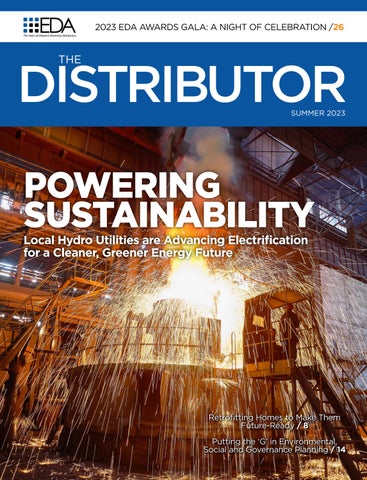

POWERING SUSTAINABILITY







FROM THE CHAIR
Sustainability:
Out
with the ‘Old’ in with the ‘New’
Welcome to the Summer issue of “The Distributor” and my first edition as the leader of your Association. I am truly honoured to serve in this capacity and look forward to working with all of you to further our progress related to sustainability, decarbonization, and a net-zero future. As we resume this journey together, I am reminded of a famous quote by Albert Einstein: “We cannot solve our problems with the same thinking we used when we created them.” This statement is particularly relevant as we work to support Ontario’s net-zero targets through sustainability efforts and decarbonization of the electricity distribution system.
Simply put, past approaches to electricity generation and distribution are not tenable and have contributed to several challenges, both environment and infrastructure related, that require a new perspective and innovative solutions. We must shift our thinking from the ‘old’ toward a ‘new’ mindset focused on sustainability and our collective decarbonized future. In this issue, we are proud to showcase the efforts and initiatives of EDA members that are leading the way in supporting sustainability, electrification, and decarbonization of the grid. Through a range of innovative programs and technologies, our members are working towards a cleaner, greener, and more sustainable energy future for Ontario.
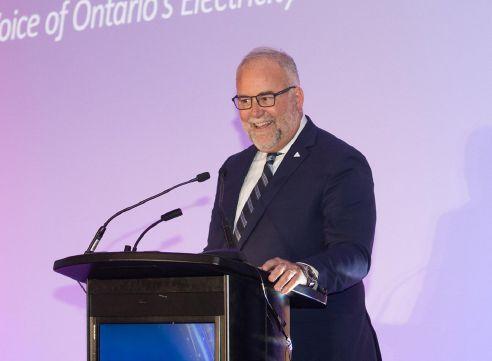
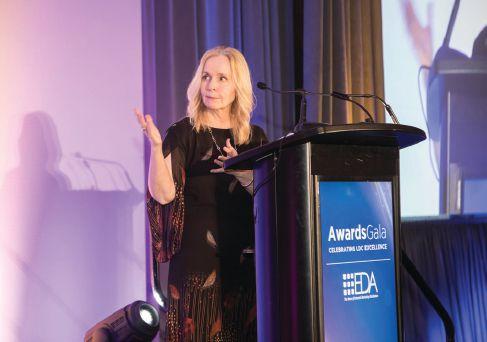
Outside of highlighting our members, this issue holds a special significance for me as it represents my first as EDA Chair. Having been appointed at our AGM in late March, I had the honour of serving as the MC of the EDA Awards Gala, and I am thrilled to see the winners’ achievements also recognized in this issue. The EDA Awards are a testament to the hard work, innovation, and dedication of our members, and it was truly a privilege to participate in that recognition. Of course, this issue also includes the regular standing items from the EDA, including news, industry and event information, and important regulatory and policy updates. We are committed to providing our members with the latest information and insights on the issues that matter most to our sector, and I hope you find this issue informative and engaging.
In closing, I would like to express my gratitude to all of the EDA members that have contributed to this issue and the broader effort to build a more sustainable electricity distribution system. Together, we can achieve great things, and I am confident that with your support, the EDA will continue to be a driving force for positive change in our industry.


Sincerely,
Tim Wilson President & CEO, SYNERGY NORTH
The Electricity Distributors Association (EDA) publishes The Distributor for its members and stakeholders. All rights to editorial content are reserved by the EDA. No article can be reproduced in whole or in part without the permission of the EDA.
PUBLISHED SUMMER 2023 FOR:
Electricity Distributors Association
3700 Steeles Avenue West, Suite 1100 Vaughan, ON L4L 8K8 www.eda-on.ca
EDA STAFF CEO’S OFFICE
Teresa Sarkesian, President and CEO
Natasha Galati, Executive & Administrative Assistant
POLICY, GOVERNMENT AND CORPORATE AFFAIRS
Ted Wigdor, VP, Policy, Government & Corporate Affairs
Derek Nardone, Director, Corporate, Government & Public Affairs
Brittany Ashby, Senior Regulatory Affairs Advisor
Paul Luukkonen, Senior Regulatory Affairs Advisor
Tina Wong, Senior Policy Advisor
Antonio Brieva, Advisor, Government & Stakeholder Relations
MARKETING, COMMUNICATIONS AND MEMBER RELATIONS
Mike Chopowick, VP, Marketing, Communication & Member Relations
Marica Macura, Director, Member Relations
Gibb McGugan, Senior Manager, Communications & Marketing
Lesia Kostecki, Member Marketing Specialist
Sari Maritzer, Communications Specialist
FINANCE AND ADMINISTRATION
Tamara Orlova, Chief Financial Officer
Arlene Klemmer, Accounting Clerk
Matthews Joseph, Senior IT Analyst
Chrissan Pascal, Office Services Assistant
PUBLISHED AND PRINTED BY ANNEX BUSINESS MEDIA, 111 Gordon Baker Road, Suite 400, Toronto, ON M2H 3R1 (416) 442-5600
annexbusinessmedia.com Agreement #: 43526108
ADVERTISING SALES titus/one mediasales@eda-on.ca
SECTOR SCAN
EDA WELCOMES NEW CHAIR AND VICE CHAIR
The EDA is pleased to announce the appointment of Tim Wilson, President and CEO of SYNERGY NORTH, as the Chair of its Board of Directors, and Indrani Butany-DeSouza, President and CEO of Elexicon Energy, as the Vice Chair of its Board of Directors. The EDA looks forward to the continued leadership of both Tim and Indrani in their new roles and the contributions they will make toward the success of the Ontario electricity sector.
EDA THANKS OUTGOING CHAIR BRYCE CONRAD


The EDA and Ontario’s local hydro utilities thank Outgoing Chair Bryce Conrad, President & CEO of Hydro Ottawa, for your leadership and dedication to the sector.


EDA WELCOMES NEW BOARD DIRECTORS
The EDA officially welcomed the full board of directors at AGM 2023 on March 27, but the association would like to acknowledge three new board members. They are: Sarah Hughes, Vice President, Corporate Services and CFO, GrandBridge Energy; Ysni Semsedini, CEO, NT Power; Megan Telford, EVP, Strategy, Energy Transition, Human Resources and Safety, Hydro One. Visit www.eda-on.ca for more information on the full slate of the EDA’s 2023-2024 board of directors.
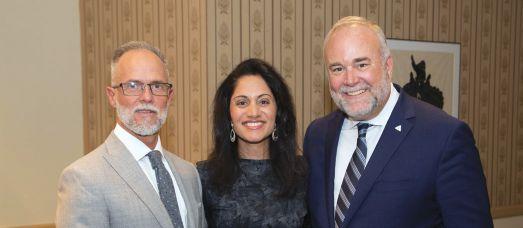
(L to R): EDA Chair, Tim Wilson, and Vice-Chair, Indrani ButanyDeSouza, greet Ontario’s Energy Minister Todd Smith at the EDA Awards Gala.
EDA ANNOUNCES NEW 2023-2024 COUNCILS AND ADVISORY COMMITTEES
EDA councils provide an important forum for members to discuss their needs, issues, and policy solutions, ensuring the Association is always on target in its advocacy efforts. Councils also offer valuable input into strategic messaging and other industry initiatives, as well as play a key role in developing policy positions for consideration by the EDA Board of Directors. The participation of more than 145 LDC employees, representing the majority of our LDC members, will evaluate issues, share ideas, and provide valuable input into EDA policy development, advocacy work, and other association activities. Our sector will benefit greatly from their contributions.
ALECTRA APPOINTS DANIELLE DIAZ AS NEW EVP AND CFO
Danielle Diaz, Alectra’s VP, Strategic Support, Treasury and Taxation, has been appointed as the new EVP and CFO of Alectra. Diaz has made significant contributions during her tenure and has been a key member of their executive team. The EDA congratulates Danielle on her appointment.
OSHAWA POWER APPOINTS NEW CEO AND STRENGTHENS LEADERSHIP TEAM
Oshawa Power Group has announced the appointment of Daniel Arbour as the new President and Chief Executive Officer. Denise Carpenter, who previously served as the interim President and CEO, will resume her role as Board Chair. The company has also made significant changes to its leadership team to reinforce its ability to achieve its goals of business transformation and modernization.
HYDRO ONE ANNOUNCES NEW LEADERSHIP AND STRUCTURAL CHANGES
Hydro One has announced two executive-level promotions and new mandates for two existing executives. The changes aim to deliver the company’s investment plan and execute on projects to support economic growth and a clean energy future. EDA Board Member Megan Telford has a newly expanded mandate and is now EVP, Strategy, Energy Transition, Human Resources and Safety.
HYDRO OTTAWA MAKES CANADA’S GREENEST EMPLOYER LIST FOR 12TH YEAR
Hydro Ottawa celebrates its 12th win as one of Canada’s Greenest Employers for its comprehensive approach to sustainability. This includes increasing clean energy production, promoting energy conservation, building LEED Gold facilities, utilizing green technology, and fostering a culture of sustainability within the company.
ELECTRIFYING SOUTHWESTERN ONTARIO WITH 148 NEW EV CHARGING STATIONS
Essex Powerlines Corporation (EPL) is a dynamic organization that is prioritizing sustainability, electrification and decarbonization of the grid. An important sector EPL is targeting to advance these objectives and achieve the Government of Canada’s goal of net-zero emissions by 2050 is transportation, which accounts for 25 percent of total emissions in the country. That’s why EPL launched its Charge Up Windsor-Essex County program, which allocated $2 million in Government of Canada funding to 148 new local EV charging stations in the region.
In 2021, EPL identified a need for additional public EV charging infrastructure in Windsor-Essex as an important step for enabling electrification locally. At that time, only 64 public EV charging stations were available in the area according to ChargeHub, a platform allowing EV drivers in the U.S. and Canada to find public stations to charge their vehicles. Although increasing numbers of Canadians have been making the switch from gas-powered to electric vehicles, EPL quickly recognized that more publicly available EV charging infrastructure would be needed to support this transition. “Range anxiety”, a worry among potential EV drivers that they could become stranded because they are unable to charge their vehicle on the road, was recognized by the organization as one of many roadblocks to EV uptake –but it was one they could help solve.
Enter the Charge Up Windsor-Essex program, which EPL officially launched in 2022. EPL created this important program to allow organizations in the region to apply for funding for public EV charging stations and
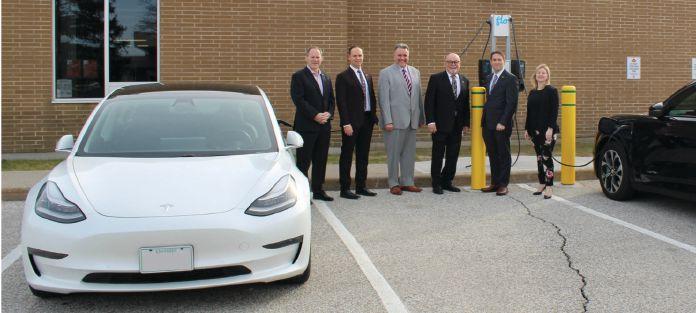
Town of Tecumseh Council stands in front of the newly installed charging station located at Tecumseh Town Hall.
accelerate electrification efforts locally. EPL received $1.7 million in funding for Charge Up after successfully applying for a grant offered by Natural Resources Canada’s (NRCan) Zero-Emission Vehicle Infrastructure Program. The organization then worked to allocate this funding to eligible applicants.
This LDC originally aimed to allocate all $1.7 million in available funding by 2024, but Charge Up attracted such a high level of interest that all funding had been allocated by April 2022, only three months after the program had officially been unveiled and one year and a half ahead of schedule.
This success is due in part to the highly effective marketing strategy the EPL team implemented to raise awareness of the program. Using a combination of email marketing, on-bill messaging, radio advertising, digital advertising and media events, the local community very quickly took notice of Charge Up and various eligible applicants came forward.
Local and national news outlets covered the Charge Up journey and various politicians came forward to show their support for the program via speaking engagements at media events planned by EPL. This included Irek Kusmierczyk, Member of Parliament for WindsorTecumseh, and the Hon. Seamus O’Regan, Canada’s Minister of Natural Resources (who now serves as Minister of Labour).
All in all, funding was allocated to 148 new local EV charging stations. A total of 23 applicants were approved, with the average


RETROFITTING HOMES TO MAKE THEM FUTURE-READY
The Alectra-led Power.House Hybrid pilot highlights the benefits of collaboration between utilities and cities, enabling the movement towards a sustainable future
By Gulnar Joshi
Spurred by consumer appetite favouring sustainability, as well as market drivers, like increasingly affordable solar technology and updated building codes – there is a pressing need for housing solutions to address climate concerns. Power.House Hybrid (PHH) is a first-of-its-kind technology demonstration project that integrates a hybrid set of electrical and thermal equipment into a virtual power plant (VPP) platform and uncovers possibilities for the next generation of smart, future-ready homes.
Power.House Hybrid is a collaborative project between Alectra Inc., Enbridge Gas Inc., the City of Markham, and Toronto Metropolitan University and is funded by Natural Resources Canada (NRCan). This project, which had a data collection period of 2021-22, has demonstrated how the integration and control of electrical and thermal technology in 10 single-family homes in Markham Ontario successfully lowered their carbon footprint and their electricity bills – as well as provided their homes with greater resiliency to address power outages experienced due to the rising frequency of adverse climate events.
WHAT MAKES PHH UNIQUE
Power.House Hybrid is a multi-pronged, flexible solution to many sustainability obstacles. Currently, residential use of clean distributed energy resources (DERs) – such as solar panels, air source heat pumps, and other

Innovative hybrid technologies like PHH are a convenient and comfortable way for residents of singlefamily homes to reduce their carbon footprint.
clean energy technologies – are individually insufficient to meet community greenhouse gas (GHG) reduction targets. Primary challenges include:
1. Optimizing household energy usage to lower the carbon footprint of homes while still meeting residents’ energy needs; and
2. Improving the sustainability and resilience of the power grid using home-based renewable DERs.
To tackle these challenges within the pilot project, 10 homes were retrofitted with advanced electrical and thermal technologies, as well as control systems, to reduce pressure on the grid during peak demand periods. Together, these homes act as a localized virtual power plant (VPP), instead of relying on large, centralized power generation. Smart electric vehicle (EV) chargers were installed to move the EV charging load to off-peak times.
THE IMPACT OF PHH
The Power.House Hybrid pilot leads the shift of energy generation away from large, centralized, GHG emission-intensive sources to cleaner, decentralized generation using solar panels, battery storage, hybrid heating (gas and electric), and combined heat and power. The operation of these electrical and thermal technologies is optimized using advanced control algorithms and grid data. Any electricity not used by an individual home is fed into the local grid to power neighbouring communities with clean energy.
Post-project evaluation found that in addition to avoiding 29.7 tonnes of carbon dioxide equivalent (tCO2e) of GHG emissions annually, which is approximately 3 tonnes per house per year, the PHH pilot also achieved the following, on average:
• Decreased total annual energy consumption by about 85 megawatthours (MWh); and
• Saved homeowners about $15,000 in annual operational cost
savings, approximately $1,500 savings per house annually.
The evaluation of the pilot also found that:
• Ability to switch between electric and natural gas heating played a role in reducing energy consumption and cost, as well as lower GHG emissions;
• Control sequences designed to minimize GHG emissions during specific time of day or time of week periods, such as during GHG peak hours, are capable of automatically reducing GHG emissions; and
• The inclusion of EV and hybrid vehicles in the PHH pilot successfully reduced GHG emissions: Fuel switching from gasoline to electricity was the major source of savings, and restrictions on EV charging during GHG peak hours further reduced emissions.
POSITIVE CUSTOMER FEEDBACK
Most participants reported they had considered and/or researched many “PHH technologies” pre-pilot but hadn’t proceeded on their own, and they appreciated the opportunity to enable and expedite their progress. This hints at the strong public interest in a sustainable future, and demonstrates a need for guidance and trusted resources to accelerate the adoption of clean technologies, which could blossom into a “hybrid movement.”
Even more so, consumers appreciated the involvement of government, municipal, and utility partnerships to accelerate their vision beyond just their personal homes, to inform policies ahead and lead the path towards net-zero communities.
For more information, visit the website at www.alectra.com/ innovation-projects.
The financial savings was not the primary motivation for me, but the fact that we could help make the grid greener and that this pilot will inform the next generation of sustainable homes.


Dry-Type Transformers for Distribution
As our cities and industries grow, so does the dependence on the reliability of the electrical infrastructure.
HPS power transformers are known for their high level of quality and service reliability.
• Cast Resin transformers up to 3MVA, 35kV Class
• VPI transformers up to 34MVA, 46kV Class
How PHH works: The installed distributed energy resources are dispatched by an advanced control algorithm.
THE REGULATORY ENERGY TRANSITION ACCELERATOR
Enabling collaboration among the world’s energy regulators as they facilitate the move to net-zero
THE CHALLENGE FOR ENERGY REGULATORS:
The transition to net-zero involves profound changes to how energy is produced and consumed, and requires the combined effort of many players, including government and policy makers, utilities, energy proponents and consumers. Although they are not always top of mind in conversations about the transition to net-zero, energy regulators are vital to the energy transition.
Energy regulators play a very important role because fundamentally, no matter the jurisdiction, the move to cleaner energy involves construction or modification of energy infrastructure. Construction of this infrastructure, including its cost consequences for consumers, requires regulatory approval, which is most often the last hurdle for a clean energy project. As a practical matter, obtaining timely approvals is crucial to a successful energy transition. Stable, appropriately funded regulators working within clear regulatory frameworks are key.
Regulatory regimes and legislative backgrounds differ across jurisdictions; however, the infrastructure involved is very similar and the policy issues and challenges faced by regulators are strikingly comparable. Regulators are well-established and well-funded in some areas of the world, and less so in others. Moreover, in many places the role of the energy regulator in the energy transition is somewhat unclear. Legislated mandates often do not clearly include a well-defined role for regulators, even as projects that further our energy transition arrive for approval at their doorsteps.
THE REGULATORY ENERGY TRANSITION ACCELERATOR
In recognition of the critical role of regulation
RETA aims to share best practices and accelerate knowledge in the areas of network planning, flexible renewable-based systems, regional interconnection, regulatory frameworks to deliver the energy transition and fair and inclusive energy transition.
and the challenges faced by energy regulators, the Regulatory Energy Transition Accelerator (RETA) was established at COP26. It was launched as part of the Green Grids Initiative by Ofgem, the International Renewable Energy Agency (IRENA), Rocky Mountain Institute (RMI), the World Bank and the International Energy Agency (IEA), which administers RETA. Approximately 30 regulators worldwide are currently RETA participants, a substantial increase since its inception a year ago.
RETA is described by the IEA as “… an initiative created to enhance the capacity of regulators to increase the speed of the clean energy transitions.” The organization works directly with energy regulators to facilitate knowledge sharing, peer-to-peer learning and thought leadership on regulatory issues. It also acts as a central resource for regulators to seek knowledge products and regulatory tools that can help mitigate challenges regulators face when trying to regulate for the sustainable, affordable and secure energy systems of the future.
In announcing RETA, Ofgem stated that, “The Accelerator will ensure that relevant knowledge and expertise from the World Bank, the IEA and IRENA as well NGOs specializing in assisting regulators are brought into its work programme.”
RETA aims to share best practices and accelerate knowledge in the areas of network planning, flexible renewable-based systems, regional interconnection, regulatory frameworks to deliver the energy transition and fair and inclusive energy transition.
In the year since its inception, RETA has increased its outreach and conducted workshops designed to increase access to existing knowledge, and importantly, encouraged and facilitated peer-to-peer contact among regulators, so that best practices and useful experience can be shared. RETA has hosted events at the latest Clean Energy Ministerial, COP27 and the upcoming World Forum on Energy Regulation, further strengthening the link between policy and regulatory decisions. It has also facilitated contact with NGOs that can provide bespoke technical assistance to individual regulators. Above all, one of the most beneficial aspects of RETA is the opportunity for one-on-one, peer-to-peer conversations between regulators, as they find ways to identify and solve for regulatory gaps through discussion of common issues.
Going forward, RETA is working with its delivery partners to coordinate a well-received knowledge exchange between small island developing states all over the world, enabling them to discuss the

Protecting the health and safety of all workers at all times is the right thing to do.
One of the most effective ways to do it is by developing and maintaining an occupational health and safety management system (OHSMS) based on COR®.
An OHSMS helps employers to manage risks, establish controls, and minimize the incidence of injury and illness to workers. This is accomplished by identifying, assessing, and controlling risks to workers in all workplaces—a particularly complex task for companies in the electrical utilities sector.
Workplaces that are COR®-certified in Ontario are proven to be 28% safer. And those that successfully implement COR® 2020 are eligible to apply for further recognition and financial rewards.
What is COR®?
COR® is a national standard that verifies full implementation of an employer’s OHSMS. Since the Infrastructure Health and Safety Association (IHSA) brought COR® to Ontario in 2012, it has been adopted by more than 670 companies. Many others are in the process of becoming COR®-certified.
Why? Because workplaces that are COR®-certified in Ontario are proven to be 28% safer.
28% safer workplaces
The University of British Columbia conducted an extensive study on the impact COR® has had on firm-level injury rates in Ontario since its introduction to the province by IHSA.
In the study, researchers concluded that COR®-certified firms experienced a 28% reduction in lost-time injury rate and a 20% reduction in high-impact injury rate (when compared to non COR®-certified firms of a similar size in the same sector).
28% Safer Workplaces
A robust, adaptable system
Because COR® is fundamentally based around a general occupational health and safety management system, it can be utilized and achieved by companies across any industry and scaled to firms of any size.
Even for companies that have appropriate policies and procedures in place, COR® can be a vital tool to help reinforce, improve, and consistently apply best practices, because it asks firms to reconsider what health and safety looks like. It’s no longer a set of individual programs to decrease risks, but rather a complete system that’s part of every business decision.
COR®’s emphasis on the plan-do-check-act cycle of continuous improvement helps companies make their health and safety processes as robust as possible while also being adaptable to changes in workplace conditions. For example, its prioritization of document control and record keeping ensures that workers in the field always have access to the most up-to-date safe work procedures.
By achieving COR®, employers are able to demonstrate that their OHSMS has been developed, implemented, and is evaluated on an annual basis through comprehensive internal and external audits.
Recognition and rebates
The COR® 2020 standard is also accredited by the Ministry of Labour, Immigration, Training, and Skills Development. Because of this, companies that have achieved COR® 2020 certification can now apply for recognition by Ontario’s Chief Prevention Officer, as well as financial rebates from the Workplace Safety and Insurance Board, through the Supporting Ontario’s Safe Employers (SOSE) program.
IHSA offers tools to help COR® 2020-certified firms apply for SOSE and create a SOSE Action Plan—a significant step toward achieving 100% compliance and demonstrating a strong commitment to workplace health and safety.
Find out more about IHSA, COR®, and SOSE by visiting ihsa.ca/cor

COMMUNITY PARTNER IN ELECTRIFICATION
How PUC has become an early mover in the energy transition
Rooted between lakes Huron and Superior, the city of Sault Ste. Marie is uniquely positioned to be a leader in the energy transition. The energy landscape is both diverse and impressive, with a renewable energy mix matched by few cities in both Canada and the U.S.
The St. Mary’s Rapids power over 200 MW of hydroelectric generation, investments into solar and wind generation represent over $1 billion, and an increasing number of battery storage initiatives are positioning Sault Ste. Marie to be a sought-after location for “green” business and industry.
The energy transition is well underway, and communities need to adapt today in order to energize the needs of tomorrow.
Robert Brewer, President and CEO of PUC Group of Companies (PUC), understands
Electrification is one of the key trends shaping the energy transition.
that the best way to support communities is by being forward-thinking and collaborative, stating, “As a community-minded utility services company for over 100 years, PUC challenged itself to not only become a key player in this transition locally, but to do it in a way that is bold, innovative, and uses partnerships to best enable a grid for the future.”
And just as energy needs are rapidly evolving, so is PUC. The PUC of today is not recognizable as the PUC even five years ago.
With a focus on sustainability and community resilience, the PUC Group of Companies has expanded its footprint to include all of Ontario, has increased its enterprise value by 40 percent in just under five years, and has become a national leader in grid modernization.
Once operational later this year, the Sault Smart Grid will become the first community-wide smart grid in Canada and transform the way we think about the distribution of electricity. Customers will experience shorter outages, average energy savings of about 2.7 percent, and a community-wide reduction in greenhouse gas (GHG) emissions.
And PUC isn’t the only forward-looking player in the Sault when it comes to reducing its carbon footprint.
as a communityminded utility services company for over 100 years, PUC challenged itself to not only become a key player in this transition locally, but to do it in a way that is bold, innovative, and uses partnerships to best enable a grid for the future.
In November 2021, Algoma Steel Inc. (ASI), Sault Ste. Marie’s largest private employer for over 100 years, announced that it would be undertaking a $703-million project to replace the plant’s existing blast furnace, coke oven batteries, and basic oxygen steelmaking operations to a pair of electric arc furnaces (EAFs).
Electrification is one of the key trends shaping the energy transition.
The impact of this transition is historic, significantly reducing carbon emissions produced by the steel manufacturer by 70 percent. To put it into perspective, this reduction in emissions is equivalent to approximately one million cars taken off of the road.
With an anticipated completion date of 2029, this project will transform ASI into a leading global supplier of green steel. According to the steel manufacturer, “The new facility will also increase steelmaking capacity from 2.8 million to 3.7 million liquid tons – that’s over 30 percent more capacity.”

Of course, such a massive transformation does not come without challenges.
At approximately 300 MW, the electricity required to power the EAFs is more than two times the load of the entire City of Sault Ste. Marie.
In comes PUC. PUC Transmission LP (TransCo) was incorporated in 2021 to provide cost-effective, locally owned and operated transmission service to Sault Ste. Marie area industries.
The new PUC 230 kV transmission line will support ASI’s plan to retire existing blast furnaces using mostly carbon-based fuel and replace them with EAFs.
As high-load industry partners, like ASI, look to make shifts in how they operate and new businesses look to relocate, TransCo will play a key role in how the community can accommodate new opportunities for growth and diversification while also lowering GHG emissions.
Establishing a transmission company within the PUC Group of Companies has provided a unique opportunity to support sustainable growth. It is part of PUC’s larger plan to reduce GHG emissions, which includes the transition to electric vehicles, battery storage programs and more.
Through curiosity, bold thinking and community partnerships, PUC is defining what it means to be a true utility partner in sustainability and responsible growth.
To learn more, you can read PUC’s Sustainability Report at www.ssmpuc.com
We have face-to-face relationships with community members - it instills trust and mutual respect.
Carey
Kostyk, Valard President
PUTTING THE ‘G’ IN ENVIRONMENTAL, SOCIAL AND GOVERNANCE PLANNING
Climate change is the most significant challenge of our time and has far-reaching environmental, social, and economic implications. The solution involves coordinated planning for a sustainable, net-zero carbon economy and shifting end uses that traditionally rely on fossil fuels, such as transportation, heating and cooling, and industrial processes, to electricity from renewable sources.
An important player in this fight against climate change is municipally owned utilities, as they are uniquely positioned to work closely with local governments and communities to advance clean energy solutions and sustainability planning. With their close ties to local communities and governments, municipally owned local distribution companies (LDCs) are well placed to develop and implement sustainable energy solutions that are tailored to the unique needs of their customers. These can include investing in renewable distributed energy resources (DERs), implementing conservation and energy efficiency programs, and exploring new technologies such as electric vehicle (EV) charging infrastructure. Moreover, as municipally owned entities, these LDCs have a vested interest in the long-term health and sustainability of their communities. This makes them well-suited to work collaboratively with local stakeholders in sustainability planning and implementing clean energy solutions.
ERTH’s successful history of deploying sustainable energy solutions in the communities of its nine municipal shareholders and the broader municipal customer base is representative of its unique position to enable climate action. Since 2015,
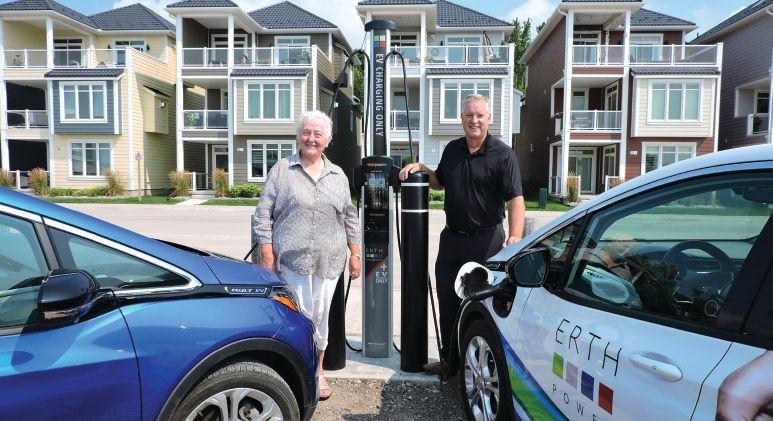
ERTH President and CEO Chris White and Mayor Sally Martin of the Municipality of Central Elgin launch the ERTH Energy Community EV Network in 2021.
ERTH has developed 850 kW of community solar generation offsetting 20 million tonnes of CO2 annually, delivered conservation and demand management solutions to its customers resulting in 24 GHh in persistent energy savings, and completed LED street lighting retrofits for over 60 municipalities saving them over 15,330 MWh/year. These climate actions were recognized when ERTH’s President and CEO, Chris White, was named to Canada’s 2021 Clean50 list for his activities in embracing renewable DERs and evolving the traditional utility business model.
In recent years, ERTH deployed the ERTH Energy Community EV Network, a charging network of 29 chargers spanning ERTH’s service territory of 15 shareholder communities from Lake Erie to Lake Huron. ERTH also developed the ERTH EV Readiness Checklist designed to help municipalities prepare for the expected increase in EVs, charging stations, and potential funding for electrification. This checklist was developed to provide ideas related to transportation electrification over the range of activities that municipalities regularly consider, such as permitting, planning, zoning, codes, inspection, parking policy, and more.
Moving forward, ERTH wants to magnify the scale and scope of its climate action by developing a formal environmental, social, and governance (ESG) planning and reporting framework, and embedding ESG performance into ERTH’s business and strategic plans. Before


embarking on any new environmental and social initiatives, however, ERTH realizes that a strong governance framework is a critical starting point. Governance is often the forgotten element of ESG practices as issues such as climate, energy efficiency, labour practices, and supply chain management tend to get more attention. ERTH believes that getting governance right not only brings its own sustainability benefits, but it is also foundational to making progress on the other ESG fronts of environmental and social. “Although governance doesn’t have as much attention as the environmental and social issues, we believe that successful business, environmental, and social strategies all stem from good governance,” says Chris White, President and CEO of ERTH. “Governance can’t take a back seat to environmental and social concerns. Instead, governance plays an equally important role in
mitigating the threats that can arise from poor environmental and social performance. Good governance also promotes organizational ethics and transparency.”
To this end, the ERTH board of directors approved a comprehensive Sustainability Policy in early 2023, which codifies ERTH’s commitment to measuring, monitoring and improving the ESG performance of its group of companies. The new policy describes how ERTH’s operations, services and supply chain will be continually reviewed and improved, so that it can integrate environmental and social considerations into everyday practices and make a positive contribution to society. In addition, ERTH established a new standing ESG board committee, which will oversee ERTH’s environmental and social performance and guide management in its ESG planning and reporting efforts.
In 2023, ERTH will undertake a
comprehensive sustainability planning exercise that involves identifying ERTH’s key ESG metrics that will be measured and managed, and commencing a baselining of those key metrics, which are expected to include emissions, energy affordability, workplace health and safety, and others. In undertaking this materiality assessment, ERTH will be guided by the ESG reporting standards expected this year from the International Sustainability Standards Board. Once completed, ERTH will develop and deploy a Climate Action Plan, which will establish net-zero targets and sustainability strategies to achieve those goals, and a 10-year Diversity, Equity and Inclusion Plan to promote diversity, equity, and inclusivity in the workplace. The results of ERTH’s performance against these plans will be reported in its first annual ESG report, expected in 2024.

Tyler Moore VP Energy & General Counsel ERTH Corporation


“No other service provider understands LDCs better than we do”
Acronym Solutions


THE CHANGING FACE OF DIGITAL
Keeping pace with change, challenges and new opportunities
The current “digital-first” imperative is forcing businesses to make a choice: transform at the pace of technical change or risk being displaced by more agile players.
In the world of Local Distribution Companies (LDCs), it has become increasingly apparent that their futures are inextricably linked to the digital landscape. According to a recent report from Accenture, 96% of utilities executives agree that emerging technologies are enabling their companies to thrive in this new era.
The industry is seeing unprecedented opportunities as innovation drives rapid cost reductions for key building blocks. Faster, cheaper, more powerful computing and improved connectivity are
fueling the growing deployment of technologies, such as advanced analytics, cloud computing, and AI, to name a few. These disruptive forces are transforming the industry, driving it toward a new future. And that future is bright.
But the journey from legacy systems to state-of-the-art infrastructure can be fraught with uncertainty and high costs. The good news? There’s still time to get ahead. At a minimum, companies must build a digital foundation with
partners who understand their unique challenges and vision. Now more than ever, LDCs require utility-grade networks
that meet much higher standards in terms of security awareness and remote access connections.
ACRONYM SOLUTIONS HELPS LDCS FUTURE-PROOF THEIR BUSINESS
When you spend 20+ years building and managing the technology for a major utility, you see the delta between a utility-grade network and a less robust network.
As a facilities-based carrier, Acronym Solutions provides
high-capacity, diverse, and secure fibre-optic connectivity to organizations with broadband network requirements as well as voice and collaboration, cybersecurity, cloud and managed IT services. They understand the complexities of
“We’re passionate about helping LDCs overcome their challenges and thrive in today’s dynamic energy market.”
an LDC’s business and specialize in providing scalable and secure solutions. As digital technologies continue to advance, they create a variety of challenges, risks, and possibilities for LDCs. Acronym offers support to LDCs to help them effectively deal with these changes and take proactive steps to shape their digital futures.
“No other service provider understands LDCs better than
we do, and we’re confident that we have the knowledge, expertise, and commitment to help them succeed,” said John Papadakis, President and CEO of Acronym Solutions.
From streamlining operations, reducing costs, improving cybersecurity and ensuring network reliability to meet growing demand, Acronym has solutions geared specifically toward the challenges LDCs face.
A TRUSTED PARTNER: HELPING HYDRO ONE SUCCEED
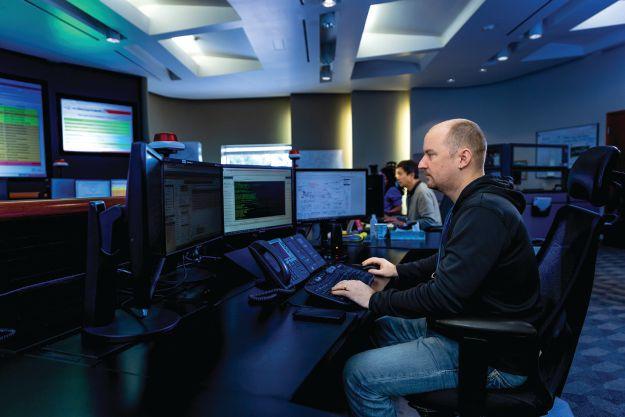
Acronym, formerly Hydro One Telecom, has more than 20 years of experience managing the communications network that enables Ontario’s electrical grid. Through custom-built, highly secure and georedundant network operations centres, Acronym partners with Hydro One to oversee the communications systems of the electrical transmission infrastructure.
Acronym also plays an instrumental role in assisting Hydro One with the design and architecture of new networks, sites, and facilities. With its expertise in developing robust and efficient infrastructure, Acronym has empowered Hydro One to transform its Local Area Network (LAN) and Wide Area Network (WAN). In addition to design and architecture, Acronym provides comprehensive monitoring and management services for Hydro One’s expansive network, taking
care of inventory management and ensuring equipment is always up to date with the newest and most cuttingedge technologies for optimal performance.
The evolution of this partnership is a testament to Acronym’s ability to deliver best-in-class ICT solutions for the most complex challenges. Acronym is uniquely positioned to understand the missioncritical needs of any business and provide innovative and reliable services that respond to the changing demands of today’s environment.
“As the name Acronym suggests, we take highly complex situations and simplify them for our customers,” said Papadakis. “We’re passionate about helping LDCs simplify their business and leverage their infrastructure to capitalize on new and exciting opportunities emerging in today’s dynamic energy market.”
To learn more about Acronym Solutions and how they can help your business succeed, visit their website or call toll-free at 1 (866) 345-6820



We help companies accelerate growth through fully managed, secure, and scalable digital transformation.





















HYDRO ONE TO LAUNCH SUSTAINABLE FINANCING FRAMEWORK
A Canadian Utility First
Hydro One has made history as the first utility in Canada to launch a Sustainable Financing Framework emphasizing its commitment to building a more sustainable and equitable future for the communities it serves. By issuing sustainable financing instruments such as sustainable bonds, the company and its subsidiaries can allocate the net proceeds to invest in eligible green and social project categories, including clean energy, energy efficiency, clean transportation, and socioeconomic advancement of Indigenous peoples, and access to essential services such as the electrical grid and the enablement of high-speed broadband internet. By investing in eligible green and social project categories, Hydro One aims to support the achievement of the United Nations Sustainable Development Goals while also enabling a greener Ontario.
With the majority of Ontario’s electricity mix already composed of carbon-free sources, Hydro One will use sustainable and green issuance as an important enabler to continue the decarbonization of the grid. The company views much of its capital expenditure projects as eligible under the Framework, which aligns with market taxonomies and has received a positive second-party opinion from Sustainalytics, a global leader in

providing environmental, social and governance (ESG) research and analysis.
Hydro One’s commitment to sustainability extends beyond its environmental goals of achieving net-zero GHG emissions by 2050, and a 30 percent reduction by 2030, but also includes social initiatives such as supporting Indigenous reconciliation. Hydro One’s equity partnership model, another first in Canada, offers First Nations a 50 percent equity stake in all future large-scale capital transmission line projects, with agreements in northwestern Ontario already confirmed with nine communities for the Waasigan Transmission Line a new double-circuit 230 kilovolt (kV) transmission line between Lakehead Transmission Station (TS) in the Municipality of Shuniah and Mackenzie TS in the Town of Atikokan, and a new
single-circuit 230 kV transmission line between Mackenzie TS and Dryden TS in the City of Dryden.
The company has also committed to increasing Indigenous procurement spend to 5 percent of its purchases of materials and services by 2026, and on many of its major projects, and is holding its suppliers to similar standards.
Chris Lopez, EVP, Chief Financial and Regulatory Officer at Hydro One, explains that aligning the company’s funding strategy with its sustainability goals will further its journey towards a more equitable and sustainable future. “Ontario is already home to one of the lowest carbon-emitting electricity grids in North America, and Hydro One is uniquely positioned to enable the energy transition to achieve the shift to a low-carbon economy. Our focus is on minimizing the impact
on ecosystems and contributing to the well-being of people, the planet and all the communities we serve.”
This past January, the transmission and distribution company issued $1.05 billion of sustainable bonds – the largest aggregate amount issuance of sustainable bonds by a corporation to date in Canada. These actions further emphasize Hydro One’s commitment to building a more sustainable and equitable future for the communities it serves.
The company understands it still has work to do and is committed to reporting transparently on its progress towards achieving its goals. To demonstrate its strong commitment, in 2022, Hydro One became the first organization in Canada to incorporate a sustainability performance measure that was based on increasing Indigenous procurement spend by amending its syndicated lines of credit to include pricing adjustments related to performance in the priority areas of Indigenous procurement, fleet conversion to electric vehicles and hybrids and gender diversification at the executive and board levels.
Through Hydro One’s Sustainable Financing Framework, the company is not only demonstrating its commitment to sustainability but also leading the way for other utilities in Canada to follow.







THE CARBON CREDIT MARKET
On June 21, 2022, the Clean Fuel Regulations (CFR or Regulations) came into effect. The CFR requires producers and importers of liquid fossil fuels, such as gasoline and diesel, to focus on the reduction of the carbon intensity (CI) of these fuels or to invest in alternative products. The Government of Canada expects these reductions will result in a 15 percent decrease in the CI of liquid fuels below 2016 levels by 2030.
Some components of the CFR are currently in place, including registration requirements, applications for approval of CI for fuels and applications for the recognition of emission reduction projects and compliance credit creation. Other components will come into effect in the near future. Most notably, the obligation to achieve prescribed CI reduction requirements does not come into effect until July 1, 2023.
Interestingly, CI tracks the carbon that is released over the full lifecycle of the fuel, including extraction, refining, processing, distribution, and end use.
Producers and importers of liquid fossil fuels (referred to as “primary suppliers”) are required to reduce the CI of their fuels from a prescribed baseline to the annual CI limit. The CI limit will be lowered each year between 2023 and 2030. Primary suppliers can comply with the CFR through three pathways:
1. Compliance category 1: Undertake projects that reduce the lifecycle CI of fossil fuels (e.g., use of renewable electricity at production facilities, carbon capture and storage, co-processing of fuels, etc.)
2. Compliance category 2: Supply the Canadian market with low-carbon fuels, such as ethanol and biodiesel.
3. Compliance category 3: Supply fuel or energy to advanced vehicle technology (e.g., electricity or hydrogen for use in vehicles).

Primary suppliers can create compliance credits by pursuing activities in any of these categories or purchase credits created by other participants in the CFR credit market, referred to in the Regulations as “registered creators.”
Compliance can also be achieved through contributions to a registered emission-reduction funding program. Primary suppliers may rely only on contributions to the compliance fund for up to 10 percent of their annual CI reduction requirements.
The Regulations set up a credit market wherein each credit represents a lifecycle emission reduction of one tonne of carbon dioxide equivalent. For each compliance period (typically a calendar year), primary suppliers must demonstrate compliance with CI reduction requirements for the fuels they produce or import by either creating or acquiring credits and then using the required number of credits toward its compliance obligation.
Credits can be acquired through direct trading with other market participants or through a credit clearing mechanism. The credit clearing mechanism can be used only if a primary supplier is not able to satisfy its obligations by using credits it has created or acquired through direct trading. The CFR set a maximum price for credits acquired, purchased, or transferred in the compliance credit clearance mechanism. If the credit clearance mechanism does not have sufficient credits to satisfy all primary suppliers’ outstanding obligations, each primary supplier will be eligible to acquire a prorated amount of the available credits.
Compliance credits will be registered and traded via the Credit and Tracking System (CATS). CATS is currently used by participants in the federal Output-Based Pricing System and GHG Offset Credit System. The CATS platform will also be used by primary suppliers, registered creators, and verification bodies to perform functions such as registration, applying for approval of CI, managing credit creation and credit transactions, and complying with periodic reporting requirements.
A key piece of Canada’s plan to hit its emissions target for 2030 and get to net-zero emissions by 2050, the CFR is expected to drive significant economic opportunities in the development and use of clean fuels and technologies.
As the industry works towards CFR compliance, companies and their advisors will need to be agile and responsive to a credit market that may see volatility in pricing as it reaches maturity.
Barry Griffiths, CPA, CA Principal at Grant Thornton LLP

OEB PROVIDES NEEDED GUIDANCE ON ENERGY TRANSITION

Ontario’s LDCs are at the epicentre of the transition to a carbon-neutral world, the achievement of which depends largely on greatly increased electrification of everything from transportation to buildings. The challenge for Ontario LDCs is that although change is required, the traditional role of the LDC remains fundamental. The LDC “day job” will still be vital even while new costs are incurred, and possible new activities are explored with a view to furthering the energy transition.
The changing energy landscape offers both opportunities for unprecedented growth and challenges as the role of the LDC expands. Many of these challenges revolve around uncertainty as to the future role of the LDC and questions around recovery of the costs associated with the demands of the energy transition.
LDCs are regulated by the Ontario Energy Board (OEB), and most if not all of the monies expended on energy transition by distributors will come from the rates approved by the OEB. The OEB in turn must adhere to a legislative and regulatory framework dictated by its governing legislation, and by wellestablished legal principles that have served the energy sector well for many years. While these tools are suited to address the current stages of the transition, in his Letter of Direction issued in October 2022, the Minister of Energy asked the OEB for its best advice for additions or changes to its governing legislation. That advice will be delivered by the end of June 2023.

Mary Anne Aldred, Strategic Advisor, Norton Rose Fulbright Canada LLPFormer Chief Operating Officer and General Counsel at
the OEB.
In the meantime, the OEB has been turning its mind to the needs of its regulated entities as they navigate the energy transition and there are now answers to some important issues, with work progressing well on others. The OEB launched an initiative called the Framework for Energy Innovation (FEI) in 2020. The final report on that initiative released in January of this year provides helpful guidance to the sector on several issues important to LDCs.
REGULATORY PRINCIPLES
One of the more foundational aspects of the report is a set of regulatory principles which describes the lens through which the OEB will examine policy initiatives designed to further the energy transition. Although developed by the OEB to inform its own policy work, they are well worth bearing in mind as LDCs consider new activities and investments for which they will seek funding through distribution rates. In summary the principles are: to protect the public, to ensure the regulatory framework is clear, predictable and flexible and lastly, to drive sector performance.
ROLE OF THE LDC
An overarching question has been whether the role of the LDC needs to change, and if so, how. The FEI report acknowledges the primacy of this issue. Given that the OEB is not able to define the role of the LDC in isolation from other energy sector agencies and participants, it does not purport to provide the final word on the matter, but it does make very clear its own expectations of LDCs:
“To support the cost-effective provision of distribution service that provides long-term value to customers, the OEB expects distributors to factor DER integration, consistent with the pace of DER [distributed energy resources] adoption, into their planning and operations and consider DER solutions (NWAs) when assessing options for meeting system needs. Although these activities may be relatively new, or not yet routine for some distributors, the OEB expects that over time they will become business as usual.”
This statement is one of the most important aspects of the FEI report, as it provides clarity that the OEB actively requires LDCs to
consider the role of DERs as they plan their systems.
COST RECOVERY
In the context of costs driven by the energy transition, and as non-wires alternatives are considered, cost recovery is another one of the main issues for both LDCs and the OEB. For the LDC, the issue is what energy transition costs can be recovered and whether costs incurred now in a time of uncertainty can be recovered in rates even in cases where, at the end of the day, a particular investment was not optimal.
For the OEB, the issue is that its long-standing test for cost recovery in rates is whether a particular cost was prudently incurred. At a time when costs are certain to mount and uncertainty prevails, the challenge for LDCs and the OEB is that this test could become increasingly difficult to apply or result in unexpected disallowances if not applied in a flexible manner. Further, even as it seeks to provide needed flexibility as the energy transition unfolds, the OEB still has a fundamental duty to ensure that ratepayers are protected.
The FEI report recognizes this issue and proposes to establish a net benefit test to assist LDCs as they evaluate investments:
“Establishing a common BCA Framework is intended to support consistent evaluation of DER solutions across distributors and reduce uncertainty about how DER proposals will be assessed by the OEB in rate applications.”
Although it is arguable that DERs should be assessed by taking into account their broader system or societal benefits, for now the OEB states that it will concentrate on the costs and benefits for the implementing distributor’s customers as it assesses rate applications. Work on developing guidelines and tools will be complete by end of fiscal 2023.
INCENTIVES
In the normal course, when assets are added to a distribution system, they become part of the utility rate base and a return is earned. However, when non-wires alternatives are incorporated into the system, it is likely that no return is earned by the distributor, as these investments are often non-capital in nature. The FEI report recognizes that this reality may be a disincentive to deploying this type of investment. The OEB, therefore, proposes to allow LDCs to apply for one of three types of incentives:
“Providing incentives for distributors to deploy third-party owned DERs as NWAs is a way of addressing this barrier in the near term, without revisiting the fundamental approach to how utilities are remunerated and the overall rate-setting framework.”
On March 28 the OEB published guidelines that delineate the three types of permitted incentives and the type of evidence needed to support the request for such incentive mechanisms for third-party DERs used as non-wires alternatives. The guidance indicates that the OEB will consider shared savings mechanisms, performance target or scorecardbased incentives or allow a distributor to add a margin on payments it makes to DER providers for providing services to the distribution system.
CONCLUSION
The FEI report is one of several important initiatives happening in Ontario as participants in the energy sector seek to address the many issues associated with the challenges of electrification. Although issues remain and more will no doubt arise, the FEI report provides guidance as the OEB clearly indicates its expectations regarding the role of the LDC, plans for the development of an investment test and addresses the issue of incentives.

UBIQUITOUS COMMUNICATION IS KEY TO ACHIEVING NET-ZERO
Here is my take on net-zero CO2 math as it applies to Ontario. In energy terms, the oil industry here is almost three times the size of the electric industry and traction (an old word) accounts for 70 percent of petroleum usage. Even though electric vehicles get four times the mileage of gasoline and diesel-powered vehicles per unit of energy, that still adds a whopping 90 percent to the amount of locally distributed electricity. All those buses, cars and trucks will need to plug in somewhere.
Still, be grateful you aren’t an oil refiner, 70 percent of whose clientele is supposed to disappear. The remaining 30 percent now rely on the refinery by-products for everything from asphalt to plastics. Without the traction market, we might have to revert to old-style electrochemistry (acetylene, hydrogen, etc.) to keep their clients going. At least those old electrochemical technologies were geared to the use of interruptible electric power, of which there will be a lot.
Then there is natural gas. In energy terms, it is twice the size of the electric industry in Ontario, and though cleaner than oil, it still dumps much CO2 into the atmosphere. The thought that this energy load – primarily heating – will move onto our electric distribution grid by 2050 seems daunting. The engineers in the room will point out that here, too, electricity offers significant advantages. It has been known for years that electricity, coupled to a heat pump, can move from four to five times more heat to or from a building than the equivalent amount of energy delivered in the form of natural gas. However, that is only true year-round if the heat pump is connected to the ground. Most heat pumps today move heat between the inside of the building and the outside air – not very

In 1998, Jan Peeters founded Olameter, a utility services company where he is currently CEO and principal shareholder.
useful in the dead of winter (full disclosure – I once owned a restaurant in Montréal that used ground-coupled heat pumps, humming quietly in the basement, and were in operation for 80 years until I got out of that business).
The hitch here is the cost of drilling all those geothermal wells. Today we consider that a building lot is “serviced” when it has access to drinking water, drainage, sewage, sidewalks, roads, street lighting and signalling, not to mention electricity, gas, and communications. Will geothermal wells be added to this “basic” infrastructure list? Well, yes, if we are serious about net-zero CO2 . It cannot be done otherwise.
The supply of electricity to the home, school, store, office, factory, or farm is in for a massive expansion between now and 2050. Most businesses – but seemingly not ours – would drool at the thought of this much growth.
Ironically, our distribution capacity is not as bleak as the picture I just painted would suggest. By my reckoning, we have vast amounts of unused distribution capacity between peak load periods. However, this capacity is useless unless we can “trickle” feed energy to storage devices that lie physically close to the end user.
Local energy storage, whether in vehicles or otherwise, has advanced considerably in recent years. In 2010, 1 kWh of lithium-ion battery storage cost US$1,000. It costs only US$100 today. This is due mainly to scale effects. For instance, the first Northvolt plant in Skelleftea, Sweden, will produce 32GWh of batteries for the European car industry this year at an expected price of US$80 per kWh. And that scale continues to grow, though rather slowly here in Canada. We only expect to begin production in Ontario in 2027, by which time this one Swedish startup will have trebled the size of Skelleftea, started on three more fabrication sites (Sweden, Germany, U.S.), plus a battery recycling plant (Norway). (Score at the end of the first period: Sweden 1, Canada 0.)
Clearly, onsite storage of electricity and pumping of heat lie at the heart of the trebling the kWh needed to achieve net-zero CO2 emissions. Distribution utilities are turning to the Internet of Things (IoT) to provide the single “pane of glass” needed to monitor and control all the devices involved – both on the grid and, with the property owner’s permission, behind the meter. Equipment vendors, reluctantly in some cases, are turning to open (rather than proprietary) communications standards. Fortunately, progressive players, such as Ericsson and Deutsche Telekom, have assembled a coalition of essentially all the cellular carriers in North America to pool their assets and enable utilities to plug in any vendor’s equipment anytime, anywhere and communicate for just pennies per month.
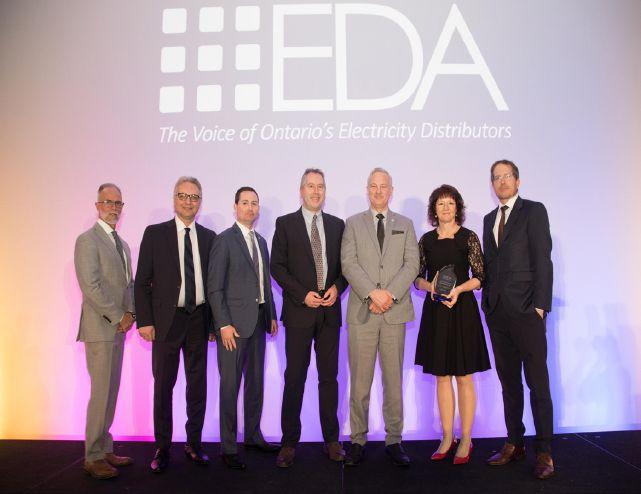
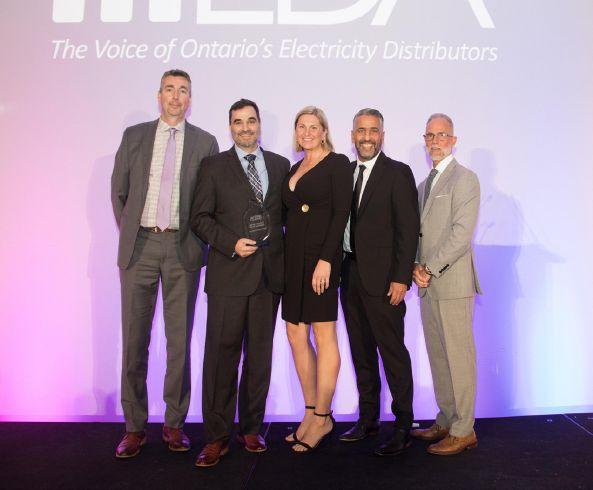
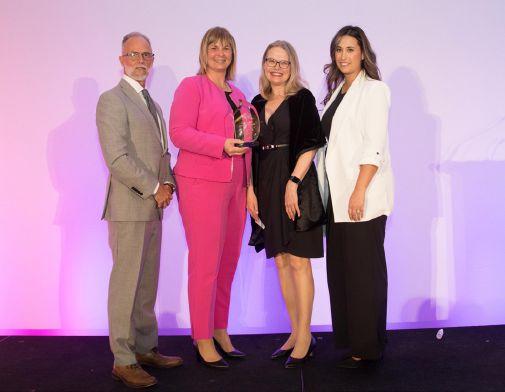
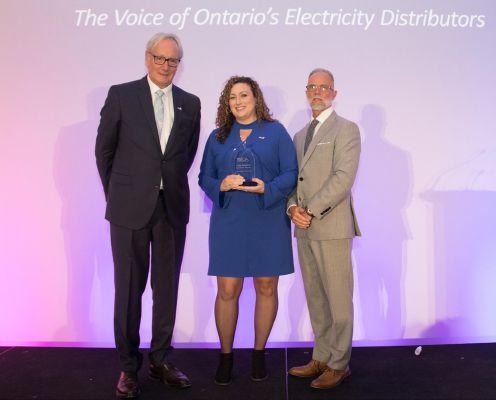
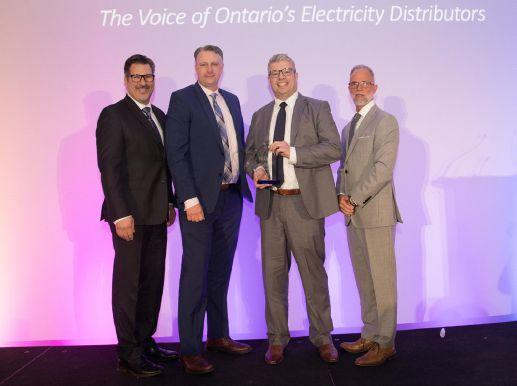
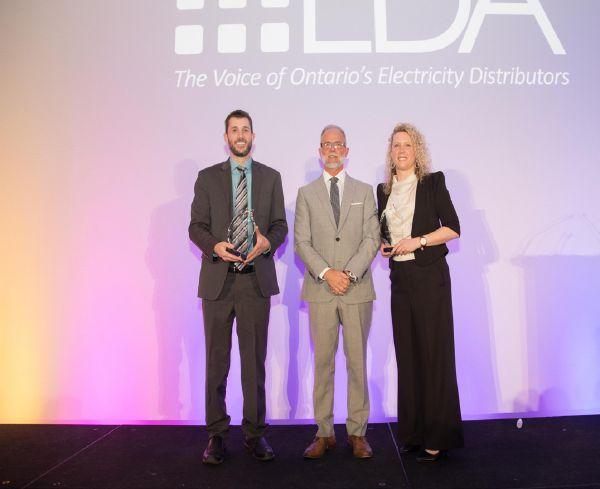
On March 27, more than 500 members, industry professionals and electricity sector stakeholders gathered for the EDA Awards Gala to celebrate the exceptional achievements of Ontario’s electricity distributors in various categories, including customer service, safety, and environmental excellence. As a member-driven association, the EDA is proud to honour not only the innovative programs and initiatives of this year’s award winners but also the success and advancement of all LDCs as they serve their customers and communities.
Check out the photos of the event over the next few pages and join us in congratulating all the 2023 award winners for their impressive contributions to

2023 EDA AWARDS A Night of




The Public Electrical Safety Excellence Award, sponsored by the Electrical Safety Authority (ESA), was awarded to Elexicon Energy for collaborating with Kids’ Safety Village Durham to provide virtual and in-classroom electrical safety presentations for students in Grades one to three.
LDC Performance Excellence Award, sponsored by GrantThornton, was awarded to Oakville Hydroforitscomprehensiveapproachtoemployeesafetyandmentalwellness, demonstratingstrongservicereliability,sustainability,andsystemperformance,while providing innovative, customer-centric solutions and philanthropic initiatives that support variouscommunityeventsandnon-profitorganizations.
The Customer Service Excellence Award was presented to Essex Powerlines Corporation for its new app-based system, which enhances the customer experience, increases workplace flexibility, and assists with regulatory reporting through real-time feedback mechanisms.
AWARDS GALACelebration
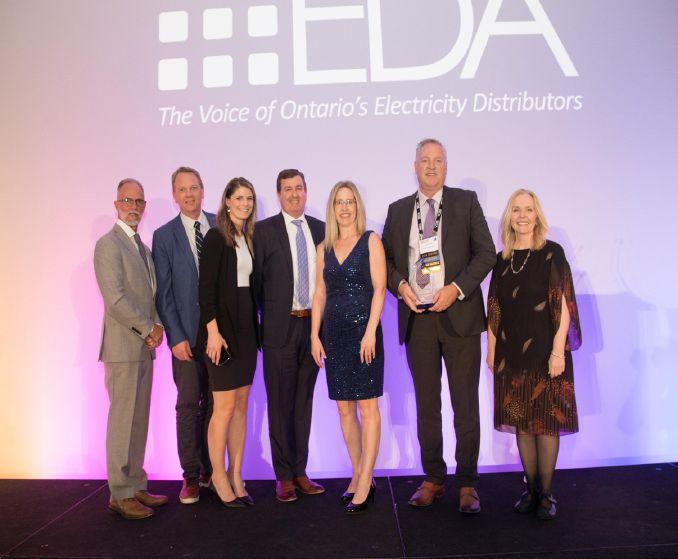


TheEnvironmentalExcellenceAwardwaspresentedtoHydroOneforoutstandingeffortstohelpcustomersreducetheircarbonfootprintthroughpartnershipsand communityplanning.HydroOnepartneredwiththeTorontoandRegionConservation AuthoritytocreateawetlandhabitatadjacenttoitsKleinburgTransformerStation
TheInnovationExcellenceAward,sponsoredbytheIndependentElectricity SystemOperator(IESO),waspresentedtoERTH Power Corporationinrecognitionof developingitsGreenButtonsolution,whichwillbeimplementedbymorethan50percent ofOntarioLDCsasapracticalandcost-effectiveoption.

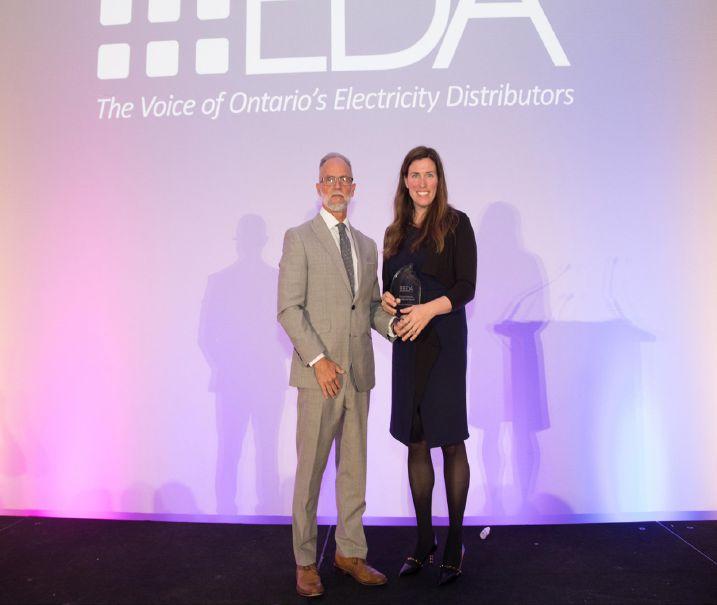


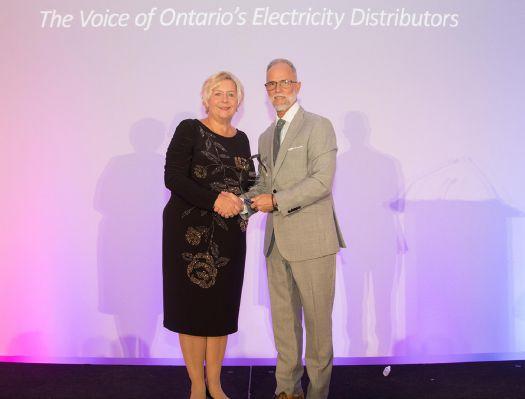
A Chair’s Citation, in Memory of Robert H. Hay, presented to Helga Reidel, former President and CEO of ENWIN Utilities Ltd., her service and significant contributions to the EDA and the electricity distribution sector.








recipient receiving $73,913 in funding. In 2022, 44 Level 2 chargers and one fast charger were installed through Charge Up. This year, nine Level 2 chargers and one fast charger have been installed to date, with more on the way.
bringing sustainable options to Windsor and Essex County. We would like to thank the Government of Canada and Essex Powerlines for making this possible.”
EPL is currently exploring promising opportunities to further expand the program in the near future.
Learn more about Charge Up at www.essexpowerlines.ca. CONTINUED FROM PAGE 6
Coordinator. “Charge Up has been tremendous in moving electrification forward at the local level and aiding in the transition to a low-carbon economy. We are thankful for the program funding from NRCan.”
“Charge Up has been an important contributor to electrification at the local level,” said Gary McNamara, Chair of Essex Power Corporation and Mayor of the Town of Tecumseh. “This is just the beginning of
NORTON ROSE FULBRIGHT
CONTINUED FROM PAGE 10
“We’re proud to support the deployment and installation of EV charging infrastructure in the region,” said Eric Freeze, Project
With Essex Powerlines at the helm, the EV transition is sure to continue its smooth ascent in Windsor and Essex County.
particular challenges they face. Along with the IEA and the World Bank, it is working on issues specific to regulators arising from interconnecting grids, undertaking a global review of regulators’ mandates relating to energy transition, and establishing a knowledge hub to bring together worldwide knowledge in an accessible way that will also help to facilitate peer-to-peer exchange.
Whether from the point of view of a government agency, regulator, regulated entity or a project proponent, RETA is a timely and beneficial
initiative. As a practical matter, obtaining timely approvals is crucial to a successful energy transition. The best new technology in the world will not provide any benefit if it isn’t built because of lack of regulatory clarity.
Broad participation in RETA should help ensure that all regulators find a way to move towards integrating energy transition into their processes and thinking. This integration is crucial, as at the end of the day, it will not be possible to transition to net-zero without robust and well-understood regulatory frameworks.

Transitioning to a decarbonized grid begins with a deep understanding of new technologies, energy distribution and policy. Combining a fully global perspective with local knowledge, we provide advice on all legal issues in the energy sector. When your target is sustainability and net zero, we understand your needs. Law around the world nortonrosefulbright.com
ADVOCACY IN ACTION

(L to R): Vinay Sharma, London Hydro, Energy Minister Todd Smith, Brandon Weiss, Wasaga Distribution, Ted Wigdor, EDA, attend the launch of the ULO price plan.
LDCs LAUNCH ULTRA-LOW OVERNIGHT (ULO) PRICE PLAN
The Ontario government is launching its new Ultra-Low Overnight price plan as part of its goal to provide consumers with additional choice and flexibility to manage their energy costs and consumption. Ted Wigdor, Vice President, Policy, Government and Corporate Affairs, attended the launch on behalf of the Association, with remarks highlighting that the new plan provides customers with pricing options to fit their business and lifestyle needs. We welcome this initiative as a positive step towards supporting electrification and a sustainable energy future in Ontario. Starting May 1, 2023, Ontario LDCs can begin to offer this new optional electricity price plan, with all utilities required to offer it to customers within six months, by November 1, 2023.
EDA SECURES EV POSTAL CODE DATA FOR LDCs
As originally announced by Minister Smith at the EDA Awards Gala, the government has provided the EDA with the Ministry of Transportation’s EV database for LDCs’ use in targeting infrastructure investments to support the ongoing electrification of transportation. The databases provide EV registration data by three-digit postal codes across the province and six-digit codes wherever there are five or more EVs. The EDA’s LDC members can access the databases on the EDA website or by scanning the QR code. This new resource represents significant advocacy in a short time frame on behalf of our members, and the EDA appreciates that Minister Smith truly understands the needs of our sector and is willing to work quickly to address our concerns.
CRITICAL CONVERSATIONS
In efforts to maintain open communication with the full spectrum of political stakeholders, the EDA recently met with Peter Tabuns, NDP Energy Critic and MPP for Toronto-Danforth, to provide an update and overview of the current energy landscape in Ontario, LDCs’ conservation efforts and capabilities, and our role in the electrification of the grid.
EDA Board of Directors hosted Electrical Safety Authority (ESA) President and CEO Josie Erzetic at a recent board meeting to discuss a range of topics, including priorities of ESA related to its strategic plan, communications collaboration with the sector, particularly post-outages or major weather events, and its role in the electrification and energy transition. We appreciate the ongoing constructive dialogue with our safety regulator, especially regarding the well-being of our staff and customers. The EDA also recently met with Rob Flack, MPP for ElginMiddlesex-London, and new ADM Tamara Gilbert, from the Conservation and Renewable Energy Division, Ministry of Energy.

ELECTRIFICATION AND ENERGY TRANSITION PANEL NEXT STEPS
Tasked with developing an effective pathway to increasing electrification and the transition to clean energy, the “Collie Panel” has identified five thematic areas that it will consider in its recommendations to Minister Smith: energy planning; governance and accountability (the role and responsibilities of government and its agencies); technology, both existing and innovative new solutions; affordability (community and customer perspectives); and economic growth. On April 4, the EDA Board of Directors met with the full Panel to share our vision for the utility of the future, address the Panel’s questions and provide information on members’ organizational priorities, challenges, and opportunities relating to the electrification and energy transition. The Ministry is launching a series of workshops in May on the key themes of the Panel mandate, and the EDA has been invited to participate. We will then complete and file our submission to the Panel before the end of the spring.
EDA PARTNERS WITH IESO ON CONSERVATION WORKING GROUP
The EDA continues its work with the IESO on conservation and establishing the structure for LDCs’ resumed role in Conservation and Demand Management (CDM) post-2024. With our policy paper, The Power of Local Conservation, as a catalyst, the IESO, in collaboration with the EDA and Ontario Energy Association, has struck a Conservation Working Group to examine a long-term funding model on LDC-delivered CDM and engage LDCs on how best to manage governance, administration, and costs. Comprising of representatives from 11 LDCs, the group intends to release a report and model structure by the end of June 2023.
Peter Tabuns and Teresa Sarkesian.


UNLOCKING INSIGHTS THROUGH INNOVATION
The way assets are managed continues to evolve. That’s why we continuously leverage technology to deliver best-in-class infrastructure and energy services. It’s how we ensure that your assets deliver optimal performance while keeping communities safe and connected.
From concept and design to engineering, construction and comprehensive field services, our integrated solution has you covered. With a simplified approach and the right data in hand, you can make the right decisions to support your organization’s bright future.
Visit OECORP.CA to find out more or email us at info@oecorp.ca to get started.