ADDITIVE MANUFACTURING
Using AI to develop 3D-printable metal alloys p.12
MATERIALS
Updates on the growing field of plastics engineering p.15
CAD REPORT
Developments from Autodesk University 2026 p.18 DESIGN-ENGINEERING.COM NOVEMBER/DECEMBER 2026
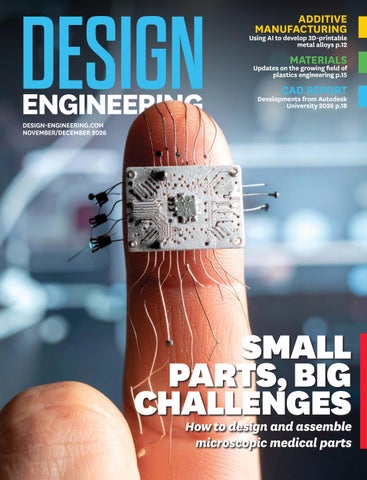
SMALL PARTS, BIG CHALLENGES How to design and assemble microscopic medical parts
November/December 2026
design-engineering.com
12 16
INSIDE
8
Cover photo: © Mahmudi / Adobe Stock
8 Medical devices
Miniaturization is now a defining feature of many new medical device compoments. Device designers must be able to meet the demands of precision, compliance, and scalability.
12 Additive manufacturing
Ontario researchers use AI to develop tough new 3D-printable metal alloys. PLUS: 3D-printed objects developed by MIT researchers can signal improper usage.
15 Materials
Updates on the growing field of plastics engineering.
Columns 4 From the Editor Staffing up in 2026
5 Design News
Engineers Canada extends international mobility work, Nunavut’s first factory opens
18 CAD Report
Learning about Autodesk AI plans from AU’26
20 Idea Generator
The latest industrial products
22 Canadian Innovator A bridge not too far
November/December 2026 DESIGN ENGINEERING 3
FROM THE EDITOR
UPFRONT
Staffing up in 2026 It’s not exactly breaking news that Canada is experiencing a shortage of skilled engineers, driven largely by mass retirements occurring faster than younger generations can replace them. It’s probably a hypothetical problem for most design engineering firms until it isn’t – when sudden project spikes push you beyond the limits. A challenge is that the younger engineers that make up Gen Z are hardwired with a different set of priorities from the exiting baby boomers. For one thing, they put a premium on “green engineering,” which focuses on integrating sustainable practices into industrial processes to mitigate environmental degradation. For another, they tend to be enthusiastic about the arrival of artificial intelligence (AI) in the workplace. So how does a design engineering firm looking to add new staff – or simply to maintain its current employment size in a post-boomer world – draw in top talent? Well, here’s what you don’t do: sit back and hope that a standard job post will attract someone with the perfect resume. That won’t work because traditional rigid hiring methods are hitting a wall in 2026, unable to weed out irrelevant requirements in a new world where roles can change faster than titles can keep up. A new study by human resource consulting firm Randstad suggests a better way: skills-based hiring, which prioritizes skills and results over work experience and pedigree. “When you hire people for their skills, you match verified competencies with your specific business needs,” Randstad noted. “As a result, you scale back your focus on titles and keep a keen eye on their ability to perform a task.” The Randstad report recommends a four-point skills-based hiring plan to find design engineering talent that can roll with the punches and master new tools on the fly. First, identify the core skills a candidate needs to succeed in their first 90 days; second, set out a clear assessment strategy; third, follow up with structured interviews to ensure every profile measures up against the same set of questions; and fourth, set the record straight with a standardized scorecard. “Shut out the likability factor to stay on the ball with your evaluation,” Randstad said. “Scale their output objectively, so you can draw in and nurture a workforce that’s built to last.” Added to that, employers should move away from the “stellar compensation framework” mindset and offer prospective engineering talent a tangible career growth trajectory. And finally, zero in on the sustainability and AI mindsets in technology application, so your talent knows you’re going with the industry flow. As noted above, Gen Z is setting the pace on these, and resistance is futile. The key to staffing up successfully in 2026, and beyond, involves moving faster than the engineering talent shortage. |DE MARK STEPHEN Editor mstephen@annexbusinessmedia.com Editorial Board DR. MARY WELLS, P.ENG Dean, Faculty of Engineering, University of Waterloo
MASSIMILIANO MORUZZI CEO, Xaba
KEVIN BAILEY CEO, Design 1st
JAYSON MYERS CEO, NGen Canada
4 DESIGN ENGINEERING November/December 2026
NOVEMBER/DECEMBER 2026 Volume 71, No.4 design-engineering.com READER SERVICE Print and digital subsciption inquiries or changes, please contact Angelita Potal Tel: (416) 510-5113 Fax: (416) 510-6875 Email: apotal@annexbusinessmedia.com Mail: 111 Gordon Baker Rd., Suite 400, Toronto ON M2H 3R1 EDITOR Mark Stephen (416) 903-8041 • mstephen@annexbusinessmedia.com DIGITAL EDITOR Jared Dodds (437) 775-9680 • jdodds@annexbusinessmedia.com PUBLISHER Kathryn Swan (647) 339-4880 • kswan@annexbusinessmedia.com ACCOUNT COORDINATOR Tiffany Huang 416-510-5217 • thuang@annexbusinessmedia.com GROUP PUBLISHER, MANUFACTURING Paul Grossinger (416) 510-5240 • pgrossinger@annexbusinessmedia.com AUDIENCE DEVELOPMENT MANAGER Beata Olechnowicz (416) 510-5182 • bolechnowicz@annexbusinessmedia.com CEO Scott Jamieson sjamieson@annexbusinessmedia.com Design Engineering, established in 1955, is published by Annex Business Media, 4 times per year except for occasional combined, expanded or premium issues, which count as two subscription issues. Printed in Canada Publications Mail Agreement #40065710 ISSN: 0011-9342 (Print), 1929-6452 (Online) Subscriber Services: Canada: $61.00 for 1 year; $98.12 for 2 years; Outside Canada: USA - $149.04; Overseas - $160.18; $10.00 for single copy. All prices in CAD funds. Add applicable taxes to Canadian rates. From time to time we make our subscription list available to select companies and organizations whose product or service may interest you. If you prefer not to receive this information, please contact our circulation department in any of the four ways listed above. Annex Business Media Privacy Officer: privacy@annexbusinessmedia.com Tel: 800-668-2374 No part of the editorial content of this publication may be reprinted without the publisher’s written permission. ©2026 Annex Business Media. All rights reserved. DE receives unsolicited features and materials (including letters to the editor) from time to time. DE, its affiliates and assignees may use, reproduce, publish, re-publish, distribute, store and archive such submissions in whole or in part in any form or medium whatsoever, without compensation of any sort. DE accepts no responsibility or liability for claims made for any product or service reported or advertised in this issue. DE is indexed in the Canadian Business Index by Micromedia Ltd., Toronto, and is available on-line in the Canadian Business & Current Affairs Database.
DESIGN-ENGINEERING.com
DESIGN NEWS
UPFRONT
ASSOCIATIONS
Photos: International Engineering Alliance, Engel Drohnenpilot / Adobe Stock
ENGINEERS CANADA EARNS SIX-YEAR EXTENSION TO INTERNATIONAL AGREEMENTS
Non-profit organization Engineers Canada has achieved what it calls “a significant milestone” in its international mobility work, earning a six-year extension in August 2026 to its membership in the International Professional Engineers Agreement (IPEA) and the Asia-Pacific Economic Cooperation Engineering Agreement (APEC EA). The IPEA and APEC EA are governed and administered by the International Engineering Alliance (IEA), a global collective of like-minded organizations focused on quality assurance in engineering education and professional competence. IEA members meet annually to review policies and procedures, consider reviews of participating organizations, and consider applications for membership. Ottawa, Ont.-based Engineers Canada is the organization’s Canadian signatory. These two agreements recognize the substantial equivalence in professional competence in engineering and are intended to help streamline the review of professional credentials for engineers wishing to practice in another member country. Part of the quality assurance activities in maintaining membership status in these agreements involves periodic review by a panel of experts to ensure that the systems in place to recognize the required professional competence for independent international practice continually meet the requirements set forth by the IEA. The maximum possible extension to a country’s participation in the agreements following a review is six years. In preparing for the review, Engineers Canada transitioned to using a new online system for
The most recent IEA meeting, held in Cape Town, South Africa in June 2026.
managing obligations under the agreements related to international mobility and developed a new policy framework to guide practices. The review, conducted throughout the second half of 2025 and into early 2026, saw reviewers engaging with staff from Engineers Canada and the Board of Examiners of the Association of Professional Engineers and Geoscientists of Alberta. For engineers licensed in Canada looking to practice in another IEA member country, Engineers Canada offers the Engineers Canada Mobility Register as the means to earn the IntPE (Canada) and APEC Engineer (Canada) designations that enable recognition under these agreements.
SOFTWARE
COLAB, VESTAS PARTNER TO EXTEND AI-POWERED DESIGN REVIEW
St. John’s Nfld.-based software developer CoLab is collaborating with Vestas Wind Systems A/S, a
manufacturer of wind turbines, to transform how engineering reviews are conducted across Vestas’ research and development, and supplier network. According to officials with Denmark-based Vestas, the goal is to create a more consistent technical review process across its engineering organization, using CoLab to bring models, design context, feedback, and decisions into a common workflow. Vestas will accelerate supplier review cycles by moving reviews from disconnected markup tools and meetings into Portals, CoLab’s dedicated supplier collaboration workspace. Inside Portals, engineers, suppliers, and design partners can exchange feedback directly on 2D and 3D design data. Vestas’ engineering teams are already conducting live model-based design reviews in CoLab as part of the company’s broader effort to standardize MBD practices, company officials said. “As a byproduct of these reviews,Vestas will capture and systemize design rationale, so expert feedback can be used to improve future designs, not just current programs,” they said. Through the collaboration, Vestas is also exploring how CoLab’s artificial intelligence (AI) peer checker, AutoReview, could help scale its design for manufacturing expertise. The work includes evaluating how AI can help apply Vestas’ internal guidelines during design reviews, surfacing DFM feedback automatically.
November/December 2026 DESIGN ENGINEERING 5
UPFRONT
MANUFACTURING
NUNAVUT’S FIRST FACTORY OPENS
The first manufacturing facility has opened in Nunavut, Canada’s largest and northernmost territory. The 64,500-square-foot modular housing production plant located in Arviat began operations on Sept. 23, marking what Nunavut officials call “a transformative step forward for advanced manufacturing, housing innovation, and economic development in Canada’s North.” Operated by Sakku Innovative Building Solutions, the plant will enable year-round production of modular homes and buildings specifically designed for northern conditions, helping address the territory’s critical housing shortage while creating sustainable economic opportunities for Inuit communities. “Arviat is about as tough a test case as you can get in Canada,” said Jayson Myers, CEO of NGen, in a Sept. 30 statement. “This factory shows that industrialized housing truly can be a coast-to-coast-tocoast Canadian solution.” NGen supported the project through its Advanced Manufacturing Homebuilding Challenge, providing funding for the installation and operationalization of specialized production cells and advanced
manufacturing equipment. At full capacity, the facility will produce up to 40 housing units annually and create more than 40 full-time direct jobs in Arviat, with over 100 additional indirect jobs supported through transportation, installation, and supply chain activities across the region.
The new plant in Arviat, Nunavut opened on Sept. 23.
SIEMENS, ROCK TECH PARTNER FOR ONTARIO LITHIUM CONVERTER PROJECT
6 DESIGN ENGINEERING November/December 2026
AUTOMATION
BECKHOFF AUTOMATION OPENS CALGARY SALES OFFICE
DIGITAL TWINS
German-Canadian critical minerals company Rock Tech Lithium has signed agreements with Siemens Canada to support the development of a digital twin and provide engineering expertise for the company’s planned Red Rock Lithium Converter in northwestern Ontario. As part of the agreement, Siemens will develop a digital process twin for the project using data generated through a feasibility study for the proposed lithium conversion facility, which is designed to convert lithium feedstock into battery-grade materials for the North American electric vehicle and energy storage markets. In a Sept. 22 statement, Rock Tech officials said the technology will create a virtual model of the facility’s processes, energy flows,
and material streams, allowing engineers to evaluate and validate design decisions before construction begins. The company said the digital twin will eventually support the project through its full lifecycle, from feasibility and engineering through construction and operations. “The parties will also evaluate the potential application of the cooperation to future projects in other G7 countries,” the statement said. Rock Tech officials said Siemens will also provide specialized expertise in process control, instrumentation, and automation architecture as part of the feasibility study currently underway for the Red Rock Converter. The study began in June and is expected to be completed in December.
Attending the Beckhoff grand opening in Calgary.
Beckhoff Automation has expanded its sales and application engineering presence in Western Canada with a new sales office in Calgary, Alta. The 2,900-square-foot office is Beckhoff Canada’s fourth location, joining its headquarters in Cambridge, Ont., and regional offices in Laval, Que., and Burnaby, B.C. Since opening its Western Region Sales and Training Centre in Burnaby in 2021, Beckhoff has used the location as a regional base for customers in Alberta, Saskatchewan, Manitoba, and the
Photos: NGen, Beckhoff Automation
DESIGN NEWS
DESIGN-ENGINEERING.com
Northwest Territories. With sales staff already working in Alberta, Beckhoff now has a local office to support the machine builders, system integrators, and process operators it serves across the province. “Alberta has become an important part of our business, and opening an office in Calgary allows us to work alongside the customers and partners we serve in the province,” said Calvin Wallace, president of Beckhoff Canada, in an Oct. 22 statement. “The new space also gives us a place to bring them together for seminars, technology demonstrations, and hands-on experiences with Beckhoff technologies.”
ELECTRIFICATION
Photos: Hitachi Energy Canada, Vancouver Fraser Port Authority
HITACHI ENERGY TO BUILD TRANSFORMER INSULATION PLANT IN ONTARIO
Technology company Hitachi Energy Canada will invest C$479 million in its insulation and components business in North America with the construction of a new state-of-the-art transformer insulation facility in London, Ont. In an Oct. 16 statement, Hitachi Energy officials said the investment will establish “a critical manufacturing capability that does not currently exist in Canada,” strengthening the domestic and North American supply of critical transformer insulation materials while supporting
The Holdom Overpass Project in Burnaby, B.C.
Hitachi’s new Ontario transformer insulation plant in London.
growing electricity demand. To be located in London’s Huron Industrial Park, the new 21,000-square-meter facility is expected to be completed by 2028, creating over 100 permanent skilled jobs; and it features Canada’s first pressboard manufacturing line and Hitachi Energy’s first in the Americas. In support of this initiative, the Government of Canada announced a C$20-million investment through the Strategic Response Fund, the Government of Ontario announced an up to C$20-million investment through the Invest Ontario Fund, and Natural Resources Canada provided an additional C$10 million. The announcement builds on Hitachi Energy’s broader expansions and footprint within Ontario, including the acquisition of London-based Canduct Group as well as a recent C$30-million investment in transformer repair, service, and training at its Stoney Creek facility.
TRANSPORTATION
VANCOUVER PORT PROJECT EARNS SUSTAINABILITY AWARD
The Holdom Overpass Project in Burnaby, B.C. has been awarded Envision Platinum designation
from the Institute for Sustainable Infrastructure. The recognition follows an evaluation across five categories: quality of life, leadership, resource allocation, natural world, and climate and resilience. The overpass will improve traffic flow and safety for the Burnaby community while increasing trade capacity by nearly 15 per cent at the Port of Vancouver’s North Shore terminals, a key hub for Canadian exports. As part of the project, native habitat is being restored and enhanced through the removal of invasive species, planting of native vegetation, and new habitat features such as bat roosting structures. The project will also create new public gathering spaces featuring First Nations art.The final bridge design includes new multi-use pathways and supports a regional strategy for sustainable mobility. The project is also participating in the Construction Plastics Initiative pilot to drive the reuse and recycling of construction plastic, as part of a partnership between Canadian green building organization Light House and Aecon-Gateway Infrastructure Group Partnership, which is the project’s contractor. Construction began in December 2024, and the overpass is scheduled to open to the public early next year. |DE
November/December 2026 DESIGN ENGINEERING 7
MEDICAL DEVICES
FEATURE
TINY PARTS, BIG DESIGN CHALLENGES
Miniaturization is now a defining feature of many new medical device compoments. Device designers must be able to meet the demands of precision, compliance, and scalability. BY MARK STEPHEN
The landscape of modern healthcare is undergoing a radical transformation, driven by a singular, powerful trend: miniaturization. From complex neurosurgical procedures performed through incisions smaller than a grain of rice, to portable “lab-on-a-chip” diagnostic devices that scale single or multiple lab processes down to millimeter-scale integrated circuits to achieve automation and high-throughput screening, to specialized sensors that include micro-electromechanical systems (MEMS), medical devices are becoming smaller, lighter, and more portable, reshaping modern medicine and patient care in the process. And this isn’t only about aesthetics, it’s also a functional necessity driven by the demand for minimally invasive surgery – a surgical approach that minimizes cutting through skin and tissues – reduced patient recovery times, and the need for point-of-care diagnostics. And on the all-important sustainability front, smaller devices use less material, making them more energy-efficient to produce and ultimately resulting in less waste. While miniaturization offers clear benefits for patients and
clinicians, it can bring challenges to design engineers. Miniaturization introduces mechanical constraints that can influence how reliably these devices perform over time, since they must often be small enough to be non-intrusive yet computationally powerful enough to perform essential functions such as executing real-time data processing algorithms. Adding a high-performance sensor, for example, might increase functionality but could also require more power, introduce thermal issues, or necessitate new interconnect strategies. “The fundamental challenge is delivering the same or greater functionality and reliability in less space, particularly as devices are expected to integrate more functions and perform reliably for longer periods,” said Hermann Handwerker, senior principal application engineer, medical with Henkel Adhesive Technologies, which has global headquarters in Düsseldorf, Germany. And the smaller the device, the greater the manufacturing challenge, and the harder it may be to maintain or advance existing technology – tolerances tighten to the micron level, materials become harder to machine, and the margin for error vanishes. A misalignment measured in microns may be
8 DESIGN ENGINEERING November/December 2026
A miniature electronic microchip. Parts such as these are bound by a complex network of physical and operational limits, including power consumption, thermal management, and portability.
negligible in a larger assembly, but in a miniature system it can lead to part failure. In short, every medical device is bound by a complex network of physical and operational limits, including power consumption, thermal management, and portability.
Maintaining precision and power
Specifically, there are several design challenges that must be overcome for a part that may be only a few millimeters in diameter, or smaller, but which integrates multiple functional components into a single assembly. A first is to maintain extreme precision. Individual components may need to be positioned, bonded or connected at tolerances measured in single-digit microns, where even minor vibrations or temperature shifts can push parts out of specification. The key to success lies in rigorous design for manufacturability analysis during product development. A second concern is power. “Small-sized electronics must be designed with enough power to reliably collect and relay high volumes of information while fitting into tight and irregular spaces,” said Brett Landrum, vice president, global innovation and DESIGN-ENGINEERING.com
design with Phillips Medisize, based in Hudson, Wis. One of the first power-related limits that designers can encounter is torque transmission. “As gear motor assemblies become smaller, shaft diameters reduce and available contact areas shrink,” said Chris Johnson, managing director with Oxfordshire, U.K.-based bearing specialist SMB Bearings. “This places a cap on how much torque can be transmitted without increasing stress on bearings and gears. In applications like drug delivery pumps or robotic surgical tools, where smooth and repeatable motion is essential, even small variations in torque can affect accuracy.” On a related note, as motor output rises, heat generation becomes more significant as components shrink. “In miniature systems, there’s less mass to absorb heat and fewer pathways for it to dissipate,” Johnson continued. “A slight increase in friction within a bearing can raise temperatures enough to affect surrounding materials, lubricants or electronic components. Over time, this can reduce service life or alter performance characteristics, particularly in devices that rely on steady output.” For miniature medical components that contain microelectronics, specialized design processes may be necessary, including different material handling techniques and technology to ensure precision alignment. “For electronics, the reduced space increases demand on component integration, electrical and thermal management, and protection,” said Alejandro Sanchez, lead application engineer, medical electronic assembly with Henkel Adhesive Technologies.
scaling down an existing device. “Miniaturization may require smaller versions of existing components, but it can also drive the use of new materials, substrates, and adhesive technologies,” Handwerker said. As an example, Handwerker continued, thin and flexible materials can support more compact or comfortable designs, while different adhesives, coatings or surface treatments may be needed to achieve reliable performance with smaller
dimensions and bond areas. Material usage in medical devices is highly regulated and changing guidelines, particularly for existing products, presents challenges for design engineers in terms of redesign and manufacturing and assembly processes. This makes it vital to understand any new material’s chemical composition and chemical safety assessment, plus its microstructural stability or lack thereof. New materials
To redesign or not to redesign
Depending on the medical component, a complete redesign may or may not be necessary when reducing a part from standard size to miniature. “Incremental miniaturization may be achieved through smaller components and more efficient use of space,” said Hermann Handwerker. “More significant reductions, however, often require a rethink of the overall device architecture.” Rather than simply shrinking each component, Handwerker continued, designers can integrate functions, eliminate parts or adopt alternative materials and manufacturing approaches. This can create more optimized designs than simply November/December 2026 DESIGN ENGINEERING 9 DES_Festo_NovDec26_CSA.indd 1
2026-10-16 9:13 AM
FEATURE
have already been developed to address the features of micro medical device components, including nitinol and nanomaterials such as hydroxyapatite and titanium materials on a nanoscale. Approved medical devices utilizing nanomaterials and nanotechnology focus on antimicrobial dressings, orthopedic and dental fillings, and implants, including those used in orthopedic, neurological, and cardiovascular treatments. In low-precision or low-load applications, acetal resin bearings offer an alternative where low friction is required. “These polymer bearings can reduce wear and heat generation, while also resisting corrosion and many cleaning agents,” said Chris Johnson. “They may be suitable for compact medical devices where weight and lubrication control are key considerations. Full ceramic bearings can also be suitable where electrical insulation or chemical resistance is required.” This raises the issue of bearing lubrication at the microscopic level, which is another area where a miniature design can change the rules. “Traditional greases may not behave predictably in very small volumes, and excess lubricant can migrate into sensitive areas of the device,” Johnson said. “In some cases, lightly lubricated or dry film solutions offer better consistency.” Engineers must also consider how lubricants respond to temperature changes and repeated use, particularly in devices intended for continuous operation, Johnson added.
Materials matter
On the topic of resin, thermoplastic elastomers (TPEs) are growing as an alternative to polyvinyl chloride (commonly called PVC) in medical parts in general because they require little compounding with no need for reinforcing agents or stabilizers and demonstrate advantages typical of both rubbery materials and plastic materials. But when joining TPEs with polar substrates – such as polycarbonate or acrylonitrile butadiene styrene, commonly called ABS – solvent welding often doesn’t work properly, which makes adhesives the better option. And miniaturized medical devices add a further twist to this. “Miniaturization can introduce new requirements for substrates, bond areas, dispensing, protection, and manufacturing,” Hermann Handwerker said. Designers increasingly
Continuous glucose monitors are tiny, flexible electrodes that sit just under the skin, tracking glucose levels in real time.
must evaluate materials not as individual selections but as interconnected systems. “Also, manufacturers must use biocompatible materials that are soft enough to provide the comfort patients expect while also withstanding sweat, bumps, drops, and moisture,” said Brett Landrum. Sterilization adds a further layer of complexity to material selection. “Many medical devices must withstand repeated exposure to steam, chemicals or radiation, and these processes can affect bearing materials, seals, and lubricants,” Chris Johnson said. “A bearing that performs well during initial testing may degrade after multiple sterilization cycles if the materials aren’t selected carefully. For disposable devices, cost constraints may limit material options, making correct specification even more important.” Design engineers should also remember that the smaller medical device components become, the more complex and challenging the manufacturing process gets for the customer. Traditional automated assembly systems, for example, weren’t developed with submillimeter components in mind. “The manufacturing of miniaturized devices, especially containing microelectronics, entails specialized processes, including different material handling techniques and technology to ensure precision alignment, which can be tough to execute when parts are sometimes too small to see with the human eye,” said Brett Landrum. “Machinery must be adjusted to handle components without damaging them while also packaging them without generating static from plastic enclosures.” Manufacturers are increasingly developing customized workflows, fixturing
10 DESIGN ENGINEERING November/December 2026
strategies, and inspection methods specifically for these advanced components, he noted. For these reasons, some manufacturing technologies are simply better suited than others to the making of miniature medical parts – specifically, in order to produce microdevices at scale, manufacturers need to develop custom procedures to replace manual assembly with automation. “Miniaturization favours technologies that enable greater precision, integration, and fewer individual components, while supporting efficient, continuous inline manufacturing with minimal intermediate handling or processing steps,” said Hermann Handwerker. “This means, for instance, supporting continuous automated manufacturing, where a component can remain in the production line and progress directly to the next step, rather than being repeatedly picked, repositioned or removed from the process for curing.” Automation is particularly important for high-volume applications. “Automation with highly controlled dispensing and part handling enables small components with tighter tolerances to be manufactured precisely and repeatably,” Handwerker said. In addition to increased use of automation, key manufacturing tools for miniature parts include the integration of laser-based capabilities into traditional machining techniques, the adoption of micromanufacturing methods, new inspection methods, and the incorporation of artificial intelligence (AI).
Considering heterogeneous integration
Overall, one solution is proving essential, DESIGN-ENGINEERING.com
Photo: © Jennifer Fontan / iStock / Getty Images Plus
MEDICAL DEVICES
some say: heterogeneous integration (HI), which enables the combination of multiple microsystems – chemical sensors, MEMS, optics, fluidics, and electronics – into a single compact package. This approach is particularly important for sensors, which – historically – were often treated as discrete components integrated into a larger system; today, they’re more commonly embedded within highly integrated assemblies that combine microelectronics, optics, mechanics, fluidics, and chemistry. “There are numerous benefits of HI within miniature medical devices,” said David Fromm, chief operations officer with Promex Industries Inc., based in Santa Clara, Calif. “By integrating multiple functionalities into a single device, manufacturers can achieve significant reductions in size, weight, and power consumption.” Rather than treating assembly, inspection, and testing as downstream activities, Fromm said, they must be integrated into design and development processes from the beginning. “Materials, workflows, metrology, and inspection are all
interdependent, and optimizing one in isolation often degrades another,” he said. “For medical device designers, this means considering manufacturability alongside performance from the earliest stages, understanding how materials and processes interact across the full assembly stack, and designing with measurement and inspection in mind.” The resulting devices aren’t just miniaturized versions of existing technologies, Fromm continued, but are fundamentally different in their functionality and capabilities. “For instance, advanced medical devices that leverage HI can perform complex tasks that were previously impossible or impractical, such as endoscopic devices capable of high-resolution in vivo imaging, wearable sensors that continuously monitor vital signs, and implantable devices that interact with the human body at a cellular level,” he said. Thanks to miniaturization, sensors and other medical devices that facilitate digital health solutions and remote patient monitoring have never been more capable. Part of the rise of so-called
smart health patches, for example, continuous glucose monitors – tiny, flexible electrodes that sit just under the skin, tracking glucose levels in real time – are widely and increasingly used, with adoption growing rapidly among people with diabetes and expanding into the general wellness market. But miniature medical components have more extreme technical requirements than most standard-sized medical parts, and this might conflict with the desires of the stakeholders and/or users, creating a design impasse. Or, if the product wrongly goes ahead, issues can appear during extended trials or validation, delaying regulatory approval or leading to recalls after launch. Oftentimes, some constraints are fixed, and some can be relaxed, and it’s important for device designers to determine these in advance. “By addressing these factors at the concept stage, designers can set realistic limits on performance and avoid pushing miniature components beyond their practical capabilities,” said Chris Johnson. |DE
26_012624_Design_Engineering_NOV_DEC_CN Mod: September 29, 2026 10:20 AM Print: 10/07/26 page 1 v2.5
π SHIPPING SUPPLY SPECIALISTS
• Huge Product Selection ALWAYS IN STOCK • Order by 6 PM for SAME DAY SHIPPING • 15 North American Locations Mean SHIPPING SAVINGS and FAST DELIVERY
COMPLETE CATALOG
1-800-295-5510
uline.ca
November/December 2026 DESIGN ENGINEERING 11 DES_Uline_NovDec26_CSA.indd 1
2026-10-09 11:03 AM
ADDITIVE MANUFACTURING
FEATURE
U of T PhD student Ajay Talbot shows samples of metal alloys made of nickel, cobalt, and chromium. Talbot and his collaborators leveraged AI to design new materials that can outperform industry standards at high temperatures.
FIT TO PRINT
Ontario researchers use AI to develop tough new 3D-printable metal alloys. BY MARK STEPHEN A team of researchers at the University of Toronto (U of T) has used artificial intelligence (AI) to design a new set of 3D-printable metal alloys that retain their strength under extreme conditions – and actually outperform industry standards at high temperatures – opening the door for design engineers to create enhanced, custom-made parts for aerospace, power generation, and more. “There’s enormous demand for materials that can stand up to huge swings of temperature and pressure, such as what you’d find inside a jet engine or in the steam generators inside nuclear power plants – anywhere conventional steel just can’t survive,” said Professor Yu
Zou, the Canada Research Chair in Materials and Manufacturing for Extreme Environments, who led the project. “We also need materials that can be printed layer by layer, enabling us to make components that can’t be created by traditional manufacturing processes. For example, to make a material that’s both lightweight and strong, you can vary the composition: a hard, tough alloy on the outside to something softer and lighter on the inside.” According to Zou, many of the high-performance metal alloys used today are made primarily of a single component – often nickel or cobalt – with small amounts of up to ten other elements mixed in. There are, however,
12 DESIGN ENGINEERING November/December 2026
DESIGN-ENGINEERING.com
many other formulations that haven’t yet been explored, largely because of physical limits. The problem is, identifying new 3D-printable alloys out of tens of thousands of possible combinations is a huge and daunting task, particularly for complex alloys of three or more principal elements. To overcome this challenge and explore new regions of the potential design space, Zou’s team, in collaboration with Professor Jason Hattrick-Simpers, is leveraging the power of AI. Their technique, which they call “active learning,” combines computer modelling, machine learning, and robot-assisted manufacturing to create a self-driving lab, capable of following up on promising leads with minimal human intervention. The project is partially supported by U of T’s Acceleration Consortium, a global community of government, academia, and industry that uses AI and automation to accelerate the discovery of materials.
models, without which AI models tend to suffer from overfitting, high variance, and poor real-world generalization. “One problem you often run into when trying to use AI to design to materials is that most machine learning models require lots of data about material properties to learn from,” said Ajay Talbot, a PhD student in Zou’s lab and lead author on a paper published in npj Advanced Manufacturing that describes the work.
“But if you’re working in part of the design space that hasn’t been explored yet, that data doesn’t exist, so you’re flying blind.” But the U of T team hit on a way to get around that challenge. “We used data-lean models that essentially feel their own way along,” Talbot continued. “Our active learning model strategically selects a few samples to manufacture and test, and the data from those experiments is ingested back into the model to inform
Overcoming the obstacles
Photos: Tyler Irving
Initially, the U of T project was plagued by a common issue in these relatively early days of AI implementation: a lack of quality data – which is the essential fuel of AI – to use in training large In a self-driving lab, AI-designed samples of nickel-cobalt-chromium alloys are designed, fabricated, and tested at high temperatures. Information gained from those tests is fed back into the model to inform the next iteration of the process.
November/December 2026 DESIGN ENGINEERING 13 DES_RotoPrecision_JanFeb26_CSA.indd 1
2026-01-28 10:05 AM
FEATURE
where we’re going to go next. It really speeds things up.” To demonstrate the value of this approach, Talbot and his collaborators targeted what they call compositionally complex alloys that contain relatively large amounts of just three different elements: nickel, cobalt, and chromium. In just a few weeks of work, their self-driving lab had zeroed in on six new alloys with promising new properties. “One of the properties we were targeting was puncture resistance at temperatures of up to 600°C [1,110°F], which is what you’d find in the front section of a jet engine,” Talbot said. “The industry standard in this space is nickel-based alloys such as Inconel 625. But we found one made of 12 per cent nickel, 62 per cent cobalt, and 26 per cent chrome that was great for retaining hardness at extremely high temperatures. Even with just three components, our alloy outperformed Inconel 625 – an alloy of more than 10 different elements – by 4.5 per cent in our lab tests.” Another alloy is designed for the back of jet engines, where temperatures can get even hotter: up to 1,000°C or 1,830°F. “One of the things that happens in an environment like that is the formation of oxide scale, which essentially means that your material is just getting burnt away,” Talbot said. “We found a material made of 36 per cent nickel, 14 per cent cobalt, and 50 per cent chrome that was extremely good for oxidation resistance at these high temperatures: it even outperforms Inconel 625 by 85 per cent. We’re eventually aiming to ramp up to even higher temperatures, up to 1,200°C [2,190°F].” According to Talbot, the new alloys reported in the paper are just the beginning. “This nickel-cobalt-chrome system has just three elements in it,” he said. “In the grand scheme of things, it’s a relatively simple system, but it’s great for showing that the closed-loop discovery platform really works.” The next step, Talbot continued, is for the U of T team to ramp up the complexity a bit more to make even more complex printable materials, with up to ten or twelve different elements. “As you add more components, you can get different strengthening mechanisms, different kinds of useful properties,” he said. “There’s a lot more out there just waiting to be discovered.” |DE 14 DESIGN ENGINEERING November/December 2026
Unfit to use
3D-printed objects developed by MIT researchers can signal improper usage. BY MARK STEPHEN
The University of Toronto researchers featured in the article beginning on pg. 12 aren’t the only team of academics working to further develop the additive manufacturing process. A new 3D-printing system created by researchers at the Massachusetts Institute of Technology (MIT), in Cambridge, Mass., produces objects capable of A chemical bottle 3D-printed with ShiftLens. changing their surface appearance in response to physical interaction, without the need for internal electronics. Called ShiftLens, the system enables printed objects to display different images or patterns when a user presses, slides or turns part of the object. ShiftLens works by stacking two printed optical layers on an object’s surface. The upper layer is an array of tiny lenticular lenses, while beneath it sits a patterned backplane carrying interleaved strips of every image the surface is meant to display. Moving the lens layer relative to the backplane brings different strips into view, and the lenses magnify them, swapping one appearance for another. Because the switch is driven by physical displacement rather than viewing angle, the object holds a defined state that the user sets deliberately. The resulting objects change appearance based on user interactions like screwing on a lid or flipping a switch, and they can be manufactured in one pass on a multimaterial 3D printer. The big benefit is that the warning technology is in the object itself rather than in an attached electronic indicator that could fail; and designers can either exploit movement an object already has – such as the twist of a lipstick tube – or add an actuation mechanism like a switch, knob or roller.
An end-to-end system
The system can be used to fabricate a range of interactive objects that don’t require fragile electronic circuits, such as adaptable warning signs that could withstand foul weather, or dynamic packaging that alerts users if fasteners came loose during shipping. Other potential applications include industrial piping that could visually flag a damaged connection; and in a bottle of hazardous chemicals sitting on a laboratory shelf, the system can alert scientists that its lid isn’t properly secured, potentially preventing a dangerous spill. The end-to-end system could also streamline rapid prototyping of adaptable objects for artistic, architectural, and engineering applications. “With our system, an object can tell you whether you’re using it properly, without the need for sensors or any complicated electronics,” said Yunzi Zhu, an MIT graduate student and lead researcher on the project. “The interactive display is mechanical, so you can create a self-contained, multistate, interactive device that a user can control very intuitively.” Next steps for the MIT team include an algorithm that builds a ShiftLens structure from fewer user inputs, and support for a wider range of actuation mechanisms, Zhu added. |DE DESIGN-ENGINEERING.com
Photo: The Massachusetts Institute of Technology
ADDITIVE MANUFACTURING
MATERIALS
FEATURE
Designing with plastic
Photo: Comco EPP
Updates on the growing field of plastics engineering. BY TREENA HEIN Our moder n world, from transportation to electronics to packaging, has enjoyed the many benefits of plastics for decades, but the advent of modern polymers is enabling steady inroads in plastics engineering – in a wider array of motion control components and structural parts across applications in manufacturing, vehicle design, heavy equipment, railways, and much more. New plastics are now literally released every month from major manufacturers like Ensinger Plastics Inc., Röchling, Mitsubishi Chemical Group, DuPont, and ITW Performance Polymers. And as Paul VanLeeuwen, business development manager at CCC (Canada Colors and Chemicals) in Toronto, explains, the replacement of metal with plastic is growing in many applications due to the “added benefits of lower weight, corrosion resistance, and easier manufacturing.” Taking thermoplastic composites as an example, some of these products now boast strength values close to that of various metals but with densities up to 40 per cent lower than aluminum, enabling their use in more and more structural parts. It’s been many years, for example, since polyamide plastics replaced metal in the sheaves of construction cranes. Another example is carbon fibre-filled thermoplastics. They’re very attractive as a replacement for metal in parts with complex shapes
“Its value doesn’t come from one outstanding property,” Hernitz explained. “It comes from the combination of temperature resistance, chemical resistance, mechanical strength, dimensional stability, and wear behaviour. This makes it relevant wherever failure or maintenance costs are far more than the material itself.” He explains that already in machinery, PEEK is being used to make bearing bushes, wear rings, seals, valve seats, and gears. “In aerospace and defence, including parts for unmanned systems, PEEK parts are lightweight brackets, clips, insulators, and housings,” Hernitz said. “In energy, typical PEEK parts are seals, back-up rings, compressor valve components, and electrical insulators. In advanced manufacturing, PEEK is used in semiconductor handling and test equipment and in food and pharmaceutical machinery.” A Comco EPP employee with a large, engineered polymer sheave/ pulley-type component used in lifting, guiding or load-handling systems.
and geometries, enabling these parts to be made in one integrated piece. Making these parts out of metal requires several separate pieces to be joined, adding cost, risk of corrosion, and potential fatigue issues. In fact, according to Stefan Hernitz, CEO of Comco EPP – which sells its semi-finished products and CNC-machined components of engineered plastics in over 30 countries – plastics science has evolved
so much that engineering discussions are shifting from whether a polymer can replace a metal part to how the part should be redesigned to make full use of the polymer.
A peek at PEEK
Another engineering thermoplastic that’s growing as an alternative to metal is PEEK (polyether ether ketone). It can be processed using injection molding, extrusion or 3D printing.
New characteristics
Dan Cedrone, director of technical sales and application development at Ensinger, can provide some further general insights about today’s high-performance engineering polymers and polymer composites. Some composites, he said, now have unprecedented compressive strength and durability, able to withstand extremely high temperatures, aggressive chemicals, prolonged time underwater, and even exposure in a vacuum. One example is Ensinger’s newest bearing-grade self-lubricating
November/December 2026 DESIGN ENGINEERING 15
FEATURE
composite (Tecaset HT), which has a compressive strength of 50,000 psi and can remain functional at 400°F or 205°C long-term and 500°F or 260°C short-term. Looking at the current range of applications of high-performance plastics, Cedrone noted that they’re already found in pivot and rotary bearings in robotics, conveyors, and medical devices, in railroad braking components, pivot bearings and coupler bearings, in heavy equipment bucket systems, and in bridge expansion joint bearings. Cedrone also noted the growing use of plastic sprockets and gears in pieces of heavy equipment with high rates of operational vibration, like grinders, gravel crushers, and hoe rams. He also reported that high-load plastic thrust washers are being installed in the transmissions of heavy equipment and vehicles, and that the manufacture and use of larger gears made of plastic (instead of machined metal) is also growing.
Custom solutions: A growth area
As the number of standard new plastics grows, it’s no surprise that the availability of custom blends is also growing. VanLeeuwen explained that “as some programs and polymer requests don’t have an off-the-shelf solution, a
A Tecason P MT surgical handle from Ensinger Plastics Inc.
custom compounder might be required. [In these scenarios], manufacturers can add the right amount of carbon fibre, glass fibre, flame retardant, colour, et cetera, in an engineering polymer matrix to meet the requirements.” There can also be the option of using some of these same materials (e.g. carbon fibre, glass fibre) and still other materials (e.g. nanotube, Kevlar) as fillers, increasing
compressive and/or tensile strength, adding electrical properties, and more. In fact, Hernitz believes custom blends are a current primary driver of plastics engineering. “Each modification addresses a specific problem,” he said. “Glass fibre increases stiffness and dimensional stability, and the material remains electrically insulating. However, it can wear the mating surface. Carbon fibre gives
Some new thermoplastic composites now boast strength values close to that of various metals but with densities up to 40 per cent lower than aluminum, enabling their use in more and more structural parts. 16 DESIGN ENGINEERING November/December 2026
higher strength and stiffness, lower thermal expansion, and better wear behaviour. Carbon fibre grades are no longer reliable electrical insulators, so they aren’t a drop-in choice for insulating parts.” Looking at some of a thousand other applications, he reports that bearing-grade plastics often combine carbon fibre with graphite and PTFE, offering low friction and low wear rates in dry-running parts such as bushings, wear parts, and seals. Another class of plastics, static-dissipative grades, are used where electronic components must be protected from electrostatic discharge.
The rise of PFAS
The world of industrial materials science is currently being rocked by regulation of per- and polyfluoroalkyl substances, a group of over 9,000 chemicals known as PFAS for short. They are ubiquitous, found in a DESIGN-ENGINEERING.com
Photo: Ensinger Plastics Inc.
MATERIALS
CL220 SPLIT-SEAM
Compression Limiters
A Tecadur MT TR manifold from Ensinger.
wide range of consumer and industrial products, from surfactants to lubricants to repellents, and also widely used in industrial processes. PFAS have high chemical/thermal stability and can repel both water and oils, giving them strong persistence in the environment and the ability to accumulate in organisms over time.Therefore, they all present a serious environmental and human health hazard. Their use is currently being regulated around the world, and Hernitz can share one impact of this so far in plastics engineering. He explained that while the European Union is banning PFAS, including a PFAS class called fluoropolymers, the regulatory status of this class is still being determined in Canada and other jurisdictions. PEEK can replace a fluoropolymer in some seal, bushing, valve seat, and insulator applications, he said, but it’s not a universal replacement.
Photo: Ensinger Plastics Inc.
Knowledge is power
Engineers won’t become experts in various polymers overnight, but it’s of course critical to understand plastic materials and other options in materials decision-making. Hernitz explained, for example, that while PEEK is “a very capable material,” plastics like cast PA6 or POM will suffice in many machined parts at a fraction of the cost. PEEK also expands considerably more than steel or aluminum, he said, and above its glass transition temperature of about 290°F or 143°C stiffness drops and thermal
expansion increases further. Hernitz added that some modified grades and large diameters or thicknesses of PEEK can have long lead times. In the end, Hernitz noted that the right plastics selection comes from working with a trusted partner from very early in the design process all the way to project completion, with thorough examination of operating conditions like load, sliding speed, temperature, media, tolerances, and expected service life.
Stay in the know
We have no way of knowing exactly how much plastics engineering will grow in the near and longer term, but Cedrone is among those who think that in a few years, the use of polymers in various motion control and structural components will be many times what it is now. Whatever the rate of change, we know that advancements in traditional oil-based polymers, bio-based plastics, engineering plastics, composites, and fillers will continue – and it’s therefore important for engineers to keep up. “It’s a whole new world of options,” Cedrone said. “If you and your team want to learn more, we offer free technical ‘walk-throughs’ of the material selection process for your specific applications, as well as free technical ‘lunch-and-learn’ seminars on high-performance materials, bearing and wear materials, and advanced thermoplastic composites.” Hernitz is also available to discuss PEEK and more. |DE
Protect plastic components from compressive loads and ensure continued integrity of bolted connection. • Self-retaining • Accommodates wide hole tolerances • Minimum clearance of 1mm over the bolt diameter • ArmorGalv® provides 1,000+ hours salt spray protection
Application example: (2) Series CL220 Compression Limiters in a Wire Harness
Ask us about Compression Limiter Installation Equipment
SPIROL.ca IATF 16949 • ISO 14001
November/December 2026 DESIGN ENGINEERING 17 DES_Spirol_NovDec26_CSA.indd 1
2026-10-19 3:38 PM
CAD REPORT
FEATURE
Learning about Autodesk AI plans from AU’26
Autodesk proposes to close the money-labourresource gap by reducing our labour component. BY RALPH GRABOWSKI
for the entertainment industry. “They help you close the gap between AI and physical outcomes faster than before,” Anagnost said. “Work faster” is a claim popular with software and hardware companies. But I would argue that faster is not the solution. Designers need unhurried time to think of possibilities, alternatives, options. Like the fresh ideas we get as we fall asleep. Speed becomes helpful liminally, in the in-between times of our thinking sessions, when we do want to arrive at an endgame quickly. Perhaps some in the AU audience were receptive to Anagnost’s pitch of “Faster”; perhaps they weren’t. In any case, the emphasis at Autodesk University 2026 was on architecture, not mechanical design. Still, there were some tidbits for us.
“The digital world is accelerating exponentially.” At the start of the first day of Autodesk University 2026, Autodesk CEO Andrew Anagnost began his keynote with this claim. Me, I don’t see acceleration happening. What I have seen is Silicon Valley repeatedly launching new technologies that end up defeated by public disinterest – whether 3D TV, virtual reality, Web3, NFTs, 3D printing for consumers, metaverse, and people inhabiting Mars by 2030. As business consultant Tom Goodwin said, “We talk a lot about faster, cheaper or better. But time and time again, what wins is simpler. Companies have zero idea how little capacity people have to change or understand.” The latest hot thing, LLM-based artificial intelligence (AI), seems to be reaching a financial brick wall. Even moving CAD to the cloud has settled into a kind-of, sort-of, endpoint: collaboration, yes; native MCAD on the cloud, not so strong.
Autodesk CEO Andrew Anagnost opening Autodesk University 2026 in Las Vegas, Nevada.
Anagnost went on to state that our ability to deliver in the real world hasn’t caught up with what could be possible: “It remains constrained by money, by labour, and by resources.” Money is the primary constraint, from my point of view, whether through waste in government processes or data centres driving up the cost of computer components many-fold. (Have you tried pricing an SSD lately?) On the other hand, labour isn’t constrained, given Canada’s 6.5 per cent unemployment rate. Resources are distributed unevenly, given the trade barriers erected by countries like China, Canada, and the U.S. It turns out that we are to solve the problem. Anagnost continued: “All of you are being asked to close that gap.” Autodesk feels it has the answer by offering “Fusion” for mechanical designers, “Forma” for architects, and “Flow”
18 DESIGN ENGINEERING November/December 2026
Autodesk proposes to close the money-labour-resource gap mostly, it appears, by reducing our labour component. It’s adding functions that automating procedures commonly do in MCAD. For instance, when we import 3D models from other MCAD programs, they may lack history and parametrics – or have lost them during the import process. Fusion’s new AutoTimeline command reconstructs parametric history from history-less geometry, which can then be edited. The new AutoAssemble command creates assemblies by predicting how parts ought to be positioned and then generates relationships between them. An older command, AutoConstrain, already applies geometric constraints to parts based on their orientations to one another. Working with natural language, Autodesk Assistant helps in Fusion by running commands, managing projects, updating permissions, and so on. Inventor, now nearly 30 years old, is not ignored by this bright new world. Autodesk continues to improve its connector with Fusion. Desktop Connector sets up a virtual Fusion drive on the Windows desktop, a sort-of Dropbox. This lets programs like Inventor and Solidworks retrieve and store CAD and non-CAD files used in projects built around Fusion that are stored on a cloud. When it comes to AI in CAM, Autodesk has System Modeler. Autodesk executive vice president of design and manufacturing Jeff Kinder said: “It DESIGN-ENGINEERING.com
Photo: Autodesk University
What Autodesk offers
when we use CAD on its own. AI/CAD specialist Mark Burhop said that AI-returned results need to be verified, validated, and approved: • Verification – does the AI work satisfy the specified requirements? • Validation – does it meet the intended need in its operating context? • Approval – who can authorize this use, or this next step, and on what basis? That’s because LLM-based AI is non-deterministic, meaning it returns hallucinations (false results) from as many as half of its runs. The reputation of MCAD depends on it being deterministic – the outcomes need to be guaranteed accurate. Something other than Claude is needed.
Assistant assisting design work in Fusion.
World Models as Neural AI
Photos from top to bottom: Autodesk, ArtCraft, Autodesk
AutoCAD-like CAD program constructed by Claude Opus 5.5 using REA.
3D models created by Neural CAD.
extends automation into manufacturing by helping teams automate machine setup, tool path generation, and production preparation workflows.” Not all AI is in-house.
Autodesk said it will continue building its relationship with Anthropic and the MCP [model context protocol] interface that connects CAD with Claude AI. The problem is that results returned by AI need rigorous checking, which tends to be less necessary
So, the new approach is World Models. This is a form of AI that relies on the laws of physics and the properties of materials to come up with designs. Autodesk calls theirs “Neural CAD.” It runs on Fusion, is tied in with parametrics, and relies on text prompts, such as us specifying spatial constraints. The output is a series of commands that construct parts. The plan is that in the future Neural CAD will accept input from voice commands, images, sketches, and documents. At AU, Autodesk brought up the problem of IP (intellectual property) protection. To work with AI, we have to share our designs with World Model AI. That’s because all AI learns by reading our materials, whether designs or books. This could lead to a chicken-and-egg standoff: Neural CAD can’t be effective until it has pondered lots and lots of our unique designs. But we won’t send proprietary designs to Neural CAD until
we can be assured our IP will be protected. Autodesk senior vice president of research Mike Haley said Neural CAD will eventually protect our IP by avoiding generating “results that match or parrot a customer’s unique designs.” But not right now. Haley explained that “anti-parroting is well understood for text and image models, but not for 3D CAD objects.” So Neural CAD one day will get to the point where it recognizes overall similarity and uniqueness of shapes to avoid reproducing them.
Underwhelming results
Autodesk says it has been working on AI for 15 years already, although some of that time was spent publishing “nearly 100 peer-reviewed research papers.” The practical results are, in my opinion, not impressive. Five-year-old Claude, on which Autodesk leans, is already more capable, such as using REA (reverse engineer anything) software to write CADcraft, an AutoCAD-like program – untouched by human hands. The problems facing MCAD companies like Autodesk, Dassault Systèmes, and PTC is that their advances in AI are relatively slow in the face of high-speed advances by upstart AI firms, never mind solving the stolen-IP problem. Anagnost began with an exponentially accelerating digital world. CADcraft shows that one person now does in a day or two what it might take giant corporations years to complete. That’s a real-world example of exponential acceleration. But it’s one that results in products that are feature-incomplete, bug-ridden, and legally dubious. In short, the non-deterministic nature of AI protects the deterministic-oriented nature of MCAD firms. |DE
November/December 2026 DESIGN ENGINEERING 19
IDEA GENERATOR
NEW PRODUCTS
UPDATED VTUX VALVE TERMINAL FOR EOAT APPLICATIONS
Festo has made updates to its VTUX valve terminal for robot end-of-arm tooling (EOAT) and decentralized pneumatic control applications. New eco functions and a multiprotocol interface extend that platform with lower air consumption, improved grip visibility, and simpler integration. Instead of continuous air consumption, the system maintains vacuum within defined limits and only consumes air when levels fall outside those limits, reducing compressed air use by up to 20 to 30 per cent while maintaining a stable grip. On the pressure side, eco functions reduce air consumption to actuators by dynamically adjusting pressure to match the load and motion profile, delivering up to 40 per cent reduction in compressed air consumption while maintaining the required actuator performance. www.festo.ca
VACUUMCOMPATIBLE LINEAR SERVO MOTOR
Moticont has released the new LVCM-013-013-02MVAC miniature vacuum-compatible linear voice coil motor, designed for fast and
precise short-stroke motion in vacuum and low-pressure applications. Featuring low moving mass and direct-drive construction that provide rapid acceleration and deceleration, smooth bidirectional force, quiet operation, and high repeatability, the motor can provide highly precise closed-loop positioning when used with an appropriate position sensor and servo controller. Its compact size and high force-to-size ratio make it well-suited for semiconductor and wafer processing equipment, vacuum optical positioning, laser and electron beam systems, thin-film and deposition equipment, inspection systems, aerospace test equipment, scientific instruments, and laboratory automation. The LVCM-013-01302MVAC features an electroless nickel-plated finish that’s corrosion-resistant, non-absorbent, and easy to clean. www.monticont.com
EMERSON EXTENDS RF TEST CAPABILITIES
Emerson is making available new radio frequency (RF) test capabilities that help engineers characterize increasingly complex devices and scale automated measurement workflows. The new NI PXIe-5633 four-port vector network analyzer, together with synchronization-focused software enhancements for the NI PXIe-5860 vector signal transceiver, expands RF validation capability to new multiple-input, multiple-output, and multiport S-parameter applications within the scalable, software-driven NI PXI platform. Users can expand RF validation capacity with four-port vector
20 DESIGN ENGINEERING November/December 2026
network analysis capabilities that address more complex device architectures and emerging multiport measurement requirements. Engineers can also perform S-parameter characterization alongside modulated RF measurements through a single RF connection, to reduce the need for separate instruments and test setups while maintaining a consistent path for automation. www.emerson.com
NEW CAMERA SERIES WITH SIX DIFFERENT IMAGE SENSORS Vision Components has unveiled its VC MIPI Blueline camera series, designed for both prototyping and series production. The cameras are available with six different image sensors from Sony and Onsemi, offering resolutions from two to 12.5 megapixels, including MIPI CSI-2 cameras with Sony Starvis sensors IMX662/832, IMX678/838, and IMX676, as well as the VC MIPI Blueline AR0246 featuring the Onsemi sensor. The streaming sensors are well-suited to artificial intelligence (AI) applications and a wide range of smart devices, from prototyping to series integration; and are available as fixed bundles with cables and lenses. Drivers for the cameras are already included in the mainline Linux source code or are being submitted for mainline upstreaming. www.vision-components.com
VISION AI SOFTWARE FOR INDUSTRIAL QUALITY ASSURANCE Senswork GmbH has released its new Neuralyze, a vision AI software solution, as a standalone software platform for industrial applications. Neuralyze maps all the steps of a vision AI project within a single application, including the structured management and
annotation of image data, the training and systematic evaluation of AI models, and the deployment on industrial hardware and continuous monitoring during live operation. Typical applications include the detection of surface defects, completeness checks, OCR applications, anomaly detection, and assembly and part identification. The software supports both pure AI approaches and hybrid strategies that combine vision AI with traditional image processing. The software is based on open standards and common deep learning frameworks such as TensorFlow, PyTorch, and ONNX. www.senswork.com
THERMOMETER WITH LOW-TEMPERATURE SELF-CALIBRATION POINT
Endress+Hauser’s iTHERM TrustSens TM37x is now available with either a 39°C self-calibration reference point or the standard 118°C version. The 39°C reference point means the self-calibration capability of iTHERM TrustSens can be deployed in processes including clean-in-place, pasteurization, distillation, and drying or dehydration in food and beverage, as well as lifescience processes such as bioreactors, coating, fluidized bed drying, and blood plasma fractionation. iTHERM TrustSens supports traceable temperature measurement through event-based inline self-calibration without removing the thermometer from the process. By detecting sensor deviation earlier, it can increase process reliability, support audit preparation, and reduce the effort DESIGN-ENGINEERING.com
associated with conventional recalibration. Calibration records are stored in the device and can be accessed through HART, locally or via cloud-based services. www.ca.endresss.com
HIGH-CAPACITY BENCHTOP VIDEO MEASUREMENT SYSTEM
New from Optical Gaging Products, SmartScope E18 is a high-capacity benchtop video measurement system that combines an XY measuring range with a benchtop design, delivering fully automatic three-axis measurement performance in a compact footprint, for manufacturers that need automated dimensional inspection without dedicating significant floor space to a measurement system. At the heart of the SmartScope E18 is OGP’s IntelliCentric-E fixed-lens optical system; and VIRTUAL ZOOM technology further enhances image detail and measurement capability, helping operators efficiently inspect a wide range of part features. SmartScope E18 includes a comprehensive LED lighting system as standard equipment. Coaxial, substage profile, and SmartRing illumination provide flexible lighting options for highlighting different part features and optimizing image contrast during measurement. www.ogpnet.com
DELTA MOTION ADDS TRAPEZOID WAVEFORM COMMAND TO RMC CONTROLLERS Delta Motion has added a new Trapezoid Waveform Command to its RMC motion controllers, giving machine builders and test engineers a method for generating any type of trapezoid, triangle, sawtooth, and square
wave motion profiles for both position and pressure or force control applications. The Trapezoid Waveform Command generates continuous cyclic waveforms directly within the RMC controller, eliminating the need to program individual motion segments or create custom waveform generators in a PLC. Typical applications include fatigue testing, hydraulic and electromechanical material testing machines, component durability testing, production cycle simulation, actuator characterization, and other applications requiring precise repetitive motion or force control. The command is available for both position control and pressure or force control. www.deltamotion.com
DUPLEX WORM GEARS FOR PRECISION BACKLASH ADJUSTMENT
enables continuous control over backlash – including clear visual arrows, and reference grooves on both the worm and worm wheel to ensure intuitive installation and precise backlash control – the gears achieve near-zero backlash (±0.045-millimeter tolerance) when properly aligned with the designated reference marks and set to the specified centre distance. www.khkgears.us
AUTOMOTIVE SAFETY COMBINATION SENSORS
ST Microelectronics has unveiled a set of automotive sensors that enable vehicle brands to extend advanced safety and driver-assistance features across categories from premium to mass market. Combining
multi-axis accelerometers and gyroscopes (angular rate sensors) in a single package, ST’s new sensors offer a unified platform for OEMs and Tier 1 suppliers to build active and passive safety systems that meet stringent automotive quality, reliability, and safety requirements. The devices address cases ranging from crash protection, rollover detection, and airbag deployment to vehicle stability controls and radar beam stabilization. ST’s combination sensors integrate a multi-axis accelerometer and gyroscope in a single ISO 26262-compliant device with full internal diagnostics. All sensors support SafeSPI, the standard serial peripheral interface for automotive safety, that enables independent monitoring of sensor data. www.st.com
MODULAR AUTOMATION FROM A SINGLE SOURCE
New from KHK USA Inc., its innovative Duplex Worm Gears are designed to streamline the adjustment of backlash in worm gear assemblies, including screw- and shim-based adjustment layouts. Unlike conventional systems requiring alterations to the gearbox housing, KHK’s Duplex solution enables easy, precise backlash adjustments through simple axial movement of the worm shaft, reducing both installation time and maintenance complexity. With a unique dual-lead tooth profile featuring tooth thickness variation that
Powered by :
MOVISUITE®
November/December 2026 DESIGN ENGINEERING 21 DES_SEW Eurodrive_NovDec26_CSA.indd 1
2026-10-15 2:00 PM
CANADIAN INNOVATOR
AT THE END
A bridge not too far It’s hard to overstate the importance of highway bridges, which keep people, communities, and businesses connected. But Canada’s thousands of highway bridges face growing pressure from aging infrastructure and climate-related hazards – in particular, freezethaw cycles that degrade highways by causing water trapped in pavement cracks to freeze, expand, and break apart the surrounding asphalt under heavy vehicle traffic. The situation is made worse by the fact that rebuilding them all would be prohibitively expensive and impossibly time-consuming. The obvious solution is to retrofit those that are in most need of repair, but even this approach raises some questions: How do engineers decide which bridges should be repaired first, and which retrofit strategy will have the greatest impact? To help address that challenge, Dr. Muntasir Billah, a bridge engineer and associate professor in the Department of Civil Engineering at the University of Calgary’s Schulich School of Engineering, has received a five-year, C$235,000 Discovery Grant from the Natural Sciences and Engineering Research Council of Canada (NSERC). Billah’s research will develop a framework to help engineers make smarter decisions about repairing and strengthening Canada’s
Dr. Muntasir Billah stands in front of a large-scale steel girder test setup used to develop improved bridge design provisions.
highway bridges. More specifically, he is following the resilience-informed retrofit design (RIRD) framework, which is a strategy that helps engineers prioritize repairs by considering a bridge’s condition, the hazards it could face, repair costs, and long-term performance. Unlike traditional approaches that often focus on a single hazard, RIRD considers those factors together, giving engineers a more complete
22 DESIGN ENGINEERING November/December 2026
picture before investing in repairs. And unlike traditional building retrofit solutions, which are based on historical data and characteristics of climate that no longer represent today’s reality, Billah’s use of RIRD also incorporates generative artificial intelligence (AI) as a key part, in order to sift through the most current available data. Billah’s team will first develop computer models and conduct laboratory
experiments to better understand how bridges perform under different hazards. Those models will then be checked against the lab results before being used to generate the large datasets needed to train the AI models. Once trained, the AI models will help engineers predict how an existing bridge is likely to perform under different hazard scenarios and compare potential retrofit strategies before work begins. Rather than replacing engineering expertise, Billah said, the technology will help engineers make faster, better-informed decisions – and his early conversations with industry partners have been encouraging, he added. And while the project is being developed with Canada’s transportation network in mind, Billah hopes its impact won’t end there. “Initially, our target is to develop it for a Canadian context, but definitely our goal is to make it globally acceptable,” he said. Billah was one of 95 University of Calgary faculty members to receive NSERC Discovery Grants, which were announced in July 2026. The award will support Billah’s project while creating opportunities for graduate and undergraduate students, along with a postdoctoral researcher to help develop the framework. “This definitely opens up a great opportunity for my research team to explore this new area,” Billah said. |DE DESIGN-ENGINEERING.com
Photo: Tanvir Tusher
University of Calgary researchers are developing a framework to help engineers make smarter decisions about repairing and strengthening Canada’s highway bridges. BY MARK STEPHEN
Canada’s Premier Design and Manufacturing Tabletop Show!
FOUR CITIES. ONE SHARED SPACE. ENDLESS POSSIBILITIES
DEX Expo brings together mechanical engineers, machine builders, product designers, system integrators and original equipment manufacturers and more to discuss, network, and solicit advice on the latest technologies and applications that drive today’s design in manufacturing.
Winnipeg, MB | April 6
Langley, BC | April 21
Calgary, AB | may 19
Halifax, NS | june 8
Red River Exhibition Park
Langley Events Centre
Seven Chiefs Sportsplex
Zatzman Sportsplex
FREE ADMISSION FOR ATTENDEES! TO EXHIBIT OR SPONSOR, PLEASE CONTACT: Kathryn Swan | Publisher | 647-339-4880 | kswan@annexbusinessmedia.com
DEXEXPO.com
SCAN
HANNOVER MESSE 2027
Canadian Innovation. Global Opportunity. April 5 - 8, 2027 | Hannover, Germany
Take your business to the global stage Join Team Canada at HANNOVER MESSE 2027 and connect with international buyers, industry leaders and potential partners. Showcase Canadian innovations, explore new markets, and unlock global business opportunities.
Join Team Canada
Explore Exhibitor & Delegate Opportunities ngen.ca/hannover-messe
Scan to learn more