ASIS Update: Winner of Ron Minion Award announced in Atlanta p.6
Industry View: Frontline roles on Canadian campuses p.8
Technology & Policy: Open source intelligence in the age of AI p.18
FALL 2026
canadiansecuritymag.com
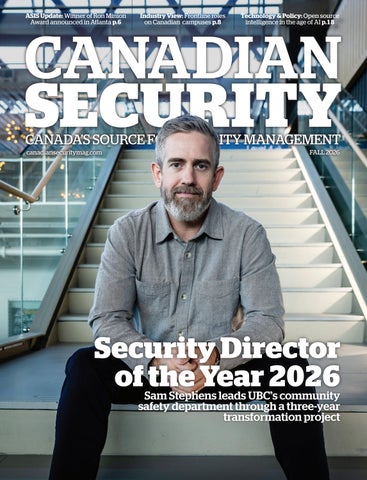
Security Director of the Year 2026 Sam Stephens leads UBC s community safety department through a three-year transformation project ’
Every security need in every type of location Get the most comprehensive enterprise security option with Scarlet Security & Risk Group At SSRG, our mission is to help clients operate worry-free knowing operational risks to people, assets, and infrastructure are addressed and their reputation is protected by a reliable trusted partner. From remote mines and arctic landscapes to complex wildfire scenes and urban centres, SSRG specializes in supporting clients through an integrated approach, in the most diverse and challenging locations.
/ / / / /
ENHANCED GUARDING RISK MANAGEMENT INVESTIGATIONS CLOSE PROTECTION SYSTEMS INTEGRATION
At SSRG, your safety is our number one priority. Contact us today to discuss your custom enterprise security solution. EMAIL CALL
info@ssrg.ca 1-866-647-SSRG
VISIT US ONLINE
CONTENTS
FALL 2026 Vol. 48, No. 2 canadiansecuritymag.com
30 08
18 DEPARTMENTS 04 | From the Editor Thinking beyond AI 06 | ASIS Update Ron Minion Award presented in Atlanta 07 | Trending 22 | Product Focus Access control solutions
12 FEATURES COLUMNS 08 | Industry View Building safer campus communities 10 | Risk Perspective Adjusting at speed
12
COVER STORY A new vision for UBC Sam Stephens leads the University of British Columbia through a three-year community safety transformation project
14
Canadian Security Honours 2026 Celebrating the accomplishments of this year’s recipients for Emerging Leader, Community Leader and Lifetime Achievement Awards
18
A new chapter for OSINT AI has changed how intelligencegathering is conducted, but a sound approach rooted in the fundamentals remains essential
COV E R PHOTO COU RT E SY U B C
canadiansecuritymag.com
CANADIAN SECURITY
3
From the Editor By Neil Sutton
Fall 2026 Vol. 48, No. 2 canadiansecuritymag.com READER SERVICE
Thinking beyond AI
A
rtificial Intelligence is a tool, not a strategy. This is a term spoken almost as a mantra as AI permeates more Canadian businesses. We have covered AI extensively in Canadian Security this year, including this issue, which features an article (see p.18) on the evolution of open source intelligence (OSINT) and how AI is supercharging investigations, research and threat assessment. (There are also dozens more articles related to AI that were published on our website this year.) AI provides the ability to gather and assess massive quantities of data — exponentially more than a human could handle alone. But what we hear time and time again from security professionals is that it cannot, or should not, supplant human judgement. In other words, AI is an extremely powerful tool, but like modern surveillance, intrusion and access control systems, it requires care and context. With that comes the need for more training and a healthy respect for a technology that sometimes seems to be without limitations except for those that we impose upon it. (It has limits, of course, but that line seems to
be moving all the time.) As AI filters through the school system as a learning and teaching tool, more graduates will enter the job economy with AI skills in hand.
“The lesson, especially with AI, is don’t lose sight of fundamental skills before turning to technology to support an organizational goal or project.” In some ways this is mirroring what we saw 25-plus years ago when businesses began to incorporate online tools into their sales, marketing and supply chains. Meanwhile, the younger generation was growing up with this technology and brought those skills with them when it was their turn to enter the workforce. The lesson, especially with AI, is don’t lose sight of fundamental skills before turning to technology to support an organizational goal or project. The fall issue of Canadian Security is also our awards issue, as we celebrate the accomplishments of the 2026 Security Director of the Year (a program now in its 21st year) and the annual Canadian Security Honours awardees for Emerging Leader, Community Leader and Lifetime
EDITORIAL ADVISORY BOARD Martin Deslauriers: Providis Services Conseils Agnes Pienio-Ganthier: Amazon Canada Ken Doige: ESRM Solutions 4
CANADIAN SECURITY
Achievement. You can read more about each of our winners in this issue. Their stories resonate not only for their individual accomplishments but also for the lessons we can take away from them. Professionalism, compassion, ingenuity, teamwork and commitment to education are consistent hallmarks of this year’s award recipients, as well as those we have recognized in years previous. We celebrated the 2026 winners at the ninth annual Canadian Security Honours gala on Oct. 6 in Toronto. The celebration coincided with Canadian Security’s third annual Advance: Women in Security Breakfast, which featured a panel discussion and mentoring sessions. Photos and additional details are available on the Canadian Security website (canadiansecuritymag.com). If you know a security industry friend or colleague who deserves to be recognized for their hard work and professionalism, we want to hear all about it. Nominations for the 2027 Canadian Security Top 10 Under 40 will open before the end of the year, and we’ll kick off the Security Director of the Year and CS Honours nomination process starting in the spring. | CS
Print and digital subscription inquiries or changes, please contact Shawn Arul, Audience Development Manager Tel: (416) 510-5181 Fax: (416) 510-6875 Email: sarul@annexbusinessmedia.com Mail: 111 Gordon Baker Rd., Suite 400, Toronto, ON M2H 3R1 EDITOR
Neil Sutton nsutton@annexbusinessmedia.com GROUP PUBLISHER
Adam Szpakowski aszpakowski@annexbusinessmedia.com BRAND SALES MANAGER
Trish Sutton tsutton@annexbusinessmedia.com MEDIA DESIGNER
Graham Jeffrey ACCOUNT COORDINATOR
Kim Rossiter krossiter@annexbusinessmedia.com CEO
Scott Jamieson sjamieson@annexbusinessmedia.com Printed in Canada I.S.S.N. 0709-3403 Publication Mail Agreement #40065710 SUBSCRIPTION RATES
Canada: 1 Year $45.61 + Taxes; U.S.A. (payable in CAD dollars): 1 Year $101.31; International (payable in CAD dollars): 1 Year $116.69 EDITORIAL AND SALES OFFICE
111 Gordon Baker Rd, Suite 400, Toronto, ON M2H 3R1 (416) 442-5600 • Fax (416) 442-2230 canadiansecuritymag.com Canadian Security is published two times per year by Annex Business Media. Annex Privacy Officer Privacy@annexbusinessmedia.com Tel: 800-668-2384 Canadian Security is the key publication for professional security management in Canada, providing balanced editorial on issues relevant to end users across all industry sectors. Editorial content may, at times, be viewed as controversial but at all times serves to inform and educate readers on topics relevant to their individual and collective growth and interests. The contents of Canadian Security are copyright by ©2026 Annex Publishing & Printing Inc. and may not be reproduced in whole or part without written consent. Annex Business Media disclaims any warranty as to the accuracy, completeness or currency of the contents of this publication and disclaims all liability in respect of the results of any action taken or not taken in reliance upon information in this publication
Roxanne Krause: CN Tower Danielle Weddepohl: Canada Pension Plan Investment Board Rowan Hamilton: Commissionaires Great Lakes Fall 2026
Canada’s full-service security partner
Le partenaire canadien en sécurité à services complets
Freeing police officers to focus on the work only they can do
Permettre aux services policiers de se concentrer sur les rôles que seuls eux peuvent remplir
BY-LAW ENFORCEMENT
APPLICATION DES RÈGLEMENTS MUNICIPAUX
NON-CORE POLICING
SERVICES COMPLÉMENTAIRES AUX CORPS POLICIERS
PRISONER MONITORING/ ESCORT/TRANSPORT DETENTION GUARDS ADMIN SUPPORT PHOTO RADAR FINGERPRINTING SOLUTIONS ONLINE CRIMINAL RECORD CHECK SOLUTIONS … AND MORE
SCAN TO VIEW OUR SERVICES/ SCANNEZ POUR VOIR NOS SERVICES
SURVEILLANCE DE DÉTENUS /ESCORTE ET TRANSPORT AGENTS DE DÉTENTION SOUTIEN ADMINISTRATIF RADARS PHOTO SOLUTIONS DE PRISE D’EMPREINTES DIGITALES SOLUTIONS DE VÉRIFICATION DE CASIER JUDICIAIRE EN LIGNE … ET PLUS ENCORE
YOUR TRUSTED PARTNER VOTRE PARTENAIRE DE CONFIANCE
ASIS Update By ASIS Canada Board of Directors
ASIS Canada Board of Directors: Jason Caissie, PCI, PSP, CPP; Marti Katsiaras, PSP; Parnell Lea; Jody Reid, CPP; Mike Soberal, CPP. Canada Night Organization Committee: Jason Larkin; Robin Soobramanie, CPP, Carl Jorgensen; Thomas Leslie
Ron Minion Award presented in Atlanta
F
ounded in 1955, ASIS International (www.asisonline.org) is a global community of security practitioners dedicated to protecting people, property and in-
ASIS CANADA NIGHT The flagship initiative of ASIS Canada is Canada Night — a highly anticipated networking event held annually on the eve of the Global Security Exchange (GSX) conference in the United States. This year, the 32nd annual Canada Night was held on Sunday, Sept.13, at SKOL Brewing Company in Atlanta, the GSX host city. Visit the website (www.asiscanada.ca/canada-night) for event photos and details on next year’s celebration in Orlando. RON MINION AWARD The second major initiative supported by ASIS Canada is the Ron Minion Canadian Security Pioneer Award. Established in 1999, the award recognizes Canadian ASIS members who have distinguished themselves through exceptional contributions to the growth and professionalism of the security industry. The founding members who created the award sought to recognize individuals whose impact extended beyond the Canadian security sector and ASIS activities within Canada, to include meaningful contributions to ASIS International on a global scale. 6
CANADIAN SECURITY
From left: Jody Reid, Mike Soberal, JD Killeen, Parnell Lea, Jason Caissie
Ron Minion, CPP, was the inaugural recipient of the award in 1999. Ron played a pivotal role in establishing ASIS in Canada. Alongside several dedicated colleagues, primarily in Western Canada, he worked tirelessly to help establish the first ASIS chapters in Edmonton and Calgary. Sadly, Ron passed away following a courageous battle with ALS (Amyotrophic Lateral Sclerosis), also known as Lou Gehrig’s disease. In recognition of his lasting contributions to the profession and to ASIS in Canada, the award proudly bears his name. A list of all the past recipients of the Ron Minion Canadian Security Pioneer Award can be found on the ASIS Canada website at: www.asiscanada.ca/ron-minion-award. This year, the Ron Minion Award was presented to JD Killeen, CPP, in recognition of his outstanding contributions to ASIS and his dedication to advancing the security profession in Canada. With more than 35 years in the security industry, JD has built a distinguished career spanning private investigations, security management, business development and consulting, while remaining a committed volunteer and mentor within ASIS. An ASIS member since 2004 and a CPP holder since 2005, JD has served the Toronto Chapter in numerous leadership roles,
including Treasurer, Chapter Chair, Vice Chair, Certification Chair, and long-time Study Group Lead. For more than a decade, he organized and led certification study groups, helping countless security professionals achieve their CPP, PSP, PCI and APP credentials. His commitment to certification excellence was recognized in 2017 when he received the ASIS Professional Certification Board Award of Achievement for service to the ASIS Certification Program. Beyond his chapter leadership, JD has been a mentor to many security professionals across Canada and continues to support ASIS events and initiatives nationwide. He also serves on the boards of the Canadian Security Lifesaver Association and ARISE, demonstrating his ongoing commitment to professional development and the security community. JD was presented with the award by ASIS Canada leadership. JD fully embraced Canada Night by showing up in his own flannel shirt, which just happened to be a perfect match for the volunteer flannels. He will be formally presented with “The Bear,” the soapstone carving of a polar bear that bears the names of all previous Ron Minion Award recipients, continuing the proud tradition of recognizing Canada’s security industry pioneers. | CS Fall 2026
PHOTO COU RT E SY A S I S CA NA DA
formation. Represented in Canada by 10 chapters serving over 2,000 individual members, ASIS International benefits from the support of over 100 Canadian volunteers. These volunteers work tirelessly to provide members and non-members alike with access to local education and networking opportunities while maintaining a vital connection to the programs and resources offered by ASIS International worldwide. ASIS Canada is not a chapter and does not organize events directly. Instead, it exists to support two national initiatives shared by all Canadian chapters.
Trending
Report: AI adoption on the rise in Canadian workplaces
PHOTO: @ B L AC K JAC K3D / E+/ G ET T Y I M AG E S
A
new report establishes that AI is becoming more commonplace in Canadian organizations, with successful implementation hinging on trust and training. CDW Canada recently released the report, Canada’s AI Workplace Evolution from Adoption to Accountability, which was based on a survey conducted in June 2026 by Earnscliffe on behalf of CDW Canada of just over 1,000 Canadian office workers across different businesses and industries. According to the research, daily use of “workplace-approved AI tools” has almost doubled year over year (31% versus 18%). The report describes a “next phase” of workplace AI, where the use of AI tools is moving away from assisting with individual tasks to more complex work. The report also indicates that worker training is increasingly important — those who receive hands-on training report significantly higher levels of confidence using AI tools. “Agentic AI represents an important shift in how organizations think about AI,” said KJ Burke, field CTO, Hybrid Infrastructure, CDW Canada, in a statement. Overall, based on the survey results, workplace attitudes toward AI continue to trend positively.
NOVEMBER 3-5,2026 ISC East New York, N.Y. www.isceast.com
However, trust is a barrier to adoption, with advanced users tending to be concerned about privacy and security. “As AI evolves from assisting employees to helping execute work, organizations must invest not only in technology, but also in the skills, governance and trust required to use it responsibly and effectively,” added Burke. Based on comparable data from 2025, employees with access to AI report improvements in productivity (an increase of 11% to 58%) and quality of outputs (up 15% to 54%). According to CDW, successful adoption of AI in the workplace “will be defined by trust, workforce readiness and measurable outcomes.” The full report is available from the CDW website (www.cdw.ca). | CS
PHOTO: W U L I A M BA PRODUC T IONS
ommissionaires Nova Scotia an- member for Alice House, which provides housnounced the appointing and support services for women ment of Rebecca Landry and children who are recovering from as chief executive officer. intimate partner violence. She also Landry joined Commentors emerging leaders through the missionaires in 2024 as chief operWomen in Leadership Foundation, ating officer. She had previously and leads Lean In Atlantic Canada, held leadership roles at Saab Canada. which provides peer-led support and Landry, originally from Sweden, professional growth opportunities for relocated to Canada in 2016. In women in the Atlantic region. 2021, she was recognized by Women Rebecca Landry, CNS Landry replaces outgoing CEO in Defence and Security with their Barry Pitcher who recently assumed Emerging Leader award, and earlier this year command of Canadian Armed Forces 36 Canwas named one of Atlantic Business Magazine’s adian Brigade Group. Pitcher was recognized as 25 Most Powerful Women in Business in Atlan- Canadian Security’s Security Director of the Year tic Canada. She currently serves as a board in 2025. | CS canadiansecuritymag.com
OCTOBER 24, 2026 Emergency Services Career Expo Calgary, Alta. www.careerexpowest.ca OCTOBER 28-29, 2026 DEMCON Toronto, Ont. www.crtdemcon.ca
Commissionaires Nova Scotia appoints new CEO
C
Coming Events
NOVEMBER 12, 2026 Focus On K-12 Security Mississauga, Ont. www.canadiansecuritymag.com NOVEMBER 19, 2026 ASIS Toronto: Women in Security Toronto, Ont. www.asistoronto.org DECEMBER 10, 2026 Focus on Healthcare Security Toronto, Ont. www.canadiansecuritymag.com APRIL 5-9, 2027 ISC West Las Vegas, Nev. www.iscwest.com APRIL 28, 2027 Security Canada East Laval, Que. www.securitycanada.com JUNE 9, 2027 Security Canada West Richmond, B.C. www.securitycanada.com JUNE 22-25, 2027 IACLEA Annual Conference & Expo Atlantic City, N.J. www.iaclea.org JUNE 26-29, 2027 BOMA International Conference & Expo Nashville, Tenn. www.boma.org SEPTEMBER 20-22, 2027 GSX Orlando, Fla. www.gsx.org
CANADIAN SECURITY
7
Industry View
Winston Stewart is the president and CEO of Wincon Security (www. wincon-security.com).
By Winston Stewart
Building safer campus communities
A CAMPUS IS A COMMUNITY Colleges and universities are not conventional commercial properties. Many operate like small communities, with residences, classrooms, libraries, laboratories, athletic facilities, restaurants, parking areas and event spaces. Some buildings close after business hours, while others remain active late into the night. Students, faculty, employees, contractors, visitors and members of the surrounding community may all use the same property. The risks present in a residence building are not necessarily the same as those in a laboratory, parking garage or crowded student event. There is no universal campus security model. Each institution needs an assessment that considers how its property is used and how risks change throughout the day and academic year. A new term brings students who do not yet know campus procedures. Major events create different access control and crowd management needs. 8
CANADIAN SECURITY
“Security personnel are often among the most visible representatives of an institution.”
THE FRONTLINE ROLE IS BROADER THAN ENFORCEMENT Security personnel are often among the most visible representatives of an institution and students should see them as approachable sources of assistance, not simply authority figures. A student may need directions, help accessing a building or support during a stressful situation. In other cases, a security professional may be the first person to notice unusual behaviour or recognize that someone is in distress. Campus assignments require more than basic patrol and observation. Personnel need strong communication and customer service skills, along with training in conflict management, de-escalation and site-specific emergency procedures. They must know when a matter can be addressed directly and when it should be referred to campus administrators, health and counselling services, police, fire services or emergency medical services. Security teams and institutional departments need established communication and escalation procedures so information reaches the right people quickly.
TECHNOLOGY SHOULD SUPPORT GOOD JUDGEMENT Access control systems, video surveillance and emergency communication platforms have become important parts of campus security. Used effectively, they can improve situational awareness and help personnel respond more quickly. Technology, however, is not a complete security strategy. An alert system is only valuable if students understand its messages and know how to react. A camera can help identify an incident, but trained personnel are still required to interpret what is happening and coordinate the appropriate response. Institutions must consider privacy and accessibility when introducing technology. Students should understand what information is collected, why it is needed and how it will be protected. Security measures earn support when they are communicated clearly and applied consistently.
Three tips for students Learn how to get help: Save the campus security or public safety number, register for official emerFall 2026
PHOTO: @ S OU T H_AG E NC Y / G ET T Y I M AG E S
F
or many first-year students, starting college or university is their first experience living away from home. It is an exciting period of independence, but it also means navigating unfamiliar buildings, routines and people. Parents and families naturally want to know that the campus environment is safe. Students want reassurance too. They want to attend classes and events, socialize and enjoy campus life without feeling restricted. That balance presents a distinct challenge for Canadian post-secondary institutions. A campus must remain welcoming and accessible while being prepared for risks that can emerge at any hour.
gency notifications and find out whether the institution offers services such as a safe walk program, late-night transportation or a safety application. In an immediate emergency, call 911. Become familiar with the campus: Identify well-lit routes, staffed buildings and places where assistance is available after regular hours. When travelling late, use available safety services or make arrangements with people you trust. Protect access and report concerns: Keep residence doors locked and never lend keys, access cards or student identification to another person. Do not allow an unfamiliar person to follow you into a controlled area. If something feels wrong, report it rather than assuming someone else will.
INSIDER RISK AND PERSONNEL SECURITY: AN INTRODUCTION
Three tips for parents and families Learn about campus resources together: Review the institution’s security, residence, health and counselling services with the student before the term begins. A shared understanding makes it easier to find the right help when it is needed. Agree on a reasonable communication plan: Discuss expectations for check-ins, late-night travel and trips away from campus. The goal should be reassurance while respecting the student’s growing independence. Discuss privacy and emergency contacts: Most post-secondary students are adults, and institutions may be limited in what they can disclose to families. Talk in advance about emergency contacts, consent and what information the student is comfortable sharing.
PREPAREDNESS MUST BE PRACTICED A written emergency plan must work under pressure. Institutions should test procedures through drills and tabletop exercises involving security personnel, administrators, residence teams, communications staff and external responders. Plans should also be reviewed after incidents and exercises. Campuses change as buildings open, technology is introduced and student needs evolve. Security strategies must evolve with them. Post-secondary institutions cannot remove every risk, nor should they attempt to turn open learning environments into fortresses. The better objective is a prepared and connected community supported by trained people, appropriate technology, clear communication and strong partnerships. | CS
Insiders cause material damage to their employers and society, and psychological harm to the colleagues and friends they betray. This textbook analyses the origins and effects of insider risk, using multiple real-life case histories to illustrate the principles, and explains how to protect organizations against the risk. $78.40 | Item #103235854
Scan code to buy this book
Educational Resources for Industry Professionals | 877-267-3473 | annexbookstore.com
canadiansecuritymag.com
CS_BOOKSTORE_FALL26_GWJ.indd 1
CANADIAN SECURITY
9
2026-10-02 12:24 PM
Risk Perspective
Tim McCreight is the CEO and founder of TaleCraft Security (www.talecraftsecurity.com).
By Tim McCreight
Adjusting at speed
10
CANADIAN SECURITY
remarkably well to Enterprise Security Risk Management (ESRM). When we Observe, we use our understanding of our business goals and objectives and continually monitor changes and potential risks against our Assets. It also means we’ve done a good job of Asset discovery along the way. We need to make sure we have processes in place to bring this “It just makes monitoring and surveillance into reviews of past incidents as well. good To Orient our security posture business and response, we have some homesense to work to do. We need to understand focus on how risks can impact our business, ways to how our culture impacts our securbounce back ity program, and be able to compare better when threats we see against our estabsomething lished norms. happens.” Deciding on what risk mitigation path to take involves planning, resource allocation, developing a risk authorization process (like a Security Risk Committee) and the development of playbooks to address risks across the organization. When we Act, we put the selected risk treatment into motion. Sometimes that means disrupting or containing a threat. Sometimes it means changing a process, imple-
menting a control, transferring the risk, or consciously accepting it. Most importantly, we capture what we’ve learned and feed that information back into the next Observe cycle. There’s so much more to all of this. It’s something I’ve been playing around with for most of this year — taking what we’ve learned from ESRM, creating an approach that uses the principles of the OODA Loop to gain time by adjusting our reaction speed, and then making sure we follow Design Thinking principles to work through problems in an iterative fashion. It’s been fascinating to explore how these three seemingly disparate frameworks can work together. We aren’t going to slow down the world around us or get more time to make security risk decisions. So perhaps the opportunity isn’t to build more process. Perhaps it’s to become better at observing what’s changing, understanding what it means to the business, making informed risk decisions and acting — then learning from what happens next. Maybe that’s how we start getting better at adjusting at speed. | CS Fall 2026
PHOTO: @ PI R A N K A / G ET T Y I M AG E S
T
his year has been an interesting one, and we’re only heading into fall. We’ve seen changes across governments, economies and organizations. Throughout all of this, I keep coming back to managing risk for organizations, how we can become better at developing mitigation strategies, and focusing on building our resilience muscles. Not because we need to practice our DRP/BCP (Disaster Recovery Plan/Business Continuity Plan) exercises, but because it just makes good business sense to focus on ways to bounce back better when something happens. The challenge isn’t simply that risks are changing. They’ve always changed. What’s different is the speed at which the environment around our organizations can shift — and the shrinking amount of time we have to understand what that change means. We need to learn how to adjust at speed. A great friend of mine, Winn Schwartau, has been advocating for the adoption of the OODA Loop into all that we do. For those who haven’t heard of the OODA Loop, the acronym stands for Observe, Orient, Decide and Act. The framework was initially created by U.S. Air Force Colonel John Boyd. Boyd’s insight was that advantage didn’t necessarily belong to the person with the fastest equipment. It belonged to the person who could understand changing conditions, make a decision and act faster than an adversary could adapt. While the framework was initially meant for air-to-air combat, the approach can be adapted to the security world. In fact, the OODA Loop maps
REGISTER FOR FREE AT SecurityCanada.com
FOLLOW US #SecurityCanada
CANADA’S LARGEST SECURITY SHOWS EAST
WEST
CENTRAL
Laval, QC April 28, 2027
Richmond, BC June 9, 2027
Toronto, ON October 20-21, 2027
Security Director of the Year
A NEW VISION FOR UBC Sam Stephens leads the University of British Columbia through a three-year community safety transformation project By Neil Sutton
T
he security industry is always adapting based on shifting threat levels, new paradigms and approaches, evolving views of risk and safety, and the security department’s changing role within the organization it supports. Sam Stephens has steered the University of British Columbia’s (UBC) security department through a top-to-bottom transformation over a three-year period, updating its mandate from rules enforcement and incident management to prevention, safety and community engagement. For his leadership and vision, Stephens is recognized with the 2026 Security Director of the Year award, sponsored by Wesco. Stephens was selected for the award by the Canadian Security advisory board based on a nomination that was submitted on his behalf. As someone who didn’t come from a conventional security background, it seems appropriate that Stephens should lead a major revision from campus security to community safety. An economics major at Simon Fraser University, Stephens came to the security industry by way of a summer job as a customs officer. He 12
CANADIAN SECURITY
was eventually hired on full-time and has since worked for different organizations such as the City of Vancouver and the Federal Government in roles that have spanned compliance, emergency management and business continuity. It was “kind of a non-linear career path in a lot of ways,” says Stephens. “I think all of these roles have really contributed to allowing me to get a different perspective when it came to how to support a business.” The UBC campus is situated just outside Vancouver and has 75,000 students and almost 20,000 staff and faculty. At capacity, the campus could have approximately 100,000 people on-site. Stephens joined UBC as the pandemic was ending in 2022, initially as director of special projects and then shifting into the security director role. From there it was his job to spearhead the department’s transition, all within the existing budget structure. Key to the success of the transformation project was strategic planning, consultation and stakeholder buy-in. Rebuilding the department meant interviewing other major departments at the university as well as vice-presidents and other senior leaders. Any change to the security
department needed to “line up to the executive vision, and we wanted to make sure we weren’t discounting their input on that,” says Stephens. “They understood the key risks, they knew the gaps, and they contributed to what it means to move forward.” Consultants were brought in to help with organizational benchmarking. Other major Canadian universities were interviewed to better understand campus security best practices across the country. Students and faculty were included in the feedback process. Input from the existing security staff was also instrumental. “We called it the model validation project because we wanted to validate what’s working, what’s not working, and how do we actually move this thing forward around connecting our program with the expectations of the community,” says Stephens. “We spent a lot of time getting the organization ready for change.” UBC’s security model is almost entirely self-sufficient, with technology systems and alarm monitoring residing in-house. UBC maintains a core of in-house security guards, adding guards from a contract provider as needed. The new community safety model is organized into four major departments: Community Safety Operations, Systems & Technology, Strategic Program Delivery and Threat Management. For Stephens the transformation represents a comprehensive reorganization, but it’s also a fundamental
“We are much more integrated into the institution’s ability to keep safe spaces.” —Sam Stephens, UBC
Fall 2026
UBC Security Forum
I M AG E COU RT E SY U N I V E R S I T Y OF B R I T I S H COLU M B I A
The three-year project led by Sam Stephens involved consultations with campus leaders, multiple departments and other Canadian universities.
shift in how the department operates on campus. At a basic level, the department has moved from a response model to a preparedness model. As Stephens puts it, “We are much more integrated into the institution’s ability to keep safe spaces.” Training is essential to the department’s success, says Stephens. In addition to integrating their input into the plan, the community safety staff participate in three full days of training annually. Any major department changes are rolled out approximately a month after the training concludes. The training days also serve as “listening sessions” where staff feedback can be heard. “We wanted to make sure as we’re going through these changes, we’re really taking time to listen, to get input,” explains Stephens. “I think canadiansecuritymag.com
the training has really been about a reflection on how we show up for this community and how we measure success.” This September marks the first full academic year since the transition to the community safety department was completed. “It would not have happened without Sam’s leadership,” says Rae Ann Aldridge, executive director of safety and risk services at UBC. “He came in with a vision for how the transformation needed to be managed, and he embraced that whole process. It’s been a real journey over the last two to three years, but under his leadership it has been proven to be really successful.” One of the next steps is redesigning the community safety uniforms, which will be accomplished through an industry partnership grant.
This is not merely a cosmetic change, but a reflection of how the department’s mission has changed, says Stephens. “Our uniforms have been a big area of conversation for us — recognizing that it is a really important step for us about how the communities see us doing that service.” New uniforms, as well as new patrol vehicles, should be rolled out by the end of the year, he says. While the transition project has accomplished its major goals, it will always be a work in progress, says Stephens. “We’re still building new services, still validating where we’re going,” he says. “That journey is really shifting us more and more in terms of how we show up for the community. I think it’s been a super-positive trajectory so far.” | CS CANADIAN SECURITY
13
In addition to managing a major redesign of UBC’s security department, Sam Stephens has created an education conference designed to share security knowledge and best practices with a wider audience. Originally conceived as an education event for department staff, it has expanded to include other stakeholders across UBC as well as security professionals from outside the organization. The second annual UBC Security Forum was hosted earlier this year. Speakers from the 2026 event included security leaders from the 2026 FIFA World Cup, the chief of the U.S. Secret Service National Threat Assessment Center, and Stephens himself, among others. Planning for a May 2027 Security Forum is underway. “It’s accessible and something of interest for everybody,” says Stephens. “I’ve been incredibly happy with how the last two events have come together, and it’s kind of become this anchor event for our team in terms of how we give back to the security industry. It’s been a very positive experience.”
CS Honours
Canadian Security Honours 2026
P
lease join us in congratulating the winners of the ninth annual Canadian Security Honours. The awards program recognizes the accomplishments of security professionals at all career stages, from those just getting started to senior leaders with decades of experience. This year we acknowledge Aman Arora (Emerging Leader), Jaime
Raymond (Community Leader), Sean Sportun (Lifetime Achievement) and Sam Stephens (Security Director of the Year). The recipients received their awards at the Canadian Security Honours celebration on Oct. 6 in Toronto. For photos and highlights, visit www.canadiansecuritymag.com. — Winner profiles by Neil Sutton
Emerging Leader Award: Aman Arora
F
or many, earning a professional certification is a goal, but for Aman Arora, it became a lifestyle. Having earned degrees from the University of Jammu in India and George Brown College in Toronto, he entered the working world as an information systems administrator. Working closely with corporate network infrastructure, he soon came to the conclusion that effective and robust cybersecurity is the key to a healthy network. “That’s when I started to transition more towards the cybersecurity side,” he says. With that epiphany came a quest for more knowledge. Arora spent his working hours focused on his admin job, then devoted the evening hours to learning everything he could about cybersecurity. He fell into a routine of keeping long office hours, picking up a slice of pizza on his way home for dinner. He read articles and listened to podcasts to learn more about exploits, malware, phishing and how bad actors are able to take advantage of weak security. In the process of educating himself, he says he earned more than 20 accreditations — an impressive list that includes a mix of academic, vocational and vendor-specific certifications. He even attained a private investiga14
CANADIAN SECURITY
“I’m expanding my horizons.”
tor licence, just so he could learn more about the physical side of the security industry. “I just wanted to understand everything,” he says. Arora is currently the director of cybersecurity at Choice Properties REIT. His professional achievements and educational pursuits have been previously recognized by Canadian Security, when he was named to the Top 10 Under 40 security professionals list in 2025. Arora says he still has a thirst for knowledge, but he has replaced his nightly study sessions with a more focused approach on cybersecurity
skills like ethical hacking, security auditing and risk assessments. He is currently working towards a CISSP designation and has taken courses at the University of Toronto and the Massachusetts Institute of Technology (MIT). As a cybersecurity director, he has also had to incorporate a new set of skills. Leading a cybersecurity program at Choice Properties means he collaborates closely with other major departments like legal, HR, compliance and IT. He also has to communicate cybersecurity goals to the company’s leaders and manage relationships with external partners like vendors and integrators. He sees his job as optimizing security without hampering business operations. “My biggest concern right now is to actually have a balance of security and service delivery. There has to be a saturation point where I will draw the line,” he explains. As the beneficiary of a well-rounded education, Arora is also keen to pass on his knowledge and experience to others. He mentors a group of students each summer through a company internship program. Arora says his passion for cybersecurity has given him a better understanding of all aspects of business. “I’m expanding my horizons.” | CS Fall 2026
Which side are you on? Do not risk your security with outdated access control technology. Move forward with stronger security solutions. Visit our website for practical tools to start planning upgrades today. • Step-by-step upgrade guides • Phased migration strategies • Budget-smart planning tools The real risk is not upgrading. It is waiting too long to do so. dk.world/Upgrade2026
CS Honours
Community Leader Award: Jaime Raymond
J
aime Raymond lives by a simple but effective credo: “Always leave a place better than you found it.” That was her father’s philosophy, says Raymond, and it’s one she has tried to live up to. “You can do that by enriching your community,” she says. Raymond’s father was a Peel Regional Police officer. In fact, many of her family members are connected to law enforcement. Her mother worked in corrections and her aunt was a court clerk. In her youth it seemed obvious to Raymond that she should carry on the family tradition, and she set her sights on joining the police. She attended the University of Guelph and started taking security guard shifts right out of school. At the time, she viewed guard work as a stepping stone to policing but she soon discovered she enjoyed the work. She took on extra guard shifts and was promoted into a supervisory position while working at Yorkdale Mall in Toronto. Not only was the security position rewarding, says Raymond, but she was able to work directly with police officers. Raymond was again promoted, this time at Hillcrest Mall before taking on a managerial security role at Square One Shopping Centre in Mississauga. There she discovered a network of businesses, organizations and Peel Regional Police officers who were all guided by a common mission to promote community safety and support local charities. Raymond founded the Square One Community Partners Committee, which brought together these organizations, along with other first responders, educational institutions, government agencies and transit 16
CANADIAN SECURITY
“It’s so great if we can find ways to show why it’s important to give back.”
partners to work towards the common goals of addressing and promoting community safety and resilience. Peel Regional Police officer Cst. Laura Wells, who has known Raymond for more than 10 years, praises her proactive approach to community safety. “What Jaime does so well is recognize the needs within their community,” says Wells. “Jaime creates that culture of, ‘we all work together, we’re all in this together.’” At Square One, Raymond spearheaded a project that helped donate unclaimed lost and found items — particularly clothing —via charitable organizations that support vulnerable members of the community. Over her 25-year career, Raymond has always found ways to make security more than just a job, but a means to connect with others and form community partnerships. One that is
particularly close to her heart is the Canadian Cancer Society’s Cops for Cancer Committee, which she has served on for more than two decades. Raymond lost her father to cancer when she was 14. “This was a great way to feel like I was honouring him,” she says. In addition, Raymond joined the Peel Human Trafficking Service Providers Committee about five years ago, has volunteered with the ASIS Toronto Chapter Women in Security committee, and served on Oxford Properties’ diversity and inclusion committee until leaving the organization just recently. She says she is grateful that her former employer was able to provide her with the flexibility to pursue volunteering opportunities. “They were really great about that because they valued those partnerships,” she says. Raymond’s philosophy on volunteering also extends to her home life. She volunteers for her son’s lacrosse and hockey organizations where she has helped to organize food drives, hospital fundraisers and anti-bullying initiatives. In recognition of her work, she was recently awarded the inaugural Town of Orangeville Volunteer Award in the Sports and Recreation category. “It’s so great if we can find ways to show (kids) why it’s important to give back to the community that we live in,” she says. Raymond encourages others to volunteer their time, noting that security professionals are often in an ideal position to do so, through their connections with community and first responders. “I think you have to do it for the right reasons,” she says, advising that “things have to speak to you so that you can really give a piece of yourself.” | CS Fall 2026
Lifetime Achievement Award: Sean Sportun
M
ost security professionals view their role as mitigating risk, reducing incidents and making their organizations safer. Sean Sportun also views these as essential but for him they are starting points. As a loss prevention and security leader, he has built a career based on forging partnerships with the C-suite, first responders and the communities his businesses serve. Sportun realized he had a knack for retail loss prevention early on in his career. Working seasonally at the Canada’s Wonderland security department while earning a college degree, he was recruited into an LP unit and joined, as he puts it, “the plain clothes retail life.” More than three decades later, Sportun is still living the “retail life” but he has embraced some new philosophies along the way. After college, Sportun worked for several retailers across the Greater Toronto Area before he found his niche at Mac’s Convenience Stores as their manager of security and loss prevention for Central Canada. During his 16-year career at Mac’s (later known as Circle K), Sportun demonstrated a willingness to experiment with different approaches to LP. He was a proponent of CPTED (Crime Prevention Through Environmental Design) and an early advocate of social media to generate tips from the public that could be shared with police. Sportun championed a “positive ticketing” campaign, providing local police with books of coupons for free beverages that they could give out to young people. The campaign encouraged positive interactions between youth and police and fostered community engagement.
canadiansecuritymag.com
“It’s always a team effort, no matter what you do.”
During his time at Mac’s/Circle K, Sportun also commissioned murals at several store locations. The projects, which were completed by local artists, helped to reduce crime and incidents of graffiti while simultaneously building community ties. For his novel loss prevention strategies, Sportun was recognized with Canadian Security’s Security Director of the Year award in 2013. Six years later, he received the Community Leader award for his consistent efforts. Sportun’s mural projects drew the interest of a University of Toronto professor who reached out to him to conduct further research on his unique approach to crime prevention. Their partnership led to a research project, partially funded by a Harvard University grant, as well as two case studies published by Harvard Business School. After his groundbreaking career at Mac’s/Circle K, Sportun joined GardaWorld as vice-president of national accounts and community engagement. He says he greatly valued that
experience as an opportunity to see the security business from a whole new perspective. “I would say this to any security professional on the end-user side. Until you fully understand the vendor side, you’re not really going to understand the security industry,” he says. “It made me a better security professional.” Sportun rejoined the retail world a few years ago and is currently national director of loss prevention and corporate security for Empire/Sobeys. Since joining the organization he has helped develop two major initiatives: a retail crime intelligence platform that helps to identify patterns of criminal behaviour and share useful data between investigators, and a body-camera rollout for frontline security staff. For every project, whether it’s a community mural or body-cams, Sportun has consistently sought the endorsement of the C-suite. The key to a security department becoming a true partner to the organization is demonstrating its value, both financially through reductions in crime or shrink, and socially through community engagement. The other major partnership that has helped to define Sportun’s career is Toronto Crime Stoppers. Sportun joined the Toronto branch of Crime Stoppers more than two decades ago and currently serves as its chairperson. Crime Stoppers was an active partner for both the positive ticketing and mural programs during his time at Mac’s/Circle K. “It’s never just me alone,” he says. “It’s always a team effort, no matter what you do.” His wish for the future of the security industry is greater cooperation and more unity between security professionals. | CS CANADIAN SECURITY
17
Technology & Policy
A new chapter for OSINT
W
hile the use of open source intelligence (OSINT) technologies and techniques to support security planning and investigations is not new, the introduction of the use of AI has changed the approach dramatically. “Five years ago, the OSINT practice largely consisted of analysts working through public sources at human speed. Today, it’s a machine-assisted discipline, with automated information collection across surface, deep and dark web sources, with increasing use of AI-driven data analysis surfacing patterns faster, sometimes in ways human analysts might not have con18
CANADIAN SECURITY
“What used to be carried out as a one-off or at set intervals can now be 24/7.” — Larry Henderson, Crisis24 sidered,” explains Larry Henderson, director of global intelligence at Crisis24, a GardaWorld company that is a provider of travel risk management, mass communications, critical event management and crisis-security consulting. Henderson says that AI-based technologies have allowed analysts to move at
much greater speeds, but the biggest shift is the value that OSINT professionals add in determining what actually matters, what can be trusted and what requires human judgement. For cybersecurity specifically, he says the biggest change has been continuous dark web and credential-exposure monitoring. Fall 2026
PHOTO: @ I M AG I N I M A / I STO C K / G ET T Y I M AG E S
AI has changed how intelligence-gathering is conducted, but a sound approach rooted in the fundamentals remains essential By Andrew Snook
“Although you have the technology now, you need to go back and rely on those fundamental analytical skill sets.” — Kyle Klein, Blackmark Protection “What used to be carried out as a one-off or at set intervals can now be 24/7. When a client’s sensitive information appears in the public domain, we’re able to flag it in near-real time, so there is a greater time window to take protective steps,” Henderson explains. Kenrick Bagnall, founder of consulting firm KONCYBER, says the information available through OSINT has been incredible and has only improved over the years, but many companies and governments have been implementing different tools to try and prevent AI from scraping their sites for information, such as CAPTCHAs, AI detectors and bot detectors. “Even in using AI today in my own work, I might reference a website and say, ‘Check this website for A, B, and C,’ and an AI agent might come back to me and say you’re going to have to do it and then give me the information to analyze because they have something blocking AI agents on the website,” Bagnall explains. He adds that the tools and the techniques that are being developed related to OSINT become outdated fairly quickly because social media platforms are constantly changing their APIs (application programming interfaces). “Changes to their platform often result in changes to the interface, thereby forcing OSINT tools and techniques to adapt,” Bagnall says. A former member of the Toronto Police Service’s cybercrimes division, Bagnall spends some of his time teaching a cybercrime investigators course at the Canadian Police College. canadiansecuritymag.com
The constantly changing APIs has made teaching OSINT practices extremely challenging. “It requires constant development of tools all the time,” he says. To have an effective OSINT practice, it is important to stay up to date with the quickening pace while evolving with changing landscapes. “For example, a collection method that worked for months can be closed off overnight by an unforeseen platform policy change,” Henderson says. “A comprehensive security plan needs OSINT built in as a persistent function, not a periodic report. A persistent OSINT strategy combines continuous collection with analysts who understand the organization, its operating environment, and what actually constitutes a meaningful change in risk.” Kyle Klein, president and founder of Blackmark Protection, notes that while AI has made scraping data much easier, privacy across all social media platforms is becoming more stringent. “Although the technology is increasing to make it easier, privacy and other changes have also come into play,” he says. “Although you have the technology now, you need to go back and rely on those fundamental analytical skill sets to know how to use the tools and the technology, and really find the information that you’re looking for.” The biggest current challenge related to OSINT for Klein is navigating all of the noise that comes with gathering such large amounts of data collected using today’s technologies. “You’re getting almost too much information, and so, you either have to really fine
tune that and set up your queries to be very specific, or you need to have processes in place to assess and analyze that data now,” he says. “I’ve always been a big proponent that process needs to be in place before you implement your technology. Technology is great to enhance, to make things more seamless, faster, more efficient. But we still need to have a process.” FINDING FUNDING With security often viewed as a cost centre, finding additional funding within the budget is often a challenge. This includes funding to keep security teams well-educated and well-equipped to deal with potential threats. One of the reasons that intelligence is sometimes a hard sell to make to upper management is because it’s more abstract in nature than other more traditional security costs. “It’s easier to say, we need a security guard at the front door because they’re going to do A, B, and C, and not having them there is very evident. If that body isn’t there, this is going to happen. It’s a lot easier to conceptualize,” Klein says. In Klein’s previous professional security roles, he would tie the budget for developing protective intelligence teams back to protecting the company’s clients. When arguing for a larger security budget, it is important to find allies in a company’s other departments that can also find value from security operations being well funded, such as finance, human resources or marketing. “Sell to them how intelligence will support them, then your argument is louder because it’s not Kyle the security guy who sits in the corner asking for $150,000 tool. It’s this team that’s going to share that $150,000 tool. Now you’ve amortized it against six teams. Maybe they’re chipping in, maybe not. But here’s how it’s going to support the whole organization,” Klein explains. Henderson suggests that organizations should think about the ROI of OSINT in terms of incidents that were prevented. “Although this can feel less tangible, every dollar spent on an effective OSINT program can meaningfully reduce the CANADIAN SECURITY
19
Technology & Policy
OPPORTUNITIES AND THREATS There are many opportunities for security professionals related to OSINT. One of the biggest lies in the role OSINT plays as the foundational layer across physical, cyber, health, geopolitical and reputational risk 20
CANADIAN SECURITY
management programs, Henderson says. “A well-run OSINT practice can underpin a breadth of disciplines including executive protection, travel security, insider threat risk management and cyber defence, as well as ones that historically sit outside of the security department’s remit — such as brand monitoring and M&A due diligence,” he says, adding that OSINT is an opportunity for security leaders to demonstrate “enterprise-wide value” from the boardroom to the frontline. The biggest threat to the value of an OSINT program is that it fails to adapt to the rapid pace of technology-driven change in techniques, tooling and the wider information landscape, Henderson says. “It’s essential to avoid information overload, keep abreast of the latest AI capabilities — including ones that can be used against you — and have processes for filtering disinformation and deepfakes,” he says. “This is where it comes back to the integrity of tradecraft, which is more — not less — important because of current technology developments.” Henderson says that as AI makes it easier to generate, manipulate and distribute
information at scale, the enduring advantage will be analysts who can challenge what they see, understand context and exercise judgement. “Trust in the analysis still has to be earned and, while AI has many strengths and is fast evolving, humans are ultimately accountable for life safety, business continuity and reputational decisions,” he says. PART OF THE PLAN The bottom line is that OSINT is a vital part of any comprehensive security plan and threat actors often begin planning an attack with open-source reconnaissance of their target’s footprint and key individuals, Henderson says. “Increasingly, we see the lines blurring between cybersecurity and physical security, but even just within the cyber domain, when designing a security plan, it’s essential to understand what information potential adversaries could leverage,” he says. “The threat environment now moves fast, with factors including the pace of technology development and geopolitical flashpoints emerging quickly, overlapping and compounding.” | CS Fall 2026
PHOTO: @ OR H A N T U R A N / I STO C K / G ET T Y I M AG E S
chance of a much costlier adverse event from happening,” he says. The unfortunate reality is that increased investment is often a reactive response after a serious incident has occurred. However, the most resilient organizations put the capabilities in place from the outset, and track near-misses and business decisions driven by intelligence outputs, Henderson notes. “An OSINT function needs to budget for the technology, but just as importantly invest in the people, training and analytic tradecraft required to turn technology into better decisions,” he says, adding that AI can scale mediocre just as easily as exceptional analysis. “The differentiator remains the analyst asking the right questions, challenging assumptions and applying judgement. This takes training and intelligence tradecraft.”
The #1 Source of Information for CANADIAN SECURITY PROFESSIONALS &
PRIMARY LOGO
CANADA’S SOURCE FOR SECURITY MANAGEMENT
PRIMARY LOGO
ERS AND SERVING INSTALLERS, DEAL DA INTEGRATORS ACROSS CANA
CANADA’S SOURCE FOR SECURITY MANAGEMENT COMPANY U.K. LOCKBOX P4 LAUNCHES IN CANADA
THEIR HOW INTEGRATORS HELP AL CLIENTS ACHIEVE OPTIM SOLUTIONS P11 30TH ANNIVERSARY P14 ROUNDTABLE DISCUSSION
TECHNOLOGY NEWS SECURITY PRODUCTS AND I.1 MARCH/APRIL 2026
SECONDARY LOGO
V.30
CANADA’S SOURCE FOR SECURITY MANAGEMENT
SECONDARY LOGO
30th Anniversary Issue
CANADA’S SOURCE FOR SECURITY MANAGEMENT
industry Serving Canada’s security for three decades
2026-03-10 2:13 PM dd 1
SPT_March_April26_GWJ.in
SPT_March_April26_GWJ.indd
2026-03-10 2:13 PM 1
sptnews.ca
canadiansecuritymag.com
SUBSCRIBE TODAY! IT’S FREE!
for three decades industry Serving Canada’s security
Issue Anniversary 30th
Product Focus Access Control Solutions
Facial biometrics
Optical turnstile
HID HID Amico biometric facial recognition readers expands HID’s biometric portfolio across a wider spectrum bringing facial recognition within reach for small and medium-sized businesses, according to the company. HID Amico brings fast, accurate facial recognition to the door. Available in both 3.5-inch and 7-inch touchscreen models, it combines multiple options. Designed for offices, healthcare facilities, educational campuses, commercial buildings and other environments, HID Amico secures entrances by letting authorized users move through the door without stopping to present a credential. HID Amico offers five authentication methods including facial recognition, physical credentials, PIN, QR code and HID Mobile Access. www.hidglobal.com
Automatic Systems
Electrified deadlatch Adams Rite
Adams Rite, an ASSA ABLOY Group company, announced enhancements to the 4300 Steel Hawk Electrified Deadlatch, making it easier to bring electronic access control to existing openings while improving performance on doors affected by sag, misalignment, and everyday wear, according to the company. The 4300 Steel Hawk features a redesigned latch assembly, along with internal improvements engineered to reduce opening force and support reliable operation in less-than-ideal door conditions. www.adamsrite.com
22
CANADIAN SECURITY
The SlimLane EVO next-generation optical turnstile combines a slender design with high-precision detection and a customizable cabinet. Designed to be futureproof, the EVO’s extension post ecosystem can accommodate new biometrics and access control technologies, and its software cybersecure platform integrates with third-party systems. The brushless motor is highly efficient and converts more electrical energy to motion, reducing power use and heat in high-traffic applications. Little to no maintenance is needed, according to the company, backed by its 5-year warranty, making it suited for 24/7 security operations and high throughput applications. www.automatic-systems.com
Keyless rotary lock dormakaba The Apexx Strato Rotary keyless electronic ATM rotary lock is designed to secure the ATM top hatch and help prevent unauthorized access that can lead to malware installation and jackpotting attacks. Features include keyless access — replacing shared mechanical keys with secure BLE credentials through the dormakaba Safe Locks mobile app. Digital credentials assigned to individual users improve accountability and eliminate shared service keys. Every access event is recorded automatically, creating audit-ready records. Operators can remotely add, remove, or update user permissions without on-site changes. www.dormakaba.com
Door alarm systems Camden Door Controls Camden Door Controls announced the launch of two new battery-powered door alarm systems. The Camden CX-DA810 Series Door Prop Alarms provide an audible and visual alarm indication of mechanically secured doors being held open for more than a specified time. These all-in-one ‘Universal’ alarms are compatible with a wide range of industry-standard mortise cylinders and cams. Both models are offered in a choice of grey or black, in either indoor or weatherized outdoor models. A mortise cylinder with two keys is included (keyed alike or keyed different). Features include a loud 105 dB alarm; a 9 VDC battery operation with low-battery alert; and a mortise cylinder and cylinder installation tool. The solution is UL-listed. www.camdencontrols.com Fall 2026
LEARN MORE
& REGISTER
Session topics include: •
Applying CPTED principles with limited resources
•
Student safety and social media awareness
•
Managing school emergencies with SPEAR (School Police Emergency Action Response)
•
Human trafficking awareness
•
A panel on best practices for K–12 security leaders
PLATINUM sponsor
GOLD sponsor
PRESENTED BY
SILVER sponsors
BRONZE sponsors
Anticipate risks with OSINT intelligence Because the old saying ‘’Knowledge is Power’’ still holds true, mastering OSINT research makes all the difference. From pre-employment screening to corporate due diligence or just to protect yourself, our intelligence services turn the unknown into clear certainties. Anticipate risks, protect your assets, and make informed decisions with cutting-edge strategic expertise. Individual profiles & surveillance: Deep-dive mapping of habits, locations, and financial profiles. Corporate due diligence: Financial analysis and audits to secure your business partnerships. Talent risk management: Rigorous pre-employment screening to protect your organization. Investigation support: Open-source data collection and analysis to expose hidden threats. Risk mitigation: Continuous monitoring to protect your people, assets, and decisions. Shroud of privacy: Online footprint monitoring to prevent sensitive data leaks.
Contact our experts today to secure your business decisions.