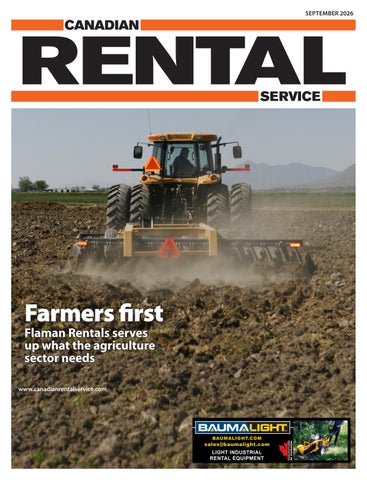
SEPTEMBER 2026
Farmers first
Flaman Rentals serves up what the agriculture sector needs www.canadianrentalservice.com
BAUMALIGHT.COM
sales@baumalight.com
LIGHT INDUSTRIAL RENTAL EQUIPMENT
2 CANADIANRENTALSERVICE | September 2026
Annex Business Media P.O. Box 530, Simcoe, Ontario N3Y 4N5 (800) 265-2827 or (519) 429-3966 Fax: (519) 429-3094 READER SERVICE Print and digital subscription inquiries or changes, please contact Angelita Potal, Customer Service Tel: (416) 510-5113 • Fax: (416) 510-6875 Email: apotal@annexbusinessmedia.com Mail: 111 Gordon Baker Rd., Suite 400, Toronto, ON M2H 3R1
SEPTEMBER 2026 Vol. 50, No. 5
6
EDITOR I Mike Lacey mlacey@annexbusinessmedia.com (416) 510-5115 ASSOCIATE EDITOR I Colin Leggett cleggett@annexbusinessmedia.com (416) 510-5207 ACCOUNT COORDINATOR I Barb Comer bcomer@annexbusinessmedia.com (519) 429-5171 AUDIENCE DEVELOPMENT MANAGER Shawn Arul sarul@annexbusinessmedia.com (416) 510-5181 MEDIA DESIGNER I Brooke Shaw
10
14
18
GROUP PUBLISHER I Danielle Beavan dbeavan@annexbusinessmedia.com (226) 931-0375 CEO I Scott Jamieson sjamieson@annexbusinessmeda.com Publication Mail Agreement #40065710. Printed in Canada ISSN 0383-7920 Subscription Rates Canada- 1 Year $ 47.74 + tax U.S.A. - 1 Year $108.73 (CDN) Occasionally, Canadian Rental Service will mail information on behalf of industry-related groups whose products and services we believe may be of interest to you. If you prefer not to receive this information, please contact our circulation department in any of the four ways listed above. Annex Privacy Officer Privacy@annexbusinessmedia.com Tel: 800-668-2374 All rights reserved. Editorial material is copyrighted. Permission to reprint may be granted on request.
Serving the Canadian rental industry for 45 years.
4
6
10
EDITORIAL
FOR THE FARMERS
TURN UP THE HEAT
Despite the inconsistent nature of the United States trade policy, Canadian businesses can’t quit the American market.
Flaman Rentals has been providing farmers with equipment solutions since 1993.
We put the spotlight on the newest heaters on the market.
14
16
18
BEFORE THEY SPARK
THE FALL RUSH
CLEARING A PATH
Hot, dry conditions increase the risk of equipment-related fires. A proactive maintenance routine can help prevent sparks before they become serious.
Are you ready for the surge in contractor and homeowner rentals this fall?
These attachments can turn any compact excavator or loader into a forestry tool.
21
22
AT YOUR SERVICE
LAST WORD
Whether running a steak house or a rental store, customers value strong, consistent service.
Farmers are looking more toward renting rather than buying equipment.
www.canadianrentalservice.com September 2026 | CANADIANRENTALSERVICE 3
EDITORIAL
Control what you can I feel for businesses trying to manage the fallout from those dismantling our economic world order
O by Mike Lacey
ver the last two years, the statement, “there is nothing more important to business than consistency,” has been uttered relentlessly. Of course, there is much truth to it. Consistent rules and regulations as well as consistent business standards and practices, are all heavily important in the success of a business and economy. But too often shoved aside is something equally as important -- a large, eager customer base. That is probably equally as important when it comes to the long-term health of a business or sector. After all, I could have one consistent customer, but I’m not sure that’s enough to keep me in business, no matter how well run it is. It’s that push and pull that underscores the difficulty Canada is facing in our ongoing trade dispute with the United States. On one hand, the inconsistent nature of the Americans makes it difficult for Canada’s economy to truly find its footing. Businesses, both here and on the other side of the border, just want to know what the rules are so they can plan properly. Yet every time we think we know those rules, the United States upturns the board and we must start anew. However, on the other side is that vast US market, guzzling up goods and services like no other in the world. We can’t simply walk away. It’s too important, both as a place to sell our products, and also a key market for us to acquire goods. Equipment, parts, services, many of those things we need come from the United States. So, here we sit, stuck in the middle of this push and pull. A market so large we can’t quit but an economic order that is unstable. I’m frustrated by this. I can only imagine how frustrating this is for those trying to run a business.
It’s frustrating to realize we are just a small cog in a much larger economic wheel.
Last spring I spoke to an electronics manufacturer on Canada’s west coast and in the course of the conversation, I asked about the impact tariffs were having on his business. At the time, he said they were spared by direct tariffs on the products they manufactured and sold into the US. But, his team still met weekly to understand tariffs on other countries. Many of the supplies they required to manufacture their parts came from overseas markets and often flowed through the United States and into Canada. Such items were subject to a complicated tariff regime. The world’s economy is so intertwined that a Canadian manufacturer often receives parts from countries across the world, which might first flow through the United States before arriving in our country. Unwinding this economic web is going to be difficult and long and painful. Unfortunatley, we don’t have a significant say in that. With the United States now placing an array of tariff rates on so many goods, the system is not just expensive for everyone but highly inefficient. When a piece of equipment enters the United States, the person importing may have to provide a significant amount of detail about the value and manufacturing history of its aluminum and steel content. What’s the final tariff rate? Well, it depends and is based on a number of factors. It’s an administrative nightmare. Few could dream up a better drag on an economy than this. Yet, it is what it is. As simple cogs in the wheel of the economic order, there isn’t much we can do. Control what you can. Do good work. And stay informed. Mike Lacey is editor of Canadian Rental Service. He can be reached at mlacey@annexbusinessmedia.com
crs.magazine 4 CANADIANRENTALSERVICE | September 2026
INDUSTRY NEWS ONTARIO LAUNCHES DATA CENTRE PLAYBOOK FOR FUTURE INVESTMENTS The Ontario government has launched a framework for its Data Centre Playbook to help the province attract data centre investments. The province says the framework will ensure data centres pay the full cost of electricity. The government says it will only offer non-financial support to attract investments. The playbook is part of Ontario’s forthcoming AI strategy. The province projects AI adoption to generate $122 billion in economic growth by 2035 and create more than 17,000 new jobs every year. As part of the Protect Ontario by Securing Affordable Energy for Generations Act, the Ontario government enacted new authorities that will give the Minister of Energy and Mines the final decision on which large-load facilities are permitted to connect to the province’s electricity grid, including data centres. The province says Ontario’s Data Centre Playbook will only consider projects that accelerate economic growth with significant community investments, on terms that prioritize Ontario’s interests. The Playbook is anchored in three pillars to guide approvals for new data centres: • Advance economic development: projects that bring in significant investment, job creation and new tax revenue for the province and municipalities, support Ontario and Canada’s domestic supply chains and help businesses be more productive. • Protect data security and digital sovereignty: projects that can advance Ontario and Canada’s digital sovereignty to protect critical data and safeguard people’s information. • Invest in communities and earn public confidence: projects that bring real benefits to local communities, significantly investing both financially and non-financially in host communities to drive local infrastructure developments, job creation and training, and future economic growth. The province says it will leverage Ontario’s existing strategic advantages such as a clean and reliable electricity system, ample land space, cool climate and skilled workforce. Data centres will also pay for the cost of their impact on the electricity system, ensuring people’s electricity bills are not increased, the province says. This will include proposed measures to address data centres’ impact on the electricity system by encouraging projects to build their own power generation and by establishing a separate rate class for large new data centres. Under this proposal, new data centres above one megawatt (MW) in size would pay a higher rate than the industrial rate program for large electricity users. The province says it will only advance data centre projects that meet Ontario’s strict environmental standards around water consumption and noise, prioritizing projects with closed-loop systems that use virtually no water during operation. The government is seeking public input through the Environmental Registry of Ontario (ERO) and the Ontario Regulatory Registry (ORR) for a 30-day public comment period beginning Aug. 13, 2026.
COMING EVENTS 2026 Oct. 21-22, 2026 BUILDEX Alberta Calgary, Alta. informaconnect.com/buildex-alberta/ Dec. 2-4, 2026 The Building Show Toronto, Ont. informaconnect.com/thebuildings-show/
2027 Jan. 18-21, 2027 World of Concrete Las Vegas, Nevada www.worldofconcrete.com Feb. 10-11, 2027 Canadian Concrete Expo Mississauga, Ont. canadianconcreteexpo.com Feb.14-16, 2027 The ARA Show New Orleans, LA arashow.org April 22-23, 2027 Alberta Equipment Expo Edmonton, Alta. albertaequipmentexpo.ca
Visit
for updated Coming Events listings September 2026 | CANADIANRENTALSERVICE 5
COVER
FOR THE FARMERS
Flaman Rentals has been providing farmers with equipment solutions since 1993
F
rank Flaman probably wasn’t thinking his name would be on the side of buildings when he bought a new baler and swather for $3,000 in 1959.
by COLIN LEGGETT
That investment, worth $33,576 in 2026 (according to the Bank of Canada), allowed Frank to do custom harvesting for neighbouring farms. The next step was bulk purchasing and selling grain bins. From there, Frank built up an agricultural sales company that has become a Western Canadian fixture with locations across Alberta and Saskatchewan. Flaman’s business, which includes ag equipment, trailers, grain systems, drones, hardware and even fitness equipment, remains rooted in farming. In 1993, the company launched its rental division, which over the following three decades has grown from 10 dealers to almost 100 across Western Canada and the United States. “We’re not really a mom and pop shop anymore,” says Jerry Valcamp, After Market Manager at Flaman. “We have six locations in Saskatchewan and another six in Alberta, but the Flaman family still remains active in the business and we try to treat customers like family.”
FLAMAN’S FARM EQUIPMENT While Flaman’s agricultural rental fleet mostly consists of what Valcamp calls “short line iron,” he says they are constantly rotating in new pieces of equipment to help drive their sales division. “If it’s a new product we’re bringing in to sell and we want to get some buzz around it, we’ll put one in the rental fleet so that customers can try before they buy.” The type of farming equipment you might see at a Flaman Rentals location includes tillage, 6 CANADIANRENTALSERVICE | September 2026
discs, grain vacs, grain bagging equipment and more. “Large tillage is the most expensive capital cost for us, but it has some of the highest rental rates to correspond with the cost of it,” says Valcamp. “Those are for breaking up pasture land or even crop land that hasn’t been seeded in a couple of years. That’s going to do a lot of the heavy lifting.” Flaman’s clientele has good reason to rent tillage, as Valcamp notes the machinery isn’t used as frequently as one may think. Deep tillage, for instance, is often rented by farmers who have taken on some new land and want to convert it to crop land. “Once they break that field, they’re probably not going to break it for a number of years, so it doesn’t always pay for them to have large tillage on the farm,” Valcamp says. “Having these shortterm solutions has boded well for us.” Outside of tillage, Valcamp highlights Flaman’s high-speed discs as options for farmers who need to complete specific tasks on their land. “The high-speed disc is really for trash management and seed bed prep,” says Valcamp. “It’s going to focus on the top two to six inches of soil and incorporate some of the trash left over from last year’s crop and kickstart the organic process.” Another piece of equipment that’s been added to the lineup at Flaman rentals is a ripper. “That’s for breaking up hard pan, alkali patches and crop land that hasn’t been yielding because of poor moisture penetration or compaction,” says Valcamp.
ALL PHOTOS: FLAMAN
Jerry Valcamp, After Market Manager for Flaman, celebrates nine years with the company.
JERRY VALCAMP’S FLAMAN JOURNEY Valcamp has become very familiar with Flaman and its business model as he celebrates nine years of working with the company. While he had an interest in farming, he never thought of himself working in the world of agriculture. “I grew up as a city kid on the east side of Saskatoon. I’d never been on a farm. I was a hockey player growing up and the city was very much all I knew,” Valcamp says. “I had some buddies that farmed and I think I went on maybe one or two combine rides before I was 15.” While Valcamp had originally planned to attend the University of Regina, life
had other plans for him. He ended up working at a Saskatoon sporting goods store for about a year. “It was great, and I was pretty good at it,” says Valcamp. “I wanted to make a career there, but that didn’t seem like much of a reality, so I started looking for somewhere I could grow.” That was how Valcamp found Flaman. The company was hiring a parts and rentals associate, so he went in for an interview with Kurt Flaman, a store manager at the time and now one of the company’s Vice Presidents. “I ended up getting hired on the spot, which was awesome,” says Valcamp. “For the next six years, there wasn’t any spe-
cial magic or rhythm. It was just showing up, doing what’s right and really falling in love with the company and its people.” Valcamp worked at the parts counter for two years before earning a promotion and managing a team of six people. After six years in that role, Valcamp was promoted again to a more corporate role in the company, where he works directly with all of the counter leads at all six Saskatchewan locations. “My favourite part about all of it is I actually didn’t ask for any of it,” Valcamp says. “I think we do a really good job at recognizing talent and giving people opportunities.” Over his nearly-decade long employSeptember 2026 | CANADIANRENTALSERVICE 7
COVER
Grain equipment like the Pro Grain E-1610 Extractor can also be found at Flaman.
ment with Flaman, Valcamp has seen changes in both the cost of equipment and how farmers approach renting that equipment. “Capital costs have definitely gone up,” he says. “There’s the delicate dance of how much rates go up because not that long ago a new disc was less than $100,000 and now you can’t get them for less than $200,000. But the rates haven’t exactly followed.”
FLAMAN’S CUSTOMER FOCUS
Flaman’s ag rental fleet includes offset discs like the Kello-Bilt Model 800.
8 CANADIANRENTALSERVICE | September 2026
In light of rising equipment costs, Valcamp highlights how Flaman remains focused on the customers and keeping them happy. It is this classic business approach that keeps farmers coming back. “We try to do our best to make sure we’re giving people the right tool because sometimes customers will come to us with a problem and think they know what the solution is, but we actually have something that might be better suited,” he says. “Sometimes we’ll talk customers out
of renting something if it’s really not the tool for them. Some of these day rates are $1,000 to $2,500, and we would hate to see customers spend money when they don’t need to.” So how does Flaman overcome soaring prices? “One of the main focuses for us this year is working on our revenue-to-maintenance expense,” Valcamp says. “There are a lot of different industry standards, but we’ve got a target in mind. For every dollar we’re getting from rental revenue,
how much of that are we spending just to maintain the equipment?” Like any business in 2026, Flaman is focused on staying profitable, but Valcamp insists that profitability should never come at the cost of customer service. “Sometimes we might leave cash on the table because we’re very friendly and we’ll work something out with the customer,” Valcamp says. “For the most part, we try to make sure we’re being fair with the customer and the customer is being
fair with us.” Valcamp says the focus at Flaman is being both problem-solvers and solution-providers. This is exemplified by their after hours support line, available to farmers who may not necessarily be working between the hours of 8:00 a.m. and 5:00 p.m. Overall, working at Flaman for nine years and moving up into management positions has instilled an important leadership principle in Valcamp, one he tries to maintain in all of his interactions with the team. “It’s about listening to those around you and making sure their voice is not just heard, but also validated and capitalized on,” says Valcamp. “If there is an opportunity, I’ll say ‘do you want to spearhead that? How can I help you? Why don’t you bring that to fruition?’ “I find that when you are supportive like that, everything else just follows.” CRS
“I grew up as a city kid on the east side of Saskatoon. I’d never been on a farm. I was a hockey player growing up and the city was very much all I knew.” - Jerry Valcamp
For All Your Commercial Heating Needs
4115 18th Ave N, Lethbridge AB, T1H 5G1
sureflame.ca September 2026 | CANADIANRENTALSERVICE 9 CRS_FrostFighter_August26_CSA.indd 1
CRS_Sureflame_Aug26_ASK.indd 1 2026-07-29 11:44 AM
2026-08-04 1:14 PM
HEATERS
TURN UP THE HEAT
We look at the latest heaters on the market
W
hat makes a heating fleet profitable? Start with units that are easy to maintain and offer quick rental turnaround, add in durable components that survive multiple rental seasons and, of course, mix in a dash of versatility that allows a shop to supply heaters for a variety of applications. by MIKE LACEY
Today’s manufacturers are trying to blend all these factors into their heaters. Manufacturer Frost Fighter has been refining its designs for years to hit these sweet spots. The company states it was the first to enter the rental market with an indirect fired heater and its units of today are designed for quick rental turnaround in mind. They also provide a new option to make maintenance easier: its new burner control. The technology allows technicians to use a smart phone to diagnose problems of a unit in the field. Other features
IHS2000 INDIRECT GAS FIRED HEATER 10 CANADIANRENTALSERVICE | September 2026
intended to improve maintenance are easy access to the burner and a rust-free poly tank that can be cleaned easily. Sure Flame is focusing on speeding up service time. Its heaters have a built-in digital control panel, which do much more than simply turn heaters on and off or adjust heat modes, explains Sure Flame’s David Gross. “It also eliminates the need for a diagnostic reader,” he explains. “This proprietary control has built-in error-code diagnostics. If the heater shuts down, an on-site person can look at the
bright screen, read the error code and it will point toward the issue. This is a huge time saver when it comes to quickly solving service issues. It will help get customers up and going quicker with fewer issues.” With 75 years in the industry, L.B. White has a built up a versatile portfolio, from handheld torches to 2.3-million makeup air heaters that include LPG/ NG, diesel, electric and offered in both direct fired or indirect fired models. It, too, is focusing on support and maintenance to help rental shops looking for quick rental turnaround. “We also provide technical support with experts that have many years of experience. We also support our customers with fast and easy shipping of parts when they absolutely need it,” L.B. White’s Andy Borkowksi says The company’s heaters feature a light tree that illuminates in a sequence. This feature can help counter staff or mechanics quickly diagnose problems. “Each level of illumination has a flow chart for things to check that might be preventing the sequence startup.” Operating in remote, harsh environments can also be a challenge. Frost Fighter notes its patented heat recovery system reduces downtime in extreme areas. As well, its heaters include dual axle trailers with heavy-duty steel construction and six-ply tires to handle harsh environments. The company notes its winter weather package can work in extreme environments and has been approved in test chambers at -60°C. Sure Flame also has taken steps in its design to protect key components from the dangers of operating in messy, cold construction sites. The company’s heaters are built with sealed, welded and weatherproof control boxes to protect ignition and control systems. “Sure Flame heaters are rated for the Canadian cold, down to -40°C,” Gross adds. “Plug-and-play is built right into these heaters, so when you get them, they are as ready to go to work as possible.” The heaters’ frames are also designed for easy storage and movement. The
JOURNEYMAN 360 units are built with fork pockets but if a forklift is unavailable, there also have lifting lugs for use by a crane truck. The units are also designed with tough frames for safe stacking. “Many storage yards have limited space. Many Sure Flame products can be stacked safely two, three or even four units high,” Gross says.
IHS2000 INDIRECT GAS FIRED HEATER The IHS2000 is suited for large projects looking for a heater with less installation requirements and easy hook up. Frost Fighter notes the heater has the highest static in the industry at six inches and features variable fan speeds and electrical options. This indirect gas fired heater provides up to 2,000,000 BTU/h and has airflow of 18,000 CFM. Although weighing in at 3,300 pounds, its standard forklift pockets and lifting hooks provide quick and easy movement. It also features a ballvalve switchover from propane to natural gas. Meanwhile, its universal duct attachment means you can attach either pin lock or belt cuff duct styles. The heater is cool to the touch thanks to a fully-insulated exterior shell. It has
increased durability and resistance to rust due to its satin-coated steel and powder-coat paint. The heater’s 20-inch outlets supports up to 100 feet of duct.
JOURNEYMAN 360 L.B. White’s indirect-fired portable heater provides 360,000 BTU/HR of heat for the worksite and can duct heat up to 25 feet. It has a blower fan of 2,000 CFM. The Journeyman is indoor/outdoor rated and equipped to move manually. It is available in either a LP/NG version or a diesel version. The diesel version has an onboard 40-gallon tank. It can be fitted with either two 12-inch outlet ducts or one 16-inch outlet duct. Not only does the unit come with a two-year warranty, but L.B. White also offers free lifetime technical support.
IDF350 INDIRECT FIRED HEATER Available in oil/diesel or propane/natural gas, Frost Fighter states its IDF350 is one of the most common units in Canada due to its versatility and ability to handle multiple applications. It runs on 115V/15 amps and has a heating capacity of 350,000 BTU/h. Its air flow September 2026 | CANADIANRENTALSERVICE 11
HEATERS is 2,500 CFM. The unit comes with either a dual 12-inch outlet or a single 16-inch outlet as well as flexible duct attachment (pin lock or belt cuff). Other features include a fully-insulated jacket, satin-coated steel with powder coated paint, heavy-duty six-ply pneumatic tires, an independent fan and blower, industrial grade burner, and polarity and running lights.
IX4 INDIRECT FIRED HEATER
IDF350 INDIRECT FIRED HEATER
Up to 5,000 CFM and 400,000 BTU/hr, Sure Flame’s ix4 indirect-fired heater has a maximum duct length of 100 feet. The unit operates at 82 per cent heat efficiency. While it weighs 530 pounds, standard forklift pockets, an available lifting bale and its compact design make it easy to move and store. Meanwhile, its standard LED screen displays warnings and errors, helping technicians identify potential service issues.
IDH400QR INDIRECT FIRED HEATER
IX4 INDIRECT FIRED HEATER
With up to 400,000 BTU/h and air flow of 2,800 CFM, Frost Fighter’s IDH400QR indirect fired heater is designed to provide reliable heat for construction sites, warehouses and industrial applications. While not standard, the unit can include a long running 118gallon tank, which can operate over two days, resulting in less fueling. It has quick connections, long duct runs (up to 100 feet of supply duct and 50-foot return duct) and operates on less than 15 amps. Also, operating at under 62dB, it is an extremely quiet machine. You can choose between oil/diesel or propane/natural gas models, depending on your preference. The propane/natural gas model features a ball valve switchover system for simple transitions between propane and natural gas. The machine’s pneumatic wheels and handles allows for easy transport across jobsites.
SE410 DIRECT FIRED HEATER
IDH400QR INDIRECT FIRED HEATER
Sure Flame’s Se410 direct fired heater operates between 250,000 and 400,000 BTU/hr and has a fan rating of 4,500 CFM. Powered by natural gas/propane, it is approved for indoor and outdoor use. Featuring hybrid enclosed flame technology, the unit runs at nearly 100 per cent efficiency and is ductable up to 75 feet. Its stackable design makes it easy for storage. It weighs in at 250 pounds and comes with fold away handles with wheels. They unit keeps discharge air safe for workers. It’s combustion monitoring self-adjusts for proper oxygen level.
PREMIER 170 DF 2.0
SE410 DIRECT FIRED HEATER 12 CANADIANRENTALSERVICE | September 2026
With an easy-start ignition, automatic thermostat and rolling wheels for easy placement, the L.B. White’s Premier 170 DF 2.0 is a direct-fired forced-air heater for outdoor use. The unit features a totally enclosed flame, built-in temperature manage-
ment, airflow safety devices and fully enclosed electronics. It can easily switch between propane or natural gas. It has a max rating of 170,000 BTU/H and air movement of 1,200 CFM. The Premier 170 DF 2.0 has 99 per cent fuel efficiency and can be ducted up to 12 feet. As it generates less than 70 dB of sound, you can comfortably have a conversation while it is in operation. The unit also fits through a standard 36-inch door frame.
DF400-II Looking for an economical heater for well-ventilated projects, Frost Fighters DF series are an option. These workhorses are reliable and offer quick heat. The DF400II offers up to 400,000 BTU/h with power requirements of 120V/15 amps. Air capacity is 2,500 CFM. Safety features include double-wall construction that reduces surface temperature, burner shutdown upon restricted air flow, automatic reset if motor overloaded, dual gas regulators and manual gas shut-off valve.
COMMANDER 500 For construction sites where improved air quality, temperature control and moisture reduction are necessary, L.B. White offers up the Commander 500, a portable make-up air/hidden flame unit. The Commander’s modulating control and powerful air flow offer tempered heat while maintaining positive air pressure. The modulating control also reduces fuel costs as the Commander uses modulation to throttle the gas valve and apply only the necessary fuel to maintain setpoint. The heater is fueled by propane or natural gas, is indoor/ outdoor rated and produces 500,000 BTU per hour and 3,000 CFM. It has a 16-inch outlet and can duct to 100 feet. CRS
RUBBER TRACKS MiniExcavator
Compact Tractor Loader
1000s of Parts in Stock
STUMP GRINDERS 337-13H
PREMIER 170 DF 2.0
DF400-II
COMMANDER 500
EARTH DRILLS AND TRENCHERS
TRENCHERS, TILLERS & GRINDERS
HD 99 Hydraulic Auger
712 Micro Trencher
terracutsupply.com
•
Toll-free 1-800-561-5414 terracut@shaw.ca September 2026 | CANADIANRENTALSERVICE 13
CRS_TerraCut_Feb26_ASK.indd 1
2026-02-03 3:17 PM
MAINTENANCE
STOP WILDFIRES BEFORE THEY SPARK
Hot, dry conditions increase the risk of equipment-related fires, but a proactive maintenance routine can help prevent sparks before they become serious by SABRINA CATALDO
W
ith hotter temperatures and drier conditions, forest and agricultural fires have become increasingly common. Right now, hundreds of wildfires are raging in Canada, severely impacting harvests. While the external factors are inevitable, owner/operators can take actions to minimize risk to their operations. The key is equipment maintenance.
HOW EQUIPMENT CAN SPARK FIRES Combines and forestry machinery work in the hottest times of the year, sometimes nonstop. Dry materials that forestry equipment crawl through, such as chaffing, needles, leaves, debris and wood, and the wheat and other dry crops combines thresh during harvest become dust in the air. When the combustible dust gets too close to engine components, the heat from the components is enough to spark fires.
WHERE MAINTENANCE COMES IN Jest Sidloski, director of parts and service at Brandt, explains that one of the main ways operators can prevent fires is by staying on top of equipment maintenance. “It’s always recommended that owner/operators are following their manufacturers’ maintenance programs to ensure that fluids are maintained and changed and there are no leaks. Outside of regular maintenance, annual inspection programs are very comprehensive and an important part of the maintenance cycle,” he says.
7 MAINTENANCE RECOMMENDATIONS To help prevent fires, Sidloski recommends seven main equip14 CANADIANRENTALSERVICE | September 2026
ment maintenance areas for owner/operators to pay close attention to: 1. Keep machines clean: “Once engines cool down after use, blow off chaffing and other materials around the exhaust areas and the areas of the engine that get hot, carefully ensuring material isn’t blown into the engine or heat-producing areas.” 2. Inspect hot surfaces and exhaust systems: “Under the equipment, there are turbochargers, exhaust manifolds, mufflers, pipes and heat shields that should be inspected and maintained to ensure that there are no cracks or holes, that clamps and fasteners aren’t loose and heat shields aren’t missing or damaged. You need to take a really good look at that for preventative reasons.” 3. Check bearings, belts and rotating components: “This includes overheated bearings, for example. Slipping belts can cause friction, and other friction between moving parts are common ignition sources. So, in those cases, operators should follow manufacturer lubrication schedules. Look for any discolored, damaged or noisy bearings and have those replaced. And replace protective guards before operation if they’re damaged or missing.”
5.
6.
7.
Control hydraulic fuel and lubrication leaks: “Hydraulic fuel and lubrication leaks are common. A small leak can become a big fire if the leaking lubricant reaches a turbocharger, exhaust manifold or other hot surfaces. We should be watching out for wet or oily residue, cracked or swollen hoses, loose fittings and damaged clamps. And, again, fuel and hydraulic lines need to be inspected to ensure that they aren’t adding fuel to a potential fire.” Maintain electrical systems: “Electrical systems are very important. Cracked or unsupported wiring, loose battery terminals, corroded connectors or incorrectly installed accessories can be a cause of spark. You need to do an overview of electrical systems to ensure that everything looks in good order.” Maintaining cooling and ventilation systems: “This is a big one. There are radiator screens on this equipment, cooler and air intakes that can collect dust and plant material very quickly. So that goes to point number one of keeping machines clean. You need to make sure that those screens and all items on the equipment are in good order to prevent that material from reaching the engine components. So be sure to do daily walk-arounds to check for the cleanliness of the radiator and coolers, cooling fan operation, air filter restrictions, overheating alarms and temperature readings.” Inspect, clean and service fire suppression equipment: “All of this equipment should have a fire extinguisher on it. Many owner/operators are already doing this, and a lot of companies require it as policy. Those fire extinguishers need to be inspected annually. You want to make sure that they’re in good working order, that they’re tested and replaced when they expire so that, if there is a fire, your fire suppression equipment is always ready to go.”
DIY VS. PROFESSIONAL MAINTENANCE Some maintenance can be done by the owner/operator, depending on their knowledge and comfort level, and some is better left to a professional. Sidloski recommends doing a visual inspection on equipment before using it each day, following company policies where applicable. “You should do a complete walk-around and give the seven main areas a quick visual inspection to ensure that everything is in good working order,” he says. “However, when you find loose belts or fittings, cracked exhaust manifolds, missing heat plates, leaking oil, swollen hoses, wiring issues—these are problems that you would likely call a professional to come in.” Whether you fix it yourself or get a professional involved, the most important part is actively looking for potential problems— every single time.
WHAT MAKES A GOOD SERVICE PROVIDER? There are a number of considerations when choosing a service provider: • Do they offer annual inspections? If so, what do the inspections cover?
PHOTO: BRANDT
4.
When combustible dust gets too close to engine components, the heat from the components is enough to spark fires.
• • • •
Do they have preventative maintenance programs? Are their technicians certified? What are their shop hours? And, of course, price. Sidloski emphasizes that price is only one factor. In agriculture and forestry, there is no room for downtime, so a service provider’s availability is essential. “It’s about when they can service you, how quickly they can get out to you, how far out you can be to have a service technician visit you on site, how soon they can facilitate your requests, and the hours of getting a hold of somebody. That’s what’s critically important in these industries.”
THE BOTTOM LINE Wildfires will continue to be a reality as long as hot, dry conditions continue, but equipment-related ignitions are largely preventable. The difference between a routine harvest and a devastating fire often comes down to attention: a daily walk-around, a clean machine, well-greased bearings, a charged fire extinguisher. Regular visual inspections and maintenance aren’t complicated, and they often only take minutes. But they have to be done consistently, on every piece of equipment—every day, every season, every year. As Sidloski makes clear, the goal isn’t perfection; it’s vigilance. Operators who actively look for problems before they start, and who partner with a responsive service provider when repairs go beyond their expertise, are doing the single most effective thing they can to keep themselves, their neighbours and their land safe. In an industry where downtime is costly and fire is unforgiving, maintenance isn’t just good practice. It’s fire prevention at the source. CRS Sabrina Cataldo is an award-winning writer and a senior copywriter at Brandt. September 2026 | CANADIANRENTALSERVICE 15
TRAINING
THE FALL RUSH Preparing for the surge in rentals this fall
E
very year in Canada when the calendar flips from July to August, there is a bit of panic among the general public – and rightfully so. With visions of last year’s snow and ice dancing in their heads, Canadians scramble.
“Only four weeks of summer left!” is the unspoken or loudly spoken thought. And those Canadians who can, go into vacation mode for as much of August as possible. But for rental company owners, August is a different sort of time, or it should be, anyway. It’s time to get ready for the fall rush. “Spring is our busiest time of year, but fall is not too far behind,” explains Mike Maltby, vice president of Ingersoll RentAll in Ingersoll Ont., and also chair of the Government Affairs Shared Interest Group at the Canadian Rental Association (as well as former chair of the board and former president, among other association positions). “We service homeowners and smaller contractors, and the fall is their last push for getting projects done,” explains Maltby. “Once August is over and the kids have gone back to school, they know winter is coming fast and if they want to put that fence up or get that deck built, they have to get on it. So, it gets busier for us in September and October, more some years than others, but there is a definite fall rush every year.” The same cycle is noted at The Rental Hub in Courtice and Belleville Ont., but here, the main clientele is construction contractors. “There’s a definite change in the pace,” observes owner Dale Hubble. “The snow and frost are coming and it’s starting to get dark earlier, so contractors start to put in longer hours and make as much progress as possible before it gets really cold.”
PHOTO: WARCHI/GETTY IMAGES
by TREENA HEIN
16 CANADIANRENTALSERVICE | September 2026
Fall often sees one last push by homeowners and small contractors to get projects completed before the snow arrives.
PREPPING IN THE LULL Returning to August, Maltby says the most important thing he and his team do to prepare for the fall rush is to take advantage of the lull that happens every year during that month. “In August, many small contractors and homeowners want to have some holiday time and we aren’t so busy with rentals,” he explains. “So every August, we give every piece of equipment a once-over annual check up. And we make sure the things that are generally in demand right away in September are ready: concrete mixers, concrete buggies and power trowels, augers for fence installation and equipment for deck building.” But for Hubble, August (and late July)
also means providing quotes. Yes, he and his team are giving equipment that’s going to shortly be in high demand a check-over (things like concrete buggies and power trowels, skid steers for removing large piles of snow, light towers), but they’re also preparing for what will be needed in later fall as well. “In August and even late July this year, our sales rep was busy giving heater quotes for this coming winter,” says Hubble. “It’s always a mid-summer topic. It’s good to know how many units you might need.” Indeed, because last winter (2025/2026) was so cold, The Rental Hub ran out of heaters. The inquiries from contractors kept coming and Hubble ordered more. And those contractors
have no desire to have their progress slowed or stopped again this winter due to lack of heat, so The Rental Hub was already getting heater bookings in July this year. And while Hubble has a larger inventory of different kinds of heaters than he did last year at this time, no one can tell how cold this coming winter might be and he just might need more. “There are no guarantees about supply of any equipment,” he says. “So you make those inquiries with suppliers early and you act quickly to buy if you need to.”
STREAMLINING YOUR PROCESSES No matter the time of year – and while Canadian rental companies are generally very lean machines – there is no business out there that can’t benefit from a little more streamlining. Like many other rental outlet owners, Hubble and Maltby have taken steps along the way to streamline their operations in various ways. First, it’s important to remember streamlining is not just about identifying and eliminating repetitive and unnecessary steps in order to save time (and costs). It’s also improving communication among all staff members. As well, a streamlined workplace is also a more respectful and happy workplace in that each’s employee physical and mental energy and efforts count, and aren’t going to waste day after day. A round-up of general steps: 1. Review current processes. Actually dig into how processes really happen, not how you think they happen. Ask your employees about what causes delays for them, what would make things easier and where there are areas of frustration. Maybe one employee does things in a way that everyone should replicate. Does a certain task get slowed down for one employee because the tool or equipment he needs is being used by someone else (which means you need to buy a duplicate)? Do things have to be moved regularly so that there’s enough physical space to do a certain
2.
job? Give your employees time to reflect on their tasks throughout the day and ask them to take notes over a few weeks about anything that could be changed or eliminated. If you are large enough to have teams (office, shop, delivery, sales), give each team time to discuss amongst themselves where things can be improved. Where are they using workarounds? It sounds crazy, but many times a workaround can be used so long that it becomes standard practice. Map it. Take your notes and map out each process or task to pinpoint where time is lost, where the process intersects with other processes etc. You can also then see snags. For example, there may be a current requirement for an employee to get approval to do a task where really, approval is not needed but simply a notification to management that the task is underway.
3.
4.
You’ll also be able to see where responsibilities aren’t clear, where employees are doing unnecessary tasks or certain employees should switch tasks because it makes more sense. You’ll be surprised at what you’ll flag and improve. The acid test is that every step or task should move work forward. If it doesn’t do these things, get rid of it. Standardize best practices. Once you’ve made a change, document this so that the change is permanent. Use simple documents with numbered steps, checklists, who is responsible for what, and so on. Monitor. After implementation, review results regularly and track progress. Talk to employees about how it’s going with the new ways of doing things. There might be unintended negative effects of making a time-saving change. CRS
Performance From Billy Goat ! ®
30” hydro drive aerates all in one pass! • 30” wide aeration and speed up to 4.3 mph • Variable Aeration Density (VAD™) from 8 to 48 holes per square ft. in one pass • Variable hydro-drive for aeration in both forward and reverse.
Force™ F10 Blower for Commercial Cleanup Power
• Ideal for medium size maintenance contractors and large property owners • Aim N Shoot™ directs airflow where you need it most with fingertip control and is lockable for single positions. Call 800-776-7690 or visit billygoat.com CRS 1-3 pg 9-25.indd 1 CRS_BillyGoat_Sept26_CSA.indd 1
8/19/25 2:55 PM17 September 2026 | CANADIANRENTALSERVICE 2026-08-20 8:43 AM
ATTACHMENTS
CLEARING A PATH There are several attachments on the market that turn any compact excavator or loader into a forestry tool
C easier. by COLIN LEGGETT
learing brush, grinding stumps and removing trees is crucial for almost any outdoor job. From farming to road construction to municipal land maintenance, it takes the right tools to make the job
For these applications, it doesn’t take an entirely new machine to get the job done. There are plenty of attachments, including brush cutters, mulchers and stump grinders that will fit on a compact excavator or track loader. These attachments are often heavy-duty with low maintenance requirements and ease of use. They can perform the required tasks without necessitating the purchase of an entirely new piece of equipment, while still delivering enough power and reliability.
preventing material build-up, and a spring-loaded retractable shield helps deflect debris for safer operation. Designed with simplicity in mind, the attachment minimizes maintenance requirements and helps keep operating costs low. Its straightforward design, broad application range and low maintenance requirements make it an excellent rental asset for municipalities, contractors, property owners and land management professionals seeking an efficient brush-clearing solution.
DIAMOND MOWERS’ EXCAVATOR BRUSH CUTTER PRO X
DIAMOND MOWERS’ EXCAVATOR DRUM MULCHER DC PRO X
Diamond Mowers’ Excavator Brush Cutter Pro X is a heavy-duty, hydraulically driven attachment that quickly cuts grass, brush and trees up to 10 inches in diameter, making it ideal for overgrown properties and large-scale vegetation management. The attachment is available in cut widths of 50, 60 and 72 inches and fits excavators ranging from six to 25 tons. Its Tri-Hex mulching disc delivers powerful inertia for consistent cutting performance while
Available in 30-inch and 50-inch cutting widths for excavators from 4.5 to 10 metric tons, the Excavator Drum Mulcher DC Pro X is built for demanding land clearing, vegetation management, and utility and roadside maintenance applications. Powered by a Rexroth 63cc adjustable displacement hydraulic motor, it efficiently processes material up to eight inches in diameter. An optimized infeed system maximizes produc-
18 CANADIANRENTALSERVICE | September 2026
tivity and produces a clean, consistent chip size, while an abrasion-resistant AR400 liner and oversized serrated skid shoes improve durability and material handling in tough operating conditions. This attachment enables rental customers to take on high-value forestry and land-clearing projects without the cost of ownership, helping rental centers attract professional contractors while maximizing utilization across a wide range of demanding applications.
BAUMALIGHT MS1472 BRUSH MULCHER Baumalight’s MS1472 Brush Mulcher
comes standard with a two-speed motor and features a wide 84-inch path and a 72-inch unique rotor design. It is built for skid steers with a minimum carrier weight of 7,500 lbs. The rotor features both P11000 and R9000 teeth. The 14 P11000 planer-style teeth are installed in the centre section of the rotor, with seven positioned on each side. These deliver efficient cutting in the middle where operators typically take down trees and where it’s easier to watch for stones while mulching on the ground. The remaining 24 R9000 ripper teeth handle tougher material and impacts with rocks toward the sides, where stones are harder to spot. The MS1472 comes with a heavy-duty frame, replaceable wear AR400 alloy liners, and bolt-in liner teeth and maximum cutting depth of two inches below grade. It uses a chain curtain to control debris and protect the operator, machine and surroundings during work.
BOBCAT STUMP GRINDER The stump grinder is the perfect tool for eliminating stumps on smaller jobsites. Contractors can pair the stump grinder with a variety of popular landscaping equipment, including compact track loaders, skid-steer loaders, mini track loaders, small articulated loaders and even utility products like the Toolcat Work Machine. The stump grinder quickly eliminates stumps with the hydraulic power from the loader. This attachment mounts directly to the front of the carrier, allowing easy maneuvering in tight areas and positioning exactly
sales@baumalight.com | BAUMALIGHT.COM September 2026 | CANADIANRENTALSERVICE 19 CRS_MTB Mfg._Baumalight_September26_CSA.indd 1
2026-08-18 3:22 PM
ATTACHMENTS where grinding action is needed. The wide reach of the grinding wheel allows operators to remove large stumps and roots without repositioning the loader. The stump grinder is mounted at a 90-degree angle to the operator offering visibility to the cutting area. Carbidetipped teeth efficiently and reliably rip through hard wood and deliver a long wear life. This is an ideal attachment for landscaping contractors, homeowners with acreage, universities, municipalities and rental companies. Bobcat offers three stump grinder models including SG, 30”, SG, 60” and SGX, 60”.
speed motor that can be configured for a closed or open loop hydraulic system configuration. They require 35 to 52 GPM high hydraulic flow.
JOHN DEERE MK76 AND MH72D MULCHING HEADS
BLUE DIAMOND ATTACHMENTS SKID STEER DRUM MULCHERS Blue Diamond Attachments offers both Heavy Duty and Severe Duty Drum Mulchers to meet the demands of forestry and land clearing operations. Heavy Duty Skid Steer Drum Mulchers feature a 60-inch bite control drum and come with a choice of carbide or reversible chipping teeth. These attachments are designed to maximize performance across both low and high-flow machines and require a hydraulic flow range from 22 to 46 GPM. A standard hydraulic gate on the drum mulcher ensures optimal material flow control, while an adjustable push bar and rear chain guard provide operator protection. Severe Duty Skid Steer Drum Mulchers are available with 60, 70 and 79-inch bite control drum rotors, allowing operators better depth control and efficient rotor operation. These drum mulchers have the option of four-sided, high-speed chipping or single-sided carbide teeth, and feature a Danfoss two-
The John Deere MK76 and MH72D Mulching Heads are purpose-built to help contractors tackle demanding vegetation management, land clearing and site preparation applications. Designed for compatibility with the John Deere 334 P-Tier Skid Steer Loader and 333 and 335 P-Tier Compact Track Loaders, both high-flow attachments can be used to reclaim overgrown properties, maintain rights-of-way and clear dense brush while transforming woody material into finely processed mulch. The MK76 features a depth-control rotor with double-edged knife tools, making it ideal for stringy, fibrous and fast-growing vegetation. A quick rotor spool-up time, replaceable cutting teeth, bolt-on shear bar and adjustable push bar help operators maintain peak performance while efficiently feeding material into the cutting chamber. The MH72D is designed for heavier-duty land-clearing applications, capable of removing trees up to eight inches in diameter, grinding stumps up to 12 inches below ground level and shredding thick underbrush. Its two-speed hydraulic system automatically adjusts torque to maintain rotor speed in demanding conditions, while a high-capacity smooth rotor with double-carbide-tipped teeth delivers aggressive cutting performance and consistent material processing. Both mulching heads incorporate heavy-duty construction, wear-resis-
20 CANADIANRENTALSERVICE | September 2026
tant components and service-friendly designs.
JOHN DEERE RE40 AND RE50 ROTARY BRUSH CUTTERS The John Deere RE40 and RE50 Rotary Brush Cutters provide a solution for vegetation maintenance in areas that are difficult to access with traditional equipment. Designed for John Deere compact excavators, these attachments can be used for applications such as embankment and ditch maintenance, over-fence vegetation management, rail and utility rights-of-way, roadsides and other challenging terrain. Both rotary brush cutters feature three swinging, directionally beveled blades mounted to a robust blade carrier capable of felling and processing trees and brush up to six inches in diameter. The beveled blade design directs material into the cutter head, producing finer debris for easier decomposition or recycling. Reversible blades can be flipped to expose a fresh cutting edge, extending service life and reducing operating costs. A heavy-duty hinged debris shield retracts as the attachment engages dense vegetation, exposing the blades for more effective cutting before returning to help contain debris during operation. Designed with operator safety, durability and flexibility in mind, the RE40 and RE50 incorporate an automatic hydraulic braking system that quickly stops blade rotation when the machine is shut down, allowing operators to exit the cab with confidence. A bolt-on mounting system enables the attachments to be easily configured for a variety of coupler styles, providing added versatility as fleet requirements evolve. CRS
AT YOUR SERVICE
Consistency is king Whether running a steak house or a rental store, customers value strong, consistent service by Russ Dantu
I
was talking to a friend about steak last week. We started talking about our favorite steak houses, and while both of us have eaten at high end restaurants across North America, we both agreed that we’d take the Keg any day over most high-end restaurants. In our neck of the woods, we do have some fabulous high end steak houses but when I say fabulous, it’s not all the time for most of them. Inconsistent with how hot your food is when it arrives, steaks over or under cooked, service being average at best and the price leaving you wondering if it really was worth it. Whenever I have visited a Keg, in any city, they are always busy, but it’s been my experience that they are always consistent on every visit. You know exactly what you are getting, the prices are reasonable and the service is great. If there is an issue, there aren’t any questions asked. They simply replace it pronto and a manager comes over to chat with you, apologizes, comps the meal and offers a free dessert or an additional appetizer. I can honestly say that in the past 20 years, going around six times a year, we’ve had two issues. It was made right and we left with a good taste in our mouth (pardon the pun). So how does this convert to running our businesses? Simple! Are your teams consistent with every interaction you have with a customer? Are your teams fast to fix things and make your customer feel whole when things go wrong? Do you as a manager or owner step in to help or reach out after to speak to each customer where there was an
issue? Do you even know there was an issue? Do you do something extra when things go wrong and not just fix the problem? It all comes down to training your way. Set the expectations, set the culture, check in regularly to see how your employees are doing. Being in the “kitchen” with them while the steak is cooking or on the “floor” with them while taking orders from customers helps you learn what is exactly happening in your business. It’s easy to get caught up on working on your business but we do need to be in our business to really get a feel for what is happening. Reward well when employees go above and beyond to help your customers out or when they fix things (maybe a Keg gift card!). Show them how to do the little extras without seeking permission. Empower them to fix things when needed. If you build a team that works the way you want them to, you will deliver a consistent customer experience with every interaction, and when those shiny new competitors come in and offer this, that and the other thing to come over to them, you might have a customer try them out but more than likely, they will stay with you because they know exactly what they are getting with every interaction. Take care of yourselves…and your customers. CRS
Russ Dantu is a 30-year veteran of the rental industry and has been delivering workshops, keynotes and seminars on customer service for 25 years. Visit russdantu.com.
September 2026 | CANADIANRENTALSERVICE 21
LAST WORD
Field of Rentals
Just like everyone else, farmers are more reliant on renting by Colin Leggett
F
or anyone living in a city, farming can seem like an entirely different world. While a Torontonian is battling the daily wave of commuters to get a spot on the next subway train, the farmer in St. Jacobs has already been out tilling his fields for hours. While someone in Edmonton is working from their home office (which in some cases might be the couch), the farmer in Westlock is working from the cab of his combine. It might sound unreasonable, and maybe even a little condescending, for a city dweller to say “farmers: they’re just like us,” but the reality is that farmers, especially young ones, are facing some of the same financial challenges as anyone else. Everything costs more, from gas to raw materials, and the financial burden for these rising costs continues to fall squarely on the consumer, whether they live in a high-rise or a farmhouse. What these driving costs have resulted in is a major shift for consumers away from ownership. Why buy an album when it can be streamed on Spotify? Why own a physical copy of a movie when it’s on at least one of the many streaming services? The same principle applies to farming equipment. Capital costs have become unfeasible, and they weren’t low to begin with. As Jerry Valcamp, After Market Manager with Flaman points out, a disc that used to cost $100,000 has essentially doubled in price, making it even less attainable for a young farmer just trying to start out. That’s not even considering the cost of leasing land. Of course, there are pieces of equipment that a farmer needs to have on hand all the time. However, the nature of farming is that it’s seasonal. There’s not really any need to buy an expensive piece of equipment that only gets used once or twice a year. Not only can a farmer save on the upfront cost
22 CANADIANRENTALSERVICE | September 2026
of the machine itself, but they also save money in the long run by not having to maintain it, which can include replacing worn parts (and those aren’t any less expensive). Much like streaming an album whenever you want to hear it instead of buying it and letting it sit on the shelf collecting dust, a piece of farming equipment can more easily be attained only when the farmer needs to use it. Even cityfolk surely know that farming is seasonal and weather dependent. The changing climate, which brings with it plenty of risks including wildfires, can also have major impacts on how essential farming duties get done. “This year we saw little to no spring tillage because the snow went away quickly and late,” Valcamp says. “So, the farmers didn’t really have a window where they could prep a field. It was snow, and then it was go-time.” As the climate becomes more unpredictable and windows for when those essential jobs on a farm shift, it makes more sense for a farmer to only rent equipment when they actually need it. It may not be the most ideal situation for ag rental companies. They’ll face uncertainties in when equipment is being rented and for how long. Just like the farmers who are renting, though, those companies will have to develop new strategies for being profitable. While from the outside, it doesn’t seem like farming has changed all that much in the last decade, it’s an industry facing inflation, climate change and global issues like any other. If renting equipment means young farmers are able to make a life and career for themselves, then it may just be the way of the future. CRS Colin Leggett is associate editor of Canadian Rental Service magazine.
BUSY? STAY INFORMED WITHOUT SLOWING DOWN.
Access every article, every magazine, and every update on your phone, tablet, or laptop. Designed for people who don’t stop moving.
Subscribe to the Canadian Rental Service eNewsletter and read anywhere, anytime!
For more information please contact Mike Lacey MLacey@annexbusinessmedia.com | 289-221-8946
September 2026 | CANADIANRENTALSERVICE 23
In addition to mobile generators, Wacker Neuson offers a full line of jobsite solutions built for you, including light towers, pumps and heaters.
If wet stacking is robbing your mobile generator of the performance and reliability you paid for, it’s time for a new solution. Wacker Neuson’s Thermal Recovery Loading System (TRLS) is integrated right inside the cabin and automatically applies load when low or no external load is detected. TRLS is maintenance-free with no moving parts and uses the heat created by the system to better heat the engine. So, whether your construction project is minimal or massive, a Wacker Neuson mobile generator delivers the power you need, when and where you need it. Contact your Wacker Neuson dealer or visit us online today.
wackerneuson.com
24 CANADIANRENTALSERVICE | September 2026