OCTOBER 2026
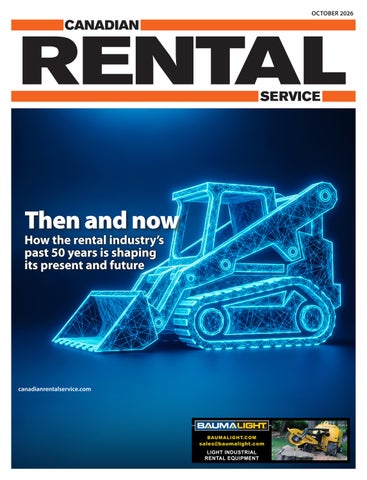
Then and now
How the rental industry’s past 50 years is shaping its present and future
canadianrentalservice.com
BAUMALIGHT.COM
sales@baumalight.com
LIGHT INDUSTRIAL RENTAL EQUIPMENT
premier heaters ®
Rental ready heaters for more uptime in cold weather.
Direct-fired efficiency with added safety
n Enclosed flame promotes safer work environments and provides option to duct n Available from 40,000 - 700,000 Btu/hr n 99% direct-fired fuel efficiency boosted by remote thermostat and option to move air only like a fan n Quiet with less than 70 dB operation n Dual Fuel (DF) models quickly switch from NG to LP n All models are maneuverable and can fit through a 36” doorway
Learn more at LBWhite.com/Premier 2 CANADIANRENTALSERVICE | October 2026
Annex Business Media P.O. Box 530, Simcoe, Ontario N3Y 4N5 (800) 265-2827 or (519) 429-3966 Fax: (519) 429-3094 READER SERVICE Print and digital subscription inquiries or changes, please contact Angelita Potal, Customer Service Tel: (416) 510-5113 • Fax: (416) 510-6875 Email: apotal@annexbusinessmedia.com Mail: 111 Gordon Baker Rd., Suite 400, Toronto, ON M2H 3R1
OCTOBER 2026 Vol. 50, No. 6
10
EDITOR I Mike Lacey mlacey@annexbusinessmedia.com (416) 510-5115 ASSOCIATE EDITOR I Colin Leggett cleggett@annexbusinessmedia.com (416) 510-5207 ACCOUNT COORDINATOR I Barb Comer bcomer@annexbusinessmedia.com (519) 429-5171 AUDIENCE DEVELOPMENT MANAGER Shawn Arul sarul@annexbusinessmedia.com (416) 510-5181
16
20
24
MEDIA DESIGNER I Brooke Shaw GROUP PUBLISHER I Danielle Beavan dbeavan@annexbusinessmedia.com (226) 931-0375 CEO I Scott Jamieson sjamieson@annexbusinessmeda.com Publication Mail Agreement #40065710. Printed in Canada ISSN 0383-7920 Subscription Rates Canada- 1 Year $ 47.74 + tax U.S.A. - 1 Year $108.73 (CDN) Occasionally, Canadian Rental Service will mail information on behalf of industry-related groups whose products and services we believe may be of interest to you. If you prefer not to receive this information, please contact our circulation department in any of the four ways listed above. Annex Privacy Officer Privacy@annexbusinessmedia.com Tel: 800-668-2374 All rights reserved. Editorial material is copyrighted. Permission to reprint may be granted on request.
Serving the Canadian rental industry for 45 years.
4
THEN AND NOW
Canadian Rental Service marks its 50-year anniversary.
As Canadian Rental Service celebrates 50 years of publishing, we look at how the industry has changed over that time and what to expect in the coming decades.
20
16
CHANGING THE GAME The rental landscape looks very different after half a century.
24
RETHINKING THE RENTAL BRANCH
MAINTENANCE MATTERS
Technology is reshaping how rental businesses manage equipment, communicate internally and work with customers.
These simple check-in routines protect your bottom line.
9
www.canadianrentalservice.com
10
EDITORIAL
26
EVENTOLOGY
LAST WORD
What are you doing with everything you learned this summer?
Technology may change, but some things never do. October 2026 | CANADIANRENTALSERVICE 3
EDITORIAL
50 years young Canadian Rental Service marks 50 years of publishing
T by Mike Lacey
his edition marks the 50-year anniversary of Canadian Rental Service. When the topic of the anniversary first came up earlier this year, I was told the magazine began publication in 1976. I thought, “That year sounds wrong. I was born in 1977 and I’m only...” Then, it hit me. I’m a year younger than this magazine. Fifty years. Five decades. Half a century. No matter how you phrase it, 50 years is a long time. Growing old is a funny thing. One minute you’re in your early 20s, ready to fight the world and slamming up against the stale, conservative standards of your elders. Then, 20 years have passed by and suddenly you are feeling the push and pull of a younger generation you’re having a difficult time relating to. What the heck happened? It’s like waking up after a long night out with friends. Life has moved on. But the memories are fuzzy. Yet this is part of life. The lessons I have hopefully learned over my many years I can now apply to the world. And the next generation can do what I did when I was their age – ignore me. In this edition we have spoken to quite a few people across the industry about what’s changed over the last five decades. However, we also spoke to them about where the industry is going.
Aging kind of feels like the morning after a long night out with friends.
Because, I have found, the one benefit of age is that it sharpens your perspective on the future. For example, as a child, I believed that by 2027 the world would resemble The Jetsons and everyone would be driving flying cars. Today, I can see how impractical a flying car would be (even if it would be very, very cool to own one). Age provides us a much more realistic view on the future. Take an emerging technology such as artificial intelligence. Its value will likely not come on the creative front as many worry about but instead handling many of the mundane tasks of work and life; of helping us manage the ridiculous amount of information we now have access to but can’t practically use because it’s just too much. Yet for all the change we can expect to see, one thing will remain vital – community. We crave connection. We find it in our families. In our neighbourhoods. In the clubs or associations we belong to. We find it in our workplace and our broader industry. These connections cannot be replaced by technology. But they can be enhanced. That’s a question each of us should be asking whenever we incorporate a new technology into our life, be it for work or pleasure. How does this improve our connection to our community? Because if it doesn’t do so, and in some cases has the opposite effect, one must relook at using this. After all, technology is simply a tool to help us. Mike Lacey is editor of Canadian Rental Service. He can be reached at mlacey@annexbusinessmedia.com
crs.magazine 4 CANADIANRENTALSERVICE | October 2026
October 2026 | CANADIANRENTALSERVICE 5
INDUSTRY NEWS KOMATSU CELEBRATES GRAND OPENING OF NEW EDMONTON PARTS DISTRIBUTION CENTRE Komatsu has announced the grand opening of its new Edmonton parts distribution centre, a full-service facility located in St. Albert, Alberta. The company says the site represents a significant investment in its Canadian operations, enabling dealers to access critical inventory more quickly and enhancing service and support across Canada. A grand opening celebration on Sept. 10 brought together Komatsu leaders, employees, local officials, distinguished guests and representatives from key dealer partners, including SMS Equipment, which covers most of Canada, Wilson Equipment in Nova Scotia, and Equipment Sales & Service (ESS) in southern and central Ontario. Spanning approximately 135,000 square feet, the new facility doubles Komatsu’s previous warehouse capacity in Canada and enables the company to stock a broader range of fast-moving and strategic inventory closer to jobsites. Komatsu says the expanded operation improves delivery capabilities across the country, including 24-hour delivery to dealers throughout much of Western Canada. The facility features advanced integration with Komatsu’s global planning and warehouse management systems, updated warehouse layouts, automation and new equipment. Komatsu says the expansion also increases workforce capacity and strategically positions the Edmonton operation to support future growth as demand from Canada’s mining, construction and forestry industries continues to evolve.
LIUGONG OFFICIALLY LAUNCHES CANADIAN SUBSIDIARY
LiuGong Canada has officially launched, establishing a dedicated Canadian organization to expand dealer support, strengthen customer service and accelerate the company’s growth across the country. LiuGong has served the Canadian market through its dealer network for more than a decade. The company says its Canadian arm strengthens relationships by establishing a dedicated organization focused exclusively on the Canadian market. Led by Miao, the organization will focus on dealer development, parts and service support, product training and customer engagement throughout Canada. LiuGong Canada will support a growing portfolio of construction and material handling equipment including excavators, wheel loaders, dozers, motor graders, compact equipment, forklifts, AWPs and battery-electric machines. The company will also bring the resources of LiuGong’s global engineering, manufacturing and R&D organization to the Canadian market to meet the demands of Canadian construction, resource, forestry and infrastructure operations.
6 CANADIANRENTALSERVICE | October 2026
COMING EVENTS Oct. 24, 2026 CRA Elevate 2026 – Blue Mountain Blue Mountain, Ont. crarental.org/EN/Web/CRAElevate---Blue-Mountain.aspx Nov. 20, 2026 CRA Elevate 2026 Saskatoon, Sask. crarental.org/EN/Web/CRAElevate---Saskatoon.aspx Dec. 2-4, 2026 The Building Show Toronto, Ont. informaconnect.com/the-buildingsshow/
2027 Jan. 10-17, 2027 CRA Connect: Punta Cana 2027 Punta Cana, Dominican Republic crarental.org Jan. 18-21, 2027 World of Concrete Las Vegas, Nevada www.worldofconcrete.com Feb. 10-11, 2027 Canadian Concrete Expo Mississauga, Ont. canadianconcreteexpo.com Feb.14-16, 2027 The ARA Show New Orleans, LA arashow.org April 22-23, 2027 Alberta Equipment Expo Edmonton, Alta. albertaequipmentexpo.ca Visit canadianrentalservice.com for updated Coming Events listings
FOUR CRA ELEVATE EVENTS SET TO TAKE PLACE ACROSS CANADA The Canadian Rental Association (CRA) has announced four dates and venues for its CRA Elevate events taking place across Canada. The events will take place on: • October 23 and 24, 2026 in Blue Mountain, Ontario. • November 20 and 21, 2026 in Saskatoon, Saskatchewan. • January 22 and 23, 2027 in Moncton, New Brunswick. • January 29 and 30, 2027 in Kelowna, British Columbia. The four events will bring together the people, resources and expertise that matter most to Canada’s equipment and event rental industry, the CRA says. Members will be able to: Connect with leading partners and discover products and services designed to support their business. • Build valuable relationships with industry leaders and fellow rental professionals from across Canada. • Hear from local Occupational Health and Safety experts about important workplace safety considerations, emerging issues and practical guidance.
•
•
•
Get updates and compliance insights from the Ministry of Transportation, helping them stay informed about regulatory changes and requirements that affect their business. Stay ahead of industry trends and gain knowledge they can take back to their team and put into practice.
The events will also feature special networking experiences including a Saskatoon Blades hockey game and an Elvis in Concert experience.
SWIVEL STUMP GRINDERS
sales@baumalight.com | BAUMALIGHT.COM MANUFACTURING OF MINI SKID STEERS A VARIETY OF ATTACHMENTS INCLUDING BRUSH MULCHERS | ROTARY BRUSH CUTTERS | STUMP GRINDERS | PTO GENERATORS | LOG GRAPPLES AUGER DRIVES | PTO POWER PACKS | TRENCHERS | TREE SPADES | BOOM MOWERS | FLAIL MOWERS TREE SAWS & SHEARS | TREE PULLERS | FELLER BUNCHERS | EXCAVATOR ADAPTERS | SCREW SPLITTERS October 2026 | CANADIANRENTALSERVICE 7 CRS_MTB Mfg._Baumalight_October26_CSA.indd 1
2026-09-16 9:56 AM
INDUSTRY NEWS A MESSAGE TO CRA MEMBERS REGARDING CANADA-U.S. TRADE DEVELOPMENTS The letter below was written and published by the Canadian Rental Association on Aug. 26. Dear CRA Members, Recent developments in the Canada-U.S. trade relationship have created uncertainty for businesses across the country, including those in the equipment and event rental industry. The Government of Canada has announced its Canada Strong Response Plan, introducing new measures to support Canadian businesses and workers affected by U.S. tariffs. The government has also indicated its intention to implement targeted countermeasures on certain U.S. imports. As leaders of the Canadian Rental Association, we want you to know that we are closely monitoring these developments and working with industry partners to better understand the potential impacts on our sector. Many CRA members rely on equipment, parts, supplies, and manufacturing relationships that cross the CanadaU.S. border. As a result, tariff-related changes may affect equipment costs, supply chains, fleet investments and business planning. FEDERAL SUPPORT MEASURES To help businesses and workers navigate the impacts of tariffs, the federal government has announced a number of support programs, including: • Regional Tariff Response Initiative providing financing support for eligible small businesses through Regional Development Agencies. • Business Development Bank of Canada (BDC) supports offering access to financing and liquidity programs for affected businesses. • Canada Strong Diversification Fund, which includes funding to help businesses strengthen competitiveness, diversify markets and accelerate investment projects. • Large Enterprise Tariff Loan Facility (LETL) with enhanced flexibility and extended terms for larger employers. • Expanded Employment Insurance measures, including faster access to benefits and additional supports for workers affected by trade disruptions. • Workforce training and retention programs designed to help employers retain employees, support skills development and manage temporary reductions in activity. Members are encouraged to review available programs to determine whether their businesses may qualify for assistance. The Canadian rental industry has demonstrated remarkable resilience through periods of economic uncertainty. We remain confident in the strength of our members and the essential role our industry plays in supporting construction, infrastructure, industrial operations, events and communities across Canada. CRA will continue to advocate for policies that support business competitiveness, protect jobs and minimize disruption to our industry. We will also keep members informed of relevant government programs and resources as more information becomes available. WE NEED TO HEAR FROM YOU Your experiences are critical to our advocacy efforts. If your business is being affected by tariffs, supply chain challenges, equipment pricing increases, labour challenges or other trade-related issues, we encourage you to share your feedback with us. By hearing directly from members, CRA can better represent the industry’s interests and communicate the realworld impacts of these policies to government decision-makers. Please contact CRA at info@crarental.org to share your concerns, experiences or recommendations. Together, we will continue to navigate these challenges and ensure the Canadian rental industry’s voice is heard. Thank you for your continued support and engagement. Sincerely, Warren Carriere | President | Canadian Rental Association Melanie Misener | Executive Director | Canadian Rental Association 8 CANADIANRENTALSERVICE | October 2026
EVENTOLOGY
Lessons learned What are you doing with everything you learned this summer?
by Michelle Nicol, CERP
B
y the time October rolls around, most people in the rental industry are ready for a little breather. The phones may finally be a little quieter, the warehouse might be starting to look somewhat organized again and everyone is probably looking forward to a weekend off from work. After months of busy weekends, changing orders, tight timelines and the occasional surprise, it is tempting to simply take a deep breath and move on to the next busy month ahead. Before we do that, there is something worth doing: taking a look back at what the summer taught us. The busy season can tell you a great deal about your business. It shows you what worked, what did not, what your customers wanted, where your team struggled and where there may be opportunities to make things better next year. We spend so much time trying to keep up during the summer that we do not always have the opportunity to stop and recognize what is happening around us. Once things slow down, that information becomes incredibly valuable. Start with your inventory. Think about the equipment that never seemed to make it back to the yard before it was needed again. What products were constantly booked? Were customers asking for items you did not have? Were there pieces of equipment that spent more time being repaired than being rented? Your busiest months can provide some of the best information when it comes to making future inventory decisions. It may even be worth looking at what you turned away because you simply did not have the inventory available. Those missed opportunities can help shape your purchasing plans for the year ahead. Your team can also provide some of the best insight. Ask your sales staff what customers were asking for most often and talk to the warehouse team about which orders created the biggest challenges. Don’t forget to ask your delivery crews where they encountered delays, difficult sites or recurring problems. Your installers may have suggestions about equipment, loading or setup/ teardown that could make their jobs easier. These
conversations do not need to become formal meetings with spreadsheets and presentations. Sometimes sitting down with a coffee and asking, “What would you do differently next year?” can lead to some of the best ideas! The same applies to customer feedback. What did customers love about working with you? What frustrated them? Were there questions that came up over and over again? Did customers compliment a particular employee or part of the service they received? Not all feedback comes through a formal survey. Sometimes it is a comment made during a phone call, a conversation at pickup or something a delivery driver hears while on site. Those little comments can tell you a lot about the customer experience. October is also a great time to recognize what went well. Busy seasons take a tremendous amount of effort from everyone, and it can be easy to focus on the things that went wrong. Take some time to celebrate the wins, recognize the employees who went above and beyond and acknowledge the teams that kept everything moving when things got hectic, as those are some of the most important moments. The busiest season is not just when you make money. It is also when your business gives you the most information about itself. Your customers, your employees, your equipment and your daily operations are constantly telling you what is working and what could be better. The question is whether you take the time to listen. Before the summer rush becomes a distant memory, grab a coffee with your team and ask a few simple questions. What worked? What did not? What did our customers ask for? What caused the most headaches? What should we do differently next year? You might be surprised by what you learn, and those lessons could be some of the most valuable things you take into the next busy season. CRS Michelle Nicol, CERP, is an award-winning account executive for Element Event Solutions in Toronto. October 2026 | CANADIANRENTALSERVICE 9
COVER STORY
THEN AND NOW
To mark Canadian Rental Service’s 50-year anniversary, we explore the evolution of the equipment rental industry over that time and what to expect in the coming decades
I
t would be an understatement to say the world looked different 50 years ago. Who in 1976 could have possibly predicted the technological, political, societal and business landscapes of today?
by COLIN LEGGETT AND MIKE LACEY
Like everything else in the last five decades, the equipment rental industry has gone through numerous sea changes. Considering how much the machines themselves have changed just in the last 10 years, it’s hard to imagine someone having been through all of the shifts 50 has brought.
TIME BRINGS CHANGES So, what exactly has changed in the Canadian rental market in the last half-century? “I think the biggest pivotal shift was that rental has become part of a successful contractor’s profit strategy,” says Ed Dwyer, owner of C&T Rentals in Manitoba. Ed Dwyer has been in the rental business since 1987, when he founded a company called Tempheat. Dwyer specialized in renting portable heaters to construction companies, but eventually diversified his equipment portfolio with a second company, Compact Equipment Rental, in 1992. In 1996, Dwyer combined both brands to create C&T Rentals. “Contractors are increasingly choosing to rent because they can put equipment cost directly against a job rather than carrying capital cost, deprecation, maintenance, storage and idle time associated with ownership,” says Dwyer. “This shift has changed everything for the Canadian rental industry: fleet investment, maintenance standards, technology, logistics, customer service and, ultimately, the professionalism of the rental industry.” Camille Jagdeo of EDGE1 Equipment Rentals in Stoney Creek and Mississauga agrees with this 10 CANADIANRENTALSERVICE | October 2026
sentiment. Jagdeo acquired EDGE1 in 2000, and has served as the company’s President and CEO since then. “I think the real transformation is that rental has gone from being a convenience to being an essential part of how construction companies operate,” she says. “Rental went from filling a gap to becoming part of the contractor’s business model.” As president of the Canadian Rental Association and sales manager at Cooper Equipment Rental in Alberta, Warren Carriere is particularly happy to see safety become a higher priority. “Safety was barely a thought years back,” Carriere says. “The industry gave the equipment to the customer and let them be on their own with the expectation that the customer knew what they were doing. Rental houses now have more robust safety practices and procedures ensuring the safety of employees and of customers with training and certifications.” Jagdeo agrees, saying the professionalization of safety and equipment management has been a positive change for the industry. “Equipment is bigger and more sophisticated, jobsites are more complex, and there are more people working around these machines,” she says. “Safety can’t just depend on somebody’s experience or memory.” Change doesn’t always have to be a bad thing. Moving the rental industry into the future has necessitated shifts, not just in how business is done but also in the attitudes of those doing business.
PHOTO: TRENDSTUDIO/ADOBE STOCK
As Canadian Rental Service celebrates 50 years of publishing, we look at how the industry has changed over that time and what to expect in the coming decades.
“I’m glad we’ve moved away from the attitude that experience alone was enough,” says Jagdeo. “Years ago, there could be a lot more of, ‘I’ve been running equipment for 20 years; I know what I’m doing.’ Today there is much greater emphasis on training, inspections, documentation and accountability.” Training and accumulating knowledge, especially on modern pieces of equipment, are especially crucial as demand among the customer base changes. Dwyer says he’s glad to see the industry moving away from the philosophy of holding on to and renting out old equipment to keep costs down “Today, customers expect newer equip-
ment, well-maintained fleets, updated clean stores and a rental experience that gives them confidence before the machine ever reaches the job site,” he says. “That shift has been good for both the rental industry and the customer.”
TECHNOLOGY’S ROLE IN THE INDUSTRY Yet when considering the changes that have taken place, Carriere believes nothing has been as transformative for the industry as the internet. “Customers can now search the types of equipment they are needing for the project, search where they can get it and even order online in some cases,” he says.
“The way customers and rental houses interact has shifted to online transactions.” Doron Broadfoot, President of The Rent-It Store in Saskatoon and a former Canadian Rental Association president, thinks so too. As a 50-year veteran of the rental industry, Broadfoot has witnessed the massive transformation firsthand. “Even the advent of mobile phones has been a tremendous boon and growth agent for an industry such as ours,” says Broadfoot. “Timely communication and problem solving has been advanced at warp speed by this important tool.” Broadfoot’s evocation of speed being driven by technology is not far off from October 2026 | CANADIANRENTALSERVICE 11
what the other industry veterans think of the changing rental space. Rapid technological growth has altered the face of numerous industries, including equipment rentals, whether it’s more advanced machinery or rental software. New technologies, such as artificial intelligence or improved telematics, are building on the online experience. “Telematics is evolving quickly allowing the rental companies to receive operational updates, location updates and maintenance schedule information,” says Carriere. “Automation like this allows the customers to maintain equipment uptime and allows projects to stay on schedule.” Steve Szaniszlo, vice president northeast region of United Rentals, says the importance of telematics is underhyped as it provides real-time information on how a fleet is performing. “It doesn’t get the same buzz as some of the flashier innovations in our industry, but it’s quietly changing how decisions get made on site,” he says. “When you can see utilization, engine hours, fuel burn and maintenance status in real time, you’re not guessing anymore — you’re making informed calls on safety, productivity and cost. That’s the kind of impact that shows up in the outcome, not the headline.”
LOOKING TO THE FUTURE Yet as this technology advances, it will require skills to adapt as well. Looking into the future, Carriere expects the value of service technicians to only grow. “The equipment’s technology is evolving quickly so those technicians will be responsible for staying up to date with training and skill development,” he says. As store owners and managers navigate this evolving world, the best piece of advice Carriere can share is to embrace change. “There are going to be economic changes, new technologies and changing customer expectations. The next generation of leaders needs to roll with them and adapt accordingly,” he says. “Researching economic forecasts, speaking with your supply partners regarding new equipment options and 12 CANADIANRENTALSERVICE | October 2026
PHOTO: JULIEALEXK/GETTY
COVER STORY
staying up to date with safety policies and procedures will give that rental house the competitive advantage. The rental industry is filled with really dynamic, intelligent and caring people. That’s why it is difficult for most to leave the industry and why I’ve been in it for over 25 years.” As Achille Ettorre, co-owner of GTA Equipment Rentals and author of the book The Digital Advantage, considers the future, the one skill he sees rising in importance is the ability to blend experience with data collection. “Owners should be able to see which machines earn their place in the fleet,
which customers generate a healthy return and where service breaks down,” he says. “That understanding also needs to reach the people making daily decisions. A business becomes difficult to scale when critical knowledge lives in one person’s head. The strongest operators will combine experience with accessible information, clear processes, and a team capable of acting on both.” That’s why data integration is so important moving forward, he says. “Linking rental contracts, maintenance records, equipment usage, delivery costs and customer payments can reveal oppor-
Contractors are choosing to rent more often to put the cost against a job rather than carrying a capital expense.
to keep learning will remain essential. We should be developing those capabilities through apprenticeships, continuing education and experienced employees passing on their knowledge.”
SOME THINGS STAY THE SAME
tunities that separate reports miss,” he says. “A machine with high utilization may look like a winner until you connect its repair history and transport costs. That insight can change a purchasing, pricing or replacement decision.” Szaniszlo agrees and believes fluency with digital tools and the broader jobsite ecosystem will be key skills for the future worker. “The equipment itself will keep evolving, but the people who can pull data from that equipment and turn it into a better project schedule, a smarter maintenance plan or a more efficient fleet mix
are the ones who’ll drive results,” he says. “Understanding how to optimize a jobsite through data, not just operate within it, is going to separate good yards from great ones.” Ettorre also sees diagnostic problem-solving as the most valuable skill for future workers, be it in the mechanical, electrical or digital realms. “The most valuable technician will understand how a machine works, interpret its data, identify the underlying fault and verify that it is safe to return to service,” he says. “The tools will evolve, but sound judgment, curiosity and the ability
However, with so much change happening, there are always going to be risks for rental houses who are not keeping up with the times. Ettorre has spent many years thinking about the equipment rental industry and its future. A concerning trend he sees across the industry is companies growing their fleets faster than they are developing their people and operating capabilities. “A busy yard can hide weak returns when maintenance, delivery costs, discounting and slow collections are overlooked. For independent operators, developing those capabilities is essential to staying competitive as they grow,” he says. “What concerns me most is treating training, leadership development and technology adoption as things ‘we will get to later.’ Those investments help turn growth into a stronger business and a better customer experience.” This is why the principles that have helped rental houses stay successful still remain crucial. Ettorre says communication is vital. Someone able to clearly explain a problem and coach someone through it is far more valuable to the operation, he says. “They protect uptime, strengthen the team and help prepare the next generation of rental industry leaders,” he says. In terms of rental houses reaching out and going the extra mile, Broadfoot agrees, saying relationships will always be the key to doing good business. “To be fair, honest and treat customers as you would wish to be treated ensures there is a healthy relationship,” he says. This old-school principle isn’t the only facet of the business that has remained October 2026 | CANADIANRENTALSERVICE 13
PHOTO: AVALON_STUDIO/GETTY
COVER STORY
Despite how much has changed in 50 years, maintaining relationships is still key to a successful rental business.
the same over the decades, but it might just be the most important. Dwyer says business is built on relationships, and suppliers should know their customers and what they do. He adds one crucial point combining what has changed and what has stayed the same. “Technology should make that relationship better, not eliminate it,” he says. “A customer should still be able to call a rental company and have someone say, ‘I know what you’re doing, you don’t want that machine, you want this one.’ That is expertise.” Dwyer says contractors don’t necessarily want the technology itself, but rather the benefits it provides. This could be basic information like online quotes and reservations, as well as reports showing what equipment is on their jobsite and what it may be costing them. On top of that, they want the information quickly. 14 CANADIANRENTALSERVICE | October 2026
“The technology should work behind the scenes,” he says. Jagdeo adds that while technology, equipment, and communication have changed the trust at the centre of the rental store-customer relationship will never change. “If you tell a contractor you’re going to have a machine there in the morning, you’d better do everything you can to have that machine there,” says Jagdeo. “You can automate a lot of this industry, but you can’t automate trust.” Despite the demand for speed and technology, Jagdeo says one major component of the business has stayed the same. “Technology has increased expectations, but when something goes wrong, customers still want a human being to answer the phone and solve the problem,” she says. “Technology changed the speed of the business, but it didn’t eliminate the
importance of people.”
CHALLENGES ON THE HORIZON As technology advances, there is a significant risk for companies who refuse to keep up with the times. “Twenty years ago, a phone call and a handwritten rental contract could be enough,” says Jagdeo. “Today [customers] expect emailed contracts and invoices, photographs, electronic records, GPS information, accurate delivery windows and almost immediate answers.” Along with trying to keep up with five decades’ worth of technological progress, the rental industry is still facing some of the same challenges it always has. Retaining and finding skilled workers continues to be a main challenge the industry needs to tackle, Carriere says. “The working world is a very competitive place right now. Finding and keeping
those valuable people in an evolving rental industry is becoming more difficult,” he explains.
WORDS OF WISDOM After 50 years and looking into the future, there is still plenty the new generation of leaders in the rental industry can learn from those who came before them. “The rental industry has grown because it has adapted,” says Dwyer. “The next generation will need to keep adapting to new technology, changing customer expectations and a changing construction industry.” Dwyer’s lesson takes half a century’s worth of experience and boils it down to one sentence. “Change everything you need to change, but never change your commitment to the customer, no matter what the consultations tell you.” For Jagdeo, her time in the rental industry has allowed her to see numerous changes, with the way technology has altered how business is done being the most significant. “Over 50 years, this industry has gone from handwritten contracts and relatively simple equipment to telematics, GPS, digital rental systems, sophisticated machines and customers expecting information almost instantly,” she says. “The companies that survived didn’t resist every change. They adapted. But the successful ones also didn’t forget what business they were actually in.” Jagdeo believes the most important lesson for the next generation of rental professionals is to embrace new technology and continue modernizing the industry. However, they should also not lose sight of serving their customers and understanding the facets of service, equipment and relationships. Beyond all of this, Jagdeo has a unique point of view on how the rental industry has changed over time. “As a woman in what has traditionally been a very male-dominated industry, I’ve seen that evolution firsthand,” she says. “There are more women today in leadership, sales, operations and equipment roles, and I think that’s an important part
of how our industry continues to grow.” Far from just seeing the demographic shift, Jagdeo sees a lesson in her own experience and those of other women working in the rental industry. “I’ve never believed that being a woman meant I needed to know less about the equipment or prove myself by trying to be one of the guys,” she says. “You earn credibility by knowing your
business, knowing your customers, making decisions and delivering on what you promise.” As someone who has been in the rental industry for a full half-decade, Broadfoot’s lesson for the generation of rental professionals to come is simple, but truthful. “Always try to do better,” he says. “Always accept genuine help, pay it forward and keep learning.” CRS
NEW
FOR RENTAL Skyjack’s new models all provide the same simple, reliable choice for rental.
skyjack.com/simply-more
October 2026 | CANADIANRENTALSERVICE 15 CRS_Skyjack_Oct26_CSA.indd 1
2026-09-21 1:39 PM
EQUIPMENT SHOWCASE
CHANGING THE GAME
The rental landscape looks very different after half a century
T
he rental industry has evolved in several ways over the last 50 years. Along with the industry itself, the equipment has also changed, and with it the demands of customers. It’s no longer enough for rental equipment to just be a workhorse on a jobsite. Rental customers are seeking out electric options and technologically advanced equipment that is changing the way work gets done. by COLIN LEGGETT
The scope and type of projects being worked on is also changing how customers look at technology. For example, the increasing number of data centres being built means contractors need more electric equipment that can be used both indoors and outdoors without compromising the work environment. They need compact equipment that can seamlessly move around the worksite without issue. Demand for vacuum excavation is also growing among rental customers. Underground risks, regu-
CANYCOM SC30EV ELECTRIC WALK-BEHIND RUBBER TRACK BUGGY 16 CANADIANRENTALSERVICE | October 2026
latory shifts and project economics are all making vacuum excavation systems more attractive on construction projects. Along with the equipment itself, contractors want reliable software and technology that allows them to easily track usage, idle time and the location of their machines.
CANYCOM SC30EV ELECTRIC WALKBEHIND RUBBER TRACK BUGGY Canycom’s SC30EV is an all-electric, walk-behind rubber-track buggy designed to move material through tight, confined and ventilation-sensitive work areas. Its Honda eGX electric power system, narrow 29-inch width and rubber-track undercarriage help navigate restricted access points and rough terrain without engine exhaust at the point of use. The hydraulic dump body tips to 90 degrees and carries up to 660 lb (299 kg), with a 9.5-cubic foot bucket. Two batteries and a charger are included to reduce downtime. Each battery has been tested with a minimum of 50 minutes of continuous work under a load. Six forward speeds, two reverse speeds and a travel range of 0.5 to 5.3 km/h give operators control across a range of landscaping, construction and material-handling jobs.
YANMAR TL40RP COMPACT TRACK LOADER The TL40RP delivers 38.2 horsepower within a
compact, approximately 48-inch-wide platform. It combines the access of smaller equipment with power, capacity and auxiliary hydraulic performance to support landscaping, construction, property maintenance, sidewalk work and snow removal. At 4,030 pounds in its open-ROPS configuration, the TL40RP is also straightforward to transport between rental locations and customer jobsites. The TL40RP offers rental businesses a seated alternative to stand-on equipment without sacrificing compact access. Its operator station is designed to reduce fatigue during longer workdays, while pilot hydraulic controls provide intuitive operation for customers with varying levels of experience. An available all-weather cab supports yearround use in Canadian conditions. The TL40RP is powered by a 38.2-horsepower turbocharged Yanmar diesel engine that requires no DEF. A rear-tilting hood provides convenient access to major service points, helping rental service teams complete routine maintenance efficiently and return the machine to service. Its patented ASV Posi-Track fully suspended torsion-axle undercarriage provides traction, low ground pressure and ride quality across soft, uneven and sensitive terrain. Yanmar says models equipped with ASV Posi-Track undercarriages are backed by the industry’s only no-derailment guarantee during the applicable warranty period.
YANMAR TL40RP COMPACT TRACK LOADER
YANMAR VIO17-1E MINI EXCAVATOR
Performance From Billy Goat ! ®
30” hydro drive aerates all in one pass! • 30” wide aeration and speed up to 4.3 mph
YANMAR VIO17-1E MINI EXCAVATOR
• Variable Aeration Density (VAD™) from 8 to 48 holes per square ft. in one pass
The ViO17-1E is a 1.8-ton mini excavator designed to deliver productive digging performance in confined working environments. Its hydraulically adjustable undercarriage retracts to 37 inches for narrow access and expands to 50 inches for greater stability while digging. A folding blade provides additional flexibility. True zero tail swing means no part of the machine housing extends beyond the tracks. Yanmar says this lets customers work efficiently around buildings, walls and landscaping while helping protect both the machine and the surrounding jobsite. The ViO17-1E gives rental businesses a
• Variable hydro-drive for aeration in both forward and reverse.
Force™ F10 Blower for Commercial Cleanup Power
• Ideal for medium size maintenance contractors and large property owners • Aim N Shoot™ directs airflow where you need it most with fingertip control and is lockable for single positions. Call 800-776-7690 or visit billygoat.com CRS 1-3 pg 9-25.indd 1 CRS_BillyGoat_Sept26_CSA.indd 1
8/19/25 2:55 PM October 2026 | CANADIANRENTALSERVICE 17 2026-08-20 8:43 AM
EQUIPMENT SHOWCASE compact, easy-to-transport solution for residential construction, landscaping, utility and renovation work. Its size and versatility allow it to serve a broad customer base and support high utilization across multiple applications. Four-point tie-downs support transportation between jobsites, while heavy-duty cylinder rod guards help protect critical components from damage. Standard auxiliary hydraulics expand the machine’s application potential with compatible attachments. Joystick pilot controls and an easily accessible pattern-change valve allow the ViO17-1E to accommodate operators familiar with either excavator or backhoe control patterns. Its operator station is designed to reduce fatigue during longer workdays. The machine is powered by a 14.5-horsepower Tier 4 Final Yanmar diesel engine and is backed by Yanmar’s four-year/4,000hour full-machine factory warranty. DITCH WITCH MV800 VACUUM EXCAVATOR
DITCH WITCH MV800 VACUUM EXCAVATOR The Ditch Witch MV800 is a compact and durable vacuum excavator designed specifically for cleanup on horizontal directional drilling (HDD) jobsites. A commercial-grade, 31-hp (23.1-kW) Briggs & Stratton Vanguard gas engine powers the MV800 and features an electric start with a high-capacity, remote air-intake filter. The MV800’s filtration system includes an integrated carryover chamber that eliminates contaminants before they reach the blower. The MV800 is equipped with a 3028-litre spoils tank with optional reverse flow and hydraulic opening door. The MV800 also offers an optional water system with a 379-litre water tank and adjustable pressure up to 3,000-psi (207-bar) for soft excavation tasks such as potholing utilities. Standard curbside controls enable one-person control of all functions. Other standard safety features include a strobe light, belt guards and mechanical locks on all lift cylinders.
JOHN DEERE OPERATIONS CENTRE
JOHN DEERE AUTOMATION FEATURES 18 CANADIANRENTALSERVICE | October 2026
JOHN DEERE OPERATIONS CENTRE The John Deere Operations Centre uses data transmitted through JDLink connectivity to help rental stores monitor equipment location, operating hours, utilization, maintenance status and diagnostic trouble codes from one centralized platform. When paired with its Connected Support, John Deere says the technology helps rental providers take a more proactive approach to machine maintenance. Service teams can track maintenance intervals, investigate alerts remotely and identify certain developing issues before they result in unexpected downtime. If service is required, dealer technicians can arrive with the necessary tools, parts and repair information. For rental stores, these capabilities can mean more rental-ready machines, fewer disruptive service calls and better visibility into equipment operating across multiple customer jobsites. Utilization data can also help managers reposition underused machines and make more informed fleet-purchasing decisions, while location tracking and geofencing support asset security. By connecting equipment through the Operations Centre, John Deere says rental providers can better protect machine health,
maximize fleet availability and deliver a more reliable experience to customers.
JOHN DEERE AUTOMATION FEATURES John Deere says its full portfolio of construction equipment offers automation and operator-assistance features that can help rental customers work more accurately and become productive faster. Available on select machines, SmartGrade technology can automatically control the blade, boom or bucket to maintain the target grade. Supporting capabilities such as Slope Control, Overdig Protect and Virtual Fence can reduce manual adjustments, help prevent over-excavation and establish operating boundaries around obstacles. Select loaders also offer automated functions such as return-todig, return-to-carry, bucket self-leveling and boom-height kickout. These features simplify repetitive tasks and support consistent loading cycles. Onboard payload weighing can further help operators move the right amount of material while avoiding underloading or overloading.
SKYJACK’S VERTICAL MASTS AND MICRO SCISSORS WITH SKYPROTECT Skyjack’s next generation vertical mast lifts, including the SJ12 E, SJ16 E, and SJ20 E, provide a quiet and versatile package with zero emissions and other ECO benefits. Electric drive provides controllability, gradeability and torque. The rigid, multi-stage cylinder mast design reduces maintenance and offers smooth operation at height, while the mast top is in line with platform rails, benefiting overhead work especially where there are drop ceilings. The control box position on the platform allows for unrestricted views and maneuverability. Included in a range of features are a traversing deck with up-and-over capability, smart charging, simple robust controls, onboard diagnostics display with plain language readouts and easy-access platform service positioning.
RUBBER TRACKS MiniExcavator
Compact Tractor Loader
1000s of Parts in Stock
STUMP GRINDERS 337-13H
SKYJACK’S VERTICAL MASTS AND MICRO SCISSORS WITH SKYPROTECT Skyjack’s micro scissors, like the SJ3213 micro and SJ3219 micro, combine zero emissions and exceptional runtime. Front wheel electric drive with wheel motor guards for performance and protection offers quiet and swift controllability with consistent power, torque and traction. The compact dimensions are designed to fit most passenger-style elevators and work in environments where space is at a premium, while still providing the largest work platform in the micro class. A telescoping extension deck optimizes platform floor space while the low gross vehicle weight and floor loads protect finished floors. The range includes a two-piece optional ECOTRAY leak containment that prevents unwanted hydraulic oil leakage. SKYPROTECT is a secondary guarding lift sensing option for scissors and vertical masts that detects potential collision hazards in the area above the operator through a control box mounted ultrasonic sensor. Upon entering an adjustable, pre-set ‘warning zone’, an e-stop light and audible alarm will warn the operator. Once the ‘stop’ zone is reached, the operator can choose to override or remain stopped. SKYPROTECT+ combines SKYPROTECT with Skyjack’s existing secondary enable switch to provide additional functionality through the use of a secondary switch for lifting and reverse driving. CRS
EARTH DRILLS AND TRENCHERS
TRENCHERS, TILLERS & GRINDERS
HD 99 Hydraulic Auger
712 Micro Trencher
terracutsupply.com
•
Toll-free 1-800-561-5414 terracut@shaw.ca October 2026 | CANADIANRENTALSERVICE 19
CRS_TerraCut_Feb26_ASK.indd 1
2026-02-03 3:17 PM
BUSINESS INTELLIGENCE
RETHINKING THE RENTAL BRANCH How early conversations, better processes and shared information can turn expertise into a competitive edge
A
customer calls to book a generator to be delivered. Same size as the last job. It sounds straightforward, until the person at the rental desk asks what it will be powering. The conversation changes. Different power requirements mean different equipment and what worked on the last project may not be the right fit this time. Before confirming the booking, the rental desk brings in a power specialist to review the requirements. Together, they help the customer choose a solution suited to the work ahead. That kind of support starts with a question. Following through takes shared information and a clear process for bringing the right people into the conversation. It’s a shift in the industry that’s well underway. Rental stores of the future won’t compete on fleet
RIGHT: Rental stores of the future will transform from equipment suppliers to project partners.
20 CANADIANRENTALSERVICE | October 2026
size, availability or price alone – the strongest providers will become trusted sources of expertise, planning support and fast local response. So how does a rental provider get there and stay competitive once they arrive? Technology will play a key role, but it’s only part of the equation. The real opportunity lies in the flow of information – between the rental desks, service departments, technicians, head office and, most importantly, customers.
ALL PHOTOS: COOPER EQUIPMENT RENTALS
BY RYAN CALFAT, COOPER EQUIPMENT RENTALS
Technology is reshaping how rental businesses manage equipment, communicate internally and work with customers.
FROM EQUIPMENT SUPPLIER TO PROJECT PARTNER The rental stores that build lasting success get involved while the customer is still planning the work. Instead of the conversation starting with “What machine do you want to rent?” it becomes: “What are you trying to accomplish? What are your site conditions? What does the schedule look like?” Those conversations are more useful when the person at the rental desk can draw on fleet availability, service history and lessons from similar jobs. Recording the customer’s requirements and sharing them with the service team helps turn that advice into a plan everyone can act on. The providers that stand out will use that information to recommend the right approach: showing customers when a smaller machine can deliver the same value at a lower operating cost or when a different attachment could eliminate hours of manual labour. They’ll use what they know about the customer, the equipment and the application to recommend
solutions that can make current (and future) jobs more efficient. It’s the shift from equipment supplier to project partner: using knowledge, information and expertise to help customers plan better, work more efficiently and keep their operations moving.
THE DIGITALLY CONNECTED COMPANY Technology is reshaping how rental businesses manage equipment, communicate internally and work with customers. In the future, it will be central to how branches differentiate themselves. It’s easy to assume technology reduces personal communication. Used well, it actually strengthens it, while also saving team members’ valuable time. The right applications can improve communication between the rental desk and shop, technicians and service departments, branches and head office, and rental providers and customers. For parts specialists, a centralized database makes it easier to find and access information, including estimated
delivery times, reducing both time and costs. For management, apps provide a clear flow of information to review, assess and support faster decisions across branches, districts, and regions. But shared information needs a clear next step and can’t just be a one-way flow of data. When a technician flags a service issue, who follows up? Does the rental desk know whether it affects the next booking? Who updates the customer? Clear responsibilities help teams act on the information they have. Consider a customer working on a remote construction site. Instead of calling the branch to check availability, reservice a machine, extend a rental or off-rent equipment, they can handle those transactions digitally, at their own convenience. The rental team can see the status of the fleet, monitor utilization and focus time on higher-value conversations and problems that require human expertise. Telematics extends that same visibility to the equipment itself. Engine RPM, sensor readings, operating hours, fuel conOctober 2026 | CANADIANRENTALSERVICE 21
BUSINESS INTELLIGENCE
Rental stores that get involved while the customer is planning the work will see lasting success, writes Ryan Calfat.
sumption and diagnostic codes can give rental teams real-time insights to how equipment is performing. If a machine starts showing signs of problems, the branch can alert the customer and arrange service before a breakdown brings the job to a halt. In some cases, technicians can diagnose an issue remotely or arrive on site with the right parts and equipment to resolve it on the first visit. Remember: No customer should have to experience unnecessary downtime when technology can help rental teams diagnose issues remotely or arrive prepared to resolve them faster.
THE GROWING VALUE OF SPECIALTY RENTALS The rental branches of the future will be defined by the solutions they can make available to customers. Specialty rentals, including trench safety, pump and power, dewatering and temporary heating, can address critical needs that many customers may only encounter occasionally. That’s one of the fundamental advantages of a local rental branch: customers get access to the equipment they need and gain valuable expertise and knowledge22 CANADIANRENTALSERVICE | October 2026
able teams to go along with it. Temporary power is a good example. A customer may request the same equipment that worked on a previous job, even though the requirements of the next job are different. The wrong machine or setup can result in poor performance, downtime and unnecessary cost. But by understanding the application and power requirements before the job starts, rental teams can recommend the right solution and help customers avoid problems before they occur. It also means a branch doesn’t need to stock every specialty machine to deliver that value. A connected network, where one branch can quickly source equipment or expertise from another, can be just as powerful as a large local fleet and can give customers access to a broader range of solutions without slowing the project down.
BUILDING A STRONGER RENTAL PARTNERSHIP Rental relationships have often started the moment a customer needed a machine. Going forward, the advantage belongs to branches who recognize that no one person can know it all. That it’s about building a team of people who draw on a wide
variety of knowledge and understand the importance of early engagement. By understanding the customer’s schedule, budget and site conditions early, rental teams can recommend the right equipment, source specialized solutions and anticipate service or backup needs. Branches that do this consistently earn trust that outlasts any single transaction…and keeps customers coming back. Getting there takes work. Start by looking at how customer information moves between the rental desk and service team: where are details getting lost and who is responsible for following up? Clear processes, shared data and better communication tools help everyone act on the same information and deliver more consistent service. The real differentiator will be what’s harder to replicate: local knowledge, strong relationships and specialized expertise. Backed by solid processes and technology, branches of any size can compete on the value they bring customers. CRS Ryan Calfat is Regional Service Manager, Western Canada for Cooper Equipment Rentals.
October 2026 | CANADIANRENTALSERVICE 23
MAINTENANCE
MAINTENANCE MATTERS
How simple check-in routines protect your bottom line
But preventing, or at least minimizing, a piece of equipment’s downtime, can be the difference between success or failure for a business. The best way to prevent untimely equipment failures is a proper check-in routine for when equipment is returned. Doing so ensures issues are spotted early and do not fester into a larger and more expensive problem. Yet these procedures also help maintain the life of equipment and ensure they go as long between repairs as possible. An official maintenance policy is generally required by insurance companies, but it doesn’t have to be complex or time-consuming for employees. “With proper maintenance on equipment, the day just runs smoother,” says Colin Wilson, co-owner of A World of Rentals in Kingston, Ontario. His procedures have developed over time and he adjusts when necessary. But they begin with the Canadian Rental The Canadian Rental Association’s R2Go tags cover the basics for equipment maintenance and are easy to implement, explains Colin Wilson, co-owner of A World of Rentals in Kingston, Ontario.
24 CANADIANRENTALSERVICE | October 2026
Association’s R2Go tags. “R2Go tags cover the basics for equipment checklists and they are quite easy to implement,” he says. “When a piece of equipment is returned, it’s fitted with a new tag. If repairs are needed, a description of the equipment’s issues will be written on the red portion of the tag. Once no repairs are needed, the red portion of the tag is removed and only the green “Ready to Rent” tag stays on the equipment. The green portion of the tag also requires a date and employee ini-
tials. These colour-coded tags make it easy to quickly see which equipment is ready to go, and who serviced each piece of equipment.” However, the type of equipment also dictates the procedure. “Smaller hand tools are cleaned, inspected, tested and green-tagged. Anything that needs attention is redtagged and placed on work order in our computer system,” explains Wilson. When it comes to larger machines such as excavators or aerial equipment, each piece has a designated binder.
PHOTOS: CANADIAN RENTAL ASSOCIATION
by MIKE LACEY
E
veryone knows equipment failures cost money. There is the cost of parts and labour for the repair. The cost of hours lost in renting that machine. And there is the cost of supplying a replacement machine for a job that could have been deployed on another site.
“These binders contain daily checklists for the equipment, as well as routine maintenance lists for each piece, per manufacturer’s recommendation,” he says. “These binders track all maintenance of the equipment. I have tried digital systems before, where maintenance is logged on an iPad and/ or phones, but we generally prefer pen and paper. We do complete work orders on our computers to track all parts and repairs to equipment.” Photography is another key procedure A World of Rentals deploys. When equipment is delivered and picked up, the drivers take multiple photos. “We can easily see when any damage has occurred,” Wilson explains. Of course, while this can seem time-consuming in the moment, Wilson notes in the long run the benefits far outweigh the upfront cost of time. “Many of [the checklists] relate to operator safety, so following these procedures helps us to protect our customers
and limit our liability,” he says. “These procedures may also save us having to send a mechanic to a jobsite because an issue was missed, and a piece of equipment failed. Equipment failures are costly, and they can quickly damage a repu-
“With proper maintenance on equipment, the day just runs smoother.” - Colin Wilson tation in the construction community.” With that said, Wilson and his team are always looking to make the process more manageable. One example he points to us is the binder system. First,
they are colour-coded to match with a specific OEM – an orange binder for Kubota or a green binder for John Deere. “They are organized by category of equipment. Inside the cover of each binder is a list of all the tools that are required for completing the daily checklists.” The way they park equipment in the yard is also part of creating a more manageable system. “Equipment in our yard that’s ready to rent will face into the yard, while equipment that needs servicing will face the store. This way we can quickly look and see what equipment is available without having to check a computer.” Ensuring these procedures are followed falls on Wilson’s managers. However, the team has been using these systems so long staff are aware of what needs to be done. “It’s generally just checking up on the maintenance guys periodically,” he adds. CRS
Rental Fleets Are Changing. Be Ready Optimize Generator Fleets
Transform Generator Performance
Build What’s Next Into Your Fleet | ANACORP.COM October 2026 | CANADIANRENTALSERVICE 25 CRS_ANA_Oct26_CSA.indd 1
2026-09-10 1:29 PM
LAST WORD
The future
Technology changes, but some things never do by Colin Leggett
B
eing closer in age to 50 than 20 offers a lot of perspective. There’s a newfound sense of what really matters, even in the face of a world that never seems to stop changing. It might be harder to keep up with the times, but there’s peace in knowing that the fundamentals at the centre of everything remain (to some extent) rock solid. Over half a century, the rental industry has no doubt gone through plenty of seismic changes. Some of them have been gradual, while others must have seemed to happen all at once. Regardless, the rental stores of 2026 are worlds different from those of 1976, and not just because of the aesthetic choices. When an industry veteran looks at the rental landscape today, the biggest differences they might see are: • The equipment: On its surface, rental equipment may not look all that different from how it did 50 years ago. There aren’t flying excavators or loaders that can fold up and fit in a suitcase. However, a closer look under the hoods reveals just how much technological progress has been made. Electric machines are now far more common, and though their upfront cost is more, they can save money in the long run. Autonomous machines, something that would have seemed impossible even just 15 years ago are now being introduced to more jobsites. • The software: Powering all this new equipment and helping keep track of all of it is a field of incredible software, whether it be the rental software ensuring a company’s machines are properly tracked, run and maintained or the assistive systems built into the machines themselves to make operation easier. • The speed: The result of so much hardware and software changing is the demand for faster service. Customers don’t just want a machine and a bill, they want all of the documentation delivered right to their email, they
26 CANADIANRENTALSERVICE | October 2026
want information on a machine at their fingertips and when something goes wrong, they want answers immediately, whether that’s with an AI chatbot or through a video call with an expert in another part of the world. If it was possible to take a rental store manager from 1976 and transport them to 2026, it would take them a long time to find their footing among all the new technology. However, they would likely see that some things have stayed the same. Relationships still matter. Customers want to know they will be taken care of. They want to be assured their equipment will work and serve their needs. Rental stores that offer great customer service and maintain their relationships with customers will always win out over ones that prioritize profits and technology over people. Of course, change is inevitable. Companies that cannot keep up with the evolving landscape will quickly be forgotten, but those that can change what is necessary while keeping their core commitments to the customer the same will continue to thrive. So, what might the rental landscape look like in another 50 years? Maybe those flying excavators and suitcase loaders really will become a reality. More likely, though, as electric machines become not just more essential but more cost-effective, they could potentially make up the majority of most fleets. Additionally, more jobsites will likely be employing autonomous machines requiring very little human input. If the advancement of AI stays on course, there may never be a human involved in any part of the process, but the less said about that, the better. Ultimately, even as everything drastically changes, doing the best job you can, valuing your customers and maintaining good working relationships will always be the keys to success. CRS Colin Leggett is associate editor at Canadian Rental Service. He can be reached by email at cleggett@annexbusinessmedia.com
TRACKED CARRIERS & BRUSH CUTTERS
SC75
STAND-ON TRACKED CONCRETE BUGGY
Straight Dump, Pivot Dump, Gas, Propane and Electric Models Available • Payload Capacity: 2,200 lbs • 35” Overall Width • Honda GX690 Engine in Gas and Propane Models
S500
HEAVY-DUTY TRACKED DUMPER
• Payload Capacity: 11,000 lbs • Kubota V3800, 129 HP diesel • Heated and Air-Conditioned Cab • 360˚ Camera View for Better Jobsite Visibility
CMX2414 RIDE-ON BRUSH CUTTER
• Honda GX690 Gas Engine, 22 HP • Max Slope Rating 25° / 46.6% Gradeability • 38.4” Cutting Width for Tall Grass + Thick Brush • Selectable AWD/2WD with Locking Differential 1-888-450-0381 www.canycomcanada.com info@canycomcanada.com
October 2026 | CANADIANRENTALSERVICE 27
MAKE DRAIN CLEANING EASIER. KEEP YOUR CUSTOMERS HAPPIER.
Speedrooter 92R
®
Make drain cleaning easier with General’s Speedrooter 92R with automatic feed. Instead of wrestling a snake in and out of the drain, the automatic feed drives the cable into the line at up to 20 feet per minute, saving customers both time and labor. The automatic feed features a guide tube that keeps your customers’ hands clean and away from the spinning cable. The Speedrooter 92R keeps customers happier and coming back for more. Call the Drain Brains at 800-245-6200, or visit www.drainbrain.com/rental.
© 2026 General Wire Spring
28 CANADIANRENTALSERVICE | October 2026