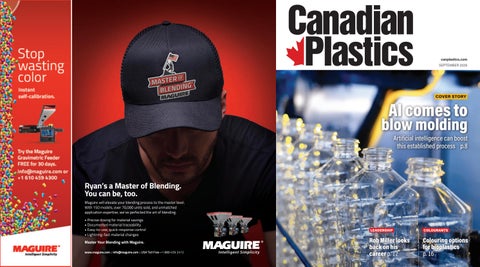
canplastics.com SEPTEMBER 2026
COVER STORY
AI comes to
blow molding
Artificial intelligence can boost this established process p.8
Ryan’s a Master of Blending. You can be, too. Maguire will elevate your blending process to the master level. With 150 models, over 70,000 units sold, and unmatched application expertise, we’ve perfected the art of blending. • Precise dosing for material savings • Documented material traceability • Easy-to-use, quick-response control • Lightning-fast material changes Master Your Blending with Maguire. www.maguire.com | info@maguire.com | USA Toll Free +1 888 459 2412
LEADERSHIP
COLOURANTS
Rob Miller looks back on his career p. 12
Colouring options for bioplastics p. 16
THANK YOU
TO THE SPONSORS AND GOLFERS AT THE
CANADIAN PLASTICS
FALL CLASSIC
Hosted by
TITLE SPONSOR
2026 GOLF TOURNAMENT
Thank you to all the sponsors and golfers who contributed to the success of the Annual Canadian Plastics Fall Classic Golf Tournament. Your support and participation made for an unforgettable day of networking, sportsmanship, and connection within the plastics industry.
REGISTRATION/ GOLF CLINIC SPONSOR
BREAKFAST SPONSOR
DINNER SPONSOR
COFFEE SPONSOR
BEER CART SPONSOR
GOLF BALL SPONSOR
CLOSEST TO THE PIN SPONSOR
LONGEST DRIVE SPONSOR
DRIVING RANGE SPONSOR
FLAG STICK SPONSOR
PHOTO BOOTH SPONSOR
HOLE SPONSORS
We look forward to seeing you next year!
8 September 2026 Vol. 85, No.4 canplastics.com
CONTENTS FEATURES
DEPARTMENTS
COVER STORY
8
Blow molding: Say hello to AI
Artificial intelligence can bring a paradigm shift to the blow molding process.
12
Leadership: Rob Miller stands and delivers
4 5 5 7 19 22
From the Editor News By the numbers Ideas & Innovations Technology Showcase Technical Tips
The president of Wittmann Battenfeld Canada looks back on his 40-year career.
16 Colourants: The colours of green
Colouring bioplastics requires careful selection of pigments and dyes to maintain the material’s eco-friendly profile, compostability, and mechanical properties.
Cover Photo: salomonus_/Adobe Stock
Find more information about any of the features please visit us online at www.canplastics.com
5
12 18
FROM THE EDITOR
Forewarned against AI cyberattacks
T
he phrase “game changer” gets used a lot, but when it comes to artificial intelligence (AI) in plastics processing, it actually fits. Our cover story in this issue explores some of the implications of AI in blow molding, for example. In the bigger picture, AI is changing both the nature of business operations and the cybersecurity landscape for processors. But as molders integrate AI systems and agents into day-to-day workflows – oftentimes rushing to scale it – they risk underestimating the shortcomings of current governance models and failing to see where they’re leaving themselves exposed. Don’t take my word for it, however. IBM recently released the 2026 X-Force Threat Intelligence Index, showing that AI-accelerated cyberattacks are reshaping the North American threat landscape and increasing pressure on Canadian organizations, plastics manufacturers included. North America is now the most attacked region globally, and manufacturing is the most attacked industry globally. Both have direct implications for Canadian plastics firms, given our sector’s advanced manufacturing footprint. IBM’s report highlights a whopping 44 per cent surge in attacks that begin by exploiting public-facing applications, driven by missing authentication controls and AI-enabled vulnerability discovery. Globally, vulnerability exploitation became the leading cause of cyberattacks in 2025, reflecting persistent challenges for Canadian organizations grappling with aging systems, patching delays, and rapidly expanding SaaS environments. Credentials are still highly sought after by cybercriminals, according to IBM. Indeed, in North America, credential harvesting – where attackers collect large volumes of valid user login details to gain unauthorized access to systems – is the most common type of cyberattack. At the same time, cybercriminals have begun targeting AI platforms directly: infostealer malware exposed more than 300,000 ChatGPT credentials globally in 2025, revealing the risk created when AI tools are deployed without adequate safeguards. The report’s final verdict is that, given the speed at which cybercriminals are creating new agentic threats, traditional security models are no longer enough. IBM’s recommendations include secure AI platforms as core enterprise infrastructure, with conditional access and strong identity controls; modernizing authentication and treating identity as critical infrastructure; continuously hunting for vulnerabilities across cloud infrastructure, applications, and networks; mapping external attack surface exposure; and strengthening patching and configuration hygiene to reduce the most exploited attack paths. Forewarned is forearmed, as the saying goes.
AI-accelerated cyberattacks are reshaping the North American threat landscape and increasing pressure on Canadian organizations.
MARK STEPHEN editor
Editor MARK STEPHEN 416-510-5110 mstephen@canplastics.com Associate Publisher STEPHEN KRANABETTER C: 416-561-5362 W: 416-510-6791 skranabetter@annexbusinessmedia.com Media Designer CURTIS MARTIN cmartin@annexbusinessmedia.com Account Coordinator KRISTINE DEOKARAN 416-510-6774 kdeokaran@annexbusinessmedia.com Audience Development Coordinator LAYLA SAMEL (416) 510-5187 lsamel@annexbusinessmedia.com Group Publisher PAUL GROSSINGER pgrossinger@annexbusinessmedia.com CEO SCOTT JAMIESON sjamieson@annexbusinessmedia.com Printed in Canada ISSN 008-4778 (Print) ISSN 1923-3671 (Online) Publication Mail Agreement #40065710 PUBLICATION MAIL AGREEMENT #40065710 SUBSCRIPTION RATES 5 issues Canadian Plastics, plus Dec. 2025 Buyers’ Guide: Canada: 1 Year $82.21 plus applicable taxes 2 Years $131.01 plus applicable taxes USA: $186.70 (CAD) / year Foreign: $213.22 (CAD) / year Single copy: $17.00 plus applicable taxes Occasionally, Canadian Plastics will mail information on behalf of industry related groups whose products and services we believe could be of interest to you. If you prefer not to receive this information, please contact our audience development department in any of the four ways listed above. Annex Privacy Officer privacy@ annexbusinessmedia.com • Tel: 800-668-2374 No part of the editorial content of this publication can be reprinted without the publisher’s written permission ©2026 Annex Business Media. All rights reserved. Opinions expressed in this magazine are not necessarily those of the editor or the publisher. No liability is assumed for errors or omissions. All advertising is subject to the publisher’s approval. Such approval does not imply any endorsement of the products or services advertised. Publisher reserves the right to refuse advertising that does not meet the standards of the publication. Canadian Plastics magazine reports on and interprets developments in plastics markets and technologies worldwide for plastics processors, moldmakers and end-users based in Canada. MEMBER: Magazines Canada, Canadian Plastics Industry Association.
mstephen@canplastics.com
CONNECT WITH CANADIAN PLASTICS www.canplastics.com
Reader Service Print and digital subscription inquiries or changes, please contact Angelita Potal, Customer Service Administrator Tel: (416) 510-5113 | Fax: (416) 510-6875 Email: apotal@annexbusinessmedia.com Mail: 111 Gordon Baker Rd., Suite 400, Toronto, ON M2H 3R1
Canadian Plastics
NEWS
Officially opening Ingenia Polymers’ new Innovation Centre in Brantford, Ont. Photo: Ingenia Polymers
MATERIALS
Ingenia Polymers opens Innovation Centre in Ontario Houston-based materials maker Ingenia Polymers Corp. opened its new Innovation Centre in Brantford, Ont., on July 22. The newly expanded centre doubles the footprint of the original building; has additional plastics processing and testing equipment, including twin-screw and continuous mixer lines, and a seven-layer blown film line from Ontario firm Macro Engineering; and has upgraded and additional office areas for employees. In a July 30 statement, Ingenia officials noted that the system from Macro Engineering expands its capabilities to develop, evaluate, and optimize advanced multilayer film structures while accelerating material innovation and product development. Ingenia currently has eight manufacturing sites worldwide, making compounds as well as white, black, colour, and additive concentrates at plants in Canada, the U.S., and Saudi Arabia. COMPRESSION MOLDING
Comoldco expands compression molding operations Guelph, Ont.-based compression molder
Comoldco Corp. will expand its production of thermoset composite automotive components through a more than C$3 million project supported by C$900,000 from the Canadian government. The funding, announced on July 22 through the Federal Economic Development Agency for Southern Ontario’s Regional Tariff Response Initiative, will help the company add equipment to increase production capacity and efficiency. Comoldco is a compression molder of reinforced thermoset composite parts used for automotive noise, vibration, and heat management applications, including fuel tank shields, hood liners, dash insulators, and muffler heat shields. The company also provides product development, tooling, and robotic assembly and sequencing services from its Guelph manufacturing facility. PACKAGING
Montreal’s Gould Industries expands into U.S. with Mississippi factory acquisition Montreal-based recycler and packaging manufacturer Gould Industries Ltd. has expanded into the U.S. by acquiring a facility in Summit, Miss., for an undisclosed amount. In a June 18 statement, officials with Gould said the firm plans to modernize the factory and install additional production lines as part of the expansion. Company officials said the facility spans more than 100,000 square feet on six acres and includes a CN rail siding capable of handling 30 railcars. The statement also said the site has the potential to produce up to 80 million pounds of product annually and
recycle as much as 10 million pounds of plastic each year. Gould was founded in 1954 and specializes in high-volume private-label products including garbage bags, contractor bags, compostable films, and other packaging products.
Signing the purchase agreement between Arburg and Stork IMM. Photo: Arburg GmbH + Co. KG
INJECTION MOLDING
Arburg buys Dutch press maker Stork German injection molding machine maker Arburg GmbH + Co. KG has signed a definitive agreement to acquire Stork Plastics Machinery B.V. (Stork IMM), a Netherlands-based manufacturer of high-speed injection molding machines, marking a strategic expansion into the premium thin-wall packaging segment. The terms of the deal have not been disclosed. “Two strong brands are uniting to benefit from economies of scale at a time when press producers face volatile market developments, lower volumes, and increasing international competition,” said Arburg CEO Volker Nilles in a July 30 statement. “The Stork machines are ideally suited to extending the Arburg portfolio very quickly – but with a lasting and long-term impact – and strategically to include machines with a clamping force in excess of 5,000 kN (500 tons) and for the packaging industry.”
BY THE NUMBERS The Chemistry Industry Association of Canada recently released its 2026 assessment of Canada’s plastics sector.
7+ million tonnes The total amount of plastics used annually in Canada, supporting thousands of products used every day.
canplastics.com
22%
The amount of plastics that go into construction materials annually, representing more than 1.5 million tonnes.
15%
The amount of plastics that go into vehicles annually, representing more than one million tonnes.
2 million tonnes The approximate amount of plastic packaging generated annually, representing the largest use of plastics in Canada.
Canadian Plastics
5
NEWS SUPPLIER NEWS Vancouver-based HydroGraph Clean Power Inc. has certified U.S. firms Midland Compounding & Consulting Inc. and Modern Dispersions as qualified HydroGraph Compounding Partners, qualified to support customers seeking performance
improvements, lightweighting, conductivity, and functional enhancements using graphene at low addition rates.
APSX-PIM tabletop injection molding machine, manufactured by APSX. PCS will also manufacture and supply mold bases designed for the machine.
Fraser, Mich.-based PCS Co. is now the exclusive North American supplier of the
PEOPLE London, Ont.-based chemical recycler Aduro Clean Technologies Inc. has appointed Jan Lemmens as project director for its industrial facility in Sittard-Geleen, Netherlands. Italy-based process cooling machinery maker Frigel Group has named Mario Coletti as deputy regional sales manager for the Americas. Bolton, Ont.-based injection molding equipment maker Husky Technologies has named Mohammad Kanaan as chief financial officer. Fraser, Mich.-based mold component supplier PCS Co. has named Chris LaBombarbe as head of product development. Switzerland-based size reduction machinery maker Rapid Granulator has named Tim Bruder as regional sales manager for the West Coast of North America, including Western Canada. Traverse City, Mich.-based injection molding training and consulting firm RJG Inc. has named Niiko Rautiola as CEO.
PROMOTIONS, RETIREMENTS, RECOGNITION •If you have people in your agency recently promoted or retiring or an individual you wish to have recognized (major award or recently deceased) you can let Canadian Plastics magazine know by emailing: mstephen@canplastics.com.
Ask Us How
Struktol.com | 800.327.8649 6
Canadian Plastics
CPL_Struktol_June26_CSA.indd 1
2026-05-28 8:12 AM
September 2026
IDEAS & INNOVATIONS
Thermal barcodes can improve plastic recycling
Image: University at Buffalo
B
arcode readers are great at quickly identifying groceries and other products. Could a similar idea work at industrial recycling facilities to make sorting different plastics quicker and more cost-effective? The answer, according to a University at Buffalo (UB) research team, in Buffalo, N.Y., is yes – which is why they’re currently developing a new, non-contact system that could rapidly identify plastics moving on conveyor belts through an innovative use of transient thermal barcodes. Plastic waste generated by households and businesses are sent to material recovery facilities where plastic is separated from other wastes. Which is where the problems begin, since the separating is often done by hand, which can result in false identification and poor quality of sorted bales; and the plastics are then separated into different types, and at present there’s a lack of cost-competitive and accurate techniques that can effectively identify plastic types by their resin codes. Traditional technologies for scanning waste plastics include near-infrared spectroscopy, Raman spectroscopy, and laser-induced breakdown spectroscopy, but these have problems that include poor sensitivity, subpar selectivity, slow speeds, inability to detect black plastics, and the inability to operate in standoff mode – identifying plastics from a distance – that’s often required in material recovery facilities. To overcome these challenges, the UB team sought to invent a technology that quickly captures the molecular signature of waste plastics from a distance, and that can also be easily retrofitted into existing sorting machinery. They started with a range of mid-infrared wavelengths, which they shine onto plastic items. As the plastic absorbs the light, molecular bonds within the plastic vibrate, generating temporary heat patterns that are measured by a thermal camera. These heat patterns, which reflect the unique molecular structure of each plastic, are essentially a “three-dimensional transient thermal barcode,” the team said.
The researchers used six mid-infrared wavelengths to identify all six common types (polyethylene terephthalate, polypropylene, polystyrene, high-density polyethylene, low-density polyethylene, and polyvinyl chloride) of plastic waste. Moreover, the technique can also identify black plastics – all black plastics are based on one of the six types of plastics, but with significant carbon derivatives added. At present, the UB team cautioned, the system isn’t ready for industrial deployment. But backed with a new round of funding from the New York State Center for Plastics Recycling Research and Innovation, they’re developing advancements – such as faster hardware to sort plastics on high-speed conveyor belts, cost-effective light sources that project multiple mid-infrared wavelengths simultaneously, and artificial intelligence-based software – that will improve the technology enough for use.
Minutes MAtter Are changeovers keeping you off your pace? Dyna-Purge cleans on the first pass, minimizing machine downtime to maximize your productivity! Plus, only Dyna-Purge provides product and technical support built on over 30 years of innovation. Our customers enjoy the industry’s most effective commercial purging compounds, outstanding customer service and reliable results. Start saving time and increasing profits today. Request a free sample of Dyna-Purge and see for yourself.
Discover the Difference. 866-607-8743 www.dynapurge.com DYNA-PURGE is a registered trademark of ShUmAN PlASticS, iNc.
Canadian Plastics
canplastics.com CPL_MinutesMatter_Nov23.indd 1
7
2023-10-19 11:41 AM
BLOW MOLDING
Say hello to AI Artificial intelligence can bring a paradigm shift to the blow molding process. BY MARK STEPHEN, EDITOR
I
t’s no exaggeration to say that artificial intelligence (AI) marks a genuine paradigm shift for plastics processors. Encompassing machine learning, virtual assistants, neural networks, robotics, and natural language processing, AI enables machines to learn from data, adapt to new inputs, and execute tasks traditionally requiring human intelligence, with the promise of reducing scrap rates, cutting energy consumption, predicting machine failures, and automating quality control. And the impact could be huge for blow molding machines, which have often faced limitations in terms of precision control, energy consumption, and responsiveness to changing production demands. AI creates opportunities to rectify this by gathering disparate blow molding information from sensors embedded within the machines and crunching it to enhance production efficiency, boost quality assurance, and predict potential issues before they escalate into costly breakdowns.
GETTING THERE It’s important to note, first, that while AI in blow molding sounds new, some OEMs have already spent years developing the technology. “We started investing in AI for engineering development back in 2017,” said Mattia Anconelli, business development manager with BBM America LLC, based in Mason City, Iowa. “By 2021, we were using digital twin technology, combined with AI-driven optimization 8
Canadian Plastics
Rather than fundamentally changing blow molding, AI aims to make the process better by analyzing and using data.
and CFD [computational fluid dynamics] simulation, to design our die heads.” Germany-based Krones AG is another blow molding machine maker that isn’t new to AI. For several years now, the company’s AI team has been developing systems like Contiloop AI and Dynafill AI, both of which monitor and control production processes for beverage production in order to reduce energy consumption, minimize waste, and increase product quality. The systems have already had time enough to win awards: Contiloop AI earned the AI Breakthrough Award 2023, run by Tech Breakthrough LLC; and Dynafill AI won the AI Excellence Award from Business Intelligence Group in 2024. Other developers directed their efforts towards other plastics processing technologies first before moving into blow molding. “We’ve been developing AI for injection molding and extrusion for several years now; our involvement using AI for blow molding goes back almost 18 months,” said James Finch, chief operating officer with Eigen Innovations, headquartered in Fredericton, N.B. For others, such as Uniloy, AI development is in the works right now. At the company’s July 23 open house at its facility in Tecumseh, Mich., Uniloy’s shuttle product line manager Daniel Horecica-Csiki predicted that the future of blow molding lies in process monitoring and AI. Uniloy plans to build on Industry 4.0 technology, such as its Uniloy Eye machine monitoring system, by coupling September 2026
BLOW MOLDING
tively makes decades of accumulated expertise available to any operator from day one,” he said. For Krones, the journey into AI is about alleviating its customers’ most pressing problems, including a shortage of experienced operators, a desire for more sustainability, increasing complexity in portfolios and production, and pressure to operate more efficiently. “We didn’t start using AI because everyone else did, but rather because we wanted to offer solutions to the biggest challenges our customers face,” said Philipp Olenberg, the company’s head of AI. In addition to the aforementioned Contiloop AI and Dynafill AI technologies, Olenberg said, another area of application is condition monitoring through Krones’ Shopfloor Guidance system, which uses AI to continuously analyze machine data to detect anomalies and wear early on, including distinguishing between actual levels of wear and false alarms. And also, language-based assistance systems and chatbots that make it easier for customer personnel to interact with digital solutions. “They help quickly evaluate large volumes of data, generate reports, and support employees in analyzing production data,” Olenberg said.
them with AI technology to help machine operators optimize blowing cycles by monitoring parison shape, detecting processes that are drifting from optimal, and identifying conveyor jams. Horecica-Csiki also said that Uniloy is working with a software partner on an AI-based predictive maintenance system, with a development timeline of months from now, not years.
TRAINING DAYS According to Mattia Anconelli, BBM is developing a version of an AI virtual assistant dubbed EVA, which is short for Efficient Virtual Assistant. “We’re currently stresstesting it for stability and, more importantly, training the model as extensively as possible, to have it fully built into our machines,” he said. The point about training deserves emphasis, he noted. “Training is, without question, the longest phase of any AI development, and it’s also where
AI-POWERED THERMAL VISION
the majority of a model’s real value comes from,” he said. “The architecture is what makes a system capable in principle, but training is what makes it genuinely useful in practice.” Anconelli identifies a list of tasks that AI can accomplish in blow molding, beginning with component design. “Our digital twin approach to die head engineering has already delivered improvements in extrusion performance, and we’re continuing to refine it,” he said. Second, he said, continuous machine monitoring, through a well-trained virtual assistant like EVA, can flag anomalies and performance drift at an early stage, preventing downtime. “Third is diagnostics and technical support: running a structured diagnosis when a fault occurs and walking the operator through a step-by-step solution to restore proper machine condition,” he said. “Fourth, applying AI to the design of the blow molded part itself, optimizing geometry to deliver the best performance with the least material required.” And finally, Anconelli said, AI can make blow molding a considerably more user-friendly process. “An AI assistant trained across thousands of different applications effec10
Canadian Plastics
A new AI-powered thermal inspection system from Eigen Innovations captures a complete thermal profile of every shot as it forms, detecting process issues that may not be visible to the naked eye. Photo: Eigen Innovations
Last year, Eigen Innovations introduced an AI-powered thermal inspection system that uses multiple thermal cameras positioned around the parison to capture a complete thermal profile of every shot as it forms. AI models analyze each image in under one second, James Finch said, and the system monitors four key areas: shape and integrity analysis to detect sagging, stretching, and swing misalignment; parison length consistency to catch premature cutoff; thermal profile mapping to identify cold spots, uniformity, and contamination; and spill and die monitoring for early detection of die wear. And it’s a solution that breaks new ground for using AI in blow molding, Finch continued. “Some firms have experimented with thermal imaging by using handheld technology, but that only gives a glimpse by checking a sample; it doesn’t give visibility into full production through inline monitoring of every parison or bottle, or every product as it’s molded,” he said. AI-driven thermal imaging in blow molding is so new, in fact, that databases must be created from nothing. “There are no libraries of thermal data for blow molded parts, so we have to build each data set uniquely with a customer,” Finch said.
SOLUTIONS WILL VARY But Finch stresses that AI isn’t a one-size-fits-all solution for blow molders. “There’s no one single use case that everyone can use: there are different places for AI in the blow molding sector,” he said. “The one that has been looked at the most, historically, is handheld thermal testing on a parison. But as far as using AI in the post-molding proSeptember 2026
cess, it’s fairly new.” As an example of uncharted territory, Finch cites using AI to understand wall thickness variation post-molding. “The AI can understand that variation part to part to part, or bottle to bottle, to reveal why you’re getting thinning in a certain zone of the product,” he said. “Or perhaps a blow molder is running a slightly thicker wall than it needs to; in that case, AI can identify an opportunity for material reduction.” Finch also identifies an elephant in the room: the initial investment needed to upgrade machinery and install the necessary AI infrastructure. “Cost is always the biggest barrier to any new technology adoption, and AI is no different,” he said. “Almost always, you can extract some new value from AI, but does that value justify the investment? That answer will vary from shop to shop.” Understanding the business context is key, Finch continued. “Each customer will have a different issue they want to solve: too much downtime, or a specific quality issue, or too much scrap production,” he said. “Examining these variables allows us to build a workable AI business case for a particular molder.” Another elephant is probably data security, rooted in widespread concerns over AI safety, data leakage, and autonomous cyberthreats. “We take this very seriously and have a
number of failsafes,” said Mattia Anconelli. “The client always remains in full control of an AI solution from BBM: the connection bridge can be switched on and off physically, through a switch located on the machine itself. Additionally, client data is never folded into some broader public dataset. And finally, we apply multiple layers of our own security to keep the setup as safe as possible.” Eigen Innovations uses a hybrid edge cloud IT architecture that connects local edge devices and private infrastructure with centralized public clouds, James Finch noted, but the company doesn’t share customer data or models between customers. “Each new customer’s AI system is trained from zero without using another customer’s inputs,” he said. And, perhaps uniquely, Eigen Innovations also doesn’t enable self-training algorithms in its AI solutions. “We always maintain a tightly controlled, gated checkpoint for the customer between model deployments,” Finch said. “These clean transition points ensure certainty around model performance, because a customer can easily revert back to a previous model and know what’s changed.”
UNLIMITED PROMISE Rather than fundamentally changing blow molding, the intelligent upgrading of machines with AI technology aims to make the process better – and it doesn’t spring from nowhere. “AI is building on Industry 4.0, which has become standard and is all about connectivity and data-gathering,” Finch said. “AI comes into the picture as a means of analyzing and using that data.” And as the technology continues to mature and becomes increasingly reliable, the sky is the limit.
Beyond General Purpose. Built for Every Purpose. As the world’s largest manufacturer of injection molding machines, Haitian delivers customized solutions for the most demanding applications.
Multicomponent
In-mold decorating
Structural foam
High-speed packaging
Ultra large shot size
PVC
Cleanroom
PUR/IMC
Looking for a partner for your project? Call us at 216-452-1000.
canplastics.com
CPL_Absolute Haitian_Sept26_CSA.indd 1
Canadian Plastics
11
2026-08-17 2:23 PM
LEADERSHIP
ROB MILLER: Stand and deliver The president of Wittmann Battenfeld Canada looks back on his 40-year career. BY MARK STEPHEN, EDITOR
12
Canadian Plastics
Rob Miller’s career has taken him from the shop floor to an executive position, while riding out some of the worst troughs in plastics manufacturing.
sign and build conveying systems, and I learned a lot from him,” Rob Miller said. And not just about conveying. “Len had a customer-driven sales and service philosophy that made a real impression on me,” he added.
LEARNING THE TRADE But despite Len Miller’s credentials, the early days at Nucon Systems weren’t easy. “We were all putting in far more than eight hours a day trying to design and build resin conveying systems that could compete against the larger established suppliers, but it was good in that it forced me to learn the intricacies of conveying from the ground up,” Rob Miller said. The company gained further stability through a series of distribution agreements: it represented Maguire Products in Canada beginning in 1987, had dryer agreements with Novatec and UnaDyn, and represented granulators for Cumberland. All of which added to Rob Miller’s own toolbox of expertise – and to his geographic responsibilities. “After handling Southern Ontario across to Canada’s West Coast by 1991, Len moved me into U.S. sales in the mid-1990s,” he said. In 1999, the facts on the ground changed when Len Miller sold Nucon Systems to family-owned, Austria-based Wittmann Robot Systems GmbH. Rob Miller assumed dayto-day responsibility for sales and operations of the company – which was renamed Nucon Wittmann Inc. and moved into a 20,000-square-foot facility in Markham, north of Toronto – but it wasn’t all smooth sailing. “There are different standard engineering principles between European and North American manufacturers of pneumatic conveying equipment, and we had to learn how to navigate those,” Rob Miller said. But there were many positives to the deal. “It was a real advantage to be connected to the Wittmann family: company founder Dr. Werner Wittmann – who is truly September 2026
All photos courtesy of Rob Miller
N
ot all successful careers are planned in advance. Harrison Ford started off as a carpenter in Hollywood, where George Lucas noticed him building cabinets and cast him in Star Wars. In the world of resin conveying, Wittmann Battenfeld Canada president Rob Miller began as a young machinist at Toronto’s Tradesco Mold Ltd. His opportunity came through his uncle, plastics industry pioneer Len Miller, who offered him a job in a fledgling firm. Rob Miller’s own hard work did all the rest, and he’s now celebrating 40 years in the conveying sector – during which time he has risen to the top of his profession, ridden out some of the worst troughs in plastics manufacturing, and developed a revolutionary technology – at the same time as he hits the personal milestone of turning 60. Growing up in the Toronto area, Rob Miller was drawn towards technical, hands-on work from an early age, excelling in shop in high school. Which is where he caught his first break. “My shop teacher’s best friend was the owner of Tradesco Mold, and he recruited machinists from our class, and I was hired to operate a computerized milling machine at Tradesco beginning in the early 1980s,” he said. “I enjoyed the work at first, but then it became very routine and I wanted more.” An opportunity arose in 1985 when Rob Miller’s uncle Len Miller founded auxiliary equipment supplier Nucon Systems Inc. “My uncle knew I was looking for a change, offered me a job, and I started at Nucon Systems in April 1986 – and it marked the beginning of my career in material conveying,” he said. It was a steep learning curve in a decade when resin conveying shifted from basic standalone loaders to centralized, high-capacity vacuum and pneumatic systems, creating rising challenges with material wear and dust. “Len had worked at machinery supplier Mould-Tek Industries, in Toronto, before founding Nucon Systems, and he had very specific ideas about how to de-
a great mind in our industry – his son Michael, and the rest of the Wittmann leadership team,” Rob Miller said. “Through all the years of ups and downs since then, I’ve always known that the Wittmann family had my back.”
THE NEXT STEPS Right off the bat, Rob Miller’s world expanded – literally – to across the ocean. “I had never been to Europe before, and almost right away I was on a plane to Vienna, showing the Wittmann family how we built our pumps, loaders, and other products,” Rob Miller said. “I’ve travelled an enormous amount during my career – many trips to Europe, Australia, and elsewhere – and that trip was the beginning of it.” And then when Len Miller retired in 2001, Rob Miller was promoted from vice president of Nucon Wittmann to president. “It represented a whole new set of responsibilities – things I never thought I’d do when I was younger, such as hiring new staff, managing the workforce, dealing with P&L statements, and putting together monthly sales reports,” Rob Miller said. Another big change came in 2007, when Nucon Wittmann bought the M-Tek brand of blending and material handling equipment from Mould-Tek Industries. “The merging of Mould-Tek and our Nucon team was the start of Wittmann Canada,” Rob Miller said. “We had been a significant player in the systems market for
many years but never had our own blenders to offer our customers. Now we had a key piece that we were missing as a manufacturer, and the ability to fully integrate the complete system using a single control platform. And personally, it was a privilege to get to know Mould-Tek founder Lorne Berggren, who was an industry pioneer and an inspiration going forward.” The products were marketed by Wittmann around the world. And just one short year later, Wittmann Group acquired injection molding machine maker Battenfeld Kunststoffmaschinen GmbH, bringing a whole new product range for Wittmann Canada to sell – plus the new corporate name of Wittmann Battenfeld Canada. “As an auxiliary equipment specialist, I didn’t know much about injection molding before Wittmann bought Battenfeld – the most we ever talked about before that was throughput,” Rob Miller said. “But the details of injection molding – such as cycle times, tight tolerances, and viscosity shifts – are complicated, and so that was a learning curve for me and my colleagues.”
A TRANSFORMATIVE IDEA It’s somewhat ironic, then, that after taking a deep dive into injection molding, Rob Miller achieved one of his biggest career successes through rotational molding. In 2014, he was the driving force in developing Rotoload, an automatic weighing and dispensing hopper
Precise Process Cooling & Temperature Control For Demanding Plastic Processing Applications
• Reliable process cooling & temperature control for demanding applications • Energy-efficient system designs • Responsive factory application and service support • Designed for long-term industrial operation • Built in the United States • Nearly 50 years supporting plastics processors
Temperature Control Units
Portable Chillers
Central Chillers
Sentra® & Regal®
Maximum®
Titan® & OACS®
525 East Stop 18 Road • Greenwood, IN 46142 317.887.0729 • AdvantageEngineering.com
canplastics.com
CPL_Chillers_Sept26_CSA.indd 1
Pump Tank Stations
Cooling Towers
TTK Tough Tank® & PTS/CPTS Power Tower® G3
1228 Gorham Street, Unit 11 • Newmarket, ON L3Y 8Z1 905.895.9667 • ChillersInc.com
Canadian Plastics
13
2026-08-11 3:48 PM
LEADERSHIP
for rotomolding. “Initially, I had designed the system for use in an enormous rotomolding factory in Oman, in the Middle East,” Rob Miller said. “Ultimately, they didn’t purchase it, but I spent a week in that plant watching them work, and it opened my eyes to an industry that we were only doing a small amount of business in. We then partnered with Agri Plastics in Stoney Creek, Ont., and they took our first Rotoload prototype for use, and it gained traction after that.” To the point, in fact, where it’s now become a global product. “We’ve installed large Rotoload systems for major customers in Chile, Germany, and New Zealand,” Rob Miller said. “Initially, it was available in models that handled 50, 150, and 300 pounds, but it’s been expanded since then to handle any batch weight and any recipe dispense, from 0.100 of a pound up to 1,760 pounds, and with no real limit to recipe size.” Run by a Siemens controller, material in the Rotoload hopper is automatically dispensed by weight; operators direct it into the mold, and the unit has an automatic vacuum refill. “Rotoload provides precise dosing every time,” Rob Miller said. “When it’s done manually, operators don’t always measure the precise amount – it might be a gram or two off. That doesn’t happen when they use Rotoload.” Nor did the technology’s success go unnoticed. In 2015, the Canadian Plastics Industry Association (CPIA) gave Rob Miller a Plastics Innovator Award for Rotoload – and it’s not hard to see why, according to Joe Corturillo, Wittmann Battenfeld Canada’s engineering manager and a longtime colleague of Rob Miller. “When it came to conveying, some rotomolders were reluctant to change – shop floor workers were still carrying resin around in buckets, because that’s how they’d always done it,” Corturillo said. “Rob has done as much as anyone to modernize the weighing and filling of molds on a rotomolder to make it more efficient. He went through a lot of obstacles in the beginning to bring Rotoload to market, but he persevered and has made a real difference in the industry today.”
ROLE MODEL As much as Rob Miller has learned about conveying and injection molding over the course of his career, his colleagues at Wittmann Battenfeld Canada have been learning from him. “I’ve benefitted a lot from Rob’s expertise in material conveying,” said Christian Weiss, the company’s vice president. “He’s been doing it for so long that he’s developed a sixth sense about all the subtleties, and he knows intuitive things that aren’t in the manuals. At his level, conveying is almost an art.” Despite Rob Miller’s shift from his early days in the toolroom to management and sales, his heart and soul remain in the toolroom, to an extent – which, in turn, benefits him as a manager and salesperson. “Rob has great ideas for 14
Canadian Plastics
CLOCKWISE FROM TOP: Rob Miller at a Nucon Systems trade show booth in the early 1990s; with a Rotoload system; with Toronto Maple Leafs goaltender Johnny Bower at the Plast-Ex trade show in 2007; and with Len Miller at Len’s retirement party in 2001. September 2026
customers when it comes to projects, and because he’s a conveying expert in addition to a salesman, he never overpromises and then leaves the engineering department in the lurch – he knows what’s possible and what isn’t, and when he commits the team to a project, he’s always involved in the design,” said Joe Corturillo. “He’s very good at being a conduit between the customer and the engineers and always gets us all the information we need for a project.” In his role as a manager, Christian Weiss said, Rob Miller fosters the feeling that the Canadian staff is a family within the larger, literal Wittmann family. “There was a family dynamic at Nucon already, with Rob having taken over from his uncle Len, and that mentality continues today,” Weiss said. “With Rob at the helm, we hire longterm and try to promote from within whenever possible.” And in addition to the full-time job of leading Wittmann Battenfeld Canada, Rob Miller also served on the CPIA’s board of directors for nine years. “I thought it was important to boost the profile of the machinery makers among the CPIA member companies,” he said. “I also had a strong desire to see member companies support other member companies, and always encouraged that – sometimes successfully, sometimes not.”
LOOKING AHEAD Having weathered the storm so far – the boom days of the 1980s,
canplastics.com PCS_SolutionsForMolders_CP_HalfPgH_7-125x4-75_081926.indd 1 CPL_PCS_Sept26_CSA.indd 1
the corporate takeovers, the busts of various recessions, offshoring and reshoring, growing concerns about plastic waste and material recovery, and a global pandemic – Rob Miller is confident about the plastic industry’s future. “As a whole, I think the plastics sector is doing well,” he said. “There’s so much being made from plastics that will never be replaced by anything else; and single-use items are still in demand – even though there are some challenges in Canada around product bans – but, overall, that’s never going to go away, either.” Having seen significant technology changes over the decades, Rob Miller tries to be realistic about artificial intelligence (AI) and the productivity gains it promises for plastics processing companies. “We’re examining how AI could build on advanced sensors and smart conveying technologies to make resin conveying even more efficient, powered by better data-gathering capabilities, so we’ll see where that goes,” he said. “But at the end of the day, we’re never going to be able to teleport pellets into a machine, so the mechanics of conveying will always be something that processors deal with every day, regardless of how AI growth will change other parts of their world. Pipes, elbows, and other hardware are always going to be necessary, so those of us in the conveying industry can never be completely satisfied. There’s always the next project to tackle, and that’s exactly what I find most rewarding about my job.”
Canadian Plastics 8/19/26 11:00 AM15 2026-08-19 1:40 PM
COLOURANTS
The colours of green Colouring bioplastics requires careful selection of pigments and dyes to maintain the material’s eco-friendly profile, compostability, and mechanical properties.
Mevopur Healthcare bio-based colourants from Avient cover bio-based polypropylene, polyethylene, polycarbonate, and styrenic resins, with bio-based content ranging from 70 to 100 per cent depending on the polymer grade. Photo: Avient Corp.
BY MARK STEPHEN, EDITOR
F
or plastics processors, it’s not always easy being green – to mold colourful, visually appealing products that meet environmental regulatory requirements plus the various sustainability goals being pursued by most customers. To say nothing of the consumers, who expect a biodegradable packaging material to break down completely, including its colour components. Which means that the polymer carrier matrix has to be just as biodegradable as the material being coloured. Colouring biopolymers such as polylactic acid (PLA), polyhydroxyalkanoates (PHA), polybutylene succinate (PBS), and biopolyesters requires specialized colourants to maintain their ecofriendly properties. Moreover, biodegradable plastic must fulfill all the relevant usage standards applicable in various regions of the world before it can be sold – including ASTM D6400 and EN 13432, which are the two primary, internationally recognized standards for determining whether a plastic product is commercially compostable – to ensure they don’t leave behind toxic residues. For comparison, most of the commonly used organic colourants today aren’t biodegradable and will therefore remain behind, in the form of mic16
Canadian Plastics
roparticles, long after the bioplastic has gone. As another wrinkle, due to regulated heavy-metal levels, certain pigment classes – such as nickel-, chrome- or copper-based pigments – can’t be used for colouring biodegradable plastics made from renewable or fossil resources. Simply put, the difficulty in producing colour masterbatches lies in attaining the smallest possible residual particle size of the colourants used without employing additional dispersing agents. While not easy – and it’s a particularly tall order in film applications, where extremely high dispersibility is required – it’s perhaps not quite the challenge that it used to be, since colour concentrates that are specially designed to perform well with bioplastics are becoming more readily available, suppliers say; and crucially, they don’t affect the compostability of the material. The key types of bioplastic colourants are inorganic pigments, including minerals like iron oxides (for yellow and red ochre) and aluminium salts (for ultramarine blue); natural pigments, including plant- and bacteria-based dyes such as curcumin (yellow), anthocyanins (red/purple), chlorophyll (green), and bacterioruberin (red); and biodegradable-safe dyes and masterbatches. September 2026
NEW FOR 2026
NOVEMBER 11-12, 2026 // CLEVELAND, OH
EXPLORE CUTTING-EDGE TECHNOLOGY & INNOVATION 4 CO-LOCATED SHOWS // 4 CONFERENCE THEATERS // 300+ EXHIBITORS INCLUDING:
REGISTER FREE NOW > 4 CO-LOCATED SHOWS:
BOOK YOUR BOOTH TODAY: LIMITED PRIME LOCATIONS REMAIN!
COLOURANTS
OFF-THE-SHELF OPTIONS In this latter category, many commercial suppliers offer specialized colour masterbatches designed specifically for resins like PLA, PHA, and polybutylene adipate terephthalate (PBAT). Launched in 2021, Mevopur Healthcare colour and additive concentrates and ready-to-use formulations from Avon Lake, Ohio-based Avient Corp. are manufactured with bio-based polypropylene, polyethylene (PE), polycarbonate, acrylonitrile butadiene styrene, or styrenic polymers, with a bio-based polymer content ranging from 70 to 100 per cent. Offered as drop-in solutions, the Mevopur materials can be used the same way as conventional concentrates for injection molding, blow molding, and extruding medical devices and pharmaceutical packaging. Avient also offers its OnColor Bio colour concentrates, which are specially designed to perform well with bioplastics such as PLA, PHA, PBS, PBAT, and special blends of those materials. “Most importantly, these colourants don’t compromise the organic recyclability of the resins they enhance,” Avient officials said. Back in 2019, Switzerland-based Clariant launched a range of 25 organic pigments under the PV Fast and Graphtol brands, suitable for biodegradable polymers like PLA, PBAT, PHA, and PBS, while meeting the European Norm 13432 requirements for packaging that’s recoverable through industrial composting and biodegradation. Both product ranges are used in several applications in the consumer goods sector such as sensitive food-contact packaging, plastic tableware and dinnerware, and toys. More recently, nine of those pigments were approved to feature the label “OK Compost Industrial,” meaning they fully meet the requirements of the European Union EN 13432:2000 compostable packaging standard when not used above the maximum concentration in the final application. From Germany-based Lanxess, the Colortherm brand of iron oxide pigments are described as well-suited to the task of colouring compostable plastics. Said to be almost completely free from heavy metals, the limits for biodegradable plastics can be reliably maintained, even with a high pigment content. The Colortherm iron oxide pigments are available in red, yellow, brown, and black, plus numerous intermediate tones. The Lifocolor Bio-C – for “compostable” – plant-based masterbatches from German masterbatch maker Lifocolor offer a wide choice of colours, company officials said, and can be injection molded or extruded at temperatures of up to 240°C. The colour products are ideally suited for bio-based, biodegradable PLAs, PLA blends, PHAs, and PHA blends, and can also be developed for other biopolymers such as bio-based PEs. The materials surpass the DIN 13432 standard, which sets the guidelines for industrial composting. “This means that all colourants decompose 18
Canadian Plastics
Shades of Lifocolor’s Bio-C masterbatches for bio-based and/or biodegradable polymers. Photo: Lifocolor
into water, carbon dioxide, and organic biocompatible molecules or minerals under home-composting conditions,” said Marco Meixner, Lifocolor’s head of research and development. “As a result, no toxic or contaminating components are released into the natural environment.” Teknor Apex, based in Pawtucket, R.I., has expanded its partnership with Israel’s UBQ Materials by creating new colour masterbatches for the latter’s biobased thermoplastic UBQ, which is made entirely from unsorted organic and unrecyclable household waste. Teknor Apex’s colour masterbatch solution enables UBQ to be compounded with a brighter spectrum of colours beyond the initial brown, black, and grey of the “climate-positive” thermoplastic. “The new colouring capability makes UBQ a perfect sustainable material swap for applications such as point-of-purchase displays, pallets, and more, and has already been in use with major brands in both beverage and industrial industries,” said Jordan Wolfe, technical manager of Teknor Apex’s colour division. “The masterbatch can be added to a wide variety of plastics and can be processed by injection molding, extrusion, and other processes.”
WORKING WITH THE CUSTOMER For Colborne, Ont.-based colourant and additive supplier CCC Plastics, meanwhile, delivering sustainable colour solutions is more customer-driven, perhaps, than with some of the larger masterbatch producers. “Competitors go to market with stock or standard biodegradable products, whereas we’ll work with a customer on an individual basis to develop a specific solution,” said Blair Russell, president of the company’s manufactured plastics business. “We have a customer that sends us their biodegradable resin and we add to it so they can make their proprietary film meet compostability targets, for example; another customer in the composite decking world has a recycled feedstock that varies so dramatically in colour that they regularly send us samples and we tailor our masterbatch so they have consistent colour at the end of it, regardless of the input.” The firm’s customers for such projects tended to be film manufacturers at first, Russell said, but CCC Plastics is now working with some rigid packagers. “Generally, they want to be able to use a greater amount of recycled resin or bioplastic material without losing colour consistency,” he said. “We work primarily with PHA and PLA, and we typically add something to the colourant package to make it more compatible in the streams that the customers are sourcing.” In the end, bioplastics aren’t new, but the ability to infuse bioplastics with strong colours is, relatively speaking. Packaging applications, where the use of bright colours is almost mandatory, are an obvious target – including food packaging, in which the use of coloured biopolymers that meet the requirements specified by the U.S. Food and Drug Administration and other agencies is growing. Indeed, as industries race to reduce their environmental footprint and manufacturers and formulators look to future-proof their supply chains, colourants in compostable bioplastics are a growth area, period. September 2026
TECHNOLOGY SHOWCASE AUXILIARY
Vacuum pumps with new health indicator lights Novatec recently added health indicator lights to its SPD e+ Infinity series vacuum pumps, allowing for easy monitoring of pump health via LED indicator lights. Powered by the InfinityDrive Magnetic Motor, Infinity pumps can handle a diverse range of materials including pellets, powders, and regrind across single and multiple systems. The pumps are designed to provide whisperquiet operation with autoadapting finesse and artificial intelligence-powered optimization. The Infinity series
pumps are available in two variants: the SPDS series for standard precision and efficiency, and the SPDM series for maximum power in demanding environments. Inspired by electric vehicle (EV) technology, the pumps offer IE5-rated energy efficiency, mirroring advanced EVs; and come with the NovaNet PumpSense App, which monitors pump components and sends maintenance advice and actionable intelligence via text and email. www.novatec.com
INJECTION MOLDING
Partnership for IMC/PU molding A new strategic partnership between Haitian International and Germany’s Hennecke to develop integrated injection molding and in-mold coating (IMC) solutions for the automotive and other industries has produced a new IMC application for automotive grilles. Integrating Haitian’s multicomponent technology with polyurethane (PU) equipment to deliver precise metering, stable coating thickness, and better pressure control, the solution reduces defects such as bubbles and orange peel while improving yield. At the same time,
optimized molding and coating processes shorten cycle time, improve material use, and remove the need for a separate painting workshop. The Hennecke pump system is fully integrated into the Keba controller. Available for molders in Canada and the U.S., the solution can be adapted for automotive, home appliance, and 3C (computer, communication, and consumer electronics) applications, with coating effects and automation levels tailored to customer needs. www.absolutehaitian.com
PLANT WIDE CENTRAL CHILLING EQUIPMENT and SYSTEMS Canadian made Chillers that can both Heat and Cool your process:
MODULAR CHILLERS - Chillers that couple together for an easy simple installation and also make it easy to expand the current system, just couple the new chiller to the existing system. REFRIGERANTS AVAILABLE – Chillers can have either a mildly-flammable or a nonflammable, non-flammable is a must if the chilling system is open to the plant. CHILLERS AVAILABLE - As Water Cooled, Indoor Air-cooled, Outdoor Air-cooled, Remote Condenser Air Cooled. Outdoor air-cooled units available for all outdoor winter ambient temperatures. PUMP TANKS - Chilled water and tower water packages with double pumps, third pump manual stand-by, four pump automatic stand-by. Other arrangements available as well. INSTALLATION - From plant layout pipe sizing drawings to complete turn key installations in southern Ontario. PORTABLE CHILLERS – Air and water cooled, Indoor and outdoor, single and dual compressors, single and dual pumps and larger or special tanks. Phone 877-513-8310 Email sales@temperaturecorporation.com
canplastics.com
CPL_CHILLERS_APRIL26_BAS.indd 1
Fax 905-513-8358 temperaturecorporation.com
Canadian Plastics
19
2026-03-05 3:00 PM
TECHNOLOGY SHOWCASE EXTRUSION
New extruder processes regrind, PET flakes
The new Eco-Twin 220 conical co-rotating twin-screw extruder from Next Generation Recycling (NGR) is well-suited for recycling polyethylene terephthalate (PET) bottle flakes, and other regrind with low bulk density; and is designed to use less energy by gently melting pre-dried flakes, operating nearly adiabatically. The drive uses two synchronous
20
Canadian Plastics
CPL_Whittmann_Sept26_CSA.indd 1
motors and has a compact, bevel-gear gearbox. NGR offers optional condition monitoring of the gearbox. The constant monitoring system measures oil condition, lubrication, cooling, speed, and vibrations. The two synchronous motors allow precise control of dosing by detecting torque fluctuations. The Eco-Twin 220 is currently offered with two 285-killowatt (kW) motors, for a throughput of up to 4.4 tons per hour; and with two 325-kW motors, for a throughput of 5.5 tons per hour. The extruder also features degassing technology. www.ngr-world.com
MATERIALS
Additive for use in highly loaded, mineral-filled polyolefins Struktol’s new TR 451 processing additive is designed for use in highly loaded, mineral-filled polyolefins. Engineered as an optimized blend of special oleo chemicals, TR 451 helps compounders meet demanding performance and cost targets in high-filler systems by improving homogenization and processing efficiency. And by reducing or eliminating more expensive treated mineral grades, the additive supports lower raw
material costs and a simplified supply chain, while still preserving the easy flow and good processability. TR 451 is supplied as tan pastilles, providing straightforward feeding, dosing, and identification in typical compounding equipment. The product offers good storage stability of at least two years under normal conditions, simplifying inventory management and helping reduce waste from expired stock. www.struktol.com
September 2026
2026-08-12 12:43 PM
p Sto Here’s a look at what’s inside the upcoming February 2027 issue of wasting Canadian Plastics magazine: color As the link between product development and production continues to narrow,
canplastics.com JUNE 2026
ww w.c
anplastics
.com
ration.
Instant self-calib
injection molding simulation can serve as a powerful design tool, enabling molders to optimize mold design, identify problems at an early stage, increase producibility, and accelerate the time-to-market. We look at the newest simulation software that can help molders achieve their production targets. No mess. No math. No waste.
MADE IN THE USA
DECEMB
ER 2025
COVER STORY
A KIM THcsIAR Impact Canadian Plasti Year Awards Leader of the p.8
202
6 BUYER GUIDES’
etric Feeder Try the Maguire Gravim FREE for 30 days.
ALSO IN THIS ISSUE: • The latest size reduction technologies • Differences between chemical and mechanical purging compounds • Overview of Canada’s new plastics registry
SIZE REDUCTI
.com or email: info@maguire call: +1 610 459 4300
SUSTAINABILITY
ON
Choosing the right granulator p. 12
Ocean Legacy Foundation is chasing ‘ghost gear’ p. 18
YOUR SO URCE PLASTIC FOR CANADA’S S INDUS TRY
PM# 4006
5710
Subscribe to Canadian Plastics Magazine Reading someone else’s copy of Canadian Plastics magazine? Get your own copy by subscribing here.
SCAN QR CODE
ALL YOUR
PLASTIC RESOURCES IN ONE SPOT LOOKING TO MARKET YOUR COMPANY? CONTACT
Stephen Kranabetter Associate Publisher | skranabetter@canplastics.com | 416-510-6791
TECHNICAL TIPS By Steven Silvey
P
22
Canadian Plastics
These refer to the distribution of the length of the chains, which then may be put into a graphical sense as a curve – or more specifically a “bell curve,” meaning the curve resembles a bell shape. The bell curve (shown below) basically shows the very short chains on one side, very long chains on the opposite, and those in the middle as normal or average in length.
NARROW MWD MOL. WT. DISTRIBUTION
olyethylene (PE) is the most common plastic in the world, and it comes in various formulations created by a few different manufacturing processes, all of which may need some sorting out for the processor, due to the actual material characteristics that now affect processing. It should be noted that the finished physical material characteristics also change. Typically, PE has been defined by both the density and the melt flow, and in the past that was all great to characterize the material, as most manufacturers used the same process to produce the raw material. Today, however, many processes appear to manufacture PE, all of which tend to have some characteristics of their own in physical and processing to a point. This has been a boost to its application in many ways. This is said for those who may be switching, sourcing, and allowing alternatives to be used in the manufacture of parts. The basics of various grades/types is based on density and converts PE into three large categories because of this: low-density, 0.910 to 0.925 g/ cm³ (LDPE); medium-density, 0.926 to 0.940 g/cm³ (MDPE); and highdensity, 0.941 to 0.965 g/cm³ (HDPE). These are given as a range and as a generic way to base things. Some other categories of PE include linear low-density PE (LLDPE); ultra high-density PE (UHDPE); and bimodal PE, which means it has two distinct molecular weights within the material. In the manufacturing process, the chain length of the polymer varies – referred to as molecular weight – and typically terms such as “narrow,” “medium,” or “broad” may be used.
WIDE MWD
LOW
INCREASING MOLECULAR WEIGHT WIDTH
HIGH
In our graph, “Increasing molecular weight width” refers to the chain length, “Low” refers to short chains, “High” refers to long chains, and “Distribution” indicates how many. From a processing perspective, a very broad or wide curve means many short and very long chains, but also makes for an easy grade to process, given that the short chains will soften and melt first, which adds to the ease of processing. This means that pressure may be used to affect fill and pack more so than temperature. In a narrow curve, the very short chains and long chains are much fewer, and the majority is of one length. This means that the temperature is of the most importance, as we don’t have those short chains to aid in flow; and further, it’s been found that pressure is less effective with these narrow molecular weight grades.
I mention this because, as stated previously, the way to characterize a material is typically by density and melt flow – which worked well enough in the past, as all types of PE were manufactured by the same process. Now, in running a test for melt flow, one can actually get a narrow and broad to match the same, and a processor could then exchange or interchange these two materials. The problem is that on the shop floor, they don’t process the same, which means that processing conditions must be changed to accommodate these differences. While any material change should be accompanied with data, many are not. Which is a problem because if PE materials are not the exact same manufacture, type, and grade, then they are not equal – and therefore different, from a processing point of view. And this means we have to answer some important questions. Specifically, is the density the same? What’s the melt flow? And is it a broad or narrow molecular weight material? While there are more questions to ask beyond these, these three should help the processor to a great extent in trying to get the parts out. From the quality aspect, the functionality of the part should be tested, as well. In conclusion, it’s crucial to know which PE material one is using, and also to share that on the floor with the machine operators, so that they know that the “tricks” used for brand A supplier may not work with brand B supplier in order to manufacture the same part.
STEVEN SILVEY is the owner of Vancouver, Wash.-based Silvey’s Plastic Consulting, which provides engineering assistance, troubleshooting, and training help for plastic part manufacturers the world over. Visit www.silveysplasticconsulting.com for more.
September 2026
Image: Silvey’s Plastic Consulting
The basics of polyethylene
Dust-Free. Drama-Free. Perfect desiccant drying with zero desiccant bead mess.
NovaDrier
Industry’s Only Lifetime Desiccating Cartridge Technology Learn More:
NovaWheel
Industry’s Most Advanced Desiccant Wheel Technology
novatec.com/canada Conveying & Drying Perfection