www.canplastics.com
SEPTEMBER 2023
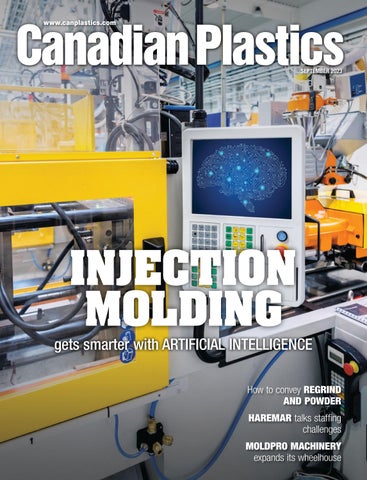
INJECTION MOLDING
gets smarter with ARTIFICIAL INTELLIGENCE How to convey REGRIND AND POWDER HAREMAR talks staffing challenges MOLDPRO MACHINERY expands its wheelhouse
contents SEPTEMBER 2023 VOLUME 82 • NUMBER 4
FROM THE ARCHIVES
The June 1999 issue of Canadian Plastics profiled Werner Scheliga, the CEO of Brampton, Ont.-based caps and closures maker Unique Mold Makers Ltd., and the newly crowned Leader of the Year by the Canadian Plastics Industry Association. Scheliga was then in the process of growing Unique Mold – which he had co-founded in 1969 – from what was originally a small mold shop into a company with 100 employees by 1999. And while discussing his employees, Scheliga made a very prescient observation, predicting a skilled labour shortage in the industry by about 2005.
11
Number of the month:
12 million*
* Dollar amount that molder Axiom Group is investing in a new plant in Mexico. (See pg. 8)
20
29
cover story
11 INJECTION MOLDING: Smarter than ever 4
Editor’s View: Fake Barbie story had a real anti-plastics message
5
Ideas & Innovations: UBC researchers turn bitumen into carbon fibre
6
News: • Balcan makes sustainability commitments • Polystyvert building two new plants in Montreal area • Axiom doubles capacity in Mexico • Supplier News and People
28 Technology Showcase Focus on moldmaking
With products that learn processing parameters so they can alert users to potential anomalies – or even solve the problem on their own – injection molding machine makers are integrating artificial intelligence to improve production.
features
15 CONVEYING: Moving regrind and powder Looking to add regrind or powder to your molding capabilities? Great, but compared to standard pellets, they can present some unique conveying challenges you need to be aware of.
20 HUMAN RESOURCES: Haremar is fighting to fill the talent pipeline Facing the same worker shortage you might be, this blown film coextruder is using a mix of hiring and retention strategies to staff up.
24 BLOW MOLDING: MoldPro Machinery expands its wheelhouse After decades of laser focus on the blow molding sector, this machinery specialist is moving into the pipe and profile extrusion business.
29 Advertising Index 30 Technical Tips: Managing flash in micromolding
26 SOFTWARE: Gaining ‘Insights’ into your production A new made-in-Canada software platform aims to make extracting value from production data easier than ever.
Visit us at www.canplastics.com September 2023 Canadian Plastics
3
Canadian Plastics magazine reports on and interprets developments in plastics markets and technologies worldwide for plastics processors, moldmakers and end-users based in Canada.
editor’s view
www.canplastics.com
Fake Barbie story had a real anti-plastics message
W
hat happens when the so-called “Summer of Barbie” – spearheaded by the Barbie movie and supplemented by more than 100 brand collaborations under the guidance of toymaker Mattel Inc. – meets the silly season, which is a period in the summer months known for frivolous news stories in the mass media? You get a hoax like the one that just happened, in which a barrage of news releases and videos seeming to come from Mattel proclaimed that all of its toys, including Barbie, would be plastic-free by 2030. The fake campaign kicked off with a news release sent out on Aug. 1 complete with invented quotes from Mattel CEO Ynon Kreiz and other company officials, and also quotes from actress and environmental activist Daryl Hannah. One of the quotes attributed to Kreiz said that “Mattel has made more than a billion plastic Barbies, and enough is enough. With our plastic-free commitment, we denounce the empty promises of plastic recycling and take a bold step towards real ecological sustainability. Only sustainably-produced toys can provide sustainable joy.” The release also announced a fictional line of limited-edition MyCelia EcoWarrior Barbies, produced using bio-based materials made from feedstocks including mushrooms and other organic materials and modeled after such famed environmentalists as Greta Thunberg, Phoebe Plummer, and Hannah herself. In one slickly produced video, Hannah says she was once snorkeling in “one of the most pristine and protected parts of the Pacific” and found an “ancient barnacle and seaweed encrusted Barbie doll.” She proceeds to say that she and Barbie are about the same age, “except that Barbie will never die” – because it’s made of plastic, get it?
4 Canadian Plastics September 2023
Reader Service Print and digital subscription inquiries or changes, please contact Angelita Potal Tel: 416-510-5113 Fax: 416-510-6875 email: apotal@annexbusinessmedia.com Mail: 111 Gordon Baker Rd., Suite 400 Toronto, ON M2H 3R1
Under the impression the Mattel news release was real, several news outlets, including People and the Washington Times, not only covered the development without fact-checking it first, but covered it approvingly, as a positive step in the noble cause of saving the planet by eliminating plastics. And then the wheels fell off. In a real response from Mattel, a company spokesman told Yahoo News: “This release has nothing to do with Mattel. It is not a product, and it is fabricated. This is false and inaccurate information.” The news agencies that had been duped by the story added disclaimers to their initial reports, and then scrubbed the stories from their websites entirely. It turns out that the fake campaign was conducted by something called the “Barbie Liberation Organization” seeking to capitalize on the blockbuster movie to call attention to what the activists see as the excessive use of plastic in toys. It may sound like a harmless prank – and in the grand scheme of things, it probably is – but those of us in the industry should keep in mind that it was designed to trick the broader public into envisioning, if only temporarily, what a non-plastic Barbie would look like. And by extension, what a plastic-free toy industry might look like. And by further extension, what a plastic-free world might look like. It was a trial balloon, sent up by an activist class that will never, ever stop pushing against the use of fossil fuelbased plastics – in this case, pushing a major plastic user like Mattel towards considering moving away from plastic dolls and packaging entirely. Just because it’s the silly season doesn’t mean that something serious – with the potential for real and negative consequences for our industry – can’t happen.
EDITOR Mark Stephen 416-510-5110 Fax: 416-442-2230 mstephen@canplastics.com ASSOCIATE PUBLISHER Stephen Kranabetter C: 416-561-5362 W: 416-510-6791 skranabetter@annexbusinessmedia.com MEDIA DESIGNER Svetlana Avrutin savrutin@annexbusinessmedia.com ACCOUNT COORDINATOR Cheryl Fisher 416-510-5194 cfisher@annexbusinessmedia.com AUDIENCE DEVELOPMENT MANAGER Serina Dingeldein 416-510-5124 sdingeldein@annexbusinessmedia.com GROUP PUBLISHER/VP SALES Martin McAnulty mmcanulty@annexbusinessmedia.com PRESIDENT/COO Scott Jamieson sjamieson@annexbusinessmedia.com PRINTED IN CANADA ISSN 008-4778 (Print) ISSN 1923-3671 (Online) Publication Mail Agreement #40065710 2023 SUBSCRIPTION RATES
5 issues Canadian Plastics, plus Dec. 2023 Buyers’ Guide: CANADA: 1 Year $77.50 plus applicable taxes; 2 Years $123.50+ taxes USA: $176.00 (CAD) / year FOREIGN: $201.00 (CAD) / year
Occasionally, Canadian Plastics will mail information on behalf of industry related groups whose products and services we believe could be of interest to you. If you prefer not to receive this information, please contact our audience development department in any of the four ways listed above. Annex Privacy Officer privacy@annexbusinessmedia.com • Tel: 800-668-2374 No part of the editorial content of this publication can be reprinted without the publisher’s written permission ©2023 Annex Business Media. All rights reserved. Opinions expressed in this magazine are not necessarily those of the editor or the publisher. No liability is assumed for errors or omissions. All advertising is subject to the publisher’s approval. Such approval does not imply any endorsement of the products or services advertised. Publisher reserves the right to refuse advertising that does not meet the standards of the publication. MEMBER: Magazines Canada, Canadian Plastics Industry Association.
Mark Stephen, editor
mstephen@canplastics.com www.canplastics.com
ideas & innovations
UBC researchers turn bitumen into carbon fibre
Finished carbon fibres derived from bitumen.
Photo Credit: UBC Applied Science/Paul Joseph
B
itumen, the sticky substance produced through the distillation of crude oil – produced from Alberta’s oil sands, for example – has only a few uses: generally, it’s either burned as fuel or gets a second life as asphalt pavement. But a group of researchers from the Faculty of Applied Science at the University of British Columbia (UBC) have developed a way to convert bitumen into something more valuable: commercial-grade carbon fibre for use in electric vehicles (EVs), improving their performance and ultimately helping to boost EV adoption rates. Known for their durability and light weight, carbon fibres not only enhance the performance of auto parts but also find applications in everyday products like tennis racquets, skateboards, and hockey sticks. The downside, however, is that producing these fibres is very expensive, with about half of the cost attributed to the use of polyacrylonitrile (PAN), a synthetic semicrystalline resin prepared by the
polymerization of acrylonitrile. By switching to bitumen, the UBC researchers say, costs can be significantly reduced while also mitigating the environmental impact associated with bitumen, which releases carbon dioxide when burned. At the core of the successful UBC formula – described recently in the journal Advances in Natural Sciences: Nanoscience and Nanotechnology – lies a process that isn’t radically different from how carbon fibres are currently made, but which uses a distinctive method of spinning finer fibres while maintaining the fibres’ structural integrity. Additionally, the team has developed two distinct fibre sizes: regular micro-diameter fibres and nano-fibre structures. Significantly, the team’s process enables the production of carbon fibres for less than $12 per kilogram, in contrast to the typical commercial rate of $33 per kilogram. “With a price point of $12 per kilogram, high-volume industries
like automakers will have the opportunity to use more carbon fibres,” said UBC lead
researcher Dr. Yasmine Abdin. “Currently, composite materials like carbon fibres comprise only about 15 per cent of a car’s composition. Affordable carbon fibres can potentially double this figure, which could be a game changer.” The solution won the first two phases of the Carbon Fibre Grand Challenge, a competition launched by Alberta Innovates to recover valuable products from oil sands, and the UBC team plans to apply for the third phase of the challenge, which will involve testing of the fibres on a larger scale, ultimately leading to commercialized production. CPL
September 2023 Canadian Plastics
PCS_MoldCompenents_CP_3-475x4-75_031523.indd 1 CPL_PCS_Sept23.indd 1
5
3/15/23 11:53 AM 2023-08-01 9:40 AM
news
C
anadian film extruder Balcan Innovations Ltd. has reached what it’s calling “an important milestone” in its use of post-consumer recycled resin (PCR) across its product portfolio. By 2025, all shipping sacks and shrink film produced by its business divisions Balcan Packaging and Plastixx FFS Technologies will contain a portion of PCR resin; and by 2030, 50 per cent of all resin purchases used in the group’s technical films and flexible packaging will be PCR. As part of its new sustainability commitments, Balcan Packaging and Plastixx also unveiled their new lineup of sustainable film options under the brand name “EcoB”. Balcan officials said the new lineup is the result of “a year of focused innovation,” highlighted by the completed installation of a new fleet of five-layer extrusion lines. Three new films are available under the EcoB umbrella: EcoB RecycleReady, EcoB Recycle-Pro, and EcoB PCR. “Our research, procurement, and
operations teams have been hard at work to establish a lasting infrastructure, where we can offer high-quality, sustainable solutions to our customers for their wide-reaching needs,” said Ludovic Capt, Balcan’s vice president of innova-
tion and sustainability. “Most notably, we’re excited about our new EcoB PCR film line, which will enable customers to achieve their sustainability goals and capitalize on all the universal benefits of PCR, without sacrificing quality and packaging performance.” The sustainability goals and new film brand are the latest in a series of developments by Balcan, which was founded in 1967 as Balcan Plastics Ltd. The Montreal-based company rebranded itself as Balcan Innovations several years ago; bought Toronto-based Covertech Flexible Packaging and Terrebonne, Que.based Nelmar Group – comprising Nelmar Security Packaging Systems Inc., Plastixx Extrusion Technologies Inc., and Plastixx FFS Technologies – in 2020; acquired Reflectix Inc., a reflective insulation maker headquartered in Markville, Ind., in 2021; and opened its inaugural U.S. manufacturing facility in 2022 following the completed installation of its first extruder and printing press in Pleasant Prairie, Wis. CPL
Photo Credit: Balcan Innovations Ltd.
Balcan makes sustainability commitments
Polystyvert building two new plants in Montreal area
M
6 Canadian Plastics September 2023
Artist’s rendering of Polystyvert’s commercial plant.
range of hard-to-remove contaminants such as pigments and brominated flame retardants – before finally separating the original polymer from the solvent. The end product is a cleaned polymer that can be used as new raw material resin again to manufacture various categories of PS products, including food-grade applications. CPL www.canplastics.com
Image Credit: Polystyvert
ontreal-based polystyrene (PS) recycler Polystyvert is investing $40 million to build its first full-scale commercial plant to produce recycled PS in the Montreal area, and is also establishing a new pilot plant at its research and development (R&D) centre located near that city. The new commercial plant will recycle 9,000 tons of postconsumer and post-industrial PS waste annually, with a high degree of contamination, Polystyvert officials said – an amount equivalent to 15 per cent of all the PS buried in the province of Quebec each year. The company said the investment involves the participation of two blue-chip partners in the PS industry who will contribute to the financing of the plant. Production is expected by the end of next year. Meanwhile, the construction of a new $3-million pilot plant at Polystyvert’s R&D centre has now commenced, the company said, “with the financial support of a renowned global partner,” and also marks the company’s expansion of its process and intellectual property to another styrenic plastic, ABS. Founded in 2011, Polystyvert has developed a low-carbonfootprint process to recycle PS based on a dissolution technology. Once dissolved, the process can mechanically and chemically separate contaminants and additives – including a wide
news
P
lastics processing machinery sales firm Belplas Inc. has gained a new key account, moved its headquarters, and is also staffing up. The Ontario-based company has been appointed as the Canadian sales representative for injection molding machine maker Tedric, which offers electric, toggle system, two-platen, and multi-component presses with clamping forces from 55 to 7,000 tons. Belplas’ sales and marketing for the Tedric machinery line will be headed by company founder and president Steve Bell. Belplas has also moved its Ontario headquarters from Vaughan to 49 High Street, Suite 300 in Barrie. The company’s new main phone number is 905-715-6068. Belplas will maintain its sales offices in Vaughan as well as in Montreal, Cleveland, and Detroit. And Belpas has also added two new staff members. Varouj Shahbazian is the new manager of operations, located in Montreal. Shahbazian, who previously owned his own injection molding business, will be responsible for Belplas’ sales and marketing of machinery and auxiliary equipment in Quebec, New Brunswick, and Nova Scotia. And Kaleigh Shaddock has joined Belplas as inside sales and customer service manager, working out of the Barrie office. Her responsibilities include assisting and handling order intakes, quoting, and follow-up services on social media platforms. CPL
We Thought
DMS wins Strategic Supplier Award
D
ie Mold Services North America Corp. (DMS), a mold component supplier in Oldcastle, Ont., has been awarded a Strategic Supplier Award from tooling supplier Integrity Tool & Mold Inc., which is also based in Oldcastle. In a news release, Integrity officials called DMS “a critical resource in enabling us to meet present and future requirements of our own customers,” and cited DMS’ “outstanding performance on both a global and regional scale.” DMS has three North American facilities – in Oldcastle; Ontario, Calif.; and Oak Grove Village, Ill. The company supplies Frank Iatonna, DMS director of numerous mold compo- operations (left) and Dino Desantis, nents, mold polishing Integrity’s director of purchasing. equipment, and some unique products such as tunnel gate inserts; and has over 2,000 customers and numerous distributors in Canada, the U.S., and Mexico. CPL
utside of the Box The Result... the Sentra® SR-Series Mold Temperature Control Unit
With all NEW Single Piece Pump & Tank Assembly that is up to 20% More Efficient Than Previous Models • MODULATING COOLING VALVE standard on G & T models • LOW WATT DENSITY, long life heaters • COMPACT SIZE only 29½” height x 12½” width x 19” depth • OPC UA EUROMAP 82.1 communications available • STAINLESS STEEL cabinet & enclosure panels • UNRIVALED Warranty • Made in the U.S.A.
3 TAILOR MADE, USER-FRIENDLY control options
525 East Stop 18 Road Greenwood, IN 46142 317.887.0729 AdvantageEngineering.com
1228 Gorham Street, Unit 11 Newmarket, ON L3Y 8Z1 905.895.9667 ChillersInc.com
September 2023 Canadian Plastics CPL_Chillers_Sept23_CSA.indd 1
7
2023-08-10 1:26 PM
Photo Credit: Die Mold Services North America Corp.
Big developments at Belplas
news
Nova partners with Novolex for its first mechanical recycling plant
ers. The existing 1.7-million-square-foot plant, which sits on 186 acres, was formerly used to manufacture automotive parts and for cabinet making. The new recycling facility will occupy about 450,000 square feet, according to Nova. Nova said the site was selected because of its proximity to five metropolitan areas in Indiana, Ohio, Kentucky, and Illinois, and convenient rail access for distribution of the rPE to customers. The Indiana Economic Development Corp. provided tax incentives and grants. CPL
Axiom doubles capacity in Mexico
Conair appoints new management
A
urora, Ont.-based molder Axiom Group is investing $12 million in a new 80,000-square-foot building next to its existing facility in San José Iturbide, Mexico, doubling capacity and creating room for several additional injection molding machines and tooling. Axiom will use the new building as warehouse space for shipments of finished goods and raw materials, creating capacity in the existing plant for more manufacturing, a July 10 news release said. The reorganization of manufacturing and storage space will also allow for a projected doubling of revenue in 2024. The investment also includes eight new injection molding machines ranging from 550 to 2,400 tons of clamping force, allowing for the addition of 55 tools and 90 different part numbers to Axiom’s existing database. Axiom opened the plant in San José Iturbide in 2017, and it specializes in thermoplastic injection molding of auto components and assemblies, with capabilities that include two-shot urethane foam sealing and multi-cavity tooling. Founded in 1987, Axiom has manufacturing and engineering centres in Canada, Mexico, and Italy. CPL
8 Canadian Plastics September 2023
Anthony “A.J.” Zambanini
Nick Paradiso
Cranberry Township, Pa.-based auxiliary equipment maker Conair Group has appointed five new managers to its sales, product management, systems, and extrusion businesses. They are: Anthony “A.J.” Zambanini, director of product management; Nick Paradiso, director of Conair’s newly formed Systems Group; Lane Brewster, director of unit group sales; Chris Weinrich, general manager of extrusion sales; and Tom Bishop, national sales manager. “All of these appointments reflect the desire of Conair Group to strengthen customer focus, market awareness, and technical expertise in key areas of our business,” Sam Rajkovich, Conair’s vice president of sales and marketing, said in a news release. CPL
Lane Brewster
Chris Weinrich
Tom Bishop www.canplastics.com
All photos courtesy of Conair Group
Image Credit: Axiom Group
Photo Credit: Nova Chemicals Corp.
I
n a move to boost its presence as a supplier of sustainable polyethylene (PE) in North America, Calgary-based Nova Chemicals Corp. plans to open its first mechanical recycling plant, in Connersville, Ind., through a partnership with packaging provider Novolex Holdings Inc. In a July 18 news release, Nova officials said the Connersville facility – which will be run by Novolex – will process post-consumer plastic films to produce the company’s Syndigo-brand recycled PE (rPE). Novolex is a leading developer of packaging products for food service and industrial markets, and has operated recycling plants for more than 15 years. Nova expects to produce rPE at commercial scale at the facility as soon as 2025, when a first line will be in operation. By the first quarter of 2026, it plans to have four lines running, delivering more than 100 million pounds of rPE to the market. The Connersville facility will employ approximately 125 people and will be one of Connersville’s largest private employ-
November 15-16, 2023 // CLEVELAND, OH, USA
Be at North America’s largest trade show for the plastics industry this year Source materials, machinery, and software from 300+ exhibitors including:
SCAN HERE TO REGISTER FOR FREE
news
Partying for Arburg’s centenary
– Chemical supplier Brenntag has made a supplier agreement with SE Tylose to distribute SE Tylose’s cellulose ethers in Canada for the material science markets. Headquartered in Essen, Germany, Brenntag’s Canadian subsidiary, Brenntag Canada Inc., is located in Toronto. SE Tylose GmbH & Co. KG is a German chemical company belonging to the Japanese Shin-Etsu Group.
A
pproximately 10,000 people packed a free open-air concert staged by Germany-based injection molding machine maker Arburg GmbH at its headquarters in Lossburg on July 15. The concert, featuring Austrian folk rock musician Andreas Gabalier, was held to mark Arburg’s 100th anniversary, and was free to attend for the company’s employees, families, and friends. The Lossburg concert included a massive stage covering nearly 1,900 square feet flanked by two huge LED display screens so everyone could see, Arburg officials said. CPL
PEOPLE
Martin Baumann
Jérôme Porlier
Gerhard Stangl
Roger Tambay
Marcello Boldrini
Matt Zessin
Natesh Krishnan
Rahim Suleman
Jonathan Baksh
Greg DeKunder
Sarah Marshall
Jennifer Woolfsmith
Wendy Hoenig
Aaron Goldstein
Jeff Kasper
Thomas Koini
Kasie Fairbarn
Vladimir Utovac
Jochen Pernsteiner
Mario Jardin
– Rocky Hill, Conn.-based Arburg Inc. – the North American division of German injection molding machine maker Arburg GmbH & Co. KG – has named Martin Baumann as CEO. – Jérôme Porlier has been appointed president and chief operating officer of Kingsey Falls, Que.-based packaging supplier Cascades Specialty Products Group. – Austria-based injection molding machine maker Engel has named Gerhard Stangl as chief production officer. – Montreal-based polyethylene (PE) film maker Imaflex Inc. has appointed Roger Tambay as president and CEO. – Houston, Tex.-based polymer supplier Kraton Corp. has named Marcello Boldrini as CEO. – Thermoplastic resin distributor M. Holland Co., based in Northbrook, Ill., has named Matt Zessin as director of global automotive. – Graphene materials supplier NeoGraf Solutions, headquartered in Lakewood, Ohio, has named Natesh Krishnan as CEO. – Toronto-based specialty chemical maker Neo Performance Materials Inc. has named Rahim Suleman as CEO, and Jonathan Baksh as CFO and executive vice president.
10 Canadian Plastics September 2023
– Calgary-based PE maker Nova Chemicals Corp. has named Greg DeKunder as vice president of Nova Circular Solutions, Sarah Marshall as PE marketing vice president, and Jennifer Woolfsmith as sustainability vice president. – The Washington, D.C.-based Plastics Pioneers Association has appointed Wendy Hoenig as president. – Thermoplastic products maker Roechling Industrial North America, which has Canadian headquarters in Orangeville, Ont., has named Aaron Goldstein as territory manager, Eastern Canada. – Stow, Ohio-based specialty additives maker Struktol Co. of America LLC has named Jeff Kasper as director of manufacturing. – German chemical company Wacker Chemie AS has named Thomas Koini as president of its silicones division. – Lincoln, R.I.-based film extrusion machine maker Windmoeller & Hoelscher Corp. has appointed Kasie Fairbarn to vice president of sales, and Vladimir Utovac to vice president of service for its operations in Canada and the U.S. – Austrian injection molding machinery supplier Wittmann Battenfeld has named Jochen Pernsteiner as sales director. – German extrusion blow molding equipment maker W. Muller GmbH has named Mario Jardin as director of aftermarket and service. www.canplastics.com
Photo Credit: Arburg GmbH
SUPPLIER NEWS
Photo: yoh4nn/iStock/Getty Images Plus/Getty Images; Photo insert: Designer_things/Getty Images Plus/Getty Images
injection molding
SMARTER THAN EVER With products that learn processing parameters so they can alert users to potential anomalies – or even solve the problem on their own – injection molding machine makers are integrating artificial intelligence to improve production. By Mark Stephen, editor
W
hen one complex process meets another, the outcome can be more than anyone bargained for. And when the branch of computer science known as artificial intelligence (AI) intersects with the complexity of injection molding, the results might just be revolutionary. “By analyzing data from the manufacturing process and making real-time adjustments, machine-learning AI technology allows injection molding machines [IMMs] to approximate the human capacity to learn, make judgments, and solve
problems; and data-enhanced efficiency keeps processes moving faster and more cost-effectively,” said Matthew Magnifico, managing partner with consulting firm Magnifico MFG. And the result can help molders to optimize their production by improving efficiency, cutting waste, minimizing defects, and automatically reducing all deviations in manufacturing that can occur due to human error. The timing couldn’t be more perfect, either. It’s long been an established protocol for molders to run their operations
with one worker overseeing multiple IMMs, and perhaps only one or two maintenance workers per shift. In the post-pandemic world, however, even this can be a stretch for some shops – the scarcity of skilled, and even unskilled, operators means that employees often lack any experience in injection molding. Which is why more and more IMM makers are unveiling AI technology designed to fill this ever-widening knowledge gap. And here are just some of their latest AI offerings. September 2023 Canadian Plastics
11
Engel’s iQ hold control assistant will automatically determine the optimum holding-pressure time for a given mold.
A MATTER OF CONTROL
One of the fastest developing applications of AI in injection molding is in monitoring and control. AI systems can analyze data from sensors throughout the manufacturing process, such as temperature and pressure, to identify trends and make real-time adjustments. Engel’s new iQ hold control software, the latest member of the company’s iQ product family, is designed to help processors easily determine optimum holding-pressure time, which is critical to producing quality parts and being able to optimize cycle time to boost productivity. Typically, and because it’s one of the main parameters to impact quality, holding-pressure time is individually configured after mold setup and determined empirically through a series of experiments. Determining gate seal not only takes a lot of time, it consumes raw material, since multiple parts
that are ultimately scrapped need to be molded and analyzed. But by analyzing mold breathing and screw position, iQ hold control suggests the optimum holding-pressure time via the machine’s CC300 control after just a few cycles. Once the setup technician has confirmed the value, production can begin. And since the holding-pressure time is determined based on actual machine outputs, even a less experienced process technician can adjust process parameters. For a limited time, Engel is offering trial versions of all of its iQ systems, including the iQ hold control, to let customers test the potential quality and efficiency gains in their own operations. LS Mtron has introduced a new AIbased smart injection offering with two distinct systems, the AI Molding Assistant and the Smart Weight Control. The AI Molding Assistant is a condition deri-
“By analyzing data from the manufacturing process and making real-time adjustments, machine-learning AI technology allows injection molding machines to approximate the human capacity to learn, make judgements, and solve problems.” 12 Canadian Plastics September 2023
vation system which reduces the time for stabilizing the initial molding setup process by learning and imitating the behaviour of highly skilled molding specialists. According to Peter Gardner, the business director for LS Mtron Injection Molding Machine North America, the AI Molding Assistant can “learn” optimal conditions, allowing it to establish the best process with minimal operator intervention – this can help molding shops whether they have skilled molders on hand or not. “A recent lab test at LS Mtron showed that operators who used the AI Molding Assistant were able to set up the optimal conditions for good products 23 per cent faster on average than the highly skilled operators who didn’t use the system,” Gardner said. Smart Weight Control, meanwhile, considers the factors that can contribute to weight changes in molded parts, including shifts in the temperature and humidity of the manufacturing environment, as well as changes in the physical properties of resin. When a change in the molded part’s weight occurs, the technology automatically detects it and alters the molding parameters to correct the issue. While the new Smart Weight Control features use the machine’s software to calculate weight differentials, a real-time weight scale can be added to log the actual part weight into the machine’s AI system. Sumitomo (SHI) Demag’s new myConnect Basic platform, available as a standard feature on all of the company’s new IMMs, provides access to remote monitoring capabilities, up-todate documentation about the machine and machine events, and Sumitomo Demag’s service and spare parts departments. Optional modules offering users more support and data access are available through myConnect Premium. Among the latest myConnect Premium modules is mySmartVision, which allows users to tap into live chats with Sumitomo Demag service personnel. Smart glasses — available as a separate purchase — give molders a way to show Sumitomo Demag technicians what they’re seeing, so they can solve problems quickly. The Premium version also www.canplastics.com
Photo Credit: Engel
injection molding
injection molding
includes mySupport, an online portal to 24/7 support from Sumitomo Demag. Other modules in myConnect Premium include myApplicationExpert, which provides weekly expert technical support; myProduction, which allows customers to individually configure how they prefer to record and present production diagram and table data; and the myAlarming module, which allows users to define what machine events trigger email notifications. A sixth myConnect Premium module, called myMaintenance, provides a structured maintenance management program, and will make its debut later this year. Part of its Wittmann 4.0 suite, the Wittmann Group’s optional HiQ Flow software module, designed for use with Wittmann Battenfeld presses’ Unilog B8 controls, keeps the injection molding process stable, even when material viscosity changes. It takes as many as 400 measurements along the injection stroke and automatically corrects for deviations outside the margins specified by the operator. By either adjusting the holdingpressure or shifting the changeover point to holding-pressure, the module can compensate for fluctuations in temperature and material viscosity. The software can often be retrofitted to older IMMs that are equipped with a B8 machine control. HiQ Flow software works in conjunction with other optional HiQ software from Wittmann, including HiQ Metering for active closing of the check valve; and HiQ Melt, which is used for good part/bad part separation depending upon the metering work required to turn the screw during recovery – if the metering work is outside of the known tolerance, the parts are discarded for that molding cycle.
Photo Credit: Arburg GmbH
INTELLIGENT SOLUTIONS
AI systems can also be used to predict when maintenance will be required on IMMs, by analyzing data from sensors and other sources to identify potential issues before they become serious. This allows molders to schedule maintenance proactively, minimizing downtime and reducing the risk of costly repairs. KraussMaffei’s
Arburg’s Moldlife Sense computer system enables the complete mold life cycle to be monitored.
socialProduction is a mobile app and web application that encompasses AI by combining the advantages of social media with up-to-date production monitoring technologies. The software uses information gathered from sensors installed on KraussMaffei IMMs to learn trends and normal operating parameters, and has an AI-based “liveCare” component that tracks the wear of machine components, helping with the implementation of efficient, conditionbased maintenance strategies and with determining the optimum service life of components, according to the company. The liveCare component reports on the conditions of the non-return valve and the screw; and can also assess the efficiency of pump groups and identify when they might need maintenance to avoid unplanned downtime, with reports that use colour coding and percentages to indicate whether a component is in good or fair condition, or needs immediate attention. Third, AI can also be used to improve quality control in injection molding – by analyzing data from sensors and other sources, AI systems can identify patterns and trends that may be indicative of quality issues. The Moldlife Sense system of
cameras and sensors available for Arburg IMMs from Hack Formenbau GmbH monitors the mold area of an IMM and facilitates communication between the mold and the machine. Data from Moldlife Sense is passed directly to Arburg’s Gestica machine control system via an OPC UA interface, where graphics allow operators to see what’s going on. In addition to the cameras, other sensors monitor the movement of mold-guide cylinders to protect against misalignments; and so-called “knock sensors” monitor the molding operation noise and alert operators to changes in sounds that could mean trouble with the machine. Also from Arburg, new apps available via the customer portal include the Configuration app for the new Allrounder 270 S and the MachineFinder, which enables the user to enter certain parameters – such as the material to be processed and size of the tool – with the app then recommending the specific Allrounder machine for the job; the MachineDashboard, which delivers status information and key performance indicators (KPIs) for the user’s machines; VirtualControl, which simulates the machine controller; September 2023 Canadian Plastics
13
injection molding SelfService, which provides guided error analysis and troubleshooting; and Shop, which allows customers to place orders 24/7 with direct access to prices, availability, and order history. A fourth variable in the sights of smart molding applications is energy consumption. Available on new Haitian and Zhafir IMMs beginning this year at no additional cost, Haitian’s new Energy Control 1.0 uses a combination of sensors and software that allows molders to understand and control their machines’ energy usage. With the feature, molders have access to real-time energy consumption data and analysis, and can see the impact that adjustments to machine settings have on energy usage. Finally, voice recognition is coming to IMMs. In combination with Microsoft’s HoloLens augmented-reality glasses, Wittmann is developing its HoloVoice technology, in which an operator wearing a wireless headset can give the machine commands by voice input. Voice com-
mands, such as “machine, start injection” or “robot, go to parts deposit position” or “robot, switch on vacuum,” are typical commands to be analyzed by a processing unit installed inside the production cell, Wittmann officials said, and operators keep their hands free and can trigger the actions. All data remains inside the work cell and is processed there, as opposed to being transmitted to the cloud, the company said. So far, HoloVoice is still in the concept stage. While AI has enormous potential to revolutionize injection molding, experts say, there are also some challenges that must be overcome. “One is the complexity of the injection molding process, which can make it difficult to develop AI systems that can accurately analyze and adjust the process,” said Matthew Magnifico. “Another challenge is the cost of implementing AI systems, which can be high. However, as the technology becomes more advanced and more widely used, the cost is likely to decrease.” CPL
RESOURCE LIST Absolute Haitian Corp. (Worcester, Mass.); www.absolutehaitian.com; 216-452-1000 Arburg Inc. (Rocky Hill, Conn.); www.arburg.com; 860-667-6500 DCube (Montreal); www.dcube.ca; 514-272-0500 Engel Canada Inc. (Waterloo, Ont.); www.engelglobal.com; 519-725-8488 KraussMaffei Corp. (Florence, Ky.); www.kraussmaffei.com; 859-283-0200 LS Mtron Injection Molding Machines (Peachtree Corners, Ga.); www.lsinjection.com; 800-843-1672 Plastics Machinery Inc. (Newmarket, Ont.); www.pmiplastics.com; 905-895-5054 Magnifico MFG (New Milford, Conn.); www.mattmagnifico.com Sumitomo (SHI) Demag (Suwanee, Ga.); www.sumitomo-shi-demag.us; 678-892-7900 Wittmann Battenfeld Canada Inc. (Richmond Hill, Ont.); www.wittmann-group.com; 905-887-5355
We’ve Got You Covered SPECIALTY ADDITIVES FOR THE POLYMER INDUSTRY ENGINEERED TO IMPROVE PROCESS AND PRODUCT PERFORMANCE THROUGHOUT AN EXTENSIVE ARRAY OF INDUSTRIES. > > > > > >
Activators Dispersants Homogenizers Lubricants Metal Stearates Montan Ester Wax Alternatives > Odor Control
> > > > > > > >
14 Canadian Plastics September 2023 112759 PE_HalfHoriz.indd 1 CPL_Struktol_April23.indd 1
Peptizers Plasticizers Polyethylene Waxes Processing Agents Silane Coupling Agents Slip Agents (Amides) Tackifiers Viscosity Modifiers
| Newmarket, Ontario | Canada info@struktol.ca | www.struktol.com
STRUKTOL CANADA, LTD.
416.286.4040
|
www.canplastics.com
8/17/21 2:26 PM 2023-03-17 9:16 AM
conveying
Photos: (Top) © Andrey / Adobe Stock; (Bottom) © Mexrix / Adobe Stock
MOVING REGRIND AND POWDER
Looking to add regrind or powder to your molding capabilities? Great, but compared to standard pellets, they can present some unique conveying challenges you need to be aware of. By Mark Stephen, editor
T
he expression “move it or lose it” applies in many contexts, but maybe never more so than resin conveying: Whatever kind of molding you’re doing, you’re out of business if you’re not distributing resin pellets quickly and reliably from a starting point to your processing machines. Historically, most shops specialized in molding standard virgin resin pellets, and so that’s what they conveyed through enclosed, airtight pipelines. But times have changed. Powder – whether resin or additives – is being increasingly used,
and therefore conveyed. And regrind is even more popular – indeed, it’s requisite in many projects these days. Here’s the potential problem: Powder and regrind can both present unique conveying challenges, and dealing with them is critical.
THE BASICS
This understanding begins with knowing the differences between standard pellets, powder, and regrind. As a rule, typical virgin resin pellets are clean, uniformly sized,
and lightweight, which makes them fairly easy to convey, with little to no dust, although modern blends such as PET or glass-filled nylons can be highly abrasive. Powders, by contrast, are much finer in size than pellets – and some are extremely fine, submicron, powders – and many can also be abrasive in nature, and with variations that may be either lighter weight or sticky and heavier. And powder is obviously dusty – actually, powder is dust – but like virgin pellets, powders tend to have a consistent particle size. Finally, regrind September 2023 Canadian Plastics
15
A dust collector from Entek Adaptive.
can be a mixed bag consisting of differing sizes and thicknesses of chipped or flaked plastics, and the quality can depend on the source. In-house regrind – which includes rejected parts as well as tails, runners, and flashings that are natural waste from the injection molding and extruding processes – is at least a known quantity to the molder, but it can be dusty. Regrind bought from a third-party vender can be a true wild card, probably obtained from the seller from multiple industrial sources and with the possibility of foreign contamination like metal fragments, dirt, dust, and oil in the mix. “With this kind of regrind, the processor doesn’t have direct control over either the cut or the quality, so there can be a lot more risk associated with conveying it,” said Justin Carter, conveying products manager with Conair Group.
16 Canadian Plastics September 2023
NEW AND IMPROVED
Usually, processors looking to introduce powder or regrind into a conveying system break down into either shops with conveying systems already installed for moving traditional pellets, or shops that want new systems designed with powders and/or regrind in mind. Let’s take this latter scenario first, because it’s becoming the norm. “From our perspective, we’re definitely seeing an increase in requests for regrind conveying systems, more so than powder,” said Don Wood, vice president, systems business development, North America with Novatec. “Our customer base is allowing and/or requiring more regrind to be used in their processes, which ultimately increases regrind conveying system demand.”
The OEMs agree that it’s critically important to identify all of the materials that you process in your plant, and where each material comes from, when designing a new conveying system. That said, whether the customer wants to convey pellets, powder, or regrind, the system supplier will in most cases probably recommend dilute phase vacuum conveying, which is commonly used because it can handle a wide range of materials and flow characteristics. “Dilute phase is the bread and butter of resin conveying for the plastics industry,” said Justin Carter. With a dilute phase system, constant vacuum pressure “lifts” the material to get it flowing through the system and then pulls it to the discharge point at a velocity fast enough to ensure the material remains suspended throughout the pipeline. Dilute phase systems are highly flexible, OEMs say, and also easy to design, install, expand, modify, operate, and disassemble for cleaning. An alternative method is dense phase, where the vacuum pressure is modulated on and off to move the material through the lines in small batches, with air pockets in between. This method is lowvelocity, OEMs say, resulting in a much gentler transfer – meaning less wear and tear on pipeline components, which reduces the need for spare parts and maintenance – and is particularly efficient at moving abrasive, fragile, and heavier materials. But dense phase systems also tend to be more expensive. Aside from price, a big determining factor is the conveying distance – how far does material have to travel from storage to point of use? “In general, dilute phase conveying is the recommended practice, especially with a mild conveying distance of +/- 500 feet horizontal and a reasonable throughput rate,” said Ron Yap, senior territory manager with Novatec. “Dense phase conveying is ideal for longer distances and multiple drop pots with elevated throughput rates.” A second factor when choosing either dilute or dense phase might be the flowability of the materials to be conveyed, which is determined by size, shape, and weight/bulk density. “Different sizes and thicknesses of material affect the flow,” www.canplastics.com
Photo Credit: Entek Adaptive
conveying
conveying said Rick Buschini, vice president of material handling sales with Entek Adaptive. “When it comes to regrind, for example, larger sizes tend to interlock and bridge much more.” Regrind is almost always considered non-free flowing, he continued. “Only occasionally with a very fine size would regrind be considered even close to free flowing,” he said. A big exception in the flowability discussion is film regrind, some OEMs say. “Regrind film flake has low bulk density, which makes it very difficult to convey because the air doesn’t get behind the material as much and can’t create the same pull,” said Jan Rickenbach, extrusion sales manager with Motan. “It requires a good infeed situation to make sure the film flake is picked up properly.” According to Rob Miller, president of Wittmann Battenfeld Canada, another problematic regrind is bottle flake, which has unique flow characteristics and will probably need an extended discharge. “And PVC siding has a thin sheet-like
profile that can also cause conveying issues,” Miller said. The range of flowability for powders, meanwhile, is very wide. “Some powders can be free flowing if the particle size is consistent, doesn’t condense or pack, isn’t sticky, and is usually on the midrange of density of 25 to 40 pounds per cubic feet [PCF],” said Rick Buschini. “Others are hard to flow, especially with any hint of moisture content. In general, powders aren’t considered free flowing.” Differences in flowability notwithstanding, dilute phase is still generally considered better for most powders and regrinds – as well as pellets – for the milder conveying distances. “It’s very rare to use dense phase conveying on regrind, and dense phase is also difficult with powders, especially sticky powders,” Buschini said.
FILTRATION IS KEY
In any new conveying system designed for either powder or regrind, filtration is a top concern. Many loaders and receivers are
GENERATION 3
equipped with filters which prevent the material from moving beyond the receiver. The filter media is sized so that conveying air can escape to the vacuum source, while the material loses velocity and falls by gravity into the body of the receiver. “Different types of filtration are required depending on the material properties,” said Joe Dziedzic, manager of technical sales with AEC, a division of ACS Group. “The level of dust or fines in the material stream will determine the level of protection in the material receivers.” When conveying powders, OEMs say, a specialized loader and filter should be used. “Powder loaders utilize a longer, larger filter area which contains either a ‘bag’ filter made of coated, finely woven filter media, or a cartridge-style filter, to separate powders from the airstream,” said Justin Carter. “The larger filter area is needed because fine powders are harder to separate from the airflow, so they accumulate more readily on the filter media, where they can reduce airflow
See us at Plast-Ex 2023 • Booth 511 November 7-9, 2023 Toronto Congress Centre
Injection molding machines from Haitian are faster, stronger and more flexible than ever. Highly intelligent, open to integration and available in multi-component and cleanroom models, our IMMs are creating excellence for molders - without higher costs. Take a look at the world’s best-selling injection molding machines.
Haitian MARS III servo-hydraulic
Zhafir ZERES III electric
Haitian JUPITER III two-platen servo-hydraulic
Zhafir VENUS III all-electric
Contact us for specs and pricing at 216-452-1000 or sales@absolutehaitian.com.
and vacuum.” To keep powders flowing smoothly and keep the filters clean, Carter continued, powder loaders generally use a burst of compressed air after each conveying cycle. “This air blows backward through the filter to loosen and remove the remaining powder, which falls into the base of the receiver,” he said. If you’re interested, dust collected in filters from regrind or powder can actually have a use. “Some shops want to keep the dust and extrude or mold it whenever possible,” Jan Rickenbach said. “They just have to remember that dust particles melt differently than pellets, regrind, or virgin powders.” The customer may also need special powder valves for conveying and sometimes special technologies for sticky powders, such as conveying lines with bypass lines that blow additional air in the conveying pipe to keep the powder moving. “And some powder has a chemical reaction with aluminum, and in this situation, we recommend using stainless or carbon steel material contact,” said Ron Yap. Vacuum systems for pellets can just pick up from the bottom of bins, and while this can be done for some powders, it’s not usually recommended, as smaller, lighter particles will pick up first, leaving the heavier particles behind. “The other concerns are sanitary in blowback from the filter powders falling out through the make-up air,” said Rick Buschini. “Some materials can be designed with this in mind but many can’t, so in general airlocks are used to introduce powders into material streams.” For regrind, meanwhile, the conveying system may require lower micron filtration, but this is influenced by the regrind itself. “Depending on the regrind quality and the amount of dust, the system may require the same filter elements as with powder in special cases, but could in most cases use flat screen filters and larger discharges,” said Ryan Ismirlian, conveying product engineer with Novatec. For regrind with rough or inconsistent cuts, additional system accessories may be needed to get the material moving and to prevent bridging or ratholing. “We might recommend pick-up material agitators and/or receiver discharge bridge breakers
18 Canadian Plastics September 2023
HammerTek deflection elbows have a spherical vortex chamber that extends partially beyond the 90° flow path, deflecting incoming material around the bend.
to influence the initial flow,” Ismirlian continued. “Larger discharges on receivers also help reduce bridging and influence the initial flow after a loading cycle.” These bridge breakers, along with pulse blowback, are almost mandatory for lightgauge regrind such as sheet or bottle flake, some OEMs say, where the bulk density could be as low as 18 PCF. The quality of in-house regrind, it should be noted, depends largely on the quality of a shop’s size reduction equipment. The closer the in-house regrind is to a clean pellet shape, the better for conveying, and dull or misaligned knives and screens prevent this. “Dusty in-house regrind is a grinder issue, not a conveying issue,” said Rob Miller. “If a customer is using a reasonable beside-the-press granulator or central grinding area and the knives are sharp, they’ll get quality regrind.” Beyond keeping a granulator in good working trim, a processor can adjust the screen size before the material gets conveyed. “This will change the size of the flake and give better flow properties,” said Joe Dziedzic.
IN THE PIPELINE
Once they can get the material moving, OEMs will focus on designing pipes and destination points. Normally, the diameter of the material line tube is determined by the rate and distance, but in the case of regrind with either square particles, large particles, or irregular shapes, the tube size may need to be larger to prevent clogging. “Powders and regrinds are less
predictable and can even surge on a system, so pipe sizing is definitely a key,” said Rick Buschini. And since some powders and regrinds can be very abrasive, wear-resistant tubing and bends might be recommended to increase life span. “Aluminum elbows will wear quickly, ceramic-lined or glass elbows are tougher and will last longer, and the HammerTek brand could last for many years, but is also the most expensive option,” said Brian Davis, general manager of Maguire Canada. HammerTek deflection elbows have a spherical vortex chamber that extends partially beyond the 90° flow path, causing a ball of pellets to rotate in the same direction as the air stream, gently deflecting incoming material around the bend. Powder conveying along conventional aluminum lines can eventually discolour the material, Davis continued, leading to discoloured parts. “Stainless steel pipes might be the better option for powder conveying,” he said. At the end of the dilute phase process, the material is typically separated from the conveying air at the point of use and then drained by means of slide valves, butterfly valves, and rotary airlock valves into loaders or receivers. One big challenge in moving regrind, OEMs say, is that flakes with irregular sizes and thicknesses can slip between the rotor and the housing on rotary valves, locking the valves when used for conveying or discharging the material. Some OEMs have developed special rotary valves with combinations of features that prevent locking of the valve. Filterless receivers work well for materials with significant bulk densities like coarse regrind, OEMs say, because they rely in part on gravity for separation. “They’re also a great maintenancesaving alternative for dusty materials and, due to the somewhat steeper cone angle, can also be advantageous for lighter, hard-to-flow materials,” said Justin Carter. “But you have to be careful not to overfill a filterless receiver, especially with dusty and low bulk density materials – if you do, material can escape back through the vacuum header to the central dust collection system.” www.canplastics.com
Image Credit: HammerTek
conveying
conveying Both powder loaders and receivers, meanwhile, require a much larger filter area – roughly three to five times as large as for resin loaders and receivers – and therefore feature a larger vessel that’s typically elongated to accommodate one or multiple filter bags or cartridges.
UPGRADING IT
A second option for molders whose endcustomers are demanding regrind and/or recycled material in their products, or that are expanding into molding powders, is to keep their existing pellet conveying systems and possibly add some component upgrades. “Usually, existing conveying equipment will work and can be modified to function with the new material selection, but it will have to be audited by a qualified system engineer to verify what modifications are required and determine any system throughput limitations that can’t be rectified within simple modifications,” said Ron Yap. As with a new installation, a lot will depend on the material being conveyed – as mentioned, the closer the regrind is to a pellet as far as being clean and uniformly shaped, the better the chance that a standard pellet conveying system can move it without difficulty. “In a typical application, we’re not going to adjust air volumes or pump horsepower or pipe size or any other conveying parameters just because it’s regrind,” said Rob Miller. “We might get a slightly different rate of conveying with regrind because the particles won’t flow as well through the airstream as round pellets, but otherwise there’s no real difference.” One exception, OEMs say, might be abrasive regrind, which can damage elbows designed for a non-abrasive pellet application. “It may be necessary to replace these elbows with tougher elbows – ceramic, for example, or even the HammerTek brand,” Miller said. “And depending on the particle size and shape of some regrinds, we might recommend a larger line size to facilitate easier conveying.” If a pellet conveying system is going to be used for powders, meanwhile, the filtration will have to be upgraded – at the very least – and changes perhaps made for getting the material into the
Since some powders and regrinds are very abrasive, wear-resistant tubing and bends might be needed to increase life span. airflow. “The conveying system for pellets won’t work on the receiver side for powders,” said Rick Buschini. “The vacuum loader or pressure blower may be capable, but the pellet receiver will allow a significant amount of material to pass into the blower or secondary filter, and the system won’t perform for very long. Sometimes it can be modified, but often the only piece that can be used is the vacuum loader or filter receiver.” Powder conveying systems, meanwhile, may have an easier transition to handling regrind than standard pellet systems. “A powder system will already have the filtration system in-house to handle any regrind, as long as it’s granulator regrind and not pulverized regrind,” said Brian Davis. “Equipment-wise, a powder system probably won’t need any new hardware to convey regrind other than small changes relating to how it’s introduced at the machine – it might need a proportioning valve, with one inlet tied to virgin powder and a second tied to the regrind source; or we might have to add a diverter valve to accomplish the same thing.”
MASTERING MAINTENANCE
Along with design and operation, maintenance has a lot to do with how well any resin conveying system meets production goals and objectives. In a standard pellet system, a regular maintenance schedule is recommended – daily, weekly, monthly, and annually depending on what you should check and when you should check it – and must be followed to prevent potential equipment disruption or failure. “With conveying systems that handle regrind or powders, more emphasis needs to be placed on filtration and filter cleaning,” said Joe Dziedzic. “In some cases, wear is an issue, and routine maintenance must be performed to keep the system running smoothly.” One of the prices of conveying regrind and powders, maintenance-wise, is that
elbows and pipes may require particular care. “Powders and powdery regrinds will cake at the elbows, sometimes very quickly, narrowing the inside diameter, so these need to be regularly cleaned,” said Brian Davis. “And with horizontal lines that convey powders or regrind – especially glass-filled regrind – it’s a good practice to rotate them to avoid wear, although not many processors do this.” As with standard pellet conveying systems, signs of trouble in regrind and powder conveying systems include increased throughput time; drops in dosing or in dispensing volume accuracy; leaks anywhere in the system, especially the joints, connections, lines, and tubes; and an increase in operating pressure or vacuum levels. Resin is the lifeblood of a plastics processing facility, and regrind and powder are becoming big components of that lifeblood. Conveying them as efficiently as pellets is a necessity to the survival of CPL your business, not an option. RESOURCE LIST AEC (New Berlin, Wis.); www.aecplastics.com; 262-641-8600 EquiPlas (Toronto); 416-407-5456 Conair Group (Cranberry Township, Pa.); www.conairgroup.com; 724-584-5500 Auxiplast Inc. (Varennes, Que.); www.auxiplast.com; 866-922-2894 Dier International Plastics Inc. (Unionville, Ont.); www.dierinternational.com; 416-219-0509 Turner Group Inc. (Seattle, Wash.); www.turnergroup.net; 206-769-3707 Entek Adaptive Materials Handling (Linda, Calif.); www.aef-inc.com; 714-854-1300 HammerTek (Bethlehem, Pa.); www.hammertek.com; 800-505-9665 Maguire Products Canada Inc./Novatec Inc. (Vaughan, Ont.); www.maguire.com; 905-879-1100 Motan Inc. (Plainwell, Mich.); www.motan-colortronic.com; 269-685-1050 D Cube (Montreal); www.dcube.ca; 514-272-0500 Novatec Inc. (Baltimore, Md.); www.novatec.com; 800-237-8379 Wittmann Battenfeld Canada Inc. (Richmond Hill, Ont.); www.wittmann-group.com; 905-887-5355 September 2023 Canadian Plastics
19
human resources
IS FIGHTING TO FILL THE TALENT PIPELINE
Facing the same worker shortage you might be, this blown film coextruder is using a mix of hiring and retention strategies to staff up.
By Mark Stephen, editor
Vaidehi Kumar, Haremar’s human resources administrator, talks with a prospective applicant at a job fair in Markham, Ont.
20 Canadian Plastics September 2023
www.canplastics.com
All photos courtesy of Haremar Plastics
HAREMAR
A
boxer on the receiving end of a few one-two combos – a jab and the straight right hand – can have his lights turned out pretty quickly. For manufacturers, the one-two combo of a shortage of both skilled workers (which predated the COVID-19 pandemic) and unskilled workers (triggered by the pandemic and continuing to this day) can put a business out of business, literally turning out the lights for good. According to the Business Development Bank of Canada (BDC), 55 per cent of Canadian entrepreneurs are struggling to hire the workers they need, which leaves them with no choice but to work more hours, as well as delay or refuse orders. In addition, more than a quarter are having a hard time retaining their employees. The long-term decrease of the labour force growth and the recent effects of the pandemic have worsened the uneven impact of the labour shortage. Unemployment persists in some sectors, while labour scarcity persists in others. For most manufacturers, the ongoing workforce crisis is the most pressing challenge they face today, and plastics processing – which is technologically-driven but also labour-centric – can be particularly vulnerable. One company, Vaughan, Ont.-based blown film coextruder Haremar Plastic Manufacturing Ltd., has opened up about its labour challenges and solutions, with human resources manager Amna Dawoud and human resources administrator Vaidehi Kumar saying that it takes a combination of approaches to win the recruitment fight. “The shortage of skilled workers has been an ongoing issue,” Kumar said. “Despite a generous benefits package, we struggle to find applicants who see themselves in manufacturing for the long term, particularly in production. The number of newer, skilled applicants entering the market has been slower than the rate at which the current workforce is retiring or remaining in the industry.” As of late-July 2023, Haremar is looking to fill about 10 operator positions, she added. Founded in 1965 as a plastic film importer, Haremar eventually diversified into manufacturing its own polyethylene (PE) film products for printers, convert-
human resources ers, and end users. In 2015, Haremar was acquired by film and sheet manufacturer Inteplast Group – along with El-En Packaging Co., a Vaughan-based sister company to Haremar that produces garbage bags – and today it processes PE film for specialty food packaging, shrink wrap, mail and security applications, and industrial and liquid packaging. Haremar currently employs about 135 workers, Kumar said, and runs 12-hour rotating continental shifts – a schedule that can be either a boon or a bane for attracting new workers. “Depending on the candidate, these hours may work well, but they’re not for everyone,” she said. Like most processors, Haremar is looking for workers with the right combination of skills and also a willingness to perform physical labour on occasion. “Since the positions we’re looking to fill are very niche, sector-specific roles, it’s been a challenge to find qualified and experienced candidates with related experience in blow molding extrusion,”
“Despite a generous benefits package, we struggle to find applicants who see themselves in manufacturing for the long term, particularly in production.” Kumar said. “Sometimes we find promising applicants who are eager and willing to learn, but there’s still the skills gap that remains; and we find that people are shying away from roles that incorporate a lot of physical activity and labour.”
GETTING IT DONE
But Haremar isn’t short on ideas for luring new talent. The company makes the best use it can of internships and apprenticeships, for example. “While most of our roles are full-time, permanent roles, we’re open to internships and apprenticeships as a way of finding the right fit for our team in the longer term,” Amna Dawoud said. “In fact, at present, we have a maintenance assistant intern currently in his second year of studying mechanical engineering at the Univer-
sity of Toronto, and he’s become a great asset.” Haremar has had interns from Toronto’s Seneca College in the past – including in its accounting department – and the company is looking to partner with Seneca again, and with other colleges and universities, on programs whereby new graduates can join the organization as a part of their co-op and then get placed permanently afterwards. “While there are very few colleges that offer plastics manufacturing-related training programs in Ontario, we’re willing to start at ground zero with local school districts to explore this opportunity,” Dawoud said. A second recruitment strategy involves community outreach. “Through the ‘Inteplast Cares’ program, we’ve partnered with the York Region Food Bank
Your One-Stop-Shop
September 2023 Canadian Plastics CPL_Wittmann_Sept23.indd 1
21
2023-08-16 10:06 AM
human resources
Haremar workers celebrating Danielle Cruz, operations lead, who was honoured as an “All-Star” in the company’s recognition program.
every Thanksgiving for the past few years to help with their food drive initiatives, and we recently partnered with the Markham Region YMCA to fill out open roles and give an equal opportunity to the newcomers enrolling at YMCA as well as the influx of Ukrainian refugees looking for work,” Dawoud said. “We’ve met a lot of promising applicants who are eager to learn about the plastics industry, and we’re eventually going to branch out to different
Haremar’s general plant manager, Nirav Desai (left), presenting a cheque to the York Region Food Bank as part of the “Inteplast Cares” program.
YMCA locations to reach diverse neighbourhoods and demographics.” Haremar also attends local job fairs, she added. Third, during the interview stage, honesty with an applicant remains the best policy for hiring and then avoiding absenteeism. “We’re located in an industrial area with very limited access to transit, which means that workers without access to a car or a reliable means to commute to work may struggle to make it on time – or
SURVEY OUTLINES THE DAMAGE BEING DONE Labour and skills shortages are harming the Canadian economy, with losses totalling nearly $13 billion in 2022, according to a recent labour survey conducted by Canadian Manufacturers & Exporters (CME). Calculated from the responses of 563 manufacturers from across the country, the survey shows that during 2022, 62 per cent of manufacturers lost or turned down contracts and faced production delays due to a lack of workers, resulting in $7.2 billion in lost sales and penalties for late delivery. At the same time, 43 per cent of companies postponed or cancelled capital projects because of labour shortages, corresponding to $5.4 billion of lost investment. For the second consecutive year, more than 80 per cent of manufacturers reported facing labour and skills shortages, the survey showed, up sharply from 60 per cent in 2020 and 39 per cent in 2016. Shortages are most acute in production-related jobs, and manufacturers continue to have trouble finding enough highly skilled workers to fill skilled trade occupations and other workers to fill general labour and assembly positions. Eight-in-ten manufacturers say that labour shortages in related sectors, like transportation and logistics, are also negatively affecting their business. The survey identified the biggest negative impacts of labour shortages on the manufacturing sector: delivery delays, increased costs, and mental health impacts on current employees. And 15 per cent of manufacturers are considering moving some or all of their production outside Canada due to a lack of workers. “Our survey confirmed what we’ve been hearing from manufacturers on the ground for a long time,” said CME president and CEO Dennis Darby. “Labour and skills shortages are a chronic and persistent issue for manufactures, and they continue to limit the growth prospects of the sector. If we don’t find the workers we need, Canada’s economy will suffer.” CPL
22 Canadian Plastics September 2023
to make it at all, in some cases,” Dawoud said. “We’re upfront about it and have candid conversations about transportation with our applicants to figure out how to accommodate them schedule-wise.” Fourth, Haremar undertakes a number of workforce development practices to lure – and keep – new talent, including tuition reimbursement of up to 75 per cent as well as professional and career development to hone skills that are consistent with their job responsibilities, in-house training programs, a good benefits package, and paid time off. There are also numerous employee recognition programs, including an “All-Star” program at the corporate level, and monthly employee recognition programs and an Employee of the Year program at the local level. In the end, access to a large, highquality workforce is critical to manufacturing success – it boosts a company’s output, productivity, and profitability, and also allows it to take the fullest advantage of new technologies and production methods. The alternative is a persistent, chronic staffing shortage that leads to lost sales, penalties for late delivery, and even business failure. And in the bigger picture, worker shortages could undermine the future of the entire plastics sector. Along with virtually every other manufacturer, Haremar is definitely being hit by the labour shortage. But it’s also fighting back with some counterpunches of its own. CPL www.canplastics.com
TORONTO’S LARGEST INDUSTRY SHOWCASE
FOR SMART MANUFACTURING, ROBOTICS & AUTOMATION, PACKAGING, PLASTICS, AND PROCESSING. 1 FLOOR. 5 SHOWS. COUNTLESS OPPORTUNITIES.
NOVEMBER 7-9, 2023 | TORONTO CONGRESS CENTER
Build Your Network
Expo Features Centre Stage Stop by the epicenter of our expo floor for panel discussions, thought leadership presentations, and more.
Tech Theatre
Meet Top Suppliers With over 250 exhibiting companies, ADM Toronto gives you the opportunity to see suppliers demonstrate their latest technologies, connect with potential partners in a 1:1 meeting for a more personal discussion, or participate in one of our many curated social activities to further increase your network.
Learn about the latest innovations and solutions during live demos presented by exhibitors. Attend our two-day EV Technology track. Ask questions and get expert insights.
Product Showcase See live, interactive demos at exhibitor booths as suppliers give you a first-hand look at their latest products and features.
SCAN THE QR CODE NOW TO REGISTER FOR YOUR FREE EXPO PASS
For more information please visit
ADMToronto.com
blow molding
MOLDPRO MACHINERY EXPANDS ITS WHEELHOUSE
After decades of laser focus on the blow molding sector, this machinery specialist is moving into the pipe and profile extrusion business.
A
fter almost 35 years in business, Burlington, Ont.-based blow molding machine specialist MoldPro Machinery & Systems is entering a new market as the North American sales representative for extrusion machine maker Mikrosan. The partnership also brings together two firms from halfway across the world, as Mikrosan is headquartered near Istanbul. Founded in 1989 by husband-and-wife team Bob and Bev Agnew – their son Sam currently serves as vice president – MoldPro probably knows the ins and outs of blow molding as well as any firm in Canada. The company specializes in extrusion blow molding and injection
24 Canadian Plastics September 2023
stretch blow molding machinery, providing technical support, service calls, spare parts, and repairs; offers machine control system upgrades, using its own proprietary control system capable of connecting to a cloud server; designs, builds, and installs extrusion heads; and also supplies accessories such as welding knives, spear knives, hot knives, and blow pin stations and tooling. “MoldPro has been upgrading blow molding machine controls for decades, and we’ve put new control systems on almost all of the different machine brands manufactured in Europe and the U.S,” said Thomas Le Berre, head of MoldPro’s
technical sales. “Currently over 80 extrusion shuttle machines, all over North America, are running on our system.” Control system upgrades are actually the biggest part of MoldPro’s business, Le Berre continued, followed by mechanical upgrades – for example, going from a pneumatic part take-out system to an electric servo-driven system. “For both, we have our own software; we do the programming internally, and we use hardware from B&R Industrial Automation,” he said. “We do the installation and aftersales support. The new control systems offer remote access control for the OEM to connect remotely and help troublewww.canplastics.com
Photo Credit: MoldPro Machinery & Systems
By Mark Stephen, editor
blow molding shoot, which makes after-sales service more critical than ever.”
A CHANGING LANDSCAPE
During its decades in business, the MoldPro staff – which currently numbers eight workers, all in Ontario – have worked with hundreds of companies across Canada and the U.S., and they’ve seen some big changes in the sector along the way. “The rise of Industry 4.0 has been huge – we’ve seen a demand for some type of data collection centre to help the maintenance and process departments analyze and troubleshoot,” Le Berre said. “And almost all the new blow molding machines being built are fully electric, which helps with reliability and more precise systems – and no more hydraulic leaks, thankfully.” But not every change has been for the best. “For shops like ours, which perform a lot of retrofits, supply issues caused by the pandemic remain an ongoing problem – spare parts are either getting obsolete or not supported, or we experience very long delivery times,” Le Berre said. “We’re adjusting by increasing our own inventory and have placed advanced orders for the next year. We’ve also added a few more vendors. Overall, some part deliveries are back to normal while others still have long lead times, and we expect it will be like this until 2024.”
From 1989 to 2006, MoldPro represented Italy’s Automa brand blow molding machines in Canada, and its sales partnership with Mikrosan adds a new country – Türkiye – to the list. More importantly, it also expands MoldPro’s wheelhouse, since Mikrosan’s extrusion products range from single- and multi-layer pipe extrusion lines to PVC profile extrusion lines to full-electric continuous extrusion shuttle machines
for the packaging industry (the firm also makes blow molding machines and auxiliary equipment). Indeed, Mikrosan is a major exporter, having supplied more than 5,000 extrusion lines in more than 65 countries to date, for an export rate of between 60 to 70 per cent. “Pipe and profile extrusion are new markets for us, and we’re excited to be involved in them, with the right OEM,” Le Berre said. CPL
WHAT YOU MAY NOT EXPECT MATERIALS CONVEYED BETTER THAN MOTHER NATURE COULD
TO BUY OR NOT TO BUY?
Through it all, one constant for MoldPro is the question of when to recommend that a customer proceed with a retrofit of an older machine versus when to recommend it buys a new unit. Not surprisingly, the answer varies. “When the cost of the upgrade/rebuild comes close to half of the price of a new machine, we try to point out that maintenance costs will still be higher with the older equipment, power costs to run the machine will be significantly higher, and productivity will be lower,” Le Berre said. “If a machine needs to run at 90 to 100 per cent capacity, there’s no room for downtime, and a sale for a new machine will be justified; if that machine doesn’t require as much run time, the customer tends to go with an upgrade.”
AEC’s versatile conveying systems offer highquality solutions for moving free-flowing pelletized materials, regrind, and powder over short or long distances. With AEC’s complete range of convey solutions, you’re sure to find the ideal configuration for your facility’s exact needs. Conveyors that exceed expectations.
VP Series Vacuum Pump, AVL Series Loader, SRC-16 Series Receiver
AECPlastics.com
September 2023 Canadian Plastics CPL_AECPlastics_Sept23.indd 1
25
2023-08-03 11:01 AM
software
GAINING ‘INSIGHTS’ INTO YOUR PRODUCTION A new made-in-Canada software platform aims to make extracting value from production data easier than ever.
T
his isn’t difficult: The more production data a manufacturer has, the more resources and money it can save by streamlining its operations, which is critical as industry continues to grapple with crippling labour shortages and skyrocketing costs. A new software platform from Canadian technology company Worximity Technologies Inc. is designed to make extracting value from production data easier than ever. Called “Insights,” the software transforms metrics from the shop floor into concrete improvement opportunities prioritized according to the highest impact on the bottom line. Worximity was founded by CEO Yannick Desmarais in 2011, and has helped improve the performance of more than 3,000 projects in North America since then, with technologies that enable automatic data collection, real-time operations monitoring, automated ana-
26 Canadian Plastics September 2023
lytical reports, and preventive and predictive advice. Data gathered by smart technologies allows company management to optimize production schedules, create more agile production processes, reduce downtime, and identify potential issues before they become major problems, Desmarais said – but despite these benefits, many shops are reluctant to make the leap. “These companies cite a variety of factors, including concerns about cost, lack of expertise, and resistance to change,” he said. “And for some of those that do make the investment, the sheer volume of data suddenly available from a plant or multiple plants can be overwhelming. For data-gathering software to be truly useful, decision makers must have actionable data without relying on a team of analysts to provide it.” The new Insights software processes and analyzes four key categories of infor-
mation, Desmarais said: downtime, throughput, rejected product rate, and raw material consumption. “For a plastics processor, for example, this analysis could find that a shop is wasting too much time between product changes, or isn’t running at the right speed, or is wasting resin – these are all critical issues that, when fixed, will have a significant positive impact on the business,” he said. “This is a solution that doesn’t just provide overwhelming amounts of data, but also connects it to tangible opportunities that optimize existing resources.”
DUE DILIGENCE
The Insights software isn’t just bought off the shelf, Desmarais explained, but is installed only after a deep dive into a manufacturer’s business. “Usually, we conduct a two-day assessment to understand a customer’s shop floor operations and define its goals and challenges,” he said. “We then www.canplastics.com
Photo Credit: © Nutchapong Wuttisak / Adobe Stock
By Mark Stephen, editor
software
connect our data acquisition device to a key manufacturing line, and then provide training on how to monitor it. After the first month, our continuous improvement specialists review the client’s performance and highlight a few high-impact opportunities for improvement.” Insights software is used in tandem with Worximity’s existing data acquisition ecosystem and real-time production monitoring software, Desmarais said, and it can also pull information from competing software suites. “The only prerequisite for installation is that a shop’s equipment is connected to the network or an existing database,” he said. Worximity offers its production monitoring software on a trial basis for the first month after installation with the goal of reviewing, as mentioned, two or three opportunities identified by Insights following the trial period. “It’s a good way to introduce the customer to the platform, and if they’re happy with the result
Insights software processes and analyzes four key categories of manufacturing information: downtime, throughput, rejected product rate, and raw material consumption. we’ll connect more lines,” Desmarais said. In the longer term, Worximity staff will hold quarterly business reviews with the customer to make sure their investments and opportunities are being maximized. “We fully understand the need to support manufacturers in their digitization efforts,” Desmarais said. “They have a lot on their plates and even though most recognize the importance of this technology, other issues often take precedence. But after a year or two, customers should be proficient enough to use the platform on their own.”
WHERE THE FLEXIBLE PACKAGING INDUSTRY MEETS!
THE NEW NORMAL
The bottom line, Desmarais said, is that the now-standard strategies of real-time production monitoring and tracking Overall Equipment Effectiveness – or “OEE,” a “best practices” metric that identifies the percentage of planned production time that’s truly productive – are no longer enough these days. “Companies that use automated data collection combined with preventive and predictive advice are the ones that survive, and Insights closes the loop between acquiring and measuring production data by using information to drive improvement,” he said. “Leveraging historical performance to understand long-term trends is critical to making improvement decisions, and it requires a minimum of 300 data points by category. We expect customers will see between a 30 to 50 per cent improvement in their processes with this software, but the later they start, the more catching up they have to do.” CPL
From materials and equipment suppliers to processors, converters, packagers, and brand owners, FlexPackCon® 2023, presented by the SPE Flexible Packaging Division, spans the supply chain. Engineers, researchers, marketers, and other flexible packaging professionals come together to learn about new developments in materials, trends, challenges, and opportunities in this double-digit growth market.
Register today at 4spe.org/FlexPackCon September 2023 Canadian Plastics
27
technology showcase
FOCUS ON MOLDMAKING Sliding clamps accelerate mold changes Sliding clamps that come in a range of mold backplate sizes and thicknesses are designed to accelerate mold changes, and the new Power Sliding Clamp line from Denmark-based Mouldpro – available in North America through Globeius Inc. – can be used in threaded or t-slot platens. The clamps are designed to slide by virtue of an integral t-slot, which allows fixation in the optimal position for clamping. An adjustable bolt allows for different clamp heights. The clamps have a nickel-plated finish for corrosion and wear resistance. The clamps can accommodate a range of different mold backplate sizes and thicknesses. Four sizes are available. An extremely cost-effective solution for any injection molding facility, the clamps are European-quality and available at a much lower price than competing products. Globeius Inc. (Miami, Fla.); www.globeius.com; 303-889-1782 Wesco Services (Brampton, Ont.); 416-823-0537
Locating ring adapters with new dimensions Hasco has expanded its Z7500/... line of locating ring adapters – which allow molders to adapt tools to machines in a tool-free and accurate manner – by adding four more sizes. The rings, which feature an integrated frictional spring-tensioning system, allow flexible, tool-free adaption of injection molds onto injection molding machines with larger apertures. Machining adjustments aren’t necessary. The adapters feature a large lead-in chamfer for the injection molding machines via an eight-millimeter guide. To ease dismantling, lever slots are provided. For secure fixing, circular wire circlips, part Z 692 /..., are available as spares. All the locating ring adapters have laser inscription to ensure easy identification and error-free deployment. The stainless steel locating ring adapters can be used in cleanroom settings and come in inch and metric versions ex stock. Hasco Canada Inc. (Toronto); www.hasco.com; 416-293-5044
28 Canadian Plastics September 2023
Digital Read Outs with Igaging absolute encoders KBC Tools & Machinery is offering Digital Read Outs (DRO’s) with absolute encoders from Igaging that allow users to read the position where they’ve stopped machining even when power has been turned off or lost during an outage or electrical shutoff – it’s no longer necessary to return to a zero reading, no matter where you are in your machining path. Igaging EZ-View DRO Plus digital scales with remote readouts for horizontal or vertical measurements, with absolute encoders, are available with measurable ranges of 0-6 inches/150 millimeters, 0-12 inches/300 millimeters, 0-24 inches/600 millimeters, and 0-36 inches/900 millimeters. They offer resolutions of 0.0005 inches/0.01 millimeters. Igaging EZ-View DRO Plus digital scales with remote readout kits come complete with “On/Off” button, “Present” button, “Hold” button, “Origin” button, a 76-inch remote cable length, mounting brackets, 3V CR2032 battery, and an articulating arm to allow for stacking multiple displays. The six key LCD display units come with magnetic strips to allow for quick, magnetic attachment to steel surfaces. KBC Tools & Machinery (Mississauga, Ont.); www.kbctools.ca; 905-564-6600
New tool steel for additive manufactured molds Next Chapter Manufacturing has successfully qualified its HTC-45 as a new tool steel available for additively manufactured molds and dies, offering a material that’s designed to eliminate the cracking that can be common with H13 while also increasing thermal conductivity to twice that of maraging steel. H13 and maraging steel powders are commonly used in 3D printing, but each has its own challenges: H13 powder is difficult to build without cracking; while the low thermal conductivity of maraging powder leads to higher thermal stress, which promotes cracking from water cooling channels and heat checking on the design surface. An optimized version of H13, HTC-45 – which behaves like copper beryllium in terms of thermal transfer but is still a steel – can push the limits of additive manufactured molds and dies by providing longer wear and tool life through better thermal transfer, which also leads to faster cycle times. Next Chapter Manufacturing (Grand Rapids, Mich.); www.nxcmfg.com; 616-383-9900 www.canplastics.com
technology showcase
Ejector pins made of high-speed steel For customers that require the unique specification of M-2 high-speed steel for their particular molding applications and tool designs, PCS Co. has introduced the new M-2 ejector pins. Made of high-speed steel – which gives them higher wear resistance and better machineability than other currently available pins – and featuring high carbon content for higher wear resistance in high-speed steel pins, the M-2 line features pin diameters ranging from 0.032 to 0.25 inches, with lengths of 6 to 10 inches. The diameters are precisely ground to provide dimensional stability and superior surface finish quality. Additionally, the pins are through hardened to 60-63 Rockwell scale, have diameter tolerance of 0.0003 inches, eliminate chipping from form work, and can be used for ejector pins or core pins. PCS Co. (Fraser, Mich.); www.pcs-company.com; 800-521-0546
Cloud-based tooling tracking system
Visit www.canplastics.com for the latest news, stories, products, videos, photo galleries and industry events
advertising index Advertiser
Page
Absolute Haitian 17 ADM Expo 23 AEC 25 AMI Plastics World Expos 9 Chillers Inc. 7 Dyna-Purge Div./Shuman Plastics Inc. 30 Ensign Equipment 29 Novatec OBC PCS Co. 5 Plastic Process Equipment IBC SPE FlexPackCon 27 Struktol Canada 14 Swiss Steel IFC Wittmann 21
Website www.absolutehaitian.com www.admtoronto.com www.aecplastics.com www.ami.com www.chillersinc.com www.dynapurge.com www.ensignequipment.com www.novatec.com www.pcs-company.com www.ppe.com www.4spe.org.com www.struktol.com www.swisssteel-group.com www.wittmann-group.com
The ProFile v4 cloud-based tracking system from Progressive Components is designed to allow OEMs, molders, and moldmakers to organize and track tooling activity. Along with housing information for molds, dies, machines, and fixtures, ProFile v4 can interface with Progressive’s CounterView (CV) monitors for real-time monitoring capabilities. Additionally, asset information can now be accessed from a QR code asset tag or the serial number from a CV cycle counter. ProFile v4 delivers distinct features for different manufacturing roles and priorities. An OEM’s global tooling assets can have real-time visibility to performance and key metrics. Molders can track downtime and rejects, get help with preventive maintenance work orders, and track spare parts inventory. And for supply chain data sharing, users can connect ProFile v4 with existing ERP/MES systems that utilize APIs and connect to report-generating platforms for custom reports. Progressive Components (Wauconda, Ill.); www.procomps.com; 800-269-6653 September 2023 Canadian Plastics CPL_Ensign_Sept23.indd 1
29
2023-08-16 11:07 AM
technical tips
Managing flash in micromolding By Shawn Thibeault, Accumold
F
lashing, or flash, is an excess of plastic or resin on a molded plastic part. For larger injection molded parts, it’s simply removed. Managing flash in micromolding, however, is both an art and a science. In the Will Ferell movie Elf, we know elves are ideal for this task because of their “nimble fingers, natural cheer, and active minds.” But because they aren’t for hire (yet), we include flash as part of the final design and manufacturing process.
MANAGING FLASH EXPECTATIONS
Despite its extremely small scale, micromolding is actually similar to other conventional injection molding manufacturing in many ways. To oversimplify, there are two moving halves to a tool. Flash, also referred to as burrs, can happen near any nonsolid surface, and it happens at the parting line, slide, core pin, ejection location, and/or even the gating location. In the same way that removing a tree leaves a stump, the molding process can never fully remove all flash. There are secondary options, but managing flash in micromolding considers its placement in the design itself. Design-for-micromolding (DfMM) engineers
THE NEED FOR SPEED
consult with OEMs and manufacturers to position a component to limit flash on critical features. Managing flash expectations is different on every project. Due to the multitude of different sizes, shapes, and materials, DfMM engineers thoroughly consult on every aspect of each project, no matter how minuscule. Many micromolded parts are so incredibly small that critical part features might actually appear as flash to the untrained eye. For this reason, we have to be sticklers for detail. Consider that the smallest micromold production part to date from Accumold is roughly 800µm (0.031 inches) by 300µm (0.012 inches) by 380µm (0.015 inches), with mold walls that can be as thin as 0.003 inches. The only hard rule to managing flash is that it should be expected, explained, and detailed early in the DfMM conversation.
WHY FLASH IS DIFFICULT TO MANAGE
As consumer products, medical devices, and other technologies shrink in size, many traditional injection molders have made the mistake of assuming that micromolding is simply a reduction in mold size. This couldn’t be farther from the truth, and it’s a misconception that results in excessive flash in many micromolding projects. Resin and plastic at micro sizes behave in surprising ways – this is why some plastic/resin manufacturers test their new materials with us; we can often outperform even their own spec sheets. Molders that aren’t experienced in micromolding (which is most of them) quickly run into difficulty setting up the mold clamping force, tool design, and managing the overall processing parameters. This inexperience can lead to excessive flash and an unusable component. Some molders don’t understand how to manage flash and rely on secondary operations like deburring or degating operations. Unfortunately, this adds significant cost and isn’t always technically possible.
HOW TO PLAN FOR FLASH
Are changeovers slowing you down? Win back precious time with Dyna-Purge! Our commercial purging compounds clean on the first pass, minimizing machine downtime to maximize your productivity. Plus, only Dyna-Purge provides product and technical support built on over 30 years of innovation. Our customers enjoy the industry’s most effective purging product, outstanding customer service and reliable results. Request a free sample of Dyna-Purge and see for yourself. Discover the Difference. 866-607-8743 www.dynapurge.com DYNA-PURGE is a registered trademark of SHUMAN PLASTICS, INC.
Part designers and engineers at the world’s leading tech companies should spend their time making products customers love, or medical devices that save lives. Partnering with pros helps in more ways than just mitigating necessary flash in micromolding – it also ensures that both timelines and budgets are met. Because molding has an upfront cost, instead of managing flash afterwards it’s more efficient and budget-friendly to review and collaborate on your part design with your micromolder ahead of time. You might even discover that your design engineer’s ideal concepts are achievable, not impossible. For most micromolders, we call that a Tuesday. CPL Shawn Thibeault is a senior sales engineer with Accumold, a high-volume precision micromolder headquartered in Ankeny, Iowa. Visit www.accu-mold.com for more.
30 Canadian Plastics September 2023 CP_NeedForSpeed_Sept23.indd 1
www.canplastics.com 2023-08-16 10:36 AM
Novatec’s Self-Contained Loaders
Go the Distance.
GSL brushless and XSL brushed motor loaders, the plastic industry’s gold standard in loaders, are available for quick shipping. >> Cleanout is quick and easy with double pivot lockable access. >> Convenient, full-featured pendant puts total control at your fingertips. >> Wear-resistant SureSeal flapper valves assure trouble-free loading.
XSL standard with a brushed motor.
GSL standard with maintenance-free, brushless motors.
Moisture Control & Drying > Conveying > Blending
Sold & Serviced in Canada by Maguire Products Canada, Inc. 905-879-1100 l info@maguirecanada.com www.maguirecanada.com © Copyright 2023 Novatec, Inc.
www.novatec.com 800-237-8379 | sales@novatec.com