www.canplastics.com
SEPTEMBER 2021
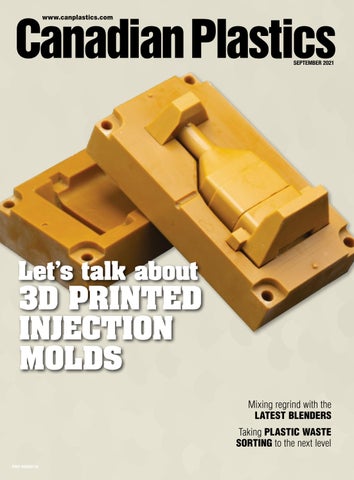
Let’s talk about
3D PRINTED INJECTION MOLDS Mixing regrind with the LATEST BLENDERS Taking PLASTIC WASTE SORTING to the next level
PM# 40065710
Molded to Perfection With over 160 years of steel production experience backing their brands, Swiss Steel Group is not only a pioneer, but also a market leader in specialty steels. Their comprehensive range of Formadur®, Thermodur®, Cryodur®, and Mold Die® grades allows you to choose the ideally suited mold material for your application. In addition, an extensive range of value added services provides you with more alternatives from one source, Swiss Steel USA / Canada. www.swisssteel-international.us www.swisssteel-international.ca +1 800 323 1233
contents SEPTEMBER 2021 VOLUME 80 • NUMBER 4
The March 1987 issue of Canadian Plastics profiled two new Canadian compact disc manufacturers that were jumping in to service the rapidly expanding audio market. Americ Disk had just opened an injection molding plant in Drummondville, Que. that could produce up to 12 million polycarbonate CDs per year, and was considering opening a second plant somewhere else in Quebec. And Cinram Ltd., already one of the largest LP and cassette makers in Canada, was set to open a new CD manufacturing plant in Toronto with 20 injection molding machines for production of 24 million discs annually.
Cover Photo Credit: Fortify
FROM THE ARCHIVES
10
Number of the month:
7
*The number of patents currently held by Aduro Clean Technologies (See pg. 19)
15
5 cover story 4
Editor’s View: Plastics as a wedge issue
5
Ideas & Innovations: Plastics engineering creates ‘floating’ swimming pool
6
News: • Polykar breaks ground on new Edmonton packaging plant • Spectrum buys B.C. film maker KCS Plastics • Ipex building new North Carolina injection molding plant • Supplier News and People
24 Technology Showcase 25 Advertising Index
10 INJECTION MOLDING: Let’s talk about plastic molds
When it does and doesn’t make sense to 3D print injection molds.
features
14 BLENDING: Mixing it up with regrind
The most important variables in molding are those that cause downtime and rejects if not handled properly, and the amount of regrind used in the process is definitely one of these. Which is exactly why some of the latest blenders and related technologies can handle regrind.
18 MATERIALS: Waste not, want not
Ontario-based Aduro Clean Technologies has developed a novel chemical conversion process that turns waste plastics into renewable fuels and specialty chemicals.
20 RECYCLING: Taking plastic waste sorting to the next level A new AI-powered technology from Vancouver-based Metaspectral uses hyperspectral imaging to differentiate between otherwise indistinguishable materials.
26 Technical Tips: Material selection and design concerns in micromolding
Visit us at www.canplastics.com September 2021 Canadian Plastics
3
editor’s view
Canadian Plastics magazine reports on and interprets developments in plastics markets and technologies worldwide for plastics processors, moldmakers and end-users based in Canada.
www.canplastics.com
Plastics as a wedge issue
I
’m writing this editorial at the end of August, so as you’re reading it, the wholly unnecessary federal election of 2021 is over and someone is going to form or maintain government. I won’t embarrass myself by guessing at the outcome, but one thing is clear: With a host of big ticket issues dominating the campaign – the government’s pandemic response and competing visions for a pandemic recovery, housing affordability, the crisis in Afghanistan – the issue of the Liberal government’s plan to label plastic as “toxic” under the Canadian Environmental Protection Act (CEPA) hasn’t been nearly as important as it should have been. After all, lumping plastic alongside such deadly substances as asbestos, mercury, and lead rather than working with the provinces to fix plastic waste management is a huge, drastic step to take against a manufacturing industry that’s a significant economic driver in Canada, worth about $40 billion in sales of resins and plastic manufactured goods and almost 100,000 jobs. And while we’re at it, it also gives a middle finger to consumer choice. But the Conservative Party still had the sense to use it as a wedge issue against the Liberals. The Conservative platform went after the Liberal government by blasting the “toxic” designation as job-killing and divisive, having ignited a sharp disagreement between the federal government and Alberta, which has tried to encourage additional petrochemical investments. “Declaring plastics ‘toxic’…is driving jobs out of Canada,” they noted. Not to overpraise the Conservatives but, win or lose on Sept. 20, they also got the big picture about plastic pollution right. The problem of plastic waste is real, they noted, but derives in large part because developing countries can’t
4 Canadian Plastics September 2021
afford to manage plastic waste properly. “Banning plastic straws in Toronto will have no impact on plastics in the Pacific Ocean,” they said. And then, in an acknowledgement of reality that I haven’t heard the Liberals make, they noted that “the last year has reminded us of the importance of domestic capacity to produce things like PPE.” The radical overkill of the Liberals’ plastics policy has already produced a backlash. Not only is Alberta warring with the feds over the “toxic” designation, but so too are members of the Canadian plastics sector: A new organization called the Responsible Plastic Use Coalition (RPUC) – currently made up of 27 industry companies, including Dow Inc. – has launched a court challenge against the move. We’ll see how that goes, but these developments might explain why the federal government is reportedly considering removing or changing the word “toxic” in CEPA, even though past Parliamentary committees have not supported removing “toxic” from the Act. The Liberals’ goal under this scenario, one imagines, is to half-heartedly appease our industry by getting rid of the scarlet letter “T” for “toxic” while still enforcing enough restrictions to keep the antiplastics activists happy. If true, this is cynicism on a level that would’ve impressed Machiavelli. And if true, it doesn’t say much for what the feds think of our intelligence if they believe we’d fall for it. The fact is, the Liberals will proceed to regulate plastic manufacturing if they still get to call the shots after Sept. 20, unless the RPUC’s lawsuit – or another similar lawsuit that may yet be filed – is successful. There’s a Chinese curse which says “May you live in interesting times.” These times are shaping up to be too interesting by half.
Reader Service Print and digital subscription inquiries or changes, please contact Serina Dingeldein, Audience Development Manager Tel: 416-510-5124 Fax: 416-510-6875 email: sdingeldein@annexbusinessmedia.com Mail: 111 Gordon Baker Rd., Suite 400 Toronto, ON M2H 3R1 EDITOR Mark Stephen 416-510-5110 Fax: 416-442-2230 mstephen@canplastics.com ASSOCIATE PUBLISHER Catherine McDonald 289-921-6520 cmcdonald@annexbusinessmedia.com ASSOCIATE PUBLISHER Stephen Kranabetter C: 416-561-5362 W: 416-510-6791 skranabetter@annexbusinessmedia.com MEDIA DESIGNER Lisa Zambri lzambri@annexbusinessmedia.com ACCOUNT COORDINATOR Cheryl Fisher 416-510-5194 cfisher@annexbusinessmedia.com VP/GROUP PUBLISHER Diane Kleer dkleer@annexbusinessmedia.com COO Scott Jamieson sjamieson@annexbusinessmedia.com PRINTED IN CANADA ISSN 008-4778 (Print) ISSN 1923-3671 (Online) Publication Mail Agreement #40065710 2021 SUBSCRIPTION RATES 5 issues Canadian Plastics, plus Dec. 2021 Buyers’ Guide: CANADA: 1 Year $77.50 plus applicable taxes; 2 Years $123.50+ taxes USA: $176.00 (CAD) / year FOREIGN: $201.00 (CAD) / year
Occasionally, Canadian Plastics will mail information on behalf of industry related groups whose products and services we believe could be of interest to you. If you prefer not to receive this information, please contact our audience development department in any of the four ways listed above. Annex Privacy Officer privacy@annexbusinessmedia.com • Tel: 800-668-2374 No part of the editorial content of this publication can be reprinted without the publisher’s written permission ©2021 Annex Business Media. All rights reserved. Opinions expressed in this magazine are not necessarily those of the editor or the publisher. No liability is assumed for errors or omissions. All advertising is subject to the publisher’s approval. Such approval does not imply any endorsement of the products or services advertised. Publisher reserves the right to refuse advertising that does not meet the standards of the publication. MEMBER: Magazines Canada, Canadian Plastics Industry Association.
Mark Stephen, editor
mstephen@canplastics.com www.canplastics.com
ideas & innovations
Photo Credit: Reynolds Polymer Technology Inc.
Plastics engineering creates ‘floating’ swimming pool
A
fear of heights doesn’t usually factor into swimming, but this isn’t usual: Coloradobased design firm Reynolds Polymer Technology Inc. and international property developer Ecoworld Ballymore Group have created what’s being called the world’s first “floating” swimming pool in London, U.K. – spanning 82 feet across two buildings 115 feet in the air. So, if you suffer from acrophobia, or are just generally faint-hearted, you may want to give it a miss. Called the Sky Pool, it consists of a single solid 14-inch-thick piece of acrylic made from totally transparent polymer, and is part of the Embassy Gardens complex. And while it was built to appear simple and confidence-inspiring to the public, it was an “incredibly complex” concept, Reynolds officials said. “It’s a three-dimensional structure carrying the weight of the water, as well as sustaining its pressure, spanning across a considerable distance at height, subject to wind loads, temperature fluctuations, and building movements,” they explained. The project took four years to complete, the first six months of which were spent just exploring the concept with plenty of discussion on design data and safety measures. “Manufacturing and engineering of the Sky Pool has pushed the envelope of what can be done in large acrylic structures,” said Paul Gardner, Reynolds’ vice president of engineering, quality, and safety. “The team has overcome incredibly tight tolerances and requirements to arrive at a finished project.” Built at Reynolds’ headquarters in the small Colorado town of Grand Junction, the transportation of such a large structure – which weighs 56,000 kilograms – across the Atlantic Ocean to London was another feat, requiring overseas shipping and then police escorts, road closures, removal of traffic lights and street signs, as well as a full day closure of Nine Elms Lane which spans along the River Thames in London, as the pool arrived via the water. The Sky Pool project is the latest in a series of acrylic construction projects by Reynolds. The firm designed the Rain Vortex at Jewel Changi Airport in Singapore in 2019, said to be the world’s tallest indoor waterfall; and that same year it supplied a 26-foot acrylic panoramic window for an CPL underwater restaurant in Norway.
Azelis is Your Source for Specialty Plastic Additives At Azelis, we are committed to servicing the Masterbatch, PVC and plastic recycling industries by providing innovative solutions, technical expertise and lab services to meet your requirements. We represent leading global suppliers in the plastics industry, including BASF, SUN Pigments, LANXESS, MannTek, KaMin and several others. See below a list of featured products we offer: Antioxidants
Fire Retardants
UV Absorbers
Peroxides
Pigments
Kaolin Clays
Non-Phthlate Plasticizers
Fire Retardants
Experience Azelis Canada’s technical support and work directly with our team of industry and sales professionals for expert advice about innovative solutions. Azelis Canada An Azelis Americas Company
Visit www.azeliscanada.com E-mail : philippe.julien@azelis.com
September 2021 Canadian Plastics
5
news
Polykar breaks ground on new Edmonton packaging plant
Photo Credit: Polykar Inc.
In the first phase of a $40-million investment aimed to better service its Western customers, Quebec-based flexible packaging supplier Polykar Inc. broke ground in early July on a new 50,000-square-foot state-of-the-art plant in Edmonton. The plant – which is expected to be fully operational by the spring of 2022 and employ about 70 workers within the first two years – is being built in the Discovery Business Park
industrial subdivision in South Edmonton. According to Polykar officials, the construction of the facility is the first step in its multimillion-dollar investment to create a centre of excellence for the development and commercialization of flexible and compostable packaging. “We selected Edmonton and Alberta as the ideal location for our second Canadian plant for its dynamism; its openness to the manufacturing sector; and most importantly, because of its highly qualified, skilled, and diverse labour force,” said Polykar president and CEO Amir Karim. In a related move, Polykar is donating $50,000 to the University of Alberta’s Faculty of Extension to fund a new pilot program called “Micro-Credentials: Communication Skills for the Workplace.” The new Edmonton plant will also incorporate a recycling facility, which Polykar says will position it to participate in Alberta’s efforts to divert plastic waste from landfills; and will allow the company to recycle and repurpose those materials, contributing to the province’s stated goal of creating a circular plastics economy. CPL
Montreal’s Protech Group buys Excalibur Paints Canadian specialty materials maker Protech Group has acquired the liquid coatings business of Excalibur Paints & Coatings Ltd. for an undisclosed amount. Headquartered in Wichita Falls, Tex., Excalibur is a protective coatings development and manufacturing company with a product line that includes epoxy systems, alkyd coatings, corrosive-inhibitive primers, polyurethanes, and chemical-resistant linings. In a news release in June, officials with Montreal-based Protech said that Excalibur’s formulations and products will
be integrated under the Protech portfolio of liquid coatings brands. “This acquisition strengthens our liquid coatings capabilities,” Protech president David Ades said. “It allows us to expand our customer base, keep up with the growing demand, and offer a great depth of solutions to them.” The deal is Protech’s third over the past year; it recently acquired the coatings division of France-based ACG Industrie and also U.S.-based liquid coatings manufacturer Winslow Browning Inc. CPL
Spectrum buys B.C. film maker KCS Plastics Blown and coextruded film maker KCS Plastics Ltd., of Langley, B.C., has been acquired by Spectrum Plastics Group, a manufacturer of medical-grade plastic products headquartered in Alpharetta, Ga. The financial terms of the deal were not disclosed. Founded in 1991, KCS offers polyethylene (PE) packaging solutions for customers across Canada and the U.S. The firm’s products are food contact safe as defined by Agriculture Canada and the FDA in the U.S. KCS makes HDPE products and three-layer coextruded films and liners for customers in Canada and the U.S. Its product line includes garbage and recycling bags; laminating and barrier films; and HDPE liners for poultry, meat, and fish packaging. It has annual capacity of approximately five million kilograms of PE products and employs more than 25 workers. Spectrum has more than 20 locations. In addition to the U.S. and Canada, it has plants in Mexico, Costa Rica, Ireland, and Malaysia. It primarily serves the medical device, defense, industrial, and food packaging markets. In addition to film, the company’s plastics operations include injection molding and tubing extrusion. CPL
6 Canadian Plastics September 2021
SUPPLIER NEWS – Fraser, Mich.-based mold component and hot runner supplier PCS Co. has expanded its Molding Solutions product line by integrating the Molders Choice products line. In addition, Ken Berger, owner of Solon, Ohio-based Molders Choice, will be joining PCS to oversee the Molding Solutions portfolio. www.canplastics.com
SPONSORED CONTENT
CCC PLASTICS: WE’RE GOING STRONG AT 100 YEARS
Founded in 1921, CCC Plastics has now been proudly serving the
chemical and plastics sectors for 100 years for customers in Canada and throughout North America.
We manufacture a full range of specialized custom products
including colours, whites, additives and source a full range of com-
modity resins, polymer compounds and engineered thermoplastics. Each identified unique need is considered during development
and selection of products to meet your exact needs. Our deep
knowledge and expertise in all facets of plastics enables us to make
business easier for you, by solving the problems you face today, and by identifying new opportunities for your tomorrow.
We recently spoke with Canadian Plastics magazine about our
past, present and future.
The CCC Plastics plant in Colborne, Ontario.
Q: What services did CCC originally provide when it was founded in 1921?
A: We started 100 years ago with a primary focus of selling coloured pigments and dies for the textile market. We then expanded into
resin distribution in the 1950s, and added a manufacturing plant in
Colborne, Ontario in the early 1980s composed of an initial portfolio
of PVC blends, compounds and masterbatches. We evolved over the years with polyolefin additives and manufacturing colour con-
centrates. We’ve progressed to become a state-of-the-art, first-class provider of raw materials for plastics processors.
When we started 100 years ago, the philosophy was to seek long-
term business, and we continue this same business approach today.
Q: How does CCC plan to evolve in the future to meet the needs of
Q: Who are CCC’s customers?
A:The legacy we’ve built over the first hundred years will help
A:We have a loyal, diverse range of customers that spans the length and breadth of Canada, into the U.S. and Mexico, and produces
plastic products for use in markets that range from pharmaceutical, automotive, rigid and flexible packaging, and many others.
Q: How does CCC partner with customers to solve their manufacturing problems and help them gain new business?
the industry?
inspire the next hundred years, including a new extruder that will be added to the Colborne plant and through many new products and
supply options for our distribution business. It’s vital that we don’t lose sight of our roots and what made us successful in the past, but
continue to evolve and reinvent ourselves to meet the ever-changing needs of the plastics industry.
A: It all starts with technical competence and listening – we have to
Q: CCC has core values of integrity, excellence, respect for em-
on options that can provide a solution, not just with our processing
suppliers, and our financial success. How do you implement these
understand the issue each customer is facing and work cooperatively customer but also with their end-customer. We want to support them
from start to finish. Our technical team is experienced and based here in Canada and is constantly upgrading their skills to better serve the
industry; and we have a vast Canadian and U.S. sales network made up of experienced and knowledgeable sales professionals. We have
the advantage of being qualified as a one-stop shop to our customers, and have such a broad portfolio that we have become a valuable resource for them.
CCC Plastics 175 Bloor St. East. Suite 1300 Toronto, ON, M4W 3R8 416-443-5500 • www.ccc-group.com
ployees and their communities, partnerships with customers and and how do they benefit your customers?
A: We’ve kept these values because we hire for technical skill and
also for cultural fit, which allows us to stick to these core values and
keep them at the heart of who we are and what we do as we continue this great legacy for years to come.
visit www.canplastics.com/podcasts/CCC Please to listen to the full podcast
Ipex building new North Carolina injection molding plant Canada-based pipe and fittings maker Ipex has announced plans to build a 200,000-square-foot facility for injection molding in Pineville, N.C. Ipex’s Pineville site already has injection molding, extrusion, and distribution operations. When construction on the new building is complete, the plants will have a total of almost 100 injection presses, making it Ipex’s largest molding site to date. The company expects to hire 150 workers, and the plant’s advanced automation will call for technical, supervisory, and quality control workers. The building also will have room for
A rendering of Ipex’s new injection molding plant in Pineville, N.C.
testing and prototyping. Operations are expected to be fully underway in early 2023. Ipex, a subsidiary of Aliaxis SA of Brussels, makes fittings for plumbing, municipal, industrial, and electrical uses. In addition to the Pineville plant, Ipex has five molding plants in Canada. CPL
PEOPLE
Mark Newman
Shruti Singhal
Ulrich Bartel
Markus Parzer
Jay Baxter
Joe Guigli
Lori Parent
Vladimir Ilyutovich
Robert Pyle
Richa Desai
Kimberly Ryan
Chris Brown
Bob Patel
Jason Pizcazotowski
Nathan Wiker
Victor Alvarado
Sarah Marshall
Avik Dey
Jason Lyons
Peter Falise
– Wilmington, Del.-based material supplier Chemours Co. has named Mark Newman as president and CEO. – Specialty colour and additive concentrates supplier Chroma Color Corp., headquartered in McHenry, Ill., has named Shruti Singhal as CEO. – Germany-based extrusion systems and auxiliary equipment maker Coperion has named Ulrich Bartel as president, and Markus Parzer as president of its polymer division. – Pawcatuck, Conn.-based extrusions systems maker DavisStandard LLC has named Jay Baxter as commercial product director, liquid coating; and Joe Guigli as vice president, aftermarket sales, North America.
– Spain-based colour concentrate and raw materials supplier Delta Tecnic has appointed Lori Parent as sales director for Canada and the U.S. –York, Pa.-based machinery maker Graham Engineering Corp. has appointed Vladimir Ilyutovich as director of international sales for extruders and systems. – Lancaster, Pa.-based blow molder Graham Packaging Co. Inc. has named Robert Pyle as CEO and president, and Richa Desai as director of sustainability. – Hillenbrand Inc., the publicly traded Batesville, Ind.-based company whose holdings include plastics machinery maker
8 Canadian Plastics September 2021
Milacron, has named Kimberly Ryan as president and CEO. – Specialty chemicals company Lubrizol Corp., headquartered in Wickliffe, Ohio, has named Chris Brown as president and CEO. – Bob Patel, CEO of Houston-based petrochemicals supplier LyondellBasell Industries, will retire on Dec. 31. A successor has not yet been named. – Houston, Tex.-based purging compound supplier Neutrex Inc. has appointed Jason Pizcazotowski as president. – Thermoplastics distributor Nexeo Plastics, headquartered in The Woodlands, Tex., has named Nathan Wiker as vice president of North American commercial sales. – Calgary-based Nova Chemicals Corp. has named Victor Alvarado as senior vice president, operations and engineering; Sarah Marshall as vice president, sustainability; and Avik Dey as senior vice president and chief financial officer. – Danbury, Conn.-based industry association Society of Plastics Engineers has named Jason Lyons, business manager at Arkema Inc., as president for 2021-2022. – Process cooling technology maker Thermal Care, headquartered in Niles, Ill., has appointed Peter Falise as regional manager for the Canadian provinces of Manitoba, Ontario, and Quebec, as well as the Northeastern U.S. www.canplastics.com
Image Credit: Ipex
news
Photo Credit: Univar Solutions Inc.
news
Univar building new distribution facility in Abbotsford, B.C.
Berlin Packaging buys Canadian cannabis packaging specialist
Specialty chemical distributor Univar Solutions Inc. has begun construction on a new customized facility in Abbotsford, B.C. The SAP-ready facility is expected to open during the first half of 2023, and Univar officials said it aligns with the company’s long-term sustainability commitment to achieve netzero emissions by 2050. The facility will include a whole-site tank telemetry system for real-time product inventory; larger chemical and ingredient storage; rail capacity; and specially designed blending rooms for solvents, corrosives, and oxidizers that will help to reduce the risk of accidents. CPL
Chicago-based packaging distributor and manufacturer Berlin Packaging LLC has acquired a Canadian company that specializes in packaging for the cannabis sector. Berlin announced in June that it purchased Markham, Ont.-based Cannasupplies, formerly a division of PharmaSystems Inc. The financial terms of the deal were not disclosed. Cannasupplies will operate as a division of Consolidated Bottle Corp., the Canadian packaging supplier Berlin Packaging acquired in November 2020. All Cannasupplies employees and locations will be retained, according to Berlin’s news release. “Acquiring Cannasupplies positions [us] to capitalize on the incredible opportunities in this rapidly growing industry, not only in Canada, but across the U.S., as more states permit medical and recreational cannabis use,” said Berlin president and CEO Bill Hayes. “Cannasupplies shares our entrepreneurial mindset, our drive for constant growth, and our commitment to compliant packaging solutions for our valued customers.” CPL
SmartPower 25 – 400 t
September 2021 Canadian Plastics CPL_DecBuyersGuide20_Wittmann2.indd 1
9
2019-11-20 1:08 PM
injection molding
LET’S TALK ABOUT PLASTIC MOLDS When it does and doesn’t make sense to 3D print injection molds.
I
njection molding is the most widely used manufacturing solution for plastic components for good reasons: it offers fast cycle times, low cost-perpart, repeatable outcomes, and minimal waste of the injected material. Making machined metal injection molds, on the other hand, involves high tooling costs, long lead times and – usually – multiple iterations of a tool. But the economics behind injection molding parts still far outweigh these negatives, especially when the required part quantity is greater than 100,000 – once the mold is made, after all, the costs of producing parts are minimal. But the economics get trickier under certain circumstances. Can a molder justify the high cost of a tool when it’s making just a few prototype parts in a contract bid, for example, or producing only hundreds of parts in a low-volume run? Which is where the idea of 3D printing injection molds comes in. The term “game changer” gets thrown around a lot, but it might fit here: The ability to rapidly print molds for parts is revolutionary for part designers, since 3D printed tooling exhibits faster lead times at a fraction of the cost of machined hard tooling. Depending on part complexity, plastic injection molds can be 3D printed in a few days, which is far faster than the weeks or even months most in the industry have come to expect. “In general, a hardened steel tool can take eight weeks or longer to
10 Canadian Plastics September 2021
provide first articles,” said Preston Souza, product specialist at plastic product supplier igus. “We can provide parts within three to four weeks using a printed tooling system.” Additionally, 3D printed mold tools allow designers to print and mold multiple iterations of a part, giving them the freedom to explore many more designs – fine details and complex geometries don’t cost extra to print, and designers are able to add in detail that would significantly drive up the cost of a steel tool – and the assurance that their final design will be the right one. Which is why there’s a lot of buzz around 3D printed molds among mold shops lately. “For management, 3D printed tooling systems have created the opportunity to provide parts for prototyping, small batch runs or lower volume production with less of an investment,” Souza said. “And for the engineers, any option for prototyping or pilot build parts that offers quality, performance, and reduced lead time is going to be popular.” But does this mean it’s right for you?
BIG DECISIONS
The big determinant in whether or not to use a 3D printed injection mold is the volume of parts being made, with the cycle time also being a factor since the cooling capabilities are less robust than with metal molds: specifically, the experts say, the heat transfer coefficient
of printed polymers is an order of magnitude lower than steel or aluminum. “In general, 3D printed molds are best suited for prototyping runs where the target part quantity is less than 200 pieces; and for production runs, the number is probably roughly 1,000 pieces,” said Ben MacDonald, applications engineer with 3D printing technology developer Fortify. “The main driver behind all of this is the cycle time – with a traditional mold, cycle times typically range from 30 to 60 seconds while printed molds see cycle times in the range of from 90 to 180 seconds. As target part quantities increase, the time on the molder increases to the point where, for instance, it doesn’t make sense to spend 60 hours molding 2,000 pieces.” Another factor is the design of the mold. A good rule of thumb is to design 3D printed tools to be more “forgiving” than steel or aluminum tools, which means that the parameters for mold design with 3D printing are different in some respects in order to avoid creating undue stress on the plastic mold. First, 3D printed molds require larger draft angles. “Steel molds have a higher tolerance to lower draft angles than printed molds,” MacDonald said. “When designing a steel mold, it’s common to see a 0.5 to 1 degree of draft, and with a printed mold those numbers shift to between 1 to 2 degrees.” Also, ejecting plastic parts can be challenging to do from a plastic mold, www.canplastics.com
All photos courtesy of Fortify
By Mark Stephen, editor
injection molding
the experts say, so greater attention must be paid to the placement and quantity of ejector pins. “The pins should be placed so that the parts won’t flex during ejection, and this can be accomplished by placing a pin next to a high aspect ratio extrusion or at the base of a rib rather than next to a rib,” MacDonald said. And gate design is different for plastic molds, as well. “Tunnel and point gates should be avoided, while sprue, fan, and tab gates should be increased to three times their normal size,” said Gus Breiland, senior technical engineer with injection molder and 3D printer Protolabs. “Also, polymer flow through the printed mold should be oriented in the same direction as 3D print lines to avoid sticking and to improve filling at lower injection pressures.” And since 3D printed molds are unable in general to withstand the kind of pressures that traditional metal molds
One of Fortify’s 3D printed internal test molds in an injection molding machine, used to benchmark performance.
can endure, extra ventilation will be necessary. “This can take the form of surface vents, ejector pins, and vent holes, to name a few,” said Ben MacDonald. “The goal with this ventilation is to always give the air in the cavity an easy path to escape so that the flow of the plastic is never restricted. The great thing about adding in all of these ejector pins is that they provide excellent opportunities for ventilation.”
01-8938-COL-CanadianPlastics-Success-7x5.qxp_Layout 1 3/5/21 12:46 PM Page 1
Affordable
Also bear in mind that current 3D printing technology isn’t capable of making plastic injection molds for truly large-sized parts, nor can it print extremely complex design features. But other, less-complicated design features can be achieved with some extra work. “Elements like undercuts require extra design time and will increase cycle time if they’re designed to be inserted and removed by hand,” MacDonald said.
Experience Full Control
Sepro Success Robots
Include 5-Axis Option Sepro has completely redesigned its bestselling Success Line and now includes a 5-axis servo version. All Success robots feature best-in-class technology: • reliable cam-follower bearings • larger part-handling and wider stroke capacity • more compact footprint • simpler maintenance Success robots are THE most versatile and technological solution for injectors. Seven models are available for IMMs from 60 to 900 tons. www.sepro-group.com • seprocanada@sepro-group.com • 514-515-9349 • @SeproGroup l
CPL_Sepro_MarApril21.indd 1
September 2021 Canadian Plastics
11
2021-03-08 9:21 AM
injection molding
LESSONS LEARNED Additive manufacturer Midwest Prototyping, headquartered in Blue Mounds, Wis., used Somos PerFORM from DSM Somos for a medical device customer that needed a 3D printed mold to make liquid silicone rubber (LSR) parts. Despite breaking a few molds in the beginning, DSM officials said, Midwest learned a few things: Thicker is better. Several molds were made, each progressively thicker. It needed to be strong enough to handle the heat of the oven and the pressure of the curing silicone. Support the mold. Steel backing plates were ultimately used to hold the mold together after the pressure of curing tore apart a mold that was secured with just bolts and washers.
Heat is another challenge, since plastic tools can break down relatively quickly when subjected to the demanding thermal cycles of injection molding, especially when molding high-temperature polymers such as PEEK or Ultem. “Printed molds typically become ineffective within 100 shots of soft, hot plastic such as polyethylene [PE] or styrene, and may produce only a handful of parts – 10 or less – from glass-filled polycarbonate [PC] or nylon and other tough thermoplastics,” said Gus Breiland. “Cooling systems can be used to improve mold longevity somewhat, but will not decrease the substantially longer cycle times seen with printed molds, as plastic tools don’t dissipate heat as well as aluminum or steel molds.” But these numbers aren’t hard and fast, since they can fluctuate with geometry. “Fortify typically sees 1,000plus shots from soft plastics and between 100 and 250 with engineered plastics,” Ben MacDonald said.
molding machine to work through the learning curve associated with printing molds. But there are still decisions that have to be made, beginning with which 3D printing process to use. Choices include digital light processing (DLP), stereolithography (SLA), selective laser sintering (SLS), fused deposition modeling (FDM), and selective laser melting (SLM), as well as printed steel and printed aluminum. “SLS is the most economical option for low-complexity parts and lower volumes,” said Preston Souza. “SLA provides a smoother surface finish and mid-range volumes, while printed aluminum and printed steel offer higher volumes and part complexity.” SLA is also known for its ability to produce patterns for investment casting, the experts say, which is one of the first uses of the technology. The second decision is selecting the right type of printing material from the many that are available. Fortify, igus,
Go easy. It was quickly learned to heat up and cool down the mold slowly and handle the mold more gently than a machined mold for best results.
“3D printed mold tools give designers the freedom to explore many more
Vent it. More vents were needed than typical. LSR is very thick and was injected under higher pressure than typical urethane casting materials.
A final factor is the design of the part itself. Parts produced with 3D printed molds are limited to less complex geometries – for example, undercuts and similar features, which are common with production mold tooling, must be generated through the use of hand-loaded inserts, due to the fact that the automatically sliding side-action cores used in metal molds aren’t an option because of their cost and design complexity.
If it isn’t broken, don’t fix it. Several rounds of poorly cured parts led to the conclusion that the standard Mann 200 mold release was still the right choice versus other suggested options. Overall, the experience left Midwest confident that it could produce low-volume parts in LSR using 3D printed Somos PerFORM molds. “In fact, another customer LSR project was immediately started after finishing this one with the advantage of the knowledge gained from this project,” DSM said. CPL
12 Canadian Plastics September 2021
designs than with conventional metal molds, and the assurance that their final design will be the right one.”
HOW TO DO IT
Despite the advantages of rapid injection molding with steel and aluminum tools, there are times when using a printed plastic mold might make sense, such as for prototyping or for very low quantities of relatively simple parts – especially for shops that have an idle 3D printing machine that can handle the resins required for robust mold tools and the time available on an injection
and other vendors all offer proprietary printing materials, and so do some familiar resin suppliers such as DSM Somos. The final material selection is determined by the melt temperature, the melt flow index, and the abrasiveness. “It’s important to select a printed material that can withstand the melt temperature of the application,” said Ben MacDonald. “The key parameter to consider is the heat deflection temperature of the printed material, which will determine how well and how long the printed mold can stand up to the rigours of the plastic.” The good news is, there’s been steady improvement in heat-resistant printing materials over the years. “Previously, 3D printed molds were reserved only for commodity plastics such as polypropylene, TPE, or HDPE; but we can now print molds for a whole new set of engineering plastics such as PC, nylon, www.canplastics.com
injection molding
POM, and even high-performance plastics like Ultem, which used to be impossible,” MacDonald said. An important caveat, the experts say, is that molding with engineering resins and high-performance plastics requires 3D printed mold tooling that’s printed with very high-performance materials that aren’t typically available to run on entry-level printers. A final step is to make sure you have the necessary resources available inhouse. “People and machines will be needed to process and assemble the plastic tool, as well as an injection molding machine operator who knows how to dial-in the shot size, temperature, and machine pressure, since these will be far different than the parameters he or she is used to with conventional tooling,” said Gus Breiland. A second option here is to order a printed mold from a third-party vendor, but this will of course add to the project cost and
turnaround time. “This will usually cost anywhere from $1,000 to $3,000, depending on the size of the mold,” Ben MacDonald said.
KNOW THE LIMITS
So, there are some very valid reasons to 3D print a mold: for part validation before committing to hard tooling, for low-volume production runs of parts that don’t have challenging features, or for a shop that needs a hundred or so parts in a few days. And it’s particularly doable if your shop has its own suitable 3D printer and if your tool-and-die team is familiar with the unique design parameters. By understanding and accepting these production differences, molders can realize significant success when molding parts with plastic molds in the right set of circumstances. In the end, plastic molds are fast and inexpensive to make, but they have limitations, primarily in regards to high-
volume production and cycle times. And if the criteria for using them haven’t been met, then a conventional metal tool is the better choice, especially for injection molding end-use parts. But if a 3D printed mold is a viable production option, then you might want to reap the benefits of faster lead times, increased design flexibility, and lower upfront investment costs by giving one a try. “I think more often than not people will be surprised to see that printed tools can meet their needs,” MacDonald said. CPL RESOURCE LIST Fortify (Boston, Mass.); www.3dfortify.com; 857-274-0483 igus (East Providence, R.I.); www.igus.com; 800-521-2747 Protolabs (Maple Plain, Minn.); www.protolabs.com; 877-479-3680
Water Chillers
Portable Chillers : .25 -40 tons Indoor Portable Chillers ... Air or Water Cooled
Central Chillers : 5 -180 tons
Indoor & Outdoor units ... Air or Water Cooled Complete chiller & pump system packages or stand alone chilling modules.
NEW MG Portable Chiller Control System
905-895-9667
Portable & Central Chillers Manufactured by Advantage With Exclusive Canadian Distributor, Chillers Inc.
www.ChillersInc.com
1228 GORHAM STREET, UNIT 11 NEWMARKET, ONTARIO L3Y 8Z1
September 2021 Canadian Plastics CPL_Chillers_June20.indd 1
13
2020-05-05 10:45 AM
MIXING IT UP WITH REGRIND The most important variables in molding are those that cause downtime and rejects if not handled properly, and the amount of regrind used in the process is definitely one of these. Which is exactly why some of the latest blenders and related technologies can handle regrind. By Mark Stephen, editor
W
hether they’re supplying centralized systems or dedicated machine blenders, blender makers are under pressure these days, and it has nothing to do with the pandemic: More and more processors are using regrind materials in order to get the most production from their resin purchases. But the problem is, these materials aren’t always easy to blend, since they may have degraded physical, chemical, and flow properties. Which means that customers expect blender makers to deliver solutions. While the use of regrind almost always implies a blending step since it’s not normally possible to use regrind material alone, there are some specific points that should be considered when designing a blender – in particular a gravimetric blender – for regrind. “The buffer hoppers should have a bigger volume than the ones for granules, since the bulk density of regrind is generally quite low and they have a geometry designed to avoid any bridge and to make the falling of the material as regular and smooth as possible,” said Tony Rodrigues, managing director of Piovan Canada. “For very light materials, adding pneumatic bridge-breakers inside the buffer hopper, synchronized with the dosing slide gate, might be necessary to guarantee a correct flow. And special attention also has to be given to
14 Canadian Plastics September 2021
the dimensions and geometry of the slide gates passing hole, to find the right balance between the accuracy of the dosing and the best flow of the flakes.” The good news is, a number of OEMs have accepted the challenge, as a quick look at some of the latest blending technologies shows.
A QUESTION OF CONTROL
AEC’s new BlendTrac software program can monitor and control up to 100 of the company’s BD gravimetric blenders – which will blend most free-flowing regrind materials – as well as the A-B and OA gravimetric blenders within a facility, across multiple facilities, or machines all over the country, to centralize inventory control, optimize quality, and reduce labour and material costs. Compatible with Windows 10, BlendTrac software remotely monitors the materials in each blender’s hopper and can track material reference numbers, lot numbers, and silo numbers to aid in quality control. It can log as many as 1,000 alarms per blender and up to 5,000 consecutive batch weights to monitor trends, and can be added to new AEC batch weigh blenders or installed on older models. “BlendTrac aggregates and presents blending data in a way that helps your operators reduce errors and make informed purchasing decisions,” said Michael Gersmeyer, AEC’s senior
product manager. Best known as a masterbatch specialist, Ampacet expanded its reach with its acquisition last year of auxiliary equipment maker LIAD. One result is the recent introduction of LIAD Smart BlendSave, a centralized, automated blending system that uses patented weighing and blending technology to manage resins – including regrind – and recipes for multiple processing machines. Designed for lightsout operations, it weighs ingredients individually and conveys them through dedicated lines to a mixer at each injection molding machine or extruder, and can manage up to 40 ingredients. Its automated manifold, called OctoBatch, distributes the individual ingredients of each recipe to as many as 50 buffer hoppers, one for each processing machine. The LIAD Smart BlendSave is modular, allowing additional units to be integrated to accommodate growth, Ampacet officials said, and provides total traceability and verification of raw materials in each batch formulation and real-time data management of all resin ingredients through a centralized control and a facility’s existing enterprise resource planning (ERP) system. Conair Group’s upgraded TrueBlend gravimetric blenders, which now come with the company’s next-generation SB-5 control, can handle regrind, which can be added to the recipe and adjusted throughout the process as a percentage of the total batch size. Designed to be user-friendly, the control is easier to program and displays intuitive graphics and provides more comprehensive monitoring. “It performs on Conair’s common control interface, meaning the user experience is the same whether the user is accessing information about a blender or any other Conair equipment – such as a dryer – which simplifies operations and reduces the need for training,” said Alan Landers, Conair’s product manager, blending and upstream products. “With Conair’s feed-forward dosing algorithm, the TrueBlend blenders deliver a dosing accuracy to within 0.025 per cent for
Photo Credit: © albertobrian/ Adobe Stock
blending
Photo Credit: Maguire Products
blending
the total batch dispensed, and can manage up to 12 ingredients, dispensed from 12 material bins.” The SB-5 blender control also includes a self-loading option, Landers said, which enables users to add vacuum receivers and up to 12 loaders, as well as one pump per blender.
hour up to three tons per hour and with a wide range of configurations and solutions, including the ones dedicated to regrind and flakes. “Quantum and batch blenders can be fully effective only when combined with a complete package designed for regrind and post-consumer flakes, such as a conveying system that can guarantee a reliable A BETTER BLEND material feeding,” said Tony Rodrigues. Hamilton Plastic Systems’ range of Opti“For applications where the batch blender mix gravimetric blenders, which are appliisn’t applicable, Piovan Group can provide cable across all process applications and Maguire Products’ new bridgea solution as well; for example, with a conthroughput requirements, are designed to breaker breaks up regrind and other tinuous loss-in-weight dosing unit with a offer precise mixing, dosing, weighing, and troublesome materials. high-throughput station for flakes also from control of all materials, including regrind Fdm and Doteco brands.” pellets and flakes. “Optimix batch blenders offer throughputs Wittmann’s new Gravimax G76 material blender is up to 3,000 kilograms per hour, and can accommodate up to designed for applications requiring material throughputs of 12 components,” said company president Steve Hamilton. more than 700 kilograms per hour, and can handle seven kilo“The Optimix range utilizes a slide valve design and the pat- grams per dosing cycle and blend up to six different compoented reverse flight mixing auger technology, a combination nents, including regrind. “If regrind is added to a virgin and that provides superior accuracies, blend ratios, and mixing additive and/colourant blend, the blender will account for the homogeneity that’s not achievable by competitive systems.” additives and/or colourants present in the regrind and adjust Maguire Products’ new bridge-breaker is a pneumatically operated device that rapidly pulses between clockwise and counterclockwise movements to break up regrind and other troublesome materials that tend to clump together during the blending process. It can be deployed in the hopper of a new or existing gravimetric blender to ensure accurate dosing, according to Frank Kavanagh, Maguire’s vice president of sales and marketing, and works with the company’s three largest blenders, with capacities of up to 12 ingredients and throughputs of up to 5,000 kilograms per hour. “These bigger blenders address the growing need for introducing regrind, which is often a major component in the raw material recipe being blended,” Kavanagh said. “Regrind can account for 30 to 60 per cent of the blend – and sometimes more – and is often a light-bulk-density material, which doesn’t flow as easily as other ingredients, tending to agglomerate or bridge. It’s an especially costly problem in high-volume extrusion. With the new bridge-breaker, we’ve been able to consistently dispense bridging-prone materials at the same weight over time in batch after batch.” Motan’s Spectroflex V line of blenders, designed for introducing powders, pellets, regrind, flakes, and fibres into continuous processes, now comes with a gravimetric dosing option that features precise load cells and is controlled via a network-compatible control called GRAVInet SF. According to Motan officials, users can now easily switch between volumetric and gravimetric dosing technologies. The dosing unit’s modular design also makes material changes fast and simple, they added. The Piovan gravimetric batch blender range, including Quantum and MDW, covers most of the applications with models from a maximum throughput of a few kilograms per September 2021 Canadian Plastics CPL_PCS_Sept21.indd 1
15
2021-09-09 9:22 AM
blending
Photo Credit: Wittmann Battenfeld
the dosed amounts, avoiding overusing these expensive materials,” said Steve Mussman, Wittmann Battenfeld USA’s division manager, material handling and auxiliaries. And the Gravimax G76 and other Wittmann blenders can monitor the level of regrind in the regrind hopper and use a high and Witmann’s new Gravimax G76 material blender can blend up to six different low regrind recipe. components, including regrind. “For example, if the level of regrind is above the sensor, the blender can dose 15 per cent regrind, but drop to 10 per cent when falling below the sensor,” Mussman said. “This will ensure regrind is always used without running out. This will provide a more consistent regrind usage, which can help achieve more consistency in the viscosity of the melt during processing, achieving more consistent part quality.” Like everything else about molding, mixing regrind is a science that requires high accuracy. These latest blenders and associated technologies can help you get there. CPL RESOURCE LIST AEC Group (New Berlin, Wis.); www.aecinternet.com; 262-641-8600 AuxiPlast Inc. (Ste-Julie, Que.); www.auxiplast.com; 866-922-2894 EquiPlas (Toronto); 416-407-5456 Ampacet Corp. (Tarrytown, N.Y.); www.ampacet.com/blendsave; 914-631-6600 Conair Group (Cranberry Township, Pa.); www.conairgroup.com; 724-584-5500 Dier International Plastics Inc. (Unionville, Ont.); www.dierinternational.com; 416-219-0509 Industries Laferriere (Mascouche, Que.); www.industrieslaferriere.ca; 450-477-8880 Turner Group Inc. (Seattle, Wash.); www.turnergroup.net; 206-769-3707 Hamilton Plastic Systems Ltd. (Mississauga, Ont.); www.hamiltonplasticsystems.com; 800-590-5546 Maguire Products Canada Inc. (Vaughan, Ont.); www.maguireproducts.com; 905-879-1100 Motan Inc. (Plainwell, Mich.); www.motan-colortronic.com; 269-685-1050 D Cube (Montreal); www.dcube.ca; 514-272-0500 Piovan Canada Ltd. (Mississauga, Ont.); www.piovan.com; 905-629-8822 Wittmann Battenfeld Canada Inc. (Richmond Hill, Ont.); www.wittmann-group.com; 905-887-5355
16 Canadian Plastics September 2021
Fast Plastic Solutions With IMPROVING YOUR PROFITABILITY WITH INNOVATIVE POLYMERIC MATERIALS AND
ON-TIME DELIVERY orders@poundsofplastic.com
SUPPLIER OF MATERIALS FOR • INJECTION MOULDING • EXTRUSION • BLOW MOULDING • ROTO MOULDING • FILM • Antimicrobial thermoplastics (Kills bugs) • Biodegradable thermoplastics (Degrades in Landfill) • Black colour concentrates • Reprocessed post consumer thermoplastics
POUNDS OF PLASTIC INC. www.poundsofplastic.com 5650 Tomken Rd., buildings 1 & 2, Mississauga, Ontario L4W 4P1 PH: 905-286-9894 • FA: 905-625-8233 rpounds@poundsofplastic.com
A MOLDING MACHINE IS NOT DESIGNED TO MIX. The molding machine is designed to plasticate (in Laymen’s terms, melt) and convey the molten material into a mold, it is not designed to mix. Making a physical blend of let’s say 50% by weight 45% glass reinforced nylon 6,6 with 50% by weight 15% glass reinforced nylon 6,6 to obtain 30% glass reinforced nylon 6,6 does not work. By “does not work”, we mean finished molded parts with consistent 30% glass content shot to shot. The consistency shot to shot will not be there when molding this blend. In this cited case nylon 6,6 is hygroscopic. This means that nylon 6,6 absorbs moisture. In the case of nylon 6,6, the moisture is not easily removed once absorbed by the nylon 6,6. Even though nylon 6,6 will not flow at above 509° F, the recommended drying temperature for nylon 6,6 is 185° F. Why not dry at 250° F, or 300° F, or even 450° F if the nylon 6,6 does not flow until 509° F? Nylon 6,6 and its counterpart nylon 6 exposed to temperatures above 185° F oxidize in the presence of oxygen. Oxidization is another word for burning. Nylon 6,6 pellets will turn yellow at drying temperatures @ greater than 185° F. Keep in mind that the larger the pellet the more difficult it is to dry relative to a smaller pellet. Smaller pellets have a greater surface area per unit volume than do large ones. Smaller pellets will dry easier than large ones. Smaller pellets will dry faster than larger ones. As a side note: How does the particulate size of “regrind” form/pellet size affect the drying of regrind? The injection molding process and the resultant parts produced from Injecting Molding is about consistency. If a Molder sets up a particular job (mold), and he has a procured a truckload of 27 boxes (say 1,500 pounds/ box) of a given material to run this molding job, he sets the molding parameters and doesn’t want to go near the machine until the job is complete. Box (1) one in this lot through to box (27) twenty-seven must be consistent. This means that every shot has the same viscosity. When you boil down what injection Molding companies do, I believe they rent machine time. The more consistent the raw material is the less time a Technician has to tend to the machine and process. The less tending, the more money the Molder makes as the machines are producing good parts. This physical blend must be dried. If both pellets are the
same size, then one would assume since glass doesn’t absorb moisture the 45% glass reinforced nylon 6,6 pellet would yield its moisture more readily than the 15% glass reinforced nylon 6,6 pellet. The pellet containing 45% glass has 55% nylon in it. The pellet containing 15% glass fiber has 85% nylon in it. The potential for more moisture to be present in the 15% glass reinforced pellet versus the 45% glass reinforced pellet exiting the dryer prior to the physical blend entering the throat of the molding machine is there. If both pellets are of different sizes, then the potential of more moisture being present in the larger pellets is apparent. The moisture content is inconsistent. Moisture content inconsistencies entering the throat of a molding machine, molding “wet” nylon 6,6 can be nightmarish. The nozzle of the molding machine tends to “freeze off” and then “drool” intermittently when moisture is present in the melt. It has been my experience that unless you (rhetorical) specify the size of the pellets when ordering compounds, you get what you get. I don’t believe I’ve seen a purchase order for glass reinforced nylon or other thermoplastic materials where the pellet size was spelled out on the Purchase Order. It doesn’t happen. Both nylon 6 and nylon 6,6 are peculiar compared to other hygroscopic thermoplastics such as polyesters, Polycarbonate (PC) and Polybutylene Terephthalate (PBT). Polyesters such as Polycarbonate (PC) and Polybutylene Terephthalate (PBT) need to be dried very well. The term “bone dry” can apply to the level of dryness for both these thermoplastics entering the throat of the molding machine. Both PC and PBT require a moisture content of < 0.03% moisture content by weight entering the throat of the molding machine. Higher moisture content than 0.03% by weight may result in moldings made from polymer chains that have undergone “chain scission”. Cut molecules of polymer. Chain scission is a reduction in molecular weight. A reduction in molecular length is perhaps a better way for the Layman to understand. Shorter molecules than intended, yielding poor toughness properties of the finish products produced. The moisture present reacts chemically with the polymer chains of PC and PBT in an adverse way. The chemical reaction is random. The chain length is not consistent. The flow of polyesters that have been processed with water is inconsistent. Shorter molecules flow easier READ FULL ARTICLE HERE than long molecules.
www.poundsofplastic.com Ph: 905-286-9894 • Fx: 905-625-8233 Pounds of Plastic Inc. prides itself in on time swift delivery (often same day delivery), high quality materials and competitive pricing.
TECHNICAL SOLUTIONS SERIES
THE PROBLEM WITH PHYSICAL BLENDS
materials
WASTE NOT, WANT NOT Ontario-based Aduro Clean Technologies has developed a novel chemical conversion process that turns waste plastics into renewable fuels and specialty chemicals.
Photo Credit: Aduro Clean Technologies Inc.
By Mark Stephen, editor
From left to right: Dr. Anil Jhawar, Aduro’s vice president, technology and process development; Dr. Paul Charpentier, professor, chemical engineering, Western University; Ofer Vicus; and Marcus Trygstad, Aduro’s chief technology officer.
I
mproving the efficiency of plastics recycling is one of the issues facing our industry these days, and it’s not hard to see why. Not only does recycling help the environment and create new economic opportunities, efficient recovery of waste plastic is also probably our best defense against critics who use the abundance of post-consumer plastic waste polluting lands and waterways as a tool to demonize the material. Like declaring all plastic manufacturing “toxic” in Canada, for example. Plastics recycling systems around the world need major help to recover greater amounts of material, and science is playing an increasingly large role in this. Turning again to Canada, Aduro Clean Technologies Inc., of Sarnia, Ont., is working to unlock value from waste plastics through its new, patented hydrochemolytic technology, or HCT, which is a versatile chemical deconstruction process that rapidly converts various kinds of plastics into components useful for a variety of consumer applications; for fuel; and even for true chemical recycling that produces new, virgin plastics.
FROM HEAVY OIL TO PLASTICS
Founded in 2011, Aduro is a developer
18 Canadian Plastics September 2021
of patented water-based molecular recycling technologies that transform waste plastics, heavy crude, and renewable oils into new-era resources and higher value fuels. Originally developed to upgrade heavy oil, Aduro has redirected and reconfigured the HCT technology to upcycle plastics and upgrade renewable oils. “HCT leverages the unique properties of water in a chemistry system that transforms large molecules of low value into smaller molecules of higher value,” said Ofer Vicus, Aduro’s founder and CEO. “Materials with undesirable characteristics are converted into materials that are more useful, the result being a tremendous uplift in market value.” In some cases, Vicus said, the products can be purified and reused as feedstocks in the circular economy for producing new plastics or foams. “But the most important factor is removing these plastics from the waste streams,” he said. “For suppliers of single-use plastic products such as beer cups for arenas and stadiums, for example, such material could be collected on-site for recovery, and if the volume is too small, we will engage other producers in the area. Either way, we can help organizations
identify new savings or be credited for participating in ESG operations.” One of the differences between HCT and more traditional refining technologies such as pyrolysis and gasification, Vicus said, is that these latter methods generally lack selectivity due to operation at extremely high temperatures from 400°C to as high as 1,100°C, and they commonly rely on hydrogen produced by conversion of fossil fuels at between 700°C and 1,000°C. “In contrast with such energy-intensive thermal processes, HCT-based processes operate at only 240°C to 390°C,” Vicus said. “This makes them significantly less energy intensive, and the lower temperatures permit control of more selective chemical reactions while achieving similar or better outcomes at significantly lower cost and environmental impact. And HCT has no requirement for hydrogen produced from fossil fuels and doesn’t need to be treated with hydrogen at a later stage, which aligns with modern environmental objectives.”
STEPPING INTO THE SPOTLIGHT
Currently, Aduro has an adjunct technology and process development team at www.canplastics.com
Photo: © Mak/ Adobe Stock
materials
Western University in London, Ont., where it’s also commissioned a showroom demonstration unit. “We received our initial funding in 2012 from Alberta Innovates, and we’ve drawn on other government funding over the years; the big facilitator that moved us out of the lab was support from Bioindustrial Innovation Canada, a not-for-profit business accelerator,” Vicus said. For years, he added, Aduro has flown under the radar, since its technology wasn’t ready for patent protection. Now, with seven patents that put a ring-fence around HCT – and having recently engaged Calgary-based engineering consultant Exergy Solutions Inc. to help bring HCT to commercialization – the company is moving into the spotlight, first by having appeared at the Global Energy Show in Calgary in September 2021, where it exhibited and also presented a seminar on its technology. “We’re now ready for partnerships in
the plastics space,” Vicus said. “Any plastics organization that’s looking for a solution for its waste cuttings is potentially a perfect partner. Different types of plastics are chemically varied – and under the hydrochemolytic conditions we’re able to unlock maximum value of each separately or as a mix – so each solution could be different, but plastic processors have a fairly uniform waste stream overall, which makes plastics a good starting point for us. We’ve already had conversations with some plastics packagers that create tons of waste cuttings daily, and they’re looking for some way to break down that material so it can be reused at the frontend rather than being sold or sent to landfill. This will help them create the true circularity they’re looking for.” According to Vicus, trial runs undertaken with single-stream polyethylene at the Western University lab have produced a 90 per cent yield rate
with 98 per cent purity. “This is approaching the limit of what can be recaptured,” he said. “If you compare that with even the most advanced pyrolosis, it’s easy to see that the benefits, yield, and product purity are higher while the energy consumption is lower.” Aduro’s ultimate goal in the plastics space is downward scalability. “Most of the recovery processes require chemical facility-scale,” Vicus said. “Our process is simplified – we’re operating at lower temperature levels and we’re using the properties of water to facilitate a chemical conversion, so our HCT system could be installed in a typical processing plant,” he said. “We’re ready to come out of the lab, and are open to working with researchers, organizations, and industry partners. We’ll sign a non-disclosure agreement and demonstrate our technology, and if it fits, we can begin working on a project right away.” CPL
September 2021 Canadian Plastics CPL_Struktol_Sept21.indd 1
19
2021-08-19 2:50 2021-08-23 2:47 PM
recycling
Taking plastic waste sorting to the next level A new AI-powered technology from Vancouver-based Metaspectral uses hyperspectral imaging to differentiate between otherwise indistinguishable materials. By Mark Stephen, editor
P
lastics are currently under assault like never before, and the industry is placing a big bet on improving recycling as part of its response. But that’s often much easier said than done. To be recycled, plastics have to be sorted to a high degree of purity so the polymers can be reused and still retain their value. But while there are
only seven resin codes used by the plastics industry to indicate the general type of chemical compound used to make a product, there are actually thousands of different types of plastic with different melting points and other properties within the same resin code; the PET used in a takeout container is different from the PET used in a water bottle, for
example. Which makes it difficult for sorting systems – where objects whizz along conveyor belts in recycling facilities at a speed around three metres per second – to distinguish different polymer types and colours, even with near-infrared (NIR) systems that rely on the different reflectivity of polymers and distinguishes between their individual wavelength signatures to separate them. To cite just one problem, carbon black pigment interferes with the reflectance by absorbing the NIR light, making identifying the polymer virtually impossible. And for sorting lines that don’t use
All photos courtesy of Metaspectral
These two post-consumer plastic bottles may appear to be the same, but the iced coffee bottle on the right is made from Avient’s Amasorb material and the juice bottle on the left is a form of multilayered PET. Using hyperspectral imaging, AI can detect these differences and automatically sort the waste more accurately.
20 Canadian Plastics September 2021
www.canplastics.com
November 9-11, 2021 Toronto, Canada Toronto Congress Centre
Canada’s most comprehensive Advanced Manufacturing Event is BACK! 4,000 Attendees
20+ Hours of Education
250 Exhibitors
1 Floor. 5 Shows. Countless Opportunities. Explore the latest trends and technologies shaping the future in advanced design and manufacturing across automation, robotics, energy efficiency, packaging, plastics, processing, and more.
Presented by
Official Canadian Media Partner and Exclusive Show Guide Publishers.
FOR EXHIBITING INQUIRIES Lonnie.Gonzales1@informa.com
Presented by
Presented by
" ADM Expo is an excellent networking and technology forum across a diverse range of industries " 2019 D & M Attendee
TO REGISTER admtoronto.com
FOR SPEAKER INQUIRIES Kayle.Kvinge@informa.com
recycling
Bottles going into the AI software (left), and the classification from the AI (right).
NIR, the situation is even worse: Since it’s impossible for humans to differentiate between different types of clear plastic bottles with the naked eye, various types of recycled clear plastics are sold together in bulk, which decreases the quality and value of the finished recycled material. So it’s very good news that Vancouver-based data management solutions firm Metaspectral has just been awarded more than $300,000 in grant funding from the CleanBC Plastics Action Fund – which supports British Columbia businesses creating value from used plastics by including more recycled material in product manufacturing to keep it out of landfills – to develop a new way of sorting waste plastics through a combination of computer vision, artificial intelligence (AI), and robotics.
FAR INTO INFRARED
Metaspectral was founded in 2019 by Francis Doumet and Migel Tissera, two business partners who got their start the year before as the creators of PixelDrive, a cloud storage platform that compressed and optimized any uploaded photo. “Metaspectral develops technology that enables real-time insights from AI using ultra-high-resolution, visible-to-infrared hyperspectral imagery,” said Doumet, who is Metaspectral’s CEO. “When we say ‘ultra-high-resolution,’ we mean larger images in scale – i.e., spatial resolution,
22 Canadian Plastics September 2021
like 1080p or 4K – but also in the number of frequencies of light that we capture. A single image that we take can have up to 300 different frequencies of light going deep into the infrared range, compared to most technologies that are limited to a few frequencies of light; colour images, for example, have three frequencies that correspond to red, green, and blue. By venturing far into the visible-to-infrared spectrum and capturing close to 300 different frequencies, we can detect defects and characteristics that are invisible to the naked eye and to traditional thermal cameras.” Part of the technology is enabled by Metaspectral’s unique, lossless compression capabilities, which can reduce file size to as little as 30 per cent of the original size without losing any data and to as little as nine per cent of the original size with near-lossless compression. The other key component is Metaspectral’s AI capabilities, developed to sift through this ultra-high-resolution data in real time. Aware of the above-mentioned problems that can hinder traditional NIRbased waste plastic sorting, Metaspectral saw an opportunity and reached out to Delta, B.C.-based recycler Merlin Plastics, said to be Canada’s largest plastics recycler. “We met with some of Merlin Plastics’ management at their facility, and listened to their problems and what they needed to solve for sorting plastic waste,” Doumet said. “We
proposed using our ultra-high-resolution technology and they liked the idea, informed us of the funding opportunities from the CleanBC Plastics Action Fund, and we applied and won an award.” By using ultra-high-resolution hyperspectral imaging, Doumet said, Metaspectral’s AI technology can efficiently distinguish among types of plastics for accurate and easy sorting. “With waste plastics sorted by NIR scanners on high-speed conveyor belts, it can be challenging to manage all of that data efficiently,” he said. “Our technology shuttles data from the sensor to a central computer, extracting vital characteristics from these images in real time. The wide gamut of frequencies that we capture allows for the differentiation between different types of plastics that are otherwise indistinguishable to the human eye and even to NIR technology, such as bottles that are 100 per cent PET and others that are multilayer PET with other material in the middle as an oxygen barrier. In short, we find characteristics of the materials that nothing else can, meaning that large quantities of plastic can be sorted and recycled more efficiently.”
JUST THE BEGINNING
Merlin Plastics is providing Metaspectral with ongoing project support in the form of recycling equipment and conveyor belts to use in testing, and the finished technology will be installed in the firm’s Delta recycling plant when the project is completed, which is slated for December 2021. “This is our first foray into post-consumer plastics recycling and we’re excited about it, and are putting a lot of capital and resources into this technology to expand on what we’ve already built,” Doumet said. “Both federal and provincial governments have set ambitious recycling targets and have endorsed policy agreements to reduce plastic waste, so we see it as a huge market for us going forward. When deployed, our technology will stimulate more regional processing capacity for recycling as more manufacturers begin using the higher quality recycled plastics.” CPL www.canplastics.com
Keywords
Location
Distance
ManufacturingJobsite.ca is Canada’s premier online job portal for the growing manufacturing sector. A laser focus on the right people across the country’s largest manufacturing media audience means you get the right applicants the first time. No more massive piles of unqualified applicants, just professional employers reaching qualified professionals. Powered by the top manufacturing media brands in Canada, the reach to over 500,000 industry professionals on ManufacturingJobsite.ca is amplified by: Website advertising to 185,000 qualified monthly site visitors A comprehensive and magnifying reach across multiple associated job boards Email promotion and job alerts to 131,000 industry emails using Canada’s largest CASL-compliant direct access to manufacturing professionals Social media promotion to all brand networks on Facebook, Instagram, Twitter and LinkedIn
Search
technology showcase
AUXILIARY EQUIPMENT
INJECTION MOLDING
Dryer upgrade gives users more control
New series offers more space, modularity
Maguire Products has upgraded its controls by integrating its FlexBus Lite software into the touchscreens of its Ultra dryers. The user-friendly, iconbased software offers features typically found only on larger central system controls. With the software, operators have complete control over one vacuum pump and up to 10 materials receivers. Users can easily adjust pump and receiver settings, as well as onloading and offloading functions, without having to adjust equipment located above the plant floor. They can see in real time on the screen whether a receiver is receiving, discharging or calling for material. The control system can work with any Maguire product or third-party system. Maguire Products Canada Inc. (Vaughan, Ont.); www.maguireproducts.com; 905-879-1100
Arburg is launching its new Allrounder More multi-component machines, which are designed to offer flexible configuration, increased space for larger molds, more modularity in assembly, and numerous optimized features for greater ease of use and simple maintenance. The Allrounder More machines feature a highly dynamic electric toggletype clamping unit with energy-efficient liquidcooled servo motors as standard. At start of production, the machines feature two electric injection units and either 1,600 or 2,000 kN clamping force. In the future, it will be possible to select the injection positions on a modular basis. Arburg Inc. (Rocky Hill, Conn.); www.arburg.us; 860-667-6500 D Cube (Montreal); www.dcube.ca; 514-272-0500
THE NEED FOR SPEED Are changeovers slowing you down? Win back precious time with Dyna-Purge! Our commercial purging compounds clean on the first pass, minimizing machine downtime to maximize your productivity. Plus, only Dyna-Purge provides product and technical support built on over 30 years of innovation. Our customers enjoy the industry’s most effective purging product, outstanding customer service and reliable results. Request a free sample of Dyna-Purge and see for yourself. Discover the Difference. 866-607-8743 www.dynapurge.com DYNA-PURGE is a registered trademark of SHUMAN PLASTICS, INC.
EXTRUSION Improved medical line of extruders
Davis-Standard has upgraded its MEDD (Medical Extruder Direct Drive) platform to make it more cleanroom-friendly, with components now encased, stainless-steel surfaces throughout, and machine guarding that eliminates areas where contaminants can get trapped. Additionally, cable management is improved with an enclosed plug plate area at the front of the machine, as well as a cable divider above the front door for wire bundling and separation. The current MEDD, for producing medical tubing, is available in 19- and 25-millimetre screw diameters. New models that can switch between 25and 32-millimetre screw diameters, and between 32- and 38-millimetre barrel assemblies, are coming later this year. Davis-Standard LLC (Pawcatuck, Conn.); www.davis-standard.com; 860-599-1010 Auxiplast Inc. (Ste-Julie, Que.); www.auxiplast.com; 866-922-2894
24 Canadian Plastics September 2021 CPL_NeedforSpeed_Sept21.indd CP_NeedForSpeed_Resized.indd 11
www.canplastics.com 2021-01-22 2017-02-23 9:36 9:10 AM AM
technology showcase
BLOW MOLDING Enhanced flame treater to improve productivity Proco Machinery‘s upgraded flame treater has enhancements that include automatic self-ignition controls that reduce energy use and operating costs. The system is equipped with built-in safety features that monitor the flow of containers in and out of the flaming area; in the event of a jam, the flame automatically stops and an alarm sounds. Other safety features include safety guards with interlocking doors, an infrared flaming sensor to monitor fire threats on the bottle line, and a sensor to detect smoke. Proco offers two models of the flame treater: a two-burner system for rectangular containers which flame-treats two sides of the bottle, and a four-burner flame treater for treatment of round bottles. The four-burner unit comes with a builtin container-turning mechanism for rotating the container after flame treating two sides, so that bottles are treated fully. Proco Machinery Inc. (Mississauga, Ont.); www.procomachinery.com; 905-602-6066
Visit www.canplastics.com for the latest news, stories, products, videos, photo galleries and industry events
advertising index Advertiser ADM/Plast-Ex Azelis Canada
Page 21 5
Website www.admtoronto.com www.azeliscanada.com
CCC Plastics Chillers Inc.
7 13
www.ccc-group.com www.chillersinc.com
Dyna-Purge Div./Shuman Plastics Inc. 24 Lorenz Conveying Products 25
www.dynapurge.com www.lorenzproducts.com
Manufacturing Jobsite PCS Company Plastic Process Equipment Pounds of Plastic Sepro Canada Struktol Canada Swiss Steel Vega Wittmann
S E R I E S
23 15 IBC
www.manufacturingjobsite.ca www.pcs-company.com www.ppe.com
16-17 11 19 IFC OBC 9
www.poundsofplastic.com www.sepro-group.ca www.struktol.com www.swiss-steel.com www.vega.com www.wittmann-group.com
E
SLIDE GATE L S P
S E R I E S
D
2 WAY DIVERTER VALVE
LORENZ MANUFACTURES PRODUCTS FOR EVERY STAGE OF THE PROCESS
S E R I E S
Ask about Lorenz Lighting Ship USA 1-800-263-7782 | CANADA 1-800-263-1942
CPL_Lorenz_Sept21_CSA.indd 1
P
SLIDEFLEX
ONE STOP SHOP STANDARD 2 WEEK DELIVERY September 2021 Canadian Plastics
25
2021-08-11 1:58 PM
technical tips
Material selection and design concerns in micromolding By Aaron Johnson, Accumold
W
hen developing parts or components for a micromolding application, it’s important to bear in mind some key issues, since the rules are so different: in micromolding, even the smallest design change has the potential to completely derail the entire project. What we call “Design for Manufacturability” (DfM) is a fundamental consideration in micromolding, and some micromolders suggest there should even be a subset of DfM – basically, DfMM (“Design for Micro Manufacturability”). With micromolding, design engineers can create the most incredible parts, but they might not be possible to make. Any design at the micro-scale requires careful attention to issues that might not be a big deal for larger parts. Each micromolding project is unique in terms of geometric complexity, shape, and very tight tolerances, and each can be made in a wide range of materials, all of which will ultimately affect the ability to manufacture the part. Material choice is a vital, early consideration for any micromolding project, and it’s crucial to remember that a material used in a large-part application can behave differently in micromolding, when micron or sub-micron tolerances are required. And material choice also has a direct and obvious impact on the cost and timeliness of manufacturing.
MATERIAL CONSIDERATIONS
Many standard materials are used in micromolding, including polyethylene, polypropylene, polycarbonate, and nylon. But micromolding often requires the use of more exotic materials like PEEK, Ultem, carbon-filled LCP, and glass-filled nylon. Soft durometer or
26 Canadian Plastics September 2021
elastomeric resins are also prominent. In a typical molding application, the route to material selection is to match the functional part requirements with material datasheets. But this doesn’t usually work with micromolding, since most datasheets are based on the manufacture of much larger parts and are at odds with microscale. Adhering to these can lead to sub-optimal parts. Material choice is fundamentally affected by a number of important considerations: What environmental conditions will the part need to operate under? Does it need to withstand solder reflow temperatures or other high-heat situations? Does it touch the human body or other bio-materials? Are there lubricity or hydroscopic properties to include or exclude? And, of course, how much should it cost? In addition to material properties, many other variables affect molded-part performance. For example, most thermoplastics come in a variety of grades that mold differently from each other, and additives such as glass, carbon, and other fibres change molded resin properties and affect how the resin melts, flows, and fills a given geometry. While some projects require micromold materials that are rigid and strong, others require resins that can maintain an ultra-thin profile. Some resins can withstand heat, while others must follow strict guidelines due to extended contact with the human body. The fact is, there are many cases in micromolding where the desired material simply can’t be used due to design restrictions. PEEK, for example, is a popular choice in medical micromolding, but it can’t fill ultra-thin areas, and neither can Ultem, which is a popular option for micro-optics applications. Consequently, to achieve OEM’s demanding
project goals, balanced with various material limitations at micron sizes, the impact of material selection should be at the forefront of everyone’s minds. The focus should be on the precise matching of chosen material to the appropriate part geometry, robustness, and performance requirements.
ASK FOR HELP
To summarize, micromolding projects are by their very nature complicated, and making the right material selection at the start is crucial. Ultimately, material choice has a direct influence on end-use part functionality and it affects tolerance attainment, the achievement of dimensional objectives, and strength parameters. It also has a direct and obvious impact on the cost and timeliness of manufacturing. (Other considerations such as micro-tool fabrication, molding, validation, and automation processes are also crucial, but they’re beyond the scope of this article.) And if you’re new to micromolding, remember that many micromolders also double as consultants, and they can help: They have the knowledge and experience to ensure that the vital consideration of material selection, along with the other considerations just mentioned, are given the attention they deserve at the beginning of the product development cycle. For the inexperienced, accessing expert micromolding design insight early is another key to cost-effective, timely, and right-firsttime manufacturing. CPL Aaron Johnson is the vice president of marketing and customer strategy at Accumold, a high-volume precision micromolder headquartered in Arkeny, Iowa. Visit www.accu-mold.com for more. www.canplastics.com
Reliable Level Measurement for an extremely wide application spectrum VEGAPULS 69 The VEGAPULS 69 radar sensor for continuous measurement of bulk solids operates with a transmission frequency 3 times higher than the widely used 26 GHz frequency. These instruments have proven their worth, especially on media with poor reflective properties, in production shafts up to 120 m deep, or in silos with numerous internal installations that generate strong false echoes. The VEGAPULS 69 is available in two versions. With a simple, light plastic antenna and a lens antenna integrated in a flange. Completely unaffected by dirt and buildup, the innovative lens antenna guarantees maintenance-free operation even in harsh environments and has a swivel holder made of high quality stainless steel.
Wireless adjustment via Bluetooth with smartphone, tablet or PC. Compatible retrofit to all plics® sensors manufactured since 2002.
Further information: www.vega.com
Call 1-833-538-8342 VEGA Instruments, Canada Ltd. canadaquotes@vega.com