Canadian Plastics www.canplastics.com
SEPTEMBER 2016
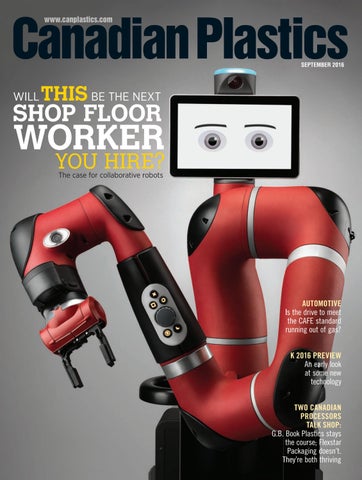
WILL
THIS BE THE NEXT
SHOP FLOOR
WORKER
YOU HIRE? The case for collaborative robots
AUTOMOTIVE Is the drive to meet the CAFE standard running out of gas? K 2016 PREVIEW An early look at some new technology TWO CANADIAN PROCESSORS TALK SHOP: G.B. Book Plastics stays the course; Flexstar Packaging doesn’t. They’re both thriving
CPL_Sept2016_issue_AMS.indd 1
2016-08-26 8:04 AM
The POWER of Drying Confidence
–5– YEAR warranty
Confidence. Proven Performance. Thousands Sold. · Confidence in the industry’s best 5-year warranty · Confidence in the easiest-to-use smart controls · Confidence in web-enabled 24/7 access · Confidence in no upcharges for advanced features
Contact the Drying Experts Today. 800-BEST-DRY | sales@novatec.com www.novatec.com
NOVATEC products are made in the USA. Supported worldwide.
Sold & Serviced in Canada by Maguire Products Canada, Inc. 905-879-1100 | info@maguirecanada.com www.maguirecanada.com © Copyright 2016 Novatec, Inc.
CPL_Novatec_Sept.indd 1 CPL_Sept2016_issue_AMS.indd 2
2016-08-15 8:04 2016-08-25 3:38 AM PM
SEPTEMBER 2016 VOLUME 74 • NUMBER 4
FROM THE ARCHIVES
In February 1968, our man at Canadian Plastics attended the Society of the Plastics Industry’s Reinforced Plastics/Composites show in Washington, D.C., along with over 60 other Canadian SPI members. The hit of the show, he subsequently reported in our March 1968 issue, was the Thoebus glider, made by West German molder Boelkow GmbH and displayed on the show floor after being dismantled outside and reassembled inside. The single-seat aircraft had a 50-foot wingspan, weighed 460 lbs, and consisted of a glass-fibre cloth and epoxy frame built over a balsa core. The “gleaming white” glider was chosen as the best exhibit at the show, beating out entries from all over the U.S., Europe, and Asia.
15 3:38 PM
10
Number of the month:
$11.5 billion*
R
y
Cover Photo Credit: Rethink Robotics Inc.
–
contents
Canadian Plastics
* Estimated value, in U.S. dollars, of the global collaborative robot industry by 2025. (See pg. 13)
in every issue 4
Editor’s View: The great 54.5 mpg debate
5
Ideas & Innovations: “Tequila!” Ford, Jose Cuervo team up to make bioplastic car parts from agave
6
News: • With lawsuit dismissed, Schad and Athena look to the future • CAMM establishes new Toronto chapter • New ownership at Auxiplast • Wittmann Group turns 40 • Supplier News and People
34 Technology Showcase 36 Advertising Index 38 Technical Tips: Salt and screw cooling
27
7 cover story 10 ROBOTS & AUTOMATION: Say hello to your little friends
Collaborative robots are inexpensive, versatile, and easy to program. And by working safely alongside human operators, they can revolutionize the way you handle small-batch manufacturing and ever-shortening product cycles.
features 16 K 2016 PREVIEW: Special K The world’s largest plastics trade show is almost here, which means a tsunami of new technology is headed your way. From processing machines to auxiliary equipment to materials, this stuff is so cutting edge it makes Pokémon Go look like an eight-track tape. Here’s just some of what will be on display.
22 AUTOMOTIVE: Is the 54.5 mpg CAFE standard out of gas? American consumers have spoken, and the 54.5 mpg corporate average fuel economy target is off the table. But the Environmental Protection Agency might have something to say about that. PLUS: Ontario, Michigan sign automotive cooperation agreement.
26 PACKAGING: Flexstar Packaging reinvents itself Recapitalization, new technology and new hires, a plant expansion, and green initiatives are all part of this Richmond, B.C.-based company’s growth strategy. PLUS: Macro Engineering sells its 60th double bubble film line.
30 DOING IT BETTER: The Book on plastics When it comes to running Peterborough, Ont.-based custom molder G.B. Book Plastics Ltd., the brother/sister team of Bill Book and Cathy Cremers has always been on the same page.
Visit us at www.canplastics.com www.canplastics.com
CPL_Sept2016_issue_AMS.indd 3
September 2016 Canadian Plastics
3
2016-08-25 8:04 AM
editor’s view
Canadian Plastics magazine reports on and interprets developments in plastics markets and technologies worldwide for plastics processors, moldmakers and end-users based in Canada.
The great 54.5 mpg debate
S
inister global conspiracies might be the glue that holds the James Bond film franchise together, but reality is more mundane, and I tend to take people at their own words about their own motives. So when Chris Grundler, director of the U.S. Environmental Protection Agency’s Office of Transportation and Air Quality, said he believes dangerous climate changes will occur if greenhouse gas emissions aren’t reduced 80 per cent by 2050 from today’s levels, I believe he believes that. And when Grundler also said that, because of this belief, the EPA will do everything it can to enforce its targeted 54.5 miles per gallon fleet average by 2025, I believe him again. But I hope the EPA doesn’t succeed, for two reasons. First, the 54.5 mpg goal was always just an estimate of where the automotive industry could be by the 2025 model year, based on an assumption that 67 per cent of the market would be cars and 33 per cent would be SUVs, crossovers, and pickups. But as noted in a new U.S. federal report (and outlined on pgs. 22-23 of this issue), buyer preferences are changing. Because of factors like low gas prices, American consumers still want larger vehicles, and the government now estimates a more even split between cars and trucks in the marketplace. Which is why it revised the target fuel economy figure down slightly to between 50 and 52.6 mpg by 2025, instead of the 54.5 mpg favoured by the EPA. The consumers, in other words, have spoken. But the EPA doesn’t want to hear it, motivated — it seems to me — by the same arrogance and ideological rigidity that convinced Ontario’s provincial government that it knew more about setting hydro rates than the free market did (and which led to the misguided Green Energy Act and some of the highest and fastest-increasing electricity rates in 4 Canadian Plastics September 2016
CPL_Sept2016_issue_AMS.indd 4
Canada). “We are in the beginning stages of tackling one of the most challenging issues of our time, which is climate change,” Grundler said. “It will require every country and every economic sector to take meaningful action.” Leaving aside the still-open question of whether climate change really is “one of the most challenging issues of our time”, this statement sounds to me like a member of the governing class — and an unelected one, at that — telling the great unwashed what’s best for them. Which is where my second reason for wishing the EPA ill in this case — and where the conspiracy stuff mentioned at the outset — comes in. While it doesn’t qualify as a conscious conspiracy, I do think something untoward has occurred at the leading edge of the modern environmental movement. Conrad Black summed it up well in a recent National Post column: “After the fall of the Soviet Union, the defeated international left gravitated to environmentalism as a way of obstructing the victorious free enterprise system, gradually, instinctively, and opportunistically, not by any plan or prearrangement. They radicalized a positive and very respectable pro-Earth movement — which solved specific problems like acid rain — and pushed it to extremes.” I’m certainly not saying the EPA — or the Ontario Liberals, for that matter — is trying to dismantle capitalism; but one can, I think, detect whiffs of these extremes in Ontario’s job-killing Green Energy Act and in Grundler’s the-people-be-damned determination to double down on the 54.5 mpg fuel standard. In his concession speech after his election loss last year, then-Prime Minister Stephen Harper said “the people are never wrong.” And he was right. Which is why the EPA should listen to the millions of American consumers voting with their wallets by buying larger vehicles, and back off. Mark Stephen, editor mstephen@canplastics.com
www.canplastics.com EDITOR Mark Stephen 416-510-5110 Fax: 416-510-5134 mstephen@canplastics.com ART DIRECTOR Andrea M. Smith ACCOUNT COORDINATOR Cheryl Fisher 416-510-5194 cfisher@annexbizmedia.com PUBLISHER Greg Paliouras 416-510-5124 Fax: 416-510-5134 gpaliouras@canplastics.com CIRCULATION MANAGER Beata Olechnowicz 416-442-5600, ext. 3543 Fax: 416-510-6875 bolechnowicz@annexbizmedia.com VICE PRESIDENT ANNEX BUSINESS MEDIA EAST Tim Dimopolous 416-510-5100 tdimopoulos@annexweb.com PRESIDENT & CEO Mike Fredericks mfredericks@annexweb.com 80 Valleybrook Drive, Toronto ON, M3B 2S9 416-442-5600, Fax: 416-510-5134 CANADIAN PLASTICS is published 7 times a year by Annex Business Media. 2016 SUBSCRIPTION RATES 6 issues Canadian Plastics, plus Dec. 2017 Buyer’s Guide: CANADA: 1 Year $73.50 plus applicable taxes; 2 Years $117.95+ taxes; single copy $10.00+ taxes. USA: US$128.95/year FOREIGN: US$147.00/year Buyers’ Guide only: CANADA: $103.00 plus applicable taxes and $5.00 shipping USA & FOREIGN: US$103.00 plus $5.00 shipping.
CUSTOMER SERVICE: Maklit Chana 416-510-5109 mchana@annexbizmedia.com From time to time we make our subscription list available to select companies and organizations whose product or service may interest you. If you do not wish your contact information to be made available, please contact us via one of the following methods: phone 800-668-2374; fax 416-442-2191; e-mail: privacyofficer@businessinformationgroup.ca; mail: Privacy Officer, 80 Valleybrook Drive, Toronto ON M3B 2S9. The contents of this magazine are protected by copyright and may be used only for your personal non-commercial purposes. All other rights are reserved and commercial use is prohibited. To make use of any of this material you must first obtain the permission of the owner of the copyright. For further information please contact Greg Paliouras, 416-510-5124. For reprints call RSiCopyright, Michelle Hegland, msh@rsicopyright.com CANADA POST – Publications Mail Agreement No. 40065710. Return undeliverable Canadian addresses to: Circulation Dept. – Canadian Plastics, 80 Valleybrook Drive, Toronto ON M3B 2S9. RETURN POSTAGE GUARANTEED INDEXED BY CBPI ISSN 0008-4778 (Print) ISSSN 1923-3671 (Online) MEMBER: Canadian Business Press, Canadian Plastics Industry Association. We acknowledge the [financial] support of the Government of Canada.
www.canplastics.com
2016-08-25 8:04 AM
ideas & innovations
“Tequila!” Ford, Jose Cuervo team up to make bioplastic car parts from agave
Agave plants being unloaded.
I
n his 2002 country music hit “Ten Rounds with Jose Cuervo,” singer Tracy Bryd lamented his epic hangover after mixing it up with the world’s best-selling brand of tequila. The Ford Motor Company hopes to have a better experience. In June, the Detroit, Mich.based automaker announced a partnership with Jose Cuervo to explore the use of its agave plant byproduct to develop more sustainable bioplastics to use in Ford vehicles. Ford and Jose Cuervo are testing the bioplastic for use in vehicle interior and exterior components, such as wiring harnesses, HVAC units, and storage bins. Initial assessments, Ford said, suggest the material holds “great promise” due to its durability and aesthetic qualities. The result could reduce vehicle weight and lower energy consumption, while paring the use of petrochemicals and the impact of vehicle production on the environment. The growth cycle of the agave plant is a minimum seven-year process. Once harvested, the heart of the plant is roasted, before grinding and extracting its juices for distillation. Jose Cuervo uses a portion of the remaining agave fibres as compost for its farms, and local artisans make crafts and agave paper from the rest. Under the
Photo Credit: Ford Motor Company
terms of the new partnership, the fibre will be shipped to Ford’s research cen-
tre in Dearborn, Mich. to be converted into bioplastic. Ford first began researching the use of sustainable materials in its vehicles in 2000; today it uses eight sustainablebased materials, including soy foam, castor oil, wheat straw, kenaf fibre, cellulose, wood, coconut fibre, and rice hulls. “There are about 400 lbs of plastic on a typical car,” said Debbie Mielewski, senior technical leader of sustainability research at Ford. “Our job is to find the right place for a green composite like agave to help reduce our impact on the planet.” It’s a noble idea, for sure, but it’s hard to see anyone making a hit song out of it. CPL
www.canplastics.com
CPL_Sept2016_issue_AMS.indd 5
September 2016 Canadian Plastics
5
2016-08-25 8:04 AM
news
With lawsuit dismissed, Schad and Athena look to the future
L
ife, Winston Churchill once said, is one damn thing after another. The saying rings equally true for business, and Athena Automation Ltd. is a case in point. No sooner did the Woodbridge, Ont.-based injection molding machine maker emerge victorious from a lengthy legal battle with Husky Injection Molding Systems Ltd., than it officially opened a new $45-million, 150,000-square-foot facility next to its original headquarters in Woodbridge; and also began the process of finding a successor to Athena founder and president Robert Schad. The lawsuit against Schad and Athena filed by Husky — the Bolton, Ont.-based company Schad founded in 1953 and sold to private equity investors in 2007 — was dismissed on April 22. Husky had alleged that Schad and Athena misused confidential information in their designs for Athena’s injection molding presses. Athena employees had access to new Husky technology used at injection molder
Athena’s new 150,000-square-foot facility.
Niigon Technologies Ltd. in MacTier, Ont., but the judge ruled Athena did not make material use of the knowledge. A financial settlement has now been reached. “The lawsuit caused me an enormous amount of stress — it was probably the most stressful thing I have ever been through — and consumed a lot of our time and resources,” said Schad, who gave detailed testimony at trial. (Athena claimed Husky’s suit cost it $5 million in lost profit from 2013 to 2015.) “What bothered me the most, however, was that my integrity was being questioned. So I’m thrilled that Husky’s claims have been defeated.”
Photo Credits: All photos courtesy of Athena Automation Ltd.
THE SHADOW LIFTS
The new facility’s office area (above), and shop floor.
With the shadow of the lawsuit removed, Schad said, he can finally give his complete attention to the business of Athena.
And business looks promising. “We are on track to double last year’s machine shipRobert Schad ments in 2016,” Schad said. “Repeat orders, mainly for PET preform and closure applications, are waiting to be filled. And the first systems integrating Athena machines with third-party in-mold labeling automation were recently installed in North America.” Athena is also looking forward to hiring more people in Woodbridge and elsewhere. “As we grow in North America through relationships in sales and service, we have stationed a service representative in the Pennsylvania-Ohio area, with Atlanta and Chicago to follow,” Schad said. New products under development include a 4,500 kN injection press to extend the firm’s machine tonnage options, and cube and rotary table technology for multi-material molding. Athena will also debut a closure molding package this year to complement its PET container molding machine offerings. “We decided early on to focus on injection molding machines, to make them completely modular,” Schad said. The new machine manufacturing facility is another important step in Athena’s growth. “The new plant is where our machines are being built and where the majority of our employees now work; to support just-in-time machine assembly, we have linked Athena, continued next page
6 Canadian Plastics September 2016
CPL_Sept2016_issue_AMS.indd 6
www.canplastics.com
2016-08-25 8:04 AM
news
CAMM establishes new Toronto chapter
W
Photo Credit: CAMM
hat’s in a name? Plenty. Azzopardi said. “Also, politiWhen the Windsor Associacians prefer to make announcetion of Mold Makers changed its ments in the media epicentre of name to the Canadian AssociaToronto; so to grab their attention of Mold Makers (CAMM) tion and help them understand more than ten years ago, the goal our industry better, it helps us to was to reflect the group’s aspirahave a presence here. Moldmaktion to be the voice for mold, tool, ers know the importance of and diemakers nationwide. Probmaking these connections with lem is, it hasn’t always felt that local and federal politicians — way, and the perception grew that and also with foreign shops CAMM remained, stubbornly, a looking for partners — but Windsor, Ont.-based entity they’re usually too busy managfocused primarily on the concerns ing their shops day-to-day to do of its Windsor members — i.e., on The CAMM Toronto board of directors. From left, Jonathan it themselves. With the new Azzopardi, Cyrus Jebely, Russell Vardy, and Kim Thiara. the automotive industry. CAMM chapter, we can apply Which is why CAMM established a Toronto chapter in even more pressure on their behalf.” 2010: to address some of the specific needs of member The Toronto chapter will take a few years to become companies in the GTA that made molds for industries like fully established, Kim Thiara said, but she and the other caps and closures, food packaging, medical, cosmetics, board members are all firmly committed to it. “We have a aerospace, and oil and gas. The Toronto chapter held two lot of work to do and we’re anxious to get started,” she said. well-attended meetings...and then fizzled away into noth- “We need to further establish key board members, pinpoint ing, a victim of bad timing: The industry was in the middle the issues that the Toronto-based moldmakers need of the Great Recession and few could give the project the addressed, increase the membership, and reach out to local attention it needed. politicians. We talked to a range of CAMM members in But the need for a Toronto chapter remained — and it’s Toronto beforehand and they all agreed that a Toronto chapnow been revived, with a new and determined board of direc- ter was necessary; so if we can show them the value in it, tors at the helm. The new board consists of Kim Thiara, we’re confident we’ll have their support.” president and CEO of AceTronic Industrial Controls Inc.; And there’s also a symbolism to the new chapter that suits Cyrus Jebely, president of Cap-Thin Molds Inc.; Russell the post-recession world, the board said. “The recession Vardy, senior technical sales with Bohler Uddeholm; and showed Canadian mold shops how vulnerable they are, and Jonathan Azzopardi, president of Laval International and how much pressure they’re going to be under going forward,” also the national president of CAMM. said Russell Vardy. “They realize now that, although they’re “Moldmakers in the two big Ontario regions of Toronto competitors on one level, on a global level they’re all in it and Windsor need to do a better job of working together and together; and that there’s strength in unity. That’s why the time CPL sharing strengths, and a Toronto chapter can facilitate this,” has never been better for CAMM to expand.”
Athena, continued from previous page
mechanical engineering, controls, IT, and purchasing staff in a collaborative environment,” Schad said. “Spare parts, service, sales, and corporate functions are consolidated in our previous headquarters, which is now the customer service building.” It won’t exactly come as a surprise to anyone who knows Robert Schad to learn the new building provides a unique energyefficient and automated infrastructure. “It features geothermal cooling and heating, daylight-harvesting LED
lighting, automated high-density part storage, and state-of-the-art inspection equipment,” Schad said. “The mold trial and extended run area is supported by resin conveying and drying systems, as well as dedicated chillers for each machine.” Another item on the agenda is particularly personal for the 87-year-old Schad: finding a successor to take the company’s reins within the not-too-distant future. “Harold Luttmann is taking over as acting CEO, in addition to his role as chief operations officer,” Schad
said. “We are also interviewing candidates for the chief commercial officer position; in the meantime, I have assumed this responsibility.” Schad knows Athena still has other work to do, too. “We still have to bring the new facility completely on-stream,” he said. “It will be the end of the year before we have achieved a proper production flow.” With all due respect to Churchill, maybe we should modify his adage to better fit Robert Schad and Athena: Life is one business opportunity after another. CPL
www.canplastics.com
CPL_Sept2016_issue_AMS.indd 7
September 2016 Canadian Plastics
7
2016-08-25 8:04 AM
news
New ownership at Auxiplast
Q
Photo Credit: Auxiplast Inc.
uebec-based plastics processing and auxiliary equipment sales agency Auxiplast Inc. has new ownership. In June, owner and president François Cote sold the company to two long-time Auxiplast employees. The new owners are Jean-François Continelli, president, and David Marois, vice president. Continelli has David Marois (left) and Jeanalmost 25 years of expe- François Continelli. rience in the plastics industry, the last 17 with Auxiplast; Marois has 12 years of experience in the industry, the last 10 with Auxiplast. Aside from the departure of Cote, it’s business as usual for Auxiplast, which is headquartered in Sainte-Julie, Que. The company’s location and contact coordinates will remain the same. CPL
ABC Group purchased by investment firm Cerberus Capital
A
BC Group, one of Canada’s biggest auto parts suppliers, has been purchased by New York City-based private investment firm Cerberus Capital Management LP. According to a joint statement from the two firms, the deal will help drive forward the privately-owned, Toronto-based ABC, which has blow molding and injection moldMary Anne ing operations representing more than $1 Bueschkens billion in sales. The financial details of the purchase have not been disclosed. Mary Anne Bueschkens, president and general counsel, is ABC’s new chief executive; deputy president Derrick Phelps is the new president. In the statement, Cerberus also said it’s putting a new board in place, to be led by Daniel Ajamian, now chairman Helga Schmidt of Reydel Automotive. Stepping down as ABC’s chair and CEO is Helga Schmidt, who helped found the company in 1974 with her late husband, Mike, who died in 2009. CPL
Wittmann Group turns 40
I
Photo Credit: Wittmann Group
n June, 1,650 customers and business partners gathered in Vienna, Austria, to help founder Werner Wittmann and his sons Michael and Thomas celebrate the Wittmann Group’s 40th anniversary. The event included an elaborate stage show, and was highlighted by 10 injection mach inery demonstrations and exhibits of the company’s full product line. Wittmann On the floor at Wittmann’s 40th anniversary bash. Group also offered plant tours to show off its latest expansions, including a new technology centre for demonstrating large machines at Kottingbrunn, Austria. From the launch of its first product — a water regulator — in 1976, Wittmann Group has grown into a global manufacturer of injection machinery, robots, and auxiliary equipment. Still family-owned, Wittmann Group now employs approximately 2,050 people at 36 locations worldwide. The company plans to mark its big year with the launch of new products across its entire range of equipment. CPL
8 Canadian Plastics September 2016
CPL_PCS_June.indd 1
CPL_Sept2016_issue_AMS.indd 8
www.canplastics.com
2016-05-13 11:22 AM
2016-08-25 8:04 AM
news
PEOPLE
Andrew Blubaugh
Mike Cicco
Renzo Davatz
Dr. Thomas Ebeling
– Bunting Magnetics Company, headquartered in Newton, Kan., has appointed Andrew Blubaugh as its product manager for metal detection. – Rochester Hills, Mich.-based robotic automation supplier Fanuc America Corporation has named Mike Cicco as its new president and CEO. – Swiss-based injection molding machine maker Netstal-Maschinen AG, a member of the KraussMaffei Group, has named Renzo Davatz as its new CEO. – Chippewa Falls, Wis.-based extrusion equipment maker Nordson Corporation has named Dr. Thomas Ebeling as director of engineering and operations for extrusion and coating dies. – Wallace, Mich.-based material handling equipment maker Advanced Blending Solutions has named Mark Jordan as director of business development. – Size reduction equipment maker Vecoplan LLC, headquartered in High Point, N.C., has named Robert Korkos as national sales manager of its mobile division. – Germany-based blow molding machine maker Bekum Maschinenfabriken has named Dr. Wilfried Lehm-
SUPPLIER NEWS – Plastics processing and moldmaking equipment supplier IMS Company, headquartered in Chagrin Falls, Ohio, is the new North American distributor of Autosol metal and mold care products.
Mark Jordan
Robert Korkos
Dr. Wilfried Lehmann
Phil Lem
Steve Maxson
Tim Melita
Robert Schroeder
Patricia Zwergel
Dave Miller
Eve Vitale
ann as its technical director. – T hermoplastic compounding product maker RTP Company, headquartered in Winona, Minn., has named Phil Lem as its sales engineer for Ontario and Eastern Canada. – York, Pa.-based Graham Engineering Corporation — which comprises Graham Engineering blow molding systems, Welex sheet lines, and American Kuhne extruders and extrusion systems — has named Steve Maxson as its director of business development for extrusion, Tim Melita as vice president of operations, Robert Schroeder as director of business development for blow molding, and Patricia Zwergel as vice president of finance. – Cranberry Township, Pa.-based auxiliary equipment maker The Conair Group has named Dave Miller as its general manager for size reduction. – The Society of Plastics Engineers, headquartered in Bethel, Conn., has appointed Eve Vitale as its foundation director.
CUSTOM DESIGNED PLASTIC PRODUCTS • • • • •
In-house designing, moulding, decorating, manufacturing and packaging. Full Machine Shop and Tool Room. Low minimums & Fast turnaround FDA Approved and Certified Material when applicable Canadian-made products Promotional Products to Industrial Parts
www.harcoplastics.com 1-800-361-5361 / sales@harco.on.ca / 705-743-5361 CPL_Harco_Sept.indd 1
CPL_Sept2016_issue_AMS.indd 9
www.canplastics.com
10:49 AM September 2016 2016-08-11 Canadian Plastics 9
2016-08-25 8:04 AM
robots & automation
SAY
HELLO to your
LITTLE FRIENDS
Collaborative robots are inexpensive, versatile, and easy to program. And by working safely alongside human operators, they can revolutionize the way you handle small-batch manufacturing and ever-shortening product cycles.
10 Canadian Plastics September 2016
CPL_Sept2016_issue_AMS.indd 10
By Mark Stephen, editor
www.canplastics.com
2016-08-25 8:04 AM
robots & automation
E
ver since the Terminator went on a rampage in the 1984 sci-fi classic, robots have had a bad reputation from a human interaction point of view. It doesn’t help that, on factory shop floors around the world, industrial robots are generally kept behind cages, sending the message that they’re dangerous and unpredictable. There’s no question they can be dangerous, especially in situations where high-speed robots are moving heavy payloads faster than the eye can see. But in another way it’s a perception of automation that’s almost as outdated as those mid-1980s mullets also on display in The Terminator. In the past couple of years, a new kind of robot has done away with cages and fences altogether. Collaborative robots — or cobots — are robots that work as assistants alongside human operators; and they might just turn the world of industrial robotics upside down by putting automation within reach of many small and medium-sized companies for the first time.
SAFETY FIRST A discussion of collaborative robots has to begin by talking about what they aren’t. For one thing, they’re not a replacement for traditional highspeed industrial automation. “Collaborative robots can’t compete with other six-axis industrial robots in terms of speed or payload capacity, and they’re not meant to,” said Craig Tomita, an area sales manager with Universal Robots USA Inc., which offers the UR3, UR5, and UR10 cobot models. “A traditional industrial robot is expensive, challenging to program, and has to be surrounded by a fence to protect workers. The whole point of collaborative robots is to get away from that.” Think of it this way: If industrial robots The Sawyer (left) and Baxter collaborative robots from Rethink Robotics Inc. Photo Credit: Rethink Robotics Inc.
are mainframe in the computer industry — robust and efficient, but needing expert programmers to change or update — cobots are user-friendly laptops with arms. “The repetitive jobs that can be automated using collaborative robots are essentially unstructured tasks, where it’s difficult or too expensive to use traditional industrial robotics; collaborative robots can be used in these areas without fencing, which means no additional space is needed on the shop floor,” Tomita continued. How so? “The defining feature of collaborative robots is that they can work safely in close proximity to humans, either by force-limiting to avoid injury if they touch or by sensors that prevent touching, or by a combination of both,” he said. Safe operation is, indeed, the biggest priority of the collaborative robot industry by a factor of about 10, and there are 2 basic approaches to making cobots safe. The first is to make the robot itself inherently safe. “If any one of our collaborative robots makes contact with a human co-worker, it immediately stops so the worker doesn’t feel anything more than a gentle nudge,” said Jim Lawton, chief product and marketing officer with Rethink Robotics Inc., which makes the Sawyer and Baxter collaborative robots. “The robots have rounded surfaces to help make that nudge even gentler, and we’ve also eliminated pinch-points.” Redesigning the end-ofarm tooling was important, too. “If the robot and operator are handing parts back and forth, the tooling needs to be designed so that, if the person gets their fingers caught, they won’t be hurt,” Lawton said. “There are several styles of grippers that grip firmly enough to hold the part but gently enough to avoid injuring the operator.” Collaborative robot makers have even gone so far as to make the robots look friendly. “Some cobots appear almost cartoon-like,” said Nick McDonald, application manager for robotics with ABB Inc., which makes the YuMi dual-arm collaborative robot. “This is an intentional design feature to help put the operators at ease, and it works.” Extreme examples include Rethink Robotic’s Sawyer and Baxter cobots, which come with big, friendly-looking graphical eyes on the displays on their heads. And limiting both the speed and the payload are also factors in making collaborative robots safer. The ideal speed for a collaborative robot is human-speed, the suppliers say, and the typical lift load is in the range of 22 lbs, although Fanuc’s CR-35iA cobot can handle a 77-lb payload. “If the cycle speed is too fast or the payload too heavy, a human operator could get hurt in a fenceless environment,” Jim Lawton said. The second approach for ensuring safety is to double down on the sensors that allow a robot to react to the presence of a human on an intercept course before a collision takes place — an approach that also allows some collaborative units to be used in slightly faster and heavier applications. “Modern 3D area scanners are extremely sensitive and discriminating, detecting not only the presence of a person, but their location as well,” Craig Tomita said. “This allows the cobot to slow down, work around the www.canplastics.com
CPL_Sept2016_issue_AMS.indd 11
September 2016 Canadian Plastics
11
2016-08-26 7:44 AM
robots & automation
person, or stop as the situation demands to maintain safety. When the person moves away, the cobot automatically resumes normal operation.”
TEACHABLE MOMENTS Safer human-robot collaboration is one benefit cobots are bringing to manufacturing; easier robot programming is another. Whereas traditional industrial robots require advanced computer programPalletizing ming skills, cobots can learn with a Fanuc through lead-through proCR-35iA collaborative gramming. “Human workers robot. can show a collaborative robot what to do simply by moving its arm through the appropriate paths; the robot will then remember these movements and repeat them,” said Peter Fitzgerald, general manager of Fanuc Canada Ltd. “It’s a revolutionary learn-by-doing approach that any shop floor operator can master.”
By taking the difficult, time-consuming job of programming out of the equation, collaborative robots potentially offer more flexibility than their high-speed industrial counterparts. “Because it can be programmed and then reprogrammed so easily, a collaborative robot can be moved from one short-run production line to the next, to either work alongside a human operator or replace that operator,” said Jim Lawton. Size makes a difference here, too, since most collaborative robots are human-size at most, and can be adjusted to either stand tall or be small enough for mounting on a tabletop. “This versatility makes collaborative robots ideal for smaller factories where the norm is more about lower volumes of customized, lightweight products and less about mass production,” Craig Tomita said. Given this upside — smart, safe robots that can work alongside people in a wide range of Photo Credit: Fanuc
ADDitive
||STRUKTOL||TR|451|| ®
For Extruded & Molded Interior or Exterior Automotive Components
Designed for both extruded and molded applications, STRUKTOL® TR 451 will improve overall processing characteristics of your compound leading to more efficient manufacturing, less scrap, and better performance. It is especially effective in improving the incorporation of fillers into polyolefin compounds, allowing for higher loadings without sacrificing processing or performance. Compounders using treated fillers may be able to substitute untreated fillers in combination with STRUKTOL® TR 451 to cut cost and realize performance benefits.
Increased filler loadings & dispersions Retained physical properties Lower viscosities Improved aging characteristics
= INNOVATION + TECHNOLOGY + PERFORMANCE Struktol Canada, Ltd. | Uxbridge, Ontario | Canada Call us at 416.286.4040 email us at strukcansales@bellnet.ca or visit us at www.4struktol.com
1 12 CPL_Struktol_Sept.indd Canadian Plastics September 2016
CPL_Sept2016_issue_AMS.indd 12
www.canplastics.com
19-26 October
Düsseldorf, Germany
Please visit us at:
Hall 6 / A23
2016-05-09 1:40 PM
2016-08-25 8:04 AM
robots & automation
ABB’s YuMi dual-arm cobot.
Photo Credit: ABB Inc.
industries and processes — it’s no mystery why sales of collaborative robots are entering the stratosphere. According to capital goods analyst Barclay’s, the global cobot market is set to grow from US$116 million last year to a whopping US$11.5 billion by 2025 — roughly equal to the size of the entire industrial robotics market today. And in North America’s plastics industry, orders for collaborative robots grew 25 per cent in 2015 over 2014. Affordability is probably another reason for the growing popularity of cobots: The price of a unit can be as little as $10,000, although typically they cost two to three times that. “In addition to a low price, cobots also have a very quick return-on-investment because they’re so simple to install — there’s no need to reorganize the factory or even put up fencing,” said Peter Fitzgerald.
DOING THE GRUNT WORK But low cost and fast ROI might also be reasons, the robot makers say, why some operators worry about cobots putting them out of work. Truth is, they’re probably more likely to get struck by lightning. “Industry-wide, collaborative robots are actually helping to create more and better jobs as they bring manufacturing home and allow smaller operations to expand,” Fitzgerald said. “And on an individual shop basis, the cobot is almost always intended to assist, not replace,
CPL_Chillers_June.indd 1
CPL_Sept2016_issue_AMS.indd 13
the production worker.” And when a cobot does replace a worker, the vendors point out, it’s usually to take over the repetitive, pick-and-place or stack-and-pack operations that people dislike doing anyway. “The workers are then free to
www.canplastics.com
September 2016 Canadian Plastics 13 2016-05-18 3:04 PM
2016-08-25 8:04 AM
robots & automation
do the jobs that require more thought and are less physically demanding,” Fitzgerald continued. Another job the human workers won’t have to do is gather scut work production data — which is just as well, because they’re usually terrible at it. Cobots, on the other hand, excel at this, which makes them real-world examples of the Industry 4.0 phenomenon we’ve been hearing so much about lately. “Cobots are not only hardware but also data acquisition devices,” said Jim Lawton. “If each joint has a sensor, by the very course of doing what it’s doing, the robot is collecting cycle time data, which can then be combined with other kinds of information — customer support data, warranty data, field failure data — that a manufacturer can use to improve its operations. You really can’t collect cycle time data from human operators; it’s been tried, but the results are usually very poor.” Lawton believes that while collaborative robots will be used for substitution now, eventually they’ll be key components of cyber-physical systems that communicate and cooperate with each other and with humans in real-time. “In future, cobots will be able to learn from their own experiences and improve the way they operate,” he said. “This data exchange is a cornerstone of the ‘smart factory’, which is what Industry 4.0 is all about.”
1 14 CPL_September_2016_Weima_CSA.indd Canadian Plastics September 2016 www.canplastics.com
CPL_Sept2016_issue_AMS.indd 14
In the end, it’s worth repeating: Collaborative robots aren’t going to replace traditional industrial automation. “Cobots aren’t the solution to every production issue,” said Nick McDonald. “There will always be production lines that require fencing because the automation is dangerous to shop floor workers, and there will always be dedicated, highvolume production lines that are better served by highspeed servo robots.” But here’s the thing: While industrial robots are very good at handling automated tasks, more than 90 per cent of tasks in factories are not automated. “To automate that 90 per cent, manufacturers require automation that can work with humans and operate in the semi-structured environment of a factory floor,” Jim Lawton said. Collaborative robots — safe, versatile, and user-friendly — are definitely up for the job. And they’ll never call in “sick” from the golf course. CPL RESOURCE LIST ABB Inc. (Brampton, Ont.); www.abb.ca; 905-460-3000 Fanuc Canada Ltd. (Mississauga, Ont.); www.fanucrobotics.com; 905-812-2300 Rethink Robotics Inc. (Boston, Mass.); www.rethinkrobotics.com; 617-500-2487 Universal Robots USA Inc. (East Setauket, N.Y.); www.universal-robots.com; 631-610-9664
2016-08-18 7:43 AM
2016-08-25 8:04 AM
4858 ENG CPL_Eng
You’ve got the deal. We’ve got the machines.
Fast-paced business requires you to act quickly and choose the right partner to get the job done. Time is everything – that is why we are currently offering two of our top injection molding machine lines for immediate delivery and at an attractive price. Need high volume production? Need precise production of technically demanding parts? We’ve got your machine. Accelerate your business with the all-electric ENGEL e-mac or the tie-bar-less ENGEL victory hyspex and let ENGEL inject success into your production.
Visit us at K 2016 19 – 26 October | Hall 15 | Stand C58 Düsseldorf | Germany
www.engelglobal.com/fastlane
4858 ENG ANZ CAN Fast Lane 206x273 MH us 160722.indd 1 CPL_Sept2016_issue_AMS.indd CPL_Engel_Sept.indd 1 15
22.07.2016 14:24:27 2016-08-25 2016-07-27 8:04 1:06 AM PM
K 2016 preview
SPECIAL The world’s largest plastics trade show is almost here, which means a tsunami of new technology is headed your way. From processing machines to auxiliary equipment to materials, this stuff is so cutting edge it makes Pokémon Go look like an eight-track tape. Here’s just some of what will be on display at K 2016. By Mark Stephen, editor
I
f you’ve got a thirst for new plastics processing technologies, hitting up the triennial K show in Germany is like drinking from a fire hose. Last time around, K attracted 3,200 exhibitors and almost 220,000 visitors from more than 120 countries; the upcoming K 2016 edition — which will fill all 19 halls of the gargantuan Messe Düsseldorf trade fair grounds — seems like a lock to hit the same heights. Some of the exhibiting companies keep their new technologies bottled up tight until the event starts, which is fair enough. Others pop the cork early. Courtesy of this second group, here’s a small taste of what buyers can expect on the show floor.
INJECTION MOLDING
New from Arburg Inc., the Golden Electric series machines are designed to offer an attractive price/performance ratio, made possible through such standardised components as a fixed combination of distance between tie-bars, clamping force, and injection unit size. 16 Canadian Plastics September 2016
CPL_Sept2016_issue_AMS.indd 16
The entry-level Golden Electric series is available in four sizes — 370, 470, 520, and 570 — with clamping forces from 600 to 2,000 kN. At K 2016, an Allrounder 470 E Golden Electric with a clamping force of 1,000 kN and a size 290 injection unit will be used to produce technical parts. In-mold decoration (IMD) technologies are increasingly replacing painting in the production of car interiors because they combine a high quality surface finish with a high degree of flexibility for low volume production and low unit costs. Engel will unveil its new DecoJect technology for decorating auto interior parts at the show, a system that can replace painted PP parts
Parts made with Engel’s DecoJect process.
with IMD. In-mold graining of a decorative TPO film can incorporate colour, gloss, as well as haptic — or “feel” — qualities. In this roll-to-roll process, the film is pulled through the mold from top to bottom, sucked into the mold by vacuum, preheated by a robot carrying an infrared heater panel, and then backinjected with PP and trimmed in the tool. After the 60-second cycle, the part is transferred to a station for laser trimming of excess film. This process is suitable for large parts like door panels, Engel said, and can cost up to 14 per cent less than painting. Husky Injection Molding Systems Ltd. will introduce its HyCap 4 system
Husky’s HyCap 4 system.
www.canplastics.com
2016-08-25 8:04 AM
K 2016 preview
for high-output beverage closure molding, the latest addition to the HyCap platform launched in 2009. The HyCap 4 has enhancements that include electrification of the clamp motion, servovariable pumping technology, and a regenerative clamp stroke. “Combined, these enhancements deliver up to a 40 per cent improvement in energy consumption over the previous generation system, without sacrificing performance,” Husky said. “Other enhancements include a new part-eject assist feature to ensure a consistent freefall of closures at the fastest cycles, and sensor-driven mold alignment to reduce mold wear.” Turning 70 this K show year, Negri Bossi isn’t displaying any rust: The Italy-based company will introduce its new ELE all-electric series, designed to combine high levels of performance with precision and low energy consumption. Available in 11 models from 50 to 650 kN, the machines come with the 21-inch Tactum multi-touch controller, with features such as remote access, inbuilt camera, and gesture navigation. The units also feature the new “Smart Flex” two-inch locking unit with different toggle geometry designed to be coupled specifically with electric closing.
to offer a host of advantages, such as a lower melt temperature, and energy costs reduced by up to 15 per cent. The major changes in the solEX NG, the company said, are an internally grooved barrel, a screw concept that consistently applies the theory of dispersive melting, as well as a feed zone with a completely revised geometry and fitted with spiral grooves. The solEX NG extruder series is available in four sizes — 60, 75, 90, and 120 mm — and offers outputs ranging from 1,000 to 2,500 kg per hour, which is an increase of up to 25 per cent for each machine size compared to the original solEX series. Davis-Standard LLC will demonstrate an extruder with QSE — quick screw exchange — adapter. This 3.5inch (90 mm) extruder has preferred features such as computer designed feedscrews, electrical barrel heating with air-cooling for each zone, and simplified electrical installation. And mounted on the extruder at the show will be a QSE adapter for fast screw changes without disturbing the downstream melt path.
EXTRUSION Developed on the basis of its solEX series, the solEX NG single-screw extruder from battenfeld-cincinnati features a new processing unit designed
battenfeld-cincinnati’s solEX NG singlescrew extruder.
Nordson's Autoflex VI flat extrusion die.
Nordson Corporation will show a redesigned EDI Autoflex VI flat extrusion die that increases the “stroke” of the lip adjusting system by 43 per cent without adding to response time, enabling it to correct a wider range of process variations. “While all flat dies with gauge profiling systems have a flexible lip made up of individual adjuster blocks arrayed along the product width, the adjusters in the Autoflex VI die include
thermally-actuated copper alloy translators that are linked to a computer controlled downstream gauge monitor,” said Sam Iuliano, the company’s business development manager for polymer dies. “By providing a much larger stroke without an increase in response time, the new Autoflex system has a greater capacity to correct for changes in throughput, line speed, target thickness, and other process parameters while remaining in automatic mode.”
AUXILIARY EQUIPMENT/ RAW MATERIALS HANDLING
The Conair Group’s R-Pro vacuum conveying system represents a new approach to the old problems of pellet fracturing, angel hair, and equipment wear caused by conventional dilute phase conveying. Comprised mainly of standard vacuum conveying components, R-Pro offers slower flow, and therefore less resin damage, without limiting throughput. It’s cost-competitive, Conair said, and can be retrofitted to existing systems. At K 2016, an R-Pro conveying system will be controlled by Conair’s new FLX-128 Plus system, which is scalable and has the same features as the company’s popular webenabled FLX-128 conveying system control, but now is smarter, faster, and more powerful. Maguire Products Inc. will show its new LoPro vacuum loading system, designed to be simpler to operate than standard systems, and consisting of autonomously controlled receivers that
Maguire’s LoPro receivers atop a blender.
www.canplastics.com
CPL_Sept2016_issue_AMS.indd 17
September 2016 Canadian Plastics
17
2016-08-25 8:04 AM
K 2016 preview
are fully 80 per cent shorter than conventional material loaders and receivers. LoPro’s receivers protrude only eight inches above the lid of a blender, providing a low centre of gravity that minimizes potential sway on fast-cycling processing machines. “Each receiver is self-controlled, with no central control required,” the company said. “Connection and installation is simple, with plugand-play cabling and sequential linking of components.” Receivers load on a first-in/first-out basis, and the vacuum is supplied from a “mini-central” unit mounted on a portable floor stand or on the blender frame. “Also, the discharge or ‘dump’ flap in the LoPro receiver is three to six times wider than the flap on traditional upright receivers, making possible a dump time of only one to two seconds per cycle, depending on material flow properties,” Maguire said. Two new material loaders from Wittmann Battenfeld will be on display. With a capacity of up to six litres, key features of the FeedMax Basic include easy cleaning due to the fact that the vacuum connection is separate from the canted lid, as well as the ability to easily set the desired conveying time. In combination with high-capacity blowers, the loader can handle high material throughputs and longer conveying distances, making the FeedMax Basic well-suited for use in workcells or when drying hoppers have to be filled with a volume of up to 150 litres from a long distance. The second loader, FeedMax Plus, has a capacity
Wittmann’s FeedMax Plus material loader.
of up to 80 litres. Both units are equipped with the ambiLED status display, which is designed to make it easy for the operator to quickly determine the condition of the conveying unit. All loader parts that are in contact with the material are made of stainless steel, and the material inlets are made of cast stainless steel.
RECYCLING/SIZE REDUCTION
Erema is aiming to be the first machinery supplier in the plastics recycling industry to present an extensive Industry 4.0-themed “smart factory” package for both recyclers and producers. The concept — called “Careformance” — consists of four components, beginning with Erema’s Intarema system, which forms the basis for the further smart factory applications. “Second, in addi-
1 18 CPL_September_Absolute_Machinery_CSA.indd Canadian Plastics September 2016 www.canplastics.com
CPL_Sept2016_issue_AMS.indd 18
tion to the previous machine data, specially integrated sensors — the QualityOn package — can be used in future to record and evaluate melt volume rate, colour, and moisture,” said Erema’s CEO Manfred Hackl. Third, in order to make use of the vast amount of machine, quality, and process data in a worthwhile and user-friendly way, Erema has developed the re360 manufacturing execution system. “A key benefit of re360 is that it works independently of the plant manufacturer,” Hackl said. “Customers can integrate not only different systems, but also their global production locations.” Fourth, customers can link to Spare Parts Online, Erema’s online webshop. “Spare parts can be ordered directly through the webshop to keep downtime as low as possible,” Hackl said. “The customers’ respective Erema systems and previous orders are stored at Spare Parts Online.” Starlinger will show its new recoSTAR dynamic 215 plastics recycling line at its booth. With an output range of 2,200 to 2,600 kg per hour, and power requirement of 0.2 to 0.35 kWh per kg, the recoSTAR dynamic 215 is one of the most energy-efficient lines on the market, said Paul Niedl, Starlinger’s head of sales for recycling technology. “To achieve this, we used the most energy-efficient motors available, integrated energy recuperation systems into various process steps, and heated the extruder barrel with infrared emitters, to achieve energy savings in excess of 10 per cent.”
2016-08-22 8:17 AM
2016-08-25 8:04 AM
CPL_Sep
Molded to Perfection Only With Our Plastic Mold Materials
Schmolz Bickenbach page 19
With over 160 years of steel production experience backing their brands, SCHMOLZ + BICKENBACH is not only a pioneer, but also a market leader in specialty steels. Their comprehensive range of products allows you to choose the ideally suited mold material for your application. In addition, an extensive range of value added services provides you with more alternatives from one source, SCHMOLZ + BICKENBACH. Thanks to the use of the latest technology, the steels for plastic molding meet the toughest requirements in terms of:
MOLD MATERIALS Formadur® grades: 2083 Superclean, 2085, 2311, 2316 & Corroplast® FM; P20 Modified, P20 High Hard, P20 ESR, Holder Block, S7 Mold Quality, 2344 Superclean (H13 ESR), MoldMax® grades VALUE ADDED SERVICES » CNC Machining and Grinding » Complete Range of Heat Treatment Services » Technical Support
» Degree of purity and polishability » Uniformity of hardness and microstructure » Wear and temperature resistance » Machinability, toughness and hardness » Thermal conductivity
SCHMOLZ + BICKENBACH GROUP SCHMOLZ + BICKENBACH USA & CANADA Phone: (800) 323-1233 www.schmolz-bickenbach.us www.schmolz-bickenbach.ca
CPL_September_2016_Schmoltz +19Bickenbach_CSA.indd 1 CPL_Sept2016_issue_AMS.indd
2016-08-22 8:04 9:42 AM AM 2016-08-25
K 2016 preview
The new WKS series single-shaft shredders from Weima have a unique material feeding system: the socalled “swingram,” which is guided on rolls, making it compact and easy to maintain, and also allowing a more aggressive material infeed. The WKS machines have an optimized frame structure, including sidewalls that are Clariant’s AddWorks additives for roofing at work. 40 mm thick, to significantly The view from inside Weima’s WKS series shredder. reduce vibrations and wear; and come with an increased rotor diameter of 500 mm. Cus- tems, including grades with superior hydrolysis and hightomers can also choose from two drive concepts: the power- temperature resistance,” said Vikram Gopal, Ascend’s ful hydraulic drive or the electromechanical power belt drive. chief technology officer. “Vydyne PA66 is also suitable Cutting knives are available in 40, 60, and 80 mm. for molding of complex, thin-wall parts required in sophisticated automobile systems. By replacing cast metal with MATERIALS lighter PA66 material, automakers can make vehicles Nylon 6,6 supplier Ascend Performance Polymers will more fuel-efficient.” showcase its Vydyne PA66 compounds and resins at the Clariant will show a variety of new pigments, addishow. “Ascend has introduced several new Vydyne PA66 tives, and masterbatches designed to enhance safety, susproducts specifically for under-the-hood and cooling sys- tainability, and innovation in plastics. On display at the show will be a yellow pigment designed to replace lead chromates for consumer goods, as well as an infrared transparent black for nylons, ABS, PC, and other engineering resins; the latest halogen-free flame retardants for electrical and electronic applications; and the company’s AddWorks LXR 920 UV additive masterbatches for polyolefin roofing sheets. DSM Engineering Plastics will showcase the latest in what it calls the industry’s most extensive portfolio of high-temperature polymers, including a new product family of its 4T nylon for electronics, and a new PPA family for demanding automotive and electronics applications. Sabic will showcase materials and applications for several industries, from transportation to healthcare. Among these is what the company described as the first rear PC glazing window on a car; the first polyether imide filament for 3D printing of aircraft prototypes; new ultra-clear PP and PC/ABS carbon fibre reinforced compounds; and PC sheet for the healthcare sector. And Songwon Industrial Company will highlight its portfolio of antioxidants and UV stabilizers in a full range of physical forms. The company will also launch a new antioxidant specifically developed to boost the long-term thermal stability of short- and long-glass fibre reinforced PP used in interior automotive applications, while also making the parts thinner and more lightweight. The processing machines and other technologies outlined here represent just a few drops in the overflowing beer stein of new plastics-related products at K 2016. If you want to drink deeper, these and hundreds of other exhibitors will be CPL only too happy to pour out a lot more information. 20 Canadian Plastics September 2016
www.canplastics.com
K2016_C CPL_Sept2016_issue_AMS.indd 20
2016-08-25 8:04 AM
CPL_Arb
osa sognare
atrévete a soñar
Dare to Dream Hallo träume
osez rêver
Düsseldorf / Germany 19. – 26.10.2016
K2016_CanadianPlastics_207x273_September_EN_US.indd 1 CPL_Arburg_Sept.indd 1 CPL_Sept2016_issue_AMS.indd 21
www.arburg.us
19.07.16 10:03 2016-08-15 8:04 2016-08-25 1:26 AM PM
automotive
Is the drive to meet the
2025 CAFE
STANDARD
running out of gas?
Americans have spoken, and the 54.5 mpg corporate average fuel economy target is off the table. But the Environmental Protection Agency might get the final say. By Mark Stephen, editor
22 Canadian Plastics September 2016
CPL_Sept2016_issue_AMS.indd 22
leader among these technologies is lightweighting by adopting plastics. Fully 64 per cent of respondents to a recent WardsAuto survey, for example, cited lightweight structural materials as their primary focus area, ahead of interest in transmission technologies and even engine efficiency. Automakers agreed to the dramatic hike mandated by the CAFE requirements back in 2011 — but only after the Obama administration agreed to the so-called “midterm review” of the TAR study to ensure that the final four years of the tightened standards are achievable. As formulated in 2011, U.S. fuel efficiency standards will nearly double between 2012 and 2025 under the CAFE system, and many in the auto industry are pleased that the 54.5 mpg target appears to be off the table. The Alliance of Automobile
Regulators are abandoning the 54.5 mpg minimum because lower gas prices have kept demand for SUVs, crossovers, and other light trucks higher than anticipated. Manufacturers, a trade group for 12 carmakers and Detroit’s Big Three, said in a statement that “excessive regulatory costs could impact both consumers and the employees who produce these vehicles.” Changing the target fuel economy figure, the Alliance noted, merely reflects changes in consumer demand. “The government is acknowledging the effect of factors like low gas prices on consumer sales, and the impact of consumer sales on those targets,” it said. But less than one month after the TAR study was
©Getty Images/Thinkstock
R
ock star Sammy Hagar once sang that he couldn’t drive 55 miles per hour. Americans, it now seems, might not want to drive 54.5 miles per gallon. Vehicle consumers in the U.S. appear to have voted with their wallets to put the brakes on the stringent, highly publicized corporate average fuel economy (CAFE) standards that require carmakers to achieve a fleet average of 54.5 mpg by 2025. But will that vote be overturned? It may turn out that automakers looking for a break from the 54.5 mpg U.S. federal target won’t get it after all — at least not if the Environmental Protection Agency’s Office of Transportation and Air Quality gets its way. In April, the EPA, the National Highway Traffic Safety Administration, and the California Air Resources Board jointly released a draft Technical Assessment Report (TAR) that examined the 2022-2025 greenhouse gas emissions and fuel economy standards for light-duty vehicles. The report found that car manufacturers in the U.S. are on track to meet the CAFE targets for the 2025 model year, but that regulators are abandoning the 54.5 mpg minimum because lower gasoline prices have kept demand for SUVs, crossovers, and other light trucks higher than originally anticipated. “The 54.5 mpg target was calculated based on an assumed split between cars and light trucks of 67/33 per cent,” the report said. “Considering the consumers’ preference for larger vehicles…a more realistic split would be 52/48 per cent, resulting in a 50.8 mpg target in 2025 (and a low-tohigh range of 50.0 to 52.6 mpg).” Even as it acknowledged this new market reality, the report saluted the auto industry’s push to adopt “fuel economy technologies at unprecedented rates.” And the clear www.canplastics.com
2016-08-25 8:04 AM
automotive
released, Chris Grundler, director of the EPA’s Office of Transportation and Air Quality, made it clear the agency intends to stick to the 54.5 mpg goal. In a speech given to a management briefing seminar at the Center for Automotive Research conference in Traverse City, Mich., Grundler disputed the notion that greater sales of trucks and SUVs will make it impossible for automakers to meet fuel economy standards. “It will take a transportation transformation to address climate change,” he said. “We have to think about more than incremental improvements and making cars a little better each year.” Grundler noted that there needs to be an 80 per cent reduction in greenhouse gas emissions by 2050 in order to potentially avoid what he described as permanent global warming, and that the 54.5 mpg CAFE standard therefore needs to be maintained.
Grundler isn’t alone in this view, either. Last year, the Consumer Federation of America issued a statement saying automakers will be able to meet the 2025 fuel efficiency goal and should be encouraged to keep pushing for it. The EPA will make a final determination on the 2022 to 2025 model year regulations by April 1, 2018. According to Grundler, the agency has three choices in determining the final fuel economy standards for that period: standards will remain the same, become less stringent, or become even more stringent. Whichever way it goes, bet on the plastics industry — and maybe Sammy Hagar, who could use another hit — paying CPL close attention.
Ontario, Michigan sign automotive cooperation agreement
©Steven Kriemadis/Getty Images/Thinkstock
O
f the many things Ontario and Michigan share in common — including a border, lousy winters, and an undying love of hockey — perhaps none is more important than a vital economic interest in the automotive sector. Once North America’s undisputed automotive heartland, however, the region is now facing heavy competition from southern states offering big incentives for automotive companies. Which is why the Canadian province and the U.S. state have now signed an agreement to work together to promote that sector. In August, Ontario Premier Kathleen Wynne and Michigan Governor Rick Snyder inked a memorandum of understanding designed to promote innovation and regional competitiveness in the auto industry — and hopefully stem the flow of jobs to the southern U.S. and Mexico. “Sharing best practices and integrating our supply chains will advance Michigan’s and Ontario’s positions as leaders in the auto industry,” Snyder told a news conference after signing the deal with Wynne in Traverse City, Mich., at the annual Center for Automotive Research conference. “This is an opportunity to strengthen the bonds between Michigan and Ontario in the automotive sector, as well as in all other capacities.” Automakers and automotive parts suppliers in Ontario and Michigan compete “from time to time,” Wynne said at the news conference, but they also have a shared interest in
www.canplastics.com
CPL_Sept2016_issue_AMS.indd 23
September 2016 Canadian Plastics
23
2016-08-25 8:04 AM
automotive
protecting the Great Lakes “cluster” of automotive production so it can compete with other clusters in the southern U.S and Mexico. Wynne also noted that “we’re not going to be Mexico” — a reference to lower labour and production costs in that country. “We need to find our niche,” she continued. “What is it that we do best? What are the factors at play in our region that give us an advantage?” According to the agreement, Ontario and Michigan will create a working group to look at areas for increased collaboration that would help them both compete, such as Internetconnected cars, self-driving vehicles, lightweight materials, and alternative fuels. “We’re better off if we can share expertise and support each other, and it’s the region that’s really competing with the globe in automotive development,” Wynne said. “The work is going to start right away, and we’re going to be looking for very concrete successes coming out of this memorandum of understanding.” The working group will also look at increasing supply chain integration and technology transfer between Ontario and Michigan’s auto sectors through business-to-business partnerships. Auto assembly plants use more robotics than in the past and need fewer but more highly skilled workers, Snyder said,
and growth in the sector will be in the high-tech jobs. “There’s been a great re-concentration of research and development in Michigan, really in the Great Lakes cluster, and you don’t hear about research and development in Mexico like you do in the Great Lakes,” he noted. The agreement will boost regional competitiveness and “create new opportunities for investment, jobs, and growth on both sides of the border,” Wynne said. “This is not, from either of our perspectives, about a hollow, academic process; this is about actually getting things done and finding ways to work together.” The memorandum of understanding, proposed by Ontario in June, follows last year’s appointment of Ray Tanguay, former chief executive of Toyota’s Canadian manufacturing operations, as the country’s so-called “auto czar”. Tanguay, who was at the Center for Automotive Research conference with Wynne, has advised the federal and Ontario governments to make sure their auto industry incentive programs are competitive with those from the southern U.S. and Mexico. Despite recent pressures from these southern areas, Ontario and Michigan still account for 26 per cent of vehicle production in North America. Overall, two-way trade between the province and state totalled US$74 billion in 2015. CPL
A complete range of robots for the injection moulding industry
to
up
kg
pa ylo
ad s
W
15
it
Ed
to
kg
ad s
W
15
pa ylo
m
uu
c Va
og
l na
2 2 8 up
ick
Qu
A
m
.co
up
o gr n-
www.canplastics.com
WITTMANN Canada Inc.
an
m
itt
.w ww
DYNA-PURGE is a registered trademark of ShUmAN PlASticS, iNc.
CPL_Sept2016_issue_AMS.indd 24
p
3 3 8
Discover the Difference. 866-607-8743 www.dynapurge.com
24 Canadian Plastics September 2016
su
pa ylo
o 2
35
p
to
83 su
ad
W
pa ylo
Your purging process might be the problem. Dyna-Purge provides the most efficient and effective purge in the industry. Save time, material and profits with our proven line of commercial purging compounds. Plus, Dyna-Purge provides product and technical support built on over 30 years of innovation. Our customers enjoy the industry’s most effective purging product, outstanding customer service and reliable results. Start solving your purging problems today. Request a free sample of Dyna-Purge and see for yourself.
CPL_DynaPurge_Sept.indd 1
kg
kg
pr
Puzzling Profit loss?
6
ad
l ov a tR em ar Sm
W
to
8 81
e qu
or ftT
So
w
35 Leek Crescent | Richmond Hill, ON L4B 4C2 | Tel. +1 905 887-5355 | Fax +1 905 887-1162
2016-08-02 CPL_September_2016Wittmann_CSA.indd 2:54 PM 1
2016-08-22 7:37 AM
2016-08-25 8:04 AM
CPL_IMS
Safely troubleshoot various electrical problems with ease
Hot Runner Mold/Manifold Tester
Check Opens Check Shorts Check Heaters & Thermocouple Health
Hot Runner Controller Cable Tester
Check Pin & Wire Continuity
Check Shorts Check Connectors
CPL_IMS_Sept.indd 1 CPL_Sept2016_issue_AMS.indd 25
2016-08-09 8:04 2016-08-25 1:48 AM PM
packaging
Scenes from the Flexstar Packaging shop floor. From left, watching over film extrusion, the new
Flexstar Packagi
U
nless you’re a perennial basementdweller like the Toronto Maple Leafs, a top-to-bottom makeover is a bit extreme — but it’s working wonders for Richmond, B.C.-based flexible packager and converter Flexstar Packaging Inc. To be fair, Flexstar never got anywhere near the depths plumbed by the Leafs, although it has gone through no less than eight changes in ownership since its inception back in the 1970s. Under committed ownership at last, however, the company is finally positioned for success, having gained the focus and stability it takes to make it to the flexible packaging big leagues. Aside from its name, today’s Flexstar doesn’t have much in common with the company as it existed under previous ownership regimes. “The current ownership, which took control of the company in 2005, has followed a very significant capitalization program to dramatically change the product lines we sell our customers,” said Flexstar
REINVENTS I president and CEO Marc Bray. “Whereas the firm started off in the 1970s making commodity products like T-shirt sacks and produce bags, our focus today is on custom printed, laminated, flexible roll-stock and specialty films for the consumer and industrial markets. Our products include barrier laminations for food products; plain and printed films; cold seal roll-stock; foil laminations; boilable, microwavable, and retortable laminates; pre-made bags and pouches; and unprinted industrial/converter film.”
FILLING A NICHE The shift in Flexstar’s product offerings came about when present management decided the company could fill a valuable niche as a full-service flexible packager for customers in Western Canada and the U.S. that had historically been underserved and forced to rely on suppliers from eastern North America, or even the Far East. Like any fundamental change, Flex-
star’s transformation hasn’t been easy — or inexpensive. “Changing our focus has meant investing in a lot of new technology and equipment,” Bray said. “Since 2005 we’ve invested approximately $17 million in the plant, beginning with the establishment of our own graphic department, followed by the purchase of three Combi laminators and both film extrusion and printing equipment from Windmöller & Hölscher.” Most recently, Flexstar installed a Windmöller & Hölscher Miraflex S flexographic printing press, the first of its kind in North America. “The Miraflex S has been in full operation since November 2015,” Bray said. “We have wide-web presses at Flexstar; the Miraflex S is a narrow- to mid-web press that complements the machinery we have and is able to reliably tackle any kind of job we need to run, regardless of size or if the job is a PET, OPP or thin-gauge PE application.” Additionally, Flexstar is in the process of adding 32,000 square feet of
26 Canadian Plastics September 2016 www.canplastics.com
CPL_Sept2016_issue_AMS.indd 26
2016-08-25 2:15 PM
All photos courtesy of Flexstar Packaging Inc.
packaging
extrusion, the new Windmöller & Hölscher Miraflex S flexographic printing press, working a Uteco press, and keeping a close eye on lamination.
kaging
S ITSELF space for warehousing and specialty converting applications. “The first 16,000 square feet opened last year, and the rest opened in August, giving us a total of 91,000 square feet of space,” Bray said. “The new building houses our new innovation centre, where our customers can come and learn about structures and filling technologies, as well as new types of packaging, including stand-up pouches.” And as part of Flexstar’s commitment to long-term social responsibility, the company is working on a regenerative thermal oxidizer to eliminate VOC emissions. A heat exchanger will capture energy for plant heating and specialty lamination applications requiring hot-room curing. “The project is scheduled for completion in the fall of 2016, and will make us the first flexible packager in Western Canada to have this technology,” Bray said.
PEOPLE POWER Flexstar has updated more than just its
By Mark Stephen, editor
Recapitalization, new technology and new hires, a plant expansion, and green initiatives are all part of this Richmond, B.C.-based company’s growth strategy. machinery. Key hires — including Dale Ince, vice president of technology; Darcy Asham, operations improvement manager; and Mike Aves, director of operations — have beefed up the firm’s service and quality operations, which now includes a new information system that allows customers to track and access inventory and shipping schedules. “The new staff members blend well with the rest of our workforce, some of whom have been at the plant for more than 30 years,” Bray said. “We have 125 workers at present, which is a good size for us.” But even the company’s longest-serving workers aren’t too old to learn. “Each time we’ve acquired a new Windmöller & Hölscher machine, we’ve sent workers to Windmöller & Hölscher’s training facilities in Germany for both classroom and hands-on instruction,” Bray said. “It’s just good business: If you’re spending millions of dollars on a new blown film line, it doesn’t make sense to scrimp on employee training.”
And speaking of millions of dollars, Flexstar’s most recent financial numbers testify to the success of its turnaround. “We have annual sales of over $36 million, which represents a doubling of our revenue in the last five years, and we expect to double it again within the next five years,” Bray said. These numbers also show that the owners’ strategy of filling a packaging void in western North America is paying off in spades. But Bray, for one, believes Flexstar’s approach would work just about anywhere. “There are cost advantages to being in Canada, but they’re not considerable; I think we owe our success to our own particular business strategy and skills, and we could make it work in any country,” he said. “We have a clear vision, a heavy focus on people, and are nimble so we can respond quickly to changing customer needs. In the modern era of supply chain work and short lead times, this flexibility, in particular, is crucial.” CPL
www.canplastics.com
CPL_Sept2016_issue_AMS.indd 27
September 2016 Canadian Plastics
27
2016-08-25 8:04 AM
packaging
MACRO ENGINEERING
sells its 60th double bubble film line
M
ississauga, Ont.-based film and sheet extrusion machinery supplier Macro Engineering & Technology Inc. marked a big occasion in June, selling its 60th double bubble line in the world to a repeat South American customer. The double bubble line is the 10th such line sold to the unspecified company. According to CEO Jim Stobie, Macro is able to provide double bubble shrink film lines up to 11 layers and up to 900 mm. “Film thicknesses range from 20 to 100 microns,” he said. “The double bubble line is also equipped with different annealing options depending on the applications, to provide low-shrink, medium-shrink, and high-shrink options.” The sale of the 60th double bubble line caps a busy few months for Macro, which was founded in 1978. In May, the company installed a
MEET THE CHALLENGES OF AUTOMOTIVE MOLDING with energy efficiency, performance and lower operating costs
Zeres Series electric with integrated hydraulic circuit
Venus II Series precise, costeffective all-electric
Mars II Series servo-hydraulic efficiency
Jupiter II Series two–platen servo-hydraulic
One of the top-selling molding machine brands in North America with servohydraulic and all-electric machines that are priced right and deliver performance. From 44 to 7,427 U.S. tons, we have a solution that’s best for you.
LEADERSHIP HAS MANY DIMENSIONS. 94 Gardner St., Worcester, MA ● 508-459-5372 12900 Plaza Dr., Parma, OH ● 216-452-1000 www.absolutehaitian.com
28 Canadian Plastics September 2016 CPL_AbsoluteHaitian_June.indd 1
CPL_Sept2016_issue_AMS.indd 28
www.canplastics.com 2016-04-25 11:48 AM
2016-08-25 8:04 AM
Photo Credit: Macro Engineering & Technology Inc.
packaging
seven-layer cast extrusion lamination line at Raven Industries Inc., a Sioux Falls, S.D.based maker of film and sheet. The new line is capable of processing advanced barrier structures designed to prevent the migration of radon, methane, odours, and hazardous VOCs. In April, Czech Republic-based film producer Invos spol. S.r.o. bought its third Macro blown film line, a nine-layer system with a proprietary die technology designed to make sophisticated film structures involving nylon, EVOH, and glycol-modified PET. Finally, Macro and its sister company, MT, have expanded their refurbishing capability at the company headquarters. According to Stobie, Macro and MT will now evaluate an existing die to assess any damage, strip the plating, re-machine the die surfaces if required, and then polish and re-plate it. “All cleaning is done manually to ensure the die is not overheated unnecessarily, which prevents metal warpage or cracking of the plating,” he said. CPL
CLICK ON...
for interviews with industry experts, coverage of plastics industry events, and more!
New episode every month. These 5-minute information packed videos are produced by the editors of Canadian Plastics. To view them, go to our web site,
www.canplastics.com and scroll down to canplasticsTV SPONSORED BY:
The double bubble line in action.
TOM, we need a boost ...
no problem, we’ll take care of it!
Your local EREMA contact: EREMA NORTH AMERICA INC., 23 Old Right Road - Unit#2, Ipswich, MA 01938 / USA Phone: +1 978 356-3771, Fax: +1 978 356-9003, erema@erema.net, www.erema.net
that's careformance!
See more at
K 2016 Hall 9 / Stand C05
CHOOSE THE NUMBER ONE.
www.canplastics.com 1607007ERE_Canadian 1 CPL_EREMA_Sept.indd Plastics.indd 1
CPL_Sept2016_issue_AMS.indd 29
September 2016 Canadian Plastics
29
19.07.1611:26 17:41 2016-07-29 AM
2016-08-25 8:04 AM
doing it better
The BOOK on
PLASTICS When it comes to running Peterborough, Ont.-based custom molder G.B. Book Plastics Ltd., the brother/sister team of Bill Book and Cathy Cremers has always been on the same page. By Mark Stephen, editor
F
rom Cain and Abel onward, history is littered with examples of siblings who just couldn’t work it out. But you won’t find the brother-and-sister team of Bill Book and Cathy Cremers on that list. The co-owners of Peterborough, Ont.-based customer molder G.B. Book Plastics Ltd. have always seen eye-toeye when it comes to business — which may be one reason why the 40-year-old firm successfully stayed the course during the Great Recession and emerged not only undamaged, but with the resources to expand into new areas of manufacturing. In some ways, it’s a familiar story: Like so many shops, G.B. Book began with one processing machine operating in the bay of a rented building. “The business was founded in 1976 by my parents, Barry and Melissa Book,” said Bill Book. “My father had a solid background as a business executive, having been president of Singer Sewing Machine in Canada at one time; his interest in the plastics industry began in the early 1970s, when he was retained by a bank to look into the financial viability of automotive injection molder G.S. Wooley.” The senior Book pur30 Canadian Plastics September 2016
CPL_Sept2016_issue_AMS.indd 30
chased a machine and obtained his first business, a million-piece contract for parts used in a tape dispensing machine for grocery stores. “The early days were rough, as my mother and father took turns running the machines while our family lived off RRSP savings,” Book said. “My father was a great believer in trial-by-fire as a learning method, and he applied it not only to himself but also to my sister and me, since we both worked in the shop on weekends from our early teens onwards.”
AHEAD OF THE CURVE The 1970s were a special time in Canada’s plastics industry; there was a lot of money to be made, for sure, but also a fly-by-the-seat-of-your-pants resourcefulness that spawned a million ad hoc improvisations that probably couldn’t happen in today’s more controlled atmosphere. G.B. Book and its customers had to think fast more than once. “For its first three years, our company supplied General Motors directly in Oshawa,” Book said. “On one occasion, GM lost a shipment of our parts and hired a taxi to come and pick up replacements. We filled the cab with parts and the driver
took them back to the GM plant.” The company also made other, more deliberate decisions over the years. “My father was ahead of his time in
www.canplastics.com
2016-08-25 8:04 AM
doing it better
One of the company’s biggest and earliest decisions has shaped everything since. “We came to a fork in the road in our early years, chose to get out of automotive parts molding in favour of a variety of other markets, and never second-guessed that decision,” Book said. “We now specialize in the manufacture of precision, high-tolerance components for the construction, aerospace, appliances, electronics, medical device components, oil and gas, mineral exploration, and sporting goods markets. It’s a good mix and we aren’t reliant on any one industry.”
APPLYING THEMSELVES
Peterborough power: Taking care of business on the G.B. Book shop floor.
many ways,” Book said. “He bought the first two-arm robot in Canada in the mid-1980s. He also had the foresight to install an MRP system in our
plant tailored for plastics manufacturing; according to the system vendor, it was the first ever sold to a plastics processor in Canada.”
When Barry Book retired in 1991, the company faced a transition common to family-owned custom molders. In this case, though, it wasn’t a given that the second generation of Bill and Cathy would take the reins, despite the fact that both had been working for the firm for more than a decade. In fact, they had to apply for the top jobs. “My father gave us each two weeks to think about it, and then we had to submit a joint business proposal/resume for him to review,” Book said. “He wanted us to be 100 per cent committed. It’s not unusual for the first generation to build a business and the second generation to lose it; my father didn’t want that to happen with us.” A similar transition came when Barry Book passed away in 2003. “Although my father had retired 12 years before, he remained a great teacher and an important, guiding presence at the company,” Book said. One of the biggest lessons the senior Book taught his children was to save for a rainy day — and the message stuck. “We’ve always been cautious financially,” Book said. “We hunkered down through the recession as the orders slowed, and used our savings to help keep our key workers busy painting the floors and doing other necessary maintenance while also filling customer orders. Now that business has recovered, we maintain a war chest of funds available for new equipment or in case of slumps in the economy. We have a line of credit at our bank that we haven’t touched in 25
www.canplastics.com
CPL_Sept2016_issue_AMS.indd 31
September 2016 Canadian Plastics
31
2016-08-25 8:04 AM
01-7761-Sepro Kshow Ad CP.qxp_Layout 1 8/18/16 3:32 PM Page 1
doing it better
YOUR FUTURE IS
WIDE OPEN
years. We believe in keeping our debt to a minimum because you never know what the future will bring.” That doesn’t mean the firm won’t spend when necessary. “We bought a new injection molding machine in 2014 — giving us 12 machines in total, ranging from 40 to 500 tons — and we’re looking to buy another machine next year,” Book said. “We currently run Nissei and Sumitomo presses, and almost every machine has its own automation.” And the company’s IQMS MRP system, which has been upgraded to a Windows-based operating system, is specifically tailored to an injection molding plant and has enabled the company to monitor many key facets of production operations and material and product flow. The company is also considering two acquisitions. “We’re looking at buying two small companies that would give us proprietary products,” Book said. “It’s something we’ve never done before; we have some proprietary work now, but this would diversify us that much more.”
EMPLOYEE BENEFITS
People expect that the industry of the future – Industry 4.0 – will be built on openness and flexibility. At Sepro, we agree. We’ve introduced a wide choice of 3-, 5- and 6-axis robots, all operated with the familiar Visual control platform, developed by Sepro specifically for injection moulding. Sepro can equip any moulding machine, new or existing, and we offer different levels of integration in collaboration with several IMM manufacturers. What comes next? Time will tell, but with Sepro robots and evolving technology, your future is wide open.
November 30 – December 1, 2016 Montreal, Quebec
www.sepro-group.ca www.sepro-group.quebec 514 515-9349 seprocanada@sepro-group.com
Hall A21, Stand A49
If you’re wondering whether G.B. Book’s disciplined approach pays off, look no further than its recent Supplier of the Year award, bestowed by a large U.S.-based customer. “This customer has over other 300 vendors, so it’s a real honour for us to have been selected — and most of the credit goes to our well-trained work force,” Book said. The shop has 15 workers at present, most of whom are long-service. “Our people are one of our biggest strengths,” Book continued. “Our plant manager Steve Nelson has been with us for over 30 years, and started as an operator; we have four other employees who also started as operators and rose through the ranks. All of our people have been cross-trained to fill a variety of other jobs if someone is ill or on vacation; you need that flexibility nowadays to be competitive.” Having solid business relationships with good suppliers outside the firm is another key to being competitive, Book said. “We’ve worked hard to create alliances with our material suppliers and tooling vendors, and they’re there when we need them.” As G.B. Book heads into its forty-first year of business, it’s not hard to see it as the tortoise winning the race against a slew of flash-in-the-pan — and now bankrupt — hares. “We’ve picked up a lot of new work in the past year, but it hasn’t come quickly or easily; we’ve quoted and followed up again and again,” Book said. “I think our success ultimately goes back to lessons learned from my father. He taught us the fundamentals, including the critical importance of treating both customers and vendors properly. He left behind a company with an excellent reputation and a solid foundation for continued growth.” So if you’re looking for a Cain and Abel-like dysfunctional family story, you’ve come to the wrong custom molder. If you want to succeed in today’s business world, however, you might consider stealing a page or three from CPL G.B. Book’s book.
U
32 Canadian Plastics September 2016 www.canplastics.com CPL_September_2016_Sepro_CSA.indd 1 CPL_Sept2016_issue_AMS.indd 32
2016-08-22 7:41 AM 2016-08-25 8:04 AM
Visit us at:
Hall 10 / A26
INTRODUCING OUR NEW
4088 CONTROLLER BACKWARDS-COMPATIBLE WITH EARLIER CONTROL SYSTEMS 7X FASTER
8X MORE MEMORY
45X THE RESOLUTION INTEGRATED LOADING CONTROL ‘FLEXBUS LITE’
#50KBLENDERS
TM
World’s Most Intuitive Blender Control @MaguireProducts
Maguire-Products
INFO@MAGUIRE.COM | WWW.MAGUIRE.COM
USA: 610 459 4300 | CANADA: 905 879 1100 | EUROPE: +44 1827 338 280 | ASIA: +65 68487117 | IMEA: +971 4 881 6700
CPL_Sept2016_issue_AMS.indd 33
2016-08-25 8:04 AM
technology showcase
AUXILIARY EQUIPMENT
Machine-mounted separator helps improve part quality
Lightweighting Your World Sheet Molding Compound Carbon Fiber Reinforced Plastic Long Fiber Thermoplast Hybrid Technology Hydraulic presses, process technology and automated systems for manufacturing fiber-reinforced components
www.dieffenbacher.com
34 Canadian Plastics September 2016 CPL_September_2016_Dieffenbacher_CSA.indd 1 CPL_Sept2016_issue_AMS.indd 34
The Conair Group’s new DeDuster C-50 separator is designed to be a compact, easy-to-use unit that can be mounted above the machine feed throat to prevent lightweight dust, angel hair, and streamers from contaminating high-quality polymer feedstock. Weighing in at only 20 lbs and requiring only 9.5 inches of additional headroom above the feed throat of the molding machine or extruder and loading or drying hoppers, the C-50 features stainless steel construction, 110 or 220 V operation, and only consumes 2-3 CFM (3.4-5 m3 per hour) compressed air at 20-30 psi (1.5 – 2 bar) pressure. As raw material enters the unit, a servo-driven agitator eliminates bridging and regulates the flow. Compressed air is then introduced directly from the plant’s air system and split into two streams — one stream passes through an ionizer and into the body of the DeDuster and breaks the electrostatic bond between pellets and the dust/angel hair falling through it; the second air stream passes through a venturi to create a vacuum that draws the lighter contaminants away as the heavier, clean pellets continue down into the processing machine. The dust and angel hair are carried into two minicyclones, where they fall out of suspension and into a clear catch bin. The air is exhausted through a filtered outlet. The DeDuster C-50 is well-suited for medical processors and others that cannot accept imperfections in finished parts. Payback can be expected in about month, based on reduced scrap levels. The Conair Group (Cranberry Township, Pa.); www.conairgroup.com; 724-584-5500 D ier International Plastics Inc. (Unionville, Ont.); www.dierinternational.com; 416-219-0509 I ndustries Laferriere (Mascouche, Que.); www.industrieslaferriere.ca; 450-477-8880 T urner Group Inc. (Seattle, Wash.); www.turnergroup.net; 206-769-3707
Temperature controller with large heating and pump capacities The latest development in Wittmann Battenfeld’s Tempro temperature controllers line is the Tempro plus D120/1-L, a generously-dimensioned, single-zone unit designed for a temperature range of up to 120°C. The “L” in the product name stands for “large” — in reference to this model’s large heating and pump capacities.
www.canplastics.com 2016-08-17 12:40 PM 2016-08-25 8:04 AM
technology showcase
The pump is rated for 4 kW with a maximum pressure of 5.9 bar and a flow rate of 280 litres per minute. The heating capacity is 36 kW. This unit can be used wherever large machine tools are operated, and especially where production runs initially require high heat output followed by high cooling. The options that are available for the Tempro plus D120/1-L are, in principle, the same as for the other models of the D range of temperature controllers. The new model is also equipped with a 5.7-inch, user-friendly touchscreen. Through this display, the unit can be controlled, and all the different parameters can be read out. Many differing interfaces can also be realized. This temperature controller can also be integrated into the control of the processing machine. Wittmann Canada Inc. (Richmond Hill, Ont.); www.wittmann-canada.com; 905-887-5355
INJECTION MOLDING
Making older hydraulic machines more efficient Available in North America through Plastic Metal USA, SyncroSpeed is a dynamic motor speed control system; installed as a retrofit to any brand of hydraulic injection molding machine, it can reduce energy usage by between 25 to 45 per cent, with some exceptional results exceeding 70 per cent. The system includes a variable speed drive (VSD or inverter) which is used to regulate the speed of the pump motors. The deep integration of SyncroSpeed control with the host IMM controller provides all the data to support energy-saving strategies throughout the entire cycle of the machine. Once installed and commissioned, SyncroSpeed automatically responds to the setup of each job, without further manual adjustments job after job. The SyncroSpeed software optimizes the savings without the harsh control methods that can lead to early failure of vital components. The touchscreen display lets the user navigate several screens that provide all the necessary data concerning the status of the SyncroSpeed system and the energy savings being realized. The control and physical configuration offers four escalating levels of system by-pass to rapidly manage any minor or major event that may affect production capability. The
remote monitoring system links SyncroSpeed installations with the CCS bureau in England to support real-time monitoring, data-logging, program updates, and troubleshooting. Plastic Metal USA (Bayside, N.Y.); 914-582-1848
Energy-efficient, quiet, and accurate The new CanBio ST hydraulic machine from Negri Bossi combines GH4 series pumps from Bosch-Rexroth and three-phase synchronous motors and drive from Baumuller to offer a servo-pump design that reduces energy waste, lowers sound levels to 50 dBa (comparable to a normal conversation), and is designed to be very accurate. The CanBio ST’s hydraulic system optimizes the reduction of oil thermal stress generated by oil flow during movements, and also turns the pump on standby, resulting in high energy efficiency. The system’s halved response times allow for faster and more accurate loop regulation, and an improved pressure overshoot control that minimizes material waste.
Reaction Packaging Inc. has relocated its extrusion blow molding plant to 116, Walker Drive, Brampton Ontario. The 100,000-square-foot building was originally purchased in 2015 by the Ampak Group. The Group continues to make strong headway in the packaging industry and thrives on meeting the demands of their valued customers. “As a result of our sustained growth, the new facility will bring added equipment in order to meet our production capacity of 120 million containers per year” said Salvatore Nicastro, President and CEO of Ampak Inc. “Innovation and dedication is key to our success. After all, our business is packaging your business”. Reaction Packaging Inc.
116, Walker drive, Brampton ON, L6T 4J9 (905) 450-2388 • www.ampak.ca
www.canplastics.com CP_Ampak_Sept16_GWJ.indd 1
CPL_Sept2016_issue_AMS.indd 35
September 2016 Canadian Plastics
35
2016-08-03 2:12 PM
2016-08-25 8:04 AM
technology showcase
The unit is also fitted with the new Tactus touchscreen controller that can be used even when wearing gloves; and with Powerlink communication, which offers communication speeds of only 2 milliseconds, as opposed to other systems which communicate at the rate of 4-8 milliseconds. A synoptic dashboard displays machine information and vitals, and provides the ability to monitor previous and actual cycle visualization for immediate improvements of cycle settings. Negri Bossi’s Amico monitoring software comes standard, and provides remote real-time machine monitoring, parameter modification, I/O configuring, production reporting, and software version upgrades. Negri Bossi North America (New Castle, Del.); www.negribossi.com; 302-328-8020
EXTRUSION
Easy-to-use stuffer/sidefeeder combo Entek has introduced a new stuffer/side-feeder combination unit for use with its line of QC 3TM co-rotating twin-screw extruders, designed to offer easier operation and faster service than competing products. Among the features and benefits of the new unit, the stuffer barrel can stay mounted to the extruder while the rest of the unit is pulled out for cleaning, allowing the barrel to be
cleaned in-place and the screws to be exposed for easier cleaning. The unit can also be mounted to any of the six closest barrels to the arm mount (three upstream and three downstream); or mounted to the top deck of the extruder, allowing for easier access and service than mounting above the extruder. Finally, the bolts are designed to be easily removable with the built-in air ratchet. And all bolts intended for frequent assembly/disassembly are the same size; some are at an angle for easier assembly and disassembly. Entek Extruders/Entek Manufacturing Inc. (Lebanon, Ore.); www.entek-mfg.com; 541-259-1068
BLOW MOLDING
Trouble-free operation and easy maintenance New from R&B Plastics Machinery LLC, the MAX 1800 series injection blow molding machine line is designed to provide troublefree operation and easy maintenance for the manufacture of a wide range of pharmaceutical and home and personal care bottles made of HDPE, LDPE, PET, SAN, and PP. The first unit of the series, the MAX 1835 injection blow machine with a 135-ton injection clamp, features an innovative trigger bar locking mechanism that helps eliminate wear on components that require regular service. In addition, prefill valves for the injection clamp are externally mounted for easy maintenance and extra-large diameter transfer shafts
advertising index Advertiser
Page
Website
Advertiser
Absolute Haitian
28
www.absolutehaitian.com
Ingenia Polymers Corp.
5
www.ingeniapolymers.com
Absolute Machinery Corp.
18
www.absolutemachinerycorporation.com
Maguire
33
www.maguire.com
Ampak
35
www.ampak.ca
Novatec
2
www.novatec.com
Arburg
21
www.arburg.us
PCS Company
8
www.pcs-company.com
Canadian Plastics CanPlastics TV videos
29
www.canplastics.com
Piovan
37
www.piovan.com
Plastic Process Equipment, Inc.
39
www.ppe.com
Chillers Inc.
13
www.chillersinc.com
Schmolz + Bickenbach Canada
19
www.schmolz-bickenbach.ca
Dieffenbacher
34
www.dieffenbacher.com
Sepro Canada
32
www.sepro-group.com
Dyna-Purge
24
www.dynapurge.com
Shred-Tech
20
www.shred-tech.com
Engel
15
www.engelglobal.com
Struktol Company America
12
www.struktol.com
Erema North America Inc.
29
www.erema.at
FB Balzanelli Srl
38
www.fb-balzanelli.it
The Conair Group
back cover
www.conairgroup.com
Harco Enterprises
9
www.harco.on.ca
WEIMA America Inc.
14
www.weimaamerica.com
IMS
25
www.imscompany.com
Wittmann Battenfeld
24
www.wittmann-group.ca
36 Canadian Plastics September 2016
CPL_Sept2016_issue_AMS.indd 36
Page
Website
www.canplastics.com
2016-08-25 8:04 AM
technology showcase
provide long life and accurate position control. The five-inch tie-bar diameter for the injection clamp is larger than competitive models, and resists breakage. The MAX 1835 consists of a rigid steel frame and table construction, and a three-station tie-bar design keeps all hydraulic components under the molding table. An air-pressure assisted lift-up style operator’s gate offers maximum safety, and allows access to the control panel at all times. An integrated locking mechanism in the operator gate’s handle is safer than gates utilizing chains or cables that are prone to break and allow the gate to drop unexpectedly. Dry cycle time is three seconds, and machine output ranges from 1,500 to 4,000 bottles per hour. R&B Plastics Machinery LLC (Saline, Mich.); www.rbplasticsmachinery.com; 734-429-9421
PACKAGING
Recyclable stand-up pouch structure design Nova Chemicals Corporation has developed a versatile allPE multilayer structure design for use in the popular stand-up pouch package format.
CPL_September_2016_Piovan_CSA.indd 1
CPL_Sept2016_issue_AMS.indd 37
The structure is compatible with #2 HDPE recycling streams, while retaining the performance, processability, and cost-competitiveness of existing mixed-material structures; most existing stand-up pouch packaging is made from mixed materials and therefore cannot be easily recycled. Nova’s design, by contrast, is intended to make stand-up pouch packaging easily recyclable with no loss of performance or added cost. The new multilayer PE film offers several benefits, including superior moisture barrier performance. It can also run on standard lines without productivity loss, can be co-extruded or PE-PE laminated for surface or reverse printing, and is compatible with reclosable zippers and other open/close fitments. Film customers can work with Nova’s experts at the company’s Centre for Performance Applications in Calgary to optimize this structure for their processing capabilities and their customers’ pouch requirements, such as oxygen and moisture barrier performance or abuse resistance. Nova Chemicals Corporation (Calgary, Alta.); www.novachemicals.com; 412-490-4000
www.canplastics.com
2016-08-22 10:07 AM September 2016 Canadian Plastics 37
2016-08-25 8:04 AM
technical tips
Salt and screw cooling By Jim Frankland, Frankland Plastics Consulting LLC
S
crew cooling has something in common with salt: a little improves the flavour, but too much spoils the soup. The principle behind screw cooling is that by lowering the temperature of the screw, the coefficient of friction between the polymer and the screw surface is reduced so the solids can slide on the screw. This follows the traditional solidsfeeding mechanism in which the polymer must stick to the barrel and slip on the screw, otherwise it will rotate with the screw and not move forward. In the case of polymers with low melting or softening points, such as EVA or PS, screw cooling may be required for stable operation because of their tendency to stick to the screw at relatively low temperatures. This is also true of polymers that are typically preheated before being fed to the extruder. So if a little cooling is good then it stands to reason that a lot is better, right? No. Excessive screw cooling can result in a skin of polymer building up on the screw root past where solids feeding has ended. This isn’t trivial, as it tends to reduce output and melting rate. In barrier screws, it also can restrict the flow in the melt channel, causing surging and reduced output and difficulty in purging. Moreover, it extracts energy from the early portion of the melting zone, where the purpose of the extruder is to add energy to the polymer.
38CPL_FBBalzinelli_Sept.indd Canadian Plastics September 2016 1
CPL_Sept2016_issue_AMS.indd 38
During normal solids feeding in a single-screw extruder, the incoming polymer is typically at room temperature. It serves to cool the screw, keeping it below the melting or softening point of the polymer. When the screw is stopped with the barrel at operating temperature, this does not occur. Instead, heat from the discharge end of the screw is conducted back to the feed section until the screw temperature exceeds the melting or softening temperature of the polymer. This results in polymer sticking to the screw. Upon resumption of processing, the incoming polymer may not be able to dislodge the material stuck to the screw. This is commonly called a “screw collar.” When polymer is stuck to the screw in the solids-feeding area, the screw will typically surge, output will be reduced, and air will often be entrapped in the extrudate. When these symptoms occur, the best fix is to feed chunks of polymer into the feed throat to try to dislodge the material. The size and amount of the chunks is proportional to the size of the screw, but in general use chunks as big as the screw can accommodate. A 4.5-inch extruder, for example, might require a water bucket full of chunks to dislodge a collar. In many cases this works, but in severe cases the screw will have to be pulled and cleaned. Even small amounts of material stuck to the screw can be disruptive to processing.
www.canplastics.com
The collar is usually not visible in the feed throat, as that is separately cooled. It most often forms just forward of the feed throat at the start of the barrel. New screws seem to have a greater propensity for collars when first installed because they haven’t yet built up a coating of waxes and other additives that reduce the tendency for polymer to bond to the screw. The screw-cooling bore should stop at the end of the solids-feeding zone. That location is a little hard to predict because all polymers melt differently depending on their thermal and frictional properties. Additionally, the onset of melting moves down the screw as speed increases. However, five diameters (5D) from the start of the flights is sufficient for most applications. In barrier screws, the bore should stop well short of the barrier section. When it extends into the barrier section, it can result in the problems noted. As a rule of thumb, the water exiting the screw should be noticeably warmer than the water entering; if it isn’t, you’re CPL using too much cooling water. Jim Frankland is a mechanical engineer who has been involved in all types of extrusion processing for more than 40 years. He is now president of Frankland Plastics Consulting LLC. He can be reached at jim.frankland@comcast.net or 724-651-9196.
2016-07-27 2:17 PM
2016-08-25 8:04 AM
CPL_Pla
ONE TIME SPECIAL SALE MORE FEATURES & FUNCTIONS INCLUDED IN THE PRICE!
8
MODELS IN STOCK
$ 2429.00
$ 3667.00
$ 2767.00
CPL_PlasticProcess_Sept.indd 1 39 CPL_Sept2016_issue_AMS.indd
2016-08-08 2016-08-25 12:48 8:04 AM PM
01-7770-CON-Automotive Ad CP.qxp_Layout 1 8/18/16 10:30 AM Page 1
Hall 10 / J59
Doing our part... to help you make yours shine.
Look to Conair for auxiliary equipment that performs, people that solve problems and support that’s there when you need it. We’ve served the automotive plastics industry for more than 60 years, doing our part to help you make products that perform better, last longer and – yes – even shine brighter than your competition.
Visit conairgroup.com/transport
Blending/Feeding Blending/Feeding Heat Transfer Blending/Feeding Blending/Feeding Conveying Conveying Storage Blending/Feeding Conveying Extrusion Extrusion Conveying Systems
Extrusion Conveying Drying Extrusion Drying
Blending/Feeding Size Size Drying Extrusion Reduction Reduction Drying Blending/Feeding Size Heat Heat Reduction Size Conveying Drying Transfer Reduction Transfer
Heat Size Conveying Heat Extrusion Transfer Reduction Storage Storage Transfer
Heat Extrusion Storage Systems Drying Systems Transfer Storage
Size Systems Drying Storage Reduction Systems
Size Heat Systems Reduction Transfer
Size Systems Drying Storage Reduction Systems
Size Heat Systems Reduction Transfer
1.800.654.6661 • 724.584.5500 • info@conairgroup.com • www.conairgroup.com Blending/Feeding Blending/Feeding Heat Transfer Blending/Feeding Blending/Feeding Conveying Conveying Storage Blending/Feeding Conveying Extrusion Extrusion Conveying Systems
CPL_September_2016_Conair_CSA.indd CPL_Sept2016_issue_AMS.indd 40 1
Extrusion Conveying Drying Extrusion Drying
Blending/Feeding Size Size Drying Extrusion Reduction Reduction Drying Blending/Feeding Size Heat Heat Reduction Size Conveying Drying Transfer Reduction Transfer
Heat Size Conveying Heat Extrusion Transfer Reduction Storage Storage Transfer
Heat Extrusion Storage Systems Drying Systems Transfer Storage
2016-08-18 8:04 2016-08-25 1:06 AM PM