www.canplastics.com
JUNE 2019
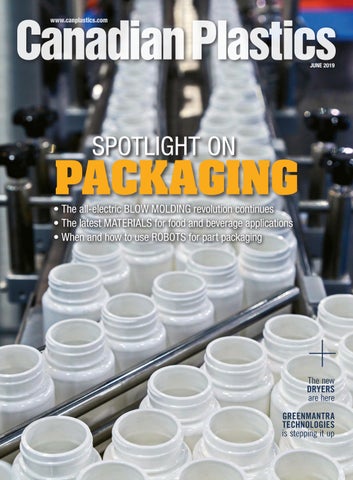
SPOTLIGHT ON
PACKAGING
• The all-electric BLOW MOLDING revolution continues • The latest MATERIALS for food and beverage applications • When and how to use ROBOTS for part packaging
The new DRYERS are here GREENMANTRA TECHNOLOGIES is stepping it up
CPL_June2019_issue_AMS.indd 1
2019-05-21 12:43 PM
C
M
Y
CM
MY
CY
CMY
K
CPL_June_Maguire.indd 1 CPL_June2019_issue_AMS.indd 2
2019-05-21 2019-05-07 12:43 2:16 PM PM
07 2:16 PM
contents JUNE 2019 VOLUME 78 • NUMBER 3
Number of the month:
22*
*The number of exhibiting companies at the AceConnex tabletop show. (See pg. 6)
4
Editor’s View: Picking on paper straws
5
Ideas & Innovations: Polymers give early warning signs of stress
6
News: • Made-in-Quebec deal between Roda Packaging and Industries Rada • Milacron selling Uniloy to investment firms • CCC buys Canadian container maker Plastique Micron • Supplier News and People
26 Technology Showcase 29 Advertising Index 30 Technical Tips: When to use a freelance product designer
Cover Photo: ©gumpapa – stock.adobe.com
in every issue
20
10, 14, 17
24
cover stories
10 BLOW MOLDING: Electrical storm Twenty years after they became commonplace in Europe, interest in all-electric blow molding machines is building in North America. Here’s a look at some of the latest fully electric and hybrid models, and why you should care.
14 PACKAGING: Resonating resins When it comes to food and beverage packaging, plastic is almost always a better material to choose than the alternatives. And speaking of better, here are some of the newest plastic resins and additives designed for both rigid and flexible applications.
17 ROBOTS & AUTOMATION: Part packaging, robot style So you’ve finally decided to automate your end-of-the-line part packaging process? Great. Now here’s how to do it.
features
20 DRYERS: New developments in plastics drying CORRECTION: An April 15, 2019 news story that appeared on our website wrongly reported that Alpha Marathon Film Extrusion Technologies Inc. was involved in a recently dismissed lawsuit with Dual Spiral Systems. Alpha Marathon Film Extrusion Technologies Inc. was not involved in the lawsuit. Canadian Plastics regrets the error.
Keeping moisture out of resin may seem like a small aspect of plastics processing, but it’s actually huge. Without properly dried resin it’s almost impossible to produce quality plastic parts. The good news is that suppliers of auxiliary equipment spend a lot of time thinking about drying so that you don’t have to. Here’s some of the latest developments.
24 RECYCLING: GreenMantra Technologies – Waste not, want not By transforming post-consumer plastics into value-added polymers and waxes, this Brantford, Ont.-based clean technology company is offering processors a whole new world of specialty materials.
Visit us at www.canplastics.com June 2019 Canadian Plastics
CPL_June2019_issue_AMS.indd 3
3
2019-05-21 12:43 PM
editor’s view
Canadian Plastics magazine reports on and interprets developments in plastics markets and technologies worldwide for plastics processors, moldmakers and end-users based in Canada.
www.canplastics.com
Picking on paper straws
W
hen it comes to plastic straw bans, the plastics industry could be forgiven for indulging in a we-toldyou-so moment. The anti-straw movement has been around for years, gaining much traction beginning in 2015 after a video of a marine biologist extracting a plastic straw from a sea turtle’s nose went viral. Beginning in 2018, major companies including Starbucks, McDonald’s, A&W Canada, and Alaska Airlines started to phase out plastic straws. Regionally, Vancouver has instituted a plastic straw ban, Scotland plans to eliminate them by the end of this year, and New York City, Hawaii, and California all have pending straw ban legislation. The problem is, the alternatives aren’t any better — and in the case of paper, are demonstrably worse. The bottom line is, paper straws taste horrible. If you’ve haven’t yet had the pleasure, reach for the closest piece of paper at hand — one of my editorials ripped from an old issue of Canadian Plastics will do nicely — and roll it into a thin tube. Then, sip any carbonated or noncarbonated beverage you choose through it, and enjoy the exquisite feel of cellulose dissolving on your tongue and the taste of glue and wet paper in your mouth. More seriously, non-plastic straws are drawing fire from the disabled and their advocates, who say they make life more complicated for people with disabilities who rely on straws because they’re unable to go through the physical motion of putting a drink to a mouth. These people — who literally need straws — are now pointing out that materials other than plastic just don’t do the job. Paper, they note, dissolves and can be bitten through; and metal gets either too hot or too cold depending on the temperature of the drink, and can even be painful for those with symptoms like jitters. “Other
4 Canadian Plastics June 2019
CPL_June2019_issue_AMS.indd 4
EDITOR Mark Stephen 416-510-5110 Fax: 416-442-2230 mstephen@canplastics.com
types of straws simply do not offer the combination of strength, flexibility, and safety that plastic straws do,” Disability Rights Washington, a non-profit group based in Seattle, said in a letter it recently coauthored to the city in response to a proposed plastic straw ban in Washington state. The group has tried to educate others on why plastic is the most efficient material for straws, the letter continued, but they often get told they’re wrong. Superior non-plastic alternatives exist from a performance standpoint — glass, copper, even bamboo — but their high cost and impracticality means they pose no real challenge plastics’ cheap disposability. All of which should remind those who want to ban them that plastic straws exist in the first place as a solution to paper’s glaring flaws. The plastics industry has known this since day one, but it probably doesn’t matter anymore because, in the Western world at least, the straw debate isn’t really about straws — it’s about the broader effects of a throwaway culture where thoughtless disposal is the rule. Developing nations and some Asian countries, meanwhile, can’t even have this debate because, since they don’t have recycling facilities, there’s no alternative to simply dumping plastic waste. Which is why, for example, China’s Yangtze River contributes 55 per cent of the estimated 2.75 million metric tonnes of plastic waste — which definitely includes straws — going into oceans each year. So until we change our ways — and until more recycling facilities here at home are persuaded to accept straws made from PP, which they don’t all do — we can expect more and more candy cane striped paper straws and fewer plastic straws — which remain, stubbornly, the most efficient straws. And in the meantime, we’d better get used to the taste of glue.
NATIONAL ACCOUNT MANAGER Catherine Connolly 289-921-6520 cconnolly@annexbusinessmedia.com MEDIA DESIGNER Andrea M. Smith asmith@annexbusinessmedia.com ACCOUNT COORDINATOR Tracey Hanson 416-510-6762 thanson@annexbusinessmedia.com CIRCULATION MANAGER Aashish Sharma 416-442-5600 ext. 5206 asharma@annexbusinessmedia.com VP PRODUCTION / GROUP PUBLISHER Diane Kleer dkleer@annexbusinessmedia.com COO Scott Jamieson sjamieson@annexbusinessmedia.com PRESIDENT & CEO Mike Fredericks PRINTED IN CANADA ISSN 008-4778 (Print) ISSN 1923-3671 (Online) Publication Mail Agreement #40065710 2019 SUBSCRIPTION RATES 5 issues Canadian Plastics, plus Dec. 2020 Buyers’ Guide: CANADA: 1 Year $77.50 plus applicable taxes; 2 Years $123.50+ taxes USA: US$135.50/year FOREIGN: US$154.50/year
CIRCULATION mchana@annexbusinessmedia.com Tel: 416-442-5600 ext. 3539 Fax: 416-510-6875 or 416-442-2191 Mail: 111 Gordon Baker Road, Suite 400, Toronto, ON M2H 3R1 Occasionally, Canadian Plastics will mail information on behalf of industry related groups whose products and services we believe June be of interest to you. If you prefer not to receive this information, please contact our circulation department in any of the four ways listed above. Annex Privacy Officer privacy@annexbusinessmedia.com • Tel: 800-668-2374 No part of the editorial content of this publication June be reprinted without the publisher’s written permission ©2018 Annex Business Media. All rights reserved. Opinions expressed in this magazine are not necessarily those of the editor or the publisher. No liability is assumed for errors or omissions. All advertising is subject to the publisher’s approval. Such approval does not imply any endorsement of the products or services advertised. Publisher reserves the right to refuse advertising that does not meet the standards of the publication. MEMBER: Magazines Canada, Canadian Plastics Industry Association.
Mark Stephen, editor
mstephen@canplastics.com
www.canplastics.com
2019-05-21 12:43 PM
ideas & innovations
stretched, demonstrating that the colour can be tailored simply by using different cyclic fluorescent rings in the rotaxanes. Again, the materials emit light of greater or lesser intensity, depending on how much they’re stretched. By combining the three polymers, the researchers said, they created the first white light-emitting polymer that can instantly be switched on and off mechanically. And because no chemical bonds are broken, the process is fully reversible. Swiss and Japanese researchers achieved the white fluorescence (bottom) by combining sensor Potential applications for these molecules that emit orange, blue, and green fluorescence respectively. materials include built-in monitors that send visual warning signs f your significant other has ever blown up at you suddenly before a part fails or that enable engineers to map stresses in because they’re stressed out and you didn’t know it and said parts under load and help them design these better. CPL the wrong thing, you appreciate the value of being warned in advance when something is under too much pressure. Getting advance warning when material in a plastic part is under stress has always been hit-or-miss: scientists have previously developed polymers that change their optical properties in response to mechanical stress, but the change is generally triggered by the breaking of molecular bonds within the material, so it can only happen once. Additionally, those bonds can also be broken by stimuli such as heat and light, resulting in false alarms. With these limitations in mind, researchers from Switzerland’s University of Fribourg and Japan’s Hokkaido University have devised a polymer with a new type of sensor molecule that can only be activated by mechanical force — it glows when it’s stretched, signalling that mechanical stress is building towards a catastrophic part failure. To do this, they built upon their previous work, published last year, in which they developed a type of PU resin Are changeovers slowing you down? Win back precious time that contains stress-sensing rotaxane consisting of ringwith Dyna-Purge! Our commercial purging compounds clean on shaped fluorescent molecules threaded on dumbbellthe first pass, minimizing machine downtime to maximize your shaped molecules featuring so-called “quencher groups” productivity. Plus, only Dyna-Purge provides product and technical — which decrease the fluorescence intensity of a given support built on over 30 years of innovation. Our customers enjoy substance — at their centre. In the relaxed polymer, the the industry’s most effective purging product, outstanding customer quenchers are near the fluorescent rings and prevent them service and reliable results. Request a free sample of from glowing under ultraviolet light. Stretching the polyDyna-Purge and see for yourself. mer moves the quenchers and fluorescent rings apart, causing the material to glow green. The more the material Discover the Difference. is stretched, the brighter it glows, and it goes dark again 866-607-8743 once the stretch is released. The process can be repeated www.dynapurge.com indefinitely. DYNA-PURGE is a registered trademark of SHUMAN PLASTICS, INC. In the current study, the researchers developed three new PU resins that glowed blue, green or orange when
I
Photo Credit: Hokkaido University
Polymers give early warning signs of stress
THE NEED FOR SPEED
June 2019 Canadian Plastics CP_NeedForSpeed_Resized.indd 1
CPL_June2019_issue_AMS.indd 5
5
2017-02-23 9:10 AM
2019-05-21 12:43 PM
news
AceConnex tabletop show was a hit
A one-day industry tabletop show held at the Doubletree by Hilton hotel in Mississauga, Ont. on May 9 got two thumbs way up from exhibitors and attendees. Organized by Mississaugabased AceTronic Industrial Controls Inc., the AceConnex show featured 22 exhibiting companies plus 11 different technical presentations put on by some of the exhibitors. “The goal of AceConnex was to bring customers in the plastics industry together with key suppliers in a smaller, more intimate setting than a traditional trade show,” said AceTronic president Kim Thiara. “This was the first time we’ve done this show, and the turnout was higher than anticipated. The exhib-
itors were thrilled to be able to connect with potential new customers, and part of the value for the attendees was in hearing the technical presentations and then being able to follow up directly with the presenters with any questions. Based on the responses to this show, we’re already planning a second show for next year.” CPL
Colour innovator Robert Swain dies at 90
Robert Swain, the founder of custom colour compounder Chroma Corp. and a member of the Plastics Pioneers and the Plastics Hall of Fame, passed away on April 21 in East China, Mich. at the age of 90. Born in Cape May, N.J., Swain worked for Union Carbide and then Exxon Chemical Co. While at Exxon, he developed and patented several new PP compounds, including the first PP used in automotive steering wheels for Ford Motor Co., and PP agitators for Maytag Corp. washing machines. Swain left Exxon in 1967 to start Chroma Corp. in McHenry, Ill., and the company began developing highly concentrated colourants for a wide range of applications. Chroma was also the first colour compounding company to offer custom formulated colourants to the pharmaceutical industry. Swain sold Chroma in 2016. Today, Chroma, Breen Color Concentrates, Carolina Color, and Hudson Color are owned by private equity firm Arsenal Capital Partners, operating under the name Chroma Color Corp. Swain was elected to the Plastics Hall of Fame in 2009. At the time of his induction, he was just the second person in the colour compounding industry to be admitted to the Hall of Fame. He joined the Plastics Pioneers Association in 1978, and served as treasurer then and later as managing director. CPL
6 Canadian Plastics June 2019
CPL_June2019_issue_AMS.indd 6
Made-in-Quebec deal between Roda Packaging and Industries Rada Quebec-based rigid plastic container maker Roda Packaging has acquired Industries Rada Ltd., an injection molder and blow molder of custom packaging products that’s also headquartered in Quebec. The terms of the deal have not been disclosed. In a statement, Roda Packaging said that it has been sourcing materials from Industries Rada — which was founded in 1999 — for more than 10 years. “Under the new designation Industries Rada (2019) Inc., the new entity will help respond positively to a specific shortage in market supply,” Roda Packaging said. Joining the organization will be Stéphan Berthiaume as president and Isabelle Lehoux as CFO and human resources officer. “With this transaction, we gain the combined strengths of production capacity, a proven sales force, and a cross-Canada distribution network,” Berthiaume said in the statement. “We believe in the intrinsic value of the made-in-Quebec business model we offer our clients, and now look to reap the benefits of enhanced production capacity and of technology investments to be made in the months to come. Furthermore, we are firmly committed to becoming a collaborative lab and high-performance centre for recycled resin reintegration.” Headquartered in Laval, Que., Roda Packaging also has manufacturing plants in Toronto and Vancouver. The company was founded more than 30 years ago, and manufactures rigid plastic containers, bottles, and caps and closures for the North American market. Industries Rada makes HDPE and PET containers, customized products, and has a machine shop for mold fabrication. The company is headquartered in Delson, Que. CPL www.canplastics.com
2019-05-21 12:43 PM
news
Milacron selling Uniloy to investment firms Milacron Holdings Corp. is selling its Uniloy blow molding business to U.S.based investment firms Osgood Capital Group LLC and Cyprium Investment Partners LLC. The terms of the deal have not been disclosed. The Cincinnati, Ohio-based plastics processing machinery maker announced the news on May 14, just two weeks after it disclosed in its first quarter financial report that it was exiting the Uniloy business and putting it up for sale. Milacron bought Uniloy, which is headquartered in Tecumseh, Mich., in 1998 from Johnson Controls Inc. Milacron plans to keep the structural foam business that it bought from Johnson Controls at the same time. Brian Marston, currently the president of Milacron’s blow molding and
extrusion division, will lead the Uniloy organization as president and CEO. He has held leadership positions within the plastics and blow molding industry for 35 years, Milacron said in the statement. “Uniloy has operated as a Milacron product brand since 1998, and we are confident it will continue to thrive under its new ownership in the years ahead,” Milacron CEO Tom Goeke said. “[The sale] is consistent with our decision to concentrate on our core...technologies, including Milacron injection molding machines, Milacron extrusion equipment, MoldMasters hot runner and control systems, DME mold components, and our Cimcool fluid technologies.” The Uniloy transaction is expected to close within 90 days, Milacron said. CPL
Polyethylene sales veteran Geoffrey Perkins passes away Geoffrey Perkins, a longtime sales professional in Canada’s plastics industry, passed away on April 11 at the age of 87 in Belleville, Ont. Perkins started at CIL in the 1960s and then transitioned into PE resin sales by joining Dow Chemical Canada as a sales manager in 1972. He stayed with Dow until 1992, when he joined PE film maker PolyExperts Inc., which was headquartered in Laval, Que., as its sales manager for Ontario. Perkins retired from the plastics industry in 2016. CPL
4 SIMPSON 4 SIMPSON ROAD ROAD 4 SIMPSON ROAD ON,BOLTON, L7E 1G9,ON, CANADA BOLTON,BOLTON, ON, L7E 1G9, CANADA L7E 1G9, CANADA For your rep.your or quotation, please call: please call: area rep.area or quotation, please For area rep.call: or quotation, Visit us: For your Visit us: Visit us: (905) 738-0101 Fax: (905) 738-5750 Tel:booth (905)Tel: 738-0101 Fax: (905) 738-5750 Tel: 738-0101 Fax: (905) 738-5750 booth #W6492 booth #W6492 #W6492 www.rotogran.com www.rotogran.com www.rotogran.com
CPL_June18_Rotogran.indd 1
CPL_June2019_issue_AMS.indd 7
June 2019 Canadian Plastics
7
2018-06-04 2:31 PM
2019-05-21 12:43 PM
news
CCC buys Canadian container maker Plastique Micron Altium Packaging Canada, a subsidiary of U.S.-based blow molder Consolidated Container Co. (CCC), has acquired Canadian firms Plastique Micron Inc. (PMI) and its affiliates IMBC Blowmolding 2014 and Action Plastic Products for an undisclosed amount. Founded in 1970, PMI manufactures plastic containers for food and cosmetics applications, and has three plants: in Anjou and Orangeville, Ont., and in Sainte-Claire, Bellechasse, Que. The company employs approximately 200 workers. In a statement, Atlanta, Ga.-based CCC said that all three locations will be integrated with the existing Altium Packaging Canada plants. Altium makes the Semopac, Deltapac, Humberline Packaging, and Polybottle brands.
SUPPLIER NEWS
“This acquisition is the next step in executing our vision of becoming a differentiated packaging solutions provider,” Sean Fallmann, president and CEO of CCC, said in the statement. “The acquisition of PMI allows us to further broaden our portfolio in the specialized pharmaceutical, health, and nutraceuticals markets while expanding our footprint in Canada.” PMI CEO Bernard Poitras said the acquisition “comes at the perfect time and will result in a new phase of expansion for Plastique Micron.” CCC also operates a leading post-consumer resin business, Envision Plastics, giving it a total force of 60 rigid plastic packaging manufacturing facilities, two recycled resins manufacturing facilities, and 2,600 employees. CPL
–N ewmarket, Ont.-based sales firm Plastics Machinery Inc. is now the Canadian representative for Nanoplas Inc.’s line of mold cleaners and degreasers. Products include Mold Brite mold cleaner and degreaser, Defender rust preventative, and Tuff-Kote mold release spray. – NCI Building Systems Inc. and Ply Gem Parent LLC, which merged last year to become the largest manufacturer of exterior building products in North America, is now operating as Cornerstone Building Brands. Cornerstone is headquartered in Cary, N.C.
TWO-PLATEN IMMS
WHICH IS RIGHT FOR YOU? Jupiter III delivers:
Jenius hybrid electric delivers:
• Smallest footprint
• Improved dry cycle times
• Best price to performance ratio
• Wide range of injection units
• Standard & wide-platen configurations
www.absolutehaitian.com
• 506 to 7,418 U.S. tons
• Electric screw drive paired with servo-hydraulic two-platen clamp • Repeatable and precise injection
• Independent screw recovery • Ideal for large precision parts • 506 to 3,709 U.S. tons
Looking for higher productivity per square foot? Talk to our sales engineers to learn more at 216-452-1000 or 508-459-5372.
FLEXIBILITY WITH TECHNOLOGY TO THE POINT 8 Canadian Plastics June 2019
CPL_June2019_issue_AMS.indd CPL_June_HaitianAbsolute.indd 18
www.canplastics.com
2019-05-21 PM 2019-05-06 12:43 2:04 PM
06 2:04 PM
news
PEOPLE
Bishop Beall
Alain Cappelle
David Castañeda
– Colourant supplier Chroma Color Corp., headquartered in McHenry, Ill., has appointed Bishop Beall as vice president of sales and business development. – Germany-based extrusion blow molding machinery maker Kautex Maschinenbau has named Alain Cappelle as director of its packaging division. – Elix Polymers, a Tarragona, Spain-based manufacturer of ABS resins and derivatives, has appointed David Castañeda as its new CEO. He takes over for Wolfgang Doering, who stepped down in March. – Williamston, Mich.-based blow molding machine maker Bekum America Corp. has named Chuck Flammer as its business development manager.
Chuck Flammer
Cole McGuffin
Jon-Michael Raymond
Chris Robinson
Harinder Tamber
– Houston, Tex.-based polymer reseller and distributor Vinmar Polymers America has named Cole McGuffin as its national account manager for Canada. He is based out of the company’s office in Mississauga, Ont. – L .S. Starrett Co., an Athol, Mass.-based manufacturer of precision measuring tools and gages and metrology systems, has appointed Jon-Michael Raymond as director of sales, North America, industrial products. – Cobourg, Ont.-based Lorenz Conveying Products has named Chris Robinson as its new U.S. sales manager. Robinson is based out of Illinois. – CCC Plastics, a Mississauga, Ont.-based supplier of resins and colourants, has appointed Harinder Tamber as its new technical specialist.
CREATIVE
Recy
cle
RECYCLING
S ! EA D he re I t n a r e gr e bo ar
Add Value to Your Scrap.
Struktol Company of America creates cutting edge additive solutions for recycled polymers. • Odor / Volatile Reduction & Control • Viscosity Modification & Lubrication • Mixing / Blending / Homogenization We help our customers develop value-added, high-performance upcycled compounds opening a wide window of feed stream options.
Struktol Canada, Ltd. | Newmarket, Ontario | Canada Call us at 416.286.4040 email us at strukcansales@bellnet.ca or visit us at 4struktol.com June 2019 Canadian Plastics CPL_June_Struktol.indd 1
CPL_June2019_issue_AMS.indd 9
9
2019-01-29 10:31 AM
2019-05-21 12:43 PM
blow molding
ELECTRICAL
STORM Twenty years after they became commonplace in Europe, interest in all-electric blow molding machines is building in North America. Here’s a look at some of the latest fully electric and hybrid models, and why you should care.
F
ossil fuels like gas and oil aren’t going to win any popularity contests these days, which makes going allelectric, in any product category, seem like a slam dunk. But it’s not. Once touted as the next big thing in urban mobility, sales of Smart vehicles have tanked since the car went fully electric, for example, with the result that automaker Daimler AG’s Mercedes-Benz business is discontinuing sales of the brand in both Canada and the U.S. On the flip side, not every all-electric product offering ends with a whimper either. In blow molding, the development of all-electric and hybrid models — which combine hydraulics with electric motors — continues to gain momentum. Advocates of all-electric and hybrid machines point to several advantages over traditional hydraulics, including energy savings, oil-free cleanliness, faster cycle times, reduced downtime and labour, fewer and smaller mold temperature controllers, and smaller footprint of the molding cell. Digging a little deeper, all-electric machines are also said to excel in precision. “All movements executed by an electric drive are very accurate and
10 Canadian Plastics June 2019
CPL_June2019_issue_AMS.indd 10
almost 100 per cent repeatable, exceeding what you can do even with closedloop hydraulics,” said Heidi Amsler, marketing manager at W. Amsler Equipment Inc. In fact, machinery supplier say, electric-machine control is so precise that set-up requires more exact plotting of positioning points than with hydraulic units. By contrast, suppliers say, the accuracy of even the best-maintained hydraulically driven machines can drift over time as fluids heat and degrade, causing varnish to deposit on valves. The oil also can amass dirt that clogs lines, leading to a slower, less accurate response. All-electric machines are quieter, too, with suppliers reporting that operating noise levels are at least 10 dB lower than for similarly sized hydraulic units. And on the maintenance side, all-electrics have fewer wear parts and require less labour to maintain. Finally, while electric-driven machines with two and four cavities are still more expensive than conventional hydraulically driven units of the same size, suppliers say the price premium on all-electric models has dropped from about 30 per cent five years ago to
between 5 and 20 per cent today because of the falling prices of servo motors due to their rapidly growing popularity. All of which explains why some of the biggest names in blow molding machinery are now firmly on board.
ELECTRIC COMPANIES Some machinery builders favour allelectrics above all else, including two Italian companies that make only allelectrics: Magic MP SpA and Plastiblow srl. In January 2019, Magic opened a U.S. headquarters in Canton, Mich. to showcase its all-electric continuous extrusion blow molding machines, which the company started making 20 years ago. The Plastiblow range of machines, meanwhile, includes single- and double-station machines for production of stackable containers up to 30 litres in size. They can be equipped with single extruder or mul-
Photo Credit: R&B Plastics Machinery
By Mark Stephen, editor
www.canplastics.com
2019-05-21 12:43 PM
blow molding
movements also minimize wear on parts such as molds, motors, blow pins, and cutting rings. Also, because it automatically adjusts clamping force, the machine produces quality parts with little flash. Additional user-friendly features include a design that allows for molds to be swapped out in just 20 minutes. Another German company, Kautex Maschinenbau, built its first all-electric machine way back in the 1990s, when it was part of Krupp Group, but decided the technology wasn’t yet robust enough for full-time production. But that was then. The firm launched its first allelect r ic K BB60D machine on the North America market three years ago, and demand for this series has grown R&B Plastics has entered the all-electric blow molding at a considerable rate, machine segment with its new RBS series shuttle line. according to company president Bill Farrant. tiple extruders for co-extrusion applica- “Extremely short dry cycle times and tions, with standard design for HDPE low energy costs give the KBB series or with grooved barrel design for high an edge in terms of saving resources molecular weight PE (in granule or and maximizing efficiency,” he said. powder form). All the Plastiblow “In addition, quick-change systems machines are suitable for a high level of enable by far the fastest product customization, the company said, and changeover in the extrusion blow molduse up to 70 per cent less energy than ing machines segment.” And in a marcomparable hydraulic units. riage between all-electrics and IndusHesta Blasformtechnik GmbH & try 4.0, Kautex recently introduced the Co. KG of Germany introduced its second generation of its virtual KBB newest and largest all-electric shuttle machine — comprising a compact last year, the double-station Hesta 900. workstation unit, two monitors, a proIt has a 900-mm mold stroke, opening jector, and a real control panel, this stroke of 240 mm, and 44-ton clamp. training tool is designed to allow simuThe dry cycle time is 3.3 seconds, the lation of exact production processes company said, and the machine can with KBB series machines in real-time. Closer to home, Canadian firms are handle up to 16 cavities per side and makes containers up to five litres, with also getting into the all-electric act. an option for 10 litres. Compared to Markham, Ont.-based Pet All Manufachydraulic machines, the Hesta 900 uses turing Inc. recently introduced its new less than half as much energy, the com- all-electric IBM 300/700, one of its pany said, and the machine’s smooth range of CanMold injection blow
machines. Besides offering significant energy savings, the machine is said to be faster than hydraulic models, and is suited to cleanrooms. This 88-ton, three-station machine is aimed at small containers — typically two ounces to one litre — for pharmaceuticals and cosmetics with very high neck tolerances. Pet All Manufacturing also recently opened a new technical centre in Paynesville, Minn. to help its expansion into the U.S. market. And W. Amsler Equipment Inc., which moved into a new 34,000-squarefoot headquarters and factory last year in Bolton, Ont., introduced its next-generation four-cavity all-electric reheat stretch blow molder at NPE2018. “The L42X all-electric reheat machine offers several new features including preferential heating, neck orientation, and hotfill capabilities,” said Heidi Amsler. “It provides versatility to enable PET bottle production in sizes up to two litres in four cavities, and can make up to 6,500 bottles per hour for a 500-ml package; it can also be used to run two- or threecavity molds for production of larger containers up to five litres. Neck finishes range from 18 to 70 mm.” According to Amsler, customers don’t crave all-electric machines per se; what they want is energy efficiency — an area in which all-electrics deliver. “Energy savings with all-electrics comes mainly from the fact that electric motors are inherently more energy efficient, plus the electric motors operate only when needed, whereas hydraulic motors pump continuously and usually at a fixed speed,” she said. “Also, hydraulic oil requires cooling, which consumes more energy.” South of the border, meanwhile, Bekum America Corp. recently introduced an all-electric version of an extrusion blow molder built with a focus on speed and price for the consumer packaging industry. Called the Eblow 407DL, the double-shuttle, longstroke machine has a newly developed integrated quick mold change system based on magnetic clamping plates as well as updated three-layer spiral flow head technology, which the company says optimizes the use of recycled June 2019 Canadian Plastics
CPL_June2019_issue_AMS.indd 11
11
2019-05-21 12:43 PM
blow molding
Photo Credit: Jomar
Corp.
material. The model also high-torque, high-force includes Bekum’s patented rotary actuators generate C-clamp design, which the clamping force. The separates clamping actions RS-90 is Rocheleau’s largfrom alignment control to est reciprocating-screw achieve platen parallelism machine, and is especially of less than 0.1 mm over the suited for making containfull stroke. The clamping ers for industrial and conforce was limited to 22.4 tons sumer products. Various die on the Eblow 407DL to offer head configurations are a competitive cost-output available to accommodate ratio and to improve cycle time molds with one to 16 caviand energy savings, the comties. With its 90-mm-diamepany said. ter extruder, the machine is And in a partnership that Jomar Corp.’s servo-hydraulic IntelliDrive injection blow capable of throughputs of spans three continents, Saline, molding machine. more than 750 lbs of resin per Mich.-based R&B Plastics hour, the company said. Machinery LLC is working with Makers of both fully electric blow molding equipment companies in hydraulics for its IntelliDrive injection and hybrid machines are confident that, Taiwan and South Africa to offer all- blow molding machine, first intro- given time, they’ll win over even their electric R&B-branded machines. Tai- duced with 85 tons of clamping force at most stubborn customers. “Old-school wan-based Sika Machinery Co. Ltd. is K 2016. Two years later the company processors are familiar with the cheap, manufacturing systems and compo- expanded the line at NPE2018 to 135 robust power of hydraulic machines,” nents that are shipped to R&B’s manu- and 175 tons of clamping force. “The Ron Gabriele said. “But as servo compofacturing facility for final assembly units feature precise servo-driven nents prove themselves over time and and customer trials. South Africa- hydraulics that reduce energy con- continue to get less expensive, OEMs based Seecor Blow Molding Solutions, sumption by up to 50 per cent com- and processors will both have to move meanwhile, is providing technology pared with standard hydraulic towards all-electric and servo units to support. The results are the RBS series machines, depending on container stay competitive.” shuttle line and RBA series accumula- specification and material process,” The Smart car turned out to be a flash tor machines, which consist of shuttle said Ron Gabriele, Jomar’s sales man- in the pan. Bet on all-electric and hybrid platforms ranging from 350 to 1,250 ager. “Also, both the model 135 and blow molding machines to stick around. CPL mm-long strokes, offered in both sin- 175 boast a dry cycle time of 2.5 sec- gle- and double-sided machine config- onds, compared to three seconds for urations. Target applications include competitive injection blow molding RESOURCE LIST Bekum America Corp. (Williamston, Mich.); consumer packaging, automotive, and machines. They use 40 per cent less www.bekumamerica.com; 517-655-4331 industrial parts. The new machines hydraulic oil and tower water, and emit Hesta Blasformtechnik GmbH & Co. KG/ mark R&B’s entry into the all-electric substantially less ambient heat com- Jackson Machinery Inc. (Port Washington, segment, R&B president and general pared with standard hydraulic Wis.); www.jacksonmachinery.com; manager Fred Piercy said. “Our cus- machines, which reduces overall oper- 262-284-1066 tomers have begun asking us for all- ating costs.” The IntelliDrive launch Jomar Corp. (Egg Harbor Township, N.J.); www.jomarcorp.com; 609-646-8000 electrics,” he said, “On a large scale, has been so successful, Gabriele con- Kautex Machines Inc. (North Branch, N.J.); there are still very few blow molding tinued, that it resulted in the discontin- www.kautex-group.com; 908-252-9350 machinery makers offering all-elec- uation of the company’s standard Magic MP SpA/Magic North America trics, so there’s room for smaller com- hydraulic Model 175. “The IntelliD- (Canton, Mich.); www.magicnorthamerica.com; panies to get involved. Most of the rives have become our largest selling 313-209-9107 older generation of blow molders are machine line — so much so that I see Pet All Manufacturing Inc. (Markham, Ont.); www.petallmfg.com; 905-305-1797 well-versed in hydraulics, less so with us discontinuing all of our larger Plastiblow srl/Hamilton Plastic Systems all-electrics, so there’s a learning curve hydraulic machines in the near future,” Ltd. (Mississauga, Ont.); www. he said. “The energy savings are too hamiltonplasticsystems.com; 800-590-5546 involved, but it’s not too steep.” R&B Plastics Machinery LLC (Saline, Mich.); compelling to ignore.” HYBRID HOPEFULS The NPE2018 show also saw Roche- www.rbplasticsmachinery.com; 734-429-9421 Other blow molding machinery makers leau Tool & Die Co. Inc. unveil its Rocheleau Tool & Die Co. Inc. (Fitchburg, Mass.); www.rocheleautool.com; offer a range of hybrid units. Jomar RS-90, a hybrid model that’s powered 978-345-1723 Corp. considered going the all-electric by both variable frequency drive elec- W. Amsler Equipment Inc. (Bolton, Ont.); route but then picked servo-driven tric technology and hydraulics. Two www.amslerequipment.com; 905-951-9559
12 Canadian Plastics June 2019
CPL_June2019_issue_AMS.indd 12
T
www.canplastics.com
2019-05-21 12:43 PM
kmd1902_N CPL_Jun
The World’s No. 1 Trade Fair for Plastics and Rubber
T h i n k i n g . R e t h i n k i n g . L a t e r aMesse l t Dusseldorf h i n k i n g . T h i n k i n g o u tpage s i d 13 e t h e b o x . K 2 0 1 9 Global megatrends demand new ways of thinking for the industry in order to initiate a paradigm shift with sustainable solutions for our planet. Approximately 3,200 international exhibitors a t K 2 019 a r e t a k i n g u p t h e c u r r e n t c h a l l e n g e s and will show you the latest de velopments and pioneering innovations in the plastics and r u b b e r i n d u s t r y . K 2 019 : T h e m o s t i m p o r t a n t business platform of the industry. Be part of it. www.k -online.com/ticketing
Canadian German Chamber of Industry and Commerce Inc. Your contact: Stefan Egge 480 University Avenue – Suite – 1500 Toronto, ON, M5G 1V2 Tel. (416)5 98-15 24 – Fax (416)5 98-18 40 messeduesseldorf@germanchamber.ca For Travel Information: LM Travel/Carlson Wagonlit Tel. (888)3 71-61 51 – Fax (866)8 80-11 21 ahoule@vovagelm.ca
kmd1902_NH_213x279+3_US_CA.indd 1 CPL_June2019_issue_AMS.indd CPL_June_MesseDusseldorf.indd 13 1
25.04.19 13:45 2019-05-21 2019-04-25 12:43 2:17 PM PM
packaging
RESONATING RESINS
By Mark Stephen, editor
The new grade Styropor P 24 Speed rounds off BASF’s EPS range for the food packaging industry.
C
harles Dickens coined the phrase “it was the best of times, it was the worst of times” to describe life during the French Revolution. Fast forward to today and it’s not a bad way to sum things up for the plastics packaging industry. On the one hand, there’s a global battle against single-use plastics, particularly when it comes to the onceubiquitous plastic bag, with at least 127 countries across the globe now having adopted some form of legislation to regulate plastic bags. But on the other, plastic has still managed to become one of the most popular packaging options, and plastic containers and bottles are in
14 Canadian Plastics June 2019
CPL_June2019_issue_AMS.indd 14
greater demand in the food and beverage industry than any other material. Which is why, depending on the region, packaging applications account for between 35 to 45 per cent of polymers produced in total. And since this trend shows no signs of slowing down, material suppliers both big and small are introducing new resins and additives designed to enable the most cutting-edge rigid and flexible food and beverage packaging applications.
STAND-UP IS ON THE RISE The market for stand-up pouches is growing at approximately three times
Photo Credit: BASF
When it comes to food packaging, plastic is almost always a better material to choose than the alternatives. And speaking of better, here are some of the newest plastic resins and additives designed for both rigid and flexible applications.
the rate of that of flat packaging, depending on the region. With that in mind, A. Schulman Inc. has introduced Polybatch-brand EasyPour additive masterbatch concentrates, designed to optimize packaging’s inner surfaces. Adding the masterbatch to the inner layer of a multilayer structure ensures the contents flow smoothly, making it easier to empty the package. “It’s a struggle to empty stand-up pouches, tubes or bottles,” said Ralf Küsters, the company’s product and market development manager. “There’s always something left inside, and no one likes that.” The new masterbatch technology www.canplastics.com
2019-05-21 12:43 PM
packaging
is designed for use in both flexible and rigid multilayer constructions. Formulas are customized using specialized test methods in order to optimize performance for a given packaged substance. To back up the innovation with numbers, A. Schulman developed a test to measure the speed and distance of the product on a tilted surface, as well as the amount of residue on that surface afterward. It showed a pouring improvement of up to 25 per cent. The testing system in place allows brand owners to appraise products themselves to see how well they work and adapt them to their particular needs. PS is a versatile plastic that can be rigid or foamed. General purpose PS is clear and hard, with a relatively low melting point. Typical food packaging applications include bottles and food containers. Rounding off BASF’s EPS range for the food packaging industry, the company has developed a new plastic grade which has approximately 4.8 per cent lower pentane content, reducing the molding cycle and intermediate conditioning times. The new grade Styropor P 24 Speed has a density of 25 grams per litre, the company said, resulting in up to 50 per cent shorter mold cycle times when compared with BASF’s established Styropor P 326. The new type of Styropor has a high mechanical resistance, superior flexural and compressive strength similar to the classic Styropor P 26, and good fusion properties and a smooth surface finish. Styropor P 24 Speed, similar to all Styropor packaging grades, is without flame retardant, and is available in three bead sizes ranging from 0.4 to 1.3 mm. LDPE is used predominately in film applications due to its toughness, flexibility, and relative transparency, making it popular for use in applications where heat-sealing is necessary. A new silicone-based slip additive masterbatch for LDPE film that reportedly optimizes form-fill-seal (FFS) flexible packaging production has been launched by Dow Performance Silicones, a global business unit of DowDuPont Specialties Products division. According to Christophe Paulo, Dow Performance Silicones industrial and
consumer strategic marketer, the company’s MB25-235 masterbatch significantly reduces the coefficient of friction for LDPE film and also addresses the traditional drawbacks of organic additives by delivering stable, long-lasting slip performance and avoiding migration to the film surface. “MB25-235 is based on advanced silicone slip technology that helps to boost production speed, maintain uninterrupted throughput, and ensure uniform film quality,” Paulo said. “Unlike organics, it will not migrate to the film surface, and is also cost-effective as it only needs to be incorporated into the outer layer of multilayer films, which reduces the amount required.” MB25-235 is approved for food contact under FDA, EU, and Chinese regulations, Paulo added.
GETTING EU COMPLIANT A new line of ABS compounds under the brand Chemical Compliance (CC) for food packaging applications has been launched by Spain’s Elix Polymers. All components in Elix’s ABS CC compounds are said to be compliant with health-related regulations such as EU10/2011 (Plastic Materials for Food Contact Applications), which already set the maximum limits of substances that are considered safe. Grades have been formulated for individual applications, enabling customers to select the materials based on their specific needs. Two injection molding grades — P2HCC and P3H-CC — are said to be easy to process, and have high levels of brightness as well as intense colours. Elix also supplies extra services like migration testing, development of compliant colours, additional quality controls for these compounds, and technical support during processing as an added guarantee that customers are following best practices and to ensure that there’s no contamination or degradation of the compounds. An innovative new TPE technology from Kraiburg TPE that features superior adhesion to nylons also complies with EU10/2011. The compounds that comprise the company’s new FC/AD/ PA Thermoset K series are said to provide very good processability and supe-
rior surfaces that don’t require any finishing after leaving the mold. “The materials can be injection molded directly onto nylon 6 and nylon 6/6 without any additional adhesive primer,” said Dirk Butschkay, Kraiburg’s product marketing manager. With hardness degrees ranging between 40 and 80 Shore A, they combine tactile properties such as soft-touch and nonslip grip even at low wall thicknesses, Butschkay continued, and they also provide superior tensile strength, elongation at break, and abrasion resistance.
IMPACTFUL COPOLYMERS PP has good chemical resistance, is strong, and has a high melting point, which makes it a good choice for hot-fill liquids. Sabic recently extended its Flowpact series of impact copolymers with the new PP FPC70 grade for rigid packaging. Rigid packaging made with this high-flow (MFR 70) resin, including applications that can be hot-filled, is said to have much higher top-load strength than identical products made with benchmark materials, resulting in better stackability for better transport and storage economics. “FPC70 boasts polymer chemistry advances that yield a material with a balance of high stiffness, impact strength, and high heat distortion temperature, unlike a standard PP impact copolymer,” said Lada Kurelec, global business director, PP, for petrochemicals at Sabic. “We believe that PP FPC70 answers the continuing trends in thin-wall packaging by enabling up to 10 per cent thinner walls and fast injection, which reduces energy consumption and increases productivity.” PET is clear, tough, and has good gas and moisture barrier properties, which is why it’s commonly used in beverage bottles and many injection molded and blow molded consumer product containers. Sukano Polymers has introduced a mobility aid additive masterbatch for injection stretch blow molded (ISBM) PET bottles that’s designed to enable bottle makers and brand owners to run their conveyor belt systems and production robots without the need for a spray coating. The Sukano Mobility Aid solution, believed June 2019 Canadian Plastics
CPL_June2019_issue_AMS.indd 15
15
2019-05-21 12:43 PM
to be the first commercially available for this application, is provided as a solid PET masterbatch and can be used for virgin PET or RPET material during molding or processing. The product is said to produce a silicone-like mobility aid effect in PET, yet is engineered to preserve material clarity with minimal impact on haze. According to Sukano research and development global head Michael Kirch, the new masterbatch is well-suited to clear, translucent, and coloured bottles produced for food and beverage applications, as well as personal care, household and cleaning, and cosmetics products. “It’s also widely applicable, as PET material containing the new masterbatch can be run on existing ISBM bottle production equipment without modification,” Kirch said. “Bottle makers and brand owners can now run their conveyor belts without interruption and minimize the mispicks by production robots, which improves
16 Canadian Plastics June 2019 CPL_June_Lorenz.indd 1
CPL_June2019_issue_AMS.indd 16
Photo Credit: Sukano Polymers
packaging
Sukano’s Mobility Aid additive masterbatch enables PET bottle makers and brand owners to run their conveyor belt systems and production robots without the need for a spray coating.
productivity and maximizes yields.” When it comes to materials innovations for food and beverage packaging applications, this might indeed be the best of times. CPL RESOURCE LIST A Schulman Inc. (Fairlawn, Ohio); www.aschulman.com; 330-666-3751 BASF Canada Inc. (Mississauga, Ont.);
www.basf.ca; 289-360-1300 Dow Performance Silicones (Midland, Mich.); www.dowcorning.com; 800-248-2481 Elix Polymers Americas LLC (Weston, Fla.); www.elix-polymers.com; 305-699-3130 Kraiburg TPE Corp. (Buford, Ga.); www.kraiburg-tpe.com; 678-584-5020 Sabic Innovative Plastics Canada (Cobourg, Ont.); www.sabic.com; 905-372-6801 Sukano Polymers (Duncan, S.C.); www.sukano.com; 864-486-1478
www.canplastics.com 2019-05-08 10:18 AM
2019-05-21 12:43 PM
robots & automation
Proco Machinery’s Robo Packer with neck inverting tooling.
PART PACKAGING,
ROBOT STYLE So you’ve finally decided to automate your end-of-the-line part packaging process? Great. Now here’s how to do it.
Photo Credit: Proco Machinery Inc.
A
staple of sci-fi films is out-of-control robots doing bad things to good people. And a staple of real world manufacturing today is the fear that robots have too much control, and are doing bad things to good factory workers by taking their jobs. But here’s another way to look at it: By automating the repetitive, tedious jobs, people can be redeployed to areas where they’ll be safer and more engaged in their work. And few jobs are more repetitive and tedious than part packaging, which can involve lifting, bending, labelling, inspecting, and orienting parts for vir-
tually an entire work shift. Which is why more and more plastics processors are automating their end-of-the-line part packaging processes. Robots can pack less expensively than people, can work around work-force shortages, are capable of complex picks and motions that would not be possible or safe for a person, and run an average of 80,000 hours before requiring maintenance. But savvy processors with plans to switch from manual to automated part packaging still have to take a number of factors into account to ensure they get the best, most competitive robotic system for their needs.
By Mark Stephen, editor
TO AUTOMATE OR NOT TO AUTOMATE The biggest decision to make at the outset is whether automating an end-ofthe-line packaging system is actually a better option than manual packaging. Sometimes the answer is no. “People are efficient at packaging small, short, one-of-a-kind runs, so robotics may not be the best choice for a product that will only run once, or if different products run every day,” said Dale Arndt, director of engineering with Fanuc Canada Ltd. Since repeatable runs are a key factor in robotic efficiency, begin by analyzing run times and product June 2019 Canadian Plastics
CPL_June2019_issue_AMS.indd 17
17
2019-05-21 12:43 PM
Photo Credit: CBW Automation
robots & automation
CBW Automation’s new B2X side-entry robot on a part production line.
quantities. And you don’t have to make this analysis on your own — automation systems suppliers can help. “Fanuc uses a charting method that assesses ease of automation and value of the automation task,” Arndt said. “If something is hard to automate and lowvalue, we recommend leaving the part to be packaged manually; if it’s a highvalue task and easy to automate, we recommend automating it.” Another important point is whether or not the processor has ever used robotic automation before. If not, robot systems suppliers recommend against automating every part packaging line in one go. Beyond that, there are different schools of thought for dealing with first-time customers. “When working with a company that hasn’t had automation before, we look for the heaviest hitting application that will give it the best return on investment, which tends to be the highest volume run,” said Taras Konowal, North America director of sales for CBW Automation. “Automating this production line will give the customer the experience it needs to handle automating other lines later on.” Other automation suppliers prefer to tackle the easiest production line first. “Some customers that are
18 Canadian Plastics June 2019
CPL_June2019_issue_AMS.indd 18
automating for the first time want to start with the toughest packaging application as a test,” said Joe Campbell, senior manager, strategic marketing and applications development with Universal Robots USA Inc., which makes collaborative robots. “We suggest they begin by automating a simpler application instead, where they can see immediate results and gain experience for other, more complex applications.”
JUST THE FACTS Once the decision to automate a particular packaging line is made, the packaging system provider needs to know some key points before it can recommend the right solution. “The fundamentals for any robot application are, what’s the part being made, what’s the payload, and what’s the cycle time?” Campbell continued. “From there, we want to know how the parts are being presented out of the mold, and also the box size. This is an advantage of collaborative robots, which are versatile enough to handle different box sizes, different stack heights, and different volumes of parts going into a box.” Another key consideration represents a genuine fork in the road that can take you in one of two different directions:
are the parts being packaged after degating for direct shipment to a customer, or do they require either immediate postmold assembly or simple box filling to be sent somewhere else in the facility for post-mold work? “If the parts require additional work downline, installing two robots might be the best solution — a top-entry robot to degate the part and a six-axis robot to manipulate it for assembly or secondary operations,” said Tim Lavigne, business unit manager with Absolute Robot Inc. “Sometimes one six-axis robot will have the reach to perform both degating and post-mold work by itself, but not often.” If the parts are being packaged for in-house work later on, the robotic automation might not have to be quite as precise. “In these situations, the processor usually only needs to bulkfill the box, which means that the orientation of the parts within the box probably doesn’t matter quite as much — we only need to know the count number of parts that will go in each box; when that count is reached, a new box is delivered,” said Jim Healy, vice president, sales and marketing, for Sepro America LLC. “Most of the inquiries we get from customers are for situations like this, where parts are going to be stored for secondary assembly later on. But if the parts are being packaged for direct shipment to customers, we need to know as much as possible about the part dimension: its size, shape, orientation in the box — the entire packaging array.” For either situation, Sepro’s Speed-Entry is a range of side-entry robots specially designed for high-speed picking and placing of packaging parts, with a modular design that makes it suitable for any type of layout. And Proco Machinery Inc. recently introduced its new Robo Packer case packer, which can be supplied with any one of three different robotic arm payloads depending on the application, the task to be performed, and the level of productivity that’s required. “The Robo Packer can be configured to pack all necks up or all necks down either using row-byrow or full-layer packing methods,” said Siva Krish, the company’s vice www.canplastics.com
2019-05-21 12:43 PM
robots & automation
president of sales. “In situations where a standard configuration doesn’t work, we can develop custom tooling to pack bottles lay-flat inside the box.”
MATERIAL CONSIDERATIONS Especially for parts that will be packaged and shipped out directly, product behaviour can be an issue, since differences in the physical characteristics of plastic containers — such as round, square, or tacky — can affect the performance of a packaging system. “This is why we always want to see part drawings and part samples before recommending custom automation,” said Tim Lavigne. PET bottles, meanwhile, can develop static “cling” that causes them to bunch up and move unpredictably as they’re fed down a conveying line and onto a palletizing/collating table or stack. “Static cling in PET bottles can be a huge problem, since they repel each
For processors that have never used robots before, systems suppliers recommend against automating all part packaging lines in one go; start by automating one line instead. other and push off the collating table, causing shorted bottle counts; or they cling together, making it difficult pick them up or palletize them without operator intervention,” said Siva Krish. “A good way to solve it is by putting an antistatic blower on the infeed conveyor to remove the static charge from each bottle.” In addition to antistatic spray systems that blow charged air onto the bottles, grounding strips or plates on the machine can help dissipate static buildup, as can changes in conveyor belt material that lessen the friction. Sometimes FDA requirements for handling of food containers dictate which areas of the containers can come in contact with the tool, which can impact end-of-arm tooling design. “In
these situations, the robotic arm must have a food-grade design,” said Olivier Cremoux, business development manager at Stäubli North America. “The integration of the arm must respect the sanitary requirements of the production area, most of the time avoiding having the robot or retention areas on top of the products. Then the tooling must be compatible to touch the product, avoiding contamination and damage to the product.” This is a rare instance in the entire robot installation process where the customer will know more than the automation system supplier. “Customers will give us boundaries as to how we can handle a part — generally with medical or food packaging applications — and we’ll use that information when designing the solution,” said Jim Healy. “This isn’t an area where we can instruct them.”
HEIGHT REQUIREMENT With these issues decided, the next step is making sure the robotic components will actually fit into the available floor and ceiling space. Consulting with a packaging system provider to think through the layout design phase comprehensively can save both time and money, especially on big projects. “This is a great place to use simulation software to discover what the options are, and to pick the lowest cost/highest functionality solution that matches the available space,” said Dale Arndt. “There are three solutions to floor and ceiling height limitations: stationary platen-mount robots, which take up very little space; product lines that move sideways along the platen; and floor-mount and rollaway floor-mount automation, which are side-entry but can be pushed out of the way when the processor has to change the tool.” For part packaging in tight areas, the new B2X side-entry robot from CBW Automation has been designed with a particularly small footprint, as well as 50 per cent greater production output, quicker changeovers, and cost savings compared to the company’s previous high-speed retrieval system. An end step in plastics production is quality control, which on a manually
packaged line is almost invariably performed by an employee on that line. But if the line gets switched over to an automated packaging process, something new will be required. What, exactly, depends on the application — it can be as simple as a leak checker or as high-tech as a vision system or other sensor, and both automation system suppliers and systems integrators can supply the technology. “Vision-guided robotics can now check each part before it’s put in the box,” said Jim Healy. “The robot can also be programmed to inspect a single part at a predetermined part count — one in every 100 shots, for example, or one in every 200 shots — so that if parts begin to go bad, the customer has a window into when the failure began.” In case you’re tempted, trying to automate only the QC while leaving the part packaging to be done manually is probably not a great idea. “When this happens, there’s no repeatability in the process, and you’re not using the full advantages of automation,” said Olivier Cremoux. “With Stäubli’s TX2 collaborative solution, the robot and operator can work together, combining efforts as a team.” In the end, once you’ve decided that a production line meets the criteria for automated part packaging, the benefits can be substantial: repeatability, consistency, and letting people work where they’re most needed. The automation supplier’s job is to get you there by determining the best robotic system for your needs and making sure the installation process goes smoothly. And that’s not science fiction. CPL RESOURCE LIST Absolute Robot Inc. (Worcester, Mass.); www.absoluterobot.com; 508-792-4305 CBW Automation (Fort Collins, Col.); www.cbwautomation.com; 970-229-9500 Fanuc Canada Ltd. (Mississauga, Ont.); www.fanuc.com; 905-812-2300 Proco Machinery Inc. (Mississauga, Ont.); www.procomachinery.com; 905-602-6066 Sepro Canada (Montreal); www.sepro-group.ca; 514-515-9349 Stäubli North America (Duncan, S.C.); www.staubli.com; 864-433-1980 Universal Robots USA Inc. (Ann Arbor, Mich.); www.universal-robots.com; 844-462-6268 June 2019 Canadian Plastics
CPL_June2019_issue_AMS.indd 19
19
2019-05-21 12:43 PM
dryers
New developments in
PLASTICS DRYING Photo Credit: Novatec Inc.
Keeping moisture out of resin may seem like a small aspect of plastics processing, but it’s actually huge. Without properly dried resin it’s almost impossible to produce quality plastic parts. The good news is that suppliers of auxiliary equipment spend a lot of time thinking about drying so that you don’t have to. Here’s some of the latest developments.
By Mark Stephen, editor
T
he idea of a necessary evil goes all the way back to the ancient Greeks, and has been used ever since to describe everything from government to marriage. For most plastics processors, a classic example of a necessary evil is resin drying: they don’t want to do it, but it has to be done. Why? The moisture contained within the plastic may seem like a small aspect of processing, but if it isn’t controlled it can lead to lowered physical properties such as reduced tensile and impact strengths, making it almost impossible to produce quality plastic parts. The bad news is, there’s no shortage of ways for resin to pick up moisture: Hygroscopic polymers such as nylon, ABS, acrylic, PET, PBT, PU, and PC absorb moisture internally and release moisture through the air; even non-hygroscopic resins such as PVC, PP, PS, PE, and many more can collect moisture on their surfaces. And if you don’t get rid of that moisture you’ll be at a major competitive disadvantage. Fortunately for processors that have to dehumidify their resins but don’t want to have to think about it, suppliers of auxiliary equipment spend a lot of time thinking about it for you. Here’s some of the latest results.
20 Canadian Plastics June 2019
CPL_June2019_issue_AMS.indd 20
OLD FAVOURITES REDESIGNED A new generation of Carousel Plus desiccant dryers from Conair Group use an innovative new air-to-air aftercooling option. The company’s D series portable dryers and dX series mobile drying/ conveying systems are the product of a complete redesign of Conair’s small and mid-size Carousel Plus desiccant dryer architecture, affecting portable dryers and mobile drying/conveying systems sized from 15 to 400 lbs per hour of throughput. “The new aftercooling option is important because aftercooling is required to reduce the temperature of the return air from the drying hopper, which improves the moisture-absorption efficiency of the desiccant,” said A.J. Zambanini, Conair’s dryer product manager. “Processors now have the ability to specify dryers equipped with either an optional air-to-water aftercooler or the new airto-air aftercooler.” The air-to-air unit can sustain drying efficiency while handling return-air temperatures of up to 190°C or 375°F and dewpoints of -40°C or -40°F, he added. “At the same time, it saves water, maximizes dryer portability, and makes installation and set-up faster and easier,” he said. A key component of the new D and dX series
Novatec’s NitroDry dryer generates its own nitrogen, using standard factory compressed air, to dry resins that are highly susceptible to oxygen degradation from prolonged exposure to heat in the presence of oxygen.
dryers is the DC-C programmable electronic controller, which was developed by Conair specifically for drying applications. “The control uses our own software to maximize flexibility in adapting to current and future customer application needs, and is available on both dryers in two configurations: the DC-C Plus package features a four-inch touchscreen user interface, while the DC-C Premium offers a seven-inch screen,” Zambanini said. Dri-Air Industries Inc. also has a new dryer revamped from a familiar favourite. The company’s new 3000 FM unit expands Dri-Air’s line of large desiccant dryers, and is modeled on its established 1500 FM design while using larger towers and blowers for use with central drying systems and extruders that have outputs of up to 3,000 lbs www.canplastics.com
2019-05-21 12:43 PM
CPL_Feb
dryers
per hour. It also has a compact footprint of 30 square feet, Dri-Air president Jason Sears said, and a new regeneration airflow design that significantly reduces the previous energy usage level — which, Sears added, was already among the industry’s lowest. “Dry air is used for regeneration or cool-down of desiccant towers, allowing for -25°C or -80°F or lower dewpoints,” Sears said. All external panels are hinged for quick access to internal components, he continued, and the panels can be slipped off their hinges to conserve space. Additionally, a high-pressure fan reduces the ambient noise level to less than 70 dB and allows the dryer to operate at very low process temperatures Canadian to accommodate resins such as 2019 Plastics PLA. “The 3000 FM also has DriHalf Page - 4Cthat display the imporTouch controls tant operating parameters on a highly visible seven-inch touchscreen,” Sears said. “The menu screen provides imme-
diate access to all settings and other parameters needed for set-up and troubleshooting.”
DRY HARD Maguire Products recently launched its new VBD-600 mid-range vacuum resin dryer, which offers throughputs of up to 600 lbs per hour, which the company said is ideal for customers that manufacture sheet and large automotive parts, as well as for other injection molding and extrusion applications. According to Maguire, the VBD-600 uses only four-fifths of the energy compared to a similarly sized desiccant dryer and dries resin in about one-sixth of the time. It accomplishes this by using three vertically arranged components: first, the heating hopper warms the resin to a customer-defined temperature; the high-speed slide-gate valves then dispense material to the next level, the vacuum vessel, with an
accuracy of plus or minus four grams — and by creating a vacuum, the vessel reduces the boiling point of water, forcing moisture out of the pellets; finally, the heavily insulated retention hopper has a transparent shroud to protect dry materials from moisture. The VBD600 has the same features as other dryers in the VBD line, the company said, including a five-year warranty and software that constantly monitors drying conditions and makes adjustments to save energy. It also has as standard the capability to display and log energy consumption, showing both real-time and averaged values. If you’ve ever noticed a dryingrelated discolouration in nylon, PBT, PLA, and TPU resins, you’re not alone. This colour shift from pure white to yellow is caused by prolonged exposure to heat in the presence of oxygen and doesn’t just spell trouble for appearance parts — it also signals degradation that
INDUSTRIAL SHREDDERS FOR PLASTICS bUILT TO RUN 24 / 7
(336) 447-3573 • 5708 UwHARRIE ROAD, ARCHDALE, NC 27263 • www.vECOPLANLLC.COm CPL_Feb_Vecoplan.indd 1 CPL_June2019_issue_AMS.indd 21
2019-01-29 12:43 2019-05-21 11:11 PM AM
dryers
in 7, 25, and 50 lbs per hour models,” Haynie said.
PROBLEM SOLVERS Piovan has a new patentpending technology called AIPC — short for automatic control of injection pressure — which is designed to enable an injection molding machine to “guide” Piovan’s Genesys PET drying system so that it operates with a constant injection pressure around a customer-defined set-point. The problem being solved is that in a conventional PET preform production system, the resin drying phase isn’t connected to injection and preform production, which means that pressure doesn’t always fall within a predetermined range of values — and can actually fluctuate continually, causing possible variations in the characteristics of the PET products. Prior to AIPC, a Photo Credit: Piovan
can impact strength, ductilPiovan’s AIPC resin ity, viscosity, chemical drying system resistance, stiffness, and connects drying to stability. Novatec Inc.’s new injection and NitroDry dryer provides preform production. processors with a new, oxygen-free tool to avoid this degradation. The dryer generates its own nitrogen, using a factory’s normal compressed air, to dry resins that are highly susceptible to oxygen degradation, and then addition, Haynie said, there’s no danger vents air to the drying room, avoiding of pure nitrogen release because the the hazards of venting pure nitrogen in nitrogen is only produced at the rate at a closed area. “The NitroDry resin which it’s needed and is released in a dryer is an oxygen-free system that’s a slightly oxygen-rich vent stream. Nitrogood fit for press-side drying of newly gen at -24°C or -75°F dewpoint disdesigned polymers with unique proper- places oxygen and circulates through ties,” said Mark Haynie, Novatec’s the drying hopper, he explained, which dryer product manager. “The process is means temperatures can be raised by as totally self-contained, so the hassle of much as 10°C or 50°F to reduce expohandling and the cost of purchasing sure time. “The NitroDry dryer is safe tanks of nitrogen are eliminated.” In for all resins, and is currently available 01-8594-COL-Sepro-CPBG-HalfPage-8x5.5.qxp_Layout 1 3/5/19 2:18 PM Page 1
Experience Full Control With Sepro, you experience full control. You control your robots, of course. The amazing Visual control platform makes it so easy. You control quality and production costs. And you control secondary operations that add value and boost profitability. But there’s so much more to it than that. You can feel the confidence that control gives you. No more compromises. Just the industry’s widest range of 3-, 5- and 6-axis robots. Seamless, open integration with so many of the biggest IMM brands. And the support of the best engineering and service teams, everywhere.
You have full control of your future…
and the future is Open 4.0. Robots and Automation
www.sepro-group.ca • 514 515-9349 • seprocanada@sepro-group.com • @SeproGroup
CPL_June2019_issue_AMS.indd 22 CPL_April_Sepro.indd 1
2019-05-21 2019-03-21 12:43 10:03 PM AM
1 10:03 AM
dryers
Genesys dryer’s performance was optimized using the AECS algorithm, based on measurement of the weight loss of the dried material. “With AIPC, the injection molding machine itself supplies the data necessary for process management, ensuring that the degree of drying is really suitable for the type of preform to be produced,” Piovan said. “With the aid of a signal transducer, the injection pressure is continually measured and sent to the Genesys dryer. The dryer continually adapts its operation even more effectively in order to keep it within a working range suitable for the type of production, with variations not exceeding ± 2 bar throughout the cycle.” Wittmann Battenfeld is offering a new generation of its Aton segmented wheel dryers: the Aton H, a compact, portable dryer that can process up to 200 lbs of resin per hour. It comes in three sizes, with airflows of 1,059,
2,472, and 4,237 cubic feet per hour. A USB interface enables users to import up to eight material data sets. If a processor is using a Battenfeld injection molding machine, the dryer can connect to it via a router, allowing control of the dryer from the primary machine’s control. Aton H series dryers are available with the Basic, Plus, and VS options. Aton Basic H dryers feature the material saver function to prevent over-drying, as well as dewpoint management that automatically adjusts the temperature for desiccant regeneration to save energy; Aton Plus H dryers have additional energy-saving features, including a standard, thermal function called 3-Save that heats the air for regeneration of the desiccant inside a special heating tube and then uses a heating element to raise the temperature of the air further before it’s blown onto the desiccant; and Aton VS H dryers integrate a vacuum blower for mate-
rial conveying in the frame under the drying unit, allowing the dryer to be connected to multiple conveying units. So if you have to dry your resins — and odds are you do — these new technologies can at least take the evil out of the necessity. CPL RESOURCE LIST Conair Group (Cranberry Township, Pa.); www.conairgroup.com; 724-584-5500 Dier International Plastics Inc. (Unionville, Ont.); www.dierinternational.com; 416-219-0509 Industries Laferriere (Mascouche, Que.); www.industrieslaferriere.ca; 450-477-8880 Turner Group Inc. (Seattle, Wash.); www.turnergroup.net; 206-769-3707 Dri-Air Industries Inc./Maguire Products Canada Inc. (East Windsor, Conn.); www.driair.com; 860-627-5110 Maguire Products Canada Inc./Novatec Inc. (Vaughan, Ont.); www.maguireproducts.com; 905-879-1100 Piovan Canada (Mississauga, Ont.); www. piovan.com; 905-629-8822 Wittmann Battenfeld Canada Inc. (Richmond Hill, Ont.); www.wittmann-group.ca; 905-887-5355
June 2019 Canadian Plastics
CPL_June2019_issue_AMS.indd 23
23
2019-05-21 12:43 PM
recycling
Photo: Adobe Stock
WASTE NOT,
WANT NOT By Mark Stephen, editor
A
lchemy was an ancient practice that sought to turn lead into gold. Its practitioners never could get it to work, but the idea of taking something that’s basically worthless and making it valuable is universal — and GreenMantra Technologies Inc. is actually achieving it today. The Brantford, Ont.-based clean technology company uses a patented process that transforms low-value waste plastics destined for landfill sites into value-creating speciality chemicals such as synthetic waxes and polymer additives. GreenMantra’s end products, which are sold under the Ceranovus brand name, are PE and PP additives that can be custom formulated to meet specific performance requirements, and which can be used in rubber compounding and asphalt modification for roofing and paving, plastics processing and composites, polymer and rubber compounding, coatings and inks, and other applications. “Our goal is to up-cycle recycled plastics into unique specialty materials that deliver value in industrial applications, creating a more circular economy for plastics where they’re beneficially reused rather than landfilled,” said GreenMantra CEO Jodie Morgan.
firm’s waxes into its mix for asphalt paving. With that door opened, the company saw more interest and adoption from other Canadian and U.S. customers. At the heart of GreenMantra’s production process is a set of proprietary heterogeneous catalysts that enables selective thermal catalytic depolymerization reactions to occur. The catalysts deliver higher yields and control factors such as molecular weight and structural and thermal properties of the final product, which also allows GreenMantra’s process to operate at a much lower temperature than other chemical recycling processes while avoiding the randomness of depolymerizations experienced in processes based on pyrolysis or gasifaction. “This allows us to deliver conversion yields as high as 95 per cent,” said Domenic Di Mondo, GreenMantra’s vice president of technology and business development. Photos courtesy of GreenMantra Technologies Inc.
By transforming post-consumer plastics into value-added polymers and waxes, Brantford, Ont.-based clean technology company GreenMantra Technologies is offering processors a whole new world of specialty materials.
Above and right: The shop floor at GreenMantra Technologies.
A QUICK START Founded in 2010 with an initial investment from the MaRS Accelerator Fund, GreenMantra built its first demonstration facility in Brantford; and at the end of 2014, a series of investments by venture capital, combined with both provincial and federal funding, allowed the company to complete construction of a commercial-scale facility, also located in Brantford. From the start, GreenMantra found eager customers, including the City of Vancouver, which incorporated the
24 Canadian Plastics June 2019
CPL_June2019_issue_AMS.indd 24
Small wonder, then, that GreenMantra’s uniqueness was recognized early on. In the fall of 2010, the Canadian Innovation Exchange named it one of Canada’s 25 most innovative companies. Since then, more accolades have followed: In 2016, GreenMantra received the R&D100 Gold Award for Green Technolwww.canplastics.com
2019-05-21 12:43 PM
Photo: Adobe Stock
recycling
ogy; in 2017, it was recognized as one of the top 100 clean technology companies by Global Cleantech, was honoured by the Canadian Plastics Industry Association with its Sustainability Award for clean technology, and won the Ontario Export Awards’ Clean Technology Award; and in 2018, it was named one of Canada’s 500 fastest growing manufacturing companies. GreenMantra is also not shy about partnering with established players in the chemicals world. In September 2017, the company announced a partnership with Sun Chemical, the world’s largest producer of printing inks, to jointly develop polymers from recycled PS waste for use in ink formulations. And in May 2019, it entered into a joint partnership with Ineos Styrolution to convert post-consumer PS into chemical monomer building blocks that can be used to replace a portion of virgin monomer feed in Ineos’ polymerization process. Another plus for the company is being located in Brantford, Di Mondo said, an area in southwest Ontario that has been hungry for manufacturing capacity since the auto sector’s exit during the economic downturn of 2009. “There’s a robust pool of qualified manufacturing workers here, and our proximity to university towns such as Guelph and Waterloo supplies a steady stream of qualified candidates for hire,” he said.
ANOTHER STEP FORWARD GreenMantra made another advancement recently when it announced the development of an allied technology that converts post-consumer PS into unique styrenic polymers with applications in inks, coatings, and insulation. GreenMantra began construction of a demonstration plant for this technology in 2018, being built at its existing manufacturing complex in Brantford. The new plant is scheduled to be operational by the end of this year. “PS in foam and solid form is commonly used in consumer products, food and product packaging, and many other applications,” Di Mondo said. “It’s one of the world’s fastest growing solid wastes, but it has one of the worst recycling rates of all plastics, with an estimated 95 per cent either disposed of in landfills or incinerated. We want to help reverse this trend.” Using a proprietary catalyst and unique conversion process, GreenMantra has converted waste PS foam into unique short-chain styrenic polymers on a laboratory scale. “Our new demonstration plant will provide an initial supply of converted modified styrenic polymers to enable customer qualifications in a variety of end-use applications and to seed commercial sales,” Di Mondo said. GreenMantra’s approach to post-consumer plastics bucks a trend followed by other clean technology companies of turning the discarded material back into its building blocks or other low-value applications such as lawn furniture.
“Plastic in general is a fairly low-value product, so it doesn’t make sense to spend a lot of money collecting it, sorting it, and processing it just so that it can go back into another relatively low-value end product,” Morgan said. “In order to boost plastic recycling rates around the world, recycling has to be more worthwhile, which means that waste plastic needs to be up-cycled into higher value applications.” For example, GreenMantra’s technology turns discarded Styrofoam into something completely different — instead of breaking the Styrofoam chains into their individual links, it only cuts them into smaller pieces, thereby generating a new material. “By using this molecule, we can create products that can have much more value than the original plastic,” Di Mondo said. By making valuable new polymers from old polymers, GreenMantra is successfully keeping the molecules in play — the definition of a circular economy. “And because we combine technology with sustainability to create differentiated specialty polymers and waxes, we’re giving our customers a wide range of benefits, including improved product performance, reduced formulation and manufacturing costs, and increased use of post-consumer recycled materials,” Di Mondo said. Think of it as a kind of modern-day alchemy that actually CP Super GC Quarter Page:Layout 1 5/7/2019 9:04 AM works. CPL
Delivers over 200,000 cuts before needing re-sharpened
See our NEW
45th Edition Catalog
Made in the USA
Full line of Standard, Economy and Special Application Cutters Available
June 2019 Canadian Plastics CCE_June_IMS.indd 1
CPL_June2019_issue_AMS.indd 25
Page 1
25
2019-05-07 1:53 PM
2019-05-21 12:43 PM
technology showcase
AUXILIARY EQUIPMENT New blender features high-speed choppers Munson Machinery Co. Inc.’s latest paddle blender, the HD510-MS, has four high-speed choppers to break up lumps and disperse dry bulk solids, pastes, slurries, and emulsions containing agglomerates, and can be used for custom compounding applications, as well as other applications within the plastics industry. The heavy-duty machine has a U-shaped vessel made of heavy-gauge carbon steel. Its paddles project radially from the main shaft, which is flange-mounted for easy maintenance, and is powered by a 75 hp (56 kW) motor with footmounted gear reducer to a chain and sprocket drive. Each high-speed tulip-style chopper features air purge seals for long life, and is driven by a 7.5 hp (5.6 kW) motor. A high-strength agitator with paddle blades pushes the material into the choppers, which add shear and intensify the blending process. The paddle blades and choppers act together to rapidly break down lumpy or otherwise difficultto-blend materials into particles that are distributed uniformly throughout the batch for more thorough blending. Munson Machinery Co. Inc. (Utica, N.Y.); www.munsonmachinery.com; 315-797-0090
INJECTION MOLDING Advanced manufacturing execution system Wittmann Battenfeld is partnering with ICE-flex, an Italybased developer of manufacturing execution system (MES) software, to offer software specifically designed for Wittmann Battenfeld injection molding work cells. Called TEMI+, the software takes advantage of new communications standards available on Wittmann Battenfeld equipment enabled with Wittmann 4.0, automatically detecting when auxiliary equipment is added or removed in the work cell via Wittmann Battenfeld’s “plug-and-produce” technology. Information collected from the injection molding machine and connected peripherals can be transmitted to a display screen for monitoring. TEMI+ consists of two packages. The basic TEMI+ package includes production planner, production monitor, data manager, and OEE (overall equipment effectiveness)
26 Canadian Plastics June 2019
CPL_June2019_issue_AMS.indd 26
and KPI (key performance indicator) functions. The basic package controls the production cell, and can adjust settings to ensure operations remain within specification and to optimize equipment effectiveness and performance. The TEMI+ advanced package includes all the basic functions and adds features such as an alarm manager, a quality management system module, and a maintenance manager module. These additional features improve both productivity and product quality while reducing machine downtime. Wittmann Battenfeld Canada Inc. (Richmond Hill, Ont.); www.wittmann-group.ca; 905-887-5355
Hybrid vertical unit with low machine height Nissei Plastic Industrial Co. Ltd. is introducing its new TWX220RIII25V hybrid type vertical injection molding machine, designed to offer one of the industry’s lowest machine heights with a 2,110 kN (220 ton) clamping force. Developed from Nissei’s TNXRIII series hybrid-type vertical machine, the new TWX220RIII25V is equipped with a new compound-type clamping mechanism and offers low profile structures throughout the machine. The most notable feature of this machine is the compound-type clamping mechanism that materializes smaller machine size. It consists of a high-speed cylinder, highpressure clamping cylinder, and half-nut mechanism, which replace a conventional-type cylinder that controls both high-speed clamping and high-pressure clamping with one clamping cylinder. Because of this new mechanism, the mold-mounting height is lowered to 1,000 mm — about 30 per cent lower than the conventional machines — making mold installation/set-up, insert, and product takeout easier than ever before. The overall machine height is about 10 per cent lower, offering good flexibility for available installation space. Nissei America Inc. (Anaheim, Calif.); www.nisseiamerica.com; 714-693-3000 En-Plas Inc. (Toronto); www.en-plasinc.com; 416-286-3030
EXTRUSION Downstream equipment for medical tubing Novatec Inc. has entered the medical tubing machinery market with the introduction of its Bessemer Rx-SmartMED series of downstream extrusion equipment, designed to help www.canplastics.com
2019-05-21 12:43 PM
technology showcase
medical extruders that need to meet stringent cleanroom standards and tight tolerance requirements for producing medical tubing. The Rx-SmartMED line includes vacuum sizing and water cooling tanks, and a line of puller/cutters. The MVT series medical vacuum tanks — available in three-, five-, and eight-foot lengths — are designed meet the critical ovality and concentricity requirements of single- and multilumen microbore tubing, and are easy to clean. Built from 304 stainless steel, the tanks include a digital closed-loop vacuum control that lets operators enter fine vacuum settings (to within 0.01-inch of water) for increased dimensional control. They also have the ability to operate at water levels under 0.10 inches to control water drool. The puller/cutter series, meanwhile, is equipped with flat belts with triangular belt wrap that precisely feed microbore tubing. Three sets of belts include sponge, white nitrile, and dual-layer with sponge and silicone combination. Precision linear slide bearings have been incorporated into the belt boom system to assure the belts are parallel in both axes to offer precise tube tracking through the belt contact area.
SEE AND FEEL THE DIFFERENCE CPL_June_Brasmold.indd 1
CPL_June2019_issue_AMS.indd 27
Maguire Products Canada Inc./Novatec Inc. (Vaughan, Ont.); www.maguireproducts.com; 905-879-1100
PACKAGING Digital plate for flexible packaging printing offers cost savings New from Flint Group, the nyloflex FTH Digital Plate is a flat top dot plate designed to provide greater versatility for meeting the highest standards in flexible packaging printing. A solvent-processed plate with a smooth surface designed for use with surface screening, the new flexo plate provides high solid ink density and superior highlight performance for ultimate overall print results. The inherent flat top dot surface of the nyloflex FTH Digital Plate is achieved without additional processing steps or consumable items. Exposure with either standard tube or LED UV-A light results in a flat top dot surface on the plate, which can be texturized with the latest surface screening technology to create a customized surface pattern to meet the specific requirements of the printer. The resultant micro-textured surface of the plate provides superior
Brasmold.ca | 450 403-3596
June 2019 Canadian Plastics
27
2019-04-29 3:30 PM
2019-05-21 12:43 PM
technology showcase ink laydown and improved solid ink density on flexible foil substrates. Plates are commercially available in standard thicknesses of 0.045 inches (1.14 mm) and 0.067 inches (1.70 mm), and sizes of 35 x 47 inches (900 x 1,200 mm), 42 x 60 inches (1,067 x 1,524 mm), and 50 x 80 inches (1,270 x 2,032 mm). Flint Group (Montreal); www.flintgrp.com; 514-731-9405
MOLD TECHNOLOGY
tom designed mold. FastTrack shortens the quoting, engineering, process planning, and m a nu fa ct u r i ng stages by using automated design and product standardization to reduce typical lead times of four weeks down to a few days. The first phase that StackTeck is now offering will cover single-face molds for round lids and round air-eject containers with two, four, six, and eight cavities. Future development of this technology will cover a broader range of part types, as well as higher cavitations and stack molds. And as StackTeck is introducing the FastTrack approach, it’s also putting a new mold proposal app in the hands of its sales team so that the standardized products can be priced and mold concept diagrams can be provided on the spot; formal proposals are sent within one business day. Delivery timelines for lid molds are nine weeks, and containers are 11 weeks, depending on size. StackTeck Systems Ltd. (Brampton, Ont.); www.stackteck.com; 888-700-8555
Accelerated mold deliveries StackTeck Systems Ltd.’s new FastTrack system is designed to accelerate mold deliveries by using automated design capabilities that work with a pre-set, optimized set of mold design rules to compress up-front processes. Design automation leads to the use of best practices in mold design, which enables the use of many standardized components that are normally considered custom in a cus-
Be part of the Canadian delegation going to the K Show 2019 and SAVE! Canadian Plastics is once again partnering with LM TRAVEL / CARLSON WAGONLIT to offer a group package for K Show, October 15 to 22, DÜSSELDORF.
WE TAKE CARE OF EVERYTHING! ▶ 4 STAR+ LODGING for 6 nights (Marriott Cologne). ▶ DIRECT FLIGHTS from Toronto/Montreal on Air Canada. ▶ 4 DAY PASS TO K + SHOW GUIDE. ▶ 2 NETWORKING DINNERS and daily BUFFET BREAKFAST. ▶ LOCAL TRANSPORTATION. ▶ PROFESSIONAL ASSISTANCE ON SITE. ▶ EXTRA: NAME CHANGES ALLOWED up to 48 hrs prior to departure and ONLY A DEPOSIT IS REQUIRED until August to hold your spot!
ALL THIS FOR ONLY
$ 3,950.00 l. occ.)
(per person, db
▶ 3 & 4 NIGHT PACKAGES AVAILABLE.
For full details and booking form: visit www.lmtravel.ca/k2019 • 1-888-378-7208 (André Houle) or e-mail ahoule@lmtravel.ca
28 Canadian Plastics June 2019
CPL_June2019_issue_AMS.indd 28
www.canplastics.com
2019-05-21 12:43 PM
technology showcase
MATERIALS First sparkle colourants formulated for rotomolding A new series of colour concentrates from Teknor Apex Co. is designed to help manufacturers strengthen brand identity, enhance shelf appeal, and add aesthetic value to otherwise utilitarian objects by supplying a sparkling effect produced by glinting flakes within the colour itself. The company’s StarDust concentrates are available in all standard colours, and are supplied in pellet form for injection molding and as powdered dry colour for rotational molding. The powder form is the first sparkle-effect rotomolding colourant. Teknor Apex recommends StarDust concentrates for consumer products such as toys, housewares, dust bins, waste bins, storage bins, and other items where shelf appeal or visual enjoyment are key values. Rotomolding applications include kayaks, outdoor furniture, coolers, and sporting equipment. Teknor Apex Co. (Pawtucket, R.I.); www.teknorapex.com; 800-556-3864
with a minimal contact surface reduce the input of heat from the hot runner to the cylinder housing. This, in turn, is provided with a cover with a large, flat surface made of thermally conductive material. The integrated telescopic design enables maximum heat dissipation from the cylinder to the cold platen. Because there’s no longer any need for elements such as cooling lines, channels, and connections that are otherwise necessary for active cooling, advantages of the system include reduced assembly and handling costs, and — because problems with clogged cooling circuits and the degradation of hydraulic fluids can no longer occur — increased machine availability and lower operating costs. Additionally, the compact design of systems with HRScool takes up less space in the molding tool, resulting in an optimum uniform temperature distribution along the entire hot runner system for higher molding quality. HRS Hot Runner Systems NA Inc. (Windsor, Ont.); www.hrsflow.com; 519-973-0212
classifieds
HOT RUNNERS Temperature management system boosts efficiency, lowers costs New from HRSflow Hot Runner Technology, HRScool is an innovative solution for hot runner injection molding in which the otherwise necessary water cooling of the corresponding actuator can be dispensed with. The key to HRScool is the twice-optimized temperature management system, in which insulating supporting columns
advertising index 2019-05-02 10:51 AM
CPL_June_PatrickPlastics.indd 1
Advertiser
Page
Website
Advertiser
Page
Website
Absolute Haitian
8
www.absolutehaitian.com
Patrick Plastics Inc.
29
www.ppi-stech.com
Brasmold Inc.
27
www.brasmold.ca
Piovan Group
32
www.piovan.com
CanPlastics TV
30
www.canplastics.com
Plastic Process Equipment Inc.
31
www.ppe.com
Chillers Inc.
23
www.chillersinc.com
Rotogran International
7
www.rotogran.com
IMS
25
www.imscompany.com
Shuman Plastics Dyna Purge
5
www.dynapurge.com
LM Travel Agency
28
www.lmtravel.ca
Sepro Canada
22
www.sepro-group.ca
Lorenz Conveying Products
16
www.lorenzproducts.com
Struktol Canada Ltd.
9
www.4struktol.com
Maguire Products
IFC
www.maguire.com
Vecoplan LLC
21
www.vecoplanllc.com
Messe Dusseldorf
13
www.messe-duesseldorf.com June 2019 Canadian Plastics
CPL_June2019_issue_AMS.indd 29
29
2019-05-21 12:43 PM
technical tips
When to use a freelance product designer By Greg Stout, Blue-Reed LLC
R
egardless of whether you’re in injection molding, blow molding, extrusion or rotational molding, if you’re a plastics processor and you have an idea for a new plastic part or an assembly of parts, you might want to think twice before trying to design it on your own. Despite what people may think, developing a new part is not a quick endeavour, and chances are you aren’t a designer and don’t have one working for you. If this is the case, then hiring a freelance product designer might be the right decision. Most times, before actually having the part designed, you have to deter-
CLICK ON...
for interviews with industry experts, coverage of plastics industry events, and more!
New episode every month. These 5-minute information packed videos are produced by the editors of Canadian Plastics. To view them, go to our web site,
www.canplastics.com and scroll down to canplasticsTV SPONSORED BY:
30 Canadian Plastics June 2019
CPL_June2019_issue_AMS.indd 30
mine if there’s a market for the part; other times, the part has to be designed so that it can be test marketed to determine its appeal. A freelance product designer can handle both tasks for you. You may also know how you want the part to look and what you want it to do, but you probably don’t know the ins and outs of the different processes, where the parting lines should go, where you might need a feature to reinforce the strength of the plastic, or even what properties you need the plastic to have. And do you know which process will make your part in the amounts per year that your market survey says you should expect to sell within a year? Again, a plastic product designer can tell you. Getting into the nitty-gritty of what the part does and how it works, you need to know if your part will be strong enough to do the job you want it to do, and also what material will be strong enough to do it in. A product designer will be able to recommend the right material and then run finite element analysis (FEA) on it to determine if the resin will be able to take the loads that the part is going to see. The designer will also be able to recommend tweaks — a rib here or a hole there — that will allow the part to actually exceed strength requirements. If, for example, you need a hollow plastic tank designed to hold a liquid with a high specific gravity for a year, he/she will be able to tell you that the creep expected from the properties of the plastic, as determined from FEA, will have this much deflection at these spots and the stresses will be beyond the rating of the resin. All of this can be figured out well before you invest in the high expense of the mold. I was once contacted by a client who had already designed a 330-gal-
lon IBC tank that mounted to a plastic skid and that also doubled as a 30-gallon water tank. A friend of his who knew SolidWorks had modeled the part for him. My client knew the part could be made by rotomolding, but he also knew there were some problems with the part and wanted me to take a look at it. I saw right away that there was no draft at all on any of the walls and no ribs for large flat areas and other major areas of concern. I told him that I would have to redesign it for the process. He told me more about how the tank/skid assembly would be transferred from spot to spot by truck. I then had to tell him that the assembly would have to pass DOT testing requirements. This meant that the IBC and skid would have to be designed to withstand more than just the weight of the product contained in them — they would have to be able to withstand a fall from a height of eight feet onto the weakest corner of the skid after the plastic has been frozen. This involves FEA to a high degree. The upshot is that, rather than costing you money, a good part designer can probably save you a bundle of cash in the long run by designing a part — in the first try — that’s strong enough to do the job it’s meant to do, with an estimate upfront of what their design fees should be so you can budget accordingly. They can also concentrate exclusively on your project and not be distracted by day-to-day production problems that an internal staff member at your company may have. In the end, it may just be the simplest and fastest way to turn your idea into reality. CPL Greg Stout is the president of BlueReed LLC, a rotomolding design consultancy located in Stow, Ohio. For more information, visit www.plasticproductdesign.com or call 330-3228707. www.canplastics.com
2019-05-21 12:43 PM
CPL_Jun
CPL_June2019_issue_AMS.indd CPL_June_PPE.indd 1 31
2019-05-21 2019-05-02 12:43 3:20 PM PM
Highest performance mold temperature control
Temperature Control Units with Thermal Energy Balancing Technology
Advanced Design Up to 50% Cycle Time Reduction VFD Gear type Pump Auto-adaptive Flow Rate Feature
Powerful Control 17” Touch Screen HMI PLC based Controls LearnMold, SmartMold, BoostMold functions
Utmost Versatility Adjustable Water Flow up to 100 gpm Adjustable Water Pressure up to 150 psi Process Temperature up to 200F
CPL_June_Piovan.indd 1 CPL_June2019_issue_AMS.indd 32
2019-05-09 12:43 2019-05-21 11:16 PM AM