NEW FOR 2026 - GOLF CLINIC Love golf but not quite tournament-ready? We’ve got you covered
The Canadian Plastics Golf Tournament Golf Clinic is your chance to join the fun — no experience needed. From noonto 2 PM, you’ll rotate through three hands-on sessions with professional instruction in chipping, putting, and swing fundamentals. Whether you’re picking up a club for the first time or just looking to sharpen your game, you’ll leave feeling more confident on the course.
Registration includes professional instruction at all three stations, a drink ticket, a Yeti tumbler, and a seat at the post-clinic buffet dinner — where you can connect with industry peers in a relaxed setting. Great skills, great food, great connections. Sign up today!
2026 Sponsors
A good start for our awards
The snowball effect can work in both positive and negative directions. A good direction is when compounding creates massive wealth growth out of tiny, initial monthly contributions; a bad direction, sticking to financial metaphors, is the doom loop that happens when a slight dip in a stock’s price causes a few investors to panic and sell, driving the price down further, causing even more panic and selling, and triggering a massive market crash.
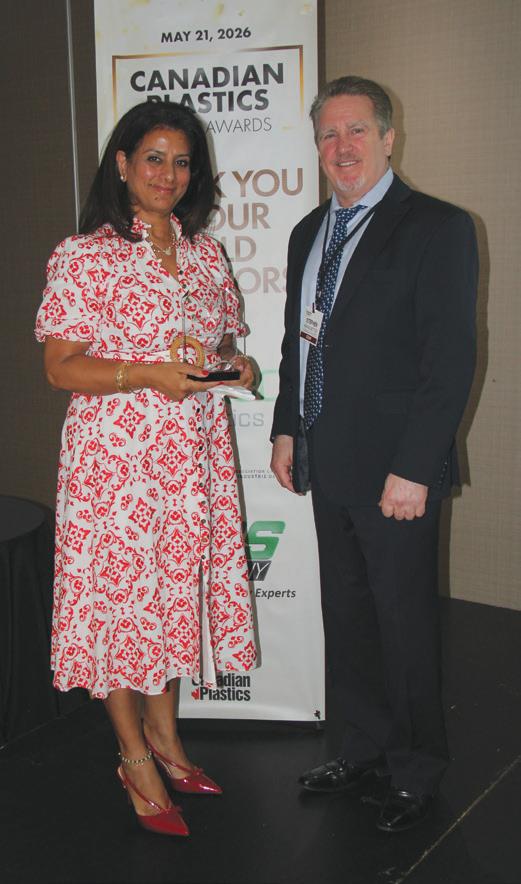
With our first-ever Canadian Plastics Impact Awards luncheon having successfully taken place on May 21 in Mississauga, Ont., we’re hoping it snowballs in a good direction: building towards an even better event next year, and then the year after that. And so on. We had approximately 60 industry members attend – which was just about capacity for the room we were in – and I saw lots of engaged networking and exchanging of contact information during the breaks.
Hopefully some fruitful business relationships will come of it.
I’d like to thank all the readers who sent in nominations for colleagues, coworkers, and customers, nominating them for various award categories. They were all deserving, and in a perfect world we could have recognized all of them. I’d also like to congratulate the award winners and honourable mentions. Each of them is inspiring in his or her own way, and you’ll find more information about them from pp. 8-11 in this issue. And a tremendous expression of thanks to our Gold sponsors the Chemistry Industry Association of Canada, Nexeo Plastics, and PCS Company, without whose generous support we literally couldn’t have done it.
With so many people in our sector due – and often long overdue – for recognition, we’re looking forward to doing it again next year.
STEPHEN editor mstephen@canplastics.com
and digital subscription inquiries or changes, please contact
Potal, Customer Service Administrator Tel: 416-510-5113 | Fax: 416-510-6875
Email: apotal@annexbusinessmedia.com
Mail: 111 Gordon Baker Rd., Suite 400, Toronto, ON M2H 3R1
Editor MARK STEPHEN 416-510-5110 mstephen@canplastics.com
Associate Publisher STEPHEN KRANABETTER C: 416-561-5362 W: 416-510-6791 skranabetter@annexbusinessmedia.com
Media Designer EMILY SUN esun@annexbusinessmedia.com
Audience Development Coordinator LAYLA SAMEL 416-510-5187 lsamel@annexbusinessmedia.com
Group Publisher/VP Sales PAUL GROSSINGER pgrossinger@annexbusinessmedia.com
CEO SCOTT JAMIESON sjamieson@annexbusinessmedia.com
SUBSCRIPTION RATES 5 issues Canadian Plastics, plus Dec. 2025 Buyers’ Guide: Canada: 1 Year $82.21 plus applicable taxes 2 Years $131.01 plus applicable taxes USA: $186.70 (CAD) / year Foreign: $213.22 (CAD) / year
Occasionally, Canadian Plastics will mail information on behalf of industry related groups whose products and services we believe could be of interest to you. If you prefer not to receive this information, please contact our audience development department in any of the four ways listed above.
Canadian Plastics magazine reports on and interprets developments in plastics markets and technologies worldwide for plastics processors, moldmakers and end-users based in Canada.
MEMBER: Magazines Canada, Canadian Plastics Industry Association.
PACKAGING
POLYKAR, POLYEXPERT MERGE TO CREATE UNIFIED FIRM
Quebec-based flexible packaging providers
Polykar Industries Inc. and PolyExpert Inc. are merging to form Invera Flexibles, a new company with over C$200 million in combined sales and 350 employees, that will make products like polyethylene (PE) films, bags, and liners.
In a May 4 news release, Invera officials said the company – formed in what’s being described as “a merger of equals” – is backed by Kent Road Capital as the majority investor, alongside MontClerc Capital, Polykar president and CEO Amir Karim, and employee shareholders.
Karim is now the CEO of Invera.
As part of this transaction, Invera is committing up to C$20 million in capital to invest in the expansion and modernization of production capacity at its Edmonton, Alta., and Laval, Que., facilities. The combined company will have production capacity of more than 150 million pounds after that work is finished.
In addition to the plants in Edmonton and Laval, Invera also has a facility in Montreal.
BY THE NUMBERS
AUTOMOTIVE
MAGNA TO SELL LIGHTING AND ROOFTOP SYSTEMS BUSINESSES
Automotive parts maker Magna International Inc. has signed agreements to divest its lighting and rooftop systems businesses through three separate transactions.
In an April 9 news release, officials with Aurora, Ont.-based Magna said a global investment firm will acquire Magna’s lighting operations serving front and rear lighting programs across North America, South America, and China. A separate investment firm will acquire its European lighting operations along with the rooftop systems business.
The businesses, part of Magna’s Power and Vision segment, generated approximately US$1.1 billion in combined global sales in 2025, including about US$1 billion from lighting and US$100 million from rooftop systems.
The release said the move aligns with Magna’s strategy to actively manage its portfolio and focus on areas that support long-term growth, margins, and returns.
The transactions are expected to close in the second half of 2026.
EXTRUSION
CANADIAN FOAM EXTRUDER ALCOT PLASTICS BOUGHT BY WR MEADOWS
Guelph, Ont.-based extruder Alcot Plastics Ltd. has been purchased by concrete construction product maker W.R. Meadows Inc., headquartered in Hampshire, Ill., for an undisclosed amount.
Founded in 1983, Alcot makes closed-cell extruded PE foam products such as pool noodles, pipe insulation, and products to improve expansion joints and window screens. In a May 7 news release, W.R. Meadows officials noted that Alcot founder Jan Alac developed a proprietary single-screw extrusion system that offers advantages such as shorter startup times, the ability to efficiently run smaller orders, and precise automatic control systems.
Alcot will continue to operate under its current name and management structure as an independent business unit, the release said, and all employees will remain in place.
W.R. Meadows is a 100-year-old familyowned firm with over 350 products, operating nine U.S. manufacturing locations and three in Canada.
The Plastics Industry Association, based in Washington, D.C., recently released the first-quarter 2026 shipment data for primary plastics machinery in North America, covering injection molding and extrusion.
US$273.5 million
The total value of shipments, down 16.4 per cent from the fourth quarter of 2025.
13%
Decrease in injection molding shipments from the previous quarter, and an increase of 19 per cent year-over-year (YoY).
24.4%
Decrease in single-screw extruder shipments from the previous quarter, and a drop of 26.2 per cent YoY.
51.2%
Decrease in twin-screw extruder shipments from the previous quarter, and a drop of 52.7 per cent YoY.
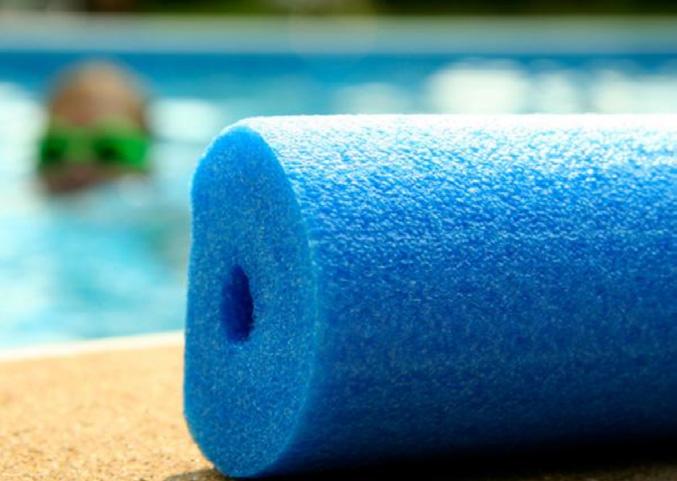
Alcot Plastics’ product lines include pool noodles. Photo: Alcot Plastics Ltd.
Amir Karim Photo: Polykar Industries Inc.
Photo: Magna International Inc.
PEOPLE
Extrusion and converting machinery maker Davis-Standard, headquartered in Pawcatuck, Conn., has named Christian Renners as president of the Davis-Standard business unit.
Midland, Mich.-based chemical maker Dow Inc. has named Karen S. Carter as CEO.
Injection molding equipment maker
Husky Technologies, based in Bolton, Ont., has named Wassim F. Labban as executive vice president of global sales.
Swedish size reduction machinery maker Rapid Granulator has named Jon Smalling as head of sales for North America, based in Atlanta, Ga.
Process cooling machinery maker Temperature Corporation, based in Markham, Ont., has appointed Melwyn Menezes as sales manager for Canada.
Tecumseh, Mich.-based blow molding machine maker Uniloy Inc. has named Chuck Flammer as vice president of machine sales, supporting the Canadian and U.S. markets.
PROMOTIONS, RETIREMENTS, RECOGNITION •If you have people in your agency recently promoted or retiring or an individual you wish to have recognized (major award or recently deceased) you can let Canadian Plastics magazine know by emailing: mstephen@canplastics.com.
Stop Paying for Wasted Energy Energy-Saving Haitian IMMs
SUPPLIER NEWS
Thermoplastic resin distributor Simcoe Plastics Ltd., based in Barrie, Ont., is now representing RAWS Americas in Canada. RAWS, based in Solon, Ohio, has developed an additive technology called RAWS Tech that enables controlled breakdown of plastics at end-of-life. Simcoe Plastics is now also distributing additives from German startup Polytives GmbH in Canada, and the two firms are also planning a joint expansion of sales activities to further regions in North America. Simcoe Plastics is owned and operated by Kurt Stahle, a plastics industry veteran with more than 40 years of experience.
Slash your power bill with every cycle. The latest energy-saving technology on Haitian injection molding machines makes the molding process more energy efficient, creating a new intelligent injection molding ecology.
HT OPTIFORCE
Reduce energy usage with AI-driven automatic clamp force adjustment to a minimally acceptable value.
SMART START-UP
Prevent energy spikes at start-up. Programmable scheduling for automatic machine start.
ENERGY MONITORING
Energy control dashboard with real-time per shot breakdown on specific parameters impacting usage.
ELECTRIC SCREW DRIVE STANDARD
Now standard on all Haitian models under 1,000 tons to improve energy usage and repeatability.
ADAPTIVE SCREW CONTROL
Adaptive control of screw rotation using AI to lower energy consumption and reduce wear on the screw.
BARREL INSULATION
Maximize heat retention with a double-layer insulated barrel cover.
Colourful plastic without dyes or pigments
Aresearch team from Donghua University in Shanghai, China has created a variety of structurally coloured plastics that are as strong as petroleum-based plastics but made from a new type of edible cellulosebased plastic that dissolves in water – which is an improvement, they said, over plastics that are dyed using specialized colourants and therefore hard to recycle.
The team used a phenomenon called structural colour – which occurs when tiny structures in a material reflect certain wavelengths of light rather than a dye or pigment molecule – to make these colourants largely unnecessary. Structural colour
new plastic can be molded into three-dimensional figures (left), extruded through a 3D printer (centre) or even folded into an origami swan
gives peacock feathers and butterfly wings their vibrant hues and dazzling shine, but certain synthetic polymers display structural colour as well, including hydroxypropyl cellulose (HPC), a derivative of cellulose used in foods and pharmaceuticals.
The researchers added citric acid, squid ink powder, and water to the HPC polymer, which formed additional hydrogen bonds within the polymer, creating a firm material as it air-dried at room temperature. The
dried material’s final hue depended on the amount of citric acid, so the researchers were able to create blue, green, orange, and red versions. The final colour intensity depended on the amount of squid ink powder present.
Next, this liquid formulation was 3D-printed into a variety of shapes, molded into small structures, formed into a thin film, and gently folded into pinwheels and origami cranes.
Because the plastics dissolved when placed in water, the original HPCbased plastic could be reformed into new shapes after being dried again.
“This work provides an efficient strategy for developing the next generation of sustainable, dye-free plastics,” the researchers said.
According to Kim
Kim Thiara, head of AceTronic Industrial Controls, tells her story.
BY MARK STEPHEN, EDITOR
Sometimes the most successful and fulfilling careers are the ones that aren’t planned for. Kim Thiara, the president and CEO of Mississauga, Ont.-based AceTronic Industrial Controls Inc. and the new Canadian Plastics Impact Awards Leader of the Year, is a good example.
Thiara had never intended on joining the plastics manufacturing technology sector – her goal, instead, was a career in interior design. But as a homemaker with four young children almost 30 years ago, she agreed to help her father Harb Mushiana – who had founded AceTronic in 1983 as a small instrument repair shop – with his invoicing paperwork and other administrative jobs, working one day a week for a few hours; and then a few years later, she was asked to take care of the sales side of the business.
And the rest has become history. Fast forward to today, and Thiara owns AceTronic, which manufactures custom parts and equipment for North American plastic manufacturers and repairs plastic manufacturing equipment and components, serving the automotive, construction, consumables, food packaging, medical, and oil and gas industries. “I had no inkling where things would go with the company when I first got involved,” she said. “I knew it would be difficult to become the second generation in a family business, and I was initially nervous that I’d be perceived as the daughter who got parachuted into the family firm without deserving it.” Thiara’s solution was total honesty with AceTronic’s customers. “I told them that I didn’t know a lot about the industry, but I wanted to learn, and I think they respected that,” she said. “There was a little bit of pushback from some, but overall, it helped develop a trust with them, and I learned and gained confidence.”
GOING HER OWN WAY
That confidence notwithstanding, a challenge came when Thiara decided to buy the company in July 2008. “Anyone in business needs to find their own passion in order to succeed – you can’t channel someone else’s,” she said. “My father had started AceTronic for his reasons, and I needed
Kim Thiara, the Leader of the Year for the inaugural Canadian Plastics Impact Awards. In addition to leading AceTronic, she served on the board of directors of APMA, as the first female chair of CAMM, and has organized several AceConnex shows.
to find my own to commit to it, and I did: first, I wanted to carry on my father’s legacy; and second, I enjoyed the fact that we were genuinely helping our customers. My father was all about doing everything to help the customer, and that resonated for me as well.”
Almost immediately, Thiara was thrown a curveball: she had bought the company just six months before the economy collapsed. AceTronic’s business almost came to a standstill during the Great Recession, and the company went from having nine employees to four. “It was an extremely challenging time to run the company,” she said. “We were going through a terrible global recession, and many of our customers didn’t survive. My biggest fear was that I would fail, but with hindsight I believe the experience made me stronger, and it forced the company to become lean immediately, which made us stronger.”
AceTronic survived and has been growing steadily since. The Covid pandemic was another challenge, although less so than the Great Recession. “Many of our customers pivoted to PPE [personal protective equipment] production, so our business remained stable,” Thiara said. “The challenge was to keep our employees safe, which we did.” As acknowledgements of its success, AceTronic has been named the Canadian Aboriginal and Minority Supplier Council’s Small Business of the Year and the Mississauga Board of Trade’s Business of the Year.
LENDING A HAND
In addition to managing AceTronic’s day-today tasks, Thiara is an ardent industry volunteer. She served on the board of directors for the Automotive Parts Manufacturers’ Association (APMA) and was then approached, at the same time, to lead the Canadian Association of Moldmakers (CAMM), of which AceTronic was a member company. She said yes with a particular goal in mind. “Because of its connection to Detroit-based auto parts work, CAMM had always been focused on the Windsor, Ontario area,” Thiara said. “But I wanted it to be more inclusive and more representative of all the molds shops in Canada. My being in the Toronto area helped: I could speak on behalf of all the moldmakers – not just those in automotive – and we were able to broaden our focus. I served as the first female CAMM chair for two years and enjoyed every minute of it.”
Another accomplishment for Thiara is organizing one-day trade shows for AceTronic called AceConnex. “We’ve held two AceConnex shows, the first at a hotel in 2019 and the second at Humber College’s North Campus in Toronto in 2024,” she said. The shows had tabletop exhibitors; panel discussions focused on workforce strategy, skilled trades development, and industry priorities; and student demonstrations highlighting applied learning, technical skills, and job readiness. “The AceConnex shows emphasized collaboration across sectors – in particular between academic research and manufacturing – to better align training with realworld manufacturing needs,” Thiara said. “This was a way for us to gather as a plastics community and show off the diverse plastics manufacturing sector beyond just automotive. The feedback I got from attendees was that we need to come together, despite being competitors. I love connecting people, and AceConnex did that.”
CLOSING THE GENERATION GAP
As a second-generation member of Canada’s plastics industry, Thiara is increasingly drawn to attracting young people into the sector. “I feel that plastic has gotten a negative connotation, unfortunately,” she said. “Through my work with AceTronic, APMA and CAMM, and the AceConnex shows,
we’re working to dispel the myth that plastics manufacturing is dark, dirty, and dangerous,” she said. “And it’s important to do that because the workforce shortage is pressing. People are retiring in droves, and we don’t have the next generation in place.”
Artificial intelligence (AI) might help offset some of the attrition, Thiara continued, but knowledgeable, skilled tradespeople are
still the industry’s future. “We have a lot of untapped resources and potential, and even with AI, people will have to control it, so this can offer new careers in addition to the skilled workers that we’ll always need,” she said. “I’m an optimist, and I treat AI as another test to show our resilience, just like all the other tests our industry has endured and triumphed over.”
And the winners are…
Meet the winners and honourable mentions in our five award categories.
BY MARK STEPHEN, EDITOR
On May 21, we celebrated the winners and honourable mentions of the inaugural Canadian Plastics Impact Awards at a luncheon in Mississauga, Ont. On pp. 8-9, we profiled Kim Thiara, our Leader of the Year. Here are the others who were recognized, as nominated by our readers and selected by our committee.
EMERGING LEADER OF THE YEAR
Olubukola Alimi, assistant professor, Faculty of Engineering, University of Alberta.
The winner of the Best PhD Dissertation Award for 2022 from the Canadian Society of Chemical Engineering, Dr. Alimi is now researching the environmental behaviour of microplastics and nanoplastics, and recently led a student team in developing MicroTrap, a 3D-printed filtration device that captures microfibres from wastewater with a removal efficiency of up to 99 per cent in laboratory testing.
HONOURABLE
MENTION
Tania Ferlin, director of sustainability advocacy, Husky Technologies.
LEADER OF THE YEAR
HONOURABLE MENTION
Patrick Lee, associate professor, Department of Mechanical and Industrial Engineering, University of Toronto.
Dr. Lee’s research focuses on nanostructured polymers, composite materials, and sustainable plastics.
LIFETIME ACHIEVEMENT
David Yeaman, president and co-founder, Molded Precision Components. Since purchasing Molded Precision Components, based in Oro-Medonte, Ont., in 2006, Yeaman has built the injection molder from a dormant shop into a 70,000-square-foot, vertically integrated, stateof-the-art manufacturing company operating more than 48 molding machines with approximately 85 employees at two plants, producing approximately 110 million parts annually.
HONOURABLE MENTION
Rocky Vermani, senior vice president, innovation and sustainability, Borouge (formerly Nova Chemicals Corp.).
Vermani joined Calgary-based Nova in 1994 as process engineer, and since then has served the company in several roles throughout manufacturing, technology licensing, polymer sales and marketing, olefins products business, and olefins feedstock and energy acquisition.
In addition to leading Bolton, Ont.based Husky’s sustainability advocacy and ESG strategy, Ferlin currently serves as chair of the Future Leaders in Plastics (FLiP) mentorship program and sits on the Society of Plastics Engineers executive committee. SCAN HERE FOR EXPANDED PROFILES
Canadian Plastics would like to thank our Impact Awards luncheon sponsors the Chemistry Industry Association of Canada, Nexeo Plastics, and PCS Company.
INNOVATOR
Nello Sansone, co-founder, NanoMorphix.
As a post-doctoral researcher at the University of Toronto (U of T), Dr. Sansone invented Gratek and Clatek, two breakthrough composite materials that offer vehicle manufacturers lighter, highimpact components. He is also advancing AegisX Transparent Armour and AegisX Textile Armour technologies, products he designed as co-founder of a U of T spin-off called NanoMorphix.
HONOURABLE MENTION
Christian Euler, assistant professor, Department of Chemical Engineering, University of Waterloo.
Dr. Euler is a leading researcher in the development of new ways to recycle plastic waste into products that are more valuable than the original material.
SUSTAINABILITY
Martin Vogt, president and CEO, EFS-plastics Inc. Vogt is a plastic engineer technologist with over 15 years of experience in post-consumer recycling in Germany and over 18 years of experience in Canada. Under his guidance, post-consumer plastics recycler EFS-plastics, based in Listowel, Ont., has diverted more than one billion pounds of scrap plastic into usable resin.
HONOURABLE MENTION
Tony Vella, vice president of materials, Vision Extrusions Group.
Vella also serves as chair of the Vinyl Institute of Canada, in Niagara Falls, Ont., and helped launch Project WinFinity, the first Canadian program for recycling post-consumer vinyl windows.
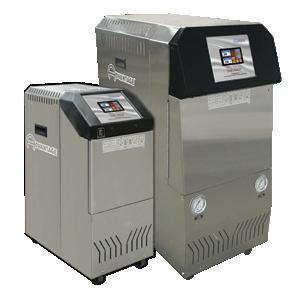
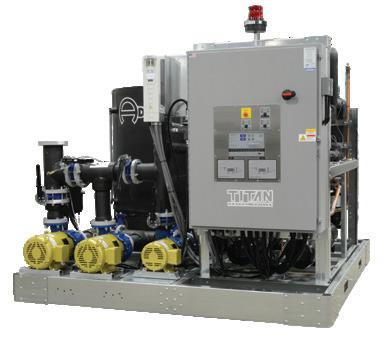
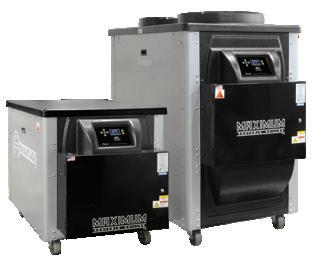
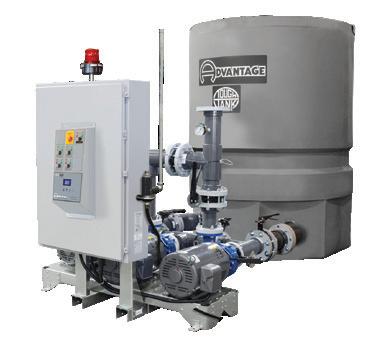
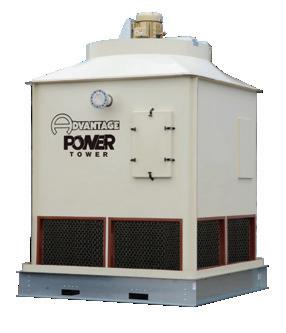
PLANT WIDE CENTRAL CHILLING EQUIPMENT and SYSTEMS
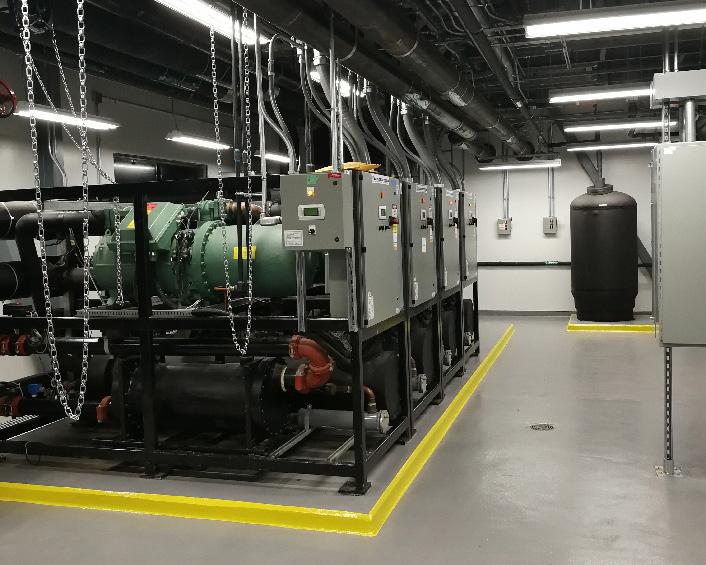
Canadian made Chillers that can both Heat and Cool your process:
MODULAR CHILLERS - Chillers that couple together for an easy simple installation and also make it easy to expand the current system, just couple the new chiller to the existing system.
REFRIGERANTS AVAILABLE – Chillers can have either a mildly-flammable or a nonflammable, non-flammable is a must if the chilling system is open to the plant.
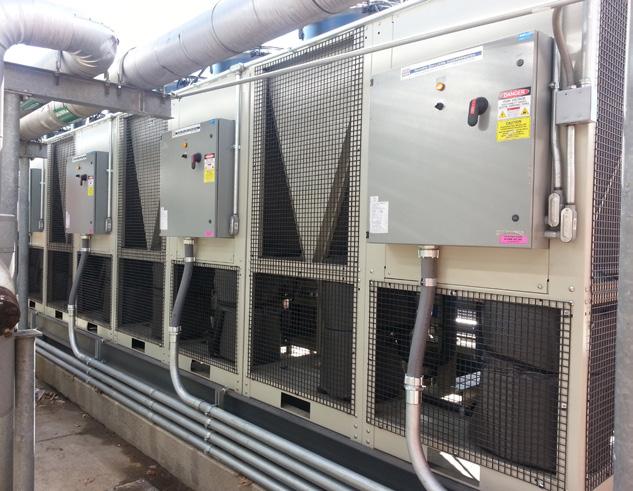
CHILLERS AVAILABLE - As Water Cooled, Indoor Air-cooled, Outdoor Air-cooled, Remote Condenser Air Cooled. Outdoor air-cooled units available for all outdoor winter ambient temperatures.
PUMP TANKS - Chilled water and tower water packages with double pumps, third pump manual stand-by, four pump automatic stand-by. Other arrangements available as well.
INSTALLATION - From plant layout pipe sizing drawings to complete turn key installations in southern Ontario.
PORTABLE CHILLERS – Air and water cooled, Indoor and outdoor, single and dual compressors, single and dual pumps and larger or special tanks.
Selecting the right plastics granulator to fit your needs can be challenging. Here’s what to consider.
BY MARK STEPHEN, EDITOR
Choosing the right granulator is one of the most important decisions in a plastic production facility. But unlike with recyclers – for whom size reduction is everything – some processors don’t take it as seriously as they should. “For a recycler, the granulator is the primary piece of equipment, whereas for the processor it’s secondary – almost a necessary evil – and some of them treat it like that,” said Mike Cyr, president of Rotogran International Inc., in Bolton, Ont.
But you should take it seriously. A granulator that doesn’t match your material or production requirements can lead to frequent breakdowns, excessive fines and dust, inconsistent particle sizing, and costly downtime – and can even be risky when used in certain environments or situations. It’s also a potential bottleneck that disrupts downstream equipment such as extruders, washers, dryers, and pelletizers.
Unlike shredders, which produce rough, irregular pieces for pre-processing, granulators deliver a finished particle size in a single pass, making them the final – and sometimes the only – size reduction step for processors looking to reclaim their regrind. Every granulator shares three core components: a cutting chamber – with three basic designs: conventional offset, tangential, and straight-drop – a screen that determines output particle size, and a drive system.
But they’re not all created equal, and they can vary wildly in performance from brand to brand. So selecting the type of granulator that best fits your needs means being laser-focused on its intended use. That, in turn, depends on taking a few factors into consideration. And sometimes, if they go it alone, processors prioritize the wrong things. “The biggest mistake people make is jumping straight to machine size,” said Jon Smalling, head of sales for North
America for Rapid Granulator, with North American offices in Leetsdale, Pa. “In reality, the machine is the last thing we decide.”
APPLICATION-SPECIFIC
The first thing to consider, the vendors say, is the application, since there are different demands on the granulator depending on the process: either injection molding, extrusion, blow molding or rotational molding. “For extrusion and blow molding, for example, it’s necessary to take into account the production of rejected parts during the starting phase,” said Denis Metral, international granulators sales manager at Wittmann Battenfeld France. “Cutting chamber designs are adapted to injection molding, extrusion, and blow molding to allow the best efficiency for feeding the cutting chamber.”
Beyond that, the end products have different characteristics that can affect size reduction, beginning with injection molded preforms, some vendors say, which can be difficult to grind. “Blow molding and rotational molding typically make bulkier parts than injection molding and require tangential or super-tangential granulators to be able to process those parts,” said Bob Harrison, product manager, size reduction group with Piovan UnaDyn, in Fredericksburg, Va. “Extrusion granulators may include roll-feed assemblies for inline use or to meter/automate feeding of off-spec rolls of sheet or film offline.” Also, there may be a catch with blow molded parts, according to Joe Platek, sales director at New Berlin, Wis.-based ACS Group, which owns the Cumberland brand. “Since a blow molded part will contain a lot of air and not much throughput by weight, this could require more open area in the
chamber to allow for part ingestion,” he said. Also, blow molded tabs and tails can be very hot. “In that case, you may want to have water-cooled chilling in the granulator,” Mike Cyr said. “And hot parts will create fines and dust, so you want to know that.”
MATERIALS MATTER
The type of process matters not in and of itself, in short, but because of what it can mean to part material – different plastics have different hardness, melt temperatures, and fracture behaviours, so they may react differently in a granulator. “Slow-speed grinders will work on any rigid or engineered resin but not on flexible resins like thermoplastic elastomers,” said Graeme Sands, general manager at Globeius Inc., based near Toronto.
The weight of the part determines if the granulator is going to be shock loaded, some vendors say – capable of taking a shock load of 100 pounds at once, for example. Most granulators are built to be uniformly fed at a specified rate and aren’t designed to absorb
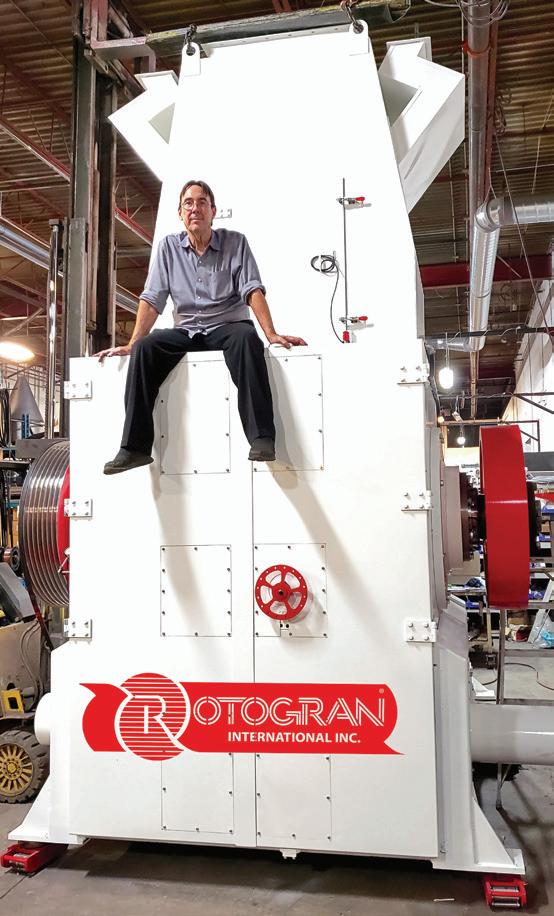
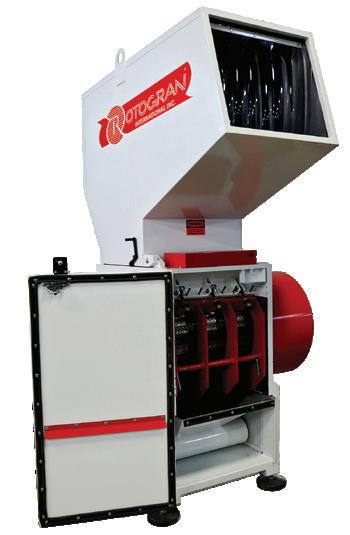
large shock loads for a short time, although some brands can handle the shock loading. Designed for under-shredder applications, Rotogran’s new WO-2260-XHD Severe Duty Granulator can absorb and withstand repeated shock loading, according to Mike Cyr.
Part geometry also matters, since the form the parts will take – molded parts, bottles, film, pipe, or mixed bales – means the granulator might need to be configured differently, for example if bottles or sheets are being processed. “This is where thoughtful engineering really shows up,” Jon Smalling said. “Machines that allow quick access for knife changes, consistent knife settings, and repeatable setups make it much easier to adapt across materials without sacrificing performance or increasing downtime.”
At the other end of the part-weight spectrum, Bob Harrison noted, film and other very thin materials require granulators with adjustable rotating knives for the tightest gap possible, rotating end disks so materials don’t wrap around the rotor, and thinner
screens to allow easier passing of lightweight materials through the screen.
All of this is why before choosing a granulator, some vendors suggest listing every type of material your shop will process (polyethylene, nylon, polyvinyl chloride, et cetera), since soft/flexible materials require high-speed, scissor-action, slant-knife cutters; while brittle materials require slower speeds and specific, higher-angle knives.
Fillers, additives, and percentages of each material type are essential points to consider, as well – in most instances, your feed stream and horsepower requirement will depend on all these factors; and depending on your materials, you may also need different screens for regrinds. “The key is matching the machine to the possible scrap types and not forcing the scrap to fit the machine,” Jon Smalling said. “When that alignment is right, feeding becomes more consistent, cutting is more efficient, and the entire process becomes more predictable.”
And keep your end goal in mind – knowing
the physical shape and size of raw materials compared to the end goal will help determine the chamber dimensions, chamber shape, and quantity of fly knives.
CONSIDERING THROUGHPUT
A huge consideration is throughput – the output volume processed per hour, in either kilograms or pounds. As a rule of thumb, some vendors say, when calculating the required throughput of beside-the-press units, match to press cycle time and shot weight; and for central systems, when calculating the required throughput, sum all machine scrap rates and add 30 per cent surge capacity.
But that’s not the whole story. “Throughput is really a combination of the cutting chamber size, rotor design, knife configuration, screen size, and how the material is fed and evacuated,” Smalling said. “If you tighten up your screen size to get finer regrind, you’re naturally going to reduce throughput.” The best-performing systems, he continued, are balanced. “They’re designed so the material flows smoothly through the machine instead of fighting it,” Smalling said.
Next, the maximum size of materials to be granulated must be smaller than or equal to the inlet diameter of the granulator without requiring labour-intensive and potentially dangerous precutting. “Anything smaller will fit, obviously,” said Mike Cyr. “If the part gets too big, the opening may have to be higher in the air, in which case you’ll have to use a conveyor to feed it.”
Granulators also host different knives, all of which vary in arrangement, size, sharpness, and angle for individual
Choosing the granulator that best fits your needs means being laser-focused on its intended use, but processors will sometimes prioritize the wrong things.
purposes. But when it comes to materials of construction, for once you don’t have to decide anything: D2 tool steel remains the standard, most-used steel for general-purpose granulator blades. “Blades from different materials have been trialed over the years, and if you go with harder materials you give up other properties, so most suppliers have settled on a specific hardness of D2,” said Joe Platek.
WHERE DO YOU WANT IT?
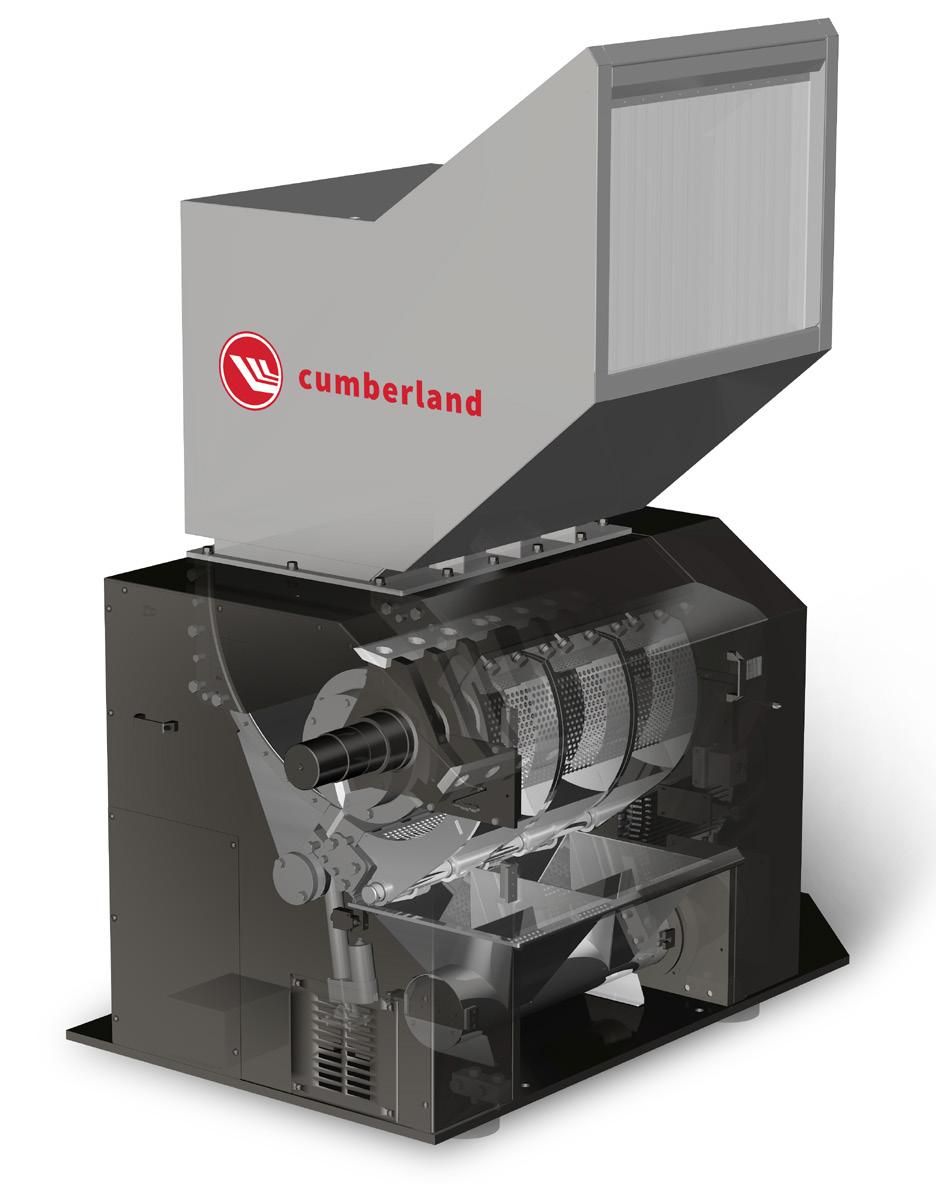
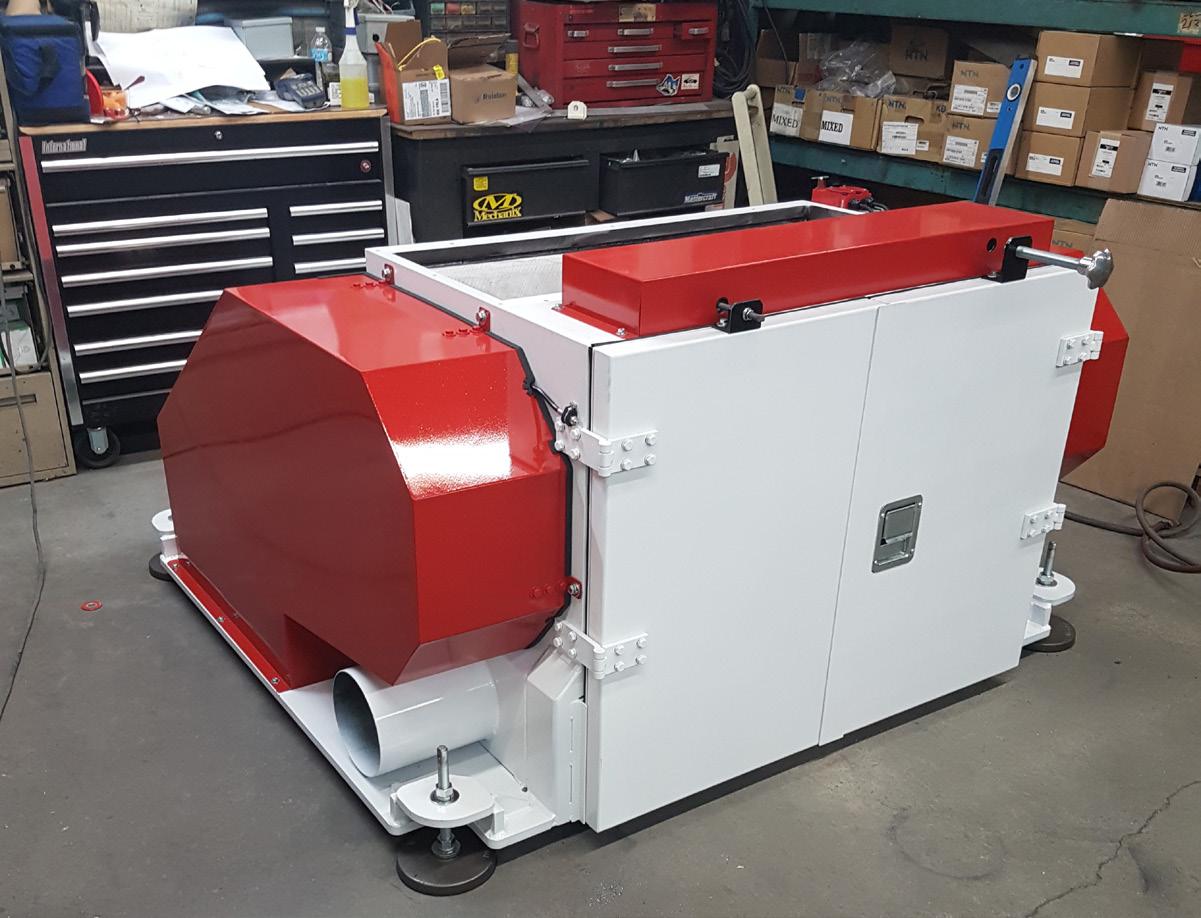
A Cumberland T50 series central granulator. Central granulators are designed for continuous operation and larger volumes of heavier scrap than press-side units, and usually feature heavy-duty steel construction.
Another decision is whether you want a beside-the-press or a central granulator. Beside-the-press granulators can integrate into any molding or extrusion operation without disrupting the layout of the factory floor and lend themselves particularly well to shorter production runs with small cutting amounts. They offer immediate inline regrinding, eliminating the need to collect, store, and transport materials to a central location; create minimal dust and fines; and operate at low rpms, for reduced energy usage. “The use of a beside-the-press granulator tends to be intermittent, as sprues are produced according to the cycle time of the mold,” Denis Metral said. Being able to move the unit from press to press is an obvious benefit of those models, Metral continued, but the operator will need to check the feeding height on each new press. Pressside units open a potential Pandora’s box in other ways too. “Noise might be an issue, and we need to determine how to evacuate the granulator if it’s beside the press,” said Mike Cyr. “Options include a loader system that ties into an existing loading system, or a standalone evacuation system that will fill a Gaylord or box near the granulator.”
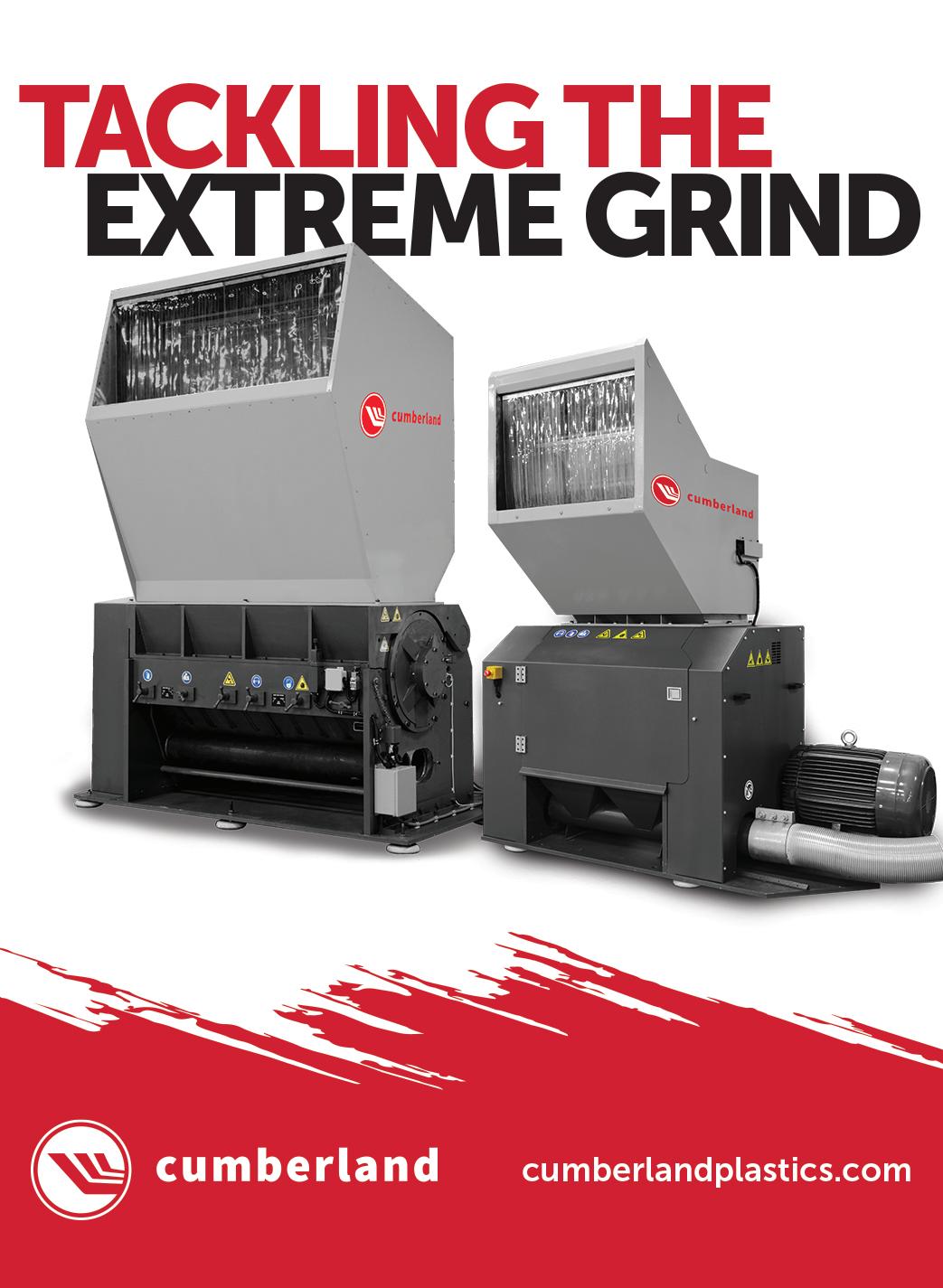
Central granulators, by contrast, are designed for continuous operation and larger cutting amounts, and usually feature heavy-duty steel construction, which gives them robustness and versatility; and offer the flexibility to process heavy-duty scrap that press-side units can’t take. Cumberland’s T50 series central granulators can handle large injection or blow molded scrap, furniture components, and appliance parts, said Joe Platek. But a central granulator equates to more complexity in the planning
Here’s a look at what’s inside the upcoming September 2026 issue of Canadian Plastics magazine:
Automation and AI are transforming multiple industries, including blow molding. These technologies enable machines to operate with greater precision and speed, reducing downtime and cutting operational costs. This article will spotlight some of the latest blow molding machines that are equipped with sensors and AI-driven controls.
ALSO IN THIS ISSUE:
• The growing use of engineering plastics in rotational molding
• The transition from Industry 4.0 to Industry 5.0
• Colourants for biopolymers
stage. “With a central machine, you may need to account for running material from multiple lines,” Platek added. While the choice is up to the customer, if the parts are too big, most vendors will strongly suggest the central granulating option to avoid the headaches of adding a conveyor to a press-side granulator. “If you go that route, then you have to start talking about a system, because it will require a central control panel, where the pieces of equipment – the conveyor, granulator, and blower – are talking to each other and running in sequence,” Mike Cyr said.
FEEDING TIME
This ties into the question of how you’re going to feed material into the granulator, which is another consideration during the planning stage. “There are various options –conveyor, by hand, a dump station, a robot – and we need to know this when recommending a granulation system,” said Joe Platek.
Some vendors recommend that processors buy slightly oversized granulators as buffers. “I always suggest that customers consider a granulator bigger than may be required,” said Bob Harrison. “The reason is to have more open screen area – and the more open screen area, the faster material cut small enough to fit through the screen holes will go through, leading to higher quality regrind.” Also, some vendors say, oversized granulators can process large, awkward, or thick-walled items – such as car bumpers and large pipes – that would jam or bridge in standard-sized units. “Nominally, an oversized machine makes sense if there’s a need to put larger scrap parts in occasionally, rather than just runners,” said Graeme Sands. Finally, choosing a granulator that comfortably meets or exceeds current peak production load lays the groundwork for future capacity expansion. “It’s an option that’s frequently
chosen by customers when the price is competitive from one size to the other,” said Denis Metral. “The only downside is that oversized machines can lead to unnecessary energy costs, which might be an issue for some shops.”
Vendors might also recommend different features depending on the specifics of an application, such as wearresistant components, safety interlocks, and dust extraction systems. “Also, do you want warning lights?” said Mike Cyr. “Handfeeding is common in beside-the-press granulation, and a safety alarm device will tell the operator if too much is being fed into the unit.” And on the topic of safety, some vendors stress that equipment operators should also have a clear visual path in order to inspect the equipment in cases where the granulator needs to be cleaned between each processing run.
TO PRE-SHRED OR NOT
Rotogran’s new WO-2260-XHD
Severe Duty Granulator for under-shredder applications can withstand repeated shock loading.
The vender will also need to know if it will be necessary to pre-shred before granulation. “Pre-shredding allows a more productive installation that makes the process smoother, protects the granulator, and creates less energy consumption,” said Denis Metral. “Pre-shredding and granulating, together, are an excellent combination for thick, large parts.” Pre-shredding can be achieved either in an integrated system where a shredder and granulator are designed to work together; or by cutting large, heavy parts by hand. Some vendors favour this two-stage approach, while others recommend it only in certain circumstances. “We only suggest using a shredder or band saw to cut parts down to size to physically fit in the grinder, assuming the granulator is sized for runners and the customer has the odd large scrap part,” said Graeme Sands. Other vendors note that pre-shredding is usually not necessary for heavy-duty granulators that have been properly designed. “A strong, well-built, well-designed granulator won’t need to pre-shred,” said Mike Cyr. Finally, a question for the end of the process – but which needs to be considered upfront – is how the granulated material is going to be evacuated, which is a crucial step for maintaining high throughput, preventing heat buildup, and ensuring consistent particle size. Options include negative pressure systems, blower/cyclones, compressed air, and an auger or belt conveyor. Press-side granulators are often configured with an evacuation system that sends regrind material back into the process line, some vendors say – it can be completely automated, eliminating manual processes and the resulting material losses and leakage. In the end, choosing the right granulator is a big task that depends on considering a host of factors: input material throughput, output flake size requirement, and operational scale. Which is why, rather than buying something based on nameplate capacity, consulting with a trusted vendor – which can include material trial results – will lead to the best result.
Ghost gear busters
The non-profit Ocean Legacy Foundation is recycling ‘ghost gear’ and other marine plastic waste into sustainable, responsible consumer goods.
BY MARK STEPHEN, EDITOR
Most of us, when we’re in the right mood, enjoy a good ghost story. “Ghost gear” stories are even more frightening, however, because they’re not fiction. Abandoned, lost or intentionally discarded plastic fishing nets, traps, buoys, and rope left adrift by fishers and industry, ghost gear is considered the most lethal form of plastic debris to marine life, killing numerous species such as fish, seals, sea lions, and sea turtles, all of which can get entangled in the nets or ropes and suffocate or starve. And it’s a problem that intensifies every year: Worldwide, between 640,000 to 800,000 metric tons of fishing gear enter the oceans annually, according to estimates, and it can stay in the water and on shorelines for centuries.
Combatting ghost gear – and other types of ocean plastic waste – was the founding mission of the Ocean Legacy Foundation, a Richmond, B.C.-based non-profit organization that develops and implements worldwide plastic pollution emergency response programs, combining field operations with technical innovation with the goal to end plastic pollution.
An accredited United Nations Environment Programme entity, Ocean Legacy was founded in 2013 by Chloé Dubois and James Middleton to fill the gap in the lack of scalable, systemic solutions to address marine debris. “Early shoreline cleanup efforts quickly revealed that without proper downstream infrastructure and circular economy pathways, collected materials were often landfilled or mismanaged, perpetuating the problem,” said Dubois, who serves as Ocean Legacy’s executive director. Dubois and Middleton envisioned something better: a systems-based approach that focused not only on cleanup, but also on material recovery, recycling, and reintegration into the economy.
DOWNSTREAM SOLUTIONS
Since 2013, Ocean Legacy has collected marine, shoreline, and ocean-recovered plastics through its own cleanups, and from community partners at different landfills in B.C. and other provinces and marine industry partners. In total, Ocean Legacy receives about 800 to 1,000 metric tons per year. The recaptured plastics go to Ocean Legacy’s Richmond recycling facility, where they’re sorted, shredded, melted, extruded, and diced into pellets that are sold
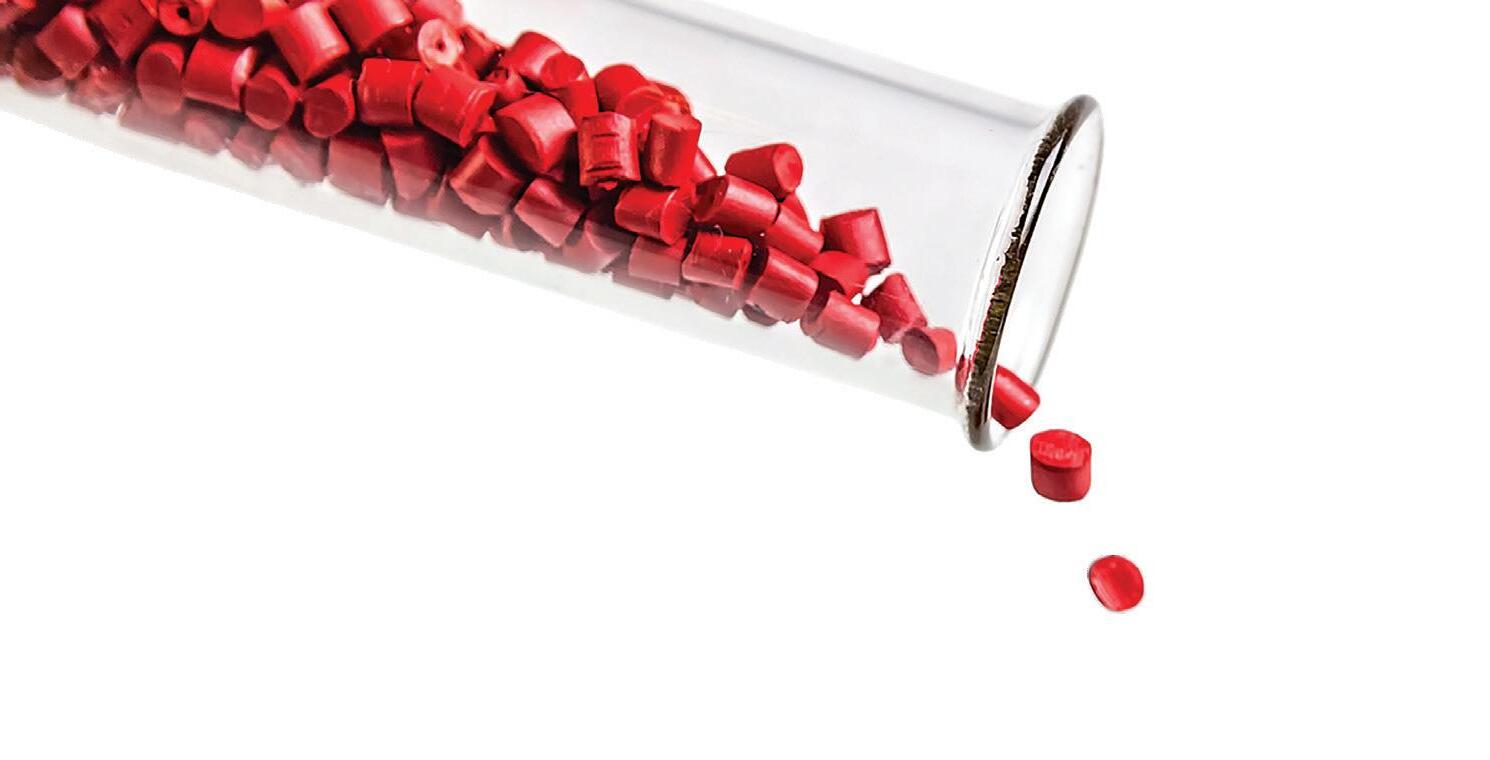
to manufacturers under the brand name “Legacy Plastic.” Key applications for the 100 per cent post-consumer processed pellets include deck furniture, construction lumber, and tower planters. “Commercializing our ‘Legacy Plastic’ brand is one of our key success stories,” Dubois said. “It demonstrates that ocean plastics can be transformed into valuable resources, effectively closing the loop and reinforcing the viability of a circular economy.”
The Richmond facility processes up to 1,000 kilograms of waste per hour. Waste plastic and other materials that Ocean Legacy can’t recycle – including potato chip bags, polyvinyl chloride pipe, metal, wood, and glass – is stored on site and eventually sent to other recyclers in the Lower Mainland. Ocean Legacy gets some revenue from selling its pellets, and other revenues come through a combination of government grants, donations, and sponsorships. In addition to a broad network of partners, volunteers, and global collaborators, Ocean Legacy currently has 20 core employees and five on-call workers. And it’s no longer confined to B.C.’s Pacific coastline: Ocean Legacy recently began collecting marine plastics from Nova Scotia and New Brunswick and wants to one day open a recycling facility on the East Coast. “We also collaborate with recyclers, product manufacturers, NGOs [non-governmental organizations], and governments in the U.S., Latin America, Southeast Asia, and Africa, supporting local material
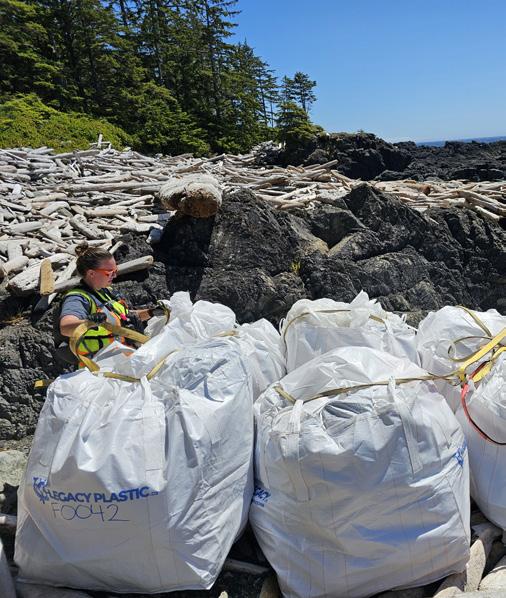
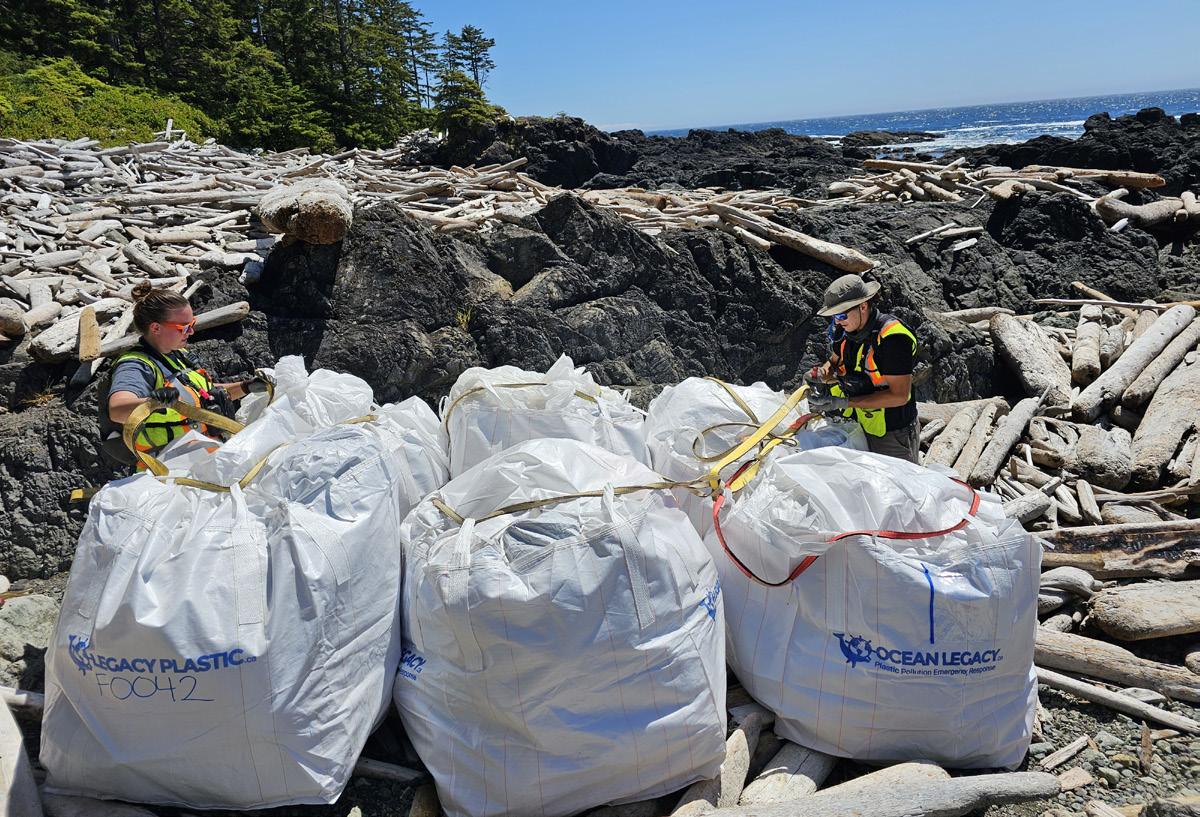
A shoreline cleanup of plastic waste by Ocean Legacy workers.
recovery and sharing technical expertise and system design,” Dubois said. In a noteworthy project in 2023, for example, Ocean Legacy partnered with the Guatemalan environmental organization HaciendoECO to have locals and students remove solid waste from the Motagua River – the longest river in Guatemala and one of the world’s most polluted – and receive education about recycling.
AN EPIC PROGRAM
In addition to the downstream solutions of recovery and reuse, Ocean Legacy is concentrating on making changes upstream, through its EPIC program – education, policy, infrastructure, and cleanup – which offers online curriculums on the ocean plastic problem’s origins, impacts, and solutions; shares research reports to influence government policy; promotes zero-waste strategies; and helps develop best practices and strategies for shoreline cleanups. “It serves as a scalable blueprint for communities looking to implement comprehensive plastic pollution mitigation strategies,” Dubois said.
Ocean Legacy also works with communities that want to get a handle on excessive plastic pollution through what it calls an Emergency Management System (EMS), which incorporates mitigation, prevention, response, and recovery measures. “EMS provides the foundation for coordinating and integrating all activities necessary to build, sustain, and improve the capability and capacity to mitigate, prepare and plan for, and respond to and recover from threatened or actual
Yes, Better Than...
plastic disasters,” Dubois said.
And in 2025, Ocean Legacy rolled out its Marine Plastic Management Program to help support fishers and aquaculture workers in repurposing marine plastics while driving Canada’s circular economy. The program accepts oyster baskets and crab pots, foam floats, hard plastic buoys and hard plastic fragments, high-density polyethylene pipe, beverage bottles, netting, rope, barrels, and Styrofoam. End products include soap dishes, compost bins, garden planters, plastic lumber, park benches, picnic tables, and patio furniture under the “Legacy Plastic” brand.
A GOOD START
Nearing 14 years in business, Ocean Legacy has demonstrated its capabilities time and again: it’s removed millions of pounds of ocean plastics and helped redirect much of it towards sustainable, responsible consumer goods. And its mission is evolving. “While our operational roots are in British Columbia, our work has expanded well beyond the Pacific Northwest,” Dubois said. “We’re moving beyond cleanup to deliver scalable, end-to-end solutions that address plastic pollution at its source while creating long-term environmental and economic value.”
But despite the good start, the work won’t be considered done until the spectre of ghost gear – and ocean waste plastic in general – has been vanquished for good.
• Designed to meet your needs by our application & engineering specialists
• Energy saving technologies such as digital scroll compressors, variable speed pumps & fan drives
• Chillers utilize low GWP refrigerants
• Available OPC UA EM82.1 communication capability
• Our factory-based service representatives are dedicated to assisting customers
Haitian’s X-Injection technology is a new-generation artificial intelligence (AI) solution purpose-built for injection molding scenarios. Leveraging advanced AI and a native edge-to-machine coupling architecture, the system is built around the two key pillars of setup optimization and
production health. It analyzes data from the injection process, proposes initial and optimization parameters, and documents the rationale behind each recommendation to reduce setup time, lower energy consumption, and deliver stable part quality from the first shot. X-Injection is part of Haitian’s HT-Xtend concept, linking machine intelligence with process intelligence. It’s supported by a built-in large language model assistant that helps diagnose faults and select parameters. The platform also includes advanced tools such as DOE designer, AI-based process prediction, what-if analysis, and multi-objective optimal setup recommendation.
www.absolutehaitian.com
Minutes MAtter
Are changeovers keeping you off your pace?
Dyna-Purge cleans on the first pass, minimizing machine downtime to maximize your productivity! Plus, only Dyna-Purge provides product and technical support built on over 30 years of innovation. Our customers enjoy the industry’s most effective commercial purging compounds, outstanding customer service and reliable results. Start saving time and increasing profits today.
Request a free sample of Dyna-Purge and see for yourself.
Easy-to-use control variant
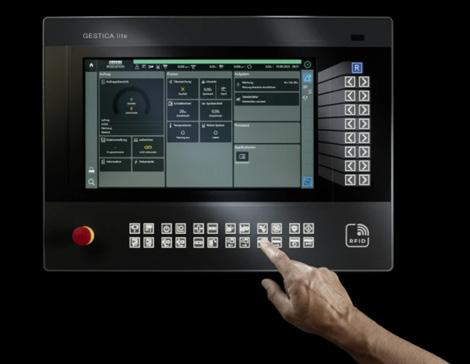
Arburg’s Gestica lite is a new, easy-to-use control variant for standard injection molding machines,designed to make operation simple even for non-qualified personnel. The user interface provides everything needed for work at a glance, streamlining the molding process and reducing the learning curve for operators. A new “Dashboard” homepage displays key functions for daily work, including job and process information and direct access to the most important parameters. The new “Status Centre” provides access to pending alarms, and the “Help Centre” links to online support.
The “Tasks” area covers
maintenance, material supply, and parts disposal; and a digital “Pinboard” supports collaborative notes at the machine. Navigation and search are simplified and enhanced with AI, and assisted workflows with visual solution trees support troubleshooting. The software basis is identical to Gestica and their data records are fully intercompatible.
www.arburg.com
Locating rings for precise mold attachment
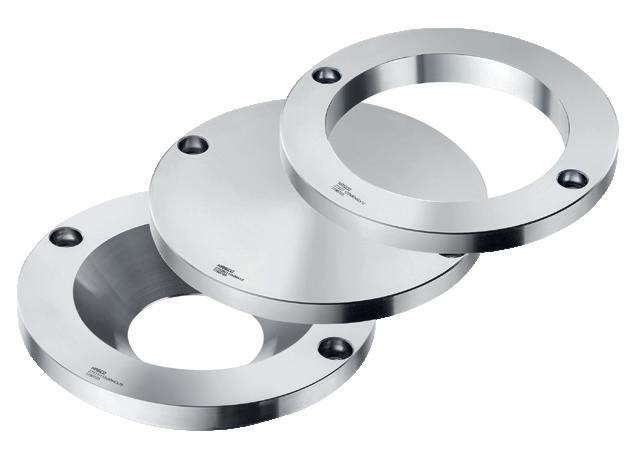
New locating rings from Hasco, with designations of Z7517, Z7526, and Z7527, are designed to provide precise centring and reliable guiding of molds when clamping on an injection molding machine. They have an extended guide length of eight millimetres (mm) and thicknesses of six mm and eight mm, and can work in combination with Hasco’s thermal insulating sheets. Benefits of the locating rings include precise positioning on the machine side, simple assembly, and long-term process reliability. The locating rings’ extended guide length prevents tipping of the mold, allowing for increased process reliability. Fixing holes enable reliable flush tightening, while flexible adjustment possibilities guarantee optimum integration in different mold constructions. www.hasco.com
New controller for all-electric machine
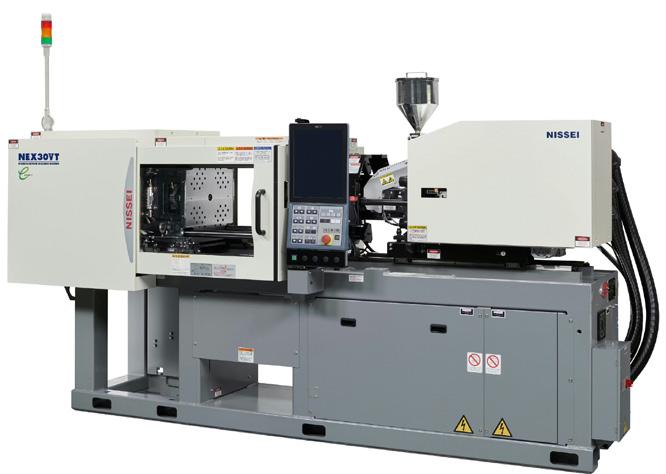
Nissei’s all-electric NEX30V-1EN1 micromolding press – which features a two-stage, high-precision injection unit that consists of a screw and plunger, for ultra-stable molding under 1.0 grams per shot – has a new Tact5 controller that enhances machine precision and includes Industry 4.0 capabilities such as Internet of Things (IoT) connectivity and smart factory integration. IoT-enabled systems include N-constellation –Nissei’s trademarked IoT package that allows the injection molding machine to serve as a network hub, integrating auxiliary equipment and connecting into a smart factory. With 33 tons of clamping force, the micro-molding press has a 14-mm screw diameter. Clamping stroke is 230 mm, and ejector stroke is 50 mm. Maximum daylight opening is 605 mm. Tie-bar clearance is 310 mm by 310 mm. Super-clean specification, a fan unit with HEPA filter, is available as an option, which improves the cleanliness significantly to reach a Class 6 level. www.nissei.com
World’s largest injection molding machine
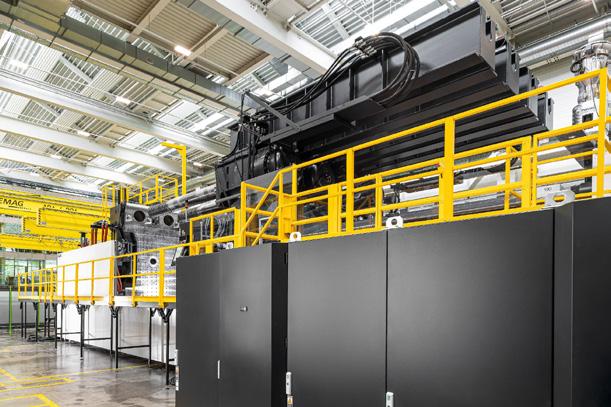
With a clamping force of 12,365 tons, the Engel duo 12000 US is said to be the world’s largest injection molding machine, developed specifically for the cost-efficient production of large-format components in previously unattained dimensions. Measuring 24 metres
in length by approximately 8.4 metres in height, the machine remains compact thanks to the modular design principle of the duo series, thereby saving valuable floor space. The machine is equipped with two injection units operating in parallel, and with screw diameters of up to 210 mm, they enable a shot volume of up to 65,000 cubic centimetres and homogeneous filling of large projected areas. Despite its dimensions, the Engel duo 12000 US exhibits exceptional precision – through options such as injection compression molding, component dimensions can be defined to an accuracy of a few hundredths of a millimetre.
www.engelglobal.com
Your customers count on products that deliver. It takes precision, consistency, and materials you can trust to perform without compromise. That’s why we produce polypropylene that meets your standards. Our resin is made in one of Canada’s most stable and prolific propane-producing regions, giving you dependable supply and the confidence that comes with it.
And with Heartland Polymers you get service that’s ready when you need it and a partner committed to helping you keep your production strong, steady, and always ready.
We believe in better.
By Shane Vandekerkhof, RJG Inc.
Five injection molding quality issues that quietly destroy profitability
Injection molding is one of the most efficient manufacturing methods for producing high volumes of plastic components. But that efficiency only holds when the process runs consistently and predictably. When quality issues appear, they rarely show up as a single obvious cost. Instead, they slowly reduce profitability through excess scrap and material waste, production downtime and troubleshooting, rework and manual inspection, tool damage and maintenance costs, and delayed shipments and unhappy customers. Even small injection molding defects such as flash, warping, or short shots can affect structural performance, product reliability, and production efficiency if they’re not addressed. Below are five of the most common and costly injection molding problems and strategies for how to fix them before they hurt your bottom line.
SHORT SHOTS
1
A short shot occurs when molten plastic doesn’t fully fill the mold cavity, resulting in incomplete or partially formed parts. Short shots create more than defective parts – they also disrupt production flow and increase operational costs, with common impacts that include increased scrap rates, extra inspection and sorting labour, machine downtime for troubleshooting, higher material consumption, and reduced first-pass yield. Modern molding operations reduce short shots by implementing in-mold cavity pressure sensors, real-time process monitoring, optimized injection pressure and temperature, and improved mold venting and runner design. By verifying that every cavity fills correctly, manufacturers reduce process variation and improve stability even when using recycled or variable materials. The return-on-investment (ROI) impact includes increasing firstpass yield, reducing scrap, preventing cycle disruptions, and increasing profit per shot.
FLASH
2
Flash occurs when molten plastic escapes the mold cavity and solidifies along parting lines or mold edges. Flash may appear minor, but it can create significant downstream costs, including manual trimming or secondary operations, increased labour costs, mold damage and wear, dimensional failures, and customer returns or rejected parts. As with short shots, the implementing of process control will help mitigate rejects. Effective solutions include implementing decoupled molding process control, monitoring cavity pressure, ensuring proper clamping force, and maintaining mold alignment and tooling condition. Using advanced process control allows manufacturers to isolate the fill and pack stages and prevent overpacking. The ROI impact of reducing flash includes lower labour costs, protected tooling investments, and improved cost of goods sold. The farther downstream a bad part gets, the harder it is to find and more costly it becomes. Rejected parts impact downtime and Overall Equipment Effectiveness, or OEE, which is the biggest driver of profitability over time.
SINK MARKS AND VOIDS
3
Sink marks appear as surface depressions, while voids are internal air pockets caused by uneven cooling or insufficient packing pressure. These defects often occur in thicker areas of a part or regions with inconsistent wall thickness, and can be especially problematic because they may not always be visible immediately. Potential consequences include failed quality audits, product performance issues, high scrap during production, increased warranty claims, and loss of customer trust. Solutions include monitoring pack pressure using inmold sensors, optimizing cooling channel
design, improving part geometry and wall thickness, and controlling pack pressure and hold time. The ROI impact of preventing internal defects is reduced scrap rates and protected product reliability in high-performance applications.
BURN MARKS
4
Burn marks appear as dark discolouration or scorching on molded parts. They typically occur due to trapped gasses or excessive processing temperatures. Although often considered merely “cosmetic,” burn marks can become expensive when parts are visible to customers, colour specifications are strict, and production runs require tight quality standards. Burn marks often lead to high reject rates, rework delays, and process instability. Molders can reduce burn marks through improving mold venting, adjusting injection speed, managing processing temperatures, and maintaining consistent material quality. The ROI impact is lower reject rates, which improves output consistency and reduces cost per unit.
WARPING
5
Warping occurs when a molded part twists, bends, or distorts from the intended geometry during the cooling process due to uneven shrinkage when different areas of the part cool and shrink at different rates. Warped parts can create serious downstream challenges, including assembly failures, scrap and rework, increased tooling complexity, and lost time spent identifying root causes. Warping can often be prevented through uniform mold cooling, balanced material flow, consistent packing pressure, and improved part design and wall thickness. The ROI impact of controlling warpage is improved dimensional stability and faster downstream assembly.