www.canplastics.com
FEBRUARY 2024
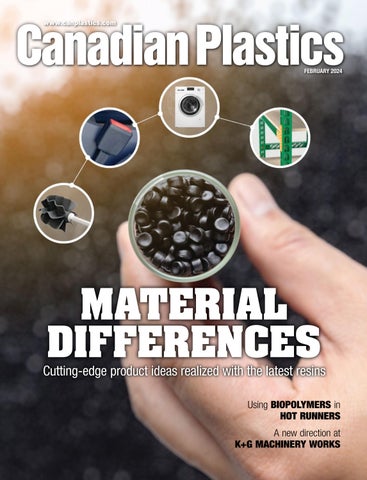
MATERIAL DIFFERENCES
Cutting-edge product ideas realized with the latest resins Using BIOPOLYMERS in HOT RUNNERS A new direction at K+G MACHINERY WORKS
Save the Date!
SEPTEMBER 5, 2024 CANADIAN PLASTICS FALL CLASSIC GOLF TOURNAMENT Mark your calendars, get your clubs ready, and plan to join us
on Thursday, September 5th, 2024 for the Canadian Plastics Fall Classic Golf Tournament! After a very successful tournament in 2023, we are returning to Piper’s Heath Golf Club with their award winning links-style golf course. The day will be filled with great networking opporutnities, friendly competition, loads of prizes, and lots of great food and beverages. Address:
5501 Trafalgar Rd, Milton, ON
For sponsorship opportunities, please contact Stephen Kranabetter 416-561-5362 skranabetter@canplastics.com
2023 Sponsors:
contents FEBRUARY 2024 VOLUME 83 • NUMBER 1
FROM THE ARCHIVES
The June 1976 issue of Canadian Plastics reported on the groundbreaking ceremony for Austrian injection molding machine maker Engel GmbH’s new North American headquarters in Guelph, Ont. Located on a 10-acre site in the city’s industrial park, the Engel plant would have more than 30,000 square feet for manufacturing and another 8,000 square feet of office space. Scheduled for completion in mid-summer 1977, the facility was expected to have about 90 workers in total. At the ceremony, the first piece of sod was turned, with a gold-plated shovel, by Engel president Georg Schwarz. Also in attendance was Guelph Mayor Norm Jary.
11
Number of the month: 6.5 billion*
16
* Dow’s investment, in U.S. dollars, in the Path2Zero project in Fort Saskatchewan, Alta. (See pg. 8)
17
cover story
11
Photo Credit: Adobe Stock/Meaw_stocker
4
Editor’s View: Sanity prevails (for now) on plastics ban
5
Ideas & Innovations: Creating biopolymers from wastewater emissions
6
News: • Brian Davis, newly retired, looks back • IKO building new extruded PS plant in Ontario • Business up for almost half of Canadian processors, survey says • Supplier News and People
INJECTION MOLDING: A material difference
A major benefit of injection molding is the wide range of base resin materials available. And it just keeps getting wider. Here’s a look at some of the latest cutting-edge polymers and the applications making good use of them.
features
14
HOT RUNNERS: It’s not easy being green
Biopolymers have become increasingly popular as alternatives to petroleumbased resins in injection molding. But just because they can replace these traditional materials doesn’t mean they process similarly. Here’s how to optimize your hot runners to handle bioresins.
17 BLOW MOLDING: A culture of change is working at K+G Machinery Works For decades, this Mississauga, Ont.-based company made tooling for blow molders. But under its present ownership, K+G is now supplying turnkey solutions for almost any plastics processing requirement.
20 Technology Showcase 21 Advertising Index 22 Technical Tips: How to injection mold nylon
Visit us at www.canplastics.com February 2024 Canadian Plastics
3
Canadian Plastics magazine reports on and interprets developments in plastics markets and technologies worldwide for plastics processors, moldmakers and end-users based in Canada.
editor’s view
www.canplastics.com
Sanity prevails (for now) on plastics ban
A
s a lifestyle choice, I prefer optimism to pessimism, so I was optimistic that the Liberal government’s designation of plastics manufacturing as being “toxic” – which laid the groundwork for its ban on a short list of single-use plastic items – would be challenged by our sector. And it was, when a coalition of industrial players in plastics, plus the provinces of Alberta and Saskatchewan, asked for judicial review. But I wouldn’t have bet the farm on their chances of success (I was counting, instead, on an eventual Conservative federal government rescinding the ban). So, when a Federal Court judge, the Hon. Angela Furlanetto, essentially swept aside the ban in mid-November 2023 as being “unreasonable and unconstitutional,” I was surprised…but most of all thrilled, as I’m sure you were too. Furlanetto – a jurist with a hard-science background that includes a master’s degree in biochemistry – noted that evidence shows that “the thousands of different items” in the “plastic manufactured items” category have different uses and chemical makeups, and there’s no evidence all of them can harm human health or the environment. In short, they aren’t poisonous in any ordinary sense. Instead, as columnist Colby Cosh wrote in the National Post, “the reasoning of the government was if an Artic lynx might choke on the ring from a six-pack of Labatt Blue, that kinda sorta makes the plastic ring ‘toxic.’” The judge’s ruling doesn’t actually undo the government’s ban, but it helps chop the legs out from under it. But even the most optimistic of us knew, I think, what would happen next: days later, the feds announced an appeal of the ruling. And to bring us up to date, in a reply to the feds’ reply, Alberta promised “to see
4 Canadian Plastics February 2024
[the government] in court.” So, lets assess the situation at present. For starters, as Canadian thinktank the Fraser Institute notes – and as even the government admits – Canada doesn’t have a significant plastic waste problem, since a whopping 99 per cent of the country’s plastic waste is already disposed of safely through recycling, incinerating, and landfills. Furthermore, Canada’s contribution to global aquatic plastic pollution is at a meagre 0.03 per cent of the total. Which means that eliminating Canada’s plastic waste would amount to a literal spit in the ocean. Second, far from being an environmental solution, the feds’ own analysis acknowledges that banning single-use plastics will actually increase the amount of net garbage in Canada. “While the regulation will remove 1.5 million tonnes of plastics from 2023 to 2032, it will almost double that tonnage in substitutes such as paper, wood, and aluminum over the same period,” the Fraser Institute noted. Why, then, is the government hellbent on regulating our sector into the ground? At the risk of mind-reading, too few of its members have ever worked in manufacturing or even really know anyone who does. And that definitely includes Steven Guilbeault, the former Greenpeace wingnut now serving as our Minister of Environment and Climate Change, and a man who – as his arrest record shows – never met a natural resource development program he didn’t want to kneecap. At the moment, the issue is still a bouncing football – nobody, optimist or pessimist, knows if the Supreme Court will dismiss Furlanetto’s ruling, or uphold it in part or wholesale. But at the very least, she has exposed the sheer illogic behind the plastics ban.
Reader Service Print and digital subscription inquiries or changes, please contact Angelita Potal Tel: 416-510-5113 Fax: 416-510-6875 email: apotal@annexbusinessmedia.com Mail: 111 Gordon Baker Rd., Suite 400 Toronto, ON M2H 3R1 EDITOR Mark Stephen 416-510-5110 Fax: 416-442-2230 mstephen@canplastics.com ASSOCIATE PUBLISHER Stephen Kranabetter C: 416-561-5362 W: 416-510-6791 skranabetter@annexbusinessmedia.com MEDIA DESIGNER Graham Jeffrey gjeffrey@annexbusinessmedia.com ACCOUNT COORDINATOR Cheryl Fisher 416-510-5194 cfisher@annexbusinessmedia.com AUDIENCE DEVELOPMENT MANAGER Serina Dingeldein 416-510-5124 sdingeldein@annexbusinessmedia.com GROUP PUBLISHER/VP SALES Martin McAnulty mmcanulty@annexbusinessmedia.com PRESIDENT/COO Scott Jamieson sjamieson@annexbusinessmedia.com PRINTED IN CANADA ISSN 008-4778 (Print) ISSN 1923-3671 (Online) Publication Mail Agreement #40065710 2024 SUBSCRIPTION RATES
5 issues Canadian Plastics, plus Dec. 2024 Buyers’ Guide: CANADA: 1 Year $79.05 plus applicable taxes; 2 Years $125.97 + taxes USA: $179.52 (CAD) / year FOREIGN: $205.02 (CAD) / year
Occasionally, Canadian Plastics will mail information on behalf of industry related groups whose products and services we believe could be of interest to you. If you prefer not to receive this information, please contact our audience development department in any of the four ways listed above. Annex Privacy Officer privacy@annexbusinessmedia.com • Tel: 800-668-2374 No part of the editorial content of this publication can be reprinted without the publisher’s written permission ©2024 Annex Business Media. All rights reserved. Opinions expressed in this magazine are not necessarily those of the editor or the publisher. No liability is assumed for errors or omissions. All advertising is subject to the publisher’s approval. Such approval does not imply any endorsement of the products or services advertised. Publisher reserves the right to refuse advertising that does not meet the standards of the publication. MEMBER: Magazines Canada, Canadian Plastics Industry Association.
Mark Stephen, editor
mstephen@canplastics.com www.canplastics.com
ideas & innovations
Creating biopolymers from wastewater emissions
Photo Credit: Adobe Stock/yganko
O
ne thing there’s plenty of in the modern world is wastewater, which is water generated after the use of freshwater, raw water, drinking water or saline water in a variety of deliberate applications or processes. So it makes sense that a four-year research project, called HICCUPS, that aims to transform wastewater into bio-based polymers for the packaging industry has been launched by a consortium of 12 European companies. The acronym HICCUPS stands for “highly innovative technology demonstration for bio-based carbon dioxide capture and utilization for production of bulk plastics applications,” and the initiative – which was launched in September 2023 and will run until the end of August 2027 – is being funded by EU Horizon Europe with a grant of five million euros. The project’s mission is to develop an efficient method for electrochemically converting carbon dioxide emissions from water-treatment sludge into polylactic-co-glycolic acid (PLGA), which is a polymer that – according to the researchers – has “excellent water and gas barrier properties,” and is fully biodegradable and completely made from renewable feedstock, which makes it a promising candidate for the replacement of fossil polyethylene (PE). The project’s final products will include PLGA-coated paper for food packaging, and molded plastic. The consortium carrying out the project consists of 12 partners from seven European nations. Four members are responsible for the CO2 capture and purification process of the CO2 present in the biogas produced during wastewater treatment, and they’ll build a demonstration plant at a wastewater treatment facility in Spain to study the average characteristics of the gas stream produced during the anaerobic digestion of wastewater sludge using consortium member Aqualung’s patented mem-
brane technology, which is a process that offers versatility and flexibility, enabling highly efficient solutions for CO2 separation from various sources, HICCUPS officials said, including flue gas and biogas. Dutch renewable chemistries manufacturer and project coordinator Avantium, meanwhile, will use its one-step electrochemical conversion technology to convert CO2 into oxalic acid, followed by reduction to glycolic acid. It will subsequently polymerize this glycolic acid into PLGA. During this process step, Avantium will work closely with research partner VTT, of Finland, which will be responsible for removing the water from the glycolic acid, enabling the dried glycolic acid to then be polymerized by Avantium. Two other partners, Walki, also of Finland, and Spain-based Tecnopackaging, both producers of packaging materials, will look at different applications made from PLGA, and PLGA packaging materials will be produced and tested at their industrial pilot plants. Walki will carry out both extrusion and wet coating trials on fibre substrates to produce coated paper and board samples. Moreover, the research team on
bio-based and green polymers at the University of Ferrara, in Italy, will conduct processability research to determine the optimal conditions for the paper coating. Additional studies, including digital projections, life cycle analyses, biodegradability and recycling studies, and a comprehensive business case analysis will be conducted by three other HICCUPS partners: University of Amsterdam, Inrae in France, and nova-Institute in Germany. Furthermore, nova-Institute and Avantium will also be responsible for the dissemination, communication, and knowledge transfer of the project, HICCUPS officials said. Avantium is said to be a frontrunner in developing and commercializing innovative technologies for the production of materials based on sustainable carbon feedstocks – i.e., carbon from biomass or carbon from the air – which is why it was selected as the HICCUPS project coordinator. One of Avantium’s other innovative technology platforms, called Volta Technology, uses electrochemistry to convert CO2 into highvalue chemical building blocks and CPL polyesters. February 2024 Canadian Plastics
5
Brian Davis, newly retired, looks back
C
anadian plastics industry sales veteran Brian Davis, most recently the general manager of Vaughan, Ont.based auxiliary equipment supplier Maguire Products Canada Inc., retired at the end of 2023. Davis, 62, enjoyed a 43-year career that coincided with some of the sector’s biggest boom and bust decades, but he came to the industry by chance. “I was working at a gas station in Toronto after high school with no idea what I wanted to do, when my soon-to-be father-in-law Don Sproule – who owned plastics machinery sales firm TempForm – asked me to work for him selling and servicing Sterlco mold temperature control units beginning in 1980, when I was 19,” he said. But just two years later, TempForm closed due to the early 1980s recession, and Davis joined Mould-tek Industries, which was owned and operated by Lorne Berggren, where he sold blending and materials handling equipment in southwestern Ontario. “It was at Mould-tek that I met Len Miller, and we formed a very strong friendship,” Davis said. “Len had very specific ideas about how to design and build conveying systems, and he left Mould-tek to found his own auxiliary equipment supply company, Nucon Systems, in 1985, and I joined him at Nucon four years later.” In 1991, Davis left Nucon to form his own sales firm, NewTech Industries, which handled the Novatec auxiliary equipment line and Rapid Granulator size reduction brands in Ontario. “We grew the Rapid Granulator business from $67,000 to $670,000 in our first year of representing them, and eventually reached $1 million per year,” Davis said. “It was a lot of fun, the money was great, and the plastics industry was booming, but it was also very stressful, and by 1999 I was tired of being my own boss – I wanted more structure, and went back to Nucon, which had just been purchased by Wittmann Robot Systems.” Hired as the U.S. sales manager, Davis transitioned to being Wittmann’s Canadian sales manager in 2003.
6 Canadian Plastics February 2024
Brian Davis
FINDING A HOME
Davis’ next stop was key to the rest of his career. “In the mid-2000s, I went to work for Novatec as their Canadian sales rep,” Davis said. “Novatec was owned by Maguire Products, and one of its executives, Pat Smith, saw an opportunity to better support the Canadian plastics auxiliary market by establishing a subsidiary, and asked me to help set up a Maguire Canada division. Steve Maguire, who founded Maguire Products, always appreciated the importance of the Canadian market.” Maguire Products Canada opened in August 2007, with a staff of five people – including key members Robert Hodge as senior technical sales manager, and Wayne Travell as service manager, who were already well-known in Canada’s plastics auxiliary equipment sector. “I insisted on getting Robert and Wayne because I knew they would give us instant credibility,” Davis said.
CHANGING LANDSCAPE
Davis has obviously seen a lot – good and bad – during his four decades in plastics. “I especially enjoyed seeing, and sometimes being part of, some fascinating product launches,” he said. “I was involved in the original Snippit milk bag opener going from concept right through to market launch in the early 1980s; and beginning in the mid-
1980s, getting to see the revolutionary explosion of plastics in the automotive field has been very exciting.” Other changes haven’t necessarily been for the better, Davis said. “In-person relationship-building with the customers – lunches, golfing, dinners at trade shows, et cetera – was crucial to building my career, just like it was for every other salesperson coming up in my time, but that dynamic is pretty much gone now, replaced by Zoom meetings,” he said. “It’s just a lot harder nowadays for a salesperson to maintain a real relationship with customers.” And in the bigger picture, Davis continued, the entire plastics sector itself is perceived differently now than ever before. “There are very strong headwinds against us, especially in Canada – single-use plastic bans and ‘toxic’ designations – that are based on either incomplete facts or outright ignorance of plastics,” he said. “Whenever I talk to someone about plastics, I can usually get them to change their minds, because they’ve never heard the pro-plastics arguments – for example, how plastics actually has a smaller impact on the environment than paper. But it’s challenging to get these facts out, and parts of our industry are suffering because of it.” But as he steps down, Davis feels confident about Maguire Canada’s future. “The company is in good hands,” he said. “Wayne will be the new chief operating officer, and Raj Shekar is the new chief financial officer. As far as supplying sales and service to our customers, it’s business as usual.” Davis also wants to offer a few thanks. “There are so many people who inspired me and helped me along the way, but a few really stand out: Don Sproule, Lorne Berggren, Ken Hoffmann at Mould-tek, Len Miller, career machinery salesman Peter Stephen, and Steve Maguire,” Davis said. “Each of them taught me different aspects of being a better salesman, service supplier, and business operator. And I’d also like to thank the customers that have supported me over the decades. I’m lucky to have CPL made plastics my career.” www.canplastics.com
Photo Credit: Brian Davis
news
news
I
AceTronic founder Harb Mushiana passes away
KO Industries, a Toronto-based maker of roofing, insulation, and waterproofing products, is building a new $45 million extruded polystyrene (XPS) insulation plant in Brantford, Ont. In a Jan. 2 news release, company officials said the new site will employ about 30 workers and serve customers throughout Canada and northeastern U.S. The company has made rigid polyisocyanurate insulation boards in the past. The Brantford plant represents its entry into the XPS market. IKO – which makes products for both the residential and commercial markets and operates more than 35 plants in North America and Europe – expects to break ground this year and start production in 2025. CPL
H
arbhajan (Harb) Singh Mushiana, the founder of Mississauga, Ont.-based AceTronic Industrial Controls Inc., passed away on Jan. 15 at age 82. Born in India, Harb immigrated to England, where he worked as an electrical technician for British Airways; and then to southern Ontario in 1974. Through his wife Gurdip, who was working in a Toronto-area blow molding shop, he learned of a need in the plastics sector for a reliable partner to fix temperature controls, and he opened AceTronic as a small instrument repair shop in 1983, initially working out of his basement. As he began ordering parts like relays and switches for his customers, AceTronic also became a manufacturer and distributor, and in the mid-1990s Harb moved the growing company into an industrial unit in Mississauga. Harb’s daughter Kim Thiara initially joined AceTronic as an administrative assistant, and now serves as president and CEO, having purchased the firm with her husband Harb Mushiana John in 2008. AceTronic now manufactures custom parts and equipment for North American plastic manufacturers and repairs plastic manufacturing equipment and components. It serves the automotive, construction, consumables, food packaging, medical, and oil and gas industries. “Harb leaves behind an influence we are very proud of, and his entrepreneurial spirit and integrity will continue to inspire many of those throughout our industry who knew him,” AceTronic officials said. CPL
Just Add Water For Instant Process Cooling & Temperature Control Dedicated exclusively to process cooling & fluid temperature control systems
Temperature Control Units
• Energy saving technologies • Maximizes production • Over 45 years of experience • Experienced engineering & customer service representatives
Portable & Central Chillers
525 East Stop 18 Road Greenwood, IN 46142 317.887.0729 AdvantageEngineering.com
Cooling Towers
1228 Gorham Street, Unit 11 Newmarket, ON L3Y 8Z1 905.895.9667 ChillersInc.com
February 2024 Canadian Plastics CPL_Chillers_Nov23.indd 1
7
2023-10-05 5:55 PM
Photo Credit: AceTronic Industrial Controls Inc.
IKO building new extruded PS plant in Ontario
news
Dow moving ahead with $6.5 billion Path2Zero project in Alberta
PURGING PERFECTION
Toronto event will target skilled trades shortage
What does purging perfection look like? Industry leadership, decades of innovation, outstanding customer service, technical expertise and product that’s effective every time. When your work has to be perfect, trust the leader. Trust Dyna-Purge. Request a free sample of Dyna-Purge and see for yourself. Discover the Difference. 866-607-8743 www.dynapurge.com DYNAPURGE is a registered trademark of Shuman Plastics, Inc.
A
one-day event targeting the lack of post-secondary education geared towards skilled training for the plastics industry will be held on March 27 at Humber College’s Barrett Centre for Technology Innovation, in Toronto. Organized and hosted by Humber and AceConnex – which is a one-day trade show for equipment maker AceTronic Industrial Controls Inc. – the event will feature industry professionals, college affiliates, government officials, and current Humber students participating in panel discussions and breakout sessions around the plastics industry. Also, a mini-tradeshow onsite at the venue will feature companies looking to hire directly. For more information, contact AceTronic president Kim Thiara at 905-564-7227. CPL
8 Canadian Plastics February 2024 CPL_DynaPurge_Feb24.indd 1
www.canplastics.com 2024-02-01 10:15 AM
Photo Credit: Dow Inc.
C
hemical giant Dow Inc. says starting up in 2027 that will add that its board has approved an around 1,285 kilo tonnes per investment of US$6.5 billion annum (KTA) of ethylene and PE in the Path2Zero project in Fort capacity. The second phase, startSaskatchewan, Alta., as part of the ing up in 2029, will add an addifirm’s goal of becoming carbon tional 600 KTA of capacity. neutral by 2050. “This new capacity will enable In a November 2023 news [us] to capture growing customer release, Dow officials said the projdemand in high-value markets, ect – which includes building a such as packaging, infrastructure, new ethylene cracker and increasand hygiene, among others, with ing polyethylene (PE) capacity by potential additional value captured Dow’s manufacturing site in Fort Saskatchewan, Alta., will two million tonnes per annum – be the home of its Net2Zero project. from commercializing low and will be the world’s first ethylene zero-emissions products,” the cracker and downstream derivarelease said. “The project builds tives unit with net-zero Scope 1 and 2 emissions. on [our] expertise in successfully implementing large projects, The project will leverage US$2 billion in additional invest- such as the TX-9 cracker in Freeport, Texas, which has delivered ment from third parties for circular hydrogen, CO2 capture, more than 15 per cent return on invested capital since its 2017 and other infrastructure assets. Path2Zero also will receive start-up through best-in-class capital intensity, conversion cost, subsidies and incentives from federal, provincial, and local and low emissions intensity.” authorities, Dow said. To achieve net-zero Scope 1 and 2 emissions, Dow said, The company plans to begin construction in 2024. Capacity the Fort Saskatchewan Path2Zero project will deploy Linde’s additions are expected to come online in phases, with the first air separation and autothermal reformer technology to convert the site’s cracker off-gas to hydrogen, which will be used as a clean fuel to supply the site’s furnaces. In addition, carbon dioxide emissions will be captured and stored, reducing existing emissions. Dow also said that it selected the Fort Saskatchewan site for this investment because Western Canada offers “highly costcompetitive natural gas relative to other regions,” as well as cost-advantaged ethane, a key feedstock for ethylene production. The region also features access to existing CO2 transportation and storage infrastructure with available capacity to fully support decarbonization of the project. Dow has operated in the CPL area for more than 60 years.
news
Business up for almost half of Canadian processors, survey says
A
lmost half of the processors responding to a recent Canadian Plastics survey reported an increase in business over the past 12 months. Fifteen per cent saw a significant increase in business during this time, and another 34 per cent saw a slight increase. The remainder saw business conditions remain stable, or decrease either slightly or significantly. Our survey was conducted in the winter of 2023, and had 166 respondents. Forty-two per cent were involved in extrusion, 33 per cent in injection molding, 23 per cent in blow molding, 12 per cent in thermoforming, and 6 per cent in rotational molding. Almost half of the respondents made plastic packaging; 33 per cent were in construction; and approximately 20 per cent were in either consumer goods, automotive or electronic molding; and 16 per cent were in medical parts. Of the many factors that influenced their business results, four stood out: 46 per cent of respondents cited overall economic conditions, 32 per cent cited supply chain disruptions, 37 per cent cited rising raw material costs and/or availability, and 34 per cent cited labour shortages. Slightly more than half of respondents – 51 per cent – introduced either a new product line or a new process in the past year, the survey showed. And slightly more than half – 53 per cent – rated their current capacity as underutilized.
As a percentage, how did your processing business perform in the past year?
Slightly increased: 33.73 Remained stable: 28.92 Slightly decreased: 18.67 Significantly increased: 15.06 Significantly decreased: 3.62 When it came to sustainability, 41 per cent of respondents were either using or actively exploring using either bioplastics or recycled materials, 37 per cent were considering using these materials, and 22 per cent were not exploring their use. Asked about labour supply, 40 per cent of respondents were not looking to hire new workers at present, 35 per cent were, and the rest were undecided. Of those on the hunt, 40 per cent needed machine operators, 31 per cent were looking for engineers, 28 per cent were looking for technicians, 25 per cent for sales staff, and 16 per cent for administrative staff. CPL
February 2024 Canadian Plastics
9
news
SUPPLIER NEWS
– Material supplier Channel Prime Alliance, headquartered in Des Moines, Iowa, has been named an authorized distributor in Canada and the U.S. for NatureWorks LLC’s Ingeo biopolymer grades for injection
molding, extrusion, and 3D printing applications. – Machinery sales firm Globeius Inc. of Miami, Fla., has been named as a North American supplier for Mould-
pro’s Flosense 1.0 flexible flow monitoring system, which monitors manifold pressure and temperature on injection molds, and alerts operators and other technicians about processing issues in real time.
PEOPLE
Matt Miklos
Linda Moore-Boyett
Ashish Khandpur
Tony Rampino
Doug Brockman
Jaisen Kohmuench
Karston Just
Kristian Aquilina
Klas Dahlberg
Chi Zhang
Paul Young
Erik Ripple
Felix Hüthmair
Sean Andersen
Jim Worby
Debra van Holst
Betsi Burns
Conor Carlin
Avi Bromberg
Michelle Landon
– Colour compounds and concentrates maker Americhem Inc. , headquartered in Cuyahoga Falls, Ohio, has named Matt Miklos as engineered compounds vice president and general manager, and Linda Moore-Boyett as vice president of global technology. – Avon Lake, Ohio-based material supplier Avient Corp. has appointed Ashish Khandpur as president and CEO. – Separation technology maker Bunting Magnetics Co. , based in Newton, Kan., has named Tony Rampino as sales director for the Americas. – Windsor, Ont.-based moldmaker Cavalier Tool & Manufacturing Ltd. has named Doug Brockman as general manager. – Erie, Pa.-based separation technology maker Eriez has named Jaisen Kohmuench as president and CEO. – Gefran Inc. , a North Andover, Mass.-based manufacturer of industrial sensors, controls, and instrumentation, has named Karston Just as chief sales officer. – Detroit-based automaker General Motors has appointed Kristian Aquilina as president and managing director of GM Canada, based out of Toronto. – Sweden-based material supplier and compounder Hexpol AB has appointed Klas Dahlberg as president and CEO. – Germany-based machinery maker KraussMaffei Group has named Chi Zhang as CEO. – Thermoform packaging supplier Lacerta Group LLC , headquartered in Mansfield, Mass., has named Paul Young as CEO.
10 Canadian Plastics February 2024
– Biopolymer maker NatureWorks LLC, based in Plymouth, Minn., has named Erik Ripple as president and CEO. – Nafels, Switzerland-based injection molding machine manufacturer Netstal has named Felix Hüethmair as vice president of sales.
– Houston-based thermoplastics distributor Nexeo Plastics has named Sean Andersen as vice president and general manager, specialties. – Calgary-based material supplier Nova Chemicals Corp. has appointed Jim Worby as vice president of polyethylene sales, and Debra van Holst as global head of customer experience. – Slide Products Inc., a Wheeling, Ill.-based supplier of purging compounds, mold releases, and rust preventives, has named Betsi Burns as sales manager. – The Society of Plastics Engineers (SPE), based in Danbury, Conn., has named Conor Carlin as president, with his term running until Dec. 31, 2024.
– Process cooling technology supplier Thermal Care Inc., headquartered in Niles, Ill., has appointed Avi Bromberg as regional manager in charge of sales and support for customers in Eastern Canada.
– Tomra Recycling Sorting, a Charlotte, N.C.-based manufacturer of sensor-based sorting technologies for recyclers, has named Michelle Landon as regional service director for the Americas.
www.canplastics.com
injection molding
A MATERIAL DIFFERENCE
A major benefit of injection molding is the wide range of base resin materials available. And it just keeps getting wider. Here’s a look at some of the latest cutting-edge polymers and the applications making good use of them. By Mark Stephen, editor
O
Photo Credit: BASF
MODERN MODULAR SHELVING
In a new idea in sustainable furniture, BASF recently worked with award-winning Spanish designer Inma Bermúdez to develop a modular concept shelf made with wood and glass-fibre reinforced thermoplastic. The shelves are wood, and the plastic parts – both the load-bearing outer structure and all connecting elements – are made of a single polyamide, BASF said, which guarantees optimal recycling of the plastic elements at the end of their life cycle. All plastic elements are expandable and interchangeable and each shelf can carry up to 100 kilograms. “High-performance plastics offer enormous advantages in this area: they combine strength and durability with low weight, can be used in a variety of ways and, thanks to alternative raw materials, can contribute significantly to reducing the carbon footprint,” BASF officials said. In series production, the product could be made with renewable raw materials to replace the current fossil-based raw materials, they added.
UNDER-HOOD AND AWARD-WINNING
A 40 per cent long-glass-fibre grade of injection-moldable Celstran polypropylene (PP) grade from Celanese Corp. has contributed to an under-hood storage area for the 2023 Ford F-150 Lightning Mega Power Frunk that won the Vehicle Interior category award at the 52nd Annual Society of Plastics Engineers (SPE) Automotive Innovation Awards Competition and Gala, held last November. Celstran PP replaced sheet molding compound (SMC) in the component, which locks and seals itself away from the elements and provides an industrylargest 400 litres of space with a 400 pound weight capability. “The production part using Celstran PP optimizes rib structure and thickness to match the ‘muscle’ of the thicker SMC version, meeting durability and crash safety requirements,” said Carl Sullivan, Celanese automotive market development director. “And it eliminates the need for painting to achieve a classA surface finish, and provides a weight reduction of 16 pounds per vehicle.” The parts are molded on a 4,000 ton press and a tool equipped with a 16-drop hot runner system, Sullivan added, with cycle time reduction versus compression molding and paint elimination contributing to an annual savings of approximately US$15 million. February 2024 Canadian Plastics
Photo Credi: Celanese
ne of the major benefits of injection molding is the wide range of base resin materials available – there are hundreds of kinds of plastic resins on the market, each of which has unique performance advantages (and disadvantages). And the range keeps expanding, with new resins constantly coming onstream, aiming to provide ever more flexibility for injection molders to do what they do best: create high volumes of identical plastic parts with good tolerances at a low cost per part. If you’re curious about what’s doable, look no further. Here are some cutting-edge applications made possible by the latest resins.
11
injection molding
Using two resins from Covestro, automotive supplier Webasto recently developed a roof sensor module that combines a total of 14 camera and lidar sensors for autonomous driving. The five lidar sensors integrated into the roof system measure the distance and the speed of moving objects by creating a 3D point cloud of the vehicle’s surroundings in order to assess the car’s driving situation. Ten cameras recognize colours and objects, making it possible to understand the meaning of traffic lights, traffic signs, highway dividers, and other lane markings; and the roof sensor module can also determine distances thanks to the use of stereo cameras. The entire sensor set, together with other antennas, is concealed under a full-surface polycarbonate (PC) cover to blend in with the vehicle’s silhouette. For its production, Webasto uses Covestro’s transparent PC Makrolon AG for the roof module, and its black PC/ acrylonitrile butadiene styrene (ABS) Bayblend T95 MF for other components in the sensor set.
SERVING UP WORLD-FIRST READY-TO-EAT BOWLS
In what’s being called a first-of-its-kind application, Sabic has teamed up with a South Korea-based food company to create ready-to-eat rigid rice packaging bowls made with 25 per cent certified renewable PP for the Asia-Pacific market. A food-contact grade of Sabic’s TruCircle portfolio of certified renewable PP resins has been used in the production of Hetbahn instant white rice packaging bowls by CJ CheilJedang. The PP polymer from Sabic’s TruCircle portfolio provides the critical attributes of dimensional stability and heat resistance required when microwaving the rice directly in the cup, Sabic officials said. Additionally, the used bowls can be returned into the rigid PP recycling stream to recover their material value and enable a more circular packaging industry. CJ has already started to introduce the new Hetbahn rice bowls in E-Mart stores, one of the largest grocery chains in South Korea.
You produce it ... We’ll Reduce it! ... Since 1982 North American Built and Priced Right for Today’s Economy » GRANULATORS » BELT CONVEYORS » BLOWER/CYCLONE SYSTEMS » FINES SEPARATOR SYSTEMS
Rotogran granulators are internationally recognized for their superior design, efficiency, durability and competitive pricing. We are the size reduction specialists for the processing and recycling industry. Our rugged equipment is precision manufactured to meet individual customer needs. • Complete range from press side to central. • Chamber construction second to none. • Custom applications our specialty.
MANUFACTURER OF SIZE REDUCTION EQUIPMENT for the Plastics and Recycling industry
4 SIMPSON ROAD, BOLTON, ON L7E 1G9 CANADA Tel: 905-738-0101 | Fax: 905-738-5750 sales@rotogran.com | www.rotogran.com
12 Canadian Plastics February 2024
www.canplastics.com
CPL_Rotogran_MayJune23.indd 1
2023-05-12 11:14 AM
Photo Credit: Sabic
Photo Credit: Covestro
ROOF SENSOR FOR AUTONOMOUS DRIVING
injection molding
Vehicle maker Audi has launched cutting-edge plastic covers for seatbelt buckles in its Q8 e-tron models that are partially manufactured from mixed automobile plastic waste using the pyrolysis chemical recycling process. Audi officials say it’s the first time the company is installing safety components made in this way, and in conjunction with the PlasticLoop project, has established an innovative process with plastics manufacturer LyondellBasell, based on the findings from a pilot project. Plastic components that are beyond repair are first stripped from customer vehicles, freed of foreign materials such as metal clips, before being broken down into smaller pieces, and processed into pyrolysis oil; the oil is then used as a raw material for the manufacture of new plastic granulate, which is then utilized in the production of Q8 e-tron seatbelt buckle covers. Audi says this operation will allow it to use fossil raw materials for longer and reduce its purchasing of additional primary materials for the Q8 e-tron.
TOILET BOWL BRUSH WITH BLADES, NOT BRISTLES
CREATING A CHEMICAL-RESISTANT BOND BETWEEN TPEs
If you never thought you’d find a toilet bowl brush to be interesting, join the club. But the new Loowy brushes from Germany-based bathroom product maker Sauba have blades instead of bristles for improved hygiene, and are made from the Dryflex Circular range of recycled thermoplastic elastomers (TPEs) from Hexpol AB. Sauba required a TPE that was strong, but with a low hardness to give the required flexibility and cleaning performance; also, the material had to be easy to process and recyclable in closed-loop systems, with the possibility to rework any process scrap. “We’re working hard to turn waste into a resource,” said Kathrin Heilmann, a sales manager with Hexpol. “We take recycled polymers – in this application, using post-industrial recylate – and incorporate them into the Dryflex Circular TPEs, which aligns with Sauba’s goals of producing more resource-efficiently and reducing waste.” Available in different sizes and colours, the Loowy blades are designed to make the toilet brush easier to keep clean, and are also easy to replace.
Photo Credit: LyondellBasell
SUSTAINABLE SEAT BELT COVERS
BSH Home Appliances is using light-blocking ABS from Elix Polymers for the control panels of its latest washing machines – and a washing machine’s control panel, if you don’t know, is perhaps the most important part of its design and functionality. The ABS material ensures precise illumination and controlled light with no leakage into neighbouring chambers, Elix officials said, and BSH was also able to achieve both cost and weight reductions compared to the previously used resin, in particular through very low wall thicknesses of just 0.5 millimeters. Elix’s light-blocking materials can be based on ABS, high-heat ABS, and ABS/PC, and are also used in appliances such as dishwashers and coffee machines, to improve the illumination quality. And applications in the automotive sector include light guides, LED reflectors, and button back panels.
In a development targeted at the medical device industry, material suppliers Teknor Apex Co. and Eastman have demonstrated a strong, chemical-resistant bond between TPEs and a clear copolyester substrate known for its toughness and chemical resistance. In 90-degree peel tests of test specimens produced in a two-shot molding process, three Medalist medical-grade TPEs from Teknor Apex – MD-34940, MD-34950, and MD-34959, with Shore A durometers of 42, 50, and 59, respectively – provided durable bonds to Eastman’s MX711, MX811, MXF321, and MXF421 Tritan copolyester grades. The combination of high peel strength and adhesive failure is valued in over-molded applications, said Yubiao Liu, Eastman’s global medical technical platform lead, and the bond strength between Medalist TPEs and the Tritan grades showed very little loss, even after soaking test samples for 48 hours in disinfecting chemicals. Over-molding TPE onto copolyester offers a combination of hard and soft materials that are desirable for grips, gaskets, seals, and soft-touch elements on rigid medical housings and other components. CPL February 2024 Canadian Plastics
Photo Credit: Teknor Apex Co.
Photo Credit: Hexpol AB
Photo Credit: Elix Polymers
A BETTER WASHING MACHINE CONTROL PANEL
13
hot runners
IT’S NOT EASY BEING GREEN Biopolymers are increasingly popular as alternatives to petroleum-based resins in injection molding. But just because they can replace these traditional materials doesn’t mean they process similarly. Here’s how to optimize your hot runners to handle them. By Mark Stephen, editor
14 Canadian Plastics February 2024
Testing injection molded biopolymers at an Oerlikon HRSflow laboratory.
Processing-wise, in short, using biopolymers is not mere substitution for the conventional polymers they typically aim to replace. “Despite their suitability for a range of applications, they aren’t considered a drop-in replacement for standard virgin plastics – it’s more complicated than that,” Ellis said. But you don’t have to adapt to this new world on your own. Hot runner makers are increasingly developing systems designed to work with biopolymers, and the gaps in knowledge are being filled in as more OEMs develop full resin testing capabilities, often in cooperation with biopolymer suppliers.
DUE DILIGENCE
These days, any processor contacting a hot runner supplier about a new system should definitely mention if they’ll be processing biopolymers. “It’s highly recommended that a customer discloses this to us when quoting, because we need to know it, since the processing properties of bioresins can be very different to conventional resins,” said Sudheer Thrissileri, senior director of product development at Mold-Masters. “If they don’t, and we deliver a traditional system, they can run into molded part quality issues since biopolymers are more temperature- and shearsensitive; and, eventually, premature wear of the hot runner system, because bioresins can be abrasive and/or corrosive.” The bottom line, hot runner suppliers say, is that standard hot runner systems aren’t designed to handle bioresins directly…and can only do the job with substantial upgrades, if at all. Another part of this conversation between customer and hot www.canplastics.com
Photo Credit: Oerlikon HRSflow
N
ot every sustainable solution succeeds. Electric vehicles are struggling with reliability issues, and nobody wants a wind turbine in their backyard. In the plastics space, however, biopolymers are here to stay, and they’re everywhere, as new legislation and regulations pressure manufacturers worldwide to reduce post-consumer waste and plastic pollution. But that doesn’t necessarily make them easy to use. Indeed, for injection molders that have to combine the complexity of traditional hot runner systems – designed, in other words, for petrochemical-based plastics – with the rapidly evolving and expanding range of bio-based materials, the results can be substandard or worse. The reason is, these renewably sourced materials – while derived from a wide range of biological carbon sources – have a common tendency to be susceptible to problems during the injection molding process because of their biodegradability, because the window between the melting point (processing temperature) and the decomposition point is very narrow, and because these materials are both sensitive and yet require high fill pressures. “Obviously, many bioresin grades differ from one to the other, and some can be easier to process than others, but it’s common for many to have narrow process windows due to thermal or shear sensitivities,” said Mike Ellis, global business development manager for hot runners and controllers with Husky Technologies. And to top it off, since biopolymers are relatively new materials, they bring unknowns to the table, especially in performance; rheological data – how they degrade, especially under what conditions – is lacking for some of these materials, forcing some molders to rely on substitute characteristics and educated guesses when setting processing parameters.
hot runners runner OEM will probably involve the biopolymers themselves, since different bioresins have different processing characteristics. The most commonly used biopolymer, by far, due to its availability and cost – and the first to be commercialized – is polylactic acid (PLA), which looks and acts like polyethylene terephthalate (PET) and polypropylene (PP), and shares some of their processing characteristics regarding operating pressures, temperature sensitivity, and drying requirements. PLA is often used to replace high- and low-density polyethylene (HDPE, LDPE), polystyrene (PS), PP, and PET. Cellulose acetate (CA), meanwhile, is a semi-synthetic, chemically-modified natural polymer that can substitute for PP in applications that include films and packaging. And two newer bioresins on the market are polyhydroxybutyrate (PHB) and polyhydroxyalkanoates (PHA), both of which can replace PP and polyethylene (PE). Bioresin suppliers should be able to help here, by providing flow characteristics for various biomaterials attained through testing of the actual resin type and not a substitute material. And some hot runner OEMs have established good working relationships with them, aiding in the testing process with full resin testing capabilities of their own – which can include thermal finite element analysis (FEA) tools that predict manifold temperature variation per the design by adjusting heater wrap, heater zones, thermocouple placement, melt channel layout, heat sinks, and the manifold profile. “We do a lot of research and development directly with the biomaterial suppliers, and sometimes we can actually test it more extensively than they can because of the sophistication of our R&D labs, one of which has a new injection molding machine designed specifically for recycled PET and similar complex biopolymers,” said Massimo Rossi, R&D director with Oerlikon HRSflow. “Also, we’ve been working with PHA producers in both Japan and Europe for years now to study the behavior of these PHA materials, and we’ve designed systems specifically for PHAs because of their input.” And MoldMasters has partnered with the University of Massachusetts to test a range of bioresins, and also conducts testing at its own facility in Georgetown, Ont.
MATERIAL CHANGES
Collaborations and testing of this kind, along with increasing real-world application experience, is why the number of biopolymers with limited performance data is getting smaller all the time, OEMs say, which helps not only the hot runner makers but also the molders and part designers. And it’s worth returning to what the totality of this data shows. “The rheology proves that viscosity and flow behaviour can vary among different bioplastics and, in some cases, may diverge significantly from conventional petrochemical-based materials,” said Jean Brandes, hot runner technical specialist with PCS Co. All of which matters because it will impact the kind of hot runner system being supplied. Bioresins tend to be corrosive – especially PLA – and, in a standard hot runner system, this can compromise machinery and lead to quality issues that include jetting and streaking, performance variation, and even component failure. “We definitely need to know which type of biopoly-
mer the customer is going to use, because we offer specific systems, with different components and coatings, for different biopolymer materials,” said Alessandra Bosco, Oerlikon HRSflow’s director of business development, packaging and medical. “For example, the hot manifold for PHA biopolymer needs a specific steel and a specific system layout. And since both PHA and PLA are usually blended with fillers, which can change the rheological behaviour of the materials with impact on the quality of the finished part, the systems also need specific surface treatments to prevent corrosion and ensure good long-term production. The synergistic relationship we have with our sister company Oerlikon Balzers, which supplies PVD coatings and other surface technologies, is an added value for us here.” A big part of making hot runner components non-corrosive comes down to the right selection of materials and coatings, including choosing metal alloys that have good resistance to the corrosive chemicals present in bioresins. Stainless steel hot runner systems, like Husky’s UltraMelt hot runner – designed for resins that are thermally sensitive or corrosive – can resist the corrosive nature of some degraded bioresins, Mike Ellis said. And applying protective coatings or other surface treatments to surfaces that come into contact with the molten resin can help prevent corrosion by enhancing chemical resistance. “Coatings that prevent premature wear of internal components and prevent chemical reactions with the sensitive resins are very important, and Mold-Masters has a range of options available, depending on the applications,” said Sudheer Thrissileri.
MAKING MODIFICATIONS
There are other choices that the hot runner OEM might have to make when designing a system for biopolymers. “Depending on the characteristics of the bioresins, it may be necessary to modify the hot runner’s geometry to optimize processing, and this can include changes to flow channels, heat distribution, or nozzle shapes,” said Jean Brandes. “And if certain hot runner components aren’t compatible with bioresins, they may need to be replaced with more suitable parts, which could involve replacing nozzles, manifold systems, and other critical elements.” According to Mike Ellis, Husky’s manifolds for bioresin applications are designed with guidelines and considerations to consider the melt delivery of the mold, and also the thermal needs of the molten resin. “All designs are validated by industry experts and thermal FEA,” he said. “Additional features are included in manifold design and manufacturing, such as finer melt channel surface finishes, which decreases the risk of resin hanging onto the melt channel wall and stagnating at the microscopic level.” Melt channel diameter transitions, when used, are also more gradual, Ellis continued. “These also minimize the risk of unwanted degradation, as abrupt changes to diameter can increase the likelihood of flow stagnation,” he said. Other design variations might incorporate thermally optimized hot runner and mold plate cooling, OEMs say, and a valve gate to reduce gate shear, yield the best gate quality, and provide a wider processing window. February 2024 Canadian Plastics
15
hot runners
Photo Credit: Mold-Masters
THE LOWDOWN ON UPGRADES
Refork, a company that produces bioresin utensils, uses optimized hot runner systems from Mold-Masters.
A MATTER OF CONTROL
As noted above, biopolymers are generally heat-sensitive, and excessive temperature variation can lead to changes in the physical and chemical properties of these materials. Every hot runner system requires a temperature controller to manage temperature and mechanical settings, of course, and with bioresin applications this controller is more important than ever. “Biopolymers often require more delicate processing conditions to prevent thermal degradation, which can occur if exposed to high temperatures for an extended period, and precise temperature control helps minimize this exposure,” said Jean Brandes. This is where advanced temperature controllers come in, to provide minimal variation and precise temperature regulation. “This may include the use of sensitive temperature sensors and sophisticated control algorithms to maintain optimal conditions throughout the molding cycle, so at PCS we recommend our MCS temperature controllers,” Brandes said. Controllers that provide highly accurate temperature, servo, and valve gate control are available in various configurations from a variety of OEMs. For example, Mold-Masters recommends its TempMaster-Series temperature controllers for bioplastics applications, Sudheer Thrissileri said. The company cites its work with sustainable cutlery maker Refork, which injection molds biopolymer forks, knives, and spoons using several optimized MasterSeries hot runner systems, including 48- and 24-drop production hot halves and a 4-drop hot half for research and development testing. “Our Mold-Masters TempMaster M2+ hot runner temperature controllers were also utilized to maintain tight process control in this application,” Thrissileri said.
16 Canadian Plastics February 2024
For many molders moving into biopolymers, the biggest question is, can they use their existing hot runner systems designed for conventional polymers? The answer, according to some OEMs, depends on such factors as the original design of the hot runner, the specific characteristics of the bioresin, and the required modifications. “Some existing hot runner systems will have materials of construction more suitable to processing bioresins than others,” said Jean Brandes. “The question is, are these still resistant to the specific conditions imposed by the bioresins? If not, they may need to be replaced with more suitable parts, which could involve replacing nozzles, manifold systems, and other critical elements.” And even if so, the molder may still be faced with other upgrades. “If the current hot runner doesn’t provide adequate temperature control or requires specific adjustments, it may be necessary to upgrade or modify the system,” Brandes said. “And it may be necessary to make modifications to the hot runner’s geometry to optimize processing, including changes to flow channels, heat distribution, and/or nozzle shapes.” It sounds like a big job, and it could very well be, which is why molders are advised to contact the hot runner OEM for specific information on the possibility of upgrading. “Manufacturers can provide guidance on available upgrade kits or recommended modifications,” Brandes continued. On the other hand, a hot runner system designed for biopolymers should be able to process virtually any traditional petroleum-based material. “We delivered a high-cavitation system designed for a PLA application to an Oerlikon customer, but they ultimately went with PP and the system still runs very well, because these traditional resins are generally easier to process,” Alessandra Bosco said. As the use of bioresins continues to grow, it’s a safe bet they’ll continue to be incorporated more and more into the injection molding process. Which is all the more reason to optimize your hot runners for processing them. “The hot runner industry has gained experience with bioplastics, and hot runner manufacturers and plastics processing experts can play a crucial role in providing guidance and specific recommendations to achieve best results,” said Jean Brandes. “But it’s still essential to address each bioplastic individually, considering its specific properties CPL and processing requirements.”
RESOURCE LIST Husky Technologies (Bolton, Ont.); www.husky.co; 905-951-5000 Mold-Masters (Georgetown, Ont.); www.moldmasters.com; 905-877-0185, Oerlikon HRSflow (Byron Center, Mich.); www.hrsflow.com; 616-228-6900 PCS Co. (Fraser, Mich.); www.pcs-company.com; 800-521-0546 D Flex-Mag Inc. (Roxton Falls, Que.); www.dflexmaginc.ca; 514-762-3434 www.canplastics.com
blow molding Tom Cameron (left) and Peter Idzerda checking blow molded bottles.
A CULTURE OF CHANGE IS WORKING AT
K+G MACHINERY WORKS
For decades, this Mississauga, Ont.-based company made tooling for blow molders. But under its present ownership, K+G is now supplying turnkey solutions for almost any plastics processing requirement. By Mark Stephen, editor
T
he concept of staying in your lane – sticking with what you know and are good at – is generally good advice, but it doesn’t hold true in every situation. Mississauga, Ont.-based K+G Machinery Works Ltd., for example, had been a full-service machine stop specializing in blow molding equipment production and services for decades, but crossed out of that lane in a big way recently to provide a wide range of services for almost all plastics processors.
BLOW MOLDING AND BEYOND
K+G was founded over 50 years ago as a general machine shop, supplying tooling to a number of local blow molding companies in the Greater Toronto Area. The company’s new direction was set in 2007, when blow molding industry veterans and brothers Peter and Marc Idzerda bought it and merged it with Peter’s blow molding service company Pitech Industries – although not everything changed at once.
“Blow molding remained K+G’s bread and butter for years after Marc and I bought it, and it’s still a big part of what we do,” Peter said. “We maintain a general machining business with a large selection of equipment, including conventional and CNC machines, which allows us to meet the needs of our clients for repair and tooling as well as our own OEM requirements. We provide reverseengineered machine parts for a wide variety of blow molding machines, and we service the blow molding industry with a growing client base covering North America and parts of the Caribbean. There are many different blow molding machine brands out there from many different countries, and we’ve worked on most of them over the years – if it can be fixed, we can fix it.” But by 2010, Peter and Marc had decided to grow K+G beyond blow molding into a full-service plastics machinery supplier, with a two-pronged strategy: as a
sales and service representative for a growing list of international OEMs, and by becoming an OEM itself. The guiding principle was simple and classic: filling a void that was identified by talking with customers. “Our market, traditionally, was small and medium-sized blow molders, and in talking with them about how to provide the best support, we kept hearing about the same problems: manpower shortages, both skilled and unskilled; rising energy costs; floor space constraints; and a lack of support from the OEMs,” Peter said. “So, we began looking for OEMs we could partner with that were capable of delivering equipment that would meet and exceed our high expectations – suppliers willing to work together with us to answer our clients’ needs.” As an OEM sales and service agent, K+G is currently the North American representative for fully electric blow molding machines (both extrusion and two-stage polyethylene terephthalate February 2024 Canadian Plastics
17
blow molding
having been a key employee at such formidable firms as ABC Plastics and W. Amsler Equipment, joined as a consulting sales associate. K+G has also staffed up with other important additions over the past few years. “We’ve assembled a team of 15 engineers specializing in mechanical, electrical, and preprogramming, so we can take full control and responsibility for all of our projects,” Peter said.
An overhead view of K+G’s machinery and equipment installation in Jamaica.
[PET]) from Luxber Spain, and fully electric multilayer jerrycan machines from JHB Taiwan – both of which companies offer extremely energy-efficient models. “It’s common knowledge today that electrical blow molding machines offering electrical savings of up to 50 per cent are available to replace older hydraulic machines, and there are options available that can also cut air consumption by as much as 50 per cent, so this is what’s available to our customers,” Peter said. “This matters to all of our clients, but especially those in the Bahamas – where we do a lot of business – where they’re paying 45 cents a kilowatt hour for energy.” In addition, K+G supplies material handling systems from Main Tech Italy, granulators from Adler Italy – with controls that are custom-installed by K+G – and screw compressors and booster compressors from Airpol Poland. “It’s a good, diverse roster of OEMs, and it allows us to supply something to virtually every plastics processor,” Peter said.
BUILDING IT
And K+G has also become an OEM itself, beginning with building custom automation. “Given the skilled labour shortages that have been part of the plastics industry for decades now, supplying automation was a good first area to focus on, and we got into it a few years ago,” Peter said. “We specialize in building and installing fully or semi-automated systems for prod-
18 Canadian Plastics February 2024
uct handling and assembly, including endof-the-line turnstile indexing units, bagging units, tray packers, and palletizers. We target small and medium-sized blow molders with solutions that provide labour savings while also satisfying the tight floor space requirements that many of them have. And all K+G automation offers internet support.” In addition, K+G has developed an extensive OEM product line that includes control systems, leak testers, dome trimmers, packing equipment, conveying systems, and its proprietary K+G Miser waste reduction system. Here, too, the focus is on energy and other savings. “A K+G Miser control system includes a proprietary fully vertical auger feed mechanism that operates based on demand with a frictional horsepower [hp] motor,” Peter said. “Used on a granulator, it tailors the power consumption to the demand, allowing a 10 hp granulator to operate with the same power draw as a 5 hp granulator,” Peter said. “Also, conventional augers take up a lot of room, but the Miser system’s vertical design minimizes the required floor space.” Part of the company’s transformation involved setting up in a new facility. “In 2016, we moved K+G from its original 6,000-square-foot facility to its current 12,000-square-foot plant in Mississauga,” Peter said. K+G’s new foundation was then solidified when blow molding process specialist and equipment developer Tom Cameron, who was well-known in the field by
To measure just how far K+G has come as an all-system supplier, consider a recent project in Jamaica. “This customer hadn’t done any blow molding before, so we were starting from scratch, with an empty room in a factory,” Peter said, “We installed a chiller and air compressor with variable frequency drives, an all-electric blow molding machine designed specifically for this company to run six different molds with different cavitations, a leak tester, a conveying system, a material handling system, a granulator, a palletizer, and a stretch wrapper – basically the entire production line. And then we trained the staff.” Successes like this notwithstanding, K+G isn’t immune from some of the problems that plague other shops. “Just like with our customers, we have problems getting, and keeping, skilled workers,” Peter said. “We don’t like turnover, so we pay our people very well in order to keep them, but we’re always looking to add more.” Manpower challenges aside, the new K+G is right where the Idzerda brothers and Tom Cameron want it to be: a supplier of turnkey solutions for almost any plastics processing requirement. “K+G built its name as a full-service machine shop offering manual and CNC equipment, welding fabrication, mechanical repairs, and blow molding equipment production and services,” Peter said. “We still do this, but we’ve expanded a lot. As an evolving OEM and sales and service agent, we now offer the kind of support today’s blow molders need, and we’re also in a strong position to bring our experience in automation and support equipment to other segments of the CPL plastics industry.” www.canplastics.com
Photo Credit: K+G Machinery Works Ltd.
FULL SERVICE
APRIL 2024 ISSUE Here’s a look at what’s inside the upcoming April 2024 issue of Canadian Plastics magazine Troubleshooting and solving extrusion problems is one of the most critical activities in pipe and profile production, and doing it inefficiently can make things worse, leading to long downtimes, off-quality products, and lost profit. We talk with some experts on how to do it right.
In addition, we’ll also feature articles on • The benefits of a central resin conveying system • Keeping you process cooling energy-efficient • A preview of NPE2024
eNewsletters Sign up for our free enewsletters to stay up-to-date Scan QR code
Subscribe to Canadian Plastics Magazine Reading someone else’s copy of Canadian Plastics magazine? Get your own copy by subscribing here. Scan QR code
Looking to market your company to Canada’s plastics industry, contact:
Stephen Kranabetter, Associate Publisher | skranabetter@canplastics.com | 416-510-6791
technology showcase
AUXILIARY EQUIPMENT
EXTRUSION
Hot-oil TCUs expand heating capacity Updated lab extruder and flow rates KraussMaffei has updated New from Thermal Care, the Oiltherm ROH series of hot-oil temperature control units (TCUs) has heating capacities up to 90 kW and flow capabilities up to 50 gpm, to provide optimum heat transfer. The design features forced circulation of flow around the heating element, which enables higher capacities and reduced thermal oil volume while maintaining a safe maximum temperature. The magnetic‐driven pump, which is standard, enhances efficiency without relying on wear-prone mechanical seals. The unit features a colour 3.5-inch touchscreen which, in addition to control, displays information to monitor the process, including actual and setpoint temperatures along with flow, pressure, and heat/cool ratio data. The ROH series controller also supports various interfaces, including TTY, ethernet IP, and Profibus; and provides remote control capabilities via smartphones or PCs. Thermal Care Inc. (Niles, Ill.); www.thermalcare.com; 847-966-2260 D Cube (Montreal); www.dcube.ca; 514-831-6623 Tantus Corp. (Pickering, Ont.); www.tantuscorp.com; 647-258-9657
INJECTION MOLDING New M-Series handles big jobs With clamping forces ranging from 506 to 1,236 tons, Milacron’s new M-Series of two-platen injection molding machines are well-suited for large-part applications from automotive and construction to housewares and furniture. Featuring a patent-pending mechanically synchronized nut lock design, with industry-leading tie-bar spacing and improved mold and eject access, all M-Series presses come with a 21.5-inch multitouch screen with configurable screen layout, and are compatible with Milacron’s M-powered suite of connectivity products. The M-Series can be used with a wide selection of injection unit sizes, barrels, and screws, boosting processing flexibility for customers. Additionally, the presses are environmentally friendly, with a smaller footprint, a reduced dry cycle time, and decreased need for lubrication. Milacron LLC (Batavia, Ohio); www.milacron.com; 513-536-2000
20 Canadian Plastics February 2024
the design of its ZE 28 BP extruder, which can be used for small-volume production or laboratory lines. The new high-performance laboratory-scale extruder has a free volume outer- dia meter-to -in ner diameter (OD/ID) ratio of 1.65, an L:D ratio ranging from 32:1 to 64:1, and can add up to three side feeders. New features include an improved head design that offers better protection of electrical parts and simplifies cleaning, as well as a separated control cabinet that improves protection of the electrical equipment. The standard version also adds two more optional positions for the operator panel, allowing the machine to be operated from the left or right side. Also, the machine is equipped with KraussMaffei’s pioneer processControl HMI software, which can integrate common upstream and downstream systems. KraussMaffei Corp. (Florence, Ky.); www.kraussmaffei.com; 859-283-0200
MOLD TECHNOLOGY Real-time mold monitor updated Progressive Components has released the new CVe Monitor RT, a real-time mold monitor that tracks tool activity and communicates via Bluetooth access to ProFile, a web- and mobilebased application. Molders can use the CVe Monitor RT to view a tool’s cycle count and other data on the device; provide Bluetooth access to information utilizing the ProFile app; and with additional hardware, the system can send real-time data to the ProFile app in the cloud for global access. Every device is manufactured with a QR code and unique serialization for assignment to a specific tool via the ProFile system, creating a file-sharing method for moldmakers to share documents, prints, and other information with customers. And the CVe Monitor RT features replaceable batteries, an ingress protection rating of IP52, and a maximum operating temperature of 90°C or 190°F. Progressive Components (Wauconda, Ill.); www.procomps.com; 800-462-6653 www.canplastics.com
technology showcase
SHOP FLOOR TOOLS Heated nippers for easy part degating
Visit
Plastics machinery and equipment distributor Globeius Inc., now offers heavy-duty heated nippers from MouldPro that are designed to make degating and cutting plastic parts easier. The heated nippers also help reduce possible hand and wrist injuries among operators by making degating less strenuous. The 29-watt nippers are sturdy and easy to handle with open/ close actuation via a spring mechanism. Ultra-sharp 5/8 blades feature a cutting capacity of 5/32. And when used with a proper transformer, also sold by Globeius, the built-in heater warms the blade edges for easier, crackfree cutting and trimming of fragile materials. The heated nippers enable users to execute precision cuts, leaving a smooth, clean finish. Globeius Inc. (Miami, Fla.); www.globeius.com; 303-889-1782 Wesco Services (Brampton, Ont.); 416-823-0537
for the latest news, stories, products, videos, photo galleries and industry events
www.canplastics.com
advertising index Advertiser
Page
Website
SPE Ontario/Canadian Plastics golf
IFC
www.canplastics.com
Canadian Plastics Sneak Peek
19
www.canplastics.com
Chillers Inc.
7
www.chillersinc.com
Dyna-Purge Div./Shuman Plastics Inc. 8
www.dynapurge.com
Novatec PCS Co.
OBC
www.novatec.com
9
www.pcs-company.com
Plastic Process Equipment
IBC
www.ppe.com
Rotogran International
12
www.rotogran.com
Wittmann
21
www.wittmann-group.com
Robots & Automation 5 to 5000+ US TONS
Injection Molding Machines
Conveying Equipment
Dryers
Portable and Central
Central and SelfContained
From 6 to 2250 US TONS
Blenders
Gravimetric Blenders & Dosing Equipment
Water Flow Regulators
Controls Flow Measuring System
Granulators Beside-the-Press & Central
Temperature Controllers
Your One-Stop-Shop
Direct & Indirect Cooling
Contact Us Today!
@wittmannBattenfeldCanada
WITTMANN BATTENFELD CANADA INC. 35 Leek Crescent | Richmond Hill | ON L4B 4C2 Toll free: +1 888 466 8266 Christian Wei ss Christian.weiss @wittmann-group.ca
It's all WITTMANN www.wittmann-group.com info@wittmann-group.ca www.wittmann-group.ca
ANPLAST PIÈCES ET SERVICE INC 8849 3e Croissant | Anjou | QC H1J 1B6 Tel: +514-355-8907 Stefan Tremblay stremblay@anplastps.com QUEBEC REPRESENTATIVE
technical tips
How to injection mold nylon By Garrett MacKenzie, plastic411.com
N
ylons have been around for almost 100 years, but they’re still one of the trickiest materials to mold with. Developed in the 1930s by a research team headed by an American chemist, Wallace Carothers, working for E.I. du Pont de Nemours & Co., nylon can be drawn, cast, or extruded through spinnerets from a melt or solution to form fibres, filaments, bristles, or sheets to be manufactured into yarn, fabric, and cordage; and it can be formed into molded products. It has high resistance to wear, heat, and chemicals. The material itself has great molded-in properties, such as strength, and – when used properly – visual aesthetics. Using the material itself, however, sometimes requires a strong molding approach to prevent molding variances and defects. But nylon processing doesn’t have to be frustrating – applying some basic molding rules to nylon can help to prevent processing headaches. This article will address some common problems that occur in nylon molding; identify many of the normal molding conditions that are common with this material; and provide some insight into a processing approach that can help to reduce, and even eliminate, scrap events.
GASSING
One of the most common problems with nylon molding is gassing. Gas causes such defects as shorts/unfill, poor/chalky appearance, and poor filling in rib/detail areas. There are several reasons that gassing can occur. First, the higher the barrel temperature is, the more gas will be produced. There are things to consider when trying to correct a gassing condition. First would be the initial process setup. Always start at the lower end of the melt window as established by the material supplier. A processor’s goal should always be to keep the heat as low as possible. Higher temperatures produce gas, while a temperature that’s too low can reduce flow front performance, leading to shear and burns or unfill. Take the time to find the appropriate temperature that allows for a nice flow with reduced gassing. In addition, verify that gas has ample opportunity for escape through venting. Poor venting and venting approaches can lead to major headaches. End-of-fill venting is imperative to assure process control. When vented pins are used, the mold will need to be analyzed historically to develop a strong preventative maintenance approach. It’s also important to monitor gassed vents, to determine the appropriate mold cleaning schedule – the general rule is that a mold running nylon should be cleaned once per shift, but some might require more frequent servicing. Barrel throughput is another variable that can be considered when gassing is an issue. The longer nylon stays in the barrel, the more prone it is to producing gas. In some cases, the process might require lower temperatures in the rear zones of the barrel. It can become a tricky situation, however, because if the barrel
22 Canadian Plastics February 2024
temperatures in the rear are too low, you can expect increased shear in the metering section. This, of course, can cause splay.
MOISTURE
Moisture is another key to nylon production. Poor drying can cause gassing and other potential scrap-producing defects. It’s important to note that of all the materials, nylon is the most hygroscopic and can quickly take in moisture. When starting a press, it’s good practice to drain at least 25 pounds of material from the dryer cone to assure that the material being introduced to the loader is sufficiently dry. In addition, make sure the loader line and loader receptacle have been cleared of material that has sat for longer than five minutes. Purge the barrel amply, to allow the barrel time to heat soak, and learn what appearance the purge puddle should have to identify that the material is ready for injection. In addition, it’s important to note that nylon is not only affected by poor drying/moisture conditions – overdrying can also lead to multiple defect conditions. Pay attention to long-term drying occurrences, and bank the dryer appropriately to prevent overdrying. Material that’s overbaked tends to take on a yellowed appearance. If defects such as splay or poor appearance occur, dry time and dryer heat should be reviewed and considered as suspect.
SHRINKAGE
Nylon is a material that’s particularly prone to shrinkage, and this can affect dimensional properties. In addition, many nylons are semi-crystalline. Increased or poor shrinkage can result in reduced strength, poor colour, and warp. Shrinkage needs to be controlled through barrel and mold temperatures. It’s important to remember that any added heat increases cycle time. In some cases, that increase is essential to improve part properties. And it’s also important to note that although the general rule is that part shrinkage is achieved within one hour, there are occasions where nylon stasis might require up to 24 hours for shrinkage to be complete. To summarize, nylon can be a very temperamental material, leading to frustration, high scrap, and low efficiencies. But with the proper handling, care, and approach, nylon is capable of the same consistencies as materials that require less maintenance. Taking a strong approach through tool design, proper material handling procedures, and concentrated processing setup are the best approaches to assure successful nylon molding…and your company’s success and profitability. CPL Garrett MacKenzie is the owner/editor of plastic411.com and a consultant/trainer in plastic injection molding. He has provided process engineering expertise to many top companies, and he was inducted into the Plastic Pioneers Association (PPA) in 2019. Contact him at garrett@plastic411.com. www.canplastics.com
D, AND
Y AHEA AD, STA E H A T STAR
N U RR UN N U R
See Nov atec at NPE2 024 West H all Booth W 2429
Mobile dryer built for the long run. Convey. Dry. Load. All In One. >> Space-saving footprint, sturdy easy-to-move cart. >> Most popular, most sold dryer in North America. >> Energy efficient desiccant wheel. >> Easiest to set-up, easiest to operate touchscreen control.
Get it right, right from the start with Novatec.
Moisture Control & Drying > Conveying > Blending
Sold & Serviced in Canada by Maguire Products Canada, Inc. 905-879-1100 l info@maguirecanada.com www.maguirecanada.com © Copyright 2024 Novatec, Inc.
www.novatec.com 800-237-8379 | sales@novatec.com