www.canplastics.com
FEBRUARY 2022
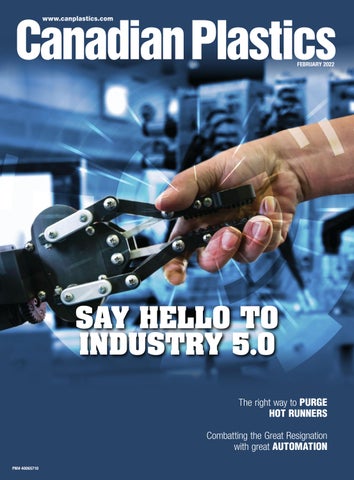
SAY HELLO TO INDUSTRY 5.0 The right way to PURGE HOT RUNNERS Combatting the Great Resignation with great AUTOMATION PM# 40065710
contents FEBRUARY 2022 VOLUME 81 • NUMBER 1
FROM THE ARCHIVES
The May 1991 issue of Canadian Plastics reported on the completion of a new $2.8-million, 80,000-square-foot recycling plant built in Mississauga, Ont., for the Canadian Polystyrene Recycling Association (CPRA). The CPRA was founded in 1990 to combat criticism of polystyrene (PS) fast food packaging, and the plant – which was being fitted with cleaning, extruding, and pelletizing machinery, and which had a gallery for visitors to watch the operations – was designed to recycle waste foam and rigid PS scrap from restaurants and industry. Preliminary start-up of the plant was scheduled for June 1991.
9
Number of the month:
*78
* Increase by percentage in the manufacturing quit rates in the U.S. since February 2020. (See pg. 18)
5
13
cover story 4
Editor’s View: An antidote to the Great Resignation
5
6
Ideas & Innovations: Recycled plastic dishwasher component proves a big point News: • ABC Technologies makes two big acquisitions • Davis-Standard bought by private equity firm Gamut • Piovan buys Conair parent IPEG • Supplier News and People
20 Technology Showcase
9
SMART MANUFACTURING: Say hello to Industry 5.0
The fifth industrial revolution is here, with the goal of putting human workers back at the centre of smart factory manufacturing.
features
13 PURGING: Get with the hot runner purging program
With more and more suppliers formulating grades of commercial purging compounds designed for hot runner use, the case for adopting a planned purging procedure has never been stronger.
18 ROBOTS & AUTOMATION: Automation vs. the Great Resignation
As workers continue leaving their jobs in droves, doubling down on robotic automation can help keep your manufacturing operations up and running.
21 Advertising Index 22 Technical Tips: The unique nature of CNC plastic machining
Visit us at www.canplastics.com February 2022 Canadian Plastics
3
editor’s view
Canadian Plastics magazine reports on and interprets developments in plastics markets and technologies worldwide for plastics processors, moldmakers and end-users based in Canada.
An antidote to the Great Resignation
T
he plastics industry has had a skilled labour shortage for some time now, and to this we can now add a more general labour shortage. The first problem doesn’t require much explanation: Baby boomers are retiring, and younger generations lack interest in, and training for, manufacturing careers. It’s a talent crisis that was there before the COVID-19 pandemic and will no doubt continue to challenge business leaders in a post-pandemic world. Unlike the skilled labour shortage, however, the general labour shortage is directly related to the ongoing pandemic. It even has a name, usually referred to as either the Great Resignation or the Big Quit. By whatever title, it’s an economic trend in which record numbers of people are leaving their jobs as the pandemic continues. According to the latest data, quitting rates are especially high for in-person roles in traditionally blue-collar jobs, including manufacturing. In the U.S., manufacturing quit rates are up 78 per cent since February 2020. In Canada it’s not clear whether the Great Resignation is taking place with equal intensity, but some studies suggest that it is, and there’s no reason to doubt them. There are many factors causing the Great Resignation, including wage subsidies which have given workers more freedom to choose the kind of work they want to do, the added work stress caused by the pandemic, the need to stay home with young children, and the shift to remote work. The end result is that millions of workers throughout North America are rethinking their career options, voting with their feet, and walking out of their jobs – many without having another position already lined up. For the manufacturing sector, an obvious solution to this mass exodus is factory automation. As manufacturers struggle to recruit and retain shop floor workers, a growing number of them are
4 Canadian Plastics February 2022
adding robots and automation to keep operations running. Which is why orders for robots in North America are up 37 per cent from a year ago, according to the Association for Advancing Automation, totalling nearly 29,000 since January 2021. That’s nearly US$1.5 billion in machinery. In the longer term, a McKinsey study predicts that roughly half of all existing manufacturing work activities could be automated in the next few decades, with more than 50 billion devices connected to the Internet of Things by 2025. “This trend will shift competition toward capital expenditure investments in automation technology and toward the social, emotional, and technological skills needed as intelligent machines take over more physical, repetitive, and basic cognitive tasks,” the study said. There’s a name for this too: Industry 5.0. Building on Industry 4.0’s interconnectedness of artificial intelligence, robots, and other systems in order to achieve optimum performance to improve efficiencies and productivity, Industry 5.0 is touted as taking it a step further – and adding a human touch – by refining the interaction between humans and machines to help the people do better work. Industry 5.0 didn’t develop as a response to the Great Resignation but, as we explore in our cover story, it can alleviate some of the effects. (Better labour management and improved flexibility and retention practices are also important, but are topics for another day.) In the end, whether your shop buys into Industry 4.0 and/or Industry 5.0 wholeheartedly or simply adds a pickand-place robot or two to fill in for missing human workers on your simplest production lines, automation is one way to help navigate a perfect storm of labour shortages.
www.canplastics.com Reader Service Print and digital subscription inquiries or changes, please contact Serina Dingeldein, Audience Development Manager Tel: 416-510-5124 Fax: 416-510-6875 email: sdingeldein@annexbusinessmedia.com Mail: 111 Gordon Baker Rd., Suite 400 Toronto, ON M2H 3R1 Mark Stephen 416-510-5110 Fax: 416-442-2230 mstephen@canplastics.com ASSOCIATE PUBLISHER Catherine McDonald 289-921-6520 cmcdonald@annexbusinessmedia.com ASSOCIATE PUBLISHER Stephen Kranabetter C: 416-561-5362 W: 416-510-6791 skranabetter@annexbusinessmedia.com MEDIA DESIGNER Lisa Zambri lzambri@annexbusinessmedia.com ACCOUNT COORDINATOR Cheryl Fisher 416-510-5194 cfisher@annexbusinessmedia.com GROUP PUBLISHER/VP SALES Martin Mcanulty mmcanulty@annexbusinessmedia.com COO Scott Jamieson sjamieson@annexbusinessmedia.com PRINTED IN CANADA ISSN 008-4778 (Print) ISSN 1923-3671 (Online) Publication Mail Agreement #40065710 2022 SUBSCRIPTION RATES 5 issues Canadian Plastics, plus Dec. 2022 Buyers’ Guide: CANADA: 1 Year $77.50 plus applicable taxes; 2 Years $123.50+ taxes USA: $176.00 (CAD) / year FOREIGN: $201.00 (CAD) / year
Occasionally, Canadian Plastics will mail information on behalf of industry related groups whose products and services we believe could be of interest to you. If you prefer not to receive this information, please contact our audience development department in any of the four ways listed above. Annex Privacy Officer privacy@annexbusinessmedia.com • Tel: 800-668-2374 No part of the editorial content of this publication can be reprinted without the publisher’s written permission ©20221 Annex Business Media. All rights reserved. Opinions expressed in this magazine are not necessarily those of the editor or the publisher. No liability is assumed for errors or omissions. All advertising is subject to the publisher’s approval. Such approval does not imply any endorsement of the products or services advertised. Publisher reserves the right to refuse advertising that does not meet the standards of the publication. MEMBER: Magazines Canada, Canadian Plastics Industry Association.
Mark Stephen, editor
mstephen@canplastics.com www.canplastics.com
ideas & innovations
Recycled plastic dishwasher component proves a big point
Photo: Fraunhofer Institute for Structural Durability and System Reliability LBF
W
e all want to use more recycled plastic, but here’s the problem: Every time plastic is recycled, the polymer chain grows shorter, so its quality decreases. And who wants to buy something of lower quality? Which is why it might be a big deal that researchers at the Fraunhofer Institute for Structural Durability and System Reliability LBF in Darmstadt, Germany, working together with partner companies and home appliance makers Bosch GmbH and BoschSiemens-Hausgeräte GmbH, have demonstrated that recycled plastic can perform similarly to virgin plastic if the recyclate is processed efficiently. And they used dishwasher case bottoms to prove it. First, Bosch optimized recyclate from the housing of automotive starter batteries by mixing in additives to increase the strength and enhance the visual properties. Next, the LBF team had to demonstrate that the optimized material could be suitable in a demanding application…and they chose dishwasher case bottoms, which form the base structure of a dishwasher, holding the side walls and housing ancillary components such as the pump, status sensors, and salt reservoir. The researchers produced test specimens and subjected them to a set force around 100,000 times in an automated process – the number of times an average dishwasher door will be opened throughout a service lifespan of approximately 18 years. The tests showed that the recyclate had similar stiffness properties to that of virgin plastic. “More importantly, however, both materials behave exactly the same way in terms of plastic deformability,” said LBF scientist and research team member Dominik Spancken. And on tests performed on the finger-thick pin on the dishwasher case bottom – which is subject to mechanical stress every time the dishwasher door is opened and closed and is therefore subject to the greatest load on the dishwasher case bottom – the resilience values recorded for the pins made from recyclate differed only very slightly to those made from virgin material. “In summary, it’s fair to say that the recyclate can handle the same stresses as virgin material,” Spancken said. “A dishwasher case bottom made from recyclate is indeed possible, and swapping from virgin plastic to recyclate would make a significant contribution to a sustainable complete appliance.” The end goals, he continued, are to overcome a lack of trust in recycled materials and to convince more experts and companies to use more specially blended recyclate in CPL other high-end products.
A dishwasher case bottom.
PURGING ShumanPlastics-Dyna Purge PERFECTION page 5 What does purging perfection look like? Industry leadership, decades of innovation, outstanding customer service, technical expertise and product that’s effective every time. When your work has to be perfect, trust the leader. Trust Dyna-Purge. Request a free sample of Dyna-Purge and see for yourself. Discover the Difference. 866-607-8743 www.dynapurge.com DYNAPURGE is a registered trademark of Shuman Plastics, Inc. February 2022 Canadian Plastics
CP_PurgingPerfection_Resized.indd CPL_Shuman_Feb22_CSA.indd 1 1
5
2017-02-23 1:28 2022-02-03 9:19 PM AM
news
A
news release. Two weeks later, ABC agreed to buy Mühlacker, Germany-based injection molder Karl Etzel GmbH for about US$95 million. Etzel is a Tier-1 and -2 supplier that manufactures interior and exterior parts for the German luxury auto market. It generated about US$100 million in sales in 2021. The deal expands ABC’s scale in Europe and gives it “a strong customer base of luxury OEMs,” Sheppelman said in a Jan. 21 news release. Both deals are expected to close in the first quarter of 2022. ABC is one of North America’s largest injection and blow molders, and makes products for automotive HVAC systems, interiors, exteriors, fluid management, and air induction systems, among others. CPL
Photo: Wittmann Battenfeld
utomotive parts molder ABC Technologies Holdings Inc. has started 2022 strong, with two big acquisitions. In early January, the Toronto-based firm bought dlhBowles Inc., a North Canton, Ohio-based camera and sensor cleaning systems maker, for about US$255 million from Morgenthaler Private Equity Partners. dlhBowles’ plastics operations include injection molding, extrusion, and thermoforming. “The acquisition of dlhBowles further solidifies ABC’s leadership position in the North American washer systems market, strengthening our product portfolio to…enhance the capabilities of our Fluid Management division, while improving [our] process automation,” Todd Sheppelman, ABC’s president and CEO, said in a Jan. 5
Karl Etzel GmbH’s production floor in Mühlacker, Germany.
SUPPLIER NEWS – Bamberger Polymers, headquartered in Jericho, N.Y., has been appointed by Sabic as an authorized distributor for its engineering thermoplastics and polyolefins in the Americas. Sabic grades that Bamberger is supplying include Cycolac (ABS), Cycoloy (PC/ABS), Geloy (ASA), Lexan (PC), Stamax (long-glass PP), Valox (PBT), and Xenoy (PC/PBT).
6 Canadian Plastics February 2022
Linamar founder Frank Hasenfratz passes away at 86
Photo: Linamar Corp.
ABC Technologies makes two big acquisitions
Linamar founder Frank Hasenfratz passes away at 86
F
rank Hasenfratz, the founder of the Guelph, Ont.-based automotive parts maker Linamar Corp., passed away on Jan. 8 in Guelph at age 86. Born in Hungary in 1935 and immigrating to Canada in 1957, Hasenfratz began Linamar as a one-man operation in the basement of his family home north of Guelph in 1966, drawing on his experience in toolmaking and machining. The name Linamar is a combination of the names of his wife Margaret and his daughters Linda and Nancy. Hasenfratz took Linamar public on the Toronto Stock Exchange in 1986 and acquired Skyjack, a company making elevating work platforms, in 2001. In 2003, Linamar bought McLaren Performance Technologies to bolster its engineering capabilities and in 2007 and 2013, Ford’s All Wheel Drive division and the camshaft department of German auto supplier Mubea joined the company. Hasenfratz retired from Linamar in 1997, and his daughter Linda is the company’s current CEO. Over the course of his career, Hasenfratz was honoured as a Canadian Entrepreneur of the Year, inducted into the Canadian Manufacturing Hall of Fame and the Canadian Business Hall of Fame, and appointed to the Order of Canada in CPL 2016. www.canplastics.com
Davis-Standard bought by private equity firm Gamut
Piovan buys Conair parent IPEG
E
P
xtrusion and converting systems maker Davis-Standard LLC and its affiliates have been purchased by New York City-based private equity firm Gamut Capital Management for an undisclosed amount. The Pawcatuck, Conn.-based company was sold in November 2021 by Oncap, the mid-market private equity platform of Onex. Davis-Standard supplies extrusion and converting systems and related aftermarket products and services for the elastomer, rigid packaging, flexible packaging, and infrastructure end markets. In a news release, Gamut officials said Davis-Standard has an installed base of about US$7.5 billion of equipment globally. “We are excited to partner with the Gamut team during this next phase of Davis-Standard’s long history as a provider of highly engineered solutions to an extensive base of industry-leading customers,” Davis-Standard CEO Jim Murphy said. “The resources Gamut brings to this investment will enable us to not only accelerate growth within our markets, but also transform Davis-Standard into a leading, valueadded global process solutions business.” CPL
iovan SpA is buying Cranberry Township, Pa.-based IPEG Inc. to strengthen its position in the global auxiliary equipment market. Venice, Italy-based Piovan is acquiring 100 per cent of the outstanding shares of IPEG, which comprises four brands: Conair Group, Thermal Care, Pelletron, and Republic Machine. The deal, which is expected to close in early 2022, calls for an initial payment of approximately US$125 million and up to another US$22 million to be paid as a potential earnout in 2024 if EBITDA targets are met. In a Dec. 13, 2021 news release, Piovan officials said the combined group will have a workforce of more than 1,800 employees and will operate 14 facilities worldwide, and would have generated pro-forma sales of over 450 million euros (on the basis of the results for the 12 months ended Sept. 30, 2021). The acquisition gives Piovan access to a large customer base in North America that’s making investments, according to Piovan CEO Filippo Zuppichin. IPEG will become an indirect subsidiary of Piovan, and IPEG’s CEO Kirk Winstead and chief financial officer John Erkert will retain their positions. CPL
Water Chillers
Portable Chillers : .25 -40 tons Indoor Portable Chillers ... Air or Water Cooled
Central Chillers : 5 -180 tons
Indoor & Outdoor units ... Air or Water Cooled Complete chiller & pump system packages or stand alone chilling modules.
NEW MG Portable Chiller Control System
905-895-9667
Portable & Central Chillers Manufactured by Advantage With Exclusive Canadian Distributor, Chillers Inc.
www.ChillersInc.com
CPL_Chillers_JanFeb21.indd 1
1228 GORHAM STREET, UNIT 11 NEWMARKET, ONTARIO L3Y 8Z1
2021-01-21 3:08 PM
news
Protech Group buys specialty materials business of Dyvex Industries
M
ontreal-based specialty materials firm Protech Group has acquired the specialty materials business of Dyvex Industries Inc., a compounder headquartered in Carbondale, Pa. The acquisition, which Protech officials said enhances the company’s range of specialty material offerings, was completed on Dec. 30, 2021. The financial terms of the deal have not been disclosed. Dyvex makes compounds used in fragrance, flavour, and odour control products. The company sells its products globally and is known for its Polyessence and IonicGuard
brands. Officials said that acquisitions “are the key to the growth strategy” for Protech, a maker of coatings, paints, and specialty materials, including liquid PVC. The deal is the fifth acquisition that Protech has made since early 2020. Other acquisitions include the thermoset powder coatings business of ACG Industries, in Gondecourt, France; Calgary-based Lynx Thermoset Coating Ltd.; the liquid paints business of Excalibur Paints & Coatings Ltd., in Wichita Falls, Tex.; and Winslow Browning Inc., in Liberty, Ind. CPL
PEOPLE
Sherman McGinnis
Brodie Delemeester
Gene Cammack
Anthony O’Donovan
Nolan Strall
Peter Lennox
David Jackson
Greg Gitto
Steve Post
– Worcester, Mass.-based Absolute Group of Companies, which operates injection molding machine maker Absolute Haitian and Absolute Robot, has named Sherman McGinnis to vice president of sales.
– Sarnia, Ont.-based plastics recycling technology developer Aduro Clean Technologies Inc. has named Gene Cammack as chief operating officer. – King of Prussia, Pa.-based specialty material supplier Arkema Inc. has named Anthony O’Donovan as president and CEO. – Specialty chemical additives and polymers distributor Chemspec Canada Inc., headquartered in Ottawa, has named David Jackson as managing director. – McHenry, Ill.-based material supplier Chroma Color Corp. has named Greg Gitto as director of sales and marketing for PVC. – Cranberry Township, Pa.-based auxiliary equipment maker Conair Group has named Jason Ganim as president. – Industrial control and automation manufacturer Festo has named Jean-Francois Paquette as sales director for Canada. Paquette is based out of Montreal. – Morrisville, Pa.-based material supplier Gelest Inc. has named Jonathan Goff as president.
8 Canadian Plastics February 2022
Jason Ganim
Peter Vanacker
Jean-Francois Paquette
Tad McGwire
Jonathan Goff
Sandra Hudon
Deane Nash
Harinder Tamber
– Packaging equipment maker GN Thermoforming Equipment, headquartered in Chester, N.S., has named Deane Nash as general manager.
– Hot runner systems maker Incoe Corp., headquartered in Auburn Hills, Mich., has named Brodie Delemeester as general manager, North America. – Processing machine maker KraussMaffei has named Nolan Strall as president of KraussMaffei Corp. North America, based in Florence, Ky. – Thermoformed plastics packaging supplier Lacerta Group Inc., of Mansfield, Mass., has named Peter Lennox as CEO. –Branchburg, N.J.-based processing equipment maker Leistritz Extrusion has named Steve Post as product manager for life science and specialty film applications.
– Houston-based chemical maker LyondellBasell has appointed Peter Vanacker as CEO effective no later than June 2022. – The Washington, D.C.-based Plastics Industry Association has named Tad McGwire as chairman of the board. – Saint-Laurent, Que.-based flexible packaging supplier Polykar Inc. has named Sandra Hudon as vice president of sales and business development, and Harinder Tamber as director of sales for flexible packaging. www.canplastics.com
news smart manufacturing
SAY HELLO TO INDUSTRY 5.0 The fifth industrial revolution is here, with the goal of putting human workers back at the centre of smart factory manufacturing. By Mark Stephen, editor
Photo © zapp2photo / Adobe Stock
R
eady or not, Industry 5.0 is here. If you want proof of Ferris Bueller’s famous observation that life moves pretty fast, look no further: While many manufacturers are still busy developing methods for interconnecting new technologies to improve efficiency and productivity – the guiding principle behind Industry 4.0 – the next phase of industrialization is already upon us. Industry 5.0 represents perhaps the ultimate partnership between workers and smart manufacturing machines. And where Industry 4.0 marks an era of automation, artificial intelligence (AI), the Industrial Internet of Things (IIoT), and autonomous actions without human intervention, the thrust of Industry 5.0 is to use AI and IIoT data to help empower humans to do better work.
Simply put, it puts the focus back on people. All of which is why Industry 5.0 is expected to see the transformation of the fourth revolution’s “cyber-physical” manufacturing plants – those using digital technologies to operate factories with minimal human involvement – into “human-cyber-physical” systems that recognize that human insights and creativity are as valuable to the manufacturing process as automated and digital advances. “The greatest technology is nothing without the right processes in place and the right investments in people,” said Will Healy III, Americas marketing manager for smart factory solutions provider Balluff worldwide, which has Canadian operations in Mississauga, Ontario. “Industry 5.0 puts people at the centre in a
way that they understand why they’re doing what they’re doing, and this makes processes and technology implementations more efficient and productive.”
EARLY ADOPTERS
And some companies are already forging ahead to the new era. The sportswear company Adidas, for example, is producing running shoes and trainers in small “Smartfactory” plants in Germany and the U.S. These factories use robotics, 3D printing, and data analytics to produce shoes for anyone and at any time. When a customer requests an adapted version of an Adidas design, the nearest Smartfactory can produce a pair within a day and deliver it to the consumer shortly afterward. For plastics processors, a similar pairing of humans with machines and data opens the door to countless opportunities by promoting a more robust and competitive environment – and it’s especially necessary now, as record February 2022 Canadian Plastics
9
smart manufacturing
THE ROLE OF AUTOMATION
A fundamental tenet of Industry 5.0 is that robots will support, not replace, humans. Robots will not be only a programmable machine that can perform repetitive tasks, but also will transform into an ideal human companion for some scenarios, which marks a big distinction from Industry 4.0, where humans and robots work independently – they may work on the same production line, but there are clear delineations between where the robot works and where the human works. Industry 5.0 blurs that distinction as humans and robots – in particular collaborative robots, or cobots – start to work sideby-side and even together. The goal is for the cobot or other automation to do the required tasks of heavy lifting and ensuring consistency while the human operator provides the cognitive skills of a craftsperson. And indeed, with fewer workers available, the need for a human touch is more necessary than ever for more perception-driven and creative decisions. “Robots can handle more repetitive tasks that may require consistency, quality or challenging physical actions, which frees up the human workers for the more challenging jobs that require adaptability and critical thinking,” said Michael Muldoon, director of product
10 Canadian Plastics February 2022
CASE IN POINT
When Bryan, Ohio-based injection molder Allied Moulded was facing a significant labour shortage last year, it chose Universal Robots’ new ActiNav autonomous bin-picking system – which combines intelligent vision, real-time autonomous motion control, and Universal Robots’ cobots – to automate an important bin-picking application. ActiNav decides which part to pick; how to place it in the correct orientation; and how to identify incorrect parts, place them aside, and continue with its main task. “The deployment enabled Allied Moulded to reduce overtime expenses, move existing workers to more ergonomic tasks, and improve consistency in the production process,” Universal Robots officials said. “And if the bin is kept full, ActiNav can go all day without operator intervention.” And Allied Moulded is well on its way to being able to move ActiNav to any machine and set it up for any part style.
development with Montreal-based industrial automation supplier AV&R. “This is how Industry 5.0 combines people’s skills and robots’ capabilities. We believe that Industry 5.0 will push robotic system designers and manufacturers to adopt increasingly collaborative and flexible solutions.” A challenge for the automation makers, then, is to keep developing robotic systems that go ever further towards putting the emphasis on the human who operates them – to improve on the automation of Industry 4.0 that has been intimidating to, and even resented by, some factory workers. “Simplifying the programming and the daily use of the systems thanks to specific software, or making the systems
intuitive, flexible, and adaptable, are all elements that the designers of automation and robotic systems must take into consideration in order to remain competitive in the Industry 5.0 era,” said Jim Beretta, president of London, Ont.based marketing consulting company Customer Attraction, which focuses on automation and robotics, and host of The Robot Industry Podcast. “This is why cobots are such a good fit – they’re easy to integrate and allow humans and robots to work together on the same task – and also why I think Industry 5.0 skews towards cobots as opposed to more traditional industrial automation. Cobots are a good way in particular for smaller, understaffed shops, that perhaps don’t have much experience with automation, to dip their toes in; and if they find they need faster cycle times, they’ll have the skills and comfort level to upgrade to higher speed industrial robots and automation.”
DATA YOU CAN USE
As with Industry 4.0, gathering production data is key to Industry 5.0, but with a significant difference. Assessing production and other data generated through Industry 4.0 has been compared to drinking from a firehose: Torrents of data from sensors and manufacturing processes have immense value, but no value at all if companies can’t organize that data, search it, analyze it, and use it to build better products or processes. “An early mistake with Industry 4.0 is that companies collected all available data, including some they didn’t need, instead of just the data that could improve a process,” Beretta said. Also, data capture in Industry 4.0 tends to be centralized and amassed without human input, creating confusing signals that traditional business intelligence tools can’t always interpret. As a result, many of today’s workers are still relatively disconnected from the digital thread of the business. Making sense of this data and turning it into actionable insights is only possible with AI. For manufacturers to energize the www.canplastics.com
Photo: Universal Robots
numbers of people are quitting their jobs as the COVID-19 pandemic winds down. With this so-called Great Resignation reportedly affecting the manufacturing sector more than other sectors, many manufacturers need to work harder than ever to find and keep qualified workers. Which gives plastics processors a further incentive to integrate people with machines in order to fill these gaps, and in the longer term to maximize the unique benefits that can be reaped as Industry 5.0 continues to evolve. “Forward-looking companies are using this opportunity to invest in technology and resources for their workers, raising the value of their work and raising their contributions,” Healy said.
smart manufacturing
opportunities abundant in Industry 5.0, decentralizing data capture with information and communication models is the foundational platform for success. “With Industry 4.0, products are enabled only to collect usage data, track usage patterns, and transmit it to the observer, but have limited actionable intelligence built into them,” said Michael Muldoon. “Supported by fast connectivity, Industry 5.0 products can optimize their performance and deliver maximum efficiency throughout the lifetime of the product.” In short, Industry 5.0 uses both computing and cognitive power to find the meaning in the data. In Industry 5.0, data collection is further automated and more inputs are added through robotic systems and Internet-connected devices to winnow the valuable data from the relatively unimportant data that has no connection to helping improve a production process. Knowledge is also captured from the people in the production process at intervals like shift handover or inspection routines, for example. Digitally captured, this information can be immediately delivered to all constituents in the production process, from the plant floor all along the chain to the upper echelons of the organization, so there’s complete transparency for all. “Data is the new gold,” said Jim Beretta. “The more data you can generate through Industry 5.0 and can give to your end customer, the more competitive, and ready for AI, you’ll be.”
THE PRICE OF PROGRESS
How will these changes affect your manufacturing plant? It depends on how thoroughly you embrace Industry 5.0 and how quickly you adopt and implement the necessary technologies. One possible obstacle for processors is investment cost. “Data and interconnectivity definitely come with a price, and the question for many shops is, who’s going to pay it – is it a cost to your own bottom line or can you pass it on to your customers?” Beretta said. “If molders think their customers won’t
“Data is the new gold, and whether it’s a cost to your own bottom line or whether you can pass that cost on to your customers, getting more data is of value.” pay for Industry 5.0 upgrades, they may treat that as an obstacle to implementation.” Federal or provincial funding may be available – through the National Research Council of Canada, for example – but isn’t always reliable. “Funding can take too long and is too uncertain,” Beretta said. “It’s incumbent on the companies to invest in themselves, and perhaps charge separately or differently for various products depending on whether Industry 4.0 or Industry 5.0 is
used in the part production or machinery making process. Processors need to have conversations with their end customers about the cost-benefit value of supplying parts that are 100 per cent defect-free.” One way around having to purchase newer, smarter machinery is to upgrade existing equipment. “Predictive maintenance and condition monitoring tools have been found to be highly effective at increasing machine availability and reducing unplanned equipment breakdowns,” said Will Healy III. “Processors don’t need to throw away all their existing molding, machining, and assembly equipment when they can still get years of valuable production if they make the necessary retrofits and upgrade investments.” A bigger investment – at least of time – might be in turning around a
DS-Acti
TM
Preventative maintenance and cost-savings with DS Activ-Check™ User-friendly cloud-based IIoT solution, alerted to issues before they happen, long-term cloud data storage, reduced downtime, improved operation and enhance product quality!
®
CONTACT US February 2022 Canadian Plastics
CPL_DavisStandard_Feb22_CSA.indd 1
11
2022-02-02 10:25 AM
smart manufacturing
company’s business culture to make it more Industry 5.0-friendly. “The ‘worker-at-the-centre’ focus can cost very little in capital but requires a major upheaval of the status quo, ‘we’ve-always-done-it-this-way’ culture that predominates in many manufacturing organizations today,” Healy said. “These cultural changes can be painful for organizations and hard to sustain without a clear vision of the purpose on the other side, which is why some shops haven’t made it past previous failures.” On a related note, another major obstacle to implementing AI and other smart technologies in a meaningful way is the struggle some manufacturers in North America face in achieving Industry 2.0 or Industry 3.0 in their factories, let alone reaching smart factory goals. “Companies that try to set far-reaching goals with a factory stuck at Industry 2.0 will struggle to suc-
ceed,” Healy said. “Each factory must assess where they are in the evolution, how they’re structured, and how they’re making decisions each day. Some firms are ready to move forward with the worker at the centre of everything, and others need to rebuild their cultures first or their processes or change their technology investment strategies.”
PACE YOURSELF
Some of the most successful organizations, then, are setting a vision of where they want to be but are implementing small, reachable goals that their teams can learn from, gain success from, and build momentum from. “It must be a culmination of a series of daily decisions to find success with smart manufacturing and achieving the next revolution,” Michael Muldoon said. “Manufacturers have to realize that this is a journey, and one that has to incorporate several aspects of the business.
There’s no standard blueprint or common approach – it’s highly customized based on the type of company you are and the sector you’re in.” In the end, as Industry 4.0 winds down, Industry 5.0 isn’t just inevitable, it’s already here. And if the drivers behind Industry 5.0 aren’t new, they’re being adapted to the current moment – specifically, the manufacturing and labour challenges of the pandemic – and accelerated by it. Which might not be a bad thing. “By influencing human intelligence with calculated predictive insights, the potential for efficient outcomes can be precisely what we need in a post-pandemic future,” one recent study concluded. “The old way of supporting your workers just doesn’t work today – by putting human beings back at the centre of industrial production, Industry 5.0 gives workers jobs that are more meaningful than factory jobs have been in well over a century.” CPL
You produce it ... We’ll Reduce it! ... Since 1982 North American Built and Priced Right for Today’s Economy » GRANULATORS » BELT CONVEYORS » BLOWER/CYCLONE SYSTEMS » FINES SEPARATOR SYSTEMS
Rotogran granulators are internationally recognized for their superior design, efficiency, durability and competitive pricing. We are the size reduction specialists for the processing and recycling industry. Our rugged equipment is precision manufactured to meet individual customer needs. • Complete range from press side to central. • Chamber construction second to none. • Custom applications our specialty.
12 Canadian Plastics February 2022
MANUFACTURER OF SIZE REDUCTION EQUIPMENT for the Plastics and Recycling industry
4 SIMPSON ROAD, BOLTON, ON L7E 1G9 CANADA Tel: 905-738-0101 | Fax: 905-738-5750 sales@rotogran.com | www.rotogran.com
www.canplastics.com
purging
GET WITH THE HOT RUNNER PURGING PROGRAM
With more and more suppliers formulating grades of commercial purging compounds designed for hot runner use, the case for adopting a planned purging procedure has never been stronger. By Mark Stephen, editor
Photo © pressmaster / Adobe Stock
I
n injection molding, melt delivery management has a major impact on the final quality of the part and ultimate success of the production line. So, it’s hard to overstate the importance of hot runners, which provide a path for molten resin to flow through without allowing it to solidify. Precise control of resin flow, pressure, and temperature are critical here, which is why the hot runner is often considered one of the most sophisticated systems in the injection molding process, and which is why hot runners are so widely used today. And it’s also why purging hot runners is so important, to remove residual materials while leaving a minimal amount of residue behind. And we don’t mean using in-house resins, regrind, or a homemade laundry detergent-based purging solution. Commercial purging compounds (CPCs) have proven to be most effective at removing colour and contamination from hot runners, but you have to use the right CPC for the job and follow the correct procedure for the desired outcome.
“Molders can increase the efficiency of their hot runner operations if a strategic approach is developed to address the need for required resin and colour changes,” said Jim Bott, new business development manager for automotive with Incoe Corp.
WHY NOW?
The concept of using CPCs on screws and barrels has definitely been embraced by the plastics processing community. But using a CPC to clean injection molding hot runner systems still remains a bit of a taboo – some processors have only ever put resin through their hot runners, the logic goes, so why change now? Because the technology has changed. “Up until about 10 years ago, most molders weren’t doing hot runner purges because the right compounds weren’t widely available – they were using production resin and home brews for the job because that’s what they’d been taught, or they used a general-purpose CPC on their hot runners and got poor
results,” said Jeff Lewis, technical and sales manager with Slide Products Inc. “A lot of work has been done in the past 10 years to make purging compounds more fluid and better suited for hot runners. Slide has three different purges now that will go through orifice sizes of less than 30,000th of an inch if necessary.” A first step in developing a strategic approach to purging hot runners is to understand the hot runners themselves. Which isn’t always easy – very intelligent and experienced people in the plastics industry frequently ask for hot runner basics because although they know that a hot runner is a critical component, some still don’t understand what it does or how it works. “A big part of getting a good hot runner purge result is understanding how your hot runner tooling was designed, especially the size of the manifold, gates, and melt channels,” said Rodney Davenport, vice president of injection molder CH3 Solutions in Dalton, Ga., and a longtime advocate for purging hot runners. “Every hot runner February 2022 Canadian Plastics
13
purging
is different, and they’re almost all manufactured differently – a CPC that works in one hot runner might not work in another.” Some CPCs, for example, have fillers that may not melt completely during the purging process, which can result in blockages in smaller gates or melt channels; also, poorly designed runners with dead spots or sharp angles can be difficult to clean and can be a sticking point for the CPC itself.
GETTING SPECIFIC
Given the complexity of hot runners and the fact that some CPCs are suitable for hot runner purges and some aren’t, the smart move is to bring the CPC supplier into the conversation early on, as the best resource to help identify the correct purging formulation and procedure. For one thing, they can help with the key determination of whether to use a chemical or mechanical grade CPC. In a nutshell, mechanical purging compounds primarily utilize shearing force to purge contaminants from processing surfaces, while chemical compounds operate by utilizing heat-activated chemicals to break down bonds between the various contaminants and processing surfaces in a chemical reaction in the barrel or die. “Key factors in choosing either a mechanical or chemical compound for a hot runner purge are always going to be material, temperature, machine design, hot runner volume, and gate size – there are chemical grades that can flow through smaller gates than a mechanical grade can flow through,” said Jeremy Cooley, technical sales representative at Asahi Kasei Asaclean Americas. “Mechanical purging compounds have been shown to work well with hot runners and we tend to recommend them, but we also have chemical purges for hot runners; most, but not all, are for a specific type of polyethylene that happens to match up perfectly with the carrier resin that we would use for our chemical grade, which eliminates the issue of residue.” And according to Robert Grzegorek,
14 Canadian Plastics January/February 2021
global technical services manager for the Dyna-Purge division of Shuman Plastics Inc., chemically active CPCs can be a good choice for fast colour changes, but may not be aggressive enough to thoroughly purge highly contaminated injection systems or highly filled resins. And the number of cavities in the hot runner system can influence the decision. “A mechanical purge has a higher success rate with a twocavity mold than for a 16-, 20- or multicavity mold,” said Jeff Lewis. Oftentimes the solution is to try both chemical and mechanical grades and see which works best – with the important caveat that you consult your CPC supplier beforehand. “Have an open mind about mechanical versus chemical purges,” said Rodney Davenport. “There’s a lot of trial and error in finding the right procedure. Get with a purge professional and trial a few things to find the right grade for your hot runner.”
“A lot of work has been done in the past 10 years to make purging compounds more fluid and better suited for hot runners.” As mentioned, it’s also important to verify if there are any hot runner gate clearance requirements for the CPC being considered – if the CPC has any type of filler, then it will likely require larger gate clearances. A glass-filled CPC isn’t recommended for purging most hot runner systems due to gate clearance restrictions or potential damage to nozzle tips. “Also, any effective CPC will remove carbonized resin or colourants, which could potentially block gates if their clearances are too small,” Jeremy Cooley said.
DO AS THEY SAY
Once you’ve found the right grade, it’s critical to follow the instructions pro-
vided by the CPC supplier carefully, especially at first. “The key is to follow the instructions to the letter at the beginning to optimize the procedure,” Cooley said. “Later, as the customer gains more experience and gets more comfortable, they can perhaps adjust the steps a bit to improve on the results. But don’t deviate from the CPC grade that’s been recommended or from the overall procedure.” Carefully following the instructions will help you complete a purge cycle using the minimum amount of material while reducing downtime, the experts say. For example, industrial technology and machine maker Husky Injection Molding Systems Ltd. and Chem-Trend L.P. recently collaborated on a system to create repeatability during the critical colour change process. The team devised a new, guided procedure for the Husky Altanium Mold Controller operator interface with the aim of increasing equipment and labour uptime – instructions that cover a simple but effective approach to setting up and performing the colour change process for molds with hot runner systems. The colour change step-by-step instructions include settings for shot weight, conversion ratio, and purge quantity while a “purge booster” feature aids in faster colour change time; and the approach is based on the process for using Chem-Trend’s Ultra Purge brand of purge compounds, which is designed for hot runner systems. According to Graziano Pestarino, Chem-Trend’s global account manager for thermoplastics solutions, trial results showed up to an 85 per cent reduction in scrap and an 80 per cent increase in mold cleaning efficiency when following the recommended process. Adding a wrinkle of complexity, since hot runner tools can be quirky, CPC suppliers recommend different procedures for different systems. Which means there’s no one-size-fitsall procedure. Some CPCs can be used with either a closed-mold or openmold method of purging, and the method chosen depends on the resin(s) processed, mold design, and cleaning difficulty. “The mold plates should be left open when doing a hot runner trial
purging
HOW TO DO A ‘TYPICAL’ HOT RUNNER PURGE* While there’s no one-size-fits-all hot runner purging procedure, a typical purge may consist of some or all of the following steps, although several variables may require more or less time to successfully complete the purge cycle: 1. The molding machine’s material handling equipment should be cleaned of all resins or additives.
2. The cooling system should be turned off on the injection side of the mold, taking care to monitor the mold to avoid overheating. 3. Setpoint temperatures for the manifold, nozzles, and hot runner system should be increased, with caution being taken to not exceed the resin’s maximum temperature specifications. 4. The CPC is then introduced to the material handling system, following the supplier’s instructions. At this point, the hopper or material handling equipment can be cleaned of CPC and the post-purging phase can begin. Using only screw rotation and backpressure, run the new material through the barrel and hot runner system for a minimum of 60 seconds, or begin running full molding
purge, so the customer can see what’s going on,” said Jeff Lewis. “After that, open-mold purging is usually sufficient for molds with fewer cavities, while higher cavitation molds may benefit more from closed-mold purging.”
Photo: Incoe Corp.
WORTH IT IN THE END
As a rule of thumb, according to Robert Grzegorek, faster purge times and fewer purge cycles can be expected for hot runner systems that have smaller flow diameters. And some other general rules apply. Hot runner temperatures, particularly gate temperatures, should be raised before purging in order to help loosen any deposits – the extra heat also helps improve flow of the purging compound. And it’s usually recommended to purge the screw and barrel first before purging the hot runners to ensure that any contamination in the barrel doesn’t get dragged into the hot runners and make cleaning that much more difficult. “In some cases, if you’re certain that the screw and barrel are relatively clean, it may be acceptable to start cleaning the hot runners without purging the screw and barrel in order to save some time and material,” Jeremy Cooley said. “But when in doubt, always clean the screw and barrel first.” And at the end of process, the CPC should leave low residue so that it lends itself to quick and efficient purging. “Other measures can be taken to ensure that the CPC is quickly displaced from the hot runner system so that excessive amounts of scrap and rejects aren’t generated,” Cooley said. “For mechanical-type CPCs, maximizing injection pressure and velocities while displacing the CPC will shorten displacement time and reduce displacement scrap.” But even the best-laid plans can go awry. Perhaps the most
system shots. Once a clean flow of new material is visible at the gates, or several injection cycles have been completed, proceed as follows: 1. Set the machine and hot runner parameters back to the desired molding conditions. 2. Run the new material through the entire molding system, including the hot runner for 60 seconds, or cycle multiple shots until the material looks clean. 3. Begin molding, and inspect parts until the material change is verified and all quality control requirements are met. Remember: in all cases, it’s advisable to first purge the injection system to clear out any contaminants to avoid transferring them to the hot runner system; and in all cases, it’s critical to follow the instructions provided by the CPC supplier. *Source: Jim Bott, Incoe Corp., and Robert Grzegorek, Dyna-Purge division of Shuman Plastics Inc.
TURN TO THE
INDUSTRY EXPERTS NOZZLES, TIPS & ACCESSORIES
THE BEST QUALITY. FINEST WORKMANSHIP.
ORDER
TODAY! February 2022 Canadian Plastics
CPL_PCS Company_Feb22_CSA.indd 1
15
2022-02-03 7:20 AM
purging
common mistake processors make during a hot runner purge is in how they respond if something goes wrong. “If a nozzle heater spikes or a component wears out during the purge – which can’t always be avoided – processors tend to make the mistake of shutting down the purge before they’ve cleared the CPC out of the runner,” said Jeff Lewis. “It’s important to evacuate the runner when this happens, because otherwise the CPC hardens inside the tooling and clogs the nozzles.”
“As a rule of thumb, faster purge times and fewer purge cycles can be expected for hot runner systems that have smaller flow diameters.” In the end, if purging hot runners with a CPC seems like a lot of work – especially if you think you’ve always gotten by with using production resin – consider the return on investment. “We inherited a set of tools that was taking almost two hours to change colours because the hot runners hadn’t been purged properly, ever,” said Rodney Davenport. “By repeatedly washing out the hot runner with a CPC, we’ve now got the colour changes down to under 10 minutes. In our shop, we purge every shutdown and startup and every colour change – with no exceptions – and we run 4.5 million pounds of polypropylene per year and have a scrap rate of less than half a percent.” So, the verdict is definitely in: “Molders that implement consistent purging regimens with the right CPCs, and stick to them, can expect to achieve significant improvements in their manuCPL facturing performance,” said Jim Bott.
RESOURCE LIST Asahi Kasei Asaclean Americas Inc. (Parsippany, N.J.); www.asaclean.com; 800-787-4348 Chem-Trend L.P. (Howell, Mich.); www.chemtrend.com; 517-545-7980 Dyna-Purge Div./Shuman Plastics Inc. (Depew, N.Y.); www.dynapurge.com; 866-607-8743 Incoe Corp. (Auburn Hills, Mich.); www.incoe.com; 248-616-0220 Slide Products Inc. (Wheeling, Ill.); www.slideproducts.com; 800-323-6433 AceTronic Industrial Controls Inc. (Mississauga, Ont.); www.acetronic.com; 905-564-7227
Fast Plastic Solutions With IMPROVING YOUR PROFITABILITY WITH INNOVATIVE POLYMERIC MATERIALS AND
ON-TIME DELIVERY orders@poundsofplastic.com
SUPPLIER OF MATERIALS FOR • INJECTION MOULDING • EXTRUSION • BLOW MOULDING • ROTO MOULDING • FILM • Antimicrobial thermoplastics (Kills bugs) • Biodegradable thermoplastics (Degrades in Landfill) • Black colour concentrates • Reprocessed post consumer thermoplastics
POUNDS OF PLASTIC INC. www.poundsofplastic.com 5650 Tomken Rd., buildings 1 & 2, Mississauga, Ontario L4W 4P1 PH: 905-286-9894 • FA: 905-625-8233 rpounds@poundsofplastic.com
16 Canadian Plastics February 2022
I am writing this wee blurb on impact testing of thermoplastic materials. Impact testing and ductile/brittle transition. Polymeric materials are sometimes subjected to rapid stress loading or impact loads. The most prevalent test for evaluation impact is “notched Izod”. I was schooled and learned specifically about the Izod test. The Izod test is typically a benchtop test. The test is named for its inventor Edwin Gilbert Izod. In this test a small test specimen is clamped in a vise. This specimen has a V-shaped notch in it, facing forward. ASTM (American Society for Testing and Materials) has a documented method, see ASTM D256. Another method of testing impact was the Charpy. Diagrams are available in the digital version of this article. Edwin Gilbert Izod This Izod test was developed for testing toughness of metals, a metal test.
performance. Compact disc cases (Do we remember those?) are brittle. They are manufactured from polystyrene. Polycarbonate is used for things like canopies for fighter aircraft. Very high end. The Popemobile has polycarbonate windows, as well, made from high molecular weight polycarbonate or long molecules of polycarbonate. Both these applications are specialty applications. Since GE (now Sabic) was the industry leader in engineered thermoplastic, every other thermoplastic supplier followed. The notched Izod test became the test that people could relate to or compare their products with. It is my opinion that notched Izod is a poor test for plastic because this test uses a notched specimen. When we design a plastic part, we design without notches/sharp corners. This is taught in Plastics Design 101. On any given part there may be a change in plane – the addition of a wall on a flat surface, for example. This corner needs to have a generous radii or a fillet. Below are examples of radius and fillet. Diagrams are available in the digital version of this article.
The Izod pendulum impact toughness test is described in the standard ASTM D256. This method requires a minimum of five and preferably ten or more individual readings to get a good average for the impact resistance of a material. The total impact energy depends on both the size of the test specimen General Electric (GE), which invented polycarbonate, knew they had a very tough material in polycarbonate. GE used this Izod test to compare their polycarbonate to metal. Notched Izod was a test used in the metal industry. Polycarbonate is a very tough plastic. Tough means it can take a blow or a hit or is impact-resistant. What better way to show case your polycarbonate than to have it compared to metals? In 1955, GE’s Dr. D. Fox applied for a U.S. patent on polycarbonate. The same year Bayer in Germany had also applied for a U.S. patent on a molecule invented by Dr. Hermann Schnell that was virtually identical to Fox’s. The two companies entered into an agreement regarding selling polycarbonate. Certain materials such as polystyrene have poor impact resistance. When plastic use became a reality, they were deemed substandard relative to other materials such as wood, glass and metal due, I believe, to their poor impact
The other aspect of this notched Izod procedure is the notch is put into the test bar, in my opinion rather precariously. There is a procedure to make the notch, however the procedure is subject to interpretation (without explicit details). The process is conducted by human hands. Human hands can vary the cutting. It is my opinion that the cutting of the notch can be inconsistent. The inconsistent notch will create inaccurate results. Lab-to-lab there will be inconsistencies. Is the data sufficient for us to make a comparison or a decision on a particular lot of material or on a material selection? I reiterate that notches and sharp corners are not part of a plastic part design. Semi-crystalline thermoplastics acetal (AKA polyoxymethylene acetal) is an example of a semi-crystalline thermoplastic. Semicrystalline thermoplastics are more susceptible to poor impact performance relative to amorphous thermoplastics such as ABS (AKA acrylonitrile butadiene styrene). The Charpy impact test was developed by S.B. Russell and Georges Charpy at the turn of the 20th century. It remains to this day one of the most popular impact testing methods due to the relative ease READ FULL of creating samples and obtaining ARTICLE HERE results.
www.poundsofplastic.com Ph: 905-286-9894 • Fx: 905-625-8233 Pounds of Plastic Inc. prides itself in on time swift delivery (often same day delivery), high quality materials and competitive pricing.
TECHNICAL SOLUTIONS SERIES
IMPACT TESTING OF THERMOPLASTIC MATERIAL
robots & automation
AUTOMATION VS. THE GREAT RESIGNATION As workers continue leaving their jobs in droves, doubling down on robotic automation can help keep your manufacturing operations up and running.
By Mark Stephen, editor
demic, or possibly because of it, robot orders in North America were up by 3.5 per cent.” The pandemic has amplified the focus on productivity and forced decision makers at injection molding, extrusion, and blow molding shops to laser focus on how automation, coupled with remote technologies, can facilitate working smarter with fewer people. Many automation suppliers say this acceleration of automation by their customers is currently the key industry trend, and probably represents a permanent change. “We’ve crossed the line whereby we don’t need to convince customers to buy automation anymore,” said Siva Krish, vice president of sales with Proco Machinery Inc. “They’re now pursuing us for solutions.”
N
othing accelerates a trend like a good crisis. Adding automation was already the popular move for plastics molders before the pandemic, but events over the past two years have given it new impetus, as work from home directives, social distancing requirements, and emergency production manufacturing schedules pushed many shops to the limits of their capacity. And now an even newer development is making robots and automation even more valuable: the so-called Great Resignation, in which quitting and absenteeism have hit the highest levels in two decades. Studies show that manufacturing quit rates in the U.S. are up a whopping 78 per cent since February 2020, and Canada is probably on par. “It seems that every plant you go into, one of the first things you hear is the
18 Canadian Plastics February 2022
difficulty in finding operators,” said Firaz Sharaf, national sales manager for Sepro Canada. It’s a perfect storm, and to ride it out many plastics firms are mechanizing more and more operations – especially the mundane, repetitive processes that suck up human capital – to maintain business continuity.
HIT RECORDS
Which is why many automation suppliers are seeing record sales. “By the end of April 2020, we were the busiest we’d ever been, and every month since has been even busier,” said Tim Lavigne, business unit manager for Absolute Robot Inc. And figures from the Robotic Industries Association (RIA) back up claims like this; describing the situation in its summary of 2020 statistics, RIA said that “despite the pan-
For shops without much experience with automation, the first step is to plan things out. There’s a right way to start, and several mitigating factors to the automation decision that must be considered at the outset, including what to invest in – and what to stay away from, at least in the early stages. When looking to automate that first process, the automation suppliers say, it’s usually best to start with a pilot program or a small implementation that replaces a simple, repetitive, continuous action on an assembly line. “Short-staffed customers are really looking to automate the repetitive tasks that they can’t justify human operators working on anymore – such as part assembly and/or part packaging – and we especially encourage first-time customers to select one of these operations as a starting point,” said Tim Lavigne. In addition to being relatively simple to install and operate, these robotic systems are also less expensive than faster, more complicated systems. “A basic top-entry robot www.canplastics.com
Photo © xiaoliangge / Adobe Stock
INTRO TO AUTOMATION
robots & automation
can start from as low as $25,000,” Lavigne continued. Choosing to automate a line that runs continuously without too many changeovers on the tooling or the configuration also serves as a confidence booster for the novice customer, Siva Krish noted. “This builds up their skills and comfort levels, so eventually they can put the line on more frequent changeovers,” he said. Finally, installing robotic automation for the mindnumbingly repetitive jobs is a good human resources move in an era where people are more willing to quit jobs they find unfulfilling. “Automating these dull jobs allows shops to move their workers into more interesting work, giving them a reason to stay,” said Taras Konowal, director of sales and marketing for North America with Muller Technology Co. Inc.
ADAPT OR DIE
Any company that adds robotics and automation obviously wants to do so in the most adaptable way possible. One key to this is working with controls that are easily reprogrammed as jobs come and go. Sepro’s Visual is the universal control platform that controls all Sepro robots. “Visual is freely programmable, open architecture that’s very powerful and also easy to use,” said Firaz Sharaf. “It has three functionality levels depending on the robot range or application needs, giving the user the flexibility to meet any automation requirement.” Wittmann Battenfeld has focused on its Wizard programming for its robots, including the updated Quick New Wizard programming function and new ergonomic vertical touchscreen pendants. “The new Quick New Wizard requires very little training for the operator and can have a robot up and running in just a few minutes,” said Jason Long, Wittmann’s national sales manager. “The flexibility now allows for more than just a simple pick-andplace program – the end user can set up more complex programs for things like degating parts or stacking parts in only eight steps by answering simple yes/no questions.”
The pandemic has not only accelerated the acquisition of robots and automation, it’s also led some molders to reconsider their views on remote access tools, which allow service technicians to troubleshoot and program automation securely from remote locations, through laptops, PCs or smartphones. “Automation suppliers have been offering remote capabilities for years, but some customers resisted allowing us to dial into their network and connect with a robot remotely,” said Siva Krish. “Not anymore – they now allow the remote connection, because with fewer workers on the floor, the more you can monitor from afar, the better.” Proco’s systems have remote capabilities, Krish continued, with a remote module inside, and the customer can turn this on or off as they choose. “We don’t need to monitor 24/7 – the customer can turn the remote function on only when there’s a problem, and we can start troubleshooting from there,” he said. Sepro offers a 24/7 live service line that puts customers in touch with a technician within minutes. “We can also offer remote diagnostics and troubleshooting software to help customers solve problems quickly,” said Firaz Sharaf. And all of Muller Technology’s automation systems come with remote capabilities that include wireless routers. “This allows us to monitor a customer’s automation system without having to convince their IT department to give us their IP address,” said Taras Konowal. And Absolute Robot has developed remote access for its top-entry robots, Tim Lavigne said, and also integrates with automation supplier Fanuc to provide remote access for anything away from the press.
DELIVERY TRUMPS PRICE
If there’s a downside to this unprecedented and broad-based adoption of automation and robotics from the suppliers’ point of view, it’s that demand now outpaces supply, to the point where delivery time is now a bigger factor for many customers than price when choosing an automation supplier. “Price is definitely less of a concern than it used to be,” Taras Konowal said. “The
big issue now is, how quickly can they get delivery of a new system?” The problem is, automation suppliers are hampered by the same labour shortages as their customers. “We go through the same personnel challenges as everyone else,” said Siva Krish. “Market demand is almost limitless, but our resources aren’t.” Which means that automation makers have to go beyond the usual to overcome supply chain issues. For example, Firaz Sharaf says that Sepro has tripled the number of in-stock robots compared to historical levels; and according to Tim Lavigne, the Absolute Robot team in the U.S. has had to take on a bigger role in designing and building systems rather than relying on its team in Ningbo, China. Adding automation has never been about eliminating human workers, but rather about freeing them up to handle more rewarding tasks by giving the robots the repetitive, monotonous work. And this is more imperative now than ever, when employee retention is a major challenge. “Human capital has become literally too valuable to waste on repetitiveness,” Lavigne said. “There are now no jobs to lose by automating; if anything, it saves jobs by keeping shortCPL staffed companies in business.” RESOURCE LIST Absolute Robot Inc. (Worcester, Mass.); www.absoluterobot.com; 508-792-4305 Shadow Automation Inc. (Uxbridge, Ont.); www.shadowauto.ca; 416-464-2070 Barway Plastic Equipment (Vaudreuil-Dorion, Que.); www.barway.ca; 450-455-1396 Muller Technology Co. Inc. (Fort Collins, Colo.): www.muller-technology.com; 970-229-9500 Proco Machinery Inc. (Mississauga, Ont.); www.procomachinery.com; 905-602-6066 Sepro Canada (Montreal); www.sepro-group.ca; 514-515-9349 Industries Laferriere (Mascouche, Que.); www.industrieslaferriere.ca; 450-477-8880 Injection Depot (Barrie, Ont.); www.injectiondepot.ca; 705-627-5456 Wittmann Battenfeld Canada Inc. (Richmond Hill, Ont.); www.wittmann-group.com; 905-887-5355 February 2022 Canadian Plastics
19
technology showcase
AUXILIARY EQUIPMENT
EXTRUSION
Fast, modern, efficient drying process
Energy-efficient machine for high-viscosity HDPE applications
An upgraded design for Maguire Products’ Ultra dryer allows users to dry materials by use of vacuum and not by dry air, as is done with desiccant designs. Although both desiccant and vacuum systems use heat to bring the resin up to temperature, the Maguire Ultra dryer uses a low-energy venturi to pull a high vacuum on the heated resin, creating a pressure and temperature differential that releases the moisture from the material. This fast, modern, and efficient process takes a fraction of the time compared to desiccant dryer designs: from four to six hours with a desiccant dryer process compared to under 60 minutes with the Ultra dryer. And with this vacuum design, there’s also no need to replace desiccant every 12 to 18 months. Maguire Products Canada Inc. (Vaughan, Ont.); www.maguireproducts.com; 905-879-1100
Davis-Standard LLC recently introduced its new SHO (super-high-output) extrusion system with upgraded groovefeed technology, designed to deliver up to 20 per cent higher outputs than existing groove-feed models. The SHO’s optimized feed section and energy-efficient DSB barrier screw are especially suited for high-viscosity HDPE applications, such as pipe extrusion, where lower melt temperatures and energy efficiency are key. The SHO also includes the company’s next-generation gearcase, along with a streamlined hopper, low-profile power panel, rugged base, and fully enclosed components. Additionally, it offers improvements in melt quality and reduced purging/changeover time. Davis-Standard LLC (Pawcatuck, Conn.); www.davis-standard.com; 860-599-1010 Auxiplast Inc. (Sainte-Julie, Que.); www.auxiplast.com; 866-922-0282
INJECTION MOLDING Machine line comes equipped with MuCell foam technology LS Mtron has introduced a new line of injection molding machines that come equipped with Trexel MuCell technology – which LS Mtron has been licensed to sell since 2019 – for a wide variety of foam molding applications. The ONE MuCell line consists of 10 injection molding machines ranging in size from 550 to 3,600 tons. Key features include a core back function, which is controlled by the tie bars’ digital position sensors, where the volume of the mold is increased once the foamed resin has filled the cavity, causing the foam to expand; and a servo valve for precise position control. Additional features include KEBA controllers, digital position sensors, and a specially designed screw for MuCell foaming with a 23:1 L/D ratio. LS Mtron (Peachtree Corners, Ga.); www.lsinjection.com; 800-843-1672 Plastics Machinery Inc. (Newmarket, Ont.); www.pmiplastics.com; 905-895-5054
20 Canadian Plastics April 2021
SIZE REDUCTION Fluff feeder offers higher film-scrap capacity Conair Group has redesigned its ScrapSaver fluff feeder to make high-volume film-scrap reclaim easier by feeding granulated film fluff into a stream of virgin material and delivering the mix to an extruder. The feeder mounts directly atop the extruder feed throat, and features an enlarged and strengthened main hopper and top plate for greater fluff surge capacity. The unit also has an improved auger to deliver higher fluff-to-virgin ratios, an integral control panel, and mounting adapters for varied extruder feed throats from two to eight inches diameter. The standard ScrapSaver feeder enables users to set maximum fluff re-feed ratios of up to 28 per cent of extruder output and can be factory-modified to provide even higher fluff ratios. Conair Group (Cranberry Township, Pa.); www.conairgroup.com; 724-584-5500 Dier International Plastics Inc. (Unionville, Ont.); www.dierinternational.com; 416-219-0509 Industries Laferriere (Mascouche, Que.); www.industrieslaferriere.ca; 450-477-8880 Turner Group Inc. (Seattle, Wash.); www.turnergroup.net; 206-769-3707 www.canplastics.com
technology showcase
MATERIALS PET grades for auto exterior parts Polyplastics Group has introduced two new Renatus PET grades designed to deliver superior mechanical properties, appearance, and weather resistance for automotive exterior components. The two new glass-reinforced grades, RH030 (30 per cent glass-filled) and RH045 (45 per cent glass-filled), maintain their jet blackness and reduce whitening on the surface of molded articles in outdoor environments, making them wellsuited for applications such as automotive side mirrors and rear wiper arms/blades. Recent company testing shows that when compared to standard grade PBTGF30, RH045 (PET-GF45) exhibits higher surface gloss, even though it has a large amount of glass fibre added to the formulation; and at similar glass loadings, both RH030 and RH045 PET grades have higher mechanical properties. Polyplastics USA Inc. (Farmington Hills, Mich.); www.polyplastics.com; 248-479-8928
Visit www.canplastics.com for the latest news, stories, products, videos, photo galleries and industry events
advertising index Advertiser Chillers Inc. Davis-Standard LLC LM Travel/CarlsonWagonlit PCS Co. Pounds of Plastic Plastic Process Equipment
Page 7 11 21 15 16-17 23
Website www.chillersinc.com www.davis-standard.com www.voyagelm.ca www.pcs-company.com www.poundsofplastic.com www.ppe.com
Rotogran International 12 Dyna-Purge Div./Shuman Plastics Inc. 5
www.rotogran.com www.dynapurge.com
Swiss Steel Women in Manufacturing
OBC 2
www.swisssteel-international.ca www.automationmag.com
Be part of THE CANADIAN DELEGATION going to the K SHOW 2022 and SAVE! Canadian Plastics is once again partnering with LM TRAVEL to offer a group package for K show – October 18-25, 2022
WE TAKE CARE OF EVERYTHING! • 4 STAR+ LODGING for 6 nights (Marriott Cologne). • DIRECT FLIGHTS from Toronto/Montreal on Air Canada. • 4 DAY PASS TO K + SHOW GUIDE. • 2 NETWORKING DINNERS and Daily BUFFET BREAKFAST. • LOCAL TRANSPORTATION. • PROFESSIONAL ASSISTANCE ON SITE. • EXTRA: NAME CHANGES ALLOWED up to 48 h prior to departure • 3 & 4 NIGHT PACKAGES AVAILABLE.
All this for only $4,350.00 (per person, dbl. occ.)
Special worry free Covid conditions for booking For full details and booking form: visit www.lmtravel.ca/k2022.pdf, call 1-888-378-7208 (André Houle) or e-mail ahoule@lmtravel.ca
LM Travel CPL_KShow2022_.5 ad_GWJ.indd 1
February 2022 Canadian Plastics
21
2022-02-02 8:41 AM
technical tips
The unique nature of CNC plastic machining By Greg Stout, Blue-Reed LLC
C
omputer numerical control (CNC) manufacturing is becoming more and more popular, and it’s not hard to understand why. The process can be used to control a range of complex machinery, from grinders and lathes to mills and CNC routers. With CNC machining, three-dimensional cutting tasks can be accomplished in a single set of prompts. Simply put, it allows for the creation of parts and components that would usually be impossible to create manually. But the world of CNC manufacturing is also inherently complicated. There are many different fields where CNC machinists can work – including automotive, manufacturing, dental, computer part production, aerospace, tool and die making, motorsports, and medical industries – and in all of these, customers and engineers demand difficult, intricate parts and expect reasonable (and sometimes unreasonable) turnaround times, all at a competitive price. And it’s not uncommon for things to go wrong – common enough, in fact, that they’ve named it, Murphy’s Law – or for problems to be far more complicated than you first imagined. No matter how you slice it, CNC manufacturing is a tough world that requires tough-minded people to get the job done. And things become increasingly difficult when you add one simple word to that phrase: CNC plastic machining. And things get more difficult still when you add in additional variables, like the type of material being used. Not all materials can be treated the same. Some are harder, requiring tougher tooling; and some are softer, which can present issues with galling or debris buildup on cutting surfaces. And that’s only scratching the surface of the issues and considerations that need to be made with different materials. Cutting plastic requires an entirely different understanding than cutting metal, given its different makeup and characteristics. At first glance, cutting metal would seem to be the more difficult of the two, but that’s not necessarily the case. What exactly are the differences between the two? The following is a list of five different challenges that you may encounter while trying to cut plastic.
1. CRACKING
Chipping and cracking are common problems with brittle plastics. The likelihood of chipping or cracking increases with thin cross-sections and sharp corners. It’s necessary, therefore, to machine these parts more slowly. Choosing the right tool path and cutter can help to alleviate this issue. Plastic may crack under heat, so it’s recommended to have the proper cooling measures, like coolant and fans, to help as well.
22 Canadian Plastics February 2022
2. BURRING
Burrs are a common occurrence in most machining processes, but they’re often more frequent when machining plastic materials because of their softness. While some burrs can be removed by machining extra passes, others need to be deburred later on by hand, which is usually the best method of catching any stragglers.
3. WARPING
When machining plastic sheet stock, parts are prone to warping. A thin sheet of plastic or certain types of plastic resins are more likely to show this type of deformation. Modifying the tool paths can minimize the effects of stress that causes warping. Much like the issue of cracking, temperature control and feed speeds also play a role in how the material behaves.
4. FIXTURING AND TOOLING COMPLICATIONS
Plastic materials/parts that are brittle or too soft can pose a challenge when holding. Overtightening the fixture can lead to damage or warping of the parts. Cutter wear is typically greater with plastics – sometimes drastically so. This requires careful selection of the cutter, as well as frequent monitoring. If you’re machining plastics, uncoated tools produce a much smoother finish but are more susceptible to wear and tear.
5. DISTORTED RAW MATERIAL
Due to their general malleability, sheets of plastic aren’t always perfectly flat and plastic rods aren’t always perfectly straight. Fixturing and bar feeding can be challenging as a result. It’s therefore important to qualify raw plastic materials before machining. A machinist can solve these issues by using techniques such as fly-cutting. The nature of the plastic manufacturing industry is combatting the ever-present process of entropy, which is another way of saying that things are always going to decline into disorder. But it’s up to the experts to make it right. Half the battle lies in knowing what can go wrong, and then being prepared and equipped with the proper tools to solve the issue. Hopefully, this list leaves you feeling just a bit more prepared to solve the common issues involved with CNC plastic machining. CPL Greg Stout is the president of Blue-Reed LLC, a rotational molding design consultancy located in Stow, Ohio. For more information, visit www.plasticproductdesign.com, or call 330-322-8707. www.canplastics.com
Molded to Perfection With over 160 years of steel production experience backing their brands, Swiss Steel Group is not only a pioneer, but also a market leader in specialty steels. Their comprehensive range of Formadur®, Thermodur®, Cryodur®, and Mold Die® grades allows you to choose the ideally suited mold material for your application. In addition, an extensive range of value added services provides you with more alternatives from one source, Swiss Steel USA / Canada. www.swisssteel-international.us www.swisssteel-international.ca +1 800 323 1233