Sausage Success Page 22
RCC Conference Preview Page 28
Metal Detection Page 33 SERVING CANADA’S PACKAGING COMMUNITY SINCE 1947
Show Preview November 10, 11, 2026 Starts Page 31
CANADIANPACKAGING.COM OCTOBER 2026 / $10.00
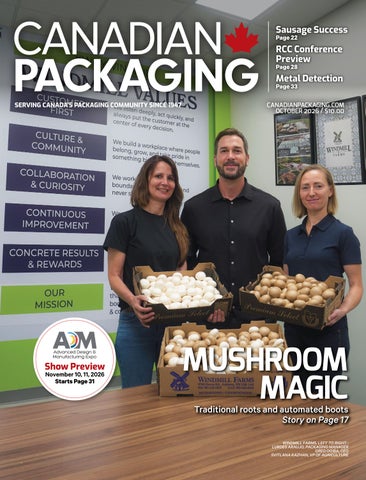
MUSHROOM MAGIC
Traditional roots and automated boots Story on Page 17 WINDMILL FARMS, LEFT TO RIGHT : LURDES ARAUJO, PACKAGING MANAGER GREG OGIBA, CEO SVITLANA KAZHAN, VP OF AGRICULTURE
91 92
97
COMPLETE SNACK PACKAGING SOLUTIONS • • • • • • • •
Accumulation Horizontal motion conveying Incline, belt and bucket conveyors Filling and multihead weighing Bagmaking and casepacking Checkweighing and seal checking Foreign object and defect inspection Controls and information systems
98
17
We are successful when you are successful. That’s why we apply creativity, engineering excellence, and determined perseverance to every project to help our customers get the performance their business demands—whether measured by flavor, efficiencies,
Helping you bring your best products to market. Delivering Results. With Heat and Control, you have a partner with the scale to support your success, the innovation to advance your operations, and a commitment to quality that will help you offer better products for consumers.
sustainability, improvement, or innovation.
34
32
99
12
36 108
42
116 94
~2~
107 41
info@heatandcontrol.com | heatandcontrol.com
Fabcon Food Systems
LOOKING BACK. PRESSING FORWARD. ALWAYS INNOVATING.
20
26
16
Videojet® 7920
96
UV Laser Marking System
93
59 101 102
The Videojet 7920 UV laser marking system is engineered to optimize your operations with innovative Videojet SmartFocusTM technology, helping to reduce manual intervention while maintaining packaging integrity.
103
See how you can achieve your automation goals with the Videojet 7920 UV Laser and SmartFocus™ technology.
27
Discover more: videojet.com/7920 ©2026 Videojet Technologies Inc. All rights reserved. Videojet Technologies Inc.’s policy is one of continued product improvement. We reserve the right to alter design and/or specifications without notice.
56
Extend product shelf-life and appeal
Watch live demonstrations of our Ross tray seal packaging machines n Flexible Ross system produces high-quality modified atmosphere
(MAP), vacuum skin (VSP), and lid-only packages n Fully automatic, high-speed production n Uses preformed trays of almost any size or shape n Superior package seals eliminate leakers, rework, and returns n Backed by Reiser’s industry-leading service and support
October 18-21, 2026 | Chicago, IL | Reiser Booth S-2566 www.reisercanada.ca Reiser Canada Dundas, ON (905) 631-6611
October 2026 Vol. 79, No. 7 canadianpackaging.com
COVER STORY
17
17 DUTCHINSPIRED
How an Ontario-based farm has expanded into one of Canada’s leading mushroom growers.
FEATURES
22 Linking Packaging with Demand
Sikorski Sausages updates packaging to meet their evolving client needs.
22
28
28 Less Talk, More Green
The RCC Sustainability Conference is back, and this year’s mission is spurring participants to act on their goals.
31 Ready for Takeoff DEPARTMENTS
COLUMNS
NEWSPACK 6 Packaging news roundup.
FROM THE EDITOR 4 By Jeff Cottrill Sustainability is a noble goal, but requires a practical approach.
NOTES & QUOTES 9 Noteworthy industry briefs. FIRST GLANCE 12 New packaging solutions and technologies. ECO-PACK NOW 13 All about packaging sustainability. imPACt 14 A monthly insight from PAC Global.
CHECKOUT 36 By Paul Pethick Joe Public speaks out on packaging hits and misses.
ON THE COVER
Windmill Farms CEO Greg Ojiba shows off his company’s various mushroom types, along with packaging manager Lurdes Araujo and agriculture vice president Svitlana Kajhan. Cover photo by Windmill Farms
The return of the popular ADM Montreal manufacturing conference and exposition, with focus on AI, strategic innovations.
33 Metal Detectors for Hidden Hazards Food-safety specialist Fortress Technology examines the importance of food metal detectors and why the company has dedicated 30 years to developing systems to cover every food-processing HACCP checkpoint.
ISSN 0008-4654. Canadian Packaging is published eight times per year by Annex Business Media. Canada Post Publications Mail Agreement No. 40065710. Return undeliverable Canadian addresses to: Circulation Department, 111 Gordon Baker Rd., Suite 400, Toronto, ON M2H 3R1. No part of the editorial content in this publication may be reprinted without the publisher’s written permission. © 2026 Annex Publishing & Printing Inc. All rights reserved. Opinions expressed in this magazine are not necessarily those of the editor or publisher. No liability is assumed for errors or omissions. All advertising is subject to the publisher’s approval. Such approval does not imply any endorsement of the products or services advertised. Publisher reserves the right to refuse advertising that does not meet the standards of this publication. Printed in Canada. CANADIANPACKAGING.COM
October 2026 · CANADIANPACKAGING
3
FROM THE EDITOR
The road to recycling is paved with practicality 14% Amount of plastic packaging that is successfully sorted and recycled in Canada. Source: Environment and Climate Change Canada
4
S
ustainability. That’s a word that gets tossed around a lot these days, especially in manufacturing and packaging. But does it still mean what it used to? And how much progress is industry making when it comes to products and packages that don’t harm or waste our resources? The upcoming RCC Sustainability Conference in Toronto (preview on page 28) is counting on getting across the message that lip service to sustainability isn’t good enough: action and implementation are crucial and urgent now. “The next phase of sustainability is about execution,” says Michael Zabaneh, vice president of sustainability for the Retail Council of Canada, the organization putting on the Conference. Zabaneh tells Canadian Packaging the sustainability conversation has grown from well-meaning ambitions and goals to practical application. How are manufacturing and packaging going to decarbonize operations, boost recycling, and comply with evolving policies? Hoping to spur action, five producer-responsibility organizations are collaborating on new, Canada-wide eco-design guidelines: Circular Materials, Éco Entreprises Québec, Multi-Material Stewardship Manitoba, SK Recycles, and Recycle BC. Aiming to boost recyclability of paper products, this project was launched last autumn and is expected to reach completion this December. The initiative is a well-meaning push towards a harmonized national framework to offer clear guidance to manufacturers who market their products across Canada, with a three-fold focus – reduction of materials used, procurement of recycled substances, and designing goods to be compatible with the changing recycling infrastructure. Still, it’s anybody’s guess how well businesses will adhere to these new guidelines, unless there’s some clear incentive or enforcement. Another entity that’s been gunning for solid results is the Government of Ontario, with its Blue Box regulation. On Jan. 1, manufacturers in Canada’s most populous province became fully responsible for providing Blue Box services. This initiative also introduces manufacturer obligations regarding public-space collection and regulated diversion targets. Starting this year, producers are also required to meet regulated diversion targets, which are expected to increase in 2030
CANADIANPACKAGING · October 2026
and ensure companies are recycling collected materials. Ontario expects this added industry onus, including consistent Blue Box collection, to “help reduce litter and help divert packaging and other resources from landfills.” This is an example of extended producer responsibility, or EPR, a policy approach that makes manufacturers financially and physical responsible for products and their packages after consumer use. This policy approach means businesses should help pay for, organize, or manage collection, sorting, recycling, reuse, and disposal. More recently, the Government of Alberta has expanded residential recycling programs under EPR regulations, in that residents have more opportunities to recycle packaging that has typically been lost to landfills. Among the materials accepted as recyclable since Oct. 1 are foam packaging, food and body aerosols, flexible plastic bags and wrappers, toothpaste tubes, and deodorant containers. All these ongoing initiatives sound like steps in the right direction. EPR policy and other programs are necessary, but the real test is whether they achieve longterm results – whether they influence packaging design and creation significantly, rather than just changing who bears the costs of waste collection. Another crucial question: how do we balance eco-friendliness with packaging that serves its purpose? This is particularly relevant to food products, which must have packaging that properly protects them, to optimize food quality. If we’re serious about protecting the environment and making manufacturing conform to that lofty goal, the next phase of sustainable packaging must be defined not by words and slogans about recycling, but by designing and creating packages that comply with the systems that actually collect, sort, recycle, and refill them. Packaging reuse is most likely to succeed when it becomes a practical infrastructure system, not just a preachy morality test on companies and consumers. As the cliché goes, action speaks louder than words. Sustainability goes well beyond branding and good intentions. It requires concrete plans and activity.
October 2026 | VOLUME 79, NO. 7 Reader Service Print and digital subscription inquires or changes, please contact Angelita Potal, Customer Service Tel: 416-510-5113 apotal@annexbusinessmedia.com Mail: 111 Gordon Baker Rd., Suite 400, Toronto, ON M2H 3R1 Senior Publisher Stephen Dean | (416) 510-5198 SDean@canadianpackaging.com Interim Editor Jeff Cottrill | (416) 510-6897 jcottrill@annexbusinessmedia.com Account Coordinator Barb Comer | (888) 599-2228 ext 210 bcomer@annexbusinessmedia.com Audience Development Manager Barbara Adelt | (416) 510-5184 Fax: (416) 510-6875 badelt@annexbusinessmedia.com Media Designer Graham Jeffrey gjeffrey@annexbusinessmedia.com CEO Scott Jamieson SJamieson@annexbusinessmedia.com Annex Business Media 111 Gordon Baker Rd., Suite 400, Toronto, ON M2H 3R1; Tel: 416-442-5600.
Canadian Packaging, established 1947, is published 8 times per year except for occasional combined, expanded or premium issues, which count as two subscription issues. PRINTED IN CANADA ISSN 008-4654 (PRINT), ISSN 1929-6592 (ONLINE) PUBLICATIONS MAIL AGREEMENT NO. 40065710 SUBSCRIPTION PRICE PER YEAR (INCLUDING ANNUAL BUYERS’ GUIDE: Canada $83.27 per year, USA $190.41 (CDN) per year, Outside Canada $215.87 (CDN) per year, Single Copy Canada $10.00. From time to time Canadian Packaging will mail information on behalf of industry-related groups whose products and services we believe may be of interest to you. If you prefer not to receive this information, please contact our circulation department in any of the four ways listed above. Annex Privacy Officer Privacy@annexbusinessmedia.com Phone: 800-668-2374 DISCLAIMER: No part of the editorial content of this publication may be reprinted without the publisher’s written permission. ©2026 Annex Publishing & Printing Inc. All rights reserved. This publication is for informational purposes only. The content and “expert” advice presented are not intended as a substitute for informed professional engineering advice. You should not act on information contained in this publication without seeking specific advice from qualified engineering professionals. Canadian Packaging accepts no responsibility or liability for claims made for any product or service reported or advertised in this issue. Canadian Packaging receives unsolicited materials, (including letters to the editor, press releases, promotional items and images) from time to time. Canadian Packaging, its affiliates and assignees may use, reproduce, publish, republish, distribute, store and archive such unsolicited submissions in whole or in part in any form or medium whatsoever, without compensation of any sort. We acknowledge the [financial] support of the Government of Canada
JEFF COTTRILL, interim editor jcottrill@annexbusinessmedia.com CANADIANPACKAGING.COM
ONE PARTNER.
COMPLETE PACKAGING LINES. Robotics Flow Wrapping Tray Sealing Vertical Bagging Multihead Weighing Product to Pallet Automation
On the Show Floor at ADM Montreal:
ULMA TFS 200 Thermoformer
VISIT US @ BOOTH #2217
© 2026 Harpak-ULMA Packaging, LLC, 85 Independence Drive, Taunton, MA 02780 USA
NEWSPACK
Fanta’s Haunted Universe arrives, with new Ghost Face Punch, collectible can designs
With summer officially behind us and Oct. 31 fast approaching, Fanta has taken its Halloween platform to the next level with the launch of Fanta’s Haunted Universe. This original Halloween entertainment world is inspired by spooky characters, storytelling, and fandom, complete with a new limited-editor flavour and collectible cans: Among the details: • Cinematic Universe – The trailer offers a
chilling first look at Fanta’s Haunted Universe and its frightfully fun new horror icon. • New Limited-Edition Flavour – In partnership with Fun World and Paramount+, Fanta is releasing Ghost Face® Punch, a dark berry-flavoured punch featuring the iconic Ghost Face® created exclusively for Halloween 2026. • Five Collectable Halloween Designs: Fans can collect all original characters on beloved classics (Fanta Orange, Fanta Orange Zero Sugar, Fanta Pineapple and Fanta Strawberry), as well as the limited-edition Ghost Face® Punch flavour. • Made for Canadians, by Canadians: Fanta cans and bottles are proudly made, packaged, merchandised and distributed in Canada in partnership with Coke Canada Bottling.
Introducing Grande Maison V: Uniting iconic chocolate brands under one vision
Maison V (GMV) recently announced its official launch as a house of brands built to unite established confectionery companies, Galerie au Chocolat (Jelina Chocolatier), Brockmann’s Chocolate, and Theobroma Chocolat, together with its Olivia & Leo confectionery line, under a single strategic vision: to be the best in taste, in every sense. Privately held and headquartered in Montreal, Que., GMV operates two manufacturing facilities and corporate offices, one in British Columbia and one in Quebec, and distributes chocolate and other confections across North America and to global markets.
Turn On-Hold Inventory Into Recovered Value Mobile and In-House Re-Inspection Services Instead of discarding entire product lines and losing revenue, X-ray Reclaim services from METTLER TOLEDO allows for the re-inspection of products either on-site or at a secure facility to detect physical contaminants. Our precise, flexible emergency X-ray re-inspection services help manufacturers quickly inspect on-hold products suspected of foreign material contamination from metals, stainless steel, rubber, bones, stone, wire, plastic, gaskets, O-rings, and more. Get complete traceability with detailed reports and data-driven insights to strengthen quality assurance, protect product safety, comply with regulations, minimize waste, and maintain production efficiency.
“Grande Maison V represents more than a new name on the door: it’s a commitment to being the best in taste, in every sense of the word,” said Noah Pinsky, CEO of Grande Maison V. “By joining together strong brands and experienced teams with more than 40 years of combined expertise and heritage, we’re building exception capability and capacity to grow together, while protecting what makes each of our brands special.” The creation of GMV reflects a deliberate strategy to combine the strength of deeply rooted confectionery brands, while improving efficiency, capability, and manufacturing
Learn more about X-ray Reclaim re-inspection by contacting us at reclaimsales@mt.com or by visiting www.xrayreclaim.com.
6
CANADIANPACKAGING · October 2026
capacity across the group. Each brand in the portfolio continues to operate under its own identity with a wide-ranging offering from premium artisan chocolate to better-for-you and everyday indulgence. GMV’s leadership says the model is designed to combine the operational consistency and volume of a large manufacturer with the craftsmanship and agility of artisan makers, allowing the group to react quickly to retail and consumer trends, while still delivering meaningful scale. Looking ahead, GMV says it will pursue growth through four key levers: expanding its existing brands; strengthening retail partnerships; developing new products and formats; and pursuing strategic acquisitions.
dollars, reported revenues of US$21.7 billion, rising from US$17.3 billion a year earlier. Miller highlighted energy drinks as one of the stars of the quarter, which ended July 19. “Energy’s been around now for 25 years, and it is a massive category today,” he said. “It’s twice the size of carbonated soft drinks, yet it is still growing high-single-digits industry-wide, and for us, we’re outperforming that.” New energy drinks like Alani and Celsius are driving much of the sales across that
category and luring in more women. “It’s been an incredible story, and it is not slowing down,” Miller said. Another highlight was the launch of Flamin’ Hot boneless wings — CoucheTard’s first collaboration with Cheetos and Doritos maker Frito-Lay — in the U.S. More than 40,000 units of the product are selling every week, pushing consumer spending on food even higher. “More broadly, we’re seeing customers increasingly trade up into higher value
Sweets, soda take a hit as CoucheTard customers shop cautiously
Pocketbook pressures are pushing some Alimentation Couche-Tard Inc. customers to ditch buying snack foods. The convenience-store chain’s chief executive officer, Alex Miller, said on Sept. 2 that sales of packaged carbonated soft drinks, salty snacks, and sweets have dropped as the cost of living and fuel prices rose. But shoppers haven’t severely curtailed their overall spending. “When you stand back, the consumer and many of the metrics, they’ve proven to be highly resilient and that gives us optimism,” he said on the company’s earnings conference call. “They are out spending. They are just being more targeted, more direct and more thoughtful in their choices and we need to play into that.” To cope with the shift in consumer behaviour, Miller said Couche-Tard is reallocating shelf space, refining its product assortment and tweaking its promotions to better suit demand. So far, the consumer cutbacks don’t appear to be weighing much on CoucheTard’s financial performance. On Tuesday, the Laval, Que.-based company revealed its net earnings attributable to shareholders were US$828.5 million in its first quarter, up from US$782.5 million during the same period last year. That amounted to diluted net earnings per share of 90 cents U.S. for the first quarter, compared with 82 cents U.S. in the prior-year quarter. The firm, which keeps its books in U.S. October 2026 · CANADIANPACKAGING
7
Process improvement is improving quality while reducing operational costs. Constant demand for consistency in product quality and taste makes Food & Beverage a demanding industry. With our comprehensive portfolio of instruments, industry expertise and accredited calibration services we ensure plant availability, resource conservation and repeatability in processing with traceable compliance.
Do you want to learn more? ca.endress.com/food-beverage
NEWSPACK
prepared food offerings,” Miller said. His remarks came roughly a month after Couche-Tard said it had made an offer valued at US$8.6 billion for a controlling stake in Polish convenience-store operator Zabka Group. The transaction is subject to regulatory approvals, but is expected to close no later than December. Zabka has more than 13,000 convenience stores across Poland and Romania. It plans to open another 6,000 to 7,000 stores in Poland, and 7,000 to 8,000 sites in Romania over the next five years, Miller said. Meanwhile, Couche-Tard has more than 17,200 stores across the Couche-Tard, Circle K and Ingo banners. It is on track to open more than 100 stores in its current fiscal year, and Miller indicated that acquisitions could boost that count further. “We believe there’s an increasing opportunity to acquire one
site, single sites, five sites, 10 sites, and our real-estate teams have organized that way now,” he said. “We are much more active on the ground pursuing those opportunities, and we are starting to see more transactions in that space.”
Kraft Dinner launches KD x Solly’s cream soda: Cheesy twist on a classic favourite
Kraft Dinner (KD) is now pouring its iconic cheesiness into a fizzy new frontier. For the first time ever, Canada’s favourite mac ’n’ cheese is hitting the soda aisle, teaming up with Canadian brand Solly’s Craft Soda to introduce KD x Solly’s cream soda. The limited-edition drink puts a cheesy twist on nostalgic cream soda, bringing together two unmistakably familiar flavours in one unexpected sip. Consumers are increasingly embracing bold, expressive flavour experiences alongside familiar comfort foods, and KD is no exception. Fans have made KD
their own way for years, satisfying their cravings in different ways, whether it’s adding more KD cheese powder or experimenting with the latest “mac hack.” Now, the brand is giving fans a new – and unexpected – way to take their love of KD beyond the bowl with KD x Solly’s cream soda, transforming that appetite from what fans eat to what they drink. “A soda might be the last place you would expect to find KD, which is exactly what made teaming up with Solly’s Craft Soda so much fun – they have the entrepreneurial energy, creativity and willingness to challenge conventions that made them the perfect partner for this idea,” said
Daniel Lundberg, head of marketing and strategy at Kraft Heinz. “KD x Solly’s cream soda is a whole new way for fans to experience their KD obsession; it’s something to crack open with friends, debate what it could possibly taste like, and then satisfy your curiosity with that first sip.” This collaboration brings together one of Canada’s most recognizable food brands and Solly’s Craft Soda, an independent Canadian company founded by Toronto entrepreneur and father Adin Wener. For Solly’s Craft Soda, the partnership is an opportunity to introduce its modern approach to craft soda to Canadians across the country, without abandoning the principles on which the company was built. “For an independent company like Solly’s Craft Soda, having an iconic Canadian brand like KD believe in us is a genuinely big deal,” said Adin Wener, founder of Solly’s Craft Soda. “This was an amazing challenge and product to work on.
26_011558_Canadian_Packaging_OCT_CN Mod: August 20, 2026 12:36 PM Print: 09/08/26 page 1 v2.5
π KEEP IT COOL WITH INSULATED SHIPPERS
ORDER BY 6 PM FOR SAME DAY SHIPPING
COMPLETE CATALOG 8
CANADIANPACKAGING · October 2026 CPK_Uline_October26_CSA.indd 1
1-800-295-5510
uline.ca CANADIANPACKAGING.COM 2026-09-09 9:37 AM
NOTES & QUOTES
ABB’s Machine Automation Division (B&R) recently announced the appointment of Christian Strahberger as its new division president. Christian Strahberger succeeds Florian Schneeberger, who tragically passed away in an accident in April.
Christian Strahberger, the newly appointed division president of the ABB Machine Automation division Christian Strahberger brings 25 years of experience in senior leadership
roles with full profit-and-loss responsibility across the mechanicalengineering, drive-technology, motion-control, and powerelectronics sectors. He joins the Austrian automation specialist from Danfoss, where he held a variety of international leadership positions, most recently serving as chief technology officer and head of semiconductor manufacturing at Semikron Danfoss. Prior to his time at Danfoss, Christian Strahberger spent 14 years in senior technology and business leadership roles at Singulus Technologies, Schottel, and Voith. “I am very excited about this new challenge at ABB and the opportunity to actively shape the next era of the Machine Automation Division. My focus is on driving innovation with purpose and successfully translating future technologies into marketrelevant solutions. Together with our teams, I want to help ensure that B&R continues to enable sustainable competitive advantages for our customers as a trusted partner in a dynamic market environment,” said
Christian Strahberger. In his new role as division president, Christian Strahberger will focus on driving innovation that helps customers increase their productivity and competitiveness, while enabling them to operate more sustainably. Christian Strahberger holds a Ph.D. in Semiconductor Physics from the Technical University of Munich. His professional career combines
scientific excellence with many years of international leadership experience in technology-driven industrial companies, underscoring his commitment to leveraging innovation as a key driver of sustainable growth. MotionTech, a European leader in automation, has announced its entry into the North American market. The launch marks a significant milestone
Motiontech is expanding its market to North America.
A tighter pack. Less purge. Longer shelf life.
DuroShrink SG is a shrink bag with secondary seal technology that activates during your normal vacuum and shrink cycle, bonding the bag to itself around the entire pack.
REDUCE LEAKERS
BETTER COLOUR
EXTENDED SHELF LIFE
CLOSER FIT
DuroShrink SG
FEWER SOAKER PADS
Talk to our team about how DuroShrink SG can help you reduce waste and improve your yield.
QC: 450.444.4266 ON: 905.848.6660
sales@duropac.com duropac.com
BC: 604.255.8252 AB: 403.919.5789
sales@foodpak.com foodpak.com
Competitor’s Bag
NOTES & QUOTES
in the company’s international growth strategy, bringing MotionTech’s proven portfolio of automation and packaging technology to North American customers. To spearhead the expansion, MotionTech has appointed Kristian Hulgard as executive sales director for the U.S. market, effective Sept. 1. An experienced business builder with a strong track record of establishing and scaling commercial operations in the automation industry, Hulgard will lead MotionTech’s U.S. business from the Dallas-Fort Worth area and drive the company’s next phase of growth in the region. The initial focus of the U.S. launch is bringing MotionTech’s end-of-line packaging, storage systems, and conveying solutions to American customers, building on the automation and material-handling solutions that have made the group a trusted partner across Europe. “Customers have repeatedly asked for a dedicated local point of contact for both sales and service,” said Louise Ringström Grandinson, CEO of MotionTech. “Hulgard’s appointment lays that groundwork as MotionTech positions itself to serve a U.S. automation market set for substantial growth in the coming years.” “The U.S. represents an enormous opportunity,” said Hulgard. “I’m excited to build something meaningful here from the ground up. American manufacturers and distributors are investing heavily in automation to stay competitive, and
MotionTech brings exactly the kind of proven, high-quality technology they’re looking for. “My focus from day one will be on getting our products in front of the right customers, build up a distribution network, and establish MotionTech as a serious partner in this market.” With more than 3,000 customers around the world, MotionTech has moved more than 3 billion products and completes more than 500 projects every year, according to its website. The corporation specializes in helping businesses across Europe and beyond to automate their workflows, warehousing, and intralogistics. Aliments du Québec has appointed Pierre Lessard-Blais as its new executive director. Having taken office on Oct. 5, he brings extensive experience in management, business development, strategic planning, governance, and team leadership to the organization and its member companies. “Aliments du Québec has made tremendous strides in recent years and, backed by an experienced team, is exceptionally well-positioned for the future. The board of directors was seeking a unifying leader to guide our industry through a period marked by significant challenges,” said Pierre-Alexandre Blouin, Chair of the Board of Directors of Aliments du Québec. “His proven track record of collaborating with partners across diverse sectors is a major asset. We are confident that Pierre will advance Aliments du
Your Product Coding & Identification Specialists
Featuring Evolabel Label Printer Applicators
Evolabel develops, manufactures and supplies innovative and intuitive machines for automatic labeling in production or warehousing around the globe. Would Evolabel work for you? Contact our sales team today!
sales@harlund.com www.harlund.com
CPK_Harlund Industries_Oct26_CSA.indd 1
2026-09-24 3:16 PM
Pierre Lessard-Blais is the new executive director of Aliments du Québec. Québec’s mission and effectively represent the interests of the organization and its members to benefit Québec’s biofood sector and broader economy.” As mayor of the Montréal borough of Mercier-Hochelaga-Maisonneuve from 2017 to 2025, Lessard-Blais led major projects and worked closely with municipal teams, government representatives, businesses, and community organizations. He also chaired the City of Montréal’s Standing Committee on Finance and Administration. Earlier in his career, he co-founded the microbrewery L’Espace Public, which he led from 2011 to 2017 and where he remains a minority shareholder, gaining firsthand experience in business development and product marketing. Additionally, he served as Chair of the Société de développement commercial Hochelaga-Maisonneuve, representing and supporting more than 300 local merchants. This background gives him a practical understanding of the daily realities businesses face, as well as extensive experience engaging with diverse stakeholders. As executive director, he will focus on raising the profile of Quebec businesses and products, while strengthening the organization’s certification marks as trusted reference points for consumers. Lessard-Blais succeeds Isabelle Roy, who served as executive director from 2018 to 2026. The organization also extends its sincere thanks to Corinne Demars, who served as interim executive director during the transition and will continue in her role as deputy executive director. Established in 1996, Aliments du Québec is a nonprofit organization that showcases the expertise of producers, processors, restauranteurs, and institutions that select local food products, thus promoting the agri-food sector for the benefit of the Quebec economy. The organization has more than 1,800 member companies and has certified nearly 30,000 products, according to information from its website. 10
CANADIANPACKAGING · October 2026
FIRST GLANCE
CODING THE FUTURE Many manufacturers preparing for the transition to QR codes powered by GS1 face the same challenge: how do you adopt a new way of connecting products to digital information without disrupting existing processes? Rather than simply advising customers on the move to 2D codes, Domino Printing Sciences decided to experience the transition firsthand. Over the past year, Domino has implemented QR codes powered by GS1 across its global product and
consumables portfolio. The move has given the company practical experience of the challenges and opportunities businesses encounter when preparing for the next generation of product identification. For manufacturers like Domino and its global customers, the shift to 2D codes represents one of the most significant changes to product identification in decades. The GS1 Digital Link standard helps businesses improve traceability, make product information easier to access, and strengthen supply-chain
PRECISION FILLING. SEAMLESS CAPPING. SINGLE OPERATOR.
visibility, but its implementation also introduces new data, systems, and operational considerations. “Our customers rely on us for more than the technology itself,” says Craig Stobie, Global Business Development Director at Domino Printing Sciences. “They also look to us for guidance as new standards emerge, and their coding requirements evolve. “We recognized early that QR codes powered by GS1 would become increasingly important for many of our customers. By implementing GS1 Digital Link across our global operations, we experienced the same issues many manufacturers will face – from data preparation and system integration to governance and long-term maintenance.” All products and consumables by Domino will come equipped with a QR code powered by GS1, providing access to technical specifications, safety data sheets, certifications, and reordering information with a single scan. The move supports improved traceability and reduces the need for multiple on-product labels. The transition required far more than adding a new code to a label. Product data had to be reviewed and standardized, systems updated to support GS1 Digital Link, processes adapted, and teams trained to manage the new approach. The work reinforced a lesson many businesses are now discovering: successful adoption depends on data and governance as much as on printing technology. Domino Printing Sciences
Picolo Tabletop Monoblock: Efficiency for Startups. One Operator: Drastically cut labor costs and simplify production. Seamless Process: Achieve precise piston filling, reliable capping (press-on or screw caps), and crimping. Perfect Fit: Ideal, customizable efficiency for high-value liquid products in Diagnostics, Biotech, and Nutraceuticals.
CAPMATIC.COM 514 322 0062 sales@capmatic.com
DOUBLE VISION, DOUBLE PROTECTION METTLER TOLEDO introduces the X56 DXD+ dual-energy photoncounting X-ray inspection system with AI capabilities. Designed specifically for packaged tasks, the X56 DXD+ is suitable for applications like pet food and potato chips, in which low-density contaminants, such as rubber and plastics, must be detected. It has a 12
CANADIANPACKAGING · October 2026
throughput rate of up to 500 products per minute. The launch of the X56 DXD+ expands METTLER TOLEDO’s X6 Series, offering a comprehensive suite of inspection solutions tailored to modern food manufacturing. With its dual-energy photon-counting capabilities, the X56 DXD+ delivers new levels of detection performance in complex packages across single and multi-lane formats. METTLER TOLEDO
GETTING INKED hubergroup Print Solutions, a leading manufacturer of printing chemicals, is expanding its portfolio with Gecko CyclOne, a new nitrocellulose-free (NC-free) liquid-ink system for frontal, reverse, and lamination printing. The ink range is based on a proprietary polyurethane technology and helps printers meet the requirements of modern, recyclable packaging – without compromising on print quality or efficiency. In doing so, hubergroup is strengthening its portfolio of recyclable packaging solutions and consistently putting its guiding principle, “Shaping Next-Generation Flexibles,” into practice. At the heart of Gecko CyclOne is a modular system concept: pigment concentrates can be easily adapted for frontal, reverse, and lamination printing with special additives. This approach simplifies stock management while maximizing flexibility, enabling print shops to boost their operational efficiency and adapt quickly to changing production requirements. The PU-based system is suitable for flexographic and gravure printing, with or without lamination, and is also available for mono-solvent applications. The product range includes white, CMYK process colours, varnishes, and primers. This provides printers with all the essential components for printing on flexible packaging from a single source. The launch of Gecko CyclOne underlines hubergroup’s ongoing commitment to recyclable packaging solutions. Complementing Gecko Platinum and Gecko Xtreme White, the new ink range further expands the NC-free portfolio. Hubergroup Print Solutions
ECO-PACK NOW
New California wines using paper bottles for low-carbon enjoyment
B
reaking with tradition can be fraught with risk in established industries like the wine business, but a recent launch of two new California wines in unique paper bottles has too much going for it not to succeed. Launched several weeks ago by direct-to-consumer wine store Scout & Cellar, part of the Full Glass Wine Co., the new Petalscape wine label—comprising the 2025 Sauvignon Blanc and NV Red Blend varietals—comes packaged in the revolutionary paper Frugal Bottle containers, offering consumers a lower-carbon way to enjoy premium California wines. Produced in King City, Calif. by Monterey Wine Company using the Frugal Bottle Assembly Machine—designed and supplied by British sustainable-packaging company Frugalpac—the Frugal Bottles are made from 94 per cent recycled paperboard with a foodgrade pouch. Made from 94 per cent recycled paperboard with a food-grade pouch, the Frugal Bottle is five times lighter than a standard glass wine bottle and has a carbon footprint up to 84 per cent lower than glass. According to Frugalpac, it also uses around five times less water and energy to manufacture than conventional glass bottles do. The launch marks another significant milestone for the Frugal Bottle in the U.S., following its adoption by leading retailers such Target, 7-Eleven, Whole Foods, Total Wine & More, and other brands and retailers looking for more sustainable beverage packaging. “Petalscape was created to offer consumers a more sustainable wine experience without compromising on quality,” says Full Glass Wine’s chief executive officer, Louis Amoroso. “The Frugal Bottle aligns perfectly with that vision by significantly reducing the environmental impact of packaging while delivering outstanding California wines,” Amoroso says, adding that all Scott & Cellar wines are produced wine to the company’s Clean-Crafted standards with a strong focus on sustainability. “The launch builds on the growing adoption of the Frugal Bottle across the U.S. wine industry,” Amoroso says, “where brands are increasingly looking for lower-carbon packaging solutions that are lighter to transport, easier to handle and designed for a Circular Economy.” While Frugal Bottles are not entirely new to the U.S. market, the Petalscape wine launch marks the first time the containers are actually made locally. CANADIANPACKAGING.COM
The new Petalscape wines, available in Frugal Bottle containers made from 94 per cent recycled paperboard with a food-grade pouch
“As the first company in the U.S. to produce Frugal Bottles locally, it’s incredible to watch major brands like Scout & Cellar embrace paper packaging,” says Monterey Wine Company’s general manager, Shannon Valladarez. “Producers are realizing that sustainability
in the vineyard must carry through to the packaging on the shelf,” Valladarez says, “and manufacturing and filling the Petalscape bottles here in King City proves that high-volume, lower-carbon packaging is no longer just a trend—it’s the future of American wine.” October 2026 · CANADIANPACKAGING
13
2027 AWARDS @
FUTURES EDGE SUMMIT
LAST CHANCE TO ENTER DEADLINE: OCTOBER 30, 2026
Take your place among the world’s finest in packaging excellence and showcase the creativity, craftsmanship, and innovation behind your most exceptional work. Across seven award categories and 30 subcategories, every achievement has an opportunity to be recognized. Enter today and inspire what’s next in packaging.
BRAND MARKETING
STORE BRAND
PAC IOU
SPECIALTY
TECHNOLOGY & INNOVATION
VISIT PAC.GLOBAL/AWARDS/ FOR CATEGORIES & ENTRY INFORMATION.
LIMITED EDITION
SUSTAINABLE
STAY TUNED
FOR LOCATION & SUMMIT DETAILS!
Prints that stand out. Packaging that performs. Digital printing. Vertical integration. Sustainable solutions. Atlantic Packaging Products delivers digital printing solutions that combine eye-catching graphics with the strength of a vertically integrated manufacturing network. Whether you are launching a new product, running seasonal promotions, or producing limited editions, we deliver consistent quality and dependable service every time. Headquartered in Canada with operations in the United States, we provide end-to-end packaging solutions for brands looking to move faster and stand out.
Atlantic.ca
16
CANADIANPACKAGING · October 2026
CANADIANPACKAGING.COM
COVER STORY
The Windmill Farms team has been supplying mushrooms to the Canadian market since its founding in the 1960s, when it began with only a few growing rooms.
DUTCH-INSPIRED Photos: Canadian Packaging staff
How an Ontario-based farm has expanded into one of Canada’s leading mushroom growers By Andrew Snook
CANADIANPACKAGING.COM
W
hen discussions about agricultural expertise take place, it is common for the Netherlands to find its way into the conversation. Well-regarded for its incredibly efficient growing operations, the Dutch people’s methods are often studied and adopted in other parts of the world. In Canada, one company that has leaned on its Dutch heritage to support its growing operations is Windmill Farms. Started up as Greenwood Mushroom
Farm in the 1960s with only a handful of growing rooms, Windmill Farms has grown into one of the largest fully vertically integrated mushroom growers in Canada, with operations in compost production, growing, harvesting, packing, and distribution. “Over the years, we have invested significantly in our people, facilities, and growing capabilities,” says Greg Ogiba, CEO of Windmill Farms. “Our farms use a Dutch style of growing, which is the most efficient process for producing high-quality mushrooms in the world. Hence the windmill in our company’s name and logo, which is indicative of our Dutch roots.” Growing mushrooms 365 days a year, October 2026 · CANADIANPACKAGING
17
White mushrooms convey toward the packaging stations at the Port Perry facility. Packaging Manager Lurdes Araujo keeps a watchful eye.
18
Windmill Farms currently employs approximately 750 people across its three properties spanning from Ontario to Washington State, which house four farms and two composting facilities. The company produces up to one million pounds of fresh mushrooms every week. Windmill Farms’ primary products include all the fresh mushrooms that a consumer will find in major supermarkets, restaurants, and many pizza shops across North America. “Specifically, most of our production is fresh white, brown cremini, and portobello mushrooms offered in a variety of formats and package sizes for retail and food-service customers,” Ogiba explains. “We also grow several exotic or ‘specialty’ mushroom varieties under the Heartee brand, which includes oysters, lion’s mane, and chestnuts.” The company’s primary customers include major grocery retailers and food-service distributors, which serve national and local restaurants, schools, and institutions. “We also allow walk-in customers at our main farm in Port Perry, Ontario, just as the original owners did more than 50 years ago,” Ogiba adds. Demand for its mushrooms stems from the company’s impressive versatility. “They can be used as a side dish, an ingredient in everything from pizzas and pastas to soups and stir-fries, or increasingly as a centre-of-plate ingredient,” Ogiba says. Their versatility, nutritional profile,
CANADIANPACKAGING · October 2026
and ability to add flavour and texture make mushrooms relevant across a very broad range of meals and cuisines. But while many people enjoy adding mushrooms to a wide variety of dishes, global consumption is on the decline. “We’re seeing a global decline in mushroom consumption primarily because emerging consumers are not replacing Baby Boomers’ consumption habits,” Ogiba explains. “So our teams are focused on producing consistently high-quality mushrooms, which also helps our industry tell the mushroom story: they’re nutritious, versatile, and tasty. We’re seeing new consumers come
into the category and hope they stay once they realize how unique mushrooms are.” While there has been a decline in the more common brown and white mushrooms sold on supermarket shelves, there have been a few bright spots showing growth. “We’re seeing more demand for organic, so I think that’s probably the younger emerging consumers. They’re health-conscious and looking for organic foods, and mushrooms fit the bill,” Ogiba says. “We’re also seeing growth in the exotics, although that’s sort of levelled out recently. It’s a niche market, but with lion’s mane, oysters, things like that, you CANADIANPACKAGING.COM
Photos: Canadian Packaging staff
COVER STORY
can create some really exciting dishes. So for restaurants, chefs love them.” The mushroom-growing sector is a very competitive industry. Fresh mushCANADIANPACKAGING.COM
rooms are highly perishable, and customers have extremely high expectations for quality and service. “Producers have to manage agricultur-
al variability, while operating a sophisticated manufacturing and distribution system every single day of the year,” Ogiba says. “So you have to be good at a lot of things simultaneously: growing, harvesting, labour management, food safety, packaging, logistics, forecasting, and customer service.” Like most agricultural operations in Canada, recruitment and retention can be challenging aspects of operations. The workforce is comprised of a combination of local workers and harvesters and farmworkers largely recruited through Canada’s Temporary Foreign Worker Program (TFWP). “It’s not easy, but we find a balance. We are looking to hire as many locals as we can,” Ogiba says. “We have a very high retention rate, but most agricultural operations struggle to employ locals who just don’t want to work on farms. Therefore, the TFW program is absolutely critical in supporting the industry.” While automation is becoming a larger part of Windmill Farms’ operations to help “future-proof” its workforce, growing and harvesting mushrooms is still a manually intensive process. “You’re never going to get away from it. Yes, there are fully automated farms, and you’re seeing some of it happen in Europe, but they’re expensive, and the return on that investment just doesn’t make sense right now. I think in 10 years, it will be a different story, but today, we’re just implementing automation in the parts of the production process where it gives us the
Svitlana Kazhan, VP of Agriculture, and Greg Ogiba, CEO, display white and brown mushrooms. Atlantic Packaging corrugate awaits forming on a Wexxar Bel IPAK TF-350 automatic tray former. Kazhan and Ogiba inspect the quality of the formed corrugate trays.
October 2026 · CANADIANPACKAGING
19
COVER STORY
20
biggest bang for the buck in terms of labelling, and case packing,” Kazhan productivity and efficiency,” Ogiba says. explains. “As such, we have growers who Food safety and product quality are have been around for decades, but also always top priorities at Windmill Farms’ have food-manufacturing talent to pull operations, according to Svitlana Kazhan, the two worlds together.” vice president of agriculture. Windmill Farms’ main packaging “We are producing a fresh food prod- operation is located at its Port Perry farm uct, so hygiene, traceability, temperature and features eight packaging lines decontrol, and disciplined operating pro- signed to handle different product formats, cedures are critical throughout the pro- pack sizes, and customer requirements. cess,” Kazhan says. “At Windmill, our “We also operate 104 automated GTL food-safety audit scores are consistently Europe packing stations in the farms; ‘excellent,’ due to the food-safety culture and Windmill is the only mushroom we maintain.” grower in Canada that runs these maAnother area that is gaining increas- chines, which we added during our farm ing focus is the sustainability of oper- expansion completed in 2024,” Ogiba ations, ranging from energy and water says. “Combined with our efficient ‘tiltefficiency to reducing waste, optimizing shelf’ blue-belt system, also from GTL packaging materials, and improving the and a first in Canada, we can produce efficiency of the company’s overall sup- mushrooms nearly two-and-a-half-times ply chain. more efficiently than the standard “Mushrooms are naturally friendly to ‘Dutch method.’” the environment, as many of the materiWindmill Farms has been continuals used in the growing process are re- ously investing in automation, through used,” Ogiba says. which it improves food safety, quality, Windmill released its first ESG report consistency, employee ergonomics, and earlier this year. Among the highlights, efficiency. the company donates more than 100 “The goal isn’t simply automation for million pounds of spent compost to lo- automation’s sake; it is using technology cal farmers. where it creates a better operation and “Windmill cannot reuse it to grow ultimately a better product for our cusmushrooms, but it’s a highly desirable tomers,” Ogiba says. “Our focus is infertilizer that farmers spread on their vesting in ways to produce mushrooms fields to help maximize their crops,” as efficiently as possible, in order to Ogiba says. counter inflation and keep nutritious, Successfully growing mushrooms on fresh produce affordable for consumers.” the type of scale that Windmill Farms The majority of the company’s operates comes from a combination of packaging equipment is manufactured indoor agriculture, manufacturing and by ARCO Solutions out of the technology know-how. Netherlands, with a small amount of “Growing and harvesting still require equipment supplied by Omori tremendous human expertise and deci- Machinery Company out of Japan. sion making, while our packing operAnother way Windmill Farms has ations increasingly use automation for been improving efficiencies within its weighing, conveying, inspection, sealing, operations over the past year is through
CANADIANPACKAGING · October 2026
investments in Montreal-based Worximity Technology’s real-time production software. “Worximity allows us to monitor our performance in real time, and that’s helped us identify bottlenecks and drive cost out of the business,” says Lurdes Araujo, packing manager. “We were able to get it up and running in a couple of weeks and saw results immediately.” Since the company’s performance is displayed on a TV screen positioned at each packing line, it’s been easy for all employees to understand how they are performing, from managers to supervisors and all staff working in the system, said Araujo, who has been with the company for more than 42 years. “Automation is particularly valuable here because we are dealing with large volumes of a fresh product, with more than 100,000 units being packed and shipped every day,” she adds. “Accurate weighing reduces giveaway and waste, while automated sealing and packing help us deliver consistent, secure mushroom tills, day-in, day-out.”
The growing process
Mushroom production begins with preparing compost, which takes place at Windmill Farms’ facility in Ashburn, Ont. It is the largest indoor mushroom-composting facility in North America, producing nearly 1,500 tons of compost each week to fill the company’s farms. Once the compost is put into the growing beds, which is done by two dedicated filling teams using heavy-duty agricultural equipment, the growers get to work in setting the right environmental conditions for mushrooms to grow. “We have more than 100 growing rooms across the company, each with 10 to 12 vertical growing beds per room,”
Photos: Canadian Packaging staff
Bird’s eye view of the Port Perry, ON Windmill Farms facility. White mushrooms maturing in their growing beds.
CANADIANPACKAGING.COM
An Anritsu SSV Checkweigher system and a Fortress Technology Stealth Metal Detector inspect for proper weights and possible contaminants.
Kazhan explains. “The crop is grown in they are then moved into our ‘Fresh highly controlled rooms where temper- Pack’ operation, where they are sealed, ature, humidity, airflow, and other condi- inspected by quality control, and pretions are carefully managed and set by the pared for distribution the same or next growing team multiple times per day.” day,” Kazhan adds.The packing lines “Our most modern and advanced use various equipment, including farms utilize [a] tilt-shelf and blue-belt ARCO sorting machines and Omori system to feed the automation packing sealing equipment, to create the final stations. Once all mushrooms are product the consumer finds on superpicked and settled into their containers, market shelves. Each line is equipped or ‘tills’ as we say in mushroom lingo, with ARCO Solutions checkweighers CANADIANPACKAGING.COM
and Fortress Technology metal detectors, to ensure all products leaving the farm adhere to specifications.
Looking forward
Windmill Farms sees significant opportunity in the future and is building the most modern mushroom company in Canada, which focuses on the customer and innovation for the consumer backed by its ability to produce high-quality mushrooms at scale. “That means continued investment in our growing operations, automation, packaging technology, sustainability, our people, and our customer capabilities,” Ogiba says. Over the next five years, he expects Windmill to become increasingly technology-enabled, while remaining very much an agricultural business at its core. “We are incorporating AI to help us better align our sales and production forecasts, to assist the growers in making better decisions, and in finding additional efficiencies in our freight fleet by optimizing routes,” Ogiba says. “We want to grow with our customers, innovate within the category, and build Windmill into an even stronger North American leader in agriculture.” He adds that the fundamentals for future success are straightforward: better growing, better technology, better packaging, and better service – all while continuing to deliver a high-quality fresh product to consumers every day. “Ultimately, our objective is simple: grow great mushrooms, deliver exceptional service to our customers and keep getting better at how we do it. We see ourselves not just as leaders in the mushroom category, but in the broader fresh-produce and agriculture industry,” Ogiba says. October 2026 · CANADIANPACKAGING
21
PACKAGING INNOVATION
L to R: Brian Byusa, Director of Strategic Growth & Business Development Manager at Duropac; Peter Sikorski, CEO, Sikorski; Pawel Zwerello, General Manager, Sikorski
Sikorski Sausages updates packaging to meet their evolving client needs By Andrew Snook
22
CANADIANPACKAGING · October 2026
L
Like the origin stories of many successful businesses, Sikorski Sausages started out from humble beginnings. Escaping the hardship of communist Poland, Marek Sikorski immigrated to Canada in 1981 to build a better future. While working as a valet in Toronto, Marek found he missed the tastes of home and wanted to bring those flavours to people in Canada. He moved to London, Ont. and opened the Baltyk Delicatessen. “My parents identified a niche. There wasn’t a lot of Eastern European smoked meats available at the time, so they decided to produce and sell their own,” recalls Peter Sikorski, the second-generation owner of Sikorski Sausages and son of
Marek. “Sikorski quickly stopped being just a supplier to our own store and started to supply more and more delis across Southwestern Ontario, then outside of Ontario,” Peter recalls. “As we grew, we started to work with the major retail grocer partners across Canada.” The company now supplies retailers across Canada and the U.S. and currently employs approximately 100 people, with an average production of about 60,000 kilograms a week of smoked meats and ready-to-eat products. “We’ve got our own distribution network and our own sales network. We work directly with all the major grocers,” Peter says. Sikorski Sausages primarily focuses on producing its own branded products, but also produces some private-label items. CANADIANPACKAGING.COM
Photos: Canadian Packaging staff
LINKING PACKAGING WITH DEMAND
Sikorski’s Jerky Linx line in beef, pork and chicken, packed in printed thermoformed packaging supplied by Duropac.
Peter Sikorski, CEO, with a selection of Sikorski’s smoked sausages, hams, and Jerky Linx snacks.
“If someone is looking for a premium private-label product, then absolutely, we work with them. But we won’t tie up capacity for commodity products,” Peter explains. The most popular items produced at Sikorski are its many traditional smoked sausages and wood-smoked hams. While the production process has not changed a great deal over the years, the packaging operations at Sikorski have evolved dramatically. When the company first started hand-
ling large orders of sausages for Southwestern Ontario retailers and delis, it wasn’t unusual for the orders to be delivered in 30-kilogram cardboard boxes. As customer demands changed and grew, so did the packaging operations. “The majority of our business is still bulk format. However, more of the share of our business is going to smaller consumer packaged products that are packaged by us and sold in this format direct to the consumer – like a grab-and-go item,” Peter says, adding the company
“We don’t have any liquid smoke.Everything that we do is hardwood-smoked and then is cooked with steam.” CANADIANPACKAGING.COM
also produces some shelf-stable meat snacks. “The product itself hasn’t changed so much. It’s just the format of how we sell it and get it to the client that has changed.” For many years, the bulk of Sikorski’s employees would work in the production section of the company’s operations, with very few in the packaging department. That situation has now changed significantly. “I would say at least 40 per cent of our capital expenditure and labour is for packaging – handling, packaging, logistics, food safety … it’s a very different business than it was before,” Peter says. “Twenty years ago, we had about 20 people on the production side. Today, we have 40. On the packaging side, we went from having just one person to now having a team of 40. So there’s been tremendous growth in the packaging side of our business.” The company’s meat-processing area better resembles a massive kitchen than a processing plant with traditional production lines. As the raw production side of the business grew in scale, it has not grown a great deal in technological advancements, except for the addition of some auto-linking for sausages, and metal-detection units on the raw production side for meat coming off the grinders and the sausage stuffers. Sikorski now produces about 200 different SKUs of products, so the packaging operations have become more complex. This has included the introduction of modified atmospheric packaging (MAP) and vacuum packaging with printed films and best-before-date labels. Sikorski has been actively upgrading its packaging operations over the past few years. A few of its recent packaging projects were done with food-packaging and preservation experts Duropac, based out of Candiac, Que. Some of the projects involved the packaging for one of the company’s most popular national products, Jerky Linx, a line of premium, high-protein meat snacks made from top-quality pork, beef, and chicken. “In Poland and other parts of Eastern Europe, a pencil-thin sausage snack that’s dehydrated and shelf-stable is amazingly popular,” Peter explains. “Where in Canada, you have potato-chips aisles, in Eastern Europe and Poland, specifically, those same aisles of potato chips are aisles of meat snacks.” Originally, Sikorski was packaging the Jerky Linx using a flow wrapper, but it was not an ideal solution. “We were gas-flushing, but in a flow wrapper, there’s still some ambient amounts of oxygen that are left, and the seal is not as solid,” Peter says. “We were only getting three months’ maximum shelf life.” October 2026 · CANADIANPACKAGING
23
PACKAGING INNOVATION
Right: Moving Jerky Linx from flow wrapping to thermoforming gave a stronger seal, longer shelf life, and the flexibility to run smaller pack sizes.
24
To improve the shelf life of its products, the company worked with Duropac on installing a thermoformer. The two companies have worked together for the past five years, originally starting with shrink bags for Sikorski’s smoked hams. “We’ve added artwork to our different ham and deli-meat products to enhance their presentation at the deli counter, while also showcasing our company and logo to strengthen brand awareness,” explains Michal Lorczyk, project manager and brand-development lead at Sikorski. Duropac assisted Sikorski with its transition to high-barrier shrink bags for hams that do not have PVDC (polyvinylidene chloride). “PVDC is coming under increasing regulatory pressure. The EU is promoting alternatives like EVOH and metal oxides, and as of September, EPR eco-modulation fees now apply to PVDC content. The issue is the chlorine – when incinerated, it produces HCl gas, a precursor to dioxins. Duropac’s bags are almost exclusively nylon EVOH [ethylene-vinyl alcohol] bags, and they are GDR #2 compliant,” explains Brian Byusa, director of strategic growth and business-development manager for Duropac. “It’s three layers that do the same thing as the PVDC bags have done for several decades – keeping it fresh, keeping the oxygen out. But the advantage of these bags is that they’re much glossier, they’re much clearer, and we can print on these bags.” Duropac’s bags are manufactured with a custom thickness for Sikorski’s hams, due to its proprietary cooking processes. “They do a true wood smoke, and therefore, the thickness of
CANADIANPACKAGING · October 2026
Photos: Canadian Packaging staff
Top left: Printed Jerky Linx top film from Duropac feeds onto Sikorski’s thermoforming line. An employee places Jerky Linx sticks into freshly formed cavities.
CANADIANPACKAGING.COM
Left: Most Sikorski products now run through thermoforming, sealed in printed and non-printed films supplied by Duropac.
the bags that we created with the puncture resistance allows them to pack hams that are traditionally made, as it would have been done from way back,” Byusa says. Another project recently completed with Duropac involved the redesign of Sikorski’s packaging for garlic sausages supplied to Costco. The two companies worked together to create a theme on all the packages. “We design our packaging and artwork internally without outside help. But sometimes, we have last-minute changes, whether it’s a layout adjustment, something we forgot to include, or simply something we want to modify. Duropac has been helping us with those changes,” Lorczyk says. “That saves a lot of time. Normally, when we worked through our suppliers, it took up to two weeks to make another revision. [With Duropac], we work together at the same time in a span of a couple of hours. It’s done quickly, so we appreciate that.” “We have designers within Duropac that help them dial in the correct formats, make sure that everything looks great. We help them with their pre-press approval. It’s an important part of the printing process, and we help them come up with materials that work really well and that help extend the shelf life of the product,” adds Byusa.
Production processes
The production of Sikorski’s products is broken down into two categories: sausages and ground meats, and whole muscle products such as hams, bacons, and loins. The sausage is typically made from different cuts of pork after the meat is ground up. Afterwards, a combination of spices and other ingredients are added and mixed together to create a “meat block,” which is stuffed into a natural casing. They are then hung on sausage carts and taken into thermal processing. For whole muscle items, they are first put into a brine, either CANADIANPACKAGING.COM
Right: Packaged product passes through metal detection, part of Sikorski’s full traceability and food-safety program.
through injection or into a dry brine, then tumbled under vacuum pressure to help soften the meat and ensure the added ingredients are absorbed. For ham, the meat would then be tied together or stuffed into a net and then hung. The meats would then be transferred to thermal processing. For the thermal processing, the products are mainly divided into two categories. The first is a fully cooked product that is traditionally wood-smoked. “We don’t have any liquid smoke. Everything that we do is hardwood-smoked and then is cooked with steam,” Peter explains. Another type of thermal processing is used for maximizing shelf stability through dehydration for products like Jerky Linx. “It’s just a lot of time under high-to-middle-level temperatures, dehydrating like you would dehydrate fruit, basically – reducing the moisture content inside or fermenting products like salami,” Peter says. “Here, we’re working with bacterial cultures and pH levels, and then also dehydration to get certain targets.” After the thermal processing is complete, the products are all sent to cooling, and then onto the packaging process, in which one of three processes are used. One process is the use of a horizontal-form-fill-seal (HFFS) flow wrapper. Another method of packaging is to use a vacuum bagging line. However, most of the packaged products are sent through thermoforming machines. Duropac helped Sikorski transition its packaging operations for its Jerky Linx products and some other products from a HFFS process to a thermoforming packaging process. “The reason that happened was, it was just easier and more convenient to make products of a different size and smaller packages,” Byusa explains. The products are then wrapped in Duropac-supplied printed or non-printed films. “Whether it’s printed film or non-printed film, everything has its own barcode and its own labelling that’s fully traceable,” Peter says. Over the past five years, Duropac and Sikorski have enjoyed a close working relationship. “We are two strategic partners where we have an agreement that we are working together for mutual benefit of both of us growing together,” Byusa says. Once packaging is complete, the products are placed into general inventory in a refrigerated warehouse. From there, sales reps or warehouse workers assemble the orders, which are then placed on company-owned trucks and delivered to customers. October 2026 · CANADIANPACKAGING
25
PACKAGING INNOVATION
From the smokehouse to the finished pack: Sikorski’s hardwood-smoked sausages and Jerky Linx, sealed in fully traceable Duropac films.
26
Scaling up
When a company experiences success and grows at a significant rate, there are always challenges to overcome. In the case of Sikorski, one of the big challenges to scaling up was implementing food-safety culture. “All of our programs, the QA steps all along our processes, that was really the big change,” recalls Paweł Zwerello, general manager and head of food safety at Sikorski. “We’re there for them to support them when they need us. The change from that small kitchen, where it was a few guys making great products, to making them realize that the bureaucracy and the procedures make a difference, and they’re important to scale the business up and to really ensure the safety in growing the products down the road.” The company has also implemented a full system of traceability for everything coming into the plant. “Every single ingredient that comes into the plant is identified, barcoded, weighed, assessed visually, organoleptically, through the entire process. There are weights, measures, checks, everything that travels with the product – all the ingredients from start to finish,” Peter says. Despite the labour-shortage challenges affecting the food-processing sector as a whole, Sikorski has experienced few labour issues in recent years. “We appreciate our staff. We work closely. We’re like a big family here,” Peter says. “If we work closely together and we don’t shut our eyes to issues that might be happening, then our turnover isn’t terrible. A lot of people have been here for 10, 15, 20, 30 years. So we’ve been pretty lucky, but we also put some effort into that too.” The conditions of the plant are often positively mentioned
CANADIANPACKAGING · October 2026
by auditors and visitors, and that starts right from the top down. “This isn’t a plant that’s just run until it’s run down and told to renovate. We’re on the cusp of new technologies and treat everyone with respect. People are not a number here,” Zwerello says, adding the company does little things for its staff on a regular basis. “We prepare fresh food every day, every lunch period. Very few of our 100 staff bring lunches to work.”
Building relationships
Growing relationships and solving problems for retailers has been key to the successful growth of Sikorski over the years. “We’re here to make things easier, not more difficult. We’re here to solve issues, whether they’re long-term or immediate short-term issues,” Peter says. “We have a very motivated and passionate group of sales reps that are hungry and eager, and that are very involved with our clients.” He adds that Sikorski isn’t just focused on making traditional smoked meats; it’s focused on the success of its clients. “The consistent high-quality product, that’s fundamental, we do that. But over and above that, we’re partners,” Peter says. “So when you set up new delis, or have issues with shrinkage, or want to attract clients into the door, we’re here to help find a solution.”
Please see the video on how Sikorski preserves product quality and shelf life with the films and flexibles constructions supplied by Duropac in the Canadian Packaging TV section on www.canadianpackaging.com CANADIANPACKAGING.COM
FOOD SAFETY
Improving Food Safety with Mobile X-ray Inspection Services
Author: JP Perreault, Business Area Manager, METTLER TOLEDO Product Inspection (X-ray Reclaim) oreign material incidents can create supply chain, operational, financial and reputational challenges for food manufacturers. When a potential contaminant is identified, products may need to be quarantined while the manufacturer investigates and determines next steps. This process can involve large quantities of product inventory, limited storage capacity, production pressures and complex supply chain logistics. Manufacturers may need additional inspection capacity to assess affected products on-site without disrupting normal operations. Mobile X-ray inspection services provide a flexible option for food manufacturers managing these situations. By bringing inspection equipment and trained personnel directly to the customer’s site, mobile services can support the evaluation of quarantined products across a wide range of food applications.
F
UNDERSTANDING FOREIGN MATERIAL RISKS IN FOOD PRODUCTION Foreign materials can enter food products during manufacturing, handling, preparation or packaging. Potential sources include raw materials, processing equipment, maintenance activities, packaging components and the production environment. Examples may include: • Ferrous, non-ferrous and stainless-steel fragments • Broken needles or other metal components • Glass • Stone and mineralized material • Bone fragments • Dense plastics • Rubber • Other product-specific materials The type of contaminant and its’ CANADIANPACKAGING.COM
likelihood of detection can vary according to the food product, packaging format, contaminant size, production speed and inspection technology. Low-density materials may be more difficult to identify because they can resemble the surrounding food product. Texture, moisture content, overlapping items and packaging materials can also affect inspection performance. X-ray inspection uses PXT photon counting technology and configurable Simultask software that allows for 480x better image resolution and foreign material composition analysis. The suitability of an X-ray inspection application depends on the product, packaging and contaminant, making application testing an important planning step. THE ROLE OF X-RAY INSPECTION IN FOOD SAFETY PROGRAMS Food manufacturers typically manage foreign material risks through documented food safety and quality programs. These may include Hazard Analysis and Critical Control Points (HACCP), supplier controls, preventive maintenance, quality inspections and traceability procedures. X-ray inspection may form part of these programs by providing a method for identifying potential foreign materials in packaged products. It can also support quality checks, depending on the product and application. In addition to foreign material detection, X-ray systems may assess: • Product completeness • Fill levels • Product placement • Missing components • Broken or damaged products • Package integrity • Product consistency Inspection information can sup-
port investigations and decision-making. Records may include product identification, batch information, inspection settings, quantities, findings and reporting details. Mobile re-inspection does not replace a manufacturer’s food safety program or regulatory responsibilities. Instead, it provides additional inspection capacity when a manufacturer is managing quarantined products or responding to a specific foreign material concern. WHY MOBILE INSPECTION CAN BE VALUABLE Fixed X-ray inspection systems are commonly installed on production lines for continuous inline inspection. Mobile re-inspection services offer temporary or additional capacity when required. A mobile inspection operation can be deployed to a customer’s facility, allowing products to remain on-site while they are assessed. This may be useful when preservation of control and chain of custody is important. Potential benefits include: • Eliminates off-site ship ping coordination and ex pense • Preservation of chain of custody and control over quarantined finished goods • Allows oversight on re-in spection process and im mediate access to detected foreign material • Support for multiple pro duction facilities • Provides dedicated sched uled re-inspection services to customer’s facility The most appropriate inspection approach depends on the product, project scope, location, volume, facility layout and inspection objectives. Some projects may suit mobile inspection, while others may be better managed at a dedicated in-house re-inspection
facility. A combination of both approaches may also be appropriate. CONCLUSION Foreign material incidents can affect manufacturers across every area of the food industry. Responding to a concern may involve quarantining products, investigating the cause, evaluating affected stock and making decisions about product disposition. Mobile X-ray inspection services provide a flexible option for manufacturers that need additional inspection capacity at their own facility and maintains chain of custody and control over quarantined finished goods. X-ray Reclaim provides mobile and in-house foreign material re-inspection services for food manufacturers. To discuss an application, arrange testing or learn more about available options, visit X-ray Reclaim. (www.mt.com/ xrayreclaim) About the Author - JP is Head of X-ray Reclaim, a service offered by METTLER TOLEDO. X-ray Reclaim is a finished goods reinspection service, supporting food and beverage manufacturers with on-hold inventory to manage foreign material incidents. With over 20 years of experience in the food and beverage processing and packing industry, JP is a trusted advisor in contamination detection. He founded X-ray Reclaim, which gained recognition for its rapid response reinspection and recovery service. X-ray Reclaim is now a part of METTLER TOLEDO, continuing to deliver exceptional service and support in the industry.
JP PERREAULT, Business Area Manager, METTLER TOLEDO Product Inspection (X-ray Reclaim) October 2026 · CANADIANPACKAGING
27
SUSTAINABILITY
The Mainstage at last year’s RCC Sustainability Conference, which took place Oct. 29-30 at the Toronto Congress Centre South.
LESS TALK, MORE GREEN
28
CANADIANPACKAGING · October 2026
S
ustainability is a vital con- cycled-content use, advance reuse and cern in retail packaging circularity, transition fleets, and respond today, but good intentions to an increasingly complex policy enand ambitions aren’t vironment.” enough. Action and impleThese aren’t uniquely Canadian issues, mentation are crucial – and Zabaneh adds. “Retailers and brands urgent. That’s the message operate within global supply chains, the Retail Council of source materials internationally, and are Canada (RCC) wants to spread at its responding to sustainability expectations upcoming event, the Retail Sustainability and regulatory developments across Conference, which happens Oct. 27-28 at multiple markets. the Metro Toronto Convention Centre “Our audience reflects that broader (north building) in downtown Toronto. ecosystem, with participants and perLaunched in 2023, the Retail Sustain- spectives from across Canada and North ability Conference has expanded from a America and global companies repreone-day event to a full program combin- sented throughout the program.” ing interactive workshops and an interThe conference is expected to draw national lineup of speakers. This year, the more than 600 leaders from such fields as conference introduces an awards cere- packaging, retail, consumer goods, recycmony to honour organizations doing their ling, technology, transportation, energy, bit for the environment. and government. It will bring the full “The conversation has evolved as well,” value chain together to work through the Michael Zabaneh, RCC’s vice president practical challenges of sustainability. of sustainability, tells Canadian Packaging. The event program intends to combine “We have moved from primarily discuss- global leadership with practical impleing ambition and targets to tackling im- mentation. Among the expected highplementation: how companies actually lights of the conference: decarbonize operations and supply chains, • “Inside Walmart: Scaling Sustainimprove recycling systems, increase reability across Retail Value Chains” CANADIANPACKAGING.COM
RCC photos courtesy of Devon Pool
The RCC Sustainability Conference is back, and this year’s mission is spurring participants to act on their goals By Jeff Cottrill
Left: – Kathleen McLaughlin, Walmart’s Peers, experts, and executive vice president and chief suspolicymakers work tainability officer, discusses what it takes through real to lead sustainability transformation in challenges together one of the biggest, most complex retail during the ecosystems in the world. McLaughlin interactive was recognized by TIME magazine’s workshops at the TIME100 Climate list in 2023. 2025 conference. • “The New Era of Sustainability: Value Creation at Colgate-PalmolRight: ive” – A fireside chat on how integrating Attendees mingle eco-responsibility into core corporate on the exhibition strategy can drive billion-dollar savings, floor at last year’s by Colgate-Palmolive chief sustainaevent in Toronto. bility officer Ann Tracy, one of the most influential sustainability executives in the consumer-goods sector today. • The inaugural Retail Sustainability Excellence Awards Gala – a new awards ceremony, recognizing 60 finalists in 10 categories, including several that are directly relevant to packaging. Multiple nominees include IKEA, Tim Hortons, and L’Oréal Canada. • Sustainable Leaders of the Year – McLaughlin, as well as SC Johnson chairman and CEO Fisk Johnson, will be recognized for taking on a leading role in global green initiatives. The Awards Gala will recognize the best in sustainability leadership over 2025 in categories that span circular economy, EPR (extended producer responsibility) performance, data and transparency, and decarbonization. Winners will be chosen by a jury of more than 20 respected retail leaders, from such major organizations as TELUS Communications, Coca-Cola Canada Bottling, LCBO, Costco Wholesale Canada, and Sleep Country Canada. There will also be a panel discussion about producers’ perspectives on advancing recycled content across products and packaging, including Zabaneh and representatives from the Canadian Beverage Association, SC Johnson, and FHCP. CANADIANPACKAGING.COM
Another panel tackles textile circularity, which is gaining momentum worldwide; this panel features participants from Holt Renfrew, Canadian Tire Corporation, and Goodwill Ontario Great Lakes. Attendees will have opportunities to network during the conference’s breakfast and lunch events and half-hour breaks between sessions. RCC sustainability manager Harrison Brook is slated to deliver the opening remarks. In addition, RCC is bringing back the conference’s interactive workshops by popular demand. “Zero Emission Vehicles” will explore how retailers can accelerate adoption of zero-emission cars and other vehicles and charging infrastructure. “Recycled Content,” developed with Environment and Climate Change Canada (ECCC) and the Association of Plastic Recyclers (APR), focuses on practical approaches to boosting recycled material in plastic packaging. Both these half-day workshops on Oct. 27 give the retail sustainability community an opportunity to take on practical challenges and share solutions. “Recycled Content” will feature speakers from SC Johnson, the Canadian Beverage Association, and FHCP in addition to ECCC and APR, while “Zero Emission Vehicles” will include speakers from IKEA North America and PowerON. “The response to our workshops last year was tremendous,” says Zabaneh. “People valued the opportunity to move beyond presentations and work directly with others across the value chain.” The workshop format, he explains, allows participants to compare experiences across organizations and jurisdictions, identify barriers, and discuss solutions with the people directly involved with implementing them. The agenda of the conference includes talks by influential leaders, visionaries,
and professionals qualified to discuss the most crucial issues in the sustainability field. Aside from McLaughlin, Tracy, and Johnson, other big names at the event will include the following: • Shannon Stewart, director of national accounts, WM Canada • Rosanna D’Alessandro, director of sustainability and social impact, Holt Renfrew • Peter Jones, head of sustainability, IKEA North America • Gauravi Saini, senior consultant, Reclay Steward Edge • Bev Kobe, president and CEO, Goodwill Ontario Great Lakes • Paul Nowak, executive director, GreenBlue • Susan Seto, senior vice president, Environics Research Group • Allen Langdon, CEO, Circular Materials • François David, vice president for communications, public affairs, and sustainable development, Cascades • Saskia van Gendt, chief sustainability officer, Blue Yonder • Kimi Walker, associate vice president for product stewardship, Canadian Tire Corporation • Matt Lebrun, director of the Plastics Regulatory Affairs division, Environment and Climate Change Canada • Tim Fuchs, head of public affairs, IKEA Canada • Michelle Saunders, vice president for sustainability, FHCP The breadth of the conversation and participation is one of the primary traits that sets this event apart from others of its kind, according to Zabaneh. Rather than viewing sustainability through the lens of one single industry or jurisdiction, the Retail Sustainability Conference deals with retailers and consumer brands on a general basis, which involves an intersection of international manuOctober 2026 · CANADIANPACKAGING
29
SUSTAINABILITY
30
CANADIANPACKAGING · October 2026
investment, but also effective policy, innovation, collaboration, and action. greater harmonization, and collabora- We’re thrilled to have been part of it and tion across sectors and jurisdictions.” remain committed to making sustainHeadquartered in Toronto, with addi- able living accessible and affordable for tional locations in Vancouver, Winnipeg, the many.” Ottawa, Montreal, and Halifax, RCC Joanne Eboh, a senior climate analyst brands itself as Canada’s Voice of Retail. with the Shareholder Association for The organization represents more than Research and Education, attended 65,000 retailers across the country in all the conference one year and found it retail formats, in all sizes, ranging from “encouraging to see many Canadian ordepartment, grocery, specialty, and dis- ganizations and entrepreneurs leading count stores to independent retailers, the way on circularity, decarbonization, online merchants, and quick-service res- innovation, and accountability, and to taurants. Its mission is to advance the see the important role the RCC conretail sector’s interests via advocacy, tinues to play in advancing these efforts.” communications, and education regardZabaneh’s main hope is that every ing such issues as sustainability. attendee leaves the conference with the Retail remains Canada’s largest pri- recognition that meaningful progress in vate-sector employer, with more than 2.3 sustainability is achievable – but that the million workers across the nation, ac- next phase is about execution. Goals and cording to the RCC website. theories now must be put into practice. The Conference is not the only event “Many of the challenges we are dealing the RCC is hosting this month. On Oct. with — reducing waste and emissions, 16, the organization is putting on Contact improving resource efficiency, strengthSécurité, a summit about retail loss pre- ening circularity, and transforming vention, at Montreal’s HONEYROSE complex supply chains — cannot be adHotel. Speakers include representatives dressed by one company, one sector or from Home Depot, the City of Mont- one government acting independently,” real, and l’Association des directeurs he stresses. “Solutions such as recycling, de police du Québec. recycled-content use, reuse, and decarLast year’s Retail Sustainability Con- bonization depend on interconnected ference took place at the Toronto Con- systems that often span multiple jurisdicgress Centre South in Etobicoke and tions and international supply chains.” focused on themes of reducing plastic So progress in the sustainability field waste, net-zero emissions, and decar- must be practical, scalable, and collabbonization. The participating corpora- orative, he notes. tions included Loblaw Companies “Ideally, people leave [the event] with Limited, Unilever, Proctor and new ideas they can apply, a clearer Gamble, and IKEA Canada. understanding of where markets and “The conference featured an incred- policy are heading, and new relationible lineup of presentations and discus- ships with organizations that can help sions that sparked inspiration and them move forward. showcased the collective momentum “The ultimate takeaway is that sustowards a more sustainable retail indus- tainability has to move from ambition to try,” IKEA posted on its LinkedIn page implementation — and from individual following the event. action to solutions that work across the “It was a fantastic event filled with value chain.”
The interactive workshops at last year’s RCC Sustainability Conference were such a hit with attendees that the Retail Council of Canada is bringing them back this year, for new practical conversations and shared solutions.
CANADIANPACKAGING.COM
RCC photos courtesy of Devon Pool
facturing, packaging, logistics, energy, recycling systems, consumers, and government policy. Solutions must reflect that complexity. “For the packaging sector, that is particularly important,” explains Zabaneh. “EPR, packaging design, recyclability, recycled content, and reuse are increasingly part of the same conversation. Improving outcomes means looking at the entire system: how products are designed, what materials are available, how they are collected and recycled, whether strong end markets exist, and how policy can support investment and innovation without creating unnecessary fragmentation.” The new Retail Sustainability Excellence Awards Gala will reflect the same philosophy of participation from all industries and jurisdictions. “We are recognizing companies and global leaders that are demonstrating credible, scalable, and measurable results, not simply setting commitments. The conference briefing itself positions the event around collaboration across the industry and bringing together the people shaping practical solutions.” The aim, Zabaneh clarifies, is a gathering in which leaders operating in value chains around the world, not just in Canada, have a space to exchange ideas, challenge assumptions, learn from solutions that are already working globally, and build the collaborations required to accelerate progress in this area. Asked why sustainability is such an important and urgent issue in retail today, Zabaneh notes that sustainability is now as much about business performance, resilience, and competition as it is about environmental responsibility. “For retailers and consumer brands operating across global supply chains, it increasingly shapes how products are sourced, designed, packaged, transported, and sold — while also creating opportunities to improve efficiency, reduce risk, and drive innovation.” This is especially relevant to the Canadian packaging sector. Businesses face increasing expectations regarding recyclability and recycled content, as EPR programs grow and governments pursue higher outcomes in this area. Setting targets and goals is not enough to reach these objectives; it’s a matter of recycling infrastructure, dependable supplies of high-quality recycled materials, strong end markets, consistent standards, and economics that support scale. Also important is meeting product-performance, safety, and supply-chain needs while keeping cost and affordability in mind. “The real challenge now,” says Zabaneh, “is creating the conditions for sustainability objectives to be delivered at scale. That requires innovation and
PRE-SHOW REPORT
ADM is one of Canada’s largest industry events.
READY FOR TAKEOFF ADM photos courtesy of Manufacturing by Informa
The return of this popular manufacturing conference and exposition, with focus on AI, strategic innovations By Jeff Cottrill
CANADIANPACKAGING.COM
T
he Advanced Design & Manufacturing Expo, or ADM, is coming back to Montreal next month. This annual conference and trade show takes place Nov. 10-12 at the Palais des congrès de Montréal, and it’s promising some new features along with the usual talks and vendors. Among the highlights of this year’s ADM Expo is “The Impact of AI in Print & Packaging,” a one-hour PAC Global panel that examines the reality and risks of artificial intelligence [AI] in this field and what’s coming soon. The session is hosted by Ultimate Tech CEO Julie Watson and features panelists Kirk Lewis (HP), Patrick Zacard (Pubco), and Elyse Boulet (Pigeon Brands). PAC anticipates an honest discussion about how workflow, skills, customer interaction, and business models are likely to change. To get a preview of the Expo as a whole, Canadian Packaging spoke with
Kayle Buchanan, the event director for Manufacturing by Informa, which is putting on the event. me about the upcoming ADM Q Tell Montreal event. What’s the focus
this year? This year, there are a million things going on geopolitically that are impacting manufacturing. Last year, in our Toronto event, we launched a conference for the first time. And that was really tailored towards interprovincial and international trade as a diversification solution for the tariffs. And that conference went well. We realized that was our audience. So there’s definitely a desire for some education – and not just deep-dive technical stuff. We also have that in the show, of course; we’re a manufacturing event. But on top of that, education on how Canadian manufacturers can weather all these challenges that have been coming up recently. So we took that approach, and now we’re applying that to our Montreal show. The focus is a little different, of course, given the new
A
October 2026 · CANADIANPACKAGING
31
PRE-SHOW REPORT November 10, 11, 2026
which is by far the largest, and a lot of that is packaging automation. The next largest section is automation, and this one has been growing tenfold; it’s going to start surpassing the packaging section here soon, just because there’s been so much innovation within robotics and AI and machine learning. does the show have to offer Q What for attendees from the packaging
sector? A good portion of our industrial AI program is going to focus specifically on packaging companies. We have some sessions on automation and AI and labelling, ways you can digitize your packaging, and we’re working closely with PAC Global on this. On top of that, the majority of our attendees are coming from the food and beverage industry. They are looking to buy packaging technology. Personal care, pharmaceuticals, the cosmetics industry, all are packaging-heavy. I would say about a third of our attendees are coming specifically for the packaging industry, and then another third are coming for something else and packaging. When we do our registration, we set it up so people
A
“The majority of our attendees are coming from the food and beverage industry ... and packaging.” 32
CANADIANPACKAGING · October 2026
can highlight which one of the sectors they’re most interested in, and we really see about 70 per cent of people clicking packaging in some way, shape, or form. the main takeaway you Q What’s hope every attendee leaves with? they leave feeling like they have A Ithehope tools to bear whatever challenges
come for manufacturing the next few years. Of course, there’s always an underlying goal of an expo of networking. You want to network, you find new customers, or you want to find new clients or new products you can use. That’s the underlying thing we all hope to get from our trade shows and our expos. That’s a given. But I think what’s different with ADM Montreal from the rest of the events is, we really do strive to arm our audience with tools that weather all the unpredictability and challenges they’re facing right now, so they use those and really leverage those to grow alongside it.
Last year’s event in Toronto had more than 375 exhibitors. Next month, the expo returns to Montreal and is expected to be the largest ADM event since before the COVID-19 pandemic.
CANADIANPACKAGING.COM
ADM photos courtesy of Manufacturing by Informa
tariff announcements. Our conference is focused on three tracks. One is industrial AI. Everyone’s talking about AI as if it’s the greatest thing and you need to have it in your business. But very rarely are people coming away with actual tangible steps on how to successfully integrate that into their businesses and into their manufacturing chains. So that’s what our first track is intended to do: give attendees, especially SMEs [small and medium enterprises], an understanding of how you can do this.. Then we have an electrification and battery-manufacturing track. The battery industry has changed a lot, and there’s much more emphasis on electrification across manufacturing as a whole, energy storage, things like that. Our third track is about manufacturing’s role in national defence. Obviously, there’s so much funding going into national defence right now. Traditionally, the expo’s been about 250 exhibitors. This year, we’re already pacing to go over 300 exhibitors. It’s going to be the biggest show we’ve had since before COVID. Similar to previous editions, it’s broken up into different pavilions. We’ve got a packaging pavilion,
FOOD METAL DETECTION
A Fortress Technology food metal detector stops a metal contaminant in a processed convenience meal from reaching a consumer.
Photos courtesy of Fortress Technology
METAL DETECTORS FOR HIDDEN HAZARDS Food-safety specialist Fortress Technology examines the importance of food metal detectors and why the company has dedicated 30 years to developing systems to cover every food-processing HACCP checkpoint By Fortress Technology CANADIANPACKAGING.COM
W
hen consumers pull products from retail shelves, their focus is often on branding, nutrition, and ingredients. Few shoppers contemplate the complexity involved in establishing and safeguarding Critical Control Points (CCPs) on food production lines, but manufacturers do. Determining the correct Hazard Analysis Critical Control Point (HACCP) checkpoint and metal-detector type is more than just best practice. It is mandated by rigorous standards like Brand Reputation through Compliance Global
Standards, the Global Food Safety Initiative, the International Food Standard, and specific Code of Practice retailer requirements. Failing to implement these protocols can lead to large-scale recalls, safety investigations, and potential barriers to market entry. HACCP guidance recommends locating contaminant and metal-detection CCPs at any step at which hazards can be prevented, eliminated, or reduced to acceptable levels. In practice, this means every food processor’s metal-detection needs can vary based on their ingredients, equipment, and process flow. Industrial food safety does not begin on the factory floor; it starts in the soil. Because root vegetables are harvested using heavy machinery, they can be October 2026 · CANADIANPACKAGING
33
FOOD METAL DETECTION
34
CANADIANPACKAGING · October 2026
ductive foods, such as meat, cheese, baked products, and frozen goods, can mimic the signal of a metal contaminant potentially triggering false rejects. Overcoming this requires sophisticated signal processing that can distinguish between the food’s natural signature and an actual hazard. The Interceptor conveyor metal detector applies advanced signal processing to accurately separate a food’s inherent electrical signal from genuine metal contaminants. Vepo Cheese invested in seven Interceptor metal detectors with automated reject systems to support processing efficiency. By standardizing their inspection equipment, Vepo Cheese also reduced its maintenance and spare-parts costs. “The automated reject system ensures continuous production and reduces the risk of a metal contaminant slipping through the safety net. We are extremely satisfied with our new standards of quality assurance,” comments Hugo van Put, the technical operations manager at Vepo Cheese. Combination and multi-lane, multi-aperture metal detectors are equally essential for solving production bottlenecks. These technologies enable simultaneous inspection of multiple product streams, ensuring efficient processing without sacrificing safety or quality. By integrating multi-aperture systems, manufacturers can manage high throughput while maintaining rigorous contaminant control. “Our Fortress twin-aperture metal detector has been key to improving efficiency, proving reliable and easy to operate,” says Mr. Boneschansker, the plant manager at Borgesuis Bakery. The confectionery industry faces a unique technical challenge: how do
processors detect metal inside a product already wrapped in aluminum foil? A standard metal detector would be rendered useless, as the packaging itself would trigger constant product rejections. Instead, confectionery products like foil-wrapped chocolate bars or chewing gum need a metal detector that can prioritize specific metallic properties over others. Ferrous Only metal detectors are specifically engineered to ignore the non-ferrous signal of the foil packaging, while remaining hyper-sensitive to actual steel fragments. It is a brilliant example of industry innovation, in which detection technology is purpose-built to filter out expected metal signals and identify only the contaminants that pose a risk. This strategic use of advanced technology greatly improves food-safety programs. With metal detectors available for every food-manufacturing CCP, processors can implement a multi-risk contaminant-metal-detection strategy across entire production lines. For optimal efficiency, this should also be supported by digital reporting tools, which give processors instant visibility of all detector statuses and allow them to document inspection results efficiently. Although one metal detector will always be better than none, implementing a combined approach helps to verify that every food product is safe and meets the highest standard. Installing a food metal detector is only one part of the process. CCPs are not a “set and forget” installation. Effective food safety also depends on regular employee training, ongoing HACCP reviews, and planned maintenance and calibration.
Left: A multi-lane, multi-aperture bakery-food metal detector, with two conveyor belts and two separate BRCGS-approved reject systems, doubles inspection speeds. Right: Meat factory adds inline pipeline metal detector to production line, reducing product waste costs by 50 per cent.
CANADIANPACKAGING.COM
Photos courtesy of Fortress Technology
susceptible to metallic contaminants long before they reach a processing facility. High-volume crops (for example, potatoes processed into potato chips or fries) are typically scanned by farmers to catch hazards that could otherwise be fragmented into smaller metal pieces during later stages of production. This “start at the source” philosophy recognizes that farming environments are the first line of defence. Deploying robust conveyor metal detectors as crops are harvested, cleaned, and sorted for storage can mitigate risks long before ingredients even enter the supply chain. This early intervention is a critical component of a comprehensive HACCP strategy. Where food metal detectors are situated within a production line can have a substantial effect on a manufacturer’s financial status. This decision can also be a key factor in safeguarding both product quality and operational efficiency. There is always value to be gained from implementing gravity, pipeline, and large-format conveyor metal detectors upstream. By thoughtfully positioning metal detectors at CCPs, manufacturers can prevent contamination from progressing further along the production cycle. Early detection enables swift removal of compromised product, minimizing the scope of potential recalls and the associated financial repercussions. Additionally, strategically placed detectors help maintain consistent product quality, ensuring that only safe items reach consumers. One of the most significant technical hurdles that Fortress Technology has helped food processors overcome is addressing “product effect.” Certain con-
“I’ll be there. Will you?” - Greg Ogiba, CEO, Windmill Farms
Canada’s food & beverage leaders are gathering in Toronto on November 26 to celebrate the plants and people driving food and CPG manufacturing forward — through automation, innovation and greater efficiency.
15 award categories. One landmark evening! Joining us...
Premier Doug Ford Sam Oosterhoff, Ontario Minister of Agriculture, Food & Agribusiness Both will be on hand to spotlight the importance of investing in automation to strengthen Canada’s food & beverage manufacturing industry. P R E S E N T E D BY
Be part of it. Nominate a plant. Reserve your seat or table. Exhibit. Sponsor.
Food & Drug Packaging Plants Awards Gala
LEARN MORE
November 26 • Palais Royale • Toronto
For more information, contact Stephen Dean, Publisher, Canadian Packaging at sdean@canadianpackaging.com.
P L ATIN UM SP ON SORS
S I LVE R S PO N S O R S
CHECKOUT
Fun new twists on some old consumer faves / Paul Pethick
E
very once in while, a new product hits the shelves, and it leaves you scratching your head in wonder … how is this only coming out now? Well, that head scratcher was me, the moment I heard Toronto-based Kraft Heinz Canada was poised to release KD Ramen, an instant Asian food twist on the time-honoured classic Kraft Macaroni & Cheese, a.k.a. Kraft Dinner. At first, I wasn’t sure the rumours of this macked-out masterpiece were true. I thought it was part of some disinformation campaign, waged to rile me up. So when I finally saw it hit the shelves, it felt like a dream. Instantly, the 97-gram package of ramen called out to me, with its alluring mix of bright KD brand colours and standout cheesy noodle graphics. Instructions, for those that need them, can be found on the inside of the cardboard sleeve. The bottom panel is reserved for the nutrition information and ingredients list. For the health-conscious, I suggest you avert your eyes from this panel, as KD Ramen is not for the faint of heart – it is pure indulgence. This product also loses points from an environmental perspective, due to all the plastic involved in making the one-timeuse microwavable bowl. But I was happy to learn it is at least recyclable.
Mention the name Juan Valdez to just about any coffee connoisseur, and it will no doubt conjure visions of a mustachioed farmer stoically leading his beanladen mule through the verdant coffee plantations of the Colombian hillsides. That was the image the Bogata-based National Federation of Coffee Growers of Colombia wanted on every coffee drinker’s mind, when they invented the fictional character to help market the morning must-have way back in the 1950s. Since then, the name has come to represent the best Colombian coffee has to offer. This quality is certainly exemplified in the Juan Valdez five-pack coffee sampler a Colombian friend recently gifted me. A large windowpane adorning the front of the souvenir pack allows a clear view of the contents, while the back and side panels provide brewing instructions and information on the 540,000 coffee-growing families that helped bring
Clockwise from top: KD Ramen from Kraft Heinz, a new Asian food twist on the beloved Kraft Dinner flavour; the Juan Valdez five-pack coffee sampler, offering a variety of flavours for those who need their morning Joe; the President’s Choice Squeeze & Drizzle Toum garlic spread; and Taco Bell’s new Chrunchwrap Supreme Cravings Kit, bringing the classic Taco Bell treat home.
the product to life. Each of the 70-gram packs represents a different type of bean or growing region in the country, giving aficionados an opportunity to sample different flavours. Each packet also provides information (in English and Spanish) on the bean’s “Cup Profile” (ranging from light to dark roast) and “Tasting Notes” that help guide the experience. Between memories of this and memories of that, Toronto-based Loblaws Inc. has probably made a mint over the years marketing their President’s Choice brand sauces. For decades now, they’ve scoured the four corners of the world looking to bring a taste of the exotic to Canadian dinner tables, and it seems they’ve done it again with the release of their Squeeze & Drizzle Toum Garlic Spread. If you’re unfamiliar, toum or toumiya is a creamy Lebanese garlic sauce that brings a zing to Middle Eastern fare like chicken shawarma, falafel and lamb kabobs. The standup, 255-millilitre plastic bottle is even reminiscent of the squeeze bottles commonly found in Lebanese fast-food restaurants, with a tapered nozzle and a small cap to keep it sealed. The only real drawback I see to this package is the overcrowding of various elements on the label. Between the numerous product claims, marketing copy, and ingredient graphics, it seems the designers had to place the product name at a 90-degree angle to make it fit, causing it to lose some of its prominence.
years, a challenger has finally risen, from the ranks of fast-food restaurants, no less, to contend for top spot. That challenger is Taco Bell’s Crunchwrap Supreme Cravings Kit, imported by Heinz Kraft Canada of Toronto. The box, which features some delectable product shots and plays on the purple and orange Taco Bell brand colours, measures in at 32-by-20by-6.5 centimetres. It is a true colossus that is guaranteed to take up space on the grocery shelf and in your pantry. For those not in the know, Taco Bell’s Crunchwrap Supreme is the classic menu item that combines ground beef, warm nacho cheese sauce, a crunchy tostada shell, sour cream, lettuce, and tomatoes, all wrapped in a soft tortilla that is gently grilled to seal it all in. In the 642-gram Cravings Kit, you get four large tortillas, cheesy filling, four crunchy tostadas, and the seasoning for the meat. All the home cook needs to provide is the perishable food items and the knowhow to put these hexagonal treats together. Comprehensive directions can be found on the bottom of the box. Yo quiero Taco Bell!
There’s been a heavyweight battle brewing in the taco section of my local grocery store. For decades, Old El Paso has been the undisputed champion of Tex-Mex fare served in the home. But after many
PAUL PETHICK is a Torontobased writer and editor, specializing in healthcare communications.
AD INDEX Atlantic Packaging Products Ltd. Beneco Packaging Canadian Packaging Gala Awards Capmatic Ltd Duropac 36
15 OBC 35 12 9
CANADIANPACKAGING · October 2026
Endress+Hauser Canada Ltd. Engage Technologies Corporation (Squid Ink) Harlund Industries Ltd Harpak-ULMA Packaging , LLC
7 IBC 10 5
Heat and Control KRONES, INC Mettler Toledo Reiser / Robert Reiser & Co. Technical Adhesives Limited
IFC 11 6, 27 2 16
Uline Canada Corporation Videojet Canada
8 1
CANADIANPACKAGING.COM