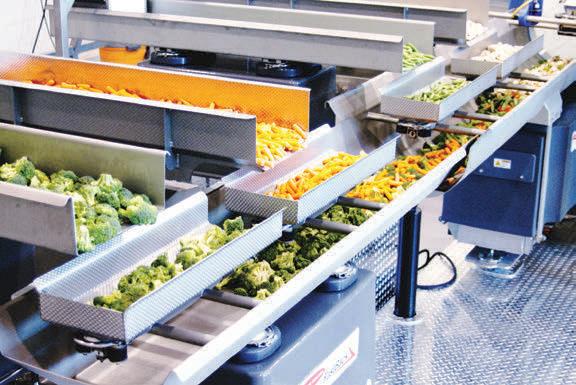
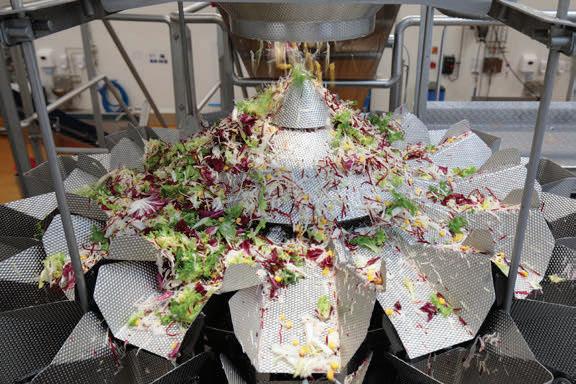
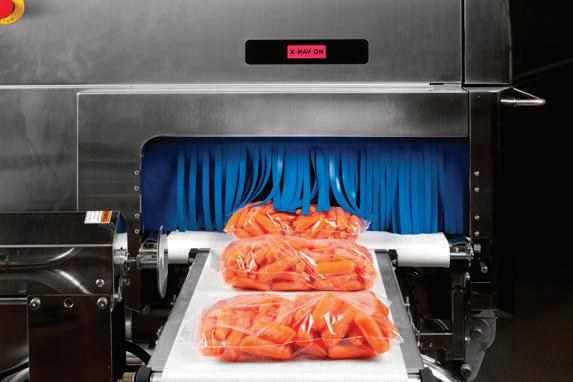
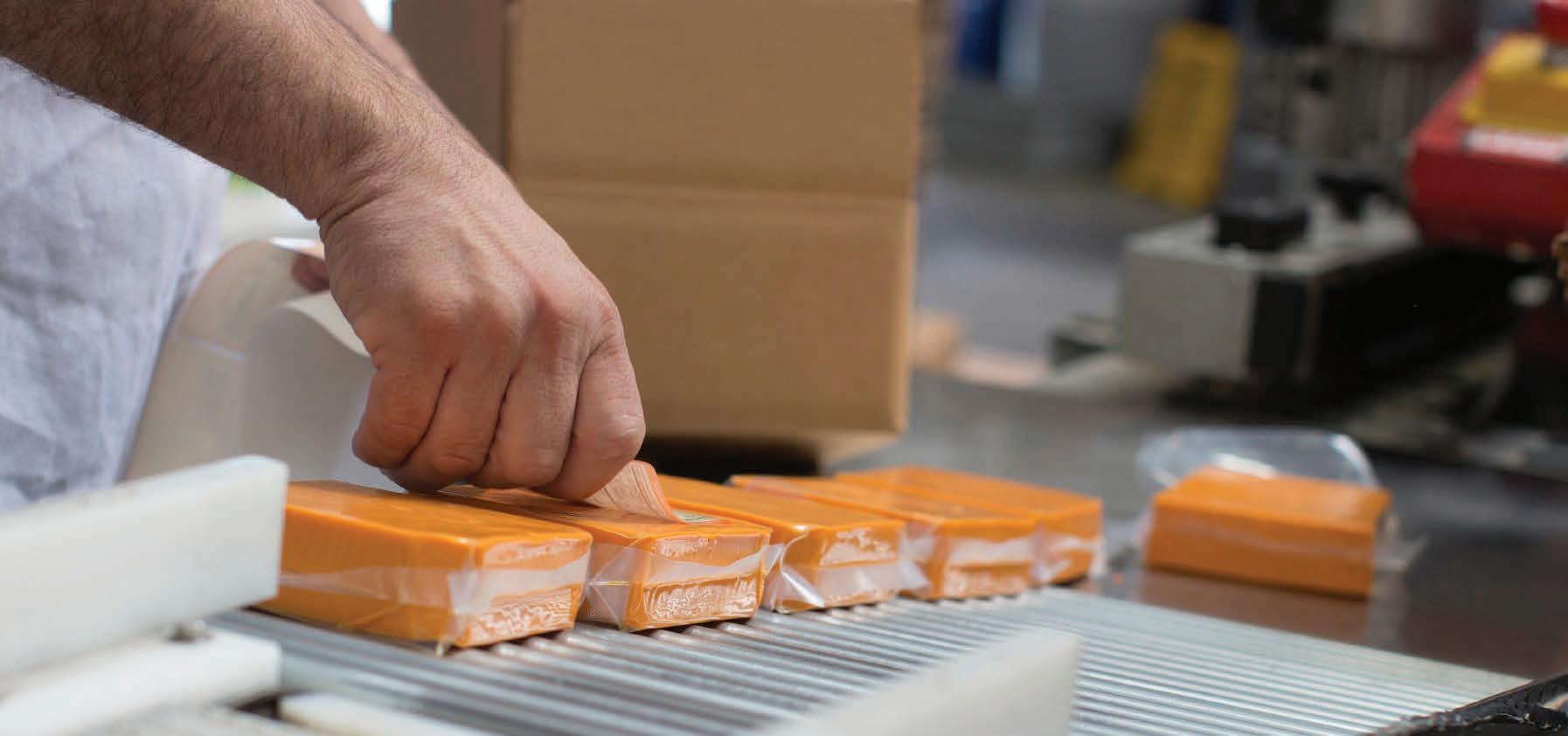
Delivering Results. With Heat and Control, you have a partner with the scale to support your success, the innovation to advance your operations, and a commitment to quality that will help you offer better products for consumers.
• Multihead weighing
• Tray filling
• Produce blending/mixing
• Horizontal motion conveying
• Incline, belt and bucket conveyors
• Checkweighing and seal checking
• Metal detection and x-ray inspection
• Controls and information systems
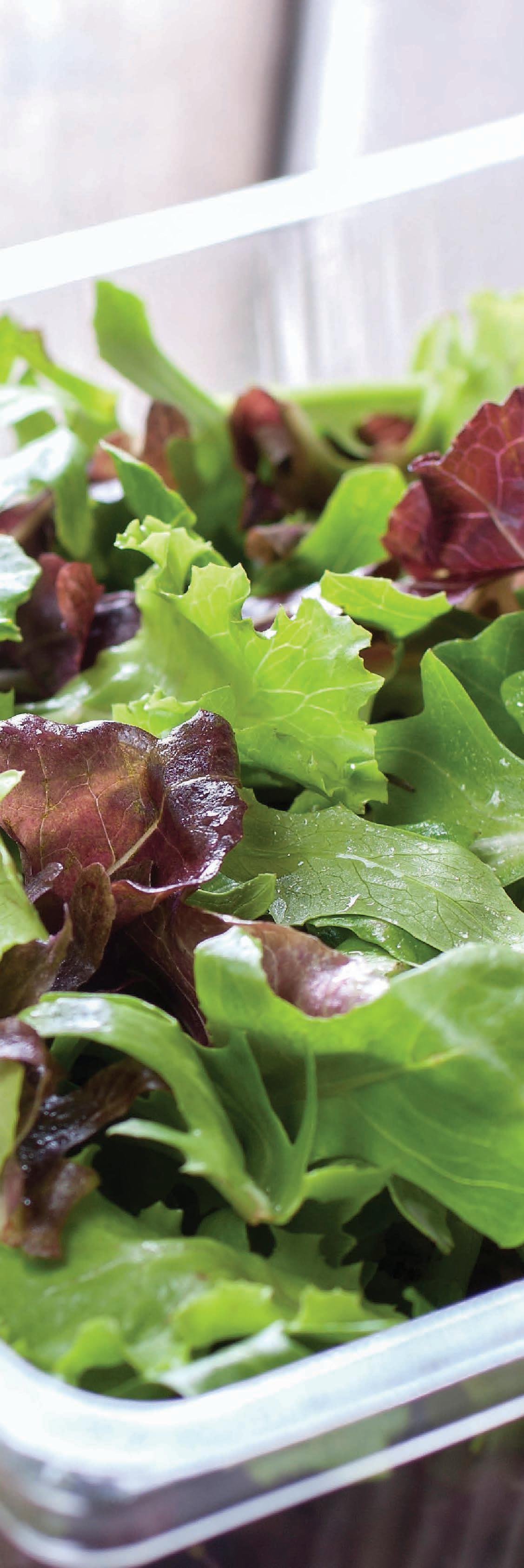
We are successful when you are successful. That’s why we apply creativity, engineering excellence, and determined perseverance to every project to help our customers get the performance their business demands—whether measured by flavor, efficiencies, sustainability, improvement, or innovation. FRESH PRODUCE PACKAGING & INSPECTION SOLUTIONS
18–21, 2026 Booth N-4706 Chicago, IL USA
Videojet
character
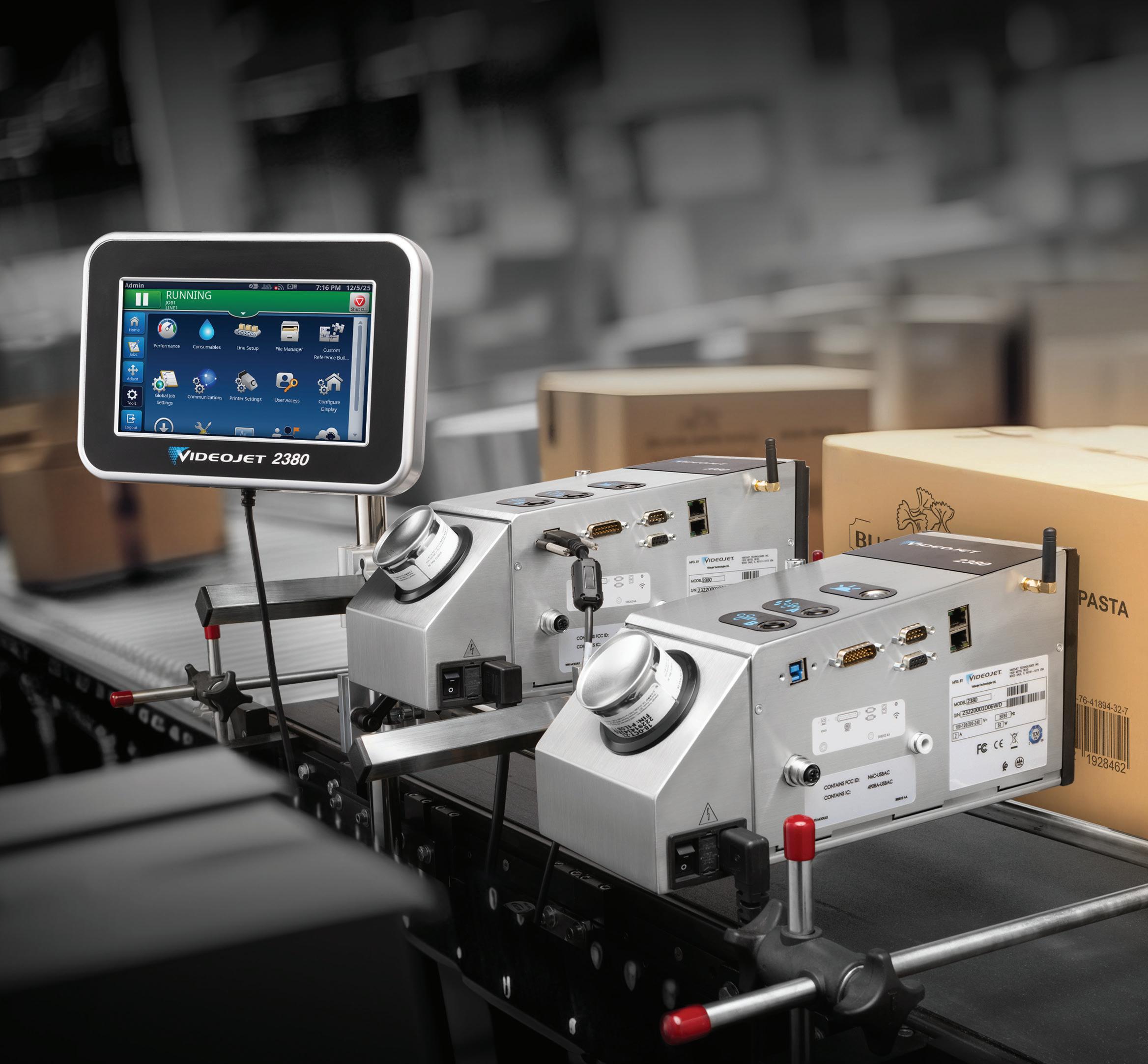
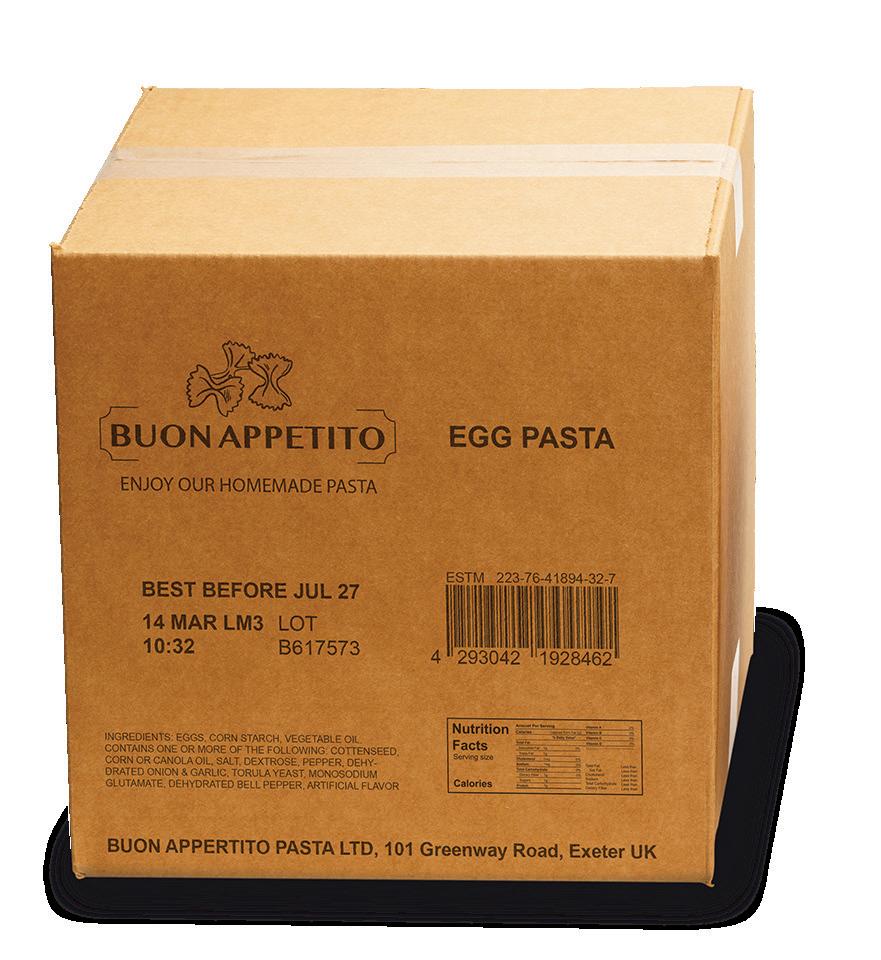
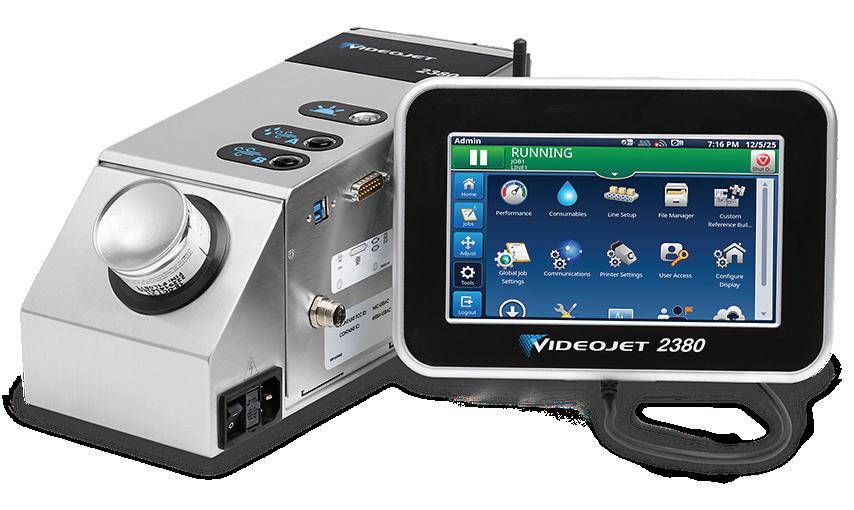
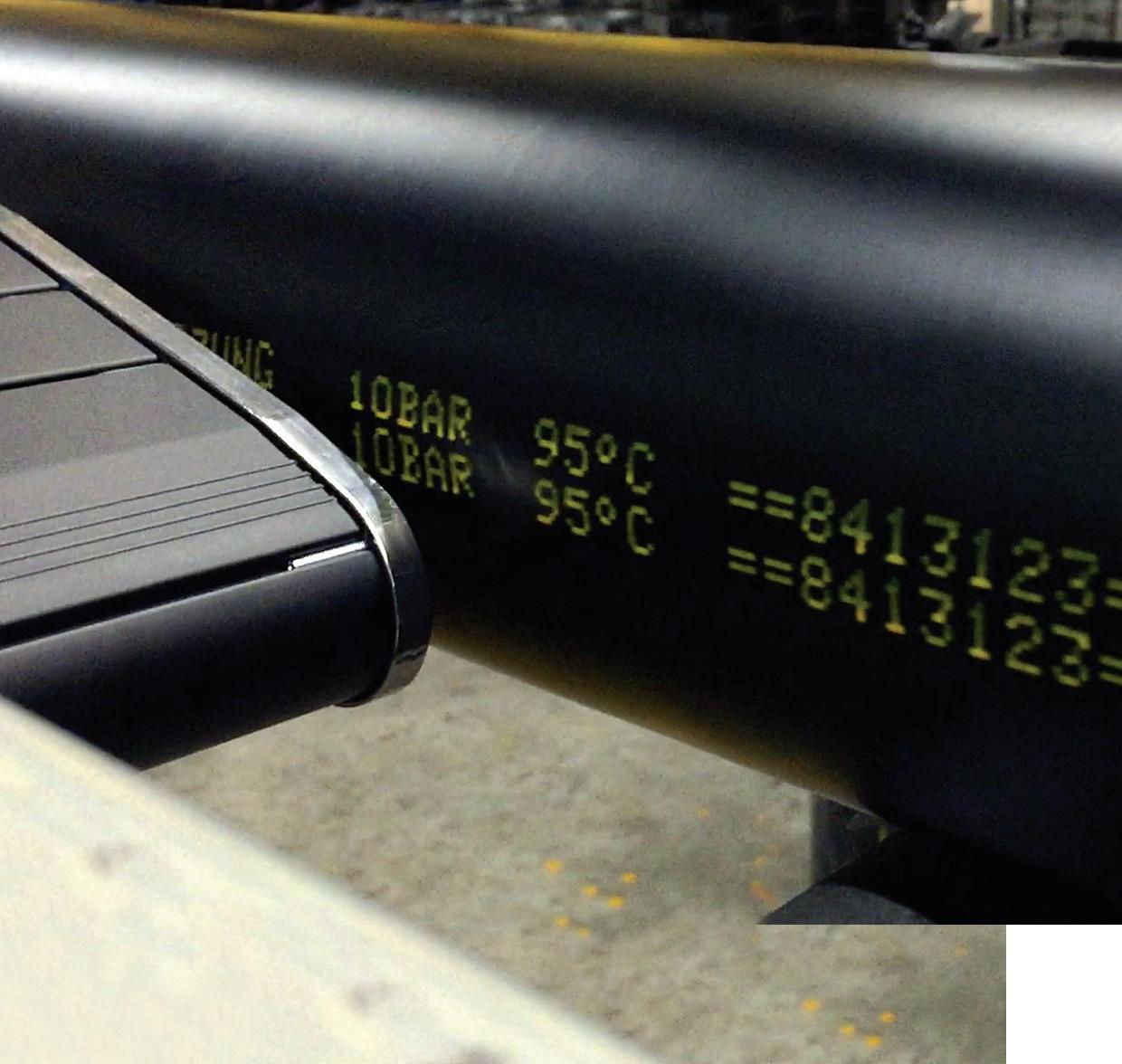
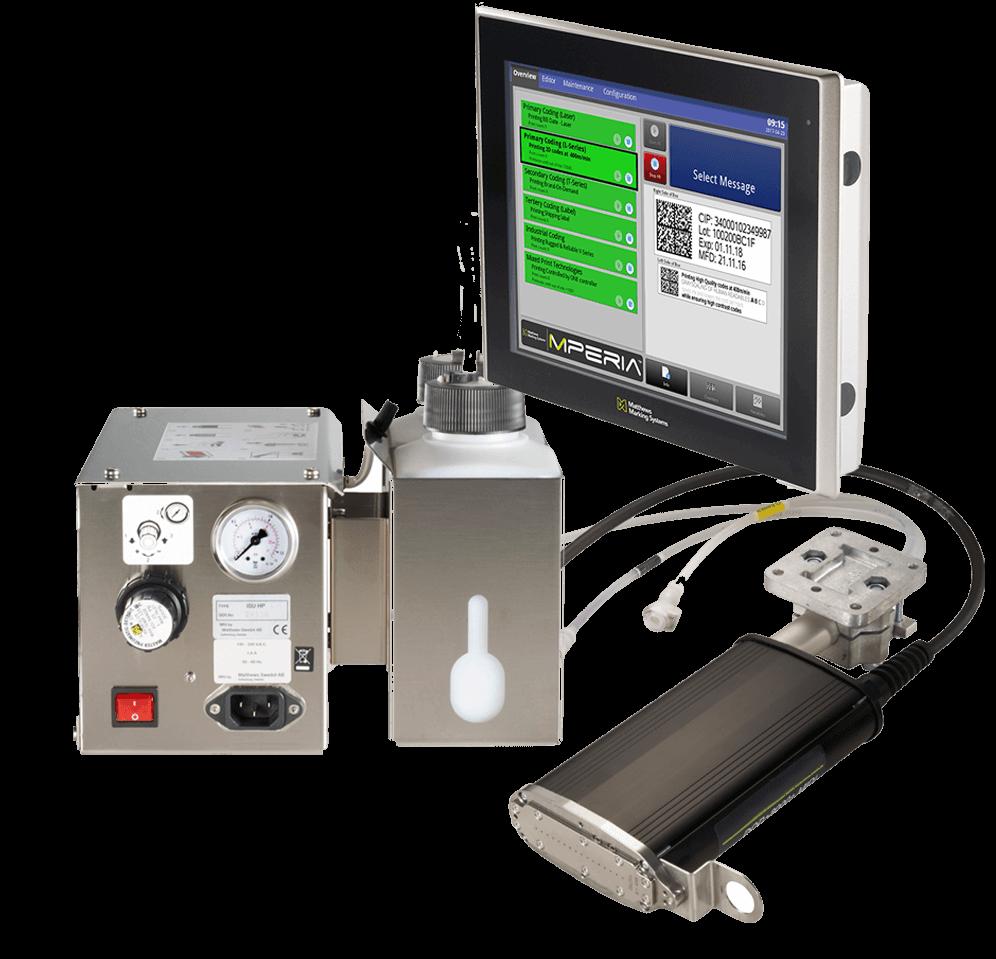
Maximize your coding efficiency with the Videojet 2380 inkjet printer. Designed for easy use, it integrates smoothly, requires minimal maintenance, and can be operated with simple training. Self-cleaning technology helps ensure crisp, high-resolution text, logos, and barcodes. Take advantage of the ability to code on multiple sides of cases and cartons with up to four printheads.
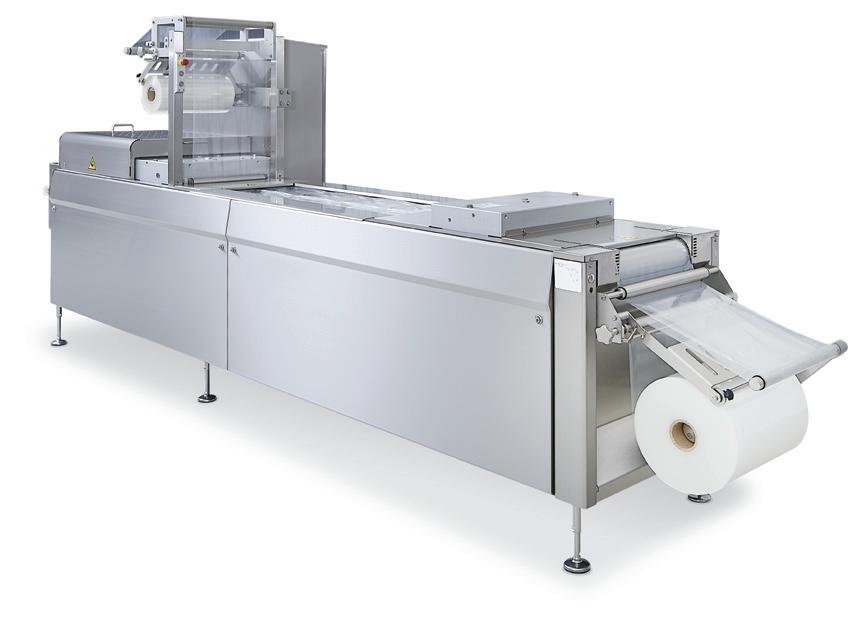
Reiser Form/Fill/Seal Packaging Machines
n Reliable package seals eliminate leakers, rework, & returns
n Extends product shelf life
n Wide range of machines for all production requirements
n Fast, easy changeovers from one package style to another
n Rapid Air System guarantees the highest quality packs
n Backed by Reiser’s industry-leading service and support
Simpler. Faster. Better.
DEPARTMENTS
NEWSPACK
6-8 Packaging news round-up.
NOTES & QUOTES
9 Noteworthy industry briefs.
ECO-PACK NOW
10 All about packaging sustainability.
imPACt
11 A monthly insight from PAC Global.
ON THE COVER
COLUMNS
FROM THE EDITOR
4 By George Guidoni Packaging industry keen on making AI start delivering on its promise.
CHECKOUT
32 By Rhea Gordon Joe Public speaks out on packaging hits and misses.
COVER STORY
13 METAL METTLE
Canadian manufacturer of metal lids and closures set expand its repertoire to the production of tinplate metal cans to serve the domestic food-processing market with sustainable and 100-percent Made-in-Canada packaging.
FEATURES
18 Taste of Home
Nova Scotia-based feta cheese pioneer invests in leading-edge thermoform packaging technology to support its fast-growing artisanal paneer cheese business.
23 Padding the Numbers
Ontario packaging machinery and consumables distributor making many new friends in the Canadian fresh meat and produce industries with its innovative tray-padding service offering.
27 Daily Comforts
Canadian supplier of hotel and hospitality amenities expanding its Canadian manufacturing footprint to support its breathtaking global growth.
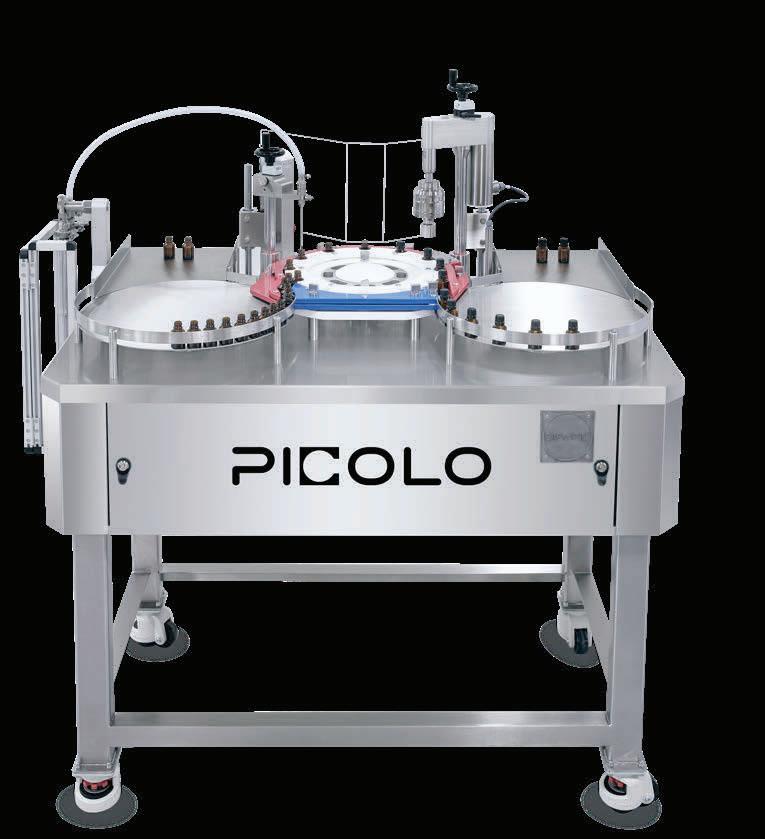
PRECISION FILLING. SEAMLESS CAPPING. SINGLE OPERATOR.
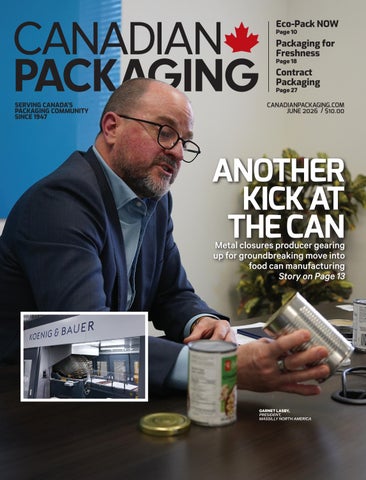
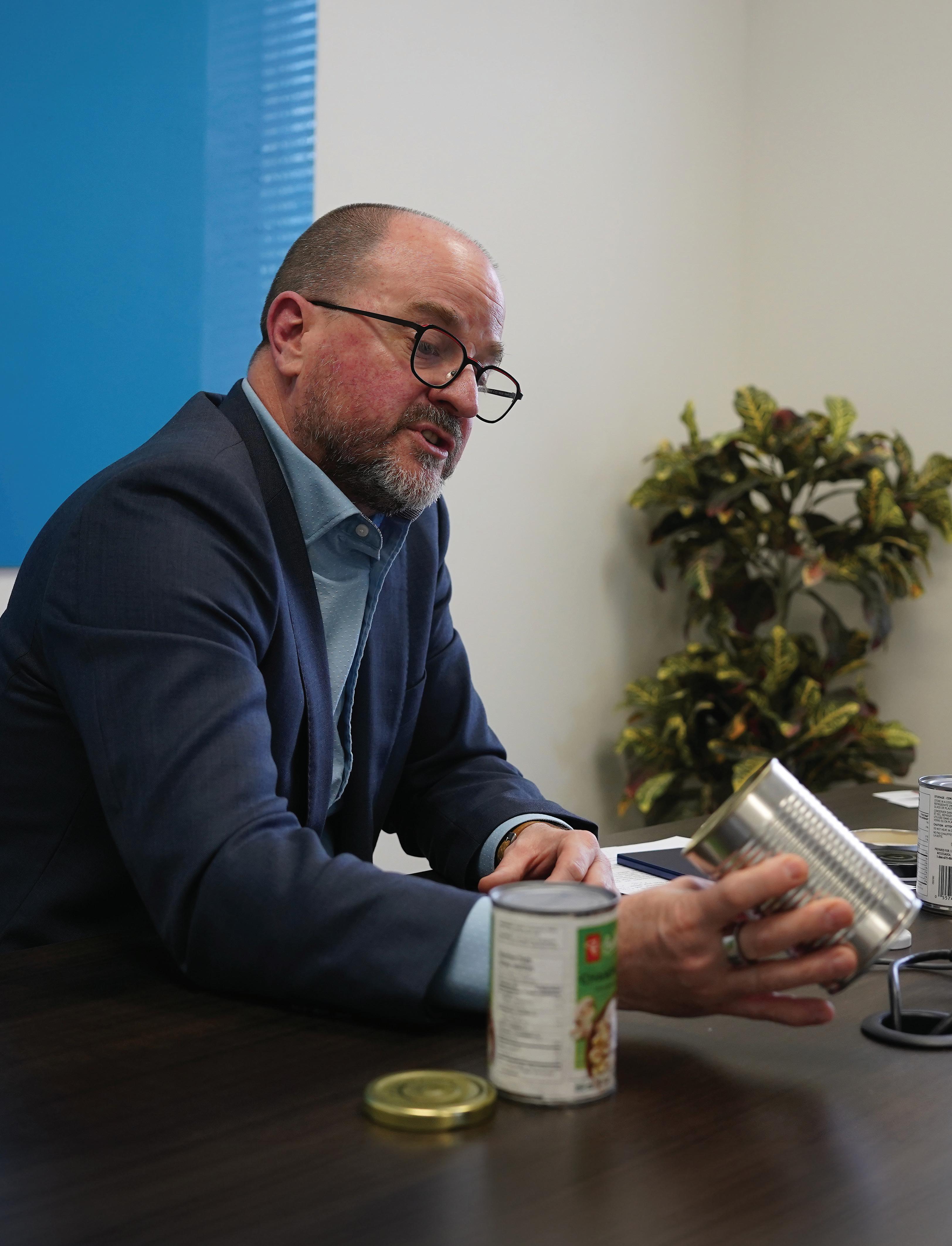
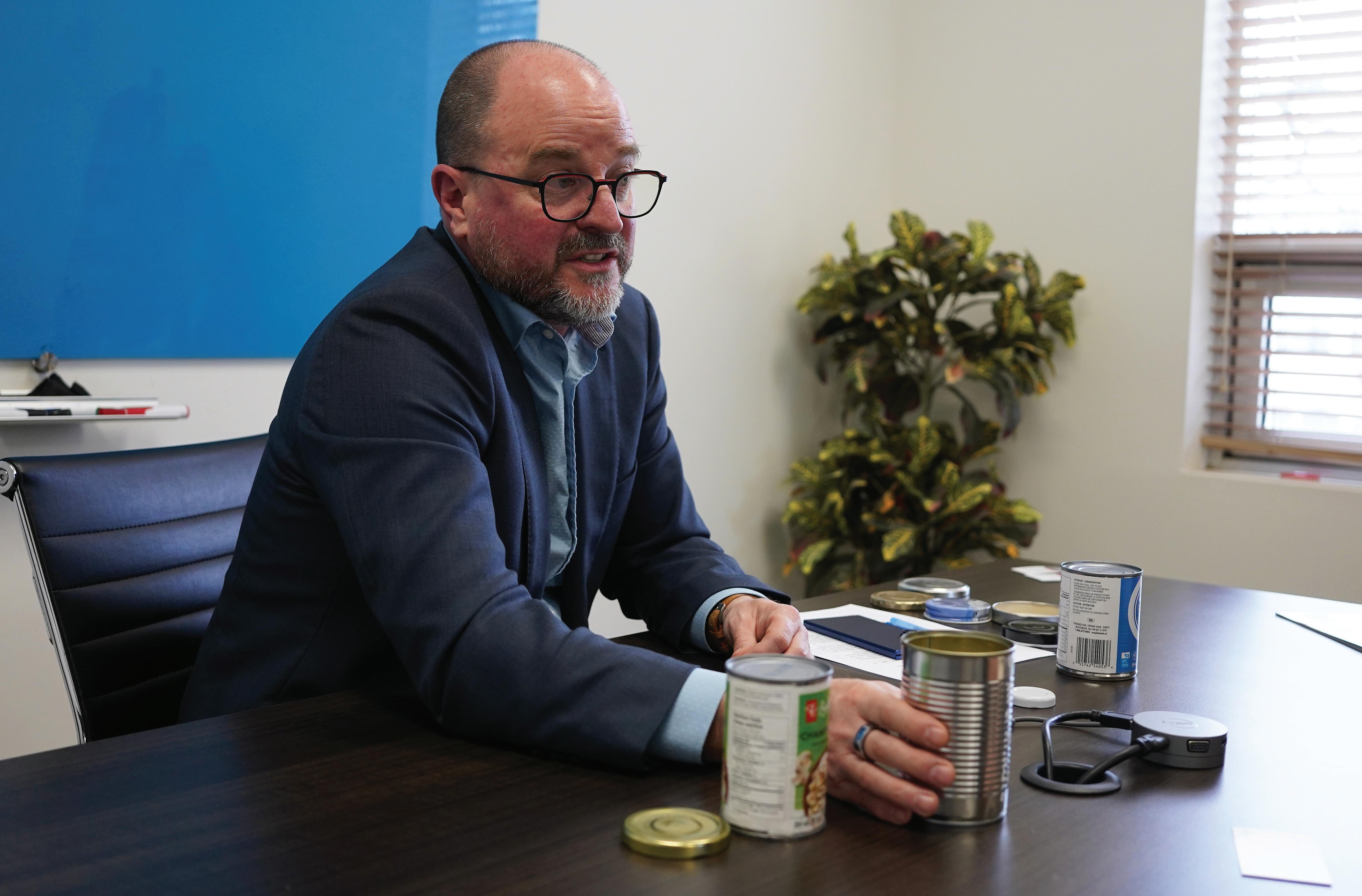
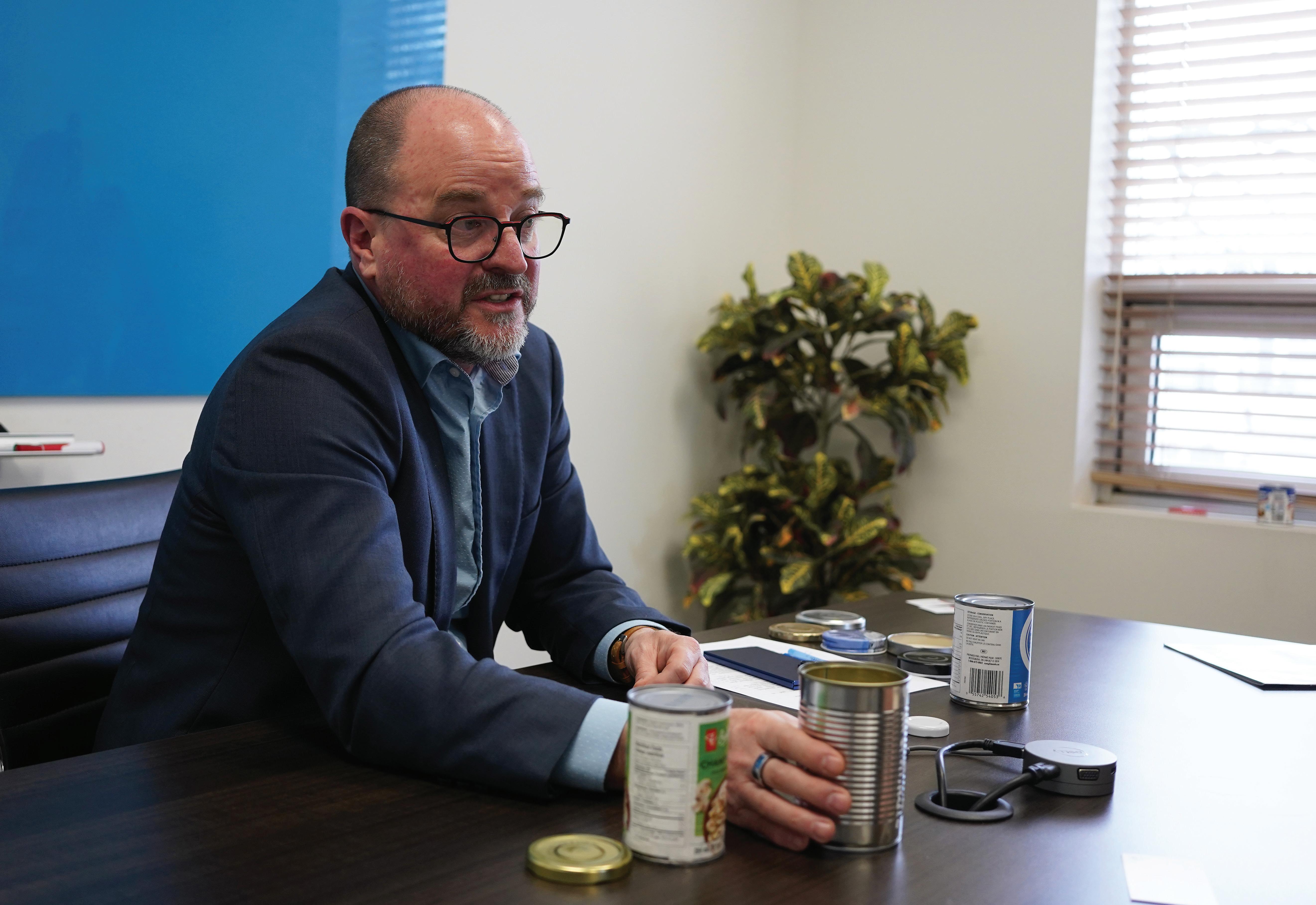
Massilly North America president Garret Lasby explaining the inherent advantages of metal packaging and the pending start-up of the company’s commercial-scale can manufacturing operations in Brantford, Ont.
Picolo Tabletop Monoblock: Efficiency for Startups.
One Operator: Drastically cut labor costs and simplify production. Seamless Process: Achieve precise piston filling, reliable capping (press-on or screw caps), and crimping.
Perfect Fit: Ideal, customizable efficiency for high-value liquid products in Diagnostics, Biotech, and Nutraceuticals.
514 322 0062 sales@capmatic.com
Unfolding AI revolution spreading to packaging
Betting on AI (artificial intelligence) to solve most of mankind’s problems is a comforting thought in times of geopolitical and economic doom and gloom.
For a technology still barely past its teething stages, its disruptive and transformational potential is already manifesting itself in gazillion-dollar AI investments, stock market anxiety, tens of thousands of job losses in the tech sector and, notably, shaping government policy.
The report, titled Building an AI Advantage in Packaging Equipment, asserts that the lower cost of AI are increasing its accessibility for companies of all sizes, while also citing higher awareness of AI benefits, notable movement beyond pilot projects, and greater acceptance by workers on the front line.
June 2026 | VOLUME 79, NO. 4
Reader Service
Print and digital subscription inquires or changes, please contact Angelita Potal, Customer Service Tel: 416-510-5113 apotal@annexbusinessmedia.com
Mail: 111 Gordon Baker Rd., Suite 400, Toronto, ON M2H 3R1
Senior Publisher Stephen Dean | (416) 510-5198 SDean@canadianpackaging.com
Editor George Guidoni | (416) 510-5227 GGuidoni@canadianpackaging.com
Share of Canadian businesses using AI in their operations
Announced with great fanfare earlier this month, the federal government’s new AI for ALL national AI strategy—a $2-billion AI infrastructure investment meant to accelerate AI adoption across Canada’s key business sectors—is a mere reflection of this seemingly unstoppable megatrend.
According to Ottawa, only 12 per cent of Canadian businesses have adopted AI in their operations to date, meaning there’s a lot of work to be done to reach Ottawa’s 60-percent adoption target by 2034. As the government laments, Canada’s contributions and influence in the rapid global AI development have been relatively negligible in comparison to many other industrial economies of note.
“While Canada has world-class talent and one of the fastest-growing digital sectors in the G7, we are among the slowest countries to adopt AI at scale,” Prime Minster Mike Carney points out in the official press release. “This gap risks undermining public trust, driving Canadian talent and start-ups abroad, and leaving critical parts of our AI ecosystem under foreign control.
“With the global AI market projected to reach U.S.$4.8 trillion by 2033, Canada has a limited but real opportunity to ensure AI works for all Canadians—to harness this technology to create jobs, protect Canadians, and strengthen our prosperity.”
Whether the current 12-percent AI adoption rate is sufficient or not in the current economy, it’s a safe bet that’s it’s much higher in industry segments like packaging, where using AI-ready cameras, robots, sensors and other high-tech gadgets is quickly becoming a standard practice.
According to a new report from PMMI - The Association for Packaging and Processing Machinery, consumer packaged goods (CPG) companies and OEMs (original equipment manufacturers) are both taking advantage of lower costs and greater functionality to speed up AI adoption in packaging.
“Manufacturers across the packaging value chain are recognizing that AI can help address some of their most pressing challenges, from workforce knowledge gaps to operational efficiency,” says PMMI’s vice-president of market development Jorge Izquierdo. “What we’re seeing now is a shift from isolated pilots toward broader adoption, where AI supports smarter, more connected production environments.”
According to PMMI, the most common applications fall into five categories, including knowledge transfer, machine vision, predictive maintenance, regulation and compliance, and data transparency.
Despite growing usage, the report cites a number of challenging obstacles in the way of more accelerated AI adoption.
“Primary concerns include data hallucinations and accountability for AI-generated errors,” the PMMI report states. “In addition, although progress has been made in strengthening security, cybersecurity remains a major issue.
“Other barriers include internal attitudes, ROI, latency challenges, existing data infrastructure, job security, and gaps in operational readiness.”
For all that, the use of AI in packaging will continue to advance at an unprecedented pace, according to Izquierdo, with transformative developments occurring within remarkably short cycles.
For companies looking to start their AI journey on the right foot, Izquierdo strongly recommends attending the upcoming PACK EXPO International 2026 exhibition in Chicago (Oct 18-21, 2026), to see first-hand what AI can do for their business: “Artificial intelligence is becoming a practical tool for improving packaging operations, and PACK EXPO International offers a unique opportunity for companies to see these innovations in action and explore how they can be applied on the plant floor.”
GEORGE GUIDONI, editor GGuidoni@canadianpackaging.com
Audience Development Manager Barbara Adelt | (416) 510-5184 Fax: (416) 510-6875 badelt@annexbusinessmedia.com
Media Designer Graham Jeffrey | (519) 428-3471 gjeffrey@annexbusinessmedia.com
CEO Scott Jamieson SJamieson@annexbusinessmedia.com
Annex Business Media 111 Gordon Baker Rd., Suite 400, Toronto, ON M2H 3R1; Tel: 416-442-5600.
Canadian Packaging, established 1947, is published 8 times per year except for occasional combined, expanded or premium issues, which count as two subscription issues.
PRINTED IN CANADA ISSN 008-4654 (PRINT), ISSN 1929-6592 (ONLINE)
PUBLICATIONS MAIL AGREEMENT NO. 40065710
SUBSCRIPTION PRICE PER YEAR (INCLUDING ANNUAL BUYERS’ GUIDE: Canada $83.27 per year, USA $190.41 (CDN) per year, Outside Canada $215.87 (CDN) per year, Single Copy Canada $10.00. From time to time Canadian Packaging will mail information on behalf of industry-related groups whose products and services we believe may be of interest to you. If you prefer not to receive this information, please contact our circulation department in any of the four ways listed above.
We acknowledge the [financial] support of the Government of Canada
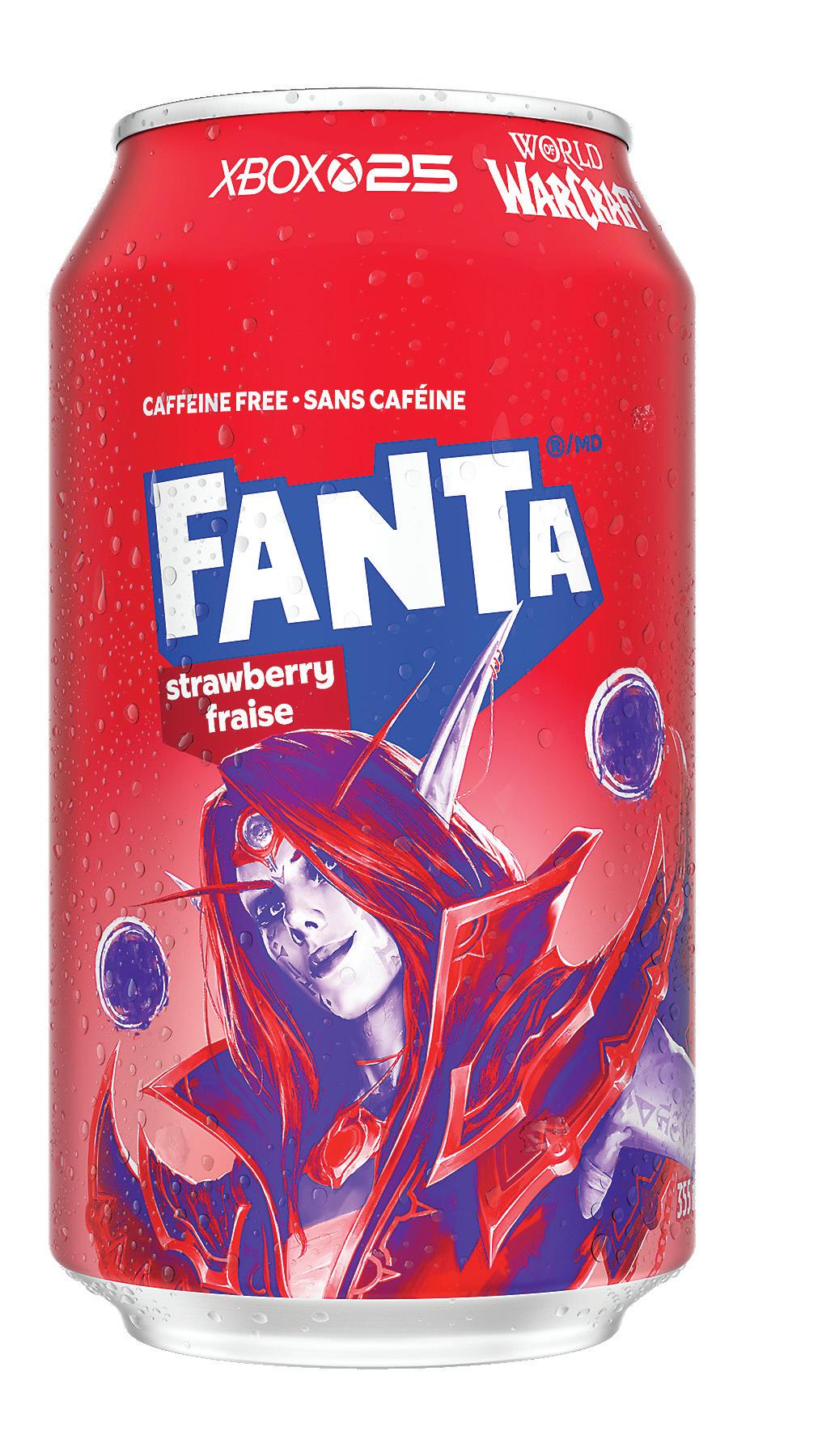
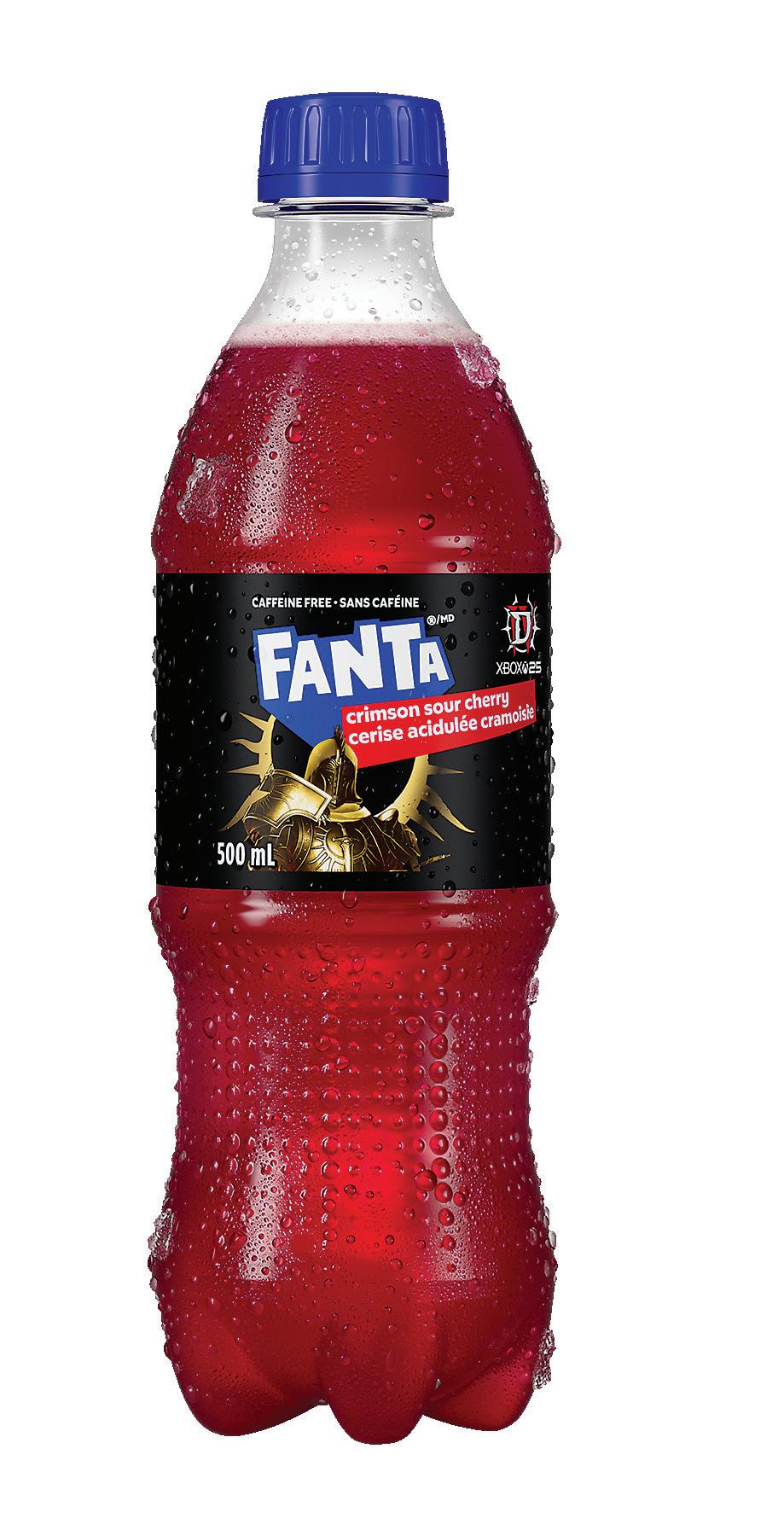
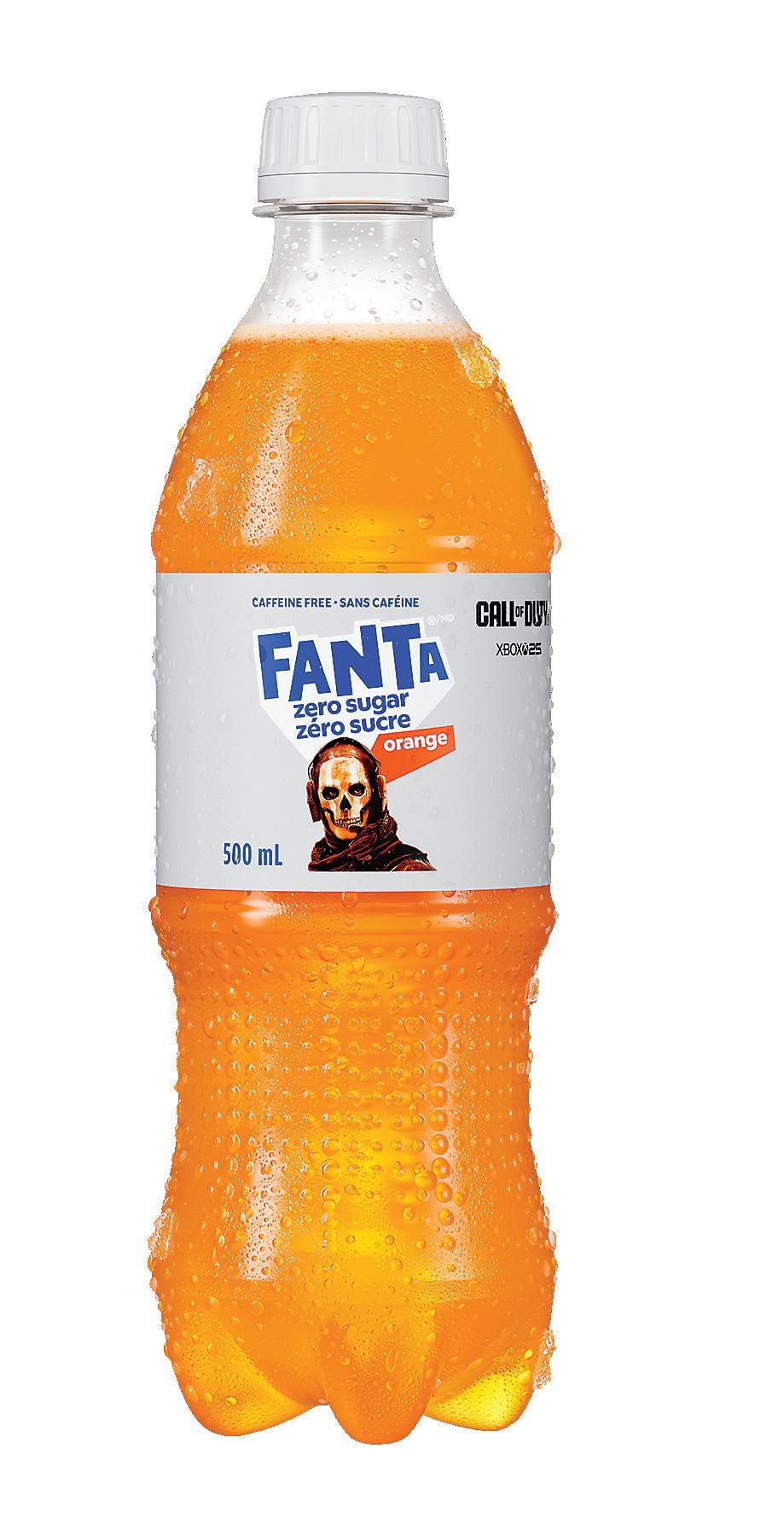
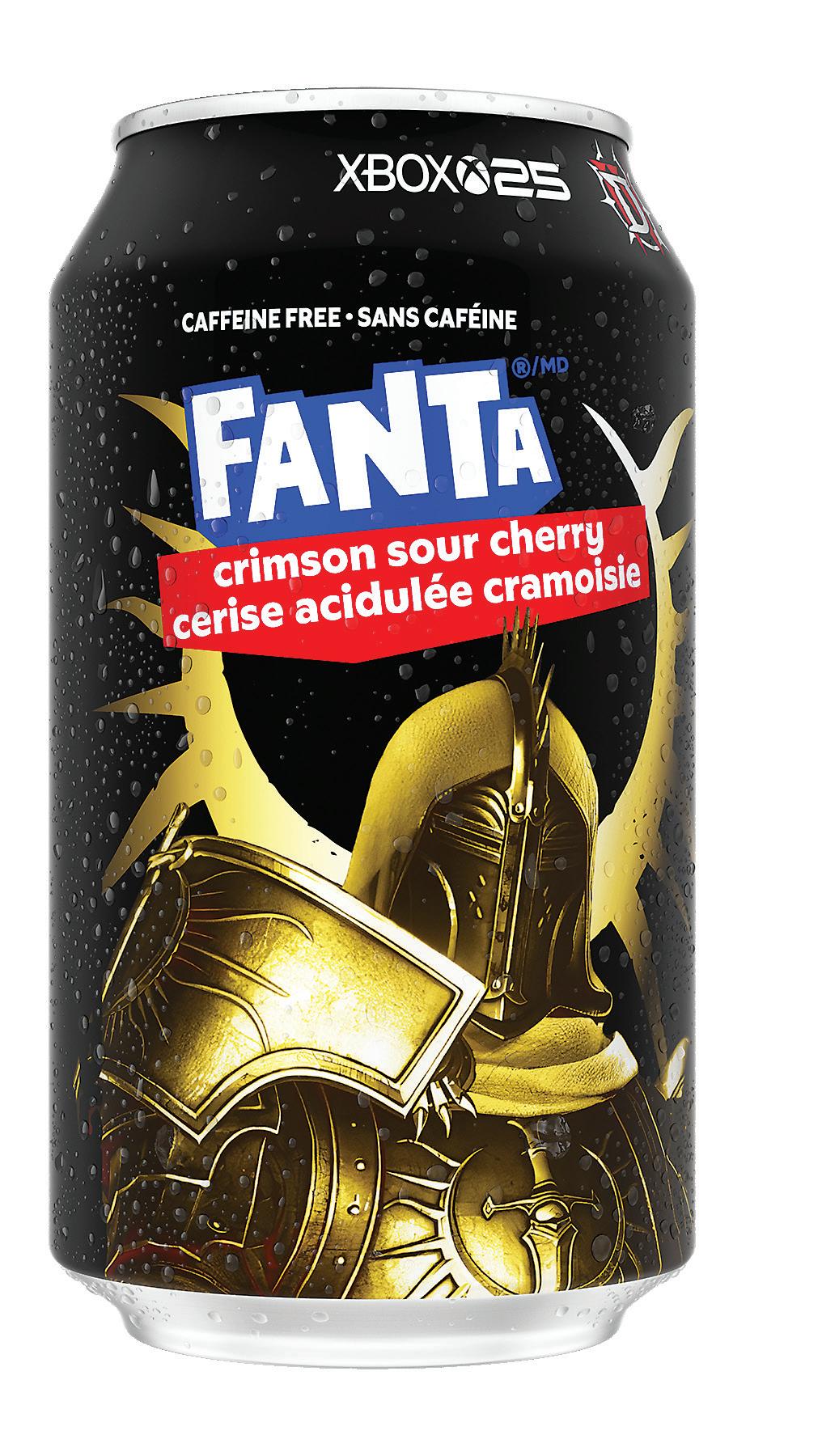
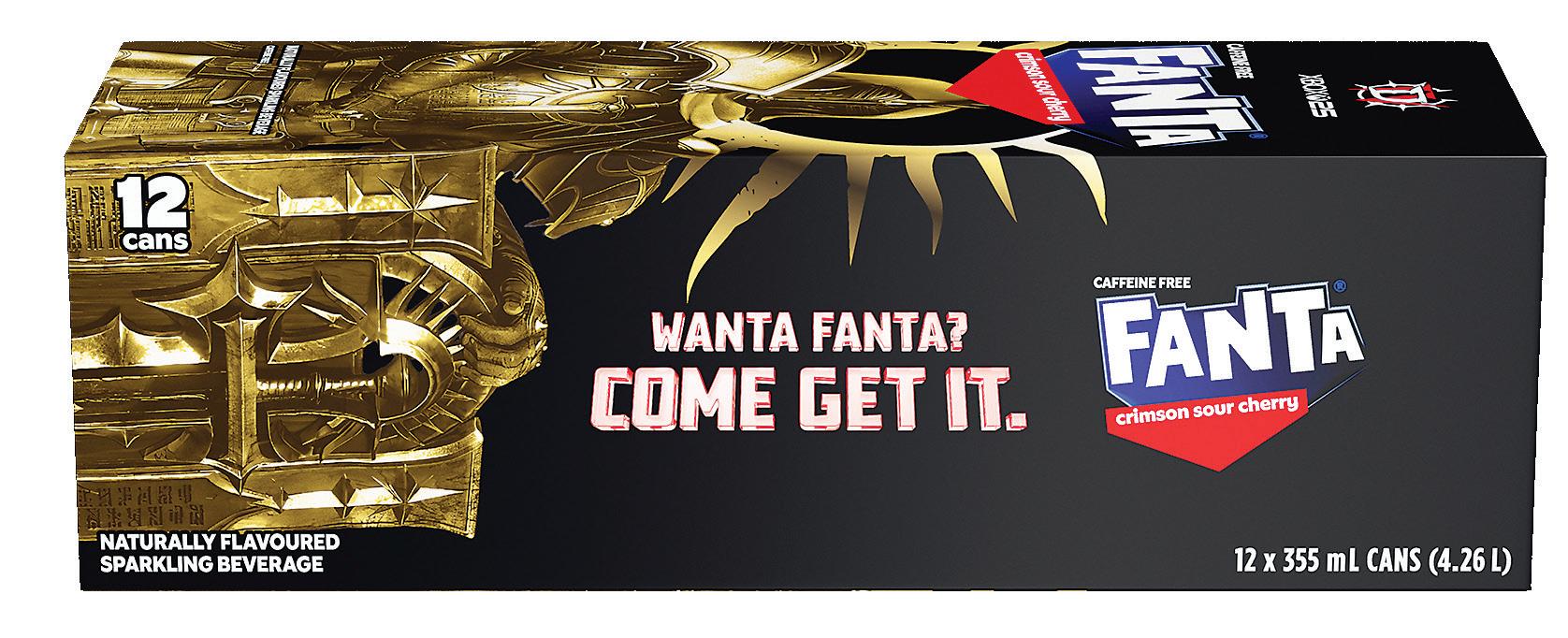
Fanta enters the gaming world with joint Xbox collaboration and character-driven packaging
As one of The Coca-Cola Company’s fastest-growing brands in Canada not bearing the parent company’s trademark name, Fanta has been on a roll in recent years, boosting its sales and profile with clever limited-time promotion tailored to the younger tech-savvy demographic.
Earlier this spring, the fruit-flavored soda
brand entered the exciting word of gaming through a global new partnership with Xbox, a Microsoft gaming brand, to celebrate the video gaming giant’s 25th anniversary with a comprehensive packaging overhaul based on some of the world’s most popular gaming series.
To mark the occasion in style, Fanta has launched a new special-edition beverage collection featuring character takeovers from some of the most iconic Xbox franchises including Call of Duty, Halo, World of
Improve Food Safety with Re-Inspection Understanding Foreign Material Investigations
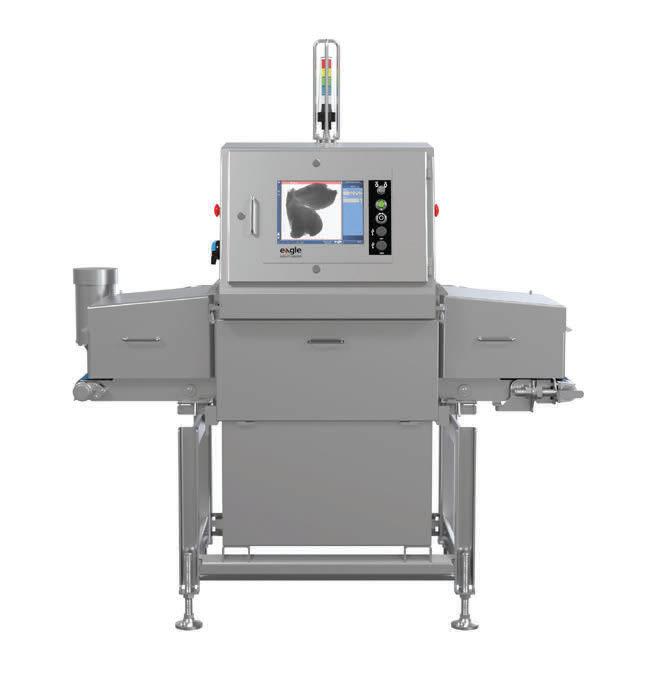
Foreign material investigations move quickly, and having a repeatable, defensible re-inspection process is critical. Understanding the steps involved in finished goods re-inspection programs, validating thresholds, and setting performance expectations help to ensure a successful investigation.
Pre-testing using X-ray is the foundation of any successful rework effort. Our PXT™ Photon Counting and Dual Energy technologies detect most foreign materials below 1 mm in packaged food and beverages, including bone, dense material, gaskets and O-rings, metal and stainless steel, plastic, rubber, stone, and wire.
Learn more about X-ray Reclaim re-inspection by contacting us at info@xrayreclaim.com or by visiting www.xrayreclaim.com
Warcraft and Diablo IV, while introducing a new special-edition of Fanta Crimson Sour Cherry flavor.
Featuring the fearsome holy warrior Paladin from Diablo IV on its packaging, the Fanta Crimson Sour Cherry joins other popular gaming icons in the special edition’s line-up, including:
• The Ghost from Call of Duty for Fanta Orange and Fanta Orange Zero Sugar;
• Master Chief from Halo for Fanta Pineapple;
• Xal’atath from World of Warcraft for Fanta Strawberry
Made and bottled by Coke Canada
Bottling, the special-edition Fanta beverages are now available nationwide in 500-ml rPET (recycled polyethylene terephthalate) plastic bottles and 12-packs of 355-ml cans.
As part of the promotion, Fanta is also offering its fans to game with featured iconic characters and compete in never-beforeplayed challenges inspired by these epic franchises to win various prizes and themed merchandise via the Wanta Fanta? Come Get It challenge, using the on-pack QR codes as a gateway to the interactive digital experience.
“This partnership with Xbox takes us to a whole new realm of delicious game play [and] we’re just getting started,” says Ibrahim Salim Khan, vice-president for the global sparkling flavors category. “We imagine a world where the irresistible taste of Fanta is so delicious, it pulls players into a multiverse-sized adventure.”
“We’re excited to unleash this partnership with Xbox by immersing fans in the worlds of their favorite games,” Khan states, “teaming up with iconic characters and facing largerthan-life challenges to prove just how far they’ll go to get their Fanta back.”
Adds Xbox partnerships general manager Marcos Waltenberg: “This partnership with Fanta brings together two brands that thrive on creativity and self-expression. Together, we’re creating experiences that meet fans where they are and celebrate the joy of play—on screen and beyond.”
Evan Segalowitz, Managing Director and President of MULTIVAC Canada, will be leaving the company at his own request, effective July 27, 2026, after over nine years in the role, to pursue new professional opportunities. During his tenure, Evan supported the organization’s continued development and long-term growth.
The company also announced that, effective July 1, 2026, Paul Marsden will assume the role of Managing Director and President of MULTIVAC Canada. Paul has more than 20 years of experience within MULTIVAC and has held leadership roles across Customer Care and Sales, most recently serving as Vice President of Sales and Marketing. His broad experience across the organization positions him well to lead MULTIVAC Canada through its next stage of growth.
As the leadership transition takes place, MULTIVAC Canada remains focused on continuing to support its customers and partners with the consistent service, quality, and reliability they expect.
MULTIVAC Canada Announces Management Change
Brampton, ON - May 7, 2026
MULTIVAC Canada announced today an upcoming Management change.
ABOUT MULTIVAC CANADA
At MULTIVAC, we aim to be your preferred partner in developing sustainable solutions for processing and packaging products of all types. Our portfolio comprises a wide range of packaging technologies, automation solutions, labellers, quality control systems, and materials. Our product range is rounded off with solutions upstream of the packaging process in the areas of portioning and processing, as well as dough processing technology. MULTIVAC Canada first opened its doors in 2007 and now has offices and innovation centers in Brampton, Ontario and Richmond, British Columbia. We have more than 1,000 thermoformers installed, producing packs for products and businesses of all shapes and sizes. Since the beginning of 2022, we have been LASKA and METALQUIMA’s exclusive partners for preparation and processing equipment. With our 25+ provincially based technicians, we aim to provide our customers with the excellent service support they need. Further information at: ca.multivac.com
ABOUT MULTIVAC GROUP
Packaged expertise, innovative cuttingedge technology, and strong brands under one roof: The MULTIVAC Group offers complete solutions for the packaging and processing of food, medical and pharmaceutical products, as well as industrial items – and as the technology leader, it continues to set new benchmarks in the market. For more than 60 years, the name has stood for stability, strong values, innovation, and future security, as well as quality and excellent service. Founded in 1961 in the Allgäu region of Germany, the MULTIVAC Group is today a global solutions supplier that supports small and mediumsized companies, as well as large corporate businesses, in designing efficient, resourcesaving production processes. The product portfolio comprises a wide range of packaging technology, automation solutions, labelling and marking equipment, inspection systems and packaging materials. The product range is complemented by practical, customized solutions for food processing – from slicers and portioning machines to bakery technology. All the packaging and processing solutions are individually matched to customer requirements in the company’s own application and development facilities. Over 7,000 staff across more than 85 subsidiaries worldwide ensure that the company remains close to its customers and delivers maximum customer satisfaction, from the first project concept through to aftersales service. Further information at www.multivac.com
Quebec beverage giant picks up a coveted award for major plant upgrades
The passage of time has been kind for Rougemont, Que.-based, Lassonde Industries Inc.
Founded as a family business over 100 years ago, the company nowadays employs nearly 3,000 people at 19 plants across Canada and the U.S., producing a comprehensive brand portfolio of ready-todrink fruit and vegetable juices, along with a growing range of soups, broths, sauces and other specialty products.
Generating revenues of $2.93 billion last year, the now publicly-traded corporation is showing no signs of slowing down, having carried out major capital upgrades at its home Rougemont plant last year to boost its production output and capacity.
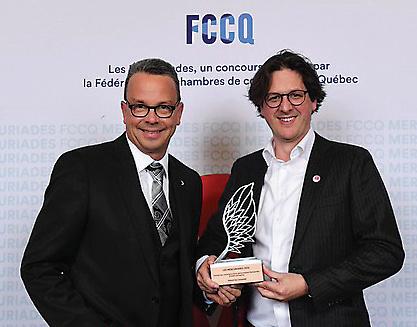
These efforts were fittingly recognized last month at the annual Mercuriades Awards gala in Montreal, a prestigious Quebec business competition—organized by the Fédération des chambres
de commerce du Québec (FCCQ)—celebrating the innovation, ambition, and success of businesses, entrepreneurs and SMEs (small and medium enterprises) across the province.
Taking home the top prize in the High-Performance Manufacturing Company category, as well as being named finalist in the Technological Innovation category, Lassonde was lauded for company’s large-scale
26_003877_Canadian_Packaging_JUN_CN
strategic investments to modernize its facilities and increase the flexibility of its production capabilities. Among the recognized initiatives is the 2025 commissioning of a multi-format aseptic line at one of Lassonde’s Rougemont plants.
This investment of more than $10 million enables the production of concentrates in formats ranging from four to over 2,000 liters on a single line—enhancing the company’s ability to serve institutional, industrial and fast-food customers across North America.
“Receiving this Mercure is a great source of pride for all our teams,” says Lassonde’s chief executive officer Vince Timpano.
“This recognition reflects the quality with which we continue to advance our operations and invest in technologies that enhance our manufacturing efficiency and our ability to serve our customers,” Timpano states.
A major player in both retail and foodservice markets, Lassonde develops, manufactures and
markets a wide range of national brand and private-label products, from juices and sauces to fruitbased snacks and, well as alcoholic beverages such as ciders and wines.
Altogether, Lassonde distributes over 3,500 unique products in approximately 200 formats across shelf-stable, chilled, and frozen categories.
Accepting the award, the company’s general manager for Canadian Martin Lauzière paid tribute to the hard work of all of the company’s employees contributing to its continuous success.
“Behind every innovation and every industrial achievement are, above all, dedicated people who push the limits of what we can accomplish.,” Lauzière said.
“This Mercure belongs to the many teams in our plants and offices who contribute to moving Lassonde forward every day.”
Martin Lauzière, General Manager, Beverages Canada, accepting the Mercure award in the HighPerformance Manufacturing Company category on behalf of Lassonde Industries Inc. at the Mercuriades gala last month
Kingsville, Ont.-based Red Sun Farms has picked up the Best Berry and Overall Best Strawberry awards in last month’s 2026 Greenhouse Competition in Leamington, Ont., for the company’s Sweet North brand of greenhouse-grown strawberries. “We are extremely proud of the recognition our team has received,” says Red Sun Farms vice-president of sales and business development Harold Paivarinta. “With more than 70 entries in the Berry category, this recognition is a true testament to the exceptional flavor, quality, and consistency that Sweet North
Strawberries deliver,” Paivarinta adds. “These achievements are a testament to the passion and expertise of our growers, partners and team members who continue to push the boundaries of greenhouse-grown produce.”
PolyExpert Inc., Montreal-based manufacturer of blown polyethylene films, has announced a “merger of equals” with Polykar Industries Inc., also of Montreal, to form Invera Flexibles, a major flexible packaging producer with over $200 million in combined sales and 350 employees. As part of the transaction, Invera Flexibles is committing up to $20 million in capital to invest in the expansion and modernization of production capacity at its Edmonton and Laval facilities. Upon completion, the company will reach an annual production capacity exceeding 150 million pounds, reinforcing its scale and ability to meet growing market demand for high-quality flexible packaging films and products. With coast-to-coast operations, three state-of-the-art facilities in Montreal, Laval, and Edmonton, Invera Flexibles is positioned as a market leader
across five key segments, including converter films, industrial and food-grade packaging, agricultural films, and compostable solutions, with the PolyExpert and Polykar brands continuing to be marketed as distinct product lines.
Valco Melton, Cincinnati, Ohio-based manufacturer of adhesive dispensing machinery and vision inspection systems for quality control in package printing applications, has reached a definitive agreement to be acquired by Graco Inc., a leading supplier of fluid-handling systems and components such as paint sprayers, pumps, and dispensing equipment headquartered in Minneapolis, Minn., in an all-cash transaction.
Leading Finnish paperboard packaging producer Metsä Board and German printing press manufacturer Heidelberger Druckmaschinen AG (HEIDELBERG) have entered into a strategic collaboration aimed at enhancing the end-to-end value chain of packaging production by developing innovative packaging solutions that improve both operational performance
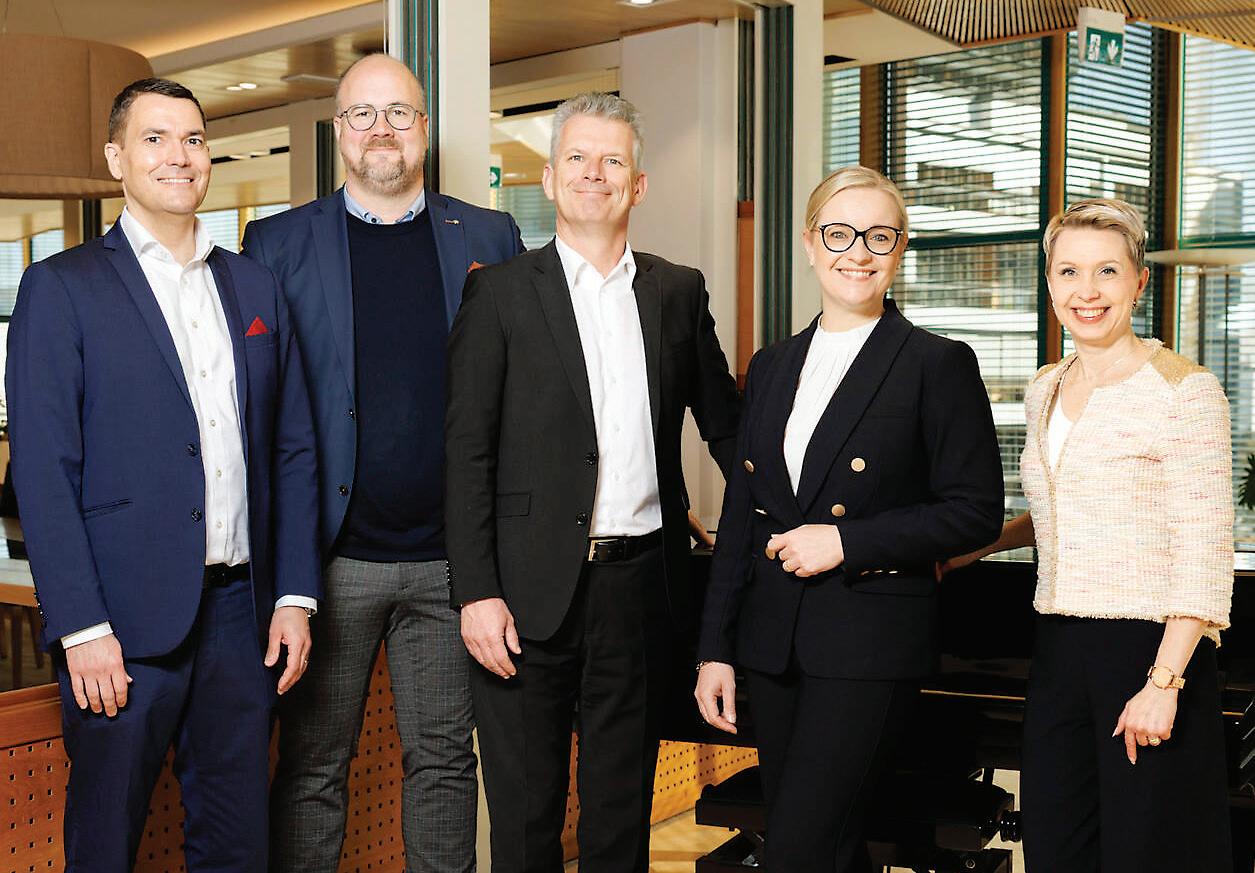
From left: Erkki Nyberg, Metsä Board; Maarten Florizoone, Metsä Board; Andreas Lang, HEIDELBERG; Erja Hyrsky, Metsä Board; Elina Huopio, Metsä Board.
and the consumer experience. According to the companies, the initiative will encompass joint R&D projects, pilot production runs and customer demonstrations at HEIDELBERG’s Print Media Centers, as well as Metsä Board’s Excellence Center and Design Studios. “Our collaboration allows us to offer our customers new possibilities in packaging design and production efficiency, while maintaining our commitment to sustainability and premium quality,” says Erja Hyrsky, Metsä Board’s senior vice-president of commercial operations.
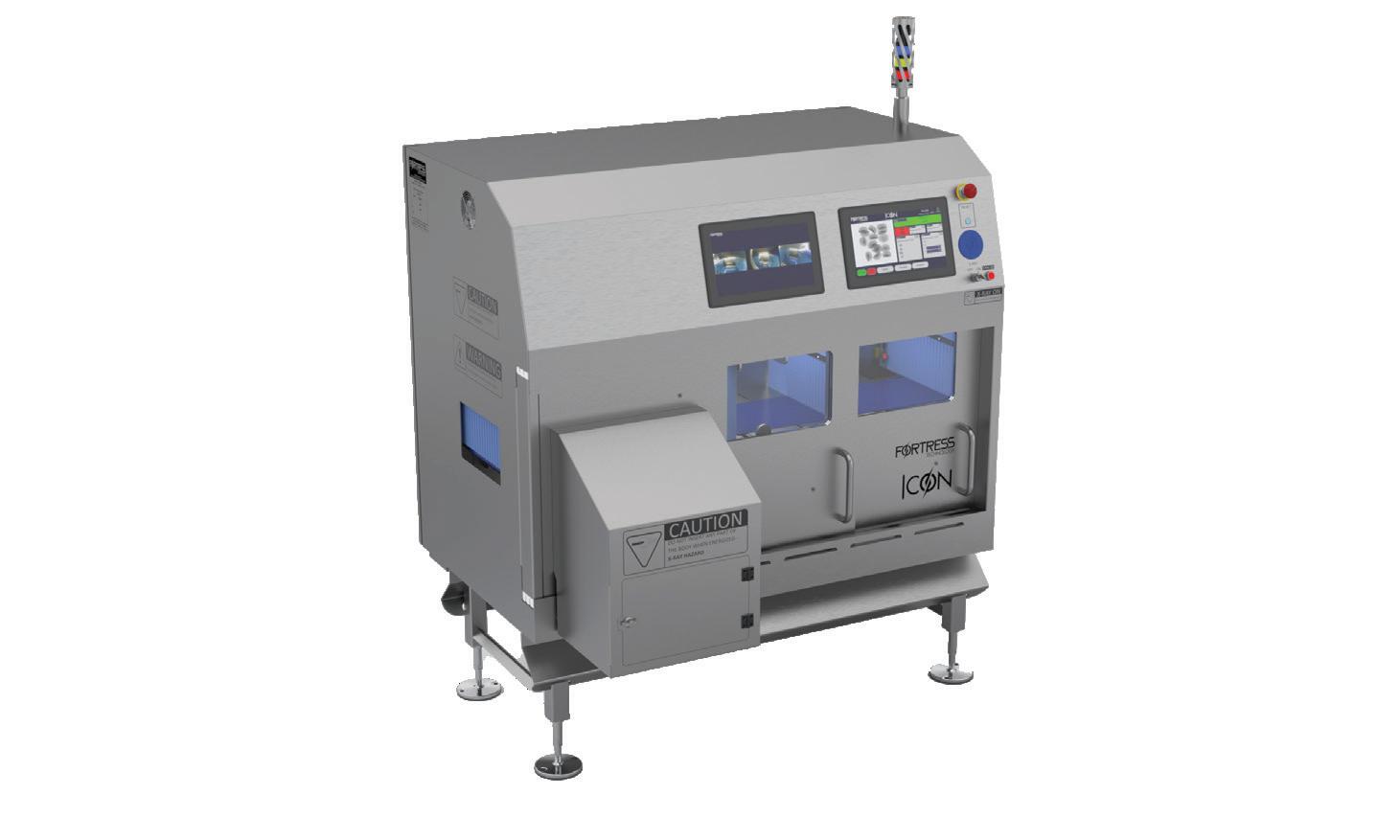
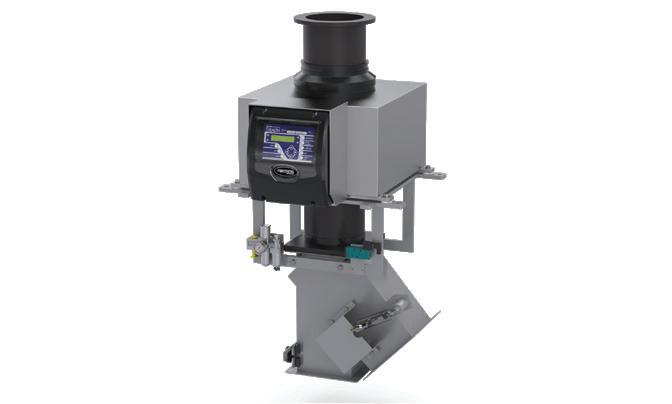
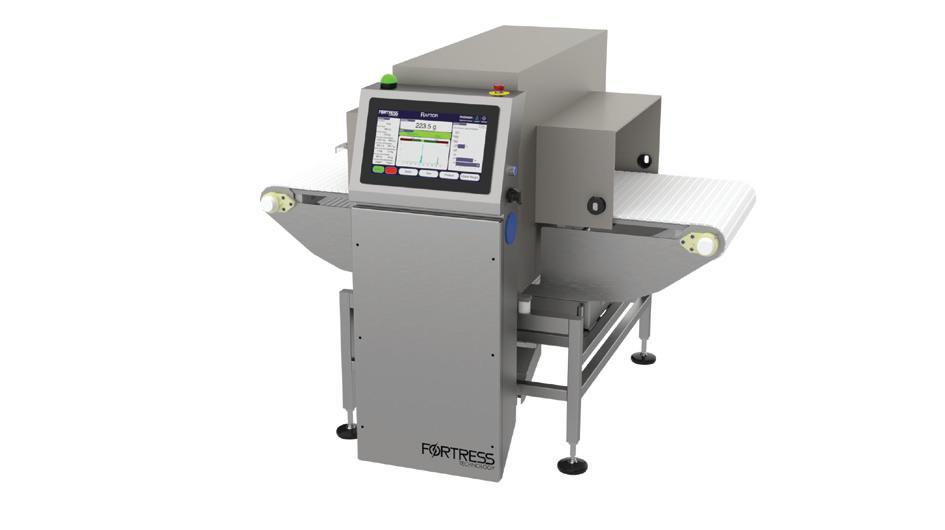
Fortress Technology engineers upgradeable inspection systems for Canadian food and packaging manufacturers who plan long term.
Lifting the lid on single-serve foodservice pack recyclability
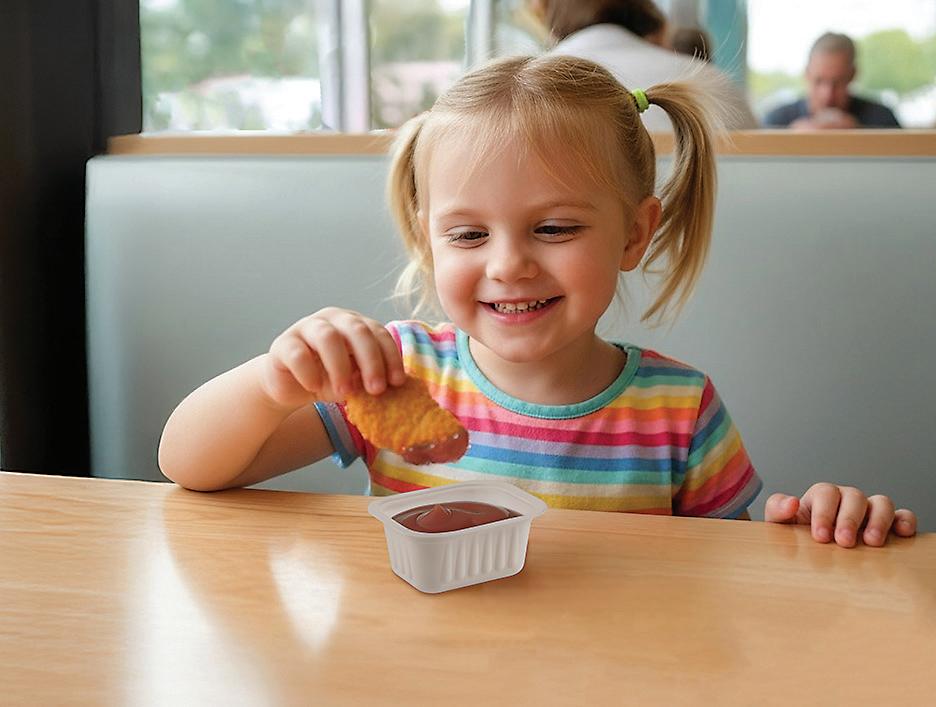
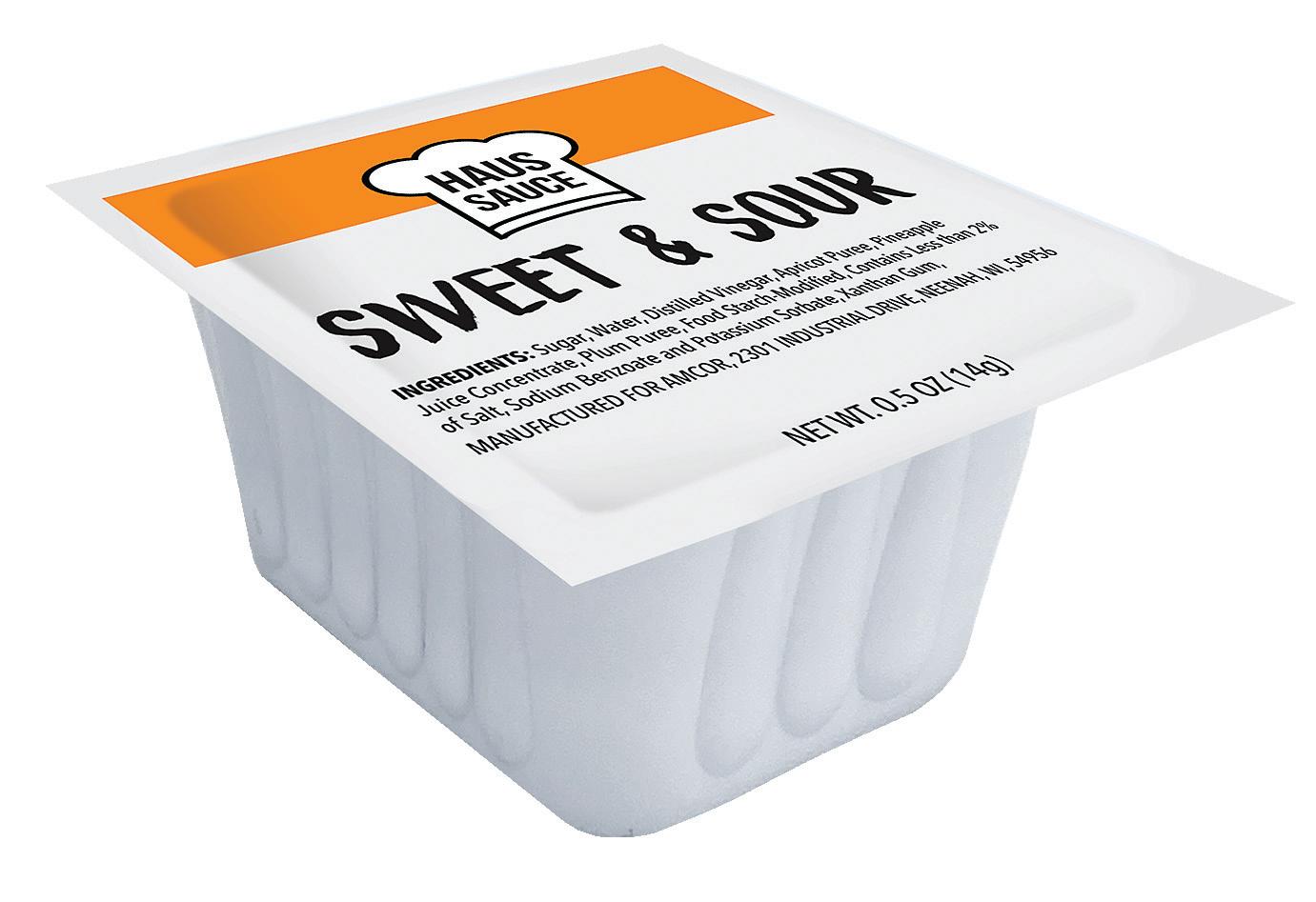
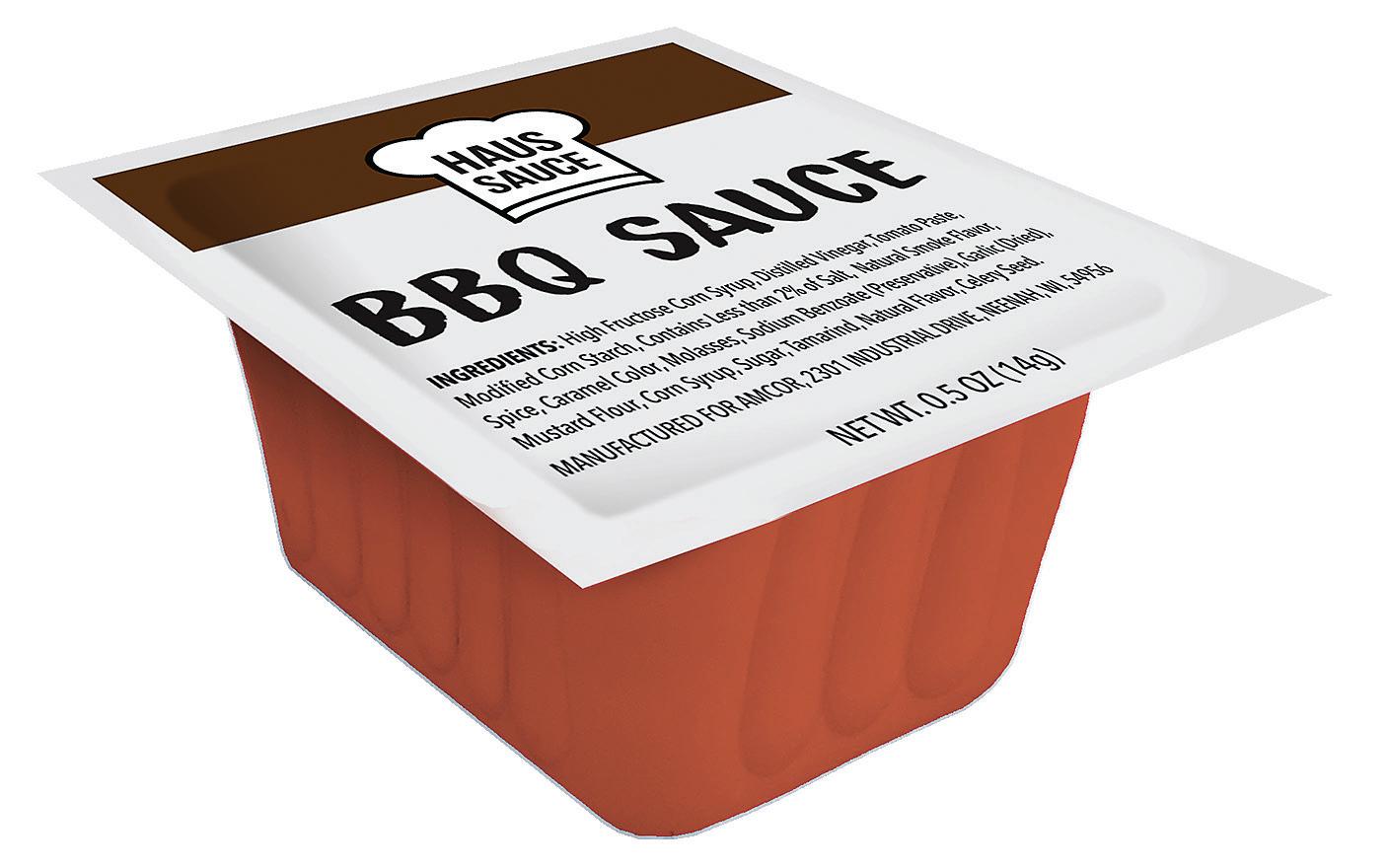
While single-serve plastic packaging is often decried as being environmentally irresponsible, leading global packaging producer Amcor is aiming to change that widespread notion with the development of a new portfolio of polypropylene (PP) recycle-ready dip cup arrays and lidding solutions for condiments, dressings and sauces used by foodservice providers.
Launched last month under the PP Revolution banner, the new dipping cups and lids are designed to help brands transition from traditional polystyrene while maintaining performance, efficiency and consumer appeal, according to Amcor.
“Our PP Revolution platform is designed to help brands move forward as Extended Producer Responsibility (EPR) requirements evolve,” says Sarah Paleg, sustainability director for Amcor Flexibles North America in Oshkosh, Wis.
“It is a recycle-ready solution that supports
improved recyclability claims today and prepares our customers for the regulatory realities of tomorrow,” says Paleg, adding the new cups and lids deliver high performance attributes and compatibility with existing filling equipment for a seamless transition.
Available in 10 sizes—from 0.5- to two-ounce —in clear, white opaque and custom colors, the
new dip cups are said to have an improved barrier compared to traditional solutions, and they are available with Amcor’s comprehensive EZ Peel lidding portfolio, including metallized, foil and AmPrima recycle-ready options.
“Today’s consumers expect packaging that’s easy to use, locks in freshness and is aligned with their sustainability values,” says Kevin Glaser, Amcor Flexibles North America’s vice-president and general manager for liquid products
“The PP Revolution was designed to elevate the dip cup experience—from easy-open lidding and portion-appropriate sizes to premium aesthetics—while helping brands move forward with recycle-ready packaging.”
According to Amcor, the PP Revolution dip cup solutions are designed for recyclability, with select sizes rated “Preferred” under the APR Design Guide for Size Sorting Potential.
This evaluation can support stronger recyclability claims and potential EPR fee advantages, with the How2Recycle pre-qualification available for select sizes.
The PP Revolution solution significantly expands Amcor’s portfolio of sustainable film technologies, which includes the recycle-ready PET Revolution barrier cup stock.
“Amcor’s innovations support the foodservice industry as it prepares for evolving regulatory requirements,” says Aimee Johns, senior marketing manager for liquid products at Amcor Flexibles North America.
“We’re ready to help customers begin testing and scale-up within as little as six weeks,” says Johns, adding the new product launch underscores the company’s commitment to leading the way to a more sustainable packaging future through material innovations, high quality products, and access to packaging expertise to navigate changing regulations.
FALLWINTER 2026 EVENTS
WHERE INDUSTRY LEADERS GAIN THEIR EDGE
PAC Global’s events are designed to give professionals direct access to the ideas, insights, and connections shaping the future of the industry.
Through expert-led webinars, immersive facility tours, and highvalue networking experiences, attendees gain opportunities that can influence business decisions, accelerate growth, and strengthen competitive advantage.
Stay informed, stay connected, and stay ahead of what’s next.
Massilly North America president Garnet Lasby discussing the company’s plans for a new $85-million canmaking plant in Brantford, Ont., to produce three-piece steel cans made with 100-percent Canadian steel.
THE METAL METTLE
Twist-off tinplate closures supplier to expanding its production repertoire with pending move into the can manufacturing business
By George Guidoni, Editor
Photos by Ahmad Sayed
For a packaging format tracing its roots back to the Napoleonic Wars of the early 19th century, the ubiquitous steel food can’s remarkable longevity and enduring everyday utility rightfully put it at or near the top of all packaging inventions introduced into the global food business over the last 200-plus years.
Still widely acknowledged as the most reliable means of preserving all kinds of food products in their original state for a virtually infinite shelf-life, today’s tinplate cans are also well-suited for spearheading the ongoing global drive towards packaging circularity, owing to
their 100-percent recyclability and reuse, while helping prevent food waste.
Combined with modern labeling and direct printing technologies, metal cans also offer brand-owners and food processors a vast range of decorative options to create strong shelf impact for their brands at the retail level with eye-catching graphics and vibrant colors, while also displaying all the required product information and nutrition claims, along with product barcodes and other mandated variable product data for traceability purposes.
And while the growth in metal packaging has generally lagged well behind plastic and fiber-based packaging, tinplate cans remain the go-to packaging choice for a significant share of pro-
Photos
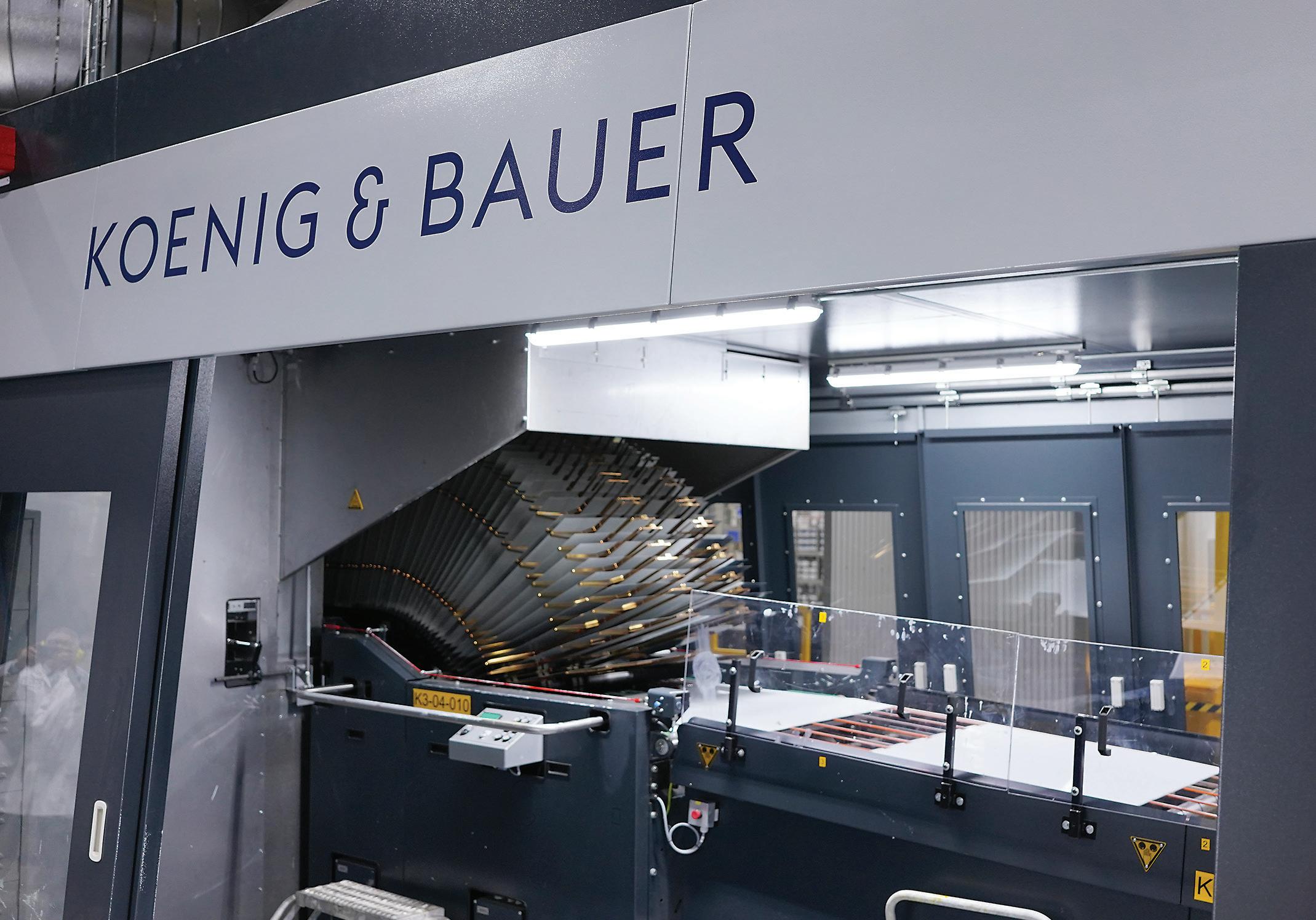
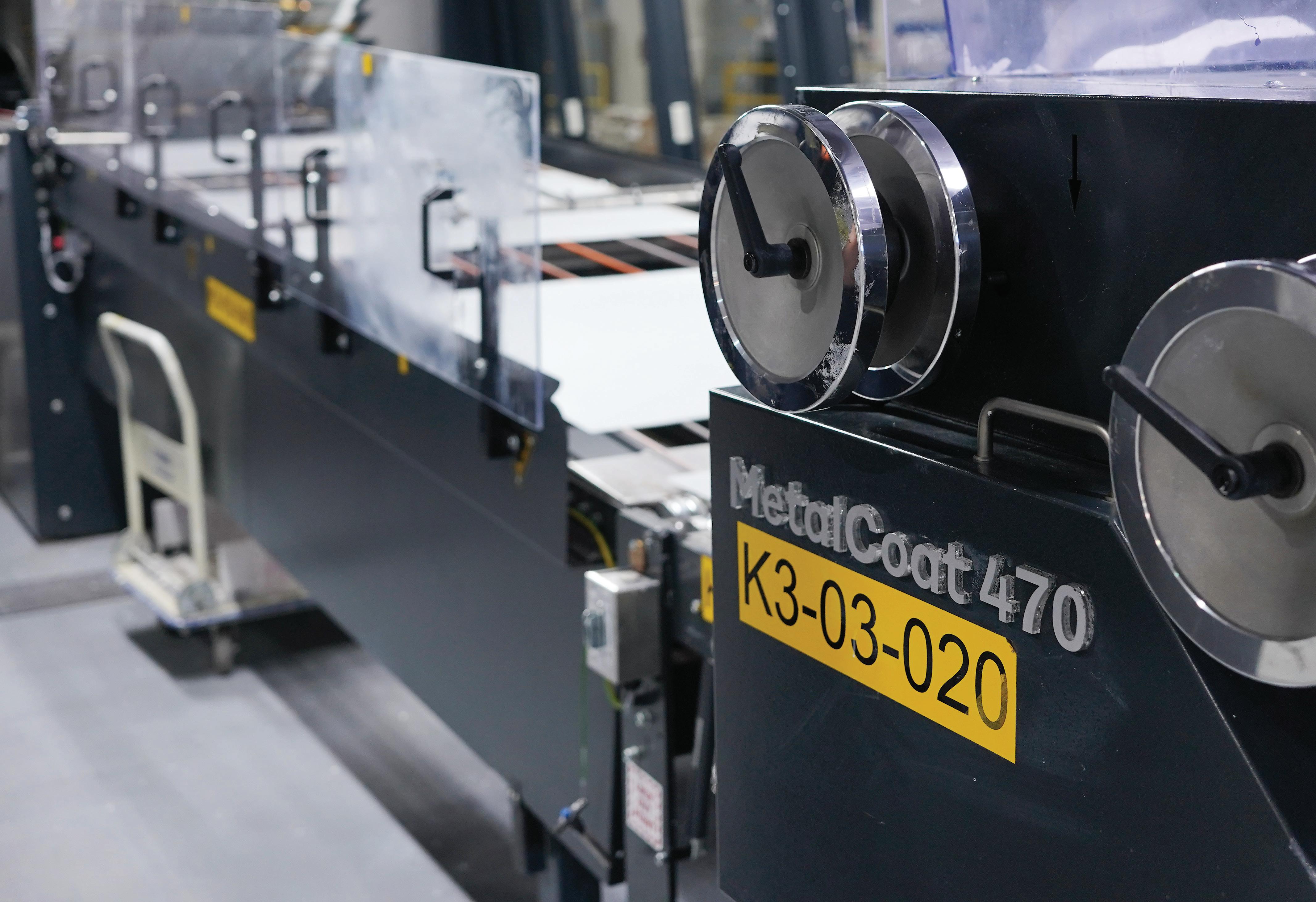
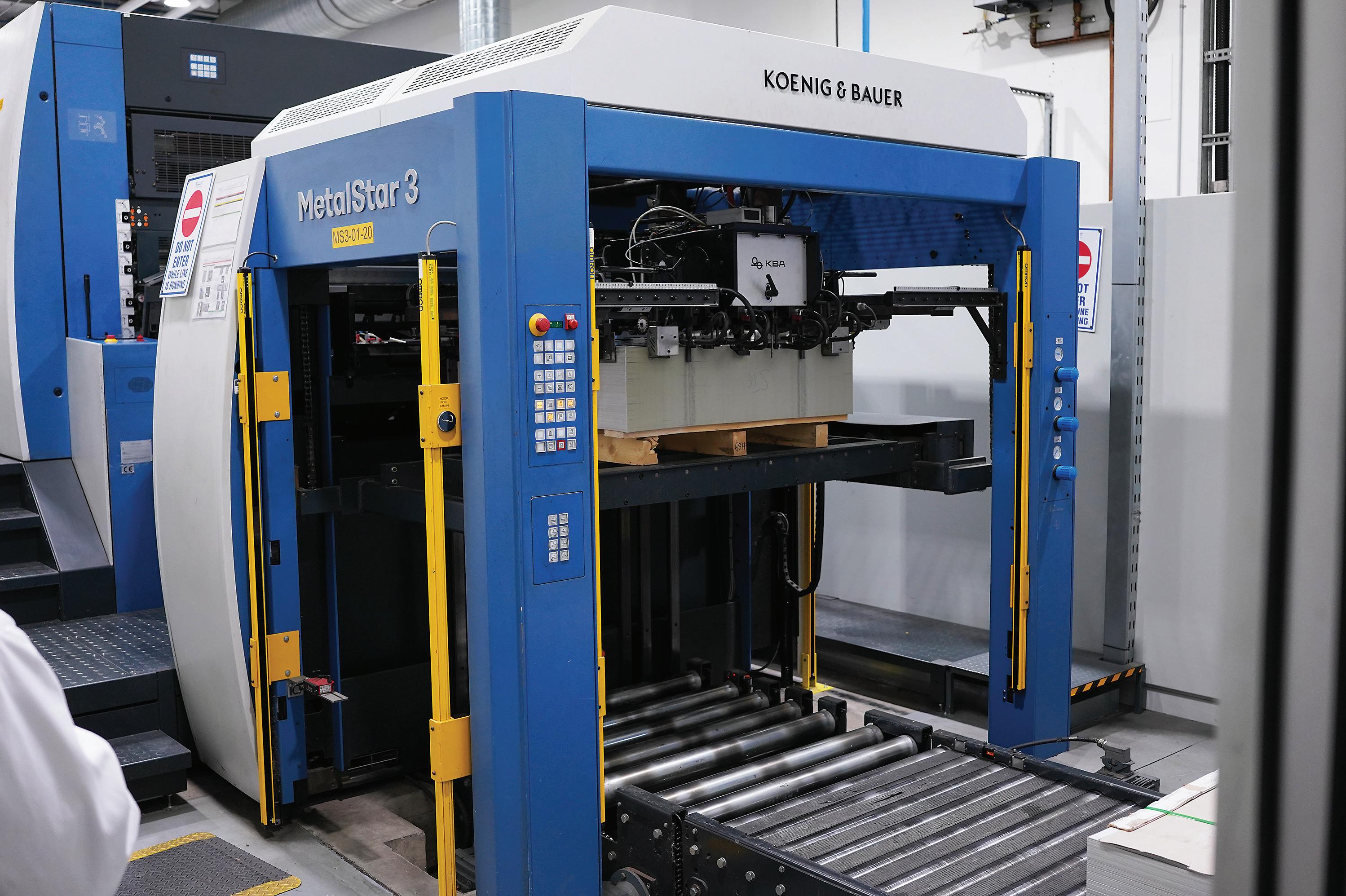
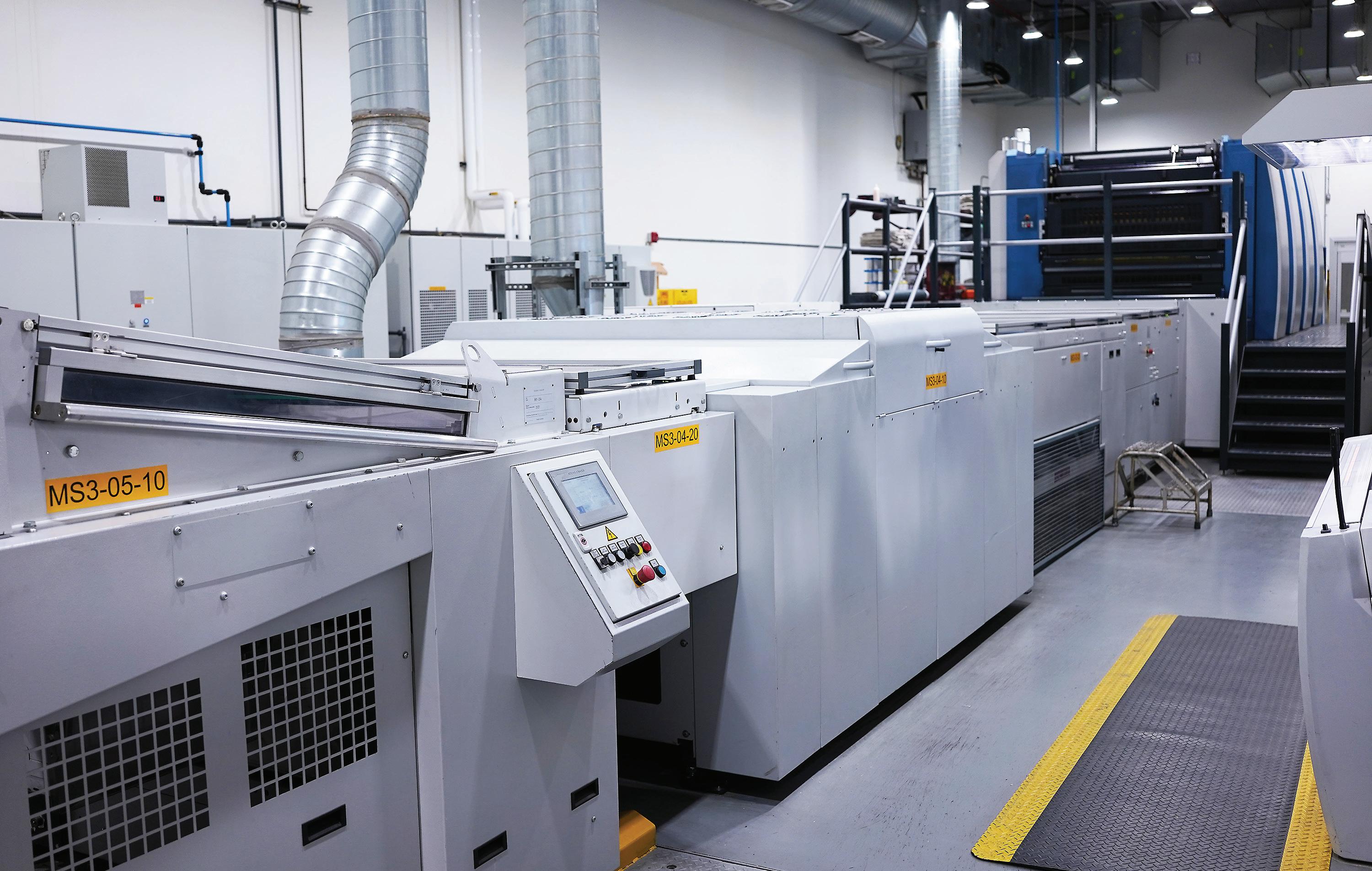
The new MetalCoat 470 coating line from Koenig & Bauer can process about 660 large-sized tinplate sheets per hour.
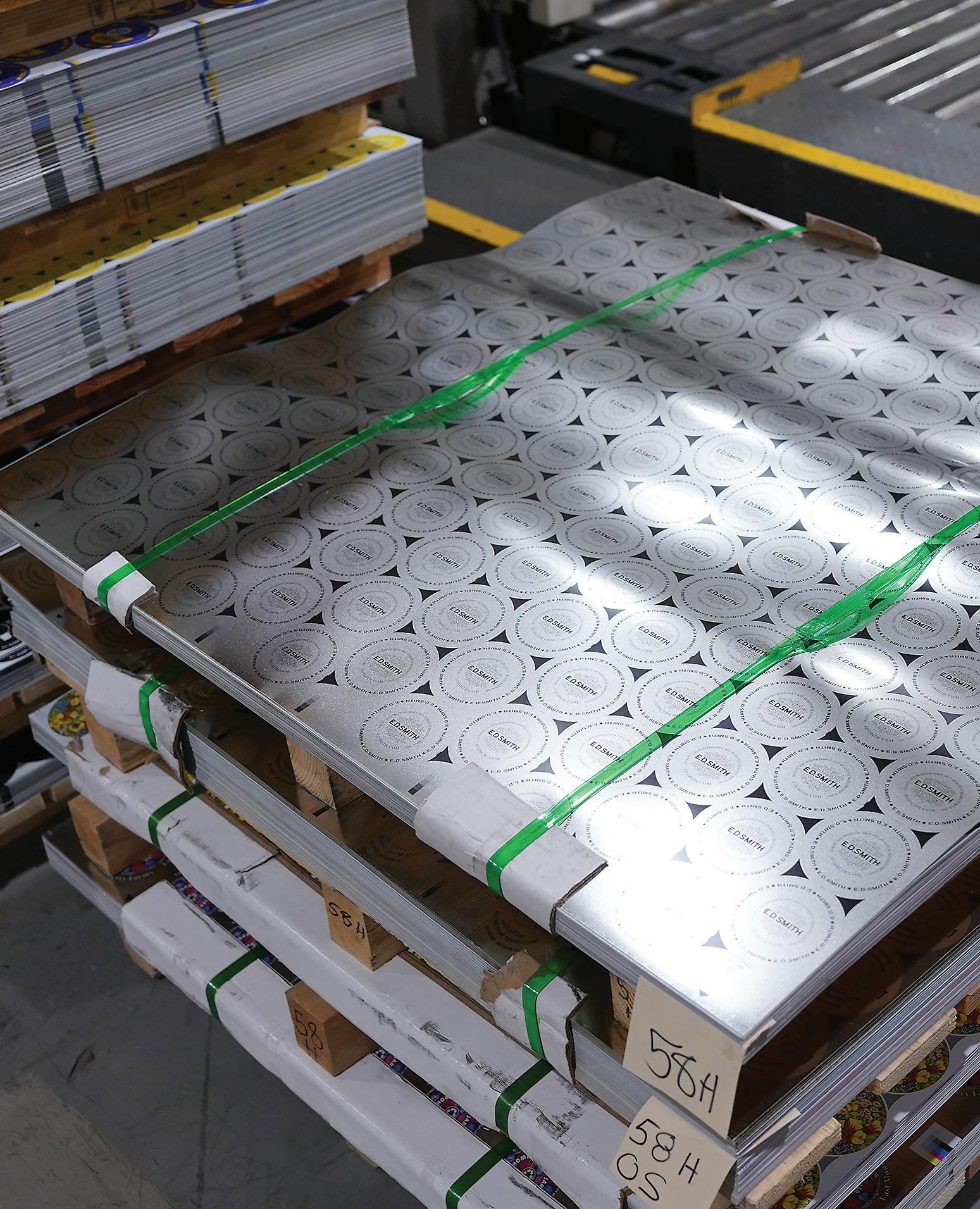
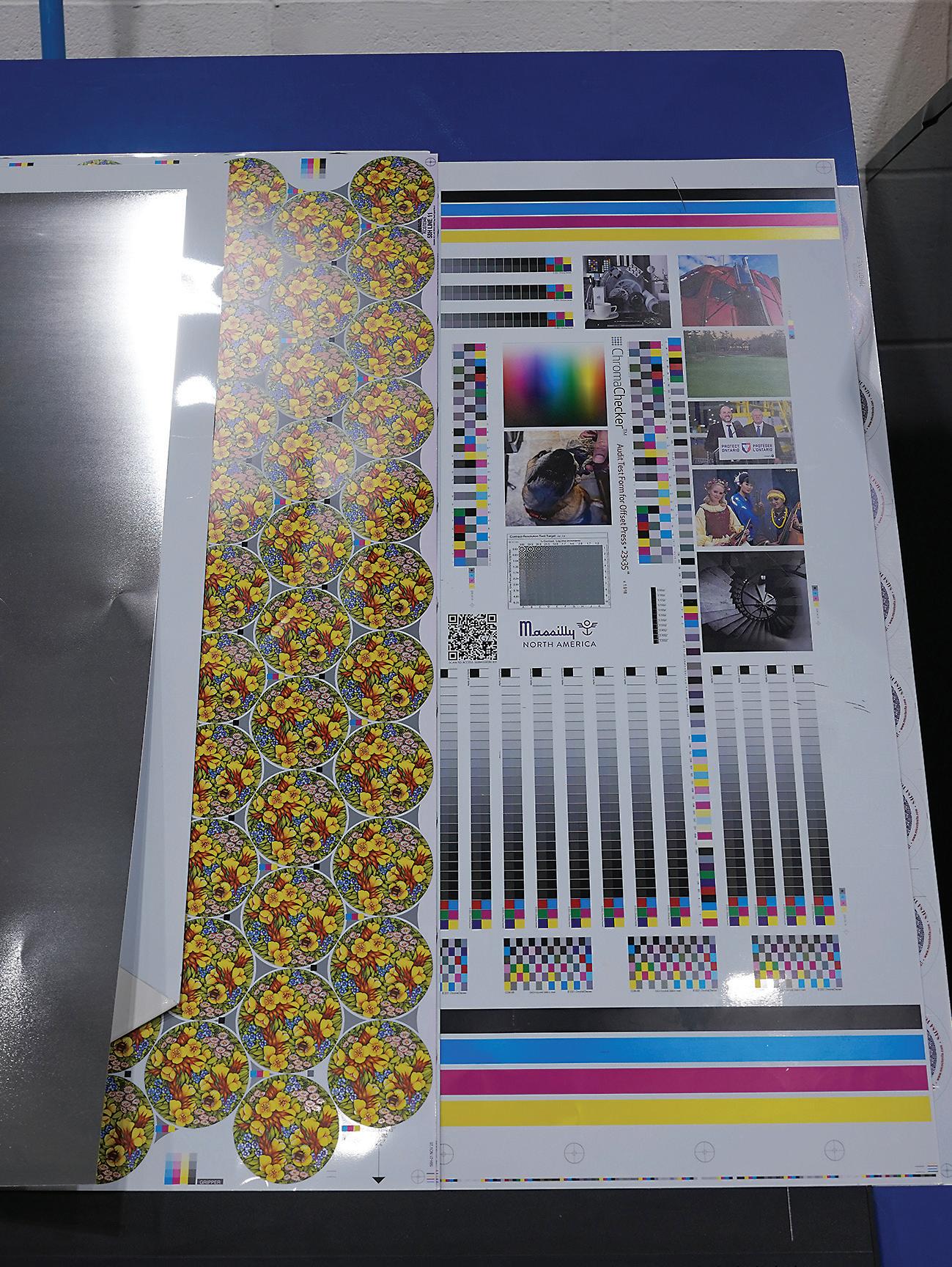
Stacks of finished tinplate sheets awaiting their turn on the press.
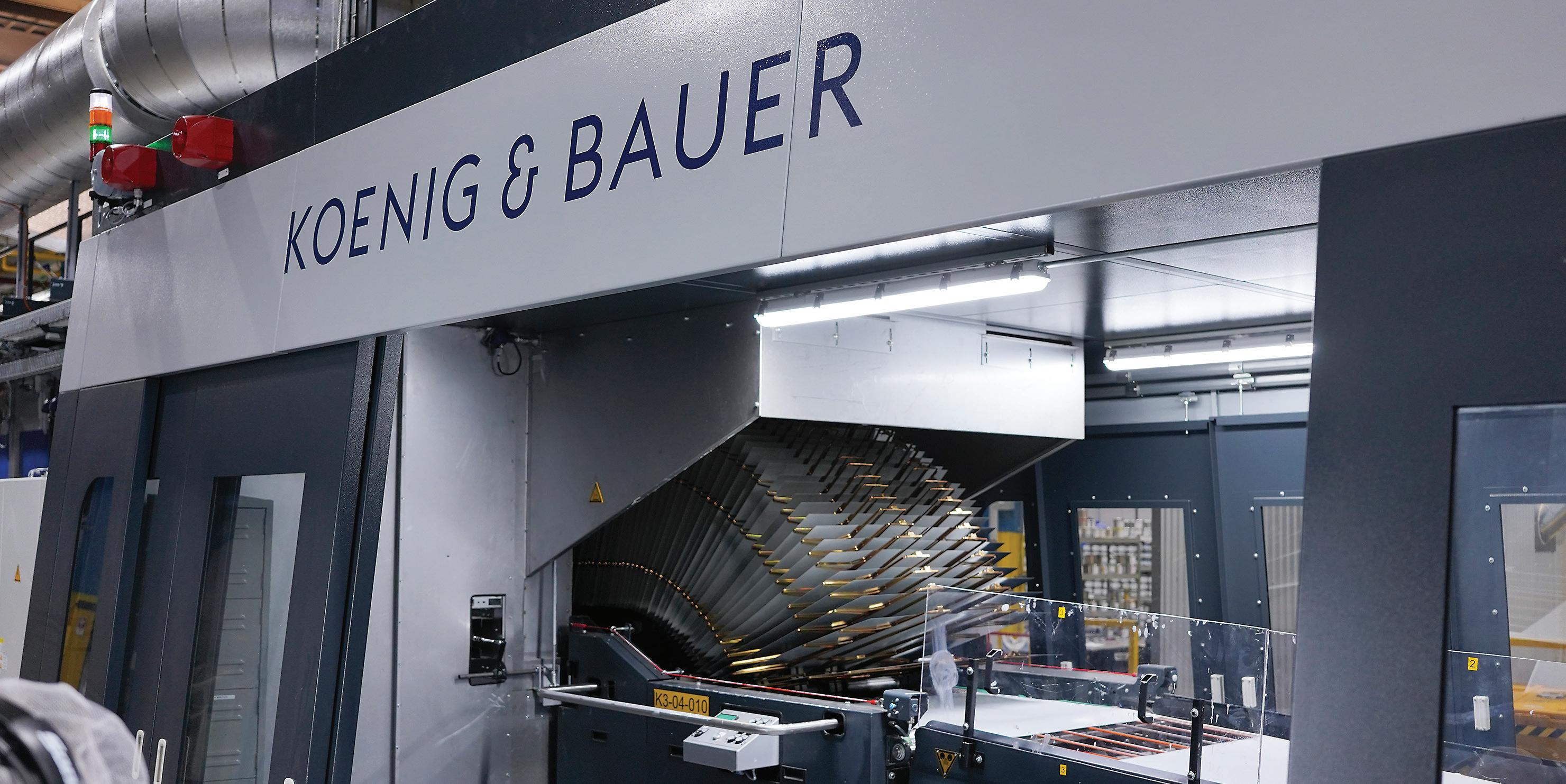
The MetalStar 3 metal decorating press from Koenig & Bauer boasts output of up to 9,000 sheets per hour.
The loading end of the MetalCoat 470 coating line.
cessed foodstuffs like fruits and vegetables, soups and sauces, meat and seafood, prepared meals, pet food, and a long list of other popular staples.
Despite a relatively healthy and stable global market estimated at over $2.7 billion last year, according to Knowledge Sourcing Intelligence , the Canadian canned food market has long relied on imports from the U.S and other countries to meet its packaging needs.
But with Canada and the U.S. now locked in an escalating reciprocal tariff war that has already upended what used to be a fairly smooth flow of steel, aluminum and other meatal products between the two countries, that reliance is nowadays being severely tested and questioned across many major Canadian food processing segments looking for a made-in-Canada solution.
For these companies, the recent announcement by the Brantford, Ont.based Massilly North America (Massilly NA) to invest $85 million in a new canmaking facility is a timely and welcome sign that the much-lauded shift toward greater self-reliance amongst Canada’s key industries is at last getting some real traction.
A wholly-owned subsidiary of the French-based, family-owned global
metal packaging supplier Massilly Group, founded in 1911, Massilly NA has been operating in Ontario for 30 years, starting out in Mississauga in 1996 and moving to Brantford in 2012.
Manufacturing about 1.5 billion metal twist-off closures per year—used for airtight sealing of glass and rigid plastic food jars—the 275,000-squarefoot Brantford facility currently employs over 200 people in a three-shift operation to produce a wide variety of tinplate lids in multiple sizes and designs to serve a diverse Canadian customer base comprising leading producers of condiments, sauces, jams, jellies, pickles, baby food, juices and all kinds of specialty beverages.
According to the company’s 55-yearold president Garnet Lasby, adding tinplate cans to the company’s manufacturing repertoire is a natural complementary extension of the parent company’s renowned expertise in metal packaging at a highly opportune moment in time.
“A metal can is the most economical way in the world to preserve food longterm, because it is effectively oxygen impermeable,” says Lasby, whose extensive experience in the Canadian manufacturing business includes senior management postings at major produ-
cers of both plastic and aluminum packaging products.
“Once the food is inside the can, it is effectively preserved for years and years and years,” says Lasby, noting that most canned foods retailing today are marked with three-year expiry dates, which is primarily done due to abundance of caution rather than any real risk of serious product degradation over time.
“A properly sealed metal can will always provide the longest shelf-life you can possibly get from preserved food,” Lasby told Canadian Packaging during a recent visit to the state-of-the art Brantford facility housing a formidable arsenal of towering, high-performance automated production machinery used to make high-quality tinplate lids at breathtaking speeds.
Says Lasby: “If you look at a plastic jar of apple sauce packed 18 months ago and compare it to a freshly-packed jar, you will see a notable color change in the product.
“That’s because plastic is not perfectly oxygen-impermeable,” Lasby explains, “and the apples themselves are very susceptible to oxygen in terms of product quality.
“But if you were to take out apple sauce out of a can, it will look like it was
Clockwise from top
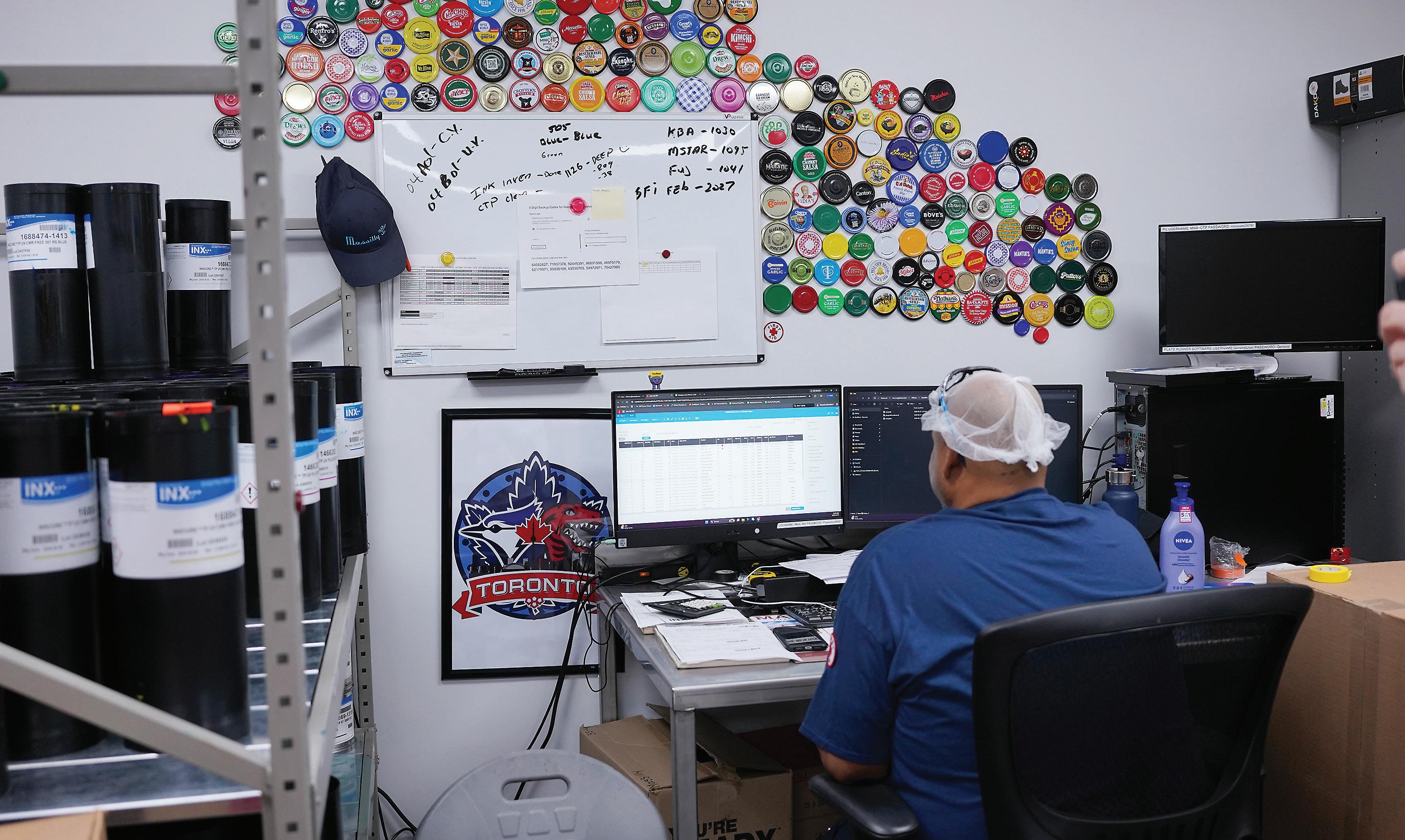
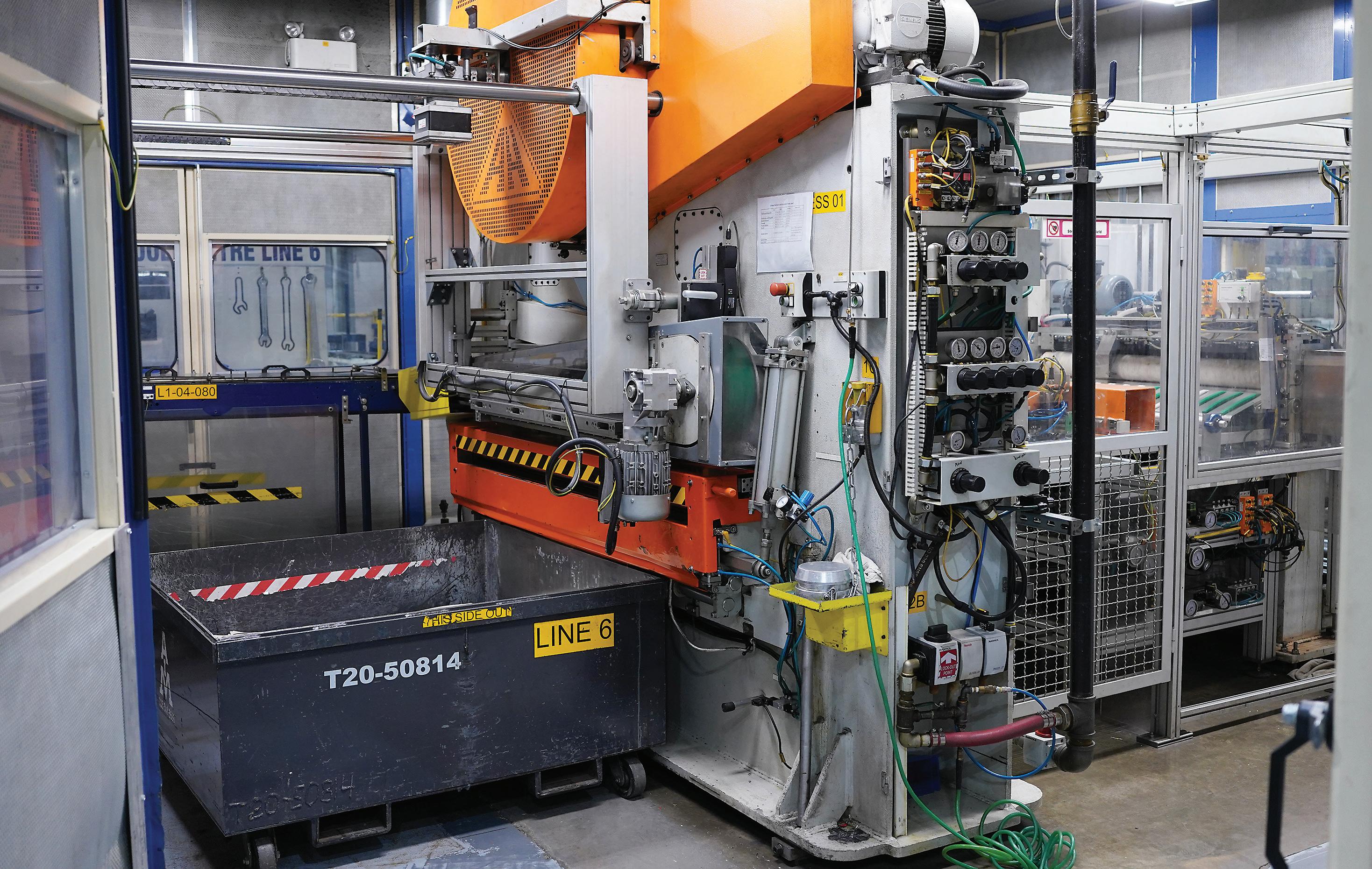
Headed by prepress specialist Romesh Beharry (right), the Brantford plant’s ink room formulates its own colors to match the customer’s design specs using food-grade inks supplied by Sun Chemical and INX International to produce highquality graphics on tinplate twist-off closures using the advanced MetalSar 3 metal decorating press manufacture by Koenig & Bauer.
packed yesterday.”
As Lasby relates, the new Massilly canmaking plant in Brantford will be able to produce up to 500 million high-quality, three-piece welded cans annually by 2028, creating about 50 new full-time jobs and also helping Massilly NA optimize new warehousing capacity enabled by recent construction of a fully-automated 50,000-square-foot storage and distribution facility nearby.
Prior to that, the new site will see a continuous influx of modern, leading-edge automated canmaking machinery from Europe, which will enable the plant to be cost-competitive compared to both aluminum and two-piece cans currently dominating the beverage and aerosol markets.
According to Lasby, Massilly Group has allocated $40 million in capital spending to supply the new plant with all the blanking, drawing, ironing, cleaning, decorating, necking, and flanging equipment it will need to produce mass quantities of tin-plate cans in at least five different diameters and nine different formats (shapes), along with various easy-open end options for added consumer convenience.
As such, the investment will make the new plant by far the largest commercial-scale producer of three-piece tinplate cans in Canada, Lasby relates, thereby offering many Canadian canneries a true ‘Made-in-Canada’ packaging solution made exclusively from Canadian steel.
Says Lasby: “There is definitely demand for three piece cans in Canada, but with one notable exception in Quebec, there hasn’t been a three-piece can manufacturer of sufficient scale in Ontario to meet their needs for some time.
“Twenty years ago there were all sorts of companies making tinplate cans all around Ontario,” Lasby relates, “but they’re now all gone, and that capacity has not been replaced domestically.
“So we aim to serve that Canadian demand by becoming the three-piece canmaker for Ontario, and indeed for Canada, and using Canadian steel to achieve that.”
While Massilly NA has always prioritized local sourcing of its raw materials whenever feasible, the ongoing trade disputes over Canadian exports of steel, aluminum and other metals has strengthened the company’s resolve to ‘Buy Canadian’ when possible, according to Lasby.
“Until the current trade issues arose, almost all of the Canadian steel intended for packaging went to the U.S., where they actually have a lot of companies making three-piece cans,” Lasby relates.
“Currently there is more demand for tinplate steel in the U.S. than there is the production capacity to fill it,” he says, “which they eventually must address.
“So what we’re proposing to do by using steel made in Canada to make Canadian products really addresses all the Canadian interests at stake in the current trade climate,” Lasby states.
“It is in the economic interests of all Canadians to have a strong Canadian steel industry,” he asserts, “be it used for make bridges, buildings, battleships or, in our case, steel food cans.”
Moreover, having a large domestic supplier located right in the middle of Ontario’s agricultural heartland will help reduce the transportation costs to deliver the cans to their canning lines, Lasby points out, thereby lowering the overall carbon footprint.
As Lasby explains, “A lot of the economics of canning comes down to where you make the can and where you fill the can,” Lasby explains, “because transporting cans is extremely inefficient—it’s mostly air.”
That said, Lasby says the new plant will be able to distribute its cans cost-effectively with about a 600-mile radius, keeping the overall costs down by using the more advanced automated canmaking machinery developed in Europe.
While the high costs of such machinery have held back its mass adoption in North America so far, Massilly’s massive new investment in this machinery will give the Brantford plant a key competitive edge, Lasby opines.
“A lot of three-piece canmaking in North America is being done on equipment that has been installed for quite some time,” Lasby relates. “It’s just not the most efficient equipment in the world.
“That is in direct contrast to Europe, where there has a lot of reinvestment in
the three piece can market, so the new machinery will enable us to not only compete with the two-piece cans in pricing, but also to produce cans that offer superior strength properties and are easier to stack for transport and distribution, either empty or filled.”
As Lasby relates, the new-generation canmaking equipment will also allow for the use of the more lightweight, thinner-gauge tinplate that enhances sustainability and is also easier to weld, enabling the new production lines to maintain swift operating speeds of 100 to 400 cans per minute, depending on size.
“By installing the most modern canmaking equipment that exists on Earth, we will be able to offer customers both a
fair price and a significant quality advantage over two-piece and aluminum structures,” he states.
Noting that the existing Brantford plant currently accounts for about 20 per cent of all tinplate closures produced by Massilly Group worldwide, the parent company’s move to expand its Brantford operation is strong vote of confidence in the Canadian market and the country’s manufacturing competencies and capabilities, according to Lasby.
“When you’re investing $40 million in five new production lines, it is obviously a long-term investment,” he states, citing “high barriers to market entry.”
Noting that Massilly Group makes already billions of three-piece cans in
Close-up look at the broad range of controls and instrumentation contained inside assembled inside the MetalCoat 470 coating line to ensure top perfromance levels and high product qaulity.
Europe annually, “This is a very natural extension of their existing business, their existing knowledge, and the existing core of what the Massilly Group offers to the global packaging market,” says Lasby.
“So they are very excited to expand their footprint in North America, particularly when they look at eliminating that trade risk during step one, and then also having access proximity to the U.S. market in step two,” he relates.
“Despite our current difficulties, Canada and U.S. are still great trading partners,” Lasby points out, “and we have no doubt that when the market opens up again and remains open, we will end up serving the U.S. market as well.”
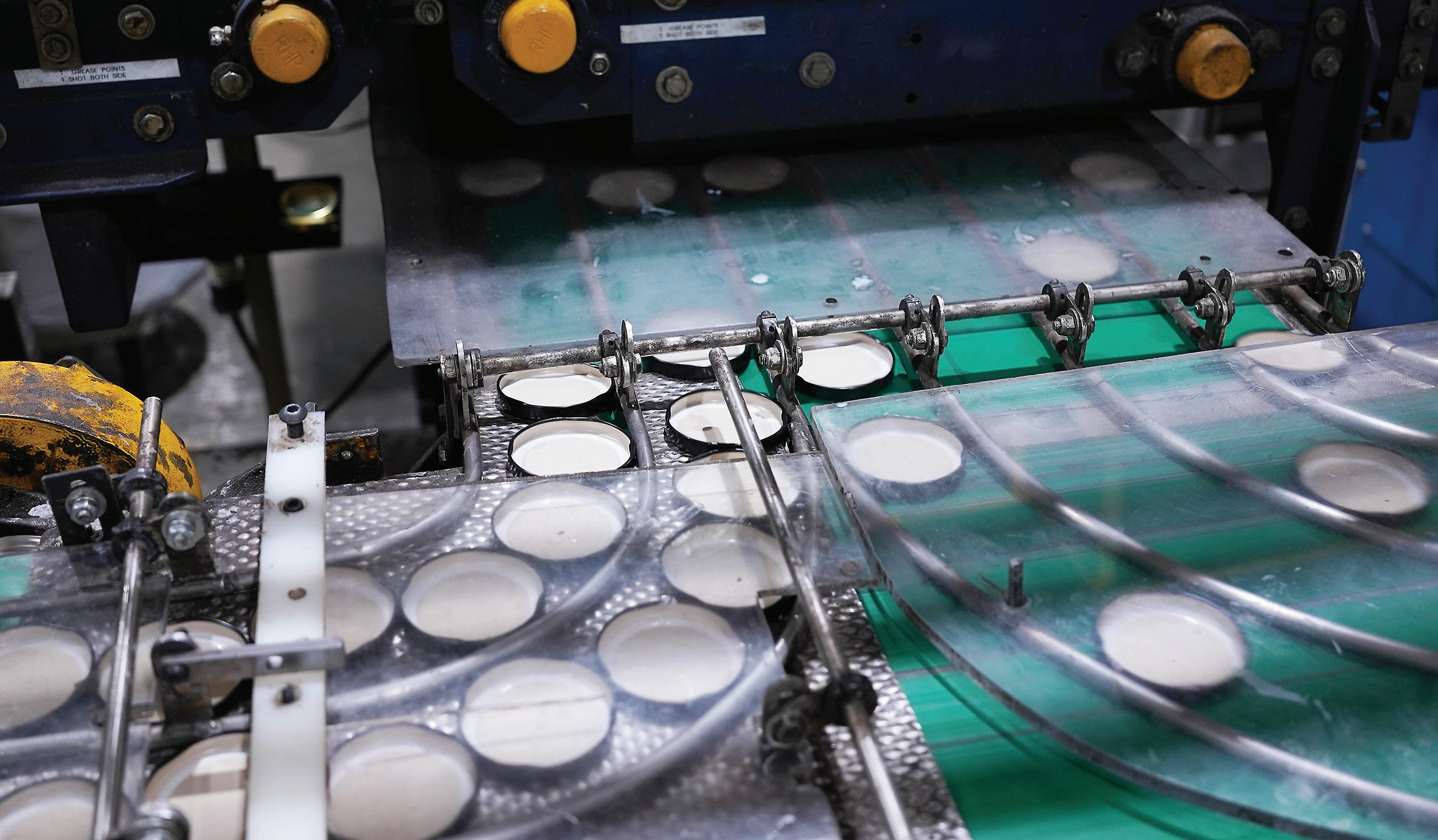
Finished closures exiting the oven for packing.
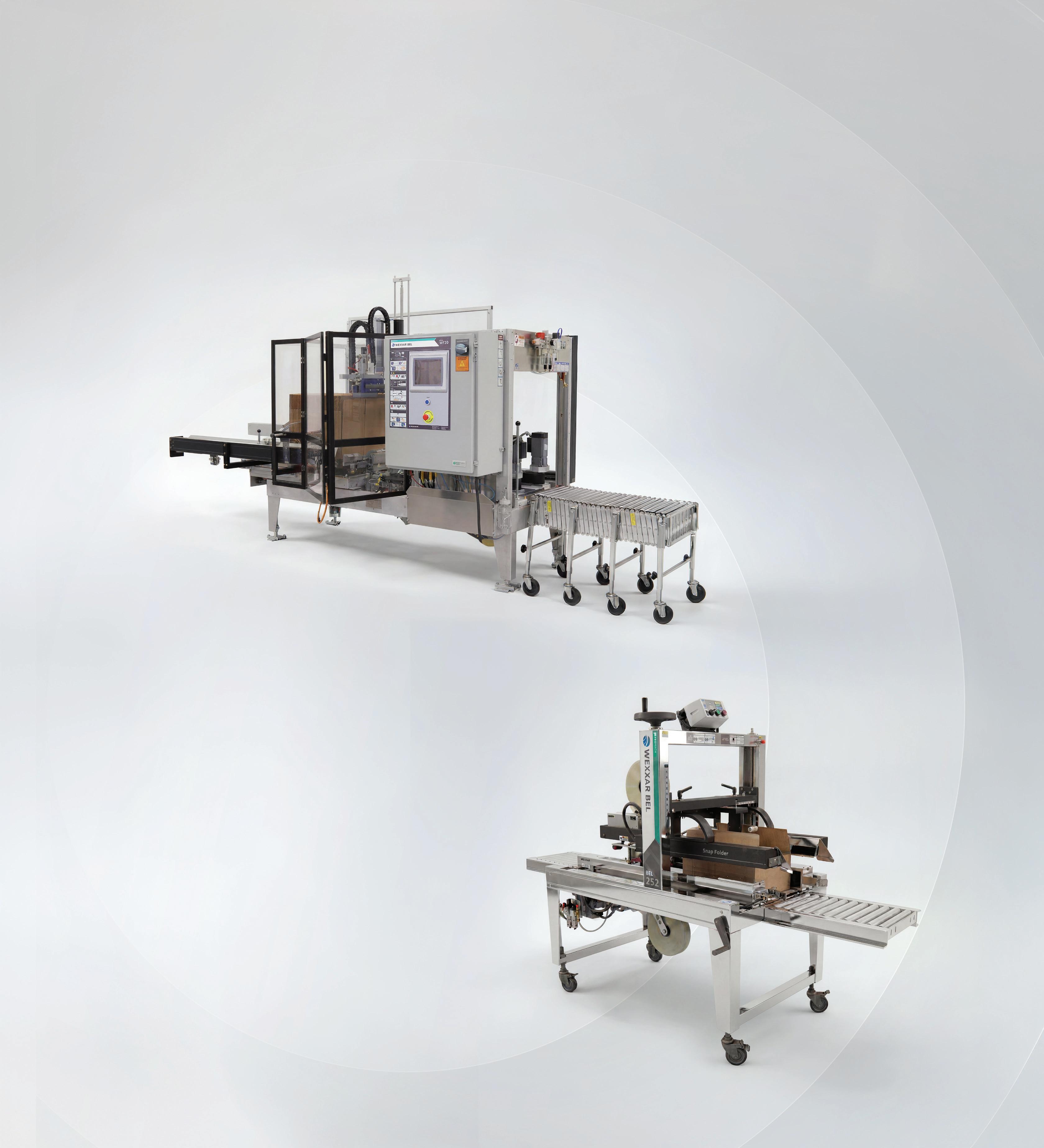
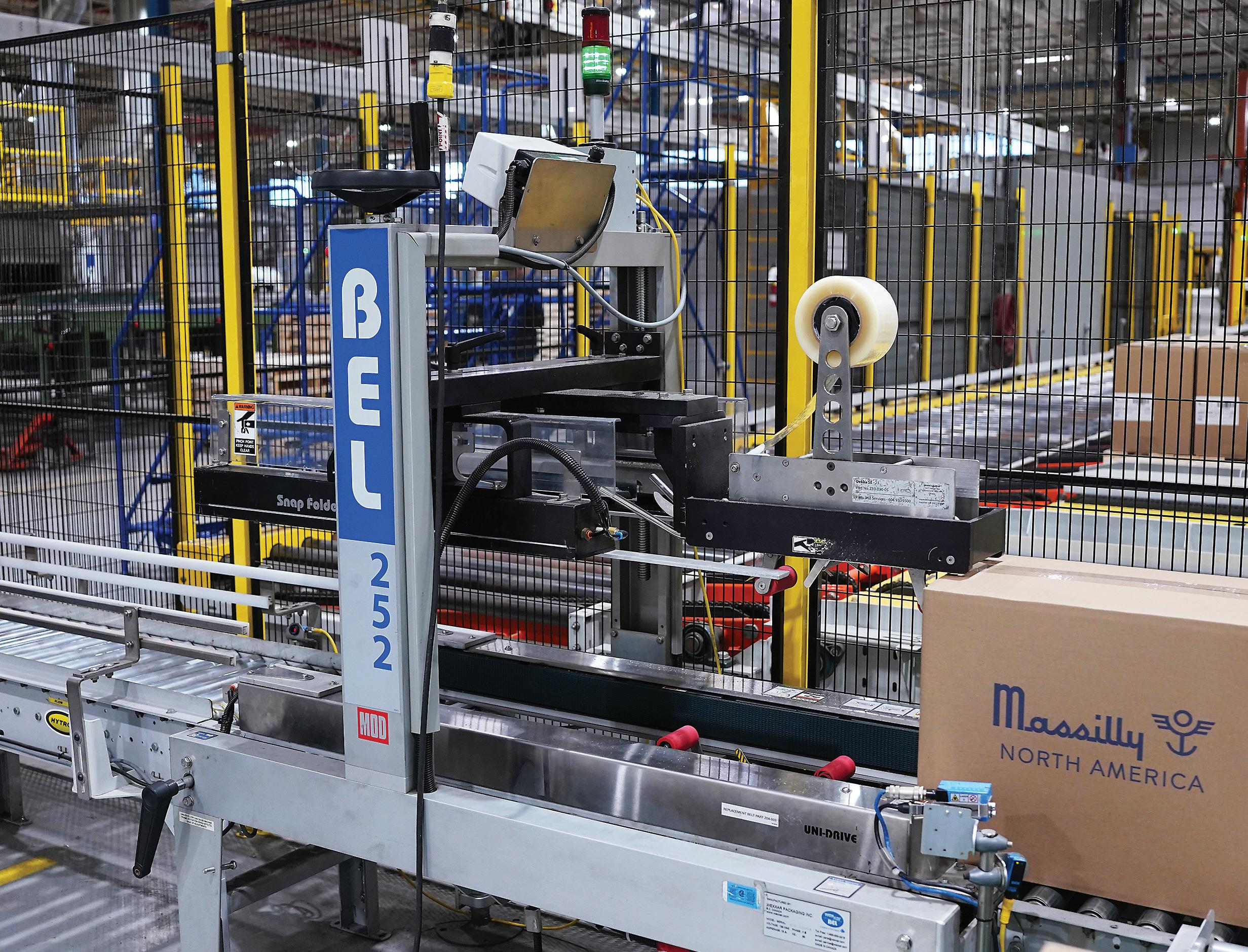
The Wexxar Bel 252 carton closer used for packing finished twist-off closures inside large corrugated shipping cartons for delivery to customers.
From left
Clockwise from top
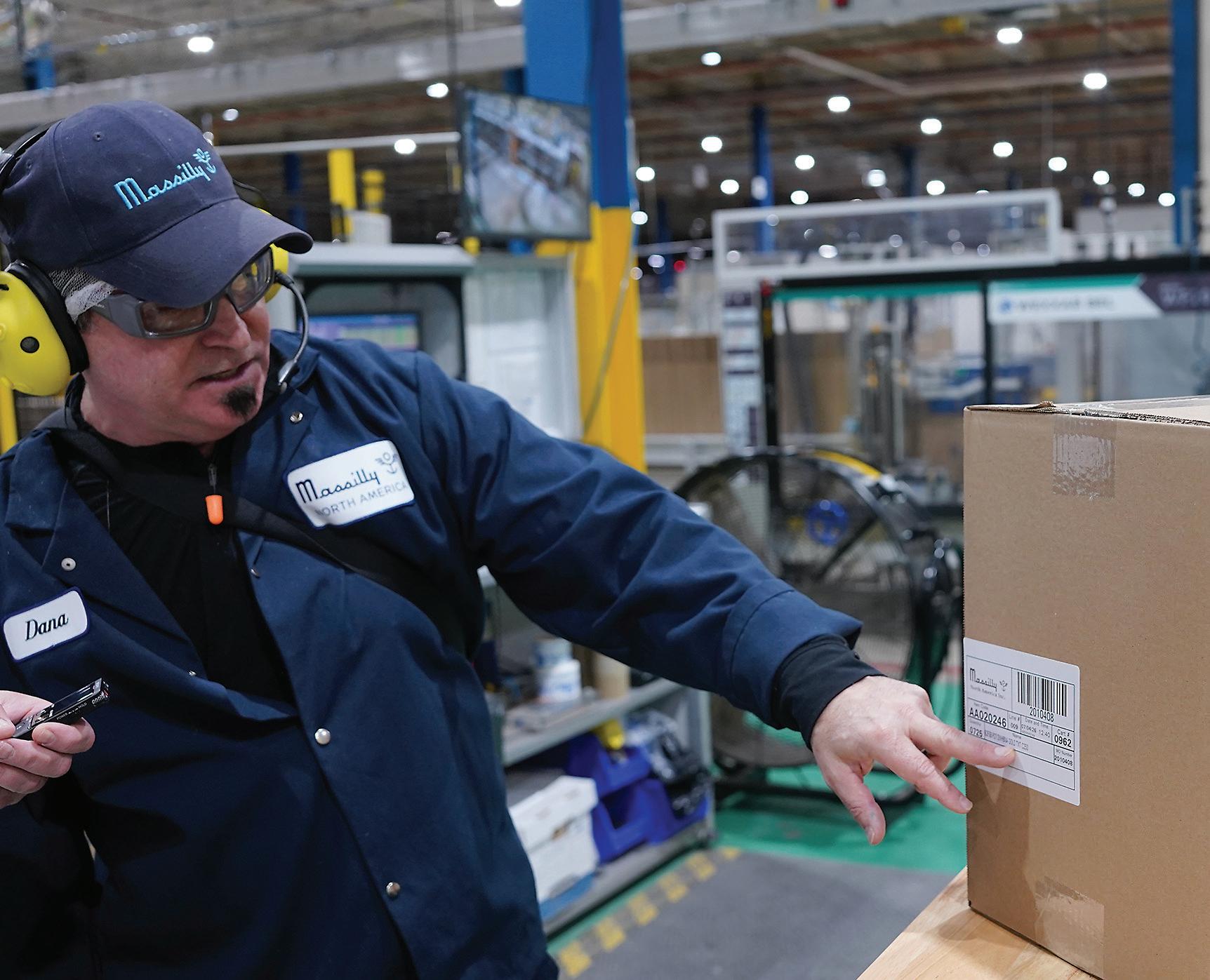
Litho production manager Dana d’Entremont making sure the shipping label is properly applied to the corrugated shipping container.
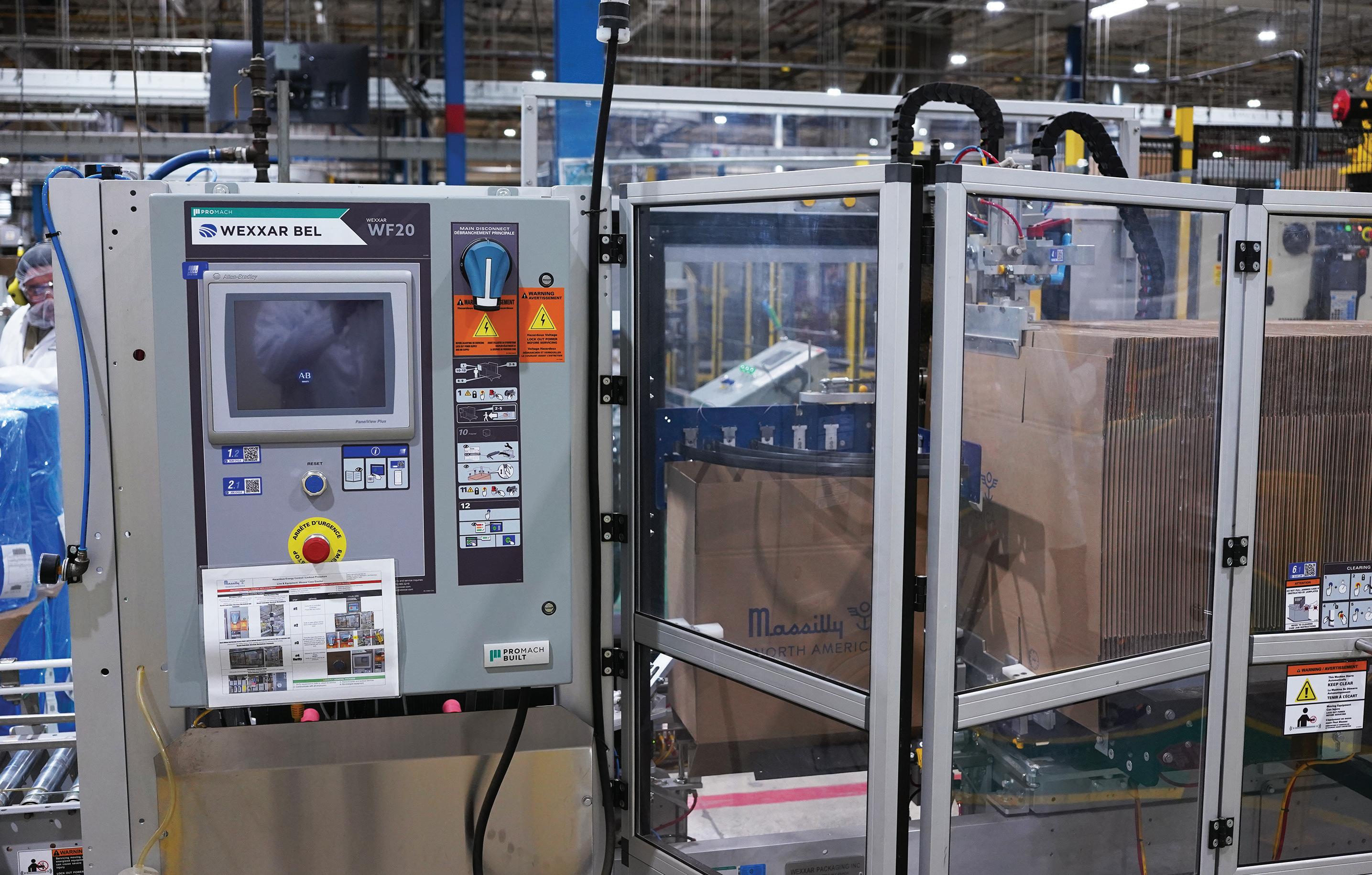
The fully-automatic Wexxar Bel WF20 case erector provides consistent case forming at up to 20 cases per minute.
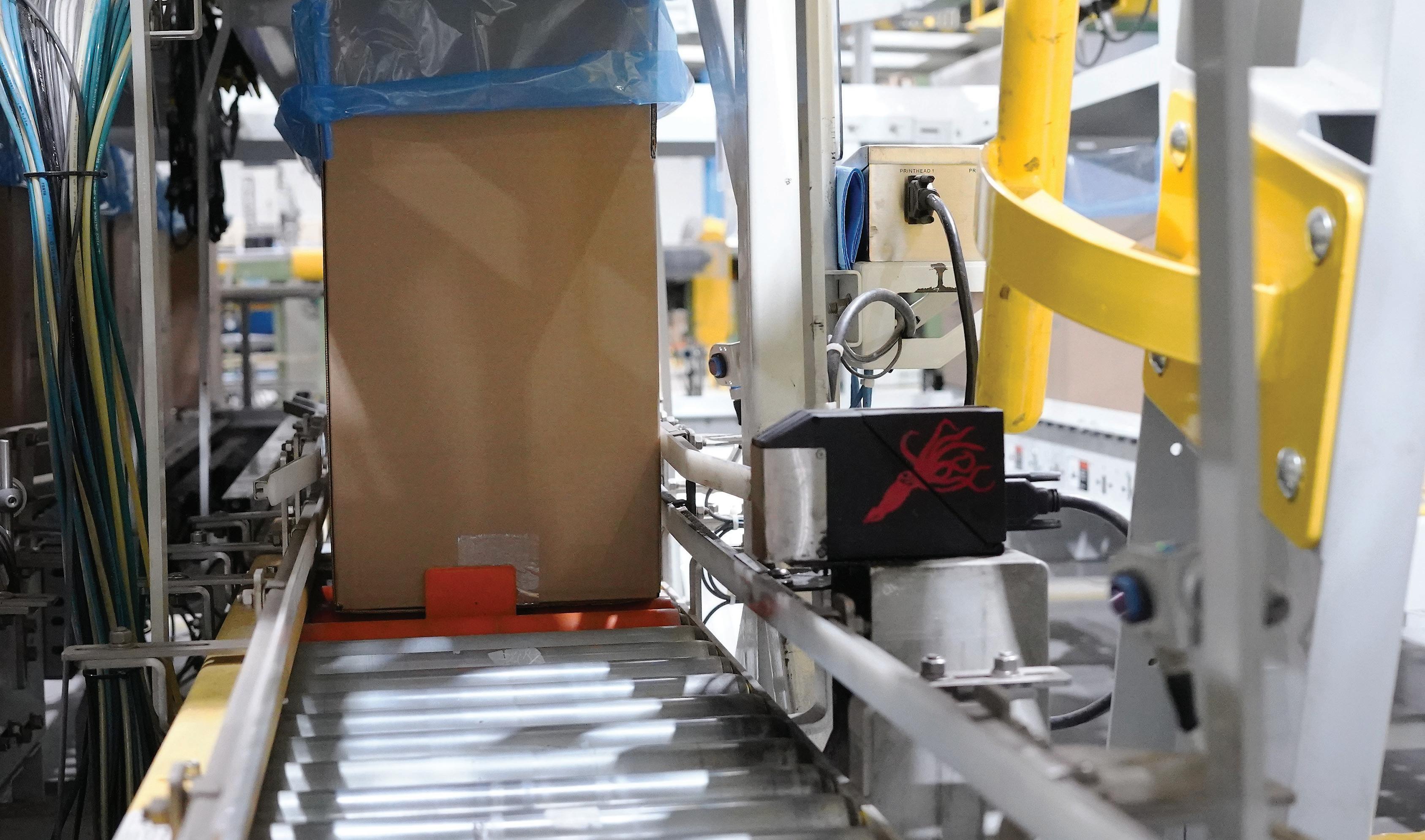
A Squid Ink inkjet case-coder used to apply all the pertinent product information onto the corrugated shipping boxes.
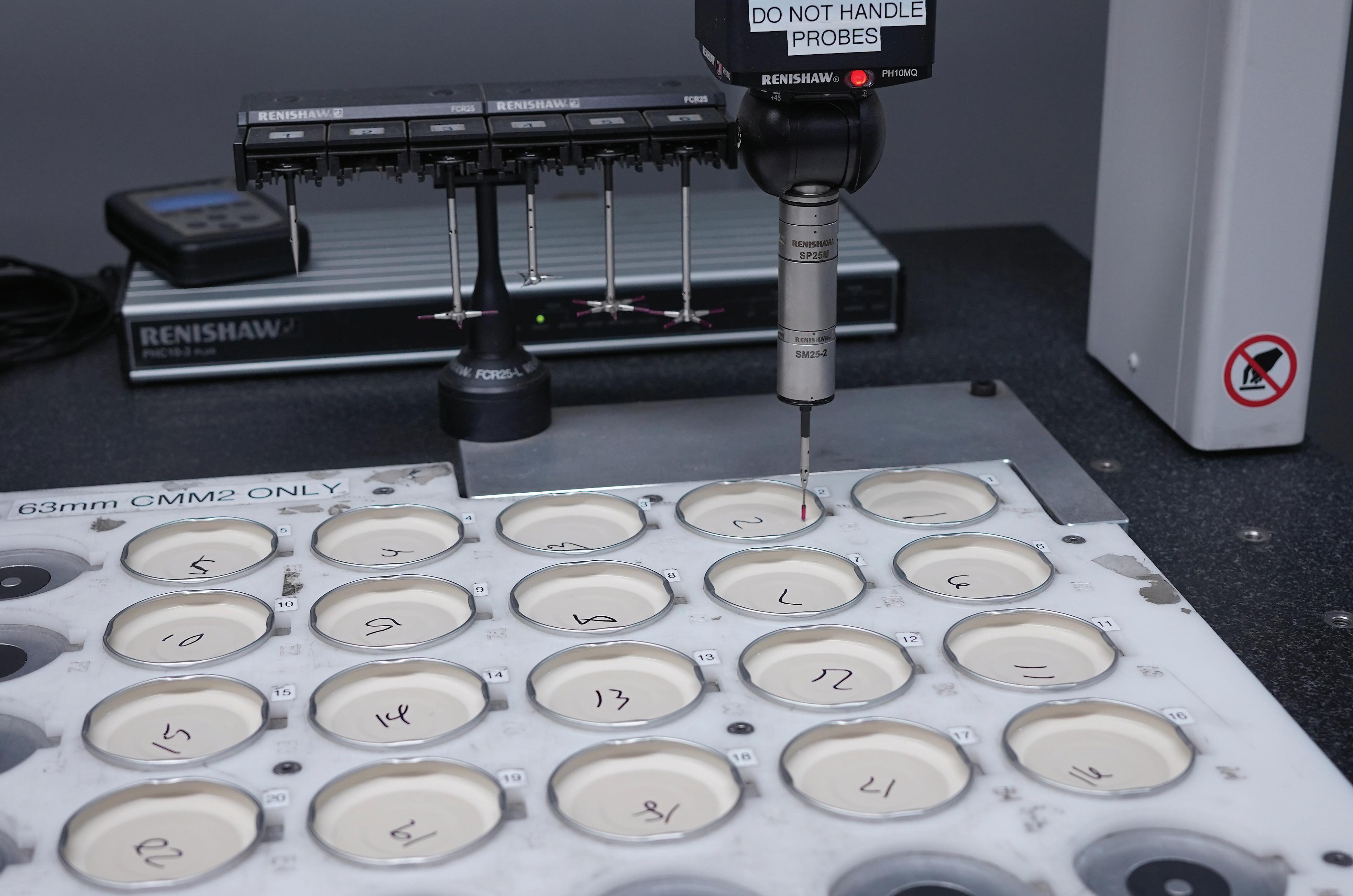
Close-up of some of the quality control and testing equipment used to measure the thickness and dimensions of finished twist-off closures.
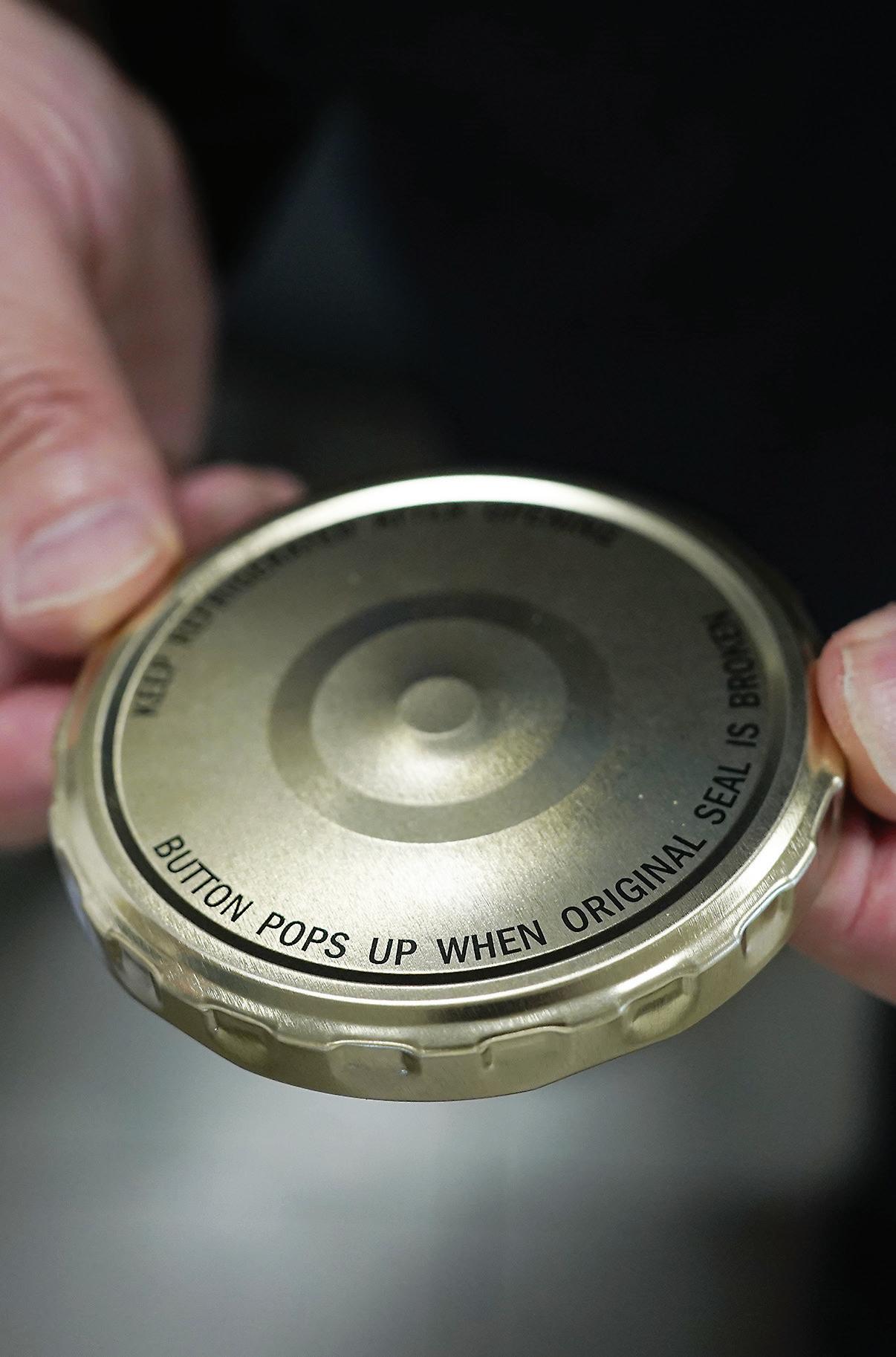
Close-up of a finished and polished closure.
Like all Massilly Group factories worldwide, the Brantford plant adheres to some of the world’s most exacting international standards—including ISO 9001 (Quality Management), ISO 22000 (Food Safety Management) and PAS 223 (Prerequisite programs for food safety in manufacturing)—and is currently working to upgrade its current EcoVadis ratings for overall corporate sustainability from Gold to Platinum status.
“We are also working to obtain the ISO 14001 environmental management system standard,” adds Lasby, lauding the inherent sustainability and circularity advantages offered by modern metal
packaging products.
“All of our investments are viewed through a sustainability lens,” Lasby states. “When we look at what can we do in respect to using the most energy-efficient best equipment, downgauging the material, optimizing transportation … everything we do is structured around reducing the overall carbon footprint of our production process.
“We know the material we use is recyclable,” he says, “and the leading Canadian steel companies themselves are making serious efforts to produce ‘green’ steel to support sustainable sourcing for their customers.
“When you compare that to what’s going on with the petroleum-based sourcing of plastics, you can see why we are seeing a move back towards glass and steel packaging in many of the markets we serve across the developed world,” Lasby sums up.
As Lasby concludes, “When you look at all the factors like where the raw material comes from, the process used to make the packaging, the length of time with which you can keep the food preserved, and the 100-percent recyclability of the end product, you can see why we believe that steel is the most sustainable packaging product available today.”
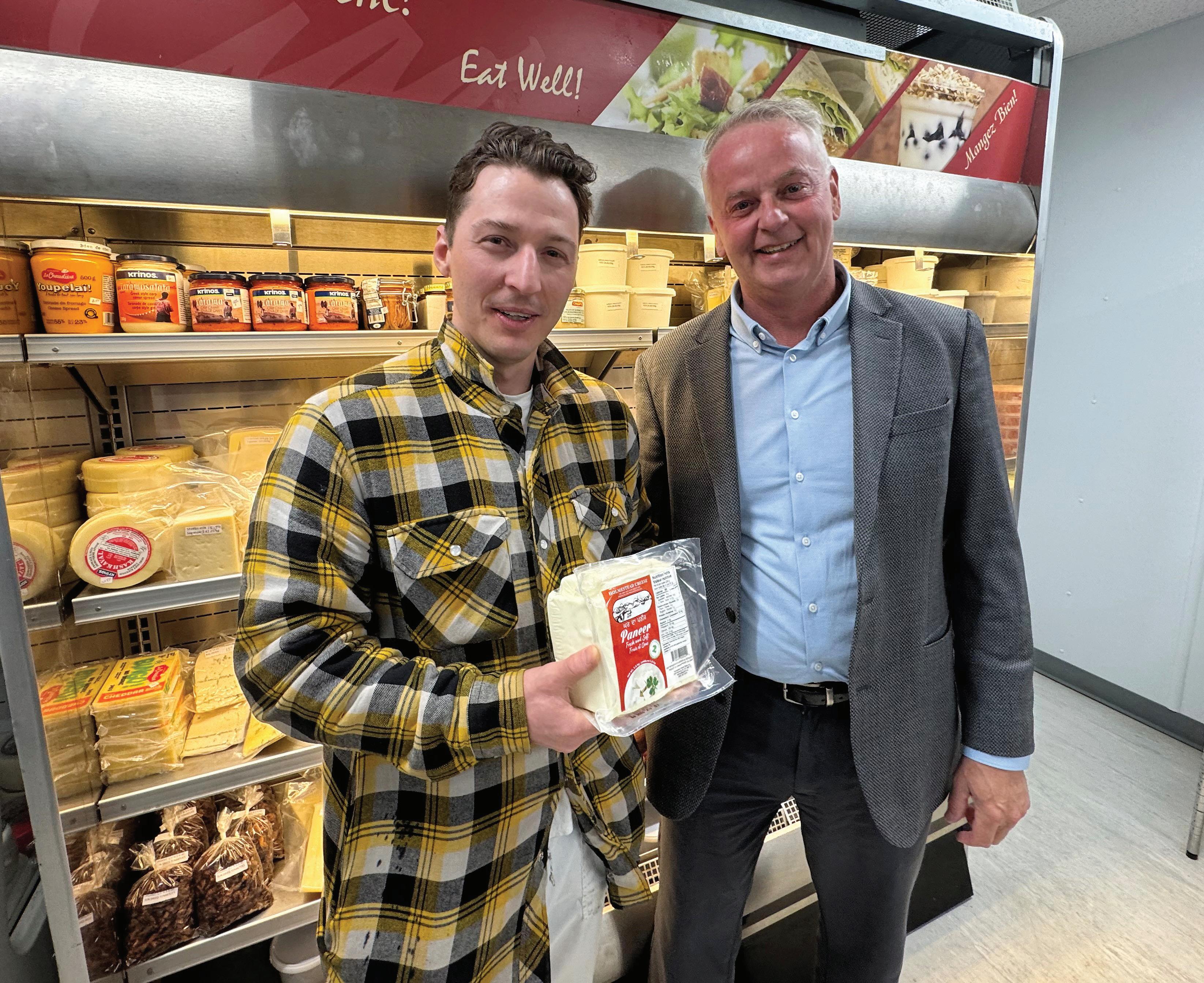
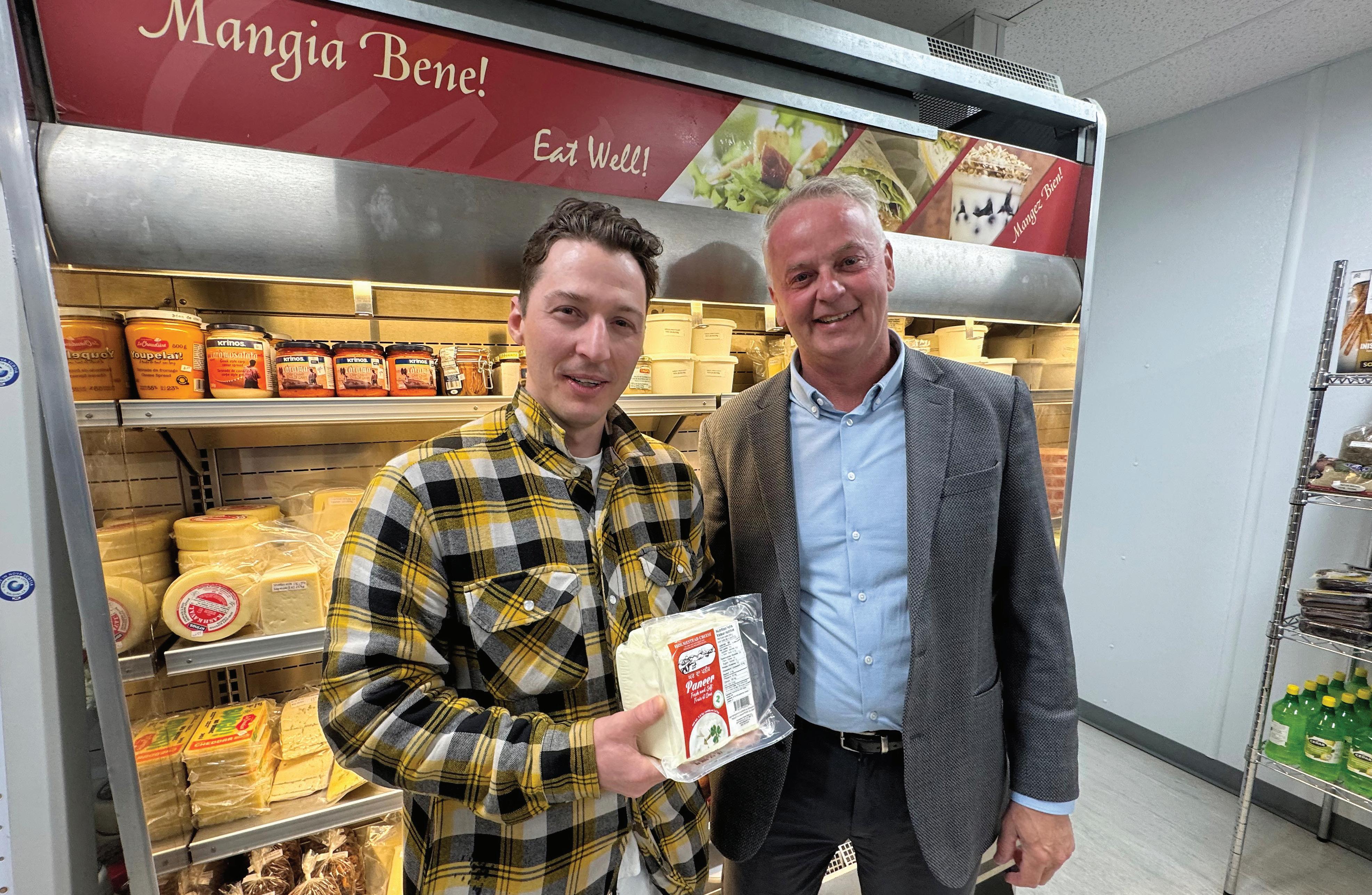
Holmstead Cheese Sales operations and production manager George Tziolas (left) and Reiser Canada sales representative Jean Collette inside the retail storefront of the cheese producer’s production facility in Aylesford, N.S.
TASTE OF HOME
Nova Scotia feta cheese producer invests in thermoform packaging machinery to meet soaring local demand for authentic Indian-style paneer cheese
By Andrew Snook
When Holmestead Cheese Sales opened up in 1985, Nick and Susan Tziolas were focused on making high-quality feta cheese to sell door-todoor in Nova Scotia. Since that time, the Aylesford, N.S.-based producer has grown to become of the country’s largest feta cheese producers, supplying restaurants and wholesalers across Canada.
“My father came from a small village in Greece where he was a shepherd; his whole family were shepherds.
“A lot of people in the village knew how to make any Greek cheese, but my father
specialized in feta cheese,” relates the company co-founders’ son George Tziolas, who nowadays oversees production at the Holmestead Cheese Sales production plant.
The story of Holmestead Cheese Sales began with Nick’s decision to immigrate to Toronto from Greece to help manage a struggling cheese production plant.
While in Toronto he met Susan, fell in love, and they eventually married.
The couple decided they wanted to open their own cheese production plant, but at the time the only province offering bulk milk licenses was Nova Scotia. So they moved to the Annapolis Valley and started up their business.
“In the beginning, they had very little money,” Tziolas recalls. “They bought a
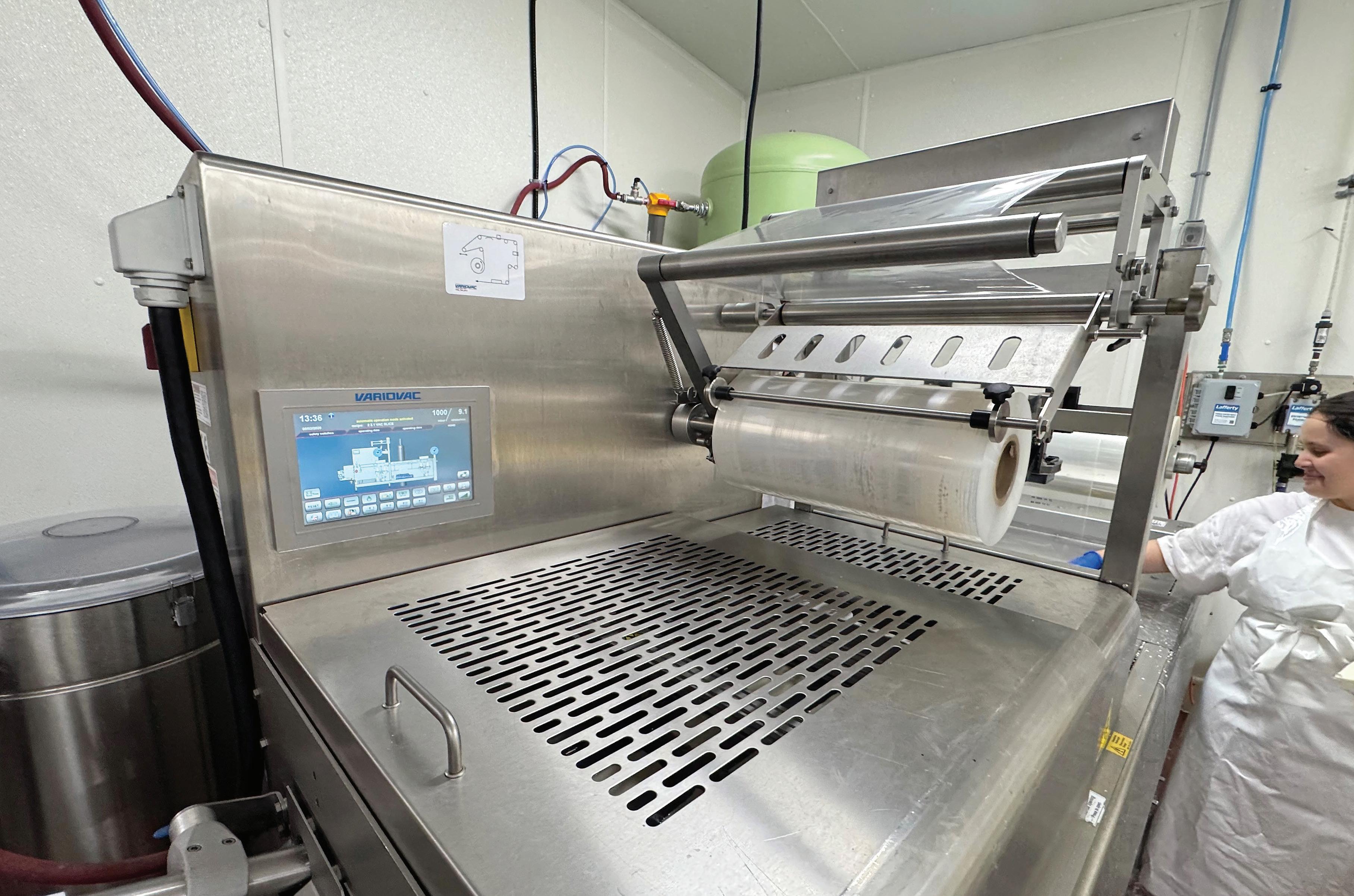
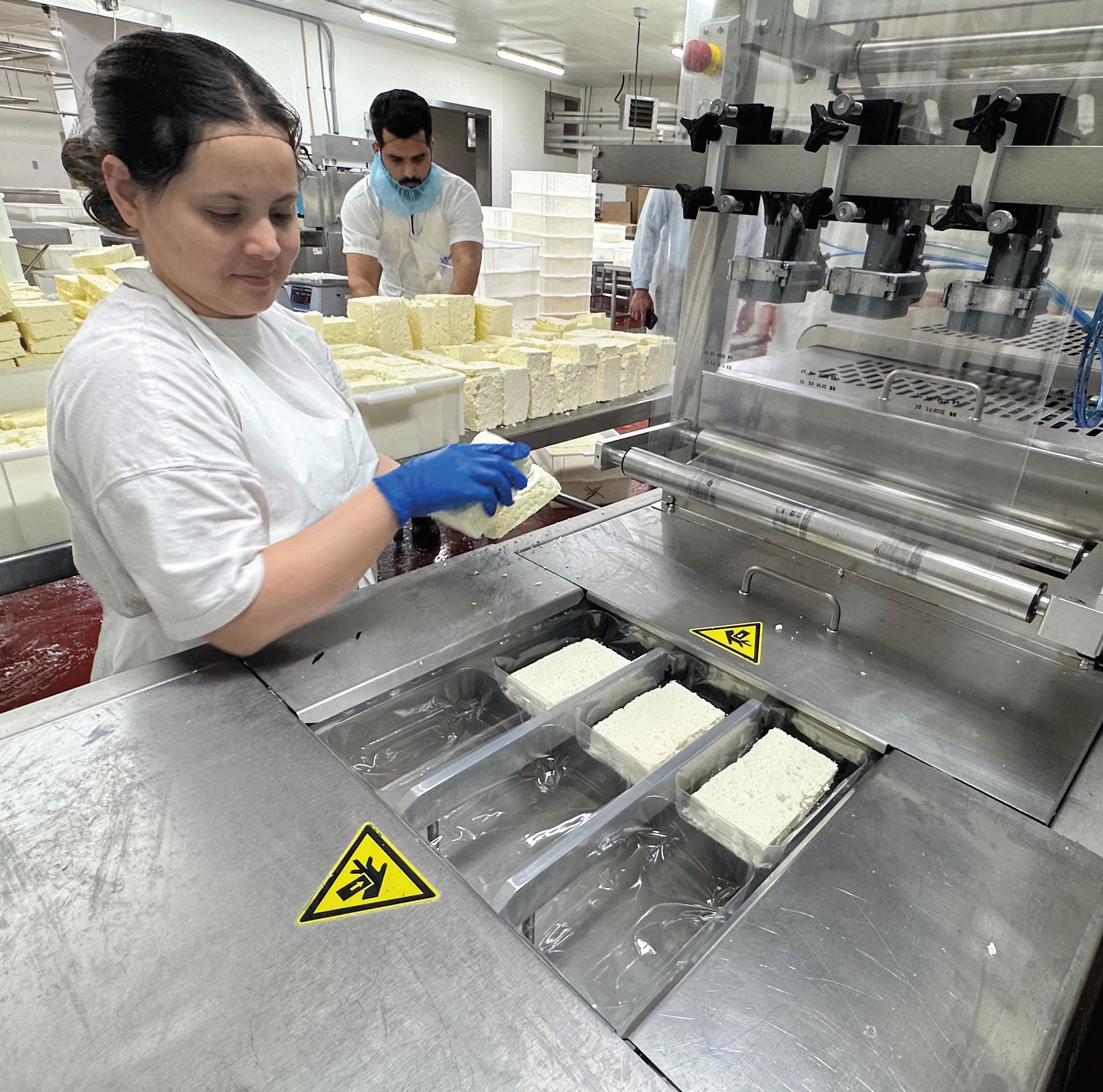
The Reiser Variovac Optimus thermoformer machine uses the rollstockfilm from Duropac to create retail packs of paneer and feta cheese products.
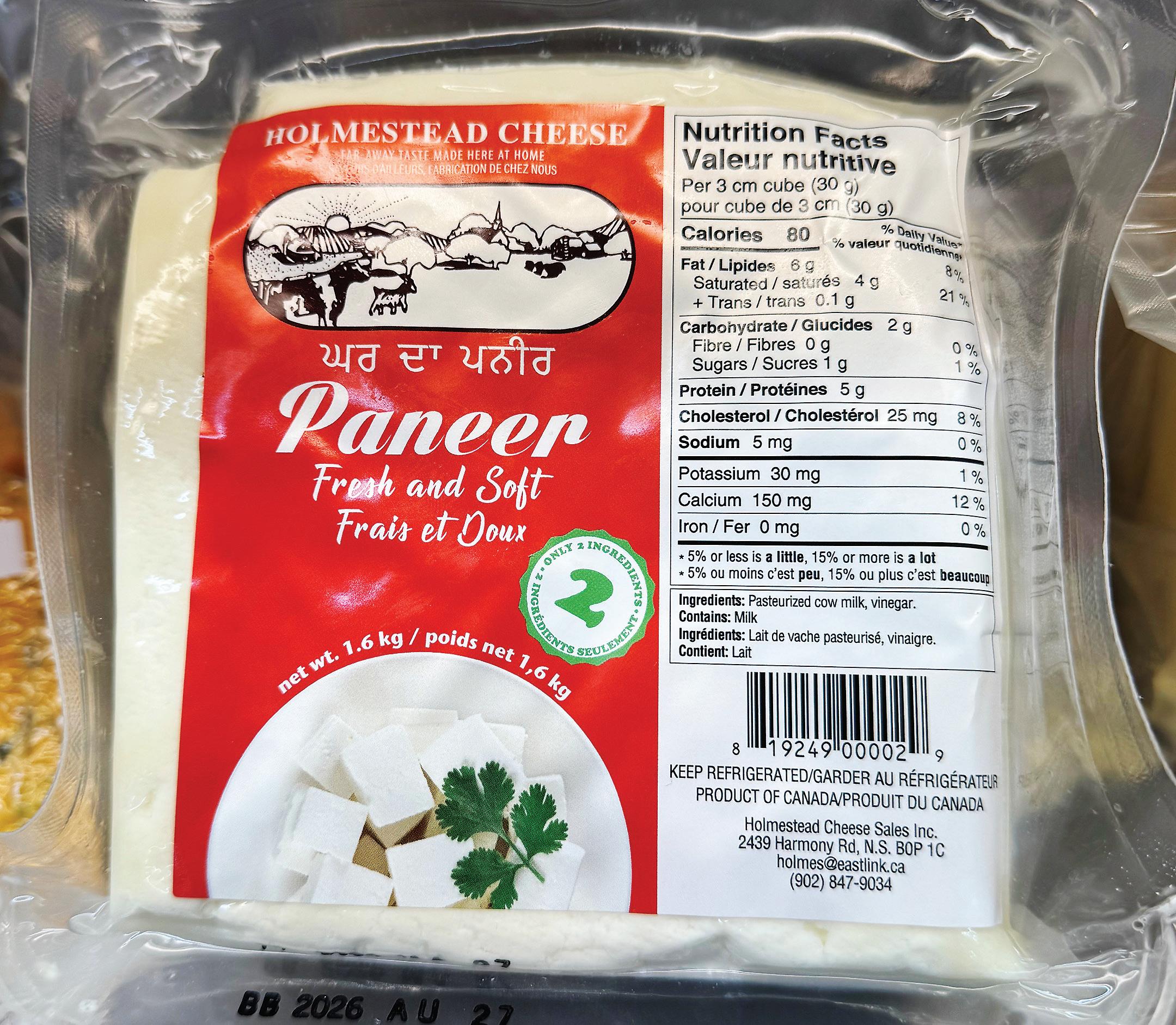
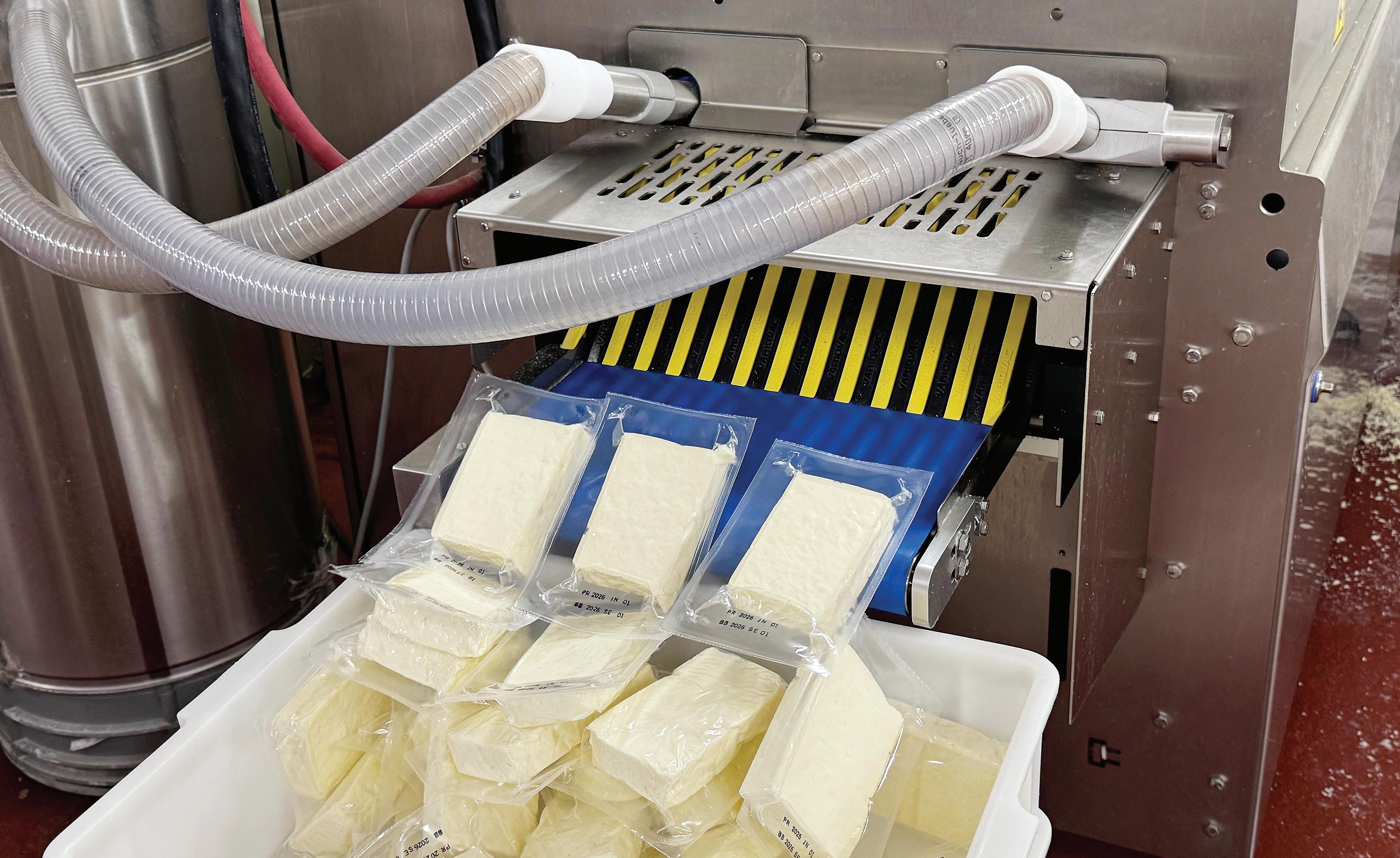
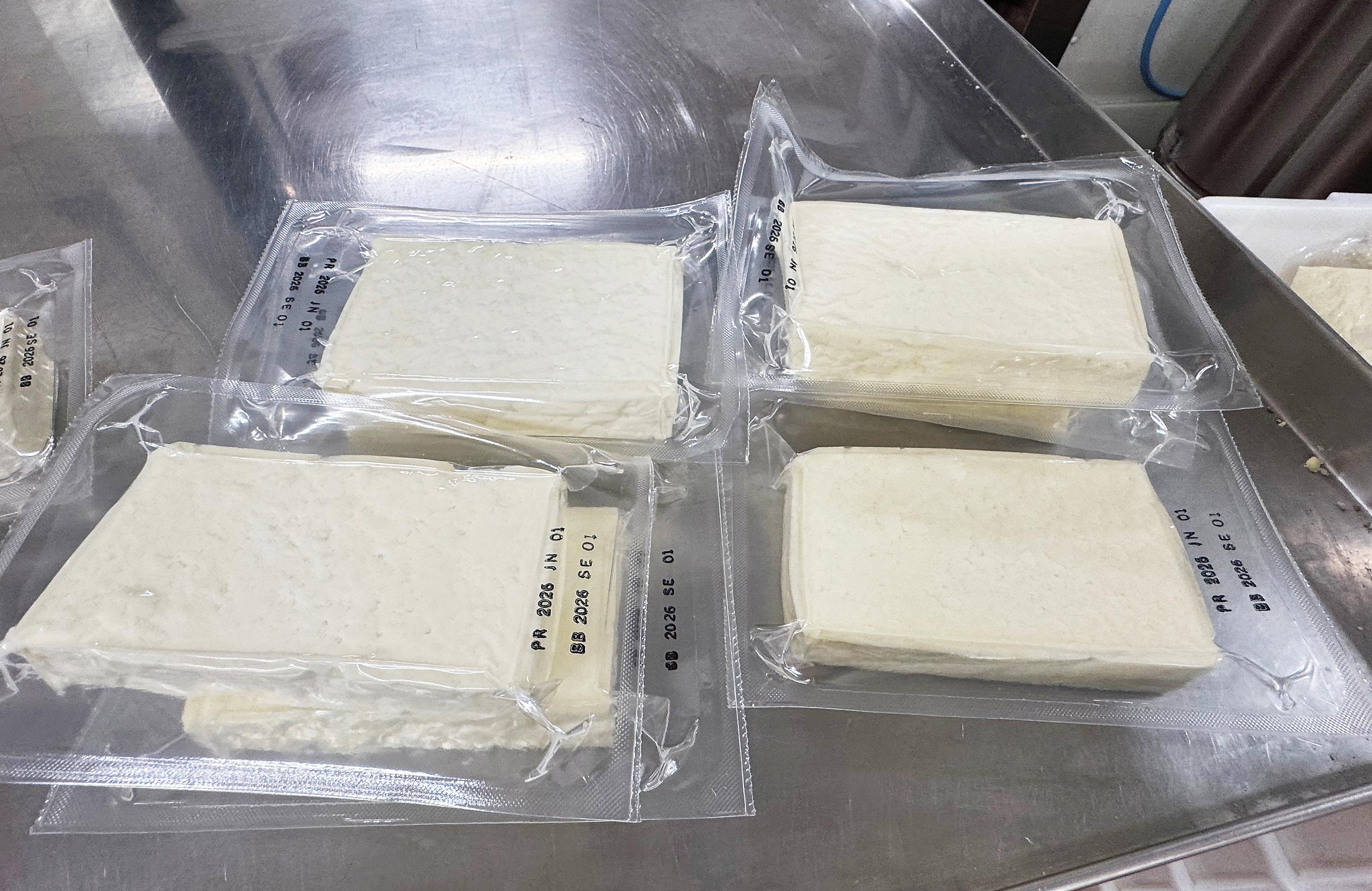
A semi-rigid thermoformed package of paneer cheese processed on the Variovac Optimus.
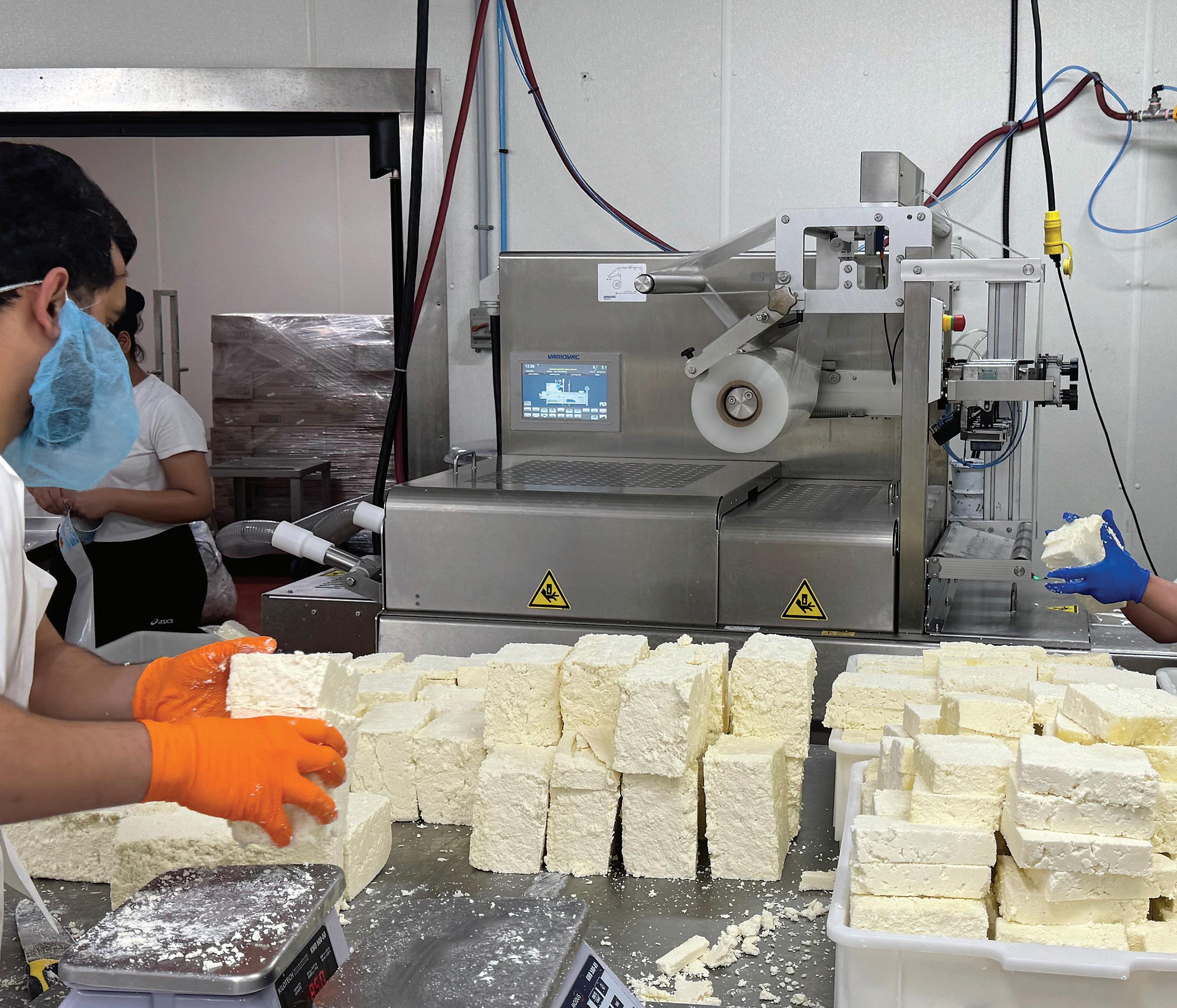
Blocks of feta cheese being portioned and loaded onto the Variovac Optimus.
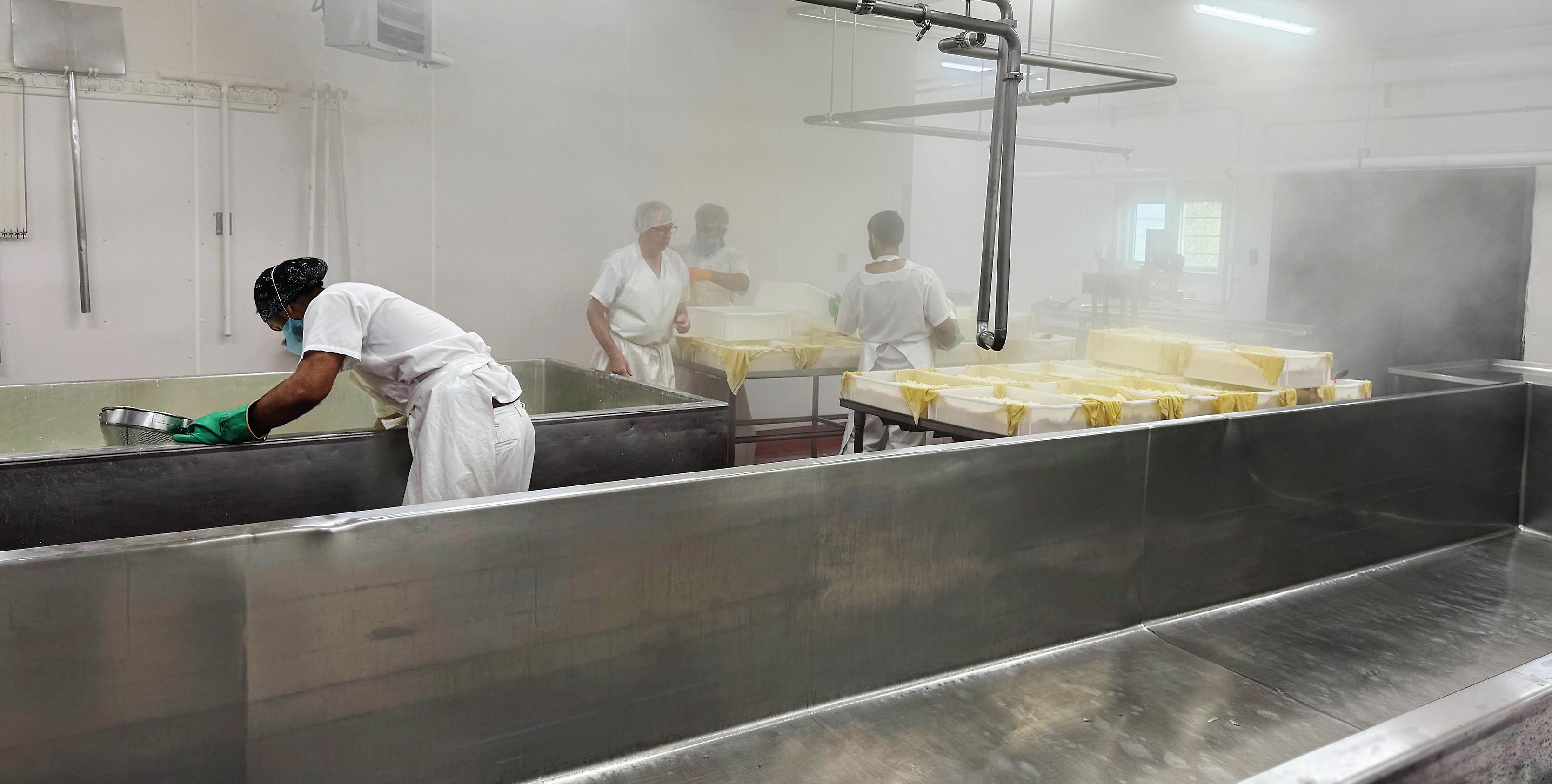
Side view of the cheesemaking process at the Ayelsford production plant.
place that didn’t have any indoor plumbing, which is the building I’m in now, and they were making feta cheese in a bathtub over a fire.
“They would buy $500 worth of milk to make $1,000 worth of cheese, and then go door-to-door, explaining what it was to people,” George says.
“They would then sell it all and buy $1,000 worth of milk to make $1,500 worth of cheese,” Tziolas says, “and gradually grew the business this way.”
To help the business expand, Nick started taking regular trips to Halifax so he could introduce himself to people and businesses within the local Greek and Balkan communities.
“He started dealing with Greek restaurants there, and he had connections in Toronto,” Tziolas relates. “He got small business loans and was able to build a facility that was federally licensed.
“A lot of our early business was with big Greek wholesalers in Ontario and Quebec, and then we got into the Atlantic Canada’s Loblaws and Sobeys with our retail sizes,” says Tziolas, adding the feta
cheese products made at the plant are available in 250-gram, one-kilogram, three-kilogram and 11-kilogram sizes.
As the company grew its feta production, there was a large number of byproducts that needed to be managed, and they started using some of those products to make paneer cheese, which id is a popular staple for many East Indian restaurants and families.
At the time, George Tziolas had no idea how quickly this product would skyrocket in demand.
“I went to one restaurant and the guy immediately said, ‘I’ll buy 100 pounds a week, no questions asked.’
“I went to another, and he said the same thing,” he recounts.
“And before I could go to a third one, I already had a broker calling me.”
That broker ended up getting Holmestead Cheese Sales into Costco locations across Atlantic Canada, and over a twoyear period, the demand for paneer products was quickly outpacing the demand for the company’s feta cheese.
“We retooled the factory to become
Closwise from top
Finished packs of cheese coming out of the Variovac Optimus machine are collected in large bins before being moved to the secondary packaging area.
more of a paneer plant, although we still make the feta,” says Tziolas.
“The paneer we make here is shipped as far as Ontario, and we sell around 10,000 kilos of paneer weekly,” he reveals, “whereas we sell 2,500 kilos of feta cheese a week.”
Managing the exploding demand for paneer products was not easy, according to Tziolas, as the company needed to invest quickly n new production equipment and to increase its fresh milk supply.
“Eventually the growing demand for paneer meant that I could no longer just make it as a byproduct with the whey,” he relates.
“I had to start using fresh milk, and to
do that, I had to buy a new batch pasteurizer, which I could cook the milk in to get it up to temperature,” Tziolas says, adding the company currently processes an average of 14,000 liters of milk per day.
Once the broker had got Holmestead Cheese Sales into Costco, the company could no longer rely on its existing manually operated tabletop vacuum sealers to keep up with demand.
The company knew it would encounter bottleneck challenges the packaging side of its operations without further capital investment.
In order to prevent costly delays, Holmestead Cheese Sales ended up investing in a Reiser Variovac Optimus
thermoformer to package its two paneer cheese products in 1.6-kilogram and 300gram blocks.
“It was a huge help: there’s no way we could keep up with the demand without it,” Tziolas says.
“When we started off, we had two tabletop vacuum sealers that could each do four packages at a time… so you could do eight a minute,” he recalls.
“We needed to get into the thousands, so there was just not enough time in the day to complete one order,” Tziolas points out. “It would have been physically impossible to meet the demand without the right machine.”
The two companies’ first interaction
From left
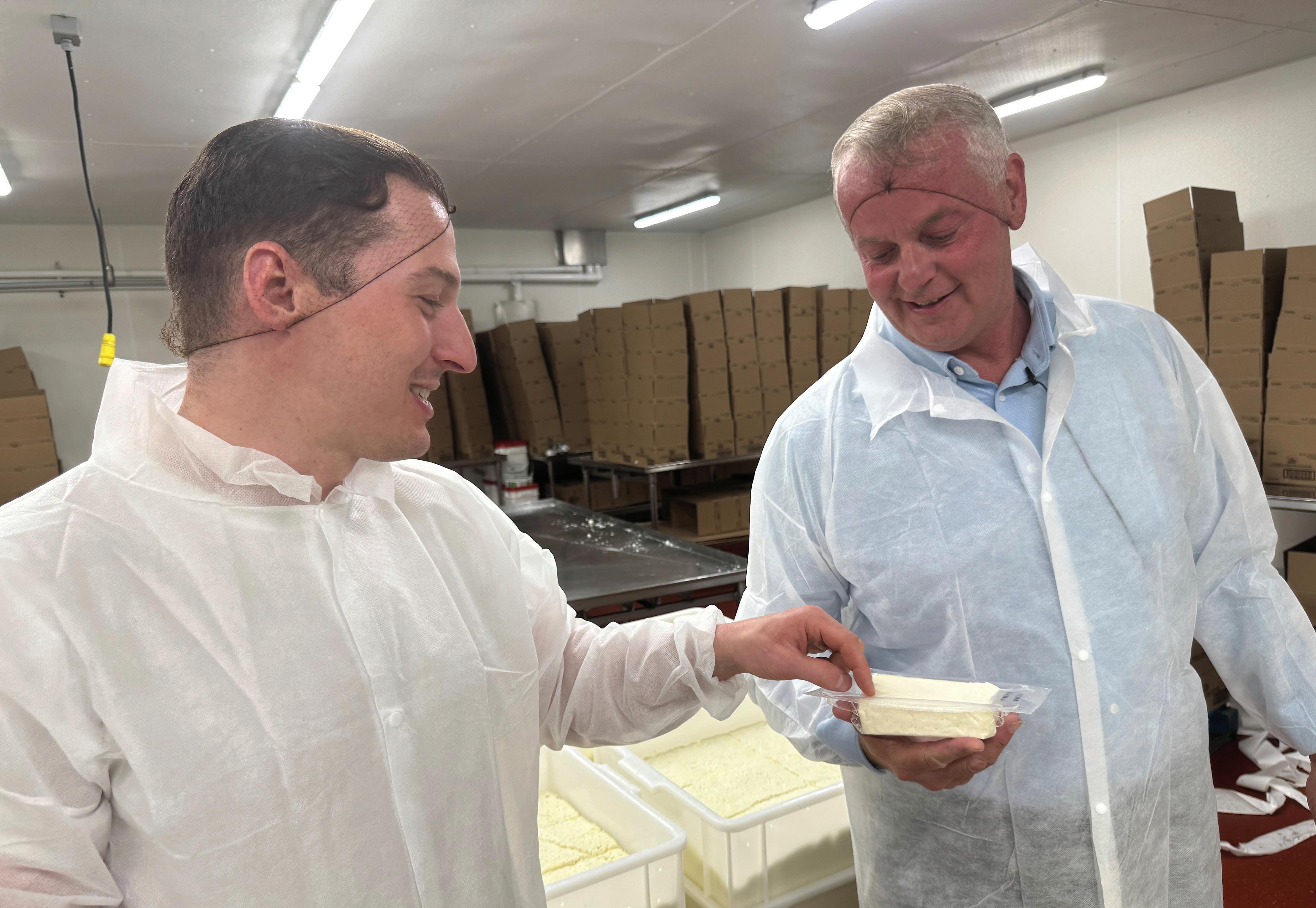
George Tziolas and Jean Collette sampling some of Holmestead’s fresh-made cheese.
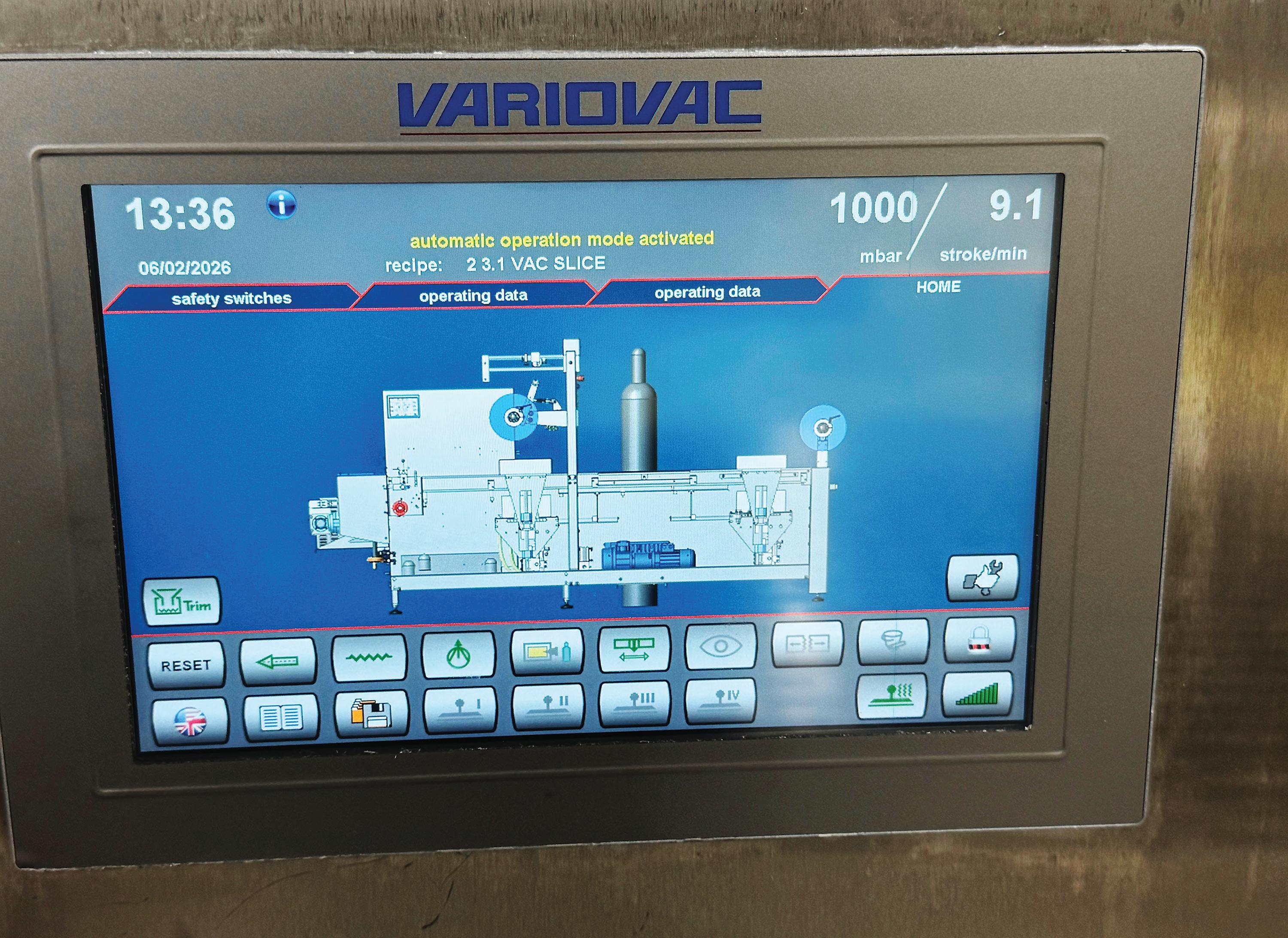
Close-up of the Variovac Optimus thermofomer’s HMI (human-machine interface) controlling and monitoring the machine’s operations.
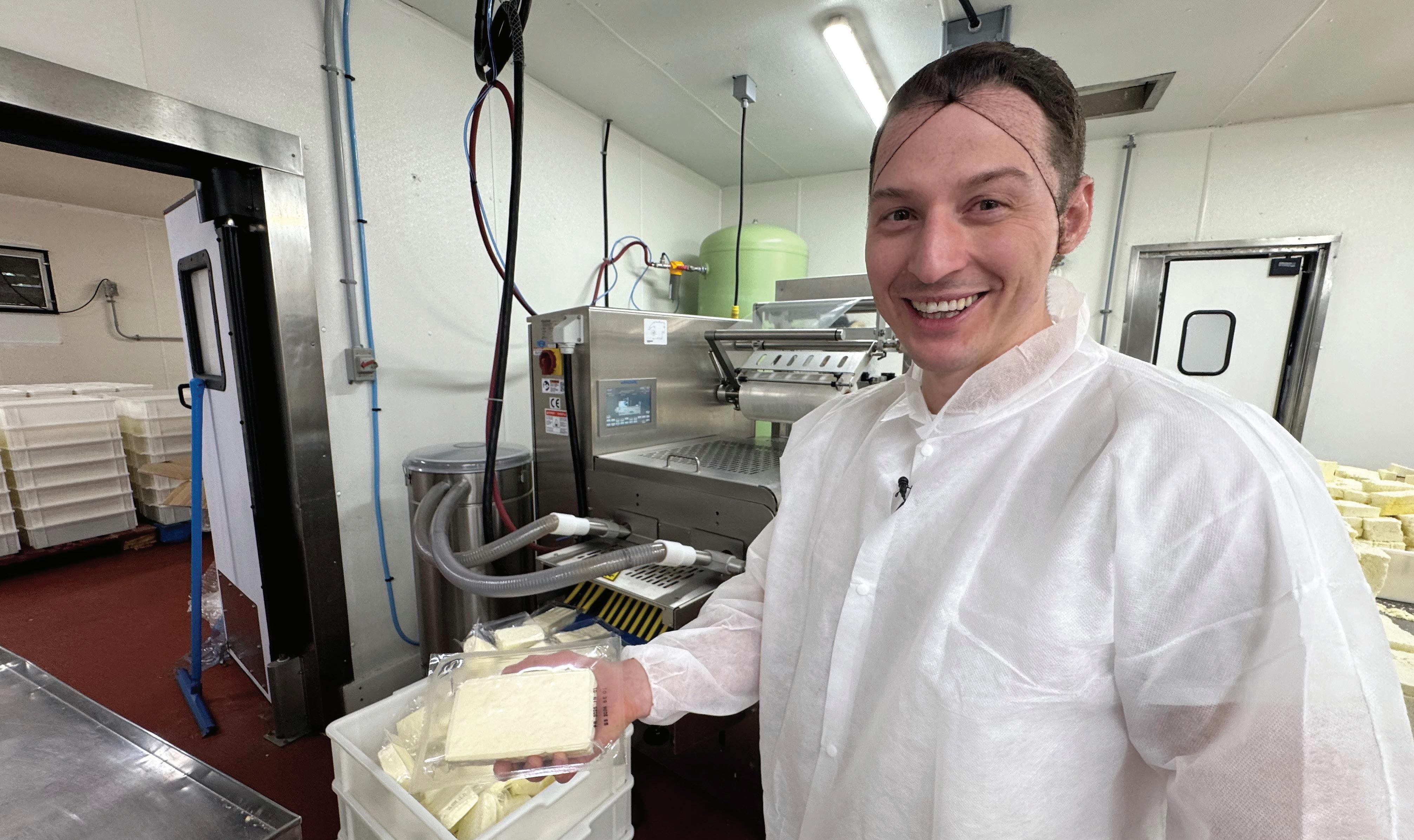
Operations and production manager George Tziolas cheerfully displays a tightly sealed pack of cheese produced on the Variovac Optimus thermoformer at swift speeds of up to 13 cycles per minute.
stemmed from a chance encounter when Jean Collette, sales representative for Reiser (Canada), was driving in the area visiting clients a few years ago and happened to spot the Holmestead Cheese Sales’ production plant.
He decided to drop by to introduce himself, and to have a conversation with Nick.
“At the time, most of their production was feta cheese, which were great products,” Collette says. “I would buy some anytime I was in that area, and I would also stop by and talk with Nick,” Jean recalls.
A short while after George Tziolas took over the family business from his father, the paneer demand exploded.
“He could not keep up, which meant that orders potentially wouldn’t go out and he would have trouble increasing his business,” Collette relate.
“So, we chatted about installing a Variovac Optimus thermoformer to replace his little desktop bagging machines,” he says.
While discussing the possibility of purchasing one of Reiser’s Variovac Opti-
mus thermoformers, Tziolas researched many other options available on the market.
In the end, he decided that Reiser’s technology was the right fit for his operation.
“Like any sales process, it takes time,” Collette states. “It’s a fair-sized investment for a company of their size, but at the end of the day, the return on investment was there.
“I just needed to prove it.”
According to Collette, Reiser’s more localized footprint for servicing machines was an important factor in the purchasing decision.
“We’re known in the industry that we just don’t sell a machine—we’re there to support it,” Collette proclaims.
“A lot of times, companies may have similar machines, but it’s very difficult to get help.
“That’s certainly not the case with us, because our motto is ‘We’re there to help service and support the machine for the long term’,” Collette says.
“I’ve heard from a lot of different companies that have worked with them (Reiser) over the years,” adds Tziolas.
“One of their big things that people tend to be happy with is that they always have service that’s fairly local
“They always have people in Canada that they can get to you.”
Tziolas says that operating in rural Nova Scotia makes opting for a company with local service was a no-brainer.
“One of the challenges here in Nova Scotia, especially rural Nova Scotia, is getting service you need,” Tziolas remarks.
“We’re pretty lucky that the guys who built our pasteurizer, and a lot of our other equipment, have a pretty renowned
engineering team that does a lot of work in this industry,” he says, “and they are located right nearby in Halifax.”
While Homestead Cheese Sales was considering their investment in a Variovac Optimus thermoformer, Jean took some of their cheese back to Reiser’s Canada’s head former office in Burlington, Ont., and put it into a customized package to show George what the final product could look like.
“I emailed them and said, ‘This is what it could look like,’ and immediately, the text came back asking when they could get it,” Collette says.
The purchase of the Variovac Optimus thermoformer not only allowed the company to keep up with current demand, but also to continue expanding.
After purchasing the thermoformer, Homestead Cheese Sales was able to secure contracts with major grocery retailers across Ontario.
To ensure they meet all quality and sustainability requirements, Homestead Cheese Sales became SQF (Safe Quality Food)- and CFIA (Canadian Food Inspection Agency)-certified.
While Tziolas is thrilled to have such a huge demand for his company’s paneer products, it comes with a variety of challenges.
Whereas feta cheese is a fresh product that is heavily salted, placed in brine, and has a significant shelf-life, the paneer requires stricter production procedures.
“Sanitation has always been a priority, but now it’s at the forefront of our minds all the time,” Tziolas says. “How do we limit the amount of contact this stuff has with our hands and any other potential contaminants?
“You want the shelf-life to be as long as possible, and because it’s a fresh dairy
product, even the slightest aberration can create a problem.”
This is an area where the Variovac Optimus thermoformer has paid huge dividends, according to Tziolas.
“The thermoformer really helps with this quickly. It’s right there in the production room.
“Things come out of the cooler, cut to size and go right into the vacuum-sealing thermoformer, where they are safe from contaminants,” George says.
Additional features of the Variovac Optimus thermoformer include a standard frame length from 2.5 to 4.5 meters; film widths ranging from 320-mm to 460mm; advance length of 150-mm to 400mm; packaging depth up to 110-mm; industrial PC controls with multiple language options; and a packaging output of up to 13 cycles per minute.
Capable of producing several different packaging types—including sealed, vacuum, MAP, skin, steam and shrink— the Variovac Optimus is equipped with the innovative RAPID AIR SYSTEM technology to achieve precision forming every time, in both semi-rigid and flexible film applications.
Another advantage of the machine is its use of printed film supplied by the highly leading flexible packaging supplier Duropac Of Mississauga, Ont.
“It limits the amount of labeling we have to do,” Tziolas states. “If you’re
using clear film, you have to put a sticker on the package, which is pretty that’s labor-intensive.
“Considering the speed at which the product comes out on that conveyor belt, there’s no way you could do it with just one person at the end,” he says. “It would take a team of people at the end applying stickers.
“Being able to use pre-printed labels is a nice feature,” says Tziolas. “We just have one person at the end of the machine catching the product and putting it in boxes, rather than six or seven guys trying to keep up with applying stickers, with one guy putting in boxes and another guy palletizing it.”
The production process for paneer is surprisingly not very automated, relying on 16 employees to produce the artisanal-styled products.
“Our paneer is so popular because we do it very artisanal,” Tziolas proclaims. “We use cheesecloths and turn them—it’s a very old-fashioned method.
“I think a lot of other plants, they just put milk in one end of an automated machine, and it comes out as cheese on the other,” he says, “without the ‘TLC’ you
need to make a really nice cheese.
“We were able to expedite the process and make 2,500 kilos a day,” he notes, “but also to do it in a way that retains the ‘Old World’ methods.”
As Tziolas points out, the company sits on a 100-acre property with lots of room to grow and expand in the future.
And while competition in the dairy industry can be fierce, Holmestead Cheese Sales has been enjoying significant success in the region to date, which Tziolas attributes to making the right decision at the right time.
“It’s about capitalizing on emerging markets at the right time,” he says. “When my dad and mom started out, the Mediterranean diet was taking off, with people realizing how healthy it was.
“At the same time, there was a lot of immigration from that part of the world,” he says. “The same thing happened two years ago, with a lot of immigration from the Southeast Asia region.
“As a result, the Indian cuisine has really taken off,” he concludes, “because many new arrivals to Canada are often desperate for a product that reminds them of home.”
Exterior view of the Holmestead Cheese Sales production facility in rural Nova Scotian community of Aylesford.
PADDING THE NUMBERS
Innovative traypadding service helps Ontario packaging distributor deliver real value to customers in the key fresh food processing sectors
By George Guidoni, Editor
It takes a lot of work behind the scenes to make raw cuts of meat, poultry and seafood retain their fresh looks, color and texture long after they’ve been packed inside food trays and placed into the grocers’ refrigerated displays and coolers.
More often than not, the products inside these trays sit on top of soaker pads, absorbent liners, whose primary function is to soak up the excess juices and moisture to prevent messy leaks, inhibit bacteria growth and keep the packages looking clean and tidy.
As such, absorbent pads are a musthave packaging component for a vast number of food processors and retailers who may not have the technical resources or expertise to optimize their use in the most cost-effective manner.
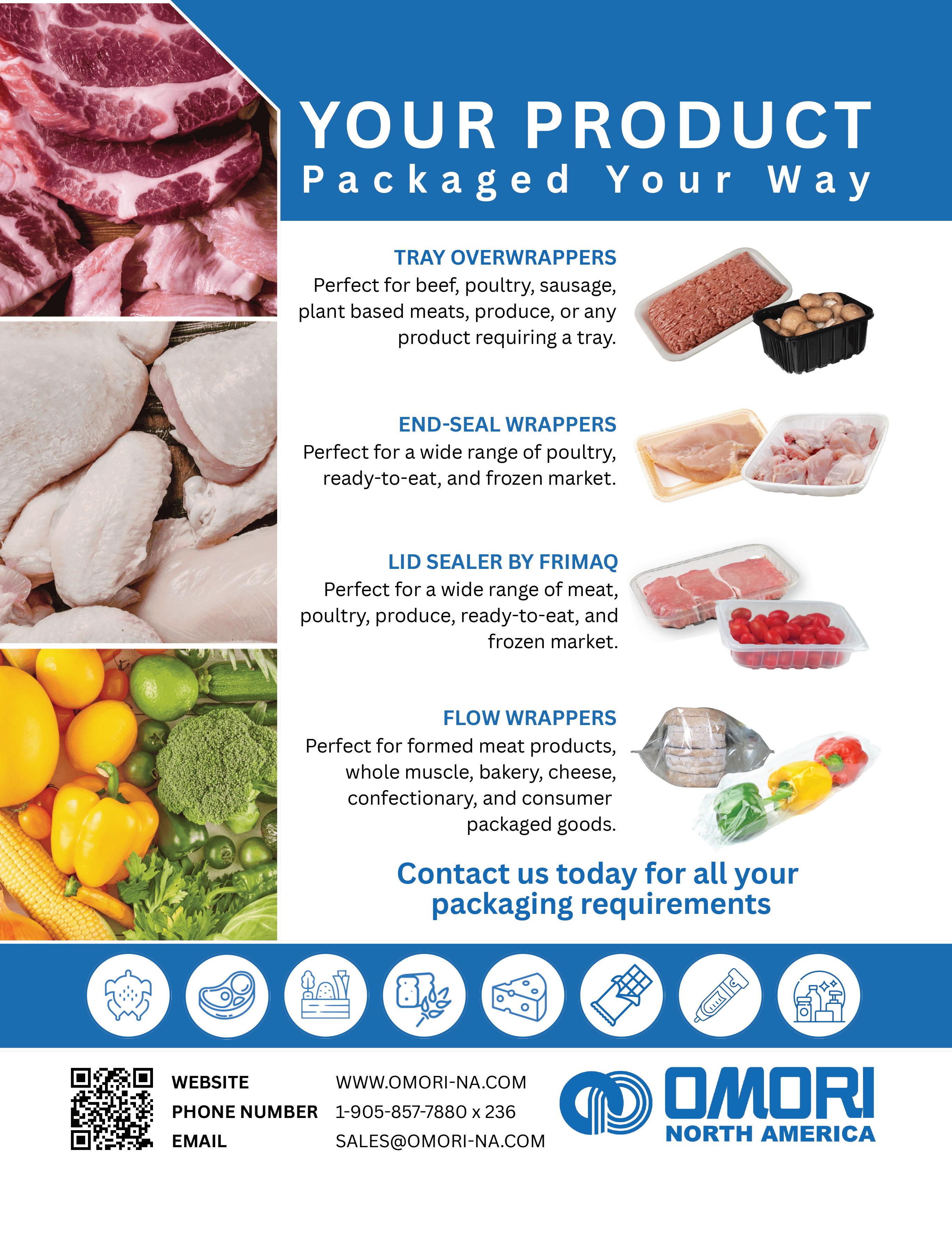
But thanks to companies like Omori North America, based in Bolton, Ont., putting soaker pads in the right place time after time at high operating speeds is not an issue—especially with Omori’s vast range of tray-padding services.
Operating as a wholly-owned subsidiary of leading Japanese packaging equipment manufacturer Omori Machinery Co., Ltd., the Bolton operation serves as a regional platform for the parent company’s growing sales, service and system integration.
Today, Omori North America offers world-class capabilities across equipment, parts and service, and consumables, with strong emphasis on customer support and niche market expertise.
Omori North America president and chief executive officer Don French men-
says the company’ focus on providing customized packaging solution tailored to the end-use customers’ production needs gives it a significant competitive edge in North American markets.
tions that, “Today, Omori North America plays a critical role within the global organization, delivering full-service packaging solutions tailored to the North American market while upholding Omori’s core values of reliability, innovation, and service excellence.”
The company’s state-of-the-art 80,000-square-foot-facility is a vivid testament to Omori’s success in the North American market, built on the company’s well-earned reputation for engineering excellence and continuous technological advancement.
As French states, the company’s diverse North American client base is comprised of large-scale protein processors (meat, poultry, seafood), major produce packers and fresh food processors, bakery and prepared meal manufacturers, and a wide range of small to large food producers—from entrepreneurial companies to multinational operations.
As French also mentions, “Omori systems are designed to support a broad range of operational needs—from entrylevel automation to fully automated, high-speed production lines.”
Don French, president and chief executive officer of Omori North America in Bolton, Ont.,
As such, the company’s extensive offering of packaging equipment includes:
• Tray overwrappers/stretch wrappers;
• Horizontal form-fill-seal (HFFS) machines and flow-wrappers;
• End-seal systems;
• Thermoformers;
• Tray-sealing and lid-sealing systems.
“Overall, Omori machines are designed to help customers increase output, reduce labor dependency, and improve overall line efficiency,” says French, “while maintaining high packaging quality and product integrity.
“These systems can be supplied as stand-alone machines or as fully integrated, turnkey packaging lines customized to the customer’s production environment,” says French citing the company’s formidable strengths in systems customization.
“The Bolton facility operates as a flexible, project-based manufacturing and integration site,” he explains, “with output levels aligned to customer-specific system configurations rather than standardized mass production volumes.”
As French expresses, “Omori’s manufacturing philosophy is rooted in traditional Japanese engineering principles
Above left
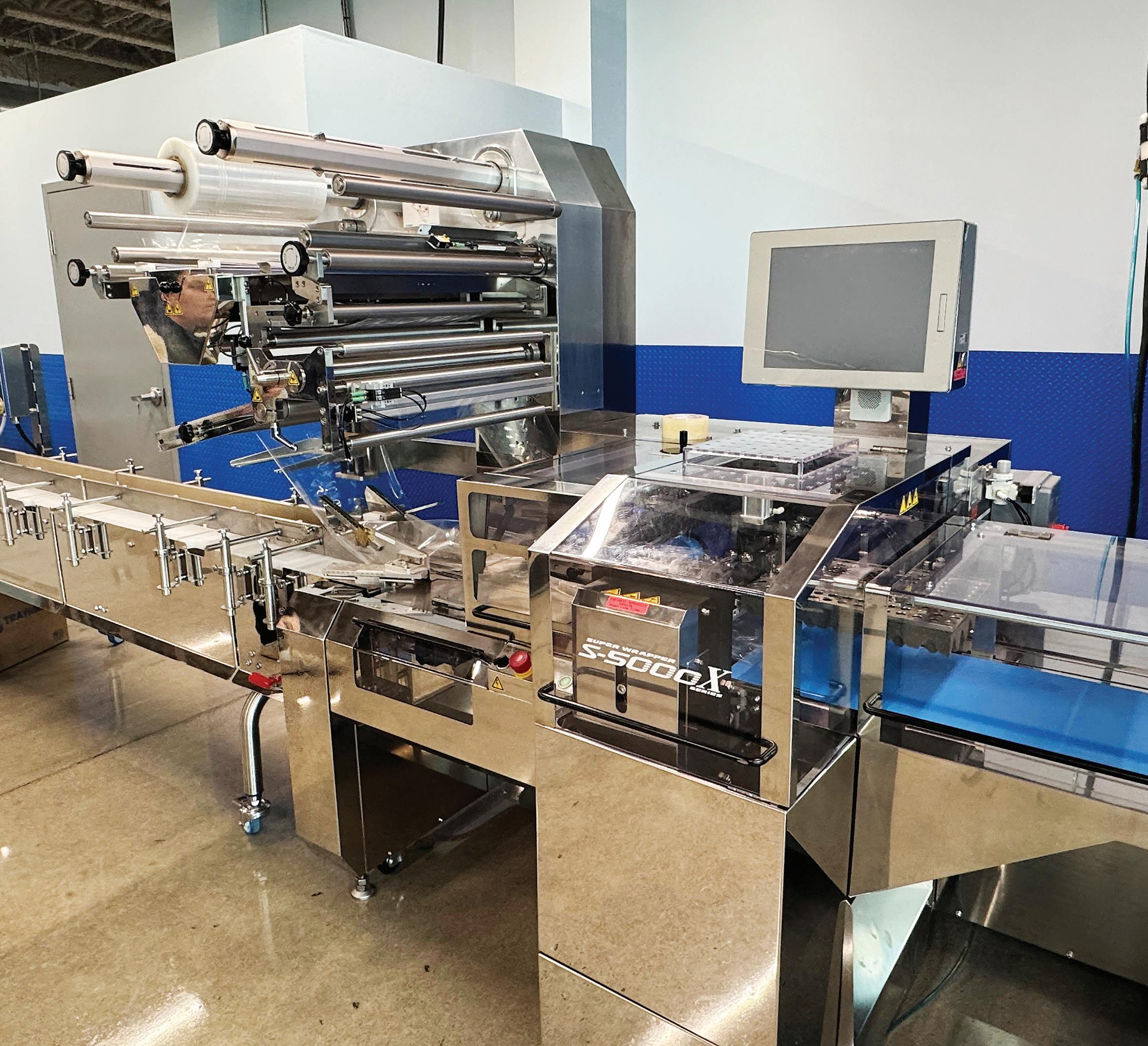
Omori’s S-5000X series machine is a high-speed HFFS flow-wrapper capable of processing up to 300 packs per minute.
Above right
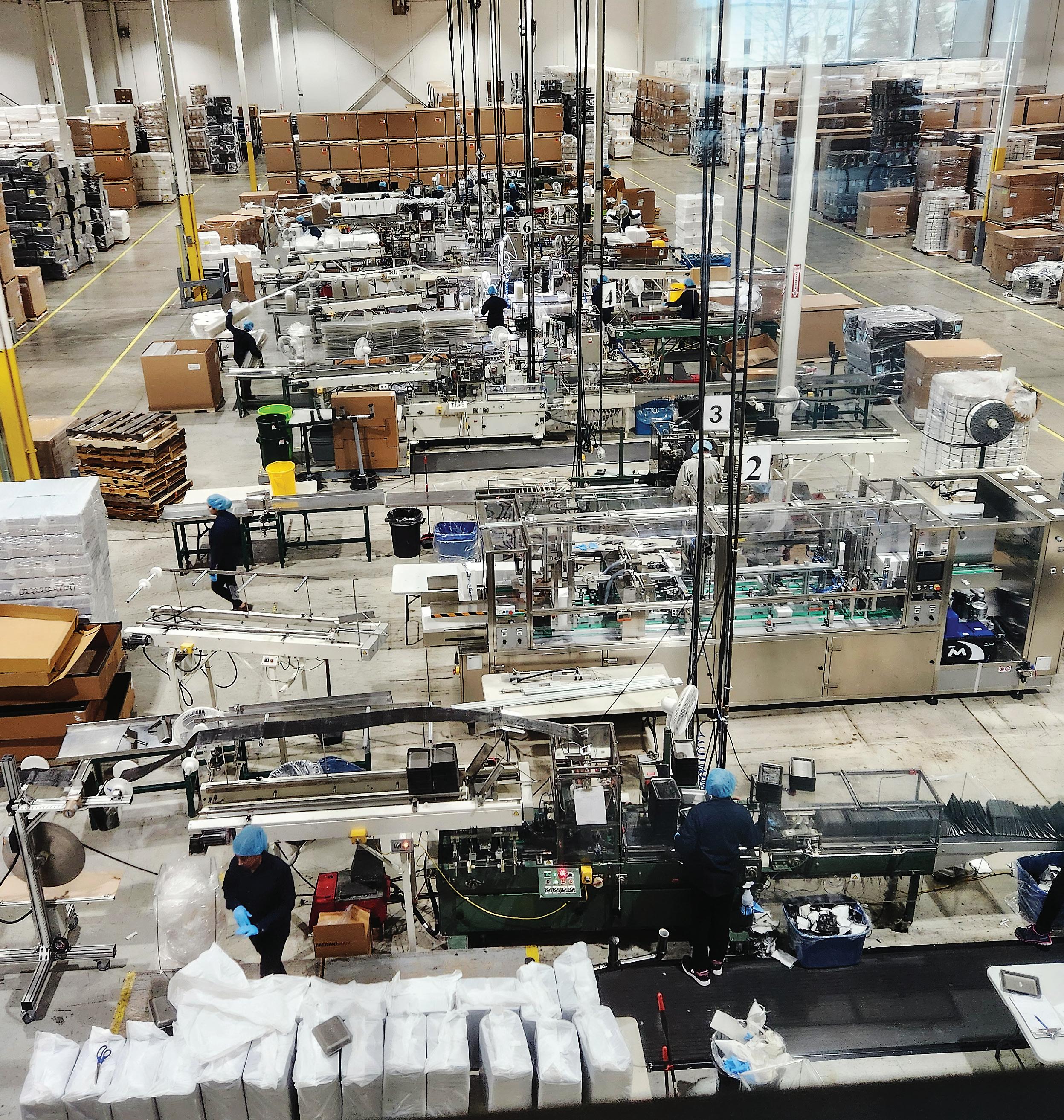
The busy production floor of Omori North America’s Bolton facility, which houses a total of 14 automated tray-padding lines.
“Omori’s manufacturing philosophy is rooted in traditional Japanese engineering principles combined with a service-driven, life-cycle partnership approach.”
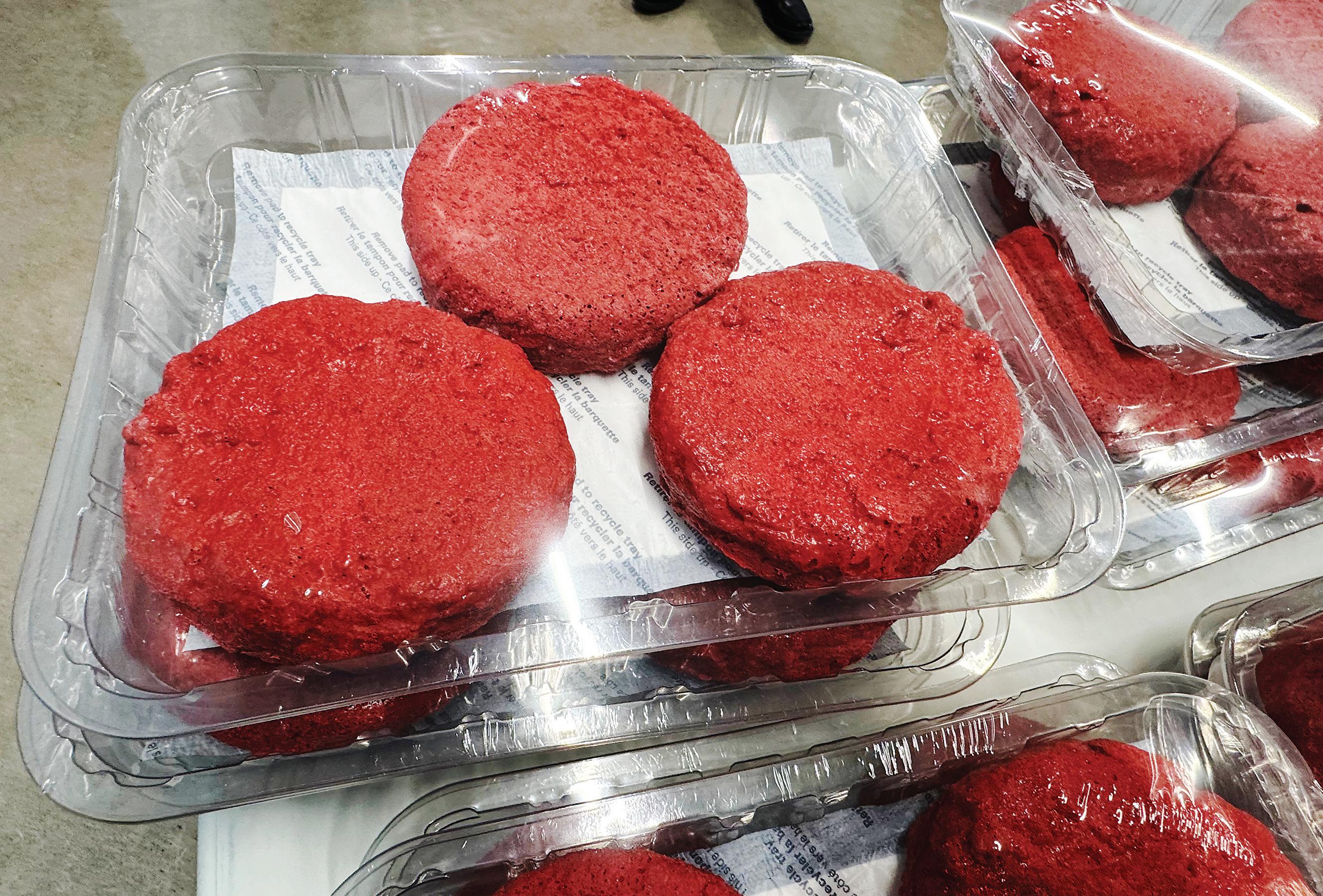
example of the clean and consistent finished package processed on the
tray overwrap equipment.
combined with a service-driven, life-cycle partnership approach.”
This approach has certainly played a key role in the rapid growth of the company’s pre-padded tray solutions, according to plant manager Ashwin Jadav.
“A key strength of Omori is its ability to custom design and configure systems and tray-padding services based on the customer’s specific product, packaging format and production requirements,” Jadav states. “From infeed systems, automation, custom tray-padding to handling equipment and packaging formats, solutions are engineered to fit seamlessly into
the customer’s full production process.
“This high level of customization ensures optimal efficiency, product handling, and packaging quality across a wide range of industries,” says Jadav, citing significant cost-saving benefits offered by Omori’s pre-padded trays.
“Our unique tray-padding service is transforming the industry by delivering significant savings in time, cost and valuable warehouse space.”
As Jadav point out, “By eliminating the need to source trays and pads separately, our tray-padding service simplifies the supply chain, streamlines operations, and
An
Omori
removes a traditionally costly, labor-intensive step from the packaging process with just in-time delivery.”
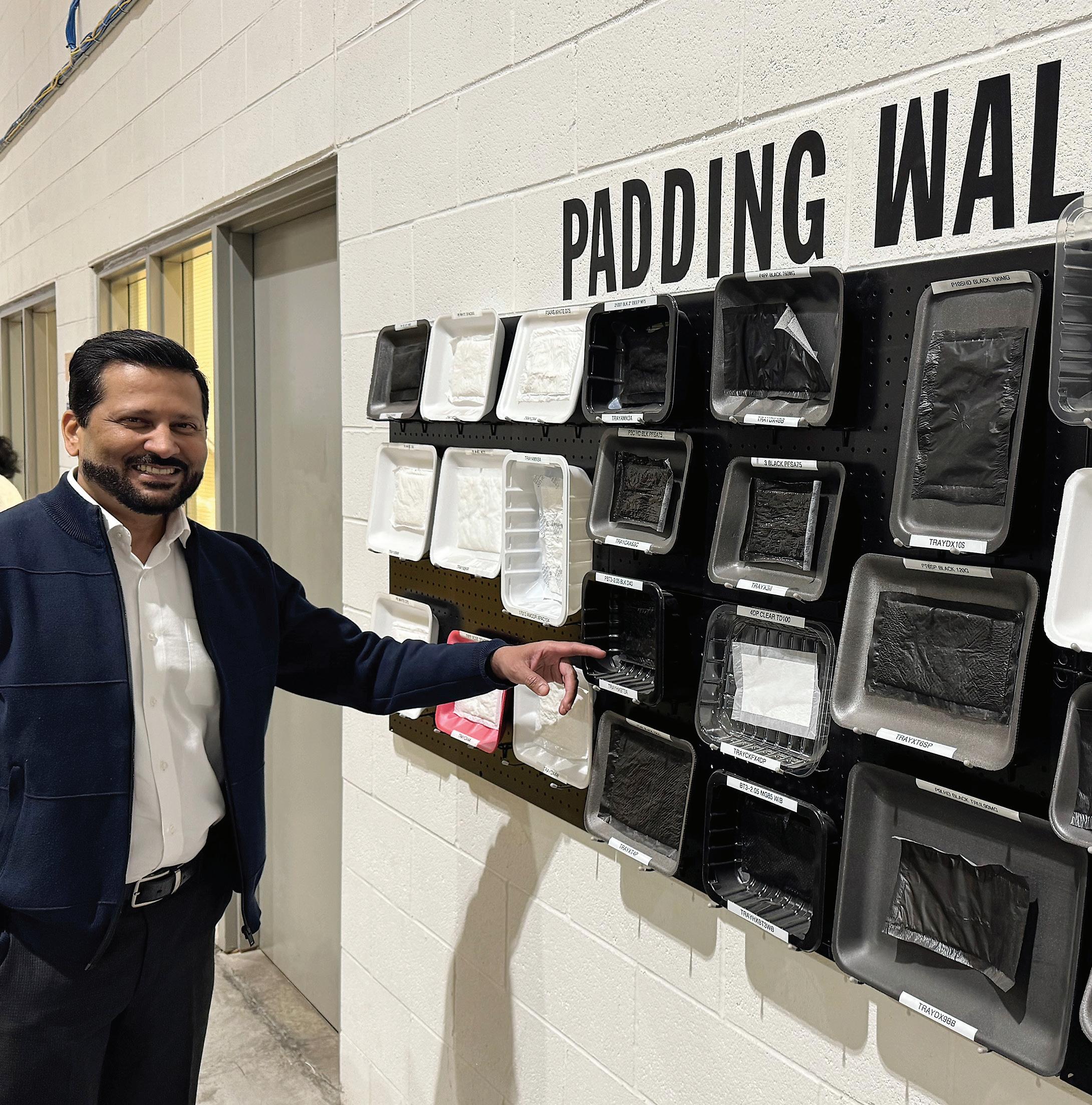
Housing 14 tray-padding lines at the Bolton plant, Omori North America offers customers a broad range of tray sizes and types—from PS foam, PET, barrier and non-barrier to paper fiber trays— along with a variety of environmentally sustainable and recyclable alternatives for trays, films and pads. As for the pads themselves, Omori North America customers can choose from a wide range of sizes, colors and absorbencies.
Omori North America also welcomes customers’ existing trays and pads, as well as tray manufacturers seeking tray-padding services for their company or customers.
As Jadav relates, “Omori North America continues to strengthen its tray-padding services by investing in modern technologies and faster machinery designed to better support evolving customer needs.
“By upgrading to advanced high-speed padding lines, the company can deliver better quality and more efficient production with reduced turnaround times,.
“These improvements not only streamline operations, but also enhance reliability for customers who depend on precision and performance in their packaging processes,” he states.
“The commitment to modernizing equipment reflects a broader focus on innovation,” Jadav asserts, “ensuring clients benefit from scalable solutions that keep pace with growing demand, while maintaining the highest standards in tray-padding.”
French adds: “This strategy allows the company to compete effectively against larger OEMs (original equipment manufacturers) by delivering greater flexibility
Above
Omori North America’s plant manager Ashwin Jadav showing the broad choice of trays and tray pads that curently run on the tray-padding lines.
Top right
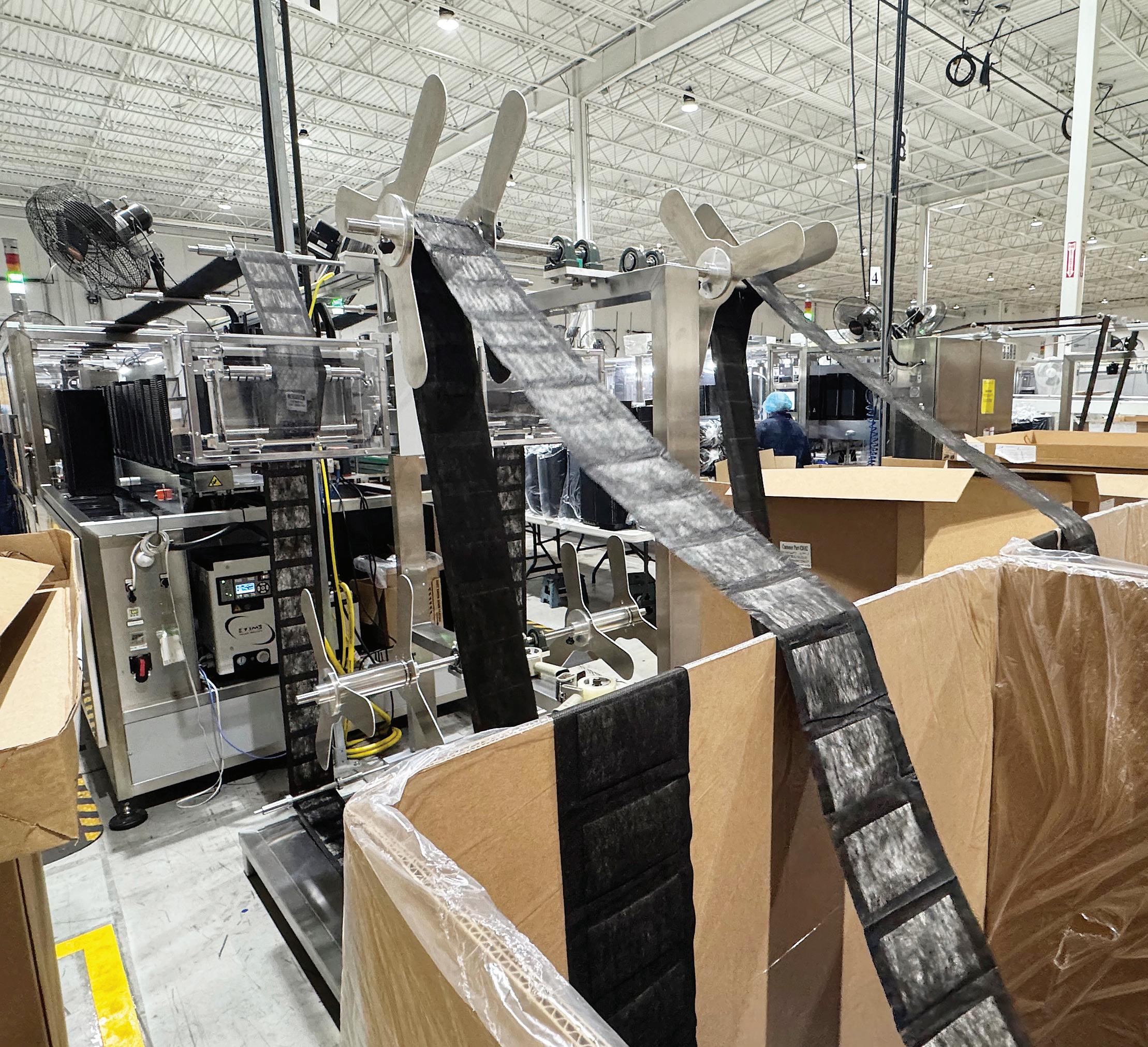
A roll of absorbent pads being fed onto a high-speed padding line to be placed inside food trays.
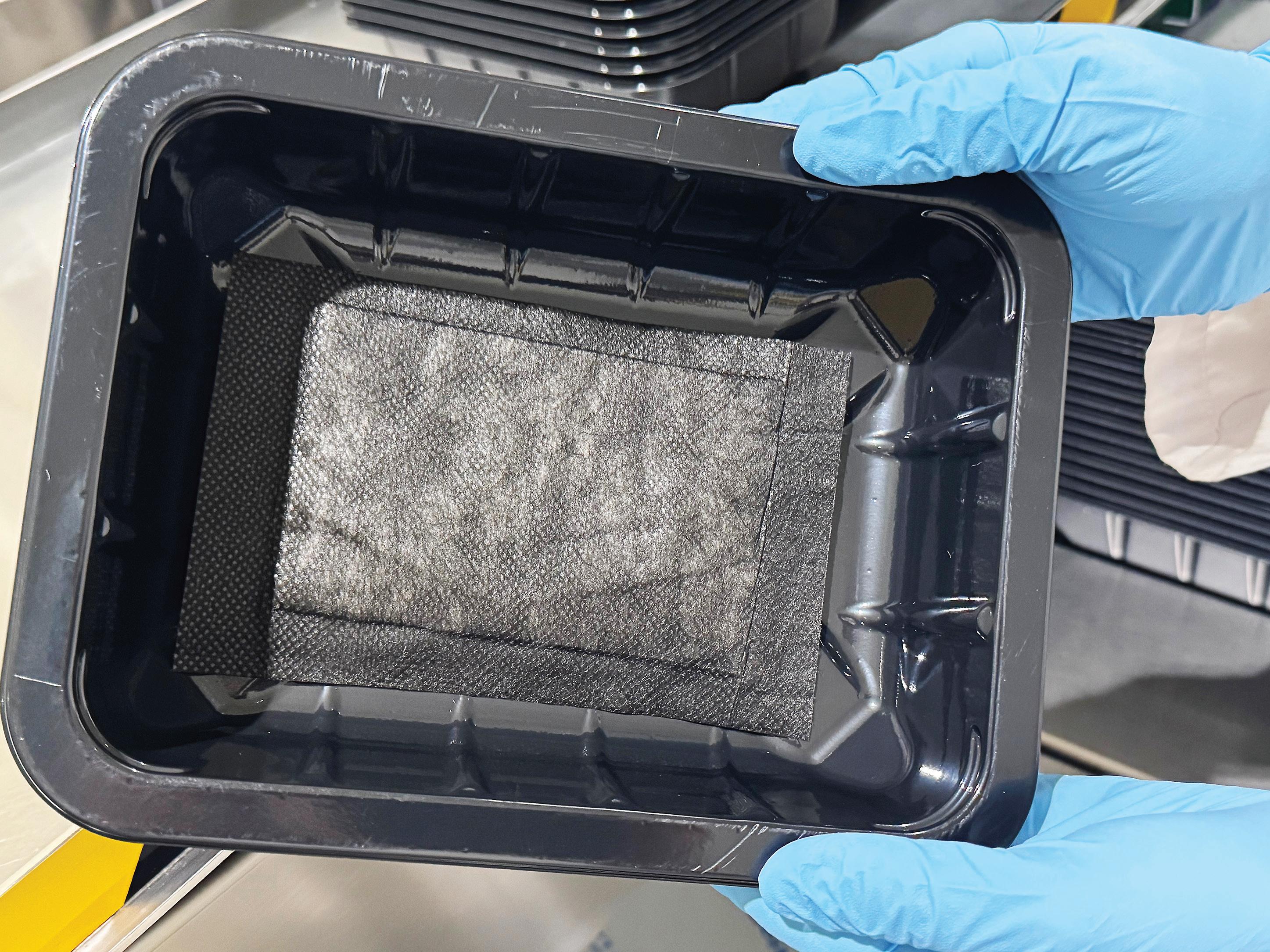
A close-up look at one of many types of padded food trays at the Omori North America production facility in Bolton.
and customer alignment, which is often more valuable than scale in food packaging operations.”
Describing Omori as an ‘Upper Tier’ machinery supplier in the North American market, French cites Omori’s expertise in systems integration as one of the company’s key core competencies.
“Integration is a critical success factor in modern packaging lines,” French
says, “and Omori approaches this through a systems-based, collaborative model between the customer, engineering and sales.”
According to French, this approach enables seamless integration of Omori solutions into existing production lines and full interfacing with both upstream and downstream equipment such as conveyors, weighers and inspection systems.
“Across the industry, the ability to deliver fully integrated packaging lines and consumables, rather than stand-alone machines, is increasingly essential to remaining competitive,” says French.
“Omori’s strength lies in combining its own machinery with complementary technologies, consumables and partners to deliver a complete, optimized packaging solution.”
As French relates, Omori is confident that it can replicate the success of its tray-padding services in the U.S., where the company is opening up a new 12,000-square-foot facility in Atlanta, Ga., next month, housing:
• Showroom, testing facility, and demonstration area;
• Parts and service;
• Tray-padding services;
• Customer service.
According to French, the company’s strong manufacturing competencies are closely tied to Omori’s substantial R&D (research-and-development) activities on both the machinery and the consumables sides of the business.
“Omori’s commitment to R&D and innovation is a key driver of its long-term success,” French states.
“Through continuous investment in new technologies, development of advanced packaging solutions, and recognition from respected industry organizations, the company reinforces its position
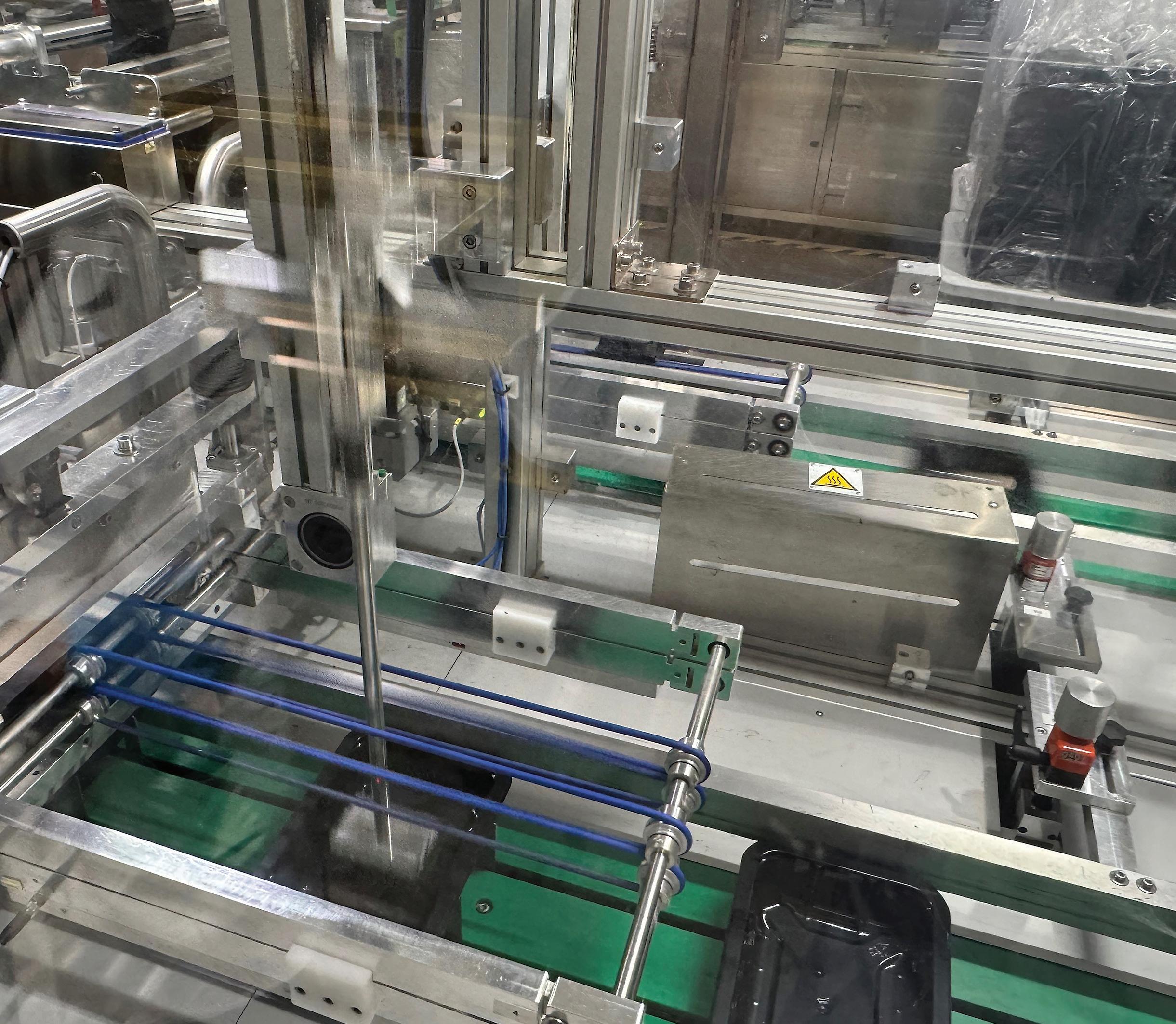
A close-up look inside one of the Bolton plant’s 14 padding lines applying soaker pads to the bottom of passing trays.
Right
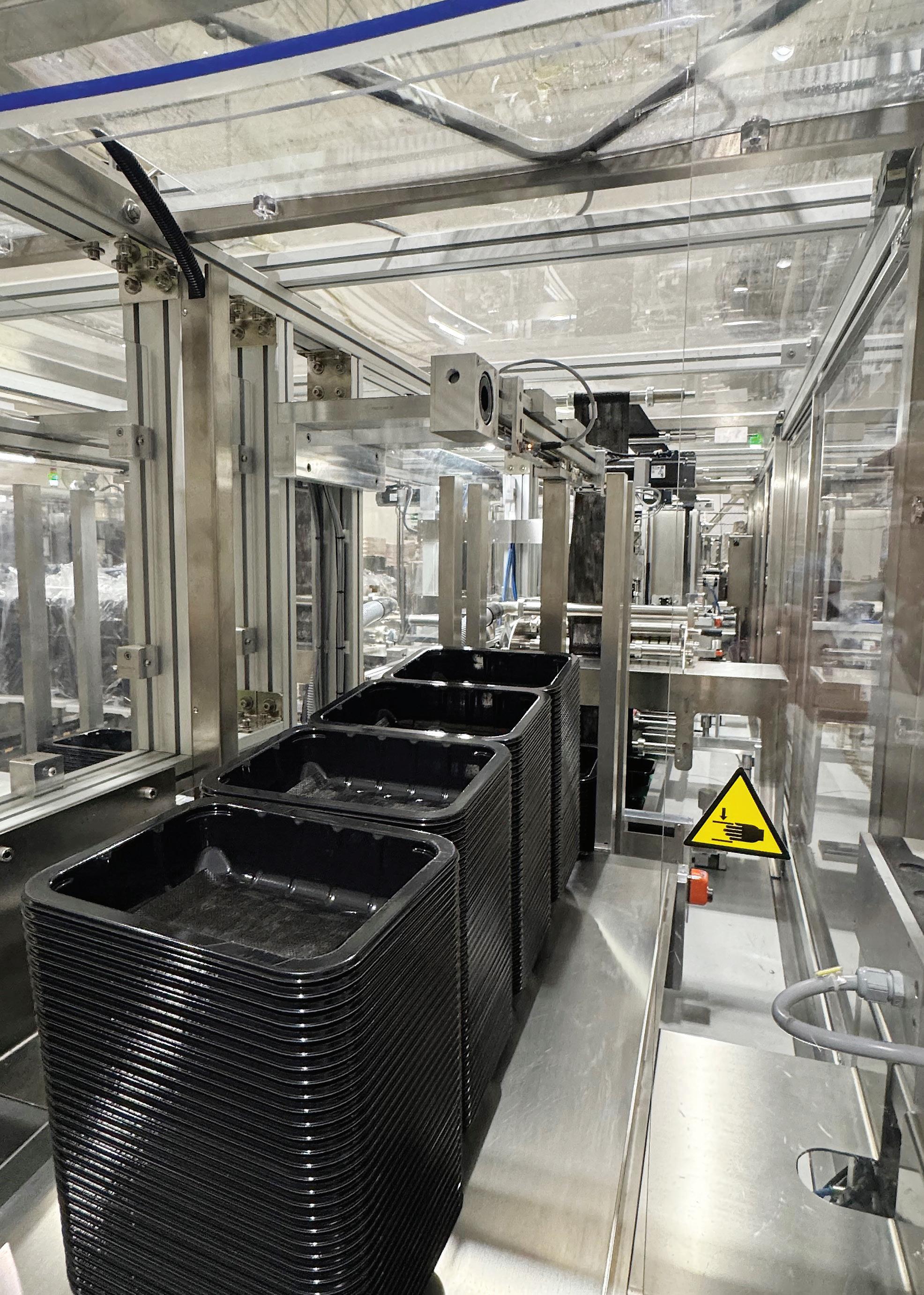
Stacks of empty food trays awaiting their turn on the padding line inside Omori’s Bolton facility.
as a forward-thinking leader in packaging equipment,” he points out
“This focus enables both Omori and its customers to remain competitive in an increasingly automated, efficiency-driven, and sustainability-focused market.”
French cites the recent introduction of the Omori Bellpack three-sided seal packaging machine as validation of Omori’s innovation credentials.
Says French: “For Omori, Bellpack strengthens its position as a leader in packaging technologies, expands its capabilities into fast-growing packaging segments, and reinforces its broader strategic shift toward value-added, innovation-driven solutions.”
system optimization, rapid parts availability, and just-in-time consumable delivery as important components of the company’s overall value proposition.
“The Bolton facility functions not just as an equipment supplier, but a fully integrated packaging hub bringing together machine supply, system integration, consumables and life-cycle support under one roof,” French adds.
“This integrated approach gives customers a streamlined, single-point-of-accountability model from concept through commissioning and ongoing operation, significantly reducing the risk, complexity, and inefficiencies commonly associated with managing multiple vendors.
“Omori’s strength lies in combining its own machinery with complementary technologies, consumables and partners to deliver a complete, optimized packaging solution.”
In addition to its extensive machinery and consumables offerings—Omori North America also provides customers with comprehensive after-sales support, including parts, service and ongoing technical assistance—delivered by a team of trained service professionals focused on maintaining uptime and optimizing customer operations.
“Omori ensures that customers not only invest in high-quality equipment but also receive the ongoing support necessary to maximize performance and longevity,” says French, citing preventative maintenance, application support and
“Backed by proven Japanese design and manufacturing capabilities, the North American operation is structured to customize, assemble, and support solutions specifically for regional customer requirements, while maintaining consistent global standards of quality and performance,” French concludes.
“This combination, along with a strong service culture and a true partnership mindset, positions Omori as more than just an equipment provider, but as a committed, long-term partner focused on delivering reliable performance, minimizing operational risk, and supporting customers as their needs evolve.”
Above
THE DAILY COMFORTS
Canadian beauty and personal care products formulator accelerates its quest for global leadership by expanding its home manufacturing footprint and capacity
By George Guidoni, Editor
Making guests feel at home is a daily challenge facing hotel operators across the globe—from five-star resorts to standard motel rooms—and making sure those guests are well stocked with essential toiletries and premium personal care items they expect, plays a critical role in how much they enjoy their stay.
But keeping these products within easy reach in sufficient quantities to keep all guests happy at all times does not just happen by magic or in isolation, which is where companies like Hunter Amenities International step in.
Started up in 1981 by local young entrepreneur John Hunter, the Burlington, Ont.-based company has enjoyed astonishing growth under the founder’s leadership, becoming one of the world’s
leading contract manufacturer and co-packer of personal care cosmetics and various accessories for the global hospitality, travel and retail industries.
With presence in over 120 countries around the world and a blue-chip client list that includes hospitality industry giants like Marriott, Hilton, Hyatt and Four Seasons, among others, the company’s global reach and diverse client base are a compelling testament to the virtues of product innovation, manufacturing excellence, and superior customer service in opening up new markets and business opportunities.
In addition to operating two Ontario-based manufacturing facilities in Burlington and Cambridge—along with a distribution center in nearby Oakville—the company’s manufacturing footprint also includes world-class factories and distribution centers in China, India, and Malaysia, enabling Hunter Amenities to serve international
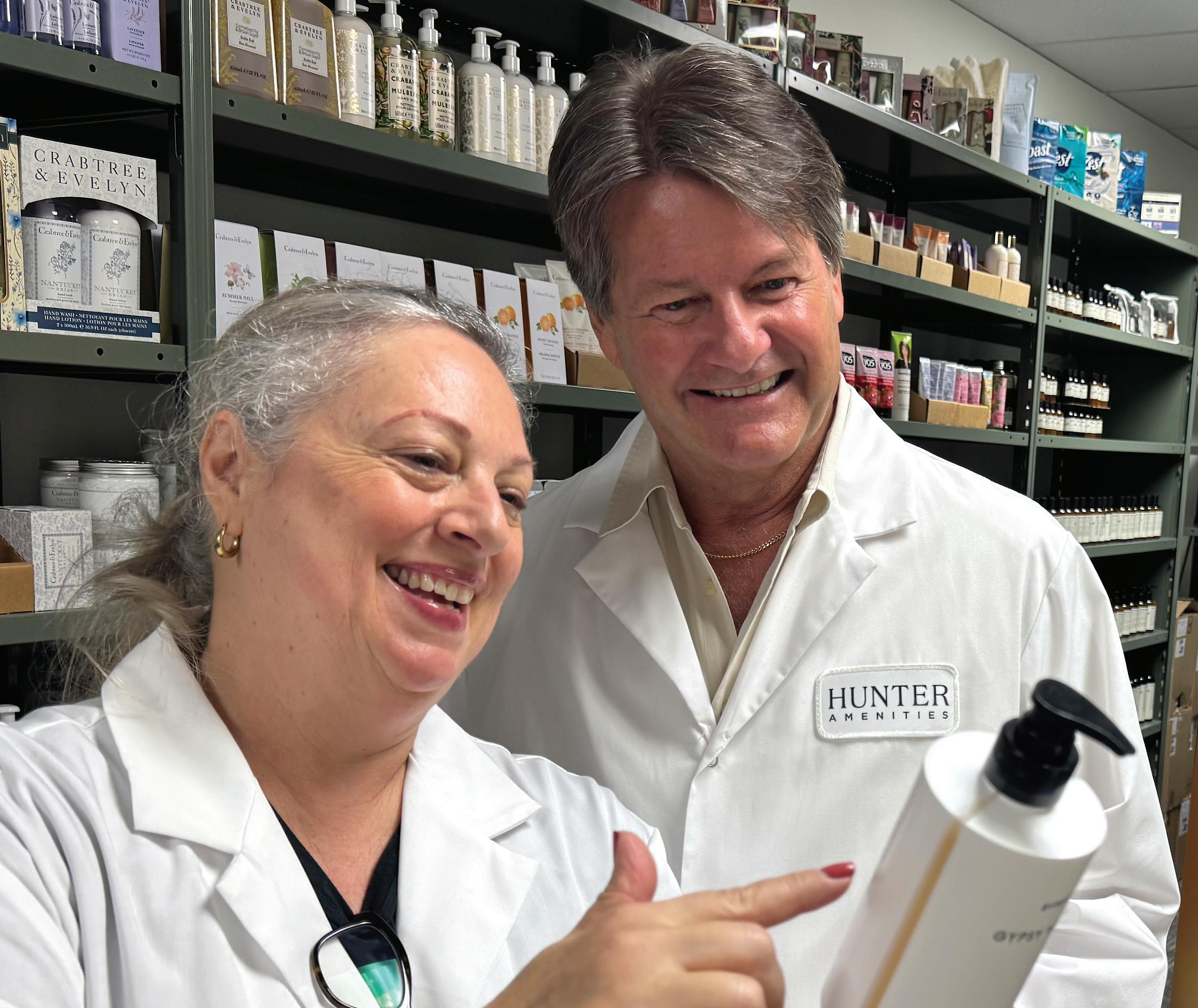
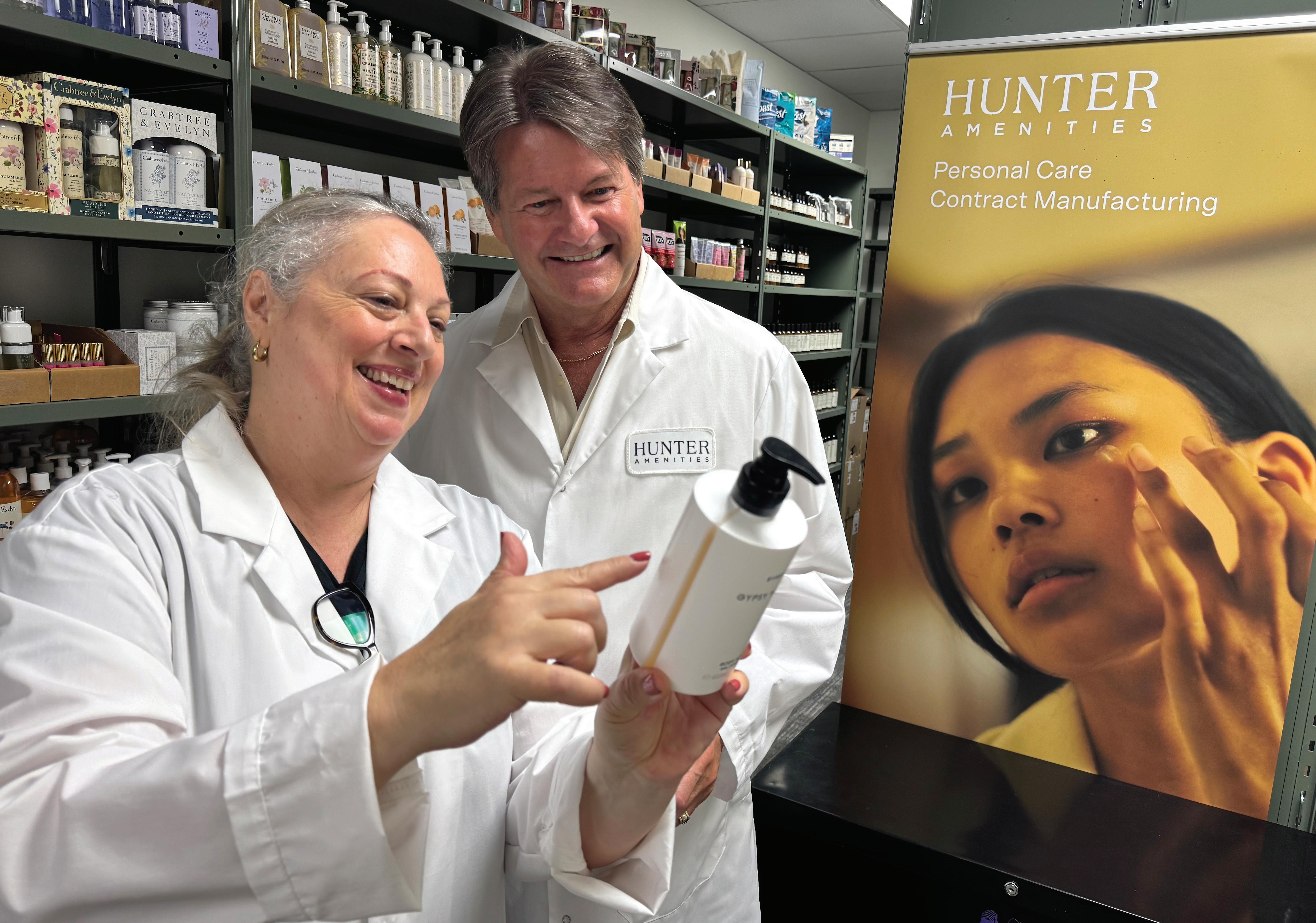
Hunter Amenities head of global marketing Jackie Charest (left) and company founder John Hunter checking out the print quality of text applied onto a pump dispenser of liquid soap processed in Burlington.
markets across the globe.
Despite stepping away from his official post as chief executive officer three years ago, founder John Hunter is still very much active in the company’s operations and strategic planning, spending a lot of time traveling the world in search of new opportunities for further expansion.
“It’s an exciting company in an exciting market, so I’m as excited about keeping us growing as I have ever been,” Hunter told Canadian Packaging in a recent interview, citing annual revenue growth of 15 to 20 per cent over the last several years.
“Although we are the largest hotel amenities supplier right now, we only account of for a tiny share of what is a $10-billion global market opportunity,” Hunter says, “so there is plenty of runway for future growth out there.”
As Hunter explains, the global amenities market is very fragmented one, with
plenty of independent hotel operators relying on all kinds of different local and regional suppliers to service their needs.
As a company priding itself on offering clients full turnkey solutions, Hunter Amenities sees a lot of promise for future growth in some of the world’s fastest-growing economies.
“We saw 33-percent growth in India last year,” says Hunter, “and China is also a very promising market.”
Hunter adds that the company is also focusing on expanding the retail side of the business—currently accounting for about 20 per cent of total sales—by enticing more leading global cosmetic brands to outsource their manufacturing to Hunter Amenities.
“We already license 46 global brands for the hospitality sector,” says Hunter, citing leading beauty companies like Estée Lauder, Beekman 1802, Aveda and
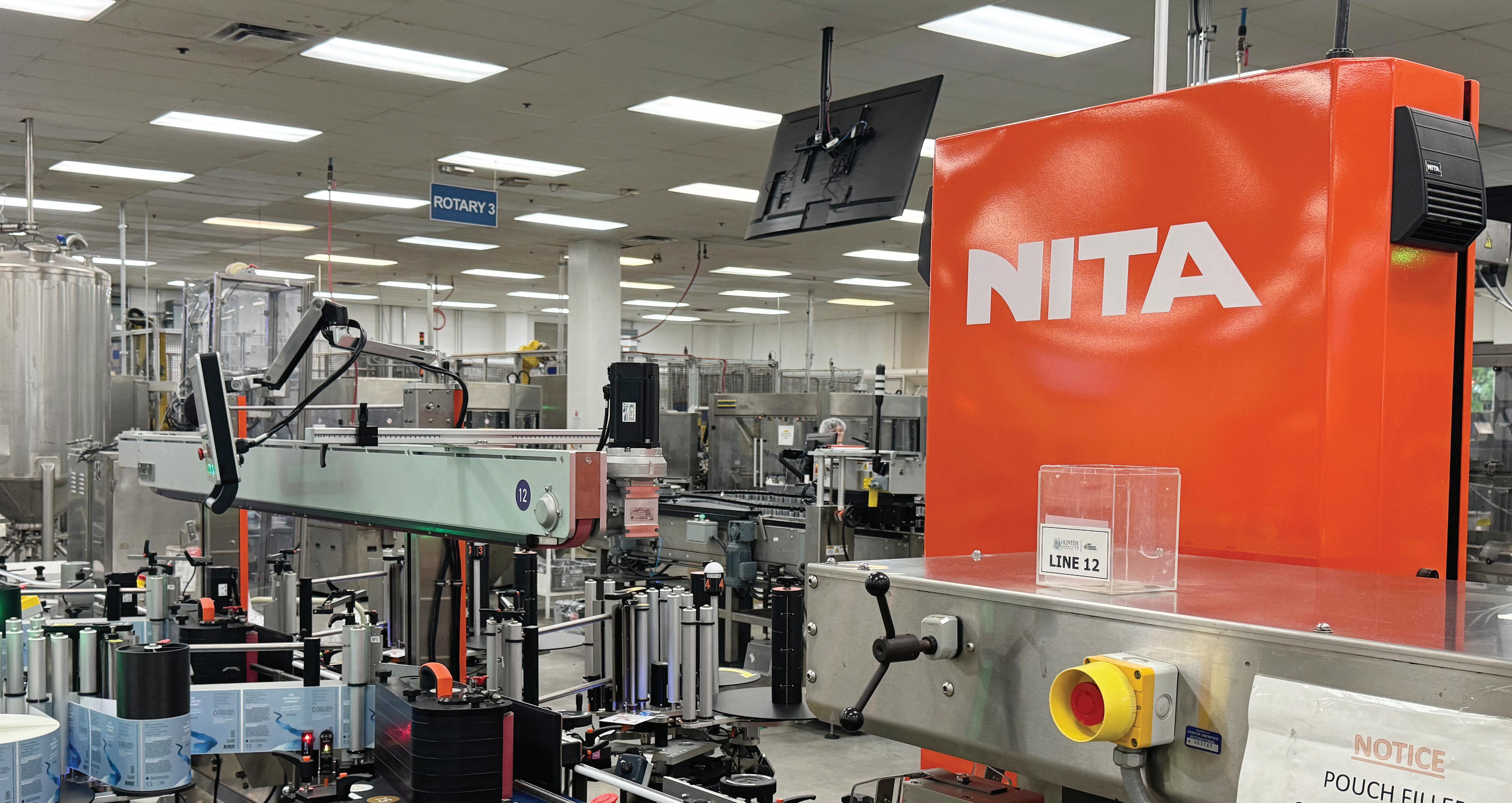
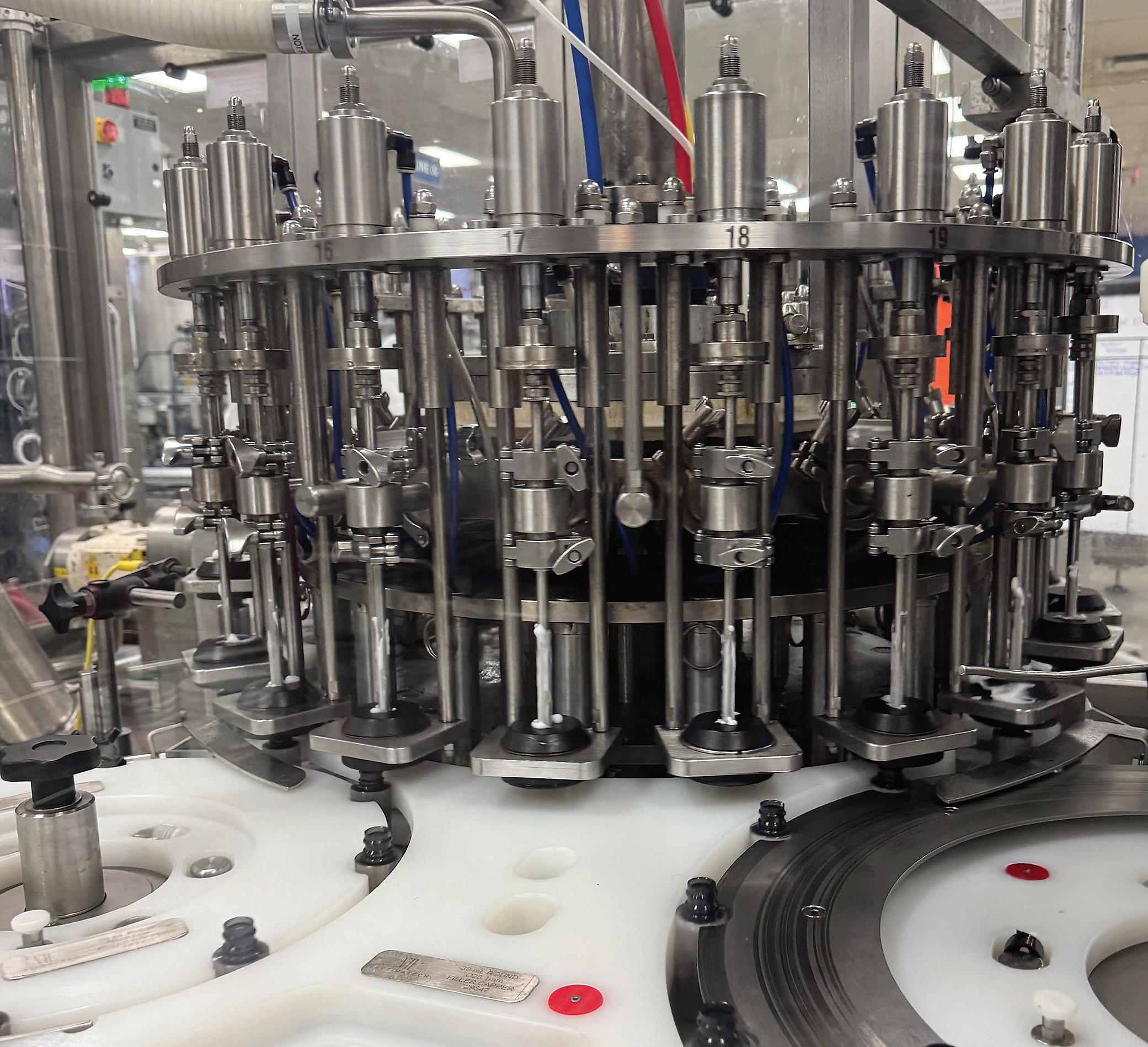
A Nita Sentient labeling system (foreground) performing high-speed labeling on filled containers of liquid beauty products manufactured
Crabtree & Evelyn as some of the company’s prestigious partners.
“We have recently won a contract to supply white-label soap products for the Whole Foods Market chain in North America, also picking up some new business with Walmart,” says Hunter, adding he expects the retail segment of the company’s business eventually to account for about a half of its total revenues, even as the amenities side of the business continues its robust growth.
As a reflection of that continuous growth, Hunter Amenities is currently in the process of further expanding its 165,000-square-foot manufacturing headquarters in Burlington, which employs -350 people on a two-shift, five-days-a-week schedule to produce well over 12 million kilograms of liquid health-and-beauty products annually.
For its part, the company’s 50-empoly-
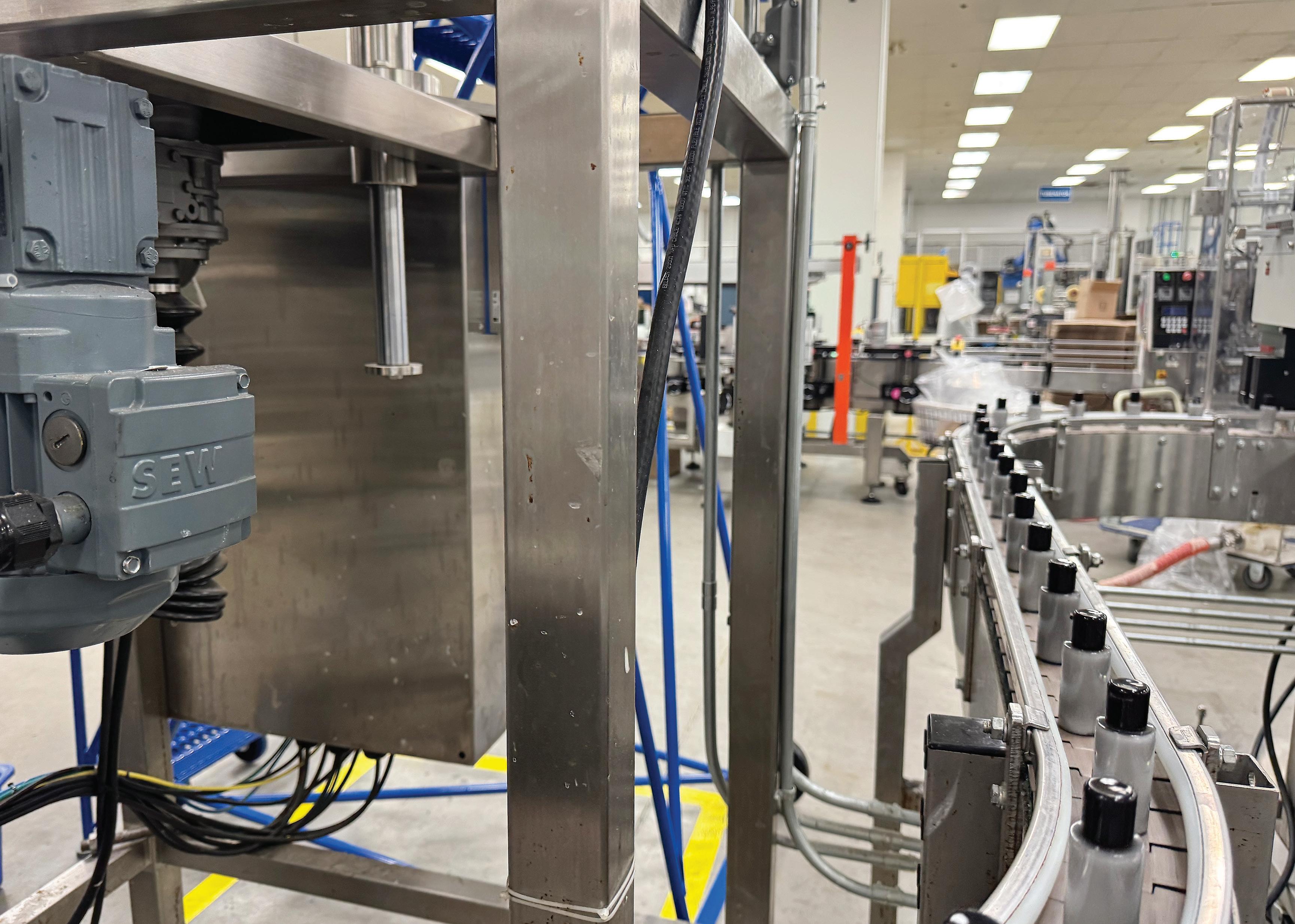
A heavy-duty SEW-Eurodrive electric motor powering the conveyor line whisking finished bottles away from the filler towards the secodary pacakging stage.
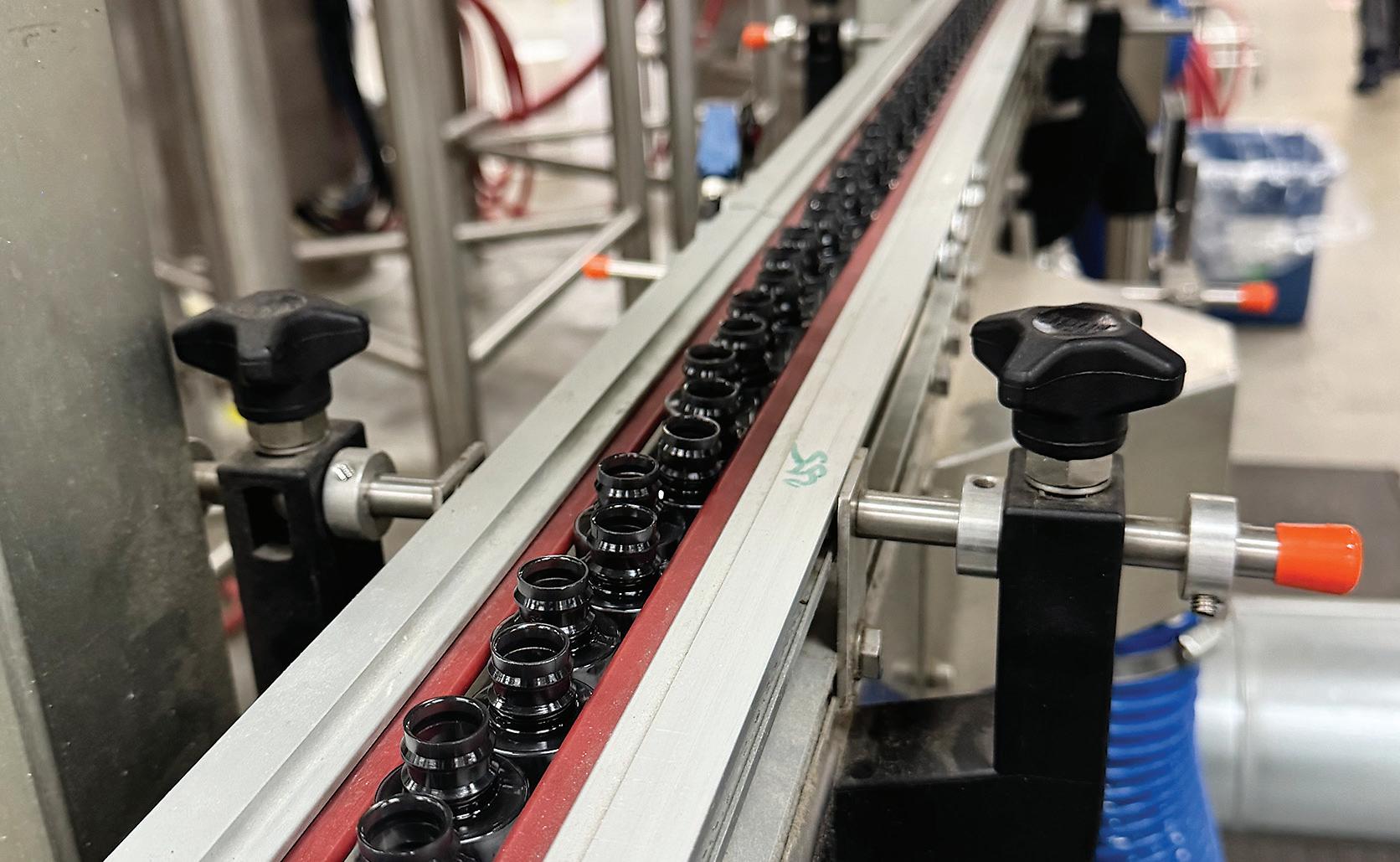
A single-file row of empty bottles making its way towards the Lanfranchi rotary filling machine.
Above right
Above left
at the Hunter Amenities facility in Burlington, Ont.
ee, 67,000-square-foot facility in Cambridge focuses on manufacturing bar soap products, producing nearly five million kilograms of bar soap last year.
With over 2,500 active SKUs (stock-keeping units) in its North American product portfolio—and about three times that number worldwide—there is naturally a lot of emphasis on making sure that the company’s packaging capabilities and performance are maintained at world-class levels at all times across the entire global organization, according to Hunter.
“Packaging innovation plays a critical role in Hunter Amenities’ marketing and product strategy,” he states.
“It is not only a key visual touchpoint that reinforces brand positioning and guest perception, but also a core driver of our sustainability commitments,” Hunter points out.
“Today’s consumers and brand partners expect packaging that looks premium,” he asserts, “while delivering meaningful environmental progress.”
While acknowledging the company’s heavy reliance on both rigid and flexible packaging materials to pack its products—ranging from single-use bottles and tubes to refillable dispensers and one-gallon bulk containers—Hunter points out the company makes concert-
ed efforts to cut its plastic footprint through lightweighting and widespread use of PCR (post-consumer recycled) plastic, along with making sure the bulk of its packaging is recyclable and/or reusable.
“As sustainability becomes increasingly central to purchasing decisions, eco-conscious packaging solutions are no longer differentiators—they are essential,” Hunter proclaims.
“To that end, we continuously invest in packaging innovation focused on reducing environmental impact through improved materials, responsible sourcing, recyclability and ongoing evaluation of emerging sustainable alternatives,” he explains. “Our global teams actively source and assess new packaging solutions to ensure we remain at the forefront of industry advancements,” says Hunter citing the company’s Gold standing in the EcoVadis global corporate sustainability rankings, as well as the international ISO 14001 standard certification for environmental management systems standards.
The company’s other important worldwide certifications include the ISO 22716 Good Manufacturing Practices (GMP) standard for cosmetics and the ISO 9001:2015 standard for quality management systems, with some
plants—including the Burlington and Cambridge locations—also boasting the ISO 45001 standard for occupational health and safety management systems and the and ISO 50001 energy management systems standard.
Says Hunter: “Achieving Gold from EcoVadis signals that our sustainability management system is not only robust but continuously improving — from climate action investments to employee well-being, responsible sourcing, and ethical governance.
“For our partners, this milestone reinforces quality, accountability and trust, which are all key differentiators in today’s sustainability driven marketplace.”
Along with an on-site Research & Development, Quality Control and Microbiology Lab and creative design services for retail and amenity products, the Burlington facility houses 16 batching kettles and tanks—enabling the preparation of a wide range of lot sizes to meet varying customer and regional requirements—and 27 dedicated packaging lines capable of filling multiple formats, including bottles, tubes, jars, and sachets.
“This configuration provides significant flexibility and throughput,” says Hunter, “allowing the operation to efficiently support high-volume demand
Clockwise from left
Close-up of the high-speed rotary filling machine manufactured by the Lanfranchi Group.
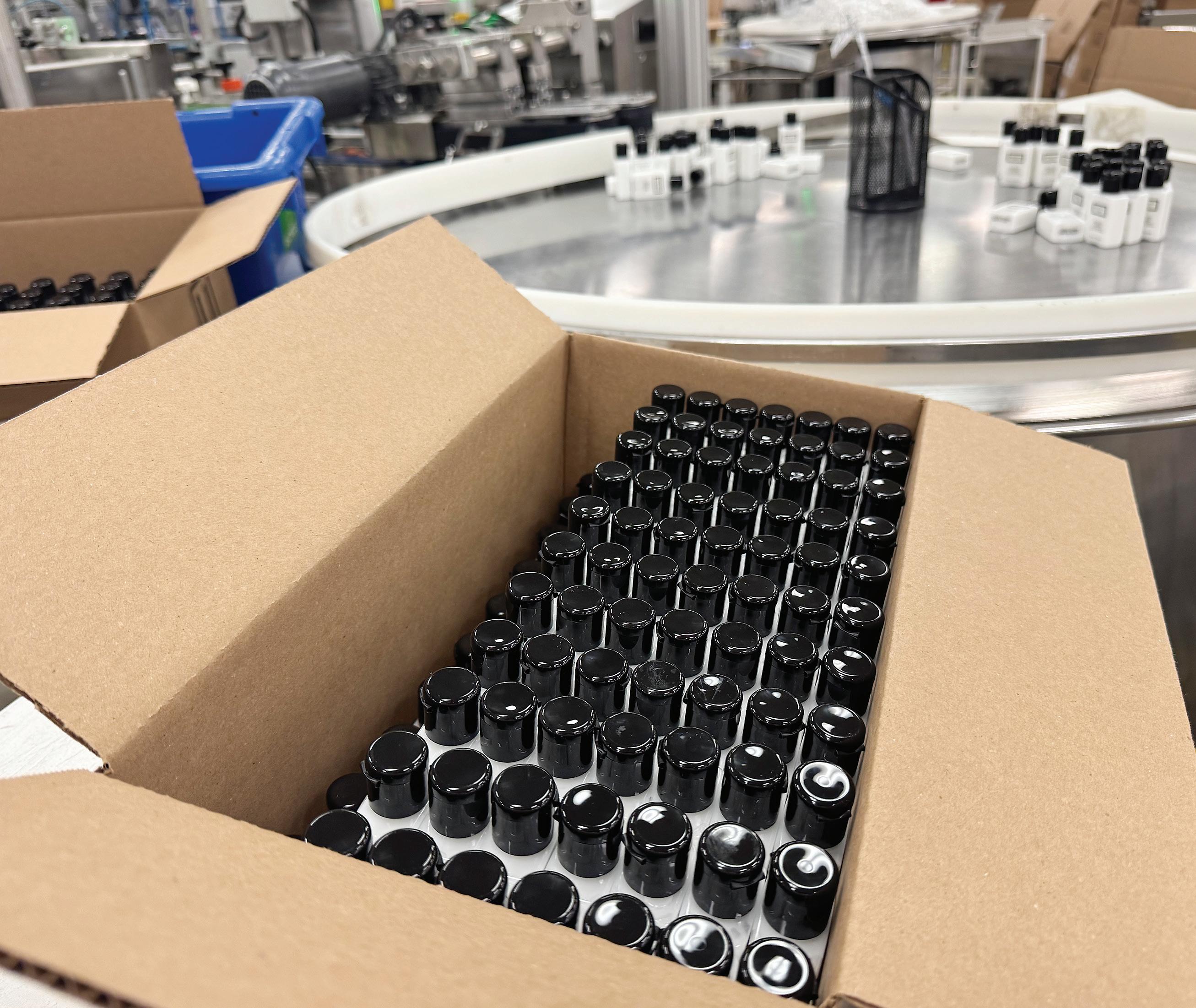
A box of filled small-format amenities in front of the Aesus accumulation table.
Company founder John Hunter started Hunter Amenities while still finishing university.
while accommodating customized, multi-format programs across hospitality, retail, and private-label customers.”
As Hunter relates, the Burlington facility has undergone several important facility upgrades in recent years to boost its productivity and line efficiencies, while also building extra capacity to accommodate future business.
“One of the most substantial recent investments was the expansion and modernization of our hot water system, effectively doubling its capacity,” Hunter relates.
“This upgrade enhances temperature accuracy for sanitization processes, heating of lotion and conditioner vessels and significantly improves changeover efficiency, supporting both current production demands and long-term scalability.
“In parallel, the facility has added approximately four to five million liters of new liquid compounding capacity per year,” Hunter adds.
“This expansion positions the operation to reach nearly 20 million litres annually—a major increase from approximately nine million liters just a few years ago,” he adds.
On the packaging side, the facility has carried out major upgrades across the filling and packaging areas, including increased capacity for gallon filling, jar filling and sachet formats, as well as enhancements to labeling capabilities.
“These improvements provide greater flexibility and throughput to support a broader range of customer programs and packaging formats,” says Hunter, also noting the addition of a dedicated cleanroom for pre-weighing of ingredients prior to compounding.
“The modernized Clean Room features controlled temperature, humidity and pressure—further strengthening the chemical pre-weighing process precision, quality control, and operational consistency.”
Says Hunter: “Collectively, these in-
vestments reinforce the facility’s role as a scalable, future-ready manufacturing hub capable of supporting Hunter Amenities’ ongoing growth and global production requirements.”
For a proud Canadian company, working with Canadian packaging equipment manufacturers to keep the plant in top shape is always a special bonding experience, Hunter reflects, singling out three Canadian equipment manufacturers— Nita Labeling Systems (labeling/coding), Septimatech (line integration) and Aesus (labeling)—for their outstanding contributions to the plant’s formidable packaging competence.
“Many technologies implemented across our production facility have been purposefully selected to drive measurable improvements in capacity, productivity and quality,” says Hunter.
“These improvements translate directly into better outcomes for our customers—fewer disruptions, greater reliability, and consistently high-quality finished products,” he states, lauding the high-speed performance levels of Nita equipment manufactured in Montreal.
“Nita labeling and coding systems play a critical role in our operations,” Hunter extols. “Their intuitive HMI and recipe-driven controls enable rapid, onthe-fly changeovers without the need to reset parameters, supporting high SKU complexity.
“The equipment delivers consistently clean, precise label application with fine adjustability during operation, which is an important advantage in a fast-paced, high-mix environment.”
Likewise, Hunter is full of praise for the “high-quality line integration and changeover tooling” supplied by packaging line solutions provider Septimatech of Waterloo, Ont.
“Their solutions are known for precision, robustness and reliability,” Hunter says, “complemented by punctual, re-
sponsive service that supports uptime and continuous improvement initiatives.”
As for the made-in-Canada Aesus labelers, “Aesus equipment has been a long-standing part of our operation,” Hunter relates, “with several systems in service for more than a decade.
“Their machinery has demonstrated strong long-term reliability and durability, reinforcing our preference for partners that deliver sustained performance over the full life-cycle of the equipment.”
As Hunter explains, all manufacturing and packaging at the facility is carried out in line with Good Manufacturing Practice (GMP) standards to ensure quality, safety, and consistency at every step of the process, which includes:
• Receiving and Preparing Materials.
Upon arrival at the facility, each item is carefully inspected to confirm it meets quality specifications before being approved for use.
Once approved, materials are clearly labelled and stored in controlled areas until needed, ensuring the right materials are used at the right time FIFO/ FEFO (first in, first out/first expired) principles.
• Weighing and Dispensing. Approved raw materials are weighed and dispensed according to controlled batch records. This activity is performed in designated areas to prevent cross contamination and mix-ups, with appropriate documentation and line clearance procedures in place.
• Manufacturing/Batching. The ingredients are combined and processed in large stainless-steel kettles and tanks.
Depending on the product and volume, this process can be fully automated, semi-automated, or supported by trained operators.
During this stage, ingredients may be mixed, heated, cooled, or blended
From Left
The palletizing workcell Installed by Consolidated Technologies incorporates a high-payload FANUC robot to handle the heavy lifting.
One of the many popular retail beauty brands co-packed at the Burlington plant.
to achieve the final formulation.
Key process conditions and mixing time are carefully monitored to ensure every batch meets strict quality standards.
All critical process parameters are defined, monitored, and recorded in accordance with approved manufacturing instructions.
• In-Process Controls and Bulk Product Holding.
Throughout manufacturing, quality checks are performed to confirm the product looks, feels and performs as expected.
Once a batch is complete, the finished bulk product is temporarily stored in holding tanks until it receives approval to move forward to packaging.
• Filling and Packaging.
Once approved, the bulk product is transferred to one of the facility’s packaging lines, which are designed to fill a wide variety of formats, including bottles, tubes, jars, and sachets using a combination of automated and semi-automated equipment.
• Sealing, Labeling and Coding.
After filling, containers proceed through sealing, labeling, and coding equipment to ensure the containers are properly sealed; properly sealed; all labels are applied correctly; and all batch numbers, expiry dates, and traceability information are accurately coded.
• Final Inspection and Distribution.
Packaged products undergo a final inspection and are reviewed by quality teams before being released for shipment.
Finished goods are released for distribution only after confirmation that all manufacturing and packaging activities meet GMP, specification, and documentation requirements.
Released products are stored and shipped under controlled conditions to maintain quality throughout distribution.
Citing sustainability and wellness as the major tends shaping the current global market, “These priorities are no longer optional,” Hunter asserts, “they are fundamental expectations among today’s consumers and brand partners.
“Hunter Amenities is deeply committed to developing innovative product and service solutions that positively impact both social and environmental landscapes,” Hunter explains. “This includes ethical and responsible sourcing, sustainable formulation practices, reductions in environmental footprint across manufacturing and packaging, and continuous investment in materials and processes that support long-term environmental stewardship.
“Wellness is the second major trend influencing our product development and manufacturing strategy,” Hunter continues. “Today’s travelers expect the same level of wellness-minded products they use at home to be available while on the road.
“Thoughtfully developed amenities that support rest and recovery, such as pillow sprays designed to aid sleep, are a strong example of how wellness translates into tangible guest value,” Hunter concludes. “This extends beyond clean formulations and ingredient transparency to the functional benefits products deliver—comfort, relaxation, and overall well-being.”
Loma Systems® Appoints New North America Sales Director
Loma Systems, the leading global manufacturer of inspection systems for food quality and safety, has appointed Tomasz Strzemecki as its North America sales director, effective 23 February 2026.
In his new role, Tomasz will lead the company’s sales strategy across North America, drive revenue growth and develop key customer and channel partnerships. He will also oversee go-to-market execution across food manufacturing and processing sectors, working closely with product, engineering and operations teams to ensure Loma’s inspection solutions continue to meet evolving requirements around safety, quality and regulatory compliance.
Tomasz brings a strong combination of technical and commercial experience to the position. He began his career servicing X-ray systems within the healthcare sector before moving into business and product management roles at Loma Systems. He subsequently transitioned into sales, where he has developed a customer-focused leadership approach and a strong track record in delivering growth.
Commenting on his appointment, Tomasz said: “Loma operates in an industry that plays a vital role in ensuring a safe food supply and I see a significant opportunity to further strengthen our position in North America. I am looking forward to working closely with our customers and partners to deliver smart, customer-driven inspection solutions, while continuing to build a highly professional and capable sales organisation.”
Tomasz will report to Louis Chatel, business unit manager, who commented: “Tomasz brings a strong combination of product expertise and proven commercial leadership that will further enhance the capabilities of our sales team. His ability to connect product strategy with frontline execution makes him exceptionally well-suited to lead our sales efforts into the next phase of growth. This blend of product insight, hands-on sales experience, and leadership positions him to deliver immediate and meaningful impact. We are delighted to welcome Tomasz to his new role.”
MatthewSerwin
joins Technorol as Vice President, Sales – Central & West
Technorol is pleased to announce the appointment of Matthew Serwin as Vice President, Sales – Central & West.
Based out of the company’s Burlington office, Serwin will lead business development and sales growth across Ontario, as well as Central and Western Canada. He will also play a key role in strengthening customer relationships and supporting the continued expansion of Technorol’s market presence.
Matthew brings extensive experience in the graphic arts industry and packaging industry, along with a strong network of contacts and well-established business relationships. His strategic mindset and deep industry knowledge will be valuable assets in driving growth and delivering value to customers across the regions.
“Joining Technorol Inc. is an exciting next step. I’m eager to work with our team and collaborate with our customers to help them achieve their highest quality potential. Together, we’ll continue to focus on our customers’ needs, add value and build more profitable, future-ready businesses.”, said Serwin.
With this appointment, Technorol continues to reinforce its leadership team and commitment to providing high-quality products, technical expertise, and customer-focused solutions across Canada.
Playful packaging to add some sizzle to a perfect date night/Rhea Gordon
Can a product name sound too odd, strange, or counterproductive to a brand image?
Not for folks at the Crappy Wine Co. of Norfolk, Ont., the cheeky company making Crappy Wine. I wondered if, on a first date, this wine could separate the snobs from the open-minded types with a healthy sense of humor? Offered in red, white or rosé varieties, each batch of the 100-percent Niagara Region products is prepared using a random variety of grapes— Vidal, Riesling, Gewurztraminer, or Pinot Noir—so that each batch takes on its own unique flavors and shades of color. This intentional inconsistency is played up with tongue-in-cheek pairing suggestions such as “Pairs well with food,” followed by, “Pairs well without food,” and “Pairs well with more Crappy Wine.” The product label itself is made to look like it’s printed on an aged, crumpled paper bag, the standard packaging accessory for the skid row brownbag imbibing, further underscored with a further claim at that bottom of the label that, “This wine is suitable for drinking directly from the bottle.” If first impressions are the only ones that matter in today’s dating scene, this VQA-certified wine may be a deal breaker or maker with its edgy name and a product label that proudly proclaims, “Wine snobs beware, this wine may not be upscale enough for you.”
Crossovers and collabs are no stranger to the Italian fashion house Dolce & Gabbana, whose high-end SMEG kitchen appliances are draped in rich, opulent jewel-toned patterns and graphics curated from D&G vintage clothing collections displaying charming graphics offering glimpses into Italy’s traditional street life and architectural features. This fashion sense also extends to the company’s Pastificio G. Di Martino brand of artisanal pasta, produced using unique low-calcium water sourced from Grangano in northern Italy, and produced using the old the bronze die-cut manufacturing technique that is claimed to be the best for captur ing sauces in a finished dish. Using strongly colored
The three varieties of Crappy Wine produced in the Niagara Region.
A colorful 500gram bag of the Made-in-Italy Pastificio G. Di Martino brand penne.
A resealable stand-up pouch of pitted dates sourced from Tunisia and Algeria.
The Oneka Elements liquid hand soap dispenser and a two-liter bulk refill pouch.
patterns and graphics of traditional tiles and drawings in bright red, yellow and navy blue assures these packages get noticed, while line drawings of various figures and symbols inject true authenticity, coyly complemented with a charming cartoon drawing of a joyful family gathering at the dinner table. The stylish package is a fitting artisanal tribute to the D&G’s iconic fashion sense.
While reaching for the shelf to grab a bottle my beloved Terra Delyssa brand olive oil, I was drawn to the stylized silhouette of a black horse set again a bright-yellow background on the standup pouch of Terra Delyssa Organic Pitted Dates sitting next it. Imported from Tunisia and Algeria by Cho Amerique of Saint-Laurent, Que., this resealable pouch shares many of the olive oil’s labeling features. Using a cropped photograph of glistening dates set against a dark background, while leaving the bottom of the pouch all-
black, helps create a perfect canvas for the pouch’s mid-section, where the mustard-yellow background and sans-serif fonts seamlessly blend with the organic and non-GMO certification logos to project a pure and wholesome image for this hand-harvested, chemical-free treat with zero fat or cholesterol content.
Based in Frelighsburg, Que., Oneka Elements produces a wonderful nourishing hand soap and shower gel combo in cedar and sage, boasting a scent that is bound to impress your guests. This particular formulation was “crafted with plants grown on our family farm and essential oils,” the product label proclaims, backing up its claim with an impressive number of certification symbols to validate the product’s vegan, biodegradable, pH balance and wild plants credentials. The most prominent of these symbols, “Certified B Corporation,” is an authoritative confirmation that the company “meets the highest standards of verified social and environmental performance, public transparency and legal accountability.” The canister’s label has a “refill me” request asking buyers to “protect the oceans” and “prevent bottles from entering the ocean,” with the option to keep the label or to peel it off without leaving residue. The Oneka two-liter refill pouch leaves you with less materials to recycle, while saving eight bucks compared to the cost of four individual soap dispensers.
RHEA GORDON is a freelance writer living in Toronto.
Clockwise from top
Unique products call for packaging that stands out. Trust Beneco for best manufacture custom folding carton paper packaging that help your brand with premium print and finish.