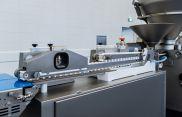
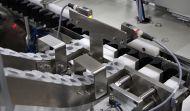
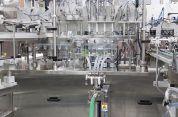
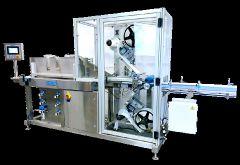
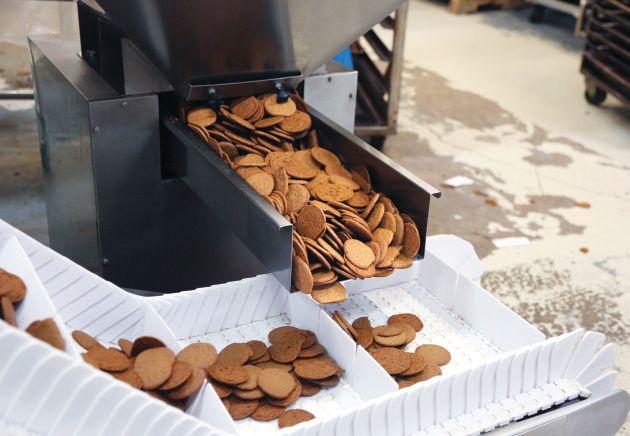
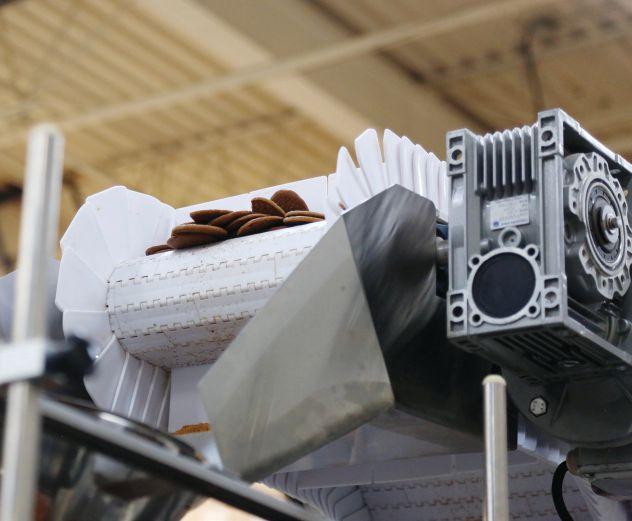
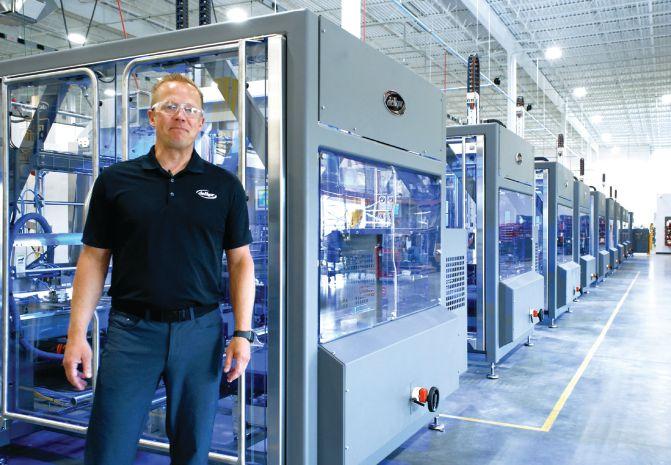
With Heat and Control, you have a partner with the scale to support your success, the innovation to advance your operations, and a commitment to quality that will help you offer better products for consumers.
COMPLETE SNACK PACKAGING SOLUTIONS
• Accumulation
• Horizontal motion conveying
• Incline, belt and bucket conveyors
• Filling and multihead weighing
• Bagmaking and casepacking
• Checkweighing and seal checking
• Foreign object and defect inspection
• Controls and information systems
We are successful when you are successful. That’s why we apply creativity, engineering excellence, and determined perseverance to every project to help our customers get the performance their business demands—whether measured by flavor, efficiencies, sustainability, improvement, or innovation.
3-6,
info@heatandcontrol.com | heatandcontrol.com
Ontario cookie maker refreshes its recipe for sweet success in the baked goods industry through proactive investment in its automation packaging competence and capabilities.
ISSN 0008-4654. Canadian Packaging is published 10 times per year by
Quebec ice cream manufacture leverages continuous innovation and product inspection technology to grow its market share in fiercely competitive premium product categories.
28 Clean Conscience
Enterprising Quebec manufacturer of biotech-engineered industrial cleaning products masters its product coding requirements with cutting-edge continuous inkjet printing technology.
33 Just in Case
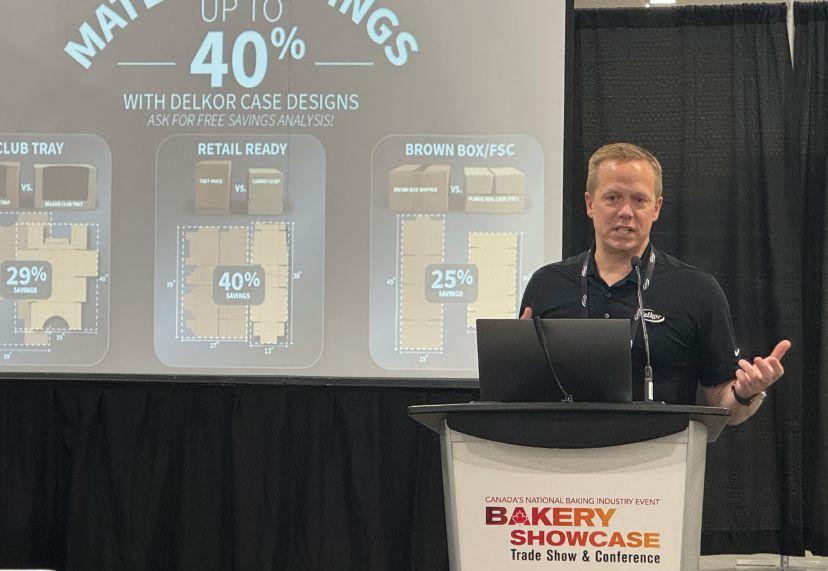
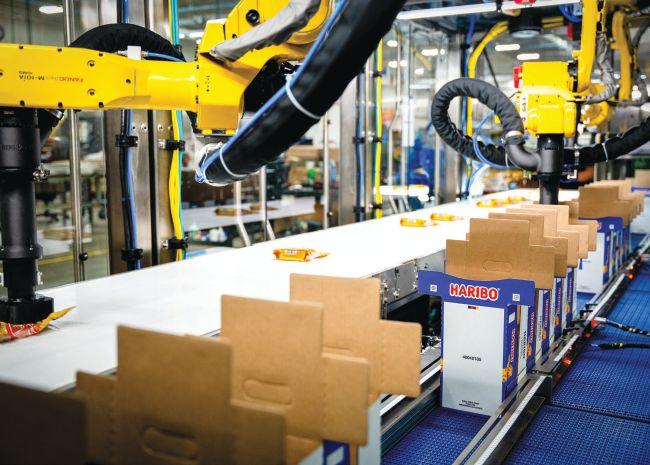
Industry expert explains how CPG companies can unlock huge cost savings through leveraging innovative new shelf-ready case designs and robotic case forming technology. COLUMNS
FROM
4 George Guidoni
Working to make e-commerce packaging enhance the consumer experience.
CHECKOUT
36 Paul Pethick
Joe Public speaks out on packaging hits and misses.
ON THE COVER
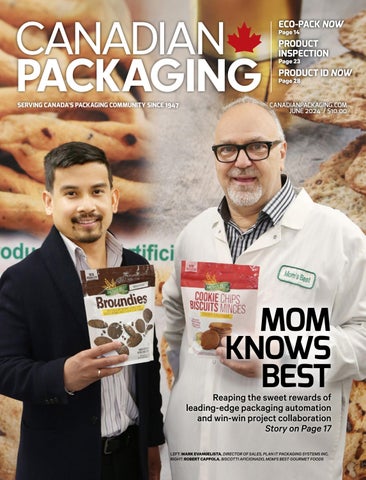
PLAN IT Packaging Systems sales director
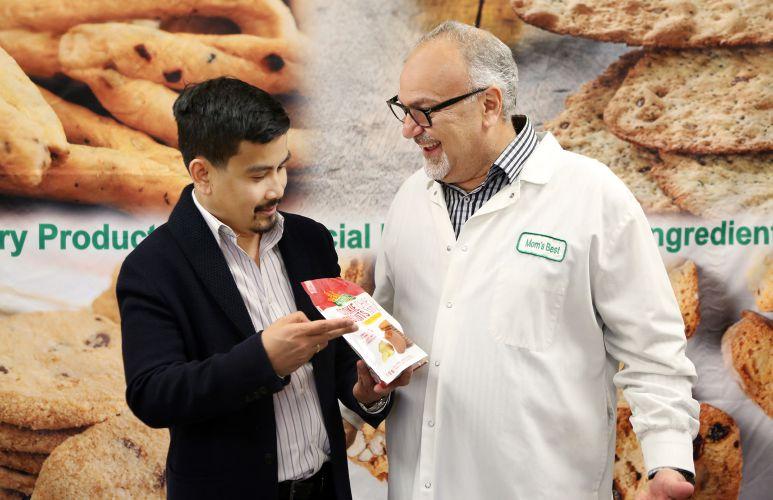
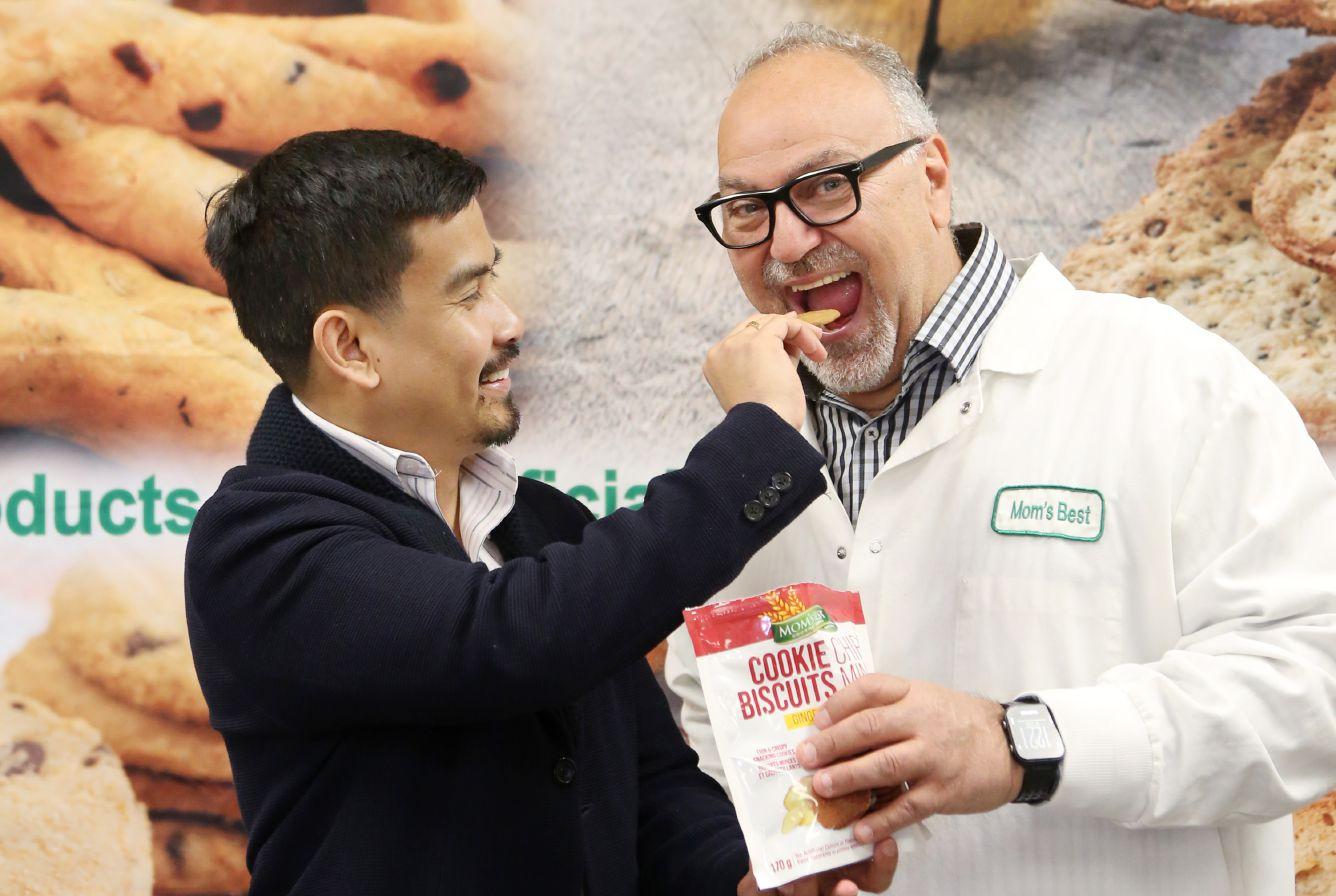
Mark Evangelista and Mom’s Best Gourmet Foods owner Robert Cappola strike a cheerful pose in the reception area of the cookie maker’s Mississauga production facility. Cover photography by Naomi Hiltz
Making e-commerce packaging enhance consumer experience
It is virtually impossible to overstate the huge impact that the unstoppable rise in the popularity of online shopping and e-commerce trade have had on the packaging business—creating ample opportunities for new packaging design and innovation that would have seemed unfathomable at the turn of the century.
the most complex processes within the e-commerce operation, impacting everything from shipping costs to the customer experience.
“Previously, manufacturers rarely considered how the packaging would be used or transported,” the Innovation in E-Commerce Packaging report observes.
JUNE 2024 | VOLUME 77, NO. 5
Reader Service
Print and digital subscription inquires or changes, please contact Angelita Potal, Customer Service Tel: 416-510-5113
apotal@annexbusinessmedia.com
Mail: 111 Gordon Baker Rd., Suite 400, Toronto, ON M2H 3R1
Senior Publisher Stephen Dean | (416) 510-5198 SDean@canadianpackaging.com
Editor George Guidoni | (416) 510-5227 GGuidoni@canadianpackaging.com
Audience Development Manager Barbara Adelt | (416) 510-5184 Fax: (416) 510-6875 badelt@annexbusinessmedia.com
US$98.2 BILLION
Projected global value of e-commerce packaging for 2025
With the notable exception of sustainability, it’s hard to think of another packaging mega-trend to rival the profound game-changing influence that the burgeoning e-commerce industry has had on packaging strategies of leading companies across virtually sector of the global CPG (consumer packaged goods) manufacturing industries and their retail customers.
Not only has it breathed new life into the realm of packaging innovation, but it has also created a growing industry-within-an-industry brimming with fresh ideas about packaging functionality, performance and circularity.
According to the Chicago-based market research firm PreScouter, the global market value of e -commerce packaging is expected to rise to US$98.2 billion next year, capping off a five-year trend of breathtaking 15-percent annual rate over the last five years.
Today, it is not uncommon to see traditional packaging machinery manufactures creating new subsidiaries or divisions dedicated solely to producing machines tailor-designed for e -commerce fulfillment, to go along with the multitude of feisty new start-ups eager to make their mark in a thriving new business sector with virtually unlimited growth potential.
Even at this relatively early stage of the e-com packaging industry’s development, there are already plenty of well-established e-commerce packaging suppliers generating hundreds of millions of dollars in annual revenues, while providing countless online retailers with many novel ways to connect with their customers.
In the U.S., these new rising stars include Conformer, Fuseneo and EcoClose, with the St. Charles, Ill.-based Conformer ringing in revenues of just under US$1 billion in 2021.
As the PreScouter e-commerce packaging study notes, “Packaging is one of
Interestingly, the study notes that most innovations in e-commerce packaging at the moment focus on packaging customization and enhanced customer experience, rather than the development of new materials.
According to Bob Makofsky, cofounder and general manager of aforementioned Conformer Products, Inc., generating consumer excitement at the point of delivery is arguably the biggest challenge that e-com packaging providers have to overcome to maintain their viability and competitiveness over the long term.
As he is quoted in the PreScouter’s report, “A lot of companies miss the mark, where there’s a disconnect between the marketing department, which wants to do all those promotion codes and talk about the next greatest product they’re launching, and the buyer, who is tasked with buying the cheapest packaging possible.
“Most of my customers don’t have retail stores: they’re entirely online,” Makofsky states.
“So that physical experience of interacting with the merchandise, especially when they first open it, is critical.
“There’s too much focus on acquiring the cheapest thing possible to get the job done when it comes to e-commerce,” Makofsky adds.
“There’s no worse buying experience than when you just receive a carton at home with your new merchandise in a plastic bag and there’s nothing else,” he points out, “and it shocks me how often that’s the norm.
“So yes,” Makofsky concludes, “I think there is a huge amount of room for improvement.”
GEORGE GUIDONI, editor GGuidoni@canadianpackaging.com
Media Designer Brooke Shaw | (519) 428-3471 bshaw@annexbusinessmedia.com
CEO Scott Jamieson SJamieson@annexbusinessmedia.com
Annex Business Media 111 Gordon Baker Rd., Suite 400, Toronto, ON M2H 3R1; Tel: 416-442-5600.
Canadian Packaging, established 1947, is published 10 times per year except for occasional combined, expanded or premium issues, which count as two subscription issues.
PRINTED IN CANADA ISSN 008-4654 (PRINT), ISSN 1929-6592 (ONLINE)
PUBLICATIONS MAIL AGREEMENT NO. 40065710
SUBSCRIPTION PRICE PER YEAR (INCLUDING ANNUAL BUYERS’ GUIDE: Canada $80.07 per year,USA $183.09 (CDN) per year, Outside Canada $207.57 (CDN) per year, Single Copy Canada $10.00.
From time to time Canadian Packaging will mail information on behalf of industry-related groups whose products and services we believe may be of interest to you. If you prefer not to receive this information, please contact our circulation department in any of the four ways listed above.
We acknowledge the [financial] support of the Government of Canada
Iconic soft cheese brand is having the last laugh with plant-based option
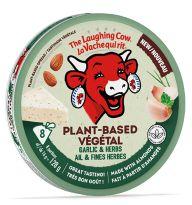
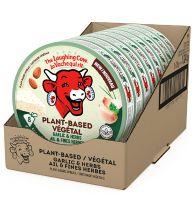
With plant-based dairy products continuing to grow at a brisk pace, Montreal-headquartered dairy giant Bel Group Canada is cheerfully leading the charge with the launch of a plant-based version of its iconic Laughing Cow brand.
Coming soon after earlier launches of the Boursin dairyfree cheese spread and the Babybel plant-based cheese snack, the new plant-based Laughing Cow completes a perfect dairy-free trifecta for the dairy’s three core retail brands.
According to the company, a subsidiary of French-headquar-
tered multinational cheesemaker Bel Group, the launch is part of the parent company’s global ambition to offer a more balanced range of products by 2030, with a 50/50 split between traditional dairy products and the fruit- and plant-based alternatives.
“This plant-based version of the Laughing Cow is bringing the brand’s experience and know-how in creamy, delicious spreadable cheeses to the plant-based category, where a better taste and textural product experience is needed,” explains Marie-Eve Robert, Bel Group Canada’s vice-president of marketing and CSR (corporate social responsibility.)
“For our plant-based offerings,
we always collaborate closely with consumers to make sure that we are getting the taste, texture, and quality just right,” Robert states.
“In fact, our consumers essentially serve as final decision-makers in all our product innovations.”
As Robert explains, sub-par taste profile has long been a key barrier to having more consumers embrace plant-based cheese alternatives, but the company has since made big strides in mimicking the desirable sensory attributes of their dairy counterparts.
In fact, a recent consumer taste test conducted among amongst flexitarian Canadians found that 94 per cent of the participants found the Laughing Cow PlantBased to be a great-tasting product.
Made with high-quality almonds imported from Spain, the new plant-based product is retailed in the iconic and convenient triangle format associated with the venerable brand—providing an efficient way to avoid food waste, as well as delivering a
perfect snack-sized appetizer or a lunch-box add-on.
Moreover, the almonds used to make the product are sourced from a highly reputable supplier who uses sustainable agricultural practices—including respecting the fauna, reusing agricultural waste, and responsible water usage.
With this launch, The Bel Group’s Canadian portfolio now comprises 57-percent plant-based and fruit products and 43-percent dairy products—contributing to the group’s global ambitions, while reducing the local carbon footprint.
Other plant-based products in the company’s portfolio include the Nurishh brand plant-based cheese alternative—available as slices, shreds and blocs—and the GoGo SqueeZ fruit sauce pouches, with both brands recording strong gains in market share.
According to Bel Canada, sales of the company’s plant-based products grew by 51 per cent in 2023 from the year before.
Rychiger
I’m sure many of us have experienced that initial encounter with someone whose name we can’t pronounce. We understand this scenario all too well since our transition from Nuspark. That’s why we have taken the initiative to provide assistance in mastering the pronunciation of our new name: RYCHIGER.
Learn how to pronounce our name with a scan
As part of the Rychiger Group we excel in delivering comprehensive solutions, from filling, and sealing, cartoning, case packing, tray loading, and palletizing equipment.
www.rychiger.com/pronunciation
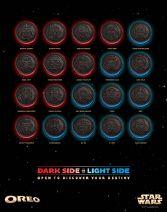
a pack won’t actually know which side they are on until they open the elaborately designed packaging.
That’s because the Special Edition Star Wars OREO Cookie Packs feature differing embossments of corresponding dark side and light side characters and include red or blue creme, respectively, infused with “kyber” (sugar) crystals—inspired by the crystals found in the LIGHTSABER swords.
“The tremendous fandom between Star Wars and the OREO brand has made this strategic partnership such a fun collaboration, and we hope fan bases of both communities are just as excited about the launch of Star Wars OREO Cookie Packs as we are,” says Colleen Bowker, OREO brand manager for Canada.
“The OREO brand always strives to connect with our dedicated fans in new and unexpected ways through culturally relevant moments— making this partnership between two iconic properties such a natural fit.”
Designed by leading global branding services provider Bulletproof, the stunning Star Wars-themed packaging pays homage to the film franchise’s enduring legacy and popularity by deftly incorporating the original character artwork hand-painted by the legendary illustrator Greg Hildebrandt, an iconic Star Wars poster artist since 1977.
On each cookie, fans will find embossments of corresponding dark side and light side characters such as Darth Vader, Darth Maul and a stormtrooper for the dark side pack, or Luke Skywalker, Yoda and Princess Leia for the light side pack.
With 10 characters each across the two varieties, the Special Edition Star Wars OREO Cookie Packs feature 20 distinct characters in total. (Picture Above)
According to Mondelēz, the OREO brand cookies are available in over 100 countries around the world, with an estimated 60 billion OREO cookies sold each year, with about 20 billion in the U.S. alone.
The company estimates that more than 500 billion OREO cookies have been sold since the first OREO biscuit was developed in 1912.
With 2023 net revenues of approximately $36 billion, Mondelēz is leading the future of snacking with iconic global and local brands such as Ritz, LU, Clif Bar and Tate’s Bake Shop biscuits and baked snacks, as well as Cadbury Dairy Milk, Milka and Toblerone chocolates.
PET bottles and cans packaged without plastic? No problem with the renewable, paper-based packaging solution LitePac Top from Krones!
Swiss-based automated packaging machinery manufacturer Rychiger AG says it has completed the integration of Toronto-based secondary packaging systems builder Nuspark Inc., which it acquired in July of 2019, into its global operations. As a result, all the machinery previously marketed under the Nuspark brand will now be manufactured under the Rychiger brand label as part of the company’s strategy to expand its presence in the North American market, while providing a global platform for end-of-the-line packaging solutions manufactured by the renamed Rychiger Canada, now part of the Rychiger NA subsidiary operating out of Cary, Ill. “The completion of the Nuspark acquisition and brand transition marks an important chapter in our company’s history,” says Marco Stalder, chief executive officer of Rychiger Canada. “By integrating Nuspark’s expertise and product offerings into the Rychiger brand, we aim to enhance
value for our customers and provide them with a more comprehensive range of solutions to meet their packaging needs.”
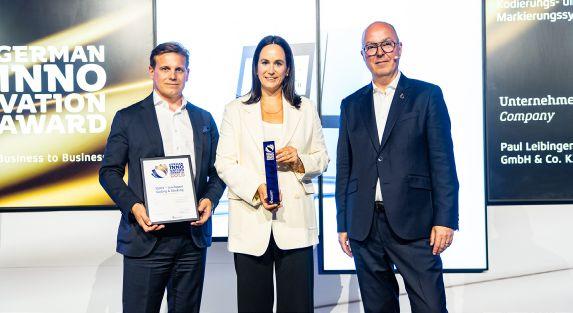
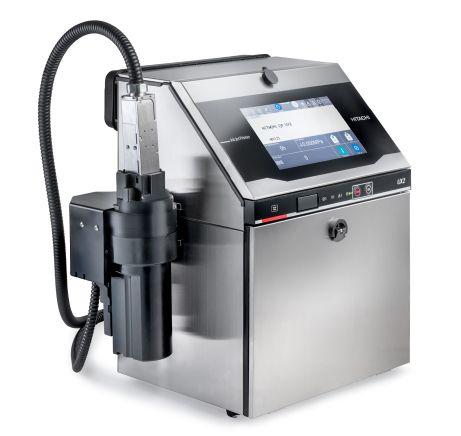
German product coding and marking systems manufacturer Paul Leibinger GmbH & Co. KG has been presented the prestigious Gold German Innovation award of the German Design Council for the company’s high-performance IQJET
industrial printer, along with special recognition as Germany’s Innovator of the Year 2024. According to the award judging panel, the IQJET continuous inkjet (CIJ) system “offers industries an optimal solution for marking their products” by generating prints texts, logos and codes on a wide variety of surfaces including metal, plastic, glass and paper, while lowering operating costs by 30 per cent and significantly reducing the
environmental footprint through low consumption of energy, ink and solvents. According to the company’s chief executive officer Christina Leibinger, “We have set a goal to continuously optimize industrial CIJ printing and take a leading role as a provider of innovative coding and marking technology.” Adds chief operating officer Jan van het Reve: “Our developments are always focused on benefiting the customer, meaning that with the Leibinger printers we aim to make a significant contribution to operating cost optimization, sustainability, and efficiency in manufacturing and packaging lines worldwide.”
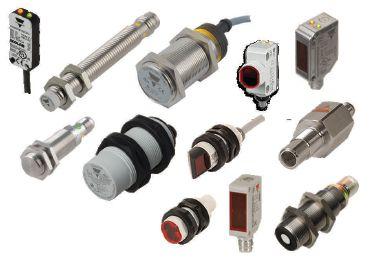
CARLO GAVAZZI has the solution for your application needs, whether it’s our industry leading solid state relays & contactors, energy meters, monitoring relays, soft starters or sensors, available with or without IO-Link.
CONTROLS: AC and DC Energy Meters and Transducers • Universal Web Platform • CurrentVoltage- and 3-Phase Monitoring Relays • Current Transformers • Timers • Panel Meters
Contact us today, and one of our field sales representatives will show you why we are one of the fastest growing automation companies worldwide. We’ll even provide a free evaluation sample to qualified OEMs.
The Metsä
of leading Finnish paper products manufacturer
Leibinger’s chief executive officer Christina Leibinger (center) and chief operating officer Jan van het Reve (left) accepting the German Innovation Award at a gala ceremony in Berlin last month.
Metsä Group has officially inaugurated its upgraded folding boxboard machine at the company’s integrated mill in Husum, Sweden, which produces producing folding boxboard, uncoated white kraftliner and bleached chemical pulp. Originally started up in 2016, the BM1 folding boxboard machine has undergone about $335 million in various capital upgrades over the last four years to boost annual manufacturing capacity from 400,000 to 600,000 tonnes— making it Europe’s largest and most modern machine of its kind. Powered almost entirely by renewable energy, the machine’s upgrades included the extension of the board machine’s drying section,instllation of a new winder and an automated reel handling system, and dtrat-up of a new, fully-automatic machine roll transfer and control system. “The combination of the most modern available technologies with a very high degree of automation solutions gives us both a safer mill as well as lots of new improvement opportunities,” says Husum mill’s vice-president Olov Winblad. Adds Metsä Group’s chief executive officer Mika Joukio: “With the investment in the folding boxboard capacity at Husum, Metsä Board is well-positioned to meet the growing demand for fiber-based packaging materials by supporting our customers with high quality and resource-efficient solutions that help replace fossil-based materials.” According to Metsä Board, the additional capacity will be directed mainly to the North American and European markets.
Austrian-headquartered ALPLA Group, a major global manufacturer of plastic processing and recycling machinery, has announced formation of the new ALPLAinject division as part of the company’s strategy to concentrate all of the company’s injection molding expertise and capacity under one brand in order to increase operational efficiencies, speed up the market launch of new products, and unlock new market segments for high-quality injection-moulded parts such as closures, caps and jars, as well as multi-part packaging components such as pumps or deodorant sticks.
blow moulding and compression moulding technologies to manufacture closures, caps, jars and complex multi-part packaging components made of plastic. As the compony explains, the ALPLAinject brand comprises three core technologies— injection blowmolding, compression molding and addition to injection moulding— as well as global toolmaking, development and sales under one organizational structure operating global teams in nine regions worldwide. “The injection molding sector offers enormous potential and is one of our strategic
growth drivers,” says ALPLA’s chief executive officer CEO Philipp Lehner. “The competitive market environment requires maximum cost effectiveness and flexibility [and] as its own injection molding division, ALPLAinject will continue to ensure our competitiveness in the future.”
Cincinnati, Ohio-headquartered packaging machinery manufacturing group ProMach has completed the acquisition of Etiflex, a major producer of pressure-sensitive and RFID (radio frequency identification) labels based in Mexico City. Founded in 1981, Etiflex is one of the leading converters in Mexico for variable information-printed labels, tickets and RFID labeling, with its extensive portfolio of label converting solutions serving a broad range of industries including food-and-beverage, textile, automotive, personal care, cosmetics, pharmaceutical, retail and logistics. “This addition to our business significantly extends our ability to offer a complete portfolio of labeling equipment solutions beyond our existing markets in the U.S. and Canada,” says ProMach president and chief executive officer Mark Anderson. “This acquisition truly supports our commitment to provide best-inclass labeling and coding solutions and support from a partner that is geographically close to our customers, wherever they are located throughout North America.”
SICK, Inc., the North American subsidiary of leading German industrial sensor technologies
manufacturer SICK AG, has officially commenced a US$64-million expansion of its SICK Office and Customer Resource Building facility in Bloomington, Minn., which also serves as the company’s North American headquarters. Operating in the Minneapolis region since 1975, the company’s ambitious expansion plans call for and additional 139,000 square feet on four floors, each designed with purpose and functionality of labs including engineering, vision software and applications, robotics, conveyors, and R&D (research & development). The announced investment also calls for construction of a seven-level parking ramp, with primary use by SICK employees, to complete a state-ofthe-art customer conferencing and training space. (See Picture) “In the ever-evolving landscape of innovation, we at SICK find our compass pointing toward a future where technology and human ingenuity converge, where knowledge meets action,” says SICK Inc.’s president of sales Ron Jubis, adding that the Bloomington campus will be the central connector for SICK’s customers and regional North American offices located in Boston, Houston, Detroit, San Francisco, Toronto and Calgary.
SACHET CACHET
The new ConPro Sachet System from Handtmann Group is claimed to be a groundbreaking technology that offers a sustainable and innovative packaging solution for a wide range of food products. Intended for packaging fluid or pasty food products—from jams and cheeses to energy gels and meat snacks—inside small, perfectly portioned edible sachets made from alginate, a seaweed-based material, the ConPro Sachet System offers a highly innovative solution for both the food industry and eco-conscious consumers looking for convenient, innovative and environmentally-friendly options. Unlike traditional plastic packaging, these alginate packets are completely edible and biodegradable, according to Handtmann, breaking down organically within weeks. Developed using the company’s proprietary coextruding technologies to create exceptionally thin, yet highly effective alginate packaging, along with the ability to portion small, separated volumes at high speeds—preventing any squeezing or loss of contents at the sachet ends—the eco-friendly sachets offer a broad range of potential applications, including nutritional supplements, sauces and jellies, cheese snacks and salami pillows, among others.
Handtmann Canada Ltd.
SIMPLY ELECTRIC
Featuring a slim design with no air-tubing or cabling, the new all-electric piCobot heads from Piab AB are said to be the most versatile and energy-efficient electric pump units for cobot applications, according to the company. Featuring various accessories to match the application at hand, the two electric models are deigned to achieve the same performance levels as the conventional air-driven grippers without the need for compressed air—making them ideal for use in confined workspaces without a compressed air infrastructure. Designed for direct mounting ono the robotic arm, the energy-efficient grippers operate by using the electric current provided by the cobot itself, while the absence of entangling air tubing and cabling greatly simplifies the installation by requiring only a single connection on the cobot arm to enable true plug-and-play operation with completely unrestricted movement.
Piab AB
MOVING THE NEEDLE
TurboFil Packaging Machines LLC has enhanced the company’s recently introduced TipFil syringe filling and assembly machine to enable it to handle up to 80 syringes per minute in a fully-automated start-to-finish process—from syringe loading, filling and capping through inspection, labeling and
printing. The servo-driven, intermittent-motion machine incorporates a racetrack indexing system for rapid and reliable throughput, and it can be outfitted with interchangeable pucks to accommodate syringes with fill volumes from one to 60-ml, while also handling a wide range of product viscosities. Ergonomically designed for efficient operation, the TipFil syringe filling and assembly machine features a 10-inch touchscreen HMI (human-machine interface), an Allen-Bradley PLC (programmable logic controller), three password levels for access protection, Ethernet capabilities to allow for remote diagnostics, and easily identifiable buttons for emergency stop, reset, and circuit breaker-enabled on/off function for expedient line stoppage and intervention.
TurboFil Packaging Machines LLC
HIGHER GRADES
Aesus Packaging Systems has completed major upgrades to its Eco and Delta series labelers to enable enhanced packaging operations with improved efficiency, precision and versatility, including:
• Enhanced economical precision for the Eco
Wrap labeler to provide greater cost-effectiveness for small to medium production lines requiring accurate labeling, enhanced product presentation and operational efficiency.
• Advanced user interface for quick-changeovers capabilities on the Eco Wrap labeler to help minimize downtime and maximize productivity.
• Increased versatility for both Eco and Delta labelers to enable them to handle a broader range of container shapes and sizes in order to adapt to the diverse needs of various industries, while ensuring a seamless and flexible packaging process.
• Cutting-edge technology featuring the latest in automated adjustments and error detection on the upgraded Delta Panel Labeler—ensuring consistent, high-quality labeling with minimal waste, precise application, reduced errors and enhanced overall efficiency. Says Aesus director of marketing Andreas Pollmueller: “The upgraded Eco and Delta Labelers exemplify our commitment to addressing the unique challenges our clients face daily. We are excited to see how these enhanced products will further revolutionize packaging efficiency for them.”
Aesus Packaging Systems
New carrier bag offers a more sustainable shopping solution
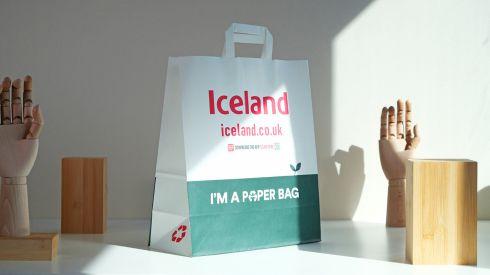
Iceland Foods, one of Britain’s fastest-growing and most innovative grocery retailers, has introduced a strong, lightweight, reusable and moisture-resistant carrier bag made of wood fiberbased Paptic material.
Available at all of the grocery chain’s stores, the wood fibers used in constructing the bag are all sourced from certified sustainably managed forests, while the reusable bag itself can be safely recycled with paper or cardboard at the end of its life-span.
“We continuously look for ways to improve our offering for our customers and to meet our ambitious sustainability goals,” says Mark Armstrong, senior packaging technologist at Iceland Foods.
“Therefore, after an extensive period of piloting this bag in stores
across the country we have moved to switch to offering paper bags by Paptic as the best choice for our customers and the environment.”
As Armstrong explains, the Paptic bag offers highly effective moisture-resistance, reusability and recyclability, while using 40 per cent less raw materials than other strong paper alternatives.
Designed to handle carrying of heavy, wet and frozen goods—even on longer journeys—the new bag is also designed for reusability, as it easily folds and remains functional over multiple uses.
“We will introduce this new bag in all our stores across the U.K., including the Food Warehouse, over the next few months,” Arm-
strong states.
“We are thrilled about this major development and our close cooperation with Iceland Food,” says Jukka Rovamaa, business segment director at Paptic Ltd. in Espoo, Finland. “This step confirms that our material is well-designed for this purpose and provides superior benefits—combining functional, cost and sustainability performance—versus conventional materials.
“We believe that this will help Iceland Foods further reduce the use of plastic carrier bags overall and strengthen its brand position as a leader in innovation and sustainability,” Rovamaa sums up.
“By choosing Paptic, Iceland Foods opts for a carrier bag solution that makes sense both today and in the future.”
New paper wrapping solution for eco-friendlier transport
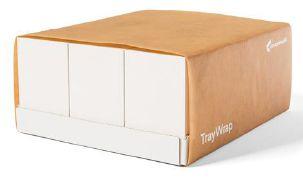
Packaging sustainability is often a team game, and it took some exceptional teamwork between leading Austrian consumer packaging product group Mondi and German machine-builder Meurer Packaging Systems GmbH to create a breakthrough sustainable alternative to plastic film for holding and protecting food and drink product during transportation.
Called TrayWrap , the new paper solution is made with Mondi’s Advantage StretchWrap paper wrap, which is already being used by a major coffee brand to secure 12 large-sized coffee cartons for transportation across Sweden.
The paper wrap holds the coffee packs tightly in place with four to six adhesive dots on the bottom side of the existing corrugated tray, utilizing pre-punched folding
points to ensure stability on each open side so that the products can be seen, stacked, transported, and easily unpacked for sale.
According to Mondi, the Advantage StretchWrap is 100-percent kraft paper made from renewable resources. With no coating, it is fully-recyclable and easy for retailers to dispose in Europe’s existing paper recycling streams.
Moreover, the new solution has a unique combination of mechanical properties. In addition to high stretch and superior puncture resistance, it also exhibits very good stretchability—making this solution also suitable for grouped packaging applications, in line with future regulatory requirements in Europe.
By working closely with Meurer, Mondi has been able to ensure that existing machinery can be adapted to accommodate this new solution.
In fact, Meurer’s latest PHM (Paper Hood Machine) system uses inline paper technology that has higher resistance against mechanical stress, which enables it to process a wide range of paper grades, including Advantage StretchWrap, and tray formats.
Being similar to the technology used for film stretchwrapping, it makes it easy for food and drink producers to modify existing processes, as opposed to investing in new machines altogether.
“Our aim is to be always innovating and providing solutions that
work for the product, the customer and the environment,” says Larsgoran Berglund, Mondi’s business development manager for kraft paper. “By working closely with Meurer, we are jointly mapping out a path to sustainability that is convenient for customers—supporting them in achieving their own sustainability goals.”
Adds Meurer’s senior global key account manager Jens Averbeck: “We are delighted to be developing solutions to provide food and drink producers with effective and secure packaging solutions that reduce or replace unnecessary plastic.
“This is just one example of how effective paper can be in securing goods,” Averbeck states, “and we look forward working with more food producers with this product and process, tackling today’s challenges in the FMCG (fast-moving consumer goods) industries.”
Packaging Circularity Course | Early bird rates until June 28
*This course can be taken in full or register for individual modules*
Intro to Packaging Circularity/Sustainability | September 10
Elimination, Food Loss & Waste, Safety, Quality and Compliance | October 1
Delivered by industry experts, the PAC Global Packaging Certificate Program has been designed to meet the needs of international professionals in the packaging value chain, whether new to industry or tenured. For more information, visit www.pac.global/education.
BIG OPPORTUNITY
CANADIAN PACKAGING ANNUAL BUYERS’ GUIDE AUDIENCE:
• 14,000 print copies addressed by name to Canada’s top packaging buying influences.
• Digital version e-blasts to 13,000 opt-in e-audience.
BONUS: FREE listing links for Buyers’ Guide advertisers on Category Captains drop-down digital directory on www.canadianpackaging.com (Up to 6 categories)
PLAN IT
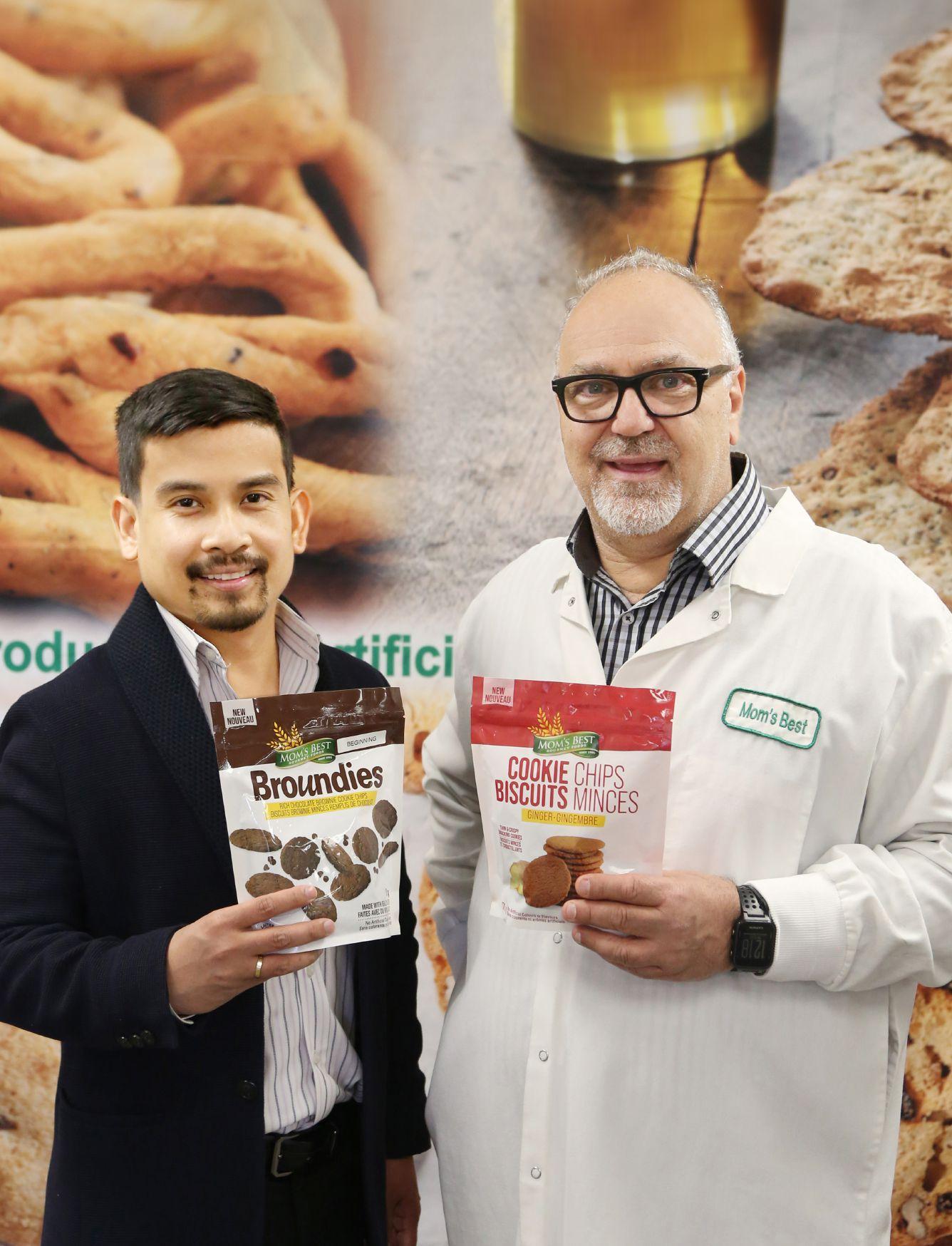
Packaging Systems sales director Mark Evangelista shares a light moment with Mom’s Best Gourmet Foods owner Robert Cappola at the cookie maker’s production facility in Mississauga, Ont.
JUST LIKE MOM’S
Stand-up pouch line automation overhaul hits all the right productivity and performance sweet spots for fast-growing Ontario cookie maker
By George Guidoni, Editor
Photos by Naomi Hiltz
One of the sweetest underrated perks of being the boss of your own company is the complete freedom to give yourself whatever job title you like, no questions asked.
And for Robert Cappola, the affable owner of the Mississauga, Ont.-based cookie maker Mom’s Best Gourmet Foods, his self-styled, tongue-in-cheek professional designation as Biscotti Aficionado is a perfect reflection of his intense passion and devotion to the art of making the famed Italian almond biscuits originated in the Tuscan city of Prato during the 19th Century.
Having spent a good part of his working life helping his family run a highly successful meat-processing business in the GTA (Greater Toronto Area) region, Cappola decided to carve his own path to success in the Canadian food business about five years ago by purchasing Mom’s Best from its original co-found-
ers, two ladies of Italian heritage who literally started the company out of their home kitchens back in 1995.
While Cappola says the company’s biscottis are still made using traditional authentic Italian baking techniques and recipes, the sheer volume of biscottis produced at the 26,000-square-foot commercial bakery—located a half-hour drive west of Toronto—has grown exponentially, along with the product’s popularity in mainstream markets across North America.
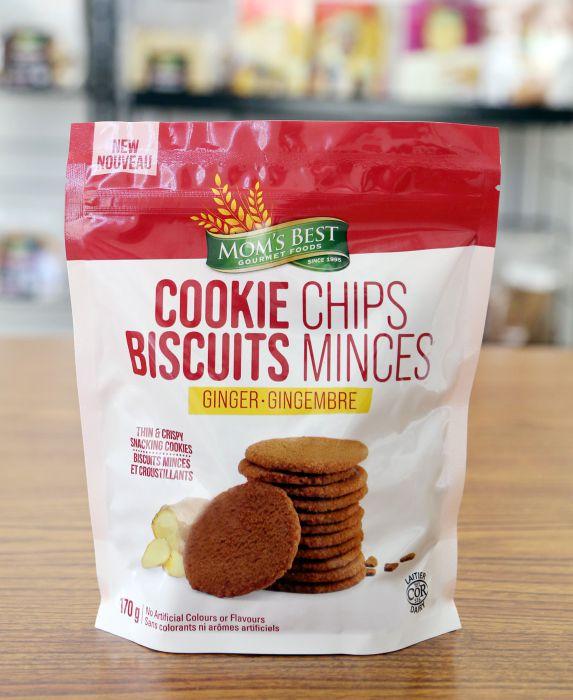
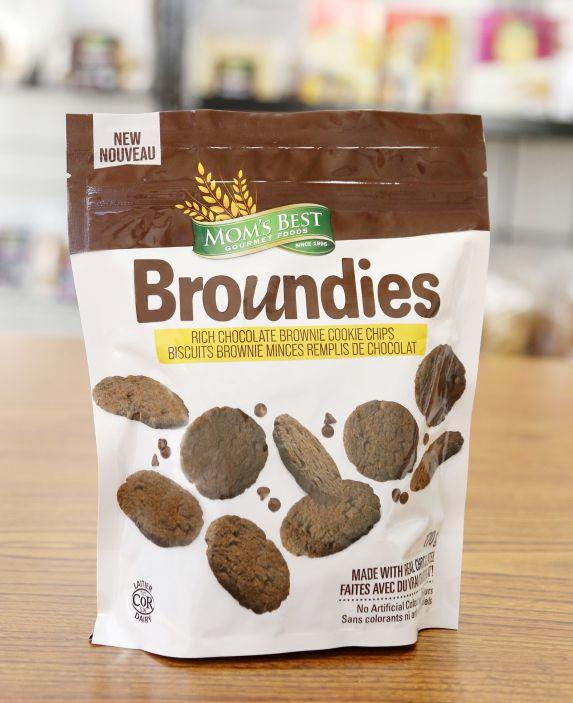
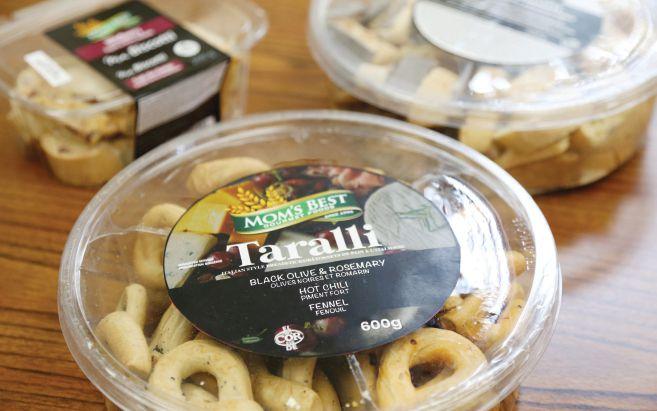
According to Cappola, the 30-employee company nowadays produces about 8,000 pounds of finished baked goods per day, with its product portfolio also comprising various flavors of bitesized “cookie chips,” which are today the company’s best-selling product line, and ring-shaped taralli biscuits, another crunchy Italian snack specialty originated in southern Italy.
“They are essentially Italian crunch bread rings with a soft texture on the inside,” Cappola explains, extoling the
taste profile, quality and the clean ingredient deck of all products made at the Mississauga bakery, which boasts the coveted international SQF Level 1 certification for food safety and quality.
“We achieved a 96-percent score during our last SQF audit last year,” Coppola relates, “and we intend to improve on that going forward.”
While hard-baked treats like biscotti and taralli have been a daily staples among Italian-Canadian families for generations, Cappola says they are quickly becoming a popular items among all other mainstream demographics, enjoying brisk sales at coffee shops and other quick-service eateries across the country.
For Mom’s Best, which Cappola estimate to command a 60-percent share of the Canadian biscotti market, this growing popularity is a welcome gift that just keeps on giving.
“It is a very wholesome product made without any artificial ingredients or preservatives,” says Cappola, citing the plant’s Kosher certification and complete absence of saturated fats.
“We only use four primary ingredients—flour, butter, sugar and oil—which we all source from local Canadian suppliers,” he says.
“Moreover, we still use the traditional batch process to make our products to ensure superior product quality and taste,” he says, “and the market has really responded to our products’ authenticity and craftsmanship.”
According to Cappola, about 60 per cent of the plant’s output is dedicated to producing the company’s signature Mom’s Best retail brand, with the private-label and co-packing accounting for the rest.
“You can find us at all the major grocery chains and major independent stores right across Canada,” he says, “and we also ship our products right across North America, as far as California.
“Being a premium-quality product, it is primarily sold right at the bakery sections of the grocery stores,” Cappola points out.
“We do have a couple of SKUs (stock-keeping units) designated for cookie aisle shelves,” he says, “but the vast majority of our retail sales take place at the bakery counters.”
As Cappola relates, the Mississauga bakery primarily operates on a one-shift, Monday-to-Friday schedule, but it often switches over to two-shift production schedule to keep up with seasonal demand spikes, which typically begin in July and last right up through the festive Christmas season.
Says Cappola: “There was a time when products like biscotti were geared for sale to the local Italian communities,
“We still use the traditional batch process to ensure superior quality and taste, and the market has really responded.”
The Mom’s Best production facility houses a total of three packaging lines, with one dedicated to the processing of flexible stand-up pouches (above), and the other two to the filling of various-sized clamshell containers, as seen on the right.
but that’s just not the case anymore.
“The popularity of coffee shops and other specialty beverage outlets has had a major positive impact on our business,” says Cappola, adding the hardcrunch, double-baked treats are perfect for dipping into coffee, tea and even wine, which is a popular lasting Italian tradition.
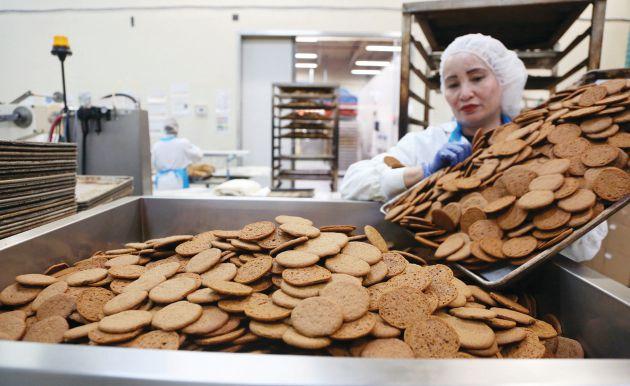
While the Mom’s Best plant still uses time-tested manual techniques to prepare the dough for processing and cooking, the operation has made considerable investments in both processing and packaging side of the business in recent years to boost its output to commercial-scale levels.
Housing six production lines and three packaging lines, the plant operates a hybrid semi-automated production process combining manual processing techniques with modern automated mass production methods.
“We still use the traditional way of measuring out the ingredients by hand to prepare the batches,”Cappola points out.
“The batches then go into a big bowl to get mixed, after which the blended mixture goes into a hopper and then inside the extruder, which forms the mixture into the selected product shapes,” Cappola explains.
“After that, the shaped product is dropped onto the baking trays, which
are automatically loaded onto tray racks and moved inside the oven to be cooked.
“Once done, the product is transferred over to its proper packaging line to be pouched or placed into clamshells.”
While the two clamshell packaging lines are still something of a work-inprogress, Cappola says he is extremely happy with high level of packaging automation achieved on the plant’s stand-up pouch line over the last year or so through close collaboration and partnership with the nearby packaging automation specialists PLAN IT Packaging Systems.
Also based in Mississauga, the company specializes in providing custom-tailored automated packaging solutions for customers across a broad range of CPG (consumer packaged goods) industries.
Having evolved into a highly respected packaging machinery OEM (original equipment manufacturer)and distributor over the last decade, PLAN IT Packaging enjoys ready access to a comprehensive assortment of high-performance packaging equipment covering all aspects of packaging line operations: from filling and bagging to
The model A100+ continuous inkjet printer from Domino Printing Sciences positioned right next to the RotoBagger machine to apply product codes and other required variable product information onto the filled pouches of product coming out from the eight-station rotary bagger.
conveying, flow-wrapping and end-of-line packaging and inspection.
But rather than operating as a mere machinery distributor and OEM, the company’s main strength lies in its formidable skillset as a full-service systems integrator and customized solutions provider, offering a full slate of start-to-finish services comprising:
• Free on-site consultation;
• Needs assessment;
• Strategy development;
• System installation and implementation;
• Custom training;
• Support service;
• Equipment servicing.
With hundred of successful installations under its belt, the company also operates a U.S.-based subsidiary in Costa Mesa, Ca., and is currently in the process of starting up another 35,000-square-foot facility in Tampa, Fla., this summer to provide full coast-to-coast service capabilities right across North America.
As Cappola relates, he first became aware of PLAN IT Packaging’s capabilities at the annual PACKEX national packaging exhibition in Toronto in November of 2021.
“They came to our booth looking for a solution to automate the weighing and bagging of their fragile cookies going into pre-made stand-up pouch bags,” recalls Mark Evangelista, director of sales for PLAN IT Packaging Systems.
“While that was the main focal point of their needs at the time, they also wanted something that was flexible and easy to changeover,” Evangelista relates, “while also improving their productivity by boosting their throughput from 20 to 40 bags per minute.
“They also wanted high accuracy to prevent product waste,” he continues, “along with gentle operation to prevent the product from breaking, which was an issue with their manual packaging operation at the time.
“It would also have to be easy to clean, be robust enough for 24/7 operation, be expandable to accommodate future needs, and feature non-proprietary components that could be sourced from anywhere in North America,” Evangelista adds.
After taking stock of the Mom’s Best plant’s existing process and facility layout, PLAN IT Packaging proposed the installation of an eight-section simplex RotoBagger machine—a pre-made pouch rotary fill-seal bagger designed for filling standup pouches with various dry, powdered or solid products.
Freshly-baked cookie chips being manually transferred inside bulk totes.
Pre-measured quantities of cookie chips loading onto a bucket elevator conveyor.
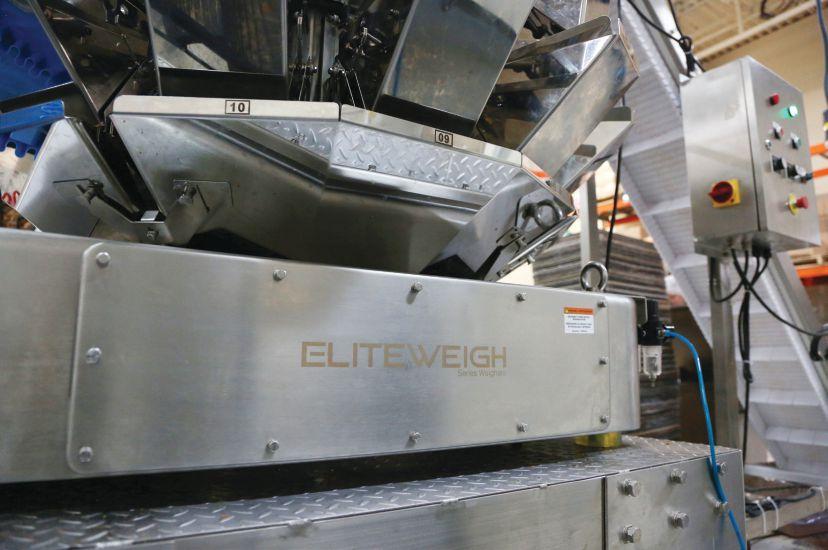
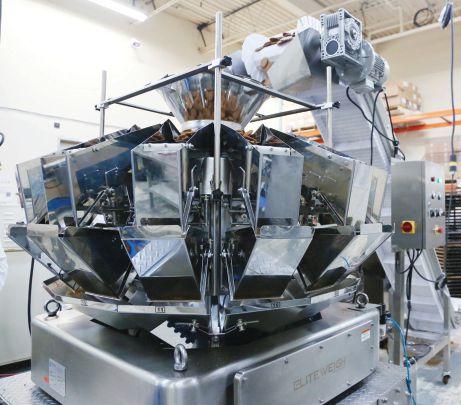
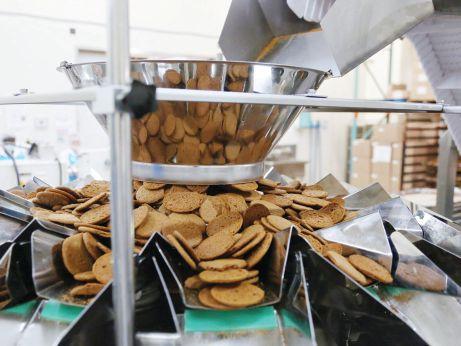
Cookie chips being gently dispensed inside the ELITEWEIGH weigher buckets.
“Everything we do to minimize our packaging’s carbon footprint is all part of keeping up with the times and market trends.”
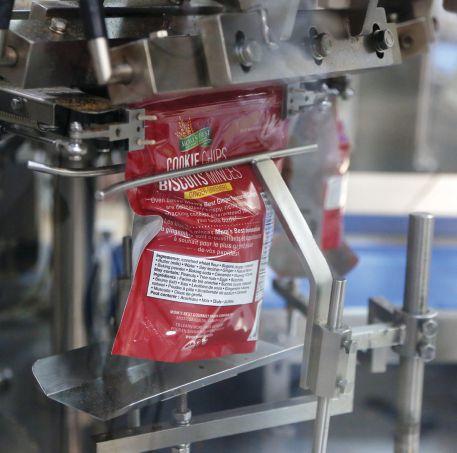
Designed for reliable continuous operation, the pre-made pouch rotary RotoBagger can operate on multiple types of pre-made zipper and press-toclose type pouches at speeds of up to 50 bags per minute.
Completely designed, engineered and assembled in Canada, the RotoBagger is one of PLAN IT Packaging’s most technologically advanced and leading-edge packaging machines.
As Evangelista explains, “The RotoBagger comes standard with servo changeover on the grippers, which allows users to change the bag width through the touch of the screen and servo change on the bag magazine, which opens and closes the guides automatically when doing a changeover.
“This bagger is great if you have multiple bag width sizes, as changeover only takes about two to five minutes, whereas linear type baggers with mechanical knobs and switches can takes about 30 to 40 minutes or more to perform a changeover,” Evangelista points out.
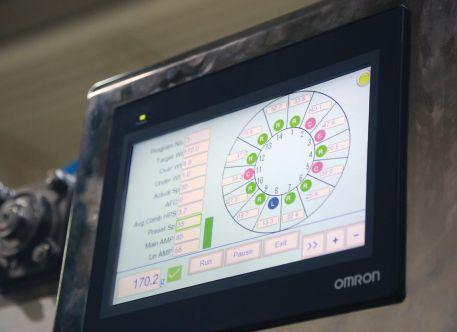
Equipped with an Omron PLC (programmable logic controller) and HMI (human-machine interface) terminal, the CSA- and UL-certified ma-
chine incorporates electronic components that can be easily sourced through PLAN IT Packaging or virtually any other automation provider in North America, Evangelista adds, while its 316 stainless-steel full-washdown construction greatly simplifies the required cleaning and sanitation procedures.
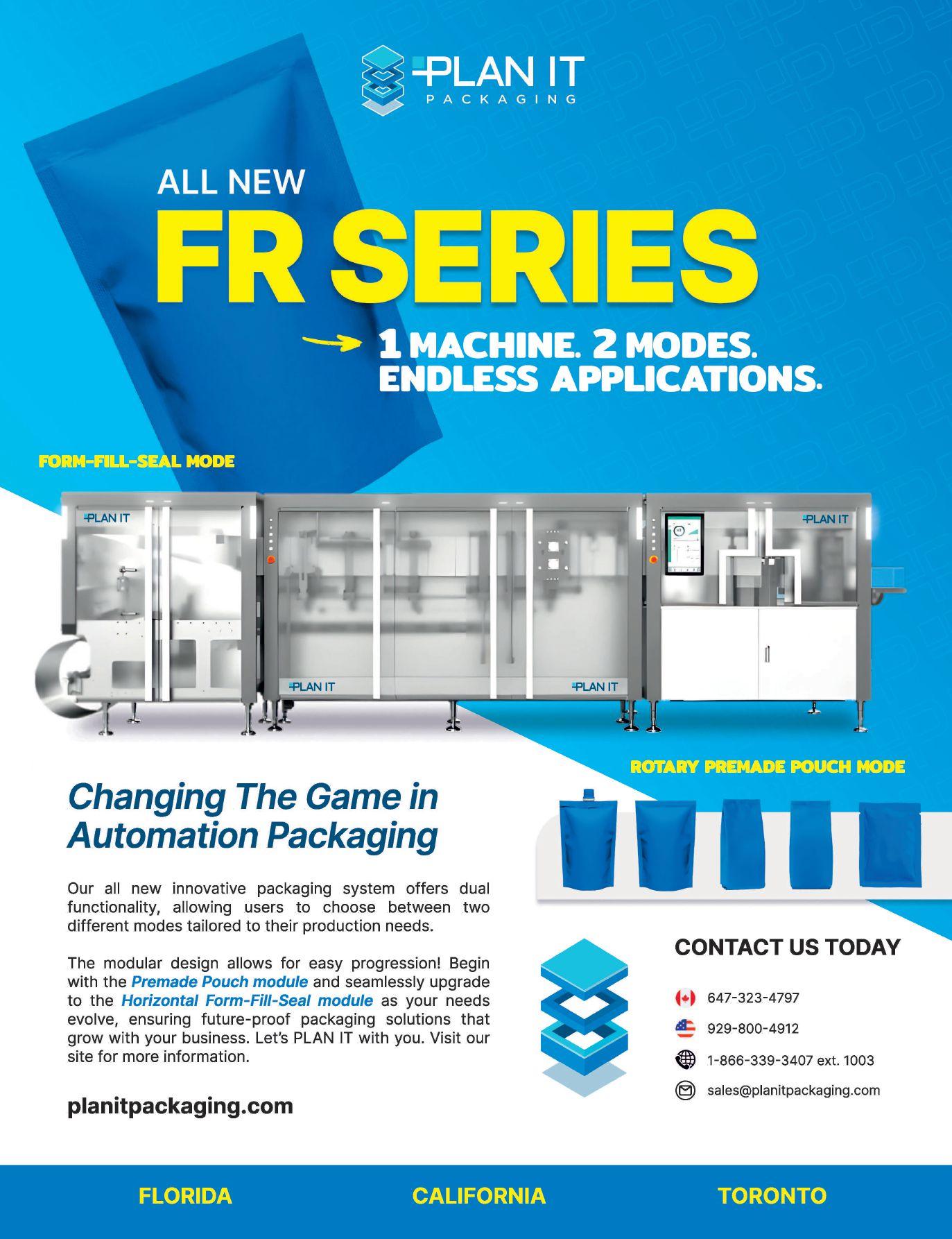
As for future expandability, Evangelista explains: “With our innovative new FR (film to rotary) module, the RotoBagger is fully expandable, whereby you can as make it work as an HFFS (horizontal from-fill-seal) machine that will form that bags and apply the zipper.”
For all that, commissioning the simplex RotoBagger machine was just a first step in automating the bakery’s standup pouch line, which was completed in 2022 with the arrival and integration of the automatic 14-head ELITEWEIGH weigher—used to weigh and dispense precise quantities of product into the RotoBagger—and a high-sensitivity metal detector-checkweigher to perform the final quality assurance test on finished packages.
The addition of these systems has completely transformed the notion of what productivity and quality control
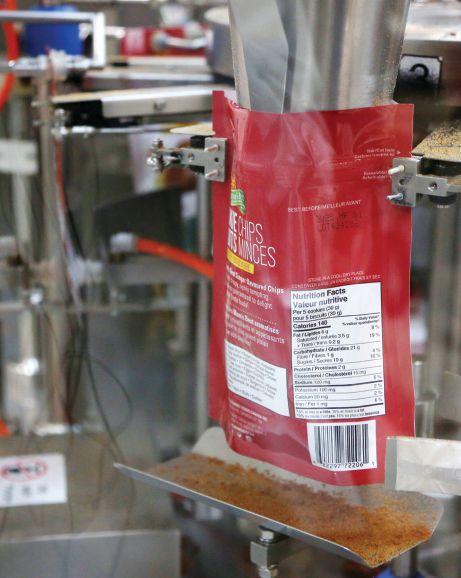
The 14-head ELITEWEIGH weigher in full action mode. Close-up of a pre-made stand-up pouch being filled.
The ELITEWEIGH weigher made by PLAN IT Packaging.
are all about at Mom’s Best, according to Cappola.
“Before purchasing the new equipment from PLAN IT Packaging, we would have 10 people on the stand-up pouch line bagging the product by hand,” he recalls.
“Today, we have three operators running the whole line, which is now running 30 per cent faster, at an average speed of 31 bags per minute.
“It’s a phenomenal improvement any way you look at it,” he adds, adding the automated line has also greatly reduced product waste and breakage.
Evangelista agrees, adding that PLAN IT Packaging’s technical experts pulled all the stops to ensure gentle product handling at all stages of the packaging process.
“We had to take in consideration that this type of product is very easy to break,” he says, “and there are many fragile weighers in the market today that only have a stopper on the discharge chute,” he explains.
“In order to reduce the breakage, our engineering came up with a solution that slides the products from the center of the weigher to the feed buckets, and then sliding it over to the weighing buckets.
“This has significantly reduced the drop impact to help lower the incidence of breakage,” Evangelista says, while lauding the ELITEWEIGH weigher’s accuracy.
“With the target weigh of 170 grams, we were able to hit spot-on every single fill, thanks to the German-made load cells we use on our weighers,” he states.
While Cappola says he’s highly impressed with all the productivity and performance improvements that the stand-up pouch line automation project has yielded, he is also just as thrilled that
the new equipment if fully compatible with the new, fully-recyclable stand-up pouches supplied to the bakery by Bradford, Ont.-based flexible packaging producer Vins Plastics.
“We have a mandate from all our major retail chain customers that all our packaging has to be sustainable by January 1, 2025,” he states, “and I am delighted that our company is ahead of the curve on this hugely important switch.
“We still have some work to do in this respect with our clamshell packaging,” he acknowledges, “but I am confident we will be able to find the right solution in time.”
“We take packaging very seriously around here,” Cappola asserts, “and so do our customers.
“If we are going to send stand-up pouches to our big retail clients, we better make sure that those pouches actually stand up on the shelf like they should, lest they get rejected and end up in the landfill somewhere, with us bearing all the cost associated with that waste.
“Moreover, sustainability is a big thing with the younger Millennials and Gen Z demographics that we want to attract to our products,” Cappola points out, “so everything we do to minimize our packaging’s carbon footprint is all part of keeping up with the times and market trends.
“Working with companies like PLAN IT Packaging Systems, who are always on top of their game, is a win-win proposition that helps us drive continuous innovation in our market segment,” Cappola concludes, “along with our long-term success in the baked goods industry.”
SUPPLIERS
PLAN IT Packaging Systems Vins Plastics
the Mom’s Best Gourmet Foods bakery in Mississauga, Ont., on Canadian Packaging TV at www.canadianpackaging.com
Filled pouch being precision-sealed inside the RotoBagger.
An Omron HMI touchscreen controlling the RotoBagger.
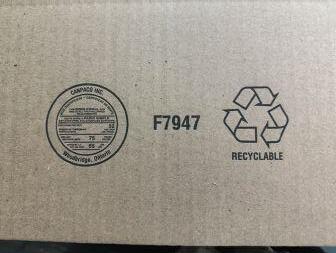
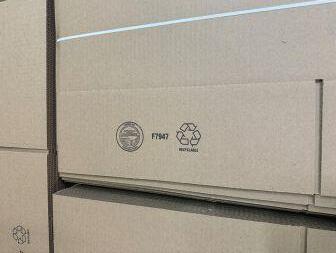
Prominent secondary packaging distributor Canpaco supplies the Mom’s Best plant with corrugated shipping boxes and other everyday packaging accessories.
Mom’s Best Gourmet Foods has operated at this Mississauga location since 2001.
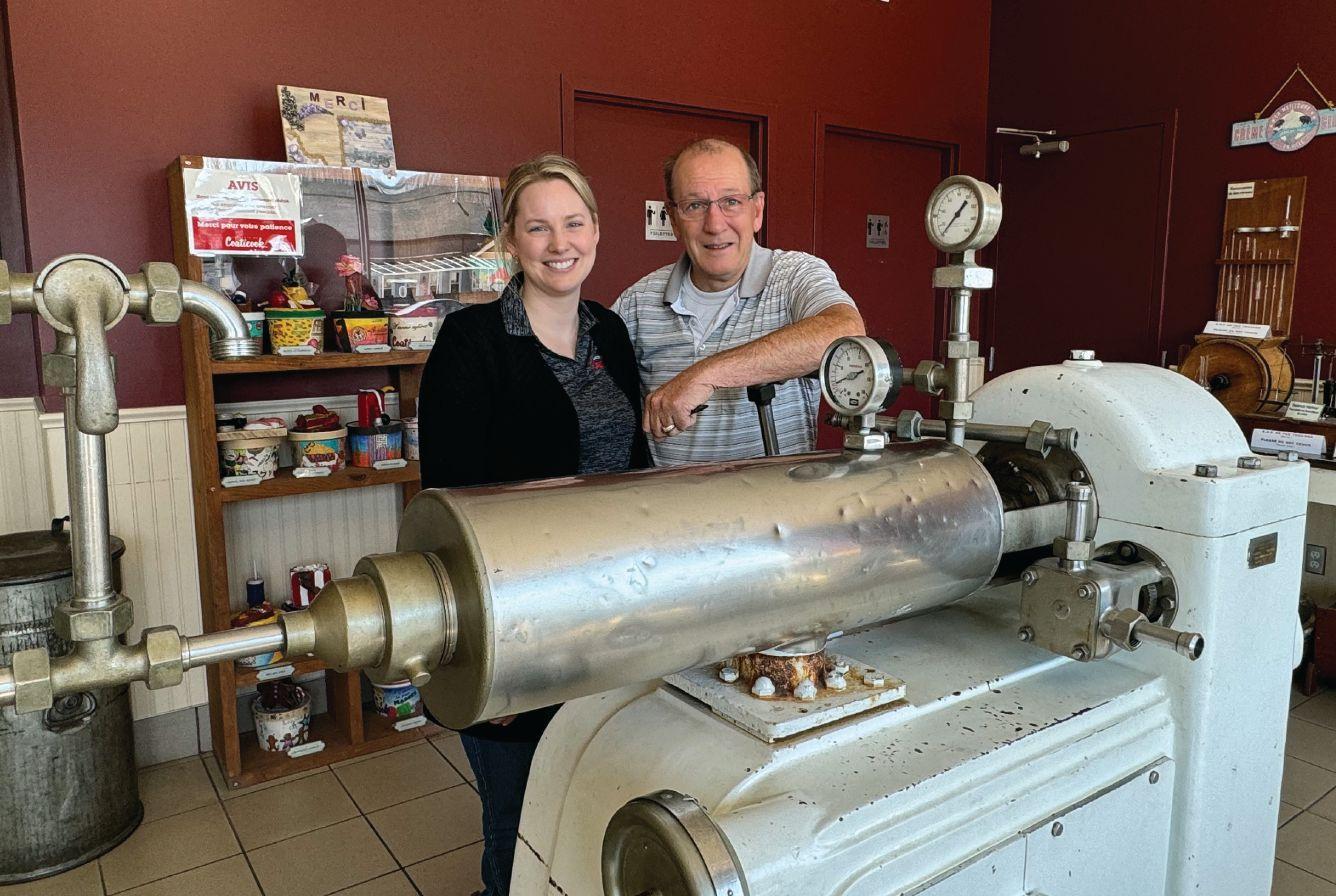
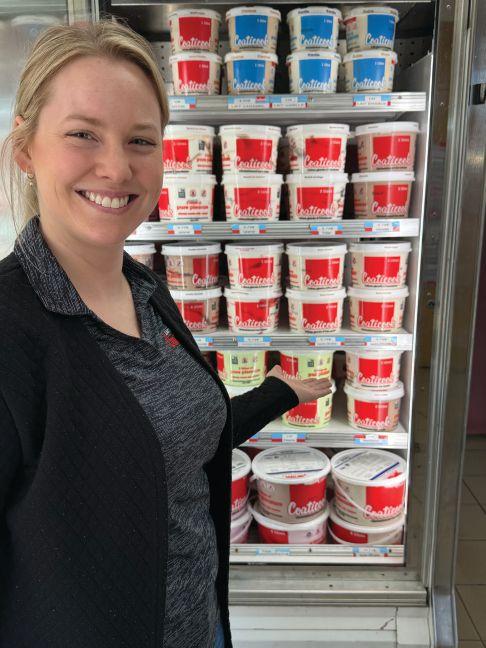
Laiterie De Coaticook co-owners Rebecca Provencher (left) joins her father, Jean Provencher, to pose for a picture behind one of the company’s original vintage ice-cream making machines in the plant’s reception area.
RIGHT WEIGH FORWARD
Quebec ice-cream producer doubles down on product inspection technologies to safeguard the company’s hardearned reputation for immaculate product quality
By Andrew Snook
You get what you pay for. This common expression is typically used when describing the purchase of a low-priced item that turns out not to be a very good investment.
However, this expression is also the law of the land when it comes to the food and drinks we purchase on retail shelves. We must have the right to assume that all packaging must have accurate weights displayed for the product inside.
As for the product itself? Again, consumers need to be able to trust that manufacturers are supplying a product inside the package that matches the labeling and is free of any potential hazards such as stones, glass, metals or
other contaminants that could find their way into products.
To ensure that weights are accurate and product quality is maintained from start to finish, companies use a variety of technologies to keep their operations running safely and smoothly.
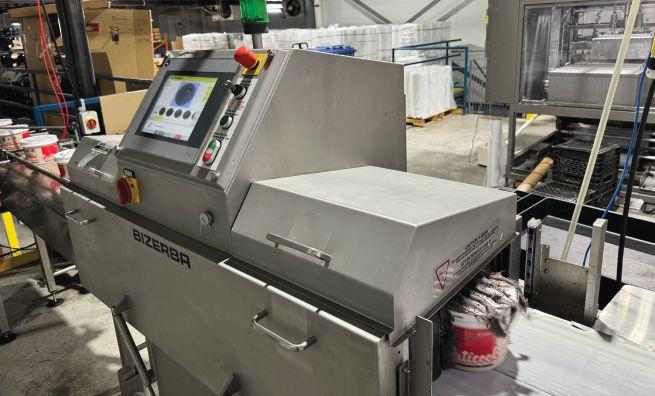
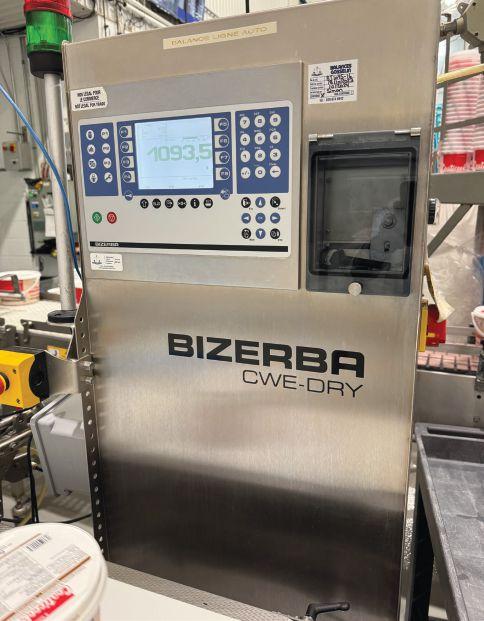
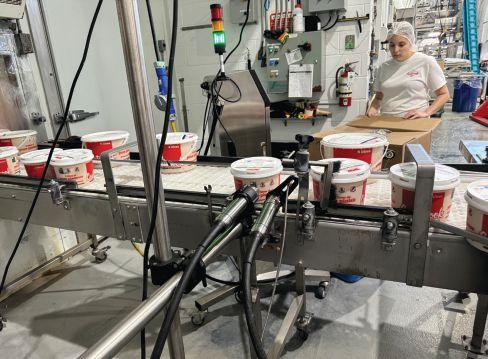
At Laiterie De Coaticook in Coaticook, Que., the popular long-time ice cream and cheese maker recently invested in a new Bizerba CWE-DRY checkweigher and a new Bizerba X-Ray machine for the second of its two ice cream production lines.
A decade after Laiterie De Coaticook first installed a Bizerba checkweigher on one its first ice cream production lines, the company has recently built another automated line to keep up with demand for its products and to cope
“When you purchase an item like ice cream, it’s sold to you in a declared weight, so that when you pick it up and take it home you’re getting exactly what you paid for.”
with industry-wide labor shortages.
“We always have more demand, and we want to optimize the line because we have staff challenges,” explains Antoine Bergeron, technical director and project manager for Laiterie De Coaticook.
Laiterie De Coaticook was founded in 1940 by Arthur Bédard, Arthur St-Cyr and Henri Gérin, and specialized in pasteurized dairy products such as milk, chocolate milk and cream.
In 1942, Bédard bought out his partners and began producing ice cream and cheddar cheese. In 1976, Émile Provencher and Fernand Houle purchased the company, and over the years, the popularity of the dairy producer’s products grew.
By 2004, the company built a 56,000-square-foot production facility, which is currently owned by Jean Provencher, son of Émile Provencher.
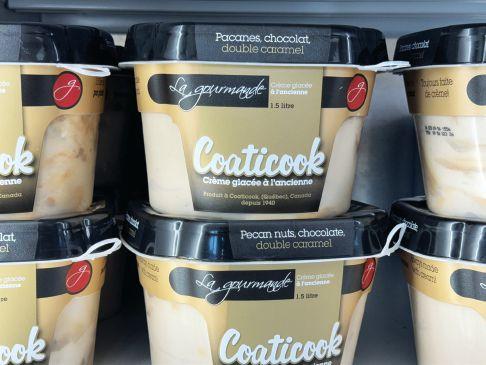
The company’s most popular product is its two-liter vanilla ice cream containers that are still packaged in the old-fashioned round ice cream tub.
While it also produces a variety of cheeses, their frozen desserts account for approximately 75 per cent of their overall production, with its main customers including major retail grocery chains such as Sobeys and Loblaws
Naturally, summertime is the busiest time of the year for the hard-working dairy producers, which employs up to 100 people during summer months to keep production moving.
To ensure that the production process runs smoothly and efficiently at all times, the company invested a significant amount of capital into the new automated line, which it equipped with the new checkweigher and X-Ray machine to
maintain optimal quality control for the packaged products.
“It’s all about quality and delivering value to the consumer and delivering it safely,” says Derek Wagget, sales director for industrial business at Bizerba Canada in Mississauga, Ont.
“When you purchase an item like ice cream, it’s sold to you in a declared weight, so that when you pick it up and take it home you’re getting exactly what you paid for.
“The checkweigher helps to guarantee to the consumer that you’re getting what you paid for as promised by the producer, so that you’re not getting ripped off by getting a tub that’s half-filled with air,” Wagget elaborates.
“There are laws in Canada that say: if you’re buying one kilogram, you’ve got to be getting pretty darn close to one kilogram worth of product.”
The checkweigher manufactured by Bizerba for Laiterie De Coaticook is an economical model designed for products in drier environments.
“You wouldn’t think of ice cream being a dry environment, but in the area of the final packaging stage where they’re doing the checkweighing, it’s a very dry and clean area,” Wagget says.
“We have checkweighers for that type of environment,” he notes, and we have checkweighers for harsh environments where you have to hose them down.
“But in this instance, they don’t have to do any of that.”
According to Wagget, the CWE checkweigher series comes in a variety of weighing ranges up to 15 kilograms.
“We can tailor the checkweigher to the weight of the product, the size of the product, and how much throughput the customer needs to get from us, like how many packs per minute are
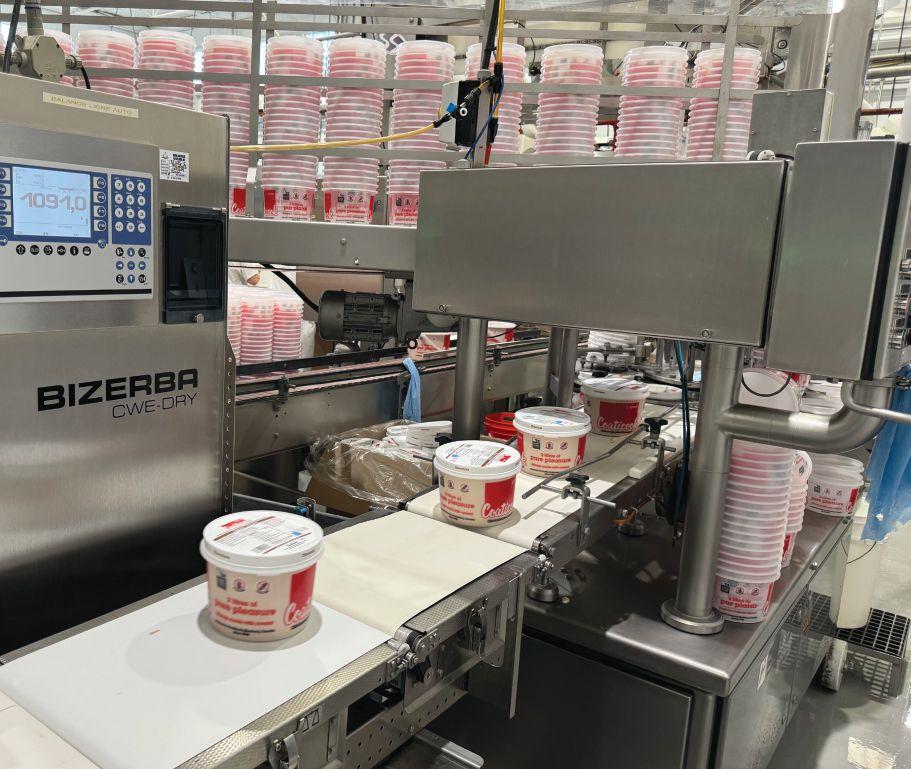
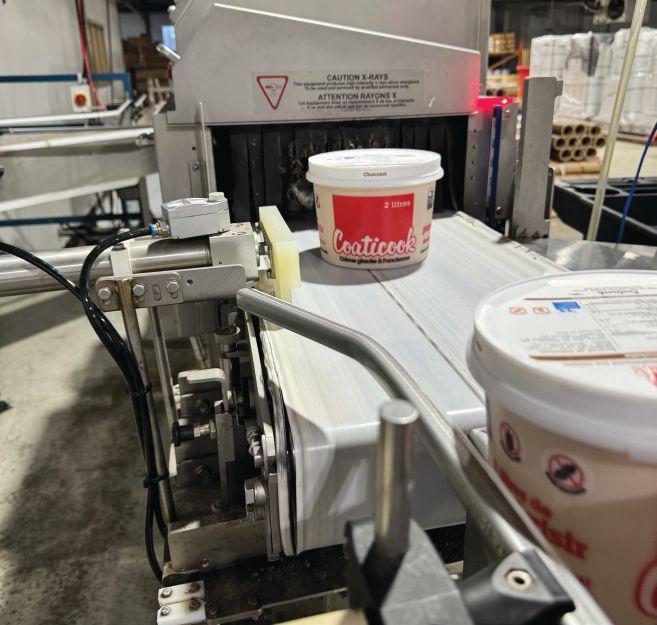
Properly spaced finished tubs of ice cream pass in front of the Bizerba CEW checkweigher to verify the product’s weight prior to moving it on to the end-ofline packaging.
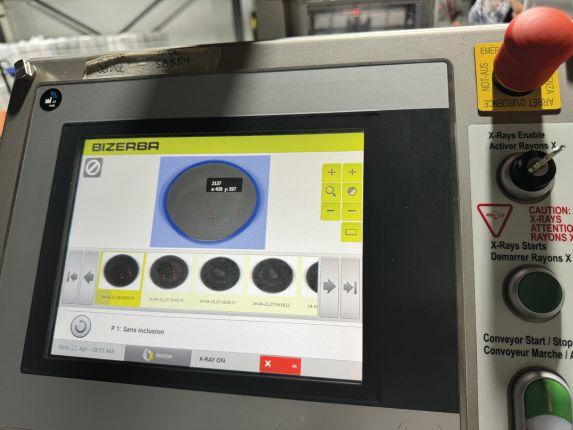
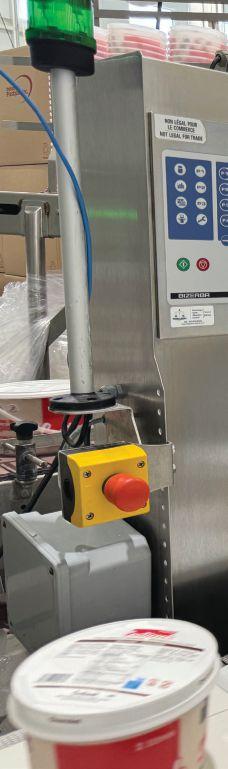
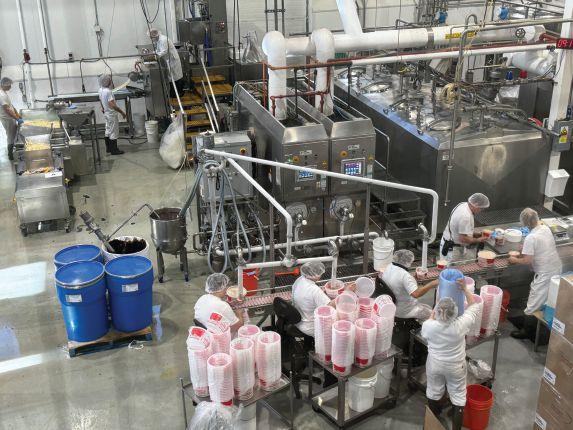
Left: Close up of the HMI (human-machine interface) panels of the Bizerba X-Ray machine. Right: A bird’s-eye view of the busy production process unfolding on the Coaticook plant floor.
coming off that line,” Wagget states. “When you take a look at a checkweigher, you have to address all those things.”
The placement and positioning of the checkweigher on a production line is also extremely important, Wagget asserts, and therefor needs to be planned out appropriately.
“It’s weighing in motion and in reasonably low quantities —one kilogram, three kilograms, six kilograms … not very heavy items.
“To get the kind of precision you need, you have to take into consideration things like if there is any movement of air in the area, or if there are any vibrations,” Wagget explains.
When weighing such its items at robust speeds, it’s important to do so on a solid foundation, and to account for any disturbances that might be in the area that may affect the weighing results.
“A checkweigher is a great tool for verifying in high production speeds in environments where you’re producing continuously, and you’ve got to keep things moving,” Wagget says.
After the ice cream tubs are filled at the Laiterie De Coaticook plant, they are conveyed down the production line to the packaging area for weighing.
Side view of the Bizerba XRay detection systems used to identify and locate possible contaminants inside the inspected
Prior to being inspected at the checkweigher, however, the tubs need to be spaced out appropriately.
“They have to be spaced right, so we have to provide [conveyor] belts that make sure that the product is properly spaced,” Wagget explains.
“And then we have to be able to detect the product and make sure we only have one on the scale at a time, because when you’re weighing something, you should just be weighing one unit of something,” Wagget says.
“And of course, you also want to set up a tolerance system that says if this product is not meeting the expected weight, it has to be rejected,” he continues.“So, you can add rejection systems to these types of checkweighers.
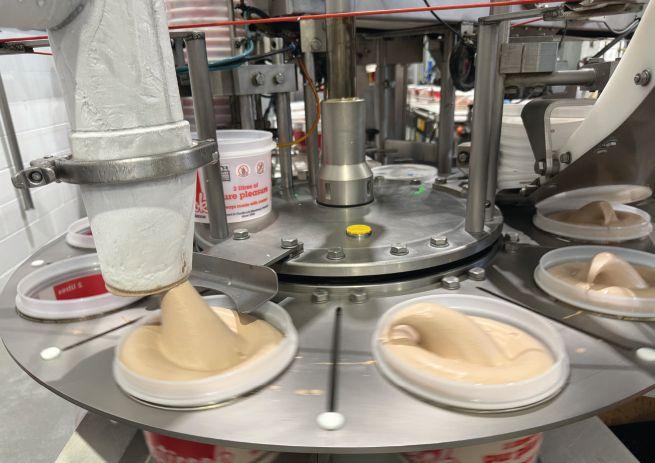
Close-up of the Coaticook plant’s ice cream rotary filling machine in action, as it swiftly dispenses pre-measured quantities of fresh-made ice cream into the buckets.
“You can also integrate metal detectors to checkweighers, so that they have a rejection system both for weight and a separate one for metal detection,” says Wagget. “Inserting a metal detector right in the middle of that checkweigher is also a feasible option.
“In case of Laiterie De Coaticook, they chose to insert an X-Ray machine over a metal detector, which will detect metals as well as other types of potential contaminants such as plastics, glass, wood, or anything else that shouldn’t be inside the product.”
Because the Coaticook plant uses a great deal of fruit in its ice cream production, the X-ray machine can pick up many tiny contaminants not removed earlier on during the earlier fruit washing
ice cream tubs.
Above left: Close up of the high-precision Bizerba CWE-DRY checkweigher installed at the Coaticook facility new automated production line. Above right: Large plastic tubs filled with premium ice-cream being transferred inside the
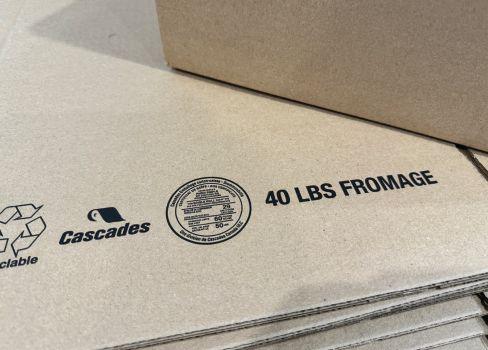
Finished and fully-inspected ice cream tubs are packed for distribution inside high-strength corrugated boxes supplied to the Coaticook plant by Cascades.
and processing stages.
“The X-Rays machines work more on density than anything else,” Wagget explains.
“You start by training the known product, and then when the X-ray looks through it, it understands the densities in a perfect product.
“When it looks through it and identifies contaminant, that contaminant will
“They chose to insert an X-Ray machine, which will detect metals as well as other types of potential contaminants such as plastics, glass, wood, or anything else that shouldn’t be inside the product.”
most likely have a different density than the rest of product does,” he says. “That’s how it locates it.”
Wagget says it is critical that both the X-ray machine and the checkweigher need to be programmed for each of the various products they will need to inspect.
Once the product profiles are properly pre-programmed into the machines, they can communicate with each other, Wagget explains.
“So, you can go to the checkweigher machine and call up the product, and the checkweigher will send the information about what product you’re working on now to the X-Ray machine,” Wagget explains.
Once a contaminant is detected, the inspected product needs to be removed quickly off the line.
While there are different options for
rejecting contaminated products, Wagget recommends an automated rejection system to keep production lines moving efficiently.
This is especially important when dealing with continuous production lines like the one at the Laiterie De Coaticook facility.
“You can also do things like stop-ondemand,” Wagget states.
“But stopping on demand is not very successful when you have a continuous row of products coming,” he points out.
“Because if you stop, you’re going to back up products right down the line.”
As Wagget relates, Bizerba and Laiterie De Coaticook have a long history of doing business together.
Based at Bizerba’s regional office in Boucherville, Que., Cesary Lewicki has been with Bizerba for 35 years, and he
Bizerba X-Ray machine to ensure they are contaminant-free.
fondly recalls working with Laiterie De Coaticook during his first years with the company.
“They were one of my first customers,” Lewicki states. “We started doing business together around 35 years ago, and the very first machine they bought from us was a vacuum packing machine.”
As Laiterie De Coaticook grew over that time, it purchased many other products from Bizerba including small scales, metal detectors, checkweighers and X-Ray machines.
“After so many years, they have always been happy with our service and our products,” Lewicki relates. “Whenever they have had some problems, we would always solve them very quickly.
“So they trust us,” he says, “and they like us.”
For Coaticook’s Bergeron, the company’s close working relationship with Bizerba is underpinned by two key factors.
“Their service is very good, and so is the quality of their machines,” says Bergeron, adding the company is considering adding a third ice cream production line in the near future, which could produce an additional 10 to 15 million liters of ice cream per year.
Having the proper inspection system in place will naturally be a key consideration during the design and commissioning stages, Bergeron adds.
“Inspection systems are very important in the quality of what a manufacturer delivers to their customer,” Wagget says.
“They’re checking the weight in the case of a checkweigher. In the case of a metal detector or an X-Ray system, they’re checking that there are no contaminants that may be harmful to the end-user.
“This is a big deal for the quality department,” he concludes.
“If you start getting known for having contaminants in your products, your products are not going to get a very good name.”
SUPPLIERS
Bizerba Canada Inc.
Coaticook co-owner Jean Provencher (above) runs the venerable family-owned business alongside his daughter Rebecca (below).
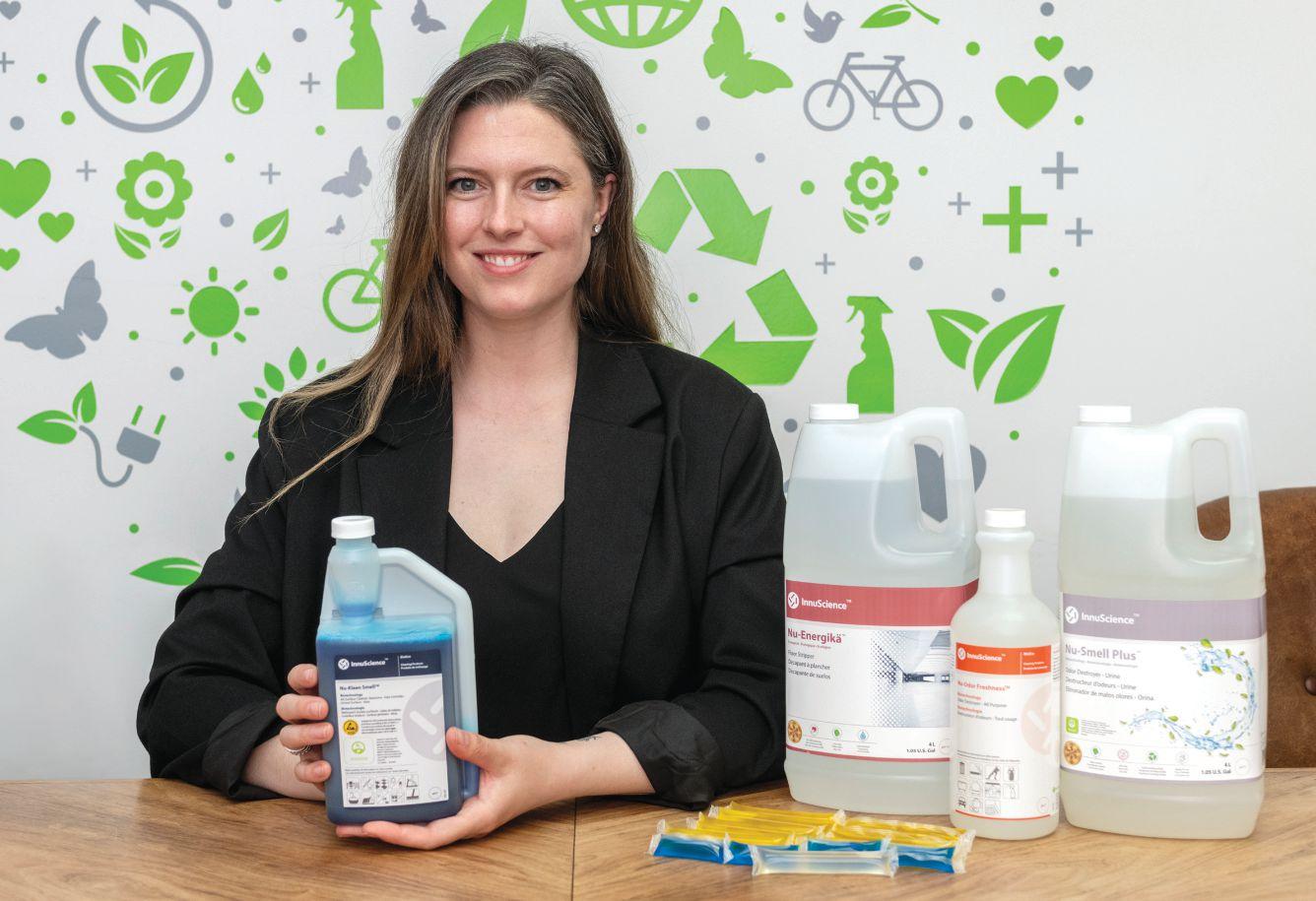
InnuScience business development director Faye Teasdale shows off some of the professional cleaning products produced by her company in Montreal without using any harsh or toxic synthetic chemicals and ingredients found in traditional professional cleaning formulations.
CLEAN CONSCIENCE
Trail-blazing biotech pioneer gets a firm grip on its product coding requirements with leading-edge continuous inkjet printing technology
By George Guidoni, Editor
Photos by Pierre Longtin
Founded in 1992, Montreal-based cleaning products manufacturer InnoScience is a company on a continuous mission of the highest righteous order: making the world a cleaner place without harsh chemicals and synthetic formulations posing indelible risks to human and environmental health.
An while that noble end goal is still some ways from being achieved, the company’s remarkable success in the global professional cleaning markets to date makes a compelling case for the enormous potential of modern-day science to improve the quality of life for world’s population by working with Mother Nature, rather than against it.
Formed by two industrious Canadian scientists at the Department of Biological Sciences at the University of Quebec in Montreal, the idea for developing effective “natural” alternatives to traditional chemical cleaning solutions was sparked by their visit to a local restaurant kitchen, where they we shocked by the amount of harsh chemicals used as part of the daily cleaning routine, with questionable results to boot.
Convinced that they could harness the powerful cleaning effects existing in our natural environment, they proceeded to develop an effective prototype for the treatment of grease on cooking filters in commercial kitchens.
After that initial success, they went on to develop a new range of bacterial-based products for niche and specialty applica-
tions like grease trap treatment, odor elimination and kitchen hood degreasing.
Aiming to broaden their product offering and to gain access to higher-volume market segments, the biotech start-up began researching various enzymatic technologies that could be combined with its existing bacterial cultures to provide higher degreasing performance.
In 2000, InnuScience filed a worldwide patent introducing the first effective biotech degreaser that could outperform any traditional chemical degreaser—firmly establishing InnuScience’s leadership position and opening the door to the development of many other surface cleaning products and technologies.
Since then, the pioneering company has since developed an extensive portfolio of products using advanced, biotechnically-engineered technologies that “essentially harness the power of nature through living organisms or components of them,” according to InnuScience.
“These are patented microbial strains that, together with enzymes and surfactants, results in a product that has continuous cleaning action, is pH neutral, non-toxic, hypoallergenic and biodegradable,” the company’s website states.
Rigorously tested and quality-assured, each unique product is made with carefully selected bacterial strains demonstrating exceptional cleaning abilities, according to InnuScience, which has developed more that 400 different proprietary formulations to date to cover a broad range of application in the industrial, commercial and institutional environments: from floor, carpet and fabric care to wastewater treatment, odor control and graffiti removal, among many others.
Strategically located in the Sinte-Julie district on the south shore of Montreal, the InnuScience production facility enjoys close proximity to the Port of Montreal, facilitating efficient shipping and distribution of its products to a growing number of countries around the world, including international markets across North and South America, Europe, Asia, Africa and the Middle East region.
Operating a single shift over a five-day weekly schedule, the plant turns out a remarkably high number of SKUs (stock-keeping units) under the flagship InnuScience brand for the B2B (business-to-business market) and the the Game Over Sport brand for the B2C (business-to-consumer) sector, along with many private-label offering for both B2B and B2C sectors.
“Our main packaging formats include four-, 20- and 205-liter containers, as well as our innovative soluble pods that align with our mission to provide sustainable
“These certifications and accreditations are a testament to our dedication to quality, sustainability and continuous improvement in both our facility operations and product offerings.”
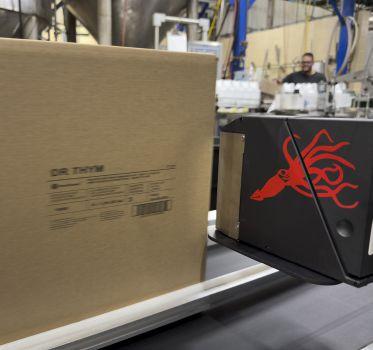
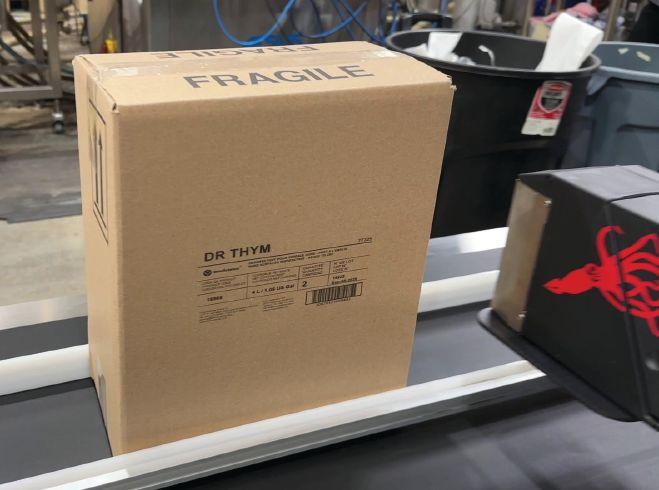
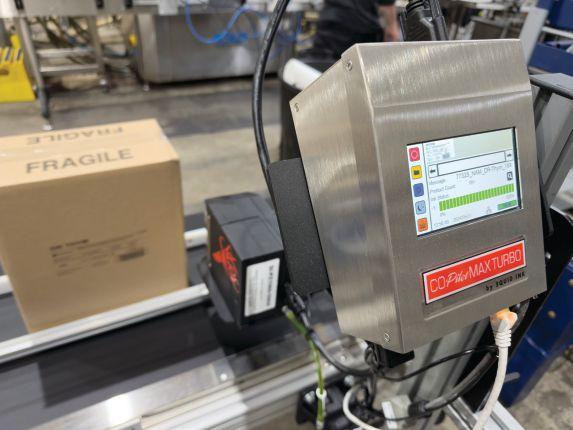
An upright corrugated case filled with bottled product features all the pertinent variable product information applied to it in one quick pass by the CoPilot Max Turbo continuous inkjet printer mace by Squid Ink Manufacturing.
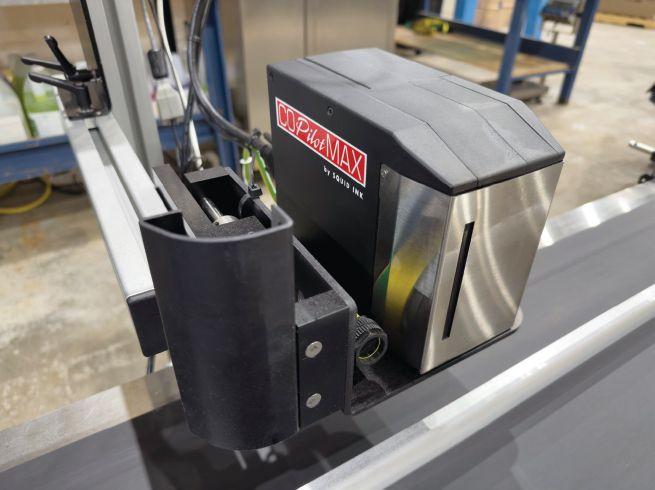
The CoPilot Max Turbo printer is positioned right after the casesealing station to apply key variable product information onto the side of each passing box right after they are taped shut.
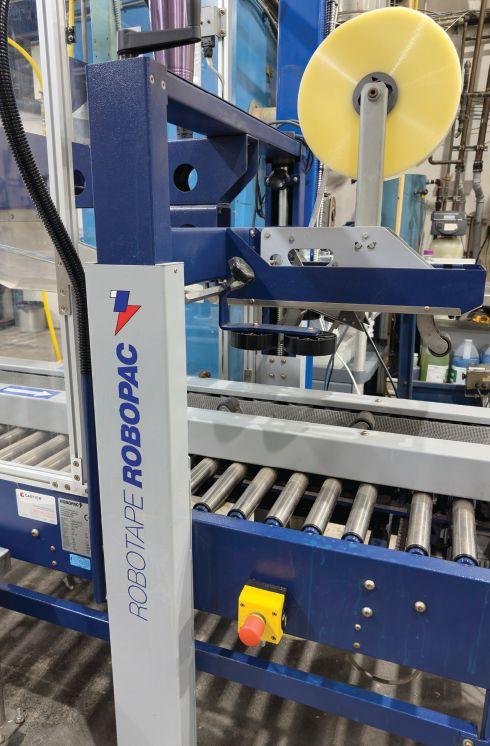
Clockwise from left Manufactured by Robopac, the semiautomatic Robotape taping machine was supplied to the InnuScinece production facility by CARTIER, L’emballage optimisé.
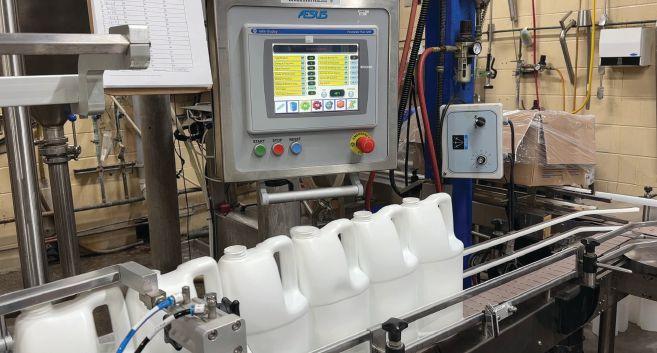
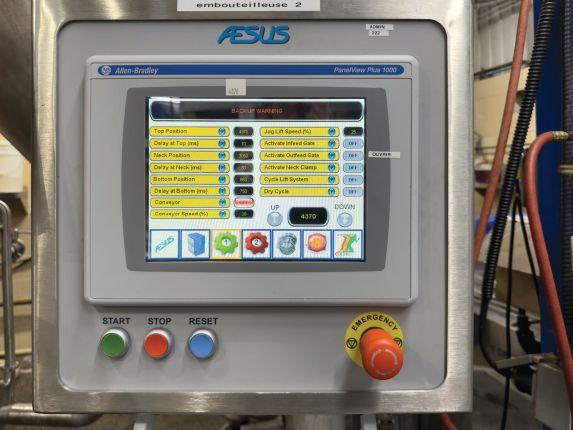
Empty plastic jugs entering the high-perfromance Aesus filling machine to be precision-filled with liquid product.
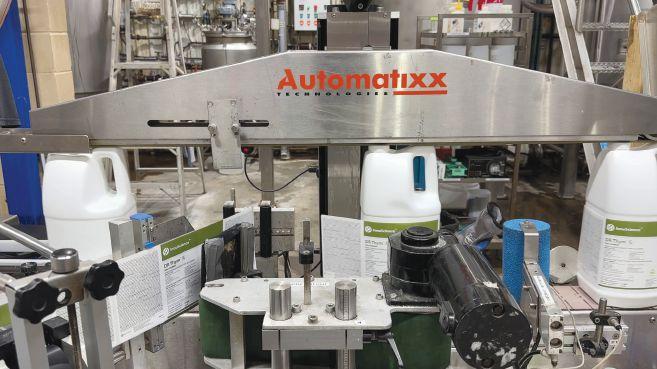
Filled containers have product labels applied by the Automatixx labeling machine from Aesus.
and eco-friendly solutions,” relates InnuScience’s business development director Faye Teasdale.
“The popularity of these formats varies, whereby the four-liter container-liter containers are preferred for industrial applications,” Teasdale points out.
“For their part, our soluble pods are gaining traction for their convenience and reduced environmental impact.”
While the plant enjoys fairly stable demand for its product throughout the year, “June is a particularly busy month due to increased demand from schools preparing for summer cleaning,” Teasdale notes.
“To meet that peak demand, we optimize our workflow by adjusting production schedules, increasing inventory levels in anticipation of high demand, and ensuring our supply chain is robust and responsive,” Teasdale states.
“We source our raw materials from reputable suppliers who share our commitment to sustainability and quality,” she says, “and we also produce some of our own raw materials, including specialized bacterial strains, to ensure the highest quality and effectiveness of our biotechnological solutions.
“This in-house production capability allows us greater control over the quality and sustainability of our products,” says Teasdale, citing the facility’s impressive list of globally recognized quality standard certifications that include ISO 9001 and ISO 14001, alongside the environmental ECOLOGO and Ecolabel accreditations.
Says Teasdale: “These certifications and accreditations are a testament to our dedication to quality, sustainability and continuous improvement in both our facility operations and product offerings.”
Due to unique nature and composition of its products, “Our production process incorporates some automation to ensure efficiency and consistency, but it also relies on skilled manual labor,” Teasdsale confides.
“This blend allows us to maintain flexibility and adaptability in our operations, ensuring high quality across all our products.”
The process begins with raw material preparation, where high-quality raw materials are carefully measured and mixed using large industrial mixers to create our various liquid formulations.
“The raw materials are blended in large mixing tanks, where
they are combined according to precise recipes to ensure consistency and effectiveness,” Teasdale explains.
“This stage involves both manual oversight and automated mixing equipment to achieve the desired product quality,” says Teasdale, noting the company’s unwavering commitment to meticulous quality control.
“Throughout the mixing process, samples are taken an tested in our on-site lab to ensure they meet our stringent quality standards,” she reveals.
“After initial mixing, each batch undergoes a rigorous quality control process, whereby the samples are tested for a week before being released for sale,” Teasdale points out.
“This ensures the stability and effectiveness of our products over time.”
Once the products are ready, they are directed to one of the facility’s three packaging lines:
• Large Formats Line, which handles packaging of larger containers, ranging from 20-liter drums to large-volume IBCs (Intermediate Bulk Containers);
• Smaller Formats Line, for packaging smaller containers from 800-ml bottles to four-liter jugs.
• Soluble Pods Line, focusing on producing and packaging the highly-concentrated soluble pods that are dissoved by end-user in water prior to use.
“Each line uses specialized filling machines to ensure accurate and efficient packaging,” Teasdale notes.
After labeling, the containers are placed inside shipping carriers, which are then printed with all the required variable product information and transferred to the end of the line for final quality checks and distribution.
“Before shipping, all packaged products undergo a final quality check to ensure they meet our high standards,” says Teasdale.
“The products are then prepared for distribution to various markets, both locally and internationally.”
With so many different SKUs and customer destinations, applying all the pertinent product dates, codes, text and graphics onto the corrugated shipping boxes used to be a fairly time- and labor-consumer operation that required a plant employee applying pre-printed labels onto each passing box, Teasdale relates.
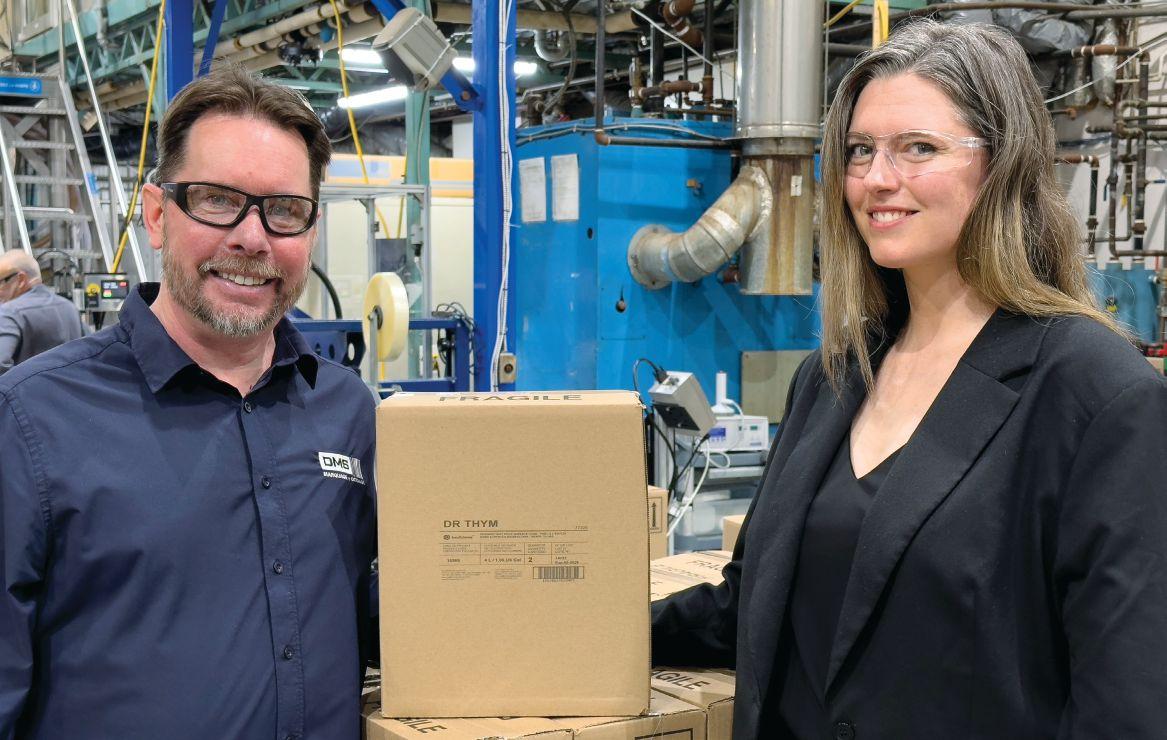
But that all changed a few weeks ago with the arrival of a brand new CoPilot Max Turbo continuous inkjet (CIJ) printer, manufactured by Squid Ink Manufacturing and delivered to InnuScience by Squid Ink’s local distributor DMS Marquage Codage
As Teasdale recalls, “The equipment was installed in May, replacing our old method of printing physical labels and manually sticking them on each box.
“The new coding equipment prints labels directly onto the boxes, streamlining our production process and significantly increasing efficiency.
“The installation was efficient and the training sessions were very comprehensive—allowing our team to quickly become proficient with the new equipment,” she relates.
“Overall, the experience has been highly positive, and the new coding equipment’s performance is excellent, significantly enhancing the overall packaging process.”
Adds DMS business development rep Patrick Gray: “At DMS, we conduct print tests with different systems for each project to ensure that we recommend the
best solutions to our clients.
“In this case, primarily due to the very small characters in the client’s images to be printed, we needed a system with excellent resolution, such as the CoPilot Max Turbo, which also allows for darker printing,” Gray relates,
“Due to the ease of maintenance and use of both the controller, with its 4.3inch color touchscreen and the simplicity of using Orion software to create messages, we proposed this device to InnuScience,” says Gray, “and they chose it.”
After installing the CoPilot Max Turbo on a conveyor at the exit side of the box tape-sealing machine, “We took the time to provide the client with comprehensive training to make it easier for the operators to use the system,” says Gray.
As he explains, “The new equipment allows InnuScience to eliminate the labels they were applying, thereby allowing them to realize cost-savings on label and labor, along with improved standardization and accuracy—resulting in increased quality of their packaging process overall.”
Having worked with InnuScience in
“We are privileged to count InnuScience among our clients. It is always a pleasure to provide winning solutions that help our clients go further.”
the past, Gray says the CoPilot Max Turbo installation was an exceptionally gratifying experience for DMS.
“What sets DMS Marquage Codage apart from the competition is our continuous support for our clients before, during and after each project,” he says.
“We are privileged to count InnuScience among our clients,” Gray adds. “It is always a pleasure to provide winning solutions that help our clients go further.”
Operating as a wholly-owned subsidiary of Minneapolis, Minn.-headquartered Engage Technologies Corporation , Squid Ink Manufacturing it a well-established and highly respected supplier of a broad range of product identification technologies, including hi-resolution industrial inkjet printers, thermal inkjet printers, CIJ small-character coders and laser coders—offering a one-stop solution for virtually any challenging product identification and traceability application.
According to Engage Technologies’ vice-president of marketing Chad Carney, the CoPilot Max Turbo printer was a natural fit for the InnuScience’s application requirements.
As Carney explains, “Their application requires quick generation of barcodes, logos, bold characters and small-character text.
“The CoPilot Max is perfect for this application due to its 360-dpi print resolution, which is about twice the resolution offered by other competing printers in this class.
“Moreover, the CoPilot Max prints up to 2.8 inches (70-mm) in print height, offering the user a lot of real estate for their messaging,” he continues.
“They are also using a spring-loaded printhead bracket, which provides a consistent throw distance from the
Turbo printer (left) and the Allen-Bradley HMI panel of the Aesus filler.
printhead to the box,” Carney points out.
“This is helpful to ensure excellent print quality if there is an issue with the material handling or product conveying—basically if the box doesn’t line up consistently with the printhead.”
With print speeds of up to 110 feet per minute at 300-dpi resolution, the CoPilot Max Turbo installed at InnuScience uses a low-maintenance, oil-based ink formulation—safely contained in large-volume 500- ml ink cartridges—that is quickly absorbed into the corrugated board’s porous surface and dries virtually upon impact.
For Teasdale, the CoPilot Max Turbo installation was an exceptionally outstanding capital investment on every level.
“The introduction of the Squid Ink equipment has had a significant positive impact on our operation’s efficiency, productivity and quality levels,” she extols.
“By automating the labeling process, we are saving precious time that was previously spent manually labeling each box.
“Without this equipment, we would have needed to hire an additional team member solely for labeling,” she says, “whereas now we can allocate new hires to areas where their efforts will be more effective for our operations.
“This shift has led to a significant increase in our overall productivity,” adds
Teasdale, citing an estimated $18,000 saving in labeling material costs per year, along with about $100,000 annual saving in total labor costs.
“Additionally, the precision and quality of the prints have enhanced the clarity and legibility of our product information,” she states, “further improving our quality standards.”
All in all, saying that the InnuScience is happy with the new printer’s performance to date would be a gross understatement.
“One of the standout features of the Squid Ink equipment is the user-friendly controller, which makes the machine incredibly easy to operate,” Teasdale enthuses. “The intuitive interface allows our operators to quickly and efficiently change variable fields, such as expiration dates and lot numbers, enhancing our overall productivity.
“The laser precision of the prints ensures that all product information is clear and legible, which is crucial for maintaining our high-quality standards,” Teasdale adds, while lauding the excellent customer service and technical
support provided throughout the project by both DMS and Squid Ink.
“Our business relationship with Squid Ink has been very positive and collaborative,” she states.
“From the initial purchase through to the installation and training, Squid Ink and their partner DMS Marquage Codage have provided outstanding support.
“They have been instrumental in helping us integrate the new coding equipment into our production line seamlessly,” Teasdale adds.
“This partnership has not only enhanced our labeling process,” she concludes, “but it also reinforced our commitment to delivering high-quality sustainable products efficiently.
“We look forward to continuing this successful collaboration with Squid Ink well into the future.”
SUPPLIERS
Squid Ink Manufacturing
Engage Technologies Corporation
DMS Marquage Codage
Aesus Packaging Systems
DMS Marquage Codage business development representative Patrick Gray (left) joins Faye Teasdale at the packaging line to show off the high-resolution multi-line product codes and text generated by the CoPilot Max Turbo CIJ printer.
JUST IN CASE
Retail-ready packaging expert reveals the secrets to reaping enormous cost-savings in corrugated board usage
At the recent Bakery Showcase 2024 exhibition in Toronto—produced by the Canadian Packaging magazine’s parent company Annex Business Media—we reached out Rick Gessler, vice-president of engineering at Minneapolis, Minn.-based secondary packaging specialists Delkor Systems , to explain his company’s approach to producing effective, economical and attractive shelf-ready packaging for mass merchandisers and other major retail customers.
QPlease give us a brief overview of what you company does.
We are a large a large manufacturer of advanced robotic packaging systems that include top-load cartoning, case-packing and palletizing.
We are very well-known for building turnkey front-to-back packaging systems, meaning we’re happy to pick up the process at the discharge of your filler or bagger, and build out the entire automation system all the way through finished pallets, including all the ancillary devices such as labeling, printing, X-Ray inspection, metal detection and checkweighing.
QGiven that corrugated board is the largest single packaging substrate consumed by CPG (consumer packaged goods) companies, what impact can automated corrugated case forming and sealing equipment have for them?
It can have a massive impact. In fact, this is one of the key messages that we’re delivering at a lot of the trade shows and
in discussions with our customers.
By shifting away from the traditional case designs, such as the RSC (regular slotted case) design, we are able to unlock somewhere in the order of 10 to 30 per cent in corrugated board savings.
Generally speaking, by updating your packaging from traditional designs to the more current flat-blank case designs, we can pick up about $100,000 a year in material savings.
QSo what sort of machines are you bringing to the market to help customers achieve these objectives?
When folks look at robotic automation or case-packing systems, they’re often looking to pick up the labor savings that come along with replacing the people who are hand-placing product into the cases.
But they’re not often considering the massive opportunity they have in moving away from a standard RSC case to ones made from a flat-blank sheet, which is created by the more modern packaging systems like those made by Delkor.
Moving from a pre-glued traditional RSC case to a case formed by flat blank requires a much different style of machine that is going to utilize a mandrel and, in our case, a dynamic cavity. Using this type of forming technology is what enables the machine to not
Delkor Systems vice-president of engineering Rick Gessler making a show-floor presentation during last month’s highly successful Bakery Showcase 2024 exhibition in Toronto, which drew over 2,000 visitors to the lively display of latest leading-edge technologies for the baked goods industry.
only operate with reduced corrugated consumption, but also to improve the efficiency of the line.
When we put in a machine forming from a flat blank, customers will be getting a true square base, instead of an erected case that has a bit of a skewed, parallelogram shape when viewed from above.
That squareness translates into a case that’s more efficient to run on the robotic system, and robots love square cases—, especially when handling tight-fitting products.
So in addition to enabling material savings, we’re also enabling higher efficiencies through delivering a higher-quality package that uses less material and saves money.
QTell us about the success you’ve had with some of the big Club Stores by standardizing to new case formats that your machines make. One of the best-known stories about Delkor Systems is the launch of the Cabrio case, which hit the shelves about seven or eight years ago—being launched at Walmart in the cheese category. The Cabrio case is a shelf-ready display package that is essentially a tray hood package made from a single-piece blank.
The package was designed to simplify the operation of machinery that uses two piece packaging to create shelf-ready displays made from one piece.
We can form this case on a traditional case former, and we can load the case with product laying flat or standing up vertically when required, and we can seal it in a traditional base sealer.
With our machines, changing from a Cabrio case over to a standard ‘brown box shipper,’ and then over to a Club Store-style stackable tray is something that we can do on our packaging systems in less than five minutes. Today, 60 per cent of cheese on retail shelves in North America is packed in the Cabrio case, including products from several Canadian cheese manufacturers. That’s about one billion Cabrio cases produced every year!
QPlease tell us more about the corrugated savings achieved with single-blank style cases. With simple ‘brown box’ back shippers, we’re typically seeing something in the 15 to 25 range in terms of savings, which represent every fifth case as a general rule of thumb. Coming off of your packaging line at 10, 20 or 30 case per minute, that can add up to some huge numbers. In terms of shelf-ready packaging, the numbers can vary quite a bit more. Compared to a hang tab box, it’s not uncommon to get savings of 30 per cent of higher, and the same goes for stackable Club Store trays.
“Today, 60 per cent of cheese on retail shelves in North America is packed in the Cabrio case. That’s about one billion Cabrio cases produced every year!”
QSo where do we see the market move over the next five years in terms of case design?
I think we’re going to see a massive trend and a massive move towards these more efficient, blank style-based designs.
The RSC has served us well for over 75 years, but there are a lot of trade-offs involved with using RSC cases. You have a seam on the bottom, but when you’re dealing with damp or heavy product that seam can blow out, whereas the Cabrio case has a solid bottom.
In terms of propagation of this flatblank style of case, one of the trends that can help to drive that is the e-commerce category, as well as some shelf-ready categories. As the throughput speeds of the primary package continues to increase, and the size of the packets continues to decrease, the case rates on modern robotic systems are often
Above Rick Gessler of Delkor Systems is the inventor of the shelf-ready Cabrio cases featured in the other accompanying pictures on this page.
double or even triple of what you would have seen with traditional ‘brown box’ from years past. Moreover, they are able to deal with non-conforming or warped corrugated, while running the most material efficient designs and achieving the speeds that the modern lines are going to require.
With our machinery, the single-blank case design will always outperform traditional pre-glued box designs in terms of efficiency. Whereas conventional designs will get you about 95-percent efficiency levels in the real world, moving to a flat-blank machine will generally put you into the 99-percent-plus range. Based on the efficiency tests we have done with our machines, we are seeing numbers like 99.5- and even 99.8-percent efficiency rates.
QWhen is the next big opportunity for the packaging professionals and end-users to see this innovative machinery in action?
Our next big display of our machinery will be at the PACK EXPO International in Chicago, running November 3-6, where you’ll find us dead-center of the North Hall of the McCormick Place building. We will also showcase some new advanced robotic technology that will unlock the many payload and speed barriers that exist around a lot of robotics currently on the market.
If you have a packaging innovation you would like to feature in our Have Your Say! Q&A series, contact Canadian Packaging at 416-510-5198.
JUNE 20-21
Chicago: AmericaPack Summit 2024, conference by Marcusevans Group. At Radisson Blu. To register, go to: www.marcusevanscy.com
JUNE 24-25
New York City: Vinexpo America, global alcohol beverages exhibition by Vinexposium. At Jacob K. Javits Center. To register, go to: www.vinexposium.com
SEPT. 8-12
Orlando, Fla.: SuperCorrExpo 2024, international corrugated manufacturing exhibition and conference by TAPPI (Technical Association of the Pulp and Paper Industry) and AICC, The Independent Packaging Association. At the Orange County Convention Center (OCCC). To register, go to: www.supercorrexpo.com
SEPT. 10-12
Chicago: Labelexpo Americas 2024, exhibition and conference by Informa Markets. At Donald E. Stephens Convention Center. To register, go to: www.labelexpo-americas.com
SEPT. 11-13
San Diego, Ca: IMFA Annual Conference, by the International Molded Fiber Manufacturers Association (IMFA). At the Omni La Costa. To register, go to: www.imfa.org
OCT. 1-3
Cincinnati, Ohio: International Robot Safety Conference, by the Association for Advancing Automation (A3). At Hyatt Regency. To register, go to: www.automate.org
OCT. 8-10
Memphis, Tenn.: Autonomous Mobile Robot and Logistics Conference, by the Association for Advancing Automation (A3). At Renasant Convention Center. To register, go to: www.automate.org
OCT. 8-11
Stuttgart, Germany: Motek/ Bondexpo 2024, the international trade show for automation in production and assembly by Schall Trade Fairs. At Messe Stuttgart. To register, go to: www.motek-messe.com
OCT. 15-19
Stuttgart, Germany: Fakuma 2024, international trade fair for plastics processing by Schall Trade Fairs. At Messe Stuttgart. To register, go to:www.fakuma-messe.com
OCT. 17-19
Atlanta, Ga.: Global Produce and Floral Show, by International Fresh Produce Association (IFPA). At Georgia World Congress Center. To register, go to: www.freshproduce.com
OCT. 28-30
Chicago: EATS (Equipment, Automation and Technology Show for Food & Beverage), by Messe Frankfurt Inc. At McCormick Place fairgrounds. To register, go to: www.theeatsshow.com
NOV. 3-6
Chicago: Pack Expo International 2024, global packaging technologies exhibition and conference by PMMI, The Association for Packaging and Processing Technologies. At McCormick Place fairgrounds. To register, go to: www.packexpo.com
NOV. 6-9
Boston, Ma.: Rockwell Automation Fair 2024, industrial automation exhibition and conference by Rockwell Automation. At Boston Convention and Exhibition Center. To register, go to: www.rockwellautomation.com
NOV. 12-15
Milan, Italy: SIMEI 2024, international winemaking and bottling machinery exhibition by Unione Italiana Vini. At Fiero Milano. To register, go to www.simei.it
NOV. 13-14
Cleveland, Ohio: Plastics World Expo, a multi-show exhibition also comprising Compounding World Expo and Plastics Recycling World Expo. At Huntington Sonvention Center. To register, go to: www.amiplastics.com
JAN. 21-23, 2025
Riyadh, Saudi Arabia: Gulf Print & Pack 2025, regional exhibition by Informa PLC. At the Riyadh Front Exhibition Conference Center.. To register, go to: www.gulfprintpack.com
Leading Canadian containerboard and tissue products group Cascades Inc., headquartered in Kingsey Falls, Que., has appointed Hugues Simon as the company’s new president and chief executive officer.
Joe Gemma, chief revenue officer at Wauseon Machine, automation solutions provider based in Wauseon, Ohio, has been awarded the 2024 Joseph F. Engelberger Robotics Award of the Association for Advancing Automation (A3) in recognition of his exceptional leadership and contributions to the automation and robotics industries.
Schaumburg, Ill.-headquartered INX International Ink Co., manufacturer of inks and coatings for commercial, packaging and digital printing and graphic arts applications, has announced three senior executive management appointments, including (from left):
• Anthony De Francesco, vicepresident of integrated supply chain;
• Alex Folloso, vice-president of R&D for metal decorating technology;
U.K.-headquartered digital printing press equipment manufacturer A B Graphic International (ABG) has appointed Simon Nadin as the company’s new chief executive officer. Alexandria, Minn.based Orion, a ProMach subsidiary specializing in stretchwrpping machinery for end-ofline packaging applications, has appointed Kelly Watterworth as regional sales manager for the U.S. East Coast territory.
• Kim Hill, vice-president of R&D for liquid solvent technology.
Size always matters when it comes to packaging / Paul Pethick
My local grocery store recently began a major reshuffle of its operations. It started subtly, with cured meats moving from one refrigeration unit to another by the cheese section. While that seemed sensible enough, it was just the beginning. By my next visit, they put the squeeze on the shopping laneways, so that two carts could barely pass without grinding against one another. Then whole food groups started shifting about: canned veggies moved from Aisle 2 to the north side of Aisle 5; breads, bagels and other baked goods were replaced by meat department specials … it was sheer anarchy. That’s when I started to wonder whether this discombobulation was a mere rouse to obfuscate effects of the endless food inflation?
Case in point, the store moved the salad dressings in Aisle 2, next to the dry pasta in Aisle 4. Was this merely for show, or were they trying to confuse me so I wouldn’t notice the missing 50o-ml bottle of my favorite bottle of Rancher’s Choice dressing from Kraft Heinz Canada? To the naked eye, the new 425ml PET bottles aren’t strikingly different. They have a slightly wider neck, perhaps a tad trimmer along the sides, and definitely a bit shorter than their predecessor. But the volume printed along the bottom of the label spelled it out clearly: shrinkflation is here to stay. Will it prompt me to switch to the private-label brands that continue to offer slightly better bang for the buck, or will they too follow suit? Who knows, maybe this will inspire me to make my own salad dressing from scratch, or more than likely just cut salads out altogether now. I suppose this change will help with refrigerator congestion, and it may very well reduce food waste, as there will be less product sitting around by the time the best-before date comes to pass.
Next up, the store manager decided to mess my mind up by moving my beloved taco kits to the opposite side of Aisle 3, where dried spices used to sit, leaving me with a real right-brain versus left-brain conundrum to resolve. It’s all wrong.
Clockwise from top left
The downsized 424-ml bottle of Rancher’s Choice salad dressing.
The misleading Old El Paso Tacos for 2 Dinner Kit that is more of a DIY appetizer dish.
A made-in-Japan three pack of decidedly offbeat Pringles flavors.
The Bassé City Mix stand-up pouch featuring highimpact graphic swirl of primary product ingredients.
But even more unsettling was the sudden appearance of the downsized Old El Paso Tacos for 2 Hard Taco Dinner Kits. Now, these kits from General Mills Canada Corporation would typically be right in my wheelhouse. I love tacos, and since my wife and I are DINKs (Double Income No Kids), the idea of something for two is especially enticing. But with six stand-and-stuff hard tacos and just enough seasoning to match, I’d be hard pressed to say this 94-gram kit is “Just enough for me & you” as the box playfully states. They’ve kept the beautiful taco graphics, laden with fresh, colorful ingredients, but have taken out the packet of salsa that comes with the “family” sized kits. This in and of itself isn’t fatal, as I usually build my tacos without it. But what really got to me was the sticker price, which was the same as for the larger “family”sized packages. Perhaps this is all part of my shrinking reality.
Like a wise chocolate bar jingle once said, “Sometimes you feel like a nut.” Well, the grocery manager really helped scratch that itch when they moved the Bassé rack of assorted snacks to the front and center of ... the produce section? I won’t question their motives but will say it was a smart idea as the Laval, Que.-based company’s collection of nuts (and oh so
much more!) is a real eye-catcher. With so many colorful options to choose from, like Mountain Mix or the Sweet & Spicey Pub Mix , finding your favorite might take some time. New to me was the 336gram City Mix, which consists of peanuts, cranberries, almonds, and little chunks of dark chocolate. These stand-up flexible pouches stand out by incorporating the individual ingredients from each mix into elegant design patterns, such as the swirling spiral of my City Mix pouch. What I didn’t realize until I examined this treasure in more detail, was that it was actually a multipack comprising a dozen of 28-gram snack-packs. In the hand it felt as hefty as Bassé’s regular bulk offerings, but in reality containing considerably less product than I anticipated. Is this shrinkflation rearing its ugly head again?
When I don’t feel like a nut, I generally reach for a can of Pringles, at least when I can find them. I must have gone up and down each aisle three times, but they were nowhere to be found. Luckily, my wife had recently returned from Japan with a gastronomic delicacy in the form of a three-pack of Takoyaki Pringles. Takoyaki, aka fried octopus balls, are a local favorite in Japan’s Kansai region. Think savory Timbits with a chunk of octopus at the centre, then top them with mayonnaise, oyster sauce, bonito and seaweed flakes: mmm good! While the chip itself came pretty close to the authentic takoyaki taste, what got me was the three-pack of 53-gram packaging of the cannisters. The iconic mustachioed Pringles brand mascot is featured prominently on the gold-and-burnt-orange cardboard container, highlighted with iconic takoyaki treats and a smattering of cartoon cephalopods and local tourist attractions. One hard-to-notice feature that stood out to me was the circumference of the cannisters, which measured 2.5 centimeters less than their Canadian equivalent. Perhaps a sign of more shrinkflation to come?
PAUL PETHICK is a healthcare communications professional living in downtown Toronto.