October 2026
AUTOMATE NOW PLUS
Brought to you by
DIGITAL SUPPLEMENT FOR FOOD & DRUG PACKAGERS AND THEIR OEM’S
INSIDE: Festo Headlined PACK EXPO Dutch-Inspired Metal Detectors for Hidden Hazard
CATEGORY CAPTAINS
QUICK REFERENCE DIGITAL DIRECTORY
OCTOBER 2026 SENIOR PUBLISHER Stephen Dean (416) 510-5198 SDean@canadianpackaging.com
FEATURES
3 FESTO HEADLINED PACK EXPO 7 DUTCH-INSPIRED
1 Find the category of interest.
2 Click on the
category to reveal suppliers.
INTERIM EDITOR Jeff Cottrill (416) 510-6897 jcottrill@annexbusinessmedia.com MEDIA DESIGNER Alison Keba akeba@annexbusinessmedia.com ACCOUNT COORDINATOR Barb Comer (888) 599-2228 ext. 210 bcomer@annexbusinessmedia.com. AUDIENCE DEVELOPMENT MANAGER – TEAM LEAD Barbara Adelt (416) 510-5184 badelt@annexbusinessmedia.com
13 METAL DETECTORS FOR HIDDEN HAZARDS
CEO Scott Jaimeson sjamieson@annexbusinessmedia.com
BIG BOX AND LEADERBOARD BANNER RATES:
1. $1,000 per month • 2. $500 per month when you invest in 12 consecutively
Contact Stephen Dean at 416.510.5198 • sdean@canadianpackaging.com
ANNEX BUSINESS MEDIA 111 Gordon Baker Rd., Suite 400, Toronto, ON M2H 3R1 Tel: 416-442-5600
AUTOMATE NOW PLUS
LESS ENGINEERING, MORE EFFICIENCY:
FESTO HEADLINED PACK EXPO New motion, gripping, connectivity, and handling solutions help OEMs build machines ready for changing requirements by Festo Canada
E
very new product, package format, control architecture, and handling application can create another engineering task for packaging OEMs, adding time, cost, and complexity to the machine build. At the recent PACK EXPO, Festo showed OEMs how to automate format changes in washdown areas, handle different products without changing grippers, switch PLC platforms without redesigning motion
CANADIANPACKAGING.COM
and I/O, and build multi-axis handling systems with less engineering. The show took place in Chicago, Oct. 18-21.
Bring automatic format change to washdown applications Caustic cleaning chemicals, high-pressure washdown, and constant moisture have traditionally limited the use of electric motion in hygienic applications or required costly protective enclosures. Those conditions have made it more difficult to use programmable
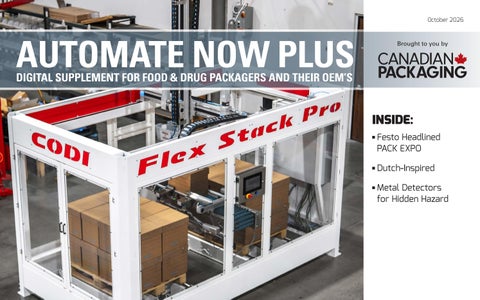
CODI’s Flex Stack Pro gantry-based palletizer uses Festo’s handling system at its heart. October 2026 · AUTOMATE NOW PLUS
3
AUTOMATE NOW PLUS
Soft silicone-based fingers adapt to the food or package being handled, allowing HPSX to grip produce ranging from strawberries to mushrooms. electric positioning for automatic format changes in washdown areas. Festo brings electric motion directly into the washdown environment with the new hygienic EPRF stainless-steel electric cylinder and EMMH-AS stainless-steel servo motor. Combined with Festo CMMT-AS multiprotocol servo drives, the IP69K EPRF and EMMH-AS provide linear and rotary motion that integrates with Rockwell, Siemens, Beckhoff, and Festo PLC architectures. A multi-turn absolute encoder on the EMMH-AS retains position through power cycles, eliminating homing and reducing startup and commissioning time. At PACK EXPO, a new dynamic booth demonstration brought electric and pneumatic automation together under simulated washdown conditions. EPRF electric cylinders and EMMH-AS servo motors operated alongside an IP69K MPAC pneumatic valve maniCANADIANPACKAGING.COM
number of fingers, the change can be made quickly using simple tools. HPSX grippers are highly corrosion-resistant and feature a sanitary design that facilitates cleaning and maintenance. They have an IP69K high-pressure washdown rating. Their silicone fingers are certified for direct food contact and are metal-detectable, allowing material fragments from a damaged finger to be detected by the food processor’s metal-detection system. At PACK EXPO, attendees saw the HPSX simulate picking and placing an apple in the EPRF washdown demonstration.
fold and stainless steel pneumatic actuator, demonstrating how machine builders can combine both motion technologies in hygienic applications without sacrificing washdown capability.
Change the product without changing the gripper Delicate products present another engineering challenge. Their varying shapes, sizes, and consistency make them difficult for conventional robotic grippers to handle without damage. Festo introduced the complete HPSX family of adaptive grippers at PACK EXPO, giving cobots a grasp that conforms to the product being handled. Soft silicone-based fingers adapt to the food or package being handled, allowing HPSX to grip produce ranging from strawberries and mushrooms to peaches and honeydew melons, as well as glass
Change the PLC without redesigning the motion and I/O The HPSX soft gripper is food-safe, features a sanitary design, and handles a wide variety of objects without requiring a tool change. and fragile packaging. These grippers withstand acceleration up to 15 grams while holding up to 1.1 pounds (half a kilogram) for high-speed operation. Customized versions are also possible to meet unique application requirements. Each HPSX all-in-one gripper accommodates a wide variety of shapes and sizes without a tool change, allowing the same cobot to move from one product to another. When an application requires a different gripper size or
Packaging OEMs build machines for customers that specify different PLC platforms, potentially requiring controls engineers to re-engineer the motion and I/O for each architecture. At PACK EXPO, Festo’s new Seamless Connectivity 2.0 demonstration showed how OEMs can move from one PLC platform to another without re-engineering the underlying motion and I/O system. Visitors interacted with the demo by unplugging one PLC and plugging in another, switching among Rockwell Automation, Siemens, and Beckhoff controllers. The Festo motion, pneumatic, and I/O system continued operating through automatic addressing and initialization. Festo CMMT multiprotocol October 2026 · AUTOMATE NOW PLUS
4
AUTOMATE NOW PLUS servo drives, CPX-AP-A remote and CPXAP-I decentralized I/O, electric motion, and pneumatics operated without alteration and were visibly displayed in a transparent case. Festo Automation Suite, a free software application, further reduces commissioning work by automatically identifying Festo devices and providing a single environment for parameterization and configuration. Instead of configuring components individually, machine builders can bring the connected automation system into operation faster.
Design a handling system without engineering every component Developing a multi-axis handling system can require machine builders to select, size, and integrate many components individually. CODI Manufacturing in Littleton, Colo. brought its FlexStack Pro gantry-based palletizer to the Festo booth, demonstrating how application-specific handling systems can be engineered and built faster. FlexStack Pro palletizes or depalletizes 44-to-110-pound boxes at rates of four-to-10 per minute. It offers industrial speed and dependability at about the same cost as a slower and less weight-capable cobot system. At the core of FlexStack Pro is Festo’s FPaKit, a pre-engineered multi-axis handling system that integrates axes, motors, drives, controls, cabling, and software into a system ready for mounting to the machine frame. “On our first FPaKit-based machine, we saved 20CANADIANPACKAGING.COM
PACK EXPO International 2026 allowed the Festo team to demonstrate how integrated automation, engineering tools, rapid product availability, and workforce training can help packaging OEMs build more flexible machines with less engineering.
About Festo
The Festo EPRF electric cylinder, with the EMMH-AS motor axially mounted. This new hygienic cylinder brings electric motion directly into the washdown environment.
The EPRF electric cylinder with the Festo EMMH-AS motor parallel-mounted. A multi-turn absolulte encoder on the motor retains position through power cycles.
to-30 hours of engineering and another 10-to15 hours of assembly,” said CODI Manufacturing Chief Operating Officer Jared Jones. CODI also offers Festo AX, an AI-based predictive analytics tool for monitoring electric and pneumatic components. Festo AX can run at the edge, keeping operational data under local control.
when materials are needed, reducing inventory without jeopardizing machine build schedules.
Reduce inventory without risking the build schedule Festo FAST gives packaging OEMs rapid access to frequently specified automation components. Pneumatic cylinders, valves, air preparation, fittings and tubing, electric actuators, motors and drives, and remote I/O are stocked at Festo’s Mason, Ohio facility for next-day shipment. OEMs can order nearer to
Skilled people keep automation productive Advanced automation delivers its full value only when employees have the skills to operate, maintain, and troubleshoot the technology. At PACK EXPO, Festo Didactic highlighted standardized and customized mechatronics training that prepares employees for these responsibilities. Festo Didactic is PMMI’s preferred technical learning partner, with training aligned to PMMI’s industry-recognized Mechatronics Certifications. At the PACK EXPO booth, attendees interacted with mechatronic learning systems.
Festo, the world’s leading supplier of automation technology and technical education, is deploying its products and services to meet the challenges of digitization and smart production. Founded in 1925, the family-owned company based in Esslingen, Germany supports a wide range of needs for advanced solutions in factory and process automation. In Canada, Festo has been supporting Canadian industry for 50 years, continuously elevating the state of manufacturing in this country with innovative products, optimized motion-control solutions and unrivalled support. Globally, some 300,000 customers put their trust in the company’s pneumatic- and electric-drive products and technology. In addition, Festo Didactic provides state-of-the-art training equipment and educational programs for industrial companies and educational institutions – about 56,000 customers worldwide. The Festo Group registered sales of €3.33 billion in the 2025 financial year and is represented worldwide at 250 locations with over 20,600 employees. About eight per cent of its annual turnover is invested in research and development. www.festo.com October 2026 · AUTOMATE NOW PLUS
5
STAINLESS
STEEL DRIVES Clean, Safe & Resilient Scalable High quality Integrated Available in 8 sizes
AUTOMATE NOW PLUS
DUTCH-INSPIRED How an Ontario-based farm has expanded into one of Canada’s leading mushroom growers By Andrew Snook
W
hen discussions about agricultural expertise take place, it is common for the Netherlands to find its way into the conversation. Well-regarded for its incredibly efficient growing operations, the Dutch people’s methods are often studied and adopted in other parts of the world. In Canada, one company that has leaned on its Dutch heritage to support its growing operations is Windmill Farms. Started up as Greenwood Mushroom Farm in the 1960s with only a handful of growing rooms, Windmill Farms has grown into one of the largest
CANADIANPACKAGING.COM
fully vertically integrated mushroom growers in Canada, with operations in compost production, growing, harvesting, packing, and distribution. “Over the years, we have invested significantly in our people, facilities, and growing capabilities,” says Greg Ogiba, CEO of Windmill Farms. “Our farms use a Dutch style of growing, which is the most efficient process for producing high-quality mushrooms in the world. Hence the windmill in our company’s name and logo, which is indicative of our Dutch roots.” Growing mushrooms 365 days a year, Windmill Farms currently employs approximately 750 people across its three properties spanning from Ontario to Washington State, which house four farms and two composting facilities. The company produces up to one million pounds of fresh mushrooms every week. Windmill Farms’ primary products include all the fresh mushrooms that a consumer will find in major supermarkets, restaurants, and many pizza shops across North America. “Specifically, most of our production is fresh white, brown cremini, and portobello mushrooms offered in a variety of formats and package sizes for retail and food-service customers,” Ogiba explains. “We also grow several exotic or ‘specialty’ mushroom varieties under the Heartee
LEFT: The Windmill Farms team has been supplying mushrooms to the Canadian market since its founding in the 1960s, when it began with only a few growing rooms. October 2026 · AUTOMATE NOW PLUS
7
AUTOMATE NOW PLUS
brand, which includes oysters, lion’s mane, and chestnuts.” The company’s primary customers include major grocery retailers and food-service distributors, which serve national and local restaurants, schools, and institutions. “We also allow walk-in customers at our main farm in Port Perry, Ontario, just as the original owners did more than 50 years ago,” Ogiba adds. Demand for its mushrooms stems from the company’s impressive versatility. “They can be used as a side dish, an ingredient in everything from pizzas and pastas to soups and stir-fries, or increasingly as a centre-of-plate ingredient,” Ogiba says. Their versatility, nutritional profile, and ability to add flavour and texture make mushrooms relevant across a very broad range of meals and cuisines. But while many people enjoy adding mushrooms to a wide variety of dishes, global consumption is on the decline. “We’re seeing a global decline in mushroom consumption primarily because emerging consumers are not replacing Baby Boomers’ consumption habits,” Ogiba explains. “So our teams are focused on producing consistently high-quality mushrooms, which also helps our industry tell the mushroom story: they’re nutritious, versatile, and tasty. We’re seeing new consumers come into the category and hope they stay once they realize how unique mushrooms are.” While there has been a decline in the more common brown and white mushrooms sold on CANADIANPACKAGING.COM
White mushrooms convey toward the packaging stations at the Port Perry facility. Packaging Manager Lurdes Araujo keeps a watchful eye. supermarket shelves, there have been a few bright spots showing growth. “We’re seeing more demand for organic, so I think that’s probably the younger emerging consumers. They’re health-conscious and looking for organic foods, and mushrooms fit the bill,” Ogiba says. “We’re also seeing growth in the exotics, although that’s sort of levelled out recently. It’s a niche market, but with lion’s mane, oysters, things like that, you can create some really exciting dishes. So for restaurants, chefs love them.”
The mushroom-growing sector is a very competitive industry. Fresh mushrooms are highly perishable, and customers have extremely high expectations for quality and service. “Producers have to manage agricultural variability, while operating a sophisticated manufacturing and distribution system every single day of the year,” Ogiba says. “So you have to be good at a lot of things simultaneously: growing, harvesting, labour management, food safety, packaging, logistics, forecasting, and customer service.”
Like most agricultural operations in Canada, recruitment and retention can be challenging aspects of operations. The workforce is comprised of a combination of local workers and harvesters and farmworkers largely recruited through Canada’s Temporary Foreign Worker Program (TFWP). “It’s not easy, but we find a balance. We are looking to hire as many locals as we can,” Ogiba says. “We have a very high retention rate, but most agricultural operations struggle to employ locals who just don’t want to work on farms. October 2026 · AUTOMATE NOW PLUS
8
AUTOMATE NOW PLUS
Atlantic Packaging corrugate awaits forming on a Wexxar Bel IPAK TF-350 automatic tray former.
Kazhan and Ogiba inspect the quality of the formed corrugate trays.
Therefore, the TFW program is absolutely critical in supporting the industry.” While automation is becoming a larger part of Windmill Farms’ operations to help “future-proof ” its workforce, growing and harvesting mushrooms is still a manually intensive process. “You’re never going to get away from it. Yes, there are fully automated farms, and you’re seeing some of it happen in Europe, but they’re expensive, and the return on that investment just doesn’t make sense right now. I think in 10 years, it will be a different story, but today, we’re just implementing automation in the parts of the production process where it gives us the biggest bang for the buck in terms of productivity and efficiency,” Ogiba says. Food safety and product quality are always top priorities at Windmill Farms’ operations, according to Svitlana Kazhan, vice president of agriculture. “We are producing a fresh food product, so hygiene, traceability, temperature control, and disciplined operating procedures are
critical throughout the process,” Kazhan says. “At Windmill, our food-safety audit scores are consistently ‘excellent,’ due to the food-safety culture we maintain.” Another area that is gaining increasing focus is the sustainability of operations, ranging from energy and water efficiency to reducing waste, optimizing packaging materials, and improving the efficiency of the company’s overall supply chain. “Mushrooms are naturally friendly to the environment, as many of the materials used in the growing process are reused,” Ogiba says. Windmill released its first ESG report earlier this year. Among the highlights, the company donates more than 100 million pounds of spent compost to local farmers. “Windmill cannot reuse it to grow mushrooms, but it’s a highly desirable fertilizer that farmers spread on their fields to help maximize their crops,” Ogiba says. Successfully growing mushrooms on the type of scale that
CANADIANPACKAGING.COM
Svitlana Kazhan, VP of Agriculture, and Greg Ogiba, CEO, display white and brown mushrooms. Windmill Farms operates comes from a combination of indoor agriculture, manufacturing and technology know-how. “Growing and harvesting still require tremendous human expertise and decision making, while our packing operations increasingly use automation for weighing, conveying, inspection, sealing, labelling, and case packing,” Kazhan explains. “As such, we have growers who have been around for decades, but also have food-manufacturing talent to pull the two worlds together.” Windmill Farms’ main packaging operation is located at its Port Perry farm and features eight packaging lines designed to handle October 2026 · AUTOMATE NOW PLUS
9
AUTOMATE NOW PLUS
Since the company’s performance is displayed on a TV screen positioned at each packing line, it’s been easy for all employees to understand how they are performing, from managers to supervisors and all staff working in the system, said Araujo, who has been with the company for more than 42 years. “Automation is particularly valuable here because we are dealing with large volumes of a fresh product, with more than 100,000 units being packed and shipped every day,” she adds. “Accurate weighing reduces giveaway and waste, while automated sealing and packing help us deliver consistent, secure mushroom tills, day-in, day-out.”
The growing process
Bird’s eye view of the Port Perry, ON Windmill Farms facility.
White mushrooms maturing in their growing beds.
different product formats, pack sizes, and customer requirements. “We also operate 104 automated GTL Europe packing stations in the farms; and Windmill is the only mushroom grower in Canada that runs these machines, which we added during our farm expansion completed in 2024,” Ogiba says. “Combined with our efficient ‘tilt-shelf’ blue-belt system, also from GTL and a first in Canada, we can produce mushrooms nearly two-and-a-half-times more efficiently than the standard ‘Dutch method.’” Windmill Farms has been continuously investing in automation, through which it improves food safety, quality, consistency, employee ergonomics, and efficiency. “The goal isn’t simply automation for automation’s sake; it is using technology where it creates a better operation and ultimately a better product for our customers,” Ogiba says. “Our focus is investing in ways to produce mushrooms as efficiently as possible,
in order to counter inflation and keep nutritious, fresh produce affordable for consumers.” The majority of the company’s packaging equipment is manufactured by ARCO Solutions out of the Netherlands, with a small amount of equipment supplied by Omori Machinery Company out of Japan. Another way Windmill Farms has been improving efficiencies within its operations over the past year is through investments in Montreal-based Worximity Technology’s real-time production software. “Worximity allows us to monitor our performance in real time, and that’s helped us identify bottlenecks and drive cost out of the business,” says Lurdes Araujo, packing manager. “We were able to get it up and running in a couple of weeks and saw results immediately.”
CANADIANPACKAGING.COM
Mushroom production begins with preparing compost, which takes place at Windmill Farms’ facility in Ashburn, Ont. It is the largest indoor mushroom-composting facility in North America, producing nearly 1,500 tons of compost each week to fill the company’s farms. Once the compost is put into the growing beds, which is done by two dedicated filling teams using heavy-duty agricultural equipment, the growers get to work in setting the right environmental conditions for mushrooms to grow. “We have more than 100 growing rooms across the company, each with 10 to 12 vertical growing beds per room,” Kazhan explains. “The crop is grown in highly controlled rooms where temperature, humidity, airflow, and other conditions are carefully managed and set by the growing team multiple times per day.” “Our most modern and advanced farms utilize [a] tilt-shelf and blue-belt system to feed the automation packing stations. Once all mushrooms are picked and settled into their containers, or ‘tills’ as we say in mushroom lingo, they are then moved into our ‘Fresh Pack’ operation, where they are sealed, inspected by quality control, and prepared for distribution the same or next day,” Kazhan adds.The packing lines use various equipment, including ARCO October 2026 · AUTOMATE NOW PLUS
10
AUTOMATE NOW PLUS
An Anritsu SSV Checkweigher system and a Fortress Technology Stealth Metal Detector inspect for proper weights and possible contaminants. sorting machines and Omori sealing equipment, to create the final product the consumer finds on supermarket shelves. Each line is equipped with ARCO Solutions checkweighers and Fortress Technology metal detectors, to ensure all products leaving the farm adhere to specifications.
Looking forward Windmill Farms sees significant opportunity in the future and is building the most modern mushroom company in Canada, which focuses on the customer and innovation for the consumer backed by its ability to produce high-quality mushrooms at scale. “That means continued investment in our growing operations, automation, packaging technology, sustainability, our people, and our customer capabilities,” Ogiba says. Over the next five years, he expects Windmill to become increasingly technology-enabled, while remaining very much CANADIANPACKAGING.COM
an agricultural business at its core. “We are incorporating AI to help us better align our sales and production forecasts, to assist the growers in making better decisions, and in finding additional efficiencies in our freight fleet by optimizing routes,” Ogiba says. “We want to grow with our customers, innovate within the category, and build Windmill into an even stronger North American leader in agriculture.” He adds that the fundamentals for future success are straightforward: better growing, better technology, better packaging, and better service – all while continuing to deliver a high-quality fresh product to consumers every day. “Ultimately, our objective is simple: grow great mushrooms, deliver exceptional service to our customers and keep getting better at how we do it. We see ourselves not just as leaders in the mushroom category, but in the broader fresh-produce and agriculture industry,” Ogiba says. August 2026 · AUTOMATE NOW PLUS
11
“I’ll be there. Will you?”
- Greg Ogiba, CEO, Windmill Farms
Canada’s food & beverage leaders are gathering in Toronto-on November Greg Ogiba,26 to celebrate the plants and people driving food and CPG manufacturing CEO, Windmill Farms forward — through automation, innovation and greater efficiency. P R E S E N T E D BY
15 award categories. One landmark evening! Joining us...
Premier Doug Ford and Sam Oosterhoff, Ontario Minister of Agriculture, Food & Agribusiness Both will be on hand to spotlight the importance of investing in automation to strengthen Canada’s food & beverage manufacturing industry.
Food & Drug Packaging Plants Awards Gala November 26 • Palais Royale • Toronto For more information, contact Stephen Dean, Publisher, Canadian Packaging at sdean@canadianpackaging.com.
P L AT I N U M SP O NS OR S
S ILVER S P ON S OR S
LEARN MORE
AUTOMATE NOW PLUS
METAL DETECTORS FOR HIDDEN HAZARDS Food-safety specialist Fortress Technology examines the importance of food metal detectors and why the company has dedicated 30 years to developing systems to cover every food-processing HACCP checkpoint By Fortress Technology
W
hen consumers pull products from retail shelves, their focus is often on branding, nutrition, and ingredients. Few shoppers contemplate the complexity involved in establishing and safeguarding Critical Con-
CANADIANPACKAGING.COM
trol Points (CCPs) on food production lines, but manufacturers do. Determining the correct Hazard Analysis Critical Control Point (HACCP) checkpoint and metal-detector type is more than just best practice. It is mandated by rigorous standards like Brand Reputation through Compliance Global Standards, the Global Food Safety Initiative, the International Food Standard, and specific Code of Practice retailer requirements.
A Fortress Technology food metal detector stops a metal contaminant in a processed convenience meal from reaching a consumer. October 2026 · AUTOMATE NOW PLUS
13
AUTOMATE NOW PLUS
Failing to implement these protocols can lead to large-scale recalls, safety investigations, and potential barriers to market entry. HACCP guidance recommends locating contaminant and metal-detection CCPs at any step at which hazards can be prevented, eliminated, or reduced to acceptable levels. In practice, this means every food processor’s metal-detection needs can vary based on their ingredients, equipment, and process flow. Industrial food safety does not begin on the factory floor; it starts in the soil. Because root vegetables are harvested using heavy machinery, they can be susceptible to metallic contaminants long before they reach a processing facility. High-volume crops (for example, potatoes processed into potato chips or fries) are typically scanned by farmers to catch hazards that could otherwise be fragmented into smaller metal pieces during later stages of production. This “start at the source” philosophy recognizes that farming environments are the first line of defence. Deploying robust conveyor metal detectors as crops are harvested, cleaned, and sorted for storage can mitigate risks long before ingredients even enter the supply chain. This early intervention is a critical component of a comprehensive HACCP strategy. Where food metal detectors are situated within a production line can have a substantial effect on a manufacturer’s financial status. This decision can also be a key factor in safeguarding CANADIANPACKAGING.COM
A multi-lane, multi-aperture bakery-food metal detector, with two conveyor belts and two separate BRCGS-approved reject systems, doubles inspection speeds. October 2026 · AUTOMATE NOW PLUS
14
AUTOMATE NOW PLUS
both product quality and operational efficiency. There is always value to be gained from implementing gravity, pipeline, and large-format conveyor metal detectors upstream. By thoughtfully positioning metal detectors at CCPs, manufacturers can prevent contamination from progressing further along the production cycle. Early detection enables swift removal of compromised product, minimizing the scope of potential recalls and the associated financial repercussions. Additionally, strategically placed detectors help maintain consistent product quality, ensuring that only safe items reach consumers. One of the most significant technical hurdles that Fortress Technology has helped food processors overcome is addressing “product effect.” Certain conductive foods, such as meat, cheese, baked products, and frozen goods, can mimic the signal of a metal contaminant potentially triggering false rejects. Overcoming this requires sophisticated signal processing that can distinguish between the food’s natural signature and an actual hazard. The Interceptor conveyor metal detector applies advanced signal processing to accurately separate a food’s inherent electrical signal from genuine metal contaminants. Vepo Cheese invested in seven Interceptor metal detectors with automated reject systems to support processing efficiency. By standardizing their inspection equipment, Vepo Cheese also reduced its maintenance and spare-parts costs. “The automated reject system ensures continuous production and reduces the risk of a metal contaminant slipping through the safety net. We are extremely satisfied with our new standards of quality assurance,” comments Hugo van Put, the technical operations manager at Vepo Cheese. Combination and multi-lane, multi-aperture metal detectors are equally essential for solving production bottlenecks. These CANADIANPACKAGING.COM
Meat factory adds inline pipeline metal detector to production line, reducing product waste costs by 50 per cent. technologies enable simultaneous inspection of multiple product streams, ensuring efficient processing without sacrificing safety or quality. By integrating multi-aperture systems, manufacturers can manage high throughput while maintaining rigor-
ous contaminant control. “Our Fortress twin-aperture metal detector has been key to improving efficiency, proving reliable and easy to operate,” says Mr. Boneschansker, the plant manager at Borgesuis Bakery. The confectionery industry faces a unique technical challenge: how do processors detect metal inside a product already wrapped in aluminum foil? A standard metal detector would be rendered useless, as the packaging itself would trigger constant product rejections. Instead, confectionery products like foilwrapped chocolate bars or chewing gum need a metal detector that can prioritize specific metallic properties over others. Ferrous Only metal detectors are specifically engineered to ignore the non-ferrous signal of the foil packaging, while remaining hyper-sensitive to actual steel fragments. It is a brilliant example of industry innovation, in which detection technology is purpose-built to filter out expected metal signals and identify only the contaminants that pose a risk. This strategic use of advanced technology greatly improves food-safety programs. With metal detectors available for every food-manufacturing CCP, processors can implement a multirisk contaminant-metal-detection strategy across entire production lines. For optimal efficiency, this should also be supported by digital reporting tools, which give processors instant visibility of all detector statuses and allow them to document inspection results efficiently. Although one metal detector will always be better than none, implementing a combined approach helps to verify that every food product is safe and meets the highest standard. Installing a food metal detector is only one part of the process. CCPs are not a “set and forget” installation. Effective food safety also depends on regular employee training, ongoing HACCP reviews, and planned maintenance and calibration. October 2026 · AUTOMATE NOW PLUS
15
DOUG FORD is on our side...
He’s at every food and consumer packaged goods event in creation. He’ll be front and centre at the Food & Drug Packaging Plants Awards Gala at the Palais Royale in Toronto on November 26 to promote investment in Canada’s food and drug packaging companies.
Will you be there? Book a table for your people and your customers. Nominate a customer for an automation or leadership award. Be a part of the celebration of our food and packaging businesses.
NOVEMBER 26TH, 2026 | PALAIS ROYALE • TORONTO events.annexbusinessmedia.com/event/food-drug-packaging-plants-awards/
P L AT I NU M SP ONS OR S
S ILVER S P ON S OR S
Contact Stephen Dean 416-510-5198 | sdean@canadianpackaging.com