AUTOMATE NOW Plus
DIGITAL SUPPLEMENT FOR FOOD & DRUG PACKAGERS AND THEIR OEM’S
Broughttoyouby



THE TIMES ... THEY ARE CHANGING
Now that there is an online app for just about anything you once had to search, find and confirm yourself, it seems inevitable that soon there will also be a robot to do a multitude of mundane manual tasks that many of us still do on daily basis without giving it much thought—both at home and at work.
The big question is, How soon?
Although industrial robots have been around for decades, it is only recently that their potentially enormous impact on the global workforce has captured widespread public imagination and the attention of leading business, government and social leaders acknowledging their irreversible mass appeal and ubiquity in the modern workplace.
Whereas industrial robots were once neatly confined to carrying out the big Three D tasks identified as being dirty, dangerous or dull, the quantum leaps in digital and AI (artificial intelligence) software technologies over the last decade—along with spectacular breakthroughs in robotic design, intelligence and pricing—could spell doom for mind-boggling numbers of people employed not only in manufacturing, but also in a multitude of service industries spanning from retail clerks to bus derivers and bartenders.
With less work to go around for the growing population, the socioeconomic implications of such accelerated workplace automation can be a cause of severe anxiety for the fast-growing millennial generation still looking to establish its own definitive identity in the new world economic order.
Which is exactly what disruptive technologies do and have always done—ever since the original Industrial Revolution, in fact. But for all the social havoc and disruption caused in the past, the end result had inevitibbly manifested itself in more productive and prosperous societies, at least in the industrialized nations.
So why should it be any different this time around?
It’s easy to succumb to hysterics when looking at the numbers in isolation: they are grimly discouraging.
Only a year ago, the World Economic Forum (WEF) predicted the loss of five
million jobs across 15 industrialized economies by 2020, linking it directly to the ongoing developments in genetics, artificial intelligence, robotics and other new-generation technologies.
According to WEF’s widely-cited The Future of Jobs report, “Developments in previously disjoined fields such as artificial intelligence and machine learning, robotics, nanotechnology, 3D printing, and genetics and biotechnology are building and amplifying one another.”
All this multidisciplinary convergence will usher in nothing less than the Fourth Industrial Revolution, the report contends, predicting a golden age for advanced robotics and autonomous transport, artificial intelligence, machine learning, advanced materials, biotechnology and genomics between 2018 and 2020.
That’s in less than in a year’s time for the first shock waves to ripple, which is hardly enough time for the sort of an epic and universal skill retraining initiative that would have be implemented to offset the expected decline in millions of white-collar office jobs that will bear the brunt of the future labor displacement.
“Across nearly all industries,” the report states, “the impact of technological and other changes is shortening the shelf-life of employees’ existing skillset.”
As with all game-changing pronouncements, there will be optimists hailing the liberation of blue- and grey-collar proletariat from routine mind-numbing tasks better left to robots, along with naysayers lamenting massive job displacement and the social friction it will cause.
Whatever side of the fence you find yourself on, dear reader, just keep in mind that this column you have just read was not written by a robot, yet.
FINDING THEIR NICHE
Canadian distributor of fresh fruits uses new trayformer to achieve huge savings on per unit costs
BY ANDREW JOSEPH, FEATURES EDITOR
PHOTOS BY NAOMI HILTZ
Within the global fruitpacking sector, more is usually considered better: more variety, more markets to tap—certainly many a business has tapped that plan to great financial success.
But one Canadian company has shunned the ‘more is more’ mentality, and has instead found global renown and success with its niche business plan.
Founded in 1929 by Michael Leonard Catania at the onset of the global depression, M.L. Catania Company Limited was set up as a produce import and distribution business to service the Toronto area.
Nowadays, the company remains a family business, but rather than the localized Toronto market, M.L. Catania has found its niche as an exotic fresh fruits importer and distributor with a global focus.
Founder’s son Paul Sr. joined the company in 1946, but it wasn’t until current president and owner Paul Jr. joined the family business in 1975, that the company expanded its vision to be
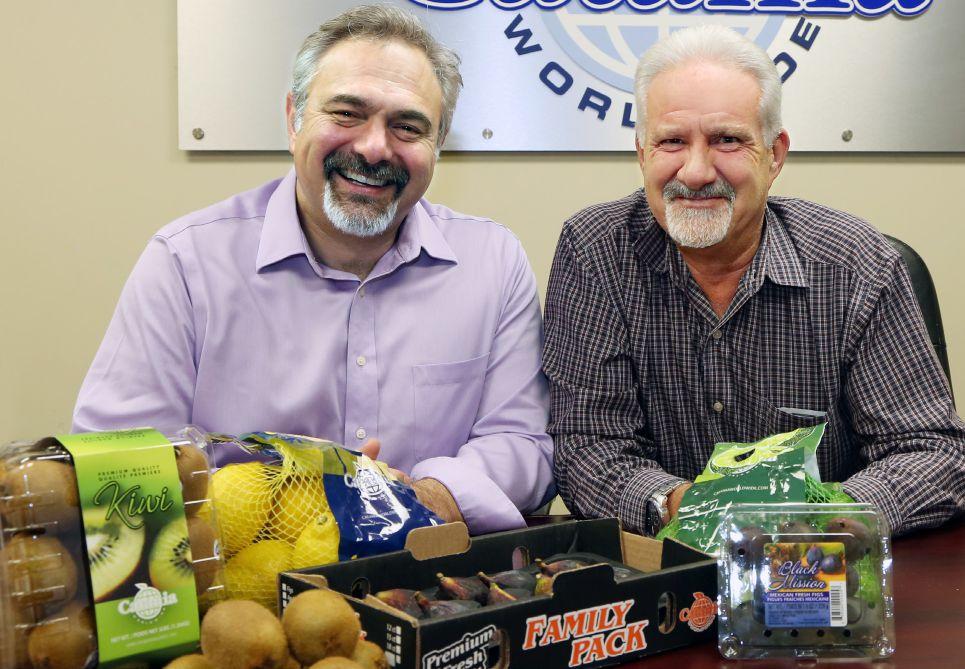
M.L. Catania Company Limited director of sales and marketing Mario Masellis (left) and general manager Neil Catania with some of the semi-exotic fruits the Toronto-headquartered company grows, packs and distributes around the world.
more global, with international expansion throughout the northern and southern hemispheres.
Always a big player in the fresh fruits market, M.L. Catania is now considered to be a true global player and leader.
Despite the company’s continued forward momentum in regards to its growing customer base as a 21st century business that utilizes new world innovation and business approaches, M.L. Catania does so by using an old world tradition of small business charm.
That so-called old-fashioned charm is hardly lost on current ownership, as company director of sales and marketing Mario Masellis attests.
After Chinese gooseberry fruits were transported and grown in New Zealand, Michael Catania was one of the first people in the world to fly there and import them to Canada.
“It failed miserably,” Masellis told Canadian Packaging during a recent visit to the modern Mississauga, Ont.-based company headquarters. “Figuring it had more to do with its name, our company founder and a few other like-minded individuals got together and came up with a new name for the hairy, but delicious fruit.
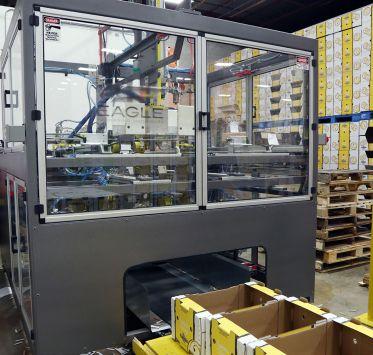
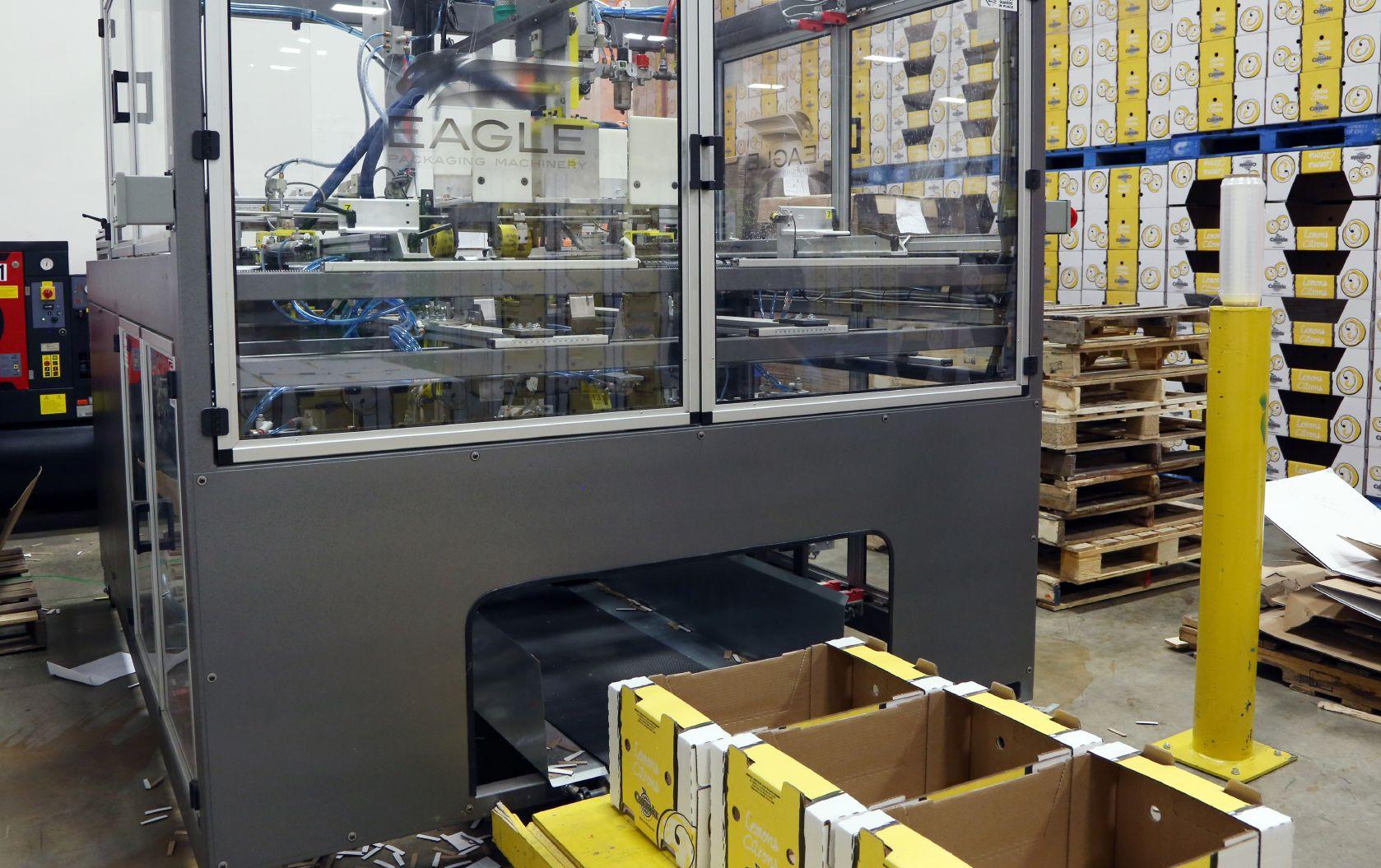
M.L. Catania uses a VassoyoAir automatic trayforming machine designed and manufactured by Eagle Packaging Machinery to pack lemons, limes and clementine fruits, as well as larger types of fruits such as grapefruit into the stackable corrugated trays.
“Taking their cue from where these fruits were being grown, and borrowing from the existing national bird, the name kiwi was chosen,” says Masellis. “And the rest is history.”
From within the 40,000-square-foot plant floor with an additional 5,000 square feet of loft storage, Catania says the facility has seven coolers that provide 250,000 cubic feet of cold storage, and provides 3,000 square feet of office space.
M.L. Catania Worldwide continues to sell
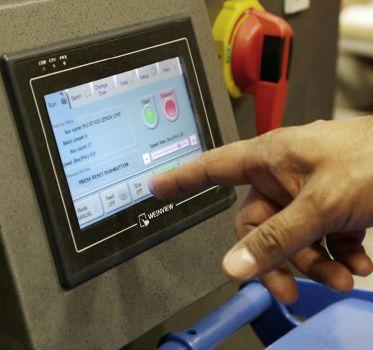
by Eagle Packaging Machinery is easy to use, helping M.L. Catania employees easily alter glue patterns on corrugated tray blanks as required.
kiwi, with some 40 percent of its business derived from the importation and packaging of the former Chinese gooseberry across North America and the world.
Catania says that limes and figs each represent approximately 20 percent of its business, with remaining number taken up by a wide range of fruits such as mango, pomegranate, cactus pears, clementines (a hybrid between a mandarin orange and a sweet orange), persimmons, avocado, figs, papaya, plums, grapes, pears, lemons and a
The HMI (human-machine interface) on the VassoyoAir trayformer manufactured
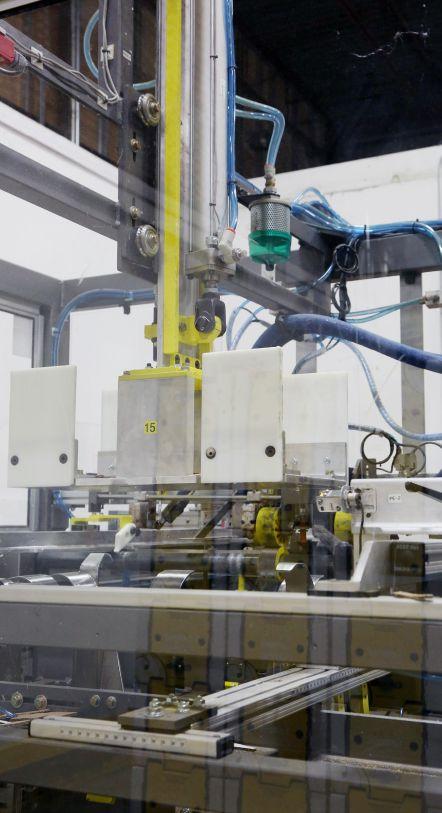
A peek inside the VassoyoAir automatic trayforming machine.
few others.
Along with its Canadian-based Catania Worldwide, the company started up several other companies: Stellar Distributing, and Maple Leaf Ranch in Madera, California, and Catania Mexico in Mexico.
Stellar Distributing moves product through the western U.S., and also has a packaging and distribution center in Vineland, NJ that services the east coast of America.
Showing its heritage, the aptly named Maple Leaf Ranch is a division of Catania Worldwide that grows products like figs and persimmons exclusively for Stellar Distributing.
Catania Mexico grows, packs and ships its products—figs and limes—to both the Vineland and Madera facilities, as well as to the Mississauga headquarters.
“Many people think that a particular fruit just comes from one part of the world,” says Masellis. “But to access non-greenhouse fruit year-round, we have farms we deal with all over the world.
“For example, the kiwi we package comes from Italy, New Zealand, the U.S. and Chile, all are available at different times of the year.”
He notes that even though a fruit may be available year round from different sources, M.L. Catania imports different varieties,
such as standard mangoes, and the golden mango that is sweeter, with a literal melt-inyour-mouth constancy.
Masellis says that along with growing and shipping their own niche fruits, the company imports its fruits from known growers around the world, adding that the Mississauga facility of M.L. Catania is the Canadian distribution center and importer of fruits from the company’s other divisions in Mexico and California.
“We bring fruit in from those areas and from around the world, creating custom packaging in bulk and in specific sizes per customer requirements,” relates Masellis,
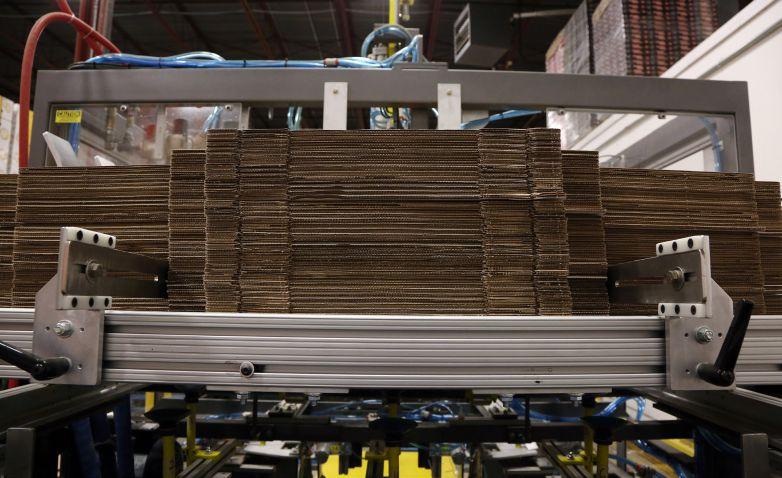
Venturi vacuum technology automatically pulls carton blanks one at a time from the VassoyoAir trayformer’s hopper.
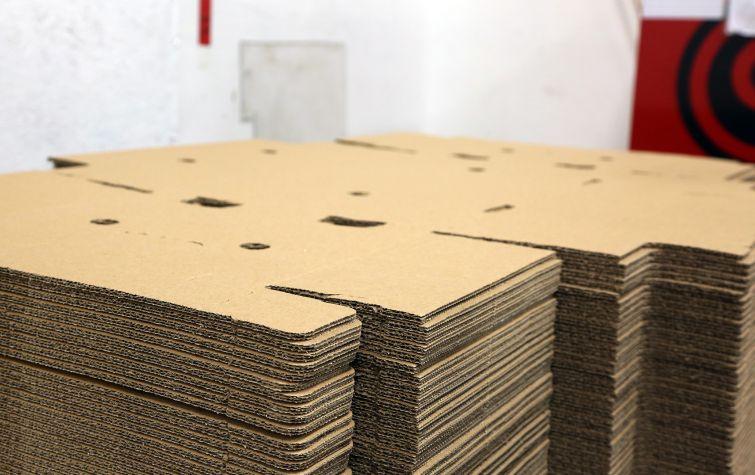
WestRock Company makes the corrugated trays and cartons purchased by M.L. Catania via Stesco Global Packaging Corporation.
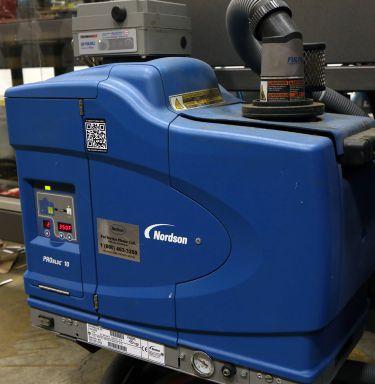
A Nordson ProBlue 10 system sprays a hotmelt adhesive to bond the corrugated trays .
adding that the company can count Costco, Loblaws, Sobeys, Metro and others, amongst its large customer base.
M.L. Catania Worldwide has over 50 SKUs (stock-keeping units) consisting of the aforementioned fruits and their various packaging types and sizes.
One of the packaging options from Catania Worldwide is its stackable corrugated tray pack, an initiative that came onboard approximately 18 months ago, and is formed by a very unique piece of automated equipment manufactured by Eagle Packaging Machinery—a VassoyoAir automatic trayforming machine.
Eagle Packaging Machinery—part of the Paxiom Group—was established in 1998 and is headquartered in Miami, Fla.
Eagle Packaging Machinery manufactures a wide range of end-of-line packaging systems, including automatic case erecting, trayforming, pick-and-place and robotic palletizing solutions. Its well-known brands include the Vassoyo, Boxxer and PopLok.
M.L. Catania general manager Neil Catania says this VassoyoAir automatic trayforming machine was custom-made to its exact specifications.
“The box we use is special, so we needed
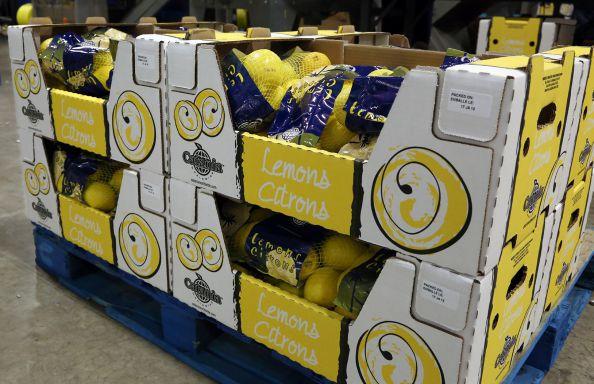
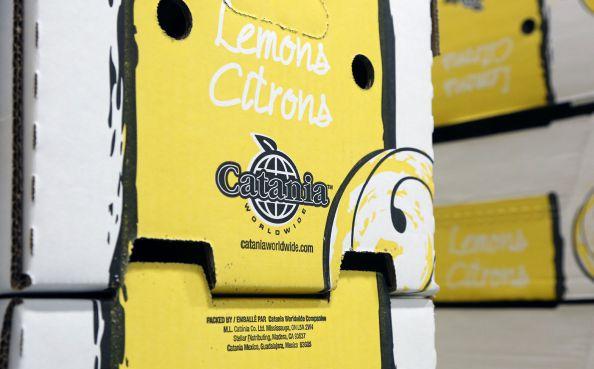
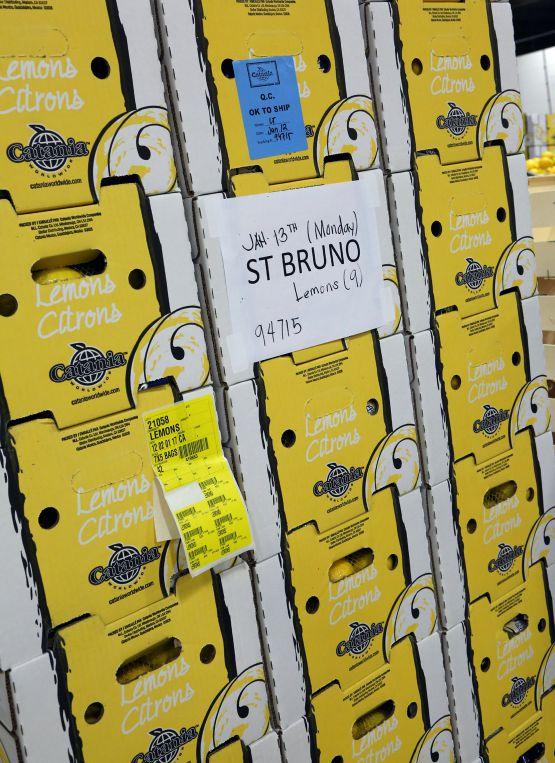
Key to the design of the corrugated trays formed on the Eagle Packaging Machinery VassoyoAir trayformer is the way it forms a stable wall when placed atop each other, ensuring safe transport from its Toronto distribution center to its far-reaching global customer base. Notched trays are converted by WestRock.
a tray former that could efficiently fold down the top flaps, and fold up the side flaps and glue it all together—and that’s what Eagle Packaging Machinery gave us,” expresses Catania.
The VassoyoAir uses Venturi vacuum technology to gently pull a single corrugated blank from the hopper, fed under the glue guns that apply a hotmelt adhesive to the minor flaps of the tray courtesy of a Nordson ProBlue 10 adhesive system.
Catania says that “the Nordson takes the adhesive in a pellet format, sucks it up into the heating chamber of the machine, where it is melted at a temperature of 350°F before it is pumped through a series of hoses to four different nozzles, where it is sprayed onto specific predetermined locations onto the formed corrugate case.”
The blanks continue past a ram mandrel, where it is forced down through corner folders to form the tray.
The tray is then held within a compression area until the next tray enters the forming section, at which time it is dropped onto a discharge conveyor to exit the machine.
“Despite the complexity of our tray format, I’m impressed with the speed of the VassoyoAir in forming it,” says Catania, noting that it is engineered to form and glue stackable produce trays at up to 25 cycles per minute, though they run it slightly slower “at a rate of 22 trays a minute.”
Catania also raved about the VassoyoAir’s ease-of-use.
“It offers us quick change-overs, low maintenance,” he says. “And for our operators, it has a color touchscreen interface that easy allows to alter glue patterns on the cor-
rugated blanks.
“The interface also provides us with full access to all functions and timing of the VassoyoAir.”
According to Eagle Packaging Machinery vice-president of sales Anthony Del Viscio, he believes M.L. Catania chose Eagle Packaging Machinery because “we have the unique ability in offering custom-engineered solutions, and take the time to fully-understand the expectation of our customers in order to ensure we not only meet them, but exceed them.”
He says Eagle Packaging Machinery takes great pride in its ability to manufacture robust packaging systems that remain easy-to-use and fairly-priced.
“The VassoyoAir has helped M.L. Catania save some 80 percent in labor costs over hand-folding trays,” relates Catania, adding that they also save on corrugated materials because glued trays use less board—some 25 percent—on these hand-folded trays.
“Then there’s also the fact that we can save space by producing trays on demand rather than having to do so in batches, which helps free-up floorspace,” says Catania. “As well, by not having to store corrugated flats on the floor, and by folding on demand, M.L. Catania has increased its hygiene and eliminated possible contamination risks.”
According to Eagle Packaging Machinery, the VassoyoAir can run large or small tray sizes and with or without a lid, proving options for the processor.
Manufactured by WestRock Company, the corrugated trays and cartons used by M.L. Catania are purchased via
the Toronto-based Stesco Global Packaging Corporation, that Catania says provides warehousing of the corrugated blanks until such time that it requires them.
Stesco designed the graphics, and places orders through WestRock, who produce the corrugate, print the box and diecut it to the specific size and shape.
At this point, explains Catania, Stesco warehouses the product, adding that it can be a large quantity owing to the fact that M.L. Catania places daily orders.
“We have a high volume daily output,” notes Catania.“In 2016, we utilized approximately 350,000 trays or cartons.”
He says these WestRock trays are used by Costco stores as retail-ready—the pallet of trays are placed upon the store floor.
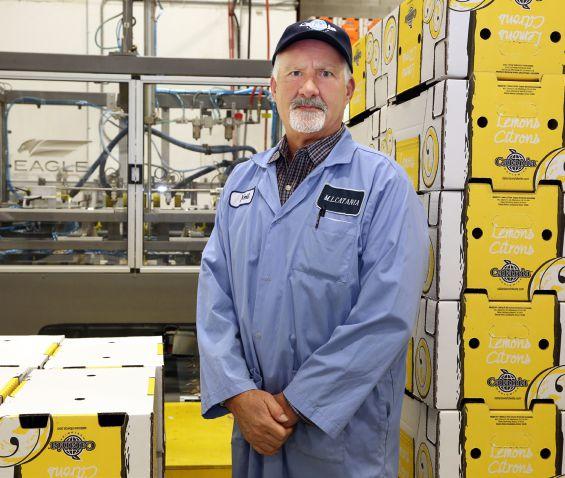
M.L. Catania general manager Neil Catania stands beside the corrugated trays formed on the model Vassoyo Air transformer from Eagle Packaging Machinery.
Catania continues, “It has some unique features, such as a front flat that folds down once fruit is ready to be placed in it, giving the holding tray a ‘mouth’ to display the fruit, providing the shopping consumer with a great view of the fruit.
“Beyond that,” he adds, “the box has step-up notches on the top and cutouts on the bottom so they can easily interlock on a shipping pallet.”
Even before the filled corrugated trays are strapped to the shipping pallet, “these cases aren’t moving around in the truck,” says Catania. “They are gridlocked in place, meaning we know our fruit will arrive in excellent condition at its destination.”
While the WestRock trays and cartons are provided to M.L. Catania with different graphics per need, it is the same blank used to package lemons, limes and clementines—but easily handles larger-sized fruit such as grapefruit.
“The trays are highly diversified,” Catania relates. “We like them, our customers like them, and so do the consumers.”
He explains that within any high volume work environment, trying to keep costs down is a full-time concern, and is one of the key reasons why the company opted to purchase Eagle Packaging Machinery’s VassoyoAir trayformer.
“We were looking to try and reduce our labor costs,” says Catania.
Prior to purchasing the VassoyoAir, Catania figures it cost
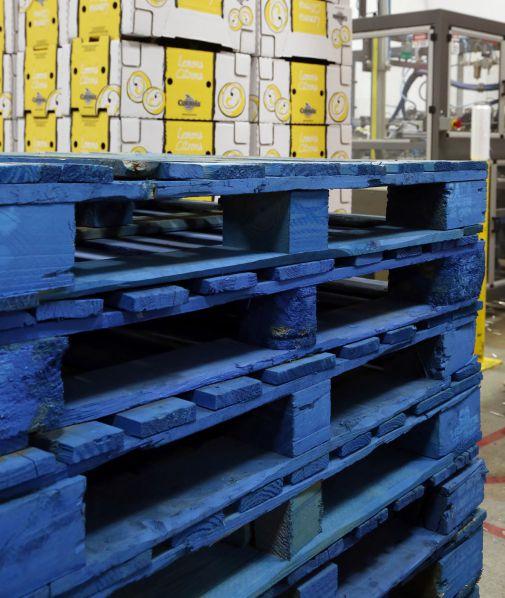
M.L. Catania uses the iconic blue wood pallets from CHEP to load cases of its fruit for delivery to its customers.
$0.25 to make a single tray by hand.
With the automation brought by the VassoyoAir, to erect each tray costs only $0.05, including costs to run the machine, support costs such as the hotmelt adhesive, hydro and compressed air.
“With the addition of the Eagle Packaging Machinery VassoyoAir trayformer we have reduced our overall assembly costs by 80 per cent per unit,” relates Masellis.
“As well, we believe we now have a much superior box thanks to the consistency and precision provided by the automation technology of the VassoyoAir.
“We are very, very happy with the Eagle Packaging Machinery VassoyoAir tray erector,” relates Catania. “Our reduced costs are completely in line with what we had expected from our ROI (return on investment).”
More than that, both Catania and Masellis expressed how impressed they were with the exemplary service provided by the VassoyoAir.
“In the future, I can honestly state that should the need arise where we needed a tray former, I would not hesitate to purchase more equipment from Eagle Packaging Machinery,” says Catania.
“Eagle has been great,” he says. “Not only did they oversee the install of the tray former, but they took the time to carefully teach our operators how to effectively use the VassoyoAir to get the most out of its automation.
“It’s a great machine, and we’re being serviced by a great company,” sums up Catania. “It’s a great example of a modern approach with old-world ideals, and that’s what Eagle Packaging Machinery was able to bring to the table.”
He continues: “Knowing we have suppliers who share our ideals helps us grow our business the way we want to grow our business.”

See M.L. Catania video discussing the Eagle Packaging Machinery trayformer on Canadian Packaging TV at www.canadianpackaging.com

MAKING PACKAGING PROCESSES MORE FLEXIBLE AT NESTLE
Modern automation systems for safe, efficient packaging processes.
BY: BENOIT PETIT, NETWORKS PRODUCT MANAGER, PILZ FRANCE, AND ANDREAS SOBOTTA, CHIEF EXECUTIVE OFFICER AND GENERAL MANAGER, PILZ CANADA
These days the quality of the packaging is important, as is the multifunctionality of the packaging lines. Not only must it satisfy the very highest requirements in terms of productivity, flexibility and reliability, but safety must also be absolute. Flexible automation technology guarantees that foodstuffs are always packed hygienically, gently, efficiently and safely, whether for canine, feline or human consumption.
Nestlé Purina Petcare is a worldwide manufacturer of dog and cat food; its priority is the quality of its products.
To guarantee this quality in the future, the company, which belongs to Nestlé France, arranged a comprehensive retrofit of its production facilities. The focus was on modernization of the electronics and the safety of the packaging lines. The aim was to increase produc -
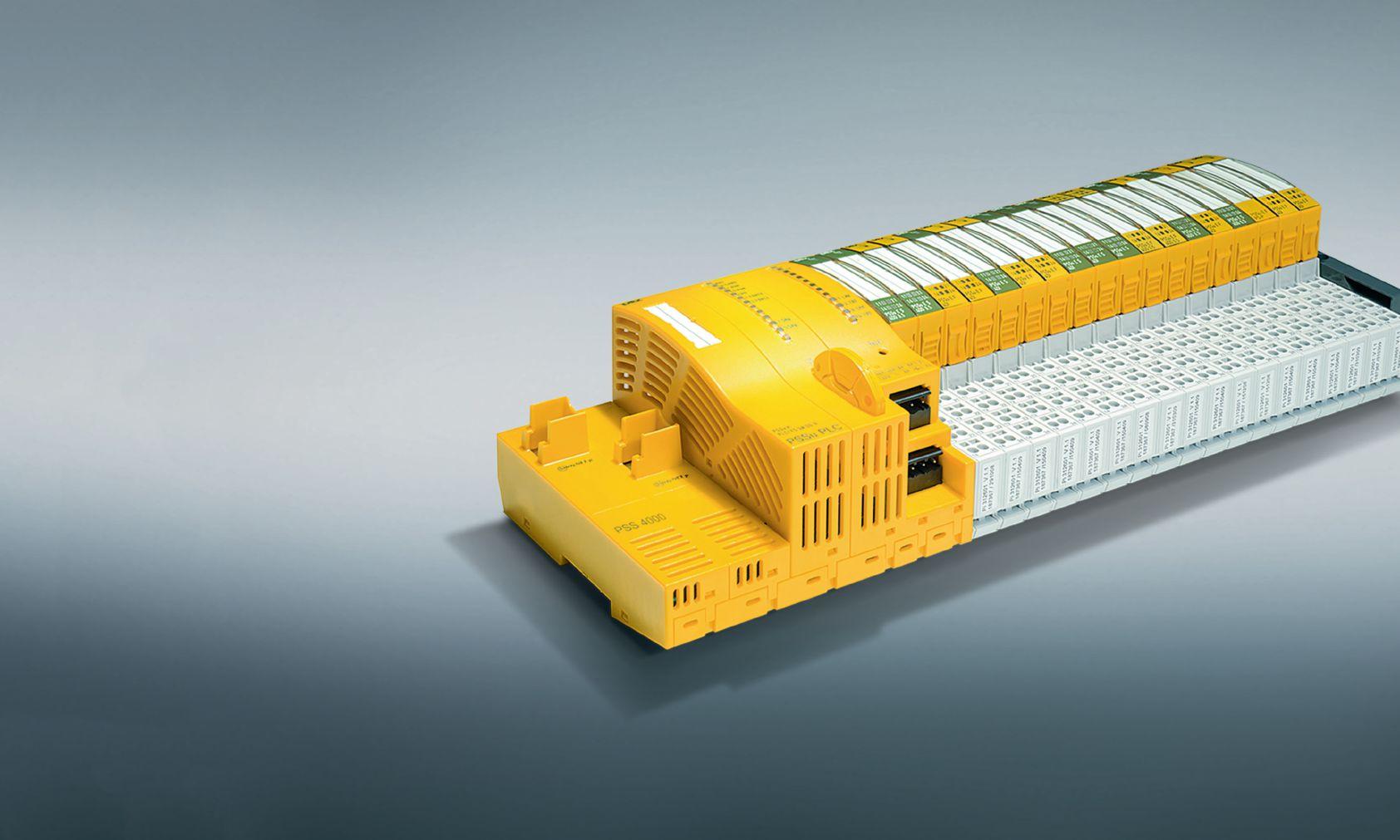
Thankstoitsflexibility,theautomationsystemPSS4000 canbeadaptedindividuallytoexistingstructures.
tion to serve the rapidly growing market segments for the Nestlé products.
The rise in production meant that the packaging lines had to be upgraded, with the focus on safety and flexibility. The aim was to achieve a highly flexible, safe production process.
The factory in Aubigny, France, manufactures round the clock; the production facilities run 24/7/365. Different product sizes from the Purina cat food range are packaged, involving a variety of packaging cycles.
These continuously changing production cycles demand an automation technology that can be tailored flexibly to the respective packaging process. That’s why Nestlé Purina Petcare opted for the automation system PSS 4000 from Pilz, which can be used to implement standard as well as safety-related automation tasks simply, and above all flexibly.
The automation is currently implemented at the various stations – filling or heat-sealing for example – on a total of three packaging lines, using PSS 4000.
PSS 4000 FOR HIGHLY FLEXIBLE PACKAGING PROCESSES
To manufacture and package high-quality cat food, packaging
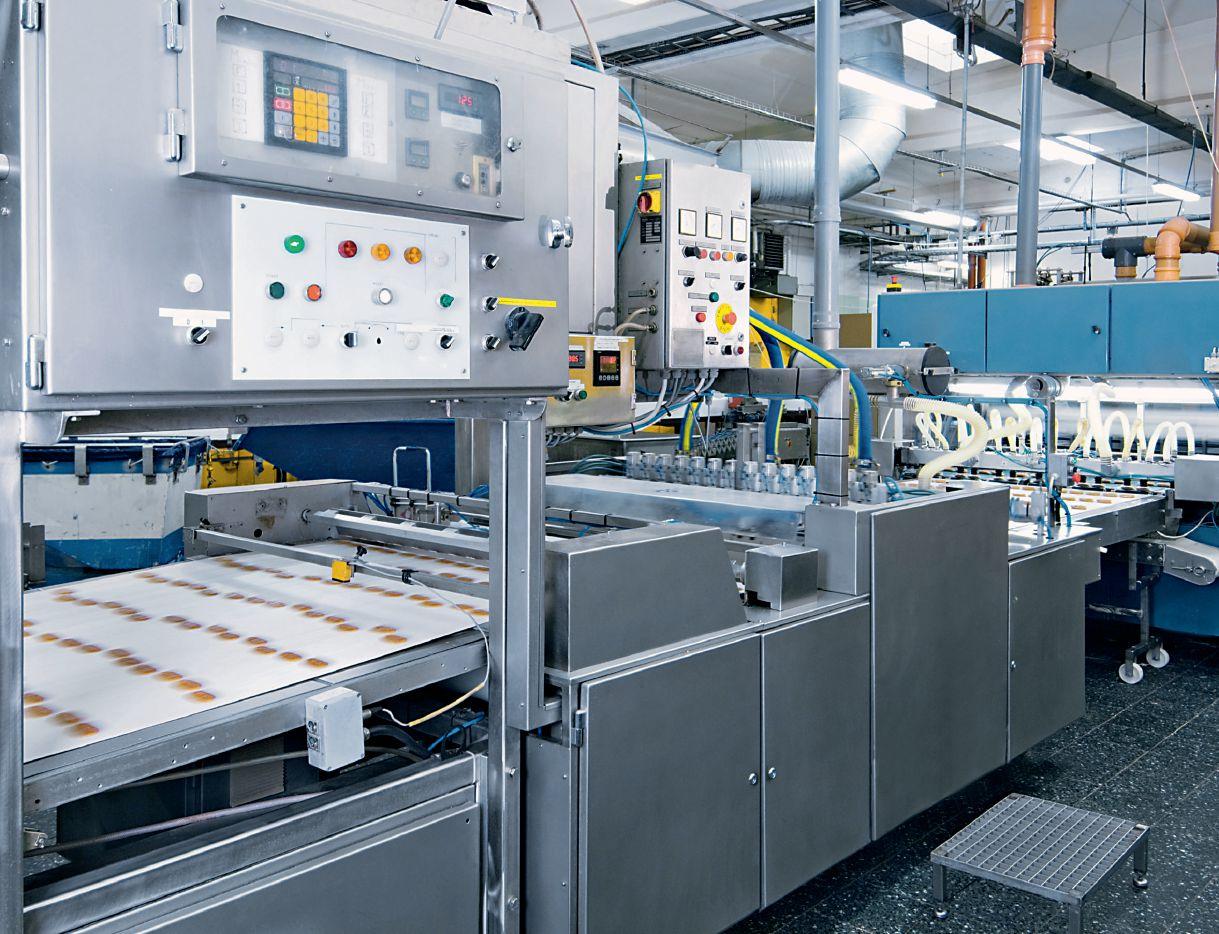
Modern automation technology ensures that foodstuffs are packed gently, flexibly and efficiently.
lines need to be flexible and must meet today’s applicable safety standards. At Nestlé Purina Petcare, products are generally packed into rectangular aluminum pouches.
The pack designs vary, depending on the type and size of the pack to be filled.
As changes in the packaging process are continuously repeated, the engineering needs to be flexible.
Key differences in flexibility are evident even as an automation project is launched, when actual implementation begins following the initial project agreement. With the automation system PSS 4000, the hardware and software design can begin immediately, for the software is developed independently of the hardware.
Ultimately the required hardware can also be defined faster, as the automation system PSS 4000 enables the system and hardware development to run in parallel. Certain aspects need to be considered when selecting control components for the hardware. For example, it’s important to note the cycle time that is to be achieved, or how the operating and monitoring structure is to be designed. Another point that needs to be considered is the layout of the automation structure, i.e. the number and distribution of the programmable logic controllers (PLC). For example, is each individual packing station to have a PLC or will several stations be controlled by a centralized control system? All these are matters which are usually cleared up prior to design, to avoid
safety functions such as emergency stop, light beam devices, door locking devices, etc.
The necessary rise in production meant that this technology had reached its limit.
The modernization work on the packaging lines comprised a full upgrade of the control components; the new automation technology was to be easy to integrate into the plant’s existing basic structure.
causing the considerable expense of subsequent modifications.
The automation system PSS 4000 opens up a whole range of possibilities in this regard. Due to its structure and properties, decisions such as the selection of a PLC to suit the design can be postponed to a much later point in the design phase. With PSS 4000 therefore, it is possible to concentrate on the design of the components required for the process.
SAFETY IS ABSOLUTE
Before the upgrade, the packaging line was controlled via a relay-based solution, which assumed control of
The selection criteria included absolute flexibility, easy operation and simple diagnostics via the corresponding software platform PAS 4000. Data transfer via the real-time Ethernet SafetyNET p, which enables all data to be transferred safely, was another key factor: The real-time Ethernet adapts to the existing data transfer structure and uses the existing Ethernet – Modbus TCP to communicate with the distributed remote stations PSSuniversal I/O and the automation system’s higher level control systems PSSuniversal PLC. Safety data from the individual stations and the installed operator terminals is transferred in real-time, as is the data from the packing stations.
PSS 4000 also enables all data to be managed on a decentralized basis: if one of the seven areas on a packaging line has to switch to a safe condition in the case of danger, the other areas will continue production, so that the overall process is not interrupted.
“Standstill times were reduced significantly thanks to the improved diagnostic function,” says Nestlé Purina Petcare project manager Thierry Jouval.
The control system PSSuniversal PLC, part of the automation system PSS4000.
YASKAWA MOTOMAN COLLABORATIVE ROBOT
OFFERS FLEXIBLE AND AFFORDABLE TASK AUTOMATION
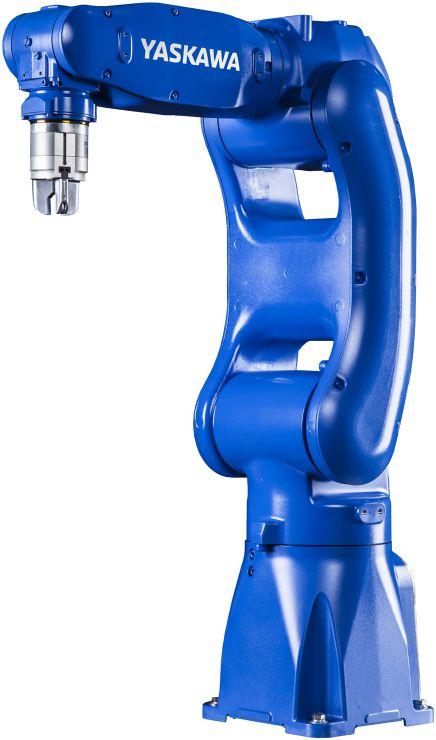
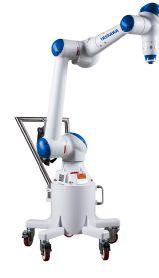
Dayton, OH (April 2017) — Featuring power and force limiting technology, Yaskawa Motoman’s new six-axis HC10 robot works safely with, or in close proximity to humans by stopping the robot in the event of contact with an operator. Dual torque sensors in all joints constantly monitor force to quickly react to contact; something typically only found in more expensive systems. It is designed to eliminate operator pinch points while through-arm utilities hide cabling and increase safety by reducing the risks of snagging or interference with other equipment.
Utilizing Easy Teach software, the user can hand-guide the HC10 robot when teaching new program paths. This allows the HC10 to be quickly deployed or redeployed on demand, decreasing system downtime and increasing ROI. Whether operating at full speed or collaborative speed, cycle times are optimized based upon risk assessments and process requirements.
The highly configurable HC10 offers a 10-kg payload and 1,200 mm reach and can perform a broad range of material handling, machine tending or light assembly tasks. Function-specific tooling and accessories are available from various Yaskawa partners.
The HC10 collaborative robot leverages Yaskawa’s long history of building robots that are durable and reliable, resulting in minimal downtime.
The HC10 robot is controlled by Yaskawa’s new high-performance YRC1000 controller that is built to a global standard and does not require a transformer for input voltages ranging from 380VAC to 480VAC. The YRC1000 is highly compact (598 W x 490 H x 427 D mm), resulting in reduced space requirements. Its I/O communication speed is improved by as much as 50% for improved work efficiency and a single controller-to-robot cable improves cable reliability. The improved programming pendant design features enhanced ergonomics and lighter weight.
STACKED FOR STRENGTH
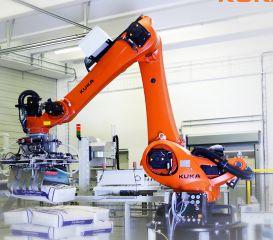
KUKA Robotics Canada will showcase the powerful capabilities of the company’s KR QUANTEC PA family of palletizing robots, designed to meet all of today’s automation requirements for minimized footprint, shorter cycles, maximum availability and low operating costs.
Thanks to its slim design, these five-axis robots can reach stack heights of over 2.5 meters, while its 60-mm-dimeter hollow shaft allows for fully protected routing of the energy supply to enable it to perform demanding palletizing tasks quickly and precisely even in ice-cold temperatures of -30˚C.
THE BUILDING BLOCKS
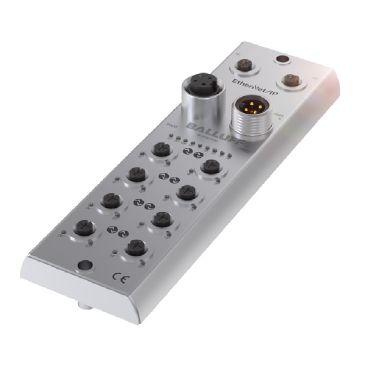
Balluff Canada Inc. will present a new family of machine mount network blocks designed for hygienic environments in the food-and-beverage industries that require frequent high-pressure washdowns and caustic cleaning.
Made from stainless steel and approved for an IP69K protection rating, along with ECOLAB certification, these network blocks support connectivity to the controller or PLC (programmable logic controller)
PROFINET. With IO-Link onboard, the network blocks can seamlessly connect to a multitude of smart devices with standard M12 sensor cables— offering automatic configuration, parameterization and diagnostics features in addition to the sensor intelligence, while also offer connectivity via SNMP (Simple Network Management Protocol) to the enterprise-level network management systems.
Utilizing the virtual IP addressing technique, Balluff IO-Link masters can make IO-Link devices available to the network management systems gathering critical information from IO-Link devices for asset tracking and condition monitoring functionality for the system, without impacting the PLC or the machine controller.
HARMONY, OBVIOUSLY
Get more out of your electrical panels and machines with robust and ergonomic pushbuttons
Switches, pushbuttons, and pilot lights you can trust
• Robust performance that can withstand even the most severe environments.
A touch of style for electrical panels and machines
• Modern design for customizing new and existing cabinet to meet the requirements of customers worldwide.

New offers, taking smart machines and panels to the next level
• New USB and RJ45 ports make updating or modifying data easier and more secure, while new potentiometers and timers boost your machines’ precision like never before.
The widest offer on the market
• Get all of your switches, pushbuttons, and pilot lights from a single manufacturer. Schneider-Electric.
PRODUCTIVE INNOVATION
From creating the first three-phase induction motor in 1917, to introducing the field of mechatronics, to developing the first PLC control platform for industrial robots, Yaskawa has delivered groundbreaking innovation for more than a century.
How? By helping top companies worldwide overcome challenges, outpace the competition and drive their industries forward.
Experience the impact of productive innovation. Contact Yaskawa today.
937-847-6200 | yaskawa-motoman.com
NEW! High-speed GP-series robots and space-saving YRC1000 controller
• 7-, 8- and 12-kg payload capacities
• IP67-rated models
• Food grade grease option
• Single cable connection
• Multiple mounting capabilities