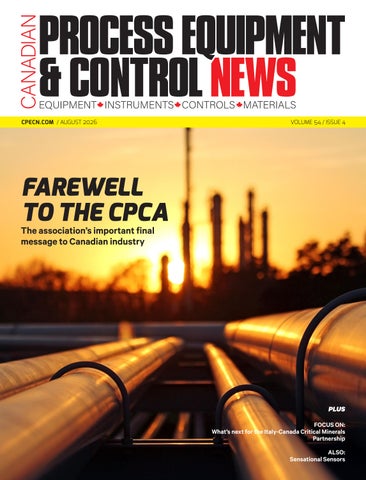

FAREWELL TO THE CPCA
The association’s important final message to Canadian industry


million barrels, authorized release from the strategic petroleum reserve
What the SPR Drawdown Means for Canadian Industry
While I want to use this editor’s letter to highlight significant developments in the U.S. Strategic Petroleum Reserve, I first would like to mention the special theme of this issue. It is necessary and fitting to recognize the passing of the Canadian Process Control Association (CPCA). This past June 30th, they voted to dissolve and become a part of the American equivalent, the Measurement, Control and Automation Association (MCAA). To mark the occasion, we are publishing the report of the CPCA’s final taskforce investigation into the potential for Canadian Registration Number (CRN) reform, the association’s meaningful last message to Canadian industry. CPECN columnist Ryan Kershaw also offers his thoughts as a former member of the association.
The U.S. Strategic Petroleum Reserve (SPR) is now at its lowest level since the early 1980s. This is worth pausing on, because the drawdown that got it there has direct implications for Canadian industry.
When the Strait of Hormuz closed this spring, it disrupted a corridor that normally carries about a fifth of the world’s oil supply. In response, the U.S. authorized the release of 172 million barrels from the SPR — the largest single-country release in the reserve’s history — as part of a coordinated 400-million-barrel release by 32 IEA member countries. Oil prices (WTI) had risen nearly 50 percent in two weeks. The stated goal was therefore to moderate prices while the underlying supply disruption remained unresolved.
Canada’s position in this is different from the United States. As a net exporter, Canada does not hold a strategic reserve in the same way importing countries do. Our contribution to the coordinated response came through increased production: deferred refinery maintenance and higher pipeline throughput. We are not
drawing down an emergency buffer to supply this market.
The financial effect has been uneven across provinces. Alberta, Saskatchewan and Newfoundland and Labrador are all benefiting from higher realized oil prices, with corresponding increases in royalty and tax revenue. The federal government also stands to collect more in corporate and income tax as a result. This is not evenly distributed, however. Provinces with less exposure to energy production, and industries with higher input costs, are absorbing the downside of elevated prices. There is also a broader risk: if global economic growth slows because of sustained high energy costs, Canada’s export-dependent economy will not be insulated from that, regardless of its position as a producer.
The more significant issue is what this means for the United States going forward. The SPR exists as a buffer against prolonged supply disruption, not as a routine price-management tool. With inventories now close to the reserve’s legally mandated minimum, and the Department of Energy’s replenishment plans only aiming to restore pre-war levels, the U.S. has less capacity to respond to a second disruption than it has had in over four decades. When (not if) another supply shock occurs, the reserve will have limited room to absorb it.
For Canadian industry, the practical takeaway is to monitor this closely rather than assume the current price environment holds. The SPR’s depleted state increases the odds that any further disruption in the Gulf translates directly into price volatility here, without the cushioning effect a fuller reserve would provide. This is a planning consideration for producers, refiners, and any business exposed to energy costs, independent of any view on U.S. policy.

JUSTIN YULE, editor jyule@annexbusinessmedia.com
Reader Service
Print and digital subscription inquiries or changes, please contact Angelita Potal Customer Service Tel: 416-510-5113
Fax: (416) 510-6875
Email: apotal@annexbusinessmedia.com
Audience Manager Anita Madden 416.510.5183 amadden@annexbusinessmedia.com
Brand Sales Manager Pat Lorusso 416.518.5509 plorusso@annexbusinessmedia.com
Editor Justin Yule 438.483.7451 jyule@annexbusinessmedia.com
Account Coordinator Kristine Deokaran 416.510.6774 kdeokaran@annexbusinessmedia.com
Group Publisher/ Director of Production Paul Grossinger pgrossinger@annexbusinessmedia.com
CEO Scott Jamieson sjamieson@annexbusinessmedia.com
CPE&CN is published bi-monthly by: Annex Business Media 111 Gordon Baker Rd, Suite 400, Toronto, ON M2H 3R1 T: 416-442-5600 F: 416-442-2230
© All materials in this publication are copyright protected and the property of Annex Business Media., the publishers of Canadian Process Equipment & Control News magazine.
For permission on reprinting or reproducing any materials, e-mail your requests to cpe@cpecn.com
Canadian Postmaster send address corrections to: 111 Gordon Baker Rd., Suite 400, Toronto, ON M2H 3R1
Canadian Process Equipment & Control News assumes no responsibility for the validity of claims in items reported.
Annex Privacy Officer privacy@annexbusinessmedia.com Tel: 800-668-2384
PUBLICATION MAIL AGREEMENT #40065710
Printed in Canada ISSN 0318-0859

Mail: 111 Gordon Baker Rd., Suite 400, Toronto, ON M2H 3R1 Volume 53 No.4 AUGUST 2026 Subscription Rates





OTTAWA PRESSURES PROVINCES TO DELIVER ON DIRECT-TO-CONSUMER ALCOHOL SALES
Internal Trade Minister Dominic LeBlanc issued a statement May 29 urging provinces and territories to finalize direct-to-consumer alcohol sales—a framework that could reshape interprovincial alcohol commerce in the months ahead.
The federal government has removed all federal barriers to interprovincial alcohol trade, including amendments to the Importation of Intoxicating Liquors Act, elimination of federal exceptions under the Canadian Free Trade Agreement, and a two-year extension of alcohol excise duty relief for brewers, distillers, and winemakers.
Implementation now depends on provincial and territorial governments completing a Memorandum of Understanding signed by 11 jurisdictions in 2025, which set a May 2026 target for direct-to-consumer sales to take effect. That deadline has passed without full implementation.
FEDERAL AI STRATEGY NAMES ENERGY, MANUFACTURING AMONG PRIORITY SECTORS
Ottawa’s newly released national AI strategy, “AI for All,” puts energy and natural resources, transportation, and manufacturing and robotics among five priority sectors slated for concentrated investment, a signal worth watching for Canadian process and material-handling operators.
The plan leans on industrial precedent. It cites Quebecbased Maya HTT’s 200-plus industrial and physical AI deployments, which raised production-line throughput by an average of 17 percent while creating and maintaining over 1,000 jobs. The strategy frames such “pro-worker” AI — augmenting operators and technicians rather than replacing them — as its preferred model, and names predictive infrastructure maintenance as a target application.
UNITED STATES DECLINES CUSMA RENEWAL, TRIGGERING ANNUAL REVIEW PROCESS
The United States has opted not to renew the Canada-United States-Mexico Agreement in its current form, triggering an annual review process for the trilateral trade deal that will extend for the next decade.
U.S. Trade Representative Jamieson Greer confirmed the position in a statement, indicating the United States will continue engaging with Canada and Mexico to address what he described as the agreement’s shortcomings and U.S. trade deficits with both countries. Greer stated the agreement remains in force pending resolution of these issues or until termination.
Representatives from all three countries met virtually July 1 to discuss the agreement’s future. The meeting marked the deadline for officials to indicate whether they wanted to renew CUSMA for another 16 years. The U.S. decision not to approve renewal triggers annual reviews for the next 10 years.
ONTARIO MANUFACTURING THINK TANK TRILLIUM NETWORK TO SHUT DOWN AFTER 11 YEARS
The Trillium Network for Advanced Manufacturing, a London, Ontario-based research organization that has tracked the province’s manufacturing sector for over a decade, announced this week it is ceasing operations.
The nonprofit, housed at Western University, produced independent, data-driven research
and analysis on trends, opportunities, and challenges facing Ontario’s advanced manufacturing ecosystem, while also playing a lead role in bringing together industry stakeholders, government, manufacturers, and academic partners. The organization was founded in 2015 by Paul Boothe, an Order of Canada recipient who served as its inaugural Managing Director before later joining its Board, and originally envisioned as a decadelong project — it ultimately ran for 11 years.
ONTARIO AND UNITED KINGDOM SIGN CRITICAL MINERALS COOPERATION AGREEMENT
Ontario Minister of Energy and Mines Stephen Lecce and U.K. Minister of Industry Chris McDonald signed a Statement of Intent in London on June 15, establishing a framework for cooperation on critical mineral supply chains.
The agreement positions Ontario as a strategic supplier for U.K. industrial and defense requirements while opening new investment channels for the province’s mining sector. The framework targets three areas: coordinating strategic investments in Ontario’s critical minerals sector, enhancing research collaboration across the value chain, and developing diversified transatlantic supply chains.
The agreement responds to global supply concentration, with China producing approximately 60 percent of global raw ore and controlling up to 90 percent of refining capacity for rare earths, lithium, and cobalt. Both jurisdictions are working to reduce dependence on China.
Canadian consumers cannot currently purchase out-of-province alcohol products directly from the producer.
REDUCING BARRIERS WHILE MAINTAINING SAFETY
A Case for Modernizing Canada’s CRN Framework
By the
CPCA’s CRN Taskforce
Canada’s Canadian Registration Number (CRN) system has played an important historical role in ensuring the safe design and operation of pressure equipment. Developed in response to serious industrial safety risks in the 19th and early 20th centuries, the system reflects a long-standing commitment to public and worker safety. Today, it operates within the broader framework of CSA B51, which promotes safe design practices and harmonization across jurisdictions.
However, the current CRN framework has evolved into a fragmented, multi-jurisdictional process that imposes significant administrative, financial, and operational burdens on manufacturers and end users. While safety outcomes in Canada remain strong, there is limited evidence to suggest that duplicative provincial design reviews provide incremental safety benefits beyond those already achieved through adherence to recognized engineering standards such as ASME and CSA.
At the same time, the system introduces measurable inefficiencies, including extended approval timelines, increased costs, and barriers to interprovincial trade. These challenges affect not only manufacturers and distributors but also infrastructure projects, industrial operators, and, ultimately, the competitiveness of the Canadian economy.
CPCA supports continued prioritization of safety while advocating for a modernized, harmonized regulatory approach. This paper outlines key challen-
ges within the current CRN system, examines its impacts, compares international frameworks, and presents practical, safety-aligned recommendations for reform.
OVERVIEW OF THE CURRENT CRN FRAMEWORK
Responsibility for pressure equipment regulation in Canada rests with provincial and territorial authorities. As a result, the CRN system is administered through multiple jurisdictions, each with its own review processes, timelines, and interpretations of applicable codes.
Although national submissions are possible, approvals are ultimately issued on a jurisdiction-by-jurisdiction basis. This means that a design accepted in one province is not automatically recognized in another. In practice, manufacturers must navigate multiple parallel review processes, even when submitting identical technical documentation.
This decentralized structure reflects Canada’s regulatory framework but has led to increasing complexity as industries have become more integrated across provincial and international boundaries.
KEY CHALLENGES IN THE CURRENT SYSTEM
The most significant challenges associated with the current CRN framework relate to cost, consistency, timelines, and barriers to trade.
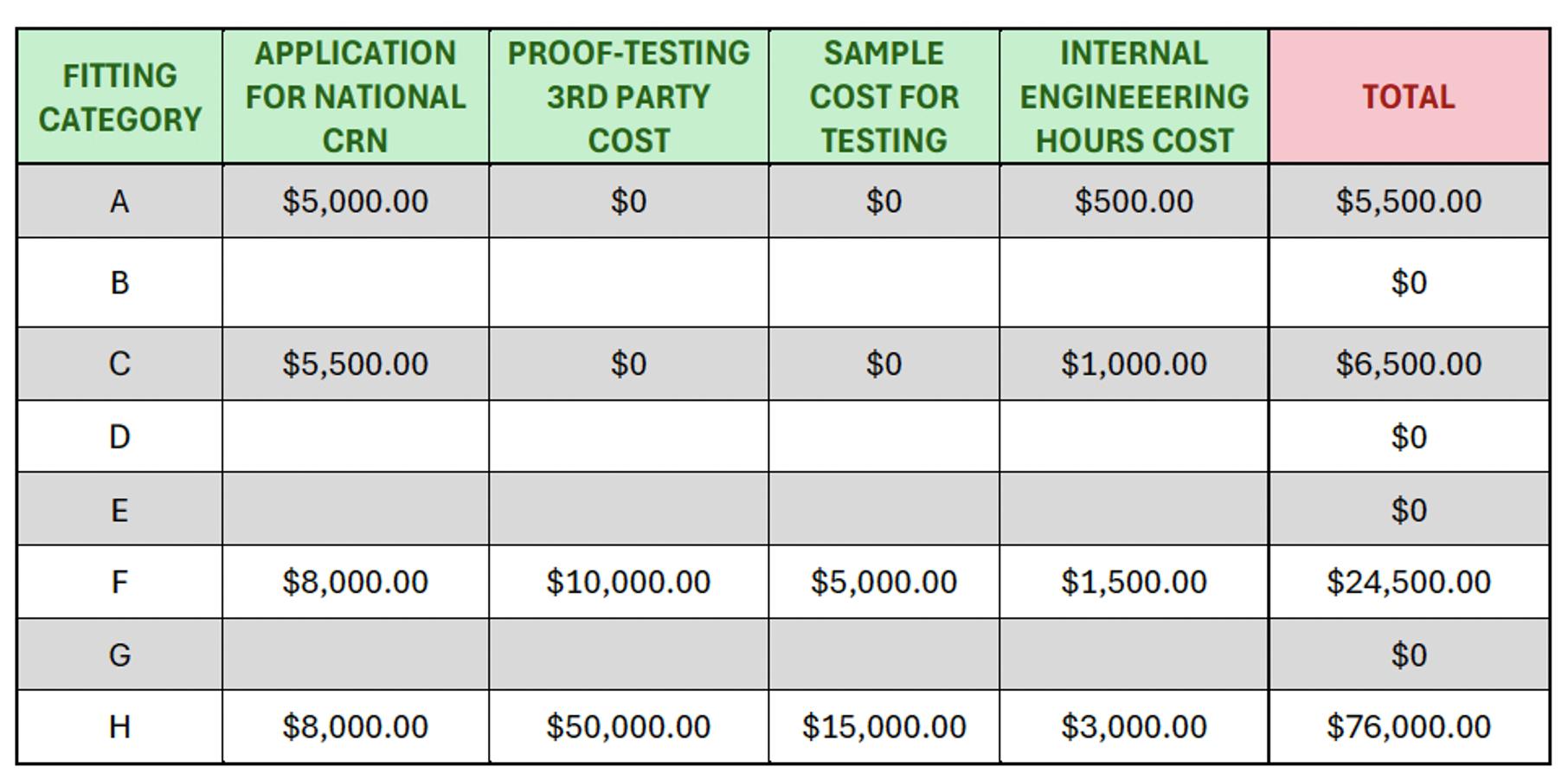
From a cost perspective, design registration can represent a substantial investment. Industry data indicates that straightforward national submissions
typically range from $4,500 to $8,500 CAD per design, depending on the fitting category and submission complexity. However, total costs can increase significantly where additional engineering analysis, proof testing, or third-party validation is required.
Importantly, costs vary across the fitting categories defined in CSA B51. For example, lower-risk components such as standard pipe fittings (Category A) may involve relatively modest costs, whereas more complex or non-standard components (e.g., Categories F and H) can require extensive proof testing, third-party validation, and engineering effort, resulting in total costs exceeding $25,000 to $75,000 CAD per design.
To illustrate this variability, Table 2 provides representative cost ranges across selected fitting categories, including application fees, testing requirements, and internal engineering effort. A full description of fitting categories is provided in Appendix A.
Beyond direct costs, the CRN process also introduces significant indirect (“soft”) costs, which are often more difficult to quantify but have meaningful operational and economic implications.
These include:
• Engineering time spent responding to jurisdiction-specific questions or rework
• Project delays resulting from extended approval timelines
• Procurement inefficiencies and extended equipment lead times
• Administrative burden associated with managing multiple submissions
• Opportunity costs related to delayed market entry or project execution
These indirect costs are particularly impactful for:
• Small and medium-sized manufacturers
• Firms introducing new or innovative products
• Projects operating under tight capital or schedule constraints
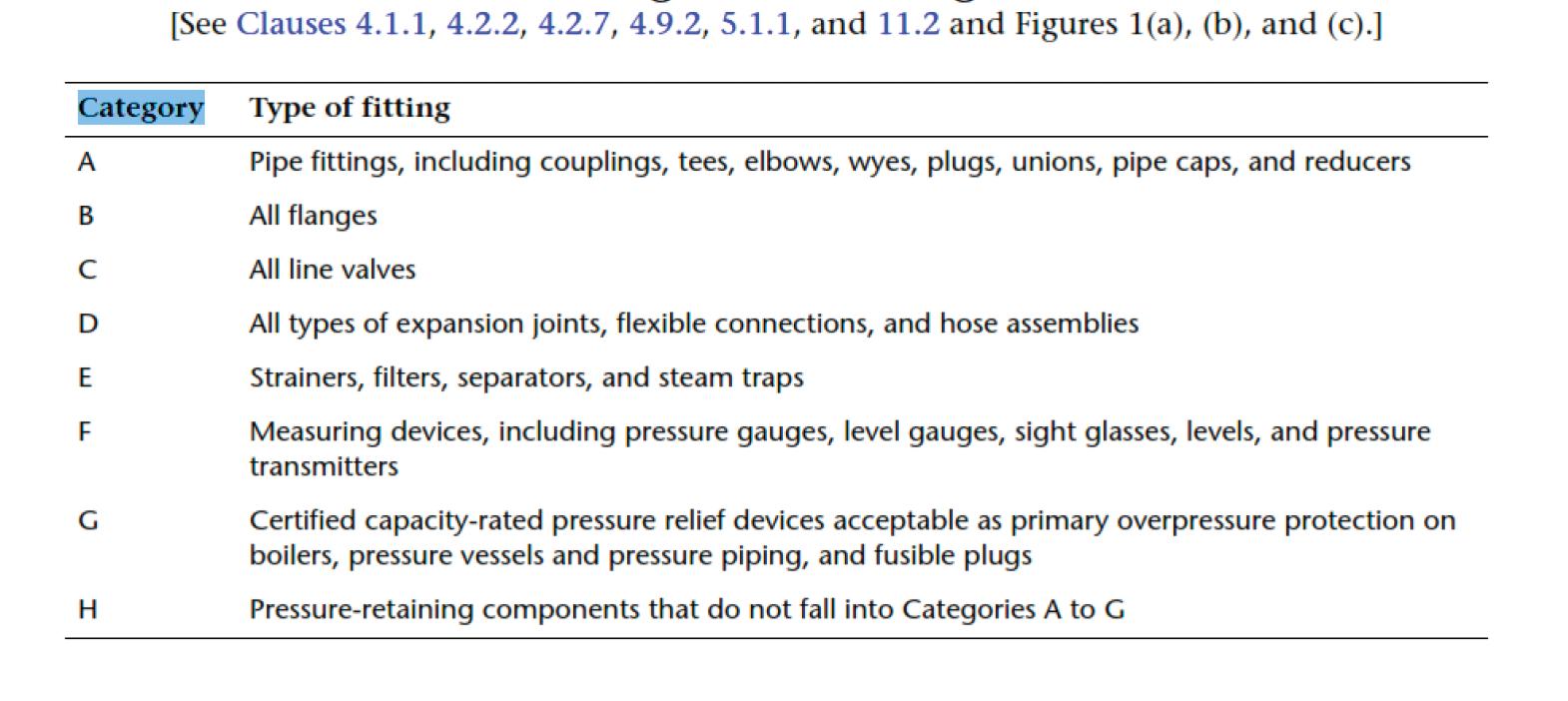
Top: Table 1. Categories of fittings
Below: Table 2. Sample costs for CRN
When combined, the direct and indirect cost burden of the CRN process represents a material barrier to efficiency and competitiveness, particularly when compared to jurisdictions that rely on harmonized or risk-based approval systems.
Inconsistency in code interpretation presents a further challenge. While CSA B51 and ASME standards provide a common technical foundation, provincial authorities may apply different interpretations or impose additional requirements. This variability can result in redesign, retesting, or extended review cycles, even for equipment that meets established North American standards.
Timelines are also a critical concern. Approval processes commonly take six to twelve months, with delays increasing in recent years due to resource constraints and administrative transitions. While expedited services exist in some jurisdictions, they are not consistently available and do not address the broader issue of duplication across provinces.
Perhaps most significantly, the CRN system functions as a barrier to interprovincial trade. Equipment approved for use in one province cannot necessarily be deployed in another without additional approvals. This creates operation-
al inefficiencies for companies operating across Canada and limits the mobility of equipment and capital. The Canadian Free Trade Agreement (CFTA) emphasizes reducing internal trade barriers, yet the current CRN framework remains misaligned with this objective.
INTERNATIONAL COMPARISONS
A review of comparable international frameworks highlights alternative approaches to achieving safety without introducing duplicative approval processes.
In the United States, pressure equipment is primarily governed by adherence to ASME codes and standards, supported by inspection regimes and certification requirements. There is no equivalent system requiring separate design registration across multiple jurisdictions.
Responsibility is shared among manufacturers, inspectors, and operators, with a strong emphasis on compliance with established codes.
In the European Union, the Pressure Equipment Directive (PED) establishes a harmonized framework for the design and manufacture of pressure equipment. Products that meet PED requirements and carry the CE marking can be freely marketed and used across all member states. The system incorporates a riskbased classification approach, with higher-risk equipment subject to more rigorous conformity assessment, often involving third-party notified bodies (European Commission, 2014).
Both systems demonstrate that it is possible to maintain high safety standards while enabling efficient market access and minimizing administrative duplication.
IMPACT ON END USERS AND INDUSTRY
Canada’s pressure equipment safety record is strong, reflecting the combined influence of robust engineering standards, regulatory oversight, and industry practices. CSA B51 and ASME codes provide a comprehensive framework for safe design, while inspection regimes ensure ongoing compliance throughout the equipment lifecycle.
Within this context, there is limited evidence that multiple duplicative design reviews across provincial jurisdictions materially improve safety outcomes. Instead, safety performance appears to be primarily driven by adherence to standardized engineering practices and effective inspection and maintenance protocols.
At the same time, the current CRN system introduces tangible economic and operational impacts. The cost of repeated engineering reviews, additional testing requirements, and administrative processes ultimately increases the price
“A more harmonized and risk-based approach would maintain Canada’s strong safety record while improving efficiency, supporting innovation, and enhancing economic competitiveness.” — CPCA
of equipment and projects. These costs are borne not only by manufacturers, but also by end users across sectors such as energy, food and beverage, and pharmaceuticals.
Operationally, extended approval timelines can delay project execution, disrupt procurement schedules, and limit the ability to respond to changing operational needs. For companies operating nationally, the inability to move equipment freely between provinces represents a significant constraint, often requiring duplicate assets or additional approvals.
The system also has implications for innovation. Manufacturers may be discouraged from introducing new technologies or materials into the Canadian market due to the complexity and cost of the approval process. In some cases, products are launched in other jurisdictions first, where regulatory pathways are more streamlined.
Taken together, these impacts suggest that while the current CRN framework supports safety, it does so in a manner that introduces disproportionate inefficiencies relative to the incremental benefits of duplication.
OPPORTUNITIES FOR REFORM AND HARMONIZATION
Modernizing the CRN framework does not require compromising safety. Rather, it presents an opportunity to align regulatory processes with contemporary engineering practices and international standards.
A national harmonization approach would allow a design reviewed and accepted by one qualified jurisdiction to be recognized across all provinces and territories. This would eliminate duplication while maintaining regulatory oversight.
Building on this concept, a formal reciprocal recognition model could be implemented, drawing on existing examples within Canada. Such a model would enable jurisdictions to accept approvals from one another based on shared standards and mutual trust.

The
Canadian Registration Number system makes
modern
industrial
work a much safer prospect than earlier ages.
A risk-based classification system would further enhance efficiency by aligning regulatory requirements with the actual risk profile of equipment. Low-risk, standardized components, particularly those with long-established performance histories, could be subject to streamlined approval processes or exemptions, while higher-risk equipment would continue to undergo rigorous review.
Recognition of international certifications represents another important opportunity. Standards such as ASME and the European PED already provide robust frameworks for ensuring safety. Where equivalency can be demonstrated, these certifications could be accepted as part of the Canadian approval process. Reform of CRN renewal requirements is also warranted. For designs that have not changed, repeated testing and full re-evaluation at fixed intervals may not provide additional safety value. A simplified renewal process based on documented design continuity could

reduce unnecessary administrative burden. Develop a centralized digital submission system that allows applicants to submit, monitor, and follow up on open applications. Once the CRN number is generated, provide a searchable function for both end users and vendors to find products and their relevant registration numbers. This would be similar to other approval agencies such as CSA, UL and NSF. This would minimize effort for all parties involved. Automating the database would reduce human effort and improve efficiencies for all parties.
CPCA POSITION
The Canadian Process Control Association supports the continued prioritization of safety in the design, manufacture, and operation of pressure equipment. The principles underlying CSA B51 and related standards remain essential to protecting public and worker safety.
At the same time, CPCA advocates for a modernized CRN framework that reflects current engineering capabilities, aligns with international best practices, and reduces unnecessary duplication. A more harmonized and risk-based approach would maintain Canada’s strong safety record while improving efficiency, supporting innovation, and enhancing economic competitiveness.
The CRN system was developed in response to a critical need for improved safety in an earlier industrial era. While its foundational objectives remain relevant, the context in which it operates has evolved.
Every component of a pressurized system in Canadian industry has been certified.
Today, advances in engineering, the globalization of manufacturing, and the availability of internationally recognized standards provide new opportunities to achieve safety outcomes more efficiently. By modernizing the CRN framework, Canada can reduce trade barriers, boost productivity, and support innovation—without compromising consumer, end-user, or infrastructure safety.
REFERENCES
1. CSA Group. 2024. CSA B51: Boiler, pressure vessel, and pressure piping code. CSA Group.
2. American Society of Mechanical Engineers. 2023. ASME boiler and pressure vessel code (BPVC). ASME.
3. European Parliament and Council of the European Union. 2014. Directive 2014/68/EU on pressure equipment (2014/68/EU). Official Journal of the European Union.
4. Government of Canada. 2017. Canadian Free Trade Agreement. https://www.cfta-alec.ca/
ODE TO AN ORGANIZATION
Thoughts on the break-up of the Canadian Process Control Association
By Ryan Kershaw
June 30th marked a disappointing day for the Canadian industrial landscape, with the Canadian Process Control Association (CPCA) closing its doors. While the organization will continue on as part of the Virginia-based Measurement, Control and Automation Association (MCAA), it will lose its autonomy and identity as a Canadian organization, and I think that needs to be mourned.
Let’s face it, the writing has
been on the wall for the CPCA for a while now. Membership had been dwindling for years, which caused significant issues for programs like statistics and advocacy. This had little to do with the efforts of the members; they were passionate about the benefits of an organization that represented a niche but important part of manufacturing and more, with the overall trend of enthusiastic association participation. Many groups are feeling the pinch with fewer companies willing to join
trade organizations like this, or even willing to support their employees with extra-curricular activities. I have seen this with the CPCA, ISA (International Society of Automation) and other professional organizations — even getting volunteers to join up with Scouts Canada is like pulling teeth.
For those who are unfamiliar with the CPCA, it was formed years ago as an organization that could represent manufacturers and distributors of instrumentation and control equipment. While I have been struggling to find out exactly when the organization formed, it was back in the pre-internet era. Because of this, much of the initial draw was the networking aspect that allowed manufacturers and distributors to connect. Manufacturers could
find new partners to work with and open up new areas in Canada, and distributors could find new manufacturers that could complete their portfolio of solutions.
Statistics were (and continued to be) another big draw for companies. While there were general statistics about the economy and industry, specific numbers about the I&C sector were difficult to come by. With cooperation from the companies in the organization, an independent manager and some outside help, companies could now rely on specific numbers as the basis of their long-term plans. I personally used these figures for 5-year planning and they came in extremely handy.
Networking and statistics aside, I think one of the biggest benefits of the CPCA was its ability to provide a collective voice to this

group. Just by their nature, I&C companies have a unique set of challenges since they deal with a wide range of regulations including electrical, pressure, hygienic, etc. When challenges presented a major roadblock, the CPCA was the entity that helped get the right parties sitting across from each other to get it sorted out. One of the best examples of this was an issue in the 2010’s where it was discovered that process radars fell under a radio emissions law under the purview of Industry Canada. No one in the I&C community knew about this before it became an issue and no one from Industry Canada was familiar with a process radar, which created a major issue. Fortunately, the CPCA was able to get the right people at the right table to get this sorted out, legislation was adjusted and everyone went home happy. All this took months not years. So where did it all go wrong?
The internet definitely did not help. This has been the bane of many professional organizations that used to have education and

“The CPCA was able to get the right people at the right table to get this sorted out, legislation was adjusted and everyone went home happy. All this took months not years.” — Ryan Kershaw
networking as their main draws. The CPCA did try to develop professional training programs and it worked with local colleges and universities on this initiative, but the demand for this was lukewarm at best. On the networking side, the main event of the CPCA was their AGM, which was typically held over a couple of days at a fairly upscale location. It was an opportunity to connect with the community and learn about new initiatives and trends. Competitors that were typically at each other’s throats on a day-to-day basis could be seen sharing an adult beverage or two, manufacturers and distributors mixed with little regard to the difference in



their status, and everyone talked in a language that was unique to the I&C world. Unfortunately, changing attitudes about these types of events and the false closeness that came with a digital connection caused the AGMs to fizzle out over time.
Problem solving was in itself a problem within the organization. While issues specific to the I&C community were typically dealt with quickly and efficiently, the reality was there were not that many to deal with. This essential role within the CPCA was not used enough to justify it. For larger issues, the CPCA just was not big enough to take the lead. CRNs are a great example. The CPCA
was part of a coalition of associations that tried to get things changed and, while there was some success, it was far from a clear win (in my opinion, CRNs are a great regulation with the dumbest implementation). The CPCA did not have the size to go it alone and did not attract the attention of other organizations looking to solve issues, which it could have given its collective expertise.
I might be a bit biased on this subject having been part of the CPCA for over a decade, but I think we will be worse off having lost it as an organization dedicated to Canadian companies. I am hoping I get proved wrong and the MCAA is able to provide the weight needed to get changes pushed through and attract new companies to the organization. The I&C world is a niche one, but growing ever more important as automation improves and grows. Having the right representation and community is important. Unfortunately, we now have one less community to be a part of.



MANAGING SKILLS AND TALENT AS A CRITICAL SUPPLY CHAIN
Tackling Labour Shortages in Process Industry
By Andrew Bieler & Sunny Chan
Those who work in Canada’s process industries already understand supply chains better than most. The next supply chain they need to manage, with the same skill and foresight, is human talent.
Every industrial manufacturer knows what happens when a critical component does not arrive on time. Production slows, costs rise, and opportunities are delayed or even missed. Yet many organizations still treat skilled talent differently from other critical inputs. Too often, employers struggle to manage skills shortages on their own, with stop-gap solutions as vacancies arise. But employers can see more success when they approach skills gaps the same way they manage other strategic supply chains: by building strong partnerships and capacity before they need it.
Here at the Business + Higher Education Roundtable (BHER), through our work convening leaders from across Canada’s top employers and post-secondary institutions, we have seen organizations in energy, advanced manufacturing, and industrial technology face talent shortages and learn a common lesson: employers must take an active role in engaging with education. They must go beyond just giving input on training, and instead take leadership in working with post-secondaries to address talent needs.
The strongest workforce strategies take an end-to-end approach to talent pipeline management, from securing today’s talent supply, to strengthening capacity for upskilling and retention, to building the future pipelines.
SECURE TODAY’S SUPPLY
Successful employers are not waiting for fullyformed graduates to appear on the job market. They are taking an active part in shaping their talent supply by collaborating with one another, with post-secondary institutions, and with trusted non-profit intermediaries that help

employers tackle shared workforce challenges together, rather than independently.
Canadian metals company Teck, for example, works closely with institutions like UBC and Selkirk College to align engineering education and place-based training with their evolving operational needs. Uranium company Cameco has partnered with Saskatchewan Polytechnic and the Saskatchewan Indian Institute of Technologies to expand mining and nuclear workforce capacity through co-designed programs, including ones specially developed to increase participation from Indigenous communities and women in trades.
Humber Polytechnic’s Barrett Centre for Technology Innovation houses the Advanced Manufacturing Skills Consortium, and brings leading manufacturers together with faculty and students to solve real industrial challenges using robotics, automation, AI, and other advanced manufacturing technologies. Employers gain access to the latest applied research, innovation, and future talent, while also ensuring that students graduate with hands-on experience with the very systems they will encounter in industry.
The common thread is employer leadership. Rather than hoping graduates arrive workforce-ready, these examples show how employers can actively shape the skills, experiences, and professional networks students develop before they enter the workforce. They show that work-integrated learning (WIL), apprentice-
“The strongest workforce strategies take an end-toend approach to talent pipeline management” – Andrew Bieler
ship models, and employer-designed education are no longer “nice to have,” they are critical talent infrastructure that reduces the distance between education and operations.
STRENGTHEN TOMORROW’S CAPACITY
The technologies transforming Canada’s process industries are changing faster than traditional workforce models can handle alone, and change continues to accelerate. The companies staying most competitive are not only focused on securing new talent, but are also investing just as deliberately in the people they already employ.
Nuclear power producer Bruce Power has made continuous workforce development part of its core operating model. In partnership with post-secondary institutions, they keep experienced staff agile for changing business needs through robust systems that track, develop, and support employee training over time. Hydro-Québec is currently expanding training capacity to prepare thousands of workers for the energy transition and increasing electricity infrastructure demands.
BUILD THE PIPELINE YOU
WILL NEED IN 10
YEARS AND BEYOND
The talent supply pipeline itself starts much earlier than most employers are currently thinking about. Schools direct young people’s learning development, but employers have an important role in supporting understanding of where those learning journeys can lead.
Children are asked from a young age what they want to be when they grow up — and very few of them are saying “I want to work in process industry.” Many young Canadians still imagine energy, petrochemical, food and beverage manufacturing, and industrial operations through outdated stereotypes of grimy factories and boring tasks, despite the exciting careers actually available involving robotics, automation, digital twins, AI, and sophisticated process control systems.
Across Canada, employers, schools, post-secondaries, and sector organizations are working together to begin rewriting that narrative from the start. Ontario Power Generation’s interactive WattNext platform, for example, introduces students and K-12 educators to modern energy career paths through skills and interests rather than assumptions. Similarly, the Mining Industry Human Resources Council has collaborated with multiple sector partners on Mining Needs You, a youth-focused career exploration platform designed to inform students about diverse careers in the sector.
NAIT actively engages high school students with hands-on experiences in energy and natural resources technologies, while ApprenticeSearch.com and Skills Ontario are building regional Skilled Trades Regional Networks that connect employers directly with students through guest speakers, industry tours, job shadowing, and WIL. These flexible, employer-led experiences make it easier for organizations of all sizes, not just large companies with formal internship programs, to participate in shaping the future of the workforce. In New Brunswick, the Centre of Excellence for Skilled Trades and Manufacturing is taking a similarly coordinated approach by connecting K-12 students and educators with hands-on career pathway exploration activities.
These initiatives are an important start to the work that will need to continue with collaboration between employers and educators. Building a sustainable talent pipeline will require stronger labour market information for students and families, closer alignment between K-12 career education and industry needs, and more opportunities for employers to engage directly with schools.
MANAGE TALENT LIKE A SUPPLY CHAIN
Canada’s industrial sectors understand the importance of managing physical supply chains in advance. Increasingly, they must bring the same mindset to human talent.
The organizations making the greatest
progress are not treating workforce development reactively. Rather, they are treating it as part of the infrastructure that enables growth, by building partnerships, investing in learning, and working together to shape the talent pipeline before it becomes a constraint.
No single employer or post-secondary institution can do this alone. It requires sustained collaboration across sectors and across multiple stages of the talent pipeline. Organizations like BHER can facilitate business + post-secondary partnership, but it must be a coalition of the willing that begins with leaders opting in to build
the workforce Canada’s industrial economy will need to accomplish our nation’s priorities.
The Business + Higher Education Roundtable is Canada’s only national organization bringing together leaders from business and post-secondaryeducationtoaddressthecountry’sskills,talent, innovation,andproductivitychallenges.Through our membership, research, national convening, employer-connected programming, and ExecutiveLeadershipTables,wehelpconnectCanada’s talent system to the economic priorities that matter most.
‘WE SET THE CONDITIONS TOGETHER’
Inside the ItalyCanada Critical Minerals Push, and What’s Still Missing
By Justin Yule
This spring, I had the pleasure of attending the Italy-Canada Bilateral Critical Minerals Forum. It was an excellent opportunity to learn about the major projects being undertaken, and to hear pivotal voices, from both business and government, talk about the future of an important relationship—the type of relationship Canada is going to need more of. It was also informative to get a sense of the role critical minerals will play in the future economy, and to feel the impact of the pivotal player who was not in the room: China.
WHAT ITALY AND CANADA BRING TO THE TABLE
The forum, held at the Delta Hotel by Marriott in downtown Toronto on the sidelines of PDAC, brought together ministers, ambassadors and corporate leaders from both countries to map out the next phase of critical minerals cooperation. Impeccably dressed officials and executives detailed multibillion-dollar funding vehicles for future critical mineral projects. Only one fully signed commercial deal however, between Northern Graphite and Alkeemia, was discussed in real detail. The forum reaffirmed an existing bilateral framework rather than producing a new government-to-government agreement; the closest thing was a Canada-Leonardo working group signed the day before. Speakers repeatedly invoked Chinese dominance of mineral processing as the strategic rationale for the partnership, a line that can start to sound
a little too pat. Absent from the discussion: Indigenous partnership, permitting and community consent, all of which will determine whether any of this funding turns into an actual mine or plant.
As PDAC’s exhibition floor swelled to record size this year, the Bilateral Forum aimed overall to ask a pointed question: can Italy and Canada turn a decades-old friendship into an operational supply chain?
Both governments arrived with money to point to. Canada pointed to a $2 billion Critical Mineral Sovereign Fund for equity stakes and offtake guarantees, a $1.5 billion fund to connect mines to infrastructure, and roughly $450 million for processing technology under its new defence industrial strategy. Italy countered with its Fondo Nazionale del Made in Italy, a roughly €1 billion vehicle built specifically to back joint Italian-Canadian projects, plus nine projects already approved under the EU’s Critical Raw Materials Act, and an alteration to mining
legislation dating to 1927.
Set side by side, the two commitments are roughly comparable in scale, several billion dollars apiece, but their structural differences reflect their respective positions in the supply chain: Canada’s money is split across extraction, infrastructure and defence-linked processing, while Italy’s is concentrated on transformation and recycling capacity downstream. Thus the refrain repeated throughout the event: Canada extracts, Italy processes.
BUILDING ON WHAT EXISTS
Strip away the funding announcements and the forum’s substantive industrial content came down to a handful of company-level relationships. Leonardo’s Francesco Norante described close to $1 billion invested in Canada since 2018 and the aforementioned new working-group agreement to identify co-financed projects; he was careful to frame it as a continuation of a 40-year presence rather than a new entry. ENI’s Lapo Pistelli said the company has “signalled inten-
tion” to invest in Canadian lithium, graphite and rare-earth-refining startups, language that describes an interest rather than a transaction. Flavio Volpe of the Etobicoke-based Automotive Parts Manufacturers’ Association pointed to a Linamar-backed project converting recovered industrial graphite into automotive-grade battery material, enabled by a specific piece of Ontario resource-recovery legislation that reclassified a former landfill site.
Among the partnerships discussed, the Northern Graphite–Alkeemia agreement was the most advanced: a signed letter of intent for offtake and toll-processing tied to a graphite purification plant in Italy, with Northern Graphite’s Hugues Jacquemin and Alkeemia’s Lorenzo Di Donato both speaking to the mechanics of getting there. Even so, both described the deal as unfinanced at scale. Di Donato was blunt about the math: producing at a cost premium to Chinese supply “is suicide” from a financial standpoint without sovereign-level
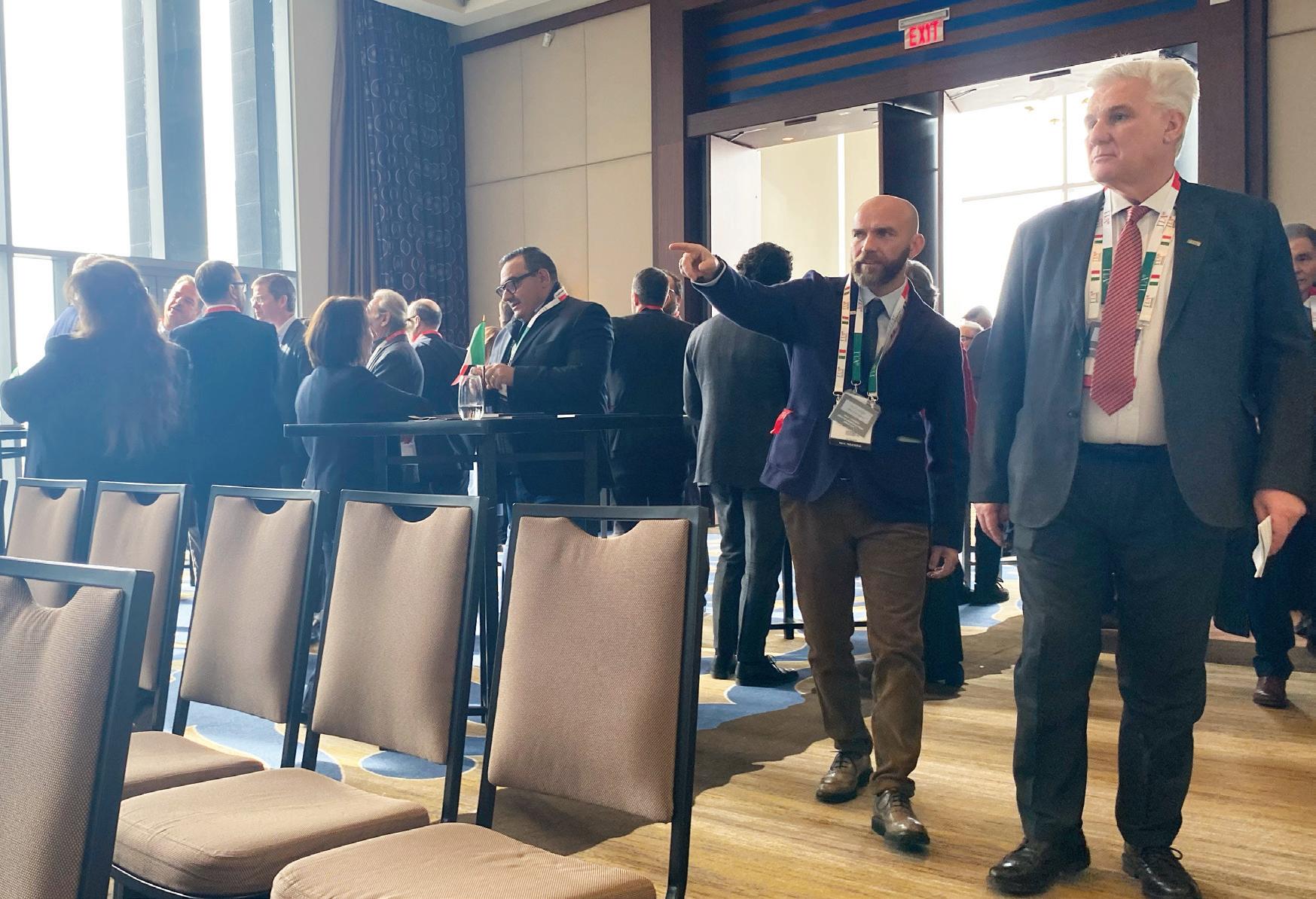
As attendees arrived at the Bilateral Forum, goodwill was in abundance, but so was curiosity about substance.
capital support, and OEM qualification timelines, which can take years, compound the problem for any company trying to convert a pilot plant into a bankable one.
Of everything discussed at the forum, exactly one agreement has a signed commercial structure behind it. The rest are working groups, stated intentions, or funding pools without named recipients. None of the speakers offered a number for how many projects have reached final investment decision, how many tonnes are under contract, or how much capital has actually moved, as opposed to
been announced. Nevertheless, there is abundant goodwill. Leaders from the two countries have an immediate sense that opportunities exist in this direction, that Canada and Italy should be partners in the 21st century.
THE ELEPHANT IN THE ROOM
The strategic rationale offered throughout the forum rested on a single, mostly unquantified premise: that Chinese dominance of mineral processing and pricing has made Western supply chains dangerously concentrated. Speakers referred to this repeatedly, some-
times obliquely (“no need to name names here”), without putting figures behind it. China currently processes the large majority of the world’s graphite and rare earths, and refines a similarly outsized share of battery-grade lithium and cobalt, a concentration built over roughly two decades of statebacked investment that Western producers are only now trying to counter. That gap is the entire premise of the Italy-Canada partnership, and it is also the reason every speaker who touched financing, Pistelli, Di Donato, Jacquemin, returned to the same point:
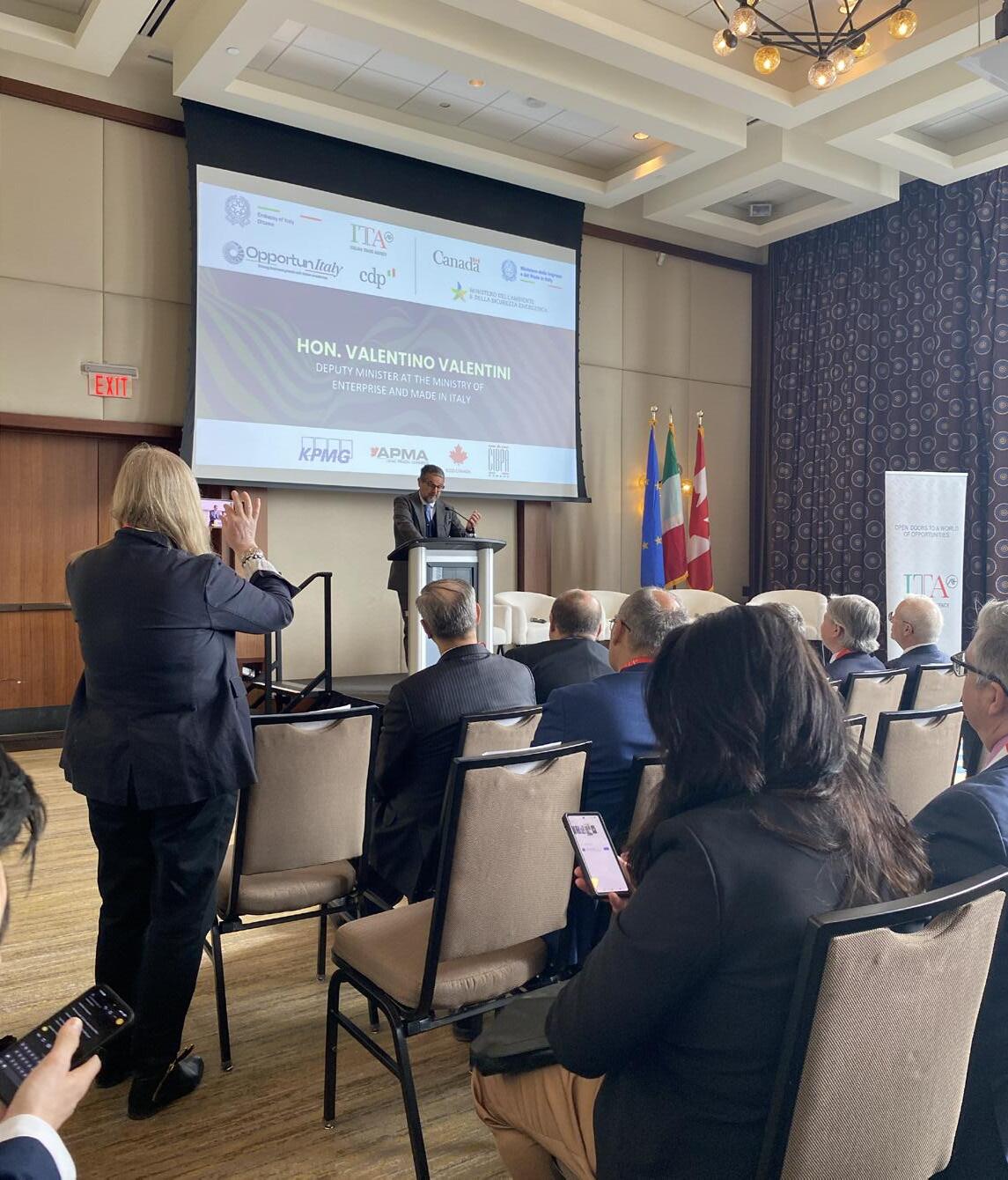
matching Chinese pricing without matching Chinese subsidy requires either tariff protection, direct capital support, or both, over many years, before any of these projects are commercially self-sustaining. What the forum did succeed in doing was reaffirming that the political architecture, funding vehicles, diplomatic channels and strategic agreements, are largely in place. Deputy Minister Valentino Valentini stated, “The direction is decided. The tools are in place, the companies are engaged, the political will is here in this room. What remains is the execution.”

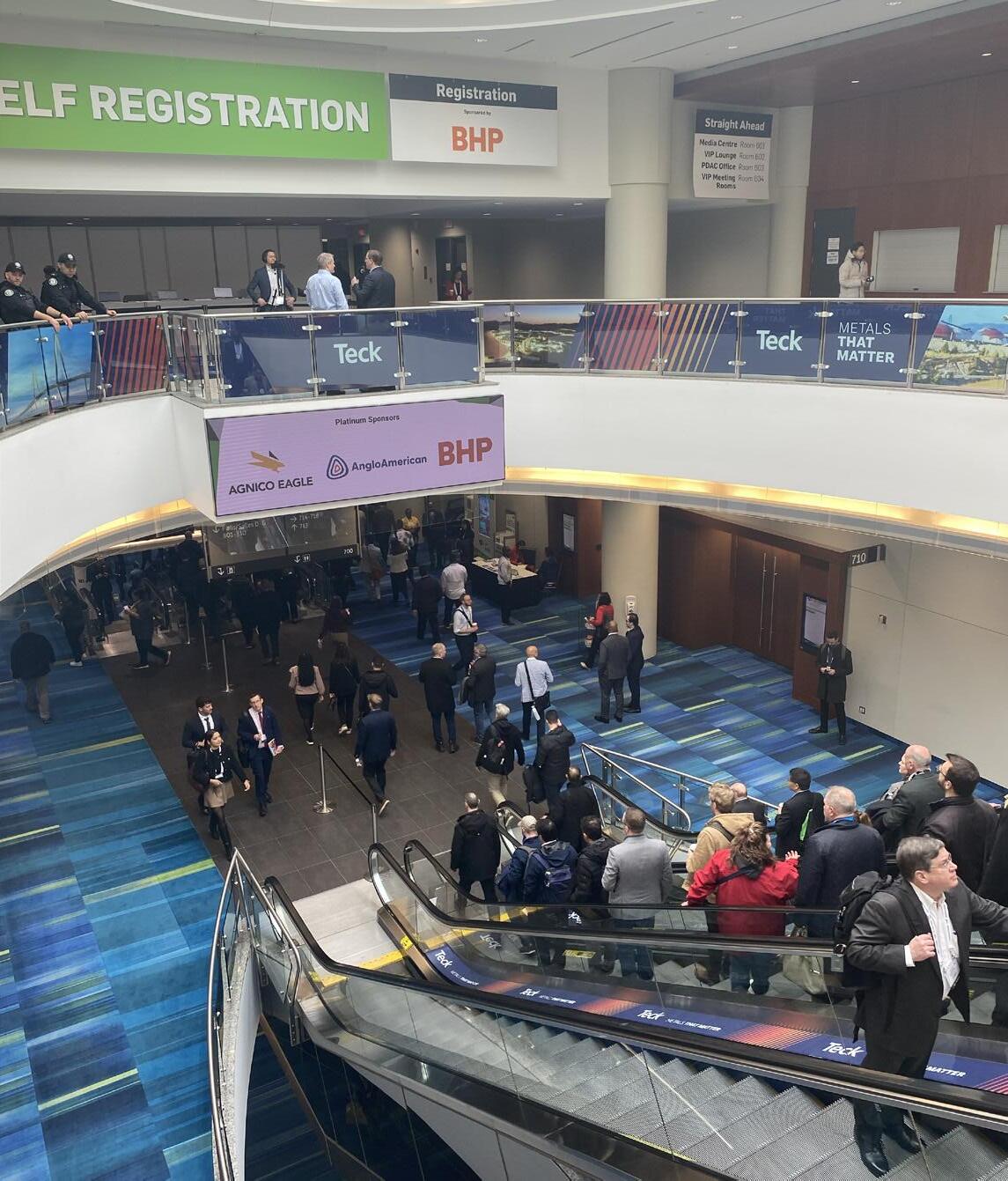
LEFT TO RIGHT: The Bilateral Forum unfolded just outside the sprawling PDAC show, which filled the Metro Toronto Convention Centre; Italian Deputy Minister Valentino Valentini highlighted the significance of the event as both an economic and geopolitical gathering.
GROWING MORE WITH LESS
By Thomas Montgomery
A How Windset Farms is Growing a Future Using Less Energy
controlled environment
agriculture producer in British Columbia is using innovative greenhouse technologies to improve energy efficiency while delivering premium, locally grown greenhouse vegetables year-round.
When shoppers pick up fresh tomatoes, cucumbers or peppers at the grocery store, they may not think about the sophisticated systems working behind the scenes that make locally grown greenhouse vegetables. Yet every decision inside a modern greenhouse, from heating and lighting to ventilation and humidity control, plays a role in delivering quality produce while using less energy.
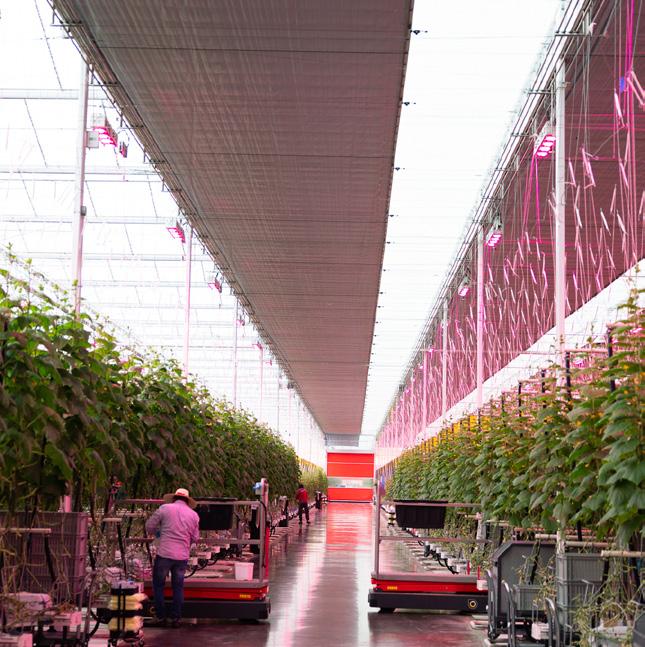
At Windset Farms in Delta, British Columbia, a long-standing collaboration with FortisBC has supported investment in greenhouse technologies that help improve energy efficiency while continuing to produce locally grown vegetables yearround. Operating a 130-acre facility, including 86 acres of advanced LED-lit production—the largest LED-lit greenhouse vegetable facility in Western North America—Windset Farms shows how long-term investment and continuous innovation can strengthen operational excellence and food production.
A GROWING OPPORTUNITY
Windset Farms is a family-owned controlled environment agriculture producer that has grown greenhouse vegetables for almost 30 years. Today, Windset’s Delta facility supplies tomatoes, cucumbers, peppers and other vegetables to customers across North American and international markets.
Growing fresh vegetables year-round requires management of temperature, humidity, lighting and ventilation to create ideal growing conditions while using resources responsibly. For Windset Farms, improving efficiency is not simply about reducing energy consumption—it is about producing more with less while maintaining the quality, freshness and consistency customers expect.
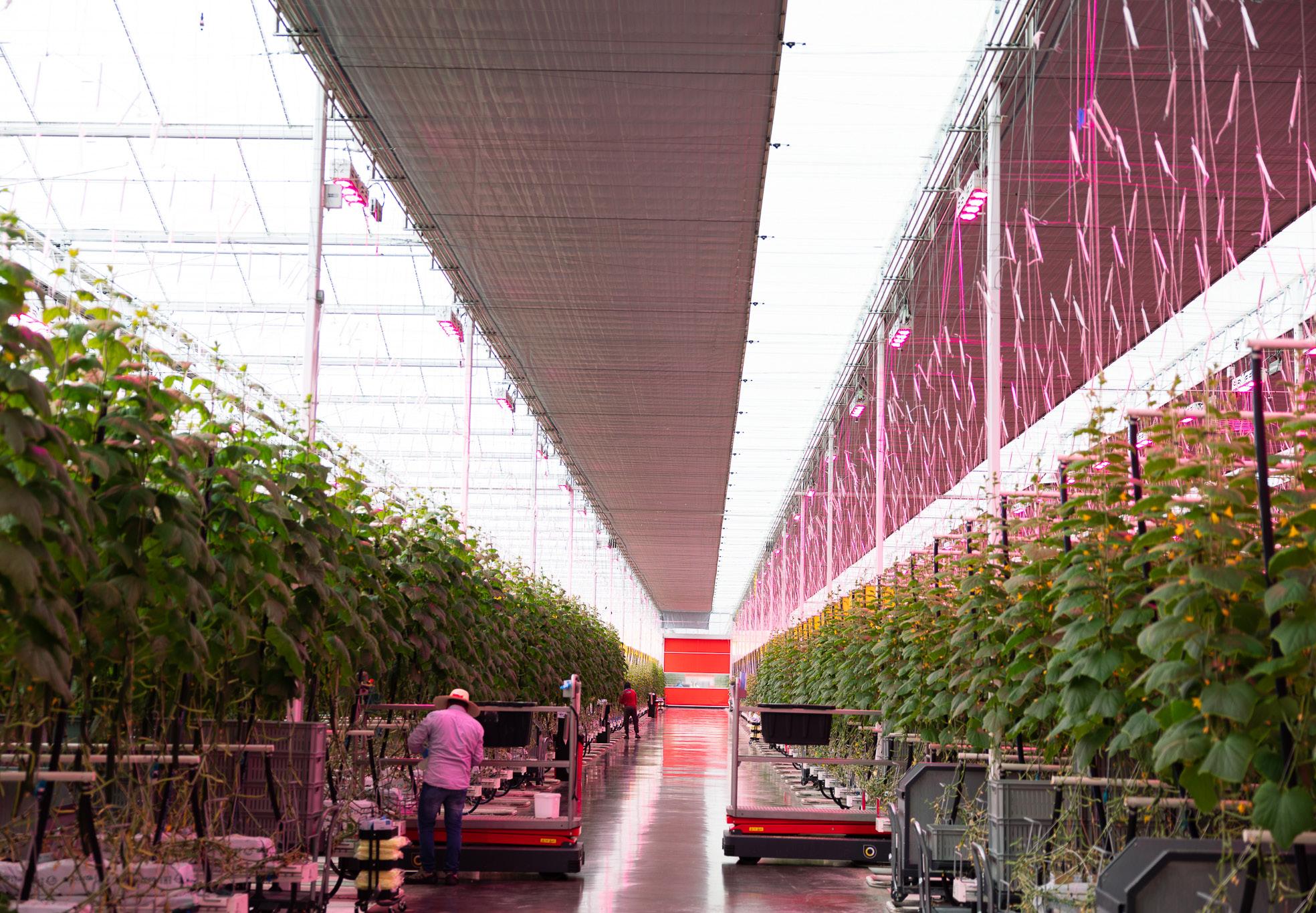
Recognizing opportunities to improve, Windset Farms has undertaken a series of energy-saving projects, supported through FortisBC’s Custom Efficiency Program, taking a holistic approach that integrates multiple technologies to strengthen crop consistency while reducing energy use. This work was recognized by FortisBC in 2025, when Windset Farms received the Efficiency in Action Award for its leadership in implementing energy efficient technologies that support food production.
“For almost 30 years, we’ve believed that innovation and sustainability go hand in hand,” said Steven Newell, president and CEO, Windset Farms. “Every investment we make reflects our commitment to innovation, operational excellence and producing exceptional greenhouse-grown vegetables while using resources more efficiently. We’re proud to grow fresh vegetables close to the communities we serve. Our collaboration with FortisBC has helped us accelerate that journey, strengthening our ability to deliver long-term value for our customers.”
From advanced greenhouse technologies to climate management and energy recovery, Windset Farms continues building a more energy efficient future for greenhouse agriculture in B.C.
OPENING THE CURTAINS
One of the most significant improvements at Windset Farms has been the
To optimize the climate in their greenhouses, Windset installed thermal curtains that contribute to energy savings by reducing heating and ventilation loads.
installation of thermal curtains throughout the greenhouse. Installed beneath the greenhouse roof and along the greenhouse side walls, these motorized curtain systems play a critical role in maintaining a stable growing environment while reducing energy use. During colder periods and overnight, the curtains close to help retain heat inside the greenhouse, improving energy efficiency while reducing the amount of supplemental LED light escaping into the surrounding community. During warmer periods or sunny conditions, the curtains retract to maximize natural sunlight or provide shading to help prevent overheating and reduce cooling and ventilation demand. Thermal curtains are an integral part of greenhouse climate management. By reducing heating and ventilation loads, they help create more consistent growing conditions while lowering energy consumption. As part of Windset Farms’ commitment to being a good neighbour, the curtain system also helps minimize nighttime light emissions while supporting optimal growing conditions for year-round production.
VENTILATION SYSTEM TO CONTROL HUMIDITY
Managing humidity is equally important to maintaining a healthy greenhouse environment. Moisture can create condensation on plants and greenhouse structures, limiting growth and increasing the risk of fungal diseases and mold pressure.
Traditionally, greenhouse operators have managed humidity by partially opening thermal curtains—a practice commonly known as “gapping.” This allows warm, humid air to rise and exit through roof vents. While effective, it also increases heat loss because the curtains remain partially open, allowing cooler outside air to enter the greenhouse.
To improve both crop performance and energy efficiency, Windset Farms implemented a specialized ventilation system that controls humidity while allowing the thermal curtains to remain closed more often. The system uses fans to draw cooler air from above the thermal curtain and gently mix it with the warmer air below in a controlled manner. This improves air circulation, reduces condensation, minimizes conditions that contribute to fungal disease pressure and creates a more consistent greenhouse climate. At the same time, it reduces the need for additional heating, supporting healthier crops while lowering overall energy demand.
BETTER TOGETHER
No single technology delivers these results on its own. The greatest efficiencies come from designing greenhouse systems that work together as one integrated growing environment.
In addition to thermal curtains and advanced ventilation, Windset Farms installed hot water grow pipes that run through plant rows to help maintain consistent crop temperatures while encouraging healthy plant development. The company also invested in a biomass boiler that provides thermal energy. Working in combination with the greenhouse’s natural gas heating system, Windset Farms is able to optimize energy use while supporting the CO₂ enrichment required to promote healthy crop growth.
To also improve efficiency, Windset Farms installed a condensing economizer that recovers heat from exhaust streams that would otherwise be lost. Rather than allowing that energy to escape, the recovered heat is redirected to support other greenhouse processes, improving overall system efficiency. Together, these integrated technologies create a stable

greenhouse climate that supports healthier crops, more consistent quality and a dependable yearround supply of tomatoes, cucumbers, peppers and other vegetables—while reducing enough energy each year to power approximately 1,200 homes. The result is more than a collection of individual projects: it is an integrated system where innovation, operational excellence and continuous improvement work together to produce more with less, benefiting our customers.
ANOTHER DOOR OPENS
Innovation does not stop with today’s technologies. At Windset Farms, continuous improvement means constantly looking for new ways to strengthen greenhouse performance, improve energy efficiency and enhance growing conditions.
One of the latest initiatives is a pilot project evaluating highspeed commercial doors in collaboration with FortisBC. Routine movement of people and materials in and out of greenhouses can leave conventional doors open for several minutes at a time, allowing warm air to escape and cooler air to enter. Even brief temperature fluctuations can increase heating demand and affect the stability of the growing environment.
High-speed commercial doors close in approximately 30 seconds, helping maintain more consistent greenhouse temperatures while reducing unnecessary heat loss. While the pilot project is still underway, it demonstrates how even relatively simple innovations can contribute to meaningful improvements when integrated into a broader energy management strategy.
30 YEARS AND COUNTING
For almost 30 years, Windset Farms and FortisBC have worked together to identify practical opportunities to improve greenhouse energy efficiency. That relationship has evolved from individual energy-efficiency projects to collaborating on innovative technologies that strengthen greenhouse performance and operational efficiency.
As greenhouse agriculture evolves,
Windset Farms is a family-run business growing fresh cucumbers and tomatoes in Delta, B.C., for customers across Canada and globally.
this collaboration demonstrates how innovation, responsible resource management and continuous improvement can strengthen longterm food production. By integrating technologies that work together—from thermal curtains and advanced ventilation to efficient heating and heat recovery—Windset Farms continues improving the way premium greenhouse-grown vegetables are produced.
For information about FortisBC Custom Efficiency Program visit fortisbc.com/customefficiency

ThomasMontgomeryisa FortisBC key account manager, working specifically with agriculture and food and beverage processors. He helps connect these large commercial and industrial customers with FortisBC’s conversation and energy efficiency rebates.
Professional Solutions for your Transfer Needs
THE SENSOR CONSPIRACY
What Your Temperature Gauges Aren’t Telling You
By Claudiu Popa
One of the most underappreciated facts about industrial security is that attackers do not always need to break the machine. Sometimes they only need to make the machine report a lie. This is a frequent concern in finance, healthcare and logistics, but it is particularly ominous in industrial operations.
That sounds conveniently dramatic, because temperature monitoring usually needs all the drama it can get. If I were to bring up thermocouples, RTDs, humidity sensors, calibration intervals, and loop checks at the wrong event, everyone would suddenly remember they left something in their car.
But in a plant, a mine, a refinery, a food-processing facility, or a grain operation, temperature is not trivial, it is evidence. It tells people whether a process is stable, whether equipment is being stressed, whether a product is safe, whether a room is controlled, whether a motor is overheating, whether a silo is behaving, and whether a shutdown is a sensible precaution or a very expensive overreaction. When I am auditing a data centre in the middle of a Chilean desert, I can tell by the temperature whether the company’s financials are at risk of not meeting stock market reporting regulations.
So when temperature data is wrong, late, spoofed, stale, badly calibrated, or quietly manipulated, the problem is not “bad data.” That is a polite phrase people use when they would rather not say “we can’t trust the data”.
And yes, that happens more often that we think.
In 2025, the Canadian Centre for Cyber Security and the RCMP received multiple reports of incidents involving internet-accessible industrial control systems. One affected a water facility, where pressure values were tampered with and service was degraded. Another involved a Canadian oil and gas company, where an automated tank gauge was manipulated into triggering false alarms. A third involved a grain drying silo on a Canadian farm, where temperature and humidity levels were manipulated, creat-
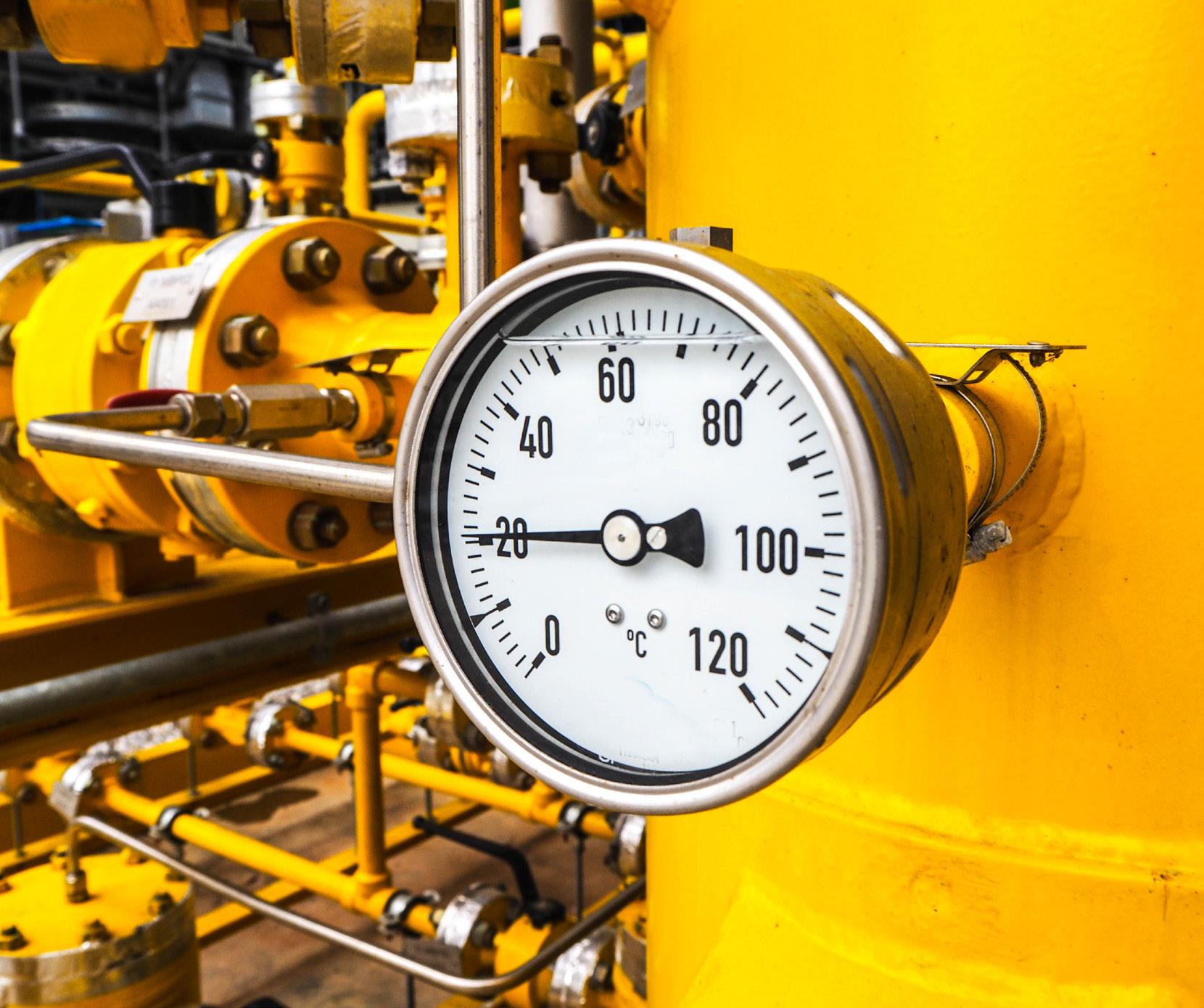
ing potentially unsafe conditions if the issue had not been caught in time. The same alert warned that exposed PLCs, RTUs, HMIs, SCADA systems, safety instrumented systems, building management systems, and IIoT devices pose significant risks to organizations and the public.
That grain silo example should stop anyone who still thinks sensor integrity is some niche cyber topic.
THE STUXNET LESSON EVERYONE REMEMBERS BADLY
When people bring up Stuxnet, they usually remember the spectacular parts: nation-state malware, nuclear centrifuges, air gaps crossed by infected media, Siemens PLCs, a cyberweapon with a passport full of stamps and no respect for maintenance windows.
All that is true, but the more useful lesson is not that Stuxnet was exotic. It is that the Stuxnet malware understood the fragility of trust.
The attack did not simply damage equipment. One Stuxnet variant observed normal operations and then replayed recorded data to operators once sabotage began, preventing them from detecting changes in valves or gas pressure. Later analysis also showed that the
“Anyone who has ever watched a team argue over a reading from a badly placed probe knows the difference between a cyberattack and industrial comedy with a purchase order.” — Claudiu Popa
malware targeted Siemens PLCs used in Iran’s Natanz enrichment facility and manipulated physical processes in ways operators were not meant to notice.
That is the Stuxnett-ish part of modern instrumentation risk. The trick is not always to smash the system. The trick is to convince everyone that the system is fine while the physics quietly disagrees. For Canadian process industries, the lesson is painfully practical. If your control decisions depend on instrument readings, then those readings have to be treated as something more than helpful suggestions from a friendly sensor. They need provenance, validation, calibration, redundancy, and monitoring. They need a chain of custody, not vibes.
SENSORS LIE IN THREE BORING WAY
Most sensor failures are not caused by espionage. That should comfort us, but
only a little. Sensors lie in three common ways.
First, much like the rest of us, they age. Drift is real. A temperature sensor can slowly move away from the true value and do it so politely that nobody notices until product quality, safety margins, or equipment health have already been affected. NIST’s calibration guidance puts it plainly: if a system drifts or takes unpredictable excursions, calibrated values may no longer properly correct for bias and can further degrade measurement accuracy.
Second, sensors are widely misunderstood, even by professionals. A measurement can be technically accurate but operationally useless if it is taken in the wrong place, at the wrong interval, through the wrong assumptions, or interpreted without process context. Anyone who has ever watched a team argue over a reading from a badly placed probe knows this is not a cyberattack. It is just industrial comedy with a purchase order.
Third, sensors can be manipulated. That manipulation can be crude, like an exposed internet-facing device being changed by hacktivists for attention. It can be indirect, like a compromised gateway altering what reaches a dashboard. Or it can be more sophisticated, like logic or communications tampering that makes one layer of the system see something different from another.
WHY 2026 MAKES THIS WORSE
Temperature monitoring used to be local, boring, and really unambitious. A sensor connected to a loop. A loop connected to a controller. A controller connected to a display. Someone with experience looked at the number and decided whether to worry.
Unfortunately, now everything wants to be smart. Sensors report into historians, dashboards, predictive maintenance systems, building management platforms, vendor portals, mobile apps, cloud analytics tools, and sometimes ESG

reporting systems, because apparently no number is allowed to remain in one place anymore.
There are benefits to that. Better visibility can prevent failures, reduce waste, and improve maintenance. Nobody serious wants to go back to clipboards, mystery panels, and the priesthood of the one technician who knows which cabinet makes the humming sound.
But every new connection creates a new trust decision. The Canadian Centre for Cyber Security has warned that OT is now extensively used in sectors such as manufacturing, resource extraction, electricity, natural gas, and water, and that digital transformation has added network connections, automated decision-making, data exchange, and centralized management to systems originally built before internet-era security
assumptions took over the world.
In plain language: a lot of industrial systems still trust messages because they arrive looking familiar. That presents a false sense of security.
CALIBRATION IS NOT PAPERWORK
Calibration does not get enough respect because it looks like paperwork wearing safety boots. But calibration is one of the places where safety, quality, cybersecurity, and common sense meet. Any auditor will tell you that Configuration Management and control evidence are at the core of any industrial audit.
ISA describes accurate, reliable, and repeatable operation of monitoring and control loops as vital to safety and reliability. It also warns that without a calibration program, maintenance of
control, indication, and analytical devices often happens only when the error becomes obvious to facility personnel. By then, people may already have been making decisions based on faulty indications.
That is exactly the problem. Bad readings do not become dangerous only when an attacker touches them. They become dangerous when organizations forget that measurement is an active discipline.
A temperature transmitter in a harsh environ-
ment is not a sacred object. It is a device under stress. Heat, vibration, contamination, moisture, wiring problems, aging components, reference junction errors, process changes, and poor installation can all turn “close enough” into “why is the batch ruined?” or “why did the alarm not make sense?”
To understand cyber risk, pause here and ask these questions:
• Was the firmware changed?
• Was the configuration altered?
• Was the engineering workstation clean?
• Was the reading validated against an independent source?
• Was the alert suppressed?
• Was the dashboard showing live values or cached comfort food?
• Was the sensor actually wrong, or did someone make the system report it that way?
If it looks at least a little bit like paranoia, you are doing it right. These are normal questions in a world where instrumentation has become networked, remote, and valuable.

THE CANADIAN ANGLE IS NOT THEORETICAL
Canada has no shortage of facilities where temperature and instrumentation integrity matter. Food processing. Grain drying. Cold storage. Pulp and paper. Mining. Oil and gas. Chemicals. Pharmaceuticals. Water treatment. Data centres. District energy. Manufacturing plants trying to squeeze more productivity out of older equipment without annoying physics too much.
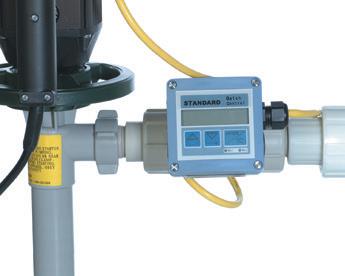
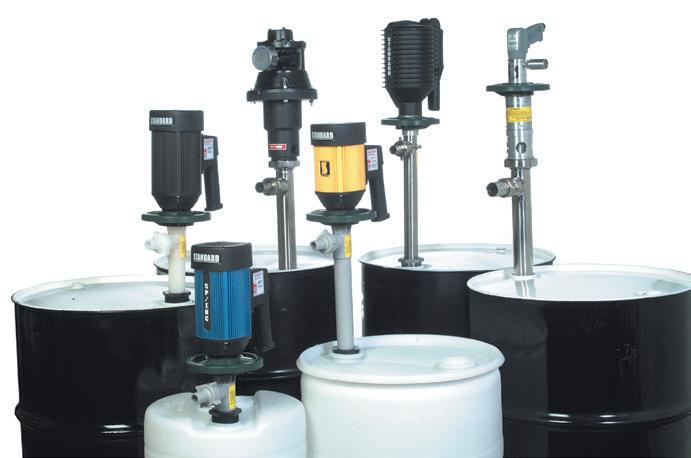
Tote and Drum
Pumping Solutions Tote and Drum Pumping
In oil and gas, the Cyber Centre has assessed that the sector’s digital transformation is expanding the attack surface of OT assets and exposing them to cyber threats. It also notes that Canada has about 850,000 kilometres of gathering, feeder, transmission, and distribution pipelines for oil and gas products, with nearly 120,000 kilometres of large-diameter transmission pipelines. That is a lot of distributed infrastructure, and distributed infrastructure loves instrumentation because humans stubbornly refuse to be everywhere at once.
COMPLIANCE IS WAKING UP TOO
The regulatory direction is also changing. Bill C-8 received Royal Assent on June 15, 2026, creating the Critical Cyber Systems Protection Act and a regulatory framework for designated operators in federally regulated sectors including finance, telecommunications, energy, and transportation. The federal government says the law will be implemented gradually, with some provisions coming into force through a phased approach.
Not every temperature sensor in Canada is suddenly a federal compliance matter. Let us not get carried away and start putting legal disclaimers on thermocouples. But the policy direction is clear. Critical systems are being viewed through a cybersecurity lens, and operators will be expected to understand not only whether systems are available, but whether they are trustworthy.
For industrial instrumentation, that means integrity matters. It means knowing whether readings are authentic, timely, accurate, complete, and protected from unauthorized change. The dull words are doing serious work.
WHAT PRACTICAL SITES SHOULD DO
The answer is not to distrust every sensor and run screaming into the parking lot. That would be entertaining for the security camera
operator but not especially helpful. The answer is disciplined suspicion.
Start with criticality. Identify which temperature and instrumentation readings can affect safety, product quality, environmental performance, shutdown decisions, equipment protection, or regulatory reporting. Not all sensors deserve equal attention. Some are informational. Some are operational. Some are the difference between a controlled process and a bad day with lawyers.
Validate readings independently where it matters. Use redundant sensors, physics-based expectations, manual checks, lab checks, or independent instrumentation for critical loops. If one number claims the world has changed and every other indicator disagrees, do not worship the number. Investigate.
Treat calibration records as security-relevant evidence. They show whether the instrument has a history of behaving, drifting, failing, or being adjusted. That history matters.
Monitor configuration changes. A sensor range, alarm threshold, scaling factor, or compensation setting can be just as important as the sensor itself. Small changes can create large lies.
Secure engineering workstations and maintenance laptops. These are the quiet little bridges between intention and machinery. They deserve more scrutiny than they usually get.
Review remote access to instrumentation, gateways, HMIs, building systems, and IIoT platforms. If someone can change what the plant sees from outside the plant, that access should not be managed with hope and a shared password from 2019.
And finally, test the story your sensors are telling. If the dashboard says everything is normal, ask what normal is being compared against. A clean graph is not proof. It is a claim.
FIVE TAKEAWAYS WORTH BRINGING BACK TO THE SITE:
1. temperature data is operational evidence, not decorative dashboard content.
2. sensor failure and sensor manipulation can look the same to an operator until someone investigates properly.
3. calibration drift is not just a maintenance nuisance. It can become a safety, quality, reporting, and cybersecurity issue.
4. connected instrumentation expands the attack surface, especially when remote access and weak protocol security are involved.
5. the most dangerous reading is not always the one that looks wrong. Sometimes it is the one that looks perfectly normal because somebody, or something, made it that way.
The sensor conspiracy is not that your temperature gauges are malicious. They are innocent little devices, mostly. The conspiracy is the unreasonable amount of trust we
place in readings that are rarely challenged, poorly contextualized, sometimes badly maintained, and increasingly networked into systems that can be reached, altered, or fooled.
Industry already knows how to respect pressure, heat, voltage, torque, and confined spaces. It needs to develop the same respect for measurement integrity.
Because when your instruments lie, your plant does not magically become safer just because the dashboard is calm. At that point, either people or
machines risk making decisions in the dark while everyone is otherwise distracted.

Claudiu Popa is a published author, industrial cybersecurity auditor and speaker,andleaderatOTSecurityCanada.As CEO of Informatica he advises on risk, policy and compliance, particularly where operations at scale meet emerging risk. Feedback and commentary are always welcomed at SecurityandPrivacy.ca and www.OTSEC.ca.
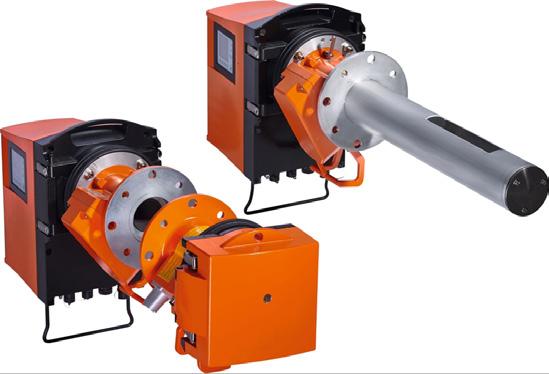
ENDRESS+HAUSER OFFERS REPLACEMENT DISCOUNT FOR AGING GAS ANALYZERS
Endress+Hauser has announced a discount program for users replacing older in-situ gas analyzers with new GM32 units.
The Burlington, Ont.-based company is offering a 20 per cent discount for the balance of 2026 to users upgrading from the discontinued GM31 analyzer, or a 10 per cent discount for users replacing GM32 analyzers in service for more than seven years.
The GM32 is available in cross-duct and probe versions for measuring process or flue stack emissions. The unit includes an automatic self-testing capability and does not require gas sampling lines, gas treatment or measurement containers. www.ca.endress.com

STRUKTOL HIGHLIGHTS RUBBER PROCESSING ADDITIVE FOR MULTIPLE APPLICATIONS
Struktol Company of America LLC has outlined applications for its EF 44A processing additive designed for natural and synthetic rubber compounds.
The Stow, Ohio-based company said the additive is formulated as a blend of fatty acid derivatives, predominantly zinc soaps. The product is designed to enhance mixing and flow across elastomers including natural rubber, styrenebutadiene rubber and ethylene propylene diene monomer rubber. The additive is not intended for halogenated elastomers. www.struktol.com
ABB INTRODUCES LOW-RANGE EMISSIONS MONITORING SYSTEM FOR STRICTER EU STANDARDS
ABB has announced the launch of the ACF5000 LCS, a new Continuous Emission Monitoring
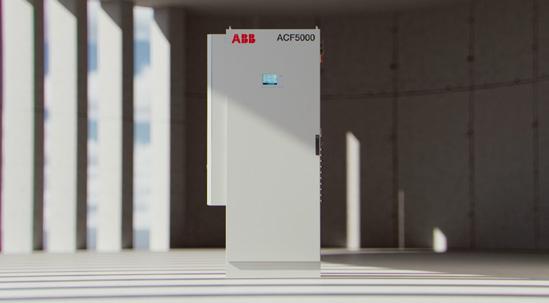
System (CEMS) designed to measure industrial emissions at very low concentration levels.
The system has been developed in response to increasingly stringent emissions regulations in Europe, including requirements under the European Union’s revised Industrial Emissions Directive (IED 2.0). The directive introduces lower emission limit values for industrial facilities, requiring monitoring equipment to operate within tighter certified measurement ranges. new.abb.com/ca

BITFLOW
RELEASES FRAME GRABBERS FOR AI-DRIVEN MACHINE VISION SYSTEMS
BitFlow has announced production availability of its Claxon CXP-12 frame grabbers designed for machine vision systems that use NVIDIA GPU-accelerated artificial intelligence inference.
The Woburn, Mass.-based company, a division of Advantech, said the Claxon lineup includes five models ranging from the single-link Claxon CXP1 and quad-link Claxon CXP4 to the long-reach Claxon Fiber model. The frame grabbers are built on the CoaXPress 2.0 standard, which delivers 12.5 gigabits per second per link over standard coaxial cable. Link aggregation can scale throughput to 50 gigabits per second across four links. According to BitFlow, this provides five times the throughput of 10 Gigabit Ethernet Vision without the latency and overhead associated with Ethernet network protocols. www.bitflow.com
INTEGRION AUTOMATION EXPANDS FIELD SERVICES PROGRAM FOR MANUFACTURING AUTOMATION SYSTEMS
Integrion Automation, a Wauseon company, has expanded its Field Services program for preventive
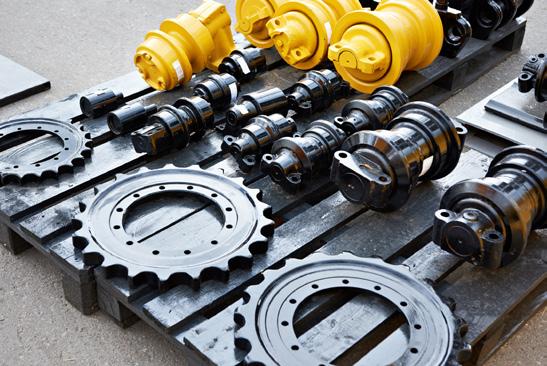
maintenance and support of automated manufacturing systems and robotic cells.
The program includes equipment assessments, scheduled maintenance planning, robotics service and parts inventory management. Services are designed to address unplanned downtime and maintenance requirements for automation equipment.
The Field Services process begins with an equipment assessment conducted by field service engineers. The assessment evaluates system condition, operating environment, usage patterns and service history. Based on the assessment, the company develops a maintenance plan coordinated with production schedules.
www.integrionautomation.com
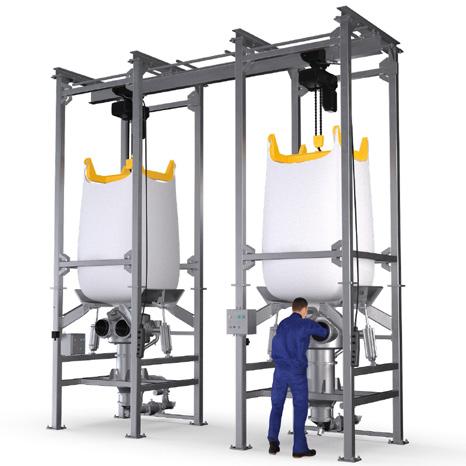
VOLKMANN INTRODUCES CONTAINMENT BULK BAG UNLOADER FOR HAZARDOUS MATERIAL HANDLING
Volkmann USA has introduced a containment bulk bag unloader designed for transferring hazardous materials from bulk bags into downstream processes.
The Bristol, Pa.-based company said the closed, sealed system is designed for single-operator use to transfer toxic, ignitable, allergenic and other hazardous materials from bulk bags, sacks and flexible intermediate bulk containers. The system is designed to minimize dust release into the workplace and reduce contamination risk from environmental exposure.
Applications include emptying anode and cathode materials used in battery manufacturing such as cobalt, manganese and nickel, as well as allergenic products containing gluten, peanuts and soy. The bag
emptying station features dust-tight docking and a built-in glove box that provides access to the bag and spout inside the tie box. The design allows operators to untie and prepare bulk bags for discharge while remaining isolated from the material. www.volkmannusa.com
KAMAN OFFERS HIGH-PRESSURE DISPLACEMENT SENSORS FOR SUBSEA APPLICATIONS
Kaman Precision Products Inc. has outlined specifications for its Advanced Magnetic Sensing family of non-contact displacement sensors designed for oil, gas and subsea condition monitoring applications.
The Middletown, Conn.-based company’s Measuring Division said the sensors are engineered to operate in high-pressure environments ranging from 500 psi to 40,000 psi.
The AMS sensors measure runout, speed and vibration profile changes in rotating machinery. www.kamansensors.com
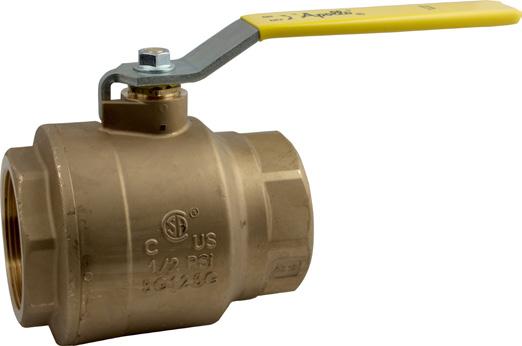
AALBERTS IPS COMPLETES STAINLESS STEEL BALL CONVERSION FOR VALVE PRODUCT LINE
Aalberts integrated piping systems has completed a conversion of its Apollo brass and bronze ball valve portfolio to Type 316 stainless steel balls.
The company discontinued manufacture of chrome-plated brass and bronze balls in early 2025 and standardized production on 316 stainless steel for all brass and bronze ball valve models manufactured in Pageland, S.C. The conversion was implemented as a running change and completed in July 2025.
The project consolidated stock keeping units and standardized materials across the valve line. Type 316 stainless steel provides corrosion resistance in steam, cooling water, heating and industrial applications. According to Aalberts IPS, the material change results in extended service life and reduced maintenance requirements compared to chrome-plated brass. www.aalberts.com

VIRTUAL WORKSHOP
NEXT GENERATION LEADERSHIP IN MANUFACTURING
OCTOBER 28, 2026 • 9AM TO 3PM
Next Generation Leadership in Manufacturing is a full-day, high-impact virtual workshop for emerging and frontline leaders navigating the realities of today’s manufacturing environment.
Through real-world examples, interactive exercises and practical frameworks, participants will learn to build trust, lead adaptively under pressure and bring out the best in their teams.
Participants will leave with practical tools to lead people more effectively and support stronger team performance.


SCAN TO REGISTER
DEADLINE TO REGISTER IS SEPTEMBER 28TH!
Space is limited to 60 registrants
Presented by: