Markets: Behind chicken prices p.12
Turkey Lighting: Blue light benefits p.18
October 2026
Biosecurity: Targeting HPAI risks p.22
canadianpoultrymag.com
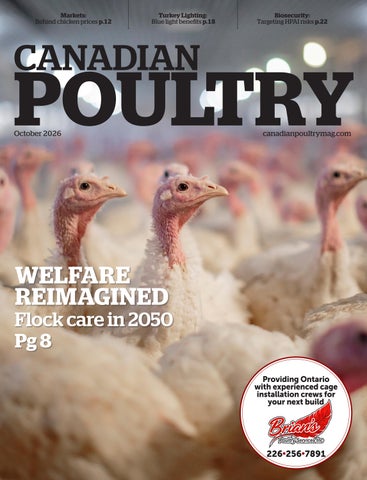
WELFARE REIMAGINED
Flock care in 2050 Pg 8 Providing Ontario with experienced cage installation crews for your next build
Poultry Services Inc
226•256•7891
Female
Male
FLOCK ACCURACY: 97%
ACCURACY from the start is our priority, Ceva GENDER SORTING SYSTEM for Broilers. 2
CANADIAN POULTRY
CEVA.COM October 2026
CONTENTS
October 2026 Vol. 113, No. 7 canadianpoultrymag.com
12
20 8 DEPARTMENTS
FEATURES
04 | Editorial The value of conversation
8
06 | What’s Hatching Chicken donations, barn probe, AI opportunities and import concerns 25 | Classifieds 26 | Poultry Spaces New automated aviary facility for pullets and layers
COVER STORY Reimagining welfare International collaboration is helping shape the future of poultry welfare.
12
Behind chicken prices What demand, supply and imports mean for chicken prices.
ON THE COVER What will poultry welfare look like in 2050? Industry conversations are identifying common priorities, from AI and enrichment to transparency and collaboration, and turning them into action. See story on page 8.
18
Blue shines through Light colour eliminates aggression in turkey hens.
20
The locomotion link Early life activities may affect how well layers navigate aviaries.
22
Targeting HPAI risks New CFIA matrix pinpoints high-risk farm activities.
ISSN 1703-2911. Canadian Poultry is published 10 times per year by Annex Business Media. Canada Post Publications Mail Agreement No. 40065710. Return undeliverable Canadian addresses to: Circulation Department, 111 Gordon Baker Rd., Suite 400, Toronto ON M2H 3R1. No part of the editorial content in this publication may be reprinted without the publisher’s written permission. © 2026 Annex Business Media. All rights reserved. Opinions expressed in this magazine are not necessarily those of the editor or publisher. No liability is assumed for errors or omissions. All advertising is subject to the publisher’s approval. Such approval does not imply any endorsement of the products or services advertised. Publisher reserves the right to refuse advertising that does not meet the standards of this publication. Printed in Canada.
From the Editor
canadianpoultrymag.com
by Brett Ruffell
The value of conversation
O
ne of the things I’ve always liked about agriculture is how much can come from simply getting the right people talking to one another. That idea is at the heart of a new approach to the Influential Women in Canadian Agriculture (IWCA) program this year. Since its launch in 2020, IWCA has recognized women making an impact across Canadian agriculture – producers, researchers, entrepreneurs, industry leaders and advocates. Over the years, we’ve shared their stories through profiles, podcasts, digital magazines and events.
“Progress often begins by creating room for people to exchange ideas.” This year, we did things a little differently. The 2026 IWCA Conversation Series brought honourees together for two digital roundtables. Rather than relying on presentations and tightly scripted questions, the sessions were designed to encourage open discussion about their careers and some of the bigger issues facing agriculture. The result was a wide-ranging conversation touching on misinformation, mental health, climate concerns, political uncertainty, research, mentorship and the challenges and opportunities women encounter in agriculture.
facebook.com/CanadianPoultry
Among this year’s impressive group of IWCA honourees are two women with strong connections to Canada’s poultry industry. Margaret Hudson, president and CEO of Burnbrae Farms, grew up gathering eggs and has spent her life connected to the family egg business. Jennifer Woike is a B.C. egg producer and president of the B.C. Agriculture Council. Their poultry perspectives join those of women working across a diverse range of commodities, disciplines and regions. There’s something valuable about bringing those different experiences together. Agriculture has plenty of complex issues without simple answers, and progress often begins by creating room for people to exchange ideas. That’s particularly fitting for this animal welfare-focused issue of Canadian Poultry. Our cover story looks at a similar concept through new interactive welfare labs that encourage poultry industry participants to discuss welfare challenges and possible solutions. Elsewhere, we examine research into turkey aggression, layer locomotion and HPAI risk. Different subjects, but a common thread: asking questions, sharing experiences and being willing to hear different perspectives. You can watch the 2026 IWCA Conversation Series and learn more about all of this year’s honourees at canadianpoultrymag.com.
canadianpoultrymag
canadianpoultrymag.com
Reader Service Print and digital subscription inquiries or changes, please contact Angelita Potal, Customer Service Rep. Tel: (416) 510-5113 Email: apotal@annexbusinessmedia.com Mail: 111 Gordon Baker Rd., Suite 400, Toronto, ON M2H 3R1 Editor Brett Ruffell bruffell@annexbusinessmedia.com 226-971-2133 Brand Sales Manager Ross Anderson randerson@annexbusinessmedia.com Cell: 289-925-7565 Account Coordinator Julie Montgomery jmontgomery@annexbusinessmedia.com 416-510-5163 Media Designer Brooke Shaw Group Publisher & VP, Content Strategy Michelle Bertholet mbertholet@annexbusinessmedia.com Audience Development Manager Anita Madden amadden@annexbusinessmedia.com 416-510-5183 CEO Scott Jamieson sjamieson@annexbusinessmedia.com PUBLICATION MAIL AGREEMENT #40065710 Printed in Canada ISSN 1703-2911 Subscription Rates Canada - Single-copy $10.00 Canada – 1 Year $34.48 Canada – 2 years $58.87 (plus applicable taxes) USA – 1 Year $97.06 CDN Foreign – 1 Year $109.79 CDN GST - #867172652RT0001 Occasionally, Canadian Poultry Magazine will mail information on behalf of industry-related groups whose products and services we believe may be of interest to you. If you prefer not to receive this information, please contact our circulation department in any of the four ways listed above. Annex Privacy Officer privacy@annexbusinessmedia.com Tel: 800-668-2374 No part of the editorial content of this publication may be reprinted without the publisher’s written permission. ©2026 Annex Business Media. All rights reserved. Opinions expressed in this magazine are not necessarily those of the editor or the publisher. No liability is assumed for errors or omissions. All advertising is subject to the publisher’s approval. Such approval does not imply any endorsement of the products or services advertised. Publisher reserves the right to refuse advertising that does not meet the standards of the publication.
MAXIMIZE BIRD HEALTH AND PRODUCTIVITY Water has a big impact on how healthy and productive your flock is, which is why our watering systems are designed to deliver a consistent and reliable flow of fresh water to your entire flock. LUBING’s watering systems are precision-engineered for ease of management and a long service life. Upgrade your system with the LUBING E-Flush Water Regulator. It automates line flushing to eliminate biofilm and sediment—delivering fresh, cool water effortlessly so your layers stay hydrated and productive.
Glass-Pac Canada St. Jacobs, Ontario Tel: (519) 664-3811 Fax: (519) 664-3003
Les Equipments Avipor Cowansville, Quebec Tel: (450) 263-6222 Fax: (450) 263-9021
Specht-Canada Inc. Stony Plain, Alberta Tel: (780) 963-4795 Fax: (780) 963-5034
Carstairs, Alberta Tel: (403) 337-3767 Fax: (403) 337-3590
RELENTLESS QUALITY. EXCEPTIONAL SERVICE.
canadianpoultrymag.com
WWW.LUBINGUSA.COM | CUSTOMERSERVICE@LUBINGUSA.COM | 423-709-1000
CANADIAN POULTRY
5
What’s Hatching
Investigation continues after N.S. barn fire A faulty extension cord caused a small fire at a poultry farm near Lunenburg, N.S., where 10,000 chickens died in July after someone deliberately shut off barn ventilation fans. RCMP say the recent fire was accidental and caused only minor damage, with no injuries reported. Police continue to investigate the July 25 break-in but have not laid charges due to a lack of evidence. They are asking the public for information.
Representatives from Chicken Farmers of Ontario, Hamilton Food Share, Maple Leaf Foods, Feed Ontario and the Ontario government gather to recognize the donation of more than 1,500 kilograms of locally grown chicken to Hamilton Food Share.
FCC report highlights AI opportunities A new Farm Credit Canada report says artificial intelligence could boost productivity, resilience and competitiveness across Canadian agriculture, but adoption remains low. Developed with Deloitte Canada, the report identifies opportunities in areas including animal health, precision management and supply chain coordination while highlighting barriers such as limited rural connectivity, talent shortages and fragmented digital infrastructure. It also outlines steps needed to accelerate AI adoption and help Canadian agriculture remain competitive globally.
Spent fowl duties lag Canada has collected only about one per cent of the nearly $311 million in duties, interest and penalties assessed on mislabelled U.S. chicken imports since 2017, according to newly released federal figures. The Canada Border Services Agency says much of the outstanding amount remains unpaid or has been written off. Chicken Farmers of Canada says stronger enforcement is needed, while a recent parliamentary report also called for tighter controls on spent fowl imports. 6
CANADIAN POULTRY
11 MILLION
is how many chicken meals the CFO Cares: Farmers to Food Banks program has donated since 2015.
Ontario chicken farmers are celebrating another milestone in their efforts to combat food insecurity after donating more than 1,500 kilograms of locally grown chicken to Hamilton Food Share through the Chicken Farmers of Ontario (CFO) Cares: Farmers to Food Banks program. The donation, recognized during a July 20 event in Hamilton, will provide approximately 14,000 meals for families and individuals facing food insecurity in the region. “Food insecurity continues to be an issue for many Ontario families and Ontario chicken farmers are continuing to step up to tackle hunger in our local communities,” said Murray Opsteen, chair of Chicken Farmers of Ontario. “Chicken farmers were proud to recognize regular donations of chicken, including 1,500 kilograms of locally grown chicken delivered to Hamilton Food Share earlier this year.” The event brought together local chicken farmers with the Hon. Neil
Lumsden, MPP for Hamilton East– Stoney Creek, and Monica Ciriello, MPP for Hamilton Mountain, to recognize the contribution. Since its launch in 2015, the CFO Cares: Farmers to Food Banks program has donated the equivalent of more than 11 million chicken meals to food banks across Ontario. Opsteen credited the program’s success to industry and community partnerships. He thanked Maple Leaf Foods for processing the donated Ontario-grown chicken and Feed Ontario for coordinating logistics to ensure donations reach food banks across the province. He also acknowledged the Ontario government’s continued support for farmers, the Community Food Program Donation Tax Credit and its advocacy for Canada’s supply management system. Chicken Farmers of Ontario says the program demonstrates how collaboration across the poultry sector continues to help provide nutritious protein to Ontario families in need.
Visit us online Find the latest poultry-related news, stories, blogs and analysis from across Canada at:
canadianpoultrymag.com
October 2026
PHOTO: C H IC K E N FA R M E R S OF ON TA R IO
Ontario chicken farmers mark Hamilton food bank donation
B.C. chicken board urges growers to build The BC Chicken Marketing Board is urging the province’s chicken growers to build more barn space as rising demand and production shortfalls put pressure on capacity. In an Aug. 6 memo, the board said demand for B.C. chicken is at an all-time high, but the province has repeatedly fallen short of its allocated production. B.C. met its allocation in only one of the past nine production periods, with chick shortages, disease, flooding and other challenges contributing to the shortfalls. Canadian chicken consumption is also climbing. According to the board, total consumption has increased about 22 per cent since 2020, while per-capita consumption has risen roughly 11 per cent. “The demand and the allocation are there. The constraint is our ability to grow the birds,” the chicken board said. Additional barn construction is needed to accom-
modate future growth, the board says. Assuming provincial allocation grows by three per cent annually, it projects allocation will exceed B.C.’s standard-density barn capacity in 2027, with the gap potentially becoming substantial by 2030. The board is also reevaluating its High Density program, which was intended to increase production within existing barn space. It said growers are not consistently using their registered high-density capacity, particularly during peak summer periods. Continued production shortfalls could eventually put B.C.’s share of national growth at risk. Growers are being encouraged to assess whether their barns can accommodate expected allocation three to five years from now and plan additional capacity where needed. “Build real barn capacity now,” the board said. “The single biggest constraint on your future is usable space.”
22 per cent
is the increase in total Canadian chicken consumption since 2020.
Pests can impact livestock. Protect your farm’s health. The health and well-being of your animals is critical — but nuisance pests can spread disease, cause stress and reduce productivity. Envu provides targeted solutions to help you take control, reduce pest pressure and keep your animals healthier and happier: + Reduce stress and disease risks + Protect livestock in barns, poultry houses and outdoor areas + Maintain productivity and farm hygiene
ALWAYS READ AND FOLLOW PESTICIDE LABEL DIRECTIONS. Environmental Science U.S. LLC, 5000 CentreGreen Way, Suite 400, Cary, NC 27513. For additional product information, call toll-free 1-800-331-2867. www.envu.com. Not all products are registered in all states. Envu, the Envu logo, Annihilator®, Credo®, Maxforce® and PolyZone® are trademarks owned by Environmental Science U.S. LLC or one of its affiliates. ©2026 Environmental Science U.S. LLC. Far-Canada-Bui-MB-011326-A-36
canadianpoultrymag.com
CP_ENVU_Oct26_CSA.indd 1
Safeguard your farms
CANADIAN POULTRY
7
2026-08-18 2:13 PM
Cover Story
Reimagining welfare International collaboration is helping shape the future of poultry welfare research and innovation.
A
sk poultry specialists what welfare looks like in 2050 and there will be a wide range of answers. Despite the volume and diversity, responses will start to group together. There will be overlap. And from this, there will be common themes, messages and ways to categorize resulting information to move forward and make appropriate welfare needs happen globally. This is the work of Shawna Weimer, assistant professor in the Department of Poultry Science and director of the Center for Food Animal Wellbeing at the University of Arkansas, where her research focuses on advancing poultry welfare. As a key contributor to the International Poultry Welfare Alliance (IPWA), and chair of the organization’s research and innovation committee, she sought to build on the work of Anne-Marie Neeteson, a board member at large with IPWA. “She was there from the inception of IPWA,” Weimer says. “She revolutionized the industry and poultry welfare.” 8
CANADIAN POULTRY
Icebreakers spark connections Weimer says it was Neeteson’s work that led her to craft a series of events she called icebreakers. Held at seven poultry meetings in Germany, the U.S. and Thailand, the result of these conversations in 2024 and 2025 informed a paper first-authored by Weimer published in Poultry Scienc called “Research and Innovation Perspectives: Poultry Welfare in 2050.” The paper is the culmination of input from more than 200 participants with experience and expertise in poultry welfare. “The question was, what does poultry welfare look like in 2050?” she says. “And, how do we get there?” The findings have since come to Canada, with Weimer presenting them at the Poultry Science Association (PSA) annual meeting in Toronto in July. The work also informed WelfareLab2050, which was held at the World’s Poultry Congress immediately following the PSA meeting in Toronto. Weimer led WelfareLab2050 with Richard Griffiths, chief executive with the British Poultry Council. As the next step in the process, this lab focused on how welfare science is interpreted, communicated and applied. The session was open to all attendees as part of the congress, where people discussed the topics from the paper and how to take the information forward into action. Weimer says the goal at this stage is establishing relationships so the industry can build together. “This is just the beginning of it,” she says. “The icebreakers were just the gathering of information and the
WelfareLab2050 sprints are how we get there.” The Canadian Code of Practice for the Care and Handling of Hatching Eggs, Breeders, Chickens and Turkeys was a key response in Toronto when attendees were asked about who they trusted most and where science had worked well. “There were quite a few Canadians [at the session],” she says. “There were several people who came up and talked with me after my talk.” The information for the paper came from throughout the industry, from poultry producers all the way to retailers participating in the icebreaker events. Eight different topic areas were chosen to guide the international discussions and categorize the results for the paper and ongoing welfare labs. “We wanted to identify the needs that will keep improvements anchored in validated science and then show that it’s practical, something that’s actually usable,” notes Weimer. She says that looking toward the “how” takes an understanding of who is “at the table.” “I see animal welfare as an ecosystem, bringing working parts together,” she adds. “Because welfare is everything. We have to take a holistic view of it because it is holistic: the environment, how they’re handled in the past, all of it.” Part of the icebreakers explored how more conversations can be established. That may be cross-species conversations or industry-specific ones that look deeper into welfare issues.
Industry conversations about the future of poultry welfare are identifying common priorities – from technology and enrichment to transparency, training and collaboration.
October 2026
Five concepts to watch 1. Artificial intelligence will be part of the barn of the future in predicting welfare indicators, optimizing food and supplementation, ensuring comfort and more.
PHOTO: A L LT EC H
2. Genetics will focus on production as well as immunity and resilience.
“How can we create a safe space to talk about animal welfare?” Weimer asks. “Every company has the stance they want to take on it. Let’s at least talk about it, have more of a sharing of information. The conversations about how you’re getting things done.” This could include knowledge sharing about transportation and handling – a sometimes-problematic phase of animal production. Or, if the processor is seeing damage to foot pads, understanding how that is being communicated back to the producer and tracked through the process. “It’s really about connections,” she says. “It’s connecting science and innovation and stakeholders.” Instead of just considering what has been tried and the results, this connection-based approach would canadianpoultrymag.com
open up opportunities to consider what something new would require and find those willing to take it on. Eight key areas Audiences at the icebreakers contributed to word clouds, both for the event they were at and subsequently to the overall word cloud from all events. The 10 most frequent responses made up the summaries for each of the eight topics. These include: Housing and Management with a Focus on Environmental Enrichment; Positive Animal Welfare; Impact of AI on Welfare of Poultry and Humans in the Industry; Research-based Applications Across Poultry Species; Welfare from the End of Production to Processing; Welfare and Nutrition Management; Robustness; and Welfare and Sustainability.
Some of the key takeaways from the sessions are already being implemented in Canada. For example, in the Housing and Management discussion area, the concept of increased, cage-free space for laying hens, including vertical space and opportunities to promote natural behaviours, was a primary point for participants. AI-based solutions were also noted in the Housing and Management section, with much of this work already underway around the world to better understand bird behaviours, ensure optimal comfort and create real-time feedback on conditions within bird environments. Enrichment was also cited in this section with a desire for more studies. “Environmental enrichment is really big,” Weimer says. “There are
3. Cross-species sharing will enhance best practices and inform the creation of new tools. 4. Education and transparency are key for consumer trust, confidence and support. 5. Enrichment will evolve to easier, changing, yet integrated solutions that maximize bird engagement.
CANADIAN POULTRY
9
Cover Story
10
CANADIAN POULTRY
Participants discuss how poultry welfare science can be interpreted, communicated and put into practice during the WelfareLab2050 session at the World’s Poultry Congress in Toronto.
importance of welfare and steps that promote it. The training element also came up in the Welfare from the End of Production to Processing theme around better training for improved handling during catching and processing – an ongoing concern for many consumers and animal advocates. Clearly, AI was dominant in most of the eight sections and the Impact of AI on Welfare of Poultry and Humans in the Industry section brought the potential of it together with concepts like both individual- and flock-level monitoring and management, automation and forecasting. AI-powered assessments of specific species’ welfare indicators may also be developed in tandem with multispecies welfare dashboards. While sustainability can often cause trade-offs with welfare improvements, in the Robustness theme, these factors were noted, stressing a need for balance in conjunction with productivity. “Welfare and sustainability conversations often go in different directions,” Weimer says. AI and welfare Across these conversations, she emphasized the need to measure both protection from negative welfare states and evidence of positive welfare. Participants repeatedly identified technology as a promising tool for this work. AI could support continuous monitoring of bird behaviour and health, but its value will depend on developing
proven welfare indicators that automated systems can detect and interpret reliably. This represents a significant opportunity for the industry. “It’s tough, because it’s behaviour. It varies,” she says. “But technology can help with that long-term look at things. Sensors can detect issues before we can. Data can be turned into decisions that can make a difference now and enhance that benchmarking for the future.” Weimer notes that the goal is not to replace humans and certainly not to replace their interaction with poultry. Instead, this is about creating tools that identify subtle changes before they are observed by humans, thereby allowing for further inspection. Decisions are enhanced by knowledge gained from AI observation, not replaced by it. Any animal welfare project must be longterm because, as Weimer says, welfare isn’t a quick hit of data like nutrition or feed conversion ratios where the needle moves quickly. Welfare is less finite and currently less data-driven. This is where much of the future lies. When machine learning is integrated, establishing micro-steps and identifying repeated behaviours becomes possible. This is a computerized way to address human needs for animal welfare. Those looking to contribute to Weimer’s work on poultry welfare should watch for announcements about more conversation-based labs. October 2026
PHOTO: S H AW NA W E I M E R
several organizations and companies that do this. The term ‘consistently use’ is key here. The novelty wears off.” She says the industry is still in the early stages of finding enrichment that is a winwin where poultry have ongoing options they continually use that are easy and affordable for the producer. Looking at Welfare and Nutrition Management, it’s not surprising to see AI noted as part of optimizing feed efficiency and welfare. This theme also pointed to different supplements and formulations that help reduce phosphate emissions, enhance immune responses and improve the foraging experience. AI also plays a part within the theme of Positive Animal Welfare, where participants noted real-time behaviour and health monitoring will become increasingly important. But it isn’t all about computers. There will also be a push for breeding programs to focus on traits that ensure welfare along with productivity. This was echoed in the Robustness section where genetic advancements to improve disease resilience and adaptability were noted. “Positive welfare is astronomically more difficult to empirically evaluate than negative welfare,” Weimer says. “How do we know chickens are happy?” Another element within the Positive Animal Welfare theme was the ongoing need for transparency in the areas of feeding and overall management. “It’s about trust and transparency,” she says. “Consumer engagement is required to build trust in agriculture.” In the Welfare and Sustainability theme, the message about transparency was repeated and the need for more public education on animal welfare for the public and in schools was noted. “Consumer involvement is essential to social sustainability in reducing the disconnect between industry and consumers,” the paper notes in regard to this theme. The paper also notes that modular training, like that provided by IPWA, is an example of improving knowledge within the industry to ensure understanding of the
CULTIVATING LEADERSHIP Egg Farmers of Canada is proud to empower egg sector leaders through our National Young Farmer Program and Women in the Egg Industry Program. These initiatives support knowledge growth and provide networking and leadership opportunities.
Interested? Contact your egg board to learn canadianpoultrymag.com how to get involved.
CANADIAN POULTRY EGGFARMERS.CA
11
Markets
Behind chicken prices
T
here has been a lot of media attention in Canada this spring and summer about the price of chicken. To help Canadian chicken farmers address misperceptions about chicken prices when they speak to people in person or engage online, Canadian Poultry dug into the broader context. Here’s a full look at Canada’s chicken situation, starting with demand. Why demand is high People may prefer chicken for many rea-
12
CANADIAN POULTRY
sons – its taste, versatility, eating experience, family habits and more – but there’s no question chicken is popular. “Canadians are eating tremendously more chicken compared to years ago,” notes Graeme Crosbie, senior economist at Farm Credit Canada. “In fact, we set a record in 2025. According to Statistics Canada, the average Canadian ate 35.6 kg of chicken last year. That’s increased over the years. It’s now over double what it was over 55 years ago in 1970, when it was about 14 kg.” There has also been a long-term trend
Retail chicken prices reflect a mix of consumer demand, domestic production, imports and costs throughout the supply chain.
toward eating more protein. GLP-1 medications may be adding to that demand as users tend to eat less and place greater emphasis on protein-rich foods. A 2026 Leger survey found eight per cent of Canadian adults reported currently taking a prescription GLP-1 medication, with users reporting reduced appetite and increased consumption of protein-rich foods. Chicken, other meats, eggs, Greek yogurt, whey, nuts and other high-quality protein sources may, therefore, benefit from the trend. October 2026
PHOTO: A D OB E STO C K
What demand, supply and imports mean for chicken prices. By Treena Hein
WORTH
CELEBRATING. Canadian turkey. Canadian farmers. Proudly Canadian.
This Thanksgiving, we celebrate the farmers behind Canadian turkey.
Happy Thanksgiving
from Turkey Farmers of Canada canadianpoultrymag.com
CANADIAN POULTRY
13
Markets
Chicken situation summary
14
Canadian chicken production is increasing in 2026 as the industry responds to strong consumer demand.
The price of beef is another factor. When one product in a category such as meat or cereal becomes expensive, consumers will often substitute other, more affordable options. Crosbie notes that the current price of ground beef, a traditional Canadian family staple, is now “astronomical.” “A pound of ground beef is now more expensive than a pound of chicken breast,” he says, “so people are looking to chicken instead. However, people are also switching to different cuts of beef, pork and chicken that aren’t as expensive as others.” Dr. Sylvain Charlebois, director of the Agri-Food Analytics Lab at Dalhousie University, also notes this trend, particularly among consumers looking to stretch their food budgets. “Consumers looking for value are increasingly turning to whole chickens, thighs and drumsticks,” he says, “while breasts remain a higher-priced convenience product.” Canada’s population has also increased by millions over the last few years, but it’s unclear how much this has affected chicken consumption. To summarize, demand for chicken is strong, and increased demand for any product will increase its price
CANADIAN POULTRY
if supply does not keep up. Let’s, therefore, move on to production. Production levels The volume of chicken on the market is currently rising in Canada to meet demand. “Production, chick placements, slaughter volumes, quota allocations and imports are all increasing,” says Charlebois. Crosbie echoes this, noting that broiler slaughters are up about six per cent through the first six months of 2026, chick placements are at record levels, more birds are being marketed at heavier weights and domestic quota allocations have increased by about 5.4 per cent year over year in recent years. For an allocation period in fall 2025, Chicken Farmers of Canada (CFC) increased allocation by eight per cent, the largest hike in Canadian history to date. CFC director of public affairs and communications Lauren Kennedy adds that, going forward, “the planned production increase for August to December 2026 is set at 5.9 per cent above the same timeframe last year, which should fully supply the market. We have grown more chicken in 2026 than ever before.” This current production boom follows a few years October 2026
PHOTO: A L LT EC H STO C K
• Chicken is in strong demand in Canada and that demand continues to grow. • Domestic production is growing and is expected to meet demand going forward. • Chick and hatching egg shortages from Canadian and U.S. suppliers, due to avian influenza outbreaks on broiler breeder farms, have affected the growth of Canadian chicken production. • Imports from Chile are steady, and U.S. imports continue to grow by a small amount each year. • Chicken prices have declined over the past year on the whole, according to Statistics Canada. • Inflation, including increasing diesel costs, could increase the cost of chicken and other products in the future, depending on geopolitics.
Cage-free keeping you awake? You don’t have to switch alone.
40+ years of cage-free knowledge. From bird behaviour to house performance.
Start your transition today canadianpoultrymag.com
CANADIAN POULTRY
15
Markets
The price of chicken cuts in early 2026 February
March
April
May
Whole chicken
$8.57/kg
$8.24/kg
$6.49/kg
$8.52/kg
$7.06/kg
Chicken breasts
$14.46/kg
$14.96/kg
$14.39/kg
$14.58/kg
$14.63/kg
Chicken thighs
$12.31/kg
$12.70/kg
$12.16/kg
$13.72/kg
$13.45/kg
Chicken drumsticks
$6.62/kg
$6.97/kg
$6.48/kg
$7.29/kg
$8.03/kg
when a couple of key factors hampered industry growth. One major factor was a limited supply of broiler chicks, or on-farm broiler hatching eggs for chicken farmers with these systems. There were fewer chicks and eggs being produced simply because there were fewer broiler breeder hens, with many flocks in Canada being wiped out by outbreaks of several strains of highly pathogenic avian influenza that started in 2021 and continue around the world. U.S. broiler breeder flocks were also affected by outbreaks. This matters, says Crosbie, because under the Canada-United States-Mexico Agreement (CUSMA), signed in 2018, more than 20 per cent of Canada’s required broiler chicks and eggs may enter from the U.S. tariff-free. The rather large complication is that “we have to make allowance for that 20 per cent to enter Canada, to have that transaction occur,” says Crosbie, “but that doesn’t mean it occurs.” It has, therefore, been challenging for the Canadian broiler industry to match Canadian broiler chick and egg production with the needs of farmers, not knowing how many chicks and eggs are coming from the U.S. on a continual basis. The other factor is chicken imports from Chile. In 2018, Canada signed the Comprehensive and Progressive Agreement for Trans-Pacific Partnership (CPTPP), allowing some chicken from member countries to enter
“Canadians are eating tremendously more chicken compared to years ago. In fact, we set a record in 2025.” 16
June
CANADIAN POULTRY
Canada tariff-free. No member did that until Chile entered the CPTPP in 2023. Crosbie says it now almost single-handedly fills the entire import allotment. CFC considers expected tariff rate quota imports when setting national chicken allocations every eight weeks, since imports contribute to total available supply. Kennedy stresses, however, that domestic production was not held back to accommodate CPTPP access. Canadian chicken production increased in 2025, but fell short of allocation largely because avian influenza and other chick supply issues limited the number of birds available. She adds that CPTPP market access represented only 1.6 per cent of total chicken production in 2025. Kevin Grier, a livestock and meat market analyst in Guelph, Ont., notes that in March 2026, chicken from Chile was not permitted to be exported to Canada due to avian influenza outbreaks, but exports resumed shortly after. Chicken prices in 2026 Crosbie notes that, according to Statistics Canada, the price of fresh and frozen chicken increased by 0.3 per cent overall for all cuts from July 2025 to July 2026. Prices paid to Canadian chicken farmers have also remained relatively stable. Agriculture and Agri-Food Canada data show the national average broiler live price at about $2.19/kg in 2026 to date, compared with $2.15/kg in 2025, an increase of about 1.7 per cent. Looking at the cost per kg of specific cuts each month in early 2026, Statistics Canada data released in August shows the whole chicken price was highest in February at $8.57 per kg, came down in April and was up a little in June at $7.06 per kg. Drumsticks increased in price over those months, from $6.62 to $8.03 per kg, while breasts stayed relatively steady and thighs increased slightly. However, looking at the past 12 months, Crosbie exOctober 2026
TA B L E: STAT I ST IC S CA NA DA, DATA R E L E A S E D AUGUST 2026
Chicken part
plains that retail chicken prices did not increase from December 2025 to July 2026 on the whole, but actually decreased by 2.4 per cent, according to Statistics Canada. Imports, whether from Chile or the U.S., are not a factor in retail chicken prices. Crosbie notes that under CUSMA, which came into effect in July 2020, the U.S. tariff-free chicken import allotment has increased substantially each year. These allotments have largely been filled, except for some periods when avian influenza outbreaks affected U.S. chicken production. For the first six years of CUSMA, from July 2020 to July 2026, the U.S. was allowed to increase exports of chicken to Canada by 2,000 tonnes each year over the base amount it was importing at the time. The U.S. import allotment, thus, reached about 56,000 tonnes, or 56 million kg, in 2025. After that, CUSMA enables U.S. chicken imports to Canada to increase by one per cent each year. Kennedy says these increases are planned until 2035, when a cap of almost 63 million kg is specified in CUSMA.
Prices to come Crosbie notes that due to the conflict between Israel, the U.S. and Iran and the closure of the Strait of Hormuz, we are in the middle of a global energy crisis that may get much worse. “Diesel prices are up over $2/litre, and that’s impacting the cost of production. If the crisis persists, diesel will become more costly, and that’s going to have an even bigger impact on the cost of crop harvest and transportation of feed, chicks, birds to slaughter, processing, cold storage, everything. It’s reasonable to expect that in that case, the price of chicken and everything else at the grocery store will go up further.” Crosbie also explains that retailers might increase the price of chicken if competing products in the same category, such as beef, increase in price, or if demand is higher and the product is selling quickly. Grier adds that retail chicken prices have been rising more slowly than wholesale prices for the last nine months or so. “Retailers are still playing catch-up, so further price hikes can be expected,” he says.
The Dehydration Difference Increased BioSecurity | Faster Better for the Environment | Cost-effective Ravager® is a simple on-farm system that processes mortalities in a single automated cycle without water, chemicals, or additives, producing a dry, stable by-product that can be safely reused. Dehydration offers a practical solution using heat, airflow, and agitation to process deadstock quickly. It reduces disease risk and avoids many of the drawbacks of older methods. Compared with composting, dehydration doesn’t depend on carbon bulking agents, careful moisture control, or long curing times.
Contact sales@county-line.ca 800-463-7622 (x 4 Hickson) www.county-line.ca canadianpoultrymag.com CP_CountyLine_Oct26_CSA.indd 1
Listowel 8582 Hwy 23 N., Listowel ON Hickson 596202 Highway 59, Woodstock, ON
To see a system in action visit innovativepoultryproducts.com
CANADIAN POULTRY 17 2026-08-11 9:57 AM
Welfare
Blue shines through
I
f Karen Schwean-Lardner won turkey quota tomorrow, she’d likely install blue bulbs in the barn. After recently completing a research project to study the effect of LED light on the performance and welfare of turkey hens, she’s seen the value of using blue light to keep birds calm and eliminate aggressive pecking behaviour. “Aggression in turkeys can be a significant welfare and economic issue, and it costs a lot for producers to lose a bird that size,” says Schwean-Lardner, who leads the Poultry Management & Welfare Lab at the University of Saskatchewan. Beak treatment is commonly used to reduce aggressive behaviour that includes severe pecking and cannibalism in turkey flocks. Infrared beak treatment is the preferred method under the current Codes of Practice in Canada. It involves exposing beak tips to infrared light, which kills exposed tissue within a few days without
18
CANADIAN POULTRY
pain to the bird. But Schwean-Lardner was looking for alternatives to beak treatment that might also address bird welfare, particularly after her work on the impact of light wavelength on broiler behaviour. “We were very curious about the behavioural reactions we saw in our work with broilers under different light spectra. They were calmer under blue light, so we wondered if lighting might have an impact on aggression in turkeys,” she says. Measuring up LED Birds have better eyesight than humans and see more colours and farther into both ends of the light spectrum. They take in light through the eye as well as through the skull, although researchers are not clear what happens inside the bird’s brain. Schwean-Lardner and her master’s student Domenica Medina chose turkey hens to investigate whether lighting could calm
Researchers examined how different lighting conditions affect turkey behaviour, welfare and performance.
turkeys enough to limit aggressive behaviour, reduce economic losses and provide new insights for producers. They raised about 3,000 turkey hens in each of two trials from hatch to 11 weeks under conditions similar to commercial farms. Half the birds received infrared beak treatment at the hatchery and the other half did not. Birds were divided into smaller groups to receive one of three different LED light colours throughout the study – dark blue (peak at 455 nanometres), green (peak at 510 nanometres) and white (full spectrum). Light colour was measured in gallilux, or “clux” – a more accurate measure than lux that’s based on how a bird sees, not a human. “We measured everything we could because we want to answer producer questions, welfare questions and economic questions,” says Schwean-Lardner. Performance measures included body weight, body weight gain, feed consumpOctober 2026
PHOTO: D OM E N ICA M E DI NA
Light colour eliminates aggression in turkey hens. By Treena Hein
tion, feed-to-gain ratio and mortality. Welfare assessments included gait score, footpad score, feather coverage, cleanliness, ocular development, aggression damage and behaviour. A basic economic analysis looked at how much money was made on a per-bird-placed basis using the cost of the pullet and feed. Lighting up the differences The project set out to evaluate the effects of different LED wavelengths on aggression along with other parameters, and uncovered interesting and sometimes inexplicable results. Birds were evaluated twice daily for signs of aggressive pecking. If there was severe injury to a bird, it was treated, removed from the trial to a hospital pen or euthanized. The mortality rates from aggressive pecking and cannibalism gave some shocking results. There was four per cent mortality under white light, about two per cent under green and zero under blue. “The reduction in overall mortality – particularly due to cannibalism – was a real surprise and a huge welfare win with blue light,” says Schwean-Lardner. “And this is significant for an industry that sometimes struggles with trying to control cannibalism.” Across all light treatments, there were no significant differences in body weight, although there was a trend toward higher body weights under blue light. When they compared the gross return per bird under the different light colours, blue again came out on top – with about $1.50 more per bird under blue light than white. While Schwean-Lardner admits it may not sound like much, when that impact is multiplied across a commercial flock, there appears to be an economic benefit to blue light as well.
Schwean-Lardner describes it as similar to a stargazer effect – but not stargazing – where birds started to put their heads back over a period of days. As affected birds continued to throw their heads back, they reduced their feed intake, were picked on by other turkey hens and were eventually removed from the pen. She emphasized the need to understand this behaviour because, for the small number of birds affected, it is a welfare concern. “We’ve never seen anything like this before and can’t explain why it only happened under the blue light,” says Schwean-Lardner. “Less than 0.1 per cent of the birds did this, but it happened in both trials under blue light, so it’s something for producers to be aware of.” The other insight Schwean-Lardner has for producers considering blue light is how it affects visibility in the barn for humans. “During our experiments, it was a little
tougher to do barn checks, so I would say blue light takes better stockmanship to manage.” Green light, which showed mid-range improvements in aggression compared with white, is also a consideration to balance the ability of workers to see better in the barn. As with many research projects, the results uncover many more questions, but for Schwean-Lardner, it’s great news for turkey farmers as they look for alternatives to addressing aggression. “We hit all the major impacts with blue light to improve welfare, production and economics,” says Schwean-Lardner. “Producers need to keep in mind that it’s a little more difficult to work in blue light and to watch for any abnormal behaviour, but if I was a turkey farmer, I’d certainly be thinking about putting blue lights in my barn.”
A few things to watch There was another unexpected and unexplained finding in a very small number of birds raised under blue light. canadianpoultrymag.com
CP_JeniMobile_JulyAug23_MLD.indd 1
CANADIAN POULTRY 19 2023-06-28 7:49 AM
Welfare
The locomotion link Early life activities may affect how well layers navigate aviaries. By Jane Robinson
A
Getting an early start on strength Several trials are underway in this five-year project. Each follows birds from pre-hatch through laying, and all link to locomotion as the key to learning how laying hen physiology and behaviour affect movement in aviary housing. 20
CANADIAN POULTRY
Researchers are comparing egg movement and light levels in white and brown strains to learn more about how early-life movement might help layers navigate aviary housing more successfully.
Movement in the egg Starting before hatch, Garant is measuring egg movement in different strains, then following those birds to see if movement in the egg affects weight at hatch and growth one and four weeks after hatch. “There isn’t a lot of research on locomotion in the egg, so we wanted to find out if birds are moving more in the egg – pre-training, as it were – that they might be stronger at hatch,” the researcher says. They expected that chicks that moved more before hatch would be heavier at hatch because they were using their muscles. But they found the opposite. Preliminary results showed that white strains – which moved more than brown strains – had slower growth rates at weeks one and four after hatch, but not at week 10. At this point, the researchers don’t know why. October 2026
PHOTO: H A R L A N DE R L A B
s more producers opt for aviary systems for laying hens, there is a growing need to understand how chickens move through these new spaces to improve their lifelong performance and welfare. Researchers know that hens thrive in cage-free systems when they are reared in a similar-style environment, giving chicks the opportunity to learn how to navigate different levels with perches and ramps from a young age. Some of the latest research to ensure hens are productive and healthy in aviary systems is starting even earlier – before they hatch. By design, cage-free systems allow birds to move freely through three-dimensional space and express their natural behaviours. But little is known about how movement early in life affects a bird’s musculoskeletal strength and movement later in life – influencing how well layers can safely move through aviary space and potentially limit keel bone fractures. Dr. Alexandra Harlander – professor in the Department of Animal Biosciences at the University of Guelph and Egg Farmers of Canada Research Chair in Poultry Welfare – and her PhD student Renee Garant are examining several aspects of pre-hatch and early-life experiences to learn which activities influence healthy muscle and bone development in layers. Starting with early factors that affect locomotion, they want to understand how well layers can move and thrive in aviary housing. “Chickens are ground dwellers and flight is generally used to escape predators or to roost,” says Garant. “As birds move into multitiered housing systems, we need to understand what they are physically capable of and how early life experiences might influence how well they use their space, in order to improve the lifelong performance and welfare of laying hens in Canada.”
Moving with the light The researchers are also looking at whether altering the amount of light on incubated eggs can stimulate movement. There is evidence that light can stimulate movement, and they are investigating whether encouraging embryos to move with more light might affect muscle and bone growth and hatch weight. Training young chicks After hatch, chicks were “exercised” for the first 10 weeks of life. They were trained to descend from a one-metre-high tower to exercise their flight muscles, mimicking movement from tier to tier in an aviary. Muscle development was measured to compare growth in two breast muscles, as well as energy expenditure. They found an interesting preference for muscle use, with chicks appearing to use their left side more than their right – a left-handedness of sorts.
“The left breast muscles were thicker than the right breast muscles after 10 weeks,” says Garant. “We don’t know what’s behind this difference in muscle development, but it’s more information that could alter aviary design if we knew birds prefer to move left.” While exercise affected muscle development in the chicks, MSc student Taylor Burwell found that exercised birds used energy more efficiently in their activities. That was good news for researchers as it demonstrated that, directly following the exercise period, there was no extra metabolic cost associated with helping birds improve their ability to navigate through various parts of an aviary system. Producers are unlikely to add exercise routines for chicks, but the early results of this project suggest that complex environments can provide a similar benefit by encouraging chicks to use their flight
Meller Poultry Equipment Inc.
826 Nanticoke Creek Parkway, Jarvis, Ontario, N0A 1J0 Call us on: 519-587-2667 Or visit our website: www.mellerpoultry.ca
Authorized dealer VDL Jansen VDL Agrotech
muscles without any negative impact on growth or egg production. Informing future housing design As the research team completes its work on these projects, it will uncover more about how understanding the influence of early locomotion could help improve productivity and welfare for laying hens in aviary housing. “The more we understand how birds use their bodies and how that shapes their behaviour, the more likely we will be able to use different strategies at incubation and adjust aviary design to better suit the way birds move,” says Garant. This research is funded by the Canadian Poultry Research Council as part of the Poultry Science Cluster, which is supported by Agriculture and Agri-Food Canada as part of the Sustainable Canadian Agricultural Partnership, a federal-provincial-territorial initiative.
Phone: 204-371-1800
TRAIN PULLETS EFFECTIVELY? CHOOSE OUR REARMAXX The RearMaxx is a multi-tier system designed to train cage-free pullets effectively and use the house area optimally. Apart from rearing quality, this system stands out in managementand cleaning ease. Opening and closing the RearMaxx takes limited effort, which makes working with this system a true pleasure!
MELLER POULTRY EQUIPMENT AUTHORIZED DEALER VDL JANSEN
canadianpoultrymag.com
CP_Meller_SEPTOCT26_BAS.indd 1
Meller Poultry Equipment Call us on: 519-587-2667 or 519-420-0514 Or visit our website: www.meller.ca
CANADIAN POULTRY
21
2026-09-08 9:16 AM
Biosecurity
Targeting HPAI risks A new CFIA matrix helps producers identify everyday activities that pose the greatest risk of introducing HPAI. By Jane Robinson
S
New matrix ranks the risks The HPAI Biosecurity Risk for Commercial Farms is a new colour-coded matrix that visually ranks 16 farm activities based on how often they happen and the likelihood they could introduce the virus. Racicot knew it was key to find an effective format to share their findings. She wanted to help producers better identify and evaluate the HPAI risks associated with everyday activities that could be unknowingly giving the virus an easy access point onto the farm. 22
CANADIAN POULTRY
An enclosed composting system can help reduce biosecurity risks associated with on-farm deadstock management.
“We built the matrix so producers could prioritize where they should pay attention, based on the potential risk factors we identified on HPAI infected farms,” says Racicot. “Activities with the highest risk are in red, and we are commonly seeing them on infected premises. Producers should pay attention here.” Activities in orange are still high risk for HPAI introduction. Those in yellow are a little lower risk, and activities in green are considered the lowest risk for HPAI. Racicot points to the top right red corner of the matrix as the area many producers need to work on. Farm and barn access presents a frequent, high HPAI risk because producers are not changing their boots properly or sometimes not at all, according to Racicot. “The barn entry design needs to keep the dirty area (by the outside door) separate from clean area (production and bird areas). Changing boots and sanitizing hands while crossing a physical barrier, such as a bench, are the best practices. Changing clothing is also needed, especially if you are sharing employees between two different farm sites,” she says. Deadstock management is a high risk that happens daily and needs a rethink. “We found similar results in our turkey study that showed the way producers are composting (open system) or rendering dead birds (near barns) is a risk.” October 2026
PHOTO: JOR DA N W I E NS
ince the first wave of highly pathogenic avian influenza (HPAI) hit Canadian poultry farms, scientists at the Canadian Food Inspection Agency (CFIA) have collected and analyzed data from infected farms to better understand and predict the disease. CFIA carry out epidemiological investigations on all infect premises – commercial and backyard flocks – to identify likely routes of introduction and track trends. What they found has fueled a stronger push for on-farm biosecurity as an effective way to reduce the risk. Dr. Manon Racicot, senior veterinary epidemiologist with CFIA, has been investigating HPAI infected premises for many years. Together with her colleagues, she’s gaining a new understanding of what may be putting certain farms at more risk than others. “We are seeing some common practices on infected farms that are helping us assess the potential risk factors compared to farms that haven’t been infected,” says Racicot. Those insights are based on getting a picture of everything that happened on infected farms in the two weeks before the infection. They’re looking for connections between farm practices and infection rates. Building on the work Racicot and her team already did on HPAI risk factors for duck and turkey operations, she has compiled farm practices with an increased risk of HPAI infections on broilers, layers and breeder operations. Racicot translated these trends into a new tool to help producers rethink where and how they adjust on-farm practices that will help prevent future outbreaks.
PHOTO: M A NON R AC ICOT
Shipped to slaughter is another high red risk that depends on how often birds leave the farm. This risk is seen more often on meat birds. If all birds aren’t shipped from one barn at the same time – thinning and split loads compared to all out – there is an increased likelihood of exposing birds that remain on the site through biosecurity breaches. Beef up your biosecurity While waterfowl are still a significant transmitter of the HPAI virus, there is a definite shift in how to keep the virus from entering the farm. Pay more attention to biosecurity and know where the cracks in your system could be. Start with the matrix to look at your on-farm risks based on how often certain practices happen and how likely they are to introduce the virus. Racicot identifies three key areas to focus on.
The CFIA’s HPAI Biosecurity Risk for Commercial Farms matrix ranks common farm activities by their risk of introducing the virus.
T C E N CON
rs ! roduce p K C O IVEST with L
NEW BARNS STORAGE FACILITIES WOOD & STEEL STRUCTURES BARN STRAIGHTENING
WEDNESDAY, December 16
Experience. . . That’s the Braemar Difference. For your FREE estimate please call
1- 800 - 215 - 1996
Victoria Inn Hotel & Convention Centre,
More than 140 exhibits MULTI-SPECIES LIVESTOCK SHOW featuring: hog, beef, dairy, sheep, poultry, bison, goat New & Evolving Technologies: expert presentations for today’s producers Canada’s largest PORK QUALITY COMPETITION Latest in livestock production techniques
FREE admission | FREE parking For info see our website or E-mail: info@prairielivestockexpo.ca
www.braemarbuildings.com canadianpoultrymag.com CP_BRAEMAR QP April23_MLD.indd 1
prairielivestockexpo.ca
PLE_2026_CP_3.475x4.75_stripes_w-crops_RR5_pr __.indd 1
2023-03-07 CP_Prairie 3:44Livestock PM Expo_September26_CSA.indd 1
CANADIAN POULTRY
23
2026-07-29 9:13 AM
2026-07-29 1:12 PM
Biosecurity
The windborne risk perception The CFIA always asks poultry producers affected by HPAI how they think their farm was infected. During the latest waves in 2025 and 2026, most producers pointed to windborne transmission. It’s a common misconception that assumes infected waterfowl shed the virus in the surrounded fields that then makes its way into the barn, for example through air inlets. But that’s not what the evidence is showing. “We don’t believe windborne HPAI is an important route of introduction from wildlife, except for farm-to-farm transmission when infected premises are located less than 200 meters apart,” says CFIA veterinary epidemiologist Manon Racicot. “It’s more often related to farm activities like barn access, deadstock, manure, and bedding management and bird movement – all the activities we highlight in the risk matrix.” The HPAI virus survives in cold, humid and wet conditions and must remain alive to infect birds. But windborne transmission depends on drier conditions to carry the virus through the air. Even if the virus could travel on dry air, the wind needed to carry it would dilute the concentration and make it difficult for the windborne virus to be directed towards a barn air inlet. Racicot reiterates that if producers are only focused on windborne transmission to reduce their risk of HPAI, they are missing the opportunity to address several biosecurity factors that pose a much bigger risk.
POULTRY INSPECTION, 2ND EDITION Scan code to buy this book
Change your boots. Racicot was surprised at how many infected farms were not following this basic, simple practice. “A lot of farmers are relying on disinfection to reduce the risk of bringing the virus into a barn, instead of changing their boots,” she says. But unless those boots have been cleaned off and make contact with a disinfectant for several minutes, not seconds, it’s not addressing the risk. Deal with deadstock. Racicot says all poultry sectors need to look at how deadstock is managed. If deadstock areas are not sealed off from wildlife, there is the possibility that the virus is shed from scavengers that can also be infected by HPAI. Then it could be as simple as dirty boots or equipment (e.g. pail) bringing the virus into the barn. Always protect the compost pile. And if deadstock goes on the manure pile, close it on all sides to keep scavengers out. Know your zones. Racicot suggests producers think about the clean areas (production and bird areas) and dirty areas (by the outside door) on the farm – and not mix the two. This approach can help identify where and when there might be a weak point in a biosecurity plan or protocol. If everything inside the barn is clean and uninfected, every time you enter (or exit and re-enter) the barn, make sure you aren’t opening the door to let the virus in on your boots, clothing or equipment.
The full colour photographs make this an invaluable tool for all those for whom a knowledge of poultry anatomy, diseases and other conditions is required, including veterinary surgeons and meat inspectors within the abattoir, and poultry producers who will be receiving condemnation data from these establishments. Importantly, the author has added a guide to performing postmortem examinations on suspect birds. $109.99 | Item #1899043460
Educational Resources for Industry Professionals | 877-267-3473 | annexbookstore.com
24
CANADIAN POULTRY
CP_BOOKAD_OCT26_BAS.indd 1
October 2026
2026-09-02 12:00 PM
CLASSIFIEDS
Contact Ross to place an ad – 289-925-7565 or randerson@annexbusinessmedia.com
EQUIPMENT FOR SALE
PEST CONTROL
BARN DISINFECTING
CompostDrum.com
Fly Problem?
Easy, Effective, Economical
Fly parasites are safe and effective but require starting early in the fly population.
Call now toll-free for a free consultation.
1-866-577-1117 Proudly Canadian! 519-527-2525
bugsforbugs.ca
John@ActiumComposting.com
info@bugsforbugs.ca Our 25th year! 778-548-7968 SamGabara@NewLeafequipment.ca
201-86 Yarmouth St., Guelph, ON N1H 4G3
CP_BugsForBugs_May23_CSA.indd 1
CP_Actium_Class_June23_CSA.indd 2
2023-04-12 8:16 AM
2023-05-11 2:31 PM CP_BugsforBugsclass_FEBMARCH26_BAS.indd 1
2026-02-02 10:10 AM
BARN WASHING 2022-08-03 11:11 AM
CP_newtechfog class_Sept22_MLD.indd 1
BARN WASHING AND DISINFECTING
G, COMPOSTIN IRL! H GIVE IT A W
Western Canada info@agprowest.ca 604-746-5376 www.agprowest.ca
Eastern Canada sales@county-line.ca 800-463-7622 www.county-line.ca canadianpoultrymag.com CP_County Line-Class_September26_CSA.indd 1
CANADIAN POULTRY
25
2026-07-16 3:17 PM
Poultry Spaces highlights new and renovated poultry facilities. Do you know of a good candidate to be featured? Let us know at poultry@annexweb.com.
Poultry Spaces
Prairie Home Colony Location Near Wrentham, Alta. Sector Layers and pullets The farm Established in 1997, Prairie Home Colony operates a diversified farm with cropland, dairy, hogs and layers. Its poultry operation raises pullets and laying hens and produces feed on farm. Josh Waldner and Jordan oversee the pullet and layer operations, including the colony’s existing layer barns.
Vencomatic Eco Zero units combine heat recovery, ventilation and summer cooling in one system.
A Cortex Agritechnology controller integrates the barn’s equipment and systems.
The need Additional quota and growth in egg demand helped drive the decision to build. The colony had been unable to accommodate all its quota in its existing barns and wanted to bring more production in-house. The project also provided an opportunity to transition from conventional to aviary housing. The new facility will eventually replace the colony’s older layer barn.
26
CANADIAN POULTRY
The automated egg handling line uses advanced detection technology to identify cracks and dirty eggs.
The Bolegg Gallery aviary system was selected for its simple, user-friendly design and proven performance.
October 2026
PHOTOS: PE N N E R FA R M S E RV IC E S
The barn Prairie Home Colony worked with Penner Farm Services on the new barn, which pairs Vencomatic’s Bolegg Starter pullet system with its Bolegg Gallery layer system. Ramps, perches and layered lighting train pullets to navigate the system before moving into the two-house layer barn. Automation is a major feature. The egg line detects dirty and cracked eggs, including difficult-to-see hairline cracks, before automated packing and palletizing, helping improve egg quality while reducing labour. Vencomatic Eco Zero units combine heat recovery, ventilation and summer cooling. Canadian-built Cortex Agri Technology controls were customized around the farm’s equipment, including the aviary floor scrapers. Waldner says the move to aviary production has brought a learning curve, but the transition has been relatively smooth.
Apply for Chicken Farmers of Canada’s Young Farmers Program Today!
APPLICATION CLOSES NOVEMBER 6, 2026 www.chickenfarmers.ca/young-farmers-program canadianpoultrymag.com
CANADIAN POULTRY
27
Shorter Withdrawal Time for Your Flock With NEW withdrawal period reduced from 21 to 7 days for
Zoetis’ Bron Mass, Bron Mass Conn & Bursine©-2 vaccines.
For more information, talk to your veterinarian or Zoetis territory manager. Reference: Canadian Food Inspection Agency, “Memorandum 2026-01: Reduction of the withdrawal period for certain chicken vaccines,” January 12, 2026, Canadian Centre for Veterinary Biologics
28
CANADIAN POULTRY
October 2026