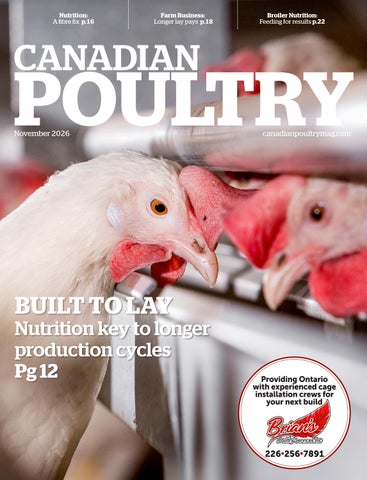
Nutrition: A fibre fix p.16
Farm Business: Longer lay pays p.18
November 2026
Broiler Nutrition: Feeding for results p.22
canadianpoultrymag.com
BUILT TO LAY
Nutrition key to longer production cycles Pg 12
Providing Ontario with experienced cage installation crews for your next build
Poultry Services Inc
226•256•7891
CONTENTS
November 2026 Vol. 113, No. 8 canadianpoultrymag.com
22
26 12 DEPARTMENTS
FEATURES
04 | Editorial Feeding the future 06 | What’s Hatching Quebec launches poultry startup program 29 | Classifieds 30 | Poultry Spaces Enriched housing meets efficient ventilation
12
ON THE COVER Precision feeding helps modern hens sustain egg production while protecting gut, liver and bone health. See story on page 12.
COVER STORY Built to lay Precision feeding supports production and hen health.
16
A fibre fix Nutrition key to longer production cycles and healthier hens.
18
Longer lay pays Longer laying cycles boost profits and reduce emissions.
22
Feeding for results Matching broiler feeding strategies to farm conditions.
26
Do broilers benefit from enrichment? How huts, ramps and lasers affect bird welfare.
ISSN 1703-2911. Canadian Poultry is published 10 times per year by Annex Business Media. Canada Post Publications Mail Agreement No. 40065710. Return undeliverable Canadian addresses to: Circulation Department, 111 Gordon Baker Rd., Suite 400, Toronto ON M2H 3R1. No part of the editorial content in this publication may be reprinted without the publisher’s written permission. © 2026 Annex Business Media. All rights reserved. Opinions expressed in this magazine are not necessarily those of the editor or publisher. No liability is assumed for errors or omissions. All advertising is subject to the publisher’s approval. Such approval does not imply any endorsement of the products or services advertised. Publisher reserves the right to refuse advertising that does not meet the standards of this publication. Printed in Canada.
From the Editor
canadianpoultrymag.com Reader Service Print and digital subscription inquiries or changes, please contact Angelita Potal, Customer Service Rep. Tel: (416) 510-5113 Email: apotal@annexbusinessmedia.com Mail: 111 Gordon Baker Rd., Suite 400, Toronto, ON M2H 3R1
by Brett Ruffell
Feeding the future
L
onger laying cycles are attracting plenty of attention, and understandably so. Keeping productive hens longer offers an opportunity to spread replacement costs over more eggs while reducing the environmental footprint of production. But realizing those benefits requires careful planning, with nutrition at the centre. That is a central theme of our November nutrition issue: getting more value from feed means understanding what birds need throughout their lives, and how those needs change under commercial conditions.
“Getting more value from feed means understanding what birds need throughout their lives, and how those needs change under commercial conditions.” In our cover story, “Built to lay,” Melanie Epp explores the feeding strategies that can help modern hens sustain production while protecting gut, liver and bone health. The genetic potential is impressive, but achieving it requires more than extending the calendar. Preparing pullets for longer lives, managing calcium availability and adjusting diets to actual production and feed intake all deserve attention. For me, an important takeaway is that the goal needs to be clear from the beginning. A feeding program designed for a longer, steadier production curve may look different
facebook.com/CanadianPoultry
from one focused on maximizing output over a shorter period. Treena Hein’s “Longer lay pays” adds Canadian economic evidence to that discussion. Researchers found that longer cycles improved profitability and reduced the carbon footprint of eggs in the flocks studied. However, results varied considerably among farms. The average economic optimum is useful context, but each producer’s records must guide decisions about when keeping a flock remains worthwhile. Jane Robinson’s “A fibre fix” also challenges familiar assumptions. Ingredients once limited by their fibre content could offer nutritional and environmental value. Understanding fibre’s properties, and how enzymes can improve its usefulness, may expand options for locally sourced feed while supporting gut health. The same emphasis on informed decisions carries into broiler production. In “Feeding for results,” Lauren Dawson and Nayara Tavares Ferreira explain how response modelling can help compare feeding strategies against farm conditions and business objectives. Maximum growth, feed efficiency and profitability do not always point to the same ration. Together, these stories make a practical case for closer collaboration among producers, nutritionists and researchers. Better feeding decisions begin with clear goals, reliable records and attention to bird health.
canadianpoultrymag
canadianpoultrymag.com
Editor Brett Ruffell bruffell@annexbusinessmedia.com 226-971-2133 Brand Sales Manager Ross Anderson randerson@annexbusinessmedia.com Cell: 289-925-7565 Account Coordinator Julie Montgomery jmontgomery@annexbusinessmedia.com 416-510-5163 Media Designer Emily Sun Group Publisher & VP, Content Strategy Michelle Bertholet mbertholet@annexbusinessmedia.com Audience Development Manager Anita Madden amadden@annexbusinessmedia.com 416-510-5183 CEO Scott Jamieson sjamieson@annexbusinessmedia.com PUBLICATION MAIL AGREEMENT #40065710 Printed in Canada ISSN 1703-2911 Subscription Rates Canada - Single-copy $10.00 Canada – 1 Year $34.48 Canada – 2 years $58.87 (plus applicable taxes) USA – 1 Year $97.06 CDN Foreign – 1 Year $109.79 CDN GST - #867172652RT0001 Occasionally, Canadian Poultry Magazine will mail information on behalf of industry-related groups whose products and services we believe may be of interest to you. If you prefer not to receive this information, please contact our circulation department in any of the four ways listed above. Annex Privacy Officer privacy@annexbusinessmedia.com Tel: 800-668-2374 No part of the editorial content of this publication may be reprinted without the publisher’s written permission. ©2026 Annex Business Media. All rights reserved. Opinions expressed in this magazine are not necessarily those of the editor or the publisher. No liability is assumed for errors or omissions. All advertising is subject to the publisher’s approval. Such approval does not imply any endorsement of the products or services advertised. Publisher reserves the right to refuse advertising that does not meet the standards of the publication.
We have had Lubing drinkers on this farm for over twenty years. When the time came for new lines, the decision was easy to use Lubing’s OptiGROW, because of the quality and longevity from Lubing. Eric Johnson - Triple J Farm
THE ORIGINAL CHICK MAGNET The OptiGROW nipple is specifically designed to present water to day-old broiler chicks for the best possible start, and will deliver fresh water throughout the grow-out for the largest possible broilers. Made with a stainless steel triggering pin and chemical resistant thermoplastic body so you can depend on a reliable drinker for many flocks.
Glass-Pac Canada St. Jacobs, Ontario Tel: (519) 664-3811 Fax: (519) 664-3003
Les Equipments Avipor Cowansville, Quebec Tel: (450) 263-6222 Fax: (450) 263-9021
Specht-Canada Inc. Stony Plain, Alberta Tel: (780) 963-4795 Fax: (780) 963-5034
Carstairs, Alberta Tel: (403) 337-3767 Fax: (403) 337-3590
WATCH THIS VIDEO TO LEARN MORE
WWW.LUBINGUSA.COM | INFO@LUBINGUSA.COM | 423-709-1000
What’s Hatching
EFC launches student challenge Benoît Fontaine, president of Éleveurs de volailles du Québec, says the startup program will help the next generation of chicken producers overcome financial barriers.
Quebec launches startup program for chicken production
Avian influenza spreads through Prairie poultry farms Highly pathogenic avian influenza has surged in Manitoba and Alberta during fall migration. Between September 21 and October 12, the Canadian Food Inspection Agency confirmed infections at seven commercial poultry premises in Manitoba and five in Alberta. The latest detection was in Alberta’s Sturgeon County on October 12. Quarantines and control zones impose movement restrictions on affected areas, reinforcing the need for strict barn biosecurity as producers face renewed risks of flock losses and production disruptions.
EFC partners with Matty Matheson Egg Farmers of Canada launched a Get Cracking partnership with chef Matty Matheson on October 5, encouraging consumers to use eggs beyond breakfast. Matheson made recipes – a weeknight egg bake and a chopped BLT egg salad sandwich – for his YouTube channel and social platforms. Part of EFC’s Eggs Anytime strategy, the campaign promotes eggs as versatile and affordable to boost demand. 6
CANADIAN POULTRY
2
is the number of aspiring chicken producers who will receive lifetime quota loans through Quebec’s 2026 startup program.
The Éleveurs de volailles du Québec (EVQ) has launched the second edition of its Programme d’aide au démarrage, offering two aspiring poultry producers lifetime loans of chicken quota to help them enter the industry. For the 2026 edition, EVQ will select two businesses to each receive a lifetime loan of 1,000 square metres of chicken quota, equivalent to approximately 235,000 kilograms of production annually. EVQ estimates that level of production represents about $500,000 in annual revenue. The quota loans allow recipients to establish poultry operations without purchasing the quota themselves, reducing one of the major financial barriers to entering chicken production. “The next generation is essential to the future of our sector,” says EVQ president Benoît Fontaine. “With the Programme d’aide au démarrage, we want to give new entrepreneurs the opportunity to make their chicken production projects a reality and contribute to the vitality of Quebec’s regions.” The program is open to applicants between the ages of 18 and 40 who want to establish a chicken
farming business and have never held production rights in a supply-managed agricultural sector. Eligible applicants can submit applications from Oct. 1 to Nov. 30, 2026. The five applications receiving the highest scores during the evaluation process will advance to a random draw, which will determine the two quota recipients. The winners are expected to be announced at an event in Quebec City in April 2027. The program follows an inaugural edition that resulted in a quota loan being awarded to Aude Boissonneault, a 27-year-old agricultural entrepreneur from Lyster, Que. Boissonneault, who has a degree in agri-environmental engineering and is involved in her family’s hog operations, received a lifetime loan of 1,000 square metres of quota. She is now working toward building her first chicken barn. According to EVQ, Boissonneault has said the program provided an opportunity to become a poultry producer and diversify her farm business, and that the project likely would not have been economically viable without the quota loan. November 2026
PHOTO: É L EV EU R S DE VOL A I L L E S DU Q U É B EC
Egg Farmers of Canada has launched its Student Innovation Challenge, offering $10,000 in prizes for research supporting Canada’s egg sector. Students enrolled in or recently graduated from Canadian post-secondary institutions can submit videos explaining projects related to sustainability, hen welfare, economics, human health or other industry priorities. Applications close Dec. 1, 2026. Three finalists will be notified in January. Prizes include $5,000 for the winner and $2,500 for each runner-up.
Apply for Chicken Farmers of Canada’s Young Farmers Program Today!
APPLICATION CLOSES NOVEMBER 6, 2026 www.chickenfarmers.ca/young-farmers-program
What’s Hatching
Coming Events NOVEMBER 2026 NOV. 10-13, 2026 EuroTier 2026 Hanover, Germany eurotier.com NOV. 18, 2026 PIC’S Producer Update – All Breed Virtual poultryindustrycouncil.ca DECEMBER 2026 DEC. 9, 2026 PIC’S Producer Update – Broilers Elora, Ont. poultryindustrycouncil.ca
Ontario poultry research centre breaks ground Construction is underway on a new poultry research centre in Elora, Ont., designed to help farmers improve flock health, animal welfare and productivity. Government, university and industry representatives marked the groundbreaking Oct. 7. Expected to be completed by summer 2028, the Ontario Poultry Research Centre will include dedicated areas for layers and pullets, broilers and hatcheries, alongside specialized and commercial research wings. The project brings together the provincial government through Agricultural Research and Innovation Ontario (ARIO), the University of Guelph and Ontario’s four poultry feather boards. Ontario has committed $24 million, including an additional $10.5 million announced in 2025. The feather boards are also contributing funding under a partnership agreement formalized in 2023. Research will cover nutrition, behaviour, genetics, biosecurity, 8
CANADIAN POULTRY
production costs, reproduction, meat quality and food safety. The facility is expected to serve more than 1,500 chicken and turkey producers and 500 egg and pullet farmers. Chicken Farmers of Ontario chair Murray Opsteen said the centre will help producers “manage risk, prevent disease, and improve on-farm efficiency.” The feather board partners also include Egg Farmers of Ontario, Turkey Farmers of Ontario and the Ontario Broiler Hatching Egg and Chick Commission. “For Ontario’s turkey farmers, this new facility represents an important investment into research that can be applied directly onto their farms,” said Turkey Farmers of Ontario chair James Schlegel. The project received another $250,000 through the Sustainable Canadian Agricultural Partnership for part of its design phase. Construction is expected to support more than 220 jobs while expanding Ontario’s poultry research capacity.
$24M is Ontario’s funding commitment to the new poultry research centre in Elora.
JANUARY 2027 JAN. 13, 2027 PIC’s Producer Update – Broiler Breeders Stratford, Ont. poultryindustrycouncil.ca JAN. 18, 2027 PIC’s Science in the Pub Guelph, Ont. poultryindustrycouncil.ca JAN. 25-26, 2027 International Poultry Scientific Forum Atlanta, Ga. ippexpo.org JAN. 26-28, 2027 IPPE Atlanta, Ga. ippexpo.org FEBRUARY 2027 FEB. 3-4, 2027 National Poultry Show London, Ont. nationalpoultryshow.com FEB. 9, 2027 Canada’s Agriculture Day Nationwide foodintegrity.ca
November 2026
PHOTO: M I N I ST RY OF AG R IC U LT U R E , FO OD A N D AG R I BUS I N E S S
Government, university and poultry industry representatives mark the groundbreaking for the new Ontario Poultry Research Centre in Elora, Ont., Oct. 7.
Introducing
Performance+ BROILER SERIES DIETS
Talk to a Broiler Specialist Today!
Clavet, SK | Denfield, ON | Inkerman, ON | Listowel, ON newlifemills.com
What’s Hatching
Canadian egg-sexing tech heads to IPPE Canadian Egg Technologies, MatrixSpec Solutions and SANOVO Technology Group announced that they plan to showcase their day-four in-ovo sexing system at IPPE in January 2027. The Canadian-developed technology uses hyperspectral imaging to identify embryo sex without damaging eggs. The partners say it integrates into existing hatchery operations and could eventually advance to sex identification before incubation through a platform upgrade. The system aims to improve hatchery efficiency and provide an alternative to male chick culling.
Roger Pelissero, right, takes over as WEO chair from outgoing chair Juan Felipe Montoya Muñoz.
Roger Pelissero named chair of World Egg Organisation
10
CANADIAN POULTRY
Pelissero and his family operate an egg farm in Ontario’s West Lincoln area, caring for approximately 24,000 laying hens that produce about 14,000 dozen eggs weekly. His grandfather began raising chickens after immigrating to Canada from Italy in 1923. His father built an egg business in the 1950s, and Pelissero has farmed with his family and wife, Lorrie, since 1984. Pelissero has also represented Canadian egg farmers before parliamentary agriculture committees and advocated for evidence-based research to support sector innovation. “Together, we have already accomplished a great deal – and I believe the opportunities ahead of us are even greater,” he said. “I’m confident that the future of the global egg sector is bright.” As he begins his term, Pelissero is emphasizing collaboration and inviting members to share ideas that will help shape WEO’s direction.
2 years
is the length of Roger Pelissero’s term as chair of the World Egg Organisation.
Canadian chicken meat production is forecast to increase two per cent in 2027 to 1.515 million tonnes, according to a USDA outlook reported September 21. Retail and foodservice demand are expected to support growth, with chicken remaining competitively priced against other proteins. The forecast follows production challenges in 2026, when shortages of day-old chicks, lower hatchability and higher chick mortality linked to avian influenza prevented the industry from meeting allocated production targets.
World Egg Day honours farmers Egg Farmers of Canada marked World Egg Day on October 9 by recognizing the country’s 1,290 regulated egg farmers and farm families. The organization released a video showcasing Canadian producers and encouraged consumers to share their appreciation using #CanadianEggs. The celebration highlighted farmers’ contributions to a dependable domestic food supply and their commitment to food safety and animal welfare. November 2026
PHOTO: WOR L D EG G ORGA N I SAT ION
Roger Pelissero, chair of Egg Farmers of Canada, has been named chair of the World Egg Organisation (WEO). Pelissero succeeded Juan Felipe Montoya Muñoz during the closing celebrations of the WEO Global Leadership Conference in Singapore. He will serve a two-year term leading the international organization, which brings together members of the global egg sector. A third-generation egg farmer from St. Ann’s, Ont., Pelissero joined the WEO Councillors Board in 2021 and became vice-chair in 2024. He has also chaired its Sustainable Egg Production Expert Group. “I want you to know that I’m listening, and I welcome your ideas to help shape the path ahead,” Pelissero told members. He has chaired Egg Farmers of Canada since 2017 and serves on the Egg Farmers of Ontario board, representing Zone 4, which encompasses Brant, Haldimand, Hamilton-Wentworth and Niagara.
Chicken production forecast to rise
FEB 3-4, 2027
WED 9AM–5PM | THUR 9AM–4PM
Tickets available soon! Scan the QR code or visit NationalPoultryShow.com
The Largest Poultry Show in Canada Brought to you by:
The J-AAR Expo Centre (Formerly - The Agriplex) at Western Fair District 845 Florence St, London, ON
Cover Story
Built to lay
M
odern layers have the genetic capacity to produce 500 eggs by 100 weeks of age. That is a dramatic increase from the early 1900s, when top-performing hens laid only 200 eggs in their lifetime. Researchers and field nutritionists are working to understand what hens need to sustain longer laying cycles, should Canada’s egg industry choose to make greater use of those genetics. Their work points to precision nutrition as a key part of keeping hens healthy, strong and productive through 100 weeks.
Feeding for output During a session on extended laying cycles at the World Egg Organisation (WEO) conference in Warsaw in April, Vitor Arantes, global technical and product manager at HyLine International, compared the modern laying hen to a Formula One race car. Three-time world champion Niki Lauda succeeded because he learned to manage speed while maintaining engine integrity, Arantes said. Modern hens require the same careful management. Yet most producers still fuel them like 1980s commuter cars. Age-based phase feeding does not account for one of the hen’s greatest strains as she ages: eggshell formation. A hen’s medullary bones hold a reserve of just 1,000 milligrams of calcium, but she requires 3,000 milligrams daily to build a shell. Over a 480-egg cycle, she must draw from and replenish this skeletal reserve 1,500 times, Arantes said. Traditional three-phase feeding
Precision nutrition helps hens stay healthy and productive through longer laying cycles while supporting gut, liver and bone health.
12
CANADIAN POULTRY
programs, which rely strictly on flock age, can underfeed high-performing birds and limit production, or overfeed birds producing fewer eggs. Overfeeding can lead to obesity later in the cycle, adding costs for producers. Just 150 grams of excess body weight increases a hen’s daily maintenance feed requirement by four grams, Arantes said. For a flock of one million birds, that extra weight could add $500,000 in annual feed costs without yielding another egg. To avoid this, some operators now feed according to current egg mass rather than flock age. Nutritionists calculate egg mass weekly by multiplying average egg weight by the flock’s production rate, expressed as a decimal. Feed mills store a matrix of formulas that cross-reference egg mass with feed intake. If environmental stress causes intake to drop, the mill can deploy a preprogrammed, concentrated diet. Adjusting for egg mass helps ensure the flock is neither underfed nor overfed, Arantes said. A more precise approach has also reduced dietary phosphorus requirements by 10 to 20 per cent compared with a decade ago, he said. As phosphorus is the thirdmost expensive nutrient in the ration, lowering its inclusion can cut feed costs while improving shell quality and reducing phosphorus excretion. “We can keep doing the things that we were doing in the 1980s,” Arantes said. “Probably it’s not gonna work. Or we can adapt and change a little bit the mindset and adapt to modern [genetics].”
500 eggs by 100 weeks of age is within the genetic potential of modern laying hens.
PHOTO: NA M E T K H E R IOUS
Precision feeding helps modern hens sustain production while protecting gut, liver and bone health. By Melanie Epp
November 2026
The long lay in numbers 500 eggs Modern layers have the genetic capacity to reach this output by 100 weeks of age.
200 eggs Lifetime production of top-performing hens in the early 1900s, showing advances in genetics.
60 to 70 per cent Feed’s share of egg production costs, according to Cargill researcher Lieske van Eck.
150 grams
Extended lay panellists at the World Egg Organisation conference in Warsaw in April 2026. From left: Ovsanna Mikhaylovskaya, Lieske van Eck, Vitor Arantes and Roger Pelissero.
Excess body weight that can increase a hen’s daily maintenance feed requirement by four grams, according to Hy-Line’s Vitor Arantes.
PHOTO: WOR L D EG G ORGA N I SAT ION
$500,000
Sustaining the curve At the same conference, Lieske van Eck, senior research scientist at Cargill Animal Nutrition, urged producers to rethink how they view feed. Typically, she said, it represents 60 to 70 per cent of egg production costs. She encouraged producers to see it as an investment that drives profitability, with feeding strategies matched to production targets. Rather than chasing a higher production peak, van Eck focused on slowing the decline in later lay. Diets designed to maximize peak performance can lead to a rapid decline afterward, she said. Her research shows that changing dietary energy over time can reshape the production curve. canadianpoultrymag.com
In a 2024 study, van Eck compared hens receiving a constant-energy diet with those receiving a diet whose energy content declined over time. Hens on the reduced-energy regimen responded by eating more feed. Although their peak production phase was slightly shorter, their subsequent decline was much slower. They also produced more eggs overall, she said. The strategy delivered economic benefits, too. While the hens ate more, the lower-energy feed cost less to manufacture. Financial modelling using Dutch market data showed that white hens on the reduced-energy diet yielded higher annual profits when kept to 100 weeks than those on standard diets. “The goal of egg production should be thought out at the start of
your laying cycles,” van Eck said. “If you want to go for more eggs and longer cycles, that is a different type of feeding management than if you want to have the highest egg mass production for a shorter period of time.” Protecting the gut While van Eck focused on dietary energy, Ovsanna Mikhaylovskaya, an independent poultry consultant from Latvia, argued that long-term feeding strategies must start with the digestive tract. Speaking at the same WEO session, Mikhaylovskaya said gut health plays a central role in immunity and nutrient absorption, with consequences for both environmental and economic sustainability. CANADIAN POULTRY
13
Potential additional annual feed cost for a million-bird flock carrying that excess weight, without producing extra eggs, Arantes said.
10 to 20 per cent Reduction in dietary phosphorus requirements compared with a decade ago, which Arantes attributed to more precise feeding.
2024 Year of van Eck’s study comparing constant and declining dietary energy. Hens receiving declining energy ate more feed but produced more eggs overall.
Cover Story
Liver and bones Although Canadian egg production is largely structured around a 72week cycle, knowledge of how to manage longer laying cycles is still needed. In Manitoba and Alberta, adjusted policies allow producers to keep hens for an additional 20 weeks. Elijah Kiarie, a professor in the University of Guelph’s Department of Animal Biosciences, said keeping hens longer creates distinct biological challenges. As hens age, their eggs grow larger, putting pressure on shell quality. Maintaining liver health is another concern. The liver processes nutrients absorbed from the gut and supplies important components of the yolk. “Most of the egg production is happening in the liver,” Kiarie said. To control egg size later in the cycle and protect shell quality, nutritionists typically reduce dietary protein. This often means replacing soybean meal with corn, increasing dietary starch. The liver converts excess energy to fat, which can contribute to fatty liver syndrome, Kiarie said.
University of Guelph professor Elijah Kiarie studies feeding strategies to support liver and bone health in longer laying cycles.
His team studied replacing corn with fibrous ingredients to change the source of dietary energy. Mature hens ferment fibre in the cecum, producing short-chain fatty acids. Kiarie said this approach could help limit fat accumulation in the liver. He also studied feed antioxidants, including fruit pomace from winemaking, to assess their potential to combat oxidative stress, and choline to help transport fat out of the liver. Bone integrity presents another major challenge. Tanka Khanal, a
“If you want to go for more eggs and longer cycles, that is a different type of feeding management than if you want to have the highest egg mass production for a shorter period of time.” 14
CANADIAN POULTRY
poultry nutritionist with Grand Valley Fortifiers in Cambridge, Ont., studied it during his doctoral research at the University of Guelph under Kiarie. As hens age, they absorb calcium less efficiently, Khanal said. The shell gland can also become less efficient at taking calcium from the blood. Hens build shells at night, when they are not feeding, and draw on calcium stored in their bones. Repeated depletion can lead to osteoporosis, he said. Producers planning longer laying cycles should therefore invest in the pullet phase. “You need to make sure that the bones are bigger, the frame size is bigger, so that there is a lot of calcium deposition into the bone, so the hens can utilize it in later life,” Khanal said. Nutritionists should adjust early rations to target a frame size slightly ahead of standard growth curves, he said. In addition, he emphasized zinc and copper supplementation to support the shell gland, alongside vitamin D to aid calcium absorption from the gut. Khanal believes the industry has the genetics, nutrition and management needed for longer laying cycles, with policy remaining the barrier to wider adoption. “Our hens, our nutrition, our housing and our farmers are all ready,” Khanal said. “Genetics and nutrition have proven it is feasible. Policy is the only thing restricting us from moving to extended lay cycles. Every front is ready – now we need to make our policy ready.” More resources For more on nutrition and egg production, visit
canadianpoultrymag.com
November 2026
PHOTO: E L I JA H K I A R I E
She also discussed phytogenics – plant extracts and essential oils – but cautioned that botanical substances cannot replace strong management practices.
Coccidiosis Control in a Gel Droplet
SAFETY • CONSISTENCY • OPTIMAL VACCINE UPTAKE A unique coccidiosis vaccine that balances the safety and efficacy needed for poultry that are raised without antibiotics, or in management programs to reduce resistance against anticoccidials.
Visit our new poultry website to find products and services available in Canada, disease information, corporate blog links, and other helpful resources: poultry.ceva-canada.ca
Immucox is a registered trademark of Ceva Animal Health Inc. ©2024 Ceva Animal Health, LLC
Feature
A fibre fix
D
ietary fibre has long been viewed as a limitation in poultry nutrition, but Dr. Anna Rogiewicz has a different take on what increasing daily intake could offer laying hens. An animal nutritionist and assistant professor at the University of Manitoba, Rogiewicz is taking a closer look at how homegrown feed ingredients, including soybeans, canola and peas, could benefit bird health and the sustainability of layer operations. She is starting with a feed component many overlook: dietary fibre. Rogiewicz sees the complexity of dietary fibre as a nutritional opportunity. “I look at fibre as a very critical, functional component of feed and if we can source it locally, that would help ease our reliance on other feed sources,” she says. Her research focuses on Manitoba-grown crops and locally produced feed ingredients that are not commonly used as primary ingredients in poultry diets. Often rich in nutrients, they can be overlooked because of their high fibre content.
16
CANADIAN POULTRY
Finding the function The challenge is ensuring fibre is in a form birds can use. This has traditionally limited its inclusion in poultry diets. “My goal is to identify the fibre properties in each of the ingredients because we need to understand these properties to be able to use new feed options effectively,” says Rogiewicz. Dietary fibre varies in solubility and fermentability. It typically contains substantial amounts of non-starch polysaccharides (NSP), which affect digestibility and the extent to which birds can access its nutritional benefits. Rogiewicz is using feed enzymes that target NSP to improve birds’ ability to digest nutrients in fibre-rich feed and enhance the functional properties of alternative ingredients. Modifying the fibre makes nutrients more available and produces compounds with prebiotic properties that contribute energy to the diet and promote beneficial gut bacteria. Rogiewicz and her team, including research associate Dr. Yanxing Niu and
Laying hens are a useful model for evaluating new feed options because mature birds are better able to handle ingredients with more fibre and less protein.
master’s student Poonam Neupane, have collected and analysed alternative feed ingredients grown or produced in Western Canada. Their nutrient analyses emphasize dietary fibre. Ingredients include full-fat soybeans, dry-extruded soybean meal, short-season corn, canola meal, flax, oat hulls and peas. “Many of the products we worked with could become viable feed ingredients, instead of waste, providing economic and environmental benefits to the industry,” says Rogiewicz. The team added enzymes called carbohydrases to the ingredients to evaluate how effectively they could break down NSP into smaller, more nutritionally valuable molecules. Ultimately, the researchers are looking for a process that improves digestibility and enhances the functional properties of alternative feed ingredients. This could release extra energy and provide food for beneficial gut bacteria, including Bifidobacterium and Lactobacillus. The goal is to diversify protein and November 2026
PHOTO: P O ONA M N EU PA N E
Breaking down new opportunities for layer diets. By Jane Robinson
content and composition of fibre and protein. Rogiewicz will examine the effects on gut microbiota and nutrient digestibility. “Nutrition research is taking a deeper look at the effect that nutritional strategies have on overall bird health, on the immune system and resilience to disease,” she says. The findings will help nutritionists incorporate these ingredients into diets, including those designed to support younger birds’ health and laying hens through extended production cycles. “If we can better understand the structure of fibre, we can manage it in the diet to optimize how hens can use it as an energy source that also supports gut health,” she says. “And if we can source alternative feed ingredients that are locally-produced – and would otherwise be considered a waste byproduct – we can also improve overall sustainability for layer operations.” While laying hens hold considerable promise for using fibrerich feed ingredients, Rogiewicz sees opportunities in other poultry sectors. Inclusion rates must reflect each ingredient’s nutritional value to ensure a balanced diet.
Researchers, from left, Yanxing Niu, Poonam Neupane and Anna Rogiewicz are studying the properties of dietary fibre in alternative feed ingredients, including its solubility, digestibility and fermentability in the bird’s gut.
This research is funded by the Canadian Poultry Research Council as part of the Poultry Science Cluster, which is supported by Agriculture and Agri-Food Canada through the Sustainable Canadian Agricultural Partnership, a federal-provincial-territorial initiative.
PHOTO: A N NA RO G I EW IC Z
energy sources and reduce reliance on traditional corn- and soybean-based diets. Promising early results In 2025, the team measured metabolizable energy in laying hens fed dry-extruded soybean meal, cold-pressed canola expeller and peas. Results to date indicate these less commonly used ingredients can be incorporated into layer diets as valuable sources of protein, energy and dietary fibre. Dry-extruded soybean meal contained more than 40 per cent protein and had a favourable amino acid profile. Cold-pressed canola expeller, the material remaining after oil is extracted by pressing, contained about 38 per cent protein as well as residual oil. Canola use in poultry diets has been limited by concerns about glucosinolates, naturally occurring compounds that contain sulphur and can affect bird health. Advances in canola breeding have substantially reduced glucosinolate concentrations, opening the way for inclusion rates above 10 per cent for canola meal or expeller in poultry diets. Peas are becoming increasingly available for animal nutrition, particularly as a food industry byproduct. They have a relatively high protein content, supply energy through their high starch concentration and can serve as an alternative to soybean meal. Health and sustainability The next step is a metabolic study with laying hens. Their diets will include canola meal modified with enzymes to alter the
NEW BARNS STORAGE FACILITIES WOOD & STEEL STRUCTURES BARN STRAIGHTENING Experience. . . That’s the Braemar Difference. For your FREE estimate please call
1- 800 - 215 - 1996 www.braemarbuildings.com CANADIAN POULTRY
canadianpoultrymag.com CP_BRAEMAR QP April23_MLD.indd 1
17
2023-03-07 3:44 PM
Farm Business Canadian research suggests extending laying cycles can increase profit per dozen eggs while reducing the carbon footprint per kilogram of eggs produced.
Longer lay pays Canadian research links longer laying cycles to higher profits and a smaller carbon footprint. By Treena Hein
S
ome Canadian egg farmers have already extended their laying cycles beyond the national norm of about 51 weeks. Now, researchers at Université Laval and the University of British Columbia have built on earlier work, finding that longer cycles can improve profitability across a range of hen strains and housing systems. The new study, funded by Egg Farmers of Canada (EFC), includes data collected in 2024 and 2025. It was led by Dr. Maurice Doyon, holder of the Egg Industry Economic Research Chair at Laval. Team members included Dr. Ousmane Traoré at Laval and Dr. Nathan Pelletier and Dr. Ian Turner at UBC, whose research focuses on sustainability. Two years ago, Doyon and Traoré conducted an initial study involving
18
CANADIAN POULTRY
a few flocks of white hens in aviary housing and found positive economic results. The study provided proof of concept that extending a flock’s laying cycle could make money, says Doyon. “The next step was to do a larger study, which we’re in the process of publishing now.” STUDY DETAILS The team collected data from 74 flocks in 2024 and 2025, although avian influenza outbreaks in B.C. prevented data collection from farms in that province. Records from some other farms were incomplete. Ultimately, researchers selected 20 flocks with the most complete and detailed records for in-depth analysis. Located in Quebec, Manitoba and Alberta, these flocks had
Maurice Doyon and members of his research team visit a large egg farm in Quebec. Doyon is in front, followed by master’s student Wisler Alvincy. At the back, from left, are Ousmane Traoré, postdoctoral researcher Steven Azima and PhD student Arnold Michel Koyou.
November 2026
CLEAN • CLEAN • CLEAN PulsFOG® disinfecting and pest control
laying cycles ranging from 50 to 67 weeks. The farms housed white or brown hens in aviaries, enriched colony cages or conventional cages. To assess the economics, researchers gathered data on egg production, feed consumption, mortality, egg grading, production costs and revenue from eggs and spent hens. They evaluated environmental impacts through a life-cycle assessment of water, energy and land use, along with emissions, for each flock cycle. HIGHER RETURNS The team found that each additional week beyond a 51-week laying cycle increased profit per dozen eggs by about 1.2 per cent. The main reason, says Doyon, is that flock replacement costs, including cleaning between flocks and buying pullets, are spread over more eggs. “However, there’s also an egg size increase with age and that plays a key role in maintaining overall egg output,” says Doyon. “Even though older hens lay fewer eggs, the larger size helps stabilize total production, which supports economic and environmental outcomes.” Pullets and young hens also need higher-protein feed than mature hens, he adds, creating opportunities to save money by feeding lower-protein rations for longer. Across the farms studied, longer cycles improved profitability regardless of hen strain or housing type. However, the limited number of flocks with detailed records prevented researchers from identifying the best cycle length for each combination. “We had six categories, white and brown hens in each of the three housing types, and there was a lot of variation in the economic results within each category,” says Doyon. More data would help determine whether meaningful differences exist among those categories and when the financial benefits of extending a cycle begin to disappear. canadianpoultrymag.com
FAST
effective
The fog generated by PulsFOG will cover all hard to reach areas. Assortment of PulsFOG models to choose from.
KILL
SURFACE & AIRBORNE
PATHOGENS
COVERAGE
®
information@dramm.com
dramm.com 920.684.0227
CP_Dramm_Nov23_CSA.indd 1
CP_JeniMobile_JulyAug23_MLD.indd 1
2023-09-25 3:11 PM
CANADIAN POULTRY
19
2023-06-28 7:49 AM
Farm Business
“There was one farm with white hens in aviary housing that was still making money at 65 weeks.” SMALLER FOOTPRINT Longer laying cycles also reduced the carbon footprint per kilogram of eggs compared with shorter cycles. “If you extend the lay cycle, the mature hens produce well on feed that’s lower in protein, which lowers the carbon footprint of feed to some extent, but their feed productivity stays stable – that’s how much feed is eaten per egg produced,” says Doyon. As feed efficiency deteriorates and mortality rises, however, the economic and
environmental advantages can diminish. Eventually, replacing the flock becomes the better option. Across the study, the average economic optimum was about 62 weeks. Results varied considerably among farms, with some systems showing optimal cycles as short as 54 weeks and others benefiting from much longer cycles. The environmental benefits appeared to continue beyond 62 weeks, but researchers could not identify the precise point at which those gains ended.
Asked which hen strains or housing systems supported the longest cycles, Doyon cautions against drawing broad conclusions from the available data. He does offer one example. “There was one farm with white hens in aviary housing that was still making money at 65 weeks,” he says. “There were more eggs being laid on the barn floor at that time, but the farmer was working on ways that might improve that.” GRADUAL DECLINE Although egg productivity began to decline after about 51 weeks, the drop was slower than researchers anticipated. “It was much more gradual than we had anticipated, but at the same time, it’s difficult to pin down what we had actually expected, as we don’t have data on that,” says Doyon. Interviews with farmers and graders before the study revealed differing expect-
Register now at ippexpo.org
20
CANADIAN POULTRY
CP_PoultryProteinAndFat Council_Nov26_CSA.indd 1
November 2026
2026-09-23 12:08 PM
ations. Some said productivity remained relatively steady, while others said production declined quickly. The team’s earlier study had also shown that productivity could remain high beyond 51 weeks. GLOBAL PERSPECTIVE Laying cycles beyond 51 weeks are common in other countries, says Doyon, including the U.K. and U.S., particularly on farms supplying processors, where shell cracks and egg size are less restrictive. Canadian adoption is harder to quantify. Doyon estimates that fewer than one in five eggs nationally come from flocks with cycles longer than 51 weeks. He has heard that many B.C. farmers extend cycles and estimates Quebec’s share may exceed 40 per cent. He also knows of extended cycles on Prairie farms, particularly in Manitoba, but lacks a clear picture elsewhere. Doyon hopes to identify optimal cycle lengths across hen strains and housing systems. “We may then be able to create a decision tree support tool for more precise decision-making on flock length,” he says, but each farm would have to look at its own data over time.
Longer lay – Eight takeaways Profit gains
Replacement savings
Added value
Smaller footprint
Longer cycles spread pullet purchases and between-flock cleaning costs over more eggs.
Larger eggs and the ability to feed lower-protein rations for longer also support returns.
Longer cycles reduced the carbon footprint per kilogram of eggs produced.
Timing matters
Global practice
Canadian uptake
Next steps
The average economic optimum was about 62 weeks, but results varied widely among farms.
Cycles beyond 51 weeks are already common in other countries, including the United States and United Kingdom.
Do yon roughly estimates that fewer than one in five Canadian eggs come from flocks with cycles longer than 51 weeks.
More data could help researchers develop a tool to guide decisions on flock replacement.
In the flocks studied, each additional week beyond a 51-week laying cycle increased profit per dozen eggs by about 1.2 per cent.
The air you don’t filter can cost you.
Trusted brands. Better results.
Don't leave your flock exposed. Air filtration systems by SKOV or Parker help reduce the risk of airborne diseases, such as HPAI while delivering the clean, consistent airflow modern poultry operations depend on.
STRONGER BIOSECURITY
HEALTHIER BIRDS
SMART INVESTMENT
604-746-5376 info@agprowest.ca
Your ventilation experts!
canadianpoultrymag.com
CP_Agpro West Supply_Sept26_CSA.indd 1
31290 Wheel Avenue, Abbotsford, BC Canada V2T 6H2
CLEAN AIR IN. FLOCK PROTECTED. CANADIAN POULTRY
21
2026-08-07 9:21 AM
Nutrition
Feeding Feeding for results Response modelling helps match broiler feeding strategies to farm conditions and production goals. By Lauren Dawson and Nayara Tavares Ferreira
B
roiler nutrition has traditionally focused on one fundamental question: What does the bird need to achieve its genetic potential? Nutrient recommendations remain the foundation of feed formulation. But Canadian producers are managing changing ingredient costs, variable barn conditions, processing targets and tighter margins. Feeding programs must support growth and feed efficiency while delivering profitability, resilience and responsible resource use. The question is no longer just what the bird requires. It is also how the flock will respond and which strategy offers the most value.
CHANGING NEEDS Nutrient requirement tables provide valuable guidance, 22
CANADIAN POULTRY
Barn conditions, flock health and production goals help determine which feeding strategy offers the most value.
but commercial flocks do not grow under standardized conditions. Genetics, environmental temperature, health status, ingredient digestibility and management practices influence a bird’s nutritional needs. These factors also change over time. Feed intake is particularly important. Birds respond to the nutrients they consume, not simply to the nutrient concentrations listed in a feed formulation. If feed intake falls during heat stress or a health challenge, intake of energy, amino acids, minerals and vitamins also changes. A diet that appears adequate on paper may not deliver the expected nutrient intake under those conditions. Birds must also allocate nutrients according to biological priorities. Maintenance comes first. Nutrients November 2026
PHOTO: B IG DU TC H M A N
DEFINING PERFORMANCE Body weight and feed conversion ratio remain essential measures, but neither tells the full story. A producer may prioritize profitability. An integrator may focus on kilograms of meat produced. A feed manufacturer may emphasize ingredient flexibility and manufacturing efficiency. Retailers and consumers also increasingly value sustainability and responsible resource use. A nutritional strategy that improves one outcome may not optimize another. This creates a challenge for nutritionists. The best diet is not always the one with the highest nutrient specifications or the lowest cost. The best diet is the one that matches the bird’s needs, the farm’s conditions and the producer’s objectives.
PREDICTING RESPONSES Modern broiler nutrition is increasingly shifting from asking, “What does the bird require?” to “How will the bird respond?” Biological responses occur along a curve rather than at a single fixed point. Increasing dietary energy or amino acid levels may improve growth or feed efficiency, but the response is rarely proportional to the added cost. Eventually, each additional unit of a nutrient delivers less biological or financial value. Understanding these relationships allows nutritionists to balance performance and profitability. It also creates opportunities to compare feeding strategies before introducing them in commercial production. MODELLING OPTIONS Modern models combine information about genetics, diets, feed form, environment, management and economics to project how birds may respond under different conditions. Built around biological principles such as feed intake, nutrient use and nutrient allocation, these models can help explain what may happen and why. Modelling tools such as NutriOpt BroilerSim allow nutritionists to evaluate feeding strategies before making changes on the farm. Scenarios can include changes in ingredient prices, energy levels, amino acid specifications, the duration of feeding phases or environmental conditions. Nutritionists can assess likely outcomes in advance and compare approaches. The goal is to support nutritional expertise. Models provide another source of information that can improve confidence in decisions and help quantify potential trade-offs among objectives.
The best diet is the one that matches the bird’s needs, the farm’s conditions and the producer’s objectives. are then directed towards growth, immune activity, temperature regulation and other physiological processes. During heat stress or a disease challenge, more nutrients may be needed to maintain normal function, leaving less available for growth. This helps explain why the same diet can produce different results across barns, seasons and regions. canadianpoultrymag.com
TESTING PRIORITIES Research illustrates the value of modelling. In a study using Ross 308 male broilers, researchers compared standard breed recommendations with feeding programs optimized through modelling. One program targeted body weight, while another targeted feed conversion ratio. Birds were evaluated under both thermoneutral and heat stress conditions. Different targets produced different outcomes. Under thermoneutral conditions, the program optimized for body weight increased final body weight by about 44 grams compared with the control. However, this improvement came with a slight increase in feed conversion ratio. The program optimized for feed conversion significantly improved feed efficiency while keeping body weight close to that of the control group. Under heat stress conditions, birds on the program optimized for body weight were 147 grams heavier than CANADIAN POULTRY
23
Nutrition
the control birds. The program optimized for feed conversion improved the ratio by more than five points. The study highlights a key principle: There is rarely one best feeding strategy. The optimal decision depends on the objective. If a producer values maximum growth, one nutritional approach may be preferred. If feed efficiency and margin are the primary goals, another may provide greater value. Modelling lets producers explore these possibilities before making changes commercially.
Broiler performance depends on the nutrients birds consume, making feed intake an important consideration in diets.
and economic objectives to better predict how birds will perform under commercial conditions. For Canadian broiler producers, the value is practical. Modelling tools help them compare alternatives before committing a flock to a feeding program, understand why performance may change and select
a strategy that supports their production goals. This can reduce uncertainty, build confidence in decisions and deliver more value from each production cycle. Lauren Dawson, PhD, is monogastric brand manager, and Nayara Tavares Ferreira, PhD, is director of strategic marketing and technology for poultry at Trouw Nutrition North America.
Intelligent insights for smarter egg production See the full picture – Track and benchmark flock performance. Turn data into action – Make informed decisions with real-time insights.
Scan to learn more!
Stay proactive – Catch issues early and optimize egg production.
trouwnutrition.ca
24
CANADIAN POULTRY
CP_TrouwNutrition_MayJune26_CSA.indd 1
November 2026
2026-05-06 9:32 AM
PHOTO: B IG DU TC H M A N
EARLIER DECISIONS A useful model should lead to a clear, workable decision. The process begins by defining the objective, establishing a realistic baseline and comparing alternatives. Recommendations must also fit feed mill and farm realities, including ingredient availability, manufacturing capacity, delivery schedules and diet transitions. Nutrient requirements will remain central to poultry nutrition. The next step is to combine them with response modelling, farm data
Sat Feb 6, 2027 | 9am-3pm | Bingemans Conference Centre | Kitchener, Ontario
Learn more & register
Book your booth or sponsorship
The one-stop ag career fair. Explore career opportunities, ear from experts and connect with new hires.
ASCENTCAREEREXPO.CA Presented by Annex Business Media’s Agriculture Media Network
Connecting students, skilled tradespeople, emerging professionals and those seeking a career change with agriculture employers.
Welfare
Do broilers benefit from enrichment? How huts, ramps and lasers affect bird welfare. By Jane Robinson
O
Room to explore Schwean-Lardner and her postdoctoral fellow, Dr. Carolin Adler, recently completed a trial evaluating plastic huts and 26
CANADIAN POULTRY
Broiler chicks rested beneath the plastic huts, which provided a sheltered space.
metal ramps. “Our goal was to see how these objects impacted broiler health, performance and welfare,” says Schwean-Lardner. They also observed how birds used the structures and whether their use changed with age. The trial involved about 7,200 broilers raised for 32 days in eight rooms. Four
rooms contained plastic huts and metal ramps, while the other four served as a control group without enrichment. As expected, researchers found no differences in production or bird health measures between broilers raised with and without enrichment. What surprised them was how much the birds interacted with the structures. November 2026
PHOTO: CA ROL I N A DL E R
ne of the main reasons laying hens are moving into enriched colony and non-cage housing is to provide environments where they can express their natural behaviours. Much of the research has focused on structures that allow layers to perch, forage and nest. Less is known about the value of adding enrichments to broiler housing. Since 2021, Maple Leaf Foods has offered custom-designed enrichments on a voluntary basis to Canadian broiler producers who contract with the company. Producers are generally pleased with how birds use the structures to perch, climb and rest. But the company wanted to learn more, so it partnered with Dr. Karen Schwean-Lardner, a poultry researcher who leads the Poultry Management and Welfare Lab at the University of Saskatchewan. How do researchers know whether enrichments make a difference to bird welfare and well-being? One indication is whether birds choose to use them. “If the bird interacts with objects, they are making a choice to interact,” says Schwean-Lardner. “If they didn’t enjoy it or had no interest, they wouldn’t interact with them.”
KICK-OFF 330° PAN FEEDING SYSTEM Stimulates the chicks’ curiosity and collectively activates them to seek fresh feed. Chick bodyweight is up to 30 g higher than normal after the first week. • Hit target weight in less time & increase profit • Simple reliable robust design • Makes your daily operation much easier
Listowel (800) 463-7622 8582 Hwy 23 N Listowel ON, N4W 3G6
Hickson (800) 463-7622 x 4 596202 Hwy 59 Woodstock ON, N4S 7W1
sales@county-line.ca www.county-line.ca
CP_CountyLine_Nov26_CSA.indd 1
2026-09-30 1:47 PM
POULTRY SIGNALS: A PRACTICAL GUIDE FOR POULTRY-ORIENTED MANAGEMENT Scan code to buy this book
Proper management starts with recognising signals in practice. For poultry-keepers, this means being alert when in the hen house, watching and listening to the animals, and paying attention to their behaviour as a group as well as their individual behaviour. This usually provides much information about animals’ health, well-being and production for poultry-keepers to use for improving economic results and the well-being of the animals, as well as their own. This book is a successful total concept for you to use in associate management. $73.95 | Item #9087490798
Educational Resources for Industry Professionals | 877-267-3473 | annexbookstore.com
canadianpoultrymag.com
CP_BOOKAD_OCT26_BAS.indd 1
CANADIAN POULTRY
27
2026-09-30 12:49 PM
Welfare
Play with benefits
Follow the light “We’ve consistently shown in our research setting and in commercial broiler buildings that birds that want to interact with the lasers do, and the ones that don’t have a place to rest and they aren’t bothered by the light,” says Bobeck. The lasers have no negative impact on bird performance. Some birds that follow the dots encourage others to join in. Birds that are not interested show no evidence of a fear response; they simply get up and move away. “Our goal is not to create any additional stress of the birds but just offer an opportunity for them to express natural pecking behaviour, if they choose,” says Bobeck.
Healthier birds Laser enrichment has shown benefits for bird health. By measuring corticosteroids, which are stress hormones, and T-cell populations, which indicate the ability to fight pathogens, Bobeck and her team found that exercise associated with laser enrichment reduced stress levels and improved immune health. “The immunity results were most encouraging, and the differences between birds with laser enrichment and those without was some of the clearest indication that play definitely improves immune outcomes for broilers,” says Bobeck. Laser enrichment also improved meat quality, reducing woody breast and white striping.
Ramps gave broilers opportunities to climb and perch above the litter.
“At the start of this study, I wasn’t convinced that enrichments were amazing,” says Schwean-Lardner. “But watching how much the birds loved interacting with the objects, I now see the value of providing broilers with ways to enrich their environment.” Broilers used the two structures differently. The square plastic huts had flat tops, and birds rested beneath them for shelter. The perforated metal ramps gave birds opportunities to climb, get off the litter and hide underneath. “It was important to confirm that enrichments don’t have any negative impact on broiler performance,” says Dr. Kathleen Long, vice-president of animal care at Maple Leaf Foods. “It was very encouraging to see broilers exhibit more comfort behaviours – wing and leg stretching – when they are raised with enrichment objects.” The project gave Maple Leaf Foods valuable feedback on ways to improve its enrichment designs. For example, birds preferred sitting on flat surfaces rather than an incline, suggesting the ramps could benefit from more flat perching space. “Broilers are highly motivated to perch 28
CANADIAN POULTRY
and peck, and providing enrichments gives birds the opportunity to express their behaviours, improving their welfare and quality of life,” says Long. Next steps Schwean-Lardner says there is still much to learn about broiler enrichment, including how many structures to provide and how to clean them between flocks. She is already addressing the cleaning challenge by developing biodegradable ramps. “We have designed cardboard ramps that provide the welfare benefits to broilers and biodegrade with the litter at the end of the flock,” says Schwean-Lardner. The ramps are already being used by Lincoln Premium Poultry, a large U.S. broiler integrator owned by Costco. Although the 2016 Code of Practice does not require enrichment in broiler housing, Schwean-Lardner expects interest to grow as consumers seek more information about how animals raised for food are cared for. More resources For more on poultry welfare, visit
canadianpoultrymag.com
November 2026
PHOTO: CA ROL I N A DL E R
Dr. Elizabeth Bobeck remembers noticing broiler chicks following and pecking at the small red dot projected by an infrared thermometer. It gave her an idea. A poultry scientist at Iowa State University, Bobeck has been studying lasers as a way to enrich broiler environments and improve bird welfare and well-being. Her team has evaluated how birds interact with the lasers and measured growth performance, stress levels and immune responses. The lasers, patented by Iowa State University, are mounted on broiler barn ceilings. They project small red dots that move slowly and randomly across parts of the pen floor, resembling bugs. Researchers have found that running the lasers for about six minutes several times a day provides an appropriate level of engagement.
CLASSIFIEDS
Contact Ross to place an ad – 289-925-7565 or randerson@annexbusinessmedia.com
EQUIPMENT FOR SALE
PEST CONTROL
CompostDrum.com
Fly Problem?
BARN DISINFECTING
Easy, Effective, Economical
Fly parasites are safe and effective but require starting early in the fly population.
Call now toll-free for a free consultation.
1-866-577-1117 Proudly Canadian! 519-527-2525
John@ActiumComposting.com
bugsforbugs.ca
info@bugsforbugs.ca Our 25th year! 778-548-7968 SamGabara@NewLeafequipment.ca
201-86 Yarmouth St., Guelph, ON N1H 4G3
CP_BugsForBugs_May23_CSA.indd 1
CP_Actium_Class_June23_CSA.indd 3
2023-04-12 8:16 AM
2023-05-11 2:32 PM CP_BugsforBugsclass_FEBMARCH26_BAS.indd 1
2026-02-02 10:10 AM
BARN WASHING 2022-08-03 11:11 AM
CP_newtechfog class_Sept22_MLD.indd 1
BARN WASHING AND DISINFECTING
G, COMPOSTIN IRL! H GIVE IT A W
Western Canada info@agprowest.ca 604-746-5376 www.agprowest.ca
Eastern Canada sales@county-line.ca 800-463-7622 www.county-line.ca canadianpoultrymag.com CP_County Line-Class_September26_CSA.indd 1
CANADIAN POULTRY
29
2026-07-16 3:17 PM
Poultry Spaces
Poultry Spaces highlights new and renovated poultry facilities. Do you know of a good candidate to be featured? Let us know at poultry@annexweb.com.
Wild Rose Colony Farming Location Vulcan County, Alta. Sector Layers The farm Established in 1990 with 3,500 laying hens, Wild Rose Colony Farming has grown to hold quota for approximately 28,000 birds. The farm raises its own pullets and supplies eggs to Sparks Eggs. Daniel Kleinsasser manages the poultry operation, with colony members helping place and move birds. The need With its existing barn full, the colony built another facility to accommodate quota previously leased out. “We’ve been leasing all that quota out till now, and now we’re bringing it home,” Kleinsasser says. The barn Working with Penner Farm Services, the colony chose a Valli enriched housing system from the supplier used in its existing barn. “It’s a strong cage,” Kleinsasser says. “The birds do well in it.” Split cages house 34 birds, compared with 60-bird groups in the existing barn. Features include PVC perches, nesting and scratch areas, and supplemental spiral feeding. Kleinsasser chose feed carts over chains for more even distribution. ECO Zero ventilation units are another major investment, chosen for energy efficiency and lower utility costs. The system provides heat recovery in winter and cooling in summer. CBM Lighting inside the cages blends red and white light, a choice shaped by his experience with brown hens. “They were much calmer when I put in a red light,” he says. A refurbished egg packer from the existing barn will pack and stack eggs, with pallets loaded manually. 30
CANADIAN POULTRY
Daniel Kleinsasser manages Wild Rose Colony Farming’s poultry operation. The new barn will accommodate egg production quota previously leased out.
Exterior feed bins supply the new barn’s feeding system. Inside, Kleinsasser chose feed carts over chains because he finds they distribute feed more evenly.
ECO Zero units provide heat recovery for winter ventilation and cooling in summer. Kleinsasser selected the system to improve energy efficiency and lower utility costs.
CBM Lighting inside the cages allows red and white light to be blended. Kleinsasser chose the system after finding his brown hens were calmer under red light.
November 2026
IT TAKES A
FARMER. IT TAKES A SYSTEM. Canadians can count on fresh, high-quality eggs. Farmers deliver them through a made-in-Canada system: supply management.
Learn more at eggfarmers.ca/supplymanagement
Shorter Withdrawal Time for Your Flock With NEW withdrawal period reduced from 21 to 7 days for
Zoetis’ Bron Mass, Bron Mass Conn & Bursine©-2 vaccines.
For more information, talk to your veterinarian or Zoetis territory manager. Reference: Canadian Food Inspection Agency, “Memorandum 2026-01: Reduction of the withdrawal period for certain chicken vaccines,” January 12, 2026, Canadian Centre for Veterinary Biologics