
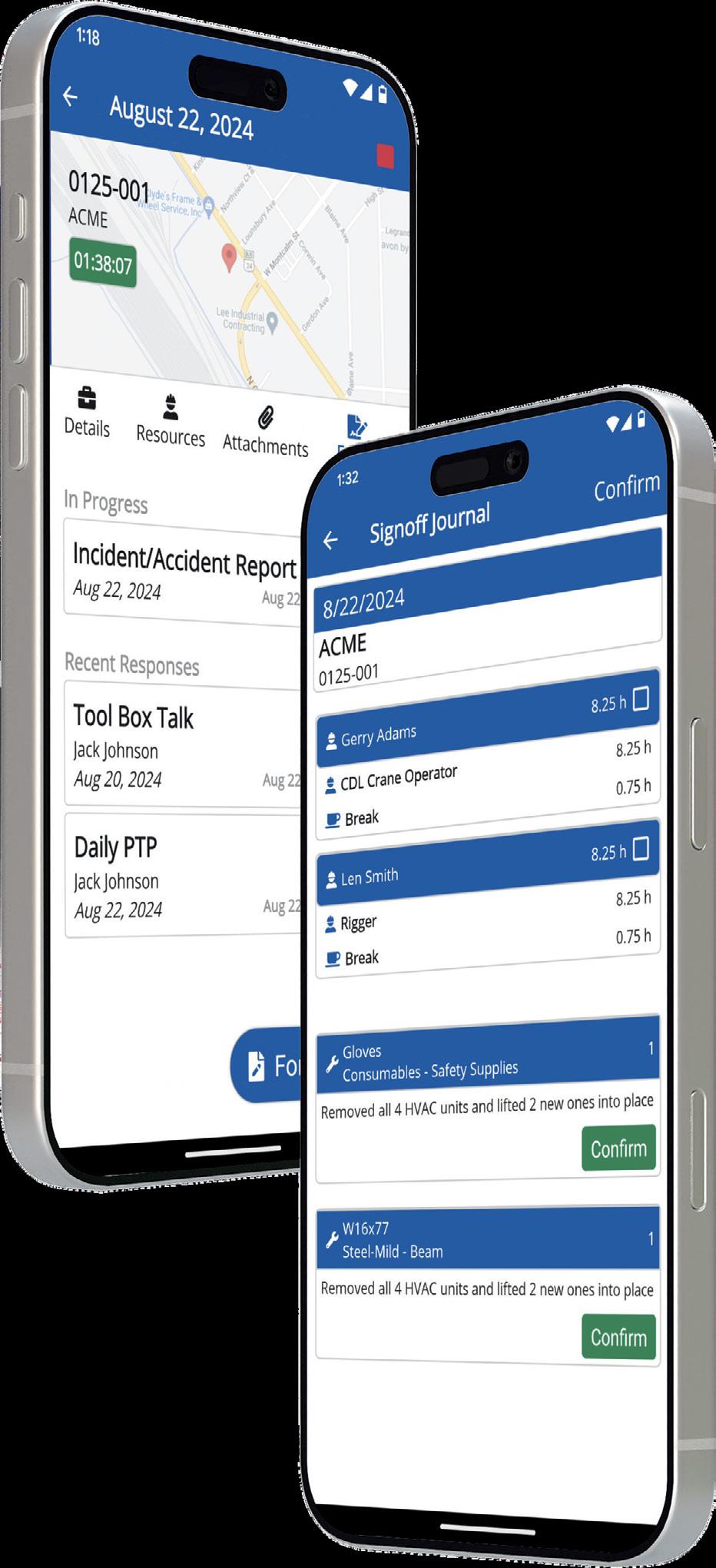
Learn more Track time, approve work and keep payroll moving on the job not after
Synthetic shift
Modern composites replacing heavy metal components? p.10
INSIDE
Slings, shackles and lubricants p. 14
Lift of the year p. 16


Learn more Track time, approve work and keep payroll moving on the job not after
Modern composites replacing heavy metal components? p.10
Slings, shackles and lubricants p. 14
Lift of the year p. 16
Why Nors Crane?

BY MIKE LACEY
More than 250 people gathered in Halifax, Nova Scotia, for the Canadian Crane Rental Association’s annual conference.
It was the conference’s largest gathering to date and the three-day event was a blast. It featured education sessions, networking events and the always popular Lift of the Year awards (which you can read more about on page 16).
Halifax was a great host and, if you have never visited, you need to make the trip. I will definitely be going back again.
A real treat at this year’s conference was the keynote speaker, Peace by Chocolate founder Tareq Hadhad. He shared the inspirational story of how he and his family fled war-torn Syria to make a new home in Canada. His passion for his family, his chocolate and the country he now calls home was truly inspirational. In a world and a time when everything seems uncertain, his story reaffirmed the certainty I have about what makes this country the best in the world.
The conference also did some heavy lifting.
A presentation from Jalaja Shanmugalingam, PEng, followed by Rick Sikora with Cranemasters, discussed the lack of national standards around rigging and the importance of developing both national standards and a comprehensive training program for riggers.
Shanmugalingam is a doctoral researcher at the University of Waterloo who is studying how rigging knowledge is taught, transferred and applied in practice as well as why serious incidents continue to occur despite the existing training. She shared her findings at the conference, specifically what she learned from interviewing people in the industry.
“Practitioners said that the training that we have is inconsistent and also riggers don’t get enough practical experience that they need in order to be competent to be
able to do the job that they are expected to do,” she said. “The second [area of concern] is no unified standard. And I want to put a big emphasis on that one because we don’t have a unified standard across the country to tell trainers and instructors what should be taught.”
She noted that certification levels change from province to province.
“Level one in one province doesn’t equate [to] the same in another province, but this is not just across provinces but also across training institutions. What you get as level one certification might not be the same for another level one certification from a different institution. That’s where we’re at now: we don’t have a national standard for rigging training.”
Shanmugalingam and Sikora also sat on a panel discussing lifting leadership. The panel was moderated by Jen Mutas of BC Crane Safety, and also featured BC Crane Safety’s Trenton Grower and Justin Brown of Unirope.
The topic is so important and so comprehensive that we will be writing more about this in upcoming editions. Lives will be saved by improving rigging standards and training.
Another interesting panel session explored the current and future emissions controls for the crane and trucking industry.
A big issue with emissions standards? It’s still unclear if the United States is making changes (which the current administration has said it would but has not formally acted upon). That seems to be a theme in the world. The only thing certain about the United States is uncertainty.
Keep an eye out in upcoming editions as we plan to explore that topic as well.
Final thought
Crane & Hoist Canada’s Photo of the Year contest is back. We’re still accepting nominations. Please email your photos directly to me. Time is running out, so don’t wait.
Mike Lacey mlacey@annexbusinessmedia.com
Reader Service
Print and digital subscription inquiries or changes, please contact customer service
Angelita Potal
Tel: (416) 510-5113
Fax: (416) 510-6875
Email: apotal@annexbusinessmedia.com
Mail: 111 Gordon Baker Rd., Suite 400, Toronto, ON M2H 3R1
EDITOR | MIKE LACEY mlacey@annexbusinessmedia.com
ASSOCIATE EDITOR | COLIN LEGGETT cleggett@annexbusinessmedia.com
NATIONAL ACCOUNT MANAGER | LAURA GOODWIN lgoodwin@annexbusinessmedia.com • 289-928-8543
MEDIA DESIGNER | ALISON KEBA akeba@annexbusinessmedia.com
ACCOUNT COORDINATOR | BARB COMER bcomer@annexbusinessmedia.com
AUDIENCE DEVELOPMENT MANAGER | URSZULA GRZYB ugrzyb@annexbusinessmedia.com • 416-510-5180
CONTRIBUTORS | Saul Chernos
GROUP PUBLISHER | DANIELLE BEAVAN dbeavan@annexbusinessmedia.com
CEO | SCOTT JAMIESON sjamieson@annexbusinessmedia.com
PUBLISHED BY ANNEX BUSINESS MEDIA 105 Donly Drive South, Simcoe, ON N3Y 4N5
Crane & Hoist Canada is published six times a year by Annex Business Media. Reference to named products or technologies does not imply endorsement by the publisher.
Subscription rates (six issues)
Canada: $39.25 (per year + tax)
Canada: $67.36 (2 years + tax)
USA: $50.92 (CAD per year)
Send cheque or VISA/Mastercard number to Subscription Department, Crane & Hoist Canada, 111 Gordon Baker Rd., Suite 400, Toronto ON M2H 3R1. Fax orders to 416-510-6875. Or subscribe online at www.craneandhoistcanada.com
RETURN UNDELIVERABLE CANADIAN ADDRESSES TO: Crane & Hoist Canada. CIRCULATION DEPT. 111 Gordon Baker Rd., Suite 400, Toronto ON M2H 3R1
PRINTED IN CANADA ISSN 1923-788X
Publications Mail Agreement #PM40065710
Annex Privacy Officer Privacy@annexbusinessmedia.com Tel: 800-668-2374
The contents of Crane & Hoist Canada are copyright ©2026 by Annex Business Media and may not be reproduced in whole or part without written consent. Annex Business Media disclaims any warranty as to the accuracy, completeness or currency of the contents of this publication and disclaims all liability in respect of the results of any action taken or
Next Advertising Deadline: August 28, 2026 Don’t miss the opportunity to be part of this exciting industry publication. For more information, or to reserve space in the next issue, call Laura Goodwin at our Advertising Department Tel: +1-289-928-8543 lgoodwin@annexbusinessmedia.com
Next Editorial Deadline: August 21, 2026. For writers’ guidelines and submission requirements get in touch with the editor, Mike Lacey, at mlacey@annexbusinessmedia.com


MEMBER OF: MEDIA PARTNER:





Long and Strong

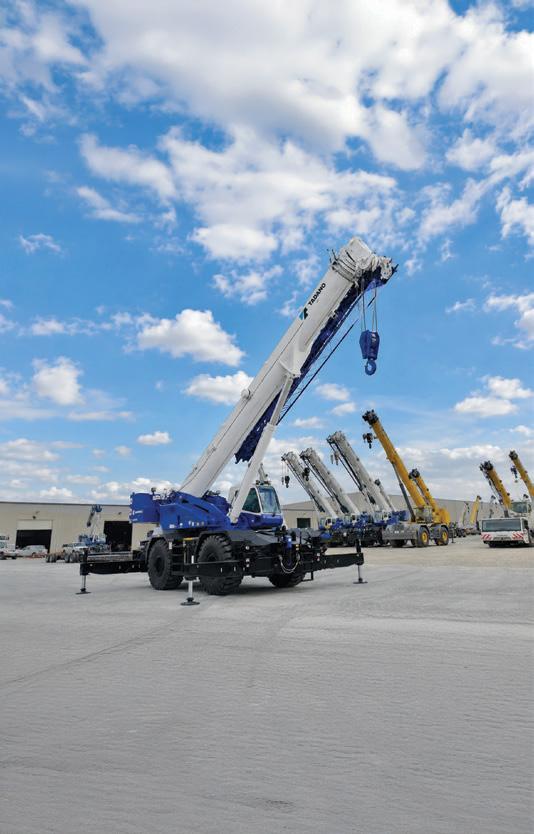
Smart Chart


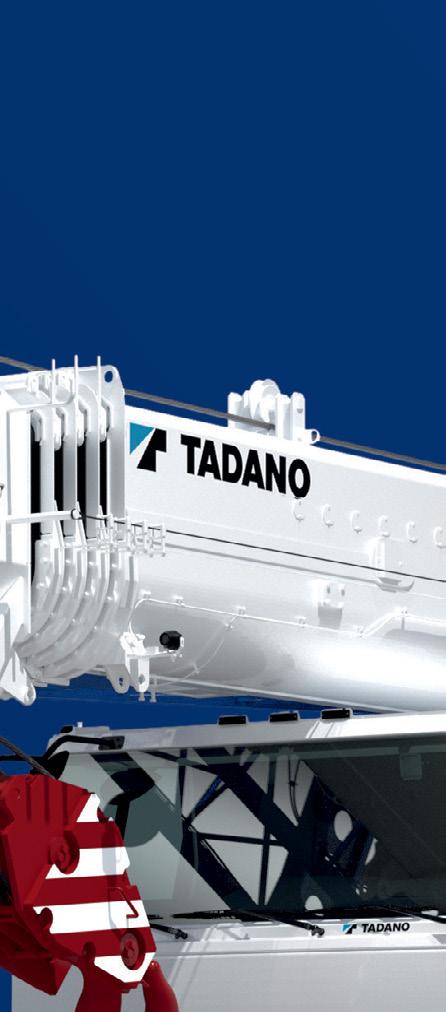
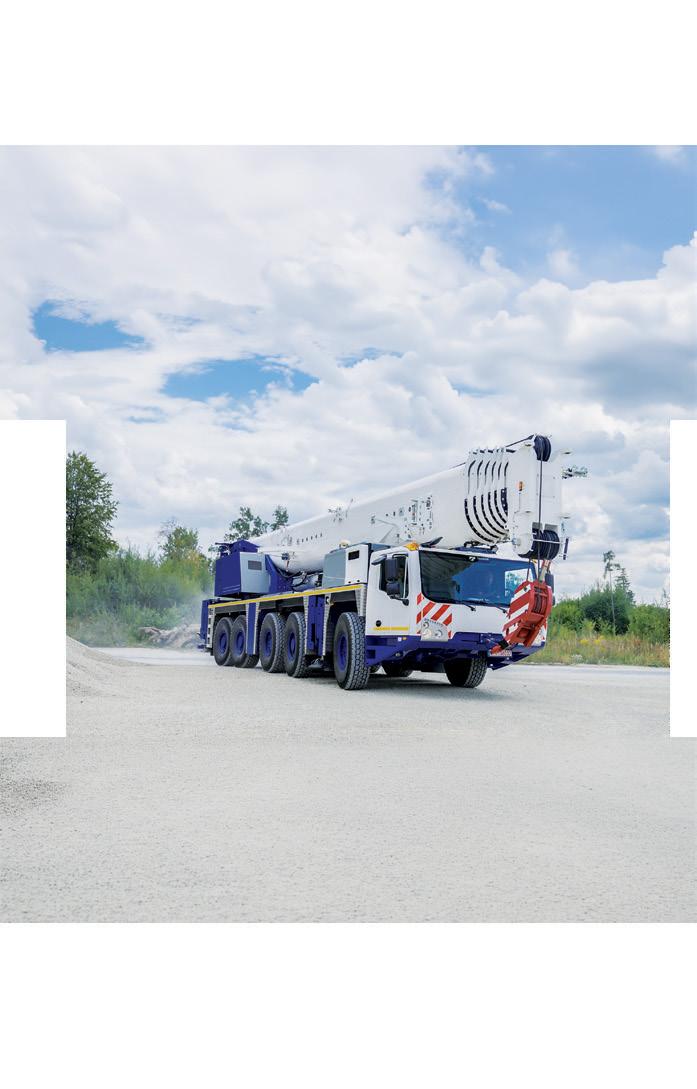
Maximize your crane’s capabilities with higher capacities and longer radii.

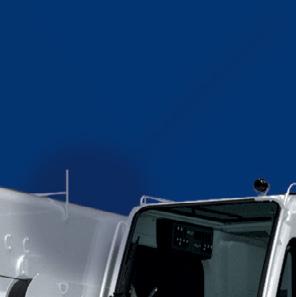


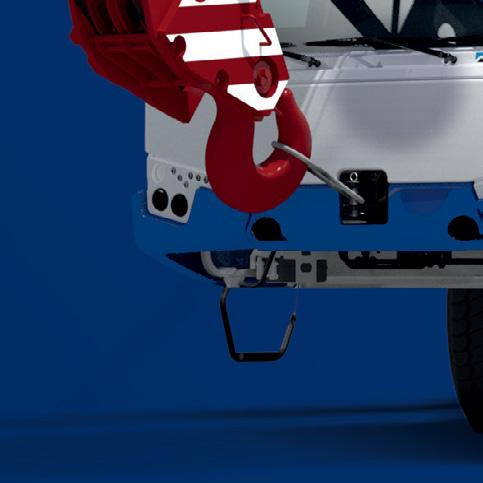

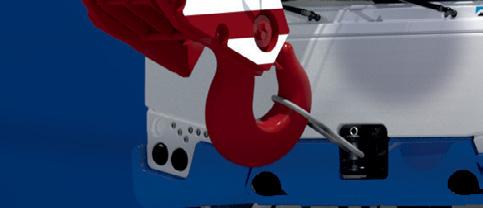
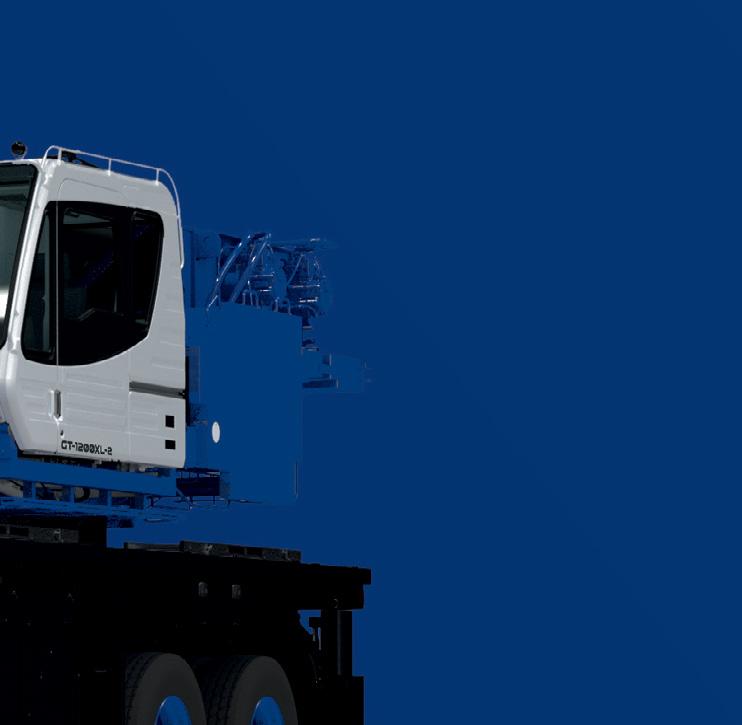
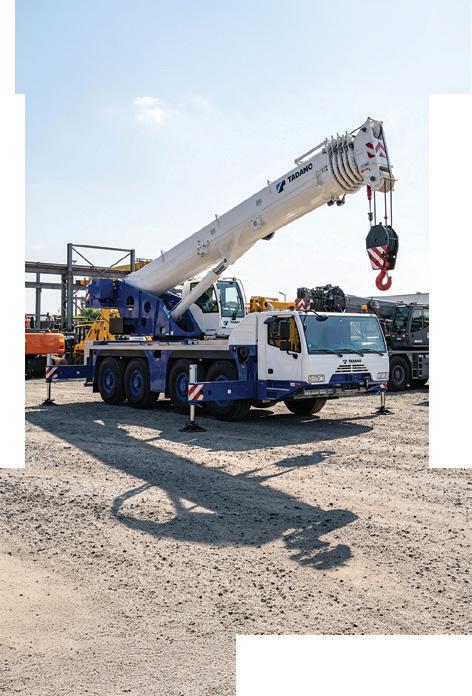
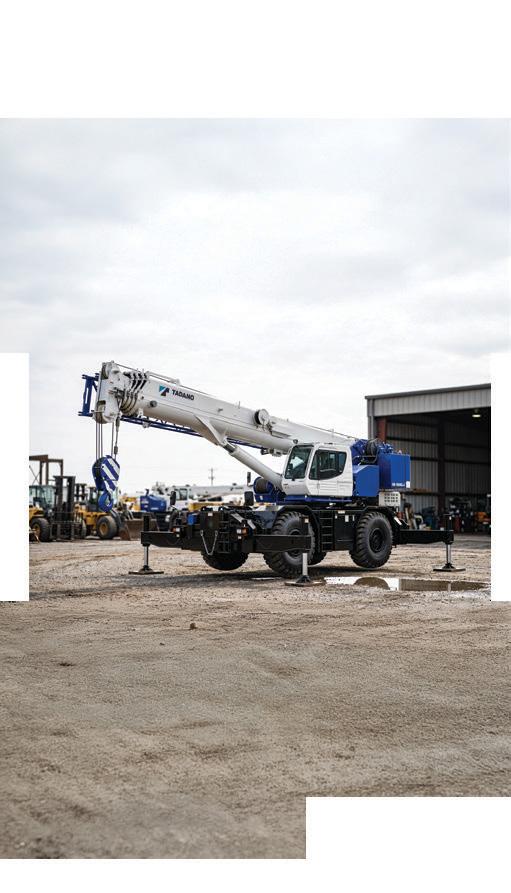
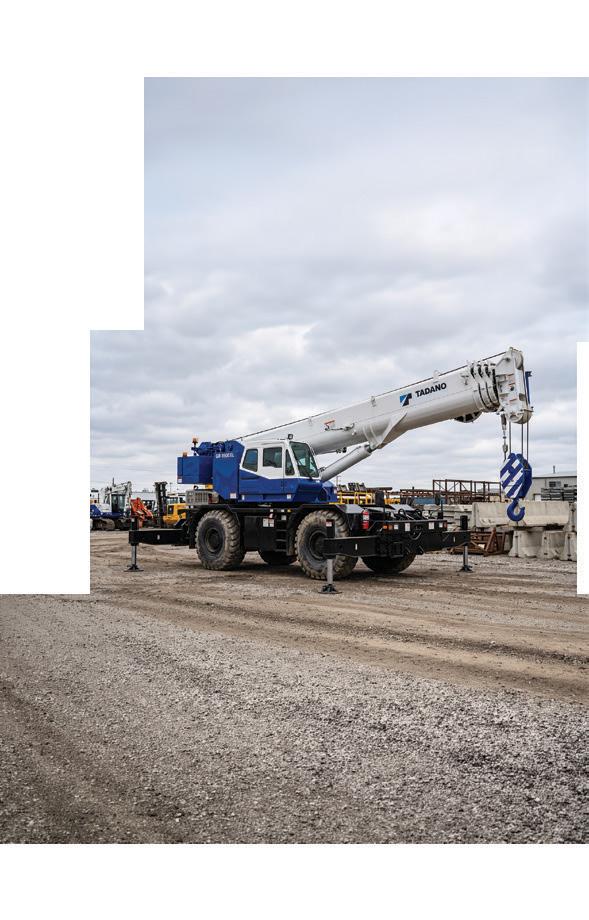
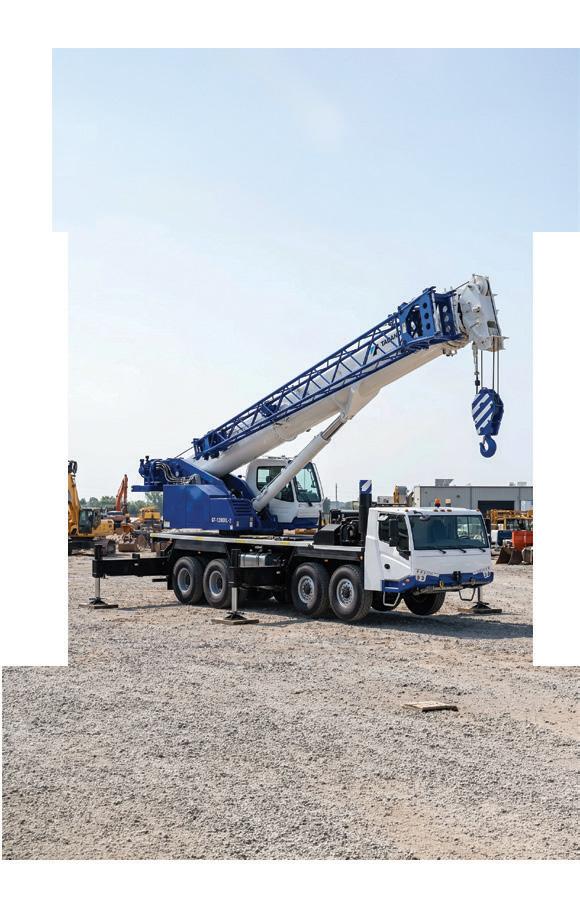
The GT’s full-width cabin has plenty of space for whatever you need for the job.


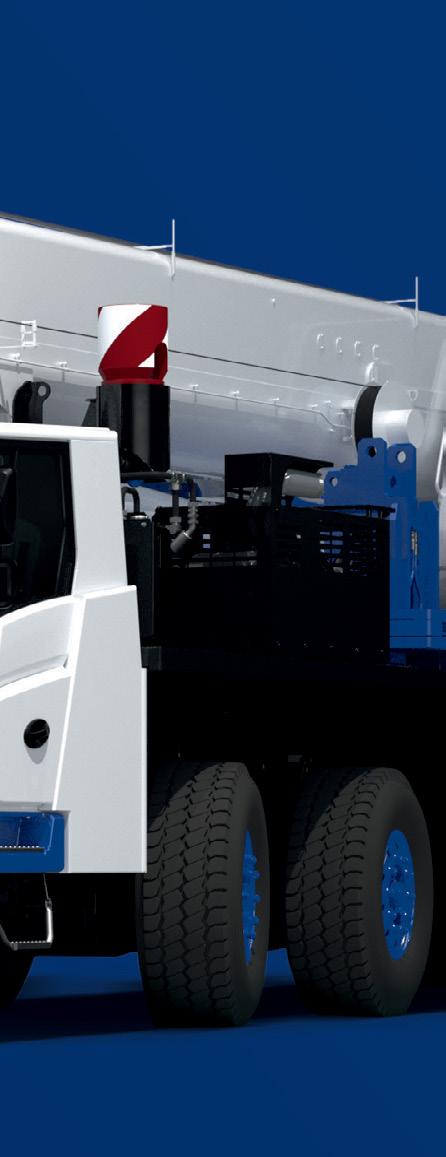



Tackle the Roads Ahead Powered by a Cummins X12 diesel, the GT Series has plenty of power to get you to the job site.


Learn more about Tadano Truck Cranes at tadano.com




AML-E
Large, intuitive multi-function display with enhanced features.


Tadano truck cranes feature the same smooth operator controls as our popular rough terrains. Combined with strong lifting performance, powerful drivetrain, and comfortable suspension the GT-800XL-2 and GT-1200XL-2 are the perfect addition to your eet. The GT Series is designed with the operator in mind –smooth, ef cient, and comfortable.
CTT
flat-top used in construction of Canada’s tallest residential skyscraper
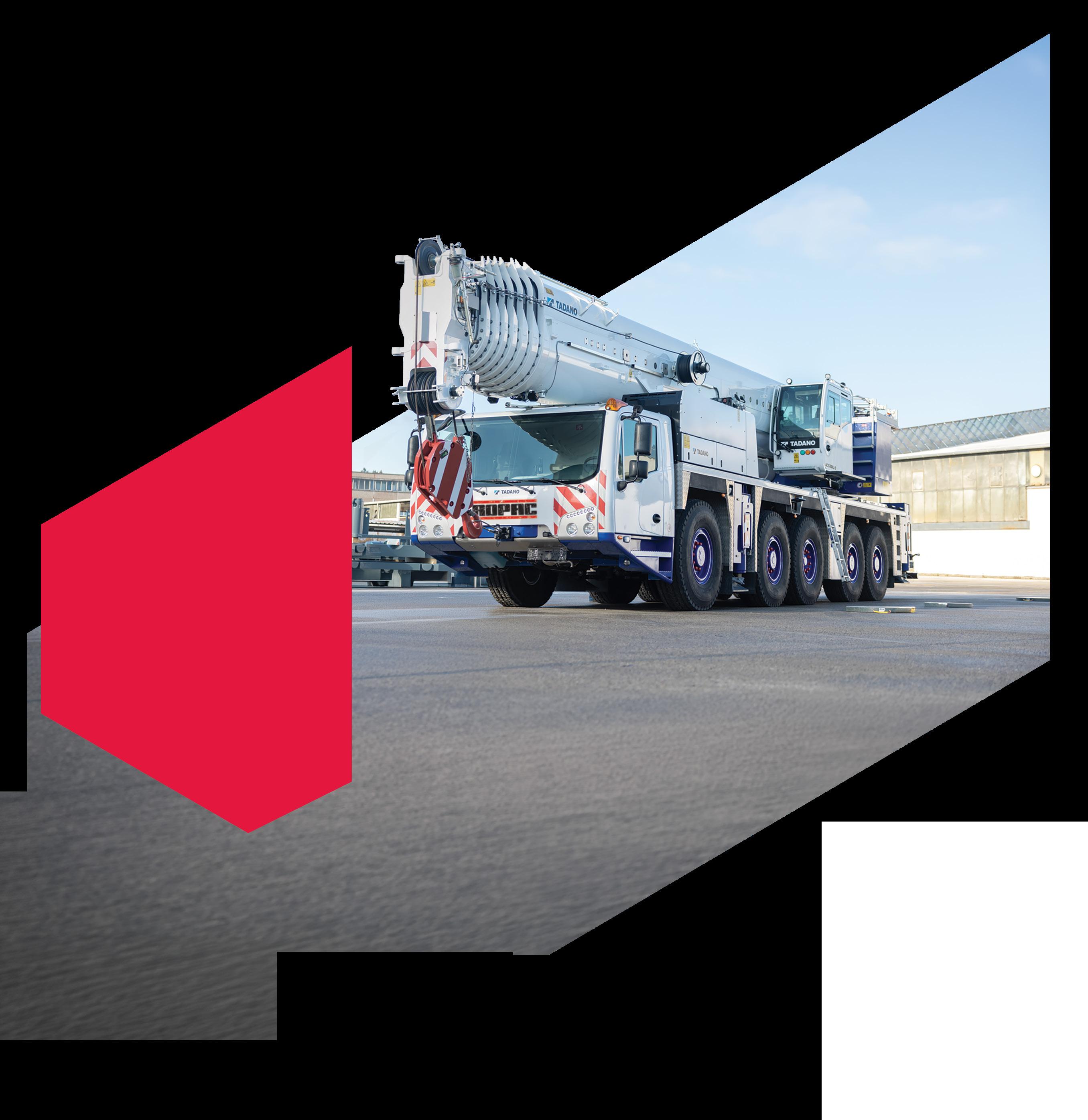
Cropac Equipment, official Terex Tower
Cranes dealer of Eastern Canada, supplied a CTT 472-20t flat-top tower crane for the construction of Toronto’s 110-storey Pinnacle SkyTower.
SkyTower is the tallest residential building currently under development in Canada. It is located on Toronto’s waterfront and is part of the landmark Pinnacle One Yonge development.
Utilizing an anchoring system made of 16 internal ties, the crane was progressively climbed alongside the structure, ultimately reaching the impressive height of 348 metres.
Configured with a 55 metre jib and a 6.24t tip load, the CTT 472-20t is equipped with a hoist of 80kW, lifting at a maximum speed of 196 metres per minute. This configuration provided the reach, lifting capacity, and operational reliability required to support material handling operations throughout the project.
The Terex CTT 472-20t has taken part in the build for the past four years and is set to be dismantled later in Q3 2026.
Part of the broader Pinnacle One Yonge master-planned community, SkyTower will deliver a mix of residential, hospitality, and commercial spaces spread over 110 storeys, including a Le Méridien hotel at the podium level.
The Canadian Centre for Occupational Health and Safety (CCOHS) will hold its Forum 2026: The Changing World of Work on Oct. 28 and 29 in St. John’s, Newfoundland and Labrador.
The two-day national event will bring leaders, safety professionals, workers, employers and government representatives together to talk about how work is changing, and how that can impact health and safety in Canadian workplaces.
Experts from diverse backgrounds will share their stories and offer ideas for organizations to use in their workplace. Speakers for the event will include:

• Lee Jeyes, business futurist and Head of Innovation and Change at Waitrose & Partners. Jeyes will challenge current thinking on innovation and share practical insights for moving ideas forward and driving change. Drawing on his extensive professional experience, Jeyes will offer strategies and tools to execute ideas and navigate change in large and complex organizations.
• Alan Doyle, musician, actor and best-selling author. Doyle will offer essential life lessons on how to be open to opportunities and cultivate a mindset for excellence.
• Mary Ann Baynton, psychological health and safety expert. Baynton will discuss what the evolution of psychosocial hazards from values-based conversations to operational risk management means for your workplace.
• Janet MacEachern, CEO of the Association of Workers’ Compensation Boards of Canada (AWCBC). MacEachern will explore national injury trends and emerging risks, and how to support evidence-informed prevention discussions.
• Dr. Arif Jetha, Associate Scientific Director and Scientist, Institute for Work & Health (IWH). Jetha will explore the future of work and health, anticipating what is on the horizon for occupational health and safety. Discussing findings from an international scan, Jetha will highlight emerging risks to worker health and safety, prompting workplaces to consider proactive health and safety strategies for the future of work.
The event’s Innovation Showcase will feature free programs, tools and resources to help workplaces foster safer, healthier and more supportive environments.
British Columbia is expanding skilled trades certification to tower and mobile crane
As of July 6, 2026, people working as tower or mobile crane operators in British Columbia will have one year to register as an apprentice with SkilledTradesBC or take the skilled trades certification exam and become a journeyperson before the new requirements take effect on July 5, 2027.
During the transition period, experienced workers can continue working while pursuing skilled trades certification. Government supports are available to help cover certain training costs, including tuition, travel and childcare, as well as apprenticeship advisers to support them in the transition.
The introduction of skilled trades certification for tower and mobile crane operators is part of the province’s broader strategy to strengthen crane safety, standards and accountability. The crane industry nominated these two trades for skilled trades certification as part of an application process SkilledTradesBC established in 2023 to determine trades that will benefit from additional certification.
The new requirement also responds to recommendations from the Province’s Crane Safety Table, convened by the Minister of Labour with industry, labour and technical experts to co-ordinate and accelerate safety improvements. It complements recent actions to strengthen crane oversight in B.C., including WorkSafeBC’s work with industry partners to improve licensing, permitting and safety practices for crane operations.
SkilledTradesBC has worked closely with the International Union of Operating Engineers local 115, WorkSafeBC and other industry partners.
Your
Crane and Hoist Canada’s photo contest is back Entries for our annual photo contest, presented in collaboration with the Canadian Crane Rental Association, are now open until August 3.

Outstanding submissions will be highlighted in our September/ October 2026 issue, with the winning entry receiving a spot on the cover and a free year of membership from the Canadian Crane Rental Association.
Think you have what it takes? Send your submission to mlacey@ annexbusinessmedia.com by August 3, along with the following information:
• The model of the crane in the picture
• Where and when the photo was taken (Photos must be taken after January 1, 2025)
• Some background on the project in the picture
Working in the crane and heavy lifting sector, your view of the world is one of a kind. Our photo contest is the perfect opportunity to show off that perspective, along with the projects and machines that make your work possible.
For those of you looking to lock down that cover star slot, here are some tips for coming out on top:
• Quality matters: Photos must be high-resolution in order to make it onto our cover – the resolution of phone pictures is too low to be printed on our cover.
• Portrait is preferred: We’re happy to crop down any pictures to fit on our cover, but a wide photo with a lot going on can be difficult to edit down while still showing everything that’s going on in it.
• It’s all in the details: While we’ll need to know the crane model and where and when the picture was taken, providing some additional context on the lift itself and some of the unique aspects about the project will help you stand out.
Canadian Crane Rental Association members spent three days learning, networking and celebrating the industry
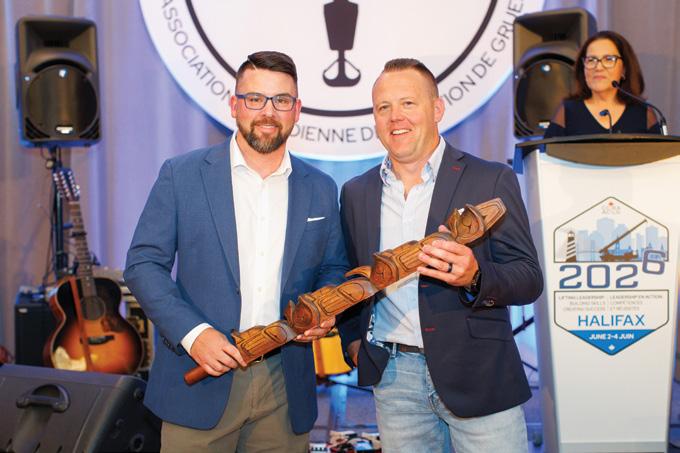
More than 250 people gathered in Halifax, Nova Scotia for the Canadian Crane Rental Association’s (CCRA) annual conference.
The three-day event featured education sessions, networking events and the always popular Lift of the Year awards.
The CCRA’s new board was announced during the conference.
The board executive is:
Chair: Michael Lavoie, Operations Manager, Myshak Crane & Rigging Ltd.
Vice-Chair: Guillaume Gagnon, Executive Vice President, Guay Inc.
Secretary-Treasurer: John Woulfe, Vice President, Business Development Canada, Barnhart Crane & Rigging
Past Chair: Ryan Long, President, A.W. Leil Cranes & Equipment Ltd.
Newly elected to the Board are:
Ryan Beers, President of Cutting Edge Crane Services Inc., Kamloops, British Columbia
Brian Campbell, President of Richard Steel Ltd, Gatineau, Québec
Daren Trépanier, Director of Sales & Business Development at CC Blocking System, Red Deer County, Alberta
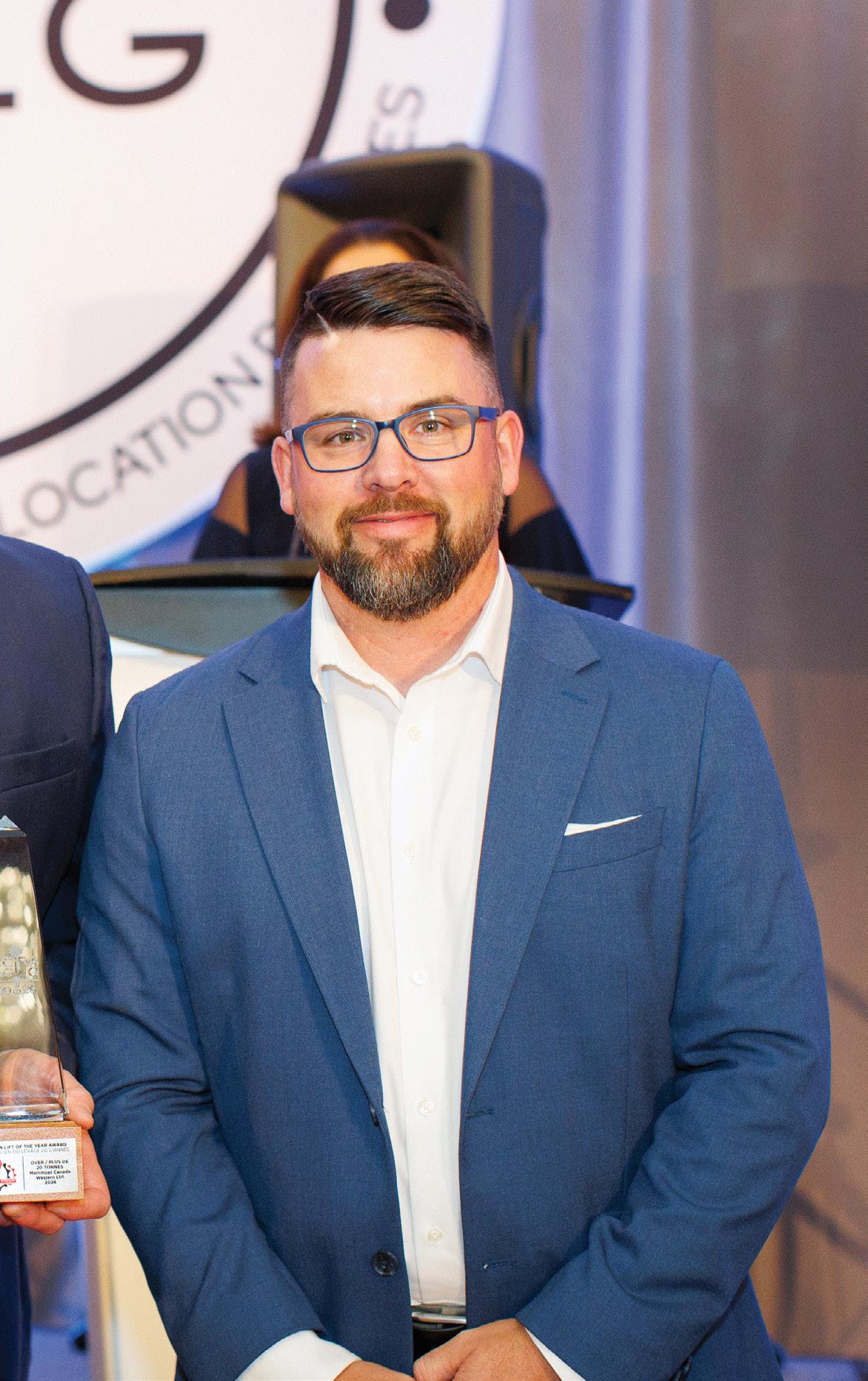
They will join current board members Jeremy Asher, Mammoet Canada; Pascal Francoeur, Grues JM Francoeur; Mark Hooper, Manitowoc; Victor Murty, Irving Equipment Ltd; Jim Littlemore, Sterling Crane; and Paul Walchuk, Kova Engineering part of Industrial Inspection & Analysis Engineering Ltd.
Leaving the Board of Directors are Steve Anema, Past Chair, after completing a threeyear term, and Justin Andrews, Regional Business Manager, Tadano Pan America Operations, after completing two highly successful three-year terms. Andrews will remain as co-chair of the Weights & Dimensions Technical Committee, leading the Western Task Force Initiative.
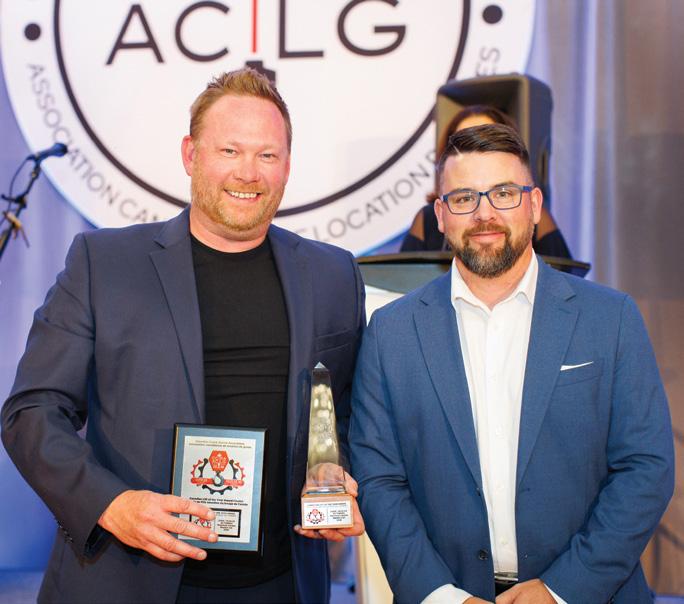
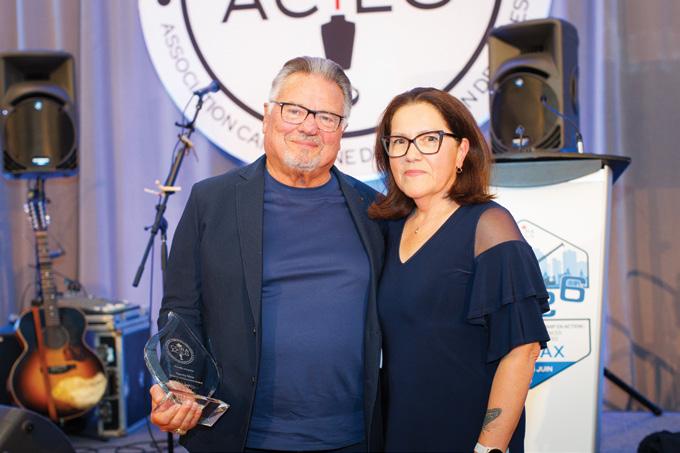
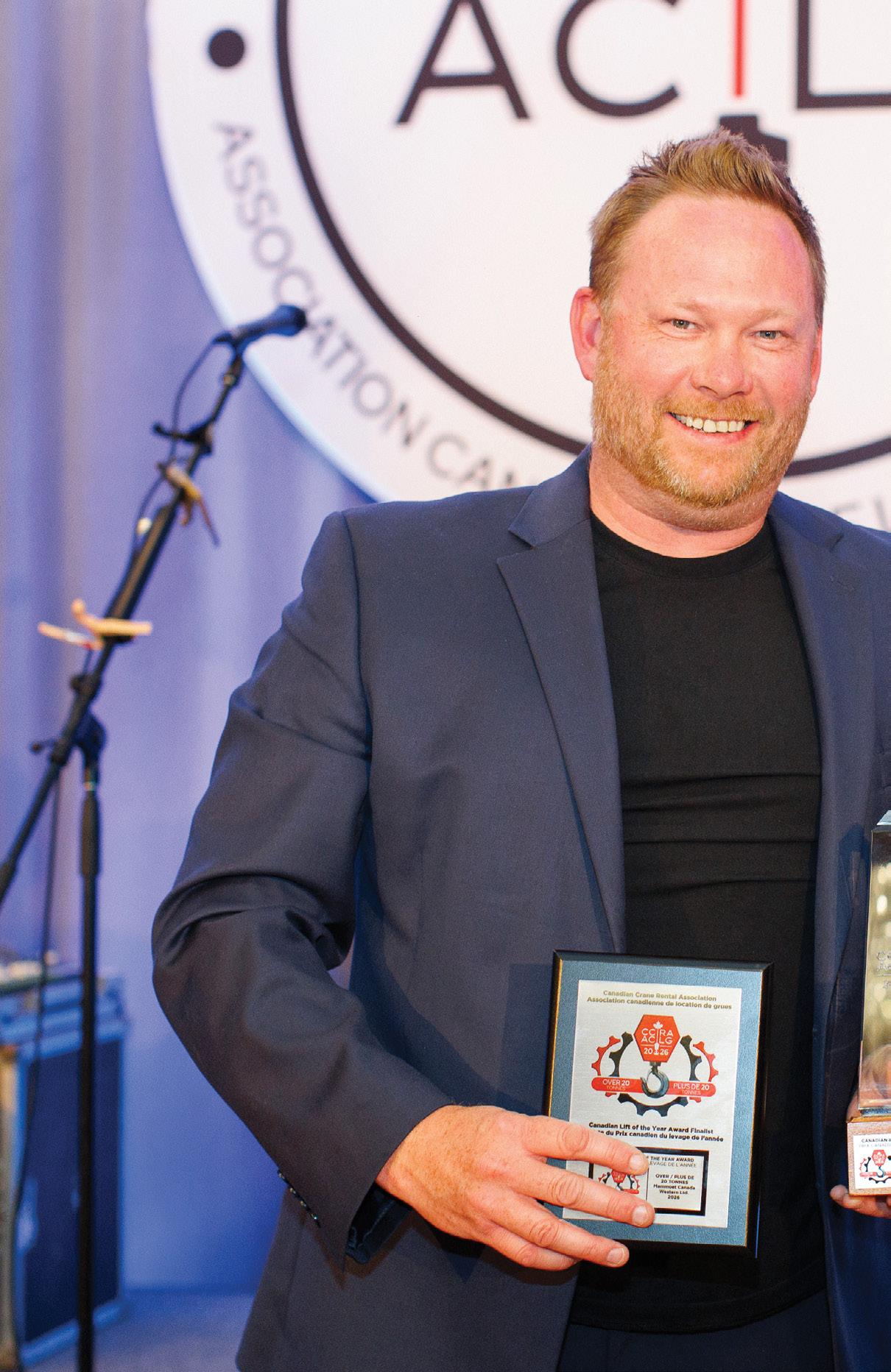
The CCRA honoured Alan Swagerman, Regional Manager – Crane at NORS Construction Equipment Canada, and Randy Moir, President of Moir Crane Service Ltd., for their long service to the crane industry.
Alan Swagerman began his career in 1985 with Irving Equipment Limited. Over the course of his career, he has held numerous leadership roles with Irving Equipment Limited, Sterling Crane, Mains Crane & Rigging, ENTREC, Mi-Jack Canada, and currently serves as Regional Manager –Crane at NORS Construction Equipment Canada. A dedicated contributor to the CCRA, Swagerman has served on the Board of Directors on three occasions, representing both crane rental members and supplier organizations. He was also a member of the CCRA’s founding Board of Directors in 1998.
Randy Moir is a fourth-generation owner and president of Moir Crane Service Ltd. He became a member of the CCRA in 1999 and served on the Board of Directors from 2001
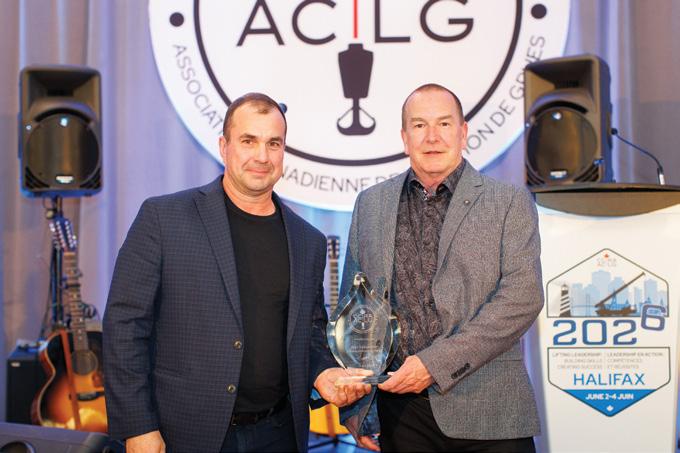
to 2005, including as chair in 2005. He later completed a second term from 2008 to 2011 and has remained actively engaged with the CCRA as a past chair and director.
Safety was also top of mind at this year’s conference as the CCRA handed out its Safety Awards to those who have demonstrated outstanding health and safety standards.
A total of fifteen crane rental companies were recognized. Recipients of the 2026 Safety Awards include:
• ABCO Crane Services Ltd.
• Amherst Crane Rentals Ltd.
• A.W. Leil Cranes & Equipment (1986) Ltd.
• Barnhart Crane & Rigging Ltd.
• Bigfoot Crane Company Inc.
• Canuck Concrete Pumping & Crane Services
• Irving Equipment Limited
• Lampson Canada Ltd.
• Mammoet Canada Western Ltd.
• Moir Crane Service Ltd.
• Myshak Crane & Rigging Ltd.
• Sky-Hi Crane Services Ltd.
• Sterling Crane
• TNT Crane & Rigging Canada
• VanGenderen Canada Inc.
CCRA’s 2027 conference takes place at Dakota Dunes Resort in Whitecap, Saskatchewan.
The event runs from June 8 to 20, 2027.
LR
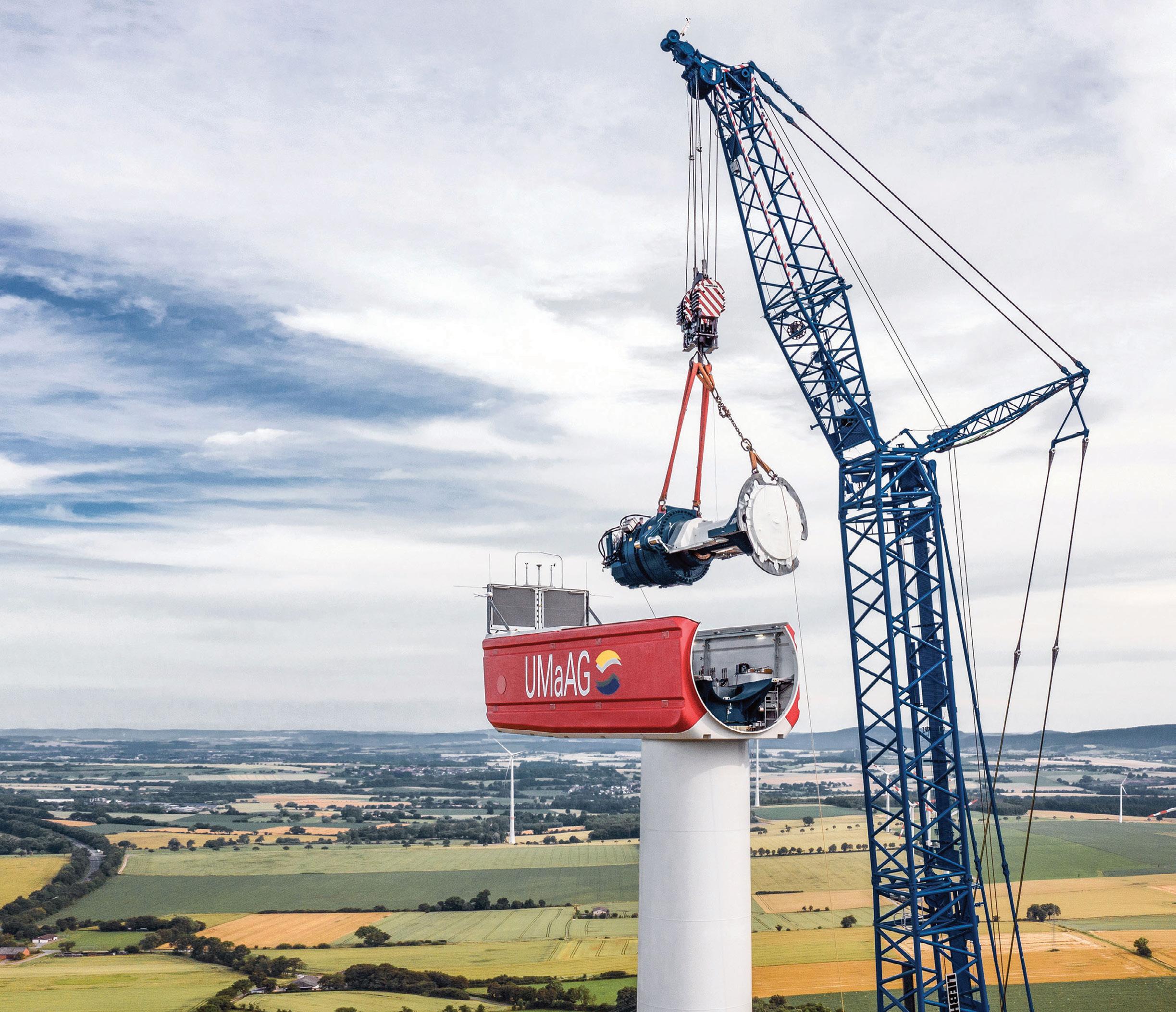
From cast nylon sheaves to synthetic fibre ropes, modern composites are quietly replacing heavy metal components to eliminate corrosion and slash maintenance costs.
By Treena Hein
It may come to as a surprise to some that today’s new ‘engineering’ plastics have enabled plastic components to replace many metal counterparts across a wide range of industrial machines, including cranes.
There are millions of plastic bearings in use along railways, for example, and plastic gears are getting larger all the time. Another example is plastic high-load thrust washers, which are now found in the transmissions of both vehicles and heavy equipment. It’s no wonder that use of plastic is increasing in heavy equipment. For starters, these materials do not corrode and some can self-lubricate. They also offer high UV resistance and good gener-
al chemical resistance, resulting in excellent durability in structural, wear and electrical parts exposed to prolonged outdoor use. Indeed, plastic manufacturer DH Lamina of Italy boldly states on its website that at this point in history “when it comes to pulleys, rollers or other crane components, first choice goes to plastic materials.” This is partly “because of their very good load capacity with the possibility to deform but not break (elasticity properties), and because of an exhaustive possibility of design. Semi-finished materials are available in a huge range of shapes and dimensions. Big parts are possible too.”
Looking closer at load capacity with regard to today’s thermo-
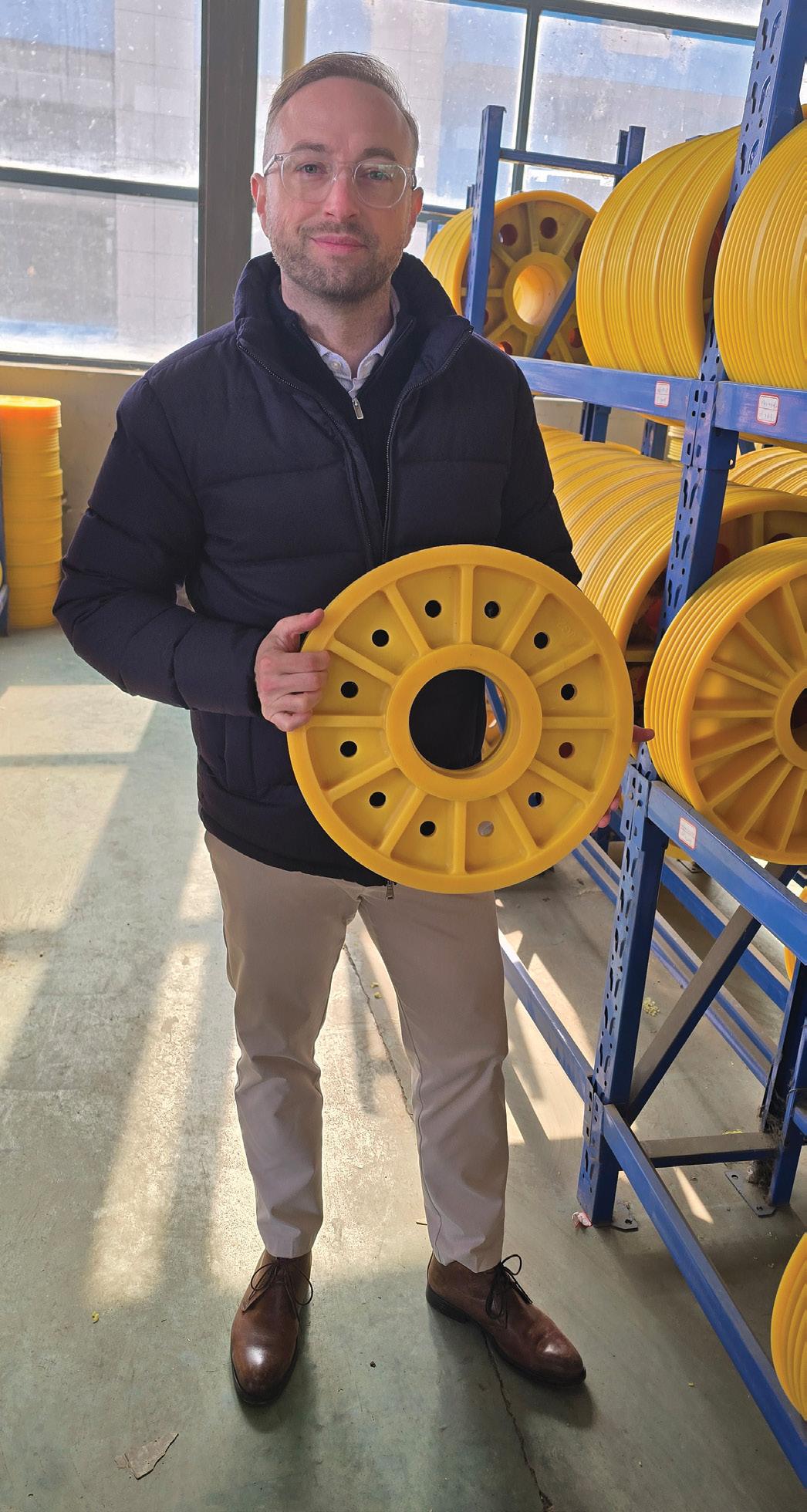
CHART COURTESY COMCO EPP GROUP
plastic composites, these materials offer strength and modulus values approaching those of metals, but with a density 40 per cent lower than aluminum, explains Dr. Keith Hechtel, VP of Business Development & Marketing at Curbell Plastics, a North American distributor for advanced plastics/plastic composite manufacturers such as Ensinger, Röchling, Mitsubishi Chemical Group, DuPont and ITW Performance Polymers.
“Plastic parts thus weigh less without compromising structural integrity,” says Hechtel, noting that polyamide plastics are typically used in the sheaves of construction cranes, making the crane lighter and thus able to offer greater load capacity than cranes with metal sheaves.
In addition, plastic crane cables and other parts also enable greater overall machine efficiency because they reduce stick-slip effects. This also prolongs parts lifespan.
In the big picture of how using plastics components in cranes is evolving, Stefan Hernitz, CEO of COMCO EPP Group, first notes
Corrosion resistance
Lubrication Regular required Regular required
Vibration
no
Up to 1/12 of steel groove pressure
Self-lubricating grades available
that when crane engineers get together to talk about performance improvements, the focus is typically on hydraulics, load ratings or boom geometry. COMCO EPP is an engineering plastics manufacturer with operations in Europe, the UAE and East Asia, and parts made from its plastics are found in mobile, truck-mounted, marine and railway cranes around the world.
“The material of the sheave, the slider or the rope guide rarely makes the agenda [in these performance discussions] until maintenance costs escalate, a wire rope fails ahead of schedule or a competitor’s machine simply lifts more for the same engine output,” Hernitz observes. “At that point, the question of why so many leading crane manufacturers have quietly moved from steel and cast iron to cast polyamide…nylon [made using a process called centrifugal casting] becomes very relevant.”
In general, Hernitz notes that the long-term trend of replacing metal sheaves, sliders, rollers and boom-support wear pads with those made from COMCO EPP cast PA6 nylon is driven by measurable, quantifiable performance data. Looking at some specs of this plastic as an example, it has a density of approximately 1.15 g/ cm³ compared to 7.8 g/cm³ for steel (see sidebar chart).
“In practice, this means a cast nylon sheave of equivalent dimensions to a steel sheave weighs roughly one-seventh as much,” says Hernitz. “For aluminum, the ratio is approximately one-half. In large telescoping or truck cranes, where multiple sheaves sit at the end of the boom, the cumulative dead-weight reduction is significant. Every kilogram removed from the boom tip translates directly into additional usable lifting capacity, or equivalently, into structural relief that extends boom service life.”
He adds that these weight savings also impact mobile crane logistics and more. Over-road weight is lower and stress on axles and transport configurations is reduced. Manual handling during installation and maintenance is also easier.
There are also operational benefits from the ability of engineering plastics to absorb vibration. Noise is reduced if vibration levels are lower in lifting systems under dynamic load. Specifically, with plastic sheaves, the transmission of shock loads through the sheave to the boom structure and anchorage points is reduced. Lower vibration levels also extend the service life for surrounding metallic components (bearings, pins and structural elements) due to lower peak stress cycles.
Standard cast PA6 also has inherent low-friction surface characteristics, says Hernitz. “Oil-filled grades take this further, releas-
ing lubricant under pressure and friction to maintain a near-constant film at the rope interface,” he says. “In practical terms, this means dramatically reduced-lubrication intervals.” Indeed, cast nylon boom sliders have demonstrated service life four to five times longer than the traditional brass sliders, “with only a single lubrication event at installation,” says Hernitz, “rather than ongoing scheduled maintenance.”
Self-lubrication aside, there are other reasons why cast PA6 is replacing brass, which has long been the preferred material for the sliders between nested boom sections in the extension and retraction systems in truck crane booms. Cast PA6 also removes the risk of galvanic corrosion at the contact interface, and of course, is lighter than brass.
Let’s return to plastic sheaves for a moment, but from the rope movement perspective. Hernitz explains that because the contact mechanics between a wire rope and the sheave groove determine rope fatigue/lifespan, cast nylon sheaves provide a deflection in the groove surface so that contact pressure is distributed over a larger area, due to their low modulus of elasticity. In fact, the contact pressure of a cast nylon groove is one-tenth to one-twelfth that of a steel groove under equivalent loading.
“The practical outcome of this is that wire rope service life is extended by a factor of two to three times when running on cast nylon sheaves rather than steel,” Hernitz says. “For a crane oper-
ating in intensive lifting cycles, this is not a marginal improvement. Wire rope is an operational cost that the maintenance department tracks closely, and it carries both a direct parts cost and a downtime cost associated with replacement.”
Hernitz also explains that the grooves that support the rope diameter (without pinching or allowing the rope to bottom out in the groove) must be carefully engineered, and cast nylon’s excellent machinability enables precise, repeatable groove profiles.
In addition, rope guide rollers made of cast nylon reduce rope abrasion, operate quietly, and also resist the oils, hydraulic fluids and environmental contamination typically found in crane environments. In addition, “as a replacement for copper and Babbitt alloy bearings, cast nylon rollers provide high PV values (a measure of pressure-velocity capability),” Hernitz says, “relevant to sustained rotational loads.”
But plastic is also making inroads in crane rope itself.
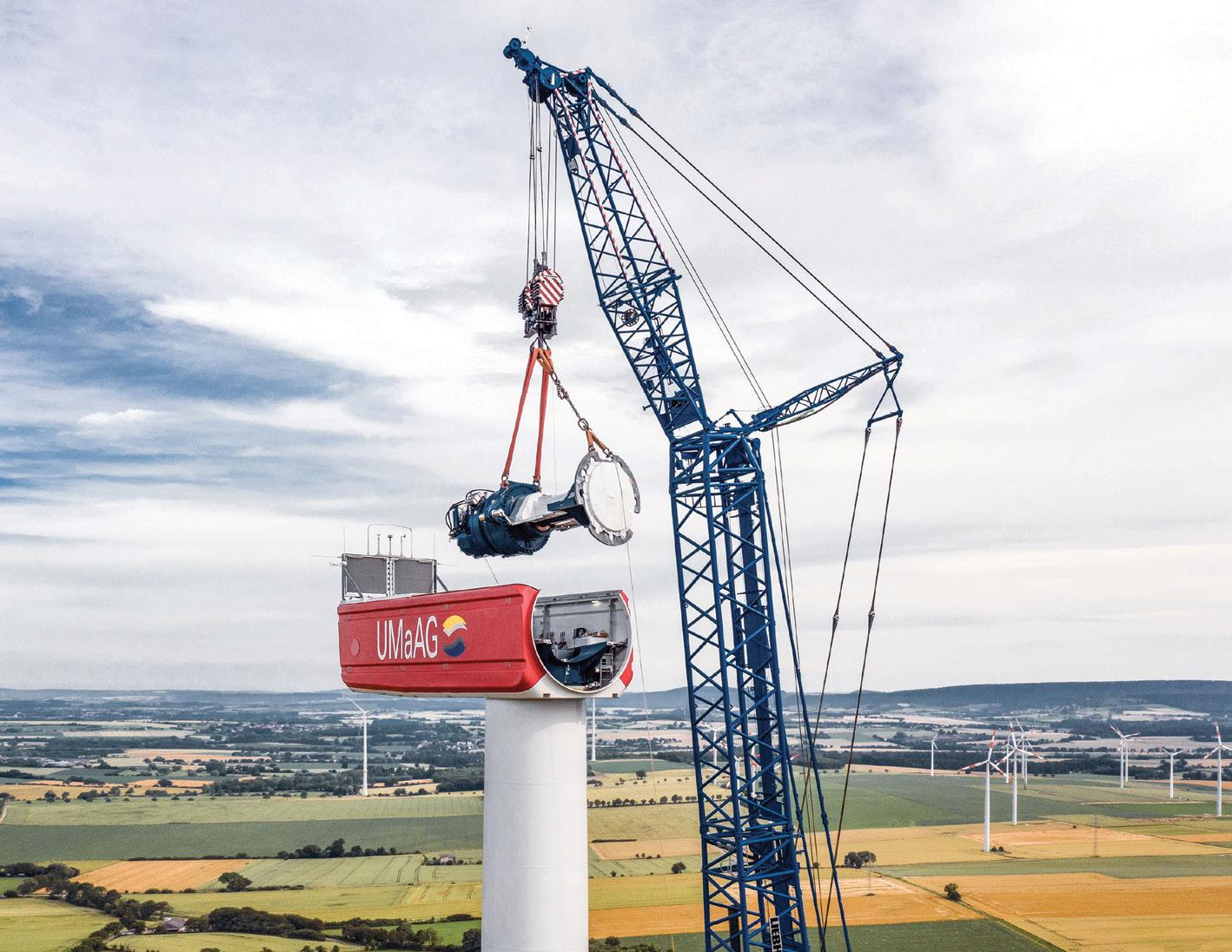
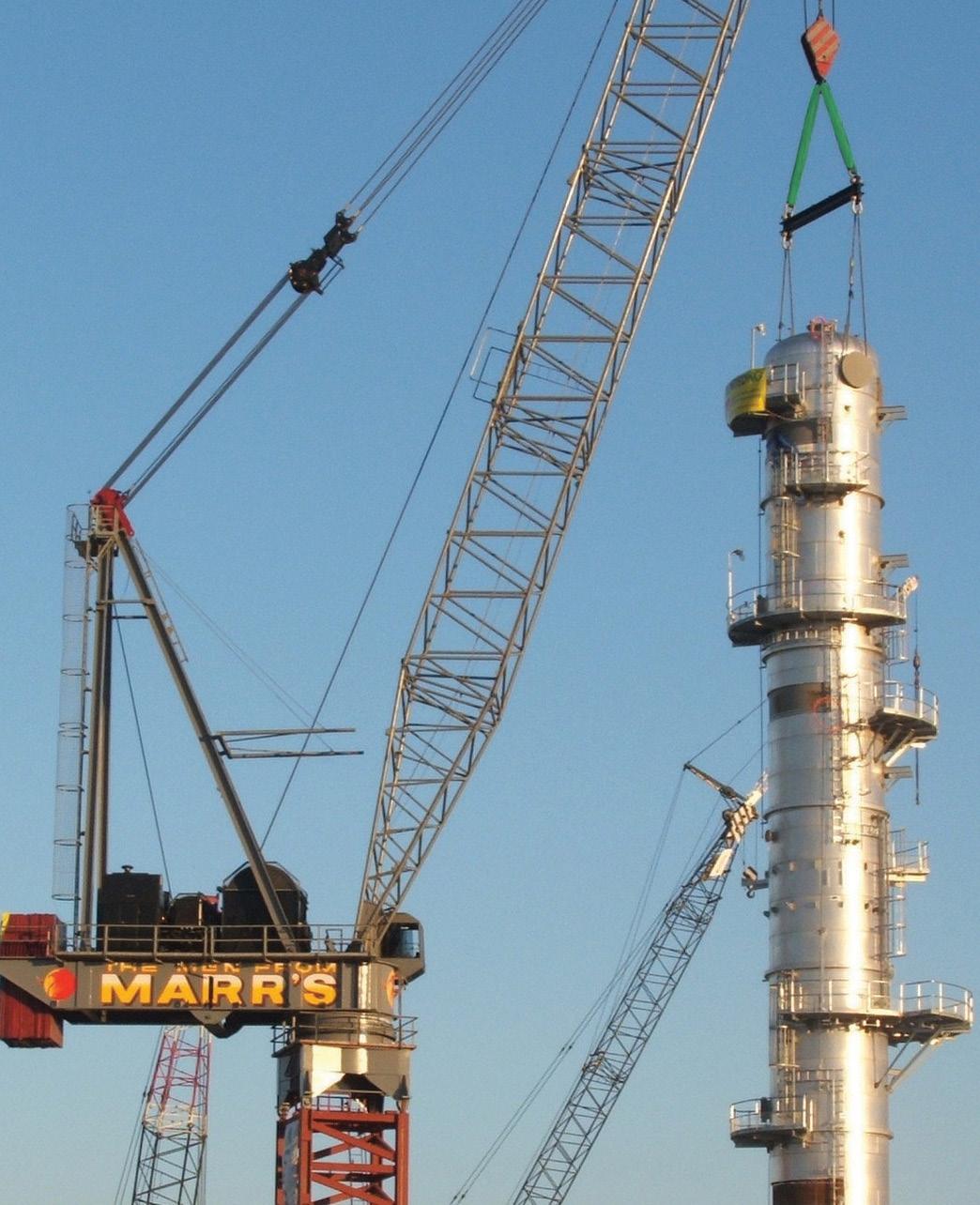
Since 2008, Germany-based crane manufacturer Liebherr-Werk has been working closely with rope manufacturer Teufelberger to incorporate high-tensile synthetic fibres into its ropes. All those years of development, including 87,000 hours of testing, led to Liebherr’s launch in 2019 of its Fibre-Cranes rope product. It’s 80 per cent lighter than comparable steel rope, directly increasing lifting capacity by up to 40 per cent when using existing tower sections and substructures, says Shannon Korff, marketing lead for tower cranes at Liebherr-Werk. It also reduces energy consumption during operation by up to 5 per cent.
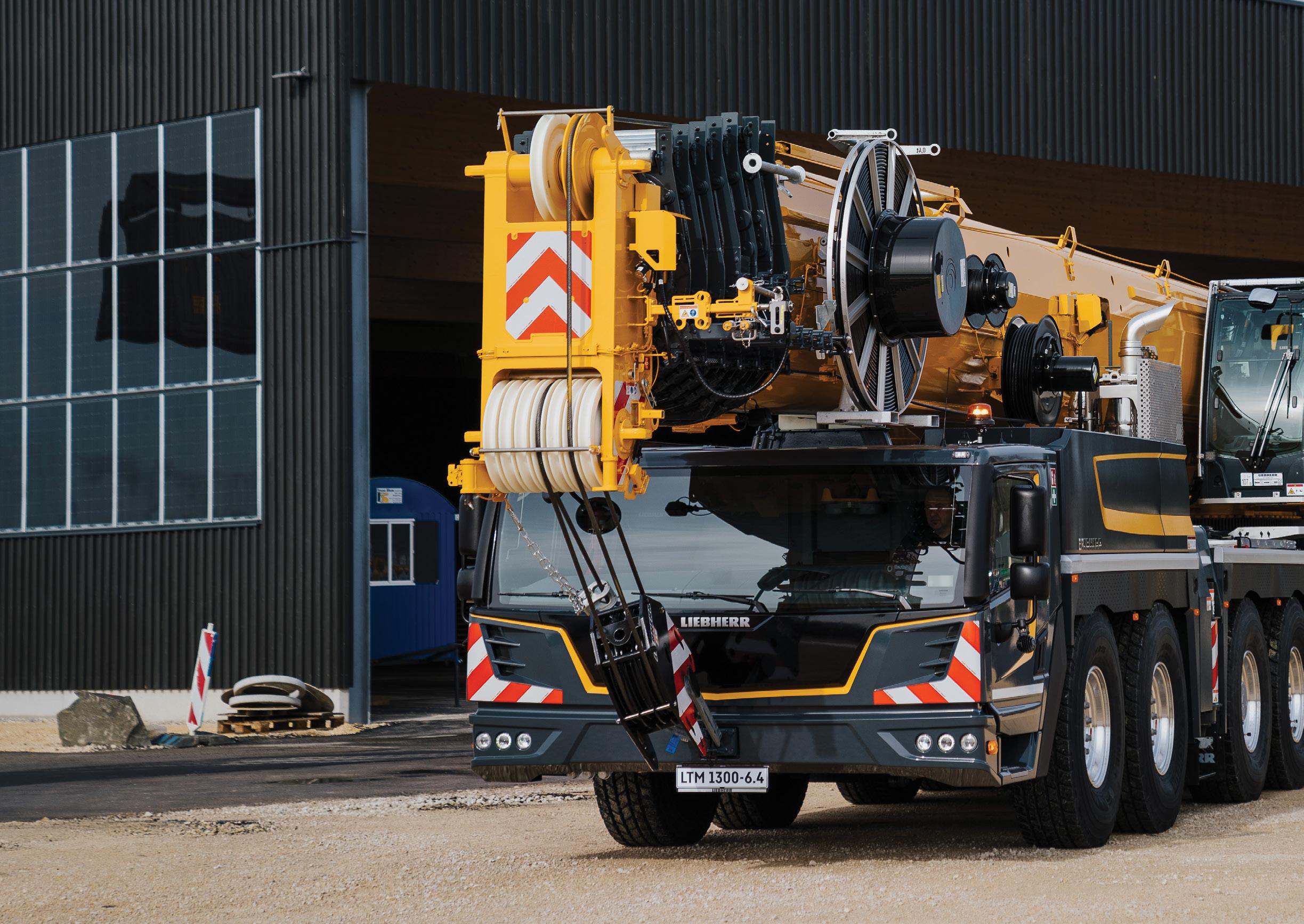
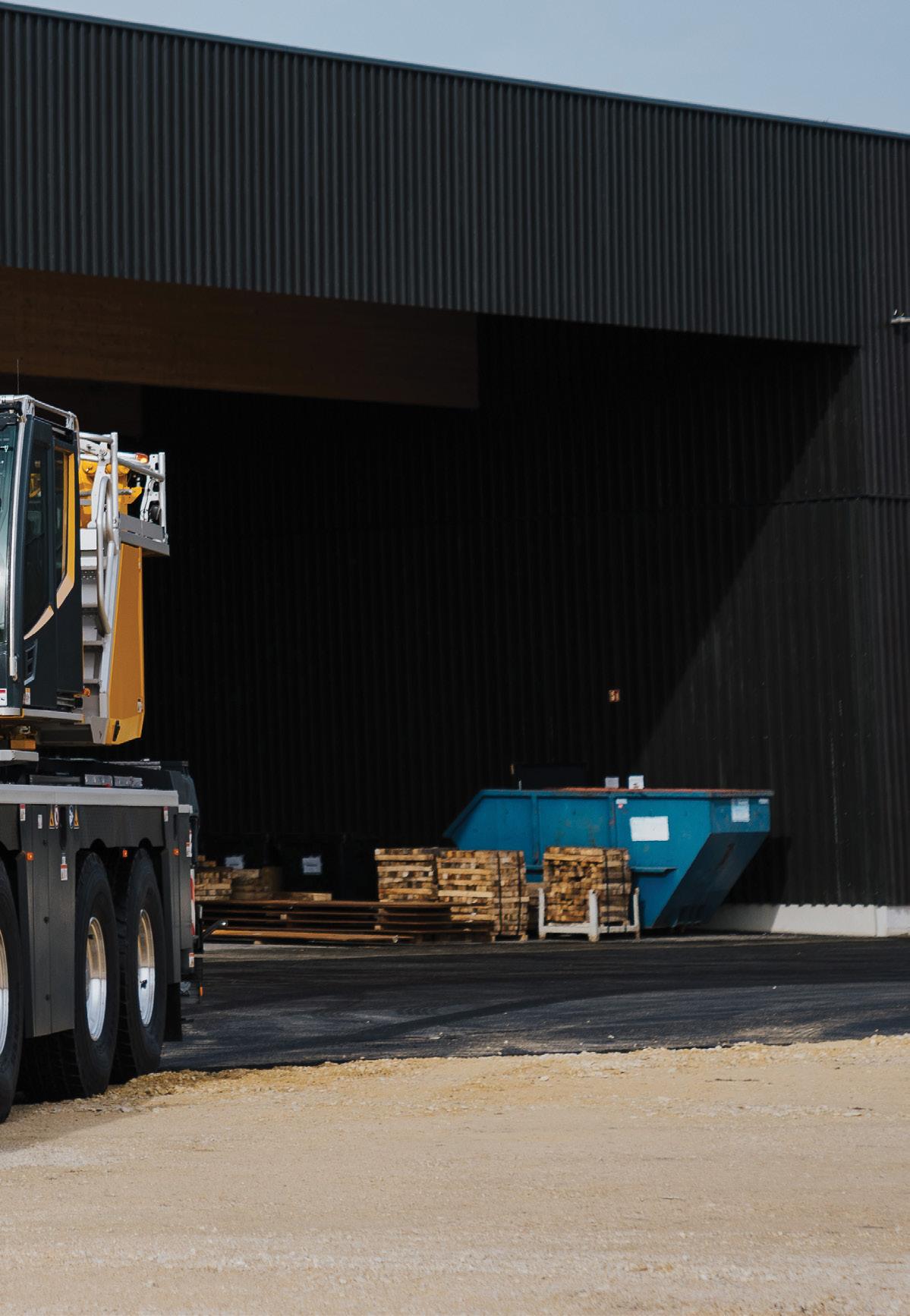
Liebherr’s LTM 1300-6.4 mobile crane.
PHOTO: LIEBHERR
“Additional advantages,” reports Korff, “include no lubrication requirement, significantly-reduced maintenance, a service life of up to 14 years and an on-site repair capability that is not possible with steel rope.”
Benefits in action
Liebherr-Werk uses plastics in other crane components for many reasons, including low friction (in telescoping) and good wear resistance. “For weight-saving reasons, we’ve replaced many parts that do not bear any structural load, such as fairing panels, with plastic,” adds Marketing and Communication Lead Wolfgang Beringer. “We also use plastic pulleys in the rope drive (neck pulleys, head pulleys, hook pulleys) and plastic bearing plates in the area of the front bearings and the end sections of the telescopic boom.”
For many years, Liebherr-Werk has also used polyamide rollers for weight savings in its crawler cranes, and aramid fibre guying ropes instead of steel cables or steel rods for fixed jibs, due to their lower weight and good handling benefits. “In addition, GRP (glass reinforced polymer composite) gratings are used on lattice booms for weight-saving reasons,” says Beringer. “The erectable length and load capacity in certain positions increase with a lower boom head weight.”
We invite those with experience using cranes with plastic components to share their usage feedback. Stay tuned for more developments as plastics continue to evolve.

These high-performance slings, hardware, and lubricants are built to handle our country’s harshest season
Currently, the weather is hot and sunny, but before long that will give way to winter.
Planning ahead is vital, especially when lifting in a country with a climate as cold as Canada’s. To keep projects moving safely through the winter, it’s important to rely on specialized equipment built specifically for our harsh climate. From advanced dual-path synthetic slings to impact-tested shackles and deeply penetrating low-temperature lubricants, the following products are designed to maintain strength, flexibility and structural integrity when the temperatures dip below zero.
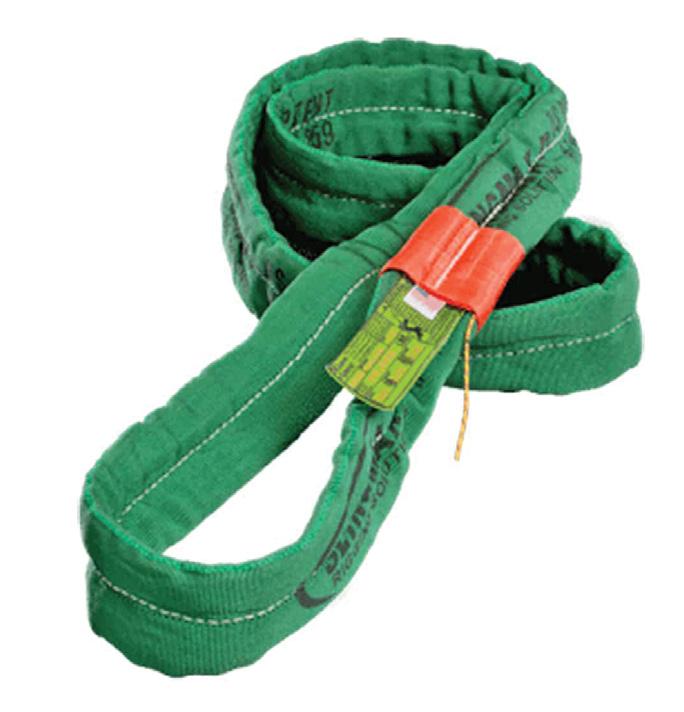
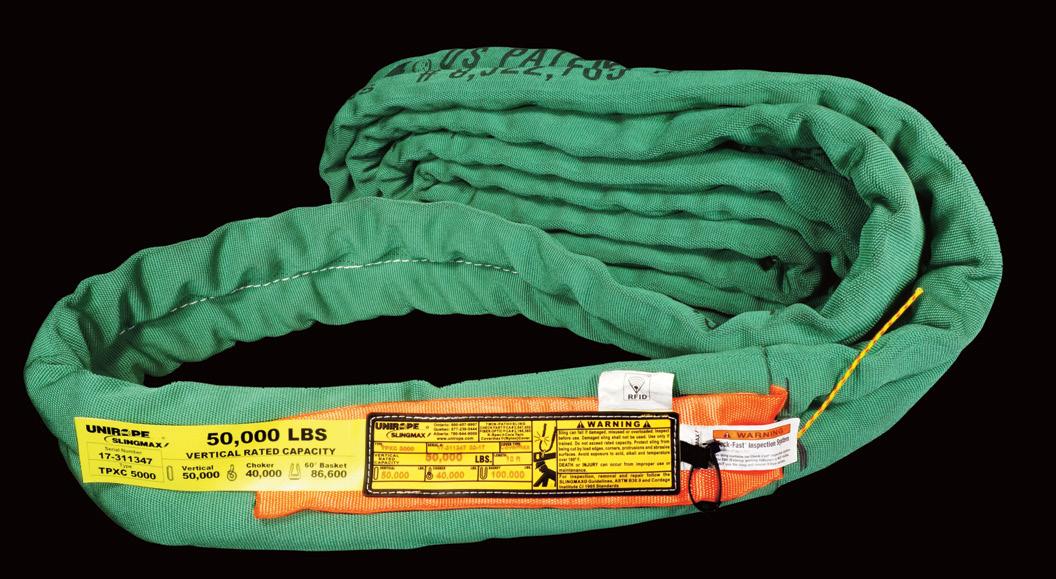
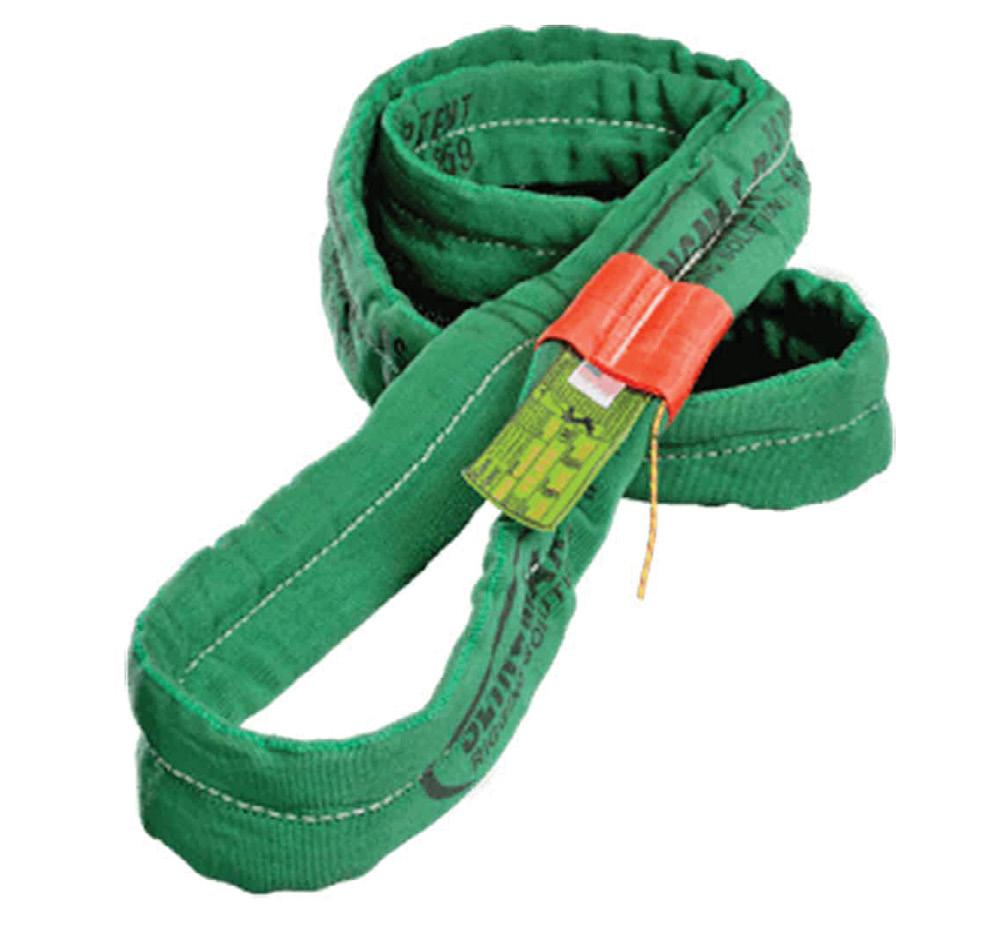
The development of the Twin-Path Slings product line was driven by operators seeking a high-performance alternative to traditional nylon, polyester, wire rope, and steel chains. Made with K-Spec load-bearing yarns, which are 10 times stronger than steel pound-for-pound, Twin-Path Slings weigh just one-tenth as much as comparable wire rope slings.
The slings feature a patented dual-path design and function as two complete slings in one to provide independent redundancy. If one path suffers severe damage during a lift, the backup path maintains control until the load is safely lowered.
Twin Path Slings also feature an Early Warning Indicator (EWI), which provides a
clear visual cue when the sling has been overloaded or damaged, helping operators take action before a failure occurs.
Built with a 5:1 safety factor, each independent path boasts a breaking strength equal to 2.5 times the total sling capacity. Twin-Path Slings are rated for cold-weather environments down to -40°C.
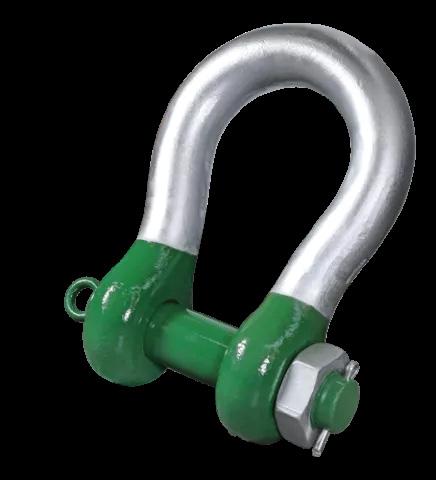
2 Green Pin Polar
While Green Pin’s entire lineup is engineered for specialized applications, its Polar shackles are specifically designed for extreme climates, offering an operational temperature range of -60°C to 200°C depending on the model.
All are forged from Grade 8 alloy steel, quenched and tempered. The G-5163 bow shackle (with safety bolt) and the G-5143 bow shackle (with safety bolt and fixed nut) deliver a working load limit (WLL) ranging from 2 to 85 tons. For heavy-lift applications, the P-6031 bow shackle with a safety bolt is rated for temperatures as low as -40°C with an exceptional WLL span of 120 to 1,500 tons. Similarly, the P-6011 bow shackle with a safety bolt and fixed nut has a WLL ranging from 120 to 150 tons and can operate in temperatures as low as -40°C.
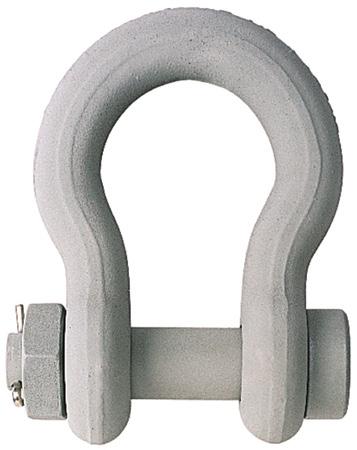
3 Crosby G-2130CT and G-2140CT Cold Tuff Shackles
Crosby G-2130CT and G-2140CT Cold Tuff Shackles are engineered to provide de-
By Mike Lacey
1
pendable lifting performance in extreme cold and harsh environments where standard hardware may be prone to failure. Designed for use in temperatures as low as -45°C in non-DNV applications, these shackles maintain strength and toughness under freezing, high-impact conditions.
The shackles’ durability and resistance to fatigue are a result of their forged, quenched and tempered construction. They’re available in long-lasting carbon or alloy steel. As well, its Charpy impact testing ensures reliable performance under shock loading in low temperatures. A corrosion-resistant zinc primer finish enhances protection in wet, icy and offshore or saltwater environments.
Crosby states each shackle is individually proof tested to
2
3
4
twice its working load limit, serialized and magnetic particle inspected for quality assurance, reinforcing safety and traceability in critical lifts. Crosby Cold Tuff shackles come with permanently marked load ratings and full certification to recognized industry standards.
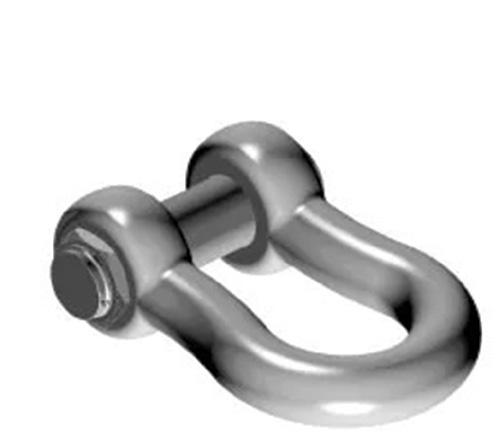
While founded in the 1920s, GN Rope Fittings entered the heavy-lifting industry 60 years ago. Today, the company manufactures an extensive line of polar-rated, alloy steel shackles engineered with an operating temperature range stretching from -40C up to 200C.
This rugged lineup includes the H10 bow safety pin shackle, the H10S Super safety pin shackle, the D15 DEE safety pin shackle, the H11 heavy-duty double nut shackle, and the H14 wide-body shackle. GN Rope Fittings also designs and manufactures highly specialized forged products for mooring, anchor handling, and complex rigging setups.
In the US and Canada, GN Rope Fittings shackles are
available exclusively through Associated Wire Rope & Rigging.
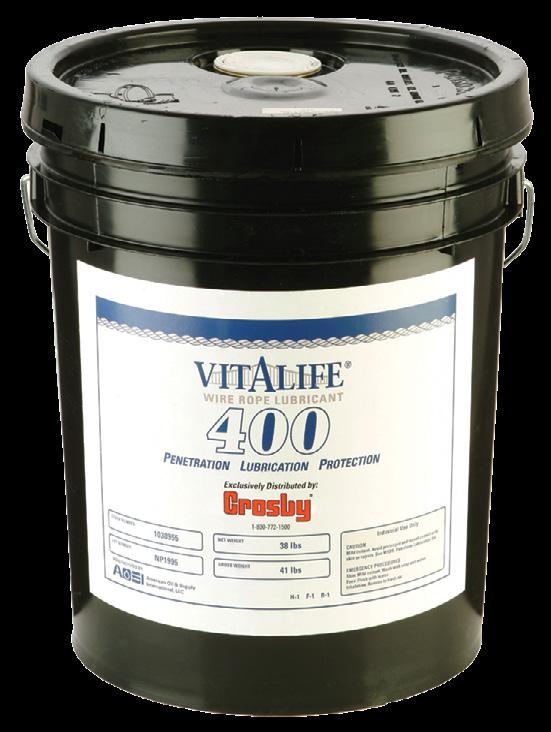
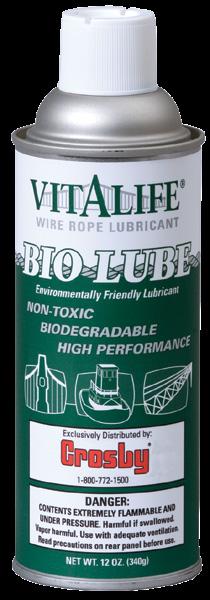
Vitalife Wire Rope Lubricants are engineered to perform in cold and harsh operating environments where conventional lubricants often fail. Its advanced formulation penetrates deeply into wire rope strands, displacing water, ice and contaminants that can speed up corrosion and internal wear.
By maintaining effective lubrication in extreme conditions, Vitalife reduces friction between strands, helping prevent stiffness, brittleness and premature rope failure. The non-tacky composition resists buildup from dirt, snow and debris. This ensures reliable performance and easier inspection even in rugged, exposed settings.
Vitalife is available in multiple formats, including aerosol, bulk containers and applicator systems.
7
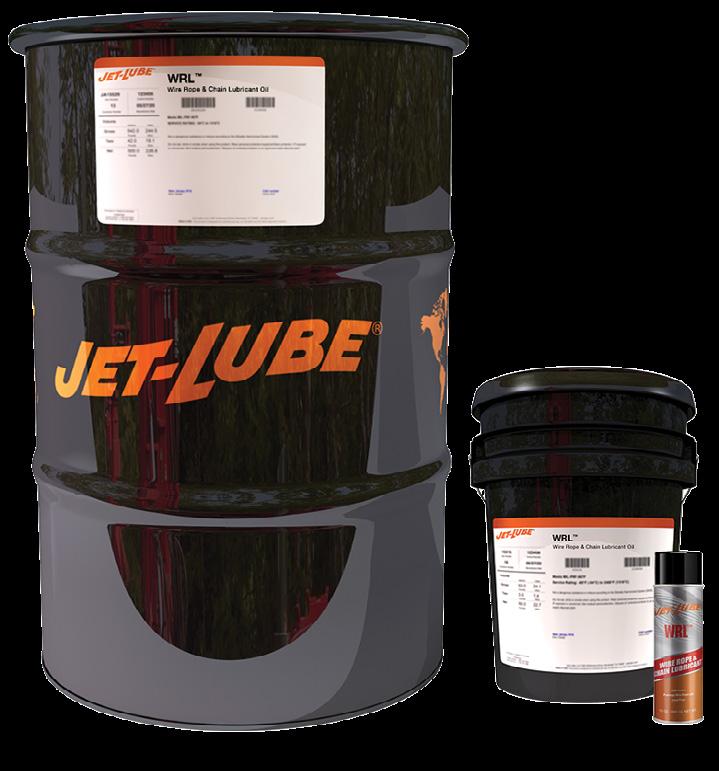
mium penetrating wire rope lubricant specifically formulated to lubricate, protect and extend the service life of wire ropes operating in demand-ing industrial and marine environments. Its low-viscosity carrier system allows the lubricant to penetrate deeply into the rope core, reaching internal strands and wires where wear and corrosion commonly originate. After penetration, the product leaves behind a durable lubricating film that reduces friction between moving wire strands, minimizing wear and extending rope life. WRL provides protection against rust and corrosion by displacing moisture and creating a protective barrier against water, salt spray and environmental contami-nants. The lubricant’s tacky residual film resists sling-off and washout.
Jet-Lube WRL is a pre -
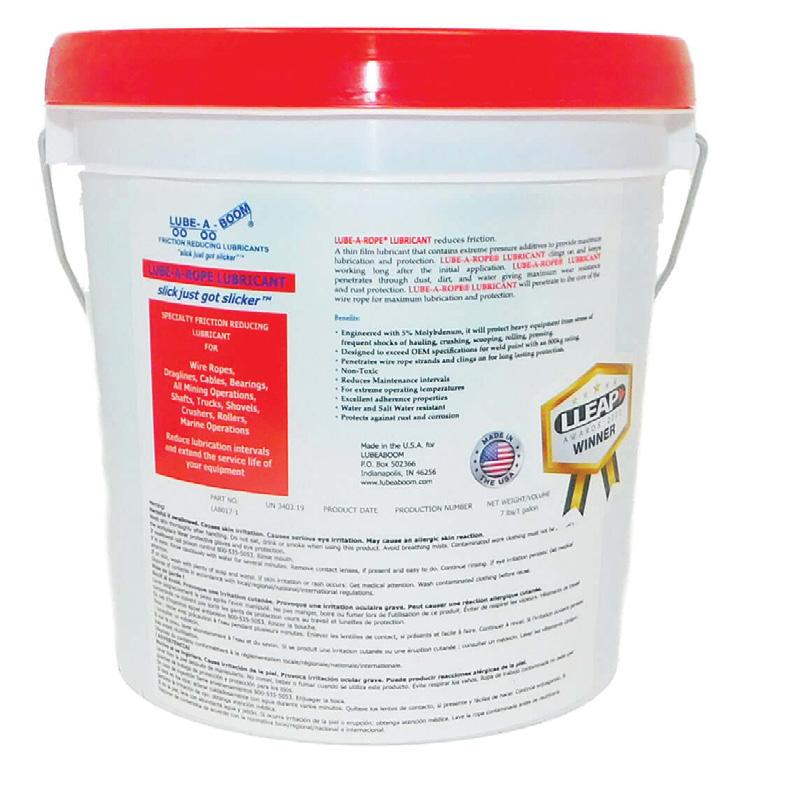
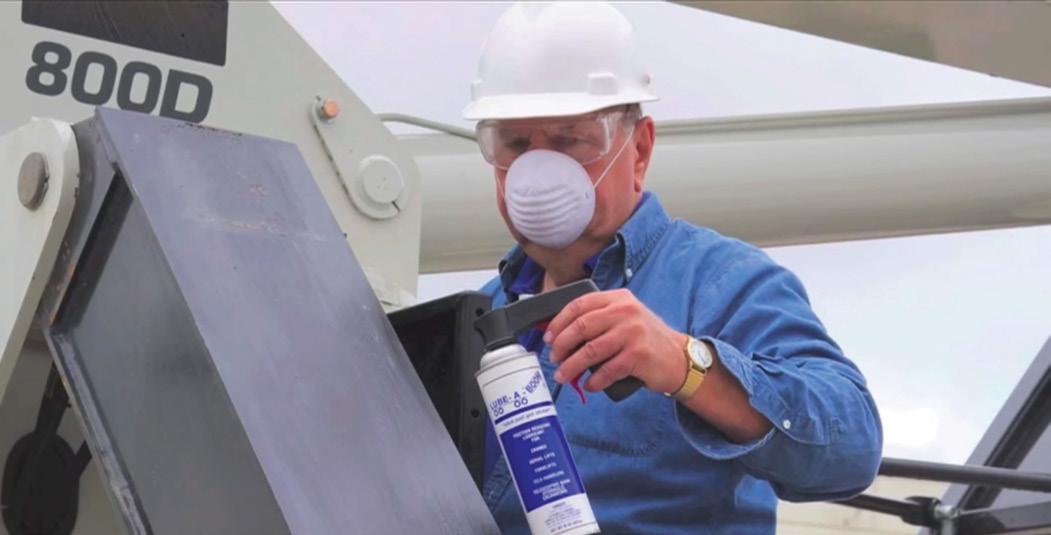
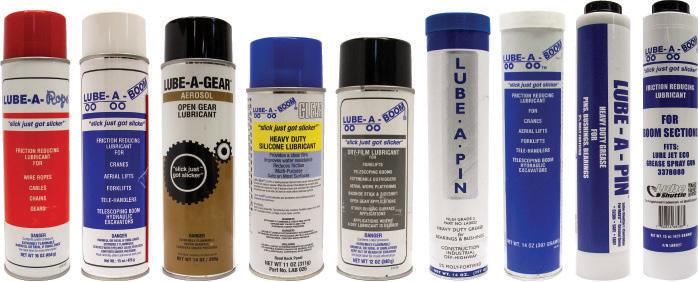
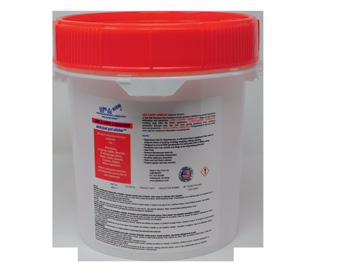
Lube-A-Boom’s specialized aerosol and liquid lubricants for cranes, aerial lifts and heavy equipment are engineered to handle extreme industrial conditions. Whether facing desert heat, arctic
cold, coastal salt air, or dirty jobsites, the company states its products drastically reduce friction, resist water wash-off and stay put.
Its advanced friction-reducing lubricant includes a synthetic thickener and PTFE for unsurpassed performance on everything from telescoping boom cranes and aerial lifts to telehandlers and forklifts.
Its highly engineered lines of aerosols, grease and liquid lubricants are designed for highly specific applications rather than general-purpose use. They are purpose-built to handle intense loading conditions and ensure dependable performance during cold starts.
Its Lube-A-Rope chain and cable lubricant is a thin fluid formulated with moly to provide maximum lubrication and protection. Available in aerosol, grease and liquid forms, it resists flinging after application and keeps working long after the initial layer is applied.
It penetrates internal strands and acts as a heavy-duty corrosion inhibitor, providing long-lasting protection. 5 6
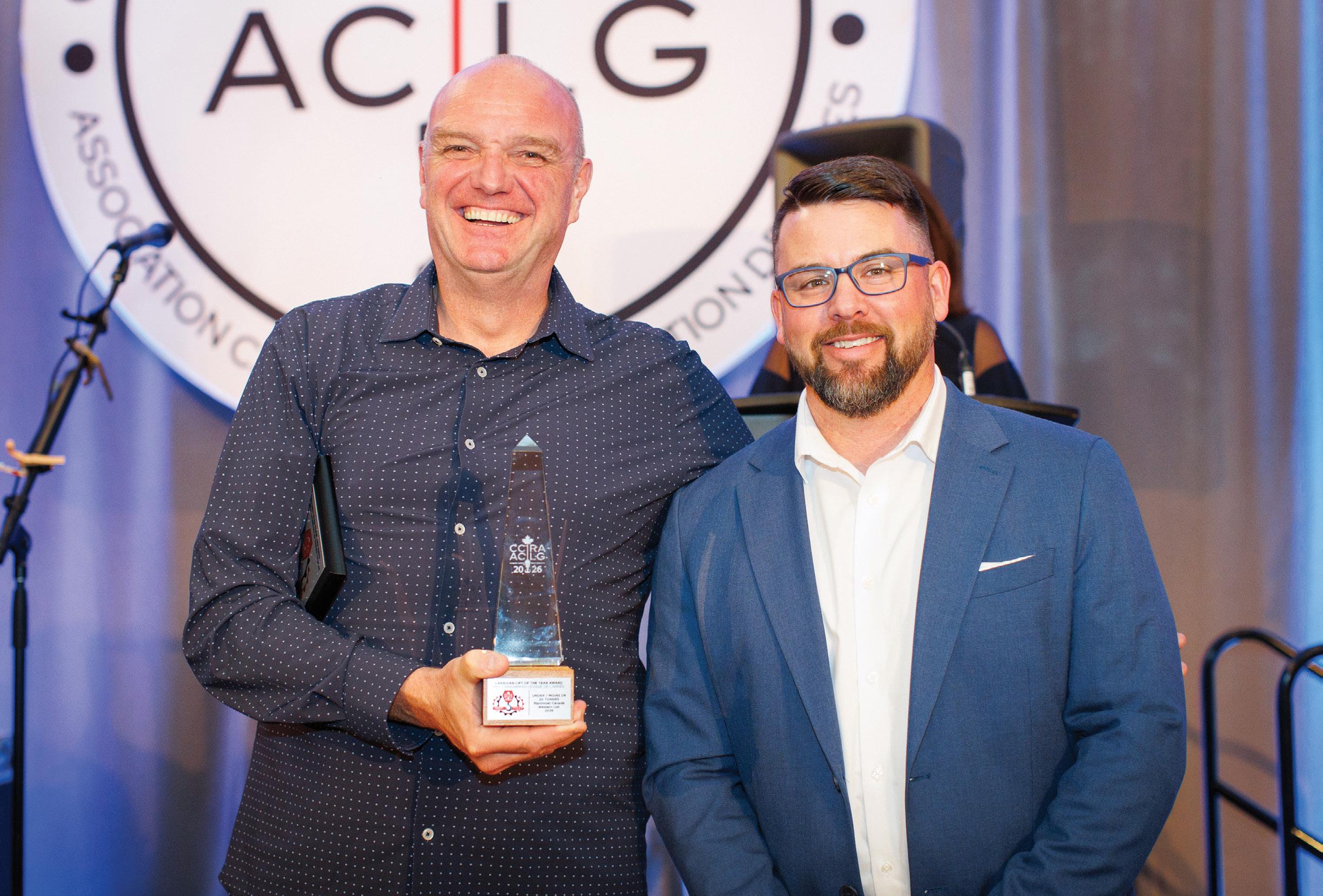
Canada’s most difficult lifts took centre stage at this year’s Canadian Crane Rental Association conference.
SCIENCE WORLD VANCOUVER
HVAC MODERNIZATION
Company and Overview
Winning Company: Mammoet Canada
Western
Project Name: Science World Vancouver
HVAC Modernization Project
Location: Vancouver, British Columbia
Timeline: March 2 to 14, 2025
Presenter: Gijs Verdeijen, Mammoet Canada Western Ltd. director
The company demonstrated innovation in creative problem-solving under extreme constraints for a crane lift project at Science World in Vancouver. The lift involved the removal of an old HVAC units and installation of new, more energy-efficient systems on the building’s roof. Due to site constraints, a modular approach was used where the new units were delivered and hoisted as preassembled modules.
Each year, the Canadian Crane Rental Association (CCRA) celebrates the complex and difficult work carried out across the industry with its Lift of the Year awards.
The awards recognize one Under 20 Tonne and one Over 20 Tonne lift. The contest takes place during the CCRA annual conference. Each enterant presented their lift to a panel of judges, who selected the winner for each category.
Here is a look at the winning lifts in both categories.
• Site Accessibility: The original crane access area was no longer available, having been converted into an outdoor exhibit.
• Aging Infrastructure: The site sits on an aging seawall deemed unsafe for heavy industrial equipment, requiring full geotechnical validation to create a viable crane location.
• Spatial Interferences: Overlapping constraints included an adjacent Sky-
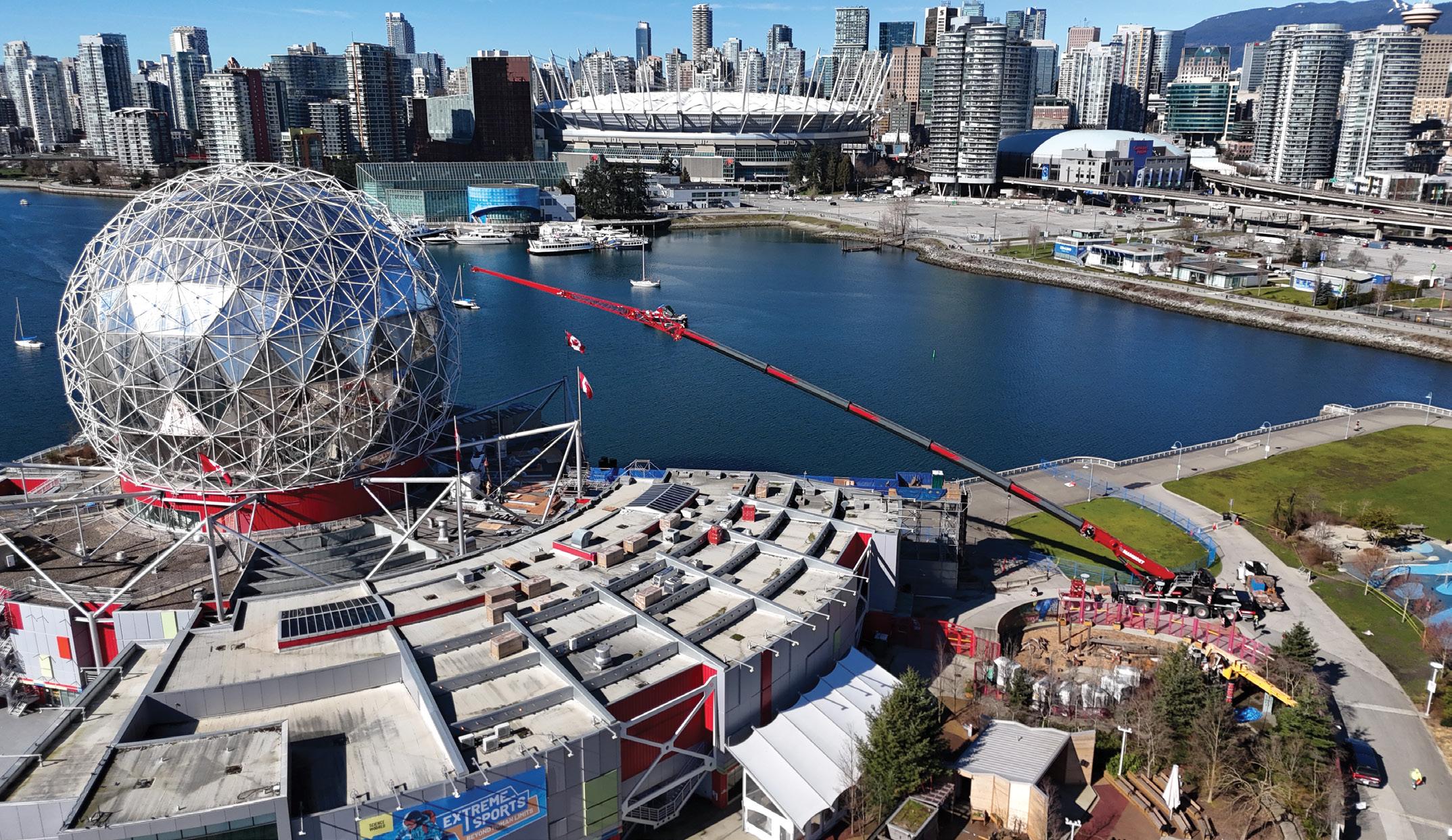
Train line, a playground, and the outdoor exhibit.
• Overhead Obstructions: Large tension cables, installed years after the original units, spanned directly over the installation plinths, blocking a direct vertical lift path.
• Public Environment: The team had to manage approximately 8,000 pedestrians and cyclists daily.
Rigging and Equipment
Specifications
• Primary Crane: LTM 1250
• Configuration and Setup: Operated at a
70m radius to reach designated landing zones
• Maximum Load Weight: 3.2 tonnes (including 0.7 tonnes of rigging gear)
• Maximum Radius: 70 metres
• Role Played: Principal Lifting Contractor, Lift Analysis, Lift Management, and Supply of Lifting Equipment
The Execution
• Dismantled existing HVAC units in-situ and removed them in smaller pieces to overcome access issues.
• Preassembled new units at the factory into two modular pieces and stored them
at the Mammoet yard.
• Performed 3D modeling and developed engineered lift plans to ensure safety in the constrained environment.
• Engaged a dedicated traffic management contractor to safely direct thousands of daily pedestrians around the work zone.
• Installed custom-reinforced “dancefloors” (engineered landing zones) on the roof to bypass overhead cable interference.
• Lifted new modules onto the roof landing zones using the LTM 1250 at a 70m reach.
• Transferred and rolled the units from the landing zones into their final positions on the plinths
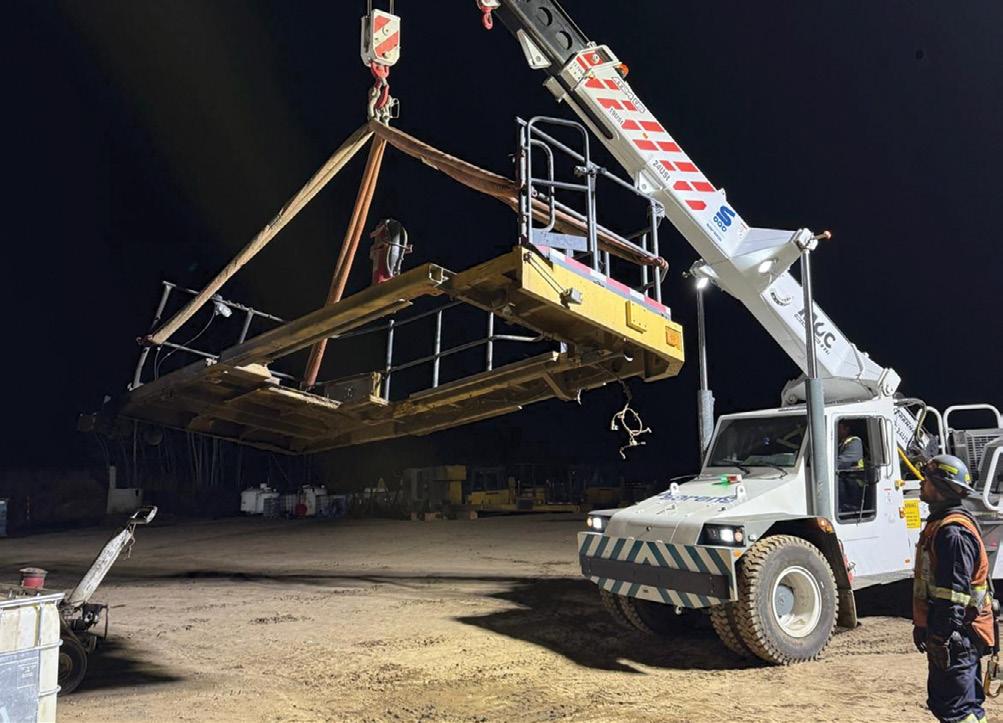
Sarens Canada used a Franna AT24US articulated pick-and-carry crane to disassemble and reassemble Komatsu 930 haul trucks.
PHOTO: SARENS CANADA
Sarens Canada engaged in the first Franna Pick & Carry application in the Canadian market. The company deployed a Franna AT24US articulated pick-and-carry crane to support the disassembly of multiple Komatsu 930 haul trucks in the oil sands and then reassembly at a Taseko copper mine in British Columbia. This approach eliminated the need for traditional outriggers and stabilizers, which reduced auxiliary equipment requirements and resulted in completion of the project seven days ahead of schedule.
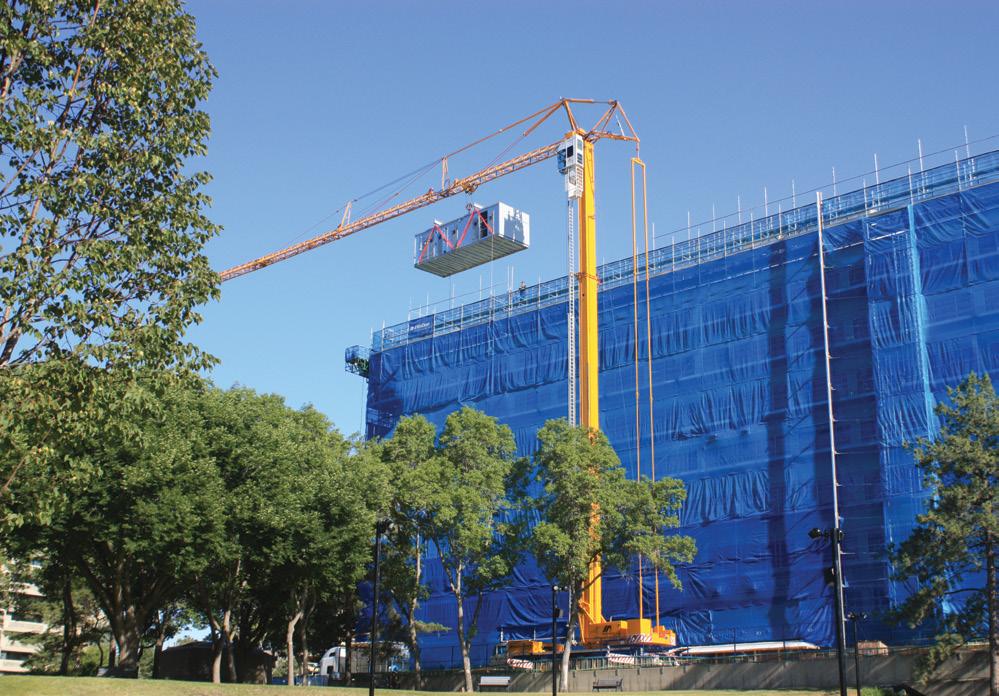
VanGenderen Canada Inc. lifted heavy air conditioning units on top of the Haultain Building in Edmonton, Alberta. PHOTO: VANGENDEREN CANADA INC.
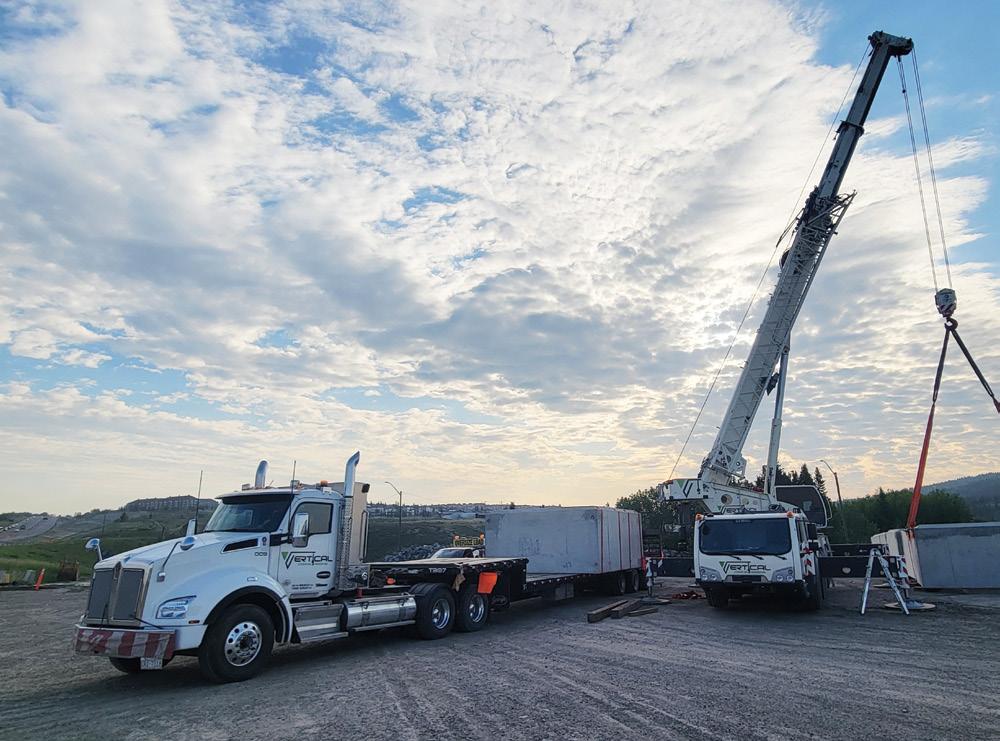
VanGenderen Canada Inc. used a Spierings SK1265-AT6 mobile folding tower to lift and replace heavy air conditioning units on top of the Haultain Building in Edmonton, Alberta. The project required the company to navigate extreme site constraints and live underground pedways. The operation used custom engineered lifting beams and strategic matting to clear the 32-metre structure with only three metres of vertical headroom.
SUNCOR COKE DRUM INTEGRITY PROJECT Company and Overview
Winning Company: Mammoet Canada Western Ltd.
Project Name: Suncor Coke Drum Integrity Project (U1CDIP)
Location: Fort McMurray, Alberta
Timeline: May 10 to June 4, 2025 (Final derrick lift executed June 2)
Presenter: Curtis Barnett, Regional Director North
An extremely complex heavy lift operation to dismantle and replace a 58-year-old coke drum structure at Suncor Energy’s Fort McMurray plant, emphasizing safety, efficiency and technical innovation.
This massive undertaking involved the piece-by-piece replacement of the entire existing Upgrader 1 structure to extend its operational life by 30 years.
The critical final lift was the installation of a brand-new, 1,276.2ton six-drum coker derrick supermodule.
• Extreme Scale: Required a hook height exceeding 125m and the largest crane ever deployed in Western Canada.
• Operational Continuity: To minimize shutdown impact, the crane had to be positioned far back from the structure, requiring a massive reach of 86.8m.
• Ground Conditions: The crane exerted a maximum load bearing pressure of 25 tons/m², necessitating a concrete ring foundation supported by over 200 piles.
• Global Logistics: Transporting the containerised crane involved moving 200 containers 20,000km from Asia, including transloading for inland transport.
• Rigging Complexity: The flexible supermodule required a highly technical 12-point rigging arrangement to remain level during the lift.
• Thread-the-Needle Clearance: Limited space required the rigging to be maneuvered over the structure from the side rather than lowered from above.
Rigging and Equipment Specifications
• Primary Crane: 3,200-ton PTC-210 DS Ring Crane
• Configuration and Setup: 94m main boom and 55m jib with a 3,200-ton Double Mast Head
• Maximum Load Weight: 1,696.5 tonnes (Total weight including rigging; the module itself was 1,276.2 tonnes)
• Maximum Radius: 86.8 meters
• Role Played: Principal Lifting Contractor, Lift Analysis, Lift Management, and Supply of Lifting Equipment
• Constructed a custom concrete ring foundation with 200+ piles to withstand the crane’s weight.
• Assembled the PTC-210DS crane outside the coke wall to allow plant operations to continue unimpeded before the shutdown.
• Preassembled derrick components into a massive six-drum supermodule at an on-site construction laydown.
• Validated the module’s weight and center of gravity using a 28-point unified jacking and weighing system.
• Conducted a test lift to perform equipment checks and validate the levelness and deflection of the structure.
• • Used 3D “Move3D” software to maneuver the complex rigging arrangement into place from the side to avoid overhead clashes.
• Employed 1,000-ton hydraulic Adjustable Rigging Links (ARLs) and 43kN remote-controlled steering winches to precisely control the load 125m in the air.
• Successfully placed the module, shortening the overall heavy lifting schedule by 14 days with zero incident.
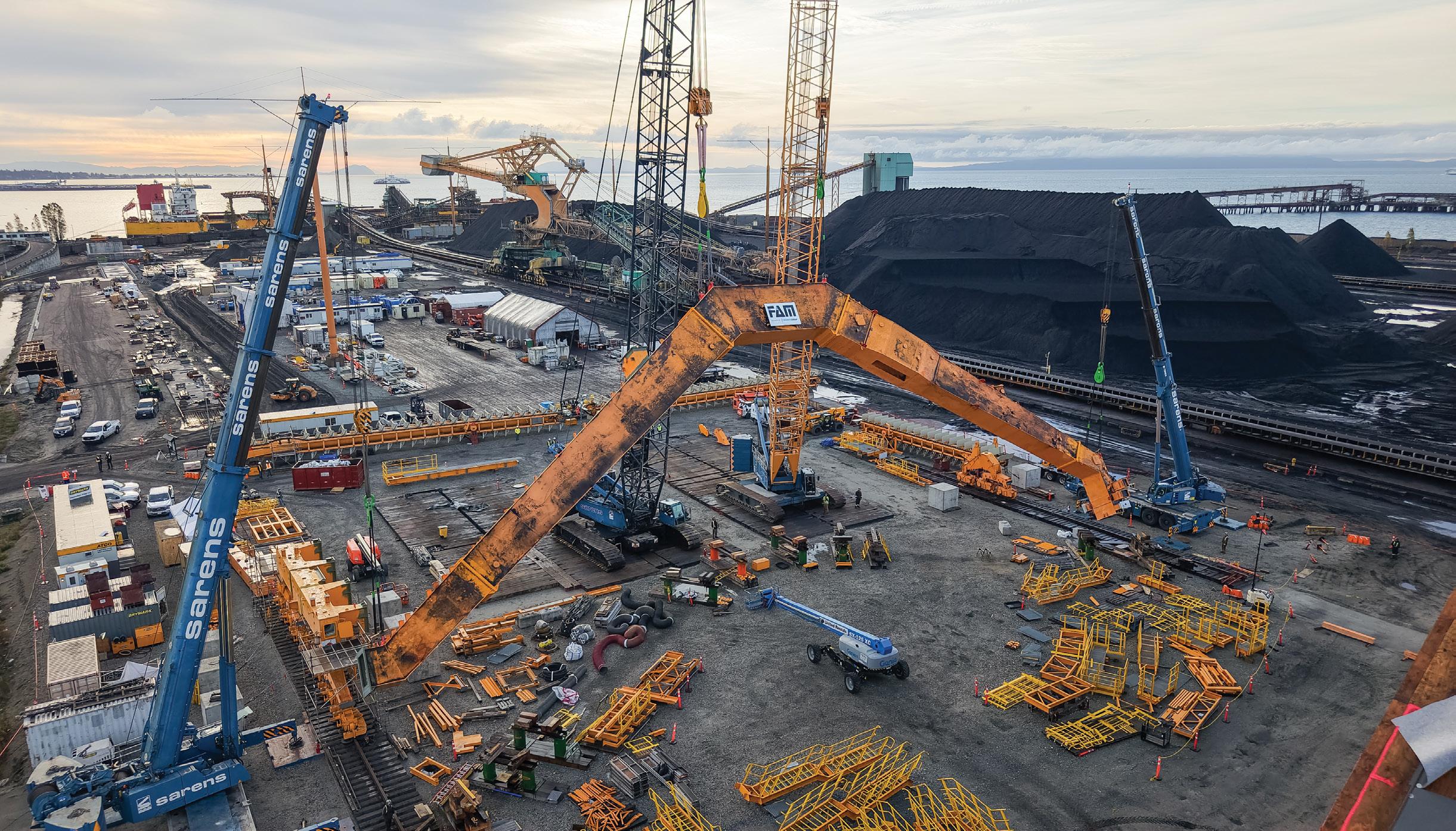
Sarens Canada performed a complex four-crane tandem lift at the West Shore terminals in Delta, BC., rotating an asymmetrical 203,000 kg (500,000 lb) walking portal 90 degrees using a fleet led by a Demag CC 2400 and Liebherr LTM 1300. The operation’s engineering included utilizing high-capacity rotating blocks to protect attachment points from lateral loads and a precise sequence where crawler cranes advanced on matting to maintain radius during critical rotation hold points.
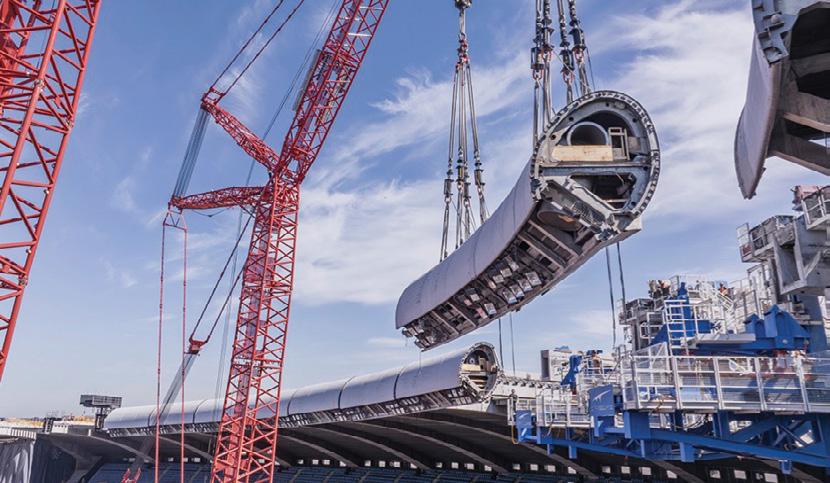
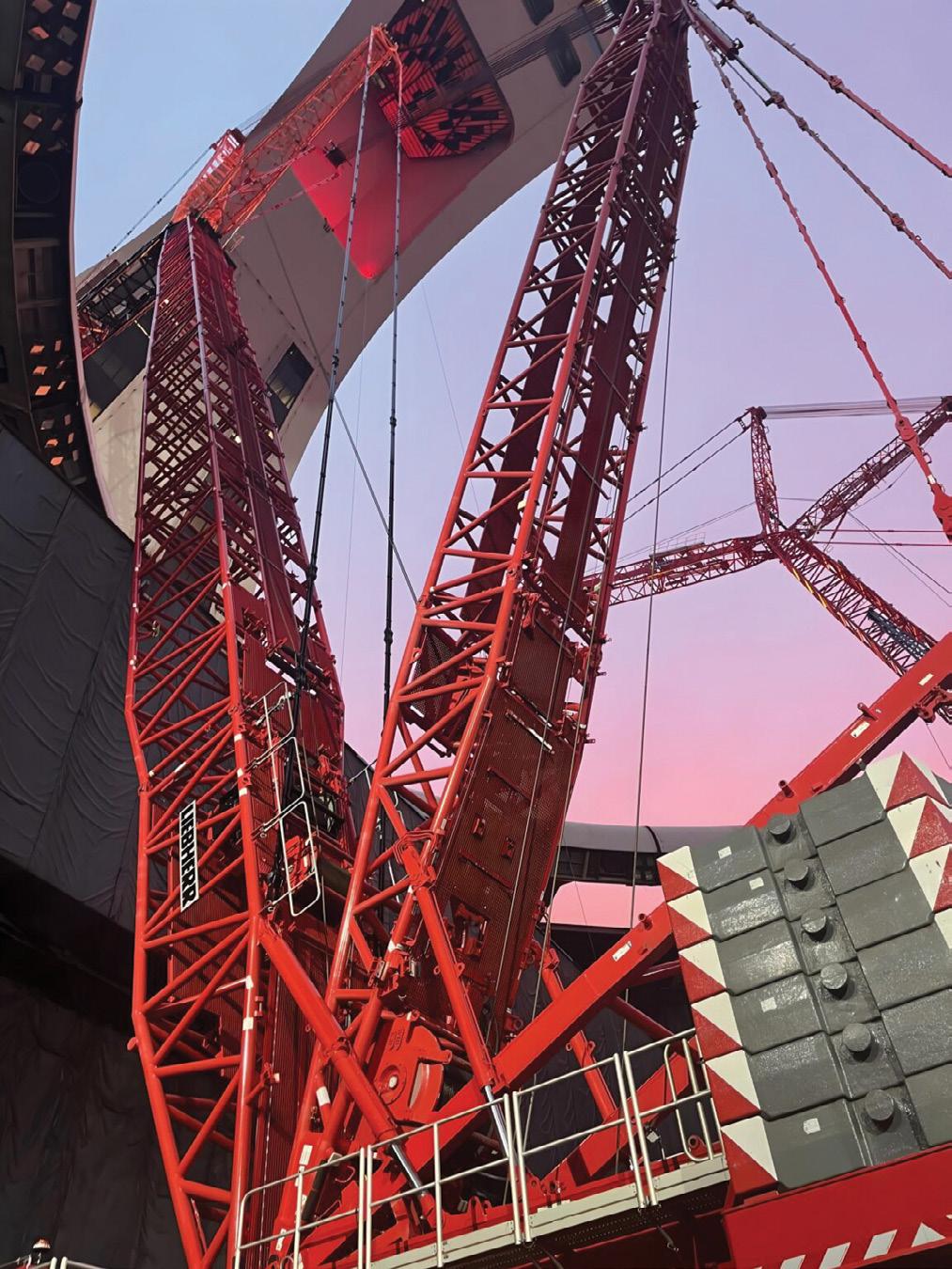
Guay Inc.’s high-precision tandem lift at the Montreal Olympic Stadium. The company deployed two LR 1700 crawler cranes to remove and travel with 247-metric-ton segments of the facility’s original technical ring. The project faced extreme site congestion and structural movement in the 50-year-old structure. To ensure a level, controlled descent of the unbalanced sections, the team used a real-time adaptive sequence and innovative rigging, which featured hydraulic equalizer cylinders and load-cell monitoring.

Most failures are because someone didn’t know, didn’t see or didn’t stop the lift
Thirty years of crane and rigging operations has taught me a lot, but one lesson standing above the rest is: when rigging fails, it almost always comes back to slings and ropes.
Not the crane. Not the operator.
It’s how slings and ropes were selected, protected, inspected, or ignored.
Working offshore, I witnessed an endless synthetic round sling fail hoisting an empty personnel lifting device. A crane lifted safety capsule used to move people between a ship and a platform called a “frog” was being repositioned. A common and routine lift for our experienced crew. The sling did not have adequate protection causing the sling to part suddenly and the frog dropped onto the deck of the vessel, breaking apart on impact. The incident frightened the crew, stopped ship to ship transfers, delayed crew changes and resulted in significant replacement costs.
No one was hurt, but only by luck.
That failure wasn’t mysterious, it was preventable. Proper sling protection would certainly have altered the outcome.
I’m often asked which type of sling is “the safest?” The question is impossible to answer as all slings have the potential to fail; we need to switch the mindset to think how and why they fail to best prevent incidents and injuries.
Industry research and incident investigations consistently show synthetic slings fail more frequently than wire rope or chain slings - largely because they are more vulnerable to cutting, abrasion, heat and chemical exposure. One major analysis of sling accident investigations found approximately 87 per cent involved synthetic slings, with edge contact and inadequate protection as dominant factors. In those cases, failures were attributed to abuse rather than manufacturing defects.
That doesn’t make synthetic slings bad equipment, it means they demand more knowledge and discipline.
Synthetic web and round slings are popular because they’re light, flexible and easy to handle, but when misused they can fail quickly.
Common causes of synthetic sling failure
include:
• Contact with sharp or abrasive edges.
• Inadequate or incorrect sling protection.
• Long term UV exposure.
• Heat or chemical damage.
• Knots or twisting.
• Missing or illegible identification tags, leading to inadvertent overloading.
American Society of Mechanical Engineers (ASME) B30.9 - Slings, is recognized as the standard in many jurisdictions. ASME standard requires synthetic slings be inspected before use and removed from service if they show cuts, exposed core fibres, heat damage, chemical attack or missing identification, etc.
In the field, surface damage is often dismissed as “it’s just the cover.” With round slings, that’s a dangerous assumption. If the core yarns are exposed, the sling’s strength can’t be verified, and it must be removed from service. Flat web slings don’t fail all at once — they fail fibre-by-fibre. Edge cuts, abrasion or damaged stitching reduce the number of load bearing fibres. Once that happens, the sling no longer meets its rated capacity and must be rejected.
Wire rope slings tend to fail more slowly, creating a false sense of security. Common failure modes for wire rope include:
• Broken wires from fatigue or overload.
• Crushing or bird caging.
• Severe abrasion.
• Corrosion, especially in marine or wet environments.
• Kinking from tight bends or chokers.
Wire ropes use the same ASME standard as synthetic slings including specific rejection criteria for wire rope slings such as broken wire limits, deformation and corrosion, etc. These limits aren’t suggestions, they’re legal requirements.
Often missed is inspection quality. Wire rope slings are sometimes used long after broken wires were clearly visible simply because no one knew the rejection thresholds or didn’t want to be the one to take the sling out of service.
Most sling failures aren’t caused by manufacturing defects, they’re caused by misuse.
Inconsistent training is a major contributor. Some riggers receive solid handson instruction. Others are handed a certificate and expected to figure it out in the field.
Good training teaches riggers:
• How to inspect slings properly, not just glance at them.
• Why sling protection matters and when it’s mandatory.
• How load shape affects sling stress.
• How sling angle affects sling tensions and adds potential for slings to slip.
• When damage is cosmetic and when it’s critical.
• When to stop a lift.
That knowledge prevents the kind of failure I witnessed offshore.
Based on incident data, safety investigations and manufacturer analysis:
• Synthetic slings fail most often, primarily due to cutting and abrasion from unprotected edges.
• Wire rope slings fail from fatigue, corrosion, and crushing, usually over time and with poor inspection practices.
• Chain slings fail least often, but when they do, it’s typically due to overloading, wear beyond limits, heat damage, or unauthorized repairs — again, almost always from abuse rather than defect.
The takeaway isn’t to avoid certain slings. It’s to understand their failure modes and respect them.
National and international standards like Canadian Standards Association and ASME provide clear direction for sling selection, inspection, rejection and use. The real issue isn’t a lack of guidance, it’s inconsistent understanding and application in the field. When roles, inspection responsibilities and removal from service decisions are clearly defined and reinforced through hands-on training, those standards translate into practice.
Real rigging safety depends on proper training, disciplined inspections and respect for sling limits and condition.
Trenton Grover is a field OHS advisor for BC Crane Safety.

BY DAVE MONTEITH
Most companies strive to build and maintain a strong and positive workplace culture; the place where their employees want to work.
However, as companies grow and evolve, it’s easy for culture to become lost or diluted. Thankfully, it is possible to rebuild this culture and ensure it’s resilient enough to grow with the company instead of being left by the wayside.
Bringing culture back into focus can be a challenge for a myriad of reasons, but a great starting place is also one of the easiest: leading by example. When a culture is slipping, employees often look to their leaders for direction and cues to acceptable behaviour. From owners and managers to foremen and senior staff, positive mindsets and a
Providing Solutions for all of North America ASSIST YOU WITH YOUR TRANSPORTATION NEEDS * Construction * Heavy Haul * Oversize * Aerospace sales@nelsontrailers.com www.nelsontrailers.com Phone: 419-523-5321
Providing Solutions for all of North America LET US ASSIST YOU WITH YOUR TRANSPORTATION NEEDS Crane * Rigging * Construction * Heavy Haul * Oversize * Aerospace sales@nelsontrailers.com www.nelsontrailers.com Phone: 419-523-5321
favorable opinion of the company and the work from your leaders will likely be adopted by other staff members. Conversely, when those in leadership positions project negativity, even the strongest cultures can be poisoned, making it critical for companies to have a finger on the pulse of the attitude of those in leadership roles to protect against the erosion of their culture.
Leading by example goes beyond mindset and into the ways in which those in leadership roles execute their duties. When leaders take shortcuts or fail to follow pre-set expectations, other staff will take notice, undermining the company’s efforts to implement norms to which all staff are expected to adhere to. This is particularly evident when it comes to safety, where the old childhood idiom of “monkey-see, monkey-do” demonstrates how staff who witness leaders failing to follow rules are more likely to do the same. In this way, the tone for safety within the company is set, regardless of the company’s efforts to create and foster a safety-oriented culture.
Providing Solutions for all of North America LET US ASSIST YOU WITH YOUR TRANSPORTATION NEEDS Crane * Rigging * Construction * Heavy Haul * Oversize * Aerospace sales@nelsontrailers.com www.nelsontrailers.com Phone: 419-523-5321
Beyond the way in which duties are performed, the tone of a culture is greatly impacted by what behaviours and actions are recognized and rewarded. Unsurprisingly, employees place significant value on recognition and tend to repeat rewarded behaviours or to emulate those of recognized peers. It’s important for leaders to be intentional with their recognition and rewards, promoting behaviours and actions that closely align with the norms that are integral to the company’s desired culture. While this seems straightforward, it can be challenging deciding what to reward and how to reward it.


It may seem straightforward to reward efforts that generate positive outcomes for the company — faster job completion, reduced expenses from sourcing lower-cost parts, etc. However, when these short-term gains stem from actions misaligned with company culture, the long-term impact can be damaging. Faster completion may be the result of a disregard for critical safety protocols, while cheaper parts may fail to meet the quality standards needed to preserve longterm equipment value. Although these benefits are easy to measure, rewarding
them would undermine a culture of safety and quality, as others adopt these behaviours as the norm. It is therefore critical that only actions that truly align with the company’s goals and values be rewarded for and used as an example to others.
Additionally, busy managers need to avoid the recency-bias trap which can accidentally incentivize inconsistent adherence to culture norms. If employees know, consciously or not, that managers tend to look at the most recent events when considering rewards, they may feel that their day-to-day efforts are unappreciated or worse, unworthy of their time. In this way, developing and maintaining an employee achievement matrix, however simple it may be, is important to ensure employees who consistently follow norms and promote a positive workplace culture are duly recognized, acting as an example for those around them.
While ensuring you’re recognizing the right behaviours might be tricky, choosing the type of reward that’s right for your organisation and your employees is decidedly more fun. Financial rewards are easy and universally well-liked but can be constrained by a company’s financial factors and tend to be more easily forgotten by the employee.
Clothing and other merchandise is also popular and doubles as a means of marketing the company, though employees may be less thrilled about this option due to it’s overuse as promos for clients and other business affiliates. Other options can include vacation packages, award trophies or plaques or a combination thereof. Additionally, a manager can hold group appreciation events such as holiday or other parties to celebrate a combined group or company achievement. Walking-the-walk, finding the right carrot and knowing when to use said carrot are all skills that are unique to every company. Just like day-to-day business practices have a way of becoming an experimental trial and error type of process, so is culture building.
David Monteith is the safety, HR, and fleet manager for Calgary-based McIntyre Crane & Rigging Ltd. An NCSO and graduate of the University of Alberta Occupational H&S Program. David specializes in safety program development and maintenance, training, and company culture management




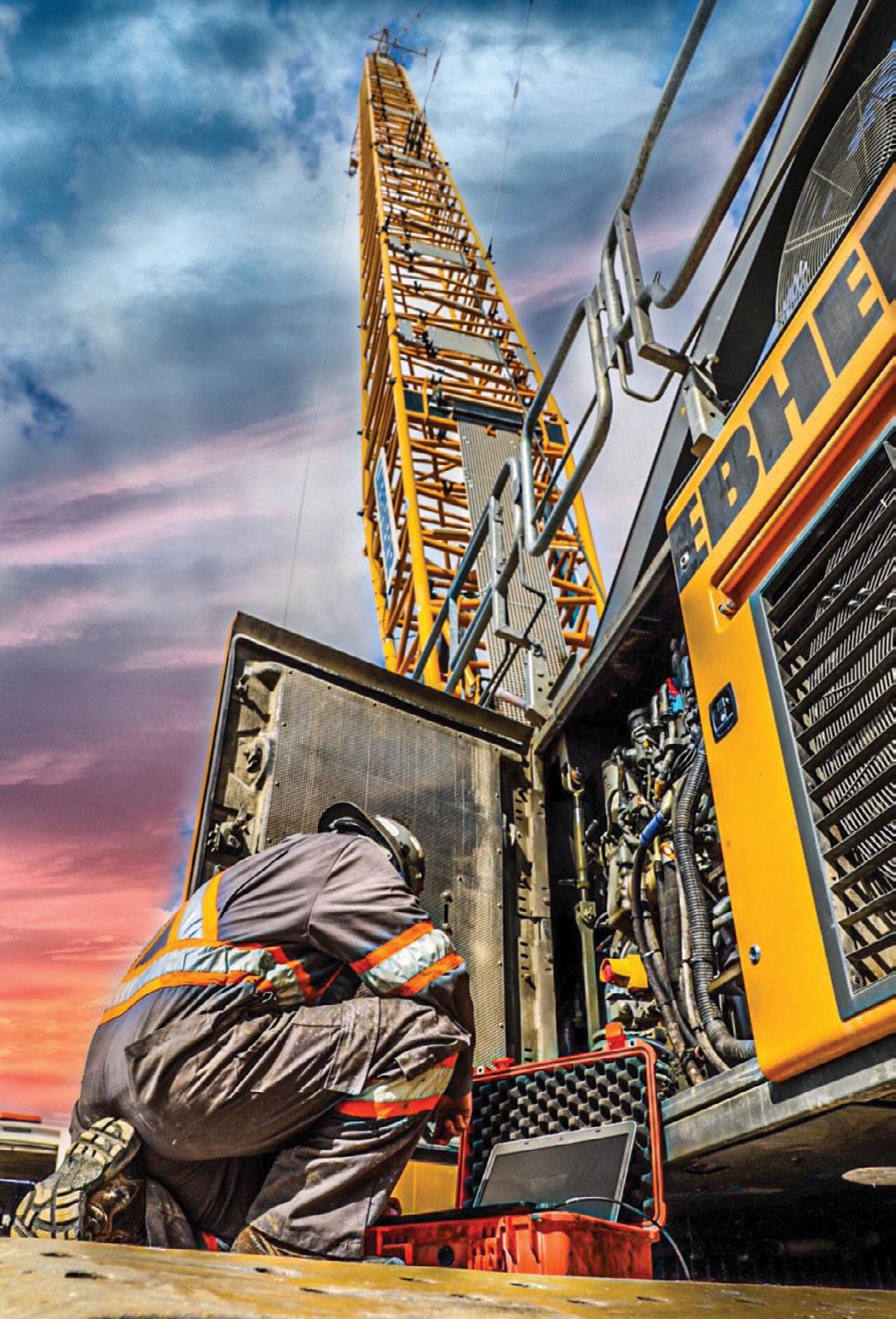
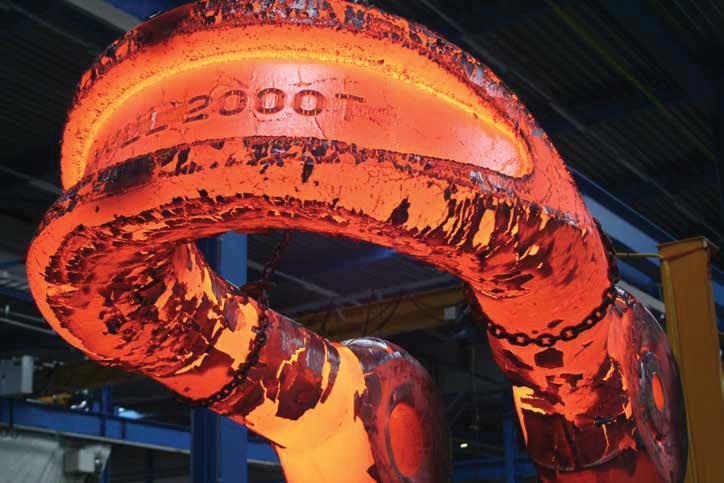


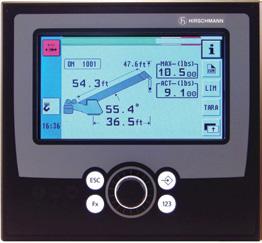
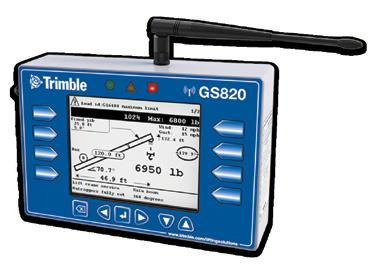
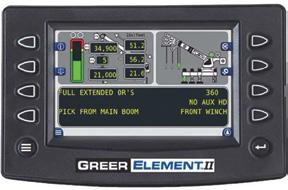



Most rigging incidents are not the result of complex engineering failures. More often, they stem from fundamental principles being misunderstood or misapplied.
The Canadian Crane Rental Association (CCRA) Conference in Halifax in June brought together crane owners, contractors, manufacturers, trainers and other stakeholders to discuss many of the challenges facing the lifting sector today.
While topics ranged from technology to workforce development, one theme consistently surfaced throughout conversations both on and off the conference floor: competency.
It is a topic that affects every aspect of a lifting operation. Competency influences how equipment is selected, how lifting plans are developed, how hazards are identified, and ultimately how safely a load is moved. Yet despite its importance, competency is often discussed in broad terms without clearly defining what it looks like in practice.
The discussion is particularly relevant at a time when the industry continues to face labour shortages, increasing project demands, and the ongoing need to attract and develop the next generation of skilled workers. As experienced personnel retire and new workers enter the workforce, ensuring that critical rigging knowledge is transferred, understood and applied becomes increasingly important.
This raises an important question: if the industry wants to reduce incidents and improve lifting safety, where should it focus its efforts? Looking at many of the publicized rigging-related incidents across Canada over the last several years, the pattern is
PHOTO: UNIROPE
Safe lifting is about building and maintaining competency so workers have the knowledge, skills and judgement to assess risks and respond as conditions change.
not that a highly complex engineering problem failed. Instead, most come back to a basic rigging principle that was missed or misunderstood. Reports of cut slings stands out along with inadequate training. In fact, it seems that what was missing in such cases was a basic understanding of basic principles. And this cannot be understated. This lack of training and knowledge has resulted in Canadian workers paying the ultimate price, their lives.
The lessons from these situations should be enough to place training firmly at the forefront of the industry’s safety agenda. However, simply providing more training is not enough. We must also challenge how training is delivered, assessed and reinforced to ensure that critical knowledge is retained and successfully transferred to the job site. In other words, we need to move from, “I took a course,” to, “I can
prove I know what I am doing.”
Too often, training is treated as a compliance exercise, measured by attendance and the issuance of a certificate rather than by an individual’s ability to perform the work safely and effectively. The focus should instead be on competency-based training, where participants are required to demonstrate not only what they know, but how they apply that knowledge in real-world situations. Competency is not proven by completing a course. It is proven by the ability to make informed decisions, recognize hazards and apply fundamental rigging principles every time a load is lifted. The next question is how the industry creates and measures that competency consistently. Every lifting operation is different, and no standard, regulation, or training program can antici-
pate every challenge a rigger may encounter in the field. Nor should it try to. The objective is not to standardize every lift.
What the industry can standardize, however, is the minimum level of knowledge, skill, and judgment required to make sound rigging decisions regardless of the application. Every competent rigger should understand load weight, center of gravity, sling angles, inspection requirements, edge protection, hardware limitations, and when a lift has moved beyond their level of expertise.
Establish clear expectations and fundamental principles
In an industry where labor mobility is common and qualified riggers and operators remain in high demand, training providers, crane programs and employer-led competency systems all have an important role to play. By establishing clear expectations and reinforcing fundamental principles, they help ensure that knowledge and skills are developed consistently across the workforce. Ultimately, safe lifting is not about creating more rules; it is about building and maintaining competency. When workers possess the knowledge, practical skills, and judgement needed to assess risk and respond to changing conditions, they are better equipped to make safe decisions during every lift.
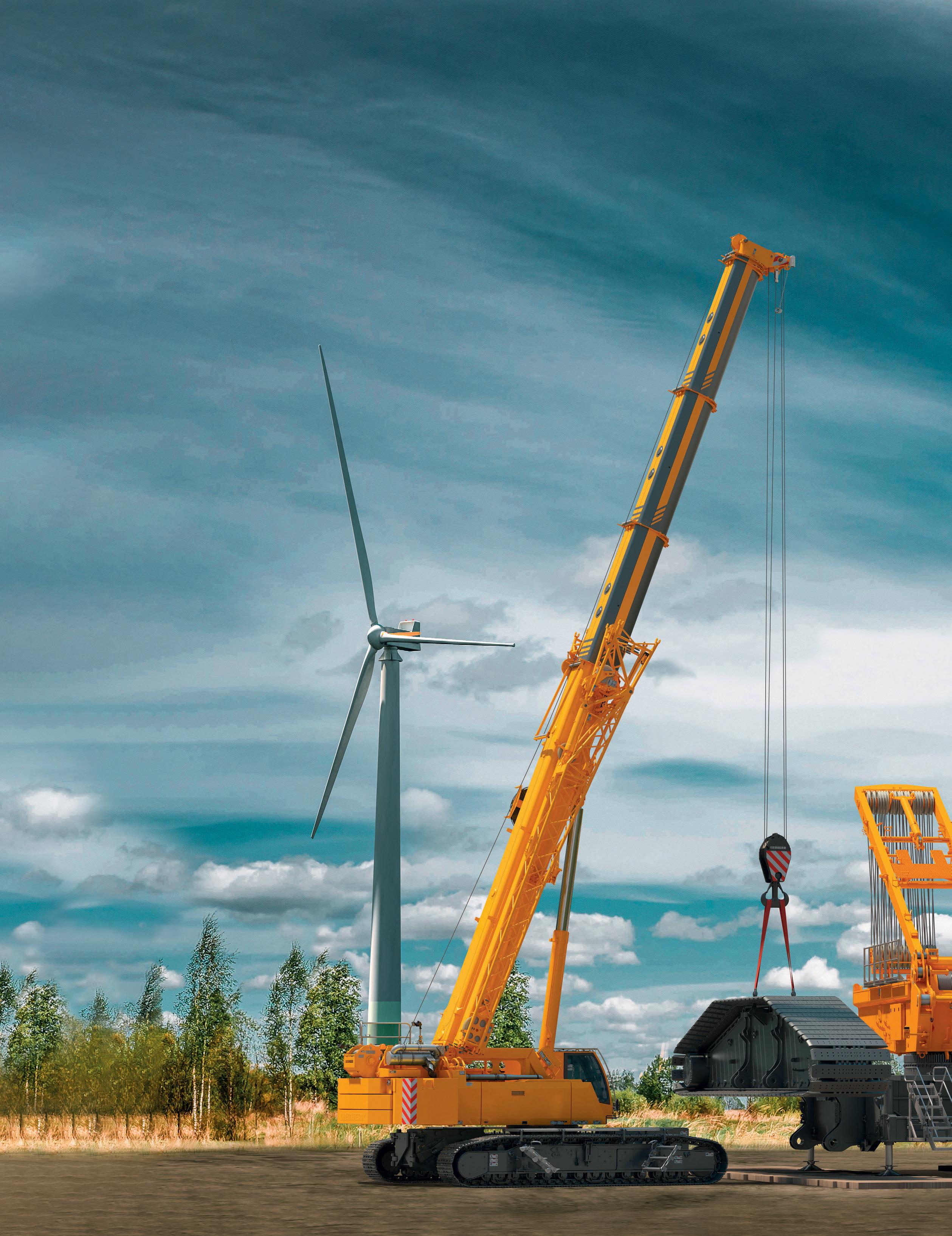
The most economical transport concept in its class! No other telescopic crawler crane in this lifting capacity class can be transported in full with its crawler carriers on one low loader. All the counterweight can be ballasted on the crane with just four hoists. And for the first time: the well-trusted VarioBase® lifting capacity calculation now on a crawler crane, for three fixed track widths. www.liebherr.com
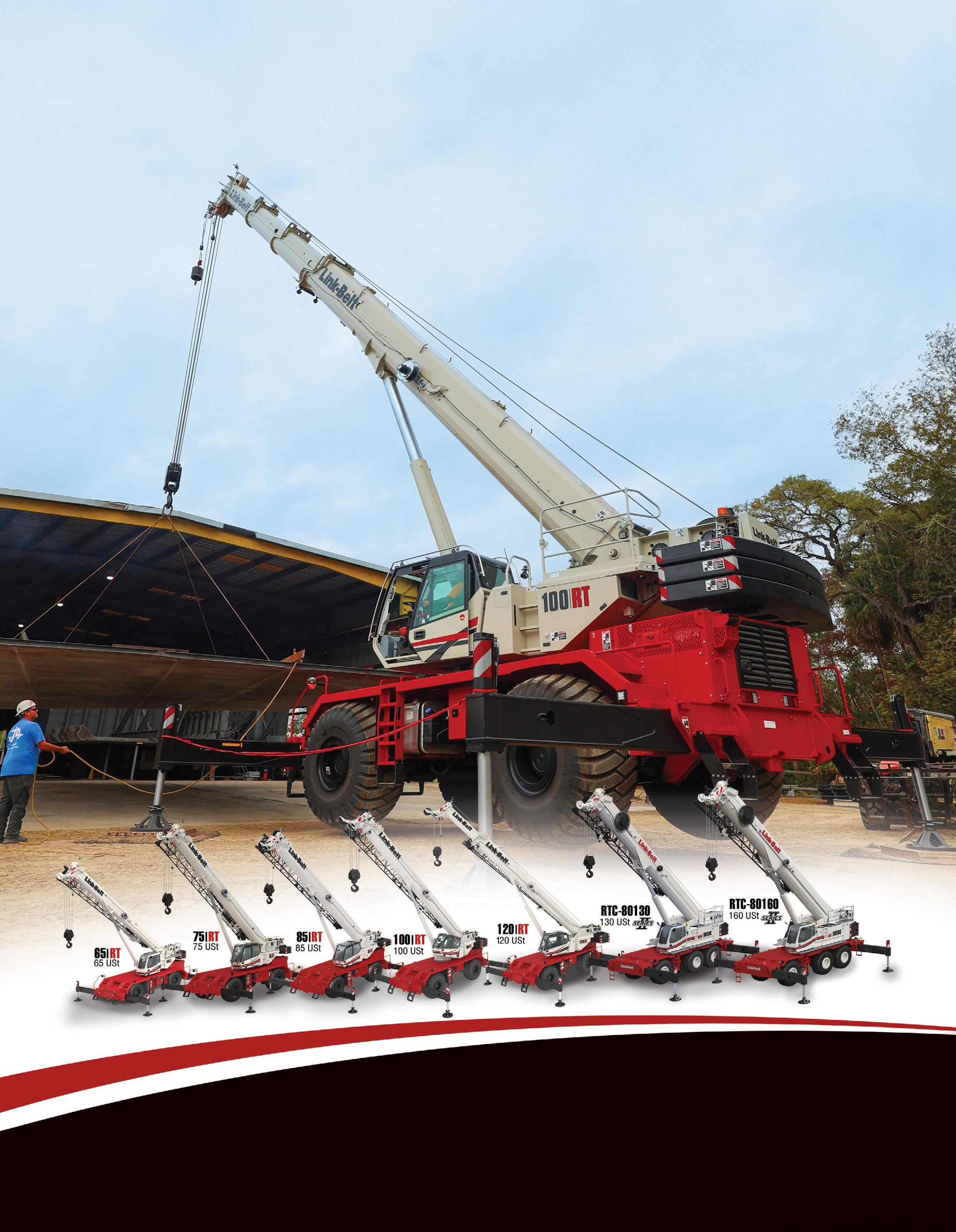
100-Ton| 90 mt Rough Terrain Crane
✓ 40.6' - 155' |12.3 - 47.2 m five section full-power boom
✓ Boom length and capacity outreaches/outlifts the competition
✓ Simple operation – 2 boom extend modes
✓ Link-Belt PULSE 2.0 – total crane operating system with V-CALC and telematics
✓ Unmatched serviceabilitygreaseless boom, remote-mounted filters, onboard diagnostics