“The HewSaw team has been extremely helpful, accommodating and supportive throughout the install, start-up and into steady state operations. The Hampton FSJFP team has been extremely pleased with HewSaw’s ability to adapt and meet our company and project goals, key metrics and manufacturing philosophies.”
Ian Gray Regional Manager, Hampton Affiliates -
Pembroke
MDF plant helping Ottawa Valley mills thrive
Click here to see the sawline in action!
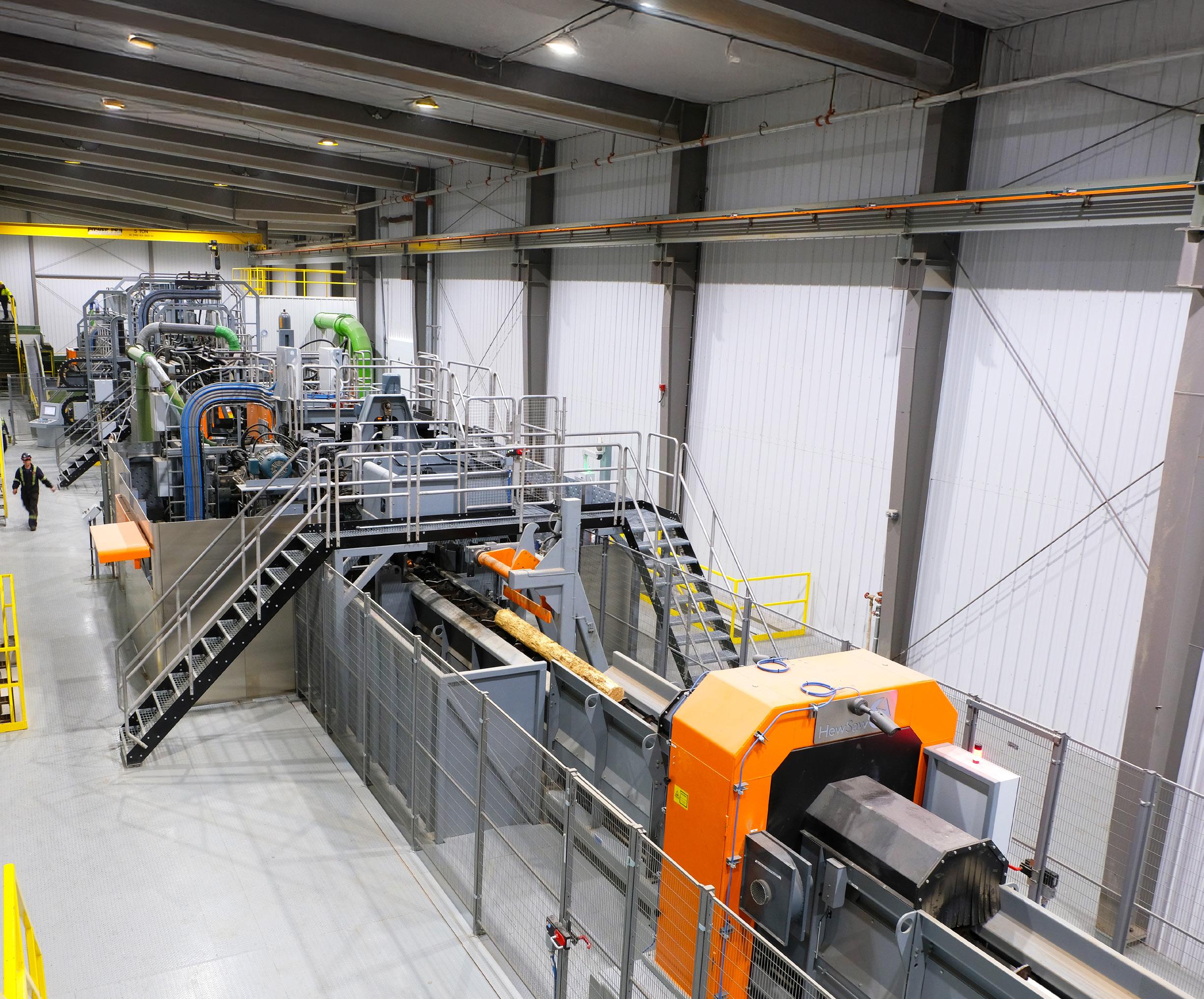
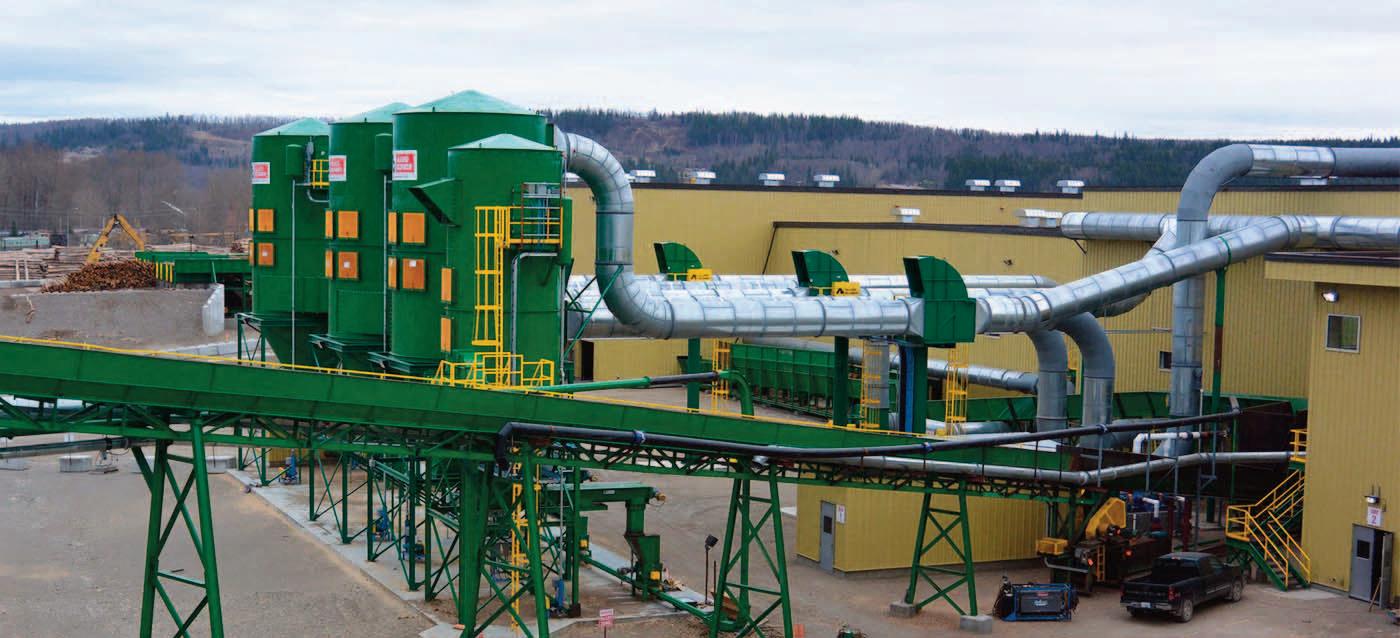
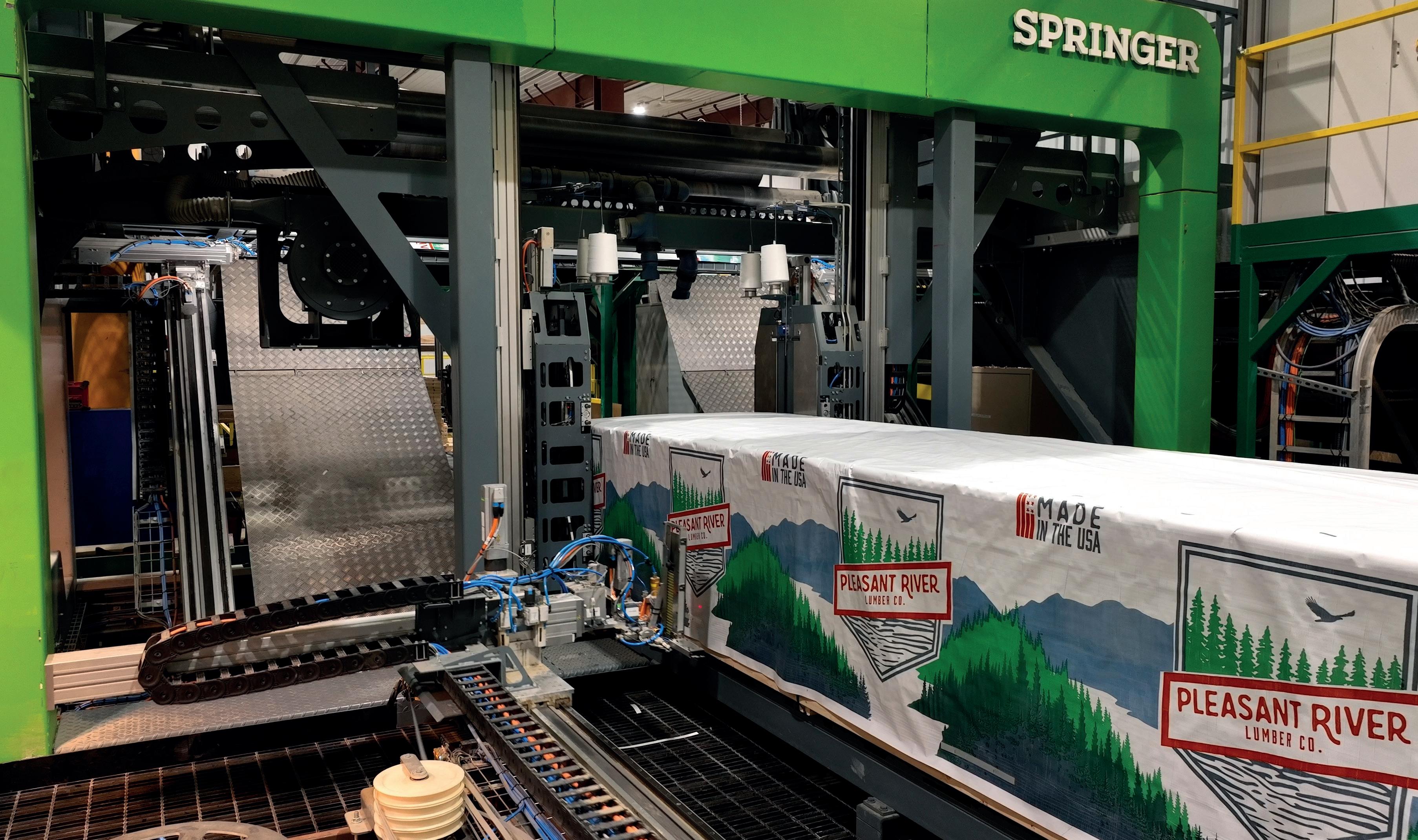
With their HewSaw SL200 3.3 stud line in Fort St. James, British Columbia, Hampton Lumber has transformed their older multi-line mill into an efficient and modern one line facility.
• High feed speed and high LRF
• Edged sideboards produced in-line - no downstream edging required
• Low operating costs with reduced staffing
• Fast and easy saw and knife changes
• Optimized log gap control Flexibility in saw patterns, including asymmetrical patterns for the highest LRF
Powering Pembroke
Roseburg Forest Products’ MDF plant in Pemrboke, Ontario is helping Ottawa Valley sawmills thrive.
A biomass boost
FESBC focused on biomass recovery with new funding.
Steep slope maintenance
Keeping steep slope equipment in tip-top shape.
Consistent results
Achieving consistency in the filing room.
Diverse offerings
LiỈwat Forestry Ventures continues to search for growth despite challenging times.
Smooth and safe
Maintaining dust and explosion mitigation equipment.
successful show
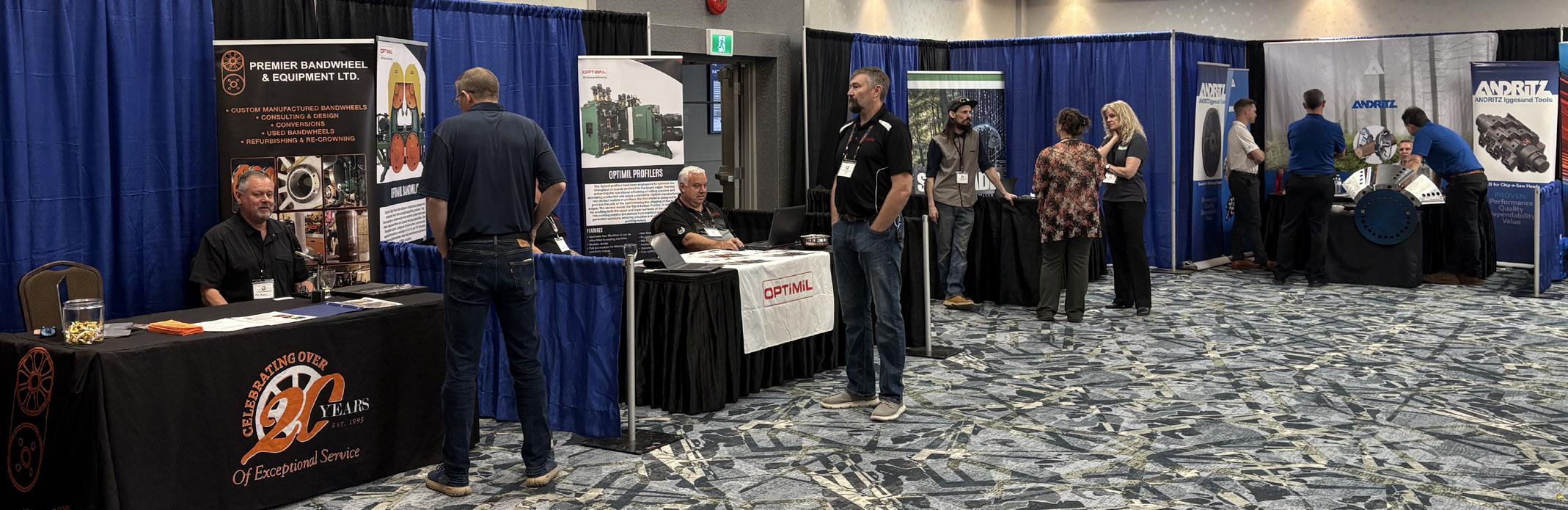
The BCSFA moves to one-day format for annual show in Kamloops, B.C.
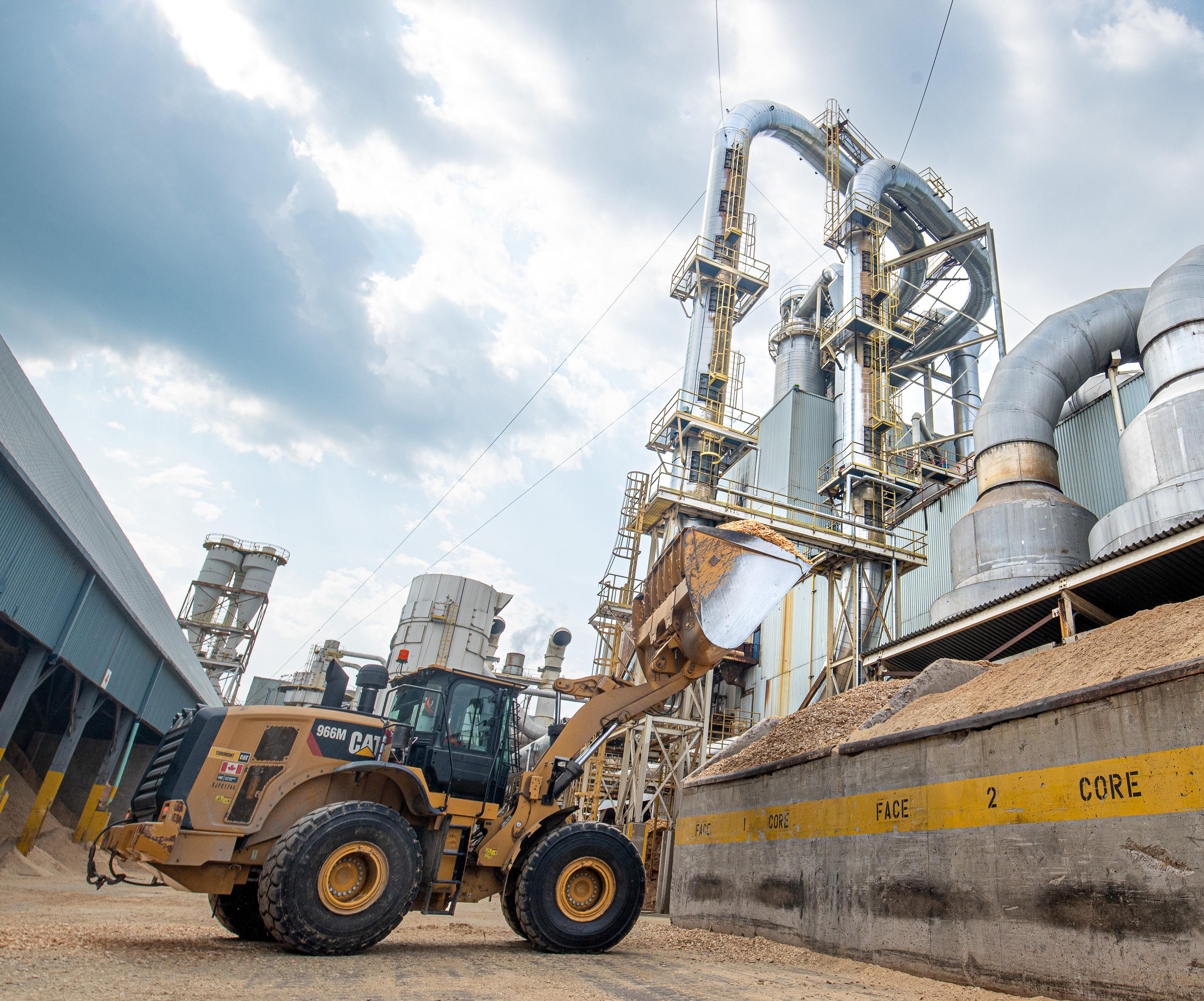
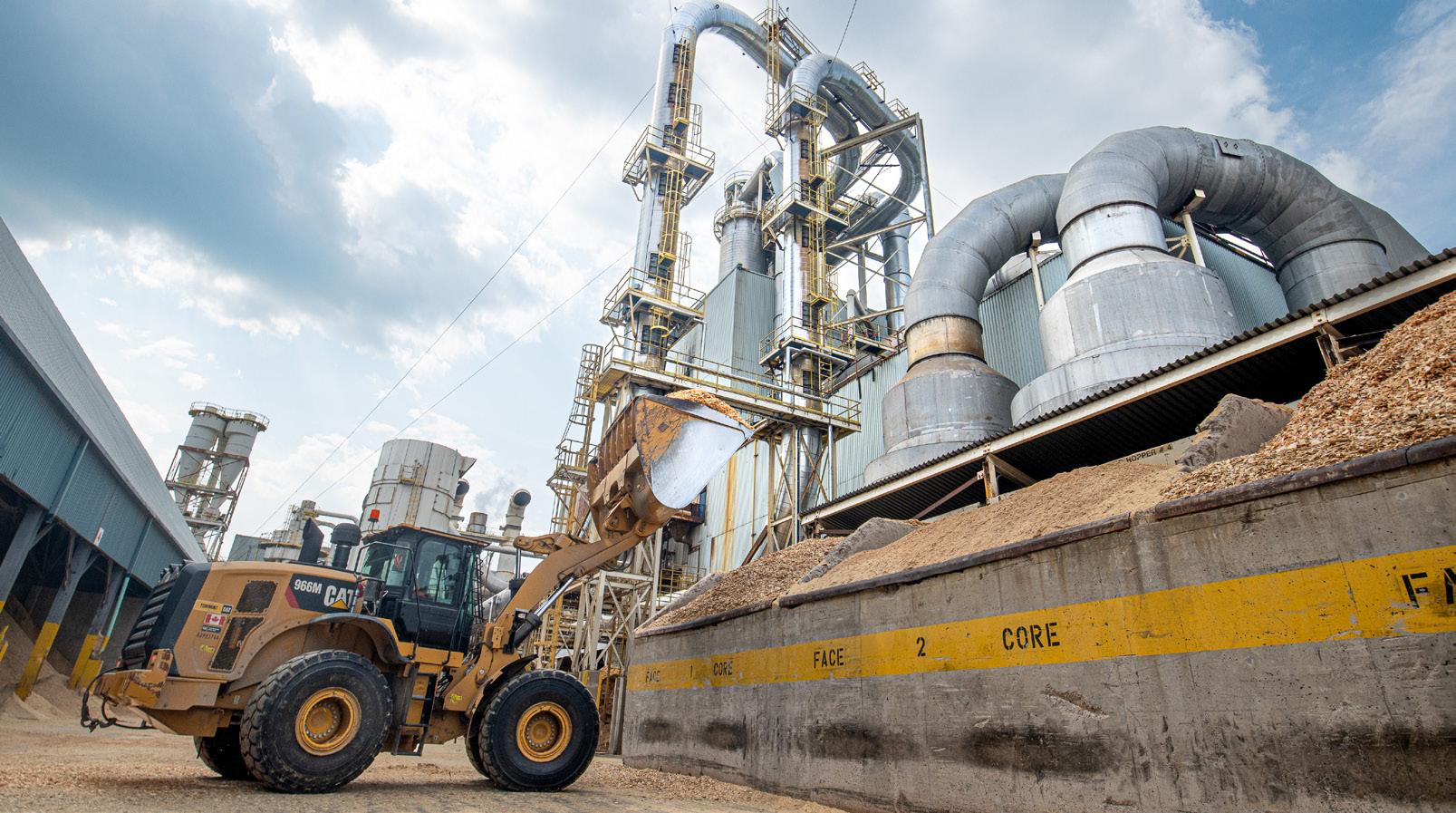
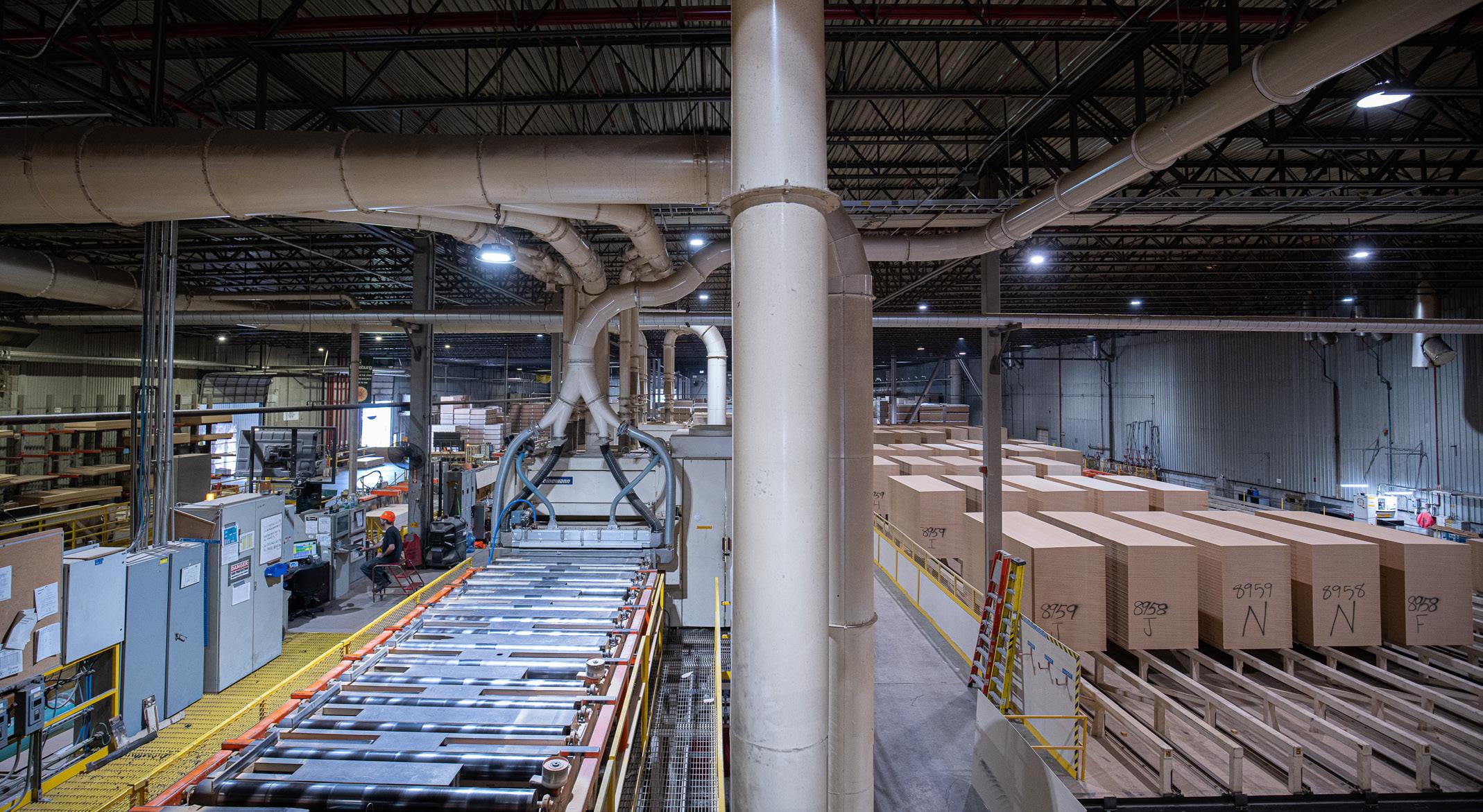
Roseburg Forest Products’ MDF plant is creating a home for sawmills’ residuals throughout the Ottawa Valley. For the full story, turn to page 20. Photo: Roseburg Forest Products.
first cut
Resounding support
Task Force’s final report hits all the key pain points
If you’ve lived in Canada for any significant duration of time, you know that the provincial, territorial and federal governments don’t always get along. With a wide array of needs affecting every province and territory in this amazing country, it’s not surprising that leaders in every region have different ideas on how to improve the lives of their citizens.
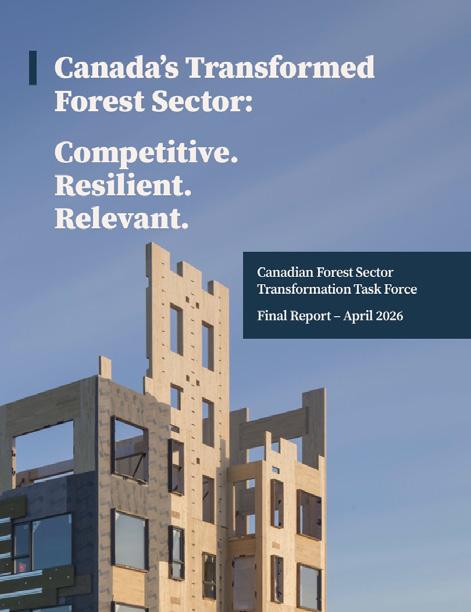
In the forest products sector, some needs can vary by province, such as the loosening of legislation, while others are nearly universal – like access to fibre. So, when the federal government makes announcements about supports for the forest products, not all industry representatives are necessarily satisfied. However, the recent announcement by Minister of Energy and Natural Resources Tim Hodgson on June 2, discussing new funding and the release of the final report from the Forest Sector Transformation Task Force, Canada’s Transformed Forest Sector: Competitive. Resilient. Relevant, was met with great support by national and provincial associations.
Derek Nighbor, president and CEO of the Forest Products Association of Canada (FPAC), stated that the task force’s report offers a “thoughtful playbook” and that the federal government has offered “the most robust federal government response we’ve seen in years to the core issues holding our industry back.”
The Alberta Forest Products Association (AFPA) stated that the report provides “a roadmap for action to improve access to fibre, increase domestic demand for wood products, expand market opportunities, and strengthen the long-term competitiveness of Canada’s forest industry.”
BC Council of Forest Industries (COFI) president and CEO Kim Haakstad stated that COFI was pleased that the federal government was recognizing “the serious pressures facing forestry workers, communities, and businesses.”
The Ontario Forest Industries Association (OFIA) called the task force’s report “an important first step toward a coordinated, forward-looking strategy for Canada’s forest sector.”
And why wouldn’t the sector approve of the recommendations within the report? They range from working on ways to create long-term access to cost-competitive fibre to increasing domestic consumption of wood products; aiding the aging workforce; improving trade infrastructure; and more.
It comes as little surprise that the final report identified so many of the sector’s areas of weakness and opportunities for growth. After all, it was put together by a wide range of people representing various aspects of the sector including wood products manufacturers, logging contractors, home builders, finance experts, organized labour and Indigenous representatives.
The Forest Sector Transformation Task Force was comprised of co-chairs Ken Kalesnikoff (Principal and director, Kalesnikoff) and Frédéric Verreault (executive vice-president, Chantiers Chibougamau); Brad Carr (CEO, Mattamy Homes Canada); Don Roberts (CEO, Nawitka Capital Advisors Ltd.); Jim Irving (Co-CEO, J.D. Irving Ltd., Kent Homes); Lana Payne (Unifor national president; Lennard Joe (CEO, BC First Nations Forestry Council); and Luc Thériault (Wood Products CEO and president, Domtar Canada).
These leaders all understand key aspects of what it will take for the forest products sector to overcome one of its most challenging times in history. Kudos to the Task Force members for volunteering their time to share their insights and put together this report to help the sector move forward. I have no doubt that it will help navigate the bumpy ride this sector is currently on, and will continue to be part of, for some years to come.
Check out the full report at: https://natural-resources.canada.ca/forests-forestry/forest-industry-trade/canadian-forest-sector-transformation-task-force
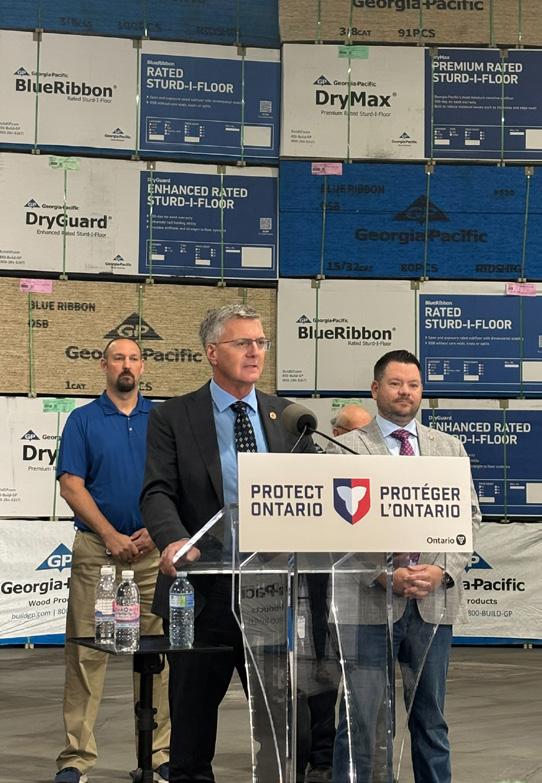
Ontario investing $10 million in Georgia-Pacific North Woods
Ontario’s Ministry of Forestry and Forest Products has announced that it will invest $10 million in the Georgia-Pacific North Woods facility in Englehart, Ont. to support a $191-million upgrade of the oriented strand board (OSB) plant. The province stated that the investment will protect 220 forestry workers as well as hundreds of indirect jobs. The $191-million plant mod-
ernization includes upgrades to log processing operations; construction of new facilities; and expansion of on-site storage and modern equipment. The Ministry of Forestry and Forest Products stated that the improvements will increase production at the plant by 14 per cent; and that Georgia-Pacific will also purchase a thermal energy system to use wood by-products for heat and power.
Canadian Forest Sector Task Force report priority recommendations:
• Stabilize long-term access to cost-competitive fibre
• Catalyze transformation and modernization at scale
• Increase domestic demand by building more – and with wood
• Stabilize the workforce and support communities
• Defend market access and strengthen trade infrastructure
• Rebuild a national forest culture
QWEB names new director of Softwood Group
The Quebec Wood Export Bureau (QWEB) has appointed Samuel Gendron as the new director of the Softwood Group. Gendron will succeed Sven Gustavsson, who announced his retirement earlier this year.
Gendron recently contributed to assessing export market requirements and their impact on sawmill performance indicators, with a focus on industrial process optimization, production cost reduction and value creation through product diversification.
Driven by a strong interest in improving the competitiveness of wood manufacturing companies, Gendron is particularly focused on strategies that help businesses better respond to market needs while supporting profitability and long-term growth.
Prior to joining QWEB, Gendron held the position of wood processing researcher at FPInnovations. He played key role in developing digital tools aimed at optimizing
sawmilling and wood drying operations.
Forest Sector Transformation Task force final report and millions in funding supports announced
Hundreds of millions of dollars in funding supports for Canada’s forest products sector were announced by Minister of Energy and Natural Resources Tim Hodgson on Vancouver Island on June 3, along with the release of the final report from the Forest Sector Transformation Task Force.
Minister Hodgson announced that effective immediately, the Business Development Bank of Canada’s BDC Softwood Lumber Loan Program will increase the maximum loan size from $30 million to $50 million and will be enhancing the terms for letters of credit offered under the program. The BDC will also be offering two new programs that offer loans upwards of $25 million to forest products sector companies.
Hodgson announced that the federal government will also add $300 million in regional trade response initiatives to “help ensure that small- and medium-sized businesses have access to the financing they need to invest in market diversification and enhance productivity,” adding that the federal government has created a new $100-million Regional Development Fund designed to offer dedicated funding to community mobilization and economic diversification in regions significantly impacted by
Canfor acquires I-joist facility in Calgary
The Canfor Corporation recently announced that it will purchase PinkWood Ltd.’s I-joist business for $68 million, including working capital. The Calgary-based PinkWood facility is the largest I-joist manufacturing plant in Western Canada. It produces engineered wood joists for residential, multi-family, and commercial construction. PinkWood has 120 employees and a production capacity of 46 million linear feet. PinkWood will retain its name and operate as a wholly owned subsidiary of Canfor.
“Canfor’s acquisition of PinkWood complements our operations in Western Canada by enhancing product diversification and supporting the continued expansion of our value-added manufacturing capabilities,” stated Susan Yurkovich, president and CEO of Canfor.
disruptions in the forest sector.
He also noted that the federal government is investing almost $130 million into 56 forest sector projects across the country through the Natural Resources Canada forest sector transformation programs.
The announcement also included the release of the long-awaited final report, Canada’s Transformed Forest Sector: Competitive. Resilient. Relevant, comprised by the Canadian Forest Sector Transformation Task Force, which began its work in January 2026.
In the report, the task force has requested a federally led, 25-year national forest sector strategy to run from 2026 to 2050 that would be accountable to the Minister of Energy and Natural Resources. The stated strategic objective would be “to restore long-term competitiveness, crowd-in private capital, stabilize employment and communities, and modernize Canada’s forest-based industrial ecosystem to drive transformation.”
To download the Canadian Forest Sector Transformation Task Force’s report, visit: https:// natural-resources.canada.ca/forests-forestry/ forest-industry-trade/canadian-forest-sectortransformation-task-force.
Forests Canada recently surveyed and interviewed forest managers and tree planting practitioners and published the findings in a report titled, Forest Restoration After Wildfire: Knowledge Gaps and Future Needs Analysis. The report is designed to help better understand decisions and approaches for post-wildfire forest restoration in Canada.
Authored by Forests Canada partnerships manager Amber Brant, Natural Resources Canada senior research scientist Dr. Nelson Thiffault, and consultant Dr. Season Snyder, the report highlights the collected inputs of 80 survey respondents and another eight experts interviewed for their insights.
The report is available to read at: ForestsCanada.ca/PostFireReport.
Reader Service Print and digital subscription inquires or changes, please contact Angelita Potal, Customer Service Tel: 416-510-5113
Email: apotal@annexbusinessmedia.com
Mail: 111 Gordon Baker Rd., Suite 400, Toronto, ON M2H 3R1
EDITOR - Andrew Snook (416) 510-6801 asnook@annexbusinessmedia.com
GROUP PUBLISHER - Anne Beswick (416)410-5248 • Mobile: (416) 277-8428 abeswick@annexbusinessmedia.com
AUDIENCE DEVELOPMENT MANAGER Barb Adelt (416) 510-5184 badelt@annexbusinessmedia.com
NATIONAL SALES MANAGER Justin Hertzman Ph: (514) 262-9803 JHertzman@annexbusinessmedia.com
WESTERN SALES
Tim Shaddick 1660 West 75th Ave Vancouver, B.C. V6P 6G2 Ph: (604) 264-1158
COO - Scott Jamieson sjamieson@annexbusinessmedia.com
PUBLICATION
A biomass boost
FESBC focused on improving recovery of biomass with new funding
BY ANDREW SNOOK
Part of the major funding announcement made by Minister of Energy and Natural Resources Tim Hodgson on June 3 to support the forest products sector included $37 million in funding for the Forest Enhancement Society of BC (FESBC). With tens of millions in new project funding at their fingertips, the FESBC is excited to assist with funding innovative solutions for improving the management of B.C.’s forests with a focus on fibre.
“The funding is aimed towards innovation and improvement of utilization of fibre,” says Jason Fisher, executive director of the FESBC. “Historically we’ve had two streams that we’ve been focusing on as an organization: one on wildfire risk reduction, and one on fibre recovery and utiliza-
tion, and so, this money is earmarked for those fibre recovery and utilization type projects.”
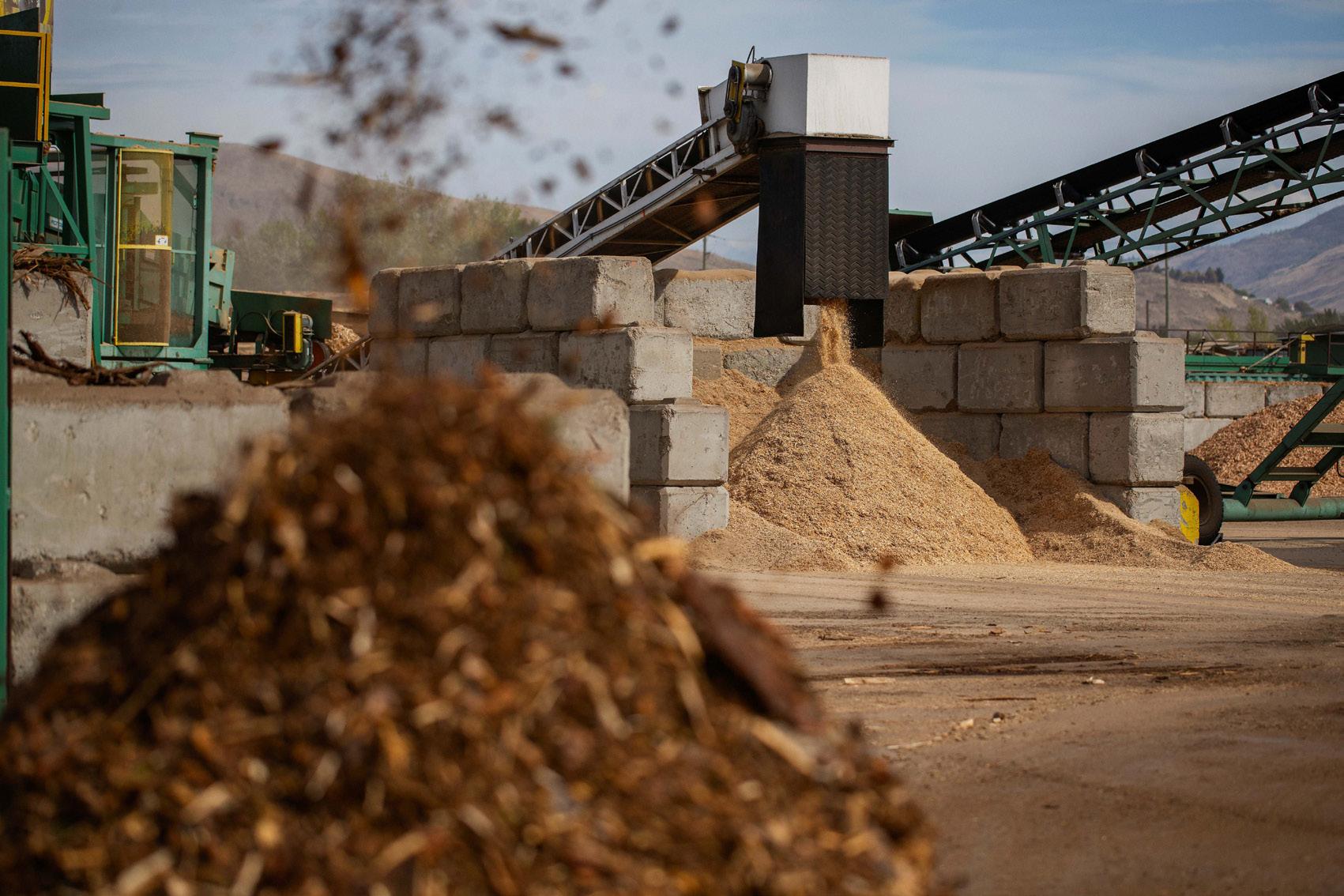
Anytime forest management projects are being performed, woody biomass is generated through management and harvesting. The projects that the FEBSC is funding are designed to support more productive and sustainable uses for that biomass. Some of that biomass has traditionally been disposed of through controlled burning to avoid it being left as a wildfire hazard.
“We’re reducing the greenhouse gas emissions that come from open burning of slash piles. We’re supporting contractors who have already made the investment in moving that material to roadside, in many cases, or piling it,” Fisher explains.
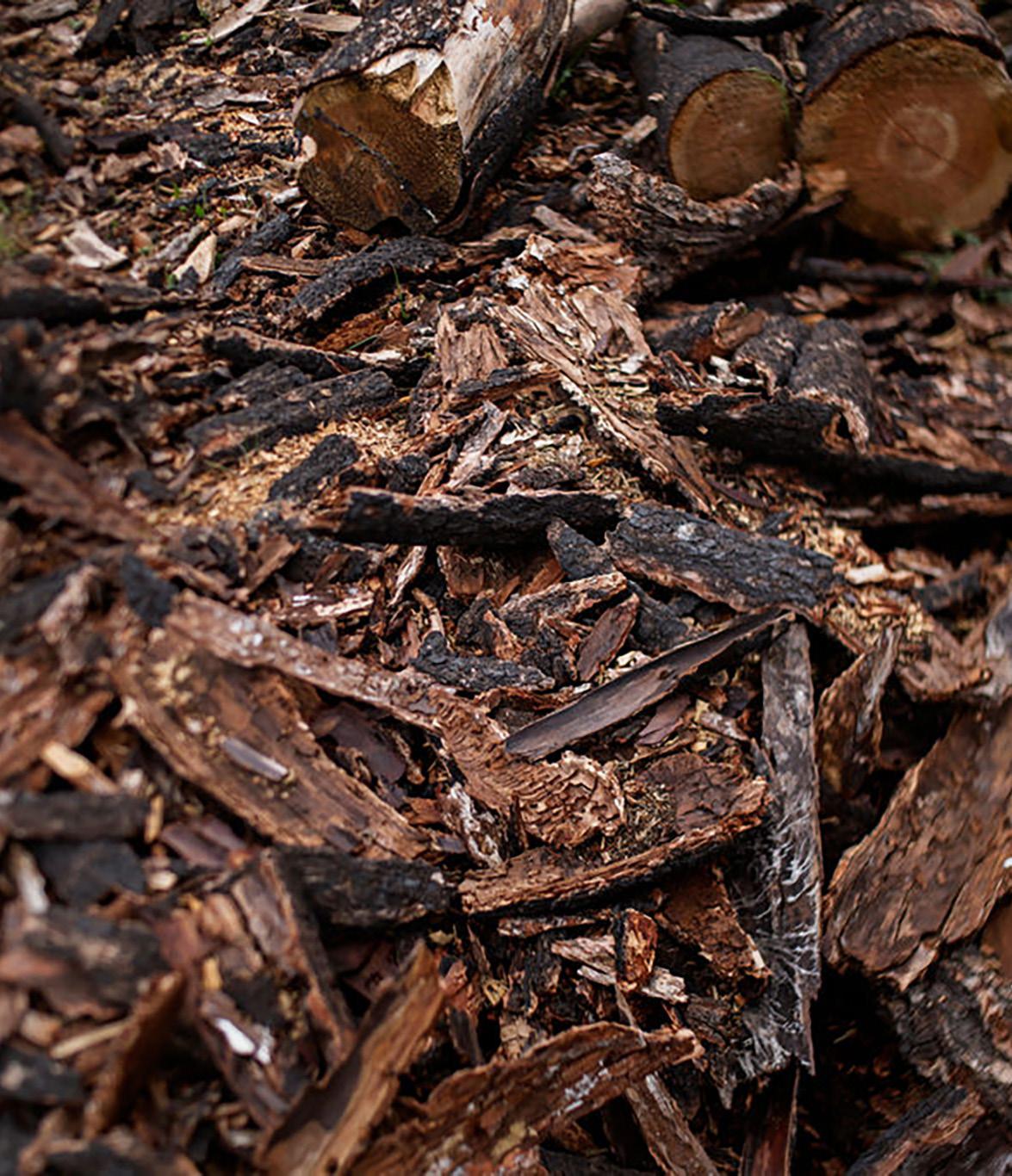
At a project site in Logan Lake, burned wood is being piled, chipped, and transported to bioenergy facilities.
The FESBC is still actively doing intakes and evaluating submissions, so none of the projects that will receive part of the $37 million in funding have been announced to date.
“I really appreciate the projects that are about not so much what we’re taking off the landscape, but what we’re leaving behind on the landscape,” Fisher says. “Are we leaving behind a more fire-resilient ecosystem? Are we leaving behind an area that if a fire does start, it’s easier to operate on for the wildfire fighters who would come in and action that fire? Does it improve habitat for wildlife? Does it improve the way that water is retained on the site? There’s a lot of different factors that you can look at.”
The additional funding support from the FESBC has the potential to be incredibly beneficial for local contractors where the projects take place. Much of the wood being harvested through forest management is fire-killed, has too many defects, is too small, or is otherwise too damaged to be accepted by a sawmill.
“That doesn’t make them any less expensive to process and transport for use in pulp and paper or bioenergy,” Fisher says. “One of the hallmarks of the program has always been that we support recovering that material that could provide economic value but is too far away from the processing centre to move without help. Can we change the transportation costs just enough to get that material moved in, instead of it being piled and burned?”
With the sawmill closures and curtailments that have taken place in recent years, local contractors have been under additional pressure to find work for their crews and finance operations. These contractors are a vital part of the solution for reducing wildfire risks in communities.
“We believe that the local forest managers, the local contractors, actually have the relationships in the communities and have the relationship with the forest to be able to propose work and carry out work that is going to benefit the communities that they live in,” Fisher says. “To me, that’s the special sauce in what we do – empowering those local contractors, consultants, land managers to do what they know is right for the landscape but maybe is not otherwise economically available to them without our support.”
The $37 million in funding marks the first time the FESBC has received support from the federal government.
“I am very grateful and humbled by this opportunity. We have a real chance to show what we’re capable of achieving, what our proponents are capable of achieving,” Fisher says. “I really hope that this is the start of something, as opposed to a one-time announcement. But that’s on us and our proponents to perform to make that a reality. Things are tough in the forest sector in a lot of places; there’s a lot of help that’s needed. We’re just a part of that solution, but we’re going to do the best we can.”
THE ADDITIONAL FUNDING SUPPORT FROM THE FESBC HAS THE POTENTIAL TO BE INCREDIBLY BENEFICIAL FOR LOCAL CONTRACTORS WHERE THE PROJECTS TAKE PLACE.
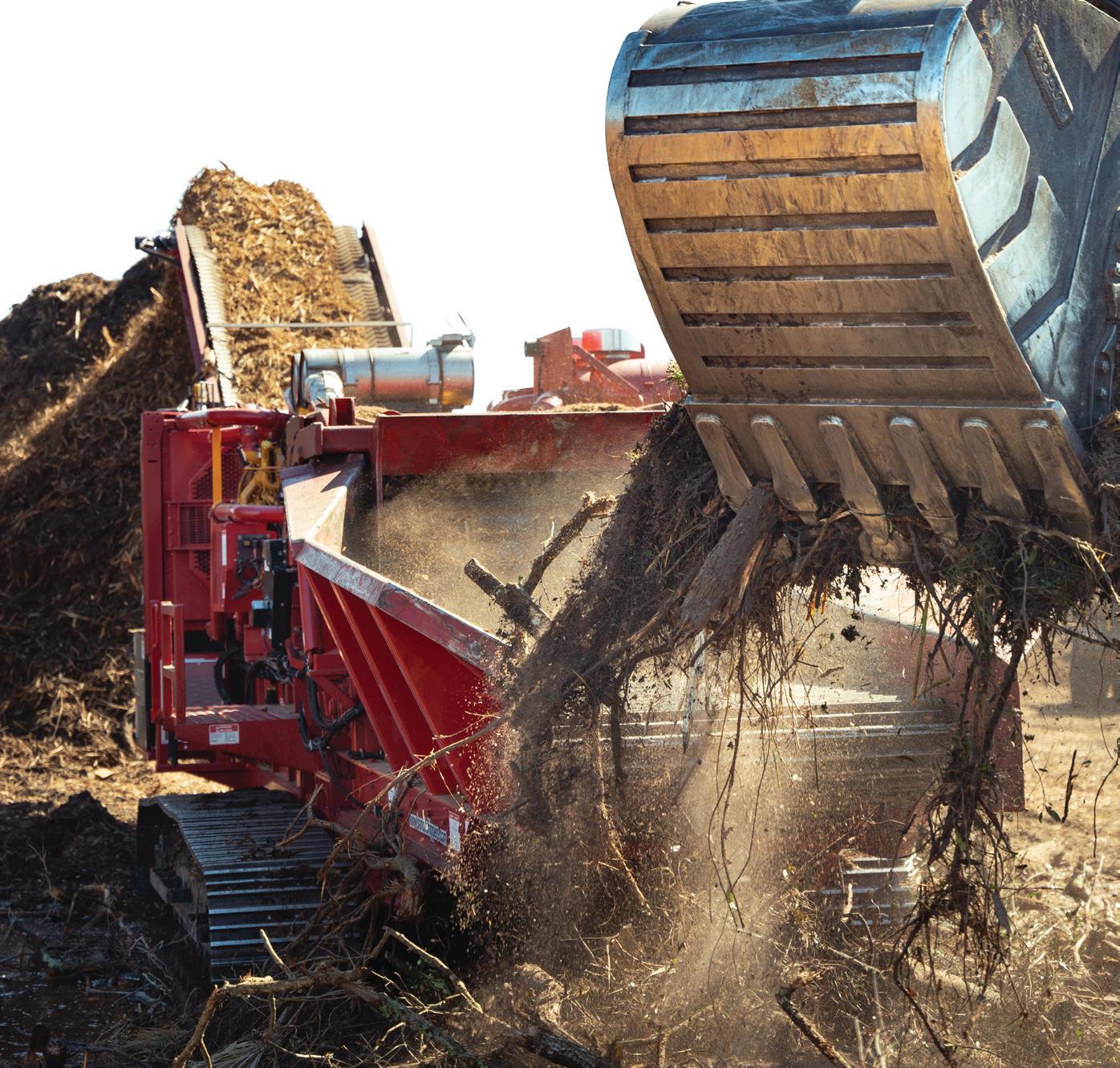
A grinder on site at River City Fibre in Kamloops, B.C. takes low-value wood fibre and grinds it to make it suitable for various biomass uses. Photos: FESBC.
DIVERSE OFFERINGS
Lílwat Forestry Ventures continues to look for growth despite challenging times
BY ANDREW SNOOK
When Lilwat Forestry Ventures (LFV) started up, the company was an economic arm of the Lilwat Nation that provided harvesting services for the Nation’s forest licenses, as well as some minor silviculture work for BC Hydro. Since that time, the Mount Currie, B.C.-based company has expanded to offer a wide variety of services including forestry management, wildland firefighting and fuels management, silviculture, arborist work, excavation services, and more.
“We were able to create profits through our harvesting and reinvest that into our contracting division, using it to buy equipment, pickups, and invest in training as well,” recalls Klay Tindall, general manager for LFV, who has been leading the company since 2012.
As an important division of the Lilwat Business Group (LBG), the LFV offers much-needed employment to about 25 to 30 people over the winter months with a goal of 55 staff in the peak of summer.
“We see opportunities to grow even larger,” Tindall says.
If anyone would know the potential for the business it’s Tindall, who has worked in the forestry sector for nearly 30 years. While he sees opportunity to grow the business, Tindall acknowledges that there are challenging roads ahead.
“Obtaining contracts with First Nations forest licenses can be challenging, especially the smaller size of the licenses,” he explains. “We have licenses now that are fairly small – 35,000 cubic metres – while a forest company we’re competing against might have 350,000 cubic metres.”
“FIRST NATION LICENSES RUN A LOT LIKE COMMUNITY FOREST LICENSES, WHERE THERE IS A FOCUS ON MULTIPLE COMMUNITY VALUES.”
Fortunately, mill closures have not im pacted LFV’s operations as hard as some other regions of B.C. to date.
“We sell our wood through a log bro ker system, so they’re able to access mills that are currently open,” Tindall explains, adding that more active mills would obviously help his company fetch a better price for its logs.
LFV’s annual harvest can range 50,000 to 75,000 cubic metres, depending on the year, although they have room to grow if the sector is able to rebound.
“Our AAC (allowable annual cut) is just over 100,000 cubic metres. We hav en’t hit that yet,” Tindall says.
PUBLIC PERCEPTION
In addition to trying to keep operations cost efficient on a smaller scale than some competitors, LFV is battling some of the same public perception challenges that many companies in the sector face from communities where they operate.
“First Nation licenses run a lot like community forest licenses, where there is a focus on multiple community values. Having that has been really important for First Nation tenure,” Tindall says.
He says changing public perception
and getting the Nation on board with what they’re doing is key to growing their forest sector business. Building trust needs to include keeping people in the same roles for longer periods of time so the community becomes familiar with them and knows who to approach whenever they have questions or concerns.
“Being located in the area where the work is being done; continually trying to provide information to the community through social media; and annually through open houses; those have really
helped to let people know what we’re doing,” Tindall says.
The company also organizes regular field trips with the community so people can see the work being done. This is beneficial not only so people can see their sustainable practices but also for the recruitment of young workers.
“The majority of our staff are from the Lilwat community, so they’re happy to live there and stay there. It’s definitely a different mindset than other entities,” Tindall says.
Choose Edge Equipment
HM6420 Key Features
40” Capacity Hammermill Grinder
WILDFIRE MITIGATION
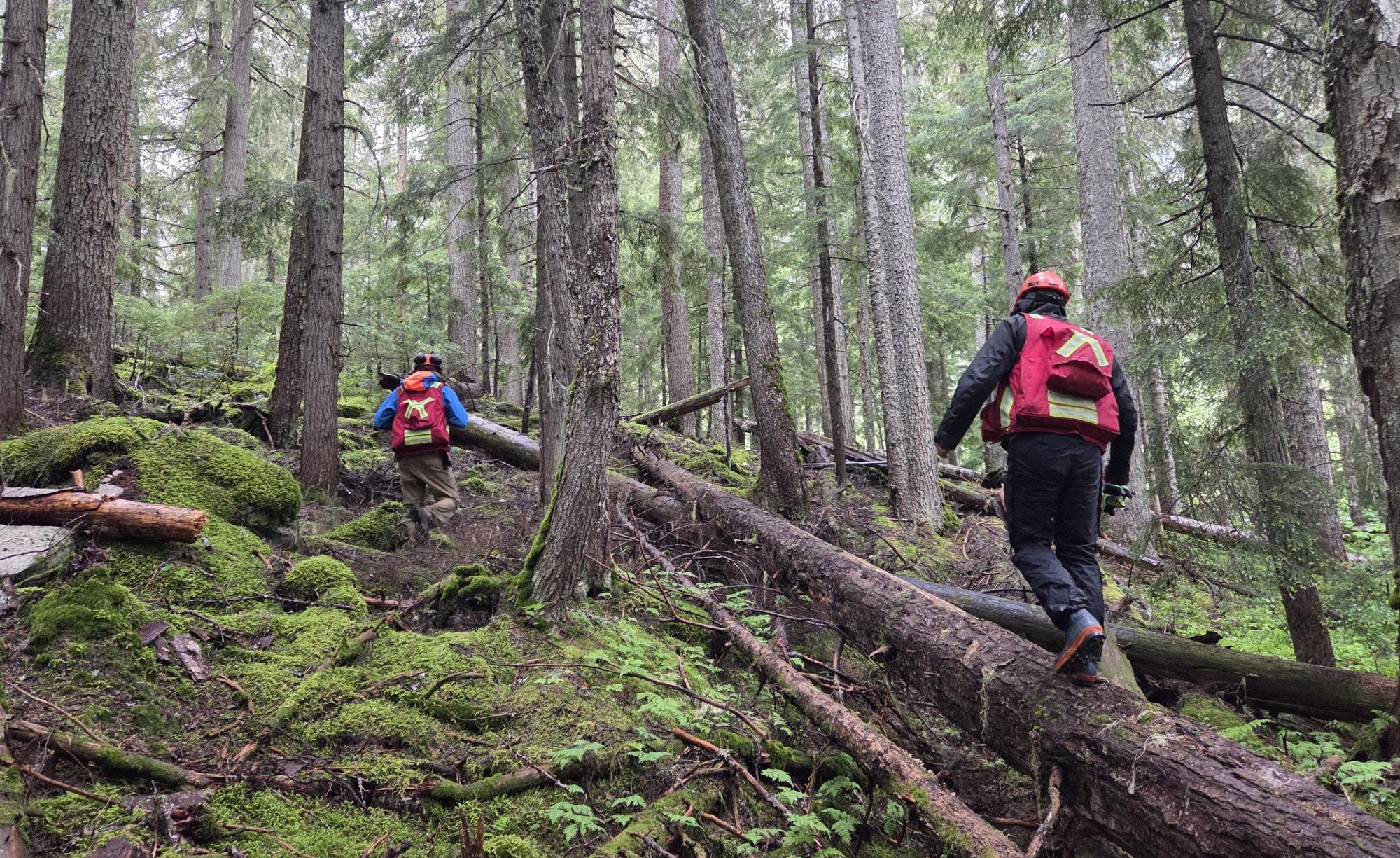
LFV is currently working on understanding the landscape a little better, reviewing what opportunities there might be related to more wildfire mitigation work. The company has been active in the wildfire management space for over eight years, starting with assisting with the Cheakamus Community forest fire in the Whistler region several years ago.
“Now we’re incorporating wildfire practices in Lilwat communities,” Tindall says. “We’re getting support from the B.C. government identifying areas of high risk that need treatment. We’re also getting scientific support from the First Nations Emergency Services (FNESS) that set up a model that looks at natural disturbance types related to climate change. It shows we have a lot of low-elevation forests that will have more risk to wildfire in the future.”
LFV is working on gaining public support to allow for some commercial thinning for mitigation purposes in areas more prone to potential wildfires.
“Currently, a lot of those stands have been protected through forest management lenses, and old growth management areas – protected areas for spotted owl management. There are significant areas protected near communities that don’t allow treatment to happen,” Tindall explains. “Companies aren’t going to
jump up to do the work. But if you have the support from the general public and support from the province, then those changes can be looked at.”
Tindall says the work in these sensitive areas isn’t about generating significant revenue.
“A lot of the work we’ve been trying to do is to break even or create a slight
profit,” he says. “We want to continue to grow what we’re doing and not only protect the community, but other important valleys in the landscape. There was a fire last summer that was quite close to one of the most valuable spotted owl habitats in September. If it was in July, we probably could have lost all the spotted owl habitat and could have lost the community.”
One of the more challenging aspects of increasing wildfire management work in Nation territory will be amending the Lilwat Nation Land Use Plan with the current number of wildfires so all the decision makers will have a better understanding of how active wildfires are in the 780,000 hectares of traditional territory, of which, about 280,000 hectares are forested.
“We’re working really hard to incorporate the Nation’s cultural values to what we’re doing and that’s been a key part of it, because without that, it keeps the community divided,” Tindall explains.
The company’s long-standing reputation managing the forests has helped them gain fairly strong public support. However, there will always be some NIMBY-ism encountered.
“There’s always that concern of not in my backyard, as long they can get insurance for house fires,” Tindall says.
LFV is working on gaining public support to allow for some commercial thinning for mitigation purposes in areas more prone to potential wildfires. Photos: LFV.
Klay Tindall, general manager for LFV, has been leading the company since 2012.
LFV’s annual harvest can range 50,000 to 75,000 cubic metres, depending on the year.
LOGGING equipment
STEEP SLOPE MAINTENANCE
BY ANDREW SNOOK
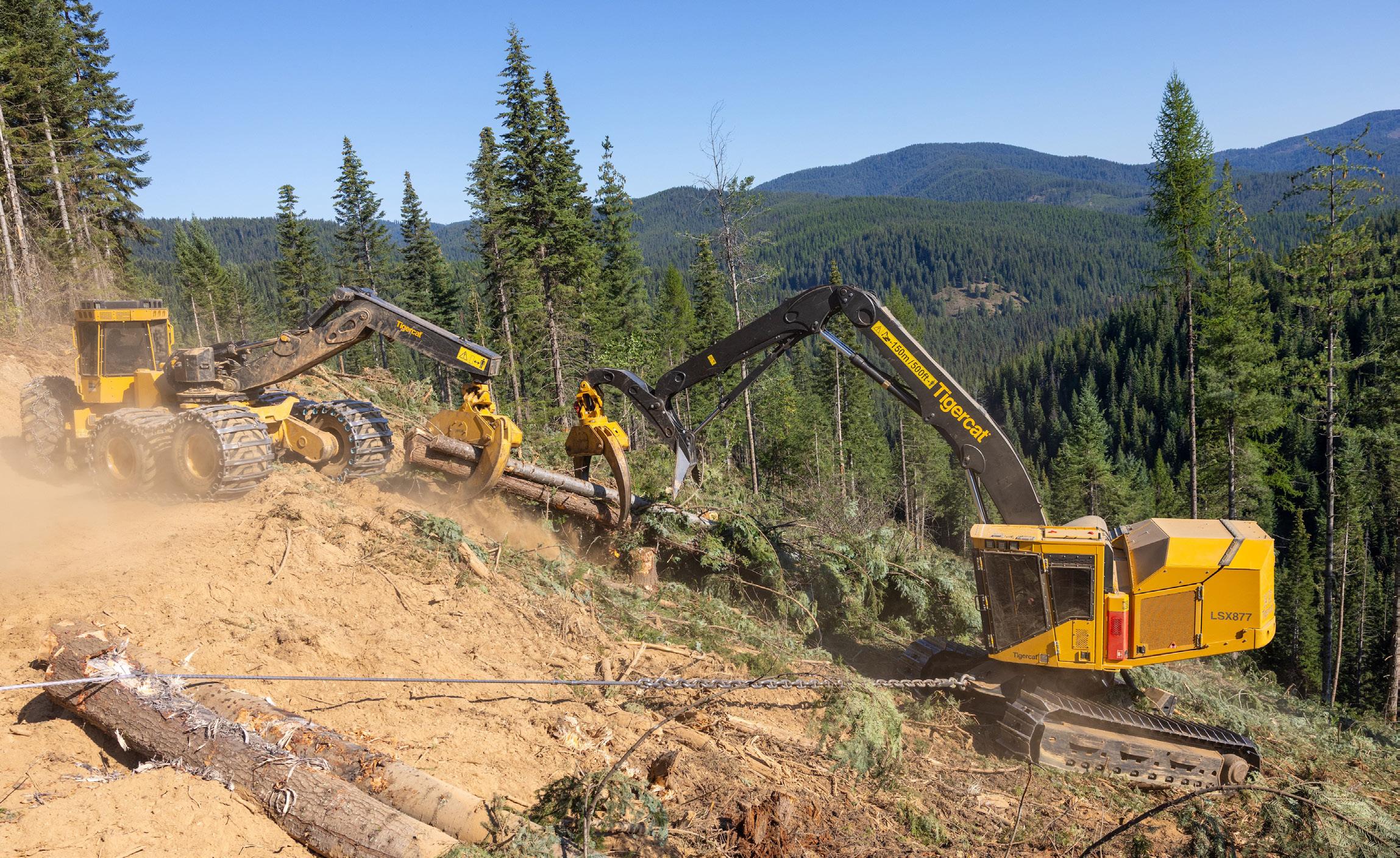
In places like B.C., working on steep slopes is becoming a growing requirement to get access to the best fibre in many parts of the province. This type of logging requires special equipment from winch-assist systems to yarders and more. Keeping this gear in top-notch condition is vital for ensuring smooth and safe harvesting operations, and that starts with the basic checks when starting a shift.
“Regardless of where you’re working, perform a machine walkaround first. Follow the owner’s manual and do your machine checks for things like
loose hardware, any cracks in any of the structures, missing components, leaks, things like that,” says Chris McMillan, marketing technical writer for Tigercat Industries. “You’ll want to verify that all your fluids are up within operating range and in good condition.”
While preventative maintenance procedures are an important part of managing an entire fleet, if something goes wrong with steep slope equipment, it is more likely to come at a very inopportune time.
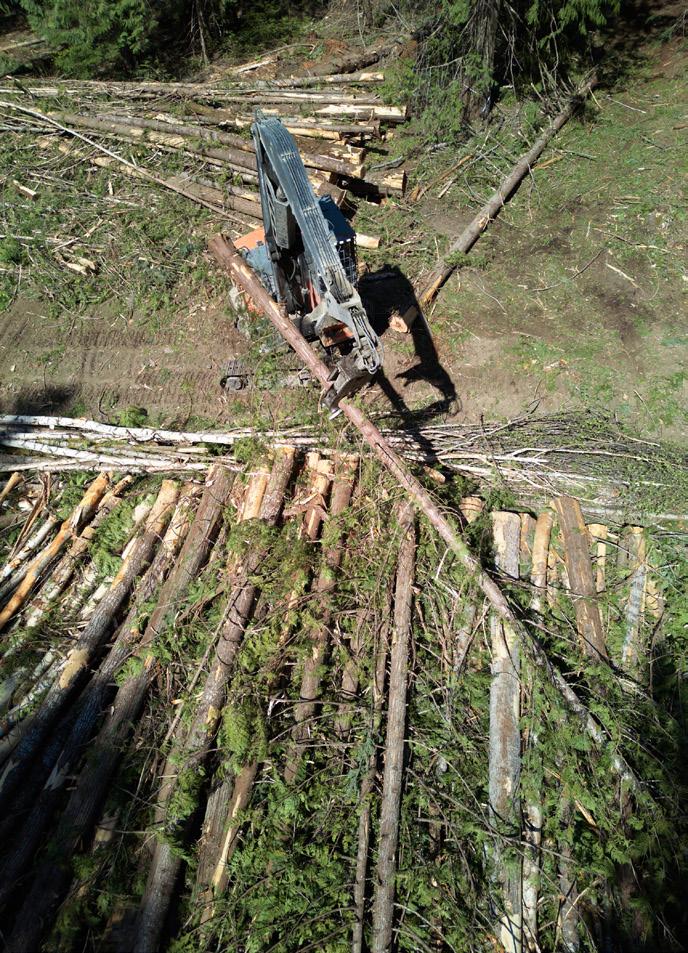
Photo: Tigercat Industries.
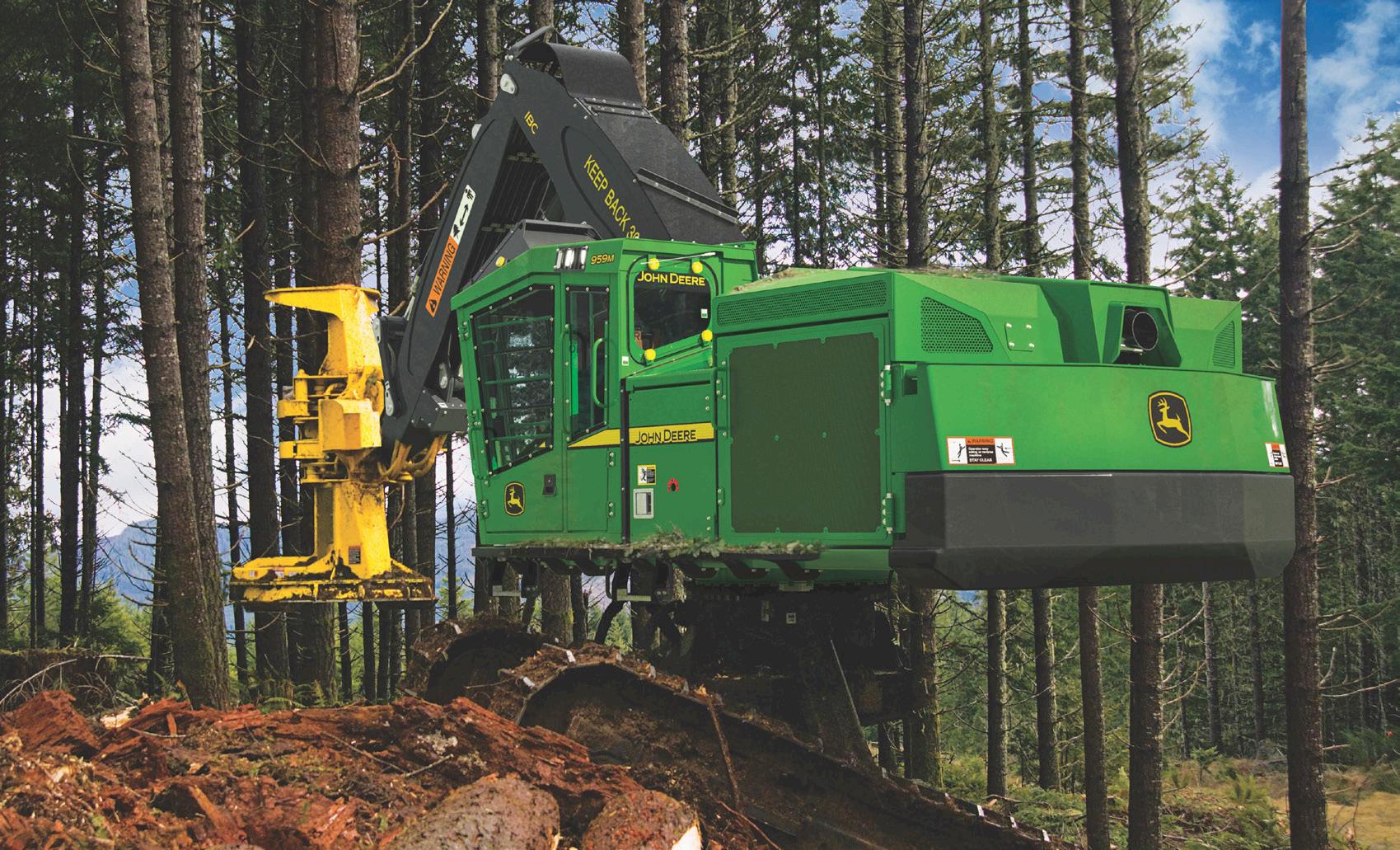
“If you’re on the side of a hill, whether it’s 25-, 30-, 40-, 50-per-cent slope, whatever is going to happen will probably be at the wrong time, so it’s probably more important to be on top of your general maintenance on an extreme slope or any extreme conditions,” says John Deere product marketing manager Jim O’Halloran.
If equipment goes down during steep slope logging operations, service trucks will not be able to drive to the location of the downed unit.
“I would say it emphasizes the importance of servicing, and making sure your machine is up to snuff, and is going to be able to work the shift,” O’Halloran says.
If the steep slope equipment is equipped with an escape hatch, it is important to ensure that it is functioning properly.
“You want to regularly open the escape hatch to ensure that it’s free and not sticking, in case of emergency,” McMillan says.
While these machines are designed by OEMs with safety as a top priority, there is always the potential of a rollover on steep terrain. For this reason, an emergency plan should be a key part of the maintenance and safety program for a fleet.
“We developed a procedure for cab extraction using a Milwaukee saw,” McMillans says, explaining that the saw acts as a safety redundancy for operators in case they end up in a situation where the emergency exits, skylight and doors are somehow blocked.
Another vital area for steep slope equipment that needs to be kept in top-notch shape is the winch-assist cable. Maintenance on the cable should include ensuring the cable is not frayed and has no kinks.
“You can go out 1,000 feet with some cables,” O’Halloran says. “The cable rubs up against stumps and rocks and ground debris… periodic maintenance and care of the cable system is probably number one.”
Checking how the winch is functioning is also important before starting a shift.
“Obviously, make sure it’s going in and out without binding. Check the winch machine for hydraulics leaks, damaged hoses, loose components – the same type of things you would do for your machine. Check your engine for proper oil level and leaks,” McMillan says, adding that the cooling systems for the winch drive should also be checked for any leaks.
Before starting a shift, it is also important to ensure the winch-assist machine and the assisted machine are communicating properly; and to perform a stability test.
“Regardless of what manufacturer you’re using, you want to perform any pull tests provided by the manufacturer to check the stability of the winch machine and the assisted machine,” McMillan says.
When heading out for a shift, O’Halloran suggests operators always keep spare parts on hand that commonly break down – such as hoses and extra oil – and always keep the machine clean of debris.
“When a machine gets full of debris, engines run hot,” he says. “You can power wash the machine. You can power wash the cooling system. You can blow out different areas. Keeping debris out, you don’t really talk about much, because it’s not a physical maintenance item… but keeping your machine clean is one of the key maintenance items you can do on a piece of forestry equipment.”
IF STEEP SLOPE EQUIPMENT IS EQUIPPED WITH AN ESCAPE HATCH, IT IS IMPORTANT TO ENSURE THAT IT IS FUNCTIONING PROPERLY.
During steep slope logging operations, service trucks will not be able to drive to the location of a downed unit. This makes proper servicing absolutely vital.
Photo: John Deere.
WOODPRODUCTS
RUNNING SMOOTH AND SAFE
BY ANDREW SNOOK
While the majority of wood products producers understand the need for dust and explosion mitigation equipment, that equipment only runs as well as it is maintained. With the long list of work that needs to be performed by maintenance staff to ensure production continues uninterrupted, this type of equipment can sometimes fall of the radar, or slips so low on the priority list that staff can delay the regular checks and/or cleanings recommended by manufacturers.
When it comes to failures on dust collection systems, one of the most common is poorly maintained filtration units for baghouses. If there is too much dust collected within the filter, the air flow will decrease causing the overall performance of
the system to drop, explains Francis Petit, director of engineering for VETS’ Industrial, Mechanical & Ventilation Division.
“When that happens, there’s a big risk of having several problems. You won’t pick up at the hood the right amount of dust, so you’ll have a lot of residual dust in your plant. You will also have, possibly, plugging in the duct work. Even worse, you’re not even sucking from certain ducts, so you will also have additional amounts of dust inside the baghouse.”
A simple way to prevent this issue is to monitor the pressure across the filters.
“There’s a sensor you can put in to check the pressure build-up on the bag, and if the pressure is too high, then you know there’s a problem,” Petit explains.
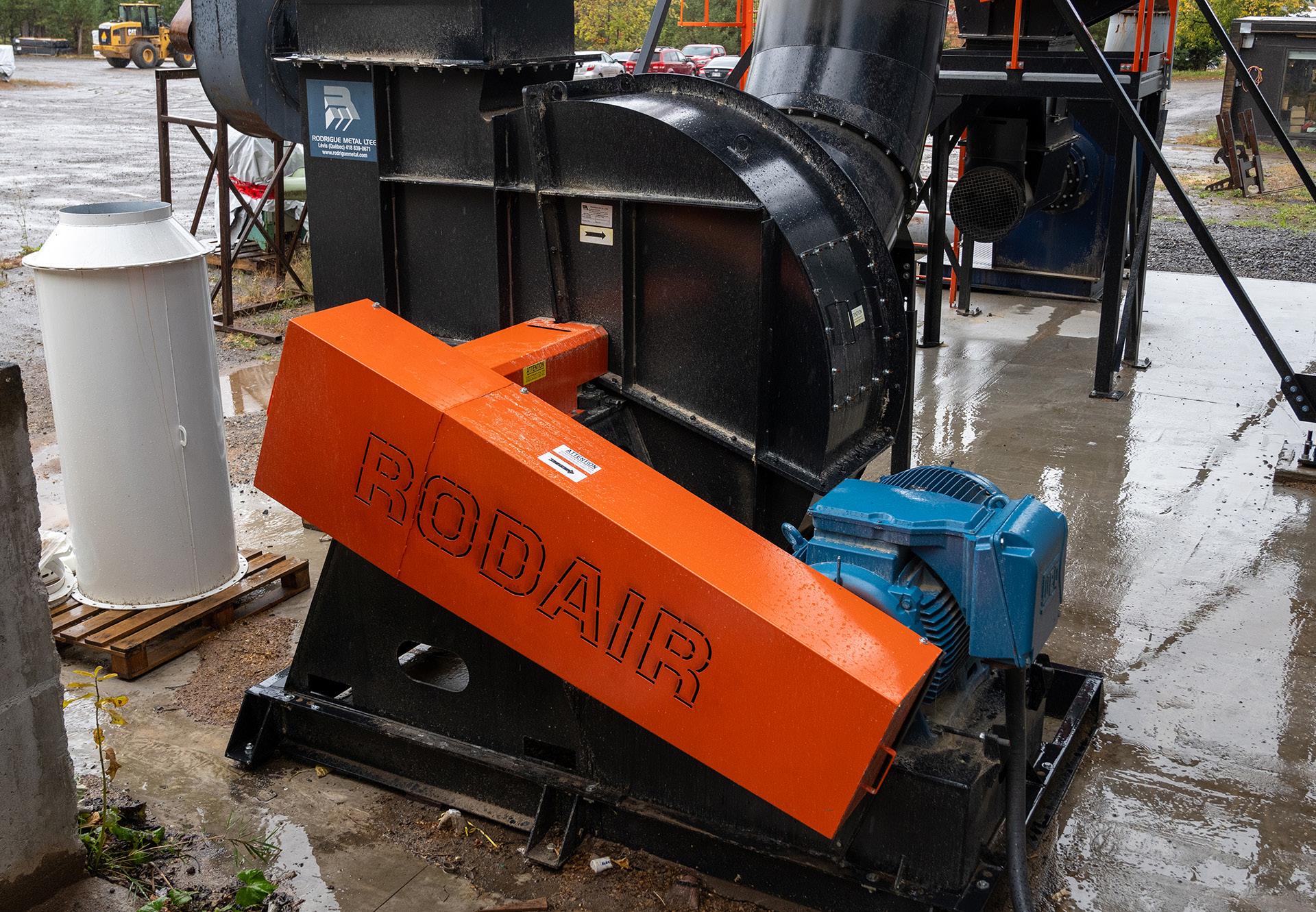
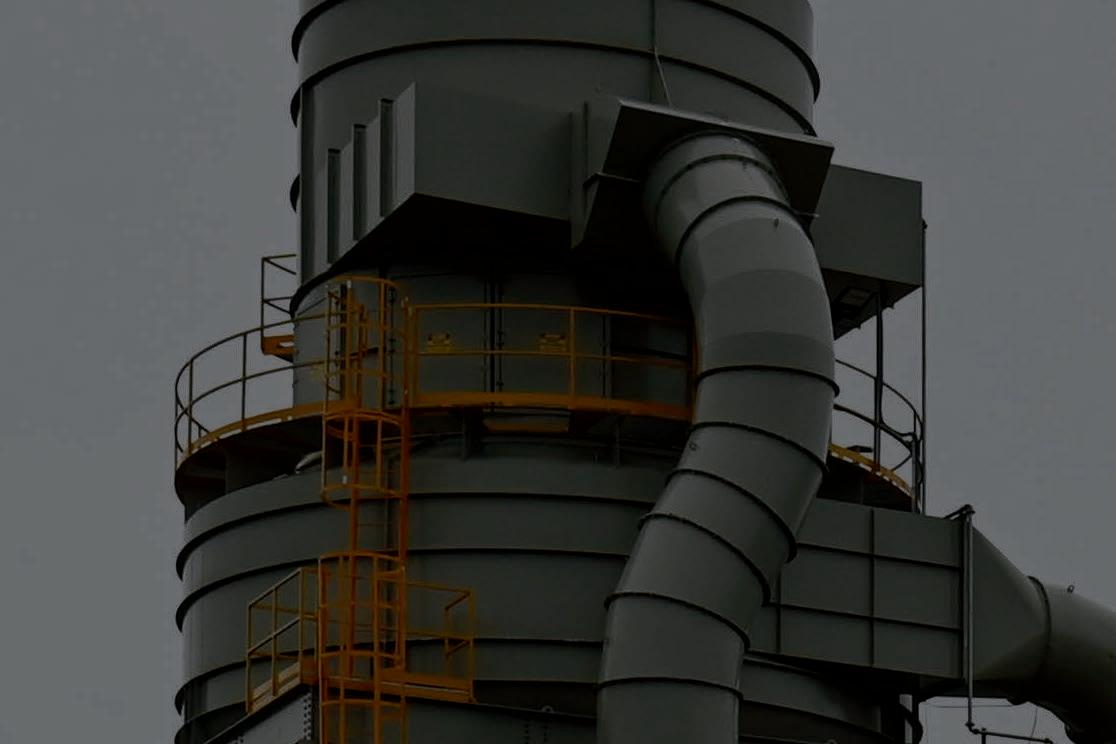
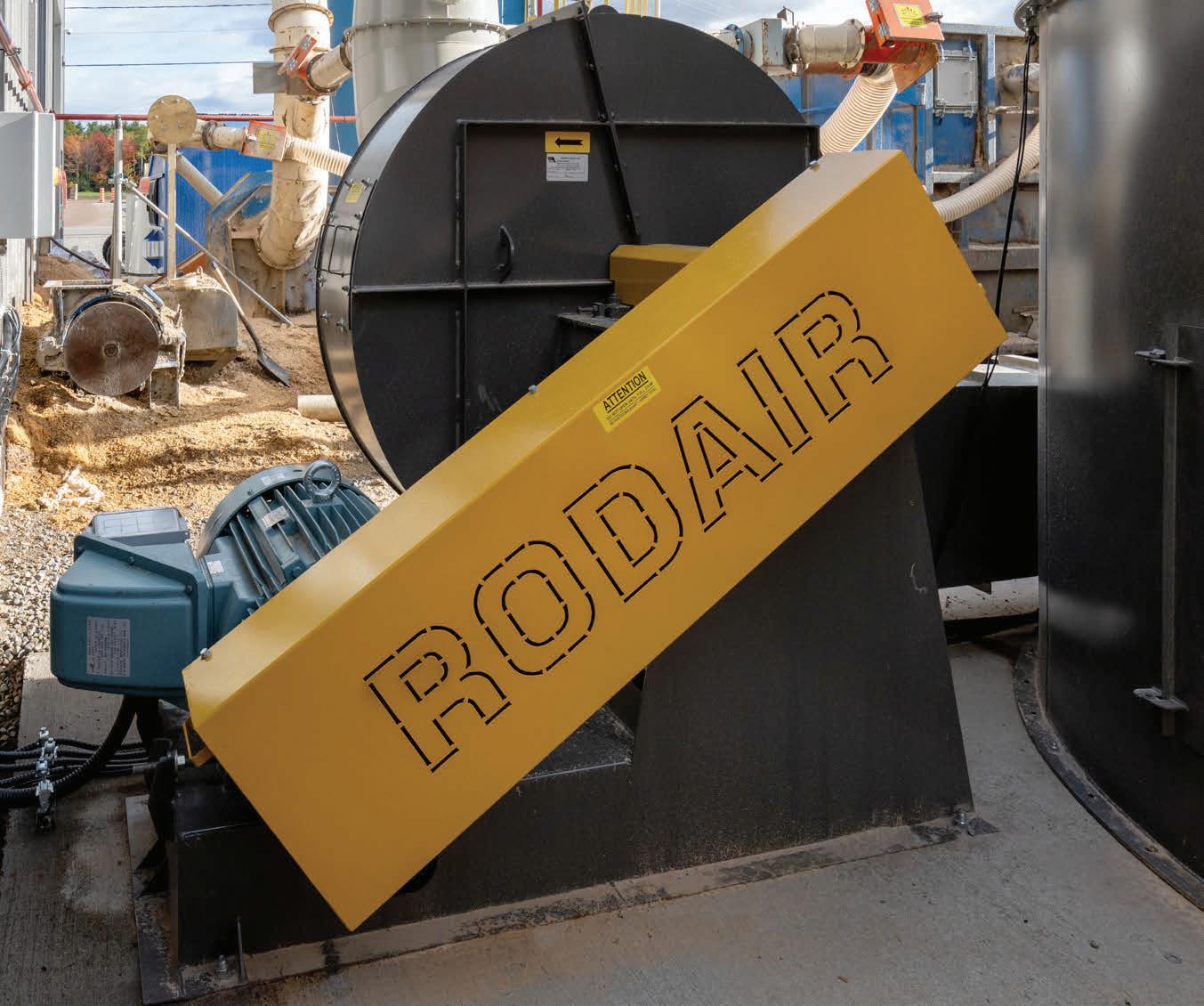
Keeping the space clear around electric motors and moving parts will help keep these systems in good working order and safe. Photo: Rodrigue Métal Ltée.
The filters on the bags should also be regularly cleaned and replaced. Life expectancy of a filter can range from a few years to a few months depending on the processes at the plant.
“They have layers of fibres, and then there’s holes between the different fibres. When there’s dust build-up, those holes will close up,” Petit explains. “When there’s dust coming in the fibre too deep, even if you wash it, they’ll get stuck in there, and there’s no way you can pull it out, so you’ll have to replace your filter.”
When it comes to Rodrigue Métal’s dust mitigation equipment, the company recommends that customers inspect the inside and outside of their systems twice a year. For the baghouse, the company recommends inspecting it every six months at the end of fall and start of spring, once everything is thawed out.
“If things are contained properly, you’re protected much better. But if, for example, you’ve got broken bags in your filtration system, you’re going to have fine dust getting into places that it shouldn’t. If you have fine dust getting in places that it shouldn’t, there is potential that you’re not monitor-
It is vital to do regular visual inspections of the entire potential path of safe discharge areas. Photo: IEP Technologies.
ing those places, and that could be a source of that once-in-a-lifetime event where something happens,” says Neill Gibson, director of business development, sales and marketing for Rodrigue Métal Ltée.
Gibson also recommends inspecting the blades in the rotary valves.
“You’ve got to watch the wear and tear. Very often with pneumatic systems there’s a negative or positive pressure. If those blades are starting to wear down, you’re letting air out. Therefore, your system is not performing properly. You’re creating unnecessary force within the system. What happens then? You get blockages,” he says.
To assist maintenance teams in typical hard-to-reach locations of dust collection systems, additional access doors can be installed.
“A lot of it is visual, and they’re not the cleanest locations, so people don’t tend to like to go into them, but it’s critical. You need to look at what’s going on inside,” Gibson says. “We suggest to all of our customers wherever there’s a bend, a 90-degree angle in any ductwork, to put in an access door. You can take a look, make sure that wear and tear is okay.”
SPRINKLER SYSTEMS
Any sprinkler systems within the ductwork also need to be inspected regularly to ensure they’re working properly.
SUPPLIER OF THE BEST SOLUTIONS FOR YOUR DUST MITIGATION NEEDS
For over 60 years, we have proudly designed and manufactured our equipment in Quebec.
Creating reminders to check these types of systems can help keep them on the radars of maintenance staff.
“It’s like the smoke detectors in the house. You need to have a note in the calendar to say every fall, check the battery,” Gibson says. “When the problem happens, and you haven’t checked, those are the events that just hurt the most, because they’re preventable.”
EXPLOSION SYSTEMS
When it comes to explosion protection systems, the two types of systems – active suppression systems and passive systems – each have their own needs.
Active suppression systems essentially have three components: controls, detection, and explosion suppression extinguishers. Those systems are governed by NFPA 69, the international standard for explosion prevention systems, and require inspection at least four times a year. These inspections require planned plant shutdowns.
“The control panel is inspected by field service personnel to help ensure that there are no issues with the field wiring, with the interlocks. or with the battery backup, as required by NFPA,” explains David Grandaw, vice-president of sales for IEP Technologies.
The extinguishers are checked to ensure they’re fully pressurized, making sure that the discharge nozzle path isn’t blocked by any product build-up; and that there are no grounds or faults in the wiring.
The detectors are also checked to make sure that they’re calibrated and operational.
“Confirmation is made that a signal from a detector going into
alarm is registered at the control unit, checks for grounds and faults in the field wiring, and making sure there is no blockage that would prevent an explosion pressure wave, or a radiant energy signal from causing that detector to function properly,” Grandaw says.
For passive systems such as explosion vents and flameless vents, inspections are also required to check for leaks or if they’ve become physically blocked.
“Everyone thinks because it’s a vent, it’s passive, you just can put them in there and forget about them. The code, and just common sense, states that you should actually be inspecting them at least once a year,” says
Jeff Mycroft, national sales manager Fike Canada. “In most circumstances, it’s not a big deal, but if you have a sticky product like sugar, or even wood, when it gets wet, you can get a coating on the inside of the vessel that over time builds up. The vents typically burst at 0.5 to 1.5 psi; that’s the most common threshold. When you get a quarter-inch or even less of solid product on the inside of some of these things, it’s going to prevent them from opening when they should.”
Sometimes people will start erecting steel somewhere near a vessel, and if they erect something in front of a vent, it can’t fully open, Grandaw adds.
“If they can’t fully open, the vents cannot relieve pressure as efficiently as necessary. So, visual inspections are needed to make sure there’s a clean path, while confirming at the released pressure and flames are is still aimed at a safe area,” he says.
In explosion isolation flap valves, while dust sensors are useful tools, visual inspections are still needed to ensure that dust accumulation isn’t taking place in sensitive areas.
“Even with a dust sensor, dust can accumulate up on weird sides and places that you’re not thinking about, and it’s going to prevent that flap from closing and locking,” Mycroft says.
After installing a new flap valve, maintenance staff should regularly check on it to measure the dust accumulation.
“If it’s a really fine dry dust, you can probably wait a month then poke your head in, and if it’s clean, then you can go to two months. Then you can go four or six. But at minimum once a year they need to be poking their head in there and just having a look to make sure it’s clean and open,” Mycroft says.
On the older explosion doors, the latches should be serviced at least three times a year, Mycroft says.
“They need to be oiled, they need to cycle it, and they need to make sure it’s clean and it still opens at the pressure it’s supposed to,” he says. “They should open like fairly easily. I’ve seen sites where they need a crowbar and two people to pop this thing open. That’s not going to work the way it’s supposed to.”
Grandaw says regular visual inspections of the entire potential path of safe discharge areas are also important for maintenance staff to conduct, in case an area has changed over time.
“Maybe at one point the vessel was located in a safer area in the back of a building and the explosion vent is positioned to a normally unoccupied area, maybe into a field. Since that original installation, the plant decided to install a driveway through that path to access some other part of the facility. By making this change, it’s no longer a safe area to discharge the flame, as that escaping fireball from the vented explosion can be pretty substantial,” he says.
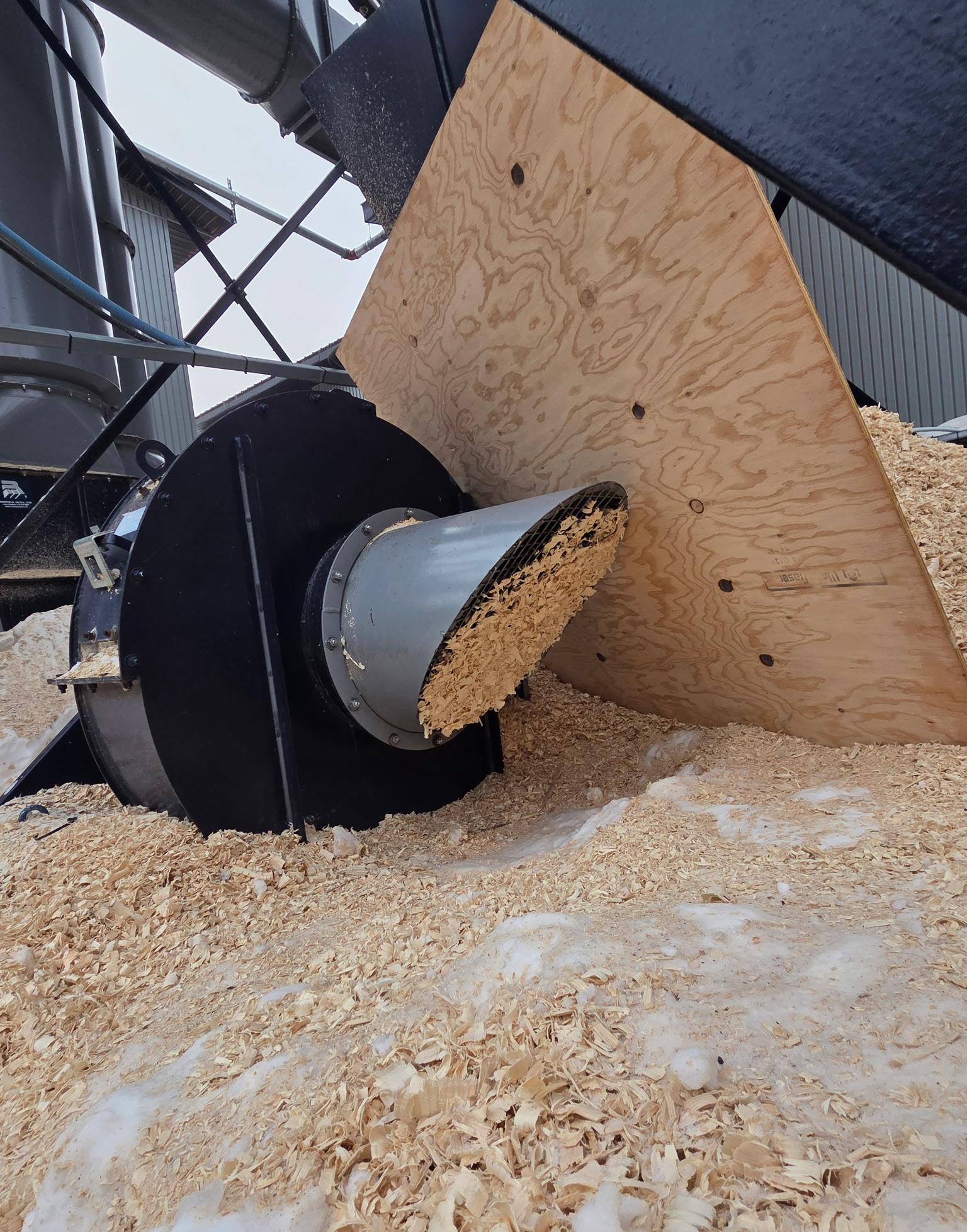
Accumulated residuals around air intakes impede overall performance and can increase risks. Photo: Rodrigue Métal Ltée.
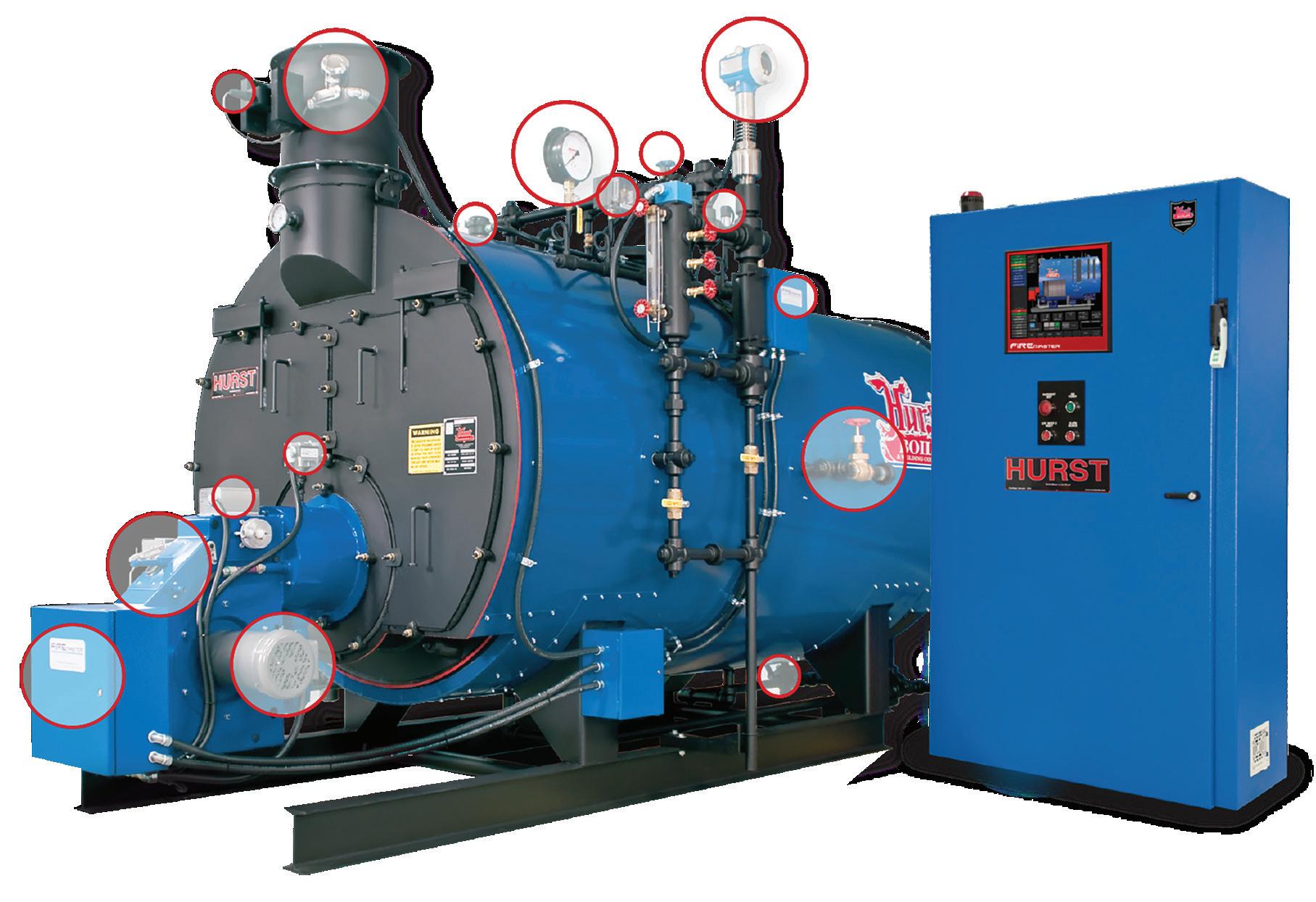
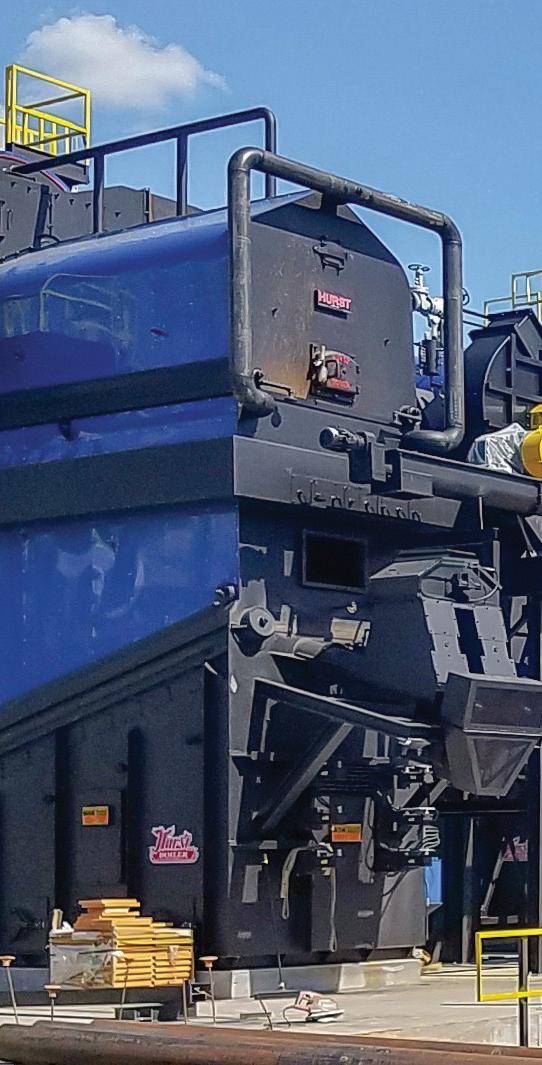
Hurst Biomass Systems Lead the Alternative Energy Boiler Market With Innovative
Solid-Fuel-Combustion Design
Hurst is a custom manufacturer of engineered packaged steam and hot water boilers and integrated boiler systems, renewable fuel fired gasification/ combustion/heat recovery systems, biomass & hybrid boiler systems, CHP/ co-generation systems, PLC-integrated boiler controls, parts & boiler room accessories. Fire-tube, water-tube & feedwater equipment for all industrial heating & process applications. Low NOx modular boilers & burners available.
High Efficiency Integrated Control Systems
Offering integration and scalability, the new, high efficiency Integrated Control Systems from Hurst Boiler for boiler room monitoring and communications provide advanced supervisory boiler controls for all new and legacy Hurst products. FireMaster, BoilerMaster & BioMaster may also be configured to work with any existing boiler - no matter the manufacturer.
WOODPRODUCTS
POWERING PEMBROKE
BY ANDREW SNOOK
When Roseburg Forest Products was founded by Kenneth Ford in 1936, it was comprised of a single lumber yard and sawmill in Dillard, Ore. Since that time, the company has expanded dramatically with a wide array of acquisitions and plant start-ups throughout the U.S.
The company currently operates five wood products facilities and a wood chips export business across Oregon; an engineered wood products plant in Chester, S.C.; a softwood dimensional lumber sawmill in Weldon, N.C.; and MDF plants in El Dorado, Ark.; Medford, Ore.; and Pembroke, Ont. While mergers and acquisitions by large corporations dominate much of the production in the forest products sector in the U.S. and Canada, Roseburg Forest Products is still privately owned by the Ford family.
“That’s a special point of pride for us,” says Kenny
Larson, communications manager for Roseburg Forest Products.
One of the competitive advantages that the company holds over some of its competitors is that many of its facilities are vertically integrated from the woodlands operations all the way to its production streams.
“This gives us a distinct ability to shepherd that tree,” Larson says. “All the way from seedling, we’re raising it, and then when the time is right, harvesting it and sending it in for manufacturer, and then from there, it goes to industry and they build what they build with it.”
The hard work and dedication of the company’s 2,600-plus team members across the U.S. and Canada can be summed up with the main catch phrase used at Roseburg Forest Products, which is that the company is “Grown to Build. Built to Grow.”
“It really does capture the spirit we have here at Roseburg. We’re scrappy, we’re really interested in doing the right thing for the right reasons, and making the best quality products that we can to meet those needs, no matter what the market environment,” Larson says.
MADE IN CANADA
The company has a Canadian footprint in the Ottawa Valley with its MDF plant in the Pembroke, Ont. area, purchased when it was the MacMillan Bloedel Medium Density Fiberboard plant in 2018.
Originally started up in 1997, the MDF plant had changed ownership a few times over the past 29 years. One person who has been there to see the operation evolve throughout its entire history is Bruce Oattes, plant manager for Pembroke MDF, who has worked at the MDF plant since its inception.
“I started in ’97 just before our first board,” Oattes recalls. “It’s always been an MDF site.”
Experiencing first-hand every ownership group in the history of the plant, Oattes is thrilled to have Roseburg Forest Products leading the way.
“They’re by far the best ownership group this mill has seen,” he says.
The company is a key employer for the city with approximately 200 team members in Pembroke, and this doesn’t include all of the additional jobs created for suppli-
ers of equipment, and other services supported by the plant.
The Pembroke MDF produces raw MDF boards as well as finished mouldings.
“We make MDF panels that go out to market to OEMs or other distribution com-
panies,” Oattes says, adding that the moulding production accounts for about 18 per cent of the overall production of the plant.
A HOME FOR SAWMILLS
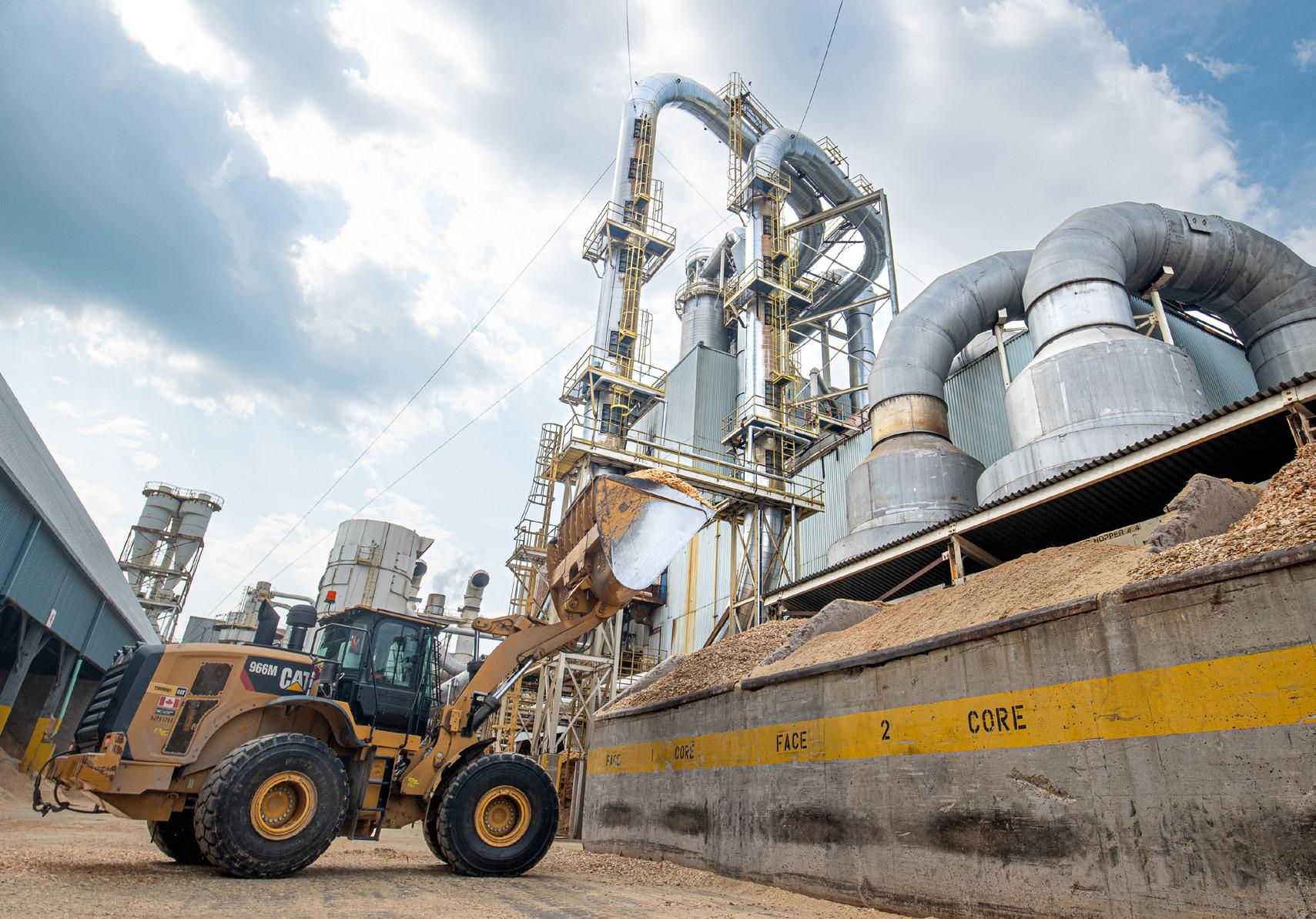
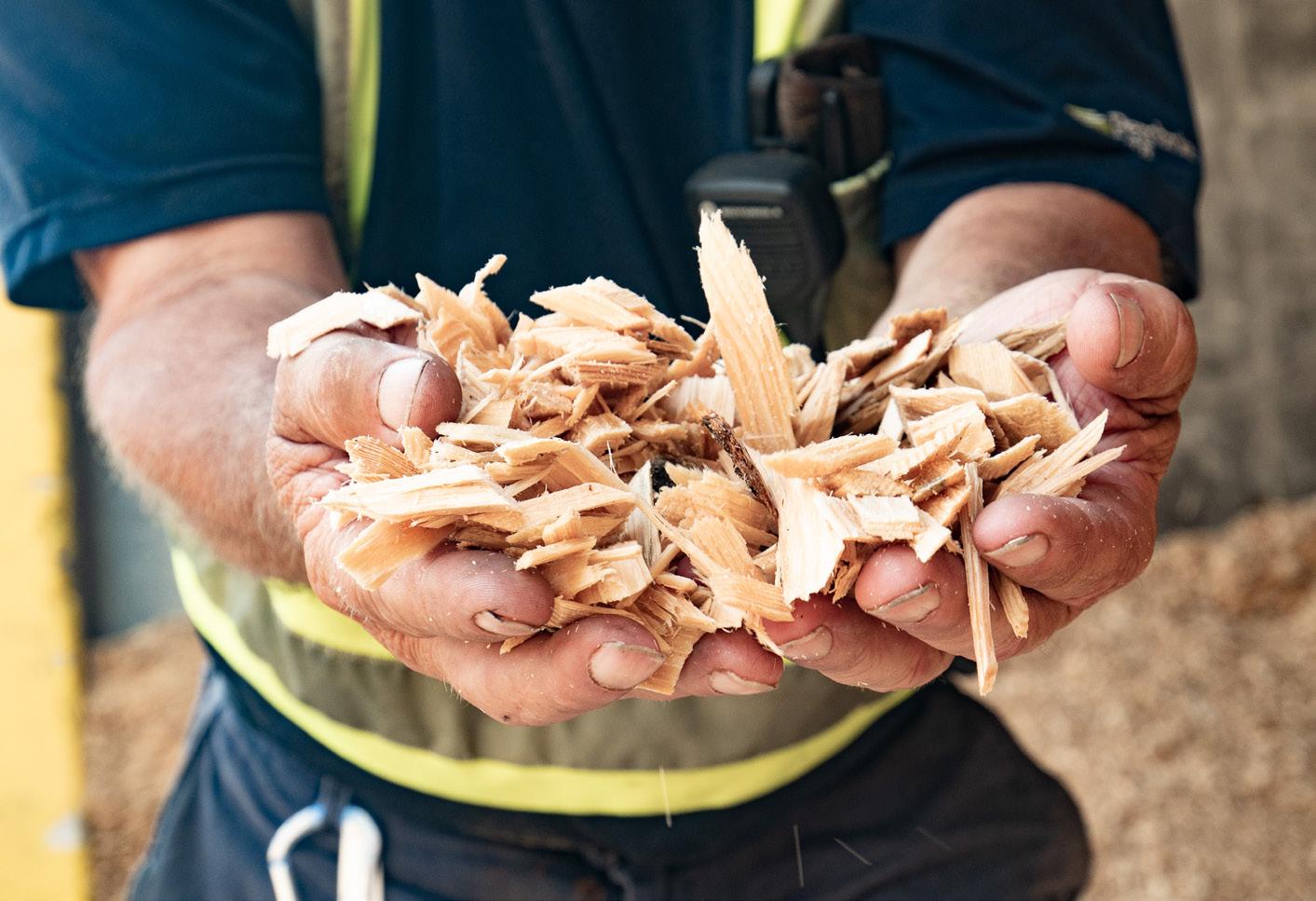
Pembroke MDF is vital for the health of five key sawmills across the Ottawa Valley that supply the plant 45 to 50 trucks a day filled with their residuals to make the MDF and moulding products.
“We have a really good partnership with them. They need us, we need them, and primarily, we take their residuals, bring those in chip form or sawdust form, and then we manufacture MDF from that,” Oattes says.
The residuals from the local sawmills help Pembroke MDF fulfill significant production targets with an average annual production of 135 million MCF (1 MCF is equivalent to 1,000 square feet).
“It’s a huge volume of material,” Oattes says.
The majority of the residuals come from the five primary sawmills within a 150-kilometre radius; however, a minor amount also coming from smaller sawmills in the area.
Combustible Dust Specialists
While
“The mill was specifically built here because of the fibre basket in the area. You look at the Ottawa Valley, and the history that they have in the forest industry, it really goes back,” Oattes says, noting that the red and white pine that grows in the Ottawa Valley used to be shipped to Europe to supply shipbuilding operations. The oldest sawmill in the area, Shaw Lumber, started up its operations in 1847, making it one of the oldest operations in the country.
Another way that Pembroke MDF is planning on supporting the forest products sector in the Ottawa Valley is through a project under development to install a new combined heat and power (CHP) plant that will be able to take low-value pulp wood, shipped to them as biomass. This is especially important since local logging contractors that supply the sawmills need a home for those low-value logs. This project is also important to take some of the stress off the local electrical grid.
“We have an agreement in principle to be able to be behind the metre, still tied to the grid, but we would take approximately 15 megawatts off the grid. That’s fairly substantial to be able to make that available to other industries,” Oattes notes.
TOUGH TIMES
There was a time before the purchase by Roseburg Forest Products that the plant was practically on life support after the 2008 housing market crash in the U.S.
“At the same time, energy was going through the roof – a similar scenario as what’s happening now. We paused our plant then. I was fortunate, I stayed on. We actually
got down to four of us in the plant. I stayed on straight days, and then we had three other individuals that carried the night shift and weekends, and what we thought was going to be six months to a year turned into six years,” Oattes recalls, adding that the restart of the plant in 2014 was supported by an Ontario government rebate that reduced the facility’s monthly electric bill.
the company has operations in the U.S. and Canada, Pembroke MDF typically exports about 35 per cent of its products into the U.S.
The company has made significant improvements since taking over Pembroke MDF, including updating various pieces of equipment such as a new robotics line.
INVESTING IN THE FUTURE AND THE COMMUNITY
Since Roseburg Forest Products took over ownership, the company has been continuously re-investing in the plant’s operations over the years. In addition to the CHP plant, the company has invested approximately $47 million into its Pembroke operations. This includes updating various pieces of equipment including a new robotics line to improve safety and efficiencies on the moulding production line through automated bundling of the final products.
“Getting rid of that repetitious work, where you’re at the end of the line – just like some of the older sawmills – where it’s very labour intensive. We’ve turned that into robotics and displaced no one,” Oattes says. “We took those three shifts, and we’ve been able to expand it to four because of the robotics. Now we have the same number of people across four shifts, as opposed to three.”
Investing in sustainable practices is another area of focus for Roseburg Forest Products.
The company invested heavily into installing a technology that captures the off-gassing that occurs during the MDF production process.
“It captures those gasses, puts it through
a water cleaning system, and then we vent clear steam to the atmosphere,” Oattes says.
“We not only want to make a product that’s marketable into the MDF market, but we also want to be good neighbours, good stewards, continuing to do things environmentally and
Before the purchase by Roseburg Forest Products, the plant was practically on life support after the 2008 housing market crash in the U.S. Photos courtesy of Roseburg Forest Products.
Roseburg is a key employer for the city with approximately 200 team members at the Pembroke MDF plant.
becoming more a part of the community.”
In addition to job creation and supporting local businesses whenever possible, Roseburg Forest Products has an annual budget dedicated to supporting local charities and community fundraisers.
“Last year, there were about 152 events, charities or fundraisers that we participated in,” Oattes says. “We are really trying to be part of the Laurentian Valley and Pembroke community.”
MDF PROCESS
Once the raw material arrives at Pembroke
MDF, it is offloaded using truck dumpers and stored under roof to limit its contact with snow during the winter months. The materials are warmed via steam then transferred to the company’s refining process.
“We have parallel lines at that point, and our refiners are 8,000-horsepower refiners. It’s refined, dried, and brought back into the building via dryer tubes,” Oattes says.
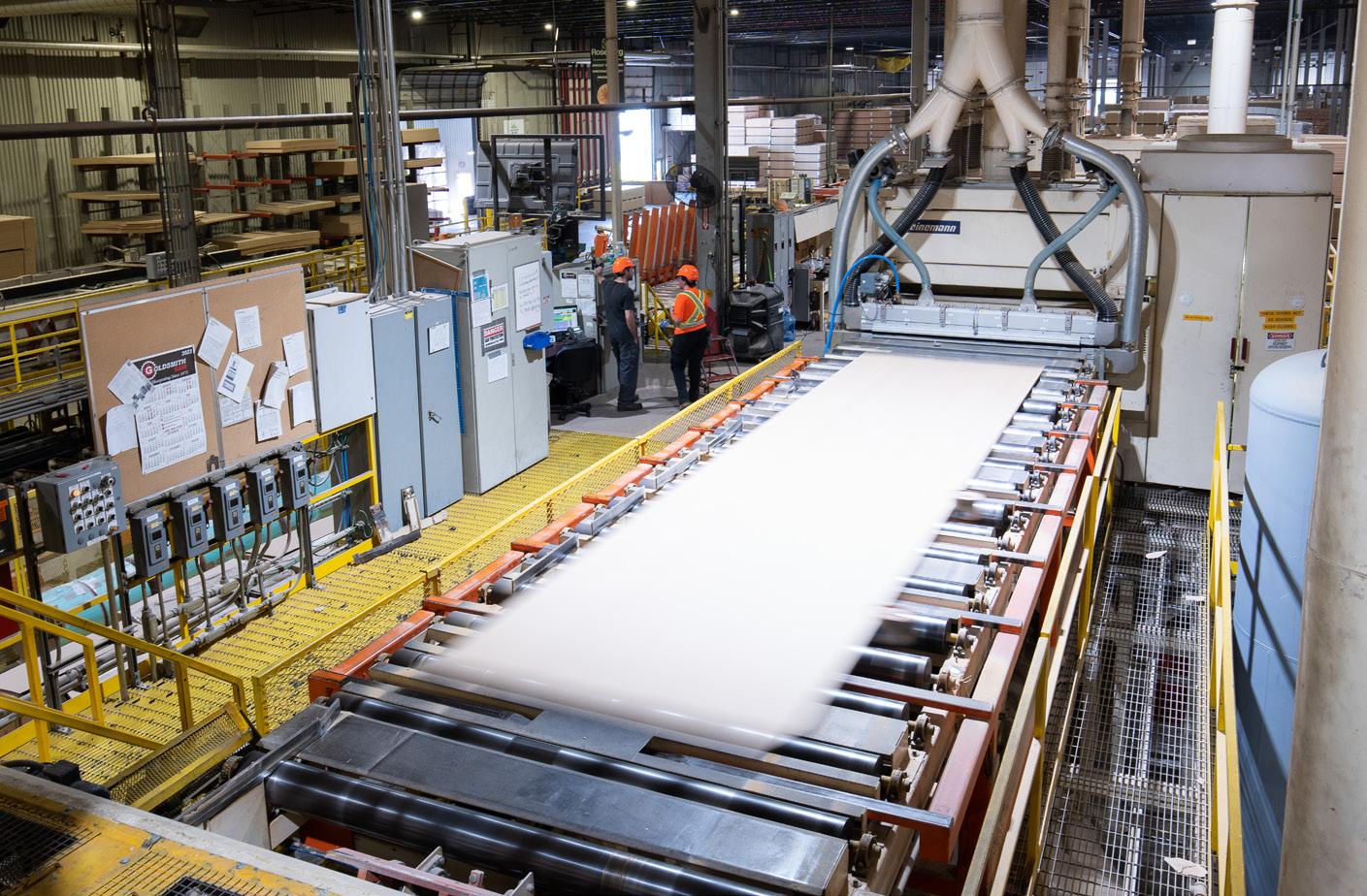
The fibre is then laid down on a mat and goes through the plant’s hot press, where they cut the boards to a rough length, allow them to cool for a period of
time, and then transfer them to the finishing line, where the board is cut and sanded to a specific customer length and width, packaged, and placed in the warehouse.
CURRENT AND FUTURE CHALLENGES
While the company has operations in the U.S. and Canada, Pembroke MDF typically exports about 35 per cent of its products into the U.S.
They have built strong partnerships with their customers over the years; however, the tariffs and duties can still present a challenge.
“There are some great customers in the U.S., and we intend to be able to keep that relationship going with them,” Oattes says.
While tariffs present some challenges, the bigger crisis the forest products sector is facing, as far as Roseburg Forest Products is concerned, is the growing shortage of truck drivers.
“The demographics of the truck driver is getting older, less people want to do those long hauls,” Oattes says. “You have your eight hours cost of fuel, so a lot of those mom-and-pop shops that used to have one or two trucks, and it was a family business, those are becoming less and less. I think logistics is certainly something that we’re going to realize how important it is, especially because we are so integrated. We’re not shipping tens of miles or even hundreds of miles, we’re shipping thousands of miles with our products. So, I think logistics will be something we’re paying attention to in the future.”
The majority of the residuals the MDF plant consumes come from the five primary sawmills within a 150-kilometre radius.
CONSISTENT RESULTS
BY JAY DRURY
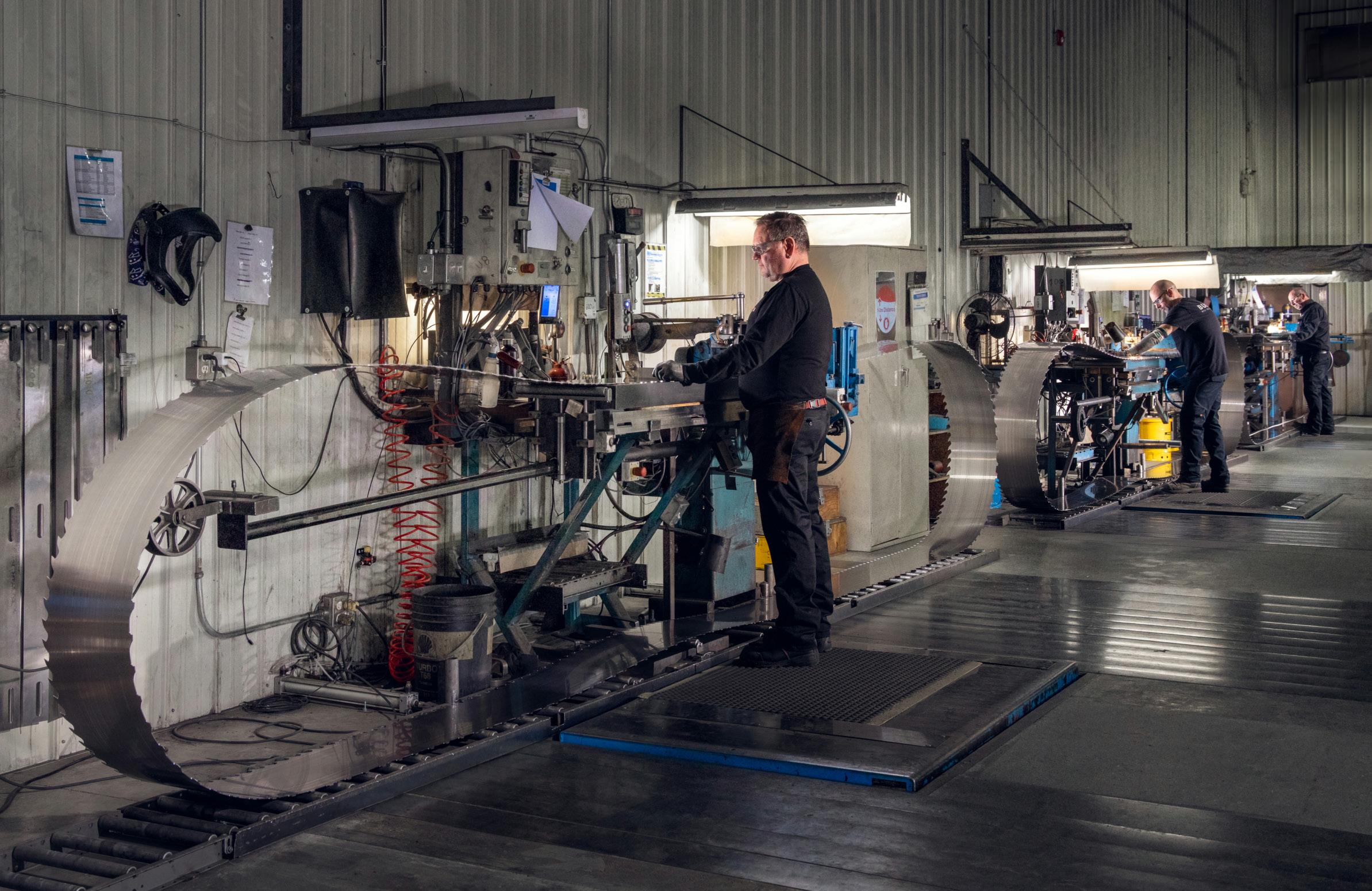
In most sawmills, lumber recovery, surface quality, and saw life ultimately trace back to one place: the filing room. While optimization systems, machine alignment, and feed control all matter, none of them can overcome inconsistencies in saw preparation. A well-run filing room delivers predictability and sawing accuracy. An inconsistent one creates daily variability that operators may need to compensate for and possible extra downtime. Achieving consistent results in the filing room is, therefore, not just a maintenance goal – it is a production imperative.
CONSISTENCY BEGINS WITH PROCESS, NOT SKILL ALONE
Experienced filers are invaluable, but even the best craftspeople struggle to achieve consistency without standardized processes. Filing room success depends on repeatability: each saw must leave the room as close as possible to a known, correct condition. That requires defined procedures for incoming inspection,
sharpening, tensioning, leveling, and final verification. Documented standards – hook angle, side clearance, tip height variation, gullet shape, plate tension profile – create a common reference point. Without them, adjustments become subjective, and performance becomes dependent on who happened to work on the saw that day. Consistency improves dramatically when decisions are based on measurable targets rather than judgment alone.
INCOMING INSPECTION SETS THE TONE
Every saw entering the filing room should be inspected before any corrective work begins. Skipping this step increases the risk of chasing symptoms instead of addressing root causes. Incoming inspection should include checking for cracked gullets, uneven side wear, abnormal heat marks, loss of tension, and damaged tips.
Just as importantly, the filer should understand where the saw ran and what issues were reported.
A saw that came off a guided edger for surface problems requires a different approach than one pulled from a gang saw for washboarding. Capturing this information consistently creates a feedback loop between the filing room and the mill floor.
SHARPENING CONSISTENCY DRIVES CUTTING CONSISTENCY
Sharpening is the most frequent filing room operation, and small inconsistencies here have outsized effects. Variations in kerf, side clearance, cutting angles, or tooth geometry change cutting forces and load distribution, which directly affect tracking stability and heat generation.
Consistent sharpening requires:
• Properly maintained sharpeners or grinders;
• Calibrated cams, templates, and stops; and
• Routine checks for wheel wear and alignment.
Grinding wheels themselves are often overlooked. Dull, glazed, or improperly dressed wheels introduce variation even when machine settings are correct. A correctly shaped and dressed wheel is essential for repeatable results. Automated wheel dressers take the guesswork out and assure consistent results, no matter the operator.
TENSIONING AND LEVELING MUST BE SYSTEMATIC
Tensioning is one of the most critical – and least forgiving – elements of filing room work. Inconsistent tension profiles are a leading cause of unpredictable saw behavior, including flutter, lead changes, and premature cracking. Each saw diameter, plate thickness, and operating speed requires a specific tension pattern.
SIMPLY
Applying too much, too little, or placing it incorrectly, leads to variability that no guide or alignment adjustment can fully correct.
Leveling should never be rushed or treated as optional. Even small unlevel spots or sections can cause uneven guide contact and localized heating. A consistent approach means checking the entire plate, not just obvious problem areas, and confirming results rather than assuming success.
MEASUREMENT AND VERIFICATION CLOSE THE LOOP
The most effective filing rooms verify their work before releasing a saw back to production. This includes checking:
• Side clearance consistency of the tip;
• Tip height variation;
• Plate runout and flatness;
• Tension profile;
• Back length on bandsaws; and
• Guide condition and accuracy.
Using gauges, indicators, and tension tools consistently removes guesswork. When measurements are recorded, trends become visible – allowing teams to spot systemic issues before they affect production. Verification also builds confidence between the filing room and operations, reducing unnecessary saw changes driven by uncertainty.
CLEANLINESS AND ORGANIZATION MATTER MORE THAN THEY SEEM
A cluttered, dirty filing room makes it difficult to achieve consistent results. Pitch buildup on saws, debris on benches, and mixed tooling create opportunities for error. Organized tooling, labelled fixtures, and designated work areas reduce variation and speed up work without sacrificing quality.
Consistency thrives in environments where tools are easy to find, machines are kept clean, and procedures are followed in the same order every time.
COMMUNICATION WITH OPERATIONS IS ESSENTIAL
The filing room does not operate in isolation. Changes in species mix, feed speeds, guide configurations, or machine condition all affect how saws perform. Without regular communication, the filing room may unknowingly prepare saws for conditions that no longer exist.
Regular feedback from operators – and just as importantly, feedback from the filing room to maintenance and operations –helps align expectations and prevent recurring problems.
CONCLUSION
Achieving consistent results in the filing room is less about heroic fixes and more about disciplined execution. Defined standards, systematic inspection, controlled sharpening, precise tensioning, and verified outcomes create repeatable saw performance. When consistency becomes the goal, variability drops, saw life improves, and mill performance stabilizes. In an industry where small changes produce large results, the filing room remains the beating heart of the sawmill.
Jay Drury has spent 43 years with Burton Mill Solutions in manufacturing and sales and currently serves as director of technical services. He can be reached at jay.drury@burtonmill.com.
WOODPRODUCTS CANADIAN
BCSFA SHOW A SUCCESS
BY ANDREW SNOOK
The BC Saw Filers Association (BCSFA) moved to a one-day format for its annual conference and trade show in Kamloops, B.C. and it turned out to be a successful event.
“We got about a very similar turnout to the year we had before,” said Matt Graves, Secretary-Treasurer for the BCSFA and head filer for Tolko Lavington. “People showed up and they showed their support.”
Graves thanked all of the vendors for their continued support of the event.
“They just want to keep supporting the event, the association, and the industry,” he said. “They knew it wasn’t going to be a great attendance this year, but they still came and did their thing, and they were pretty happy… We talked about maybe taking a year off and vendors thought it was a bad idea. They want it to keep going. They recommend we keep doing what we’re doing and power through,”
One of the highlights of the event was an update on saw filer training. There are currently 26 apprentices active in the system without their Level 1 completion.
“I know there’s a lot of mills, just talking, that need to get more guys going. We do here,” Graves said.
In addition to file rooms in B.C. sawmills, the
event drew saw filers from Alberta.
“A lot of the guys that came there were doing it on their own expense. It shows the dedication of some of those guys, they think it’s important,” Graves said.
To ensure the association remains financially healthy, there were conversations during the convention about the possibility of merging with other saw filers in Western Canada and rebranding the association.
“There was some talk about us maybe expanding our boundaries with our association and including some of the other provinces in Western Canada; and that we might have to do that to survive and to grow the association,” Graves said. “There are a lot of mills in Alberta. That’s one thing that we’re probably going to be focusing on here in the next year, looking at that and putting it out to the membership to see if everybody is in favour of that.”
There are currently two members of the BCSFA executive board based in Alberta.
“One of the guys had an idea that we should have a show in Alberta one year, and then one in B.C. the next year, and bounce back and forth,” Graves said.
COLUMN final cut
A quick and painful ripple
Declines in homebuilding are bad for everyone
The repercussions of the decline in homebuilding, while quite severe, are not confined to the residential construction industry. The impact will extend well beyond the industry as it is interconnected. A sustained decline will ripple quickly – and painfully –through the entire wood and forest products supply chain, affecting everything from construction sites to sawmills, to the transportation sector and more. Spinoff effects will hurt our wood, softwood lumber, structural panel and engineered wood manufacturers, and those who make prefabricated components.
Residential construction is the single largest end market for wood products. Even a modest slowdown will deliver a substantial blow.
Already, plunging starts and sales have resulted in tens of thousands of job losses in the industry. Ontario is looking at a potential 1.5- to 2.5-per-cent reduction in GDP between 2026 and 2027 tied directly to the collapse in residential construction. These are not normal cyclical adjustments. Residential construction supports a vast ecosystem of tradespeople, suppliers, engineers, planners and small businesses, so the consequences will be widespread. Housing is also the anchor tenant of Canada’s wood products economy. When homebuilding declines, demand collapses, prices fall, production is cut and jobs are lost across the supply chain. Let me elaborate.
New housing drives a large share of lumber consumption for framing, joists and studs. Fewer housing starts means less demand. During slowdowns, mills are often forced to reduce shifts or temporarily shut down. We have seen this pattern repeatedly in past slowdowns. Structural panel and engineered wood manufacturers are heavily tied to housing starts and a slowdown can lead to rapid inventory buildup and price declines. Facilities that produce these products are capital-intensive and rely on high throughput.
In logging and forestry operations, mills need fewer logs and cut production in a downturn. Logging is highly capital-intensive but financing costs for equipment remain, adding to the problem.
A typical North American single-family home
requires 15,000 to 16,000 board feet of lumber and significant volumes of OSB, plywood and engineered wood. That means a drop of 100,000 housing starts can remove demand for 1.5 billion board feet of lumber and massive volumes of panels and engineered products. Studies have consistently found that residential construction contributes up to 10 per of Canada’s GDP when including indirect effects. A sustained housing decline can shave billions off national and provincial GDP.
History is a good teacher about the impacts of a housing slowdown. In 2022 and 2023, for example, lumber prices fell from pandemic highs of $1,600 per thousand board feet to below $400. There were dozens of temporary mill shutdowns across Canada. Demand for engineered wood products softened and logging contractors reduced their harvesting volumes.
In 2008, during the financial crisis, the shock was more severe. The wood products industry went into a freefall. In Canada, more than 30,000 forestry jobs were lost between 2006 and 2010. Many mills in Ontario and B.C. closed, and major producers of structural panels idled their plants. Logging activity dropped sharply as mills stopped buying logs and contractors went bankrupt. The effect on the GDP was devastating. According to analysis from various organizations, the forestry and wood products sector saw billions in lost output.
My point, of course, is that we must do everything possible to support the residential construction industry – our economic health depends on it. Housing is one of the most powerful economic engines in the country. When it stalls, the consequences ripple far beyond the construction site.
The potential downside of inaction is alarming.
According to a recent analysis, without policy intervention, about 35,000 Ontario residential construction workers could potentially be displaced, on average, over the next 10 years, while 390,000 fewer Ontarians would be housed.
Reviving the homebuilding industry must be treated as an economic priority. Our economic future depends on it.
RICHARDlyall
President of the Residential Construction Council of Ontario
Built for high-performance output in today’s planer mill environments
See product brochure:
Contact our team to discuss your application.
1-843-563-7070 | info@comact.com | comact.com
BENEFITS
• Consistent product quality
• Reliable operation
• Simplified maintenance
Available for new installations and upgrades. Modernize existing Miller Planers without full replacement.