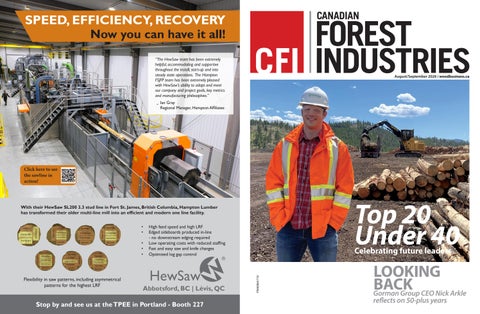
SPEED, EFFICIENCY, RECOVERY Now you can have it all! “The HewSaw team has been extremely helpful, accommodating and supportive throughout the install, start-up and into steady state operations. The Hampton FSJFP team has been extremely pleased with HewSaw’s ability to adapt and meet our company and project goals, key metrics and manufacturing philosophies.”
CANADIAN
FOREST CFI INDUSTRIES August/September 2026 | woodbusiness.ca
- Ian Gray
Regional Manager, Hampton Affiliates
Click here to see the sawline in action!
Top 20 Under 40
With their HewSaw SL200 3.3 stud line in Fort St. James, British Columbia, Hampton Lumber has transformed their older multi-line mill into an efficient and modern one line facility.
• • •
Flexibility in saw patterns, including asymmetrical patterns for the highest LRF
High feed speed and high LRF Edged sideboards produced in-line - no downstream edging required Low operating costs with reduced staffing Fast and easy saw and knife changes Optimized log gap control
®
Abbotsford, BC | Lévis, QC
Stop by and see us at the TPEE in Portland - Booth 227
Celebrating future leaders PM40065710
• •
LOOKING BACK Gorman Group CEO Nick Arkle reflects on 50-plus years
ONE PARTNER. One profiling line, run by a single operator, working Scan & Set, for all possible cutting patterns:
North American Sizes
European Sizes
Asian Sizes
LIN CK Ho l zverarbei tu n g stech n i k Gm bH Rep resentative Canada : Da mi e n M eye r I + 1 45 0 449 9173 d.meye r@l i nc k .c o m I www.l i nc k .c o m
Middle Eastern Sizes
CONTENTS
August/September 2026
8
TOP 20 UNDER 40
Showcasing the sector’s future leaders
Canadian Forest Industries celebrates 20 of the forest products sector’s best and brightest from across Canada.
27 WOOD PRODUCTS
32 SAWMILL PROFILE
Nick Arkle reflects on 50-plus years with Gorman Group.
Zavisha Sawmills discusses recovery from costly fire.
From bins to CEO
Bounces back
37 SAWMILL TECH
39 SAW FILING
The latest scanning and optimizing solutions for sawmills.
Peak saw performance starts with proper maintenance.
Scanners & optimizers
Peak performance
41LOGGING EQUIPMENT
42 FINAL CUT
The latest forwarders for logging contractors.
Reconciliation in forestry: Working toward the same goal.
Forwarders
Reconciliation
DEPARTMENTS
ON THE COVER
4 First Cut 6 Industry News 42 Final Cut
Nathan Rees, log buyer for Gorman Group’s Similkameen Forest Products in Princeton, B.C. is one of this year’s Top 20 Under 40 recipients. To learn about all of this year’s winners, turn to page 8. Photo: Gorman Group. August/September 2026 CFI 3
EDITORIAL first cut
Tougher times ahead More pain for the forest products sector
ANDREWsnook
asnook@annexbusinessmedia.com
CanadianForestIndustries @cfimag Canadian Forest Industries
4 CFI August/September 2026
Here we go again. This past August, the U.S., under The Trump Administration, announced additional 50-per-cent tariffs on roughly $28 billion worth of Canadian goods. The new Section 338 tariffs cover a wide range of value-added wood products including plywood, medium-density fibreboard (MDF), particleboard, moldings, doors, wood furniture, and others (If you’re looking for the full list of affected products, the BC Wood Specialties Group has created a list you can download at: www.bcwood.com/newtrump-tariffs). This combined with the existing softwood lumber duties and Section 232 tariffs, means that Canada’s forest products sector is being hit, arguably, harder than ever – certainly harder than anytime I can recall in my lifetime. On the other side of the border, the U.S. homebuilders and consumers will also be affected by rising costs of Canadian wood products, since our market continues to supply a significant number of products into our neighbours’ homebuilding sector. Those additional costs will not help the tough time the U.S. homebuilding sector is already experiencing. According to an August 25 press release from the National Association of Home Builders (NAHB) titled, “Economic Uncertainty, Affordability Challenges Weigh on New Home Sales,” a combination of elevated borrowing costs, rising inflation and broad economic uncertainty is hurting demand for new home sales. In the release, the NAHB states, “Sales of newly built single-family homes declined 10.5% in July to a seasonally adjusted annual rate of 607,000, following a sharply upwardly revised June estimate, according to newly released data from the U.S. Department of Housing and Urban Development and the U.S. Census Bureau. The pace of new home sales was 6.3% lower than a year earlier.” Increasing the costs of wood products further to
build those homes certainly will not help matters. While Prime Minister Mark Carney told Canadians walking away from the negotiating table was necessary, additional U.S. tariffs will not make the lives of the people working in the forest products sector any easier. I’m also of the opinion that reciprocal tariffs on U.S. goods are unhelpful for Canadian consumers, as we are the ones most likely to bear the costs of those additional taxes. Not unlike a certain four-letter “S” word, the costs of tariffs always roll downhill. And we, the consumer, live at the bottom of that hill. Hopefully, the U.S. and Canadian governments will return quickly to the table and find a way to overcome their current issues and strike a new deal that removes many of these damaging tariffs and duties from our forest products sector so we can return to a less combative relationship with our largest trading partner. With the U.S. midterm elections approaching this November, it is in the best interests of The Trump Administration to strike a deal with Canada that can slow the rising costs impacting the U.S. consumer (I am of the opinion that there is no issue that greater sways the average voter than day-today affordability). It is also in the best interests of Canadians for our federal government to negotiate a solution that takes pressure off our forest products sector, which directly employs approximately 200,000 people. While diversifying trade away from the U.S. makes sense, we also need to accept the reality that they will always be our largest trading partner, and we need to find solutions that both sides can accept so we can go back to having a more positive relationship with our most important ally. Will that happen under the current U.S. administration? Maybe, maybe not. But Canada’s forest products sector, its workers, and the many communities reliant on those jobs, need our government to work towards an economic solution sooner rather than later.
NEWS upfront FPAC calls for immediate response to new U.S. tariffs The Forest Products Association of Canada (FPAC) has stated its disappointment with the new 50-percent U.S. tariffs that will affect a range of Canadian forest products following the collapse of the Canada-U.S. trade negotiations. “We appreciate the sustained efforts of Prime Minister Carney, Minister LeBlanc, lead negotiator Janice Charette, and Canada’s negotiating team. Canada was right not to accept terms that failed to provide a fair and reliable path forward. Unfortunately, with the introduction of new Section 338 tariffs, in addition to existing softwood lumber duties and Section 232 tariffs, Canada’s forest sector is among the hardest hit in the country. We must move swiftly to protect Canadian forest sector employees, businesses, and communities,” said Derek Nighbor, president and CEO of FPAC. FPAC stressed that Canadian forest products are essential to integrated North American housing, construction, manufacturing and consumer-product supply chains; and that the new tariffs will disrupt those supply chains and raise
costs on both sides of the border. Forest products affected by the new tariffs include value-added products such as plywood, laminated wood products, fibreboard, paper and packaging. FPAC is calling for immediate action in four areas: • Timely, practical and accessible measures to help viable facilities maintain operations, retain employees and manage trade disruption that reflect the operating realities of Canada’s forest sector. • Carefully designed countermeasures, remission processes and import monitoring that protect Canadian producers and supply chains from unintended harm
and unfairly priced imports diverted into Canada. • Immediate implementation of the Forest Sector Transformation Task Force recommendations, including action on economic fibre access, regulatory efficiency, wildfire resilience, transportation competitiveness and investment in anchor facilities and value-added manufacturing. • Stronger domestic demand and market diversification through federal housing, infrastructure and procurement programs that make greater use of Canadian wood and forest products. “We will continue working with governments, our members, labour partners and American business partners to protect employees and productive capacity, strengthen domestic competitiveness and diversify markets,” said Nighbor. “All forest products, including lumber, pulp and paper, and value-added products, must remain a priority in any future negotiations with the United States. A fair, predictable and durable trading relationship remains in the interests of both countries.”
Millar Western receiving $100-million loan through LETL The Government of Canada announced that Millar Western Forest Products Ltd. is receiving a $100-million loan through the federal Large Enterprise Tariff Loan (LETL) facility overseen by the Canada Enterprise Emergency Funding Corporation. The loan will help Millar Western with rebuilding its log inventory as well as helping provide flexibility to strengthen its near-term operations and ability to adapt to
6 CFI August/September 2026
changing market conditions. Millar Western currently employs a total of 420 fulltime workers and supports approximately 300 contractors in maintenance, field-level forestry and consulting services through its three hardwood and softwood pulp mills in Slave Lake, Alta., Whitecourt, Alta., and Quesnel, B.C. Approximately 93 per cent of the company’s sales are to Asian markets with the majority shipped to China.
FPInnovations appoints new president and CEO FPInnovations has announced that Mathieu Blouin has been named its new president and CEO, effective as of July 13, 2026, as part of a planned transition. Blouin has more than 20 years of experience in applied forest research, fostering industry partnerships, and organizational leadership. He has been with FPInnovations for more than 16 years holding a variety of senior positions including his latest as vice-president of industrial partnerships. “Industrial research and innovation have
CCR wins CCIB Indigenous Small Business Award Central Chilcotin Rehabilitation Ltd. (CCR) is proud to share that it has been named the recipient of the Indigenous Small Business Award from the Canadian Council for Indigenous Business (CCIB).
The award recognizes CCR’s leadership in Indigenous-led forestry, forest rehabilitation, wildfire risk reduction, fibre utilization, and community-based economic development in the Cariboo Chilcotin. Through its work, CCR has created meaningful employment, supported local and Indigenous businesses, reduced wildfire risk, and advanced the rehabilitation of fire-affected forests across the region. “This recognition reflects the hard work of our crews, communities, partners, and leadership,” said Percy Guichon, CEO of CCR and elected Councillor of Tŝideldel First Nation. “Everything we do comes back to the land and the people we work for. This award is a reminder of what is possible when Indigenous communities lead the work in their own territories.”
never been more important. I am pleased to continue this work with our employees and partners to strengthen our sector competitiveness and support its transformation,” Blouin said. FPInnovations thanked its outgoing president and CEO Stéphane Renou, stating that under his leadership, “FPInnovations has moved to a more adaptive and agile model built to respond to the evolving needs of the industry, maximize the value of harvested wood, and serve as a trusted, honest broker of science and data for Canada’s forest sector.”
Burton Mill Solutions acquires East Coast Die Burton Mill Solutions has announced that it has acquired Georgia-based East Coast Die’s business as a specialized provider of fuel and feed die refurbishment and roll shell rebuilding services for the pellet industry. East Coast Die brings more than 30 years of experience supporting pellet producers across the East Coast and Midwest, with additional reach into Canada and the ability to serve customers wherever freight networks operate. This acquisition expands Burton’s refurbishment capacity and broadens its overall product offering. Along with strengthening die and roll shell service capabilities, Burton will expand into supplying new fuel and feed dies, further positioning the company as a comprehensive, one-stop solution for pellet producers. Integrating East Coast Die’s capabilities into Burton’s network will provide customers with greater technical expertise, enhanced operational support, and access to a wider range of products and services. Customers will also benefit from Burton’s dedicated fleet of delivery trucks, enabling more reliable pickup and delivery, and improved turnaround times. The East Coast Die team will remain in place to ensure continuity, including former owner Bobby Dumas, who will continue to be actively involved during the transition and support future growth, including the expansion of new die offerings. East Coast Die’s products and capabilities will be integrated into Burton’s existing network of reconditioning and service centres across North America, further strengthening its ability to deliver reliable, high-quality support to the fuel and feed pellet industry.
Reader Service Print and digital subscription inquires or changes, please contact Angelita Potal, Customer Service Tel: 416-510-5113 Email: apotal@annexbusinessmedia.com Mail: 111 Gordon Baker Rd., Suite 400, Toronto, ON M2H 3R1 EDITOR - Andrew Snook (416) 510-6801 asnook@annexbusinessmedia.com GROUP PUBLISHER - Anne Beswick (416) 410-5248 • Mobile: (416) 277-8428 abeswick@annexbusinessmedia.com ACCOUNT COORDINATOR - Shannon Drumm (416) 510-6762 sdrumm@annexbusinessmedia.com AUDIENCE DEVELOPMENT MANAGER Barb Adelt (416) 510-5184 badelt@annexbusinessmedia.com NATIONAL SALES MANAGER Justin Hertzman Ph: (514) 262-9803 JHertzman@annexbusinessmedia.com WESTERN SALES Tim Shaddick 1660 West 75th Ave Vancouver, B.C. V6P 6G2 Ph: (604) 264-1158 COO - Scott Jamieson sjamieson@annexbusinessmedia.com PUBLICATION MAIL AGREEMENT #40065710 RETURN UNDELIVERABLE CANADIAN ADDRESSES TO CIRCULATON DEPARTMENT. P.O. Box 51058 Pincourt, QC J7V 9T3 Canadian Forest Industries is published five times a year. Published and printed by Annex Business Media. Printed in Canada ISSN 0318-4277 SUBSCRIPTION RATES: Canada - 1 Yr $60.47; 2 Yr $108.20 Single Copy - $9.00 (Canadian prices do not include applicable taxes) USA – 1 Yr $128.89 CDN Foreign – 1 Yr $146.39 CDN Occasionally, Canadian Forest Industries will mail information on behalf of industry-related groups whose products and services we believe may be of interest to you. If you prefer not to receive this information, please contact our circulation department in any of the four ways listed above. No part of the editorial content of this publication may be reprinted without the publisher’s written permission ©2026 Annex Business Media. We acknowledge the [financial] support of the Government of Canada. Annex Privacy Officer Privacy@annexbusinessmedia.com Tel: 800-668-2374
British Columbia Saw Filers Association
www.woodbusiness.ca
August/September 2026 CFI 7
COVER
story
JUSTIN GALBRAITH
TOP 20 UNDER 40
Showcasing the forest products sector’s future leaders STAFF REPORT
8 CFI August/September 2026
The Top 20 Under 40 contest offers a spotlight for some of the best and brightest within Canada’s forest products sector. This year’s nomination pool was so rich with talent that we expanded the Top 10 Under 40 to include the Top 20 Under 40 nominations. These include production and woodlands managers, supervisors and coordinators, log buyers, engineering professionals, financial managers, workforce developers, and more. Congratulations to all of this year’s winners!
JUSTIN GALBRAITH A&A Trading Campbell River, B.C. Operations Manager Justin Galbraith’s love of wilderness and adventure lead him to choose forestry as a career. “I grew up outside of town and spent my youth canoeing and mountain biking throughout Ontario,” he says. “I’m happiest in the woods and my career has allowed me to spend a lot of time exploring some of the most wild places in British Columbia.”
As the operations manager for A&A Trading, Justin enjoys the challenges and diversity that the forest products sector has to offer. “No day is the same, whether it’s figuring out how to access timber, navigate changing legislation, or calculate financial forecasts. I wear a lot of hats in my role and never know what I’ll run into next,” he says. Seeing a project come to fruition keeps Justin motivated in his current role. “It usually takes a couple years of planning before the first tree is cut, and seeing a project move from a map to finished road and logs in the water is satisfying,” he says. To date, his proudest achievements have been providing A&A Trading’s First Nations clients with opportunities to improve the livelihoods of their members. “I’ve been able to provide direct employment, arrange funding for training someone to drive a logging truck for their Nation’s timber company, and complete projects that funded such initiatives as building a new reserve for one Nation and replacing roofs for another,” he says. As the sector continues to evolve, Justin says strengthening partnerships with First Nations will be critical. “Finding new avenues like custom cutting lumber, partnerships with industry and government, and investment in modern software and equipment will become increasingly important going forward,” he adds. When asked about recruitment and retention, Justin says the sector needs to continue educating the public about what the forest industry really means. “There’s still a pervasive idea that the forest industry is all about environmental destruction and a volatile industry to be a part of, which just isn’t the case. There are stable, high-paying jobs for people from all walks of life available, and responsible stewardship is paramount,” he says. When it comes to Justin’s future goals, continuing to grow his industry knowledge is key. “I just want to keep learning and becoming a well-rounded, knowledgeable forester. I work with a team of experienced people with a wealth of knowledge and skills to learn from and value that immensely,” he says. KELL HANSEN FraserWood Industries Squamish, B.C. Glulam Production Coordinator Like many of his industry colleagues, Kell Hansen grew up in the sector – his first job growing up working on his family’s Christmas Tree Farm. “My grandfather and uncles were professional foresters or ‘forestry professors,’ so I’d always been aware of the industry,” he says. Kell found log and timber buildings such as log cabins and timber frame ski resort lodges particularly interesting, so he moved out west and enrolled in the wood products program at University of British Columbia (UBC). “My time at UBC opened my eyes to engineered wood products, digital fabrication, CNC machines and new products still being developed,” he recalls. Kell thoroughly enjoys how small the industry is and the
A LONG WAY
TOGETHER
POWERTRAILER SR 331 Designed for trailers and tankers in transport applications both in the fields and on the road, BKT comes up with POWERTRAILER SR 331. The brand-new All Steel radial tyre features high load capacity plus extraordinary casing stability. Moreover, POWERTRAILER SR 331 stands out for enhanced durability - partly due to a special sidewall rib providing protection against impacts and the effects of tyre rubbing, while the hexagonal bead with chafer reinforcement ensures a perfect fit on the rim. Thanks to all these features, POWERTRAILER SR 331 is also synonymous with fuel economy and comfort on the road.
Discover the BKT Range
Joe Dias Eastern Zone Manager Directeur Régional, Est du Canada BKT Tires (Canada) Inc. Cell: 514-792-9220 Web: www.bkt-tires.com
August/September 2026 CFI 9 CFI_BKT-Tires_AugSept26_CSA.indd 1
2026-08-24 3:29 PM
the wood industry. When asked about his short- and longterm goals, Kell offered an answer that rents space in the heads of many people in the sector. “My number one goal is to not throw out my back before the age of 40,” he says. “My second goal is to keep working with exciting partners and building relationships in the industry to hopefully have a long and exciting career in the forest products industry. So far, off to a good start!”
KELL HANSEN connections he’s been able to make over the past 10-plus years. “I still routinely cross paths with old university colleagues, whether they’re in a sawmill up north or a cabinet shop on Vancouver Island. I have also made plenty of contacts in my 14 years working at FraserWood while collaborating with other companies throughout B.C. and the U.S.,” he says. “That is what I really enjoy about this industry – being able to pick up the phone and chat with someone about custom lumber grades, curved glulam, troubleshooting or a potential project and always get someone with a degree or two of separation.” The variety of projects that Kell tackles in his role as glulam production coordinator at FraserWood help keep him motivated in his role. “As the self-proclaimed ‘Glulam Guru’ I get to laminate everything from curved Yellow Cedar structural beams to veneer wrapped rift sawn White Oak,” he says. “If an architect or client wants 28-in.-wide clear vertical grain, I get to find a way to glue it from smaller pieces and do my best to meet their expectations. As soon as I am comfortable with a recently developed product I can always count on someone to ask, ‘What if it were like that but clear or curved?’” Kell’s proudest achievements to date have been developing custom laminated products for specific projects and solving challenging issues. Going forward, Kell would like to keep pushing the envelope of what is physically possible with laminated wood products and hopes that will convince others to innovate their sector of 10 CFI August/September 2026
OLYVIA FOSTER Ontario Woodlot Association North Bay, Ont. Communications Manager Olyvia Foster has always enjoyed being in the outdoors, but her path into the forestry sector wasn’t linear. “During my undergraduate studies I gravitated towards the ecology and plant science courses, but it was really my interest in conservation, seed genetics, communication – and a bit of good timing – that I began working for the Ontario Woodlot Association,” she explains. “I eventually recognized a desire to combine my passion for the environment with my love of writing, and this inspired me to pursue a career in communication and ultimately led me to landing my current role.” Olyvia’s favourite aspect of working in the sector is meeting people from all walks of life and hearing their stories. She says associations have a unique way of connecting people with shared interests. As a communications professional, Olyvia is motivated by her sense of responsibility to share resources and offer words of support to people during difficult times. “Hearing about peoples’ experiences this past wildfire season was particularly tough, but I find support from colleagues and online communities of communicators within the climate change space. And ultimately, there’s work to do to get forest owners the resources they need whether their goals relate to forest products and revenue, conservation, or wildlife,” she says. Olyvia says her proudest achievements are often the opportunities that push her to grow. One example she shared took place in 2025 when the OWA and sister organization Ontario Model Forests (formerly the Eastern Ontario Model Forest) hosted the International Model Forest Network Global
OLYVIA FOSTER Forum, in which her team welcomed 180 delegates from more than 40 countries to eastern Ontario for a week. “In collaboration with many partners, our team brought nearly 400 people together from around the world to learn from and experience forestry in eastern Ontario. For me, it’s all about improving lives economically, socially, and environmentally,” she says. Her future goals are to continue connecting people in the sector while offering up resources to help them in working towards their objectives. In the short term, Olyvia wants to continue supporting the OWA’s team with projects and connecting landowners with service providers and other resources. “Throughout my career I want to continuously learn and build skills so I can be an effective communicator and advocate. For now, I’m focusing on completing my Master of Arts in Professional Communication part-time through Royal Roads University. In the long-term, I want to apply my communication skills to help people navigate climate change adaptation,” she says. DEREK BURDKIN Selkirk Cedar/Downie Timber Revelstoke, B.C. Planning Forester Being raised by a forester in a forestry dependent community, Derek Burdkin had plenty of exposure and understanding to the opportunities and paths that can be taken within the forest products sector growing up. “I pursued general sciences in post-sec-
THE ORIGINAL WELCOME TO OUR TERRITORY
® Olofsfors is the market leader in bogie tracks for CTL machinery and wheel tracks for skidders and wheeled feller bunchers. Under the brand names, ECO-Tracks and ECO-Wheel Tracks, Olofsfors offers the widest range of track models and linkage systems for various machine configurations and ground conditions. Superior quality, performance and a proven track record for increased productivity and durability. NO MATTER THE CONDITIONS - OLOFSFORS HAS YOU COVERED!
www.olofsfors.com (519) 754-2190 info@olofsfors.com
ondary, followed by summer employment in forestry. I quickly developed a love for the challenges and exposure to the outdoors that forestry provided, which resulted in me transferring into a forestry degree. I have never looked back since,” he says. Derek’s favourite aspect of working in the forest products sector is the people. “It is humbling and inspiring working with and learning from them. The field day views and solid lunch spots are a close second and third,” he says. To date, Derek’s proudest achievement in his career has been developing a level of experience and understanding that allows him to continue to push for more innovative and sustainable forestry practices. To help advance the industry and his company into a better future, Derek says great opportunities lie within reconciliation with First Nations, especially in forest management. “I hope to continue being a part of the shift where First Nations partnerships, participation and collaboration are integrated at all levels,” he says. One of Derek’s goals is to advance continuous forest cover management as a viable tool. Another is to add resiliency to the land base by improving the company’s forest practices by incorporating fuel management. His short-term goals for his career are to continue increasing his exposure to all aspects of the industry to develop a well-rounded skill set. “Some areas that really interest me are wildfire risk reduction, landscape level planning, innovative silviculture and alternative forest management,” he says. “My long-term goal would be to have an influence on forest practices at the provincial level.” NATHAN REES Similkameen Forest Products Princeton, B.C. Log Buyer While Nathan Rees grew up in the U.K., he had the opportunity to travel throughout Canada to see the country’s vast, rugged, and unique landscape. “That was my biggest draw to forestry,” he says. “Later, I was offered an opportunity to study in B.C. for a second degree, which allowed me to reflect on what I wanted from a career. Forestry offered the perfect 12 CFI August/September 2026
DEREK BURDKIN
NATHAN REES
DAVE DE GRAAF
balance of working outdoors, solving complex challenges, and contributing to the sustainable management of a renewable resource.” Nathan’s favourite thing about working in the forest products sector is the variety and purpose that comes with the work. “There are always moving parts, new challenges, and opportunities that require thoughtful decision-making and collaboration,” he says. “I also value knowing that our work contributes to sustainable forest management and supports smaller communities.” The opportunity to continuously learn and grow keeps Nathan motivated in his position as log buyer for Similkameen Forest Products. “I am fortunate to be surrounded by people who trust my abilities, challenge me to improve, and provide the support needed to make meaningful decisions. Having the opportunity to contribute, take on new responsibilities, and develop as both a forester and a leader is incredibly rewarding,” he says. Nathan’s proudest achievement to date has been obtaining his Registered Professional Forester (RPF) designation. “It marked an important milestone in my professional development and reflected years of learning and experience in the field,” he says. “I have also been fortunate to build strong relationships with colleagues, contractors, and stakeholders. Those relationships have helped shape my professional growth and reinforced the importance of collaboration, trust, and mutual respect.” Nathan wants to help advance the industry by promoting practices supported by sound science, innovation, and continuous improvement. “I believe technology and data-driven decision-making will play an increasingly important role in the future of forestry, particularly as we focus on maximizing value from the fibre we harvest and expanding value-added opportunities,” he says. “This will require strong partnerships with Indigenous communities, landowners, other forest licensees, and stakeholders to ensure we are building a resilient and sustainable industry.” In the short term, Nathan’s goal is to continue expanding his leadership capabilities, technical expertise, and professional
relationships while contributing to safe, sustainable, and effective operations. “In the long term, I want to continue challenging myself by taking on broader leadership roles that allow me to contribute to strategic decision-making and help shape the future of the industry. I hope one day that I will be a positive influence on the next generation of forestry professionals,” he says. DAVE DE GRAAF Gorman Bros. Lumber West Kelowna, B.C. Energy/SR&ED Manager Dave De Graaf’s connection to forest products started in the mid90’s through his father’s career. “My father worked at Gorman Bros. Lumber over 25 years, so I grew up with an appreciation for the people and the process,” he says. During his time off while attending university, Dave worked at Gorman Bros. Lumber greasing bearings and changing gearbox oil and spent a lot of time in production. “Those experiences gave me a firsthand understanding of how mills operate and the pride that people take in producing high-quality wood products, particularly at Gorman,” he says. After completing his bachelor and master’s degrees, Dave joined GE Power & Water, which exposed him to a variety of operations and approaches across the forest products sector from an outside perspective; while also learning to interact and collaborate with people at all levels. “Returning to the Gorman Group in 2017 felt like coming full circle. It gave me the opportunity to combine my technical background with my firsthand understanding of mill operations and help further contribute to an industry that has been a huge part of my life,” he says. What Dave enjoys most in his position is that every day presents an opportunity to solve meaningful problems. “Whether it’s supporting innovation through SR&ED, improving energy performance and awareness, or helping teams secure funding for projects, the work has a tangible impact,” he says. Over the past decade, Dave has helped establish a stronger internal SR&ED process, developed best practices, and expanded his role into energy management. “Along the way, we’ve secured significant funding that has supported innovation and efficiency projects across our operations,” he says. “I’m also proud of continuing to invest in my own development which has helped me better understand the business and broader perspectives, allowing me to contribute in new ways.” One of Dave’s goals in his position is to help create an environment where innovation and advancement become part of everyday operations rather than something reserved for major projects. Looking back, Dave’s career has taken him from the mill floor, to supporting the industry as a supplier, and now to helping lead innovation within the company where he first learned the business. Looking ahead, his goal is to continue building on that journey by helping the industry become more innovative, sustainable, and competitive for the next generation by bridging the gap between operations, engineering, and business strategy.
PROTECTOR ULTRA SIGNAL RED SCAN TO SHOP www.haixca.com August/September 2026 CFI 13
CFI_HAIX_AugSept26_CSA.indd 1
2026-08-11 8:16 AM
COULTER ROBERTS Ntityix Resources LP West Kelowna, B.C. Planning Supervisor Having grown up in a rural area of West Kelowna, Coulter spent much of his childhood exploring the forests in his back yard – forests that he would later realize were part of the Westbank First Nation Community Forest. “When I started working in forestry I had little knowledge of the forest industry,” he says. “I began as a summer student after completing my Bachelor of Science in biology. My love of nature quickly made me realize this was something I wanted to pursue as a career. I was lucky enough to get to work and learn about forestry on the Westbank First Nation Community Forest in the forests I used to explore while growing up.” Coulter says getting the opportunity to bring his local knowledge and connections into the company’s forestry practices really sparked his passion for the forest industry. His favourite aspect about working in the sector is having a strong connection to nature, being outside in the forest and planning the future of the forests to promote healthy, resilient landscapes. “What keeps me motivated is knowing that the work I do today will have a lasting impact on the forests and communities. Working for an Indigenous forest management company, we implement Indigenous forestry principles that emphasize stewardship, sustainability, and planning for future generations,” he says. “I find purpose in developing treatments that create healthier, more resilient forests, with the hope that my children and future generations will be able to enjoy and benefit from them. Creating economic value and generating meaningful employment while balancing ecological, cultural, and community values gives me a great sense of pride in the work I do.” One of Coulter’s biggest achievements to date is being appointed vice-president of the BC Community Forest Association. “While it’s a recent milestone, it’s a great opportunity to help advocate for community-based forestry and contribute to the future of sustainable forest management across British Columbia,” he says. He’s also proud to have been involved in the planning and layout of harvest blocks 14 CFI August/September 2026
COULTER ROBERTS
JACKIE BUTLER and fuel mitigation treatments around his neighbourhood in West Kelowna that helped reduce the intensity of the Mount Law Wildfire in 2021. “Being familiar with the local landscape and community allowed me to bring local knowledge to the planning process. Seeing that work contribute to protecting our community reinforced the importance of proactive forest management,” he says. Coulter wants to continue working with the BC Community Forest Association to advocate for more community-based and Indigenous forestry. “I hope to bring innovative ideas and Indigenous values into practice that advance forest management and demonstrate that Indigenous-led forestry is the path forward,” he says. To assist with recruitment and retention
in the sector, Coulter suggests increasing public awareness through community messaging, education, and hands-on experiences to help people better understand the industry and the positive impacts it has, including wildfire risk reduction, job creation, and the creation of wood products – especially value-added products. “At the same time, promoting clear career pathways, mentorship, and opportunities for young people will help attract and retain a skilled workforce. Building a more stable and predictable industry will give young people greater confidence in pursuing long-term careers in forestry,” he says. In the short term, Coulter wants to continue building his experience in Indigenous forest management and obtain his Registered Professional Biologist designation. “Long term, I hope to continue advancing community-based forestry with Ntityix Resources and the BC Community Forst Association; and help shape a more sustainable forestry industry that benefits future generations,” he says. JACKIE BUTLER Woodtone Specialties Spallumcheen, B.C. Production Supervisor For Jackie Butler, anything that involves craftsmanship and the tools Mother Nature provides for everyday life is the most inspiring. “My favourite class in high school was woodworking, so it’s always interested me,” she says. “I have always spent my life growing up surrounded by trees, camping and making forts as a child. So, to continue working with lumber in a totally different way now is pretty neat.” One of Jackie’s first jobs as a teenager was harvesting pinecones from coniferous trees in the summers; and spending time within the forests made her fall in love with everything about forestry. “From the ecosystems to the bugs and spiders I would see every day, getting lost in the bush, and eventually moving into my job I have now working with lumber in a totally different way. I love everything about it,” she says. “I went from dealing with cones to raw lumber, and the whole process of it was fascinating for me.” Jackie’s favourite thing about working in the sector is the beauty. “Not only is the product beautiful that
we can create with all the species but being able to live within the beauty of it in general,” she says. Jackie adds that living in one of the most lumber-rich areas is truly a blessing. “It is especially important to me to work within a company that is not only a value-add company, but a company that does not rely on any old-growth fibre,” she says. “We can sustain our plant on even scrap wood fibre to make gorgeous, manufactured products; and that always really stuck out to me as something special. The whole process of our mill is something I’ve never really seen anywhere else and I really enjoy being part of a company that doesn’t let any of the fibre we use go to waste.” The teamwork, support and overall moral at Woodtone motivates Jackie in her current role. “If it wasn’t for the team I have at Woodtone, I would not be where I am at today – not only at work, but in everyday life as well,” she says. “I am constantly challenged and supported day to day, and the whole culture of the work environment is something I really value; and I feel like I have made a difference.” Jackie’s proudest achievement to date is how much she has learned from all the different positions she has held at Woodtone. “From working as a production worker hands-on, becoming a leadhand, eventually working my way into quality assurance and now production supervision – there is so much to learn, and my hope is to never stop learning and helping all my peers around me gain knowledge and experience as the years go on,” she says. One of Jackie’s main goals for Woodtone are to help build on the company’s partnership with the Adams Lake Indian Band, where they are planning on building a manufacturing facility, which would create a big opportunity to open up jobs for many people while growing the company. “I would enjoy being a part of continuing to make this happen and see what that looks like down the road, as we are still in the early stages. It is very special to be able to work with the First Nations around B.C. and I’m very proud to have a part in that,” she says. As for personal goals, Jackie wants to 16 CFI August/September 2026
ERIK QUIRING keep learning and growing her career. “Long term, I think it would be beneficial to get out in the field more and learn more about our land, maybe take a few classes. I’d also like to somehow make a difference in making working in this sector more appealing to women and young adults, as it has been the most interesting job I’ve had to date and has been very welcoming and well-rounded to work in.” ERIK QUIRING Tolko Industries Meadow Lake, Sask. Woodlands Operations Supervisor Erik Quiring’s passion for the outdoors, inspired by his father, led him to pursue a career in the forest industry. “As a forester, he often took me into the woods, and some of my earliest memories are of travelling forestry roads with him,” he recalls. “He would let me call out our location over the radio so oncoming traffic knew where we were. I’m also an avid fisherman and hunter, making the forest industry a natural fit for me.” Erik’s favourite thing about working in the sector is collaborating with all the different parties involved, from harvesting timber to delivering it to the mill. “Every day brings new challenges. I enjoy problem solving with others, brainstorming solutions, then executing and seeing the outcome,” he says. “Anyone who works in a woodlands role understands what I mean. I value the relationships I have built since starting in the industry, and I value everything I have learned through
LOGAN LEAN collaborating with everyone along the way.” In his current role as a woodlands operations supervisor with Tolko, Erik works with the woodlands team, the mill team, contractors, and stakeholders. What keeps him motivated is watching all this work come together in the log yard as the wood is fed into the mill. “I’m motivated to deliver the right log to the right line at the lowest cost,” he says. Identifying one proudest achievement is a tough question for Erik to answer. “I would say my best achievement working in the sector is the reputation I have built for myself. I’ve executed many large and small capital projects with positive results,” he says. As a curious person, Erik is always thinking about new efficiencies, technologies, and practices to help his company thrive. “I also think it’s important to be a team player, mentor new employees when possible, and contribute ideas that reduce costs, improve sustainability, and promote a safe working environment,” he says. “When you combine everything I’ve mentioned, it will help advance the industry, and Tolko, into a better future.” Erik says the forest industry needs to do a better job of promoting modern forestry by highlighting the technology, sustainability, variety of wood products, and the range of careers available. “There is so much opportunity within the forest industry. When forest companies continue to invest in, challenge, and grow their employees, they will retain
high-performing and motivated individuals,” he says. In the short term, Erik wants to become proficient in his current role and learn as much as he can from the team he works with and consistently contribute high-quality work. “I also want to develop new skills and take on more responsibility as I gain experience,” he says. “My long-term goal is to continue to be challenged, grow into more advanced roles, and help improve Tolko’s performance in Meadow Lake.” LOGAN LEAN Acadian Timber Edmundston, N.B. Health, Safety and Environmental Specialist Growing up, Logan Lean spent countless hours outdoors hiking, fishing, ATVing, and enjoying everything nature has to offer. She says it was only fitting that he found a career that allowed her to stay connected to the outdoors. “I’m fortunate to have had great family members and mentors who introduced me to the forestry industry and helped
guide me along the way,” she says. Logan’s favourite aspect of working in the sector are the people she gets to interact with. “People often say they go into forestry to get away from people, but in reality, it’s a very people-focused industry. The relationships you build and the people you work with are what make this industry so rewarding. Great people are the backbone of forestry, and that’s my favorite part of the job,” she says. What keeps Logan motivated is knowing that every day she has the opportunity to make the workplace safer. “Taking every opportunity to create a safe, healthy, and functional work environment for my coworkers and the contractors who work with Acadian gives me a great sense of pride and purpose,” she says. One of Logan’s proudest achievements to date has been the progression of her career within the forest industry in a short period of time. “I started as a summer student in a silviculture/operations role, then moved into seasonal spruce budworm work
before transitioning full-time into forest operations. These experiences provided me with a strong foundation and a well-rounded understanding of the industry,” she says. “Today, as a health, safety and environmental specialist, I have the opportunity to contribute in ways that improve worker safety, environmental stewardship, and operational excellence.” Logan wants to contribute to the advancement of both the forestry industry and her company by promoting innovation, strengthening safety and environmental performance, and supporting sustainable practices that position them for long-term success. Her short-term goal is to continue improving workplace safety and environmental performance every day while growing her knowledge and experience in the industry. “Long term, I hope to work alongside industry leaders to help strengthen the safety culture across the forestry sector and contribute to initiatives that make our industry safer, more sustainable, and better prepared for the future,” she says.
2026
TOP 10 UNDER 40
CONGRATULATIONS TO OUR WINNERS
We are proud to congratulate Derek Burdikin, Nathan Rees, and Dave de Graaf on being recognized as Canadian Forest Industries’ Top 10 Under 40 recipients. Their leadership, innovation, and commitment to sustainable forestry reflect the excellence found throughout the
DEREK BURDIKIN
NATHAN REES
DAVE DE GRAAF
Planning Forester Downie Timber
Log Buyer Similkameen Forest Products
Energy / SR&ED Manager Gorman Bros. Lumber Ltd.
GORMAN GROUP
CFI_Gorman Bros_Aug_Sept26_GWJ.indd 1
August/September 2026 CFI 17 2026-08-18 1:08 PM
FLORIAN BERGOIN Nazko First Nation Quesnel, B.C. Director of Natural Resources Florian Bergoin grew up in a forest sector dependent community in the French Alps. He learned the importance of forest stewardship and balancing all the ecological services provided by forest ecosystems and grounding sustainable development in traditional ecological knowledge. “From a young age, when making firewood or working on our family woodlot, I learned the importance of trees, and knew early on this was the place for me,” he says. “I worked in different parts of the sector, from hand-falling to land use planning and enjoyed every minute of it.” Florian’s favourite aspect of working in the forest sector is the diverse people, cultures and perspectives. “Because forests are such an intrinsic part of our cultures, there is so much passion shared by all of us; and the thing I enjoy the most about my job is finding synergies and solutions to the complex issues faced by the sector,” he says. Florian says he’s motivated in his current role from having the privilege of working for an Indigenous community, where forests are much more than trees. “I love working with community members and members of the public to develop collaborative solutions grounded in a diversity of perspectives. There is nothing more rewarding for me than seeing connections being made,” he says. When asked about his proudest achievements to date, Florian says it’s building strong networks and finding commonalities and consensus among differing perspectives to advance towards a common goal. “I love the challenge of building and working in multidisciplinary teams because I believe everyone has something good to contribute,” he says. “The challenges that the sector faces are numerous and very complex, and my goals are to try and always be open minded and promote optimism and team work to develop solutions that work for everyone.” When it comes to improving recruitment and retention in the sector, Florian says Canadian forestry has never had better story to tell than right now. “Despite the recent economic challenges faced by the sector, it remains such a di18 CFI August/September 2026
FLORIAN BERGOIN verse and friendly place to work, thanks to the resilience and passion of the people that make it,” he says. “There is so much space for creativity, innovation and self-development that needs to be communicated to the world so we can keep attracting talent into the sector.” When it comes to his future goals, Florian says he has too many to list them all. “The main ones are I want to keep building teams and bringing people along, whether it is within my staff or with different agencies I work with,” he says. “I am also trying to learn the Dakelh language so I can also broaden my understanding of traditional ecological knowledge.” VINCENT CORBEIL Domtar Windsor, Que. Engineering Coordinator - Mechanical Vincent Corbeil grew up in a house surrounded by forests and located near a lake, so nature has always been part of his daily life. During his studies in mechanical engineering, Vincent completed several internships at Domtar, first as an industrial mechanic and later as an engineering intern. Those experiences exposed him to the scale and complexity of the forest products industry. “I was impressed by the size of the equipment, the challenges involved in keeping operations running, and the expertise of the people working there. What started as an internship opportunity quickly became a career path,” he says. “I realized this industry offered the chance to work on
VINCENT CORBEIL major projects, lead meaningful initiatives, and contribute to an essential sector built around a renewable resource.” Vincent’s favorite aspect of working in the sector is the opportunity to make a tangible impact through teamwork. “In an integrated mill environment, every project involves collaboration between operations, maintenance, engineering, contractors, and suppliers. I enjoy bringing people together around a common objective and helping teams overcome challenges. Seeing an idea evolve from a concept into a successful project that improves the mill’s performance is incredibly rewarding,” he says. What motivates Vincent most? Helping others succeed. “Today, a large part of my role involves supporting engineers, technicians, and project managers as they execute projects and navigate challenges. I enjoy sharing my experience, helping teams solve problems, and creating an environment where people can grow professionally,” he says. “I am also motivated by the scale of the responsibility. Coordinating the execution of a portfolio of over 75 projects representing more than $100 million in capital investments is both challenging and rewarding. Knowing that these projects will contribute to the longterm future of the mill gives purpose to my work every day.” The major projects he has had the opportunity to lead throughout his career are Vincent’s proudest achievements to date. “Two milestones stand out in particular: the modernization of a paper machine’s
forming section and the modernization of a headbox on another paper machine. In both cases, I led multidisciplinary teams of 10 to 20 people through every phase of the project, from definition and design to construction, start-up, and operational support,” he says. Vincent’s main goal is to help ensure the long-term competitiveness and sustainability of Domtar’s operations. “I hope to contribute by helping prioritize and execute strategic investments that improve efficiency, reliability, and sustainability,” he says. “At the local level, I want to play a role in positioning the Domtar Windsor mill for long-term success so that it remains a strong contributor to our community and the industry for many years to come.” In the short term, Vincent wants to continue supporting the growth of the Domtar Windsor mill and developing as a leader within the capital projects organization. “In the long term, I aspire to take on broader leadership responsibilities where I can help shape strategic decisions, influence organizational direction, and positively impact even more people. Ultimately, I want to be known as a collaborative and inspiring leader who helped build strong teams and contribute to the longterm success of our industry,” he says. NATASHA LEBIADOWSKI Silvicon Services Smithers, B.C. Operations Manager In 2016, Silvicon hired Natasha Lebiadowski as a compassman with no forestry experience or an understanding of what forestry is.
CONGRATULATIONS JUSTIN Success in forestry is built through hard work, practical thinking, strong relationships, and a willingness to solve problems. That’s why it comes as no surprise to us that Justin has been named one of Canadian Forest Industries’ Top 10 Under 40.
We’re proud to call him one of our own. Your Friends at A&A Trading
aatradingltd
aatrading.com
“I was physically exhausted but mentally so supported by my coworkers that I fell in love with the challenge, variability of each day, and the people. I gained a permanent state of bruised banana legs from pine salvage and many of my dearest friends. Later, I attended the NRFT (Natural Resources and Forest Technology) program at CNC (College of New Caledonia) and got to build my understanding,” she says. Natasha’s favourite things about working in the forest NATASHA LEBIADOWSKI sector are that she’s always learning and each day presents new challenges and opportuntiies. She says she’s been lucky to be involved in development and lead operations on partial cut and thinning projects. “With Wetzin’kwa Community Forest Corporation, the general manager encourages the weird and wonderful so there is opportunity to trial unique concepts,” she says. “I learned a tremendous amount on Nisga’a lands when I was involved in all phases of forestry. Then, often completing field work with just my dog, there was a lot of self-growth and comfort gained walking around different parts of the Nass… I think my greatest achievements are the people I get to have in my life – and the field dogs I’ve got to work with that eat half my lunch and demand attention.” To help the industry with better recruitment and retention, Natasha says more exposure to different skillsets, other industry professionals and tasks will help broaden what forestry means to each person. “Being stuck in a task – too much production or having little to no impact in decisions – I’ve seen quite a bit of burnout from workload or the industry as a whole,” she says. “Having someone to learn from or give you the opportunity for exposure to challenge yourself has helped me progress significantly and find the parts I love.” Natasha’s immediate goals are meeting her deadlines. Her longterm goals are to continue learning, developing and implementing the weird and wonderful. “I completed my RFT designation last fall so now I have all this free time – not really,” she jokes. “I recently was accepted to TRU (Thompson Rivers University) to pursue my bachelor at a distance and hopefully eventual registration with the EGBC (Engineers and Geoscientists British Columbia) as a PGeo. I’m also hopeful for eventual ASFIT pathways to my RPF.” JON ROTHWELL Mosaic Forest Management Campbell River, B.C. Area Planner Like many people in the sector, Jon Rothwell was inspired to work in the forest products sector to be outside, and it has not disappointed.
20 CFI August/September 2026 CFI_AATRADING_AUGSEPT26_BAS.indd 1
2026-09-01 9:53 AM
JON ROTHWELL “I have been truly fortunate to see and explore a lot of amazing places all over British Columbia from the Rocky Mountains, northern B.C., and the coast. It is also a complex industry with a lot of diversity in career paths that one can pursue which has kept my career exciting,” he says. Jon’s favourite thing about working in the sector is the complex and dynamic nature of the industry.
“Each problem tends to be unique and keeps you engaged. Even a problem you have dealt with many times may need to be approached and addressed differently depending on the current conditions of the economy, social pressures on forestry and the statutory frameworks you are operating within,” he says. The challenging operating climate of forestry motivates Jon in his current role. “Even when I think I know how to do something there may be a better way, which keeps me receptive to new ideas,” he says. Jon’s proudest achievements working in the forest sector are his ability to move between multiple management frameworks on the B.C. Coast and successfully execute on projects in contentious areas. “A few of my operating areas involve a lot of delicate balancing and engagement with local stakeholders where nothing moves fast; but being diligent in my work, listening to concerns and being receptive to different viewpoints has been a key to success,” he says. Two things that stand out that Jon says are vital for industry are a need for in-
creased fibre utilization of a smaller timber profile and increased participation of local communities in forest management. “Accessing profitable timber will continue to be a challenge and being creative and harnessing innovative technologies to leverage an advantage will be critical to moving beyond the status quo,” he says. “I think this will best be achieved at a local level having the management of forests locally rooted with the returns and benefits staying in the community.” Jon’s short-term goals are simple: continuing to develop as a professional and fill gaps in his knowledge to be a better forester. His long-term goals include being involved with a program that advances creative solutions at a local level to achieve the desired results of a community. CHRISTA CAMPBELL Domtar Ontario Senior Coordinator, Forestry Christa Campbell was inspired to work in the forest sector by her father and her upbringing in northwestern Ontario. “My father was a Registered Professional
WELL DONE
CARMEN BACKS & TYLER BACKS! Join us in congratulating Carmen & Tyler in being nominated as two of the top 10 under 40 in the Canadian Forest Industry. This is a well-deserved recognition of their success as young business leaders in BC’s dynamic coastal forest industry.
CFI_VANSPEC_AUGSEPT26_BAS.indd 1
Carrying on a storied coastal tradition through the implementation of VanSpec Skirl siding , their youthful enthusiasm has driven positive change across our business. Constructive change combined with dedication to a traditional standard of - on grade- on spec- on time - has resulted in a loyal & growing customer base for the VANSPEC product line.
August/September 2026 CFI 21 2026-08-25 12:32 PM
Forester in northwestern Ontario for his whole career. My parents instilled in me a love of the outdoors at a young age through camping, fishing, hunting, and living on 40 acres of forest,” she says. Christa’s favourite thing about working in the sector is the time spent in the bush. “There is nothing that beats a sunny August day walking through the bush once the bugs have died down,” she says. She is motivated by her passion for managing forests sustainably, now, and into the future. “I want to be a part of ensuring a sustainable legacy of well-managed forests here in northwestern Ontario so that my son can enjoy the same beautiful landscape that I have been able to enjoy,” she says. “I am also motivated by the woodlands team at Domtar. They are a group of professional resource managers who share my passion for sustainable management.” Christa became a Registered Professional Forester (RPF) in Ontario directly out of university by completing the 18-month mentorship program. One of her proudest achievements working in the sector is building an interactive presentation for local high schools to help further their education about sustainable forestry. “I brought in drone pilots for a demo, government resource professionals, forest harvesting equipment simulators, and many passionate foresters to showcase the work we do,” she says. To help advance the industry and her company into a better future, Christa says the sector needs to utilize the latest available technologies to increase efficiency and provide more accurate information. “An example of this is the latest Ontario Forest Resource Inventory, which includes LiDAR information. The company can utilize this information to make more informed decisions when planning harvest especially over the long timeframes required,” she says. Christa’s short-term goal is to be the Plan Author on a Forest Management Plan for one of Ontario’s Sustainable Forest Licences. “My long-term goals are to continue to increase my knowledge through life-long learning and build a career where I enjoy going to work every day,” she says. 22 CFI August/September 2026
CHRISTA CAMPBELL
NATALIYA VORONOVA
ANNA MCNALLY
NATALIYA VORONOVA Alberta-Pacific Forest Industries Boyle, Alta. Manager, Financial Reporting When Nataliya Voronova came to Canada and joined PwC Edmonton, the first industry she was exposed to was forestry during her days in public practice. “I learned a lot when I was on-site at the pulp and sawmills, as well as other manufacturing companies, and it has always been the most exciting part – to be able to apply accounting to the manufacturing and production processes, and be able to add value to the business both in public practice and at Al-Pac,” she says. What Nataliya enjoys most is the collaborative nature of the industry. “Success depends on people from many different disciplines working together – operations, engineering, maintenance, forestry, sustainability, commercial teams, and finance. Every day presents new challenges that require practical solutions and cross-functional thinking,” she says. Nataliya is motivated by the opportunity to create lasting value within the financial reporting function and beyond. “I believe there is a common misconception that financial reporting exists solely to satisfy accounting, audit, and tax compliance requirements. In reality, it provides a unique, enterprise-wide perspective on the company’s financial performance – both at a specific point in time and over longer-term trends,” she says. Her proudest achievement to date in her career has been helping transform financial reporting from a compliance-focused function into a strategic business partner for the organization. “Over the past several years, I have contributed to initiatives that modernized financial reporting processes and streamlined reporting, including implementation of a major ERP system, implementation of the Net Direct Cash Cost model, and improved board reporting,” she says. Nataliya’s goal is to continue supporting initiatives that improve decision-making through advanced analytics, automation, and stronger governance while maintaining the highest standards of financial integrity. “I also hope to contribute to sustainability by improving how organizations measure environmental performance, capital investments, and long-term value creation.
Equally important is developing future leaders by sharing knowledge, mentoring young professionals, and fostering collaboration across functional teams,” she says. In the short term, Nataliya wants to continue strengthening her leadership capabilities while driving improvements in financial reporting, governance, operational analytics, and business performance. “Over the long term, I would like to continue growing as a finance professional and contribute to the development of a strong, forward-looking finance function. I am interested in expanding my knowledge across different areas of the business, mentoring and supporting others, and continuing to take on opportunities where I can create value for the organization,” she says. ANNA MCNALLY Western Forest Products Vancouver, B.C. Cedar Sales Manager Anna McNally ended up in the lumber industry almost by accident. When she immigrated to Canada from Ireland, Anna took a job at reception with Western Forest Products to pay her rent and had no inten-
tion of staying with the company long term. “What really drew me in was the nature of the business and how deeply it is built on relationships and trust. I was fascinated by an industry where purchase orders could be verbal and significant volumes of business could be committed to with a handshake on a golf course. There is something very genuine about doing business in an environment where relationships and your word still carry so much weight,” she says. Anna’s favourite thing about working in the sector is the constantly evolving nature of the business. “It is an industry that is always changing and always presenting new challenges, which means there is never a shortage of opportunities to learn, adapt and improve,” she says. “A large part of my role involves analyzing the products we manufacture, the markets we serve, and the customers we sell to. I really enjoy digging into that information, identifying opportunities and finding ways to optimize what we do.” Career progression is a big motivator for Anna. One of the things she’s come to appreciate during her time in the sector is
how much there is to learn. “There are areas of the business where I know I need to deepen my understanding in order to continue growing and progressing in my career,” she says. “Identifying those gaps, building my knowledge and working toward the next opportunity keeps me motivated and continually pushing myself. I’m also fortunate to have a wonderful team around me who work extremely hard and share a strong sense of responsibility for the success of the business.” Obtaining her role as cedar sales manager is Anna’s proudest achievement to date. “I’m very proud of the role I hold today and, in particular, of the trust the company has placed in me to be responsible for one of our most critical business segments,” she says. “I’m also proud of the relationships I’ve built throughout the industry over the years. I’ve worked hard to be someone who is knowledgeable, dependable and true to my word, and I feel fortunate to have earned the trust and respect of colleagues, customers and others across the industry.” Anna wants to help the industry do a better job of telling its story. “We have an incredibly sustainable,
Woodtone Specialties Congratulates
JACKIE BUTLER
From general labourer to Production Supervisor, you've succeeded by doing what you always do: putting people first. Your curiosity, your care for those you work with, and your knack for finding a better way have made you exactly the kind of leader this award was created to celebrate. You don’t just meet Woodtone's values, you show all of us what they look like in action. Your inclusion in the Top 10 Under 40 is well deserved, and just the beginning. Congratulations as well to all this year's winners - the future of this industry is in good hands.
The Woodtone Specialties Team
August/September 2026 CFI 23
renewable product, and I believe we need to be much more confident in positioning wood and natural building materials as part of the solution to the climate challenges we face. There is a great story to tell, but we need to get better at telling it,” she says. She also wants to see the industry continue to make meaningful progress on diversity and inclusion. “I would like to help create an industry where a much broader range of people can see a future for themselves, have opportunities to progress and, ultimately, bring different perspectives to the decisions we make,” she says. Anna’s short-term goal is to continue developing her leadership skills and broadening her understanding of the business with the aim of progressing into a sales director role. “Longer term, my ambition is to hold an executive-level position with a major lumber company. I would like to be in a position where I can help shape the strategic direction of a business and have a broader influence on the future of our industry,” she says. “An important part of that journey for me is paying forward the mentorship and support that I have been fortunate to receive throughout my own career as well as continue to ensure I am enjoying myself along the way.” CATHERINE LANGILLE BC First Nations Forestry Council Nanaimo, B.C. Workforce Development Lead Catherine Langille was inspired to join the forestry sector through her experiences with crew leaders and supervisors she met through the Outland Youth Employment Program as a high school student. “They were down-to-earth, adventurous and really connected to their work. I wanted the Blundstones, the tree-planter look, and, more importantly, the sense of purpose they carried,” she recalls. “Nearly 10 years later, the people I have met continue to inspire me and are now lifelong friends. As an Indigenous woman, this work is not always easy, but I believe Indigenous knowledge, leadership and stewardship are essential to the future of our forests.” Catherine’s favourite part of forestry is working with young people. “Supporting Indigenous youth means supporting the future of our forests; 24 CFI August/September 2026
CATHERINE LANGILLE
DR. SHIVA ZARGAR because one day, they will carry this work forward,” she says. “Helping someone recognize their strengths, find an opportunity, and begin to see themselves as a future leader is one of the most meaningful ways I can give back. When we invest in young people, we plant something that will continue growing long after us.” Catherine says she is motivated by the need to turn good intentions into real opportunities. “Forestry has many conversations about change, but strong workforce programs allow us to put those ideas into action,” she says. “I was once the student receiving support, and now I am becoming the mentor and program leader. Standing between those two places allows me to understand where young people are beginning, while also seeing how far they can go.”
Catherine says she is proud to have received national recognition, spoken alongside forest leaders, and built relationships with Indigenous students and professionals across Canada. However, her most meaningful achievement is the reach of that work. “I have supported hundreds of young people from high school through post-secondary education and into their careers. Their successes are entirely their own, they did the work. I am simply proud to have offered guidance, encouragement or an opportunity that helped them see what was possible,” she says. Catherine’s main goal is to help build forestry programs that are culturally grounded, inclusive and shaped by what Indigenous youth genuinely need. “Through the BC First Nations Forestry Council’s scholarship, youth and mentorship initiatives, I can help connect education, funding, work experience and community,” she says. “I want these programs to create more than entry points; I want them to create lasting pathways. A stronger future for forestry begins by ensuring young people can see themselves within it and have the support to stay, grow and lead.” To help improve retention and recruitment in the sector, Catherine stresses that the industry must move from conversation to action. “Indigenous Peoples should not have to carry the responsibility of teaching organizations how to fulfill their own commitments to reconciliation and inclusion. Employers must do that work: build genuine relationships, create culturally safe workplaces, invest in mentorship and make advancement visible and attainable. Recruitment may open the door, but retention depends on what people find on the other side, respect, belonging, opportunity and a reason to stay,” she says. Catherine’s short-term goal is to continue strengthening Indigenous scholarships, mentorship and youth programming across B.C. and the rest of Canada. Long term, she hopes to bring this work to an international level by connecting Indigenous youth, communities and forest leaders across borders. “Forests remind us that everything is connected. Trees, wildlife and fire do not recognize political boundaries, and our re-
sponsibility to care for the land should not be limited by them either,” she says. “I hope to create spaces where Indigenous Peoples around the world can exchange knowledge, strengthen relationships and shape the future of forestry together.” DR. SHIVA ZARGAR Build Neutral Inc. Calgary, Alta. Co-founder and director of science and LCA Dr. Shiva Zargar’s inspiration to join the forest products sector stemmed from her time pursuing her PhD in sustainable bioeconomy at the University of British Columbia’s Faculty of Forestry. She says this is where she realized that one of Canada’s most important industries also presented one of its most exciting scientific challenges. “Forests have enormous potential to support a low-carbon future, but unlocking that potential requires more than innovation; it requires evidence,” she says. “Through my research, I developed an integrated analytical platform combining Life Cycle Assessment (LCA), Techno-Economic Analysis (TEA), and Multi-Objective
Optimization methodologies to evaluate the environmental and economic performance of forest-based products. That experience showed me how science can guide better decisions and ultimately shaped my career as an LCA scientist.” Shiva’s favourite thing about working in the sector is the opportunity to bridge science and real-world impact. “Every project presents a new challenge, whether it’s evaluating an innovative wood product, a bio-based technology, or a manufacturing process. I find it incredibly rewarding to use science to help industry make informed decisions that strengthen both environmental performance and longterm competitiveness,” she says. What keeps Shiva motivated in her role is seeing science translated into real-world impact. “Whether it’s helping a manufacturer develop a lower-impact product, supporting credible environmental claims through Environmental Product Declarations (EPDs), or contributing to international standards, I find it rewarding to know that rigorous scientific assessment can influence decisions that benefit both industry and
the environment,” she says. “Every project is an opportunity to improve transparency, support innovation, and help build a more sustainable future.” To date, one of Shiva’s greatest achievements has been bridging academic research with practical industry implementation. “I have always been passionate about scientific research and its ability to solve complex sustainability challenges. Through my PhD and the co-founding of Build Neutral, I have had the opportunity to translate advanced research into practical tools that help organizations improve environmental transparency through LCA, EPDs, and carbon accounting,” she says. Shiva says her goal is to help make science-based decision-making the foundation of sustainability across all industries, including the forest products sector. “I believe LCA has an incredibly important role in helping organizations move beyond assumptions and make informed decisions based on trustworthy environmental data,” she says. “Through Build Neutral, I hope to continue advancing environmental transparency, improving the quality and accessibility of LCA, and
SUPPLIER OF THE BEST SOLUTIONS FOR YOUR DUST MITIGATION NEEDS For over 60 years, we have proudly designed and manufactured our equipment in Quebec.
PHONE 418-839-0671 | EMAIL info@rodriguemetal.com
CFI_Rodrigue Metals_AugSept26_CSA.indd 1
August/September 2026 CFI 25 2026-08-17 9:16 AM
exploring how merging technologies such as artificial intelligence can strengthen environmental assessment. Ultimately, I want to help build a future where sustainability is measured with confidence, communicated with transparency, and used to drive meaningful innovation.” When asked about her short-term and long-term career goals, Shiva says that in the short term she wants to continue working on meaningful and impactful projects. Over the long term, Shiva views her career as an opportunity to contribute to the continued advancement of LCA as both a scientific discipline and a practical decision-making tool. “If I can leave the field stronger than I found it, inspire others to pursue science with curiosity and integrity, and know that my work helped people make better decisions for the future, I would consider that a meaningful and fulfilling career,” she says. CARMEN AND TYLER BACKS Vancouver Specialty Cedar Products Maple Ridge, B.C. For Carmen Backs, she feels like cedar is in her blood as a fifth-generation Backs in the
26 CFI August/September 2026
CFI_ScanMeg_AugSept26_CSA.indd 1
TYLER BACKS AND CARMEN BACKS industry as lead plant operator of Vancouver Specialty Cedar Products (VANSPEC). That said, this wasn’t her initial career path. uld consider that a meaningful and fulfilling career,” she says. “I had been working for VANSPEC on my summers and weekends from age 13 to 23 and had no intention of staying in the industry, but the opportunity presented
2026-08-24 11:50 AM
itself with an opening to work in the cedar department at Western Forest Products (WFP) under Jeff Derby and I took it. I started as sales admin and left as a logistics coordinator managing North American WRC orderfile shipments out of a Surrey reload hub point for the company. I very much enjoyed learning and working with the group at WFP,” she recalls. Her brother, Tyler, after finishing his diploma at BCIT in marketing management (Professional Real Estate option), he was presented an opportunity to shift gears and work for his father at VANSPEC. “Needless to say, I’ve never looked back and have thoroughly enjoyed building meaningful relationships and developing business from logs to finished products,” Tyler says. Carmen’s favourite aspect of working in the sector is that it is largely one big happy family with their customers, suppliers, and others in the industry. For Tyler, it’s being part of the entire process of manufacturing and economics of raw logs being turned into finished products that can enrich homes or commercial spaces that is deeply satisfying. Carmen loves what she does at VANSPEC and takes great pride in helping the company succeed. “Over the past eight years, we’ve grown into a team of nearly 80 people. That represents 80 homes and families positively impacted by our successes – and affected by our challenges. While some may view that as pressure, I see it as an honour,” she says. Tyler says he is motivated by continuously strengthening supply chains through being a better partner to vendors and finding new ways to support his customers. “Seeing this process drive success with operations and our whole team is really rewarding,” he says. Carmen’s main goal is to eventually move into more of a leadership role. “Helping guide and teach the next generation of remanufacturers would be an exciting opportunity and something I’d truly enjoy,” she says. For Tyler, he wants to ensure he is always putting himself in a position to grow, and recently took a new position and is excited “to be a part of the team growing West Bay Preferred Red Cedar for our next generation of success.“
CANADIAN WOODPRODUCTS
FROM ASSEMBLING APPLE BINS TO CEO BY ANDREW SNOOK
When Nick Arkle attended his cousin’s wedding in the U.K. more than 50 years ago, he had no idea that day would be the beginning of his long and impressive career with the Gorman Group. On that important day, Nick was introduced to his cousin’s new father-in-law during the dinner service. That man was Ross Gorman. Nick was a student finishing his last year of high school at the time. The two men started up a conversation during the dinner that helped chart Nick’s course into the forest products sector. “He said to me, ‘What are you going to do when you finish school in a year’s time?’ And I said, ‘Well, I’ll do what every other British kid does. They go down to southern France, they pick grapes in the vineyards, and then they do their gap year,’” Nick recalls. Ross offered Nick another option that intrigued him, asking him to come to Canada and work at his small sawmill and box manufacturing plant in the B.C. Southern Interior.
“He said, ‘Come out to Canada. You can earn your airfare and see a different part of the world. You can go to Europe anytime and do the stuff that you’re talking about.’ So, I did, and little did I know that was going to be the path to 50-plus years that I’ve now been here,” Nick says. When Nick first arrived at the sawmill he was assembling apple bins, which is what Gorman Bros. were known best for back then. After their family’s fruit orchards froze in 1949, brothers John and Ross Gorman decided to change the family business’ direction and started their fruit boxes and lumber business in 1951 called Gorman Bros. Lumber and Box Company. “I made apple bins that summer and then decided I’d like to stay for ski season. So, I stayed into the fall. By then they were no longer making apple boxes, so I ended up going into the mill and piling lumber,” Nick recalls. “When you’re 18 years old, you don’t mind piling lumber. It’s hard work, but you’re doing it with a bunch of friends, and all
Nick Arkle speaking with Prime Minister Mark Carney during the PM’s visit to the Gorman Group. Photos: Gorman Group.
August/September 2026 CFI 27
CANADIAN WOODPRODUCTS is good. But after a while, you start to think, I don’t want to pile lumber for the rest of my life.” While his interest in piling lumber waned, Nick’s passion for the forest products sector was firmly planted. So, Nick approached Ross and expressed his interest in learning more about the business. Ross advised him that he should go back to school and attend university. Nick listened and went back to school attending the British Columbia Institute of Technology and then the University of British Columbia and earned his degree in forestry. At the same time that Nick’s education was flourishing, so was his romantic life. And funny enough, just like his cousin, he found himself falling in love with a member of the Gorman family. “Ross’ youngest daughter Louise was at university at the same time as me, and we knew each other because of the connection, and we’d ski together. One thing led to another and we got married,” Nick recalls. After the couple married in 1985, they completed university and travelled the world. After backpacking around Asia and Europe for a full year, Nick had planned to rejoin the forest products sector with Macmillan Bloedel, one of the country’s most successful forest products companies at the time. However, a letter from Louise’s father shifted Nick’s attention away from the major lumber producer and back to the small family-run sawmill nestled in the Kelowna area. “While we were travelling, my wife got a letter from her dad saying there’s an opportunity back at the mill here in our woodlands department. And my wife, being an Okanagan girl through and through, said, ‘Let’s go back to the Okanagan’ So, we did, and I stayed here for 50 years in a job that I’ve really enjoyed and feel honoured to have done,” Nick says. EVOLUTION OF THE MILL While he oversaw the forest products operations chain at Gorman Bros. from seedling through to market, Nick notes that everything in between those two areas of the business has evolved. “Even though it may look the same, you still see logging trucks going down the road; you still see log yards filling up in the spring as people build their inventories; you see lumber sitting out in yards and lumber trucks going down the highway; however, how you get logs to lumber has changed dramatically over the years,” he says. Between the new scanning and optimizing technologies, machine learning, robotics and 28 CFI August/September 2026
evolving applications for AI, the technology in sawmills is changing by leaps and bounds. “That means you’re able to extract more and more value from the log, and that’s something that fits really well with us and the whole industry,” he says. “But with us, we’re very much a company focused on higher-value products to create the margin that makes our complex company ecosystem work.” A HALF-CENTURY OF CHALLENGES Navigating 50 years of the forest products sector’s ups and downs is not for the faint of heart. When asked what he believed were the biggest challenges to overcome during his time with Gorman Bros., Nick places timber supply changes and the high cost to deliver logs to the mill at the top of the list.
Nick Arkle recently gave Prime Minister Mark Carney a tour of one of Gorman Group’s sawmills. Over his 50-plus years at Gorman Group, Nick has witnessed the evolution of his company’s entire operations. Photos: Gorman Group.
“I WOULD SAY THE VAST MAJORITY OF THE INDUSTRY HAS GONE FROM THREE SHIFTS TO TWO SHIFTS. SO, WE’VE HAD TO LEARN HOW TO BE EFFICIENT ON TWO-SHIFT OPERATIONS. THAT WOULD BE THE BIGGEST CHANGE.” away that we shouldn’t be giving away,” he says. “We demand a high value for our product, so we want to make sure the customer gets the product they have paid for and expect.” MANAGING RELATIONSHIPS Another key component to the success of Gorman Bros. over the years has been the company’s involvement in the communities they operate. When he first started in the sector, Nick says the only people that saw you working the forest were other industry members. That has changed dramatically over the years. “Now you see everyone up in the
forest, and they all have an opinion of what should be done, how it should be done, and whether it should be done at all,” he says. “And so, it’s about working with communities. That starts with First Nation communities, and then goes to the other communities, the hunters, the people are out there just enjoying being in the forest. Then, of course, you’ve got water interests, you’ve got wildlife interests. That’s what has changed dramatically. Our foresters today have to be so much more engaged with communities than they were 20 years ago.” Nick says the change in how forests are worked on began in the 1990s when an initiative was started in B.C. to double
FROM LOGS TO FINISHED PRODUCTS
SINCE 1987
“It seems like every time you see a major adjustment in the industry in B.C. – and I’m sure in other jurisdictions as well – it’s usually because the timber supply is dropping off,” he says. When Nick first got involved in forestry coming out of university, there was sufficient volumes of timber for his company to harvest and process. As a company, Gorman Bros. was virtually 100-per-cent reliant on its timber supply coming from the licenses they had. “We’d buy some on the open market just because not all of our license would have the kind of wood we wanted. So, we’d trade that off and buy something back in return,” Nick notes. But since that time, timber supply has continuously grown more challenging – with the exception of harvesting during the mountain pine beetle infestation that started in the late 1990s, peaked in about 2004, and ended in 2015. “Today we buy close to 50 per cent of our mill needs on the open market and that is for two shifts,” Nick says. “When we went through the mountain pine beetle infestation, there was a sudden increase in volumes. I agree with what they did back then. This wood was going to deteriorate, and it was going to burn. So why don’t we turn it into a commercial product before it loses all its value? And so, that was done,” Nick says. “But we all knew there’d be a day of reckoning, and that day of reckoning, of course, is now. We’re well into it. And so, mills have left the province or have shut down. I would say the vast majority of the industry has gone from three shifts to two shifts. So, we’ve had to learn how to be efficient on two-shift operations. That would be the biggest change.” Once that reality set in, the next step was to figure out how to best maximize the value from two shifts. Nick says this comes from a combination of better recovery in the mills while going after better grades and quality with the finished product going to targeted markets. “That’s where the optimization and scanning really comes in because it allows us to make sure we’re not giving anything
LOG HANDLING
BREAKDOWN EQUIPMENT
LUMBER HANDLING
3D AND AI-VISION SCANNING
COME AND MEET US TO DISCUSS YOUR PROJECTS AND NEEDS. BOOTH #725 carbotech.ca info@carbotech.ca
CFI_Carbotech_AugSept26_CSA.indd 1
August/September 2026 CFI 29 2026-08-19 10:21 AM
CANADIAN WOODPRODUCTS the number of parks in the province, and that led to a change in thinking about how people and companies operated on the land. “Since then, it’s really snowballed. Today, foresters are spending as much time in town halls explaining what they’re doing, getting input, getting the feedback, spending time with First Nation leaders to discuss how we manage this land collectively so that we get all the various interests and values that we’re looking for,” he says. While some companies operate in extremely remote locations where communities are heavily dependent on the forest products sector for employment, some Gorman Bros. operations, like the one in West Kelowna, operate in more densely populated areas where there are other industries and hiring opportunities, and there can be more opposition to the sector as a whole. “We are in semi urban-rural areas and these have a different dynamic to pure rural communities” Nick says. “Not everyone was convinced that we should be there, and so, we had to work very closely with communities, probably before many others had to. That would be something that I’m particularly proud of. We did a good job with that and we keep building on that foundation.” A young Nick Arkle assembling apple boxes for local orchards.
OVERCOMING CHALLENGES While Nick has had many different moments over his past 50
SIMPLY BETTER NEW JS-50 EDGERS X6B SHORT-INFEED CARRIAGES &
NEW JS-50 MX LINEAL
LONG-RANGE
SAWMILL SCANNING
years that he looks back on with pride, one of his proudest achievements with the company is the recent purchase of the company’s Princeton lumber mill from the Weyerhaeuser Company in September 2025. “We put forward the case that within a world of declining timber supply that it would really be in the best interests of both communities if one company owned both operations – the West Kelowna operation and the Princeton operation – and worked the synergies between those two operations,” Nick says. Another proud moment came during the incredibly difficult period of the subprime mortgage crisis, which took place from 2007 to 2010. “We really struggled with our operation in Revelstoke. We got hit particularly hard there. We could have lost the mill, but that was when our team really put their heads down and figured out how we reinvent this operation for the future,” Nick recalls, noting that there were many people involved in this achievement. “There was the team that was there at that time. There was our family involvement in it, and it could have been very easy just to throw our hands in the air and walk away. But we didn’t. It was our commitment to the community, the commitment to the employees, to workers there, and we had to figure out a path forward, and we did. And now, it’s a successful operation.” CURRENT STRUGGLES When it comes to the biggest issues facing the forest products sector today, Nick says the declining timber supply remains the No. 1 challenge, and high harvesting costs are making things worse. “We we’ve got to be one of the highest cost jurisdictions in the world for getting logs into the mill. It is hard to compete globally
30 CFI August/September 2026 CFI_JoeScan_marApr23_CSA.indd 1
2023-03-20 3:16 PM
when that is the case”, he says. The other major challenge that isn’t going away any time soon is managing U.S. tariffs and duties. “I think there’s always going to be tariffs of some sort. The prime minister has made it very clear he wants to try and keep more of that lumber in Canada or send it somewhere else. So, the developing of new markets is going to be important to reduce the dependency on the United States,” Nick says. While he likes the concept of trying to have more affordable housing in Canada, and that there’s an initiative in place to build Canada 500,000 extra homes a year for the next 15 years, that simply will not happen overnight. “So, the challenge is that the U.S. is still going to be a major market for us,” Nick says, adding that it is important that industry and governments on both sides sit down and find a workable solution. “Let’s at least try and get the right people sitting at the table so they can start having the discussion. I believe there is something that can be put on that table that protects the U.S. industry interests and we can work to build the lumber demand to enable us to grow stronger together. We just need to have that discussion. Today, we are talking past each other”. A GREAT HONOUR Nick officially announced his retirement this past March and worked with Ashlee Cribb to help her transition into the role of CEO on July 1, 2026. He says it has been a great privilege to be part of the Gorman Group for more than half a century, whether it was building boxes, working in the sawmill, or helping lead the company with an incredible team through challenging times and helping it grow. “If I was doing it all again, I think I’d make the same decisions. I have become an ambassador and advocate for this industry. It is not just a job” he says. When people get into the forest industry, they tend to stay. Nick says he’s been asked why this is the case on several occasions, and each time, he replies that
Nick Arkle officially announced his retirement this past March and worked to help the new CEO transition until July 1, 2026.
forestry is a very relational business. “Whether you’re managing the land, working with First Nations and other communities, and building relationships, these very quickly become friendships,” he says. “It’s the same in the sales end, because the industry is selling billions of dollars of lumber every year, and there’s not a contract in place. It’s all by handshake, telephone call, a text, or an email. What that means is you have to know your customer, and your customer has to know you, so when you’ve just sold $250,000 worth of lumber on that shipment going out, you are confident you’re actually going to get paid for it. That happens because you stay in contact with them. You get together with them. You get to know their families, and so, there’s a trust that develops. I think that trust turns business relationships into friendships, and that’s what I think makes this industry very special.”
Combustible Dust Specialists NFPA68 ◆ NFPA69 ◆ NFPA77 ◆ NFPA91 ◆ NFPA499 ◆ NFPA654 ◆ NFPA664 Allied brings 49 years experience to help you meet current NFPA Standards with: system design/documentation, spark detection, isolation, grounding, PLC, venting, blast path management, clean-up systems and duct audits — CWB certified and member SMACNA. Sawmill – Biomass – Boardplants – Pulp & Paper – Power Generation – Mining
50 years of Industrial Air Systems
www.alliedblower.com ◆ Phone: 800-576-3611 Surrey,BC ◆ Vernon,BC ◆ WilliamsLake,BC ◆ Edmonton,Alberta ◆ PrinceAlbert,Sask ◆ Mobile, Alabama
CFI_AlliedBlower_JanFeb24_MLD.indd 1
August/September 2026 CFI 31 2024-01-23 1:51 PM
CANADIAN WOODPRODUCTS
ZAVISHA SAWMILLS BOUNCES BACK BY SARAH STOTLER
“It was a pretty interesting day,” recalls Greg Zavisha, co-owner of Zavisha Sawmills Ltd. The mill was shut down for the 2025 Easter long weekend when an employee arrived around 5 a.m. on the Saturday morning, only to find smoke billowing out of the mill. Greg continues, “He called me, our Mill Manager, Rick Young, and the fire department. By the time everyone arrived, the fire was intense. All we were able to do was mitigate any spread.” While the inventory in the yard and the structures outside the mill, including the planer mill, were spared, the entirety of the sawmill was lost. Zavisha Sawmills, which is now a four-generation family business, was established in 1943 by Greg’s grandfather, Henry Zavisha, and his brother-inlaw. It started as a simple operation in the bush, powered by a steam tractor and producing roughsawn lumber. In 1965, the mill was brought to its
current location in the village of Hines Creek, Alta. Today the mill is owned by Greg, his wife Amber, and his father Glenn. “It’s all we’ve ever done,” Greg says. “So, after the fire, it was a no-brainer to decide that we were going to rebuild.” At the time of the fire, Zavisha Sawmills had equipment for a new small log line on order from Finnish equipment manufacturer, HewSaw. Some of the preliminary foundation work at the mill had been completed, but the machine was still being manufactured at HewSaw’s factory in Finland. “We decided that when the HewSaw arrived, we would install it and run it, and we just forged ahead with that plan,” Greg says. During the rebuild, Zavisha Sawmills, which is the biggest employer in the village of 312 people, kept all 53 of its staff working. Maintenance staff
Members of the Zavisha Sawmills team show off the first processed log from the company’s new small log line featuring a HewSaw R200 1.1 compact single pass sawing line. Photos courtesy of Zavisha Sawmills.
32 CFI August/September 2026
BACK CANADIAN FORESTRY WITH LUBRICANTS THAT LAST. Proudly made here at home, our lubricants deliver proven, long-lasting protection for Canada’s forestry, logging and lumber industries. Engineered to stand up to the toughest workloads and harshest climates, our multi-functional products keep your equipment running reliably day after day. Get performance you can count on.
Buy smart. Buy Canadian
EXPLORE THE LINE:
petrocanadalubricants.com
CANADIAN WOODPRODUCTS worked on reconstruction, while production staff ran the planer, with the mill sourcing rough stock lumber from outside sources. “We ran a double shift on the planer, and applied for a workshare program through the federal government,” Greg explains. “It enabled us to provide two days of work, and our employees were able to receive two days of Employment Insurance. This program allowed us to turn one shift into two crews.” ZAVISHA’S NEW SMALL LOG LINE Under the guidance of mill manager Rick Young, who acted as project manager, the mill restarted February 19, 2026 – 10 months to the day from the fire. Zavisha was able to save some time and money by salvaging part of the original foundation. The two new lines, a small log line featuring a HewSaw R200 1.1 and a large log line, which is still in the engineering phase, both fit into the existing footprint. “Before the fire, we had already conceptualized the mill with the HewSaw,” Greg explains. While the HewSaw ended up being installed in the originally planned location, Zavisha took the opportunity to streamline the flow of the mill. “We had a 90-degree corner on our trim line,” Greg says. “So, we removed that, and now our layout is an L-shape.” Zavisha’s two Nicholson A5 debarkers, its disc chipper, and its log bins survived the fire, so they remained in their original place. The mill’s 22-inch debarker unit, installed in 2021, handles short logs that have been bucked to length in the yard or by Zavisha’s harvesting contractors. The other is a 27inch tree-length debarker; logs go from it to the mill’s custom-designed bucking saw. Logs from both debarkers are directed to the four log bins, which will eventually feed both the small log line and large log line. There is also the option to kick logs out to the yard for future processing. Logs with a maximum large end diameter of just over 14 inches are delivered to a v-flight scanning conveyor equipped with HewSaw’s True Shape Scanning. Next is the 2R rotary log positioner, which positions the log for maximum recovery based on the scan information. The HewSaw then chips the log on all four sides, producing a cant which is processed through the HewSaw’s ripsaw, with the top and bottom boards edged within the machine. Zavisha’s HewSaw features optimized edging, as well as walk-in maintenance for saw and knife changes 34 CFI August/September 2026
During the rebuild, Zavisha Sawmills, which is the biggest employer in the village of 312 people, kept all 53 of its staff working. Maintenance staff worked on reconstruction, while production staff ran the planer, with the mill sourcing rough stock lumber from outside sources.
along with other maintenance tasks. “With the fire, we’ve ended up utilizing the HewSaw more than we planned,” Greg says. “Right now, it’s our only sawline. Luckily, we’ve been able to cut more products than we originally thought, so we were able to keep our product mix.” A LONG TIME COMING Zavisha Sawmill’s interest in adding a HewSaw goes all the way back to the late 1980s. “My dad went on one of HewSaw’s Wood Safaris to Europe and toured some facilities,” Greg explains. “He was really impressed with the simplicity and the concept of the log breakdown. We revisited it in 2024 and went on a few facility tours, including Northland Forest Products in Fort McMurray, Alberta, and three mills in Eastern Canada. After seeing the versatility and advancements HewSaw has made over the years, we decided it was a perfect fit.”
DOWNSTREAM PROCESSING Boards from the HewSaw are then directed to Zavisha’s Carbotech trim saw and optimizer. It ties into a system from DO2 Industrial, including a lumber sorter, transfer chains, sort bin and stacker. Finally, lumber is dried in one of the mill’s three Mühlböck Kilns or its Wellons Kiln. By-products are utilized within the province, with chips going to Mercer Peace River Pulp, bark to a cogeneration facility in Grande Prairie, and sawdust to Lil Fella Trucking for use in the oilfield. EXPANDING CAPACITY Zavisha Sawmills currently runs one 12-hour shift per day on its small log line, while the planer runs one 10-hour shift. The large log line is expected to be operational around the end of 2026 – pending equipment deliveries – and will be responsible for approximately 25 per cent of the mill’s products.
“It’s cleaning up the entire log profile for us, as not all the logs we get are smaller,” Greg explains. Once the project is complete, the mill will be able to handle logs up to 29 inches in diameter and eight to 16 feet in length. Between the two lines, the mill will initially produce up to 60 million board feet annually of dimensional and specialty products, all destined for the domestic market. The large line will feature an end-dogger breakdown unit from Cooper Machine Company, purchased used from Roach Sawmill and Lumber Co. in Tennessee. “We had a very similar system in the past and had great success with it. We knew it wasn’t going to be a large part of our product profile, so we didn’t need to commit to a full-blown optimized system,” Greg says. “It’s not as productive, but the HewSaw is exceeding expectations when it comes to log profile and throughput,
Choose the Original - HewSaw Grey Thank you Zavisha Sawmills for your trust and partnership
“The staff at HewSaw were first class on our rebuild project!” -Greg Zavisha ®
See the Zavisha HewSaw in Action
www.hewsaw.com
CANADIAN WOODPRODUCTS so we decided that the end-dogger would be a budget-friendly fit that we are very familiar with.” The end-dogger produces a four-sided cant, which is transported downstream by a line bar. The cant is then ripped at a 12inch Ukiah gang edger. Meanwhile, any sideboards are directed to a McDonough linear edger, which was delivered last Fall. The edger features scanning and optimization provided by Carbotech. The company also engineered a top chipper to handle the round backs. Eventually, Zavisha plans to optimize the large log line with a full log scan and solution. “We are a family-run mill. As corporate mills get bigger, we become a smaller piece of the puzzle for a lot of equipment manufacturers. It can be challenging to find tailor-made equipment for mills our size, but we have been pretty lucky with our equipment suppliers,” Greg says. LOOKING AHEAD While Zavisha was able to move forward with the HewSaw project, the fire also caused some upgrades to be put on hold. “We had plans to modernize our planer. Hopefully it will be done within the next five years, but that’s pending markets and productivity,” he says. “While we’ve added some optimization, the tail end of the
36 CFI August/September 2026
CFI_ Supersaul _MayJune23_CSA.indd 1
Zavisha Sawmills is a four-generation family business established in 1943 by Henry Zavisha and his brother-in-law.
planer just has a hot stacker and a piling chain, so it’s quite labour intensive.” The fire in 2025 wasn’t the only fire that Zavisha Sawmills has experienced. “In 2014, a transformer failure in the mill sparked a fire. We lost one of our sawlines and our board edger,”Greg recalls. “We rebuilt, purchased a doublelength infeed and modernized our log breakdown system.” The company put this past experience to use when dealing with the aftermath of the more recent fire. “It helped us expedite the process of dealing with the insurance company,” Greg says. “However, the problem we ran into
was the scale of the fire. We, of course, never anticipated that we would lose the sawmill in its entirety. The whole experience has led us to working with the community and the municipal government to put a water reservoir on site and start the installation of a fire suppression system.” Carter, Greg and Amber’s son, is apprenticing as a millwright and continuing the family’s history at the mill. “He’s easy to boss around,” jokes Greg. “It’s been really good; he has a fantastic work ethic. He works hard, and he works long. He’s open-minded when it comes to input, whether it’s from myself or our other experienced staff.”
2023-05-12 9:19 AM
CANADIAN WOODPRODUCTS
SCANNERS AND OPTIMIZERS LINCK
COMACT STAFF REPORT
COMACT SCANNERS Powered by advanced artificial intelligence, Comact’s scanners set the standard for lumber optimization. From edging and trimming to grading, EdgExpert, TrimExpert, and GradExpert deliver reliable defect detection and optimization that help maximize recovery and production value. Backed by experienced application specialists and responsive aftermarket support, they continue to deliver value long after installation, helping sawmills adapt to changing production demands and remain competitive in today’s market. www.comact.com LINCK OPERATION MODE 5 The right modernization package and the answer to log shortages at the site. Operating mode OM5 optimizes sideboards not only in length, position and width, but also in thickness without affecting the main product, thereby increasing the overall efficiency. Innovative cutting patterns increase the yield by up to 2.5 per cent compared to conventional sawing in operating mode OM3 – intelligent solutions like OMS compensate for throughput loss. OM5 is suitable for anyone looking to increase their saw line’s efficiency. www.linck.com
MICROTEC MICROTEC’S REDESIGNED GOLDENEYE TRANSVERSE Engineered for North American production challenges, MiCROTEC’s redesigned Goldeneye Transverse includes high-precision snapshot scanning technology that instantly captures highly accurate measurements regardless of board movement or vibration, providing more reliable data for downstream optimization. The system also features a robotic calibration unit, built into the scanner itself, automating the calibration process at the touch of a button, and full four-sided scanning, providing comprehensive colour and laser imaging of every board, evaluating all four faces in a single instant and delivering highly reliable quality grading and optimization for trimmer and edger applications. Combined with high-resolution cameras facilitating enhanced MiCROTEC Ai, it transforms data into optimized grading decisions that improve value recovery while maintaining high production speeds. Goldeneye Transverse combines precision, automation, and intelligent optimization to improve grading consistency, maximize yield, and achieve operational efficiency from every board. www.microtec.com August/September 2026 CFI 37
USNR
JOESCAN
LMI TECHNOLOGIES JOESCAN TRUESIGHT SAWMILL VISION SYSTEM JoeScan’s brand-new TrueSight Sawmill Vision System introduces a complete, integrated approach to colour vision and geometric scanning for sawmill optimization. Built specifically for sawmill applications, TrueSight combines JS-50 WX geometric scan heads, new ColorCam vision heads, purpose-built lighting, networking, industrial computing, calibration tools, and a documented API. The platform delivers co-registered colour images and geometric profiles that optimization integrators can use for defect detection, grading, cutting, and sorting decisions. New push-button calibration simplifies setup and maintenance, while a modular upgrade path enables existing JS-50 WX transverse systems to add colour vision without replacing their current scanning equipment. www.joescan.com LMI TECHNOLOGIES GOCATOR 7500 SERIES The Gocator 7500 series is designed for log scanning (headrig carriage, merchandiser, and end-dogging applications). This powerful family of sensors delivers fast snapshot scan rates and high ambient light immunity for maximum value recovery. Sawmills operate in an environment where raw material variability, throughput pressure, and mechanical constraints collide. Logs arrive with a wide variation in diameter, taper, sweep, surface texture, and are often rotating or drifting as they move through the line. Large-area stereo 3D vision captures complete log geometry in a single acquisition, enabling faster inspection, simpler system architectures, and more reliable operation in demanding sawmill environments. www.lmi3d.com 38 CFI August/September 2026
CARBOTECH LISTENING TO THE EDGER: TURNING PRECISION DATA INTO RECOVERY GAINS USNR’s Mill Intelligence applications, Edger VerifEye and Edger SawSight, bring real-time quality control to the edger. VerifEye monitors flitch positioning before the sawbox, while SawSight verifies cutting accuracy after the cut, automatically identifying errors and recommending corrections. Together, they create a closed-loop system that turns every piece into actionable data, helping mills reduce off-size lumber, improve recovery, protect product value, and support continuous improvement through real-time monitoring, trending, and reporting. www.usnr.com CARBOTECH SOLUTIONS Carbotech delivers advanced scanning and optimization solutions that help sawmills maximize recovery, productivity, and profitability. From log scanning and optimization to linear and transverse board scanning and grading, Carbotech combines highprecision sensors, powerful optimization software, and decades of wood-processing expertise to extract maximum value from every log and board. Recently, Carbotech had the opportunity to install its new TGS – Transverse Grading System for boards grading in several sawmills processing a wide variety of wood species, including White Pine, Red Pine, Radiata Pine, and hardwoods. Combining AI with high-precision sensing technology, the TGS identifies lumber characteristics and defects to deliver accurate grading decisions. From log breakdown optimization to edging, trimming, sorting, and final grading, Carbotech transforms data into smarter decisions and greater value. www.carbotech.ca
CANADIAN WOODPRODUCTS
PEAK SAW PERFORMANCE JAYdrury
Jay Drury has spent 43 years with Burton Mill Solutions in manufacturing and sales and currently serves as director of technical services. He can be reached at jay.drury@burtonmill.com.
In any sawmill operation safety, productivity, and product quality all hinge on one critical factor: how well the equipment is maintained. Sawmill machinery, and especially the saws themselves, are engineered with precision to perform demanding, high-speed cutting tasks. However, even the perfect saw is merely a passenger on the machinery that drives it. Expecting optimal performance from a saw mounted on poorly maintained equipment is like installing a balanced racing engine in a car with a bent frame, worn bearings, and an inadequate drivetrain. The potential is there, but the delivery is impossible. Proper maintenance is not just a routine chore; it’s a strategic investment that allows saws to perform the work they were designed for. THE ROLE OF CUTTING TOOLS IN OVERALL PERFORMANCE At the heart of every sawmill are the cutting tools: circular saws, band saws, gang saws, and edger saws. These tools are designed with specific geometries, tooth configurations, and materials to efficiently process wood under defined conditions. Over time, wear and tear are inevitable. Teeth dull, tension changes, alignment drifts, and resin or debris accumulates. Without regular maintenance, these issues compound, leading to reduced cutting efficiency, increased energy consumption, and degrading lumber quality. Left unchecked, minor problems can quickly become systemic performance limitations. SHARPNESS: WHERE PERFORMANCE BEGINS Sharpness is one of the most critical aspects of saw performance. A dull saw blade requires more force to cut, which increases strain on motors, belts, and bearings. This results in higher energy use and accelerated wear throughout the system. More importantly, dull blades compromise cut quality, producing rough finishes, burning, and dimensional inaccuracies. Routine sharpening and
proper tooth maintenance restore cutting efficiency, protect downstream components, and help maintain consistent lumber quality. SAWS MUST BE PROPERLY TENSIONED AND LEVELLED Equally important is maintaining proper level and tension in the saw. For example, incorrect tension can cause the blade to wander, resulting in heat build-up, uneven cuts, and kerf loss. Unlevel saws can result in off-sized lumber production and lead to vibration, which not only affects cut accuracy but also creates safety hazards. Regular inspection and adjustment ensure that each saw operates within its intended parameters, reducing the risk of costly errors and downtime. CLEANLINESS MATTERS MORE THAN YOU REALIZE Wood processing generates sap, pitch, and fine debris that readily accumulate on blades and machinery. This buildup increases friction, traps heat and interferes with the saw’s cutting action. Over time, it can alter the effective geometry of the teeth. Implementing a consistent cleaning schedule helps maintain optimal cutting conditions, improves surface finish, and prevents unnecessary strain on both saws and equipment. SUPPORTING SYSTEMS ARE PART OF THE CUTTING SYSTEM Preventive maintenance extends beyond the saw blades themselves. Bearings, guides, lubrication systems, and drive components all directly influence saw performance. Even a perfectly maintained saw cannot perform effectively if the supporting systems are failing. Regular lubrication, inspection for wear, and timely component replacement ensure smooth, reliable operation and help protect the investment made in high-quality cutting tools. August/September 2026 CFI 39
CANADIAN WOODPRODUCTS SAFETY RELIES ON PROPER MAINTENANCE Safety is another compelling reason to prioritize sawmill maintenance. Poorly maintained equipment is more prone to failure, increasing the risk of cracked blades, loose components, and excessive vibration. Any of these conditions can result in serious injury or equipment damage. Maintaining equipment in proper condition not only protects operators but also supports compliance with safety regulations and industry standards. FINANCIAL CASE FOR PREVENTIVE MAINTENANCE From a financial perspective, maintenance is far more cost-effective than reactive repairs. Unexpected breakdowns lead to production delays, lost revenue, and expensive emergency fixes. In contrast, a proactive maintenance program allows for planned downtime, predictable costs, and longer equipment lifespan. It also maximizes throughput by ensuring that saws operate at peak efficiency. MATCHING SAW DESIGN TO REAL-WORLD CONDITIONS It is equally important to ensure that the saw in use is properly designed for the current sawing application. Conditions within a sawmill evolve over time and saw design assumptions must evolve with them.
40 CFI August/September 2026
CFI_DolbeauOxygene_FebMar26_CSA.indd 1
Key variables include log size and depth of cut; feed speed through the saw; arbor speed or surface feet per minute; and kerf size requirements. Even a seemingly minor change, such as a kerf adjustment, can materially affect performance. All these factors must be considered to ensure the saw is optimized for how the mill actually operates today. In today’s competitive lumber markets, consistency and quality are critical differentiators. Customers expect accurate dimensions, smooth finishes, and minimal defects. Properly maintained saws cut straighter, waste less material, and help mills deliver products that command greater value. Maintenance, therefore, is not simply about asset preservation, it is directly tied to market competitiveness. Ultimately, maintaining sawmill equipment is about respecting the design and engineering that went into it. Saws are designed to perform under specific conditions, and when those conditions are preserved through diligent maintenance, they deliver exceptional results. Neglect, on the other hand, undermines performance, increases costs, and compromises safety. A well-run sawmill recognizes that maintenance is not optional, it is fundamental. By investing the time and resources required for proper upkeep, operators ensure that their saws perform reliably, safely, and efficiently day after day.
2026-02-18 9:34 AM
FORWARDERS
spotlight
PONSSE
Agility, power, ergonomics, weight distribution and economic efficiency – these are the features that set PONSSE forwarders apart. You can choose from various modern designs suitable for soft terrain and steep slopes alike. Power
and the best comfort in forests are standard equipment in PONSSE forwarders. All PONSSE forwarder models have more than enough power for changing conditions and difficult terrain types. The excellent weight to load-carrying
ratio, the smallest turning radius in their size classes and dimensions that distribute loads evenly to all wheels are unrivalled features. The extreme tractive force of our forwarders guarantees excellent comfort and efficiency, also over longer distances. Ponsse’s range has the most productive forwarders in the markets, both for thinning and regeneration felling! Ponsse’s forwarders are the only forest machines in the world that use a continuously variable transmission (CVT). It enables higher fuel economy and tractive force, particularly in difficult terrain. PONSSE forwarders, equipped with ultimate tractive force, guarantee efficient timber transportation – while saving the environment as much as possible. PONSSE forwarders have the most ergonomic controls in the market, modern engines, and loaders that are full of power. Ponsse’s forwarders are filled with phenomenal power and extreme comfort. www.ponsse.com
Tigercat 1055D Forwarder The Tigercat 1055D is a heavy-duty 15-tonne forwarder designed with a strong focus on operator comfort, machine configurability, and productivity. Built to suit a wide range of cut-to-length harvesting applications, the machine can be configured with multiple transmission options, wagon frame lengths, bunk systems, and crane choices, allowing contractors to tailor it to specific terrain conditions, harvesting methods, and log lengths. Powered by a 159 kW (213 hp) engine, the 1055D delivers the performance needed for demanding forestry applications. A complete cab redesign improves operator comfort and ergonomics, featuring increased legroom, enhanced climate
control, multiple storage options, and configurable seating. Visibility was also a key design priority. Clear, unobstructed sightlines and a curved rear window provide excellent visibility to the crane, work area, blade, and tires, helping reduce operator fatigue and improve productivity. The 1055D also features a service-friendly design that includes a hydraulically operated front hood enclosure, accessible service platforms, and a power-tilting cab for improved access to major components. Together, these features make the 1055D a versatile forwarder engineered to maximize uptime and operator performance. www.tigercat.com August/September 2026 CFI 41
COLUMN final cut
Reconciliation in forestry Working toward the same goal
Chief Otis Guichon of Tŝideldel First Nation
Otis Guichon is Nits’ilʔin (Chief) of Tŝideldel First Nation, and Tribal Chief of the Tŝilhqot’in National Government.
The future of forestry depends on how forests are managed, who is involved in decisions, and how benefits are shared. For Central Chilcotin Rehabilitation Ltd. (CCR), this is where reconciliation becomes practical. CCR is an Indigenous-led forestry organization, a joint venture of Tŝideldel First Nation, Tl’etinqox Government, and Yunesit’in Government. Its work includes large-scale forest rehabilitation, wildfire risk reduction, and wood fibre recovery and utilization, working alongside government, industry, and forestry organizations across the Cariboo Chilcotin region in British Columbia. Reconciliation in forestry is simply working together to achieve the same goal of healthy forests and healthy communities. Healthy forests and healthy communities are connected. The condition of the land affects the people who live on it and depend on it. In the Cariboo Chilcotin, we have seen the impacts of wildfire, mountain pine beetle, and other pressures on our forests. Rehabilitation and wildfire risk reduction are part of caring for the land, making our communities more resilient, and ensuring the forests continue to provide environmental, cultural, and economic benefits into the future. Working toward that shared goal means First Nations having a meaningful role in decisions affecting their territories. It also means looking at forest management and ownership in ways that recognize Indigenous rights. Traditional ecological knowledge is also an important part of forest management. First Nations bring generations of knowledge and connection to the land, which can work alongside scientific and technical knowledge to support informed decisions grounded in Indigenous rights, cultural heritage, and traditional laws. Reconciliation also means creating meaningful economic opportunities. Ownership, long-term business ventures and revenue-sharing models are
42 CFI August/September 2026
ways for First Nations to participate more fully in forestry and support community growth. CCR is one example of what that participation can look like. Through the joint venture, First Nations have a direct leadership role in forestry work taking place within their territories. I have seen progress, particularly in partnerships between First Nations companies and industry; but more work is needed to build stronger relationships with government staff and ministers. Creating strong relationships requires consistency. First Nations need to be involved early enough to help shape decisions, rather than being brought into conversations after the direction has already been set. Building trust takes time, and it depends on governments, industry, and First Nations understanding each other’s priorities and being willing to work through challenges together. When those relationships are built on respect and a shared commitment to the land, we can make better decisions and create stronger outcomes for everyone. For reconciliation to move forward, governments, industry, and First Nations all need to participate. That is particularly important when decisions affect forest management, Indigenous rights, and economic opportunities within First Nations territories. My vision for the future is straightforward. I want forests managed the way they should be managed, with everyone working together to create healthier, more resilient forests, sustain the economy, and respect Indigenous leadership and perspectives. That work also needs to extend beyond today’s projects and partnerships. I hope what is being built now will continue for our future youth, creating opportunities for generations to come. Reconciliation in forestry ultimately comes back to working together for healthy forests, healthy communities, and future generations.
LX825
4154-15
PRECISION
MASTICATING Meet the Tigercat LX825 — built for precision masticating in dense stands and steep terrain. This compact, near-zero tail swing leveling carrier delivers speed, agility, and control for vegetation management, fuel reduction, and wildfire mitigation. Paired with the TCi 4154-15 mulching head, it ensures efficient, high-quality results while preserving valuable timber and improving forest resiliency. Contact your Tigercat-TCi dealer today.
www.tigercat.com
Scan to learn more