
SOLUTIONS in STORAGE









Never a cost centre
by Andrew Snook

Since investments made into sales teams and production operations are fairly simple to establish a return on investment, those dollars are often injected without any objection – as long that ROI is justified.
Meanwhile, safety is often placed in the cost centre pile along with security and several other divisions that are tougher to nail down an exact ROI. However, the reality for the top-performing companies in almost any production operation is that there is a direct correlation between safety leaders in the workplace and the high levels of success those companies achieve in their respective sectors. This includes the wood products sector.
On that note, I would like to welcome all of you to Canadian Biomass’ first Solutions in Storage eBook. This collection of articles and sponsored content is dedicated to enhancing safety with many of these pieces focused solely on one aspect of safety: storage.
Anyone who has been in the wood products sector for even a short period of time has learned about the potential hazards that can exist in sawmills, wood pellet plants, and other wood-related production facilities. Some of the key potential hazards posed at those plants are related to how residuals and fuels, such as wood pellets, are stored and managed. Through this eBook, we look to offer you some insights into ways to enhance safety in wood production facilities.
Special thanks goes out to the Wood Pellet Association of Canada (WPAC), Bruks Siwertell, and TAPPI for sponsoring this publication. Your support is greatly appreciated.
While investing in safer operations may not always be easy to argue ROI in the boardroom, the bottom line is this: people are the heart of every operation. Ensuring that every employee goes home safe at the end of the day should always be the No. 1 priority, and never be looked upon as a cost centre.
Stay safe everyone.
SOLUTIONS in STORAGE
4

Controlling self-heating in pellets
Managing silo size and humidity key to controlling self-heating in pellets.
5 Why is DHA so important?
Dust mitigation expert Diane Cave discusses the importance of dust hazard assessments.
6 Automated stacking and reclaiming the smarter way to handle biomass in Canadian woodyards
8 Product diversification requires protections
Sawmills increasingly investing in spark and dust mitigation.
12 Enhancing safety practices in biomass storage
Managing silo size and humidity key to controlling self-heating in pellets
by Dr. Shahab Sokhansanj, Dr. Fahimeh Yazdan Panah and Dr. Jun Sian Lee
Self-heating is one of the leading causes of fire and explosion in storing wood pellets. According to the 2021 Combustible Dust Incident Report, five fire and explosion events occurred in wood storage facilities in 2021, and most recently, in 2023, self-heating led to a fire in Japan’s Yonago biomass-fired power generation plant. These types of incidents are believed to be initiated by temperature rise caused by moisture adsorption and condensation. The temperature increase is then accelerated when an oxidizable material, such as woody biomass, reacts to produce heat, which accumulates to a temperature of ignition and combustion. Self-heating is dangerous because when it is not controlled, fire and explosion can occur in biomass storage facilities and cause damage to health and property.
Over the past 20 years, researchers at the Biomass & Bioenergy Research Group (BBRG) at the University of British Columbia have carried out self-heating research, in parallel with off-gassing research. The research was funded by the Natural Sciences and Engineering Research Council of Canada (NSERC) and the members of the Wood Pellet Association of Canada (WPAC). Based on our research, we have developed six key steps pellet producers can take to prevent self-heating events:
1. Keep the pellets dry – but not too dry. Dry pellets adsorb more moisture than moist pellets. We recommend a moisture content of seven to eight per cent.
2. Do not store warm pellets in temperatures hotter than 35 C. Warm pellets reach self-heating conditions substantially faster than cooler pellets.
3. Keep the pellets cool using ventilation but limit humid air as it can carry additional moisture into the silo. A higher air flow rate for a short time is preferred. However, if self-heating is already present, the introduction of air to the silo must be ceased immediately.
4. Minimize loading broken and dust into the silo.
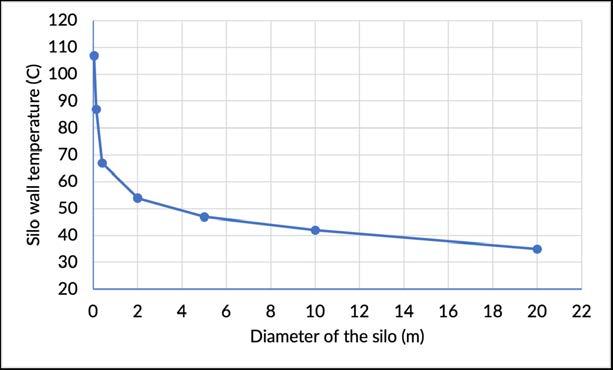
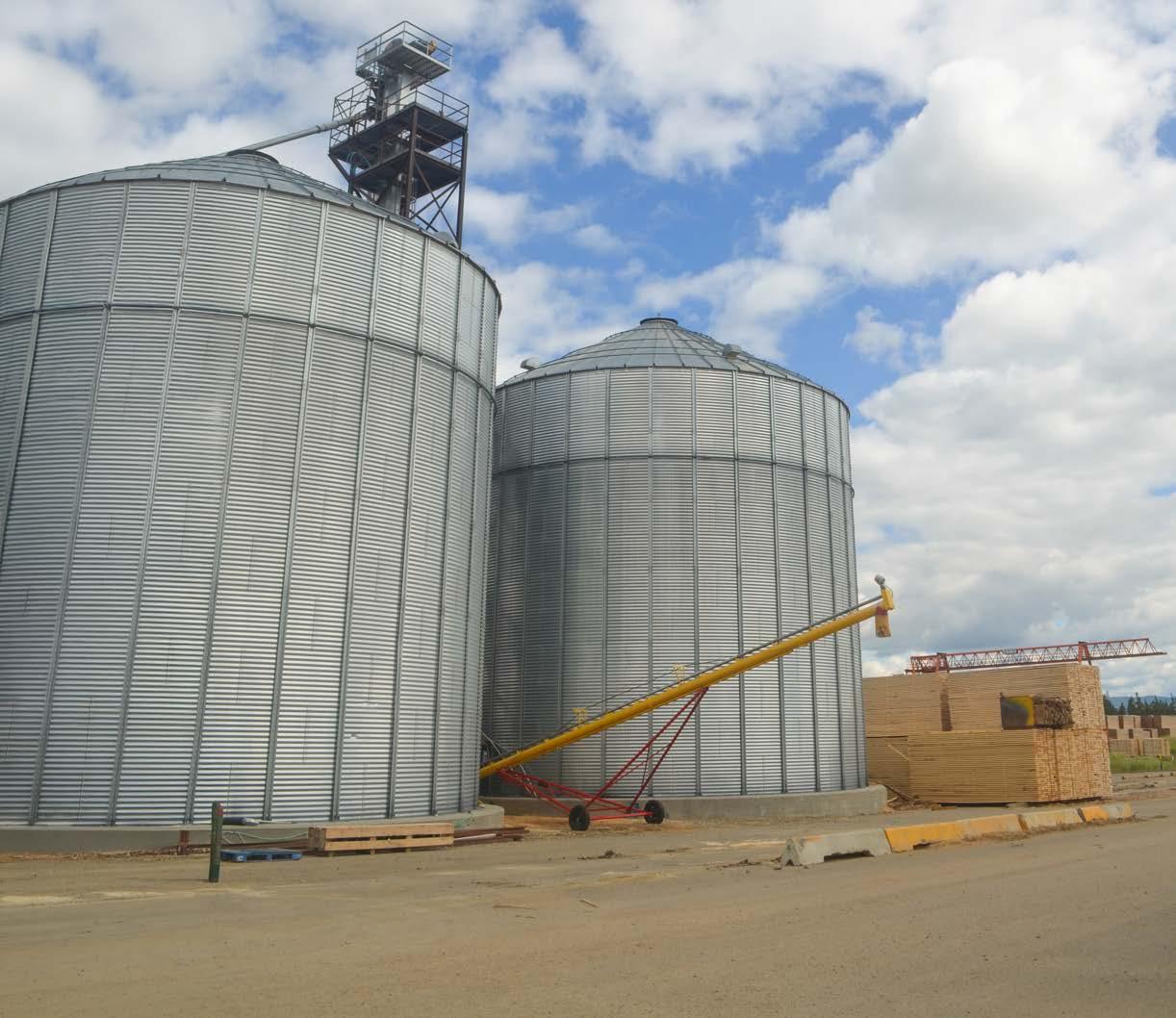
Very wide silos (large diameter) are prone to self-heat and combustion at a lower wall temperature. The curve in this graph can be used as a guide for safe storage. Having the silo wall vs. diameter of the silo above the curve will not be safe; the points below the curve are safe. Image: WPAC
Field experiences have shown that filing a silo at stages may create dense layers along the column of pellets inside a tall silo.
5. Silo size is important. Generally, more slender structures dissipate heat faster than wide storage structures. Concrete silos come in 5-, 7-, and 9-m diameters. Steel grain bins can be up to 18 m. Recommended silo diameter is 10 m or less.
6. Screen pellets for reactivity using an instrument such as a thermal activity monitor (TAM) which is available in BBRG’s lab at UBC. The unique instrument is used to determine the reactivity of pellets and to screen pellets for off-gassing.
Self-heating is not limited to just the wood pellet sector. This research can also provide important information for other products such as coal and agricultural biomass like straw and grass.
Why is DHA so important?
by Diane Cave
If you’ve ever asked yourself “where did this DHA thing suddenly come from and why is it so important?” or “Why is there such a push for all facilities to have a completed DHA?” Well, you’ve come to the right place. In the world of combustible dust, the DHA has been a hot topic for years.
The easy answer to this is compliance with codes and standards, predominately the many NFPA guidelines. Digging into the specifics of NFPA 652, section 7.1.1.2 states that “for existing processes and facility compartments, a DHA shall be completed by September 7, 2020.” Section 7.1.4 goes on to say that the DHA should be review and updated at least every five years. Regulation can differ by jurisdiction. There we have it. Case closed! Codes and standards say it must be done, so it must be done! Not so fast. I’m all for following directives, but I’d like to know why I have to jump on board before I do! So, let’s put the mandated reasons aside and let’s look at the practical side of things.
In my 20-plus years in the industry, I have witnessed a fair amount of jaw dropping things done (or not done) around combustible dust. Often than not productivity, cost, or convenience are prioritized over safety. This pertains to all aspects of combustible dust: electrical area classification, dust collection, interlocks, safeties, design, start ups, the whole gambit. So, who are these malevolent actors, callously putting their people at risk? The unfortunate truth is that it’s not in one area, or one industry, it’s uniform across the board. Due to the complexity of it, combustible dust really is not an area where you want things to be done poorly or by the uninformed. When we look back at

the most consequential combustible dust incidents of the past century the common theme is decisions that were uninformed, cheap or outright reckless. If you don’t believe me, do a YouTube search for “combustible dust explosions.”
This brings us back to the questions of the importance of a DHA. First, the objective. A DHA is a fact-finding mission to help us understand combustible dust risk. In my opinion the objective of the DHA is not to fix problems but to inform of current hazards and risk witnessed during the DHA. This pertains to process and procedure around combustible dust hazards (both explosion and fire). The objective is to identify the hazards, communicate where the highest risks are, and provide rough ideas on what actions are required to mitigate the risk. The report will not to solve all the combustible dust hazard issues. It will however assist the diligent reader in what the problems are, where to start, and ultimately how to move the facility towards a safer work environment. If completed and compiled correctly the
DHA is a very useful and powerful tool in the hands of a diligent employer.
To recap. Combustible dust is in a lot of industries, and the risk is typically handled and protected against poorly. To protect against that risk, we start with a DHA report. The objective is to outline what the hazards are, what the highest risk is and a general path forward to mitigate those hazards. I think you can start to see how the pieces fit together. Think of it as a (explosion proof) flashlight in a dark, dusty room. Yes, the DHA is something that is mandated to be completed, but it should not be thought of as just checking a box. If done correctly, it can be used to outline where issues in a facility are and how to keep the people (foremost), property and process safe. This knowledge is ultimately the importance of a DHA. •
Diane has spent the past 20-plus years working with the design, installation and retrofitting of dust collection systems in industries ranging from sawmills and grain installations to food and beverage and specialty chemicals. Diane’s expertise covers all aspects of dust collection systems from troubleshooting system issues, upgrading systems to meet current codes and standards. Diane has also assessed hundreds of dust collection systems for combustible dust hazards using the latest NFPA codes and standards and completed numerous dust hazard assessments. She can also provide advice and design experience for explosion protection systems, vessel retrofits, Pred verification, and static bonding and grounding. Diane has conducted numerous webinars and training session for clients and industrial publications. She has multiple articles published in various industry magazines.
Automated Stacking and Reclaiming the smarter way to handle biomass in Canadian woodyards.
Your challenge is clear. You need to move biomass efficiently, control costs, and deliver a consistent product to your process—often in some of the harshest operating conditions in the world. Across Canada, many woodyards are still relying on mobile equipment and multiple handling steps to manage wood chips and biomass. It works—but it comes at a cost. Every additional movement adds fuel consumption, labour demand, variability, and wear on both equipment and material. There is a better way. Automated outdoor stacking and reclaiming transforms the woodyard from a handling area into a controlled, efficient process—built to meet the realities of Canadian operations.
Built for your environment
Operating in Northern climates means dealing with long winters, frozen material, and unpredictable supply conditions. These are not edge cases—they are daily realities.
This is why it matters that automated outdoor woodyards are already proven in these conditions. Bruks Siwertell Installations in Dryden, Thunder Bay and Espanola Ontario have been operating reliably for more than 30 years, designed specifically to handle cold weather, snow, and seasonal variability. For your operation, that means confidence. Not theoretical performance, but technology that has demonstrated long-term reliability in environments just like yours.
One flow, not multiple handling steps
One of the biggest challenges in conventional woodyards is the number of times fibre is handled before it reaches the process. Material is dumped, pushed into piles, moved again for blending, and finally loaded into the system. Each step adds cost and introduces inconsistency. Automated systems remove this complexity. Instead of multiple handling steps, fibre moves in a single, continuous flow— from truck intake, through stacking, to reclaim and delivery into the plant. There is no need for loaders to reshape piles or reposition material. The system
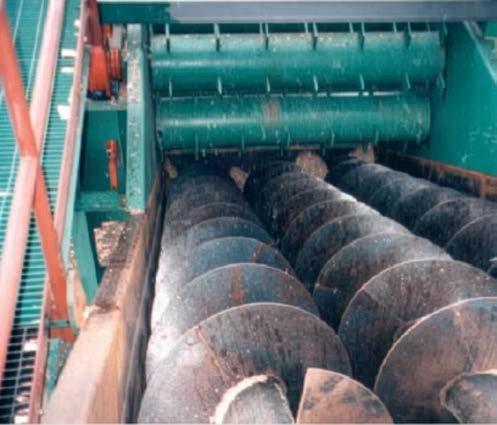
does it for you, consistently and efficiently. The benefit is immediate. Lower operating costs, reduced equipment dependency, and a more predictable operation.
Reducing your reliance on diesel
Mobile equipment is not just a handling solution— it is an ongoing cost center. Fuel, maintenance, operator availability, and winter performance all add pressure to your operation.
By replacing diesel-driven handling with electrically powered systems, you gain a more stable and efficient process. Energy use becomes predictable. Maintenance can be planned. And your operation is less exposed to fuel price volatility. At the same time, reducing diesel use supports your environmental targets, helping you lower emissions without compromising performance.
Turning storage into an advantage
In a traditional woodyard, storage is often unmanaged. Piles are built and reclaimed based on immediate needs, which can lead to variability in moisture and material quality. Automation changes that. With controlled stacking and reclaiming, you
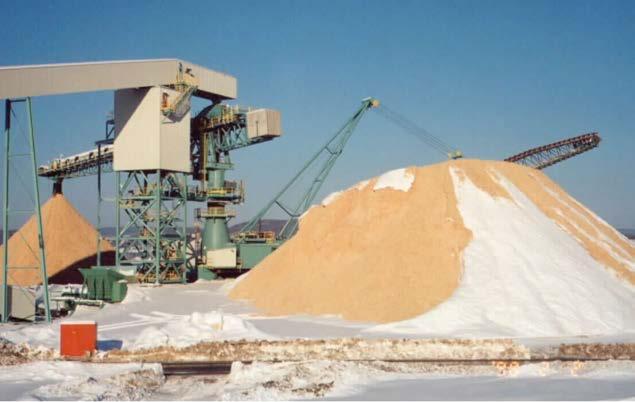
can achieve a first-in, first-out—or near-first-in, first-out— flow. This ensures that material moves through the pile with consistent residence time.
For your operation, that means more than storage. It means conditioning. Wood chips stored outdoors in Canadian conditions naturally dry over time. When managed correctly, this reduces moisture variability and delivers a more stable, predictable feedstock to your process.
Delivering consistent results
Consistency is critical to performance. Variations in moisture, species, or particle size can impact everything from energy efficiency to product quality. Automated reclaiming systems are designed to address this. By reclaiming material across the full cross-section of the pile, the system blends layers deposited over time. The result is a uniform feedstock, delivered continuously and reliably to the next stage of your process. Instead of depending on operator technique, consistency is engineered into the system.
Proven technology, supported locally
Technology only delivers value if it can be supported over the long term.
In Canada, particularly in Northern Ontario where Bruks Stacker Reclaimers have been in operation for 30 years, there is a strong base of experienced operators and maintenance personnel who have worked with Bruks automated woodyards for decades. This practical knowledge reduces risk and ensures that your system can be supported throughout its lifecycle. It also reflects a key principle: solutions must not only perform—they must be sustainable in real operating environments.
A smarter investment
Automation is often seen as a capital investment decision. But when you look at the full picture, it is also an operating strategy. By eliminating multiple handling steps, reducing reliance on diesel equipment, and improving material consistency, automated outdoor systems deliver measurable gains across your operation. At the same time, outdoor storage reduces the need for large, enclosed structures, lowering capital costs and simplifying project execution. The result is a solution designed not just for today’s challenges—but for long-term performance.
Moving your operation forward
Canada’s biomass and forest industries continue to evolve. Expectations are higher, margins are tighter, and operations must be more efficient than ever. The opportunity is not just to improve what happens inside the plant—but to rethink how fibre is handled before it gets there. Because when your woodyard works as a controlled, automated system, everything downstream performs better.
And that is where real efficiency begins. The woodyard of the future must be seen as a competitive advantage.
In a tight margin industry, a 2-5% improvement is not incremental; it’s transformational. The mills that win in the next decade will not only look to modernize their boilers and digesters, they will upgrade and optimize woodyards.
Bruks Siwertell, your partner in woodyards and bulk material handling.
Product diversification requires protections
Sawmills increasingly investing in spark and dust mitigation
by Andrew Snook
When many sawmills and planer mills operated in the past, finding homes for their residuals outside of the mills was common practice. This may have meant sending green wood chips to a nearby pulp mill and sawdust to a medium-density fibreboard (MDF) manufacturer, or simply burning the residuals in beehive burners. But as sawmills and other wood products manufacturers across Canada identified the additional value in using 100 per cent of the log – both monetary and societal – they’ve also acknowledged the additional precautions needed to ensure operations remain safe.
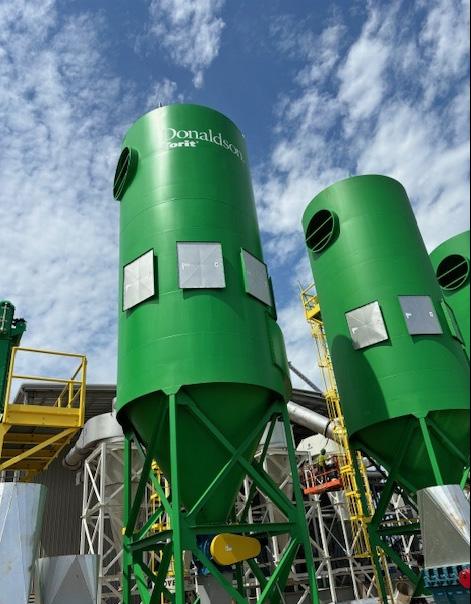
“A lot of the sawmills are now using those residuals to add value to their process, whether it’s consolidating the material and using it as fuel in their biomass burners or creating wood pellets. I believe the mills are realizing the additional danger in the manipulation of those products,” says Neill Gibson, director of business development, sales and marketing for Rodrigue Métal Ltée. “When you think about a planer mill, obviously the lumber, the material, is dry, so they’ve got dry sawdust. They’ve got dry chips and wood shavings. In the past, those would be shipped off to other users and there wouldn’t necessarily be a whole lot of danger. Now with the integration of what they’re doing, all of a sudden they’re forced to look at the notion of dust extraction, the control of spark detection, sprinkler systems, etc.”
Dust mitigation and spark detection systems have come to the forefront for even the smallest of mill owners and operators.
“Instead of major industrial complex-
Very wide silos (large diameter) are prone to self-heat and combustion at a lower wall temperature. The curve in this graph can be used as a guide for safe storage. Having the silo wall vs. diameter of the silo above the curve will not be safe; the points below the curve are safe. Image: WPAC
es producing pellets, or sawdust going to producers of MDF, now you’re getting mills taking these byproducts and doing something with it themselves on a smaller scale, and this means that they have to consider these productions differently than they would a traditional sawmill,” Gibson says.
Francis Petit, director of engineering for VETS’ Industrial, Mechanical & Ventilation Division, says the types of dust and explosion mitigation technologies have not trended to anything specific in recent years, but safety testing has been evolving.
“We see similar tech used; however, the
safety testing for the technology has improved. Only vendors that work towards functional testing are being considered as NFPA compliant equipment, and we are replacing older pieces of equipment with similar, but tested ones,” Petit says.
First steps
When mills are deciding on the types of protection systems they require, they should first focus on the content of their materials.
“With sawmills, you generally have material that’s still wet, higher moisture content, so the risk of an explosion is much lower, but fire threat is still there. When
you get to the point after material has been dried – whether it’s being used for biomass purposes or even for MDF plants – when that wood dust is dry, there is substantial explosion potential,” explains David Grandaw, vice-president of sales for IEP Technologies.
As a first step, Grandaw says companies should be looking at their facilities and identifying where the ignition points are, as well as the areas where they could have mechanical breakdown and some friction risks that could cause some smoldering or burning materials. This is where they should start to address detection and prevention measures.
“Then you consider an upset condition, do occasionally discover burning or smoldering materials, and how do you stop this material from turning into an explosion?” he says.
One of the common ways this can be done is through the use of a spark detection and suppression system.
“Spark detection and suppression systems are based on detection in the form of an infrared detector, or detectors, depending on the duct size, looking for a hot spot, typically a spark or burning ember traveling through a duct or on a conveyor, detecting it, and then, X amount of metres downstream based on conveying velocity, inject a water spray to suppress that burning ember before it gets into the downstream receiving vessel where it might find the right dust-air mix to start an explosion,” Grandaw explains.
There are a wide variety of technology suppliers in the dust and spark detection and suppression space, so selecting the right technologies for a plant requires the consideration of multiple factors.
“Like with any other technology, there are a number of considerations you have to look at when you put in one of these systems: What is the scale of the detection and protection required? What are your airflow velocities? Is the application outside where you must heat trace the water pipes, since in the wintertime up in Canada, we don’t want pipes to freeze and break,” Grandaw says.
Increased integration
In sawmills in Canada and the U.S., dust
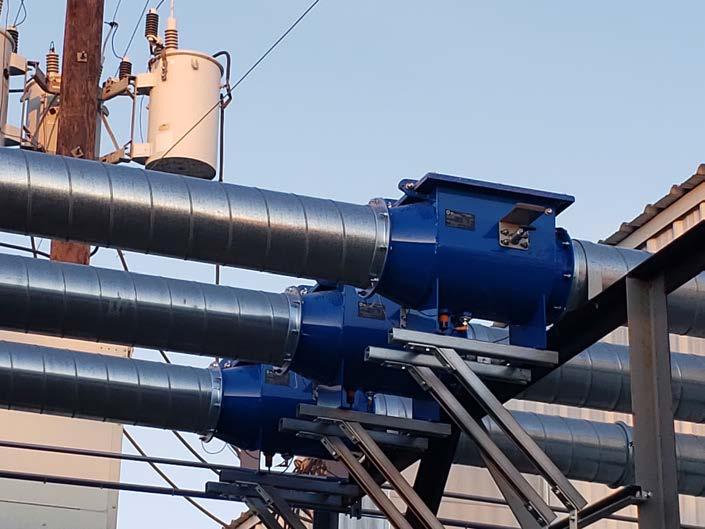
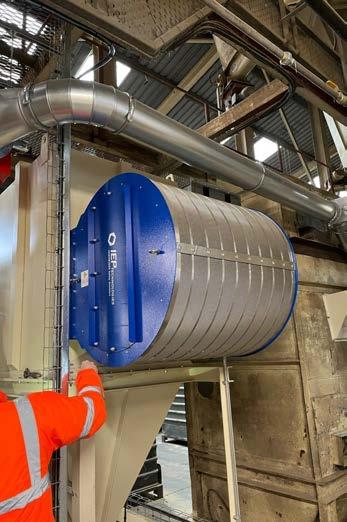
EVN flameless vents on conveyors. Photo: IEP Technologies.
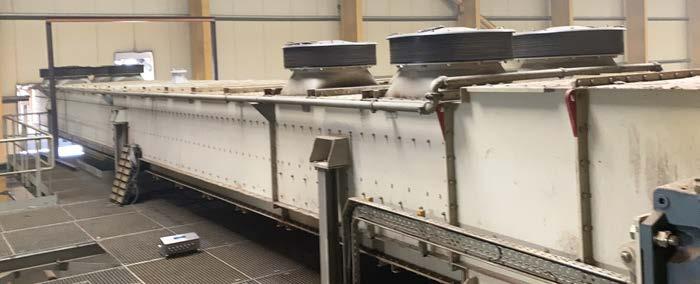
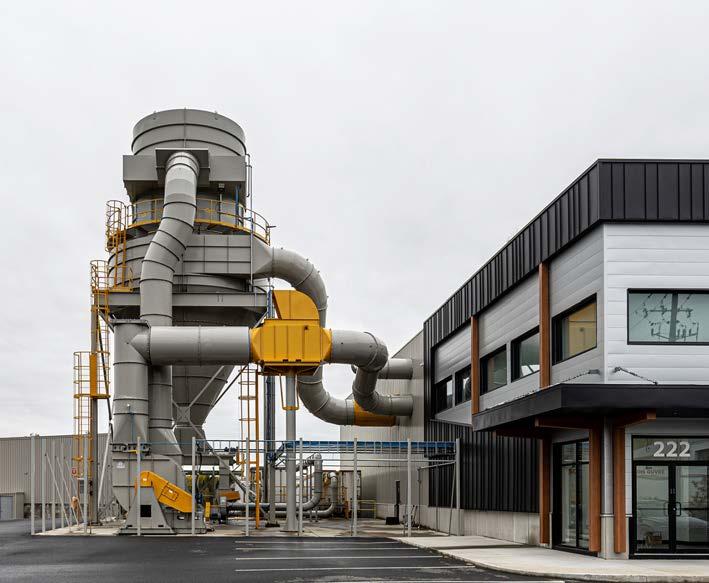
Cyclofilter Series Dust Collector. Photo: Rodrigue Métal Ltée.
collection systems are always located outside, so people tend not to consider them when they’re talking about the automation within a facility, Gibson notes.
“It’s almost secondary. So very often, there’ll be maximum two inspections annually where you’re going to be looking inside the system to see if there’s any escaping material, to see if there’s any gap in pressure, or anything like that. But the systems are standalone, and they operate on their own,” he says.
In the majority of European mills, the dust collection systems have been integrated into the main control centre of the mills and are treated more like part of the production line than as a secondary system, Gibson notes.
“That’s something that we need to look at on our end, moving towards an integrated system, having that data be collected within the same systems, and to be able to include that within all of the maintenance packages that exist for sawmills as a whole,” he says.
Air recirculation
While cleaning up the air in closed-off production facilities is vital for the health of employees, mill owners also want to be able to recirculate the air back into their
facilities as much as possible to reduce energy costs.
“Here in the north with colder climates in the winter, it’s one thing to clean the air, but that heated air, you don’t want to just exhaust it outside. You want it to be clean enough to reintroduce it back into those buildings. That brings in a whole other series of rules and regulations, because it’s people’s health. So, it’s interesting to see how the systems are evolving,” Gibson says.
His company has been offering these systems for over 60 years to their customers in Quebec due to the colder climates, and it’s something that is increasing in demand for mills in the north and south.
“Sometimes it’s not even keeping the heat in, it’s keeping the cool to recirculate the air,” Gibson says, referring to mills in the southern U.S. “Planer mills, especially the high-production planer mills, they’re all closed systems. You’ve got dust collection in there. You want to keep any cool air in that you can. Therefore, you’re cleaning the air, removing the particles, so that you can reintegrate that cooler air.”
The systems for cleaning and recirculating heated air or cooled air back into a building are largely the same. The key factor to consider for both is moisture management.
“Condensation within the piping is one of those things that you’re having to deal with. So, you’re insulating the pipes here in the north to keep the heat in and to avoid condensation, and the same thing in the south, but it’s cold air on the inside versus the outside,” Gibson says. “The systems exist in terms of open systems, where they’re venting directly outside. It’s less expensive because it’s less piping. But when you’re looking at energy costs, when you’re looking at what’s going out into the environment, sometimes having that closed system and bringing the air back into the building is the best way to go. We’re seeing more and more customers going for the idea of closed systems to keep that heat or cool inside the building.”
Explosion venting options
When it comes to explosion venting options, there are standard and flameless options. A flameless explosion vent consists of a vent panel surrounded by a metal mesh or other means to act as a heat sink to absorb the heat from the flames, so all that is released to the outside during an explosion event are hot gasses with no flames.
“That’s a very common technique that can be used in areas where standard explosion vents aren’t suitable,” Grandaw explains.
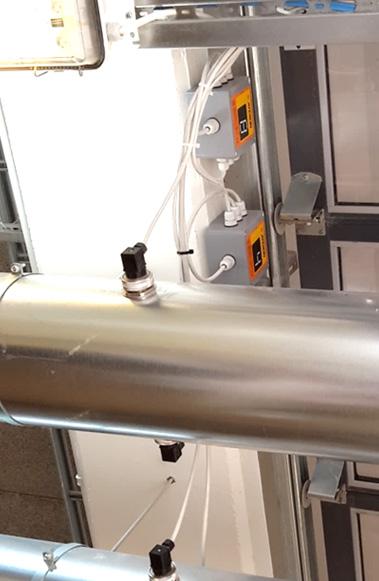
IsoFlap passive isolation flap valve. Photo: IEP Technologies. Spark detection on duct.
Standard explosion venting is a much less expensive option than flameless vents, so has historically been the preferable protection measure for a customer in the wood products industry. However, flameless venting is a good option for plants that cannot redirect potential fireballs to a safe area.
“In those cases, the flameless venting makes a good alternative,” Grandaw says. “I did a calculation on a vessel once that indicated 114 feet was needed for flame ejection distance. That was unusual, as that was for a very large vessel. But 30 or 40 or 50 feet is not unusual.”
The NFPA 68 Standard offers a formula for measuring safe flame ejection distance. Additional thermal effects must also be considered, as the heat generated from an explosion can travel farther than the fire and can still be hot enough for someone to be injured or worse.
Current challenges
One of the biggest challenges for some wood products manufacturers keeping current with the latest dust and explosion mitigation technologies has been a misinterpretation of the standards that results in plants using the wrong technology for the goals of the safety standard, Petit notes.
“We have seen plenty of spark detec-
tion systems as the only line of defense, in place of explosion isolation,” he says. “Catching up with the current standards is not incredibly hard; as in, we are not seeing any drastic changes of the methods of mitigation being changed drastically with each revision.”
Some companies want to continue using legacy systems instead of buying new ones, but this can be an issue as older standards may have been originally misinterpreted and were always deficient, Petit adds.
Luc Cormier, explosion protection consultant for Fike, says Canadian facilities are probably less protected than the U.S. facilities overall due to there being less requirements in Canadian standards relating to combustible dusts compared to the U.S.
“Most sawmills would need traditional explosion protection (e.g., venting or suppression) on some vessels handling their dry materials, spark detection and extinguishing systems where saws, mills or sanding equipment are tied to dust collection systems, and deflagration isolation on any vessel having an explosion hazard. This along with housekeeping procedures to limit dust accumulation inside the facility would go a long way. However, in most cases, I see one or two of these safeguards provided, with some equipment having no
protection at all where there should be protection,” Cormier says.
Another major challenge can be the age of the mills, and the cost involved in retrofitting the equipment.
“A lot of these facilities tend to have older equipment which might be difficult to retrofit, and cost of upgrading to a fully compliant facility may be prohibitive for a lot of these sawmills, which is probably one of the biggest obstacles they face,” Cormier says.
Grandaw says price is a major factor for wood products plants when looking at whether to install passive or active dust and explosion mitigation and suppression systems. “Not only initial cost, but long-term cost of ownership, because passive systems do not typically require the maintenance that an active system would. Active systems need to be inspected, just like any other process area of the plant. Usually, since these are specialized systems, you would have the manufacturer send their own field technicians to do that inspection. So, the cost is much higher to maintain the active systems than the most passive systems. Passive systems are things such as the flap valves, standard and flameless vents. Those require mostly visual inspections so they can be done at the plant level. So, the longterm cost of ownership is less.” •
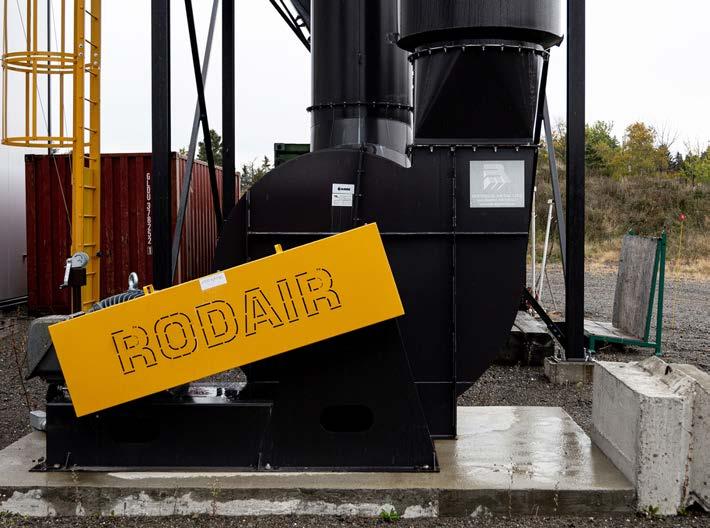
Rod-Air Centrifugal Industrial Fan. Photo: Rodrigue Métal Ltée.
IV8 Flameless Explosion Relief Vent.












ENHANCING SAFETY PRACTICES IN BIOMASS STORAGE:
By Fahimeh Yazdan Panah, Associate
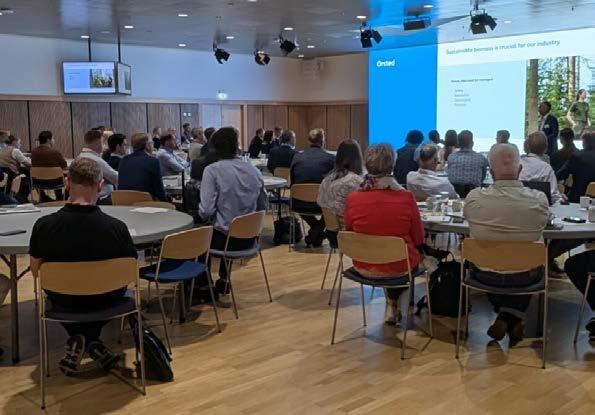
Over the past year, the Wood Pellet Association of Canada (WPAC), in collaboration with Ørsted, FutureMetrics, Firefly and Hanwa (Japan only), has brought together industry leaders and technical experts from across the global biomass sector in Tokyo, Japan, and Copenhagen, Denmark, for Safe Wood Pellet Storage: Preventing, Detecting, and Managing Self-Heating Incidents workshops. The events focused on addressing safety challenges in large-scale wood pellet storage — self-heating and its potential for fires or explosions. The two workshops brought together over 120 producers, utilities, terminal operators, engineers and fire-safety professionals to examine the causes of self-heating in stored wood pellets, explore emerging detection technologies, and discuss effective prevention and response strategies. The program combined technical presentations with real-world case studies, creating an opportunity for knowledge exchange and industry collaboration.
LEARNING FROM REAL‑WORLD INCIDENTS
A central theme of the workshops was the importance of learning from past incidents. Jens Kai Holm, Chief Specialist at Ørsted, and John Swaan, Operations and Project Development Expert from FutureMetrics, presented case studies examining runaway self-heating events in pellet
Executive Director, Wood Pellet Association of Canada Lessons from Wood Pellet Workshops In Denmark and Japan
storage facilities. They reviewed the consequences of such incidents and highlighted lessons learned related to storage design, monitoring practices and operational preparedness. Jens and John emphasized the tangible risks associated with inadequate controls and the value of proactive risk management.
UNDERSTANDING THE CAUSES OF SELF‑HEATING
Technical insight into why selfheating occurs was provided by Fahimeh Yazdan Panah, Associate Executive Director, WPAC. Her presentation explored both intrinsic and operational contributors to self-heating, including pellet moisture content, particle size distribution, chemical composition, cooling efficiency and storage practices. The session underscored that self-heating is rarely caused by a single factor but rather by the interaction between

material properties and operating conditions.
DETECTION AND EARLY WARNING SYSTEMS
Early detection was highlighted as a critical line of defence against self-heating that could escalate into more serious incidents. Håkan Johansson, Division Manager –Senior Advisor at Firefly, presented on detection and monitoring approaches, including temperature and gas measurements, spark detection systems and infrared surface temperature monitoring.
Jens Kai Holm from Ørsted answered questions from participants in Denmark.
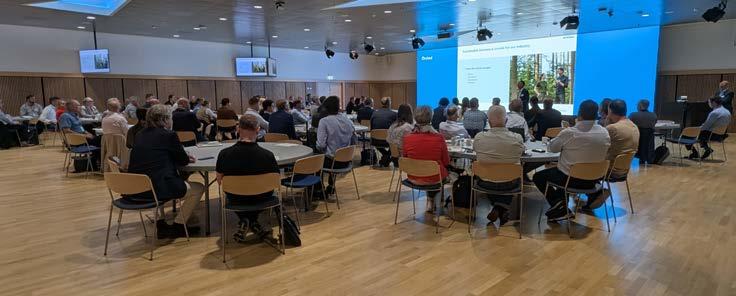
Over 90 people participated in the Denmark workshop.

STRENGTHENING INDUSTRY COLLABORATION
The event concluded with remarks emphasizing the importance of continued collaboration across the pellet supply chain. Participants were encouraged to share data, lessons learned, and operational experience to strengthen safety standards industry-wide. By bringing together expertise from producers, utilities, technology providers and safety specialists, the workshop underscored the collective responsibility to improve the safe handling and storage of wood pellets as global biomass use continues to grow.
WPAC is committed to safety, and we recognize that each company’s individual safety performance reflects on the entire industry’s reputation across Canada and wherever our pellets are sold. That’s why we are committed to openly sharing knowledge, and we have made both workshop presentations available on pellet.org.
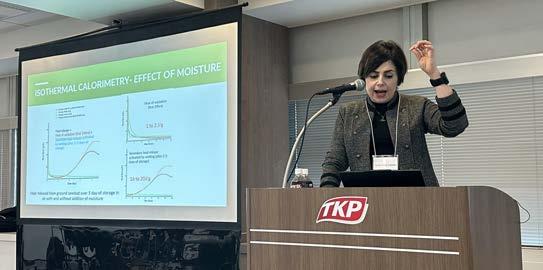
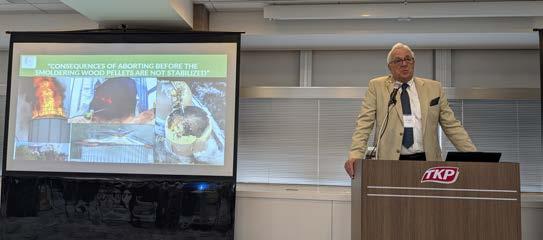
Japan WORKSHOP
DENMARK WORKSHOP
His session emphasized that timely identification of early warning signs allows operators to intervene before conditions worsen, reducing the risk to personnel, infrastructure and supply continuity.
PREVENTION AND INCIDENT RESPONSE
The workshop also addressed how facilities can reduce the risk of self-heating through informed design and operational practices. Jens Kai Holm outlined strategies for minimizing self-heating in pellet storage, drawing on laboratory measurements of pellet reactivity, storage configurations in silos and flat storage, and established industry best practices.
In a complementary session, John Swaan focused on response strategies for a selfheating incident, highlighting effective mitigation approaches and identifying actions to avoid to prevent exacerbation.
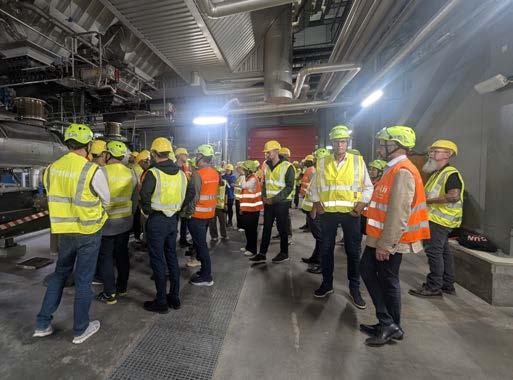
BEECS AND CHP PLANT TOUR IN DENMARK
While in Denmark, participants also had the opportunity to take a half-day tour of Ørsted’s Bioenergy Carbon Capture and Storage (BECCS) installation at the Asnæs combined heat and power (CHP) plant. Attendees received a firsthand look at CHP technology and Ørsted’s approach to carbon capture, setting the stage for the technical discussions that followed.
Fahimeh Yazdan Panah from WPAC spoke to the causes and contributing factors of self-heating in Japan.
Håkan Johansson from Firefly offered practical tools for identifying issues in Denmark.
In Japan, John Swaan, from FutureMetrics, discussed effective mitigation approaches.