Volume 14 Number 9
Inside This Edition
November 2002
Blue Line Magazine 12A-4981 Hwy 7 East Ste 254 Markham, ON Canada L3R 1N1
Ph: 905 640-3048 Fax: 905 640-7547 eMail: blueline@blueline.ca — Publisher / Editor — Morley S. Lymburner eMail: publisher@blueline.ca
Publisher’s Commentary Report shows Parks Canada can’t manage armed Wardens
5
Community partners making a difference The Owen Sound Police Service
6
Toronto’s Mounted Police Unit glows between these covers
10
— General Manager — Mary Lymburner, M.Ed.
Integrity and temptation 12 The challenge of being better cops
eMail: admin@blueline.ca
— Managing Editor — Mark Reesor eMail: editor@blueline.ca
— News Editor — Les Linder
DOWN EAST RNC’s newest recruit ‘a real doll’
14
PERSONAL COMPUTING Just the facts ma’am, on the Web
15
Dean Clarke - dean@blueline.ca Kieran Huggins - kieran@blueline.ca Bob Murray - bob@blueline.ca
DEEP BLUE Healthy body, healthy mind
16
— Pre-press Production — Del Wall
Traffic calming, from an emergency services perspective
17
eMail: news@blueline.ca
— Advertising — General eMail: sales@blueline.ca
— Contributing Editors — Communication Skills Terry Barker Police Management James Clark Tactical Firearms Dave Brown Technology Tom Rataj Psychology Dorothy Cotton Case Law Mike Novakowski Blue Line Magazine is published monthly, September to June, by Blue Line Magazine Incorporated with a mailing address of: 12A - 4981 Hwy. 7 East, Ste. 254, Markham, Ontario, L3R 1N1. Individual magazines are $3.50 each. Subscriptions are $25.00 per year or $40.00 for 2 years. (Foreign - $50.00 U.S.) All material submitted for publication becomes the property of Blue Line Magazine unless other arrangements have been made with the publisher prior to publshing. The authors, advisors and Publisher accept no liability whatsoever for any injuries to persons or property resulting from the application or adoption of any of the procedures, tactics or considerations presented in this magazine. Readers are cautioned and advised that articles presented herein are edited and supplied for your personal awareness and should not be used for further action until appropriate advice and guidance is received from a supervisor, Crown Attorney or other person in authority. Established in 1988, Blue Line Magazine is an independent publication designed to inform, entertain, educate and upgrade the skills of those involved in the law enforcement profession. It has no direct control from a law enforcement agency and its opinions and articles do not necessarily reflect the opinions of any government, police, or law enforcement agency. ©2002 - All articles are protected by copyright. No part of this publication may be reproduced or transmitted in any form or by any means, electronic or mechanical, including photocopying and recording or by any information storage or retrieval system without permission.
Internet activity is monitored and use or reposting of material on the Internet is restricted. Blue Line Magazine is a private venture and as such is not funded through any level of government agency, union or association.
— Affiliations — International Association of Law Enforcement Planners Canadian Advertising Rates & Data International Police Association The Police Leadership Forum The Canadian Press Newswire Printed in Canada by Jansen Printing Service
CASE LAW 18 • “Bare suspicion” is not articulable cause • Police right to detain upheld • Manitoba’s top court sanctions protective search VITALITY Canadian policing loses giant
20
WINNING STRATEGIES FOR LIFE When life becomes a war zone
21
Blurring The Line 22 Issues between public and private policing COMMENTARY It’s high time to abolish juries
24
TECHNOLOGY Wireless networking offers freedom
26
Shooting legacy is HELP for mentally ill 28 PRODUCT NEWS
30
INCREDIBLE
31
COMING EVENTS
32
Calgary hosts first Canadian LEBA instructor school
33
Meritorious Service Medals awarded
36
THE BACK OF THE BOOK Investigative Integrity
38
ISSN #0847 8538 Canada Post - Canadian Publications Mail Product Sales Agreement No. 176796 November 2002
3
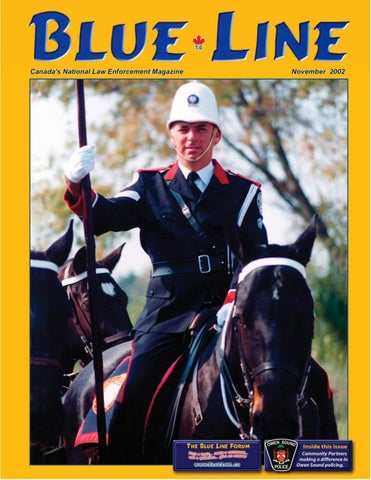
Bill Wardle, a 20-year veteran of the Toronto Mounted Police Unit, has accomplished a Herculean task - documenting the unit’s more than 100 year history. The painstakingly compiled book encompasses the history of the entire force. Blue Line’s tribute to this endevour is to feature the author on this month’s cover and to give you an overview on his book. If Parks Canada can’t even manage something as simple as keeping track of injuries to its own wardens, how can it hope to handle the complexities that come with dealing with the public in a law enforcement capacity? That’s the question Blue Line Publisher Morley Lymburner poses in his commentary this month. Perhaps it’s something in the water or the scenic beauty of the area; with the full support of the association, the Owen Sound Police Service is using part-time and retired officers and has a thriving auxiliary program. Learn why both sides feel they benefit from an innovative arrangement. The desire of a rookie cop to fit in and be accepted can often lead to adopting bad habits and even corrupt practices. Boston University Professor Edwin J. Delattre looks at what it takes to help officers stand up and be counted in ‘Integrity and temptation.’ The Royal Newfoundland Constabulary newest recruit is a real doll and relates well to primary school children. Down East columnist Danette Dooley tells us about Cst. J.T.N. (Jimmy) MaGillicutty and partner Cst. Glen Moores. There’s plenty of information out there on the web — you just have to know where to find it. Personal Computing columnist Reid Goldsborough gives us a few pointers. If you don’t take care of yourself, who will? Dorothy Cotton ruminates on the importance of staying fit in her regular Deep Blue column. In other features, Case Law editor Mike Novakowski has another triple helping of cases; Winning Strategies columnist Audrey Pihulyk has some advice on what to do when life becomes a war zone; we have the first of a two-part series on how the line is blurring between public and private policing; and Chris Braiden pulls no punches on why he thinks it’s high time to abolish juries. It is all waiting for you between the covers of this month’s ediiton. Blue Blue Line Line Magazine Magazine
Report shows Parks Canada can’t manage armed Wardens by Morley Lymburner Recently I received a document that was released through the Federal Access to Information Act entitled Parks Canada Agency Risk Assessment Review. For a couple of years now I have been trying to get my head around Parks Canada and its intransigent attitude against supplying their wardens with sidearms. This report places a whole new light on the firearms issue. I now believe the officers should not be armed or do any form of law enforcement, no matter how small, unless they are headed up by someone with extensive police experience. We all know the wardens can handle themselves well and would have no more problem having sidearms than any other law enforcement agency in the country. You see, the real problem with Parks Canada is that the upper management is not capable of handling the issues surrounding firearms. (Not only are they incompetent in this area but they have become far too secretive, suspicious, uncommunicative and intimidating toward their staff to not complain about their lot.) The almost devious way they handle problems is not conducive to a modern style of law enforcement where police agencies find they must be as transparent as they can be. Modern police agencies know they must keep lines of communication with the public and the media open at all times. This well researched document was kept secret from the public eye and was authorized by Parks Canada upper management. They approached The Justice Institute of BC with a request to conduct a third party review of the service’s “risk assessment and mitigation model, strategic direction policy, interim risk mitigation guidelines, and field unit law enforcement plans.” The final report basically told them the wardens should be armed to do their duties and that they have been performing real police duties for a long, long time in a very hazardous manner that regular police would never do even while fully armed. The end of the report then went on to conclude that if the warden Service wished to continue in the same manner, they had better follow a policy of no law enforcement duties for wardens and get the real police to assist. Instead of reading this as a condemnation of their attitude they decided to do the impossible instead. They went the extreme route and contracted with the RCMP at a cost of $35 million in taxpayer’s money to keep $12,000 worth of sidearms from their wardens. A contract signed just before September 11th keeps a lot of Mounties chasing poachers and campers instead of terrorists. And what about the study? Over one year later the report comes to light when legislation forced their hand to release it. The JIBC Report, authored by the police academy Assistant Director Steve Hess, is well researched and insightful regarding the concepts of law enforcement and conservation. The 134 page report is too lengthy to publish but Blue Line will print an article next month based on this report. For now it is sufficient to say that Parks Canada was informed that their terNovember 2002
minology of law enforcement was poorly defined. In other words their resistance was based on an improper departure point if they wished to reach the goal of solving the sidearms issue. “Early in its development, the Warden Service used the following axiom to distinguish between protection and enforcement ‘protection deals with nature and enforcement deals with people.’ While the definition is catchy, it does not provide much assistance in distinguishing the duties of wardens from police officers.” This Parks Canada Agency Risk Assessment Review report also points out that “there can be little doubt the Warden Service has changed dramatically in the last 114 years. The romantic notion of the warden as a guardian of the wild has been slowly replaced with the image of the warden as a law enforcement officer who specializes in resource management.” The report pokes holes in a significant mitigation strategy proposed by the Warden Service. It is a requirement for a 30-minute response time for emergency backup. “The 30-minute backup risk mitigation strategy is impractical,” the report concludes. “Situations involving hostile people can accelerate within minutes and when they do, backup is needed im-
mediately....” The report goes on to say that “The Warden Service probably deals with more people who have access to edged weapons or firearms then public police officers. Parks Canada Agency has authorized Wardens to use long guns (rifles or shotguns) during exigent law enforcement circumstances but this may actually increase the Agency’s exposure to liability. Collateral damage caused by the high penetrating power of rifle bullets and the scatter effect of shotgun pellets may result in unintended injury risk.” So why do I say wardens should not be armed? During the study it was found that Parks Canada top management did not even keep central records of the numbers or types of injuries sustained by their own officers. If they can’t even handle this routine detail with their own people, how can they handle any job that deals with the public in an enforcement capacity? The report more-or-less says that unless Parks Canada upper management gets their heads into the world as it is today they might as well fold up camp and send everyone into the back-country and hope they don’t see humans at all. But if they do see people, they will have to call the Mounties. Unarmed wardens are a luxury Canada can no longer afford.
For further details go to BlueLinks at www.blueline.ca
5
Community partners making a difference The Owen Sound Police Service makes an impact from within by Morley Lymburner Community Partners is the slogan emblazoned on the sides of Owen Sound Police cruisers. It quickly identifies the quality and consistency of police service delivered to the 22,000 citizens of this picturesque community nestled along the tree-lined cliffs of Georgian Bay. “The slogan is also a form of mission statement,” said Chief Thomas Kaye. Since coming to Owen Sound police four years ago he’s worked diligently to make the slogan’s statement a reality. “I want to ensure that every member of the police service and the community understand the phrase is more than a hollow jingle. We can’t do a job as important as policing without the cooperation and consent of the community at large.” Kaye points out that a big part of his mandate when he initially took on the mantle of police chief was to upgrade the quality of service and expertise. He has tackled this responsibility by studying finances and presenting convincing arguments to the police services board that more resources must be set aside for training and skills enhancement. “When I first came to Owen Sound I looked desperately for places to send my officers for courses,” Kay said, “Very few officers had been on any kind of course other than basic training for the whole time they had been on the force.” Kay pointed out that Blue Line Magazine was a great help in finding some initial courses. He even sent people as far away as Edmonton and managed to send the use of force instructor for firearms instructor training for the first time. “At that time returning officers would report the difficulties they had trying to explain where Owen Sound was,” Kaye points out. “It was this that spurred me on to become the president of the Ontario Association of Chiefs of Police.” Getting involved in the broader field of policing enabled him to put Owen Sound on the radar screens of other people and influential governmental organizations which could benefit the service. Kaye credits the higher profile for an increase in grants from $7,000 in 1997 to an expected $350,000 this year, noting the service probably wouldn’t have even known the grants existed if they’d remained overly insular in their outlook on policing. That extra funding is paying dividends in helping to support the training needs of the service. The realities of maintaining the knowledge level competencies of a smaller department require considerable creativity in staff management. The service maintains certified firearm and self defence instructors that actually exceed minimum requirements set out by the province. In addition, they subscribe to a police video training alliance which supplies training tapes November 2002
on a monthly basis designed to refresh and update previous knowledge and introduce new subjects and initiatives. As a result, staff members were exposed to 64 skills enhancement or training seminars last year, in addition to inhouse training initiatives. Training is such a high priority that the service has allocated considerable space for the development of a regional training centre, giving officers access to joint training sessions with the Ontario Police College’s in-the-field training program. This cooperative effort has seen officers from surrounding agencies trained in joint classroom sessions that encourage consistency of training and inter-force cooperation. All front line supervisors have been sent on the Canadian Police College’s senior police administrators course, an exhaustive, much sought after, six-week course primarily designed for senior command officers. “We are simply too small an organization to not have all our supervisors trained in all aspects of command,” Kaye points out. “We 6
also train all supervisors through the Ontario Police College media relations program to ensure the local media need not wait to have appropriate dialogue about a current event or issue that may be important to the community.” Several years back there was polarization between the patrol and management levels of the agency. Recognizing this, Kaye instituted a program of job rotation that saw many officers moved into station administrative work so they could see the workload and responsibilities handled at this level. “Initially officers were curious and jumped at the opportunity,” Kaye points out, “but after a short time we couldn’t get any more volunteers. The word spread very fast that no one is exactly sitting on their hands or putting their feet up on the desks staring at the ceilings. The officers found out quickly the absolutely huge volume of support work that maintains them on the street.” The rotational initiative was a great bonding mechanism that transcended all ranks and positions within the force, said Kaye. “Everyone finally got the message that no one really works alone around here. We all need each other.” The idea of working alone does not appeal to Deputy Chief Frank Elsner either. “I strongly endorse our slogan ‘Community Partners’, he said. “I really don’t believe in long mission statements so those simple two words are universally appropriate to policing everywhere and something each member of this service can carry with them in their daily tasks.” Elsner moved from the RCMP to the Thunder Bay Police before joining Owen Sound and has seen a variety of policing styles and initiatives in his 15 years of police work. “I am proud
Owen Sound Police part-time constables handle the radar enforcement duties to free up regular officers for other more pressing matters. Retired after a 30 year career as an OPP officer this part-time constable enjoys the less hectic pace of school zone speed enforcement. of the men and women at all levels of this department. They are a truly dedicated group. They understand their community intimately and this is the true strength of this department. It makes the chief’s and my job a lot easier. We can concentrate on planning, new initiatives and deployment with the confidence that our people can handle the daily issues as they arise.” Handling the day to day issues appears to come naturally to the service’s 38 full time, nine special and four part-time officers. Their relationships are a model of cooperation and costeffective distribution of resources. Each job function has been analysed and the duties defined to ensure a maximum impact for the dollars invested while remaining sensitive to col-
Sergeant Sandra Greene briefs the Friday evening shift. Around 50 per cent of the police members came from auxiliary or civilian branches of the force. “We don’t have to guess at the quality of the members we hire,” Greene says. “We know them when we hire them.” lective agreements. Special constables look after security and prisoner control at the city’s newly constructed consolidated courthouse, relieving front line response officers from this duty. Requests from sitting judges to arm some
For further details go to BlueLinks at www.blueline.ca
November 2002
7
court security officers is the most recent challenge to the service’s budget. Appropriate court security is the responsibility of the local chief but the act stipulating this doesn’t afford the money to pay for it. This new challenge will test the community’s financial resources and
the local chamber of commerce. the department’s adaptability and Sgt. Sandra Greene, a 15 year creativity. member of the service, is impressed Adaptability in the courts could with the program. “They have been come from an inspired program alresponsible for quite a few major arready established by Owen Sound Porests and considerable reduction in lice, which recognized several years problems in the city parks and school back the need to make traffic enforcegrounds. For such a small group just ment a speciality. It didn’t want to pull riding around three evenings a week away trained and more expensive they have sure made a big impact.” generalist officers to perform this priOther community partners makmary responsibility and the job was ing a difference include the 31 memviewed as far too dangerous for unbers of the auxiliary police. When armed special constables. The solufull training is complete, Owen tion: re-hire four retired officers to perform these duties, regaining valuable Trained accident reconstructionists and front-line supervisors sent Sound police will be able to effiexperience and allowing the retirees to the Canadian Police College’s Senior Police Administration ciently and cost effectively double its to work without having to assume the Course are just two examples of an agency dedicated to investing size for special events and emergenheavier responsibilities of a generalist in training. “Morale has never been higher,” the association cies. Another bonus; the mind set inpresident said. corporated is one of progression constable. planning. “This was terrific for me,” said “The auxiliary program is also an excellent former sergeant, now constable, John Stekli. “I clopedia of Owen Sound police work. I tap into had pretty well run the gamut of every job pos- him all the time. It’s nice to see his experience method for us to evaluate and train future members of the force,” said Greene. “I came on the sible on the force. I had a few health issues and is not going to waste.” No program is more in keeping with the Owen Sound Police Service as a dispatcher in decided it was time to collect my pension. I did a variety of minor jobs around town and then slogan “Community Partners” than the very ef- 1987 and, after two years of exploring my talwas approached to do this special traffic work fective ‘Citizens On Patrol’ program. This ents and understanding the force and commuas a part-time job. I jumped at the opportunity group of 12 mostly retired folks patrol the city nity, I felt comfortable stepping into the role of a and don’t regret it. My wife is still working and streets in their own cars as extra ‘eyes and ears’ full time constable in 1989. As is the case with I missed the people at work so I coupled this for police. They begin their shift by obtaining the auxiliary members today the service had an with the thought of making some extra money a portable police radio and then clearing on the opportunity to watch and evaluate me before inair through the dispatcher. They never get in- vesting further into my development.” above my pension and it was a perfect fit.” Former auxiliary constables Craig Now healthier than when he originally re- volved in any arrests but simply report suspitired, Stekli actually enjoys the daily contact cious activity to officers on patrol. At times they Matheson and Steve Beaney can attest to the with citizens and police staff alike without the stand by on scene to keep responding officers investment necessary to becoming a full time added responsibilities and stressors he once had. updated to an incident’s progression. The only member. They’re the most recent to be hired as “Hey it’s great to see John coming in,” one of- compensation is a mileage fee paid by police regular members and point out that, after passficer commented. “That guy is a walking ency- through community fundraising initiatives and ing the GATB tests, it cost them $300 just to do
For further details go to BlueLinks at www.blueline.ca
November 2002
8
the entry level testing to qualify to go to the Ontario Police College (OPC). When they passed this battery of tests, mandated by most Ontario police services, they had to fork over another $5000 to take their 13 week OPC basic training. Luckily the Owen Sound tuition money is off-set Police Chief by their 4th class conThomas Kaye stable’s pay cheque from the service but the initial cash pay out is a sobering thought that helps prevent qualifying grades from deteriorating. The auxiliary program has produced a tremendous payback, says Greene. “We do not have to guess at the quality of new candidates. We know we are getting the best because of this auxiliary program.” Support by association Much of the credit for establishing such a large auxiliary program is indirectly attributable to the forward thinking of the Owen Sound Police Association. They, along with management, realized the intrinsic value in adopting the principles of auxiliary policing. Many police associations and unions have tended to view them as border line scab workers and put up road blocks to limit the size and quality of auxiliary membership. In a bold, trend-setting move, the Association was included in the auxiliary building process and fully endorsed the concept almost from the beginning. The rationale of employing the best people for the job equates to being able to size up the candidates before they join. “This results in reduced aggravations and expense for the Police Association to intervene in future disputes,” said president Bill McCutcheon. “In other words, it is not just a matter of top management hiring whoever they wish without some monitoring by the Association.” McCutcheon points out that in other departments, the first time they hear about new officers is when the chief’s office sends them their applications. “One major mistake in hiring practices by management can cost our Association a lot of resources in supporting a potential bad apple,” McCutcheon concludes. “If you look over the list of officers,” he said, picking up the duty roster, “you will find at least half the strength of this department has come from the auxiliary level first. We have a fairly young department but this has increased the calibre of officers on this force to the highest level it has ever been and reduced the numbers of issues our Association has to handle to a minimum.” McCutcheon had a stormy few years with other Ontario police Associations over the issue of part-time officers. “The members of my Association see no problem with the part-time constables. We firstly look upon them as previous members in good standing of the police force and this Association. We also see them capable of handling the duties to the levels necessary to relieve the regular members of this added responsibility. There is no doubt in the minds of our Association that the duties they perform would never have been performed by November 2002
regular members.” The chief and senior staff have always worked with a keen understanding of the needs of the Association and a good working environment for all has resulted from this positive relationship, he concludes. “We are what we have become” With a population of 22,000, Owen Sound’s 8,900 households are located in a river valley below the sheer rock cliffs of the Niagara Escarpment on Georgian Bay. First established in 1840 as a Great Lakes port, both vice and virtue have followed the history of the city. Much of the problems and advantages existing today relate back to geography and trends and attitudes of the past. Alcohol and the community have had a history as rocky as the high cliffs that surround the city. The economy flourished in the latter part of the 1800’s and early 1900’s. The city has magnificent brick homes and commercial buildings which attest to the grandeur and wealth of an earlier era graced by a Victorian charm seldom seen in other communities. With no significant highway infrastructure but a northern terminus of the railway, Owen Sound was a bustling and wild sea port in the 19th Century. Its first chief constable, who owned a distillery, earned $20 a year. It can only be supposed that this aspect of working both ends of a problem was quite acceptable for the times, as all indications were that he was a well respected member of the community. Prohibition was grasped with great enthusiasm by city residents who wanted to see the open drunkenness and brawling, for which the town was becoming quite well known, reduced or eliminated. When it was repealed in 1926, municipalities could elect to remain dry by local option. This required a municipal vote and Owen Sound became the Canadian stronghold of temperance for another 50 years. It has been pointed out that both the temperance society and the highly developed bootleg entrepreneurs guaranteed a dry vote on every occasion. Not only were taverns and beer halls banned but also beer and liquor stores. Thirsty tipplers among the city’s 20,000 population had to drive over 40 km to the surrounding ‘wet’ towns to purchase or legally consume in a tavern. The distance could never be reduced due to the anti-alcohol stance of several surrounding townships that still prevails to this day. For those with no transportation, the only option was the local bootlegger. Police all but gave up investigating in most cases as evidence was hard to obtain and convictions even harder. The first beer and liquor store opened in Owen Sound in the 1970’s, followed a short time later by the first ‘legal’ tavern. Since this time it would appear to some that the city was just catching up to the 20th Century in time to see the 21st Century arrive. “I have never seen a place that has so many drunken bar fights,” one experienced officer explained. “The attitudes that prevail in some of the drinking habits and behaviour of many of these bar patrons has not been seen in other communities in 20 years.” “The police in this town would certainly like to see a little more sophistication in drinking habits some time soon,” another officer stated with resignation. Owen Sound appears 9
to be a prisoner of its past and a jailer of the present when it comes to alcohol. Owen Sound has much to be proud of however. It’s the birthplace of artist Tom Thomson, First World War ace Billy Bishop and, despite its historical awkwardness, elected Canada’s first female member of parliament, Agnes McPhail. Owen Sound’s regional commercial draw population exceeds 150,000 people and it’s an administrative, cultural and governmental focal point for the region, boasting theatres, museums, courts and regional jails. It is an industrial and commercial centre with many small, medium and large scale manufacturers and fabricators, is headquarters to two Great Lakes shipping firms and boasts a shipping and trans-shipment terminal. Owen Sound has some wonderful park lands, a large modern hospital, two state of the art secondary schools and a college campus. It’s also a tourist destination of great delight in both summer and winter and, because of its very low crime rate, is fast becoming the ideal retirement community. The surrounding geography claims some of the most rugged and tree covered wilderness in southern Ontario, with pristine lakes and miles of sand beaches just minutes from the city. “I moved here from the greater Toronto region three years ago,” one constable said with pride. “After ten years of policing a much larger city, it was a quality-of-life issue for me and my family. We have not regretted it for a second.” To Contact Owen Sound Police Service call 519 367-1234 Web: owensoundpolice.com eMail: info@owensoundpolice.com.
Toronto’s Mounted Police Unit glows between these covers Title: The Mounted Squad Reviewed by Morley Lymburner There is perhaps nothing more noble looking than a police officer on horseback. The simple act of mounting a horse can transform almost any officer into a stately presence that draws the eye in admiration. There is no part of police work that has as much majestic appeal. Nothing spotlights this appeal more than a book released last August. The Mounted Squad, by Bill Wardle, is an illustrated history of the Toronto Mounted Police between 1886 and 2000. Wardle, himself a 20-year mounted officer, has painstakingly compiled a history showing his passion for mounted police patrol. This book is not just a history of the mounted unit but also of the entire police force. So much of the day-to-day activities of the Toronto Police have been entwined with the mounted officers that their utility and necessity has outpaced their glamour. Police horse patrol has historically been a welcome part of Toronto’s police work and this book brings that message home loud and clear. If you’re an injured officer lying in the middle of Yonge Street during an anti-war demonstration in the early 1970’s - as I was - you welcomed the site of that mounted officer and his steed circling you and keeping the anarchists back. To me that was a most beautiful sight indeed. Admiration and utility were far from the minds of the top Toronto police brass in 1874. The new chief, Frank Draper, was ignored when he complained to the commission that he needed horses to patrol an ever growing city. A mounted unit was a new innovation and, as is the case today with helicopers, anything new was resisted. Looked upon as an extravagance by the commission, yet a necessity for the officers on the street, it took seven years of pleading before several used sets of saddlery were reluctantly purchased. The officers could continue to rent horses from a livery but now could use their own saddles. It was obvious that the complaining was working when, in 1885, the force received approval to purchase eight new saddles. In 1886 the city learned the necessity and value of horses when Toronto Street Railway personnel went on strike. Strikes were something new to the society of the time and handling them was far from a science for police forces. Draconian working conditions drove 800 transit workers to join a union and they were all promptly fired. To suggest this caused a problem would be an understatement. When the inevitable violence occurred, several officers were surrounded and severely beaten. A mounted police inspector with all seven mounted officers finally broke up the violence. November 2002
Toronto was heading into some tumultuous decades and the rationale for using horse patrols was finally clearly defined. The next year the force received the go ahead to purchase seven horses to go with the seven saddles. They were even allowed to buy another eight saddles in case livery horses had to be rented to bolster their numbers in a hurry. People in the outlying districts of the city were now happy to see mounted patrols in their neighbourhoods more frequently and crowd control duties could be performed in a fashion that would reduce injuries to foot officers. The strength of the mounted squad at the close of the 19th century was the same as it was 15 years before; seven constables and one patrol sergeant with an annual budget of $1300. The new century held much promise — and challenge — for the mounted police officer and
Toronto Street Railway Riots 1886
10
the 42-year-old force’s 280 officers. Of particular interest is the book’s description of the typical early 1900s recruit: In the early 20th century, the stereotype Toronto policeman was a rugged Irish constable. By 1910, about 20 per cent of the force was Irish born, with many other Canadians of Irish descent. Membership in the Orange Lodge was an important factor affecting hiring and promotion within the police service. In 1913, an observant officer estimated that three quarters of the force belonged to fraternal organizations, primarily the Orange Lodge. Employment registers reveal that, during this era, the police commission preferred to hire new immigrants from the British Isles. Second choice were men from rural areas or small town Ontario - people with few family ties to the community. Unlike today’s “community policing,” senior officers did their best to prevent familiarity with the community, rotating the beats officers covered and heavily fining them if they were caught “gossiping” with citizens. ...On the basis of salary and housing, the life style of an average officer was on par with a lower-middle class skilled worker... Recruiting these types of traits were seen as favourable as it was believed they would accept the existing social order more than common urban labourers, who stood little chance of being hired. The hiring policies and rules and regulations of the force prevented the men from becoming sympathetic with the working poor, those people who were likely to walk the picket lines and strike for social change... Another factor in determining who would be hired was one’s religion which was listed in the back of the chief constable’s annual report. Anglicans, Methodists and Presbyterians comprised approximately 80 per cent of the police department and held all senior officer positions. Catholics were under-represented in relation to the community they were to protect. A good portion of the book points out the social and cultural changes that occurred over the century that affected the police force and the community they protected. The true value of the mounted officer wasn’t fully appreciated until Dennis Draper, a much decorated brigadier general in the First World War, was made chief in 1928. The commission may have been hearkening back 45 years earlier to previous chief Frank Draper when they chose him. It was looking for a disciplinarian from outside the force to take command and approached National Defence in Ottawa for a suggestion. They recommended Draper, who was then working in the lumber industry in Quebec and had recently failed in his attempt to run for a parliamentary seat.
Toronto Police Chief Dennis Draper, 1928 1945, admired the use of horses in police work and built the Mounted Unit to its strongest level. By most accounts Draper was a poor police chief. The famous police reporter, Jocko Thomas, described Draper as being Toronto’s most incompetent and clownish chief. Many senior officers where bitter that he was made chief ahead of them. The men despised the harsh discipline that the new chief imposed. It is important to remember that Chief Draper did exactly what he was hired to do. The press, public and police may not have been happy with him, but those in power must have been elated with the job that he did. Draper was the first chief to break down the fraternal organizations and religious hold over promotions, changing to a military style
of patronage. The Draper years of 1928 to 1946 became the golden years of the mounted unit. He not only increased their status and strength but also rode along with them on parades and street clashes. It was not long before the media began calling the Toronto Police Mounted Unit “Draper’s Dragoons.” He was a dictator-type personality and at one point banned Toronto Star reporters from all police stations in the city. After one year in office Draper ordered the unit’s strength increased to 48 mounts and all police officers had to have military service. The expansion coincided with the great needs of depression era Toronto. The city had ballooned to a population of over 650,000 and saw much labour unrest, riots and increased Communist Party activity. So many disturbances were occurring that the force began recording the number of times the mounted unit was called out. In 1934, mounted officers attended 4,497 incidents, of which 1,728 were strikes. Strikes reached a peak of 2,020 in 1935. The late 1930’s saw an increase in riots involving pro and anti Nazi Party members. Due to the intense hatred involved between these two factions, the mounted unit was stretched to its limits to help the foot officers gain control. In the late 30’s Draper managed to change the training procedures of the Toronto Police to such a point that every recruit was required to take mounted training, a practice that continued until the outbreak of war made it unviable. This quick overview only takes you up to around 1935 or page 100 of this 528 page book. It’s an unbelievable text that draws upon 866 colour and black & white illustrations and incorporates stories of individuals and events with equal prominence. It draws upon newspaper stories, biographies and references to many other publications used in its research. The book is not merely a story about a particular branch of policing; it is a well researched encyclopedia of Toronto Police history. It just happens to approach it with a view from a higher level — on the back of a police officer’s mount. To obtain a copy of The Mounted Squad, send a cheque for $67.00 (includes shipping and taxes) to: The Canadian Mounted Police Association, 131 Minerva Dr., Ste. 108, Toronto ON M1M-1W1.
For further details go to BlueLinks at www.blueline.ca
November 2002
For further details go to BlueLinks at www.blueline.ca
11
Integrity and temptation The challenge of being better cops by Edwin J. Delattre When a person enters policing, they have a natural desire to fit in, be accepted and overcome the newcomer and outsider image. This tendency can lead to trouble though if the department and its members have bad habits or tolerate corruption, brutality, incompetence, bigotry, gratuities and other wrongful conduct. Every newcomer has a personal history and brings hopes, ambitions, purposes and ideals which may or may not suit the job. The principal challenge of all careers is to preserve what is best in ourselves and change in ways that improve us, but we are often tempted to change for the worst. One of my closest friends began his career with a partner who solicited bribes from bar and restaurant owners on his beat — money, cigarettes, liquor — in exchange for favours. As a newcomer, my friend might have ‘gone along to get along,’ accepting his share of the bribes, but he didn’t want to be that kind of cop and asked his sergeant for a different partner. He didn’t make a big deal of it but said that he thought he would be better off learning from someone else. His was assigned to a different partner and went on to a distinguished career as a police leader. Being a police officer helped him become an exceptionally fine person but he knew from the outset that he wanted to be an honest cop and never compromised to get along or to be accepted. There are many thousands of officers exactly like him but newcomers are likely to also meet some who are not so honest or honourable. Cops who are dishonest, brutal to suspects, foul-mouthed, prejudiced in dealing with the public and otherwise unworthy of the badge want others to behave as they do. They don’t fear being detected by other bad cops but are afraid of good cops and so pressure newcomers to do as they do, betraying trustworthy police and the public. When experienced officers succeed in involving newcomers in their corrupt schemes or brutal practices, they can manipulate and control them to their own advantage. If the rookies go along, even a little, there will probably be more pressure later — a supposedly harmless gratuity today, an outright bribe tomorrow. The slope of wrongdoing is steep and slippery. Training New recruits and probationary officers should be especially alert to discrepancies between academy and field training, a real problem in some departments. Academy instructors teach newcomers departmental standards, expectations and policies and then field trainers and other officers tell them that what they learned has “nothing to do with reality.” The teachers “don’t know how it is on the streets” and “don’t know how we do the job,” they’re told. It’s terribly unfair to put rookies in this position. With little or no experience, they have to November 2002
choose between academy lessons and street lessons, between academy instructors and field officers. Sometimes academy instructors don’t know the streets and aren’t very good teachers — but sometimes field training officers aren’t very competent and haven’t been carefully screened for their jobs; what is a newcomer to do? Right and wrong Some ways of behaving are always right and some are always wrong, no matter who says otherwise. For example, it’s always wrong for police officers to: • Accept money, goods or services in exchange for favours of any kind, even if other police, mayors, judges and lawmakers do it. The only honest dollar is the officer’s salary; everything else can be compromising. • Deliberately use more force than is necessary, beat people up in order to ‘punish’ them, rough up suspects in custody or handcuffs or use the badge as an excuse to assault others. • Falsify or plant evidence against anyone, file false reports or commit perjury. It doesn’t matter whether the purpose is to protect police who have behaved wrongly or to secure convictions. • Prejudge others because of colour, gender, ethnic background or nationality. People deserve to be treated as individuals, not as mere members of groups they happen to belong to by birth. It’s also always wrong to use denigrating words to refer to the gender, colour or origins of others or to enforce the law differently with them. • Give illegal substances or prescription drugs to informants (or anyone else) or skim money or drugs from drug busts, even with the intention of harming drug dealers. • Come to work with a hangover, drink on the job or consume illegal substances of any kind at any time. • Commit acts that pressure a partner or other officers to lie or cover up wrongdoing. True friends never call upon one another to betray the badge by lying or looking the other way because of a misguided sense of loyalty. • Not back up a partner or others in a danger12
ous situation or to place another officer or member of the public in a needlessly dangerous situation. No list is ever complete but this covers the areas where police are most frequently tempted or pressured to do wrong and should be easy to remember. Living up to the duties of honourable and trustworthy policing isn’t always easy; it’s sometimes harder to do what is right than to know what is right. Entering dangerous situations, backing up other officers or taking the lead is frightening and takes courage; so does resisting peer pressure to help cover up brutality or corruption. It can be very tempting to lie to convict a known bad and dangerous suspect. Resisting requires deep respect for justice, law and individual rights. Policing can be frustrating, boring and repetitious and watching bad people get away with crimes can cause deep feelings of outrage. It can be tempting to respond by drinking too much or using illegal drugs and it takes selfcontrol, temperance and self-respect to resist. You owe your partner and the public your very best every day; doing less than your best plays into the hands of criminals and predators. Compromises Most people want to be liked and are inclined to compromise when they fear being unpopular. There’s nothing wrong with that but the question is what and how much we are willing to change. An officer who refuses to compromise with a partner about where to eat lunch soon becomes impossible to bear but one who overlooks brutality or corruption to be popular cannot be trusted by anyone. “Integrity,” as one law enforcement recruit class said in their motto, “is not negotiable.” Good police and police leaders have always understood and taught that no one can honourably compromise on police corruption and brutality. As retired New York City Police Commissioner Michael J. Murphy put it: The purpose of police training is to produce strong and brave officers. Not officers of physical courage alone, but officers of great moral courage who can face unflinchingly the hoots and jeers of weaker people who secretly respect and envy them... The ability and desire to resist temptation, to fight against the ‘easy way,’ is the true test. Yet, sadly enough, that desire may be attacked by a host of aggravating doubts and concessions and convenient selfserving alibis which can weaken a person’s ability to resist and cause them to bury their beliefs and conscience. To a strong individual this is no problem. He knows his course of action, he has studied the consequences of weakness and he refuses to surrender. This individual’s will is so strong that he is generally labelled harsh and inflexible. Just how many such strong people are there? Every person wants to be liked. It takes great moral stamina to make the right decision, which generally is unpopular. The most convenient, self-serving alibi for
corruption and other wrongdoing I hear is “other people do it.” Cops who are dirty or drifting toward corruption convince themselves that ‘drug dealers are getting rich, judges are selling sentences, the mayor is on the take, the chief is dirty, everybody is getting something but me. I’m underpaid, under appreciated and overworked. I deserve better.’ This is nothing but a whining excuse for selfindulgence. It cannot be part of any honourable compromise or decency in any form of public service. People tempted by such alibis are better off in less important and demanding jobs. The golden rule While police work sometimes brings out the worst in people or grinds them down, leaving them worn out and bitter, its challenges and opportunities can also often bring out the best in them. Few people have the opportunity to serve others every day. They may not always be grateful but the chance to help the injured and lost, safeguard the innocent, assist another officer or citizen in danger, prevent an accident, save a life, arrest the perpetrator of a dreadful crime or encourage children toward healthy activities can be very satisfying. Most police spend much more time providing services than enforcing the law so their best guide is the golden rule, “do unto others as you would have them do unto you.” Treat others as you would like an officer to treat your own loved ones. Remember, most of the people who need your help are loved by someone and deserve your consideration.
that great numbers of police officers and leaders are worthy of the public trust because they are people of integrity who give their best at work and home each day. They make sacrifices — often profound ones — for the public good and never go ‘on the pad,’ participate in coverups or use unreasonable force or brutality. All people of integrity make honest mistakes and are better some days than others. No one is infallible but policing has always been rich with honourable sworn and civilian personnel. New police officers will one day be senior members and leaders and need to recognize the pitfalls in policing and dedicate themselves early to honourable service. Knowing how to
behave honourably isn’t so complicated but staying resolute and dedicated is demanding. Remember, it’s up to us how we live our lives; nothing is incorruptible except a personal character that will not be corrupted. Boston University professor Edwin J. Delattre has written two books, Education and the Public Trust and Character and Cops: Ethics in Policing and is a frequent lecturer at the FBI Academy. He is an adjunct scholar of the American Enterprise Institute for Public Policy Research in Washington, DC and president emeritus of St. John’s College, Annapolis and Santa Fe.
Integrity and private life Among the most dangerous of all temptations in policing is the pull to let the job become all-consuming. There is nothing wise or healthy about letting any job overwhelm private life, especially when it involves stresses of the kind customary in law enforcement. We all need time to relax and enjoy non-police friends and family, hobbies or sports and other emotionally and physically beneficial activities. Our jobs do not entirely define us; we’re not merely police officers but also citizens, friends, family members and individuals. There is one vivid way in which the two are indivisible though. Integrity means being the same person in private as in public, applying habits of justice, self-control, courage, honesty, compassion and the golden rule and being our best wherever we are. When we become accustomed to this, we can usually trust and rely on ourselves when the going gets rocky or the pressure gets bad. Integrity comes from constantly doing the right thing, just as physical strength and stamina come from regular exercise. No one with good sense believes that achieving integrity in public and private life is easy and no experienced police officer supposes that the temptation to do less than one’s best is trivial. No one who knows policing and its history can possibly believe that corruption, brutality, incompetence, bigotry and dishonesty are small problems. They have been and are very real problems and few police are entirely spared exposure to at least some of them in their career. Everyone who knows policing well knows For further details go to BlueLinks at www.blueline.ca
November 2002
13
RNC’s newest recruit ‘a real doll’ by Danette Dooley At 22 years of age, Cst. J.T.N. (Jimmy) MaGillicutty is the Royal Newfoundland Constabulary’s newest recruit. Assigned to the force’s community services section, he’s being teamed up with Cst. Glen Moores to talk with school children from kindergarten to grade four about such issues as peer pressure, bullying, teasing and respect. A fit and trim MaGillicutty sits on Moores’ lap posing for pictures. Dressed in navy blue socks, black leather tie up shoes, an RNC crest, pin, and gold nametag carefully positioned on his impeccably clean uniform, the dark haired officer also sports furry eyebrows and a chocolate brown mustache. Moores works the rod like stick which controls MaGillicutty’s right hand movements — the fingers are flexible and can be shaped into several hand gestures — and inserts his left hand into the large gap behind MaGillicutty’s face. After the first couple of pictures are snapped, with MaGillicutty still positioned on his lap, he throws his voice to give a demonstration of how the duo will work in getting their message across to the children. While Moores has no formal training as a ventriloquist, it’s evident he’s been practicing with the made-to-order puppet, imported from Ontario. “You know hitting and being mean to kids is bad, don’t you?” MaGillicutty asks in his own distinctive voice, looking directly toward the camera. “Yes, Jimmy, Danette knows that,” Moores quips, having quickly returned to his own voice. The conversation between puppet and police officer continues for another few minutes before Moores returns MaGillicutty to his resting place, not far from his desk. Partnering with a puppet stemmed from the RNC’s Students Taking Responsibility In Violence Education (STRIVE) initiative. Moores is quick to point out that the program’s success is a result of a team approach by several officers. Last year alone, Moores delivered the program to about 9,000 kids, with many schools now on the waiting list. “This program really took off last January with the increase of bullying in the schools. It was just unbelievable the requests we had here,” the officer says. After receiving national media coverage for the STRIVE program, Moores spent a week in Saskatchewan delivering the program in intercity schools and on six reservations. “You talk to these kids about violence and their culture might be a bit different but they have the same problems that we have in our November 2002
schools right across Canada.” Moores returned home intent on doing even more to help erase bullying and peer pressure in the schools. With the help of the St. John’s, Newfoundland Crime Prevention Committee and the federal government’s Community Mobilization Program, he’s confident bringing the child-sized puppet onboard will help him do just that. At just over three feet tall, MaGillicutty can speak first hand about how it feels to be made fun of by other school children. “Jimmy’s has a hard time growing up because he’s so short,” Moores explains, “and he has lots of messages for the kids; That being mean is not good; Respect each other; Be nice and share things; Say please, thank you and I’m sorry; Those are the messages that Jimmy will be getting out to the kids.” The puppet has a theme song that is about to be put to music by the RNC band Síochána to the catchy tune of The Yellow Submarine. Christina Gillingham wrote the music for MaGillicutty’s song Peaceful Loving School. Reaching across his desk, Moores picks up a typed copy, hesitates for just a moment and then signs the first stanza and chorus. We all go to a peaceful loving school A peaceful loving school, no bullies are the rule We all go to a peaceful loving school, A peaceful loving school… 14
“Jimmy’s going to be singing that and it will be the kids theme song that they can learn and practice with him,” he explains. Moores and his new partner will be talking to primary school children about many issues, including ‘A Bad Case of the Meanies.’ “That’s a video about a meanie bug that goes into the school and makes kids do bad things to each other and (it tells) how they can resolve that issue. He also sings happy birthday in Donald Duck,” Moores says, giving a rendition not unlike the Disney character. Moores has spent many years interacting with children and letting them know he’s approachable is important to him. “I’m a police officer and the kids know that I’m their friend and that I’m here to help them. I talk to them about respect and being respectful and I’ll talk to them about stealing and about pushing and the best part about it is that you know you’re going to get something back,” Moores says, reaching across his desk for a thick file folder. He opens it to show dozens of messages and coloured drawings the kids have given him in return for his visit to their school. The drawings are by kindergarten to grade four kids. ‘Don’t be mean’ – one child has carefully printed in large pastel colours. A picture of an older child holding a younger child’s hand illustrates the child’s words while the two cross the street. Laying the drawings back on his desk, Moores says that the initials T.N. in MaGillicutty’s name stand for ‘The Newf.’ Glancing at several clocks on his bookstand and walls, the officer flashes a wink at his new partner. “Jimmy likes my clocks. He gets ticked off once in a while but he likes them all the same. Jimmy’s cool and collective and nonchalant. He’s doesn’t have a macho image and he has ambiance. It just oozes out of him. “What’s that?” Moores says, in MaGillicutty’s direction. “Oh, he said to tell you that he was in tears when he finally got his uniform — and now that he’s a member of the force, he’ll be going out and talking to kids. Jimmy doesn’t talk too much but when he does, his message is loud and clear. He’s told me many times, ‘Glen, all I want to do is make people happy and make sure bullying is done away with because I’ve been put down sometimes and it doesn’t feel good; but now that I’m a young man in the police force, I can make a difference — and that’s really what I want to do.’”
Danette Dooley is Blue Line Magazine’s East Coast Correspondent. She can be contacted via eMail at dooley@blueline.ca.
PERSONAL COMPUTING
Just the facts ma’am, on the Web by Reid Goldsborough You’re writing a report and need to check a fact — or you just heard something and want to make sure it’s right. What do you do? In the past, you reached for an encyclopedia or went to the library. Today these facts are on the web, as close as your computer screen. To check a fact, you may be tempted to fire up Google (www.google.com), the best generalinterest Web search engine. Despite sophisticated search technology that helps you home in on relevant information, Google can still be too scattershot an approach when fact checking. Nothing beats an almanac for quick facts on everyday items, and nothing beats InfoPlease.com for free online almanacs on everything from world and domestic issues, history and government to business, society and culture, biography, health and science, arts and entertainment and sports. There’s also a dictionary, concise encyclopedia and atlas. For more meaty material, Britannica Online (www.britannica.com) has the full text of Encyclopedia Britannica, along with a dictionary, thesaurus, atlas, audio and video clips and links. The first few sentences of articles for free; full access is $10 per month or $70 per year. Encyclopedia.com also includes links to eLibrary, a compilation of articles from thousands of newspapers, magazines and TV and radio transcripts; a subscription costs $25 per month or $125 per year. If it’s definitions you want, Dictionary.com offers a dictionary, thesaurus and translation tools for Spanish, French, German, Italian and Portuguese. Even more comprehensive is AltaVista’s Babelfish (world.altavista.com/tr), which handles the above languages plus Russian, Chinese, Japanese and Korean. Another good word site is YourDictionary.com. Along with English and foreign language dictionaries and thesauri, it provides links to 60 specialized glossaries, from business and computing to law and medicine. If it’s technology related, CMP’s TechEncyclopedia (www.techweb.com/encyclopedia) may be an even better choice, with definitions of more than 20,000 acronyms and other terms related to computers and the Internet. Sometimes you want to know how something works. The appropriately named site HowStuffWorks (www.howstuffworks.com) has descriptions and photos of more than 2,500 devices and processes in categories from automotive and electronics to health and money. If it’s a statistic you want, check out Statistics.com to find numbers from government and other sources on a range of different topics, though you’ll be more likely to find regularly published data there than private market research. Another good site is the University of Michigan’s statistical resources on the Web (www.lib.umich.edu/govdocs/stats.html). Two great sites for checking health information are Harvard-affiliated InteliHealth (www.intelihealth.com) and MayoClinic.com. RxList (www.rxlist.com) and the National Library of Medicine’s Medline Plus ( w w w. n l m . n i h . g o v / m e d l i n e p l u s /
druginformation.html) both have brand name and generic pharmaceutical drugs information. A number of sites compile links of reference materials. The best overall is the University of Michigan’s Internet Public Library (www.ipl.org), which has links to almanacs, dictionaries, writing guides, quotations, biographies, encyclopedias, atlases and more. Researchville (www.researchville.com) is another good reference site. You can ‘meta search’ multiple sources with single queries, though it doesn’t combine results on a single page, and includes almanacs, encyclopedias, dictionaries, print media, health, education and government sources and discussion forums. But, of course, if you are a cop and want to dialogue or research within your occupation you must go to www.BlueLine.ca. Designed from the ground up by Blue Line Magazine this site has links to police sites around the world, a reference section called Investigations, and even a bulletin board with public and private sections where you can ask or answer questions, make a statement or simply lurk and read. Finally, UselessKnowledge.com may seem useless but it’s a great trivia resource, allowing searches for arcane information by keyword. Reid Goldsborough is a syndicated columnist and author of the book Straight Talk About the Information Superhighway. He can be reached at reidgold@netaxs.com.
For further details go to BlueLinks at www.blueline.ca
For further details go to BlueLinks at www.blueline.ca
November 2002
15
Healthy body, healthy mind by Dr. Dorothy Cotton Ph. D., C. Psych. I spent a significant part of a meeting at the Canadian Association of Chiefs of Police Conference trying to pry out of the person beside me exactly who he was. Once he found out I was a psychologist, he ‘weren’t gonna say nothin.’ I wish this was an unusual response but to some extent it isn’t. The trouble with being a psychologist is that you often have the feeling no one pays the slightest attention to anything you say. In fact, people tend to turn and run in the opposite direction when they see you coming. Perhaps that’s why a magazine that is published FOR psychologists recently ran an article entitled ‘If you don’t take care of yourself, who will?’ Indeed, we must look after ourselves while the rest of you are avoiding us like the plague. Interestingly, what this article said, in a nutshell, was that if you can only do one thing to look after yourself, you should exercise. Do I hear cries of despair and note some eye-rolling amongst you all? Those of you who are still young’uns and actually run around chasing bad guys are probably well attuned to the wisdom of being fit, but what about the many of you gainfully employed doing almost the same thing that psychologists do — sitting on your butts all day? Well, the fact is that exercise does a whole lot more for you than simply keep you fit, whatever that means. Regular exercise positively affects things like high blood pressure, diabetes and high cholesterol. It improves sleep — and any one familiar with shift work knows what an issue that can be. Obviously, it helps with weight control, but there are other ben-
November 2002
efits as well — mood, for example. People who exercise regularly are less prone to anxiety and more resistant to depression. Some studies have shown exercise to work as well as medication for depression. People who exercise regularly also respond less to stress. You all know what that’s like, heading into a scary-sounding situation (or being called to the boss’s office) and feeling yourself tense up, adrenaline flowing, heart pounding, breathing faster… a little of this is a good thing but too much is not. The person who exercises regularly still gets the rush but not to the extent that it interferes with their ability to function and think — and that’s another thing; people who exercise regularly think clearer and at a higher level. They also problem-solve better, which is definitely a good thing in a pinch. I talk and write a lot about stress. People come to workshops hoping there will be some magic answer to the question of how to get rid of it. Here’s what the list might look like (based on what the research says) if you think about the most common kinds of stress you may encounter in your job, 1. Organizational politics 2. Strange promotional procedures 3. Bad guys 4. Shift work 5. Social isolation
Here’s what you can do to change it: 1. Nothing 2. Nothing 3. Nothing 4. Nothing 5. Nothing Okay, this is probably an overstatement and there are partial solutions, but some stresses are just part of the job and you have to live with them. That’s where the exercise part comes in. If you can’t change it, you gotta learn to live with it. Works for me. I was on a ride-along recently with two young guys in their mid-20s. One of our calls involved dashing up to the fourth floor of an apartment building. As we ran, with me bringing up the rear, I could see the young constable at the fore trying to look back to see if I had dropped dead yet. I didn’t blame him — I’m a charter member of the Dumpy Middle-Aged Woman Club — and the ability to sprint many flights of stairs is not one of the membership requirements. When we got to the top though — we all made it — one of us was quite winded... and it wasn’t me. Dr. Dorothy Cotton has been practicing psychology for more than 20 years, providing service for “adults of all ages.” She can be reached at deepblue@blueline.ca.
ORILLIA, ON - Kenneth Deane, the provincial police officer convicted in the shooting death of aboriginal protester Dudley George in 1995, resigned from the police service in September. The announcement ended an appeal by Deane of his dismissal. No reason was given for Dean’s decision to resign. Deane launched the appeal to the Ontario Civilian Commission on Policing Services following his conviction of criminal negligence causing death under the Police Services Act in 2002, in which he was ordered dismissed. He was found guilty by a provincial court judge who ruled that George and the other two dozen native protesters occupying Ipperwash Provincial Park were unarmed when seven officers opened fire. The judge also ruled that other officers lied to protect Deane. George’s shooting marked the end of a 48hour standoff at the park, the site of a native burial ground taken from the Stoney Point natives by the federal government in the 1940s. Hours later, George bled to death after a brother and sister frantically drove him 50 kilometres to hospital, where they were arrested. He is the only native killed during a land-claims dispute in Canada in a full century. Harris said he would consider an inquest only after the civil suit was concluded. Premier Ernie Eves has maintained the same position, arguing that the civil suit, which has cost taxpayers more than $1 million in defending
Harris, has been too expensive to abandon. Sam George has said he would not drop the suit first in hopes Eves would then call a judicial probe. *** TORONTO, ON - Police seized heroin, cocaine, marijuana and guns in a sweeping bust in September after an undercover operation that took them into three high schools. Police arrested 14 young people, including two youths, following the three-month undercover investigation that led them into Toronto high schools. “One of the frightening aspects of our investigation was the ease in which fairly significant quantities of heroin was able to be obtained by our undercover officer,” Insp. Neale Tweedy was quoted as saying. Police said the arrests represent a premature end to their undercover operation. They decided to bring it to a close shortly after school started over fears a student could overdose if the dealing was able to continue. Officers seized drugs, cash, a .32-calibre handgun and a .22calibre rifle. Two of the accused are students at Downsview Secondary, one at Monsignor Fraser Catholic School and another at Yorkdale Secondary. A fifth accused was recently expelled from Downsview and police believe the others who were arrested are graduates of the three schools. Police observed drug deals taking place in school parking lots and in surrounding neighbourhoods, Tweedy said.
16
Traffic calming slows emergency responders by Garry W. Morden Managers of emergency services, particularly fire and ambulance, worry that the proliferation of some traffic calming mechanisms will lead to increased response times and, in some cases, hamper the effectiveness and efficiency of service delivery at an emergency scene. Response time standards may be either mandated or recommended, depending on the type of service being provided. It is commonly accepted, for example, that the first fire service vehicle in an urban environment should arrive, on average, in four minutes. Add the time to process the incoming emergency call, dispatch the vehicle and for the crew to dress and clear the station and that response time increases to six to eight minutes. Not accidentally, this range is also a critical time to intervene at a fire, as its exponential growth will quickly outstrip the ability of even the best equipped crews to contain it to the area of origin. Seconds lost also have a profound impact on the outcome of a patient in medical distress. The Heart and Stroke Foundation tells us that the probability of a victim of sudden cardiac arrest surviving declines from 65 percent if emergency crews arrive in four minutes to 28 percent at five minutes and nine percent at six minutes. With these two examples as a backdrop, consider that recent studies completed by three
major US cities demonstrated that up to 10 seconds is lost for each speed hump fire trucks encounter. Vertical speed control devices, which include speed bumps and humps, are usually developed in groups of three or more and thus, 30 to 60 seconds can quickly be lost, with serious repercussions. Speed humps/bumps and raised intersections not only place a significant obstacle in the path of responding fire crews but also ambulances returning to hospital with patients requiring CPR, careful handling (spinal injury) or the administration of medication. Add to this damage to the fleet and discomfort and injury
For further details go to BlueLinks at www.blueline.ca
November 2002
to emergency responders and it’s little wonder that speed bumps are treated with derision by many emergency service providers. Undoubtedly traffic calming is a cost-effective means of responding to public demands for neighbourhood streets that are safe from excessive speed or traffic volume. Vertical speed control devices are a particular concern to emergency services because they can have such a significant impact on response time, employee and patient safety, and service delivery. Horizontal speed control devices (e.g. chicanes) and psycho-perception controls such as Ontario’s Road Watch program have less effect on emergency services and should always be included among the options considered for implementation. Traffic control and timely emergency services are community values which may, surprisingly, be in conflict from time to time. Your local emergency service managers should be invited to participate in any decision involving traffic calming measures. They can add a useful perspective to the process and ultimately support the best solution to dangerous traffic conditions in your community. Mississauga Fire & Emergency Services Chief Garry W. Morden made this presentation at the 52nd annual Ontario Traffic Conference convention. He can be reached at garry.morden@city.mississauga.on.ca.
For further details go to BlueLinks at www.blueline.ca
17
“Bare suspicion” is not articulable cause by Mike Novakowski Spotty information or suspicion does not qualify as articulable cause, New Brunswick’s highest court has ruled. In R. v. Robichaud, 2002 NBCA 46, a plainclothes police officer set up surveillance from an unmarked car in a restaurant parking lot adjacent to a bowling alley because of an ongoing theft from vehicle problem. After watching several people go to a black Jimmy SUV parked in the alley lot, stop for a short time and then leave he asked a second plain-clothes officer to check the vehicle. The second officer spotted a vehicle of similar description moving through the parking lot toward the highway about 30 minutes later. As he approached it, the driver turned around, drove through the lot and parked in a new spot. The officer checked the vehicle and found the accused, who was driving, had a slight odour of alcohol on his breath. A breath test was done, using an approved screening device, and the driver was ultimately charged with impaired driving and over 80. At trial, the judge found the detention arbitrary and a violation of s.9 of the Charter because the officer lacked an articulable cause to stop the vehicle. The breathalyzer results were subsequently excluded under s.24(2). The Crown successfully appealed to the New Brunswick Court of Queen’s Bench. Justice Riordin found the detention to be justified in the circumstances because the “officer had reasonable cause to suspect that the driver of the vehicle was possibly involved in illegal activity.” The detention was not arbitrary but based on an articulable cause. The officer was “carrying out his duty to investigate suspected criminal activity.” The accused appealed, this time to the New Brunswick Court of Appeal. Although (s.15(1)(d)) of New Brunswick’s Motor Vehicle Act allows police to randomly stop motorists to check licence, registration, and insurance particulars, the officer wasn’t using this statutory authority at the time of detention. Thus, any support for a lawful detention would need to be justified at common law under the articulable cause doctrine. Justice Larlee for the unanimous court explained that, “at common law the police power to detain a person in the course of an investigation for criminal activity can only be justified if the police officer has articulable cause for the detention.” Even though an officer “can rely on hearsay, not for the truth of the statements, but to support the reasonable cause to suspect that the detainee is criminally involved in the activity under investigation,” the evidence in November 2002
this case didn’t support an articulable cause. The detaining officer had only a “vague report of some activity around” the vehicle. Justice Larlee wrote: [The detaining officer] detained [the accused] in a parking lot, based on very spotty information that he had received from [the plain clothes officer], with the plan to check the vehicle for anything of suspicion. This might have been open liquor in the vehicle or anything in plain view that might have been taken from other vehicles. He wanted to check for suspicious activity. Bare suspicion… is not articulable cause. This detention took place in the parking lot
adjacent to a bowling alley and a restaurant, not in an area which one would normally associate with criminal activity such as a crack house…The black Jimmy could not be positively identified and the identity of the driver was unknown. I agree with the trial judge that [the accused’s] s.9 Charter rights were infringed and the police did not have lawful authority at common law to detain [the accused] (references omitted). Since the officer’s subsequent observations of the accused, which lead to the approved screening device demand, were made at a time when the accused’s s.9 rights were violated, the evidence was inadmissible under s.24(2) of the charter. The accused’s acquittal was restored.
Police right to detain upheld by Mike Novakowski The BC Court of Appeal has upheld a police officer’s right to detain and investigate suspects if there’s reasonable evidence they were involved in a crime and the search is warranted in the circumstances.. In R. v. Cooke & Jaworski, 2002 BCCA 305, a police officer patrolling a rural BC town noticed the lights were off at a fast food restaurant and saw a van pull out of a nearby alley. The officer followed for a short distance and, as it turned off the highway, heard a broadcast of an armed robbery that had recently occurred at the restaurant. A male suspect dressed in a grey sweatshirt with a hood and a nylon covering his face had held up an employee with a small revolver, ordering him to fill a small black zippered bag with the contents of the register, about $160 in $5 bills. He then fled on foot. The employee turned out the lights and called 911. Before proceeding to a checkpoint about five km. away from the restaurant, the officer following the van made a mental note of it and broadcast its description as a “dark brown beater” with a licence plate containing the letters “BTL.” Another officer proceeded to a checkpoint about 10 minutes from the restaurant and, within a minute or two, a dark blue, older van with licence plate BLL151 passed by. Jaworski was driving and Cooke was in the passenger seat. The officer stopped them, obtained Jarowski’s license and queried him on CPIC, learning that he had a previous connection with the offence of robbery. After backup arrived, Jaworski was asked to get out and the van was searched. In plain view on the passenger seat, where Cooke was previously seated, police found a black zippered bag with $5 bills. They confirmed the amount of money corresponded with what was taken and arrested the accused. Officers obtained a search warrant for the van and subsequently located a nylon and a revolver behind the wood paneling in the ceiling. A grey hooded sweatshirt, tear away pants and a denim jacket were discovered in the area, be18
tween the checkpoint and the restaurant. Cooke later told police that they were smoking a joint near the restaurant when he called to a man who then dropped the bag. Cooke said he picked it up and found the money. Cooke was convicted of being masked while committing an indictable offence and both men were convicted of robbery. They appealed to the BC Appeal Court, arguing that the roadside search was unreasonable and it consequently tainted the subsequent issuance of the search warrant. Police may detain people to investigate prior to arrest provided they have “sufficient objective evidence that the [persons] were recently involved in a crime,” described as “articulable cause.” However, a subjective belief alone is not enough; the officer’s belief must also be based on objectively discernible facts providing reasonable cause to suspect the person might have been involved in the criminal activity under investigation. In this case, the officer knew that the restaurant had been robbed with a firearm, that a van had been seen leaving the area and that the accused’s van arrived at his location in about the time it would have taken to drive from the restaurant. Furthermore, two of the letters in the licence plate matched, there was almost no other traffic in the semi rural area, the van was the first vehicle to arrive at the checkpoint and the driver had some past connection with the crime of robbery. Chief Justice Finch, for the unanimous court, stated: This combination of objectively discernible facts fully justified the police in detaining the occupants of the van and conducting a search on the spot. The timing of the events, the description of the van and its direction of travel... were sufficient to meet the test. The fact that the crime under investigation involved the use of a firearm adds to the justification for the detention and search. The search was lawful and the evidence was admissible. Moreover, the subsequent issuance of the search warrant was founded on reasonable grounds and the evidence obtained with it was also admissible. The appeal was dismissed.
Manitoba’s top court sanctions protective search by Mike Novakowski Police may conduct a safety search of a person temporarily detained for enquiry, the Manitoba Court of Appeal has ruled. In R. v. Mann 2002 MBCA 121, police responding to a report of a break and enter in progress found the accused, who matched the suspect description, walking on a sidewalk close to the scene. They questioned him and conducted a ‘security search’ by patting him down, looking for items that may be used as weapons. In the front pouch of his pullover sweater, an officer detected, by touch, something soft, looked inside and found a baggie of marijuana. The officer testified that the soft item could have been concealing something hard like a weapon behind it so he didn’t stop his protective search. At trial the accused was acquitted because the judge concluded that the officer had no reason other than perhaps curiosity to go beyond the external pat down search when he felt something soft. He ruled the search was thus unreasonable and the evidence was excluded under s.24(2) of the Charter. The Crown appealed to the Manitoba Court of Appeal, arguing that the trial judge erred in holding the search unreasonable and excluding the evidence. Justice Twaddle, writing for a unanimous Manitoba Court of Appeal, set aside the acquittal and ordered a new trial. Using the two-prong analysis of the Waterfield test — a legal analysis adopted from the English case of R. v. Waterfield, [1963] 3 All E.R. 659 (C.C.A.), which sets out the test for determining common law powers of the police — the court concluded police were justified in both detaining as well as searching the accused. When police conduct constitutes a prima facie interference with a person’s liberty or property, in this case the detention itself and the search that followed, the court must consider two questions: (1) Does the conduct fall within the general scope of any duty imposed by statute or recognized at common law? (2) Does the conduct, albeit within the general scope of such a duty, involve an unjustifiable use of powers associated with the duty?
justified by the similarity of the accused’s appearance to the description of the suspect broadcast to the officers. Indeed, it would have been a serious neglect of duty for the police officer to have permitted the accused to have walked into the night, so to speak, without stopping him, requesting identification and enquiring as to where he had come from. In stopping the accused for questioning, no unjustifiable use of a police power was involved. The detention was thus authorized by the common law. The search In holding that the protective pat-down search was authorized at common law, Justice Twaddle stated: Although the pat-down search was prima facie an unlawful interference with the accused’s liberty, the search fell within the police duties to preserve the peace and protect life; this, because an armed detainee would present a threat to the public peace and to the lives of the police officers and any passing public. A pat-down search to ensure that the detainee was unarmed was a justifiable use of power associated with those duties . And further: The pat-down search limited to a search for weapons was, in my view, both necessary for carrying out the police duties of preserving the peace, preventing crime and protecting life and reasonable having regard to the minimal infringement of the accused’s right to personal integrity, which the pat-down search involved. Moreover, the public purposes of preserving peace and protecting life weigh heavily on the scale than the minimal infringement of the accused’s right. The accused argued that it was unreasonable for the officer to search inside the pouch after the item he initially detected by touch was soft. He submitted that the officer would need to feel something hard or which “might conceivably be a weapon” before searching the
pouch further. Although a protective search on detention is limited to one of weapons, a search of inside pockets may be reasonable where the external pat-down indicates something that may or could conceal a weapon. In rejecting the accused’s submission, Justice Twaddle held: Nonetheless, as we are talking about a search undertaken for safety reasons, it would not be reasonable to place too rigid a restraint on a police officer’s right to ensure that the detainee has no weapon or other object with which he might cause harm to the police, himself or members of the public. It is therefore my opinion that, so long as the court is satisfied that the search for weapons was conducted in good faith - and not as an excuse to search the detainee for evidence of a crime the officer should be allowed some latitude. In the present case, the officer’s explanation of why he searched inside the pouch - “... because I feel something soft in, in the front, it may be hiding something hard behind, another weapon or anything” - strikes me as a reasonable ground for extending the pat-down search to a search inside the pouch. There is certainly nothing to suggest that the officer was not acting in good faith in this regard. Although the reasoning appears consistent with numerous courts, which have dealt with investigative detention and articulable cause, the court directly applied the Waterfield test without addressing whether the officer had articulable cause for detaining and searching the accused. More on the Waterfield test can be found in the Supreme Court of Canada decisions Dedman v. The Queen, [1985] 83 R.C.S. 2, R. v. Ladouceur, [1990] 74 R.C.S. 1257 and R. v. Godoy, [1999] 36 R.C.S. 311, available online at www.scc-csc.gc.ca. Mike Novakowski is Blue Line’s Case Law Editor. You can reach him at caselaw@blueline.ca.
The detention In concluding that the police power to detain a person without arresting them exists under the common law and meets both prongs of Waterfield, Justice Twaddle stated: Applying the first branch of the Waterfield test to the case at bar, I do not think there can be any doubt that the temporary detention of a person who matches the broadcast description of someone suspected of involvement in a recently committed serious crime in the immediate neighbourhood falls within the general scope of the duties of a police officer to prevent crime and protect life and property. Similarly, applying the second branch of the test, the temporary detention of the accused for the limited purpose of inquiry was entirely For further details go to BlueLinks at www.blueline.ca
November 2002
19
Canadian policing loses a giant by Peter Shipley
police fitness field for more than 30-years, helping to develop entrance and mandatory standards for many specialized teams and units. I have on my desk a letter from the Canadian Nuclear Safety Commission, which ensures Canadian nuclear sites are protected from attack. The tragic events of 9/11 provided an impetus to review and increase security and the commission is asking to use the Ontario Police Fitness Award Program in their emergency response team selection process. This is a testament to the vision that Jean had for the PFPO, “to be a leader in the police fitness area” and a highly respected organization from which agencies can request health and fitness leadership. Jean accomplished numerous Jean Bonneau(left) receives his OASES award from Dr. Bob Ross. things in his career, many of which, I’m sure, even his RCMP colconductor for more than 17 years and master leagues were not aware of. His impact on physicourse conductor. cal educators and police officers alike is im• 30 years of adult education, fitness and health measurable. promotion. • The 1999 Ontario Association of Sports and Exercise Sciences (OASES) honorary award • Developed numerous job related tests like the RCMP’s Physical Abilities Requirement for outstanding advancement in the fitness Evaluation (PARE), emergency response profession. team and dog handlers occupational tests. • OASES member since 1982. • Certified Fitness Consultant (CFC) course • Helped coordinate the National Consensus Forum on Bona Fide Occupational Requirements. As a respected colleague once said to me, “in everything you do, try to raise the bar.” This can be a very onerous task for many. Jean did, in fact, raise the bar for all Canadian police fitness professionals. Hopefully we can raise it even further, although it will be a difficult task. He was a true warrior, battling to improve the health and fitness of all police officers, and truly believed in carpe diem (seize the day). Jean was very passionate about health, fitness and the importance of lifestyle, treating every day as a gift and embracing new people and relationships. It’s ironic that people like Jean, committed to helping others, tend to take on more and more until something gives. As with other fitness and health educators, they tend to get personally involved with people so they can make a difference. This takes its toll even on giants like Jean. He lived his dream and made it happen right up to the last day. The question he would ask is, “are you making your dream happen?” I bid you adieu, my friend. You have earned Cst. Glenn Green (left) and Scott Snelgrove with the Royal Newfoundland Constabulary's your rest. new Emergency Response Vehicle. The specially built Ford 350 super diesel is unique in Articles for this column are supplied by that, once the motor runs its life, the van's cubed backing can be removed and replaced on a new chassis and motor. members of the Police Fitness Personnel of Ontario (PFPO). President Peter Shipley can The vehicle can be used as a command post and is equipped with two separate be reached at peter.shipley@jus.gov.on.ca compartments to transport both male and female offenders at the same time. One of the two compartments has a full sized hospital stretcher. or (705) 329-7546.
Only those who risk going too far will ever know how far they can go. Although RCMP officer Jean Bonneau was only five feet, six inches tall on a good day, he was a giant in the police fitness field. When he passed away on September 7, 2002 while scuba diving, something he loved to do, Canadian policing lost a visionary, pioneer and extremely passionate man. The national fitness and lifestyle advisor for the RCMP, Jean began his career with the force in 1983. He had a vision that police officers would be in excellent physical condition for their entire career, not just when they came on the job. He believed the public had a right to expect “their police officers” to be not only physically fit but also able to meet the demands of their occupation without question for their entire careers. A small group of police fitness professionals got together in the early ’80s to discuss their common goal of trying to improve officer health and well-being. The meeting led to the formation of the Police Fitness Personnel of Ontario, with Jean elected as the first president. I am proud to serve as the current president. Then and now our vision was that collectively we could make, and sometimes force, improvements in an otherwise very traditional occupation. Jean provided guidance and expertise to the
November 2002
20
When life becomes a war zone Dealing effectively with challenging people by Audrey Pihulyk Are there people in your life who frequently explode emotionally or are indecisive, negative or uncommunicative? Trying to deal with them successfully, whether in personal or business life, can be a frustrating experience. Take heart though, there are steps you can take to bring them on side. Remember the last time you suffered a sunburn? Painful, wasn’t it? The same may be said of the difficult person — they are in pain. Emotional conflicts which bring pain may be due to a number of factors, ranging from unresolved childhood trauma, such as sexual or physical abuse, to the lack of positive parental affirmation. Sometimes conflicts arising between individuals may be due to personality differences, so it’s important that the person dealing with these difficult people know something about the dynamics of personality and how it affects behaviour. The challenging behaviour may also originate from an innate need to emotionally survive. In the past, negative behaviour worked for them so today it has become a reinforced way of behaving. In most situations, therefore, challenging people behave in ways that will help keep or re-establish their control over others, while at the same time restoring their own sense of balance and self esteem. So who are these challenging people? Well, we can broadly identify them as aggressive or passive. An aggressive person may be described as pushy and intimidating, capable of erupting into a tirade of words for seemingly no reason. They usually have a strong sense of how others should act and think and come from an “I am superior” orientation. From this lofty domineering position they are capable of intimidating their victims, keeping them defensive and off balance. These people need to be dealt with carefully, but firmly. In a work situation it is wise to ask yourself a few key questions before taking on one of these ‘heavies.’ Ask: • Can they injure me personally? • Is my own work at an acceptable standard? • Is this negative criticism hurled at me warranted? The answers to these and other related questions need to be carefully thought out before confronting such a person. When confronted by an aggressive person, it may be difficult to calm them down so allow time to run down and gain self control. While waiting, mirror their actions, using similar voice and stance. After letting them fume for a short time, interrupt as often as needed, calling them by name. Keep eye contact with the aggressor and encourage them to sit down, as most people behave less aggressively when seated. If they do sit down, follow through with empathy, watching for the coded messages that may reveal clues as to what they are really trying to say. Internalize and mirror these messages back while asking open ended questions to get at the November 2002
real issue. Using this assertive approach of standing up to the aggressor will help them realize that you are not a person that can be attacked easily or successfully. The second group of difficult people is the passive type and includes negativists, chronic complainers and those who respond with “no comment.” The negativists are those who act out negatively toward most situations and feel that they have little or no power over their own lives. Therefore, through their negativity they hope to gain a measure of power over others by creating despair in them. Their power comes from dragging others down to their level, leaving their victims feeling frustrated, helpless and incapable of making sound decisions. These people dampen any suggestions with “there is nothing we can do, so why bother trying.” Chronic complainers manage to find fault with most everything. They tend to view themselves as powerless and incapable of making changes, so they blame others for causing their woes and this complaining keeps them appearing blameless and perfect, while leaving their victims feeling guilty and wrong. However, we must not mistake these skilled complainers for people who have legitimate complaints and want to get something done. The ‘no commenters’ are the silent ones who can’t or won’t talk, many times just when you need them to do so. They retreat into the safety of silence by withholding their words. Unfortunately, the motivation behind this silence may be a form of quiet aggression used to gain control over you by shutting down. They get pleasure out of watching you try to make them talk. However, it should be noted that not
all people who are silent are difficult. There are some who are naturally timid, others who remain quiet because they are processing information and still others who have no comment to make at the time. Coping with the different types of passive people basically follows similar patterns. One should be patient and listen attentively, trying not to argue them out of their pessimism. Doing so may cause them to further clam up or complain louder. Don’t try to persuade them to admit that they are wrong or allow yourself to be drawn into negativism either. Be realistically optimistic, stay on topic and allow ample opportunities for talking. Affirm them by making sure they know you feel what they have to say is important. Show them that some alternatives are worth trying and set a time limit for dealing with each situation. If a stalemate occurs, reschedule another appointment and be ready to go back and try again. To summarize, when working with challenging people, appraise the situation, asking ‘Am I the one that is being difficult? Is the difficult person acting out of character? What may have triggered the difficult behaviour? Will pointed, honest communication relieve the situation?’ Doing some thoughtful investigation before dealing with challenging people will set you on the road to positively and productively interacting with them.
WINNIPEG, MB - A new Web site aimed at catching Internet child predators began operating in September. Operated out of Winnipeg, the project is expected to be a national model for similar programs which will be expanded to other provinces as early as next year, Federal Justice Minister Martin Cauchon said. The site, www.cybertip.ca, is believed to be the first in Canada designed to educate parents and protect children from on-line exploitation. Winnipeg Police Chief Jack Ewatski said a joint unit of Mounties and city police formed last year to investigate Internet-based child pornography will likely also follow up tips from the Web site. However, officials believe many of the tips - also involving luring, child sex tourism and child prostitution - will come in from other countries. Police and officials behind the project have already started meeting with police agencies around the world to share that information. The federal and provincial government have pumped $600,000 into the one-year pilot project, which is expected to be renewed next year. The funds were used to buy com-
puters and software, hire two full-time and one part-time staff members, develop policy manuals and promote the tip line. The site will be administered by Child Find Manitoba.
21
Audrey Pihulyk is a ‘humour-cilator’ who speaks at conventions and for organizations on ‘Winning Strategies for Life.’ You can reach her at 1-866-484-2197, audrey@possibilitiesnetwork.com or through her website, www.possibilitiesnetwork.com.
*** FREDERICTON, NB - The RCMP will soon have a permanent presence on two First Nation communities in the Fredericton area. Insp. Wayne Lang, commander in the capital city region, said Monday that the force is in the process of establishing offices on reserves in Oromocto and at Kingsclear. An office will be put in each of the band offices, Lang said. The inspector said the goal is to be in touch with what is happening in the communities. “What prompted it was meeting with the two chiefs and councils to try to increase our visibility in both communities,” Lang was quoted as saying. Cst. Jadie Spence has been assigned the duties in Oromocto, while Const. Scott Grover has been assigned to Kingsclear. They will work with the existing band constables. Costs have yet to be worked out, said Lang.
Blurring the line between private and public policing Canadian policing is transforming. Services once presumed to be the exclusive domain of the state are being taken over by private security firms. Private security officers now patrol large areas, make arrests for Criminal Code violations, enforce provincial statutes and investigate complex fraud cases. It’s becoming more and more difficult to differentiate between them and police. The current legal framework, premised on a distinction between public and private, may no longer reflect the reality of policing in Canada. Four principles — justice, equality, accountability and efficiency — must be reflected in policing and the governance of it. Justice The principle of justice means individuals ought to be treated fairly and presupposes that policing is carried out in a manner that guarantees the peace of the community and the integrity and humanity of the individual. Should the same principles of justice we employ for police apply to private security? Take the example of people detained or arrested. All citizens, regardless of the circumstances, have basic constitutional rights — to be informed of the reason for the arrest, to remain silent and to have a lawyer present. The charter has also been interpreted to impose additional requirements on police which clarify basic constitutional safeguards. The person arrested must be informed of the availability of legal aid and given a reasonable opportunity to contact and speak privately with counsel. Police also have a duty to stop questioning or obtaining evidence from an arrestee until a right to counsel has been exercised and must tell a suspect that he/she has a right to choose another lawyer if the first counsel is unavailable in a reasonable amount of time. Public and private officers are also subject to different standards when they detain an individual. In some cases, private investigators may not be subject to the obligations of informing the accused of his or her right to retain and instruct counsel. When working for a private employer, a private investigator may not be subject to the same standards as a police officer. The question is, should there continue to be such distinctions? This becomes more pressing when you consider the expansive public access spaces like shopping centres and office complexes that large private security firms police and the number of arrests they routinely make. The principle of justice also requires some measure of parity between the crime and the punishment. Charges laid by public police are dealt with by the justice system, which tries to ensure people aren’t punished for things that they didn’t do or too harshly for small offences. Security guards often exercise powers, such as banning someone from a property, that may or may not be deserved. Such a ‘penalty’ can’t be appealed, even though it may have serious consequences. An Ontario commission of inquiry in 1987 explored the practice of some security companies to target young (usually black) teens and ban them from city shopping centres, largely without explanation. November 2002
Part 1 of 2
Equality There must be equality of service, meaning that all Canadians should receive policing services sufficient to feel safe and secure in their daily lives. It has been speculated that one of the reasons for the growth in private security is the rationalization of the services police provide. In addition, new demands have been created by, for example, the rise of ‘mass private’ spaces like shopping centres and amusement parks. This has led to a gap between what the public expects and what they actually receive and, in response, some have turned to private security to fill the void. Are there limits to relying on the market to fill the expectation gap? Some individuals and businesses may not have the resources to purchase private security, resulting in a lower standard of policing than their neighbours receive. The question of access raises difficult issues. To what extent are police able to provide adequate service to all Canadians? Can private agencies provide adequate service? We might ask how we could ‘re-imagine’ policing in Canada so that all Canadians receive equal service regardless of the agency that provides the services. Policing must also be inclusive of all members of society and representative of the community it is meant to safeguard. Tensions can rise when disadvantaged populations feel unjustly targeted by police or the justice system. This is an important point because the relationship between citizens and police must take place in a climate of trust. When there is acrimony and discriminatory practices, trust is broken and effective policing cannot occur. Inclusiveness is a central focus of community-based policing and the shift toward it has led many police administrators to reassess their human resources practices to keep pace with the changing face of Canadian society. The private sector has also been adept at inclusiveness. The 22
few studies done on private and public security employment show women and members of visible minority groups are more likely to find jobs in private security organizations. It may be, however, that this inclusiveness reflects broader labour market patterns whereby women and visible minorities are over represented in lower-paying service sector occupations. One of the problems facing inclusiveness and community-based policing is the fundamental question - representation of what community? Should it be the local neighbourhood, police divisional boundary, municipality, province or the entire country? Should community be based on territory at all? The problems associated with defining community, as well as the dangers associated with having police that are not representative, are illustrated by the experience of Aboriginal peoples. Their communities have long been plagued by higher rates of insecurity. Aboriginal peoples also have disproportionately high arrest rates. It was the recognition that conventional policing approaches were inconsistent with Aboriginal communities and their values that prompted the formation of the first band constable program in 1969. Subsequently, a number of programs aimed at increasing the eligibility of Aboriginal peoples for police service have been developed. More recently, the federal government has established a policy on First Nations policing that enables Aboriginal people to develop self-designed policing solutions. Accountability The principle of accountability means that there are formal channels that individuals can use to lodge complaints against the police. Police are accountable politically, since elected officials appoint the chiefs of public policing services. The court system also examines the conduct of officers to ensure that they acted within their legal mandate. For example, courts may refuse to admit certain evidence in a criminal proceeding if the investigation techniques violated the charter. There are also administrative mechanisms that may be internal to the police service (internal affairs) or external (special investigation units or police complaints commissions). Finally, at times, citizens take a direct role in police oversight or in seeking redress. This type of accountability is the idea behind community-based policing and experiments with civilian advisory panels. The effectiveness of police accountability measures is a contentious issue. Some argue that officers are treated poorly by an unfair and inefficient system of oversight but many citizens groups maintain that measures are ineffective. They claim that police forces resist oversight and that these bodies lack broad-based community representation. Moreover, some argue that mechanisms of police oversight vary across the country. Lawmakers and analysts have paid much less attention to the private sector. Some argue that private security officers are much less accountable for their actions than police, especially since private agencies don’t have the equivalent
of a public complaints process. Most provincial private security and investigators’ acts focus on regulating security firms as a business. They stipulate, for example, that firms must have a licence and be insured but don’t establish independent oversight mechanisms that can be used to hold officers accountable for their actions. As security companies expand their services into areas that were previously the exclusive domain of police, critics argue they operate in the interest of their clients and not those of the communities they police. Without effective external oversight, the safety of the public may be compromised. Some private security executives, however, claim that the market and existing regulatory structures make them far more accountable than public police. They are subject to criminal liability, industry self-regulation, labour legislation, contractual liability and are held accountable through the marketplace. Certainly, private security guards can be charged with assault if they use force in carrying out their duties. Criminal charges have been laid against private security guards and are a deterrent to abuse of power. However, because victims must lay a complaint, is criminal liability a sufficient accountability measure? Some individuals may be reluctant to inform police that they have been abused, while others may not lay a complaint because of the cost, time and uncertainty involved in doing so. There are also concerns that the industry is not well equipped to self-regulate. The private security industry in Canada lacks a professional organization that can develop minimum standards of conduct. Self-regulation has never been seen as sufficient in the case of public policing because of the vulnerability of potential victims to abuse of power; should we expect it to be so with private security? Labour legislation regulating private security agencies ensures that workers have proper conditions of employment but doesn’t protect potential victims from abuses of power. Similarly, contractual liability creates a relationship between a security agency and a client, who may or may not choose to incorporate standards of conduct within contracts and thus ensure a certain amount of compliance with principles of justice and fairness. Finally, the market may not provide effective accountability; a private security company that loses a contract may continue its poor performance with other clients. Accountability through the marketplace works best in a context where information is available to make the appropriate choices and the right incentives are being supported by the market. Accountability in the context of both private and public policing raises significant issues. The question is not only whether private and public policing bodies are accountable, but to whom. Accountability mechanisms for policing – whether carried out by police or private security agencies – may not be as responsive to local communities as they ought to be. Moreover, existing methods do not reflect new realities. Perhaps it is not simply that private security ought to be under the same accountability mechanisms as public police but that law reform efforts should be directed towards developing innovative oversight mechanisms reflecting the new public/private police reality.
Efficiency Policing services must be cost-effective; perhaps one could be designed that would attend to all the security needs of Canadians but this may require a massive investment in human resources, technology and administration. If the costs are disproportionate to the benefits received, the service’s overall efficiency is called into question. Certainly, striving for efficiency must be balanced by the values of justice and equality. Policing must be efficient and carried out in a fair and just manner, accountable to its citizenry and reflect the value of equality both
in the delivery of service and hiring practices. Carrying out these values and developing governance mechanisms that best reflect them will be challenging. This is part one of an edited version of a Law Commission of Canada discussion paper designed to “raise questions and stimulate debate... the first step in the process of reflecting on what policing should be in a democratic society.” Your comments are welcome. E-mail policing@lcc.gc.ca, fax 613 946-8988 or send to Law Commission of Canada, 1100 - 473 Albert Street, Ottawa, ON K1A 0H8.
For further details go to BlueLinks at www.blueline.ca
November 2002
23
It’s high time to abolish juries by Chris Braiden When I was a young copper I learned a criminal trial was a search for the truth; not an unfettered search but that’s the object of the exercise. For instance, one spouse can’t be made to testify against another unless violence within the family creates the crime. The reason — society sets family unity above a conviction — makes sense. What doesn’t make sense is the way courtrooms have been turned into circuses. The culprits? Lawyers and the media. Their cohorts? Jurors. The cure? Abolish juries. Why? Juries are used today for the opposite reason they were created and they’re redundant anyway. Remember, cars used to have crank-handles. There’s a new industry on the block. It will deliver (for a price, mind you) tailor-made juries to fit individual crimes and criminals. It employs lawyers, sociologists and psychiatrists. They’ve even coined a new title — ‘trial consultants,’ and specialize in finding people who enjoy a steady diet of National Enquirer, Oprah and Another World. Aristotle had it right when he described convention as “a multitude of the inferior among us.” Today the only reason for choosing trial by jury is to dodge the truth. Jurors are chosen for their affinity to a particular accused so they will ignore the law of the land and substitute their own version in its place. Gender is very important when choosing juries, says James Paul Linn, a defence lawyer who’s worked with them for 42 years. He much prefers female jurors because they’re more compassionate than men, except, of course, when the charge is sexual assault! He likes the way they think and how they respond to him personally. When a jury is predominantly female he can usually get his client “off the hook.” On the other hand, Gerry Spence, another defence lawyer, shies away from them because “I’m big. I make noise and look fierce so some women are afraid of me.” What does size of lawyer have to do with justice? Many think justice is synonymous with acquittal; they’re wrong. Society is entitled to justice, yet more and more we’re getting screwed by ‘trial consultants’ and their genetically engineered juries. Contemplate the three jury acquittals in Canada in the 1980s of Dr. Henry Morgentaler on abortion charges, despite overwhelming evidence (including his own admission to the charges on the stand under oath) to the contrary. Contemplate the acquittals of the white police officers in the first Rodney King trial, despite gut-wrenching videotaped evidence witnessed by millions that screamed out for convictions. That mindless verdict sparked the worst urban riot in US history and set the stage for the equally idiotic, almost total acquittals of two black men accused in the pathological beating of Reginald Denny, also viewed by millions. The accuseds’ lawyer admitted to a November 2002
TV interviewer that “I’ve always been lucky with juries. I hope my luck continues in the future.” You don’t run a justice system on luck. We live in a mass media world. Mass media breeds mass thought and mass thought breeds mass behaviour. Mass media is driven by advertising. The advertiser will tell us what we like and why we like it. Taste’s great, less filling. When Nancy Kerrigan skated in the Olympics she recorded the highest rating ever registered since the dawning of television, just because she got banged on the knee with a stick! Lawyers use the media to run our legal system. John and Lorena Bobbitt were acquitted following tabloid defences eagerly gobbled up by genetically engineered juries. The first Menendez brother trials had hung juries. All they did was blow their parents away, execution style, with 15 shotgun blasts. Why? Because their father (allegedly) sexually assaulted them ten years before. Lyle, then 23, admitted he left halfway through the slaughter, reloaded and returned to finish off his mother. Her crime? Not stopping or reporting the abuse. The fear-struck sons concocted alibis and went on a $700,000 spending spree; to drown their sorrows, I suppose. There were six women and six men on Lyle’s jury. Guess what? All the men voted for a murder conviction while all the women voted for manslaughter. Linn knows his business. Get this one! The guy who shot San Francisco Mayor George Moscone and supervisor Harvey Milk wasn’t guilty of murder because “sugar in his junk food made him depressed.” ‘Abuse Excuse’ is the in thing. Conjure up any abuse from any time, murder someone and blame it on that. I’ve got a bald head and I’m ugly. Does that mean I can murder my wife and blame it on lack of self-esteem? Nonsense reigns supreme in courtrooms and those of us who care had better start making noise. Juries used to concentrate on whether the accused did the deed but today they’re manipulated into focusing on excuses by putting the victim on trial. Virginia Postrel, editor of Reason Magazine, writes, “we have created a culture of excuse and it has conquered our courts.” For those who applaud these moronic ver24
dicts, ask yourseIf — if Morgentaler was charged with wife-beating instead of abortion, would his acquittal have been cheered? Would he have wanted a jury? Would his lawyers have chosen the same jurors? We reap what we sow. With everything there’s a cause and effect. I’m sure Robespierre thought the guillotine was a great idea until his neck was under it. The community is getting shafted by these irresponsible verdicts. Worse, they’re leading us back to the law of the jungle. Kill first and then think of a reason. Anything will serve as a defence with the right jury. Trials are supposed to be decided on evidence, not emotion, gender, size of lawyer, a way with jurors or luck. Evidence must be fact or based on it. Knowledge is understanding the evidence that establishes a fact, not an emotional belief that it is a fact. That’s fundamental to the common law system of justice. James Madison, in helping frame the US Constitution, said passion must never overrule reason in making law. Jurors are to put aside their biases and feelings and analyze evidence, not sympathy-inducing TV theatrics dealing in images and emotions. Televised trials focus more on witness performance than evidence. The slick cliches “the police are not paid to lose street fights” and “the thin blue line” of the King trial have nothing to do with a search for the truth. The “I got caught up in the riot” excuses of the Denny trial are just as irrelevant. There’s only one lawful reason to use physical force against another; to protect oneself or another from immediate attack. The rule of law is the cornerstone of democracy and ignorance is no defence. We’re all expected to know the law of the land. A law stays until rewritten or repealed by those elected to do so on our behalf. If it’s flawed, they can fix it. If they’re flawed, we can fire them. This keeps control in the hands of the community. Juries are redundant. Their raison d’etre has disappeared. When introduced centuries ago they were badly needed; the law was what the monarch said it was and the ‘judge’ his lackey. Many an aristocrat lost his land on trumped up treason charges. Under common law the justice of the peace was also police chief. The Magna Carta, which created the notion of trial by peers, applied only to the aristocracy. As recently as the early 1800s, the judiciary and police were as one with the Bow Street Runners. The first two superintendents of the newly created (1829) London Metropolitan Police were also justices of the peace — they lost their judiciary powers and were called commissioners in 1839. For centuries, courts were inquisitorial in nature. There were no trained lawyers, codified law or formal justice system, common law was in its infancy and the accused couldn’t call witnesses in his defence. That’s all changed. Today we have a professional bench and bar, our system is
adversarial and the bench is entirely independent. There’s a constitutional legal system with volumes of codified and case law. A lawyer, provided for the accused at public expense if necessary, has an almost unlimited right to call witnesses, and there’s an extensive appeal process. Granted judges are not infallible nor lawyers perfect but they are professionally trained and can be held accountable for illogical decisions and removed if proven incompetent. The system itself is sound. In fact, eliminating juries would force society to clean up its act in appointing judges. Their role in a democracy is far too important to be left to the caprice of politicians. I don’t have that boundless faith in any branch of humanity. Too many judges are appointed for wrong reasons and some have no litigation experience. The bench should be like any other profession, where one chooses early in life to study and train for it. Juries no longer make sense. Contemplate paying a plumber to fix your pipes. He hands you the tools, tells you how to do the job and has coffee while you work. That’s what we do with juries. They made sense when trials were uncomplicated and short, laws few and simple and there wasn’t mountains of forensic and technological evidence. Now there can be scores of witnesses (including experts) and thousands of pages of evidence. At the end of it all we take the case out of the professionals’ hands and drop it in the laps of twelve lay folk who are invariably intimidated and overwhelmed by it all. “I felt like a spectator in a game, a winlose battle between two lawyers. The main strategy of this game was to discredit the testimony of the accused, complainant and witnesses,” wrote Ellen Desjardins, a juror in a sexual assault case. Lawyers behave differently in front of juries. There’s far more acting. As Desjardins put it, they “would strut about in their black robes firing questions and making suggestions to people who could only respond to the specific questions put to them. It seemed to me that the lawyers could be as rude, sarcastic, intimidating, offensive, blunt and persistent as they wanted to be. There appeared to be no concern for human dignity or sensitivity of people’s feelings.” In some countries a lone dissenter can hang a jury. I once heard a defence lawyer boast that to get his client off all he had to do was sow a doubt in the head of one juror. In this day and age of tabloid excuses it’s easy to convince one person that the accused didn’t do what millions saw him do — and more than a few mobsters have ‘walked’ because one juror was bought. The premier of the State of Queensland, Australia escaped conviction on corruption charges in 1991 because a lone juror held out for acquittal. The state police commissioner was jailed on the same charges and, in 1993, the juror admitted he’d been bought by the defence. Britain has tried to fix the unfixable by allowing conviction by a simple majority of jurors, which is like putting a new paint job on an old car with a shot engine. Juries are unpredictable and unaccountable; each trial is a one-shot deal. They don’t have to give reasons for their decision, just a simple “guilty” or “not guilty,” and there’s no way of November 2002
knowing their competency until it’s too late. Judges, on the other hand, are accountable both formally and informally. They’re required (by convention) to give written explanations for decisions, which can be professionally scrutinized by both sides. If they’re irrational too often, they can be fired. The fact that rarely
“Nonsense reigns supreme in courtrooms... and those of us who care had better start making noise.” happens is the fault of those whose job it is to fire incompetent judges. The system is sound. Judges are also accountable to their professional peers, whom they must face on a daily basis. Jury trials are very costly and disruptive to public and private interests. Venue change is common, especially if one’s trying to dodge the truth. It can take weeks to choose a jury and they may be sequestered at public expense, lost to their family and employer for months (during Denny trial deliberations one juror ran through the hotel hallways screaming that she wanted to go home to her boyfriend!). Jury trials are much longer and produce far more appeals, most commonly for a flawed explanation of reasonable doubt (something that defies exactitude by anyone) or a flawed summation of the evidence by the judge to the jury. Because we live in a mass media world it’s impossible to keep prospective jurors in the dark
25
about the facts of a case. Ponder the futile media gag in the Karla Teale trial in 1993 — we weren’t supposed to know her plea to two manslaughter charges even though the ‘trial’ was over in two hours — including sentence!). Good luck, I say. Even 40-years ago when President Kennedy was murdered, the world knew about it in two minutes. Trial by judge alone wipes out the need for venue change, media gags, sequestering, long verbal summaries and the impossible task of flawlessly explaining reasonable doubt. They produce fewer appeals and, most importantly, leave the matter to those trained to conduct that search for the truth. And then there was OJ; I rest my case. Time overtakes all things. Plato said all that exists must decay. Jefferson said no country can make a perpetual constitution or even a perpetual law. Like automobile crank-handles, juries are redundant. Worse still, they’ve become tools of injustice. “We do things this way because that’s what we’ve done for centuries” rings hollow against the inanity of Morgentaler, King, Denny, Bobbitt, Menendez, Teale — and common sense. It’s time our legal system caught up with the times. Chris Braiden is a retired superintendent with the Edmonton Police Service and now consults, speaks and writes on a broad range of policing topics. He can be reached at 403 458-5513 or cbraiden@interbaun.com.
Wireless networking offers freedom by Tom Rataj
May also save money but it’s not without risk
Networking computers and related resources such as printers and high-speed Internet access is fairly common in most office settings and now even in many homes. Installing and configuring a computer network was a complicated nightmare until the arrival of Windows XP — unless you had a Macintosh; Apple built networking into its operating system. Each piece of connected equipment needs a network card, a cable connecting it to a distribution point — a hub, router or switch — and the appropriate software to make it all work. Cable connections are fairly simple to make if equipment is close together but become a problem when connecting between floors or over long distances. Cables running along or through walls, floors and ceilings can be difficult to install, maintain and troubleshoot. The most common type of wired networking is a technology known as ‘Ethernet.’ It generally consists of wiring and jacks similar to that used for telephones, although on a slightly larger scale. The most common type of Ethernet wiring has a light-grey or medium-blue casing and is often referred to as Category Five (Cat. 5). Most wired Ethernet installations operate in a dual speed environment, meaning they can take advantage of equipment that works at either the older 10 megabit per second (Mbps) mode or the newer and more common 100 Mbps mode (one Mbps is defined as 1,000,000 bits per second). In theory, at 10 Mbps you could send a one megabyte file in about a second but actual speed depends on various hardware and software factors and is 40 to 80 per cent of the rated speed. A simple basic network (such as in a home or small office) can easily be installed and administered by an experienced computer user, while a complex network in a large corporate environment requires expert help. Wireless The late 1990’s introduction of wireless networking provided a radio-frequency (RF) link between the traditional wired network and mobile devices such as laptop computers. A person using a laptop computer with the appropriate wireless hardware and software can now move about while functioning as if they were still physically plugged in to the network. The effective working range of most wireless hardware depends on many physical factors but is around 75 metres (250 feet) in a typical office building and about 275 metres (900 feet) in an outdoor installation. Several new enhanced antenna and signal boosting technologies are being introduced that can increase this to several kilometres. Wireless network signals operate in the 2.4 GHz and 5 GHz radio spectrums. Two-way communication is established and maintained between an equipped device and a wireless access point, which is physically connected to a network with standard Ethernet cable. The most common wireless technology curNovember 2002
DPLN access point Wireless LAN access point rently in use is referred to as IEEE 802.11b – (Institute of Electrical and Electronics Engineers standard 802.11b). It has a rated speed of 11 Mbps and operates in the 2.4 GHz spectrum. A newer and faster technology just coming on the market is IEEE 802.11a, which has a rated speed of 54 Mbps and operates in the five GHz spectrum. Another recent addition is 802.11bplus, which uses a newer chipset to double the rated data speed of regular 802.11b to 22 Mbps. Fortunately the Wireless Ethernet Compatibility Alliance (WECA), an alliance of top wireless networking equipment manufacturers, recently introduced a far more consumerfriendly labelling convention. The term ‘wireless fidelity (WiFi) is used for 802.11b equipment while 802.11a is labelled WiFi5. The WiFi label indicates that equipment meets the interoperability standards established by WECA, ensuring that it will work with similar devices made by other manufacturers. Security When wireless networking was first introduced it had a very simple security arrangement known as Wired Equivalent Privacy (WEP), providing a level similar to that found on wired networks. WEP uses a basic 40-bit encryption technology that provides a very low level of security so most vendors also provide 64, 128 or even 256-bit encryption. Other security enhancements include such technologies as Dynamic WEP, which uses dynamic encryption-key changes to make wireless systems virtually impenetrable to hackers or unauthorized users. Unfortunately it appears that many WiFi users implement little or no security on the wireless end of their networks. Various computer trade publications and well known consulting firms have reported that as many as 80% of all installations are left completely unprotected. Without WEP implemented, anyone with a WiFi equipped device passing within range of a network can easily gain access to it. This is so commonplace that it has become an underground sport of sorts known as wardriving or warchalking. The objective is to cruise around looking for an open and unprotected WiFi network — once found, warchalkers leave a mark on a building or sidewalk nearby with chalk to identify it to others. Locations are also identified on Internet sites. Many warchalkers use this free access pri26
DPLN outdoor antennas marily to obtain high-speed Internet access, although they could just as easily use it for hacking, industrial espionage or, with law enforcement systems, to do counter-intelligence work. The FBI has warned that warchalking poses a serious threat to corporate networks and could even be used by terrorists. One of the biggest problems is that an unauthorized user leaves virtually no trail because they’re accessing a network by an authorized access point, so there’s little way of tracing illegal activity back to the perpetrator. Hotspots Providing free or contract-based WiFi hotspots is also becoming a common practice. Coffee giant Starbucks is adding wireless access points in 2,000 of its US and European stores by the end of this year. Customers can try the service free for 24-hours, after which they’re required to subscribe. The Minneapolis St. Paul Airport offers unlimited access to its public WiFi network for $7.95 a day. In a more ambitious project, the city of Athens, Georgia is implementing a WiFi zone in a 24-block section of its downtown core; anyone with an 802.11b-equipped computer can access the Internet for free. WiFi in policing In a practical application of the technology in law enforcement, the Toronto Police Service is launching a wireless network, known as the Divisional Parking Lot Network (DPLN), that will operate in all its parking lots. The project takes full advantage of its installed base of more than 450 Panasonic CF-28 ToughBooks by introducing far more sophisticated business applications and processes. Complete in-car report writing, mug-shot access, mapping and other applications are in various stages of development and implementation. As with most other mobile computer implementations in the policing community, communications between the car based computers and
NETWORKING TECHNOOGY
Network data transmission speeds 100BaseT
Understanding the implications of wireless networking
100
802.11a
54
802.11b+
22
802.11b
11
10BaseT
by Kieran Huggins
10
Cable/DSL Internet
1.5
Radio-modem
0.192 0
20
40
60
80
100
120
Mega bits per second (Mbps)
the TPS systems are conducted using radio-modem based technology. While this works reasonably well over large areas and for simple communications tasks, its 19.2 kilobit per second (Kbps) communication rate is easily overwhelmed by anything more complex than CPIC checks and CAD related messaging. Actually implementing all these new applications and processes will require installing new software on the ToughBooks and repeated updating of the data used and generated using the new applications. That could ordinarily only be accomplished by taking each computer to the shop. Business partners Symbol Technologies and IBM are helping to implement the DPLN. The project consists of installing several outdoor WiFi access points at each police facility and the necessary hardware and software infrastructure to connect them to the regular wired network. Each ToughBook is also being fitted with a WiFi card and external antenna. Full 128-bit encryption and several other security measures are being put into place to protect the data being transmitted by this system, as well as providing user and equipment authentication and authorization. Once the project is fully implemented, a WiFi equipped ToughBook that comes within range of the DPLN will automatically establish communications with the system, temporarily suspending the radio-modem connection. The system will then determine what needs to be transferred to the wired network, as well as what information and software updates need to be transferred. These processes will then be completed automatically, without any user intervention. This project is well underway and should be competed within the next few months.
The 2.4 GHz and 5 GHz radio bands are ‘unlicensed’ frequencies in North America, set aside by the US Federal Communications Commission (FCC) for “industrial, scientific and medical” use. These ‘ISM’ bands can be used by anyone, anywhere, which affects wireless networking in two very important ways. On a positive note, the lack of licensing fees and red tape cuts both costs and time to market wireless networking products. This encourages development from a large number of companies, driving down the cost and increasing the availability and popularity of the latest technologies. Unfortunately, the band is not limited to network traffic. The same incentives that drive the production of wireless networking products also fuel unrelated devices like cordless phones and wireless video cameras. This means that there is often competition for the frequency your wireless network uses and it’s not always clear where the interference is coming from. A cordless phone in the wrong place can effectively cripple a wireless network, reducing your transfer speeds to that of a modem. Wireless video cameras are worse still, since they’re always transmitting.
Hubs, switches and routers There’s generally a lot of confusion about what these devices are and how they differ from one another. They all connect computers to one another on a network, much the way the telephone company connects telephone calls from one location to another. Hubs are the most basic (and least expensive) way to connect two or more computers. Every computer connected to the hub can hear all the traffic. The computer then listens for data ‘addressed’ to itself and ignores the rest. If two computers happen to send data at the same time, the signals ‘crash into’ each other and the data is automatically re-sent. Only one speed (either 10Mbps or 100Mbps) is allowed on a hub. Switches are intelligent hubs that keep fast traffic and slow traffic separated. When information sent on the fast channel is destined for a computer on the slow channel, the switch takes care of the translation. Routers are the most complicated (and most expensive) way to connect computers and are somewhat analogous to a policeman directing traffic. No collisions occur and traffic is only sent towards its destination. Routers are consequently the building blocks of the Internet. Kieran Huggins is Blue Line’s IT Technician and can be reached at kieran@blueline.ca
Conclusions Computer networking is a must to take full advantage of computer equipment and related resources. A wireless network can be installed and configured in a matter of minutes by a moderately skilled computer user, with components that are readily available at the retail level for just a few hundred dollars. Security should be a natural extension of the hardware and software security measures implemented on a wired network, with some obvious improvements to take into account the insecure nature of any information being broadcast. The DPLN project is an example of how any large corporation can leverage its existing computer resources to improve the quality and efficiency of its service delivery. Watch for a full review of this project in an upcoming issue of Blue Line Magazine. Tom Rataj can be reached at technews@blueline.ca For further details go to BlueLinks at www.blueline.ca
November 2002
27
Shooting legacy is HELP for mentally ill by Mark Reesor It doesn’t take most people long to come up with names to describe a person struggling with a serious disease like cancer — ‘survivor, hero, fighter.’ They’re also quick to coin names for people suffering from another serious disease, mental illness — ‘whacko, retard, nutbar.’ “What’s the difference,” wonders Sgt. James Biskey of the Chatham-Kent Police Service. “Are they both diseases that people die from? Do they suffer their whole life battling them? Yet we stigmatize people with one and call them crazy while calling those with another illness, with all the same sorts of things associated with it, heroes.” Biskey posed that question in powerful presentations he gave to community groups to help launch the HELP Team program, which trains officers to deal with mentally ill people. The desire to do something for those suffering from mental illness came after a very traumatic ‘suicide by cop’ incident in 1990, involving a patient who had escaped from the psychiatric ward of a local hospital. “A number of years ago I was involved in a fatal shooting of a young man who broke into an elderly lady’s home and was stabbing himself,” Biskey explains. “He cut his own throat in front of us as we were pleading with him to drop the knife so we could help him. “He turned the knife on us and ran at us, obviously to kill us, and we shot and killed him,” he recalls, his voice breaking. “That type of event was life altering for me and the trauma associated with it was horribly severe. You have to live with it your whole life and it never, ever goes away. It’s something you carry...” — his voice trails off — “and that was, oh God, that was over 10 years ago now.” Biskey credits former Chatham-Kent Police Chief John Kopinak with getting HELP rolling. “He approached me and asked if I would be interested in setting up some kind of community-based program modelled after the Crisis Intervention Team in Memphis. We got the idea from an article that we read in Blue Line.” Biskey contacted Lt. (now Major) Sam Cochran, who was interviewed in the article, for help establishing a similar program in Chatham-Kent. “In order to make this thing work, I had to get buy-in and partnerships in our community. I joined the Canadian Mental Health board of directors, forged a relationship with the (local) head of mental services, got on the hospital advisory board and started contacting people on the PACT Team (Program of Assertive Community Treatment)... “I presented them my idea, based on the Memphis model, and convinced them to share costs and initiatives to assist people who are in crisis that the police become involved with.” Biskey, the executive director of Canadian Mental Health and the head of the hospital mental health clinic flew to Memphis for an introduction to their program. “We brought back November 2002
their ideas, married them up with our own... trained together (and) got buy-in from everyone, including all the advocacy groups.” They wrote a protocol manual and held the first four-day training class in Nov. 2001. Officers role played to come up with the best ways to handle crisis situations, learned about psychotropic drugs and heard first hand how psychologists and area hospital staff diffuse crisis situations. They also heard from people suffering from mental illness, who explained what they were thinking and feeling when dealing with police and what they would like changed — “that was very powerful,” Biskey notes. As well, the president of Canadian Mental Health talked about what he went through when his son committed suicide, telling us “as a parent, this is what I felt and this is what I need you people to tell me to do.” Asking local groups to do presentations guaranteed they’d come on board — “and these were the people we were trying to help.” All HELP Team members are volunteers, Biskey notes. “This isn’t a specialty team — these are front line guys that have received specialty training to help other platoon members.” The mayor, city council and chief all love the program, he adds, since it makes special assistance available at zero cost to taxpayers. HELP is still being refined and team members and volunteers have met countless times. “It’s a work in progress and we develop the team as we go. We now have ridealongs and job shadowing between the hospital and police... so we can get a clear perspective of what each others’ job entails,” Biskey says. Community partners can be called to a scene to help handle a situation. If HELP Team members have to apprehend someone, “we call ahead and a crisis worker from the hospital meets us there and expedites the journey 28
through the ER and gets them upstairs. We’re having a substantial reduction in time sitting in the hospital.” That helps officers but also the people they’re bringing in, he notes. “It’s like someone who’s broken their leg; they need medication to help them deal with that pain and the sooner they get it, the sooner they feel better... we try to expedite their journey to get them feeling better.” Biskey now runs the service’s court division and has taken a “back seat.” Cst. Jodie Foster is now the HELP Team leader, under the direction of Insp. Claire Wiersma, who says a big challenge now is training more officers. “Because of our large geographical area, we are far too often unable to have a HELP Team officer respond to an incident.” Another goal is having members take a more proactive role. They’re beginning to stop in at group homes and develop relationships with residents, for example, in the hopes of getting involved before a person gets in crisis “and does something that requires our intervention.” One of the program’s goals is avoiding the “tragic consequences which often occur when police officers deal with the mentally ill,” Wiersma says. “You don’t know how an incident would have turned out if a HELP Team member hadn’t been there but we’re quite confident that, over the course of time, it’s saving significant injuries, and lives even, in our interactions with the mentally ill.” The program helps officers and staff get to know each other on a first name basis, says Barb Tiessen, Program Director, Mental Health Services, Chatham-Kent Health Alliance. “Officers will call crisis nurses for quick tips and advice if they’re going out on a call and we have called them when we’re in trouble. The working relationships between front-line staff have really improved and I think that’s a really terrific thing.” Staff have tried “very hard” to shorten the length of time police have to spend in the emergency room — “we haven’t got it down to where they would like it yet but we have made a significant improvement. The officer calls directly to the crisis nurse, who will meet them in the emergency room; they already have the mental health expert at the door and don’t have to take a number and wait in line with everyone else.” The nurse assesses the patient, doing what they can to speed up the process. Doctors make the cases their first priority, barring emergencies, “which is a big breakthrough... and the ER docs like it because they’ve had a mental health expert do an assessment,” Tiessen says. “It helps smooth the process and the officers feel like they’re not left hanging in the emergency room like they used to be.” Another part of the protocol is ensuring patient follow-up. If the doctor and crisis nurse agree a person doesn’t need to be admitted, the nurse sets up an appointment with the outpatient program “so that they won’t be let out on the street with no kind of follow up... we hope that will head off future problems.” The program also helps with patients released under community treatment orders, where a patient has to agree to follow a doctor’s treatment plan in order to be released from hospital.
“If you’ve got someone who has been in and out of jail a lot (for example), and now we’re going to discharge him and the person says he promises he won’t drink alcohol — if we get the police as part of that treatment team, then the patient has more of an incentive to stay out of hotels because he knows the cops are going to see him... “It helps them stay on that treatment plan so they don’t wind up getting sicker and needing to come back to hospital.” HELP has built relationships, “which I feel are really important,” Tiessen says. “Getting to know each other was a big part of the program, training officers was a huge part and also the protocols — you can do all the team building you want but if you don’t have a formal commitment that you’re going to do things differently, it may not happen.” Tiessen would like to see HELP spread to other areas — “we think that we’re the only ones doing it” — and isn’t surprised it started in a smaller area like Chatham. “In small towns people are forced to work together — in a bigger city and a bigger town, people don’t have that urgent need and I suspect that’s part of the problem.” Chatham-Kent Police are willing to give presentations on the HELP Team and share their training manual, protocol and mission statement philosophies. Contact Inspector Claire Wiersma at clairew@city.chatham-kent.on.ca or (519) 436-6605 for more information. Barb Tiessen can be reached at btiessen@ckha.on.ca or (519) 352-6401 x2753.
RCMP purchase new executive plane from Italian company
Giuliano Zaccardelli says there’s nothing wrong with the Mounties buying a new $8 million dollar plane from a non-Canadian source. The RCMP commissioner recently confirmed the federal police force has decided to purchase a nine-passenger, twinengine aircraft from an Italian manufacturer. Zaccardelli suggests the plane should save taxpayers money because it won’t be used solely to ferry him around the country. The commissioner defends the purchase, calling it “just one more aircraft” the Mounties needed to add to their fleet. Zaccardelli adds he had no say over the decision to buy from Italy instead of a Canadian manufacturer. A company spokesman is quoted in a
For further details go to BlueLinks at www.blueline.ca
November 2002
29
report (Sun Media) saying he understands the Piaggio 180 Avanti plane will be used by Zaccardelli and other senior officers for executive travel.
Peltor - Listen only earplugs P e l t o r Communications releases their latest line of Hearplugs. T h e s e “listen-only” earpieces combine hiquality audio reception with N L V A P certified noise reduction to deliver crystal clear audio to the user. Hearplugs are made using medical grade materials, and are compatible with most twoway radios. Maritime Services - Handheld digital radiometer Maritime Services announces the new PalmIR 500 Digital radiometer. This unit combines a real-time infrared radiometer with the flexibility of a PDA for half the price
Klein Electronics- Heavy duty cellular headset
Microviper - Portable field microscope
K l e i n Electronics has announced it’s newest heavy duty headset for Nextel / iDEN phones. The TITAN series is certified as a 24dB NRR headset, and includes controls for the two-way radio and cellular functions of Nextel / iDEN phones. The TITAN’s earshells are manufactured with a high-quality ABS plastic.
Microviper is a new forensic video microscope for crime scene investigations. This fully portable unit can store thousands of images with its integrated hard drive, and later transfer the images to a PC for inclusion in case notes. This 1000x magnification microscope incorporates an array of digital image enhancement tools.
davTech - Waterproof electronics
Sigarms - Laser sighting system
of traditional systems. The PalmIR 500D weighs in at under five pounds, including the touch-screen WindowsCE PDA with 16 MB of memory.
davTECH presents a new line of Aquapac cases. These cases are specifically designed to carry and protect electronics devices like PDAs. All Aquapac products are designed to protect the electronics without limiting their functionality.
Sigarms has designed a laser sighting attachment for pinpoint accuracy, day or night to make pistols in their “sig pro” line even more practical. Easy to slide on and off, the laser sight doesn’t change the point of impact and is fully waterproof to a depth of 10 meters.
Visitor Management - Simple visitor management
Datakey - Total authentication solution
Boresnake - Fastest gun bore cleaner
Visitor Management Inc. provides a simple & powerful solution for personel and visitor identification. Their easy-to-use software customizes badges for your facility and includes a camera for photo printing. Visitor Management Inc. designed this software specifically for Law Enforcement Agencies and Corrections facilities.
Qunara Inc’s line of “smart card” based products is a broad-based authentication solution. Datakey systems are available in the form of smart cards and USB keys, and can incorporate biometrics. This solution enables secure e-mail and other Internet transactions, file encryption, facility access, digital signatures and many other features.
The BoreSnake, available through Michael’s of Oregon, is the “world’s fastest gun bore cleaner,” according to the manufacturer. Made from durable, reusable floss with phosphor bronze brushes, the BoreSnake cleans from the breech without disassembling the firearm. The BoreSnake is available in sizes fitting all popular rifles, handguns and shotguns.
November 2002
30
A judge in Brandon, Manitoba gave a teenaged bully a taste of his own medicine in court. The 15-year-old was in court in September after bullying another boy to give up his skateboard, jacket and ball cap. The teenager was puzzled when Judge Krystyna Tarwid told him she wanted his jacket, and ordered the boy to give it to the court clerk. She told him she was doing to him what he had done to the other boy and then demanded he “hand it over.” After some pleading, the youth finally gave up his jacket. Tarwid ordered him to complete a 500-word essay entitled Why I Should Work for the Things I Want. If he completes the essay within two weeks, he will get his jacket back. The teen was granted a twoyear conditional discharge and ordered to complete 100 hours of community service. *** A man attempting to rappel from the Lions Gate Bridge in Vancouver onto a passing cruise ship in September ended up in a police boat instead. A report came in that he was bungee jumping and that he hit his head on the cruise ship, said Capt. Erin Ferguson of the Vancouver Fire and Rescue Service, who sent a crew to assist police. “But what he did was he was repelling down a rope to get on the cruise ship and he missed,” Ferguson was quoted as saying. Ferguson said the man continued to rappel down and landed in a police boat that was re-
sponding to the incident. However, police officers were waiting for him at the bottom. A local TV station reported the man was not taken to hospital and that witnesses saw the man wearing a harness and swinging from the bridge. The bridge, one of two that crosses Burrard Inlet, links Vancouver with the cities of North and West Vancouver. *** A Kansas fisherman believes he has reeled in a peeping tom. The Wichita man was convinced someone was watching his daughters as they showered at night. A backyard chair kept getting moved under a bathroom window. So he rigged a simple trap using clear fishing line in September. He tied fishing line to the chair, ran the line into the house and put the spool on a kitchen counter. A night later, the unwinding spool fell. The father grabbed a piece of pipe, went outside and found a man pulling the chair up to the window. He ordered the intruder onto the ground while his wife called police. The man turned out to be a neighbour, who claimed he was looking for a cat. *** A police officer’s late-night knock on the door of a west-end home in Edmonton likely saved the lives of three men and resulted in the arrest of five alleged gang members or associates. One of two kidnap victims was taken to
31
hospital with head injuries after police discovered them bound with ropes and duct tape inside the home in September. The third kidnap victim was found when police stopped a suspicious car at a nearby convenience store. It’s believed the car was headed to the house where the other two men were being held captive. Police believe the kidnappings were in retaliation for the Aug. 10 shooting death of known gang member, Norm Hoang, outside a bar in south Edmonton. The three kidnap victims are suspected of being associates of a rival gang. The alleged kidnappers were found when a west division staff sergeant, following up on some unrelated information, knocked on the front door of the house shortly before midnight Tuesday. A man, peeking through the blinds, saw the officer and ran out the back door. Police found the man hiding under a vehicle. Inside the house, police discovered the two kidnap victims, who they believe had been held captive for at least 24 hours. In the basement was a loaded handgun. While the search was on for the first suspect, other police officers in the area noticed a vehicle at a nearby 7-Eleven store with three suspiciouslooking males in it, and one standing outside. In the vehicle, police found the third kidnap victim. Investigators found a loaded handgun in the washroom of the store, and a bulletproof vest and several walkie-talkies in the car.
Blue Line’s Coming Events are a free service to law enforcement agencies and related personnel support groups. Other persons or organizations may place their notices in this section at a price of $50 per insertion up to 25 words. Pre-payment by Visa, MasterCard or Cheque only please. Send information and pre-payment to: 12A-4981 Hwy. 7 East, Ste. 254, Markham, ON. L3R 1N1 or Fax (800) 563-1792 or E-mail to sales@blueline.ca. Nov. 8-10, 2002 Police Leadership forum University of Toronto Toronto, ON Conference will emphasize that leadership is an activity, not a position, and provide an opportunity for participants at all ranks from Police Services across Canada to involve themselves in leadership initiatives. See web page at www.utoronto.ca/ policeleadershipforum conference1.html. Nov. 16, 2002 Crimestoppers Gala Ball Barrie, ON 4th annual Gala Ball for the S i m c o e - D u ff e r i n - M u s k o k a Crimestoppers, hosted by the Barrie Police Service. Contact: Cst. Jennifer Caddell at (705) 725-7025, x2551 or jcaddell@police.barrie.on.ca. Nov. 18 - 20, 2002 LSI Statement Analysis Course Mississauga, ON Laboratory for Scientific
Interrogation Scientific Content Analysis basic course, sponsored by Canada Post Security. Contact: Colin Nanton at (905) 455-5110. Jan. 19 - 25, 2003 Canadian Police Alpine Games Vernon, BC Designed for all levels of skiers and snow boarders. Contact: Sgt. Ian Wightman at (604) 717-3066 or ian_wightman@city.vancouver.bc.ca.
Service’s sexual assault and offender management units and geared toward police and crown attorneys dealing with sexual assaults and offender management. Speakers include Doctors Alberto Choy and John Yuille. For more information contact: Maureen Phelan at (905) 688-4111, x5100.
April 29 - 30, 2003 Blue Line Trade Show Le Parc Conference Centre Markham, Ontario Blue Line Magazine’s seventh annual law enforcement and emergency response trade show, promoting products and services for all law enforcement personnel. Call (905) 640-3048 to register as an exhibitor. Register at www.blueline.ca.
Feb. 12 -14, 2003 7th Annual Conference on Child Abuse Issues Niagara Falls, ON Hosted by the Niagara Police Service’s child abuse unit and featuring experts in interviewing victims and suspects in abuse cases, including Dr. John Yuille, Dr. Lillian Glass and Crown Attorney Rita Zaied. Contact: Lianne Daley at (905) 688-4111 x5100. April 2 - 4, 2003 Sexual Assault/Offender Management Issues Conference Hosted by the Niagara Police For further details go to BlueLinks at www.blueline.ca
For further details go to BlueLinks at www.blueline.ca
For further details go to BlueLinks at www.blueline.ca
For further details go to BlueLinks at www.blueline.ca
November 2002
For further details go to BlueLinks at www.blueline.ca
32
Calgary hosts first Canadian LEBA instructor school by John L. Haney
Your worst fear is realized when you hear a colleague call for assistance. Your heart rate jumps and adrenaline kicks in as you run to your cruiser and begin navigating through traffic, your thoughts racing as fast as the engine under the hood. You finally arrive and run to the scene, discovering, to your relief, that the bad guy is handcuffed and your colleague is dusting himself off after a brief struggle. Order has been restored and your fellow member is out of harm’s way. Now imagine that scenario playing out for a bike cop. Think of the increased physical demand of racing to the scene on a mountain bike. If that doesn’t convince you of the need for training, try sprinting 100 metres and then see how that affects your ability to shoot. The Law Enforcement Bicycle Association
November 2002
(LEBA) has become the leader in training and certifying mountain bike officers throughout North America and is beginning to spread its influence internationally. Its mountain bike officer course is the training standard for the RCMP and the majority of Canadian municipal police services. With mountain bike cops becoming a valuable tool in deterring crime in urban and rural communities, the need for certified instructors has grown exponentially. The Calgary Police Service, in conjunction with LEBA, held the first ever Canadian international mountain bike instructor school Aug. 5-10. Sixteen candidates, along with eight previously certified instructors, gathered from across Canada and the United States to develop their skills. The purpose of the course was to certify members and allow them to deliver the course training standards within their local communities and agencies. Instructor candidates received classroom training and participated in daily group rides to develop the necessary skills. The demands placed on each candidate
33
tested their desire and personal fortitude beyond imagination, teaching them group riding, emergency techniques, officer safety and the use of firearms, among other skills. Put it all together and you have the equivalent of a NHL pre-season conditioning camp. Not surprisingly, LEBA’s motto is “never give up, never stop trying,” which is a befitting motto for any officer. John Haney is a corporal with the Fort McMurray RCMP and a LEBA instructor. He can be reached at (780) 799-8850. For more about LEBA and upcoming courses, go to www.leba.org or call them at (800) 849-7517.
Your help needed for research by Sean Cameron We’re studying Canadian forensic interviewing practices. Our study involves an anonymous online questionnaire directed at police and social workers who interview child or adult witnesses and victims of crimes. It will show which practices interviewers find helpful and also identify aspects that you feel would benefit from further research. You can help us tremendously by sharing your expertise. Our intention is to promote best practices in this area and share the results in a future edition of Blue Line. If you interview children or adults, fill out our survey online at
www.laurierstudy.com — you’ll never have to identify yourself or your department and it only takes 10-15 minutes. This research is being conducted under the supervision of Dr. Kim Roberts and has passed multiple levels of ethical approval at Wilfrid Laurier University. Thank you so much for your participation and dedication to quality policing. We look forward to providing you with upto-date information on interviewing practices across the country. Sean Cameron and Dr. Kim Roberts wrote the Bridging the Gap series on child abuse, which ran recently in Blue Line. They can be reached at kroberts@wlu.ca.
The man responsible for the 1972 shotgun slaying of S.Sgt. Ron McKay, of the Delta Police Service, has been released on full parole. Elery Long, 56, was originally sentenced to hang but had the sentence commuted to life when the death penalty was repealed in 1973. The Parole Board permitted full parole inspite of several abuses including threats to inmates and dropping out of a training course to spend the tuition money. Despite those setbacks, the Parole Board says Long is remorseful, is working two jobs and is staying sober. Although his release was in February information was only released in October. A former cop who became a member of the notorious Hells Angels biker gang has been sentenced in Florida to 10 years in prison. Guy Lepage pleaded guilty in September to one count of conspiracy to traffic drugs. The plea came after the withdrawal of another charge of conspiracy to traffic drugs, permission not to testify in the eventual trial against his co-accused, and the possibility of serving his sentence in Quebec in about six months to a year. A judge ruled in September that Nova Scotia police officer David Kingsbury can go back to his job and has restored his full rank of corporal. Kingsbury was fired in April after he was deemed to have violated the Police Act with death threats to the chief and a staff sergeant. The new head of the RCMP in Manitoba is promising a renewed attack against neighbourhood crime and organized criminals. Assistant Commissioner Gerry Braun says he wants to build on relationships with organizations and citizens including First Nations people. He also wants to build on the work done on joint operations with Winnipeg police against violent criminals and organized crime, like the Hells Angels. Jermaine Miller, who was convicted of aggravated assault in the March, 19, 1998 shooting of Det. Const. Russ Lillie, will serve an additional two years in prison, the Ontario Court of Appeal ruled in September. The court dismissed an appeal of the conviction, and increased his sentence to six years from four. Miller was jailed for four years in June 2000 on top of 27 months pretrial custody which, when given the usual two-forone credit, made the total sentence equal to eight years. Former Nova Scotia police chief Cecil Martin was sentenced to a year in jail in September on two sexrelated counts involving a 14-year-old girl. Martin was charged in August of last year with one count of sexually touching the girl and one of inviting her to touch him while he was in a position of authority or trust. Martin admitted before trial that he had a sexual relationship with the girl but denied he was in a position of trust. Judge John Nichols found him guilty of the charges last month. A Quebec trucker acquitted of dangerous-driving after a crash that killed an Ontario Provincial Police officer has launched a lawsuit. Terry DeMerchant has filed a suit naming the Ministry of the Solicitor General, Ontario Provincial Police, the estate of the late Sergeant Margaret Eve and two constables. He is suing for 500thousand dollars, plus court costs, loss of wages, loss of income and earning potential, medical expenses and compensation for mental anguish. The OPP has reportedly launched its own lawsuit against DeMerchant.
For further details go to BlueLinks at www.blueline.ca
November 2002
34
Twelve Canadian police officers, including nine from the Toronto Police Service, have received Meritorious Service Medals by Governor General Adrienne Clarkson. An important part of the Canadian Honours System, the medal, like the Order of Canada, recognizes a deed or activity performed in a highly professional manner or of a very high standard that has brought honour to their community or the country. All of the recipients “have been at the centre of extraordinary stories, set in locales both familiar and exotic, that grip our imagi-
Photos: Rideau Hall Photographer Mcpl Fabien Lehoux
Meritorious Service Medals awarded
Sgt. William D. Kemp
Det. Audrey Chen
S/Sgt John Badowski
Cst. Gary McBratney
Cst. Brad Anderson
Cst. Larry Smith
Cst. Tammi Inwood
David J. Gummo
Cst. Michael Marchen
After completing an in-depth study in the applied science of ridgeology, or fingerprint identification, Ashbaugh created, in 1999, a formalized process entitled ‘Quantitative-Qualitative Friction Ridge Analysis’for documenting a fingerprint comparison. The expertise of this worldRCMP S/Sgt. renowned forensic specialist and David expert in fingerprint research has Robinson Ashbaugh, been of crucial assistance to inChilliwack ternational, high-profile investigations. He has published several articles on the subject and his methods are taught at many police training facilities around the world. Ashbaugh’s achievements have greatly contributed to bringing international recognition to the RCMP and to Canada.
The Great Mac Attack! by Tony MacKinnon We should have known there was a catch when they asked for probationary constables !
November 2002
MOUNTED POLICE UNIT
nation,” Clarkson said. “Together, they tell a remarkable tale of achievement, an inspiring profile of courage and character – of which we can all be proud as Canadians. ”In September 1994, during the Rwanda civil war, each of these nine individuals from the Toronto Police Service went to Africa, at his or her own time and expense, to provide humanitarian aid at refugee camps in neighbouring Zaire, where approximately 250,000 Rwandans were displaced. Undeterred by extreme living conditions, gunfire and threats by armed soldiers, they carried on with their mission, digging drainage ditches, building a makeshift hospital out of rock, distributing food and caring for terminallyill babies, as well as collecting and burying the dead. The devotion and determination shown by these nine individuals in the midst of a humanitarian tragedy brought credit to themselves and honour to Canada.
On April 24, 1998, while employed by the United Nations as a civilian police officer in Bosnia and Herzegovina, Josey helped the wounded mayor of Drvar escape rioting citizens who had stormed the UN police station, where he had taken refuge. Displaying great determiRCMP Insp. Edward Victor nation, Josey helped the mayor Josey, Ottawa flee the building and, shielding him with his body prevented the mob from killing him. Josey’s professional conduct in an extremely violent situation served to enhance the reputation of Canadian police and brought great credit to Canada.
A pioneer in the research of foot morphology, Kennedy has acquired an international reputation as one of the world’s leading experts in this field. Since introducing his innovative method of identifying human foot imprints in 1990, he has provided crucial expert eviRCMP Sgt. Robert Beniah dence in a number of criminal Kennedy, cases in Canada and abroad. Ottawa As a result of Kennedy’s expertise, his advice has been sought after by police agencies around the world and the RCMP has set the standards in the development of this unique identification process.
TORONTO — A new study finds young offenders are nearly 40 per cent less likely to re-offend if they are responsible for looking after a dog. The Ontario Society for the Prevention of Cruelty to Animals released the findings of their three-year study in September. Researchers matched hard-to-adopt shelter dogs with 33 young offenders in York region, north of Toronto. Dr. Fred Mathews, the director of research on the study, says the youth were 37 per cent less likely to reoffend. He says rehabilitating them, while giving them responsibility, was a potent combination that the youths really responded to. They showed improved coping and problemsolving skills, reduced levels of anti-social behaviour and better relations with their friends and families. The dogs also benefited, with 41 of them being adopted by the families of the youth. The researchers are so impressed with the results, the program may be expanded across the province.
SYDNEY, NS — An audit has given the Cape Breton Regional Police Service poor marks for case management in September. However, the service received good marks for client satisfaction last year. The audit was conducted by the Nova Scotia Justice Department. Police Chief Edgar MacLeod said he is pleased by the findings on public satisfaction and the regional force has already solved most of the case management problems. When it came to managing cases, the review found files could not be located in a number of instances. Also, if files were found they were lacking documentation or not fully completed.
36
NEW GLASGOW, NS — An amalgamated police service in northern Nova Scotia was officially disbanded in September. The Town of Westville will once again have its own force after joining forces with the neighbouring town of New Glasgow seven years ago. The move was part of an overall shared services agreement between the two towns.
Investigative Integrity Go ahead, play it on the 6:00 o’clock news! by Anthony (Tony) Turner Let me begin by confessing to you that I have never personally met a police officer that set out to put together a bogus criminal case in a high profile investigation. I have met officers that have made mistakes, or errors in judgement, and I have met officers that have committed criminal offences; but never have I met one that purposely set out to fabricate a case against a suspect. It goes without saying that the majority of police officers join the job because they feel that they will make a positive impact on a society that they and their families are part of. We all have our niche in our endeavour to keep the community safe, be it traffic, community services, criminal investigations or any of the other areas important to the police function. Whatever section of policing we put our efforts into, it’s pretty certain that we believe that we are making a positive impact on society. Let’s face it, most of us want to do a good job and show positive results at the end of the day. However, have you ever felt pressure from the boss, the public, the press, the victims’ family, fellow officers, or neighbouring police services, to bring your investigation to a conclusion? Well, you’re not alone, particularly if your case is high profile. You know the kind of press we read where the community is suddenly afraid to walk in their neighbourhoods at night or let their children play in the park. When the Mayor starts getting calls from the citizens about public safety and then contacts the Chief about bringing the community back to a calm state, the pressure will soon be on to make an arrest. Most investigators will experience the pressure to “solve this case quickly” at least once in their career. The stress will push you, gently at first, but the more time that passes, the more strained you will feel. We all know what happens when we are pushed from several directions and everyone is expecting instant “miraculous” results. Murphy’s law will take over and things will go wrong. But who is going to “Wear it” when all is said and done? Chances are, you’ll be standing in front of a defence lawyer at trial, or maybe a Public Inquiry with James Lockyer asking for your explanations. For two years now, since my retirement from the Durham Regional Police Service, I have lectured to literally thousands of police officers across this country and from the United States on the topic of “Ethics”. Having spent thirty years in policing, twelve of those as a Detective, I am speaking from first-hand knowledge. I’ve felt the pride of successful murder and sexual assault investigations and trials. I’ve had the respect of my colleagues for a job well done. And there’s probably no better feeling than the self-pride when you know you’ve put November 2002
everything you had into an investigation and the bad guy is behind bars. Let me ask this question: What type of officer do you think is the most likely to compromise their ethics? The answer, surprisingly enough is, “the over-achiever”. That’s the officer that feels he or she has to perform and produce results, and sometimes, to get those results, they may feel “the end justifies the means”. But it is always “the means” that will be examined by the “Monday Morning Quarterbacks.” After the arrest is made and the celebration is over, someone will be answering as to “How” the evidence was gathered. What then is “Investigative Integrity”? Quite simply put, it is the ability to comfortably expose every one of your actions to anyone that wants to know, “how you did it”. Ethics 101 tells us that if you find your entire investigation on the 6:00 o’clock news, you hope that everyone sees it. Let me leave you with this thought. The
Advanced Interactive Systems Bellwood Health Services Blue Line Trade Show BMW Motorcycles CALEA Canadian Process Serving Carswell Dalhousie University Delmas Manufacturing DuPont Canada Henry’s ITI Instrument Technology Laser Labs LEADS Software
38
31 17 4, 34 29 5 32 17, 31 27 32 35 32 11 15 40
next time your guts are telling you to pay attention to your actions, ask yourself this question. “Who is putting me in a position that makes me uncomfortable? The boss? The press? The victims’ family?” And then ask yourself if that action can be played on the nightly newscast? Who will be affected if your actions don’t measure up to the ethical standards expected of us? Remember, the public sees us as one for all and all for one, behind “The Thin Blue Line”, so it’s not only your reputation on the line, it’s the entire profession. Policing is a highly respected vocation and everyone understands that, “mistakes will be forgiven, corrupt practices will not!” Tony Turner, president of Magna Carta Training Inc., retired from the Durham Regional Police Service with the rank of superintendent after 30 years of service. He can be reached at magnacarta@on.aibn.com or 705 325-0255.
Luminox Watches Matte Industries Mega Tech NEC Technologies Nine-One-One Outerwear Northrop Grumman Panasonic Canada Pride in Service SigArms Tetragon Tasse The Walter Fedy Partnership Triform Business Systems Ltd Westervelt College xwave
32 19 7 37 23 13 2 11, 33 39 33 32 25 15 8