2
MARCH 2004
March 2004 Volume 16 Number 3
Blue Line Magazine 12A-4981 Hwy 7 East Ste 254 Markham, ON L3R 1N1
Canada
Ph: 905 640-3048 Fax: 905 640-7547 eMail: blueline@blueline.ca — Publisher — Morley S. Lymburner eMail: publisher@blueline.ca
— General Manager — Mary Lymburner, M.Ed. eMail: admin@blueline.ca
— Editor — Mark Reesor
Publisher’s Commentary Vancouver Chief raises bar for police ethics
5
Lurking hazards of S&W firearms 6 The RCMP and Peel Police should have a long look at designed safety features of their weapons and training BOOK REVIEW A good read — spoiled by sloppy editing
7
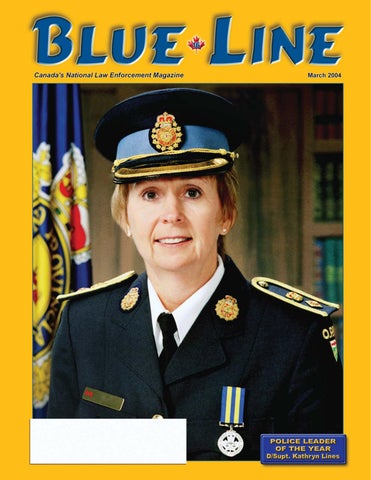
2003 Police Leader of the Year Chief Supt. Kate Lines
8
Satanic Cults The dark side of graffiti vandalism
9
Ontario says national registry flawed
10
Cracking down on bad cops
12
Coping with shiftwork The impact on women’s health
14
eMail: editor@blueline.ca
— News Editor — Les Linder eMail: news@blueline.ca
— Advertising — Mary Lymburner Dean Clarke Bob Murray eMail: sales@blueline.ca
— Pre-press Production — Del Wall — Contributing Editors — Communication Skills Terry Barker Police Management James Clark Tactical Firearms Dave Brown Technology Tom Rataj Psychology Dorothy Cotton Case Law Mike Novakowski Blue Line Magazine is published monthly, September to June, by Blue Line Magazine Incorporated with a mailing address of: 12A - 4981 Hwy. 7 East, Ste. 254, Markham, Ontario, L3R 1N1. Individual magazines are $5.00 each. Subscriptions are $25.00 per year or $40.00 for 2 years. (Foreign - $50.00 U.S.) All material submitted for publication becomes the property of Blue Line Magazine unless other arrangements have been made with the publisher prior to publshing. The authors, advisors and Publisher accept no liability whatsoever for any injuries to persons or property resulting from the application or adoption of any of the procedures, tactics or considerations presented in this magazine. Readers are cautioned and advised that articles presented herein are edited and supplied for your personal awareness and should not be used for further action until appropriate advice and guidance is received from a supervisor, Crown Attorney or other person in authority. Established in 1988, Blue Line Magazine is an independent publication designed to inform, entertain, educate and upgrade the skills of those involved in the law enforcement profession. It has no direct control from a law enforcement agency and its opinions and articles do not necessarily reflect the opinions of any government, police, or law enforcement agency. ©2004 - All articles are protected by copyright. No part of this publication may be reproduced or transmitted in any form or by any means, electronic or mechanical, including photocopying and recording or by any information storage or retrieval system without permission. Internet activity is monitored and use or reposting of material on the Internet is restricted.
This publication is a private venture and receives no subsidy or grant from any level of government.
— Affiliations — International Association of Law Enforcement Planners Canadian Advertising Rates & Data International Police Association The Police Leadership Forum The Canadian Press Newswire Printed in Canada by Janson Printing Service
ISSN #0847 8538
Canada Post - Canadian Publications Mail Product Sales Agreement No. 176796 June 2003
Cold case squads leave no stone unturned 16 Managing the rumour mill
19
DEEP BLUE 20 Asking questions key to preventing suicides More die from suicide than accidents
21
Artist paints colourful history of RNC
22
INCREDIBLE
23
CASE LAW 24 • Long breath test delay ruled reasonable • Sealing blood samples not unreasonable • Video camera doesn’t violate privacy • Police aren’t authorities when undercover • Seizing belongings reduces privacy interests • Questioning okay if counsel not sought DISPATCHES
26
NEWS CLIPS
27
False alarms An overview of what causes them
28
Policing’s future depends on good recruits 29 COMING EVENTS
31
Winnipeg Police dive unit sets standard 32 Tracking hookers, pimps and johns Computer database helps solve crimes
34
Police target Montreal street gangs
35
Pepper spray effectiveness and safety
36
CORRESPONDENCE
39
PRODUCT NEWS
40
TECHNOLOGY Toronto emergency services share the air
41
Blue Line Trade Show — Seminars
43
BACK OF THE BOOK Give me a dime for every innovative idea
46
3
After a panel of judges reviewed many candidates, the Police Leadership Forum (PLF) selected OPP Chief Superintendent Kate Lines as the recipient of the Police Leader of the Year Award. Chosen for her innovative approach to problem solving, Lines is also known for instituting many of the technological investigative techniques currently in use by the force. She is also seen as a visionary who advanced professionalism within modern policing. Lines is the fifth recipient of the Police Leader of the Year Award. Started in 1998, it recognizes people who demonstrate the highest ethical standards and are recognized leaders within their organizations. The Forum recognize professional role models who serve as innovators of change. The award is also designed to encourage visionaries within policing and generate momentum toward encouraging these attributes within individuals. Blue Line Magazine has been a proud sponsor of the Police Leader of the Year award since it was initiated. This year’s recipient will be recognized at a ceremony and banquet to be held at the Blue Line Trade Show on April 27. In other features this month, firearms expert and retired pilot Ted Ryczko looks at the hazards of the magazine disconnect on Smith and Wesson pistols, which are carried by almost half of Canadian police officers. Firearms editor Dave Brown reviews Nowhere to Run, Toronto Police S/Sgt Heinz Kuck, who will be conducting a presentation at the Blue Line Trade Show, writes about the dark side of graffiti vandalism and News Editor Les Linder explains why the head of Ontario’s sex offender registry has some serious concerns about the national registry, due to begin operating later this year. David Griffith tells us how several US police departments got back on the straight and narrow after corruption scandals, Dr. Dorothy examines suicide, case law columnist Mike Novakowski has six recent cases, Danette Dooley reports on an artist who drew the Royal Newfoundland Constabulatory’s long history and Tom Rataj looks at Toronto’s new emergency services communication system. MARCH 2004
4
MARCH 2004
Vancouver Chief raising the bar for police ethics by Morley Lymburner I have been following the Vancouver Police Department’s handling of six officers charged with assault. I was particularly interested since that agency acquired a new chief shortly before the incident and I, like a lot of others, was curious how the ‘new guy’ would come through this. He handled everything extremely well, to the point where I would encourage all police services to study this entire incident and learn from his example. One of my goals when investigating traffic deaths was to not have an inquest. I wanted to leave no question unanswered. If any of the deaths ended with one, I viewed it as a bit of a failure. There are times when you can’t get all the answers but this principle and attitudinal approach to the job is very important. The fact that the Vancouver Police can have an incident involving six officers and three ‘victims’ and not go to a public inquiry is directly attributable to the manner in which it was dealt with. Taxpayers did not have to foot the bill for further investigations and no outside department had to come in to investigate. It speaks volumes about the goals and integrity of the agency and its leader. When the six officers were first identified, an investigation was launched quickly and conducted quite expeditiously. To the credit of the six officers involved, not only did they waste no time in accepting responsibility but, less than a month after the incident came to light, apologized to their victims and signed a public statement of apology to the community which was published on the Vancouver Police web site. They also all negotiated guilty pleas and ended that stage quickly, saving their agency and themselves prolonged negative stress and publicity. I most admire Chief Constable Jamie Graham’s handling of this entire incident. He held true to the principle of transparency and openness with the community throughout the entire process. He and his staff quickly acknowledged the problem and dealt with it swiftly with what appears to be the utmost fairness. Historically this has been an uncharacteristic police approach to bad news. In January, one year after the incident occurred, Graham announced the penalties the officers would receive under the departmental code of discipline. The decisions he made about the punishment of each officer displayed his understanding of both the human and legal aspects of the situation. The penalties not only reflected good police practice but also solid judgment. Although two officers were dismissed, he gave equally good arguments for those retained. The emphasis was on understanding, training and rehabilitation. None of the decisions could be considered knee-jerk reactions to public opinion. The most important image was that the top person in charge was there, front and centre, to reassure both the public and the members of the department that all was under control — but the most important message was that lessons learned will also be retained, taught and understood. I am certain there are individuals perhaps June 2003
closer to the issues that would not share my opinions, but I am talking about the larger picture. When I first heard of the incident, I was sure the agency would be embroiled in a lot of negativity and probably a long, drawn-out public enquiry. I expected lots of radio and television police-bashing sessions and almost expected to see upper management bunker down for the onslaught. None of this happened and when I review the feelings I had toward the Vancouver Police, I must say that I feel more confident in them today than I did even before the assaults hit the media. In his public announcement Graham stated
5
that when he joined the police department, it was his hope and intention that it would mark the beginning of a new era of openness between the police and the public, noting “we cannot expect to earn your trust if we are not entirely open in explaining the decisions we make.” Sometimes adversity can make one stronger. I hope this is not only true for the Vancouver Police Department but also those six officers, who can now hopefully move on with their lives. There is no doubt that Vancouver has raised the bar for transparency and police ethics. Now if they could only teach those folks in Ottawa.
MARCH 2004
by Ted Ryczko A police pistol is an emergency tool that’s used very infrequently. The cause for its use occurs almost instantly and without much, if any, warning. The outcome of the event is determined within a matter of seconds and if the pistol doesn’t fire, innocent people could die. Accordingly, its operating controls and features must be favourable and reliable. I read with interest Dave Brown’s article in the December issue of Blue Line (The Canadian Police Firearms Survey), wherein he states that 48 per cent of the pistols used by Canadian police are Smith & Wessons. Most officers are satisfied with that choice, Brown wrote, even though Smith is still the only major manufacturer to equip their semi autos with the magazine disconnect safeties; this feature elicited mixed feelings, even among RCMP members. The function of this “safety” is to prevent the pistol from being fired with the magazine removed; even the chambered round can’t be fired if the magazine is inadvertently released. Very few tools are perfect and most have many features, some of which are selected because of their positive aspects; negative aspects, if any, are discovered during the selection process or after the tool has entered service and must be immediately weighed against its positives. Unless there’s a net gain sufficient to make the feature worth keeping, it must be removed as soon as possible. I can find only one aspect of the magazine safety that was identified as a positive during the selection process; it renders an officer’s pistol inoperable during a gun grab — if they anticipate it’s going to happen and drop the magazine by depressing the release button with their thumb. To accomplish this, the pistol must be slightly rotated about the hand, causing the officer to forfeit some gripping power, hence control over the pistol, in a situation that demands maximum control. Although dropping the magazine may prevent an adversary from shooting the officer’s gun, it also prevents the officer from doing so. Since magazine safety proponents say this is a positive, let’s examine the negative aspects. After firing shots during a gunfight, an officer may wish to replace his/her partially depleted magazine with a fully loaded one. During a top-
up reload however, a pistol with a disconnect safety is inoperable while the magazine is out of the well. While it may be argued that an officer should only top up from behind cover and during a lull in the fire fight, there’s no guarantee it will last long enough to insert the fresh magazine. The ability to just point-and-pull to fire the chambered round should a threatening target pop up during the reload could very well save a life. The worst aspect of the safety feature is that the magazine only has to become unseated to the point where the disconnect mechanism engages, rather than being totally out of the well, to render the pistol inoperative. This means the release button needs be displaced only a very short distance, using a relatively light force, to unseat a magazine. Such a displacement can occur in the holster, during a draw or as a result of physical activity. If an officer drew his/her pistol to shoot an adversary while the magazine was unseated, the pistol wouldn’t fire when they pulled the trigger. They would have to correctly determine the cause of the failure, drive home the unseated magazine or, in the case of an empty magazine well, retrieve a spare magazine and insert it into the pistol. This takes time during a period when there may be little or none to spare. Unfortunately, this problem was probably not discovered when the magazine safety feature was adopted during the pistol selection process but was made clear a little over two years ago when RCMP Cst. Dennis Strongquill was shot and killed. As reported by the media, his magazine was out of his pistol during the encounter. If this is true, it’s possible he died while attempting to fire a live round loaded in the chamber, perhaps desperately pulling the useless, disconnected trigger. I was assigned by the armed forces in 1979 to instruct the Ontario Provincial Police (OPP) Tactical Response Unit (TRU) on using their new Browning pistol. Since pistols were new to the force, I was afforded considerable leeway in introducing them to pistol procedures. Accordingly 6
I removed the magazine safeties, after demonstrating their hazard and prescribed operating procedures incorporating its absence. The TRU team relayed my concerns to senior management, who agreed; by the time I gave the Browning course to the OPP Canine Unit a year later, no reference needed to be made to the magazine safety because it was policy for the armourers to remove it before the pistol was issued. A stroke of a pen by senior police management today could remove the magazine safety from their officer’s pistols, just as was done by senior OPP management nearly a quarter of a century ago. There are no positive aspects to justify the continued use of the magazine safety and it should be removed immediately. Many other users agree with this position — Texas, California and the Federal Bureau of Investigation (FBI) have specifically excluded firearms with magazine safety disconnects from their purchase standards. There must be those who believe that the magazine safety improves officer safety, otherwise 48 per cent of the police pistols in this country would not be so equipped. It therefore logically follows that the proponents should lobby the 52 per cent of officers without the safety to have it installed. After all, they deserve no less safety than the others have. I welcome proponents to respond to any or all of my arguments. The RCMP and Smith & Wesson received this article and other documents in December and were invited to respond. A spokesperson for the RCMP, after conferring with upper management, had no comment at this time. Smith & Wesson reaffirmed general confidence in its products but didn’t have a specific comment regarding this issue. Ted Ryczko is well known and respected in police circles. His efforts in changing Canadian police from revolvers to semi automatic handguns is legendary. He recently retired after a long career as a captain of both military and commercial passenger jets. He can be contacted at ted_cathy@cogeco.ca.
MARCH 2004
Good read — spoiled by sloppy editing Title: Nowhere to Run Author: Mike McIntyre Publisher: Great Plains Publications Reviewed by Dave Brown Just days before Christmas 2001, RCMP constables Dennis Strongquill and Brian Auger were heading to Russell, Manitoba for coffee when they noticed a pickup run a stop sign and fail to dim its lights and investigated. Instead of a routine traffic stop, their RCMP Explorer was met by a hail of high-power rifle fire. Auger spun it around and raced for the shelter of the Russell detachment, pursued at high speed by the pickup, which rammed the side of their SUV just as they entered the parking lot. Inside were brothers Robert and Danny Sand and Laurie Bell, Robert’s girlfriend. As Danny targeted the cruiser, Robert coldly gunned down Strongquill while he lay helpless and trapped in the passenger seat. In the back of the stolen pickup, Bell madly passed loaded guns to the brothers, urging them to kill the two officers. Despite the barrage, Auger returned fire, repeatedly hitting the truck and wounding Danny in the arm and back. After it sped away he found his partner, who was hit in the upper body by shotgun rounds fired at point blank range and died almost instantly. He’d apparently been unable to defend himself; his Smith & Wesson semi-automatic pistol was unholstered but the magazine had fallen out and a live round was still loaded in the chamber. Officers tracked the three killers to a Saskatchewan motel the next morning and sealed off the area. Danny was killed by an RCMP sniper as he climbed the motel roof with a highpower rifle, preparing to fire at the surrounding officers. Robert and Bell surrendered. Veteran Winnipeg Free Press reporter Mike McIntyre followed the murder trial of the two remaining killers in the spring of 2002 in Brandon, Manitoba. After months of dramatic and heart wrenching testimony, Robert was convicted of first degree murder and Bell, unbelievably, only of manslaughter. To complete his book, McIntyre interviewed witnesses and friends of both the victim and killers. He pored through the long pages of testimony, visited the locations where much of the action took place and even interviewed Robert in prison. One has to wonder how much better this book might have been if it hadn’t been rushed to make it into the bookstores by Christmas. Much like the late-night disc jockey at a small town radio station, true crime stories about very recent events don’t really have to be good; they just have to be there — but numerous mistakes in grammar and editing will have readers questioning whether McIntyre was really at the trial he wrote about. For example: “Dennis had his nine-millimeter Glock pistol out, but it was of no use. The magazine clip had somehow been jolted, causing his ammunition to fall to the ground. It was too dark and too hectic, for him to retrieve it.” Aside from the minor slip of calling it a June 2003
‘magazine clip,’ the RCMP issue sidearm is made by Smith & Wesson. McIntyre refers to it as a Glock throughout, even though the make was a key piece of evidence at the trial. This is nothing new; Free Press reporters are notorious for referring to every police issue semi-automatic as a ‘duty revolver.’ (Ironically, if it had been a Glock, Strongquill may have been able to fire that one round, as S&W is one of the few makers to equip their police sidearms with a disconnect that disables the pistol if the magazine is removed.) It’s apparent McIntyre knows little about firearms. He describes Robert as reaching into the back for a stolen shotgun with the unique ability to “spray shot in all directions.” RCMP ERT members are described as “SWAT;” a young man committed suicide by “trying” a rope around his neck and the town of Westlock, Alberta, residents and all, is magically moved about 200 kms closer to Sylvan Lake. Most disturbing is how the writer supports the somewhat bizarre defense argument that the RCMP shares blame for Strongquill’s death. As McIntyre puts it, “Dennis hadn’t fired a single shot, his gun completely falling apart while desperately trying to fend off the ambush. A left-handed shot, the RCMP had given Dennis a right-handed gun, which caused a release mechanism for his ammuni-
7
tion to be released when he tried to extract it from his holster. It was a tragic mix up, with deadly results.” Blue Line readers would, no doubt, love to see one of these ‘lefthanded guns’ that would have miraculously prevented him from being gunned down. (The RCMP now moves the mag release on all lefthanded officers’ pistols to the right side of the frame. Like every police force in the world, however, they still issue a ‘right-handed gun.’) Despite the defense lawyer’s preposterous ramblings, only three factors led to Strongquill’s death; one is dead and two are in jail. In his review of the book, Winnipeg lawyer Douglas Johnston questions why it didn’t generate enough empathy for the murderous trio. Readers may question why anyone should empathize with three violent, drugged-out killers who deliberately killed a fine officer. If this crime had occurred 100 kms south, Sand and Bell would be locked up for life and the book would already be a Hollywood script. However, since it happened north of the 49th Parallel, one of the killers is already eligible for release from prison this August, a dedicated police officer is dead and many lives will never again be the same. Dave Brown is a regular Blue Line columnist. He can be reached at firearms@blueline.ca.
MARCH 2004
Award recipient known for innovation by Elvin Klassen This year’s Police Leadership Forum (PLF) police leader of the year is a 26-year member of the Ontario Provincial Police known for her innovative approach to policing. Acting Detective Chief Superintendent Kate Lines, who was one of five nominees for the 2003 Police Leadership Award, previously managed the force’s investigations support bureau and directed the behavioural sciences section. She also served in the drug enforcement section, anti-rackets branch and criminal investigation bureau, worked as a uniformed and undercover officer and investigated fraud and major crimes such as homicides and sexual assaults. She became the OPP’s first criminal profiler in 1991 and only the second Canadian to complete the 10-month training program at the FBI’s criminal profiling fellowship program in Quantico, Virginia. Her vision and dedication to advancing policing and community development has been the primary catalyst behind the introduction and formation of the force’s behavioural science unit, which expanded under her direction to include . polygraph services, criminal and geographic pro-
filing, forensic psychiatry, threat assessment, the provincial ViCLAS Centre (Violent Crime Linkage Analysis System), a research unit and the Ontario Sex Offender Registry. Lines’ expertise in the field of behavioural sciences concepts as it relates to policing is world renowned and highly respected within the national and international law enforcement community. As a result she is a highly sought after guest speaker on the international stage.
8
She holds a bachelor of arts degree in the crime and deviance specialist program from the University of Toronto and has received general and advanced certificates in police studies and a diploma in police management studies from the University of Western Ontario. Lines has been instrumental in providing, promoting and advancing behavioural sciences concepts in Canada and internationally since 1991. Her efforts and leadership has enhanced professional awareness, acceptance and utilization of specialized ‘leading edge’ skills and technology in supporting violent crime investigations and victim prevention. Under her leadership, the behavioural sciences section achieved international stature and recognition for its expertise and excellence in investigating violent crimes. Lines is also responsible for forming the first forensic psychiatry unit in Canada; established in 1998, it quickly gained an international recognition for its expertise, particularly in the areas of crimes against children, child pornography, equivocal death cases, undercover officer stress debriefings and forensic-psychological issues surrounding violent crime cases. This unit represents the OPP and Canada on the INTERPOL specialists group on crimes against children. The FBI, New Scotland Yard, the Georgia Bureau of Investigations and the RCMP are among the agencies that have requested its assistance on investigations.
MARCH 2004
As a result of her dedication and vision, the Ontario ViCLAS Centre is now the largest in the world and has been visited and helped train officers from across Canada, US, England, France, Austria, Holland, Germany, Australia, Japan, China, the Slovak Republic and South Africa. Lines has received numerous commendations for her contributions to policing and dedication to public safety, including Officer of the Order of Merit of the Police Forces, Queen’s Golden Jubilee Medal, Police Exemplary Service Award, Team Endeavours Award, Appreciation of Commitment to Public Safety and Excellence in Performance awards from the IAWP and OWLE. The last word goes to one of her supporters, who said “the fact that your work in the study of criminal behaviour is acknowledged world wide is an honour that reflects proudly on you and also on the OPP. Your foresight in recognizing the importance of creating a behavioural science section with in the OPP is a tribute to your professionalism and outstanding dedication to policing. Through your efforts, the OPP has become a recognized leader in criminal investigation.” Elvin Klassen, Blue Line’s west coast correspondent, can be reached at elvin@blueline.ca.
Police leadership in the 21st Century focus of keynote speaker Police leadership is changing and to help guide you through it, the Police Leadership Forum is featuring Dr. Sheldon Greenberg as its guest speaker at the Blue Line Trade Show on April 27th. Issues affecting today’s police leaders are varied and far more complex than those of the past. They include: • increased expectation for service • demonstrating effective response to terrorism at the local level • serving the needs of special interest groups • job instability • demand for quick-fix approaches to long-standing community problems • statistics-driven policing • labour relations • allocation of resources • increased costs • managing fear
These issues must be addressed while ensuring quality response to calls for service and the performance of other routine police functions. Leaders must do all that’s needed while surviving in a highly charged political environment and preparing to take on future challenges. This is a frank, hard-hitting discussion about the current and future state of police leadership and the survival of police executives. Sheldon Greenberg, Ph.D. is the director of the Division of Public Safety Leadership in Johns Hopkins University’s School of Professional Studies. He directs JHU’s Police Executive Leadership Program, is the coordinator of the MidAtlantic Regional Community Policing Institute and was previously the associate director of the Police Executive Leadership Forum and a bureau commander with the Howard County (MD) Police Department.
Satanic Cults The darkest side of graffiti vandalism
by Heinz Kuck Unlike many other forms of graffiti, you’re not meant to see or understand it. Its nefarious purpose lies within secrecy and sanctity. Its existence focuses on an internal audience, elaborate ceremony and ultimately, homage to a deity of darkness. This is the arcane world of Satanic cult graffiti. Both research and empirical policing experience have given us seven definitive styles of graffiti vandalism — hip hop (encompassing tags, throw ups and pieces), gang, hate crime, political activism, folk epigraphy, latrinailia and Satanic cult. The hip hop style is recognised as the most pervasive, the criminal gang variation the most intimidating and hate crime the most repugnant, but Satanic cult is the most misunderstood and cryptic. Graffiti comes from the ancient Greek root of Graphien, “to write,” and is any marking, writing, script, scratch or etch done to alter a public or private surface, without the property owner’s permission. Hip hop’s purpose is to promote pure vandalism, altering the aesthetics of the established community for the writer’s attempt at sub-cultural fame, respect and recognition. For the ‘home-boy,’ the importance is in the pronouncement and demarcation of one’s gang ‘turf,’ the June 2003
intimidation value and even to memorialise dead gang members — but for the Satanist, the key is symbolism — purifying and consecrating the ceremonial environment. Since cultists try to keep their association and activity hidden, Satanic symbolism (graffiti) isn’t routinely done within or near their own property, for its very existence and possible recognition might cause social agency or police intervention. Ceremonies, initiations or sacrifices have often taken place within isolated outdoor locations, abandoned buildings and even cavernous trunk sewers beneath our busy 9
city streets. Once a sight is chosen, empowered emissaries select the appropriate symbol type, which is dictated by the nature of the ceremony. Established symbols include hexagrams — half human-half animal representations of Satan, inverted crucifix — the ‘eye’ of Satan and representations of the number ‘666.’ For the most part, standard manufactured paint is used to create these symbols, but blood from domestic animals and livestock is known to have been used. Although emissaries create the symbols with reverence and dexterity, they’re fully aware of how ephemeral they are. The image, present for the ceremony and/or sacrifice, may, through community intervention and eradication, disappear well before the ashes have cooled within their ceremonial pentagram. Staff Sgt Heinz Kuck has been a member of the Toronto Police Service since 1979 and is the architect of the service’s award winning graffiti eradication program. He will speak at the Blue Line Trade Show, April 27-28. Learn how to design and develop your own graffiti eradication program through in-depth study of its various styles and the success of employing the community oriented policing and problem solving model — go to http://blueline.ca/ ?seminars to register.
MARCH 2004
Ontario says national registry flawed by Les Linder Canada’s national sex offender registry may open its doors later this year before serious concerns expressed by the head of Ontario’s own sex offender registry are resolved. However, steps have already been initiated by staff of the Ontario registry to confront the federal government and help deal with some of the major issues. “We have strong achievements that we’re hoping the (federal) government take into account and adopt certain aspects of our database as we discuss some of the changes the national registry still needs,” said Ontario Provincial Police (OPP) Det. Staff Sgt. Charles Young, who also manages Ontario’s registry. Perhaps one of the most successful aspects of the province’s registry program is its high compliance rate from convicted sex offenders — it has continued to maintain about 93 per cent compliance for more than two years, with 4,526 compliant offenders and only 292 noncompliant. There are also an additional 1,588 not part of the compliance list because they’ve either been incarcerated, left the province, were deported or are deceased.
“The non-compliant individuals almost always register themselves, they’re not out there saying ‘come and get me,’” Young said. “Usually it is just a case where these offenders are trying to see if they slipped through the cracks and whether we forgot about them - once police contact them, they almost always comply immediately.” A computer system alerts police after 16 days if a released sex offender hasn’t registered with the database, prompting police to take action. Much of Ontario’s success with its registry comes from how differently it is operated compared to those in the US. “One huge difference is that (Americans) have a public notification component in their registry system, whereas we do not,” Young explained. “Our registry is strictly for investigative value and we do not publicly notify people of sex offenders and their whereabouts.” However, the Community Safety Act amendments authorize the chief or designates to make community releases where appropriate. Young said that police would provide the information to the public if a potentially dangerous sex offender was being released into the community. Young does not want to see a public notification element similar to that of the US registries added to the Ontario system, as there are philosophical differences in how they manage their systems. “We know that 94 per cent of the time, we have the exact location of a registered offender at our disposal,” he said. “In the US that can be anywhere from 30 to 60 per cent, which translates into the police not knowing where these offenders are and now neither does the public.” The other disadvantage is the increased enforcement costs associated with tracking 10
down non-compliant offenders who have been driven underground out of fear of public retribution. In Ontario, enforcement hasn’t been an overly significant issue, Young pointed out. With only 33 non-compliant sex offenders convicted since the registry was put into place in 2001, Young is satisfied that the province’s system works. “So now we have low enforcement costs and the police know where these registered offenders are. We haven’t driven them underground because we didn’t release their information to the public and now we can keep a close eye on them to help make sure they don’t re-offend.” The database stores a wide array of photos that are used during radius searches anytime police need to locate offenders. The Ontario registry, staffed by 16 full-time members at OPP headquarters, is also currently looking at adding an enhanced ‘inquiry builder’ computer system, allowing investigators to make specific inquiries of offenders stored on the database. They can use the builder to search for information based on description, convicted offence, specific address or known links to a specific address and whether the offender has used a specific verbiage during an attack or used a specific weapon. The system will then calculate the data and bring up a possible suspect from the sex offender registry. “This is a first in policing for us where a system will actually give us possible subject of interest,” Young said. “We can pull up a map of where the offence occurred and clearly see on the system the proximity of any registered offenders to the scene of the offence.” Officers can then interview the offenders and determine whether they need to be ruled in or out of the investigation, saving police valuable time and enabling them to spend more time searching for the guilty individual. The database is also digitally connected to every police service in the province, allowing police to access information as soon as it’s needed. Sharing agreements are also in place with provincial, federal and state governments, so long as they are actively involved in a criminal investigation. “One of the greatest benefits of the sex offender registry is how it has been bringing other police services, as well as crown attorneys, ministry correctional staff and probation and parole officers closer together in co-operation,” Young said. “We’re talking 20 times more often than we did before about the managing of high risk offenders, improving everyone’s ability to conduct strong and efficient investigations.” The investigative value of the planned national sex offender registry is questionable, however. Young wants it to more closely mirror the Ontario approach rather than existing for a non-investigative purpose. Some of the key points of contention are the lack of radius and digital searches or an inquiry builder to assemble information on an offence and provide police with possible suspects. Currently, Young said none of these will be available when the national sex offender regMARCH 2004
istry rolls out later this year. “Another thing we have a huge issue with is that access to the new registry is restricted to establishing reasonable suspicion that a sex offence has occurred,” he said. “This is unacceptable to Ontario. They are trying to provide (police) a tool but then we are suddenly restricted from using it exactly when we need it. “When an incident occurs, we can’t access the data in the national registry until we know for sure that we can prove reasonable suspicion and articulate it in court during a trial. This takes away from the law enforcement and proactive element to the registry.” In Ontario, Christopher’s Law allows police to use the Ontario sex offender registry for law enforcement and crime prevention. Young said Ontario will not change to the national registry’s system and will continue to follow Christopher’s Law. “How do you explain this to a concerned citizen who phones police out of good faith of a suspicious individual he sees near a school,” he added. Officers will need to ask themselves whether or not they can access that national database with sufficient reasonable suspicion and match a description of the person with a registered offender. “Police are forced into waiting for the person to do something so overt that we can then take action,” Young said. “This is a needless hurdle that we should be able to overcome.” There is also no authority under the Sex Offender Information Registration Act (SOIRA - Bill C23) for authorities to provide the public
June 2003
with information of a potentially dangerous sex offender being released into the community. Registered offenders are also not required to report in-person to police when leaving Canada. It’s been proposed under SOIRA that sex offenders cannot be forced to report in-person to indicate they are leaving the country, but can simply do it by phone. It also still permits them to be pardoned. “Why are pardons applying to these people?” Young asked incredulously. “A large number of sex offenders who apply for pardons receive it - why does that occur? Why should pardons be given to those who victimize the vulnerable members of society? We believe pardons should not apply to someone convicted of a violent sex offence.” Ontario has, however, been successful in convincing the federal government to include most of the offenders from Ontario’s registry in the national registry database. Under the agreement, all of Ontario’s registrants will be provided an opportunity to appeal being included in the new database. However, there is a mechanism in place which requires they come forward and explain to a judge why they should not be included. Failure to appeal means they would automatically be rolled into the new registry. Young said he doesn’t expect many people to come forward, as they need to have a very good reason not to be included. Despite the numerous problems Young sees within the national registry, he said Ontario will continue to work with the federal government and provincial counterparts to improve the national registry.
11
MARCH 2004
Cracking down on bad cops by David Griffith There has probably never been a worse month in the history of the Detroit Police Department than June, 2003, when 17 police officers were indicted on a variety of corruption charges. The agency agreed to oversight by the U.S. Department of Justice. According to documents leaked to local papers, federal investigators hadn’t uncovered such “entrenched and embedded” problems on an American police agency in a decade. When you consider the 10 years in question, that’s quite a damning statement. Major US cities, including Los Angeles, Miami and New Orleans, were rocked by revelations of officer misconduct during the period. Internal and external investigations of these departments led to lurid evidence of officers dealing drugs, stealing evidence, hiring themselves out for contract killings, planting guns on suspects after police-involved shootings and covering up for fellow officers. Not all police misconduct is as newsworthy as these infamous cases, but it all has the same results — an erosion of the public’s trust in law enforcement, damaging good cops and sometimes destroying their careers. You don’t have to plant a gun or lift kilos of coke from the evidence locker to find yourself turning in your badge, or worse, indicted and possibly on your way to a state or federal prison. Each year a lot of police find themselves jammed up because they falsified timecards for a little extra overtime or lied on a report to cover for a buddy. Retired officer Neal Trautman, head of the non-profit National Institute of Ethics, says more than 2,000 US officers were decertified for misconduct from 1990 to 1995 alone. He has no definitive recent figures, but Trautman believes those numbers have increased and will continue to climb for another 10 years or so. Bad in, bad out The root of the problem is recruiting and hiring. In the mid-’90s, the Clinton Administration launched an initiative to hire an additional 100,000 police officers. Unfortunately, there weren’t an additional 100,000 qualified officers to fill the demand. It was hard to fill police positions during the booming ’90s but with federal money available, many agencies hired anyway. Consequently, there are a lot of officers on the street who would have been rejected if their agencies hadn’t relaxed hiring standards. Trautman points out that several cops involved in a recent major police scandal were recommended for rejection by departmental interviewers and investigators but were hired anyway. “The bottom line is that in terms of recruitment, we have already blown it,” Trautman says. Not every officer hired during this period is going to be a problem, of course, but it’s unlikely officers with less than favourable background investigations will change their spots just
because they’ve been given a gun and badge. “If they are thieves before becoming cops, then they will be thieves in uniform,” says Trautman. “If they are abusive to people from certain racial groups, then they will do that in uniform, too.” Just one worm A bad hire can do a lot of damage to a police force. It’s kind of like letting a worm into an apple. Their performance and behaviour will affect the public’s attitude toward its police force, damage the morale of good cops and spread corruption throughout the ranks. This is why thorough recruitment and hiring policies are some of the best defences against corruption in police ranks. It’s also one of the first things that reformers address when they seek to fix broken law enforcement agencies. The best way to attract decent recruits is to offer reasonable compensation. In the early ’90s, when the foundations for the New Orleans Police Department’s drug and murder scandals were being laid, starting pay for a police officer was about $16,000 per year. Under reforms implemented by former NOPD superintendent Richard J. Pennington and current superintendent Edwin Compass, starting pay has been doubled. By paying a living wage, NOPD has made it much more difficult for individuals with questionable backgrounds to wear its uniform. “Hiring is now much more selective,” says Capt. Marlon DeFillo, NOPD’s commander of public affairs. “The department now rejects nine out of 10 applicants.” The vetting of new candidates is also much more thorough than a decade ago. Background investigations intensively examine the recruit’s criminal, financial and military records and investigators trained in background checks now 12
talk to the candidate’s character references and neighbours. Recruits receive psychiatric evaluations before, during and after the academy. New Orleans instituted its hiring policies after a major scandal, but some agencies long ago decided that the best way to maintain high ethical standards was to turn away questionable people at the door. For example, few law enforcement agencies meet the hiring standards of the Wyoming Game and Fish Department — and admittedly, few can afford to do so — but there are lessons to be learned in examining the department’s hiring policies. With 72 sworn game wardens, Wyoming Game and Fish is responsible for enforcing the state’s laws regarding hunting, fishing, trapping, etc. The job requires both a biology and law enforcement background. It’s a popular job — each opening attracts as many as 100 applicants, which allows the agency to be picky about who gets to wear its badge. The hiring and evaluation process is long and thorough, involving tests, interviews, psychiatric exams, extensive background investigations and a series of probationary positions. Chief Game Warden Jay Lawson says the hiring process is so involved because wardens are in a position of great authority that could easily be abused. “Our wardens work alone and beyond direct supervision,” he explains. “They also have huge areas of responsibility, oftentimes as much as 2,500 square miles.” Lawson realizes that the opportunities for misconduct are not as tempting as they are for say, a New York narcotics officer, but bad game wardens could damage an agency that prides itself on integrity and its high public regard. “They’re in charge of lots of valuable equipment, they protect valuable wildlife and they make arrests,” he explains. MARCH 2004
Copy machines If you really want to know the culture of a police department, look at the field training officers (FTOs), who are more than teachers. In some ways, they’re like parents raising the next generation of officers and instilling them with the values of society, in this case the department. “You do not want cynical, unappreciated FTOs,” says Trautman. “They are machines replicating themselves. If you have a group who feel unappreciated and they are not compensated for the extra work, then you can’t expect anything but a whole department of cynics.” Accordingly, many police administrators have come to realize that proper selection, training and supervision is essential to maintaining the integrity of their departments. For example, one of the first reforms in the New Orleans PD was an overhaul of the FTO program. Perhaps the most comprehensive US FTO training and supervision programs can be found at the LaGrange, Georgia PD. It’s very selective; candidates are required to complete a 500hour training program before being given the responsibility of working with new officers. LaGrange Chief Louis Dekmar says the 85sworn agency has made great strides in the last decade, overhauling its policies and procedures, achieving accreditation and maintaining high morale and integrity. He credits daily reports FTOs are required to submit with helping to keep the department on the right path. “They are required to submit every day a two- to three-page, typewritten, single-spaced report to me,” Dekmar explains. “That’s my morning reading. I look at those reports with my morning coffee because I want to know how the recruits are doing. If we take a recruit through training and then have to dismiss him or her later, then we’ve just thrown away $25,000 to $30,000. It’s like taking a fully equipped Crown Vic and driving it off a cliff.” Dekmar also lets his officers know that he takes ethics very seriously. He personally teaches the department’s classes on ethics. “Our integrity policies are reinforced by the FTOs, the supervisors and the management team,” he says. “If we see somebody heading down the wrong path, we try to do whatever we can to help them be successful.” On-the-job testing Proper recruiting and training are critical to maintaining departmental integrity, but where the rubber meets the road is in the field. Both rookie and veteran officers are constantly faced with temptation on the job and some departments, rightly or wrongly, have instituted pop quizzes to test officer honesty. One of the first reforms instituted in New Orleans was ‘integrity checks.’ Agents of the Public Integrity Bureau — a joint operation with the FBI — go undercover to test and observe officers in scenarios that present them with temptations. For example, the agents have left cash in the glove compartment of abandoned cars, set up accidents to make sure responding officers are not working for lawyers, doctors or insurers and offered bribes. DeFillo says the tests are conducted randomly and secretly. “The officers never know when they are being tested,” he says. “It keeps June 2003
everybody guessing. They have to wonder, ‘was the test the call I got yesterday, or the call I responded to last week?’” The bureau sends results to the commander of the unit tested. DeFillo says the only time they’re shared with the officer tested is when their behaviour merits correction or discipline. If the officer’s action is illegal or a gross violation of policy, they won’t know about the test until they’re fired or arrested, says DeFillo, who notes no integrity check has ever led to the discovery of such serious misconduct. Such checks are probably not appreciated by street cops, but they’ve become a common practice in large agencies, especially in forces that have suffered through corruption investigations. For example, the federal consent decree that now governs many of the policies and procedures of the Los Angeles PD specifies that the department conduct ‘sting audits’ to sniff out corruption. As when offering temptation to criminals in sting investigations, there’s a fine line between a legitimate test of an officer’s honesty and entrapment. “We don’t entrap officers,” says Lt. Jorge Perez, commander of the Miami Police Department’s Internal Affairs unit. “We take the environment where the officer is and we observe how he handles himself in that environment. For example, if there’s an allegation that a specific officer is out there picking up hookers, then we’ll send an undercover officer out there posing as a hooker and see what he does — but we don’t just go out there and put a good-looking female officer undercover flirting with every male officer she sees and see what happens. We don’t do that. We don’t set officers up for failure like that,” he says. Rotten from the top The focus of sting audits, integrity and quality-control checks and the like is usually street cops, but experts say that agencies generally rot from the top down. “I believe with absolute certainty that the greatest category of misconduct in law enforcement is committed by chiefs, sheriffs, directors and superintendents,” says Trautman. “The most destructive form of police misconduct is administrators ignoring obvious ethical problems. That causes a backlash that reaches every part of the department and every employee.” Trautman’s research shows misconduct spreads fast and that when the brass ignores bad cops and bad behaviour, a culture of corruption begins to flourish. This is especially true if officers believe discipline is inconsistent from officer to officer and easily influenced by outside forces and internal politics. “We collected 1,902 surveys from 444 agencies in 20 states and we discovered that the number one reason that officers were angry and frustrated with their agencies was their belief that discipline was unfair and that administrators play favourites,” says Trautman. Eliminating anger and frustration in the ranks is critical to any attempt to clean up a department because certain types of police misconduct are often an expression of the officer’s disdain for his or her employer. “Most 13
officers who commit misconduct rationalize their behaviour,” says Trautman. “They see themselves as victims of their departments. That’s why the biggest category of misconduct is theft by falsifying reports, documents and time cards.” Airing dirty laundry One of the reasons why some police administrators ignore corruption in the ranks is because they don’t want to find themselves in the middle of a media feeding frenzy. Unfortunately, this is a case of causing something to happen by attempting to avoid it. Put simply, if you don’t eventually wash your dirty laundry, it’s going to start to stink — and reporters looking for corruption know how to follow their noses. Believing it’s better to give them a story than have them dig it up on their own, some enlightened administrators have taken a novel approach to dealing with the media in corruption cases. “We’re not shy about it,” says NOPD’s DeFillo. “When an officer is accused of a crime or wrongdoing, the superintendent is very pro-active about calling a press conference.” Last to know Unfortunately, in some agencies, the brass can’t tell the public about corruption in the ranks because they’re unaware of it. Some chiefs want to know and some don’t. Others may be ignorant of problems because junior officers shield them from the truth. This is a very dangerous condition for a chief and department. The New Orleans force was once characterized as corrupt beyond redemption and now it’s held up as an example of how an agency can clean up its act. Part of the ongoing process of maintaining that reputation has been elevating the department’s public integrity division to bureau status. There are only five bureaus in the NOPD and each commander reports directly to the superintendent. This structure gives them deputy chief status and prevents any interference in investigations. It also means that the superintendent can’t plead ignorance when it comes to internal investigations. Career killer There are numerous reasons why law enforcement agencies must be vigilant in attempts to excise bad cops and eliminate police misconduct — but perhaps the most important is that a culture of corruption endangers every officer by undermining police authority and officer morale. Worse, bad officers make life extremely difficult for the good guys. Police loyalty, known as the ‘blue wall’ or ‘code of silence,’ has forced many officers to jeopardize their careers — and their liberty — to cover up another officer’s misconduct. The results are often tragic. “Misconduct and the code of silence are the most destructive forces in law enforcement,” says Trautman. “It is far more likely that an officer’s career will be cut short by these things than by a bad guy with a knife in the alley.” This article is reprinted with permission from Californiabased Police Magazine. MARCH 2004
Coping with shiftwork The impact on women’s health can differ from their male colleagues Disruption occurs because shiftwork alters normal rest and activity requirements and processes adjust at different rates in response. After about five successive night shifts, for example, the body will have begun to make measurable biochemical changes to allow, as far as possible, alertness during the night. Unfortunately, when the tour of night duties finishes, the body has to adjust back again and that takes a lot longer - the end result is that hormonal balances are in a constant state of flux and, over time, this is detrimental to health.
by Sue Woolfenden Matching limited police resources to the every increasing demand for service has meant experimenting with different work schedules, aggravating the negative effects of shiftwork on individual and organizational performance. Legislation imposing welfare, health and safety requirements further complicates the situation. The day when work schedules only considered the operational need for a 24 hour police presence is gone; they now need to balance the needs of the organization with those of the workforce, which unfortunately are not always compatible. Employees want quality time off for social and domestic commitments, often during times they are most needed at work. It’s generally accepted by those who study and work shifts that they’re anti-social, detrimental to health and should be avoided if possible, or at least well managed. There are sound business reasons for getting this balance right. Individuals can be held liable for corporate breaches of health and safety legislation. Poorly designed or managed work schedules result in underemployed or over-stretched staff, with an associated impact on the quality of service, employee relations, job satisfaction and organizational costs. A holistic approach A structured approach to scheduling will ensure that both organizational and employee priorities are not forgotten. Assess whether the schedule meets the community’s needs and ensure more than just one shift pattern option is considered. Keep in mind people’s health, welfare and views, as well as legal issues and, having designed a schedule, consider how it’s going to be managed. Addressing each of these
elements increases the chances of coming up with something that will benefit everyone. Assessing needs Using patrol officers as an example, ask how many are needed to meet demand within response time targets and provide an adequate level of service whilst ensuring that workload is equitably distributed. What else might officers need to do? All this is essential information when it comes to designing shift patterns and setting hours of duty. Health considerations Some of the physiological and psychological effects of shiftwork are well known, certainly by those who work them. Other detrimental effects are only now being recognised and some are still the subject of still inconclusive research. This is particularly so for women, whose bodies are controlled by a range of physiological and biochemical processes which have regular cyclical fluctuations over a 24 hour period. These circadian rhythms control body temperature, heart rate, blood pressure, respiration rate, urination, hormone production, etc. Mood, alertness and performance all show 24 hour rhythms.
14
Physiological effects The most noticeable and potentially dangerous physiological effects include persistent fatigue and reduced alertness. For those who drive or carry firearms, such factors are not only a problem, they can also be life threatening. Women over 40 become noticeably less able to cope with shiftwork. Latent medical conditions can emerge, gastrointestinal complaints become more common and sleep quality is often reduced. The damage is cumulative, occurring over a number of years; much of it will go unnoticed often until after they retire. You only need to stop working shifts for three to four months to notice a significant improvement in your feeling of well-being. Women are faced with some specific hazards. Recent studies have identified a number of reproductive problems among women shiftworkers and suggest that some forms of non-standard work hours may be associated with elevated risks. Most of the evidence is related to spontaneous abortion, premature birth among women who continue working after 23 weeks gestation and lowered birth weight. There’s also evidence that it takes shiftworkers longer to become pregnant than their daytime working colleagues. Although the evidence is not ample — none of the studies involved police officers — and the types of shifts being worked varied from study to study, there’s general agreement among researchers that it would be prudent to consider shiftwork as a potential risk to reproductive health. US studies have linked nighttime working to increased risk of breast cancer and, more recently, disruption of circadian rhythms has been linked to poor survival rates. Expert opinion is still divided but these studies certainly suggest the need for women who work night shifts to think about the availability of mammographic services. MARCH 2004
Psychological effects Night work in particular affects concentration and performance and lessens higher cognitive functions. Operating technical equipment, performing calculations and making decisions are all more difficult at night. Many of the world’s major disasters — Three Mile Island, Chernobyl, Exxon Valdez — occurred at night and were blamed on human error. Low morale and job satisfaction and higher absenteeism and wastage levels are good indicators that people are being adversely affected by shiftwork. The wastage rates among women officers have long been of concern. One UK police force lost 15% of its female officers in 2001 and medical retirements in England and Wales are currently 26% higher than those for men. Female officers often face the additional difficulty of balancing childcare and other responsibilities with their career. The type of work schedules employed or the willingness of organisations to be flexible can make the difference between an officer being able to maintain a balance between her family, career and health or having to sacrifice one of the three. Sources of help Some police organizations publish guidance booklets and run advice sessions for new recruits. Longer service colleagues are not always the best source of advice. Although they will often have developed their own coping strategies, they’re not always healthy ones. An active approach to sleep hygiene (your sleeping routine and sleeping environment) can help. Room temperature and the amount of light in the bedroom are important, as is managing noise and developing a routine for preparing to sleep. Watch what you eat too; perhaps it’s not a coincidence that researchers long ago identified an increased risk of heart disease and cancer of the digestive organs among police. Avoid using drugs or stimulants either to help you stay awake or go to sleep. Fitness is also important — the fitter you are, the better you will cope. Manage family and other commitments; taking care of yourself is an essential element of taking care of your family.
not necessarily work in another because policing environments and priorities are different.
welfare and training supervisors in resource management skills.
Selection First, measure your demand and begin to design a schedule that best matches it, taking into account health or legal considerations presented by the pattern and, as far as possible, people’s preferences and welfare needs. If you’re considering a rotating shift pattern, remember that three or four consecutive nights are better than seven, as the body will adjust back more quickly. Shifts should rotate forward in line with the body’s clock and start times are important. A 6 am start means sleep has to be interrupted at an important stage and is almost as detrimental as night work. Fixed shifts will give you the most efficient match of officers to demand and, because they’re working the same hours of duty all the time, they can more readily adjust their lifestyle to those duties. Consider shift length. Compressed working weeks, where officers work longer shifts for fewer days, can allow overlapping shifts to match peaks in demand, reduce the number of trips officers have to make to work and give them more days off. Twelve hour shifts may seem attractive, given the number of days off, but may prove difficult for some, given the nature of their domestic commitments. On duty days, these commitments will invariably intrude on time that should be spent asleep, thus contributing to officer fatigue.
Getting it right Lastly, an essential but often overlooked part of this process is identifying a set of indicators that will allow you to monitor the effectiveness of the work schedule. Are officers meeting response time targets? Are accident rates or absenteeism level increasing or decreasing? What about overtime costs and employee relations? Any one of these may cause you to revisit and amend your work schedule. Remember, a better allocation of resources to demand is likely to affect the pattern of demand in the longer term. This is a continuing process, not a once and for all solution. Sue Woolfenden Q.P.M., B.A., Ph.D. is the director and principal consultant for British-based Strategic Direction, which specializes in police resource allocation and management. Go to www.strategic999.com for more.
The Great Mac Attack! by Tony MacKinnon “.....Apparently there are grow operations in almost every municipality!......i guess you have to know what to look for!....”
Managing the schedule No matter how well your schedule matches demand, it won’t work if you don’t manage it well. Careful management is needed to ensure all benefits are realized and sustained, including setting minimum and optimum staffing levels, risk assessments, a crewing policy, monitoring workload equity, managing abstractions, balancing management objectives with staff
Force responsibility The way in which organizations design, implement and manage their work schedules will either complement or work against your efforts to maintain health and well being. If forces can design work schedules that, as much as possible, take into account health and welfare, they will generally also cover their legal liabilities. The importance of consultation cannot be overstated as it revolves around people’s sense of being involved and being able to control their destiny. You are much more likely to get people to buy into change if they’ve been involved in the process, understand the reason for it and know that their well-being has been considered. There are any number of shift patterns; adopting one that seems to work elsewhere is an easy option, but what works in one place will June 2003
15
MARCH 2004
Cold case squads leave no stone unturned by Ryan Turner and Rachel Kosa Conventional homicide investigation wisdom holds that speed is of the essence; any case not solved or lacking significant leads and witness participation within the first 72 hours is unlikely to be solved, regardless of the expertise and resources deployed. Over time, unsolved cases — most often gang and drug-related deaths, homicides involving immigrants, transients, and homeless or unidentified people, unclassified deaths and unsolved police shootings — became ‘cold.’ They’re among the most difficult and frustrating cases detectives face, since they’re ones other investigators couldn’t solve. Regardless of size, police agencies are not immune to rising crime rates, staff shortages and budget restrictions and an increase in crime can tax their investigative and administrative resources. The result may be fewer cases pursued vigorously, fewer opportunities for follow up and/or increased caseloads for already overworked detectives. Transfers, retirements and other personnel changes may force departments to rely on younger, less experienced investigators to work cases, often unsuccessfully. More homicides also increases the burden on crime lab staff, coroners’ and medical examiners’ offices, leading to delayed reports, increased chances for error and overlooked evidence. If available at all, support services may be spread thin during high-profile cases, increasing lab costs, slowing investigations and discouraging some detectives from using them. Criminalists and evidence technicians also face backlogs which may prevent them from attending all crime scenes and conducting prompt follow up work. As a result, crucial scientific evidence, especially blood and trace evidence, goes uncollected. Investigators with heavy caseloads may be forced to rely on evidence photos or witness testimony, which may be strongly challenged by defense attorneys. These obstacles hamper homicide investigations in their early phases, contribute to cold cases and may lead to more murders; people who have killed once, if not arrested, may continue to kill. Failing to solve murders and put offenders behind bars often leaves the community feeling helpless. If they feel police aren’t doing their job in protecting the community and witnesses to crimes, they may be less willing to cooperate. A cold case squad may be a viable option for jurisdictions plagued by significant numbers of unsolved murders. Some are formed because the volume of new cases or police initiatives prevents work from being done on old cases; others are begun out of convenience
• a supervisor (usually a sergeant) who coordinates the daily operations of the team • investigators Squads may also have administrative or ‘light-duty’ detectives to enable full-duty detectives to devote their time to other cases. They review cases, write summaries, list evidence and witnesses and perform work ups on witnesses and potential suspects to gather current information such as addresses and recent arrests. Lightduty detectives also compile any documentation or records not already in the case file.
when new murder cases decline, freeing up personnel and resources. Specific duties vary among agencies; nearly all squads review and continue the investigation of unsolved or suspected homicides in which the former lead detective has retired, transferred or otherwise left the case. Cold case squads can be especially useful in locating and working with past and potential witnesses and reviewing physical evidence to identify suspects. They may investigate currently assigned unsolved homicides when deemed necessary by supervisors — usually when the lead detective has exhausted all leads — and also perform an outreach and networking role by assisting other jurisdictions with homicide investigations as appropriate. The most important part of cold case squads is having personnel with the right mix of investigative and supervisory talent. The staffing model used depends on whether the squad works full or part-time and where it’s based, and can consist of any of the following: • one or more full time investigators • investigators working on cold cases in addition to other investigative duties • former homicide detectives in a part-time or volunteer capacity • one-time or occasional cold case squads (assigned to high-profile unsolved cases) • investigators in a special squad based outside the police station • interdepartmental partnerships (regional cold case squads) Squads usually include at least the following: • a supervisor or team manager (usually a lieutenant) from the homicide division who acts as a liaison among management, participating law enforcement agencies, local community and the press. 16
Using external resources Squads may also use, as needed, the services of other agencies, the medical or coroner’s office, retired personnel, college students or interns, internal or external criminalists, other specialists (forensic, fingerprint, firearms) and administrative staff. A permanent, fully staffed and supported cold case squad can work better than a temporary or onetime squad because staff and resources focus solely on solving cold cases and are more likely to be applied to cases over a long period. Budget and staff constraints, however, may determine the setup. Not all cold case squads reside in municipal police departments. In the US, the Naval Criminal Investigative Service (NCIS), like the Army Criminal Investigation Division and Air Force Office of Special Investigations, looks into cold cases involving homicides that occurred on military bases or involved military personnel. The amount of formal cooperation between military and local law enforcement personnel is limited by the scope of their jurisdictions. NCIS is unique among the armed forces investigative services in that its cold case investigations are all performed as undercover operations. Choosing personnel Cold cases can be very labour and timeintensive and may require innovative investigative techniques so squads are most effective when they have personnel with significant experience in investigating and prosecuting various types of homicide cases. Essential traits to look for include: • seniority • strong research, communication and interpersonal skills (including interviewing and interrogation ability) • patience and creativity • persistence and high motivation level • enthusiasm for the job Some cold case squads encourage members to take training on modern criminalistic techMARCH 2004
nology and victim services (support meetings and witness protection). Various types of additional compensation, including working regular day shifts, increased salary and rank and separate offices and equipment, including cars, are offered. The size of the staff determines the number of cases that can be conducted. Several investigators may be assigned to a case depending on its nature and the type of work involved. If possible, the squad should be given an office separate from that of the general homicide squad, which may help prevent cold case detectives from being drawn into general homicide cases, especially high-profile ones that require more resources. In some instances, officers rotate periodically between general homicide assignments and cold case squad investigations. Reviewing cases The process by which cases are reviewed and considered for referral varies; they generally have to be at least a year old and not being pursued by the original homicide squad because of workload, time constraints or the lack of viable leads. Cases are referred by the homicide squad supervisor or other homicide detectives and in many instances, the supervisor, sometimes with input and consensus of squad members, decides which cases the squad takes on. Prosecutors will sometimes reopen cold cases or initiate investigations with state and local law enforcement agencies. Witnesses that were previously uncooperative or unknown may come forward with information that leads to the reinvestigation of a cold case. Cases are reviewed and prioritized according to the likelihood of an eventual solution, with the highest priority given to cases where: • the murder victim or a survivor has been identified • the death was ruled a homicide • suspects were previously named or identified through forensic methods • an arrest warrant was previously issued • significant physical evidence (such as fingerprints, DNA, or shell casings) can be reprocessed for further clues • newly documented leads have arisen within the last six months • critical witnesses are accessible and willing to cooperate High (but not highest) priority cases generally include those where: • witnesses can identify suspects • information or evidence can identify possible suspects • the initial investigation identified witnesses who could not be located or need to be reinterviewed Moderate priority cases include those where: • preserved evidence can be processed and analyzed through modern technology such as an automated fingerprint identification system, DNA analysis, or DRUGFIRE, a computerized program that tracks signatures on spent shell casings • the homicide status can be reclassified depending on the results of additional lab analysis. June 2003
Cases where there’s no known physical evidence or witnesses available to help identify a suspect are given a low priority. Investigators usually start by reviewing the case file, talking with all previous investigators tied to the case and obtaining any notes not in the file. They’re particularly interested in reviewing or locating gaps of information, including people mentioned in statements that don’t have a corresponding interview report, undocumented investigative actions (such as search warrants without documentation of service) and so forth. Any available evidence is assessed for future usability and additional analysis. After re-interviewing significant witnesses (but rarely the original suspect) and working all viable leads, if no suspect can be identified the detective writes a summary documenting the follow up investigation and recommending either further investigation or inactivation. A homicide case can be closed either through arrest of the suspect or by administrative action. Arrest renders a case closed regardless of whether the suspect is convicted or even brought to trial. A case may be closed administratively if the suspect for which the department has probable cause has either died or been prosecuted for another crime and jailed for life. Resources Despite greatly improved forensic analysis and investigative techniques, resolving old cases primarily depends on the ability to identify, locate and secure the testimony and cooperation of witnesses and informants.
17
MARCH 2004
Squad investigations place particular emphasis on talking to previously unknown or uncooperative witnesses, although locating them can be a formidable task. Witnesses may lie low because they face threats or retaliation and informants may have, at best, a faulty recollection of an incident. Witnesses may no longer feel intimidated by threats or the initial shock and publicity of a homicide or have previously unavailable information, especially when a killer begins to boast about previous crimes. The relationship between suspects and witnesses may also have soured over time; in drug and gang-related homicides, the killer may have been killed by a rival or other parties. Some witnesses’ personal, professional, or legal circumstances may have changed, or they might even need assistance from law enforcement themselves. Squads today have technology, investigative methods and resources agencies in the past only dreamed of — the two technological tools most often cited are DNA analysis and fingerprinting technology (including automated fingerprint ID systems, cyanocrylate (‘superglue’) systems which can lift prints from surfaces such as leather and cloth and lasers devices to lift prints). Telephone services such as Crime Stoppers have increased the number of tips received and some law enforcement web sites offer police-only areas that present examples of modus operandi to investigators and agencies worldwide for discussion. Although media’s relationship with law enforcement is sometimes uneasy, particularly on a local level, they can help by reaching out to potential or uncooperative witnesses. After an arrest is made in one cold case, people often contact police with information on others. Major newspapers and community publications can print articles and photographs relating to old cases and electronic media can disseminate information, offer reenactments and reach more community members than most law enforcement agencies can. Moreover, the participation of one media entity may encourage others, increasing the potential for outreach.
squad’s success in closing cases and encouraging other investigations may actually hamper its effectiveness if resources for pursuing the flood of additional leads aren’t available.
Performance measures The most visible gauge of a cold case squad’s effectiveness is the number of cases it solves; others include awareness of and participation in investigations by communities, families, witnesses and outside law enforcement agencies, number of investigations handled, resolutions (even those not resulting in arrest) and successfully prosecuted cases. Pros and cons The main benefit of a cold case squad is that it reduces the backlog of unsolved homicide cases. Arresting suspects in one cold case may either solve others through new leads and information from those suspects, or prevent new ones by stopping killers from murdering again. A squad’s success in even one case can lead to positive feedback from a family frustrated by law enforcement’s previous inability to solve the death of a loved one. The sense of justice and closure gained cannot be overestimated. Even clearing previous suspects from suspicion can be helpful; arrests made in old cases also provide good opportunities to present the community with a positive image of police who never stop caring about unsolved cases. Significant staffing and financial resources are needed to pursue leads, track suspects and get information from potentially uncooperative or reluctant parties, especially the community, victim’s family and witnesses. A
Other options Not every law enforcement agency can afford a permanent cold case squad. One alternative is to consult a group like the Vidocq Society, an international nonprofit organization of forensic experts, criminalists, pathologists, investigators and attorneys who meet regularly to solve unsolved homicides. The group works with police, prosecutors and the victim’s family and assists on a pro bono basis. Assistance may also be available from other law enforcement agencies. This is an edited version of a document prepared by the Police Executive Research Forum. For additional information about cold case squads, contact Idaho Attorney General Scott Birch at 208 334-4527.
Cold squad listing The following is a listing of the cold squads know to Blue Line at press time. Edmonton Police Historical Homicide Unit Det. Doucette 9620 103A Ave. Edmonton, AB T5H 0H7 780 421-3423 Fax 780 421-3360 Ottawa Police Service Cold Case Squad Sgt. Lalonde Homicide PO Box 9634 Station T Ottawa, ON K1G 6H5 613 236-5931 Saskatoon Police Service Major Crimes – Cold Case Squad Sgt. Wiley PO Box 1728 Saskatoon, SK S7K 3R6 306 975-8214 Fax 306 975-8033 Toronto Police Service Cold Case Homicide Squad Det. Tom Gates 40 College St., 3rd Floor Toronto, ON M5G 2J3 416 808-7419 Fax 416 808-7402 RCMP Surrey Satellite Complex Major Crimes Unsolved Homicide Unit Insp. Henderson 12992 76th Ave. Surrey, BC V3W 2V6 604-543-4816 Fax 604 543-4856 Ontario Provincial Police Cold Case Initiative Deputy Director Insp. Clancy Graftsman Memorial Avenue Orillia, ON L3V 7V3 705 329-6330 Fax 705 329-6333
18
777
MARCH 2004
Managing the rumour mill by Jim Stanton Rumours kill a police service’s credibility; if you don’t commit to monitoring the media and correcting misinformation, you will become the victim of rumours. Media relations officers need to be trained to get messages out fast to be heard above the din of rumour and media clamour. Since public perception is determined by media coverage, rumours quickly take on a life of their own. My experiences during the 2003 blackout, SARS, the Kananaskis G8 Summit and other major incidents has led me to appreciate the importance of managing and controlling rumours. You can’t get ahead of them so you must get information out to correct them as quickly as possible. This requires a corporate communications strategy based on a carefully planned, proactive, strategic plan. Over communicate on the simple issues and the big ones will take care of themselves. Assign communications responsibilities at operational levels. Encourage staff at all levels to bring up rumours as soon as they hear them. You need a commitment to media monitoring to be able to prioritize the rumours because when things start going wrong, you get one chance to get your messages out correctly and you must be prompt, effective and coordinated. Either you ‘own’ communications or everyone else will. Identify where rumours are coming from — external/internal sources, the media or special interest groups. Ask yourself the following questions:
June 2003
• What’s the nature of the rumour? • Who should respond, when and how? • What ‘proof’ is needed to correct the rumour? • What happens if we don’t respond? • How do we verify the rumour is ‘dead’? Note that there will be times when you don’t know what happened or what should be said. Here are four steps to handle this type of incident by providing information about the process you are following: • Express sympathy or concern • Admit you don’t know why it happened • Advise that an investigation will be conducted • End with a message that reinforces your mission statement As a good communicator and an effective rumour manager, remember these tenets of rumour control - over communicate, look for what’s missing and stay focused. As Sun-Tzu said in the 6th Century BC, “all battles are won before they’re fought because of good planning and preparation.” An important part of planning is being ready to manage rumours. Jim Stanton is president and founder of Jim Stanton & Associates, an Ottawa based communications and training company with offices in Canada and the US. A frequent guest lecturer on crisis communications and the media, Stanton will be conducting a seminar at the Blue Line Trade Show. You can go to www.blueline.ca for more information or to register. He can be reached at jimstanton@ca.inter.net.
19
Man sentenced for ramming officer An Alberta man who rammed his pick-up truck into an RCMP officer’s car and pushed it into a ditch was sentenced in January to four years in prison. “The most aggravating factor in this case is that the victim was a police officer who was doing her duty - the police have a difficult job to do,” provincial court Judge Michael Allen told Leo Desjarlais. Desjarlais, 27, pled guilty to dangerous driving causing bodily harm. RCMP Cst.. Sarah Kropp approached his truck, parked outside a playground, and asked him to stay inside while she ran a check. She found that Desjarlais, 27, was wanted for violating parole on drug and other charges. Before she could confront him, he took off at high speed, did a U-turn and rammed into the passenger side of her cruiser, then rammed it at least two more times and pushed it 13 metres into a ditch. Kropp received scrapes and bruises in the incident. She missed a day of work and spent another three weeks on light duties. She also suffered from post-traumatic stress disorder, leaving her with months of severe anxiety that required psychological counselling, and is still anxious, paranoid and occasionally uncomfortable on the job. Kropp listened tearfully in court to the sentencing but declined comment. Desjarlais apologized in court, saying he panicked and didn’t mean to harm her.
MARCH 2004
Asking questions key to preventing suicides by Dr. Dorothy Cotton, Ph. D., Psych. What do a police officer, bright, aspiring young university student and hospital worker have in common? They’re all people in my home town who committed suicide in the not too distant past. Suicide doesn’t respect age, gender or occupation and it’s rare to find someone who hasn’t had a friend, neighbour, family member or colleague affected by it. Police officers (and psychologists) are likely to have to deal with it as part of their jobs. I’ve had long discussions about suicide with officers across Canada, and each has had at least one very traumatic encounter with it. One officer attended a particularly gruesome double suicide early in their career; another had one take place in their family and a third came across a prisoner in a station cell who had decided to end it all. One officer admitted to having been suicidal himself at one point. The details vary but the outcome is the same. Each time it takes us by surprise and we are left wondering if we could have done anything or if we should have seen it coming. The short answer to that question is — I don’t know. We can torture ourselves secondguessing, agonizing over the truth – or fallacy – of the belief that ‘people who really want to kill themselves will and there is nothing we can do to stop them.’ In a way, people in our line of work are lucky as we really don’t have to consider whether that statement is true; it’s our job to keep people alive — the tough question, of course, is how. The first step is to look for warning signs. People who feel hopeless about their future are prime suicide risks. Why? Perhaps their judgement is clouded by alcohol or drugs, or they’re depressed or otherwise mentally ill and see no way out. There may have been a personal disaster — financial problems, job loss, criminal charges, marital or relationship break up, a messy divorce. Other situations include older people tired of being alone, the up and coming lawyer just diagnosed with schizophrenia or the teenager who suspects he/she is gay and knows their parents will not handle the news well. Suicide may seem slightly more acceptable to a person because a family member or friend did it, which increases the risk that those close to them may attempt it; perhaps they came from a family which didn’t get along or cope well with problems or have considered or attempted suicide before, which increases the risk they will do it again. Those without social support or with little or no connection to others are also at higher risk. Sometimes there are clues; a person giving away their prized personal belongings, for example, making plans for someone to take care of their children, pets or property or taking a
special interest in wills, insurance and burial plots. Perhaps they aren’t as interested in their usual activities, don’t care about hobbies any more, avoid friends or aren’t at all concerned or interested in their future. The best way to find out if someone is a suicide risk? Ask them. Much as it might make you flinch or seem awkward, simply ask ‘are you thinking of harming yourself?, ‘are you thinking you’d like to be dead?’ or ‘are you considering suicide?’ Contrary to popular belief, asking will not make it so. Mentioning it will not give someone ideas. Think about that one — can you imagine anyone saying “gee, suicide — what a good idea! I never thought of that—thank you!” To the contrary, asking the question is likely to open a door and perhaps the suicidal person can walk through it. Someone contemplating suicide is alone and feels there’s no way out of their current situation — that things are so bad and painful, they’re irreconcilable. Acknowledging those feelings — and fear — is the first step to disputing them. If someone can understand enough to see the pain, then just maybe there is light at the end of the tunnel. OK, but then what? You have asked the question and gotten the answer, so now you have to listen and hang in there. Time and conversation are your greatest allies. Recognize what the person is feeling and make sure they get help, whether it be from a hospital or therapist — or something as simple as getting them a blanket, coffee or piece of paper to write on. The idea is to somehow get the message across that someone DOES care, things are not hopeless, there may be solutions and their problems might not be worth dying over. Probably one of the most important things to do in the short run is reduce the means and opportunity. Make sure they’re not alone or have access to guns, weapons or pills. It’s hard for a person to commit suicide if they don’t have the means to do so and you’re sitting beside them. Strangely enough, if you ask a person 20
who has admitted to being suicidal what their plan is, they will probably tell you. If they’re going to drive their car into a rock face, take away the car keys. If they’re going to shoot themselves, take away their gun. Whatever. If you’re not sure, sit tight. It may well mean you take them to the hospital, even if they don’t want to go. This can be a puzzling and difficult situation for police officers. Let’s say you have someone who has slashed her wrists, and this isn’t the first time she’s done this. You go to the hospital and before you can say “the paperwork is done,” some doctor has sent the person back out to the street and you wonder why you even bothered. This is one of those times when you have to take it on faith that your job is to get the person to the hospital and the doctor’s job just might be to discharge them. Sometimes it’s the right thing to do. It probably doesn’t make sense to you, but hey, many of the things you do may not make sense to doctors either. Suicide is not something you can cure so you have to rely on prevention; part of prevention is asking the right questions, but before that it’s important to make sure there’s an atmosphere that allows a person to ask for help and admit to a problem. As a society, we tend not to feel comfortable talking about mental health. No one wants to admit they may have a problem and we feel a little antsy even being around those who are affected — but the fact is, we all have our moments and it’s far better to address the issue than ignore it. A final note on police suicides; there’s a lot of urban myths drifting around about the high rate of suicide among officers, but the evidence for this is pretty weak. If you compare them to the general population, the rates do look somewhat higher, but if you compare them to groups of the same age and gender, then there’s no difference. Police suicide rates vary from one area or country to another; they’re higher in the US, for example, but there are studies which suggest that in the United Kingdom, where police do not normally carry guns, rates are actually lower than the general population. The other fact worth noting is that police suicides rarely have anything to do specifically with police work. Officers generally commit suicide for the same reasons anyone else does — troubled relationships, financial distress, alcohol, drug or legal problems; that’s because, in the end, police are people first. All police officers should be trained to assess or intervene in suicides. There are a lot of programs available. Check with your local Canadian mental health association branch for advice — drop me a line if you have trouble finding something and I’ll point you in the right direction. Dr. Dorothy Cotton is Blue Line Magazine’s Psychology columnist and she can be reached at deepblue@blueline.ca.
MARCH 2004
More die from suicide than traffic accidents Suicides continued to rise in the last decade; the death toll surpassed that from traffic accidents in 1992 and has been greater ever since. More than 4,000 Canadians took their lives in 1999, 37 per cent more than were killed in vehicle crashes. Alarming though these statistics are, they may be low. “We simply do not know how many deaths in single-vehicle crashes, railway trespassing incidents and other so-called ‘accidents’ are intentional,” notes Canada Safety Council president Emile Therien. Prevention strategies Suicide is the leading cause of death for Canadian men ages 25 to 29 and 40 to 44 and for women 30 to 34 — and the second leading cause of death among youth ages 15 to 24. There are 100 attempts for each completed suicide and more than 23,000 Canadians are hospitalized each year after attempting it. Suicides are not sudden and unpredictable and are rarely the result of a single painful experience or loss. Some 80 per cent of victims give signals before taking their own life, although few make a direct plea for help. Mental health conditions, sometimes very well-hidden, are usually a factor. Over 90 per cent of victims have a psychiatric illness, most often depression, at the time of their death - in many cases undiagnosed and thus untreated. One in 10 people living with schizophrenia dies by suicide. Safety measures and policies play an important role in prevention. Most suicidal individuals can be helped and go on to lead rewarding and meaningful lives, Therien says, making it critical to prevent access to anything they could use for self-harm. He cites statistics that show the proportion of completed suicides is highest with a firearm (92 per cent). A home where there are firearms is five times more likely to be the scene of a suicide than a home without a gun. Nearly 80 per cent of all firearms deaths in Canada are suicides and almost 20 per cent of people use a gun to kill themselves. Some say that in the absence of a firearm, a suicidal person will seek out another method, but research indicates that is not so. A Quebec study led by Dr. Robert Simon examined whether suicide rates were related to gun ownership rates. It found that where hunting for sport is common and firearms are more readily available, suicides using guns was higher than in urban areas. Moreover, as the firearm-related suicide rate increased, so did the overall death rate by suicide. The researchers concluded that if a suicidal person didn’t have access to a gun, there was no evidence they would use another method, or at least not as June 2003
lethal a one. Guns aren’t the only means of self-harm that are of concern to the Canada Safety Council. • Self-inflicted poisoning, mostly among women in their 20s to 40s, involves tranquillizers, analgesics, anti-depressants and other psychotropic medications. Physicians and pharmacists must keep a close eye on such prescriptions. • The combination of mood disorders and sub-
21
stance abuse greatly heightens the risk of suicide. This reinforces the need for preventive policies with respect to alcohol, illegal drugs and prescription medications. • The media have a powerful influence. They can educate the public about suicide - or they can provoke copycat suicides. If a suicide is covered, reporting must be responsible and sensitive. Traffic deaths are declining in Canada despite higher numbers of drivers and vehicles because of Canada’s effective national road safety strategy, says Therien, who adds many developed countries have suicide prevention strategies and Canada desperately needs one. The Canadian Association for Suicide Prevention is working on a blueprint for such a strategy to address this silent tragedy. This is an edited version of a CSC paper. Emile Therien can be reached at 613-739-1535, x224. For more, go to the council’s web site www.safety-council.org.
MARCH 2004
Artist paints colourful history of RNC by Danette Dooley Ontario artist James Long has put the finishing touches on a project to recreate the lengthy history of the Royal Newfoundland Constabulary (RNC). Working almost exclusively with acrylics, Long is nationally known for his photo-realistic style of art. His most recent painting, which comes with a numeric key, is a collage of 38 different police images, each meticulously and creatively painted in fine detail. “I just find that Newfoundland and Labrador has so much history and unique things to offer but those things aren’t being brought out,” says Long, who spent some eight months researching and more than 600 hours drawing the project. “This is the biggest project I’ve ever tackled and in technical aspects I feel it’s the best piece of work I’ve ever done,” Long says. Included in the painting is ‘The Black Mariah,’ a 28-foot Studebaker police van used from the 1940’s to the 1960’s. It’s shown with blacked out war-time headlights, which all vehicles were required to have during the Second World War. Also depicted are early police horse and wagons, circa the late 1800s. The wagon doubled as a police transport and a vehicle for fire fighting, with fire hoses bundled in the back, as early fire fighting services were under the direction of the Constabulary. In depicting the force’s lengthy history, Long included the Constabulary Mounted Force uniform, circa 1890, complete with a sword, which was a common part of the dress. It was
fashioned after the Royal Irish Constabulary. “The RNC is the oldest police force in North America and I wanted to do a piece that hits on every aspect of the force as well as the community,” Long says. Moving to the force’s recent history, a United Nations logo represents the RNC’s contribution to world peacekeeping, while a constable with a child is symbolic of the relationship between the force and the community it serves and protects. In addition to a collage of historic and recent images, Long has included some very unique elements of Newfoundland and Labrador. “The painting includes the first traffic lights in St. John’s and if you notice, the traffic sign says ‘keep left’. That was the old British days when we drove on the other side of the road,” Long notes, “and we have the rowing shell which represents the police’s contribution to the St. John’s Regatta, which is the oldest sporting event in North America.” Born in Toronto, Long’s journey as an art-
22
ist began when he was old enough to hold a pencil. His eye for detail soon caught the eyes of his grade-school teachers and by high school, he was well on his way to defining his photo-realistic style of creativity. He’s found inspiration in many subjects, from landscapes and industrial images to the human form. After graduating from architectural technology in 1992, he moved to Eastern Canada to work in his profession. However, it wasn’t long before he found his career was limiting his artistic abilities and put aside his work as an architect to carve his niche as a fine artist. Today, his artwork forms part of public and private collections worldwide. For Long, spending months on one piece of artwork is physically as well as mentally exhausting. “Any project of this magnitude is a tremendous challenge. There are a lot of subtleties here that perhaps only a constable would know — but to that constable and to me as the artist, it’s really important to get it right.” Prints of the RNC history painting — the number is limited to 399 — are popular among veteran officers and currently serving members, says Long. “This type of painting is what everyone seems to want – so much information in one painting — and I’m lucky enough to be able to pull it off.” James Long can be reached at jameslong@look.ca Danette Dooley can be contacted at dooley@blueline.ca.
MARCH 2004
An injured duck in North Bay, ON knew where to go for help. Cst. Marc Ethier was operating radar in his cruiser when he noticed the duck in a ditch across the road in January. The mallard waited for traffic to clear, then waddled across the busy road to the car’s door and quacked several times before heading off and hiding behind a stump, Ethier said. Believing the duck was in distress, Ethier called the humane society. After the animal was corralled, the officer noticed a problem with one of its wings. “In 10 or 15 years of policing, I doubt I’m going to see anything like that happen again,” Ethier said. The duck is now safe and in a heated wildlife sanctuary.
Federal prosecutor David Crowe told court the pot was hidden in the waistband of the pants. Gordon pleaded guilty to having 26 grams of marijuana and asked Masse if he could pay a fine rather than doing the time. With two prior convictions for drug offences on Gordon’s record, Masse said he wouldn’t give him a fine “even on the street.” As Gordon was leaving the courtroom, Masse asked him if he really was allergic to the prison’s jumpsuits. “The new ones, yes,” Gordon was quoted as saying, explaining they were made of cheap material. “Well,” Masse was quoted, “we have to cut the costs somewhere.”
York City. Later the parents discovered muddy dog tracks throughout the house, and that cash, keys and a cell phone were missing. Based on the girl’s description, investigators suspected Craig Finnegan, 38, a homeless man who had lived in the nearby woods for three years and was seen with two dogs the previous night, Schramek said. The next day, a toll bridge collector reported seeing a man and two dogs walk across the Bear Mountain Bridge, and that a truck was stolen near the western end of the span, authorities said. Finnegan was arrested in Fort Myers, Fla., Dec. 15 for allegedly stealing items from a WalMart, the Lee County sheriff’s office said. The dogs were still with him, Schramek said.
**** Smelly track pants have cost a prisoner at Kingston Penitentiary 21 more days behind bars. Allan Gordon, 37, appeared in court in January because a distinctive aroma was emanating from his pants last June 13. When he arrived at the prison that day following a parole violation, Gordon demanded to have his own clothes, claiming he was allergic to the institutional coveralls he’d been issued. A guard in the prison’s admissions area noticed a strong smell coming from Gordon’s track pants. They were subjected to a sniff test by drug dog and the aroma was confirmed to be marijuana.
*** A young girl in White Plains, NY found that something really was lurking in her closet. The 10-year-old woke up to the sight of a strange man and his two dogs in her bedroom last month. She ran to tell her sleeping parents, but they told her to go back to bed. The parents thought she was having a dream or a nightmare, said Gerald Schramek, chief criminal investigator for the Putnam County Sheriff’s Office. The parents still didn’t believe the girl half an hour later, when she said the man and his cocker spaniels left the family’s house in Philipstown, about 80 kilometres north of New
*** An Alberta man is accused of ordering a “hit” on his tenant’s pet goat. He and the two men who allegedly shot the animal are charged with unlawfully killing an animal. The goat’s owner, Norm Noviski, alleges his landlord, never liked the pet goat, Heidi, and had asked his friends to kill it. The goat was shot last July near Medicine Hat, while Noviski was working out of town. Noviski says he loved Heidi as a pet, as others might love a dog, but he couldn’t keep a dog because he works out of town a lot. The goat, on the other hand, was self-sufficient, eating grass and drinking water on the rural property.
June 2003
23
MARCH 2004
Long breath test delay ruled reasonable by Mike Novakowski Waiting 11 minutes after a demand for a breath test device to arrive is a reasonable delay if the circumstances warrant, the Saskatchewan Court of Appeal has held. In R. v. Ritchie, 2004 SKCA 9, police stopped the accused after seeing him turn from the wrong lane and slow to a near stop at a green light. They could smell alcohol on his breath, his speech was slurred and he was unsteady on his feet. An officer demanded Ritchie provide a breath sample into an approved screening device (ASD) under s.254(2) of the Criminal Code, but had to radio for one to be brought to the scene. Ritchie was uncooperative and made repeated demands as to his “options;” when the device arrived, he refused to provide a sample and was arrested, told of his right to a lawyer and charged with impaired driving and failing to provide a breath sample. Ritchie was acquitted of the impaired driving charge in Saskatchewan Provincial Court
but convicted of failing to provide a sample. The judge rejected Ritchie’s argument that the 11 minute wait for the ASD violated his right to have the sample taken “forthwith,” concluding that the word does not mean immediately. In his view, the section allows for some flexibility and the police acted in good faith. The conviction was overturned by a Saskatchewan Court of Queen’s Bench justice, who interpreted the word to mean immediately, meaning the police didn’t comply with the demand section. Furthermore, she ruled the delay gave the officers time to advise Ritchie of his right to counsel or take him to the station, which was only two blocks away, for a test. The Crown appealed to Saskatchewan’ top court, which unanimously decided to reinstate the conviction. After reviewing case law, Justice Sherstobitoff found the word forthwith isn’t synonymous with immediately but rather means “as soon as possible,” which depends on the circumstances. Included in these circumstances is whether “there is any realistic possibility that the subject could successfully contact counsel and get legal advice.” In this case, the court ruled it was open to the trial judge to conclude that the 11 minute delay was reasonable and satisfied the meaning of forthwith. As for advising the accused of his right to
Sealing hospital blood samples not unreasonable Placing seals on blood samples taken by a doctor for medical purposes is not an unreasonable seizure, the Ontario Court of Appeal has ruled, even when police later get a warrant and analyze the blood for use in a criminal investigation. In R. v. Gettins, (2003), Docket: C34768 (Ont. C.A.), a passenger in the accused’s vehicle was killed in a collision with a dump truck. An emergency room doctor prevented an officer investigating whether alcohol was a factor in the accident from conducting a breathalyser test so the officer placed seals on four of five vials of blood medical staff had drawn from the accused. A search warrant was obtained and executed the next day and Gettin’s blood analyzed and admitted as evidence in his trial on charges of impaired driving causing death and over 80mg. He was convicted but appealed to the Ontario Court of Appeal arguing, in part, that sealing the vials was an unreasonable search or seizure under s.8 of the Charter. Police weren’t authorized by law to seal the vials, he submitted; doing so tainted the subsequent search warrant, so the evidence should have been excluded under s.24(2). Justice Weiler, for the unanimous appeal court, agreed that placing the seals amounted to a seizure under the Charter but nevertheless
found the action to be reasonable. There was no interference with the accused’s physical, spatial, or informational privacy interests, he found, stating: (P)lacing (Centre of Forensic Science) seals on vials of the (accused’s) blood involves no interference with the spatial aspect of the (accused’s) privacy interests. There was no intimidation or interference with the (accused’s) dignity. The doctor and nurses in the hospital already knew that (the officer) was investigating the accident to see if alcohol was involved. There was no interference with the (accused’s) physical integrity because the blood had already been taken. The police officer’s actions were brief, limited to sealing the vials of the accused’s blood and the vials remained under the control of the hospital in the event they were needed for medical purposes. Nor was there any ‘use’ of the blood, in the sense that any information was obtained from it, before the warrant was obtained, the court ruled. Even if s.8 was violated, Justice Weiler nonetheless would have found the evidence admissible under s.24(2). Assuming there was a breach, it wasn’t serious, was committed in good faith and the accused wasn’t compelled to participate since the sample had already been taken. The appeal was dismissed. 24
counsel, the court noted that there was no means available at the scene by which Ritchie could speak with a lawyer. Taking him to the station for an test was also not an option; an ASD demand only requires a reasonable suspicion but a station test demand requires reasonable and probable grounds for which, absent an ASD result, there was no evidence.
Video camera doesn’t violate accused’s privacy The mere presence of a video camera, by itself, is insufficient to breach an arrestee’s privacy when speaking with their lawyer, the Ontario Court of Appeal has decided. In R. v. Cairns (2004) Docket:C39952 (Ont.C.A.), the accused failed a roadside screening test and was taken to the detachment for a breath sample. Police arranged a phone call with duty counsel and placed her in a holding cell area equipped with a video camera; it didn’t have a microphone and wasn’t on, but Cairns wasn’t told this before speaking to counsel, in private, for three to five minutes. She subsequently provided two breath samples of 138mg and was charged. At trial in the Ontario Court of Justice, she argued her right to counsel under s.10(b) of the Charter was violated because she believed police were watching and listening, although she didn’t claim the camera’s presence affected her conversation. The judge concluded Cairns hadn’t satisfied the constitutional burden in establishing she wasn’t given privacy since, in his view, there was no evidence the camera was on or that police were listening and watching. Cairns appeal to the Ontario Superior Court of Justice was dismissed and the Ontario Court of Appeal also affirmed the earlier judgments and dismissed the appeal. The right to counsel under s.10 of the Charter includes the right to privacy during conversations with a lawyer. In this case, there was no actual breach of Cairns privacy, since police could not and did not overhear her speaking with duty counsel — but that didn’t end the enquiry. It’s possible to establish a breach if the court is satisfied the accused reasonably believed, based on the circumstances, that they couldn’t consult with their lawyer in private. In this case, the presence of the camera by itself was insufficient to establish either an actual or perceived breech, since Cairns didn’t ask about the status of the camera, tell police she was concerned about her privacy or suggest that it hampered her communication; duty counsel also didn’t complain. The court agreed with the trial judge that the accused failed to satisfy the burden, on a balance of probabilities, that her right to counsel was infringed. MARCH 2004
Police aren’t authorities when undercover Undercover police officers are not persons in authority for the purposes of the confessions rule, the Alberta Court of Appeal has ruled. In R. v. Grandinetti, 2003 ABCA 307, police commenced a five month undercover operation to obtain evidence from the accused, who had become the principal suspect in his aunt’s murder. Officers posed as members of a criminal organization, recruiting the accused and gaining his confidence and trust. They engaged him in money laundering, theft, illegal firearms, drug dealing and other illegal activities and encouraged him to talk about his role in the murder, saying they needed to ensure members weren’t under police investigation. He was also told the organization’s boss could divert suspicion from him because he controlled police, including the lead investigator in his aunt’s murder, and could have him make witnesses and evidence disappear. The accused believed them, ultimately confessing to his involvement, providing details and taking them to the crime scene. At his trial, the judge concluded the undercover officers were not persons in authority and therefore a voir dire to determine the admissibility of the statements wasn’t necessary. They were admitted and the accused was convicted of first degree murder. Grandinetti appealed to the Alberta Court of Appeal, arguing that the trial judge had erred in concluding the officers weren’t persons in authority and that he’d been detained and his right to silence violated. The confession rule requires the Crown prove beyond a reasonable doubt that a statement made to a person in authority — someone who the accused believes is an agent of the police, under their control and can influence an investigation or prosecution against them —
June 2003
is voluntary or it’s excluded as evidence. The undercover officers didn’t satisfy this definition, since the accused believed they were criminals who could sabotage the investigation into his aunt’s murder. In dismissing the argument, Justice McFayden, for the majority, wrote: (The accused) believed that he was dealing with members of a criminal organization, which he voluntarily joined, who might be able to assist him through their control of corrupt police officers acting outside their lawful duties. At no time did he suggest that he believed the members of the organization were acting on behalf of the police and could influence the prosecution as agents of the police. Detention & the right to silence A person may be detained even when they’re not under arrest or physically restrained. A Charter detention can arise “when a police officer or other agent of the state assumes control over the movement of a person by a demand or direction which may have significant legal consequence and which prevents or impedes access to counsel” (R. v. Therens, (1985) 1 S.C.R. 613). A person’s sense of compulsion for the purpose of a detention can also occur if they submit or acquiesce to their liberty being deprived when they reasonably believe they have no choice but to do so (psychological detention).
25
The accused argued he was a psychological captive because the undercover officers told him he may be killed if he walked away from the criminal organization. The majority of the court rejected this contention, since the undercover officers didn’t assume control over him, he didn’t believe they were police and there was no criminal liability if he refused to comply with them or their demands. The right to silence, protected under s.7, wasn’t engaged either, since it arises only after detention, when a person is under the control of state authorities. Since there was no detention, the trial judge was correct in concluding the accused’s right to silence wasn’t violated, the appeal court ruled. A different view Justice Conrad dissented, finding the trial judge erred in concluding that an undercover officer can never be a person in authority unless an accused reasonably perceives them as acting for the state objective of promoting justice rather than thwarting it. In this case, she found there was some evidence to show a reasonable perception that the undercover officers were sufficiently connected to the police investigating the murder that they could influence or control the investigation. In her view, a voir dire should have been held and a new trial ordered.
MARCH 2004
Seizing belongings reduces privacy interests Examining a prisoner’s effects didn’t breach his privacy rights, the Ontario Court of Appeal has ruled, despite two warrantless inspections. In R. v. Blais (2004) Docket:C38311 (Ont.C.A.), the accused was arrested and held at a detention centre and his effects seized by jail staff and placed in a sealed but transparent plastic bag. A detective later viewed the belongings, without opening the bag and saw a key which resembled one taken from one of Blais’ co-accused; that key had unlocked the door to a residence where stolen property was stored. The detective returned a second time and compared the keys, again without opening the bag, to satisfy himself it was likely the same key. A search warrant was obtained and the key seized and admitted into evidence at trial in the Ontario Superior Court of Justice. Blais was convicted but took his case to the Ontario Court of Appeal arguing, in part, that the warrantless inspections of his effects amounted to unreasonable searches and tainted the warrant used to obtain the key. In his view, the evidence should have been excluded under s.24(2) of the Charter. The existence and degree of a reasonable expectation of privacy depends on the “to-
tality of the circumstances,” including presence at the time of search, possession or control, ownership or historical use of the property or place searched, ability to regulate access and the reasonableness of any subjective expectation. In dismissing the appeal on behalf of the court, Justice Rosenberg concluded that once Blais’ belongings had been lawfully seized by correctional authorities, his privacy expectation in those items was greatly reduced: (The accused’s) expectation of privacy was that the state would preserve the goods and return them to him upon his release. He could not reasonably expect that agents of the state would not inspect those goods, although he could expect that the police would obtain a search warrant before actually taking them out of the possession of the jailer who was under a duty to safeguard them. This is exactly what (the police) did in this case and I therefore see no violation of s. 8. Moreover, even if there was a breach of Blais’ privacy expectation, the court ruled, the evidence was nonetheless admissible because the officer acted in good faith and tried to comply with the law.
Questioning arrestees okay if counsel not sought When an arrested person has been properly advised of their right to counsel and doesn’t ask to call a lawyer, police may take a statement without violating s.10 of the Charter, BC’s highest court has held. In R. v. Green, 2003 BCCA 639, the accused, a part time employee of a bottle depot, was arrested for theft over $5,000 after her supervisor told police money had been misappropriated. She was read her s.10(b) Charter rights, acknowledged she understood them and said “can I think about that?” when asked if she wanted to contact a lawyer. The officer said yes and also told her she had a right not to say anything. She was taken to the station and left alone in an interview room for a few minutes before the officer returned and said “you are aware about your rights regarding legal counsel?” The accused made no indication that she wanted to call a lawyer and made a statement confessing to the theft. At her trial, the judge found no violation and ruled the statement admissible, deciding the
officer properly advised the accused of her Charter rights when she was arrested and reminded her of them at the station. She would have been given a reasonable opportunity to speak to a lawyer had she asked to do so. The informational components of s.10, the judge held, had been satisfied. The accused appealed the statement admission to the BC Court of Appeal, which found no error in the trial judge’s decision and unanimously dismissed the appeal. In citing case law, the court noted that a person detained by police and informed of their right to counsel doesn’t have to speak to a lawyer. Therefore, once properly advised, the onus shifts to them to ask to call a lawyer and until then, police aren’t required to provide a reasonable opportunity or assume/guess they will do so. Hence, they may proceed with their investigation and, as in this case, take a statement without breaching the accused’s right to counsel. Contact Mike Novakowski at caselaw@blueline.ca. 26
The RCMP in New Brunswick have welcomed a new Commanding Officer for “J” Division. In January Fredericton, Chief Superintendent Steve Graham assumed command of the RCMP from Assistant Commissioner Tim Quigley. C/Supt. Steve Graham was most recently the Commanding Officer of the RCMP in Prince Edward Island. Assistant Commissioner Tim Quigley is retiring from the RCMP after nearly 36 years of service. The RCMP welcomed a new Commanding Officer in “L” Division - Prince Edward Island. In a ceremony held in January in Charlottetown, Chief Superintendent Randy Robar assumed command of the RCMP in Prince Edward Island from Chief Superintendent Steve Graham. Robar was born in Kirkland Lake, Ontario. He joined the RCMP in 1971 and has held a variety of posts with the organization in Ontario, Quebec and New Brunswick. Most recently, he was the Corporate Management Officer for the RCMP in the Atlantic Region. Robar says he is looking forward to the challenges of his new post. A retired RCMP officer who was killed in an explosion in Iraq in January was providing security for a convoy bound for a US military camp. Richard Flynn, 54, of Mississauga, Ont., died when his vehicle exploded on its way to a weapons disposal camp set up by U.S. forces, said RCMP Sgt. Jocelyn Mimeault. Flynn retired from the force as a sergeant in 2000 after spending 24 years as a Mountie, first in New Brunswick and later in Ontario. He was born and raised in Montreal and had two children - Tom, 24, and Christine, 27. Frank Beazely, Halifax’s chief of police, apologized to Kirk Johnson in January and admitted the heavyweight boxer was discriminated against when an officer stopped and seized his car five years ago, leaving him stranded on the side of a highway. Beazely said he was sorry for the difficulty the high-profile incident caused Johnson and his family after the black athlete was pulled over in April 1998 for allegedly not having the proper papers for his car. However, the head of the police association issued a very different statement, insisting that Cst. Michael Sanford - who wasn’t disciplined for his actions - acted appropriately and did not let race affect his judgment when he stopped Johnson. Det.-Sgt. Bill Hollis dismissed the opinion of the police chief and the chairman of a human rights commission that found Sanford discriminated against Johnson at least in part because of race. The president of the CACP says the federal government should scrap plans to rein in spending on Canada’s $1-billion gun registry because there’s almost no room for more cuts. Edgar MacLeod told a news conference Wednesday that spending problems identified by the federal auditor general have already been addressed. He added that until someone comes up with a better way of registering and controlling firearms, the current system must be maintained to ensure public safety. MacLeod disagreed with a suggestion that it might be wiser to hire more police officers instead of throwing so much cash at the registry, saying more officers on the street would be great, but they can’t do what the registration system can do.
MARCH 2004
TORONTO — The Ontario government will overhaul the province’s police complaints system to end the practice of police investigating themselves, says Attorney General Michael Bryant. Bryant hopes to introduce legislation establishing an arm’s length civilian body by the end of 2004 to investigate complaints against police in an effort to make the system more fair and transparent. “The police need to have complete confidence (in the new system) and the public need to have complete confidence in the police,” Bryant was quoted as saying. However, he admitted it will be a challenge to convince police to co-operate with civilian investigators looking into complaints against officers. Six years ago, the then-Tory government scrapped the Police Complaints Commission, an independent civilian agency with the power to investigate public complaints against police and hold disciplinary hearings. Now, police services investigate complaints and their decisions can be reviewed by local police services boards, and if necessary, appealed to the Ontario Civilian Commission on Police Services. Bryant said the premier has asked him “to look into the best way to get transparent, accountable and independent civilian oversight.” *** OTTAWA — The RCMP lost track of millions of dollars’ worth of items purchased for the G8 summit in Alberta, a report reveals. An internal review team found the Mounties were left wondering what they actually bought for the June 2002 event, how much they had, and in some cases where it was. The gathering of leaders from G8 countries at a resort in Kananaskis, Alta., took place just nine months after the Sept. 11, 2001 terrorist attacks on the United States. The RCMP spent months preparing for the event to ensure the security of participants. The Mounties purchased an array of items, ranging from flashlights and protective helmets to computer equipment and police radios. The review team conducted interviews, examined documents and did spot checks in two RCMP warehouses at the Springbank Airport just west of Calgary. Under federal policy, items worth more
June 2003
than $1,000 are supposed to be listed according to price, quantity, supplier, date of purchase and other identifying information. In this case, however, a list was compiled only after the summit. The lack of complete information made it difficult for the auditors to match up goods with purchase documents. Also, some items were bought using credit cards and other means that “bypassed the G8 procurement process,” making tracking even more of a challenge. Some goods located were not on the list, or appeared twice. In other cases, items were described inaccurately or turned up in quantities at odds with the listing. The auditors made several recommendations to correct the flaws, including creation of a detailed inventory of G8 assets, an effort to match purchase records with the items and preparation of a comprehensive guide for future events. As of last September, the bulk of the acquisitions for the G8 and other recent conferences were being transferred from the Alberta warehouses to a central facility in Ottawa. But some items had already been distributed across the RCMP for personnel to use. Staff Sgt. Paul Marsh confirmed the items had been catalogued and moved to a single warehouse. “The RCMP is on target to accomplish all of the recommended steps included in the action plan,” he said. *** SUDBURY — A dozen Greater Sudbury Regional Police officers are now trained mediators to deal with incidents of bullying in area schools. Under the program, the dozen officers will mediate outside their regular police duties. When dealing with bullying, police usually speak to the victim and suspect at different times. In a break with tradition, Staff Sgt. Wayne Foster says the victim, bully, with parents and a teacher would meet face-to-face. This way, says Foster, the victim could tell the bully how it feels to be pushed around and the bully could explain why it happened. Foster says an apology from the bully might be enough in some cases, or for damaged items to be reimbursed. Police have already received three requests from local school boards to bring in mediators in incidents of bullying.
27
VANCOUVER — Vehicle theft and break-ins across British Columbia are rising and Vancouver is considered the bank robbery capital of Canada, suggest some alarming statistics presented in January at a forum on crime solutions. A board of trade report indicates Greater Vancouver is No. 1 percapita for property crime Chief Jamie Graham in Canada and the United States. These increasing problems are eventually going to force the public to become more involved in finding solutions to rising crime, said Vancouver police Chief Jamie Graham. Graham predicted that people who don’t protect themselves from crime may one day be refused insurance coverage. The forum heard that car theft in B.C. is growing at an alarming rate. Nick Geer, the head of the Insurance Corp. of B.C. said auto theft has reached an alarming rate in the province. The number of vehicles in the province has increased about 20 per cent over the last decade but auto theft has doubled. Vancouver-area theft has dropped slightly, but increased dramatically elsewhere in B.C. “We’re seeing a doubling of car thefts in Kelowna,” Geer was quoted as saying. “We’re seeing significant increases in Abbotsford, Chilliwack and Prince George and other areas.” Insurance coverage for vehicle theft and break-ins cost $163 million in 2002, which amounts to about $60 extra for every vehicle insured. Vancouver also has the dubious distinction of being the bank robbery capital of Canada, said Paul Griffin, a spokesman for the Canadian Bankers Association. On average, there is at least one bank robbery every business day in Vancouver, or 237 holdups last year. Vancouver has five times more bank robberies than Montreal and double the number of Toronto, he said. In November, the board said property crime in Vancouver costs $128 million a year, but police are only able to close 8.7 per cent of all reported theft files. The report’s 14 recommendations include more police resources, a tougher justice system and better drug treatment for addicts.
MARCH 2004
False alarms An overview of what causes them by Kenneth Moe False alarms have become such a problem in some areas that police no longer respond to them at certain times of the day or until a break-in has been confirmed. A better understanding of why they occur may help to reduce the problem. An alarm system is simply a series of sensors, switches, timers and relays which detect when something is happening and trigger a bell or siren (local) or send a coded signal to the monitoring station, alerting them to where the alarm occurred and even which sensor was activated. Some systems also detect tampering in the line connecting the system to the monitoring centre. Alarm systems can be local, monitored or both and are normally controlled by a keypad. Someone opening a designated door, for example, would trigger a timer with a pre-set delay, giving them time to enter a code to deactivate the alarm before it goes off. Use any other door and the alarm goes off immediately. The most common cause of false alarms is operator error — a person entitled to be on the premises forgets to turn off the alarm, for example, or briefly re-enters without resetting the system. Perhaps staff don’t know or forget code numbers or procedures — this can be easily remedied by phoning the monitoring station and giving them a pre-arranged code word or number so the call isn’t dispatched. Then there are the people who like to test their systems or see how quickly police respond to alarms. Your summons book and/or verbal skills can be useful in discouraging them from conducting these unannounced tests. Contacts Door or window contacts are two-piece; the switch is mounted on or flush with the frame and the magnet is attached to the moving piece; the alarm is triggered when they’re moved apart. Contacts are quite durable and false alarm are usually due to improper placement or damage/deterioration on the surface they’re mounted on, although the problem may be simple as wind moving a door just enough to activate it. Listen closely and you can hear the switch make a slight clicking noise when it’s triggered; if it doesn’t click, it might be defective. Switches should be mounted in a structurally sound area. Motion detectors The most common type is the passive infrared, which detects heat and motion. It’s quite reliable and can be recognized by its translucent plastic sensor surface. A light on the front
Window foil A simple but effective method of detecting glass breakage; a thin metal foil is applied around the edges of a window surface and forms a closed loop electrical circuit. The foil breaks when the glass does, triggering the alarm. It can become brittle with age and then break or crack, triggering false alarms.
comes on when it’s activated; you can see the sensors field of detection by walking slowly around in front of it. Video detectors are relatively new and detect motion in the camera’s field of view. They can be wired to start a video recorder at the same time the alarm is triggered, making it easier to diagnose the cause of false alarms. Active motion detectors emit an ultrasonic or microwave signal; any disruption of it triggers the alarm. As with police radar, the transmitted signal, which bounces back to the unit, remains constant but the receiver’s sensitivity is adjustable. Microwave units use radar frequencies and can cover larger areas but are also more vulnerable to false detections. Motion detector false alarms are generally caused by changes in the field of detection or the structure it’s mounted on becoming unstable. This can often be determined by standing behind the detector and looking at what it’s seeing. Perhaps a detector installed in summer is fine until winter, when it’s triggered by air movement from a furnace; conversely, a unit installed in winter could be fine until a window is left open. Even a large truck going past a window can be enough to set a unit off; pets are another common cause of false alarms. Photoelectric beams Light from a transceiver is projected to a reflector, which bounces it back; any interruption of the beam triggers the alarm. False alarms can be triggered if the unit is knocked out of alignment. The longer distance the beam has to travel, the more critical alignment becomes because its strength is reduced. Glass break detectors These electronic devices ‘listen’ for two specific sound frequencies emitted by breaking glass. They’re usually mounted on the ceiling near windows and may have a sensitivity adjustment. They can be tested by banging a set of keys against a window. 28
Seismic detectors Commonly used in bank vaults to pick up vibration from drills or explosions, they are normally stable and reliable, though they can cause problems if installed on an insecure structure. Seismic detectors can also be buried in the ground to detect objects crossing a field or yard, but this makes them much more prone to false alarms caused by minor earth tremors, thunder, wildlife or falling branches. Hold up alarms False alarms are almost always due to operator error and are generally caused by a staff member accidentally pushing a button, sometimes because they think it does something else. Buttons should be mounted in locations accessible only to staff, who should be trained about where it is and when to push it. Business managers should be told of the serious public and police safety consequences of rapid responses to false hold-up alarms. These are only the most common types of alarms. A little detective work can uncover what’s causing false alarms and help prevent future occurrences. Simply asking what has changed since the alarm was working properly and when it started malfunctioning can sometimes identify the problem. Generally speaking, an alarm system does exactly what it was designed to do. Problems start when detectors are mounted in inappropriate locations or when the environment around them changes or deteriorates. Alarm technology is constantly being upgraded and replacing an older system may also be a good idea. When writing the occurrence report, describing what you believe the problem is may be beneficial to the technician assigned to correct the problem, the alarm clerk trying to track the information and the next police officer who responds to the location. A simple phrase indicating operator error or that a door contact is loose can go a long way to solving the problem and eliminating future calls. RCMP Cst. Kenneth Moe works with the border integrity program in the Vancouver area but formerly worked in the alarm industry. He can be reached at ken.moe@rcmpgrc.gc.ca.
MARCH 2004
Policing’s future depends on good recruits
Shammi Persaud with Ottawa Police Service's 2002 Ontario Police College recruit class. by Shammi Persaud On my first day of recruit training at Ontario Police College (OPC), I walked out of the auditorium after the induction ceremony looking for someone in authority who could tell me how to withdraw from the course. The induction clearly communicated OPC’s rules, regulations and expectations — and was enough to convince me I wasn’t up to the challenge of a career in policing. Thankfully, I never found anyone and over the next 10 weeks learned the meaning of dedication, discipline, sacrifice, perseverance and teamwork and my self-confidence grew. My instructors, who had the great responsibility of shepherding recruits through the basic recruit program, acted as both professional and personal role models, teaching and supporting us. We wanted to be just like them. I dreamed of returning as an instructor someday — and 12 years later that dream came true when I was seconded to the college for two years. Now a liaison sergeant for OPC recruits with the Ottawa Police Service (OPS), I developed a blueprint for dealing with new officers using methods borrowed from the many people who took the time to share their experiences and wisdom with me.
every word and model their behaviour and actions to be identical to yours. They’re highly motivated and competent individuals who constantly pressure and compete among themselves to be the best of the best — and demand only the very best you can deliver. The role model This influential role is of the utmost significance since there’s an opportunity to leave
a career-long impression on recruits and those they influence. The most important objective is to create an environment conducive to the recruit’s success in reaching their goals. The role model should set an example by being professional, respectful, accountable, positive and team-oriented, promptly challenge any recruit who doesn’t follow their example and working with them to develop a plan to correct the breach. They should mentor recruits
The impressionable Today’s recruits are no longer predominantly young men in their early 20s. They’re male and female, range in age from early 20s to 50-plus and are of different races, religions, ethnicity, education levels and backgrounds. However, they all share the same goal — excelling at the basic constable training program. Collectively our recruits bring thousands of years of varying experience and perspective with them — that’s why they were selected. They are viewed as valuable assets who are critical to the future success of our organizations. Each has unique needs and each will face at least some of the anxiety and fear I did on my first day. This is where the leader steps in. You’d be hard pressed to find a more captive audience than recruits; they hang on your June 2003
29
MARCH 2004
by offering support, guidance and advice and display impeccable deportment as prescribed by departmental policy. All eyes are upon them, on and off duty, so positive attitude, language, behaviour, dress and other traits are crucial. It’s an honour and privilege to wear a police uniform and role models should reflect this. They should be physically fit, showing recruits the importance of fitness not only for improved health and well being but as a way of combating job stress. The role model should be passionate about their work, smile and recognize good work and have a sense of humour, which helps make the learning process fun and creates a positive environment. They should be sincere, which helps build a relationship of trust and approachability; experience has shown me that taking the time to talk and listen to recruits helps in understanding them and their needs. Delivering positive messages with passion and sincerity increases the recruit’s chances for success. The role model should be humble but confident of their ability, skills and expertise. Remember to share your personal experiences in achieving this level of expertise, which will reinforce the value of hard work, preparedness and perseverance. Instruction should be clear, concise and thorough. As recruits learn skills and knowledge that’s very foreign to them, it’s best to leave nothing to chance and employ a ‘hospital line’ method of instruction which details every step, no matter how small, for them to follow. I learned the hard way not to assume recruits know the little things we take for granted — my mentor, Paul Bonner, refers to this assumption as being “the lowest form of knowledge.” Finally, the role model should recall their days as a recruit and remember how hard it was to learn the skills and knowledge that are now second nature; the overwhelming feeling of firing a gun for the first time, searching and handcuffing someone, driving while multi-tasking and learning the difference between summary conviction and indictable offence — all while being watched by an ever-present, hovering instructor and the peers you’re competing with. A role model’s own training experience and memories may help reassure recruits that patience and perseverance will ultimately lead to success. The recipe Clearly communicate to the recruit what is expected of them and what they can expect from the college, their police service and you. Our recruits spend a week at the Ottawa Police Professional Development Centre, where they’re asked to prepare a one to two page ‘autobiography,’ to be submitted at the first OPC meeting. Although I have an internal OPS profile, I find this very helpful since it’s a first-hand description of who the recruit is and how they came to choose a policing career; it also provides clues on how they can be motivated to reach their goals. I hold a meeting for all OPS recruits on the evening of their first day at OPC, giving them a roadmap for success and minimizing the opportunity for misconceptions. After welcoming them, I explain that the college is one of the finest police training institutions in North America, its methods are tried, tested and true and that
most Ontario police officers have graduated from the course they’re about to begin. I explain how the college will prepare them for the many facets of life as a police officer — professionally, personally, physically and academically. Be professional • Deportment: Wearing a police uniform is an honour and privilege and makes them a representative of their service and city. This should be reflected in the recruit’s appearance (shoes clean and shined, clean, pressed and neat pants and shirt, hair neat and trimmed or worn up) • Punctuality: Be early for classes, meetings and appointments; OPC is an excellent place to start and develop this good habit • Prepared: Review timetables for the upcoming day and week to ensure you will meet deadlines for assignments and always have a pen, notebook, the correct books, material and equipment for classes • Work Ethic: Work hard! Put in the time and effort so the desired results can be achieved • Behaviour: Exercise humility, class, diplomacy and good judgment Be respectful • Treat everyone with the same amount of respect • Refer to instructors and full-time staff as sergeant, sir or madame • Respect others’ points of view, even if you don’t agree Be accountable • Promptly accept responsibility for your behaviour • Forewarned is forearmed; inform the role model about conflicts • It takes courage to be accountable. I don’t define courage as bravery but rather doing something which can make you unpopular with peers. By being accountable, the recruit preserves the integrity of the college and themselves — and is relieved of undue stress Be positive • People like to be around others who are positive. I ask each recruit to support their classmates and pick them up when they’re feeling down; in turn, they will do the same • No matter what the situation, frame things positively. If you’re feeling overwhelmed, approach it as a challenge to better yourself. Remedial instruction is a chance to get more practice and one-on-one instruction; Wayne Gretzky perfected his skills by continuous practice, combined with passion • I ask recruits to reflect upon their journey through the hiring process and remember their eagerness for the job. They earned this opportunity and it’s now time to do whatever it takes to reach their goal Be a team player • Replace the words ‘I’ and ‘me’ with ‘you’ and ‘we;’ help others reach their goals by sharing knowledge and skills and lending support • Sacrifice personal recognition or achievements for the betterment of the team — policing is about being a team, not an individual • Don’t wait to be asked when you see something that needs to be done • Support classmates encountering challenges and 30
ask what you and your peers can do to help By clearly defining roles, you, as the leader, have a strong foundation from which to refer throughout the recruit’s journey; by repeatedly referring to expectations, you instill them in the recruit. These act as a roadmap to help resolve challenges. Thom McDaniels, a very successful Ohio high school football coach, told me he imprints the foundations and pillars of his program by saying the same thing over and over. When his team tires of hearing it, he seeks alternative ways to deliver the exact same message. He taught me the importance of clearly communicating expectations and then reinforcing them every chance you get, which has the added benefit of encouraging graduates to pass this along to new recruits. I also tell recruits what they can expect from me, making sure they know the same rules and expectations also apply to me. I will be professional, respectful, accountable, positive and a team player, offering support, guidance and direction and will promptly challenge myself if these expectations are not met. My number one objective is to create an environment which helps them meet their goals by being positive and using positive reinforcement. I make sure each recruit knows they’re an appreciated and valuable member of the OPS team. Think back to how it felt to get a star on a test paper when you were in public school — how proud you felt that your work and effort had been recognized and the confidence it gave you to continue with the same hard work and effort. Very little has changed; the star has been replaced by positive reinforcement. Telling a recruit they’re doing a good job and you appreciate their effort motivates them to continue learning. If a recruit lacks self confidence, listen to them, ask for their help in coming up with a plan to correct the situation and make sure they’re aware of resources which can help. Both of you should agree to the plan and to a progress check. Letting the recruit know you believe in them, even if they don’t believe in themselves, is crucial — this will go a long way and can ignite confidence. Emphasize the positives you’ve seen them demonstrate. Emotion can cloud their thoughts and attitudes at times like this; focusing on one small negative can prevent them from seeing their many positives. For example, I’ve encountered situations where a recruit can do only the first step in a three part exercise correctly — and only sees what they did wrong. I help them to focus on what they did well in step one, increasing their confidence and putting them in a better frame of mind to complete the other steps. While I can’t do the skill for them, I can create the absolute best possible environment for them to be able to do it. While a role model, I held a weekly recruit meeting to exchange information, answer questions, discuss challenges and reinforce expectations. Most importantly, it provided an opportunity for all to work together as a team, ensuring cohesiveness. The group recognized good work and effort, recent birthdays and newborn additions to their families. Some other methods I employed, with great success, to create a motivational environment: MARCH 2004
• Remembering and addressing recruits by their first name each time I saw them • Encouraging OPS team members strong in a certain skill or subject to lead study and practice sessions or even tutor individual classmates • Meeting off site the evening before the midterm exams, which is filled with stress. I found getting my team off campus for a couple of hours to share some laughs did a lot to relieve some of the undue stress they put on themselves • Eating dinner in the recruit dining hall Friday evenings, offering an opportunity for informal meetings I had OPS recruits assess me midway through the course and at the end by filling out a form with ten questions, including listing my strongest and weakest points, what the recruit would change about the liaison sergeant’s function and whether they found the weekly meetings worthwhile. They were encouraged to be candid and frank and were given the option of remaining anonymous, since the purpose was to make our program the best it can be. I also had an instructor from another department meet with our recruits when I wasn’t present to discuss the questions and prepare a report for submission to my immediate supervisor. We carefully considered the suggestions and often implemented them for future intakes. The tradition I believe the best form of advertising is word of mouth, so we had graduates speak to new classes, sharing their experiences and passing on the OPC role and OPS expectations. The new recruit is able to see and hear a successful graduate, the torch is passed and a new journey begins, in the same way that seconded instructors passed the torch and their invaluable insights to me. I was very fortunate to inherit this program and its existing strong foundation and pass it on to my successor, Sgt. Barb O’Reilly. My OPC experience was a dream come true — everything I had hoped for and more. I will never forget the positive environment in which I worked and am grateful to have been given the responsibility of having the first chance to make the first impression. Shammi Persaud is a member of the City of Ottawa Police Service and holds the rank of Sergeant. For any general enquiries or to respond to this article you can eMail him at persauds@ottawapolice.ca.
June 2003
March 7-12 or 14-19, 2004 Tactical High Angle Rescue Seminar The Training Edge, Calgary, AB Intense 6 day seminar for personnel who have the potential to work in any tactical high-angle environment. Techniques taught by industry leaders are perfect for small unit operations. Instructors include Rob MacIntyre and Jay Danis, both respected and experienced operators. Contact: 1-866-720-4867, or jamesrc@theshootingedge.com ; www.theshootingedge.com
www.blueline.ca/tradeshow or email admin@blueline.ca, 905-640-3048.
April 1 & 2, 2004 IALEFI Regional Training Conference The Training Edge, Calgary, AB Topics include: SigArms carbine techniques, low light shooting, ALS less-lethal munitions instructor, TASER instructor and more. Contact: James Cox, 1-866-7204867 or jamesrc@thshootingedge.com.
April 27 & 28, 9:00 – 4:00 Public Information & Communications Markham, ON A dynamic and intensive, 2-day training course for participants working in teams or as individuals. Participants will receive a template for their Public Information Officer duties as well as a “Media Check-list” template, be able to prepare a “Crisis Plan Checklist” for their organization, will work with the workshop leader to produce a working plan to become more proactive with the media in their community and will take part in a communications exercise designed to test the skills learned on the course. Delivered by Jim Stanton, considered one of Canada’s foremost experts on media relations. More information and registration: www.blueline.ca/tradeshow, email admin@blueline.ca or 905-640-3048.
April 5 - 7, 2004 Police Leadership 2004 Conference Vancouver, BC Hosted by the BCACP, Public Safety/Solicitor General ministries and Justice Institute of BC Police Academy. Theme: Excellence in policing through community health, organizational performance and personal wellness. Presenters include Giuliano Zaccardelli, Sir Ronnie Flanagan, Dr. Kevin Gilmartin and Gordon Graham. Go to www.policeleadership.org or contact Sgt. Mike Novakowski at mnovakowski@jibc.bc.ca or 1-877-2754333, x5733 to register or for more information. April 27 – 28, 2004 8th Annual Blue Line Trade Show Markham ON Trade Show for law enforcement personnel from across Canada to view and purchase a wide spectrum of products and services of the latest technology in the law enforcement industry. Admission is free by pre-registration. Simultaneous 2 day conference with 4 training seminars requires separate pre-registration and fee. See topics below. Registration and information at: www.blueline.ca/tradeshow, email admin@blueline.ca or 905 640 3048. April 27 or 28, 1:00 – 4:00 Lessons from a Gang Cop Markham, ON Delivered by internationally renowned gang expert Tony Moreno, this half-day seminar and training course will focus on how law enforcement and other front line professionals can learn the key principles of maintaining mental, physical and emotional well-being in dealing with youth and violent gangs. For more information and registration at: www.blueline.ca/tradeshow or email admin@blueline.ca, 905-640-3048. April 27 or 28, 9:30 - 12:30 Unmasking Urban Graffiti, Markham, ON This half-day training seminar is an award winning blueprint of how police services and community partners can win the war on graffiti. Delivered by Heinz Kuck, internationally recognized as Canada’s authority on graffiti eradication. For more information and registration at:
31
April 27 & 28, 9:00 – 4:00 Investigative Interviewing, Markham, ON A 2-day intensive training course is a must for professionals who want to take there investigative skills to the next level. Delivered by Gord MacKinnon author of the book Investigative Interviewing. More information and registration at: www.blueline.ca/tradeshow or email admin@blueline.ca, 905-640-3048.
May 3 – 5, 2004 Canadian Critical Incident Spring Conference Halifax, NS Hosted by Halifax Regional Police at Casino Nova Scotia Hotel. The Conference is for Crisis Negotiators, Tactical Officers, and Incident Commanders. Participants will be hearing a number of educational lectures and major incident debriefs. Registration information and details: www.commandpost.tv or spiced@halifax.ca or Sgt Don Spicer (902) 490-5154. May 5-7, 2004 Ontario Women in Law Enforcement Conference Niagara Falls, ON For more information, go to www.owle.org or call 905257-4588. June 2-4, 2004 Ontario Police Communicator Conference (OPCC) York Regional Police Association Newmarket ON Topics: Suicide Callers, Conflict resolution, Stress management, Debriefings, Call scenarios, Health and wellness. Information: www.yrpa.on.ca, www.police.york.on.ca. Telephone 905-830-4947 June 14 - 18, 2004 Fundamentals of Auditing in a Police Organization St John, NB A comprehensive hands-on 5-day course using real life police examples. Course is lead by Ray Jacobsen, a seasoned instructor with extensive police auditing background. Contact: A/Deputy Chief Bert Martin, 506 648-3218, email: bert.martin@saintjohn.ca
MARCH 2004
Winnipeg Police dive unit has high standards by Scott Fuller Winnipeg’s three major rivers have more than 100 miles of frontage. There are also 26 feeder creeks, 150 retention ponds, 122 spillways and sluices, more than 40 manmade lakes and ponds, a network of flood diversionary canals and tunnels and marsh and swamp areas. This massive watershed not only presents a public safety risk but also provides all too convenient dumping sites for criminals wanting to dispose of vehicles and other stolen property, evidence and bodies. Recreational boating, outdoor hockey and other ice sports are becoming more popular and the risk of accidents is even higher during fall freeze and spring thaw. The Winnipeg Police Service (WPS) has long recognized the importance of patrolling marine areas, establishing a special river patrol unit early in its history and even a separate agency, the Winnipeg Parks Police. It took several years to convince senior staff of the need for an underwater unit; early efforts were thwarted by competing interests, political disagreement, the rapid growth of the force and budget restrictions. Several accidents and criminal cases where volunteer divers had to be called in to conduct underwater searches and recover human remains prompted managers to study and eventually remedy this deficiency. They conducted a detailed analysis of the watershed and the needs of the service and eventually formed a specialized police underwater unit modelled after the Michigan State Police underwater recovery team. It was championed by far-sighted officers of the Fort Garry Police service, which later merged into the city force and the Manitoba Underwater Council. The Underwater Search and Recovery Unit (USRU) was formally authorized in 1969 and tasked with providing an underwater search and recovery capability which could be called out 24/7 to support police operations. The seven police divers on that first team eventually grew to 17; the unit presently has 12 officers, including three spares. Like comparable police underwater teams, its members perform their primary duty as police officers, serving as divers on a part-time basis. Unit members must successfully complete a rigid selection criteria and post-selection training program. Selection and training As few as 30 per cent of applicants make it through the selection process. While many possess commercial, military or sport diving qualifications, most quickly learn that police diving is not for everyone. The USRU believes that only
PHOTOS: Winnipeg Police Service USRU
Sgt. Cam Jones, (in full-face mask) of the Winnipeg Police Service Underwater Search and Recovery Unit demonstrates the recovery of a drowned child with a training mannequin during a recent ice diving training course. the most dedicated officers, those who work well as team-players under high degrees of stress in adverse conditions, are suitable. A good sense of humour, ability to assess risks and know ones limitations and willingness to put the team before yourself are also key assets. Candidates’ job performance assessments and records are analyzed, they’re given a comprehensive Manitoba labour department divers medical examination, answer aptitude and motivational questions, undergo a psychological review and tests, competency testing and qualification/experience checks. Attention is also paid to critical but nondiving areas such as physical fitness, swimming ability, life-saving skills, CPR/first aid and administering emergency oxygen, operating small craft, water rescue skills and diver emergency evacuation procedures. The ‘diver recruit’ is also subjected to peer assessment, a probation period, apprenticeship and continuous advanced training. Prior qualifications are analyzed to see which could best be employed by the team and to identify areas where they would benefit from more training. Each candidate is further tested to confirm their swimming and diving abilities and ensure they are comfortable, self-confident and competent. Recruits then follow members to ensure they completely understand the standard operating procedures and the role each member plays in planning and administration, logistic support, underwater searches and emergency response. They’re taught how to tie nautical knots, ensuring a common team standard, and mentored by each of their peers so each diver knows instinctively they can fully rely on another, regardless of the circumstance. Government and industry standards are strictly adhered to; all members complete ice, limited visibility, marine navigation, limited ac32
cess, explosives recognition, arson, haz-mat and specialty night diving training to enhance their operational effectiveness and personal safety. The team also takes part in post-dive, critical incident stress management workshops and posttrauma debriefing and counselling sessions. Unit members hold advanced diving qualifications which require re-certification annually. They also take or teach other job-related courses, including cave diving and underwater photography or archaeology. Winnipeg is one of the coldest cities in Canada and the USRU is recognized as a leader in cold water and ice-diving training, techniques, technologies and operations. It conducts advanced under ice-diving exercises each year with Canadian naval divers. Many USRU members have specialized military skills and were formerly Canadian Forces clearance divers qualified in underwater explosives ordinance disposal, advanced surface support diving systems and mixed gas/re-breather diving technologies. Several are experts on side-scan sonar, marine global positioning systems and underwater video/still photography equipment. All USRU members are qualified in and maintain advanced first aid, diving accident management practices, diver rescue skills and oxygen administration certifications. The USRU also trains in underwater crime scene protocols, gathering forensic evidence, analyzing water-related causes of death, investigating diving fatalities, tactical marine surveillance and all forms of underwater recovery techniques. Members appear before coroners boards of inquiry and act as crown expert witnesses and each is qualified to service and maintain team diving equipment. They can also operate small craft, marine motors and other support systems. Each dive (training or operational) is conducted on a ‘plan the dive then dive the plan’ MARCH 2004
A Winnipeg Police USRU diving air panel surface support station rigged to two light-weight diving helmets. basis, with each diver capable of defining his own limits and calling off any dive in which he doesn’t feel fully comfortable or safe. The team constantly weighs and evaluates each situation and condition prior to planning and diving. All members are encouraged to seek new diving knowledge, take refresher or advanced courses and find new ways to enhance safety and operations. Team training never ends and all members contribute equally to maintaining equipment through constant attention to procedural inspections and servicing. Post-dive debriefings have helped maintain safety and fine-tune standard operating procedures. The USRU is called out for a wide variety of specialized tasks, ranging from simple, shallow-water dives to complex, deepwater body searches, evidence recoveries and explosives removal. They can dive during any type of weather. Typical incidents include drownings, homicides, suicides, boating accidents and flooding. Hazards encountered include situations with little or no visibility, extremely confined spaces, polluted, contaminated and fast flowing water, tangles of tree limbs, bloated animal carcasses, commercial and agricultural chemical spills and sewage leaks. Bacterial contaminates, especially those from body fluids, present a serious risk to health so all dives are treated as haz-mat dives. Regular medicals and rigorous preventative protocols are required and each diver records all health conditions in their log books. Annual assessments and inoculations are mandatory. The extensive precautions and careful attention to every aspect of risk management has resulted in a perfect safety record over the unit’s 35 year history.
gation instruments and remotely-operated vehicles with still and video cameras. A specially equipped truck is used to transport the team and its equipment; it has equipment storage compartments, a diver heating system, portable lights, evidence and body bags, decontamination kits, winch, generator, pump, submersible communications system and emergency medical and oxygen equipment — it even dispenses hot beverages. Call outs The USRU presently logs between 40 and 50 operational dive call outs a year, a big jump from the 15 to 20 it used to perform. This
doesn’t include demonstrations, searches for missing persons and small craft assists which don’t include underwater operations. Some 45 officers have served with the USRU, one of the first official police underwater teams in the country, over its 35-year history. Retired divers are frequently used as advisors, ensuring that their knowledge continues to contribute to safety. A former military officer, Scott Fuller is presently a case officer in the federal Proceeds of Crime, Seized Property Management Directorate and technical advisor to the International Police Diver Symposium. He can be reached at Scott.Fuller@pwgsc.gc.ca.
Equipment Team members originally provided their own wet suits and equipment and trained on their own time, at their own expense. In later years, a few new regulators and compressed air cylinders, ropes, lines, harnesses and underwater lights were acquired. The unit is now fully equipped with dry suits, full-face masks with diver-surface-support air panels, compressors and other advanced equipment, including naviJune 2003
33
MARCH 2004
Tracking hookers, pimps and johns electronically Computer database helps solve crimes by Elvin Klassen A database designed by two Vancouver Police Department (VPD) detectives is credited with helping to solve six homicides and countless sexual assaults. DISC (Deter Identify Sex-trade Consumers), developed by VPD Dets. Oscar Ramos and Raymond Payette, has also helped get dozens of missing and sexually exploited children off the streets. Pimps typically recruit young girls and then quickly move them to other cities to cut off all home ties, increasing their dependancy on them. DISC gives families of young prostitutes news of their whereabouts and has helped others get off the streets and off drugs. Police use the database to determine which city and area a youngster is working. They can then be contacted and told their parents are concerned and want to hear from them. The faster a child working the streets can be contacted, the greater the chance they can be rescued. “Eliminating the activities of a pimp in a city like Toronto has direct effects in Vancouver,” says Payette. “This is why we need a national database. A bank robber will rob a bank in Vancouver but it will not really affect other cities. In the sex trade, pimps move around to many cities.” There appeared to be no leads in one of the murder cases — DISC was used to identify the nickname and photo of a person and that, along with the cooperation of other police agencies, was enough to crack the case. The DISC system has expanded to Winnipeg and parts of the US, especially along the western corridor. It only costs $250 for a police agency to register. Ramos and Payette vividly remember the day that they came up with the idea for DISC. They were stopped at a red light in an unmarked police car near an elementary school when a middle-aged man called out to two ten-year old girls, asking them to come and talk to him. The girls ran away; one of the officers questioned the man while the other called his licence plate number into dispatch and discovered he was on probation from a neighbouring community for sex crimes against another child. The officers knew they were fortunate. A moment later and one or both of the girls could have been abducted and the only witness description would have been that the suspect was a middle-aged man in a big green car. Police and searchers would have canvassed the neighbourhood, unaware that the man lived an hour’s drive away. They realized that, because of the transient nature of those committing sexual offences and selling sex, there was a vital need for a system that would allow police officers from different jurisdictions to share information — a system that would return information on a suspect or
Detectives Oscar Ramos and Raymond Payette similar situations where a “big green car” or “man with a scar on his lower lip” was spotted, for example. DISC tracks five categories — johns, pimps, young (under 18) and older prostitutes and individuals of special interest to police; someone caught filming children at a playground, for example, or carrying nylons or rope — which could be used to tie someone up — near a known prostitute stroll. Officers take information recorded in their notebooks during regular duty and enter it into the database; it could be the licence plate number of a john’s car, a pimp’s nickname, the name of a young prostitute or the description of a tattoo on a man who attacked a prostitute. The information is then made available to anyone connected to the DISC system and is retrievable through a key word search. Ramos and Payette tell about a recent success story where they traced the activities of a pimp who picked up a 16-year-old recruit in Idaho, transferred her to Sacramento and then Portland, where she was provided with counterfeit identification. The DISC system tracked her to Seattle and Vancouver, where she was identified within 36 hours. The system also supported her statements and helped convict her abductor. DISC is considered to be the first system to allow police to share information in this way across provincial and national borders. PRIME, VICLAS and other similar databases provide information about incidents that have already occurred but DISC is proactive, providing identification before more serious problems arise. “If you searched for a white male with a baseball cap driving a green van in PRIME,” said Ramos, “you would get three million hits. It is not focused. When you get into DISC it is all about sexual predators and power.” “We can ask for a simple search such as how the john asks for an act in a certain way,” added Payette. “PRIME is a great program and is built to do the data management system for a department and it does that well. DISC can search details.” Begun as a three-month pilot project in January, 1998 in one Vancouver neighbourhood, then VPD Chief Constable Terry Blythe quickly realized its potential and gave the program his full support; it then 34
spread to the entire city. “It has grown into a great program,” said his successor, Chief Constable Jamie Graham. “Many of the pimps travel a circuit between Seattle, Vancouver, Saskatoon and Calgary. This is a good mechanism for tracking them.” Both men realized that identification has a global perspective. Solving abductions by a pimp in Calgary or Toronto can also resolve problems in other jurisdictions. “The great success for DISC is that it gets all the cities together across Canada,” said Payette. “That has never happened before. Focusing into sexual exploitation helps us change our thinking about what is really happening. It is not about sex, it is about power... “This is not about two consenting adults having sex. The pimp has payments to make so he forces her to work. If she does not come back with the right amount of money, she is dealt with.” Ramos and Payette could have gotten rich off the database but note that “we did not design this as a money making operation for us. That was the suggestion by two private companies.” They declined the opportunity and decided to keep the cost of subscribing to DISC very reasonable so that it would be affordable to all law enforcement jurisdictions. Any area in the country that is not covered by DISC decreases the effectiveness of the system. Officers are typically given a one-day course in how the system works when their force joins. They then add even routine information to the system — for example, interviewing a john they see talking with a prostitute or having sex in a car. “For many guys, they’re out here because it offers anonymity,” Ramos says. “When we stop and talk to them, it takes that anonymity away and we usually never see them again.” DISC is targeted at the predator, violent customer and pimp. A prostitute beaten by a john might only remember that the attacker had a beard and a gold hoop earring. The investigator can search the database and determine that, for example, a man with a similar description frequents the strolls of the Vancouver suburb of Surrey. ‘We’re not saying every john is a sexual predator,” says Ramos, “but almost every sexual predator was or is a john and they tend to practice and escalate their crimes.” Payette and Ramos work as a team — they recently returned from speaking to police forces in Australia and Brazil about their methods, and have made presentations across North America. “When we assist others in solving sexual predator problems,” added Payette, “we solve problems right here in Vancouver.” The detectives are also promoting a ‘Five E’s’ strategy - education, enforcement, expertise, empowerment and exiting - to deal with the problem. Any approved law enforcement agency can join DISC. Contact Ramos and Payette at 604 717-3535 or disc@city.vancouver.bc.ca for more information. MARCH 2004
Police target Montreal street gangs by Albert Sevigny Quebec police have set up a new special crimes unit to fight the growing threat of Montreal street gangs. The Sans Frontieres (without borders) task force has officers from five forces, including Montreal’s SPVM (Service de la Police de Montreal), Quebec’s SQ (Surete du Quebec) and the RCMP. “We’re going to take prompt and severe action against the street gangs,” says Yves Riopel, commander of the SPVM’s organized crime division. “We’re going to deal with this problem before it evolves into something more serious.” There were an estimated 300 active members spread among a few gangs when Montreal police first became aware of the problem in 1989. Now there are at least 1,200 active members and more than 20 recognized street gangs spread all over the island. While the retail drug trade remains at the core of their criminal agenda, they’re also deeply involved in other activities, including juvenile prostitution, burglary and extortion and are believed to have murdered at least 100 people over the past 10 years. Sans Frontieres is being set up along the same lines as the successful Carcajou (wolverine) model, which was used to put down Montreal’s notorious biker gangs. Riopel says it has “a long arm and a wide reach” because the gangs are very mobile. “The CDPs (Crack-down Posse) may live in Cote des Neiges,” he says, “but they could just as easily be selling drugs up in Laval as in their own neighbourhood.” While the rigid, pyramid-style organization of a biker organization tends to make them an easy target for police, street gangs are less organized, more independent and less cohesive than the average biker organization. This makes them far less powerful but also more difficult for police to deal with. Although the task force is a step in the right direction, it may be too late to stop the gangs, notes criminologist Chantal Fredette. While gang members look to the States for their role models, she says Montreal’s cultural diversity has created a new dynamic, resulting in gangs considerably different from their US counterparts. The CDPs (Crack-Down Posse) are one of two gangs that dominate Montreal’s street gang hierarchy. Once made up of mostly English speaking Jamaican teenagers who lived in the Cote des Neiges district, it now has as many Haitians, whites and Latinos as Jamaicans, she says. “The gangs are all about who your friends are, who’s going to cover your back and who rules in your neighbourhood,” says Fredette. “It’s not about colour as much as it’s all about who you are, where you live and what you can do for the gang.” The Bo-Gars (BGs) rule in north Montreal. Predominately of Haitian descent, they have always been at odds with the CDPs. Unfortunately, American gang rivalries have made it June 2003
to Montreal and the BGs have taken on American Blood colours while the CDP sided with the Crips and wear their traditional blue. Fredette notes it’s never a good idea to wear blue anywhere north of Montreal’s Rosemount Blvd. One boy, sitting on a bus and minding his own business, was stabbed in the back and nearly killed because he was wearing the blue scarf his mother gave him for Christmas. She also inferred that it could be considered more than a fashion mistake to be young and wearing red on the western side of the Cote Vertu Metro line. New gangs grow out of their districts. The West Island’s Rough Riders, out of Pierrefonds,
35
were too far away and isolated from the CDP’s home base to be considered members. Sources report that the CDPs considered NDG’s Walkley Crew, broken up by police in 2001, too dumb to be considered as part of their gang. Other members consider Verdun’s CADs (Crazy Ass Delinquents) to be nothing more than a bunch of little kids who spend their time tagging walls along Wellington Street. The Uptown Posse (Cote des Neiges) is a spin-off from the CDP and are considered to be rivals of the Downtown Posse (Little Burgundy). Some of these rivalries can have deadly consequences. Sources within the SPVM’s major crimes division believe that 10 of the 41 murders committed in Montreal last year were due to various gang rivalries and ‘settling of accounts.’ While Fredette is sure the gangs will keep police busy for the next few years, she also believes they will never be more than cannon fodder for the bikers who use their services. “These guys don’t think very much,” she says. “They can be vicious, but they’re also impulsive. That’s why most of them end up dead or in jail by the time they’re 30.” Albert Sévigny is Blue Line Magazine’s Quebec correspondent. He can be reached via eMail at albert@blueline.ca.
MARCH 2004
The effectiveness and safety of pepper spray Though generally assumed to be safe and effective, the consequences of using pepper spray — oleoresin capsicum (OC) — as with any use of force, can never be predicted with certainty and the need for reassurance remains. Two unpublished studies funded by the US National Institute of Justice (NIJ) looked at its safety and effectiveness in real-life arrests and compared them with previous studies. One study looked at officer and subject injuries in three North Carolina police jurisdictions before and after pepper spray was introduced. The other examined 63 incidents across the US in which people were sprayed with OC during arrest and later died in custody. The North Carolina study found that the number of injuries to officers and suspects decreased after pepper spray was introduced and complaints that police used excessive force also declined. The study of in-custody deaths concluded that exposure to pepper spray was a contributing cause of death in two of the 63 fatalities; both cases involved people with asthma. In the other 61 cases, death was judged to have resulted from the arrestee’s use of drugs, disease, positional asphyxiation (which may occur when subjects are placed in a prone position, typically handcuffed behind the back, in which breathing becomes more difficult), or a combination of these factors. These findings complement those of another recent experiment that used healthy volunteers who inhaled pepper spray and were then
placed in a sitting position or handcuffed in a prone position. The volunteers exhibited no breathing difficulties in either position. The North Carolina study Claims of pepper spray’s effectiveness were tested in a two-year study conducted by a multidisciplinary team of investigators at the University of North Carolina’s Injury Prevention Research Center. This research sought to assess whether introducing pepper spray reduced the number of: • Injuries to police officers from assaults • Injuries to suspects from police use of force • Excessive force complaints against the police The records of three North Carolina police departments — Charlotte-Mecklenburg (CMPD), Winston-Salem (WSPD)and the North Carolina State Highway Patrol (SHP) — were compared for the periods before and after pepper spray was introduced. SHP introduce pepper spray in Jan. 1993, WSPD in April 1993 and CMPD in Jan. 1995. Results • Officer injuries: In Charlotte, monthly counts of injured officers declined steadily from 1991 to 1998 (see exhibit 1). This decline began before pepper spray was introduced and continued at roughly the same rate afterward. There were two upward trends in monthly counts of officers injured, the first ending in August 1991 and the second in December 1992, before OC was introduced in WinstonSalem; afterwards they declined, increased
36
and then entered a relatively stable period of low counts (see exhibit 2). The monthly count of injured State Highway Patrol officers, however, shows a substantial decline that corresponds with the implementation of pepper spray. In 1992, 87 officers were injured, whereas only 58 were injured in 1993, a 33-percent decline over a one-year period (see exhibit 3). • Suspect injuries: Monthly counts of suspects injured by CMPD officers began falling after OC was introduced (see exhibit 4). In Winston-Salem, on the other hand, monthly counts had already been declining before pepper spray (see exhibit 5). • Excessive force complaints: Ninety-four excessive force complaints were filed against SHP officers from 1975 to 1998, peaking in 1992 — the year before pepper spray was issued. Complaints dropped sharply afterwards (see exhibit 6), suggesting OC use reduced SHP officer injuries and suspect injuries/excessive use-of-force complaints in Charlotte. Although it could have contributed to declines in officer injuries in Charlotte and WinstonSalem and suspect injuries in Winston-Salem, the available data were not sufficient to support those claims. A 1998 study, however, indicated OC reduced assaults on police significantly in the Baltimore County (Maryland) Police Department. • Study limitations: Due to differences among the study’s data sources, only a limited number of conclusions could be drawn. The procedure for identifying officer and suspect injuries differed considerably from agency to agency and within each agency over time. The availability of data differed, depending on the level of computer use, sophistication of proMARCH 2004
gramming and software and injury reporting system used. In-custody deaths study Early on, as pepper spray use began to spread, questions arose as to its safety, especially after several exposed arrestees died in custody. A Texas professor of forensic sciences and pathology studied 73 cases of in-custody deaths following pepper spray, collecting reports from police sources, EMS technicians, emergency room personnel, coroners, medical examiners and toxicologists. He also analyzed police reports, autopsy findings and toxicological data. Classifying the cases Ten of the 73 deaths were excluded because investigation showed pepper spray had not been used. The remaining 63 cases were broken down into four subsets: • Clear-cut cases: In 12 of the 23 cases included in this category, drugs alone were determined to have caused the death; in another four cases, death was attributed to drugs and heart disease and the rest were blamed on positional asphyxia, which can occur when subjects are placed in a position where they cannot use the muscles that move air in and out of their lungs. When a subject is made to lie face down, hands cuffed behind, pressure on the abdomen forces the abdominal contents up against the diaphragm, making it harder to breathe. Obesity makes the problem worse, as does weight applied to the back, such as when an arresting officer puts pressure on the shoulderblade area, interfering with a suspect’s ability to breathe (in one case, a sofa was placed on the subject to help control him). Pepper spray was ruled out as a direct or contributing cause in all of these deaths. • Combined effects: In these cases, drugs and disease combined with the confrontational June 2003
situation to such a degree that it was impossible to isolate a single cause of death. In 23 cases, death was attributed to a combination of the confrontational situation and drugs. In five cases, death was attributed to the confrontational situation and the effects of disease. In another four cases, all three factors contributed to death. Again, pepper spray was ruled out as a cause or contributing factor in these deaths. • Outlier cases: Other weapons or health issues involved in the deaths were likely the main cause of death. • Asthma: In the two cases involving asthma, death was attributed to the disease. In one case, details of the confrontation with police were not available, but the autopsy found signs of pre-existing asthma and the medical examiner certified the death as asthma precipitated by the use of pepper spray. In the other case, signs of asthma were not found, but the autopsy revealed airway damage that could have made the subject susceptible to bronchial spasms triggered by inhaled pepper spray. The autopsy surgeon listed OC and disease as the cause of death. Pepper spray was used more times in this case than in any other, but according to police officers, it was ineffective. The obese subject was handcuffed behind his back and placed in a face-down position when being transported. Difficulty breathing in this position may have been compounded by the damage already done to his airways. In this case, the confrontational situation could have caused or contributed to death. Did pepper spray cause death? For this to happen, the spray would have to make breathing difficult by closing or narrowing the bronchial tubes, forcing the subject to struggle to both inhale and exhale. These effects would be noticeable shortly after spray was applied, yet, except for the two cases in which the subjects were classified as asthmatics, comments regarding breathing (other than “ceased breathing”) were found in only five case reports, none of which referred to a strug-
37
gle to breathe. Death didn’t immediately follow pepper spray application, so the study concluded it wasn’t the direct or sole cause of death in these five cases. Lessons and observations In addition to concluding that pepper spray didn’t cause or contribute to death in 61 out of 63 cases, the author viewed it as a relatively innocuous force option, ranking at the low end of the ‘escalation of force’ scale. Although it was reported effective by arresting officers in only 20 percent of the cases studied, all confrontations examined were distinguished by the subject’s death. A 1999 study that examined 690 incidents of pepper spray use concluded it was effective 85 percent of the time, according to the broadest definition of the term ‘effectiveness.’ None of the arrestees in these incidents died in custody. Other studies have reported lower and higher effectiveness rates, but the word is a subjective term and its definition varies across studies. The 1999 study found that the effectiveness rate reported by officers was significantly reduced when subjects exposed appeared to be on drugs (about 13 percent of the incidents). In the in-custody death study, toxicological data showed that 39 of 63 subjects (62 percent) had some level of drugs in their body. This apparent large difference in drug use and varying interpretations of what constitutes effectiveness may explain some of the differences in rates reported in the two studies. The current study also concluded that, despite some skepticism as to its existence, positional asphyxia is real and can (and does) cause death. Although pepper spray wasn’t found to be effective in any of the cases of positional asphyxia examined in this study, its precise role in these cases could not be determined. Pepper spray and positional restraint In another study, University of CaliforniaSan Diego medical researchers measured how pepper spray affected breathing and other health parameters, particularly when combined
MARCH 2004
with positional restraint. The subjects — 34 recruits from a law enforcement training academy — were exposed to pepper spray and a placebo spray and then placed in a sitting position or handcuffed in the ‘hogtie’ or ‘hobble’ position. The study found that inhaling spray alone doesn’t pose a significant risk for respiratory compromise or asphyxiation, even when combined with positional restraint. Researchers found no evidence that OC exposure resulted in any additional change in respiratory function in the restraint position. In both the OC and placebo groups, pulmonary function was restricted in the restraint position, but measurements remained within the normal range. Moreover, there were no statistical differences between the OC and placebo groups relative to these declines. Pepper spray did, however, result in an increase in blood pressure of 10 to 15 percent, perhaps due to the discomfort and pain associated with it. This study had several limitations though: • Conditions that occur in the field are impossible to replicate in the laboratory • The effects of prolonged sprays and repeated exposures were not studied • All of the subjects were cadets at the local police academy and generally healthy • Subjects wore goggles to reduce pepper spray exposure to the eyes, which causes irritation and pain (the purpose was to measure acute effects of inhalation) • Restrained subjects were placed on a medical examination table rather than on a hard surface, as often occurs in the field • The study did not investigate the long-term effects of pepper spray exposure or the potential for complications from chronic occupational exposure to it Practical implications In-custody deaths occurred before pepper spray was introduced and continue in cases where it isn’t used today; determining its risks in arrest situations is complicated by two factors: • The number of in-custody deaths in which it’s used in the arrest process is very low • Every situation in which a suspect resists arrest is unique; it’s impossible to collect
enough useful data on nearly identical documented arrest scenarios with and without the use of OC The studies cited in this report do not and cannot prove that pepper spray will never be a contributing factor in the death of a subject resisting arrest. In the in-custody death study summarized here, the evidence led the author to believe that, except for two cases, the deaths could be explained as being caused by the struggle with officers and the presence of drugs or alcohol (or both), even if OC had not been used. The clinical study of subjects exposed to pepper spray and placed under positional restraint, even hogtied, strongly indicates that these conditions alone are unlikely to produce any significant risk to subjects. That study, however, was performed on healthy subjects not on drugs or obese who didn’t fight with officers or subject themselves to other physiological or psychological stress that could have compromised their health. These complicating conditions, often found in the field, cannot be replicated in a laboratory. Thus, there can be no definitive clinical determination of the risk of pepper spray use in all arrest circumstances. The North Carolina study provided results that, in some instances, supported the general belief that the use of pepper spray will reduce injuries to police officers and suspects and excessive force complaints against police. Limitations in the data, however, made it impossible to draw conclusions on the effectiveness measures at all three study sites. The in-custody death study noted that pepper spray was reported to be effective in only about 20 percent of the incidents. This rate is much lower than that found in a 1999 study of arrests involving pepper spray, which examined a large number of incidents in which no deaths occurred. The in-custody death subjects study had a much higher rate of drug use however and there is evidence that pepper spray is less effective on drug-taking subjects. A possible implication of these observations is that officers may want to move quickly to another force option if subjects appear to be on drugs and seem unaffected by a blast of pepper spray that clearly hits them in the face. Doing so could reduce risks
The Atlantic Women in Law Enforcement (AWLE) annual conference, held in Truro, Nova Scotia, drew 146 female law enforcement delegates from all corners of Atlantic Canada and Ontario. Award winners included (L-R) RNC Cst. Georgina Short (community service), Saint John Police Force S/Sgt. Janet Holt (leadership and officer of the year), Canada Customs Investigator Darlene Stamp (excellence in performance), RCMP Antigonish Cst. Niki Borden (Medal of Valor) and RCMP Cole Harbour Cst. Angela Corscadden (not shown - mentoring). 38
from continually aggressive subjects. The results seem to confirm that pepper spray is a reasonably safe and effective tool for law enforcement officers to use when confronting uncooperative or combative subjects; the studies provide no reason to stop using this important less-than-lethal weapon. Other studies continue to be conducted however and this will not be the last word on the subject. This is an edited version of an NIJ Research for Practice study - go to http://www.ojp.usdoj.gov/nij/pubs-sum/ 195739.htm for the full study.
Alberta struggling to control auto theft Auto theft in Alberta is threatening to go out of control but Calgary police say a new program is paying off. Between 40 and 50 vehicles are stolen each hour in Alberta an estimated 18,000 per year, a six per cent increase over last year. The increase bucks a downward trend in the rest of the country, which have dropped 13 per cent over the past five years, according to Statistics Canada. Calgary has managed to put a lid on the escalation with a special team of officers and civilians who focus on the problem. Preventing auto theft is as easy as making drivers more diligent, says Dan VanKeeken of the Alberta Motor Association (AMA), who notes 40 per cent of the vehicles stolen were left unlocked and 25 per cent had keys in them. Almost half of all auto thefts in the province are committed by youths 12 and 17 years of age and 80 per cent of stolen cars are used to commit other crimes. Police and industry officials say Alberta is one of the easiest places in North America for crooks to hide the past histories of stolen vehicles because vehicle registry offices were privatized in 1993-94; there are now 223 offices in the province. The Alberta Auto Theft Prevention Committee, a coalition of police and industry officials, say it’s “the destination province”’ for trafficers in stolen vehicles with false ID numbers and rolled-back odometers. The committee has called for tighter regulations to make it tougher for thieves. More than 170,000 vehicles were stolen in Canada in 2001 - a per capita rate 26 per cent higher than in the US, according to Statistics Canada. Both Edmonton and Calgary are among the top 10 worst cities for car thefts. RCMP say auto thefts cost Albertans about $60 million a year. The coalition has called for the creation of more integrated police units like Calgary’s to investigate car thefts. Manitoba and Saskatchewan now have programs to help motorists install anti-theft devices in their vehicles, while British Columbia has established an integrated police unit to investigate auto thefts on the Lower Mainland. But a special police focus on auto thefts isn’t a panacea for the problem, police in Regina warn. They say that while their emphasis on catching car thieves is working, it’s funnelling resources away from efforts to curtail other crimes, like break-ins. MARCH 2004
Thanks for Dave Brown’s recent article on 2004 police vehicle evaluation(January, 2004). I urge you to consider an article on comparing maintenance costs (via a cross country poll), especially after 100,000 KM. A comparsion of new purchase prices of the big three would indicate quite a gap between the Ford and the other two. I’ll bet Dave a shipment of fresh PEI lobster that he will not feel the gap is closing in after speaking to fleet managers across the country about how the Impala/Intrepid compares to the Ford Interceptor. We have experienced cost over-runs on both Impala and Intrepid, as have other agencies. I have received e-mails from Sydney, Nova Scotia to Medicine Hat, Alberta about the Intrepid’s costly/noisy braking system. Food for thought. Thanks, Clyde Sangster, Fleet Manager, Charlottetown City Police
our road test because we were assured it was a pre-production issue but these symptoms made it to some early production cars. One must also acknowledge that Ford has had to address problems too, most seriously a gas tank which was vulnerable to severe rear collisions. No vehicle will ever be perfect and their additional complexity has made them more costly to repair -- but the modern technology goes a long way to keeping officers out of crashes and protecting them if they do get into one. Vehicles are more fragile because they're designed to sacrifice themselves to protect the occupants. A friend was in a minor collision about 15 years ago with his 1970 Dodge Polara and the only damage was a slight scratch on the bumper. The other vehicle was much newer and suffered several thousands of dollars in damage — but my friend was hurt badly enough to affect his quality of life and forced to retire early because of his injury. Therefore, I have to decline your wager, as you’re right about the disparity in maintenance costs; besides, all I could offer in return is 100 pounds of bison and elk meat, which has dropped so much in price lately, ranchers out here can’t even afford the bullet to shoot them with! Dave Just to advise you that after a case study at our detachment, our 10 hour shifts were found to be the best way to police the city of Yorkton. I and the members of this detachment want to thank you for your article submissions. We used
them in the case study and I wanted to thank you for doing the research and allowing us to use them as we had to analyse the bad and the good of our shift schedule. Your articles allowed us to do just that. Keep up the good work. I really enjoy reading your magazine. Thanks again. Rick Dubois Yorkton Municipal RCMP Pride in Service ‘Travel-Down-Under’ As a direct result of our family’s move to Australia in April, we anticipate expanding Pride in Service to include a new segment on our web site offering travel and attraction discounts to Australia for the police community and friends. Joy and Ken’s focus there will be to maximise your stay in Australia using their years of travel experience to Australia. Let Joy’s ‘Personal Touch’ Travel Consultant plan your stay in Australia and custom plan your itinerary — or just relax and enjoy personal two and three day tours along the Gold and Sunshine coast up to the Great Barrier reef and Fraser Island. Make your trip of a life time an experience to remember. Visit www.prideinservice.ca for updates offering great deals to Australia. Pride in Service welcomes Mike and Glenna as our new managers of Pride in Service - Canada and as a thank you momento, we are including a custom-made Canada pin with each ring order received before the end of the year. Joy and I would like to thank Mary and Morley of Blue Line Magazine and our many friends across Canada for their support and business. — Ken and Joy Bloomfield
Dave Brown replies: Thanks for your comments. The article was reporting the latest Michigan State Police Vehicle Tests and they don’t evaluate and report maintenance costs over the period you suggest. On the other hand, this is important information and you make some good points that are shared by many fleet managers across Canada. If you can suggest a way that we can construct an article relating this information to our readers, we would gladly consider it for publication. The Impala and Intrepid are new vehicles and their reliability and maintenance in the first two years of manufacture shouldn’t be compared to mature technology, but the major manufacturers should be able to deliver a good and reliable product without the growing pains you mention. GM had their share of problems with early Impalas and you're familiar with similar DaimlerChrysler issues. As one of the first police publications to test the pre-production Impala, we observed a rare but unnerving situation where it lost all electrical and engine power while cornering. We didn't report this in June 2003
39
MARCH 2004
Generation 3 ECM
Meal replacement bars
P.W. Allen design and manufacture a wide range of field-proven ECM (Electronic Counter Measure) equipment for EOD/IEDD, Tactical Scenarios and VIP/Venue Protection. The company is now offering Taranis™ third generation vehicle mounted and portable units in response to this evolving threat.
Nutritel bars, distributed by Silsco Marketing, are a cutting edge, Canadian developed and manufactured, nutritionally balanced meal replacement. Designed as a total meal replacement, they’re an ideal source for a healthy, natural power boost, the manufacturer says. With a long shelf life and compact design, Nutritel bars are particularly suited for the mobile professional.
Military grade tablet
Bluetooth radio kit
AMREL Corporation has released the ROCKY APEX, a fully rugged tablet computer based on the company’s military grade tablet for applications in law enforcement. To ensure the APEX’s ability to perform dependably even in the most severe conditions, the standard ROCKY APEX offers compliance to both military and industrial ruggedization standards. The ROCKY APEX also features sealed metallic magnesium casing, internally sealed ports and precautionary port covers, a touch screen that accepts finger and stylus input, hot-swappable batteries, programmable function keys, an Intel Pentium III 500MHz CPU, 128MB SDRAM, and a 20GB Hard Drive.
PVP Communications, Inc. announced the release of its new Motor-One Wireless Motor Kit, the first and only product on the market to enable a “no wires” connection between the officer, motorcycle and station, the company says. The Motor-One Wireless Motor Kit utilizes Bluetooth, a new and advanced short-range wireless radio technology, for the wireless connection from the officer to the motorcycle. The kit requires no internal modification of either the mobile or portable radio, since wireless send/receive is accomplished by way of circuitry internal to the kit.
Footwear traction aid
Property information database
MD Charlton Co. Ltd. has available the new Get-A-Grip Advanced. This lightweight, durable traction aid is designed to improve officer safety by reducing the risk of injury from slips and falls on snow or ice. Its form fitting design easily slips over your existing footwear providing a snug fit without straps or buckles to get hung up on. The superior grip and traction comes from six replaceable, non-sparking tungsten carbide spikes.
The Teraview software provides access to critical Ontario property information to assist in criminal investigations. The Province of Ontario’s automated Title database can be accessed to obtain information on specifics such as property ownership, mortgages, liens and registered encumbrances. Access to the Attorney General’s Writs of execution database provides information on outstanding writs registered against individuals. 40
Law enforcement oakleys
Tetragon is proud to announce that they have been appointed as an authorized Oakley dealer, handling Oakley’s Police and Military line in Canada. Oakley Law Enforcement glasses feature Plutonite lenses, 100% UV AB protection, stress resistant frames, Polaric Ellipsoid lens geometry and a hinge-less design. These products will only be offered to Military, Police, Fire, Security and Emergency Services personnel.
Prescription eyewear inserts
North Safety Products design team has launched the N-Vision 5600 Series - a revolutionary new spectacle designed to allow prescription lenses to be inserted on the nosepiece, the company says. The N-Vision 5600 Series is designed with a choice of universal comfort bridge or the new flexi-fit nosepiece. The new spectacle absorbs 17 times more kinetic energy than required by CSA, North Safety says, and comes with both straight and curved temple ends, four frame colours and eight lens colours. The high base, panoramic aspherical lens offers a wide, unobstructed field of view and is coated with exclusive 4A coatings - Anti-fog, Anti-scratch, Anti-UV and Anti-static.
Forensic light source
Sirchie’s GoldPanther alternate light source features six different filters for producing fluorescence in items of forensic interest. The unit is light-weight and fully self-contained, drawing power from rechargeable Ni-Cad batteries. The complete kit includes three different camera barrier filters and barrier goggles for the user. Intense light is provided by a Xenon lamp, cooled by twin, high volume electric fans. MARCH 2004
Toronto emergency services share the air by Tom Rataj In a perfect world, police, fire and ambulance services would share one large voice radio infrastructure, allowing all personnel in the field to communicate directly with each other. Unfortunately, interservice communication is now generally accomplished through dispatchers, which slows down operations and can easily result in miscommunication between those responding to or at the scene of emergency incidents. Voice radio is still the backbone of public safety service communication and although agencies work together in handling many incidents and generally share 9-1-1 centres, each has its own communications infrastructure tailored to specific operational needs. Combining systems is a complicated task since they’re often incompatible — digital vs. analog, for example — and use different frequencies, hardware and software. Amalgamation Toronto’s police, ambulance, roads and traffic control services were amalgamated in 1957 when Metropolitan Toronto was formed, but each of the six municipalities kept their own fire department. They were forced together into the Toronto Fire Service with the creation of the ‘megacity’ in 1998. Needless to say, combining the personnel and resources of six unique departments while maintaining adequate response levels was an enormous task, further complicated by six incompatible radio systems. The six systems ranged from the very simple — a single dispatcher with a computer and radio console — to complex, integrated communications centres operated by the four largest departments. The old Toronto fire and Metro Toronto police departments had discussed integrating their voice radio systems as far back as 1994 but always got stuck on command and control issues. Talks were resurrected when the new fire service began planning to construct a new city wide voice radio system and the ambulance service was invited to the table. Fortunately, the Toronto Police Service’s (TPS) relatively new voice radio system, a sophisticated citywide infrastructure providing complete coverage, had adequate capacity, with some adjustment, to handle fire and ambulance service requirements. The all-new communications centre system was the most integrated in North America when it opened in 1992 with a Motorola 800 MHz Smartzone trunked voice radio system, Intergraph Computer Aided Dispatch (CAD) June 2003
and Bell Canada/ Nortel 9-1-1 phone system. More than 5,000 mobile and portable police radios had to be reprogrammed to accommodate the other services and the entire radio infrastructure was upgraded to provide more capacity and better in-building coverage. Project management and engineerToronto Fire Service and EMS Headquarters ing was handled in-house by technicians from the Toronto Police Radio & Electronics Services unit. The fire department paid $35 million of the $40 million capital budget for the project, with police covering the rest. Some of that money was used to buy almost 900 mobile and portable radios for the fire department, a new Intergraph CAD system and the various infrastructure components required to make it all work. Sharing information The communications centre phone system has the latest generation Automatic Number Identification/Automatic Location Identification (ANI/ALI) technology, which automatically shares 9-1-1 call information between the three services as required. However, there currently is no direct transfer of data from the police CAD system to either of the others, due primarily to policy and security issues. Protocols and policies to allow this to happen have been discussed. Hazardous materials, dangerous criminals and dangerously infectious individuals all pose a risk to emergency responders attending an emergency. Since each service maintains a database of information dealing with specific safety hazards or threats, it makes a lot of sense for the services to freely and automatically share this information, although the unique, confidential nature of police information makes such a process much more complicated. The future While the main job of integrating the existing ambulance and police radios with the new fire service system has been completed, enhancements are in the works. One of the first to be added was mutual aid talk-groups, which allow field level personnel to talk directly with one another by dialling their radio equipment over to one of four common frequencies accessible to everyone. This type of arrangement allows fast, direct contact between all the emergency services when working on a major incident together. With help from the South-Central Ontario Police Communications Commanders group, 41
Toronto Police Communications Centre the arrangement will eventually be expanded to include other Toronto area police services. Plans also call to convert the system from analog to digital to enhance capacity and more efficiently handle traffic within each band; all mobile and portables are currently analog but the communications infrastructure is ‘digital ready.’ Voice over Internet Protocol (VoIP) is one of the new technologies currently being studied. Commonly used by discount long-distance phone companies to route calls over the Internet, it would increase capacity and offer new features on a voice radio system. However, switching would mean replacing all field gear and major hardware and software changes to the system infrastructure. Increasing the use of mobile data is also being studied, since it would remove many routine administrative tasks from the voice radio system. Most marked police vehicles are already equipped with mobile computers capable of handling much of this type of traffic. Adding personal digital assistants (PDA’s) and other two-way capable data devices would allow all three emergency services to accomplish this. You can reach Tom Rataj at technews@blueline.ca.
MARCH 2004
42
MARCH 2004
June 2003
43
MARCH 2004
Public Information Communications Date: April 27 & 28, 9:00 - 4:00 Presentation: 2-day multi-media Accreditation: Certificate Cost: $495.00 + GST Course Description: This workshop is designed to create an atmosphere that encourages the preparation necessary for capitalizing on crises and creating achievement out of adversity, inspiration out of confrontation, and opportunity out of danger. The world changed on September 11, 2001. Police agencies face some unique challenges in handling the media in emergency situations.. Practical advice is shared with participants from our experience in dealing with many of Canada’s major police departments. The workshop material is presented within the context of the Incident Command System. This is a dynamic and intensive, twoday seminar that will see all participants intensely involved in the program - they will work in teams and as individuals. We will also present participants with a template for their Public Information Officer duties as well as a “Media Check-list” template. They will also be able to prepare a “Crisis Plan Checklist” for their organization. On day two, participants will work with
the workshop leader to produce a working plan to become more proactive with the media in their community and will take part in a communications exercise designed to test the skills learned on the course. Understanding how to develop, update and prepare for the worst possible event is a potent antidote to the pitfalls of a disaster. During this workshop participants will learn the importance of: • developing a proactive media strategy, • training personnel to handle the worst possible crisis questions, • responding promptly when a disaster occurs, and, • rebuilding the organization after a crisis. Extensive use is made of real world television clips, newspaper articles and magazine stories to illustrate good and bad examples of police departments and other organizations that have experienced major crises and how they responded. A workbook is provided. Presenter: A graduate of Simon Fraser University, Jim Stanton brings to his seminars more than 30 years of first-hand experience as an army officer, broadcaster, trainer, communicator, and public speaker. Jim Stanton is President and Founder of Jim Stanton & Associates, an Ottawa based communications and training company with offices in Canada and the
USA. Since 1989, Jim has trained emergency officials from many of Canada’s major cities and provinces, including law enforcement agencies, ambulance services, fire departments, the Ontario & Alberta Fire Colleges, the Canadian Police College, the Ontario Police Academy & Emergency Measures organizations in B.C., Alberta, Saskatchewan, Newfoundland, Manitoba, & Ontario. A frequent guest lecturer on crisis communications and the media, Jim has also trained many private sector company spokespersons and organizations to be ready when a crisis occurs. He assisted the Region of Halifax during the crash of Swiss Air 111 as well as the city of Winnipeg as they prepared for the flood of 1997. Stanton & Associates recently completed the emergency public information plan for the city of Richmond, B.C. and worked with the city of Calgary in providing strategic communications assistance during the Kananaskis G8 Summit last year.
Investigative Interviewing
Date: April 27 & 28; 9:00 - 4:00 Presentation: 2-day multi-media Accreditation: Certificate Cost: $250.00 + GST
Course Description: Day One: • Introduction • Types of Witness and Witness Psychology • The Law Relating to Interviews (Case Law and the Charter) • Important Legal Concepts for the Interviewer • The “Non-Accusatory Interview Technique”
• The Mechanics of the Interview • Detecting Deception • The Essential Steps • Verbal Signs of Deception • Tactics for Overcoming Deception Day Two: • Using Tactics and Thematics • Dealing with Denials • Physical Indicators of Deception (includes body language) • Analysis of Statements by both Witness and Accused • Conclusion and Wrap Up Presenter: Det/Sgt Gord MacKinnon, with over 30 years of experience in law enforcement, has
worked in a multitude of areas including uniform patrol and criminal investigations as well as specialized in areas of underwater search and recovery, fraud investigation, and intelligence. He is an acclaimed lecturer in the techniques of investigative interviewing and has taught officers of police services across Canada, as well as being a course instructor at a community college. Gord MacKinnon is the author of the book Investigative Interviewing, available in the Blue Line Reading Library.
Unmasking Urban Graffiti
Date: April 27 or 28, 9:30 - 12:30 Presentation: ½ day multi-media Accreditation: Certificate Cost: $50.00 + GST
Course Description: Unmasking Urban Graffiti is a comprehensive and dynamic exploration into the arcane world of urban graffiti. The presentation draws upon community consultation, empirical policing experiences, and academic research focusing on the causes and consequences of this physical disorder crime. The end result is an award winning blueprint of how police services, community partners, city officials, and educators, can win the war on graffiti vandalism, and reverse urban decay. Unmasking Urban Graffiti involves a high energy, multi-media presentation di-
vided into three distinct areas. The first area journeys deeply into the deviant mind set of the graffiti vandal. Offered no where else in Canada, this provocative PowerPoint presentation, 6 years in the making, will teach you how to recognize and decipher the seven definitive styles of graffiti found throughout the Canadian urban landscape. You will also learn to understand the ultimate in offender motivation, and the complexities of the graffiti sub-culture. The second area involves an overview of the award winning Graffiti Eradication Program, its design, development and delivery. It looks at the programs blueprint which utilizes a five part community inclusive formula embracing; eradication, education, enforcement, empowerment and economic development. The third and final area presents to participants a template and methodology in which they will be able to design and de-
velop their own graffiti abatement projects, custom formatted, for their own property, neighborhood, community, or city! Presenter: Architect of Canada’s most successful graffiti eradication p r o g r a m ; speaker, writer, educator Heinz Kuck brings with him 25 years of law enforcement experience with a strong academic foundation, having been granted certificates in Advanced Police Sciences from Humber College, as well as a Bachelor of Arts Degree from York University. He is internationally recognized as the Canadian authority on graffiti vandalism.
Lessons from a Gang Cop Date: April 27 or 28, 1:00 - 4:00 Presentation: ½ day multi-media Accreditation: Certificate Cost: $50.00 + GST Course Description: Based on the insights contained in his book of the same name, the Lessons From A Gang Cop seminar is led by internationally recognized gang expert Tony Moreno of the LAPD. This seminar is unlike any other in law enforcement today. It does not focus on gangs, their origins or their criminal activities. Rather, the seminar will present the key principles Tony Moreno believes are essential for the mental, physical and emotional well-being of law enforcement and other front-line professionals dealing with violent gangs and fighting to make our communities safer. Full of inspiring stories and no-nonsense practical advice, this seminar is an indispensable resource for any law enforcement professional wishing to be more effective, successful and productive.
Presenter: A 28-year veteran with the Los Angeles Police Department Tony Moreno. is an internationally recognized gang specialist who has devoted his entire career to developing information on gangs, investigating gangs and gang-related crime, and providing training to tens of thousands of law enforcement professionals, agencies and private companies. Tony’s reputation as a gang cop is well chronicled. The nickname given to him by LA gang members, “Pac-Man”, and the yellow Plymouth Fury police vehicle he drove for five years, were used in the story line of the movie “Colors”, starring Robert Duvall and Sean Penn. Some Wisdom from the Expert My advice in dealing with Canadian police officers is the better they know their neighbourhoods and the people they work with the better they can detect changes and the emergence of gang activity. You need to be objective in assessing the crime activity and gang activity. If you know the people, they will tell you when there is a rise in gang activity. The key is knowledge
45
of your particular area. The gang activity is different from city to city, but police need to be able to recognize the problem. I've seen cities in the U.S. deny they have a gang problem and if they do that it just gets worse. I'm not totally aware of the gun laws in Canada but my experience is that they do make a difference from the prosecution angle. Once a crime is committed there is increased sentencing, which is effective. I don't believe it is something that will prevent gang members from using guns but I believe it serves society in the long run if there is stiffer sentencing. But criminals seem to find guns, no matter where they are. Proud sponsor
Give me a dime for every innovative idea by Morley Lymburner Being the new breed of young cop in the early 70’s, I was well prepared to innovate at the first opportunity. Almost every city officer had to walk the beat at some point in those days and my fondest memories are of Weston Road in westend Toronto. A tavern variously referred to as the ‘bucket of blood’ or ‘Weston Drunk Tank’ was a major problem, and it was my job to be on hand at closing time to keep order and make sure the drunks didn’t drown; a good number, accidentally or otherwise, invariably managed to stumble into the fast flowing Humber River, which was just behind the tavern. There were only three kinds of beat officers then — those who had non-working radios, no radios or had found an excuse not to carry one. The ‘portable’ radios weighed as much as your average brick and invariably wouldn’t work when you really needed them. Patrol sergeants would ensure at the beginning of each shift that each radio-less beat officer had at least two dimes so they could check in with the station at appointed times. When I found a drunk who had deteriorated to the level of primal sludge, the general protocol was to drag the carcass to the nearest phone booth and use my departmental-issue dime to call a scout car to take him to the station cells. The drunk was lodged overnight and released the next morning, usually with no charges. The overriding concern was for the safety of a person unable to care for himself. This was before the Bail Reform Act, which essentially took away this police power and rendered the bull pen or drunk tank obsolete. Today police can leave these people to freeze or die on the street, because they have that right. One night I found a hapless drunk laying in my favourite alley — it was a great place, so
BIE Health 4 Blue Line Reading Library 42 Blue Line Trade Show 31, 43, 44, 45 Blue Links 23 BMW Group 11 Can-Am Games 7 Canada Law Book 25 Conrad Grebel University College 14 Dalhousie University 17 Danbar Enterprises 25 Defense Aerosols 36 Diemaco Law Enforcement 19 Henry’s 27 Hi-Tec Intervention 11 John E. Reid 29 Laser Labs 17 Lloyd Libke Law Enforcement Sales 33
dark that no one on the street could see me but I could see them. I walked him out to the edge of the sidewalk — he was in particularly bad shape — and realized I didn’t have a dime to call in for a car. I remembered there was a fire hall on the next block that would not only have a phone but be open and warm. “Sure, bring ‘em in,” the smiling fire captain said. “Need a coffee? It’s always hot around here.” I explained my dilemma and showed him the hapless shell of Jello I was supporting. “Sure you can use the phone officer, but I might have a better solution for you. Why don’t you just let him sleep it off in the cells in the basement?” Cells! In the basement of a fire hall? I’d heard of a disciplined management style but aren’t cells a little Draconian for misbehaving firemen? The Captain explained that they once shared the hall with the police department; the cells were still intact, since some were used for secure storage. They had the keys and noted two were never used. “Wow!” I thought. This is the perfect answer — just leave the drunk in the cell until he sobered up and let him out. The captain promised to keep an eye on him. This was terrific. My very own personal drunk tank. Hey! No need to transport, leave my beat, do the paperwork — no glaring sergeant complaining about the smell in the police station and these guys were happy to baby sit. The next night, when I found another drunk, I simply trotted him off to the fire hall. “Yes sir,” said the smiling captain, “only too happy to help out the long arm of the law.” Oh yes! Everything is wonderful in a perfect world — until four days later, when I was called into the inspector’s office. It turned out a sobered-up drunk complained about being “released” from the custody of the fire depart-
MD Charlton Mega Tech Micro Survey Software Pacific Safety Products Panasonic Pelican Pride in Service RBC Financial Savage Range Systems Sensors & Software Sherlock Antitheft Tac Wear Tetragon Tasse Toronto Police Gift Shop Triform Westervelt College
2 8 31 47 48 5 18 23 15 19 35 37 22 27 21 39
ment. I felt a slow, sinking feeling that told me this wasn’t going to be a commendation for a job well done. The inspector pointed out many, many flaws in my innovative thinking. What would happen if a person in custody attempted suicide? Who would be responsible? As the proverbial light came on, my heart raced into my throat and I broke out into a cold sweat. “Someone tried to commit suicide?” I asked, in a voice I couldn’t recognize as my own. No one actually had, the inspector admitted; he was more concerned about what the fire department was doing with my drunks. Apparently they put them to work before releasing them. Some had to clean the hall and one was made to clean up and wash two fire trucks while the fire fighters immediately returned to their bunks. The drunk was informed by the smiling fire captain that the officer had said this was his penalty. The sum total of what remains between a good idea and reality is what we usually call ‘experience.’ The lessons that I learned included: • A fire hall is still a good place to get warm • Never trust a smiling fire captain • Get the big picture before implementing an idea • Let fire fighters fight fires • A dime spent is eight hours pay saved. BOOK REVIEW by Morley Lymburner I recently had the pleasure of reading Tony Moreno’s new book entitled “Lessons from a Gang Cop” and to say I was impressed would be an understatement. Tony has created a book that is more in tune with modern day policing than any book currently available. His knowledge of street cop psychology is nothing short of amazing. Firstly this book gives any police officer a clear understanding of issues they have been struggling with for years. Youth crime, lack of community involvement, supervisory ignorance, inter-departmental jealousies, poor training and officer burn-out. These are just a very few of the topics covered so well in this must read title. “Must Read.” Yes. Every officer in every department must read this book if not for the sake of the communities they serve then at least for their own gratification and sanity. One point that struck me was something I had understood for a long time but had never articulated it as well as Tony. You can find many officers who claim they have 20 years of police experience when in actuality they only have one year of police experience that has been repeated 20 times. In this book Tony points out the simple formula that success is the intersecting of character, competence and commitment. He then takes the reader in a systematic street patrol of each of these points. When you finish this book you understand why this man is as good as he is. I feel this book is mistitled. Although Tony permits the reader to view life through the eyes of a Gang Cop from central LA he really speaks to every cop — and from the heart. TO PURCHASE THIS BOOK GO TO PAGE 42
SEE MORE ABOUT TONY MORENO ON PAGE 45 46
MARCH 2004
June 2003
47
MARCH 2004
48
MARCH 2004