Volume 14 Number 1 January 2002
Inside This Edition Publisher’s Commentary There is hope for the New Year
5
Blue Line Magazine 12A-4981 Hwy 7 East Ste 254 Markham, ON Canada L3R 1N1
Ph: 905 640-3048 Fax: 905 640-7547 e-mail: blueline@blueline.ca
- Publisher / Editor Morley S. Lymburner e-mail: publisher@blueline.ca
- General Manager Mary Lymburner, M.Ed. e-mail: admin@blueline.ca
- Managing Editor Mark Reesor
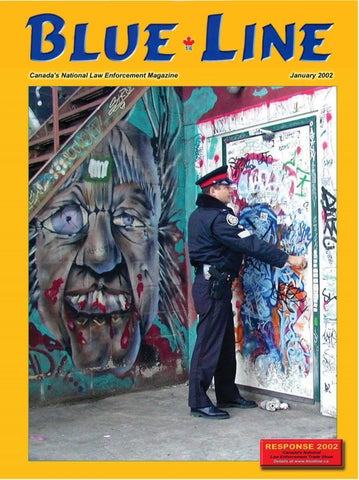
Taking back the streets one wall at a time 6 Winning the war on Toronto graffiti Michigan State Police test 2002 patrol vehicles
9
Death on the job: officers killed in the line of duty
12
2001 Ontario medal for police bravery
14
CORRESPONDENCE
15
e-mail: editor@blueline.ca
- News Editor Les Linder
Shooters beware, ShotSpotter is listening! 16
e-mail: news@blueline.ca
The Firearms Act and Part III of the Criminal Code for Dummies
- Advertising Mary Lymburner Kieran Huggins Bob Murray Dave Douglas e-mail: bluelinesales@rogers.com
- Pre-press Production Del Wall - Contributing Editors Communication Skills Terry Barker Police Management Robert Lunney Tactical Firearms Dave Brown Technology Tom Rataj Psychology Dorothy Cotton Case Law Mike Novakowski Blue Line Magazine is published monthly, September to June, by Blue Line Magazine Incorporated with a mailing address of: 12A - 4981 Hwy. 7 East, Ste. 254, Markham, Ontario, L3R 1N1. Individual magazines are $3.50 each. Subscriptions are $25.00 per year or $40.00 for 2 years. (Foreign - $50.00 U.S.) ©2002 - All articles are protected by copyright. No part of this publication may be reproduced or transmitted in any form or by any means, electronic or mechanical, including photocopying and recording or by any information storage or retrieval system without permission from the publisher. Internet activity is monitored and use or reposting of material on the Internet is restricted. All material submitted for publication becomes the property of Blue Line Magazine unless other arrangements have been made with the publisher. The authors, advisors and Publisher accept no liability whatsoever for any injuries to persons or property resulting from the application or adoption of any of the procedures, tactics or considerations presented in this magazine. Readers are cautioned and advised that articles presented herein are edited and supplied for your personal awareness and should not be used for further action until appropriate advice and guidance is received from a supervisor, Crown Attorney or other person in authority. Established in 1988, Blue Line Magazine is an independent publication designed to inform, entertain, educate and upgrade the skills of those involved in the law enforcement profession. It has no direct control from a law enforcement agency and its opinions and articles do not necessarily reflect the opinions of any government, police, or law enforcement agency. Blue Line Magazine is a private venture and as such is not funded through any level of government agency, union or association.
- Affiliations International Association of Law Enforcement Planners Canadian Advertising Rates & Data International Police Association The Police Leadership Forum The Canadian Press Newswire Printed in Canada
ISSN #0847 8538 Canada Post - Canadian Publications Mail Product Sales Agreement No. 176796 January 2002
17
Canadian officers recognized as survivors 19 WINNING STRATEGIES FOR LIFE Stress, Obstacle or Opportunity Using Stress as a Positive Force
20
VITALITY Fit for duty?
21
DEEP BLUE Risk Assessment
22
Cory: Ban most jailhouse snitches
23
Harold Adamson earned his officer’s faith 24 CASE LAW Reasonable grounds: putting two and two together
25
CASE LAW Privacy breached even with answering machine message
27
Teens promise to drive safe under new program
27
Taser jolt ‘Les’ than lethal
28
TECHNOLOGY Microsoft XP next big step in mainstream computing evolution
30
The Last Noose Newfoundland
32
THE BLUE LINE FORUM
34
BLUE LINE CLASSIFIED
37
THE BACK OF THE BOOK 38 Morality - Fashion or old-fashioned values 3
One year ago our lead story in Blue Line was on the Toronto Police Services’ Grafitti Eradication Program. The program has been a great success; more than 120 people were arrested, grafitti incidents are down and Toronto, already known as a clean city, is cleaner than ever. That article begins on page six. The results of this year’s Michigan State Police tests of police vehicles are in. Three versions of the Ford Crown Victoria, the Chevrolet Impala and the new Chrysler Intrepid were tested; our story on the results begins on page nine. Forty five police officers were fatally shot between 1980 and 1997. In some cases, officers made “fatal mistakes,” failing to follow established procedures. An excerpt from Canadian Police Work, which begins on page 12, suggests ways their deaths could have been avoided. On page 16, Paul Ford tells us about the ShotSpotter, a new product which pinpoints where shots are fired from. In tests, the system was able to detect 82 per cent of the shots fired over a one square mile error — 72 per cent of those were pinpointed to within 25 feet. Confused about the firearms act and its new criminal code offences? Staff Sgt. Ted Smith and Sgt. Cam MacIntyre try to clear things up in their Criminal Code for Dummies article, which begins on page 17. ‘Humour-cilator’ and motivational speaker Audrey Pihulyk begins her new series on Winning Strategies for Life on page 20. This month: How we can use stress as a positive force. Am I fit for duty? Vitality columnist Peter Shipley looks at things you can do so you can answer that question with a yes on page 21; Dr. Dorothy Cotton tells us about methods to assess risk in her regular column,Deep Blue on page 22; Case Law Editor Mike Novakowski explains reasonable grounds on page 25; Technology columnist Tom Rataj writes of his experiences with the Windows XP operating system on page 30. Blue Line News Editor Les Linder tells us on page 28 how it felt to be tasered for one second. Something of a masochist, Linder’s considering going back for a two, three, four and eventually, even a five second jolt so this could turn into a series! Blue Blue Line Line Magazine Magazine
by Morley Lymburner
There is hope for the New Year... but only if... Sitting down to write a New Year’s message can at times be such a hopeless task. To do so appropriately you have to look over the past year and see what it can tell you about the next. Well folks I think it is pretty much up for grabs. What can one say that is hopeful after September 11th irreversibly imposed the memory of New York City on the world’s future calendars. Surely a moment never to be forgotten and hopefully never to be repeated. In the New Year I hope a few things will become clearer to society. That no place or person is exempt or immune from those that endanger society. In the realm of public safety I hope society will no longer take their police for granted. They can no longer look upon the police budget as elastic or optional fluff. Here is hoping that in the New Year politicians at all levels will finally listen to the multitude of cops out there who have been warning them about the dangers of cutting back on public safety. I hope they now heed those warnings. The passing into law by parliament of the anti-terrorist legislation is a partial recognition of the importance of public safety. Sadly it is also an indication of what politicians and bureaucrats have always been ready to do. Pass
January 2002
more legislation rather than take action about how it is to be implemented. It is certainly far cheaper and more politically appealing than putting more cops on the beat - and arguing about paying and equipping them properly. Here is hoping the New Year will bring a right-headed approach to budgeting and spending money to appropriately implement the laws the politicians say they want enforced. The saddest part of politics in this age is that the provinces, followed closely by municipalities, love to put the blame for budget shortfalls on the level of government above them. When one really thinks about it you realize all that money they play with comes from the same pockets. Ours! All this political posturing about downloading of services, budget transference and grants being cut is just the stuff for headlines and vote garnering. All the taxes gathered at all levels of government are still required to fund the infrastructure that exists and is needed. Arguing about moving it around from one shelf to another doesn’t mean it need not be spent. Here is hoping the New Year will bring governments at all levels together to coordinate their efforts better. That they will realize there are some issues that transcend all political motivators. Safety of the public is paramount. Police services themselves can become rather
5
myopic. They can also become too proud and even too arrogant. There are too many agencies who view themselves as islands and who have an attitude that there is no problem they can’t solve on their own. Many times this is not the reality and the agencies themselves know it. Too often they put on a front of adequacy and competence that simply is not there. No police agency can be as great as they either think they are or as great as they want everyone else to think they are. Given the events of September 11th it is time more agencies admitted, even if just to themselves, that they can’t do it all. You do what you know you are good at and then seek out help from outside agencies or sources to fill the gaps. Here is hoping the New Year will bring an enlightened era of inter-agency cooperation as never seen before. There has never been a better time than now for everyone to pull together. There is hope for the New Year inspite of the tragic events and bungling of the past. The public has a new understanding and sense for what must be done to protect themselves and they are keenly interested in how their political leaders react to their needs. Politicians had better pay attention and act accordingly. Only the passing of time will tell if lessons have been learned. But there is always hope.
by Heinz Kuck The Toronto Police Services’ Graffiti Eradication Program, officially launched October 27, 2000, unveiled dynamic strategies, new partnerships and innovative methods to reduce crime, fear and disorder as it relates to graffiti vandalism. The program has completed its first challenging year of operation, meeting and, remarkably, in most cases surpassing expectations. More than 52,000 square feet of surfaces were cleaned and reclaimed, 122 people were arrested and 312 criminal charges were laid and 1.5 million Toronto and area residents were informed about the program through an aggressive radio, TV and literature campaign. For the first time we established a secure and sustainable toehold into the arcane world of urban graffiti. Despite the challenges, there was an overriding commitment to continuous improvement, with reviews of what worked, what didn’t and what needed to be changed. Toronto’s graffiti scene involves seven distinct and identifiable styles but ‘hip-hop’ is the most common, accounting for approximately 80 per cent. Born out of the New York ghetto experience of the 1970’s, it can be seen in all urban centres, large and small. It involves ‘tagging’ — single colour initials or symbols, ‘throw ups’ — two dimensional, two colour bubble style lettering and ‘pieces,’ also known as master pieces — large, multi colour, multi dimensional murals often done by a group or crew of taggers. Gang graffiti makes up about five per cent January 2002
and is generally lettering with a single colour and simplistic style spelling out the actual name of the gang or a derivative of its initials. It demarcates boundaries and is used for inter-gang communication, recruitment and, in a growing number of instances, to issue threats. Hate crime graffiti accounts for another five per cent. The most frequent occurrence of hate crime was mischief to property, and within that the use of graffiti, according to a 1999 year-end analysis by the Toronto Hate Crime Unit. Is there anything more sinister than a swastika spray-painted on the side of a synagogue or racist slogans scrawled throughout a culturally diverse neighbourhood? In these cases it’s not just the owners and residents of the buildings targeted who become victims but the entire community. The remaining 10 per cent is made up of ‘latrinalia’ (from the word latrine, drawn in public washrooms), folk epigraphy (‘Bobby loves Suzie,’ for example, painted on a bridge overpass) and graffiti done by satanic cults and political activists. Whether scripted for hatred or recognition, demarcation or destruction, graffiti applied to a surface, public or private, without permission, is one dimensional; it is a criminal offence. Toronto’s program has five parts: • Eradication: Physically removing graffiti from surfaces by using property owners, prisoner work programs, students, volunteers and social service recipients. • Education: Running anti-graffiti campaigns in the media and programs in schools, community centres and faith groups. • Empowerment: Working with business improvement associations, rate payer groups, community police liaison committees and lo6
cal politicians. • Enforcement: Arrests and prosecutions, surveillance, informant information, Crime Stoppers and municipal by-law enforcement. • Economic Development: Urban beautification, city funded, council initiated graffiti transformation programs and entrepreneurial youth focused mural businesses. Each of our 16 Toronto Police Service divisions has a Graffiti Eradication Program coordinator who has taken on program responsibilities in addition to their regular duties. They guide personnel and resources in designing, developing and executing strategies and seek out new partnerships. The strength of the program lies not in what each coordinator achieves as an individual but in the collective action of all coordinators and community partners at any given time. Eradication The first year of the program saw 52,762 square feet of heavily graffiti-vandalized surface painted out, chemically cleaned or blasted away. For the most part, community groups, faith groups and schools pitched in to clean up their neighbourhoods. Supplies were often donated by Business Improvement Associations, property owners, paint dealerships and, in some cases, by area ward councillors. One of the true success stories involved a partnership with the Ontario Ministry of Corrections allowing us to use provincial inmates through a work program. Prisoners selected have volunteered for the program, are serving time for non-violent, non-drug offences and are considered low escape risks. They’re accompanied by corrections staff while working for us. Prisoners were especially valuable when it came to cleaning up gang graffiti, which some . . . continued page 8
Canada Post donates volunteers were reluctant to cleaning supplies and protouch because they feared vides liability waivers. retribution. Inmates had no Students trek to hard hit such concerns and cleaned areas and scrub away; up more than 10,000 square they’ve cleaned and refurfeet of surfaces. bished more than 200 Another outstanding mailboxes so far. way to eradicate graffiti is Education with murals. Studies have Our two-pronged shown that surfaces simeducational program ply painted over are often teaches front line officers re-tagged, since a newly to identify types of grafcleaned area is like a blank fiti, its criminality and socanvas. Tasteful murals cial costs while showing however, done in consulthe community how to tation with the commu“record, report and renity, are less likely to be move.” We created two touched since taggers ofweb sites, one internal and ten express awe for the one external, and both are large, colourful paintings and aspire to such skills. ONE YEAR LATER: An article in Blue updated regularly with new research material, soThey will often leave the Line last January is credited with giving cial cost commentary and murals unsullied as a symthis program national attention. trends. bolic gesture of approval, We also designed and moving off to find another, printed 25,000 colourful anti-graffiti brochures more enticing blank canvas. A unique partnership with Canada Post tack- and 10,000 stop graffiti Crime Stoppers magles the approximately 10,000 Toronto-area mail nets and posters, which were distributed through and relay boxes, referred to as ‘street furniture,’ each division to the community. As the program increased in scope, the next which are routinely hit by taggers. The post office has limited maintenance personnel and stage was an aggressive marketing campaign uscannot paint over the many boxes hit so we ing Toronto’s vast media network. Feature pieces developed project T.A.G. (Teens Against Graf- were done in the Toronto Sun, commentaries in the Toronto Star, and reports in the Globe and fiti), which recruits students to help. Ontario students, who now require commu- Mail, as well as Eye and Now magazines. Eradinity service hours to graduate from high school, cation events were shown on TV newscasts and provide the elbow grease to clean the boxes and several radio stations showcased it on their call-
in shows - the radio shows alone had a listenership of more than one million people. The January 2001 article published in Blue Line Magazine highlighting the start of the program drew enquiries from across Canada. Information packages were sent out coast to coast and an RCMP officer from Surrey, BC was even sent to Toronto to gather information so he could start up a similar program in that city. Empowerment Letters were sent out to all Toronto ward councillors, area MPPs and public and private schools explaining the program vision and mission and asking for their support and participation. Enforcement The demographics of the offenders, and the tools they used, neatly dovetailed into what our research suggested — that most graffiti artists are young, live in an urban area and are poor. Ninety per cent of those arrested were male and the average age was 17.6 years old — the youngest offender was only 12. Most of the charges (209) related directly to graffiti vandalism while the remaining 103 charges involved drugs, weapons and violence. The tools used to produce the graffiti proved interesting too — 59 used aerosol spray paint, 50 used markers, nine had house paint, three used a sharp object to scratch out their message and one had a paint roller. Most of the arrests were the result of officers conducting regular patrols, 911 calls by witnesses/victims and pro-active surveillance of areas with high incidents of graffiti. The map showing city wide arrest locations illustrates how widespread the problem is — no community was spared the intrusion of graffiti vandalism. Economic Development The police program has a partnership with the ‘Graffiti Transformation Program,’ a city funded, community-wide economic development effort designed to create full and part time employment for youth. Artists meet with residents of communities hit hard by graffiti vandalism to create and complete community sensitive murals which are often sought out by Toronto tourists. The Future From eradication to enforcement, empowerment to education, the first 12 months have been stellar. A toehold has been established and the program continues to raise the bar in combating vandalism. The challenge now, it seems, is one of swaying popular opinion. Toronto is one of the most culturally diverse cities in Canada, with over 150 ethnic and cultural groups, and with that comes strength of choice and opinion. There seem to be as many groups opposed to graffiti as feel it’s acceptable. Researchers say youth turn to graffiti to rebel, achieve fame and recognition and for a sense of power and artistic expression. The challenge next year won’t only be ‘taking back the streets one wall at a time’ but also winning the hearts and minds of the apathetic property owner, youth, criminals and the uninformed. Staff Sergeant Heinz Kuck has been a member of the Toronto Police Service since 1979 and is currently the lead coordinator of the Graffiti Eradication Program. He can be contacted at (416) 808-5354.
For further details go to BlueLinks at www.blueline.ca
January 2002
8
Michigan State Police test 2002 patrol vehicles
Patrol vehicles are one of the most critical purchases that a law enforcement agency makes, representing the second largest expenditure after personnel in their annual operating budgets. For more than 25 years, the Michigan State Police (MSP) has extensively evaluated the performance capabilities of each new model year police vehicle as part of its annual procurement process. We define police vehicles as those designed and manufactured for use in the full spectrum of law enforcement patrol service, including pursuits. A special service vehicle may be used for specialized use (e.g., off-road, inclement weather, K-9, or commercial vehicle enforcement), but is not designed or manufactured to be used in pursuit situations. (Special service vehicle trials will be included in an upcoming issue of Blue Line). Each vehicle is subjected to six major tests and evaluations, with the results weighted to reflect the relative importance of each attribute
as related to MSP operational requirements. Each vehicle’s overall performance is scored, the manufacturer bid price is reviewed and a January 2002
final score calculated using a sophisticated formula that combines the overall performance score and the price. The MSP vehicle specifications, test categories and scoring reflect MSP needs. If your department employs this or a similar method, consider your own needs carefully and alter the weighting factors accordingly. What’s New for 2002
• Chevrolet: For the 2002 model year, the Impala is once again available in both the 9C1 police package and the 9C3 unmarked police package. The only change from the 2001 model year is that dual-zone temperature control is now standard. • 2002 marks the final year of production for the Camaro B4C special-service police package, as Chevrolet will discontinue production of the entire Camaro model line at the end of the 2002 model year. For the 2002 model year, the Camaro special-service police package will be available only with a 49
speed automatic transmission. • DaimlerChrysler: DaimlerChrysler is fielding an entirely new line-up of police-package and special-service vehicles for the 2002 model year. The most significant new entry is the Dodge (Chrysler in Canada) Intrepid, the company’s first police-package sedan since the Dodge Diplomat in 1989. The Intrepid is front-wheel-drive and equipped with a 3.5L Magnum V6 engine rated at 242 horsepower and 248 lb-ft of torque, connected to a four speed automatic transaxle with overdrive. Other standard equipment includes a 160-amp, high-output alternator, heavy-duty cooling and suspension and four wheel antilock disc brakes. The Intrepid is available as both a police-package and a special-service sedan. • Ford: New for the 2002 model year is the long wheelbase Crown Victoria special-service package, an extended frame sedan that adds six inches to the wheelbase, providing six more inches of rear-seat leg room. This vehicle was developed by Ford engineers in response to requests from law enforcement and taxi fleet managers for a vehicle with additional rear-seat leg room. It’s available only as a special-service package but Ford says that if there is enough interest (sales), they may consider further refinements necessary to make this model pursuit capable. The 2002 Police Interceptor, which was to be manufactured only through the end of 2001, is a carry over from last year. Ford will introduce the 2003 Police Interceptor in March as a midyear replacement. The exterior sheet metal . . . continued page 10
and interior will remain basically the same but there will be major enhancements to the frame, suspension and braking. The new model will feature a new hydroformed steel frame which Ford engineers say will have improved strength and better frontend crash performance, and new shocks, springs, suspension and rack-and-pinion steering. Front- and rear-side airbags and antilock braking system (ABS) will be standard, as will new wheels with bolt-on wheel covers. A compressed natural gas (CNG) version of the Police Interceptor will still be available but Ford decided not to submit a version for testing this year.
Objective: To determine high-speed pursuit handling characteristics. The two-mile road racing course contains hills, curves and corners; except for the absence of traffic, it simulates actual pursuit conditions. The evaluation measures each vehicle’s blending of suspension components, acceleration capabilities and braking characteristics. Methodology: Each vehicle is driven 16 timed laps by four drivers. The final score is the average of the 12 fastest laps. Acceleration Testing
Vehicle Dynamics Testing
Following a four-minute heat soak, the entire sequence is repeated. The exact initial velocity at the beginning of each of the 60-to-0 m.p.h. decelerations and the exact distance required to make each stop is recorded with a Datron NonContact Optical Sensor. The data is used to calculate the average deceleration rate, which is the vehicle’s score for this test. Note: The final scores are the average of the 10 best deceleration rates attained out of a total of 12 stops (for each phase of the test, the five best deceleration rates achieved in six total stops). It was mutually agreed by MSP and the participating vehicle manufacturers that the lowest deceleration rate recorded in each phase would not be used in determining the final score. Ergonomics and Communications
Savage Range Systems announces Mini Check-it bullet trap
Savage Range Systems has announced the addition of the MINI Check-it! bullet trap to their product line. The tabletop check and clearing systems is designed so that no live ammunition is present before storing or clearing a firearm. This model features low angle entrance ramps and the Snail deceleration chamber, where it loses energy and drops for easy recycling. Durable and easy to use, the Mini Check-it! is appropriate for law enforcement professionals who care about safety. The system is designed to accommodate all calibres of handguns and shotguns (no slugs) up to 1400 foot pounds of energy at muzzle but not steel core or armour piercing ammunition. However, Savage Range Systems offers a complete line of Checkits, bullet traps, ranges and custom systems. For more information on Savage Range Systems go to
January 2002
Objective: To determine the time required for each test vehicle to accelerate from a standing start to 60 m.p.h., 80 m.p.h. and 100 m.p.h. Methodology: Using a Datron Non-Contact Optical Sensor and a computer, each vehicle is driven through four acceleration sequences — two northbound and two southbound to allow for wind direction. The average of the four is the score on the competitive test. Top Speed Testing Objective: To determine each vehicle’s speed at a distance of one mile and two miles and the actual top speed attainable within a distance of 14 miles from a standing start. Methodology: Following the fourth acceleration run, the vehicle continues to accelerate to the top speed attainable within 14 miles from the start of the run. The highest speed attained is the vehicle’s score on the competitive test. Braking Testing Objective: To determine the deceleration rate attained by each test vehicle on 12 60-to-0 m.p.h. impending skid (threshold) stops, with ABS in operation if the vehicle is so equipped. Each vehicle will be scored on the average deceleration rate it attains. Methodology: Each vehicle makes two decelerations at specific, predetermined points on the test road from 90-to-0 m.p.h. at 22 ft/ sec2, with the driver using a decelerometer to maintain the deceleration rate. Immediately after these heat-up stops are completed, the vehicle is turned around and makes six measured 60-to-0 m.p.h. impending skid (threshold) stops with ABS in operation, if the vehicle is so equipped, at specific, predetermined points. 10
Objectives: To rate the vehicle’s ability to provide a suitable environment for patrol officers to perform their job, to accommodate the required communications and emergency warning equipment and to assess the relative difficulty of installing the equipment. Methodology: A minimum of four officers independently and individually score each vehicle on comfort and instrumentation. Communications division personnel responsible for new car prep evaluate the relative difficulty of the necessary installations. Each factor is graded on a one to ten scale, with one being totally unacceptable and ten representing superior. The scores are averaged to minimize personal prejudice. Fuel Economy
Objective: To determine fuel economy potential. The scoring data are valid and reliable for comparison, but may not necessarily be an accurate prediction of the car’s actual fuel economy. Methodology: The vehicles’ scores are based on estimates of city fuel economy to the nearest one-tenth of a mile per gallon from data supplied by the vehicle manufacturers.
January 2002
11
Death on the job: officers killed in the line of duty With every shift, police officers must confront the possibility that lethal force will be used against them or that they may accidentally cause their own death. Even though police killings are relatively rare events, the potential for routine work to escalate into a high risk situation requires officers to be constantly vigilant, even in encounters that appear on the surface to be minor and non threatening. During the 17-year period from January 1, 1980, to June 4, 1997, 45 Canadian police officers were fatally shot by assailants. This figure contrasts sharply to the United States, where, in 1993 alone, 98 police deaths were attributed to assailants. However, the Canadian figure does not include the accidental line-ofduty police deaths that occur at the workplace, including car accidents and drownings; those figures are unknown. Between 1990 and 1994, a total of 1032 police officers in the United States have died in the line of duty. Although the number of deaths per year has been declining, this figure represents an average of 147 police fatalities per year. The widespread use of body armour, combined with improved training, are two primary reasons for the decline. Of the 151 American officers who died in 1993: • 75 were killed by an assailant using a firearm. • 23 were slain by other means. • 53 died from accidental causes while on duty (aircraft or automobile crashes, being struck by a vehicle or drowning, for example). • The average age of officers killed was 36 and their average length of service was 10 years. • Ten of the officers were female. There is no one pattern of events leading to the death of a police officer; each situation is different. Case one illustrates a scenario in which the use of deadly force by the assailant so took the officer by surprise that she did not respond to the threat. Case One - On Monday, November 27, 1995, Constable Odette Pinard of the Montreal Urban Community Police was shot and killed as she sat alone in a storefront police station, completing paperwork. At approximately 3:30 p.m., a lone gunman is believed to have entered the police station and, without warning, shot Pinard in the face. Pinard’s service revolver was still in her holster at the time of her death. The case
remains unsolved. In other cases, lethal force is used against officers during the course of their patrol duties. Case Two - At approximately 10 p.m. on Thursday, June 16, 1994, Constable Todd Baylis of the Metro Toronto Police encountered a possible drug deal while on foot patrol in a Toronto housing project. Constable Baylis and his partner pursued the drug suspect on foot. Suddenly the suspect stopped and shot Baylis and his partner. Baylis was shot in the head and died as a result of his wound. Baylis’s partner was also shot and wounded, surviving the shooting due to his body armour. In other cases the death of the officer may have been avoided if certain actions had been taken. Case Three - On Friday, June 14, 1996, a sergeant in the RCMP detachment in Lunenberg, N.S. died when he was shot by a suspect who was sitting in the back seat of his police vehicle. The sergeant and three other police officers had attended a family dispute involving firearms. After it was resolved, the sergeant placed a male suspect, whom he knew, in the rear of his police vehicle. The suspect then produced a concealed handgun and shot the officer through the opening of the prisoner screen. After killing the officer, the suspect exited the police vehicle and later killed himself. Fatal Mistakes In spite of all that is known about officer deaths — despite what officers have been taught
IACP raises funds for families of lost officers A fund has been created by the International Association of Chiefs of Police Foundation to assist the families of the law enforcement officers who lost their lives in the September 11 terrorist attacks. Donations made to the fund will be used solely to aid the families of the slain officers and no administrative or management fees will be deducted. “Through this fund, the IACP wishes to express its heartfelt condolences to the families of the officers whose lives were lost as a January 2002
result of the terrorist attacks,” said IACP president Bruce Glasscock, chief of police of the Plano, Texas police department. “We want them to know that law enforcement officials from all over the world share their grief and join them in mourning the loss of our colleagues.” The IACP Foundation mandate is to provide financial assistance to the families of law enforcement officers killed in the line of duty as well as sponsor law enforcement related training and research programs. 12
in the academy — all too often good cops are still killed because they forgot, they took a short cut, they took an unnecessary chance or they were just plain lazy.— Garner, 1996 In some cases, officers have contributed to their deaths by failing to follow established police procedures. Among the fatal mistakes that are made: • poor handcuffing or searching practices. Officers may be killed by weapons that were missed due to an inadequate search. • poor approach or positioning. The risk increases when a suspect is allowed to approach too closely, particularly if the officer is sitting in his or her patrol car or turns his or her back on the suspect. • cowboy courage (or, in Canada, the Johnny Canuck syndrome). Officers, acting on the basis of bravado or machismo, may intervene in a dangerous situation without proper assistance or equipment and thereby place themselves at a high risk of injury or death. • failure to watch the hands. Police officers routinely ask suspects to produce identification or to show their hands and must be prepared for what the hands reveal, particularly if they have been hidden from the officers’ view. • losing control of a weapon. Many police officers have been killed by their own weapon. On July 16, 1990, two police officers in Port Moody, BC, were summoned to deal with three suspicious males. One of the three appeared intoxicated and, during the arrest, the officers were physically overpowered while placing the unarmed suspect in the rear of the police car. During the scuffle, the suspect took the handgun of one of the police officers. He then overpowered and took the handgun of the second officer. Once in possession of both of the officers’ guns, the suspect began shooting at the police officers, narrowly missing them. During the confusion, one of the officers was able to obtain a shotgun from his vehicle. The police officer, fearing for his life, shot and killed the suspect before he could discharge any further rounds at him and his partner. There are a number of well-known tricks of the trade that reduce the likelihood an officer will be placed at risk of injury or death, including these: • gathering as much information about the situation and the suspect as quickly as possible. • completing a threats-troubleshooting process that involves threat awareness (acknowledgment that there are risks), threat recognition (identifying danger signs) and threat response (taking action to avoid or neutralize the threat). • looking for danger signs or red flags in any encounter situation, including the condition of the suspect (e.g., impaired by drugs or alcohol, mentally unstable), the suspect’s behaviour and demeanour and the presence of weapons. • maintaining distance from the suspect to allow for reaction time and evasive action. • assuming that all encounter situations have the potential for danger and the risk of injury or death. • following routine procedures, such as searches
and handcuffing, conscientiously, even in encounters that don’t appear to be dangerous. • knowing when to back off — the strategy of tactical withdrawal. • using common sense. There is some evidence to suggest that officers with certain behavioural traits may be more at risk of being the victim of deadly force: A study of 51 in-the-line-of-duty deaths in the United States found that the majority of slain officers shared a number of behavioural traits that may have contributed to making errors in judgment or procedural errors which placed them in harm’s way. The traits were those most associated with community policing; being community-oriented and viewed positively by the residents of the communities they policed, for example, or being reluctant to use force. These findings raise important questions about police training and the need to ensure that officers remain vigilant at all times, even when engaging in activities that may not be specifically directed toward enforcement. Police as Victims of Their Own Weapons Police officers are also at risk of becoming the unintentional victims of their own weapons. Every year accidental firearm discharges, crossfire situations and intentional discharges which cause bullet and concrete fragment ricochets result in police officer woundings. The vast majority of these injuries are minor, yet they underscore the ever-present risk associated with firearms. Approximately 15 percent
of the police officers who have been murdered since 1980 were disarmed and killed with their own, or their partner’s gun. Canadian police officers always face the threat of a firearm being used on them because they bring a gun into every encounter situation. Officers have been injured and killed in altercations when unarmed assailants have managed to grab their handgun or shotgun and used it against them. Officers have also been killed by their own weapons in encounters that appear to have been routine and non life-threatening: On September 19, 1991, a police officer in Ingersoll, Ontario stopped a subject who was riding a bicycle. A fight ensued, resulting in the officer being shot and killed with his own service revolver. The suspect, who initially escaped apprehension by the police, was later found murdered. One of the more frequent causes of police injuries occurs when officers attempt to shoot out the tires of suspect vehicles — a technique that is familiar to viewers of police action movies. The automobile and its wheels are largely made of steel and the concrete or asphalt roadway further compounds the situation. When a high-speed bullet is discharged in the general area of a vehicle, the results are ricochets and flying metal fragments. Unlike the scenes depicted by Hollywood, shooting out tires can be a highly risky tactic, especially since there is no control of where an out-of-control vehicle will stop. Over the past decade, there appears to be an increase in the frequency of instances in which police officers have been killed with their own, or their partner’s gun. This has led to a layered
Preparing for bioterrorism is coming at a hefty price for law enforcement. The Edmonton Police Service is spending about $150,000 for 500 gas masks to protect its front-line officers in potential bioterrorism cases. The agency is also considering buying biohazard suits, which can cost about $1,000 each. Sergeant Jeff Anderson says bioterrorism is a real threat and they would be in a tough position if they’re not ready to deal with it. The purchase of the gas masks was approved by Chief Bob Wasylyshen in November on the advice of an internal emergency preparedness committee. Anderson says the service is also considering equipping at least 100 officers with biohazard suits. The equipment will be paid for out of this year’s police budget. The service will be asking the federal government for reimbursement since the equipment is needed to respond to potential terrorist threats. January 2002
13
concept of handgun retention, training that focuses on handgun retention, the quality and security features of a duty holster, a manual, a safety equipped service pistol and the use of concealable body armour. In the United States, many police officers routinely carry a backup gun, although this practice has not been adopted for general duty patrol officers in Canada. If one of these features should fail the police officer during a violent confrontation, then hopefully the remaining layers of protection would save his or her life. There are also the rare incidents in which police officers have been killed by friendly fire. Canadian Police Work is available at the Blue Line Reading Library in this issue, or purchase on-line at Blueline.ca
Did You Know? Studies indicate that a 7.62 mm bullet fired in the air will travel almost one-and-a-half miles upward before beginning its descent. As the bullet nears the end of its 17-second vertical journey, it slows and becomes susceptible to movement by the wind. Any person or object within a one-quarter mile radius of the point from which the bullet is fired is in danger as the bullet begins its descent. At impact on return to earth, the bullet is travelling at approximately 70 metres per second. There is the risk of skin penetration, which occurs when a bullet is at 45-60 metres per second, or of head injury, as the bullet hits base first.
2001 Ontario medal for police bravery Nine Ontario officers have been presented with the 2001 Ontario Medal for Police Bravery recognizing outstanding acts of bravery. Three Leamington Police Service officers, three Ontario Provincial Police officers and a Toronto, Hamilton and Niagara police service member were honoured. Leamington Constable Christopher Anderson and Sergeants Edward Marocko and Jose Moniz responded to a Sgt. Cst. Moniz Anderson report of a pick-up truck crashing into the front porch of a house, rupturing a natural gas meter. Gas was beginning to fill the home as they entered and the officers rescued a critically injured man Sgt. who was pinned between the vehiMarocko cle and a wall. OPP Constable Dustin Dewar and Senior Constable Wayne Smith of the South Porcupine (Gogama) Detachment were investigating a domestic dispute when they observed smoke Cst. coming from a nearby residence. They Dewar entered the smoke-filled home, crawling on the floor, and successfully rescued a man asleep on the couch.
January 2002
OPP Constable Belinda Rose of the Wellington County Detachment responded to a potential suicide call about a man preparing to leap into the turbulent waters of the Elora Cst. Gorge near Victoria Park. She arRose rived just as the man was preparing to jump over the wall and rescued him by grabbing his feet, saving him from a 70-metre plunge.
Cst. Elliott
Toronto Constable Christopher Elliott jumped into the waters of the Don River, which was swollen by a heavy rainstorm, attaching a water safety line tied to his cruiser around his waist to rescue a traumatized motorist who was clinging to a tree.
Hamilton Constable Loris Pilot was off duty when he saw a car go out of control and roll over on Hwy. 403. Two young passengers were horrified to see their father pinned Cst. under the car. Pilot took quick acPilot tion to free him before flames fully engulfed the vehicle.
Cst. Walsh
Niagara Constable Vanessa Walsh responded to an emergency call about a hospital patient who was threatening to commit suicide by jumping into the Welland Canal. Walsh arrived as the woman was
14
swept into the freezing water, dove in after her and pulled her out, saving her from certain death. The officers are owed “an enormous debt of gratitude,” said Ontario Solicitor General David Turnbull. “These heroes selflessly risk their lives to protect their fellow citizens every time they respond to an emergency.” “In your selfless concern for others, we recognize the very best of humanity,” said Ontario Lieutenant Governor Hilary Weston in a speech at the ceremony. “In the name of the Queen, I commend your extraordinary acts of bravery, and on behalf of all Ontarians, I add my sincere thanks to the heartfelt gratitude of those whose lives you have saved.” The medals are the province’s highest honour in recognition of firefighters and police. Medal recipients are determined by an independent body made up of citizens representing all parts of Ontario. To date, 150 medals have been presented to police officers and 142 medals to firefighters since 1975.
The Ontario Medal for Police Bravery The Ontario Medal for Police Bravery was established in 1975 to recognize acts of superlative courage and bravery performed in the line of duty by members of Ontario’s Police Forces. The award encourages the virtue of bravery and focuses attention and support of the public behind the efforts of police forces. Presented by the Lieutenant Governor of Ontario in a special ceremony held at Queen’s Park, the Medal is a cross incorporating a crown, a circle of maple leaves, and the Ontario trillium. It is gold plated sterling silver with blue and white enamel. Each recipient also receives a provincial scroll and a miniature of the medal is available. Recipients of the award are those men and women who are members of Ontario’s police forces and whose nomination is endorsed by their Chief. Award of the medal may be made posthumously. Nomination closing date is mid-September of each year. To find out more about the Ontario Medal for Police Bravery contact: Ontario Honours and Awards Telephone: (416) 314-7526 Fax: (416) 314-7743 E-mail: OntarioHonoursAndAwards@mczcr.gov.on.ca
I want to thank you for supporting the Western Canada Use of Force Conference by way of your upcoming events section. When asked how they had heard of the conference, many of officers indicated that it was through your magazine. The conference was attended by over 150 officers from all across Canada and from the feedback we received, everyone enjoyed the presentations and the skills sessions and took back to their departments a great deal of useful information. Phil Haggart, Committee Chairman I read and enjoyed the article Close quarters... close encounters by Kathryn Lymburner in the November, 2001 issue of Blue Line Magazine. I would like to make a correction concerning who was responsible for crowd control and riots that might develop. It was decided early on, about 16 months before the Summit of the Americas in Quebec City, who would be in charge of what was called maintaining and re-establishing public order (crowd control and riots). The Surete du Quebec was responsible for this mandate. A committee made up of commissioned officers from the RCMP, SQ, Quebec City Police Service and Ste-Foy Public Security service was responsible for developing strategic and tactical plans for the different situations and sites that crowd control troops and platoons would be confronted with. A total of five battalions were used to man-
age riot situations, four made up of SQ police officers and a multi-agency battalion made up of troops and companies from the RCMP, SQ and the Quebec City Police Service. To my knowledge it was the first time that federal, provincial and municipal police forces planned and initiated manoeuvres that worked coherently on the same crowd in the same area. Considerable training and exchanges took place before the summit to be able to arrive at these results. The SQ has had personnel assigned to permanent crowd control units in the Quebec City and Montreal areas since the early 1970s. In 1997 after the riot that took place at the national assembly in Quebec City, we developed a working partnership with city police to manage future riots that might take place there and have been training and working together. SQ commanders have in recent years been sent to France to train with the Gendarmerie mobile and other officers should be sent to Great Britain in the following year. The summit also permitted us to develop an interesting network with Canadian and American police departments who have crowd control units and have had major riots in recent years. We think that these exchanges are beneficial to all agencies and definitely keep us informed of new strategies and tactics used by the demonstrators. Pierre Goupil, Commander Unite d’urgence region ouest Surete du Quebec For further details go to BlueLinks at www.blueline.ca
For further details go to BlueLinks at www.blueline.ca
January 2002
15
Shooters beware, ShotSpotter is listening! Examining a new technology that instantly detects and locates urban gunfire by Paul Ford The essence of the meaning of the word “technology” has more to do with the products of man’s curiosity and inventiveness, coupled with an ability to find solutions to common problems. Technology is the product of man’s ability to analyse a difficult situation, combine different principles to reach a solution, and confront it. For example, take the problem of urban gunfire. Delores Zamora lives in a large American city. Several times during the week Delores and her young children pause at the sound of gunfire. They may be watching television, eating dinner, or getting ready for bed. On weekends, the gunfire sometimes goes on unabated, intermittently throughout the night. The Zamora’s story is not unlike many people around the world living in areas impacted by gunfire. Their existence is riddled with the interruption of gunshots and the fear of living in an impact area tantamount to a shooting range. The police occasionally are called, but with delays in response time along with witnesses who find it difficult to pinpoint where the shots originated from, most of their investigative efforts are futile. Enter ShotSpotter, the nation’s first urban gunshot location system developed by Trilon Technology. When used in conjunction with other technologies, ShotSpotter provides accurate and instantaneous locations of gunfire. Followed up with an effective police strategy, ShotSpotter has demonstrated it can dramatically reduce the level of gunfire in urban neighbourhoods. First tested in 1996, the system was deployed in an area of Redwood City, California. The Redwood City Police Department tested a one square mile area. They fired blanks from 32 locations using three weapons. ShotSpotter detected 82% of the shots fired and 72% of those were pinpointed to within 25 feet. Redwood City then deployed ShotSpotter operationally for a test and evaluation period. During that time, officers made immediate and delayed responses to reported gunfire. Several times ShotSpotter lead officers to evidence, such as spent cartridges, and twice the system gave officers information accurate enough to arrest the person responsible for the shooting. ShotSpotter worked so well that Redwood City,
jointly with San Mateo County, purchased the system where it is in use today. Ward Hayter, Administrative Service Manager of Redwood City Police Department, believes the benefits of ShotSpotter outweigh the costs. “Implementing ShotSpotter has decreased the instances of random gunfire, improved media relations, and reduced fear for Redwood City citizens,” Hayter said. So how does this new communications technology work? ShotSpotter gathers sound information from eight acoustic sensors placed on rooftops and utility poles in a one square-mile area. Each sensor is networked to a central computer, where a dispatcher receives the gunshot detection notification almost instantly. The dispatcher can play back the sound to determine the type of event. The precise location is given on a map with property boundaries and a history to discern patterns in space or time. The same system can be redeployed to other parts of the city as needed, allowing broader coverage without greatly increasing
costs. It is also capable of determining a vehicle’s velocity and direction of travel when multiple shots are fired as it moves. With this information, officers may be immediately dispatched or follow up at a later date with a crimeprevention or problem solving approach. Redwood City acknowledges that the public’s awareness that such a system exists is a deterrent in itself and also contributes to the decrease in gunfire. ShotSpotter works in conjunction with other proven communications software provided by Dialogic Communications Corporation and Environmental Systems Research Institute. This combination delivers immediate identification, geographic display, and rapid notification, sometimes to include citizens in the affected area. Whether or not ShotSpotter technology will catch on is yet to be seen. The evolution of communications technology is difficult to predict. “The demise of Iridium is a warning that not all technically advanced and well-funded systems will flourish,” said Dr. Robert Showen, President of Trilon Technology. Dr. Showen believes many of the legacy systems will be around for some time, some stubbornly resistant to innovation. Technology cannot stand alone to confront complex and intolerable problems. ShotSpotter is a marriage of technologies and people. Implementing ShotSpotter with a sound police strategy has done more than decrease gunfire in a problem area. It has increased property values, improved police-community relations, and most of all improved the quality of life for the people its serves. Paul Ford is the editor of Global Enforcement Review Magazine and he can be reached in Austin, Texas at 512 248-1117 or Fax 512 248-1118.
For further details go to BlueLinks at www.blueline.ca
January 2002
16
The Firearms Act and Part III of the Criminal Code for Dummies The purpose of this article is not to re-join the ongoing debates being vociferously waged between gun lovers and haters. It is intended to offer to police and other law enforcement agencies some facts to support them in their efforts to maintain public safety. Typical squad room conversations… “We’ve been taking Marg to the hospital for five years now and she never wants to charge Frank with assault. One of these days…” “Jack was growing dope on his farm since the spring and when we busted him, he had this loaded shotgun set up in the barn…” “If a brother needs anything, booze, dope, women or guns, what his brother has, he has…” “Why didn’t anyone do something about Henri just leaving his rifle where the kids could get it?” “You got to be kidding. The guns we found at the drive-by were stolen?” “Mat told us that he’s owned this gun since he was a kid and didn’t know he needed a license.” “This firearms stuff is a waste of time and money. When’s the government going to do something to help us put the bad guys in jail?” Firearms Control Legislation Control of firearms in Canada has been on governments’ agendas since Confederation and before. Most recently though, events in Montreal and Vernon have encouraged Parliament to take notice of violent elements in our society that use firearms as their tools: • Organized crime, be it gangs of motorcyclists, youths, racial/ethnic posses or traditional Mafioso, have always sought out tools of murder or mayhem. • Drug profiteers need high calibre protection more from their competitors than from police. • Violent, deranged, drug or alcohol impaired persons in relationships will resort to firearms when they are at hand. • Persons bent on suicide are much more likely to be successful when a firearm is available. • Shady business operators make sizable profits when they smuggle or traffic in firearms. They don’t feel constrained by any regulatory requirements other than to maximize their cash flow outside of reportable income. The Firearms Act (Bill C-68) was passed in 1995 as part of a larger package of Criminal Code amendments and implemented December 1, 1998. It also affected the Controlled Drugs and Substances Act, the Criminal Records Act, the Young Offenders Act, Customs Tariff, the Explosives Act, the National Defence Act and the Export and Import Permits Act. Police and law enforcement agencies were informed several years ago that the regulatory burden of firearms control would be lifted from them and organized across Canada by the Federal Justice Department. The thrust of this message may have neglected to mention that the role of the police would always be to enforce the act and part III of the Criminal Code. January 2002
those individuals to move or transport firearms. It creates a new class of partner in the management of firearms in Canada, the firearms officer (FO), appointed by the office of the chief firearms officer (CFO). Peace officers are NOT automatically firearms officers and vice versa. A FO investigates applications for many privileges under the act and can approve or refuse the application or revoke the licence, relying on any evidence that is relevant. Every step of the process is a function of public safety. The officer can use hearsay evidence and their decision is based on any good and sufficient reason. The standard of proof is a balance of probability rather than beyond a reasonable doubt. A provincial court judge cannot substitute his opinion at a reference hearing but only confirm if the firearms officer had grounds for his belief. The act provides for all persons who will possess or acquire firearms to be licensed and subject to an ongoing eligibility check. As of January 1st, 2001 no firearms owner or borrower in Canada has had a legal excuse for not having a firearms license. As of January 1st 2003, all firearms in Canada must be registered. In spite of its 135 sections, the act only specifies eight offences; most others relating to firearms and the conduct of persons possessing them are found in Part III of the Criminal Code:
The Firearms Act The Firearms Act, also known as Bill C-68 or C-39 RSC, received Royal assent December 5, 1995. - Licensing is for people and businesses. - Registration is for firearms. - Authorizations are issued to allow people to move certain firearms to specified locations. The act deals with the regulation of licenses for individuals and businesses, with registration of firearms and with the authorizations of 17
The Criminal Code of Canada Part III Front line police investigators routinely deal with traffic stops, drug searches, sudden deaths, gang violence and domestic disturbances. In too many of these situations, firearms are an ingredient that compromises the safety of the police and the public. Part III CCC contains Sections 84 to 117. It lays out many criminal offences made possible by the regulations of the Firearms Act. It also presents several regulations of its own that deal with prohibited firearms, weapons, devices and ammunition. Part III is of assistance to law enforcement as it includes many sections that detail search and seizure, applications for prohibitions and disposal of firearms that have come into the justice system. In partnership with the CFO office, provincial crown and the courts, police can use both the Firearms Act and the Criminal Code to deal with offenders, suspects and those persons who should be separated from firearms for their own safety: Criminal Code Offences Generally Beyond the offences in the above table, C-68 amended ten offences so that there is a mandatory four year minimum if a firearm is used for: • Aggravated sexual assault • Attemptedmurder • Causing bodily harm with a firearm
• Criminal negligence causing death • Extortion • Hostage-taking • Kidnapping • Manslaughter • Robbery • Sexual assault with threats Police, Courts, Firearms, Public Safety and Individuals If a FO receives a license application or an indication that a licensed person is no longer eligible, he may refuse or revoke the license, thereby making the person unable to possess or acquire firearms. This does not prevent the person from legally possessing them under the immediate and direct supervision of a licensed person. On the other hand, if police officers feel that it is not in the interests of safety that a person has firearms, they can approach the matter in a number of ways without having to lay a charge: • Make an application to a provincial court judge for a firearms prohibition under Sec 111 CCC. This is useful when there is a need but no immediate urgency, as it’s an administrative matter that does not involve a charge approval by a crown and a provincial court judge shall fix a date. • Enter a residence or other location, with or without warrant under Sec 117.04 CCC, and search and seize firearms and documentation if there is an immediate urgency. Warrant or not, a return to a justice of the peace must be
January 2002
made within 30 days. The justice shall fix a date for a hearing of disposition, where it will be determined whether to prohibit the person and order forfeiture of the firearms. • Seize firearms under Sec 117.03 CCC in situations without need of warrant (hunter check, road side stop etc), when a person fails to provide proof of registration or licensing. An application to a provincial court judge for forfeiture and destruction must be made within 14 days. • If a firearms owner is co-habiting with another person who is prohibited or the prohibited person has ready access to the firearms of the owner, the police can apply to a provincial court judge under Sec 117.011 CCC for a limitation on access order. The judge can make terms and conditions under which the firearms may be removed from the access of the prohibited person. Once an investigation of a more substantive offence has yielded a charge and a conviction, or in some cases a discharge, amendments to the code provide an ‘offence grid’ that spells out in no uncertain terms what the minimum/ maximum sentences are and for what length of time a firearms prohibition may exist. Section 109 CCC provides for mandatory prohibitions and Sec 110 CCC provides for discretionary prohibitions. The code is clear that a judge must, in cases that involve a possibility of firearms prohibition, indicate his reasons for issuing the prohibition or choosing not to. He cannot choose to disregard mandatory prohibitions or minimum sentences.
18
Summation The aim of firearms registration and licensing in Canada is not to infringe on the ownership and enjoyment of good citizens who are using good firearms at appropriate locations. By complying with the laws and becoming licensed and registered, an owner and his firearms have distanced themselves from those who are, by choice, criminals. When it comes to the Firearms Act and Part III of the code: • Will we be able to better prevent crime? •Will we have a better chance of detecting who the criminals are? • Will we be able to determine the origins and ownership of crime guns? • Will we be able to correct the behaviour of criminals who misuse firearms? • Will the government and the police be able to provide safer communities? The answer to all these questions is... yes! Read your Criminal Code, your firearms act and regulations and your police officers field handbook. You can also check out the Canadian Firearms Center website at www.cfc.gc.ca Lastly… get your own personal firearms license if you need one and stay on this side of the fence. S/Sgt. Ted Smith is the deputy chief firearms officer of BC and can be reached at ted.smith@ag.gov.bc.ca — Sgt. Cam MacIntyre is headquarters firearms officer and can be reached at cam.macintyre@ag.gov.bc.ca
Canadian officers recognized as survivors a private driveway. The driver and occupant, a father and son, became extremely aggressive and the father entered a house and returned with a .32 calibre handgun, opening fire and hitting Christensen on the lower leg, forearm and chest. Another round fired by the father hit his son in the head, causing critical injuries. Christensen’s body armour stopped the round that hit his chest and he was able to return fire, hitting the shooter in the abdomen and hip. He recovered from his injuries and has returned to duty; the suspect was charged in both shootings. The officers were recognized in a ceremony at the International Association of Chiefs of Police conference in Toronto.
Three Canadian police officers who were protected from serious injury and possibly death by their body armour have been made members of the IACP/Dupont Kevlar Survivors Club: • ERIC CHARTIER , Municipalite de SaintAdolphe-D’Howard, Quebec. Chartier encountered an armed drug trafficker in a traffic stop Sept. 13, 2000. The suspect fired four rounds, hitting Chartier twice, but his protective armour stopped the bullets. He was treated overnight in a local hospital for bruising and a small laceration. The suspect was arrested and charged with trafficking marijuana and causing bodily harm to a police officer. • ELAMINE SOUFI, Detective, Winnipeg Police Service Soufi and other members of his team were serving a search warrant for drugs on March 14, 2001. He was staged at the front door, preparing to make entry, when he noticed that officers assigned to cover the rear door were having trouble moving through heavy snow. Realizing that
he was better positioned, Soufi moved to the rear just as a suspect bolted out the door. He immediately gave chase, following the suspect through a pitch black rear yard to a river bank, where he fell 50-feet to the frozen river bed below. His right knee was seriously damaged but his body armour protected his torso and there was no damage to vital organs. Soufi saw the suspect, who was more seriously hurt, attempting to recover something from the snow and controlled him until his partners arrived to complete the arrest. Soufi continues to recover from his injuries and the suspect was charged with property and drug crimes after his release from hospital. • KEVIN CHRISTENSEN Constable, Royal Canadian Mounted Police, assigned to the Salmon Arm, British Columbia RCMP detachment. Christensen attempted to stop a vehicle that was being illegally operated on Saturday, March 24, 2001 and the driver refused to stop. A brief chase ensued, which Christensen terminated after deciding it wasn’t warranted. He continued following and observed the vehicle stop in For further details go to BlueLinks at www.blueline.ca
For further details go to BlueLinks at www.blueline.ca
January 2002
19
Stress, Obstacle or Opportunity Using Stress as a Positive Force
by Audrey Pihulyk Stress can be defined as the body’s nonspecific response to any demand made upon a person. By definition then, stress is not always a negative force. It can be positive, negative, chronic or acute. Stress can be compared to music played on the strings of a violin. If the strings are too loose, the sound is low and unclear; if the strings are too tight, the sound is too high and irritating, but if the strings are set just right, the sound produced is pleasing and beautiful. Positive stress is needed to help us operate at maximum potential, both mentally and physically. It is necessary for the normal functioning of our bodies, bringing productivity and joy into our lives. On the other hand, if we have too little, there is no movement and we become aimless and stagnant. In the January, 1999 issue of Occupational Health and Safety Magazine, Statistics Canada estimated that stress-related disorders caused by overwork cost Canadian businesses $12 billion annually. It’s clear that the result of negative stress can be costly, although it is almost impossible to escape its effects on our lives. This was not always the case, however. In primitive times, stress was needed for war and hunting when the concept of ‘fight or flight’
was a means of survival. When the body experiences stress, it releases sugar into the blood, along with increased insulin. In addition, digestion shuts down and the level of cholesterol increases, the blood thickens and the heart rate rises. In the days of fight or flight the physical activity that followed made these changes useful. However, in this modern age, there is little outlet for the fight or flight behaviour, so we must learn how to handle stress wisely. Think of being caught up in a road rage incident. You may be innocent and in control of your senses, willing to talk the problem through. However, the other driver is reverting to the automatic ‘fight’ mode and is bent on doing you harm with his tire iron. In this scenario your body behaves as though under attack, but because you are ‘civilized,’ you do not follow through as our ancestors might have. Stressful situations like this, compounded frequently without outlet, causes serious negative stress. If this continues, it becomes chronic stress, and if not resolved acute stress results - a situation in which we become incapacitated. In this complicated technological age, stressors such as, pollution, overcrowded facilities, demanding family and work issues urgently require that we develop coping strate-
gies to deal with these more intricate and complex problems. Everyone reacts to stress in a different way. Some people are ‘horses,’ being very resilient, while others are like butterflies, unable to handle much stress at all. Nevertheless, there are psychological/emotional warning signs that may identify a person who is not coping adequately. Early signs include irritability, tension headaches, impatience, anxiety, poor job performance and susceptibility to colds and flu. As the stress becomes more acute, more serious signs like high blood pressure, depression, substance abuse, gastric problems and chest pain may appear. It’s important during the early stages, when the symptoms first appear, that action be taken to deal with stress before it becomes acute and damaging. Becoming a successful ‘stress manager’ requires using a few key strategies. First, take inventory of the past week’s activities, both in your personal and business life, noting what your body was feeling and what caused these feelings. This will help give you an idea of the stressors and your reactions to them. While beginning to manage stress can seem to be an awesome task, it will help you realize why the motivation to manage it must be stronger than the fear of discovery. Another important strategy in combating stress is learning to relax. Fortunately, there are techniques that can be used at a moment’s notice in the ‘heat of battle,’ or at a structured time you have set aside for relaxation. Most of us have, from time to time, experienced neck and shoulder pain which was likely the result of muscle tension. One effective strategy is to relax through the tightening and relaxing of various muscles. In so doing you will gradually feel a lessening of tension and the muscles will automatically relax. Another relaxation tip is to practice taking a few moments during the day to scan the body’s muscle groups for tense areas and then take a few slow, deep abdominal breaths. Say “relax and let go”. This exercise will also help you to think clearly when confronted with an immediate stressful situation. You should schedule a time in your day when you can practice progressive relaxation. Begin by lying down on your back and progressively telling the large muscle groups in your body to relax. Then do so until your entire body is in a state of relaxation. While we all have experiences that bring stress, blaming others for it is not the solution. By taking personal control over the stressful situations we face and developing our own stress management techniques, we can help ourselves to lead a more peaceful and ordered life. Audrey Pihulyk is a ‘humour-cilator’ who speaks at conventions and for organizations on ‘Winning Strategies for Life.’ You can reach her at 1-866-484-2197 or by email at audrey@possibilitiesnetwork.com or through her website, www.possibilitiesnetwork.com.
For further details go to BlueLinks at www.blueline.ca
January 2002
20
VITALITY
Fit for duty? by Peter Shipley Am I ‘fit for duty?’ That’s the question every police officer has to continually ask themselves throughout their career. How do you know that you are, in fact, mentally and physically fit for duty? What do you do to ensure this? Many have accepted the challenge to try the Ontario Police Fitness Award program, which was designed to kick start some of you into getting back to a regular workout routine. The benefits of employee wellness programs have been well documented; they benefit the organization, the employee and the bottom line. Many believe that the new PREP test (Physical Readiness Evaluation for Police) ensures that you are fit for duty. Others feel it’s far too easy and that we have lowered the level of physical fitness to get people ‘on the job.’ The research shows very clearly that physically fit individuals have less absenteeism and are off sick less than non-fit individuals — and when they are off sick, they return to work sooner. This is not guess work, it’s FACT. Some argue that mandatory fitness standards should be commonplace in policing and all emergency service work. Officers have to recertify annually in firearms, defensive tactics, O.C. and even C.P.R., but the actual vehicle in which we deliver these skills, the human body, is not physically tested annually? Why? It makes no sense to have an entrance standard, as in all other physical skills, and not re-test annually — or does it? Would mandatory fitness standards make police officers ‘fit for duty?’ Is it wrong to focus entirely on physical fitness to assess whether you are fit for duty? Of course — how many of you who are over 40 have had a full medical? Yes, the full medical! It’s no secret that cops, males in particular, have some genetic, inherent fear of going to a physician to get checked out. Maybe it’s the, ‘what I don’t know won’t hurt me’ syndrome. We tend to forget that physical fitness is only one piece of the wellness puzzle. One of the arguments against fitness testing is that the job is sedentary 90 per cent of the time, so why have standards? That is exactly why. The fact that the job is sedentary, for the most part, puts every single officer at greater risk of dying from a cardiovascular illness unless they do something proactive. Being physically fit is only ONE of the ways to reduce your risk of succumbing to the tragedy that is cardiovascular disease. One of the most dangerous things you can do is to go from an inactive state to a state of high intensity. By not gradually building up the cardiovascular system (building the strength of the heart muscle, arterial walls, etc.) over time, you put yourself at higher risk of suffering a cardiovascular consequence. This information should not, however, stop you from starting a program. There are a number of things to consider before embarking on any training program: 1) Arrange to have a full medical check-up. 2) Do not participate in a maximal cardiovascular fitness test unless you have been intensely
active for at least two months. 3) If you do not have a full medical, at least have your cholesterol level checked, body mass index calculated, blood pressure checked regularly, etc. These tests can be performed by your local, friendly, personable OPP certified fitness consultant or select In-Service Training personnel. 4) Ensure you include strength training, aerobic and anaerobic training as part of your overall program. 5) Incorporate a holistic approach to your program, focusing on areas such as nutrition, stress management and lower back strength. 6) Have your program guided/supervised by a fitness or wellness professional. Some police agencies have health and wellness programs and implement numerous health initiatives. It is up to you to contact your in-service training staff or a certified fitness consultant. If your agency offers health initiatives like cholesterol education or blood pressure testing, take advantage of it. If your agency doesn’t have one, find out why. The cost of these programs are minimal so it is almost negligent not to have some form of health program within your agency. You must take a number of preliminary steps and a holistic approach to ensure that you are not only truly ‘fit for duty’ but also ‘fit for life.’ For further details go to BlueLinks at www.blueline.ca
Dalhousie University Certificate in Police Leadership “I have been a participant in the Police Leadership Program at Henson College for the past several years. The courses I have taken are thought provoking, informative, and practical. These are excellent courses for police officers who want to improve their skills to keep pace with the ever changing challenges and demands of police work.” Courses in this unique distance education program include: > Police Leadership and Management Development > Communication Skills for Police Personnel > Community-Based Policing > Problem-Oriented Policing Sgt. Tony Reeves > Police Human Resource Management Halifax Regional Police > Budgeting and Financial Management > Legal Issues in Policing > Policing and the Law of Human Rights > Advanced Police Leadership > Managing Police Performance: Coaching Skills (includes a 3-day workshop)
Our winter term will begin on January 28! If you would like more information or wish to have a brochure mailed to you please contact Sherry Carmont-MacBean, Program Manager at (902) 494-6930. You may also write to Sherry via e-mail at CPL@Dal.Ca or to the address below. Detailed information and registration forms can also be found on our web site. Henson College, Dalhousie University 6100 University Avenue Halifax NS B3H 3J5 www.dal.ca/~henson/police/indexcpl.html
Learning Solutions for a Changing World
For further details go to BlueLinks at www.blueline.ca
January 2002
21
Risk assessment by Dr. Dorothy Cotton Ph.D., C. Psych. As a psychologist, I am firmly committed to asking people endless questions and spending time adding up numbers to see how many people said what. I went to school for many years to learn to do this. One of the things I asked people recently was “What do you want?” More precisely, I asked a couple of hundred police officers from three different police forces, “What do you want from the mental health system?” As you can well imagine, there were a lot of answers, some of them unprintable, but the most common question had to do with risk assessment — ‘How do you know if a person with a mental illness is potentially violent?’ This is a tricky business, risk assessment. There is a whole body of literature out there that tells you that mental health professionals are no better than your dog at predicting violence. In case you’ve heard this rumour, I want to assure you that it’s old news and we have gotten better at this over the years. There are essentially two aspects of risk assessment. In the big scheme of things, we look at what are called actuarial or static factors. These are things that don’t change; they are just characteristics of an individual and are not related to what’s going on at that moment. Many people maintain that these are the best predictors. A huge US study, the MacArthur Violence Risk Assessment Study, went on for years and
years looking at people with mental illness and trying to figure out how to predict who was likely to be violent. They came up with a bunch of ideas. There are also a whole bunch of other scales, developed for the same purpose, going by names like the VRAG (Violence Risk Appraisal Guide) or the HCR-20 (aptly named since it contains 20 historical, clinical and risk items). These tell you who is more or less likely to get in trouble again. A risk scale will end up saying something like “this individual’s chance of reoffending in the next seven years is 48%.” (By the way, you might be interested to know that a lot of the work on violence risk assessment is Canadian; we are actually leaders in this field!) What kind of things seem to be good predictors? Well, stuff like gender (duh!), age (younger), whether the person has a past history of violence, when they first got in trouble with the law, whether their parents lived together until they were 16, if they have a good support network, whether they are in or have ever been in a stable relationship, if they were abused as a kid, if they have a problem with anger management, what kind of mental illness they have... ‘Hmmmm’... I hear you thinking. ‘Fat lot of good this is going to do me.’ Yeah, if you have just run into someone who seems a little off the wall, it is hard to imagine yelling out, ‘STOP!! POLICE!! Were your biological parents still together when you
Andersen earns forensic society’s highest honour The Canadian Society of Forensic Science (CSFS) has presented a Simon Fraser University associate criminology professor with its highest honour. Gail Anderson was given the Derome Award, recognizing outstanding contributions in the field of forensic science, at the CSFS’s annual general meeting in Toronto Nov. 9. News of her latest accolade came as a complete surprise to Anderson, the only woman to receive the honour. Other recipients have been directors of laboratories, not practising researchers in the field. Four of the five awards were given posthumously. The Derome honours CSFS members who have pioneered and developed new techniques or principles for use in the field or have won “the overwhelming respect” of peers in the profession, earned widespread recognition and have shown outstanding leadership of benefit to “the whole of forensic science.” January 2002
The award is named in honour of Dr. Wilfrid Derome, a pioneer of forensic science in the early 1900s who published the first Canadian treatise on forensic medicine, Precis de Medicine Legale, in 1920 and was director of the first forensic medicine laboratory in North America until his death in 1931. Anderson was listed by Time Magazine as one of the top five global innovators of this century in the field of criminal justice and has also received the YWCA Women of Distinction and Canada’s Top 40 Under 40 awards. She says being recognized by her peers is particularly rewarding, “the icing on the cake.” Anderson, who is also the school of criminology’s undergraduate director, is currently analysing data from her latest research project involving pig carcasses submerged in Howe Sound. This spring she will begin a similar project in freshwater locations and will oversee a graduate research project on the effects of drugs on insects. 22
turned 16? Drop the weapon!!’ And then you wait seven years to see what happens. OK, I agree. This is not what you want to do in a crisis. But many of the encounters you have with mentally ill folks are not crises and many of your customers are repeat customers. Surely it might be handy to know which ones are really at risk of becoming violent? My guess is that you, like us mental health people, have all kinds of theories about who is likely to be violent and you probably act on those beliefs. It might be nice to know if your seat-of-the-pants guesses are likely to be right. We tend, for example, to think that people who are more psychotic are more dangerous, but it’s really not the case. The MacArthur study found no relationship between hallucinations and delusions and violence. It did find that people who were just sort of generally suspicious were more likely to be violent. Hearing voices didn’t make you more likely to hurt someone either, even if the voices were telling you to do things (we call those ‘command hallucinations’). Persistent thinking about hurting someone or daydreaming about it was a sign, though, and so was abusing drugs or alcohol. We tend to think that people who are less intelligent are more dangerous but again, it ain’t so. We tend to think that a murderer is more dangerous than someone with a history of many small and petty offences but that isn’t so either. So generally speaking, the more of these risk factors you have, the more likely it is that you are going to commit a violent act in the future. Of course these static factors aren’t the whole answer. They still aren’t going to tell you if this is the moment, if the violence is going to happen right now. There are the things that change on a day to day or minute to minute basis as well — and these things really are hard to anticipate and pinpoint. You folks are probably as good at figuring out these things as anyone is. Along with wanting information about how to predict who is violent, people in my survey also wondered what to do with ‘repeat customers.’ There are many parts to that answer, but knowing exactly how worried one should be about a given individual helps. If you have a forensic program nearby or a psychologist hanging out in your neighbourhood, you might ask them about risk assessments. Having a little background on the regular customers can certainly give you a hint how you might handle a certain person next time he comes your way. For the record, 93 percent of you wanted to know more about predicting violence and 67 percent wanted help dealing with repeat customers. You didn’t specify if it had to be within seven years. Dr. Dorothy Cotton has been practicing psychology for more than 20 years, “providing service for adults of all ages.” She holds degrees from McGill, Purdue and Queen’s Universities and can be reached by email at deepblue@blueline.ca.
Cory: Ban most jailhouse snitches by Mark Reesor Some recommendations by the Cory inquiry into the wrongful conviction of Thomas Sophonow are addressed to the entire justice system, not just the Winnipeg Police Service, says Chief Jack Ewatski. Retired Supreme Court Judge Justice Peter Cory makes it “very clear” that the service is much different now than it was at the time of the investigation 20-years ago, says Ewatski. “Justice Cory even complemented us, saying that our policies and procedures are exemplary,” he says. “I think the recommendations are aligned with the direction this service has gone and is continuing to move in... “When you compare our policies that are in place and you overlay the recommendations, I think anybody would agree that, for the most part, we’ve already implemented those types of issues.” Videotaping statements, for example, has already been built into the Service’s strategic plan “and it is our intention at the appropriate time, when we have the resources to be able to do that, to fulfil our goal of trying to obtain the best evidence possible through video taping or audio taping or a combination of both.” Ewatski says Cory’s recommendations are “very sound” and he accepts his findings; “I think anyone who looks at trying to improve the effectiveness of policing is doing something positive... we should never be pleased with the status quo; we’re always looking at ways of becoming more effective and more responsive to the needs of people today and in the future.” Cory made 43 recommendations on police and Crown conduct to avoid future wrongful convictions, including generally prohibiting jailhouse informants from testifying. When they do, juries should be strongly cautioned, advised of informants tendency to lie and cases where they have done so in the past and their evidence “must be approached with the greatest caution... (because they have) established a unique record of consistently giving false testimony.” “They rush to testify like vultures to rotting flesh or sharks to blood,” Cory wrote. “As a group, they have an unsurpassed record for deception and lying... very special attention and caution must be exercised in the use of their evidence.” Before the third trial, 11 jailhouse informants volunteered their services, he notes, and the police and crown “took pride” in narrowing that number down to three, based on their credibility and reliability. “How many wrongful convictions must there be,” Cory asks, “before the use of these informants is forbidden or at least confined to very rare cases?” Among his other recommendations:
which Cory calls “insidious... (and) results in the officer becoming so focused upon an individual or incident that no other person or incident registers in the officer’s thoughts... anyone, police officer, counsel or judge can become infected by this virus.” Police Notebooks • The municipality should be responsible for saving officers’ notebooks for at least 20-years from the date they retire or leave the force. Exhibits • Exhibits should be stored for at least 20-years from the date of the last appeal or the expiry of the time to undertake the appeal.
Alibis • Police should take the same care interviewing alibi witnesses as suspects, videotaping or at least audio taping the entire interview, which should be conducted by officers who didn’t investigate the offence. Anything which is alleged to have been said that is not transcribed should be considered inadmissible. • Alibi witnesses shouldn’t be cross-examined, threatened, intimidated, influenced to change their position or subjected to police suggestions that they are mistaken. They should be treated with respect and courtesy. • Further interviews of Crown witness should be done by someone other than the investigating officers and every effort made to avoid leading questions or anything suggesting the position of the police on the case.
Live and photo pack line-ups • All proceedings should be recorded, preferably on videotape. • The conducting officer shouldn’t be involved in the investigation or know who they are. • Line-up fillers should match the descriptions of eyewitnesses, or at least the suspect, as closely as possible. • Line-ups should contain at least 10 people. • Witness should be asked how certain they are if a live line-up identification is made and their answer or comments should always be recorded verbatim and signed by them. • Officers shouldn’t speak to witnesses about their choice or inability to identify someone. Tunnel Vision • Annual mandatory lectures or courses on tunnel vision, For further details go to BlueLinks at www.blueline.ca
January 2002
23
Harold Adamson earned his officers’ faith by Alan Barnes Toronto Star Harold Adamson, praised for his leadership as Toronto’s police chief during the turbulent 1970s, appeared destined to be a peace officer. As a sizeable youth, nicknamed “Tiny”, he would step in when bullies picked on his smaller classmates. Mr. Adamson died December 6th from cancer at the age of 80. By the time he retired as Toronto’s top cop at 59 - after 41 years as a police officer - he was showered with compliments from the public, politicians and the police force. Mr. Adamson took such praise in stride. “This is a job that will never give you a swelled head. I didn’t accept it with any great degree of relish. It was very nice to be made chief of police, but I certainly knew I wasn’t in for any picnic,” he once said. He wasn’t wrong. He spent four decades with what is now the Toronto Police Service and was chief from 1970-80 - not an easy time to be in charge. The 1970s were the era of Rochdale College and its drug culture, increased street crime and downtown body rub parlours. But it was an especially tough decade for what was then the Metro police department, with investigations into police corruption, mishandling of suspects, charges of racism and several citizens killed by police. Along with this he endured the deaths of nine of his own officers. It was Mr. Adamson’s responsibility to change the force while de-
street with nothfending its image. ing much more Said Mayor than a police Mel Lastman of manual in his Mr. Adamson: pocket and a gun “Among his other in his holster,” he accomplishsaid on leaving the ments, he outforce. “We were lawed displays of once just law enbigotry on the forcement people force, instituted who didn’t have new procedures much to do with following the the rest of society. Morand report Now, we have into allegations of gone to ethnic police brutality squads to reduce and commiscommunity tensioned the sion, youth buHickling Johnson reaus to divert Report on adaptyouth from crime ing to the future.” Chief Harold Adamson and crime prevenPolice Chief tion units to teach Julian Fantino said Toronto police deeply regret people how to avoid becoming a Mr. Adamson’s passing, calling him crime victim.” But if Mr. Adamson was ame“a dedicated servant of the citizens of Toronto and a widely respected nable to changing the force’s structure, he always defended his team’s police leader.” Although he was a no-nonsense integrity. After a royal commission, disciplinarian, “I never heard one under Mr. Justice Donald Morand, cop say anything bad about discovered acts of police brutality Adamson,” said Gwyn (Jocko) and false testimony by officers in Thomas, retired long-time crime re- the mid-’70s, Morand warned that porter for The Star. “They knew he public support for the Metro postood fully behind them. ... They lice was disintegrating. Mr. Adamson agreed with had real faith in his leadership.” Mr. Adamson returned that most of the Morand report and trust. “I’m like a quarterback call- took steps to ensure there would ing the signals,” he once said. “I be no more brutality. He set up an internal affairs have to rely on my men executing branch, but also set out to improve the plays I call.” And Mr. Adamson kept a close public support for the force, makeye on his team. He also pushed for ing speeches about the burdens unhiring more police officers from eth- der which police labour. Public nic minorities into what had been a confidence in the force recovered. Mr. Adamson first grabbed WASP-dominated force. He said the most important changes he saw media attention when he was 18, a were improved training of officers year before he became a police officer, when he surprised a burglar and a widened scope of policing. “When I first joined the force, in the family home and hit him with we used to put a man out on the his lunch bucket. He made the
For further details go to BlueLinks at www.blueline.ca
January 2002
newspapers again a few years later, when he single-handedly rescued a 10-year-old boy who had fallen over the Scarborough Bluffs. The first case that drew major media attention to him was the 1953 kidnapping-disappearance of Scarborough teenager Marion McDowell. Mr. Adamson, an inspector at the time, organized what was then the largest manhunt in Toronto’s history for the girl, reportedly yanked from her boyfriend’s car. The case was never solved, but Mr. Adamson had demonstrated his drive. A Grade 10 dropout, he’d joined the old Scarborough police department on the eve of World War II, when he was 19. He was an inspector when he was named deputy chief in charge of Scarborough in 1955 at age 35. He became the youngest to hold the post on any major Canadian police force. Mr. Adamson made headlines again in the 1960s, with what was virtually a one-man crackdown on vice offences by drug addicts, prostitutes and tavern owners. In 1970, he was named the third chief of the Metro police department. Former police chief James Mackey, whom Mr. Adamson followed as chief, recalled his successor as “a serious-minded man who worked well with other officers and the public.” Mr. Adamson said he didn’t like politics, but he was seen as something of a political animal, one with an uncanny skill for saying the right thing at the right time. Mr. Adamson leaves his son Ed, daughter Gloria, three grandchildren and four great-grandchildren. He was predeceased by his wife Sandra.
For further details go to BlueLinks at www.blueline.ca
24
Reasonable grounds: putting two and two together by Mike Novakowski A recent British Columbia appellate case illustrates the correct standard in law for assessing whether a police officer has reasonable grounds to justify action. In Schmirler V. Police Complaint Commissioner, 2001 BCCA 573, the British Columbia Court of Appeal ruled an adjudicator appointed under the Police Act was unreasonable in finding an officer who shot a dangerous pit bull guilty of a disciplinary default. The dog was shot after it attacked another officer executing a search warrant on a home in which children were attending a birthday party. Emergency response team members were executing a drug and weapons search warrant on the home of a person known to police. During the tactical entry, they went up to the living room and the dog attacked; a second officer fired two rounds at close range to incapacitate it. The adjudicator at the public hearing found the officer guilty of discharging his firearm without reasonable grounds and when unsafe to do so, a disciplinary default contrary to s.4(1)(g) of the Police Act Code of Professional Conduct Regulation. In examining whether the officer had reasonable grounds for believing it was necessary to shoot the animal, the Court recognized that police officers must make decisions at a moments notice, with little time for reflection. In this case, a peace officer confronted with a dangerous dog wouldn’t be expected “to sit down and write out for himself an analysis of the alternatives and the pros and cons of the alternatives.” The Court found the question was not if the officer was wrong in shooting the dog but whether the decision was reasonable taking all the circumstances into account. Since the adjudicator did not ask himself the correct question, he erred in law and the Court declined to send the case back for a decision using the proper test. Every police officer must be familiar with the term reasonable grounds to believe. It’s one of the first concepts new police recruits learn, is fundamental to police decision making and the catalyst that often triggers depriving an individual of their constitutional freedom. Canadian courts recognize that “the state’s interest in detecting and preventing crime begins to prevail over the individual’s interest in being left alone at the point where credibly-based probability (reasonable grounds) replaces suspicion.” The ‘reasonable grounds to believe’ term is found in various federal and provincial enabling statutes. Police powers of arrest, search and seizure and use of force are generally based on it. Although it has no statutory definition, its been synonymously referred to as reasonable and probable grounds, strong reason to believe, credibly based probability, reasonable probability, reasonable belief, reasonable and probable cause to believe and the American equivalent of probable cause.
The Legal Standard To meet the standard, an officer must subjectively and genuinely believe they have reasonable grounds. This relates entirely to their state of mind when a power (search, arrest, force) is exercised. Although it would be a best practice for police to state they subjectively had reasonable grounds when testifying in court, they need not “resort to particular words to satisfy the subjective component.” In the absence of expressly stating their belief, the court may conclude there was a subjective belief on a fair reading of the evidence, including circumstantial evidence, and if a “police officer is to give an honest answer as to [their] belief, (the court cannot), as a matter of law… tell the officer that the answer is wrong.” Secondly, reasonable grounds must be objectively based. The objective test “is whether a reasonable person, standing in the shoes of the officer, would have believed that (they) existed.” The grounds that form the basis for the officer’s subjective belief “must be justifiable from an objective point of view.” The standard recognizes that police conduct may be warranted only when such conduct can be subject to detached, independent and neutral scrutiny of a court evaluating the reasonableness of the action, in light of the par-
ticular circumstances that were apparent to the officer. This serves to avoid and provide a safeguard against arbitrary and indiscriminate police action and to prevent officers from being the ultimate judges of their own decisions. The objective component imposes a responsibility on the police to act with restraint and after careful assessment. Intuition, for example, cannot be equated with reasonable grounds since there is no objective or factual basis upon which a court can assess it. In applying the objective test to the reasonableness of the officer’s subjective belief, the court isn’t required to look beyond what was in their mind at the time of action. However, the lack of a subjective belief on the part of the officer will generally suggest the objective test has not been met “unless the officer is to be considered to have an unreasonably high standard.” How Much is Enough? Police need only demonstrate that they had reasonable grounds. It is not necessary to establish proof beyond a reasonable doubt or even that there was a prima facie case for conviction. The degree of likelihood must transcend a reasonable suspicion (articulable cause) but the line between reasonable suspicion and reasonable grounds is often a fine, grey one. (Continued... )
For further details go to BlueLinks at www.blueline.ca
January 2002
25
Piecing Together the Puzzle The “circumstances have to be considered as a whole and not in isolation,” nor separately or out of context. The “totality of the circumstances test” must be applied. As stated by Belzil J.A. in R. v. Huddle (1987) 21 M.V.R. (2d) 150 (Alta.C.A.): It is an error in law to test individual pieces of evidence which are offered to establish the existence of reasonable grounds… The question is whether the total of the evidence provided reasonable grounds on an objective standard. The foundation for establishing this can be reduced to three core categories; personal observations, information and experience. Personal observations are the externally manifested stimuli that the officer considers when reaching a subjective conclusion and aren’t restricted to sight. Information would include other people’s personal observations, including colleagues, informants, CPIC queries and information bulletins. The law is clear that reasonable grounds may be based on information that is hearsay. Don’t discount experience, including personal, corporate, training and that of the agency or profession, in formulating reasonable grounds for belief. As well, police are permitted to draw inferences or reasonable assumptions and it isn’t necessary for the officer to have personal knowledge of every element of an offence. Perhaps Cumming J. in R. v. Charlton (1992) 15 B.C.A.C. 272 (B.C.C.A.) described it best when he stated the police “are entitled to ‘put two and two together.’” Through the Officer’s Eyes The combination of personal observations, information and experience must be examined by the reasonable person standing in the “shoes of the officer,” viewing circumstances through their eyes, knowing what they knew and taking into account their experience, training and understanding at the time. It is not the uninvolved perspective of a passing stranger; it is the police officer’s own account of the information they had at the time which is material, not what is known or observed by someone else. In the case of an arrest, Ryan J. in R. v. Daggit [1991] B.C.J. No. 3210 (B.C.S.C.) described the test as “whether the circumstances that the peace officer believes to be true are such that would give rise in the mind of a reasonable person in the likelihood that the accused has committed the offence.” This underscores the importance of the officer’s ability to articulate their reasonable grounds. Reasonable grounds “does not require that the grounds be made up of evidence that can later be adduced in a court room.” Evidence that may otherwise be inadmissible at a trial for various reasons, may be used by the officer in forming reasonable grounds. For example, evidence of prior criminal misconduct is generally excluded at trial on policy grounds (the prejudicial effect outweighs its probative value) but this has no application to determining whether reasonable grounds existed for an arrest or search. In Berntt v. City of Vancouver et al. (1999) January 2002
135 C.C.C. (3d) 353 (B.C.C.A.), Southin J.A. found the judge must “be a Doppelganger to the peace officer whose conduct is in issue” when assessing its reasonableness. The test is not whether the officer turns out to be wrong but whether they lacked reason for their belief. It is the facts, known to the officer who exercised the power, to which the mind of the independent observer must be applied. Applying the Standard It’s recognized that police officers have a very heavy responsibility under the law and “may have to decide at a moments notice points that have engaged the attention of our Courts on many occasions and have caused great perplexity even to learned judges sitting in Appellate Tribunals”. Precisely when reasonable grounds “is reached is open to some debate” but a “police officer seeking to apply the standard should not be held to the strict exactitude of a lawyer or justice swearing out a warrant.” Although the law does not expect the same indepth analysis, it “does require some meaningful inquiry by the police.” Accuracy v. Reasonableness: Hindsight is 20/20 Assessing police conduct is based on the reasonableness of what occurred up and until the point of the core transaction (ie. the moment of search, arrest or force). A fact that “arose or came to light subsequent to the formation of the belief is not relevant in determining whether the police officer had [reasonable grounds] for [their] belief at the time” the belief was formed. An ex post facto (after the fact) analysis, or “doctrine of relation back”, is not the appropriate approach in determining whether a police action was lawful. The proper analysis governing the conduct of police officers must focus at the point of inception, not at the end result and reason backwards. The comments of McClung J.A. in R. v. Musurichan (1990) 56 C.C.C. (3d) 570 (Alta.C.A.) are apposite: The important fact is not whether the peace officer’s belief... was accurate or not, it is whether it was reasonable. That it was drawn from hearsay, incomplete sources, or that it contains assumptions, will not result in its legal rejection by resort to facts which emerged later. What must be measured are the facts as understood by the peace officer when the belief was formed. An unexpected result does not solely defeat the legality of police conduct. In law, it is not the accuracy of the belief or whether the belief was “right”, a term erroneously used to mean reasonable, but the reasonableness of the belief itself. Society does not, and cannot while at the same time recognizing reality, demand perfection. The analysis will end with the state/ citizen encounter, not with its results, and begin with a “whole picture” analysis. For example, an inaccurate result will not retroactively render a reasonable drug search at inception unreasonable simply because the officer did not find what they were searching for. Nor would an arrest be vitiated merely because the person was not convicted. 26
Summary The actions of police officers are often made at a moment’s notice. Officers are required in many cases to receive, process, and react to sensory observations and information in an instant with no second opinion, no appellant process, and no judicial review. Undoubtedly the action chosen by officers will be subject to criticism. This review may be made by a supervisor, a court, a board of enquiry, the media, the general public, or the officers themselves who, in hindsight, may be critical of their actions. However, it is important to recognize that the foundation on which the officer acts, their reasonable grounds, is not to be assessed by the accuracy or outcome of the belief, but the reasonableness of the belief itself from the point of inception. Facts that arise after the requisite grounds have been met do not invalidate the initial grounds nor render the action by the police unlawful. The grounds upon which the officer acted are not to be examined in a “vacuum”, although there may be attempts by review authorities to “arm chair quarterback” the officer’s conduct in the comfort of a controlled environment and with an inordinate amount of time at their disposal to deliberate. In fact, they may reserve judgement for a later day, a luxury the officer cannot afford. The proper test is “through the officer’s eyes” based on the totality of the circumstances. The officer’s perception of the stimuli presented and their understanding and apprehension of the unfolding events, through their experience and training, is critical to the analysis. It is of utmost importance the officer understand the concept of reasonable grounds, their authorities in law, and their corresponding responsibilities. In detailing the proper foundation for their belief, the officer must convincingly “paint a picture” for the critic who, at the end of the day, will intuitively state to themselves: “I would have done the same thing if I was in that officer’s shoes.” Mike Novakowski is Blue Line Magazine’s Case Law Editor. You can get hold of him via eMail at caselaw@blueline.ca
The Great Mac Attack! by Tony MacKinnon Attention shooters The auto-stop on target lane four is not working!
Privacy breached even with answering machine message R. v. Bowman An Ontario Court Justice has excluded breathalyzer evidence because an officer failed to provide privacy as an accused spoke to his lawyer’s answering machine. Justice Jack Nadelle stated in his judgement, “in my view the consultation process begins when the conversation progresses beyond the customary introduction one might initially make on a phone call.” In this matter a man was stopped by police and displayed the classic symptoms of impairment. A breath test was demanded of him after he was arrested for driving while his ability was im-
paired and the accused was taken to the station. Upon arrival the accused indicated he would like to speak to counsel and a phone was provided. He made two calls to his lawyer and on both occasions only received a voice mail. On the second call he left a message which related the events before his arrest and the amount of alcohol he had consumed. During this phone conversation a police officer remained in the room. He testified he could not remember what the accused said on the phone, but felt he didn’t have to leave because the accused was not actually speaking to a lawyer. Justice Natelle disagreed. “It matters not
whether an accused is leaving information concerning the case on an answering machine, or giving the same information to an actual person at the other end of the line.” The defence attorney argued that in a world with, some would say, too many voice mails, the moment that the person being detained begins to give information to their lawyer, or as we now know even their voice mail, the solicitor-client privilege begins. The Crown in this matter essentially agreed with this submission and an appeal will not be launched. The Crown pointed out that it has been well established ever since section 10(b) of the Charter was brought into force that violating the accused’s right to instruct and consult counsel will render evidence inadmissible.
Teens promise to drive safe under new program Few occupations, other than morticians, see more dead teenagers than police. Officers are on the scene of every fatal car crash and many of these involve teens. Teen-driver car crashes are the single greatest cause of permanent injury and death in that age group in Canada, accounting for 30,000 serious bodily injuries and 400 deaths annually (Ministry of Transportation, 1999); that’s a lot of carnage, to say nothing of the social and emotional destruction. While many programs preach the perils of unsafe driving and advocate responsible road use, there’s little or no evidence that those aimed at improving teen driver behaviour have any appreciable effect, though they continue to try, at great expense. They provide a ‘feel good’ but not necessarily a ‘do good.’ A new report discusses this very issue. The following excerpt is taken from an October, 2001 US National Highway Traffic Safety Administration (NHTSA) report (The full report can be found at http://www.nhtsa.dot.gov/people/outreach/traftech/TT261.htm). States and communities conducted extensive youth drinking and driving programs in the past two decades. These programs seek to motivate youth not to drink and drive through positive means... Other organizations such as insurance companies, automobile manufacturers, MADD (Mothers Against Drunk Drivers) and many others did the same through public education and specific program activities. There is little direct evidence of the effects produced by these activities… There is no direct proof that most of the youth traffic safety program activities not involving laws and enforcement had any direct effect on youth drinking and driving. The accumulation of information, education, skills and role models provided by these programs may have been a crucial influence in changes in youth attitudes, behaviour and crashes (but) there is no strong research evidence... The report clearly shows that laws and enJanuary 2002
forcement alone affect teen driving behavior. A new initiative, the I Promise Program, has found a potent way to provide this in a palatable approach within the context of the strongest social entity available — the family. I Promise consists of a comprehensive parent-youth mutual safe driving contract and a rear window decal, providing parents with a structure to discuss and negotiate behaviour that occurs most often with youth related car crashes. Upon completing and signing the contract, parent and youth seal their commitment by affixing the rear window decal, which asks the community to call a toll free number to report on driver behaviour, to the vehicle. Reports are taken by a call centre and forwarded by mail to the parent to be dealt with according to the terms of the family contract. This encourages accountability between parent and teen and to the general community, key elements of the enforcement concept. The kit is primarily distributed through partnerships with automobile insurance companies, recognizing the mutual interest they share with parents — injury and loss prevention. Information about this initiative must be included with every new insurance certificate that goes out to a teen driver. George Cooke, president of the Dominion of Canada General Insurance Company, Canada’s 10th largest, was the first to sign on. Distribution will begin in January 2002. Cooke also chairs the Insurance Bureau of Canada board of directors and is taking the lead in promoting the program. Discussions are underway with many other Canadian and US insurers. The program has been developed with the input of hundreds of interested organizations, including government, medical, parent and injury prevention groups and police services. You can 27
view the parent-teen mutual safe driving contract and over 87 letters of support, many from law enforcement agencies across North America, at our website, www.ipromiseprogram.com Feedback from police has been overwhelmingly positive. They recognize that the program will have the same deterrent effect as a radar trap. Should a negative report be made however, they also know that the parent has the immediate ability to respond with sanctions on the use of the car. Support has poured in from one side of Canada to the other. The program has a link on the local RCMP web site on Vancouver Island and an RCMP officer in Newfoundland is assisting an auto insurer in distributing the program. The Ontario Neurotrauma Foundation has awarded a research grant of $103,000 to conduct focus groups this fall to help launch the program. Planit Safe, a research program of the Children’s Hospital of Eastern Ontario in affiliation with the University of Ottawa, is conducting the research. I Promise is the brainchild of social worker Gary Direnfeld, who spent the better part of the ’80’s working with delinquent teens and later developed and provided brain injury rehabilitation services for patients injured in car accidents. Direnfeld is hoping to get the support of every law enforcement agency and insurance company across Canada. He urges interested people to urge their insurance company and broker to support the program, write letters of support, place links and information on it on websites and talk about it during traffic and safe driving presentations. Gary Direnfeld can be reached at: MSW, Executive Director I Promise Program 20 Suter Cr., Dundas, ON L9H 6R5.
Taser jolt ‘Les’ than lethal
Photo: Dave Brown Blue Line Magazine
TAKING ONE FOR THE TEAM: Blue Line Magzine News Editor, Les Linder, decided that before he could write about less-than-lethal weapons he should first experience it. There is no truth to the rumour that a man with an MP5 is looking for some editorial coverage. by Les Linder Nothing wakes you up after an exhausting day on your feet better than a 50,000 volt blast through your body. Or so I had hoped. What I received instead was a humbling experience. Wandering endless aisles at last October’s IACP trade show; looking at every doodad, gadget and thing-a-ma jig for eight hours, I was ready for either a gallon of coffee to keep me on my feet or a swift kick to the head to end the misery of my migraine. Seeing as how there wasn’t an affordable cup of coffee in sight, that kick to the head was beginning to look inevitable. Lumbering back to the Blue Line exhibit, I was rudely intercepted by Kieran ‘The Boy’ Huggins, one of our Marketing Representatives. He seemed to be excited about something and went into a flurry of words that flew by me. In my futile attempt to feign interest, I picked up something about people volunteering to be tasered at a nearby exhibit. Apparently he had decided to try it and suggested that I go along. It sounded like a stupid idea - so obviously I went along with it. Perhaps it would be just January 2002
the kick I so desperately needed. We were shown a brief video of a monstrously huge, US marine with muscles that might as well have been armour. With two small electrical probes connected to his body, he stood before the camera looking as if he were ready for some serious combat. Seconds later he was reduced to a pathetic blubbering mass, writhing in agony on the floor and screaming like a banshee out of hell. “What a wuss,” I thought. “I guess appearances aren’t everything.” As the video ended several volunteers gathered around the booth. An American police chief, a couple of officers and various other people took turns taking a quarter-second jolt. While most people withstood it with a yelp, I was interested to learn what it was like in a real arrest when the bad-guys get a full five seconds of “taser love.” How amusing - I was getting free entertainment watching other people suffer and nearly fall to the floor as the powerful shock hit them. Laughing through the whole display, I had just barely realized I was hooked up to the probes myself. With one probe on my shoulder and another on my foot, I stopped laughing. Seeing Blue Line’s Firearms Editor Dave 28
Brown nearby, I motioned for him to take a photo of me when I was to be shocked. However, a quarter-second was just not going to be long enough for Brown to take a proper photo. I told the taser operator to give me a one second jolt to buy Brown enough time. Besides, I’ve been shocked, gouged, sliced, slashed and bludgeoned many times in my accident-prone life - this was going to be a piece of cake. As instructed, I took an offensive stance and stood about eight feet from the taser operator. My fists up and standing on the balls of my feet, I was ready to charge and knock him to the floor. That’s when time slowed down to a crawl. I saw the operator hit the trigger and I tried to lunge with my hefty, 210 pound frame. I think I moved a single step, after which my legs refused to obey my commands. Milliseconds felt like hours. I could feel the current running through every part of my body. My arms dropped to my side, my head felt as if it weighed a ton and I gradually felt my knees beginning to buckle. Then it was over. I was still standing after the jolt, but I was forced to drop to one knee to stop the room from spinning. The operator then told me to stay on the ground and give
him my wallet. I said no. He raised the taser and placed his finger over the trigger. I reached for my wallet. Most people recover instantly after being jolted but, I wasn’t so lucky. My legs felt wobbly and my arms had cramps. By tensing up and trying to lunge at the operator, I made the effects of the shock even worse. The people who remained relaxed recovered immediately. Unlike some other less-lethal weapons, the taser actually shuts down motor function. Pepper spray can be resisted by a highly motivated or intoxicated individual and some have built up a resistance to it. Rage and willpower can even overcome some bullet wounds for a short period. Since the taser interrupts muscle function, a person would still not be able to do a thing against an officer. Of course there is some concern that the weapon can fail due to human error, low batteries and cartridge misfires. However, if the opportunity presents itself and the taser can be used in a relatively safe way, even with its failure rate, it’s a formidable and preferable weapon. The RCMP in Alberta say they had an 86 per cent success rate when using the taser in 20 cases. Having been shocked by the taser, I can say it is a weapon to be feared by criminals. Once hit, even the most inconsiderate scum will treat the officer as a friend and be highly appreciative when the pain is stopped. They may even reconsider resisting arrest in the future. The mere sight of a police officer with another taser would likely make them comply immediately. I, on the other hand, am already looking forward to the next trade show so I can volunteer again and see if I can still stay standing after a two second jolt. Perhaps if I withstand that I’ll try for three seconds, then four and maybe even five... and then five again... and... Am I a masochist? Goodness, no. Let’s just call it “good investigative reporting.” Les Linder, when not being a glutton for punishment, is the Blue Line Magazine News Editor. He can be reached at news@blueline.ca
The Great Mac Attack! by Tony MacKinnon I found my new “less-thanlethal” weapons at the Bingo hall.
For further details go to BlueLinks at www.blueline.ca
January 2002
29
Microsoft XP
The next big step in mainstream computing evolution by Tom Rataj Not since the launch of Windows 95 back in the summer of 1995 has there been such a major change in the world of the Microsoft Windows operating system. Changes introduced in Windows 98 and ME were just minor tinkering by comparison. While Windows 95 certainly introduced us to a whole new look and feel, departing from the cluttered Windows 3.1 look, its technological foundation, along with 98 and ME, was still the 15 year-old Microsoft Disk Operating System (MS-DOS). With the launch of XP (for eXPerience), Microsoft has finally abandoned the MS-DOS foundation, opting to use the kernel (or core code) from Windows NT and 2000 – the commercial or business version of Windows. Because the NT kernel doesn’t need or use MS-DOS, it has proven to be far more reliable and stable. Released with great fanfare on October 25, 2001, XP is available in both home and professional versions. Both start with the same core components, but pro includes high-end, business-oriented extras aimed at the commercial market currently using 2000 or NT. While obviously having a Windows 95 heritage, XP introduces a substantially overhauled look and feel. Softer, cleaner and more modern looking, it’s the cumulative result of years of usability research and experience at Microsoft. Several reviewers suggested that it has much in common with the look of the Apple Macintosh OS-X (ok, Mac users, go ahead and cheer!) The new interface also gives XP a less business-like appearance. Dialogue-boxes, menus, and balloon-tips don’t snap on and off as in previous Windows versions, instead sort of fading in quickly and fading out slowly. Those who dislike the new look can revert to the 98 interface. Some features are whimsical, such as ‘rover,’ the animated 3D hound-dog puppy that appears as the default ‘assistant’ in the general search screen. While the animated assistants can be changed or turned off, their default installation in the Pro version seems a little ill considered; they’re more appropriate in the home package and certainly amusing for kids. An all-new welcome screen simplifies the task of allowing different users, with different needs and access privileges, to use the same machine. In the home environment, this keeps little fingers out of some files and applications, while in the business environment it leaves behind the ill-conceived Ctrl-Alt-Del combination for signing on. January 2002
This “fast user switching” utility allows several people to use the same computer at the same time. A person can simply log on and open their applications, suspending another users session. A few quick mouse clicks and a password entry are all that are needed to switch between each session. The new start menu also blends together a variety of usability features, giving users easy access to their most frequently and most recently used applications and files. The emphasis is more on function than the program required to perform the function.
Much work has gone into the ‘convergence’ of audio, video and digital images. XP offers a variety of standard utilities to handle virtually any type of digital media, from any available source. CD-ROM, DVD, scanners, digital cameras, digital camcorders and Internet-sourced materials of every type are handled quite effectively by the default settings in XP. While serious, commercial use would require specialized applications, XP does an admirable job handling all the basic needs of home and small office users. XP inherits the extensive hardware and software compatibility from the Windows 95/98/ ME line. Newer versions of mainly Microsoft authored or licensed programs are included. A new version of Internet Explorer (6.0) is introduced, along with Windows Media Player 8.0, which now includes basic CD burning capability. There’s also a basic software firewall to provide increased security to Internet connected computers. Remote assistance capabilities allow one XP user to remotely connect to another XP computer over the Internet. Now an inexperienced user can call his or her computer-geek friend or Microsoft Support and have someone virtually look over their shoulder to see what is wrong, making the diagnosis and fix much easier. Networking is also substantially simplified, vastly improving on the nightmarish mess in 30
previous versions of Windows. The home networking wizard is designed to get users up and running in mere minutes, compared to the frustrating hours of tinkering and useless help-files in previous versions that inevitably defaulted to “contact your network administrator.” Device driver rollback and system restore are two other nice features that allow users to return their machine to a previous configuration where everything was working correctly. Along the same vein, automatic update had been added, allowing for simple automated software updates and patches to be downloaded over the Internet and installed on a user’s machine to keep things current. The new interface is a visually pleasing overhaul of the Windows 98 look with softer colours and rounded corners. While very familiar, it is also very different, and will certainly take some getting used to. Transitioning users familiar with the most recent versions of Windows won’t encounter very many hurdles, while new computer users may have a slightly easier time of it. A controversial new feature is ‘product activation.’ Primarily designed to prevent software piracy (aka sharing), it requires users to register their installation of XP with Microsoft within 30-days or it will stop working. So users don’t forget, XP automatically pops-up an onscreen reminder every day, giving a countdown of the number of days remaining. The activation code ties together the XP serial number and the hardware configuration of the computer it is installed on so it cannot be installed on a second or third machine. There are some arrangements in the scheme that take into consideration hardware upgrades and operating system re-installs. Even before XP was released in the final commercial version, product activation defeating software was available on the Internet from a variety of sources. Upgrading from previous versions is well designed and easier than ever before. XP home upgrade costs around $150 and the professional $300. Microsoft says you must have at least a 233 MHz processor and 64MB of system memory to run XP, although they recommend a 300MHz or faster processor and 128MB of memory with 1.5 GB of free disk-space. Multimedia and other memory intensive programs realistically require another 128MB of memory (currently priced at under $30, making it a cheap upgrade). The general consensus in the reviews I read was that XP ran as fast as or slightly faster than
previous versions on most computers meeting the recommended hardware requirements. Hardware compatibility was generally good, although older machines and those with unusual or non-namebrand components suffered a few problems. A simple to use, on-line testing utility available at http://www.pcpitstop.com/xpready/ examines a computer system for potential and known hardware incompatibilities or problems, generating a basic report that grades the machine for XP suitability. PC Magazine tested XP on 86 different computers and found it generally performed faster and more reliably, with some exceptions of course, than the same machine running Windows ME or 98. It performed even better with more memory — those with 64MB ran slowly and some features turned off. I tested XP Pro by doing a ‘clean’ install on a custom built, 2.5 year old Pentium II-350 MHZ computer with 256 MB SDRAM (100 MHZ) and a 8.5 GB hard drive. Other than the BIOS (basic input/output system), which was listed as questionable because of its age, my hardware configuration passed the PC pitstop test. I visited the motherboard manufacturer’s website and downloaded and installed the new BIOS, re-ran the test and this time it passed. The site also pointed out that my software firewall, ZoneAlarm, was incompatible, as was the Adaptec Easy-CD software that came with the CD-ROM burner. Fortunately XP includes a basic firewall in both versions, as mentioned, Media Player now also includes basic CD-
ROM burning utilities. Prior to installing, I backed-up all my important files and settings to CD and then reformatted the hard-drive, installing XP directly from the CD. The complete installation took just under an hour, proceeding without any difficulties. Much to my relief and joy, XP properly installed all hardware devices, and even configured my high-speed Internet connection without a hitch. A few unique configurations had to be manually adjusted, and some irregularities with basic sound quality were present though, with no apparent fixes readily available. True to Microsoft’s claims, the home networking wizard actually worked quite well, successfully installing and creating a diskette to set-up networking on the two other Windows 98SE machines connected through an Ethernet router. The utility worked flawlessly on one machine but ran into a hardware error on the other, although the high-speed Internet connection still ran flawlessly on all three machines. Although my test-machine is near the bottom end of the recommended configuration scale, it worked quite acceptably and start-up and shut down times are slightly faster. Due to the heavy emphasis on graphical elements such as Rover the 3D assistant, some features are a bit slower than on Windows 98 though; my base model video card probably contributed to the problem, which likely wouldn’t be evident on newer systems with more memory. In some cases the graphical elements are a real bonus. You can view thumbnails of photograph and graphic folders, for example; a small copy of
the image is displayed above its file name, making the search for a specific image far simpler. While there are always improvements in software, with cleverly crafted, ‘must-have’ advertising and sales pitches, most ‘upgrades’ often appear to be little more than revenue generating tools. Every so often a major upgrade arrives though, making a substantial difference that justifies both the cost and challenge of dealing with the changes. As with the moves from MS-DOS to Windows 3.1 and 95, the move to Windows XP qualifies as one of those justifiable upgrades. At the very least, the move away from the MSDOS foundation found in most previous Windows versions to the newer Windows 2000/ NT foundation makes it worthwhile. Although I did not find that Windows 95/ 98 was as unstable as many reports and articles suggested, it did suffer from some frustrating crashes and stalls that often came at the most inopportune moments. Most new computers shipped after the first week of October 2001 came with XP pre installed, while the retail packages hit store shelves on October 25. For most home users and some smaller businesses, the home version will probably prove to be a worthwhile upgrade and a decent value at around $150. You can contact Tom Rataj at technews@blueline.ca. To find out more about this product go to
For further details go to BlueLinks at www.blueline.ca
31
NEWFOUNDLAND by Blair McQuillan Herbert Spratt of St. John’s, Newfoundland was just 21-yearsold when he took the final steps to the gallows on May 22, 1942. His path began when he murdered his girlfriend, 18-year-old Josephine O’Brien, on March 17, 1942, St. Patrick’s Day. Spratt and O’Brien went to the home of Spratt’s brother Edward to ask him to be the best man at their wedding, which was planned for June, but he wasn’t home. Because it was St. Patrick’s Day, they planned to go out to the Capital Theater to see “On The Beat,” starring George Formby and Dorothy Hyson. However, the two never made it to the show. Before going out, the couple were lying on the couch in the kitchen, joking with each other while they discussed their plans of marriage when O’Brien allegedly revealed that she was pregnant. Knowing that he had not been intimate with her, Spratt flew into a blind rage, striking her with his fist and then seizing an iron and thrashing her repeatedly with it.
At 10:45 p.m. Spratt went to the Water Street home of another brother, Raymond, who soon suspected he had been drinking because of the way he was acting. Raymond’s wife Theresa asked him what was wrong and he told the family about the murder. While Spratt was relating his story to a stunned and disbelieving audience on Water Street, Edward and his wife arrived home and were shocked to find O’Brien’s body in their kitchen. Sergeant Manderson was on duty when Edward called the police lock-up on Water Street. The police van was not available at the time of the call, so Constable Brazil was dispatched on foot (things haven’t changed much since then). He was soon joined by Constables Barnes and Kelly while on route to the Plymouth Road home. The officers found the victim with her head bent back and face covered in blood. A blood-stained iron, a man’s hat and a blood covered scarf were discovered beside her body. Sergeant Case of the CID was
For further details go to BlueLinks at www.blueline.ca
January 2002
32
brought into the investigation and Spratt was taken into custody just seven hours after the murder, still wearing blood stained clothes and having made no effort to remove the blood from his hands. His trial began on Monday, April 27, with Chief Justice William Horwood presiding, Attorney General L.E. Emerson representing the Crown and James Power representing Spratt. The case was basically open and shut with the prosecution based on Spratt’s voluntary statement admitting guilt, though Emerson also called 20 witnesses to the stand. The testimony included police and family statements regarding the location and behaviour of Spratt on the night of the murder. The only evidence the defence could produce was a naval record of good service and Spratt’s discharge due to medical unfitness. In his address Power reminded the jury that Spratt was very cooperative with the police and that the killing was not premeditated but an instantaneous reaction to the news of O’Brien’s pregnancy. Power also argued that Spratt was under stress because of his naval experience and that his discharge had “caused him to suffer emotional periods and, because he was provoked, he attacked the unfortunate girl.” In his conclusion, Power asked that the charge be reduced to manslaughter. In his summation Emerson told the court that although Power had skilfully handled the case there was no evidence to support the claim that the victim was going to have a baby. The fact that the deceased was not pregnant was later proven by two physicians. In response to Power’s request to reduce the charge to manslaughter Emerson said that because the two were only engaged and not married, there were no grounds to reduce the charge. The jury retired at 4:10 p.m. and returned 35 minutes later with a guilty verdict but with a “sincere recommendation for mercy at the hands of the law or at the hands of His Majesty’s representatives.” Ignoring the plea for leniency, Horwood read the sentence, stating “This Court doth ordain that you, Herbert Augustus Spratt, be taken hence to the place from whence you came and from thence to the place of execution and that
you be hanged by the neck until you are dead...” For the next few weeks attention shifted to Governor Humphrey Walwyn who held meetings with Commissioner of Justice L.E. Emerson to discuss the situation. Emerson gathered reports on Spratt from G. Byrne, the superintendent of Her Majesty’s penitentiary, the police surgeon, the prison doctor, the superintendent of the hospital for mental and nervous diseases and Horwood. Byrne gave numerous details of Spratt’s behaviour during his stay in prison, noting he “was subject to fits of hysteria and violent trembling” after his arrest on March 18th. “During these attacks he would endeavour to injure his head by banging it against the wall or on the head of his bedstock.” Byrne also stated that Spratt had become very calm after his sentencing and had not caused any trouble since the first day of the trial, when he had a small attack involving “violent trembling.” Doctors Thomas Anderson and E. Leo Sharpe were charged with relating their views of Spratt’s mental condition to the Justice Department. After meeting with Spratt the doctors concluded that “the possibility of (the) mental disease called schizophrenia must be considered.” Troubled by this report, Emerson asked Fr. John Grieve for his opinion. He visited Spratt and deemed him to be mentally fit. In his written report to the governor, Emerson mentioned that the plea would only reduce the charge to manslaughter and that the death penalty was not considered to be a deterrent to murder when the crime was one of passion. In addition Emerson mentioned Spratt’s service record and the nervous upheaval he had suffered after the Bismark encounter. Emerson also noted that many of the jurors had only delivered a guilty verdict because they believed the sentence Spratt would receive would be a lenient one. Despite the report, the Governor of Newfoundland decided that the jury’s recommendation for mercy would be ignored. On May 22, 1942, at 8 a.m. Spratt was escorted to the gallows, which awaited him in the northeast corner of the prison, and was hanged. The entire process took only two minutes.
Ask a Ques tion... Give a n Ans wer
... Topic Pick a nt... omme C a Make A question about firearms standards in the armoured car industry triggered plenty of discussion on the Blue Line forum. It all started with this from “Frank” of Winnipeg: I work as an armoured car guard. The standard duty firearm is the .38 Special S&W Model 10 (sound familiar to you old timers?) I feel that the industry should have adopted the high capacity semi-auto when the law enforcement community did. I’d like to hear what others think on this issue. “Luke,” also of Winnipeg, thinks the armoured car industry sticks with the .38 because not much can go wrong with it in a high stress situation: Provided proper training I myself have already came to the conclusion that the only thing you can do wrong while operating the firearm is to try a speedloader and misalign it. In a double/single action semi-auto there’s a million and one things that can jam or render the firearm useless... In the armoured car industry, the only thing you want to worry about while operating the firearm is the ‘front-sight-target-trigger pull’ not ‘safety on/off, etc.’ The most important thing is simplifying the firearm for DEFENCE ONLY, not for anything more. The guards still have revolvers, notes Blue Line firearms editor Dave Brown, even though
January 2002
almost all police have switched to pistols: This is a very serious topic, and I think it deserves a lot of debate... In my neck of the woods, armoured car officers have been forced to use their sidearms to defend their lives at about two to three times the rate of police officers in the last few years. Maybe this was just a statistical anomaly, but the fact is that they are not just carrying a weight on their belts. “Grant” agreed, noting that those attacking guards are usually carrying semi-autos: The guards often expend most or all of their available rounds during an encounter. I don’t know what the rest of the country is like, but I sure as hell wouldn’t be doing that job without my Glock (or similar weapon). The advantages of semi-autos are their increased capacity, power and ease of reloading, said “Mark,” who works as an armoured car guard in Winnipeg, but the disadvantage is the cost of buying them and extra training: The company does not spend money unless it absolutely has to. Another disadvantage is the complexity of the weapon. Apparently it’s hard to find intelligent, capable people willing to get shot at for $8 an hour and although most of our employees are very careful and well trained, there are exceptions... Reliability is another issue. I’ve been told
34
that revolvers are very reliable compared to semiautos. I’ve heard of two incidents at work where someone opened the action on their revolver to reload and instead watched the cylinder fall off and roll away. I have had a gun fail to fire on me, and I’ve heard of another person that had this happen. I don’t attribute this to the design of the gun but the poor maintenance of them. This is where the government needs to step in. This is not simply an issue of safety to armoured guards, but the public in general. Our last two shootouts occurred during the Christmas season outside very busy shopping centres in broad daylight with people everywhere. It’s utterly amazing that no one was killed in either. The first resulted in a guard taking a ricochet in the leg and a small boy having a bullet pass through the armpit of his jacket. In the second there were at least 13 shots fired outside the city’s busiest mall at noon. Miraculously only the robber was hit. With every round that is fired in one of these shootouts, that’s another potential lost life. It is vital to public safety that the guard is able to take down the assailant as quickly and efficiently as possible to ensure that the fewest rounds are fired from his gun, and that the guard can do this accurately so that none of his shots end up in an injury to an innocent bystander... . . . continued page 36
Another issue that needs to be addressed by the government is that guards work alone. All of our recent robberies have been one man attacks. In a one-on-one scenario, the attacker has the advantage as he has everything planned out and has the advantage of surprise. I have never faced any sort of threat on the job at all, and for that reason it’s hard not to get complacent and relaxed. Given that, when the fecal matter does hit the air circulation device, most guards will not be mentally or physiologically prepared. I’m sure many of you have been trained on the dangers of going from complete relaxation to a life or death situation. All these factors create a huge disadvantage for the guard... An issue of great concern to me is holsters and weapon retention. My company recently downgraded our level two holsters to level ones,
January 2002
while our competitors are transitioning to level threes. Perhaps the new holsters claim to be level two as well, but I am not convinced. These holsters make it very easy to snatch the gun from behind, a position that is left very vulnerable by the lone guard when bent over loading or unloading a truck, or when moving through shoulder-to-shoulder crowds. The armoured car industry is a sorry state of affairs. Security and safety are completely ignored in the face of profits... Simply put an innocent bystander or two... will be killed before the general public starts to realize that shootouts in public places are a danger to public safety, and that maybe something should be done about it. “Court Officer” posed this interesting question: Pardon my ignorance, as I know nothing
36
about your industry, but what do your superiors tell you the purpose of your weapon is? I know that sounds silly, but I am assuming it is for defending yourself when faced with imminent bodily harm (duh). They don’t tell you it’s to protect money, do they? Because, for $8 an hour, or $80 for that matter, I think I’d willingly turn over the cash for an armed robber. (Assuming, there would be no subsequent payroll deduction!) “Rook,” a former supervisor with a large armoured car company, said one of the major stumbling blocks to upgrading is cost: For the branch that I was at, it would cost approximately $120,000 to switch over the entire staff to semis and in a business where the profit margin is very low, it’s money that the business will never spend (in my opinion) unless mandated by the government. Another point is that many employees work part-time, one or two days a week. Are you going to spend $1,000 to outfit them with a new firearm, belt, magazines, blah, blah, blah to work four or eight hours a week? Unlikely. Through my experience in that industry, I found that a number of employees complained about their ‘inferior’ firearms and that it was a health and safety issue. These are the same employees that would have difficulty qualifying twice a year because they didn’t practice enough... I guess my point is that many employees weren’t capable of using their .38 to the best of their ability, and weren’t willing to take the time to learn. By spending the money, are the companies just giving them a more expensive and prettier firearm that is no more effective due to a lack of proficiency? Six, 10 or 14 rounds are no good if you can’t react properly when you have to. The reason armoured car employees carry a firearm is to prevent ‘immediate grievous bodily harm or death to themselves or another person (funny how that comes back to me). But I feel the same way as CO, I’m going home at the end of the night, no matter what. If they want the money, here it is — the keys for the truck? There you go — can I go now? Thanks and have a good night —that’s just my opinion though. The sidearm is ONLY to protect life, said Brown: For example, we had an incident in Winnipeg where a guard was attacked outside a mall during the day. The assailant ran toward the guard, firing a 9mm pistol at him with no warning whatsoever. The guard performed exactly as he was trained. He dropped the money on the ground, backed toward cover, drew his sidearm and returned fire, all while moving backwards. Before he fired, he ensured he had a safe backstop and there would be no bystander injuries from his use of the sidearm. He only fired when he was fired upon and he stopped when the threat to his life ended. The assailant had no such restrictions. He randomly fired towards a crowded mall without regard for human life. The media initially seized upon this story as a possible example of “dangerous security guards with guns.” Fortunately, they dropped the story when both the Winnipeg Police Service and the CFO informed them that the guards were HIGHLY trained. He probably saved lives by forcing the assailant to quit firing and run away. By the way, the robber has yet to be found, but the good news is he’s got a .38 caliber hole in his leg somewhere. No one else was injured.
Blue Line’s Classified advertisements are a free service to law enforcement agencies and related personnel support groups. Other persons or organizations may place their notices in this section at a price of $50 per insertion up to 25 words. Pre-payment by Visa, MasterCard or Cheque only please. Send information and pre-payment to: 12A-4981 Hwy. 7 East, Ste. 254, Markham, ON. L3R 1N1 or Fax (800) 563-1792 or E-mail to bluelinesales@home.com
Up-Coming Events January 27 - February 2, 2002 Canadian Police Alpine Games Silverstar Mountain, Vernon, BC Book your leave now to attend the 16th annual alpine games at Silverstar. Designed for all levels of skiers and snow boarders, finishing off with the ‘DOWNHILL.’ Contact Sgt. Ian Wightman at (604) 717-3103 or email ian_wightman@city.vancouver.bc.ca. February 6-8, 2002 6th Annual Conference on Child Abuse Issues Niagara Falls, Ontario Niagara Regional Police Child Abuse Unit hosts this informative conference geared to law enforcement agencies, child welfare services and others working against child abuse. Featured speakers include child abuse expert Dr. Astrid Hegar and Dr. Stephen Ceni, an expert in interviewing children. Contact Lianne Daley at (905) 688-4111 x5100 for more information.
February 19 - 23, 2002 American Society for Law Enforcement Training (ASLET) Terrorism Seminar Anchorage, Alaska ASLET has assembled a group of world renowned experts on terrorism to headline its 15th Annual International Training Seminar, including retired FBI agent Dr. Thomas Strentz, 21-year Secret Service veteran Carl Kovalchik, New York City Deputy Chief Paramedic Dr. Paul Maniscalco and Commander Alan Morris, retired Director of Training at the Naval Special Warfare Center in California. These trainers, authors and consultants serve as a resource to front line responders charged with shoring up security and restoring order after crisis situations. To register call ASLET’s national office at 301-668-9466, or go to their website at http://www.aslet.org. March 6 - 7, 2002 42nd Annual Police Hockey Tournament Vaughan - Ontario Hosted by York Regional Police.
To register or for more information, go to http://www.policehockey.com or contact Ron Ralph at 905-8811221 x7221 or John Miskiw at 905881-1221 x7850. March 18-22, 2002 16th Annual Forensic Identification Seminar Toronto, Ontario Hosted by the Toronto Police Service, the seminar includes lectures, workshops and a trade show. This year’s event will be held at the Colony Hotel in downtown Toronto. Call Det. Cst. Rodger Davie or Det. Cst. Martin Doyle at (416) 808-6869 for more information. April 10 - 12, 2002 3rd Annual Police Leadership Conference Vancouver, BC The conference is being held this year at the Westin Bayshore Resort and Marina in Vancouver and emphasizes that leadership is an activity, not a position. The theme is ‘managing change through principled leadership.’ Participants of all ranks will be taught to become community
For further details go to BlueLinks at www.blueline.ca
April 23 - 24, 2002 Response Trade Show Markham, Ontario Blue Line Magazine’s sixth annual law enforcement and emergency response trade show, promoting products and services for all law enforcement personnel. Call (905) 640-3048 to register as an exhibitor or attendee. April 22 - May 3, 2002 Osteology for Police Officers York Regional Police An intensive, first year university course condensed and geared to police officers, with an emphasis placed on identifying human remains, ‘animal vs human’ and determining sex, race, stature and age. A background in forensic identification is helpful but not mandatory. Call Greg Olson at (905) 8300303, x7400 for more information.
For further details go to BlueLinks at www.blueline.ca
For further details go to BlueLinks at www.blueline.ca
January 2002
leaders. A two-day seminar on ethics training will follow on April 13 and May 11. Contact S/Sgt. Murray Lunn at the Justice Institute of BC at (604) 528-5824 for more information or to register or go to http:// www.policeleadership.org.
For further details go to BlueLinks at www.blueline.ca
37
Morality — Fashion or old-fashioned values by Clare Westcott Religion is one of the cornerstones of our society. Civilized society as we know it probably evolved more from our belief in the importance of religion and the family than anything else. The areas of religion and law enforcement are difficult topics. I thought I might take a few minutes and talk about something that falls in between and could be of concern to both groups. The feeling I have may or may not be shared by some of you but somehow I think they are. I would like to talk about morality. Our social values relate to how we as a people respond to such things as integrity, ethics, traditions, respect for others, respect for the law, and yes - even good manners. I am not sure our social values are changing. I think, more like our dollar, they are being devalued. Our values are worth less than they once were and we risk the possibility of this continuing. In the past two or three decades we have built up a great head of steam in our quest for some new kind of freedom. The by-words of the last half of the 20th Century have been human rights, civil rights, freedom and yet more freedom. A cause that, on the face of it, should be applauded and supported. The focus has been more and more individual rights and freedoms and much of this thrust has been given the blessing of our legislators at all levels of government. Old laws are thrown out and new laws are passed and, as well, we have case law being set by court decisions. All this is having an impact on our society that troubles me. But few people want to talk about it for fear of being criticized for being out of step with the new, morality. I am lucky. I was born shortly after the first world war and grew up in the 1930’s. Absorbing the social values provided by life in a small Ontario town. So for me the new morality is a lot like the old immorality. I am lucky also as I am at an age where any future is measured in years rather than decades. My concern is not for myself, but for my children and grandchildren and what kind of society will be out there for them. The quest for individual rights and freedoms is a noble cause. As long as it results in improving our society and providing the opportunity for a healthier, happier, safer and more meaningful life for all of us. I mentioned earlier that the family was one of the ingredients, along with religion, related to establishing and maintaining a civilized society. Benevolent governments throughout North America, in responding to the needs of welfare and housing, have unwittingly created a social services system that could be contributing to the breaking down of the family unit. A sociologist in the United States said recently that because of the welfare system unwed mothers were marrying the state rather than a man. The figures reflect this phenomenon. A frightening phenomenon brought on by easier divorce, a liberal welfare system and sweeping attitudinal changes regarding sexual relations. January 2002
Today in North America more than half the families have single parents and, of course, mostly women. It is becoming worrisome to community and government leaders concerned about the lack of traditional parental support and guidance for the children in these families. A large percentage are wholly state supported through welfare and living in public housing. Today, progress in civil and human rights comes in many forms. In the United States the right to carry a gun is considered almost sacred and has been this way for 200 years. United States citizens have killed more of each other, in their own country, with their own guns, than have been killed in all the wars the United States has fought in over those same 200 years. The derelict and the bag lady today have rights. There was a time when they could be picked up and bundled off to a nice warm jail or Detox centre. But they now have the right to freeze to death on the street. The 13 and 14-year-old prostitute has rights. There was a time they were picked up and taken to places where they were cared for and encouraged to return to their families. Today case law allows them to be taken off the street only if it can be proven they are in “horrendous” danger. So they stay out on the street and destroy their lives and the lives of others. In the past it was found that 90 per cent of those we once arrested suffered from either venereal disease or infectious hepatitis. Then there is AIDS. For the first time in the history of the world we now have a fashionable epidemic. We now have laws that let convicted murderers out on weekend passes. Believe it or not a court in New Zealand awarded a bank robber $30,000 in damages. He fell on his sawed off shotgun and shot himself. Another man collected thousands of dollars in compensation for injuries he received when he fell off a 20-foot wall while trying to escape from the Auckland jail. Life on our planet is becoming more and
Advanced Interactive Systems Athabasca University Beretta Blue Line Reading Library BMW Motorcycles CALEA CIDBase CopSeek.com HotCool Wear Dalhousie University Delmas Manufacturing Ltd Denton Technologies Detect Investigations DuPont Canada Flir Systems Glock Henry’s
32 23 33 39 18 8 21 24 24 21 37 15 16 19 7 5 37
more like the Bizarre show on television. A burglar breaks into your house and gets a slap on the wrist. A police officer enters your house without a warrant and gets into very serious trouble. Figures show that 30,000 children die of malnutrition in the world every day, 365 days a year. Here is a cause that is urgent and just. Indeed I believe we should help refugees. My wife and I adopted a Vietnamese family of eight in 1950 and they are now like part of our own family. But maybe we should reconsider being a haven for the well-fed, welldressed refugees who turn up at our border and consider how we might adopt some of the starving children of Ethiopia or go to Calcutta or Mexico City or other large cities and scoop up these homeless children; children who are suffering a life of deprivation beyond our wildest imagination. By tomorrow another 30,000 will be dead and for each month that passes another million youngsters will die. We have a weird and wonderful society. We can stop prayer in the schools but we can’t stop the use of “Pot.” We have a society that locks up the jury and lets the accused out on bail. We seem to want to provide legal rights for everyone for every situation. We now have a society that has passed 50,000 laws to enforce the Lord’s ten commandments. Let us all hope and pray that when we meet again a year from now some of our old values will be back in fashion. Publisher’s Note: Clare Westcott is a former Board Chair and Commissioner of the Metropolitan Toronto Police (198588). This commentary was written by him in 1986 for “The Police Informant” - a District newsletter within the Toronto force. His comments still posses considerable validity today.
Laser Labs LEADS Software Lloyd Libke Police Sales MD Charlton Micro Video Nine-One-One Outerwear Panasonic Canada Pelican Products PRC Response Trade Show 2002 Savage Range Systems Teijin Twaron Tetragon Tasse Triform Business Systems Ltd Viking Metals & Military Supplies Westervelt College Wolverine Supplies
19 40 37 29 37 15 4 2 14 34 31 35 20 13 31 25 11
Find out more about these advertisers through BlueLinks at www.blueline.ca 38
January 2002
39
January 2002
4 0go to BlueLinks at www.blueline.ca For further details