Canada’s Law Enforcement Information Specialists
January 2017
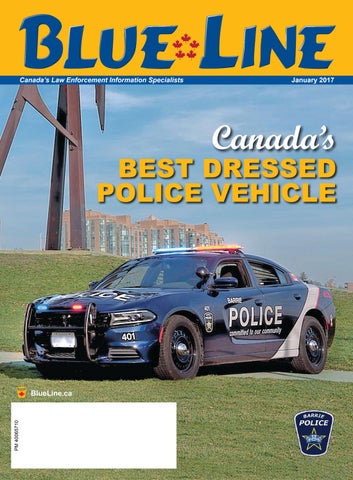
Canada’s
BEST DRESSED POLICE VEHICLE
PM 40065710
Magazine Inc.
BlueLine.ca
SWIFT
JUSTICE
THE FORD POLICE INTERCEPTOR® Purpose-built, it’s the only pursuit-rated vehicle with standard all-wheel drive (AWD), giving you impressive handling and the confidence that no driving conditions can prevent you from catching your guy.
Make us the team behind your team. fordpoliceinterceptor.com | 1.800.668.5515 ©2016 Ford Motor Company of Canada, Limited. All rights reserved.
January 2017 Volume 29 Number 1
Features 6
The Barrie Police Service heritage and future
Canada’s Best Dressed Police Vehicle
6
11
8
Best Dressed
10
Best Dressed
11
2017 Police Vehicle Evaluations
16
Police rescue vehicles
25
Celebrate Canada 150
26
Making Vancouver a Safer Place
Second place & Community Relations
Law Enforcement & Special Service
Departments 30 30 28 20 25 23 29 28 5 22
26
Advertisers Index Back of the Book Calendar Deep Blue Dispatches Holding the Line Market Place Product Showcase Editor’s Commentary Technology
Case Law 18
Reasonable suspicion is about possibilities, not probabilities
18 BLUE LINE MAGAZINE
3
A divided Supreme Court uphold’s arrest JANUARY 2017
Blue Line
EDITOR’S COMMENTARY by Tom Rataj
www.blueline.ca
GROUP PUBLISHER Paul Grossinger – pgrossinger@annexweb.com PUBLISHER EMERITUS Morley Lymburner - morley@blueline.ca EDITOR Tom Rataj - tom@blueline.ca ACCOUNT MANAGER Janice Eaton - janice@blueline.ca ACCOUNT MANAGER April Lensen - april@blueline.ca ART DIRECTOR Svetlana Avrutin - savrutin@annexweb.com ACCOUNT COORDINATOR Trish Ramsay - tramsay@annexweb.com CIRCULATION MANAGER Beata Olechnowicz bolechnowicz@annexbizmedia.com
MAILING ADDRESS 222 Edward Street, Aurora, ON L4G 1W6 Publication Mail Agreement No. 40065710 CIRCULATION email: asingh@annexbizmedia.com Tel: 416-442-5600 ext 3553 Fax: 416-510-5170 Mail: 80 Valleybrook Drive, Toronto, ON M3B 2S9 SUBSCRIPTION RATES Canada — 1 Year $30.00; 2 Year $50.00 plus tax USA — 1 Year $100.00 USD PRINTED IN CANADA ISSN 0847-8538 Occasionally, Blue Line will mail information on behalf of industryrelated groups whose products and services we believe may be of interest to you. If you prefer not to receive this information, please contact our circulation department in any of the four ways listed above. Annex Privacy Officer privacy@annexbizmedia.com Tel: 800-668-2374 No part of the editorial content of this publication may be reprinted without the publisher’s written permission. © 2017 Annex Publishing & Printing Inc. All rights reserved. Printed in Canada.Opinions expressed in this magazine are not necessarily those of the editor or the publisher. No liability is assumed for errors or omissions. Readers are cautioned and advised that articles presented herein are edited and supplied for your personal awareness and should not be used for further action until appropriate guidance is received from a supervisor, Crown Attorney or other persons in authority. All advertising is subject to the publisher’s approval. Such approval does not imply any endorsement of the products or services advertised. Publisher reserves the right to refuse advertising that does not meet the standards of the publication.
BLUE LINE MAGAZINE
They were called “police” cars but they really weren’t Looking over the materials for this month’s cover story, our annual Best Dressed Police Vehicle contest, makes me reflect, reminisce (and cringe) at my memories of the sad state of affairs that police cars once were. When I joined the then Metropolitan Toronto Police Force as a cadet back in 1979, I was assigned to the summons bureau, where my daily duties consisted of delivering outstanding parking tickets to often unwilling recipients. I was shocked to discover that my ride for the first few months was a bright yellow marked two-door Ford Pinto that had seen better days, sometime well before my arrival. Nagging in the back of my mind of course was also the propensity for the Pinto’s to explode into a ball of fire when rear-ended. For a time afterwards I was assigned a brand-new metallic brown unmarked AMC Spirit. It’s not surprising that AMC went out of business, considering how poorly designed and built, and uncomfortable that Spirit was. One could easily get sea-sick if relegated to the front passenger seat because the ride was so soft. During my final six months on the job my regular ride was upgraded to a brand-new marked Ford Fairmont four-door sedan with a relatively rare six-cylinder engine (most others only had the inline-four). Without roof-lights of any kind, the car was mistaken for a taxi on more than one occasion. After turning 21 and being sworn in as a constable I was sent off to recruit training at the Ontario Police College in Aylmer, Ont. During field training and then after graduation I finally moved up to a “real” police car, although real would soon get tempered by the reality of what that was, or more accurately, wasn’t. In an apparent attempt to save money, we continued to get more Ford Fairmonts (mostly with four-cylinder engines that stalled if one attempted a quick 3-point turn). Some of these actually had A/C, but the vinyl benches persisted, presenting a challenge when two officers of largely different stature had to share the car for a shift. The taller officer typically drove so they didn’t have to sit with their knees rubbing against the dashboard all night long. The Fairmonts were replaced quite quickly once their complete unsuitability for police work was realised. We then drove Plymouth Caravelle/Gran Fury’s equipped with an anemic slant-six mated to a four-speed automatic transmission. They had vinyl bench seats, untinted manual windows, no A/C, and no police equipment other than an antique GE police radio. 5
Roof-lights consisted of six large red incandescent tractor-lights mounted on a primitive roof rack that howled-up a storm at highway speeds. Our traffic colleagues were at least lucky because they had actual real sirens – beautiful long cylindrical chrome units, while we divisional guys got saddled with cheap European-style two-tone “mee-maw” horns that created more confusion with the public than clearing the way for us during emergencies. There was also no prisoner partition and there was nowhere to put portable radios, so officers quickly improvised and pried the dash-vents out, wedging the portable radio into the resulting hole, which was a surprisingly good fit. We eventually received basic wire-mesh partitions, A/C and tinted windows, electronic sirens and in the late ‘80s a MDT. Thankfully, Dodge ended production of the Caravelle/Gran Fury’s (so we couldn’t buy them anymore) and we finally received full-sized Ford LTD’s and a few Chevy Impalas. With that we got V8s, tinted power windows, commercially built partitions and roof-lights and the Panasonic ToughBook computer. We also got a proper centre console with a mobile radio, proper siren and PA controls, and even coffee cup holders. Before retiring last year, I marvelled at how far police cars had come during my years of service. Now equipped with all the usual creature comforts, plus state-of-the-art mobile computers, GPS, shotguns/patrol rifles, in-car cameras, stylish decal packages and all proper commercially made equipment. Car manufacturers have also stepped-up their game quite nicely over those years, providing a wide range of police-specific features and equipment in their police-package offerings, instead of just bolting heavy-duty everything onto regular cars and selling them as “police” cars. Another item that has changed a lot over the years is the implementation of joint management and employee equipment committees that brought enlightened and progressive thinking to the fleet procurement and equipment process. User input has gone a long way towards fielding real “police cars” and professional equipment for all. Enjoy the rides, and this issue.
JANUARY 2017
THE BARRIE POLICE SERVICE – heritage and future by Robert Gravel The Barrie Police Service has been in existence since 1853 and enjoys the distinction of being the second oldest active police service in the province of Ontario. The City of Barrie is located in the centre of southern Ontario, approximately 90 km (56 mi) north of Toronto. It is situated on the west side of Kempenfelt Bay which is on the western shores of Lake Simcoe. During the war of 1812, British naval forces had a supply depot in the area where Barrie is now located. The city was strategically located near the Nine Mile Portage, an aboriginal transportation route that existed centuries before Europeans came to Simcoe County. The portage linked Kempenfelt Bay to Willow Creek and then the Nottawasaga River, which flows westward to Georgian Bay and Lake Huron. The city was named Barrie in 1833 after Sir Robert Barrie, who was in charge of British naval forces in Canada at the time. More recently, in the last forty years the population has grown by more than 560 per cent to about 143,000, residents and is expected to grow further to 210,000 by the year 2031. The city is ideally located for those looking for yearround recreational activities, and is an excellent place to raise a family or operate a business. The city’s boundaries may soon extend towards the south, with plans to annex lands located adjacent to the south end of Barrie. Policing Prior to the arrival of cars, motorcycles and radios, officers walked the downtown core, and once electricity was commonplace, they had JANUARY 2017
6
to rely on red lights atop hydro poles to notify them that their services were required. With the arrival of the patrol car and the two-way radio, a new style of policing came to the community. Modern police services have now realized that they cannot succeed in meeting the needs of the community without the help of their citizens. Most Ontario police services have all adopted the ‘Community Based or BLUE LINE MAGAZINE
Contemporary policing’ concept. Community policing is a balance between community involvement with policing strategies and the retention of the ability to respond quickly and effectively in emergencies. The backbone of community policing is the partnership between the community and the police. Officers of the Barrie Police Service are proud of the number of partnerships that have been formed within their community; partnerships that have enhanced their ability to provide responsive and effective service. Today’s Barrie Police Service is committed to providing accountable, responsive, and cost-efficient policing services to the citizens of Barrie. We have grown from one County Constable to a modern police service of more than 237 sworn officers and 105 full-time civilian members. Rebranding Between 2014 and 2016 the Barrie Police Service embarked on the rebranding of its organizational image. Our senior management team felt that a consistent approach to our corporate image would establish a new visual persona that would better reflect our professionalism, define our vision and provide guidelines for the consistent use of our corporate logo. This initiative was part of the 2014-2016 Strategic Business Plan and mirrors the goals and objectives by “Delivering Quality Service and Promoting Organizational Sustainability.” The revitalization of our visual and corporate identity touches every facet of police work and compliments our Mission, Vision and Values. This, in turn, is a direct reflection of our leadership and professionalism coupled with our commitment to our community. New fleet design As part of the rebranding process an internal survey specific to our vehicle design was conducted with the Bateman Design Group in January 2015. The survey presented three graphical design options for our police vehicles, which complimented our branding initiative. The majority of the respondents canvassed during the internal survey agreed on the design which was the final choice. While the presence of the white and red BLUE LINE MAGAZINE
striping denotes the commonality with other police services, the bold use of a Jazz Blue Pearl colour was purposeful in focusing on Barrie’s geographical location and image as one of Canada’s premier waterfront communities. The new look also sought to harness the known qualities associated with the colour: trust, dignity, intelligence and authority. In addition to the new graphical design, the following safety enhancements are included with our new 2016 police vehicles: •
• • •
•
Whelan Legacy SOLO 48 inch Red/Blue LED Duo light bar, with take-down and alley lights and Amber Traffic Adviser array, controlled with a Whelan CenCom Sapphire control panel; Setina 450L front push bumper with fourLED emergency lights; Rear taillight flash is incorporated through an Auto-Watch module to flash the ‘Halo Light’ opposite the reverse-lights; Panasonic ToughPad FZG1 tablet with iKey keyboard and E-Seek M260 drivers licence reader, mounted on a PMT Sightline centre console and vehicle mount; Setina Universal XL Lock System patrol-rifle mount for Colt C8 Carbine.
Additional convenience/officer-safety features include: •
•
•
When the driver/passenger front doors are opened the alley and corner lights turn off to prevent the light flash from blinding the officers; The siren sounds are toggled through the steering wheel horn pad and the siren is deactivated when the vehicle is placed in park; and Setina SPT system and TPO plastic full rear bench replacement module.
Vehicle efficiencies To compliment the vehicles’ safety features the Barrie Police Service sought to improve the vehicles’ efficiency and performance. All of our new vehicles are equipped with the performance Mopar Air Intake System, which replaces the standard paper air filter that required 7
quarterly replacement at a cost of $50 each. The Mopar Air Intake System filters are readily cleaned during regular service intervals and reused for the life of the vehicle. The system costs approximately $350.00 and with some vehicles lasting as long as 6 years the Service saves an additional $800.00 per vehicle by using the system. When the vehicle is retired, the original intake system is reinstalled and the Mopar Air Intake System can be installed in a new vehicle which can translate into another $1,200 in savings. Additionally, when driven under normal conditions the Mopar system reduces fuel consumption and when needed it provides the vehicle a 14 per cent increase in horse power. The decisions for all these safety and efficiency improvements were made by our fleet manager, Kevin Harrison. They will enhance officer safety and provide future cost saving for the fleet. As the award recipient for Blue Line the Best Dressed Police Vehicle for 2017 we are very proud of our vehicle redesign. We believe our vehicles possess a look and style that reflects our community and the policing functionality that is required in today’s changing environment. Due to the added efforts in the areas of lighting, fuel economy and environmental concerns we believe that this initiative clearly illustrates that our service is being sensitive to the numerous issues within policing while remaining fiscally responsible and environmentally conscious at the same time. Sergeant Robert Gravel is a 26-year member of the Barrie Police Service. He currently works in the Corporate Services – Planning and Research section. He can be reached at: rgravel@barriepolice.ca. JANUARY 2017
Orangeville Police Service The Orangeville Police Service is excited to unveil the latest addition to their general patrol vehicle fleet, cruiser #104. This vehicle is a 2016 Ford Police Interceptor Utility, the police version of the Ford Explorer. Design The vehicle exterior features a new multi-coloured graphics package on a white body that incorporates a large traditional Orangeville Police crest along with large and bold blue and red reflective striping package to reflect new branding for the police service. Bold, contemporary lettering and the inclusion of their motto “Community Focused” completes the new design. This progressive new look is very visible in all conditions and is eye catching and should appeal to all age
demographics by combining tradition with more modern design and tastes. Equipment The vehicle is not equipped with a tradition roof-mounted lightbar, but uses a discrete interior mounted emergency lighting package that is highly visible from the outside when activated. A Setina pushbar with LED lighting package is installed on the front, and a driver’s side A-pillar mounted spotlight completes the exterior lighting. An innovative single prisoner compartment is installed in the vehicle to enhance the comfort of the driver by not intruding into the driver’s seat rearward travel range.
This vehicle is also equipped with technology to assist officers with the performance of their duties including a mobile computer with a driver’s licence card reader and mobile printer, and a C8 patrol carbine mounting bracket. The vehicle graphics were supplied by Sign Needs of Orangeville and the lighting and equipment package was supplied by D & R Electronics of Bolton. Conclusion Orangeville Police Cruiser #104 delivers a combination of the latest in technology and modern styling, which made it a strong contender as one of Canada’s “Best Dressed” police vehicles.
Estevan Police Service The Estevan Police Service celebrated the 110th anniversary of policing the City of Estevan in 2016, and as part of that celebration acquired a 2016 Dodge Challenger R/T as a community relations vehicle. The vehicle is only being used for traffic and community relations events and initiatives. It is outfitted with a unique custom decal and police equipment package that starts with a white basecoat and an elaborate customdesigned graphics package. Traditional red and blue police striping runs the length of the vehicle and sits above a black and silver custom printed graphics package that covers the lower half of the vehicle. JANUARY 2017
In addition to the large Estevan Police crest at the front of the doors, it also includes POLICE in large blue letters, and a stylized Canadian flag in a black and silver motif that 8
extends from the door onto the rear fender. The vehicle emergency lighting package includes a blue and red Whelen Freedom IV F4W LED lightbar on the roof, and compact emergency LED lightheads located in the front grill, inside the Shaker hood-scoop, and inside the rear windows. The vehicle was made possible with the assistance of local businesses including Dynamic Signs Inc., the Local Dodge Dealers and Signal Direct Communications. Their logos all appear at the back of the front fender in recognition of their contributions. This unique vehicle generates a lot of interest from community members and helps advance police and community relations. BLUE LINE MAGAZINE
PRIMARY MARK
PRIMARY MARK
PRIMARY MARK
SECONDARY MARK
SECONDARY MARK
SECONDARY MARK
TERTIARY MARK
TERTIARY MARK
TERTIARY MARK
TSTM-55
QUATERNARY MARK
CUT LEVEL 5
TSRE-55
QUATERNARY MARK
TSBR-55
TSCR-55
QUATERNARY MARK
TSAZ-55
RECON
TEMPEST
BREACHER
PURSUIT CR5
AZIMUTH
ERGONOMIC DESIGN HIGH-DEXTERITY 0.5MM LEATHER
FR LEATHER FLAME RESISTANT NOMEX®
FR LEATHER IMPACT PROTECTION
CUT RESISTANCE ERGONOMIC DESIGN
FLAME RESISTANT NOMEX® GAUNTLET CUFF
Mechanix Wear’s Tactical Specialty line is designed to protect law enforcement officers and SWAT professionals with specialized hand protection for a range of scenarios and environments. T/S tactical gloves are built with high-quality goatskin leather and incorporate varying levels of protection such as (ASTM) rated flame resistance.
CONTACT US AT INFO@MECHANIXWEAR.CA FOR A DEALER IN YOUR AREA
THE TOOL THAT FITS LIKE A GLOVE.® TOLL FREE: 877-278-5822 / 604-542-7055 | WWW.MECHANIXWEAR.CA #mechanix
S/Cst Peter Mohyla, S/Cst Richard Schnabel
Transit Safety Government of Ontario Transit (later shortened to GO Transit) was formed on May 23rd, 1967. GO Transit originally served the Greater Toronto Hamilton Area (GTHA) as an inter-regional public transit system with a single commuter rail line running along the shore of Lake Ontario between Oakville and Pickering. With today’s combined daily ridership of more than 260,000 passengers, GO trains and buses have become essential tools in reducing traffic gridlock throughout the GTHA. One part of the evolving culture shift at GO included the release of GO Transit’s Passenger Charter in 2009. This document highlighted GO’s promise to “Always take your safety seriously”. The sworn officers and civilian staff members of GO’s Transit Safety unit are dedicated to providing a safe and secure experience for customers and employees while on the transit system. In early 2014, GO Transit underwent a wholesale rebranding of their colour schemes and logos on all GO transit rolling stock including trains, buses and support vehicles. The Transit Safety division followed suit. The refreshed GO Transit colour scheme was
applied to the new shipment of Transit Safety Public Safety grade Ford Pursuit sedan patrol cars, replacing the aging fleet of Ford Crown Victoria models. In 2015, Transit Safety also began similar services and emergency response capabilities to the newly launched UP Express rail service between Toronto Pearson International Airport and Union Station in downtown Toronto. In keeping with the overall agency branding scheme, Transit Safety utilized several different shades of green on their patrol vehicles. The green striping on the vehicles veers off in a widened direction, symbolizing the growth of both train and bus public transportation. The Transit Safety crest and lettering is boldly displayed on both sides of the vehicle, clearly indicating which agency the vehicle represents and the services we provide. Each vehicle is equipped with a public safety emergency LED lighting package including traffic direction lighting, an exter-
nal speaker and siren package. Radio communications consists of a P25 public safety grade Motorola UHF radio complete with a digital vehicle repeater system (DVRS) and a railway industry VHF radio system and a laptop mounting kit. Each vehicle is GPS equipped including an on-board duress button in addition to any existing radio emergency features. The finished package meets the needs of the officers and the communities in which they serve in both design (highly visible and recognizable) and functionality. The railway crossing logos on the sides of the car reinforces the partnership that Transit Safety has with Operation Lifesaver, Canada’s national railway safety education program and keeping people safe along railway tracks.
level armouring and STANAG 4569 Level II blast protection, so it can safely transport up to 8 passengers under any condition likely to be encountered in Winnipeg. The vehicle includes no weapons, but features seven gunports, a roof hatch and five doors for quick entry and exit. The rear compartment is large enough to accommodate a stretcher in the event an injured civilian or officer needs to be transported away from a dangerous scene ARV1 is equipped with a number of op-
tions including extra lighting scene lighting, police emergency lighting and other options bringing the price to $343,000. The exterior is painted in a dark grey matte paint finish, and in addition to the WPS crest and WINNIPEG POLICE decal is appropriately decaled “POLICE RESCUE”. Despite weathering some initial criticism about the price and the “militarisation” of policing, the ARV1 has been successfully deployed numerous times in 2016.
Senior Constable Richard Schnabel and Sergeant Anthony Iafrate are members of the GO Transit Safety Division. Follow them on Twitter at: @GOTransitSSD
Winnipeg Police Service ARV1 The Winnipeg Police Service Armoured Rescue Vehicle #1 (ARV1) is the Special Duty category winner for 2017. The Ontario built Terradyne Gurkha MPV is a light armoured vehicle that went into service in mid-2016, to provide a new level of safety and protection for members of the WPS Tactical Support Team, engaged in high-risk operations where weapons or explosives may be present. The 7,710kg (15,000 lb) light armoured diesel-powered truck is built to CEN B7 JANUARY 2017
10
BLUE LINE MAGAZINE
2017 POLICE VEHICLE EVALUATIONS By Dave Brown The 2017 pursuit-rated police vehicles on the market in Canada are the most capable, most fuel efficient and safest vehicles ever made for police officers. They are faster than many high-performance cars were just 10 years ago, and get better fuel economy than many econobox sedans could achieve just five years ago. Even the full-size, body-onframe four-wheel-drive Chevrolet Tahoe can out-handle what used to be called a supercar … while still loading four officers, all their gear and a Smart car in the back as a spare. Yes, these are not my dad’s police cars anymore. The previous market leader, the Ford Crown Victoria Police Interceptor (CVPI), has now been almost completely forgotten by nearly everyone. Newer, faster and more capable police vehicles have taken over. All-wheel-drive
(AWD) or four-wheel-drive (4WD) models now dominate the market for 2017. Ford replaced that aging gas-guzzling CVPI with two new vehicles, both based on the same civilian market Taurus platform in 2011/2012. The Police Interceptor Sedan and Utility are both police specific versions of the Taurus sedan and the Explorer SUV, respectively. The Sedan is available in either frontwheel drive (FWD) or AWD with several engine choices, while the Utility is available in AWD only and two engine choices. Chevrolet is still selling the rear-wheeldrive (RWD) and a 4WD version of their fullsize Tahoe SUV as a fully-rated police pursuit vehicle (PPV). The FWD Chevrolet Impala sedan has been discontinued, but the Australianbuilt Chevrolet Caprice PPV RWD sedan is available south of the border, but not in Canada. Dodge is selling their Charger Pursuit in both RWD and AWD versions with a choice of either a V6 or V8 engine.
All-Wheel-Drive Rules Comprehensive performance, handling and braking tests as conducted by both Michigan State Police and LA County Sheriff, show that AWD vehicles perform just as well as their RWD or FWD counterparts in nearly every parameter of testing, even with the weight penalty imposed by the additional drive-train components. The advantages to the handling of AWD vehicles under any conditions will be immediately obvious to officers driving them, with the higher maintenance cost potentially being offset by a higher wholesale value on the used market. Better vehicle driving dynamics and control may also help reduce the number of crashes caused by loss of control. In the Tahoe, Chevrolet uses a true FWD system. One can drive in 2WD for good mileage, and switch to Automatic 4WD (A4WD) for variable conditions. In this setting, similar to the on-demand AWD systems in the Ford
Rugged In-Car Video & Body-Worn Cameras for Law Enforcement featuring
Solid-State Storage Secure Data Encryption Reliable Performance
Experienced Builder Officer-Friendly Design Made in Canada!
Proudly Designed & Manufactured in Canada! PatrolWitness™ | A Division of 247Security Inc. 1-866-693-7492 | www.patrolwitness.com BLUE LINE MAGAZINE BlueLine_247_Jan.indd 1
11
JANUARY 2017
2016-12-13 8:55 AM
2017 POLICE VEHICLE EVALUATIONS or Dodge, the system can divert torque to the other axle when it detects slippage. In A4WD, the transfer case always keeps 5% of the torque flowing at the front wheels to add stability on slightly slippery or mixed surfaces. More torque is automatically portioned to the front axle as additional slippage is detected at the rear axle. In 4WD high range, the Tahoe’s Autotrac system locks front and rear axles together for true four-wheel-drive. It even has a traditional 4WD low range for descending slippery slopes or crawling over rocks. Officers can switch back and forth between 2WD, A4WD and 4WD HI at any speed. The future of the U.S.-only Chevrolet Caprice remains uncertain as of 2017. Scheduled to go out of production in 2017, the Caprice may be saved by the popularity of the civilian version – the Chevrolet SS. As the last of the big V8 RWD sedans on the police market, we had enormous hope for this car being made available in Canada. But when GM announced it would not be for sale here, and because they are selling fewer than 1,000 police version cars per year in the entire U.S. market, the Caprice may just die a quiet death after 2017. After all, Chevrolet sells every single civilian Tahoe they can possibly build – at substantially higher profits than fleet vehicles – and perhaps sees no need to enter the competitive sedan market against Ford and Dodge as long as the roomy Tahoe SUV remains popular with officers. So with all these choices for police vehicles in 2017, we here at Blue Line Magazine don’t think that a single officer will fondly remember that old, slow and thirsty Crown Victoria, or miss the big, dated Caprice. Michigan State Police Yearly Vehicle Tests Every fall the Michigan State Police, in conjunction with the US National Institute of Justice (NIJ), test the handling and performance of every new police vehicle on the market for the coming year in back-to-back acceleration, braking and lap time tests. These eagerly anticipated tests are seen as the most comprehensive analysis of police vehicles in North America. We compile our report on police vehicle tests every year from a variety of sources: LA County Sheriff test figures, manufacturers’ data and media releases, the Michigan State Police results and our own and other’s user experience behind the wheel. Vehicles The NIJ and Michigan State Police evaluate police vehicles in two categories: policepackage vehicles and special-service vehicles. Police-package vehicles are designed for the full spectrum of general police activities including high-speed pursuit. Special-service vehicles are designed only for specialized duties such as canine units or adverse weather conditions and are not intended for or recommended for pursuits. Thirteen 2017 model-year vehicles were submitted to the NIJ in the police-package category: JANUARY 2017
• • • • • • • • • • • • •
2017 Chevrolet Caprice with the 3.6L V6 2017 Chevrolet Caprice with the 6.0L V8 2017 Chevrolet Tahoe PPV with the 5.3L V8 2017 Chevrolet Tahoe 4WD PPV with the 5.3L V8 2017 Dodge Charger with the 3.6L V6 and standard 2.62:1 axle ratio 2107 Dodge Charger with the 5.7L V8 and standard 2.62:1 axle ratio 2017 Dodge Charger AWD with the 5.7L V8 and standard 3.08:1 axle ratio 2017 Ford Police Interceptor Sedan FWD with the 2.0L turbocharged I4 2017 Ford Police Interceptor Sedan FWD with the 3.5L V6 2017 Ford Police Interceptor Sedan AWD with the 3.7L V6 2017 Ford Police Interceptor Sedan AWD with the twin turbocharged 3.5L V6 2017 Ford Police Interceptor Utility AWD with the 3.7L V6 2017 Ford Police Interceptor Utility AWD with the twin turbocharged 3.5L V6
Here is the lineup and summary of PolicePackage Vehicles that will be available for sale in Canada for 2017 (with figures from the 2017 Michigan State Police vehicle tests, and additional comments from Blue Line Magazine.) Police-Package Vehicles
Chevrolet With the Impala now out of production and the Caprice not for sale in Canada, Chevrolet is down to only two versions of its full-size Tahoe SUV as a Police Package vehicle in Canada. The popular slab-front, full size Tahoe remains the only full-size, body-on-frame pursuit-rated police vehicle on the market in Canada. It equals the gas mileage of all the other AWD police cars on the market, in spite of its much larger dimensions. Its selectable 4WD system is more complex and more versatile than the on-demand AWD systems found with both Dodge and Ford. The built-in stability control system has a special “competition” driving mode in either two-wheel-drive or A4WD that changes both traction control and stability control parameters to allow for more aggressive driving in pursuit modes without the need for shutting 12
down the systems entirely. The Tahoe PPV offers full pursuit capability with a 355 horsepower 5.3L EcoTec3 V8 under the hood, in either a rear-wheeldrive or four-wheel-drive models.
Dodge The 2017 Dodge Charger Pursuit has a revised cockpit design that offers an optional 12-inch touch-screen display. This frees up critical space in the front and includes an interface that allows officers to quickly toggle between vehicle controls without taking their eyes off the road. Auxiliary controls on the steering wheel can easily be remapped to control aftermarket accessories. The electric power steering improves steering performance and feel, as well as improves fuel economy. The optional 220mm rear axle increases payload capacity by 200 pounds and suspension upgrades now include a performance-tuned suspension, load-leveling shocks and heavy-duty brakes. Interiors feature specially developed seats to accommodate belt-mounted gear, a steering wheel with auxiliary buttons for controlling police equipment and a shift-lever mounted on the steering column instead of the center console. The 2017 AWD models transition seamlessly from RWD to AWD, resulting in more control, and the transfer case and front-axle disconnect system, monitors and adapts to the environment, road conditions, vehicle mode and driver style. The 2017 Dodge Charger Pursuit comes with either a 292-horsepower 3.6L V-6 RWD or a 370-horsepower Hemi V-8 in either RWD or AWD. Optional axle ratios have been dropped, with RWD models coming with a 2.92:1 rear axle and the AWD with a 3.08:1 axle. Ford The Ford Police Interceptor has been the number one selling pursuit-rated police vehicle on the market since 2013. Seventyfive percent of all Ford police vehicle sales are the Utility model, and Ford sells more Utility SUVs than all police cars from Dodge and Chevrolet combined. A 2016 redesign gave the Utility a more truck-like look and the sedan a more integrated front end. Officer safety features BLUE LINE MAGAZINE
2017 POLICE VEHICLE EVALUATIONS either of the two V6 engine choices of the Sedan. Ninety-seven percent of Ford police vehicle sales are AWD. Ford also sells a pursuit-rated 240hp 2.0L twin-turbo EcoBoost inline 4 cylinder (I4) for the Special Service category, which offers the best mileage (and slowest acceleration) of all police cars on the market. All models come paired with a six-speed automatic transmission that features a Pursuit Mode specially programmed for law enforcement. It automatically switches from Fuelsaving Mode to Pursuit Mode when it detects aggressive driving based on brake pressure, longitudinal deceleration and lateral acceleration. include anti-stab plates in the front seatbacks, Level-III ballistics shields in the front door, front doors tethered to prevent them opening more than 50 degrees even if kicked, and rear doors that open an inviting 90 degrees. An “ambush sensor” uses the rear-mounted proximity sensor to detect anyone sneaking up from the rear, and warns the driver, raises the driver’s window and locks all doors. The Sedan is available in FWD with a 288hp 3.5L non-turbo V6, while the AWD version offers either a 365hp 3.5L twin-turbo EcoBoost V6 or a non-turbo 305hp 3.7L V6. The Utility is available only in AWD with
Police Vehicle Recalls General Motors - Chevrolet Impala - 38,000 2008-2012 model year vehicles were recalled because a part in the front suspension could crack. Chevrolet determined that the lower control arm in the suspension could fracture near a bushing sleeve, causing sudden changes in handling that could make the driver lose control. If a fracture occurs, a squeal or chirp is likely to come from the tire area at low speeds. Caprice - 7,600 2011 to 2013 model year police vehicles were recalled to fix a seat belt issue. Flexible steel cables that connect seat belts to the vehicle at the outside of the driver
Chevrolet Caprice
seat were prone to being bent from being sat upon while the driver entered the vehicle. Over time, repeated bending could break the cable. Caprice - 7,600 2011 to 2013 model year police vehicles were recalled for a problem with the gear shifter that could allow the car to roll away while in park. Vehicles can be shifted out of park without a foot on the brake pedal. Drivers also may have difficulty shifting between gears, and may be able to move the shift lever between gears without pressing the shift lever lock button. The ignition key can be removed without the transmission being in park, potentially allowing it to roll away. Police Pursuit Vehicle - all 2015-2017 model year vehicle, were recalled for an air
Move forward in your career.
Bachelor of Applied Arts Justice & Public Safety
Toronto, ON
> Degree completion for professionals
Complete your degree while working!
> Build on your credentials and open up opportunities for career advancement > Credit for previous postsecondary education, training and work experience > Online and weekend classes allow you to balance work and studies
>>> guelphhumber.ca/jpsdc BLUE LINE MAGAZINE
BlueLine_UnivGuelph_Jan.indd 1
13
JANUARY 2017
2016-12-13 10:03 AM
2017 POLICE VEHICLE EVALUATIONS VEHICLE DYNAMICS TESTING
ACCELERATION 0-60 mph
Overall average lap times CHEVROLET
0-80 mph
0-100 mph
Top Speed (mph)
CHEVROLET
Tahoe 5.3L V8 RWD
1.39.75
Tahoe 5.3L V8 RWD
7.97
13.15
19.76
132
Tahoe 5.3L V8 4WD
1.40.60
Tahoe 5.3L V8 4WD
8.08
13.29
20.39
121
DODGE
DODGE
Charger 3.6L V6 RWD 2.62:1
1.38.27
Charger 3.6L V6 RWD 2.62:1
8.06
12.80
20.23
141
Charger 5.7L V8 RWD 2.62:1
1.37.12
Charger 5.7L V8 RWD 2.62:1
6.17
9.46
15.22
149
Charger 5.7L V8 AWD 3.08:1
1.36.53
Charger 5.7L V8 AWD 3.08:1
6.05
10.00
15.26
149
FORD
FORD
Sedan 2.0L I4 EcoBoost FWD
1.43.05
Sedan 2.0L I4 EcoBoost FWD
8.26
13.51
22.17
120
Sedan 3.5L V6 FWD
1.38.82
Sedan 3.5L V6 FWD
7.78
12.76
19.70
131
Sedan 3.7L V6 AWD
1.35.01
Sedan 3.7L V6 AWD
7.43
11.89
18.56
131
Sedan 3.5L V6 EcoBoost AWD
1.35.34
Sedan 3.5L V6 EcoBoost AWD
5.70
8.98
13.62
148
Utility 3.7L V6 AWD
1.40.93
Utility 3.7L V6 AWD
7.99
12.82
20.32
131
Utility 3.5L V6 EcoBoost AWD
1.38.53
Utility 3.5L V6 EcoBoost AWD
6.40
10.35
16.00
131
bag sensing and diagnostic module software problem that may activate a diagnostic test, preventing deployment of the front air bags and the seat belt pre-tensioners in the event of a crash. Tahoe Police Pursuit - recalled all 20152016 model year vehicles manufactured between March 1, 2014 and February 1, 2016 to fix a brake pedal pivot nut that may loosen during normal use, causing the brake pedal to be loose or inoperative. Dodge Charger Pursuit - 10,000 2011-2012 model year vehicles were recalled because an overheated lighting harness connector could cause the vehicle’s low beam headlights to fail. In addition, some Chargers may also suffer from an overheated power distribution center that could result in a loss of the vehicle’s anti-lock braking and stability control systems. They also announced the recall of 86,000 2011 to 2014 trucks and police cars because of a potential short-circuit in the alternator that could lead to stalling or engine fires, especially in hot weather. Ford Utility (and civilian Explorer) - 213,000 2011-2013 model year vehicles were recalled in North America to fix interior door handles. The spring that controls the interior door handles may become unseated, allowing the door to unlatch in a side-impact crash, increasing the risk of injury. Utility and other cars and SUVs - 88,000 vehicles, manufactured between Sept. 8, 2011 and May 31, 2015 were recalled to inspect and possibly replace fuel pump control modules. If the fuel pump control module fails, it will cause the vehicle to stall unexpectedly and prevent it from being restarted. The recall affects all 2013-2015 Ford Taurus, Ford Flex, Lincoln MKS, and Lincoln JANUARY 2017
MKT with the 3.5L EcoBoost V6, and Police Interceptor Sedans with all engines. It does not affect the Ford Police Interceptor Utility SUV. Ford has also been sued over problems with its turbocharged EcoBoost engines in the civilian versions of its sedan and utility vehicles. During acceleration in situations of high humidity, some engines have suddenly gone into “limp” mode, leaving frustrated drivers with no acceleration. This would be particularly dangerous during passes or merges on the highway. During periods of high intake airflow in humid conditions, the engine detects what it thinks is high moisture content entering the engine and reduces power to save engine damage. Ford redesigned the charged-air cooler but a lawsuit alleges that Ford was aware of the problems and the affected vehicles should have been recalled. Agencies who experience a sudden loss of acceleration in high humidity conditions should return their vehicles to the dealer for a replacement charged air cooler. Owners of Fords with the EcoBoost engine have also reported real-world mileage results to be far less than EPA numbers. In fact, the EPA lowered many mileage numbers for Ford throughout their model range. The 2017 police vehicles test reflect these lower numbers. The Tests Michigan State Police and the NIJ’s National Law Enforcement and Corrections Technology Center (NLECTC) test all the vehicles together over a three-day period at the Chrysler Proving Grounds and the Grattan Raceway. Each vehicle is tested without rooftop lights, spotlights, sirens or radio antennas in place. Tires are original equipment as provided by the manufacturer. Acceleration, braking and top speed tests are performed at the Chrysler proving ground and vehicle dynamics tests are done using the 14
two-mile road course at the Grattan Raceway. (All dimensions and measurements are given in U.S. imperial measurements with some Metric equivalents.) The Results Vehicle Dynamics Testing The objective of the vehicle dynamics testing is to determine the high-speed pursuit handling characteristics. Except for the absence of traffic, the two-mile road course simulates actual pursuit conditions. It evaluates the blend of suspension components and acceleration and braking ability. Four different drivers test each vehicle over an eight-lap road course, with the five fastest laps counting toward each driver’s average lap time. The final score is the combined average of all four drivers for each vehicle (recorded in minutes, seconds and 1/100th of a second). Acceleration and Top Speed The objectives of the acceleration and top speed tests are to determine the ability of each vehicle to accelerate from a standing start to 60 mph (96.5km/h), 80 mph (128.7 km/h) and 100 mph (160.9 km/h), and to record the top speed achieved within a distance of 14 miles (22.5 km) from a standing start. Each vehicle is driven through four acceleration sequences, two in each direction to allow for wind. Acceleration score is the average of the four tests. Following the fourth acceleration sequence, each vehicle continues to accelerate to its highest attainable speed within 14 miles of the standing start point. Braking The objective of the braking test is to determine the deceleration rate attained by each vehicle on twelve 60-0 mph (96.5-0 km/h) full stops to the point of impending skid and BLUE LINE MAGAZINE
2017 POLICE VEHICLE EVALUATIONS BRAKING PERFORMANCE Average deceleration rate (ft/sec2)
EPA Mileage (miles per U.S. gallon) Projected stopping distance from 60 mph (feet)
Tahoe 5.3L V8 RWD
28.12
137.7
Tahoe 5.3L V8 RWD
Tahoe 5.3L V8 4WD
28.62
135.3
Tahoe 5.3L V8 4WD
23
16
22
125.1
Charger 3.6L V6 RWD 2.62:1
17
26
31.44
123.2
Charger 5.7L V8 RWD 2.62:1
15
25
30.51
126.9
Charger 5.7L V8 AWD 3.08:1
15
23
30.95
Charger 5.7L V8 AWD 3.08:1
16
DODGE
DODGE Charger 5.7L V8 RWD 2.62:1
Highway
CHEVROLET
CHEVROLET
Charger 3.6L V6 RWD 2.62:1
City
FORD
FORD Sedan 2.0L I4 EcoBoost FWD
30.03
128.9
Sedan 2.0L I4 EcoBoost FWD
19
28
Sedan 3.5L V6 FWD
30.44
127.2
Sedan 3.5L V6 FWD
17
25
Sedan 3.7L V6 AWD
29.76
130.1
Sedan 3.7L V6 AWD
16
22
Sedan 3.5L V6 EcoBoost AWD
29.62
130.7
Sedan 3.5L V6 EcoBoost AWD
15
22
Utility 3.7L V6 AWD
30.46
127.1
Utility 3.7L V6 AWD
15
20
Utility 3.5L V6 EcoBoost AWD
30.33
127.7
Utility 3.5L V6 EcoBoost AWD
15
20
with ABS in operation. Each vehicle is scored on the average deceleration rate it attains. Each test vehicle makes two heat-up decelerations at predetermined points on the test road from 90 to 0 mph at 22 ft/sec2 using a decelerometer to maintain rate. The vehicle then turns around and makes six measured 60-0 mph stops with threshold braking applied to the point of impending wheel lock, using ABS if so equipped. Following a four-minute heatsoak, the sequence is repeated. Initial velocity of each deceleration and the exact distance required is used to calculate the deceleration rate. The resulting score is the average of all 12 stops. Stopping distance from 60 mph is calculated by interpolation of results. Fuel Economy While not an indicator of actual mileage that may be experienced, the EPA mileage figures serve as a good comparison of mileage potential from vehicle to vehicle.Vehicle figures are based on data published by the vehicle manufacturers and certified by the U.S. Environmental Protection Agency. Mileage figures are given in U.S. miles per gallon.
four officers independently evaluate ergonomic factors, and Michigan State Police Communications Division personnel then evaluate each vehicle on the ease of equipment installation. A total of 29 factors are evaluated on a scale of one to 10 and averaged among all the testers. The final score is the total cumulative score from the average of each of the 29
factors, such as seat design, padding, ease of entry, head room, instrument placement, HVAC control placement, visibility, dashboard accessibility and trunk accessibility. Dave Brown is Blue Line Magazine’s Firearms Editor and staff writer. He is a tactical firearms trainer and consultant. He can be reached at firearms@blueline.ca
PRICE? CHECK. DURABILITY? CHECK. WARRANTY? CHECKMATE.
Visit your local dealer for details.
We don’t provide the best warranty in the game because we have to – we do it because we can. An unmatched combination of quality and durability means you can rest assured that you’re making the best decision when you make it a Mitsubishi.
TOTAL ERGONOMIC TEST SCORES – POINTS PER VEHICLE Chevrolet Tahoe
340.76
Dodge Charger
325.95
Ford - Sedan
291.39
Ford - Utility
313.05
Ergonomics The objectives of the ergonomics and communications test are to rate a vehicle’s ability to provide a suitable environment for patrol officers to perform their job, to accommodate required communication and emergency warning equipment and to assess the relative difficulty in installing this equipment. A minimum of BLUE LINE MAGAZINE
Visit mitsubishi-motors.ca/fleet for more information on how you can add a Mitsubishi to your fleet. ** Whichever comes first. Regular maintenance not included. See dealer or mitsubishi-motors.ca for warranty terms, restrictions and details. Some conditions apply.
15
MITBRD16106_2016 Fleet_BlueLine_3rdPage_E 2.indd 1 BlueLine_Mitsubishi_Jan.indd 1 172 John St., Toronto, ON M5T 1X5 Studio Hotline 416 348 0048 x411
AD CODE: MITBRD16041_2016 Fleet_BlueLine_3rdPage_E 1
JANUARY 2017
2016-12-05 4:23 PM 2016-12-12 3:13 PM
Colour Information: Printing Inks: 4 Colours
Creative (Designer/AD/CD)
POLICE RESCUE VEHICLES
by Tom Rataj There are times when standard police vehicles fail to afford adequate protection for their occupants. Fortunately, there are a number of light armoured trucks available in Canada that provide excellent ballistic and explosives protection for just those times. Protection standards Armoured vehicles are manufactured to meet established ballistic resistance standards, most commonly the European Normalization Standard (CEN - Comité Européen de Normalisation). For light armoured trucks this typically includes CEN B6 and B7 designations. B6 is rated to defeat multiple 7.62x51mm rifle rounds, while the higher B7 level is rated to defeat armour piercing 7.62x51mm ammunition, and larger 7.62x54R ammunition. Explosives protection is defined by the NATO Standardization Agreement (STANAG) 4569 Level II, which establishes protection levels for occupants of logistics and light armoured vehicles against kinetic energy (rifle rounds), grenade and mine blasts, and nearby artillery blasts. Selling the need Making the operational and business-case for one of these vehicles is just the first step though, as the Winnipeg Police Service discovered in 2016. After they announced their Terradyne Gurkha light armoured truck, there was some negative feedback about the need for the expensive “military-style” vehicle. Before deploying a vehicle such as this, police agencies would be wise to formulate a thorough and detailed media strategy to “sell” the need for the vehicle to the general public. This should probably include data to support the acquisition of the vehicle and an event where local media have access to the vehicle with one or more officers on hand to help articulate the need and benefits of such a vehicle. Winnipeg police helped this cause by wisely marking their truck “POLICE RESCUE.”
JANUARY 2017
INKAS This Toronto-based company armours just about any civilian vehicle, but also produces a number of purpose-built armoured trucks for law enforcement use, such as the Hudson APC. The Hudson APC accommodates eight passengers and a turret operator. It is built on a Toyota Land Cruiser 79 4X4 platform, uses a 4.5L V8 diesel engine and a 5-speed manual transmission. It is equipped with two escape hatches, perimeter-wrapping gun-ports, and has other available options. It is rated to level CEN B6. www.inkasarmored.com
TERRADYNE This Newmarket, Ont. based company manufacturers four versions of its Gurkha armoured vehicle. Its police specific Gurkha MPV is an armoured truck that seats eight-12 people depending configuration. It is built on a Ford F550 4X4 chassis equipped with a 6.7L V8 turbo-diesel engine and a 6-speed automatic transmission. It features seven gun-ports, an optional roof hatch or gun turret and various other options. It is rated to and successfully completed whole-vehicle CEN B7 armouring and STANAG 4569 Level II blast protection tests. www.terradyneinc.com
16
BLUE LINE MAGAZINE
STREIT This company produces a wide variety of armoured vehicles at its facility north of Toronto and elsewhere around the world, including purpose-built armoured trucks for law enforcement use. Its newer large SWAT truck ASV is built on a Ford B550 4X4 chassis equipped with a 6.7L V8 turbo-diesel engine and a 6-speed automatic transmission. It seats up to 14 people, has six gun-ports and an optional roof mounted turret and other options. It is rated to CEN Level B6. www.armored-cars.com
ARMORED CARS CANADA This Toronto-based company specializes in armouring regular passenger cars and trucks to provide ballistic protection up to the CEN B6 level. To the untrained eye, their vehicles appear to be ordinary, but have been completely retrofitted with a complete armouring package. Vehicles such as their armoured Chevrolet Suburban would provide excellent discrete transportation for government officials or dignitaries in situations where a standard civilian vehicle may be inadequate and an armoured truck would be excessive. www.armoredcarscanada.com
Justice Studies Bachelor of Applied Arts Your career in Justice Studies has no limits. A Lethbridge College Policing or Correctional Studies diploma leads directly into year three of our degree program, which meets or surpasses entry-level requirements for management and supervisory positions in municipal, provincial and federal jurisdictions. All courses can be taken on-campus or online so you can continue working while completing your degree.
lethbridgecollege.ca BLUE LINE MAGAZINE
BlueLine_Lethbridge_Jan.indd 1
17
JANUARY 2017
2016-12-16 10:01 AM
CASE LAW by Mike Novakowski
REASONABLE SUSPICION IS ABOUT POSSIBILITIES, NOT PROBABILITIES Roadside breath demands The absence of indicia of impairment did not negate an officer’s reasonable suspicion that a driver had alcohol in his body under s. 254(2) of the Criminal Code such that a roadside breath demand was unreasonable. In R. v. Schouten, 2016 ONCA 872 the accused was stopped during a R.I.D.E. – Reduce Impaired Driving Everywhere – check. There were no signs of impaired driving noted when the officer gestured for Schouten’s truck to stop. When the officer approached the truck, he immediately detected an odour of alcohol on Schouten’s breath and told him so. Schouten indicated that he had his last drink about 10 hours earlier but did not know how much or what he had had to drink. A roadside breath demand followed and Schouten failed the test. He was arrested for driving over 80mg and taken to the police station where he provided two samples over the legal limit – 120mg and 109mg. He was charged accordingly. At trial in the Ontario Court of Justice the officer testified that he formed a suspicion that Schouten had alcohol in his body based on the odour of alcohol on his breath and his answers to the officer’s questions, even though he displayed no signs of impairment. The officer also said that he knew, from his training as a breath technician, that alcohol would be eliminated from a person’s body in four to five hours if they had “a drink”. The officer also stated that, even when an odour of alcohol is detected, alcohol consumed 10 hours earlier
“may have been eliminated” and it could not be said “with any certainty” that there was still alcohol in the person’s body. Taking into account all of the circumstances, the trial judge found that the police officer lacked reasonable grounds to suspect Schouten had alcohol in his body despite smelling alcohol on his breath. Schouten’s statement that he consumed alcohol some 10 hours earlier would explain the odour on his breath, but without more grounds, did not mean there was alcohol in his body at the time of the stop. Since the officer lacked the necessary suspicion, the roadside test breached Schouten’s rights under s. 8 of the Charter (search or seizure) and his breath sample was excluded as evidence. Schouten was acquitted. The Crown unsuccessfully appealed to the Ontario Superior Court of Justice. Although the appeal judge agreed an odour of alcohol alone could create a reasonable suspicion of the presence of alcohol, he concluded that the officer’s evidence included more than just an odour of breath alcohol. There were no signs of impairment, Schouten was polite and co-operative, and he followed all of the officer’s directions without difficulty and said he had consumed alcohol 10 hours earlier. As well, the officer, a trained breath technician, could not say with certainty that a person who stopped drinking 10 hours earlier would still have alcohol in their body. Schouten’s acquittal was upheld. The Crown then launched a further appeal, this time to Ontario’s highest court. In the Crown’s view, the facts as found by the trial judge did amount to reasonable grounds to suspect that Schouten had alcohol in his body; the absence of impairment did not render the officer’s suspicion unreasonable. Justice Simmons, speaking for the Court of Appeal, agreed with the Crown. “It is not necessary that a person show signs of impairment to found a basis for making a roadside breath demand. Nor is
it necessary that a police officer suspect the person is committing a crime,” said Simmons. “All that is required is that the police officer making the demand has reasonable grounds to suspect that a person has alcohol in their body. … Moreover, the standard of ‘reasonable grounds to suspect’ involves possibilities, not probabilities.” She continued: The absence of the indicia of impairment even when combined with the fact that the [accused] claimed to have consumed his last drink 10 hours earlier did not negate the possibility that the [accused] had alcohol in his system, which was raised by the presence of an odour of alcohol on his breath and his admission of consumption. The [accused] could not tell the officer how much or what he had had to drink. Even if the officer believed the [accused’s] statement about when he had his last drink, the fact that his last drink was 10 hours earlier – even when combined with the absence of indicia of impairment – did not negative the possibility that he still had alcohol in his body. Accordingly, the fact that, on the [accused’s] version of the timing of his alcohol consumption, the alcohol may have been eliminated from his body did not negate the reasonableness of the officer’s grounds for suspecting the presence of alcohol – the odour of alcohol and the admission of consumption [paras. 29-30]. As for the officer’s evidence about elimination rates providing an alternative explanation for the presence of the alcohol breath odour, the officer agreed that alcohol may have been eliminated, not would have been eliminated. This evidence therefore did not exclude the possibility that Schouten had alcohol in his body and therefore did not negate the reasonableness of the officer’s grounds for suspecting the presence of alcohol. The Crown’s appeal was allowed, Schouten’s acquittal was set aside and a new trial was ordered.
A DIVIDED SUPREME COURT UPHOLDS ARREST Reasonable grounds are not always black and white The Supreme Court of Canada was once again split on whether a police officer had the requisite reasonable grounds upon which to make an arrest. In R. v. Diamond, 2016 SCC 46 a police officer stopped a pick-up truck at 12:55 am on a remote road for travelling 80 km/h in a 50 zone. He radioed-in the licence number and was advised to be cautious because JANUARY 2017
the registered owner had earlier been arrested for drugs and had a scanner and knife at that time. As the officer approached the vehicle, he saw a police scanner above the driver-side window visor. When Diamond leaned over to check his glove box for the registration document, the officer saw some money he had been sitting on. The officer then shone his flashlight 18
on “an unsheathed hunting type knife” within Diamond’s reach next to the driver’s-side door. Diamond was arrested for possessing a weapon dangerous to the public peace and was placed in handcuffs and patted-down at the roadside. A small bag of cocaine fell from his clothing. Diamond was advised of his right to counsel, which he declined, and was given the standard BLUE LINE MAGAZINE
police caution. Another 28 small bags totaling 12 grams of cocaine were discovered during a subsequent strip-search at the police station. Diamond was charged with possessing cocaine for the purpose of trafficking and possessing a weapon dangerous to the public peace. In Newfoundland and Labrador Provincial Court, Diamond argued that his rights under ss. 8 and 9 of the Charter were breached. In his view, among other things, the officer lacked the necessary grounds upon which to justify the arrest. However, the judge found the officer had the necessary reasonable grounds under s. 495(1) of the Criminal Code for the offence of possessing a weapon for a purpose dangerous to the public peace. The searches that uncovered the cocaine were therefore reasonable. Diamond was convicted of both charges. Diamond then challenged his conviction before the Newfoundland and Labrador Court of Appeal again contending, in part, that the discovery of the knife alone was insufficient to justify the arrest. He submitted that the patdown and strip searches, which revealed the cocaine, were therefore unreasonable. In his opinion, all of the evidence should have been excluded under s. 24(2) of the Charter. Justice Harrington, speaking for a twomember majority of the Court of Appeal, agreed with the trial judge that Diamond’s arrest was lawful. Not only did the officer have the required subjective belief (as conceded
BLUE LINE MAGAZINE
by Diamond), the belief was also objectively reasonable in all the circumstances. Although Harington cautioned that not every instance of an unsheathed knife located in a door pocket beside the driver of a vehicle would properly found a basis for arrest, the totality of the circumstances in this case not only included the presence of the knife but also the following: (i)
The knife was located on the driver’s side, where it would be most easily accessible; (ii) It was unsheathed. If the knife was related to illegal drug activity, it would be advantageous to have it unsheathed for quicker access; (iii) Involvement in the drug trade can be a motive to carry a weapon for a purpose dangerous to the public; (iv) The officer knew the [accused] had previously been arrested for possession of drugs; (v) The [accused] was carrying a machete type knife when he was last arrested for possession of drugs; (vi) The [accused’s] vehicle was carrying a police scanner. That is a known drugtrafficking accessory; and (vii) The [accused] was carrying a police scanner the last time he was arrested for possession of drugs [para. 25]. Since the arrest for possessing a weapon
IWA_EnforceTac_2017_Kombi_BES_177-8x127_CAN_Blue_Line_Magazine.indd 1 BlueLine_IWA_Jan.indd 1
19
dangerous to the public peace was lawful, the seizure of the cocaine was justifiable incidental to Diamond’s arrest. Diamond’s appeal was dismissed and his convictions were upheld. Justice White, in a dissenting opinion, concluded that Diamond’s arrest was unlawful because the officer did not objectively have reasonable grounds. This rendered his arrest a breach under s. 9 of the Charter and the searches incidental to it were unreasonable under s. 8. White would have excluded all of the evidence under s. 24(2) and entered acquittals on the charges. Diamond then argued his case before the Supreme Court of Canada. However, in a short judgment, his conviction appeal was dismissed by a 3:2 margin. Justice Karakatsanis, speaking for herself and two other justices, agreed substantially with Justice Harrington’s reasons of the Newfoundland and Labrador Court of Appeal in upholding Diamond’s arrest. Justice Gascon and Côté, in dissent, would have allowed Diamond’s appeal for the reasons of Justice White. Once again, this case demonstrates how reasonable grounds are not always black and white, but a whole lot of grey. Case facts taken from R. v. Diamond, 2015 NLCA 60.
Mike Novakowski is Blue Line’s case law columnist. He can be contacted at: caselaw@blueline.ca.
JANUARY 2017
01.12.16 2:46 08:39 2016-12-12 PM
DEEP BLUE by Dorothy Cotton
Increasing organization efficiency through diversity I was recently at a meeting where there was great discussion about the problems that some police services are having with recruitment, and in particular, the challenges of recruiting ethnic minority and female candidates. Whenever this conversation comes up—whether in policing or elsewhere—there is always a subliminal rumbling about the need to choose “the best candidates” and not to alter or adjust standards in the quest for political correctness. I always have to put duct tape over my mouth in order to avoid engaging in discussions about the whole way in which “best candidate” is defined. Whether you are hiring police officers or psychologists or cashiers at the local supermarket, you can always pick out a number of people who somehow got the job and shake your head, wondering how those particular people actually won a job competition and were the “best candidate.” So clearly, we don’t always get it right. But that’s a whole ‘nuther story. What I was really thinking about during this discussion was: aside from optics, what effect does increasing the number of ethnic minority police officers have on policing and on public perceptions? There are many many reasons why this is important but I will confine myself to talking about a couple of things that are within my realm of knowledge. There is a whole literature in social psychology that talks about how people are most likely to listen to and be influenced by people who they perceive as being similar to themselves. Similarity can take the form of gender, ethnicity, age, political stance, sexual preference—or it can mean having the same health problems, having lived in the same place, being members of the same occupation. This is a pretty obvious concept; if I think you have some idea what it is likely to walk in my shoes, then you might be worth listening to. The hitch for police is that it is a little hard for a member of the public to look at you and tell whether you have anything in common. One of the few things that a member of the public can make a guess at simply by looking at you is your ethnicity. So on those grossly oversimplified grounds, diversity seems like a good idea. But how does this actually play out in real life? Lo and behold, someone has actually attempted to answer this question in a fairly valid and even scientific manner. I refer you to some work done in the U.K.—see the article “Representative Bureaucracy, Organizational Integrity and Citizen Coproduction: Does an increase in Police Ethnic Representativeness JANUARY 2017
Reduce Crime?” * So here is the opening scene: in 1993, an seven African student was stabbed to death in London. No one was ever convicted and the unfolding of the case led to generalized public opinion that the police handling of the case was affected by racial issues in the Metropolitan Police Service. An inquiry was established, led by Sir William MacPherson (and therefore cleverly named the MacPherson Inquiry Report) and released in 1999. It concluded that indeed “institutionalized racism” had led to collective failure to provide appropriate public service to the family of the victim because of their colour, culture and ethnic origin. There were a whole number of outcomes from this report, which affected police services all across England and Wales. One of the things that happened was that police services were directed to increase the proportion of ethnic minority officers to match the proportion of ethnic minorities in the jurisdiction. Each police service was given a specific 10 year target to meet. The targets were of course different for each police service. They depended on the composition of the citizens in the area, and the existing proportion of ethnic minority officers. So what happened? In a nut shell, several things happened. Crime rates decreased, citizen co-production improved, and police organizations generally became more ethical. “But wait!” you say. “There are all sorts of reasons these changes might have happened, not just an increase in ethnic minority officers!!” Indeed, you are correct. Crime rates everywhere were on the decline during that period. But this researcher had a fair amount of data available to him, and there were police services who met their targets and ones that struggled, and ones that were pretty good to start with, so the author was actually able to parcel out what was due to what. The paper is full of data analysis processes like… Yit= α + ρ Dit−1+ Xitγ + λt+ φ+ νit …that do account for many of these other factors. In slightly more detail, what the study found was: 1. An increase in the proportion of ethnic minority officers in any one year is associated with a decrease in crime incidents in the following year. Overall, a 10 per cent increase in the proportion of ethnic minority officers was associated with a 3.8 per cent decrease in the number 20
of crime incidents reported. In particular, there was a decrease in the number of reported incidents that were considered racist incidents. 2. When the author measured the association between ethnic representation and police integrity, more ethnic representation led to less corruption and improved public attitudes toward police integrity. In particular, there were fewer allegations of corruption and improved perceptions of fairness and reliability. This of course leads to improvements in coproduction. The underlying dynamics of some of these changes is interesting. One factor I was not aware of is that apparently, research shows that the more homogeneous an organization is (police or any other organization), the harder it is for its own members to report corruption or problem behaviour by co-workers. So if everyone looks like you and is similar to you, you are less likely to acknowledge or deal with bad behaviour. But if an organization is diverse, it becomes easier to point out problems. There is also substantial research that shows that an organization with greater diversity has access to a wider range of viewpoints and a broader array of resources for problem solving—and thus generally increases organization efficiency. Curiously this may lead to more tension in the workplace—but it also leads to a more ethical workplace. The whole “co-production” trend is also interesting. Coproduction includes ways in which the citizens contribute to providing the service—so in the case of policing, it means reporting crimes, providing information to police, and serving as witnesses, for example. One of the fears of changing the composition of the police workforce is that the changes might benefit the ethnic minority members of the public but not necessarily the rest, but evidence from this study suggested that the improvements were across the board and not tied to any population subgroup. The moral of the story? Keep at it. We need those ethnic minority officers. The public—even the majority public—need those officers. Recruitment is a challenge, for any number of reasons, but it looks like it might be worth the effort. * Author is Sounman Hong; Journal of Policy Analysis and Management, 35(1),11-33, 2016
Dr. Dorothy Cotton is Blue Line’s psychology columnist. She can be contacted at: deepblue@blueline.ca.
BLUE LINE MAGAZINE
DANCING WITH THE STARS OF 911 The 7th annual “Dancing with the Stars of 911” Gala was held in London, Ont. on November 5, 2016. The event has in support of the Dave Mounsey Memorial Fund, which is dedicated to donating life-saving Automated External Defibrillators (AEDs) in public buildings. Dave Mounsey was an OPP officer that died from injuries he suffered in an on-duty motor vehicle crash in late 2006. Just prior to his death he ran a marathon to raise funds to purchase an AED for his volunteer fire department in Blyth, Ont., about 200km west of Toronto. After his death his ambition to purchase AEDs for smaller rural municipalites was formalised through the creation of a memorial fund named in his honour and the Dancing with the Stars of 911 event was eventually born. At the 7th annual gala, seven couples competed against one another to win the dance competition. The dancers are active police personnel, including dispatchers and members of the Royal Canadian Navy, firefighters and EMS personnel. The event was presented by the Ontario Provincial Police Association, the HMCS
Prevost (Royal Canadian Navy), Ontario Provincial Police, Middlesex-London EMS, and the Ontario Central Ambulance Communication Centre. This year’s event donations were in honour of the memory of Corporal Randy Payne, a Canadian Forces Military Police officer, who
was killed along with three other soldiers, in an IED attack near Kandahar, Afghanistan in April 2006. This year Randy’s parents were on hand to receive the 61st AED purchased by the Dan Mousey Memorial Fund. For more information visit: www. davemounsey.com and www.dwts911.com.
ARE YOU RECEIVING
News Week?
Subscribe today! www.blueline.ca BLUE LINE MAGAZINE BL_eNews House Ad_1/4.indd 1
21 2016-12-19 10:32 AM BlueLine_ACS_Jan.indd 1
JANUARY 2017 2016-12-12 3:24 PM
TECHNOLOGY by Tom Rataj
Treading carefully
In much of Canada, snow and freezing temperatures are the norm from November through March, give or take a few weeks and the occasional random storm. During those months, driving is often an unpredictable and rapidly changing mix of road conditions that can challenge even the best of drivers. One minute roads can be clear and dry, and several seconds later they can be treacherously wet, slushy, icy, and snow-covered with zero visibility. Getting around safely and successfully requires the right balance of driving skills and experience, the right vehicle with the right tires and probably some degree of good luck. Oversold Most passenger vehicles in Canada come equipped with “all-season” radial tires, which are actually only capable of performing adequately for three seasons of the year; spring, summer and fall. During the winter months they quickly lose their “all” designation for a number of significant reasons. Chief among those is the cold, because when temperatures drop below 7˚C the rubber compounds start to stiffen, while causing the tires to lose traction. Additionally, their tread patterns and designs cannot safely handle snow, ice and other dangerous winter driving conditions. In the past few years some tire manufacturers have introduced multi-season tires, which feature tread patterns and rubber compounds that are advertised to improve performance during the winter months, eliminating the need to switch between all-season and winter tires. Snows vs Winters The names “snow-tires” and “winter-tires” are often incorrectly used interchangeably, although these tires are both designed to be used during the winter months. A snow-tire is primarily designed to be JANUARY 2017
used on snow covered roads, while a winter-tire is designed to be driven under a variety of coldweather driving conditions beyond just snow. For a large portion of drivers in Canada, especially in more southerly and urban areas, a winter tire is the best choice because the roads are often well serviced and clear of snow and ice. For drivers in rural areas and areas where roads are snow-covered for a large part of the winter, a snow tire is the better choice. Treads The tread design and construction is what really sets these two types of tires apart. Snow tires have deep groves between their large tread blocks, which grip the snow and other loose materials very effectively. They are also configured so that the grooves are self-clearing during driving, so they are empty on their next contact with the road. The tread-blocks and grooves are also arranged to provide good grip both when being driven straight and while turning corners. Winter tires have a very similar design, although the tread-blocks include “sipes,” zigzag shaped slits molded into each tread block. The sipes provide additional grip by adding many smaller grip edges and by removing water from the road surface. As each sipe-equipped tread block begins to make contact with the roadway, it opens and draws water up into itself, holding it there until the tread block breaks contact with the roadway again, at which time the sipes close and eject the water. Water on the surface of ice makes the ice far more slippery and dangerous. Think of the difference between the ice in a hockey rink before and after the Zamboni has made its rounds. Many snow and winter tires also include friction additives in the tread rubber, such as ground walnut shells, silica sand and other materials to further improve grip. 22
Get grip Numerous tests have been done by tire manufacturers, researchers, government agencies and others, which all clearly indicate that a winter tire provides about 25 per cent better traction and 25 per cent shorter stopping distances than an all-season tire used under the same conditions. To put this into context, Goodyear Canada did testing that showed that a winter tireequipped vehicle driving on snow at a speed of 80 km/h travelled about 70m before coming to a stop. The same vehicle equipped with summer touring tires was still travelling at 49 km/h at that 70m mark and required another 42m to come to a complete stop. Additional data released by the Québec Ministry of Transportation showed that a vehicle equipped with winter tires driven on dry pavement at an ambient temperature of +5°C has 25 per cent better braking performance and 38 per cent better handling performance, than the same vehicle equipped with all-season tires. Notes Most insurance companies offer a 5 per cent premium discount for vehicles equipped with winter tires. All provinces and territories in Canada recommend wintertires, but only Québec makes them mandatory province-wide. Critics often complain that snow/ winter tires are expensive. While there is some additional expense, this is mitigated by the fact that while the snow/winter tires are being used, the all-season tires are not, which extends their life by about 8,500km annually (based on using winter tires for driving five-months of the year and driving 20,000km annually). The significant increases in traction and stopping power provided by winter tires are well established and convincing. Because police and other emergency services in Canada are required to drive in virtually every weather condition, often under urgent circumstances, all their vehicles should be equipped with tires appropriate to the season. While there are certainly some budgetary and operational challenges with implementing this, if an officer was injured or killed because their vehicle was not equipped with the proper tires, a successful legal action against their agency could easily exceed the annual costs of using snow or winter tires. For a complete list of winter tires, visit the Tire and Rubber Association of Canada website at: www.rubberassociation.ca. Tom Rataj is Blue Line’s editor and technology columnist and can be reached at tom@blueline.ca.
BLUE LINE MAGAZINE
HOLDING THE LINE by Michelle Vincent
Teamwork and mental health There are many famous quotes about teamwork that I have found to be so true in both my personal and professional life. Whether it’s “Many hands make light work” by John Heywood, or “Teamwork is so important that it is virtually impossible for you to reach the heights of your capabilities… without becoming very good at it,” by Brian Tracy, teamwork is so critical to so many successful outcomes in all areas of our lives Right from the very start of our policing careers, we are taught about the importance of teamwork. Understandably, we as a profession value teamwork as a critical operational system, and yet I wonder how much we individually and organizationally actually practice this aspect in our personal lives and in the execution of our duties as police officers? We often have large very well-organized projects that are only successful because of teamwork. Team members’ roles and responsibilities are usually delegated and clearly defined and each member utilizes their personal skillset to effectively complete their tasks and the team’s goal. The question is, how well do we actually practice teamwork outside of that more formal structure, such as when we are out on the road, where the completion of everyday tasks are not always as clearly defined? We are always there as back-up for one another because of that team mindset, something that remains unspoken most of the time. For the operational part of policing, teamwork works quite well, but what about the mental health piece where teamwork may be even more critical? Our peer support groups work very hard with our members who need mental health support, often putting in countless hours and being on call 24/7. Our critical stress management team also provides support to our members who have attended a bad call where we feel they may have been adversely affected by what they have encountered. But what about those members who have encountered something traumatic, that isn’t readily apparent to an outside observer? For those that suffer in silence or have difficulty coming to work because of something they have seen or experienced, where does teamwork come into play for them? How about when they are working towards promotion or simply wanting recognition from their supervisors? Do we remember the components and importance of teamwork then? Do we place value on including others in our path even though their role in our success may not be obvious? Do we take the time to see the value others may bring to the successful outcome of our tasks? I have noticed that this is something we definitely need to work on, recognizing that
when we take the time to include others in our journey, we almost always discover something through that inclusion that they have added to our success. Part of the problem is that we often don’t share things with others because we live and work in a world where almost everything is competitive. Even with teamwork, it’s us against them. When we successfully execute a warrant and arrest people, we have won a competition of sorts. And yet if we have a look at what truly unfolds during an investigation,
the information we gather from them in the first place is usually what contributes in part to the successful completion of the investigation! I wonder what would happen if the fear of losing the competition didn’t exist and we simply set out to execute the tasks required for success, if we could be more open and receptive to receiving information; would that expedite the process? Could we be more effective in the field while doing traffic enforcement, investigating criminal offences or any of the other random police tasks if that competitiveness was diminished or absent? We could probably all identify areas in our personal and professional lives where we could be more effective by thinking more about teamwork and putting those thoughts into actions. Michelle Vincent is a 15 year York Regional Police officer with a Masters Degree in Arts in Counselling Psychology and a background in equine assisted therapy and workplace reintegration and teaching. Her counselling practice is supervised by a psychologist with a specialty in addictions and trauma. Contact: michelle@blueline.ca.
JUSTICE STUDIES FOR wORkIng FROnTlInE OFFICERS The Police Foundations Leadership Diploma program provides advanced standing to those working in justice services, including security. Qualified students are able to complete their Diploma in less than 6 months through a combination of intensive in-class and online studies.
OFFE Graduates can pursue their Degrees at the P ART- RED University of Guelph-Humber quickly and & On TIME directly after their Leadership Diploma. lInE
BLUE LINE MAGAZINE
guelphhumber.ca/justice communityservices.humber.ca
23 BlueLine_Humber_Jan.indd 1
JANUARY 2017 2016-12-09 11:21 AM
Meritorious Service Medals awarded
His Excellency the Right Honourable David Johnston presented the awards to (from L to R): Constable Alan Dennis Arsenault, M.S.M. Port Moody, B.C.; Constable Tobin Hinton, M.O.M., M.S.M. Burnaby, B.C.; Constable Lenny Hollingsworth, M.S.M. Victoria, B.C.; Constable David W. Kolb, M.S.M. North Vancouver, B.C.; Constable Walter Maxwell McKay, M.S.M. Red Deer, Alta.; Constable Mark Warren Steinkampf, M.S.M. Coquitlam, B.C.; Constable Dale Weidman, M.S.M. North Vancouver, B.C.
The seven original members of the Odd Squad Productions Society were awarded the Meritorious Service Medal by Governor General David Johnston at Rideau Hall in Ottawa on November 25, 2016.
Odd Squad Productions Society is a Vancouver-based charitable organisation comprised of serving and retired police officers and volunteers, and is recognized as a leader in the field of drug and gang education for youth.
Their vision is to design programs that honour and motivate youth, encourage them to set positive goals, lay their own path and stay On Track by remaining drug-free. They educate the public about the devastating effects that high-risk behaviour has on members of the community. They ascribe to the notion that ‘an ounce of prevention is worth a pound of cure’ and that drug prevention programs are a more cost-effective and healthier investment for youth than treatment. They use valuable and thought-provoking visual media tools, and peer-to-peer youth programs combining sport and education, to bring their mission to life. The Meritorious Service Decorations were established to recognize the extraordinary people who make Canada proud. Their acts are often innovative, set an example or model for others to follow, or respond to a particular challenge faced by a community. The best candidates are those who inspire others through their motivation to find solutions to specific and pressing needs or provide an important service to their community or country. For more information, visit: www.gg.ca and www.oddsquad.com.
May 2, 2017
The International Centre Mississauga, ON
Don’t Miss Canada’s Largest Law Enforcement Conference and Trade Show
Register Today at BlueLineExpo.ca JANUARY 2017
BL_EXPO_half_ad.indd 1
24
BLUE LINE MAGAZINE 2016-12-14 10:42 AM
Celebrate Canada 150
DISPATCHES Anthony ‘Tony’ Perry, the Inspector in charge of the Labrador District of the RCMP, was found dead at his home in the Town of Happy Valley - Goose Bay in late October. Perry joined the RCMP in 1988 and spent most of his career working in the province of Nova Scotia until being transferred to Newfoundland and Labrador in July 2015. He recently worked as a negotiator between aboriginal leaders, protestors and police at the controversial Muskrat Falls hydroelectric project. Foul play is not suspected. ••• Dwayne McDonald is the new Chief Superintendent of the RCMP in Surrey BC. McDonald is a 20 year veteran of the RCMP, who spent many years working in Burnaby, most recently as the OIC of the Integrated Homicide Investigation Team. McDonald also worked in the Combined Forces Special Enforcement Unit. He holds a Bachelor of Business Administration degree from Simon Fraser University, is a member of the Major Case Management Committee and the Integrated Kidnapping Operational Response working group. McDonald received the Order of Merit of the Police Forces in 2015. ••• Curtis Zablocki is the new Assistant Commissioner for the RCMP in Saskatchewan. Zablocki began his policing career with the RCMP 26 years ago after graduating with a Bachelor’s Degree in Criminology from the University of Alberta. Zablocki has spent his entire policing career with the RCMP ‘K’ Division (Alberta). He was most recently the Deputy Criminal Operations Officer for RCMP ‘K’ Division, responsible for all operational policing. ••• Marcie Flamand has received an Outstanding Alumni Award from Langara College in Vancouver where she graduated from the Criminal Justice program in 1984. Flamand is an inspector with the Vancouver Police Department (VPD) where she is assigned to the Diversity and Aboriginal Policing Section. She is a member of the Sister Watch Committee in the Downtown Eastside and has worked numerous specialised units at VPD, including being the coordinator and team leader of the VPD’s Critical Incident Stress Management Team for several years.
This year marks the 150th anniversary of the Confederation of Canada. The Government of Canada has created a variety of promotional materials for this historic celebration, including a logo and a typeface. The Canada 150 Logo was created by Ariana Cuvin of Toronto, who was the winner of a nation-wide competition. It is a stylised maple leaf composed of a series of coloured diamonds or “celebratory gems” set on a white background. The four red diamonds at the base represent the original four provinces from 1967: Ontario, Québec, New Brunswick and Nova Scotia. The additional nine diamonds represent the provinces and territories that Canada now includes. There are several variations of the logo, subject to the guidelines that have been established. A single, unified typeface was also created for the celebration. It supports English and French as well as our Aboriginal languages. The Canada 150 typeface was created by Canadian typeface designer Raymond Larabie who then offered it to the Government of Canada for this celebration. It includes all Latin characters and accents,
BLUE LINE MAGAZINE
25 BlueLine_Osgoode_Jan.indd 1
common Cyrillic characters, and syllabic and diacritical elements contained in Canada’s Aboriginal languages. It is available in both a light and regular weight. More information on the use of the logo and typeface and the celebration can be found at the official website (www.Canada.ca/150), and various social media platforms.
www.facebook.com/Canada150th
https://twitter.com/@Canada150th and #Canada150
www.instagram.com/canada150
www.youtube.com/cdnheritage
JANUARY 2017 2016-12-12 10:52 AM
MAKING VANCOUVER
A SAFE PLACE by Kimberly Wong
With one of the largest LGBTQ communities in the country, Vancouver has taken notice of the frequency and severity of crimes against members of that community.
The Vancouver Police Department (VPD) has instituted many programs to minimize harm, prevent crime and victimization and increase safety for LGBTQ community members. It has also implemented new policies and embarked on internal training programs
LAW ENFORCEMENT WEBINAR SERIES 2017 CERTIFIED IN-SERVICE TRAINING WITHOUT COST
Continuing in 2017, American Military University (AMU) will be hosting 1-hour webinars without cost to help law enforcement officers* stay current on topics covering: • DarkNet Awareness
• Social Media Monitoring during civil disturbance
• DarkNet Investigations/Operations
• Islamic Radicalization
• Digital Currency Awareness
• Domestic and International Kidnapping
• Social Media/Apps Part 5
Investigations
• UAV/Drone Operations for Law Enforcement
• Drug Smuggling Tactics and Money
• UAV/Drone Counter Measures
Laundering (Digital currency)
Webinar attendees may receive a 5% tuition grant and fee waiver for degree and certificate courses at AMU. TO REGISTER FOR THE WEBINAR SERIES VISIT INPUBLICSAFETY.COM/WEBINAR OR CONTACT INSTRUCTOR JIM DEATER AT JDEATER@APUS.EDU.
AMU is part of the accredited American Public University System and certified to operate by SCHEV. *The webinars include law enforcement-sensitive information; therefore all registrants will undergo a verification process to ensure they are current law enforcement officers, analysts, or law enforcement support personnel.
JANUARY 2017 BlueLine_AmericanMilitary_Jan.indd 1
to improve officer understanding. During production of the transgender training video “Walk with Me”, Cst. Dale Quiring, Hate Crimes investigator/LGBTQ liaison officer in the VPD Diversity and Aboriginal Policing Section, listened to heart-wrenching tales of violence and harassment. After learning the personal stories of participants and hearing about their day-today struggles, he realized more needed to be done to help protect those LGBTQ in the community. Quiring received a 2016 Chief Constable’s Commendation in recognition of his dedication and outstanding service to the community. His groundbreaking new initiatives include the first Canadian implementation of Safe Place, patterned after the Seattle Police Department program, designed to provide a safe place for LGBTQ person to go when they are feel unsafe or need assistance. Participating businesses, schools and other institutions prominently display a rainbow coloured decal in their front window to identify their facility as a safe haven. They must also sign a pledge indicating their support and acknowledge their willingness to assist anyone seeking refuge. More than 200 businesses have enrolled and big name corporations are taking notice. Companies such as TD Bank and Starbucks are on board. The Vancouver School Board is also involved and will work to spread the word along with the VPD, gay/straight alliances and school youth support groups. Significance LGBTQ persons are the most likely to be targeted by violent hate crimes, with assault the most common offence. A 2013 Statistics Canada report found that while the majority of police-reported hate crimes involved non-violent offences, twoBLUE LINE MAGAZINE
26 2016-12-12 11:19 AM
thirds of those committed against the LGBTQ community were violent. In comparison to other members of the general population, they are more likely to be bullied, harassed, tormented and targeted simply for being who they are. New policy, new video The VPD unveiled a new policy in June directing officers to use the chosen name of the transgender person and the corresponding pronoun specific to their gender identity when making initial contact. Furthermore, all staff will be trained on awareness during the coming year to ensure that the progressive new transgender policies are implemented. In doing so, the VPD is taking a leadership role to ensure that all individuals are treated with respect and dignity. These changes have also lead to the establishment of the VPD’s LGBTQ Advisory Committee, which includes transgender and LGBTQ representatives. In conjunction with the new policy and training, the ‘Walk with Me’ video was created by partnering with the Trans Alliance Society Board and the LGBTQ2+ Advisory committee. Although made to educate VPD officers on transgender issues, it has been viewed almost 24,000 times on YouTube.
Constable Dale Quiring receiving the Community Safety and Crime Prevention award on November 7, 2016 from Mike Morris (standing), Minister of Public Safety and Solicitor General of British Columbia and Sam Sullivan (seated) the MLA for Vancouver-False Creek.
which would amend the Canadian Human Rights Act and Criminal Code to add “gender identity or expression” to the definition of identifiable groups in both acts. On November 7, 2016 he won the Community Safety and Crime Quiry Prevention Award at the 2016 Community Safety & Crime Prevention Awards with the Ministry of Public Safety and Solicitor General. With hope and tremendous perseverance, the program will soon be in place across the country.
College of Continuing Education
Training initiatives The video was used at the 2016 IACP Conference to teach police leaders about transgender issues in hiring practices and employment and police interactions with LGBTQ persons. Quiring shared his knowledge and experience through a training presentation for the Royal Newfoundland Constabulary in November, which included showing the RNC ways they can incorporate their new knowledge in day-to-day work. He is also in discussions with the Toronto and Calgary police services about implementing the Safe Place programs in those cities. He also travelled to Ottawa in November to speak to parliamentarians about Bill C-16,
Kimberly Wong is the program administrator for the VPD Diversity & Aboriginal Policing Section. Contact: kimberly. wong@vpd.ca. Visit https://vpdsafeplace.com/ for more information or follow Quiring on Twitter @Dale2075 for the most up-to-date information. Search “Walk with Me - VPD Transgender Training 2016” on YouTube to watch the video.
Certificate in Police Leadership
Only three courses required for your first certificate in this online program: • Advanced Police Leadership • Budgeting and Financial Management for Police Services • Communication Skills for Police Personnel • Ethics for Police Leaders • Legal Issues in Policing • Managing Police Performance: Coaching Skills for Police Supervisors (workshop) • Police Leadership and Management Development • Policing and the Law of Human Rights • Policing the Modern Community • Strategic Human Resource Management for Police Organizations • Strategic Policing
Managing Police Performance: Coaching Skills for Police Supervisors “is an excellent program. I am looking forward to…assisting my assigned coachee and others achieve their professional goals.” Insp. Doug Fenske, OPP
ONLINE COURSES Fall Term begins Sept. 5, 2017 COACHING WORKSHOPS Toronto: March 24-26, 2017 Halifax: June 9-11, 2017
Prepare for career advancement today! If you would like more information or wish to have a brochure mailed to you please contact the Program Manager, Sherry Carmont, at (902) 494-6930 or toll-free at 1-800-565-8867. You may also write to Sherry via e-mail at CPL@Dal.Ca or to the address at right. Detailed information and registration forms can also be found on our website at www.dal.ca/cce.
BLUE LINE MAGAZINE
27 BlueLine_Dalhousie_Jan.indd 1
Dalhousie University College of Continuing Education 1459 LeMarchant Street, Suite 2201 PO Box 15000 Halifax NS B3H 4R2
JANUARY 2017 2016-12-12 10:40 AM
PRODUCT SHOWCASE
Microsoft Surface Pro 4 The Microsoft Surface Pro 4 is an ultrathin Windows 10 Pro tablet computer. Available with one of three 6th gen. Intel Core processors (m3, i5 and i7), 4-16GB RAM and 128GB-1TB in solid-state storage. The 12.3”high-resolution PixelSense Display is touch-enabled and also accepts input from the Surface Pen. Features one full-sized USB 3 port, microSD card reader, mini-DisplayPort and headphone jacks. Rated at 9 hours run-time. Available with optional Type Cover.
calendar
BLueLine_911_Nov.indd 1
TestReadyPro.com TestReadyPro.com is the recognized leader in professional recruitment preparation for Emergency Service Candidates and Military Employment Transition; Ontario Police Recruits - PATI, WCT Tests, BPAD PREP for C.O.R, RCMP, CBSA, Corrections, Special Constable GATB, Forces CFAT/eCFAT, Paramedic and Firefighter candidates, Ontario Security Guard, Private Investigator plus Application, Resume and Interview preparation for entry level and supervisor candidates.
PROTECH Tactical Fast Attack Vest Safariland announces the release of their new PROTECH Tactical Fast Attack Vest outfitted with the FirstSpear® Tubes™ Closure System. This new closure system allows users to put-on and remove their Fast Attack Vest using a single-handed down or up movement to connect the front and rear panels. This system is ideal during stressful emergency situations and ensures proper positioning and fit every time.
Mitsubishi Outlander GT S-AWC At Mitsubishi, we don’t provide the best warranty in the game because we have to – we do it because we can. An unmatched combination of quality and durability means you can rest assured that you’re making the best decision when you add a Mitsubishi to your fleet.
JANUARY 2017
28
2016-10-19 3:10 PM
SHOT Show January 17-20, 2017 Las Vegas, NV, USA http://shotshow.org/ Surviving Trauma & Building Resilience in the Workplace February 7, 2017 10268 Yonge St, Richmond Hill, ON https://badgeoflifecanada.com/ The Mental Health of Police Personnel February 13-15, 2017 Ottawa-Gatineau https://cacp.ca/the-mental-health-ofpolice-personnel.html?mid=361 2017 International Financial Crimes Investigators Conference April 3-7, 2017 Toronto, Ontario http://www.torontopolice.on.ca/seminars/ financialcrimes/ Blue Line Magazine EXPO and Gala Awards May 2, 2017 Mississauga, Ontario www.bluelineexpo.com Canadian Security Conference (CANSEC) show May 31 - June 1, 2017 Ottawa www.defenceandsecurity.ca/CANSEC/ International Police Mountain Bike Association June 5-10, 2017 Delaware, OH, USA http://ipmba.org/conference/overview The 26th Annual Forensic Training Conference June 6-9, 2017 Toronto, Ontario www.torontopolice.on.ca/seminars/forensic BLUE LINE MAGAZINE
MARKET PLACE Don’t Drag your family through Divorce/family court. DON’T DRAG YOUR FAMILY THROUGH DIVORCE/FAMILY COURT.
Choose the civilized way to separate.
Choose the civilized way to separate.
Stop fighting, start moving forward.
Stop fighting, start moving forward.
Dawn is dedicated to YOU, your family and an
time to do the right thing for equitable agreement. Dawn is dedicated to It’s It’stime tofamily. do Over 16 years your mediating. YOU, your family and the right thing anstay equitable agreement. Save thousands … and out for your family. of court.
Over 16 years mediating.
Cornerstone Mediation.com
Save thousands ... and stay out of court. 905-567-6833
Cornterstone Mediation.com 905-567-6833 Dawn Porter-Schofield, Acc.F.M, LLM (ADR)
Dawn Porter-Schofield, Acc.F.M., LLM (ADR)
BlueLine_Artcal_Nov.indd 1
BlueLine_FisherSpace_Nov.indd 1 2016-10-20 10:30 AM
BlueLine_Cornerstone_Nov.indd 1 2016-10-20 9:27 AM
2016-10-20 10:45 AM
Stainless Steel Long Shank Spurs Phone: 306-529-2642
www.royalspurs.com
BlueLine_FreedomLock_Nov.indd 1
BlueLine_PrideinService_Nov.indd 1 2016-10-18 1:20 PM
2016-10-20 11:08 AM SPURS_DEC.indd 1 BlueLine_ROYAL
2016-11-02 12:09 PM
BlueLine_Scully_Nov.indd 1
BlueLine_Target_Nov.indd 1 2016-10-21 9:34 AM
2016-10-20 11:22 AM BlueLine_Summit_Nov.indd 1
2016-10-13 9:57 AM
BLUE LINE MAGAZINE BlueLine_Wealth_Nov.indd 1
29 BlueLine_TorontoMuseum_Nov.indd 1 2016-10-20 2:45 PM
JANUARY 2017 2016-10-20 11:48 AM BlueLine_Travers_Nov.indd 1
2016-10-19 3:21 PM
BACK OF THE BOOK
Those cruisers look like they mean business by David Menzies
The other day, I was taking inventory of things that “trigger” the progressives. There are sports team nicknames such as the Redskins and Indians. There’s free speech on campus if the thoughts being espoused are in conflict with the beliefs held by Generation Snowflake. And let’s not forget Halloween costumes that supposedly appropriate the haberdashery of someone else’s culture. So, what else can we add to the list of things that trigger the social justice warriors? Would you believe, the paint scheme of a car? I do not jest. Case in point: the Toronto Police Service recently rolled out a new colour scheme for their cruisers. For what it’s worth, I think the new dark grey cruisers look superb. I’ve never been a fan of the current red, white, and blue Toronto cruisers. Thanks to that tri-colour scheme and the font used for the lettering, these cruisers almost have a fast-food vibe to them. Last time I checked, Burger King wasn’t in the law enforcement business. Well, not yet ... Before Toronto went red, white and blue, Toronto police cruisers were bright yellow. In addition to choosing the most garish colour you could possibly slap on a car, I’m sure the coppers of yesteryear were getting sick and tired of tourists mistaking them for cabbies. Oh, and that yellow paint contained lead. And because it was a special-order colour, Toronto Police always had to place a large minimum order. And c’mon, let’s face it: what cop – then or now – wants to drive around in a cruiser painted the same hue as Big Bird? But that new dark grey colour scheme ... wow, those cruisers look like they mean business. Which, I think, is how you want a police cruiser to look. Yet, the progressives find this colour offensive. For example, a Toronto Star article chronicling the cruiser colour conundrum quoted Johnathon Vaughn Strebly, the ethics chair and president of the Graphic Designers of Canada. He said policing agencies seem unaware that “there’s a real connection between the use of colours and perceptions,” and that JANUARY 2017
these designs convey “oppressive, aggressive, intimidating and combative traits.” Strebly further argues that the dark-grey Toronto cruisers – along with similar ones in Vancouver and Calgary—appear to be influenced by films such as Robocop and Batman. (Um ... aren’t Robocop and Batman good guys?) Regardless, Strebly says that the militaristic influence of the paint-scheme is undeniable. “It’s a disturbing trend to say the least.” Yeah. A Ford Taurus in dark grey is “disturbing.” Gee, why don’t we just paint rainbows on police cruisers and perhaps affix a My Little Pony decal on the hood? The other criticism was that the new cruisers looked too “stealthy.” Granted, the prototype featured tone-on-tone decals, but the approved version featured all-white decals. And reality-check time: a typical stealth police cruiser doesn’t have a roof-mounted light-bar. Even so, for its part, oh-so-progressive Toronto City Council expressed it was very upset with Toronto Police Chief Mark Saunders for the colour switcheroo. I mean, can you imagine? The Chief of Police had the audacity to make a decision about something directly affecting policing! The nerve of that guy. Who does he think he is? So it was that city council passed a motion asking the Toronto Police Services Board to retain the red, white and blue colour scheme of its patrol cars pending further review. In other words, sensitive Torontonians will no longer have to worry about seeing any more darkgrey “militaristic” cruisers prowling around the mean streets of Hogtown. (Incidentally, wouldn’t a “militaristic” colour scheme be camouflage? Or is dark grey somehow evoking a connection with battleships?) Too bad there’s so much fuss about the colour of a police car, when so many other things are more pressing. Don’t worry snowflakes, Robocop isn’t behind the wheel.
Advertisers Directory Learn more about these Canadian Law Enforcement suppliers at
www.BlueLine.ca
247 Security Inc. 911 Gear ACS Canada American Military University Artcal Graphics Blue Line News Week Blue Line Expo Chrysler Canada Fleet Cornerstone Mediation Dalhousie University Fisher Space Pen Ford Fleet Freedom Lock & Security Humber College IWA Outdoor Classics Lethbridge College Mechanix Wear Mitsubishi Motors Osgoode Panasonic Police Leadership Award Pride in Service Royal Spurs Summit Canada Target Sports TD Wealth Toronto Police Museum Travers Communications University of Guelph William Scully Ltd.
11 28 21 26 29 21 24 32 29 27 29 2 29 23 19 17 9 15 25 31 4 29 29 29 29 29 29 29 13 29
David Menzies is a Toronto-based freelance journalist and Mission Specialist at www.Rebel.Media. He tries to do everything in his power to stay out of the backseat of police cruisers, regardless of the colour scheme. He can be reached at: d.menzies@sympatico.ca.
30
BLUE LINE MAGAZINE
your trusted partner
helping you serve and protect
The original evidence management solution provider
PublicSafetyMarketing@ca.panasonic.com
business.panasonic.ca
PRESENTING THE BEST-LOOKING FORCES IN CANADA
FIRST PLACE BARRIE POLICE SERVICE
COMMUNITY RELATIONS WINNER ESTEVAN SASKATCHEWAN POLICE
CONGRATULATIONS TO ALL THE WINNERS OF
CANADA’S BEST-DRESSED POLICE VEHICLE. BARRIE POLICE, ORANGEVILLE POLICE, ESTEVAN POLICE, WINNIPEG POLICE
fleet.fcacanada.ca
1 800 463-3600