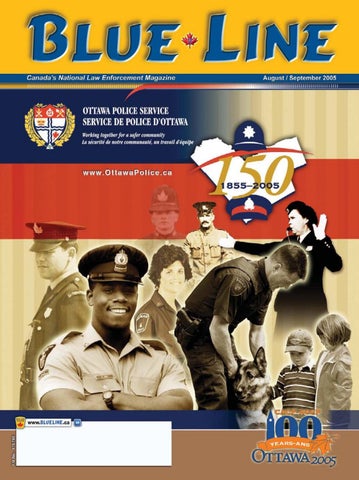
Blue Line Magazine
1
AUGUST / SEPTEMBER 2005
Blue Line Magazine
2
AUGUST / SEPTEMBER 2005
August / September 2005
Volume 17 Number 7
Blue Line Magazine
Publisher’s Commentary Ottawa’s “run-away” philosophy out of touch with 9/11 and 7/7
5
Policing in Ottawa — 150 years of service to the community
8
Building an association for the future A tribute to the vision and hard work of the founders of the CACP
13
12A-4981 Hwy 7 East Ste 254 Markham, ON L3R 1N1
Canada
Ph: 905 640-3048 Fax: 905 640-7547 Web: www.blueline.ca eMail: blueline@blueline.ca
— Publisher — Morley S. Lymburner eMail: publisher@blueline.ca
— General Manager — Mary Lymburner, M.Ed. eMail: admin@blueline.ca
— Editor — Mark Reesor eMail: editor@blueline.ca
— News Editor — Ryan Siegmund eMail: news@blueline.ca
— Advertising — Mary Lymburner Dean Clarke Bob Murray Kathryn Lymburner eMail: sales@blueline.ca
— Pre-press Production — Del Wall — Contributing Editors — Communication Skills Mark Giles Police Management James Clark Tactical Firearms Dave Brown Technology Tom Rataj Psychology Dorothy Cotton Mike Novakowski Case Law Blue Line Magazine is published monthly, September to June, by Blue Line Magazine Incorporated with a mailing address of: 12A - 4981 Hwy. 7 East, Ste. 254, Markham, Ontario, L3R 1N1. Individual magazines are $5.00 each. Subscriptions are $25.00 per year or $40.00 for 2 years. (Foreign - $50.00 U.S.) Group and bulk rates available upon request. All material submitted for publication becomes the property of Blue Line Magazine unless other arrangements have been made with the publisher prior to publishing. The authors, advisors and Publisher accept no liability whatsoever for any injuries to persons or property resulting from the application or adoption of any of the procedures, tactics or considerations presented in this magazine. Readers are cautioned and advised that articles presented herein are edited and supplied for your personal awareness and should not be used for further action until appropriate advice and guidance is received from a supervisor, Crown Attorney or other person in authority. Established in 1988, Blue Line Magazine is an independent publication designed to inform, entertain, educate and upgrade the skills of those involved in the law enforcement profession. It has no direct control from a law enforcement agency and its opinions and articles do not necessarily reflect the opinions of any government, police, or law enforcement agency. ©2005 - All articles are protected by copyright. No part of this publication may be reproduced or transmitted in any form or by any means, electronic or mechanical, including photocopying and recording or by any information storage or retrieval system without permission.
Internet activity is monitored and use or re-posting of material on the Internet is restricted.
This publication is a private venture and receives no subsidy or grant from any level of government.
CACP celebrates 100th annual conference 14 Helping cops step out in style
18
Training on a limited budget More training with less money
20
Analysis versus guesswork 24 The case for professional geographic profiling Cities plan united push on court-cost issue 28 CORRESPONDENCE
30
CASE LAW 32 • High court okays roadside procedures • “Forthwith” requires a prompt demand • Search preceding arrest lawful • Courthouse security searches permissible Feds draft CBRN strategy
42
Media strategy depends on who is involved 44 Model provides a starting point Kentville police get new station
46
ODDITORIALS
48
NEWS CLIPS
50, 58, 64, 72
Saskatoon Police honoured
51
Reconnecting with the mother force
52
Complacency a “recipe for disaster”
54
DISPATCHES
58
DEEP BLUE 59 Perfectly obvious answers not always true A first venture into a controversial issue 61 Kingston police racial profiling study What to do after using force
65
Training youth to save lives
70
TECHNOLOGY More investigative help from DNA
74
Study concludes stun technology safe
75
PRODUCT NEWS
76
BACK OF THE BOOK A tale of old Fords and fishing dories
78
— Affiliations — International Association of Law Enforcement Planners Canadian Advertising Rates & Data International Police Association The Police Leadership Forum Periodical Publishers Exchange The Canadian Press Newswire Harvey Research Printed in Canada by Tri-Tech Printing
ISSN #0847 8538 Canada Post - Canadian Publications Mail Product Sales Agreement No. 176796 Blue Line Magazine
3
It’s a year to remember for the Ottawa Police Service. Not only is it celebrating 150 years of community service – Bytown, as it was then known, was incorporated in 1855 and hired its first police chief January 22 of that year – it’s also hosting the Canadian Association of Chiefs of Police conference. The CACP marks its 100th anniversary this year. Then known as the Chief Constables Association of Canada, 50 senior police officers met for the first time in September 1905 in Toronto. Ottawa organizers promise the twin celebration will give the conference a unique flavour that delegates will remember for years. In these days of ever-shrinking budgets, officer training is often one of the first programs cut back. Costs can really add up, especially for smaller services. An Illinois police force has come up with a solution — holding regular in-house training using its own officers. Sgt. Paul LeBreck says it’s a great way to do more training with less money. In Man versus machine (Blue Line, April 2005), university professors Brent Snook and Craig Bennell and lecturer Paul J. Taylor wrote about a study they conducted which found humans did just as good a job of geographic profiling as computers. Former Vancouver Police Department Inspector Kim Rossmo, a pioneer in the field, and RCMP S/Sgt Scot Filer take issue with their findings, calling the manual approach “guesswork”. In our regular features, Mike Novakowski has four case laws, Danette Dooley reports on the RNC reconnecting with its roots and the first new station for Kentville Police, Mark Giles has a model for helping to make the right media relations decisions and Dr. Dorothy warns that sometimes the obvious answers aren’t the right ones, Elvin Klassen profiles a program that teaches youth to save lives and Tom Rataj tells us about innovative new DNA technology. For more information, news and discussions visit www.blueline.ca. AUGUST / SEPTEMBER 2005
Blue Line Magazine
4
AUGUST / SEPTEMBER 2005
Ottawa’s “run-away” philosophy out of touch with 9/11 and 7/7 by Morley Lymburner I read a story once where a person in a boat leaving a port town always managed to find his way to the same fishing hole even though he appeared not to use any navigational instruments. When asked how he managed to end up at the exact same spot he informed his inquisitor that he only needed the flag pole at the back of the boat and a clear view of the Catholic church steeple in the town. If they were aligned properly, and he ran the engine at half throttle, he would be at the right place in half an hour. His only problem arose on days that were a bit misty and he used the wrong church steeple. “You have to watch out for that Anglican church. It will steer you in the wrong direction every time.” This navigational philosophy is what came to mind as I read a semi-secret report anonymously sent me regarding a Job Hazard Analysis of Customs Regional Intelligence Officers and Customs Investigators. The report was commissioned by the CBSA through a consultancy firm from Toronto and was released to management in May 2004. Although the study appears to be well researched, and considerable work went into interviews of the officers concerned, some of the conclusions had me scratching my head. It was at this point I determined I could not exactly speed read my way through it. How could they come to the conclusion that these officers need not be armed? The study appeared to come to rationally written conclusions but yet what was troubling me was that the same philosophy could be used to disarm all police officers. I read through the surveyed officers’ concerns and they painted a scenario exactly the same as any cop on the beat would confront. And yet this study’s conclusions were completely different and at one point very contradictory to their own conclusion. When I went back over the document I realized the reason for this. It was the beginning navigational point from which the consultants started. Yes indeed they were focused on the “wrong steeple.” Their departure point was flawed so they could not help but end up at the wrong destination. But the problem appears to go deeper. They appear to have chosen the wrong departure point by design. They have arrived at the wrong destination but some master navigator has simply declared it the correct one. Their entire philosophy was geared to the Wheel of Safe Production model. This is a model also known as the “System Safety 2000” which was published in 1991 by a J. Stephenson. It is primarily used to help increase safe working conditions in an industrial environment. The Wheel of Safe Production has as its goal a work environment that has: • competent people, • using tools that are fit for the job to be performed, • coupled with suitable work methods, and • all coming together in a planned and controlled work environment. Their first erroneous departure point was Blue Line Magazine
using this as their model for safety. We aren’t talking about building refridgerators on an assembly line here. Using this model appears to be fine for the first three points but for Customs officers it fails dramatically on the fourth point. The fourth point fails so badly that it has all the appearances of being engineered to keep guns out of the hands of Custom officers. How can any rational person suggest that these officers are working in anything even remotely resembling a “controlled work environment”? Each day Customs investigators have to take up surveillance of known criminals, some with nothing much to lose except the unarmed person tailing them. But even worse. What if the criminal being tailed thinks it is the criminal competition following them? If you were a biker how would you get away from another biker gang closing in on you? Is restraint the one aspect in a criminal bikers training or experience Customs investigators can rely upon to make their “controlled work environment” safe? But the part of the study that really struck home to me were the officers working on Joint Forces Operations. Pooling talent from multiple jurisdictions is, without exception, the only way to tackle organized criminal activity. From what I read in these reports the mere fact that Customs officers are included in a JFO is a danger to everyone. In this report I read one Customs officer’s comment, completly ignored by the conclusions, that he was working with police officers who had no idea he was not armed. In this case the Customs investigator made this known just before a raid. The assuredly shocked police supervisor simply shoved a shotgun in his hands and advised him he was now armed. This supervisor was otherwise saying, “you are on this team to do the same job as I am and there is no way I am going to be
5
harnessed with having to take care of you.” Having these Customs officers working alongside police places the police and the Customs officials at high risk. Why should police have to baby sit Customs investigators because they lack the training and tools necessary to handle armed and dangerous individuals? As I continued to read this report I arrived at the point where I gave up trying to see any semblance of reason. The consultants actually recommended the officers wear body armour. Where this fits into the grand scheme of the study, while carrying a firearm was not, fell outside of any form of rationality. The mere suggestion these officers wear armour is recognizing the hazard within the environment they are working and it is anything but “planned and controlled.” This point was seriously underscored by a recent conversation I had with an Inspector from the Toronto Police who has been given the unenviable task of getting the guns off the streets of Toronto. He advised me they are open to any and all suggestions and he asked me my thoughts on the matter. I informed him that every gun being carried by every thug in his city at one point came to within eight feet of a Canada Customs officer. If you were a smuggler your options are as wide open as that border. You can lie, cheat, hide or run. Any way you look at it there is a zero deterrent factor for gun runners. The consultancy firm suggested that Customs officers need to be protected from armed individuals but they also concluded they should have no means by which they could either neutralize that threat nor prevent the armed threat from continuing to endanger the rest of the public. Post 9/11 in the US and 7/7 in the UK this is unacceptable. Tear up that report and start over folks. Look for another model. How about the “Use of Force Continuum.”
AUGUST / SEPTEMBER 2005
Blue Line Magazine
6
AUGUST / SEPTEMBER 2005
Blue Line Magazine
7
AUGUST / SEPTEMBER 2005
1855 The town of Bytown formally incorporates and adopts the name of Ottawa, and on January 22 Roderick Ross becomes the first Chief of the Ottawa Police. 1866 The police force becomes salaried – constables no longer paid a fee based on the number of arrests made or services provided.
1913 The village of Eastview incorporates as a Town. A short time after, its first Chief of Police, H.C. Prior, is appointed. 1913 December 31, Florence Campbell becomes the Ottawa Police’s first policewoman. 1916 February 3, the Parliament Buildings burn down.
1867 With a population of about 15,000 Ottawa becomes the permanent capital of the Dominion of Canada.
1920 The population of Ottawa eclipses 110,000.
1873 May 23, an Act of Parliament leads to creation of what would come to be known as the RCMP.
1927 The Ottawa Senators defeat Boston to win the team’s ninth Stanley Cup.
1889 The Ottawa Police moves into new headquarters, located on the southeast corner of Queen and Elgin Streets.
1935 One-way station-to-car radios installed in the prowler patrol cars. Two-way radios make their debut in 1941.
1896 October 1, the first bicycle used as transportation for police officers. The first “patrol wagon” appears on July 1, 1901.
1945 October 24, Detective Thomas Stoneman, age 37, shot as he attempts to question three suspicious males. He was the first Ottawaarea police officer killed in the line of duty.
1900 April 26, a terrible fire decimates much of Hull and many buildings in Ottawa. 1909 October 13, an Order-in-Council establishes the Ontario Provincial Police. As well, Janeville incorporates as the Village of Eastview (Vanier). 1912 Eastview employs a single constable, Harry Walker, to patrol the streets on a bicycle. 1912 Ottawa purchases its first patrol car, a Model T Ford. Blue Line Magazine
1946 May 20, Edna Harry becomes the Ottawa Police’s second female constable. In 1950, she becomes the first woman to wear the uniform of the Ottawa Police. 1948 December 1, the Ottawa Police Association formed to administer wage benefits. 1955 August 7, the Ottawa Police Association Credit Union Ltd. incorporated by the Ministry of Financial Institutions. 8
1957 The Gloucester-Nepean Police Department formed. 1958 June 2, City Council approves that 413 Churchill Avenue becomes Number 2 Police Station (it closed in 1983). 1960 April 1, female police officers (officially called the Ottawa Police Women Auxiliary, but better known as Meter Maids) appointed to enforce parking regulations. 1963 January 1, the Vanier Police Force formed when the community of Eastview incorporates as a City and changes its name to Vanier. 1964 January 1, the Gloucester-Nepean Police Department splits into two distinct police forces. 1967 The Ottawa Police Association Pipes and Drums formed. 1969 A collection of cities, villages and municipal townships amalgamate to form the Regional Municipality of Ottawa-Carleton. 1972 A fire destroys the Vanier Police station and all its police files. 1972 March, the forerunner to the Ottawa Police Chorus founded. 1974 Operation Identification introduced during Police Week. 1977 July 11, Constable David Kirkwood, age 21, is murdered while aiding in an arrest. His death led to the creation of the Memorial Service for Police and Correctional AUGUST / SEPTEMBER 2005
Officers who lost their lives in the performance of duty, held annually on the front lawn of the Parliament Buildings.
2001 Municipal amalgamation triggers the organization’s name change to the Ottawa Police Service. 2003 The city’s population tops 830,000.
1979 April, the Senior Officers’ Association is formed. 1981 The first Neighbourhood Watch set up in the Abbey Road area of the city.
2005 The Ottawa Police Service celebrates 150 years of policing in the Ottawa area.
1983 June 21, their Royal Highnesses, the Prince and Princess of Wales, formally open the new Elgin Street Police Headquarters. 1984 December 31, members of the Vanier Police Force sworn in as members of the Ottawa Police. 1985 The Ottawa Police introduces a new system for catching criminals: Crime Stoppers. 1988 June 22, the 9-1-1 emergency service system introduced. 1991 Population reaches 700,000 for the 11 municipalities of OttawaCarleton. 1993 March 3, current Police Headquarters renamed the Thomas G. Flanagan S.C. Building, honouring the former Chief. 1995 The Ottawa-Carleton Regional Police Service formed when three municipal agencies (Ottawa, Nepean and Gloucester) and areas formerly under the jurisdiction of the Ontario Provincial Police amalgamate into a single police service. Blue Line Magazine
9
AUGUST / SEPTEMBER 2005
Preparing for the future
The 150th anniversary celebrations are an excellent way to showcase how the Ottawa Police Service is preparing for the future through its recruitment efforts. A recent graduation ceremony underscored this initiative when the police service welcomed Cst. Jasdeep Singh Bajwa — he is the first turbaned-Sikh to join the ranks. Celebrating the past also provides the right platform for preparing for the future. Many of the police service’s 150th anniversary celebration activities have focussed on or included messages about the organization’s quest to be the “Employer of Choice for All.” Like most sectors, law enforcement is facing a recruitment challenge. Over the next decade, the Ottawa Police Service — like other police agencies across the country — will face a huge turnover in staff and an increasingly competitive job market. Consider that over 200 sworn members have retired from the Ottawa Police in the last five years, and double that amount will likely retire in the next five years. The need for new sworn officers is clear. At the same time, the City of Ottawa is growing and changing. Over the next 10 to 20 years, the city’s population will push past the one million mark and possibly reach 1.2 million. The city is also becoming more multi-cultural. One in five residents of the city is born outside of Canada, and the immigrant population is growing at twice the rate of the general population. The Ottawa Police Service recognizes the need to better reflect — and thus be able to better serve — Ottawa’s increasingly diverse communities. “We would not be a legitimate police organization unless we had the capacity to communicate with and understand the diverse population that call Ottawa home,” says Chief Vince Bevan. “If we can’t communicate with Blue Line Magazine
the victims, who is going to investigate crimes committed against them? And if we can’t penetrate organized crime because we can’t speak the language and don’t understand the culture, who’s going to halt its spread?” The Ottawa Police Service’s response to these interconnected issues involves a proactive strategy to promote careers in policing in the Ottawa area that focuses on reaching out to members of the community who traditionally may not have considered a policing career. The organization’s Outreach Recruitment Project aims to diversify the Ottawa Police workforce and grow its in-house cultural skills and lifestyle awareness. It is a major step towards achieving the police service envisioned by Sir Robert Peel when he prescribed that police services should be representative of the communities they serve. In Ottawa, the Police Service’s 150th anniversary celebrations are helping spread the recruitment message. The annual open house, special community events and activities and the extensive media coverage help present a favourable image, and help the organization connect with a wider audience.
10
150 years of service to the community Throughout 2005, the Ottawa Police Service is celebrating the 150th anniversary of policing in the Ottawa area. The year features a wide variety of events and activities to enhance the community’s knowledge of the history of policing and its contribution to the quality of life in Ottawa. While catching criminals or enforcing laws is most often in the spotlight for any law enforcement agency, the Ottawa Police’s 150th anniversary celebrations offers a unique opportunity to increase awareness about the city’s rich — and sometimes quirky — policing past. For example, did you know… • on February 29, 1880, the entire Ottawa Police Force was disbanded on the charge of insubordination; • the famed Grey Cup was once recovered in Ottawa after being stolen in Toronto; • in 1882, Ottawa’s Chief of Police left the organization to become the Superintendent of the Dominion Police — the forerunner to the RCMP; • the father of hockey legend Aurele Joliat was Chief of the Ottawa Police in the 30s; and • on February 4, 1953 a Grand Jury inspected Number 1 Police Station and reported the conditions of the station as ‘disgusting’ and should be closed immediately. This led to the headquarters being moved to 60 Waller in 1957. The high-profile, year-long focus on the Police Service also provides the opportunity to reinforce many other important police messages around traffic safety, crime prevention and recruiting — among the other priorities for the organization. Equally important, the Ottawa Police Service’s celebration includes a charitable component. A portion of funds raised through sponsorships, sales of promotional items and special fundraising events will be donated to the Boys and Girls Club to help it continue to engage at-risk kids in prosocial activities. The celebrations officially kicked-off on January 21, 2005 — 150 years after the City of Ottawa’s first Chief Constable, Roderick Ross, was appointed. With the accompanying slogan “Our past, our future,” the celebrations have been a hit. A full list of events and activities is posted on the organization’s website at ottawapolice.ca.
AUGUST / SEPTEMBER 2005
Electronic ticketing Ottawa Police streamline ticketing with technology and respond to community priorities
Photo by Michael Houston
In 1961 a policewoman giving a ticket.
Cst. David Nicholson, E-Ticketing Project Constable, presents the Symbol MC-50 PDA and Zebra RW-420 Mobile Thermal Printer.
by S/Sgt. Rock Lavigne For decades, law enforcement agencies have been issuing traffic tickets using the same paper-intensive, highly manual procedure. This has led to frustration for stakeholders due to the challenge of collecting timely and accurate data from traffic tickets. Manually collected data has historically contained errors of content and omission – smudges or poor handwriting on the ticket can potentially lead to lack of data collected or tickets that are not prosecuted. This problem is now compounded by the need for multiple layers of identical data entry into the Police, Courts and ICON systems. These experiences summarize just a few of the business drivers that have led the Ottawa Police Service (OPS) to consider an innovative solution known as Electronic Ticketing. The benefits of this system are overwhelming: it provides a streamlined solution to a paperintensive process; responds to the community’s priority for increased traffic and road safety; increases the call for accountability and ongoing budgetary constraints; and enhances delivery of its core responsibilities through
technological advances. “What’s great about this system is that it’s quicker, it’s easier and it meets all the needs of the City, the judiciary and the ministry,” said Michael Parsche, Project Manager for the ETicketing project. “This system benefits all users – officers and drivers spend less time at the side of the road, there’s no duplication of data entry, and we can get more accurate and enhanced ticket information to respond to our city’s traffic issues.” The OPS, leveraging its present technology investment in the new Panasonic CF-29 laptops, is deploying magnetic stripe readers and the Advance Public Safety ticket application to the patrol cruisers. As for the 30 traffic motorcycles, the OPS is equipping its officers with Symbol, MC-50 handheld computers capable of reading magnetic stripes and 1D barcode. Both streams will be printing to a wireless Zebra RW420 thermal printer. This new technology will permit electronic transmission of the ticket data to in-house records systems. The next phase, early in 2006, will focus
on building an electronic bridge between the OPS and the Municipal Courts, which will enable transfer of the issued ticket data to Courts and the Provincial ICON system for payment or prosecution and disposition. For more information about the E-Ticketing project, please contact S/Sgt. Rock Lavigne, Operational Project Manager, E-Ticketing at (613) 236-1222 ext. 5111. At roll call one morning, the officer in charge of the Ottawa parking-meter patrol announced the police were searching for three stolen vehicles. On duty later a patrol member called his dispatcher to say he had spotted one of the cars. He was immediatley patched into the police frequency. The police asked him to keep it in sight until they could get to him. Five minutes passed before police called back to see if he still had the vehicle in sight. “Yes,” he replied, “it’s now at the corner of Bank and Queen streets.” After another five minutes they called again. “It’s now seven blocks east of Bank and Queen streets,” he reported. Ten minutes later the police asked if he was keeping a safe distance from the car so that the driver wouldn’t notice he was being followed. “Yes,” he panted breathlessly, “but I don’t know how much longer I can keep this up.” That’s when the police realized he’d been chasing the car on foot!
Our past, our future – a look at how we got here… The Ottawa Police Service 150th anniversary logo’s main influence is the celebration’s accompanying slogan “Our past, our future – Celebrating 150 years of policing in Ottawa.” Many people were consulted throughout the design process, including current and retired members representing the six police services being honoured by our 150th anniversary: the former Ottawa, Vanier, Nepean, Gloucester police services, as well as the OPP and RCMP. At the top of the logo is an officer’s hat from the early days of policing in Ottawa, with Blue Line Magazine
11
a modern-style forage cap at the bottom, showing a clear transition from the past to the present. Emphasis is on “community” and “continuity.” Colours include police blue and gold to indicate something of value and to connote the idea of heritage. The red colour reflects Canada and is also a nod to policing’s British roots in Ottawa in 1855. The red line connotes movement, forward motion and progress from past to present to future. Also, the shape of the logo represents the contours of the Ottawa region. AUGUST / SEPTEMBER 2005
Public safety communicators: an inside look by Eric Janus I began training for my new position at the Ottawa Police Service’s (OPS) comm centre on a momentous day – Sept. 11, 2001. As one of six newly appointed shift managers – the service had ‘civilianized’ the sergeant’s position – I watched the events in New York with disbelief and got my first taste of what it would be like working for a major police service. My career in public safety communications began across the river with the Gatineau-Metro Police Service. It had 17 full-time communicators, supplemented by part-time employees. We dispatched police and fire vehicles and, like many comm centres, took calls outside business hours for the city, public works, SPCA and pretty much anything else you could think of. We were also the CPIC section, tasked with doing all the entries and normal day-to-day queries and correspondence. I’ve worked in a variety of public safety
environments – part-time in a rural department, alone on 12 hours shifts; in a mid-sized centre with two to four communicators per shift; now I’m responsible for a platoon of 16 in a section of 103 communicators. No matter the size of the centre though, the issues are the same – staff grumble about overtime, people taking too many breaks, even when no one does the dishes. Problems are proportionate to size. I’ve dealt with more issues in one year working in Ottawa than my supervirors handled during the entire period I was employed in Gatineau. Another factor proportionate to size is resources. When the CAD system fails at 4 AM in a small department, you are the IT section. There’s no tactical unit if you get a barricaded subject. Today I have multiple tactical, canine and other specialty units – even an airplane. Working in Ottawa also has its unique challenges. Major events tend to have an additional component in the nation’s capital. People are generally more aware of world events since 9/ 11. Everyone interprets and implements orders
Police cooperate in Ottawa region The National Capital changes and/or seRegion’s unique condments of ofinterjurisdictional ficers between policing environOPS and the ment includes the OtRCMP, implementawa, Gatineau, Militation of an 800 tary and Ontario ProMHz digital radio vincial Police, MRC system, developdes Collines, Sûreté ment and impledu Québec and mentation of a RCMP. The Ottawa tiered response Police Service (OPS) protocol and the reis using the occasion cently formed Naof its 150th anniver- Photo : Shy Ing tional Capital Strasary to demonstrate tegic Security Ottawa Police Director General Debra Frazer, IT Aphow it works with plications manager Baby Kotlarewsky and Chief Council. other police agencies Vince Bevan browse the integrated records system. A new level of and publicize its goal information sharof becoming the leader and model for policing began when the OPS collaborated with ing partnerships and integration. the London and Windsor police services, who Municipal police services are rapidly use the same records management system, on changing; dynamic organizations must adapt the Law Enforcement Information Portal to community needs while staying within the (LEIP). parameters of strict federal and provincial legThe London Police Service spearheaded islation. The OPS also faces the unique chalthe project and currently hosts and maintains lenge of policing the nation’s capital – an inthe server. By the end of 2003, the three agenter-jurisdictional policing environment with cies were sharing records, assisting in investispecific public safety and security concerns gations. The Toronto Police Service came on such as the Parliament buildings and embasboard a few months later and the Ontario syssies. This environment presents both chaltem was connected with BC in August 2004. lenges – planned and unanticipated major The RCMP has been keenly involved from day events – and opportunities – intelligence gathone, providing input, network resources and ering/sharing and inter-operability. support. Shining examples of the mobilization of The project may soon welcome the OPP, community resources and joint problem solvKingston Police Service and Montreal Police. ing were seen during such events as the G-8 Nova Scotia is planning a similar system and and G-20 demonstrations, the ice storm, les prospects for national expansion of the project Jeux de la Francophonie and 9/11. Other are excellent. The OPS is a proud partner in this interoperability successes include the creaand other integration opportunities and will contion of an integrated road safety plan, extinue its philosophy of working with others. Blue Line Magazine
12
and policies differently and internal communications have turned out to be one of the biggest challenges I have to deal with daily. Life is a lot simpler in a smaller department. Issues can be resolved in a day by meeting with one or two people. In a major service, there’s the challenge of multiple sections and divisions, all with their own dynamics and styles. Another change was Ontario’s ‘adequacy standards.’ They specify the training that uniformed and civilian members must receive and precisely state how a service must operate. I also heard the word “corporate” so many times in my first few weeks that I felt I had been hired by a private firm rather than by a police service – it seemed strange for a police service to have an actual business plan, but now all Ontario services must have one. We are approaching a crossroad in public safety communications. Most managers, born before ‘Generation X,’ may find it challenging to deal with the high expectations of ‘Gen Y.’ Senior members often recall being told to sit down, shut up and listen when they began their careers, and treated like dirt until they earned the respect of their peers. Communicators with bachelors and masters degrees will expect a certain level of expertise and professionalism from their organization and management team. We must promote life long learning at all levels, ensuring frontline managers have upto-date skills. Tuition reimbursement, already offered by many agencies, is a great way to promote learning; by supporting and training them, we are preparing our future leaders. Another thing I’ve often heard through the years is that generally, communicators should be treated like police officers. Many options are available for civilian members and, unlike officers, they’re not limited to only a few agencies and can find work in the same geographical area within emergency services. Comm centres often attract people from all kinds of backgrounds and if they’re unable to achieve corporate buy-in, they will leave. Uniformed and civilian members are two different animals and must be approached in a different way. Qualified, educated members can be retained by creating and encouraging modern business practices. Gone are the days of staying in one job for life. Today qualified members are considered a valuable commodity. Public safety communications is now a career; communicators are professionals and should be treated as such. The expectations placed on them are greater now than ever. Communication centres are the first contact for the majority of emergency calls and the actions or inactions of the communicators play a vital role in how incidents are handled and resolved. With professionalism comes responsibility. Members need to be trained and mentored so they can become skilled emergency response personnel – but they also need to be willing to improve themselves and accept ever-changing roles. Eric Janus can be contacted at Januse@ottawapolice.ca AUGUST / SEPTEMBER 2005
Building an Association for the future A tribute to the vision and hard work of the founders of the CACP
by Kathryn Lymburner In September 1905, the Chief Constables Association of Canada (CCAC) or the Canadian Association of Chiefs of Police (CACP) as it is known today, met for the first time in Toronto. Fifty senior police officials gathered to foster closer ties among police departments, encourage uniformed police administration, improve conditions of service and promote legislation for the suppression of crime and preservation of law and order. The association grew out of the absence of a centralized police system due to the division of powers in the British North America Act, 1867. The formation of the CCAC allowed for municipal police to articulate their concerns in a national forum. Not much has changed since then. The size of the association has grown to a combined membership of 913, 315 of these as active members, and represents more than 90 per cent of the Canadian policing community. Most of the Chiefs at this first meeting were from Ontario, and the only surviving record of the meeting is a photo taken by Philip Holland, the publisher of the American journal “The Detective.” At the first meeting, the CCAC’s five man executive represented the Dominion Police and municipal departments of Quebec, Westmount, Guelph and Winnipeg. The President was Chief Constable Lieutenant-Colonel Henry J Grasett of Toronto and Chief Oliver Campeau of Montreal was elected vice-president. The group’s first lobbying effort was to seek a province-wide pension system for disabled and retired Ontario police officers. Throughout the history of the CACP there have been four themes that remain at the heart of public debates over policing: technological change, relationship between politics and law enforcement, practical criminology and search for professionalism. Blue Line Magazine
The creation of the CCAC was sparked by the need to scientifically collect, store and disseminate information on the criminal class. Members were able to exchange fingerprints, photographs, bulletins and modus operandi, which were important for not only crime control, but also standardized policing. This need for shared information led to the development of the fingerprinting movement in Canada. In the 1960s, the CACP inaugurated the Uniform Crime Reporting System and members were also instrumental in the creation of CPIC. The relationship between the government and law enforcement in 1905 was another rallying point for the CCAC. The government was seen as being insensitive to police needs. Some central political questions have been around police governance and accountability and police response to radical groups such as Industrial Workers of the World and the Communist Party of Canada. Practical criminology has taken up the majority of CACP papers, publication and committee work over the century. The CACP reacted to major criminal-justice developments such as the Juvenile Delinquents Act, the creation of provincial court systems, the rise of Crown prosecutors, probation, parole, ticket of leave, firearms control, section 98 of the Criminal Code, the rise of the defense bar and legal aid, the creation of the National Parole Board, the ending of status offences by the Young Offenders Act, the abolition of capital punishment and the regulations for wire-tapping. Efforts in these areas has included passing resolutions at conventions, sending delegations to interview the Minister of Justice and other MPs in hopes of blocking amendments to the Criminal Code and other statutes. The fourth theme seen through out the CACP’s history is the search for professionalism and has encapsulated both the public and self-image of the law enforcement industry. The 13
association has always taken this to be at the forefront of its lobby group. Police executives have always tried to elevate the status of the police through improvements in recruitment, training, discipline, salaries, working conditions and publication relations. With the founding of a secretariat in the early 1970s and an increase in the scope of committee work and establishment of a research foundation in the early 1980s, research has become central to the development of police professionalism. The Great War era, from 1914 to 1918, which cemented the need for the CCAC, is considered the most challenging time for the association. With the onset of war, it fell to police to regulate enemy aliens, guard against sabotage and espionage, enforce war-related legislation governing liquor, venereal disease and military conscription and act as mediators in a difficult industrial-relations climate. War industries, harbour facilities, railways, and utilities also required extra vigilant monitoring. As responsibilities for the police increased, many officers were lost to the armed forces or even to better paying civilian employment. The situation got so difficult that by the end of the Great War administrators and authorities were then faced with a militant police union movement. The increase in tasks were beneficial to the CCAC’s membership, by 1917, 445 members were registered. Half were from Ontario and less than one-third were from the west. It was also during this year that the designation “Life Member” was first given to any member of five years’ standing and twenty years in law enforcement. The first 15 years of the CACP were trying. The issues dealt with were technical, political and profound. Today much credit must be given to the early pioneers who built the foundations of the current CACP. AUGUST / SEPTEMBER 2005
CACP celebrates its 100th annual conference “Building on Traditions” by Insp. John Copeland The 100th anniversary of the Canadian Association of Chiefs of Police conference is to take place in Ottawa this year, from the 21st to the 24th of August. Chief Vince Bevan and the Ottawa Police Service are proud to be hosting this event and invite you to join them in celebrating not only CACP’s milestone, but also their 150th anniversary of providing professional policing services to the City of Ottawa. This twin celebration will give the 2005 conference a unique flavour that delegates will remember for years to come. This year’s CACP Conference will challenge its delegates to examine their organizations and allow them to focus on some of the most pressing issues facing today’s policing executives. The professional program will highlight three contemporary issues including police misconduct, a recent case study involving a Police Chief and his service under fire, and a panel discussion on issues of national security. The conference will feature several highprofile participants speaking on topics that are relevant to the current Canadian policing environment. Deputy Chief Michael Berkow of the Los Angeles Police Department’s Profes-
Blue Line Magazine
sional Standards Section will be on hand to recount his experiences and share his expertise. Also taking part will be Chief Constable Jamie Graham of the Vancouver Police Service. He will speak about his experiences from the past year as his organization received criticism from the media. He will be followed by Mr. Jim Vance of the Federal Bureau of Investigation, a world-renown expert in supporting and advising organizations facing public and media scrutiny. In addition to our featured speakers, an exciting panel has been assembled for a lively discussion on issues of national security. RCMP Commissioner Giuliano Zaccardelli, David Harris, president of Insignis Strategic Research and former Chief of Strategic Planning for the Canadian Security Intelligence Service and Professor Martin Rudner from Carleton University will participate in a heated panel discussion facilitated by Larry O’Brien, founder and chairman of Calian Technologies. The conference trade show promises to be a highlight of our event. Situated inside the world-class Ottawa Congress Centre, it will
14
feature exhibitors showcasing the latest technology and products available to policing organizations. Anyone attending the conference should not miss the opportunity to mingle with representatives from CACP’s sponsoring partners, and to explore all the latest offerings from the business and supply communities. Running concurrently with the conference will be a number of social gatherings and family events. We are proud to present the Gala Awards Dinner at the Canadian Museum of Civilization’s Grand Hall. In celebration of the 100th anniversary of the Canadian Association of Chiefs of Police Conference, we are proud to host this event in Gatineau, Quebec, on the banks of the Ottawa River. The extraordinary atmosphere of the internationally respected Museum of Civilization is sure to create lasting memories for all who attend. We look forward to hosting the CACP’s 100th conference in Ottawa in the same year the city celebrates 150 years of policing. For more information on this exciting historical event, visit www.cacpconference.ca .
AUGUST / SEPTEMBER 2005
Blue Line advertisers at the 2005 Trade Show Canadian Association of Chiefs of Police Atlantic Police & Security Supply See advertisement page 14 Atlantic Police & Security Supply is continuing its growth throughout the Canadian market with some of the most innovative products in Law Enforcement. Innovation is not normally associated with clothing, but Atlantic’s line of Elbeco garments are breaking the rules. Elbeco has grown to be the Premier Manufacturer of uniform shirts, trousers, outerwear and base layer underwear for Law Enforcement, SWAT, K9 and Security personnel. With the introductions of the Prestige Advance poly/wool, the U F/X base layers and the new Tactical Twill BDU garments, Elbeco has maintained its commitment to providing uniforms with best-in-class performance and outstanding value. Atlantic Police is a national distributor offering a complete line-up of Law Enforcement products including uniforms, duty gear, outerwear and fleet equipment.
tions are well thought out, custom-fit to every application and fully guaranteed. We also carry equipment consoles, vehicle partitions, sirens, helmets, speed reader boards, custom-made canine containment units, window bars, car alarms, gun lock boxes and firearm racks.
Athabasca University See advertisement page 67 Athabasca University, Canada’s leading distance education and online university, serves 30,000 students each year. Since its founding by the Government of Alberta in 1970, AU has delivered individual courses and programs to 200,000 students. In 1994, Athabasca University’s Centre for Innovative Management logged on with the world’s first fully interactive online Executive MBA program. Today, the AU MBA is Canada’s largest Executive MBA program, and one of the most respected MBA programs in the world. AU’s Executive MBA was ranked one of the “Top EMBAs in the world” in 2003 and 2004 by the Financial Times (U.K.).
Canada Law Book See advertisement page 18 As one of Canada’s foremost legal publisher for 150 years, Canada Law Book has established itself as an industry leader, publishing some of the finest legal resources available. Our continued commitment to excellence helps to ensure you meet your law enforcement responsibilities both knowledgeably and confidently every day. Enlist Martin’s Annual Criminal Code – Police Edition, Police Legal Access System (PLAS) on CD-ROM, Admissibility of Statements, Police Edition 2004 and Sentencing Drug Offenders, as your ammunition to making a difference in the line of duty. Our word is the law.
Blue Line Magazine Blue Line Magazine is Canada’s independent national law enforcement publication. Blue Line News Week is Canada’s weekly law enforcement executive digest while Blue Line Trade Show and Blue Line Online compliment the two publications with discussion forums, training courses and exhibits. BlueMax Lighting & Emergency See advertisement page 72 Blue Max Lighting & Emergency Equipment Ltd. was established in 1990 to provide a better alternative to the existing products and services available to law enforcement and emergency agencies. Blue Max is proud to offer TOMAR Electronics emergency equipment. Setting the industry standard in performance with its patented Neobe and LED technology, TOMAR is the most visible and reliable lighting and emergency equipment available in the market. Our professional technicians provide the best equipment installation in the business. From unmarked cars to fullyequipped highway interceptors, our installaBlue Line Magazine
BMW Authority Motorcycles See advertisement page 53 BMW will be presenting some of our models which have many applications including police, paramedic, rescue work and other patrol duties. BMW Authority Motorcycles offer superior performance, safety, and low cost of maintenance. In addition to some of the many standard features like ABS, dual batteries, heated grips, adjustable electric windshield, and variable-height rider’s seat, you can also custom order specialized options such as sirens and front and rear flashing light systems in red or blue.
CPKN See advertisement page 31 The Canadian Police Knowledge Network (CPKN) is a not-for-profit collaborative network that identifies the needs and coordinates the development of e-learning products for the Canadian police community. Within this network, police organizations provide the content and CPKN provides the resources and expertise to develop and deliver the e-learning products. This collaborative process ensures the training needs of the Canadian police community are satisfied with high quality, interactive and cost-effective products. Some of the e-learning courses currently offered at CPKN include: • CBRN: First Responder • Clandestine Methamphetamine Lab • Domestic Violence Investigations • Ethics, Values and Principles • Hate and Bias Crime • Investigative Communications • Managing Workplace Harassment • Missing Child First Responder • National Sex Offender Registry • Niche Records Management System 15
DaimlerChrysler See advertising insert DaimlerChrysler now has the most impressive product range and the most valuable brands in the automotive industry. Backed by strong research and development, these brands will be at the cutting edge of technology in their respective segment, offering our customers the best there is in terms of innovation, design, safety, quality, service and the sheer enjoyment of owning one of our products. Dataradio See advertisement News Week Dataradio provides state-of-the-art 43.2 Kb/s private networks that are compatible with the major suppliers of dispatch software, workstations and associated products. When less secure and less robust networks overload or simply don’t cover the required territory, your Dataradio private network will continue to perform because we designed it according to your needs. Once deployed you control your network’s operation, maintenance and evolution. davTECH Analytical Services See advertisement page 50 davTECH Analytical Services (Canada) Inc has positioned itself to become a leader in Traffic Safety Products and Solutions throughout Canada. Our product line of Radar, LIDAR, Emergency LED Lighting, Accident Investigation Software, Traffic Analysis Equipment, Alcohol Breath Testing Instruments, Drugs of Abuse Testing and all related peripherals enable us to supply the sale while also providing authorized technical support for all our lines. davTECH is an authorized distributor for Decatur Electronics, Laser Atlanta, Intoximeters, NPAS, Visual Statement, Eluminator Lighting, Metro Count, Medtox and Cozart Bioscience to name a few. DriveWise See advertisement page 39 DriveWise is Canada’s first turnkey driver education company incorporating high fidelity virtual reality driver simulation in all its programs. Our solutions are custom designed for Emergency Vehicle Operations, fleet, and beginner education clients. DriveWise employs blended learning environments (classroom, simulation and in vehicle where required) to offer the most advanced driver education on the market today. Our simulator provided by the world’s largest provider L3 Communications features three visual display channels, full instrumentation, 3D road surface models, multiple visual databases and variable traffic density and weather. Come visit our booth and experience our virtual reality environment for yourself! AUGUST / SEPTEMBER 2005
Federal Signal See advertisement page 63 Law enforcement has unique needs when it comes to warning the public of emergency situations. Police officers are challenged more every day as they seek a safe path through heavy traffic with increasingly distracted motorists. To help meet this challenge we brought together the finest engineers, distributors, and field and customer support people to create a specialized Police Products Group. Our job is to serve you every day - and keep Federal Signal the number one name in emergency products. Gordon Contract See advertisement page 46 Gordon Contract, Canada’s foremost supplier of uniform and safety footwear now carries a full line of Law Enforcement Supplies including uniforms, nylon belts and accessories, flashlights, cuffs and ancillary items. We carry virtually every major footwear and many of the law enforcement brands that you need. Visit us online at www.gordoncontract or at either one our three Toronto locations or our Winnipeg store. We pride ourselves on our service and dedication to the Police, Fire, Security Guard and EMS personnel that we serve. We look forward to serving you too. Infrared Technologies Canada See advertisement page 66 Infrared Technologies Canada, a division of the Triton Marine Group, evolved from the Infrared Technology offered by Texas Instruments in the early 1990s, when the first commercial pan and tilt cameras were sent for installation and use on marine search and rescue vessels operating from the port of Vancouver. Since that time, Infrared Technologies Canada has grown and now provides infrared products for a wide variety of applications, including handheld, mobile, fixed, aerial and remote thermal imaging cameras and systems. With a wide range of customers now established, infrared technology has reached areas such as law enforcement, marine, industrial maintenance, process control, security, surveillance, driver safety, wildlife management, rail, fire and rescue, research and medical applications. Many of our customers include police agencies, coast guard, petroleum industry, security companies, industrial manufacturing, universities and manufacturers using OEM products, where the use of infrared technology has moved the technological bar to the next level no matter the application. The growth of Infrared Technologies Canada, is attributed to our state-of-the-art infrared products, our outstanding reputation and excellent customer support. Our goal is to assist our clients in solving their problems, improving their existing systems and providing new solutions to an ever-changing environment. Infrared Technologies Canada is the exclusive Canadian and Asia/Australasia distributor for Infrared, Inc., Reno, Nevada. Blue Line Magazine
Integral Designs See advertisement page 34 Integral Designs is a niche manufacturer of specialized outdoor products including: Sleeping systems: primaloft and down sleeping bags, liners, bivy sacks Shelter systems: single wall tents, bivy shelters, ultra light tarps and tarp shelter Clothing systems: custom outerwear, primaloft insulated clothing, vapour barrier socks. The company started business in 1986 making equipment for some of North America’s top mountaineers, and still has its roots firmly in the mountaineering and lightweight backpacking markets. Specialized military and law enforcement personnel have equipment needs very similar to those of mountaineers, and are discovering that the lightweight, high performance fabrics and insulations used by Integral Designs can help them to do their jobs better. Integral Designs specializes in small production runs and “just in time” manufacturing at its Calgary factory. More than 50% of production is sold to outdoor stores and specialized military groups in the USA. Leupold Canada See advertisement page 2 America’s Optics Authority, is a familyowned, fourth-generation company that manufactures the world’s most rugged, waterproof, accurate and dependable tactical optics and riflescope mounting systems. The newly expanded line of Leupold Mark 4 optics is mission specific and includes Long Range/Tactical, Mid Range/Tactical, Close Quarter/Tactical and Precision Rifle riflescopes. First Responders know Leupold products perform when needed, after all, we build them like our lives are on the line, because we know yours is. Martin & Levesque/Blauer See advertisement page 37 Uniform shirts and pants including uniforms with stretch fabric, sweaters in acrylic and poly wool with Windstopper or HI-VIS liners, fleece jackets and vests, reversible rainwear, over pants with scotchlight options. Outer Wear including jackets with Gore-Tex or Crosstech NFPA 1999 (03) certifications and 3 Year Warranty. Reversible jackets and HIVIS Yellow jackets with CSA scotchlight package. All Season and 4 in one jacket combinations (outer shell, bomber/vest fleece liners) and new for 2005 the OPP All Season Jacket. Best quality garments on the market. M D Charlton Co Ltd See advertisement page 4 M D Charlton has been providing a wide range of top quality equipment to Canadian law enforcement agencies and security companies for the past 25 years. Featured will be Wiley X Eyewear, Streamlight flashlights, Original SWAT boots, ASP expandable batons and their NEW tactical handcuffs, Hatch gloves, Hiatt handcuffs, and our custom leather/nylon accessories. We will also be displaying our new Laser Devices Inc. tactical weapon mounted lighting systems and Salient search tools. 16
Mega-Technical See advertisement page 55 Mega-Tech is pleased to offer to our customers a full line of quality products and factory trained technicians. Our new Eastern Regional office allows us to better serve you from two full service facilities. In many cases the products we offer are recognized as industry standards that offer the very best in quality and customer support. Motorola Biometric Solutions See advertisement page 29 Motorola’s Biometric Solutions are designed to help save time and increase accuracy in the identification, processing and management of individuals by agencies including police, criminal identification, jails and prisons, booking centers, and civil identification agencies. The Automated Fingerprint Identification System (AFIS), a proven identification tool developed and used by law enforcement agencies, has expanded to include palmprint capabilities to help in the identification of individuals. The palmprint verification capability found in the Motorola Printrak Biometric Identification Solution (BIS) is made possible with AFIS innovations including faster match processors, enhanced matching algorithms, and the ability to store, search and retrieve the right information from right database at the right time. Opus/Marketex Apparel See advertisement page 51 “We’ve got you covered!” Opus Brand uniform is foremost in the uniform trade; synonymous with high quality apparel. Opus Brand specializes in durable fabric for the demanding uniform industry. Emphasis on stress points and colour fastening give our garments a long life of service to you our customer. Opus Brand garments are built to be rugged and tough without compromising comfort. Pacific Safety Products See advertisement page 73 Pacific Safety Products Inc, manufacturer of the PROTECTED BY PSP line of soft body armour, is Canada’s leading provider of protective vests to law enforcement, military and public safety personnel. Founded in 1984 PSP been bringing everyday heroes home safely for 20 years, and has grown to include more than 130 employees at three Canadian facilities in Kelowna, British Columbia; Brampton, Ontario; and Arnprior, Ontario. These facilities are equipped with complete design, production and research capabilities, and the head office in Kelowna PSP houses one of the most advanced ballistic research labs in North America. Panasonic Canada Inc See advertisement page 27 Panasonic has deployed over 25,000 rugged notebook computers into law enforcement organizations throughout North America. Our top of the line CF-29 Toughbook can be found in many public safety organizations throughout the US and Canada. Panasonic offers a full range of rugged notebooks suited for the public safety market including the CF-29 and our newest model the CF-50. For more information on the Toughbook lineup, drop by our booth. AUGUST / SEPTEMBER 2005
Blue Line Magazine
17
AUGUST / SEPTEMBER 2005
priMED: QuikClot See advertisement page 38 Founded by a group of entrepreneurs in 1995, PrimeLine Medical Products Inc. manufactures disposable medical products for infection prevention and control. Products include protective apparel, wound care, face masks, gloves, OR drapes and gowns, industrial products, and custom products. priMED products are available throughout Canada and internationally through medical distribution centers. PrimeLine Medical Products is an ISO 13485:1996 registered company. PrimeLine Medical Products Inc. has become the sole distributor for QuikClot in the Canadian market. QuikClot has received both FDA approval and Health Canada clearance. QuikClot almost instantaneously stops massive bleeding from traumatic injury and represents a whole new approach to hemostatis, or techniques for stopping the flow of blood. QuikClot can be easily applied by military, police, fire, rescue and other non-medical personnel who are the first on the scene of an accident to enable them to treat victims of bleeding injuries. It’s all about saving lives! R. Nicholls Distributors See advertisement page 35 For 25 years R. Nicholls Distributors has been committed to the Canadian law enforcement market by supplying organizations and public safety agencies with equipment and uniform products. Nicholls is focused on continu-
ous improvement, aimed at providing our customers with top notch service and quality products. Nicholls carries the finest product lines from the leading manufacturers in the United States, Europe and Canada. We also manufacture our own products under the names of Traditions 4, Rapier, Armor of America and SWAT, and are proud to offer quality products, designed specifically for the Canadian market. Second Chance Body Armor See advertisement page 19 Second Chance Body Armor is featuring the new Ultima Level II soft body armor, 37% lighter than previous technology, wrapped in Gore-Tex Comfort Cool pad covers. Lightest, thinnest, most comfortable Second Chance vest. New Second Chance Ballistic Helmets and Shields, featuring revolutionary, lightweight ballistic technology. Sierra Systems See advertisement page 45 Since 1966, Sierra Systems has been providing Solutions Delivery, Business Consulting, and Managed Services expertise to help our clients achieve measurable, long-term results from their IT investments. Our mission is to improve the operational performance of our clients by delivering superior information technology and business consulting services. By making client success our focus, we provide a dynamic environment for our 800+ staff and long-term value to our clients. By concentrating on our core industries - Justice, Health,
Government – each of our 15 locations across North America continues to win exciting engagements in the face of stiff competition. Telus Mobility See advertisement page 25 Telus Mobility is leading the way in mission critical communications for Canada’s public sector. We provide anywhere, anytime emergency voice and data communications across national and international digital networks. In any crisis situation Telus provides: enhanced communications coverage; ready-to go-emergency radio handset inventories; voice interoperability between department and jurisdictions, as well as priority emergency communication; and on-demand satellite imagery, asset tracking and crisis management systems anywhere in Canada. xwave See advertisement page 48 xwave’s Computer Aided Dispatch (xwaveCAD) is a modern dispatch solution that takes an integrated approach to dispatching police, fire and ambulance services. xwaveCAD tightly integrates radio interfaces, mapping, police mobile workstations, handheld devices, GPS/AVL, fire hall alerting, paging systems, E911 ANI/ALI, inter-jurisdictional messaging, and state and local databases into a unique graphical desktop designed to enhance dispatching. The xwave suite of products also includes the Remote Office and Dispatch System (ROADS) police in-car mobile application and the OnPatrol police application for the BlackBerry Wireless Handheld. Zoll Canada See advertisement page 43 According to the American Heart Association, portable automated defibrillation has the potential to be the single greatest advance in the treatment of ventricular fibrillation cardiac arrest since the invention of CPR. Zoll’s AED Plus with instantaneous CPR feedback, designed specifically for non-medical professionals, is the only public access defibrillator available today that coaches rescuers through all steps of the American Heart Association’s Chain of Survival. It provides vital visual and audio cues to ensure effective defibrillation and CPR technique to help achieve the recommended depth and rate of chest compressions. Defibrillation combined with better CPR technique means a better chance of saving a life.
Blue Line Magazine
18
AUGUST / SEPTEMBER 2005
Helping cops step out in style by Ryan Siegmund Danny Trudeau, long time supplier of footwear to Canada’s law enforcement community, died in April of prostate cancer at the age of 73. He leaves behind a legacy of lasting love, friendships, and “damn comfortable boots.” Known as a very devoted husband and father, Danny will be remembered by police as an honest salesman who provided excellent products and wonderful memories. Born Daniel Raymond Trudeau on January 28, 1933 in Britt, Ontario, he was married to Shirley and together they had two children Dan and Peggy. Along with their spouses, Carol and Denny, they presented Danny with four grandchildren, Nicole, Kaithlyn, Tyler and Bailey. Shirley advised that their’s is a true love story. She and Danny came from the same home town of Britt, Ontario, which is situated half way between Parry Sound and Sudbury. “We were neighbours actually. Both our families knew one another relatively well. We would have been married for 50 years as of August 22nd.” Shirley advised that Danny was a quiet man who left an impression with everybody he met. “Danny sort of had a magical smile... when you met Danny, he almost automatically became your friend... Danny was always there to help you. Everybody that Danny touched, he left something with them. As far as our personal life they called us ‘Nancy and Ronald Reagan’; that is how people always referred to us... we had a beautiful marriage.” Danny’s business confidant and best friend was Bernie Bird, whom friends say were always together like ‘Mutt and Jeff.’ The two of them travelled across Canada attending almost every police conference available; Bernie with his re-designed warrant cards and Danny with his boots and shoes. Throughout his career Danny worked with companies such as Mahar Contract, Gordon Contract and finally with R. Nicholls Distributors where he was credited for bringing in a few million dollars worth of business in shoe sales. One of his achievements during his career was that he got police and fire to shy-away from the standard armystyle boot. He convinced and supplied these services with a wider variety of more comfortable boots which he saw as necessary for their line of work. “Danny had a very good rapport with everybody including his customers,” says former Nicholls colleague and friend Walter Mokrynski. “Anytime they made a purchase they knew they were going to get exactly what they ordered. Danny did wonders for Nicholls and he increased sales for the firm but he was very good for everybody.” Bernie echoes those sentiments. “He did a fantastic job,” says Bernie. “At one time he pretty much had Canada sewed up with the police boots.” Danny wasn’t a big fan of all the travelBlue Line Magazine
“He wasn’t a salesman ling that he did in his job, trying to hawk his wares — Bernie says, noting there he was there because he liked wasn’t one place in Canada police officers. He was one they haven’t been. of the mainstays of the ex“We went to every pohibitors at the chiefs conferlice conference for 25 years. ences and was part of the We always had a famous glue that kind of bonded evehospitality suite (at the conrybody together.” ference’s) and everybody King said he will always would show up. We had a remember the hospitality little card made up; ‘Come given to all by Bird and wet your whistle’ and on the Trudeau over the years. back of it, we would put the “To them, the fellowship room number and time.” was just as important as the Danny loved the outexcellent equipment they doors, and weekends of fishrepresented,” King said. “It ing and hunting up north wasn’t so much having the with Bernie were common. hospitality room to give you While he was known for his a few drinks — it was to get classy demeanour and like1933-2005 everybody together so they able mannerisms, Bernie could talk about the good and says he was actually a shy individual. “His quiet old times. That was his mainstay and I would nature might have fooled a few.” never miss going to anything when they were “Maybe in his own way he was always there just because of that.” laughing,” says Barry King, Brockville chief “Just like the fish he used to catch Danny of police, who knew Danny for over 30 years. was a real keeper,” says Morley Lymburner, “He always made you feel like he knew you Publisher of Blue Line Magazine. “But I guess for years. Danny was a small man that didn’t we had to let him go. He was always a joy to have a small man syndrome.” meet and would keep your attention and laughKing remembers Trudeau for his honest ter. His smiling face and ready jokes will be approach to the business and that he never sold fondly remembered and sadly missed.” anything that wasn’t an excellent product.
19
AUGUST / SEPTEMBER 2005
by Paul LeBreck Many police agency budgets are tighter than ever and the first area to be sharply cut is often training – but in a world of school shootings and threats of terrorism, the demand for officer training has never been greater. A department can train its officers while still staying within a shrinking budget; the answer is in-service training. The Palatine, Illinois Police Department conducts four days of in-service training with all 106 sworn members each year.
Blue Line Magazine
Topics include rapid deployment, high risk traffic stops, officer rescue tactics, tactical pistol drills, building searches, high risk warrant service and refresher training on baton skills, oleoresin capsicum (OC) and pressure point control tactics (PPCT). One of the difficulties in a larger department is the variety of tactics that officers have been trained in at different academies and other training seminars. This is especially true when there are a wide variety of ages among patrol officers. The proper method to conduct a highrisk traffic stop 20 years ago is different than
20
what is taught today – and not all academies teach the same tactics. Unless an agency provides its own in-service training, there is no standardization among officers on how to perform tactics in high-risk situations. Having several individuals develop the training module increases the chances of success in creating a method that has been well researched and thought through for that particular agency. For instance, in developing a high-risk traffic stop module, a variety of ways to conduct this task were researched. The lead trainer on this topic had to convince the others why a particular method was chosen. It is well known in law enforcement that convincing cops to change is no small task. Once the other trainers were in agreement, it was much easier to convince the other department members that the chosen method was the best one for the agency. When the right trainers are part of this core group, they can have a profound influence on the rest of the agency. The four days of training began when the coordinator approached the police chief about forming a core group of trainers from within the department. Trying to conduct refresher training on a variety of topics to all 106 sworn members was becoming nearly impossible for one or two individuals. The four individuals selected had specialized knowledge, skills and abilities that enabled them to instruct various aspects of the program. The department enabled them to learn skills they were lacking by sending them to train-the-trainer courses. Three of the four trainers are firearms instructors and two were members of the regional NIPAS team (similar to a SWAT team). It wasn’t enough, however, to just have special skills. They all also needed AUGUST / SEPTEMBER 2005
to have similar tactical philosophies. That’s why it is important to have firearms instructors work with baton, OC and rapid deployment instructors. Everyone should be using the same tactical philosophy so that conflicting methods are not taught by different instructors. The village of Palatine is divided into seven police beats; officers on each are designated to participate in the four-day training in separate months. Since they’re assigned to permanent beats, the training brings together all of the officers from different shifts, but from the same beat, to train together. Training is conducted during February, March, April, and May, suspended during the busy summer months, and then resumes in September, October, and November. Several detectives and administrative personnel are also assigned to train with a beat, joining the members and their sergeant. This ensures that all of the sworn members receive this training, but does not deplete everyone in their division of personnel for four days. A variety of methods are used to instruct each training module. Most modules have some component of classroom training, followed by hands-on instruction. Simunition weapons are used during scenario-based training to let officers experience the wide range of behaviors that they might encounter in a real incident. They have
Blue Line Magazine
described in debriefings after the scenarios how movement slowed down; they had tunnel vision or auditory exclusion. Some of the training was videotaped and officers watched how they had performed. Another advantage of forming a core group of trainers is safety. All make sure that everyone is checked at least twice for live ammunition before any scenario-based training begins. Anyone who leaves and returns must be checked again. All know the objectives we’re trying to achieve in each module and thus are able to control the training better. They spend a full day, or more, each year deciding which training modules are needed and how much time needs to be devoted to each. A lesson learned from previous training sessions was that some modules require more individual instruction, which creates some down time for those not receiving instruction at the time. To minimize this, some modules have been designed to split the group being trained. For
21
instance, one morning the PPCT course is taught to half the group while the other half does tactical pistol drills. After lunch each group switches. This keeps the groups smaller and therefore more active during their training day. Each year the training attempts to build on skills that were taught in the previous year. For instance, one block of instruction was on conducting basic building searches. The following year incorporated searches involving stairwells in buildings. It is important too that officers continue to learn new skills instead of simply reviewing old ones. This keeps them engaged in the training. New modules under consideration are edged weapon and ground fighting courses. All of the modules are important, but the reality is that the agency cannot afford an unlimited amount of time for training. Again, these top-
AUGUST / SEPTEMBER 2005
ics will be incorporated as building blocks, providing variety in future years. At the end of the four days, an anonymous written evaluation is conducted. All participants are asked for their honest feedback on each of the training modules. After they have all left the room, trainers review the critiques, most of which are very favourable, and discuss any problematic areas. Many officers comment that this is the best training they have received in a long time. There are, occasionally, some constructive comments that have improved the program. One participant observed that some of the trainers talk at the same time and repeat what the other had just said. Trainers now are more conscientious of this concern and work to minimize it. While the training has been valuable in teaching critical skills, it is not without challenges. Occasionally someone incurs a minor injury during physical skills training. It is important to recognize that if a department has not had any type of physical fitness program, they must proceed with caution in this area to minimize officer injuries. Another challenge may be finding a location to conduct specific training modules, especially high-risk traffic stops. It is important to find an indoor location in the event of inclement weather. One suggestion might be to contact the public works or park district and ask if their
garages could be used. Find out from the zoning department if demolition permits have been issued for any buildings. Fire departments are sometimes knowledgeable about this, as they use these buildings for fire training. Before they start putting holes in the roof, see if police can use the building for some scenario-based training or to train in building searches and rapid deployment. A word of caution though; make sure you notify neighbors before beginning training. Contact the sign department for your municipality and ask them to make a couple of large orange signs that read something like “Police Training in Progress.” Hand out fliers the day
before to all surrounding neighbors, informing them of what is to occur and make sure no live ammunition is present. If equipment for this type of training is in short supply, find out if neighboring agencies can loan you what you need until you can afford your own equipment. This is sometimes the case with simunitions gear. Scheduling is the greatest challenge in conducting this type of inservice training to ensure patrol strength is not jeopardized. The key here is advance notice. The earlier you decide when training will be conducted, the sooner schedules can be planned to permit the necessary officers to attend while still having enough personnel to handle patrol duties. The first step, however, is making sure that all of the trainers are available at the same time to assist. Once the program gets rolling, it can be helpful to have additional trained officers assist to provide more flexibility to the schedule for the four days. Finally, all of the trainers should be members of a professional law enforcement organization dedicated to training. If possible, trainers should attend these organization’s annual conferences, allowing them to see what others are doing and pick up new ideas for their own program. This also gives trainers time together to discuss ideas for improving the current program; a rare opportunity if they work different shifts. It is possible to do more with less today. Here are some steps to consider: • Start with a vision of what training is important to the organization • Build a team of trainers that bring different knowledge, skills, and abilities to the table but have similar tactical philosophies • Develop your own programs that are customized to your agency • Seek feedback from participants if the tactic is new. This will also help get other department members to buy in to a new tactic • Evaluate the training at completion Your own trained officers can provide effective and cost efficient training in critical skills that will breath new life into in-service training. Sgt. Paul LeBreck is the training coordinator and 26 year veteran of the Palatine, Illinois Police Department. He can be reached at plebreck@ameritech.net
Alberta to address needs of rapidly growing security industry Due to a rapid growth of the private security industry, Alberta Solicitor General Harvey Cenaiko says a major review of it is necessary to update 50-yearold legislation. Current laws no longer meet the needs of the government or the public, he says, adding there is a greater need for better co-ordination between police and security guards. Len Webber, an Alberta member of the legislature, has been appointed by Cenaiko to look at licensing, training standards and legal duties for private investigators. The roles of special constables and the establishment of a central training facility are also part of the review. The province has approximately 900 private investigators and more than 6,500 security guards. Blue Line Magazine
22
AUGUST / SEPTEMBER 2005
RCMP launch new patrol vessel CHARLOTTETOWN — The RCMP in the Atlantic Region have christened their newest tool to support a variety of coastal operations — the MURRAY vessel. The $3.2-million patrol vessel will support coastal operations in the Atlantic region from its base in Burin, Nfld. The vessel is named after former RCMP Commissioner Phil Murray, who was in attendance at the christening ceremony at the Charlottetown Coast Guard Base. “The RCMP is part of a partnership in combating marine security threats,” said Commissioner Zaccardelli, who also attended the unveiling. “The addition of the MURRAY will strengthen our contribution to both marine and national security in the Atlantic region and to Canada as a whole.” Sgt. John Trickett, the vessel’s captain, says coastal security is much more of a concern since 9-11. “Through the prohibition days, the focus was on smuggling of liquor,” said Trickett. “That progressed to the smuggling of illegal drugs. From there, it went to illegal migrants coming into the shores of Nova Scotia. Since (the 2001 terrorist attacks), it’s border integrity.” The MURRAY is a Commissioner Class Aluminum Fast Patrol Catamaran that measures 21.62 metres in length and has a cruising speed of 25 knots.
Blue Line Magazine
23
AUGUST / SEPTEMBER 2005
Analysis versus guesswork The case for professional geographic profiling by Kim Rossmo and Scot Filer In Man versus machine: The case of geographic profiling (Blue Line, April 2005), Brent Snook, Paul J. Taylor and Craig Bennell claim untrained and inexperienced individuals, using just two simple strategies, can geographically profile a series of crimes as accurately as trained police geographic profilers using sophisticated software. They reached these conclusions on the basis of experiments conducted with students and solved cases. The authors contend that “geographic profiling experts who rely on complex geographic profiling systems may be providing nothing more than what could be achieved by applying one of the two strategies…” The two strategies are: (1) criminals usually live within the area of their crimes and (2) criminals do not typically offend far from home. Their article includes a diagram showing three crimes marked on a blank background. Their studies were flawed and the conclusions reached unsupported by their data and methods. None of the authors have experience as police officers, investigators or geographic profilers. The advice they offer is therefore of questionable operational value. “There is no way a team commander could justify to me the resources necessary for a comprehensive canvas based on educated guess work, warns Dep/Chief Cst. Doug LePard, who commands the investigation division of the Vancouver Police Department. “Something much more systematic, tested and evidence based, is needed as the foundation for important investigative decisions. “We do not spend taxpayers’ money on major investigative strategies directed by an ‘eyeball’ estimate that the person probably lives about here, somewhere. Canadian police agencies already have credible computerized geo-
Blue Line Magazine
graphic profiling systems, operated by experienced, trained and qualified people, who conduct rigorous analyses and take into consideration confounding variables, such as type of target and natural geographic boundaries.” Geographic profiling is a criminal investigative technique that analyzes the spatial pattern of a linked series of crime locations in order to determine the most likely area of offender residence (see www.txstate.edu/gii for more information). It is a form of criminal profiling; the better known psychological profiling is concerned with the ‘who,’ while geographic profiling is concerned with the ‘where.’ A profile cannot solve a crime – only physical evidence, a witness or a confession can do that. The role of profiling in a police investigation is managing information and prioritizing suspects. Geographic profiling does this by producing colour maps indicating the areas of most probable offender residence, to which suspects can be compared. First developed at Simon Fraser University’s School of Criminology and implemented in the Vancouver Police Department, geographic profiling has spread to various police agencies in Canada, the US and Europe, including the RCMP, OPP, Bureau of Alcohol, Tobacco, Firearms and Explosives and the British National Crime and Operations Faculty. There are two levels of geographic profiling: • Geographic profilers are experienced police officers who undergo a one-year understudy program, followed by a qualifying examination and one-year probation period. They work in the field full time, typically with the behavioural science section of a large police department. • Geographic profiling analysts (GPAs) have taken a two-week course that covers the geography of crime, linkage analysis and various exercises and case examples. Certification follows an examination and evaluation period. GPAs are usually crime analysts with medium-sized police agencies and are restricted to working on property crime cases. All professional geographic profilers are members of the ICIAF (International Criminal Investigative Analysis Fellowship), a professional body originally formed for behavioural profilers. Why does it take so long to train a geographic profiler? Well, to start with, the spatial analysis of the crime locations is actually only one step of many. First comes a case assessment to see if geographic profiling is an appropriate tool. Then the case file and other relevant background information are reviewed. The different crime sites are visited, often twice – once in the daytime and again at night. Case details are discussed with the lead detective and specific investigative strategies developed during a brainstorming session with the investigative team. Then comes the geographic profile analysis. The final step is a written report, complete with colour maps. 24
A geographic profile involves much more than a computer analysis of crime locations. Factors considered in its preparation include: • Offender type – are we dealing with a bank robber, professional burglar, indoor or outdoor rapist, serial murderer, juvenile arsonist? Is the offender psychotic or psychopathic? Were there any witnesses that can provide a suspect physical description? • Demographics – the ethnic, racial and age composition of neighbourhoods provide important clues in understanding the spatial patterns of serial crimes and the areas where such offenders most likely live (this is where the physical description can be helpful). • Crime sites – a crime can involve multiple locations. A murder, for example, includes the victim encounter site, attack location, murder scene and body disposal site. These may all be in the same location or in various locations. Each site has a different meaning, depending on crime and case specifics. They cannot be indiscriminately lumped together and analyzed. • Hunting method – criminals use different methods to hunt (search and attack) for their victims. If the hunting method is not considered in a geographic profile, the wrong locations may be analyzed. For example, when elderly victims were being robbed at gunpoint of their money and jewellery as they returned to their homes in Los Angeles, LAPD detectives determined the two offenders were following the victims from hospitals and shopping malls. It was therefore actually the victims who determined the robbery sites. The geoprofile had to be based on the hospitals and shopping malls because these were the locations chosen by the offenders. • Target backcloth – in some cases the victim or target type is not available equally in all areas; this is referred to as a patchy target backcloth. Assaults on prostitutes, for example, are determined more by the location of red light districts than by offender residences. Geographic profiling may not be appropriate under such circumstances. • Land use and zoning – important factors in geographic profiling. When the geoprofile for a series of noon-hour bank robberies fell on a commercially-zoned area, it was obvious the offender was committing his crimes during his lunch break. The anchor point (base) for these crimes was the offender ’s workplace, not his home. • Arterial routes and barriers – street networks, arterial routes, freeway entrances/exits, rapid transit stops, jogging paths, rivers, lakes, ravines and other environmental features all play a role in a geographic profile. • Temporal patterns – geography cannot be separated from time. The time, day, week, season and weather affect how busy a location is. It is important to understand the temporal patterns of the crime series and how they integrate with the crime geography. • Displacement – increased uniformed police AUGUST / SEPTEMBER 2005
Blue Line Magazine
25
AUGUST / SEPTEMBER 2005
presence or media disited case data and inapclosures about an invespropriate measuretigation can shift the ofments. Police agencies fender’s hunting area. must deploy their limThis is called spatial disited resources in the placement; if it occurs in most effective and effithe midst of a crime secient manner possible. ries, then the geographic In an actual criminal inprofile has to take its vestigation, the dots on impact into account. the map represent real The student experivictims. The wrong ments conducted by the “guess” can have seriFigure 2 authors have little connecous consequences. major intelligence and tion to the reality of poFormerly a Vancouver Police Department inspector, Dr. criminal investigative lice investigations. Both Kim Rossmo is a research professor for the Center for Figure 1 failures. Geospatial Intelligence and Investigation with the the research data and Department of Criminal Justice, Texas State University. The authors misleadingly suggest smaller analyses were problematic. The most obvious He can be contacted at krossmo@austin.rr.com police agencies may get by with a quick and problem, as can be seen from the diagrams in Scot Filer is an RCMP staff sergeant posted to “E” inexpensive training exercise and will find their article, is that they ran tests on series of Division in the Geographic Profiling Unit, Behavioural “low-cost, easy-to-implement alternatives to Sciences Group. three crimes. Geographic profiling is based on geographic profiling systems particularly benprobability; the more crime locations and ineficial.” This conclusion ignores the fact that formation, the more precise the profile. TypiUS, Canadian and UK police agencies can obcally, a minimum of five crime locations is nectain geographic profiling services from federal essary and the average is 20. law enforcement agencies at no cost (the OPP More importantly, as discussed above, in Ontario and the RCMP in the rest of Canada). crime locations are just one part of the infor“The RCMP became interested in geoSeptember 13 & 14, 2005 mation required for geographic profiling. By Property Room Management Seminar graphic profiling because there was no valid using only three crimes and ignoring the auxLondon, ON way to determine where an offender might live iliary information, both the students’ guesses Sponsored by the London Police Service, the Interin relation to the crimes he was committing,” and the computer analyses were similarly imnational Association for Property & Evidence will incomments Supt. Glenn Woods, OIC for the struct the training seminar. Contact the IAPE at 818precise. Looking at Figures 1 and 2, it becomes 846-2926 or check the website at www.iape.org RCMP’s Behavioural Sciences Branch and apparent that “eyeballing” the offender’s likely chair of the ICIAF Education Committee. October 3 – 7, 2005 residence area is a bit more complex in a seConference on Sex Crimes Investigations “Geographic profiling changed that and, since ries of several crime locations than in one of Toronto, ON 1996, we have invested significantly in this only three crimes. The 12th annual international conference is hosted by very useful investigative tool. It has more than Snook et al. referred to their test comparithe Toronto Police Service Sex Crimes Unit. An opmet our expectations. portunity to learn about the issues that matter to toson of a “commonly used geographic profilday’s leading sexual assault investigators from an in“The one challenge we still have is getting ing system.” In fact, the software used in their ternational panel of dynamic speakers. Contact Nadine the message out to investigators that we have research is not commonly employed by police Lyle at 416-808-7474 or www.torontopolice.on.ca/ this capability and that the system works. Artiagencies for geographic profiling and is not sexcrimes/seminar . cles such as Man versus machine are counterused in Canada. There were also problems in October 12 - 14, 2005 productive to professional law enforcement and the measurement methods they adopted. These 1st Annual Marine Unit Seminar only make our job more difficult. The RCMP are described in detail in Response to NIJ’s Radisson Admiral - Toronto Harbourfront has two fully qualified geographic profilers, with Hosted by the Toronto Police Service Marine Unit, the Methodology for Evaluating Geographic Provariety of topics will include underwater death, accident a third in the process of being trained. We refiling Software, available at the U.S. National reconstruction, and aircraft recovery. Various vendors/ main fully committed to geographic profiling Institute of Justice’s Mapping and Analysis for displays will be demonstrated. Cost: $200.00 prior to Aug and its use in conjunction with other investigaPublic Safety web site (http:// 15th; $250.00 after Aug 15th. Contact: tive tools, such as the Violent Crime Linkage anthony.kozdas@torontopolice.on.ca or www.ojp.usdoj.gov/nij/maps/). michael.jander@torontopolice.on.ca or 416-808-5800. Analysis System (ViCLAS) and the recently The authors used heuristics (mental implemented National Sex Offender Registry.” December 5 – 9, 2005 ‘shortcuts’) in their research. The research literaFraud Conference The policy recommendations for police opture from psychology and economics has demToronto Marriott Eaton Centre erations in the article were made by individuals onstrated that heuristics lead to cognitive biases Hosted by the Toronto Police Service Fraud Squad. with no police or investigative experience. They (mental errors) in reasoning. These, in turn, have Provided will be a mixture of lectures and case studwere based on research with students, using limies discussing a wide variety of fraud issues and pracbeen identified as significantly contributing to tices. For further information and contacts go to www.torontopolice.on.ca under Seminars and Conferences, or contact Allister Field at 416-808-7332, allister.field@torontopolice.on.ca or James Farrell at 416-808-7238, james.farrell@torontopolice.on.ca
Consultant
Consultant in Biosafety available with experience in forensic laboratory design, training and protocols for biohazardous materials. Contact M.E. Kennedy 613-257-5837 or Email: kenne58@attglobal.net Blue Line Magazine
26
AUGUST / SEPTEMBER 2005
Blue Line Magazine
27
AUGUST / SEPTEMBER 2005
Cities plan united push on court-cost issue Conference in Owen Sound draws more than 50 people from across Ontario by Jim Algie Owen Sound Sun Times At a conference about court security costs, held on June 29 in Owen Sound, Ontario, virtually everyone in the room thought the Ontario government should pay for security in provincial court houses, but nobody thought it would happen. As a result delegates, most representing regional centres stuck with the huge costs, concentrated on the next best thing — how to convince the province to force other municipalities to chip in. Owen Sound, the host of the conference, has seen annual court security costs rise to almost $500,000 from $90,000 since 1990. It’s a similar story elsewhere. Barrie court costs add up to more than 2.3 million, counting small claims courts, as well as a large number of change of venue trials that are moved there without compensation. There are now seven murder trials under way in Barrie, including major long-term prosecutions of accused motorcycle gang members imported from elsewhere, Barrie Coun. Dave Aspden said. North Bay, Barrie, Guelph, Waterloo Region, Stratford, Kingston and Brockton also sent delegates to the conference, which drew 56 people. Windsor police chief Glenn Stanners said court costs there have grown from $250,000 to more than $1.8 million
Owen Sound Chief Tom Kaye
Sarnia Mayor Mike Bradley
since 1990 when the provincial Liberal government of the day downloaded court security onto municipalities. A recent report to safety and correctional Services Minister Monte Kwinter acknowledged the inequity and the minister has promised a response. Some participant’s in the sessions argued for drastic action such as a class action lawsuit or the withdrawal of security services to force the province’s hand. They agreed in the end to create a formal coalition to be spearheaded by Own Sound Mayor Ruth Lovell. A consensus statement developed by Owen Sound city manager Craig Curtis, who facilitated talks, calls for unified lobbying of the province to force costs to be shared by upper tier municipal governments.
Saskatoon police take to the sky
SASKATOON — The Saskatoon Police Service have unveiled the Skyhawk II, a Cessna 172 plane, that will be used to respond to calls around the city. The plane will aid the force by lowering the ground members’ response times and by detecting false alarms. The two-seater plane, equipped with stabilized binoculars, hand-held night vision and laptop can fly for about six hours at 90 miles per hour. Constables Gary David and Scott Horner, both pilots, introduced the idea and business plan. “When you put yourself in an airplane, now you have a huge cone that you’re looking down through,” David said. “You can see the car no matter which way it turns, you can see bad guys running through back yards, you can see through the trees from the top where somebody driving down the road couldn’t see into.”
Blue Line Magazine
David says it will be an invaluable tool for high speed chases wherein the plane can track a vehicle in pursuit and by in large avert long and dangerous road chases. Each pilot will be joined by an observer during flights who will survey the city below. Police Chief Russell Sabo said the project’s success will be based on how the air support interacts with the front line, the number of hours logged, how many complaints the flying officers respond to and the number apprehensions attributed to the Cessna. “At the end of this we may say it has merit, maybe the city’s not big enough, maybe this is a first,” he said. “Maybe this is an opportunity for some of the medium-sized cities in this country to start looking at getting into more high tech crime fighting.”
28
City officials in Sarnia have made a deal that helps spread the $500,000 annual court security bill to all Lambton County municipalities. The deal was worked out in 1997, when the city was negotiating its return to county government. Not even Sarnia Mayor Mike Bradley, one of two keynote speakers, predicted Windsor Chief Glenn Stanners his community’s formula would work elsewhere without provincial direction. “The Lambton County solution is probably best. The problem is you need two willing participants,” Bradley told the meeting. There are few, if any, reasons for municipalities that don’t have to pay for court security to get involved. Bradley figures communities with courts are on their own. He expects little support from the Association of Municipalities of Ontario, which lobbies the province on the part of more than 300 member municipalities. Few AMO members have municipal police services, let alone regional courthouses where they have to pay for security. Bradley, a former vice-president of the association, described it as “a toothless tiger.” “The government loves dealing with AMO because they pretty well end up with no agreement or consensus or they’ll end up with such a diluted position you won’t have any impact,” he said. Owen Sound court security costs have grown more than 500 per cent since Chief Tom Kaye took over in 1997. Part of the increase was due to a new provincial courthouse, which consolidated courts from several locations in the city. New court security standards were adopted by the province in 2000 as well, which requires police to prepare court security plans. Demands from court and judicial officials have also driven costs up. From the viewpoint of community policing priorities, courtroom security just doesn’t stack up, Kaye told the conference. A study of ten years of occurrence reports in the city show no more incidents of criminal offences within the court. Just over half of the cases heard in Owen Sound courts are a result of city-based occurrences, but city taxpayers cover all security costs. Kaye estimates that to be about $20 per city resident. The Municipal taxation system doesn’t recognize costs to the city, particularly for policing, which arise from visits from people who live in nearby municipalities. Most rural municipalities operate with provincial police service, which costs $150 per household a year and which takes no account of court security costs. AUGUST / SEPTEMBER 2005
Blue Line Magazine
29
AUGUST / SEPTEMBER 2005
Thank you for your work on the recent article on our Kids N Kops summer camp program. The article was very well done and your photo collage was excellent. Since the publishing of your article we have received enquiries from other agencies about this worthwhile program and our local newspaper reprinted the article as a feature. Thank you for recognizing this program and featuring it in your magazine. Sgt. Robert Bruce Miramichi Police Force *** As a subscriber and avid reader of Blue Line Magazine I want to congratulate you on the professionalism of your magazine. Your articles are always interesting and often directly applicable to the police and security curriculum that I teach at Medicine Hat College. When assigning article reviews or other research projects to my students I find that I often refer to Blue Line as a credible and dependable source of information. Recently I attended the Blue Line Investigative Interviewing Course and was very impressed with the course and the trade show. Gord Mackinnon and Wayne Vanderlaan work very well together and cover an extensive amount of material in a relatively short period of time. In addition I also had an opportunity to meet Gino Arcaro, whose text we use as part of our program. While at the conference I was very pleased to read the article on the London Police Serv-
ice’s 150th Anniversary found in the May edition of Blue Line. A reference on page seven to the driver of the “Black Maria”, Sgt. John MacKey was particularly interesting to me. Sgt. MacKey was my grandfather and the same picture adorned our mantle in our family home in London for many years. By the way two of my uncles were also police officers. Joe MacKey served in London for a few years and Jim MacKey retires as an inspector with the Kingston Police Service. As a retired member of the RCMP it is interesting to look back now as the third generation to have served the public in law enforcement. Keep up the good work! Jim Groom Medicine Hat College, Alberta *** I enjoy your magazine and appreciate your journalistic integrity and demonstrated commitment to reporting both sides of the gun control issue. I am writing in response to your cover story, “Triggering effective gun control – Following the misty trail of illegal firearms,” in your June/ July 2005 issue. Since 1999, I have filed more than 500 Access to Information Act requests trying to
find out what benefit taxpayers received for their now $2 billion dollar firearms program. Your article read like the government’s responses – reports of lots of activity showing little or no real results. My duty as a Member of Parliament is to oversee the activities of government and ensure that tax money is spent in the most cost effective way possible. A comment I often hear in defence of the present gun control scheme (usually very senior police officials) is, “If it saves one life, it’s worth it.” The real questions we should all be asking ourselves are: “How many lives could have been saved with these two billion dollars?” And, “Was this the best way to spend money to improve public safety and reduce violent crime?” We all have reasons to doubt both the wisdom and the expense of this paper-pushing exercise called the Firearms Act. Here are just a few: Statistics Canada reports clearly show that Criminal Code incidents per police officer (excluding traffic offences) have more than doubled since 1962; that violent crime is now more than four times greater than it was forty years ago; and that in 2003, firearms were present in just 2.74 per cent of violent crimes. While NWEST’s goals are laudable and all the activity you reported sounds good, neither the government nor NWEST has been able to produce real evidence of success. Assisting in 4,500 cases is evidence of activity – not evidence of success. How many gun smugglers were put in jail? How many gun traffickers were put out of business? What types and how many charges were laid and convictions obtained? How many illegal firearms were seized? How many stolen firearms were recovered? How many registered firearm owners were actually linked to the person that committed the crime with their firearm? How many seized firearms were eventually returned to their registered owners? Maybe you will be able to use these suggestions for another article on the subject. What could be accomplished if we invested this money into front-line policing priorities? Garry Breitkreuz, MP Yorkton-Melville *** Just a bit of insight. I was a provincial Conservation Officer in Nova Scotia during our gun battle in the late 80’s and early 90’s and it was sad that it took officers Dougald MacNeil and Eric Leforte to get the tar beat out of them before the government woke up. I agree whole heartedly with the firearms issues involving the CBSA and the Warden Service. In fact the Fishery Officers in my Detachment work closely with these officers. We patrol part of the national park in the Kedji Seaside Adjunct looking for people harvesting contaminated shellfish and in fact have done joint patrols with these officers in the past and will in the future. It is ironic that the Warden Uniform and the Fishery Officer uniform are virtually identical and the general public have asked questions
Blue Line Magazine
30
AUGUST / SEPTEMBER 2005
about the park believing we were wardens. And guess what? No comments about guns. As for the CBSA, I saw Anne MacLellan on the news the other night saying these officers carry pepper spray, batons and handcuffs. They also wear body armour. Am I stupid or just by giving these officers the armour they are saying there is an inherent risk of being shot!!!! Also CBSA officers also call upon Fisher Officers to assist in patrols. For example the local CBSA marine unit does not even have a boat!!! There used to be a publication that showed the assault rates of resource and police officers in NA and the resource officers that were not armed, time after time had the higher assault rates. I have worked in the provincial parks as a CO in NS and the issues are very similar to the National Parks and the potential for violence is much greater, I feel than the general duty officers in towns or cities. The reason for this is the attitude of the campers as well as a high transient population. When a person goes camping they want to get away from the hustle and bustle of the “real world” and add a few trees to the mix and some people think they can do whatever the hell they want. Combine that with booze - need I say more? Besides what a simpler way to “hide from the cops” than in a park! Most Provincial Parks are patrolled by COs. Maybe check the assault, damage, disturbance stats that are available and it may surprise you of what these officers are dealing with. It may help open the eyes of the politicians with their heads you know where. Another lead that may help. MP Peter MacKay was a provincial prosecutor in Pictou NS where I know Conservation Officers had many problems in Melmerby and Caribou Provincial Parks. Also the park I used to patrol called Rissers Beach (or what I called the park from hell) also had a lot of incidents over the years. Scott Mossman Nova Scotia
Blue Line Magazine
Stronger deterrent needed at Canada’s border crossings OTTAWA — A Senate committee says Canada’s border crossings must have a stronger deterrent to terrorist action or risk the economic repercussions. The committee has recommended arming customs officers to change the manner in which the Canada-U.S. border is protected. A future terrorist attack along the border would be an economic catastrophic, says a report by the Senate Committee on National Security and Defence. Over a billion dollars in trade flows across the border each day and approximately 90 per cent of Canada’s exports head to the US. “The committee has reluctantly come to the conclusion that if the federal government is not willing or able to provide a constant police presence at Canada’s border crossings, current border inspectors must be given the option of carrying firearms,” the report says. Also recommended in the report is increasing the
31
amount Canadians can import, from $750 to $2,000, so that customs officers can focus more on assessing and repelling security threats. It goes on to say, “Canada needs a system within which personnel on the crossings are border officers first and clerks second - the reverse of the current situation...Raising personal exemptions for traveller’s will help border officers better direct their attention to border security rather than revenue collection.” The Ambassador Bridge, which crosses the Detroit River between Windsor, Ontario, and Detroit, has been feared as a key target for potential terrorists. Canada and the United States have promised to build a second crossing by 2013, however the immediate threat warrants extraordinary action, the committee says, adding it may be necessary to allow the federal government to expropriate property in Windsor to speed up construction.
AUGUST / SEPTEMBER 2005
High court okays roadside screening procedures by Mike Novakowski In a seven to two judgement, the Supreme Court of Canada has ruled that police do not have to advise motorists of their right to counsel before undertaking reasonably necessary roadside screening measures, such as asking about recent alcohol consumption or administering sobriety tests. In two consolidated cases the court overturned Manitoba’s highest court, which ruled the screening procedures were not prescribed by law. In R. v. Orbanski, police stopped the accused after he ran a stop sign, made a wide turn and swerved back and forth on the road. The officer smelled liquor on his breath, noticed his eyes were glassy and asked if he had been drinking. Orbanski admitted to having one beer and was asked to perform voluntary field sobriety tests – reciting the alphabet, walking heel to toe while counting to 10 and following the officer’s finger with his eyes. He failed and was arrested, fully advised of his right to counsel and read the breath demand. After speaking to a lawyer, Orbanski provided samples above the legal limit and was charged with impaired driving and over 80mg%. Orbanski was acquitted at trial in Manitoba Provincial Court. The trial judge held that the sobriety tests were authorized by common law, although Orbanski wasn’t bound to perform them. However, he wasn’t properly informed of his right to counsel prior to the tests being administered. Without the results, the officer would not have had reasonable and probable grounds to arrest Orbanski or demand breath samples under the Criminal Code. The judge excluded the tests and breathalyzer readings under s.24(2) of the Charter and dismissed the charges. The Crown appealed to the Manitoba Court of Appeal, which ordered a new trial. Justice Philp, authoring the court’s judgment, ruled there was no common law or statutory authority to request the sobriety tests, nor was there a limit on the right to counsel under s.1 of the Charter. However, Philp’s disagreed with the trial judge on the admissibility of the evidence, ruling the evidence should have been admitted under s.24(2). In R. v. Elias, the accused was randomly stopped by police after he was seen getting into a pickup truck and leaving a hotel. The officer smelled liquor and asked Elias if he had been drinking. He answered “yes” and the officer read a demand for a roadside breath sample using an approved screening device. Elias failed and was arrested for impaired driving, informed of his right to counsel and given the breathalyzer demand. He subsequently provided breathalyzer samples over the legal limit and was charged with impaired driving and over 80mg%. Blue Line Magazine
At trial the judge found Elias’ rights under s.10(b) of the Charter had been violated because he wasn’t advised of his right to counsel before the officer asked him if he had been drinking. The judge excluded the results of the roadside test under s.24(2); there was therefore no basis for the breathalyzer demand and Elias was acquitted on all charges. On appeal, the Manitoba Court of Queen’s bench set aside the over 80mg% acquittal and ordered a new trial, ruling the officer did not have to advise Elias of his right to counsel before asking him if he had been drinking. On further appeal to the Manitoba Court of Appeal, a majority concluded that asking Elias about recent drinking without first advising him of his right to a lawyer breached s.10(b) of the Charter and could not be saved by s.1. However, once again Manitoba’s high court admitted the evidence of the roadside screening and breathalyzer tests under s.24(2). The Crown made several concessions in these cases when they were appealed to the Supreme Court: 1. Both Elias and Orbanski were detained for constitutional purposes from the moment they were directed to pull over, thereby triggering the right to counsel under s.10(b) of the Charter (para. 31) 2. Neither Elias nor Orbanski were afforded their right to counsel until they were arrested (para. 32) 3. The evidence obtained without the right to counsel could be used as an investigative tool to confirm or reject the officer’s suspicion of impairment and provide grounds for a demand, but not as direct evidence at trial to incriminate the driver (para. 58) 4. Manitoba statute relevant at the time did not expressly limit the right to counsel (para. 69) 5. Drivers are under no obligation to perform sobriety tests or to answer questions about consumption (para. 82) Authoring the judgement for the seven justice majority, Justice Charron made several important observations concerning the context of these stops: • These cases were concerned with the licensed and regulated activity of driving on a highway, rather than liberty in a general sense • Drinking drivers are a menace and effective screening can only be achieved through po32
lice enforcement in the field • Police must be able to screen drivers at a road stop before they are involved in an accident • Effective roadside screening ensures the safety of the driver, their passengers and other highway users • The need for regulation and control involves both federal legislation, which is concerned with deterring and punishing criminal offences and provincial legislation, which allows for action even if the danger presented does not reach the criminal level – immediate driving licence suspensions, for example • These cases deal with the interaction between police officers and motorists from the time police stop them through the roadside screening procedure, when they are either arrested or allowed to go. The right to counsel under s.10(b) is triggered on arrest or detention, however it’s not absolute. It may be suspended under s.1 if there is a reasonable limit placed on it prescribed by law which can be demonstrably justified in a free and democratic society. Even though a detained driver doesn’t have to answer questions about alcohol consumption or perform sobriety tests on request, these procedures are prescribed by law and arise through necessary implication from the operating requirements of federal and provincial legislation. Police in Manitoba, as in most provinces, have the right to stop motorists for highway safety reasons – checking driver’s licences and insurance, sobriety, vehicle mechanical fitness – under the general statutory power found in s.76.1 of Manitoba’s Highway Traffic Act, or under the common law authority to check driver sobriety. Since police had the power and duty to check both mens’ sobriety in these cases, they could take measures to fulfill their duty, even though there were no explicit provisions authorizing them to do so. The Supreme Court ruled that asking about alcohol consumption and performing sobriety tests were reasonable and necessary under the circumstances and implicit under general stop provisions. The limit on the right to counsel in these circumstances was also reasonable. Charron used the same rationale advanced in roadside screening device cases, where right to counsel may be suspended before administering the test. He found the sobriety tests and questions in these cases were the functional equivalent of a roadside screening device. Thus the limit on the s.10(b) rights of Orbanski and Elias was prescribed by law, which was also justified given the importance of detecting and deterring impaired drivers, the regulated nature of driving, the limits imposed on the types of screening (must be reasonably necessary) and the limited use of the evidence (only for establishing reasonable grounds). As a result, Orbanski’s appeal was dismissed while the Crown’s appeal in Elias was granted. Visit www.blueline.ca/resources/caselaw for the complete case. E-mail caselaw@blueline.ca to reach Mike Novakowski. AUGUST / SEPTEMBER 2005
Blue Line Magazine
33
AUGUST / SEPTEMBER 2005
“Forthwith” requires a prompt demand by Mike Novakowski The Supreme Court of Canada unanimously rejected the Crown’s appeal in the over 80mg% acquittal of a man who refused an approved screening device (ASD) demand at the roadside but later complied with a demand at the police station. In R. v. Woods, 2005 SCC 42, police stopped the accused and smelled a strong odour of liquor. Woods refused a demand for a roadside breath sample into an ASD, made under s.254(2) of the Criminal Code and was arrested for failing to comply and informed of his rights. Woods asked to speak to a lawyer but was told he’d have to wait since there was no cell phone in the police car. The officer waited for a tow truck and it was more than an hour after the arrest before Woods arrived at the station, spoke to a lawyer and told an officer he wished to provide a sample. The ASD demand was read again and, after seven attempts, Woods failed. He was arrested for impaired driving, given a breathalyzer demand and re-advised of his right to counsel. He again spoke with a lawyer, subsequently provided two breath samples – both 120mg% – and was charged with driving over 80mg% and impaired driving. Woods was convicted at trial in Manitoba Provincial Court of driving over 80 mg% and the impaired driving charge was stayed. The judge found the ASD sample had been taken “forthwith,” as s.254(2) of the Criminal Code requires, because the refusal was continuous from the time he was stopped until 70 minutes later, when he changed his mind at the station. Thus the sample provided was in response to the demand made at the roadside (see R. v. Woods, 2004 MBCA 46). The case was appealed to the Manitoba Court of Queen’s Bench, which concluded Woods’ rights under s.8 of the Charter had been breached. The justice found the breath sample ultimately provided was in response to the demand made at the police station, not the roadside and went well beyond that contemplated by the meaning of ‘forthwith.’ Woods was acquitted and the Crown appealed to the Manitoba Court of Appeal (see R. v.
Blue Line Magazine
Woods, 2004 MBCA 46). Justice Philp’s, writing for the unanimous court, found s.254(2) of the Criminal Code allows testing for alcohol on a driver’s breath provided the officer reasonably suspects they have alcohol in their body. Under this section, a peace officer may make a demand requiring the person forthwith provide a breath sample into an ASD – “a screening test to be administered immediately and with minimal inconvenience to drivers...” Since Woods provided the sample more than an hour after the stop – not with the promptitude and immediacy required under the section – it could not be said that the sample was taken forthwith and the police station sample was a consequence of the invalid second demand. This fail reading, therefore, could not be relied upon as part of the reasonable and probable grounds required for a breathalyzer demand. The evidence of the concentration of alcohol in Woods’ blood was inadmissible and the Crown’s appeal was dismissed. Philp’s noted however that there was no apparent reason why the accused could not have been prosecuted for the initial roadside refusal. The Crown appealed to the Supreme Court, arguing the court should completely ignore the second demand made at the police station and interpret the phrase “to provide forthwith” found in the ASD demand section broad enough to encompass the time from the first demand to the station sample. Justice Fish, authoring the unanimous Supreme Court judgment, rejected the Crown’s appeal, holding that the breath sample wasn’t provided “forthwith”. In reaching his conclusion, Fish first noted that there are two methods for obtaining a legal ASD breath sample: 1. Voluntarily (which the Crown conceded wasn’t the case) 2. Pursuant to a valid demand under s.254(2) of the Criminal Code. Under this subsection, police can require a person to forthwith provide a sample of their breath into an ASD if an officer reasonably suspects a person operating or having care and control of a vehicle has alcohol in their body. An ASD demand is the first of “a two-step detection and enforcement procedure to curb
34
impaired driving.” The device allows immediate roadside screening upon interception of a motorist and help determine the presence of alcohol and whether more conclusive testing is warranted. At this stage, limits are placed on a drivers constitutional guarantees, such as the right to counsel. The second step, a breathalyzer demand, allows for testing, which is regularly conducted at the police station and determines the alcohol concentration in a driver’s blood. At this stage, Charter rights must be respected and enforced, such as the right to counsel. In this case, police made two ASD s.254(2) demands. The second demand, made at the station, was unlawful and, as the Crown urged, should be ignored for the purposes of resolving the appeal. This left the Crown contending that the sample obtained at the station was a product of the ASD demand at the roadside, even though “compliance” was achieved more than one hour later. Fish, however, dismissed this long-delay compliance argument, ruling that the period between the first demand to the taking of the sample fell outside the ambit of ‘forthwith,’ which means immediately or without delay (although there may be a somewhat flexible interpretation, such as brief and unavoidable delays). “The ‘forthwith’ requirement in s. 254(2) appears to me… to connote a prompt demand by the peace officer and an immediate response by the person to whom that demand is addressed,” noted Fish. ”To accept as compliance ‘forthwith’ the furnishing of a breath sample more than an hour after being arrested for having failed to comply is in my view a semantic stretch beyond literal bounds and constitutional limits. “Here, Woods did not provide a breath sample in response to the first demand at the roadside. The evidence was clear that he expressly refused at the roadside and was arrested for failing to comply. Rather, the ASD sample was furnished after the second demand, which was invalid since it wasn’t made forthwith. It was the police who later decided not to prosecute Woods for the refusal after he had provided the evidence to support an over 80mg% charge. As Fish noted, “drivers upon whom
AUGUST / SEPTEMBER 2005
ASD demands are made are bound by s.254(2) to comply immediately and not later, at a time of their choosing, when they have decided to stop refusing!” The demand and subsequent breathalyzer tests performed at the station depended on
whether police had reasonable and probable grounds to make such a demand. The only evidence of such a demand was the ASD result obtained at the police station. Since the sample provided by Woods wasn’t obtained lawfully – forthwith in response to a proper de-
mand – the breathalyzer results were inadmissible. The Crown’s appeal was dismissed. Visit www.blueline.ca/resources/caselaw for the complete case. E-mail caselaw@blueline.ca to reach Mike Novakowski.
Search preceding arrest lawful by Mike Novakowski A search done before an arrest may still be lawful, providing police have reasonable grounds to make the arrest before conducting the search, Manitoba’s highest court has ruled. In R. v. Sinclair, 2005 MBCA 41, two police officers saw a vehicle pull into a donut shop parking lot and park at 1:00 am. A male approached the car, reached in through an open window, engaged in some sort of transaction and then left. The car also departed and one of the officers thought he had just witnessed a drug transaction, based on his experience, the circumstances and the location. Police followed the car and ran a licence plate check, which came back blank. Thinking the car may be stolen, the officers stopped it. Sinclair could not produce a licence or identification and was asked to step out of the car. As he did so, one of the officers observed two balls of rolled up tinfoil, apparently crack cocaine, in the middle of the driver’s seat and heard a cell phone ringing. Sinclair was escorted to the cruiser and
Blue Line Magazine
patted down, during which cash was discovered. The officer returned to the car to seize the two tin foil balls and cell phone, opened the foil and discovered cocaine. Sinclair was arrested for trafficking in cocaine and possession of proceeds of crime. A couple hours later, two calls were received on the cell phone ordering cocaine. At trial the judge concluded police had reasonable grounds to arrest Sinclair when they saw the tinfoil balls in the car before searching it. However, he found the search illegal because it was warrantless and neither incidental to detention or arrest. In his view, police should have applied for a search warrant. The search and seizure was unreasonable, the evidence was excluded under s.24(2) and Sinclair was acquitted. The Crown appealed to the Manitoba Court of Appeal, arguing that the trial judge erred. Justice Freedman, authoring the unanimous judgment, agreed that police had reasonable grounds to arrest Sinclair before the search took place, stating: The combination of the suspicious events
35
in the parking lot, the tin foil balls which were in plain view of the officer, his informed suspicion and thought (far more than a mere hunch) that it was crack cocaine, the ringing cell phone, the time of day, all against the backdrop of the officer’s experience and the previous event in the parking lot, all provide a sufficient evidentiary foundation for the conclusion. (para. 14) However, Freedman disagreed with the trial judge and found the search lawful as an incident to arrest. Although such searches usually follow an arrest, “a search prior to arrest will still be incidental to the arrest provided that prior to the search, there were reasonable grounds for the arrest,” Freedman stated. The fact the search and seizure preceded the arrest wasn’t relevant to its lawfulness in this case. There was no s.8 violation and the evidence was admissible. The acquittal was set aside and a new trial ordered. Visit www.blueline.ca/resources/caselaw for the complete case. E-mail caselaw@blueline.ca to reach Mike Novakowski.
AUGUST / SEPTEMBER 2005
Courthouse security searches ruled permissible by Mike Novakowski It is reasonable to search people as they enter a courthouse, the Ontario Court of Appeal has held. In R. v. Campanella, (2005) Docket:C39402 (OntCA), the accused attempted to enter a courthouse to appear on a drug charge. Before passing through the metal detector at the entrance, Campanella passed her purse over to a special constable, who opened it and saw a baggie of marijuana. She was arrested and charged with possession under the Controlled Drugs and Substances Act. At her trial in the Ontario Court of Justice, Campanella argued that inspecting her purse was an unreasonable search and seizure under s.8 of the Charter, but Justice Cooper ruled it reasonable and convicted her. His decision was affirmed on appeal by the Ontario Superior Court of Justice, which found there had been no search since the security screening procedures did not infringe upon a reasonable expectation of privacy. Furthermore, even if there was a search, no warrant was required. The search was authorized by a reasonable law and carried out in a reasonable manner. Campanella appealed to the Ontario Court of Appeal. Without deciding whether she had a reasonable expectation of privacy, Justice Rosenberg concluded, on behalf of the unanimous court, that the warrantless search did not violate s.8. First, he examined the security screening program at the courthouse, a process described as follows: • Anyone without a security clearance must pass through metal detectors (police officers, lawyers, court officials and court staff have security clearances) • People entering are asked to empty their pockets of metal objects, which are then visually inspected. All personal belongings, such as bags and purses that contain metal, are searched manually • If the metal detector is still activated, a hand scanner is used; if it’s activated and there’s a need to visually verify what caused it to activate, a person of the same gender will perform a secondary search in private • The security check’s purpose is to ensure no
Blue Line Magazine
one entering the courthouse has any offensive, restricted or prohibited weapons or anything that could be used as a weapon. Anyone with an illegal weapon is arrested and those with objects which could be used as a weapon, such as a pen knife, are allowed to leave the building or surrender the item for later destruction • Any person refusing to allow a search is asked to leave the building. Anyone in the security line can turn back at any time and return without items he or she does not wish to be examined, or even pause to transfer non-metallic objects from hand baggage to a pocket that will not be searched • Signs are posted at all public entrances advising that all who enter will be subject to a security search and that no person possessing a weapon or article that could be dangerous to the public peace will be allowed entry. The notice also stated that those possessing illegal articles are subject to arrest and may be charged criminally Next, the court considered the legislation involved. Under s.3(b) of Ontario’s Public Works Protection Act, a guard or peace officer “may search, without warrant, any person entering or attempting to enter a public work,” which includes “any provincial or municipal public building” such as a courthouse. Section 137 of Ontario’s Police Services Act makes the police services board responsible for courthouse security and the security of judges, persons participating in or attending court proceedings and those in custody or on or about the premises. This legislation was found to withstand constitutional muster. The law was designed to address a legitimate concern – the safety of all in the court complex.
36
Rosenberg noted: I start with the importance of the government objective. It is notorious that, unfortunately, there have been serious incidents of violence in the courthouses of this province by the use of weapons that have been brought into the courthouse. Court proceedings are emotionally intense. Family, criminal and civil and litigation involves matters of great consequence to the parties and those associated with them. The proceedings can provoke strong emotions. Everyone with business in the courthouse and ordinary members of the public have the right to expect that a courthouse will be a place of safety. The public generally expects the government to ensure the safety of people who are either required or wish to attend court. We pride ourselves on having an open and transparent justice system. A necessary incident of that system is that people who attend the courthouse to participate in or merely observe the proceedings will feel safe when they do so. Most members of the public would expect the government to take reasonable measures to ensure the safety of the courtroom environment. (para. 18) Moreover, the law was neither vague nor over-reaching, the security procedures used were non-intrusive, bore no stigma and were not carried out for the purpose of criminal investigation. Any reasonable expectation of privacy, if there was one, was considerably diminished because of the signage and public expectation when entering such buildings. Prior authorization based on reasonable grounds – usually a pre-condition for a valid search and seizure – wasn’t feasible. “Over 1,000 people enter the Hamilton courthouse every day,” noted Rosenberg. “The security officials could not possibly obtain prior authorization from a judicial official to search even a small number of these people.” Finally, the legislation in this context only authorized a search of people entering the courthouse. It wasn’t conducted in an unreasonable manner and there was no evidence of an ulterior motive unrelated to courthouse security. The appeal was dismissed. Visit www.blueline.ca/resources/caselaw for the complete case. E-mail caselaw@blueline.ca to reach Mike Novakowski.
AUGUST / SEPTEMBER 2005
Blue Line Magazine
37
AUGUST / SEPTEMBER 2005
Money laundering exceeds resources to investigate OTTAWA (CP) — The RCMP did not pursue more than a third of the money-laundering tips passed on by Canada’s financial sleuthing agency, largely because the force lacked the manpower, says a newly released report. The Mounties did not open investigations on 45 files turned over to them by the Financial Transactions and Reports Analysis Centre of Canada, better known as Fintrac, says the document. The agency was established in 2000 to gather financial intelligence from banks and other institutions on potential money-laundering schemes. After careful analysis, Fintrac forwards information on the most suspicious transactions to the RCMP and other police forces. An internal Fintrac report, obtained under the Access to Information Act, found the Mounties did not chase 45 of the 131 highquality tips the agency had produced to the end of 2003. Virtually all of the cases not pursued were suspected schemes in Vancouver, Toronto and Montreal, where the national police force places most of its proceeds-of-crime investigators. And about three-quarters of the abandoned
Blue Line Magazine
tips were not investigated simply because the RCMP had “limited resources.” “There is no shortage of evidence against these individuals committing crime, just a shortage of investigators to bring all the criminals to justice,” says the 31-page report from 2004. The findings suggest the extent of money laundering in Canada, most of which stems from drug-trafficking, far exceeds the ability of the RCMP to investigate. Fintrac found that the Mounties were abandoning almost half of the tips they were given in Canada’s three biggest cities. The report also showed that cases were much more likely to be followed up if the suspects’ names were already in the Canadian Police Information Centre database, or CPIC, which contains criminal records of known offenders. The value of the suspected money-laundering schemes appeared to have no bearing on whether the tip would be followed up.
38
Six of the abandoned files, for example, were worth more than $5 million. The Mounties also tended to avoid files where the original crime that produced the allegedly laundered money was not known. “Without knowledge of the source of funds, which must be derived from a substantive offence, there is no money laundering offence,” the report concludes. “In order for the RCMP to dedicate resources to an investigation, they need some information that the investigation will be successful, particularly in Canada’s three largest cities where the prioritization of investigative sources results in numerous potential investigations being terminated at the early stages.” A spokeswoman for the Mounties said even though some disclosures from Fintrac are set aside, the information may still be useful at some future date. “We do keep the intelligence from that, even though we can’t act on it at this time or with the resources at the moment,” Cpl. Monique Beauchamp said in an interview. “The intelligence is deemed extremely valuable, and all the specifics that we receive from the tip are still entered into an RCMP database for future use. . . . It’s not discarded.” Fintrac is prevented by law from doing more than simply turning over sealed envelopes to police forces or the Canadian Security Intelligence Service, and sometimes police officers don’t appreciate the quality of the information, an agency spokesman said. “There’re still police forces out there that would look at the envelope and not know . . . the amount of analytical work that went into it,” said Peter Lamey. To encourage better mutual understanding, Fintrac has since met the RCMP to help align priorities, he said. “We’re trying to become more aware of what their investigations and their investigative priorities are, to know where they are going or what is of most interest to them at the moment,” said Lamey. Fintrac, with a staff of 180 and an annual budget of $30 million, was also given responsibility in 2001 for monitoring terrorist financing. The agency watches for rapid movement of money into and out of accounts; transactions that appear to have no economic rationale; or money moving to places known for criminal or terrorist activity. In 2003-2004, the agency produced 197 tips involving about $700 million in transactions. About 48 of those, worth $70 million, were related to terrorist activity. The agency does not keep records on whether its tips produce criminal convictions.
AUGUST / SEPTEMBER 2005
It’s hard to be humble with readers like these by Morley Lymburner
Blue Line Magazine
AGENCY
JOB DESCRIPTION Other 20%
Other 30%
General Enforcement 26%
%
ns
4%
10
ctio
c
ty
rre
Se
i ur
Police Service 56%
Co
Blue Line Magazine had its first independent review completed in June by the New York based Harvey Research Group, and the results say it is the most read and effective publication of its kind in Canada. The survey gave us a good look at who reads the magazine and their feelings about the content. To say we were pleased is an understatement. The report indicated that 60 per cent of readers work with a public police service or correctional service in a municipal, provincial or federal agency or institution and that the majority of Blue Line Magazine readers work in a location employing more than 25 people. The average respondent to the survey worked at a location that employs over 46 people. The readership survey also asked people how much time they spend reading the publication each month and the average was found to be 42 minutes. The Harvey Research Group reported that the April 2005 edition of Blue Line was passed along to an average 4.6 people. Their calculations reported back that based on this figure the magazine has a potential reading audience of over 53,000 people. All publishers are keenly interested in monitoring what portions of their magazines are read the most. When surveyed, Blue Line readers clearly showed their preferences. Readers preferred the commentary, Case Law, featured lead story and “Back of the Book” the most. All of these received editorial scores of from 124 to 133 out of a possible score of 200. No articles or columns in the magazine received a score under 57 and attests to the high calibre of the magazine’s editorial content. Not to leave everyone thinking that the analysis was simply a statistical exercise, the Harvey Research study asked those surveyed for comments about the publication. Some responses were: “The magazine captures current issues and is a very useful information tool... a very worthwhile magazine.” — Chief of Police “I have been a faithful subscriber since 1988 and look forward to - and read all of every issue.” — Detective Constable “Always very informative and very up-todate. Nice to have a national magazine of its calibre.” — Physical Trainer Police Service “I enjoy the magazine and in particular the ‘Case Law’ articles. I find most of the articles very timely and useful references. I have a tendency to skip through the ads and come back to them on my second read.” — Chief of Police “Thoroughly enjoy this magazine. It has good articles and well written profiles - excellent commentary.” — Court Services Officer So what about improvements to the maga-
Senior Management 22%
Security 10%
Supervisor 14%
Specialty Unit 8%
zine? Below are some comments from readers about what they would like to see in Blue Line Magazine. “More training articles would assist many departments where defensive tactics stops at graduation.” “Like to see more articles about Auxiliary policing” “I would like to see more advertising for police officers wanted by other communities.” “I would like to read about police services from other countries and compare their style with ours.” The Harvey Research study is quite detailed and the Publisher’s Report is only one of three volumes of the complete study received in June. The Publisher’s report is an analysis of readers’ job functions, responsibilities, buying/specifying involvement, readership of the publication, and actions stimulated by the publication.
39
Source: Harvey Research, Inc. April 2005, Blue Line Magazine
Morley Lymburner is the group publisher of Blue Line Magazine Inc. He may be contacted via email at publisher@blueline.ca or phone 905 640-3048
AUGUST / SEPTEMBER 2005
Blue Line Magazine
40
AUGUST / SEPTEMBER 2005
Blue Line Magazine
41
AUGUST / SEPTEMBER 2005
Feds draft CBRN strategy Continuing terrorist attacks have demonstrated that no country is immune from the threat of chemical, biological, radiological and nuclear (CBRN) terrorism. While noting Canada has received no specific threats, the federal government has drafted a strategy which provides an “over-arching framework to enhance the country’s readiness to manage CBRN incidents... (and) protect Canada and Canadians by taking all possible measures to prevent, mitigate and respond effectively to a potential CBRN incident.” The federal government is primarily responsible for preventing unauthorized use of CBRN materials and for policy and operational response to the criminal aspects of a terrorist incident. However, the strategy recognizes that local and provincial/territorial authorities would likely be the first to respond and “the province or territory where a CBRN terrorist event occurs has the main responsibility to manage its consequences.” Response to a CBRN terrorist incident would be carried out within the National Emergency Response System, including crisis and consequence management. The four strategic objectives identified as necessary to achieve the aim of the CBRN strategy are prevention and mitigation, preparedness, response and recovery. Prevention and mitigation Taking preventative/mitigative actions to address CBRN threats will help to prevent and
reduce the effects of a CBRN terrorist attack. The federal government commits to: • Continuing support of the global effort to combat terrorism through coherent and consistent international action, based on agreed upon standards and practices • Provide CBRN training, funding, technical and legal assistance and information on how to prevent and respond to an attack • Continue to support non-proliferation, arms control and disarmament • Work with the provinces, territories and private sector to keep CBRN-related materials out of the hands of terrorists, in part by reviewing and revising, as necessary, legislation and regulations governing their sale, importation, safe storage and transport • Support international efforts to deter and prevent states with CBRN weapons or weaponscapable materials from using and/or transferring them to others • Improving security for storage and movement of CBRN weapons-capable materials and their safe destruction • Strengthening national programs to identify and intercept CBRN-capable materials, weapons and persons who may want to use them with malicious intent by enhancing partnerships and cooperation at Canada’s borders and ports • Maintain a system of shared intelligence with provincial and territorial governments and industry associations • Continuously review legislation to provide
law enforcement and intelligence agencies with the tools needed to fight terrorism • Ensure that the mitigation aspects of CBRN threats are incorporated as part of ongoing efforts to review and renew Canada’s emergency management system Preparedness Assuring Canadians are adequately prepared to deal with the the effects of a CBRN incident is a continuing priority for all levels of government, according to the strategy. The federal government promises to: • Work collaboratively with provinces/territories and the private sector to implement the CBRN Strategy and develop appropriate and effective national protective measures against CBRN incidents. This includes enhanced national immunization and antibiotic stockpiles, CBRN incident surveillance and monitoring and advice on protective measures • Conduct and help coordinate CBRN research and development, in partnership where possible, to build capabilities in critical or lacking areas • Work with partners and allies to develop combined response plans, training protocols, equipment and interoperability standards and mutual aid agreements. Conduct exercises, share intelligence and threat information, engage in joint research and development, coordinate technical assistance to other states and cooperate in other ways to address CBRN threats • Provide federal leadership and coordination to prepare for and respond to public health risks • Sustain and deliver a coordinated CBRN training program, in conjunction with provinces and territories, that includes standards for response personnel • Coordinate equipment capability standards and guidelines • Evaluate the national response structure, help to develop a ‘lessons learned’ system, amend policies, procedures and protocols and enhance exercises and results-based research Response To strengthen capabilities to respond to CBRN incidents, the federal government pledges to: • Integrate CBRN crisis and consequence management and support provinces and territories in their management efforts • Enhance national operational response capabilities • Share intelligence and provide first responders with the equipment, technology and training to respond to a CBRN incident • Ensure that the government operations centre is connected with regional centres to coordinate management of CBRN incidents or other critical events Recovery Recovering from a CBRN incident poses significant challenges, the strategy notes. The federal government pledges that it and its partners will continue developing national recovery mechanisms for major emergencies, including those with CBRN elements. The full CBRN strategy is available at: http://www.psepcsppcc.gc.ca/publications/cbrn/strat_e.pdf
Blue Line Magazine
42
AUGUST / SEPTEMBER 2005
New counter-terrorism projects announced The federal government is investing $18.3 million to fund new projects by the Chemical, Biological, Radiological and Nuclear (CBRN) Research and Technology Initiative (CRTI). $15.9 million will go into research, technology acceleration and technology demonstration projects and $2.4 million will be used to buy technology for federal laboratories. “This round of project funding will enhance Canada’s comprehensive preparedness against terrorist threats,” said Defence Minister Bill Graham. “This initiative contributes to the government’s chemical, biological, radiological and nuclear strategy through a coordinated research and development approach with government, industry and international academia.” The new projects will be in the following specialties - health of plants and animals and biosecurity of food, water and agriculture and forest crops; command and control for planning and response; science and technology for training and equipment for first responders; long-term consequences management and criminal investigation capabilities. CRTI is a $170-million, five-year interdepartmental initiative to enhance Canada’s capacity to deal with potential CBRN threats to public security. This latest funding is part of the comprehensive $7.7 billion security package announced in the 2001 federal budget. Since its launch in May 2002, CRTI has invested $92 million in 52 projects and spent $23.8 million on 65 technology acquisitions. The result of collaboration by the federal government’s science-based and security departments and agencies, CRTI is led by Defence R&D Canada, an agency of the Department of National Defence, and also includes Atomic Energy of Canada Ltd., Canada Border Services Agency, Canadian Nuclear Safety Commission, Canadian Security Intelligence Service, Public Safety and Emergency Preparedness Canada and the RCMP. Its projects include: • technology acceleration projects help commercialize technologies that are already in the pipeline to address key capacity gaps and speed their
Blue Line Magazine
delivery into the hands of first responders • research and technology development projects close the gaps in knowledge and capabilities of the science and technology and operational communities to improve the effectiveness of response to CBRN threats • technology demonstration projects show first responders the value of new technology through partnerships and exercises and by giving them new equipment and teaching them new techniques. • technology acquisition projects equip federal government laboratories to conduct CBRN research and development or to support civil and military responders to a terrorist event.
43
By March 31, 2005, nine CRTI projects from the first two rounds of funding were completed. Some of the products are ready for commercialization, while others will lead to further research and development. Products include: • A new detector that can sense radiation without actually contacting it, thus permitting detection and characterization of hazards from outside a contaminated area • Rapid Triage Management Workbench, a user friendly triage system for use in masscasualty incidents by first-responders, hospital staff and humanitarian organizations. • A nucleic acid biosensor with potential for detecting and identifying bioterrorism agents.
AUGUST / SEPTEMBER 2005
Media strategy depends on who is involved Model provides a starting point for media-relations decisions by Mark Giles When a police or law enforcement agency faces a difficult issue, deciding on a media strategy can involve many factors. If the issue involves charges against a police officer or other person in a position of public trust, it can further complicate an already stressful experience. With the development and use of a sound media-relations policy, however, decisions can be made easier. Approaches to media relations often vary, but the public’s attitude towards issues with law enforcement personnel is fairly consistent – a higher standard of conduct is expected and, therefore, a greater degree of openness and transparency is required. Having a model, as part of a sound policy, can simplify the decision-making process and help determine what constitutes openness in a given situation. Law enforcement models exist in a variety of other areas, such as the nationally accepted use-of-force model, which provides a guideline for dealing with offenders of varying threat levels. As with the use of force, media-relations decisions must also be weighed on a case-bycase basis, taking operational needs into account. Public and media-relations policy exists to help commanders manage issues. Good policies and
Blue Line Magazine
strategies achieve this, while maintaining operational security, officer safety and the integrity of investigations as top priorities. “Media relations must be part of the operational-planning process,” said Captain (N) Steve Moore, Canadian Forces Provost Marshal, the military’s chief of police. “To ensure appropriate strategy and tactics are employed, media-relations policy must be developed and used at all levels of command.”
44
A law enforcement-based model The following model was developed after consultation with media-relations staff at several Canadian police agencies, the Department of National Defence (DND) and the Pentagon, which also has its own on-site police agency. Using the type or seriousness of an offence along the horizontal axis and the status (employment) of the accused along the vertical axis, it employs the philosophy that more serious offences generally call for a more proactive approach and that the public holds senior officers, and both police and military personnel (generally in that order), to a higher standard of conduct than the public at large. Charges against a member of the public do not normally generate much media interest unless they are very serious, of a unique nature or involve a prominent member of the community. For this model, the following definitions apply: Proactive response - taking the initiative to advise the media and public of the incident and any related charges, normally by distributing a news release or holding a news conference or briefing. Active response - posting of the incident or charges to a publicly accessible forum, such as a departmental website. Reactive (passive) response - information not normally distributed publicly, but may be released in response to queries by media or members of the public. NDA - National Defence Act. Criminal code or other federal charges, such as the Controlled Drugs and Substances Act (CDSA), can be laid under section 130 of the NDA. Other charges, normally disciplinary in nature (similar to those laid under provincial police acts), can also be laid under the NDA. • Civilians working with police agencies and the military are not normally subject to police acts or the NDA. There are exceptions, however, such as when civilians are deployed on overseas missions with the Canadian Forces or civilians employed with the RCMP. AUGUST / SEPTEMBER 2005
Type of offence verses status of the accused The model balances public expectations of openness and transparency with the seriousness of the alleged offence and provides general guidelines for each category. The higher standard expected of police and law enforcement officers is also extended, although to a lesser extent, to military and civilian support personnel. While the model recommends a proactive response for all personnel charged with serious offences such as sexual assault, child pornography, large frauds or thefts (indictable offences generally), it also recognizes that the expectation of transparency is generally less with more minor offences. Websites and bulletin boards Disciplinary (internal) charges or actions against law enforcement and military personnel, laid either under a police act or other equivalent legislation, are generally considered less serious and do not generate the same level of media interest. They can, therefore, usually be dealt with using an ‘active’ response, including posts to a publicly accessible website or other forum. This forum should not be used as a substitute in situations where a proactive response is warranted, such as high-profile issues or those involving senior officers and potentially affecting public trust and confidence, but works well in handling internal charges that do not involve personnel or cases serious enough to require a news release or briefing. An agency should make reasonable efforts to ensure that interested media and members of the public are aware of the website or other bulletin–type board. DND uses the website of
Blue Line Magazine
the Chief Military Judge http:// www.forces.gc.ca/cmj/ - to publicize upcoming courts martial of military personnel, and makes considerable efforts to ensure that media and other interested parties know where to find it. When a case calls for a proactive response, the website posting will normally be supplemented with a news release. Privacy and other factors The name of a person charged with a criminal offence (young persons and publication bans excepted) is public information and will normally be released unless privacy, security, safety or investigative reasons dictate otherwise. All information is subject to relevant provincial or federal privacy and access-to-information legislation and, regardless of media or public interest, cannot be released if the law prohibits it. This sometimes frustrates reporters, but media-relations strategy and tactics are, like all other police and law enforcement operations, subject to the rule of law. Any strategy employed must take into account that information withheld for valid reasons can still be released later if the situation changes. Once it is released, however, it is difficult to stop or even limit its distribution. Regardless of the strategy employed to release or even withhold information, as with use-of-force cases, it is important that agencies be able to articulate the reasons for the actions they take. When they fall within the guidelines set out in policy, that policy may need to be explained. If actions were taken due to exceptional circumstances, those circumstances may also need to be explained. Sometimes an issue is unique and has never
45
been encountered before. The recent HIV-positive woman case in Borden, Ont., discussed in detail in the last edition of Blue Line, was the first of its kind handled by the military police and the National Investigation Service (NIS). Although the accused was a member of the general public, the other factors involved significantly raised the requirement for openness and transparency. Given its unique nature and public health implications, a very proactive response was initiated. This strategy was explained to both internal and external audiences, including the media. A workable, flexible policy is the best option In outlining categories into which the vast majority of situations fall, this media-relations model provides a guideline to determine appropriate strategy for serious incidents or charges involving police, law enforcement and military personnel. Each situation must still be weighed on a case-by-case basis, balancing the need for openness, maintenance of public trust, individual’s privacy rights, operational security and officer safety, and the integrity of investigations and the court process. This model is developmental in nature and is intended to provide a starting point in the media-relations decision-making process. I welcome your feedback to further refine it for use by the police and law enforcement community. Captain Mark Giles is the communications director for the Canadian Forces Provost Marshal, National Investigation Service and Canadian Military Police Association, based at National Defence Headquarters in Ottawa. E-mail: giles@blueline.ca
AUGUST / SEPTEMBER 2005
Kentville police get new station by Danette Dooley The chief has one of the smallest offices in Kentville Police Service’s new $1.2 million facility – and Mark Mander wouldn’t have it any other way. “What I said to the architect was, ‘the size of my office is not a consideration.’ The consideration needs to be for the people who are out there doing the work. They are the ones that need the space – and these people are the members on the street.” The building is designed to meet the workflow of a modern policing organization, with an open concept in the general work area, Mander says. There is also a workout room, storage facility for police exhibits, rooms for identification officers and investigators and space up front so the public can easily find the force’s crime prevention officer. Mander is excited to be at the helm of the organization at this momentous time in the force’s and town’s history. “This is a new beginning for our police service,” he says. “The members’ morale is up now and the community is very supportive of the police force.” The high morale is due in large part to the fact rank and file members were included on the planning committee and involved in every stage of the process. “What we have here now is how our members decided their work force should be; and since we’ve moved in here, they are spending more time here because they enjoy their surroundings.” Mander says police officials often “think inside the box” when they think of their work and work environment, “but the architect challenged us to look at this as something more than a square box – and what we have now is what came from us changing our way of thinking.” The service moved into its brand new, 30,000 square foot building in June. It was a momentous occasion and marked a first in the force’s history.
Blue Line Magazine
“The Kentville police have never had a new building. The police were located for many years in the town hall,” says Nola Folker-Hill, chair of the Kentville Police Commission. The department moved into a renovated building in the late 1980s but had to share the space with the town’s public library. The move, Folker-Hill recalls, came with its share of problems. The decision to put up a new building was made soon after the town decided to keep the municipal force, Folker-Hill says. She also notes that the new building has brought with it lots of excitement, pride and enthusiasm, due largely to the involvement of both management and rank and file in all stages of planning. “It is an awesome structure and will meet the needs of the department and the community very well,” she says. John K. Dobbs & Associates conceived and designed the building, then drew up its specifications. The firm’s previous experience designing police buildings in both Nova Scotia and New Brunswick made it a good choice for the job. Drawing on that experience, architect Ross MacIntosh knew the building needed to be designed specifically with the role of police officers and units in mind. “The challenge was to make a building that was both cost effective yet provided quality space for the officers to work,” he says. Like Folker-Hill, he points out that the success of the finished product is the cooperation garnered
46
at every turn, including from officials with the town council. One of the design challenges was in meeting the current needs of the organization while also planning for future growth of both amenities and staff. Installing a lock-up wasn’t necessary at present, for example, as these facilities are available in the court house, which is nearby. However, the building is designed in such a way that a lock-up can be put in place if needed in the future. Construction began in mid-October last year and was weather-proofed before workers took their Christmas break. Early in the new year the trades people settled in to perform interior finishes, including installing air conditioning and an energy efficient, in-floor hydronic heating system. Dave Seaboyer of builder B.D. Stevens Ltd. describes the end result as “a stunning architectural landmark that will serve both the Kentville Police Service and the larger community for many years.” Folker-Hill says the community feels very fortunate to have such a dedicated municipal force working around the clock to keep its residents safe. “We enjoy a very low crime rate and a real sense of security. For the police members and staff, this was a real plus and I am sure provided them with a sense of continuity and security for their future.” All those involved in the impressive project say it is both appropriate and fitting that the building is dedicated to the memory of former Kentville Mayor Gary Pearl, who was present for the ground-breaking ceremony but has since passed away. “Gary was one of the leaders in getting this project underway,” Mander says. “He died the same day we were moving. We’ve dedicated the building to his memory, which is important to all of us.” You can reach Danette Dooley at dooley@blueline.ca
AUGUST / SEPTEMBER 2005
Blue Line Magazine
47
AUGUST / SEPTEMBER 2005
As one motorist found out, Police Week festivities is no excuse to be drunk and looking to party. The driver, with a bottle of rum beside him, mounted the curb and pulled up beside an officer directing traffic. He told the officer he was headed north but could see a party and wanted to join in, acting Staff Sgt. Jed Handy said. The party, part of Police Week festivities at 31 Division in Toronto, turned out to be a real bummer for the man. “The officer went to talk to him and sees an empty bottle of rum and a half bottle of rum in the seat of the car,” Handy said. The man, who registered a blood-alcohol level of about 0.29 - more than three times the legal limit of 0.08 - faces a number of alcohol related charges, Handy said. *** A convicted drunk driver who’d been sobbing with remorse on the witness stand “changed his tune in a hurry” when he confronted a relative of his victim, says a Florida prosecutor. Trembling on the witness stand, the defendant, Donald Hawkins, was speaking of his “tragic mistake” in a crash that killed a 64-year old woman. After getting a 15-year prison sentence, Hawkins was led from the Pensacola courtroom only to be overheard saying to a daughter of the victim, “I hope this happens to one
Blue Line Magazine
of your children.” While relatives were shocked by the comment, Prosecutor David Rimmer said “I guess that shows how remorseful he really is.” *** Defence lawyer Donald Johnson got an upclose experience with of one of his clients one night at his home in Cornwall, Ontario. Johnson, a former Crown attorney, woke up after hearing somebody in one of his upstairs bedrooms. When he elected to investigate, he discovered a man rummaging through one of his bedrooms and pursued the intruder when he fled down the stairs. “I sleep in the nude, so he had an advantage,” said Johnson with a laugh. During a struggle in the living room Johnson managed to disarm the intruder - who was holding a knife - and pin him down until police, who were called by Johnson’s wife, arrived. To his surprise, the man he was struggling with was one of his clients. “I guess he didn’t know it was my house,” said Johnson. At the police station, the suspect was asked if he wanted to call a lawyer. “Apparently, he wanted to call me,” said Johnson, “but that wouldn’t have been a good idea.” *** Police in Compton, California discovered
48
their policy of allowing ride-along guests may result in a role reversal. The program allows anyone to accompany an officer if they have no felony convictions and fill out an application. Steven Funderburk, riding with LA County Deputy Alexander Miller, asked if he could retrieve his bag from the car in the parking lot when the shift ended, police say. When Miller returned to check on Funderburk, the car was gone — leading police on a chase through three cities. Miller was able to talk to Funderburk on the patrol car’s radio and persuaded him to surrender without incident - after a chase through Compton, Long Beach and Westminster. Police call the incident “very bizarre” and are “still trying to figure this one out.” *** Bad odds led to a 61-year-old man being charged with impersonating a police officer. A man placed a flashing red light on his dashboard in order to pull over another motorist at about 6:30 a.m., and then claimed to be a police officer, Thunder Bay police said. Unfortunately for the man, the driver he pulled over was a city police officer in an unmarked car. The officer had notified the police dispatcher when he first noticed he was being followed. The suspect was arrested without incident by responding police officers.
AUGUST / SEPTEMBER 2005
Blue Line Magazine
49
AUGUST / SEPTEMBER 2005
VERNON, BC — The RCMP is mourning the loss of 46 year-old Constable Jean Minguy, whose body was pulled from BC’s Okanagan Lake. Minguy, a 23-year veteran of the service, fell out of an RCMP Cst. Jean Minguy Zodiac June 3rd, while doing a routine patrol. Three days later, a search team found his body some 200 metres west of the Vernon Yacht Club, where he had launched from. Cst. Gord Molendyk says Minguy had a “magnetic personality” and made many friends while stationed at Vernon. “People were drawn to him. I talked to him a couple days ago about his retirement plans,” said Molendyk. Before coming to Vernon from North Vancouver, Minguy was stationed in Tofino, where he would regularly conduct boat patrols, says RCMP spokesperson Cpl. Henry Proce. While the RCMP were not saying if Minguy was wearing a life jacket at the time of the incident...it is RCMP policy that officers working on boats should be in pairs and wearing the life vests. Officers working on boats are also required to wear their full uniform, which includes a gun belt, body armour and work boots. An internal investigation has been launched and the Workers’ Compensation Board is also looking into the incident. More than one thousand people, including hundreds of RCMP officers and other emergency personnel, were on hand for the regimental funeral service. This was the second funeral for a Vernon RCMP officer in recent months;
Blue Line Magazine
Auxiliary Cst. Glen Evely died last November. Minguy was a father of two sons, ages 13 and 11. *** HAMILTON — A disturbing new trend in medicinal counterfeiting in Canada could be emerging, say RCMP investigators. An unknown quantity of counterfeit heart medication called Norvasc, was seized by police from a local pharmacy in Hamilton, and investigators say they have identified a number of patients who unwittingly purchased the pills. “What is very disturbing is that the RCMP is beginning to see a general trend in this type of crime where medication is being passed off to the public under legitimate brand names when in fact they are cheap knock-offs, some with very little or no medicinal ingredients,” RCMP Cst. Judy Laurence, was quoted as saying. The real drug, produced by Pfizer, is typically prescribed for potentially life-threatening conditions. “Counterfeiting is really a huge problem and what concerns us the most with the medication is that they could be putting lives at risk here,” Laurence said. The coroner’s office is investigating the deaths of more than one patient who filled prescriptions for Norvasc at the pharmacy. Regional Coroner Dr. David Eden said there are reasonable grounds to believe the deaths may be attributable to fake versions of the drug being sold. “At the moment, the cases we’re investigating are ones in which Norvasc had been dispensed,” Eden said. “Whether other drugs will be considered is something we’ll be sorting out over the next little while.”
50
Pfizer was alerted to the problem by a pharmacist, who was informed by an acquaintance that her refilled Norvasc prescription pills had a different shape. The RCMP and the Ontario College of Pharmacists are attempting to contact dozens of patients who filled prescriptions at the store. The seizure is dubbed to be the first of its kind in the area, and possibly in Canada. *** OTTAWA — Protecting Canada’s nuclear facilities is costing hundreds of millions of dollars, according to Canadian Nuclear Safety Commission (CNSC) figures. The threat of terrorism, prompted the nuclear safety commission and the federal regulator to order atomic plants to increase security and implement an on-site, immediate armed response. Nuclear reactors, mines, research facilities and laboratories that handle radiological material costs approximately $300 million to secure, while further expenses are tabled at $60 million annually. The RCMP and municipal police provided protection in some areas while plant security officers were responsible for others. Proposed regulations by the CNSC concludes that an armed presence was required at plants, such as a police service, Canadian Forces unit or a team of nuclear security officers trained and qualified to use firearms. With no provisions in the regulation that address any attempt to strike a nuclear plant by aircraft, Pierre Dube, director of the nuclear security division at the safety commission, says the Department of National Defence would take the lead. “Should there be an imminent threat to one of these facilities, there is a protocol in place whereby the DND would co-ordinate the effort,” said Dube. “Since post-9/11 we’re living in a different world. We’re monitoring the threat situation constantly with our colleagues in the intelligence world and law enforcement.” Meanwhile in Washington, D.C., the CIA has dismissed claims by a U.S. politician that an Iranian exile provided credible information about a terrorist plot to hijack a Canadian airliner and fly it into a nuclear reactor near Boston. Republican Congressman Curt Weldon accuses the CIA and others of ignoring information passed to him from a man he codenames Ali, a man U.S. intelligence agents have identified as a close associate of another Iranian, Manucher Ghorbanifar, identified as a fabricator by the CIA. Agency spokeswoman Anya Guilsher, says the CIA have thoroughly assessed the information, “more than once.” Weldon credited his source with disrupting the plotted attack and pointed to the August 2003 arrest in Toronto of 19 men, most Pakistani, on suspicions of terrorism. All security related charges were dropped, however, and the case was quickly downgraded to immigration fraud. AUGUST / SEPTEMBER 2005
Saskatoon Police honoured for supporting Reserves OTTAWA — The Saskatoon Police Service has been honoured for its support of officers and support staff who are also reservists in the Canadian Forces. The police service was named the most supportive employer of reservists in Saskatchewan during a national awards ceremony in Ottawa June 4. Sponsored by the Canadian Forces Liaison Council, a group of civilian business people who volunteer their time and efforts to promote the primary Reserve Force — Canada’s part-time military — and the value of Reserve Force training in the civilian workplace. Through their actions, the CFLC aims to encourage employers to grant reservists time off for military training and operational deployments without negative consequence to their civilian job. The Saskatoon Police Service has a long and distinguished history of employing reservists who are members of the Reserve Force. At present, reservists from the North Saskatchewan Regiment, 734 Communications Squadron, and HMCS UNICORN are police officers in the city. In 2000 the police service instituted a policy granting two weeks paid military leave to sworn members with two years experience. A member who has benefited from this policy, Warrant Officer Joel Pedersen of the North Saskatchewan Regiment, nominated the police service for the supportive employer award. Available military
Blue Line Magazine
Photo by Master Cpl. Timothy Jordan
MGen. Herb Petras, Chief of Reserves and Cadets, Dr. Keith Martin, Parliamentary Secretary for National Defence, Saskatoon Police Service employee Warrant Officer Joel Pedersen, and CFLC National Chairman John C. Eaton, present Saskatoon Police Superintendent Bernie Pannell with the award for being most supportive employer in Saskatchewan for 2004-05 during a ceremony in Ottawa on June 4, 2005.
leave coupled with Warrant Officer Pedersen’s vacation time, allowed him to complete key courses during the past few years. Saskatoon Police Superintendent Bernie
51
Pannell accepted the employer support award. The Saskatoon Police Service was one of 13 organizations to receive an employer support award during the ceremony.
AUGUST / SEPTEMBER 2005
Reconnecting with the mother force by Danette Dooley The Irish have been coming to the shores of Newfoundland and Labrador since the mid1600s, drawn by the lucrative cod fishery. The predominent language spoken in St. John’s in the late 1700s was Irish Gaelic and there have been close ties between the old and new country ever since. Policing links date back to 1844, when Newfoundland Governor Sir John Harvey selected Timothy Mitchell of the Royal Irish Constabulary (RIC) as a member of the Terra Nova Constabulary, the predecessor of the Royal Newfoundland Constabulatory. Harvey, himself a former RIC inspector-general, “knew that Mitchell would be good for the constabulary and, some day, a fine leader,” retired RNC deputy chief Gary Browne says. Mitchell served as inspector and superintendent of police from 1853 to 1871. When the Newfoundland Constabulary was reorganized with a new police act, Mitchell played a major role and ensured it was modelled after its mother force. Other officers recruited from the RIC to command the Newfoundland force included Thomas J. Foley, who served from 1871 to 1873 and ensured the constabulary uniform was almost identical to that of the RIC. The RIC’s Paul Carty took the helm from 1873-1895 and John Roche McCowen served as constabulary inspector general from 1895-1908. All four are buried in St. John’s and played a major role in
Blue Line Magazine
policing and social circles; their families became prominent in the province. A 14 member RNC Historical Society (RNCHS) delegation concluded a five day visit to Ireland by exchanging colours with An Garda Siochana, Ireland’s national police force, after a five day visit to Ireland recently. The ceremony took place in Phoenix Park, one of the largest municipal parks in Europe. It has been home to the Irish police since the mid-1800s and was where the four officers were trained. “I remember driving in through the gate of Phoenix Park, a huge police facility,” Browne recalls. “When the security officers stopped to check us, I looked to the right and there was our own flag flying, the Royal Newfoundland Constabulary. In my own heart I said, ‘we’ve come home.’” The Irish Times ran a front page photo the next day showing five RNC officers in full dress uniform. Four of them are intently watching the ceremony while Cst. Wayne James is turned the other way, offering Ireland that welcoming smile that Newfoundlanders and Labradorians are famous for. The caption reads: “Happy beat: a smile in the line of duty.” “To see our guys on the front page in their new uniforms, that are so similar to the Royal Irish Constabulary’s; to see them looking so sharp and to see Cst. James smiling, to me that says it all because, visually, it summed up our whole trip,” Browne says. “We were there on a friendly visit to celebrate more than 150 years of policing between both forces. We were coming home to our roots and celebrating that rich connection. So, believe me, we had every reason to smile.” Organized policing in Ireland began in 1822 with the formation of the Irish Constabulary, according to Browne. That force was disbanded in 1922 with the formation of the Irish Free State, 52
as the country was then called, and resulted in the formation of the An Garda Siochana – a Gaelic term meaning “the guardians of the peace.” The Dublin Metropolitan Police, founded in 1836, was amalgamated with Garda in 1925. The combined force has since grown to more than 11,000 members, with another 3,000 to be added in the near future, and provides state security in addition to law enforcement. Exchanging colours with Garda Commissioner Noel Conroy was the most memorable part of the trip, says Browne. “In police terms, exchanging colours means exchanging flags; and the greatest sign of respect and friendship and loyalty one organization in the paramilitary or military can show the other is to give (them) your colours,” Browne says. “I wasn’t even able to dream that big, to be able to stand on Phoenix Park and exchange colours right where our force started with the Royal Irish Constabulary (RIC). We brought their flag back and they keep ours... “This trip legitimized the Royal Newfoundland Constabulary’s Irish roots with the Royal Irish Society and An Garda Siochana; and I don’t mind saying that for me, it was a dream come true.” Music among friends The RNC band Siochana, named after its mother force, rounded out the trip by performing at official police functions in dress uniform, offering traditional Irish entertainment that opened hearts and doors wherever they ventured. “They sang acappella at Dublin Castle. They sang a cappella at the Garda officers’ club and they were asked to sing at our formal dinner. They did such a job as ambassadors. They made us all very proud,” Browne says. “Playing music for the people from the area where our people immigrated from was awesome,” says band member Sgt. Jim Carroll. “It was just like being home. The people and the music were all the same. We were all family.” RNC Chief Richard Deering and Deputy Chief Joe Browne were also scheduled to make the trip, but had to stay behind because of operational requirements. RNCHS president Bill Mahoney, who co-led the trip with Browne, says it went far beyond anyone’s expectations. “We were overwhelmed by the reception we received everywhere we went in Ireland. We were welcomed with open arms and wonderful hospitality.” You can reach Danette Dooley at dooley@blueline.ca AUGUST / SEPTEMBER 2005
Akwesasne winter carnival 2005 Elder’s night out
Held at theSnye Recreation Center and hosted by Akwesasne Racing Against Drugs. L-R Pete Barnes SRMTP, Kevin Lazore HAVFD, Pete Mitchell HAVFD, Mike Hopkins INSP OPP, Joel Dorion Cst OPP, Steve Lazore Deputy Chief AMPS, Al Bennett CPL RCMP, Pat Dornan Cst RCMP, Nathan Leland Cst AMPS, Matt Rourke SRMTP, Larry Beechey Chief Superintendent OPP, Richard Phillips HAVFD
One event at the Akwesasne Winter Carnival, February 17, 2005, was hosted by Akwesasne Racing Against Drugs organizers Tim Thompson and Cpl Al Bennett and was in honor of their elders. This event was named “Elders Night Out,” which included a meal and entertainment. Serving the Elders were Law Enforcement Agencies from Akwesasne and surrounding areas as well as the Hogansburg Akwesasne Volunteer Fire Department.
Blue Line Magazine
The dinner was attended by 178 Elders who were treated to a fantastic meal prepared by the Snye Recreation Committee. The Elders enjoyed time sharing stories, playing cards and being entertained by Akwesasne’s own comedian Ernestine Oakes, as well as a local Akwesasne Band “The Thundertones”. Many thank you’s were shared with the officers and firemen who attended and helped the Elders enjoy a night out.
53
AUGUST / SEPTEMBER 2005
Complacency a “recipe for disaster” Fantino says Canada has to prepare for emergencies by Ryan Siegmund “Doing everything you can, to prevent as much as you can,” is the way Julian Fantino, Ontario’s new commissioner of emergency management, sums up his new responsibilities. As a police officer for 36 years, he’s accustomed to dealing with crisis situations and notes that experience is one of the best attributes he brings to the new job. Fantino takes over from Dr. James Young as the second commissioner in the position’s two-year existence. The two men share similar ideals; ensuring coordinated responses to emergency situations are in place and, in doing so, bringing Ontario up to Canadian and North American standards of emergency preparedness. Once the top-cop in London, York Region and Toronto police services, Fantino is accustomed to the high demands and responsibility of preparing for and dealing with all types of emergencies – a vital component of his new post. He was involved in planning security for the Toronto economic summit in the late 1980s, the Papal visit and the security package for Toronto’s failed Olympics bid. He also directed the policing response for the SARS outbreak and blackout. His experiences have familiarized him with important stakeholders, agencies and gaps that need to be addressed. Fantino says he will work to improve emergency preparedness in the province and contribute to a work in progress – Emergency Management Ontario (EMO) – and its ongoing plan to ensure the security of Ontarians. An organization within the Ministry of Community Safety and Correctional Services, EMO has come a long way since the act creating it was passed in 2003. Expanding upon key partnerships and ensuring that various material experts are in place remains a high priority. Brokering deals and building a bridge between the various entities is vital because you never know who you will have to call upon to help, he notes. “In the event of an emergency, we are all having to contribute to one another’s survival,
Blue Line Magazine
if you will, so we have to make sure that we can work together, that systems are compatible and that there is this mutual aid willingness, which exists but just needs to be facilitated,” Fantino says. “This isn’t a one-stop shopping kind of a response. We are trying to put together a comprehensive area of expertise that we can deal with in all these issues and, of course, in formulating all these plans, practicing them, doing exercises and improving as we go forward.” As the number of partnerships and mutual aid agreements continue to grow, delegating responsibilities and developing understanding is an ongoing process. EMO is trying to make the response to any emergency seamless, Fantino says, adding the way to do that is to get everyone on the same page. First responders and interoperability EMO monitors, determines and coordinates the response to emergency situations. Most disasters and emergencies are local issues, which is why Fantino wants to focus as much energy as possible on first responders and getting them properly trained. Joint exercises between fire, EMS and police, currently taking place in many areas and dealing with pandemics, terrorism, nuclear and cross border issues, are helping to put proper procedures
54
in place, Fantino says. “My view is that we have to ensure that they are properly trained, that they have proper equipment and that all the necessary safeguards are in place to ensure that they are safe as well when responding to what is invariably dangerous work,” Fantino says. “We have to make sure that our first responders are supported and that we have systems, plans and strategies in place.” The response to the massive Cobourg industrial fire is a fine example of how having a plan of action leads to a successful recovery, Fantino says. “Everything worked very well because they trained together, planned together and eventually they deployed together... some 12 different fire departments deployed there. The end result was a lot of damage but there was no loss of life and no one was really injured.” Response measures are all predicated on the availability of resources, says Fantino, adding all parties are very much dependent on one another for survivability. “In circumstances where there is an emergency – I don’t think anybody would refuse you, but you have to go out and find a resource that would be able to help you with whatever equipment is necessary. In the Cobourg fire, for instance, there were all kinds of things necessary to deal with that event that were not readily available in the community and we facilitated some of that – like bringing in environment experts and resources from the air force base in Trenton.” Communication is key to getting first responders on the same page and it’s crucial that they and other agencies can exchange both voice and data effectively, transparently and in a timely and critical fashion. With technology at the forefront of so many expenditures for first responder units, Fantino says new equipment needs to be compatible. “We are advocating more and more that it’s critical to ensure that we buy equipment that talks to other equipment,” Fantino says. “There is just no way that you can deny the fact that people are out there buying and doing their thing for all the good reasons, but at the AUGUST / SEPTEMBER 2005
end of the day, I think we have to look at the greater good and how does this fit into the master plan.” Current interoperability challenges include aging equipment, limited funding and few standards. “I think there is also a lack of planning, vision and foresight in developing interoperability into the things that we do,” says Fantino. “I think it starts with the belief that this is an essential ingredient in enabling us to deliver the services that we are required to provide. Public Safety and Emergency Preparedness Canada is developing a national strategy with the goal of having a fully interoperable wireless communications system within ten years. “That (goal) is too long and too far down the track because we may need this tomorrow,” says Fantino. “The strategy is expected by next year and we are now going to be able to see what our vision will translate into.” US and international relations An emergency or disaster situation that would cause the shutdown of Canada’s border with the US would have a huge economic impact on both countries, says Fantino. “We have eight major border crossings with congruent states and we have to ensure they are as aware as we are in our commitment and determination to do everything we can here in Ontario... it’s ensuring that our American colleagues also realize that Canada, especially Ontario in my situation, is as committed as they are to look after issues of mutual concern; the safety of their states and our provinces, the
Blue Line Magazine
economic viability, vulnerability and the risks.” Fantino and Ontario premier Dalton McGuinty met with homeland security secretary Michael Chertoff to talk about the common issues and importance of a united front against the threat of terrorism. Fantino says he was very impressed by the willingness to work together on these issues and notes the economies of both countries are closely linked. “They are absolutely on guard, believing as they do that it is not a matter of them being struck again by terrorists – its just a matter of when and where. We here tend to be a little more complacent and I think that complacency in itself is very dangerous.” As important as it is to be prepared on the home front, Fantino recently went on a trip to Israel, along with high profile police and government officials, to examine how Israeli officials deal with state of emergencies. Fantino says it would be a recipe for disaster if Ontario and the rest of Canada looked at the challenges they are facing in isolation from events elsewhere in the world. Keeping up with what is going on internationally helps Canada learn the best practices of other countries. “Some, through an awful lot of grief and aggravation, have developed quite a resilient response to issues, as the Israelis have. They are really good at having to deal with these tragic events and they do it in a way that we can’t even imagine here... but they have had to practice out of necessity and they have been thrown into this kind of scenario, where they are very confident and capable of dealing with these situations...
55
“Now should we train and prepare to their level? Probably not, but you need to know what you may have to deal with and you need to prepare for the worst and hope for the best.” Events happening in a far away place can and does impact us here, Fantino says. “SARS didn’t start in Toronto, it came from somewhere else... the globalization of travel, international terrorism, pandemics – you name it – all of those things have an international and global component. As a result, no entity can work in isolation; you have to be plugged in, you have to be on guard and even more so, you have to be strategic in looking at the bigger picture and that is the only way we can really do business today.” Threats Ontario can not assume it’s immune from acts of nature, man or health concerns. Pandemics, for example, are attracting a lot of interest and concern and motivating people to work very hard at prevention and preparation. “If you think of SARS, you look at the challenge we had to go through there; 40 odd lives lost, it created a great deal of anxiety and trauma in the communities, the difficulty travelling and what it did to the economy.” Fantino is intrigued by research conducted by Dr. Michael Osterholm, director of the Centre for Infectious Disease Research and Policy at the University of Minnesota. Osterholm warned that the next pandemic will shut down the global economy within days and mentioned Toronto’s ordeal with the two SARS outbreaks as an example of what can happen in a city in a
AUGUST / SEPTEMBER 2005
short period of time. “He warns that because the world has become so interdependent for food, drugs and other supplies – even a mild pandemic would shut down international trade and travel and leave the world in chaos within days,” Fantino notes. “What’s worse, he predicted that it would take years for the world’s economy to recover. Should we be worried – I say yeah, we should, but we can’t isolate ourselves to avoid such situations.” The threat of terrorism can also never be discounted, he adds. “The determination of a criminal element or anybody that wants to cause harm – terrorists are very sophisticated people and you can’t undermine their determination to do things,” cautions Fantino. “They frustrate the kinds of things
that law enforcement and national security agencies do to prevent them (from acting), so I think the vigilance has to always be there. “Complacency is a recipe for disaster. Look what is happening all over the world; Canada and Ontario are no less vulnerable. Terrorism is all about making a statement and you can make that statement anywhere – and they do. “There are all kinds of trains that travel this country and carry all kinds of goods, some of which are very dangerous if not controlled or not properly stored... we just don’t know what would happen and we can’t assume that it won’t happen. In fact, you have to believe that it will at some point, somewhere, and we have to be prepared because it is the only reasonable thing to do.”
Ontario emergency legislation defines authority by Ryan Siegmund SARS and the blackout demonstrated the need for effective legislation to further enhance Ontario’s capability to respond to emergencies, says Julian Fantino. New legislation, Bill 138, will more clearly define the role of senior people in an emergency situation and outline the rules of engagement. “What this does is define roles and responsibilities (and) span of control,” says Fantino. “It empowers the premier and cabinet to do any number of things that may be necessary to deal with a provincially declared emergency, including (setting) the criteria for declaring a provincial emergency.” Mike Colle, parliamentary assistant to the minister of finance, chairs the committee that introduced the bill. He says former commissioner Dr. James Young told them the province was not keeping up with North American emergency preparedness standards. Young spoke of the need to have a clear line of authority, a person in charge, specific protocols for getting information and cooperation from municipal governments and ministries, right down to EMS agencies across jurisdictions. Furthermore, a report on SARS and the blackout noted that there was no designated person in charge of implementing a course of action. Bill 138 specifically states that either the province’s chief medical officer of health, Dr. Sheila Basrur, or Fantino will assume that role. “That’s what the bill does right off the top, that they are in charge and they can start to take action immediately without wondering who is in charge,” says Colle. For example, Peel, Toronto and Halton all have their own authority, making it difficult to designate power in emergency situations, he notes. One person in charge enables a quick response and eliminates having to deal with layers of authority. “The last time we found we had no authority to control people, especially the big manufacturers, from using all this electricity – we had to basically do it by request,” says Colle, adding the government had to plead
Blue Line Magazine
with General Motors and other companies to reduce electricity during the blackout. “We want the province to have the authority to say ‘listen, everybody has to reduce their electrical output by 20 per cent so that you won’t have this drain on resources’... those are the things that are quite evident and what the other provinces and the states are doing, and that is what we included in the Ontario legislation.” However, the committee took care to ensure the legislation wasn’t a “bull-dozer type bill,” Colle notes. “We didn’t include the right to enter without warrant (for example), because we were told by the police authorities... that in Ontario, there has been a pretty good tradition of the public being very cooperative with police. In other words you don’t want to scare people and all of a sudden give police extra rights and extra authority – the bill was an attempt to be very conscious of people’s rights and, at the same time, ensure that the people on the front lines can get the job done without being second guessed.” The bill is designed to help the province cope with major emergencies, Colle says. “This is about, god forbid, looking at the history we have had with 9-11... we are not talking about a one-day blackout. Let’s say we get a blackout for three months in the middle of winter time – that’s what this bill is all about. It would be invoked very rarely, but we were told unanimously throughout North America that you have to have this in your back pocket. “In this day and age, considering what can happen – you have no choice – you are basically being negligent if you don’t have this kind of legislation ready to protect the public and to ensure the first responders can get the job done. “Nobody thinks about these types of bills and then when something breaks out, everybody says ‘oh, why don’t you have it’... once the public and the government understand that we need it, it will happen.” The bill has been carried over to the Ontario legislature’s fall session.
56
Education EMO continues to move forward to ensure that Ontario’s 444 municipalities are working on preparedness but Fantino says it needs to also focus on educating the public. “If people are not prepared and if they are not self sustained, at least for a few days in an emergency and a catastrophe – then they too become a burden on the system. We need to think of people as a resource, not as a burden. “Those are the kinds of things we want to do more of; embracing more of the partners and developing a larger inventory of critical infrastructure from the corporate and private sector. They can do so much and they are doing a lot, so I think what I want to do is embrace as many entities, people (and) organizations as we can in a master plan that we can then draw on when we are put into that predicament.” Fantino has set a goal of building new capacity in every component of EMO; mitigation, preparedness, response and recovery. He is committed to streamlining the government’s response and approach in times of declared provincial emergencies and to broaden EMO’s vision, both nationally and internationally. Prior to 9-11, EMO was a small, relatively unknown organization, but that has changed. The Ontario government increased its funding, enabling it to introduce round the clock monitoring, double its staff and enhance the province’s emergency operations centre capabilities. It provided resources for chemical, biological, radiological and nuclear units and Heavy Urban Search and Rescue (HUSAR) teams across the province. It also improved Ontario’s ability to gather criminal intelligence. “I think as I look around and become more and more aware of what is going on, Ontario is working very hard and there is a great deal of energy and commitment to be the best in an area where you hope you will never have to engage. There is a very conscientious regard for being prepared and for being able to respond to best protect the citizens of Ontario in a way that we minimize the loss of life, injuries, the loss of property and recover as quick as we can.” Julian Fantino is the former police chief of London, York Region, and Toronto Police Services. For more information contact Julian Fantino at 416-327-9734 or julian.fantino@jus.gov.on.ca
AUGUST / SEPTEMBER 2005
Athabasca University and the Canadian Police College form partnership Athabasca University’s Centre for Innovative Management and the Canadian Police College (CPC) recently announced a partnership that will provide Canada’s first MBA degree with specialized electives in policing. These electives will address many of the leadership and operational competencies required in increasingly complex policing environments, and will feature new models of highly collaborative and integrated policing management. Chief Superintendent Mike Saunders, Director General of the Canadian Police College noted the significance of this historic partnership: “We are very pleased to collaborate with Athabasca University on this important new initiative that will equip our policing community with the knowledge and tools that are required in these rapidly changing and challenging times.
The CPC supports the development of curriculum that will focus on strategic issues in policing management... while enhancing career opportunities for police executive and middle management communities across Canada.” Dr. Lindsay Redpath, Executive Director of the Centre for Innovative Management, shared her thoughts on the new initiative: “Our partnership with the Canadian Police College is a natural extension of the very successful experience that many members of the policing community have had in our MBA program. The
addition of new specialized electives, with content developed in collaboration with the CPC, will give police professionals the best of both worlds: a highly rigorous management education with a concentrated focus on the leadership needs of the broad policing community.” The CPC and AU will work together to develop elective curriculum that reflects the latest developments in policing management theory and practice, including the move to more highly integrated policing. Students will be able to enrol in the first official intake in January, 2006.
Police pre-dawn raid deals blow to Hells Angels NAPANEE, Ont. (CP) — The wings of an eastern Ontario Hells Angels motorcycle gang cell have been clipped after a 21month covert operation,
police said. “These individuals were leading the Hells Angels drug distribution network for Kingston and the surrounding area,” said Det. Supt. Dan Bell of the Ontario Provincial Police’s Biker Enforcement Unit. More than a dozen Hells Angels or their associates were rounded up on drug and conspiracy charges during pre-dawn raids throughout eastern Ontario and western Quebec. Several also face organized crime charges, which could carry 14-year prison sentences if they come to conviction. Of those arrested, police said three were “ranking members” of the Hells Angels - two from a chapter in the Ottawa area known as the Nomads, and another from a Quebec arm of the gang - who operated a cell in the Kingston area and funnelled drugs into the region, Bell said. Police have issued warrants for two more people. In addition to arrests, officers seized Hells Angels paraphernalia, patches, jewelry, several vehicles and a large quantity of cocaine, ecstasy and marijuana. “I think we’ve dealt a significant blow to the Hells Angels, particularly the Nomads chapter,” Bell said. “They now see that they are vulnerable, and law enforcement have come in, identified a cell and taken it off. The impact to the community is significant. The impact on the organization, I believe, will also be significant.” Led by the provincial police biker squad, the probe began in September 2003 and involved a number of police agencies, including Belleville, Ottawa, Kingston, Quebec provincial police and members of the RCMP. “Organized crime knows no bounds, and this investigation succeeded with partnerships between all eight agencies,” said Det. Supt. Jim Miller of the OPP Drug Enforcement Unit. “We’re hoping this will put a dent (in Hells Angels operations) for a period of time, but certainly it won’t shut them down forever.”
Blue Line Magazine
57
AUGUST / SEPTEMBER 2005
VANCOUVER — Vancouver police have decided against installing 23 video surveillance cameras in the downtown area, after years of toying with the idea. Police cooled to the idea after research conducted in the United Kingdom showed cameras there do little to deter property theft and violent crime. There are as many as one million closed-circuit television surveillance cameras on 24-hour watch in the U.K. Insp. Axel Hovbrender, coordinator of the police’s video surveillance proposal, presented the study’s findings to the police board and recommended it shelve the idea. “The research came back and it proved that the type of regime we were talking about ... did not have the impact in relation to crime that was anticipated,” Hovbrender was quoted as saying. Michael Vonn, policy director of the B.C. Civil Liberties Association, applauded the police for paying attention to Britain’s “groundbreaking study.” The research also confirms a study done by the Edmonton police that shows cameras have little, if any, impact on fights and disturbances in bar districts. Hovbrender says although cameras might not deter fights, the research shows they can be valuable against auto theft. The department has not ruled out the possibility of using cameras in parking lots. *** LONDON, Ont. — A coroner’s jury has recommended that all front-line police officers in Ontario be equipped with and trained in the use of Taser stun guns. The jury, convened under regional coroner Thomas Wilson, made 17 recommendations and also determined that Peter Lamonday, a 33-year-old landscaper from London, Ont., died of cocaine induced excited delirium on May 14, 2004, when he was tasered by London police. London deputy Police Chief Tony McGowan said the recommendation on ex-
panded Taser use goes further than the province and police have so far. Last August, seven London police officers were cleared in Lamonday’s death by the provincial Special Investigations Unit, Ontario’s police watchdog. Lamonday’s common-in-law partner, Cathy Colborne says although she felt the jury performed its duties well, she and her lawyer felt that the physical restraint also contributed to Peter’s death. Colborne is considering a civil action against police. *** WINNIPEG — A memorandum of understanding has been signed by the Manitoba government and three native organizations that will allow native communities to take over so-called community justice services ranging from probation to court-ordered anger management courses. “We have been ready for a long, long time to develop a system that will reflect our culture and beliefs, and a system that will work for our people,” said Grand Chief Sydney Garrioch of the Manitoba Keewatinowi Okimakanak, which represents northern native communities. While it is expected that the details of the agreement will take a while to work out, native leaders and the government are hoping that programs run by native communities will do a better job of reducing crimes by aboriginals. “Community justice services will be provided by people who are familiar with the community (and) understand the background of those they help,” said provincial Attorney General Gord Mackintosh, adding that the services will still have to follow the Criminal Code and other laws. The agreement, billed a first of its kind in Canada, is partly in response to the 1991 Aboriginal Justice Inquiry, which examined the police shooting of Winnipeg aboriginal leader J.J. Harper. One of the inquiry’s many recommendations was a call to try to keep aboriginal convicts out of jail and strengthen their community ties.
Alberta Solicitor General Harvey Cenaiko says the creation of an Integrated Child Exploitation (ICE) unit will tie Alberta to an existing initiative at the national level. The ICE unit will be 20 members strong and will be made up of officers from the RCMP, Edmonton Police Service, Calgary Police Service, officers from smaller cities. They will look into tips, review files and assist police on investigations and major warrants. “This announcement sends a very clear message to Internet predators and pedophiles that their actions will not be tolerated in Alberta,” said Cenaiko. The program, expected to launch this summer, will cost $1.8 million per year. Under new legislation, police are to be notified by Ontario doctors when a patient comes in with gunshot wounds. Community Safety Minister Monte Kwinter says the legislation has received support from police and health-care staff. He says the policy on reporting gunshot wounds varied from hospital to hospital. The bill requires all hospitals and other health-care facilities to verbally report the names of people who are treated for such wounds to their local police service as soon as they can. Ontario is the first province in the country to pass such a law. Former foreign minister Bill Graham says he felt frustrated that he couldn’t get more information from the RCMP about Maher Arar, who was arrested by U.S. authorities and deported to Syria. Graham told a public inquiry that he was repeatedly told by top American officials there was good reason for their actions - and that he should ask his own police and security people for details. The RCMP provided only general information, with no operational details, Graham said, adding he felt he was at a disadvantage because his American counterparts appeared to know more than he did. Arar says he was tortured in Syria into false confessions of terrorist activity. The inquiry is examining the role of Canadian officials in the matter. Retired Ontario Provincial Police chief James Erskine, who spent much of his life fighting street and white-collar crime, has died at the age of 84.“He was an open, honest and friendly man,” his son Bruce said. “It didn’t matter what your rank was...whether you were the cleaner or the federal minister, he always had time for you.” Erskine helped solve one of Canada’s most memorable art fraud investigations and later led a province-wide campaign to reduce drunk driving. A veteran of the Second World War, he launched his policing career as a probationary constable in 1945 and rose through the ranks to become commissioner in 1981. Cmdr. Steve Moore has been appointed as the new Canadian Forces (CF) Provost Marshal, the military’s chief of police. Moore, the former deputy provost marshal for the National Investigation Service (NIS), assumes responsibility for policing and coordinating security and force protection at CF bases and Defence establishments around the world. He was promoted to the rank of captain on June 1, succeeding Col. Dorothy Cooper, who leaves the post after four years. “I am confident Cmdr. Moore will continue to build upon the organization’s reputation of professionalism and competence among military members and the wider police community,” said Col. Cooper.
Blue Line Magazine
58
AUGUST / SEPTEMBER 2005
Perfectly obvious answers not always true by Dr. Dorothy Cotton Given that I spend a lot of time writing, it probably won’t surprise anyone to learn that words amuse me, but I am also amused by numbers; I like to count things. Sometimes it’s obvious what needs to be counted – I wonder how many guys in prison have attention deficit disorder, for example, or whether fewer or more people would end up in jail if they opened a mental health court – but other times it’s a little harder. What do you count to find out how ‘good’ a police service is or to show whether the death penalty is an effective deterrent? Sometimes you don’t bother to count things because you figure the answer is so obvious, it’s not worth the trouble. Now here’s a question for you. You have to agree to answer this before you read any further, okay? Promise? Are female police officers more likely, less likely or of the same likelihood to use force as male officers? I ran across an article about this recently and have to admit that my guess was wrong. I asked a few of my police friends and they all got it wrong too – although some of us were wrong in one direction and the rest in another. I’m not going to tell you my guess, but I will tell you what the options were and some of the reasoning involved. There are a number of reasons to suspect females would be less likely to use force. Some people felt that female police officers tend to be better verbally than men and thus better at using words to de-escalate a situation. Women are also socialized not to be aggressive and thus might be less likely to resort to force, at least until they run out of other options. They are also generally smaller and weaker than men and might be more reluctant to engage in a fight because of the increased likelihood of losing. On the other hand, women might be more apt to respond with force because they deal with male suspects who could be tempted to take advantage of a difference in size. A medium sized ‘bad guy’ might think twice about going after another man his size or bigger – but be more inclined to go after a smaller person. Women would be more likely to use force just to compensate – or overcompensate – to ensure people don’t see them as wimpy or less of a ‘real’ police officer. Women who become police officers may not be representative of women in general so the stuff I said earlier might not apply. Perhaps women who don’t want to use force don’t become police officers. So what’s the answer? A couple of studies have looked at this and they all concluded that (may I have a drum roll please?) – there really is no difference. Whether you look at force as a firearm, baton, OC spray or just wrestling around on the ground, the rates of occurrence are pretty well the same. Interesting eh? The recent study I refer to was done with the Montgomery County, Maryland Police Department (that was the police service that coordinated the efforts around the DC Blue Line Magazine
beltway sniper incidents a few years ago). It found no significant differences in frequency of use of force between the genders, although suspects involved in encouters with female officers were slightly less likely to need medical care. I suspect that all of the reasons I listed above probably have some small influence on whether or not women use force – but in the end, it appears they either just don’t matter very much or cancel each other out. It appears that police officers act like police officers, gender notwithstanding (at least as far as use of force is concerned). One of the lessons from this study, aside
59
from its conclusion, is that, just because you think something and have a good rationale to back it up doesn’t mean you are right. There are lots of good reasons to think that women may use more or less force, and your experience could also make you lean one way or another – but there is a lot to be said for counting things. Sometimes the stuff that seems perfectly obvious just isn’t true. You can reach Dr. Dorothy Cotton, Blue Line’s psychology columnist at deepblue@blueline.ca, by fax at (613) 5303141 or mail at: Dorothy Cotton RTC(O) PO Box 22 Kingston Ontario K7L 4V7.
AUGUST / SEPTEMBER 2005
A first venture into a controversial issue Kingston police racial profiling study yields surprising results by Ryan Siegmund A Kingston Police Service (KPS) internal study on racial profiling garnered reactions from across the country and has led several other departments to consider conducting similar studies. The ‘Bias-Free Policing’ study collected information about police contact with citizens in the city by having officers fill out contact cards each time they interacted with people in a non-casual manner. There had been a lot of controversy in the community a few years ago about police racial profiling, explains Carol Allison-Burra, chair of the KPS police board. In the most notable case, charges were laid under the police services act after officers pointed their firearms at the same individual on two separate occasions. Visible minorities complained of racial bias in town hall meetings held by police. Rather than dismissing their complaints, KPS decided to address the issue and hired University of Toronto criminology professor Scott Wortley to conduct a study. While the service was already collecting data on skin colour, it wasn’t specifically identifying what officers perceived to be a person’s ethnicity. Data collected from October 2003 through September 2004 examined the age, sex
Blue Line Magazine
and ethnicity of every person whose background was checked or whom police interrogated, warned, searched or charged. The preliminary results, revealed in May, were a great surprise to the service. Blacks account for only 0.6 per cent of the
60
city’s population, according to 2001 census data, but made up 2.2 per cent of all police stops. Whites are 92.7 per cent of the population and accounted for 92.6 per cent of all stops. Asians, Hispanics, South and West Asians were less likely to be stopped than whites, whereas
AUGUST / SEPTEMBER 2005
Blue Line Magazine
61
AUGUST / SEPTEMBER 2005
Aboriginal people were almost 1.4 times more likely than whites to be stopped. What had visible minority groups most up in arms was that, according to the study, blacks were more than 3.5 times more likely than whites to be stopped by police. Blacks aged 15-24 were the most likely to be stopped. The data suggests that racial differences aren’t the reason for stops and that racial minorities are no more likely to be searched than whites. Wortley’s findings reveal significant officer resistance initially to filling out the contact cards; there were just 246 completed in October but that increased to 1266 in September. While these findings were part of the preliminary report, the final version is not expected to reveal much more, says KPS Deputy Chief Robert Napier, who adds “the big surprise is already out there.” He wouldn’t disclose whether he thought it was a good idea to release the preliminary report, but says it’s unfortunate the media has narrowed in on the disparity between blacks and whites being stopped. “Basically what we were really interested in here was how the police use their power on the street with ‘everybody,’” says Napier. “We don’t have an issue with the fact that racial profiling or bias policing exists – because it probably does – our concern is that we have never said that our officers ever engaged in that and this study doesn’t necessarily prove it one way or another. “Can there be some unintentional or intentional sub-conscience things that happen all
Blue Line Magazine
through society – yes – I mean police are just a slice of society. As far as we are concerned, the number of stops that we’re involved in were all for legitimate reasons.” In his report to the police services board, KPS Chief Bill Closs disclosed that there was “little action regarding the monitoring of police interactions with citizens with a view to exploring shortfalls in standard practices, or identifying trends that might be counter-productive to police-community relations.” Closs goes on to write that the “initiative most certainly had its flaws” and that the service invites constructive criticism by police and academics to “improve a first venture into a controversial issue.” The Kingston Police Association (KPA) felt the city and its police service were ‘unfairly maligned in the national media,’ and have been the target of more racial slurs. The KPA decided to bring in University of Ottawa criminology professor Ronald Melcher for a second look at the data collected. Melcher says the report is flawed and doesn’t conclusively prove that people were discriminated against based on the colour of their skin. He identifies three main problems with Wortley’s conclusions: • The internal distribution of observations does not suggest differences in police intervention according to racially defined groups • The number of people identified as black is too small to support any conclusions • The use of census data for benchmarking is misleading
62
Accuracy in monitoring police stops The community has, for the most part, congratulated the service for at least trying something and not ignoring the issue, says Napier, who notes that police services across the country have very mixed feelings about the project. “They say ‘if the keeping of stats doesn’t really prove anything, then why would you do it?’ At the same time, it is showing a commitment to your community and we have always been of the opinion that it’s an individual community thing. The Kingston Police Service is not advocating that every police service do it... it was just something that we thought was the right thing to do, given the time and circumstance that we were in.” Officers were informed about the intent of the study and why it was being done before it was completed. KPS has revamped its contact cards by removing the term ‘colour complexion’ and breaking it down into more categories, such as Latino, South Asian, etc. “All we did was refine and add a few things like action taken... we were already doing the contact cards, the difference is that we normally would put a contact card on somebody for intelligence purposes. You have to appreciate that this is all based on the officer’s perceptions – we don’t ask you where you are from, that’s intrusive. I can put (someone) down as a white male but maybe (he’s) aboriginal.” Everyone who is stopped is entitled to an explanation, says Napier. “If I stop someone at four o’clock in the morning and they ask why they are being checked, I could say ‘we just had an armed robbery two blocks away and we are checking everybody.’ In all likelihood, that is all you need to tell people and if it isn’t the person, I move on... I don’t take that extra 30 seconds to explain something because time is of the essence. There are a lot of things we try to do to catch the bad person that doesn’t necessarily provide a positive interaction with an otherwise innocent member of the community – so it’s a lot of those reminder things.” “Could there be inaccuracies in terms of honesty in where I stop a person who is obviously an Asian and I put them down as white – yes that is possible. Do we have someone looking over the officer’s shoulder all the time – no, but what we did do was spot check to see who (they were checking) and how they were checking them.” Although there is a clear process of being able to track which officers are doing the pulling over, the purpose of the report wasn’t to find blame or to use the study for discipline, Napier says. While it may be useful from a management perspective, it may not be the type of thing that you would come out publicly with, he adds. “Let’s say one officer stops a car for going a little fast and interacts with four Asians – suddenly he becomes the person who has stopped the most Asians. You have to be careful with that kind of stuff and what you do with it as a management tool.” Napier says that keeping stats can typically drive the racists underground. KPS will be looking into the ‘who was doing the pulling over’ however, because they would be foolish not to, he says. AUGUST / SEPTEMBER 2005
Conclusions Allison-Burra, who has sat on the police board for four years and chaired it for the last two, says it’s “tricky” determining whether or not there is an issue in Kingston that needs to be addressed. Given the census numbers, she thinks the data collected indicates there are disparities in the number of people police perceive to be aboriginal or black. There are also questions around whether it’s possible to accurately count the number of minorities in the area because of fluctuations in the student population attending Queens University, St. Lawrence College and the Royal Military College. “The disparities in the black members are in terms of the overall contacts and if you look at how many were made over the year, it’s not a huge number, however, in terms of the percentage of the population, it is. Certainly the black community perceives they are targeted more than other people in our community,” Allison-Burra notes. The board has never accused or thought that officers were engaging in racist policing, she says, but was concerned that they could not definitely say they were not. She says there needs to be further examination to account for these disparities.
“I think there needs to be a movement towards greater bias-free policing because the other part of it is police have a lot of discretion about who they stop and they have a lot of power... human rights and law enforcement has to be balanced out and I think it’s an effort to begin that examination of what is happening in policing.” Napier says one of the biggest positives to come out of the data collection project is that people are talking about it. Bringing an issue that has been “percolating in the background of a community out into the public forum is a good thing,” notes Napier. “At this stage, we are not planning any kind of super-sensitivity training or diversity training because that’s already a (fixture) of what
police agencies do in Ontario. I think it is fair to say that any police officer in Ontario is sensitive to this issue about ethnicity and telling them about it some more isn’t the way to go. What we have is a data set, with the contact cards that no other police agency in Ontario has, and we are going to use it to create discussion amongst our officers as well. “It still comes back to the fact that this whole thing was about using police powers on the street with everybody – and that is still going to be our focus in terms of our professionalism and our interactions with the community.” More than 20 US states have passed legislation prohibiting racial profiling and requiring jurisdictions to collect data on law enforcement stops and searches.
Alberta correctional workers get vests EDMONTON — For the first time in Canada, all frontline correctional workers in Alberta will soon be equipped with stab resistant protective vests. Correctional workers have long advocated for such vests, and the new policy will “afford frontline staff a greater level of personal safety and security while on the job,” Alberta Solicitor General Harvey Cenaiko says. “Homemade spiked weapons, often referred to as ‘shivs’, are one of the greatest dangers facing frontline correctional workers,” Cenaiko was quoted as saying. “Alberta is the first jurisdiction in Canada to take this significant step to ensure the health and safety of all frontline correctional staff.” The Department of Solicitor General and Public Security plans to have the province’s 1,100 correctional officers and correctional service workers wearing the vests by the fall of this year. The Alberta Union of Provincial Employees (AUPE) is pleased with the decision. “We are very glad that the government has listened to its employees and is putting into effect a policy that Correctional workers have long advocated,” AUPE President Dan MacLennan, was quoted as saying. In 2001, Alberta began making a limited number of protective vests available to frontline staff at remand centres. In 2002, the MLA Corrections review committee recommended a limited number of protective vests be made available to staff at provincially run correctional facilities. The new stab resistant vests are lightweight and offer greater comfort and mobility in meeting the needs of Alberta’s frontline correctional staff. The cost of getting the vests to 1,100 workers will be approximately $650,000. In 2004, 185 homemade weapons were found in Alberta correctional facilities.
Blue Line Magazine
63
AUGUST / SEPTEMBER 2005
EDMONTON — A fatal motor vehicle collision on the main highway south of Edmonton has killed Constable Jose Agostinho, a nine-year member of the RCMP and injured another officer. The collision involved two police motor vehicles from the Wetaskiwin Detachment, and a fifteen-ton delivery truck. Agostinho was responding to another traffic accident when his vehicle was struck from behind. A witness to the scene says the truck forced the cruiser across the median of the QE2 and across the southbound lanes into the ditch. The second officer, Constable Robin Haney, was treated and released from hospital. Cst. Haney has nearly 25 years of service and he is currently posted to Wetaskiwin Traffic Services. The driver of the truck was taken to hospital and later released. Agostinho, 45 years of age, had been posted to Wetaskiwin Detachment for the past 2 years where he performed General Duty policing. Cst. Agostinho is survived by his wife and two teenage children. OTTAWA — More money is needed to fight organized criminals and terrorist groups involved in money-laundering, according to a federal finance department internal audit. The report says the Canadian government has spent $174 million over the last five years
Blue Line Magazine
on multi-agency resources, including Fintrac, to combat the problem, but more is needed. “Organized crime will always expend the resources to ensure access to the most sophisticated information technology to avoid detection and so it is important for Fintrac to have the resources to keep pace with this element,” concludes the report. Establishing the Financial Transactions and Reports Analysis Centre, which follows large money transactions through banks, brokerage firms, real estate agents and casinos, cost about $92 million. The CBSA, Canada Revenue Agency, RCMP and Justice and Finance departments also received money. Fintrac hasn’t had new funding to update technology since 2002, the audit found. John Thompson, president of Torontobased security think tank Mackenzie Institute, says Fintrac is hamstrung by privacy laws and poor funding. He hints it may take a direct terrorist strike to force the government’s hand. “In the whole security industry... they’re waiting for us to get hit because until we get hit, they don’t believe Ottawa is actually going to have a realistic attitude about our security requirements,” Thompson was quoted as saying. $10 million is needed for more sophisticated computer programs and technology, Thompson says Ottawa also needs to relax stringent privacy laws that keep Fintrac from giving police personal information gleaned from suspects’ financial records. ***
64
KITCHENER — A 34 year-old Kitchener man has been let off on child porn charges because of an unlawful search. Justice Pat Flynn ruled that three Waterloo regional police officers didn’t warn Philip Publuske about the possible consequences or explain his legal rights to him when they got his consent to search his home last July. While Flynn said the officers “meant well,” he determined they seized evidence without a warrant. Police had been watching Publuske, suspecting he was viewing illegal images on his computer because he had previous convictions for sexual assault and exploitation and possession of child pornography. Publuske was then on probation, labelled a high-risk sex offender. Defence lawyer Craig Parry argued police were on a fishing expedition and violated Publuske’s constitutional rights by not telling him he could get a lawyer or refuse the search. TORONTO — The Toronto police services board is looking at establishing a tougher penalty for ‘witness’ officers who don’t co-operate with internal affairs investigators. Toronto police constable Jaroslaw Cieslik has initiated this response by the board because he refused to speak to investigators probing allegations of police corruption. Police board chair Pam McConnell says she’s asked chief Bill Blair to look into the case, saying the board views it “very seriously.” Cieslik, a former drug squad officer, will come before a police tribunal this fall to answer a charge of insubordination for not cooperating with investigators. The investigation stems from allegations of corruption involving members of the Central Field Command drug squad. It was the second such investigation into the squad, which for years had been the centre of allegations that drug dealers were being ripped off by officers. If Cieslik remains silent, his fellow drug squad officers on trial will rely heavily on the testimony of alleged drug dealer Christopher Quigley, who alleges officers beat him and stole $32,000. Cieslik was deemed a ‘witness’ officer after a RCMP led investigation resulted in 40 charges. Under the police services act any officer who, “without lawful excuse, disobeys, omits or neglects to carry out any lawful order,” is guilty of insubordination that can lead to dismissal. In June 2003, RCMP officers looking into allegations of corruption, informed Cieslik he was a witness officer and would be asked to tell what he knew about Quigley’s arrest in 1998. Cieslik, accompanied by his lawyer, refused to answer any questions when he met with investigators in September, 2003. Cieslik was charged with insubordination. In June 2005, his lawyer gave notice he will file an abuse of process motion that will likely be heard in October. Police say it will set a dangerous precedent if he wins and fuel speculation that there’s a two-tiered justice system: one for the public and one for police. A preliminary hearing is set for January in the case against Cieslik’s co-worker, S/Sgt. John Schertzer, and Constables Richard Benoit, Steve Correia, Joseph Miched, Ray Pollard and Ned Maodus. AUGUST / SEPTEMBER 2005
What to do after using force by Joel Johnston Confident of your ability to handle yourself after a critical force incident? Consider the following scenario: You are a lone officer dispatched to deal with a young, violent male suspect who has threatened others. You talk to him and advise him he’s under arrest. He violently attacks you and manages to snatch your gun from its holster. The fight for your life, and for the lives of everyone around you, is on. You immediately engage the assailant, even though he is bigger and stronger than you and somehow manage to regain control of your gun. The suspect continues to attack, so you fire – twice. The suspect falls and ends up dead. You can’t believe what happened – the whole thing was over in less than ten seconds. You were never trained for this scenario; in fact, your trainers told you your equipment would prevent such an incident from ever occurring. You call for an ambulance. Soon you are ushered into an interview room and ordered to provide a statement. Still in a state of shock and disbelief and suffering from post critical incident and survival stress effects, you try to reconstruct what happened as uninvolved, unaffected investigators ask you questions. They alternately apply a combination of psychological tactics and pressure, logic and common sense to an uncommon occurrence, as they’ve been trained to do. You can’t explain what happened so your mind begins to fill in the blanks. You are charged with manslaughter because of what you said, yet you know that what you did was the only way to survive. You are subsequently tried and convicted, lose your job and are sent to jail. You still know in your heart that you did the right thing; the alternative would have been to die and have everyone in that environment compromised in the same fashion. Things like this have happened to good police officers in tense, uncertain, rapidly evolving, chaotic, life-threatening situations where they won the short battle for survival but lost the five to ten-year legal war. Other police officers lost the battle for survival and were heralded as heroes, with full police honour-guard funerals and civic ceremonies. The truth is, neither is more heroic than the other. Heroes win and survive and heroes lose and die. We need to revisit how we handle surviving heroes. It’s important to distinguish between police-involved and citizen-involved shootings, stabbings or assaults. Police officers are sworn to uphold the law and are regularly asked to deal with difficult situations – they have a duty to act. They must instantly assess the behaviour of the person(s) they are dealing with; if they are cooperative, or resistive but pose no physical threat to anyone else, that means talking to them and trying to convince them to voluntarily comply. If a person’s behaviour is threatening however, police have no option but to respond usBlue Line Magazine
ing the variety of force response options they are equipped with – it’s almost as though there is an expectation that, from time to time, officers may have to use them. Disengagement is
65
rarely a viable option due to reaction time, proximity to the threat, duty to act, etc. If police do respond with physical force, they don’t try to escape but remain on scene to provide or
AUGUST / SEPTEMBER 2005
call for medical aid, leave their name and complete follow-up reports. It’s inappropriate to compare police-involved deadly force encounters with civilian crimes of violence. They are simply not the same. Generally, police involved incidents lack criminal intent, do not manifest themselves in the same manner as criminal events, the aftermath is handled differently and there are no efforts to escape accountability. Officers should not be treated like criminal suspects during the investigation process. Certainly a thorough investigation must occur – but the goal must be to obtain the most complete, accurate information about the encounter as possible. Research has shown that a statement provided by an involved officer immediately after a deadly force encounter will be fraught with inaccuracies that will forevermore compromise the integrity of any investigation and the legal survival of the officer. It is a scientific fact that the officer will not be able to provide the most complete and accurate statement possible until some 72 hours later, after two full sleep periods. Citizens are afforded the right to retain and instruct counsel without delay, and these are often people who have purposefully committed a violent crime, attempted to escape detection and either had time to conjure up a story about ‘what happened’ or simply and directly deny any involvement. Police have the right – the duty really – not to speak or write in detail about an incident at a time when they are not physically,
Blue Line Magazine
psychologically or emotionally capable of providing the most accurate and complete details. According to research and recommendations from medical experts, an involved officer should provide only a cursory preliminary report after a deadly force encounter – that is, ‘I was on duty, attended a call and “X” was the outcome’ – period. In fact, all of this information would be obtainable from other sources (duty rosters, dispatch information, hospital records, etc.). Officer-involved shooting/use of force investigators do their job as they have been trained and most don’t know how survival stress, which frequently occurs after a critical incident, can affect memory accuracy. The notion of compelled or coerced statements should not even be a consideration at this juncture of an investigation. The concept of obtaining a ‘pure statement’ – one that hasn’t been contaminated by conversation with others – simply is not accurate under such circumstances and cannot be obtained from an involved officer post-critical incident. An immediate statement will be affected by probable psychological trauma, critical incident amnesia, memory distortion and an officer’s desire to say what they think makes sense – in essence, to fill in the blanks where necessary. The statement may be immediate but will be anything but pure. Dr. Alexis Artwohl, a renowned clinical and police psychologist and author of Surviving deadly force encounters, conducted research in 2002 on perceptual and memory dis-
66
tortions in law enforcement deadly force encounters. She found that 52 per cent of officers experienced partial memory loss of the event, 46 per cent weren’t able to remember some of their own actions and 21 per cent had memory distortions in what they saw, heard, or experienced during the event. “Contaminating their performance and memory are the intrusive, distracting thoughts that 26 per cent of the officers had in the midst of a deadly force encounter,” wrote Artwohl. “Even in the midst of doing what they needed to do to survive, officers found they were distracted. In itself, this is not unusual and is the equivalent of ‘seeing your life flash before your eyes.’ I have found three types of memory problems to occur in lethal force encounters. “The final memory problem exemplifies another interesting aspect of lethal force encounters. The only way law enforcement officers can face this kind of threat is if they believe they can control or manage the threat at some level. They need to have the power to control the unknown. For an officer who cannot remember what happened, that control is not possible. For some of those officers, unconsciously, it is better to create a fictional fact about what might have happened than to live with the unknown.” Artwohl’s research has been validated by numerous other related anecdotal and formal research studies, including work by police psychologists Dr. Roger Solomon and Dr. Kevin Gilmartin. A 1998 LASD research study by Dr. Honig and Dr. Roland found that 90 per cent
AUGUST / SEPTEMBER 2005
Blue Line Magazine
67
AUGUST / SEPTEMBER 2005
of involved officers experience perceptual distortion, for example. Artwohl offers specialized research-based training for OIS investigators, including: • The psychology of combat and the dynamics of violent encounters • The psychological impact of use of force incidents on the community, the agency and individual officers and how to minimize negative responses to these events • Research on factors that impact witness recall and statements after critical incidents • A review of detailed recommendations for supervisors, managers and investigators on how to handle participants and witnesses on-scene and afterward. • Enhancing the ability to develop individualized investigative procedures to handle witnesses and take statements • How to protect yourself/staff from the psychological damage of investigating traumatic events She has reviewed research from the areas of psychology, sociology, law enforcement, investigations and her own experience talking with critical incident victims and hundreds of officers involved in shootings. She has also spoken with investigators, attorneys, union officials and command staff. This type of information is critical for OIS investigators if they truly want to accurately, fairly and thoroughly investigate high-level
Blue Line Magazine
officer-involved use of force incidents. Protecting the community is at the core of the police mandate and that calls for a proper and thorough examination of what occurred in any given deadly force encounter. A fair and objective process for the involved officer will allow him or her to provide the most accurate statement possible. The research and known effects of critical incident amnesia and memory distortion has led to the following recommendations for officers who have been involved in a deadly force encounter: • Any initial report should be verbal only and labelled as preliminary; it should relate only cursory facts of public record
68
• A supplemental report should not be provided until after the first sleep period (a person’s ability to remember will increase by 50 to 90 per cent during this time) • A final report should not be provided until after the second sleep period (a person will not be able to completely remember until then) • An involved officer should be isolated as much as possible during this period to prevent memory contamination We owe it to our community, the subject and officer and their families to obtain the most complete, accurate account of what happened during a deadly force encounter. This cannot be rushed. Officers need to protect themselves, while some agencies need to learn processes that will enhance their deadly force investigations. This will best protect the community, provide the truth to grieving families and ensure that involved officers have the opportunity to provide as complete and accurate details as possible after being involved in a deadly force encounter. For more information, visit www.ppct.com (PPCT Management Systems), www.killology.com (Killology Research Group), www.dtidefensivetactics.com (DTITM Defensive Tactics) and www.alexisartwohl.com (Survival Triangle Training). Joel Johnston is a 20 year veteran police officer, with 15 years full time experience in use of force and emergency response. He is a frequent contributor to Blue Line and can be reached at joel@dtidefensivetactics.com
AUGUST / SEPTEMBER 2005
Police dog attacks officer A foot pursuit by an Alberta RCMP officer took an ugly turn for the worst when a Medicine Hat police dog attacked him, tearing out part of his calf muscle before it could be restrained. It began with a high speed pursuit that started in Medicine Hat and ended temporarily on a highway when the stolen vehicle from Ontario, went off the road and caught fire — prompting two individuals to flee on foot. Cst. Joel Barrette of the Redcliff RCMP detachment was chasing the suspected car thieves when Cst. Darcy Brandt of the Medicine Hat city police then arrived on the scene with his dog. When the dog was released from the dog handler’s vehicle, Barrette said the dog immediately ran toward him. Barrette said he retreated to his car only to find the passenger door locked. Barrette said Brandt then told him not to move, but the dog attacked and started biting his left calf. “I was yelling my head off,” said Barrette. “I didn’t think of using my Taser.” Barrette said the dog was not responding to the handler’s commands to let go, prompting Brandt to attempt to choke the dog and pry its mouth open. When the dog was finally brought under control, Barrette said Brandt turned to him and said, “You should have stayed in your car.” Barrette, who said he was left on the ground bleeding after the dog attack, called himself an ambulance while lying beside his patrol car. Two people from a passing car stopped to help bandage the officer’s leg before the ambulance arrived. “It shouldn’t have happened that way,” Barrette said. “If the dog had been leashed, there wouldn’t have been a problem. “He (the dog handler) did not help me.” Medicine Hat Police Chief Norm Boucher said he was told by Brandt that when he came on the scene, Barrette was in his patrol car and was told to remain there because the dog was going to be let loose. Boucher didn’t see anything wrong with Brandt leaving Barrette after he was bitten. “He (Brandt) has a unique job to do. No one has the tool he has (a dog), and I know he knew officers were coming from behind. Also,
Blue Line Magazine
there was constant radio contact between the members, and there were other people around. It wasn’t an isolated area. All the members were monitoring the radio.” Police dogs are not trained to recognize the difference between a police officer and other people, says Cpl. Wayne Oakes, spokesman for the RCMP in Alberta. “An incident like this doesn’t happen often, but if you’re in the wrong place at the wrong time, one could have an interaction with a police dog,” Oakes said. “This does not reflect badly on the Medicine Hat Police Service, the Medicine Hat Police Service handler or the Medicine Hat Police Service dog.”
69
After going under the knife to reattach his torn calf, doctors told Barrette that he may have to undergo skin grafting procedures. The two suspects in the foot pursuit were eventually arrested — one after yet another car chase. One suspect stole a vehicle at knife point before eventually hitting an RCMP spike belt and losing control of the vehicle.
AUGUST / SEPTEMBER 2005
Training youth to save lives by Elvin Klassen Improving community safety, which can be as simple as calling 911 to summon help, is often left to someone else – but in many cases, there is no one else, Surrey RCMP Cst. Marc Searle reminded local youth Pamela Cameron killed helping to clean up a memorial garden. in Surrey in 1994 “The answer I got,” says Searle, “(was that) youth would help if they knew what to do, and all too often they assumed that it was up to adults.” The young people were cleaning up the South Surrey ‘Forever Garden,’ dedicated to fallen youth such as Pamela Cameron, who was brutally beaten and killed in 1994. The garden had been vandalized and few knew of its significance so Searle recruited local youth to help repair it and ensure it would never be neglected again. The circumstances of Cameron’s death were retold during the renovation, igniting a desire to do more to prevent such tragedies and save lives. Cameron, 16, was sexually assaulted and murdered by Mitchell Owen in broad daylight. The crime took place in a wooded area just off South Surrey’s main arterial street. Earlier in the day, several witnesses saw
Blue Line Magazine
Forever Garden in memory of Pamela Cameron
Cpl. M. Searle and Sgt. Bob Usui
Cameron steal a cell phone from a local business, break into a home of an elderly couple, throw Cameron to the ground and pull her off the sidewalk into the lot, but did not call police.
Police soon identified Owen, a recent parolee, as a suspect and, in one of the first Canadian cases, used DNA evidence to confirm their suspicions.
70
AUGUST / SEPTEMBER 2005
A proud father of three and 12-year Surrey resident, Searle began volunteering when he was 12. Presented with the BC Community Achievement Award for community service last year, he has served with Surrey RCMP for five years and was recently promoted to media relations officer. Rather than lecture to youth on safety or hold candlelight vigils, he decided, with the support of the Cameron family, to encourage youth to become involved in community safety. The first step was to train 1,000 young people in first aid, at no charge, giving them the potential to save lives. St. John Ambulance’s Lifesaver course was chosen, as it could be taught in less than four hours and was targeted at youth in grade 8 or 9. CIBC Wood Gundy’s Children’s Miracle Fund agreed to sponsor the program, which trained as many as 400 students a day to minimize the impact on a school. Those taking part receive a certificate of participation at a graduation ceremony, which also gives program instructors and assisting emergency personnel a chance to thank staff and students. Searle is quick to credit community partners. “Without the support of the schools, this program would never have been launched,” he notes, and “the participation of the jurisdictional police has (also) been essential.” Lifesaver 1000 was begun in the spring of 2004 and achieved its goal of 1,000 graduates after only 14 training days. The next goal was to expand the initiative across the Lower Mainland and graduate 5,000 students, which was achieved in June. Jenna Lanot presented the 5,000th graduate with his certificate at the Vancouver school where her son, Mao Jomar Lanot, 17, was beaten to death in 2003. Surrey, Langley, Ridge Meadows and White Rock RCMP and the Vancouver and Port Moody police departments have sponsored training sessions in their communities. The events give students a chance to interact with officers from many agencies, including the
RCMP, municipal and CP/CN Police, Canadian Forces, Canadian Fisheries, BC Ambulance and Canada Border Service Agency. Three key messages are presented: • Get involved in positive community activities • Report incidents in the community to the appropriate agency • Learn lifesaving skills today that could make all the difference in someone’s life tomorrow “The greatest gift you can give youth is your time and attention,” says Searle. The course provides participants with the knowledge and skills necessary to: • Recognize when first aid is needed • Give first aid at an emergency scene • Recognize when more qualified help or medical assistance is required “Lifesaver 1000 is a great opportunity for
the partnership of students, the community and law enforcement agencies,” says Vancouver high school principal Chris Atkinson. “No one takes a first aid course to help themselves. It is all about helping others.” Searle is excited about the future of youth and the possibilities of the program. He hopes to make the program national this year. “By building on the success of a local community initiative,” says Searle, “we have the potential to create a generation of lifesavers across Canada.” Visit www.Lifesaver1000.com for more information on the Lifesaver program, or contact Marc Searle at marc.searle@rcmp-grc.gc.ca or 604 599-7776. Elvin Klassen is Blue Line Magazine’s West coast correspondent and can be reached at elvin@blueline.ca
Vancouver Police post policy manual on web VANCOUVER (CP) — The Vancouver Police Department has posted its regulations and procedures manual on the web site, a move civil libertarians are applauding as an “important step toward greater transparency and accountability.” The 605-page policy manual, which outlines a wide range of procedures for officers from how to address detainees to how much of police activity can be revealed to the public, has certain sections blocked out under B.C.’s Freedom of Information and Protection of Privacy Act. The B.C. Civil Liberties Association said the posting eliminates the need for making time consuming requests under the act. “We have been encouraging the VPD to post the policy manual to their web site for some time and in the end we are very pleased they did the right thing,” association president Jason Gratl said in a news release. The group is encouraging other police departments to do the same. The manual can be found at http:// vancouver.ca/ police/RPM/index.htm Blue Line Magazine
71
AUGUST / SEPTEMBER 2005
TORONTO — A study conducted by Queen’s University found that judges managed to tell truth from falsehood only 56 per cent of the time in a test involving videotape accounts from children. The authors of the study say the results put them “only slightly above chance levels” when it comes to detecting the honesty of child witnesses. Police and social workers who also took the same test fared no better, however, they did edge out law students, who were able to distinguish truth from falsehood 44 per cent of the time. “This certainly suggests that all professionals - including judges - need to have more education about child development and about how children communicate,” Queen’s University law Prof. Nicolas Bala, and one of the researchers, was quoted as saying. In a separate study, 38 judges were asked to assess their own perceptions of the credibility of child witnesses. It was revealed that they perceive children as being more honest than adults - a reverse of conventional belief within the justice system. “Our whole justice system is built around the notion that children are least honest, whereas judges say they are actually more honest,” says Bala. In the first study, subjects were shown
Blue Line Magazine
videotapes in which young children testified in mock courtroom settings. The respondents included 39 judges, 42 law students, 39 child protection workers and 27 other justice system professionals. “In effect, the participants are relying on the demeanour of the witnesses when assessing honesty, and this study confirms that this is a highly unreliable guide to honesty,” the authors concluded. Judges lack knowledge of a witness’s ordinary behaviour and speech patterns, the authors say, adding the conventional belief that averting one’s gaze or fidgeting indicates lying is false. The authors say the only reliable signs of lying is a reduction in eye-blinking or fleeting facial expressions, noting these nuances are hard for any judge to discern in court. *** VANCOUVER — A Vancouver drug-treatment program that offers addicts a year’s worth of free heroin is struggling to recruit participants. “We had a slower start to the study than we had expected,” Jim Boothroyd of the North American Opiate Medication Initiative (NAOMI), was quoted as saying. “We thought that our telephone lines would be rung off (the hook).” The NAOMI project, which includes sites in Montreal and Toronto, is funded by the fed-
72
eral government and will cost $8 million. It has recruited 21 people to date but are mandated to have 158 hard-core heroin-users by November. The problem stems from a combination of stringent entry requirements and misinformation about the program circulating in the Downtown Eastside, says Boothroyd. “People thought we were fully enrolled in the first week. One doctor thought we were giving away free cocaine and other people thought we were taking methadone users, which we aren’t,” he said. The stringent entry requirements include; being 25 years of age or older, a hard-core user of five years, used everyday for the past year, not be on probation or facing criminal charges, live within a kilometre of the project’s Downtown Eastside location and must consent to making all their medical history available to researchers. The program, which gives participants either heroin or methadone several times a day, seven days a week, for a year is considered a “harm reduction” method of dealing with addiction. Its goal is to determine if giving addicts free heroin helps them give up their addiction. Boothroyd said recruiters are no longer solely relying on phones to find participants and are doing outreach work instead. There are an estimated 4,000 hard-core addicts in the Downtown Eastside.
AUGUST / SEPTEMBER 2005
Blue Line Magazine
73
AUGUST / SEPTEMBER 2005
More investigative help from DNA by Tom Rataj The collection, analysis and codification of deoxyribonucleic acid (DNA) has become a routine procedure. DNA is a genetic material present in virtually every cell in plants and animals. It governs the inheritance of features such as hair and eye colour, physical stature and appearance and most other traits common in humans and animals. Its physical structure in a cell is usually referred to as a strand consisting of four basic chemical ‘building’ blocks or bases, commonly referred to by the first letter of their chemical names: A, T, G and C. The structure of strands is the same in every person or animal, although the order of the base pairs is different. The difference is so vast that it’s virtually impossible for two persons or animals to have identical base pairs. It is this difference that makes DNA such a powerful tool in a variety of fields. DNA analysis and comparison is the most significant advance in law enforcement since the discovery and use of fingerprints over 100 years ago. DNA has also become a powerful medical research tool and an irrefutable test of maternity and paternity. The price of testing has plummeted and the speed with which tests can be done has dropped to several days from several weeks or months. Maternity and paternity tests can already be
performed through the use of mail and Internet ordered test kits that cost around $200 US and guarantee an accuracy rate of 99.999 per cent. DNA testing has attracted a great deal of media attention over the past few years, particularly when it has been used to exonerate individuals convicted and jailed for crimes they apparently didn’t commit. While it has proven to be a useful tool for connecting known and suspected individuals to crime scenes, it has, until now, never been used to give investigators a solid clue as to who to look for. Since a crime scene sample containing DNA is only useful if it can be matched to a suspect or person of interest, its value is somewhat diminished when there’s no one to match it with. When the list of persons of interest or suspects is lengthy, a great deal of time and many resources may be required securing discard samples to make any connections. Heritage A relatively new product addresses this investigative shortfall by offering a test that will provide investigators with reliable information regarding the genetic heritage of a person based on their DNA sample alone.
DNAWitness 2.0 detects a suspect’s genetic heritage, providing the percentage of genetic make-up from four major groups – Indo-European, East Asian, Sub-Saharan African and Aboriginal. It does this by studying 176 single nucleotide polymorphisms (SNP’s), which are the markers that measure the differences between different genetic groups. These are also called ancestry information markers (AIM). Samples from an individual are compared against a reference database to determine the genetic ancestry. Cases To prove the reliability of the product to law enforcement agencies, manufacturer DNAPrint Genomics conducted a series of blind tests for two US police departments. A west coast department submitted 16 samples from employees and an east coast department submitted 20 samples. In both tests, the product correctly predicted the genetic heritage of all the individuals who gave samples. In a real-world case, the product was used in the investigation of a Louisiana serial killer and determined that the suspect was 85 per cent Sub-Saharan African and 15% Native American. The FBI and Baton Rouge Police Department had been hunting for a Caucasian suspect, based largely on a FBI psychological profile. Based on the results, Derrick Todd Lee was added to the list of suspects and eventually arrested and charged with the murders. This product holds great potential for helping shorten investigations by pointing investigators in the right direction. The RCMP, Scotland Yard and US medical examiners, district attorneys and police agencies have already begun using it. The test also offers other investigative benefits – in cases where individuals claim to be wrongfully convicted, it could help categorize samples from individuals to establish whether further DNA testing needs to be done. For example, if the crime scene DNA sample were categorized as having come from an East Asian person and the incarcerated person is IndoEuropean, then the samples could be tested sooner to clear the Indo-European person. The future Work has already begun on version 3.0, which will add eye colour to the information that the test can predict. Retinome, if current research and development is successful, will be the first test that can accurately determine eye colour and shade from a DNA sample. As with the existing product, it uses complex mathematical formulas and works with SNP’s to calculate the results. Also in the works for version 3.0 are tests for other inherited traits. Tom Rataj is Blue Line Magazine’s technology editor and he can be reached at technews@blueline.ca
Blue Line Magazine
74
AUGUST / SEPTEMBER 2005
U.S. study concludes stun technology is relatively safe Arlington, VA — A Potomac Institute for Policy Studies report concludes that stun technology is relatively safe and clearly effective. The institute cautions though that increased medical testing should continue and federal guidelines for manufacturers and end users should be instituted. A conference at Potomac in February analyzed current issues related to stun devices and brought together medical, industry, policy, military and law enforcement experts. The independent study is based on information gathered from the conference and additional sources. Among the report findings:
• Overall, currently available information supports the view that, when used appropriately, stun technology is relatively safe. However, the institute strongly recommends that additional research be conducted at the organism, organ, tissue and cell levels. The specific effects of varying electrical wave forms on organic matter in the immediate time frame of stun application and in the downstream time course needs to be better understood, as do possible psychiatric and other non-lethal effects. • The institute adopted the FDA philosophy, which considers the risks associated with a
B.C. releases report on Taser technology by Scott Sutherland A report in British Columbia says the full force of Tasers should only be considered for use by police on suspects who are aggressively attacking or trying to assault an officer. The final report done for B.C.’s police complaints commissioner on Taser technology and released on Tuesday also recommended the appointment of a provincial coordinator on the use of force to evaluate new and existing technologies available to police. But even after the 10-month investigation, commissioner Dirk Ryneveld said there is still no proof that Tasers kill. “There is still no direct connection yet been shown between the application of a conducted energy device and death,” he said. “It has been discovered (however) that there are some problems with repeated use.” The study follows an interim report and recommendations made last September. The review and the writing of the report was done by a number of Victoria police officers and overseen by Chief Paul Battershill. The investigation into Taser technology was ordered by the police complaints commissioner after four deaths in B.C. after the device was used. It followed revelations that the family of a man who died in the custody of the Vancouver police were not informed the weapon had been used against him. A separate investigation into the June 2004 death of Robert Bagnell is expected to be wrapped up before the end of the month. The Bagnell family lawyer said the report is flawed and “parrots” the manufacturer’s claims about the weapon. “Canadian police forces should be obliged to stop using Tasers until truly independent and objective studies have been done on their safety implications,” Cameron Ward said in a statement. At least six people have died in Canada after being shocked by Tasers. Amnesty International has said the weapon should be banned until more tests are done to determine its safety.
Blue Line Magazine
The human rights group says the guns can be deadly when someone is in a weakened state because of heart problems or drug use. Recommendations contained in the final B.C. report say Tasers should not be used against suspects who are giving only passive resistance, and should be used in what is called the “push-stun” mode for suspects showing active resistance without attacking. But if a suspect is attacking or trying to assault an officer, then the officer should consider probe deployment. B.C. Solicitor General Rich Coleman was generally satisfied with the report. “I think it was time after having the Taser in the field that it was well worth having the review,” he said. “Now we have the report, we’ll let police services do their analysis with the (police) chiefs and make some recommendations on reporting (Taser use) and upgrade training.” The report rejected a blanket prohibition on the use of Tasers. “The reasonableness of any use of force will always be determined by the situational factors,” the report says. “Our responsibility as a police community is to give officers the information to make the best possible decision.” A key member of the team that wrote the B.C. report said no restraint technique is completely without risk, but Insp. Bill Naughton said when used appropriately, the Taser can be an effective option. “The Star Trek phaser set on stun is not yet a technological possibility,” he said. Finding that tool is what he called the “Holy Grail” in police use of force. “But in the interim, we’re trying to do the best that we can with the available tools and I think the report tries to strike a balance between the risks and the benefits for the officer and the subject.”
75
device relative to its efficacy and considers no product to be completely free of risk. • Odds for stunning to contribute to (this does not imply “cause”) death are, at worst, one in a thousand. The ratio of lives saved to lives lost exceeds 70:1. By comparison, the similar ratio for air bags in automobiles is approximately 50:1. • Stun employment was not implicated singularly as the cause of death in any of the 72 mortality cases appearing in the Amnesty International 2004 report on stun device use, although its application could not be ruled out as a possible contributing factor. These cases showed that other contributing factors, including pre-existing morbidity (such as heart disease), excessive drug ingestion and multiple force applications (baton, wrestling, stunning) could have also led to the deaths. • Available animal modeling conducted by a government laboratory offers indirect evidence of the relative safety of currently available stun devices. • There are no industry standards, regulatory agencies, or federal restrictions or guidelines for stun devices. The institute recommends establishing government-endorsed standards that will contribute significantly to better understanding of this technology domain. • Although some law enforcement organizations offer exemplary use of force rules, there is no agreed upon point for placement of stun devices on a use of force continuum. • There is no universally accepted terminology or definition for non-lethal weapons within the stun device industry or among users of the technology. The institute suggests adopting the US Department of Defense definition for non-lethal technology, which focuses on the intent of the technology and not the outcome of using the device. • Direct evidence of safety can be drawn from law enforcement agency reports, which provide statistics on situational use and employment results. • Indirect evidence of efficacy of stun devices can be determined from the increased acquisition of stun devices by law enforcement agencies. Some other organizations have actively voiced support for stun device use as a non-lethal force option. The full report can be downloaded at www.potomacinstitute.org (click on report link).
AUGUST / SEPTEMBER 2005
Digital video recorder
Briefcase repeater
Next generation C8A2
Electronic Services Agency now offers a complete digital video package that is portable for vehicle fieldwork with capabilities for multiple cameras and is also compatible and downloadable from field to Wireless Local Area Networks.
Daniels Electronics introduces rapdily deployable briefcase repeaters providing instant communications anywhere, anytime. Able to be set up in minutes to proivde solutions to any analog, digital or encrypted secure communications.
Colt Canada introduces the next generation C8A2 featuring free floating barrel for enhanced accuracy, solid quad-rail system with continuous top rail. Greater control is provided by the ambidextrous charging handle, fire controls and magazine release, folding front and rear iron sights and removable bayonet lug.
Wireless meshing network
Lightweight, powerful megaphone
Motorola introduces Mesh Enabled Architecture solution, a flexible and scalable wireless network that can maximize performance and bandwidth efficiency for wireless applications. This self-forming, self-healing and selfbalancing routing allows wireless devices to become the network.
TOA Canada releases the new ER Series, a line of lightweight and powerful megaphones. Comprised of fourteen new models, both hand-held and shoulder-type and with sound coverage of up to 1/2 mile, these megaphones feature extended battery life and are available in a variety of colours. All units come with a five year warranty and include an anti-bacterial treatment which eliminates germs within 24 hours.
Blue Line Magazine
76
Hand sanitizer
Orange aPeel intorduces their premium sanitizing handgel which contains a unique skin conditioning system that features five botanical extracts including Aloe Vera, rosemary, chamomile, nettles and sage. It won’t dry your hands and leaves no greasy residue. It has a subtle scent with no medicinal smell.
AUGUST / SEPTEMBER 2005
Blue Line Magazine
77
AUGUST / SEPTEMBER 2005
A tale of old Fords and fishing dories by John McKay I observed the London train bombings with the same profound sense of sadness I had when watching the twin towers fall or hearing about the train bombings in Madrid. I feel compassion for the victims of these events, but my real and profound sense of sadness is reserved for myself and my countrymen. I have a deep foreboding that one day the cancer that spawned these events will be visited upon us. What then, what then? We have left ourselves open, cowed by special interest groups; circled by the multicultural bandwagons. We’ve seen our rights eroded; Canadians, once all equal under the law, now splintered so that some are more equal than others. People get the government they deserve; we don’t elect leaders anymore - we elect managers, adept at reading the polls and spewing out the drivel they think will get them reelected. The public has lost faith in the justice system, watching organized criminals flourish while these self-serving spin artists pay lip service to justice and the law. We’ve seen violence perpetrated in large cities by illegal immigrants; deported many times they, like the proverbial bad penny, keep turning up, again and again, leaving a trail of crime in their wake. We don’t have an armed presence at our border crossings, nor even a border patrol. We don’t even have an armed and ready coast guard. The best they can do is
911 Supply Alasdair Cook & Associates Artcal Graphics Athabasca University Atlantic Police & Security Best Glove Blue Line Reading Library Blue Max Lighting BMW Canada Law Book Carruthers Shaw Architects CPKN CVDS Dalhousie University davTech Analytical Drive Wise DuPont Inc Federal Signal First Choice Armor Fredericton Police GM Fleet Gordon Contract Heckler & Koch Defense Henry’s
Blue Line Magazine
26 56 5 67 14 60 79 72 53 18 54 31 42 22 50 39 17 63 23 70 40, 41 46 68 75
fish me out if I’m drowning; and speaking of fishing, the coast guard is hamstrung by government regulation. It doesn’t matter if it’s fishing inside our limits or finding a boatload of terrorists, they have to call for help or go back to port to pick up a cop because they don’t have the power to do anything. This same ‘run-awayscared’ philosophy is shared by the warden service and Canadian Border Services Agency. It’s a farce that would be laughable if the stakes weren’t so high. One day this comedy will become a tragedy. Terrorists are targeting mass transit but our transit cops, with the exception of BC’s Greater Vancouver Transportation Authority Police Service, are unarmed. What’s the rest to do, yell ‘stop or I’ll yell stop again?’ People need to be educated to the fact that guns don’t kill people any more than cars kill people - criminals kill people. No one has the courage any more to stand up and say Canada is about uniculturalism. You
Infrared Technologies Canada Integral Designs International Police Association John E Reid LETS Leupold Martin & Levesque MD Charlton Medicine Hat Police Medtronic of Canada Mega Tech Motorola Northwestern University On Duty Equipment Opus Pacific Safety Products Panasonic Pelican Products Pride in Service priMed: QuikClot Rebanks Architects R. Nicholls Distributors Road Safety Network Royal Cayman Islands
78
66 34 76 62 20 2 37 4 66 59 55 29 33 71 51 73 27 77 18, 58 38 56 35 36 47
come here to live like a Canadian and that involves living through the cold of winter and the heat of summer. It means helping your neighbour and making some sacrifices of comfort and accepting a little hardship for the common good. It means accepting the laws of this land, not trying to change it with some manipulative rhetoric to get your own way. If any of this is too much to take, then don’t accept membership in this society. Canada is no stranger to terrorism. We remember bombs exploding in mail boxes in Quebec. We know about kidnapped politicians and murdered foreign diplomats. Sooner or later, it’ll happen here once again. Then what? The United States is a military power, Great Britain is a military power, Canada was once a military power - but what little we have is already committed and there ain’t no more. What are we going to do? Go after them with old Fords and fishing dories because this will be about all we will have left very soon. The sad fact is that this will have happened on our watch; we stood by, each and every one of us. We were the silent witnesses to our demise. Our flame has gone out. Our will to protect our citizenry has been reduced to speeches and political posturing; and that, dear reader, is why I have a deep, profound sense of sadness. John McKay is the managing editor of STRIDE Magazine, a subsidiary publication of Blue Line Magazine Inc. John may be reached by eMail to editor@StrideMagazine.com.
Seals Action Gear Second Chance Body Armor Securesearch Seneca College Sierra Systems Sigarms Stantec Architects Teijin Twaron Telus Mobility Toronto Police Gift Shop Toronto Police Sex Crimes Unit Triform Triosyn Corp Underwater Kinetics University of Cambridge Vancouver Police Viastat Online Visa Canada Wolverine Supplies Worldwide Law Enforcement Xanalys xwave Zodiac Hurricane Technologies Zoll Canada
52 19 34 65 45 57 53 80 25 75 21 30 61 21 68 51 36 49 44 74 6, 7 48 64 43
AUGUST / SEPTEMBER 2005
Blue Line Magazine
79
AUGUST / SEPTEMBER 2005
Blue Line Magazine
80
AUGUST / SEPTEMBER 2005