Blue Line Magazine
1
APRIL 2005
Blue Line Magazine
2
APRIL 2005
April 2005 Volume 17 Number 4
Blue Line Magazine 12A-4981 Hwy 7 East Ste 254 Markham, ON L3R 1N1
Publisher’s Commentary It’s time to target pot users
5
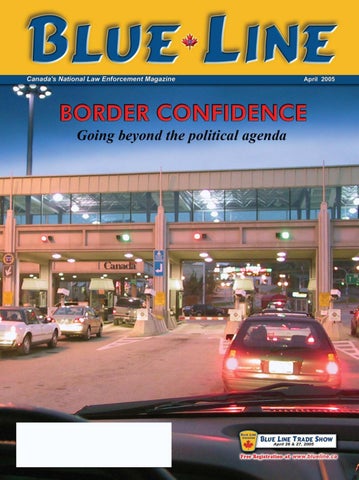
Border confidence Going beyond the political agenda
8
Relationships top priority for Saanich
12
DISPATCHES
14
The best handgun for police is — The answer is closer than you think
16
Canada
Ph: 905 640-3048 Fax: 905 640-7547 Web: www.blueline.ca eMail: blueline@blueline.ca
— Publisher — Morley S. Lymburner eMail: publisher@blueline.ca
— General Manager — Mary Lymburner, M.Ed. eMail: admin@blueline.ca
— Editor — Mark Reesor eMail: editor@blueline.ca
— News Editor — Ryan Siegmund eMail: news@blueline.ca
— Advertising — Mary Lymburner Dean Clarke Bob Murray Kathryn Lymburner eMail: sales@blueline.ca
— Pre-press Production — Del Wall — Contributing Editors — Communication Skills Mark Giles Police Management James Clark Tactical Firearms Dave Brown Technology Tom Rataj Psychology Dorothy Cotton Mike Novakowski Case Law Blue Line Magazine is published monthly, September to June, by Blue Line Magazine Incorporated with a mailing address of: 12A - 4981 Hwy. 7 East, Ste. 254, Markham, Ontario, L3R 1N1. Individual magazines are $5.00 each. Subscriptions are $25.00 per year or $40.00 for 2 years. (Foreign - $50.00 U.S.) Group and bulk rates available upon request. All material submitted for publication becomes the property of Blue Line Magazine unless other arrangements have been made with the publisher prior to publishing. The authors, advisors and Publisher accept no liability whatsoever for any injuries to persons or property resulting from the application or adoption of any of the procedures, tactics or considerations presented in this magazine. Readers are cautioned and advised that articles presented herein are edited and supplied for your personal awareness and should not be used for further action until appropriate advice and guidance is received from a supervisor, Crown Attorney or other person in authority. Established in 1988, Blue Line Magazine is an independent publication designed to inform, entertain, educate and upgrade the skills of those involved in the law enforcement profession. It has no direct control from a law enforcement agency and its opinions and articles do not necessarily reflect the opinions of any government, police, or law enforcement agency. ©2005 - All articles are protected by copyright. No part of this publication may be reproduced or transmitted in any form or by any means, electronic or mechanical, including photocopying and recording or by any information storage or retrieval system without permission.
Internet activity is monitored and use or re-posting of material on the Internet is restricted.
This publication is a private venture and receives no subsidy or grant from any level of government.
— Affiliations — International Association of Law Enforcement Planners Canadian Advertising Rates & Data International Police Association The Police Leadership Forum Periodical Publishers Exchange The Canadian Press Newswire Harvey Research Printed in Canada by Tri-Tech Printing
ISSN #0847 8538 Canada Post - Canadian Publications Mail Product Sales Agreement No. 176796 Blue Line Magazine
The demise of revolvers in police work 18 DEEP BLUE The conversation has finally begun
20
A dedication to getting the job done
22
Outstanding leadership in youth policing 26 COYO celebrates 25th anniversary CASE LAW 28 • Police not negligent in drunk’s death • Cops playing crooks not in authority • Court okays First Nations RIDE off reserve • Police lose lawsuit over aggresive search ODDITORIALS
31
BLUE LINE TRADE SHOW
32
Security industry shake up imminent
42
Looking sharp helps police be sharp
42
Death by misadventure An analysis of graffiti vandalism
44
NEWS CLIPS
45, 55
Important issues are worth fighting for 46 Correcting media errors ... the best option RCMP opens doors for charity
48
Effective police media relations crucial 50 RCMP to modernize funeral policy
52
Auxiliary officer benefits examined
53
TECHNOLOGY Editing digital evidence
54
Man versus machine The case of geographic profiling
56
Emergency services cooperate
57
More than meets the eye 58 Psychological influence of police uniform Credit card fraud a growing concern
60
COMING EVENTS
61
BACK OF THE BOOK A terrible price was asked . . . and paid
62
3
Although both Canada and the United States have spent many millions of dollars and made many announcements about how they’ve tightened border security, Blue Line Publisher Morley Lymburner discovered one side appears to take the issue much more seriously than the other. In our lead article, he describes how he discovered first-hand on a recent visit to a BC border crossing that US Department of Homeland Security officers were much more vigilant than their Canadian counterparts – and proposes a change that would improve security on both sides of the 49th parallel. Still in BC, West Coast Correspondent Elvin Klassen profiles the Saanich Police Department and its annual tradition of lowering the crime rate and reducing its caseload – the department’s secret, says C/Cst Derek Egan, is building relationships with the community, especially youth, through early intervention and asset building. Tactical Firearms Editor Dave Brown is often asked what he thinks is the best handgun for police to carry and has finally decided to answer the question once and for all – the answer, he says, is closer than you think! Few officers, with the possible exception of Montreal Police, would disagree that pistols are a significant improvement over revolvers for police use, but convincing the powers that be to allow the change required a lot of hard work. Dale Kinnear, Canadian Professional Police Association (CPPA) Director of Labour Services, was directly involved in “using the law to change the law,” which compelled the Ontario government to replace revolvers, and recalls what happened. In other stories, Dr. Dorothy says the Feds are finally beginning to listen to police, Mike Novakowski has four case laws, Ryan Siegmund reports on 25th anniversary celebrations of the Committee of Youth Officers for the province of Ontario (COYA), Mark Giles explains why important issues are sometimes worth fighting for and Danette Dooley reports on the RCMP B Division raising money for charity. APRIL 2005
Blue Line Magazine
4
APRIL 2005
It’s time to target pot users by Morley Lymburner Few things are more gut wrenching for me than to hear a police officer has been killed. Last month wasn’t only gut wrenching but mind numbing. Not only did four RCMP officers die in Alberta but one more died in Quebec in a car accident while on leave from Saskatchewan – but that off-duty death, no matter how devastating, had its headlines crushed by the death of the four officers in Alberta. There are so many things to talk about on so many levels; there’s not enough space in this magazine to fulfill the need. The best we can do is try to encapsulate a few tidbits. Marijuana grow ops These self indulging occupations of husbandry have been around for many years. Today our society has become enamoured with a new liberalism regarding pot that is totally out of perspective with reality. Society rails about the hazards of tobacco but it has become cool to demand that marijuana be legalized. This is wrong on so many counts. Many suggest that it is similar to the prohibition era of alcohol. The popular theme is that if we let the government control and tax it, everything will be rosy and police can go about other ‘more important’ things. Any fool should be able to figure out that alcohol is tougher to produce and there’re fewer people willing to try. It takes time to ferment and distill and there’re many steps needed beyond the growing of the plants. The finished product involves agriculture, chemistry, brewing, mechanics and even a manufacturing process; in other words, it takes a lot of smarts. Marijuana takes in only the first of the five processes. Almost any fool can, and does produce it. This means bootlegging will be rampant upon legalization, and the same cops will still be gainfully employed and taking even more risks in the future. Another factor is the reported harmlessness of the drug. It is not harmless and any comparison to alcohol is only spoken by fools. Forget the ‘stepping stone to harder drugs’ theory; let’s just talk about basic health. Tobacco is a proven killer and alcohol has also destroyed many lives over the centuries. Marijuana has yet to make its effects felt on such a large scale, but our society is really pulling for it. Okay people – think on this for a minute. Alcohol is water soluble, while THC is fat soluble. Living in the fast food age, what do you think the difference is? Come on now! Take off those rose coloured glasses and see the world as it really is and will be when the politicians in Ottawa decide that a little bit of pot is okay. I have another concern about our methods Blue Line Magazine
of enforcement. For many years now, we have heard the mantra that a little bit of pot should not give the kid a life-time record. The populist opinion has been to go after the producers and traffickers and you will kill the pot industry. We have been trying this for years and frankly, I think it is time to re-think the strategy. The more society keeps pushing to legalize pot, the more it emboldens those who want to produce it. Why? Because the young people who think it’s cool are now actually en-
5
couraged to go get it, or grow it. Demand has never been greater, so what can we expect? The only solution is to keep the laws as they are, encourage anti-pot education as we have anti-tobacco promotion, and make it socially unacceptable; and yes, society must now go after the consumer of the product as hard, if not harder, than the trafficker and grower. All the head-busting, door crashing and field raids have not been successful because it is simply too profitable and easy to produce. It is a low risk crime, in that the courts will simply skim a bit of the profits. It has turned into a form of catchus-if-you-can tax – and the tax collectors are taking far more risks than the people in the courtrooms who levy it. It’s an upside down world and the needless deaths of four young officers is far too tragic a loss, but the root causes of the loss has focused far too much on the grow-operation. There will be an inquest into this tragedy and it will be interesting, to say the least. The shootings are the culmination of a lot of concerns. They include mental illness, firearms control, drug trafficking, organized crime, police procedure, police equipment, societal norms, organizational attitudes and, of course – politics.
APRIL 2005
Blue Line Magazine
6
APRIL 2005
Blue Line Magazine
7
APRIL 2005
by Morley Lymburner The US Department of Homeland Security is working with a severe handicap. It is called Canada. In my recent investigations along the Canadian/US border in BC I have found that this ailment is experienced by US County Sheriffs Departments as well as the Canadian Border Security Agency(CBSA). It is more clearly recognized as the Canadian Firearms Registration laws and an awkward Department of External Affairs. My investigation to determine if there is any common ground to get around these issues was met with the blank stares of a lot of dedicated but long suffering faces on both sides of the border. The Point Roberts awakening My first stop was with the Delta Police Department. A little American border hiccup they call Point Roberts is situated immediately south of the city of Delta and is the recipient of a large influx of Canadian tourists looking for a good time and a big bang for their otherwise puny dollar. Here they can buy American and pay Canadian. Most of these dollars are spent at bars where the inevitable drinking issues and bar room fights explode into full scale mini-riots during the summer. To police the rabble the U.S. based Whatcom County Sheriff’s department keeps two resident officers on the peninsula. If any help is needed these officers have been known to call for assistance from their headquarters 40 km away in Bellingham, WA. But problems arise when the back-up units arrive at the Canadian border in an attempt to cross the 20 kms of Canada that stands in the way of help. Members of the Delta Police have unofficially advised us, on the “QT”, that it is not unusual for their officers to slip across the US border to assist until help arrives. We spoke with Delta Police, people who assured us that they never knew this to happen... officially any way. It is clear there is really no protocol in place to actually “legally” do what they do Blue Line Magazine
when they go to assist. But cops being cops, they still have a need to help and in the case of a police officer needing help it is understood that no politically drawn imaginary line will stop them. In other words they will make bad rules work... and potentially get themselves into a lot of hot water in doing so. And what happens officially if an officer messes up? Politicians and top brass would shake their heads, show concern and drop the cop like a lobster in a pot. Okay then if this unofficial protocol actually exists how do we recognize it or how was I to find out what proper process should take place? I found out very easily and there were no embarrassed faces about it all. The Canadian Border connection My one stop at a CBSA office found me discussing the issues with a senior supervisor. There was no reluctance in telling me that if there were officers at Point Roberts needing the assistance of Whatcom County officers the border would not be a problem under her watch. “I think if there is any form of emergency anywhere along the border, and there are emergency services of either country wanting to help, this border will be no obstacle,” 8
the Supervisor advised with confidence. “The help will be delivered first and then we can sort things out later.” When I asked where this is written down the only response was... “There is a big shelf of books behind me and the answer will be in there somewhere.” ... and south of the border However, this was in contrast to official Canadian policy. In fact as far as the bureaucratic process is concerned the biggest fly in the ointment is the Canadian Firearms regulations. Chief Criminal Deputy of Whatcom County Sheriff’s office, Jeff Parks, made this abundantly clear. “I don’t like what the Canadian Regulations say we have to do to simply get our officers some help up there,” Parks advised. “The Canadian laws are simply obstructing our ability to properly protect both Americans and Canadians. And Point Roberts is mostly Canadians. But if they are on American soil we have to protect them regardless of what country they are from.” When asked if Canadian police officers have aided their officers in the past he declined to say. “We have always had a cordial relaAPRIL 2005
tionship with Canadian police and as far as I am concerned we always will.” The Sheriff’s office was informed that due to the Firearms Regulations in effect in Canada their officers must go to their patrol area in Point Roberts after stopping at the Canada Border office, advise where they are going, unload their firearms and place the handgun in a locked box in the trunk and the clip in a separate locked box. They may then drive directly to the US Border where they must stop their cruiser and open the two locked boxes and re-load and holster their weapon when they arrive back in US territory. But all of this has even more bureaucracy. Before they even get to the stage of locking up their firearms. The officers must first be registered at the border crossing prior to attending and the list must be kept at the CBSA office and the border officer must check the identity of the officer and ensure he or she is on the list of people permitted to cross with a firearm. “Now if we have to send in a Tactical Team in an emergency we don’t even want to begin talking about the weapons they will have to take with them,” Chief Parks stated. “The process certainly could be far more streamlined in this day of terrorism and cross border security issues.” Just like good neighbours Border issues are certainly multiplied when one considers much of the geographic anomalies that exist across Canada. The dangling tonsil of Point Roberts is simply one of many. The Northwest Angle of Minnesota is a por-
Blue Line Magazine
Deputy Sheriff needs assistance in Point Roberts
tion of the US border that hangs above the 49th parallel and is attached to the east side of Manitoba. The border between the State of Maine, New Brunswick and Quebec is shrouded in uncertainty as thick as the bush and swamp that makes up the geography of the area. The Alaska Panhandle is a likewise obscure geography and the exact delineation of the border between Alaska and Yukon Territory has never been properly delineated to the satisfaction of all concerned. So how seriously do the Americans take
9
our borders? I found out when I attended the Pacific Truck crossing station just south of Langley BC. The Canada/ US border in this location is roughly delineated by a small grass and weed covered ditch beside a paved road situated on the Canadian side of the border. The truck inspection station is situated about 50 metres to the south and on land elevated higher than the Canadian side. A long line of tractor trailers snake their way from the Canadian side of the border with no visible obstructions at all. I determined a picture of the line-up would be good for a future file photo for the magazine. I walked along the paved BC roadway snapping about four pictures of the trucks going through the customs check point when two uniformed officers came out of the building attached to the booths. As they approached me they yelled across to me to stop taking pictures. I inquired what the problem was and they said it was illegal to take pictures of the site. Looking around I could see no signs prohibiting such activity and since there were no
APRIL 2005
United
Canad
Canada Customs - White Rock
blinds put in place to obstruct the view I asked how this could be. The officers became aggressive and asked how many pictures I had taken. I asked where the Canadian border was and if I was in the US or Canada. They became even more agitated by this question. They insisted that I could not take pictures and I pointed to a trailer park situated behind me and advised if the people living here, year round, knew of this restriction. The level of aggression was escalating so I advised I was a journalist and was simply taking file photos for future use. They invited me across the ditch to talk further and I advised that I did not think this was prudent but if they wished to come over to the road way on my side and discuss things further I would be happy to speak with them. The supervising officer, with no hesitation, came to the road way with me and both of us returned to my car where I gave him a copy of Blue Line Magazine. It was at this point I noted that the supervisor was a member of the US Department of Homeland Security. He was armed and it was clear that he had just entered Canada to discuss my activity of taking pictures. After a more amenable conversation evolved he advised of their frustration with the Canadian border and that they would certainly
Blue Line Magazine
States
challenge any strangers wanting to take up surveillance or pictures of border crossings. How did I feel about this obvious “breech” of Canadian sovereignty? I actually felt good. The supervisor was willing to take what action he thought was necessary and protection of his country was paramount in his mind. Indirectly he was helping Canada as well. Did the border mean anything to him? No it did not. My activity was important to him. That is what I thought he should have been concerned about. During this entire incident were there any Canadian authorities even in view? No! And that speaks volumes about Canada’s commitment to the whole issue of borders. “Wink and a Nod” policies As my west coast correspondent and I were quietly sipping our coffee in a Tim Hortons in Delta we were greeted by the Delta Police spokesperson who was attending to her own cup of wake-me-up. “How are things going with your investigation?” she asked. “Very well,” I answered. Then I asked if she found out anything about their officers assisting Whatcom County officers in the past. She looked at me for a brief second... “Yes it has happened... but it is very rare.” I thanked her for her candidness. In the typical fashion of all cops on both sides of the
10
a
border she simply confirmed that cops will always make bad rules work. But why should they not have the proper support of their respective countries? Conclusions to the illusions When surveying the landscape on these issues there are a couple of ideas that I feel should perhaps be looked at more closely. Why not have a unified single facility for Customs Agents at the Canada/USA border? This makes sense if we buy into the “friendly neighbours” rhetoric spoken on both sides of the border. The northern boundary of the United States is completely different than the southern boundaries. A closer cooperation under one physical roof could not only assist both countries but would help to reduce misconceptions, jurisdictional disputes and costs. Why not have a unified border patrol? At the present time we have the US Border Patrol to the south and effectively nothing (or at most not much) north of the border. Border patrol activities in Canada are suppose to be performed by the RCMP. A straw vote with some officers has indicated that most do not like the idea of routine patrols near the border due to border hassles. It is much easier to handle a domestic in Surrey than chase down someone bent upon zigzagging across the border with all its potential for career inhibiting political fall-out. If anyone had doubts about the effectiveness of Canada’s border policing one need not go any further than recent events in Quebec. The last vestiges of RCMP Border Patrol was effectively abandoned in favour of a centralized anti-organized crime unit based in Montreal. A new unified US/Canada Border Patrol unit would give these officers authority that would not be limited by a political boundary drawn between “friends.” The result would undoubtedly be a better control on border runners and a renewed confidence by citizens on both sides. Last, but not least, get over the idea that police officers from the US are a threat to Canadian sovereignty when they are passing through. I have failed to find police officers in the US less dedicated to their duty or less qualified with firearms safety than those in Canada. If they are in fresh pursuit or simply passing through let them know we are grateful for their assistance in whatever form it comes and that we are willing to cooperate for the common good. We want informed and confident police officers on both sides of the border. APRIL 2005
Blue Line Magazine
11
APRIL 2005
Relationships top priority for Saanich Police by Elvin Klassen There’s no doubt in Insp. Bob Downie’s mind why the crime rate is so low and the Saanich Police Department’s caseload drops each year. “I am a firm believer that it relates to the philosophical mindset and the strong support of early intervention and asset building. This philosophy is supported from the municipality through recreation centres with trained, caring staff and accommodating programs for youth.” The department averages just 44 criminal cases per member per year, the second lowest in British Columbia, notes Dep. Chief Cst. Mike Chadwick. “This allows our members to spend much more time on investigations, proactive patrols and dealing with problems that develop in their own zones,” he says, adding “community oriented, preventative style of policing has been successful.” Saanich is the largest municipality on Vancouver Island by population and area, with some 37 schools and more than 35,000 students administered by two school districts and several private school boards. It’s also home to the University of Victoria and Camosun College’s two campuses and numerous public and private institutions. Saanich Police Department was formed in 1906 at the request of local residents and initially had only one constable, who rode alone on horseback, sometimes for days. As the community grew and prospered, the department also did; soon horses gave way to Harley Davidson and Indian motorcycles and they, in turn, to Model T Fords. Today, with 200 full and part-time employees, the department’s mission is “to provide
Blue Line Magazine
quality police service by working with our partners to ensure the safety and security of our community.” “We have a strong tradition and culture of community policing as a natural function evolving from a peaceful, lightly populated, rural community,” explains Chief Cst. Derek Egan. “However, in practice, maintaining this affinity and intimacy with the community became harder to hold onto as the population and department grew significantly and the nature of the municipality changed. “Our strategic plan, organizational structure and the activities that flow from it are aimed at retaining our historical relationships with the C/Cst. Derek Egan community and meeting our citizens expectations of service and the activities that flow from it.” Many of the officers, 25 per cent of which are female (one of the highest ratios in Canada), were introduced to policing in school and building assets is part of an expectation that’s developed over the years, says Egan. Recruitment and commitment to the department and community it serves began with the school liaison program. “We have had officers assigned to Saanich Schools since 1965 and now
12
several of these students are employed with the Saanich Police,” he notes. The department’s four patrol platoons, each headed by a staff sergeant, with two sergeants (road supervisors) and up to 14 constables, works 12 hour shifts — two days followed by two nights. Saanich is divided into four zones — east, west, centre and north. Officers are assigned to a zone for extended periods so they can become familiar with the residents, geography and neighbourhood problems. “We encourage our ‘generalist’ patrol officers to think of themselves as ‘uniform investigators’ and problem solvers,” says Egan, “and to take ownership for all matters relating to their patrol zone, rather than ‘first responders’ responsible for so many on-duty hours. This responsibility includes both proactive and reactive activities such as responding to emergencies, conducting criminal investigations, problem solving of recurrent nuisance behaviours, traffic safety issues and meeting with community, business and school groups. “I believe this is not only more challenging and satisfying for the officers, but aids in their development and provides depth of experience and flexibility in assigning them to assist throughout the department to meet specific operational needs.” Most officers spend their first three to five years on patrol before moving on to specialized sections, though the department has a saying — ‘everything leads back to patrol’ — and most return after stints in other sections. This provides a constant flow of personnel throughout the department and gives everyone a chance to learn and train in different assignments. APRIL 2005
Youth development The Saanich Youth Development Strategy, developed following extensive meetings with students, parks, recreation and police representatives, provides a vision, philosophy, guiding principles and overriding goals for youth and those who work with them. The Search Institute’s building blocks of healthy development are used as a basis for the strategy. These include support, empowerment, boundaries and expectations, constructive use of time, commitment to learning, positive values, social competencies and positive identity. Each organization involved with youth has identified assets that they can use as a special focus. The guiding principles for interacting with Saanich youth are: • Striving to support youth • Empowering youth by involving them in decisions that affect them • Giving young people responsibilities and expect them to do well • Providing opportunities for constructive use of time where they can develop their skills and abilities An eight-day ‘Police Camp’ leadership program is held annually for 50 Greater Victoria high school students who have an interest in either policing or a career in the justice system. Although the RCMP and local police departments also participate in this initiative, Saanich takes the lead and dedicates a lot of resources. The boot camp style residential camp resembles a mini-police academy for youth, who receive simple police training similar to that which might be given to recruits, including education on road safety. Upon completing the course, each youth must make a ‘road sense’ presentation to their school. The program has received rave reviews and many attendees see it as a life altering experience. Youth are left with a different perspective of police, which they share with their peers. Officers spend the entire eight days at the camp and police, school and civilian volunteers conduct most of the instruction and interactive scenarios. Several graduates have gone on to become Saanich police officers. Another project with a special youth focus, ‘Keep it Off the Street,’ was developed by Sgt. Doug Oakley of the community liaison section and uses a 1970 front engine dragster, complete with Saanich Police colours and a custom built emergency light bar. The police racecar is used as the flagship for the program and attracts attention from kids of all ages while important safety and life skill messages are discussed. Presentations are given at schools, summer camps and other community events. The dragster and a donated hot rod are used at local speedways to show youth where it is appropriate to race. Participants are provided with a t-shirt that reads “SAANICH POLICE BEAT ME! on the drag strip where it belongs” or “I OUT RAN SAANICH POLICE! on the drag strip where it belongs.” The ‘Rock Solid Program’ is a prize winning, innovative plan that presents youth with a gritty and realistic vision of the consequences of violence. Using an interactive, multi-media presentation, a team of police officers and Blue Line Magazine
young actors bring an ‘in your face’ look at bullying and intimidation and some successful strategies for defeating violence. WITS (Walk away, Ignore, Talk it out, Seek help) is an anti-bullying program designed for elementary school students and is offered by school liaison officers. After introducing the program to the class, an officer drops by on a monthly basis to provide little gifts and ask the students if they’re using their WITS. The relationships students develop when officers show up to tell a story or provide encouragement is of prime importance, notes Downie. The MYST (Mobile Youth Services Team) goes into schools to help youth make smart choices about sexual exploitation, crystal meth and life styles.
13
Four liaison officers are assigned to the schools and four to youth investigations. Several other youth section members work with the parks and recreation youth activity centres to ensure that a positive rapport is developed between youth and centre workers. Members attend the centres weekly, talking with youth and staff and participating in activities. The traffic safety unit has undertaken a public awareness campaign, intended to encourage parents and youth to discuss and make smart decisions about road and driver safety. Parents and youth 14-19 are invited to ‘Conversations,’ an annual series of presentations from emergency personnel and people who have been directly impacted by fatal crashes. Participants then discuss and develop solutions
APRIL 2005
and tips to keep young drivers and passengers safe on the roads. More than 2,000 people attended last year alone. The Saanich Police Department provides a free youth and family counselling program to ensure families receive the assistance they need to see youth through difficult times and to open communication. A contracted employee of the department runs the program and refers those with issues beyond the program’s scope to other community partners. The department’s four-member bike squad has developed a graffiti eradication project that sees police partner with parks and rec and public works staff, local businesses and the John Howard Society. Participants work with at risk youth in a joint effort to eradicate graffiti on businesses, bus shelters and parks. Bike squad officers and the public identify vandalized areas; if it’s public property, it’s immediately cleaned or painted over by municipal staff. If a business has been vandalized, the owner is contacted. Since removal is expensive and time consuming, bike squad members assist by arranging for reduced cost paint from sponsoring stores, and for a group of at risk youth, identified by the John Howard Society, to provide the labour, supervised by volunteer reserve police officers. Bike squad officers also interact with students through a bicycle training program, teaching them new skills and how to make smart choices. When youth make poor choices, alternative measures and restorative justice may be available. Saanich has been a leader in British Columbia with its restorative justice program. Community forums bring together the offender, victim, police and the community, enabling everyone involved to better understand the impact of the offender’s actions. The Saanich Police paid for the program until May, when the John Howard Society arranged funding. Some 6,500 Saanich households are involved in Block Watch and participating homes are about three times less likely to be broken into, notes Chadwick. “Solving crimes is only a small piece of what the officers do,” says Downie. “Twenty five percent of the workload is crime related.
The other part is where asset building and proactive policing comes in. Patrol may mean playing a game of basketball or shooting a game of pool with the youth.” Suggestions from patrol officers are welcomed. When house party difficulties arose, for example, officers suggested a plan of reporting problems to parents rather than ignoring the situation. When problems originated in a park, the youth were given the option of using recreation facilities, solving the issue before it developed. Building relationships is of prime importance to policing, Egan says. “The many separate programs all work together to help the Saanich Police build relationships with the citizens and make the community a safer place. “Special efforts are made to develop relationships early and then attempts are made to sustain them through adulthood. The police become facilitators to help people help themselves. This gives us a safe community where people make smart choices.” C/Cst Derek Egan can be reached at degan@saanichpolice.ca or 250 475-4321. E-mail elvin@blueline.ca to reach Blue Line west coast correspondent Elvin Klassen.
FBI warns of phony e-mails WASHINGTON — The FBI is warning that a computer virus is being spread through unsolicited e-mails that are giving a false appearance of coming from them. The bureau said the e-mails which appear to come from an fbi.gov address, tell recipients they have accessed illegal web sites and that their Internet use has been monitored by the FBI’s Internet Fraud Complaint Center. The message then directs recipients to open an attachment to answer questions however the computer virus is in the attachment. FBI statement reads; “Recipients of this or similar solicitations should know that the FBI does not engage in the practice of sending unsolicited e-mails to the public in this manner.” In February, the bureau shut down fbi.gov accounts, used to communicate with the public because of a security breach. The FBI says the two incidents are not related and they are investigating the phony e-mails.
Criminals are renting guns for the weekend much the same as people would rent movies, said Ontario’s Attorney General Michael Bryant. Law enforcement officials, including former Toronto Police Chief Julian Fantino, are telling him the guns are being rented out for short periods making it difficult for prosecutors to trace the weapons. Organized crime is the main culprit of the rental schemes, according to Bryant, noting the distribution has to be stopped at the source. Fantino pushed the issue of imposing a mandatory 10-year minimum sentence for gunplay in serious crimes. The Manitoba government will offer a province-wide gun amnesty this spring due to the events of Winnipeg street violence, Justice Minister Gord Mackintosh said. “We are concerned with the number of firearms related deaths in Manitoba,” Mackintosh said. “This can reduce the risk of firearms falling into the wrong hands.” RCMP Sgt. Steve Colwell believes there are still many Manitobans who have old guns in their homes and says Mounties would welcome another amnesty. “I think it’s a great idea,” he said, “They’re family heirlooms and there’s no need for them.” The last provincial gun amnesty was offered in 1994; 500 weapons, including three machine guns and explosives, were turned in during the five months it ran. Special police and judicial powers granted three years ago to combat terrorism are still needed, even though most have never been used, says Justice Minister Irwin Cotler. “The whole purpose of anti-terrorism laws is to ensure that terrorist acts don’t take place to begin with,” Cotler told a Senate committee. The law gave Canadian police the power to make arrests without warrant and to hold suspects without charge if they believe a terrorist act is imminent. Suspects may also be compelled to testify before a judge about what they know of terrorist plans, rather than remaining silent as is their normal right. Cotler said that’s no reason to do away with the powers that raised an outcry among civil libertarians; “My position at this point is that those provisions, even if we have not had to resort to them, are still required.” Cpl. Jim Galloway, an RCMP dog handler killed on duty will have a new road named in his memory. ‘Galloway Road’, which leads to the RCMP dog training centre near Innisfail, Alberta will honour the fallen officer who had managed the RCMP Civilian Search and Rescue Service Dog program in Alberta. Galloway joined the RCMP with the specific intent of serving in the Police Service Dog Section. A dog handler for more than 30 years, he was killed in a standoff with an armed gunman last February in Spruce Grove, Alberta. Red Deer County agreed to the request and will cover all costs involved in the road renaming project. A coroner’s report shows the number of crystal methrelated deaths in BC have more than doubled in one year. More than three dozen people died last year in BC with meth in their systems, the statistics show — compared with 15 deaths in 2003. RCMP Corporal Scott Rintoul says one of the reasons for the increase is because crystal meth is so cheap - about five bucks a hit - compared to pricey drugs like cocaine. Made from solvents like floor stripper and battery acid, crystal meth is believed to cause long-term mental disorders.
Blue Line Magazine
14
APRIL 2005
Blue Line Magazine
15
APRIL 2005
The best handgun for police is ... The answer is closer than you think by Dave Brown Police officers must live with one inescapable fact; every time you answer a call, there’s at least one firearm present. Most of you work with a police-issue, semi-automatic pistol strapped to your hip every day. With budgets tight everywhere, officers may sometimes wonder if their gun is the best possible one for the job; was it the best choice for the money or the best choice period? I’ve had years of experience training officers from many agencies on a variety of different handguns and I am going to answer that question – but first, let’s look at the state of the art in police weaponry. Unlike long arms, which evolved primarily through their use as military weapons, handguns are defensive in nature and have been designed, especially in the last 100 years, around the needs of law enforcement. Officers have always required something compact enough to strap to a hip, powerful enough to efficiently stop a threat and simple enough to bring into action quickly without fumbling for levers or switches. For many years, that meant the doubleaction revolver; they’re called that because pulling the trigger first cocks the hammer to the rear and then causes it to drop forward. This ‘trigger-cocking’ design gives the modern revolver a ‘point-at-the-bad-guy-and-pullthe-trigger’ simplicity. Double-action revolvers were widely used for decades, simply because they are easy to shoot and train on and have no external buttons or levers that need manipulating in a hurry. Many armed security officers in Canada still rely on them today.
Blue Line Magazine
Other than internal safety mechanisms designed to prevent the revolver from discharging if dropped to the ground, a revolver’s ‘safety’ is dependant on the operator pointing it in a safe direction and keeping their finger outside the trigger guard unless shooting. It doesn’t get much simpler than that. In spite of a relatively heavy and longish trigger pull, revolvers are as accurate as any other handgun. Even in combat competition today, revolvers still beat the scores of semiautomatics in equivalent marksmanship tests. Experienced shooters feel that the longer trigger pull of a revolver is more ‘forgiving’ than the abrupt break of a semi-automatic, particularly under stress. Revolvers do have drawbacks. They only hold six rounds and you (really) need to make them count because once they’re expended, a revolver is very difficult to reload under stress. The biggest single factor making it unsuitable for the modern police officer is that it takes fine motor skills to manipulate spare cartridges into the chambers. Even the advantages of modern speedloaders are not enough to ensure you get six fresh rounds in there every time, especially when the bad guy is shooting at you. I personally would never brand a revolver as unsafe. One has to understand its limitations, but I would trust my life to a modern, well-made revolver, provided I worked harder on those basic skills, which are just that much more difficult to perform under stress – a very good plan of action on (any) weapon, incidentally. The military understood the limitations of revolvers as a sidearm as far back as 1910, the year the United States Army commissioned the design of an entirely new semi-automatic pis-
16
tol and a brand new cartridge to go with it. Named after the year of its patent, the Colt Model 1911 is still wildly popular among target shooters today. It’s short, light and its crisp, single-action trigger pull is ideal for rapid-fire practical pistol sports, but even the military understood the problems inherent with such a light trigger pull in real combat, since it dictated that the pistols were to be carried in the holster with the magazine loaded but the chamber empty.
Although single-action semi-automatics like the Colt or Canadian Browning pistol are designed to be carried fully loaded with the manual safety ON, the military adopted the empty chamber condition. This was acceptable for the military but concerned police agencies looking closer at semi-automatics for law enforcement. After all, the essential simplicity of the revolver was lost if officers had to draw their weapon and chamber the first round before responding to a deadly threat. Even if an agency allowed officers to carry them with a round in the chamber, citizens quickly became alarmed at the sight of them walking the streets with hammers fully cocked to the rear. It became a debate over public perception versus the need for readiness and the result can still be seen today in every single action movie and television show, where no one can get shot until that first round is chambered. Even if the technically correct way is to carry the round chambered, a single-action semi-automatic belongs on the target range and has no place on the street. That short and light trigger pull can become deadly in high stress situations, where officers will not feel their own trigger moving, especially considering the body’s natural tendency is to flinch from a sudden stimulus. When the body goes into extreme survival mode, it concentrates the majority of the blood flow into the center-mass. Blood flow – and hence the feeling in the fingers – disappears rapidly from extremity areas like the hands. The result is that the finger can move without the officer realizing or intending it to – and, welcome to Canada; we also may be wearing gloves when we need to pull that trigger back. What may work for target shooters and tactical officers, who spend hundreds of hours training every year, does not work for the average street officer, whose entire yearly pracAPRIL 2005
tice regimen is a couple of hurried rounds fired off just before yearly qualifications, ‘just to knock the dust off the ole gun.’ In an effort to come up with a gun that’s both fast into action and looks ‘correct’ to the general public, manufacturers designed a double-action semi-automatic. The first round is fired with a long and heavy pull of the trigger and all subsequent rounds are fired from the lighter, single-action mode. Essentially a compromise design, the double-action semi-automatic uses a decocking lever to safely lower the hammer to the forward position after the magazine and chamber are both loaded. Earlier designs often integrated a manual safety into the decocking lever, such as the Smith & Wesson Model 659 pictured here.
It didn’t take long for officers to realize that the manual safety was entirely redundant; the firearm would be ready for instant action if the hammer was dropped using the safety/ decocking lever and the safety moved back to the OFF position. Internal safeties prevented the handgun from discharging accidentally if dropped anyway, so the manual safety just became a hindrance in an emergency. The manufacturers soon caught on and modified some designs so that the decocking lever was spring-loaded and returned to the up position once the hammer was dropped forward. An example of this is the Sig Model 220, very similar to the double-action semi-automatic now issued to Canada’s military police.
pull tends to catch nearly everyone by surprise. During the long history of revolvers, one other trigger function was explored – the double-action-only design. The revolver was internally modified to remove the single-action notch from the hammer and the spur was ground off the back. The result is that the shooter has to fire double-action for every single round, without the option of first cocking the hammer manually for a lighter pull, which is a target shooter’s trick for long-range accuracy but potentially deadly on the street. Realizing the compromises of the double-action design, manufacturers began to look for better ways and rediscovered the advantages of the double-action-only design for real world use. They modified existing semi-automatic designs to remove the full-cock notch on the hammer and smoothed off the back spur for a nice flush fit with the rear of the slide. An Austrian industrialist named Gaston Glock even went one step further when designing handguns for the Austrian Army, designing a mechanism where the trigger would act directly on a springloaded firing pin, eliminating the need for a hammer entirely. See Glock top right. Regardless of make, the result is the same. Pulling the trigger to the rear cocks the firing mechanism and then discharges the firearm. The trigger pull is exactly the same from the first shot to the last. There is no manual safety, no decocking lever and no spur on the back of a hammer. The double-action-only (DAO) semi-automatic is the ultimate in simplicity, although
ironically it took 100 years of evolution to bring the modern semi-automatic back to the point that the revolver always was: point at the bad guy and pull the trigger. So what IS the world’s best handgun for police officers to carry? It’s the one that’s probably in your holster right now. The modern DAO semi-automatic is easy to shoot and train on, simple to manipulate in an emergency (even with gloves on!) and has a consistent trigger pull for every shot. As a firearms instructor, I train anyone on anything, but courses on double-action semi-automatics are just that much more intimidating, because I need to watch every student’s hammer like a hawk to ensure they’re all safely decocked before holstering at the end of every exercise – and with a career as a freelance firearms instructor, I supervise a LOT of exercises! Dave Brown is Blue Line’s tactical firearms editor – e-mail firearms@blueline.ca to reach him.
The double-action semi-automatic has one inherent problem that dooms its suitability as a police weapon – vastly differing trigger pulls for the first two shots. The first round is pulled double-action, meaning a long and heavy pull. All subsequent rounds are fired single-action, with its short and light pull. This design practically guarantees one of the first two shots will miss the target. Interestingly enough, shooters often find their first round is more accurate than their second; the much shorter and lighter second Blue Line Magazine
17
APRIL 2005
The demise of revolvers in police work Past issues of Blue Line Magazine have referred to the conversion from revolvers to semi-automatic pistols in Ontario. In response, a loyal Blue Line subscriber provided this background on how the change happened, to set the record straight and explain how the government was compelled to replace the revolver. As the story explains, this wasn’t a case of government largesse or recognition that equipment needed to be upgraded. by Dale Kinnear For more years than anyone cares to remember, the .38 calibre revolver was the sidearm of Canadian police officers. It was specified in Ontario’s police act regulations until 1993, even though police unions and senior management associations had spent years trying to convince the government to switch to semiautomatic pistols. There was provision in the regulations for a chief of police or OPP commissioner to issue different types of firearms. The so-called ‘special purpose’ regulation authorized issuing pistols and other special equipment to tactical officers, drug squads and the premier’s security detail. In February 1992, the Ontario Provincial Police Association (OPPA) began using the law to change the law, employing the Ontario Health and Safety Act (OHSA) to challenge the use of revolvers. In October 1993, an Ontario Ministry of Labour (MOL) order resulted in the demise of the revolver in Ontario and eventually, the RCMP and all the other provincial jurisdictions, except Alberta, where the change was already underway. The challenge commenced at a meeting of the Ontario Police Joint Health and Safety Committee (OPJHSC). Provided for in section 21 of OHSA, the committee advised the Solicitor General on police occupational health and safety issues. At that time, S/Sgt Paul Eddy of the Toronto Police Service was appointed to the Ontario MOL as the designated inspector for the police community and administrator of the section 21 committee. Eddy advised Dale Kinnear, the OPPA committee member, that the commissioner had
Blue Line Magazine
recently turned down a constable’s request for a semi-automatic pistol. Cst. Cam Woolley subsequently filed a complaint with the MOL. The complaint had not followed the internal responsibility system in that it had been submitted directly to the MOL inspectorate, with no opportunity for the employer to respond, as per prescribed process. In his complaint, Woolley argued that if the semi-automatic pistol wasn’t issued, the Ontario Provincial Police (OPP) wasn’t taking every reasonable precaution for his safety. On reviewing Woolley’s correspondence, Kinnear felt that the employer obligation under section 25 (2) “…an employer shall,” (h) “take every precaution reasonable in the circumstances for the protection of the worker;” could be used to challenge the revolver designation. Woolley was convinced to introduce the complaint to the detachment OHS committee, where it could not be resolved and would automatically be directed to the district committee, which also lacked the authority to override the existing sidearm regulation. The com-
18
plaint would then be passed on to the Level II Committee at GHQ. When it reached the GHQ committee, the OPPA upped the challenge to include all OPP members issued with revolvers; the committee lacked the authority to resolve the complaint, which allowed the OPPA to call upon Eddy to investigate. Eddy called a meeting of employer, employee and management representatives to deal with the complaint on Sept. 8, 1992. The OPPA called upon firearms specialist Ted Ryczko, a recognized expert, to explain the shortcomings of the revolver and how and why it failed to satisfy the employer’s obligations under the act. Ryczko’s evidence was based on sound engineering principles that centered on an examination of ergonomic and functional differences in the two pieces of equipment. Following this examination, Eddy issued a report to the employer that failed to make a decision. As per the legislation, an inspector’s decision, or failure to make a decision, allows either party a right to appeal, which sends the issue to adjudication under the act. The OPPA appealed and several days of hearings were conducted between April and October 1993, with Ryczko and several Ontario police officers called to give evidence. A key factor in the OPPA argument was that the police sidearm was a piece of personal protective equipment under OHSA. This was accepted by the MOL. At the outset of the adjudication hearings, the MOL assigned Insp. Bob Cunningham to continue the investigation parallel to the adjudication. It came out later that this ‘continued investigation’ was initiated to avoid having the matter decided by the adjudicator, who had the authority to rule on what type of sidearm would replace the revolver. The adjudicator could also rule on ammunition type. At the time, Ontario police officers were not allowed hollow point ammunition. The OPP was directed to undertake a trial of semi-automatic pistols in Sept. 1993. Firearms trainers were called in from across the province and spent several days testing and ranking makes and models of pistols in all calibres and configurations. The OPPA learned of this testing exercise after it was completed. It is not widely known that the make, model and calibre that ranked the highest in this test was the .45 calibre Sig Sauer, double action, single action (DA/SA - double action on the first APRIL 2005
round and single action on subsequent rounds). Cunningham issued an order stipulating inadequacies of the standard issue revolver on Oct. 14, 1993. Pursuant to Section 25 (2) (h) of the OHS Act, the MOL determined that the Ministry of the Solicitor General and Correctional Services (the employer) “…failed to take every precaution reasonable in the circumstances for the protection of workers, issued with .38 calibre revolvers under circumstances where the revolver can accidentally become cocked… and circumstances where workers must reload the gun while exchanging fire in the performance of their duties…” Solicitor General David Christopherson announced that the ministry would not appeal the MOL order Oct. 21, 1993 at the OPPA annual general meeting. A compliance plan outlining the transition to the semi-automatic pistol for Ontario police officers would be presented, he promised, and it was developed over the next few weeks. Only DAO 9 millimetre and .40 calibre S&W pistols were designated to replace the revolver. The ongoing appeal was abandoned and the adjudication ceased. Transition training for the switch to the pistol commenced in 1994. The Ontario MOL order spread across the country very quickly and even found its way to Australia within 48 hours of its release. Subsequent due diligence examinations outside of Ontario resulted in the demise of the revolver in other jurisdictions. The Police Association of Ontario (PAO) commenced an OHS Act challenge regarding hollow point ammunition in early 1994. It was just nicely into this challenge when the government changed; the new Conservative government authorized the switch to hollow point ammunition. This is a classic example for the Canadian police community of how provincial health and safety legislation can benefit employees, the police service and the public. Dale Kinnear is the CPPA’s Director of Labour Services and can be reached at dkinnear@cppa-acpp.ca or 613231-4168, x228.
Blue Line Magazine
Canada taking action to shore up national security By Jim Bronskill (CP) The government plans to shore up national security by spending another billion dollars to secure Canada’s skies, borders and seaports against terrorism. The money, to be doled out over five years, represents the latest effort to shore up national security in the wake of the Sept. 11, 2001 attacks on New York and Washington. In all, Canada has now earmarked more than $9.3 billion toward anti-terrorism measures since those watershed assaults on North America by members of Osama bin Laden’s al-Qaida network. The money allotted in the federal budget - $179 million next fiscal year and a little more than $200 million in each of the four following years - is directed at air and marine security, border protection, policing, and emergency readiness and response. In a sharply critical report last year, Auditor General Sheila Fraser questioned several elements of the government’s anti-terrorism strategy, pointing out weaknesses in programs ranging from screening of personnel to compilation of security watch lists. Public Safety Minister Anne McLellan subsequently outlined Canada’s first national security policy, intended to protect the public, ensure Canada is not a base for terrorist operations and contribute to international stability. Several activities and programs that flow out of the security policy will benefit from the planned spending. The budget puts $433 million toward beefing up border checkpoints, including new staff at key land crossings - a measure the government hopes will both improve security and reduce traffic bottlenecks. The money will also bankroll training of border personnel and the purchase of equipment, such as radio communication systems. A total of $222 million is tagged for marine transportation security projects: new patrol vessels and emergency response teams for the Great Lakes and St. Lawrence Seaway, additional regulatory inspections and more police to monitor ports.
19
In an effort to identify high-risk cargo bound for North America, the government plans to spend $88 million to team up with the United States on the Container Security Initiative. The American initiative allows U.S. customs officers to work with counterparts in other countries to gather intelligence, share information and verify inspections on containers. Canada intends to send officers to overseas ports as part of the program. The budget allocates $16 million for air security initiatives, namely creation of a no-fly roster - to be known as the “specified persons list” - that flags people barred from boarding commercial aircraft in Canada for security reasons. A portion of the funding will be used to develop systems of electronically matching air passenger information against security watch lists. Among other planned expenditures over five years: • $56 million for emergency management initiatives, including disaster preparedness drills, a new secret communication system linking government agencies and refinement of plans to handle a large-scale power outage. • $59 million to bolster security at Canada’s foreign embassies and consulates. • $117 million to renew the Integrated Proceeds of Crime initiative, which brings together police, lawyers and other players to seize profits and assets from criminal organizations. • $3 million for Canada’s participation in international bodies involved in the fight against money laundering and terrorist financing. The budget also sets aside $193 million over five years for renewal of justice-related initiatives aimed at crime prevention, assisting victims and taking action against war criminals.
APRIL 2005
The conversation has finally begun by Dorothy Cotton That police will interact with mentally ill persons is inevitable and, to some extent, necessary. After all, it is we who have the 24/7 telephone and the staffing to respond to callsfor-service and people in crisis – Moose Jaw Police Chief Terry Coleman, speaking to a Senate committee. That quote might not say anything new or original to most people in the police business, but it speaks volumes to those who’ve never thought much about the role police have in dealing with the mentally ill. Many in the mental health system also haven’t given the subject much thought, but at least we know the Senate now has an appreciation of this role, and that has to be a good thing. Coleman, along with Royal Newfoundland Constabulary Insp. Sean Ryan and Service de Police de la Ville de Montreal Agent Michael Arruda, were invited by the Standing Senate Committee on Social Issues, Science and Technology to provide input on police and the mental health system. As they pointed out, it is not an inconsequential role. Police apprehend people under mental health acts and investigate crimes in which people with mental illnesses may be the perpetrator or victim, crisis situations, minor disturbances, ‘suicides by cop,’ situations in
which mentally ill people simply need help... and a whole variety of other cases where they simply don’t know where else to turn. After all, like it or not, the police are de facto the front line extension of the mental health system. When someone in the community acts oddly and the public feels uneasy, they don’t phone the local hospital. When their son with schizophrenia threatens to burn down the house to rid it of demons, they don’t phone the fire department. When someone thinks there are aliens invading their apartment, they don’t phone the exterminator. When an eccentric woman living under a bridge is beaten and her blanket and shopping cart is stolen, it’s not her lawyer who comes to her aid. When life no longer seems worth living and an adolescent perches atop a bridge, it’s not the school guidance counselor who talks him down. The police are called in all these cases, and they respond. As Coleman pointed out, it’s not all that surprising, nor entirely inappropriate. Some aspects of meeting the needs of people with mental illnesses are entirely consistent with the fundamentals of community policing – fundamentals that include a customer/client focus, consultation and collaboration with the community, teamwork and communication. The good news, Arruda told the committee, is that there are an ever increasing number
of programs and options being developed which involve joint police/mental health system responses to mental health problems. He described programs such as Vancouver’s Car 87, Hamilton’s COAST program and Montreal’s Joint Response Initiative. He also spoke of educational initiatives for both police and mental health workers. So what were these guys doing at a Senate committee anyhow? The Senate has been conducting a review of mental illness and mental health systems in Canada over the past year or two. They have released three reports to date – you can access them at: http:// www.parl.gc.ca/38/1/parlbus/commbus/ senate/com-e/soci-e/rep-e/repintnov04-e.htm. In report three, section 5.3, there is a passing mention of police. Specifically, the committee poses these questions: • What should be done to improve the training of police officers to enable them to deal more effectively with mental illness and addiction? • How can we increase the safety of those involved in the intervention and help to ensure that officers use the least amount of force when apprehending someone experiencing a mental health crisis? As Ryan pointed out, education and training are not the sole answer; the problem is not so much a lack of training as a lack of communication and cooperation. He referred to many of the recommendations of the recent Luther Report in Newfoundland, which spoke of needs like interagency agreements, coordinated efforts and cooperation between hospitals and police services. He also mentioned the need for systematic data collection and research and standardized response strategies. Why, he asked, could we not develop a national response strategy? One pervasive theme that emerged from the comments of all three panelists was the need simply to be at the table. Until and unless mental health systems see police as collaborators and colleagues, the problems will not go away. It is no small accomplishment that these comments were made to the Senate. As the panelists pointed out, when major shifts in the mental health systems began a decade or two ago, no one thought to talk to police services or anticipated the impact that would feel. The fundamental message to the Senate was ‘let’s not do that again.’ The mere fact the three were invited to make submissions to this august body indicates a significant shift in relations between police and the mental health system. It may be the first time police have been invited to make a specific contribution to the planning of mental health services in Canada. As Arruda so aptly concluded, “let’s talk.” Indeed, it appears that the conversation has begun. Visit www.pmhl.ca to read the full text of the police submission to the Senate. You can reach Dr. Dorothy Cotton, Blue Line’s psychology columnist , at deepblue@blueline.ca
Blue Line Magazine
20
APRIL 2005
Blue Line Magazine
21
APRIL 2005
A dedication to getting the job done Cape Breton Regional Police Chief Edgar MacLeod will be the 2004 recipient of the Canadian Police Leadership Award. The award will be presented at a special ceremony hosted by The Police Leadership Forum and Blue Line Magazine on April 26th. Chief Edgar MacLeod, a 32-year policing veteran, is the inaugural Police Chief of the Cape Breton Regional Municipality (CBRM), located in Cape Breton in the Province of Nova Scotia. In January of 1995, Chief MacLeod joined the senior management team of the newly created CBRM. As the first Police Chief in the region, he was charged with the responsibility of designing and implementing policy and structure for the provision of policing services to the 120,000 residents of Cape Breton County, effective August 1, 1995. The CBRM was a creation of the provincial government and was imposed upon the residents of Cape Breton County as a new form of governance for the provision of municipal services in the region. Specific to policing, this meant the merger of seven separate municipal police forces into the newly created CBRM Police Service. Prior to regionalization, many of the original municipalities were experiencing severe fiscal pressures which challenged the very viability of their organizations. Chief MacLeod realized that for this new police service to be effective a strategic plan was required. In 1996, Chief MacLeod assembled management, sworn officers, and civilians from all sectors of the police service including a police commission representative and with the services of a consultant a strategic plan was developed. It included the establishment of objectives and goals, the development of a motto, mission and vision statement. Community-based programs have redefined policing in the CBRM and solidified a strong reputation for the CBRPS in the eyes of the general public. Examples include police officers in the schools, safe grad programs and community policing offices run by volunteers and police officers cooperatively. The management of this regional policing transition was complicated by much public unrest over the imposed regionalization process and the wage disparity issue within the ranks of the police officers. Despite these complications, Chief MacLeod charted the course to develop a regional police culture from seven separate police services by an early policy decision to transfer officers to unfamiliar districts of the new regional territory. Carefully managed, this decision established a solid foundation upon which the evolution of a regional Blue Line Magazine
police force could be built. To date Chief MacLeod has provided sixteen CBRPS members for peacekeeping duties in missions in Kosovo and East Timor. These members have provided a safe and secure environment for all persons in their respective jurisdictions by maintaining civilian law enforcement operating in accordance with internationally recognized standards and with respect for internationally recognized human rights and fundamental freedoms and by taking such other measures as appropriate. Chief MacLeod is a visionary and a tireless worker who is prepared to make the sacrifices necessary to help make his visions a reality. He has always viewed the community as a significant stakeholder and partner in the business of policing. Chief Macleod’s outgoing personality, personal integrity and love of his community are traits that have served him well in developing partnerships with local community groups and organizations. On April 4, 2003, Chief MacLeod was the recipient of the “Order of Merit of the Police Forces” presented by Her Excellency, The Right Honourable Adrienne Clarkson, Governor General of Canada. This award was created in 2000 as a means of recognizing conspicuous merit and exceptional service by men and women of the Canadian Police Forces. In August 2003 Chief MacLeod was elected President of the Canadian Association of Police Chiefs in Halifax, Nova Scotia. Chief MacLeod is an accomplished presenter. His presentations focus on cooperation, education, vision, leadership in times of restraint, economic challenges, current and future trends, crime prevention through social development, empowerment of police officers, 22
community organizations and leaders. Ontario Provincial Police Commissioner Gwen Boniface, in her endorsement, summarized his accomplishments in this way. “Chief MacLeod’s ability to inspire “team spirit” and commitment from those around him is definitely one of his strongest qualities. What stands out most with Chief MacLeod is his down to earth nature, his simplicity, compassion, generosity, concern for others, leadership skills, unending motivation and dedication to getting the job done. In every aspect of his involvement he has set the highest ethical standards.” When interviewed for a profile article for Blue Line Magazine in March 2000, MacLeod displayed his enthusiasm and why he posses all the attributes of leadership as an activity and not a position. “Its not about individuals, it’s about accomplishing things,” MacLeod said in the interview. “All of these initiatives were not started by myself. A lot of these initiatives were started by my officers. It just seemed to me that many of them just wanted the opportunity to show some leadership... I just facilitated that momentum.” The annual Leadership Award is presented to persons who are seen to be promoting standards and recognizing the performance of individual leaders in action. For further information on the Police Leadership Forum of Canada, please contact Supt. Glyn Wide, 905 546-3800 or gwide@hamiltonpolice.on.ca
APRIL 2005
I just wanted to tell you that your Publisher’s Commentary in the March 2005 issue, A parallax view from here, was one of the best pieces of its type that I’ve read in years. Too bad that the mainstream media can never seem to grasp these concepts. It would make for more balanced reporting and less sensationalism, especially in the coverage of policing and military matters. Major Richard E. Gower Canadian Forces Liaison *** I thought that you hit the nail on the head with your article on policing overseas, A parallax view from here, I have been involved with policing overseas more than most with direct experience in Somalia, Haiti, Jamaica, Qatar and modern developed police forces in the UK and Germany. The point is that our policing methods in Canada reflect our highly developed, technologically advanced society. It has developed an ethos of the rule of law and the protection of individual rights not seen in the majority of the countries of the world. On numerous occasions I have seen well educated, articulate police trainers attempt to impose methods and standards on third world police that are neither appropriate nor sustainable. While attempting to do the “right thing” they have come off as arrogant and impractical. Teaching forensics that rely on advanced computer models to police forces that don’t have even notebooks and pencils is a waste of time.
Police trainers working overseas have to possess a well developed sense of what has to be done tempered by a well developed dose of common sense as to how to do it under the prevailing circumstances. Tom Haney, Director Police Leadership Program Dalhousie University *** Let me first express the profound sense of loss and senselessness that I and the rest of Canada are feeling over the tragic loss of four police officers in Alberta. There are many unanswered questions that come to mind over this event but the one missing from any comment or discussion that I have
heard in the media comes back to the fundamental issue of gun control in this country. Specifically in the area of restricted weapons such as the assault weapon that was used against the police officers in Alberta. Marijuana grow operations do need to be controled but since when have we allowed citizens to own assault weapons in this country? Toronto and its environs, in particular, are increasingly being affected by the use of firearms. Why are govenments, Canada Customs and the police forces not doing everything in their power to stop the influx and possession of illegal arms? Richard Ackerman Oshawa, ON
Reality based module series Police officers deal only with reality, not the theoretical. The science of policing requires life-long learning. As the challenges of policing grow, so does the need for realistic, functional police training literature. Thomson Nelson has been committed to publishing unique police training literature since 1997. They are now launching the first of its kind, ‘realitybased’ module series, suited to the novice officer as well as the advanced specialist. The series uniquely does three things. First, it recognizes that new recruits and veteran officers have different training needs; each module is designed to take the reader from novice to expert within the individual module as well as throughout the entire series. Secondly, it captures the ‘reality’ of front-line policing by providing clear and concise interpretation of the law, relevancy and immediacy of application. Finally, the modules provide the convenience of customizing a textbook. Police educators will benefit from the ready-made, scenario based training information and support materials. Police officers can customize their book to include only the topics they choose. The author, Gino Arcaro, who wrote monthly for Blue Line for over a decade, will use the same style as in his case law articles, where complicated laws were translated into functional, “how-to” language reflecting the reality of the court decisions. Many police officers think Arcaro’s work is unique in its interpretation and application of the law. To quote an avid reader, “this work presents, in a clear and concise manner, a how-to approach that takes the fundamentals of police work and puts them in terms and language that is easy to understand.” For further information visit the Thomson Nelson exhibit at the Blue Line Trade Show on April 26 and 27. Blue Line Magazine
23
APRIL 2005
The faceless cop killers 2002 . Reports such as this provide startling details of the danOn the evening of March 7, gers officers’ face when they serve 2003 at 2148 hours, 18 year police their community. One of the most veteran, Sgt. Marcus Young of the disturbing facts is that the average Ukiah, California, Police Departlength of time served by officers ment was responding to what killed between 1991-2002 was ten would be considered a “routine” years. The fact is that there are facall to take a young female shoptality trends amongst veteran polifter into custody at the local Wallice officers that appear to be less Mart Store. Within seconds of placlikely among rookies. In the end ing the suspect into the back of the this trend exposes the existence cruiser, Sgt. Young was shot four Sgt. Marcus Young and realities of the “faceless cop times (once in the face) by the suskillers” such as complacency, aspects’ unknown accomplice. A security guard sumptions and the pre-judgment of situations. coming to his aid was also stabbed. Within When a person first becomes an officer, seconds a life or death struggle ensued, with they experience a never ending supply of Sgt. Young killing his attacker while barely adrenaline and excitement, going from one escaping death himself. call to the next, picking up any extra shift they Police trainers and administrators relican. They totally immerse themselves in their giously review situations such as this, hoping chosen profession and their self-identity beto learn which tactics worked, which failed, comes the job itself. Overtime things subtlety where the officer went wrong and how we can change. The job becomes “routine” and some learn from the circumstances or mistakes. But officers begin to develop a sense of time after time, officers still end up in dangermastership over the quick paced, chaotic calls ous situations where they perform simple tacthat fill the workday. tical errors. Part of this is the reality inherent No longer experiencing the high or thrill in the nature of police work while the other of the job, veteran officers often begin to look part is the biased attitudes and beliefs that ofdown upon the rookies because of their enthuficers hold the longer they are on the job. siasm without seeing the changes in themAccording to the FBI “Officers Killed and selves. Sometimes these same officers begin Assaulted” 2002 report there were 636 U.S. to develop tactically dangerous ideas that lead officers who died in the line of duty from 1991them to prejudge situations and categorize by Michael A. VanBlaricum
them as “routine” because of their experience on the job. One often hears this dealing with the after effects of a critical incident when a fellow officer describes the situation as “simply making a routine stop”. Somewhere along the way some veteran officers forget their basic law enforcement training that tells them there are only two types of stops, “high risk” and “unknown risk”. Referring to a traffic stop as “routine” is a key indicator of complacency. Prejudging a traffic stop, or any type of police activity as low or no risk to the officer is an extremely dangerous and neglectful mind set. Assuming or prejudging a situation limits the officers tactical response capability. Through cognitive limitation they have already rendered themselves, to the suspect’s advantage, unprepared for the dynamic realities of a violent encounter. Complacency will cause the officer to miss warning or danger signs that other officers would pick up on. So as officers and trainers how do we prevent complacency from interfering with our performance on the job? How do we make changes in our daily activities to prevent ourselves’ or fellow officers from becoming one of the “statistics”? Step one is self-honesty. As an officer, trainer or administrator, we need to honestly look and evaluate ourselves. Have we allowed complacency to creep into any facet of our daily lives, thinking and routines? Do we engage in realistic and relevant training that goes beyond the departmental mandated qualifications and licensing requirements? It is human nature to develop certain levels of complacency within our daily lives and professional careers and rest on the laurels of our achievements and experience. It is also this very human tendency that can expose us to unneeded deadly harm on the job. Step two is actively seeking change. Once we have identified which areas we have grown complacent in we can begin to develop action plans to change this behaviour. Regardless of the change, actively seeking and pursuing ways to transform your mind set, actions and beliefs and implementing these changes into your daily routine will help defeat complacency. Every day officers are killed or injured because they underestimate a situation or make false assumptions based on what is perceived as “routine”. An officer’s mind set can help them survive, or set them up for dangerous failure. By being honest with our own self-evaluations we can identify what areas we have become complacent in and begin to change our attitudes, actions and beliefs. Through this honest self-evaluation and subsequent behavioural changes we can give ourselves and our fellow officer’s a tactical advantage to survive. Michael Andrew Lord VanBlaricum is a Certified Law Enforcement Instructor, Published Author and owner and Chief Instructor of LordVan Tactical LLC. To contact Michael or learn more about self-defense philosophy or seminars visit www.lordvantactical.com or call 651-324-6854.
Blue Line Magazine
24
APRIL 2005
Blue Line Magazine
25
APRIL 2005
Outstanding leadership in youth policing COYO celebrates 25th anniversary by Ryan Siegmund It began with a group of officers at the Ontario Police College (OPC) who wanted to meet and discuss how best to work with youth, interviewing techniques, legislation and other issues. Twenty five years later, the Committee of Youth Officers for the Province of Ontario (COYO) continues its commitment to Ontario’s youth, says president Rob Mayea, and has grown in both numbers and support. Its annual conference, held in February in Niagara Falls, offered a unique opportunity for probation, police, school authorities and other community youth service groups to network and develop insight on today’s youth issues. To mark the 25th anniversary, three founding members were invited; CYO founder and former OPC instructor Bud Knight; retired Waterloo Police Service Deputy Chief Gord Miller, who served as the first president; and retired Hamilton Police Service S/Sgt. Jim Galloway, the committee’s original treasurer and secretary. These founding members were not only honoured but had a chance to witness how the organization they created has grown. Knight established an association of youth officers who met quarterly to share information in the 1980s and began holding an annual general meeting and inviting keynote speakers. The Juvenile Delinquent Act was on its way out at the time, to be replaced by the Young Offenders Act (YOA). Wanting to revamp its training, the OPC asked the committee to help shape its new curriculum. CYO worked with the Ontario Police Commission to establish guidelines and strengthen partnerships with the OACP in determining the implications of the YOA. When Knight retired in 1989, new leadership turned the 100 person general meeting into a conference that attracted over 250 youth service providers. The first conference committee created the Bud Knight award to rec-
Blue Line Magazine
Photo: Carla Bertolin
From left to right; Community Safety and Correctional Services Minister Monte Kwinter, Bud Knight, and TPS S/Sgt. Dave Saunders.
ognize his contributions. Presented to an Ontario officer demonstrating outstanding leadership in youth policing, it has been awarded annually for 15 years. “When the conference reached its capacity in 1998... we said we needed to open this up to more people, we need involvement from children’s aid, safe school committees and non profit organizations,” said Mayea, addressing the 500 delegates at this year’s conference. Knight, Galloway and Miller should be recognized for the vision they showed in recognizing the need to work together on youth issues, he said. “Twenty five years later we have a committee of 25, consisting of officers, public sector workers, school principals... still working together on the same issues and we are keen on exploring new ways of improving youth service deliveries to Ontario.” It was a bitter sweet conference for Mayea, who stepped down as president after seven
26
years on the committee. Responsibilities shifted to Quinte West OPP officer Randy Green. Mayea said the committee is in a good position to do some remarkable things. “We bring 500 people together and talk about working together, developing partnerships and doing community development,” said Mayea. “I feel we have shaped and influenced youth service delivery in Ontario in our own fashion with this conference and with the Bud Knight award.” Monte Kwinter, Ontario’s Minister of Community Safety and Correctional Services, said the government supports the committee’s work and shares its commitment to Ontario’s youth. He applauded Toronto Police Service S/Sgt Dave Saunders, this year’s Bud Knight award winner. “Saunders is the architect of the TPS youth strategy and was appointed the service’s first youth crime coordinator in 2000,” noted Kwinter. “The wide range of youth programs
APRIL 2005
and early childhood education dealing with gang violence can now be delivered thanks to Saunders leadership and vision.” Saunders is an asset to the whole community, said Kwinter, because his dedication goes well beyond the call of duty. He’s a member of several youth related committees and chairs the Ontario chapter of ‘Leave Out Violence’ (LOVE), a community based, non-profit agency committed to creating a widespread youth culture of non-violence. “He’s worked at forming partnerships and to create positive opportunities for youths at risk,” said Kwinter. “He is also a driving force behind the empowered student partnerships (ESP), the largest school safety program in Canada that involves school boards, police and community organizations.” Accepting his award, Saunders said the original committee members truly created a foundation in which police officers today are carrying the torch. Recognizing his colleagues and community partner contributions, Saunders said they are fully committed to producing education and prevention programs dealing with guns and gangs, a very serious issue in Toronto and something becoming increasingly common in the rest of the country. “We all have a responsibility to be here and to do a couple things; one is to steal ideas from people and two is to share them because we have some of the best practices here in Ontario.” Taking aim at bullying The Ontario government is building safer, stronger communities by taking action to pro-
Blue Line Magazine
tect Ontario’s children and by increasing services, Kwinter told the conference. “Two of our key priorities are to fight bullying and to combat Internet crimes against children,” he said. “The safe schools action team will implement new measures to protect students, including creating an anti-bullying hotline in which students can report bullying incidents and get support. The action team will also help spread tactics in preventing bullying and to ensure every school has effective anti bullying strategies.” Ontario has also launched cybertip.ca to combat Internet predators and Kwinter said the OPP and OACP are currently finalizing a $5 million province wide policing strategy to combat Internet luring and child pornography. The conference focused on bullying, both in and out of schools. Not a new problem, but the consequences for both the victim and tormenter are becoming increasingly serious. It’s important for parents to discuss bullying with their children, noted guest speaker Cindy Wesley, whose daughter Dawn-Marie committed suicide because of the pressure of being bullied. Two of the three tormentors named in the suicide note were convicted of uttering threats. Since the death, Wesley has worked to spread awareness of the problem and is a founding member of Parents Against Violence Everywhere (PAVE). Izzy Kalman, a school psychologist and psychotherapist who helps victims of teasing and bullying, led one of six workshops at the conference. Kalman created bullies2buddies.com, a web site that highlights his methods of helping victims in the easiest, most natural manner.
27
New study prescribes heroin to addicts A Vancouver program aimed at curbing drug users daily routines has begun handing out prescription heroin to addicts. Approved by Health Canada under a clinical trial, 158 Vancouver addicts will be receiving pharmaceutical grade heroin for free for 12 to 15 months. With addicts being freed from their daily pursuit of money to buy their next fix, officials are hoping users will find time to make positive change. The program also plans to attract users to a clinical setting where they can receive additional help with their addiction. The North American Opiate Medication Initiative (NAOMI) volunteers are placing posters around Vancouver’s Downtown Eastside asking for recruits to take part in the study. More than 4,000 addicts live in the slum near NAOMI’s clinic, an area populated with pushers and pimps. NAOMI is readying a second site in Montreal, set to open in April and Boothroyd says a Toronto program will follow. Initiatives of the same nature in Switzerland quickly developed from pilot to permanent programs, said Anne Livingston, director of the Vancouver Area Network of Drug Users. The programs also demonstrated a drop in theft. NAOMI has received scientific approval, 6.4 million from the Canadian Institutes of Health Research as well garnering support from the Universities of B.C., Toronto and Montreal. Heroin is scarce at the Vancouver site and stringent security measures are being taken.
APRIL 2005
Police not negligent in drunk’s death by Mike Novakowski A rare five member panel of the British Columbia Court of Appeal has overturned a lawsuit against police in the death of an intoxicated prisoner. In Roy v. Attorney General of British Columbia, 2005 BCCA 88, the family of a man who died in police custody successfully sued the government after police were found partly negligent in failing to seek medical treatment for his intoxicated condition. The 56 year old deceased was arrested for being drunk in a public place, under the province’s Liquor Control and Licensing Act, after a citizen reported that a drunk male had stumbled and fallen while trying to get into his car. The attending officer found Roy non-responsive and lying on the ground, concluded he was severely intoxicated, carried him to his police vehicle and put him in the back. Roy was taken to the station, placed on a blanket and dragged to the ‘drunk tank.’ His personal effects were removed and he was rolled into the recovery position in his cell, in case he vomited. Although Roy had no signs of external injury, he was drowsy, had difficulty communicating and didn’t react much to his surroundings, but no medical check was performed. About 23 minutes after being booked in, a jail guard checked Roy and found he had stopped breathing. Attempts to revive him were unsuccessful and he was later pronounced dead at the hospital. Roy died from acute alcohol
Blue Line Magazine
ingestion, which occurs when large amounts of alcohol depress the central nervous system, leading to coma, respiratory depression and eventually respiratory arrest. If timely medical intervention is sought and the alcohol toxicity detected, death can be averted. At trial in British Columbia Supreme Court, Justice Neilson ruled that police negligence contributed to Roy’s death (2002 BCSC 1021). She found that police owe prisoners in their custody a duty of care, particularly when a prisoner is intoxicated. In her view, police policy manuals assist the court in determining the standard of care. In this case, police policy required a person of ‘questionable consciousness’ to be medically assessed. As Neilson noted: I would expect such an assessment to include, at a minimum, an attempt to converse with the person about how much he or she has had to drink and what other causes there may be for his or her condition. I would expect some attempt to make him or her respond to basic commands to assess the level of awareness. I would expect the officer do a basic physical examination to determine if the person has suffered any injuries and whether the vital signs such as pulse and breathing are stable. I would also expect the officer to investigate the circumstances in which he or she was found, including speaking to available witnesses about their observations (para. 128). Since police didn’t adequately assess or investigate Roy’s state of consciousness, they failed to meet the standard of care required. Neilson concluded that if Roy had been medically assessed, the progression of his respiratory distress would have been identified and he would have received immediate assistance to save him. Neilson split liability 50/50 between the police and Roy – police for failing to meet the standard of care and Roy for his self-induced intoxication. The attorney general appealed to the BC Court of Appeal, which, in a 4-1 decision, dismissed the lawsuit. Justice Southin, with Justices Saunders and Lowry concurring, found that the trial judge erred. Although police owe a duty of care to a prisoner and must take reasonable steps for their safety, they are not an insurer. The constables in this case believed Roy was simply a passed out drunk. He was extremely intoxicated but had no signs of external injury. It never occurred to them that he was of “questionable consciousness,” as defined in policy, or that he needed medical at28
tention. Nor could it be expected that the officers would “recognize the difference between a person obviously inebriated who is merely ‘passed out’ and such a person who is on the verge of central nervous system failure.” Although police policy is an important factor for courts to consider in determining the standard of care, the trial judge treated it as statute and also imposed her own standard, requiring officers to perform a physical examination, check vital signs and converse with the prisoner. In noting that hindsight cannot be the foundation for liability, Justice Southin wrote: I think it right that we remind ourselves of what the principal duty of a peace officer is. It is to keep the Queen’s peace, an obligation which includes the prevention of crime and the detection of criminals. Peace officers are not emergency services personnel and cannot be held, unless and until they receive similar training, to a standard which would be appropriate for such persons (para. 41). Justice Hall, writing a concurring judgment, agreed with Southin that police were not negligent. He looked at other cases where police had been found liable for a prisoner’s injuries, but found Roy’s case different because it wasn’t obvious that he had any physical injuries. He stated: It was simply a case of the police dealing with an individual who appeared to have had a considerable amount to drink – an amount sufficient to cause him to pass out. If peace officers were required to take every individual they find heavily intoxicated to a hospital for assessment, it seems to me that this would have very dramatic implications for both hospitals and police forces. This could have a tendency to prevent police officers assisting in a timely way those in need of assistance. Here the officers took positive steps to place the deceased in what they thought was a safe environment; namely, the jail cells, in order to enable him to regain consciousness in a protected environment. Unfortunately, unknown to the officers, Mr. Roy had ingested so much alcohol that he died from the effects of alcohol on his vital functions, but I cannot see from the circumstances in this case that there was anything particular to alert the officers that this deceased was in peril (para. 53). A second opinion Justice Oppal was the lone dissent of the five member panel. In his view, the trial judge did not err in finding that the officers should have recognized that Roy was in need of medical treatment. The police policy made it clear that persons of “questionable consciousness” shall first be medically examined before being placed in a cell. There was no discretion about what the officers ought to have done, despite there being no signs of injury, he stated. Visit www.blueline.ca/resources/caselaw for the complete case. E-mail caselaw@blueline.ca to reach Mike Novakowski. APRIL 2005
Cops playing crooks aren’t persons in authority by Mike Novakowski Police posing as criminals are not persons in authority and therefore don’t engage the common law confessions rule, Canada’s top court has held. In R. v. Grandinetti, 2005 SCC 5, officers went undercover to obtain evidence from the accused, the principal suspect in his aunt’s murder. Posing as members of a criminal organization, they recruited Grandinetti, gaining his confidence and trust, and engaged him in various criminal activities, including money laundering, theft, receiving illegal firearms and drug dealing. They encouraged him to talk about his role in the murder, telling him they needed to ensure none of the organization’s members were under police investigation. They could divert suspicion of his involvement in the murder, they said, by using corrupt police officers to influence the investigation. Grandinetti believed they could make witnesses and physical evidence disappear and ultimately confessed to his involvement, provided details and took them to the scene of the crime. At Grandinetti’s trial, the judge concluded the undercover officers were not persons in authority and therefore a voir dire to determine the admissibility of the statements was unnecessary. They were admitted and he was convicted of first-degree murder. A majority of the Alberta Court of Appeal dismissed his appeal so he took his case to the Supreme Court of Canada, arguing, among other grounds, that the undercover officers were persons in authority because he believed they could influence his aunt’s murder investigation. Persons in authority The common law confessions rule requires the Crown prove beyond a reasonable doubt that a statement made to a person in authority is voluntary; if this burden is not met, the statement is excluded as evidence. The rationale is twofold; it encourages statement reliability and discourages improper police coercion. In determining whether a confession is admissible, an accused bears the initial burden of showing there’s a valid issue for consideration – that they believed the person receiving the statement was a person in authority. If the accused meets this threshold determination, the burden shifts to the Crown to prove beyond a reasonable doubt that they did not reasonably believe the receiver was a person in authority or, if they held such a reasonable belief, that the statement was nonetheless voluntary. Generally, a person in authority is someone engaged in the arrest, detention, interrogation or prosecution of an accused, but could also include someone the accused perceives to be allied with, an agent of, or acting on behalf of or in concert with police or prosecuting authorities. Justice Abella, writing for the entire court, dismissed Grandinetti’s appeal, stating: Blue Line Magazine
The test of who is a ‘person in authority’ is largely subjective, focusing on the accused’s perception of the person to whom he or she is making the statement. The operative question is whether the accused, based on his or her perception of the recipient’s ability to influence the prosecution, believed either that refusing to make a statement to the person would result in prejudice, or that making one would result in favourable treatment. There is also an objective element, namely, the reasonableness of the accused’s belief that he or she is speaking to a person in authority. It is not enough, however, that an accused reasonably believe that a person can influence the
course of the investigation or prosecution…(paras. 38-39) In her view, Grandinetti believed the undercover officers were crooks, not cops. Even though they claimed to control corrupt police officers and be able to potentially influence the murder investigation against him, the coercive power of the state – which the confessions rule is designed to address – was not engaged and the statements were therefore not made to a person in authority. Visit www.blueline.ca/resources/caselaw for the complete case. E-mail caselaw@blueline.ca to reach Mike Novakowski.
Court okays First Nations spot check off reserve by Mike Novakowski Motorists stopped during an off-reserve RIDE check by First Nations constables were not arbitrarily detained, the Supreme Court of Canada has ruled. In R. v. Decorte, 2005 SCC 9, the accused was stopped by two Anishinabek Police Service First Nation constables shortly before 1 am at a RIDE checkpoint just outside the Fort William Reserve in Ontario. Decorte had an odour of alcohol on his breath, refused to provide a breath sample and was breaching a recognizance which required him to not consume alcohol and remain in an alcohol-free residence between 4 pm and 10 am. He was arrested and charged with refusing to provide a breath sample and breaching his recognizance. At his trial in the Ontario Court of Justice, Decorte was acquitted of the refusal charge but convicted of the recognizance breach, which was affirmed on appeal by the Ontario Court of Appeal. He launched a further appeal to the Supreme Court, arguing he was arbitrarily detained, in violation of s.9 of the Charter and that the evidence should have been excluded under s.24(2). In his view, the First Nations officers were not allowed to set up a RIDE operation using s.48 of Ontario’s Highway Traffic Act (HTA) outside their reserve territory and were not ‘peace officers’ for the purpose of the breath demand section in the Criminal Code. A unanimous court rejected Decorte’s appeal. The jurisdiction of the constables was determined by statute, regulation and service agreement. Although the First Nations con29
stables were not ‘police officers’ within the meaning of Ontario’s Police Services Act (PSA), it nonetheless attributed them the “powers of a police officer” for the purpose of carrying out their specified duties – such as preventing crime, preserving the peace, preventing accidents and apprehending offenders – which are similar to the PSA duties of police officers. Furthermore, the constables are not confined to the territorial limits of their First Nation community. They were appointed by the commissioner of the OPP “to act as First Nations constables for the province of Ontario... for the purpose of performing law enforcement functions in Ontario.” In addition, the Anishinabek Police Service agreement provides for the exercise of their police powers in and for Ontario, while their oath of office refers to the discharge of their duties in Ontario. As well, their identification certificate states they are empowered to exercise their authority in Ontario. Thus, they were empowered to discharge their policing duties anywhere in Ontario in relation to the First Nation communities they were employed primarily to serve. Since the constables were also peace officers and authorized to set up the RIDE operation, the detention was authorized by law and passed constitutional muster. Decorte’s appeal was dismissed and his earlier conviction upheld. Visit www.blueline.ca/resources/caselaw for the complete case. E-mail caselaw@blueline.ca to reach Mike Novakowski.
APRIL 2005
Police lose lawsuit over aggressive search by Mike Novakowski Alberta’s top court upheld a lawsuit against police after a tactical team aggressively entered a suspected grow op, injuring the occupant. In Crampton v. Walton et al, 2005 ABCA 81, a drug unit member was tipped by a confidential informant about marijuana possibly being grown at a residence. The officer investigated, concluded there was a grow op and obtained a warrant to search for evidence of cultivation. He also had information that there may be a weapon at the home; not enough to get a firearms search warrant but police protocol required using the tactical unit. The unit burst through an unlocked screen door, pointed an assault rifle at the plaintiff and announced they had a search warrant. The plaintiff, who was making a pickle sandwich, was ordered to drop a steak knife he was using. Stunned, he hesitated, dropped the knife and began to kneel. A tac officer assisted the plaintiff’s descent, knocking the wind out of him. The plaintiff wet himself, bruised his jaw, injured his rotator cuff and cracked five ribs. The intelligence was faulty and the plaintiff wasn’t the suspect named in the warrant. Police found no drugs or weapons. He sued the police chief and officers for assault and was awarded $20,000 by the Alberta Court of Queen’s Bench. Police appealed to the Alberta Court of Appeal, arguing they were protected from liability under s.25 of the Criminal Code. Once a plaintiff establishes they were assaulted and injured, the burden shifts to the defendant to justify the assault. Section 25 protects police from criminal and civil liability in the course of enforcing or administering the law, provided they act on reasonable grounds and don’t use unnecessary force. The court divided its analysis into three branches: 1. Were police required or authorized to perform the action? 2. Did police act on reasonable grounds? 3. Did police use unnecessary force? Required or authorized by law In this case, police obtained a warrant authorizing them to enter and search the residence for drugs. Although it did not authorize them to detain, restrain, or arrest the occupants, they
Blue Line Magazine
arguably would be permitted to restrain the plaintiff for purposes related to properly executing the warrant, since he was present. Reasonable grounds In evaluating the basis for police action and how it was carried out, a “court must determine whether there was an objectively reasonable basis, given the circumstances faced by the police officer, for the actions undertaken.” Justice Fruman, for the unanimous court: Essentially, s. 25(1) is a safe harbour from liability for those who are required to enforce the law. The police are often placed in situations in which they must make difficult decisions quickly, and are to be afforded some latitude for the choices they make… Courts recognize that law enforcement is dangerous; no one wants police officers to compromise their safety. On the other hand, s. 25(1) is not an absolute waiver of liability, permitting officers to act in any manner they see fit… The police are entitled to be wrong, but they must act reasonably (para. 22, references omitted). The warrant, as police suggested, didn’t confirm reasonable grounds for their actions in executing it. Rather, it provided reasonable grounds that evidence could be found in the residence. By itself, though based on reasonable grounds, the warrant did not give police carte blanche to execute it in any manner they wanted. Police were required to establish reasonable grounds for the way they executed it, which included using the tactical team in an aggressive manner in restraining the plaintiff. Police argued, unsuccessfully, that they were concerned the occupants were armed, which justified using the tac team, but there was no evidence supporting this. The information to obtain the warrant had been sealed and the officer who obtained it declined to state the basis for believing weapons may be there. Without this, police couldn’t meet established reasonable grounds for aggressively executing the warrant. Justice Fruman added: Unlike many cases in which s. 25(1) is invoked, in this case the police decisions were not made in the heat of the moment, but with the benefit of reflection, discussion and an assessment of risk. The police decided to deploy the tac team and to execute the search war-
30
rant in a manner that required (the plaintiff) to be aggressively secured and restrained. They are answerable for these choices. The police need not demonstrate the correct decision was made, but that the decision was made on reasonable grounds, based on the circumstances known at the time. Normally, this onus would not be a difficult one to meet when there is a possibility the occupants of a residence will be armed. However, in the unusual circumstances of this case, there was absolutely no independent evidence to substantiate that possibility (para. 40). Unnecessary force Even if police acted on reasonable grounds, they’re not protected from liability if they used excessive force. Justice Fruman described the test as follows: Police officers act in dangerous and unpredictable circumstances. No doubt a trained police officer will have instructions and a game plan to follow when entering premises to execute a search warrant, but the officer will have to react to the circumstances that present themselves. Accordingly, police officers will be exempt from liability if they use no more force than is necessary, having regard to their reasonably held assessment of the circumstances and dangers in which they find themselves… Police officers are not expected to measure the precise amount of force the situation requires… nor will they be denied the protection of s. 25(1) if they fail to use the least amount of force that would achieve the desired result. Allowance must be made for an officer, in the exigency of the moment, misjudging the degree of necessary force… Accordingly, the immediate decisions a police officer makes in the course of duty are not assessed through the ‘lens of hindsight’… (paras. 44-45, references omitted). The plaintiff wasn’t combative, didn’t resist or attempt to flee and fully complied. The trial judge concluded the force used was unnecessary in the circumstances. Police had not established all three branches of the s.25 defence analysis and their appeal was dismissed. Visit www.blueline.ca/resources/caselaw for the complete case. E-mail caselaw@blueline.ca to reach Mike Novakowski.
APRIL 2005
Provincial court Judge Hermann Rohrmoser negated a suggestion that Barry Jack had “banked” seven months of jail because he had served too much time last year waiting for trial on other charges. Jack argued he should be allowed to apply that “jail credit” against an assault on a Kamloops Regional Correctional Centre guard, who was attacked with a broom stick while Jack was drunk on prison home brew he cooked in his cell. Jack’s lawyer suggested the man be allowed out of jail immediately, with no further time to serve. Rohrmoser refused saying the attack on the guard was too serious. He did however give Jack seven months jail time for the incident. Jack was charged with assault with a weapon after a July incident at the correctional centre. He was in jail waiting for trial on a series of offences in Kelowna. In December, another judge sentenced Jack to 24 months in jail on those crimes, but Jack had already been in custody for almost 16 months. When doubled, the judge ruled Jack had served 31 months in jail, seven more than needed and apparently suggested Jack should be given the outstanding months in credit, Rohrmoser was told. No reason was given why Jack spent so long in custody waiting for trial. ***
Blue Line Magazine
After sneaking across the border in bonechilling weather to meet his Internet sweetheart, Charles Gonsoulin has learned that love can sometimes hurt. The Los Angeles-born maintenance man pleaded guilty in early March to illegally entering Canada. He was to be deported, but not before having all of his fingers and half of his toes amputated because of severe frostbite. “He didn’t really know that there could be any place on earth this cold, this inhospitable,’’ defence lawyer Mike Cook said at Gonsoulin’s sentencing hearing. “This is a love story with a very, very sad ending.’’ The court was told Gonsouli had chatted on the Internet almost daily with an unidentified woman from Lachute, Que. since 2002. He tried to enter Canada legally last year, but was refused because of a 1984 robbery conviction in Arkansas. He decided to ride a bus to Pembina, ND and sneak across the border undetected, then catch another bus from Manitoba to Quebec. “He wasn’t here to perpetrate a crime or to put any harm into the Canadian judicial system,’’ Cook said in an interview outside court. “He simply wanted to go visit his love interest.’’ Wearing a parka, boots, a tuque and mitts, and armed with pepper spray to ward off ani-
31
mals, Gonsoulin made it across the border – but he became lost and was not prepared for extended exposure to the -20 degree weather. He was rescued by an RCMP officer Feb. 23 after spending about 100 hours in the Prairie cold. The officer had spotted his footprints on a golf course just outside Emerson, Man. after being alerted by a passerby that a man was wandering aimlessly in the snow. He was taken to hospital and treated for several days. Gonsoulin pleaded guilty to one count of illegally entering the country and one count of possessing a prohibited weapon - the pepper spray. His lawyer asked for a conditional discharge, but provincial court judge Timothy Preston instead gave Gonsoulin a one-year suspended sentence. Cpl. Don McKenna of the Emerson RCMP told the Winnipeg Free Press that he knew something was amiss when he came across a pair of gloves and a couple of duffel bags as he followed Gonsoulin’s tracks in the snow. “I went down a little embankment and there he was at the bottom,’’ said McKenna. He said Gonsoulin was babbling incoherently. “His hands were black and frozen solid. He didn’t know who he was or where he was.’’ He said Gonsoulin had covered only about seven kilometres during his 100-hour trek.
APRIL 2005
Blue Line Magazine
32
APRIL 2005
911 Emergency Vehicle Services Aearo/Peltor A J Stone Company Angiolaz Inc Artcal Graphics Association of Black Law Enforcers Bell Mobility Business Solutions Blue Line Magazine Bock Optronics Burgess & Associates CATAIR Current Corporation Deeley Harley-Davidson Canada Deister Electronics Diemaco Digital Boundary Group Drive Wise Electronic Wholesale Engineering Services Inc EOTech Ferno
Blue Line Magazine
Fides Marketing FLIR Systems International Defense Force Inc International Police Association Konica Minolta Photo Imaging Lakeland College M/A-COM Matte Industries MD Charlton Medtronic of Canada Mega Technical MicroSurvey Software Newcon Optics Opus/Marketex Apparel Pacific Safety Products Pack-A-Cone Panasonic Canada Pardons Canada Pelican Products Polar Pin Police Leadership Forum
33
PrimeLine Medical Products Inc R Nicholls Distributors SAIC - Exploranium Salient Manufacturing & Security Sheridan College Sherlock Antitheft Marking Inc SIU Special Investigations Unit Sterlmar Equipment Tactical Advantage LE Products Tac Wear Team-1 Emergency Services Thomson Nelson TSM Traffic Safety Mgmt Union of Canadian Corrections Officers University of Guelph-Humber Valley Associates Viking Police & Security Equipment VoiceGate Corp Westervelt College Whelen Canada Zoll Canada
APRIL 2005
Blue Line Magazine is pleased to present its eighth annual trade show designed specifically for buyers and sellers of law enforcement goods and services. This year’s event features companies, individuals and organizations with a keen interest in showing and demonstrating what they have to improve the day to day operations of officers and civilians engaged in this noble task. Whether you are involved in public or private law enforcement initiatives or simply have an interest in what is new in the field you will find Blue Line Trade Show to be a worthwhile event to attend. What follows is a brief overview of the companies and services you can view at this year’s event. 911 Emergency Vehicle Lighting Lobby 911 Emergency Vehicle Lighting is your source for the newest high tech lighting and sound solutions for your fleet. Come down and visit our 15,000 square foot facility and let one of our friendly sales people show you around. If you are interested, we can also bring one of our fully equipped police demo units to your location. 911 EVL also sells and leases fully loaded or empty police cars. Not sure what lighting to buy? 911 EVL has a well-stocked show room to help you with your specific needs. 911 Emergency Vehicle Lighting - best prices and service guaranteed! Aearo/Peltor Booth 611 Aearo is the leading manufacturer of safety products with brand names such as Peltor, EAR & AO Safety. Peltor is the world leader in earmuff hearing protection & communications equipment. Be sure to check out the latest advancements in Peltor “Tactical” headsets and see a variety of our new communications accessories. EAR is the #1 earplug sold worldwide and offers numerous options to meet your hearing protection requirements. AO Safety protective eyewear provides superior protection in a variety of styles sure to fit your needs. Use Aearo products to protect and outfit yourself with the best the industry has to offer. A J Stone Company Booth 509 A.J. Stone Company Ltd. has been well known in the Fire and Safety Industry for 32 years. Continual growth in knowledge and products led to our recent ISO certification and the development of a new mission statement: “That the men and women of the Canadian First Responder and Safety Industries are supplied with quality products so that they may be protected from occupational dangers.” With our expertise and quality products, we hope to become a valuable partner to law enforcement across Canada. Angiolaz Inc Booth 407 The Vision Stick from Angiolaz Inc, utilized by law enforcement, border security, transportation departments and search and Blue Line Magazine
rescue teams is a portable video solution that allows one to view inside areas that cannot be reached by conventional methods. Offered in two versions, the LED illuminated color model or the Infrared “night vision” model, both with daylight viewable screens, allows for one to thoroughly inspect virtually anywhere. With its submersible camera heads, the systems are ideal for liquid inspections, such as inside tanks or down manholes. The Vision Stick is totally self-contained and has a unique battery system that enables perpetual uninterrupted viewing. A digital recording device is also available which enables live video or still recording and transmission. Artcal Graphics & Screenprinting Booth 409 Artcal Graphics specializes in retro-rePage 12 flective fleet graphics for Police, Fire, Ambulance as well as Municipal Fleet Vehicles. With over 25 years experience, we take pride in the quality of our products and exceptional service. Because we use only 3M Brand Scotchlie, our graphics are covered the 3M Matched Component System giving you an unparalled warranty against defects in material and workmanship. From design to installation we can do it all. Our graphics are found all across Canada and with our network of qualified installers we are always close by should you need help with your installation. Keep Artcal in mind for other graphic products such as banners, posters, interior and exterior signs. Artcal for all your graphic requirements. Association Black Law Enforcers Booth 510 ABLE is a non-profit organization founded in 1992 by a group of law enforcement professionals who wanted to make a difference in the community. Our primary objectives: • To build bridges between Law Enforcement agencies and the community, • Support post secondary education and provide scholarship opportunities to deserving youth, • Actively participate in community programs working with young people • Increase awareness of the justice system • To be an advocacy for black and other 34
visible minorities within Canada. Our future is our youth and we must strive to provide them with an equitable opportunity to attain safety and success. Bell Mobility Business Solutions Booth 501 Bell Mobility offers a variety of industry leading wireless data solutions to help public safety networks access critical information while working in the field. Partnering with best-in-class hardware and applications providers Bell Mobility offers unique solutions that operate via their 1X CDMA cellular network. Bell Mobility’s 1X network was the first in Canada to meet the stringent security requirements to transmit mug shot information over a public network. Wireless Data Specialists and dedicated customer support help to ensure that wireless solutions from Bell Mobility improve efficiency and keep public safety officers armed with the up-to-date information they need while in the community. Blue Line Magazine Booth B Featured will be the complete list of Page 33 books regularly listed on the Blue Line Reading Library page in the magazine and on the web site. Also available will be a variety of back issues of Blue Line Magazine. Due to demand, the cover photo of the February 2002 cover will be available in 11x17 poster format. All regular participants on the Blue Line Forum are invited to meet for faceto-face conversations. Bock Optronics Booth 114, 213 Since 1987 Bock Optronics has been a distributor and manufacturer of video, optical and sensor technologies for public safety, emergency response, surveillance and forensics. They offer an extensive selection of products and solutions such as thermal imaging cameras, long range surveillance systems, remote ground based sensing systems, portable video solutions, wireless links, discreet surveillance devices, high resolution imaging systems and more. Bock Optronics can provide off the shelf and custom solutions to meet the need of many policing applications. APRIL 2005
CATAIR Booth 105 The Canadian Association of Technical Accident Investigators and Reconstructionists (CATAIR) was founded in 1984, initially to provide all accident investigators, the majority of whom were serving police officers within Canada, a professional and affordable mechanism in which to meet and share experiences and ideas. The association has grown from the concept stage, with an original membership of fewer than 20, to a maintained membership of approximately 300. Membership is maintained throughout Canada, the USA, Singapore, Australia, and Brazil. CATAIR is an original sponsoring agency to ACTAR, was a co-sponsoring agency to Wrex 2000, and is involved in the 20th anniversary celebration for TAARS. To better serve the membership, CATAIR currently has four regional chapters, one in the Province of Ontario, a second chapter serves the Atlantic Provinces, the third chapter serves the Prairie Provinces, and the fourth chapter serves the membership within the Province of Quebec. Current Corporation Booth 200 Current is clearly focused on Light, MoPage 10 bility, and Safety. We are the exclusive Canadian Distributor for ITT Night Vision, Maxa Beam Searchlights, Zistos Camera Corp., DIOP Thermal Imaging, Eotech Inc., Startron OST, and Gyrocam. Current specializes in tactical equipment and surveillance equipment for short to extremely long range applications, for sea, land and air. Current also supplies Triple-Sensor camera systems, in un-stabilized configurations for land-based applications and in stabilized configurations for marine applications. Our newest products are a Gyro-Stabilized searchlight that is 20 million candlepower, and the Universal Night Sight to change a day gun into a night gun instantly. Deeley Harley-Davidson Canada Booth D Deeley Harley-Davidson Canada is the exclusive Canadian distributor for HarleyDavidson Motorcycles, parts, accessories and branded products and related services. Deister Electronics Booth 403 Deister Electronics develop, manufacture and distribute a wide range of security products, including Electronic Verification Blue Line Magazine
and Key Management Systems. Electronic verification uses a two checkpoint option (barcode and/or proximity) and applications include security patrol, weapons control and evidence tracking. The Proxsafe Key Cabinet prevents the removal of keys and small articles from secured areas, holds up to 32 key bunches and can be expanded up to 32 cabinets. The Amantag Compact Reader sounds a visible and/or audible alarm when it detects transponder tagged articles being removed from monitored locations. Both Key Control Systems are compatible with most existing security systems or can be stand alone. Diemaco Booth 203 Diemaco is the strategic source of supPage 49 ply for small arms to the Canadian government, and supplies small arms systems to roughly half of our NATO allies, including Netherlands, Denmark and the UK. Diemaco offers services directly to Canadian law enforcement agencies. Products and services include sniper systems, tactical weapons, patrol rifles, 40mm launchers, pistols, less lethal solutions, optics, accessories, armourers’ tools, engineering, service and repair, training, safety equipment and technical publications. Digital Boundary Group Booth 202 Digital Boundary Group is an information security services firm supporting municipal police. Security Assessment: certified security specialists provide an objective evaluation of the current state of the organization’s security posture for information sharing requirements; Network Intrusion Investigation: incident response professionals help prepare for and respond to cyber-security events; Penetration Testing: point-in-time engagements designed to identify and eliminate risks to critical devices, networks and web-based applications, includes social engineering; Vulnerability Scanning: Scheduled scans checking for known vulnerabilities, unnecessary shares, missing security patches, services and open ports; Threat Advisory Service: 3rd party antivirus research and assurance services 24/7; Network Security Training: Intended for the IT professional looking to gain knowledge of hacking techniques, the training program uses current tools and procedures. 35
DriveWise Booth 312 DriveWise is Canada’s first turnkey driver education company incorporating high fidelity virtual reality driver simulation in all its programs. Our solutions are custom designed for Emergency Vehicle Operations, fleet, and beginner education clients. DriveWise employs blended learning environments (classroom, simulation and in vehicle where required) to offer the most advanced driver education on the market today. Our simulator provided by the world’s largest provider L3 Communications features three visual display channels, full instrumentation, 3D Road surface models, multiple visual databases and variable traffic density and weather. Come visit us at booth 312 and experience our virtual reality environment for yourself!
Electronics Wholesale Booth 310 Electronics Wholesale carries a full line of CCTV Cameras: (Color, B&W) Monitors: (Regular and LCD) Capture Cards: (30Fps-240Fps, 4CH-16CH) Connectors: (BNC, RG6) Cable:(RG6, Cat 5e & Cat 6 Cable) Wireless Cameras: (Spy, Covert) With many Locations across Canada we are happy to pass on our very competitive pricing to all of Canada’s National Law Enforcement & Emergency Response Departments and their Personnel. We also carry Brand Named Commercial and Consumer Audio/Video Products including Home Theater supplies and accessories.
ESI Engineering Services Inc Booth 401 Engineering Services Inc. (ESI) is a leading robotics and automation technology company, specializing in the development, design and manufacture of advanced robotics and automation products and custom robotics systems. For over ten years ESI has been providing advanced solutions to the law enforcement industry. ESI products include mobile robots for handling and neutralizing explosives and ordnance, and specialized pan-tilt-zoom (PTZ) surveillance systems. The company is also active in biomedical/biotechnology, energy, and security and defense sectors. To date, ESI has exported its technology and products to more than fifteen countries including the United States, Mexico, several European countries, Australia, India, Korea, and Singapore. APRIL 2005
EOTech Booth 205 EOTech Holographic Weapon Sight (HWS) is the first electro-optic sighting system to apply holographic technology to small and medium sized weapon platforms. When used in Close Quarter Battle (CQB) environments, this revolutionary weapon optic delivers amazing speed and accuracy gains, uncompromising use of peripheral vision, leaves no muzzle side operator signature and is packaged in a compact, durable unit. When the situation is critical, so is the performance of your equipment. Fast, accurate target acquisition can make the difference…and this is exactly what separates the HWS from any other sighting system. Engaging around physical barriers or in awkward shooting positions are now made with ease while ensuring rapid reticle to target lock-on. Ferno Booth E Ferno is a global leader in the manufacture and distribution of Emergency Medical and Emergency response equipment including personal protective equipment and rescue devices. Although primarily focused on the EMS and Fire Industries, Ferno has recently expanded it’s markets to include the law enforcement community most notably with Police Marine Units. Emergency shelters, which can be deployed in under a minute are ideal for temporary Command Posts and Crime Scene Management, are the latest addition to the Ferno line. Fides Marketing Booth 208 Fides Marketing Inc. is the manufacturPage 23 er’s representative firm in Canada that is responsible for Federal Signal Police products and Scott Health and Safety. Federal Signal is the North American market leader in emergency signaling products for the police service and we will be displaying our new Solaris Led products. Scott Health and Safety is a leader in respiratory protection and will be displaying the SWAT-SCBA plus gas masks and PAPR’s. FLIR Systems Booth 507 FLIR Systems manufactures and trains on the industry leading ThermaCAM Scout infrared imager used across North America in tactical and surveillance applications. Contact FLIR Systems to discuss handson and field law enforcement thermography training. Blue Line Magazine
International Defense Force Booth 108 International Defense Force Inc. is a private firm that caters to the training and consulting needs of government and corporate organizations on a global scale. Our mission is to provide world class training to the military, police and professional security agencies around the world. IDF operates four divisions: Canadian Police and Tactical Training Division; Israeli Combat and Security Training Division; Operational Security Training Division; Corporate Leadership Training Division. We assess training needs and provide personalized training solutions. We provide professional expert instructors that lead the industry in years of training experience. We are a company that stands behind our training. International Police Association Booth 603 The International Police Association Page 49 (IPA) is one of the most unique and interesting social organizations in the world. This fraternal organization is dedicated “to unite in service and friendship all active and retired members of the law enforcement service throughout the world.” The IPA strives to enhance the image of the police in its member countries, and to facilitate international cooperation through friendly contacts between police officers of all continents. Membership now exceeds 300,000 officers in over 58 countries and is steadily rising. Membership is open to any serving or former Police Officer meeting the requirements as set out in the Canadian Section Constitution. Konica Minolta Photo Imaging Booth 109 Konica Minolta Photo Imaging Canada, Inc. is a leading manufacturer of 35mm film, single-use cameras, digital and 35mm film cameras, accessory lenses, binoculars, photographic and color measurement meters. The introduction of Konica Minolta’s first digital SLR camera, the MAXXUM 7D, marks a turning point in modern digital photography. In addition to being the first digital SLR camera in the world to offer body-integral Anti-Shake, the Maxxum 7D is equipped with a large, 2.5-inch LCD monitor that brings a new standard of image reviewing to digital SLR photography. Lakeland College Booth 112 Lakeland College is raising the bar in training for emergency services personnel 36
with its web-based Bachelor of Applied Business: Emergency Services (BAppBus:ES) Degree. The BAppBus:ES is an on-line applied degree program designed to meet the management and leadership development needs of people currently employed in emergency services, including policing and fire, medical services and municipal emergency response as well as for private/ industrial emergency services. The program’s elective modules emphasize the integrated nature of emergency services and provide students with a holistic view of emergency services administration. It is designed to provide integrated management skills applicable to each field. M/A-COM INC Booth 410 M/A-COM INC, a business unit of TYCO ELECTRONICS, is a leading supplier of Critical Communication Systems and Equipment for Public Safety, Utility, Federal, Transit and select Commercial Markets. Products range from the most advanced IP-based Voice and Data Networks to traditional Wireless Systems offering customers the highest levels of Reliability, Interoperability, Scalability and Security. M/A-COM’s VIDA Network offers: Voice, Interoperability, Data and Access for all your Critical Communication needs. Matte Industries Booth 211 The cartridges of conventional ball Page 18 point pens are open to permit ink to be fed to the point. The secret behind the Fisher Space Pen lies in the unique design characteristics of the ink and the high precision manufacturing tolerances of the ball point and socket. The ink is fed to the ball point by gas pressure permitting the pen to write in any position. An additional benefit of the closed design is that it keeps the pen from drying out giving the Fisher Space Pen an estimated 100 year shelf life. Due to its unique design and reputation for writing in extreme conditions the Space Pen® has become the pen of choice for Law Enforcement, Military, Astronauts, Tradesmen, Firefighters, Coast Guard and more. MD Charlton & Co Booth C, 302 M D Charlton has been providing a Page 49 wide range of top quality equipment to Canadian law enforcement agencies and security companies for the past 25 years. Featured will be Wiley X Eyewear,
APRIL 2005
Streamlight flashlights, Original SWAT boots, ASP expandable batons and their NEW tactical handcuffs, Hatch gloves, Hiatt handcuffs, and our custom leather/ nylon accessories. We will also be displaying our new Laser Devices Inc. tactical weapon mounted lighting systems and Salient search tools. Medtronic of Canada Booth 500 Medtronic of Canada Ltd. is the Canadian Page 15 subsidiary of Medtronic Inc., the world’s leading medical technology company. Medtronic is a leader in the design, manufacture, sales, and service of automated external defibrillators (AEDs), and manual defibrillators. Medtronic currently has approximately 500,000 units in operation worldwide, and the LIFEPAK 500 is the most popular AED ever produced with more than 130,000 units in service. Police deployment of AEDs in the United States has doubled survival rates (9.0% to 17.6% in Miami-Dade County), and police forces in Canada, are now committing to AED use, with the LIFEPAK 500 as their AED of choice. Mega-Technical Booth F Mega-Tech is pleased to offer to Page 31 our customers a full line of quality products and factory trained technicians. Our new Eastern Regional office allows us to better serve you from two full service facilities. In many cases the products we offer are recognized as industry standards that offer the very best in quality and customer support. MicroSurvey Software Booth 309 MicroSurvey’s vision is for all individuals Page 5 involved in forensic mapping of collision and crime scenes to apply innovative technologies to improve the quality and impact of their work. We continue to lead in providing top quality, innovative desktop and evidence data collection solutions. From evidence Scene to CAD software Screen more court-ready scaled diagrams are produced with confidence. This professional mapping system is accurate, provides complete data integrity, and takes less time than traditional methods. We stand by our core values of customer focus, inspired people, and continuous improvement. Blue Line Magazine
Newcon Optik Booth 308 Newcon Optik Ltd. was established Page 55 in 1991 for the purposes of state-of-the-art optical systems manufacturing and consecutive distribution worldwide. Since then, Newcon has been successfully developing its market strategy and distribution policy for this specific business area. The anticipation of market trends, innovative electronic engineering essential for our digital era, and our commitment to high quality and customer satisfaction procured us with steady, successful growth in our market niche. Our achievements are reflected not only in constantly growing sales; the Newcon Optik trademark is becoming recognized as one of the leading brand names worldwide. Newcon’s bestsellers are efficient for military and law enforcement applications, search and rescue, surveillance, hunting, camping, marine professional, and more. Opus/Marketex Apparel Booth 512 “We’ve got you covered!” Opus Brand uniform is foremost in the uniform trade; synonymous with high quality apparel. Opus Brand specializes in durable fabric for the demanding uniform industry. Emphasis on stress points and colour fastening give our garments a long life of service to you our customer. Opus Brand garments are built to be rugged and tough without compromising comfort. Pacific Safety Products Booth 301 Pacific Safety Products Inc, manufacPage 4 turer of the PROTECTED BY PSP line of soft body armour, is Canada’s leading provider of protective vests to law enforcement, military and public safety personnel. Founded in 1984 PSP has been bringing everyday heroes home safely for 20 years, and has grown to include more than 130 employees at three Canadian facilities in Kelowna, British Columbia; Brampton, Ontario; and Arnprior, Ontario. These facilities are equipped with complete design, production and research capabilities, and at the head office in Kelowna PSP houses one of the most advanced ballistic research labs in North America. Pack-A-Cone Booth 503 Equip yourself with the latest in roadside safety equipment. Space is no longer 37
an excuse to compromise safety. Our Pack-A-Cone is a revolutionary traffic cone that expands to a regulation 18” or 28” height and collapses down to 2 inches to store flat! • Collapses to 2” for compact flat storage and easy access • Quick and easy deployment in one pull • Visible from all 360 degrees • Bright fluorescent colour and reflective collars for day and night visibility • Constructed of durable polyethylene and nylon that resists impacts – functional even after a vehicle runs over it • Weighted base to resist winds • Available in 18” or 28” expanded heights • Optional internal dual mode led for added visibility (lantern mode or beacon mode). Panasonic Canada Inc. Booth 400 Panasonic manufacturers a full line of Page 64 rugged and semirugged notebook computers. The TOUGHBOOK series is designed to withstand the demanding conditions of mobile professionals in fields that include law enforcement, military, utility, and first response markets. Ruggedized features include a full or partial magnesium case that’s 20 times stronger than ordinary plastic, a shock-mounted hard drive, and sealed keyboards that resist the hazards of dirt, dust and spills. Panasonic Toughbook notebook products are marketed in Canada by Panasonic Canada Inc. PCI. PCI is a principal Canadian subsidiary of Matsushita Electric Industrial Co., Ltd., of Japan, one of the world’s largest manufacturers of quality electronic and electric products for industry, business and the home. Pardons Canada Booth 411 Pardons Canada is a federal non-profit organization, which assists individuals in removing a past criminal offense from public record. As a resource for over 3,500 government and community agencies, we provide free telephone and Internet support, and a walk-in centre. Pardons Canada offers information, support and guidance. We also undertake all necessary steps and procedures for removing a criminal record, including: Pardons, Purges, File Destructions, U.S.A. Entry Waivers, and U.S.A. Visa Waivers. With the applicant’s permission, we use our computer terminals to easily access and process all the necessary documents and get proof in writing that your criminal record is removed.
APRIL 2005
Pelican Products, Inc Canada Booth 201 The world’s most technically adPage 2 vanced flashlights and toughest protector cases. New from Pelican is advanced super bright Recoil LED Technology which combines the brightness of a conventional light with the long life and durability of an LED. See this new technology in Pelican’s Super SabreLite LED and M8 LED. All Pelican flashlights are manufactured to be the brightest, toughest and safest lights in the world. Pelican protector cases are dustproof, corrosion proof and virtually indestructible. Every Pelican product is backed by our legendary lifetime guarantee – if you break it, we replace it … forever! Polar Pin Booth 609 Polar Pin offers the law enforcement community custom made badges, embroidered crests, lapel pins, bullion wire crests, leather ID wallets, lanyards, and epaulets. • Police badges for law enforcement agencies and EMS agencies • Competitive pricing on police badges without compromise to quality • Guaranteed satisfaction and professional service • All police badge lettering is MELTED GLASS (cloisonne) not paint • Solid base metals insure uniform color • No weak adhesives used in badge construction, only strong silver soldering Police Leadership Forum Booth 514 The goal and mission of the Police Leadership Forum is to enable members of police organizations to become effective leaders of positive change. It has a vision to be a world leader in the promotion and development of leadership practices that continuously improve the quality of police services. The “Forum” is a notfor-profit corporation which can represent all police employees, from all positions and from all parts of the country. The “Forum” also seeks to be a clearinghouse for training resources and research materials which promote continuous learning. It is also seen as linking leaders, resources and information with the dynamics of police operations; facilitating information sharing among police professionals and practitioners. The annual Leadership Award is presented to persons who are seen to be promoting standards and recognizing the performance of individual leaders in action. The award will be presented at the Blue Line Trade Show on Tuesday, April 26.
Blue Line Magazine
PrimeLine Medical Products Inc Booth 210 Founded by a group of entrepreneurs in 1995, PrimeLine Medical Products Inc. manufactures disposable medical products for infection prevention and control. Products include protective apparel, wound care, face masks, gloves, OR drapes and gowns, industrial products, and custom products. priMED products are available throughout Canada and internationally through medical distribution centers. PrimeLine Medical Products is an ISO 13485:1996 registered company. PrimeLine Medical Products Inc. has become the sole distributor for QuikClot in the Canadian market. QuikClot has received both FDA approval and Health Canada clearance. QuikClot almost instantaneously stops massive bleeding from traumatic injury and represents a whole new approach to hemostatis, or techniques for stopping the flow of blood. QuikClot can be easily applied by military, police, fire, rescue and other nonmedical personnel who are the first on the scene of an accident to enable them to treat victims of bleeding injuries. It’s all about saving lives! R Nicholls Distributors Booth 107 For 25 years R. Nicholls Distributors Page 2 has been committed to the Canadian law enforcement market by supplying organizations and public safety agencies with equipment and uniform products. Nicholls is focused on continuous improvement, aimed at providing our customers with top notch service and quality products. Nicholls carries the finest product lines from the leading manufacturers in the United States, Europe and Canada. We also manufacture our own products under the names of Traditions 4, Rapier, Armour of America and SWAT, and are proud to offer quality products, designed specifically for the Canadian market. SAIC - Exploranium Booth 209 SAIC is the USA’s largest employee owned research and engineering company, providing information technology, systems integration and eSolutions to commercial and government customers. SAIC engineers and scientists work to solve complex technical problems in national and homeland security, energy, the environment, space, telecommunications, health care, transportation and logistics. With annual revenues of nearly $7 billion, SAIC and its subsidiaries, including Telcordia
38
Technologies, have more than 45,000 employees at offices in more than 150 cities worldwide. Salient Manufacturing & Security Booth 304 Salient Manufacturing & Security Products Inc. continues to expand and improve their surveillance and tactical equipment complementing their current product offerings. New for 2005 is the Series 1200 Pole Camera which is a versatile compact video monitoring system for either tactical or search applications. Also, this year, The Portable Distractor has been redesigned and enhanced for deploying diversionary devices where height poses inaccessibility. The Portable Detective and Search Buddy Lines of Search Mirrors continue to improve and expand by offering clients options such as internal wiring for Pelican’s M6 Tactical or SureFire G2 Tactical Lights and product customizations for specific needs and uses. Sheridan College Booth 101 At Sheridan we offer a wide range of programs to help you meet your career goals in the field of Community and Public Service - Justice. Whether you’re a recent high school graduate, a mature student, a university or college graduate, or an experienced professional in your field, Sheridan can prepare you to excel in your chosen career. From individual courses through certificates and diplomas, Sheridan offers full-time and part-time learning opportunities for you in the following Justice fields. • Correctional Worker (Institutions, Community and Young Offender Services) • Investigation - Public and Private • Law and Security Administration - Private Security • Police Foundations • Civil Process • Court and Tribunal Agent • Law Clerk • Police Studies • Private and Investigative Training *New* Sherlock Antitheft Marking Inc Booth 605 Sherlock Antitheft Marking Inc. markets and distributes a patented process consisting of permanent engraving of an identification number on a vehicle in order to reduce its value on the black market and thus reducing vehicle theft. Over 52 parts on the vehicle are marked including all glass, lights, wheel covers and over thirty-five engine parts. This process has been proven over the years to be the most effective deterrent against vehicle theft. The
APRIL 2005
process is presently available in Quebec, Ontario and Germany. SIU Special Investigations Unit Booth 404 In the world of civilian oversight, the Special Investigations Unit (SIU) is unique. As a civilian law enforcement agency, the SIU has the power and authority both to investigate and charge police officers with criminal offences. The SIU investigates circumstances involving police and civilians that have resulted in a serious injury, (which includes allegations of sexual assault), or death. The Unit is a provincial body that investigates occurrences across Ontario. This represents approximately 23,000 police officers from municipal, regional and provincial services. The SIU does not have the authority to investigate First Nations constables or Royal Canadian Military Police officers. Sterlmar Equipment Booth 103 We’re a proven, quality distributor, installer and service provider specializing in emergency lighting for all types of emergency vehicles. We can custom design an equipment package for your police vehicles from our long line of products including Whelen, Sho-me/Able2, Weldon, Havis-Shield, Setina and many more at prices hard to beat. Our fit and finish prove that old fashioned quality workmanship still exists. In-shop or on-location, our owner brings many years of personal police and firefighting experience. He knows and cares about your needs. Tactical Advantage LE Products Booth 110 We are a proudly Canadian company that manufactures Nylon Duty Gear for Law Enforcement. Our products lines, BLACK RHINO and BLACK RHINO PROFESSIONAL, have a wide portfolio of products uniquely designed for law enforcement, security, parking enforcement and paramedics, both in plain (Ballistic) and basket (Basket weave) finishing. Tactical Advantage’s product lines include standard and custom designs, such as highgrade nylon/leather carrying cases and belts, and nylon/leather badge wallets. Custom designs for corporate needs are one of our specialties. On top of that, we are an authorized dealer for Bianchi International and also carry the popular Streamlight rechargeable flashlights.
Blue Line Magazine
Tac Wear Booth 300 Tac Wear Inc is proud to exhibit their line of Protective Performance Clothing. Tac Wear has created apparel specifically designed for the rigours of the Emergency Services profession using proven performance fabrics such as CoolMax, Thermolite by INVISTA and NOMEX by DuPont. These vastly superior materials ensure that police, ambulance and fire personnel are comfortable and protected while on the job. You chose a career that is unique; you should be wearing gear that is functional by design. Team-1 Emergency Services Booth G Team-1 Emergency Services provides emergency support services to police and fire. Our specialty is response and complete mitigation of clandestine drug labs. Crews are highly trained and certified Hazardous Materials Site Specialists. State of the art equipment for air monitoring and chemical identification are owned and operated. TEAM-1 also specializes in Decontamination with the only mobile unit with heated water and air. A 35’ mobile lab is also operated out of TEAM-1’s Hamilton location. Join the ever-growing number of police and fire services that have utilized TEAM-1 on a regular basis. Miles AheadMinutes Away. Thomson Nelson Booth 408 Thomson Nelson, the largest educational publisher in Canada and a leading publisher of Canadian criminology titles, is proud to announce the spring launch of a unique module series written by wellknown author Gino Arcaro. The Reality Policing Series, geared specifically toward both recruit and specialist training needs, is the first of its kind in Canada. Each of the 30 modules follows a continuum, providing a sensible learning progression and the flexible module format makes it easy to build a customized training resource. Instructor resources, in the form of a “Course-in-a-Box”, provide everything an instructor needs to easily deliver courses. TSM Traffic Safety Management Booth 402 TSM will feature the Cool Zone vest. An extensive armed forces test and evaluation of the technology in the Cool Zone cool vests proved a substantial increase in productivity while wearing burdensome personal protective apparel. Cool Zone is preset to maintain the “optimum cooling temperature” for hours of effective relief from the risks associated with heat stress.
39
We will also be offering a new hand, body and equipment sanitizer that is effective in only 30 seconds. Come check us out! Union of Cdn Correctional Officers Booth 305 The Union of Canadian Correctional Officers - Syndicat des Agents Correctionnels du Canada-CSN / UCCOSACC-CSN are delighted to announce that for the first time, Federal Correctional Officers from our Union will be attending this year’s Blue Line Trade Show! Many of our members have individually attended the Trade Show on previous occasions and we felt that as a member of the law enforcement community, that our attendance is long overdue. Federal Correctional Officers will be on hand to answer questions concerning the internal operations of Canada’s Federal Prison system and will look forward to discussing the similarities We look forward to meeting our sisters and brothers of the law enforcement world University of Guelph-Humber Booth 502 Part Time Justice Studies Program Degree Completion for Law Enforcement Practitioners. This program has been specifically designed for the unique learning needs of law enforcement practitioners. Applicants receive significant advanced standing for their prior learning and education. Applicants who receive the maximum advanced standing can complete an Honours degree in less than 4 years of part-time study. A new course is offered every September and January. Graduates of the part-time degree completion program will receive an Honours Bachelor of Applied Science in Justice Studies from the University of Guelph. This program is open to all law enforcement practitioners who are sworn peace officers with a minimum of three years related experience. Valley Associates Booth 504 Providing superior tactical equipment, protective gear, and technical support to response authorities around the world. People putting their lives on the line for the safety of others rely on the best that Valley Associates’ global network of suppliers can deliver. Our family of innovative, first-response products effectively equip field personnel to meet, manage and control ballistic, bomb, fire rescue, and bio-chemical threats quickly, safely, and securely. Valley’s products represent the highest standard of excellence in product strength, safety and performance. We are proud to present you with the best the world has to offer.
APRIL 2005
Viking Police & Security Equip’t Booth 506 Our product line includes: tactical gloves, flashlights, batons, carrying cases, fanny packs, handcuffs, belts, knee/elbow pads, boonie hats, glow sticks, gas masks, hearing protection, night vision, tactical pants/ shirts, uniform shirts, fire retardant pants/coveralls, vests, raingear, sweaters, safety vests, bomber jackets, parkas, sunglasses, uniform/safety footwear, swat headsets, tactical vests, disposable handcuffs, Camelbak, barrier tape, binoculars, notebooks, soft body armour, gas masks, fire retardant hoods, fluorescent/reflective outerwear, holsters, weapon grips, gun cleaning kits, inner/outer carriers, uniform/safety footwear, Redman protective body gear, Redman training gear. We sell a large variety of outerwear for Police, EMS & Fire. VoiceGate Corporation Booth 303 VoiceGate designs and manufactures affordable, award winning: Mass Message Emergency Planning, Dialing, Notification, Voice Broadcast and Contact Management Auto Dialers; Voice Recorders/ Loggers and Conversation Archiving Units; Customized Speech Enabled Call Processing, In-
teractive Voice Response; and Network Surveillance systems that increase any community or group’s safety and communication capabilities. Paul Perryman is the President of VoiceGate Corporation and has been with the company since 1985. He has successfully transitioned the company from a traditional third party voice mail provider into a solutions based supplier of products that improve the security of call centers. Bryan Minnes is the Project Manager responsible for the VoiceGate Emergency Response and Business Continuity Communications Planning and Dialing Engine technology. Westervelt College Booth 607 Graduates of our Police Foundations program are taught in a police academy style, where their training exceeds the requirements set by the Ministry of Colleges and Universities, the Solicitor General of Ontario, and the Police Services of Ontario. Trained by active and recently retired police officers, uniformed cadets are subjected to disciplined physical and academic daily regiments that are expected of today’s police officers. With training in over 26 courses of study in the interpretations of social is-
sues and statutory law, including numerous volunteer experiences, our students are more than prepared and extremely motivated to enter the “World of Policing”. Whelen Canada Booth 601 Whelen Engineering Company designs and manufactures state-of-the-art visual and audible warning equipment. All of our products are SAE certified. We manufacture Strobes, Halogen and LED lights. Barlights can be purchased in any one these or a combination of all. Secondary lighting is also available in all configurations. You can also select from a wide variety of sirens and speakers to fit your needs. Please come to our booth to let us help you select the products that best fit your requirements. On display will be Orangeville Police Service’s motorcycle with new LED lights. Zoll Canada Booth 204 According to the American Heart AsPage 13 sociation, portable automated defibrillation has the potential to be the single greatest advance in the treatment of ventricular fibrillation cardiac arrest since the invention of CPR. ZOLL’s AED Plus with Instantaneous CPR Feedback, designed specifically for non-medical professionals, is the only public access defibrillator available today that coaches rescuers through all steps of the American Heart Association’s Chain of Survival. It provides vital visual and audio cues to ensure effective defibrillation and CPR technique to help achieve the recommended depth and rate of chest compressions. Defibrillation combine with better CPR technique means a better chance of saving a life.
TORONTO — The passenger of a pulled over speeding Honda was grazed by a police bullet after a fight broke out between the resistant driver and arresting officer, York regional police said. The speeding car initially was pulled over by a different officer. When the officer got out of his patrol car to approach the vehicle, the Honda reversed towards him and sped away, police said. When a second officer spotted the Honda and pulled it over, a fight ensued. During the altercation, the officer fired a bullet that hit the 20 year old passenger in the leg. The province’s Special Investigations Unit was called to the scene, but ended their probe of the incident because the man’s injuries were minor. “It was just a minor flesh wound so they terminated the investigation,” SIU spokeswoman Rose Bliss said. The passenger was treated and released at Toronto’s Sunnybrook hospital. The driver, Bernard de Abreu, 24, of Richmond Hill, Ont., has been charged with impaired driving, speeding, and assaulting police. Blue Line Magazine
40
APRIL 2005
Blue Line Magazine
41
APRIL 2005
Security industry shake up imminent by Mike Burgess The initial shock waves over the pending changes of Ontario’s Bill 159 are still rippling though the security industry. Companies and officers who’ve done their job for years unencumbered by provincial standards for mandatory training are waking up to the fact that not only will they be impacted, they will have to be more accountable and comply with strict uniform, vehicle and equipment guidelines. People don’t like change nor being told what to do when it comes to their professions or businesses. In most provinces, there have been no major changes to security guard or private investigators legislation for 40 years! Even company owners and veterans don’t remember the last time there were this many major changes to how they do their jobs; now its happening all at once, in a big way! Regardless of where you live in Canada, you will be impacted sooner rather than later, whether you like it or not, if you’re involved in the security industry or anything similar. The new proposed Ontario legislation will include bouncers, in-house security personnel like those working for retailers, bars and hotels, and the Commissionaires, who were previously exempt – but it doesn’t end there. The wake up call Hey, I don’t live or work in Ontario, so why should I care about this? The Canadian General Standards Board (CGSB) is in the process of re-writing the federal standard for Canadian government contract security officers in light of the Shand case and Bill 159. Any company wishing to provide security services to the federal gov-
ernment will have to meet the new standard. You can be assured that once approved by the board, the standard will soon include many missing elements such as updated academic training, physical skills training in use of force for those who make arrests and interventions, training and academic testing in restraint asphyxia and likely modules on handcuffing, judgment and restraint, to come into line with the coroners recommendations. Once new standards for training are entrenched in legislation and the CGSB releases the new federal standard, what do you think will happen in your province? The pro-active provinces are already involved with the CGSB and are closely monitoring the Ontario initiative. Peace and bylaw enforcement officers – anyone who enforces municipal or provincial statutes for a municipality – are exempt, according to section (7) of the new legislation, which states that “this act does not apply to (c) a person who is acting as a peace officer.” Many municipal or contract bylaw officers, for example, patrol public parks and properties for their employer while enforcing local laws. Where is the line here between enforcing bylaws and the ‘perception’ of doing security work? When are you performing security work on behalf of your employer and when are you acting as an “agent of the Crown?” This is only half the discussion yet to be settled. There’s an assumption that the exemption is based on similar training standards existing
Looking sharp helps police be sharp by Gord Mackinnon Is it just me – or should we all be dressing up for the occasion? How many of you work for departments or agencies that now have a relaxed ‘dress code’ for investigators? You know – golf shirts, jeans, t-shirts and all the other accoutrements that we favour when off duty, on a day off or going to the gym. It seems our society has blurred the lines between working attire and the garb that we slop around in when we are at leisure. This will not go down well, I know, with many people who see nothing wrong with coming to work ‘dressed as you are’ and ready to go. You could, I suppose, argue that it is the person who makes the difference, not the clothes that they wear, but I beg to differ. When I was first transferred into the Criminal Investigation Division of the old Mississauga Police Department, before Peel Regional Police was formed in 1974, my first stop was at an old tailor in Cooksville (long gone now, I’m sorry to say) to get fitted. We all wore suits and ties then, and the only concession in the summer months was that we were allowed to wear short sleeve shirts – if you had to. As the late, great Fred Gibson (alas, gone too soon from this mortal coil) said to me, “Mac, you can always roll Blue Line Magazine
your sleeves up if it’s that hot!” He was a class act, and taught us all a lot. The public, we felt, had an expectation of what an investigator would look like; we were detectives and it didn’t matter whether we were investigating break and enters, robberies, sexual assaults or hit and runs. Make no mistake – it was a fashion show, but some of the smoothest investigators I learned from were also some of the best dressed, most erudite guys I ever knew. To this day, I am told, NYPD detectives pride themselves on their sartorial acumen. These guys and gals know their business and the advantages of looking and being sharp. When you knock on someone’s door and flash your tin, these people are now looking at a person who represents not only the police department but someone who has been around the block a few times. Do yourself a favour and look the part. Gord Mackinnon has more than 30 years of experience in law enforcement and is an acclaimed lecturer and author on investigative interviewing. He will present a two-day training course on the subject at the Blue Line Trade Show. Visit www.blueline.ca/tradeshow to register or for more information.
42
in parallel legislation for special constables, municipal law enforcement officers and those classed as ‘peace officers.’ The truth is that these standards for training don’t exist in most cases. Contracted security officers/guards are already doing parking enforcement and enforcing other municipal bylaws in some areas; contracted security officers have to be licensed and trained to enforce bylaws as a peace officer but a bylaw officer who also provides security does not. Once the province(s) realizes this situation makes them vulnerable to a Shand type case in a parallel or overlapping industry, they will start either closing these loopholes or mandate similar training within those other acts. The death of Patrick Shand reminded us that we can’t keep ignoring the fact that all officers, guards and persons responsible for our safety need adequate training in a modern day, competency based system. Current methods of delivering training programs and the core competencies required are under the microscope at the moment. The college system and even private institutions offering training will be forced to change to meet the requirements of the industry or their graduates will not be employable, even though they have a graduate certificate. The days of obtaining a certificate without demonstrating the practical application of the core skills and abilities are gone. Due diligence within this industry has been tested in the courts and employers now know that they are responsible for making sure that their guards know the law and how to physically deal with situations. Others likely to be affected The list is not complete yet and many special interest groups are lobbying for a say in the final draft of the legislation. My advice is this – if you are currently a law and security or police foundations student or a person wanting even temporary employment in this field, you will need adequate training in physical skills and the practical application of the academic knowledge required to do the job. This also means passing a provincial licensing exam that will include physical skills at some point prior to 2007, once Bill 159 becomes law. If your college does not offer it, you will need to find one which does. A good start would be to sign up for the security officer safety & situational awareness training course at the Blue Line Trade Show, which will include handcuff training and a detailed overview on how to prepare for the coming changes. Mike Burgess, the Managing Director of Burgess and Associates, is a recognized authority on use of force, managing violent behaviour and preventing violence in the workplace and has 25 years experience in the law enforcement field. He will conduct a security officer safety and situational awareness training workshop at the Blue Line Trade Show – visit www.blueline.ca/tradeshow to register or for more information. APRIL 2005
Blue Line Magazine
43
APRIL 2005
Death by misadventure An analysis of graffiti vandalism, and its inherent risk of loss of life by Heinz Kuck The water tower stood as a lone sentinel standing watch over the city, but it was its height, majesty and pristine surface that caught the eye of the young vandal. Ever higher he climbed, reaching, reaching, until he arrived at the top. Then, with deftness of hand, he began his fearless ritual of colour, unleashing the spray can’s destructive power along letters of multiple dimensions. As the letters formed, it became visually loud, clear, and rousing. Then, reaching wide to complete his last outline, he lost his balance, was unable to steady himself and slipped off the edge, as silently as he had ascended, falling into the darkness – a death by misadventure. Rarely do we equate death with acts of simple vandalism, but there is an alarming awareness that has come to the global forefront on the inherent risks posed to graffiti vandals as they ply their trade, night after night. Recently in Toronto an 18 year old youth, skilled in the art of ‘Graff,’ was about to complete a large tag on a stationary freight car when he was struck and killed by an oncoming train in the area of Dupont and
Photo by Jeff Arnold
Christie Street. I knew the risk was inherent to this type of vandalism. Writers gain fame, respect and rec-
ognition from within the aerosol sub-culture not only through acts of massive tag proliferation throughout the urban landscape, but by placing themselves at physical risk of getting caught, injured, or the ultimate cost, killed. I attended the scene of this death to see if I could put academic ‘veritas’ to sub-cultural proclivity, and there it was, freight car after freight car, lined with ‘tags’ and ‘throw ups’ identifying writers from across the country, an ideal means, for them, to expand their fame. Although paint was now mixed with blood, the situation was absolute. Graffiti vandals are prepared to risk personal injury and death in the pursuit of ‘getting up.’ I spoke with a number, friends of the deceased, who knew him as “completely devoted to what he did,” “fearlessly pursing a path to make a name for himself across an entire city.” “His tag was Alpha,” another told me. “Tough as nails, I saw him do things others wouldn’t dare,” another offered. Nancy Macdonald who completed her PhD at Brunel University, has written extensively on the subject of North American youth, masculinity and its link to graffiti vandalism. She writes: The scale of a writer’s work is used as another indicator of their skill and stamina. A larger piece (done on a train) will earn the writer more respect because its size indicates that he has spent more time in danger and physically extended himself to cover the space. This is a great feat of physical strength and endurance. A train carriage is an imposingly large canvas, and writers will need tools or specialized techniques to help them cover it. Some elevate themselves by clinging on to the small grooves that run along the roof of the train. Others straddle the sides of two trains, using one to shimmy up and paint the other. No matter how it is accomplished, any writer with a whole car top to bottom under their belt is guaranteed a rousing applause. The respect earned for this is unparalleled, making it any illegal writer’s ultimate ambition. The evidence doesn’t stop here; the Australian Institute of Criminology reports that in 1986, four young persons were killed on New South Wales railways while writing graffiti on trains, and the 343 reported acts of vandalism on the railway led to 1306 train delays. From New York City to New South Wales, Toronto to Timmins, graffiti vandals and trains exist as a deadly combination. So let me ask you, are your morgues devoid of these fearless youth? Or are they soon to be included, with a foot note – death by misadventure. Staff Sgt Heinz Kuck has been a member of the Toronto Police Service for the past 26 years. He is the Service’s Graffiti Eradication Program Coordinator. He can be reached at 416-808-5354. He will be presenting these theories and others in detail at the upcoming Blue Line Trade Show and Seminar Series in the “Unmasking Urban Graffiti II” Training Course. Log onto www.blueline.ca.
Blue Line Magazine
44
APRIL 2005
ALBERTA — Alberta’s special constables - or peace officers - may soon be permitted to carry handguns as part of a coming review of their roles and responsibilities, says Solicitor General Harvey Cenaiko. “There’re 2,700 special constables that are out there now and we’re going to examine the role each one plays. Not as police officers, but as peace officers. We have special constables now that carry sidearms - those that are First Nations that are special constables, those that are in court security are special constables, Fish and Wildlife officers have sidearms. So we’re going to have to look at all the various levels.” During the commenced legislature sessions, Cenaiko plans to give First Nations police services the same responsibilities and authority as municipal police forces. Forming a civilian oversight committee that reviews findings of internal police investigations will be a third component of the government’s proposed changes to the Police Act, Cenaiko said. Through these initiatives, the Assembly wants to explore how they can provide a better policing service and the opportunities of doing them. Some Alberta rural communities fear law enforcement in their areas will lag behind larger centres unless the province increases the powers of special constables. Parkland County, west of Edmonton, is
Blue Line Magazine
lobbying for special constables to have expanded roles; including enforcement of impaired-driving laws and not just municipal bylaws and provincial statutes. Parkland County corporate general manager Pat Harrington is concerned the limitations are undermining their special constables. Currently they are armed with batons, pepper spray and protective vests to guard against injury. *** TORONTO — A computer system designed to catch serial predators like Paul Bernardo has become standard equipment for Ontario police services. “Paul Bernardo was known to the investigators, but they had so much material they just didn’t get to him or (were not) able to ascertain that he was a person who was a potential suspect,” said Community Safety and Correctional Services Minister Monte Kwinter. “Under this system, that information would come up readily and they would be able to track down these people.” The province made participation in the system mandatory on January 1st, 2005. The government has pledged five-million annually to fund the program. The Major Case Management system, known as PowerCase, originally launched under the previous Tory government. However less than 50 per cent of the province’s police
45
services signed on. Kwinter said funding was a big reason police services weren’t using PowerCase. “You can’t have an effective network unless every single police force is hooked into it,” said Kwinter, officially launching the system. “The government will pay for the hardware, the software, the training and all the police service has to provide is either the clerk or the police officer to input the data.” PowerCase software manages investigative data from jurisdictions across the province and allows cases with apparent links to be identified. The government says the risk of serial offenders escaping detection and apprehension will be lessened. The computer system has it’s roots in the case of infamous school girl killer Paul Bernado. Poor co-ordination between police and the justice system allowed the dangerous predator to initially slip through the cracks, stated Justice Archie Campbell in his review of the investigation. Having authorities use automated case-management software when investigating homicides and sex assaults was one of Campbell’s recommendations. Kwinter said, “We’ll use it for sexual predators, for serial killers, for people who are stalking people. All of those, what we call, major crimes,” PowerCase was used in the investigation into the murder of 10-year old Holly Jones, according to a government press release.
APRIL 2005
Important issues are worth fighting for Correcting media errors sometimes the best option by Mark Giles Mar 08 2005 — TORONTO - The RCMP com-
When the media get it wrong, a law enforcement agency must decide quickly if the issue is worth seeking a correction, or harmless enough to not warrant any action. You can’t fight every battle, and you certainly can’t win every one you do, but some issues are worth the effort, especially if inaccurate information has become part of a story with the potential to harm your agency’s reputation. Once information has been used as part of television, radio, web or print media, it has already reached the viewing, listening or reading audience and influenced their perception of reality. If not corrected, it also becomes part of the database for ongoing and future stories. When a story or portion thereof is inaccurate, a decision must be made to either let it go or take steps to correct it. In today’s busy world, unless a law enforcement agency has a sizeable public and media relations team, it may not be possible or reasonable to address every subtle inaccuracy. The ability to decide which ones are priorities is an essential part of issues management, and the tactics to deal with these priorities form part of a good media relations plan. While correcting errors will not always change the impact already made initially with viewers, listeners or readership, it hopefully corrects the record for the future, and sends a message to the media that you closely monitor coverage of your organization and will act quickly to correct inaccurate information. Reaching the media The sooner a correction or clarification is made, the better. Contacting the reporter or editor is generally the first option in getting corrections made. When the error is significant, and perhaps being picked up by other media and repeated, a good strategy is to look beyond just those media that have already run
Blue Line Magazine
missioner says he was too hasty to blame drugs for the murders of four Mounties in Alberta. Guiliano Zaccardelli tells the National Post he was too quick to link the murders to marijuana and admits he reacted to incomplete information. RCMP officials said from the outset their men were killed in a grow-op raid. But Zaccardelli says they did not have full details of the case, or the background of the man who killed the four Mounties. Police who first went to the man’s home were looking for stolen auto parts, and came across some marijuana plants. Officers returned the next day with a warrant looking for the drug operation, and that’s when the four Mounties were killed. A former commander of the local RCMP detachment says the shooter had a reputation for flaring up at the slightest provocation, and would often swear at officers. Kim Connell described James Roszko as a “keg of dynamite.’’ — (National Post, CP)
the story, to those that are likely to express interest in the near future. A short news release with a well-written lead, directed to the appropriate editors, community or region, can often result in adjustments to ongoing coverage, and hopefully correct the record for the future. A recent investigation involving the CF Military Police and the National Investigation Service attracted considerable media interest in central Canada. The coverage was fair in many respects, however some inaccurate information crept into the story. It first appeared in two print publications and then received print and television coverage in the region the next day. Realizing that the second day coverage was likely based on the first, with the other
46
publications using it as their source, a decision was made to issue a short news release to all Ontario media clarifying the facts, before the misinformation spread too far. Organizations though, like people, often have short memories. Approximately two months later, with the story again in the news, the same error appeared. Did the media fail to correct the record two months prior? Did the reporters use background information from other sources? Either way, another clarification was needed to again correct the facts. With ongoing stories, attracting media attention over a long period of time, several clarifications on the same issue may be needed to ensure that inaccurate information not corrected in databases, or still in the minds of reporters, doesn’t creep back into the story. Reaching key audiences While news releases and calls to the editor can correct inaccurate information for members of the media, this tactic does not guarantee that the desired changes will be made. Other tactics are needed to reach the viewing, listening or reading audience directly. With television and radio, reaching the audience directly can be a challenge and usually requires an appearance on a program, ideally live, discussing the issue at hand. With print publications, however, a letter to the editor can be an effective means of reaching the readership. It can be sent by email or fax, and should be short, to the point, with a catchy headline to grab the attention of the editor. I often use a title such as: “Letter from the Canadian Forces (CF) Provost Marshal, the military’s chief of police, regarding (subject).” In a Feb. 23 article, published by the Sun Media Group, Michel Drapeau suggested that the “suffocating presence of 1800 military police,” being 15 times the number per capita compared to that found in civil society, is negatively
APRIL 2005
impacting the CF. Not only were Drapeau’s numbers and ratio inaccurate, but he had failed to point out the scope of military police duties compared to their civilan counterparts. A short, succinct letter to the editor was sent highlighting the correct number of military police (1250 regular and 385 reservists), and, most importantly, the fact that military police not only perform policing duties in Canada, but also provide support for operational deployments, and coordinate force protection and security services for defence establishments, troops and embassies around the world. If printed, the letter to the editor can reach both the media and a percentage of the readership. It doesn’t reverse the original error but it can definitely mitigate it somewhat. Using other tactics If the letter to the editor is not printed, the opportunity to appear on television or radio is not available, or you just want to supplement successes in these areas, then other means can still be used to reach the desired audience(s). These include using your own and other websites, and internal and external print publications. Decide which audience(s) is most important to reach and target your information to that group(s). In correcting the inaccuracies with Mr. Drapeau’s story, we felt that the law enforcement community was a key audience. By highlighting the above-noted military police example in this article, I have been able to use an external publication (Blue Line Magazine) to reach a substan-
Blue Line Magazine
tial portion of the military and civilian police community. The fact that I write a monthly column made this task easier, but this avenue is still available to others through submission of articles, ideas, or letters to the editor of this or other relevant publications. Internal publications can also be used to ensure that employees have accurate information, which helps maintain morale during ongoing issues attracting significant and negative media attention. Some issues are worth it In a perfect world, the media would get it right every time. They usually try their best, but they’re human too and mistakes will happen. In the real world, errors are made and law enforcement agencies must decide what matters and what doesn’t. “If it’s worth having – it’s worth fighting for,” U.S. Vice-President Dick Cheney told his press secretary regarding an issue his office had to address. Canadian law enforcement agencies must also decide what’s important to them and what’s worth fighting for. By working closely with local media to develop strong and professional relationships, and employing effective media-relations tactics, law enforcement agencies will have a high likelihood of success in correcting inaccurate information.
New graffiti trend dangerous Bylaw officials in Calgary are worried a new trend amongst graffiti vandals will get one of them killed. ‘Giraffiti’ - a form of graffiti that sees the vandal climbing as high as possible to leave painted slogans that are becoming visible in Calgary, said Bylaw manager Bill Bruce. This new trend exemplifies a daring course of action to gain respect among peers. “Someone is going to slip and fall, and when you get above 20 feet, a fall can kill you,” Bruce said. Bruce who has found tags as high as four storeys high on buildings and bridges, is especially concerned about a railway bridge above busy road. “The fall may not kill them, but if they break both their legs and are sitting on the road when a truck comes along . . .” he said. Giraffiti is meant to confound viewers, Bruce says, adding “the object is to leave you wondering how the hell they did it.”
Captain Mark Giles is the communications director for the Canadian Forces Provost Marshal, National Investigation Service and Canadian Military Police Association, based at National Defence Headquarters in Ottawa. E-mail: giles@blueline.ca
47
APRIL 2005
RCMP opens doors for charity by Danette Dooley Police services looking for good fundraising ideas may want to follow RCMP B Division’s lead and organize an annual Klondike Night. The federal police force in Newfoundland and Labrador opens its doors to the public just once a year for the event, which draws over 1,000 people and has raised more than $384,000 for charity over the last 20 years. The RCMP’s two charities of choice this year - Special Olympics Newfoundland and Labrador and Sexual Assault Crisis & Prevention Centre – could each receive cheques for over $20,000. No one is more pleased to hear that news than the Fleming family, especially Greg; when asked what he likes best about Special Olympics, he begins making motions with his arms. “Swimming,” his father Dan says as Greg moves his hands in a swimming motion. “Bowling,” his father nods as Greg picks up a pretend bowling pin in his right arm and throws it down an imaginary alley. “Athletics,” his father continues, as Greg sits up straighter on the chesterfield and begins lifting imaginary weights over his head. Greg was about a year old when diagnosed with microcephaly. ‘Micro’ means small and ‘cephaly’ refers to the head. It is a rare neurological disorder in which the circumference of
Blue Line Magazine
RCMP Cst. Rod Kavanagh dealing to the Trail Riders at last year’s annual Klondike Night fundraiser
the head is smaller than average for the age and gender of the infant or child. A life-long condition that is not correctable, management includes maximizing the child’s capabilities at home and in the community. Positive reinforcement encourages children with microcephaly to strengthen their self-
48
esteem and promote as much independence as possible. For Greg, Special Olympics Newfoundland and Labrador has played a key role in helping him mature into a mannerly, kind and caring young adult. Greg’s motor functions and speech are delayed because of his medical condition, but he’s found his own unique way of communicating. “They (the doctors) said Greg would never do anything,” his mother Carley says. “They said he would never speak but he learned sign language. You talk with your hands, right Greg?” “Yah,” her son answers, making the appropriate sign language to coincide with his word. Special Olympics Newfoundland and Labrador uses sport to enrich the lives of athletes with an intellectual disability. Money from the Klondike Night will help support the 2005 Special Olympics Summer Games in St. John’s and assist in training Team Newfoundland and Labrador so they can compete at the 2006 Special Olympics National Summer Games in Brandon, Manitoba. Offering quality sport programs not only allows individuals with intellectual disabilities to excel in the field of play but also assists them in developing their social skills. Through hard work and dedication of the volunteers, programs such as bowling, swimming, athletics, skiing, snowshoeing, power lifting, floor hockey and curling are offered to Special Olympics athletes in the province. “They have dances and other get-togethers, too,” Carley says. Greg also enjoys doing fun things with his long time friend Christopher Alexander as well as going to movies and hanging out with his respite worker, Neil Cheeseman. “Neil includes Greg in a lot of things with his friends. It’s not just about going to movies, it’s about making Greg a part of his group,” Dan says. As she explains the things her son loves APRIL 2005
doing most, Greg gestures to his father. There’s something else he likes to do that his parents have yet to mention. Dan immediately recognizes what his son is trying to say. “Yes, Greg, you’re waiting to go to work,” he says, to which Greg replies, “yah,” while nodding excitedly in agreement. “He worked for awhile last June and he just loved it,” Carley says. “We’re hoping to get him something again, but we haven’t had any luck yet,” she adds. Greg finished high school last year, however his special needs teachers still involve him in numerous activities with their current students. His parents say he’s had the best of education and are grateful he’s been encouraged to continue working on his Duke of Edinburgh Award with his former teachers. The Special Olympic family in Newfoundland and Labrador has grown from six to 600 since 1986. Greg has won dozens of medals, many proudly displayed on his bedroom wall. However, Special Olympics is about much more than coming home with a prize, his mother says. “When they’re competing, they all cheer each other on. They’re not just out for themselves,” Carley says. “It’s just not the sports, Special Olympics takes care of many of Greg’s needs. They all get together and form their own niche. They look after each other and they listen to each other. It’s a great program not only for the athletes but it’s good for the parents to get together as well,” Dan says. The support for the parents helps them realize they’re not alone in what can sometimes
Blue Line Magazine
feel like a struggle in getting the programs and services needed to ensure their children are given the best opportunity possible to live their lives to the fullest. “It gives parents and guardians an opportunity to get together to talk about their unique problems. Then, after discussing them, you find out they’re not all that unique,” Dan says. Dan and Carley are also very active in Special Olympics and were thrilled to learn it had been chosen to benefit. “We’d really like to say thank-you to the police for what they’re doing, not just for Special Olympics but for all the charities that they’ve supported over the years,” Dan says. “The RCMP is a fine organization and it’s great that Special O has been picked to receive half of the money from their big fundraiser. We couldn’t be more pleased.” Tracy Duffy is coordinator of the other organization to benefit, the provincial Sexual Assault Crisis & Prevention Centre. It provides
49
non-judgmental peer support and essential services to those affected by sexual violence. Last year the centre’s 24-hour crisis line volunteers answered over 1,200 calls for assistance and information from men, women and children. Although funded by the province, the money only allows for one paid employee – Duffy; funds from Klondike will help pay for a part-time summer employee. Thanks to the caring cops and the public that support the fundraiser, much more can be done to help survivors of sexual abuse, she says. “The money will also help us start up our support groups again for survivors and get some much needed awareness out there about our centre,” Duffy adds. RCMP Inspector Leigh Desroches chairs the Klondike Night celebrations. An offshoot of the historic Klondike days in Western Canada, people are encouraged to dress in period costume, Desroches says. “You’ll see some cowboys and some cowgirls and the Trail Riders are here every year, dressed in full gear – and we have prizes for the best female and the best male costume.” There’s also a cash bar, gaming tables of blackjack, crown and anchor, wheel spins, a silent auction and entertainment throughout the evening – and plenty of food. “We have caribou and moose and steel head trout, beans and chili, dessert, tea and coffee... it’s a great night for all involved and at the end of the evening two very special charities are really the ones who come out winners.” E-mail dooley@blueline.ca to reach Danette Dooley.
APRIL 2005
Effective police media relations are crucial by Chris Horsley More coverage of policing issues over the last 20 years has resulted in increased media scrutiny of police agencies. The number of lead stories on the evening news focusing on ‘police related’ incidents is staggering and illustrates the great need for effective police/media relations. There is a great need to ensure that the highest standards of effective media relations are maintained and nurtured, but the need to continue developing a strong media presence is also critical to future success. Relations between the police and media have, in recent years, been strained and, in some cases, close to the breaking point. Many reporters view police as secretive and insular about matters they believe should be in the public domain. Many police agencies have had to endure tarnished reputations and relationships within their communities, up to and including civil and criminal proceedings resulting from public complaints. Maintaining a good reputation is key to good police/community relations. The Institute of Public Relations defines public relations as “the discipline that looks after reputation.” For there to be any value in improving a media relations program, there must be evidence supporting the need for both improvement and the dedication of resources. Progressive law enforcement agencies have begun proactive media programs, with the understanding that they will translate into sound public relations programs. However, there is not a great deal of research on police media relations programs; much of the literature largely focuses on the corporate world. The Saanich Police Department implemented a dedicated media relations program
Blue Line Magazine
about eight years ago, with the goal of increasing the department’s visibility and improving communication with the community – but was it necessary? As a public institution, the department had to justify the expenditure. A 1999 community survey showed Saanich residents were satisfied with the policing services they received. However, studies show the media play an ever increasing role in shaping the way people feel about police, so the need to continue a positive media program was clear. Canadian police services have tended to work in isolation and used to be considered the sole experts on public safety, but scrutiny from outside sources has increased in recent years. Police agencies need the support of the community if they’re to achieve goals such as that spelled out in the Saanich Police mission statement: To provide the highest quality of police service in order to ensure the safety and security of the community of Saanich.
50
All police work requires public support – and the amount of support an agency receives largely depends on its community reputation. It is the image portrayed by the media that either helps or hinders a police agency’s reputation, which is key to good police/community relations. The need for new thinking on public relations is highlighted by historical institutional roles. Police must be prepared to challenge the definition of their own role or risk being trapped in their traditional role as enforcer or issuers of tickets. This must be considered when dealing with police related media issues. The ongoing relationships formed between police and media are vital to fostering a good relational framework. The benefits of a strong relational history include strong credibility, positive credits and the halo effect. Highlighting the good news stories will improve relational history. There has been a long-standing wariness between police and the media; the relationship is seen by many officers as us (police) vs. them (civilians). Police have recognized that they cannot deal with social problems alone and that partnerships with the community are vital for success. Establishing trust is one element of creating successful partnerships. Trust is the central issue in human relationships and a vital component in building healthy police/media collaboration. The trust can exist on a professional level and there needs to be a healthy respect for the positions of both the police and the media to ensure that effective communication is achieved. The changing scope of media presence is also an issue the modern police department has to cope with. Many media companies have cut their newsroom operations through budget reductions, lower wages and longer hours of work. The result – fewer reporters covering a wider range of stories involving greater knowledge and expertise. Covering police issues may only be one of many tasks ‘new age’ reporters are faced with, which places police in the unique position of educating them about law enforcement issues. Reporters with other primary assignAPRIL 2005
ments will look to police for clarification on many issues. The end goal of the police media relations officer will be to present the department in a positive image, ensure that its reputation is upheld and explain police actions to both the media and public. This will ensure continued community support. There’s a critical need to develop a good media relations program. Many experts predict that both private and public organizations will be confronted with more and increasingly severe critical incidents, so the need to plan becomes more urgent. Media involvement with a critical incident is both inevitable and unavoidable. The need to address a critical incident is paramount in maintaining good relations with the public. Issues such as appropriate apologies, speed of media coverage, training for crisis, issues management and spokespeople all need to be addressed prior to facing a critical crisis. Positive relational history will be valuable when a critical incident occurs, but the need for an effective media relations plan to deal with it is crucial. Good relations help but a critical incident plan will ensure success. An organization needs to be welcomed to survive in its community. Policing depends on maintaining favourable relations with the community, which makes good communication with the media crucial. A positive effort to keep reporters fully and timely informed about an organization’s activities is another way to secure favourable media coverage. Without community support, police can not only lose investigational efficiencies but
Blue Line Magazine
also the critical element of trust. If the public perceives police less than positively, it may become less involved with the department. Every day occurrences such as calling in complaints, participating in crime prevention initiatives and generally assisting police may decline. Without the public’s trust and willingness to report criminal activity, crime could increase and prosecutions decrease, observed Metropolitan Police Commissioner Sir Robert Mark in 1973: Most members of the public come into direct contact with policemen infrequently and it follows that their image of and attitude towards the force, when not dictated by hearsay, is largely governed by the approach adopted by the news media. It is therefore of the utmost importance that every effort should be made to develop and maintain good relations with news media representatives in order to render it the more likely that the coverage of police activities will be full and fair. Furthermore, if the force as a public service is to be properly accountable for its actions, the public has the right to fullest possible knowledge of its activities. Trust and accountability are critical in maintaining a positive relationship with the community. Police agencies must be able to ‘manage’ their credibility, and an essential component of this is a strong and effective media relations program. Saanich Police Department Cst. Chris Horsley BA, MA has eight years experience as a media relations officer. Now serving in general patrol, he teaches media relations to other officers and the private sector and can be contacted at chrishorsley@shaw.ca.
51
APRIL 2005
RCMP to modernize funeral policy by Ryan Siegmund The four Albert RCMP officers who died in March join a list of three other Albert officers whose families were recently confronted with the prospects of an untimely funeral. The possibilities of unexpected expenses was a recent topic of public concern which is currently in the process of review by the RCMP and Treasury Board. This review could be a wake-up call to many police services across Canada who have not thought through their own policies. The review comes after the widows of Supt. Massey, Cpl. Galloway and Cst. Maurice incurred funeral expenses that far exceeded their expectations and led to some public displeasure. “They should not have insisted that there be a full regimental funeral if they didn’t intend to pay for it,” widow Lesley Massey was quoted as saying. Presently, the beneficiaries of RCMP officers killed in the line of duty receive up to a maximum of $3,938 for funerals that involve one funeral home and $4,491 if two are involved. Resolutions have been reached, however, between the RCMP and each of the families regarding these expenses. The RCMP says the families have conveyed their satisfaction with the agreements reached, however the details will remain confidential because of the personal nature of each situation.
Blue Line Magazine
“There is a lot of stuff that still needs to be done and we had to get all the facts, especially all the expenses that were incurred,” says Gilles Deziel, RCMP media officer. Prior to the RCMP resolution, the Edmonton Police Association (EPA) tried to help the widows by initiating a cash fund, however they insisted that it was an RCMP issue and that any money should come from them. “We thought it was an ugly rumour that tends to circulate in police circles (but) it turned out that in fact it was the case,” says Pete Ratcliff, president of the Edmonton Police Association. “We just felt that, not just from the association but from a police perspective and from a human perspective, that it was completely inappropriate and needed to be fixed.” Ratcliff says the association wasn’t hesitant at all to intervene and offer assistance. Within a week of speaking to the widows and offering help, Ratcliff says they informed him that a high ranking officer of the RCMP came to Edmonton to speak with them and guaranteed their
52
expenses to that point would be reimbursed. Ratcliff says he was also told the RCMP also committed to reimbursing all widows or widowers of officers for funeral expenses going back to 1991. The RCMP policy centre is now looking into the entire section dealing with funeral entitlements, which is covered by an administrative policy which sets pay-outs as approved by the Treasury Board of Canada. The current policy is viewed as being outdated, with expenses having risen since the last version was implemented six years ago, according to Robert Makichuk, of the Treasury Board. “We review all our policies every so often and now is the time to do it. You want to review if your policies are effective — if they are doing the job, if they should be updated and if they are required at all anymore.” Makichuk says the RCMP requested the treasury board secretariats review the policy; it’s also reviewing the Canadian Forces policy, because of their similarities in nature. He says beyond that, their involvement is none. “The way it has been spun by certain people is not completely correct,” he notes. “We don’t control this, we don’t monitor this — this is an RCMP thing.” In comparison, survivors of Ontario Provincial Police officers killed in the line of duty receive $12,000 for funeral expenses. If the cost is higher, an application can be made to the WSIB for additional death benefits. “That is just there and it gets paid,” says Ontario Provincial Police Association (OPPA) executive officer Debbie McKenna. “The OPP and the OPPA have an agreement that they will equally share the costs of the reception for the police officers — which quite often can be as much as $20,000.” Some of the biggest policing agencies do not provide any type of funeral benefits for members killed on duty. The Toronto and Vancouver Police Associations provide for such things as flowers, food and, at the request of family, assistance in organizing the service. Toronto has an open dialogue agreement with specific funeral homes to offer members discounted funeral expenses. “What we do have is the widows and orphans fund, but it is up to the members if they want to join or pay into it,” says TPS Director of Member Benefits, Larry Molyneaux. “All members that join the TPS have to purchase life insurance through our association, so there is money available there that more than covers funeral expenses.” In Vancouver, a serving member’s estate receives $3,500 immediately upon their death. This initiative is funded through payroll deduction with the focus to get money to the family as quickly as possible. The RCMP expects to have completed a review of its funeral policy by this spring. “You just can’t go with any numbers, it has to be substantiated to reflect reality,” Deziel says. “We want to make sure we have a full thorough review and take the time that is necessary.” APRIL 2005
Auxiliary officer benefits examined by Ryan Siegmund BC Aux. Cst. Glen Evely’s death has prompted the RCMP’s auxiliary divisions to examine their own accidental death benefits, which differ by province. Cpl. Steve Cummins, the RCMP’s national auxiliary coordinator, has worked hard to collect data from across the country, a task made harder by the fact some divisions didn’t have the information readily available. “The only reason I am doing it is because we don’t really have a whole lot of continuity,” notes Cummins. “In my position, I could be here one day but then someone could replace me and take over this program.” Cummins says it’s important for auxiliary officers to know what they’re entitled to so they can obtain additional insurance if the coverage isn’t enough for their situation — or if benefits in one area are badly out of step with the norm, “we can say this here is not adequate and maybe you should be looking at another insurance package, so at least the families are taken care of.” Auxiliary constables are not eligible for benefits under the Supplementary Income Benefit Plan for survivors of RCMP members killed on duty, but are covered by their provincial WCB.
Blue Line Magazine
Tom Clark, the RCMP auxiliary constable coordinator at E Division, says when the policy program there was rebuilt and restructured in November, 1999, it was exceptionally well though out and now offers the best benefits in the country. E-Division auxiliary members are covered by a $100,000 accidental death and dismemberment policy and $7,286 in WCB funeral benefits. There’s also a pension of $1,500 to $3,000 a month for spouses and dependent children, based on the member’s annual salary at the time of death, and Canada Pension Plan benefits. “What we have done is to try and ensure that we have established the best business practices here,” says Clark. Evely, whose death fell under E Division’s coverage, was killed while riding in a police cruiser which was struck by a stolen vehicle. Auxiliaries are covered under the vehicular insurance policy when they’re driving but not when they’re passengers. Clark says his division went through a massive review in BC six years ago when auxiliaries were disarmed. “The litmus test you have for your program is if the worst case scenario happens and you have the misfortune of loss of life of one of your volunteers. Everything has worked beyond my wildest dreams as far as the way the family has been taken care of by both the life insurance company, as well as by the WCB.” D Division in Manitoba does not have the
53
same coverage as E Division. Auxiliary officers or their family would receive $15,000 from WCB, with no stipulation on how the money is used. “Our coverage, I think, isn’t very good but I don’t have any control if something were to ever happen,” says Cpl. Joanne Prejet, who works out of the Community Contract Aboriginal Policing Services. “They don’t per se have death benefits.” All she can do is make sure auxiliaries know what coverage they have when they join, says Prejet, who adds that only one officer has ever received benefits and that case didn’t pertain to a death. The OPP auxiliary death benefits include accidental death insurance of $100,000 and a post-secondary scholarship fund for an auxiliary member’s dependents. “This is an issue that we quite frankly have been talking about,” says Insp. Brian Wagner, manager of the Field and Traffic Support. “We are looking at some historical guidance on that.” Wagner is looking to confirm the benefits so that if something were to happen, they won’t be caught not knowing if any changes have been made over the years. “It’s one of those things that if you don’t look at it – you want to be sure that it is still there... commanders may change and so on. We want the current standing firmed up with our human resources.” Wagner also wants the actual grounding for the funeral policy and where it originates from.
APRIL 2005
Editing digital evidence by Tom Rataj The use of digital photography as a replacement for traditional film in law enforcement has been held back for a number of years due to the ease with which photos can be ‘edited.’ Agencies using digital cameras have instituted various processes and procedures to authenticate or protect the continuity of digital images. Several software products can assist by digitally watermarking the images or embedding security code within the image files – so, in some ways, the recent public release of four heavily edited digital images by the Child Exploitation Section of the Toronto Police Service’s Sex Crimes Unit has raised some interesting issues. For almost two-years, the section’s investigation into the case of ‘hotel girl’ has seen members painstakingly sift through hundreds of child pornography images of what appears to be a nine year old girl being sexually abused. While the tactic of releasing edited crime scene photos appears to be completely new, it’s actually an extension of an innovative and intriguing investigative approach that the unit has used for some time now. Although victims are generally the focal point of child pornography images, backgrounds hold a wealth of potential evidence and help identify the location where the abuse took place. Prior to publicly releasing the four edited photos, investigators used photo-editing software to carefully erase the image of the child. This allowed them to focus on the background without having to endure exposure to the disturbing image of a child being sexually abused. In their newest tactic, they not only removed the child but carefully and painstakingly replaced the area previously obstructed by the child’s image. Not every picture readily lends itself to this process, but for those that do, the result is a photograph of a room or place where the abuse took place, which can be a powerful investigative tool. The local news media picked up the four
Blue Line Magazine
images the section released in February and they were soon circulating around Canada, the US and beyond. Within minutes, more than 700 calls and e-mails streamed in to investigators. During the same afternoon, two of these tips led to the positive identification of the crime scene, which was a Disney resort hotel in Orlando, Florida. Working in conjunction with US authorities, evidence was gathered about the hotel room clients during the time period when the photos were believed to have been taken, probably two to three years ago. Other evidence suggests the now 12-year old ‘hotel girl’ resides in the northeastern US or southeastern Canada. The background Examining an image background is often a tedious and painstaking job that involves recognizing and positively identifying various items in the scene. While one image alone may not yield more than one or two clues, a series of photographs can reveal numerous clues which, together, provide a context. Tracking down each clue may take weeks or months to complete and requires investigators to be creative. For example, in one picture of hotel girl there is a flowerbed full of impatiens. Investigators joined an online chat group dealing with flowers and were eventually able to identify the probable location based on their shape and colouring, the shadows cast by the sun and other information. The location was narrowed down to the northeastern US or southeastern Canada. Another image showed the bricked exterior of a house. Working in conjunction with brick manufacturers, investigators were able to identify the probable brand and the geo54
graphical area where they were sold. Again, this led them to the northeastern US. A third image showed what appeared to be an elm tree. Again, contacting the appropriate experts, investigators were able to identify the tree as a particular type of American elm tree that only grows in the snow-belt region. When the child and offender are finally identified and located, all these inter-related location clues will help to bring the offender to justice. Success While there are an estimated 50,000 children whose images have been catalogued during child pornography investigations, only about 500 have been successfully identified and rescued. One of the most successful cases, which lead to the arrest and guilty plea of an adult, was the 2003 case that the TPS Child Exploitation Unit helped to break wide open. After a frantic three-day hunt, the FBI rescued a six year-old girl in Raleigh, North Carolina. Hundreds of photos, many depicting the child caged and crying, were scoured for clues to her identity and location. Clues garnered from the backgrounds of these photos led directly to her rescue and the arrest of the offender. APRIL 2005
Another case involved a video of abuse being committed against three boys which had been widely circulated on the Internet. Fortunately for investigators, the boys’ first names were mentioned and a southern US accent was detected. Eventually the offender was identified and arrested. Tools The advent of digital photography has been a two-edged sword when it comes to child pornography. Because cameras are so cheap and easy to use, they are readily affordable to many people and the images don’t need to be developed before being shared. Digital images can be readily edited or adjusted by any number of photo-editing programs, many of which come packaged with a digital camera or a computer. Many people do not know that an original, unedited picture taken with a digital camera contains a wealth of information about the camera and image. Known as ‘meta-data,’ it is embedded in the image file and can be viewed on a computer. Unfortunately, once the image is edited or resaved, this information is lost. To view this information in Windows XP, navigate to the my pictures folder, right click on an image and select properties from the shortcut menu. In the properties dialogue box, select the summary tab at the top and scroll through the extensive list of image information that is displayed. You can reach Tom Rataj at technews@blueline.ca
Blue Line Magazine
OTTAWA — The Federal Government says new wiretapping rules are needed to keep pace with technological advances. Under new wiretapping rules being considering by the government, is a requirement that service providers be able to intercept all types of communications in real time and be able to conduct simultaneous interceptions of one or more customers. Developments in the Canadian telecommunications market, including the introduction of new technologies (particularly wireless and IP technologies), presents a challenging environment for law enforcement authorities to obtain lawful access to communication flows in order to carry out their duties. Needing to move forward with international cyber crime initiatives, the government proposal would ensure law enforcement and national security agencies will continue to be able to intercept all telecommunications services in Canada. Under the proposal, officers and directors of telecommunications service providers could face fines as high as $500,000 or up to five years in prison if companies are non compliant. Violators could also be hit with a court order to shut down certain operations. *** LOS ANGELES — The Los Angeles Police Commission unanimously approved a policy prohibiting officers from firing at moving vehicles unless they are being fired upon or threatened with deadly force.
55
The policy change, which was previously being considered, was pushed forward in the events of the fatal shooting of a 13-year-old by a police officer. Trailing the stolen car, officer Steven Garcia elected to fire his gun 10 times at the suspect’s vehicle after it had backed into his squad car twice. The boy was fatally shot as a result with five shots hitting Garcia’s own car. Under the new policy, officers are required to move out of the path of a vehicle headed toward them if possible. Officers are allowed to defend themselves if their life or other people’s lives are endangered, but a burden of proof to justify their actions would be placed on them. Los Angeles Police Protective League President Bob Baker issued his statements saying there are no absolutes in a confrontation with a suspect. “If officers pursue a suspect and they perceive a threat to themselves or the community – whether a suspect is driving at them in a car or the person brandishes a weapon – it might be necessary to use deadly force to stop the suspect.” Baker hopes that the Department responds to this policy change by instituting field training, roll call training and training videos to better prepare officers to anticipate the dangers from moving vehicles. Twenty-two officers over the past four years in the U.S. have been killed by criminals intentionally using their cars as weapons. Baker adds these officers were tragically unable to just “move out of the path” of oncoming vehicles driven by murderers.
APRIL 2005
Man versus machine The case of geographic profiling Geographic profiling is a police decision-making task that requires a prediction to be made about the home location of an at-large serial offender, based on information about where that offender has committed his or her crimes. The most publicized solution to this task involves using computer systems to produce a probability map that shows the likelihood of an offender residing at various locations around the area where their crimes were committed -see probability map (diagram one). Based on decades of offender spatial behaviour research, these computer systems utilize mathematical functions (derived from large data sets) that reflect the distribution of distances between offender home and crime locations. What is surprising about these complex and, until recently, costly actuarial systems however, is that they have been implemented around the world without any evidence that they outperform human judgments. We have been conducting experiments over the past three years to determine how people perform on geographic profiling tasks and the sorts of strategies they employ when making such predictions and can now report four major conclusions. 1. People use simple cognitive strategies to make accurate predictions. Please examine diagram two and predict, by marking an X on the map, where you think the serial offender is living (the black dots represent crime locations). If you are like one of our participants, you probably used one of two simple cognitive strategies. Prior to being instructed on how best to make such predictions, you may have used either the Equidistant heuristic (you predicted that the offender lives roughly in the centre of all the crimes) or the Cluster heuristic (you predicted that the offender lives close to the majority of crimes). In either case, you would have made a reasonably accurate prediction. We discovered that people using one of these two strategies made accurate predictions because these strategies exploit the empirical regularities associated with offender spatial behaviour. In other words, a strategy that involves predicting that the home location of an offender will be in the centre of their crime locations matches the empirical regularity that serial offenders often live central to their area of criminal activity. Of particular interest to the police practitioner is our finding that, before training, police officers who used one of the two strategies above made predictions that were as accurate as those produced by one commonly used geographic profiling system. 2. It is possible to train people to improve their predictions. Although some used inappropriate strategies to make predictions, we have found that Blue Line Magazine
Diagram 1
Diagram 2 it is possible to teach them to apply more effective strategies through a 10-minute training session. We have trained groups of participants to use one of two simple strategies that we knew beforehand would exploit the empirical regularities associated with offender spatial behaviour. The two strategies are the Circle heuristic (serial offenders often live within a circular area with the diameter defined as the distance between the two furthest crimes in a series) and the Decay heuristic (serial offenders often do not travel far from home). We found that introducing one of these heuristics resulted in improved predictive accuracy. Again, perhaps most important to the police practitioner, is our finding that it is possible to train groups of police officers to make heuristic-led predictions that are as accurate as those made by one commonly used geographic profiling system. 3. Simple strategies perform as well as more complex strategies. Geographic profilers have access to a repertoire of strategies for predicting a serial offender’s home location. These range in complexity – some involve more calculations to implement than others – and the assumption often made is that more complex strategies (e.g., negative exponential function) will outperform simpler (e.g., mean centre) strategies. 56
We tested this assumed relationship between the complexity and accuracy of 11 strategies and showed that strategy complexity wasn’t positively related to accuracy. In other words, when used to make geographic profiling predictions, simpler strategies were often more accurate than complex strategies. Simpler methods were also found to perform as well as complex strategies across profiling tasks that ranged in complexity, where complexity was defined by the number of crimes included in an offender’s crime series (i.e., increasing number of crimes equates to increasing complexity). From this evidence we offer the following advice: Geographic profiling experts who rely on complex geographic profiling systems may be providing nothing more than what could be achieved by applying one of the two strategies described above. 4. Increasing task complexity does not have an effect on human predictive accuracy. It has been contended that actuarial systems might outperform human judges when the geographic profiling task becomes more complex (i.e., when there is more information to consider). In our most recent research, we tested this notion by varying the number of crimes that our participant’s had to consider when making their predictions and by providing some of our participants with topographic information. We found that human predictive accuracy wasn’t affected by the inclusion of either of these factors, thus human judges appear capable of making accurate profiling predictions under a range of conditions. Our findings may surprise those who believe it is necessary to use computerised geographic profiling methods that require extensive training. In terms of operational support, our findings suggest that police officers can make highly accurate predictions when using only simple strategies. Furthermore, in terms of training, the findings indicate that police forces may be able to suffice with a quick and inexpensive training exercise that teaches their officers simple decision rules. The significance of this implication increases with smaller police agencies that may be limited in their technological capabilities. These forces will likely find low-cost, easyto-implement alternatives to geographic profiling systems particularly beneficial. This study was done by Dr. Brent Snook, Assistant Professor, Memorial University of Newfoundland (bsnook@play.psych.mun.ca), Dr. Paul J. Taylor, Lecturer, The University of Liverpool (pjtaylor@liv.ac.uk) and Dr. Craig Bennell, Assistant Professor, Carleton University (cbennell@connect.carleton.ca). Contact the authors for references (omitted) or more information. APRIL 2005
Emergency services cooperate to save lives by Ryan Siegmund It can strike anyone at any time; sudden cardiac arrest (SCA) kills people by the tens of thousands in Canada each year. Police in Medicine Hat hope to reduce the toll in their city using Automated External Defibrillators (AEDs). The community-based initiative aims to provide the fastest possible response time for SCA victims. Seconds can mean the difference between life and death – a victim’s chance of survival drops by ten per cent for each minute defibrillation is delayed, and brain damage occurs in less than four minutes. The program, launched in mid January, makes the Medicine Hat Police Service (MHPS) the first in Alberta to carry AEDs in police service vehicles. It has already equipped five prime response patrol vehicles and hopes to have up to 10 more by the end of the year. With police often the first to arrive at emergencies, the program made a lot of sense, says police coordinator Sgt. James Balmer, who notes fire and ambulance services are also dispatched to SCA calls. “Getting the nearest unit that we can to this person is what our goal is,” Balmer says. “In putting this initiative together, we are looking at what we can do to help save lives in this community.” The 911 dispatch centre is housed in the police station, which helps alleviate any problems that may arise, says paramedic Paul Blasetti, Public Access Defibrillation (PAD) coordinator. “You need to have early access for the patient to get the AEDs but you also have to activate the system, whereby the system needs to follow its protocols to ensure that all are notified.” Not having a link to the communications centre is often the biggest missing link in these initiatives, he says. The Medicine Hat Ambulance Service is the lead agency for the PAD program and is working to get AEDs located throughout the community, including with first response personnel. An average of 70 to 100 incidents of cardiac arrest occur each year in Medicine Hat, and resuscitation was not attempted in 30 to 40 per cent of these cases because of delays in help reaching the victims. Medicine Hat has a large population of senior citizens and the middle aged and elderly make up the majority of people who require ambulances, though Balmer notes anyone can go into cardiac arrest. “You are seeing kids, children, teens, people in their 20s right into the 100s go into cardiac arrest – it happens to everybody. Times are changing and you are seeing more and more people having heart attacks.” Balmer says the service realized that getting AEDs would be costly. “The thing is, whether it be police, fire and ambulance, we are all on the job to save lives,” he says. “When you look at the life worth, it is a life saving Blue Line Magazine
Sgt. Jim Balmer and Sgt. Rick Spencer, of the Medicine Hat Police Service. demonstrating how to use an AED.
venture for everybody.” The MHPS defibrillator initiative benefited greatly from a successful fundraising campaign which saw community agencies cover the entire costs of the units. Public awareness of the devices has increased since the launch date, as has support. Other service providers have expressed interest in the donation process, in hopes of augmenting the present status and equipping more vehicles. The only cost MHPS was responsible for was training officers to use the devices; it has trained 78 members to date. Blasetti and Balmer, who served as a paramedic for ten years, were both involved in this process.
57
Blasetti says the defibrillator model they purchased was attractive because of its compatibility with the Electrocardiogram (ECG) monitors currently used on the ambulances. This saves EMS time by not having to hook up different pads or electrodes to the patient. “When police or fire arrive at the scene and initiate defibrillation, we (EMS) just allow the machine to finish its sequences and then unplug it from their machine and back into ours to continue on with our advance life saving procedures,” says Blasetti. Another advantage to the AEDs is the ability to download all event information into EMS computers. EMS gets a complete print out of everything that happened since the unit was turned on, including the patient’s heart rhythms and if/when defibrillation was performed. “The ER or the physician in intensive care can look at the print off and determine the situation, and if they need to do anything for continuation of care,” says Blasetti. “We can link that information and compile that in a briefing with officers and paramedics... its going to help those cases and bring more info for the whole AED project.” With working partnerships now established between Medicine Hat emergency services, no one will step on another’s toes, notes Balmer. He stresses that police aren’t trying to take over the ambulance service – “we are working together and are all in this to help.”
APRIL 2005
More than meets the eye The psychological influence of the police uniform by Richard R. Johnson Most people can identify law enforcement officers by their official police uniform. When citizens on the street need help, they scan the crowd looking for the distinct uniform of a police officer. Normally, drivers who arrive at an intersection and find someone in a police uniform directing traffic, they willingly submit to that person’s hand directions. Criminals, usually curb their unlawful behaviour when they spot a uniformed officer. Parents, teach their children to respect and trust a person in police attire. In fact, police academy recruits relish the day they can finally wear their official uniforms. The crisp uniform of the police officer conveys power and authority. When officers put on their uniforms, citizens believe they embody stereotypes about all police officers. Research suggests that clothing has a powerful impact on how people perceive each other. The police officer’s uniform represents a tradition as old as the field of law. In fact, dark blue was the chosen colour of early British police officers to differentiate them from the British military, who wore red and white uniforms. Today, most law enforcement agencies select uniforms generally dark in colour with a somewhat paramilitary appearance. Agencies prefer dark colours for their ease in cleaning and their ability to help conceal the wearer in tactical situations in hours of darkness. However, why do most agencies insist patrol officers dress in a uniform? Perhaps the uniform psychologically influences the public’s perception of officers. The social significance of clothing Individuals seek clues about others from their appearance. Clothing provides one powerful clue to an individual’s background and serves as a mental shortcut to identify a person’s sex, status, group membership, legitimacy, authority and occupation. Clothing and physical appearance are important in the initial development of social relationships. Studies have revealed that physical appearance, including clothing, remains the factor used most often in developing the first impression of someone and has an even greater effect than personality. In early social interactions, clothing has a significant psychological influence on people’s perceptions. In one study, personnel administrators rated the competency of similar female job applicants. They consistently rated the women in conservative, slightly masculine attire as the most competent. In another experiment, both high school students and teachers rated pictures of female athletes dressed either in uniforms or casual clothes. Participants perceived athletes in uniBlue Line Magazine
form as being more professional, possessing higher ability and having more “team spirit.” Similarly, other research revealed that both students and teachers rated photos of students dressed in private school type uniforms as having higher scholastic ability. The uniform worn by a police officer elicits stereotypes about that person’s status, authority, attitudes and motivations. The police uniform identifies a person with powers to arrest and use force and establishes order and conformity within the ranks of those who wear it by suppressing individuality. The police uniform can have extraordinary psychological and physical impact. Depending on the background of the citizen, the police uniform can elicit emotions ranging from pride and respect to fear and anger. The power of the police uniform Research has supported suggestions about the police uniform’s power and authority. In one study, individuals ranked 25 different occupational uniforms by several categories of feeling. The test subjects consistently ranked the police uniform as the one most likely to include feelings of safety. In another experiment, participants consistently rated models as more competent, reliable, intelligent and helpful when pictured in a police uniform rather than in casual clothes. When an individual wearing a police-style uniform stood on a sidewalk near a corner, drivers committed fewer turn violations at that intersection. This occurred even though the uniform did not represent a real police department in the area and the individual did not display a badge or weapon. 58
In one experiment, a researcher randomly approached pedestrians on a city street and ordered them to either pick up a paper bag, give a dime to another person, or step back from a bus stop. The researcher alternately wore casual clothes, a milk delivery uniform or a police-style uniform. Only the last resulted in a high rate of cooperation from citizens. Moreover, obedience to the police-style uniform usually continued even after the researcher walked away and did not watch to ensure compliance. To hat or not to hat Although the police uniform in general suggests the authority of the wearer, details about a police officer’s uniform, such as the style of hat, or the tailoring, can influence the level of authority emanating from the officer. Study participants in one experiment evaluated photographs of uniformed male and female police officers wearing nine different styles of headgear, including no hat at all. Even though psychological tests showed the participants perceived the officers to have authority under all of the circumstances, the type of hat varied the level of authority attributed to the officer. The traditional forage cap and Stetson conveyed more authority than the baseball cap or no hat at all. Many studies have addressed the influence of eliminating the paramilitary style of the police uniform. In one experiment students viewed black and white drawings of three styles of police uniforms. Two of the uniforms represented a traditional paramilitary style, but lacked a duty belt or weapons. The third, a nontraditional uniform, consisted of a sport coat APRIL 2005
or blazer, over slacks and a shirt and tie. Although students ranked all three uniforms similarly for objectivity and trust-worthiness, the blazer-style uniform ranked slightly higher for professionalism. However, a similar experiment using colour photos, found the traditional paramilitary style uniforms ranked as more honest, good, helpful and competent than the blazer uniform. In 1969, the Menlo Park, California, police department discontinued their traditional navy blue, paramilitary-style uniforms and adopted a non-traditional uniform hoping to improve police-community relations. The new, non-traditional uniform consisted of a forest green blazer, black slacks, a white shirt and black tie. Officers displayed their badges on the blazer and concealed their weapons under their coat. When other agencies heard about Menlo Park’s attempt more than 400 other police departments in the U.S. followed their example. In 1977, after using the blazer-style uniform for eight years, the Menlo Park Police Department determined that it did not command respect; therefore they returned to a traditional, paramilitary style uniform. During the four years after the Menlo Park police returned to a traditional uniform, the number of assaults on their officers dropped steadily. Experiments with hats and the style of police uniform suggest changes in the design of a police uniform can have an adverse effect on the perceived authority, power and ability to control.
Blue Line Magazine
The influence of colour Many police departments wear darker colours. Just as with the style of the police uniform, the colour of the uniform also has meaning. Psychological tests have found individuals associate colours with specific moods. For example, people usually associate red with excitement and stimulation. Tests have also found individuals associate the colour blue with feelings of security and comfort and the colour black with power and strength. Cultural influences did not affect their results, which did not vary with the race of the students. Colour has a considerable impact on clothing and perceptions of the wearer. When people rated pictures of models for attractiveness, clothing colour appeared the most common determinant. Individuals perceived job applicants wearing dark business suits as more powerful and competent than those who wore lighter coloured suits. Safety concerns In addition to colour, the condition of a police officer’s uniform and equipment can have an impact on the officer’s safety. Interviews with prison inmates who have murdered police officers indicate that the killers often visually “sized up” the officer before deciding to use violence. If the officer looked or acted “unprofessional” in the assailant’s eyes, then the assailant felt capable of successfully resisting the officer. A dirty or wrinkled uniform or a badly worn duty belt may convey to suspects that of-
59
ficers have complacent attitudes about their job. This complacency can invite violence. Conclusions The uniform of a police officer conveys the power and authority of the person wearing it. Research proves clothing, including the police uniform, has a powerful psychological impact. When individuals come into contact with each other, they subconsciously search for clues about the other person to understand the context of the encounter. The police uniform represents a powerfuI clue to the wearer’s authority, capability and status. Additionally, research has revealed the uniform has a subconscious psychological influence on people, based on the person’s preconceived feelings about police officers. Citizens in the presence of a person in a police uniform cooperate more and curb their illegal or deviant behaviours. Selecting a uniform style, following regulations on properly wearing the uniform, maintaining uniforms, and designing policies to address when officers may wear plainclothes, should command serious attention from an agency’s managers. After all, the uniform stands as one of the most important visual representations of the law enforcement profession. Richard R. Johnson, formerly an Indiana State Trooper and military police officer, is an investigator with the Kane County, Illinois State’s Attorney Office and criminal justice professor at Waubonsee Community College, Sugar Grove, Illinois. This article was reprinted with permission from the FBI Law Enforcement Bulletin.
APRIL 2005
Credit card fraud a growing concern by Ryan Siegmund Police and credit card companies are engaged in a technological arms race with criminals perpetrating credit card fraud across the country. Criminals take advantage of new technology and police inevitably have to play catch-up, adapting to new equipment as quickly as possible and as much as budgets will allow. Criminal organizations engaged in fraud or money laundering “have the best of the best,” says Cobourg Police Chief Garry Clement, a member of the Association of Certified Fraud Examiners (ACFE). “For every time something is invented that gives us a leg up on it, they’ve got something else that really puts us behind.” Police work closely and cooperate with the financial community, Clement notes, and with the cost of fraud increasing every year, he predicts companies will soon adopt security features they’ve rejected in the past. The most common method of credit card fraud continues to be ‘skimming,’ which often takes place at gas stations, he notes. “They just skim the numbers twice and they got all your data… they are able to replicate that magnetic strip, reprint the cards and they have an army of people who go out and utilize them.” Mail orders are also a popular method. “You’ve got a world audience opened up to you because of the Internet and so you are able to target so many millions of people in a very short period of time… if only point one per cent of them buy into it, you still realize a fair profit.” Identity theft is also on the increase, however Clement says the jury is still out on whether there is a direct correlation with credit card fraud. “You rely on what has been dubbed as forensic accountants and a collaborative effort and concentrated working atmosphere with attorney generals and people that specialize in fraud. I think we have become far better at it because we are utilizing the same principles that a lot of the people we are targeting are using. The better we are getting, we have to remember the better the criminals are getting as well.” Fraud and money laundering is a dollar and cents issue for everyone, says Clement. Al-
Blue Line Magazine
though Canadian credit card issuers lose tens of millions of dollars to fraud artists, some say it’s still cheaper for the industry to take the losses rather than implement new safety features on their cards. “These companies are in the business of making money, so it’s always offset – what is cheaper, the loss or the protection?” offers Clement. “What it comes down to is money, no doubt about it. I mean, a credit card could be secured with the technology that is out there – 100 per cent, but we are talking expense. Until we get over that hurdle and we get into mass production and bring expenses down, these features are just too expensive to implement right now... “You look at what the Bank of Canada did with some of the new security features they put in their bills… even though it was more expensive by a substantial amount for each bill, it is cheaper to do that now then have the counterfeiting going on,” says Clement. Companies are looking at ways of enhancing holograms on credit cards, and have considered borrowing a security feature from debit cards. “Ideally there is no question that we would like to see personal identification numbers (PIN) on all forms of payment cards,” says RCMP C/Supt. Peter German, Director General Financial Crime. “Canada has the greatest use of debit cards in the world, which is why the question is always asked, ‘why don’t you have PIN numbers on credit cards?’” German says the very nature of credit card fraud requires the use of technology and as it
60
evolves, police can’t always automatically counter it. “We have to work within the restraints placed on us with regards to privacy legislation, the charter and so forth… it may require legislative amendment or a technological fix.” Times have changed and German recognizes a lot of the fraud is done by organized crime, in part because of the knowledge and money required. “Increasingly it’s the type of expertise that organized crime can acquire so they move into this area from more traditional areas, depending on what is more lucrative and easier to deal with. To combat any of this type of crime, you have to be intelligence led. We have to have the intelligence systems in place to know what is happening out there.” The intelligence tends to come from two sources, German says – reports from credit card companies after their customers have been victimized and what police can turn up on their own through Phone Busters and Reporting Economic Crime On-line (RECOL). The latter project is in its early stages but has the potential of supplementing and surpassing Phone Busters, notes German. With fraud a very target-rich environment, Phone Buster analysts attempt to move calls into certain streams, which are then passed on to police. This is done at the back end so they can profile the intelligence coming in. “If it means a couple hundred calls end up being channelled into two to five good cases, that would be considered a success because each of these individual cases tends to represent an organized crime group or individuals committing multiple acts of fraud or counterfeit,” German explains. The RCMP does use a scoring system, called PROOF, to decide what cases it will take on. For example, German says the commercial crime section in Toronto has an intake unit that will proof a file, and use the score to decide whether they can investigate it, given present resources. The RCMP is pushing integration because it allows federal, provincial and municipal resources to be leveraged, getting a bigger bang for the buck. That’s a big change from 30 years ago, German admits, when the RCMP did its own thing. “We recognize now and our commissioner is adamant that integration is the way to go. That’s why you see an ‘I’ at the beginning of our Integrated Proceeds of Crime Teams, our Integrated Border Enforcement Teams and our Integrated Market Enforcement Teams.” The latter teams are the newest area of responsibility for German and the RCMP and are designed to respond to major capital market fraud and market related crimes.
APRIL 2005
April 26 - 27, 9 – 4 p.m. 9th Annual Blue Line Trade Show Markham ON Trade Show for law enforcement personnel from across Canada to view and purchase a wide spectrum of products and services of the latest technology in the law enforcement industry. Admission is free by pre-registration. Simultaneous 2 day conference with 4 training seminars requires separate pre-registration and fee. See topics below. Registration and information at: www.blueline.ca; email admin@blueline.ca or 905 640 3048. April 26 or 27, 10:00 – 2:00 p.m. Unmasking Urban Graffiti II Markham, ON This new half-day training seminar is an award winning blueprint of how police services and community partners can win the war on graffiti vandalism. Delivered by Heinz Kuck, internationally recognized as Canada’s authority on graffiti eradication. Information and registration at: www.blueline.ca or email admin@blueline.ca, 905640-3048. April 26 & 27, 9 – 4 p.m. Investigative Interviewing Markham, ON A 2-day intensive training course is a must for professionals who want to take their investigative skills to the next level. Delivered by Gord MacKinnon author of the book Investigative Interviewing. Course details and registration at: www.blueline.ca or email admin@blueline.ca or 905-640-3048.
Blue Line Magazine
April 26 & 27, 9 – 4 p.m. Security Officer Safety & Situational Awareness Markham, ON This training course for security and municipal law enforcement officers includes basic handcuffing certification. Focusing on Bill 88 & new Ontario regulations on licensing requirements for security officers, this in depth training will give the officers the necessary foundation to effectively do there job. Topics include: positioning tactics, critical distances and personal space, distraction methods for slowing attackers and basic grounding and takedowns. Course details and registration at: www.blueline.ca or email admin@blueline.ca or 905-640-3048. April 26 & 27, 9 – 4 p.m. CATAIR Training Markham, ON Canadian Association of Technical Accident Investigators and Reconstructionists (CATAIR) 2-day specialized training with crash testing and mapping; comparing collected crash data; perception and reaction times; and a special presentation from the Quebec Provincial Crime Lab. Course details and registration at: www.blueline.ca or email admin@blueline.ca or 905640-3048. April 25 – 29 Gun and Gang Investigators Conference Marriott Downtown Eaton Centre Hotel, Toronto Hosted by the Toronto Police Service Gun and Gang Task Force. Topics will focus on investigations and operations of gangs, guns and drugs from a local and national Canadian perspective. $300.00 Canadian per
61
person. Registration cut off date: April 11th , 2005. Contact: www.torontopolice.on.ca under seminars and conferences, or gary.keys@torontopolice.on.ca or 416-808-4493. May 4 – 6 Ontario Women in Law Enforcement Mississauga ON The annual O.W.L.E. Conference will take place at the Stage West Hotel, 5400 Dixie Rd., Mississauga. The banquet is May 6 at 6434 Dixie Rd. For registration and information check www.owle.org. May 14 & 15 Mixed Martial Arts Expo Metro Toronto Convention Centre THE martial arts and self-defense event of the year. Sixteen 1,000 sq. ft. puzzle-mat training areas, each assigned to a different martial art. Special seminars for police and corrections officers on “Effective Use of Force” (held in a separate area) delivered by topnotch L.E.O. instructors and PPCT specialists. Information at: www.MixedMartialArtsExpo.com May 29 – June 2 Canadian Association of Police Educators Atlantic Police Academy, Summerside, PEI This year’s conference, “Bridging The Gap – The Future To E-Learning” will provide hands-on training from the basics to the development of a finished product demonstrating the benefits, potential and cost effectiveness of E-Learning. For more information please call 902-888-6704 or visit www.cpc.gc.ca/cape.htm.
APRIL 2005
A terrible price was asked... and paid by John McKay “It is not the critic who counts, not the man who points out how the strong man stumbled, or where the doer of deeds could have done them better. The credit belongs to the man who is actually in the arena, whose face is marred by dust and sweat and blood, who strives valiantly, who errs and comes short again and again, who knows the great enthusiams, the great devotions, and spends himself in a worthy cause, who, at the best, knows in the end the triumph of high achievement, and who, at worst, if he fails, at least fails while daring greatly, so that his place shall never be with those cold and timid souls who know neither victory or defeat.” — Teddy Roosevelt
I think Teddy lays out a pretty compelling case against Monday morning quarterbacking, but as usual, I’ll rush in where wise men fear to tread. Way back in ’88 I was trying to learn to fly gliders in California. To do this involved hiring both a glider and an instructor. He was a crusty old bastard who had three favourite sayings: 1) Any landing is a good landing if you can walk away from it. 2) There are bold pilots, and there are old pilots, but there are no bold old pilots.
Advanced Interactive Systems 47 Artcal Graphics 12 Atlantic Police & Security 9 Best Glove 53 BCIT 55 Blue Line 2004 CD 40 Blue Line Reading Library 63 Blue Line Trade Show 30, 32, 33, 60 BMW 59 Canada Law Book 52 Carswell 61 Ceramic Protection 51 Corporate Security Supply 51 Current Corporation 10 Dalhousie University 48 davTech Analytical Services 50 De Armond Management 46 Diemaco Law Enforcement 49 Federal Signal 23 First Choice Armor 27 GM Fleet 25 Gordon Contract 19 Henry’s 26 Infrared Technologies Canada 47 Integral Designs 26 International Road Dynamics 51 International Police Association 45
Blue Line Magazine
3) Learn from the mistakes of others because you just can’t get the chance to make them all yourself. I think this speaks to the heart of a navigational lesson; the “how did we get there from here” lesson. Something you become acutely aware of when you’re studying procedures, whether they be police or aeronautical, is that they’re all pretty much written in blood. Something happened that cost somebody. Maybe an injury or maybe a life, maybe a lot of lives. Progress comes at a tremendous cost. The population in general is shielded from this cost. The general population thinks of progress and cost as dollars and cents, capital investment, research and development, stuff
John E Reid LETS Leupold Matte Industries MD Charlton Medtronic Emergency Response Mega Tech MicroSurvey Software Opus Pacific Safety Products Panasonic Pelican Products Pride in Service R. Nicholls Distributors Royal Roads University Seals Action Gear Securesearch Seneca College Teijin Twaron Toronto Police Sex Crimes Unit Toronto Police Gift Shop Triform Underwater Kinetics Wolverine Supplies Xanalys Zoll Canada
62
20 16 43 18 21 15 31 5 55 4 64 2 14, 54 41 24 28 30 17 11 45 46 44 61 57 6, 7 13
like that. In the passenger airliner business, to sit in the pilot’s seat, you have to spend years, sometimes decades, sitting in the co-pilots seat. Why? Because a mistake could cost hundreds of lives. The paying passengers on the flight are dimly aware of this, and probably just as well. I don’t like wearing my seatbelt, it’s not comfortable. But I’m dimly aware that it could save me from a really bad case of dash board mouth. There are things put in place to protect us. I know I don’t understand a lot of them but others have paid a nasty price for us to have that knowledge. This brings us to those four dead RCMP officers in Alberta. The loss of these lives commands us to learn something from what happened. I don’t know if mistakes were made but the cost of coming forward with information should not be a lynching. Is there a chance they’d be alive if they’d done something different? I’d really like to think so. There will be other encounters with cop hating nut jobs. We need to learn how to better handle these aliens amongst us. This is brought to us from an old novel: “I have love in me the depths of which you have never seen, and rage - the likes of which you can not fathom. And if I can not satisfy the one - I will indulge the other...” — Mary Shelly’s Frankenstein
There are Frankensteins walking amongst us. The police as well as the residents of a little town in Alberta knew it. There are Frankensteins lurking out there still. Somehow the one in Alberta wasn’t dealt with as effectively as possible. A terrible price was asked... and paid. We’ve either got to develop different tools or make the ones we’ve got better. As a species we learn from experience; it’s expensive, but it’s the only thing we’ve got. John McKay is the managing editor of Stride Magazine. This is a new publication owned by Blue Line Magazine with a focus on the seniors health care industry in Canada. In addition to his background in the development of surgical and imaging equipment , John has obtained extensive experience and understanding in various industrial standards including FDA, CE, VDE, CSA, UL and ISO 9001. John may be reached via e-mail at editor@stridemagazine.com. Blue Line Magazine’s first edition of Stride Magazine was released last month. APRIL 2005
Blue Line Magazine
63
APRIL 2005
Blue Line Magazine
64
APRIL 2005