NOVEMBER 2011
2
BLUE LINE MAGAZINE
November 2011 Volume 23 Number 9
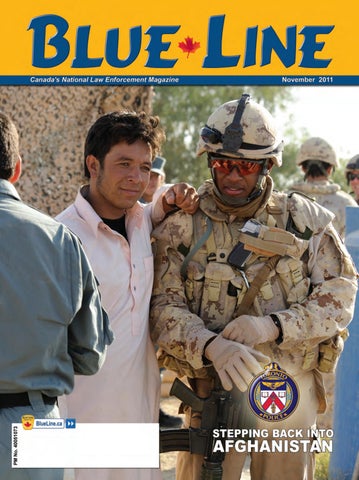
Features 6 Experience is the best teacher Toronto Police step back into Afghanistan
8
Smiths Falls Police Service
An innovative and progessive approach to policing the Rideau
12
6
Wearing our mistakes Lessons learned about a suitable measure of safety
18
An evolving process to manage risk
27
Be careful what you wish for
32
Economic boom attracts criminals
Departments 12
38 Blue Links Advertisers Directory 26 Deep Blue – Do be embarrassed 11 Dispatches 24 Letters 36, 37 Market Place 35 Product News 5 Publisher’s Commentary – Policing has a parallax view to consider 20 Technology – Tablets are everywhere
Case Law
27 BLUE LINE MAGAZINE
33
3
Consider factors supporting dog sniff together
NOVEMBER 2011
“On the Second Day
of Christmas my true love gave to me... a 2 year subscription to
Blue Line Magazine and a cartridge in a bare tree!”
Give a Blue Line gift subscription! 10 issues a year : $30 - 1yr, $50 - 2yrs
BlueLine.ca or 888-640-3048 to order
NOVEMBER 2011
4
BLUE LINE MAGAZINE
Blue Line
PUBLISHER’S COMMENTARY by Morley Lymburner
Magazine Inc. PUBLISHER Morley S. Lymburner - publisher@blueline.ca GENERAL MANAGER Mary K. Lymburner - mary@blueline.ca SENIOR EDITOR Mark Reesor - editor@blueline.ca CREATIVE DIRECTOR E. Jolene Lymburner - jolene@blueline.ca CONTRIBUTING WRITERS Mike Novakowski Mark Giles Robert Lunney James Clark Dorothy Cotton Dave Brown Tom Rataj AFFILIATIONS International Association of Law Enforcement Planners Canadian Advertising Rates Data International Police Association The Canadian Press Newswire Access Copyright SUBSCRIPTIONS $30 per year; $50 for 2yrs; US & Foreign: $100 ADVERTISING 888-640-3048 advertising@blueline.ca
www.blueline.ca 12A-4981 Hwy7 East, Ste 254, Markham, ON L3R 1N1 Canada P: 905 640 3048 F: 905 640 7547 blueline@blueline.ca
PRINTED IN CANADA ISSN# 08478538 Blue Line Magazine was established in 1988 as an independent publication to inform, entertain, connect and educate those involved in the law enforcement profession. With no direct control from an enforcement agency, its opinions do not necessarily reflect those of any government or law enforcement agency. The authors, advisors, and publisher accept no liability whatsoever for any injuries to person(s) or property resulting from application of adoption of anything presented in this magazine. Readers are cautioned and advised that articles presented herein are edited and supplied for your personal awerness and should not be used for further actions until appropriate guidance is received from a supervisor, Crown Attorney or other persons in authority. All material submitted for publication becomes property of Blue Line Magazine Inc. unless arrangements have been made with the publisher prior to publishing. © 2011 All articles are protected by copyright. No part of this publication may be repoduced or transmitted in any form or means, electronic or mechanical, (including photocopying and recording or by any information storage or retrieval system), without prior permission. Permission to reprint may be obtained in advance from Access Copyright 1-800-893-5777.
BLUE LINE MAGAZINE
Policing has a parallax view to consider In a previous commentary I mentioned the parallax phenomenon. This is when your view of something is just as clear as everyone else but with a slight shift in angle. This attribute becomes apparent in policing around the world, as well as across a time continuum. I was reminded of this phenomenon when approached about covering a story on the Toronto Police Service’s efforts to train their counterparts in Afghanistan. By all appearances it is a country that is slowly developing an infrastructure that will sustain a more civil approach to law and order – but it has a long way to go. There is a great gulf in style versus necessity in North American policing when compared to other parts of the world. That is to say that the style of policing in any society fills the vacuum that exists at any given time or place. To understand this principle one need only look at the North American policing style after World War Two. Many millions of soldiers were being “de mobbed” and reintegrated into society. It was a time of high anxiety for both the returning military and political leaders. The soldiers were not only now unemployed but had been trained to take human lives and/or were suffering from the aftereffects of doing so. Couple this with surviving the Great Depression and one can see the type of police officer required to keep order in the streets. They had to be big and tough enough to dish out a form of ‘street justice’ that would never see the inside of a courtroom. A ‘routine’ arrest in those days more often than not came with a few bruises, cuts and broken bones on both sides of the equation. After a couple of decades those rough and tumble sorts mellowed, as did policing. For police officers familiar with those days, it was a simple matter of adjust, quit or retire. I began my policing career at the tail end of this era and had to come to terms with both styles. Understanding where we had come from wasn’t easy. The daily bump and grind of police work often had me scratching my head wondering if there was a better way... and finding a better way was not encouraged. Today the tough, pugilistic cop on the beat has been replaced with officers more willing to lay charges and go through the court processes. This is only because the people they confront are more attuned to this type of treatment. Civil rights and liberties have replaced the street justice deterrent of the past and officers are trained to address 5
this style and act accordingly. Today we live in a society that endorses most police actions because they reflect the tone and humour of the majority of the population. Although good police practices are attainable in Canada, this is not so in much of the rest of the world, where policing is stuck in the post Second World War style – or worse. Most males in these societies are, or have been, trained in military style disciplines of kill or be killed. Even those with no military background are familiar with a multitude of easily available weaponry and none are strangers to death. Living conditions are substandard or precarious at best. North American police going to Afghanistan tend to learn more than they teach. Trainers find it difficult to teach the niceties of proper police practice because survival is their students’ top priority. Crime rates are high because a starving or needy population can see no other hope than to take any advantage to survive. In these countries, the common law ‘defence of necessity’ takes on a scale too enormous for Canadians to comprehend. No third-world officer or even judge would easily understand many of the principles they are being taught without a great deal of effort from very talented teachers. Our problem in Canada and the United States arises when we try to impose our value systems on countries who simply have no infrastructure to sustain them. We send police overseas to train people to be more like us. Today’s officers could not function in the society of the 1930s and 40s, yet we train overseas police who live under similar or worse environments to use our standards. This may prepare them for North American policing theory but the danger is they may not be ready for the reality that awaits when they return home. Any Canadian officers wishing for a secondment to places such as Afghanistan must consider this parallax view of third world countries if they hope to encourage evolution rather than revolution in police practices. After all, it is not police that form the society. They are merely a mirror and can only function successfully at a level their society will tolerate.
NOVEMBER 2011
Experience
teacher is the best
Toronto Police step back into Afghanistan by Simon Martin The ‘highlight of his policing career’ is how Toronto Police Service (TPS) Insp. Paul Vorvis describes his nine month tour helping to train Afghan recruits and police as part of the NATO Training Mission Afghanistan (NTM-A). “It’s good to be back home and I’m proud of what we have accomplished as a group,” he said. “I would encourage other police officers to consider doing it.” Vorvis was part of an 11 person contingent from the TPS. It appears TPS Chief Bill Blair was listening to Vorvis. Since his return in August 2010 two more TPS groups have gone to work with the NTM-A. “The officers came back as enthusiastic about the missions as when they left,” said Blair. “I asked several of them ‘if you could do it again, would you?’ and they said they would.” Now Blair said he is strongly considering increasing the force’s participation. “The Canadian mission has changed. I think it’s really important to recognize that,” NOVEMBER 2011
he said. “There has been a refocus on the training component of the Canadian contribution.” The TPS had a history of working in war torn areas like Bosnia, East Timor and the Sudan, said Blair. “We had a bad experience ourselves a decade ago. Somebody had gone over and served and when he came back he had a lot of problems,” he said. “We stopped participating in missions for a period of time.” That’s why Blair had a certain amount of trepidation when the RCMP approached him in 2008 about reinstating the force’s involvement in international missions; he definitely did not want a repeat of what happened a decade earlier. “We wanted to make sure we got it right this time,” he said. “A lot of thinking and investment went in at the front end surrounding how do we make sure our people are healthy, both physically and psychologically, before they are selected to go.” After much careful thought, Blair agreed to send a contingent. The RCMP co-ordinated the program on behalf of the federal government. Blair said some 25 police services from across Canada are involved in the mission. He was effusive in his praise of the RCMP for its leadership role and commitment to the program. At any one time the RCMP has about 30 officers stationed in Afghanistan and the TPS has at least 10 officers, he said. “The Mounties encouraged us to participate. I want to encourage others to participate. 6
We’re doing something that I think is really important,” said Blair. The mission that Vorvis and other Canadian police officers are participating in can be deemed equally as important as military operations. However, the task of training an Afghani Police Force to be effective and respected by the country’s citizens has many hurdles, said Vorvis. Language, culture and illiteracy are all huge barriers in the training process. With an illiteracy rate of 87 per cent amongst police recruits, you can’t just hand out pamphlets and textbooks. Blair said you have to try some unique approaches to teaching. The culture of policing is much different in Afghanistan, said Blair. Historically, police and citizens didn’t have much interaction. “The police were part of the security plan. They did guarding of buildings and security checkpoints. They didn’t answer calls for service the way we do now,” he said. “If you had a domestic with a neighbour it was just the will of God type thing and nothing really was done about it.” Afghanis will need a paradigm shift in the collective mentality of their society to embrace the new role of their public institutions. “We’re getting the police to transition from doing security to actually being a police service,” said Blair. “It’s difficult because they don’t have the infrastructure or the mind set for that right now.” The Afghani Police Service becoming BLUE LINE MAGAZINE
a trusted pillar of society is the key to other changes, Blair said. An effective police service can make people feel safe and people who feel safe can go to work and send their children to school, he said. “A safe community is a better place to live. That can create respect for government. Prosperity is an incredibly powerful thing,” he said. Vorvis summed up the mission as training people rather than teaching combat. “It’s not about going on night patrol, it’s about mentoring a district commander. We don’t want warriors, we want police officers,” he said. “The military performs a hugely important role but that’s not our role. Our role is to teach policing.” The NTM-A’s mission in Afghanistan is two-fold: train the Afghani army from a military standpoint and train the Afghani police from both a military and policing standpoint. Blair visited Afghanistan in the spring for a week and was amazed at the Canadian officers quality of work. He said because we come from such a pluralistic society in Canada, we have lots of experience dealing with the ethnic tensions that characterize much of the conflict in Afghanistan. Canadian police officers have made a huge difference by sharing their experience and values, he said. “It has improved the country’s ability to secure its own borders, deal more effectively with insurgencies and helped build a more respectful and trusting relationship with the citizens.” In particular, Blair remembers being at Camp Nathan Smith talking to officers who understood what the profession of policing means to the country’s future. Whether it be about how citizens should be treated or building respectable relationships with people, he said they spoke with such eloquence on the subject that it made him very proud to be associated with the mission. “What a potential change that could make if you have a police service that adopted those values, learned those skills and served that country that way,” he said. Although Afghanistan has become much safer in recent years, it is not without risk. There has been a sea-change since the Canadian military left Kandahar, said Vorvis. Canada’s police contingent was split between Kandahar and Kabul but is now just in Kabul. It was a very hot war in Kandahar, making it a pretty risky environment for officers to train. Even with Canada’s less militarized mission things are still a little dangerous. “I wouldn’t minimize the environment,” said Blair. “There is risk. It would be foolhardy to ignore. People have to be aware of their security.” That being said, Vorvis said Kabul is a little more comfortable in both temperature and lifestyle. Officers in the Kandahar region would often send a picture of a thermostat at 50 Celsius home to family. Kabul is more similar to Canada, he said, even offering some connection to home. Vorvis was able to call his wife most days and Blair’s Blackberry was going off like he was back in Canada. Blair urged Canadian police officers to think about doing a tour of international policBLUE LINE MAGAZINE
Toronto Insp. Paul Vorvis is greeted by family after nine month mission to Afghanistan.
ing, noting the TPS results have been extraordinary. “Our people have gained incredible experience and confidence. They come back better than when we sent them, more capable of making a strong contribution here,” he said. Vorvis is a great example. He returned very fired-up about the mission with many ideas about how to go forward and now is part of TPS staff planning for international police operations. Blair said officers sent to Afghanistan are often given jobs with much more authority than they had in Canada, really challenging their skills. It takes them out of what are often routine policing duties and puts them into extraordinary duties. “We send people over there that are punching above their weight and they do an incredible job,” he said. The feedback from participating officers has been great and reflects the thorough planning done before the TPS decided to join the mission, said Blair. It has a rigorous selection process for prospective candidates, ensuring they are physically and psychologically fit with a stable home and financial situation. There is no shortage of officers applying. “I think it’s an extraordinary adventure and many of our police officers want to serve,” he said, “but we want to make sure that they can serve and remain healthy through the experience.” One of the most important aspects of the program is picking the right people and making sure they are going for the right reasons, he said. Officers usually are drawn to the mission because they want to serve or are looking for an adventure. Many former military personnel view it as a chance to serve their country while still remaining part of the police profession. Blair and his colleagues did their due diligence to make sure officers feel well supported, modelling their program after the Toronto Military Family Resources Centre. Every officer who serves in Afghanistan goes through a training program and all families are assigned a TPS family liaison officer for support and to keep them connected. There are also staff psychologists for officers and their families. “I’m not suggest7
ing to you it’s perfect,” said Blair. “That’s a sacrifice for families to be separated in that way. We provide as much support as we can.” Vorvis said the support network for families and spouses has paid dividends because they are able to support each other. He cited one instance where the wife of an officer had a family emergency. She wasn’t able to get a hold of her husband but the support network was able to track him down within 45 minutes. The TPS also has a reintegration framework in place for returning officers. There is always a large contingent of police and family at the airport to let participants know they haven’t been forgotten. Coming back home is usually a very difficult transition, said Blair. Going from an exciting nine month mission to the routine of family and work life is tough. He said the TPS provides lots of support during this time to make the transition as easy as possible. With a third generation of officers participating in the Afghanistan mission, Blair said there is also much more institutional support. Those considering signing up can talk to an officer who has already gone, he said. Ottawa has approached the TPS to contribute officers to missions in Haiti and Darfur. Blair said it’s much easier to commit to doing that when you have the framework already in place to support your officers overseas. Officers have to make many sacrifices but money is not one of them. They are well compensated, said Blair. The TPS also gets some money, which it tries to invest back in its people, he added. Many police services have approached Toronto to see what it’s doing, said Blair. “We were cautious. I wanted to make sure as a police service that we made the investment right up front to make sure that we did the right thing by our folks who wanted to participate in these missions,” he said. “I think its worth sharing with other police services that it has been a very positive experience for us.” Insp. Paul Vorvis may be contacted by email to Paul. Vorvis@torontopolice.on.ca Simon Martin is an Assignment Writer for Blue Line Magazine.
NOVEMBER 2011
Smiths Falls Police Service
An innovative and progressive approach to policing the Chief Larry Hardy Rideau by Tony Palermo Located in a triangle between Kingston, Montreal and Ottawa along the banks of the Rideau Canal, the historic Town of Smiths Falls is popular with both Canadian and American visitors. This was especially true this year when the town’s 9,000 residents welcomed more than 600 emergency evacuees from Deer Lake First Nation, which was blanketed in thick, heavy smoke from nearby forest fires. Although home to the OPP’s Eastern Ontario Regional Headquarters and regional communications centre, Smiths Falls has its own police agency. With its motto of “community first,” the Smiths Falls Police Service (SFPS) echoes the town’s people-first approach and community spirit. “I believe in sending a police car to every call,” says chief Larry Hardy. “Every call that comes in to us is important to the person who’s
NOVEMBER 2011
reporting it, so we treat it as such.” Although keeping the community safe is his main priority, he doesn’t view the town’s boundaries as set in stone. His officers are available to back up nearby police services and deal with criminal activity outside the town. “I’ve been called up to bat on that a few times,” says Hardy. “Someone will come up to me and say ‘I saw one of your cars up on so-and-so road (outside Smiths Falls). What were they doing up there? My answer back is simple. I tell them that the officer was doing their job. Criminals don’t have boundaries when they’re performing a crime and I don’t have boundaries when responding to them.” As one of Ontario’s longest serving police chiefs (Hardy is in his 39th year of policing, including 28 years as a chief, 22 of them in Smiths Falls) he is still, first and foremost, a community-minded police officer. As time permits, he still patrols the downtown core on foot to engage the public and has no problem responding to calls or backing-up his officers. He cites a case a few years back where he responded to a fight in progress. Hardy laughs as he recalls the Crown’s look of confusion while reading the incident report. “Is this right?” the Crown asked, pointing to the part which read “While conducting a routine foot patrol in the downtown core, Chief of Police Larry Hardy responded to a reported fight in progress…”
8
Investing in people and technology The SFPS has come a long way from its humble 1854 beginnings when it used citizen-constables on an as-needed basis. With a current strength of 25 uniformed officers, two part-time special constables for court and escort duties and 10 (seven full-time, three part-time) civilian clerk/dispatchers, it handled 14,072 calls for service last year – a fair amount for a town of 9000 people covering a mere 8.2 km2. To help meet this demand, the SFPS thinks outside the box by finding savings where it can and investing wisely in both its people and technology. As an example, one of its 10 civilians is classified as an administrative assistant and the rest are all cross-trained to perform a combined clerk/dispatcher role. “We’re not just clerks, call-takers or dispatchers,” notes civilian Betty Anne Small. By cross-training the civilian staff to perform each administrative role, the 27 year veteran notes, resources can be allocated where they’re required, providing for a more cost-effective and efficient service. The SFPS also invests heavily in training its officers and believes in providing them with new skills and opportunities. Many frontline patrol officers have been tasked with additional responsibilities – for example, each patrol officer is assigned to a school as a resource officer. The SFPS also isn’t shy about using other skills officers may have. Cst. Cameron Mack learned web design before joining in BLUE LINE MAGAZINE
2008 so he maintains the SFPS web site and acts as media relations officer – both in addition to his duties on general patrol. Despite its small size, the SFPS arms its officers with several technological tools. It introduced voice recognition software to in-car laptops in 2010, allowing officers to run voiceactivated CPIC queries. Thanks to a 2009 provincial civil remedies grant the SFPS became one of the first services to equip all frontline vehicles with mounted audio/video cameras. The cameras have proven to be a valuable asset on several fronts, significantly reducing the amount of time (and associated costs) that officers have to spend in court. They also improve officer safety. “When you tell people they’re on video,” says Hardy, “it’s amazing to see how quickly their attitude changes; and if they decide to challenge something, we can always take them back to the car and play the video back for them. This is reality TV at its best.” Bargain hunter extraordinaire Hardy is known as an innovative, progressive leader who is far from being a little long in the tooth. As one officer notes, “Not only does the chief embrace technology, but he also has an uncanny way of finding bargains and grant money. It’s incredible what he can put together.” In addition to the voice recognition software and cameras, Hardy managed to get a 2009 Ford F-150 4X4 truck to help officers respond to calls during severe weather conditions and a 2011 Dodge minivan, used as a community services vehicle. Both were purchased with civil remedies grants. Bargain purchases within the last year include a 2004 former ambulance that the SFPS converted into a crime scene/mobile command unit (purchased for $1 – a $29,000 civil remedies grant helped outfit it) and a three-year-old digital radio system purchased from the former Leamington Police Service (a $700,000 value which the SFPS got for $125,000 plus the cost of transport and installation). Looking to the future Though Smiths Falls began using citizenofficers in 1854, the town’s chief constable didn’t start wearing a uniform until 1887, which is recognized as the service’s official birth date. Next year marks the SFPS’s 125th anniversary and plans are underway for several events to help mark the historic milestone. The SFPS will soon move out of the downtown core and into a new building in a business park on the edge of town. Hardy has long recognized that the service needed more space but hoped for a solution that would allow it to remain downtown. “While I still believe that the downtown area is the first choice for a police station,” he says, “as time moves on, space in this area becomes limited and we have to look in other areas, as we did in this case.” Hardy still has a few things he wants to accomplish before riding off into the sunset. When asked about his plans to retire, he laughs and responds “when my wife tells me to.” Tony Palermo is Blue Line Magazine’s correspondent for the Eastern Ontario & Western Quebec region. A freelance writer and former federal corrections officer, he welcomes all e-mails and stories of interest at tony@blueline.ca .
BLUE LINE MAGAZINE
Communications Operator Lenore Willows demonstrates Smiths Falls intigrated emergency communications systems which bring together Police, Fire and Ambulance services. A new digital communications system will be installed with a new police facility about to begin construction.
In a strong showing of community spirit, area schools teamed up with the Smiths Falls Police Service and raised over 1,900 kg of food for the Smiths Falls Food Bank. Top: Students from St. Francis de Sales Catholic School celebrate a job well done with (left) Cst. Chris Coon and (right) Cst. Dave Murphy. Bottom left: After participating in the St. James the Greater Catholic School’s Thanksgiving parade, Sgt. Jodi Empey and Cst. Dave Murphy help students load two minivan’s and a cruiser full of food. Bottom right: In between calls, (left) Cst. Dan King and (right) Cst. Chris Coon help unload the vehicles.
9
NOVEMBER 2011
A FIGHT FOR LIFE by Tony Palermo Cst. Paul Klassen truly understands what it’s like to fight for his life. A 15-year SFPS veteran who previously worked as a Toronto police officer for six years, Klassen, a certified use of force instructor, was taking a domestic assault victim to hospital on New Years Eve 2004. As they passed through the downtown core, the passenger suddenly screamed “That’s him!” and pointed towards a male entering a CIBC bank. Klassen steered the car closer and asked if she was sure. “No, that’s not him,” she replied, but something didn’t sit right with the veteran officer. Klassen decided to check the guy out anyway. He approached the suspect in the exterior lobby of the bank. The suspect lunged, knocking Klassen off balance and sending his radio flying. His heart sank as he watched his radio hit the floor and shatter into pieces. He was alone and the fight was on. “That was my first mistake,” says Klassen. “I didn’t book out on my radio. Now, here I was caught up in a fight with this guy and no one knew what was going on, let alone where I was.”
NOVEMBER 2011
Klassen tried everything to gain control of the assailant but nothing seemed to work. The suspect kept smiling, taking everything Klassen was dishing out, all the while saying that he would kill him. After a long struggle, Klassen managed to get the suspect in a choke hold but he reached for Klassen’s sidearm. While trying to protect his gun, Klassen lost control of the assailant and found himself on the receiving end of a choke hold. Protecting his sidearm and unable to break free, Klassen felt himself starting to black out. “This is the first time I was really scared
10
that things might not turn out so well,” says Klassen. “We were both fighting hard – fighting dirty. I was literally fighting for my life.” Klassen doesn’t remember how he did it but somehow managed to break free and continue fighting. Moments later, other officers rushed through the door and helped control the suspect. Aside from some scrapes and bruises, Klassen ended up with a broken nose, which he believes happened when the suspect hit his face and tried to gouge his eyes out. It turns out that before losing his radio, he managed to get off a partial transmission, albeit almost unintelligible. While the other units were frantically looking for him, the dispatcher kept replaying the transmission over until she made out what sounded like “CIBC.” “They say it goes down in slow motion, but I don’t know,” says Klassen. “It was really hard to think through it. Just as fast as I was thinking, stuff was happening. I use this scenario and show the bank video footage when I’m training other officers. I’m not just the guy who’s at the front preaching. I’m the guy giving a lesson learned and showing them how, because of a mistake, I almost got my ass handed to me.”
BLUE LINE MAGAZINE
RCMP boat named in honour of Cst. Leo Johnston
Lac La Biche RCMP Detachment received its new boat in 2010. In 2011 detachment members named it “The Cst. Leo Johnston” in memory of Leo Johnston killed in Mayerthorpe. Johnston was from the Lac La Biche area and his parents still live in town. His parents were thrilled when they learned the Lac La Biche Detachment boat was being
BLUE LINE MAGAZINE
11
named after their son. Shown here are; Cst. Keith Bennett, Sgt. Henry Vandorland, S/Sgt. Steve Visnoski (Detachment Commander), S/Sgt. Brian Quist (Eastern Alberta District DANCO), Inspector Brian Sutherland (EAD Operations Officer), Ron Johnston (Leo’s father), Grace Johnston (Leo’s mother), Cpl. Sarah Parke, Cpl. Trevor Cardinal.
NOVEMBER 2011
Wearing our
MISTAKES
Lessons learned about a suitable measure of safety by Morley Lymburner
A particularly nasty watering hole in the notorious Jane Street corridor in Toronto’s north west end, the Beverly Hills Hotel, was long known for bar room fights on Friday paydays. As a result our unit commander insisted on stationing two pay-duty officers there to keep the battles down. The paid-duty officers, this cool rainy Friday evening, were Ron and Jack. Both were very experienced and tough as nails, a fact well known to every hood in the area. You simply did not cross swords with them unless you were uninitiated or just plain stupid. I had passed by earlier to make sure they were well supplied with coffee; another officer had beat me to it. The routine was for area patrol cars to occasionally drop by and I was happy to hear it was quiet. A half-hour later I heard their “10-33, officers need assistance” radio call. Spinning my scout car around on busy Jane Street, I accelerated as fast as a slant six Plymouth could in those days. I arrived to find a large crowd of bar patrons mixing it up with two officers and both Ron and Jack lying on the sidewalk by the door, surrounded by pools of blood. Others, including two bar bouncers, had blood soaked cloths over their heads. Ron’s face was completely covered – he appeared to be unconscious. The left side of Jack’s face was covered with a bloody cloth but at least he was still sitting upright, with assistance. I NOVEMBER 2011
noticed a large crowd fighting in the parking lot and at least two other officers flailing at a couple of men not far from where Ron and Jack were laying. Police cars began arriving in great numbers as I ran to my car radio to advise the dispatcher we would need at least two ambulances for the officers and a supervisor as soon as possible. I ran back to rejoin the fray just in time to see a third officer go down. I managed to swing heavily at the person standing behind him, who was firmly holding the officer’s cross strap and pulling him around. I heard a crack as my nightstick landed hard on his collar bone and a howl of pain as he quickly released the officer. I then felt someone firmly grab at my cross strap before being quickly dispatched by the officer I had just released. We both decided it was time to ditch our cross straps, putting them to better use as weapons by wrapping them in our left hand. The upshot of all this was a large number of injured officers. Ron went to the hospital unconscious with a broken (torn away) jaw, broken nose and two black eyes. Worst of all, his gun and nightstick were missing. It took him a year to recover after surgery and he retired shortly thereafter. Jack had a broken nose and left wrist and black eye, along with a variety of other cuts and bruises. His gun was also missing but later recovered thanks to a waitress who saw it on the ground and scooped it up for safekeeping. After investigating the combatants (all members of a local biker club) it was discovered that bar room conversations had circulated that the best way to take out an officer was to grab his cross strap from behind. Place one hand on their back and pull hard on the strap 12
so the tension over the front pin prevented the flap from releasing. It was just a matter of time before someone would try it and the best targets were the two officers who could be found every Friday night at the same place. Word spread among officers in our unit and all decided that future calls to that hotel would be sans cross strap. About two weeks later I was dispatched to the bar and removed my cross strap before entering. My patrol sergeant was waiting for me as I left. A brief lecture about being out of uniform followed and a documentation to the boss was deemed appropriate. It took several years of arguing and many grievances for the cross strap to be officially removed as a dangerous accouterment that had no real purpose other than cosmetic. We wore them because that’s what soldiers wore. The Mike Ferguson tragedy Fast forward to 1999 when RCMP Cst. Mike Ferguson shot and killed Darren Varley. The only officer working for nearly 180 miles in a remote prairie town. Ferguson fought with the intoxicated Varley prior to taking him to the detachment. The suspect was so violent that he punched out the scout car window. During a subsequent struggle inside the detachment holding cell, Varley managed to pull Ferguson’s exterior armour vest (something the RCMP supplied and encouraged officers to wear) over his head, temporarily gaining enough control to grab the officer’s sidearm. An understandably panicked Ferguson struggled to regain his firearm and shot Varley twice – once in the abdomen and once in the head. After a tenacious three prosecutions it was determined that Ferguson’s first shot was in fear and that, amazingly in two seconds flat, BLUE LINE MAGAZINE
the officer’s adrenalin level dropped to the point that fear was replaced by anger and the assailant was intentionally shot a second time. Ferguson went to jail. Was it a faulty ruling, flawed judgement and/or poor understanding of the real world by the courts? All these things are wonderful fodder for sociologists, medical experts and legal beagles. Would any of this have happened if his exterior armour was concealed? In honour of Ron, Jack and Mike I confess my absolute hatred of anything that gives a bad guy the advantage. History has taught me how long it takes to move an object as large and cumbersome as police bureaucracy, however this inertia pales in comparison to changing something which has gained voluntary compliance. When it comes to exterior armour most police leaders have relinquished their responsibility to keep their officers safe by taking a passive approach. This modern ideal boils down to less perceived risk for them and is the easy way out of rules and regulations that would require monitoring and enforcement. In other words if they do not make a regulation there is nothing to defend. This is why officers today are given the option of wearing their body armour exterior or interior. Little thought has been given to safety. When an assailant overpowers an officer by using their armour against them, senior police policy makers feel all they have to say is that the officer was given the choice of how to wear their body armour. But can top managers really argue they have no knowledge of harm? They could claim no one has worked out the odds of an officer being shot instead of being overpowered during a career. Ron, Jack and Mike certainly found out. A police chief once asked me why I dislike exterior armour and I offered to demonstrate. He agreed and an obliging sergeant presented his back to me. I jammed my left arm between his shoulder blades, under his exterior armour, and began moving him around the room. All he had to do to escape, he told me, was strip away the Velcro flaps. I invited him to proceed and began tapping his gun. His hand went down to the butt to hold it as we continued our dance. The chief’s eyes widened and his mouth was agape. The gun was in a security holster, the sergeant suggested. “Are you willing to bet your life on that?” I asked. “Mike did and lost.” You do not know who will be a motivated attacker, from where they will come or their knowledge or training – yet far too many officers are willing to give them this one major advantage. Six handles and you are at their mercy. Tell them how many children you have. Maybe they will let you go. To determine the validity of my argument, watch a judo fighter. They gain control over their opponents by grabbing whatever they can. Is this effective? Are you willing to bet your life to find out? The only reason police wear external body armour is because soldiers wear it and BLUE LINE MAGAZINE
everyone feels secure if they look like the TAC team on television. There is a light Some police leaders have enough courage to enact policies designed to protect their members. One came to me several years ago to ask for help in countering a grievance against their ban on exterior armour. I supplied him with many articles and material from the Blue Line Knowledge Portal, including my seven points of concern. External carriers: • Supply assailants with at least six handles capable of incapacitating officers in an altercation; • Encourage target realignment to the head by armed assailants;
13
• Encourage a sloppy, unprofessional appearance while in shirt sleeve dress; • Add four more layers of nylon over a shirt and therefore are hotter than concealed armour; • Give a false image to the public of being on an aggressive, combat zone stance; • could be a cop killer’s defence against a “murder one” charge; • Should be replaced by quality issue wickaway undergarments. The grievance This agency hired an experienced police officer from another organization that allowed external body armour. Almost from the day he was hired he started a campaign against
NOVEMBER 2011
the “no exterior carrier” policy, first asking to be allowed to wear it, then rallying others against the policy. When this was unsuccessful it was brought up as a contract negotiation issue and the agency agreed to form a committee to research it. The committee looked into the subject and agreed the existing policy was appropriate given the various safety concerns. Undeterred, the officer went to his family physician and obtained a prescription pad note saying “for medical reasons” the officer should be allowed to wear external armour. The dangers of exterior carriers were explained to the doctor and he later withdrew his prescription. The officer filed a grievance. The chief assigned his deputy to deal with the issue through the union representative in an informal dispute resolution forum. The deputy was given carte blanche to do whatever he could to satisfy the complainant short of issuing the external carrier. The officer was subsequently offered the best and lightest vest on the market, the best available moisture wicking under garments, the lightest and best uniform shirts available and even a device that was supposed to stop excessive sweating. None of this was satisfactory and it became clear nothing but an external carrier was going to settle the issue for him. Finally a Canadian Union of Public Employees (CUPE) representative got involved
and had union lawyers look at the policy. They determined it was reasonable, not discriminatory and within the chief’s right to manage the organization. The policy Title: Body armour Reference: Use of force specialists 1. Purpose The purpose of this policy is to ensure police service members wear their issued body armour while on duty, concealed from view for
officer safety reasons. The police service and board of police commissioners place the greatest emphasis on officer safety. While it’s virtually impossible to develop a policy to cover all possible scenarios it must be recognized that the police service encourages members to wear all their protective equipment, in particular body armour, at all times, including those times where this policy doesn’t specifically mandate it. In those activities where the policy indicates body armour is not mandatory it’s still encouraged and recommended but is left to the responsibility of each individual to judge its appropriateness. Members must always be cognizant that the police function unfortunately is wrought with unexpected situations and even the most routine of situations may end up posing a serious officer safety concern. 2. Policy While on duty, members of the police service will wear their issued body armour under their uniform shirt concealed from view at all times, except as noted below in the procedures section. 3. Procedures Operational patrol and traffic personnel – Shall wear their complete body armour (front and back panels) concealed from view under the uniform shirt at all times while engaged in operational duties. Members engaged in clerical duties (writing reports etc.) may remove their armour, however shall not leave the office or deal with the public without their armour properly in place. Armour may be worn on the exterior of shirts when the officers are wearing other outer garments such as jackets, rainwear or reefer coats. Plainclothes officer – Shall wear body armour at any time that an arrest or search includes safety concerns. It is strongly recommended that plainclothes officers wear body armour at all times however it is recognized that there are situations where body armour may jeopardize a covert operation or procedure to the detriment of the involved officer’s safety or procedural effectiveness. Operational personnel assigned to administrative duties – Shall wear concealed body armour at any time there are anticipated safety concerns. Administrative personnel – Shall wear concealed body armour at any time they are called out to attend serious incidents where safety issues are a concern. Exception – The only members authorized to wear body armour externally are tactical response officers and those actively engaged in motorcycle traffic duties. Those so involved have the option of wearing an external carrier with police or traffic clearly identified across the back. It is the responsibility of the NCO i/c of each section to ensure, on a daily basis, the members under their direction are complying with this policy. Morley Lymburner is the Publisher of Blue Line Magazine. Your comments are expected and can be sent to morley@blueline.ca.
NOVEMBER 2011
14
BLUE LINE MAGAZINE
A public-private
partnership in forensics by Nancy Colagiacomo Public-private partnerships (PPP) – government and the private sector sharing the risks and benefits and jointly working towards a common goal – are not new. The UK and New Zealand, for example, have tried to cut costs and find new forms of service delivery through subcontracting while ensuring quality at the best possible cost. There have also been attempts to privatize water and prisons. PPP can reduce costs, relieve the government of certain services, offer the possibility of better use of resources and find new solutions if they are properly managed and remain in a legal framework. Undoubtedly an alliance between the private and public sector is an attractive alternative even in policing; this may even establish a better balance between reactive and proactive aspects of police work while engaging the community. The British government announced in 2003 that it planned to privatize the forensic science service (FSS) and said in December, 2010 that it intends to close it in March 2012.
The union is greatly opposed to public-private partnerships, arguing that the quality and availability of services and the relationship of trust between the lab and the courts will suffer, thus compromising criminal investigations. These concerns will have to be studied before a partnership is conceived. Frédéric Le Cren, author of Partnership: Between Utopia and Reality (2004) discusses the essential elements required for a successful
public-private partnership. The partners must have a certain level of trust and openness, he said, and share a common project/goal. Each partner must respect the others specific expertise and capabilities, be open to criticism and keep channels of communication open. Forensic science plays a central role in detecting and deterring crimes. The public interest must be above all others; transparency and credibility are key elements to the success of a PPP. To facilitate accountability and quality control, performance measures and indicators must be accurately expressed. The labs level of expertise and know-how must remain at the forefront of the latest innovations; scientific accuracy can be challenged at all times during testimony. Management has a crucial role to play in dealing with the clash of cultures and managerial methods. A balance must exist between the parties in order to create a relationship of trust to better handle ethical issues. Nancy Colagiacomo is Blue Line Magazine’s Québec correspondent. Anyone with stories of interest on Québec policing may contact her at: nancy@blueline.ca.
Quebec The Québec Forensic Lab serves all police services in the province. It is subject to laws, regulations and administrative rules standardizing the use of human, financial and material information. It is also subject to the rules of the treasury board, human resources office, Société immobilière du Québec, comptroller of finance and public security ministry. The labs services are essentially those of the FSS. Its mission is to support police investigations, administer justice and provide impartial expertise in forensic science, test for the presence of drugs, medicines and other volatile substances in blood or other biological matter in cases of sexual assaults, murders and suspicious deaths. It is also responsible for reconstructing crime scenes, ballistic testing, maintaining DNA databases and providing expert testimony in court. Privatising the Québec lab through a forensic PPP raises a number of questions and concerns. Issues The dissemination of sensitive information such as the national DNA database presents ethical considerations. Highly skilled lab staff could lose their jobs. Does the transfer of knowledge from the public to private sector put it at risk of being compromised? Will the change in status affect the transparency and ethics of lab staff? The credibility of expert witnesses are earned over years; this expertise is almost nonexistent in the private sector. BLUE LINE MAGAZINE
15
NOVEMBER 2011
An evolving process
TO MANAGE RISK by Michael Barnhart Police spend their entire careers managing risk and are pretty good at it, according to some. Others point out that policing is by nature a risky profession, with a certain level of assumed risk. In reality, both points of view are true. Most police professionals reduce risk by developing a good operational plan before conducting a search warrant, ensuring procedures are current and accurate and having good investigative policies – but risk also takes on many less obvious forms. How do you determine if a change in legislative procedure will impact your organization? Do you ensure a detainee cannot see the MDU screen when you query their name? From the macro to the micro, these risks (and numerous others just like them) are all around us. Peel Regional Police (PRP) has adopted a progressive program to identify and mitigate these less obvious but equally disruptive factors. Our approach is based on the premise that identification can never be conducted in isolation. Often those who operated within the risk environment (our front-line officers and civilians) have the smallest voice in identifying risk. To counter this, Peel has taken on a ground level-up approach. An Integrated Risk Management (IRM) section, operating out of the Chief’s office, was created in 2008 to develop a system to help identify risk and integrate all aspects of the Service to form a ‘global’ risk awareness mindset. IRM approached its mandate in three phases, beginning with implementing an employee risk reporting system. PRP support a community of some 1.3 million people (not including the approximately 30 million people who travel through Pearson International Airport each year) with facilities strategically placed throughout the Region. With this level of diversification, ensuring a common and consistent approach to identifying risk proved to be a challenge. To overcome this obstacle, IRM created an electronic risk reporting and tracking NOVEMBER 2011
program, accessible to all members regardless of rank or posting. This program tracks all reported risks in real time, providing feedback loops to risk submitters and ultimately notifying them of how their report was resolved. Members are encouraged to not only identify risks but also suggest strategies to address them. The tracking program is coupled with an educational risk assessment tutorial, which was communicated to all members. Its focus: to acknowledge that there are certain risks associated with policing which are simply beyond our control while identifying many historically accepted risks which, in fact, can be corrected or mitigated. The educational tutorial challenged every member to become their own risk manager. The Employee Risk Reporting phase went live Feb. 1, 2010 and over the course of the next 19 months, members submitted more than 120 identified risks. This approach has given front-line officers and civilians the opportunity to voice their risk concerns directly to IRM, which ultimately reports to the Chief’s office. The high level of engagement continues to this day and it 16
is apparent that the risk mindset has taken root within the organization. While a vital part of the success of the program, Integrated Risk Management goes beyond reported concerns. The second phase of the program, introduced in January, focuses on Area Risk Self Assessments (ARSA) – specific areas deemed to be ‘high risk.’ That designation is determined by the Risk Management Committee, chaired by the Chief and made up of the three Deputy Chiefs and General Counsel (acting in an advisory role) through consultation with IRM. When the committee identifies a high risk area, an IRM member meets with the local Senior Officer/Manager in charge to review the risk process and provide training. They are then embedded in the unit during the course of the ARSA. The process also calls for a cross disciplinary team (consisting of members from within the area being assessed), with the Senior Officer/Manager appointed as team leader. The team is tasked with identifying current and forecasted risk threats to their respective areas of responsibility. A user friendly electronic system is made available to all areas engaged in self assessment. Mitigation plans are developed and self imposed timelines for implementation are created through this process, ensuring timely completion of plans. The teams also monitor and evaluate the effectiveness of their mitigation plans, adjusting them as required. All identified risks, which are assessed and prioritized based on impact and likelihood, and the associated mitigation plans, along with any identified organizational themes, are forwarded (via IRM) to the Risk Management Committee. It reviews the material and assigns any risks deemed to be corporate in nature (outside the sole span of control of the specific area that identified the risk) to the appropriate policy centre for review and implementation. The final phase is External Risk Assessment (ERA), which focuses on scanning areas outside of our Service’s scope of control which could have a downstream impact on members. Peel Regional Police BLUE LINE MAGAZINE
is not an island and events taking place external to our organization may ultimately impact on how we fulfill our mandate. We focus on areas with the potential to impact our organization as a result of their direct (or indirect) decision making processes. Some of the areas currently being monitored relate to case law practices, legislative (or proposed) changes and local and national economic stressors and changing demographics. ERA provides the Chief and his Executive Team with a forward looking projection of foreseeable future risks that may face the organization. While no risk process is infallible, this approach dramatically reduces the likelihood of our Service being caught unaware by an approaching major external issue. The inclusion of an integrated risk management philosophy into all aspects of our organizational structure continues to grow. Risk management cannot afford to be a static process and will continue evolving in response to the ever changing environments in which we operate. While it is understood that risk assessments will
BLUE LINE MAGAZINE
New anti-ballistic product offers extra protection
not eliminate all organizational risks, they will provide a standardized approach to limit the level of vicarious liability facing our Service on a daily basis. Insp. Michael Barnhart is the OIC of Risk Management with Peel Regional Police. Contact him at michael.barnhart@peelpolice.ca for more information.
17
The Netherlands-based Teijin Aramid announced the introduction of its latest unidirectional laminate fabric, called Twaron® UD41. The fabric has been specially developed for ballistic vests to provide extra protection from different types of attack. It is designed to provide extra protection for groups such as soldiers and police units who require such protection. The new fabric - which is based on the high performance Twaron para-aramid fiber - makes it possible to produce hybrid protective vests that are not only able to withstand bullets and bullet fragments, but also other forms of assault, such as stabbing. Teijin Aramid claims the new product means that ballistic vests are lighter in weight and offer greater flexibility and comfort than standard vests. Twaron UD41 is a so-called “unidirectional laminate”, made up of four layers of Twaron fiber threads. The special 0°/90°/0°/90° configuration is individually constructed in the resin matrix and a thermoplastic film is completely laminated over the four UD layers, thereby providing maximum protection and preventing wear and tear. Teijin Aramid stated that current trends are toward lightweight and comfortable vests that comply with strict safety regulations. Twaron UD41 has been tested in accordance with NIJ 01.01.06 requirements.
NOVEMBER 2011
NOVEMBER 2011
18
BLUE LINE MAGAZINE
BLUE LINE MAGAZINE
19
NOVEMBER 2011
TECHNOLOGY by Tom Rataj
Tablets are It has been a whole year since I last wrote about the tablet computer. So much has changed in the last 12 months. Think of a tablet computer as a small laptop screen minus the physical keyboard and the rest of the laptop. The whole computer is built into the case behind the screen and most functionality is driven by the touchscreen. Your finger directs and controls the device and the view of information on the screen. While text input is possible with on-screen virtual keyboards, tablets are not all that adept at extensive text entry. Where they do excel is in surfing the ‘net, checking e-mail, watching videos and movies, listening to music, playing games and reading electronic books (e-books). A variety of utilities can also make tablets very useful portable tools for a wide variety of business, pleasure and entertainment tasks. Tablets typically have a widescreen display that can be used in portrait or landscape orientation. Built-in gyroscopes allow them to automatically change the screen orientation when they’re rotated. Tablet screen sizes range from 7” to 12” wide and they usually, but not always, have an aspect ratio of 16:9 or 16:10 like a bigscreen TV. All tablets feature at least WiFi connection so that they access the Internet anywhere there
NOVEMBER 2011
everywhere
is a wireless connection. Some models are also available with 3G cellular capability. True 4G (LTE) tablets are just arriving now in time for the Canada-wide launch of LTE cellular data networks. The vast majority of tablet brands run the free Google Android operating system (Honeycomb). There are a few Microsoft Windows 7 tablets and the one-off offerings of the Apple iPAD (iOS4) and Blackberry Playbook (QNX). The Apple iPad is typically accepted as the best tablet on the market, although Android tablets and the Blackberry Playbook are also very capable and easy to use. Windows 7 tablets trail the others in terms of ease-of-use, although, since they are real Windows 7 computers, they have some advantages in terms of compatibility with regular Windows software and hardware, such as full sized USB ports. The majority of Android tablets are built around the NVidia Tegra 2 (dual-core, 1GHz main processor). Several other processors run the remaining tablets. Apple iPADs use proprietary A5 dual-core 1GHz processors, the Blackberry Playbook uses a Texas Instruments OMAP 4430 dual-core 1GHz processor and the Windows 7 based tablets use either Intel Core i5 processors or an Intel Atom Z540 single-core processor (the Atom makes for a slow user experience). Tablets are typically available with 1GB or 2GB of system memory and 16, 32 or 64GB of solid-state storage for user files. Prices start at $299 for the few 8GB 7” Android tablets with WiFi only and typically increase in $100 increments for every doubling of user storage memory. The more common 10.1” Android tablets start at $399. The iPAD 2 starts at $519 for the entry level 16GB WiFi only version and climbs to $849 for the 64GB WiFi + 3G version. The Blackberry Playbook recently ranged in price from as little as
20
$249 to $499 and the few Windows 7 based tablets start at $599 and climb to $1,200. Mechanical keyboards, connected through a docking station or wireless Bluetooth, are also available for many tablets, expanding their functionality and greatly improving text entry capability. The Apple iPad still clearly rules the market (about 80 per cent share), having established most of the early benchmarks for what a tablet should be and do. The iPad 2 was released mid-year 2011 and finally addressed some of its first generation shortcomings, namely lack of cameras and the ability to print content created on it. The iPad has a minor handicap when it comes to surfing the Internet; many websites use Adobe Flash to create a multimedia experience but because of somewhat legitimate security concerns, iOS does not permit it to function so some websites do not function correctly. The balance of the tablet market is dominated by Android based tablets, primarily because numerous computer and electronics manufacturers offer one or more models. Most Android tablets are virtually identical, with very few unique features to set one brand apart from the other. Most have the same screen size, processor, increments of user memory (16, 32 and 64GB), price structure ($399 or $499 for the entry level model) and version of Android. Choosing between them really boils down to aesthetics, unique features and personal preferences. The Canadian developed Blackberry Playbook fills out the tablet market with a unique and very capable product. Plagued by a fumbled and premature launch and inaccurate and unfair criticism by the media and stock analysts, the Playbook is actually an excellent tablet with a great operating system and user interface. The Playbook’s smaller 7” screen has some limitations when compared to the majority of tablets, although the smaller formfactor and weight also make it easier to take along. Although very capable as a general purpose consumer-grade tablet, it shines in the business-centric world because of its secure Blackberry lineage and as a big screen extension to the Blackberry smartphone. A major upgrade to the operating system (to version 2) in late October addressed most of the criticisms of the earlier Playbooks and the anticipated 4G versions are expected by year end. A planned 10.1” version has BLUE LINE MAGAZINE
been delayed or even cancelled in favour of development efforts focusing on a new QNX based Blackberry SuperPhone rumoured for Q1-2012 release. Beyond the basics of screen size, user memory, brand and operating system (Apple iOS4, Android, Blackberry QNX or Windows 7) there are a number of additional features to consider when shopping for a tablet. Since the tablet is primarily a multi-media “infotainment” device, audio and video performance and input/output is important. Some tablets are only capable of 720p (not 1080p) video recording and/or playback and many have rear or side-facing speakers or only one speaker, resulting in poor audio performance. Ease of synchronising files is also very important. Some tablets, such as the iPAD, limit synchronisation only to their proprietary software and cables, while others use industry standard micro or mini-USB, micro or mini-HDMI or even Secure Digital (SD) memory-card ports. Some cheaper, smaller 7” Android tablets also only run the older 2.2 or 2.3 version operating system, which was actually designed for three to four inch smartphones; their screen quality is low because the image has been stretched to fill the larger space. For really unique features, Sony’s recently introduced S1 tablet offers Digital Living Network Alliance (DNLA) functionality and infrared (IR) capability. DNLA allows the tablet to wirelessly stream multimedia content to compatible TV’s and home entertainment systems and IR allows the tablet to be used as a universal remote control for most TV’s and home entertainment systems. Amazon.com recently introduced a 7” Kindle Fire tablet at US$199, undercutting the price of all tablets on the market. The Android (2.3) based Fire is largely a marketing platform for Amazon products and services and does not include any cameras, microphones or 3G capability, making it far less of a value than it initially appears to be. Although tablets are primarily infotainment devices, they offer some promise for use in law enforcement. They could be used as a personal video player for victims and witnesses to review video statements in private before court or by case managers to host personal copies of electronic disclosure files when attending court. There are a number of rugged tablet computers available for field use such as law enforcement. Motion Computing makes the Motion J3500 Tablet PC running Windows 7 and General Dynamics makes the Itronix DuoTouch rugged tablet PC. There are also a number of rugged “convertible” tablet computers – essentially laptop computers with touch-screens that can be rotated and folded flat to cover the keyboard. They can be used in either configuration.
Whipping pedestrians into shape by Tom Rataj During my recent trip to Peru we saw these “pedestrian control wardens” in Cusco, attempting to keep pedestrians from crossing mid-block near the Plaza de Armas. This street was two lanes in both directions, with a raised centre island, where there were four steel fence type barriers which making crossing more difficult. On one of the days
we were there, there were three of these “pedestrian wardens.” They each carried a sign telling people not to cross there but at the corner at both ends of that section of street. They also carried short braided jute whips that they somewhat jokingly waved at offenders. As you can see, they also had bright masks and clothing on. It was quite interesting and entertaining to watch.
Tom Rataj is Blue Line’s Technology columnist and can be reached at technews@blueline.ca .
BLUE LINE MAGAZINE
21
NOVEMBER 2011
Progress through networking Law enforcement planning by Julie B. Grimaldi The Ontario Association of Law Enforcement Planners (OALEP) may conjure images of policy bureaucrats or ivory tower thinkers to some – but for a growing field of public safety professionals and executives, it represents a forum that allows police and other law enforcement agencies to find answers to the problems of today and tomorrow. If you have ever been faced with responding to a formidable inquiry recommendation or ensuring your members have the best available information to help make them effectively accountable when carrying out critical duties, then you already know the value of being networked with professional police and law enforcement planners. OALEP provides exactly that and is open to membership from other provinces. Proud of the past The Ontario Police Forces Planning Association (OPFPA), the forerunner to
OALEP, began in the early 1980s. The intent was to provide a place where law enforcement planners could enhance their knowledge and professionalism through training and networking with colleagues in other agencies. During the 1980s and into the ‘90s, planners and policy analysts met regularly for a couple of days, three times
a year, at the Ontario Police College (OPC). The group of 20 to 30 members discussed future policing issues with government appointed experts, like Scott Campbell (then chairman of the Strategic Planning Committee on Police Training and Education) and various police chiefs. OPFPA also sponsored a one-week police planner’s course every June at OPC. Like most organizations, however, the recession of the ‘90s coupled with dire recruitment needs left their mark. Member agencies amalgamated and government support through OPC lessened as the availability of accommodations diminished. By 1996, OALEP came fully into being with a name change, a new mindset and a typical annual membership of about 45 agencies. Having lost its traditional host location for meetings, networking opportunities were modified to better fit the times. Twice-yearly symposiums emerged side by side with the introduction of an electronic bulletin board, allowing solutions to topical issues and calls for information and assistance to be discussed in both real and virtual environments. Locations for symposiums also began to rotate from east to west and into central Ontario, in the spirit of fairness to recognize the jurisdictional vastness of the province and the distances that members would have to travel. Refining for the future The semi-annual symposium has become a signature OALEP event. It provides a forum for training through presentations and seminars delivered by subject matter experts on contemporary issues in law enforcement,
NOVEMBER 2011
22
BLUE LINE MAGAZINE
and a venue for holding twice yearly business meetings with member agencies. These networking opportunities geared specifically to law enforcement planners are a major strength of the symposiums. More recently, the structuring and format of events has been refined in that member agencies now have the opportunity to showcase their organization by hosting a symposium they know many other law enforcement agencies will attend. Because membership in OALEP is by agency, all employees are automatically members at no extra fee. This benefit enables host agencies to send as many employees as they wish to attend the local symposium at substantially reduced costs. Host agencies work closely with the OALEP executive board to prepare for the event. Once a theme is established, the board works diligently to seek out keynote and other renowned speakers of interest. In recognition of the host agency’s time and effort, OALEP donates a $500 honorarium to the chief’s charity of choice. In the fall of 2010 and spring 2011, an estimated 100 symposium attendees benefited from presentations on the science of law enforcement planning from specialists like Dr. Tullio Caputo (University of Ottawa) and Peter Bellmio (Maryland, USA). They also engaged in diverse discussions about strategic partnerships with leading-edge practitioners such as Supt. Paul Pedersen (York Regional Police), Michelle Dassinger (Calgary Police Service), S/Insp. Tom Cowper (New York State Police) and many others. Staying true to the new norm, OALEP’s next symposium (in Vaughan Nov. 7-9) will take an introspective look at managing risks through the eyes of specially engaged experts. It will feature a side tour of York Regional Police Service’s newly opened investigative services facility. As well, the recipient of OALEP’s 2nd Annual Report Award will be announced; the prize will be a donation to the Ontario Police Memorial Foundation on behalf of the winning organization. The OALEP executive board has been active in introducing other developments. In 2010, under the leadership of President Margaret Gloade (Waterloo Regional Police), its primary goals were officially articulated as raising the profile of the organization and improving communications within the membership. The pursuit of these goals is taking on momentum: OALEP has been made the first Canadian chapter of IALEP (International Association of Law Enforcement Planners) and a members’ newsletter, Blue Print, was established in the fall. These initiatives were followed by the launching of a newly designed web site in April 2011 that added many new features and functionalities. The next step is developing a live listserve that will further promote and enable critical, real-time discussions and information sharing. BLUE LINE MAGAZINE
Like any non-profit organization, OALEP is member driven. Its volunteers are dedicated and committed to improving on the successes in law enforcement in Ontario and contributing to the wider public safety milieu nationally and worldwide. For tomorrow, the executive board plans to work harder at promoting planners as key professionals who possess research and evaluation skill sets unique to law enforcement and to increase its own capacity to provide greater training and networking. The wealth of home-grown expertise that resides in and is shared through collectives such as OALEP provides a foundation of knowledge and innovation that can greatly assist both new planners and executives alike. The sharing of contemporary issues and concepts through symposiums and networking make these forums truly a home to progress in law enforcement planning. Author’s note: Thanks to Barry Horrobin, Windsor Police Service, a founding member and current treasurer, for providing early historical context. Visit www.oalep.ca to learn more. Julie Grimaldi has worked as a planning officer for the Ontario Provincial Police since 1990. A graduate of both York University and the University of Toronto, she holds an Honours BA degree in Philosophy and Law & Society and a MA degree in Criminology. A past president of the Society of Police Futurists International, she is OALEP vice president-administration.
23
NOVEMBER 2011
LETTERS I read Sgt. Fawcett’s article in the May 2011 issue of Blue Line with great interest. I thought his use of the “reverse-Cassandra effect” (i.e. speaking falsehoods and being believed) was clever but somewhat indiscriminately applied in this case. In his article Sgt. Fawcett implies that all (police related) research is good research simply because it exists. With respect, I think Sgt. Fawcett may be guilty of another form of cognitive distortion – overgeneralization. While it is certainly true that the majority of the work he cited is reputable research, it is not the case for some topics mentioned in his piece. For example, it is universally accepted by those trained to distinguish between reputable and questionable research that the TASER’s health and safety effects have never been subjected to rigorous, independent and impartial research. It is true that a plethora of research on the weapon exists and has been completed by an army of M.D.s and Ph.D.s, but it lacks scientific rigour and has been termed “junk science.” It is never a good sign (or good for business) when a manufacturer contradicts its earlier “scientifically proven” claims. Taser International recently (2010.05.01) issued a new training manual for the X26 TASER. It includes a long list of alarming risks and warnings which constitute an “about face” on original claims based upon their research. Among these warnings are statements as follows: The company now cautions that the weapon “hasn’t been scientifically tested on pregnant women, the infirm, the elderly, small children and low body mass persons” ... and ... “the use on these individuals could increase the risk of death or serious injury”. The company goes on to admit “that the TASER can produce physiologic or metabolic effects, which include changes in: acidosis, adrenergic states, blood pressure ... heart rate and rhythm ....” With this statement Taser International directly disputes its own previous research findings and confirms what critics of that research have said for over a decade. Finally, Taser International appears to “throw in the
towel” as it abdicates responsibility for its own weapon in the statement recommending that “all TASER ...users conduct their own research, analysis and evaluation.” So are we to think anyone who is critical of Taser International’s sloppy research is speaking a falsehood? With regard to the controversial topic of excited delirium, Sgt. Fawcett implies that it has been the subject of “scientifically sound” research. In fact, it is not something that scientists can study in a controlled (scientifically sound) environment. Moreover, his assertion that there exists “documented descriptions of excited delirium in research dating back to the 1800s,” is similar to saying that there are documented descriptions of the Yeti (abominable snowman) in research dating back to the same time period; and we are all aware of how those descriptions have failed to increase the credibility of the creature in the minds of the scientific community. The term excited delirium was contemporarily applied by medical researchers to describe (not diagnose) the extreme end of a continuum of drug abuse behaviours such as “cocaine-induced excited delirium.” Neurologist Deborah Mash’s research on brain biomarkers for the identification of excited delirium seems to support the use of the term as a descriptor of cocaine induced behaviour and its association with cocaine toxicity; not as a diagnosis or its general application to all erratic behaviour. The agitated and deranged behaviours
termed excited delirium and observed by a police person in the community are essentially indistinguishable from those present in agitated schizophrenia, agitated hypermania, agitated dementia, true delirium, or a cocaine induced rant; there is nothing to differentiate these conditions, one from the other, save a full medical/psychiatric workup. Most concerning was Sgt. Fawcett’s implication that because of equivalent early research results the concerns with prone restraint had been discredited. He and I were witnesses at the same Commission of Inquiries where a long line of distinguished medical experts, citing recent research, cautioned against the impairment of respiration as it is associated with prone restraint. Even the Canadian Police Research Centre in 2005 emphasized that respiratory impairment becomes particularly crucial when restraint is applied during or after a prolonged physical struggle. It is uncontroversial that acidosis is cleared primarily by the lungs; therefore during or after a prolonged struggle the body’s natural response is to hyperventilate. However, hyperventilation can be impeded if a subject is lying face down (prone). In this position, prone restraint becomes an obstacle to the subject’s attempts to clear acidosis, thus increasing the risk for cardiac arrhythmias. So to conclude, are we to understand that when anyone wishes to question or criticize police actions, or methods, they will be viewed as part of the “reverse-Cassandra cry?”\ Does Sgt. Fawcett really believe that all those who criticize the police are antipolice? Is it not possible that those who are critical of police actions, or methods, also love their communities (and police services) and want the best for them both? And when Sgt. Fawcett muses, “one wonders when there will ever be enough research done to satisfy the critics,” does this reflect an understanding of the scientific method and its place in society? Or when he asserts that, “Credible police trainers stay current with research in a variety of fields...” how much
2012
Blue Line
Trade Show & Training
MA (Leadership) OnLine Program The University of Guelph’s on line MA (Leadership) program offers a broad multi-disciplinary approach which deals with leadership issues relevant to the public, private and not-for-profit sectors. The MA (Leadership) program which combines e-Learning with residential components is designed to empower individuals with leadership knowledge and experience, allowing them to increase their selfawareness and competency, in order to contribute to ethical leadership, organizational transformation and the betterment of society.
519-824-4120 x56607
NOVEMBER 2011
Blue Line Magazine’s annual law enforcement event, Blue Line Trade Show & Training, takes place at the end of April. Blue Line Training offers numerous courses nationally recognized in upgrading your skill and knowledge base. The skills attained could mean the difference that sets you apart for career advancement. Past training courses offered, among others, include detecting deception, investigative interviewing, media relations, and drug enforcement. Keep checking out blueline.ca as more courses are added to the Blue Line Training roster for 2012.
www.leadership.uoguelph.ca
24
BLUE LINE MAGAZINE
faith can we have in his assertion after reading his article? Most importantly, does the tone of his article bring law enforcement any closer to the community it serves, or does it do more to feed the “us versus them” mentality? Dr. Mike Webster British Columbia ••• No one can save the RCMP! There is now a short list for the new commissioner of the RCMP. The good news? All of the candidates are immensely qualified educationally and have a wealth of law enforcement managerial experience. The bad news? God is not on the list. The winner of the unenviable position of commissioner of our federal police force will surely understand the RCMP is overmandated and overextended. Perhaps this gifted individual will attempt to take bold steps to re-align and re-focus the force’s current unrealistic, multi-leveled responsibilities. The new chief will understand that the constant barrage of criticism emanating from an inability to juggle all the balls is surely bringing the “Scarlet Force” to its knees. The long overdue decision to remove “The Mounted” from municipal and federal contracts will then be taken to the only person who can facilitate this; the Prime Minister. The PM, already immersed in a morass of domestic and world wide socio-economic crises, will be less than enthusiastic welcoming his new RCMP commissioner to his door with proposals of vote annihilating ideas. One can only speculate as to the reactions from cities and provinces of Canada upon learning their beloved Redcoats are planning to abandon them. In addition to
BLUE LINE MAGAZINE
the nostalgia component, there is of course serious budgeting ramifications for all lesser levels of government. Perhaps if God was holding the post of commissioner, he may be more likely to get a sympathetic ear. A lesser being will have about as much chance as the fabled snowball in Hades. The new Commissioner, restricted in his options, will be told to do more with less. The mistakes and gaffs will continue. Instead of less credibility, there will be no credibility. A decision will arrive five years from now, or 15 years from now, to dissolve the organization in favour of some entity that will better
25
reflect the Zeitgeist. Lee Iacoccoa, where were you when we needed you! Ian Parsons Alberta ••• Regarding your article “Preventing crime 140 characters at a time” in your August/September 2011 edition. Kudos to Morley and crew. This article arrived in my mailbox two days ahead of a similar article in the Toronto Star of August 16th. How’s that for timely reporting?! Hal Brooks RCMP Supt. (Ret.) Markham ON
NOVEMBER 2011
DEEP BLUE by Dorothy Cotton
DO
be embarrassed This column is coming to you from a Via train leaving Toronto. I am on my way home after a business trip, sipping wine and reading some stuff that I thought would be good fodder for a Blue Line column. A series of interesting research studies just came out about the relationship between embarrassment and prosociality. Since prosociality is kind of the flip side of antisociality and we are always interested in that, I figured we should also know about prosociality. I was trying to think up a good example of something embarrassing – without embarrassing myself, because of course that is kind of embarrassing – and to my delight, someone near me provided a good example. Here’s the scenario: two young guys are sitting across the row from me chatting. An older woman comes along and stops beside them. She looks at her ticket, looks at them and suggests somewhat hesitantly that they must be in the wrong seats, as her ticket indicates she should be where they are sitting. They look at their tickets, confirm that the seat numbers are correct and basically suggest she take a hike. There is some eye-rolling and snide comments about dementia. The woman finds the attendant, who inspects all the tickets and points out that while the guys
College of Continuing Education
are in the correct seats, they are in the wrong car. One guy looks horribly embarrassed, apologizes to the woman and displays all the typical embarrassment-type behaviours: he looks away and at the floor, smiles awkwardly, gestures nervously, looks generally conciliatory. The other guy shrugs, says “Look, it’s not a big deal, we’ll move,” and heads off to the other car muttering that SHE could have just gone to the other car rather than making them move after they were all settled in. In other words, one guy was embarrassed by the gaff – and one wasn’t. So which of these folks is less likely to be joyriding in your car or selling drugs to your kids? You probably guessed – the guy who was embarrassed. It’s not news that embarrassment serves a particular social purpose. It is an emotion which signals to others you are aware that you have violated a social norm or interfered with a social interaction. Embarrassment is an acknowledgement that you have appraised both your own behaviour and the reaction of others to your behaviour – and that you know you have blown it. In other words, you have to know what the social conventions are and that you haven’t followed them to be embarrassed.
Certificate in Police Leadership
Courses in this unique distance education program for police include: • Advanced Police Leadership • Budgeting and Financial Management for Police Services • Communication Skills for Police Personnel • Ethics for Police Leaders • Legal Issues in Policing • Managing Police Performance: Coaching Skills for Police Supervisors (workshop) • Police Leadership and Management Development • Policing and the Law of Human Rights • Policing the Modern Community • Strategic Human Resource Management for Police Organizations • Strategic Policing
“Communication Skills for Police Personnel should be a mandatory course for all police supervisors and managers. I will carry on the skills I acquired throughout my career.” Cst. Adam Caissie, RCMP, St. George, NB
Distance courses begin on January 27, 2012. Registrations received by December 9, 2011 will receive a $50 discount.
Prepare for your promotional opportunity today! If you would like more information or wish to have a brochure mailed to you please contact the Program Manager, Sherry Carmont, at (902) 494-6930. You may also write to Sherry via e-mail at CPL@Dal.Ca or to the address at right. Detailed information and registration forms can also be found on our website at www.dal.ca/cce.
NOVEMBER 2011
Dalhousie University College of Continuing Education 1459 LeMarchant Street, Suite 2201 PO Box 15000 Halifax NS B3H 4R2
26
Being embarrassed is not fun and most people will go to great lengths to avoid embarrassing themselves, however it is not necessarily a bad thing. Embarrassment sends a signal to others that you are aware you have violated a social convention, somehow disrupted social interactions and feel bad about that. In that way, it is a socially constructive emotion, actually repairing the damage the bad behaviour might have done. Even though you might briefly lose a bit in terms of social standing by committing a faux pas, research (and experience!) shows that one quickly regains one’s status if appropriate displays of embarrassment follow the faux pas. Being embarrassed mends fences and acts as an apology. (Some politicians have even figured this out.) What does this tell us about prosociality? Well, logically it makes sense that if a person (1) knows what the social “rules” are; (2) is aware that they have violated them and (3) subsequently feels bad about that, then they are more likely overall to engage in prosocial behaviour – and conversely less likely to engage in antisocial behaviour. Indeed, that seems to be the case. A series of studies by Matthew Feinberg and his colleagues at the University of California at Berkeley demonstrated that generally, people recognize the expression of embarrassment as an “affiliative” behaviour – meaning the embarrassed person has a greater desire to abide by social conventions and commit to social norms (and heaven knows, Berkeley has an endless source of good material for studying embarrassment!!) People regard those who get embarrassed as being prosocial – and in fact, it appears that they actually ARE more prosocial than those who do not get embarrassed. You might not like feeling embarrassed, but other people will like you better. Almost regardless of what you did, being embarrassed will make people see you as more prosocial. One of the interesting things that this line of research highlights is that, while we may think we are judged by what we do, we are just as likely to be judged by how we perceive and react to what we have done. Our emotional reactions to events can indicate to others our awareness of our own behaviour and perceptions of ourselves. If you have ever been in court, you know that people pay a lot of attention to people’s reactions to their own behaviour. Obviously, being embarrassed is not going to be a prime determinant of anyone’s behaviour – particularly if we are looking at experienced criminal offenders. If a person has no impulse control and little in the way of personal resources, being embarrassed is not enough to make them mend their ways and will not provide the skills they lack – but if I were looking at the behaviour of a colleague who has erred, I’d be a little more optimistic if they seem embarrassed by their error instead of denying, deflecting and covering it up. Dr. Dorothy Cotton is Blue Line’s psychology columnist, she can be reached at deepblue@blueline.ca
BLUE LINE MAGAZINE
careful what you wish for Be
by Judi Grout It’s extremely frustrating to watch hardened criminals smile smugly as they’re let off of serious crimes on a technicality, feel the anguish of victims never validated for their suffering or see a judge pronounce a laughably lenient sentence. Early release bulletins tell of violent sex offenders, likely to re-offend, let back into the community with no effort to rehabilitate and take responsibility for their crimes. Add these stresses to the increasingly difficult job police face in making a sound case in court and you can feel overwhelmed. More often than not, it feels like our system favours the criminals rather than victims and this pushes us to imagine a different way, one where justice is swift and immediate. I have broken some rules at times, taking justice into my own hands when the system has failed. However, an experience in Africa made me have second thoughts. Travelling to Dar Es Salam, Tanzania to visit my husband, who was working there, I had a three month leave of absence from work and a plan which included volunteering in an orphanage, teaching English in a nursery school, learning Swahili, many wildlife safaris and soaking up the people and culture I had been drawn to all my life. It was a dream come true and within 24 hours of my arrival, I was exploring a well known ocean beach popular with locals and expats. Local people working with my husband assured me that it was safe; many exercised there daily. Sinking my toes BLUE LINE MAGAZINE
in the sand, feeling the surf hit my knees and greeting the local people who loved to hear me speak Swahili and were eager to practice their English, I was totally relaxed, taking in the sights and sounds of Africa. Wandering further away from the crowds, three young adult men suddenly approached, standing right in front of me but still exchanging courteous Swahili greetings and shaking my hand. Something was different and I knew by their eyes that they were obviously high. The leader pointed to my shoulder pack and asked for it. I immediately refused and pushed past them. They sprang into action, surrounding me on all sides and jumping up and down in the sand. One reached behind his back, mimicking a knife and making stabbing motions towards me.
27
They were more serious than I had thought so I reluctantly handed over my pack containing my new cell phone, wallet with cash and identification and brand new 35mm camera. They quickly ran up towards the sea cliff and I felt the need to give chase. Rightly or wrongly, I ran full tilt yelling as loud as I could, “THIEF THIEF,” an internationally recognized word, and “POLICI POLICI” (Swahili for police). They looked shocked to see me pursuing them and, quickly unzipping my pack, removed my camera and tossed my pack back to me! Off they went through a heavy brushed area, cradling my camera; I decided not to follow for fear of an ambush. I was suddenly surrounded by local people trying to comfort me and asking what hap-
NOVEMBER 2011
pened. There was an elderly woman wearing a safety vest who was collecting garbage on the beach, three young teenagers who sell cooked corn and two young beachcombing boys. Using a combination of broken Swahili, some English and a lot of charades, I was able to communicate that three men, one wearing a red shirt. took my camera with a big lens and pointed the direction in which they ran. Off the group went in fresh pursuit! I started walking towards the highway, hoping to find help and trying to call police emergency with my new cell phone. I had noticed a billboard earlier in the day announcing that the city had just adopted a police emergency phone line of 119. I dialed but kept getting a busy signal. Within minutes I heard shouting from down on the beach and ran back to find the three young teenagers joyfully showing me they had found the suspects, taken back my camera and trying to tell me something about polici. So grateful, I opened my wallet and gave them all the money I had. They were speechless. I am sure that was more money than they had ever seen or will ever see again, even though it was only about $40 each. Slowly we walked together towards the highway and away from the bush and beach, the group swallowing me with a protective circle, rubbing my arm and saying “Poly Poly,” which means sorry. It was like they were apologizing for the behaviour of their fellow Tanzanians. As we got to the highway a large truck marked POLICI pulled up. Two uniformed men carrying long barreled guns jumped out, dragged two handcuffed suspects out of the back seat onto the ground and pointed at them. Yes indeed, they had arrested two of the three men who robbed me! I identified them and suddenly the beating began. The officers hit them repeatedly in the head with the butts of their guns, also kicking and punching. I told them to stop, that it wasn’t necessary to beat them on my behalf, and then noticed my
NOVEMBER 2011
Judi Grout, pictured volunteering at the Cradle of Love Orphanage in Arusha, Tanzania. entourage had increased to well over 30 men, women and children. My little robbery and the apprehension had drawn a lot of attention and people were crowding around me, eager to watch the beating. I managed to get it stopped but soon realized it was getting bigger than me. A large Cadillac pulled up and a very tall, well dressed man approached, speaking beautiful English. I thought he would help me stop this madness and quickly explained the situation, then watched as he calmly walked over to the robbers and started kicking them repeatedly in the head. His brother had been robbed on this very beach a week earlier, he explained, and the suspects had tried to choke him. The Tanzanian people do not tolerate thieves, he added. The mood of the crowd intensified as I watched the police line up the sitting suspects against their vehicle and the crowd gather large pieces of coral and line up to take turns throwing it at their heads. They were going to be stoned to death. I needed help, now! Every-
28
thing was happening so fast. My husband was at a meeting downtown, a good hour away, and the only other phone number I knew was my housekeeper Dao, who I had only met that morning. I called, explaining through tears that I needed him here now and managed to read the street sign. While waiting, I blocked people from throwing coral, pleading with them to stop. I did not want to be responsible for two people dying just because they robbed me. I had my stuff back! Why couldn’t they just be arrested, go to court and do some jail time? Was death really a fair punishment? They stopped but it was clear I was really beginning to annoy them. Dao arrived within minutes by taxi and jumped into action, assessing the situation and immediately trying to hold me back from interfering. He kept saying, “Miss Judi, you can’t stop this, this is the way of Tanzania.” I looked into the eyes of the pleading and crying suspects, the blood from their head wounds mingling with their tears and draining down their faces. They looked so young and pitiful to me now, sitting slumped in a puddle trying to dodge the beatings. What brought them to knowingly risk their lives to steal my back pack? How desperate was their situation and how many times had they participated in a mob beating of another thief? Was their death by stoning an appropriate punishment? It wasn’t to me and I wasn’t going to let it happen; I just couldn’t. Through my panic and confusion I heard horns honking and a military police truck sped into the crowd. I then realized that the first responders were actually only a security company paid to patrol the beach and were fully prepared to allow the crowd to kill these two young men. This was the real police. They spoke English but were emotionless as I explained that the suspects had robbed me, we had retrieved my stolen articles and that being stoned wasn’t my choice of punishment! They quickly loaded them into their truck amid shouts of protest from the now blood thirsty crowd and ordered me into the front cab to come to the station with them. They were armed to the hilt, including AK47s, and I was a little leery. How did I know they were the real police and exactly how many different police were there? I asked if Dao could come with me as by now he had both arms wrapped around me in protection, obviously worried that I was in trouble and wondering how to explain to my husband what happened. Dao could come but he had to ride in back with the suspects, I was told. Off we went down many back-roads, with me crammed in the front seat between two very large police officers, their AKs pointed up towards the ceiling between their legs – going where, I wasn’t sure. We arrived at a real police station where a very polite, articulate sergeant took my statement. Things went wrong when he asked my occupation and I told him I worked for a Canadian police service, thinking it would help with our communication. He immediately became confrontational and, yelling, accused me of being a spy checking for police corrupBLUE LINE MAGAZINE
tion and that this was a set up! I didn’t know how much fight I had left in me. The temperature was well over 36 degrees, I still had jet lag, had chased bad guys and then tried to save their lives and now the police suspected me of being a spy? It had been a long day! It was then I heard the familiar voice of my husband’s coworkers behind me. Dao had made a frantic call to the office and they were here to smooth things over. The suspects were put in a cell and assured the sergeant I was an innocent traveler. I was taken home to our flat and later found out that my suspects were spared. Their families could bail them out once they raised enough money. They would not be killed – not this time. I admit that chasing the suspects was not wise but we all sometimes do things without thinking. The beating I witnessed wasn’t an isolated incident either. During my stay I met expats who witnessed a thief burned to death after a gas filled car tire was put around his waist and lit on fire. Another man was thrown down a well and stoned until he drowned because he stole a cell phone in a village where my husband worked. This was done by fellow villagers – men, women and children – and was perfectly acceptable behaviour to them. It’s not because Tanzanians are violent. In fact they are a very loving and giving culture, always upbeat and happy despite their poverty, starvation and poor living conditions. Police corruption is rampant and rules depend on who a person is and what they own. Police often stopped us for no reason and then asked for cash to let us go. Perhaps this gang mentality is a direct response to the pure frustration the common citizen faces each day dealing with corrupt security and police authorities. The look in those young mens’ eyes as they sat huddled together in a puddle facing peers very eager to kill them will stay with me forever. It was then that I was grateful to live in a society where the criminal justice system prevents these things from happening. I know I have felt that overwhelming desire to administer justice myself when a suspect has done something abhorrent and is getting away with it. I know that feeling – but being in that situation and really feeling the energy of a crowd hell bent on killing someone.... it’s not something that many of you would be comfortable with, no matter what you think. I still think we need drastic changes to make the punishment fit the crime, the victim feel validated and suspects not always given the benefit of the doubt. Ordinary citizens also get frustrated with how things work and desire immediate and swift justice. Is our current situation enough to move us towards a day when Tanzanian justice becomes prevalent here? I hope we can fix what we have so that never happens... be careful what you wish for! Judi Grout continued on her journey in Africa. She has served the Winnipeg Police Service for more than 30 years, starting out as a police cadet in 1977. She was a constable for 10 years and is currently a police communications operator.
BLUE LINE MAGAZINE
29
NOVEMBER 2011
Risingto the challenge Lessons for a new economic landscape by Edgar MacLeod It’s funny how things come full circle – after 35 years of policing in communities throughout the Maritimes and working on innumerable national committees and associations, I landed right back where it all began. Taking the reins at the Atlantic Police Academy (APA) in 2008 was an exciting prospect – an opportunity to help shape a new generation of recruits at the very institution where I first trained in 1973. It also coincided with some of the most uncertain economic conditions in decades. Things are very different than they were when I attended. Over its forty year history, the APA, a division of Holland College, expanded its programming from police science to include a range of other core programs, including corrections, conservation enforcement, law and security and firefighting. An advanced in-service curriculum is also offered to experienced law enforcement officers. After a major infrastructure expansion in 2005, the facilities are second-to-none and comprise 70,000 square feet of new or renovated space, including a crime scene village, state-ofthe-art indoor firing range and student residences. Of course, maintaining this kind of operation requires a healthy budget and in the midst of a global economic downturn, that’s just what we didn’t have. It’s not a new story and any police academy or service in the country can readily identify with the situation. The APA relied primarily on core funding from each of the Atlantic Provinces and revenues from in-service clients so the blows came from both sides. Provincial monies supporting recruit training began to dwindle and police services around the region significantly reduced the number of candidates they sent for specialized training. As prospects became increasingly bleak, we turned our attention to identifying new sources
NOVEMBER 2011
of revenue and, thanks to a little ‘out-of-the-box’ thinking, have managed to hold our own and even make gains in these uncertain times. When it comes to recruit training in our police sciences program, the APA is the most expensive academy in Canada. On paper, it’s a bit hard to swallow, but in practice, it has its advantages. Because we no longer receive provincial subsidies, programming costs have shifted entirely to our students. In addition to bearing the cost of the program, candidates must meet a range of entrance requirements – from psychological testing and physical evaluation to polygraph interviews and background checks – that are at or above the standard of most police or public safety agencies. By the time they actually start the intensive 35-week program, our cadets are already heavily invested in their training. It’s an understatement to say the program is rigorous. We work our cadets hard and make no apologies for it. They take on a demanding schedule of classroom and practical training. In recent years, we’ve also ‘power-packed’ the core curriculum with a growing range of online learning courses from the Canadian Police Knowledge Network. This not only contributes to a more comprehensive training program, but also initiates recruits to an increasingly prevalent means of in-service learning in Canadian police services. In fact, I believe the APA uses more e-learning than any other academy in the country.
30
It’s through this blended learning approach that the APA can turn out recruits who are not only trained in fundamental police techniques but also certified as Level ii accident investigators, familiar with systems like CPIC and the Firearms Reference Table and trained in more communitybased aspects of policing such as dealing with emotionally disturbed persons or understanding LGBT issues. As hard as we work our cadets, we work just as hard to make sure they succeed and provide the support services they need to achieve. At the end of the day, that combination of challenge and encouragement ensures our cadets are both competent and confident. Because we work on a pre-employment training model where the curriculum is designed on competencies that meet the needs of many police services, our cadets can walk off the graduation stage and on to the job, virtually anywhere in the country. At the service level, this ultimately saves valuable time and money in getting new hires up to speed. While the majority of our cadets land jobs in Nova Scotia or New Brunswick, in recent years more and more go farther afield to western provinces. On the whole, the cost model, the expanded online curriculum and a competency-based training approach are improving the calibre of our cadets and the APA’s bottom line. Services across the country are recognizing that APA graduates are not only highly capable but also represent a new level of efficiency. As a result, both program enrollments and recruitment levels are increasing. Outside of core programming, we’ve also adapted our in-service training to the new economic reality. While we continue to serve the needs of police services, we’ve broadened our scope by partnering with agencies outside of the policing sector. Recognizing a common thread of competencies among police and other public safety and enforcement sectors, the APA has expanded its business approach and leveraged economies of scale to develop new contract opportunities for training and the provision of resources and facilities. Strategic partnerships with agencies such as the Canada Border Service Agency, Fisheries and Oceans and Parks Canada
BLUE LINE MAGAZINE
have been critical to replenishing revenues and off-setting costs related to infrastructure. The past three years at the APA have been nothing if not challenging but keeping pace with changes in the economic landscape have taught some invaluable lessons that, I think, apply to the Canadian police community as a whole. Investing in innovations such as online learning build comprehensive, cost-efficient training experiences that benefit individuals, services and the communities they serve. A competency-based approach, like the framework promoted by the Police Sector Council, employs existing best practices and knowledge to develop a nationally relevant skill set among police officers that support the collective values and mandate of the sector. Lastly, greater collaboration among agencies, in and beyond the police sector, create new opportunities and generate improved efficiencies around time and money. In the end, the scramble to dodge looming fiscal disaster has, in fact, given the APA an entirely new edge in the training business. It hasn’t been an easy road, but it has been one worth travelling. Edgar MacLeod is the Executive Director of the Atlantic Police Academy. He has previously been the Chief of Police of the Cape Breton Regional Police, and New Waterford Police Departments. He has received a Doctorate Degree in Criminology and has been a recipient of the Police Leader of the Year Award. Hie is also a recipient of the Order of Merit of the Police Forces. He may be reached by email to EAMacLeod@hollandcollege.com.
BLUE LINE MAGAZINE
9/11Remembrance On September 11 police and fire personnel decided to organize an event to commemorate the sad events of 9/11. Police and fire members from across Québec jumped as a salute to the victims of 2001. Jumpers
31
were: firefighter Marcel Faguy, Yvon Corriveau (SQ-retired), Martin Dumontier (SQ), Robin Cloutier (SQ), Robert Theoret (SQ), Francois Gagne (sm Ste-Foy - retired) and Yves Dubé (SPVM).
NOVEMBER 2011
Economic
attracts criminals
by Danette Dooley There was a time when a drug bust in Newfoundland and Labrador meant officers entering a home and confiscating a few marijuana plants growing in the basement. Today, the Royal Newfoundland Constabulary (RNC) are finding sophisticated marijuana grow operations and clandestine production labs on the province’s Northeast Avalon. Entire houses are being leased and converted into greenhouses, RNC Chief Robert Johnston told a neighbourhood watch awareness event at St. John’s City Hall. Anyone in the room who believed in the saying “Crime doesn’t pay” likely left the public event with a different opinion. The RNC busted an organized crime ring in St. John’s that dealt primarily in cocaine. The drug dealers were bringing in about $1 million a month, Johnston said. Some criminals are even using their past to pave their future. Johnston told how one former drug dealer from Newfoundland touted his jail time when he ran an ad in the National Post looking for a job. In his ad titled “Former marijuana smuggler” Brian O’Dea advertised that he’d “successfully completed” a ten-year sentence for importing 75 tons of marijuana into the United States. O’Dea was seeking a legal and legitimate means of supporting himself and his family. His qualifications included participating in “the executive level management of 120 people worldwide in a successful pot-smuggling venture with revenues in excess of $100-million U.S. annually.” O’Dea received 600 responses to his ad, Johnston said. Now that the province is receiving a fair share from its oil and gas industry, the Northeast Avalon area is thriving. The spin-off of the boom is also felt in other areas of the province.
Johnston said while it’s somewhat counter intuitive to think about affluence having a downside, there is a correlation between a community’s socio-economic circumstance and crime type. Violence, drugs, prostitution and theft are common criminal behaviours in economically depressed neighbourhoods and inner cities, he said. Sociologists and criminologists suggest that reducing poverty, establishing treatment centres, increasing training and educational opportunities are a good way to confront crime. Johnston agrees but said violence, drugs, prostitution and theft are also common criminal behaviours in economically advanced neighbourhoods where there is less poverty, where treatment centres, training and educational opportunities are available. However, he said, the outward manifestation of the crime may differ. “Violence in poor neighbourhoods may occur in the street rather than in the home as in rich ones. Drugs are used in laneways in lower income residential areas and are offered at parties in upscale areas. Prostitutes stand on street corners in disadvantaged areas and arrive by taxi in advanced ones. Thefts take place by criminals who run off and also by those who log off,” Johnston said. During his presentation, entitled “The downside of affluence: The changing nature of crime,” the chief also touched about difficulties faced by new immigrants and members of First Nations’ communities. It’s believed that social exclusion within affluent areas often results in ghettoization, he said. Johnston said governments sometimes enable this by developing dense social housing areas. “This in and of itself is not a recipe for increased crime, but when combined with unemployment, poverty, less than adequate housing, poor parenting supports and cultural
Danette Dooley is Blue Line’s East Coast correspondent. She can be reached at dooley@blueline.ca
The JIBC Emergency Management Division has been educating emergency management leaders in Canada and internationally for more than 20 years. Get your Bachelor of Emergency and Security Management Studies degree online, or choose our certificate and diploma options. Plus, we can deliver applied ICS, EOC and Exercise Design training at your location.
Discover the fascinating world of forensics with Seneca College’s Forensic Investigative Studies program delivered in a flexible format in collaboration with BCIT. Designed for frontline investigators and taught by recognized experts, it provides forensic knowledge for those entering the field.
Check it out: http://www.senecac.on.ca/school/safety_police/forensics Contact: Nycole.Harding@senecac.on.ca
NOVEMBER 2011
conflicts and you have many of the necessary ingredients,” Johnston said. Crime prevention practitioners gather frequently in an attempt to discover the root cause of crime and to develop programs and policies to stamp it out. Invariably they agree that there are no cookie cutter solutions, Johnston said, and that crime causation is quite complicated and collaboration and co-operation between stakeholders is absolutely necessary. In addition to drug-related crimes, Johnston said, cybercrimes such as Internet luring, child pornography and financial crimes and scams are also on the rise. RNC officers have worked with various groups on such crimes including Interpol, the FBI and the National Child Exploitation Coordination Centre in Ottawa, he said. The chief said that credit card fraud continues to grow in terms of sophistication and technological advancement. Card readers are available for purchase on-line. People continue to be duped into giving their credit card numbers via telephone or Internet. While some crimes are on the rise, Newfoundland and Labrador remains a safe place to live and raise a family, Johnston said, adding just as crime is changing, so is the RNC. The force has grown by more than 70 per cent in the last seven years and several specialized units have been added, including two full-time drug units and permanent surveillance teams. “We’re an intelligence-led organization and we’re targeting individuals that are committing the criminal activities… The people that are committing these activities are a small group. It’s important that we target those groups and bring those people to justice.”
Visit www.jibc.ca/emergency
32
BLUE LINE MAGAZINE
CASE LAW by Mike Novakowski
Consider factors supporting dog sniff together In determining whether police have sufficient grounds to use a drug sniffing dog, the test is not to look at innocent explanations for each individual factor but to step back and view the evidence as a whole. In R. v. Chehil, 2011 NSCA 82, the accused flew overnight on a Westjet flight from Vancouver to Halifax. He had no reservation but simply walked up to the ticket sales counter alone and paid cash, checking one locked suitcase. A special police team, tasked to detect the flow of illegal drugs into the Halifax International Airport, consulted with local airline agents to identify travelers displaying suspicious patterns by examining the airline’s manifest. They noticed that Mandeep Singh Chehil matched several of their established criteria, which collectively, in their view, provided enough grounds for a dog sniff search. This included: • Chehil was travelling on a flight from British Columbia, which police knew as a source province for drugs. • His ticket was purchased with cash. The officers knew from experience and training that drug couriers are paid by suppliers in cash and use cash to purchase their tickets so as to avoid a paper trail. • He was flying on an overnight flight. Drug couriers typically prefer overnight or red-eye flights because of the reduced police presence and lower cost. • The flight was one-way with only one stop over and had no change of aircraft, meaning the luggage loaded at the place of origin would remain in the plane until it reached its destination. • He was travelling alone. In the context of drug investigations travelling alone means that fewer people know about the travel arrangements, reducing the risk of discovery either by police or other criminals wanting to steal the product. Also solo travel is less expensive. When the flight arrived in Halifax, Chehil’s suitcase, along with nine other randomly selected bags, was set aside for sniffing by a police dog in a secure area. Police directed their Labrador retriever, specially trained to detect the scent of drugs, to sniff the bags and it indicated on Chehil’s suitcase. He was arrested after removing it from the public carousel, taken to a private room and his bag was forced open and searched. Three kilograms of cocaine was found and Chehil was charged with possession for the purpose of trafficking. BLUE LINE MAGAZINE
At trial in Nova Scotia Supreme Court Chehil argued that the dog sniff and subsequent suitcase search as an incident to the arrest were unlawful. The trial judge agreed. As for the sniff search, the judge felt police did not have the requisite reasonable suspicion to justify using the dog, but rather were merely acting on an “educated guess.” He found that the factors police relied upon, even when considered cumulatively and in their totality, did not provide objectively reasonable suspicion that the suitcase contained drugs. In his view, only the cash purchase of a ticket at the last minute could perhaps be viewed as suspicious, but the rest of the factors were equivocal and clearly had innocent explanations. He also noted that police could have taken additional steps to buttress their grounds for suspicion, such as speaking to Chehil and determining the reason for the cash purchase, one way travel or why he was travelling alone. “Exculpatory, neutral or equivocal information would appear to not have been considered,” said the judge. “The cumulative effect of the various factors did not, in my opinion, establish a reasonable suspicion to
33
believe that (Chehil) was involved in criminal activity.” Since the sniff search was unlawful, the grounds for arrest evaporated. “In the present case the search wasn’t based on the reduced standard of reasonable suspicion but rather on speculation,” said the judge. “Accordingly the search wasn’t lawful and the arrest which followed was unlawful. I am not satisfied that forcing open (Chehil’s) suitcase was a search incident to a lawful arrest.” The search was unreasonable and, as a result, the evidence obtained from the s.8 Charter breach was excluded under s.24(2). Chehil was acquitted. The Crown challenged the ruling to the Nova Scotia Court of Appeal arguing, in part, that both the sniff search and search of the suitcase incident to arrest were lawful. In framing the questions to be answered in this case, Chief Justice MacDonald, authoring the court’s unanimous judgment, put it this way: (T)he police had to meet certain standards to justify their actions. For example, to justify the sniff search they required only a “reasonable suspicion” that the suitcase contained
NOVEMBER 2011
illegal drugs. This is because such a search would be less intrusive. However, to justify (the accused’s) arrest and incidental search of the suitcase, which is obviously more intrusive, the police required the higher standard of “reasonable and probable grounds” to believe that the suitcase contained illegal drugs (para. 22). Sniff searches Police are justified in sniff searching a traveller’s luggage as long as they act on a “reasonable suspicion” that a crime is being committed; more than a hunch but less than the reasonable and probable grounds standard. In addition to the officer’s personal opinion, the reasonable suspicion standard imports an element of objectivity. A court must be able to make an independent assessment of the facts upon which the police officer bases their suspicion. The court disagreed with the trial judge that police lacked the requisite reasonable suspicion to use the drug sniffing dog: (W)hen I view the “constellation of objectively discernable facts,” I see reasonable grounds for suspicion. In other words, I see ample uncontested evidence to justify a reasonable expectation that (the accused) was engaged in criminal activity. To be specific, consider the following evidence, all of which, based on police intelligence, is consistent with the flow of illegal drugs: • A Vancouver-Halifax flight; • A walk up passenger travelling alone and paying cash; • The last ticket purchased for that flight;
NOVEMBER 2011
• Just one relatively new suitcase that was locked; • An overnight flight; • A one-way ticket. These factors, in my respectful view, converge to establish the requisite reasonable grounds to suspect. In reaching this conclusion, I am not overlooking the fact that each of these factors considered in isolation offers an innocent explanation. For example, many innocent people travel alone. Many may use overnight flights to save money. A certain percentage may walk up without a reservation. No doubt some still pay cash. Not everyone has an old suitcase. However, we must step back and look at the “constellation” of factors. In other words, our task is not to consider each factor in isolation to determine if there may be innocent explanations... (I)nstead of looking for a constellation of factors, (the trial judge) appeared to look at each in isolation and in doing so, dwelled on the corresponding innocent explanations (paras. 36-38). MacDonald found it was a mistake for the trial judge to consider that police ignored the potential litany of innocent explanations. Although there were clearly innocent explanations for each factor they relied upon, the test is whether “these factors coalesced into reasonable suspicion, despite a potential innocent explanation for each.” As for police taking additional steps to support their grounds for suspicion, they could have, but it wasn’t necessary. “Could the police have done more?” asked MacDonald. “By all means. However, again, that is not the question. Instead, the question is whether in this case the police did
34
enough to establish a reasonable suspicion. In my view they did.” Thus, the officers had the requisite reasonable suspicion to direct the luggage sniff. Arrest and suitcase search Since police searched Chehil’s suitcase without a warrant, it was presumptively unreasonable. In order for the search to be reasonable, they would need reasonable and probable grounds to believe that the suitcase contained illegal drugs and thus arrest Chehil. The police dog was trained to detect the smell of drugs and its handler testified to its reliability. The dog’s positive indication on the suitcase, along with Chehil’s other suspicious travel patterns, provided the necessary grounds to justify the arrest. “I conclude that the police, armed with the suspicious indicators justifying the sniff search, together with the added results from this search, had reasonable and probable grounds to believe that (the accused) was in possession of illegal drugs,” said MacDonald. “His arrest was therefore justified, thus making it reasonable for the police to search his suitcase.” Thus, there were no Charter breaches in this case and therefore it was unnecessary to conduct a s. 24(2) analysis. The Crown’s appeal was allowed and a new trial ordered. Visit www.blueline.ca/resources/caselaw for complete cases. You can email Mike Novakowski at caselaw@blueline.ca
BLUE LINE MAGAZINE
PRODUCT NEWS
Olympus LS-20M Linear PCM Recorder Olympus America features this versatile device used to replace expensive car dashboard and interrogation room recording systems. It’s even being used to capture crime scenes and crimes in progress (e.g. drug deals, domestics, DUIs, etc.). The LS-20M’s price, quality, and ability to “shoot” from the hip make it the perfect device for law enforcement.
Enhancing Aged and Degraded Fingermarks A Northern Illinois University forensic science research team have successfully targeted amino acids on non-porous surfaces for the first time, with promising results in enhancing aged and degraded fingermarks that typically give poor results with traditional powdering. The potential is there to go back to old cases to see what might now be recovered.
Audio/Video/Camcorder/ Flashlight Combo Delivering up to 180 Lumens with LED narrow or wide beam settings, this rechargeable, IP65 rated flashlight from OMNIPro also records up to 3.5 hours of continuous audio and video while the flashlight is on. Includes a time and date stamp on all frames within the AVI recordings that are easily transferable to a PC for long term storage. It comes complete with charger, LiOn battery, PC cable and software and a 2 year warranty.
Oshkosh Defense M-ATV Tactical Ambulance Vehicle The Oshkosh M-ATV ambulance is a Mine Resistant Ambush Protected vehicle. It’s a fully functional ambulance with state-ofthe-art medical equipment and supplies with sufficient room to care for injured personnel. Configured to expedite litter load time, the MATV ambulance incorporates combat-proven components such as TAK-4 independent suspension and an advanced armour system to maximize mobility and protection.
Extreme-Terrain Rescue Vehicle For 2012, The ARGO Fire Chief is the best value, extreme-terrain capable solution for delivering fire fighting and rescue crews and equipment anywhere they are needed. They balance a low terrain impact with a high payload capability for both personnel and gear. A poly water tank, fire-suppressing foam tank, tool mounts and an on-board basket for victims or cargo all come standard.
Console Box for Chev Caprice Police Vehicle Gamber-Johnson introduces a complete vehicle solution designed specifically for the 2011-2012 Chevrolet Caprice Police Patrol Vehicle. The new console box is low profile, no-drill vehicle specific. The console box attaches to the existing tunnel plate in the Caprice and is notched out to work around the centre console shifter. The solution includes a passenger side vehicle base and a full trunk shelf.
RuggedJet 4# Mobile Printers Brother’s rugged Jet 4# mobile printers have speeds up to 5 ips. They have up to 6 ft. drop protection and are certified to withstand dust and moisture. The printers use thermal printing technology. They are about 1.87 lbs. And can be carried on a shoulder strap or clipped to a belt and can be easily adapted to any vehicle, including motorcycles.
Sprinkler Head Shut-Off Canadian Safety Equipment features the SHUTGUN, a simple tool that will shut off an individual sprinkler head while leaving all others active. Just slip it into the existing sprinkler head (even recessed ones) and squeeze. The single hand gun design makes it fast, easy and safe to use, even from a ladder. Should the fire rekindle the SHUTGUN includes a fusible link that releases when heated and the gun drops out and the sprinkler reactivates.
Toughbook Certified docking station
Havis’ latest innovation is the industry’s first Toughbook Certified docking station (DSPAN-411) for Panasonic’s Semi-Rugged 53. Provides: intelligent port replication to reliably connect to peripherals, integrated power supply cord, more reliable WWAN and Wi-Fi connectivity, and offered with dual pass-thru antenna. Another intuitive high-quality solution from Havis to keep computing equipment safely docked. BLUE LINE MAGAZINE
35
NOVEMBER 2011
MARKET PLACE
NOVEMBER 2011
36
BLUE LINE MAGAZINE
MARKET PLACE
BLUE LINE MAGAZINE
37
NOVEMBER 2011
Big gains from a little gift
by Tom Wetzel Most people are familiar with Norman Rockwell’s ‘The Runaway’ painting, which shows a kid sitting next to an officer in a diner. Cops and kids have always had special relationships, as police officers are often Guardian Angels and role models for little ones. The fact that the little boy feels comfortable next to the officer speaks volumes for the role we have with kids. We protect them and they trust us. Police officers have a lot of opportunities to interact with kids during a tour of duty. Some of these contacts may initially involve a negative environment such as a domestic violence call where children are under stress – but our actions, however slight or simple, during those incidents and other personal interactions can form opinions about us that go well into adulthood. We certainly want those perspectives to be positive. Understanding this better should help influence an agency’s community policing strategies to include how to best connect with young people. Developing their trust and support early is important. Police reach out to kids in many different ways – programs that teach them Internet safety like e-Copp, how to look both ways when crossing the street through Children’s Safety Villages
or how to avoid drugs through DARE. Sometimes it may involve cops reaching out to teenagers through athletic leagues. Other times it may be a friendly wave or stopping to chat during a foot patrol. Many of these officer friendly contacts can be enhanced when a cop hands a kid a little gift. Now the positive memory is enriched further due to the child getting something along with the kindness. Consider police sticker badges for little tykes when looking for a reasonable priced item that can fit in a uniform shirt pocket. I have handed out many of them and it is easy to see their value to both kids and their parents. The fun looks on the faces of young toddler to early primary grade kids and their parent’s appreciation will make it obvious just how special this community relations opportunity can be. I have occasionally noted what appears to be an initial suspicion, particularly from a parent, when I begin approaching them. This may be the result of negative contacts with cops over the years or disinformation they have heard or read. Entrenched bias can be a particularly difficult fence to hurdle but an act of simple kindness toward a child of someone who feels this way can be a fine start. An officer will likely find that the initial suspicious or contentious look almost always washes away when their child is suddenly handed a small gift. The initial look may change to a genuine smile. Handing a kid a little police badge sticker is a natural extension of our special relationship and an officer will quickly recognize the mileage these simple sticky pieces of paper have to build on that friendship. The fact that these stickers are police badges also present an early recruiting opportunity for us. That young runaway, so poignantly depicted by Norman Rockwell, may one day grow up to be a cop. Tom Wetzel is a suburban northeast Ohio police lieutenant, trainer, SWAT officer and certified law enforcement executive. Contact him at wetzel@blueline.ca with your comments or for more information.
S U P P L I E R T O M I L I TA R Y & L AW E N F O R C E M E N T
HS 324 Handheld Thermal Imaging Camera P 001 (1) 204.748 2454 F 001 (1) 204.748.1805
E ma il: w ol fga n g@ w ol v e r i nesupplies.com
See Clearly in Total Darkness
wolverinesupplies.com NOVEMBER 2011
38
Advertisers Directory Learn more about these Canadian Law Enforcement suppliers at
www.BlueLine.ca
911 Gear 30 Atlantic Police Academy 31 Badge and Wallet 37 Blazing Lumens 36 Blue Line Magazine 4 Blue Line Trade Show & Training 24 Carswell, a Thomson Reuters Business 11 CashTech Currency Products 37 Chrysler 40 Clauma Inc 21 Code Zero Licensing Int’l Inc. 37 Cornerstone Mediation 36 Dalhousie University 26 Digital Evidence Int’l 36 Delta Marine Security 37 Dentistry in Oak Ridges 28, 29 Divetech 36 Ergocentric Seating 36 Fisher Space Pen 37 Ford 18, 19 Gieserlab 20, 25 HeartZap Services 36 Henry’s PhotoVideoDigital 10 Humber Police Foundations 15 In the Line of Fire 33 Integral Tactical 22, 36 International Police Association 30 Investors’ Group 37 Justice Institute of BC 32 Keenbeam 36 Maxxam 23 Mr Pin Man 36 NCIC Inmate Phone Services 37 Ontario Cottage Coppers 36 PES Canada 34 Photography By Kat 37 Pride In Service 37 ReconRobotics 2 Royal Canadian Legion 14 SEALS Action Gear 27 Seneca College 32 Stokes International 36 The Patchman 37 Trackers Edge 36 Triform 13 Trillium College 23 UK Products Canada 10 Uniforce Tactical Gloves 31 University of Guelph 24 Vancouver Tactical Supplies 37 Wolverine Supplies 38 Wolverine World Wide (Bates) 25 York Regional Police 17
BLUE LINE MAGAZINE
M<>?+_)(*&^%$#@!``123456780-=\][p
M<>?+_)(*&^%$#@!``123456780-=\][p
B
SAZX
SAZX
B
M<>?+_)(*&^%$#@!``123456780-=\][p
BLUE LINE MAGAZINE
B
39
E M<>?+_)(*&^%$#@!``123456780-=\][p
G
SAZX M<>?+_)(*&^%$#@!``123456780-=\][p
NOVEMBER 2011
NOVEMBER 2011
40
BLUE LINE MAGAZINE