November 2009
2
Blue Line Magazine
November 2009
Volume 21 Number 9
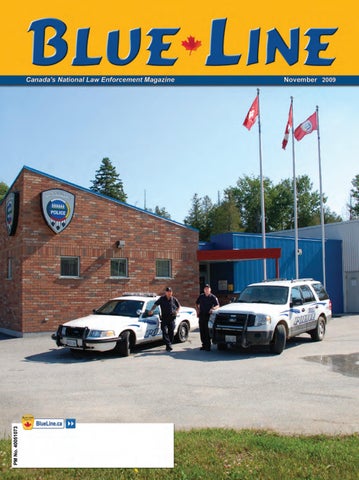
Policing a jurisdiction covering six communities spread over 145 kms comes with a lot of challenges. Such is the task faced daily by the officers of the United Chiefs Council of Manitoulin Police. The officers and members of this First Nations police service have been meeting the challenge for over 10 years. Read more beginning on page 6.
Features 6 A partner in community wellness
18 Electronic case management evolution
12 Ritual child sex cases Lessons often unlearned
20 Police help ‘boot’ teens in the right direction
16
The success of DNA
22 A safer world for a safer Canada
Policing the Manitoulin with balance and respect
20 years of international peace operations
Departments
Case Law
38 38 25 10 14 24 21, 35 37 36 5 26
29
Top court clarifies detention and revises s.24(2) analysis
34
Cocaine tossed because Charter rights disregarded
Back of Book BlueLinks Ad Directory Book Review Commentary Debate Deep Blue Dispatches Market Place Product News Publisher’s Commentary Technology
Blue Blue Line Line Magazine Magazine
33
NovemBER November 2009 2009
November 2009
4
Blue Line Magazine
Publisher ’s Commentary by Morley Lymburner
Hilda was no ordinary store detective Shoplifting calls were common when I was on patrol. Upon arrival wide-eyed store staff would direct me to a back room, telling me the store detective had a person in custody. Most times I would hurry – unless I knew it was Hilda, who always had everything under control. Invariably I would be greeted by a sorrowful thief, their expression almost a plea for help, and a stone-faced Hilda typing out an arrest report. “I haf jest arrested dis person from shtealing a tin of aspirin, two chocolate bars uunt a pair of sunglasses. He placed zee merchandize in his right and left coat pocket, paid for a newspaper at zee cash register uunt den valked out of zee shtore. I apprehended him at his car. I identified myself uunt tolt him he vas unter arrest for shtealing merchandise and I asked him to accompany me back to zee shtore.” An interesting character study, Hilda was an extraordinary thief catcher. Reputed to be a former German Border police officer, she was about 5 foot 10” and in her late 40’s or early 50’s. You wouldn’t notice her while shopping. Her typical unassuming attire would include a grey muslin coat and matching floppy hat. An unsuccesfull attempt to contain her black/grey hair as it peaked out on all sides below the hat gave her a carefully crafted dissheveled appearance. Hilda’s true talents remained dormant until she spotted a potential shoplifter. She would grab a thief with her stevedore grip, like a praying mantis on a fly. If the culprit resisted, they would end up wondering why they were on the floor – and what happened to their head. If things were particularly violent, the thief would suddenly wonder why the world was suddenly upside down and he was wearing an oxygen mask. A store thief catcher is not a very popular job. On one level, you are required to look like just another customer, which means wearing average or even dowdy clothing and appearing
Blue Line Magazine
to be a normal shopper. When it’s arrest time however, this mild mannered person must suddenly present a stronger presence. Thieves have many advantages, including a good defence if the store detective doesn’t identify the reason for the encounter or clearly state that the citizen’s arrest is binding. Resisting arrest or fleeing brings about an entirely new ball game, as does rescue attempts by accomplices. Hilda worked alone and would occasionally call police for help if there looked to be multiple suspects. She had done the job long enough to know the tell-tale methods of a professional booster. Most of her cases were simply impulse thefts, with the occasional teenager tempted by too much peer pressure. She knew her suspects could be anyone – doctors stealing aspirin, teenagers stealing cosmetics, teachers stealing staples and staff taking most anything not nailed down – but suspects going for the big ticket items probably had help nearby. One day she almost inadvertently met her match. A thief grabbed some impulse items from the cash register display so brazenly that even the cashier saw it. Hilda stopped him outside the door in her usual manner and an accomplice struck her in the face with a pipe. She had her hand on the thief and they both fell to the ground, where she was struck twice on her back and once again on her head.
5
Hilda lashed out at the second man and then fought off a third. Both limped away from the fray after realizing this was no ordinary store dick. She picked up the suspect, half carried him back into the store and, with help from other staff, placed him in the storage room to await my arrival. I entered to find Hilda with a large black eye and welt across the bridge of her nose. She was busily typing and didn’t say anything. The suspect was handcuffed to a chair, looking up at me with terrified eyes. “I didn’t do that to her,” he yelled. “It was the other two guys; I don’t know who they are.” I looked over to Hilda, who didn’t show any emotion. She finished typing and said “I haf jest arrested dis person from shtealing four chocolate bars ant two packages of gum.” Ever the consummate professional, she continued on as if nothing out of the ordinary had happened. “As his two accomplices attempted to free him, I felt it necessary to defend myself. I am sure they will need medical attention,” she concluded matter of factly. I chuckled and she looked at me with a serious look. “Yah! Yah! You are a policeman. You should check ze hospital. Zey will be there.” After taking Hilda to the hospital and the suspect to the station cell block, I cleared the station and was immediatley dispatched to the hospital. An alarmed dispatcher announced; “A lady with a thick German accent has called advising she has found two suspects wanted for an assault. You are to attend with back-up.” “Ten-four,” I responded, “but backup won’t be necessary.”
November 2009
A partner in
community wellness
Policing Manitoulin First Nations... with balance and respect by Beverley Roy-Carter Manitoulin Island is the largest fresh water island in the world and has been policed by the United Chiefs Councils of Manitoulin (UCCM) Police Service since a tripartite agreement was signed in October, 1995. UCCM Anishnaabe Police serve the six member First Nations of the UCCM Tribal Council, policing the communities of Aundeck Omni Kaning, M’Chigeeng, Sheguiandah, Sheshegwaning, Whitefish River and Zhiibaahaasing, which have a combined population of about 2,000 permanent residents. An influx of tourists during the summer swells the population by more than 25 per cent. Quick response to emergency calls can be a challenge; the travel distance between Zhiibaahaasing and Whitefish River is some
November 2009
145 kilometres. Officers effectively conduct highway patrol when responding to calls for service. The UCCM service began with 11 officers and two civilian support staff and has now grown to 25 full-time employees, all dedicated to providing and strengthening front line policing. Chief Albert Beaudin and two sergeants lead 16 officers, two special constables (whose primary duties are transporting offenders) and four full-time civilian support staff. The UCCM Anishnaabe Police Service is proud of its purposeful recruitment strategy, which has resulted in a minuscule employee turnover rate. As with all police services, human resource issues arise from time to time, but are dealt with through a solution-oriented approach to resolving problems. The UCCM Police Services Commission plays an important and active role in recruiting, selecting and managing police personnel. It places great importance on instilling in staff the importance of cultural values, which have
6
guided the organization in the past and will continue to do so in the future. While limited budgets are always a concern for Aboriginal police, the service has focused on maximizing and prioritizing available resources to address the myriad of front line operational management issues. It has focused on recruiting qualified personnel in what the service calls its “infrastructure development stage,” which included securing financing to build a new police facility, which opened in April 2006. The presence of illegal and prescription drugs is a growing problem that continues to plague UCCM communities. A more effective strategy to combat violence and property crimes associated to drug and alcohol abuse is desperately needed. Justice project UCCM officers play an important role in the justice program diversion process, which is an alternative to the provincial and federal court system. The majority of cases are Blue Line Magazine
currently postcharge diversions referred to the program by the Crown attorney. Pre-charge diversion cases, which are referred directly by officers, in effect by-pass the court system altogether and occur before charges are laid. To be eligible, an offender must be willing to admit responsibility for their action(s) and make amends for their wrongdoing. Pre-charge diversion is at the discretion of the officer. Some offences, including sexual assault, firearms, child abuse, assault with a weapon, drugs, domestic violence and Criminal Code driving offences, are ineligible. For the post-charge process, program staff screen possible candidates several days before their first appearance in court and provide a list of possible diversions to the Crown’s office for its consideration. The Crown reviews the case briefs and withdraws charges on approved cases. Justice panel circle A justice panel circle is scheduled in the offender’s community, with members chosen from participating First Nations members. Panel members are given copies of the court brief before the circle is held and are tasked with developing a plan of action (‘sentence’) for the offender. Members are guided by principles of traditional Anishnaabe law: accountability, making amends and healing. The program monitors the offender’s plan of action. If the individual does not comply, police can lay the original charge(s). Diversion significantly reduces the lengthy process associated with laying charges and taking the case through court. Blue Line Magazine
UCCM initiatives Current projects include recruiting and training an Ojibwe cultural-based civilian oversight body to improve public accountability and reporting. The service is also working to encourage better collaboration between police, social service and other justice system agencies, which was suggested during a UCCM multi-agency gathering last May. “It gives me great satisfaction knowing that the police service, the police commission and administration have all done their best efforts and the work required to ensure a strong foundation for the future,” noted Beaudin, who will retire next May, in the service’s annual report. “Success in general will undoubtedly be measured in many ways and the meaning of success will be different for any person. From a police organizational perspective, for example, one aspect of our success may be the fact that the UCCM Police Services Commission and its administration has been able to secure... tangible, physical resources such as a newly constructed building, new vehicles and new equipment. “We have also grown over the past 10 plus years in other intangible resource areas which are equally, if not more important, than these physical resources – that is, our human capital potential. “Certainly, while more vehicles and new equipment are all important tools for police work, this is not as important as the effective management of the personnel who use them. Human resource management and strategies of the future will require an even greater 7
understanding of human behaviour, required increased training in leadership and supervision and will require a proactive approach in its overall administration. “This will be critical for the next chief of police, if the service is to succeed in its employees maintaining a decent level of job satisfaction – as there is seemingly ever increasing demands placed upon them each and every year. Most simply stated though, the final qualitative measures of success will be the overall level of public satisfaction that the police organization receives from the public. “We have noticed the number of incidents reported to police continues to climb; some statistics continue to persist in the areas of domestic violence, serious assaults and the prevalence and rippling effects of drug crimes. Such crimes often result in an increase in the number of ‘lockups’ or detentions that we do in the interests of immediate public safety, but having a large number of lockups each year is not a true measure of police service success. “A single agency alone, such as the police, cannot effectively address all the underlying issues contributing to sometimes alarming rates of crime. We need a comprehensive and integrated approach in all our partner service agencies. This will empower citizens to help themselves in choosing positive and healthy lifestyle choices. The end result will be safer and healthier communities.” November 2009
UCCM Police Stats & Facts POPULATION OFFICERS POP TO COP Civ Members Budget Calls for Service Calls per officer Charges Laid Cautions
MANITOULIN POLICING BY THE NUMBERS UCCM Police Wikwemikong Police Ontario Provincial Police Total
1884 18 104 4 $2,842,703 2,574 320 465 266
18 18 31 67
Total Population = 11,000 Summer Population = 32,000 Ferry Through Traffic = 90,000 vehicles
First Nations policing policy In addition to federal, provincial/territorial and municipal policing, there are also various types of First Nations policing agreements for Aboriginal communities in place across Canada. The First Nations Policing Policy (FNPP), announced in June 1991 by the federal government, was introduced in order to provide First Nations across Canada (with the exception of Northwest Territories and Nunavut) with access to police services that are professional, effective, culturally appropriate, and accountable to the communities they serve. The FNPP is implemented across Canada through tripartite agreements negotiated among the federal government, provincial or territorial governments and First Nations. The agreements are cost-shared 52 per cent by the Government of Canada and 48 per cent by the province involved. Depending on the resources available, the First Nation may develop and administer its own police service, as is the case in most of Québec and Ontario, or it may enter into a Community Tripartite Agreement (CTA). Like self-administered agreements, CTAs are negotiated between the Federal government, the province or territory in which the First Nation is located, and the governing body of the First Nation. Under such agreements, the First Nation has its own dedicated contingent of offi cers from an existing police service (usually the RCMP). Best efforts are made for these police services to be staffed by Aboriginal police officers. Demand for more policing agreements has grown dramatically in recent years. The program currently serves 356 communities through 154 agreements. In 2003/2004, total cost shared FNPP expenditures approached $115 million, with the provincial share at about $55 million. For further information go to: www.publicsafety.gc.ca November 2009
8
Blue Line Magazine
Manitoulin Island
A home and native land
Manitoulin Island is the hereditary home of the Great Spirit of all the tribes inhabiting the region, including the north shore. Though the Aboriginal had many “manitous” (spirits) associated with nature and all its forces, there was a vague conception among some tribes of a spirit superior to all others, even to the Manitou of the Thunder or the North Wind – The Gitchi Manitou (Great Spirit). Manitoulin is the largest fresh-water island in the world, stretching over 160 kilometres in a general east-west direction and varying between two and 80 kilometres wide. It has 108 inland lakes; the three largest – Manitou, Kagawong and Mindemoya – are almost 30 metres higher than Lake Huron and between 10 and 20 kilometres long. There are very few records of Manitoulin from 1700 until 1825, a time when the island appeared to gave been uninhabited. The reason for this remains a mystery. Theories vary from crop failure to scarcity of game and fur-bearing animals. The departure would have left the island a desolate and lonely place; stories of this desolation would create a feeling of mystery. During the War of 1812, Aboriginals, chased by American forces, are said to have taken refuge on the island. The Americans fired cannons into the Island to frighten them; some of the shots have been found in the west end of Manitoulin. The Ottawas, who joined the British in the War of 1812, were barred from returning to Michigan after the war and returned to Manitoulin, the home of their forefathers. A group of about 350 Ottawas and Chippewas met with Canadian government officials in July, 1818. The Aboriginal speaker reviewed the relationship of his people with the French and British, noting they had not wished to fight and only desired peaceful occupation of their lands. “We were not anxious to raise the hatchet for fear the Americans would be too strong for you,” he told them. “In that case we would lose your support Blue Line Magazine
and be obliged to fight them ourselves in defence of our women and children and prevent them for taking our land, that the great Master of Life granted us; but knowing your words to be the breath of truth, we seized the hatchet, painted our faces and made the woods echo with the sounds of war.” From 1818 onwards an increasing stream of British immigrants began to take over the fertile land of the Bruce Peninsula, lying between Lake Huron and Georgian Bay. This immigration and settlement drove out the game upon which the Aboriginals depended for their survival. Their presence made permanent settlement by whites difficult. Sir John Colborne, Governor of Upper Canada, worked to make Manitoulin a permanent home for the Aboriginals. He visited the island and held a meeting at Manitowaning with the “Chief Men” of the Ottawas, who lived there. He persuaded them to sign an agreement allowing other Aboriginals to settle there. Sir Francis Bond Head, who took over from Colborne in 1836, completed the plan and signed a treaty with the Aboriginals at Manitowaning the same year, setting the island aside as a reserve. Land was cleared and houses built; the number of Indian settlers was estimated at 268 in 1837 and 307 in 1838. The officers appointed to form the future “Establishment” of the settlement, headed by Capt. G.T. Anderson, took up residence in Manitowaning. The staff included a minister, teacher, several mechanics, carpenters, coopers and blacksmiths. Supported entirely by the government, they made every effort to teach the Aboriginals to be self-supporting. 9
After 20 years of diligent work, it was realized that the Establishment at Manitowaning was a failure. The Ottawas seemed to take to the new life better than the Ojibwes. They did till the soil, raised a little grain and learned something of carpentry and blacksmithing. The Ojibwes preferred hunting and fishing. Many of those who had come to the Manitowaning settlement drifted back to their old haunts. Some founded villages on various parts of the Island and North Shore. The coming of steamboats (Ishkuta Cheemaun) attracted some Aboriginals to their usual ports of call. The boats required wood for fuel, and many found what they considered to be a very profitable business cutting and piling wood along the shore. This is how the village of Waiebijewung, now Little Current, was founded in 1850. With the failure of the Establishment looming, negotiations began with the Aboriginals in an effort to persuade them to cede the land to the government so it could be sold to white settlers. Much of the island was fertile and suitable for farming. After some discussion and negotiation, the Manitoulin Treaty was signed in 1862, making the land open to all. Not all Aboriginals supported the treaty. Those residing on the eastern portion around Wikwemikong, now a prosperous settlement, were opposed. Their opposition created a large tract of land which still remains under the ownership of the Aboriginals and is known as the Manitoulin Island Unceded Indian Reserve. Excerpted from Historical notes of Manitoulin Island by Turners of Little Current Ltd. (www.turners.ca).
November 2009
Commentary
Police can be part of the solution by Ian T. Parsons Twenty-two per cent of the federal inmate population are of Aboriginal descent, according to a recent federal study, and the number of incarcerated youth is equally disturbing. This figure is shamefully disproportionate given that First Nations make up only three per cent of Canada’s population. Canadian law enforcement has had little input into creating the dynamics that culminated in the disastrous scenarios confronting Aboriginal citizens. However, police have been the authoritative arm tasked with enforcing prejudicial legislation native people have historically encountered. Have First Nations ever viewed the police as a friend? It is interesting to note that during the signing of Treaty #7 in southern Alberta in 1877, Chief Crowfoot of the Blackfoot Confederacy told his people, “The police have protected us as the feathers of the bird protect it from the frosts of winter.” As our country evolved, this solid expectation of nurturing and rapport has all but disappeared and the relationship has occasionally polarized into animosity and even hatred. Celebrated Canadian author W.P. Kinsella wrote a series of fiction based on life on the Hobbema Reserve. The stories can only be categorized as “tragi-comedies” involving young people struggling to make sense of their lives as “21st Century Indians” residing on the reserve and consequently on the edge of Canadian society. Natives view life “off the reserve” as if they were visiting another planet and are unlikely to become part of the much larger society that surrounds them. The police are one of the primary agencies of the white world they have contact with and their opinion of them is seldom positive. Local Mounties are viewed with feelings of alienation and occasionally, begrudging respect. Police cars frequently drive through the reserve but residents seldom see anything but the upper torsos of the occupants. Their cynical humor is reflected in their name for police, which roughly translates from Cree to “he who has no legs.” Kinsella’s stories caused some controversy among natives but they provide poignant and insightful observations, giving the reader a rare opportunity to be on the inside of a reserve looking out. They are “must reads” for police serving Aboriginal communities. The abject poverty, isolation and anomie that afflicts Canadian First Nations people are primary factors contributing to antisocial behaviour, alcohol and drug abuse. The negative dynamics have little to do with ethnic origin. It is a disturbing dilemma for officers, who do not have the tools, wherewithal or mandate to solve the vexing social problems – yet police November 2009
continue to be the “arm of power and authority” to those who have no way of escaping the morass of poverty and depression. History has examples of Canadian police being utilized to enforce discriminatory legislation. Former sections of the Indian Act forbidding Indians to have liquor on or off the reserve come to mind. An Indian “off the reserve” was forbidden to possess an intoxicant, so to avoid prosecution (persecution?) they would ingest it as quickly as possible. This would, of course, lead to intoxication and all its ramifications. It is unlikely anyone would be socialized into drinking sensibly when facing such a dilemma. In the recent past, native homes were entered without warrant to seize liquor. The more discriminatory sections of this act have been repealed as a result of court challenges. These oppressive actions have left many First Nations people with bitter memories of police. This is further exacerbated by police participation in apprehending children who were placed in mission schools to be deprived of their culture and language. Too often these settings culminated in physical and sexual abuse. The children were left with vivid memories of police involvement in these traumatic confrontations. It is unsettling that police, who historically set out to be friend and protector of our First Nations people, have somehow become alienated, if not polarized, from their former charges. It is instructive to consider their role in milieus where, for years, governments have erred and even now are slow to resolve the plight of the victims. In such settings, should the police turn a blind eye to etiology, ignore social inequities and dispense the law “without fear, favour or affection?” Analysis and introspection is a difficult process and there is danger of placing law 10
enforcement on a “slippery slope.” Some will say this kind of deliberation is not the role of police. Others will argue our craft has reached a level of professionalism that demands critical analysis of our actions in these often perilous social settings. It is incumbent upon senior police administrators to be aware of social dynamics and ensure that first line officers are cognizant of the negative circumstances that impacted the communities to which they are attached and serving. Police have historically been given the powerful option of discretion in enforcing laws in our country. Discretionary enforcement has always been an awesome responsibility. Political pressure can be exerted to direct enforcement where high crime occurs, vis a vis less affluent areas of society. Police strive to satisfy political masters while maintaining fairness and equity of enforcement. This is the third responsibility of police leaders: acting as a buffer for first line officers who may be exercising innovative enforcement options. Alternative measures such as sentencing circles are but one example. To reiterate, the police are not the cause of generations of discrimination and bad laws but they are, at ground level, coping with the symptoms and results of these historically difficult social settings. Citizens will view the officer who demonstrates a knowledge of community history and exhibits empathy, concern and understanding as part of the solution, not part of the problem. This perception will foster greater regard for the police, make the job more rewarding and, most important of all, safer for the men and women on patrol. Assigning personnel properly prepared through additional education and in-service cross cultural training will make Aboriginal policing assignments more successful. It can be clearly counterproductive to assign members who have prejudicial feelings against Blue Line Magazine
native people, or who just do not want to be there. Policing an Aboriginal community requires special skills. It again falls within the purview of administrators to ensure optimum staffing and they should consider offering incentives for Aboriginal policing duties such as service pay and subsequent promotional opportunities. Sadly, the difficult transition of our Aboriginal peoples into the mainstream of Canadian society is ongoing. The complex socio-economic problems associated with First Nations communities will remain well into the 21st century. One way of easing the pain is ensuring police are aware of the difficult and disastrous path Aboriginals have trod for the past two centuries. While community knowledge and empathy will not diminish the problems faced on a daily basis, the additional effort sends a message to the community. Recognizing cultural mores and elders has great worth, earning officers respect, diminishing confrontations due to alienation and enhancing officer safety. While laws still have to be enforced and the incorrigible element will always be present, the police are less likely to be perceived as part of the problem. These efforts are further enhanced when police become involved in community events and sporting activities. Aboriginals will continue to struggle with integration. Canadian police need to be viewed as assisting this difficult transition rather than as suppressors of a people who have been unjustly treated. A retired RCMP inspector, Ian Parsons resides in Courtney, BC, and can be contacted at parsonsposse@shaw.ca
Blue Line Magazine
IACP lauds OPP officer ’s program ORILLIA (CNW) - An OPP officer from the Aboriginal Policing Bureau has been recognized for his contribution to a unique initiative designed to promote a positive and culturally-relevant experience to Aboriginal youth. Sgt. Jeff Simpkins accepted a Law Enforcement Officer of the Year Award on October 4th at the IACP Annual Conference in Denver, Colorado. Simpkins received the award for his role in developing and delivering North of 50/Cops and Kids in the remote community of Pikangikum, located 100 kilometres northwest of Red Lake in northwestern Ontario. The program provides a culturally relevant experience to disadvantaged Aboriginal youth by providing them with an opportunity to simply have a positive interaction with pro-social members of their community. The goal is to build capacity among the youth by having fun, learning healthy lifestyle choices, and establishing meaningful bonds with community members. “This OPP-led program is among many that are near and dear to my heart because it reaches young people in their community at a critical time in their lives,” says OPP
11
Commissioner Julian Fantino. “We are confident that the outcome of the project will make a difference in the lives of the youth and future leaders of this community,” adds Supt. Brad Blair, Commander of the OPP Aboriginal Policing Bureau. The OPP adds this award to its collection of IACP awards received this year. Others include two for its provincial traffic safety program and one for the development with the RCMP of a police resourcing model.
November 2009
Ritual child sex cases Lessons often unlearned
by Deborah Hastings THE ASSOCIATED PRESS
There are cases in which the accused admits, in sickening detail, exactly what was done to children: a self-anointed pastor walks into a small-town Louisiana sheriff’s office and announces he and others have forced children into sexual acts for years, dabbling in witchcraft as well. Those are the easy ones. Then there are those in which the facts may never be known. The ones that show some authorities still stumble when talking to children about abuse – despite the awful legacy left by hysteria-driven trials that began in the 1980s and lasted two decades. The accusations continue, though in smaller numbers and with considerably less media attention. And investigators still use discredited interviewing techniques blamed for prompting children to describe crimes that never happened. Such questioning elicited bizarre stories of underground tunnels and satanic sacrifices during the McMartin Preschool case in Southern California, which lasted seven years and involved hundreds of children – only to end in 1990 with no convictions and dropped charges. It was the most expensive criminal trial in U.S. history. “I don’t think we’ve learned any lessons since those cases,’’ said New York attorney Robert Rosenthal, who has appealed several convictions of accused molesters. Among them were Margaret Kelly Michaels, indicted in 1985 for 299 offences involving 33 children at the Wee Care Nursery School in Maplewood, N.J. After she spent five years in prison, her 47-year sentence was overturned. The state Supreme Court said interviews conducted with the children were coercive, suggestive and highly improper. “This stuff is still happening,’’ Rosenthal said. There is no standardized protocol for interviewing young victims of alleged sexual abuse. Neither are there uniform policies for recording their questioning, whether on video or in writing. Anatomically correct dolls are still given to toddlers, child experts said, though their use in the McMartin trial and others produced embarrassingly unreliable testimony. Young children appeared unable to see the doll as a symbol of themselves, and were more interested in playing with the dolls and taking off their clothes and finding extra features not found on typical dolls. Some jurisdictions, including Los Angeles County, home of the McMartin trial, have markedly improved the way they question children and now work with psychiatric exNovember 2009
perts at a university hospital. States including Washington and Michigan have guidelines for such cases. Still, there is no central repository for information on sexual abuse cases, nor an accounting of what interviewing tactics are used by individual law enforcement agencies. “They’re really hard cases to prosecute, I understand that,’’ Rosenthal said. “The kid is the evidence. The kid is the crime scene. There’s rarely any physical evidence. That doesn’t mean abuse doesn’t happen. It happens every day.’’ But there remains ample room for improving the way authorities talk to children, say those who work such cases – ways that don’t taint the investigation and do no added harm to a frightened child suddenly thrown into the very adult world of police and prosecutors. Take the case of Pennsylvania child psychologist Jerry Lazaroff, acquitted in May of sexually assaulting and endangering the welfare of four children, ages five through ten, who once were clients. The therapist, who treats emotionally disturbed youngsters and conducts court-ordered custody evaluations for divorce proceedings, had practised for 30 years in suburban Delaware County and used “play therapy,’’ including basketball and a foos ball table, to encourage children to interact with him. He was arrested in 2008, after a 10-yearold girl told her mother Lazaroff had touched a place she called her “Virginia.’’ His attorney, Mark Much, said the psychologist acknowledged touching the girl accidentally. She had been running across a couch in his office, while Lazaroff sat on the floor in front of a board game they’d been playing, the therapist testified. When he reached back to stop her, he didn’t realize the girl had sat down, and his hand bumped her private parts. He apologized, Lazaroff said, telling the child, “That part of your body is off limits. That was a mistake and it won’t recur.’’ Jurors apparently believed him, acquitting him of abusing the girl and three other children whose parents went to police after 12
the psychologist’s photograph appeared on the local paper’s front page, accompanied by a story asking other potential victims to come forward. Deputy District Attorney Michael Galantino stood by his case. “We’re disappointed,’’ he said. “We believed we presented more than enough evidence, but they chose to acquit and we have to accept that verdict.’’ Much had argued the children’s testimony was contradictory – one boy said he’d been touched on his penis nine different times but later testimony showed his parents had been in the room during each of those sessions. Another boy told investigators the therapist Scotch-taped his hands to the floor and then tickled the boy’s privates. Interviews with the children were handled by law enforcement officers. “I was shocked that the interview process didn’t have any child psychologists or social workers,’’ Much said. “These children were abused – by the process that put them on the witness stand.’’ Police took one mother’s report in front of her daughter. Then officers questioned the girl while her mother looked on. “A child doesn’t want to call their parents a liar,’’ Much said. “Children have a tendency to regurgitate what the parent has said.’’ Social and mental health workers now generally agree children should be interviewed separately, in an atmosphere that makes them feel safe and is built to their scale – small tables and chairs, for example, in colours and styles they’re used to seeing in everyday life. Children should be asked open-ended questions that allow them to tell their stories in their own words. Details should be repeated, to make sure both child and questioner understand what was said. The techniques are designed to strengthen cases that go to trial and weed out cases that shouldn’t. Those tactics might have saved everyone involved from being dragged through a muddy case that fed a local media frenzy, Much said, but fell apart in front of jurors. “If only someone had challenged what the kids said,’’ he said. “I don’t blame the kids, I blame the interviewers. How can Scotch tape hold an arm to the floor?’’ Carl Lewis, a former police officer in northern California, taught himself to work sexual abuse cases by researching interview protocols published by the National Institute of Child and Human Development, part of the National Institutes of Health. After watching publicized abuse cases spectacularly implode, Lewis taught fellow officers to alter their approaches to children. It wasn’t easy. “I thought we could change it overnight,’’ Blue Line Magazine
he said. “I ran into a lot of resistance. I constantly heard, ‘What’s wrong with the way we’re doing it now? We’re putting people in jail.’ And while there certainly has been an attempt to improve the way children are questioned, moving a mountain is a hard and slow process.’’ Lewis said he has interviewed hundreds of abused children. The trick, he said, is to never ask yes-or-no questions, and to never prompt, suggest or lead a child. “I would start by saying, ‘I want to talk to you about why you’re here today,’’’ Lewis said. “And the kid may say, ‘I’m here to tell you what my uncle did to me.’’’ And Lewis would respond, “Tell me everything about that.’’ The questioner may get details that bolster a case – the colour of the walls where the abuse occurred, a painting in the room, something that can be shown to exist in reality. Earlier interviewing methods tried to reassure children, but instead twisted their answers. For example, in the Little Rascals Day Care Center trial, North Carolina authorities charged seven defendants with abuse including rape and sodomy against dozens of children. Most convictions were later overturned when hindsight showed mistakes were made in handling the children. Don’t worry, they were told: your schoolmates have already told us about the bad things that happened and here’s what they said.
Blue Line Magazine
“That intimidates kids,’’ Lewis said. “A kid thinks, ‘If I don’t say what the others said, they’re going to think I’m stupid.’ So the child answers the way he thinks the questioner wants.’’ In the Little Rascals scandal, children as young as three told of kids being taken on boat rides and then thrown overboard, of babies being killed, of children taken to outer space in a hot air balloon. Maggie Bruck, a psychiatric expert at The Johns Hopkins Hospital in Baltimore who’s written extensively on the way children describe molestation, says some authorities – but far from all – have gotten better. “I deal with cases all the time where the investigations were just horrible,’’ Bruck said. “The interviewers were just horrible. Do you know how many people interview children? A gazillion. Some of them are very, very poorly trained.’’ Bruck testifies in abuse trials, sometimes as a witness for the accused, on how questioning methods can produce false accusations. Changing those practices would not be difficult, she said. But it would require a national movement. “A mandated standard would make a huge difference,’’ she said. “Mandatory taping of all interviews would make a huge difference.’’ This article was excerpted from Blue Line News Week. This weekly executive reading service is available for email delivery every Thursday. To subscribe to this service go to www.BlueLine.ca or phone 905 640-3048.
13
November 2009
Debate
Save our police budgets - Legalize and tax marijuana This is a third submission on the “legalization of drugs” issue by David Bratzer Michael Klimm raised a number of excellent points in his letter published in the August issue of Blue Line. Although he argued against legalizing and regulating drugs, several of his statements were compatible with drug policy reform. First, he acknowledged the status quo is not working. Second, he stated that the damage caused by tobacco – a dangerous but legal substance – has been reduced through education. Third, he asserted the best way to tackle organized crime is to remove the profit motive from the black market. Finally, he emphasized that the legalization and regulation of drugs has not yet been tried anywhere in the world. With these key points in mind, perhaps it is time for a new approach? Marijuana policy would be a good place to begin as 53 percent of the population supported legalization in a 2008 Angus Reid poll. Approximately 44 percent of Canadians have used cannabis at some point in their lives according to the Canadian Addiction Survey. Despite heavy enforcement, it remains the largest illegal drug market in the country with over two million citizens using cannabis on a recreational basis. A legal and regulated cannabis market would therefore eliminate the majority of all domestic drug trafficking in Canada. Marijuana is not a benign substance, but it is substantially safer than alcohol. Assaults against peace officers, sexual assaults and incidents of domestic violence are frequently traced back to liquor consumption but rarely to cannabis consumption. Many of us know friends or colleagues whose personal and professional lives were ruined through alcohol abuse. Upstanding citizens have committed terrible crimes while drunk, and yet Canadians remain legally bound to abstain from using marijuana. It is time to present the public with a safer, legal alternative to alcohol.
Unfortunately, the CACP / CPA joint resolution on drug abuse in 2002 insisted on the status quo. Now, seven years later, federal, provincial and municipal governments are broke. Police organizations are facing budget cuts, although leaders in law enforcement can still increase the long term financial health of their respective agencies by supporting an end to marijuana prohibition. It is the least painful concession to make, especially compared to wage rollbacks, hiring freezes and training cutbacks. Critics might point to the Netherlands and offer anecdotal reports of a failed drug policy, but the facts show otherwise. The country adopted de facto decriminalization in 1976. Adults can buy personal amounts of marijuana in licensed outlets known as cannabis coffee shops. Alcohol is banned in the coffee shops and advertising is prohibited. Overall the system works well, although one problem is that the actual production and distribution of marijuana remains illegal. Organized crime is still involved in that part of the industry which is why it is important for Canada to legalize the entire supply chain. The Netherlands has a cumulative lifetime incidence of cannabis use that is half that of the United States (19.4% versus 42.4%). Its cumulative incidence of cocaine use is one eighth that of the United States (1.9% versus 16.2%) according
to data from the World Mental Health Surveys as compiled by the World Health Organization. The United States uses a tough justice approach with drug offenders, and yet per capita drug use rates, overdose deaths and HIV infections are significantly lower in the Netherlands. Why is this? It appears the Netherlands’ tolerant attitude toward drugs has reduced the forbidden fruit effect. There is nothing rebellious about smoking marijuana in Amsterdam. In addition, they have separated the cannabis market from other drugs. Cashiers in the coffee shops don’t lace marijuana with crystal meth or give away free samples of cocaine. In contrast, Canadians face a multitude of dangers when purchasing marijuana on our city streets. At the end of the day, it is easy to look into our past and determine which social policies were just and effective. For example, contraception was legalized forty years ago with the Criminal Law Amendment Act, 1968-1969. Prior to the Act it was illegal to advertise or sell condoms or other forms of birth control. The Pill was only prescribed to women who needed help regulating their menstrual cycle. In other words, it could only be used for medicinal purposes. (Does this kind of language sound familiar?) Today, few officers could imagine using criminal law to prevent the sale of birth control pills, in spite of their harmful side effects. It is more difficult to look forty years into the future and consider how our children and our grandchildren will judge our actions as law enforcement officers. Institutional inertia is not a good enough reason to maintain a prohibition on marijuana or any other drug. Regulating cannabis would provide a safer alternative to alcohol, eliminate most domestic drug trafficking, generate tax revenue, free up police resources and reduce abuse by young people. What are we waiting for? David Bratzer is a police officer in Victoria, B.C. and he also manages the blog for Law Enforcement Against Prohibition (http://copssaylegalize.blogspot.com). The opinions expressed in this essay are entirely his own.
November 2009
14
Blue Line Magazine
Running for Jaida On September 27th, 2009, Blue Line Magazine’s own Technology Editor Tom Rataj ran the halfmarathon (21km) for “Jaida’s Challenge” in the Scotiabank Toronto Waterfront Marathon + Half-Marathon & 5K – Scotiabank Group Charity Challenge as a fundraiser to support Jaida, the very sick child of a fellow officer. Jaida Cumberland is the 6-year old daughter of Constable Helen Sykes, a member of the Toronto Police Service. Jaida suffers from an undiagnosed neuro-muscular disorder characterized by extreme muscle weakness, ataxia (un-controlled shaking) and difficulty swallowing. She requires 24-hour care, expensive medical equipment and frequent trips to Toronto’s Hospital for Sick Children where she undergoes diagnostic testing and treatment of her various conditions, which include severe osteoporosis. Despite the physical challenges that Jaida faces she is truly an inspiration to all who meet her. She is a fiery little redhead with an abundance of intelligence and humour. She is a hero to us all. She is also hospitalized more than your average child as a result of infections that she is more prone to pick up due to her weakened condition. Blue Line Magazine
Jaida receives virtually all of her nutrition through a feeding tube directly into her stomach. She is unable to walk and has recently graduated to a power wheelchair which gives her new-found independence that she loves. Jaida’s equipment needs have grown exponentially over the past year due to both progression of the disease and her growth. Jaida’s mother Helen has been off-work for about 2-years which only adds to financial and emotional stress brought on by this situation. Funds raised will be used to purchase specialized equipment needed for Jaida’s day to day living. Donations can still be made to help Jaida. Please make cheques or money orders payable to CLASS (Community Living Association for South Simcoe) and mail to Community Living Association for South Simcoe c/o Jaida’s Challenge 125 Dufferin St S. Alliston, ON L9R 1E9. Please mark the bottom left corner of the cheque for “Jaida’s Challenge”. On-line donations can no longer be made. For more information please contact Tom Rataj at: technews@blueline.ca
15
November 2009
DNA
The Success of
There has been no shortage of DNA stories in the press over the years. The following is a few of the landmark stories. An unsolved 1999 sexual assault was transformed from a cold case into a court case when Winnipeg Police Service (WPS) investigators took advantage of advancing technology and the National DNA Data Bank (NDDB). WPS investigated the assault and collected forensic evidence but failed to identify a suspect and the case remained dormant. It reviewed the case and pursued DNA evidence in 2006 as part of an initiative to re-open cold cases. The forensic science and identification services laboratory in Regina identified new evidence, revitalizing the case. The resulting suspect DNA profile was entered in the NDDB and matched to an individual serving seven years for a 2003 sexual assault. The individual had been required to provide a sample for the NDDB as part of his sentence. Based on this information, a DNA warrant was obtained and a fresh blood sample taken from the suspect, who was subsequently charged with sexual assault with a weapon and uttering threats. The pending case was scheduled to be tried in Superior Court. Without the ability to compare DNA evidence the suspect would have been out on statutory release in March 2008. As a result of the new charge, parole authorities decided to hold him until the outcome of the trial or the expiry of his current sentence. ••• An unknown person broke into a Medicine Hat investment firm in September 2006 and tried to open the safe, damaging it and other office property but succeeding in stealing only a small amount of loose change. Although investigators had no suspects, they determined that an empty soda can found at the scene could not be attributed to any of the employees. Investigators collected and submitted DNA evidence to the RCMP National Forensic Services for analysis. A DNA profile was derived and entered in the Crime Scene Index of the NDDB. One year later, the evidence was matched with a profile in the Convicted Offenders Index of the NDDB. The suspect, a person with an extensive criminal history and well known to Medicine Hat Police, had recently been required to submit a biological sample due to another conviction. Thanks to the soda can evidence, he was subsequently convicted of the break and enter. November 2009
This case demonstrates application of DNA evidence by investigators and the value of obtaining biological samples as part of sentencing. ••• Several men and a woman went to a Winnipeg house party on March 3, 2001. The men later left to buy more alcohol and the woman was sexually assaulted while they were gone. The suspect was well known to police because he had been convicted of robbery, uttering threats and two counts of assault since coming to Canada in 1998. Police questioned him and issued a warrant for a sample of his biological material to obtain a DNA profile for comparison to the crime scene evidence. Unfortunately, the suspect fled to Québec before the warrant could be executed. The suspect was ordered to provide a sample to the NDDB in 2004 after being convicted of another crime. The resulting profile matched a sample collected at the sexual assault crime scene in 2001, allowing police to charge him with the sexual assault. The suspect, who was already serving time in Drummondville, Québec for domestic assault, was convicted, and received an additional six-year sentence. This case highlights the importance of a national DNA database system to facilitate solving crime across jurisdictions. ••• The body of a 23 year-old woman was discovered on Confederation Trail in Charlottetown, Prince Edward Island on July 28, 2002. She was partially clothed, with her arms tied behind her back with leather straps. An autopsy revealed that she had been strangled until unconscious and then stabbed four times. The woman had biked over to see her common-law husband at work the day before she was found. After visiting with him, she set out to visit her son at her mother’s house but never arrived. Police were able to recover biological material from the leather straps and the RCMP Forensic Science and Identification Services derived a DNA profile from the material, which was entered into the NDDB Crime Scene Index. The case remained dormant for almost three years. In April 2005 a profile in the Convicted Offender Index matched the DNA found at the murder scene. The individual was already serving time in an Ontario jail for a sexual assault and 16
the judge had ordered him to submit a biological sample to the NDDB. The offender was subsequently charged with first degree murder in the Charlottetown case. In this case, the power of DNA lay silent in the NDDB, waiting for another DNA profile to be entered that would potentially answer the question of who committed the murder. Had the convicted offender not been ordered to submit a sample, the case could remain unsolved today. ••• Four unidentified males, two wearing balaclavas, broke in and robbed a rural home in Leeds County, Ontario in October 2005. As the suspects were leaving the house, a female occupant arrived home and the men forced her from her car at gun point and escaped in it with items taken from the home. The car was torched and found abandoned the next day. A Kingston retailer contacted police the next month after an individual made several purchases using a credit card stolen from the home. Police apprehended the individual and during questioning, he identified the three other men involved in the home invasion and robbery. Police later stopped a vehicle identified as belonging to one of the suspects and, after obtaining a search warrant, found a balaclava and property taken from the home. Biological material was extracted from the balaclava and the DNA profile generated by the Centre of Forensic Sciences was entered into the Crime Scene Index. A hit was made between the crime scene DNA and one of the other suspects in the crime – whose DNA was already in the Convicted Offender Index – in February 2006. The case took an unexpected twist the next month when a crime scene to crime scene match was made from the home invasion balaclava to a shirt from an unsolved homicide in Kingston. All four suspects in the home invasion were already persons of interest in the homicide, but no conclusive link between them and the homicide had been made. The four suspects were charged and subsequently convicted of the Leeds Country robbery and other related indictable offences. The DNA profiles from the robbery could assist in obtaining a conviction in the Kingston homicide. http://www.nddb-bndg.org/
Blue Line Magazine
Too good to be true Investment frauds are the biggest crimes today
by Danette Dooley On the heels of the Earl Jones investment scam in Montreal, the head of the RCMP’s commercial crime section in Newfoundland and Labrador is warning residents to be aware of opportunities that appear too good to be true. S/Sgt. David Hickey says if a financial adviser offers an exorbitantly high rate of return with little risk to the client, it could be a red flag that the investment is not legitimate. Hickey refers to the Ponzi scheme that made headlines recently when Jones, a Montreal financial advisor was arrested on fraud and theft charges. It’s alleged that the businessman – who has since been declared bankrupt – defrauded over 100 clients out of millions of dollars. The scheme is named after a New England businessman – Charles Ponzi – who, in the early 1920s, conned thousands of people into investing in the pyramid-type scam where money from late investors is used to pay dividends to early investors. “These types of offences are devastating because people are inclined to take everything they own and invest it,” Hickey says. Hickey says the RCMP have investigated and laid charges in fraud cases similar to the Ponzi scheme. A recent case involved the conviction of a couple from Grand Bank, Newfoundland who fleeced hundreds of thousands of dollars out of people in an Internet scheme dubbed “aid for families.” After being found guilty of fraud and possession of property obtained through crime earlier this month, the couple was sentenced to three years in jail. “The dollar signs in these people’s eyes obscure their vision,” Hickey says. Under proceeds of crime legislation, police in some provinces can restrain bank accounts, houses, cars etc. where there is evidence that these purchases were made through proceeds of crime. Unfortunately, Newfoundland and Labrador hasn’t signed onto the program. Doing so, Hickey says, would make the provincial government responsible for the seized property. “If they seize automobiles, they must pay to have them stored and, if the accused is found not guilty of the offence involving the law, government can be held liable for alternate transportation and/or depreciation of the car once it’s sold,” Hickey says. Fraud investigators who have learned of large amounts of money deposited in suspects’ bank accounts have been unable to freeze it, he adds. “We experienced that same problem with the couple out of Grand Bank... they had deposited $150,000 of a victim’s money in a Blue Line Magazine
bank account and we could not seize it. They had to get a lawyer and get the money civilly,” he says. Hickey also warns of an RRSP investment scheme aimed at releasing investors’ locked-in funds without having to pay taxes – before they are entitled to access the funds. He reminds anyone interested in investing
17
to ask questions and receive answers before doing so. “In legitimate investments there are no secrets... and legitimate brokers will tell you that higher gains will always equal higher risks,” he says. Financial planner Carl Lundrigan advises people interested in investing look into the advisor’s qualifications, experience, services offered, cost of services and how the client is expected to pay for such services. They should also make sure they’re registered with a security regulator. It’s also appropriate, Lundrigan says, to ask for references from the advisor’s former and current clients. Hickey says people who are looking for get rich quick investments should remember there are only three fast and easy ways to make money. “You can win it, you can inherit it or you can steal it.” The maximum penalty for fraud over $5,000 is 14 years in jail, he notes. Danette Dooley is Blue Line’s East Coast correspondent. She can be reached at dooley@blueline.ca
November 2009
Evolution to eMCM
Electronic major case management key to fighting future crime by Ryan Sales Contemporary major crime investigations are still strongly rooted in onerous traditional techniques such as hand written interview notes, boxes full of paper records and time and resource heavy disclosure in binder format. Police agencies have adapted technology at a record pace. Computerized license plate scanning, PDA’s with CPIC or records management system access, mobile work stations and many other technical advances are no longer toys, but perceived to be required tools for conducting efficient police work. This technological revolution has had a less pronounced impact on the investigation and disclosure of major crimes because of several mitigating factors: • Lack of case management software options; • Training limitations of major crime investigators, who are already overtaxed with heavy file loads and staff shortages; and • Resistance from investigators more comfortable with traditional processes and procedures. Many large and complex investigations are currently conducted using paper based methodologies. The drawbacks are countless given today’s technologies and data redundancies. Limitations in document management, minimized situational awareness due to slow information flow and cumbersome information retrieval and significant disclosure overhead are only a few of the bottlenecks. Police organizations must move towards adopting electronic major case management systems (eMCM) through a co-ordinated and staged approach, bridging investigator needs, expectations and apprehensions with solid training, IT resources and legislative/ procedural requirements. This migration should be strongly influenced by the court’s transition from simply accepting electronic disclosure to requiring it in many cases. As the courts become more comfortable with electronic disclosure and increasingly utilize the associated benefits, the
inevitable results will be a lack of tolerance for paper based systems. The following is a simplistic roadmap to accomplishing this task: 1. Address computer literacy Set a bar for technical core competency. Most new investigators will be familiar with using computers. For those who are not, there are a multitude of external service providers who can provide customized training to address areas requiring further development. The Windows operating system, keyboarding skills and Adobe product line training are all areas of relevance. For larger policing organizations, it is worth conducting a cost benefit analysis of your IT department becoming trainers/facilitators in these areas as a part of their professional development plan. 2. Introduce technology into your existing tool kit To ease the transition, start by incorporating supplemental methodologies/equipment into your existing procedures. Replace analog recording with digital. There are several digital recorders which save files in a ‘discloseable’ format (preferably .wma or .mp3). Avoid
models which save files in a proprietary format, as they will need to be converted prior to disclosure. Many recorders have built in USB connections, eliminating time spent on finding patch cords. Switch from VHS to digital recording systems; those that save interviews directly to .mpg or .wmv are preferred, however DVD recorders are the norm. These minor changes will start the transition towards electronic major case management and have an immediate effect in the migrating away from paper based systems. 3. Implement a hybrid paper/ electronic system The simplest method, yet with the greatest overhead, is to take a paper based investigation, scan the entire file into searchable PDF (the standard disclosure medium for documents) and then compile into a format acceptable to the courts. This method is a minimal inconvenience to investigators and existing investigative techniques yet allow an electronic format to be available to the courts. Converting audio and video tape to a digital format is within the capacity of current technologies. This simply addresses disclosure requirements and provides an electronic copy of the investigation for archival purposes. However, this method does have significant overhead as the scanning/document conversion process is extremely time consuming. In some instances, the need to do this can pull investigators away from their field duties. 4. Introduce an electronic major case management system The most difficult transition is implementing an electronic major case management system. This requires buying computer hardware (workstations and potentially costly servers), installation and set-up, training on the eMCM system, administrative overhead (information administrators/processors, IT staff, trainers) and the eMCM software system itself. While
November 2009
18
Blue Line Magazine
you can go to a computer store and be faced with an over abundance of software options, the same is not true for eMCM. There are a few commercial options available (such as Agnovi’s X-Fire investigative case management solution) or you can choose a customized solution tailored to the current needs and requirements of your organization. Both options come with various pros and cons. Ultimately, a needs analysis should be completed, followed by a formal evaluation and eventual procurement process (formal project management processes are recommended). Many organizations have tried and failed to implement electronic systems, resulting in significant costs to the organization as well as increasing resistance from investigators and management. A well organized process will minimize negative impact both organizationally and fiscally.
New patrol car announced An all-new Chevrolet Caprice Police Patrol Vehicle (PPV) will join the ranks of law enforcement departments across North America in 2011. The full-size, rear-drive sedan will offer both V-8 and V-6 engines and specialized equipment and features. People from GM Fleet state that the Caprice PPV is not based on existing “civilian” passenger-car models sold in North America. It has been developed in key areas specifically for police duty, containing modern equipment and features, including: • Designed for five-passenger seating, meaning the upper-center section of the dashboard can be used for equipment mounting without the concern of air bag deployment interference.
• Special front seats designed for long-term comfort of officer, including space that accommodates the bulk of a typical equipment belt. www.gmfleet.com/government/products/police.jsp
5. Integrate eMCM system with electronic disclosure Depending on your eMCM system’s inherent disclosure capabilities, processes may need to be developed to ensure that you can extract information from your system and disclose it to the courts in an acceptable format. This may require third party software solutions. If your organization previously adopted an electronic disclosure system for your paper based files, the best option would be to integrate your eMCM system into it. Other systems may require you to modify your procedures. Most improve the process of disclosure (an electronic report converted electronically into a PDF document significantly reduces the overhead required, eliminating scanning and paper document management tasks) and increase the speed and accuracy of delivery. 6. Our Future! Your system is in place, leading you to the last step – looking ahead. This includes monitoring case law on electronic disclosure and taking pro-active steps to address court (both crown and defence) feedback. New technologies are always available and some, such as electronic pens that capture notes directly into an electronic format or automatic voice to text software, may benefit your work. Moving towards eMCM and disclosure is the logical evolution of policing. This process can be reactive, based on court requirements and deficiencies in the ability to manage investigations, or proactive and balanced between court requirements and organizational procedures and assets. The processes and technologies are not new and have been developed, refined and deployed in many organizations. Best practices are being developed in all police agencies and a coordinated approach will be fruitful from an HR and financial responsibility perspective; the savings will be incalculable. Ryan Sales (ryansales@iconsultingcorp.com) is president of iConsulting Corporation. He has a background in IT and law, specializing in automating electronic information management, technical training and electronic major case management and disclosure.
Blue Line Magazine
19
November 2009
Police help ‘boot’ teens
in the right direction
by Patrycia Thenu It’s barely past 7 a.m. and the 15 young men and women are still trying to shake the sleep from their eyes in the glaring fluorescent lighting of the gymnasium. Their feet lift heavily as they run their first five laps. Beads of sweat begin to form on their foreheads after the first few grueling exercises and most look like they’ve already had enough. They are only about half way through the class. Several grumble and one participant has a few choice words as the instructor tells them to get on the floor for the next exercise. “That’s five more for the language,” responds Edmonton Police Service Cst. Jason Lefebvre. This is not EPS recruit training but a boot camp Lefebvre puts on three times a week at McNally High School, where he works as a school resource officer. The alternative measures program, which is called PAYOFF (Police Assisted Youth Oriented Formative Fitness), gives them a chance to get back on track – an alternative to fines or going to court for minor offences such as drug use/possession, shoplifting or fighting. Participants who don’t show up have to pay the fine or face more serious consequences. “When they know they can work off a $115 smoking ticket, or a minor criminal charge, they do show up,” notes Lefebvre, who has worked for the EPS for nine years. He began the boot camp five years ago out of need. “The criminal justice act says we have to explore other alternatives to charges when it comes to youth. When I started as a school resource officer (SRO) there weren’t a lot of alternatives available for youth,” he says. “I wanted to pick something where I could November 2009
work directly with the kids. I tried to pick something that addressed their health. If they’re making better decisions about their health, maybe they’ll make better decisions about the rest of the things going on in their life.” Some of the kids don’t have the stability or structure at home that they need and Lefebvre hopes that the boot camp provides them with somewhere to turn. “They have to get up early to get here on time. They start an hour before school starts and that ensures they’re in class on time,” he explains. “I have fun with them doing the exercises but they still have to know what the boundaries are. A lot of them don’t have boundaries in their personal lives so I try to give them that structure.” Not all the participants in PAYOFF are there because they’ve been in trouble with the law. Some of them are there voluntarily. “They’ve seen the workouts and they want to get healthy. They’re making good decisions themselves,” says Lefebvre, adding that some of the kids are just curious about him and his job as a cop and want to hang out. When it comes to the fitness training, Lefebvre doesn’t do any hand-holding and makes the boot camp as tough as the kids can handle. He draws on his university education, martial arts classes and EPS recruit physical training. “If I remember correctly high school is a stressful time and having an opportunity to work off their anxiety and stress first thing in the morning, teachers have told me the students’ behaviours are different,” he says – “or maybe it’s because they’re exhausted from the workout,” he jokes, noting that more than a few participants lose their breakfast after the first few classes. 20
Spending several hours with the kids each week gives Lefebvre a chance to find out what’s really going on in their lives and to directly impact the youth. “They feel more comfortable coming and sitting down and talking to me about their problems, or just dropping by to visit, to let me know how their day is going,” he says, pointing out they could be out getting in trouble instead. “As I get to know them, I can help them address the underlying problems for why they’re making those bad decisions.” Prosecutors, school administrators, probation officers and the Edmonton Justice Committee have all referred youth to Lefebvre. The program is about more than just the workouts. Participants have to sign a contract and set specific goals related to health, academics or community service that are measurable within the time period of four weeks. The parents go over the contract and also sign off. “As long as the conditions are met, they’ve successfully completed the program and they get a certificate,” says Lefebvre. “Hopefully I encourage them to keep coming back but they’re not obligated.” Lefebvre would like to see the program expand to all Edmonton schools so that more youth can benefit. “I’ve seen a lot of kids change in the four years I’ve been doing it. It’s also a really positive way for police to interact with youth who have committed an offence,” he says. Patrycia Thenu is the Senior Media Relations Specialist with the Corporate Communications Section of the Edmonton Police Service. She may be contacted at Patrycia.Thenu@edmontonpolice.ca or 780 421-2663.
Blue Line Magazine
Former Belleville police chief Doug Crosbie died on October 4th at the age of 86. A veteran of the Second World War, Crosbie was the married father of two who, in 1967, left Toronto’s police force to become Belleville’s chief. He would later serve about nine years on city council and be dubbed the “father” of its 9-1-1 system. Crosbie was born in Toronto, where his own father was a policeman. During the war he served aboard minesweepers of the Royal Canadian Navy and was present in the 1944 D-Day invasion of France. Crosbie retired in 1985. •••• Pat Capello has been selected as the new Chief of Police for the Perth Police Service replacing outgoing Chief Claude Brett. Pat was promoted to the top job from the rank of Inspector and has served his entire 24-year career with the Perth force. Originally from Ottawa, Capello said he "was always interested in policing." He earned an honours BA in criminology from Carleton University, then went on to graduate school at the University of Ottawa, working another year-and-a-half toward a Masters degree. Capello started out on patrol, and went on to make criminal investigations his forte. Promoted to sergeant, he held that rank for seven years. He has been an inspector for the past five-and-a-half years. The Perth Police currently employs 15 uniformed officers, three special constables who provide court security, two auxiliaries and eight civilian staff. •••• Former Lethbridge Chief John LaFlamme died on September 26th. He was 61 years old. John joined the Edmonton Police Service in 1972. He was the Accreditation Manager for the Edmonton Police Service from 1986-1988 at which time the Edmonton Police Service became the first Canadian agency accredited by CALEA. John later accepted an appointment as a CALEA Commissioner in 1999. After 23 years with the Edmonton Police, John rose to Superintendent of the Human Resources Department. In 1995, he was appointed Chief of Police for the Lethbridge Police Service a position he held until February 2002. Upon leaving Lethbridge he accepted an appointment as the Executive Director of the Regulatory Division of the Alberta Gaming and Liquor Commission. He was a graduate of the University of Alberta school of Business Management. John was most proud of the work he did as a member of the Board of the Boys and Girls Club, an organization that provides assistance and coordinates activities for kids in need. •••• Emory Gilbert has been appointed the interim Port Hope police chief and will begin a six month term while a permanent chief is recruited and hired to replace the recently retired Ron Hoath. Gilbert began his policing career in 1971 with the Toronto Police and retired after completing 34 years as the acting deputy chief policing support command. Gilbert has been a consultant, including work on an international panel conducting a comprehensive review of New Zealand police communications. Gilbert has instructed at the Canadian and Ontario Police Colleges, University of Toronto and the Rotman School of Management. The Port Hope Police Service has 26 officers and 14 civilian staff.
Blue Line Magazine
21
November 2009
A safer world for a
safer Canada 20 years of international peace operations
Top: RCMP Cst. Scott Burge with children in Rumbek, Sudan. Right: RCMP C/Supt. Barbara Fleury presents a peace operations coin to RCMP Cpl. Paul Woods (who created the coin) during its launch. Below: SQ Sgt. Pierrette Blackburn shares a moment with a community member in StMarc, Haiti after giving a school presentation on sexual assault prevention.
November 2009
22
It is the summer of 1989 and the United Nations asks the Canadian government for police to assist with its mission in Namibia. The RCMP jumps into action, putting together an ad hoc team to organize recruiting, training logistics and deployment. By October, 100 RCMP members are deployed to Namibia for six months to help monitor and observe a peace accord. The deployment launched Canadian police into the world of international peacekeeping, sparking what has become a 20-year odyssey of 2,500 deployments to 52 missions in 28 countries. More than 2,000 officers from 47 police services across Canada have answered the call to serve in the name of peace. “This 20th anniversary is an opportunity to recognize Canadian police who have served in the cause of peace in some of the world’s most challenging places,” noted RCMP Commissioner William Elliott in a March 2009 Focus Afghanistan article. “Two decades of hard work and perseverance have made significant contributions to global stability and earned Canada an international reputation for leadership and professionalism. I am very proud of our Canadian police contributions around the world.” The RCMP’s International Peace Operations Branch (IPOB) manages the deployment of Canadian police to peace operations around the world. It works closely with police and government partners to meet the growing international demand. Currently, around 170 police officers are deployed to nine countries – Afghanistan, Côte d’Ivoire, Haiti, Kosovo, the Palestinian Territories, Sudan and Timor-Leste. There is also an officer working in a senior advisory posting in Europe and another at Canada’s permanent mission to the United Nations in New York. Approximately 70 per cent of police deployed through the International Police Peace Operations Program come from municipal or provincial police services, of which 19 are currently partners. Canadian police in mission may train and mentor recruits, provide monitoring or security services for elections, patrol streets, share their specialized expertise in forensics and police administration or help out in humanitarian crises. These experiences overseas help officers Blue Line Magazine
develop leadership and problem-solving skills and enhances their ability to effectively interact with different cultures back home. Ultimately, Canadian police participate in peace missions overseas because a safer world means a safer Canada. Unstable societies offer ample opportunity for crime to flourish. By helping police in other countries to better fight crime on their own soil, Canadian officers may help reduce the spread of crime to our communities. 20th anniversary To mark the 20th anniversary, the IPOB participated in activities throughout 2009, including UN and National Peacekeeper’s Days, the RCMP’s Sunset Ceremonies in June in Ottawa and a half dozen police-related conferences across the country. “Celebrating the achievements of the many police officers who have served on missions is an important part of our 20th anniversary celebrations,” said Supt. Paul Young, IPOB director. “It is also an opportunity to bring to light the impact this program has on the safety of communities both abroad and here in Canada.” IPOB launched a commemorative coin on UN Peacekeepers’ Day in May. All Canadian police officers who have served on missions overseas will receive a coin as a token of the RCMP’s appreciation for their service and sacrifices in the name of peace. To date, the coin has been presented to more than 100 police officers in cities across Canada, with the balance to be distributed by the end of the year.
Blue Line Magazine
Canadian police in international peace Chronological highlights 1989: First deployment of 100 RCMP members to the UN Transition Assistance Group (UNTAG) in Namibia in October. The RCMP establishes ad hoc task force of personnel from HR, training, health services and material management to organize the deployment. 1992: Second deployment of 28 RCMP members to the UN Protection Force in the former Yugoslavia. 1993: Third deployment of 50 RCMP members plus an advance team to the UN mission in Haiti; a few weeks after their arrival, members were repatriated to Canada due to the deteriorating security situation. A second contingent was deployed to Haiti in 1994. Starting with this deployment and until 2001, the Canadian International Development Agency (CIDA) provided the RCMP with funds to deploy up to 100 police officers to assist with Canadian development priorities. 1995: Creation of RCMP UN Logistics Section to manage UN peacekeeping requests.
23
1995: First participation of municipal and provincial police services in the program. Since 1995, 47 police agencies have participated, contributing police officers with a vast range of expertise and skills to Canada’s international police deployments. 1997: Establishment of the International Peacekeeping Branch and signature of the first Canadian Police Arrangement (CPA), the framework used to determine to which operations Canadian police are deployed. Today, the CPA is managed by an interdepartmental partnership between the Department of Foreign Affairs and International Trade, CIDA, Public Safety Canada and the RCMP. 2006: The CPA is significantly revised to enable the RCMP to build and sustain the capacity to meet growing demand, including the ongoing deployment of up to 200 police. The new CPA also included provisions for strategic planning, a rapid deployment capacity and explicit mention of the RCMP’s municipal and provincial police partners. 2009: 20th anniversary of Canadian police participation in international peace operations.
November 2009
Deep Blue by Dorothy Cotton
Suckers for irrelevancy I periodically run across things that do make sense. It doesn’t happen as often as one would like, so I tend to take notice. I particularly like research that makes sense. Some people roll their eyes when you mention research – and some research makes me roll my eyes – but than I run across a report that seems to make sense in the light of what us normal mortals observe in the every day behaviour of people. I find it reassuring when formal research and informal observations point in the same direction. So first, let me tell you about normal day to day observations. I was at a meeting with various police educator types and they were discussing car accidents involving police. We all know that this is an ongoing concern. The general sense was that the biggest problem was relatively junior officers trying to do too many things at once. You lose your focus for one second and WHAM, someone’s rear bumper is in your lap. This seems to happen to officers with about 18 months experience. They have been on the job just long enough to think they are on top of everything and no longer see themselves as totally new and green. A few weeks later, I ran across an article
entitled Cognitive control in media multi-taskers, published in the Proceedings of the National Academy of Sciences – AKA PNAS. Its premise is that more and more people describe themselves as “media multi-taskers,” meaning they often put themselves into a position to receive input from more than one type of media at a time. They might listen to music while texting and talking on the phone, for example. These multi-taskers are often younger folks. Traditionally, research has suggested that having too many channels of input into the brain is not a good thing. Conventional wisdom in psychology is that the brain can only process one
stream of information at a time – so thinking, attention and memory suffer if there is more input. People who multi-task a lot would disagree with this view, arguing they have a unique ability to do several things at once. Maybe some people can multi-task and some can’t. To some extent, people can choose whether to multi-task so it would stand to reason that those who elect to do so are actually better at it and their performance would not suffer. Indeed, most multi-taskers THINK they get more done and handle the many streams of incoming information quite well. They may be wrong. “They are suckers for irrelevancy,” the PNAS authors state. Researchers looked for the things that multi-taskers do better but were unable to find anything. In fact multi-taskers are more subject to distraction, less able to ignore or filter out unimportant information, have trouble organizing their memories and are generally slower at tasks than people who rarely multitasked. It turns out that people who multi-task a lot have trouble NOT doing the stuff they aren’t supposed to do. They are apt to pay attention to pretty well anything and everything in front of them, which makes them worse at pretty well everything. One of the most concerning parts about this is that people who multi-task (and yes, I heard you say “But not me!”) are all convinced that this does not apply to them. They think they get more done and do it better. So what does this have to do with police car accidents? Driving is a really good example of something that requires multi-tasking. You have to simultaneously pay attention to road signs and signals, traffic patterns and a variety of motor responses, including use of your eyes, feet and arms. You have to be aware of things on the periphery, like small children and other road hazards. You have to anticipate and plan routes and make continual adjustments for changes in road conditions. The reason some old people have trouble driving is not because their eyesight or motor skills go – it’s because people normally become less adapt at dealing with multiple stimuli as they age. (If good eyesight and motor co-ordination were the prerequisites for good driving, then presumably people age 18-25 would be the best drivers. I think we can all agree this is not the case.) So we take an inherently problematic task (driving), add several more channels of input to make it even worse (in-car computers and radios), and then give the task to young people, who are under the false impression they are good at multi tasking and CAN do all these things at once. It’s a recipe for disaster. Dr. Dorothy Cotton is Blue Line’s psychology columnist, she can be reached at deepblue@blueline.ca
November 2009
24
Blue Line Magazine
Book Review
Vanished
Cold-Blooded Murder in Steeltown
Author Jon Wells Reviewed by Mary Lymburner Vanished is a real-life crime scene investigation in a working-class Hamilton, Ontario neighbourhood. Wells, an award winning Canadian journalist, crafts a story that delves into the case. Peter Abi-Rashed, lead homicide investigator, has known the murder suspect since his teenage years in east end Hamilton and uncovers a case that shocks even the veteran homicide and forensic investigators. A rookie uniformed cop responds to a call of “suspicious circumstances” and confirms the caller’s fears; the contents of a garbage bag contain pieces of human tissue. Who is the victim? Where is the rest of the body? The prime suspect is a steelworker whose inner demons and capacity for violence are inflamed by his addiction to crack cocaine. He cannot tolerate women leaving him, but several have tried to do so, including his first wife, his estranged wife and recent visitors to his house. Abi-Rashed wonders if there are more victims and, in due course, the investigation is upgraded to a doublemurder. As the investigative team works to find justice for the victims and their families, the case finally reaches a conclusion that no one expected. Wells has written a fascinating story revealing the character of the suspect and intensity of the investigators, with good use of photographs of the victims, suspect and officers.
Blue Line Magazine
Calgary Police Service takes top honours The Calgary Police Service (CPS) Air Support Section took top honours at the Airborne Law Enforcement Association (ALEA) Annual Conference and Exhibition in Savannah, Georgia. The 2009 Vision Awards, presented by FLIR Systems, recognize law enforcement agencies for their contributions to public safety through the outstanding use of tactical airborne thermal imagery. Winners were selected from videos submitted by agencies throughout the year, and receive leather flight jackets, a commemorative plaque and a donation to the charitable organization of their choice. The CPS Air Support Section, Pilot Cameron Dutnall and Tactical Flight Officer (TFO) Cst. Tat Ng’s winning entry demonstrated exceptional tactical use of airborne thermal imaging during a complex chase and apprehension. It included a vehicle pursuit, searching a steep, heavily wooded area after the suspect fled on foot and coordinating the final apprehension by guiding a K-9 unit to the suspect’s place of concealment.
25
Photo: Calgary Police Service Air Support Section Pilot Cameron Dutnall (left) and Tactical Flight Officer Cst. Tat Ng pose with their award.
The Brevard County Sheriff’s Office STAR 2 Aviation Unit (second place) and the Fairfax County Police Helicopter Division (third place) were also recognized.
November 2009
Technology by Tom Rataj
Automatic image recognition technologies Photos of wanted suspects are among the many posters in a typical police station. Some, but not all, are exposed to a much wider audience through the news media. While this is a useful tool in helping to solve a case, it relies largely on a bit of luck, since it only works if the right person happens to see the poster or story on the evening news. In the fantasy world of TV and movie cops, things are much simpler, of course. Feed the image into a computer and – after a suspenseful delay, tense background music and a big multimedia finish – the computer matches the face in the surveillance photo with the known villain. Fortunately, much of this type of automatic image recognition technology is actually coming to fruition in reallife applications. It allows police to compare images in photos to databases of known offenders. What makes much of this possible is the massive amounts of computer processing power now available on even very affordable mid-priced desktop computers. The increasingly sophisticated image recognition software which relies on that power is also more readily available and able to successfully recognize images with increased accuracy.
November 2009
Facial recognition Recognizing faces is the holy grail of image recognition technology, although there are a wide variety of other image and optical recognition technologies that offer incredibly effective and useful investigative or other commercial advantages. Facial recognition systems first become commercially viable about 10 years ago, offering a decent basic ability to classify and compare facial images obtained through various means. Simple
26
systems worked only with static images captured in controlled environments; more complex ones could capture, analyze and classify faces in uncontrolled live situations such as large crowds in hallways. Some building access-control systems use the technology in lieu of pass cards and keys. Authorized individuals are enrolled in the system by having it capture a photo of their face. To enter a facility or room, they stand still in front of the device at an access control panel while the system scans and compares their face against the enrolled facial image. Current generation systems are far more accurate and reliable then those from only two years ago, providing a far less intrusive means of identification than other biometric systems such as iris scanning and fingerprint recognition, which just have a wrong feel about them. Facial recognition systems typically work by plotting and comparing the distances between major facial features such as eyes, nose, mouth and chin. Multiple plot points improve accuracy, so better systems use more reference points. The latest 3D systems plot the unique dimensions of the face, such as the depth of eye sockets
Blue Line Magazine
and the physical dimension of the nose and chin. They are far more sophisticated and work much better than 2D systems, especially in uncontrolled environments where the face to be identified is not necessarily oriented directly at the camera. Some systems can even distinguish identical twins. Another emerging technology involves plotting the texture of facial skin to recognize individuals. Integrating this technology into prisoner management systems would also be advantageous, eliminating errors and assisting prisoners who suffer sudden arrest-induced identity amnesia. All prisoners brought into the station could be automatically and passively scanned and their identity verified almost instantly. Most systems store only a mathematical description rather than a photo of a scanned face, much as AFIS systems store a mathematical description of a fingerprint. When a new face is scanned, they search their database for a matching description to complete the process.
Other item recognition systems Canada Post has used image recognition in its automated mail sorting systems for many years. It “reads” addresses from mail and directs it to the correct destination, all without the intervention of human eyes or hands. The ubiquitous Universal Product Code (UPC) bar-code system is a rudimentary image recognition system. The system only has to read the seemingly random black bars, which represent digits. Next-generation bar-codes typically consist of square or rectangular fields of varying sized black blocks. They can store more than numbers, but function much like regular UPCs. Introducing colour adds more data storage capability. A recently introduced system can recognize
suspicious or other undesirable behaviour in people monitored by CCTV. Through a complex analysis process, it detects behaviour indicative of certain types of crimes or other undesirable behaviour, just as an experienced officer would, and draws the operator’s attention to these locations. These systems are also being introduced in airports as part of overall security improvements. Wide varieties of image recognition technologies are now available and most have matured enough to be very accurate and reliable tools for many law enforcement tasks. Tom Rataj is Blue Line’s Technology columnist and can be reached at technews@blueline.ca .
Image recognition Face recognition really shines in police applications. Child abuse investigators, who often spend hours sifting through images of abused children, especially in child pornography cases, benefit greatly from software that can recognize faces in images and compare them against a database of know victims. Some systems can match complete or partial images across a wide variety of formats, making it far easier and simpler to catalog seized images. Instead of having to review hundreds or thousands of seized images to determine their legal status, investigators can have the whole batch automatically processed against a previously classified database, greatly reducing the number that have to be examined and manually classified or compared. Eleven US and Canadian agencies currently use Law Enforcement Against Child Exploitation (LACE) software, created by a Quebec company, to investigate child abuse victims. It is capable of both facial and image recognition. Piximilar, created by another Canadian company, can search large databases for similar or matching images. Consumer products Much of this technology is now also readily available to consumers. Most basic digital cameras feature live face ID technologies that control focus and exposure to ensure photos turn out better. Some cameras even wait to take a shot until people in the frame crack a smile. Some photo management and editing applications, including iPhoto (Mac), Windows Live – Photo Gallery and Google Picasa, can recognize faces in images. With a bit of user intervention to associate a name to the face, they can automatically find and tag all the photos on the computer that include the same face. Plate recognition Automatic number plate (or licence plate) recognition (ANPR or ALPR) systems are used around the world by police and at toll-highways entrances and border crossings, for example. Cameras feed the system with a stream of licence plate images isolated from surrounding image data. The software uses complex optical character recognition algorithms to “read” the numbers. In police applications, the plates are typically compared against a computerized list on CPIC or other databases. Blue Line Magazine
27
November 2009
Databases at your finger tips passports. Each time there is a hit, an electronic alert system notifies member countries of potential matches. This significant initiative will enhance investigations in Canada by providing critical information in real-time from Canada is one of the first counInterpol’s 187 member countries. tries to offer immediate access to It will also improve officer safety, Interpol’s vast international crimias quick responses to a query will nal databases. The real-time query signal whether the subject should tool is opening up new investigabe further investigated. tive possibilities for Canadian law This accomplishment became enforcement to prevent and combat a reality due to the efforts and close international crime. collaboration of Interpol’s National Real-time access began in From left to right: CBSA President Stephen Rigby, RCMP Commissioner WilCentral Bureau (NCB) in Canada June 2009 and the impact was liam Elliott, Public Safety Minister Peter Van Loan, Interpol Secretary General and the Canadian Police Informainstantaneous. After only a day Ronald K. Noble and OPP Commissioner and CACP Secretary Treasurer Julian tion Centre (CPIC), both housed in operation, a Swedish national Fantino at the Interpol-CPIC interface official launch in Ottawa. Photo by: Gilles Laframboise - RCMP at RCMP headquarters in Ottawa. travelling from Brazil was queried “As national boundaries are at Toronto’s Pearson International increasingly meaningless to criminals, effecNearly 50,000 queries were done in the Airport. It resulted in a hit to an Interpol tive police communication across borders is two months after the launch. Interpol Ottawa diffusion on a person wanted in Sweden for becoming more and more important,” said expects usage to grow enormously as more tax evasion. Insp. Robert Resch, director of Interpol and more Canadian police services update A UK citizen at the Canadian border was Ottawa. “An advantage I can think of imtheir record management system, giving found to be wanted by Bulgaria for a fraud mediately is that the interface will contribute access to additional officers in the field. offence, denied entry to Canada and returned to protective policing initiatives surrounding Several large police agencies have made to London on the next available flight. major international events like the Vancouver the necessary changes, including Toronto, On Labour Day weekend, a Nigerian 2010 Olympics Games in February and the Peel , Halton Regional and London. Others, national travelling with a Spanish passport G8 in June next year.” including the OPP, are scheduled for this fall. was checked at one of the busiest US-Canada All searches are done through CPIC, Canada Border Services Agency uses the land crossings and arrested for using a stolen which was chosen as the tool of choice due interface extensively. The RCMP is tracking passport (entered by Interpol Madrid). The to its familiarity and the fact that it is availthe roll-out of this important new internaindividual also had a criminal record in Spain. able to all Canadian front line police officers, tional query tool for law enforcement. None of those positive findings would including federal and provincial law enforceInterpol databases contain the names of have been a possibility under the former ment partners. approximately 173,000 wanted international query system, which required Interpol Ottawa “CPIC is pleased to partner with Interpol fugitives or persons of interest, and inforpersonnel to manually enter data for Canadian on this initiative that will help improve officer mation on more than 18 million stolen or police to access. The time-consuming operasafety and help keep our communities safe. lost travel documents, including 10 million tions required days or weeks to process files. Allowing access to this database in real time is a valuable tool for law enforcement and security services,” said C/Supt. Gord Finck, CPIC director general. Canadian police agencies are also very pleased with the new Interpol-CPIC interface. “Police chiefs across Canada are excited about improved access to Interpol information. Transnational crime such as drug trafficking, terrorism and high-tech crime is a growing concern in all police jurisdictions,” said OPP Commissioner Julian Fantino, representing the CACP. The world’s largest international police organization, Interpol fosters cross border police co-operation and supports and assists all organizations, authorities and services tasked with preventing and combating international crime. The national central bureau, also known as the Interpol Ottawa team, provide support and promote Interpol services to municipal, provincial and federal police forces on issues related to international crimes and investigations. Contact Interpol Ottawa at ORI: ON10059 (via CPIC) for more information. November 2009
28
Blue Line Magazine
Case Law by Mike Novakowski
Top court clarifies detention and revises s.24(2) analysis Canada’s highest court has revised the approach courts must take in deciding whether to admit evidence obtained when police breach an accused’s rights. In R. v. Grant, 2009 SCC 32, three police officers patrolled over the lunch hour near four schools with a history of student assaults, robberies and drug offences. Two were in plainclothes, driving an unmarked car, monitoring the area and maintaining a safe student environment. A third officer, in uniform, drove a marked car and directed patrols in order to maintain a visible police presence, reassure students and deter crime. The plainclothes officers asked the uniformed officer to stop Grant and chat with him after seeing him walk by in a “suspicious” manner. Grant “stared” at them in an unusual manner and “fidgeted” with his pants and coat, which looked suspicious. The uniformed officer stood in Grant’s path on the sidewalk, told him to keep his hands in front of him and began asking questions. The two plainclothes officers arrived and stood behind the uniformed officer, who initially only requested identification but then
Blue Line Magazine
asked Grant if he had ever been arrested and whether he had anything on him he shouldn’t. Although initially saying “no,” he did admit to a small amount of marijuana. Asked if there was anything else, he admitted to having a loaded revolver. Grant was arrested, his revolver was seized from a waist pouch and he was charged with five firearms offences. The Ontario Court of Justice dismissed Grant’s motion to exclude the gun from evidence because his rights under ss. 8, 9 and 10(b) of the Charter had been violated. The trial judge found there was no detention, nor did the officer’s inquiries amount to a search under s.8. The conversation between the uniformed officer and Grant was merely “chit chat,” he ruled, while the officer’s statement to keep his hands in front of him was a “request,” not a “direction or demand.” Finally, Grant could have simply walked around the officers and kept going. He was convicted of the firearm offences and sentenced to 18 months imprisonment. Grant’s appeal to the Ontario Court of Appeal was dismissed. The court did rule that he was arbitrarily detained during the conversation, prior to his incriminating statements, because the officer had no reasonable grounds for the detention. The gun was characterized as derivative evidence from a s.9 Charter breach but nonetheless admitted under s.24(2), so the convictions were upheld. Grant appealed to the Supreme Court of Canada, continuing to argue that he was arbitrarily detained and should have been advised of his right to a lawyer before being questioned, when he gave the inculpatory answers that led to the firearm discovery. If
29
he wasn’t detained, he submitted his rights under s.8 were breached. As a consequence of the violations, he suggested the evidence should have been excluded under s.24(2). The Crown, on the other hand, contended Grant wasn’t detained until he disclosed his firearm. Police then arrested him and advised of his right to talk to a lawyer. The officers were engaged in a dynamic, community policing interaction, it argued, and the preliminary, non-coercive questioning pursuant to police policy was a legitimate exercise of investigative powers, essential to effective fulfilment of their duty to enforce the law and did not amount to detention triggering the right to counsel. Detention defined All seven judges agreed Grant had been detained, although they were divided on how to determine whether a detention occurred. The majority (five) interpreted a detention generously, yet purposively and broadly, recognizing the purpose of s.9 is to “protect individual liberty from unjustified state interference.” The section “guards not only against unjustified state intrusions upon physical liberty, but also against incursions on mental liberty by prohibiting the coercive pressures of detention and imprisonment from being applied to people without adequate justification,” the majority held. “The detainee’s interest in being able to make an informed choice whether to walk away or speak to the police is unaffected by the manner in which the detention is brought about.”
November 2009
Furthermore, when someone is detained, s.10(b) is engaged. This relationship between detention and the right to counsel was described by the majority this way: “Detention” also identifies the point at which rights subsidiary to detention, such as the right to counsel, are triggered. These rights are engaged by the vulnerable position of the person who has been taken into the effective control of the state authorities. They are principally concerned with addressing the imbalance of power between
November 2009
the state and the person under its control. More specifically, they are designed to ensure that the person whose liberty has been curtailed retains an informed and effective choice whether to speak to state authorities, consistent with the overarching principle against self-incrimination. They also ensure that the person who is under the control of the state be afforded the opportunity to seek legal advice in order to assist in regaining his or her liberty... By setting limits on the power of the
30
state and imposing obligations with regard to the detained person through the concept of detention, the Charter seeks to effect a balance between the interests of the detained individual and those of the state. The power of the state to curtail an individual’s liberty by way of detention cannot be exercised arbitrarily and attracts a reciprocal obligation to accord the individual legal protection against the state’s superior power (para. 22-23). The court found that a detention occurs
Blue Line Magazine
when a state agent suspends an individual’s liberty interest by a significant physical or psychological restraint. Psychological restraint occurs when: 1. A subject is legally required to comply with a direction or demand (eg. roadside breath sample demand); or 2. There is no legal obligation to comply with a restrictive or coercive demand, but a reasonable person in the subject’s position would feel so obligated. This can be difficult to consistently define but the question to ask is “whether the police conduct would cause a reasonable person to conclude that he or she wasn’t free to go and had to comply with the police direction or demand.” The test is objective, taking into account the entire circumstances of the situation, including police conduct. Objective test In determining whether a person is detained, the court will use an objective test based on the totality of the circumstances. This will help police know when a detention occurs and allow them to fulfill their other obligations under the Charter, such as informing the detainee of their the right to counsel. In cases where police may be uncertain whether a person is detained, they can “inform the subject in unambiguous terms that he or she is under no obligation to answer questions and is free to go.” Aspects of an encounter a court should consider when determining whether a person was psychologically detained, in the absence of a legal obligation to comply, include the circumstances, nature of police conduct (how they acted and what they said) and the characteristics of the individual.
it must be remembered that situations can move quickly and a single forceful act or word may be enough to cause a reasonable person to conclude that his or her right to choose how to respond has been removed. (3) Characteristics • Age • Physical stature • Minority status • Level of sophistication Non-detentions It is clear that, at one end of the police/ citizen encounter spectrum, a detention overlaps with arrest or imprisonment and that a legal obligation to comply with a police demand or direction, such as a breath sample demand at the roadside, is a s.9 detention. At the other end however, are “encounters between individual and (the) police where it would be clear to a reasonable person that the individual is not being deprived of a meaningful choice whether or not to cooperate with a police demand or directive and hence not detained.” The court described three common encounters where there would be no detention: • N on-adversarial assists or information gathering This happens when police are not
constraining individual choices but rather helping people or gathering information. For instance, the reasonable person would understand that a police officer who attends at a medical emergency on a 911 call is not detaining the individuals he or she encounters,” the majority said. “This is so even if the police in taking control of the situation, effectively interfere with an individual’s freedom of movement. Such deprivations of liberty will not be significant enough to attract Charter scrutiny because they do not attract legal consequences for the concerned individuals. • Preliminary investigation This happens when police officers approach bystanders in the wake of an accident or crime to determine if they witnessed the event and obtain information that may assist in their investigation. However, this cooperative encounter is not without its limits. How police act and the tactics they use may, even without physical force, be coercive enough to effectively remove the individual’s choice to walk away, creating the risk that the person may reasonably feel compelled to incriminate themselves. If this happens and police do not inform the person that they are under no obligation to answer questions and are free to go, a detention may well occur and police will need to provide the subject with their s.10(b) rights.
(1) Circumstances • Were police making general inquiries, providing general assistance or maintaining general order or did they have a focused suspicion on a particular individual? (2) Conduct • Language used • Physical contact • Place where the interaction occurred • Presence of others • Length of the encounter Consider the act of a police officer placing his or her hand on an individual’s arm,” said the majority. “If sustained, it might well lead a reasonable person to conclude that his or her freedom to choose whether to co-operate or not has been removed. On the other hand, a fleeting touch may not, depending on the circumstances, give rise to a reasonable conclusion that one’s liberty has been curtailed. At the same time, Blue Line Magazine
31
November 2009
• Neighbourhood or community policing This happens when police are exercising their non-coercive role of assisting in meeting needs or maintaining basic order. General inquiries by a patrolling officer present no threat to freedom of choice, but such inquiries can escalate from general community-oriented concerns to a focused suspicion of a particular individual. Although focused suspicion, in and of itself, does not create a detention, how police interact with the subject does. The test is whether, in a particular circumstance, a reasonable person would conclude he or she had no choice but to comply with a police officer’s request. Was Grant detained? This wasn’t a clear case of physical restraint or compulsion by operation of law. The court needed to consider all the relevant circumstances to determine if a reasonable person in Grant’s position would have concluded their right to choose how to interact with police, (i.e. whether to leave or comply), had been removed. At the point the uniformed officer stepped in Grant’s path and made general inquiries there was no detention. “Such preliminary questioning is a legitimate exercise of police powers,” the court said. “At this stage, a reasonable person would not have concluded he or she was being
deprived of the right to choose how to act and for that reason there was no detention.” Grant was detained when the uniformed officer told him to keep his hands in front of him, the other two officers moved into position and the officer embarked on a pointed line of questioning, the court concluded. By itself, telling him to keep his hands in front may be insufficient – it could be simply a precautionary directive – but the court reached its conclusion by looking at the entire context of what transpired from this point forward. Was the detention arbitrary? If a detention is lawful it will not be arbitrary under s.9 unless the law authorizing it is itself arbitrary. Put another way, an unlawful detention will be arbitrary and will violate the Charter. This is similar to the s.8 framework that held a search will be reasonable, in part, if it is authorized by a reasonable law. It should now be understood that for a detention to be non-arbitrary, it must be authorized by a law which is itself non-arbitrary,” the court said. “As with other rights, the s.9 prohibition of arbitrary detention may be limited under s.1 by such measures ‘prescribed by law as can be demonstrably justified in a free and democratic society.’ The officers said they did not have legal
grounds or reasonable suspicion to detain Grant prior to his incriminating statements, so the detention was arbitrary and breached s.9. Was s.10(b) breached? Relying on R. v. Suberu, the court concluded that the s.10(b) right to counsel arose immediately upon detention, whether or not it was solely for investigative purposes. Thus, s.10(b) required police to advise Grant that he had the right to speak to a lawyer and to give him a reasonable opportunity to obtain legal advice if he so chose, before proceeding to elicit incriminating information. Since they didn’t comply (because they didn’t believe there was a detention), they breached Grant’s s.10(b) rights. A new approach to s.24(2) Before determining whether the evidence should be admitted or excluded under s.24(2), the court revised its prior approach of grouping the factors to be considered under: • Trial fairness (conscriptive or non-conscriptive evidence); • The seriousness of the Charter breach; and • The effect of excluding the evidence on the repute of the administration of justice. In assessing and balancing the effect of admitting Charter tainted evidence on society’s confidence in the justice system, the new approach requires a court to look at the following three lines of enquiry and – considering all the circumstances – determine whether admitting the evidence would bring the administration of justice into disrepute: 1. S eriousness of the Charter-infringing conduct • Would admitting the evidence send a message to the public that the court condones the state’s unlawful conduct by failing to dissociate itself from its fruits? • Was the Charter breach severe or deliberate or was it inadvertent or minor? The more severe the breach, the greater need for a court to dissociate itself by excluding the evidence. • Were there any extenuating circumstances that may attenuate the breach, such as preserving evidence or good faith? Were police ignorant of Charter standards or acting wilfully or flagrantly? Deliberate Charter misconduct or conduct that is part of a pattern of abuse tends to support excluding evidence. 2. Impact of the Charter-protected interests of the accused • W hat right was infringed and how did it impact the accused? For example, a statement obtained by police can breach the s.7 right to silence stemming from the
November 2009
32
Blue Line Magazine
principle against self incrimination. The more serious the impact on the accused’s Charter-protected interests, the greater the risk of exclusion. 3. S ociety’s interest in an adjudication on the merits • Would the truth-seeking function of a criminal trial be better served by admitting or excluding the evidence, balanced against the integrity of the justice system? Considerations in this line of inquiry include the reliability of the evidence and its importance to the prosecution case. Evidence types The court also looked at four types of evidence (statements, bodily evidence, non-bodily physical evidence and derivative evidence) and discussed how its revised approach could treat these (see chart). The gun, which was classified as derivative evidence since it was discovered as a result of statements taken in breach of the Charter (ss. 9 and 10(b)), was ruled admissible using the revised approach. Its admission, on balance, would not bring the administration of justice into disrepute: 1. S eriousness of police conduct (weighs in favour of inclusion) • Police were not abusive; • G rant wasn’t the target of racial profiling
Blue Line Magazine
or other discriminatory practices; • The point at which an encounter becomes a detention is not always clear; • Grant’s detention was an understandable mistake; • T he error in not providing s.10(b) was understandable since police mistakenly believed Grant wasn’t detained; • Police did not act in bad faith; and • The breach wasn’t deliberate or egregious. 2. I mpact of breach on the accused (weighs in favour of exclusion) S.9 breach • P olice deprived Grant of his liberty interests; • Detention did not involve physical coercion, nor was it abusive; • I mpact of breach not severe but more than minimal. S.10(b) breach • G rant’s incriminating statements were prompted directly from pointed questioning; • G rant was in need of legal advice but wasn’t told he could call a lawyer; and • The evidence was non-discoverable. Police said they would not have searched Grant absent his self-incriminatory statements, nor did they have the grounds to do so. 3. S ociety’s interest (weighs in favour of inclusion)
33
• The value of the evidence was considerable; • The gun was highly reliable evidence; and • The gun was essential to the Crown’s case. The convictions were upheld, save one charge overturned for an unrelated reason. A second view by two Two justices disagreed with the majority in some respects. Justice Binnie agreed Grant was arbitrarily detained and with the majority’s revised s.24(2) framework which admitted the evidence, but differed on the approach to defining detention. In his view, the test proposed was strictly an objective assessment divorced from the perception of the parties involved. He opined that police perceptions, such as why they initiated the encounter, could be significant in the analysis. Justice Deschamps also agreed Grant was arbitrarily detained and that the evidence was admissible. She noted the officers were calm and polite and the detention was most likely not intentional. She suggested that if police “do not really intend to detain a person, they should – by their deeds and their words – let the person know that he or she is not being singled out.” She disagreed with the majority’s s.24(2) framework. In her view, there were only two aspects to consider in the analysis: The public interest in protecting Charter rights and adjudicating a case on its merits.
November 2009
Case Law
by Mike Novakowski
Cocaine tossed because Charter rights disregarded The importance of maintaining Charter values and a court’s disassociation from police misconduct can trump the truth seeking interests of the criminal justice system, a convicted drug trafficker has learned. In R. v. Harrison, 2009 SCC 34, a police officer saw a Dodge Durango without a front licence plate (an offence for Ontario registered vehicles) and decided to stop it. When he activated his emergency lights and manoeuvred in behind the vehicle he noticed it had an Alberta rear licence plate and realized it did not require a front plate. He nonetheless decided not to abandon his intention to make the stop to maintain his “integrity” in the eyes of observers – he already had his emergency lights on and had begun the stop. There were two men in the vehicle. The officer asked Harrison for his licence and vehicle registration, insurance and rental agreement. Harrison looked for but was unable to produce his licence. During the encounter the officer noted the vehicle looked lived in – it was messy and littered with used food and drink containers – and there were clothing and bags on the back seat and two boxes in the rear compartment. Both occupants provided different versions of their association. After conducting computer checks, the officer learned Harrison’s drivers licence had been suspended and he was arrested for that offence. The officer decided to search the vehicle as an incident to the arrest because Harrison hadn’t “identified himself properly.” The officer believed Harrison’s driver’s licence could be within the vehicle and also suspected there could be drugs, weapons and/or cash. He based this on his training and experience, including a drug interdiction course. For safety reasons, he asked the occupants if there were drugs or weapons inside – he didn’t want to get pricked by a needle or pull a trigger on a handgun when searching. Both men responded in the negative. A search turned up 77 pounds (35 kgs.) of cocaine with a street value of between $2,463,000 and $4,575,000 in the two boxes located in the rear area. The men were arrested for possessing cocaine for the purpose of trafficking. At trial in the Ontario Superior Court of Justice on a charge of trafficking, Harrison argued his Charter rights were breached and sought to have the evidence excluded. The trial judge found the officer breached s.8 and 9 of the Charter, holding the men were arbitrarily detained and that the search of the vehicle was unreasonable. In his view, the officer did not have reasonable grounds to stop and search the car and knew it. November 2009
He found that the officer’s explanation for stopping the vehicle and detaining its occupants was contrived and defied credibility. The search after arrest wasn’t, “truly incidental” to the arrest for driving while under suspension and the officer’s stated purpose for it was certainly not reasonable. The officer’s actions were flagrant, brazen, not committed in good faith and the Charter breaches were extremely serious. However, the judge refused to exclude the cocaine under s.24(2) because trial fairness wasn’t compromised and the Charter breaches, “pale in comparison to the criminality involved in the possession for the purposes of distribution of 77 pounds of cocaine.” Harrison was convicted and sentenced to five years in prison. His appeal to the Ontario Court of Appeal was dismissed by a divided panel. Two judges upheld the trial judge’s decision to admit the evidence, although concluding it was a close call. They acknowledged that the Charter breaches were serious, but found they were mitigated somewhat. The officer did not have, “a carefully thought out plan or practice to breach the Charter” and the violations were not “deliberate.” Rather, the inexperienced officer made a serious mistake – it was a flawed decision-making process, not a systemic or institutional pattern of abuse, that lead to the breaches. As well, the detention was brief, not physically coercive and Harrison’s expectation of privacy in the contents of the vehicle wasn’t great compared to a person’s body, home, or office. Further, Harrison denied that the boxes containing the cocaine belonged to him, further mitigating any privacy violation, thus the effects of the Charter breaches were relatively minor. In the dissenting judge’s view, the breaches were intentional violations that undermined the integrity of the administration of justice and condoning the constitutional misconduct by admitting the evidence obtained would do more harm to the integrity of the justice system than would excluding evidence. She would have allowed the appeal and entered an acquittal. Harrison appealed to the Supreme Court of Canada which, using the revised s.24(2) Charter analysis developed in R. v. Grant (page 22), would have excluded the evidence by a 6:1 majority. In this case, Harrison’s rights under s.8 and 9 of the Charter were violated by the detention and search. The officer should not have made the initial stop because he knew Harrison’s vehicle did not require a front licence plate before pulling it over. “A vague concern for the ‘integrity’ of the police, even if genuine, was clearly an inadequate reason to follow through with the detention,” said the majority. “The subsequent 34
search of the S.U.V. wasn’t incidental to the (accused’s) arrest for driving under a suspension and was likewise in breach of the Charter. While an officer’s “hunch” is a valuable investigative tool – indeed, here it proved highly accurate – it is no substitute for proper Charter standards when interfering with a suspect’s liberty.” The Court then went on to determine whether the evidence was admissible under their revised s.24(2) approach using the following three lines of inquiry: (1) The seriousness of the Charter-infringing state conduct. Did it involve misconduct from which the court should be concerned to dissociate itself? This will be the case where the departure from Charter standards was major in degree or where the police knew (or should have known) that their conduct wasn’t Charter-compliant. On the other hand, where the breach was of a merely technical nature or the result of an understandable mistake, dissociation is much less of a concern (para. 22). • The breaches were serious and represented a reckless and blatant disregard for Charter rights; easonable grounds for the initial stop was •R entirely non-existent; •R easonable grounds for the search were also non-existent; and • The officer’s in court testimony was misleading. (2) The impact of the breach on the Charter-protected interests of the accused. This factor looks at the seriousness of the infringement from the perspective of the accused. Did the breach seriously compromise the interests underlying the right(s) infringed? Or was the breach merely transient or trivial in its impact? These are among the questions that fall for consideration in this inquiry (para. 28). • The detention was intended to brief and there was a lower expectation of privacy in the vehicle: (M)otorists have a lower expectation of privacy in their vehicles than they do in their homes. As participants in a highly regulated activity, they know that they may be stopped for reasons pertaining to highway safety – as in a drinking-and-driving roadblock, for instance. Had it not turned up incriminating evidence, the detention would have been brief. In these respects, the intrusion on liberty and privacy represented by the detention is less severe than it would be in the case of a pedestrian. Further, nothing in the encounter was demeaning to the dignity of the (accused) (para. 30). •B ut, being stopped and searched without lawful justification is much more than trivial; arrison had the expectation to be left alone, •H Blue Line Magazine
absent a valid highway traffic stop; and • Although not egregious, the deprivation of Harrison’s liberty and privacy was significant. 3. Society’s interest in the adjudication of the case on its merits. At this stage, the court considers factors such as the reliability of the evidence and its importance to the Crown’s case (para. 33). • The drugs were highly reliable evidence; • The drugs were critical to the Crown’s case; and • The charge was very serious. In this case, the court excluded the drugs and Harrison was acquitted. The price paid by society for an acquittal in these circumstances is outweighed by the importance of maintaining Charter standards, the court stated: The police misconduct was serious; indeed, the trial judge found that it represented a “brazen and flagrant” disregard of the Charter. To appear to condone wilful and flagrant Charter breaches that constituted a significant incursion on the appellant’s rights does not enhance the long-term repute of the administration of justice; on the contrary, it undermines it. In this case, the seriousness of the offence and the reliability of the evidence, while important, do not outweigh the factors pointing to exclusion... (A)llowing the seriousness of the offence and the reliability of the evidence to overwhelm the s.24(2) analysis “would deprive those charged with serious crimes of the protection of the individual freedoms afforded to all Canadians under the Charter and, in
Blue Line Magazine
effect, declare that in the administration of the criminal law ‘the ends justify the means’... Charter protections must be construed so as to apply to everyone, even those alleged to have committed the most serious criminal offences... (T)he trial judge seemed to imply that where the evidence is reliable and the charge is serious, admission will always be the result... (T)his is not the law. Additionally, the trial judge’s observation that the Charter breaches “pale in comparison to the criminality involved” in drug trafficking risked the appearance of turning the s.24(2) inquiry into a contest between the misdeeds of the police and those of the accused. The fact that a Charter breach is less heinous than the offence charged does not advance the inquiry mandated by s.24(2). We expect police to adhere to higher standards than alleged criminals (paras. 39-41). A lone dissenter Justice Deschamps disagreed with her colleagues and would have admitted the evidence. In her view, “the public interest in an adjudication on the merits is paramount and this is a case in which excluding the evidence will have a negative effect on the confidence of an objective person, fully informed of all the circumstances, in the administration of justice.” Visit www.blueline.ca/resources/caselaw for complete cases. You can email Mike Novakowski at caselaw@blueline.ca
35
Toronto Police Cst. Michael McCormack, 47, was recently elected president of the Toronto Police Association. It is the largest police association in Canada serving over 8,000 civillian and uniform members. McCormack. While often critical of police management, he has also vowed to make the TPA more accountable to its membership, particularly in fiscal matters. “When I am elected president, there will be accountability,” he said recently. “The challenge of policing today is to keep up with change, and try to stay ahead of the game. The good old days are gone.” •••• Toronto Police Communications Operator Kate Gooch and the members of her shift have been selected to receive a Teamwork Commendation by the APCO (Association of Public Safety Communications Officials) Canada. Kate accepted the award on behalf of her Communiations Team at the APCO Conference held in Regina in October. Kate was the dispatcher responding to the infamous gas explosion in Toronto in August of 2008. Kate is credited with her calm cool demenour as she managed the movements of 95 Toronto and OPP cruisers approaching the scene. In addition the entire team of communications operators were credited for their assistance in setting up appropriate perimeters, co-ordinating evacuation routes and temporary shelters. They were also recognized for co-ordinating a seamless reaction between police, fire, ambulance and transit authorities.
November 2009
Product News
A breakthrough in advanced comfort technology – BATES INDIVIDUAL COMFORT SYSTEM – gives you the freedom to choose the setting that’s right for you. These leather and nylon boots allow you to select the level of comfort and performance you want. The midsole features a removable disk that the wearer can rotate among four zones to control firmness, cushion, inward and outward stability. Bates Footwear 800-263-8272 www.batesfootwear.com
CrimeAnalyst provides tools for geographic crime analysis, data management, predictive modeling, mapping and reporting. By presenting information on a map, crime trends and patterns can be assessed and visualized. It enables users to create hotspot maps and generate reports summarizing events. Fully interoperable, it supports the use of data from other participating organizations.
Turbo Flare SOS is not your grandfather’s road flare. This flare is the strongest, safest, smartest, and brightest electronic 24 hour flare. The life it saves could be your own. Be seen and be safe!
ESRI Canada 800-447-9778 www.esricanada.com
Turbo Flare Canada Inc 403-321-0127 www.turboflare.ca
Turbo Flare SOS
The ground breaking new Fast Find Satellite Personal Location Beacon is a compact and versatile 406 MHz emergency location beacon. It transmits two signals simultaneously, one to the subscription free global search and rescue satellite system. The signal is then quickly passed to regional search and rescue authorities who can rapidly get to the scene. If used, the unit can be refurbished and made operational again.
MobileTrace offers you the explosives and narcotics detection sensitivity and reliability proven at military bases, border crossings, airports, and other critical security checkpoints around the world.
EMERGNET is a Satellite technology based Voice Communication solution developed by GLENTEL and Simon Fraser University and is offered exclusively to Government agencies and Voluntary organizations with a mandate for Emergency Management and Response, capable of instantly (30 seconds to deploy the service) addressing and communicating with the full spectrum of Emergency response teams in your (provincial) region in a single step, during an emergency.
Infrared Technologies Canada 604-297-1232 www.infraredcanada.com
Morpho Detection, Inc. 613-294-0613 www.sagem-securite.com
Glentel 800-GLENTEL www.glentelbusiness.com
November 2009 2009 November
MobileTrace - Carry more detection power
36 36
Blue Line Line Magazine Magazine Blue
Market Place
Blue Line Magazine
37
November 2009
Back of Book
Knowing, understanding & believing by Tom Wetzel The Cambridge Police/Professor Henry Gates incident isn’t as black and white as those who take strong positions might like. Observations conflict and opinions differ about what was actually said or done – hardly unusual in tense and rapidly unfolding situations where calls for police involve potential risks or dangers and high stress for all involved. Some Gates supporters feel police profile and mistreat minorities by nature. They may wish he had been more co-operative and police had used excessive force to demonstrate how bad they really are. Police supporters may wish Gates had used more turbulent physical behaviour instead of mean inciting words during a contentious situation. Instead of being clear cut, this incident and its components are grey. That may disappoint some but situations with shades of grey are realistic and can be ideal opportunities to evaluate police practices and race relations. They present honest assessments of how to make our communities safer and more harmonious. It’s important to understand that police officers are the good guys. Although the misbehaviour or criminal acts of bad cops make for sensational headlines, most are honourable public servants committed to protecting and serving. While risking their lives on a daily basis, they arrest thousands of people who cause mayhem and suffering. Their vigilance prevents crime and allows us to generally sleep peacefully. Despite tens of thousands of physical assaults against police on an annual basis, officers demonstrate tremendous restraint. Their
use of deadly force is statistically miniscule compared to the numerous assaults against them. Many are injured fending off attacks and sadly, some brave men and women are disfigured, crippled or die while trying to protect us. The policing profession has made huge strides toward improving quality of service, regularly looking for ways to reduce injury to lawbreakers and those who resist arrest. Pepper sprays and electronic control devices, for example, are designed to limit and control the use of force by police. Many agencies have installed video cameras in cruisers to document the actions of officers and those they encounter; some even provide wearable camera systems. Departments are demanding better educated officers and advances have been made in training. Officers are not only taught how to shoot well but learn how to communicate better. That’s a good thing because more trouble is diffused by
BlueLinks Advertisers Directory www.BlueLine.ca 911 Supply Blue Line Library Brother Mobile Copeland Engineering Dalhousie University Digital Ally ESRI Canada General Dynamics Itronix Glentel Henry’s Photo-Video-Digital Infrared Technologies Canada In the Line of Fire Integrys Investigative Solutions Network iVision Technologies John Wiley & Sons Canada Mawashi November 2009
29 39 2 28 24 11 36 8 36 23 36 31 26 26 27 21 13
Mega Tech Meggitt Training Systems Morpho Detection Motorola Royal Roads University SEALS Action Gear Seneca College The Patchman Thomson Carswell Triform Turboflare Canada TWB Designs Underwater Kinetics Canada Wicklander-Zulawski Work Authority Wolverine Worldwide Inc York Regional Police Service 38
33 4 36 40 19 18 13 29 15 17 36 25 23 14 32 36 35
verbal skills than through the barrel of a gun. Trust is a vital component of policing. Scandals involving abuse by individual officers or systematic problems are often reported by agency colleagues. As a group, today’s police services are working hard to keep the public’s trust, but there is always room for improvement in service and improving relations with minorities. Constantly evaluating perceptions of those you encounter goes a long way towards building trust. Doing this, while remaining vigilant about safety, allows officers to look at individuals as just that – individuals – rather than one dimensional, with race being that dimension. All humans are multi-dimensional. One thing that’s certain about bad guys is that there is nothing certain about bad guys. They don’t wear signs indicating they are about to attack or commit a crime. Whether it’s an assault on a police officer or a woman walking to her car, their sudden yet calculated actions often leave victims little or no time to protect themselves. As a result, cops and citizens alike often rely on instincts, observations and experience to try to prevent crimes against them. When investigating complaints, officers may see patterns with certain people and make natural generalizations about them. Sometimes though, those instincts and generalizations can betray police because they may have been forged from life experiences which include personal or institutional bias or prejudices. An officer’s perception skill can be a honed and valuable tool for protecting themselves and others and solving crimes, but probably require an occasional tempering to ensure it is not soured by past or current biases. Cops are human, of course, and experience the same human condition problems that we all do. Re-evaluation will help police empathize with those they serve and more effectively apply common sense, clemency and lawful discretion in their decisions. More importantly, those they serve will recognize this and be more inclined to become partners in making their neighbourhoods safer. This mutual trust will gradually melt the stereotypes that those who believe Gates was egregiously wronged have about their public servants. Once trust is developed, people will recognize these situations as isolated incidents sprinkled with plenty of shades of grey instead of institutional problems in need of major overhauls. Only then will police agencies truly make gains within minority communities – gains which will equate to safer neighbourhoods where everyone wins. Tom Wetzel is a northeast Ohio suburban police lieutenant, SWAT officer, trainer and certified law enforcement executive. Contact him at wetzelfamily05@sbcglobal.net for more information.
Blue Line Magazine
Blue Line Magazine
39
November 2009
November 2009
40
Blue Line Magazine