DECEMBER 2010
2
BLUE LINE MAGAZINE
December 2010 Volume 22 Number 10
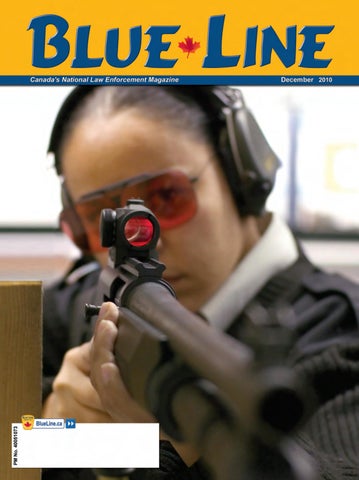
This month Blue Line’s Firearms Editor, Dave Brown, takes aim at the sighting systems available for police use. Although seen as more of a military application, firearm sighting systems are a necessity in modern day policing. The consequences of a shot missing its intended target can have a devastating effect on police and the communities they serve. Dave has spent months investigating the issues surrounding this topic and you can read more beginning on page 6.
Features 6 Aimpoint & EoTech
26
The two top electronic weapon sights square off in a head-to-head test
The Agitated Suspect Emergency
28 Martyrs or Glorified Terrorists The same old story retold
10
Shotguns: Pump vs. Semi-Automatic
14
Training With a Firearms Simulator
34 Training for Trauma Police & critical post traumatic stress disorder
Departments
Case Law
46 40 20 31 37 33 44, 45 43 5 39 12
41
Dog sniff requires reasonable suspicion
42
Warrants not ‘simultaneous’ if purposes differ
Advertisers Index Book News Book Review Deep Blue Dispatches Letters Market Place Product News Publisher’s Commentary Odditorials Technology
BLUE BLUE LINE LINE MAGAZINE MAGAZINE
33
DECEMBER DECEMBER 2010 2010
DECEMBER 2010
4
BLUE LINE MAGAZINE
PUBLISHER’S COMMENTARY by Morley Lymburner
Reflecting the communities they serve The Ontario Provincial Police recently took over a southern Ontario police agency. The takeover was not hostile, which is commendable (and unusual) over the past 20 years in Ontario. The municipal service quietly surrendered 100 years of service to the community. I was struck that the Ontario Civilian Police Commission (OCPC) report doesn’t state why the service was disbanded. There was no mention of its shortcomings, if any, or steps taken to remedy them. Also not explained was how the forced removal will improve service to the community or if it can ensure the long-range viability of “customer satisfaction.” The two people assigned to decide whether the service should be disbanded had no understanding of the actual day to day process of police work. None of the eight members of the OCPC have practical police experience. Five are lawyers, one is a retired educator, another is a professor of criminology and one, other than being a university graduate, has a previous career which is, on the face of the supplied resume, vague. There is considerable expertise within this group on how to hold a charitable community campaign, consultancy and how to resolve a wide array of dispute resolutions, but the bulk of cumulative knowledge appears to centre on lawyers and criminology. In the case of the southwestern Ontario police agency, the two people who decided the future policing for 23,000 citizens had the following on their resume. • Associate professor in the School of Criminal Justice at Ryerson University, holds a PhD in criminology from the Centre of Criminology at the University of Toronto. Involved in a wide range of community projects and agencies; has consulted to federal, provincial and local governments on a variety of justice
BLUE LINE MAGAZINE
issues. Research interests include policing, Aboriginal justice and victimology. •L egal director of the Ontario Insurance Commission (OIC) for four years; worked for ten years with the Legal Services Branch of the Ministry of Correctional Services, including six years as legal director. Was called to the bar in Ontario in 1980. Former president of the Society of Ontario Adjudicators and Regulators (SOAR) and is a member of the Board of Canadian Administrative Tribunals (CCAT). Their talent, no doubt, excels in many areas and ways. There is little doubt they can be of invaluable assistance in the deliberations but ... where’s the beef? Their talents appear to be lacking when it comes to the real questions of ability to police a community now and into the future. If the entire needs of a police service depends on statistics and price point, there should be no problem with these people’s determination. Delivering policing to a community, however, requires considerably more than looking at the sticker price. The Ontario Police Services Act begins with six “declarations of principles.” Although the first five sections reflect the traditional and more modern day expectations of police, the sixth comes close to my point. It states the need to “ensure that police forces are representative of the communities they serve.” This concept is a new addition to the act but one that municipal police have informally recognized since Sir Robert Peel put out a call to the London citizenry to select police constables from among their own numbers. Although representation of the community make-up was little considered in a formal sense, it is one factor which should be considered deeply today. With the ever-changing makeup of any particular detachment, is there an eye toward
5
representing the make up of the “community” to be policed? Representation should be an objective endeavour. Just check out Stats Can and see what pops up. Problems quickly arise when we subjectively try to determine what a “community” is before we go anywhere else. It is interesting to consider which police service – federal, provincial or municipal – can best honour this provision. There has been much angst, rancour and hostility caused by the Ontario costing process. It has divided communities and pitted municipal and provincial agencies against each other. This has been aggravated by a weak OCPC administration which simply looks at numbers and statistics as a basis for killing agencies with long and good standing within their communities. A simple beginning point for any municipality wishing to have a “costing study” should be asking “Why do you want to get rid of your police service?” If it is just to save money then some quick advice on fiscal restraint might spare the community and service a lot of angst. When picking adjudicators, the province would do well to heed the advice of Maurice Hughes, a distinguished Northern Ireland political statesman who served on the Patten Commission. He observed that “if economics is the dismal science, criminology is the hopeless one.” Bodies tasked with reviewing police services must include arbitrators with some working knowledge of police work.
DECEMBER 2010
Aimpoint & EOTech The two top electronic weapon sights square off in a head-to-head test
by Dave Brown The term “combat-ready” does not just mean the latest ‘tacticool’ products gracing the shelves of your favourite outdoor store; it means serious gear made to high standards for use in situations where equipment failure can lead to mission failure. It means ensuring users make it home alive at the end of every shift. It means it just has to work. This is a head-to-head test of the two leading players in combat-tested electronic weapons sights (EWS). Both are expensive, manufactured to mil-spec standards DECEMBER 2010
and made to be 100% reliable in real-life conditions. If you are looking for the best EWS under $100 or want to put a sight on your airsoft gun, you should look elsewhere. This is a showdown between the two best sights on the market, period. Head over to the ‘sandbox’ and you will see both in common usage. Check out any good police tac team and they will very likely have one of them mounted on their rifles or shotguns. After all, these are for real-life encounters. Out there isn’t a video game and there is no ‘reset’ button in life. 6
Aimpoint versus EOTech Aimpoint and EOTech run about 50/50 in surveys amongst military and law enforcement personnel. EOTech is slightly more popular in law enforcement while Aimpoint is used by more combat troops, but it is still a very even split. Deciding which one is better is not easy. There have been few head-to-head comparison tests of EWS, mostly because not many people are insane enough to spend upwards of $700 on a combat weapon sight and then try to destroy it. Fewer still will take a brand-new electronic sight and drive BLUE LINE MAGAZINE
over it with a truck. Well, that’s where Blue Line Magazine comes in – we are and we will! After all, this is not our first head-tohead comparison test. Long-time readers may recall the infamous triple-retention duty holster test back in December 2008. As part of our testing, we took three market-leading holsters into the nearest gym, strapped them to a test-dummy (me) and challenged the biggest guy we could find to rip out the rubber training gun in under 30 seconds (I still have the bruises). To properly test these sights, we needed to see what they will stand up to and mail back the pieces. To this end, Blue Line constructed a series of tests to see how well they will stand up in typical law enforcement situations and measure their ultimate speed and accuracy. We actually used three different versions from the two companies: the EOTech 552 model from L-3 Communications and Aimpoint’s CompM4S and Micro T-1. We mounted them on two semi-automatic shotguns and sighted them in using 12-gauge slugs, then removed them, dropped them, drove over them, left them in a bucket of water for a week and remounted them. We shot the sights without any further adjustments and examined how well they held their zero even after all that abuse. Speed test Using an electronic range timer to measure the interval from a start signal to the sound of each gunshot (to a thousandth of a second), we began from a high ready position and fired two rounds into the center of a single silhouette target at seven metres. This simple test actually says a lot about how quickly one can acquire a good sight picture on a target and reacquire it after the first shot. The opening salvo in the battle was a very close call but in the end, the simplicity of the single red dot of the two Aimpoint sights won the day. Advantage: Aimpoint. Accuracy test Our second test measured the speed in firing two-shots dead centre on two different silhouette targets within 1.2 seconds. This time, we started with the shotgun in a low-ready position. This is a tougher test of accuracy because one must bring the sight onto the target from below, rather than starting with it already aligned with the target. The lowready advantage is that one starts with the weapon already shouldered but the downside is that it takes longer to index the sight onto the target’s centre. Plus, there is always a tendency when raising the sight onto the target from below to swing slightly above the centre, meaning that your sight acquisition is a series of tiny imperceptible arcs above, then below, then above, etc. until the centre is finally nailed down. Again, it was a very close race to call BLUE LINE MAGAZINE
Aimpoint Micro-T-1
Aimpoint CompM4S
Drop test This test made us nervous. We dropped all three sights three metres onto a concrete sidewalk, 20 times in a row. Amazingly, all three survived with no more than a scratch or two. We needn’t have worried; the EOTech uses 1/8 inch of solid glass, backed up by 3/16 of an inch shatter-resistant laminate for its window; the Aimpoint models use a similar design for its hardened lenses. Impact test Just for fun, we drove a nail through a 2x4 using the EOTech as a hammer. It survived, again without a scratch. The Aimpoints’ shapes ruled out using them as hammers so we instead threw them down onto concrete as hard as we could. Try as we might, we could not break anything. Crush test This test probably had the least practical application – unless you’re prone to leaving weapons laying in the grass where trucks can drive over them. We placed each sight on grass, then slowly drove over them with a two tonne SUV. Our conclusion? Your weapon would be pretty much destroyed long before your electronic sight. After all this testing, we remounted each sight back onto a shotgun and, without any adjustments, shot it to see if the groups would remain where we left them. There was no variation noted on any of the three sights.
EOTech 552
but in this case, the EOTech was able to put the hits closer to the centre in the given 1.2 second time limit. That was long enough to take a bit more care in the sight picture; its one minute-of-angle (MOA) centre aiming dot, surrounded by a 65 MOA target reticle with its four quadrant tick marks, was ideal for not only ensuring the round would be centered but also that the gun wasn’t canted to the side. Advantage: EOTech. Waterproof test This one was simple. After testing all three sights for speed and accuracy, we removed them from the mounts and left them in a bucket of water for a week. The EOTech is rated to be waterproof to a depth of 10 metres, the Aimpoint CompM4S is rated to 45 metres and the Micro T-1 to 25 metres, but honestly, unless you’re a U.S. Navy SEAL, you are not going scuba diving with your weapon. If they can sit in a bucket of water for a week, they can survive a day or two out in the woods in a heavy downpour. All three sights survived without the slightest sign of leakage. 7
Battery life This is where the two manufacturers differ in their philosophy. The EOTech uses a series of tiny LED dots to form a holographic target reticle. The actual reticle is designed like the heads-up display in a fighter cockpit; it’s on an apparent plane of focus far out in front of the physical sight itself. This allows the shooter to have both eyes open and always stay focused on the threat. The downside is that this multi-dot holographic image consumes a lot of battery power. For this reason, EOTech designed a very fast on/off switch; one press instantly turns the sight on and it defaults to brightness level 15 out of 20 possible settings (plus 10 more unique setting positions exclusively for night vision devices). If you don’t touch any more buttons, the EOTech will shut itself off after eight hours of use. Battery life itself is over 600 hours of continuous use with regular AA alkaline batteries and 1,000 hours with lithium AA cells. While the EOTech is designed to be switched on quickly at the beginning of each mission or to be turned on with one quick thumb press when needed, the single dot of the two Aimpoint designs have continuoususe battery life measured in years instead of hundreds of hours. The CompM4S can go nine years on one set of AA batteries, DECEMBER 2010
while the tiny Micro T-1 can go five years on a single 2032 button cell. One literally mounts it on a gun and just leaves it on its whole life, replacing the battery every five years or so. While the EOTech turns on quickly, there is just something about a sight that you can mount and leave on constantly for years and years and not worry about replacing batteries. Advantage: Aimpoint. Speed AND accuracy Testing for durability is one thing, testing for speed and accuracy is another – but life is not a competition or action movie. Out there in the real world, the fastest shot does not necessarily win the gunfight. Neither, for that matter, does the most accurate. Gunfights are usually won by the fastest and most accurate shot. Basically, the person who connects first usually gets to walk away at the end of the day. Real-life gunfights are short, dynamic, brutal events that are over before they begin – and are as individual as the participants involved in them. When the gun comes out, human life is immediately on the line and the best compromise between both speed and accuracy gains the practical advantage. After all, police officers can never win an even fight. Officers react to an assailant’s actions so they are always behind the action/reaction curve and start each fight at a disadvantage.
DECEMBER 2010
ODDITORIALS
This is why police (and soldiers) need to train hard, stay aware and try to gain every advantage they can. Modern electronic weapon sights are possibly the biggest single advancement in accuracy and speed since the invention of the rifled barrel and the modern metallic cartridge. Conclusion The revolution toward unity-power electronic sights happened long before they were widely adopted by police and military. They actually started with simple ‘point’ sights mounted on shotguns and evolved
8
into battery-operated dot sights mounted on handguns for high-speed competitive pistol shooting events such as the practical pistol sports. It was rare 25 years ago to see an electronic sight in pistol competition but today it is rare to not see one in open-class competition. The modern electronic sight made the transition, first to shotguns in ‘combatstyle’ competitions and then rifles for police and military use. Today, virtually any firearm that can be designed or adapted with a Picatinny or Weaver-type rail system
BLUE LINE MAGAZINE
can accept an electronic sight. Shooters can keep both eyes open the entire time and remain focused on the threat. Unlike a telescopic sight, the dot or reticle does not even need to be in the centre of the scope; once properly installed and adjusted, wherever it appears on the glass is where the shot will impact. Electronic sights are also getting smaller and lighter, making them suitable for supplementary mounting on top of optical scopes. So the bottom line is, who wins? Well, this will be the first Blue Line Magazine head-to-head comparison test in history where there were two winners and no losers. Each sight can be mounted on any conceivable firearm and are ideally suited for short- and intermediate-range shooting. They are amazingly accurate, blindingly fast and tough enough to survive almost
anything. When mounting these types of sights, some shooters go to amazing lengths, with various heights and designs of mounts and rails, to get them to ‘co-witness’ to their factory iron sights in case they fail in mid-use. Basically, if the sight is mounted at the right height, you can still see your iron sights and ideally you can even use them through the glass of the electronic sight in an emergency. With the quality (and price) of the Aimpoint and EOTech sights, you can almost forget worrying about using iron sights as a backup. In a real emergency, it would be quick to unbolt them and go with the iron sights at that point. Maybe I am just getting old, but the older I get, the fewer the gadgets I want hanging from my firearms. I would be quite happy having nothing but electronic sights on my
gun and a set of spare batteries in my gun case. I think this is also why I have always been a huge fan of the EOTech holographic weapons sight but I am really starting to like the lightweight simplicity of the Aimpoint Micro. In fact, if I had to spend my own money (which I actually do in most cases), I would buy the Aimpoint Micro. The bottom line – the best sight you can possibly have is the one mounted on your firearm when you need it the most. If it says EOTech or Aimpoint on it, you can trust it with your life. Dave Brown is Blue Line Magazine’s Firearms Editor and staff writer. He is a tactical firearms trainer and consultant. He can be reached at firearms@ blueline.ca
Eye dominance and long gun shooting by Dave Brown Dave Sevigny has more than 150 championship wins in competitive and practical pistol shooting and is a 10 time USPSA national champion and nine time IDPA champion. There are few practical pistol sports he does not excel at. At the other end of the spectrum, Amy Simoes is a Winnipeg-based actress who just started getting into recreational pistol shooting. A long way from winning competitions, she shoots for the fun of it and shares an interest in teaching safety and handling to others – but both shooters share one common characteristic; they are cross dominant. Cross dominance simply refers to a person whose dominant eye and dominant hand are on opposite sides of their body. For the vast majority of cross dominant people, this means they are right handed and left-eye dominant. Not considered much of a problem in handgun target shooting, it can be a major hurdle to overcome in shotgun and rifle training. In all my years training people how to shoot, I have encountered about 10 per cent of the population who are left-handed but closer to 25 per cent who are cross dominant. (Interestingly, I would estimate about 20 per cent of the population don’t even know they are cross dominant.) If identified early, steps can be taken to improve their shooting performance with rifles and shotguns. They will likely never reach Sevigny’s level but they can still learn to shoot rapidly and accurately under stress. There are a variety of ways to test a person’s eye dominance, but the simplest is to get them to point their finger like it was a
BLUE LINE MAGAZINE
pistol and see which eye they naturally close. It can be very difficult and almost impossible for some people to close their dominant eye. I have even seen strongly cross dominant students who automatically close their right eye when I tell them to close the left. If identified early, some instructors suggest learning to shoot a rifle or shotgun lefthanded. This may work for some, especially younger shooters, but it can create problems for professionals who have to carry and use firearms for a living. Firstly, virtually all issue firearms are right-handed and most people have to adapt to the gun, not the other way around. Secondly, right-handed firearms fired lefthanded have a disturbing tendency to throw hot empty shell casings toward the eyes. The good news is that cross dominant shooters can learn to aim properly with their right eye. It takes work and a lot of practice, but the right eye can be conditioned to do
9
the aiming. One of the best ways is for the instructor to line up the front sight or bead with the left eyeball and place a small patch or tiny square of masking tape across the safety glasses right where the front sight lines up with the eyeball. They can walk around all day and not notice the patch of tape but as soon as they tuck their head down into a proper cheek weld, the image of the front sight disappears from their left eye. After several sessions, their brain tends to adapt so that as soon as a cheek tucks down into a shooting position, the right eye automatically takes over and they no longer need the tape. Shooters even learn to squint their left eye slightly as they aim the gun. Unfortunately, the down side to this method is that it takes work and every now and then, when their dominant eye suddenly decides to take over, they will sometimes fire a shot about a metre to the left of their intended target. Modern technology has provided another answer to this age-old problem: electronic sights. Using a red dot or holographic sight completely eliminates the issue because, unlike a telescopic sight, their unity magnification allows all shooters to keep both eyes open all the time while focusing on the target. For cross dominant shooters, the right eye keeps the dot on the target and the left eye stays open, thus reducing any fatigue or squinting problems. Few rifles or shotguns are sold today which can’t accept an electronic sight and, as Blue Line discovered, combat-tested sights like the Aimpoint, EOTech and Insight will always be there when you need them.
DECEMBER 2010
SHOTGUNS Pump vs semi-auto
by Dave Brown Modern technology helps us to shoot more accurately and faster. It also lets us challenge a few myths and old wives’ tales, including the old chestnut that the right person can fire a pumpaction shotgun just as fast as a semi-automatic. When electronic range timers first came out, their ability to time reaction from start signal to the sound of a gunshot conclusively proved what we suspected all along – that you don’t need to rest your finger directly on the trigger to fire a fast shot. Keeping the finger outside the trigger guard proved to be just as fast (and, of course, much safer.) Using a timer’s split time function, we were also able to prove that it is faster to reload a pistol from waist level than from eye level, plus you maintain a better view of any potential threat. In tactical or ‘combat’ shotgun shooting, we were able to prove it was faster to shoot a shotgun when starting from a muzzle-up ‘high-ready’ position than it was to start with muzzle-down, tucked into the shoulder. While it seems obvious that the shotgun is faster into action with the butt already placed in the shoulder pocket, the time it takes to traverse the sight onto the target from below makes it slower. Starting in a high-ready position with the front bead already lined up with a potential target means the shooter merely brings up the rear in line with the already aligned front. This brings us to one of the last great shotgun myths: the good shooter on a pump keeping up with a semi-automatic. It just stands to reason; the action takes the same length of travel to cycle, so why can’t a human cycle it just as fast with their hand as the recoil on a semi-automatic. While pump-action firearms are more
DECEMBER 2010
prone to ‘short-stroking’ the action, they are also justifiably famous for being able to digest any power of ammunition put into them. This is where the versatility of the shotgun truly shines; they will accept anything from light birdshot to heavy slugs and fire everything from flares and noisemakers to less-than-lethal impact rounds. As far as outright speed though, the pumpaction cannot be fired as fast as a semi-auto, no matter how good the shooter. I have seen some fast pump-action shooters in my time and may have even believed this myth myself at one point, but electronic timers do not lie. In conjunction with testing the electronic weapons sights for this issue’s feature article, we ran head-to-head tests of shot times for a pump and two semiautomatic shotguns. The results were conclusive. Using a CED 7000 shot-activated electronic timer, we recorded the split times of all three shotguns. Our absolute fastest pump shot-to-shot times were .29, .31 and .30 seconds. That looks pretty impressive – at least until you look at the times for the two semi-automatics. The Remington 1100 Police is a ‘gasoperated’ shotgun, meaning it bleeds off a bit of propulsion gas from the barrel to operate a piston which drives open the action. It is one of the most common semi-automatics used in law enforcement and competition shotgun shooting today. The 1100’s three best shot-to-shot times were .22, .26 and .24 seconds. The Benelli M4 is probably the newest and possibly the most capable combat shotgun ever invented. It uses a unique system that combines the recoil-operating mechanism of the Benelli M2 with a new gas assist design that uses pistons driving two rods against the bolt to speed up the
10
opening of the action. Unlike the 1100, the M4’s gas system is used for increased reliability rather than as the sole source of bolt movement – and does it work. Shot-to-shot times were .21, .20 and .19 seconds. A quick calculation shows that this shotgun can theoretically fire five rounds in one second. That’s fast. Semi-automatic shotguns are not going to replace pumps for the majority of law enforcement duties. They are more complex to load and bring into action and require a more complicated manual of arms – but with good training and ammunition powerful enough to operate the action, a good semi-auto can be 100 per cent reliable. It can also put more firepower onto a target in a shorter period of time than almost any other shoulder-fired weapon. Consider that a 12-gauge slug can penetrate an engine block at close range – and shotguns like the Benelli can put five of them onto a target in not much more than one second. This is the ballistic equivalent of 40 rounds of .223 all hitting the target at once. Thankfully, the need to bring this kind of firepower to bear is rare, but in a life-threatening situation, having this capability would certainly add to the comfort factor. After all, some people drive Cavaliers and some Ferraris. Both get from point A to point B in the same amount of time (within the law) and both are subject to the same laws of physics and rules of the road – but life is not always about just getting from point A to point B. Sometimes it’s about how fast we could get there … even if we can only dream about it. Dave Brown can be reached at firearms@blueline.ca
BLUE LINE MAGAZINE
Insight Mini-Red Dot Sight Ready to play with the big boys?
by Dave Brown As one of the world’s leading providers of tactical lasers, target illuminators and thermal imaging equipment, New Hampshire-based Insight Tech-Gear is not new to the world of combat electronics. The Insight MRDS, the company’s recently announced mini-red dot, lightweight, ruggedized mil-spec electronic target sight, can mount to almost any stock or aftermarket Picatinny or Weaver-style rail. It can be used as both a standalone sight system or a supplementary electronic sight mounted on top of an optical scope. It’s ideal for military use by combat troops such as designated marksmen; their magnifying scopes engage an enemy 600 meters away but don’t work at all on a threat that suddenly pops up six meters away. Having a small, lightweight reflex sight system mounted on top of a scope gives soldiers a lot more versatility. For law enforcement, the MRDS can be easily mounted to any police shotgun or patrol rifle. Our testing proved it’s reliable enough to roll around in the trunk of a police car all day long and still work when you need it. Available in a non-reflective black or tan finish with either a 3.5 or 7.0 minute-of-angle (MOA) dot size, the MRDS is fully adjustable for windage and elevation using one MOA click adjustments. It is powered by one 1632 battery and battery life is predicted to exceed one year if left on constantly. Similar to the Aimpoint, the MRDS has four brightness settings for the red dot, plus one very clever innovation: an “auto” brightness setting where an ambient light sensor automatically adjusts dot intensity to match actual lighting conditions. It works very well; throughout our tests we rarely encountered a situation where manual was needed. (This is good because the size of the sight dictates a tiny on/off switch with very little tactile feedback.) The size of the MRDS dictates the 1632 button-cell, not the much-more common 2032 battery found in sights like the Aimpoint Micro. This is one area that I wish Insight was able to address; 2032 batteries can be found almost anywhere but the 1632 is much harder to obtain. Thankfully, the original battery hasn’t failed, even though the sight has been left constantly on in the auto position since it was sent to Blue Line more than a year ago. The sight is listed as waterproof for two hours at depths up to 20 metres and has an operational temperature rating of -40 to +40 degrees Celsius. The body is made from high-impact polymers and the lens has an anti-reflective coating over a clear impact-resistant polymer plate. We subjected the MRDS to the same tests as the EOTech and the Aimpoint (see feature article in this issue) and it passed all durability and accuracy tests. It even comes with a small BLUE LINE MAGAZINE
lightweight aluminium ‘roll bar’ hoop over the lens to add further protection and if you look closely at the photo, you can see the scars left behind from our testing. As with the other sights, we mounted it on a shotgun, sighted it in and shot it for groups with 12-gauge slugs. We then removed it, left it in a bucket of water for a week, dropped it three metres onto concrete 20 times, drove over it with a truck tire, remounted it and shot another series of groups. Not only did the sight shrug off all our torture-tests, it held its zero perfectly. Quite honestly, we thought the sight would be going back to Insight in an envelope. It was
11
admittedly very cute, but that’s not what police or troops need in an electronic weapons sight. It not only surprised us by passing all our head-to-head testing procedures but turned in much longer than promised battery life. At a list price of $650 US and street prices hovering around $500 US, it is also not cheap, but that reflects the quality of materials and workmanship. This is an expensive, professional-level tool for professionals who need the capability of a combat-tested electronic weapons sight in a compact size. To further prove its durability, we used it in a recent seminar to demonstrate the versatility of the modern police shotgun. We set up a hostage scenario, with only the upper ‘B’ zone of an IDPAstyle silhouette target exposed behind a simulated ‘hostage.’ First, we removed the MRDS from the shotgun, threw it as hard as possible against the concrete floor, watched it bounce several times off the floor and ricochet against the concrete range wall. We then remounted it and immediately put two rounds of 00-buck into the six-inch by sixinch ‘head’ of the terrorist without a single pellet going near the ‘hostage.’ Not just an amazing test of durability, this illustrates confidence in the quality of the Insight MRDS. While we wish Insight would improve the on/off switch, add more brightness settings and change the battery to a 2032 cell, the MRDS is ready to take its place in the world of combattested, lightweight miniature weapons sights. Dave Brown can be reached at firearms@blueline.ca
DECEMBER 2010
TECHNOLOGY by Tom Rataj
Laser sighting systems That famous little red dot seems to be everywhere in the movies and on TV police dramas these days. It leaves little to the imagination where the next round will strike, leading many villains to surrender as soon as they see it dance around their chest. The Light Amplification by Stimulated Emission of Radiation (LASER) traces its theoretic foundation all the way back to Albert Einstein in 1917, when he wrote about the potential of “stimulated emissions of electromagnetic radiation” to output waves of radiation. The laser remained largely theoretical (and the stuff of science fiction ray-guns) until 1960 when a researcher at the Hughes Research Labs produced short bursts of light with the first functional demonstration model. Prior to this, the Microwave Amplification by Stimulated Emission of Radiation (MASER) system emitted controllable beams of microwave energy alone. Masers are still used today in equipment such as electronic amplifiers in radio telescopes. Some work is still being undertaken to use masers and lasers as weapons similar in nature to the famous Phaser (PHoton mASER) created for the Star Trek series.
The first laser was referred to as an “Optical MASER” because it used the same basic process to produce visible light instead of an invisible microwave beam. Extensive work and innovation in the 1960s led to the many uses of lasers today. There are numerous types on the market, used in a wide variety of systems and technologies – everything from printers, optical discs, barcode scanners and medical devices to laser torches and other industrial uses.
Lasers for sighting The laser is a very efficient and effective tool in assisting a shooter to acquire a target, particularly in less than ideal conditions. Laser sighting devices are available for virtually any type of firearm. Red laser sighting is also integrated into the TASER conducted energy weapon. Red lasers are the most common colour used in weapon sighting systems; they work the best in low-light situations and in a wide variety of ambient temperatures. Most have an output of 5 milliwatts (mW = one-thousandth of a watt) and operate in the 635 to 655 nanometre (nm = 1 billionth of a metre) spectrum of visible light. They function well from 15 to 65°C (5 to 150°F). Green lasers are the newest colour for weapons sighting and offer some advantages (and disadvantages) over the traditional red. They work best in bright and rapidly changing outdoor conditions. It’s easier for most people to see because our eyes are more sensitive to it. Their 5mW output operates in the 532nm light spectrum range. Green lasers have some difficulty with lower ambient temperatures and may not function reliably in cold winter conditions. Their functional operational temperature range is 4 to 38°C (40 to 100°F). Many sighting lasers offer the ability to rapidly pulse on and off in addition to projecting a steady beam. The rapidly pulsing laser is easier to see than a steady light and offers longer battery life as a bonus. Mounting methods Sighting lasers can be installed externally or internally. Externally mounted units are usually affixed with some type of proprietary mounting hardware on older handguns and rifles without the Picatinny or Weaver mounting rails, generally to the front of the trigger-guard, into the top of a customized grip, around the back of the grip or on some other accessible mounting point. Their biggest drawback is that they are susceptible to being knocked-out of alignment and generally require a specialized holster since they no longer fit into regular holsters. Most external units have adjustments for windage and elevation. Internally installed units have numerous inherent design advantages because they are located inside the frame of the pistol, making them more or less immune to being knockedout of alignment. A converted pistol will still fit in the existing holster, so there is no additional equipment to purchase, and internal sights will fit into older pistols that do not have mounting rails. Advantage Sighting lasers offer a number of significant advantages. Shooters trying to find their target will always do better because the laser dot shows where the round will strike. No lining-up of sights is required and shooting is more intuitive.
DECEMBER 2010
12
BLUE LINE MAGAZINE
Laser sighting also offer an excellent deterrent effect because most people are familiar with what that little red laser dot signifies. On the downside, activating the laser sighting unit requires using fine motor skills and muscle memory training, so may require preplanning in some emergency situations. The small silver-oxide batteries are readily available and should last at least one year although, as with all batteries, they are susceptible to the cold. Hazards and safety Laser sighting devices have the potential to cause permanent retinal damage if pointed directly into the eye at close range. When properly used from a distance they will cause temporary flashblindness or afterimage, similar to the effect one gets when exposed to a camera flash. This generally fades within a few minutes and causes no permanent damage. Training to use these devices should include stringent guidance to avoid directly pointing the beam at the face of a live target. Laser pointers As with many other technologies, the price of lasers has dropped so substantially in recent years that laser pointers are often readily available at the corner store. The problem arises when the pointers, intended for use in presentations, are abused by kids or irresponsible individuals. Other than simply annoying behaviour, there seems to be a constant stream of incidents where aircraft are targeted while approaching airports. These dangerous incidents pose a serious risk because they can cause temporary flash-blindness to pilots at a crucial moment during a flight. There is legislation pending in many places restricting or limiting the sale of laser pointers and creating specific criminal offences for their misuse. While laser sighting devices normally operate at 5mW or less output, some improperly imported laser pointers have been found to operate at more than 15mW. The recently introduced Wicked Lasers Spyder III Pro Arctic (class 4) laser has a rated output of 1W, making it a dangerous weapon in the hands of troublemakers everywhere.
Northland infiltration feared
OTTAWA - The chilling prospect of terrorists or other extremists exploiting the Canadian Arctic has attracted the watchful eye of federal security agencies. A newly declassified intelligence assessment raises the spectre of the North as a conduit for international or domestic radicals. The report was prepared by the Integrated Threat Assessment Centre, which includes representatives of the RCMP, CSIS and other agencies. A copy of the January report was obtained by The Canadian Press under the Access to Information Act. The assessment notes the population of the Canadian Arctic has climbed 16 per cent over the last decade, and the vast region draws an increasing number of tourists, with some 15 cruise ships operating in its waters. The assessment indicates the security agencies are wary of threats from both within Canada and beyond its borders. Canadian Press - Blue Line News Week
Manufacturers LaserMax is one of the largest manufacturers of laser sighting equipment and manufactures a wide range of internally and externally mounted sighting products. Crimson Trace produces a selection of laser sighting equipment in a large variety of externally mounted products, many mounted on the top of a revolver or pistol grip. Surefire produces a selection of externally mounted tactical lights for a variety of firearms, including several with laser sighting options. NcSTAR produces a small selection of external laser sighting units. Laser sighting devices for firearms can be a very effective tactical addition to law enforcement weapons. Their use certainly requires additional training and investment, but their powerful deterrent effect can reduce the use of deadly force. Tom Rataj is Blue Line’s Technology columnist and can be reached at technews@blueline.ca .
BLUE LINE MAGAZINE
13
DECEMBER 2010
Training with a
firearms simulator by Shannon W. Lightsey Most police officers over 35 are familiar with the FATS training simulator, for many years the initial standard for simulator training. It exposed us to the shoot, don’t shoot and reaction time use of force scenarios. Today a variety of companies – including Laser Shot, Virtra, IES, TI, Meggitt and others – produce simulators, giving law enforcement (LE) personnel an opportunity to see a scenario and decide what level of force it requires. Each system presents a variety of scenarios to practice or learn from. Typical action would consist of drawing the training laser weapon, acquiring target picture and choosing the deadly force option. Whether it’s an active shooter situation within a school, a domestic disturbance call or a terrorist threat, all of the simulators can create judgmental use of force situations. The systems offer a variety of amenities, ranging from single screen to multiple screen widened views, high/low definition resolution, laser based shooting (visible or infrared) and recoil kits/weapons for firing simulation effects. Scenario branches determine whether the suspect is injured/deceased, shocked by a Taser or reacting to OC spray. Some simulators offer shock vests, shoot back cannon systems and other options to train an officer to seek cover or realize they did not react quickly enough. The main differences boil down to how much an agency wants to spend and what features it requires, but it’s also crucial to evaluate the manufacturer and sales representative. It may be detrimental to your overall success to go with a company and rep who is not experienced with police or LE training. Only a handful have former and retired law enforcement personnel and trainers on staff. Capitalize on their training experience and assistance in developing training methods and techniques. A few companies have training experience and can assist in developing and planning lessons, help customers get the best value and truly understanding the system and training relationship. LE training experience is vital to understanding the complexities, time restraints and needs involved in conducting effective simulator training. Some systems provide an indefinite number of scenarios while others also allow you DECEMBER 2010
to produce your own scenarios. Many agencies run through scenario after scenario – shooting, using Tasers or OC s p r a y, t h e n moving on to the next one. Stop – think – is this the way your officer fights and survives in the field – shooting, driving down the block, encountering an OC or Taser situation and then heading to the next call? Clearly not. Officers have legal obligations and tasks they must complete after using deadly or nonlethal force. Train the way you would fight. After using deadly force, for example, they would have to ensure the scene is safe by securing the suspect’s weapon, handcuffing and searching them, radioing dispatch for an ambulance and calling for back up and a supervisor. Work these into your training scenarios, using either a live training partner or mannequin. Continue now as a first responder and treat the injured using basic first aid principles – ABC (Airway, Bleeding and Circulation) – until paramedics arrive. Go beyond another step in the training and work outside the normal box. Have the officer write a use of force statement, then review and critique. When possible, co-ordinate with the local Crown’s office and have a representative on hand to offer feedback for improvement. Training now can be limited in scope – a felony traffic stop situation, for example, using three to four scenarios types with varying outcomes. Use simulators to evaluate the officers 14
judgmental and critical thinking skills, along with the additional tasks he/she would be required to do in a follow up. Review skills they are required to be proficient in – identifying and reacting to a threat, deciding on the required force, handcuffing techniques, radio procedures, securing evidence/weapons, searching a suspect, giving first aid, writing reports, etc. Add these tasks to simulator training and you now develop an automated tasking the officer will follow with the repetition in training. The officer becomes automated into the scenario (real life or simulated) and now training takes effect. This automated response helps to remove some initial shock from an incident, potentially keeping the officer in a defensive and proactive automated mode BLUE LINE MAGAZINE
until backup or supervisors arrive. Why do we drill repetitiously in training? To develop an automated response to a situation and allow the training to take over. Shooting skills, as firearms instructors know, are a perishable skill. Many simulators offer a variety of shooting skill drills and qualification courses. The key is getting officers trigger time. Many agencies struggle to have a couple of hundred rounds of ammunition for their officers to fire and practice or qualify with. Trigger time is critical. Repetition is a must; have officers shoot every month on the simulator so they can develop muscle memory and practice draw and flash front sight picture. Create a competitive environment in shooting and skills competition. Some of the simulators have a gaming side to them; don’t be afraid of using games like hunting or Hogan’s Alley. If it will put an officer in a trigger pull situation, he/she is practicing and developing muscle memory while enjoying training. As a firearms instructor, be there to mentor and train. Watch the hand grips and sight alignment and practice by the numbers – “smooth is fast and fast is smooth.” Your simulator teaches critical decision making in use of force situations and provides trigger time. What you pay and the added bells and whistles you choose is up to the chief or firearms instructors. Many agencies are cutting back and often, one of the first things they do is slice back funds for training and ammunition to the minimum requirement. If your agency is not training in use of force scenarios or providing the needed trigger time, it is creating a liability. The simulator provides a cost effective means to reduce this liability and continue training despite ammunition cut backs. Be creative. Some of the scenarios portrayed in simulators can be used to recreate a mock crime scene so investigators and crime scene units can be put into play to reinforce their skills. Schools with both LE and legal training programs can use the scenarios for mock trials, allowing students to go through a simulated court situation. Firing ranges require a range master, safety officer, targets, ammunition and possibly travel time and fuel to get officers there. Simulators reduce these costs by cutting range use. Officers can practice prior to live fire qualification, eliminating wasted ammunition and additional range time by marginal shooters. Research is beginning to show that marksmanship skills developed with simulators are directly reflective to live fire shooting skills. Take advantage of this. Simulation saves time and manpower. What can take three to four hours on the range now can be accomplished in as little as 15 to 30 minute training sessions. Train to standard, not to time.
New Toronto Police policy sensitive to human rights TORONTO - The Toronto Police Service is revamping its communications policy to ensure the use of “appropriate human rights-themed language,” and hopes to have guidelines for officers ready soon. The draft policy asks officers to avoid using potentially offensive terms like “mulatto” and “queer,” along with cultural identifiers, such as describing a suspect as Portuguese. “If you describe somebody as Portuguese, it makes the assumption that everybody reading that is going to think of the same thing in their mind’s eye as to what a Portuguese person looks like,” spokeswoman Meaghan Gray said, noting officers will be encouraged to use “more physical descriptions” of victims or suspects instead. Sergeant Shawna Coxon of the service’s diversity management unit said the new policy will apply to every piece of communication the service puts together, both internal and external. She said the overarching goal is to ensure communities are referred to in a respectful manner. Toronto police have struggled with terminology in the past. Just last month, the Canadian Jewish Congress accused the service of pushing anti-hate law “to its most absurd level” by listing “non-Jewish shiksa” — a redundant slur
for a non-Jewish woman—as a victim category in its latest hate crime study. Ms. Gray said the guide, which is still in the draft stage and targeted for completion by fall, encourages officers to consider all language they use “with a human-rights lens.” It does not contain a list of banned terms, she explained, but rather a framework for communications. Rather than referring to someone by their ethnicity, she suggests it would be more helpful for officers to use specific physical descriptors, such as hair colour and complexion. “In some cases, perhaps [ethnic identifiers] are not accurate, so not just are you assuming that everybody’s going to think of the same thing when they read that description, but you’re also narrowing your focus to one particular community when in fact that is not helpful,” Ms. Gray said. Descriptors such as “black” and “white” should only be used as part of a more fulsome physical description, rather than as “stand-alone cultural identifiers,” Ms. Gray said. The policy also advises officers to avoid terms such as “queer,” which may be acceptable when used by members of the LGBT community, yet inappropriate on the part of an officer.
(National Post)
Shannon W. Lightsey is a retired US Army criminal investigator, special agent, firearms instructor and former federal air marshal. He is currently a firearms training consultant with Laser Shot.
BLUE LINE MAGAZINE
15
DECEMBER 2010
Delivering it all for 25 years by Ann Harvey The next time you catch a speeder coming or going, you might want to thank Mega-Tech. You could also thank the 25-year-old Canadian company the next time you put a prisoner in one of its improved, form fitting plastic rear seats. Designed to offer maximum space, they use an outboard seat belt so officers don’t have to lean their head or torso inside the car to restrain a suspect. Helping police achieve the best results in the safest way using the latest technology is part of what Mega-Tech says it has been doing since its inception in 1986. “It’s an exciting and satisfying endeavour,” says company president John MacDonald. “In this particular market, we’re always at the leading edge of technology.” In its early days, the company sought products to sell. Now, manufacturers regularly approach it. The company examines the product and makes selections based on fit with existing product mix and its expertise. “We try to be very selective,” says MacDonald. “Mega-Tech has made a concerted effort to represent the finest quality products from the most reputable manufacturers. We’ve positioned ourselves as a one-stop-shop for police, fire and EMS services, which represent the lion’s share of our business. We also offer our products to others, including utility companies and public works facilities; those types of organizations.” He notes that one-stop doesn’t mean being all things to all people, explaining that by focusing on what it can do best, Mega-Tech maintains excellence. The company began with a small location in Edmonton. “Today we’ve grown to four locations. We are headquartered here (in Edmonton) and have offices in Chilliwack, B.C. (in the Lower Mainland), Milton, Ont. (just outside of Toronto) and Montreal, Que. At each of those locations we offer product sales, repair service and installation. “Mega-Tech services and installs everything that we sell. Our salespeople can provide on-site demonstrations and organize product trials with customers. Because we have four locations, it allows us to look after services and companies that have national fleets.” Customers have a lot of choice, MacDonald says. “Our product line is vast. We sell a wide range of vehicle equipment, which includes emergency vehicle lighting, sirens and control systems, in-car video systems, vehicle partitions, push bumpers for the front of vehicles. We also offer related equipment such as breath alcohol screening devices, flashlights, boots, handcuffs and duty belts (and video, which) is in widespread use in Canada and is the officer’s
DECEMBER 2010
backup. It’s for their protection and may provide indisputable evidence at the court level.” Direction sensing radar, which allows an officer to measure the speed of vehicles travelling in John MacDonald, both directions ahead and behind, are part of a large president selection of speed enforcement equipment the company offers, MacDonald says. Speed enforcement equipment includes traffic radar and laser. Radar’s broader beam makes it appropriate for use in open spaces such as highways and country roads while laser’s pin-point beam is more useful in high traffic congestion such as downtown areas. Anti-idling devices are beneficial when police cars are parked at collision sites with lights activated to warn approaching traffic, MacDonald says. “These devices will control the idling of a vehicle and automatically turn it on and off to avoid battery drain. While reducing the fuel consumption, it will monitor the battery voltage, allowing full function of emergency lights and equipment. Ours is state of the art. It also monitors things like exterior and cabin temperature and can monitor most of the outputs that the engine is providing.” Mega-Tech also offers an integrated vehicle solution with a voice activated control system; brand new technology which is commanding a lot of attention, he says. “The officer speaks voice commands to the police vehicle, which then responds accordingly.” This can activate such functions as lights, siren or in-car video. “It can basically interface with any of the equipment in the vehicle. It’s an officer safety feature in that they do not have to take their hands off the wheel while driving. This system is designed to work for the officer while they are in pursuit. After apprehending a suspect and placing them in the back of the vehicle, the officer might turn the voice activated system off.” The principle of redundant control is used, MacDonald says. “There’s always more than one way of operating that piece of equipment.”
16
Mega-Tech has responded to another need: officer-friendly ergonomic mounting solutions for the various equipment – computer components, keyboards, radios, speaker controls and monitors – installed in modern patrol cars. “Police vehicles more and more are becoming mobile offices, printing tickets and enforcement notices on site, and all of that type of equipment requires mounting,” notes MacDonald. “It needs to be mounted in such a fashion that the officer is comfortable using that equipment for extended periods, but can also swing it safely out of the way and secure it in place while he is in pursuit. That requires a lot of creativity and product expertise.” Another relatively new technology – automatic licence plate recognition (ALPR) – is being widely sold in the US and Mega-Tech has introduced it to Canada. “As the police vehicle is being driven, the system automatically scans and checks licence plates against a “hot list” at a rate of thousands per hour,” MacDonald explains. The system reads with ambient light during the day and infrared light at night. Before an officer begins a shift, the system is loaded with the hot list, he says. When it gets a “hit,” the system alerts the officer about the infraction, whether it be a stolen vehicle, robbery suspect or vehicle associated with an Amber Alert. “It serves for officer safety, but also prioritizes the type of infraction,” MacDonald says. A warrant for unpaid tickets, for example, will be temporarily bypassed if another plate identifies a vehicle which might be carrying a robbery suspect, he points out. The systems are gaining popularity in Canada, notes MacDonald, with trials being conducted in various provinces. In order to respect the privacy of motorists, the system may be programmed to erase data at the end of the shift. “Mega-Tech is proud to play an important role in helping members of the public safety community do their jobs safely and to the best of their ability,” says MacDonald. Check out www.mega-tech.com or call 1-800-700-7937. Ann Harvey is Blue Line Magazine’s Western correspondent based in Alberta. Contact her at: aharvey@blueline.ca
BLUE LINE MAGAZINE
Back to school
back to bullying
by Nancy Colagiacomo Holidays are a great time to catch up on your childrens’ interests and activities, but also to learn what’s happening in their life. An innocent conversation can uncover unexpected facts. One father recently discovered his teen had been bullied in school for three years but never reported it. School bullies actively terrorize primary and secondary school students. Incidents like the Columbine massacre are believed to be associated with taking revenge against the bullies who made school miserable for the ‘trenchcoat mafia’ members. More recently in Massachusetts, 15 year old Phoebe Prince committed suicide after being bullied by six teenage girls who were later charged with stalking and violating her civil rights. Sadly, teachers knew of Prince’s ordeal but said nothing. Georgia student Tyler Long’s 2009 suicide is believed to have resulted from being ridiculed in school. It’s estimated that some 160,000 thousand students in the US alone stay home from school each day for fear of bullying. Fourteen student suicides in the last year were related to bullying. Bullying has evolved from the schoolyard. Today’s bully uses technology like texting, Facebook and Twitter to torment their victims. What used to be a face-to-face encounter that occurred in specific locations can now take place 24/7. This kind of violence is a great concern for teens, who find themselves helpless and confused, and for parents. Violence is either verbal, written, or physical and appears in various ways, including physical attacks, humiliating remarks, threats and extortion. Bullies will often give a false indication of self-confidence, have a great need to dominate and a limited ability to manage interpersonal conflicts. Victims who are intimidated may be more sensitive and appear to have few close friends at school, often seeking to be close to adults, and their mood may fluctuate between anger, fear, shame, doubt and guilt. Witnesses to their bullying are usually afraid to tell and be regarded as informers and may choose to be passive; some may actively help the intimidator during the aggression or be an active spectator, laughing and encouraging them. Even if all students are not directly touched by the phenomenon, there is much to be concerned about. A 2002 investigation by the Québec Ministry of Public Security found young people most feared being extorted on the school ground and six out of 10 had encountered this situation in the past. Obviously these kids are not very inclined BLUE LINE MAGAZINE
to trust an adult and most are afraid of the consequences if they tell. Some think adults will not intervene. Interestingly, one third of school principals said that the lack of denunciation of the incidents is a factor which limits their efforts to counter such acts. The Québec auditor general launched a study in 2005 which found school violence was not a major problem in the province but still remained a preoccupation. The Québec Ministry of Education, Leisure and Sports spent almost $17 million across the province over three years on an action plan to prevent and treat school violence through awareness, prevention and intervention. Although most schools have written policies banning all types of violent acts, they do not provide students with a way to get help
17
when they’re bullied. The most likely people to witness bullying – teachers – don’t feel equipped to handle these situations. “Parents and teachers MUST intervene when they see bullying take place,” says bullying expert Susan Swearer, associate professor of school psychology at the University of Nebraska. “First, they must tell the student(s) who are doing the bullying to stop. They need to document what they saw and keep records of the bullying behaviours. Victims need to feel that they have a support network of kids and adults.” Committees made up of police officers, school board representatives, health and social services meet several times a year in Québec to exchange information and experiences to better equip teachers to deal with school violence. Their mandates include promoting awareness, encouraging training of all school personnel and developing a co-ordinating team to devise a protocol for intervening in or investigating bully incidents and guiding participants to establish a realistic approach to counter the problem. It’s important to establish the roles and responsibility at every level – teacher, principal, social services, parent and police. This approach works well with community policing, encouraging officers to develop and promote anti bullying programs in the schools with the active participation of all concerned. It’s a matter of bringing together partners from different spheres in order to develop tools and implement them. One of the participating school boards released a video made by students, for students on bullying which received a positive response. It’s an indication to other Phoebes and Tylers that someone is listening. Nancy Colagiacomo is Blue Line Magazine’s Québec correspondent. Anyone with stories of interest on Québec policing may contact her at: nancy@blueline.ca.
DECEMBER 2010
New RCMP deputy commissioner aims
to improve communication by Ann Harvey Senior Deputy Commissioner Rod Knecht brings empathy, compassion and a willingness to learn and change to his new role as second-in-command of the RCMP. Knecht will draw on his 33 years of varied and distinguished experience in helping to restore the reputation of Canada’s national police agency at a time when it’s under daily attack. The media and government consultants have identified multiple problems, including serious management flaws and overworked and alienated front line members. It’s a challenge intensified by the extraordinary fact that both highranking management and lower-ranking officers have broken ranks to make public complaints. A soft-spoken and formidably intelligent man who speaks with unhesitating confidence of the RCMP’s ability to change and adapt, Knecht describes his career as a journey of surprises and personal growth. This is his 15th physical transfer and 28th or 29th position transfer in a career that has seen him patrol rural areas and highways, work in municipal and aboriginal policing, conduct local, national and international investigations as a uniformed, undercover and plainclothes officer and combat drug and commercial crime. Growing up in Calgary, “like any Albertan I worked in the oil industry for a little while,” he said. “I initially wanted to be a pilot and I started out to become one. Once I started I just decided I didn’t want to do that. My parents encouraged me to join the RCMP.” DECEMBER 2010
He had to apply twice; his first application was rejected when he failed the then-mandatory inspiration-expiration chest measurement. “It had to be 70 inches with, I believe, a two-inch difference. I was 142 pounds when I joined.” After graduation he was sent to Kyle, Sask., a northern community of 412 people served by a four-member detachment. “I learned that value of being part of the community and knowing the community members. It was a great place to learn community policing. I guess it was a form of intelligence-led policing. “Police depended on information from the public and fellow members. Community policing is the community supporting you and you supporting your community.” Mayerthorpe reminded Knecht of a man in Kyle who, like James Roszko, was well known for his hostility and violence toward police. “I did end up by accident checking him by myself on a back road one night and I did have trouble,” Knecht recalled, adding he managed because he was prepared, thanks to community and police sources. “I was provided with the advantage of knowing what that individual was all about before I even checked him.” The experience was good training, preparing him for future postings. “There wasn’t a lot of serious crime so I enjoyed the opportunity to take my time going through investigation procedures, learning how to seize evidence and write reports.” He went on to eight more postings in Saskatchewan, a province he agrees is one of the most challenging for police but also “the best place to learn.” 18
While working in Prince Albert, a colleague suggested he try undercover work but Knecht wasn’t interested. Some time later while in Tisdale his boss surprised him with news that he had been accepted into the undercover course. Knecht told him he hadn’t applied and was promptly shown his application, complete with forged signature. Opting to take the training, he spent the next 16 years working undercover and investigating proceeds of crime. “It was a tremendous experience for me,” he said. “Before I was a very quiet person. In those days in undercover work you were really largely on your own. I think it really helped me to build my self confidence.” It also gave him a new understanding and compassion for people who use drugs. He worked on the streets with the hypes but also the dealers and distributors as he tracked down proceeds of crime and investigated money laundering. “Doing undercover work was one of those defining moments in policing for me,” he says. “As a police officer quite often you can be somewhat antiseptic with respect to who you’re dealing with. I got to see how criminals lived with their family and friends. A lot of the people I dealt with, if not for the fact they were criminals, they would have been friends. The users who are addicts are often victims of tragedies in their lives. I had a tremendous appreciation for people who were victimized by crime.” That feeling did not extend to drug traffickers. “They didn’t care who they hurt or what lives they destroyed.” The essence of undercover work was BLUE LINE MAGAZINE
blending in. He grew long hair and wore the right clothes. “Before you went out you would make sure to have dirt under your fingernails. You wouldn’t wash your hair.” Knecht found it a lot easier dealing with the higher levels than the lower levels. At the street level it was role playing and people were more conscious of his behaviour, he said. “At the higher level they often make decisions by the kind of car you drive, the kind of clothes you wear, the watch on your wrist. It’s more acting like a businessman than role playing.” Those days undercover operatives had less protection from the stresses and help from technology, he recalled. There was no video recording or other backup. “Your credibility was everything and it was your word against the criminal’s word. We took volumes of notes. For a five-minute drug buy you maybe took four hours of notes... “The undercover program has matured tremendously,” he noted. “Every time someone does an undercover operation now they have to see a psychologist after. We don’t leave them too long in that area of business.” A 1986 undercover operation involving cocaine in Buenos Aires, Argentina is especially memorable. “I was the first guy in the RCMP to buy drugs outside of Canada.” He went on to head up the drug section in Kingston and then moved to the Toronto drug section, followed in 1997 by seven months heading up proceeds of crime in Toronto as a newly-commissioned inspector.
BLUE LINE MAGAZINE
Photograph by: John Lucas, Edmonton Journal
RCMP Commisioner William Elliott presents a ceremonial sword to Deputy Commisioner Rod Knecht who took over as Commander of RCMP K Division as well as the RCMP Northwest Division. That year Knecht was made the officerin-charge of the Blood Task Force (Krever Commission), a high-profile, sensitive, multi-jurisdictional international investigation into Canada’s blood system, triggered by complaints from people infected with serious or fatal illnesses by tainted blood. The investigation taught him a lot and elicited his empathy and sympathy for the victims. “That whole file started out with a complaint from a single individual. I interviewed him and it grew from there into this massive international investigation. It took four
19
years. We charged the Red Cross and some other individuals as well. “I learned a tremendous amount particularly as a manager and leader in policing. Fortunately the RCMP was very supportive. I was given licence to go out and investigate the case. I travelled the world doing interviews in the medical and scientific community.” Corporations were also involved as blood suppliers. “You’re dealing with highly educated people... CEOs and presidents of large corporations.” Investigators had to understand differences in cultures, governments and countries with respect to some processes, Knecht said. “The whole case rested on seizing critical documents from around the world and, of course, witness evidence. We searched locations right across the country in every province and territory. Our search warrants were executed and we were there for five days, 24 hours a day.” Allowed to handpick a team, he began with four people; one was good at getting people to talk for statements, another was handy with technology and a third person prepared a 7,000 page search warrant which was used for each site by simply changing the company name and address. The team grew quickly and before long “we had people in every province and territory working with us. We used liaison officers around the world, folks in 23 countries, to help gather evidence. I had really good
DECEMBER 2010
people on that team. They logged thousands of hours of volunteer overtime. We had a full-time victim services co-ordinator. She dealt with the victims on a regular basis.” It was a very emotional investigation, said Knecht, with thousands of victims, including well over 1,000 on the HIV side alone. “A lot of people who were victims and witnesses died in the course of the investigation. Many of those people had become personal friends and many are still friends. I remember their stories to this day. It taught me a lot about discrimination. We have prejudices and preconceived notions based on lack of information. When you see the other side of the fence, when you understand what victims go through and how people get involved in certain activities, you get a better understanding of those folks.” It also taught him the value of communication and the media. “The RCMP is known as the silent police force. I learned in that investigation to take the opposite approach. We really focused on victims and communicated with the victims. A lot of folks that we worked with, we phoned regularly. We had a 1-800 number. One of the best ways to get the message out was to get to know the media. “I actually established a number of personal relationships with the big national newspapers... (and) people in broadcast. A lot of the information that we got out was as a result of positive relationships with the media. They do have the access to shape
DECEMBER 2010
public consciousness.” Knecht was promoted to superintendent in charge of the Toronto West detachment, a jurisdiction which includes the Toronto drug section and extends from Yonge Street to Guelph. He became interested in applying risk management – identifying and responding to the most serious problems affecting an organization and assessing the risks in those responses – to the RCMP. “It was little known in those days. I got into it when doing the blood investigations. I had read some books and done some studies. It is used in the corporate world. Los Angeles’ sheriff’s department was the only police force I could find that was using it. I reached out to them and got material from them as well as from an insurance company and a financial company in Toronto. “Everything we do has risk attached to it and we (the RCMP) were very risk averse. We’d go overboard. We wouldn’t take any risks.” Promoted to chief superintendent, Knecht was made second-in-command of K Division (criminal operations office) in Alberta and instituted risk assessment for the division. “We worked through the process and concluded the greatest risk was leadership and communication. Communication is a byproduct of good leadership. It you’re not a good communicator, you’re not a good leader. We think historically we (the RCMP) have been terrible at communicating
20
externally to the public and we’re terrible at communicating with our own people. The solution was training. We invest in that now. We identify the best leaders and develop future leaders. That’s the way we’re doing things since I’ve been in the division. That’s the way we manage the division. Others have taken up the initiative.” Knecht was promoted to deputy commissioner in 2007 and given the responsibility of overseeing operations in the Northwest Region – Alberta, Saskatchewan, Manitoba, the Northwest Territories and Nunavut – 51 per cent of Canada’s land mass with 6,600 RCMP employees. He was also senior officer responsible for the RCMP in Alberta. It’s been another career highlight, he said. “I got to work with some great people. Albertans are unique. It’s probably home to me not only because I grew up here but because I’ve been here the longest. I made lifelong friends here. I’ve learned a lot about policing from those I work with in the RCMP, in government and in the public sector. I’ve really been given a tremendous opportunity in my role... “The membership is different in each of those provinces and territories. There are unique skills, unique training and unique resources. I really got a diversity of exposure. Hopefully that will help me in Ottawa.” Ann Harvey is Blue Line Magazine’s Western correspondent based in Alberta. Contact her at aharvey@blueline.ca
BLUE LINE MAGAZINE
Knecht working
to change the RCMP
by Ann Harvey
it is a world-wide phenomenon and not exclusive to the RCMP... Better external and internal communication, “Our issues are identical right around the an improved grievance system and mentoring world. They largely focus right now on police junior members are among the goals set by the accountability. Expectations of the public have RCMP’s newly-appointed second-in-command, risen significantly. I think they expect to underSenior Deputy Commissioner stand value for their investment in Rod Knecht. policing. Policing is an extremely He’s working to transform the expensive proposition.” RCMP from being known as the The costs derive from techsilent police force to an agency nology, wages and the increasing that explains itself and is accountcomplexity of the police role and able to the public it serves because the criminal justice system, he said. “I’m deeply concerned about our “I think the law is becoming more reputation. complicated.” “I think there’s a heightened People everywhere are scrutiexpectation of perfection from the nizing their police and the problem RCMP and I think that we have is the same as the solution – combeen the focus of a lot of journalmunication, Knecht said. “I think if ism. Our reputation is based on Dep. Com. Rod Knecht there is something good the police public confidence and the need to did, if there is something bad the have public support what we do police did, information is all made and value what we do. I go back to something quickly available to the public now. In 1977 a (K Division) constable said to me... regarding when I joined the RCMP my first detachment in one incident. He said, ‘What concerns me the Kyle, Sask., had CBC TV, one channel.” most is when we have people who aren’t true The channel operated from mid-morning to to our values and they wear the same uniform I mid-evening, he added, but today the Internet do.’ That has a tremendous impact on morale.” and other sources provide a constant barrage of Although a barrage of news stories have information 24/7. contributed to public concerns, Knecht points The RCMP has made it difficult for officers out that the actual proportion of complaints is to admit mistakes by punishing them, Knecht only one per cent of one per cent. agreed. “We probably have not tolerated error “It’s still not acceptable and we’re working internally. I think we’ve got to get real and geton reducing it... our folks are doing a tremendous ting real means, as managers, the leaders have job but we are in the business of policing. That to understand that people are going to make does cause us to have elements of confrontation, mistakes. First and foremost we have to be more elements of challenge. Policing is difficult. Our forgiving of mistakes. That will lead to our folks folks work under some of the most trying of being more forthcoming.... circumstances. Some of the decisions our folks “I continue to be deeply concerned, as do have to make are made in a split second and a lot of my colleagues, about our discipline we’re human beings. system and how it’s not always reflective of “Human beings are not flawless. Human the core values of the RCMP. Its come to be a beings make mistakes. We’ve made mistakes in system that is focused on process as opposed to the past and we’ll make mistakes in the future.” outcome. It’s something that I as commanding Communication is essential to gaining pubofficer of K Division dealt with every day. It’s lic understanding, he said. “We’ve got to do a very frustrating. It’s frustrating to the members. better job of explaining that to the public. When It’s frustrating for the public and it’s frustrating you make a mistake you dress up, you fess up for leaders.” and you get on with business. I don’t think we Members have complained the discipline have always dressed up and fessed up. I think procedure makes it impossible to readily get rid we can do a much better job of explaining to of officers who behave inappropriately and news the public what we do, why we do it, how we stories have highlighted unacceptable behaviours do it and when we do make those mistakes. In which have continued while the ineffective the future we’ll be totally open and transparent.” system continues to grapple with those issues. The troubles the RCMP faces reflect gen“I think there are some ways we can address eral dissatisfaction with police in Canada and that to streamline some of the processes,” Knecht throughout the world, Knecht observed. “The said. “Some of the business changes will have focus certainly is on the actions of police. I think to be dealt with through legislation changes.” BLUE LINE MAGAZINE
21
Knecht plans to rely on risk management – identifying an organization’s serious problems and applying solutions which have also been assessed for risk. He learned the procedure while investigating Canada’s tainted blood investigation and applied it while in charge of operations at K Division. “Collectively in the RCMP we have a risk management program in place nationally. It would be my intention to make it more robust. I think we have to have a consistent application of how we deal with risk across the country.” Another issue the Mounties are struggling with is balancing operational readiness with the need for austerity. “We continue to have discussions and consultations with the levels of government to work toward a state of police readiness that is also respectful of the cost of policing. I don’t know if you’ll ever have enough police officers. There’s always greater need.” Police and government have to distinguish between real and perceived need, he argued, particularly as baby boomers age. Seniors make more calls for service. “You have to balance that by what’s happening. Today we’re being challenged on value for investment. I find with the governments that I deal with, if you can explain that and rationalize that, they are very supportive.” He noted that, like all police services, the RCMP is dealing with baby-boomer retirements, giving it a high proportion of young members who are more apt to make mistakes. “They need mentorship. They need help.” He agreed with member complaints that mandatory training, including on use of force, baton, firearms and pepper spray, is not enforced and should be. Closing two-member detachments, a move some members have advocated for officer safety, remains a problem tied up in the RCMP’s traditional role, Knecht said. “One of the important things for us to deliver is to ensure our members are safe. I think by virtue of our policy with respect to operational availability and operational readiness, we’ve made tremendous strides in that, but we still have two-person squads in this country and that presents a considerable challenge to us. In those kinds of locations, it’s the history of the RCMP that our people are often on duty 24-hours a day. Our members were accepting of that. The public were expecting it, but the public were also supportive of them.” Ann Harvey is Blue Line Magazine’s Western correspondent based in Alberta. Contact her at aharvey@blueline.ca
DECEMBER 2010
BOOK REVIEW
An arrival of a much anticipated Second Edition Investigative Interviewing (2nd Edition) Author: Gordon P. MacKinnon Reviewed by Morley Lymburner I was pumped on my first day in the Detective office. This would propel my career to great heights. I would learn investigative techniques, my partner would show me the ropes of this little understood but romanticized field and I would soon be sweating the bad guys with ease, laying waste to their lies and cunning manipulations of the truth. Expectations that first day were high and I struggled to control my abundant enthusiasm upon meeting my partner and mentor. He was a slightly paunchy, cigar chomping, cowboy-booted, middle-aged guy with a non-existant teaching technique. Enthusiasm was something he put in his coffee each morning and it wore off as the bottom of his cup became clearer. “You want to learn how to be a detective? Just keep your mouth shut, your ears open and do as I say.” We promptly visited every bar in our area and I later drove him home in a semi-conscious state. I learned a lot from my brief stay – but the best lesson was that traffic work would do just fine, thank you very much. Then in 1996 along came Gord MacKinnon and his book Investigative Interviewing. I read through it with amazement. He laid out all the techniques and strategies that I had dearly wished for 15 years before. What I liked most was his down-to-earth style of showing the importance of matching the interviewing method to the individual. MacKinnon’s book shows the reader methods to obtain a concise statement –
DECEMBER 2010
whether it be a confession, victim’s complaint or witness – and take it to the next level. Understanding the probative value of the information obtained while investigating a crime and advancing the investigation is vitally important yet little understood by many. Even experienced detectives learn their trade through a muddle of trial and error, street experience, casual discussion and that mysterious sixth sense, practiced and honed over many years. Interviewing has been thought of (unof-
22
ficially) as more of an art form in the past but was set in a style of protocols mixed with some psychological understanding of human nature. Debunking this process, MacKinnon’s book essentially brings out a simple truth. Any person with a willingness to learn the techniques between the covers of Investigative Interviewing can become a good investigator. Applying it to previous street experience can make you a great one. MacKinnon spent more than 37 years as a police officer, most of that time as a detective. His experiences led him to review a wide array of techniques deployed by investigators around the world. He brings the best of the newer techniques to his second edition, identifying new understandings on interview style and updating it to encompass and incorporate these new methods. Included are examples from recent investigations such as the Colonel Williams murders and how the investigators adopted many of the principles cited in this book. The second edition has also been restyled with clear type faces, chapter headings as well as illustrations by Gord’s brother (and Blue Line cartoonist) Tony MacKinnon. Given MacKinnon’s long history of instruction in investigative interviewing, I have no reservations in recommending this revised book as required reading for anyone who must interview people for any purpose, not just crime. At the very least it is an aid to the experienced investigator and a bible to the novice. To purchase this book visit www.blueline.ca/store.
BLUE LINE MAGAZINE
Canine officer and dog:
a 24/7 bond
by Danette Dooley Mac Tucker’s eyelids redden when he talks about the day his partner went through the ice and nearly drowned. The Royal Newfoundland Constabulary (RNC) officer and his police dog Zak were responding to a residential break and enter on the outskirts of St. John’s. Patrol officers caught the criminals but reported that the thieves had hid stolen property in the woods. Tucker and Zak hurried to the area. Soon, Zak was off his leash, working, his nose to the ground, his senses heightened. He ran up and over a large mound of earth. “There was a pond right behind it and when I got up there, here was Zak out on the pond. The ice was all black,” Tucker recalls during a recent interview in his office. Tucker screamed at Zak to return. The dog immediately answered the command, but the ice broke when he was still about 150 feet from the shoreline and Zak went under. Tucker saw his dog struggle, unsuccessfully, to get back on the ice. “I called on the radio and told the officers my dog was in trouble; that I was going into the pond. I hauled off my jacket and my gun belt.” Tucker began breaking the ice with his body as he headed further out into the water. Soon he was swimming in freezing water over his head. “I finally got Zak and grabbed him... I broke the ice around him and then he could swim back to shore with me. I got a fright that night. I thought he was gone,” Tucker said, never mentioning how he put his own life in danger during the rescue. Tucker has been with the RNC for over 27 years – the past 15 years with the force’s canine unit in St. John’s. After training at the RCMP’s Police Dog Service Training Centre in Innisfail, Alberta, Tucker and his four-legged partner Jery worked together for nine years. He retired Jery in 2003 and headed back to the training centre to spend three months training with Zak, who will be nine years old on November 13. The time has come, Tucker says, for Zak to retire and for him to transfer out of the canine unit. It’s a decision he’s been thinking about for over a year. “Nine years is usually the limit for our dogs. I mean, how far can you push them?” The relationship between a handler and BLUE LINE MAGAZINE
his dog is difficult to describe, Tucker says. “I’m probably bonded with Zak more than I am with my family. You go to work with him. You come home with him. You’re with him on your days off.” Tucker recalled instances where he and Zak caught criminals running from police, helped solve numerous crimes and found lost people. There’s no better feeling than locating missing people, he says. One such case involved a man missing from the province’s Southern Shore. Tucker was helping the RCMP with the investigation. The man had gone to check his rabbit slips and his family reported him missing when he didn’t return. “It was a foggy, wet, cold night. We started searching and lo and behold I see Zak’s head coming up, down close to a river. I knew then that he was onto something and he went right to the man.” Tucker said the gent told him how delighted he was to see the dog. He knew then that he’d been found, he said. “He was so happy he wanted to give me the two rabbits that he had but, I said, ‘No sir, you keep your rabbits.’” Searching for – and finding – missing people with dementia is always rewarding, Tucker says, recalling a case where he and Zak found an elderly man sitting alone on the rock. “He didn’t know he was in this world, the poor gentleman. The family was so concerned about him and so glad when they heard he’d been found.” Not all missing people cases have happy endings, Tucker says. “I’m coming out of the woods and there’s a family there waiting – and I have to tell them that yes, we found the person – but they’re not alive. I didn’t like that aspect of the job; it was hard,” he says. Tucker is now assigned to the constabulary’s property room. He’s optimistic his career will also take him to other areas of the force. He’d like to one day be assigned to the criminal investigation division – one
23
of the areas he worked before moving into the canine unit. Tucker admits it will take a little time to adjust to police work outside the canine unit. The upside of the move, he says, is that when he goes home at the end of the day, Zak will be there waiting for him. He may be retiring his dog but that doesn’t mean their bond will be broken. With Tucker’s transfer and the dog’s retirement, Zak has gone from police dog to family pet. “I’m building a cabin at Brigus Junction. Every time I go up there I take him with me. There’s no one around and he gets to run around and just be a dog. For all the hard work he’s done over the years, he deserves that – to just be a pet – for how ever many years he has left.” Danette Dooley is Blue Line’s East Coast correspondent. She can be reached at dooley@blueline.ca
DECEMBER 2010
RCMP national headquarters
move underway
by Tony Palermo The RCMP is about halfway through moving its national headquarters to 73 Leikin Drive in Ottawa’s south end. There are currently about 1,500 employees working at the new location and it is expected the remaining 1,800 will join them by the fall of next year. The new building, once the international headquarters for technology company JDS Uniphase, is a big improvement over the RCMP’s current campus at 1600 Vanier Parkway in the city’s east end. “The Nicholson building was built back in the 50s and it wasn’t even originally built to be an office building,” says Assistant Commissioner Bernard Corrigan, National Headquarters CO. “It was meant to be a seminary so it certainly had its limitations in so far as what we could do with it – and being as dated as it is, it has basically come to the end of its usable life cycle.” Corrigan says that the new headquarters is a big step up. “Our new location is absolutely beautiful and has all of the bells and whistles you would expect of a former high tech company’s international headquarters,” he notes, adding employee feedback has been extremely positive, especially about the large atrium which runs almost the full length of the building. “It’s a great spot for people to get out of the work environment and go to relax,” he says, “and the building itself gives us a lot more flexibility in being able to customize it to our needs.” Aside from the spacious environment, the new location features improved health facilities and plenty of parking, says Corrigan. Citing security concerns, the RCMP is unwilling to release any pictures of the interior or discuss anything else in greater detail. As for the types of units the new headquarters will hold, the force says only that it will combine a mixture of both administrative and operational functions. However, it is expected that certain specialized sections, such as its labs and CPIC offices, will remain at the old location. One of the challenges of the new headquarters is its distance from the old one. “Obviously, for employees that live in the east end of the city and over on the Québec side, it’s going to be a longer commute for them,” says Corrigan. “We’ve been working very closely with the City of Ottawa and OC Transpo, the public transportation system, to ensure we accommodate as best as we can those employees DECEMBER 2010
who choose to use public transit.” He notes that OC Transpo has been extremely accommodating, adding direct routes to the new location from both the city’s east end and the Quebec side. With modern technology a lot of things can be done without a face-to-face meeting but the RCMP is making sure it has enough pool vehicles available for those times when an in-person meeting is required. It is also looking at introducing a shuttle service that would travel between the other main RCMP sites in the region. The new headquarters is surrounded by residential developments and Corrigan says some members live nearby and “will be able to walk back-and-forth to work,” he says. While admitting there are always going to be bumps along the road in a project this size, Corrigan says there have been two keys to keeping the headquarters move project on track: 1) The dedication of the project planning team. 2) Keeping the affected employees informed every step of the way. “We really focussed on employee communications,” he says. “We pumped out as much information as we could through various media.” The force also created an internal web site, diligently kept it up-to-date with information about everything from building layout to transportation. The site also featured an area where employees could submit questions and receive a response. There were also e-mail broadcasts and 24
updates from the CO’s office and he held regular “town hall” sessions. Employees were given an orientation session to introduce them to their new work environment when they arrived at the new location. “Communication was definitely key to keeping the bumps in the road to a minimum,” says Corrigan, “and we’ve been very judicious to staying on schedule. This allowed for some certainty so people knew who was moving and when – and there were very few changes to that. People could plan ahead and knew what to expect.” The future of the old Vanier Parkway location is still up in the air, Corrigan says. “Public works has been looking at a longer term idea of what exactly to do but there’s been no permanent decision made on that yet. Discussions are still underway but at the end of the day, the RCMP is trying to reduce our footprint in so far as the number of buildings that we’re occupying; that and to make sure everyone has a permanent and well-functioning work site.” Minto Developments owns the new headquarters and is leasing it to the federal government in a 25-year deal worth approximately $600-million. The government has the option of buying the property at the end of the lease for $1. Tony Palermo is Blue Line’s correspondent for the Eastern Ontario & Western Québec region. A freelance writer and former federal corrections officer, he welcomes all e-mails and stories of interest at tony@blueline.ca .
BLUE LINE MAGAZINE
From everyone at Blue Line Magazine
Mary Lymburner CEO
Morley Lymburner Publisher
Jolene Lymburner Creative Director
Kathryn Lymburner Assoc. Publisher
Mark Reesor Editor
Bob Murray Sales Rep
Peter O’Desse Sales Rep
Erin Oliver Sales Rep
Kieran Huggins Tech Support
Dave Brown Firearms Editor
Nancy Colagiacomo Québec Cor.
Dr. Dorothy Cotton Psychology Editor
Danette Dooley East Coast Cor.
Mark Giles Public Relations Cor.
Anne Harvey Western Cor.
Elvin Klassen Western Cor.
Robert Lunney Police Mng. Cor.
Mike Novakowski Case Law Editor
Tony Palermo Ontario Cor.
Tom Rataj Technology Editor
we wish you a safe and
Happy Holiday Season! Portraits by
BLUE LINE MAGAZINE
25
DECEMBER 2010
The agitated suspect
emergency
by Mike Weaver Nearly all police, corrections officers and fire/EMS have been assaulted during their careers, often resulting in physical and psychological injuries that remain with us until we retire. Others are not as fortunate. Since 2004, roughly 12 per cent of all law enforcement fatalities, secondary to violent conflict, occurred while dealing with an unarmed suspect. Reactionary policy due to the negative public perception of incustody deaths has created an environment where officers hesitate when confronting an unarmed suspect. Add bad police and “training,” often just a PowerPoint presentation without practical application. Real world hands-on techniques and tactics are needed when everything goes wrong. Without correct procedural memory (hands on application), the brain uses a previous event to dictate a response. These actions may not coincide with current policy and will likely set us up for failure, even if we do survive the critical event. Unfortunately, the current economic crisis only increases the likelihood of first responders being forced to deal with agitated and/ or violent individuals. As funding is redistributed from “non-critical” social programs to maintain the day to day business of local government, many mentally ill clients/patients will no longer be able to access managed care. Some may have received enough therapy and rehabilitation to manage independent living if they can maintain their drug therapy regimen; others may have family that will assume responsibility for care and give them a place to live. Some individuals, lacking the support and/or ability to maintain independent living, relapse or fall victim to “friends” who help them spend their income on various forms of entertainment, possibly including illicit drugs. Mental illness alone does not represent great risk – but when combined with low income, homelessness, non-compliance with prescription medication, alcohol and illicit drug use – has the potential for disaster. Law enforcement has suffered greatly from negative public perception. Fire/EMS DECEMBER 2010
has only recently begun to be scrutinized by an emotional, uninformed public whipped into a frenzy by media sensationalism. When an agitated or violent individual is subdued, restrained and “packaged” for transport, the entire world gets to witness the chaos thanks to YouTube and similar web sites. If injury or death occurs – whether in a patrol car, jail cell or medic unit – all of us feel the impact. What could be a routine procedure is now a critical event due to lack of communication and relevant training. I hope all first responders receive the best education, training and equipment necessary to safely do their job and return to their families after each shift. Do note that I make a distinction between education and training. The first responder must be able to retain a great deal of knowledge in multiple fields learned through video, PowerPoint, verbal instruction, research and other classroom learning. This is done through education and represents technical proficiency. They must also be able to perform dynamic, physically manipulative tasks; this is accomplished through training and demonstrates tactical proficiency – so a competent first responder displaying knowledge and skill can be termed as technically and tactically proficient. Education Most law enforcement agencies provide their members with basic first aid and CPR 26
training but the ability to recognize a medical emergency is every bit as important as being able to treat one. The Pediatric Assessment Triangle (PAT) is part of several courses designed to help rapidly identify a sick child in need of advanced life support (ALS). It is taught to pediatricians, pediatric nurses, flight nurses and paramedics. The PAT concepts have been incorporated into adult evaluations through Competency Based Training (CBT) and Ongoing Training and Evaluation Program (OTEP). These training modules are scenario based and part of fire/EMS continuing medical education. A law enforcement officer lacking a medical background can be trained using this model to determine the need for further fire/ EMS evaluation from a safe distance. This over-simplified explanation is not a substitute for an accredited scenario-based training course. It is only intended to raise awareness of the tools available to recognize an individual in need of evaluation, treatment and transport. Appearance: How does the suspect look? Is there blood or other signs of obvious injury? Are they agitated or calm? Do they interact appropriately with the environment? Breathing: How much effort is the individual making to breathe? A normal breathing pattern is 12 to 20 respirations per minute and is an effortless, rhythmic rise and fall of the chest. This range covers being at rest to speaking and walking. Anything below or above this, with or without effort, is worth further evaluation by fire/EMS. Circulation to skin: The last part of the assessment triangle, it is an indicator of oxygenation and/or how efficiently the heart is pumping. It is the most difficult to assess without touching the individual and is further complicated by struggle and application of restraints. Essentially, the evaluator will have to rely on mottled skin, blue lips, pale gums and mucous membranes as indicators of poor blood circulation to the skin. Training While the merits of PowerPoint presentations cannot be disputed, use should be limited to education, not to replace hands on or scenario based training. Relevant training BLUE LINE MAGAZINE
begins with everyone being on the same page. While fire/EMS are not expected to physically manage a combative patient, they encounter them often enough to warrant receiving basic instruction in defense tactics. This training can be provided by law enforcement hand to hand instructors. Likewise, police are not expected to differentiate between carbon monoxide poisoning and a diabetic event, though it would make it easier to request the appropriate resources and safer for officers to do their job. Having all first responders cross train together imparts valuable knowledge and promotes creating a “universal response” to extremely agitated suspects. This will make it safer for all involved, including the suspect/patient. Equipment Some agencies have opted to incorporate a restraint system into their equipment inventory to specifically deal with combative individuals. Members should have adequate training on when and how to apply it and how to quickly remove it when necessary. While there may be other restraint systems available, four were available for review and are worth mentioning. 1. The Wrap (Safe Restraints). Used by more than 300 law enforcement agencies, emergency departments and psychiatric care facilities, the system was designed to help police manage “out-of-control” suspects but is also suitable for fire/EMS. The Wrap is compact, fits easily into small compart-
BLUE LINE MAGAZINE
ments until needed, includes easy to follow instructions and is easy to apply by trained individuals. 2. Reeves Sleeve (Reeves EMS). Designed for extricating injured personnel from confined space areas, the Sleeve is part of many fire departments’ technical rescue equipment inventory. A backboard can be slid into a pocket on the device, allowing it to be used as a combative patient restraint system (the Sleeve can also be used without a backboard). 3. T he Ultimate Restraint System (Gillen Industries). Designed for combative/violent psychiatric patients and used at various psychiatric care facilities. The system currently comes with a stiff board for rigidity. The manufacturer has a new model, which was unavailable for review, specific to fire/EMS that can be used with a standard backboard. 4. The T.A.S.E. kit (US Elite Gear). A kit consisting of items typically found in any EMS transport unit. Designed to consolidate all the necessities of patient restraint into one location, it is a combination restraint system that can be used “as is” or in conjunction with other systems. Its modest price makes it suitable for sharing/distribution with other agencies/disciplines to encourage commonality and compatibility. For a more detailed review of these items and more pictures, please visit: http://community.fireengineering. com/profile/MichaelWWeaver
27
DECEMBER 2010
MARTYRS or glorified terrorists The same old story retold by Antoon A. Leenaars In his 1897 book Suicide: A study in sociology, Emile Durkheim classifies suicide into four categories – egoistic, altruistic, anomie and fatalistic. Egoistic, the most common, refers to the unhappy person who is not integrated in society. The second most common, anomie, refers to the estranged person – one who’s relationships are no longer regulated by the social world. Fatalistic (rare) is when the person is too regulated – their future is “choked by oppressive discipline” (a slave, for example). Altruistic is a person so integrated they see death as a duty or honour. Commonly called martyr suicides, they were a unique inclusion: the classification includes saints, martyrs and terrorists, a diverse group of suicides. Violence is multi-determined (World Health Organization (WHO), World Report on Violence and Health, 2002). Suicide, homicide and related phenomena are the result of interDECEMBER 2010
play of individual, relationship, social, cultural and environmental factors. Altruistic or martyr suicides are no different. This perspective is sometimes called the ecological model and simply suggests that there are different levels – i.e., individual, relationship, community and societal – that influence suicide and thus, by implication, help explain behaviour at various levels. According to the WHO (2002), “while some risk factors may be unique to particular types of violence, the various types of violence more commonly share a number of risk factors” (p. 13-14). There are multi-faceted associations between suicide and several other types of violence, including acts by terrorists or martyrs. Are altruistic suicides the same as more common types? How can we understand violent acts of martyrs? Terrorists? Little has been done to answer these questions since Durkheim’s seminal work. To meet this neglect, martyr suicides – including suicide bombers – were explored in a special issue of the International Academy for Suicide Research’s journal, Archives of Suicide Research (ASR), edited by Antoon Leenaars and Susanne Wenckstern, in 2004. The question overall was, “Who are the altruistic suicides?” It was concluded that there was little credible evidence about, for example, suicide terrorists (often seen as martyrs by some). Martyr 28
suicides-to-be are not available to attend police interviews, fill out psychological questionnaires and undergo blood tests. Leenaars and Wenckstern presented some preliminary concepts and issues on the complex topic and offered diverse perspectives on altruistic suicide in the classical Greco-Romans, Christian Greek Orthodox Neomartyrs, self-immolators (suicide by burning) in Vietnam and South Korea, Muslim suicide terrorist and India’s Jauhar and Sati. The main conclusion: there is little known scientific fact. In the 2004 Archives, B. C. Ben Park explored the common political and social-political factors involved in acts of self-immolation in South Korea in the latter part of the 20th century. On the basis of suicide notes, diaries and letters left behind by 22 self-immolators, Park shed some light on their intentions and beliefs and the social significance of the meaning of their acts. Park’s study was mainly descriptive in nature. Acceptable, evidence-based, scientific study was needed with his data, whether for the court, police fieldwork or a scholarly journal. Such a study would need to compare the psychology and motives for his sample of martyrs’ notes to a collection of the more common suicide notes. This was the purpose of a study, “Martyrs’ last letters: Are they the same as suicide notes?,” authored by Antoon Leenaars, B. C. Park, Peter Collins, Susanne Wenckstern BLUE LINE MAGAZINE
and Lindsey Leenaars, published in the May, 2010 issue of the respected Journal of Forensic Sciences, the official journal of the American Academy of Forensic Sciences. This study was the first comprehensive, peer-reviewed, empirical study of martyrs’ last letters. The problem in studying last letters is obtaining them. The suicide notes and other personal documents used in this study came from a variety of sources, including leaflets, newspapers, magazines and secondary publications. Thirty-three Korean self-immolators left behind letters or notes. These were matched to an adult (n=33) American sample of suicide notes; the U.S. sample was derived from an archive of over 2,000 suicide notes which were scientifically analyzed; Leenaars’ logical (theoretical/conceptual) empirical analysis of notes was undertaken. It is the most widely accepted, cross-cultural, scientific, peer-reviewed method for analysis of suicide notes and personal documents, looking at eight concepts, both intrapsychic (existing within the psyche or mind) and interpersonal. It is not armchair speculation nor novel science. The method is theoretical-conceptual, not simply descriptive information, content analysis (such as how often the word love or hate occurs) or classification analysis (such as age, sex and emotional disturbance). After decades of study, including by independent researchers, a credible model was developed. The method permits a conceptual analysis of suicide notes and other personal documents (such as e-mails) and allows us to develop some evidence-based insight into the vexing problem of martyrdom and suicide. Concepts that exist across notes include unbearable pain, tunnel vision or mental constriction, ambiguities about life and death, emotional disturbance (psychopathology) and vulnerable ego. The interpersonal concepts are a disturbance in a relationship or some other ideal like freedom and religion, loss or rejection/ aggression and the wish to escape. The method has been shown to have forensic credibility in individual case investigation (such as the London Police Services’ homicide-suicide case of Supt. Dave Lucio and A/Insp Kelly Johnson). The findings supported the multidimensional nature of martyrdom and suicide in general. It is not simplistic.There is credible evidence for both intrapsychic and interpersonal (towards the state, a person) factors in suicide, whether altruistic or otherwise. This is true with martyrs. By virtue of our human quality, people about to kill themselves have a number of important psychological characteristics in common, including pain, mental constriction and a suicidal mind. However significant differences emerged in the martyrs’ notes by the sheer intensity of the state of mind. Characteristics such as pain, mental constriction, depression and rage, to name a few, are extreme in an altruistic suicidal person. The frustration and aggression, attributed outward, is especially significant. The differences are the most important finding in the study. We should not assume a suicide is a suicide; martyrs’ deaths differ significantly. A key question is why martyrdom emerged BLUE LINE MAGAZINE
in South Korea (and elsewhere). On a community and societal level, the principle element common in Korean martyr suicide, with respect to self-immolation, is that they grew out of intense political turbulence and widespread violence, at least as one reads the last letters. Altruistic suicide became the best solution to oppression. A factor linking many is the combination of the need to protest political conditions and to communicate a strong message and example to others in political opposition groups. Suicide is only one, albeit especially powerful, form of dissent. The self-immolators’ last letters are written as the penultimate public spectacle of their martyrdom. Martyrs, of course, always need an audience. Are the acts of the martyrs seen as suicide? The martyrs do not think so, nor does their community. According to Durkheim’s definition of suicide, sacrificial death can be classified as suicide, most specifically, an altruistic type where death is chosen voluntarily for the value of the community and society or in response to the circumstances of prevailing collective institutions to which he/she belongs. It is seen as the ultimate sacrifice. Is this true for all altruistic suicides? Are suicide bombers altruistic? The social context in Korea in terms of social movements, organizations and the cultural milieu in general served to dictate what they thought that they had to do – what they came to see as their individual and collective duty. They state so unquestionably in their last letters, which are very integrated. They wrote martyrdom was the only and best solution under the unique circumstances.
29
Our findings show this reasoning came from a very constricted mind. There are cognitive distortions and a uniform tunnel vision in the notes – a poverty of thought, exhibited by the sole focus on permutations and combinations of only one shared trauma: the oppression of military dictatorship, the grasp of US dominion and aggression and the best solution, suicide, as duty for national salvation. The relevance of my study for the police officer, in a plurality of services, is both somewhat historical and immediately contemporary. Even though most of the Korean altruistic suicides occurred in the 1960s through 1980s, they seem less a part of modern life than newer forms of martyr suicide. We live in an era in which politically motivated suicides have taken on major importance as terrorist acts. At issue here is whether the suicide bombers and hijackers associated with Al Qaeda and related groups are the same. It is obvious that suicide is not homicidesuicide. Again, due to the lack of study, we have insufficient facts. We know that there is no common personality type. Like the selfimmolators in Korea, these individuals do not turn to homicide-suicide only because of poverty, trauma, madness, psychopathy, education and ignorance. There is both the individual’s and his/her community/society meanings to the death(s). There are powerful social integrations, such as social networks, to the acts (see Sageman’s excellent book, Understanding terrorist networks, 2004). Social bonds are central in probably all martyr suicides, but also, as our study suggests,
DECEMBER 2010
deep intrapsychic and interpersonal factors are equally figural. There is a psychology to altruistic suicides and thus, to martyrdom, not only social integration. Individual, relationship(s), community and social factors are important in violence, whether altruistic or otherwise. Further, we should not assume that all acts appearing to be altruistic suicide are altruistic in intent. It is, in fact, not known whether the current study on Korean martyrs would apply to all altruistic suicides such as suicide bombers. The suicide notes in the study are, on a different point, from two distinctly different cultures and socio-political settings, South Korean and American. Yet on the question, “Are martyrs’ last letters the same as suicide notes?,” the tentative answer was yes and no. We were struck by how many markers of common suicide notes are evident in the martyr notes. They are, without a doubt, suicides. One could use these notes to illustrate the suicidal mind; the missing elements are the ambivalence factors towards self, the target or the act. There was absolutely no ambivalence in martyrs’ last letters. This lack, of course, does occur in the notes of a small group of egoistic suicides, especially among the elderly. Yet, the martyrs’ notes are, without a doubt, suicide notes. The same conclusion may be made about the suicide bomber in the Middle East. They are suicidal; maybe not different psychologically on the common characteristics, but in the intensity of the state of mind. Pain is pain, but in the martyr, the pain is even more unbearable. The same is true for unhappiness, aggression, need to escape and so on. What is central, as in all suicides, is the attachment (identification), not necessarily to people per se, but to an ideal – freedom being one and Jihad being another example. Yet, they are also different in the sense that they show an extreme suicidal mind. This makes them so dangerous. The single most important finding in our study was that suicidal martyrs are more extreme in their pain or anguish; more mentally
constricted on one and only one problem; more ambiguous (unconscious, masking) of their individual dynamics, but not ambivalent at all; more emotionally disturbed (especially depressed) about an external ‘object,’ such as the government or a global enemy, the US; more defeated and vulnerable; more troubled about a target in the community and/or society; more expressive of deep loss and anger, if not murderous; and more identifying with an ideal, seeing only suicide and, as the events today show, homicide-suicide, as the solution. They want to unequivocally escape, for a better life (and your death, as an officer, may help). The mind is extremist. As I presented in my Dec. 2009 Blue Line article, “Homicide-Suicide Among Police: The secret,” murder and suicide are interwoven. The choice depends on the attribution concerns, “Who do I blame for my pain?” Martyrs, faced with frustration, may choose suicide, but some may choose both homicide and suicide. The Korean martyrs, in their last letters, attributed the cause of their problems to the governments, the US and the outside community/society. Our results suggest that they were both angry and very depressed (unhappy) about the oppression. The principle source of frustration was unequivocal, marked by angst and rage and absolutely no ambivalence. They could not live without freedom (or for the global enemy, the US, to be destroyed). In the altruistic suicides, there is an extremely constricted mind (basically one problem and only one solution, martyrdom), aroused by anger and depression at the same time. The Korean martyrs’ mind, based on the study, contained one solution, but in the current martyrs (or terrorists) like Al Qaeda in the Middle East, both attribution styles exist. The martyrs’ violence is self-directed, by duty and, in some, by a duty both other-directed and selfdirected. A martyr’s homicide-suicide is a conscious act of other and self-induced annihilation, best understood as a multidimensional event in
IT’S ALMOST THAT TIME AGAIN
Blue Line TRADE SHOW & TRAINING
APRIL 26-27, 2011
BLUELINE.CA/TRADESHOW DECEMBER 2010
30
a needful individual who defined an issue, by duty, for which homicide, followed by suicide, is perceived as the best solution. The martyr’s suicide alone, as in the Korean self-immolators, has a very different attribution style. Other-directed death is against Buddhism, whereas it is not always in Islam. A Muslim is not free to end his life. Since the actual “owner” of life is God, any suicidal or homicidal act, other than acts in the name of religion (such as martyrdom), means the individual will be banished to hell. Allah says: “And do not kill yourself (nor kill another). Surely, Allah is most merciful to you.” Of course, there are very radical and lethal interpretations of these statements. The differences in martyrs can be found in the psychological (intrapsychic and interpersonal) factors and not just a difference at the community and societal levels, within an ecological model. Many agree with the concept of martyr suicide in their own sub-culture, culture, or country, but also find it not applicable to others. They are martyrs, the others are terrorists. This is true in the Middle East with so-called “suicide bombers” and was also true in Korea. The difference may, as our study showed for maybe the first time, not only be in intrapsychic factors or interpersonal context but both and thus inner world and also outer world (see Silke’s 2003 edited book Terrorists, victims and society). The study of rage, narcissistic injury, vulnerable ego, psychopathology and especially masking/dissembling is important! Yet, the goal of the act is, on the outside – God or state. This is a big difference from the more common suicides. It is perceived duty and honour and that fact is the lethal aspect (fuel) of the total scenario. The community/society may even be suicidogenic for the would-be martyr; it compels some people to kill themselves. The Korean martyrs believed that they, their family and their society had no other escape route, but this is true for all suicides and today’s suicide bomber. Yet, the latter are also homicidogenic; the Korean martyrs were not. The latter may also kill you, especially if on duty. A question remains: on the continuum of martyrdom, how can an officer predict if a suicidal martyr (or any person) may also commit homicide-suicide (be a terrorist)? Suicide notes are one source of information; it may well be prima facie. Our study should be augmented by further acceptable scientific study. Today’s challenges in policing and national security make it so. We can speculate a little better now, I think, about martyrs and terrorism, but also, as every senior officer or forensic specialist will tell you, with caution. At best our study is exploratory, but also a fascinating look into the mind of martyrs. This is the very aim of both science and policing; once we understand something better we can better predict and control it. Dr. Antoon A. Leenaars is a mental health, public health and forensic psychologist. He has served as an expert investigator/witness on cases of wrongful death, suicide, homicide and homicide-suicide for police services and justice systems and is author of Suicide and homicide - Suicide among police (Baywood Publishing Co., U.S., 2010). He can be reached at draalee@sympatico.ca .
BLUE LINE MAGAZINE
DEEP BLUE by Dorothy Cotton
Empathy can be a mixed blessing Like most everyone else in Canada and beyond, I sometimes get caught up in coverage of high profile cases. The unbelievable crimes of a former armed forces colonel took place less than an hour from my town; he and a bevy of other high profile criminals spend their days only blocks from my house – and even closer to my office. Living in Kingston, Ontario, it’s tough to be very far from a prison. I have been in many and my impression is that they’re not a whole lot of fun, especially maximum security places – definitely not my idea of a good time. Mind you, for some offenders, it is likely the best place they have ever lived. They get a bed, food, planned activities and even people whose job it is to keep them alive and safe (much to the chagrin of many of the general public) – but for people living a nice middle class sort of life (or better), prison seems unimaginable. There is much that I find unimaginable – the things some of my “neighbours” have done, being on the receiving end of what they did – even simply “being” or living the lives of many of the folks you and I deal with daily. What must it be like to be an addict, having no education or work skills, no real friends and (perhaps) only marginal intelligence? To be a sex offender and know that you are at the bottom of the heap, even when compared to other offenders? To know that you will likely die in prison? I saw a guy the other day with a progressive degenerative disease he will inevitably die of by age 50 – and he has no family, support network or money. What would it be like? I can’t imagine. Well, perhaps that’s a bit of an overstatement. I CAN imagine a little. All of these things must be awful. While I am quite sure I do not know EXACTLY how any of these people feel, I can figure out enough to know that it would not be nice being in their position. Most of us have some ability to put ourselves in another person’s situation. There’s the old proverb “Never judge a man until you’ve walked a mile in his shoes.” In To Kill a Mockingbird, Atticus Finch suggests that in order to understand a person you “climb into his skin and walk around in it.” Henry Ford suggested “If there is any one secret of success, it lies in the ability to get the other person’s point of view and see things from that person’s angle as well as from your own.” In psychology, we generally call this “theory of mind.” One of the things that differentiates humans from other animals is that we (generally) have the ability to sense another’s BLUE LINE MAGAZINE
state of mind, seeing the world through their eyes or point of view by somehow cluing in that another person just might not be seeing things the same way we are. Young kids cannot do this. If you ask a young child to imagine what something might look like to someone else, they not only can’t tell you – they can’t figure out what on earth you’re talking about. Curiously, people with Autism also often have trouble with this. Testosterone impairs this ability; give a woman a shot of it and she is less able to figure out what other people are thinking. What about our bad guys – the anti-social, the psychopaths? It appears that while they may be able to figure out what other people are thinking, they can’t relate to what they’re feeling. In other words, they lack empathy. Theory of mind is part of empathy – but there is more to it than just a rational understanding of what a person is thinking or feeling. Empathy also involves some sort of emotional response to the thoughts and feelings of other people. When we think of something awful happening to someone else, it is often the visceral or gut response that gets most of our attention. That’s when the flesh starts crawling and the stomach turns. In some ways psychopaths are better at figuring out what other people are thinking, observes Dr. Stephen Porter of the University of British Columbia. Their analysis is not all confounded with emotional stuff, thus they can be more rational than the rest of us. Is that a good thing? I think not. In your line of work – and mine – both theory of mind and empathy are a mixed blessing. Most of the treatments for violent crime are based on a sort of theory of mind approach. We (the interveners) have to have some “theory of mind” first to try to figure out who committed a crime, why they might have done it and what offenders are thinking in order to change those thought patterns. Sometimes we also try to teach empathy to those who do not naturally have any. (There is some evidence that you can teach children empathy – not a bad idea – at http://www. rootsofempathy.org). Sometimes we all need to work at keeping our own ability to relate to others under wraps. Too much understanding or empathizing with either the offender or the victim can actually get in the way of doing our jobs. Not enough empathy and – well, we become like those we are trying to protect the community from. Hmmmm... tricky. Dr. Dorothy Cotton is Blue Line’s Psychology Editor and can be reached at deepblue@blueline.ca
31
DECEMBER 2010
Agencies unite to combat domestic violence by Doug Bird and Shelina Jeshani If only every community had a place where women and children could seek out services, information and support from a variety of organizations and sectors. Unfortunately, this type of co-ordinated one stop facility is not as readily available as it should be. Globally, there are 57 Family Justice Centres (FJC) providing a co-ordinated response to abused women and children. The first opened in San Diego in 2002. Their purpose is to provide a coordinated response to victims by making services more accessible, efficient and effective. A collaborative approach encourages the development of inter-agency protocols on sharing information and enables specialized community services. Domestic violence impacts the entire community, costing many millions in health care, police and court costs and lost productivity in Canada – approximately $1.5 billion in health related costs alone (Peel Committee Against Women Abuse, 2009). It is estimated that the total cost of violence against women in Canada is $4.2 billion annually. Social supports represented 56 per cent of costs; health and medical 9 per cent; criminal justice 21 per cent; and labour and employment 14 per cent. The state was found to bear 87 per cent of these costs, the individual 11 per cent and third parties one per cent (Laing & Bobic, 2002). Recent statistics from “Family violence in Canada: A statistical profile (2009)” provides an insight into spousal violence in 2007, when nearly 40,200 incidents of spousal violence were reported to police. This represents about 12 per cent of all police-reported violent crime in Canada. Between 1998 and 2007, about 41 per cent of spousal homicides involved common-law partners and more than one-third involved legally married persons. Spousal homicide rates were highest among those in the 15 to 24 year-old age group. Research clearly demonstrates that the standard social service delivery model has reached a plateau in preventing domestic violence and keeping victims safe. Lack of program accessibility, timely intervention and communication between sector partners, law enforcement and the Crown often lead to tragedy. For the past several years, the Ontario Coroner’s Domestic Violence Death Review Committee has concluded that 90 per cent of DV deaths are preventable. It recommends that agencies collaborate to save lives, reducing the impact on communities they serve. Its recommendations DECEMBER 2010
have been echoed time and again by other investigative bodies nationwide. There are FJCs in Ontario (Durham Region, Kitchener/Waterloo and Brantford) and Alberta (Edmonton and Calgary) with other areas, including Scarborough, Peel Region and Richmond, in development. Canada’s first centre was established in 2006 in Kitchener by the Catholic Family Counselling Centre (CFCC), which has since changed its name to Mosaic Counselling and Family Services. It works with 14 partners to provide multiple services to crisis clients through the Family Violence Project. There are many benefits of co-location in supporting clients affected by domestic violence and child abuse, including: • Increased victim reporting; • More accurate disclosure from child victims; • More immediate follow-up to reports of DV and child abuse; • More consistent support for victims and their children; • More efficient medical and mental health referrals; and • Reduced interviews for abused women and children, thus reducing the incidence of systeminduced trauma. The FVP has provided “a consistent, comprehensive and holistic response to victims of family violence,” said Waterloo Regional Police Service (WRPS) Chief Matthew Torigian. “Fundamental to the success... is the fact that each partner agency continues to be independently operated and managed. The primary aspects of their business have not changed. However, through co-location, services to clients are enhanced and expedited. “The common language and open communication results in clients receiving a consistent, coordinated, comprehensive and seamless response. Clients are empowered to choose support and services from all of the partners or only a few.” Among the successes, Torigan points to increased community confidence and access to services, more direct reporting and incidents cleared by charge, better safety planning with victims, faster DV investigations with less front line and comm centre involvement, reduction in DV homicides and fewer citizen complaints. “Throughout the continuing development and enhancement of the project, the focus has remained with the needs of the victims and children,” Torigian noted. “Our vision is to create 32
a wrap around approach to domestic violence investigations and end the cycle of abuse,” he said, adding the partnership “has made great strides in building a safer community.” Durham Regional Police Chief Mike Ewles also complimented the program, stating that “working together with dedicated professionals has been very rewarding for our members and we hope to continue to enhance the program.” Durham Region’s Intimate-relationship Violence Empowerment Network (DRIVEN) has been opened for more than a year, helping women and children with meetings, babysitting, crisis counselling and law, housing and assistance referrals. It also helps with danger assessments, safety plans and medical consultations with an on-site nurse. “Domestic violence has devastating consequences in our society and on our families within our city,” noted Edmonton Police Chief Mike Boyd. “Domestic violence is a serious crime and the Edmonton Police Service recognizes and investigates domestic violence occurrences as we do any other major crime... “Creating a collaborative working environment gains the trust of each agency and co-ordinates our mandates and daily operational duties to prevent duplication of services. Further, we maximize each agency’s resources and broaden the delivery of services to our citizens.” A number of other Canadian police services are adapting the FJC principles into their unique communities, including these guiding principles: 1. Increase safety, promote healing and foster empowerment through services for victims and their children. 2. Provide victim centered services that promote victim autonomy. 3. Commit to using culturally competent services approaches that are measurable and behaviour based. 4. Shape services to clients by asking them what they need. The philosophy of working together has been a creative solution to lack of resources, gaps in systems and other barriers. Being able to provide one place where families can go to get information, support and receive the services that they may need is not only an innovative but a much needed response to domestic violence. Contact Shelina Jeshani at sjeshani@cfspd.com or Doug Bird at dbird@cfspd.com for more information,
BLUE LINE MAGAZINE
LETTERS I read with interest your commentary in the October edition of Blue Line Magazine. Morley, your comments on gun control are the most thoughtful, insightful, and broadminded I have come across so far! When one goes to the dictionary for the word “logical” it is defined as; “The science of reason!” Your opinion is so logical. Chris Braiden Edmonton, AB ••• Just when I once again fade in the hope for justice in Canada to be seen as it should be you come through... again. Your Publisher’s Commentary last month (Discretion is yours, sayeth the law - Nov 2010) goes to the real heart of policing. Forget the politics and the courts, the police officer’s job is very simple, enforce the laws, plain and simple. Thanks! Your words will keep me sane for another short while, or until I read the next issue of the Toronto Star! David Stewart Toronto, ON ••• On behalf of our conference planning committee I would like to thank you for your support around our recent International Trauma Conference held in Mississauga . Notwithstanding that I called you on very short notice you provided us with some much needed publicity and you quickly offered to donate copies of Blue Line Magazine to all of our participants. Copies have now made their way into 10 U.S. states and 5 provinces by way of our conference participants. On behalf of our members, the Board of Directors and myself, I offer you our sincere thanks and appreciation for your generosity and support for what turned out to be a very successful event.
safety. The fact that I have never received any reply from anyone is a clear indication that they could not care less about the disabled RCMP veterans who have been injured here and while serving Canada on missions abroad, the most recent mission being Afghanistan. I had sent a similar letter to RCMP Commissioner Elliott in Oct. 2008 concerning the liabilities that the RCMP could face should nothing be done about occupational stress injures such as post traumatic stress disorder. In Nov. 2009 I finally received a letter from the RCMP Health Services Directorate indicating that the stated letter had been misplaced in their office for the past year and that Commissioner Elliot knew nothing about it. How convenient – and who in the commissioners’ office insolated Commissioner Elliott from it’s existence by sending it to the health services directorate office? Presently the horror stories are starting to emerge in regards to RCMP officers injured as a result of service here and abroad, especially those who do not have pensionable service and face a meagre existence outside of the RCMP due to medical discharge. The disability pension from veteran’s affairs is not enough to live on by itself. The Canadian Armed Forces have the benefit of the new veteran’s charter and disabled RCMP veterans such as myself have NOTH-
ING in place in order to have a fair chance at a new start outside of the RCMP. Again, it’s those disabled RCMP veterans that do not have an RCMP pension that will, and are, suffering the most. Despite this, the RCMP management continue to ask for volunteers to go to Afghanistan. Is the RCMP management advising these volunteers of the pitfalls? Meanwhile other personal sacrifices continue, including a steady stream of RCMP and other Canadian police officers returning home to Canada injured in one way or another, mostly due to psychological injuries. Some will stay working in the police profession while others will be on their own trying to survive without help from the government that asked them to volunteer and serve Canada abroad in the first place. Where is the honour in this? The government can ignore me but they cannot ignore the morality of forsaking the many disabled RCMP veterans and the misery their lack of action is causing. I am looking forward to the next election. I have set up a private section of the Blue Line Forum called “The Broken Lance.” If you are a disabled officer send me an email at eric@ rebiere.ca and I will get you access to this Forum. Eric Rebiere (Former RCMP Cst.)
Kent G. Laidlaw Certified Trauma Responder President, Association of Traumatic Stress Specialists http://www.atss.info ••• It is quite evident that neither Prime Minister Harper nor his Conservative government care about the social disadvantages suffered by disabled RCMP veterans. This is, of course, due to the lack of action on the part of their government and that of the commissioner of the RCMP. The number of disabled RCMP veterans now has grown to approximately 8,000. I am open for correction if I’m wrong. I have sent letters to their offices three times, twice by mail and once by e-mail, resulting in their office staff referring my letter to the minister of veteran’s affairs, the president of the treasury board and the minister of public BLUE LINE MAGAZINE
33
DECEMBER 2010
Training for
Trauma Police and critical post traumatic stress disorder Part 1 of 3 by Sean P. O’Brien and James Bremner Use of force training has evolved significantly over the past several decades. Events such as the Dawson College shooting in Montréal show how focusing on training exercises, such as rapid deployment tactics, has helped officers respond safely and effectively to dangerous situations. While tactical trainers have helped officers develop the skills necessary to deal with violent confrontations, they have fallen short when it comes to training officers to cope with the emotional and physical consequences that follow. If these experiences are not adequately addressed they can fuel a post-traumatic stress disorder (PTSD), alcohol abuse, anger dyscontrol and significant levels of interpersonal conflict and family discord (Fairbank, Ebert & Caddell, 2001; DECEMBER 2010
Herman, 1997; McNally, 1999). Exercises are currently being developed to help officers deal more effectively with the aftermath of a violent confrontation but, unlike other tactical training scenarios, they begin, rather than end, when shots are fired. The ultimate goal of this program is to prepare officers to handle traumatic mental stress as effectively and automatically as they would a gun-toting bandit or sucking chest wound. PTSD education must be addressed when training police officers because we give them an enormous responsibility when we ask them to protect the public – one that comes with many benefits but which is also often accompanied by significant costs. The risk of developing PTSD We need to accept that the very nature of police work puts officers in harm’s way, not 34
only physically but emotionally, because of their continual exposure to traumatic events such as physical assaults, homicides and other brutal crimes. The more an officer is exposed, the more likely they are to develop a PTSD. The risk can be seen in the following chart (cf. Fairbank, Ebert & Caddell, 2001; Grossman, 1999; McNally, 1999): • Natural disasters (e.g., flood, hurricane, etc.): 5 per cent • Being threatened or attacked by an animal: 5 per cent • Being involved in a life-threatening motor vehicle accident: 10 per cent • Combat exposure: 30 per cent • Being threatened by a weapon: 33 per cent • Being raped: 45-80 per cent • Prolonged violent combat: 40 to 92 per cent Events like these can take an enormous toll on anyone but especially police officers, BLUE LINE MAGAZINE
since almost every officer has been exposed to forms of urban combat and threatened or assaulted with a weapon. Consistent with this, some experts have suggested that up to 33 per cent of on-duty and retired officers struggle with unresolved emotional issues associated with traumatic and violent events encountered while on the job (Lewis, 2004). Unfortunately, most don’t address these issues in any meaningful way. If left untreated PTSD can fuel many of the problems listed above, including police suicide. Statistics suggest that for every officer who is killed in the line of duty, we lose three officers to suicide (Turvey, 1995). Across North America, it has been suggested that one officer is lost to suicide approximately every 24 hours (Lewis, 2004). Despite these alarming statistics most officers are reluctant to seek help for fear of appearing weak or being stigmatized. Yet the reality is that stress experiences are common following a critical incident. Failing to address them in an open and direct manner is no different than allowing an officer to reject medical help following a gunshot wound because he believes that: “Real men don’t need thoracic surgery.” Dynamics of combat In order to understand PTSD in police officers, we first need to understand what
BLUE LINE MAGAZINE
happens to the human body during a violent confrontation. In our experience, what many officers describe as strange or unusual responses to a traumatic event are not really strange or unusual at all. Rather, they are normal and adaptive responses that help our bodies and minds cope with trauma. However, if an officer is not adequately trained to prepare for these responses, they can overwhelm the individual’s emotional controls and contribute to frightening symptoms of anxiety. Physiological effects of urban combat Hundreds of thousands of years of evolution have provided us with valuable tools to deal with danger. When we are involved in a critical incident, our heart rate can accelerate to over 200 beats per minute (BPM) (Laur, 2002). With prolonged exposure, our sustained heart rate can be well over that for a lengthy period of time (Hole, 2001; Siddle and Grossman, 1998). The normal heart rate is in the 60 to 80 BPM range, but, during a critical incident this acceleration is accompanied by a number of hormonal changes. First, the heart rate increases because three specific parts of our brain – the hypothalamus, amygdala and pituitary gland – set off an alarm response (Hole, 2001). It’s as if our brain says, “Holy crap, we’re in trouble.” It sends a signal to activate
35
our sympathetic nervous system – the part of the body charged with keeping us alive during threatening situations, triggering an epinephrine and norepinephrine dump from our adrenal glands. Our brain also sends a signal to the heart via the tenth cranial nerve to speed up the heart rate and increase the force of each contraction. Then, once our heart rate hits about 115 BPM, vasoconstriction occurs (Siddle and Grossman, 1998). This pushes our blood pressure higher and concentrates our blood in our body core and brain, where it’s needed most during a confrontation. Our airways also dilate and we breathe more rapidly, increasing our oxygen saturation. This is adaptive, because if we are stabbed or shot, we won’t bleed to death as quickly and the remaining blood in our system will have higher levels of oxygen. Coupled with this, we get an increase in muscle tension, making our bodies stronger, faster and more resistant to penetrating wounds (Hole, 2001). Our pupils also dilate, helping us to identify threats, especially in low light situations. At the same time, our stomach stops digesting food because it will take far too long to get nourishment into our system. Consequently, our body begins to increase the level of sugar and cholesterol in our blood, providing us with fuel in a timely manner.
DECEMBER 2010
Our body also increases cortisol levels, which not only helps process various energy sources but also travels through our blood vessels, making them less permeable. Consequently, they bleed or leak less easily when we are injured (Hole, 2001; McNally, 1999). While these effects help increase our ability to survive a violent encounter, over the long-term they can have severe side effects. Chronic and prolonged stress causes our blood sugar and blood cholesterol levels to remain high. Cortisol also damages the walls of our blood vessels and over time, this can cause blockages in our arteries. Tight muscles and dilated pupils can cause headaches. Interference with our stomach enzymes causes diarrhea and constipation. Hyperventilation causes lightheadedness and chronic stress diminishes our white blood cell – leaving us vulnerable to various forms of infection (Cunningham, 2002; Hole 2001). Another effect of reduced blood flow to the extremities is a loss of muscle control. At heart rates of 115 BPM, our fine motor control begins to diminish, but rates between 115 and 145 prime our systems for survival. So while we lose a bit of our fine motor skills, our cognitive functions, gross motor functions and visual processing skills are heightened (Siddle and Grossman, 1998). Unless we are a sniper shooting at long range, we should welcome this. As our stress response increases and heart rate begins to exceed 145 BPM, hyper-arousal starts and our complex motor skills deteriorate. This means we can’t load a magazine easily, it gets harder to change channels on a radio and we have trouble finding the transmission button. At a heart rate of 175 BPM and above, our body begins to prepare for a catastrophic reaction. At this point, the only things that really work well are our gross motor functions. We can run, grapple and might be able to strike somewhere on a person’s body with a baton, but shooting with any accuracy will be extremely difficult because our hands begin to tremble involuntarily. In fact, when the heart rate exceeds 175 BPM, DECEMBER 2010
most people would be lucky to hit the side of a barn. Keep in mind that these reactions take place at 175 BPM but during a violent encounter, our sustained heart rate can remain over 200 for an extended period of time. It is important to note that these effects don’t generally occur when we exercise or engage in simulated training because the stress hormones are not secreted, even though our heart rate may be elevated. When we are in a life and death struggle and our stress hormones begin to flow, these characteristic responses start. Most officers aren’t aware that this is happening, so when it does they often think they’re losing control. This fuels an overwhelming sense of shame or feeling of failure. One other critical experience that occurs when our heart rate exceeds 175 BPM is that our mature thinking brain begins to shut down and our reflexive brain begins to kick in (Siddle and Grossman, 1998). Our forebrain is the civilized, rational and sophisticated part that can engage in logical problem solving behaviour. When it shuts down, our midbrain begins to take over. This area controls our reflex centres and is the more primitive system. It is activated when we deal with someone who is in a drunken rage. As any officer knows someone in this state cannot be reasoned with because, as Grossman notes: “No one is home” (Grossman, 1999). Good use of force trainers know that we use the midbrain in a violent confrontation; that’s why they train us repeatedly until things are reflexive. You pull your weapon and shout: “Police. Don’t move!” over and over again until it is automatic and you can do it in your sleep. That’s important, because when our heart rate hits 175 BPM and above we don’t think, we just react with reflexive behaviour. Other things happen when we are in this state. Our peripheral vision begins to disappear and we get tunnel vision. The actual shape of the eye begins to change and our depth perception begins to alter. This can make the bad guy look extremely close and we often tune-out other stimuli, such 36
as fellow officers responding alongside us during a critical event. This can also be accompanied by auditory exclusion processes. Use-of-force trainers repeatedly emphasize this phenomenon and it is often experienced by officers during a critical incident (Bremner, 2006). It has great survival value because when we are faced with a serious threat we channel the majority of our energy to the senses that are needed most. During a violent encounter, vision is the most needed sense, but this is often used at the expense of our remaining senses. That is why gunshots sound loud when we observe an encounter but seemingly disappear when we are involved in a shooting. Other senses, such as touch, diminish as well. This is why we often feel as though we hardly struck a perpetrator when in fact we may have broken their arm during an arrest; our muscle feedback may be lost. During a critical incident, our brains may cause us to exclude auditory, tactile and other sensations without us being aware it is happening. Similar perceptual distortions can take place involving memory. It is not uncommon for police officers to experience Critical Stress Amnesia following an event (Laur, 2002). Because our brains are focused upon survival and not on accurately capturing memories, an officer may lose the ability to recall significant parts of an event immediately after it occurs. In many instances, they will never remember parts of the event. These experiences can alter our perceptions of an event significantly. Dr. Sean P. O’Brien is a registered clinical psychologist practicing in Whitby, Ontario who provides clinical services to policing organizations throughout Canada. He has more than 10 years experience dealing with high-profile critical incidents, including police-related shootings, traumatic homicides, suicides and criminal investigations into police conduct. Det. Cst. James Bremner has more than 20 years experience with the Toronto Police Service in uniform patrol and the ETF, including gun team, team leader, explosives technician and tactical trainer. He’s currently on the Gun and Gang Task Force. Through his company, Bremner Associates Inc., he provides tactical training and lectures on Critical Incident Stress and PTSD. Visit www.bremnerassociates.com for more.
BLUE LINE MAGAZINE
BLUE LINE MAGAZINE
37
DECEMBER 2010
The difference between
tactical & strategic by Stephen G. Serrao It amazes me how “good theoretical concepts” in law enforcement and the “programs derived from them” are consistently diluted as they are put in place at the operational level. They usually look nothing like what was on the drawing board, partly due to inter-disciplinary language barriers. Another problem lies in leadership not truly understanding the concepts involved. From my perspective, the two most misunderstood words in law enforcement are “strategic” and “tactical.” Police executives talk about strategy and then spend their days and most of their time focusing on tactical activity and decisions. Usually the “strategy” goes out the window. Predictive analysis In her book, Data mining and predictive analysis: Intelligence gathering and crime analysis, Dr. Colleen McCue, Ph.D, formerly of the Richmond, Va., Police Department asserts: “While the results were analytically sound and even of interest to a very small group of similarly inclined criminal justice and forensic scientists, the outcomes were so complicated and arcane that they had very little utility to those who needed them most, particularly those on the job in the public safety arena. Ultimately, these results really contributed nothing in a larger sense because they could not be translated into the operational environment” (italics added). She is talking about her experience using predictive analysis to fight crime. The scientific results usually could not be translated into the operational environment and this is what confronts law enforcement. Police executives agree that data mining and using advanced tools to predict crime are great, but very few agencies actually do this operationally. Many agencies start out with good intentions, no doubt, and then get hung up on “tactical analysis” as they struggle to put in place strategic programs. Believe me, “predictive analysis” is the epitome of a strategic program. From my experience, most agencies have not hired the appropriate staff nor acquired the appropriate software to do this type of analysis. I’ve only seen a handful of large agencies recognize these tasks as a useful endeavour and even they use this process against specific crime types and in a tactical way. Bottom line – It comes down to answering three questions: 1. What part of your agency is tasked with this activity? DECEMBER 2010
2. Do they have the right staff? 3. Do they have the right technology to get it done? If you don’t know the answers to these questions, then you’re probably not involved in predictive analysis. “Actionable” intelligence The first thing to point out is the aforementioned phrase is redundant. Intelligence, by its very nature, is actionable. Information, however, is not always actionable so part of the issue is understanding the difference between information and intelligence. Before September 11, there seemed to be no problem separating information from intelligence; since then, however, the two words have been used interchangeably, mostly because the public and media began doing so. Understanding that information transforms into intelligence is the key. The vetting process usually means that action can now be taken – but what action? Is it opening up a full blown investigation, conducting surveillance, or interviewing a witness or suspect? Something can and should be done, but what is it and who is going to do it? There is some complexity here. A typical intelligence cycle model shows a lot of information coming from a myriad of sources. Some part of a given agency does something to that information and hopefully intelligence goes out – but to where? Ideally, it is sent to command for strategic decision-making, operations for tactical decision-making and also to case support for enhanced situational awareness in the operational environment. Getting intelligence to command is relatively easy with few moving parts. Whether command does anything with it is another story, however. Getting intelligence to operations is tricky with a lot of moving parts. How does it get there in a meaningful time-frame 38
and in a usable format? There are still models and organizational structures in place where there is no process by which intelligence commands feed and/or support operational commands. The two seem to operate in spite of each other. Worse yet, I see some agencies consolidating their intelligence apparatuses into operational units, such as narcotics, vice, organized crime, etc. The belief seems to be that if you consolidate, then you can claim that every investigator is an intelligence collector. The reality is that no investigator is an intelligence collector in the typical law enforcement world where making cases matter. Intelligence activity always loses to prosecutions. Just think of the last time your organization conducted a wiretap, a very human resourceintensive activity. Who was chosen to work the wire room – the so-called “intelligence” personnel who weren’t working other cases? So one must first understand the difference between tactical and strategic, then make sure the appropriate processes are in place to get timely, meaningful intelligence to your operators. In the end, it can be summed up in a great line from an article about actionable intelligence on the battlefield (“Key issues relevant to actionable intelligence” in Torchbearer National Security Report, published by the Association of the United States Army): “Technology creates possibilities; humans turn possibilities into realities.” The question to ask, then, is “Do I have the technology I need and is it in the hands of the right people in the organization?” Captain Stephen G. Serrao is a former New Jersey State Police Counterterrorism Bureau Chief who now helps shape the direction of intelligence management software as Memex director of product management (Americas Region). He can be reached at steve.serrao@memex.com.
BLUE LINE MAGAZINE
ODDITORIALS SUMMERLAND, B.C. – A would-be cowboy from Alberta managed to wrangle a court date and not much else following a series of bizarre incidents in southern B.C. The case began when someone broke into a Summerland home – downing a beer, grabbing a shower and switching his dirty duds for clean clothes, before stealing three handguns and making off in the family pickup. Apparently lacking any guard dog chops, Spud the border collie slept through it all in a crate in the back of the stolen truck. A Summerland Mountie investigating the break-in recognized the abandoned clothing and checked surveillance tape from a nearby store, where he’d met a man earlier in the day who said he was heading to the Calgary Stampede to compete in the rodeo. The stolen pickup was spotted in a Kelowna parking lot but sped away and the dog crate tumbled out the back. RCMP say the driver apparently decided to return for the dog but was corralled by police. Twenty-two-year-old Carvel, AB resident Myles Ethier faces break and enter and stolen property charges. Spud is OK. ••• NEW WESTMINSTER, B.C. – Note to crooks – a successful life of crime requires some attention to detail. That’s what a 43-year-old man found out early on a Saturday morning after a spectacularly unsuccessful hold-up attempt in New Westminster, B.C.
BLUE LINE MAGAZINE
Police say the man’s poor observational skills became obvious as he spoke with them outside a suburban Vancouver coffee shop. The suspect then followed the pair inside the shop, interrupted their conversation with the employee and loudly demanded cash, before hurling a large drink can, almost hitting the worker. The would-be robber apparently failed to notice that the two witnesses were fully uniformed New Westminster City police officers. The incident also occurred right next door to the police station where the suspect spent the rest of the weekend awaiting a court date on robbery and assault charges. ••• BEAVERTON, OR (AP) – A homeless man who called 911 from the hot tub of a suburban Portland home and asked for towels, hot chocolate and a hug got arrested for trespassing instead. Beaverton police say Mark Eskelsen called 911 from his cell phone, said he was “the sheriff of Washington County,” and asked for medical help. Then admitting he wasn’t the sheriff informed the dispatcher he’d been “yelling for about an hour and a half.” The man said that he’d been in the water about 10 hours and his towels got wet. As he put it, “I just need a hug and a warm cup of hot chocolate with marshmallows in it.” Arriving officers arrested Eskelsen for investigation of second-degree criminal trespass and improper use of 911.
39
DECEMBER 2010
Canadian documentary receives international recognition The Canadian documentary film, When Police Become Prey, has won the much-coveted “Audience Choice for Best Documentary,” out of dozens of documentaries submitted from around the world for screening at the New Hope Film Festival in Pennsylvania (www.newhopefilmfestival.com ). The documentary investigates allegations against Saskatoon police officers regarding socalled “Starlight Tours” – the alleged practice of police dropping off aboriginal people where they do not wish to be dropped off – and concludes that Constables Ken Munson and Dan Hatchen faced a travesty of justice. “The current trend toward judges disbelieving the testimony of exemplary officers and choosing instead to rely on the word of convicted felons is alarming,” states Calgary producer Candis McLean. “No one should take the word of a constant perjurer over the word of a police officer with a record of good and honest service. The bottom line is: Justice must not only be blind, it must be colour-blind. Anything less places every single member of
society at risk.” When Police become Prey was also nominated for a second category, the “Artistic Spirit” award, a category requiring both artistry in presentation and bravery in tackling the topic. “I had activists picketing the Saskatoon theatre in which I showed the documentary,” McLean says, “and many people told me they turned away rather than run the gauntlet. I carried pepper spray the entire time I was in Saskatoon. But most importantly, I faced people who called me racist simply because I was investigating a matter of straight-forward injustice. It’s sad when a person must be brave in order to be politically-incorrect in Canada.” McLean says she was astonished by the number of American police officers who told her after the screening of her documentary that they face the same issue in their country. “American police gave me their cards and said: ‘Please contact us so that we can have a voice in your upcoming book. The lack of colourblind justice is a huge issue in America.’”
BOOK NEWS
A police officer’s guide to surviving post traumatic stress disorder Crack in the Armor is special weapons and tactics officer Jimmy Bremner’s true story of strength and courage in overcoming Post Traumatic Stress Disorder (PTSD). It also touches on how his experiences are reflected in the award-winning police drama Flashpoint. The essence of this book can be captured by Bremner’s own words. One night when I was a young officer, I picked up a drunk off the street. He told me he used to be a fighter pilot. I thought, ‘Look at you. What a mess.’ Then one day I woke up in the gutter and the light went on. Now I understand. This is what happens to people who have been traumatized. While searching for more background on this book my attention was drawn to a quote from Flashpoint creator/writer Stephanie Morgenstern, who stated that one of the inspirations for the series was meeting Bremner, who had been involved with a couple of shootings. “Jimmy was the team leader in a hostage taking incident and he told us, if you can get a hostage taker talking past his deadline, your DECEMBER 2010
odds go up a lot for a peaceful resolution. They’d got this guy talking past his deadline but then suddenly he raised his gun and aimed it at the police negotiator. Jimmy had to shoot him from two metres away. “It was the first time he’d shot someone and he was back on the job the next morning. There was a domestic dispute two days later and he got into a struggle with a guy and suddenly there was blood on his hands and he realized he’d shot the man. Jimmy explained that it’s a rule of thumb that if an officer doesn’t get treatment within 48 hours of shooting someone, or takes a drink in those 48 hours, then he’s in trouble.” Bremner went through some really tough times before he came out on the other side. His experiences inspired some of the show’s episodes. As a police officer, you’re three times more likely to die of violence from your own hand than on the job. In other words, it is safer being at work than being alone with your thoughts. How do you go home at the end of the day? 40
This is the burning question Bremner answers in his book. There is life after PTSD. You are never alone. There is help and the book holds out some of that hope. An excellent resource for all cops and an enlightenment for the family and friends who support them. bremnerassociates.com or 416-444-1847
BLUE LINE MAGAZINE
CASE LAW by Mike Novakowski
Dog sniff requires reasonable suspicion Police can use a sniffer dog to search for drugs at a roadside stop, provided they have sufficient suspicion. In R. v. Payette, 2010 BCCA 392, the accused was stopped at a random traffic checkpoint where a qualified drug detector dog handler and his dog were present. An experienced traffic officer took Payette’s licence and registration and asked the dog handler to conduct a walk-around sniff search of the vehicle based on the following observations: • The vehicle was a newer model Volvo owned by a third party, not the driver Payette; • The lone occupant, Payette, was unshaven and wearing a dark hoodie; • Judging by the debris of water and coffee containers, the vehicle appeared to be “lived in.” There were also food wrappers from Tim Hortons, suggesting Payette was hitting drive through establishments; • Payette was pale and his head was shaking; and • There was a radar detector in the vehicle. The dog indicated the presence of drugs and Payette was arrested. The car was searched and a suitcase containing 34 one-pound bags of marijuana was found in the trunk. At trial in British Columbia Provincial Court the judge found the random traffic safety stop lawful; it was conducted for traffic safety purposes, not for a drug investigation or some ulterior purpose. He noted the dog sniff constituted a search and therefore police required a reasonable suspicion of criminal drug activity before the dog was deployed. The officer had extensive experience in motor vehicle investigation and his observations supported having the vehicle sniff searched. No single observation provided a reasonable suspicion for deploying the dog, but taken together they were sufficient to establish a reasonable suspicion that Payette was involved in drugrelated criminal activity. The positive hit provided reasonable grounds to believe Payette was committing a drug offence and, therefore, his arrest was lawful and the drugs were found in a search conducted incidental to arrest. There was no breach of s.8 of the Charter, the evidence was admitted and Payette was convicted of possessing marijuana for the purposes of trafficking. Payette appealed to the BC Court of Appeal. He challenged the trial judge’s application of the “reasonable suspicion” standard rather than “reasonable and probable grounds” in deciding that the drug dog search at a traffic checkpoint was lawful. Furthermore, he argued that the judge erred in determining that the reasonable suspicion standard was even satisfied in this BLUE LINE MAGAZINE
case and, because of the s.8 violation, submitted that the evidence should have been excluded under s.24(2). Reasonable suspicion v. reasonable & probable grounds The reasonable suspicion standard was insufficient to justify the drug dog sniff in this case, Payette contended. Unlike sniff searches in a public bus terminal or high school as part of an ongoing criminal investigation, the roadside traffic stop search involved an arbitrary detention – permitted only for the specific purpose of road safety, not for conducting criminal investigations. In his view, a high standard, such as reasonable grounds for belief, was needed to do the sniff search. The court disagreed. “The characteristics of a sniffer dog search… are no different in the context of a roadside traffic stop than in a bus station or school,” said Justice Neilson, speaking for the entire court. “The trial judge properly applied the reasonable suspicion standard in determining whether the drug detector dog was lawfully deployed in this case.” However, the court ruled the trial judge erred in finding the reasonable suspicion standard, which has both an objective and subjective component, was satisfied. In assessing the objective component it is the cumulative import or collective effect of the factors that determines whether there is an objectively reasonable basis for the suspicion. These factors must also be viewed in the context of an officer’s background and experience in determining whether there were sufficient grounds existing to support a reasonable suspicion; in this case to reasonably suspect the accused was involved in drug-related criminal activity, thereby permitting a drug dog search. The court concluded the six factors relied on by the officer were not capable of providing the required objectively discernable nexus between the accused and illegal drug activity. 41
Each of those factors taken on its own is innocuous and characteristic of many citizens driving the highways. (The officer) admitted as much. He conceded the (accused’s) beard and the fact he wore a hoodie were not noteworthy. He agreed a driver stopped by the police could be nervous for reasons unrelated to drug activity. He acknowledged that radar detectors are generally and legally used by the public to avoid speeding infractions, but said in his experience drug couriers also use them to keep track of police presence along the highways. He agreed the (accused) wasn’t the only driver who was stopped at the road check with food wrappers in his car, but said that, in his experience, those transporting drugs typically obtain food at drive-through restaurants so they do not have to leave their vehicles unattended. He also said his experience led him to believe that people with a record or outstanding charges related to drugs often drive another person’s vehicle to avoid raising suspicion on a vehicle check. Nevertheless, vehicles are commonly driven by people other than their owners for a multitude of reasons (para. 23). Even though the officer considered the cumulative picture each factor presented in the context of his 18 years of police experience as a basis for ordering the search, the six factors taken together were not capable of providing grounds for any objective suspicion of criminal drug activity. “While I appreciate the objective reasonableness requirement must be viewed in the light of the investigating officer’s background and experience,” said Neilson, “deference to an officer’s intuition must not render the objective element of the inquiry meaningless.” The court found the officer “ordered the search solely on subjective intuition born of his experience.” The officer testified he did not have sufficient grounds to detain Payette for investigation once the checks on his vehicle and driver’s licence were completed. The standard of reasonable suspicion for investigative detention was the same as that for a drug detector dog search in this case; the purpose of further detention or a sniff search would both have been to investigate drug activity. The reasonable suspicion required to justify each would therefore have been identical. The officer’s own evidence supported the view that he was uncertain whether he had met the standard of reasonable suspicion, thus the sniff search was unlawful and breached Payette’s s.8 rights. The marijuana was excluded as evidence, Payette’s appeal was allowed and his conviction set aside. DECEMBER 2010
CASE LAW by Mike Novakowski
Warrants not ‘simultaneous’ if purposes differ Warrants to be executed at the same time and location are not necessarily simultaneous such that they should be quashed as an abuse of process, New Brunswick’s top court has found. In R. v. Black, 2010 NBCA 65, police executed two search warrants during the same hours following a drug/proceeds of crime investigation, code named “Operation Jackpot.” The first warrant, issued by a provincial court judge under s.487 of the Criminal Code, authorized police to search Black’s residence for various documents, including invoices, cancelled cheques, deposit slips, withdrawal slips, cheque books and ledgers. The second warrant, issued by a Court of Queen’s Bench judge under s.462.32 of the Criminal Code (special search warrant proceeds of crime) authorized a search for a pick-up truck, car, snowmobiles and Sea-Doos Black owned. Several individuals were arrested, including Black, who was convicted in New Brunswick Provincial Court of several drug counts tied to producing and selling marijuana and various charges related to possessing and laundering proceeds of crime. The trial judge
DECEMBER 2010
ordered forfeiture of the proceeds of crime in addition to a jail term. Black challenged his conviction to the New Brunswick Court of Appeal arguing, in part, that the warrants were issued “simultaneously,” constituting an “abuse of process,” and should have both been quashed – but Justice Bell, speaking for the court, disagreed. Warrants to be executed at the same time and the same premises are not necessarily, by definition, “simultaneous.” Rather, “a simultaneous warrant is one issued for purposes of searching the same premises for the same items in circumstances where the validity of the first one hasn’t yet been decided,” Bell stated. Each warrant in this case had a distinct purpose. The purpose of the general warrant (s.487) was to authorize a search for documents that would afford evidence of an offence. The purpose of the special warrant (s.462.32) was to authorize a search for motor vehicles, vessels and snowmobiles that might eventually be subject to forfeiture in the event the accused was found guilty of a designated offence. Because the second warrant was issued under a different provision of the Code, for dif-
42
ferent purposes and for different items, it could not, in any circumstance, have been considered a “simultaneous” warrant as contemplated by the jurisprudence (references omitted, para. 10). Even if a warrant had been found to be issued “simultaneously,” both need not be quashed; only the second warrant will fall. Bell would not have reversed the trial judge for failing to quash the second warrant even if had been issued “simultaneously.” Remedies will only be fashioned for abuse of the court’s process in the clearest of cases. Judicial intervention is warranted only when the conduct shocks the conscience of the community and is detrimental to the interests of justice. There was “nothing about the circumstances surrounding the issuance of the warrants that demonstrate(d) any bad faith or improper motive on the part of the police,” the appeal court said. “There (was) no evidence of anything that would shock the conscience of the community.” Blacks’ appeal was dismissed. Visit www.blueline.ca/resources/caselaw for complete cases. You can contact Mike Novakowski at caselaw@ blueline.ca
BLUE LINE MAGAZINE
PRODUCT NEWS The Uni-Max Micro
LaserMax introduces the smallest, most lightweight rail mount laser. It’s a perfect match for compact and subcompact pistols with an accessory rail used for CCW. The ambidextrous tap on/off activation will not hang up or snag when holstered or carried in bag, pocket, or belt. The battery has five hours run-time. Laserguard for the Ruger
CAPS Live-fire Simulation Systems
Officers continually confirm that the positive outcomes of their real-life shootings are a direct result of the confidence they developed while proving themselves with their duty ammunition and weapons on CAPS live-fire simulation systems. Your gun. Your ammo. No excuses. Public Safety Multi-application Platform
Compact Hybrid Ferrite Combiners
Sinclair Technology’s new compact hybrid ferrite combiners offer economical combining solutions for systems requiring extremely close frequency separation and space-efficient racking. The UHF and 700/800/900 MHz band TCC features broad bandwidth that can combine a wide range of transmitter frequencies and can be changed without retuning the combiners. Carry Bag
Crimson Trace announces the Laserguard, LG-449 for the Ruger SR9c compact pistol. It attaches to the trigger guard, leaving the grip of the gun unencumbered for an ergonomic, instant activation that assures accurate and quick shot placement. The housing is made of polymer with a rubber-overmolded activation pad. It uses the frame of the pistol as its foundation for stability.
Gtechna introduces Officer TM Traffic, the first public safety multi-application platform designed to automate the entire end-to-end law enforcement process. From licence plate recognition, citation issuance, and management to online payment. Officer TM Traffic optimizes the use of next generation law enforcement technologies.
Tactical Red Dot Sight and Laser
SureFire X400
Mobile Device Charger
NcSTAR has created the first quick release red dot sight with integrated laser. Similar to the Mark III tactical series with exterior flow and lever-locking quick release weaver style mount. With the red dot adjustments and the laser adjustments independent of each other, the applications for this unit are virtually limitless.
The SureFire X400 combines a brilliant white light with a bright red laser in one WeaponLight. It has two adapter wedges permitting rapid attachment/removal from rails. An ambidextrous push/toggle provides one-finger operation for either momentary or constant-on operation, and can select white light only, white light with laser, laser only, or system disable.
The KIWI U-Powered can be recharged from a USB port, car charger, solar energy and wall charger. The $50 device holds power for at least six months. With 11 free tips, it can charge any mobile device on the go and be recharged more than 1,000 times. It has a 2,000 mAh capacity and built-in three LED flashlight.
BLUE LINE MAGAZINE
43
The Celo 2ed carry bag offers four large zippered pockets, a pouch with quick release buckle, an adjustable rifle magazine style side pouch and an adjustable top pouch. There is the ability to customize and is built to endure the unexpected conditions of everyday carry. It dubs as a camera bag.
DECEMBER 2010
MARKET PLACE
DECEMBER 2010
44
BLUE LINE MAGAZINE
MARKET PLACE
See the funnier side of life behind the badge with Tony MacKinnon’s
NEW COMIC BOOK ARRIVING EARLY 2011! Available exclusively through The Blue Line Store and at The Blue Line Trade Show
BLUE LINE MAGAZINE
45
DECEMBER 2010
Pick your field trainers carefully
Advertisers Directory Learn more about these Canadian Law Enforcement suppliers at
www.BlueLine.ca
by Tom Wetzel A good field training officer can make such a difference in the kind of career a rookie officer has. An ideal FTO imparts knowledge and wisdom and the new officer is blessed. Conversely, an unethical or lazy one may cause the rookie to develop poor habits and have an unproductive career. Young officers are like clay and FTOs can help sculpt them into solid public servants. Ideally a training officer will not limit their instruction to only job-related tasks but will also provide insight on how an officer should behave off duty. Too many have had their careers end too soon based on what they did while not wearing their duty belt. While teaching an officer how to comply with policy and procedure, they do a great service by also including some life lessons. As FTOs are generally veteran officers with solid life experience, they have much to offer those under their direction and are remiss if they don’t offer some guidance. Some topics they may want to address could include the following: • Spend time outdoors. Our jobs are stressful. God’s nature can work as a filter for our minds and hearts so we can continue to be positive, sharp and compassionate while working. • Find time for your family. Kids grow up quick. Don’t get so caught up in side jobs or fraternal activities that you miss out. The other stuff will always be there. • Make time for your wife. Police marriages experience plenty of strain for a variety of reasons. Time together will help you weather the stress and maintain trust. • Keep your old friends. Despite shift work, these relationships are important and can provide a healthy perspective on life outside of work. • Be a mentor. Whether it is a big brother/big sister program or coaching/guiding a young person on entering a law enforcement career, your support and encouragement can have a major impact on their life. • Practice humility. Being a police officer is a special profession and offers the opportunity to make your community safer and more secure, but don’t act above others in related fields such as security officers, who may not make as much as you. Many of these men and women are fine, dedicated individuals, and their ranks include retired police officers. Treat them with respect. • Don’t abuse your position by ignoring traffic laws with the expectation that you will be cut a break. You may not and your driving DECEMBER 2010
911 Supply
39
Accident Support Services Int’l
INSERT
Aero Supplies Safety Products
44
Artcal Graphics
44
Badge and Wallet
44
Blue Line Trade Show
30
Bosik
13
C.R.A.F.M. Inc
actions could injure yourself and others. • Avoid using your badge off-duty to gain access to different events or services. This practice is unprofessional and makes you look cheap. • Avoid gossip. It can be particularly damaging to the esprit de corps of a police department and destroy shift cohesiveness. • Speak up when you hear something you know to be false. You’ll appreciate it if someone does the same for you. • Support officers who are laid off or being maliciously prosecuted. Your financial or emotional support can be uplifting and help them in more ways than you realize. • Take advantage of financial planning opportunities, particularly government supported funds or those endorsed by your union or association. Retirement comes quick and you’ll be glad you saved. • Take your spirituality serious. Attending services will strengthen you and help in avoiding temptations while on duty. • Recognize that you’re going to make mistakes, both on and off duty. Don’t make them worse by lying. If you learn from them, they become wisdom. I’m sure that much could be added to this list through the knowledge and experience of the conscientious men and women who are assigned as field training officers. I strongly encourage them to share that insight with those they train – and teach them how to be good cops both on and off duty. Tom Wetzel is a northeast Ohio suburban police lieutenant, SWAT officer, trainer and certified law enforcement executive. Contact him at wetzelfamily05@sbcglobal.net for more information.
46
INSERT
CBRPS Homicide & Forensic Invest.
2
Cdn Police Knowledge Network
39
Colt Canada
15
Constable Cigar Co
44
CopperBob.com
44
D & R Electronics
8
Dalhousie University
33
DAVTech Analytical Services
INSERT
DuPont Canada
48
Integral Tactical
45
Int’l Police Association
22
ITS Canada
44
Leupold
27
Matte Industries
44
Mega Tech
19
Meggitt Training Systems
4
Mr. Pin Man
45
OPC Tuck Shop
44
Pelican Products
42
Police Ordnance
22
Prairie Geomatics
44
Pride in Service
44
Priority Dispatch
37
Realestate4heroes.com
45
Royal LePage Kingsbury Realty
44
SEALS Action Gear
17
Stoeger Canada
35
Stokes International
45
Strath Craft
29
The Patchman
45
Thomson Carswell
31
TLC Laser Eye Centres
11
Triform
12
Underwater Kinetics Canada
20
Uniforce Tactical Gloves
39
Unique Card Concepts
45
Victoria Police Department
20
Wolverine Supplies
13
BLUE LINE MAGAZINE
BLUE LINE MAGAZINE
47
DECEMBER 2010
DECEMBER 2010
48
BLUE LINE MAGAZINE