SOLUTIONS THROUGH SIMULATION TO MEET CANADA'S CHALLENGES FOR TOMORROW OVER 2000 SYSTEMS IN THE FIELD
TRAINING FEATURES
DND
LASER INSERTS, SYSTEM CONTROLLED
ISHERIES & OCEANS
WEAPO S, OC SPRAY, BATON,
-
R MP I
I UT D P LICE DU QUEBEC TIA P LICE SERVICES
and 2
THER
ATIONS
fats
-z C)
LIVE FIRE - IT'S YOUR CHOICE. OVER 1000 EXISTING SCENARIOSIT'S YOUR CHOICE.
MARKSMANSHIP, SHOOT INO SHOOT,
0 -LETHAL,
VERBAL DE-ESCALATIO
-
IT'S YOUR CHOICE.
IT'S YOUR RESPONSIBILITY, IT SHOULD BE YOUR CHOICE JOI THE MAJORITY! CHOOSE THE LEADER, CHOOSE FATS
DESIGNED BY POLICE FOR POLICE TRAINING EXCELLENCE FOR DEDICATED PROFESSIONALS
Firearms Training Systems, Inc. 7340 McGinnis Ferry Road Suwanee (Atlanta), GA 30174-1247 U.S.A. Tel (770) 813-0755 Fax (770) 813-0751 L XIBI ITY, DEPENDABILITY, ON TIME DELIVERY AND UNPARALLELED SERVICE
Volume 8 Number 8
October 1996 - EDITOR 1 PUBLISHER -
Morley S. Lymburner Phone (905) 640·3048 Fax (905) 640·7547 InterNet Address : 102547.3140@COMPUSERVE.COM
- Contributing Editors Ballistics & Firearms Survival Tactics Case Law Supervisory Principles Computers & Technology
Manfred Benton Joel Johnston Gino Arcaro Julian Fantino Tom Rataj
- ADVERTISING Mary Lymburner (Manager) Phone (905) 640·3048
FAX (905) 640·7547
Don Disher (Canada) Phone (416) 516·8797 Fax (416) 536·3710
Richard Hubbard Anita Bradley
(United States)
Toll Free (800) 268·5503
Fax (905) 513·1377
- CONTRIBUTING WRITERS Tanis Baker Blair McQuillan Keith Merith
Gary Miller Julian Fantino Norm Lipinski
- ILLUSTRATION Tony MacKinnon
Stefan Sepa
General Manager Mary K. Lymburner, M.Ed. Blue Line Magazine is published monthly, September to June, by Blue Line Magazine Incorporated with a mailing address of: 12A · 4981 Hwy. 7 East, Ste. 254, Markham, Ontario, L3R 1N1.Subscriptions are $25.00 per year. ($50.00 for U.S. & Foreign) Editorial and copy is considered to be completely separate from advertising sales. No commrtment for editorial coverage can form any part of a sale agreement All articles are prolected by copyright No partofthis publication may be reproduced oriransmitted in any form or by any means, electronic or mechanical, including photocopying and recording or by any information storage orremal syslem without permission from the publisher. The authors, advisors and publisher accept no liability whalsoever for any injuries to persons or property resulting from the application or adoption of any of the procedures, tactics or considerations presented in this magazine. Readers are cautioned and advised that articles presented herein are edited and supplied for your personal awareness and should not be used for further action until appropriate advice and guidance is received from a supervisor or Crown Attomey. Blue Line Magazine is an independent publication designed to entertain, educate and upgrade the skills of those involved in the law enforcementprofession.lthasnodirectcontrolfromalawenforoement agency and ils opinions and articles do not necessarily rellect the opinions of any govemmen~ police, or law enforcement agency. Blue Line Magazine is printed in Canada
- AffiliatiollsInternational Association of Law Enforcement Planners Canadian Advertising Rates & Data The Canadian Press Newswire Periodical Publishers Exchange International Police Association
CARD
[[W (CP)
ISSN #0847 8538 Canada Post Canadian Publications Mail Product Sales Agreement No, 176796
Letters 4 6 Recruit T raining in the 90's IncreaSing training effectiveness with few resources. Supervisory Principles - Julian Fantino 8 Ethics and profeSSionalism in policing. 10 Neve r down a nd out - Keith Merith Learning some basic groundfighting. Technology - Tom Rataj 11 Community policing hits the information highway. Test ing police skills - Tanis Baker 12 Policing in a northern Manitoba Cree community has its challenges. 15 Non-Native Sentenci ng C ircles A Saskatchewan judge has borrowed the "sentencing circle" model of Native Justice in a non-native community. 16 Keys for fire a rms training William Sopiro writes about the use of interactive firearms training 17 Device helps police look a round 18 An Aid to breaking t he B&E chain Lance Valcour and David Byck describe a new software package designed to track B&E offenders. Innovation - Michael MacPherson 20 Ask-A-Cop information services. Communications system helps London 22 A new communications system set up by Ericsson is set to take London Police into the next millennium. Mending Fences - Gary Miller 24 The Charter and its consequences. C lass ified 26 Blue Li ne News Week 27 Product News 28 In the Line of Duty 30 The Northwest Mounted Police and Constable Graburn - 1879.
List of Advertisers Agema AlAS Artcal Graphics Ask-A-Cop Information Services Atlantic Police & Security Supply Barrday Inc Cerulean Technologies Conium Computer Services Dalhousie University Digital Descriptors Ericsson Canada FATS Hi-Tec Sport Horace Small Apparel InvestigAide L.E.O. Products M.D. Charlton Micro Snitch Microset icholls Distributors ine One One Outerwear Omni Support Services Pads Fitness Rocky Shoes & Boots Salient Manufacturing Tetragon Tasse The Police Charter
5 14 8 27 20 4 21 17 20 15 25 2 19 29 12 13 II 26 II 7 18 9 7 32 26 16 23
£
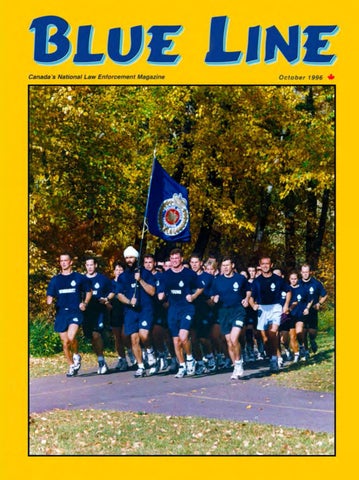
Members of the Edmonton Police Service do their compulsory daily run at the Police Academy in this month's cover supplied by Delbert Kostura. On Page 8 Staff Sergeant Norm Lipinski gives us a run-through about recruit training of the 90 's and discusses some of the points to consider when training recruits when limited resources are available. One aspect of training is fast becoming a priority in many police programs. Ethics education as it relates to policing is becoming more and more prevalent. Chieflulian Fantino of the London Police Force writes about this very important subject and fortifies the need to maintain ethical values among the members of all police agencies. We are pleased to introduce you to Keith Merith of the York Regional Police. Keith has agreed to supply us with a series on ground fighting. Many of us are only too aware of the first time we went into a bar fight armed with only enthusiasm and the good old college "comealong" holds. We were certain that the invincible long arm of the law would make short work ofthe miscreants. The sudden rudeness offinding yourself flat on your back, with some 220 pound drunken mass of primal sludge trying to turn your face into a Big Mac, is about the greatest lesson you ever received. Well Keith has some neat tricks up his sleeve and is quite confident that with practice you will never be "down and out." Also this month we present an article about policing in remote areas of Canada. In her submission, writer Tanis Baker, takes us through policing activities in a orthern Manitoba RCMP detachment where the nearest backup is only an airplane flight away. If you were never challenged by your occupation before you should give it a try! We are sure your curiosity has been suitably tweaked and there is much more to read in addition to these tantalizing pieces. We know you will enjoy this month's edition and as usual we look forward to your comments and stories.
- - - - - - - - - - - - - - - - 1G'31 - - - - - - - - - - - -811.'£ LIN£ October, 1996 __________________---IVI-_ ____________________ Magazine
I find it very difficult and disappointing to read Bob Whitman 's article criticizing the location of the Police Memorial Pavilion in Onawa a tated in your August! eptember edition. The I ation wa decided after many hours of on ideration and input from officers across thi great land. The site wa picked because of th beautiful and unequalled view. The Memorial Pavilion i a quiet and honoured location for all officer, ne ·t-of-kin and the public to refle t on the death of all the peace officers who ha e a rificed their lives while performing their dutie . The plaque with the names engraved is too clo e to the travel portion and hould be enclo ed . Weather and the elements, I agree, are a pr blem. Ilowever, they are here to stay. I a ur you it wa not "a secondary thought from p liti ian to appea e the police profes ion". I do find itextremelydisturbingthat Whitman would write that the er ice is not directed to tho e urvivor of the deceased officers. He also tated, "Let' re ognize the need to include the deceas d offic r' urviving family members at our ervi e, offer upport to surviving families, provid opportunitie for them to anend and have planned program ". Whitman either never attended our Memorial or was at the wrong one. Thi i e aclly what we do. The whole service is for the ne t-of-kin and the police officers who
are also grieving because of the loss ofa police family member. Surviving family are always personally invited, have reserved seating and are looked after on a personal basis. In addition, this year we have included the COPS (Concerns of Police urvivors) Seminar at the Canadian Police College in Ottawa. In conclusion, it would appear that Bob Whitman has more pride in the United tates National Law Enforcement Officers Memorial in Washington DC than he does in the Canadian memorial. This is extremely sad. However, I do believe we honour peace officers who have died in the line ofduty in a stately and compassionate ceremony that ensures that they are not forgotten. Perhaps the American's have something to learn from the Canadian way of organization and presentation. RJ Lyon Detachment Commander Ollawa. Ontario I am an RCMP Auxiliary with the Campbellton, ew Brunswick, Detachment. I thought the article on page 4 of the Augep issue about "Attitude adjustment toward the Auxiliaries" was extremely well written. Bravo! It' s about time that the police forces began to view the Auxiliaries as other than a bunch of ' lunatics' that only want to get their
hands on a gun and play with it! Thanks for the great article - and magazine! teve Berthelot Campbellton. New Brunswick In your August issue of "Letters to the Editor" you answered a letter in, what I feel , was a well answered and discreet fashion. Firstly by withholding the name and secondly. by agreeing with hi wife's suggestion that he get back to church. You were right-on by advising him, "'t is what YOU found and what others will find that matters most. .. You even underlined the" YOu. .. Asa hristian I think you did this answer up just fine. You must consider all the varied religiou backgrounds of Peace Officers in our nation and you ended your item correctly too by saying - "it does not mailer which church. .. Let us pray that he, and the rest of your reader , got the right message. [fthere is anyone who is in need of help they are welcome to call myself or our President, Tony Baker. We feel we can be as helpful in most situations as any EAP program. Keep up the great work! Jack Turner Fellowship a/Christian Peace Officers (4/6) 755-47 O.
WORLD CLASS PROTECTION AND COMFORT The toughest protection standards (we meet them). A complete armour line (we pioneered them). Unlimited accessory and custom options (we offer them). As important as these features are, protective apparel in the real world demands one other critical component ... comfort. That's why at Barrday, our engineers and de igners place a special emphasis on material selection and fabric weaves so that our products meet your most demanding standards of protection and durability and are comfortable to wear. Day in and day out. Real world comfort that makes Barrday a world class body armour supplier to national and international police and peace keeping forces.
TOP: Barrday Advanced Tactical Armoured Vests (A TA V) offer maximum flexibility and protection for police and military tactical applications. LEFT: Barrday offers a variety of external carriers for soft body armour including our functional and popular CLEAN FRONT carrier.
Barrdal__ ADVANCED TEXTILE SOLUTIONS Barrday, Inc., P.O. Box 790, 75 Moorefield Street, Cambridge, 0 ,Canada 1R 5W6 Tel: 519-621-3620 Fax: 519-621-4123
The Thermovision®510S infrared surveillance imager. Quiet. Reliable. Affordable. Every police officer on night patrol should have one on his or her side.
Silent partner.
V8,,"TIP/~() Quol;", 5y.tent
J'eMv,°
ISO 9001
c,~ ED ", ('
> ww u
9. ~ ~ "tO I" ~~
Whatever the mi sion - fugitive chase, drug intervention, search and rescue, perimeter control - the versati le Thermovision~ 51 OS hand-held infrared imager lets you perform your duties as safely and efficiently in the dead of night as during the day. The 51 OS produces the fast, high-resolution, TV-quality images you'd expect from a much more ex pen ive military scanner in a rugged, compact unit well within the budgets of most law enforcement agencies. You operate the 510S, which weighs just over three pounds, including its built-in battery, with just one hand. Focus is motorized and it automatically adjusts contrast to the changing scene, 0 you get the best image, quickly and effortlessly. Its high resolution image lets you detect objects or persons in complete darkness or those hiding under natural cover from as far away a 1/2 a mile. 2x and 4x electronic zoom let you come in for a closer look.
For fixed vehicular or perimeter surveillance, all functions of the 51OS, housed in an environmental enclosure, can be operated remotely. And unlike other systems, the 51OS' cooling system start up immediately, and is quiet, so it won 't give away your position. You, not the object of your search, maintain the element of surprise. To add the Thermovision~ 510S to your force, call or write us at 5230 South Service Road, Suite 125 Burlington, Ont. L7L 5K2. Telephone: 800-969-5390. Fax: 905-639-5488. Internet: 74103.3645@compuserve.com. And take control of the night!
AGEMA
Infrared Systems
Recruit Training in the 90's 'ncreasing Effectiveness With Fewer Resources
nity policing. The best teachers in this area are the foot patrol members and the personnel who work at the community stations. Requiring each recruit to spend 10 hours at each as ignment solidifies the new policing paradigm. The key to this aspect of recruit training is creativity. Community policing has many different interpretations depending in part on resources and changing community needs. The challenge fortraining staffis to develop innovative training ideas that produce societie ' be t problem olvers.
Scenario Training
By Recruit training is a very unique educational institution. Teaching omeone cognitive and psychomotor kills plus instilling certain value in a hort period of time i a daunting task. evcrthele s, anadian police agencies have accepted the challenge a they continually improve their training method logy u ing the most current adult educational n ept . BUL a we all know, the name of the game in the 1990' i to do more with Ie s; to increase training effe tivene and to ensure that produ t quality remains hi gh. To accomplish this t k, r ruit training taIT mu t continually ase thecurri ulumandu ecreativitytoachieve organizational objectives.
Community Policing There wa a time when community policing concept were taught to the recruits only in the lecture format. This proved to be ineffective in e the "application" tep in thi cognitive learning style wa missing. Individual a well as syndicate problem 01 ing e. erci e was a step in the right direction, but it till wa n' t enough. Implementing training taffbrain torming sessions and a trial and err r mind- et produced tangible results: (a) Ify upectyourrecruitstogivepresentation at community meetings, then a public
Officer safety instructors have to be the "originator " of scenario or situational based training. And it's through their encouragement that this type of training now permeates the entire recruit training program. These training ses ion encompa four broad areas: > Officer afety kills > Interpersonal kills > Investigation kills > Problem olving kills An important factor in this process is the recency of " real life" scenario training. I recall when I was a recruit in training and scenarios were not part of the curriculum until week nine. The impact of all those class lectures wa sub~ stantially reduced because of the time delay. ~ cenario training should commence after .:l two to three weeks of recruit training and it t ~ should continue at regular intervals for the remainder of this program. Granted, recruits ~ will have limited job knowledge after just two if .......-------' weeks of training, however, this is where they begin their interpersonal skills education . It' speaking segment should be included in the also a time to identify potential character shortcurriculum. comings that surface only under stress. (b) In order for the recruits to grasp the full Obviou Iy the cenarios would be extremely meaning of community policing, instruc- simple at the start and then, towards the end of tors should add it to all the major topics in the program be complex in nature. Requiring the program. Criminal law is a perfect ex- the recruits to ,"Tite a report on their re pective ample. Almost every section ofthe code can exercise brings in the final important element to be taught in tandem with the problem solv- this instructional model. ing process. Keeping in mind pedagogical principle , On criminal law exams where a situa- the following format could be used as a guide: tion is described and a charge is asked for, (I) Instruction of the ubject matter: a follow-up question asked might be, "what > lecture/development, demonstration/perwould you do to solve the problem, long formance term?" > case tudies (c) When the recruits first hit the streets with (2) Implement "paper" scenario exerci es eitheir Field Training Officers, it is beneficial ther individually or in syndicate groups for them to be assigned the task oflocating (3) Demon trate "real life" scenario exerci es a community problem, solving it, and then (4) Implement "real life" scenario exerci es presenting the entire situation to the class (5) Test upon their return for the final segment of During these scenarios, there exist some classroom instruction. tangible benefits in using a professional acting (d) I have always believed that recruits should staff as opposed to police personnel. As the start interacting with the community early scenario becomes increasingly complicated and on in the training process. Charitable or- emotions need to be displayed (ie: family fight), ganizations are the perfect venue. the professionals do it best. Additionally, durSpecifically, charity fitness events such ing the debrief, they often add valuable insight as stationary bicycle and 10 krn races go a as to how they felt (as a victim), when the police long way towards raising funds for the (recruits) dealt with their call. particular organization and also towards Discipline changing the " unfit" image that we seem to posses. Techniques to instill discipline into police (e) Upon completion offormal training, recruits recruits have traditionally been borrowed from require a broader perspective on comrnu- the military. ome may argue that since police
~~!z~~N£ ----------------------------~\!7~
_____________________________ octOber' 1996
agencies are moving away from the " para military" management model, we shou ld also abandon its discipline principles. I disagree. Never in the history of policing has public scrutiny been greater. Mistakes made because ofa breakdown in self discipline will undoubtedly be front page news. To suggest that recruit training take on a more casual " university atmosphere" is erroneous. First of all, a high standard of discipline in recruit training is a test to determine if the recruits have the proper desire; are able to take direction, and if they are able to work within a team. Once that standard is met, instructional staff must then teach character by training the recruits' mind, body and hearts. Character is really ethical behaviour. Doing the right thing for the right reasons. With proper character, a recruit will have the appropriate responsibility, determination and compassion to be a benefit to society, not a liability. Many different techniques can be utilized in this area. It essentially comes down to using whatever produces results. The subject matter experts in this area seem to be the drill instructors. I admire their zeal. Will all this discipline stifle creativity and problem solving ability? Not at all. The two entities are totally compatible. In fact, because of the move towards decentralization and empowerment, management must now place a greater reliance on individual self discipline. This is an important character trait in any organization that strives towards peak efficiency and public trust. I also believe it's the culture
l!l
that drives an organization more than the set of rules. Let's ensure that the culture is one of self discipline.
Go AHEAD ••• MAKE YOUR DAY WITH
Conclusion The future of recruit training will in part be shaped by new technology. Computer assisted learning, driving and officer safety simulators will soon become standard equipment for police services. What shouldn't change is the human element associated with community policing, scenario training and discipline. Instructors should continue to develop effective training methodologies in these areas. Although some ofthese practises - such as adding more scenario training days - will stretch the already tight purse strings, it certainly is worth the investment. If history is a teacher, then we can't afford not to. Norm LIPINSKI is a sixteen year veteran of the Edmonton Police Service. His extensive training background includes five years as the Training Supervisor in the Tactical Team and six years as the Training Co-ordinator for the Explosives Unit. Additionally, he served for three years as the Sergeant in charge of Recruit Training where he also taught criminal law. Most recently, he was promoted to the position of Platoon Commander (Staff Sergeant) in the Operations Bureau.
SS SUPPLIES Distributors of confrontational simulations equipment for all law enforcement defensive tactics training. Knowledgable staff, competitive prices, No P.S.T.
For more details call or write:
PADS FITNESS SUPPLIES 9624-74th Street, Edmonton, Alberta PhonelFax: (403) 490-0144 Dale Kliparchuk - Director I Instructor
The Leaders in Law Enforcement Supplies - Since 1980
~ STINGER SPIKE SYSTEM
I ------·==1 ~I!
Stop high speed pursuits with the Stinger Spike System. The Stinger Spike System is an easy to use and highly effective new tire deflating device designed specifically for police use. The Stinger can deflate tires on automobiles traveling up to 215 KPH.
0732-ZC-1 0732-ZC-2
~
15.5 Foot System 25 Foot System
L&R Ultrasonic Cleaning Systems are designed to provide a quick and efficient alternative to conventional firearm cleaning. Using ultrasonic soundwaves the L&R System removes residues and dirt from firearms in a labour free 10 minutes. Only field stripping the firearm is required. L&R Systems are also available for cleaning gas masks. Call for details.
THE WIDEST SELECTION OF POLICE PRODUCTS IN CANADA
'it '+'
R. NICHOLLS DISTRIBUTORS Inc.
LONGUEUIL, QUEBEC
TEL.: (514) 442-9215
FAX: (514) 442-9581
OTIAWA SALES, ONTARIO
TEL.: (613) 737"()261
FAX: (613) 737"()261
MISSISSAUGA, ON'fA~IO EDMONTON, AB.
TEl.: (905) 629-9171 TEL.: (403) 973-3999 TEL.: (506) 385-2484 TEL.: (709) 368-0999 TEL.: (902) 893-3288
FAX: (905) 629-9184
l'Rl1DEJUCfON, N.B. GOULDS, NFLD.
TRURO, NOVA SCOTIA
October, 1996 ______________________________
FAX: (403) 973-3291 FAX: (506) 385-2499
FAx: (709) 368-0991 FAx: (902) 893-3227
~~r--------------------------------B--L~!g!!~~
Ethics and professionalism in policing by Julian Fantino t a time when policing i being impacted by many aspects of change, n t the least of which is a new economic reality, law enforcement organizations, especially their contemporary leader , are forced to be increa ingly resourceful and creative. In ther word, police organizations must be strategically managed and accountable in a larger environmental etting, having a clearly-defined mi ion based on today's realities and t m rrow's forecast . I wa privileged recently to attend the Federal Bureau oflnvestigation Law nforcement Executive Development eminar(LEED ), where the elevated content of training material pre ented by very talented intructor brought the learning proces t a critical point for 35 law enforcement executives from the United tates, Europe, and anada. Ilowever presented, debated, and defined, policing issues, challenges, problems, and olution a di cussed by the group seemed to have a consi tent theme that quite clearly e 'tended beyond juri dictions. and even international border. It became quite evident that we are all impacted by the ravages ofescalating youth crime, violence, drugs, organized crime, a de lining economy, and more. Also, as much a law enforcement agencies are impacted by external pressures, not the least of which i nagging crime. economic difficullie and declining societal values. a great deal of fo us and attention was also placed on internal
issues including what I consider to be a critical aspect: "Ethics and professionalism in policing." This is the area which I intend to pursue in this text. To begin with, it is no secret that a number of highly-publicized acts of inappropriate conduct have brought an added degree of public scrutiny upon law enforcement. For instance, I do not know how we can ever undo the harm caused to the image and credibility of the profession flowing from the Rodney King affair. Admittedly and without question, the public expected that police officers and their agencies be totally accountable and beyond reproach. In my view, this is a non-negotiable expectation which I regard more as a duty. In other words,
BLUE L'NE- - - - - - - - - - - - - - - I \ a !
quite simply, I believe that "there are no ethical short-cuts to personal, professional and organizational integrity forthe police." The public trust is of paramount importance, always! Police organizations, whatever their jurisdiction, programs, philosophy, and size, are an extension of all their people. Moreover, police performance is also measured by some sense of values and ethics. It has been stated that "ethics is a system of moral principles which lead to the highest good." It is also fair to state that, regrettably, some police officers sometimes degenerate to the mould of the people they are trying to control. Hence the question goes begging: "Does society expect higher standards of conduct, professionalism, and accountability from police than that which applies to ordinary citizens?" I submit it does, and that the inevitable loss of public confidence and respect is the obvious ultimate sanction imposed by citizens on police when they do wrong. Our number one issue in policing today is our own credibility. If we lose public trust, all is lost. So, how do we approach the issue of ethics and professionalism in policing in the most appropriate way? My sense is that the most obvious place to concentrate our efforts is wi th our young people; the new recruits who truly represent the bright horizon of policing, however restructured. re-engineered. or whatever else may impact the policing profession in the years to come. I realize full well and acknowledge the fact that we have extraordinary and bright young people entering policing, and that their capacity for the technical aspects of the profession is commensurate to the demanding challenges at hand . However, more is needed; in fact, much more than academics, physical fitness, desire, and determination is needed to meet the onerous current and future pressures facing the profession . To begin with, there must be the realization by new recruits that policing is an honourable profession; a calling and not ajob. Druker stated: "The wrong man trained is still the wrong man." In some respects, regrettably, we are experiencing societal melt-down and with disastrous consequences. Even in policing, we are experiencing a breakdown of organizational loyalty and professional integrity. Some have expressed the view that we must do more wi th young people entering policing: "We must look after their heart and soul. We must reach them with more than how to do th ings. The job needs
Mag azine ----------------------\ U-/-~_ _ _ _ _ _ _ _ _ _ _ _ _ _ _ _ _ _ _ _ Oc tober, 1996
more. We need to teach them the why and what of this most noble vocation in the service of citizens and country." Plainly stated, if a person understands the why, the culture, traditions, and glory of the profession, they will endure how those precious values are to be cherished and protected. It would also he worthwhile for some of the old guard, the veterans in policing, to also examine their conscience in this regard. In the words of Bob Rogers, former FBI Special Agent: Tradition and sacrifice are to legacy as respect and loyalty are to love." Also, "Purpose is to duty as truth is to beauty." Very profound insights about the core values that should guide all police officers, not just new recruits. In essence, the profession needs a reawakening of a very special pride that is the essence of the policing profession, but for reasons that escape my comprehension, have become dulled, somewhat old fashioned , or even worse, no longer important. I say so wondering why we do very little forma l ethics training within our police colleges, both at the recruit and senior levels of police education and training. Moreover, certain aspects of discipline and respect for the traditions ofthe profession seem to have evaporated, supposedly in favour of a redefined standard of excellence and performance. Abraham Lincoln stated "What truly motivates people is values." I would like to suggest that values and character still count and that feelings provide important meaning to our personal and professional lives. How we feel about ourselves, our profession, our respective organizations, and communities are intrinsic values that he lp us relate to the true culture of our glorious profession. As good as we think we are, we can do better, and most certainly, we need to reflect if we are also preparing our police recruits with an appropriate value system, starting with the formative initial stages of their police careers. Quite candidly, I do not think we are. " They can 't relate to who we are if we don't know wh ere we have come from . W e need to celebrate the glory of our profession throu g h the culture and heritage of our history." -- (Chief Terry Mangan, Spokane Police Dept.)
As police leaders, it is our responsibility to pursue personal, professional, and organizational excellence in all that we do, including the need to ensure optimum public trust, credibility, and integrity through our people: "The organization is the famil y: th e leader is the head of he famil y. Consequently leaders often nurture and guide subordinates much as parents do children." -- (Lincoln on Leadership -- by D. T. Phil/ips) In the end, at the twilight of every police officer's career, regardless of rank or position, may we feel accomplished knowing that: "We
stood the watch - lived the dream - made a difference. " Policing is not just ajob.
Canadian Association of Chiefs of Police appoint first Mountie to top job For the first time in its 91-year history, a member ofthe Royal Canadian Mounted Police has been elected president of the Canadian Association of Chiefs of Police. Assistant Commissioner John Douglas Moodie, head of the RCMP in Manitoba, was elected to lead the Association at its annual
meeting in Ottawa in August. Moodiejoined the RCMP in 1959 and spent much of his earlier career in Alberta. His duties have seen him move from Alberta to Ontario and Prince Edward Island among others. He received a Bachelor of Business Administration degree from the University of Ottawa in 1974. He has previously held positions as the President of the Prince Edward Island Association of Chiefs of Police as well as Director for federal relations for the Canadian Association of Chiefs of Police.
Reduced Budget? Limited Resources? Increased Service Demand? Omni Support Services Limited can supply a range of low-cost affordable software programs designed for law enforcement
Increase officer availability Automate personnel data entry Improve information management Reduce labour and operational costs Forensic Crime Scene Evidence Case Property Management S.LN. Number Verification SO CO Case Management Officer Training Record Photo Service Tracking Document Evidence Audio Image Library Inventory Control Single computer or (IBM) Network applications in Windo ws en vironments Version 3.1 or greater Free estimates for additional customized features at reasonable fixed rates
For further information contact
r- '/ITr:fJ PO Box 64565, Unionville, ON Canada L3R OM9
Telephone: (905) 305·8460 Fax: (905) 305·8461
GI g ~-----------'--- DLVE LINE
Octobe~ 1996 ________________________________~~~------------------------------------ nna g azine
, . - - - - - - - - - - - - - - - - - - - - - - - - - -- - - - - - - - - - - - -
---
You are never down and out Learning some basic ground fighting techniques is the key
Over the n ext several mOllths York Regiollal Police ojficer Keith M erith willpresent Blue Line readers witlt apictorial review of specific techniques that will give them tile advantage from what appears to be a un-advantageous p osition. Two fundam ental principles will be illustrated. Th eftr t is to create space and the secon d is to take away space. A long with this the reader will explore two n ew m ethods ofhalld gun retention. A ll the techlliques are short and simple but require practice, practice and practice. You do not have to be a super athlete, (ill fact a simple "couch potato" will do nicely.) You may be down and dirty... but you are n ever out. by Keith Merith
Mo t police oriented defensive tactics training includes everal triking techniques such as palm heel strike , forearm strikes, the use of one ' knees and the angle kick. The focus generally will be primarily on stand up techniques. There is little doubt that these technique are very effective in controlling offender who become resistive or assaultive. Even in aying thi s it is unreali tic to believe that most confrontations will end after the first few strikes or kick. The majority of all real confrontations and a aultoccurwithin grappling range. This should be a wake-up call to most trainers to realize and under tand the very real possibility oftheirofficer ending up on the ground. Think about it! Whether there are five officers attempting to re train one individual or one officer in aone-onone confrontation, in the majority of resistive case the situation will end up on the ground. Along with this there are many variables to on ider (eg. incomplete techniques, off balance, unsure footing, or - as Johnny Cash has been heard to ing - "jighlin' in the mud, the
blood and the beer. ") The possibility of ending up on the ground is substantial. "Ifyou are on the ground and not cuffing you're losing!!'" Where did this statement come from? Police defensive tactics have virtually ignored the ground component in training officers to be able to defend themselves. Why? Could it be the overwhelming influence of many traditional martial arts which stress the stand up component of combat? Was it the lack of understanding on the part of use of force instructors as to the value and importance of being able to grapple? Could it be that of all the tactics employed
by police officers, ground work is not part of it (old time traditional training)? Although the answers to these questions are unclear one thing is for certain ... no one wants to be on the ground. This being said, however, the officers who have not been exposed to some type of grappling are at an extreme disadvantage when they find themselves in a situation where they are pushed, shoved, tripped or have slipped down to the ground and their opponent is still attacking. Worse yet, what about meeting an individual who is skilled in this discipline. Whether you are convinced or just curious Lesson umber I begins next month!
BLUE LINE Q Anagazin e ___________________________________~ ~ r----------------------------------- October, 1996
, Community policing hits the information highway A new organization will assist police agencies on to the Internet with this new community policing initiatille Tom Ralaj Technology Editor A new information technology (IT) project was recently launched at the Canadian Association of Chiefs of Police conference held in Ottawa in late August. Known as the Community Policing Information etwork (CPlnet), the project is designed to facilitate community policing in Ontario and abroad. It is a not-for-profit Ontario-based corporation that was established to assist with community policing. It provides crime prevention, victimization prevention, and public safety groups with ready access to information, and electronic-mail (e-mail) connections. Using the broad accessibility ofthe Internet, it will eventually extend its membership to over 5,000 groups across Canada, the USA, and abroad. Major Canadian police agencies such as the RCMP, OPP, and the Metropolitan Toronto Police have already joined, and the list keeps growing. In addition to the ability to exchange information easi lyand quickly, members ofthe CPlnet wi ll be able to establish a presence on the Internet, without having to build their own site.
Community Policing Information Network
I
CPI r-In-et'www.cpinet.org The CPInet includes a volunteer technical advisory committee, which features representatives from major hardware and software developers, as well as various information technology (IT) organizations, the telecom industry, educational institutions, community groups and several Ontario Government Ministries. CPlnet evolved from a community policing conference held at Canadian Forces Base Kingston in the fall of 1994. At that time a group of individuals decided that the opportunity for the kind of experience sharing which occurred during the conference should not be restricted to once per year. A very modest computer communication demonstration project was begun, fo-
cusing on providing E-mail linkages between and amongst community policing committees. As the initiative was developed, it took on much more significant proportions. The need for communication capability, the abi lity to access data, and the capability to conduct research, were functionalities which virtually all organizations involved in community policing required. This modest E-mail project of 1994 has subsequently evolved over the past two years to the very ambitious communication and research project which CPlnet has become. The main databanks and hardware is kept at the Military Police Station situated at CFB Kingston. It is managed by a voluntary board of directors. Presently the board consists of: > Brian Abrams - Vice President of Administration and a member of the R.C.M.P.; > Bryan Bowers - Vice President and Secretary of CP lnet and a member of the Ontario Provincial Police; > Steve Pengelly - President of CPInet and a Lawyer from Kingston, Ont., as well as member of the Kingston City Police Services Board. For more information, visitthe CPlnet Home Page at: http://www.cpinet.orgorcontactSteve Pengelly at 6 13-547-0\80.
-..-..-..-..-..~-..-..
't From the bang of the Gun to the
j
,
.,
bang of the Gavel...
1 ?~~e~aFo!~~!'· 1 Management computer program of choice in Southern Ontario.
1't ,
Now being marketed internationally, CASE FILE! has been shown to improve accuracy, while saving hundreds of detective hours in major' crime Case Management and Court Preparation .
1
IDEAL FOR SEARCHING
~
OR CONTROL. REPLACEMENT MAGNETIC, HOOK, AND SEARCH
~
TIPS F A C I L I T ATE THE SAFE D E T E CTION OF
j
CONTRABAND.
CASE FILE! is an investigator's product! . , Using a Windows GUI interface, CASE FILE! ~ minimizes the drudgery of paperwork, while organizing the facts on people, evidence and activities from the moment the crime is first reported , right through to court. .,
1 't ,
~
1
j
Download a demo from our WEB site, or call us.
~
Microset Systems Inc. 1335 Morningside Ave., Unit 7,
~~~~~~~ PH 416-283-4949 FAX 416-283-5650 Web Sites http.llwww.casefiie.com and http://www.msi.net email:pmiltier@msi.net .. flBtworldng people with computers
~
*
M.D. CHARLTON CD. LTD.
*
BOX 153, BRENTWOOD BAY, B.C. V8M 1R3 EAST: Ph. (519) 942-9235 Fax (519) 942-9246 WEST: Ph. (604) 652-5266 F~x (604) 652-4700
------------------------------~rMlr----------------------- 8LVE LINE October, 1996 _________________________________~~r--------------------------------------- ~agaz;ne
Testing police skills to the limit 111 epfember 1995, Tallis Baker, pellt several days ill a Ilorthern Manitoba Cree commullity wltere It e learned about policil/g, coul/sellil/g ami commul/ity justice. B/lle Lille Magazine/eft tlte tory would be wortlt sharil/g witlt its readers.
by Tallis Baker The Carilloll, Steillbach, MB The work is hard and the files are many, but the challenges of a northern tour of duty can also be a unique learning experience for R MP member at a remote posting. After 2 1/2 years policing southern Manitoba's t.Pierre-Jolys area, Con table Janelle Somers was po ted to Pukatawagan - a Cree ettlement with 1,869 onreserve re ident . "You are dealing with a remote area and your resources aren't readily available, so you have to make do with what you have," omers explained. "It's different going from policing ten communities with an area of about 700 square miles to one community." Bordered by the rich natural beauty of Manitoba's far north, Pukatawagan abounds with flourishing Cree tradition and culture. Of the 2,554 members of the Mathias Colomb band, 1,869 are living on the reserve, 420 are living elsewhere in Manitoba, and 265 have made their home out of province. The band is named in honour of an elder who became the first hereditary chief of the settlement. The traditional hereditary way of naming a leader has been replaced with the electoral sy tern. "You're seeing the same people all the time, and so you get to know them a bit better," orner said of the close relationship police form with re erve residents. An increased workload and adjustment to life in a remote northern village add challenges to orner' new po ting. "I have more files than what I did and more of them are persons-related criminal code offenses than property offenses," she explained. orner , a native of Monastery, ova cotia, works with three other RCMP member in Pukatawagan as opposed to the I I members she worked with at the t.Pierre-Jolys Detachment.
Scenery Beautiful
Pattern Analysis Suspect Profiling Case/Suspect Linking Surveillance Targetting nve tigAide For your free Cost Benefit Study...
Software (?att./(613)563-3413 457 Catherine St., Ottawa, On., K1 R 5T7
Planes and trains carrying resources and supplies from northern urban centres arrive regularly at the modest local airport with its gravel runway. There are no roads leading out of the reserve until the snow falls and a winter path is built. A car on the reserve is a rarity and residents rely on trucks to negotiate the bumpy, dirt roads in town that become almost impassable mud bogs when rain falls. "I've never lived in an area like this and I've never lived on are erve before," omers said. "There's so many artistic and creative people here and that's something I've never really been exposed to. Each sculptor and artist has their own style." Fish flourish in the wide expan e of Pukatawagan Lake, (actually part of the Churchhill River system) and animals abound in the thick surrounding forests. "It's beautiful up here," Somers said. "It reminds me of ova cotia with the hills and trees and water and the leaves changing colour." Reserve residents are employed at both the orthern department and grocery store and the
BLU£LIN ______________________~~ Magazin _£ Vl-_ ___________________ October, 1996
housing units located adjacent to the detachment. Constable Dean Fontaine is also stationed at Pukatawagan.
Agencies InlBrtwined
Cpl. Gerry Th om as, NCO ofthe Pukatawagan Detachment, shown with Counsellor Baptiste Caribou and Pukatawagan Band Constable Bill Greene. band-run Co-op store in the main administration building. Local sources said the health authority creates about 19 jobs and the band government creates a further 20-25 jobs on the reserve. Missinippi Construction and Beaver Air are both band-owned and employ local residents. A confectionery shop, the restaurant in the administration building, the child care agency, the crisis centre and the RCMP detatchment also provide jobs. POlicing experience Constable Scott Bird, a force member for almost six years, was transferred from Morris highway patrol to Pukatawagan in July 1995. "You gain better policing experience in the north," Bird explained. "When you move up here, you get exposure to more serious crimes on a daily basis." "1 thought it was going to be tough," he added. "My first day shift 1 dealt with two spousal assaults and a stabbing." Alcohol-related crimes make up the majority of the workload at the detachment. Picking up and lodging intoxicated people and dealing with fights are common calls to the office. "The community has a lot of problems, many stemming from alcoholism," Bird said. "However, there are also a number of programs in place here such as the Native Drug and Alcohol Dependency Program(NADAP), councillors and the justice committee members, that work to improve the quality of life. The language barrier can become a problem for newly-transferred officers, especially when dealing with the older generation, who were raised speaking Cree and still retain their mother tongue. Band constables are fluent in Cree and can be relied upon to act as translators from RCMP officers when necessary. Despite the challenges ofa heavier workload and an altered life-style, Bird said the rewards of a northern posting won out for him. "I have no plans to return to the south," he said. "1 like the living conditions here and I like the style of policing. You're a lot more independent. "You've got a lot of work and you just have to get it done." Officers live in the three RCMP-supplied
The wheels of day-to-day life in Pukatawagan are turned with a community interdependence common to a northern existence. Enforcing law and order in the community involves coopertaion among the RCMP, the tribal council, the band police force and other social agencies on the reserve. "Because of the reliance on one another, people tend to be more willing to lend a hand when called upon," Cpl. Gerry Thomas, head of the Pukatawagan detachment, observed. "The people are generally very friendly in the north because you have to rely on one another. "We work with the Cree Nation (the child care agency,) the Crisis Centre, the nursing station, the chief and council and the justice committee," he added. "Basically every agency in town is intertwined." Thomas's previous postings include Grand Rapids, Island Lake, Neepawa, Grand Beach and General Investigation Section at "0" Division Headquarters in Winnipeg. Local volunteers, called "peacekeepers", provide an extra set of eyes and ears for band constables and tribal police. Charged with spotting community crime, they report their findings to the local law enforcers. The 14-year veteran officer explained alcohol often taints the normally friendly demeanour of the community. "We had a time here when they temporarily banned liquor and you
could tell a difference," Thomas explained. "People were out walking in the summer enjoying the place. Our alcohol-related calls were non-existent. " When the calls come in, officers sometimes find themselves reacting to violent incidents. However, unlike most detachments, backup at Pukatawagan could be a plane flight away. "You get into serious situations and you don't have any backup," he said. "The nearest backup is Cranberry Portage or you have to fly someone in from Thompson. "You have to learn to use tact when dealing with violent altercations. Otherwise, you're going to get hurt." The officer in charge of the detachment explained a northern tour of duty brings out a "certain appreciation in the officers" and gives them a good base of policing experience. Pukatawagan is not the most isolated community and it's not the least isolated," Thomas said. "It has its good points and bad points but there's far more good than bad."
Tradition holds key III spirilllal healing The surrounding natural beauty of fiery fall-cloaked poplar trees and slender swaying wild rice stands doesn't serve to veil the deep cut wounds that plague Pukatawagan. But slowly, with the help of native-run programs and a return to traditional ways, the social scars are beginning to heal. "Native spirituality is very important, it's coming back now," Maurice Bear, a councillor with the Native Alcohol and Drug Abuse Program (NADAP) explained. "Even by talking, (Continued.. .)
Training We are holding classes to certify security and police officers for a variety of courses; > Expandable Baton Users Course > Handcuffing I Restraining Techniques > Pressure POint Control
•
MAG-LITE PROTECTIVE OPTICS, INC.
IP«hmayr ZAK TOOL CO.
HATCH
8_ LU£ ---.l.\WL-______________ LIN£ D M a gazine
October, 1 996 _ _ _ _ _ _ _ _ _ _ _ _ _
Parents Guiding Lights
we're u ing traditional ways - the way we learn from our elder ." "We re pect all things the Creator ga e u ," he added. "Everything that c me out of the ground we
Parents must be the guiding light for their children to stop the succession of generations of alcohol-dependant reserve residents, u e." Bear aid . Children who ee their ative councillor at ADAP parents drinking continually will work with re ident plagued with COP) that behaviour, he added . abu e of drug and alcohol. In addition to linking to modern lient receive an a e ment programs for guidance, ADAP and are then referred to one of the councillors look back to the ways of many treatment centre located their forefathers. "We're working through ut the province, including towards traditional healing, those of Brandon, Pegui , The Pas , u who conduct sweat lodges and Th mp on and Winnipeg. tipi meetings," Bear said. "It's the They are getting tired of alcoidea of sitting down around a camphol and drug, ADAP councillor fire with grandparents the way they Bapti t aribou said . "They're fed u ed to do a long time ago." up with what they're doing to them"Watching the crackling of the elve ." fire creates a peace and harmony that B th Bear and aribou admitcan be felt and seen," Bear Added . ted ubstance abu e to be a "major" To promote discus ion and the pr blem fi r Pukatawagan residents. ~~~ sharing of ideas , the councillor conPukatawagan R MP concur I:::: ducts tradition sweat lodges. After that many of the call they receive Coul/sellor Maurice Bear outside tlte traditional "sweat lodge." Tlt e returning to the community from the are al ohol-related and alcohol can cerem ol/ial c1eaf/sil/g 0/ tlt e sweat lodge is symbolic 0/ tlt e treatment centre, Caribou explained help e alate di agreements into Pukatawagal/ 's resolve to de/eattlte effects o/alcolw l af/d drugs wlticlt continued coun elling is available vi lent altercation . have tOrtl th eir commul/ity apart if/ the past. for the clients. The Icoholic nonymou "We're here to accept them, and pr gram n the re erve ha grown in memberit and a lot of times our feedback is, 'We don't the door's always open," he said, noting the rate have jobs, our per onal relationships are falling of alcohol and drug abuse on the reserve won't be hip over the la t everal years, but the councilapart and we have hard times dealing with our ended, but can be slowed. "It's always going to be I r agree much more work needs to be done. family.' All this frustration goes together on the a problem because you can't stop alcohol and ADAP client enter into the program on their own initiative. "We want to find out why the person becau e they think no one cares for them drugs that come in . It comes by air, by train, by per on i taking alcohol and continuing with this and they can't handle it on their own," he added. boat, there's always a way. You can't stop alco" 0 alcohol is the answer to relief." life- tyle," Bear aid. "They explain why they do hol."
Knowing how to read this fingerprint could improve your future.
WITH
Forensi c science is not just a fancy name. But it's the name of the game when it comes to promotion and training in criminal investigation and identification techniques. Many departments require the AlAS course and pay for the training. Others re-
Reduced risk of high speed chases Reduced risk to citizens and police Reduced risk of damage to victim's car Puncture holes are easily patched Dramatically increased apprehension rates Inspected by the Canadian Pollee Research Centre
imburse the student after completion. If you are interested in advancement, take the first step now and call our toll-free number to request our current course catalog. Then step into the world of forensic sci ence and let a new future unfold.
Edmonton Police Service reports outstanding success in apprehending car thieves who are placed under surveillance using this device.
Call 'or 'urther details 555·2 '. (99S)
END458
A.I.A.S. American INSTITUTE OF APPLIED SCIENCE P.O. BOX 639, YOUNGSVILLE, NORTH CAROLINA 27596·0639 PHONE: (919) 554·2500 • FAX: (919) 556·6784 TOLL·FREE (in U.S.A. only): (800) 354·5134 '
---\G 0 4'I-_____________ october, 1996
BLUE L'N_E _____________ Magazine
"Or indivi du als," Bear added. Alcohol and drugs were proh ibited in Pukatawagan for eight years, but the counci llors say the problems didn't stop. The hopes for the future include an onreserve treatment centre allowing residents to continue seeing their families while receiving treatment.
Hand In Hand With The HeMP In additi on to his duties as a NADAP coun ci llor, Bapt iste Caribou also sits as head of the reserve's Justice Committee. The committee meets twice a month and works with the RCMP and tribal police to review less serious offences and make decisions on cases. The offender could be ordered to complete commun ity service work or receive counselli ng from th e elders. If the offence is more serious th e provi ncial court system is coupl ed with the Tri bal Justice Committee, and the eight commi ttee mem bers fo llow the proceed ings each step of the way. "In local situations, thej ustice comm ittee has more j urisdiction," Bear explained. "If they recommend omethi ng, the j udge will respect that." The RCMP and tribal pol ice initiate investigation into the crimes and pass the details on to the justice committee by way of a fo rm. Police also meet with the j ustice comm ittee regul arly to discuss procedural issues. Rather than swearing on a Bible to te ll the tru th, offenders appearing before th e committee wi ll hold an eagle feather and place their hand on a leather- wrapped box fi lled wi th sacred items such as sweetgrass, sage and tobacco. Caribou explai ned that fo ur is a sacred nu mber for ative people and the justice commi ttee is fo rmed with that in mind. Four men and fo ur women sit on the committee to ensure equ al representatio n from the commun ity. Also, clients can choose whether they wish to speak to a wo man or man, an elder or a younger member. The foc us on fo urs also represents the fo ur elements (earth, sky, water and wind) the fo ur seasons and the fo ur di rections. Meeting are conducted in a circle to represent the di rections. When disc ussing their clients, Caribou said the fo ur parts of human nature - physical, emotional, mental and spi ritual - are examined before a recommendatio n is made. "Even ifit takes force to remove that perso n from the reserve, they can do it - that's how powerful the Justice Comm ittee is," Bear explai ned. The offender receives chances to refo rm, however, before drastic measu res such as this are taken. Tanis Baker is presently a journ alistlphotographerwith the Abbotsford Ti mes in British Columbia. At th e time of writing this story she was wo rki ng wi th the Stei nb ac h Cari ll o n newspaper in Manitoba. Tan is has a B.A. degree from the University of Man itoba and a degree injoumal ism from King's College, Nova Scotia. Tanis presently re ides in Wh ite Rock, B.C.
First sentencing circle model applied by non-native community A Saskatchewan judge borrowed from traditional aboriginal justice last month to punish a white man who racked up more than a dozen drinking driving convictions. Patrick Bogdan' s boss, a few Mounties, a village councillor, court officials and some friends and neighbors gathered in the Katepwa Beach Hotel for what resembled a native sentencing circle. It was the first case outside the native community in Canada \\ here a judge went looking for an alternative to more com'entional sentencing. Bogdan pleaded guilty last June to driving a stolen snowmobile while disqualified. For Judge Linton Smith it was the last straw and he knew something had to change. The Crown prosecutor said she was open to trying something new to deal with Bogdan's apparent disregard of the usual punishment levied by the court. Defence lawyer Niel Halford hoped the sentencing circle would stop his clienfs "never-ending cycle" of crime. A local newspaper reported Halford as saying that ifhis client "makes some sort of acommitmenttoeverybodywholivesaround him - his employer, his friends, his rei a-
tives - it may make a difference." Recent federal sentencing reforms have emphasized the importance of improving public protection, rehabilitation, deterence and restitution for victims. Existing programs have been aimed at keeping youths and first offenders out ofthe court system. This case differs in that it takes a relatively risky case involving a repeat offender. The September sentence circle was designed in an attempt to restore balance between the offender and the community. The circle made several recommendations to Judge Smith who will ultimately decide the offender's fate in December. One ofthe recommendations which the judge imposed immediately was that the accused was not to consume alcohol. However the community circle recommended that the accused agree to submit to a breathalyzer test any time the police wanted to ensure he was abiding by the conditions of release. The circle had already been informed that Bogden was seeking help for his alcoholism and knew he had to change. The matter is being monitored by members of the Balcarres RCMP Detachment.
GET OUT OF THE DARK~titmt AND INTO THE FUTURE WITH
COMPU-CAPTURE ®
A COMPLETE VIDEO IMAGING SOLUTION ..J BOOK AND ID FASTER THAN
EVER ..J BUILD ALINE-UP IN
SECONDS ..J ELIMINATE WASTED FILM
AND TIME ..J EASILY MAKE 10 BADGES
AND WRISTBANDS
Don 't forget to ask about:
COMPU-SKETCH ®
COMPU-SCENE ®
Create composites for suspect idenfication.
Draw'ng program for crime and aCCident Scenes.
CALL OR FAX TODAY FOR MORE INFORMATION
products by
DDSI
B.R (Bev) Graham, RR #1 (Jakobi Road), Castleton , Ontario KOK 1MO
Telephone: 905-344-5906
Fax: 905-344-1103
\1s?1-- - - - - - - - - -- -BLVE LINE Magazine
October, 1996, _ _ _ _ _ _ _ _ _ _ _ _ _ _ _ _ _---10
Keys for successful interactive firearms training by Willia m opiro The firearm in tructor can teach and develop h ting kill in the tudent, but he be orne hard pre ed to evaluate the trainee's ability to apply that kill in an actual three dimen i nal ituation . To accomplish this confirmation of the tuden!' kill the in tructor may re ort to the use of interactive training. lntera tive Training i ollen defined as training condu ted with the aid of a imulator. De pite the high te h that urround imulation and intera tive training, the concept is quite old. In fa tit wa probably old when Roman gladiatorial trainee were handed wooden swords and were encouraged to " have at it". more relevant con ept of interactive training for firearm rue of force might be een a the enhancement of tudent kill ,tactics or behavi ur through the cripted acting out of roles by sele ted a tor in pecific scenarios to evoke a re p n e or reaction from the tudent participant . Thi concept uses" cenario or role play" \ ith Ii e a tor a the vehicle to deliver in tructi n. M tin tructors have tried role play training with varying degree of ucce . One of the pr blem was the lack of rea Ii mcau ed by lack f an appropriate imulation device. ervice weap n were difficult to adapt to a Ie s than lethal r Ie. Blankammunition could beu ed but p ed its own ri k and failed to signal any hits. The imunition F Red Marking artridge has olved thi problem in large part. While there i a technological solution to the Ii re mentioned problem, in the shape of the imunition F Red Marking artridge, there still exi t the problem of conducting cenario ba cd interactive training that delivers a measurable end re ult ucce fully time and again. Many time you hear the phrase, " I tried role play" ... " it turned into a game", ... "they didn't take it eriou ly ... " Le than atisfactory
results with this type of training can be traced to a lack of a proper discernment of where and how it shou ld be used . This method of instruction is best utilized to reinforce, confirm and test the application of ask ill or skills. It is importantthat the skills required in a scenario or role play be built or reviewed with the student beforehand. o assuming that we are going to develop a les on plan for this method of instruction, what are the key elements for success? Firstly, the primary concern in the implementation of this form of training is safety. ommon sense and some hard and fast safety rules are required. These safety rules are incumbent on the training aid that are used. FX Marking rounds, blank ammunition, pyrotechnic ,red guns, inert chemical restraints all have their specific applications and contraindications. Understand what they are. Most manufacturers are more than happy to brief you in the safe use of their product. The second element for uccess is simplicity! imple scenarios specific to the agency' s needs are more effective than elaborate theatrical productions. Information obtained from your agency' s use of force reports, incident reports
TRAINING FOR
ON TARGET WITHTHE NEW FX BLUE MARKING CARTRIDGESI Use them with FX Red Marking cartndges to stage more true-ta-life team scenariosl
On the street... in the field ... in a crisisl Prepare your personnel for the real-life situations they are likely to encounter. Developed with law enforcement and military professionals, the FX system is built around non-lethal marking cartridges. It includes easy-to-install conversion kits, safety-ring inserts and protective gear.
iii Exclusive Ontario & Western Canada Distributor . . Tetragon- Tasse
Phone 1-S00 -3SPOLICE
Fax 905-S2S-6390
etc. are more relative to your requirements than anything you ee on TV. Thirdly, make a plan and stick to it. Thi method of instruction often lends it elf to being extemporised. The instructor may be tempted to do some of thi ofT the cuff due to time constraints or other needs. Charles E. Friend an attorney forthe I lampton Roads Regional Academy in the U. . state , "the days are gone when you could walk in ... and wing it" He goes on to advi e instructors to create, maintain and use a lesson plan. More importantly the admonition to note on the lesson plan any deviation from the original that may have been undertaken in the class. This is extremely important where your training method may be brought into scrutiny because the actions of an individual trained by you have been brought under review. Ensure you keep adequate records as to who has gone through the scenario and what was hi result. Fourthly, focu on objectives. Limit the cenario to one or two training point. A frequent question the in tructor should a k himself when developing a lesson plan using ro le play or scenario training is " What am I training to teach here"? If you find your elf unable to answer this directly from the body of the Ie on plan .... time to re-focu . The object ofthe Ie on should beclearto all. Be aware that the re pon e solution that you might elicit from a student in a scenario may not be the text book re pon e you are looking for. Fifthly, control your actors! Under tand that the actor is really an " assistant instructor". If you let him improvise, you have lost control of your training. Actors should have preprogrammed re pon e to make for limited possibilities of variation. Actors should be made very aware of your training objectives and anticipated student re pon es. ixthly, know the limits or allowable deviation. If things are not going to plan, call it off. There is always the danger of reinforcing negative or unwanted behaviour. eventh, review your plan. Revi ion consists not only of proof reading, but rehearsal, and dry runs. Also make sure to review the lesson plan with the actors and test the actors with your fellow in tructors to ensure they can comply with the cript. Last, after the rehearsals and dry run, critique the plan. Peer review is essential. Get feed back from the people who tested the cenario and make the neces ary changes to what obviously didn't work or what is fuzzy. Again you want to maintain that sharp focus. Interactive Training based on scenarios and role play is a useful tool that allows the in tructor not only to confirm the student's application of skills, but al 0 to validate tactics taught and the efficacy of the service equipment u ed . Wiliam opiro is the Law Enforcement Training Coordinator for C Industrial Technologie . He is a member of A LET, IALEF I and a certified RA Law enforcement firearms trainer .
~~~~z~~N£ ----------------------------~~~______________________________ OCtObe~1996
New device helps police do more than November just "reach out and touch someone" Conference designed to help police tackle technology The Ontario Police Computer _~~~~~..... Users Group (OPCUG) will be hosting a Police Information Technology Conference to be held in Ottawa from November 14 to 16, 1996. OPCUG is a subcommittee of the Ontario As 0ciation of Chiefs of Police Association 's Information Technology Committee and is supported through the Federal Department ofthe Solicitor General and the Department of Justice. "This is a unique opportunity for police information technology professionals from across Canada to come together for two and a half days of information sharing," said Ken Gansel, Manager in charge of the Niagara Regional Police Service's Information Systems. "It isan ideal place for police services participation in what will become one of the most important conferences held this year." The Conference dates were selected so the conference would finish just prior to the CPIC national advisory committee meeting, scheduled to start on Monday, November 18th. The conference will be held in the ational Conference Centre in Ottawa and hotel accommodations will be at the Westin Hotel in Ottawa. In keeping with budget restraints in most police services the registration fee has been kept to a minimum to cover minor costs incurred with this conference. Some of the subjects to be covered by the conference will include; ./ Information Technology in Policing - an overview by the RCMP; ./ Information Technology - A Vendor's perspective; ./ tatus of police IT across Canada. ./ Presentation on CPIC2000 and Ident2000 ./ Integrated Justice Systems - Firearms Registration System. In addition to these topics organizers have tentatively planned to have the opening remarks presented by Michael Copeland President and founder of Ottawa-based Corel Corporation. Tentative plans include a small vendershow on the Thursday evening where around ten companies involved in police information technology issues will display their products and be available to answer questions relating to them. Registration for the show is $ 100.00 and registrations must be submitted by Tuesday, ovember 12th. Additional information on the conference will be provided as the agenda is firmed up and up-to-date information is available from the iagara Regional Police Service's Internet Web site athttp://www.nrps.com/ nrpsweb. For further details call Ken Gansel at (905) 688-39 11 Ext. 4420.
• Brampton, Ontario, based Salient Manufacturing and Security Products has recently developed a "third eye" for police officers which will help them see around comers. The new tool is called "the Portable Detective" and consists of an extendible arm with a convex mirror attached to the end. It can be uti lized in a varietyofhigh-risksituations where an officer needs to look around objects or comers and still remain in a protected position. The hand operated unit was developed with the assistance of members of the Hamilton Wentworth Police Emergency Response Unit. Among its many attributes the unit can extend from its 36 inch storage size to a maximum of 75 inches and the mirror mounted on the end of the unit can be rotated through 360 degrees. The units are equipped with an 8" acrylic mirror with a 5" mirror as an option and are firmly attached but easily removable. The Portable Detective is centre balanced to make it easier to handle for extended lengths of time
and weighs under 2 pounds. All units have a heavy duty hook to close doors when securing a room. Several models are available, of which one includes a battery powered high intensity halogen lamp and a battery charger. All units come with an optional CCTV camera mount. A heavier wheeled version is available for bomb detection which encompasses many of the same features of the hand-held unit.
"Whenperjorming Tactical cal/s. the Portable Detective instilled a sense oj confidence and safety jor our officers." says gt. Ken Weatherill of the Hamilton Wentworth Regional Police ervice, "The unit has become
indispensable. .. As if all this were not enough Salient advises they can even customize the units to suit the needs of any law enforcement agency and are expert at designing custom tactical equipment for almost any purpose. Forfurther details call 1-800-558-5958 or Fax 905 456-9258.
Computer hardware supplier for Blue Line Magazine
Two Year Parts and Labour Guarantee
Hardware Software Accessories Training
Before you purchase any computer hardw are check with us for price, service and quality. Phone: 416 543·1127 Fax: 905 430· 7779
~~~~1900 _ _ _ _ _ _ _ _ _ _ _ _ _~D ~I-_ _ _ _ _ _ _ _ _ _ _ _ _ _B _W£L'~ Magazine
(by Lall e Valcour all d D avid Byck)
,r
Residential break and enters , have long been one of the most intru ive and disturbing types of crime in the Ottawa-Carleton ,I area. Frequency of occurrence, high cost of inve tigation coupled with low olvability and an enormou impa t n individual and neighbourhoods are ju ta fewofthe factor that the Ottawa-Carleton Rcgi nal Poli e ervice con idered when looking f, r n 'wand innovative ways in combating thi ' crious problem. Pre ure to re pond to hort-term problem and i sue. budgetary con traint and an increa ingly com pie and volatile environment made it all the more neces ary to plan for the
future and to take a pro-active approach to policing. In part, this entailed taking stock of internal strengths and weaknesses and then re ponding, not reacting to change. In an assessment of the investigative proce s, the Ottawa-Carleton Regional Police ervice (OCRPS) recognized the need to improve their response to approximately 4, I 00 residential break and enters resulting in over$4,300,000 (1987) worth of stolen property (the figures for 1995 are even more staggering at over 9,400,000 in stolen goods). Investigators also expressed a great deal of frustration at their inability to effectively manage their investigations due to the large number of cases and limited resources available. In 1987 two well respected public research
CustomllNYCanadian Manufacturer 'rllSK ... llNY SI~llS0N
Extensive line of outerwear Including Jackets, Parkas, Insulated Pants, Bicycle Foul Weather Suits & Shorts
Waterproof breathables, Leathers
Zip-In Zip-Out Insulations made with Thinsulate
1·800·667 ·6831
organizations (Canada's ational Research Council and the anadian Police Research Centre which is a partnership between the Canadian Association of Chiefs of Police, the Royal Canadian Mounted Police and the Research Council) approached the police service with a proposal. They sought a partnership to conduct research into the fea ibility of using knowledge-based technology to assist the police in the investigation of residential break and enter incidents and to illustrate the potential for other applications in upport of police investigations. This partnership resulted in the creation of an exciting and innovative new tool forcrimina l investigators and crime analysts. The software, "[nvestigAide B&E," developed by InvestigAide oftware of Ottawa has been in use at OCRP ince June of this year. The potential of this leading edge technology i ju t now being realized by police organizations outside of Ottawa- arleton. The initial goal of the project was to determine where knowledge-based technology could make a significant contribution in the investigation of criminal activity. As the above quote suggests, the application ofa knowledge-based solution required inductive problem olving and an interactive or evolutionary, approach. Through community meetings, the local media and feedback from its front line officers and investigators, the OCRPS clearly received the message that residential break and enters were one of the most intrusive and disturbing types of crime affecting the community. A survey, conducted by the police service, revealed that 83% of local residents were concerned with the problem of break and enters. This was by far the greatest concern identified in the survey. Although there had been successes in the past, the police service understood that it needed to be flexible and relentless in its search for new and innovative methods of combating this serious community problem. Based on the re earch conducted and the needs identified by the OCRP and the RC the project goal was defined as; To develop a know/edge-based system that will assist the police in the investigation of residential break and enter incidents and that will illustrate the potential for other applications in support ofpolice investigations. Five main criteria were identified a crucial to the success of the project. First, the ystem had to be robust. Failures should not occur more frequently than once per month and any sy tem failure should not require re-entry of more than one case. econd, the system had to achieve user acceptance, i.e the system had to be perceived by the users as permitting them to carry out their tasks more effectively. Furthermore, users should have a sense of ownership in the system through contributing to its development and continuing evolution. Third, the system had to be acceptable throughout the organization. It must be seen to have tangible benefits to the organization in the form of productivity increases for tho e investigators using it. Fourth, the system must demonstrate future potential. It should be perceived by the users to be applica-
BLU£LIN _£_____________~V ~I_------------~~~~r, 1~6 Mgzina
ble to other areas of investigation and to offer a means of maintaining or increasing service in a period of limited resources. Finally the system must be suitable for commercial deployment. The results of the successful alpha and beta testing demonstrated that all five main criteria had been met. It also provided a significant commercial opportunity for the private sector which is being reali zed by InvestigAide Software. The solution was not designed to solve the crime directly but to place another tool at the disposal of the investigative team. By bringing together the approach and the technology this was achieved and will be of even more benefit as the product matures. By utilizing advanced system technology, the project has taken a truly innovative approach. Expert systems have evolved over the years from the ongoing research into artificial intelligence. Essentially, expert systems use a unique way of programming that makes it possible to encode basic rules of reasoning for a given situation. An expert system is designed to automatically use these rules in attempting to solve a problem such as a break and enter. This system accomplishes innovation by generating a profile of the person responsible for a given break-in. It then looks for similar profiles or ' behavioural fingerprints' from its suspect data base and attempts to match them. Another advanced feature is the use of weighted queries in the system's crime pattern analysis. When viewing this system, a senior investigator from the Scientific Intelligence Unit at ew cotland Yard, who is tasked with analysing tens of thousands of sexual assaults every year, immediately recognized the implications of the system's weighted queries, and the underlying intelligence that went into creating them. He indicated that in looking at the masses of data he currently analyses there is no way of prioritizing his searches. He stated that by using a system such as InvestigAide his ability to focus in on similar cases would be immensely enhanced. While suspects in cases of residential break and enter often confine themselves to relatively small districts, some criminals travel much larger distances to conduct their activities. Data could be collected across large geographical areas, such as regions, counties, provinces or states, nationally and internationally. In crimes such as commercial break and enter, suspects often travel hundreds of miles to their targets. Bank robbers regularly travel across countries. Art thieves cross international borders to ply their trade. By standardizing data across these geographical boundaries and providing quick and easy access to current useful data, the effectiveness and efficiency of all police and/or security agencies would be vastly improved. InvestigAide B&E demonstrates tremendous potential for future migration to other crime types. It is readily adaptable to commercial break and enters, bias or hate motivated crimes, sexual assaults, robberies, frauds, auto theft, etc. By using a structured process to acquire the collective knowledge of experts in any investigative field, the reporting process is improved dramatically. Once an organization has access to reliable data, it can be used in a
myriad of applications including knowledgebased systems such as this. However, it must be recognized that although new technologies are not the complete answer, they are definitely a sizable part of it.
Conclusion As a direct result of the project, there now exists a significantly improved method of gathering and accessing information in the OCRPS. This structured method of gathering information at a B&E scene will result in the collection of consistent information. This will accent the overall effectiveness of the information used in and across police systems. In addition, theabilityfordatato be collected and shared across police service boundaries now
exists. This is extremely relevant given the recent and future amalgamation of existing area police services. Sharingofinformation will ensure timely and relevant information for the investigation teams working on B&E occurrences. By blending unique talents and attitudes, InvestigAide oftware is poised to deliver solutions in partnership with Canada' s police services based upon their needs and the needs of the communities in which they serve. Lance Valcour is a Staff Sergeant, with the Ottawa-Carleton Regional Police Service ' s B&E Sqaud and David Byck is Product Manager at InvestigAide Software.
You can't choose the conditions ... you can choose your favorite footwear. When you 've got to go out and get the job done, regardless of the weather, MAGNUM" WATERPROOF boots provide guaranteed waterproof protection and comfort with the new Sympatex breathable/ waterproof system. Steel shank construction and a channel stitched heel and toe give you rugged durability in a partner you can count on.
Street Smart. Street tough. Waterproof Boots H I-TE e S p orts (Canada) L t d. 6305 D anvil le Road, M i$8iSS8uga, Ontario 905/564 0 4' 4 800/4655766 http://W.tNW.hitee.com/boot s
\WJ-- - - - - - - - - - -BLlJE LINE October, 1996 _ _ _ _ _ _ _ _ _ _ _ _ _ _ _ _ _ _--10 Magazine
Ask-A-Cop Information Services by M ichael MacPh er 011
P lice officer do not practice law - they area tuallycommon en epractitioner .Anew anada-wide ervice called Ask A- op produ tively harne e this resource by recruiting r tired police officers to continue erving the public as Problem olvers in a ervice bureau utilizing a 900 number telephone y tem. vailable on a twenty-four hour basis thr ughout the country, the service i acce sed thr ugh the telephone y tem. aller are immediately connected with a Problem olver who has actual police training and va t p lice e perience. ince they no longer operate under the ame time constraints as serving p lice officers, they have the time and intere t t actively Ii ten to the caller' concern. <eedback i geared to meetthe caller' s need to re Ive a problem or ati t)r a curio ity. A u r-fee of 4.99 per minute i billed to the aller' telephone account in the arne manner a any 900 serviceA k-A-Cop i an information crvi e only. mergency or cri es calls are dire ted to 911 or their local police agency. Request for actual legal advice are directed to a lawyer or legal aid. The Problem olvers are no longer active p Ii e officers and are not engaged in the prac-
When an officer retiresfrom active police service, they take with them a wealth 0/experience. They have dealt with every possible situation o/human interaction and have the insight to know how to satisfy people 's needs. They are experts who not only have time to listen to complaints but can direct clients toward a resolution.
tice of law. Their function is to listen to problem or questions and advise the caller how to resolve their situation. The caller is counselled on a step by step basis on how to best access the official help they require in their own commu-
Dalhousie University
Learn to Serve Your Community Without Leaving the Community You Serve Ilav you delayed continuing your education due to shift work, lack of time to commute to cla or the fact that you do not live near a college or university? U 0 , then the Certificate in Police Leader hip offered by lien on College, Dalhou ie niversity, can provide you with the opponunity to overcome the e barriers. You can work toward a Cenificate while tudying from your own home, or just take the course which intere t you . We currently have five courses available each Fall and Winter. For mor information and to receive a detailed brochure, please contact Cara Lynn Garvock at (902) 494-6930, fax (902)494-2598, or visit our web ite. Hen on College 6100 niversity Avenue Halifax, ova eolia B3H 3]5 Cara.Lynn.Garvock@DaI.Ca http://wwW.dal.c - henson/cen-pl.html
nity. This may include referral to police, social service , bylaw enforcement, government investigator , mental health or a lawyer. Consider for a moment a person disclosing she had been the victim of domestic violence. Once the Problem Solver establishes it is not an in-progre emergent situation, the caller would be encouraged to give the full details of her situation. Then, she would be informed how he had been victimized and given suggestions about how to regain control of her life. This could include preparation of a written statement, information about what to expect from the police, and how to access helping agencies in her community. TheProblem olvers role is to give her the information she needs to break free from the abu ive relationship and ensure safety for herself and her children. The caller benefits by receiving the information she requires to solve the problems in her life in a safe, caring and anonymou setting. ller local police benefit from a client who knows what she want , has realistic expectations and i ready to act. ociety benefits by having another resource to help break the cycle of abu e that reproduces it elf with every generation. Another example is a driver who has been involved in a motor vehicle collision and
The Best Quality Uniform on the Market... THE DUTY PLUS + P SERIES ./ Distinctive law enforcement appearance, different than other agencies ./ Dark navy colour is not visible in night time situations ./ Washable 75% dacron polyester / 25% worsted wool, requiring no dry cleaning, yet does not fade or wrinkle like cotton blend materials ./ Durable material is breathable in summer and insulating in winter ./ Permanent "Lintrak" creasing system
men
versions
HENSON 14-1 • • •" . Learning Solutions
for a Changing World
---\GVlQ7_ ___________________ October, 1996
BLUE LIN_E_ _ _ _ _ _ _ _ _ _ _ M gazine
charged by the police. The reason for the charge is explained from a police perspective. This explanation may be sufficient to satisty the caller's concern so they just pay the ticket. However, when the caller feels they have been unjustly charged, a referral is made to a lawyer who they can consult with and have representation from in court. In cases where there are actual complaints made against the police, the Problem Solver explains the process by which a complaint is lodged against the police. Ask-A-Cop provides information people often can no longer obtain for free from their police. That information is available: - any time they want it - with confidence of how to act - in a manner they control - in the privacy of their own home. Problem Solvers have an outlet to make productive use of their training and experience without the time constraints placed upon them by the modem day police situation. They work from their own home or the setting which they choose. Although the police perspective is new the concept is not unique. A recently opened service in New Brunswick has doctors receiving calls on cell phones and answering minor medical que tions from anywhere in the country. They suggest their service provides people with ready access to the advice they need. It reduces pressure on medical clinics and the cost of unnecessary doctor visits. This concept is not so different from security officers taking over property checks and alarm responses. Likewise, former police officers probe fraud and property crimes as private investigators. These activities were once the exclusive domain of the public police. Shrinking resources have allowed private industry to meet this demand on a fee-for-service basis. Likewise, Ask-A-Cop satisfies a consumer' s need and reduces pressure on police agencies caused by people, who are not really sure what they want or don ' t really want what they need. In recent history, police have become problem solvers for our society. This is due to their formal authority but more importantly, police have been available twenty four hours a day at our beck and call. They have been willing to address every call for service, including ones which are not specifically within their mandate. In so doing, they have developed a certain experti e in resolving disputes for which there is no clear legal remedy. Police programs are starved for money due to shrinking tax dollars and increased costs. The result is fewer officers, each with a greater call load and each with fewer support services to back them up. Officers travel from call to call in rapid succession and must make maximum use of time management skills to cope with their workload. They must prioritize situations they are prepared to become deeply involved in or fall behind in their work schedule. These pressures do not encourage police officers to expend time giving the advice people have come to expect from them. Due to these pressures, it is increasingly more difficult for the public to communicate with serving police officers. When they do, they must have a specific complaint and employ an
economy of words to keep the officer' s attention. Otherwise the officer may tum offbecause he or she have more pressing matters on their plate. People also feel pressured to follow through with their concerns before they are ready. Every disclosure is immediately on the record and often is made in front of other citizens. Knowledge and understanding go a long way to provide people with peace of mind. AskA-Cop has great potential because it can be accessed from anywhere in Canada and the concept can be exported internationally. Ask-A-Cop claims they will not cost police jobs. They are in business to provide meaningful employment for retired or former police
officers and to take some of the pressure off the public police. There are over 41 ,000 laws in Canada that need enforcing. At best police services only enforce less than one hundred of these laws. AskA-Cop wants to use the expertise of their ex-cops to streamline the process and help serving police officers do what they do best - " keep the peace, preserve lives and protect property." For further information or a franchise inquiry, contact; Ask-A-Cop P.O. Box 306, Regina, SK, S4P 3Al Phone/fax (306) 789-2109 Email <mcphm@sk.sympatico.ca>
The Sure Sign of Safer Streets This Community has PacketCluster on patrol
Public safety, as well as the safety of those who ensure it, is a growing concern in communities of all sizes. Which is why PacketCluster Patror" has become one of the most valuable tools you can provide to your officers. An innovative, wireless mobile information system, PacketCluster Patrol keeps officers on patrol in touch with headquarter while providing them with mission-critical information from law enforcement data files. Affordable, dependable and performance-proven, PacketCluster Patrol puts the word out that your community is Ii Ceruleancommitted to keeping streets safe.
PacketClusterJU,vt WIRELESS MOBILE INFORMATION SOFTWARE
Cerulean Technology. Inc .. 2 Mount Royal Avenue, Marlborough Massachusetts 01752-1935 Tel: (508) 460-4000 !ii Fax: (508) 460-4099 !ii http://www.cerulean.com
g
BLl'E LINE
October, 1996 ________________________________~~ ~------------------------------------- ~agaz;ne
New 21 st Century communications system helps a bigger London work better
by D. /tie! Elgin A ustin & Jennifer Hilborn In 1991 the city of London, Ontario underwent anne\ation planning whereby all the city agencie , in luding the police, would ervice three time the area that they previously covered with little extra funding. The city literally g t bigger overnight and one ofthemajor i sue th p lice f! rce fa ed wa the reliabilityoftheir radio communi ation . F rtunately, the improved communication te hnology of the new private radio ystemwill n t only enable the police to greatly enhance their perf! rmance, but also to redeploy taff re ource t area where they will be of value to the organization without increased hiring. nder the original ystem installed in the early 1970', ome rural territory had poor radi verage even before the annexation proce . The other city agencies were basically in the ame predicament, operating with everal type of radio frequencie and a patchwork of radio mmunication that had been added to er the year. With a plan initiated by the p lice, city official began to think that the an wer might lie in purchasing one system for the entire city. An engineering consultant was hired and pre ented the poli e with a number of recommendation fortheir radio communicationssystem. Itimately, when the technical specification w re drafted, ricsson had a technical advantage and was the company that best met the RfP. Furthermore, it was felt they were n i tent with the direction that the police department wanted to take into the 21 st century with voice and data radio communication . Known to many a the "Forest ity", London
Ontario is one of Canada's oldest and most e tabli hed communities. Despite London's quaint small-town feel, the city encompa ses 170 square miles and its geographic positioning halfway down the Toronto-Detroit corridor, has made it a strategic location for industry, with magnificent homes, blue-chip busine es and policing issues as significant as any major city. Therefore, the London police specifications for their new radio system were exact and strict. Long term reliability, operational simplicity, future incorporation of technological developments, open architectures, digital modulation chemes, data capabilities, connectivity to other systems and availability of third party hardware wereju t some of the terms that had to be met. Technologicallyspeaking, London's vision of the system they wanted to implement was only just becoming a reality at the time they were asking for it. Perhaps the most challenging requirement from the vendor's perspectives was their insistence onone system for voice and data from one radio. At the time only Ericsson could effectively provide both functions in one system. Unlike other police departments, the London police never had mobile data terminals before. Therefore, with their one new EDACS (Enhanced Digital Access Communications System), they will have a technological and financial advantage because most police departments who purchased data radio systems in the last ten years had to buy and maintain two systems one for data and one for voice. Enid Curd-Masotti, Ericsson's major account repre-
sentative who sold London its new radio communicationssystem, explains the financia l plu es of this kind of system: "London has a huge advantage having voice and data on one system with one infrastructure, with one maintenance package for the entire enterprise. I f they were transmitting their data conventionally on a eparate voice system, they would have two sets of infrastructure - one for the data system and one for the voice, plus eparate maintenance services on both the user gear and the infrastructure for each. 0 when it comes to the cost savings analysis, a combined voice and data system comes up at a much lower cost for the London tax-payer every time." Due to government cut backs, when officers retire, they're not necessarily being immediately replaced, and the existing officer mu t work more efficiently. Like the new police reporting centres, the philosophy is to have the police spend their time on the crimes and interactions that will enhance and protect civilians lives, rather than on managing time-consuming paper trails and hand-written reports. A sure time-saver within the new radio communications system will be the mobi le data terminals used to process and disp lay information. The Pentium computers in the officers' cars will be mounted on stands that were designed at London police headquarters in conjunction with private enterprise. Via Ericsson's mobile radio and the Pentium computer, the officers will now be able to access, from their cruiser, the Canadian Police Information entre (CPIC) in Ottawa, the Ministry ofTran port records, as well as direct entry and retrieval of information from the police records sy tem. ince all ofthe e transactions were done manually until now, this will undoubtedly save a great deal of time for the officers. Interestingly, it was Ericsson's willingness to partner with other companies to develop the mobile data part of the system that made thei r proposal that much more attractive to ourdecision makers. Ericsson agreed to u e ettech a a common API (Application Program Interface) - the unit that handles the connection between the computerization and the radio. This will allow the city to manage any changes to the system over the years, with resulting financial savings. The second company's technology that Ericsson teamed with is Ver aterm - the technology that will manage the CAD and records systems. Consequently, London police feel they have three of the best experts available building their system. Radio communications is of utmost importance in police work, so the question that begs to be answered is how will this new multimillion dollar system change the way London polices its city? Deputy Chief, Elgin Au ten answers, "If [the system] works as expected, our officers will save a significant amount of time, have enhanced safety, access to critical information faster, and better radio penetration ability in buildings."
BLU£ L'N£- - - - - - - - - - - - I\W M ag zina - - - - - - - - - - -_ _ _ _ _ _ _ _--\ V l -_ _ _ _ _ _ _ _ _ _ _ _ _ _ _ _ _ _ October, 1996
Private communications was also something the London police required, as they are especially concerned with the monitoring that criminals are doing and the potential of tow trucks listening in and patrolling for accidents. Now, since they are going digital there will be no monitoring ability of their system and in addition to the digitization, they are encrypted. Still, it is very difficult for police departments with constricted budgets to keep up with state-of-the-art equipment when criminals often have the money for ultra-sophisticated scanners. Obviously, it's imperative that when police put across a communication that it be secure. London had encrypted voice in its older system and would certainly accept nothing less this time, so the AEGIS encryption feature met a very big part of requirements for the London police. This encryption actually exceeds the privacy requirements because, ultimately, criminals are unable to scan communications on any trunked system with digital voice. In regards to connectivity and inter-operability with other city departments, the London police wanted to be able to talk to all the other city agencies. Now, because of the way the trunked radio system and the EDACS technology works, they will be able to load any number of different agencies on the system and still work independently. However, if they need to communicate with one another, such as during a city-wide emergency, there is a talk group set aside for that purpose. The Ericsson products are very modular
and lend themselves perfectly to open architecture. An engineer is now working on a migration plan for the other city agencies so as we proceed, and the systems of the other agencies wear out, the new Ericsson radio system will be able to accommodate the various types of radio systems in a progressive fashion . It is expected that Engineering will be the next city department to change over and hopefully The University of Western Ontario, the airport, hydro, transit and fire will all eventually be part ofthe new system in a timely manner. The first phase of the installation will be complete in mid November. London police have been talking about this new radio system with their officers since 199 I. Everyone on the police force has received ongoing in-service training, conducted by the force 's training sec-
tion, and they know what this new communication system wi II do for them. In 1991 a needs survey, covering all members of the organization to determine what they would like to see in a new radio system, helped form the basis ofthe direction the project started to take. Thanks to this early consultation, theomcers were brought into the system as it developed. Deputy Chief Elgin Austen believes, "Once the system is up and running, the reality should surpass their expectations." In fact, the 21 st century promise communication abilities on the London radio system that the officers may have believed would not occur during their career. The open architecture of the Ericsson radio system will accommodate technological advancements as they develop and in the not-so-distant future the London police will actually be able to send and retrieve data such as fingerprints and photographs on their mobile radio. In the end, their personal safety will be dramatically enhanced as the information transmitted over their radio will allow police to assess the status ofa given house or automobile before they even get out of their cruiser. If it is true that information is power, then thanks to EDACS technology, the London police will now be empowered to do their job safely, quickly, and to the best of their ability.
For further details contact Deputy Chief Elgin Austin at 519661-5998 or Ericsson at 905 206-6570.
'<Uq.e :Jlllir.e QIqart.er Presents: ~~ Q The Canadian Police & Security Expo '96 ~
V
28-31 October, Mississauga, Ontario
Proud SupPOrTers o/IIK
SocII'Y O/IM Fnends DIS!. GIOrgI & The KnlghlS of1M GOlfer
TRAINING TRACKS FOR THE EVENT INCLUDE: .. The Role of the Tactical Team - Former SAS operative
.. Tactical Groundfighting .. Federal Corrections Arrest Teams
.. Tactical Communications
.. Emergency Planning
- Gary Foo, Esq.
- Nick Migliore
.. Multiple Attackers
.. Graphoananlysis
- Cpl. Joel Johnston
- Mike Mandel
.. Firearms Judgemental Simulator - ICAT
.. Accelerated Learning & Instruction - Authors of Super Learning 2000
.. Police Trainers as the Expert Witness
.. Officers' Fitness & Bodybuilding - Tom Platz
.. White Collar Crime
.. OC Research & Aerosol Weapons - Sgt. Doug Ashton
.. The Role of the DEA
.. Also speakers from the UK&theLAPD
.. And Much More
- Special Agent James McGill
-FBI
Just $229 for a four day pass
Don't miss out. Call now to confinn your place or for more information:
Tel. 1-800-707-TEAM Fax(905) 820-3566 9 r - - - - - - -- - - -BLVE LINE ---10 Magazine
October,1996 _ _ _ _ _ _ _ _ _ _ _ _ _ _ _ _ _
The Charter and its consequences by Gary Miller In the early eighties, our Parliamentary lawmaker pre ented a gift to the Canadian people; by bringing home the con titution along with a fre hly minted harter of Right and Freedoms, entrenching right and freedoms which had never before been pelled out for our nation. For year in fact, our constitution (the British orth America ct) had languished, unwanted, in Britain while anadians squabbled over how t bring it home. By 1982, our nation, the government calculated, was ready for a taste of r al freedom . A ta te wa all we got. The Charter turned out to be an apple with razor blades. anadian traded in a truly free democracy where parliamentary law was upreme, guided by an ancient ommon Law (in which people enjoyed boundle freedoms except for those things nece arily pro cribed by law), for a powerful new iron-fisted judicial oligarchy - a c n titution and charter listing heavily qualified right and freedom and administered with top pal infallibility" by the appointed justices of the upreme ourt of anada. The unfairness and the ultimately undemocratic dictates of the harter oon dominated all aspect of Canadian life. But, at the time, who knew? (1 believe uebe knew, and smartly refu ed to ign.) The re t f an ada did not know. The harter' rulings would, with increasing regularity, dictate how Canadians mu t live and act. The harter adoption was fa hioned into a "tremendou e ent like the invention of penicillin" . Law in anada, including our riminal ode, were now no stronger than the latest harter dictum. Driven by a 1946 nited ation re olution, the harter put an end to anadian "legal po itivi m" which ays that what i right i what the law say is right. 0 longer. ow a judge decides. Judge rule on, n t merely whether a per on ha broken the law, or how the law hould be interpreted but also on the validity of the law itself. nd the harter is e il offended . Ifin the opinion ofajudge, a ca e "bring the admini tration of ju tice into di srepute" the case i thrown out. The d liar co t of prosecuting any criminal ca. e wa nov prohibitive. In many court of the land, riminal lawyers became 0 powerful by invok.ing the ominou authority of the Charter that they could literally intimidate the court and the cr wn into doing their bidding. The offence became irrelevant. riminal know this and where once they might have folded with a plea in the face of a trong case, they now demand a trial, knowing full well that the mo t pecious technicality will almost assure them ofan acquittal or a Charter challenge. rown , in order to save the time and m ney this will cost, both of which are in finite upply, are inclined to offer the offender a weetheart deal in the form ofa plea to a lesser harge all the way to withdrawal or diversion. Thi i the reality of our courts today. The nonviolent criminal is regarded as a
petty nuisance who may steal, cheat and swindle with virtual impunity for the whole of his criminal career without more than occasional minor inconvenience from law enforcement. The Charter sends the thiefan implicit message: Stealing by force is serious. stealing by stealth. if no one is harmed. is unacceptable but really not serious. Therefore other resolutions other than trial are sought. A number of years ago judges, lawyers and crown attorneys privately and publicly began complaining about the police arresting people for what they deemed to be "petty crimes". They knew, better than the police, that any prosecution could result in costly and probably lengthy Charter arguments which would absorb precious court time. Were they subtly inviting the police to discriminate between "serious" and "petty" crime and ignore the petty crime? Probably. But how could the police tell a citizen or victim reporting a legitimate indictable crime that it was not serious enough to follow through to a charge? hould the police mislead the citizen into believing they will act and then not do it? The phenomenon of tolerated crime was upon us. ote, the complaint was not that criminals were out committing crimes. No, it was that the police were apprehending them and charging them too often. Surely the police had something better to do with their time. Is it any wonder, in the face of such depressing expediency by the lawmakers, plus a downsizing of enforcement agencies, that crime statistics appeared to drop? But one should know for certain that petty crime leads to bigger crime, e pecially when the lesser crimes go unpunished, or even ignored. Why, given the circum tances, would it not be so? oon enough, once tranquil streets will be out of control and then cops will certainly be able to concentrate only on serious crime. That will be the on ly kind around. In one brilliant coup, the criminal justice system has all but eliminated "petty" crime from their concern. Even now, Toronto's police have formally downgraded the crime of false pretences to such minor status it may more beneficially be pursued civilly. I don't know how a citizen may feel after being victimized by a newly designated "petty" crook only to be told by police they are on their own, the police involvement will be, at best, perfunctory. We have, fir t and foremost, a Charter of Rights and Freedoms to satisfy. It serves the criminal community far more comprehensively than it does anyone else including the police officer, or the victim of the crime. In fact, the criminal was lavished with rights unique to his needs and to no one else's. The criminal , at any and all stages, was the biggest beneficiary. The ultimate offence in Canada was no longer a devastating crime against a citizen's per on or property. The ultimate offence was offending the Charter of Rights and Freedoms and its appointed custodians, the judges. The police, by the very nature of their jobs,
are positioned by the writers of the Charter to be mo t often likely to offend its dictates. It followed that it was far more fitting (and safer) for the police to e chew any committed law enforcement and become social worker. As always, and more than ever before, the criminal called the shots. Thanks to the harter. A Charter who e authors have deliberately refused to recognize the rights of citizens to po e or own any real property can hardly be expected to display much vigor again t anyone who has stolen, violated by unlawfully trespas ing upon or burglarizing that property. Given the contempt for private owner hip by our lawmaker, offences against property were bound to evolve into a trivial matter, into "petty" crime. That time has now arrived. ociety's cour e has been muddied to uch an extent by the Charter that the police barely know from one day to the next whether they will be seen as enforcers or offenders, heroes or scoundrels. With their actions constantly under review and interpretation by self serving political and citizen's groups, their confidence and pride in their job uffer . One is unlikely ever again to hear the term "independent agents of the Crown" used in any meaningful application to our police. Police allegiance to the Crown created valuable pace between the police and bullying politician who wanted to run them. TheCharterwasimpo edbecau eitfulfilled one man's ambition to leave his mark and internationalize the land he ruled. There was no call for it. 99% of Canadians didn't even know what they were getting until well after the fact. There was no mandate for it. 0 election was fought or won over it. It was neaked in, not unlike ection 745 of the Code. ven many lawyers aw its dangers and said so. While having truck a near fatal blow to efficient, effective policing, the harter has also triviali ed politicians. It is the police in particular, though, who have been all but marginalised in pur uing case to trial in a court of law (excepting ca es deemed serious by the lawmakers them elves). The police are now left bereft of any important law enforcing purpo e because lawyer invoking the Charter threaten, always athuge cost and complication, to drag out irrelevant trials, even when it is obvious that the accused is guilty a sin . That the accused actually committed the crime is irrelevant. Legal positivism is dead. The community and crown have not the resources to finance uch a trial. The police will not pay a police officer to sit in court un Ie it is a big, airtight case. The accu ed legally has the right to demand the be t legal a i tance provided at public co t. In uch a setting, the crown will sue for the best deal. adly, it benefits the accu ed person and no one else. The anadian Charter does not de erve its fawning admirers. It has hredded our time honoured and respected Common Law sy tern at the direction of an outdated United ations resolution that dealt with another time, place and purpo e.
----lG V 4'I-_____________ october, 1996
BLUE L'N_E _____________ M agazine
Being out of touch with your people in the field is like being in a "black hole." Messages don't get through and you aren 't in control. That can mean wasted time and money.. . and can even compromise safety. EDACS®(Enhanced
Digital Access Communication System) from Ericsson provides the reliable digital voice and data communications you need. Call today and find out how to virtually eliminate the "black holes" in your communications.
Ericsson Communications Canada 5255 Satellite Drive Mississauga, O ntario
L4 W-5E3 Canada 905-629-6700 EDACS is a reg istered trademark of Ericsson Inc. t!:> 1996 Ericsson Inc.
ERICSSON
This is a ~ service to law enforcement agencies and related personnel support groups. Other persons or organizations may place their notices in this section at a price of $40.00 per insertion up to 25 words. (paid subscribers pay $30.00) Pre-payment by Visa, MasterCard or Cheque only please. Send to:-
ited and wi ll be booked on a first come first serve basis. eto ber 19, 1996 4th nnua l in Harmon y with th e ommuni ty Mu ica l oncert ewmarket - Ontario The York. Regional Police Male h ru i pre enting an evening of mu i at the t. - lizabeth eton ath lic hurch, 17955 Leslie t., ewmark.et. Police hoirs from ttawa- arleton, Metropolitan Tor nto, Waterloo Region, York Regi nand Iialton Region will perform. The concert starts at 7:30 pm and ti kets are 10 each. For m re information contact upt. Lowell Mc lenny at (905) 8300303, e t. 7910. to ber 22 - 24, 1996 ecuri ty anada entral '96 Toro nto - On ta r io The anadian larm & ecurity A n. pon or thi annual conference and trade show which will be held at the Toronto ongre entre. The trade show portion of this event will feature over 90 exhibit relating to the ecurity and alarm industry. For further information call at 905 5 13-0622 Fa: 0 13-0624. tober 22 - 24, 1996 11th nnu al Foren ic Identifi cati on emin ar oronto - Ontario Thi year' eminar will be held at the Metr politan Toronto Police iati n Building. All intere ted partie are a ked to contact either elynFaubertat(416)8087 71, r Det. tan Piotrow ki at (41 ) 0 -7680, during bu iness pa e for thi venue is limh
October 26 - 31, 1996 1996 lA P Conferen ce Phoenix - Arizona This year's International Association of Chiefs of Police will bring many delegates together under one roof. Topics to be covered during the conference will include Trends in International Organized Crime, Terrori m, Ethics in Law Enforcement, Reporting Police Use-ofForce, Creating a Positive Police Image and Principle-based Leader hip, among others. For more information on the conference and pecial events, such as the annual banquet and golf tournament, contact the IACP coordinating team at (602) 534-4227. Oct. 30 - ov. I, 1996 1 t Annual Canadian CPTED onference algary - Alberta The international conference for PTED practitioners will bring together Canada's top CPTED practitioners and facilitators in a series of workshops and interactive sessions designed to enhance their work in areas of planning, engineering, landscaping and security/law enforcement. Space is limited, so register quickly. Call (800) 562-2272, orfax(403)264088 1. November 3 - 8, 1996 r ea tin g C ha nge in Police Orga ni zation s: A Pra ctic a l Approach Banff - Alberta Ilosted by the Edmonton Police ervice and the Banff Centre for
Management will work with live case studies to provide participant with a practical framework and the tools needed to create change to supportcomrnunity policing in their organizations. Topics include: strategic management system , anticipated impacts of change and organizational cultural issues, among others. For more information contact Karen McDowell at (403) 421 -3340, or fax (403) 42 1-2211. November 12 - 15, 1996 Metro. Toronto Police Hold p Squad 9th Annual Robb er y Investigators eminar Toronto - Ontario Held at the Toronto Hilton Hotel, the seminar will cover topics including new case law relating to robbery investigations, statement analysis, new surveillance techniques and interviewing and interrogation techniques . For further information please contact Detective GreigFoord, or Detective Steve Proulx at (416) 808-7350, or fax (4 16) 808-7352. November 17 - 19, 1996 2nd Annual Cri is egotiator T raining emin ar Calgary - Alberta The 1995 edition of this seminar was very well received and we are pleased to announce we will be conducting an all new edition for 1996. Primari ly case studies of recent hostagelbarricade situations in Canada and the U.S. and some instruction on recent developments in the field . This is an opportunity to learn by other' s successes and mistakes. Contact Det. Greg Harris
at the Calgary Police ervice Robbery Unit, at (403) 268-8748, or fax (403) 232-6040. J anuar 26 - 3 1, 1997 anadian Police Alpin e Game Kelowna - British Columbia The Canadian Organization ofPolice kiers is the host for the I I th Canadian Police Alpine Game . This event is designed for law enforcement personnel from around the world. The week long event i designed to be a fun race for all levels of skiers. For further information contact Jerome Malysh at 604 264-2371 Fax 604 264-2971.
POLl E, current,formeror retired with an entrepreneurial spirit develop a large part time, econdary income using your police kill! Call 416-761-7977 24 hrs.
Pa rk Mod el Trail er in clean, ecure campground at auble Beach, Ont. Trailer is 8 years old, 36 foot Mallard with bedroom and double bunk room. Permanent awning and concrete deck in wooded lot. Camp ground has heated indoor pool with hot tub. Perfect get-away for perfect summer of fun and relaxation . Price reduced. Phone (905) 6403048 for further details. ~ Blue Line Classified is FREE to all Law Enforcement agencies
Ever wonder what is behind that corner? third eye could tell you! •
•
_._Il~'r.:-----"- eft?
Full y Extend e d t o a pprox . 75 W
An e}'1en i n of your own ann. The Portable Detective allows you to see over, und r, and around obstacle . Thi coUap ible, portable i1ent partner can be used
160 Main Street South, Ste. 92501,Brampton, ON L6W 4R1
Put pressure on thieves! The MicroGUARD computer alarm screams at 124 dB if they try to steal a computer or its components. Designed for commercial and institutional settings, one system fits inside any desktop computer, does not occupy an I/O slot, contains a high security lock, and can be masterkeyed. Adopted by many of Canada's leading companies. Call Micro Snitch Corp. for product information and dealer opportunities.
1-800-558-5958 Tel/Fax 905-456-9258
Ph. 1·800·611·5200 Fax: 1·800·826·4403
in a variety of application . ariOD model to choo e from and CD tomization is available.
Salient Manufacturing & Security Products Inc.
BUJ£ L'N_£_____________----"I'26I M gzine V ( _____________ october. 1996
Wednesday September 11, 1996 I
Convict dies day after hostage-rape conviction KINGSTO , Ont. (CP) - An emotionally troubled inmate died in Millhaven Institution one day after he was convicted of raping a secretary during a prison hostage-taking. Tyrone Peard, 21 , of Toronto was found dead in his cell at the maximum-security prison early Wednesday. On Tuesday, Peard was convicted of sexual assault, forcible confinement and uttering a death threat for taking a female clerical worker hostage at Kingston Penitentiary in 1994. The Crown had applied to have him declared a dangerous offender, which could have seen him sentenced to an indefinite jail term.
Thursday September 12, 1996
Town wants province to pick up police tab HIGH PRAIRIE, Alta. (CP) The mayor of this northern Alberta town is spearheading a push to have the Alberta government pick up the full cost of police service in small communities. Diana Oliver says provincial funding cuts are making it difficult for small municipalities to pay their share of RCMP contracts. Oliver says her town recently had to reduce its seven-member RCMP detachment by one officer.
She says other communities in the province are under the same financial pressure. Next week the Alberta Urban Municipalities Association will vote on a resolution sponsored by High Prairie on the police cost issue. It calls on the province to become directly responsible for policing costs for municipalities with populations below 15,000.
Friday September 13, 1996
maintaining he was being framed. The charges were dropped when the officers confessed to internal investigations. They were suspended from the force. Brown has launched a lawsuit against the force, claiming anxiety, depression and loss of reputation. The officers will serve their sentence on weekends, followed by three months of probation. Locke added that the two men have " lost promising careers ... suffering much humiliation and disgrace."
Officers to serve 60 days for 'reprehensible' framing
The three articles on this page are a sampling ofthe 157 stories received by the subscribers of Blue Line News Week last month. All uncut stories are drawn from daily newspapers from across Canada and sent out each week. By Mail - $150.00 By Fax - $300.00
Turn to page 31 to order.
Tony MacKinnon's
TORONTO (CP) - Two police officers have been sentenced to 60 days in jail after admitting their role in a conspiracy to frame a man by planting cocaine on him. Constables Robert Lynch, 26, and Dennis Mercer, 25, were led away in handcuffs after Justice Hugh Locke sentenced them in an emotionally charged courtroom Friday. Locke condemned the men for committing a "reprehensible" act. "That conscious decision to tamper with evidence amounts to one of the most serious crimes." The officers arrested Jasper Brown, an admitted cocaine addict with a criminal record, in October 1994. He was in possession ofaplastic bag containing what looked like crack cocaine - but it was actually candle wax the 47-year-old intended to sell as drugs to support his own habit. When the officers realized their error, they secretly added a small quantity of drug to the bag. Brown was in jail for 19 days, all the time
FLASHES
WELL... LOOK WHO'S BACK!... THE SUSPECT SURRENDERED TO THOSE OF US 'DELEGATED TO WATCH THE CARS' ABOUT 30 MINUTES AGO!
Follow the antics of Tony's guys and gals in his cartoon book by the same name. Turn to page 31 in this issue to order.
Attention Former Police Officers
Attention Police Chiefs
Put your police skills back to work serving the
".. False Alarm Response ".. Applicant inquiries ".. Crime Stoppers call forwarding
public. Work from the convenience of your home as an Information Provider in a national service bureau.
900 Number technology is a cost effective way to introduce user fees and improve service delivery.
Forward resume in confidence to:
For information about complete tum-key operations write to:
Ask-A-Cop Information Services, Inc.
Ask-A-Cop Information Services, Inc.
#1 Highway East, P.O. Box 306, Regina, SK, Canada S4P 2N3
#1 Highway East, P.O. Box 306,
Regina, SK, Canada S4P 2N3
\ij?1----- - - - -- - - -BLV£ LIN£ Magazine
October, 1996 _ _ _ _ _ _ _ _ _ _ _ _ _ _ _ _ _--\V
(Case-related "To-Do's" are recorded sepaJust another Tool of the Trade ers. rately in the Case Management Section) .
~..• 1996 / 97 I' l L ttL \TOR \ tHl fL.\\f.II IC \\f
By Morley Ly mburner For the first time ever, there is now a tool that police officers can come to rely on every bit as much a their pistol and handcuffs. The/nvestigators Day planner/Case management system, from King ton-ba ed Justice Publications, is designed pecifically for police officers and investigator . I wa surprised to see something this functional and handsome being custom designed to uncomplicate a cop's life. The Investigators Day planner/Case Management system was de igned by a cop who recognized the un ique demand placed on an officer's time. It was developed after the realization that it is not uncommon for meetings and court dates to be mi ed due to the stresses of shift work, travel and overtime. One other more significant aspect of this day planner is that it is available in a current twelve month ver ion. 0 no matter what month of the year you purchase the day planner you receive the next twelve months of inserts. The Investigators Day planner/Case Management system, which is encased in a durable, zippered, black leatherette binder, was developed after ten-years of research and over a year of field testing. The package is a well designed day planner comparable to any of the highest quality day planners used by professionals in bu ine s today. The ase management section, which wi ll allow officers to effectively manage minor to major ca es and anything in between, has some extremely useful features as follows : .I' torage - The interior of the binder contains a torage area for the user's business cards, two pen loops, two storage flaps and
room for 48 business cards of contacts and various associates. In addition anythi ng that can be reduced on a photocopier can be holepunched and inserted in the three-ring spine. .l'Year-at-a-Glance - There are three "Year at a Glance" calendars covering the previous year, the current year and the coming year. Handy for officers trying to calculate fu ture court appearances or warrant seized property returns. .l'Special Dates & Anniversaries Section This section is valuable for important personal information such as birthdays offami ly members and the uni t NCO Gust kiddi ng!). .I'ArrestlRelease Flow Chart - This one page section offers a simple, quick glance guide to the entire Arrest/Release process. Simply refer to the type of offence a person is arrested for and fo llow the chart as it pertains to the case. .l'Search & Seizure Table - This table provides a quick reference to some of the common search issues encountered by police and the criteria which must be met before the search authority is considered lawful. .I' Common Criminal Offences - This set of tables includes reference to 11 7 Criminal Code Offences with section numbers, basic ingredients and type of offence, and the maximum penalty. .l'Month-at-a-Glance - This page is inserted at the beginn ing of each month's "dai ly section." .l'Day-at-a-Glance Planning Pages - This places two days on each page allowing the viewi ng of up to fo ur days at a glance with the 24-hour clock disp layed to correspond with police formats. .l'The Daily Task List - Located at the bottom of each Day-at-a-Glance page this listing area is designed for recording non-time sensitive, non-case related "To-Do's" and remind-
.l'File Control Register - This is designed to track each and every file assigned that may req uire follow-up. It provides the user with an "At-a-Glance" look at exactly how many open investigations he or she has at anyone time. Each new case is added on to the fi le control register. (At performance appraisal time it is nice to have an accurate record to refer to.) .I' Case Management Section - This section is a simple yet comprehensive method of tracking all of the important components of any investigation . It keeps important dates, names, follow-up notes, property status, and the entire case history for each and every case, at your fingertips. Eachlnvestigators Dayplanner/Case management system comes with a 50 case set of forms for this section which includes sections for chronology, synopsis and time-line . .l'Master T o-Do List - A simple register for recording things to do. Often something will come to mind that an investigator does not want to fo rget but has no idea as to when it might be accomp lished. When written down in the "Master To-Do" register it will remain there unti l it can be planned and executed . .I' Overtime Register - The first page is a reference page for multiplying actual time worked by time and one half. The legend goes from I hour to 27 hours by half-hour increments. This simply makes overtime calcu lations easier when there is no calculator handy. .l'Telephone Directory - This section ho lds up to 570 contacts and can also handle photocopied sheets in a reduced format and holepunched to fit in the binder. .I' Court Register - This is a simple register found under the "Court" tab in the Investigators Day planner/Case Management system. It tracks upcoming court dates, the name of the accused, the charge and the file number. .l'Expense Register - This is a great place to track any incurred expenses (like who bought the coffee last) and includes columns for description, amount etc . The Investigators Day planner/Case Management system offers a means of tracking it all in one place, effectively and efficiently. Best of all, it's compact, portable and transportab le. Being well organized is not easy for almost all of us. The Investigators Day planner/Case Management system is certainly one way to take a giant step toward getting yoursel f organized. If every officer were equipped and trained in its use the mind boggles at the benefits. Thelnvestigators Day planner/Case management system is available at a preChristmas price of $85.00 (all taxes included) and orders can be processed electronically by calling 1-800-281 -7129. You may also send cheque or money order to Justice Publications - 829 orwest Road, Suite 729, Kingston, ON K 7P 2 3.
~~~!z~~N£ ----------------------------~~~______________________________ octOber, 1996
CompiledbyBlairMcQuillan
North West Mounted Police -Illustrated - - -by Stefon - -Sepa -
rhi erie~ wa~ comp~/ed by Blue Line Magazine and is intended to tell tile stories of police officer killed m the Ime of duty. rite initial articles will involve tile first officers killed in tile Iille of dllty f rom eacll of th e major police f orces across Canada. By Blair McQuillan traddling the border of Alberta and askatchewan is a 130 km wide tretch of land known as ~~i~1~ ypress IIills. It was on this \'M~~IY.~~ land in 1879, that Constable Marmaduke Gradburn, gained eternal fame as the first orthWest Mounted Police officer to be killed while on duty. It wa an event which seemed to be a long time coming a far as Gradburn' peers were concerned. The WMP had been in exi tence for five I ng year and no officer had died by any other mean than sickness or accident. This wa. an untamed area of the west. It was filled \\ith gunmen and easoned killer, yet the force had not 10 t a ingle man in a confrontation, nor had a member of the WMP been forced to fire upon an adversary. Am ng ypre Hills' inhabitants was a group fNWMPofficerswholivedatan outpo t named Fort Walsh and a band f anadian Indian known as the BI od . Thi band camped roughly 16 km northwe t of Fort Wal h near what was known as the "lIor e amp." The camp was one of many established by the WMP for horses which required re t or were suffering from any illness which demanded attention. For reasons which remain unknown the BI od harb ured ho tilitie towards the camp. orne believed it was because the camp was I cated on a patch ofland which was favoured by the Blo d. thers uggested that the camp wa on a trail which the tribe used as an escape route afler tealing hor es. Regardless of the reason, the Bloods were a con tant irritation to those at the J lorse Cramp. They would appear daily to beg for food and upplie. ne rather persistent Indian by the name of tar hild, eemed to be content in obtaining the neces itie of life through the humble art of begging. m ng tho e residing at the Ilorse Camp in ovcmber of 1879, was scout Jules Quesnelle and on table MaramadukeGraburnandGeorge Johnston. Both raburn and John ton had enli ted in ttawa and travelled West together. november 17, Quesnelle and Graburn lefl the camp with their horses, while Johnston stayed in order to prepare meals. While the dutie for the men were rather light the hours \\ere long. The average work day lasted twelveand-a-half hour . While on their return trip to the camp, raburn and Quesnelle decided to stop at the arden where the men had planted vegetables. When they had returned to camp Graburn
realized he had forgotten his lariat and axe at the garden and went back to retrieve them. As the night closed in around the camp a light snow began to fall. With the growing darkness and the passing of time the men became concerned about their absent colleague. They soon left camp search of the young constable but were forced to return rather quick ly due to the lack oflight. By the dawn of the following
ing word was sent to Fort Walsh where Superintendent Crozier dispatched a search party. Tracks left by Graburn's horse were soon located. The prints led to the south where they werejoined by two other sets of hoof prints. The members ofthe party were unsure as to whether the other two riders had followed Graburn or accompanied him on his southern journey. One thing they were sure of was that the unshod horses belonged to Indians. Farther along the trai l the party found a large pool of blood. Another large bloodstain was discovered a short time later when one of the horses turned the snow which had covered it. The party concentrated on this area. It was not long before one of the constables found Graburn's body in a ravine. The officer had been shot in the back. On ovember 19, scout Jerry Potts led another search party in an effort to find the killers. They found Graburn's dead horse and soon abandoned the search when a snow storm covered the trail. A thorough search of the area failed to
uncover any leads to the whereabouts of Star Child, now the prime suspect in the case. 0 other leads were discovered until the following summer when two Blood brave's were incarcerated at Fort Walsh for stealing horses. After being interrogated the braves revealed that they had been near the camp at the time of the murder, but knew very little about it. Major Crozier felt that the men were being less than honest and decided to ho ld them in the Fort until they decided to talk. The braves, who knew the reason for their lengthy stay, attempted an escape which failed. It was only after the unsuccessful jail break that the men decided to reveal all they knew regarding Graburn's death . Commissioner James MacLeod soon rec~ived a letter from Major Crozier informing him that Star Child was hiding in the Bear Paw Mountains south of the Canada U.S. border. MacLeod in turn pleaded with the Fort Benton Sheriff to apprehend the wanted man. The heriff insisted upon receiving $5,000 for his efforts. Due to the fact that MacLeod did not have that amount of money at his disposal Star Child remained free as the WMP waited for him to return to Canada. In 1881, Sgt. Patterson di covered that Star Child was in a Blood camp located south of Fort MacLeod. With Jerry Potts and two constables the ergeant made his way to the camp. Atdawn tarChildemergedfrom his lodge and pointed his gun at Patterson. He informed the Sergeant that a single move on the part of the officer would result in his own demise. The quick thinking ergeant spoke over the brave's shoulder as ifaddressing someone else. When tar Child turned his head Patterson tackled the man and a struggle ensued. During the fight tar hild's gun went ofT and woke the entire camp, which was believed to be quite hostile. After a brief struggle the group took ofT towards Fort MacLeod with Star Child in tow. They were chased the entire way by the angry band of Indians. Star Child was charged with murder and incarcerated at Fort McLeod. According to reports the brave confessed to the murder although if a motive was given it was n~ver revealed . Despite the confession and corroborating evidence a six man, all-white jury found the brave innocent on May 18, 1881. Some feel the juries verdict was a result of their fear of what might happen to their fami ly if the brave was found guilty. Historians suggest that young Indians often boasted of deeds they did not commit in order to gain respect. This of course would have been taken into consideration by the jury. Whatever the rea on for the innocent verdict, the brave was et free. The memorial to the slain officer which stands today reads as follows, "In memory of Marmaduke Graburn, died 17 ovember 1879. This monument was erected by his comrades of B & F Divisions of the WMP as a token of the esteem in which they held him." Star Child died of tuberculosis in 1889.
BLU£L'N£ ----------------------~~ 30 r------------------------------M s g szine - - - - - - - - - - - - - - - - - - - - - . JO J-_ _ _ _ _ _ _ _ _ _ _ _ _ _ _ _ _ _ _ _ October, 1996
11996 Edition 1
BliJE ·f>ER5
Milligan's Correlated Criminal Code & Selected
Federal
Statutes
BEACOH HILL BOOK UMlTED 1...
$19.95 Tactl"al Commun1cadotlll
Both of the above 18 X 24 Inch prints are from original colour acrylic by Police Artist David Hart. The painting on the right depicts a police dog while the painting on the left depicts the Metropolitan Toronto Police Marine Unit with a "Then and Now" theme.
8111£ LINE
These numbered edition prints are available ata price of$69.95 each. Also available in abeautiful mahogony frame, double matt and protective glass at a price of $230.00. Organizations wishing to purchase volumes ofthese limited editions forfund raising purposes may contact Mary at Blue Line Magazine for special bulk rates.
QUANTITIES ARE LIMITED
Fill out this handy order form and send by mail or save time by using a fax.
r------------------ ----------------------------------------, o ~ 0 '8; I
=
V/S04
Place Credit Card Account Number Here
o Cheque Enclosed (Make cheques payable to Blue Line Magazine)
I I Name _______________________________________________ ( + 2.00 Shipping each additional book) I Address _____________________________________________ I '"8l ~~~~--------------------_4-------1 I City _ _ _ _ _ _ _ _ _ _ _ _ _ ___ Province ______ ~~~~~--------------------------~--------I II (5 7% G.S.T. Postal Code ______________ Phone ______________________ Sub Total I Customer Signature X'----------------------------------Total subscriptions as indicated above (Tax Incl.) I CARDHOLDER WILL PAY TO THE ISSUER OF THE CHARGE CARD PRESENTED HEREWITH THE AMOUNT STATED HEREON IN ACCORDANCE WITH THE ISSUER'S AGREETotal I ______________________________________ ~
Gl
L~~~~~~~
12A - 4981 Hwy. 7 East, Ste.254, Markham, Ont. L3R 1N1 Phone: 905640-3048
24 Hour Toll Free FAX 1-800-563-1 792
~
®
Gore-To II. rtOklerld lr1denw1I of WL GOt'I and Auodaln, Inc Cordufl il . rtOIsterld lIJderrwk of lhI Du Pool COmpany ThinIU tllllreglslwldtf1demar):oI3M OlI1i<Roc1ty~&_,nc
Aft r years on duty our durabl , lightweight Ro ky® <liminator is still s tting th standard for military and law enforcem nt use. This is rious footgear, armed with rugged orduraGll nylon, patent d wat rproof ore-Tex®booti lin rs, slipresistant polyur thane sol s, and now availabl with 600 gm Thinsulat Gll thermal insulation.
Th Rocky liminator, time t st d and hott r than ever! Call 1-800-421-5151 for the Rocky d al r near st you.
SINeI ttll
Rocky Shoes and Boots Inc. elsonville. Ohio 45764 TIlE URGESf MA UFAcruRER OF GORE·TEX" FOO1WEAR PRODUcrs I TIlE WORLD