BLUE LINE CANADA’S LAW ENFORCEMENT MAGAZINE
www.BlueLine.ca
NOVEMBER 2019
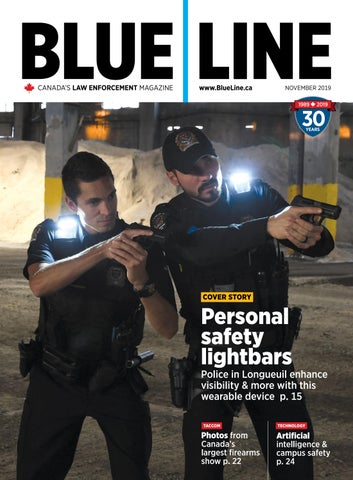
COVER STORY
Personal safety lightbars
Police in Longueuil enhance visibility & more with this wearable device p. 15 TACCOM
TECHNOLOGY
Photos from Canada’s largest firearms show p. 22
Artificial intelligence & campus safety p. 24
Contents
22 November 2019 Volume 31 Number 9
Features COVER STORY
15 Angel lighting on guard in Longueuil
Many officers of Quebec’s Service de police de l’agglomération de Longueuil, or SPAL, are opting to don this rechargeable, wearable safety light device from Guardian Angel for better visibility and protection. By Renée Francoeur
18 New waves in weapons detection systems
COVER PHOTO: SERVICE DE POLICE DE L’AGGLOMÉRATION DE LONGUEUIL, CSI TEAM
The most recent advancement in weapon detection technology has shown how Wi-Fi waves can be used to detect concealed weapons and explosives accurately, rapidly and economically. By Dr. Kelly W. Sundberg
20 Reducing street racing: a new approach
Columns 4 9 10 12 14 24 26 30
Editor’s commentary Q&A Health & wellness Behavioural sciences Holding the line Technology Case law Back of the book
Departments 5 5 8 8 27 28 29 30
By the numbers News Dispatches Calendar Off the shelf Product showcase Marketplace Blue links
The Embracing New Roads program in Edmonton offers police officers, and others with a vested interest in traffic safety, ways to use engaging education versus enforcement to reduce the illegal activities burning rubber on public blacktop. By Dawn Astbury
22 TACCOM Canada goes beyond tactical
Organized by Firearms Outlet Canada Inc., TACCOM is credited as a mini version of the popular Shot Show, the world’s biggest tradeshow for the shooting, hunting and firearms industry. See our photos from the show.
9 @Blue_LineMag
18
20 November 2019 | BLUE LINE
3
EDITOR’S COMMENTARY BY RENÉE FRANCOEUR
BLUE LINE www.BlueLine.ca
The No. 2 method of financing for organized crime and terrorists...
Y
ou may remember hearing organized crime and terrorists. Only drugs about a 58-year-old British are ahead of us. I was shocked because I Columbia woman who died af- know people gamble and we have a probter consuming counterfeit lem with prostitution—I always thought medication back in 2006. fraud and counterfeits would never be Marcia Bergeron has purchased pills ahead of them. So that’s shocking and why from an online pharmacy that contained we need to do more.” extremely high quantities of metal. The I was able to pop by for one afternoon metal contaminants were likely part of the during this conference. I was especially filler materials used to make the pills, the taken by the panel of experts discussing coroner’s report later said. counterfeit pharmaceuticals. Additionally, a 2016 Forbes “We’ve seen I had no idea there were so article pointed to more start- counterfeit pills in many deaths in developing ling results from the days of the past but not to countries from people taking the earlier drug importation the magnitude we fake insulin, for example. debate. In August of 2003, are today.” In fact, the World Health - Dan Zsido, National Organization found in its “the Food and Drug AdminisAssociation of Drug December 2017 report that tration (FDA) examined mail shipments of imported drugs Diversion Investigators one of every 10 medicines flowing to U.S. consumers sold in developing countries through Miami, New York, San Francisco, is either fake or of poor quality. and Carson, Calif. Investigators found that The panellists went on to share how for 88 per cent of the drugs they examined did less than $500, an individual with ill intent not meet FDA standards,” the article reads. can purchase a pill press and a counterfeit “The packages often contained dangerous, pill mold that allows them to turn cheap, unapproved, or counterfeit drugs.” easily available, unregulated ingredients Since then, counterfeit drugs only con- into a six-figure profit. tinue to be a deadly problem. (The Trump “We’ve seen counterfeit pills in the past administration’s proposal from earlier but not to the magnitude we are today,” this summer to import medications from said Dan Zsido, the national education and Canada for lower prices doesn’t help training director with NADDI (National tackle this money-driven crime.) Association of Drug Diversion InvestigaFrom Oct. 9-16, 2018, Canada seized or tors) in the U.S. refused over 3,000 packages of suspected One can’t help but connect the dots to counterfeit and/or unlicensed health today’s utterly devastating and wide-reachproducts, such as illegal prescription ing opioid crisis. drugs, as part of Operation Pangea XI, an “We have to be vigilant about taking out international operation targeting illicit pill presses,” Zsido said. “You’d be surprised online pharmaceutical networks. by how many items come up when you The numbers when it comes to fraud search ‘pill press mold’ on the internet — and counterfeits overall keep growing, not the dark web, just the regular internet.” said Lorne Lipkus of Kestenberg Siegal Despite my fondness for online shopping, Lipkus LLP Barristers and Solicitors, after hearing all this, I’ll be waiting until the kicking off the 24th Annual Fraud and technology is in place to trace and ID mediAnti-Counterfeiting Conference in Toron- cations purchased via a URL—such as the to this past September. proposed blockchain or radio-frequency “We’re not fighting with other crimes identification (RFID) methods. Even Tyanymore,” he continued. “Counterfeiting lenol should be purchased the old-fashis the No. 2 method of financing now for ioned way, in my opinion.
CONNECT WITH BLUE LINE
www.BlueLine.ca 4
@Blue_LineMag
BLUE LINE | November 2019
www.facebook.com/BlueLineMagazine
GROUP PUBLISHER | MARTIN MCANULTY mmcanulty@annexbusinessmedia.com EDITOR | RENÉE FRANCOEUR rfrancoeur@annexbusinessmedia.com ACCOUNT MANAGER | JANICE EATON jeaton@annexbusinessmedia.com MEDIA DESIGNER | SVETLANA AVRUTIN savrutin@annexbusinessmedia.com ACCOUNT COORDINATOR | TRISH RAMSAY tramsay@annexbusinessmedia.com CIRCULATION MANAGER | BEATA OLECHNOWICZ bolechnowicz@annexbusinessmedia.com Tel: 416-442-5600 ext. 3543 COO | SCOTT JAMIESON sjamieson@annexbusinessmedia.com
ANNEX BUSINESS MEDIA 111 Gordon Baker Road, Suite 400 Toronto, ON M2H 3R1 Tel. 416-442-5600 • Fax 416-442-2191
Publication Mail Agreement No. 40065710 ISSN 0847-8538 Printed in Canada SUBSCRIPTION RATES Canada — 1 Year $31.50; 2 Year $52.50 plus tax USA — 1 Year $105.00 USD CIRCULATION email: asingh@annexbusinessmedia.com Tel: 416-442-5600 ext 3553; Fax: 416-510-6875 or 416-442-2191 Mail: 111 Gordon Baker Road, Suite 400, Toronto, ON M2H 3R1 Occasionally, Blue Line will mail information on behalf of industry-related groups whose products and services we believe may be of interest to you. If you prefer not to receive this information, please contact our circulation department in any of the four ways listed above. Annex Privacy Officer Privacy@annexbusinessmedia.com; Tel: 800-668-2374 © 2019 Annex Publishing & Printing Inc. All rights reserved. Printed in Canada. No part of the editorial content of this publication may be reprinted without the publisher’s written permission. Opinions expressed in this magazine are not necessarily those of the editor or the publisher. No liability is assumed for errors or omissions. Readers are cautioned and advised that articles presented herein are edited and supplied for your personal awareness and should not be used for further action until appropriate guidance is received from a supervisor, Crown Attorney or other persons in authority. All advertising is subject to the publisher’s approval. Such approval does not imply any endorsement of the products or services advertised. The publisher reserves the right to refuse advertising that does not meet the standards of this publication.
NEWS
Left to right, OSCA treasurer Benny Wan, presenter Monique Rollin of Canadian Critical Incident Inc., OSCA president David Moskowitz, and OSCA government liaison Jay Lawrence. PHOTO: R. FRANCOEUR
ONTARIO
Special constables make “deeper connections” at 2nd Annual Summit
The Ontario Special Constable Association (OSCA) hosted its second annual summit in September, celebrating wins from the past year and fostering “deeper connections” between members through expert speakers and training sessions. “This year we have a two-day summit,” says OSCA president David Moskowitz. “The first day was dedicated to incident response and crisis de-escalation training with Monique Rollin and the second day is more speaker-led, featuring Ontario’s Solicitor General Sylvia Jones and others.” Rollin, a recently retired police inspector who is now an instructor with Canadian Critical Incident Inc., walked attendees through command and control material and encouraged a discussion on the value of the liaison role. “You all know your locations intimately,” she told the room. “The incident commander, the duty officers that show up — they won’t have a clue. That’s why we need the expertise of the liaison and to have the liaison stay there.” The association also celebrated its role in the creation of new legislation to encompass
the special constable profession, in relation to the amendments to the Police Services Act and Bill 68 COPS ACT. For more photos and a video from the event, visit bit.ly/2mNNCrT. OTTAWA
Ottawa police in mourning
Ottawa Police Service, friends and family are mourning the loss of Const. Thomas Roberts, age 35, who died by suicide days before the Police Const. Thomas Roberts. and Peace Officers’ National Memorial PHOTO: OTTAWA POLICE SERVICE Day, which commemorates fallen officers. Interim Chief Steve Bell released a statement, noting Roberts joined the Ottawa Police Service as a direct entry officer from the RCMP in 2016. He leaves behind his wife, a 9-monthold child and family in the Ottawa area. In 2018, he was part of a team of officers who ran into a burning building and fought a fire to rescue a man. He was awarded a Chief’s Commendation for that act. “It is information like this that makes his death even harder on all of us,” Bell said. “His
Robbery Unit colleagues and our entire organization are stunned by this tragedy.” OPS has refocused its efforts on its membership and have put plans in place to ensure everyone knows how to access help if they need it, according to Bell. “Barriers, like stigma, still exist to accessing mental health services and supports. We will refocus our efforts on eliminating those barriers and ensuring people can get the help they need.” Toronto police said they are also investigating the death of one of their officers, Const. Vadym Martsenyuk, in his home on Sept. 26. Additionally, CBC reported a Canada Border Services Agency officer was found dead in Terminal 3 of Toronto’s Pearson International Airport on Sept. 20. Const. Mark Fischer, spokesperson for Peel Regional Police, told media a man shot himself inside the airport but not in a public area. He said police are treating the death as a suicide. The Canadian Border Services Agency said in a news release that the “exact circumstances” of the death have yet to be determined and it will conduct a “thorough review.” May all three officers rest in peace. – with files from © Canadian Press Enterprises Inc., 2019 QUEBEC
Longueuil, Que. selected to host 2020 North American Police & Fire Games
Longueuil has been announced the host city of the Jeux Nord-Américains Policiers-Pompiers 2020, or North American Police & Fire Games. From Aug.14-18, 2020, police, firefighters, customs and military from all over the world will face each other in a major competition. Events will include athletics, Crossfit, tennis, boxing and many more. Visit the Jeux Nord-Américains PoliciersPompiers 2020 Facebook page for a video from the launch featuring an impromptu
BY THE NUMBERS New national crime data for 2018 was released earlier this summer, courtesy of Statistics Canada. Police-reported crime in Canada, as measured by both the crime rate and the Crime Severity Index (CSI), increased for the fourth consecutive year in 2018, rising two per cent. Despite the increase, the CSI was 17 per cent lower in 2018 than a decade earlier. Find some of the homicide stats below:
15
fewer homicides in Canada in 2018 (police reported 651) than in 2017, bringing the national rate down by four per cent
@Blue_LineMag
38
fewer homicides in Alberta in 2018 than in 2017
30
fewer in British Columbia in 2018 than in 2017
69
more homicides in Ontario in 2018 than in 2017, partly because of three serious incidents in Toronto
November 2019 | BLUE LINE
5
NEWS arm-wrestling match between the heads of Service de police de l’agglomération de Longueuil and Service de prévention incendie de l’Agglomération de Longueuil, and a surprise appearance by Hugo Girard, a Canadian former strongman. More details at longueuil2020.jnapp.ca/en/ index.html WORLDWIDE
Airbnb launches new law enforcement portal
Municipal police in Kensington, Summerside and Charlottetown in Prince Edward Island now have access to MedicAlert Connect Protect. PHOTO: MEDICALERT PRINCE EDWARD ISLAND
P.E.I. municipal police partner with MedicAlert
PHOTO: AIRBNB
Airbnb has launched a new online portal for law enforcement, noting it will provide a “secure and streamlined channel for law enforcement to submit valid legal requests for information” from Airbnb. “Law enforcement officers will be able to securely track requests, and receive status updates and customized email notifications,” the company stated. All requests for user information will continue to be handled and evaluated in line with the company’s existing Terms of Service, Privacy Policy and Law Enforcement Guidelines. To protect the privacy of users, Airbnb said it will only disclose user information when it receives a valid legal request or in emergency situations. Since 2016, Airbnb has published a Law Enforcement Transparency Report to provide insights into the frequency of requests for user information, where they come from, and how it responds to them. Between January and December 2018, Airbnb received more than 3,071 inquiries from law enforcement in 47 countries, of which 811 requests involved the release of at least some account information. To create an account and submit a request, please visit www.airbnb.com/lert.
6
BLUE LINE | November 2019
Municipal police agencies of Prince Edward Island made history this summer by partnering with MedicAlert Foundation Canada, becoming the first group of police agencies in Atlantic Canada to bring the MedicAlert Connect Protect service to their respective communities. MedicAlert Connect Protect provides police 24/7 access to a subscriber’s emergency profile. This service gives police first responders, through their dispatcher, critical intelligence, including recent photo, physical descriptions, wandering history, behaviour management strategies such as anxiety triggers and de-escalation techniques, as well as caregiver information. The information will now be accessible to municipal police in Kensington, Summerside and Charlottetown. Having access to this data through the MedicAlert identification adds an additional layer of protection for those MedicAlert subscribers living in or visiting P.E.I., as officers called to an emergency situation will have access to timely information, which could save a life. CANADA
App offers new hope in search for missing children
A new web app that directly engages the public in the search for missing children has been unveiled by The Missing Children Society of Canada (MCSC). Among its functions, MCSC rescu uses SMS alerts about missing children targeted to the locations of people who have registered with the app. MCSC rescu is also updated continually with information from police. All users can view active cases by region and submit tips on
cases to police through the web app. They can also register and opt in to receive SMS text alerts on their smartphones specific to cases in their area that police want to highlight. Since MCSC rescu is a web app, no download is required. It is accessible via any browser and across desktop and mobile devices. The app was developed by Toronto-based Esri Canada, a geographic information system (GIS) provider, for MCSC. Thousands of children go missing in Canada every year, but fewer than one per cent of those cases are broadcast to the public through AMBER Alerts, according to MCSC. While police remain on the frontline in the searches for missing children, having responded to 42,233 reports across Canada in 2018, members of the public increasingly play an important role in helping bring children to safety. Steve Burton, an inspector with Tsuut’ina Nation Police in Alberta, said during the news conference that there is a crisis with children in Indigenous communities and MCSC rescu is a welcome tool as it brings more people into the search. “Our society needs to take responsibility for our children and this is one piece of the puzzle,” Burton said. “This …. will allow members of the community to communicate in real time and become involved when these children go missing. That’s one of the big important things with this app.”
Visit www.BlueLine.ca for the latest news, stories, products, videos, photo galleries and industry events.
www.BlueLine.ca
THE 2020 FORD POLICE INTERCEPTOR ® UTILITY.
IT’S FAST. AND NOT JUST ON PAPER. The 2020 Police Interceptor ® Utility EcoBoost® outperforms all competitive police vehicles tested, including V8-powered sedans.
FLEET.FORD.CA
©2019 Ford Motor Company of Canada, Limited. All rights reserved.
NEWS DISPATCHES Sgt. James Giczi of Whitehorse, a long-time RCMP member in Yukon, died in an off-duty motorcycle accident in the territory. The 56-yearold Mountie was in charge of Yukon RCMP’s forensic identification unit. Media reports said Giczi was returning to Whitehorse with a friend after a day-trip to Skagway, Alaska, when the crash occurred. In 2015, he received his Meritorious Service Medal from the Governor General in recognition of his contribution to a national data base used to identify tire marks in criminal investigations. Rest in peace. Dave Richardson, a retired police officer on Vancouver Island who wrote the 1972 hit Wildflower for B.C. band Skylark, has passed away at the age of 77. According to the Canadian Songwriters Hall of Fame, Wildflower is one of the most performed songs in the history of Canadian popular music. Rest in peace. Supt. Jeff Hill has been promoted to the position of deputy chief of the Halton Regional Police Service, effective Oct. 1, 2019. Ronnie Schaefer, the bylaw officer for the Town of Fort Smith, N.W.T., has retired after 19 years on the job, including three as the animal control officer. He is also well known for acting as a volunteer “guardian” to the wild flock of endangered whooping cranes who come north to nest each summer on Salt River First Nation reserve land. Oceanside RCMP Auxiliary Const. Michael Dally was recently honoured with the Commissioner’s Commendation for Volunteer Service in British Columbia. Edward “Hawk” Kelly Jr. was the first Indigenous person in the history of the force to serve in the Royal Canadian Mounted Police, according to an article in the Summerland Review, and was honoured at a special event on June 26. The celebration also marked his 80th birthday, as well as 60 years since he graduated from the RCMP Training Academy, known as “Depot” in 1959. Kelly was an RCMP officer for about five years, in varying roles. He later served as Tzeachten First Nation Chief for two terms, 8
BLUE LINE | November 2019
CALENDAR worked for tribal police, and was a park ranger for B.C. Parks for almost 20 years. Insp. Michael Dazé had been serving as a police officer with the City of Owen Sound for the last 17 years and is now the new deputy police chief at North Bay Police Service. Yellowknife RCMP Const. Nick Brame was awarded the St. John Ambulance Silver Life-Saving Award earlier this summer at the N.W.T.’s legislative assembly for helping to save a woman’s life after she was attacked on New Year’s Eve. Durham Regional Police Insp. Cathy Bawden is now is the new head of the service’s North Division. Bawden was also awarded a Champion For Children award from Durham Children’s Aid Society. Tony Ventura is the new interim manager of analytics for Peel Regional Police. Previously he was the information technology infrastructure manager for the service. Kathrine Stewart, a regular member special constable helicopter pilot with the Royal Canadian Mounted Police, is the 2019 award winner in government for The Northern Lights Aero Foundation’s 11th annual Elsie MacGill award program. Stewart provides search and rescue, mountain radio repeater access, aerial surveillance, border security, and pursuits and interception support to frontline RCMP members throughout Alberta, Saskatchewan and the Northwest Territories. She has over 13,000 flight hours and is endorsed on eight helicopter types.
PROMOTIONS, RETIREMENTS, RECOGNITION • If you have an officer in your agency recently promoted or retiring or an individual you wish to have recognized (major award or recently deceased) you can let Blue Line magazine know by emailing: rfrancoeur@annexbusinessmedia.com.
CACP Counter-Terrorism and National Security Forum Nov. 13-14, 2019 Ottawa, Ont. cacp.ca/ctns-forum.html?mid=281 CATAP Workshop and Conference Nov. 13-17, 2019 Niagara-on-the-Lake, Ont. catap.ca/Violence-Prevention/Events Toronto Chief of Police Gala Nov. 14, 2019 Toronto, Ont. www.chiefsgala.com OWLE Training Day Nov. 14, 2019 Mississauga, Ont. www.owle.org Ontario Gang Investigators Association (ONGIA) Conference Nov. 18-22, 2019 Huntsville, Ont. ongia.org Law of Policing Conference Nov. 20-21. 2019 Vancouver, B.C. canadianinstitute.com/ law-policing-conference Canadian Violence Link Conference Nov. 21-23, 2019 Toronto, Ont. clc.humanecanada.ca CITIG’s 13th Canadian Public Safety Interoperability Workshop Dec. 1-3, 2019 Toronto, Ont. www.citig.ca Alberta Association of Community Peace Officers Conference Feb. 10-14, 2020 Lake Louise, Alta. aacpo.ca/winter-conference/ registration-2020 Calgary Cyber Summit 2020 March 10-12, 2020 Calgary, Alta. cybersummityyc.ca
www.BlueLine.ca
Q&A Under the Royal Canadian Mounted Police Act, the role of an auxiliary constable is to assist sworn police constables in the execution of their duties, as well as to aid in community policing. For more than 43 years, York Regional Police Auxiliary Staff Sgt. Thomas Ungar, now retired, did just that. Q: What was auxiliary policing like when you first started in 1975?
stances. At times I saw people at their worst and it made me appreciate how fortunate I am with my lot in life.
Auxiliary policing was very different back then from what it is now. We certainly didn’t have the technology or level of training we have today. As auxiliary policing was relatively new in Ontario then, auxiliary police officers were looked at with a level of curiosity as to why anyone would want to do this job for free. Auxiliary officers were not as well accepted by some of the “older generation” of sworn officers as they are today and there was not nearly the level of community involvement and partnership that there is today.
Q: And the most rewarding?
The most rewarding aspect was the knowledge that I made a bit of a positive contribution and difference in the community.
Q: What does the word auxiliary mean to you?
Q: You were working full time. Why did you add this to your plate?
Since my early teenage years, I had always been interested in a career in law enforcement. However, due to the perceived risk factor, my parents steered me toward a career in engineering. When I found out about the auxiliary police unit in Toronto, I thought that this would not only be a good way to get involved in law enforcement, but also an excellent way to give back to the community.
Q: You began your career with the Toronto Police, retiring from there at the rank of auxiliary superintendent. You then began a second auxiliary career with York Regional Police for another 15 years. How did those experiences differ?
While both Toronto and York are excellent police services, I found that York provided more of a “grass roots” community involvement for auxiliary officers. This was perhaps due to the fact that York was a smaller organization at this time and relied heavily on their auxiliary unit to achieve many of the community-oriented goals.
Q: What was your most memorable moment in auxiliary policing? @Blue_LineMag
I have many memorable moments, too numerous to mention here. With TPS, it was working out of the old 3 District Traffic Unit and riding the Harley Davidsons for four years. As an auxiliary superintendent in my later years with TPS, it was heading up a newly created Auxiliary H.R. Unit and being hands on in the recruitment, selection and training of new recruit classes – up to 54 recruits annually – and guiding them towards graduation. With YRP, I won an award in 2011 and in 2015 for having the highest number of hours in the unit. It was the professional treatment I had from the sworn officers that I worked with – especially members of 2 District COR Unit where I was assigned for most of my auxiliary career with YRP – that is most memorable.
Q: What was the most challenging part of the job?
Dealing with very difficult situations on some calls I attended, where my heart went out to the victims and their families. However, you have to stay professional and do the best you can under the circum-
I look at the word “auxiliary” as an integral part of a police service, in a support role. It means to assist in meeting the needs of many of the community-oriented functions. Auxiliary officers can also be looked at as the “ambassadors” between the police service and the community. Over time most police services have realized the value-added component of auxiliary units and I saw an ongoing positive evolution in recruiting, selection, training, uniforms and the deployment of auxiliary officers.
Q: What advice do you have for others curious about auxiliary?
Becoming an auxiliary police officer is an excellent way to find out if policing is for you or not. You get to see the good, the bad and everything in-between so that you can make an educated decision. It is also an excellent way of giving back to the community for those who have no aspirations of becoming a sworn officer.
Q: What is your overall message regarding auxiliary units?
In my opinion, in this age of fiscal responsibility, tight resources and accountability, auxiliary units can provide a lot of value-added services the police service would otherwise be unable to deliver to the community. While an auxiliary police officer does not replace a sworn officer, they certainly augment and support the community-based policing model – where partnerships are a must. November 2019 | BLUE LINE
9
HEALTH & WELLNESS
ISABELLE SAUVÉ AND BRUNO SEGUIN
Passive aggressive behaviour: Big girls & boys do cry
D
uring the Second World War, psychiatrists dealt with reluctant and uncooperative soldiers who followed orders with chronic veiled hostility and smouldering resentment. Their deportment was a mixture of passive resistance and grumbling compliance. They identified it as “passive aggressive behaviour.” In North America, many contemporary work environments nurture a disconnection with emotions. Consequently, these workplaces are particularly prone to and negatively impacted by acts of passive aggression deeply rooted in negative feelings. This “deliberate and masked way of expressing feelings of anger,” impacts productivity and morale. While acted upon deliberately, passive aggressive behaviour tends to be expressed by a lack of action, making it difficult to detect. More specifically, it can be undertaken by acts of resistance, insubordination, sabotage and omission. There are many examples of this counter-productive and destructive comportment, often sparked by resentment over the demands of others. Demands viewed as excessive, unfair or irrelevant are more likely to trigger a reaction. Employees who feel unhappy or underappreciated may demonstrate passive aggressive behaviour by missing deadlines, “misplacing” items, “misunderstanding,” arriving late, “forgetting” to complete tasks, or being intentionally inefficient. Taking a sick day, leaving the shift short when not ill, refusing to contribute to initiatives, doing the bare minimum, procrastinating, gossiping and making non-compliments are all displays of passive aggressive behaviour. The silent treatment or ignoring are also forms of passive aggressiveness. “Accidentally” overlooking to invite one person to a platoon gathering can be witnessed at the extreme. Passive aggressiveness often stems from miscommunication and assumption. Refusing to confront
10
BLUE LINE | November 2019
problems and challenges may on the surface appear easier and less frightening. Nonetheless, the psychological repercussions are frequently devastating. Canadian are proud of and, in fact, renowned worldwide for being “nice” and non-confrontational. While it is very commendable, it should not be at the expense of emotional or psychological health. Knowing when and how to properly address issues and express emotions is critical. Sometimes the person who is not speaking up regarding issues is not necessarily “nicer,” as they in turn intentionally sabotage projects or fail to contribute to the team as a result of a build-up of frustration or anger. Studies show the inability to express emotions is the reason for this common behaviour found in our modern culture. Indeed, those who feel they cannot or should not express feelings openly, may covertly or passively channel emotions. The many reasons individuals do not express their emotions lays deep down in the culture of our country. They are also propagated by factors such as upbringing, education, societal expectations, workplace culture and management. More specifically, we may believe we express our feelings when in
This inability to express emotions coupled with a culture of prescribing what we “should feel,” can annihilate true feelings and replace them by various beliefs; some of which are likely to be irrational.
fact, we suppress them and actually express what we deem acceptable by society, thereby creating growing frustration. With time, built-up frustration often turns into anger and by consequence passive aggressive behaviour. This inability to express emotions coupled with a culture of prescribing what we “should feel,” can annihilate true feelings and replace them by various beliefs; some of which are likely to be irrational. Individuals should free themselves from damaging irrational thoughts, which may have been anchored for years. For instance, there is nothing wrong with telling someone in a respectful and direct manner that you have a differing opinion or are upset over something. It is not a personal attack but a step towards problem resolution. There is also nothing wrong with showing and expressing emotions such as true joy, anger or sadness. The “big boys don’t cry” mantra told by parents leads to an inability for men to express their feelings and emotions, and in the long term this can reveal itself in various forms of aggression and violence. The same applies in workplaces that expect men and women to have the same reaction towards all situations. In reality, men and woman are different when it comes to the expression of their emotions; nonetheless, being different does not mean they should not be treated equally. The long-term repercussions of suppressed negative feelings cannot be ignored as the consequences can be significant and devastating.
Isabelle Sauvé is a 12-year veteran with the OPP, currently with the Lanark County Detachment. She has a MA in psychology and is a PhD candidate. She is also an ultramarathon/ endurance athlete and the Racing the Planet/4 Deserts 2018 Series winner as well as a Guinness World record holder. She can be contacted at: isabelle.sauve@hotmail.com. Bruno Seguin is a senior executive manager and international business consultant with experience in global operations, international business development, strategic planning, leadership and corporate governance. He is also an ultra-runner, 9th place finisher at the Racing the Planet/4 Deserts 2018 Series and fellow Guinness World record holder.
www.BlueLine.ca
A NEW SOLUTION THAT EMPOWERS OFFICERS TO CAPTURE AND REPORT ON DIGITAL EVIDENCE FROM CONSENTING VICTIMS, RIGHT AT THE SCENE.
SHIELD gives officers the ability to: Quickly and easily capture photo, video and chat evidence Immediately produce shareable evidence reports Allow witnesses to share the evidence that they want to share Collect and preserve evidence at the scene
Available as a turnkey solution on the Microsoft Surface Go tablet or as a software-only that runs on your existing hardware.
Visit empowerofficers.com for more information.
BEHAVIOURAL SCIENCES BY DR. PETER COLLINS
Understanding paraphilic disorders & the impact on criminality: Part two*
I
n part one of this two-part article we defined paraphilia as a sexual deviance. There are three basic categories of paraphilic behaviour: • the deviant behaviour is directed towards children and other non-consenting individuals • involves the pain and humiliation of oneself or one’s partner • or involves fetish items (an attraction to certain parts of the body or inanimate objects)
Although there are many forms of sexual deviance, as described in the scientific literature, the DSM 5 (Diagnostic and Statistical Manual of Mental Disorders, fifth edition) concentrates on eight specific paraphilic disorders: voyeurism, exhibitionism, frotteurism, sexual masochism, sexual sadism, paedophilia, fetishistic activities, and transvestism. 1 Paedophilia was discussed in last month’s column, as it is the most common paraphilia assessed in a clinical setting, but both exhibitionism and voyeurism are the most commonly occurring sexual deviances in society. Exhibitionistic disorder is a condition marked by the urge, fantasy or act of exposing one’s genitals to non-consenting people, particularly strangers. Those strangers are usually female or children of either gender if the offender is paedophilic. According to Clark et al (2016), studies examining the frequency of exhibitionism using victim self-report have estimated lifetime victimization rates ranging from 33 per cent to 52 per cent for women.2 A good proportion of exhibitionists expose because of their fantasy that the victim will be impressed with their genitalia and will want to have sexual contact with them. I remember asking an exhibitionist who, by his own estimate, had exposed to hundreds of adult women over the course of his offending 12
BLUE LINE | November 2019
career, if he ever had had sexual contact of any sort with any of the victims. His answer was “no but maybe next time.” Some exhibitionists will not wait to fantasize about the encounter and a proportion with also masturbate during the incident or there soon after. Exhibitionism is not just a “nuisance offence.” A high percentage of exhibitionists can have four or five or more cross-associated sexual deviances that can include hands-on offences. Becker et al (2003) found that among sex offenders who were candidates for Sexually Violent Predator (SVP) commitment in Arizona, 14 per cent had a diagnosis of exhibitionism.3 Another high frequency paraphilia, with a low arrest rate, is voyeurism. Voyeurism is a disorder characterized by recurrent sexual urges, fantasies, or behaviours involving the observation of an unsuspecting person who is naked, disrobing or engaging in sexual activity. Often these people are arrested for tres-
passing or prowl by night but their actual purpose is to engage in voyStaff Sgt. euristic activities. Josée Sexual deviants will also keep up Sabourin, with technology this is addressed manager of in the Criminal Code of Canada, the OPP section 162.1: ViCLAS Unit, Every one commits an offence encourages who, surreptitiously, observes — investigators including by mechanical or electo submit tronic means — or makes a visual these types recording of a person who is in cirof offences cumstances that give rise to a reabecause sonable expectation of privacy, if...4 exhibitionism A tasking I was assigned to during and Project Green Ribbon was to anavoyeurism lyze the six hours of video tapes are often recorded by Paul Bernardo. Bernarpresent in the do had (has) multiple paraphilias – offending his core sexual deviance was sexual pattern of sadism but he was also a voyeur, predatory engaged in urophilia and was posoffenders. sibly a hebephile. Interestingly, between committing more violent offences (including sexual homicide), Bernardo would return to his ‘entry level’ *Content/trigger warning: paedophilia, paraphilia – voyeurism. There were many examples of him recording sexual content www.BlueLine.ca
ENABLING A BETTER RESPONSE WHEN IT women in various stages of undress as he prowled adjoining neighbourhoods in the middle of the night. In the early 1990s, video cameras were large and at times Bernardo was close enough that the lens touched the window panes of his victims. Why do offenders record their sexual offences? The sounds and/or images serve as fantasy material to be read, heard or viewed later for masturbatory purposes. A take home point is that we can’t consider exhibitionism or voyeurism to just be nuisance offences. Obviously not all will become serial killers but most will have associated sexual deviances, some that may involve hands-on offending. Voyeurism and exhibitionism are not ViCLAS (Violent Crime Linkage System) criteria offences, however, Staff Sgt. Josée Sabourin, manager of the OPP ViCLAS Unit, encourages investigators to submit these types of offences because exhibitionism and voyeurism are often present in the offending pattern of predatory offenders. Offences involving criminal harassment, stalking, obscene phone calls/communication and Break & Enter with a sexual component should also be submitted to ViCLAS.
References
MATTERS MOST.
Say hello to Situalis.
The cloud based platform and communication
network that enables effective coordination between police, security contractors, and property owners during an emergency event.
Critical floor and emergency plans are accessible remotely from the cloud at a moments notice. Real time / geo-located event based alerts so you can understand and react to the key issues in your area. Differentiate your security company by joining our affiliate sales program. For illustrative purposes only.
Contact us now.
Sign up now at: ad.situalis.com/blueline Contact us at: info@situalis.com
BL_Nov19_Situalis.inddDALHOUSIE’S 1 CERTIFICATE IN POLICE LEADERSHIP
1. American Psychiatric Association (2013) Paraphilic Disorders. Diagnostic and Statistical Manual of Mental Disorders (Fifth Edition) American Psychiatric Publishing - pp. 685-686.
2019-10-15 10:37 AM
Become the leader you know you can be
2. Clarke, S., Jeglic, E., Calkins, C. & Tatar, J (2016) More Than a Nuisance: The Prevalence and Consequences of Frotteurism and Exhibitionism. Sexual Abuse: A Journal of Research and Treatment 2016, Vol. 28(1) pp. 3-19. 3. Becker, J. V., Stinson, J., Tromp, S., & Messer, G. (2003). Characteristics of individuals petitioned for civil commitment. International Journal of Offender Therapy and Comparative Criminology, 47, pp. 185-195. doi:10.1177/0306624X03251114. 4. Greenspan, E., Rosenberg, M. & Henein, M (2019) Martin’s Annual Criminal Code. Canada Law Book: Toronto.
Dr. Peter Collins is the operational forensic psychiatrist with the Ontario Provincial Police’s Criminal Behaviour Analysis Unit. He is also a member of the crisis/hostage negotiation team of the Toronto Police Service Emergency Task Force. His clinical appointment is with the Centre for Addiction & Mental Health in Toronto, and he is an associate professor with the University of Toronto. Dr. Collins’ opinions are his own and may not reflect the opinion of the OPP, University of Toronto, CAMH or his mother. Contact him at peter.collins@utoronto.ca.
@Blue_LineMag
Built for modern policing, our online courses, designed and delivered by academics along with industry experts and leaders in policing, give you the knowledge and skills to advance in your profession. Learn from the innovator in quality police education for over 25 years. WINTER TERM STARTS JANUARY 29
DAL.CA/POLICELEADERSHIP
CCE
College of Continuing Education
HOLDING THE LINE BY MICHELLE VINCENT
Experiencing mindfulness our way as first responders
M
indfulness has become a popular method and tool for mental health when we are stressed, starting our day or preparing for sleep. It is used to release the grip on challenging thoughts as well as preparing us for high performance-based activity. Meditation, an aspect of mindfulness, has us notice the thoughts that come to mind and proceed to let them go, allowing for a flow of the present moment. As police officers and civilians in a policing environment, mindfulness may be a part of our curriculum, depending on our organization. While implementing mindfulness in training for police and civilians is a powerful tool in the toolbox, understanding its parameters and limitations in terms of its strengths and weaknesses is essential if we are to respect the relationship between trauma and mindfulness. There are a number of articles discussing the pros and cons of mindfulness. Some of these works consider it to be key in managing mental health issues such as anxiety and depression. Others caution the way in which mindfulness is applied, especially in first responders. Understanding the brain that has experienced significant trauma—as many first responders have—is especially important when considering mindfulness. One author and expert on mindfulness, David Treleaven, discusses the myths on mindfulness, including: the belief that “one size fits all,” knowing when we, or someone else, is struggling or experiencing trauma; and the ideas that the breath is neutral. Treleaven explains the neurobiology of a traumatic experience and a reaction such a person practicing mindfulness may need. He also touches on the need for modification to mindfulness in these instances. Engaging in this practice may be most effective with a trainer/educator/therapist who understands what modifications 14
BLUE LINE | November 2019
Officers from Ontario’s Peel Regional Police attend the West End Buddhist Temple and Meditation Centre for a session on mindfulness meditation and Buddhist philosophy led by Rev. Dr. Bhante Saranapala, also known as the Urban Buddhist Monk. PHOTO: PEEL REGIONAL POLICE
would best support each individual, dependent on their exposure to trauma. This is something we can ask as we begin our practice. Another myth Treleaven explains is the notion that the mindfulness guide will always know when those practicing are being traumatized. Research has found that trauma can induce shame. Mindfulness can also induce shame and embarrassment if the individual feels they are not “doing it right.” If we blend this with the desire to please the guide who is conducting the mindfulness practice, the likelihood of a submissive aura may inhibit our experience. It could lead to us believing or feeling that this mindfulness practice just isn’t working for us. The final myth Treleaven shares is about the breath in relation to mindfulness. It is not always neutral. Our respiratory system is interconnected with our sympathetic nervous system, he explains, which, from a sensory perspective as breath is, may relate to our experience of trauma. Many of us can relate to smells, sounds and experiences that bring back challenging times on the job. Asking one to focus on the breath has the potential to retraumatize one who has experienced significant trauma. Deconstructing these myths is not to have us all overthinking
Engaging in this practice may be most effective with a trainer/ educator/ therapist who understands what modifications would best support each individual, dependent on their exposure to trauma.
For further information, listen to David Treleaven’s free webinar and resources available at davidtreleaven.com.
mindfulness within the realm of mental health. It is to inform us so whether we are experiencing challenges, negativity, trauma or our colleagues are brave enough to mention such an experience, we can inform them of the normalcy—as well as the potential for modification—so they or we can experience the true power of mindfulness. Instead of leading with the breath, we can choose different options around an anchor point, allowing us to feel empowered, Treleaven states. We can choose the breath, the sound in our environment (such as the hum of an air conditioner), and other sensations (such as resting our hands on our legs). Trying different anchors and allowing choice supports the power/ practice of decision-making in our own treatment using mindfulness. Empowerment is key! Let’s leverage the full power of healing in our trauma-based world as first responders and experience mindfulness our way. Michelle Vincent is a 17-year York Regional Police officer in the process of implementing the first non-profit treatment centre that will be occupationally specific for first responders. She is working towards her PhD in Forensic Psychology/ Crisis Response. She can be contacted at: michelle@vincent.net
www.BlueLine.ca
COVER STORY
Angel lighting on guard in Longueuil Many of the officers at this municipal police service in Quebec are opting to wear the Guardian Angel Elite Series lightbar for better visibility and safety By Renée Francoeur
T
he sun had long set, a main road needed to be closed after a fatal accident, and the lights on top of Marie-Christine Baril’s patrol car malfunctioned. No matter what she tried, they would not turn on. The patrol officer with Quebec’s Service de police de l’agglomération de Longueuil (Urban agglomeration of Longueuil Police Service), or SPAL, knew she had to innovate. Baril, who has been with the service for 4 years, pulled out her Guardian Angel Law Enforcement Elite Series personal safety lightbar with its magnetic pad. She placed it on top of her car and turned it on, choosing the LED strobe light feature. “It worked surprisingly well,” she says. “The magnet to secure it is very strong. I was amazed at how efficient it was in helping to close the road and alert everyone. I recommend it to all other officers.” The first Elite Series personal lights from Guardian Angel began popping up on the shoulders of police officers in Longueuil, Que., just across the St. Lawrence River from Montreal, in 2017, says Patrick Barrière, the section media relations and communications sergeant for SPAL.
PHOTO: SPAL
“I use it for every single night or evening shift.” - Alexandre Coulombe, SPAL patrol officer @Blue_LineMag
November 2019 | BLUE LINE
15
COVER STORY
Visibility makes a difference
Earlier this year, Len Garis, who is a retired fire chief and adjunct professor at the University of the Fraser Valley Centre for Public Safety and Criminal Justice Research in British Columbia, shared findings from his study Determinants of Injury and Death in Canadian Police Officers. “In particular, the study pinpointed violence and traffic accidents as the most common factors in officer fatalities,” writes Garis, who also recently joined the B.C. Injury Research and Prevention Unit as an associate scientist emeritus. Similarly, the National Law Enforcement Memorial Fund reported 16
BLUE LINE | November 2019
Compact & bright
motor vehicle-related incidents as a leading cause of line-of-duty deaths for law enforcement officers in the United States in 2017. Indeed, for those conducting unpredictable traffic stops in the dark, walking the beat at night or investigating dim spaces, light and visibility can mean the difference between life and death. That’s why Ron Dir, Guardian Angel’s lead designer, and Ed Horton, an electrical engineer, set out to develop a tool to protect law enforcement officers in the line of duty. “This product is used by people to save other people’s lives,” says Horton, who adds he’s been designing various electronic devices for the past 45 years. “That was our focus,” Dir concurs, “to give them a tool to use when they need to be visible and to be found.”
657 police officers in total at SPAL
275+
officers who use the wearable lightbar
Guardian Angel, headquartered in Brookfield, Wis., offers two versions of its newest Elite Series model suited to law enforcement: one featuring a wigwag blue/blue and a second model with a red/blue pattern. “I use it for every single night or evening shift,” says Alexandre Coulombe, another SPAL patrol officer. “I place it on top of my left shoulder on my ballistic vest to get the most visibility in front of me as well as behind me... And I have it in the white light mode in the front, with the blue and red flasher in the back, for all interactions with vehicles, such as impaired driving checkpoints and on scene at accidents.” Coulombe notes he also uses the red and white light to write reports at night and when he’s searching a building. According to Guardian Angel, the latest rendition of the Elite Series is half the size of previous models (it measures 6.9 cm long, 2.5 cm tall and not quite 4.7 cm wide) and now offers three brightness settings. It also boasts a polycarbonate, snapclose, universal micro USB charging port and a smaller battery. All Elite Series devices have one ultra-bright white LED on the top, a single red LED work light, and either side can flash or stay on. “I mostly use my lightbar for the verification of documents, using the white and red light,” notes SPAL’s Const. Michaël Henri. www.BlueLine.ca
PHOTOS: SPAL
“We have our mandatory equipment and then we also have a points system, if you will, that allows for some optional equipment per year,” Barrière says. “The Guardian Angel lightbars are such optional pieces of equipment officers can allocate their points towards.” In less than two years, more than half of all SPAL officers have added the lightweight (it weighs approximately 92 grams or three ounces), compact device to their kits. “And that has all been through word-of-mouth,” Barrière adds. Barrière, who is no longer on patrol due to his communications role, was able to also gift one of these lightbars to a fellow police friend in a different service who was curious about Guardian Angel. “He loves it. He wears it all the time,” Barrière says.
Paul J. Hobaica, the fire department physician at North Collier Fire Rescue in Naples, Fla., agrees this device “can save your life.” In his review of the Guardian Angel, which he uses mostly for personal use but also for work-related situations at times, he says he believes “it has saved my life on many occasions while riding and running at night. It is so powerful and everyone can see this illumination from a great distance.” He recommends these lights for “anyone not only involved in first response, but believe this should be in everyone’s equipment when training and other sports activities, especially at night.”
Henri is one of the more recent officers to acquire this wearable lightbar and says he “fell totally in love with it” from the first use. Even after accidentally forgetting his reflective traffic vest during one shift, he knew he was in good hands with the Guardian Angel on his shoulder. “The light is truly powerful.” The device, functioning as what Guardian Angel calls a “tactical vest flashlight,” features a lithium ion rechargeable battery, built-in rare earth magnet, a rare earth magnet mount, high powered LEDs, an emergency mode, a power saving mode, and the 360-degree light aspect ratio provides over three kilometres of visibility, according to the company’s website. While the magnet allows the product to be mounted to any piece of clothing or headgear, etc., there is an arm strap mount available as well and various other customization. The company also notes the Elite Series carries an IP68 rating, which means it can “withstand dust, dirt and sand and is resistant to submersion up to a maximum depth of 1.5 metres underwater for up to 30 minutes.” However, the unit is “designed to be water resistant if the charging port plug is securely put into place and not submerged to depths over 10 feet,” Guardian Angel explains. “This product is about providing illumination without boundaries,” Dir points out.
Identification, courts & strong magnetism
SPAL’s co-ordinator for handling infractions to provincial liquor laws, Const. Stephen Pagé, works in plain clothes with a ballistic vest underneath. He says the lightbar’s magnet is strong enough to be placed on his vest, under his clothes and still attach to the device outside his clothing. “I work a lot in the restaurant and bar atmosphere,” Pagé continues. “When you find yourself in an illegal establishment or one that is over capacity and you need to act quickly, you turn on your Guardian Angel and it clearly identifies you as a police officer. The lighting in these places is often dim so it is @Blue_LineMag
important for people to know the police are there when there is an altercation.” He says the device is also helpful in identifying his colleagues who may also be in plain clothes and invites the co-operation of the public. “When you have four or five of you spread out over a dark bar, it’s helpful to see where we all are,” Pagé explains. “And I should also point out, if an arrest had to be made, let’s say, the identification of a police officer cannot be doubted in court thanks to the blue and red beacons of the Guardian Angel.” Coulombe also notes the magnet was so strong it worked when he wanted to mount the lightbar on the trunk of his patrol car instead of resting a flashlight on there, which could roll. Furthermore, the device has never dropped from her shoulder or come detached for Baril, who also uses the magnet to mount it to her vest — even when she was trying to apprehend someone and control them on the ground. “It is very shock-resistant,” she says.
A battery that means business
Named one of the “Top 10 Most Wanted Products of 2018” by Officer.com in the U.S., the wearable lightbar’s battery is also the talk of the town in Longueuil. “I have probably only recharged it once in the last year and a half,” Baril says. Coulombe says his charge lasts five weeks or more. “That’s the most common bit of feedback we hear from officers about the wearable lights—the crazy long battery life,” Barrière adds.
Kid-friendly
One other positive offshoot of the device is its versatility during some difficult calls, as SPAL officer Jocelyn Beaucage shares. “I give it to the young kids I’m interacting with,” he says. “If I’m de-escalating a situation, it gets the kids’ attention and they have fun with it. It’s great for their curiosity and gives them something to play with while we focus on the interven-
310 km² area covered by SPAL
225 civilian employees at SPAL
tion we’re doing with the parents or concerning adults.” For SPAL patrol officer Alex Grenier, there are no problems whatsoever with the lightbar. He especially appreciates it for house clearing searches and routine traffic stops. “It’s very reliable,” he tells Blue Line. “In fact, I just used it last week [early September] in the middle of the night.” There was a call for backup to help with traffic after a major accident, with many injured. “It had happened at a huge intersection. I used the police light mode in the strobe setting so I could be seen and so traffic would slow down,” he says. “It was safe and efficient and I was able to get to the victims quickly.” Keeping our officers visible on all roads and in unpredictable situations is ever the priority and for those working hard to keep Longueuil safe, these flashing “Guardian Angels” seem to be doing their job and lightening the load, even as they perch atop officers’ shoulders. For more details, visit guardianangeldevices.com and for free 30-day agency trials, contact Distribution Elite Canada at distributionelitecanada.com.
November 2019 | BLUE LINE
17
WEAPONS DETECTION
New waves in weapons detection systems How a technology that has become an innocuous part of our daily lives can also be an evidence-based safeguard against gun violence By Dr. Kelly W. Sundberg
T
ragically, active shootings have become a reality of modern society. While the vast majority of mass shootings have unfolded in the United States, dozens of others have unfolded in cities across Africa, Asia, Europe, North America, South America and Oceania. Specifically, incidents in Canada, Finland, Norway and New Zealand stand to highlight the fact that even nations with historically low crime rates, restricted gun laws and highly liberal societies can be vulnerable to mass shootings and gun violence. Notwithstanding the sincere efforts being taken by police and lawmakers around the world to curb the rise in mass shootings and gun violence through policy and reform, the reality is such efforts can only offer limited protection against motivated and armed attackers. What has become abundantly clear is the need for more public and private sector property owners to implement evidence-based safeguards against gun violence.
Gun violence and occupiers’ liability
Occupiers’ liability occurs when an individual is injured due to a property owner 18
BLUE LINE | November 2019
(including a government) failing to meet their duty of care with relation to keeping those on their property reasonably safe from injury and harm. There are five core aspects those responsible for property security must observe to meet their duty of care: 1) foresee possible threats and hazards to all persons using the property, 2) ensure the building and sites are maintained in a way that affords a safe and secure environment, 3) ensure all activities on the property are delivered in the safest way possible, 4) take meaningful and effective efforts to mitigate risks of violence and to monitor and control the behaviour of third-parties on the premises, and 5) have professionally developed and implemented security policy, processes, protocols, and technologies in place and regularly reviewed. In today’s world where mass shootings, gun violence, domestic and international terrorism, and organized crime all have become commonplace, it is incumbent on
The rising importance of weapon detection research and technology
Starting in the United States during the 1960s, and expanding globally through the 1970s, pulse induction (PI) metal detectors and x-ray luggage screening machines became standard at all international airports. In general terms, PI metal detectors consist of an electro-magnetic gateway through which a person walks. The electro-magnetic field is created by a transmitting coil on one side of the gateway and a receiver coil on the other — when a metal object passes between the coils, through the electro-magnetic field, it becomes detectable when the object’s self-induction interferes with this field. Over the years this technology has become highly refined and remains the primary means for searching for weapons at airports, courthouses and other areas requiring affordable and highly effective weapons detection. In light of the 9/11 terrorists being able to smuggle box-cutters through traditional PI airport metal detectors, demand grew for more accurate and robust metal detection at airports in the post-9/11 era. Aside from traditional PI metal detectors becoming more sensitive, various radio wave-length and x-ray technologies have been explored for achieving rapid and accurate concealed weapons detection (including explosives). Beginning with Dr. Steven Smith’s invention of rapid backscatter x-ray scanning, followed by Dr. Kamal Sarabandi and others’ work exploring millimetre wavelength radar scanning, along with other attempts to use infrared thermal imaging, weapons detection technologies have significantly evolved over the past quarter www.BlueLine.ca
PHOTO: FIRST RESPONDER TECHNOLOGIES INC.
Using common Wi-Fi, this low-cost suspicious object detection system can detect weapons, bombs and explosive chemicals in bags, backpacks and luggage.
those responsible for the physical security of both public and private sector properties to take active steps in safeguarding their occupants from criminal and terroristic risks. Simply put, video surveillance and alarm systems alone are not enough — rulings by civil courts in every western jurisdiction have clearly established that anyone who fails to meet their duty of care in relation to a property they are responsible for risks costly judgements being made against them. To this point, it behooves all those responsible for the physical security of a building or site to work with crime prevention practitioners and researchers, along with the scientific community, to identify crime reduction best practices, approaches and technologies.
century. The most widely used millimetre wave-length scanners at airports around the world include the L3 ProVision and Rohde & Schwarz QPS scanners, with the Rapiscan Secure 1000 and AS&E Smartcheck being the most widely used backscatter x-ray scanners. Considering both millimetre wave-length and backscatter x-ray scanners involve a person being subjected to extremely low levels of radiation, combined with the ability for a traveller to be viewed as near-nude by security scanners, understandably much public concern has been raised with relation to their use. The most noted recent advancement in weapon detection technology emerges from Dr. Yingying (Jennifer) Chen’s Wireless Information Network Laboratory (WINLAB) at Rutgers University. Now being commercialized by First Responder Technologies Inc. out of Canada, Chen’s research has shown how Wi-Fi waves can be used to detect concealed weapons and explosives accurately, rapidly and economically. Unlike other technologies that have resulted in noteworthy privacy and health
concerns, Chen’s notion of using Wi-Fi as a weapons detection system offers the possibility for a more safe, effective and economic means to safeguard buildings and sites. While many people justifiably become concerned when they are exposed to microwave or x-ray radiation, nearly all feel totally comfortable and safe with WiFi — a technology that has become an innocuous part of our daily lives.
Future needs and considerations
Considering the increasing demand on property owners to provide enhanced security aimed at safeguarding occupants from gun violence, while also accepting the importance of balancing security and privacy considerations, it is imperative technologies such as Wi-Fi weapons and explosives detection be seriously considered. Security cannot be applied to the built environment in a uniformed nor an unsystematic manner. Rather, security today requires highly educated and experienced professionals from a broad range of pro-
fessions to work in concert in creating safer public and private spaces. These professionals include police officers, security consultants, building managers, urban planners, designers, researchers and others. For effective and evidence-based security solutions to be truly realized, policies, processes and technologies should emerge from university and materialize within the open market. Woefully, there are no signs that gun violence will subside anytime soon, meaning security innovations such as Wi-Fi based weapons and explosives detection will increasingly need to be explored and eventually implemented as broadly as possible. Dr. Kelly W. Sundberg is an environmental criminologist and Associate Professor at Mount Royal University in Calgary, Alta. He is also an Adjunct Professor at the University of Calgary, Adjunct Professor in the Adelaide Law School at the University of Adelaide, and a Fellow with the Canadian Global Affairs Institute. Prior to his academic career, Dr. Sundberg served 15 years in various border security and law enforcement positions with the Government of Canada.
Gain unlimited access to CARFAX Vehicle History Reports when you partner with CARFAX for Police.
Use CARFAX Vehicle History Reports to Solve: • Hit and Run • Odometer Fraud • Robbery • Homicide
CARFAX Vehicle History Report
Vehicle Information: 2018 MAZDA3 TOURING VIN: JM1BN1V78J1157308 SEDAN 4 DR 2.0L I4 F DOHC 16V GASOLINE FRONT WHEEL DRIVE
Branded Titles: Junk CARFAX 1-Owner vehicle At least 1 open recall 1 Service history record
• Missing Persons Personal Vehicle
• VIN Cloning
9,879 Last reported odometer
• Major Theft • Drug Trafficking • Crime Involving Vehicles
Available at No Cost! Contact Carl Andersen to Get Started: CAndersen@carfax.ca | 416-706-4714
@Blue_LineMag
BL_Nov19_CarFax.indd BL_Nov19_CarFax.indd 11
Title History CARFAX guarantees the information in this section
Owner 1
Salvage | Junk | Rebuilt | Fire | Flood | Hail | Lemon
No Problem
Not Actual Mileage | Exceeds Mechanical Limits
Alert! Problem Found
ALERT! - Severe problems were reported by a state Department of Mosot Vehicles (DMV). This vehicle does not qualify for the CARFAX Buyback Guarantee.
November 2019 | BLUE LINE
19
2019-10-11 2019-10-09 11:23 2:19 AM PM
TRAFFIC SAFETY
The Blue Line Racing Association team (left to right: Keane Block, Blair Dezwart, Mike Wynnyk, and Terry Innes) prepares to compete with other police and fire teams in Las Vegas in 2015. Last year, the teams raced in a grudge match against street racers, stressing the importance of keeping racing off the streets.
Reducing street racing: a new approach
W
ith each generation—and since the inception of the first vehicle—some of our earliest memories are exposed to a plethora of images, sound bites and marketing initiatives geared to create the ultimate automotive fantasies. Through movies, television commercials, videos, etc., we are taught that driving is fun, sexy and offers a heightened sense of thrill and control. Even the auto industry would like us to believe that “our” vehicle is an extension of “our” personalities. Yet at the time we get our drivers licence, we are told everything we found exciting about driving (i.e. speeding, drifting, jumping, etc.) is now illegal and we must be responsible drivers. These actions are dangerous and should not be performed on public roads. At the age when we are most impressionable, we are offered the opportunity to gain a learner’s permit, and ultimately a driver’s license, and as some often call it, this can be a ticket to freedom. A ticket to 20
BLUE LINE | November 2019
Embracing New Roads is available to any policing agency across Canada who wants to engage youth about traffic safety. freedom to a young person is a big responsibility and those feelings of excitement and nervousness can soon be changed into risk-taking and dangerous habits.
Education versus enforcement
Edmonton’s Blue Line Racing Association (BLRA) became involved with Embracing New Roads (ENR) in 2018 in efforts to promote traffic safety and responsible driving in alignment with the association’s mandate. The BLRA mandate also includes a focus on reducing street racing and providing heightened awareness and safe racing alternatives as well as cultivating positive relationships between young drivers and police.
The association believes that education versus enforcement is the key to curtailing illegal activities rather than driving it underground and creating an “us versus them” environment and mentality. The association’s initial Street Legal program was a success, however, changes were needed to adapt to today’s generation of young people. Embracing New Roads’ traffic safety program was presented for the first time to students in the fall of 2018 by members of the association. ENR was developed for 14-18-year-olds, or those in grades 10-12, to address traffic safety issues in a way that ignites their attention. It seeks to actively engage young audiences so they are aware of the social pressures and real-life consequences of four main traffic issues: • driving under substance impairment, • road rage, • distracted driving, and • speeding. www.BlueLine.ca
PHOTOS: BLUE LINE RACING ASSOCIATION
Embracing New Roads, supported by the Blue Line Racing Association, was developed in Edmonton by a group of individuals who have a vested interest in traffic safety By Dawn Astbury
This is conducted through a town hallstyle of presentations with classes in high schools where there isn’t any preaching, lectures or judgments. “Embracing New Roads is geared towards today’s youth” says Mike Wynnyk, a retired Edmonton police sergeant and the Blue Line Racing Association president. “ENR focuses primarily on the ‘why’ of traffic safety and what society deems appropriate... The students we present to have a sense of inclusion and are then more apt to accept the safe practices. Once the buy-in is established, that’s when you gain success.” ENR’s message is one that also aligns with the Vision Zero initiative, the association notes. “Embracing New Roads supports the Vision Zero initiative of zero traffic-related serious injuries and fatalities,” Wynnyk explains. “Ultimately, we all want to get home safely and we want our loved ones to get home safely as well.” Another important goal for ENR is to raise awareness and take away the perceived glamour of the dark realities to carelessness and speed, like street racing, which has been misleadingly propped up by Hollywood, the music world and other forms of highly-consumed media. Embracing New Roads offers safe and controlled alternatives to unsanctioned illegal forms of auto racing occurring on public roads. It’s thanks to the close relationship BLRA has formed with Castrol Raceway that allows this to happen. The youth are able to go the track every Friday night from May to October and the real track access is arguably what has made the program so successful, according to Wynnyk. On average, 200 or more people participate in these Friday night Street Drags. In areas that do not have a permanent racing facility, many Alberta municipalities such as Grande Prairie, Bonneville and Vegreville have utilized their local airport as a temporary racing facility. “We all know street racing is dangerous and claims lives every year. This facility allows the driver to test their abilities in a safe, controlled and responsible manner—much like how driver training is performed on a closed-circuit track,” Wynnyk says. “Without such a place, drivers who still feel the need to race will take their activities to the streets where the possibility of injury or even death from a collision can be the result.” The Embracing New Roads traffic safety program consistently receives positive @Blue_LineMag
Mike Wynnyk, the Blue Line Racing Association president, is also a retired Edmonton Police Service sergeant.
Left to right, Sabastian Williams, Avery Roberge-Eadie, Mike Wynnyk, Courtney Mageau, and Justin Knapik discuss how to keep racing off the streets.
feedback from students and schools in Edmonton. ENR created a video series of traffic safety discussions, which are centred on the four major traffic safety topics and meant to stimulate classroom discussions afterward as well as assist the speaker with content. The program and videos are available to any police agency who would like to engage the youth and have an impact in their community in regards to traffic safety. “To date, the Blue Line Racing Association has presented Embracing New Roads to over 15 schools and the results have been very positive,” Wynnyk reports. “The students are engaged and receptive to sharing their stories, whether it be impactful or humourous.” The BLRA, a not-for-profit organization, began in 1997 with the inception of the Street Legal program, endorsed by the Edmonton Police Service. In the beginning, the organization consisted of just four police officers who sought to combat a street racing culture that had grown substantially in the mid-1990s. After 22 years, with five police officers and two civilians, the BLRA still continues to be at the forefront of the auto community by attending schools, community
events, charity fundraisers and participating at a Castrol Raceway in Edmonton. The members have built cars—complete with emergency lights ablaze—that will race against the youth in friendly competitions at local raceways. “Embracing New Roads speaks to young drivers in a unique and unparalleled way,” says Det. Blair Dezwart of the Edmonton Police Service and member of BLRA. “It ignites a conversation among the youth and gets them thinking of the bigger picture of traffic safety, while still providing them a safe and fun alternative.” * Author’s note: BLRA and ENR are non-profit charitable organizations, which are solely funded by the corporate community and run by a group of volunteers. BLRA is also a member of Beat the Heat Inc., which is an international organization of police and fire teams all delivering similar messages. Visit www.bluelineracing.ca and www.EmbracingNewRoads.org for more information. Dawn Astbury is a communications advisor with Embracing New Roads and Owner of Reach Out Communications. Previously she held communications positions with the Government of Alberta and the City of Edmonton.
November 2019 | BLUE LINE
21
EVENTS
A
ll the big—and medium, small, even virtual—guns were out in Mississauga, Ont. for TACCOM, heralded as Canada’s largest firearms show. Organized by Firearms Outlet Canada Inc., TACCOM is credited as a mini version of the popular Shot Show, the world’s biggest tradeshow for the shooting, hunting and firearms industry. Fred Pellegrino, president of TACCOM Canada Inc., said 18,778 people walked through the show doors between Sept. 6-8. Clothing and other tactical/hunting/outdoors enthusiast gear from firearms manufacturers, distributors and others was all on display, coming from not only Canada but also the U.S. as well as many European countries. The 2019 event at the International Centre sought to “engage our diverse shooting landscape,” organizers said, and it blew last year’s out of the water; jumping from a 50-booth show to 100 square feet of space and 450 booths. 22
BLUE LINE | November 2019
“We have identified that one of the greatest set-backs to our community is the lack of access to quality training and accurate information,” organizers stated. “TACCOM 2019 hopes to bridge that gap among shooting disciplines by bringing them under one roof and providing individuals direct access to industry leaders and professionals.” In addition to the tradeshow, there was also a seminar series. Topics included one on deadly force and mindset as well as one with Chimera Firearms Training CEO and president, Taylor McCubbin on “realism redefined.” TACCOM also catered to the wider community: unlike Shot Show, it was open to the public and featured family-friendly activities, such as virtual reality booths and an airsoft and paintball range for youth. See more PHOTOS and a VIDEO from the event at bit.ly/2APynT8.
www.BlueLine.ca
PHOTOS: R. FRANCOEUR
TACCOM Canada goes beyond tactical, seeks to engage “diverse shooting landscape”
TECHNOLOGY
BY MELISSA ROLFE
Artificial intelligence system increases security awareness, improves response times New cameras among a number of enhancements to campus safety at Mount Royal University in Calgary
M
AI comes to Mount Royal
The iCetana technology is also known as black screen monitoring and Mount Royal is the first to adopt it anywhere in Canada. Using AI, and over a 14-day period, the system ‘learns’ and recognizes normal activity as movement patterns across campus. It learns what’s normal when students are on campus and when they’re not, weekday versus weekend, day and night. When it detects an anomaly, it switches immediately from a black screen to a live feed of the situation for the dispatcher to see. Security Services can determine how much or how little the system will react to, Davison explains. “We can adjust the sensitivity of it to catch more or less of what’s happening at a given location or time of day. We have a completely different environment at night, so pretty much any movement at night brings up the live feed.” New 360-degree cameras that have been installed across campus catch details the old cameras would have missed, in high resolu24
BLUE LINE | November 2019
With normal activity the monitors are blank. When something out of the ordinary happens, the live feed automatically pops up onto the screen. The top three monitors continue to cycle through camera feeds.
tion and with a much greater range. It’s impossible now for someone to come onto campus without at some point entering the view of at least one of the cameras. The newly integrated system is mapped with an application called Plan Manager, which shows the campus floor plan and where every device is on campus: every camera, door position switch, card reader and duress alarm. Plan Manager essentially shows a zoomed-out view of movement on campus based on what the cameras are monitoring. A device will flash in the app when it detects unusual movement. On a single screen, a security dispatcher can tap on the flashing device to open a small window for a live feed of the location, while also seeing the entire area. “Before, if someone told us their bike was stolen outside the library, we might have had the footage of it being stolen, but then we’d lose the person. Now our system will essentially follow that person’s movement,” explains Candice Merrill, manager of Security Services.
Pixels, not people
But the system doesn’t actually monitor people, notes Grant Sommerfeld, associate vice-president of Facilities Management. “It converts all of us into pixels. In a hallway, for example, there’s a group of
pixels always in motion. Suddenly if there’s a group of pixels that doesn’t move, the system notices.” iCentana learns and recognizes shapes, sizes and movement — not people or specific objects — and it can’t differentiate between people. If an active assailant walked down Main Street with a weapon, for example, the system would immediately notice the sudden, hurried movement of all the people (as pixels) around that person because that wouldn’t be normal. “As that assailant kept walking down Main Street, each of the cameras would start popping up with the live feed because other the people around him would continue to be reacting differently,” Merrill says. To use another example, the system won’t show the normal flow of people walking into East Gate, but it would flag pixelated people running, dispersing or standing still. It would also flag a scuffle or people sitting instead of walking — anything that’s not normal for that location. Similarly, the system pops up a live feed when it sees a truck where a car usually goes. It also reacts to pedestrians in parking lots and to people carrying or pulling unusual objects, such as a suitcase. It flagged a man who fell outside the EA building and couldn’t call for help. Security was able to get to him right away. www.BlueLine.ca
PHOTOS: MOUNT ROYAL UNIVERSITY
ount Royal University’s Security Services is replacing aging technology on campus with new safety equipment and technology that is more effective, easier to update and cheaper to operate. The campus’s nearly 20-year-old network of security cameras has been replaced with high-resolution cameras integrated with artificial intelligence (AI) technology that makes it easier to see issues in real time. Imagine sitting in front of a bank of monitors connected to all of the cameras across campus and trying to catch everything happening in every busy scene. Now imagine those monitors are blank and only pop up a live visual feed when something out of the ordinary is happening. How much more activity would you notice? “Study after study shows that a single operator can basically only look at two cameras,” explains Peter Davison, director of Security Services. “Now, the dispatcher sitting at the console is no longer looking at 300 images at a time. This has allowed them to concentrate on just the certain things that pop up.”
“The first day we installed iCetana, it caught a vehicle doing donuts in the parking lot and it caught some guys play-fighting on the third floor,” Merrill adds. “Before, with the cameras cycling, and the person on dispatch answering phones and questions, and dispatching people, we probably wouldn’t have seen those things. We may not go to all of those situations, but at least we have an option now because we know it’s happening instead of it being reported after.”
Cameras, card readers and ‘Code Blues’
In addition to the new cameras, more card readers are being installed, which are more secure than key locks, and nine help stations — called Code Blues — were set to be in place across campus by the end of summer 2019. Before the blue stations, the only help phones on campus were indoors or on exterior walls of the main building, meaning that people who needed help along a sidewalk or parking lot couldn’t quickly reach Security unless they had a phone and knew the number. “We identified heavy-population areas and heavy traffic flows and somewhat secluded areas,” Davison explains. “In addition to the ones already in place, there’ll be two on the west side of campus near the Residence, one at East Gate, one in Lot 5 and another at East Residence.” The new stations include cameras and a two-way communication capability, as well as loudspeakers to enable Security to speak to people or groups in the area. They’ll function as information stations, not only for emergencies but also for wayfinding or general information. “This is a 118-acre campus,” notes Sommerfeld, adding that one of the university’s goals is to welcome more visitors to campus. “We’re trying to become more porous to the community. If we get an older couple walking through here and they get scared or lost, they can call for help.” Merrill points out the stations will be valuable to students, too. “At night we have students who walk between East Res and West Res. If they see something but don’t have their phone, there aren’t a lot of spots where they can notify us. So those are there for them.” High-resolution intercom cameras have been installed at West Gate and East Gate, which enables Security to verify the identity of visitors and let them in remotely when the building is locked at night. @Blue_LineMag
One of the new ‘Code Blue’ stations stands outside the Riddell Library and Learning Centre.
The iCetana technology is also known as black screen monitoring and Mount Royal is the first to adopt it anywhere in Canada. Easily expandable
A key benefit to the new, integrated system is its expandability, Sommerfeld says. Already the cameras can gather data such as people-counts to provide information about foot-traffic patterns in hallways. That information can be used to identify where supplies might be running low in bathrooms, for example, or to monitor water use. It can let various departments or services know how many people are using their spaces or products, or how many people they could potentially reach based on foot traffic in the area. The new system is also more impermeable to hackers than the old system was, which dated back to 2001 and was at the end of its lifecycle. Sommerfeld says another enhancement to the system will alert Security to a fire before it even starts by noticing temperature changes. “Thermal imaging cameras can detect heat long before it’s a fire. We’ll be notified as things are beginning to be issues as opposed to reacting to something that’s already happening.” “We now have a proactive system,” Davison adds. The old security system relied on outdated technology, and because nothing was integrated it was actually costlier to operate and far less expandable than what is now in place. Things that were expensive and difficult, such as adding a new card reader at an office area, are now cheap and easy to do.
“We were stuck in old technology and we couldn’t move forward,” Merrill says. “We were constantly being told something wasn’t possible.” Now, Sommerfeld says, “we can configure it ourselves to meet our evolving needs.” Card readers will eventually be installed at all exterior doors, so Security won’t have to manually unlock and relock 58 doors throughout the main building every day. By 2020/2021, campus can be locked down in an emergency with the press of a button. Developed in Australia, the iCetana system is popular in the U.S., but Mount Royal is the first organization in Canada to use it — and others are taking interest. Several large organizations in Calgary are coming to campus to see it in action, something Security Services is proud of. “We are leaders in this area. We now have this secure network of high-quality cameras feeding into a single platform, which is very robust and expandable,” Sommerfeld says. “What it’s doing in tight financial times is leveraging resources on tight budgets. We don’t have the people to be out and about but we have this and it helps us a lot... The bottom line is that we do have better eyes. We’re protecting people and safeguarding assets.” The new system was partially funded as a capital project through the provincial government’s Infrastructure Maintenance Program. * Reprinted with permission of Mount Royal University. Originally published in May 2019 here: www.mtroyal.ca/AboutMountRoyal/MediaRoom/ Newsroom/ai-comes-to-mount-royal.htm.
Melissa Rolfe is the senior communications strategist with Mount Royal University. Reach her at mrolfe@mtroyal.ca.
November 2019 | BLUE LINE
25
CASE LAW
BY MIKE NOVAKOWSKI
Reasonable suspicion more than a hunch
T
he standard of reasonable suspicion is something more than mere suspicion, a hunch or feeling, but something less than a belief based on reasonable grounds. In R. v. Sahouli, 2019 PECA 14, the police began a drug trafficking investigation, code named “Project Lurid,” in Prince Edward Island and New Brunswick. It started with informer tips. The drug trafficking operation was fairly high-level and involved moving drugs between Montreal and the Maritimes. During the investigation the police obtained Criminal Code judicial authorizations, including tracking warrants (s. 492.1), data number recorders (s. 492.2), general warrants (487.01) and a wiretap authorization. When police raided an apartment where Sahouli was present, they seized—among other things—$44,840 in cash, marihuana, ammunition, numerous cell phones, a money counter and zip lock bags. As a result of the investigation, Sahouli was charged, among other people, with conspiracy to traffic in a controlled substance. In P.E.I. Supreme Court, Sahouli sought to excise all evidence obtained from two data number recorder warrants because, he argued, the requisite reasonable suspicion on which they could issue was not met. Further, he submitted that once the information from the data number recorder warrants was excised from the wiretap authorization, it too should not have been granted. The judge dismissed the applications to exclude the evidence from the two data number recorder warrants. In assessing the reasonable suspicion standard, the judge referred to dictionary definitions that included “reasonable” as meaning “not irrational or absurd” and the word “suspicion” as meaning: “1) imagination of something that is possibly likely, 2) a faint belief that something is the case, 3) a notion, 4) an inkling, 5) a hint, 6) an intuitive feeling.” He also described the reasonable suspicion standard “as a hunch, even a hunch based on experience.” 26
BLUE LINE | November 2019
“A justice may issue a warrant authorizing a peace officer to obtain transmission data, commonly called data number recorder, where a justice is satisfied on information on oath that there are reasonable grounds to suspect that the transmission data will assist in the investigation of an offence.”
- Justice Mitchell, authoring the opinion for the Court of Appeal
The judge also found that the information in the ITO (information to obtain) was credible, compelling and corroborated. He described this as, in part, a “hindsight-based test.” Because the informers were credible (the information was 100 per cent accurate), the information was compelling (the police found the drugs as expected) and the information was corroborated (every police source or informer agreed Sohouli and others were trafficking in marihuana), Sahouli was convicted and he was sentenced to two years in prison. Sahouli appealed his conviction to P.E.I.’s top court, contending, among other things, that the trial judge erred in his application of the “reasonable suspicion” standard. He suggested that the judge also used hindsight reasoning in finding that the ITO established reasonable suspicion.
Reasonable suspicion
Justice Mitchell, authoring the opinion for the Court of Appeal, first noted that “a justice may issue a warrant authorizing a peace officer to obtain transmission data, commonly called data number recorder, where a justice is satisfied on information on oath that there are reasonable grounds to suspect that the transmission data will assist in the investigation of an offence.”
In Mitchell’s view, the trial judge clearly misunderstood the application of the reasonable suspicion test. “Reasonable grounds to suspect means reasonable suspicion,” Mitchell said. “Reasonable suspicion is not the same thing as reasonable grounds to believe. Both concepts must be grounded in objective facts and stand up to independent scrutiny. However, reasonable suspicion is a lower standard as it engages reasonable possibility rather than probability.” The trial judge incorrectly interpreted reasonable suspicion. “The law is quite clear that reasonable suspicion is not simply a suspicion nor is it a hunch, a notion or a feeling,” Mitchell said. “It means … ‘something more than a mere suspicion and something less than a belief based on reasonable and probable grounds.’ A sincerely held subjective belief is not sufficient. A reasonable suspicion must be supported by factual elements which can be adduced in evidence and permit an independent judicial assessment.”
Hindsight reasoning
In determining whether information in an ITO is credible, compelling and/or corroborated, an after-the-fact analysis is inappropriate. “The fruits of a search can never be used, ex poste facto, to justify the search,” Mitchell said. “The grounds for the search must exist before the search is carried out, and in this case, the reasonable suspicion must exist prior to the data number recorder warrant being issued. The trial judge’s focus ought to have been on whether the reasonable suspicion existed before the search was carried out, not afterwards.” Sahouli’s appeal was allowed and the matter was sent back to Supreme Court for a new trial. At the new trial, a judge can rule about whether the information obtained from the two data number recorders should be excised from wiretap authorization and whether the evidence obtained from the wiretap authorization is admissible. *Additional details were taken from R. v. Sahouli, 2018 PECA 8.
Mike Novakowski is Blue Line’s case law columnist.
www.BlueLine.ca
OFF THE SHELF 375+ International Prisoner Survival Tricks By Joseph A. Laydon Jr.; 2014, 372 pages ISBN: 978- 1497524651
A while ago I heard about a book that chronicled the history and evolution of skills and tips for the prisoners of war (POWs) or captives in a foreign land. After much digging, I contacted the author, Joseph A. Laydon Jr., and arranged to have a copy shipped to Canada. Laydon’s compendium is a tome of well-researched, historical material. He has dug deep into the world of POWs (in an American context, specifically) — from the U.S. Civil War to the Cold War-era — and their methods of survival, escape and reunification through simple tips as well as in-depth case studies. As the nature of warfare has changed with the introduction of ever-advancing technologies, the realities of captivity remain. Allied soldiers have been held captive in more recent conflicts such as the Gulf Wars, the Balkans/ former Yugoslavia and in the Middle East. And though one never knows in advance the circumstances of one’s possible captivity, a study of historical methods (both by captors BL_Jan_Spirito.indd 1 and captives) is beneficial. It gives scope and depth of knowledge, which may be adapted in given circumstances. In some current theatres of conflict, one’s adversaries may tend to be on the less-technologically advanced side. If one is to be effective in combating such foes, a study into their “low-tech” methods will yield insight into their weaknesses. To that end, studying historical methods of captivity and restraint allows for the operator or agent to understand the weaknesses in those methods and train to exploit those weaknesses to one’s advantage. At Humber, we teach the professional To bring this around full circle, Laydon does an excellent job of providing a thoroughly and practical skills you need to move up researched historical account of survival and make a difference in your community methods used by POWs and also the captivity and in your career. Further your education methods of their captors. Even more useful are one course at a time or work towards a his personal notes from his time in the military certificate, diploma or degree. Advanced and through various survival schools. standing is available to those in the There are no pictures/diagrams to see Justice Services industry. (though there are a few exercises to learn), however, the sheer multitude of referenced communityservices.humber.ca tips and tricks leaves much to think about.
Make a Difference JUSTICE STUDIES FOR WORKING FRONTLINE OFFICERS
- BORIS MILINKOVICH, CD, TRUE NORTH TRADECRAFT
An unabridged version of this review was originally published on truenorthtradecraft.ca.
@Blue_LineMag
/justiceprofessionals
2018-12-14 3:06 PM
PRODUCT SHOWCASE
Find more product info at www.BlueLine.ca/products
CentralSquare’s Mobile UX improves safety for first responders
Canatek showcases Locking Gun Box
Canatek, a Canadian incorporation established in 2013, began a development process in the summer of 2017 to eliminate the use of individual trigger locks on handguns. And so, the Canatek Locking Gun Box was born. This product uses a single lock up pin for handguns in blocks of two, three or four guns (up to eight guns on special order). The Locking Gun Block is modular so it may be removed from your safe and placed directly into a gun range lockable box for transportation to the range. The ends and base of the Locking Gun Block are constructed of black 3/8” thick UHMW. All the handguns within the Gun Block are secured by a massive 5/8” solid 6/6 nylon pin, which is precision machined and milled to accept a totally armoured rectangular lock. canatekgunworks.com
Tactical Crew is the perfect heavy-duty field sock
The Tactical Crew, heavy-duty field sock from FITS, is now available through First Tactical Canada. The 100 per cent Merino wool interior provides moisture control and comfort while the nylon exterior provides durability and abrasion resistance. Other features include: fully cushioned foot and leg, Heel Lock®, which limits the chances of a blister; and Dynamic Toe Cup®, which limits the amount of material in toe box to prevent bunching in a critical area of the foot. www.fitssock.com
28
BLUE LINE | November 2019
CentralSquare has announced the launch of a “completely reimagined user experience” (UX) for its Public Safety Mobile Enterprise software, an in-vehicle mobile platform built for first responders in law enforcement, fire and EMS. CentralSquare says its UX “simplifies screens, minimizes the number of clicks and proactively highlights critical data, enabling first responders to focus on the situation at hand and allowing them to quickly provide life-saving help.” To deliver immediate benefits of the new Mobile UX, the company has made it available free to all current CentralSquare Mobile Enterprise customers. www.centralsquare.com
Secure Box Live says it offers the world’s first wearable gun safe
The all-new SBL M Series Active 3 holster from Secure Box Life is the result of a “collective obsession to make the best-looking holster ever with world-class security features.” The company credits this product as “the world’s first lockable aluminum holster with two keys.” If you want to responsibly store your firearm with the SBL M series holster, just insert the key into the lock, turn, and your firearm is securely locked inside the holster. It also comes with a security cable that can withstand the cut force of 1,500 lb, according to Secure Box Live. This feature keeps thieves from running off with your M series holster when your firearm is locked inside. The SBL M Series Active 3 holster has a uni-body tamper-resistant trigger cover hood. This trigger cover hood is made of solid aluminum construction. The holster comes with a lifetime warranty. secureboxlive.com
True Blue gun lubricants and cleaner is firearms-specific
The technology that made Dumonde Tech Racing Oil a well-known name is now available in weapon-specific formulations, featuring the Dumonde Tech Racing Oils Micro Resistant Complex Compounds™ (MRCC). Originally developed for motorsports oils, MRCC technology creates a “lighter viscosity while maintaining high protection, very low coefficient of friction and increase in adhesion,” says the company, “creating much higher film strength over common, traditional technology and claims.” By design, Dumonde Tech says it oils migrate for complete wetting of the surfaces. This formulation is a “liquid plastic.” Through heat and pressure, polymerization forms a long-lasting plating on all surfaces. This means neither the gun oil or heater grease will not become sticky or gooey, Dumonde Tech notes. truebluegunlube.com
Axon achieves wireless carrier certification for Axon Body 3 Axon has passed carrier certification requirements for the Verizon Responder Private Core, for its next generation body-worn camera, Axon Body 3. Axon Body 3 is the first LTE-connected camera purpose-built for law enforcement and was designed to improve officer safety, according to the company. The camera began shipping in Canada and the U.S. at the end of September 2019. www.axon.com/body-3
Visit www.BlueLine.ca for the latest news, stories, products, videos, photo galleries and industry events.
www.BlueLine.ca
MARKETPLACE
Check it out at BLUE | LINKS • www.BlueLine.ca/referrals
Stainless Steel Long Shank Spurs TORONTO POLICE MUSEUM AND GIFT SHOP
Wayne Harris (306) 529-2642
Custom rings and gifts, handcrafted in Canada since 1993 for police officers and police organizations across the country
PRIDEINSERVICE.COM 1-800-535-9735 sales@prideinservice.com
Shop on line after Jan 15, 2018 at
info@royalspurs.com
www.royalspurs.com
www.torontopolice.on.ca
or in person at 40 College St., Toronto Mon-Fri 9:30am-4pm (416) 808-7020
Ontario Provincial Police Halton Regional Police Serv Aylmer Police Hamilton Police Service Barrie Police Service Hanover Police Service Belleville Police Service Kawartha Lakes Police Ser Brantford Police Service Kingston Police BL_MK_Toronto Police Museum ad.indd 1 BlueLine_ROYAL 2018-03-21 9:23 AM Pride in service.indd 1 2018-07-12 2:12 PMSPURS_2018.indd 1 Brockville LaSalle Police Service Chatham-Kent London Police Service Cobourg Police Service Niagara Regional Cornwall Community North Bay Police Service Deep River Police Service Orangeville Police Service Dryden Police Service Ottawa Police Service $20 Durham Regional Owen Sound Police Service Gananoque Police Service Peel Regional Police CAMH Writes in Greater Sudbury Peterborough Police Servic EXTREME conditions! Guelph Police Service Port Hope Police Service Halton Regional St. Thomas Police Service Hamilton Police Service Sarnia Police Service Hanover Police Service Saugeen Shores Kawartha Lakes Sault Ste. Marie Police Serv Kingston Police Shelburne Police Service LaSalle Police Service Smiths Falls Police Service London Police Service South Simcoe Police Servic Niagara Regional Police Stratford Police Service North Bay Police Service Strathroy-Caradoc Police S Orangeville Police Service Thunder Bay Police Service BL_Oct_CAMH.indd 1 2019-08-30 9:51 AM BL_JuneJuly_ZebraPen.indd 1 2019-05-14 2:22 PM Ottawa Police Service Timmins Police Service
SPOUSE'S GOT YOUR SIX
Leadership is an Activity not a Position...
Deadline:
January 17, 2020 Nominate a fresh face deserving of this recognition at bluelineexpo. com/event/ awards
For years Blue Line ran an annual Police Leadership Award. This year, we’re still looking for leaders, but we’re changing things up! We’re making it more specific thanks to your feedback! And so, we present you with our brand-new Rookie of the Year Award! The award is open to active Canadian police officers who have been serving for 3 years or less and are below the rank of senior officer.
2017-10-12 12:48 PM
PRESENTED BY
The winner will be selected by our panel of judges and will be profiled in the April 2020 edition of Blue Line.
@Blue_LineMag
November 2019 | BLUE LINE
29
BACK OF THE BOOK
BY RYLAN SIMPSON, PH.D.
BLUE LINKS
The perceptual effects of police appearance
I
n the context of policing, appear- poses, I find that officers are generally ance matters for more than just perceived more favourably when presentpersonal taste. From debates re- ed in uniform than civilian clothing. garding the presence of heavily Given that appearance is embedded armed officers at community events, to within all practices that involve the physical the inclusion of uniformed officers in observation of police, I argue that these pride parades, to the designs of new po- findings have much relevance for the field. lice vehicles, questions surrounding Most interactions with the police are quick, perception and appearance rest firmly at routine, and unceremonious, like when the root of modern police work. passing an officer on a roadway or Working in collaboration with ...Officers when observing an officer inside the Irvine and Newport Beach are of a building. police departments, I devised an perceived With that being said, variation in experiment which allowed me to more the appearance of officers is empirically investigate the effects favourably enough to derive variation in perof appearance on perceptions of when ceptions of them: depending upon police. With the assistance of presented what citizens “see” in or on that more than a dozen departmental on a bicycle officer may impact their evaluation staff, I collected hundreds of or on foot... of the officer and eventually their photos of officers in different behaviours when and if they interaesthetic capacities to include as part of act with the officer. the experiment. For example, I collected These findings thus have much potential photos of uniformed and non-uniformed for police. Officers can change themselves officers occupying different styles of po- via variables like their appearance much lice vehicles, riding bicycles, and standing easier than they can change the citizens on foot wearing different accoutrements, whom they police and/or the conditions like vests, gloves, batons, sunglasses, and under which they police. For example, hats. I then compiled all of the photos into police agencies may tailor the perceived an experimental paradigm which I ran- intentions of their foot patrols by stratedomized and presented to participants gically manipulating the appearance of under the guise of a memory study: asking their officers who walk the beat. Police participants to make meaningful categor- agencies may also enhance the perceived izations of each photographed officer legitimacy of their officers by strategically along several outcomes. manipulating the aesthetics of their patrol I have now conducted the experiment, vehicles, as recently done by the Irvine titled the Police Officer Perception Project Police Department. (POPP), on nearly 800 participants. My The implementation of these findings findings consistently demonstrate the within the policing environment is symimportance of appearance: by communi- bolic of the evidence-based policing cating information about officers’ inten- movement, which is gaining traction and tions and philosophies, appearance char- support among police officials across the acteristics can fundamentally change the globe. Indeed, I write this column on the ways in which citizens perceive officers. heels of the third annual conference of the For example, I find that officers are American Society of Evidence-Based perceived more favourably when present- Policing, where I had the opportunity to ed on a bicycle or on foot than when pre- present and discuss my findings from the sented in a vehicle; but, that the marking POPP with police practitioners from both and colour scheme of the vehicle matter Canada and the United States. Each pracas well. When presented on foot, I find titioner brought an interesting perspective that some accoutrements (e.g., high-visi- to the discussion and a sense of enthusibility vests) enhance perceptions of offi- asm for what these findings might mean cers, whereas other accoutrements (e.g., for their own agencies. black gloves, longstick batons, sunglasses) By strategically equipping and deploying tarnish perceptions. And across all of the officers with proper consideration of their
30
BLUE LINE | November 2019
Advertisers Directory
Discover more about these law enforcement suppliers at www.BlueLine.ca/referrals Carfax
19
Central Square Technologies
32
Dalhousie University
13
First Responder Technologies Inc.
2
Ford Fleet Canada
7
GM Fleet
31
Humber School of Social & Community Services
27
Magnet Forensics
11
Pride in Service
29
Royal Spurs
29
Situalis
13
Spirito
27
Toronto Police Museum & Gift Shop
29
Toronto Police Service
23
Zebra Pen Canada Corp.
29
Interested in advertising with Blue Line?
Reach the law enforcement community across Canada with an ad in Blue Line and/or in Blue Line News Week, our weekly eNewsletter. Contact our advertising account manager to book your space today: Janice Eaton: 416-527-0191 jeaton@annexbusinessmedia.com
aesthetics, police agencies may improve their relations with the public and enhance perceptions of their officers. For more information, visit the following links: • https://doi.org/10.1007/s11292-017-9292-4 • https://doi.org/10.1093/police/pay015 • https://doi.org/10.1007/s11292-018-9343-5 Rylan Simpson, Ph.D. is an assistant professor in the School of Criminology at Simon Fraser University. His research interests include policing, perceptions of police, police organizations, legitimacy, experimental criminology, theories of crime, and social psychology. He has recently published his work in the Journal of Experimental Criminology, Policing and Society, and Policing: A Journal of Policy and Practice.
www.BlueLine.ca
THANK YOU FOR THE THINGS YOU DO You work hard keeping us safe. We’re proud to show our appreciation by offering first responders special pricing on OnStar plans. VISIT onstar.com/ca/firstresponders OR CALL 1.888.466.7287 FOR DETAILS.
First responders employed by federal, provincial or municipal governments may be subject to restrictions that limit their ability to accept this offer. By accepting this offer, you verify that it complies with all restrictions regarding ethics and gift acceptance that apply to you. Limitations apply. Call 1.888.466.7827 for details. Services vary by model. Properly equipped vehicle required. ©2019 General Motors of Canada Company. All rights reserved.
36% fewer clicks. The #1 public safety software provider now has an even faster UX. Born on duty from 400+ hours of ride-alongs with 30+ agencies, CentralSquare Mobile Enterprise UX gives you a faster mobile software experience than ever before.
More information at centralsquare.com