BLUE LINE CANADA’S LAW ENFORCEMENT MAGAZINE
www.BlueLine.ca
NOVEMBER 2018
COVER STORY
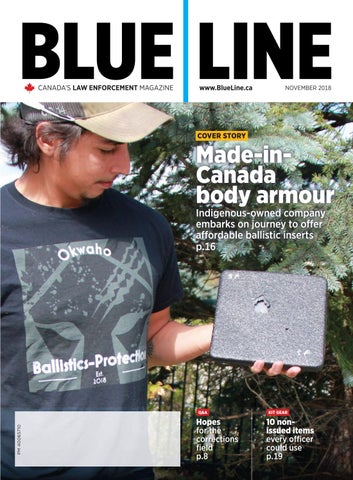
Made-inCanada body armour
PM 40065710
Indigenous-owned company embarks on journey to offer affordable ballistic inserts p.16
Q&A
KIT GEAR
Hopes for the corrections field p.8
10 nonissued items every officer could use p.19
22
PHOTO: ARMOR EXPRESS
Contents
November 2018
Columns
Volume 30 Number 9
4 8 11 12 13 23 24 30
Features COVER STORY
Editor’s commentary Q&A Holding the line Deep blue Health & wellness Technology Case law Back of the book
16 Coming soon: Indigenous-owned, made-in-Canada body armour plates Raymond Janvier has launched his online business, Okawaho Ballistics-Protection, and is in the thick of seeing his designs for personal ballistic armour inserts become a certified reality. By Renée Francoeur
19 10 non-issued kit items every officer could use More often than not, many officers seem to eventually feel the need to customize their kits to maximize efficiency, effectiveness and reduce weight. Here are examples of some fun bonus items to toss in. By Boris Milinkovich
Departments 5 5 6 7 27 27 29 30
By the numbers News Calendar Dispatches Off the shelf Product showcase Marketplace Blue Links
22 Active shooter preparation & best practices in the world of equipment
COVER PHOTO: R. FRANCOEUR
Though protocols may differ regionally, there are standard approaches that should be considered for responding to mass-casualty incidents. One of the two critical components is innovative protection equipment. By Frank Cappo
8 @Blue_LineMag
5
19 November 2018 | BLUE LINE
3
Q&A After spending 34 years in the Canadian Armed Forces (Reserves), Kevin Junor found his way into corrections, though it was never a field he thought he’d develop an interest in. Today, he is the deputy superintendent of administration at the Ontario Correctional Institute (OCI) in Brampton. He shares with Blue Line his passion for leadership development, change management and his hopes for the corrections field. Q: Your career started in the military. What was your experience like there?
Q: How did you find yourself in corrections? I honestly had zero interest in corrections. I worked for the Ontario Public Service (OPS) Diversity Office as a program advisor with the 8
BLUE LINE | November 2018
Q: What do you like most about the field?
“I think the industry needs to seek the answers in places where management and the union are working together...”
- Kevin Junor
Ministry of Government Services and had the opportunity to look at diversity across OPS. Part of that role was to brief my deputy minister prior to her meeting with other deputies. After developing a relationship with the deputy minister and assistant deputy minister for Corrections, I was asked by them if I’d ever considered a career in corrections. I was told it’d be a fairly
Corrections is all about people... it’s about having an impact on the lives of individuals. If we demonstrate the behaviour that we expect from the inmate or residents, then we can initiate a change within them. We need to do that continuously... my grandmother, who was one of my biggest influences, used to say, “Practice makes perfect,” and the military teaches if we practice something often enough, you’ll just do it.
Q: How was working at the notorious “Don” Jail in Toronto? There’s a phrase I learned at the Don www.BlueLine.ca
PHOTO: R. FRANCOEUR
I joined the Canadian Forces Reserves in 1980, as an infantry soldier in the Toronto Scottish Regiment. A recruiter came to my high school and said I could have a summer job for as long as I wanted it. By the time I was 18, I was teaching the recruit course. The military in general is known as the best training ground for leaders and they identified my leadership potential right up front so I was constantly challenged. You are pushed to your breaking point and then they give you the skills to make improvements. The military was a period of continuous growth for me and I developed as an infantry leader. In 2003, I was appointed as a diversity advisor for the Canadian Forces Senior Leadership Team. I was a regimental sergeant major for the Toronto Scottish Regiment and I later deployed as a senior military advisor to the Republic of Sierra Leone Armed Forces in 2007, where I developed the first leadership course for regimental sergeant majors in Sierra Leone. As a descendent of the Jamaican Maroons, this was a pivotal moment for me — being able to give back to Africa. It was one of my most memorable moments.
easy transition because of my military background, though a number of challenges with the culture were pointed out. So, in 2011, I started at OCI, job shadowing officers and managers, getting to know the people and various roles and shifts of this 24hour treatment centre. From there I was moved to the Toronto South Detention Centre, to assist with the opening for Phase 1, the Toronto Intermittent Centre. My primary responsibility was to ensure everyone was adequately trained. I learned a lot there from my superintendent, Jennifer Alphonso, and had many conversations with the vice-president of the union, who did a great job challenging the status quo. These relationships were important for me to better understand the corrections culture.
— they said if you worked at the Don, you could work anywhere.... Every institution has a different culture and the culture there was different, yes, so it was important for me to get into the minds of those individuals who knew the Don, shadowing them. Within a couple months of being at the Don, the organization’s structure was changed and I became deputy superintendent of operations. Regardless of my lack of experience, I had to deliver... I’ll tell you, my first three weeks as deputy of operations was more stressful than being on tour with the military. Morning meetings were mandatory and I knew we had to make some changes, such as realizing we had to always be on top of our game. Some individuals were relaxed on the job; we had to emphasize we were responsible for the care, custody and control of the inmates. I left the Don before it closed, after about a year and a half, and was transferred to Maplehurst Correctional Complex in Milton, as the deputy of operations. I then became the manager for Emergency Response Training at the Corrections College.
Q: What is your proudest moment in corrections so far? I was on the subway one day going to a board meeting — I sit on a number of community boards. An individual came up to me and tapped me on the shoulder. He said, “You probably don’t remember me but I was at the Don when you were there.” He said he was out now, in a good relationship, had a new baby and was definitely not going back to jail. He asked about myself and I told him I was at the college at that time, training new correctional officers and he said, “Well, they’ve got the perfect person for the job because if the new officers can treat people the way you treated us, I think corrections will be a better place.” That in itself sums up what being a correctional professional is at the core. @Blue_LineMag
Q: How do you see the culture changing? Just coming full circle and returning to OCI was a huge change because here, it’s about treatment. Every resident here wants to be here; they go through rigorous application and further assessment upon arrival to OCI. So that in itself has been a change and it’s true, the culture of corrections is changing. We’re moving to a case management system where the officers, psychologists, social workers and supervisors work with the residents so they can own what they did wrong and seek ways to improve by developing strategies to change the thinking behind the wrong behaviour. OCI is the leader in case management for corrections. We will be able to assist other institutions in the transition as the new Correctional Services and Reintegration Act 2018 requires a focus on case management across the entire ministry. The current OCI model is being refined and introduces improved case management to further impact recidivism.
Q: How have you seen technology influence the industry?
Snapshot of the Ontario Correctional Institute (OCI)
220
capacity at OCI
7
months is the minimum period of incarceration/ rehabilitation for Short Term Treatment Unit at OCI
Q: What is your advice to others looking to become involved in corrections?
Years ago, we would write things down. Now we have a desktop. Every institution has a body scanner... The previous technology (using metal detectors) wasn’t working as well due to the ability to smuggle in non-metal contraband. As technology changes, we have to be in transition mode. We must motivate our team to want to use that technology. After all, it’s provided to make the environment safer. At end of day, we want everyone to go home safe but the buy-in from the team is what we need — and for them to use new technology consistently.
Q: What is your hope for corrections? I’m not sure what corrections will look like down the road but I’d like to see it get to the point where we
have correctional professionals that are really proud of what they do. When you’re proud of what you do, it translates into everything else. I think the industry needs to seek the answers in places where management and the union are working together, with a results focused approach. I hope people ask more things like, “How do we make this place work efficiently so when officers go home, they’re going home well, and residents go home better people — not adversely impacted by a negative corrections culture?” We don’t communicate as well as we should... Let’s get back to the days where we can sit down and check in with each other on a regular basis, even if that’s just asking, “What’s going on?” I want officers to know that as a supervisor I’m open to conversations and that the organization is supportive of them... Let’s look at the leadership approach versus the management approach. Managers make sure you abide by the policies and procedures. Managers do things right. Leaders do the right thing.
Visit youtu.be/ W2_LXct3z1s to watch the video from Kevin Junor’s interview.
A correctional professional must be people focused. You must have a tough skin — the majority of inmates will follow directions but there will be a percentage that does not want to be here and they will give you a hard time. You have to understand it’s not because they hate you; it’s because they don’t want to be here and, for the most part, lacked structure growing up. It’s not about you. Know yourself. It’s a great job, it pays well, but if you don’t fit the organization, you’re going to question each day, “Why am I here?” Once you start saying that, you’ll be dragging yourself in. When you stop enjoying the job, it becomes a long day. Make sure you choose this career because it’s something you want to do for a long time. November 2018 | BLUE LINE
9
NEW E-COMMERCE WEBSITE NOW ONLINE AT WWW.DISTRIBUTIONELITECANADA.COM
]
DOWNLOAD OUR LATEST 400+ PAGES CATALOG HERE !
LOGIN TO THIS SECTION FOR INDUSTRY SPECIAL PRICING
First Tactical® Now Available in Canada Founder of 5.11® Tactical, Dan Costa, took his expertise and passion for creating high quality products and founded First Tactical. A tactical brand that focuses on innovative features that create solutions for first responders. These solutions come directly from feedback during field testing with Law Enforcement, Firefighters and Emergency Medical Personnel. Now, for the first time, First Tactical products are being offered to dealers and first responders across Canada. The full line of products can be found on FirstTactical.ca or at your local retailer. “We are honored to partner with some of the hardest working dealers and distributors in the world, and could not be more excited about our partnership with them,” expressed Costa. Listen, Engineer, Field Test, deploy: Has been the culture that has driven First Tactical to its success. This culture will continue in order for our first responders to have the highest quality products that are designed to help them to focus on their daily duties.
www.FirstTactical.ca
/firsttacticalcanada
Our Mission • We W believe that those who serve to protect our communities should be treated like family. • We will earn the trust and respect of Public Safety Professionals and those who serve them. • We will provide the highest quality duty apparel, footwear and gear at reasonable prices.
/firsttacticalcanada
NOW AVAILABLE IN
CANADA 1
THE DEFENDER SHIRT With cotton and Cordura® nylon fabrics for breathable stretch and the next level safety No Melt, No Drip construction, this shirt is built to perform.
1
2
FIRST TACTICAL® BELTS From the ergonomic design of precurved, reinforced nylon webbing to their maxed out versatility, our belts do more than hold your pants up.
3
HARD KNUCKLE GLOVES
4
DUTY KNIFE
5
THE V2 TACTICAL PANT
6
SPECIALIST ROLLING DUFFEL
2
3 4
5
6
Snag-proof stretch offers precise, professional fit, while the Pistol Grip Palm™ and U-Shaped Thumb Gusset provide superior weapons handling and recoil control. First Tactical® has several duty knives to choose from, each designed to cover any need you might have in the field or at the range.
This pant is all about resisting tears and stains without sacrificing tactical performance or comfort with brand new ARMS fabric. Tech meets Tactical.
Lightweight, collapsible construction doesn’t sacrifice heavy duty rigidity in this large body, go-anywhere duffel.
FIRSTTACTICAL.CA FOR A LIMITED TIME
10
% OFF
PROMO CODE: FTCA10
COVER STORY
Coming soon: Indigenous-owned, made-in-Canada body armour plates Indigenous man sets sights on developing highend — but also affordable — protection for law enforcement and beyond By Renée Francoeur
I
t all started with a sketch. Raymond Janvier, 28, was training to become a dance instructor in Hamilton, Ont. earlier this year when he began doodling body armour shapes and designs in his dance step notebook. By March, he had registered his business, Okawaho Ballistics-Protection, and those ink drawings morphed into a reality. He is now in the final stages of preparing to offer his own line of personal ballistic armour inserts. “These ballistic inserts will be approved as NIJ (National Institute of Justice in the U.S.) Level III category, which means they will be capable of stopping multiple nonAP rounds up to .308 or 7.62mm for rifles and up to .44 magnum for handgun rounds,” Janvier says. Okawaho, currently an online store (okwahobp.com), went live in September 2018 and at the moment customers can only purchase a tactical kit and products from Shadow Elite/Shadow Strategic through the site. Janvier says he anticipates his plates will be ready to sell online by the end of the year and hopes to have a storefront up and running in Ottawa in about nine months. “The end goal is to provide quality tactical kit to our law enforcement and military personnel and have it as affordable as possible,” Janvier 16
BLUE LINE | November 2018
NIJ The National Institute of Justice, the North American agency with the body armour standards and testing program
Level III NIJ armour protection level tested to stop 7.62mm FMJ lead core rifle ammunition
200
$
approximate price of an Okawaho Ballistics-Protection plate
says. “I want to set a new precedent. You shouldn’t have to pay extremely high prices for something to protect your own life.”
Airsoft connection Janvier has always had an interest in battle dress uniforms and firearms, as he grew up with a number of extended family members in the marines. “I was heavily influenced by the military and police,” he says, noting this was instrumental in his character building and the way he sees the world today. He took the police foundations course at Niagara College and worked in security for a number of years. He is also a member of a professional airsoft team and competes throughout Canada and the U.S. In fact, it’s a world where he’s a “little bit” of a celebrity; the team was playing recently in Illinois and Janvier had his first experience signing an autograph for a fan who picked him out of the crowd. Airsoft is the arena where he became involved in tactical training, such as room clearing, and where he made a number of valuable body armour connections. For example, The Requirements Group — manufacturer of the Shadow brands — is a sponsor of Janvier’s team, which is how he began distributing for the company. www.BlueLine.ca
Raymond Janvier tested his body armour plates himself with a .45-70 at 28 yards. He made the hole where those bullets hit even bigger to show how the spall protection coating works.
“So, I’ve always had an eye out for body armour,” he explains. “But everything I found was made in the U.S. and extremely expensive... I’ll be charging $200 for my plate and the typical price tag for a plate of this level is anywhere from $400$500... It just goes back to the way I was raised... it’s not the Native American way to take more than what you need.”
PHOTOS: R. FRANCOEUR
Profound protection After Janvier worked and reworked those initial sketches until he had them they way he wanted, he made a slew of calls to find the base metal for the plates. “I’m about real-world results; I’m not a procrastinator,” he says. “And I can’t sit around.” He settled on an AR500 steel plate that will be cut at a facility in Alberta in two shapes initially: a square one for backpacks or briefcases and the Sapi (also known as “shooters”) chest plate cut for tactical vests. It then took more exhaustive research online, via phone and in-person for about another month and a half to find a good composite for spall protection. Ballistic fragmentation, or spalling, “is the fragmentation of the target caused by the impact of the projectile, not fragmentation of the projectile itself,” according to an Abbey Supply blog article last year detailing the different between bullet splash and spalling. “Spalling is not caused by the bullet penetrating the target, but the target deforming in a way that allows the rear of the target to fragment.” Spall protection catches those fragments, Janvier explains, and
brought out a prototype of his plate, which he tested himself (he tested it with a .308 and a 7.62x50 at 100, 50 and 28 yards as well as with a .45-70 at 28 yards.) He made the hole where the .45-70 bullet hit multiple times even bigger to show how the coating “caught” all the fragments, preventing any damage to the other side of the plate. “The only scratches on here are from my fingernails, trying to feel for a bump but there’s no bump and that was a heavy bullet.” The coating Janvier eventually opted for features an important moisture barrier and he notes he will be spraying the sides of the plate as well as the front and the back to give it a longer shelf life. The plates will be sprayed at a local facility in Hamilton until Janvier’s own warehouse is ready — he will continue to work out of his home in the meantime. He can’t yet share the name of the company he found to source this blast mitigation coating, but can say they are a “giant company” with customers in the automotive aftermarket and beyond. “When I get into production, they are going to be sending me a bulk shipment so I can have it just for my company... This specific coating product has not yet been supplied to their Canadian stores so I will actually be the first to have it here,” Janvier says. “I want police tactical units, SWAT units to be as protected as possible.” Profound protection is the overall theme for Janvier’s mission statement. That’s why he named his company what he did: Okawaho means wolf in Mohawk.
“I want to set a new precedent. You shouldn’t have to pay extremely high prices for something to protect your own life.” - Raymond Janvier, Okawaho Ballistics-Protection owner
@Blue_LineMag
November 2018 | BLUE LINE
17
COVER STORY
Ballistic fragmentation, or spalling, “is the fragmentation of the target caused by the impact of the projectile, not fragmentation of the projectile itself.”
dards here on home turf — NIJ is the only body in North America testing body armour and providing standards, but it is U.S.- based.
Future plans
Janvier and his partner, Kristina Bradbury, hope to see the expansion of Okawaho Ballistics-Protection.
Watch a video from Canadian Bushcraft, a Native-owned wilderness survival school, featuring Janvier testing his plate at bit.ly/2yCtHyt.
“The wolf is the protector in my culture and I am of the wolf clan,” he says. “I’ve always been a protector.”
Certification At the time Janvier sat down with Blue Line, he was just about to send out nine of his plates to a laborato-
ry approved by the NIJ to be tested for the Level III protection level and the NIJ Standard-0101.06, “Ballistic Resistance of Body Armor,” which is a minimum performance standard developed in collaboration with the Office of Law Enforcement Standards (OLES) of the National Institute of Standards and Technology (NIST). Testing should take about a week, he says. “If I’m approved, my company will be added to the NIJ list of companies for certified body armour...This is an important list because all the North American customers look at it.” He plans to continue researching to get his company name up on government auction sites. Down the road, he says he also wants to work with the Canadian government to create similar stan-
Though not currently in production, Janvier says he has 12 individual sales lined up already. “We will have bulk order deals, too,” he adds. “ We have to keep in mind, for those in B.C, Alberta, Manitoba and now Nova Scotia, where there is legislation in place, you have be authorized to purchase these plates.” He plans to expand his offerings in the future and include a groin plate, kidney plate, K9 armour and wants to look into his own line of riot shields. Within four years, he hopes to have two locations, one being on the west coast, and his 10-year plan includes a location in the U.S. “I want to be the industry leader in Canadian body armour. And I want to work with as many people as I can to help save lives.”
Body armour forged in the Great White North Who else is manufacturing and selling body armour here on Canadian soil? What is Okawaho Ballistics-Protection up against?
PHOTO: CANARMOR
Bill Geraghty, the owner of Body Armour Canada, has been selling ThorShield since 2016 and told Blue Line the products he sells are made in either the U.S., U.K. or Pakistan (gloves).
18
BLUE LINE | November 2018
Similarly, Mark Yager, the general manager of Sigma Safety Corp., noted they have been working with American company Armor Express for about eight years. “We don’t sell any armour that is made in Canada,” Yager said in an email. “Generally those manufacturers sell direct (some do a little through dealers) so there isn’t much room for a dealer like us to get involved in those.” There is only one Canadian body armour manufacturer: Canadian Armour LTD., also known most popularly as Canarmor, which offers a full range of body armour, from bulletproof vests to ballistic helmets. “I will be asking Canarmor if they want to supply my plates,” Janvier says. “I do want to work with them. Their main focus is body armour, whereas I do body armour and tactical kit. They’re a Canadian company and I think it’d be great to have both companies supporting each other.” Canarmor carries out all of its processing and development in a warehouse in Keswick,
Ont., and it also boasts a retail store/ showroom in Richmond Hill, Ont. It began production in July 2010 as a small operation selling bulletproof vests to local companies and now it sells to “thousands of individuals and companies across the world.” (Focus Product Inc., out of Oakville, Ont., is Canarmor’s official distributor and reseller.) Canarmor’s general manager, Robert Razgoev, notes they do have quite a few law enforcement clients, including the Royal Canadian Mounted Police and departments of the Canadian federal government. The company carries large amounts of its body armour in stock and is also able to do custom orders and designs upon request, he adds, thanks to highly-trained machinists. As of September 2018, Razgoev says he is the only one providing made-in-Canada body armour but he welcomes new ideas from his fellow Canadians with an interest in the market and looks forward to seeing what lies ahead for more protective gear made here on home soil.
www.BlueLine.ca
KIT GEAR
10 non-issued kit items every officer could use
in handy. Just imagine: welfare checks without smashing windows and doors, gate padlocks opening without the key. Lock picks and lockout kits are also good for vehicles. Be sure to get trained and then use your new-found powers for good. www.lockpicktools.com
Tourniquet
It’s time for a kit check. Here’s a list of some fun (and important) things you might want with you on patrol and beyond. By Boris Milinkovich
W
PHOTOS: BORIS MILINKOVICH
ork kits can be lacking; that’s not news to those of us working in law enforcement. Sometimes they’re a poor fit. Other times, the kits are just not specific enough to the environment. Regardless, more often than not, an officer seems to eventually feel the need to customize his or her kit to maximize efficiency, effectiveness and reduce weight. Here are some examples of my favourite bonus items to add to a duty rig or duty bag.
Hard case
needs. From storing a cell phone, protecting sensitive evidence or equipment, or carriage of firearms, Nanuk has you covered. I personally rely on my Nanuk 935 (a wheeled case made from strong, impact-resistant, lightweight NK-7 resin) to protect my training equipment on the go. They also offer discounts for law enforcement and military members. www.nanukcase.com
If you’re looking for a protective case for your equipment, Nanuk cases are made in Canada and military tough. They come in a wide variety of configurations for all your
Lock pick/lockout kit
@Blue_LineMag
Having the ability to lawfully and effectively enter premises or bypass a lock without damaging the hardware can come
It’s an unpredictable world out there. In addition to having a first aid kit in your vehicle and station, your personal first aid kit should reside on your person/duty belt/ vest/ankle and ensure you have a quality tourniquet and the training to use it. It can greatly enhance your ability to save a life, including your own. I stock the Combat Application Tourniquet (CAT) in my car and home first aid kits and I sometimes revert to the RATS Tourniquet when a lighter option is needed. There is a lot of banter about which one is “better,” but I’d suggest that anything is better than nothing. They range in price and design, so you can select one that best suits your needs, but I’d suggest having multiple kinds of tourniquets on hand and in your car. www.combattourniquet.com www.ratsmedical.com November 2018 | BLUE LINE
19
KIT GEAR
Tactikey
Duty knife
tion clicker pen with a clip. It is less expensive than marketed “tactical pens” yet it is as equally effective, in my opinion, as an improvised weapon without the “tactical” look. It will even do extra duty as a glass breaker for car windows in a pinch. It’s built tough and is very affordable. zebrapen.ca
Back-up restraints – the Hand Cop
This is a small, lightweight, go-anywhere force multiplier. It is ideal to add to your everyday keychain, but is also perfect for when you’re working lower-profile operations in less-permissive environments. It functions as a handle for a regular house key (compatible with Kwikset) but provides an ergonomic grip to both use the key as it was intended and as a striking weapon while protecting your hand and enhancing a supported grip. It comes in a variety of colours, has a lanyard/key ring hole and is injection moulded from highstrength polymers. www.tactikey.com
Counter-custody escape kit
One of the most indispensable tools you can take with you every day is a sharp, strong and dependable knife. Everyone has their own opinion on knives. My advice is to find the best fit for you. Take into consideration ergonomics, quality materials, ease of maintenance and dependability. Buy the best one you can afford. Nice-to-have features include a window punch, partially-serrated blade and thumb hole — think about cutting seatbelts quickly to save lives or as a last-ditch defensive weapon. This should all be factored in to your decision-making process. I carry the RAT-2 by Ontario Knife Company (amzn.to/2QQKUg6) and sometimes the Ka-Bar TDI on a cross-draw. Spyderco (amzn.to/2zm8xGl), Cold Steel and Ka-Bar (amzn.to/2xvba7m) all make high-quality, folding knives. You can augment your kit with a small box cutter in your vest pocket as well.
Having back-up restraints, augmenting your issued handcuffs, can help you in a jam. Either disposable “zip tie” styles or reusable styles, such as the Hand Cop, can be used for not only aiding in restraint of additional suspects, but are unobtrusive, non-metallic, heat-, abrasion- and fatigue-resistant. They can be carried anywhere and used to secure commercial doors in an active shooter scenario as well. The Hand Cop is available through www. oscardelta.co.uk and www.truenorthtradecraft.ca.
The Mark
Non-tactical-looking tactical pen
Always have an escape plan. Learn how to escape unlawful confinement or custody should your handcuffs be used against you. Depending on the particular setup, it can include various tools (saw, shim, key, pick and glass breaker, light) to aid in defeating a variety of restraints and affect escape from unlawful confinement while maintaining a low profile. Be sure to attend training and learn how to use these tools — available through www.truenorthtradecraft.ca and www.oscardelta.co.uk. 20
BLUE LINE | November 2018
You’re used to carrying a few reliable pens... In fact you’re usually always holding one. This can come in handy — given it’s the right kind of pen — if something drastic happens too quickly and you are too short on time to grab your equipment. Enter the Zebra 701, an all-stainless-steel construc-
“The Mark” (an S-shaped polymer hook tool) doubles as a hook-hanger for duty gear, clothing, bags, etc., but also as a non-metallic, impact-striking tool. It is surprisingly strong and can hold over 20 lbs. It weighs next to nothing, lies flat and takes up almost no space. The Mark can also be used to prop doors behind you allowing back-up entry into a building. The Mark comes in several colours and is made in Canada by Delta 2 Alpha Design. www.delta2alpha.com www.BlueLine.ca
“The Zebra 701 tactical pen will even do extra duty as a glass breaker for car windows in a pinch.” Antiseptic wipes
Make a Difference JUSTICE STUDIES FOR WORKING FRONTLINE OFFICERS
At Humber, we teach the professional and practical skills you need to move up and make a difference in your community and in your career. Further your education one course at a time or work towards a certificate, diploma or degree. Advanced standing is available to those in the Justice Services industry.
communityservices.humber.ca /justiceprofessionals
You never know when you’ll need to clean yourself up after all, and you may not have a chance to get back to the station. Too often these are the types of things we forget to pack in order to remove the dirt and grime of the streets, spilled coffee, etc. They always come in handy so keep a pack in your duty bag and one in your cargo pocket. You can pick them up at drug stores all over. There is no “one-size-fits-all” solution to having the best kit as a law enforcement officer, but knowing exactly what extra addons are available — beyond what’s in your issued kit — can lead to closing a gap you didn’t even know you had. Customize your kit and be prepared for unforeseen eventualities with some extras. Plus, don’t forget, stocking-stuffing season is right around the corner — get started on your wish list now! Stay safe and stay crafty. Boris Milinkovich, CD, has served 20 years in federal public service. He has served with Canada Border Services Agency and Transport Canada in Marine & Aviation Security and Training & Liaison. He is a member of the Canadian Armed Forces (Reserve) and has served in Infantry, Intelligence and Military Police (current) capacities since 1998. He is currently the owner and training director at True North Tradecraft, teaching specialized courses in covert methods of entry, counter-custody and more.
@Blue_LineMag
BODYGUARD TM
Apparel
Ɣ Cost Effective Uniform Solutions Ɣ Great Quality Ɣ In-Stock Items Ɣ Quick Turn-Around 905.565.7576 1.800.996.9499 sales@spirito.com
www.spirito.com
BODY ARMOUR
Active shooter preparation & best practices in the world of equipment By Frank Cappo
A
ctive shooter incidents are dynamic (typically lasting 10-15 minutes) and may vary significantly from one attack to another. Most often these events involve deadly physical force perpetrated by an individual(s) against victims in a confined space or populated area. In the majority of cases, active shooters use firearms and there is no pattern or method to selecting their victims. Sadly, we see all too often the global news headlines on active shooter events and the tremendous risks and sacrifices made by law enforcement officers and first responders when duty calls. The 2014 shooting of a reserve army corporal in Ottawa, the 2017 Quebec City mosque shooting and the van attack earlier this year in Toronto are some recent examples in Canada. And just south of the border, the U.S. has experienced its own tragic events, including the deadly ambush in Dallas, Texas and the Mandalay Bay shooting in Las Vegas. A key lesson learned from all the tragedies is that preparation and application of best practices are crucial for those who are sworn to protect and serve the public. Though protocols may differ regionally, there are standard approaches that should be considered for the efficient and effective response to mass-casualty incidents. Two of the critical components are evidence-based active shooter training and innovative protection equipment designed to safeguard law enforcement officers and first responders. Failing to prepare and having certain action plans in place can mean the difference between life and death. As agencies ramp up their strategic training programs to help officers enhance their skills, they’re also very focused on equipping their men and women with advanced body armour such as ballistic vests and other tactical gear including helmets, hard armour plates and shields. This equipment enables officers to quickly engage an armed individual and address the threat while being protected. Today’s high-tech armour solutions are capable of stopping high-powered weapons, which, according to a study
22
BLUE LINE | November 2018
A ballistic panel undergoes testing during research and development stages at Armor Express. PHOTO: ARMOR EXPRESS
published in the Journal of the American Medical Association, were used in about 25 per cent of active shooter incidents in the U.S. from 2000-2017. In helping to drive agency adoption, body armour makers are increasingly researching and developing equipment that can meet mission-critical needs. These include state-of-the-art concealable, overt and tactical carriers, which provide greater coverage, flexibility and comfort; ballistic and non-ballistic helmets that offer extreme stopping power and lightweight benefits; as well as ceramic and steel plates designed for rapid up-armouring and capable of withstanding today’s rifle round threats (an officer can quickly adjust the protective capabilities of their soft armour/ concealable or overt vest). Ground-breaking solutions are available today, which provide better protection than ever before. Law enforcement departments should carefully consider these as part of their comprehensive emergency response protocol.
Ballistic carriers that meet the demand for speed and adaptability: These offer patrol officers and task forces the ability to rapidly don and doff, as well as tremendous maneuverability and scal-
ability. The latest overt carriers provide an extremely light, low-drag and durable option, and are designed to fit most hard armour plates and soft ballistic plate backers.
Hard armour plates and ballistic helmets that deliver stopping power, modular and lightweight protection: Advanced, special-threats tested hard armour plates provide the most robust protection against high-velocity ammunition and can be used in conjunction with soft armour or as a stand-alone. Made from the world’s strongest and lightest materials, new-generation plates offer extraordinary ballistic resistance and flexibility for any encounter. In addition, innovative ballistic helmets bring first-rate protection to law enforcement, anti-terror and specialized police units who may be exposed to close quarter combat and a greater risk for being shot within the head region. They deliver scalable, high-level impact protection, ventilation and comfort.
Breakthrough protection leads the way now and into the future: Focusing on the up-armour concept, the most effective “Active Shooter Kits” comprise a complete solution set that enables officers to immediately and easily upgrade their protection when a threat situation escalates. The industry is in an exciting period of game-changing body armour technologies and designs that bring significantly lighter weight, stronger, more multi-threat solutions needed to keep our first responders safe when duty calls. Not to mention, more cost-sensitive options for departments, many of which operate with modest budgets. Learn more by viewing the recent free webinar on first responders preparing together for active threats hosted by Blue Line, Canadian Security and Fire Fighting in Canada. Watch it now at: www.blueline.ca/webinars/active-threats-are-youprepared-webinar-5574.
Frank Cappo has close to a 20-year career in the body armour, protective solutions and public safety industry. He spent 12 years as a police officer in Overland Park, Kan., working in patrol, SWAT and in other positions. Cappo now leads Armor Express’ domestic and international sales efforts, responsible for the law enforcement, corrections, fire & EMS, private security, and federal market segments.
www.BlueLine.ca
CASE LAW
BY MIKE NOVAKOWSKI
Officer should have confirmed warrant
A
n officer who believed, but failed to confirm, a warrant existed made an unlawful arrest the Saskatchewan Court of Appeal has ruled in tossing out drug charges. In R. v. Kossick, 2018 SKCA 55, a police officer on patrol spotted the accused, a cyclist, who he recognized from previous interactions. The officer was aware Kossick was a suspect in a recent bicycle theft and the officer had received an email about nine days earlier from a colleague that a warrant for Kossick’s arrest had been requested. The officer radioed his colleague and was informed Kossick was still arrestable. The officer followed Kossick and ran his name on the police computer but did not read or review the information database to confirm the existence of the warrant, which had actually been executed four days earlier. The officer stopped Kossick in an empty parking lot, advised him he was under arrest for theft under $5,000, placed him in handcuffs and searched him incident to arrest. In Kossick’s pockets, the officer found $90 cash, two cellphones and a baggie of methamphetamine weighing 3.82 grams. After the search, Kossick told the officer that he had already been arrested and released in relation to the bike theft. The officer then checked the police databases and confirmed Kossick’s earlier arrest and release. The officer informed Kossick he was no longer under arrest for the bike theft but, instead, was now under arrest for possessing a controlled substance and breaching his release conditions. As a result of searching Kossick’s cellphone, the officer ultimately charged him with possessing methamphetamine for the purpose of trafficking, possessing property obtained or derived from crime, breach of undertaking for failing to keep the peace, and breach of undertaking for possessing non-prescription drugs. At his trial in Saskatchewan Provincial Court, Kossick argued that his arrest for bike theft breached his s. 9 Charter rights and that the searches of his person and phone incident to that arrest breached his s. 8 Charter rights. In his view, the evidence of the drugs, cash, cellphones and data extracted from the cellphones ought to have been excluded under s. 24(2). 24
BLUE LINE | November 2018
“Police reliance on erroneous information may be considered objectively reasonable ‘unless, in the circumstances at play in the arreste situation, the police could reasonably have made inquiries which would have led to the discovery of the deficiencies or defects’ in that information.” - Justice Caldwell The judge found the bike theft arrest unlawful. Although the officer subjectively believed there was an arrest warrant, the officer’s belief was not objectively reasonable because he could have reasonably made inquiries to discover that his colleague’s advice was defective. Therefore, Kossick was arbitrarily detained under s. 9 of the Charter and the searches incident his arrest breached s. 8. The judge also found the searches of Kossick’s cellphone unreasonable. The judge went on to exclude the evidence under s. 24(2) and Kossick was acquitted of all charges. The Crown appealed the accused’s acquittals before Saskatchewan’s top court arguing that the judge erred by finding the arrest unlawful, the searches unreasonable and in excluding the evidence.
The arrest Since the warrant authorizing Kossick’s arrest had already been executed, the Crown had the burden of proving the offi-
cer had reasonable grounds for the arrest. This would require proof that the officer subjectively believed Kossick was subject to an arrest warrant or was otherwise arrestable and that this subjective belief was objectively reasonable. The Crown submitted that the police could make a valid, warrantless arrest based on erroneous information. Justice Caldwell, delivering the Court of Appeal judgment agreed, but found such a broad statement was not without qualification. “Police reliance on erroneous information may be considered objectively reasonable ‘unless, in the circumstances at play in the arrest situation, the police could reasonably have made inquiries which would have led to the discovery of the deficiencies or defects’ in that information,” he said. Caldwell went on to conclude that the trial judge did not err when she found the circumstances had reasonably permitted the officer to inquire into the veracity of the information he had received about arresting Kossick. He could have taken the time to access the police database information. After all, the officer had entered Kossick’s name into the police computer as he followed him and the information was readily accessible and correct. Instead of accessing or reading the information available about Kossick before making an arrest, the officer did not do so until after the arrest. There was no urgency to the arrest in the circumstances and the officer could have waited until after he confirmed the information before making it. Had he done so, the computer inquiries would have disclosed the inaccuracy in the information he had received from his colleague.
The searches For a search to be reasonable as an incident to arrest, the arrest must be lawful. Since the accused’s arrest was found to be unlawful, the searches that uncovered the cellphones, methamphetamine and cash were unreasonable and breached Kossick’s s. 8 Charter rights. The Saskatchewan Court of Appeal also found the trial judge applied the appropriate legal framework in her s. 24(2) analysis and did not err in excluding the evidence. The Crown’s appeal was dismissed. www.BlueLine.ca
PRODUCT SHOWCASE Find more product info at www.BlueLine.ca/products
HD Code Blue: A 2D code for first responders
Tiger Tough Tactical seat covers Tiger Tough Tactical seat covers are built specifically for law enforcement vehicles. They are made out of 1000 denier “ballistic” nylon and have an extra layer of reinforcement over the lower lumbar area of the seat-back cover. The combination of the material used with the extra layer of fabric results in an extremely tough cover, meaning seats won’t get dirty and chewed up. The covers are easy to remove and wash. They have a waterproof backing, so spills won’t make their way through to the seat fabric. You can even get your department’s logo or other text embroidered in the cover. Tiger Tough also has heavy duty seat covers for pickup trucks and other heavy vehicles as well. sigmasafety.ca
In the event of an emergency, time is of the essence, and having the right information available could be lifesaving. HD Barcode, LLC has developed a complete solution designed to assist officers with accessing important information about their injured or fallen colleagues. HD Code Blue is a turnkey solution designed to help users embed comprehensive medical data of officers and their emergency contact information into a private 2D code that is only readable by department-issued approved reader devices. Personal information such as blood type, allergens, medications, emergency contacts, and other critical information is first input into HD Code Blue’s data entry program. With customizable templates, complete administrative control, and the ability to import or export to third party software, this process can integrate into existing personnel data entry procedures. This information is converted into a secure 2D code called an HD Barcode, and printed directly on or applied to personal identification cards via a small label. www.hdbarcode.com
Cushioned comfort for your feet on shift Wiivv custom insoles are what you need to do your duty in comfort. They are custom-made for your feet alone using photos taken with your phone. In full and 3/4 length with your choice of pattern, you can use them in patrol shoes, tactical boots, running shoes and more. The company states, “we keep you on your feet with cushioned comfort so you have one less thing to worry about on your shift.” Wiivv offers 10-day delivery, 30-day trial and one-year warranty on all products, with gratitude for your service. wiivv.com
Nightstick Dicata IXPP-5462 series headlamp
Pocket Shot now available in camo The Pocket Shot circular slingshot features a patent-pending, pouch design, which allows users to load and shoot different projectiles at two to three times the rate of a regular slingshot, according to the company, and can be used to stow ammo when not in use. There’s also an attachment for shooting arrows for archery enthusiasts. It measures five inches long in use, but only 2.3 inches by 1.3 inches when closed. It fires 1/4-5/16-inch steel slugs, marbles and small paintballs and is now available in a new colourway — Mossy Oak Original Bottomland Camo. www.thepocketshot.com
28
BLUE LINE | November 2018
The Nightstick Dicata ‘Intrinsically Safe’ headlamp was designed for fire helmets and hard hats, but also to function without interfering with face shields. The Cree LED spotlight and LED floodlight use of a series of Total Internal Reflection (TIR) lenses and two enlarged front-mounted buttons make it easy to toggle through the high/low beam options or have the spot and floodlight on simultaneously — even when wearing gloves. With a beam distance of 120 meters, the spotlight emits 275 lumens, while the floodlight emits 205 lumens. Nightstick also added an independently controlled amber, rear-facing light in order to identify other team members in dark, hazardous places. www.nightstick.com
LaCrosse Cold Snap boots New for Fall 2018, the LaCrosse Cold Snap boot is suited for late season hunting, ice fishing or simply getting outdoors in the winter. They feature Thinsulate Ultra insulation, LaCrosse DryCore waterproof lining and a specially formulated outsole made for cold weather traction. The boots measure 10 inches in height. lacrossefootwear.com
www.BlueLine.ca
Chief Officer Metro Vancouver Transit Police Metro Vancouver, BC As a result of the retirement of the Chief Officer, the Metro Vancouver Transit Police Board now seeks a proven policing leader who will be tasked with preserving the peace and serving the safety and security needs of transit passengers, transit employees and the general public in one of North America’s most acclaimed multi-modal transit systems, known as TransLink. Operational excellence is fundamental to the policing of the transit system, as is a clear focus on customer service and engagement. In this unique strategic and operational leadership role the new Chief will build on the success of the past in maintaining a shared vision of policing for the future of a large 24/7 major urban transit system. The successful candidate will work collaboratively with many partners and stakeholders (including among others, the public, the transit enterprise, transit users, other police agencies, the media, and local and provincial government leaders) to ensure continued delivery of exceptional policing operations as part of the larger TransLink enterprise. The ideal candidate will: •
• • • • •
bring proven experience working at an executive level within a police service that has community policing as a focus and uses modern systems, data and analytics to effectively deploy resources in today’s highly visible world of law enforcement; have excelled and earned the respect of peers and stakeholders in previous policing roles; have demonstrated exceptional skill in working collaboratively to develop and support effective and progressive partnerships with stakeholders; have demonstrated ability as a communicator; have experience working with Boards and Committees; and preferably, have a university degree in a relevant area of study.
Metro Vancouver Transit Police is a multi-jurisdictional policing agency dedicated to the provision of policing to the transit system in Metro Vancouver. The Transit Police comprises over 180 Sworn Officers plus 70 civilian staff. Its jurisdiction is the entire public transit system crossing twenty-one municipalities, which are also served by a combination of seventeen independent police forces and RCMP detachments that police these communities. The transit system that is operated by or on behalf of the regional transportation authority, known as TransLink, includes 144 km of rail, 63 stations, over 1,500 buses, one passenger ferry route, and 200 bus routes, spread out over 1,800 square kilometers. As a values-driven policing agency, Transit Police actions are tied to core values that guide and support each interaction that Officers have with transit passengers, transit employees and the communities served.
If you are ready to step up and take on a policing leadership role like no other in Canada, please visit our website at www.pfmsearch.com to view the Executive Profile for this position and submit your application, in confidence to Shelina Esmail and George Madden.
PFM Executive Search Tel 604.689.9970 | Toll-Free 1.800.864.9970 Suite 510–999 West Hastings Street Vancouver, BC V6C 2W2 www.pfmsearch.com