Volume 10
Number 9
November 1998 - Editor I Publisher -
Publisher's Commentary
5
T he L iveLink Television Network Toronto Police television training network is now being made available for all agencies
6
Morley S . Lymburner Phone (905) 640-3048 - Fax (905) 640-7547
E-mail: blueline@blueline.ca WEB PAGE: www.BlueLine.ca - News Editor Blair McQuillan General Manager Mary K. Lymburner, M.Ed. - Advertisin Mary Lymburner (Director) Phone (905) 640-3048 Fax (905) 640-7547
Helen Stoesz Phone (519) 251-9625 Fax (519) 251-9626 - Illustration Tony MacKinnon Steffon Sepa - Production Del Wall Blair McQuillan - Contributing Editors Ballistics & Firearms Manfred Benton Police Leadership Robert Lunney Joel Johnston Survival Tactics Gino Arcaro Case Law Tom Rataj Computers & Technology - CQIltributing Writers Dave Brown Blair McQuillan K. Grant Watkins David Hart Greg Gillespie Hal Cunningham Hayung Choi Dr. Glen Irons Blue LmeMagazineis published monthly, September to June, by Blue line Magazine tncorporated with a mailing address of 12A·4981 Hwy. 7East, Ste. 254, Markham. Ontario, L3R 1N1. Individual magazines are 53.5Oeach. Subscriptions are 525.00 per year or 540.00 for 2 years. (Overseas, 550.(0) All articles are protected by copynght No part of this publica han may be reproduced or transmitted In any form or by any means, electronic or mechanical. including photOCOPYing and recording or by any Informahon storage or retneval system without permission from the publisher Internet activity is monitored and use of material is restricted on the Internet. All matenal submitted for publication becomes the property of Blue Line Magazine unless other arrangements have been made with the publisher. The authors, adVisors and publisher accept no liability whatsoever for any injunes to persons or property resulhng from the application or adoption of any of the procedures, tactics or consideratIOns presented In this magame. Readers are cautioned and advised that artICles presented herein are edited and supplied for your personal awareness and should oot be used for further achon until appropnate advICe and guidance IS received from a supervisor, Crown Attorney or other person In authorrly Established tn t 988. Blue LineMagazinels an Independent publlcallOn designed to tnform, entertain, educate and upgrade the skills of those Involved tn the law enforcement profession. It has no direct control from a law enforcemert agency and ItS opinions and articles do not necessanly rellect the opinions of any government. police. or law enforcement agency. Blue Line Magazine is a private venture and as such is not funded by any level of government agency, union or association.
Blue Line Magazine is printed in Canada by Garson Graphic Services Inc.
- AffiliationsInternational Association of Law Enforcement Planners Canadian Advertising Rates & Data ~-"",.-~--, International Police Association The Canadian Press Newswire Periodical Publishers Exchange
ISSN #08478538 Canada Post Canadian Publications Mail Product Sales Agreement No, 176796
German M ilitary Police 10 Host 5th annual shoot at CFB Shilo Talking with Dino a u rs
12
T h e wisd om of ti mely ilence The strategic use of silence in investigative interviewing
14
Letters to the Editor
15
Book Reviews
16
Fallen leaves remembered
17
Crime and high-tech
18
I nd ustry P latform
20
La nguage Crimes The truth and consequences of the way we speak
24
Technology by Tom Rataj New threats to safe computing
26
Surveilla nce by Hal C unningham Choosing your clothing
28
Product News
29
CLassified
30
Ten-Seven News
31
Criminally Funny
38
List of Advertisers Aegis Bienville Uni versity Can-Thai Consul ting & Software Comnetix Dalhousie University DavTech AMS Ca nada DuPont Canada Dufferin Sheet Metal Fechheimer Fidelity Investments Henry's Camera Hi-Tec Sports Canada Joe Drouin E nterpri e Matte Industries Med icine Hat Police Service
5 13 25 27 9 35 7 11
2
19 30
21 8 16 19
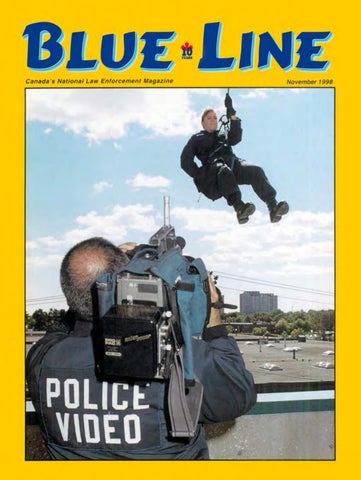
This month 's cover is dedicated to the hard working staff at the Toronto Police Video Training Unit. For over 15 years this unit has been producing police training an informational videos at an astoni shing rate They are now in the process of sharing their talents and abilities with any other agency in Canada using some hi-tech linkages an innovative cooperative efforts. Read more about this in this month 's edition on page 6 This issue also includes some very reo vealing concepts from two talented writers T he first article explains the use of trategic si lence in getting more information out or interrogations. The second article provide~. some background on how to analyse th statements you do get. Check out pages 14 and 24 to find out more. This month we also present another " Industry Platform" where various companie5 supply you with articles describing their own products in their own words. This month we present three companies who produce electronic mug shots and records management systems. We are certain this will provide our readers with a better appreciation and clearer understanding of this exciting technology. There is almost something for everyone in this month 's edition and we are worki ng hard on future articles that should keep you up-to-date in the new year.
Motorola Nine One One Outerwear Pads F itness & upply Prairie Geomatics Pride in ervice Pro Carry Systems R Nicholls Distributors Rocky Shoes & Boots Southwe t University Spacesaver orporation Tetragon Tasse The Walter Fedy Partnership Triform Virtual Depot Westervelt College
4
10 30 22
26 23,25,27 13
40 36 33 8 36 14
18 21
ill November, 1998 ________________--IV Glf-- - - - - - - - - - BLUE L.NE ______________________ YEARS
r
Magazin e
•
When you've got a symbol to live up to, you make it a point to be first on the scene. That's why Motorola was first to deliver Project 25 technology. With interoperability in a total integrated digital solution today. And the flexibility to incorporate future technology and network applications tomorrow. This is the ASTRO™ radio system from Motorola- everything you need in a communications solution. When you've got a symbol to live up to, you want the radio system that gives you pea e of mind. For more information on ASTRO technology, call 1- 00-247-2346. M;, Motorola, ASTRO and XTS 3000 are trademarks of Motorola, Inc. C1998 Motorola, Inc. http://www.motorola.com/project25
@ MOTOROLA RAD·99· 1083
PUBLISHER'S COMMENTARY
Some police agencies suffer from an identity crisis by Morley Lymbumer Two Ontario Provincial Police officers are alive today due to chance rather than design. The "chance" was a landowner 's poor aim with a rifle while the "design" wa what he may have thought he saw creeping through his property. When this landowner shot at the two officers last September they were searching his property for a run-a-way car thief. The new paper reports quote the landowner saying he thought he wa firing at a couple of crooks trespassing on his property. Crook! Cops! How could this guy figure what he saw was crooks instead of cops? Good common sense should have told him that even taking pot-shots at crooks on his property was not the proper way to do thing . He should simply call the police. But what would come to the door if he did call the cop . You would most likely get a bare headed cop (they don ' t like to wear hats you know! ) and then your next gue would be to look at the uniform. ope! othing there that says "police" in any way, hape or form either. In fact the only thing on an OPP officers uniform that u e the word is on the hat badge he left back at the detachment. And if you look at the badge you better be up real close to read it. Now this is not a real problem for people who study and write about cops all the
time. It would probably not be a problem for the vast majority of Ontario citizen who ee these officers every day and have come to associate the word "Police" on the ides of the scout cars with that blue uniformed person sitting in it. But what about the minority that know nothing about uniform or acronyms such as "OPP". We have certainly had our share of fun over the years using a little creative thinking a to what else those letters stand for. My own personal favourite is the "Other People' Police." Even the RCMP, that world renowned police agency that has become a "Canadian Icon", thought better of leaving an acronym on the shoulder patch to tell people what authority they had. If you are an American, for instance, coming to Canada to find a Mountie, to provide protection for the people of Chicago (ugh!), you would be looking for the Red Serge. They would end up looking at a sort-of-brown with yellow trimmed uniformed per on with a shoulder flash that says "Police". Their guess would
be that at lea t they were close. If they come to Ontario, however, they might ask a passing security guard with the patch belonging to the ... ah ... ah ... "Other Peoples Protection" force where they might find a police officer. Several years back a tragic incident occurred in Saskatchewan that was made far more tragic by the ruling of the court. A member of the RCMP was investigating a simple hit and run accident and went up to the front door of the man' farm house. He knocked on the door and wa met by two blasts from a shot gun that propelled the officer off the porch onto the ground. The drunken suspect took another hot at the wounded officer as he lay on the ground. The officer survived the incident but had to endure listening to a successful defence argue that the man thought the officer was a beaver. Although this incident is extreme it brings home the message of how far defence attorneys will go to get their clients off. And they do quite well with some very bizarre tatements today. If someone takes a shot at a cop I want no doubts that he knew it was a cop. In Britain even the Bobby on the beat wear a uniform that has the word "Police" clearly emblazoned. Even their sweaters have the name on them. So what' 0 different about the Ontario Provincial Police? I think it's time to get it together and quit risking an identity crisis.
WORLD CLASS PROTECTION AND CO F RT The toughest protection standards (we meet them). A complete armour line (we pioneered them). Unlimited accessory and custom option (we offer them). As important as these features are, protective apparel in the real world demands one other critical component ... comfort. That's why at ;EGIS , our engineers and designers place a special emphasis on material selection and fabric weaves so that our products meet your most demanding standards of protection and durability and are comfortable to wear. Day in and day out. Real world comfort that makeS;EGIS a world class body armour supplier to national and international police and peace keeping forces.
TOP. lEGIS Advanced TactICal Armoured Vests (ATAV) offer maximum flexibility and protection for police and military tactical applications. LEFT: lEGIS offers a variety of extemal carriers for sol! body armour includmg our functional and popular CLEAN FRONT carner.
lEGIS Engineered Textile Product1lnc.
251 Filth Avenue Amprior, ON, ClIn<ld<l K7S 3M3 Tel: 61 S-62s.6001 Fu: '13·623-6169
The LiveLink Television NettNork Toronto Police television training network is now being made available to all agencies by Morley Lymbumer How do you educate 200, or 500 or 5,000 police officers in a week's time? Is it po sible to bring in 1000 officer off the road? an we train the trainers in the intricacie of new legi lation in a week's time? These are the que. tions continually facing police services through ut Canada. hange is not new to policing. As a matter of fact it seems that there are new policies, pr edures and legislation every week. t only are governments passing new policy and legi lation, but the Supreme Court f ~tnada is continually reviewing ca e law. These change on top of tightening of the fiscal belts of ervices throughout anada are making policing definitely challenging. The Toronto Police Service noticed these trends several years ago and re-engineered the way in which in-service training is delivered. As instructors throughout the ervice were re-deployed there wa a very imp rtant educational void to be filled. Mandatory provincial cour es would continue but front-line p lice u'aining would be delivered through distance education . Working in partner hip with Bell an ada, Toronto Police Video ervices Unit designed a cost effective distribution and delivery method utilising fibre optics and microwave signals that broadcasts 24 hours a day, 7 days a week to 37 sites and 120 locations. The scrambled encrypted broadcast is operated by the Video Services nit (V ) and is called the LiveLillk Television Network (LT ). This is strictly a police televisi n netw rk delivering training, officer safety bulletins, wanted pictures, and joint teleconferences with the F.B .I. and the R. .M.P. 'The Lil'eLillk Television Network allows us to bring experts from any field into the classrooms of all police units throughout Toronto," says Sf gt. Doug Mottram of the Tor nt Police Service Training and du ati n Unit. "Officers get to interact with experts - sometimes even with the author of some of the changes. It's Di tance ducation at its finest delivering a consistent message t everyone at the same time." The in-service distance education program is produced every week and its goal is to give the front-line officer the information they need condensed into a 45 minute program which is highly polished and produced by ideo professionals of the Toronto Police ervi e V . "Most police services are time starved," say John Sandeman, VSU manager. 'They are in need of quick accurate information that can be delivered consistently in a timely manner. LiveLink allow the delivery of 'high risk, low frequency'
training and new legislation information as soon as it becomes available." Surveys indicated that officers just want the facts - fact that will affect the way they do busines . Although the VSU still produces high quality videos that are played back during the program, much of the program is supported by a 'live' panel discussion that allows for the officers to interact directly with the experts. The VSU has joined hundred of top 500 corporations in delivering education and information through Distance Learning. For close to l5 years Toronto Police delivered programs on video with plenty of support material, however it was very reliant on
BLU£ L'N£- - - - - - - - - - - - I Q M a g azin e
trainers knowing all aspects of the training that had to be delivered. Consistency of information disseminated was a real concern, especially when questioned by the courts. The weekly distance learning program 'Frolltline' has received praise from it own service and is now being delivered to other services via satellite. Other police services who do not have the luxury of having their own video unit are utilising the programs and incorporating them into their in-service training. Those services that do have video units are customising and inserting their own instructors into the program . Field lesson plans, quizzes and evalua(Colltinued page 8)
19
V}-~---------------- November, 1998 YEARS
-
-
-
- - - - - -- - - - - -- ----,
New DuPont Kevlar® Protera™ outshoots the competition!
Kevlar®Protera" can provide up to 15% lighter weight and 45% greater flexibility, or 6% increased ballistic protection! * KEVLAR~ PROTERA~ is a new fibre technology combined with an advanced fabric construction that ounce for ounce provides the be t ballistic protection available. When we asked the law enforcement community what they wanted their body armour to provide, they consistently replied, "protection with comfort and flexibility!" Now you don't have to sacrifice protection to get greater comfort, and that means more wearability!
100% U.S.A. made fibres.
KEVLAR PROTERA features a revolutionary new technology in ball istic protection that begins with the molecular structure of the fibre and a proprietary new spinning proce s. Through this we achieve increased tensile strength and improved energy absorption. The result: exceptional balli tic protection, increased comfort and flexibility. The time is right now to investigate KEVLAR PROTERA~, the new technology to protect you and your officers. CalI1-800-4-KEVLAR for more information and a list of licensed vest manufacturers in Canada.
<[[JPOfID
*Data based on V-50 testing vs. "Shield" products.
Kevlar Protera
® Registered trademark of E.I . du Pont de Nemours and Company.
Only by DuPont
Based on V-50 testing.
DuPont Canada Inc. is a licensee. TMTrademark of E.!. du Pont de Nemours and Company.
tion are upplied with every program and are available to be downloaded from the internet. A pecial "members only" section ha been de igned to allow those agencies and officers an opportunity to download this upport material. Currently, the broadca t are available on regular satellite that reaches from Halifax to Victoria. However in the near future there are some exciting plans on the drawing board to make them available on payper-view satellite and negotiations will soon begin with other agencies outside Ontario to deliver programming from other Canadian citie that have video units. Placing the program on pay-per-view satellite will allow officers to watch the programs directly from their home. Perfect for promotional exam time! "We must continue to improve the way we deliver education and information ," Sandeman ays. " 0 longer is non-interactive linear training acceptable. All North American vehicle manufactures and most Canadian major banks have their own distance education network. All of them have experimented with video training, computer and internet based training. All of them reali e they are in a customer service based indu try, interacting with people and as such feel that employees should have an opportunity to interact with the people who author the training." As we continue to hear about the global economy there is no reason why Canadian service cannot interact with our neighbours to the outh. This is why Toronto Police have Authorized framed replica display of your
Exemplary Service Medal
Framed full-size replica medal with recipients full name inscribed_ 12" x 16' (30 cm x 40 cm) $125.00 (plus Tax S&H) - - - -.Available exclusively from : - - - -
Joe Drouin Enterprises Ltd
PO Box 53059, Ottawa, ON K1N 1C5 Ph.: 819669-0756 Fax: 819669-1074
developed a partnership with the F.B .I. and re-broadcasts their monthly teleconferences for the benefit of its member agencies . Sandeman calls it the "urban virtual classroom" that allows any agency to sit in on a class and take any information they can use. The Toronto Police Service is committed to delivering high quality police training to its officers and always welcome other agencies to garner any or all of the information that they wish. SISgt. Mottram and his staff develop and research all the training programs and encourage partnerships with other agencies . "Bad guys do not respect municipal or provincial borders so why should our training and information sharing be restricted inside geographic borders," Mottram concluded. The sharing of knowledge and information amongst agencies enhances officer edu-
cation and safety. It eliminates the research redundancy that may be carried out by services throughout Canada. Police Services that are currently accessing and utilising the Toronto Police LiveLink Television Network can now concentrate on customising these programs to their organisational needs rather than having to spend precious time researching the background of each topic. The LiveLink Television Network is delivering police education in a timely and cost effective manner and at the same time meeting the needs of adult education models. If you would like more information on how you can become a member contact SI Sgt. Doug Mottram of the Toronto Police Service Training and Education Unit at 416808-4801 or John Sandeman, Manager Toronto Police Video Services Unit at 416-8084336
The logistics of video training Currently the Toronto Police Service utilises the regular phone system for officers to call in questions live. The officers then fill in a Scantron card with the appropriate answers to the questions asked on the broadcast. These cards are then sent to the Toronto Police College for marking and recording. It is anticipated in the near future Police Services on the network will upgrade and utilise a keypad that will immediately allow the program host facilitator to see if the message is being understood as the broadcast is in progress . Much like the television polling results during an election the host facilitator will be able to view these results and tailor the program live according to comprehension. Furthermore these results are automatically tabulated and can be sent immediately to individual training databases. Results will include who attended the class, the average score and each individual student score.
ON TARGET WITH THE NEWFX BLUE MARKING CARTRIDGES! Use them with FX Red Marking cartridges to stage more true-to-life team scenarios!
The Toronto Police Service is offering the LiveLink Television Network to Police Services throughout Canada on a cost recovery basis. Revenue generated from this network are used to upgrade and invest in new technologies that will further increase and research the interactive component and increase programming. It is very conceivable that it can deliver programming that will encompass programs of other Canadian police services.
Prepare your personnel for the real-life situations they are likely to encounter. Developed with law enforcement and mil ~ary professionals, the FX system is built around non-lethal marking cartridges. It includes easy-te-install conversion kits, safety-ring inserts and protective gear.
g Exclusive Ontario & Western Canada Distributor III Tetragon- Tasse Phone 1-S00-3SPOLICE Fax 905-S2S-6390
BLUE LINE \01 Magazine _ _ _ _ _ _ _ _ _ _ _ _ _ _ _ _ _ _ _--\ ~ r----------------Novem b er, 1998 " YEARS
Dalhousie University
HENSON
Congratulations to the following students upon successfully completeing their courses in the Certificate in Police Leadership program.
for a Changing World
Level I Sgt. Debra Anderson Fergus PS, ON
COLLEGE
Level II
Cpl. Claude April RCMP Ottawa, ON
Sr. Cst. J. C. Ouellette Ottawa·Carleton Regional PS, ON Sgt. Tim David Petro Medicine Hat PS, AB
Stephen B. Anderson Parks Canada Warden Service, NF S/Sgt. Donald Brown RCMP Sooke, BC
Cst. David A. Arsenault Saint John Police Force, NB
Cpl. John Francis Pyke CFB London, ON
Cpl. David B. Burrows RCMP Flin Flon, MB
Sgt. Mike Ashley Fergus PS, ON
Sgt. Anthony A. Ross RCMP St. John's, NF
Insp. Carl Busson RCMP Surrey, BC
Cpl. Richard Bamford RCMP Mission, BC
Luanna Dugas Cooper RCMP Yarmouth, NS
DetJCst. Debbie Bodkin-Ross Waterloo Regional Police, ON
Cst. Mike Saunders Calgary PS, AB Det. Heidi Schellhorn York Regional Police, ON
Cst. Stephen Corcoran RCMP Yellowknife, NT
Sgt. David Brandrith Medicine Hat PS, AB
Aux/Cst. Fritz Schmid RCMP Kitimat, BC
Sgt. Robert L. Cousineau OPP Chatham/Kent, ON
Cst. Brian P. Brosso Smiths Falls PS, ON
Cst. Jean Seaborne RCMP Woodstock, NB
S/Sgt. Susan A. Evans Sudbury Regional PS, ON
Sgt. Gary Carlson RCMP Regina, SK
Cst. Tammy Smith RCMP DesmaraiS, AB
Chief Rod Freeman Fergus PS, ON
Cpl. R.I. Carr RCMP Grande Prairie, AB
Cst. Brien Smyth Hamilton-Wentworth Regional Police, ON
Cst. Mary L. Horne RCMP Thunder Bay, ON
Cpl. Peter Clark RCMP Wetaskiwin, AB
Cst. Bert Vermeer Oak Bay Police Dept., BC
Cpl. Eric R. 1 Howard RCMP Calgary, AB
Cpl. Richard E. Draper DND, Beijing, China Beverly Gayle Evans Chatham PS, ON
Cst. Bernie Webber Peel Regional Police, ON Cst. James Wright Lasalle PS, ON Cst. Robert Zensner Waterloo Regional PS, ON
Sgt. Darren Joyce University of Toronto PS, ON Cpl. Gordon King Codiac Regional RCMP, NB Cpt. Denis R. Lachaine Criminal Intelligence Service Canada Cst. David W. Lepper Amherst Police Dept., NS
DetJSgt. B. H. Faulkner Canadian Pacific Police, Thunder Bay, ON AlSgt. Cameron D. Field Toronto PS, ON Det. John Findlay Edmonton Police Service, AB Sgt. Robert J. Fontaine West Vancouver Police Dept., BC Cst. Lee Foreman Camrose PS, AB
II ~~
Sgt. Franco Grimaldi OPPOrillia, ON DetJCst. Kathy Lynn Holt Hamilton-Wentworth Regional Police, ON Jeff Jackson Intercon Security Limited, ON Martin Kovac Keyhole Investigations Inc., ON Special Cst. Joseph Mark Kovacic Peel Regional PS, ON Cpl. Frank M. Landry RCMP Halifax, NS Cst. K.E.R. Langley RCMP Kamloops, BC Cst. Richard N. Laporte Peel Regional Police, ON Cst. Ronald W. L. Link RCMP Green Lake, SK S/Sgt. Jack D. Loft Hamilton-Wentworth Regional Police, ON
Cpl. Alexander Bruce MacKenzie RCMP Stettler, AB CIM Eric S. Miller RCMP Vernon, BC Wendy Nicol RCMP Ottawa, ON Sgt. Clem Paradis OPP Chapleau, ON Cst. M. F. Lise Thompson RCMP Ottawa, ON Cpl. Brian E. VanStone RCMP Rosthern, SK Cst. Mike Yeager Victoria Police Dept., BC Cpl. lA. Zeniuk RCMP Calgary, AB
Level III Insp. J. Robert Earle University of Western Ontario Police, ON Cpl. James Gallant RCMP Coquitlam, BC
S/Sgt. William J. Law Canadian Pacific Railway PS, ON Sgt. Alan D. McCambridge RCMP Fort Smith, NWT Sgt. A. R. Miller RCMP Dawson Creek, BC Sgt. Larry Wright RCMP Fort Simpson, NWT
Dalhousie University
Police Leadership Education
Carole Gaudes RCMP Ottawa, ON Cst. Tim Gore York Regional Police, ON
Learning Solutions
Sign up Now!
As you sign up your children for ski lessons, or sign yet another report, don't forget to sign up for a Henson College distance education course this Winter. All seven of our courses are specifically designed for Canadian police officers, to prepare them for today's leadership and management challenges. Our Police Leadership and Management Development course provides a practical approach to leadership and management and discusses the following : an overview of where police fit in the criminal justice system and how they serve the needs of citizens; the changes in Canadian society and implications for policing; an introduction to various policing styles; leadership theories and the knowledge and skills required of police leaders; systems building and organizational learning; individual and group behaviour; and alternate ways to lead and manage police services in the future . To obtain a Registration Form, or information on the six other courses we offer, call our Information By Fax line at 1-800-932-0338 or locally at 481 -2408 and request Document #0211; call Cara Lynn Garvock, Program Manager at (902) 494-6930 or write to Cara Lynn via e-mail at CPL@DaI.Ca or at the address below: Henson College, Dalhousie University
Cpl. Glenn Martindale RCMP Bathurst, NB
6100 University Avenue
Cst. Cameron Moore Moose Jaw PS, SK
Halifax, NS B3H 3J5 www.dal.cal-henson/cert-pl .html
HENSON COLLEGE
learning Solutions for a Changing World
German Military Police host their 5th annual shoot
night before. They fruitlessly attempted to keep me up all night and lead me astray with their boisterous companionship. You will be pleased to note that I acted with all the restraint and judgement befitting my position as contributor to this magazine. I awoke the next day with a clear conscience, ready to tackle the world. (Actually, I fell out of bed at some "oh-damn-early" hour and it took about a gallon of coffee to bring my sleep-challenged eyesight back to what I laughingly refer to as nonnal before I could even tackle shaving. ow, if I could just do something about those caffeine shakes ... ) A less-than auspicious beginning to my very firt International Police Shooting Competition.
by Da ve Brown
Well, their clever plan almost worked. In a transparent effort to pare down some of the competition for the 5th International Police
Shooting Competition held at CFB Shilo on September 17, representati ves from the Brandon Police Service invited your faithful correspondent to a fun shoot and bonfire the
CustOnJ Canadian Outerwear
REiDY fUR THE IiI CHiLL l\NY '1'l\SU ... l\NY SI~l\SON Extensive line of outerwear Jackets, Parkas, Insulated Pants Bicycle foul weather suits andshorts Full range of fabrics to choose Waterproof breathables, Leathers Zip-In Zip-Out Insulations Made with Thinsulate All fabrics and designs have been fully researched and field tested to meet the rigours of Canadian emergency services personnel.
Nine-One-One will custom build to suit your requirements and budgets
BLUE LINE
Q
CFBShilo
The Gennan Military Police unit stationed at Canadian Forces Base Shilo have sponsored this fun match every fall for the last five years. Officers from departments across Manitoba, Saskatchewan and orth Dakota are invited for a day of competition and an awards dinner that showcases the best of Gennan food and beer. The premise of the match is simple. Every competitor of a four-person team fires 10 rounds from each of four weapons provided by various departments. Bullseye-style targets are placed al25 meters and competitors are allowed 3 sighting shots to develop a feel for the handguns. For 1998, weapons were the Glock 17 as issued to the Brandon Police Service, the SigSauer as issued to units of the Canadian Military Police, the German MP's Heckler & Koch P7, and the issue RCMP Smith & We son 5946; all in 9mm. CFB Shilo is a massive military training complex in the middle of Manitoba's only sand desert. Miles of rolling hills and light scrub bush allow the heavy vehicular traffic and large weapons firing required of ATO tank and artillery training with minimal environmental impact. It also closely resembles the terrain of eastern Europe, which is precisely why the German Army first came here to train in 1974. Often credited with saving CFB Shilo from
ta
M agazine _ _ _ _ _ _ _ _ _ _ _ _ _ _ _ _ _ _---\~f-----------------November, 1998 YEARS
closing, the Gennans are certainly welcome in the area and they in tum make every effort to work closely with Canadians. The competition
The International Police Shooting Competition is one method used by the German Military Police to get to know their Canadian counterparts. A side benefit of this is that it provides an equal opportunity for the Canadian officers to get to know each other. The day of the competition was sunny and warm, so I had no opportunity for an excuse about my marksmanship. I tried to claim a disability ("My disability? Uh ... 1 can't shoot straight.") but it didn't work. Although, [ noticed the line officers seemed to give me a wider berth than the others. Perhaps they have seen me shoot before. 1 did manage to complete the course of fire with all four weapons without shooting myself, or anyone else for that matter, for which everyone seemed eternally grateful. I was even quite pleased with my shotgun-like patterns until 1 saw some of the other competitors' scores. The Glock pistol seemed to dominate the top scores but the Military Police's Sig-Sauer turned in some respectable scores, especially considering the shortness of the sight radius. r was pleasantly surprised by the RCMP's Smith & Wesson semi-automatic with its good sight picture and smooth trigger pull. I have shot some of these guns in the past with triggers that the entire Musical Ride could not drag back, but this one was silky smooth. 1 even managed to hit the backstop with it once in a while. I had some difficulty with the Gernlan Military Police's Heckler & Koch P7 pistol, as the squeeze-cock design is almost mutually exclusive to a proper relaxed grip. It does have a light trigger pull when cocked, however, and it takes discipline to avoid a premature shot. Match results
A total of 13 teams and 52 competitors took part in 1998. Individual winner was Sgt. Rick Hiebert of Winkler Police Department. He continued his yearly domination of the event with a performance that rarely saw a round outside the 4-inch diameter IO-ring. In fact, on his last stage, incredulity greeted the shocked announcement that he hit an " ". In contrast, when I somehow managed to accidentally strike as high as the 8-ring during my personal strategy of random suppressive fire, my teammates danced and hugged each other. (Well, maybe they didn't hug that much ... okay?) The Regina Police Service - Team One, took home the top honours for team placement. At only 39 points behind Regina, the Brandon RCMP Team garnered the prize for second. At third place, the German Military Police Team showed that their personnel can shoot (and organize a match at the same time). Brandon Police ervice - Teanl One and Team Two rounded out the top five teams with performances so clo e that a total of only five points separating the third to fifth place finishers. The Cinderella story of the event, however, had to be the solid mid-pack finish of the two Canadian Military Police teams from CFB Shilo. Another traditional bottom end finish was
avoided by the clever strategy of nominating their own Unit Tactical Handgun Trainer (your faithful correspondent) to the team a~ a "ringer." Little did they know that instructors are not necessarily good shooters. ("Like, in the middle of a gun battle, who do you want to be the best shot? You ... or your instructor?" Yeah, yeall, we've heard it before.) Local representatives of the German beer company that supplies the German Club at CFB Shilo with their beverages donated some handsome souvenir T-shirts and beer steins as door prizes. Not surprising, considering the International Police Shooting Competition at CFB Shilo is looked on by the beer company with the same affection that Christmas is seen by Eatons. Blue Lille Magazine even generously donated a subscription to the German Military Police Unit in exchange for their donation of a souvenir jacket to your faithful correspondent. (By the way, Morley, did I happen to mention to you about that? Oh well, I guess you can just deduct it from my salary... Again!) (Ed's Notes: DGI'e - If your salary were worth deducting we would!) Representatives of the Brandon detachment of a major national police agency who I shall not name for fear of reprisals (but their initials are RCMP.) spiritedly joined in with the camaraderie and souvenir-swapping spirit at the awards dinner. One corporal was so taken with
the T-shirt, that your faithful correspondent managed to snag off the prize table for a lucky third place finish, that he decided to swap prizes with me on the spot... Unfortunately, he didn't actuall y ask me fi rst! Perhaps the corpor,}1 thought I wasn 't looking. He also may have thought I was joking when I promised to get his name mentioned in Blue Line for stealing rry prize. (Ed's Notes: Nice try with the name thh,g Dave!) But seriously; take away the fun and the opportunity to affiliate with other law enforcement professionals, and there is still a very good lesson to be learned here. Actually ... I can 't think what that lesson might be. Take away the fun and the affiliation and nobody will go. That's what competition is all about. Certainly, shooting practice of any kird helps to keep those potential life-saving skills sharp. Events such as the International Police Shooting Competition are a great way to test those skills under pressure. While there may be some effort involved in setting up a shooting match, such an event does not have to be elaborate. A fun shoot does not require the organization and sanctioning of a major competitive event. A department could conceivab y design a simple course-of-fire, send invitations to area police agencies and solicit some ine:(pensive prizes. The reward for the competitors is really in the fun of the shoot and the opportunity to interact with others. Nobody cares if the prizes are modest, as they on ly serve as imple mementos to bring home. Besides, the RCMP are going to steal your prize anyway.
I~ 'T II) I~ N (~ I~ I)U()I)I~U'l'Y
1~ ()IU~NSI(~ S
~~ ~s~~~ Dufferin DS M
h et Metal Ltd.
14 Robb Boulevard, Orangevil e, Phone 519 941-5191 Fax: 519 941-418 E-Mai l: dsm @beeline.ca - Website: www.dufferinsheetmetal.com
~November,1998 __________________________~~~__________________________________ BL~!g~!~!
Talking with dinosaurs by Blair McQ uilla1l
One ofthe most effective ways fo r La w enforcement agencies to tackLe the threat of outlaw motorcycle gangs is to examine the past, according to aformer Ontario ProvinciaLPolice officer. "The best way to deal with a current and future problem is to look at the history of it and the evolution of it," said Jim immons, a retired OPP ),uperintendent and former head f the force's anti-biker unit. "That tells you a lot about how you should be dealing with it." immons, a 27-year police veteran, was the man responsible for establi ' hing the PP's pecial quad, which became part of the new Provincial pecial quad in June. "I started working on outlaw motorcycle gangs in 1969 as a result of a report that I submitted," immons said of the document he presented to senior officers at OPP headquarters, which outlined biker gang activities in the province and predicted their future growth. "My report justified the establishing of the OPP pecial Squad." The pecial quad, originally comprised of four officers, was launched in 1970. Its mandate was to identify outlaw motorcycle gang members, monitor their activities and anticipate their next move. "When we first started out intelligence was the name of the game," said imm ns, who headed the pecial Squad until 1975. "We concentrated on gathering membership information simply by identifying a member in colours on a motorcycle and taking that motorcycle's licence number. "We also, where we could, encouraged police officers when they stopped a member to properly identify him as a gang member as opposed to a follower." When the pecial quad initially began gathering information on the bikers they estimated there were between 500 and 600 active members. However, once they began their crackdown that number was reduced to 300. The most dominant biker gang in Ontario in the '70s was Satan's hoice, immons said. Other clubs in the province at that time included the Vagabonds, Para Dice Riders, hosen Few and Lobos. Their main illegal activities included drugs, bootlegging, intimidation, extortion and dealing in stolen motorcycles. But the pecial quad helped to curb the outlaw biker uprising through intelligence gathering and by prompting law enforcement agencies to take a hard stance against them, said immons.
"I think if anything we exerted control over them," he said. "The Special Squad stayed in intelligence but we encouraged all police forces to crackdown. We called it strict enforcement, which meant every time you had a chance to make contact with a biker you did just that." Police made contact with the outlaws by pulling them over for any offence they could find, Simmons said. "That 'something' might be a bad muffler on his bike. That 'something' might be carrying booze, or it might be for carrying illegal weapons. If they were doing something wrong - enforce it. 0 warnings." Police soon found that the strict enforcement approach was very effective. They were able to identify bike gang members, reduce illegal activity and even force some bikers out of their clubs altogether. "Our activity drove some member away," Simmons said. "They knew they were under surveillance. They knew that enforcement was going to be strict. It curtailed their activity and we flatlined their growth at that time." Terry Hall, who spent II years in the Special Squad, said the strict enforcement approach helped police to find informants, create partnerships with other anti-outlaw motorcycle units and gather information on gang members. "It's not just a traffic ticket," said Hall, who retired in 1997 after 34 years of service. "It's how you record that information and use it. "If a police officer's out there doing his job, you're going to find out a lot of other things." However, the resu Its of the strict enforcement measures were two-fold. While the crackdown slowed the biker movement, it also led some police officers to believe that
they had solved the problem all together. "The bikers had quit wearing their colours when they were travelling," Simmons said. "They tried to have a lower profi le. Every once in a while people would start to say, 'Oh, they're not as much of a problem as they u ed to be. '" But the former superintendent would always tell disbelievers that just because the gangs were staying out of the spotlight it didn't mean they had given up completely. This message was reaffirmed when American bikers started to enter Canada in 1971. "This was something my group really went after," Simmons said. "The minute an American biker came into Canada, particularly if he was flying American colours, we would really tighten down on enforcement." Simmons said American bikers usually had criminal records, which they never mentioned when crossing the boarder. This gave police the leverage they needed to send them back to the .S. The Special Squad knew American bikers were even more dangerous than the ones in Canada and any relations that were ~ rmed could only create problems for the police and public. But according to Simmons, not everyone agreed with this philosophy. In 1973, he travelled to Montreal in an effort to encourage police there to concentrate on the growing biker problem. He told them it was important to stop the bikers before they established a criminal presence. " nfortunately, that prediction came true," he aid. For more than three years, Quebec has been plagued by a biker gang war over the province's lucrative drug trade. More than 80 people have been killed in gang-related bombings and shootings in the province. Since leaving the force in 1985, Simmons has tried to stay updated on biker gangs and police initiatives against them. Although new technology and fresh ideas are always helpful, the former intelligence officer feels that the key to curbing outlaw motorcycle gangs hasn't really changed. "I don't think the approach has to be much different," he said. "You still enforce all of the laws on the books as far as the bikers are concerned. The highway traffic, the liquor, the Criminal Code - everything. "Uniformed officers have to be involved in this. One quad can't do it. You have to have the co-operation of the law enforcement community." OP? Detective Sgt. Bob Lines, an CO with the Provincial Special quad, said they
still deal with the outlaws in the manner Simmons suggests. "We still encourage and educate the front-line officers about the problem," he said. "It hasn't changed a lot." It's also important for street officers to relay information to intelligence personnel, Simmons said. If a biker has been arrested, intelligence officers have to know about it in order to plan future initi atives. "Some investigators, for instance, felt that they had cured the problem when they conducted a raid and charged somebody for drugs," he said. "However, to be of any real value that information had to be fed back into the intelligence community because if it was not we were only fighting with one arm." Another effective crime fighting tool is history. Even though he left the Special Squad in 1984, Hall said he still receives phone calls from police officers looking for details on outlaw biker gangs and their members. "I get called several times a year," he said. "About two weeks ago the ReMP called me for biker information. It doesn't go away." Simmons said this exchange of information is important because younger officers battling biker crime can learn a lot from those who preceded them. "I don't think that you can properly deal with current and future situations without looking at history," he said. "And if you've got to go to a dinosaur to learn something, then do it."
DON'T LET YOUR EDUCATION HOLD You BACK Bienville University's BACHELOR OF SCIENCE (BS) PROGRAM IN CRIMINAL JUSTICE ADMINISTRATION is designed to prepare students for leadership positions in criminal justice administration. The MASTER OF SCIENCE (MS) PROGRAM IN CRIMINAL JUSTICE ADMINISTRATION is designed for the professional who is pursuing a management career in criminal justice administration. Bienville Univer ity does not require on-campus residence or classroom attendance. Students comp lete course work through independent study under the personal guidance of assigned faculty . At Bienville University, we make college degrees accessible. Using our distance learning program you can earn your degree at your own pace and convenience. A degree program from Bienville University can help you to advance your present job, improve your prospects for future employment. or move you into a more fulfilling career.
BIENVILLE UNIVERSITY Call Today: 1-800-859-7038 (toll free) or 504-201-0111 http://www.bienvillc.cdu
HIDDEN AGENDA COVER
R.NICHOLLS
This over-the-shirt body armour cover has two re·· flective straps which are easily pulled out to reveaf. a reflective "POLICE" flap on the front right breast and on the back of the car·,
DISTRIBUTORS Inc.
CANADIAN MADE
QUALITY BODY ARMOUR
rier.
0568-0PPNC
Our Level II vestfeatures 22
layers offlexible Kevlar'" 129 material designed to provide excellent wrap-around coverage to the law enforcement professional. Six adjustable Velcro ® straps allowfor a customfit which provides added comfort. Also available in Level lIA and Level InA. 0568-CBA22
COOL MAX T-SHIRT Made from breathable Cool-max material, these ribbed shirts help wick moisture away from the body. Also available as a liner on under the shirt covers. Idealfor summer use. 0568-CMC (Cool max Cover)
The Leaders in Law Enforcement Supplies - Since 1980
Tel: 1-888-442-9215
Fax:
Email info@rnicholls.com
(450) 442-9581
I
Web Pa e www.rnicholls.com ~ November, 1998 _ _ _ _ _ _ _ _ _ _ _ _ _ _---'\V G___________________ J ? r - - - - - - - - - - - BLU£ L.NI£ Magazine YEARS
r
The ""isdoll1 of till1ely silence The strategic use of silence in investigative interviewing by K. Grant Walkins, M.A "There is wisdom ill timely silence which is beller Ihall all speech" Plutarch (A.D. 95) Those involved in investigative interviewing are u ed to being in control. ilence in an interview setting i, often perceived by investigator~ as a loss of control. ilence however, when used strategically, i a pOl.itive and powerful technique for eliciting information. The strategic use of silence in an interview will result in a greater quantity and quality of information being obtained l....::;!::::::.iiiiI_ _ from the subject. While it is true that unintentional silence Most investigators fail to take advantage denotes a lack of practice and preparation; of an extremely powerful interviewing techthe strategic use of si lence in an interview is nique, silence. The purpose of this article is: a positive and powerful strategy for elicitto examine why the technique of strategic ing information from a subject. silence is not used to its fullest potential in The trategic use of silence takes advanvictim/witness interviews, to determine what tage of deeply ingrained social norms and makes silence such an effective tool for elicsound psychological principles to encourage iting informati n, and to demonstrate how interviewees to produce more and better ininterviewers an use silence in their own formation than they might do otherwise. In investigations to improve both the quantity order for this to occur in practice, the interand the quality f information they are able viewer has to realize that deliberately introto obtain from interviewees. ducing a pause into the interview does not Discussion mean that s/he has relinquished control of Most individuals who conduct investigathe interaction. On the contrary, the intertive interviews are used to being in control. viewer is doing something. /he is intentionWhether the interviewer is a police officer, ally being silent and Ii tening, and in so doprivate investigator or social worker, /he is ing s/he is exerting a powerful influence over trained to take control of the investigative the interaction. process. This propensity for assuming conSilence is an inten e form of interaction. trol c,UTies over into the social interaction that The power of silence as an information gathwe know of as the investigative interview. ering strategy flows from people's need to nforlunately, control in the context of the break periods of silence. Most individuals have interview, is most often interpreted narrowly been socialized to end long periods of silence as meaning that the interviewer has to domiin social settings by making a relevant comnate the interaction. The interviewer feels rement. Maintaining silence during social intersponsible for the pace and direction of the inaction requires continuous effort. This effort terview. /he feels the need to continually encause stress, and for this reason people are ter the interaction in order to "keep things inclined to end the silence by speaking. moving"; to maintain some discipline so that Silence is also an ambiguous form of the interview heads in the "right direction". interaction , and ambiguity causes stress. ilence, in this context is seen as a negative People attempt to reduce this ambiguity by development, something to be avoided. providing additional details and/or c1arifi-
~orm leading in ~ note-taking solutions liIII • MEMO BOOKS· NOTEBOOKS· DUTY BOOKS· RECORD BOOKS· CASE BOOKS Numbered pages, sewn construction , 6 sizes, over 33 different stock books & immediate delivery SPECIAL NOTEBOOKS designed & produced for your specific needs are a Triform specialty
• CARRYING CASES 5 different materials, 5 styles, over 23 stock cases, GOLD STAMPING & immediate delivery
• RING BINDER FORMAT Numbered pages, convenient for scanning. Binders with handy pockets & floppy diskette holders
• TICKET & FORMS HOLDERS All sizes and styles, Fabric and Aluminum, In stock, immediate delivery Telephone: (416) 226-6000 • Fax Toll Free: 1-800-563-1666 (Canada & USA) Please contact us for product information and viSIt: www.triform.com
Triform Business Systems Limited Serving you since 1958.
cation to the interviewer. They may also request confirmation from the interviewer that they are meeting his/her expectations. Social norms and the internal stress they generate, predispose interview subjects to want to say more and to do so in more detail, when they are presented with periods of silence. The accomplished interviewer takes advantage of these forces by asking a question and then letting the subject answer, fully. Research has shown however, that the typical police interviewer for example, tends to interrupt his/ her subject after only 7.5 seconds. This is a significant problem, because the uninterrupted narrative portions of subject statements have been shown to contain some of the most accurate and detailed information that the subject has to offer. Even when police interviewers allowed their subjects to answer without interruption, the average amount of time between the end of the subject's response and the beginning of the next question was one second. Once this sort of tempo is established in the interview it is unlikely that the subject will be encouraged to elaborate on his/her answer, and thus the potential to gain additional information is lost. The deliberate use of silence will slow the pace and help to remedy this problem. When the subject completes his/her answer and has stopped talking, the interviewer hould maintain a purposeful silence lasting at least 3-5 seconds (force yourself to actually count it out in your head). This will prompt the subject to respond with more talk and more complex thought. The initial question, when posed to the subject, will result in the 'easy stuff' coming forth. Silence will draw out much more significant information. The strategic use of silence will always be most effective when it follows an open ended question, because there is always more detail that can be provided by the subject. ilence sustains the interviewer's question, increasing its power. It often prompts the subject to exhibit important verbal and nonverbal behaviours which should serve as clues to the astute interviewer that there is more information lying beneath the surface, and that the present line of inquiry has not yet been fully explored. The subject will typically respond to silence with such phrases as, "let me say it again", "let me clarify that last point" , "what T mean is", "what else can I say", "is something wrong", "do you want me to go on". Or through a combination of shoulder shrugs and open palm hand gestures, the subject will indicate to the interviewer that s/he is seeking guidance on how and where to proceed next. The wise interviewer will respond to such behaviour by employing a combination of pau es and prompts to wring additional information from his/her subject, while mini-
BLUE LINE r::t " Magazine _ _ _ _ _ _ _ _ _ _ _ _ _ _ _ _ _ _ _---\~I-----------------November, 1998 YEARS
mizing the potential for contaminating the subject's "story" by introducing information of his own. Such prompts consist of head nods and hand gestures; phrases such as, "continue" , "go on", "what else", "I see", "okay"; expressions such as "m-hmm" and "uh-huh", all of which are designed to indicate to the subject that the interviewer is listening attentively and expects to hear more. These prompts are tactical responses by the interviewer which take advantage of the structure of conversation; the subject is forced to continue the "conversation" because it is his/ her turn and the prompt requires a reply. Strategic silence results in more and better information being obtained from the subject because it helps himlher to express themselves. It allows the subject the time to search their memory for pertinent information and to formulate their thoughts so that the information is conveyed clearly to the interviewer. People do not express themselves in a clear seamless narrative, but in a series of
thoughts marked by hesitation, stumbles, fa lse starts and pauses. It is precisely at these points that the naive interviewer jumps in to ask another question . As a result of such interruptions the subject's thought and communication processes are hindered. S/he also receives the strong, and often unintentional message from the interviewer, that whatever else s/he was about to say is not of interest.
I am writing in response to your "PubI ishers Commentary" in the March 1998, edition of Blue Line magazine, in which you have expressed an opinion about the Toronto Police Service, "they are comp letely wrong about their approach to traffic enforcement strategies".( Road Rage? Blame Poor Enforcement!) The Toronto Police Service prides itself in being a world leader in policing, and equal ly so in its traffic enforcement initiatives, many of which were developed in partnership with very dedicated and concerned members of the community. A few examples of these initiatives are "Buckle your Kids with Care", "Community RIDE", and the latest "Your Roadways", a safe driving educational program which has received wide spread support from the business community. The restructuring of traffic and the reassignment of some traffic officers to the Services 17 Divisions, was a strategy with both reactive and pro-active implications. Solving problems at the local level, for the long term, was the prime objective of this strategy, be it either through educational programmes or strict enforcement initiatives. I do not agree with the use of the term "Road Rage". In my opinion, approval of this term simply provides motorists with an excuse to over-react and in some cases to exacerbate a situation. All motorists must take responsibility for their own actions. I take great issue with your comment it (road rage) is caused by a "lack of officers who understand the basic concepts of traffic enforcement". This once again is an unfair commentary and does nothing, but provide the basis of an excuse for inappropriate driver behaviour. The Toronto Police Services' civilians and uniform members remain committed to road safety and will continue, along with our community partners, to develop new strate-
gies and to improve upon and to enhance personal safety on our roadways. Let me assure you very strict enforcement programmes are in place in the City of Toronto, and our police officers are very pro-active in this regard .
*m:
Conclusion The strategic use of silence is a powerful, yet little used interviewing technique. It is a simple and effective alternative to the direct question, but one that interviewers have considerable difficulty applying in practice. A concerted effort to use deliberate silence in investigative interviews will yield significant results in both the amount and quality of information an investigator is able to gather. Strategic si lence is so effecti ve that it is used routinely in psychotherapy and counselling as an active strategy instead of questions. Those involved in conducting investiga-
Ron Relph Staff Inspector Traffic Services Toronto Police Service The article in your April issue, "Wild Pigs Cops. Not aLI/laws" was very informative, well written and articulate. However, it does not get much credibility, in my view, when the author omits to supply his name. There may well be considerable mud slinging going on with respect to the Wild Pigs organization and accusations that are being made mayor may not be factual however, many police officers are concerned with the impression that is being generated by a group of police officers who call themselves "Wi ld Pigs" The image that this group is projecting and the impression that is being left with members of the public is certainly not in keeping with the image that most officers want to project with respect to their profession or organization. As noted in the article, Police Services in Canada are not free of individuals who tarnish and bring into disrepute, the image of their respective organizations. In my view, Wild Pigs members fit nicely into this category of pol ice officers, who because of some sort of an identity problem want to identify with a group that is in complete opposition to the law enforcement profession. I have seen Wild Pigs in full costume aud they certainly look and act like members of an outlaw motorcycle gang. If it looks like a duck, walks like a duck and talks like
tive interviews owe it to themselves, and to the people they serve, to develop their information gathering skills to the highest degree possible. This means that investigators mllst overcome their personal and professional tendency to see silence as a negative thing, and recognize it as a positive and powerful strategy for gathering information. The interviev.er who chooses to incorporate the strategic use of silence into their repertoire of skills, will experience the power of the philosopher's affirmation that there is indeed, " ... wisdom in timely si lence that is better than all speech' ·. Kerry G. Watkins is a Detective Constable with the Metropolitan Toronto Police Service, and is currently assigned to the Traffic Services Detective Office. Kerry has a Bachelor's Degree in Criminology and Political Science from the University of Toronto; and a Master's Degree in Criminology, University of Toronto.
a duck, it must be a ... Doug Rumley Peel Region
Editor's Note Regarding the name being left out of the byline, this was a wish of the Ontario President of the Chapter because he advised the article was not just written by himself He advises that the article was an accumulation of articles in which the same concerns were responded to by other members of the club across the U.S. All names, addresses and phones were included at the end of he piece mentioned above. Contact names have always been a requirement of Blue Line Magazine. We will respect anonymity if requested but it was not the case here.
The Great Mac Attack.! by TOllY MacKill1lon
"... And here comes our bike squad! ... We're hoping the chief frees up some money to buy at least one more bicycle this year! ... "
r;;t BLUE LINE November, 1998 _______________----\~1-------------------Magazine
Title: A Trying Time uthor: Jim Wallace Publisher: Blinker to Blinker Books Reviewed by Morley Lymburner A Trying Tillie is part IT of the on-going sagas by military hist rian Jim Wallace and foil ws on the hard hitting realism of his first bo " Double DlIt\'. nlike the first book, which covered the 'firstten years of the orth West Mounted Police, A Trying Time deals with the events leading up to, during and after the 1885 Rebellion. It is with out a doubt the bloodiest peri d for the WMP and/or RCMP (however you recognize the distinction). Jim Wallace has certainly immersed himself in this incident with a great deal of enthusiasm. He has dug up a wealth of information and woven it into both a stimulating read and a revealing and enlightening educational experience. As I read the pages I was struck by the similarities between the way we were and the way we are. ertainly the politicians do not appear to have changed much. The officers patrolling the west were tasked with the job of making bad rules work and completely mystified as to how the government thought up the hare-brained ideas in the first
Title: Beyond The Badge Author: Bob Vel/liS Publisher: elf PlIblished st Bob Venus, recently retired fr m the dmonton Police ervice after 25 years of policing, has published a unique coffee-table b of his c lIection of poetry. It is a 10 k Beyond the Badge into the real world of a police officer and helps you understand the change from a rookie to a seasoned veteran, not nece sarily bad, but different and even difficult to perceive. Through Bob's poetry you can peer into the dar" side of a peace officer's life; you see the angst of police work, the frustration of police work, but also the tremendous gratification of helping someone. andra Wolfe, Ph.D. says Bob's poetry
0"
The release of this book, and its timely title, coincides with the "Trying Times" the RCMP are undergoing at presenl.1l has been said before that the bigger the pedestal the further the fall. Prior to the 1885 Rebellion the WMP were proud of their ability to simply ride into large groups of hostile people (Whites or Indians) and simply lay down the "Queen's law" and peacefully ride out. With the coming of Louis Riel the WMP were now expected to flex some muscle but were neither prepared nor equipped to do so. This book gives detailed accounts of the involvement of the police in the battles of Duck Lake, Cut Knife Hill, Frenchman's BUlle, and Loon Lake. It also has a detailed list of all the officers who served in these batoes and those who lost their live trying to bring order from chaos to a growing land. I eagerly await Wallace's next book because the two titles he ha~ written so far are simply marvellous.
place. As usual there was the official government spin on the "Riel Rebellion" and then there was the real story of how well intentioned people got hung up in their own plans, schemes and circumstances. "is a very personal and first hand glimpse into the complex and sometime confusing world of policing. There is considerable evidence that the negative repercussions of policing for both the officer and the family can be minimized by advance knowledge. Bob's poetry is a powerful means to prepare recruits and their families for the emotional aspects of a career in policing." hris Braiden, who was a fellow copper of Bob's with the Edmonton Police Service, writes: "Hollywood has entrenched a bastardised and misleading image of policing in the minds of many and in the process done great damage to our society. Bob Venus' uncluttered, accurate work helps undo that damage and I have great confidence in recommending his work to you. Bob has a way of saying intimate things that is uncommonly clear and personal."
Finally... Pens that truly perform!
This book has been placed 011 the Blue Line Preferred Readillg List and details 011 obtaining your OWII copy are availabLe 011 page 39 ofthis editioll. You may also phone 905 640-3048 or fax your order with your credit card alld expiry date to 1-800-5631792.
The following poem entitled 1990 June 26, is an example of Bob's perceptive poetry. 1990 June 26 The midnight sky is pierced by dawn As the darkness fades away And soon the morning shadows creep From the warmth of this new day [n the quiet moment of thi, morn At the birth of this new day The car is parked on a desolate lot And my mind is torn away Locked on a grizzly image Where a young man's body lay [n a different place, at a different tIme Could it be Just yesterday The crimson stripe, the crimson stain Where his life just nowed away pilled by the hand of a savage man Who stands in court today A mother's once proud breast now heaves Grappling the loss of her son Who paid the terrible toll of the uath That comes with the badge and gun Freshening the fear in every heart That holds a policeman dear nd what we ask of these young men Is so suddenly, so frighteningly clear
Writes upside down, in extreme temperatures, underwater, on ca/'bonLess paper, over grease and fingerprints .... /r: -f~her\
-
..s-~CE PE."
1·888-772·2350 Fax : (416) 696-0236
Matte Industries Inc. ..
spacepen@matte.ca
Ask about our Space Pen catalogue!
VISA
-X
This book can be ordered from the author for 29.95 plus 5.00 shipping and GST. Send your orders to: Beyond the Badge Box 13 Site I RR2 Leduc, AB, T9E 2X2 or phone 403-986-3866. The author advises that orders received prior to December 1st will have a Christmas delivery date.
~~~!z~~N_£______________________________~~~__________________________
ovember, 1998
g
The (creative) Police Artists Association of Canada is a group of artists who are employed by the police across Canada who believe in reaching out further to the community with the use of art work. The Association was formed by artists David Hart and S/Sgt Ed Hill of the RCMP. Although S/Sgt Ed Hill is on the west coast of Canada and Dave Hart is in Ontario they found themselves doing the same thing with their art; putting it to use in the community. S/Sgt Hill has been using his art under the direction of world famous artist Roy Vickers to raise funds for the Vision Quest project to create a rehabilitation centre in British Columbia. David Hart's police related art prints have been donated to many charities to be used as fund raising tools, with the majority of the prints to date being donated to Crime Stoppers. Recently close to $175,000 worth of prints were donated to the Crime Stoppers program and more will be donated in the future. There are more artists in the Association and the Association will welcome any police employee who may be creative to get involved with the good concept Ed and Dave represent. The Association has created specific artwork for the last four Ontario Chiefs of Police conferences of which the most recent was created for the Windsor Police and produced as a limited edition. It will be used for community and police programs in the Windsor area. The Windsor painting was created with the approval ofChiefKousik and was directed by Staff Inspector Bill Stephens for whom is owed gratitude and thanks for his composition idea which brought the whole work together. "We hope that PAAC will be invited to the next OACP conference and many more in the years to come," Dave Hart said. The Police Artists Association should not be confused with forensic police art as its members are creative artists who work as police employees and have chosen to put their talent and hobbies to a good use. "It has long been noted that creativity is a great stress reliever and also that police personnel hang out with police personnel merely because of the nature of their work," says Ed Hill. "The Police Artists Association gives us a chance to enjoy common ground and do more good."
* YEARS
by David Hart _ Director (Creative)Police Artists Association a/Canada
This very aggressive and complicated art composition is designed the way it is for a number of very specific reasons. The main intent is to show respect for all of the police officers who have given the ultimate sacrifice to the people of Canada, that being, laying down their life in the line of "Police Duty" . The subject matter also spans the 50 year celebration of the Canadian Police Association with vehicles etc. If the painting is studied closely it will be noted that you will find more and more subjects in the composition. There is a good reason for this method of design as it relates to how life itself overlaps from one thing to another. The style of painting is not a regular one for artist David Hart as most of the pol ice related art produced by the artist binges on realism. This work has taken realistic subject matter and juxtaposed it with aggressive abstract brush strokes and Canadian maple leaf over lapping design. To be honest, I ike all other good people in Canada, I find it hard to accept that anyone would have to lay down their life to do something good. As 1 was producing the painting I found I was more and more emotionally moved by the concept I had the challenge to create, and the work happened spontaneously as you see it. This was created while I was off with a work related injury. The subject matter and the colours used, and the fashion in which they are related are to convey also the sorrow for those who have fallen by the good things which our officers do every waking minute of every day. The
maple leaves are evident throughout and are to represent those who have fallen, but you will note that the leaves are everywhere a.nd over everything in the work. Hence Fallen Leaves Remembered. This work is a stretched canvas with a size of 54" x 66" . The subject matter wh Ich can be found in the work is as follows: Can ada's parliament buildings, Police Memorial Building, two RCM Police officers running, three tactical officers, police diver, male and female officers with child, mother and child as per Christ and mother Mary, female dispatcher, horse and mounted officer, old rumrunner Metro Toronto Police boat with two officers and Toronto's Sky Dome, fox, ative Indian totem pole, eagle (to represent and include our sorrow for our fallen ofticers of our American neighbours), Canada goose, beaver, lynx, three wolves circling, 1930's police vehicles, 60's police vehicles, 80's and 90's police vehicles, weasel, male deer, east coast Peggy 's cove scene, west coast Canada lakes and trees, moose, police motorcycle, drum major, cougar (because all officers in the job I do as stores manager tell me they have a cougar like frame), marine officer, blue maple leaves in the sky and red maple leaves on the ground . Our fallen officers are represented as the leaves, with the blue sorrow in the sky and leaves overlapping the subject matter below because they will never be forgotten. Our fallen leaves will be remembered for their courage and brave acts in the line of duty. For further details on becoming a member of
PAAC or obtaining a copy of these prints call 905898-7471 or email paac@home.com
r;:;; BLU£ L",,£ ---101-___________________
November, 1 9 9 8 - - - - - - - - - - - -___
Magazine
History 01 the international association 01 women police The International Association of Women Police was first organized as the International Policewomen 's Association in 1915. Their charter was adopted in 1916 in Washington, 0 . The IPA became a "depression casualty" in 1932. The programs and ideals set into motion by the organization had not been fully implemented . Women have been involved with police work since 1845 in the nited tates. They were assigned as matrons in ew York ity. It was n t until 1893 that a woman Will> given the rank of "policeman" with powers of arrest. Mrs. Marie Owens, the widow of a policeman, was appointed to the force of the Chicago Police Department by the Mayor of that city. In 1910, Mrs. Alice Stebbins Wells of L s ngeles, alifornia, was the first woman to be classified as a " policewoman". Mrs. Wells, a graduate theological student and social w rker, circulated a petition with nu-
merous prominent signatures for presentation to the mayor. Following Mrs. Wells' appointment, she pioneered preventative protecting principals related to the youth. Her duties were extended to include enforcing laws which concerned dance halls, skating rinks, penny arcades, movies, and other places of recreation at-
Virtual Depot is in the business of finding buyers and sellers of your surplus law enforcement equipment. If your agency has excess equipment, goods or supplies - or not quite enough simply give us a call . . . we do the rest!
Phone 905 726-4404 -
Fax 905 726-4405
A D ivis ion of Tricia Rudy E nterprises BLU£ LIN£
r:;:;
tended by women and children. Her participation in promoting women into police activities for the protection of youth and the prevention of crime took root. Our present day juvenile bureaus and crime prevention units can be directly traced back to the foundations laid by Mrs. Wells. In 1956, at a meeting of the Women Peace Officers of California held in an Diego, the association was reorganized as the International Association of Police Women and the dormant ideas and ideals formed years earlier were again implemented. Mrs. Wells lived to see the new organization formed. everal years later, the charter was changed to reflect the new name: International Association of Women Police. The first bi-annualmeeting of the IAWP was held at Purdue University in 1957. While membership in the IAWP remained small through the 1960's, the organization began holding three day seminars in 1963 . Under the tutelage of Doctor Lois Higgins, the newly elected President, the lA WP began to grow and change. Dr. Higgins was a thirty year member of the Chicago Police Department and held the title of President of the IAWP for eight years. he also served as the xecutive Director for another twelve years. The International Association of Women Police, through their constitution and activities, promoted separate women's bureaus. Many women felt this was their only opportunity for advancement. Before 1969, these women were never on patrol and many did not even own a unifonn. Their duties were still restricted to tho e perfonned by Mrs. Wells. In 1966, IAWP's first official publication, The IAWP Bulletin, was edited and printed by Mary Rita Ostrander until 1970. In more recent years, as the membership has grown, IAWP's annual training conferences have become forums for research conducted by universities and professional organizations. The seminars have also expanded with experts in all criminal ju tice fields sharing their views and disseminating important infonnation to the uninfonned. Meeting for five days, women and men from all over the world assemble to broaden their knowledge through workshop and lectures in a formal classroom setting. The friendships made and infonnal exchange of ideas and infonnation is as enlightening as the fonnal sessions. The recent upsurge in female law enforcement officers from around the world has enhanced the IAWP organization. The International Association now has fourteen re-
Magazine _ _ _ _ _ _ _ _ _ _ _ _ _ _ _ _ _ _ _--\~I-----------------November, 1998
;g :ARS
gions around the g lobe. Someday, hopefully, the organization will have a region in every country in the world. Country, state, cities and counties have formed affiliate chapters to provide support and training to those officers who cannot attend the IAWP Training Conferences. While the International Association of Women Police was established primarily for women, it was recognized that cohesiveness, profess iona li sm and communication must exist between men and women in all aspects of the criminal justice system. Therefore, since 1976, male officers have also joined the ranks as IAWP members. For the first time, in 1996, the International Association of Women Police held their annual training conference away from orth America. It was held in Birmingham, England. The next annua l training conference will be held in Anchorage, Alaska, October 26 through the 30, 1998. The IAWP can provide a strong network of support and training for every woman and man in the criminal justice system.
If you. as a law enforcement professional. would like to learn more about this organization, write to: International Association of Women Police Carolen F. Bailey, Executive Director II Eagle Ridge Rd., North OaJ...~. MN .. 55127 or email: LANSELL@WORLDCHAT.COM
A celebration of success Ontario Women in Law Enforcement wi ll be holding the I st Annual Awards Banquet to recognize the contribution of women in law enforcement In Ontario. To pay tribute to the award nominees and award recipients the OWLE Awards Banquet will be held on Friday ovember 27th at the Capital Banquet Centre in Mississauga. The guest speaker for the even i ng wi II be Commissioner Gwen Boniface, Ontario Provincial Police . The award winners will be selected from six catagories including: Medal of Valor Excellence in Performance, Leadership, Mentoring , Community Service and Officer of the Year. In recognition of the contribution of numerous women across the province the Advisory Council of the OWLE have the arduous task of selecting the award winners. Ontario Women in Law Enforcement was established in May 1997. It is a growing organization that is dedicated to the
M
Are you one of many Canadians taking increasing charge of their financial futures through mutual fund investing? If you are, you'll probably agree
,
that investing in the right Canadian mutual funds can let you benefit from Canada's strengthening economy, attractive low interest rates and demand for its exports. Fidelity True orth Fund is an equity fund focusing on Canadian companies of all sizes with the potential for growth over the long term. It's free to invest in all sectors of the economy, seeking out opportunities wherever they exisL And it's 100% RRSP-eligible. If you'd like more information on how Fidelity True North Fund can help you reach your financial goals, Fidelily Investments · please call me. I'd be pleased to pOint the way.
Set your
N
sights on
True North
N
A
V-"
JIM BEAUCHAMP I GREG TAYLOR Web: www.worldlinkinvestments.com Tel. 416 729-9139 Fax 905-723-3710 Toll Free: 1-800-529-5622
Please read a Fund's simplified prospectus carefully and consull an Investment Professional before investing. Mutual funds are nol guaranteed; their values change frequently. Investors may experience a gain or loss when they sell their units in any mutual fund. This ad paid in part by Fidelity Investments.
promotion, networkin,5, professional and person 11 development of the members through training opportunities which might not normally be available to them within their respecti ve individual agencies. This organization encompasses bo . h sworn officers and civilian members from every existing law enforcement agency in Ontario. Do you know someone that has been nominated? Are you interested in sharing in the celebration of the contributions women in law enforcement in Ontario? For tickets for this special event contact: Brenda Glass, Profess ional Development Coordinator, Ontario Women in Law Enforcement Halton Regional Police Service or 905-825-4747 Ext. 5106 Amy Ramsay, Ontario Provincial Police, Port Credit - 905 -278- 6131
Medicine Hat Police Service Recruitment of Trained Police Officer The Medicine Hat Police Service is now accepting resumes from trained police officers. Officers must have graduated from a fonnal recognized basic training program in Canada. Resumes will be accepted up to and including December 11th, 1998. Resumes are to be complete, with transcripts, and copies of all appropriate documentation attached. Resumes will be short listed and an MHPS application package will be mailed to those se lected. Persons interested in completing and returning the package are required to pay a non refundable fee of $50.00 in the fonn of cheque or money order. Successful candidates will start at a 5th Class Constable rate. The present fir>! class salary is $51 ,806.00 per year and is supplemented by a comprehensive benefit package. Medicine Hat is a city of approximately 50,000 located in south eastern Alberta. The city boasts a very stable economy and high standard of living. In 1998 the Globe and Mail describe Medicine Hat as the houeSlJob market in the country. The police service seeks qualified candidates of high profe",onal standards. CANDIDATES WILL: have Canadian Citizenship not have a criminal record minimum of grade 12 (preferably completed post secondary education in the sciences, criminology, business, or computers) correctable vision to 20/20 excellent physical condition valid driver's licence candidates will be subjected to an extensive background screening process, fitness evaluation, psychological evaluation, wnllen communications test, integrity and lifestyle assessment, and polygraph examination. For more information please visit our web SlIe at www.city.medicine-hal.ab.ca/palice Send resumes to: Recru itment Team\Medicine Hat Police Service 8842 Street S.I':. Medicine Hat, Alberta TIA 8H2
ilr November, 1998 _______________---\~~-------------------r-;;;; BLU£ LItII£ YEARS
Magazine
/11 this column Blue Line Magazine provides private industry an opportunity to speak about their products or services in their own
words. Readers shouLd be aware that although BLue Line supplied these companies with an editorial outline the following articles are writtell by the marketers of the subject material and Blue Line does not accept responsibility for the accuracy of claims made.
( By lIaYII IIg
EPIC SOLUTIONS hoi Introduction
Managing a detention facility, whether it is a small lock-up in a police station, a large provincial jailor a maximum security federal penitentiary, is a complex undertaking. The c mplexity is compounded if the facility extends from a single site to multiPie sites. It requires the right personnel with the right training, management policies, procedures, infrastructure and support systems t do it effectively. ne of the most important components of a detention facility's support system is a computer-based database application that keeps track. of arrestees and inmates, books them in, collects their personal information, and records their status to ensure that they are properly treated and handled. This functiona Iity is critical to the effective management of a detention facility, since handling arrestees and inmates is what a detention facility is for. In addition, the functionality can extend to other areas, such as personnel management. EP I olutions, Inc. (EPIC), of San Diego, alifornia, has developed two easyto-use, Year 2000-compliant software solutions to help law enforcement personnel better manage the vast amounts of information they need. BOOK'em2 is an advanced Digital Mugshot System, and H LD'em2 is a next generation Corrections Management ystem. BOOK'em2 - Dinital Munshots ~.
~.
BOOK'em2 is an easy-to-use, Year 2000-compliant, integrated and flexible Digital Mugshot ystem targeted at police agencies, jails and investigation bureaus and agencies. It has the features and functionality necessary to: • Record arrestee and inmate mugshots digitally, link.ing them with personal information, physical description, charges, modus operandi and other data. • Link an unlimited number of digital images to records, such as scars, marks, tattoos, injuries and scanned documents. BOOK'em2 can use the digital images to create investigative tools such as lineups and mugbooks in minutes, not hours, a is common with manual methods. The software consists of a "Standard" set of modules, and a serie of "Optional" modules can be added at any time to enhance fun tionality. The BOOK'em2 tandard product includes all the functionality necessary to capture mugshots digitally, as well
as other images, such as scars, marks, and tattoos and link those images to data on the arrestee. UsPhoto Gallery ers can then use those images to easi ly create lineups, mugbooks and wanted posters. BOOK'em2 "Optional" mo d u Ies a II ow you t 0 JONES, BrandonChartes perform additional func":'= :.:t:::::: tions, including tracking ... ":.. ::~~:,. crime scene information, evidence, gangs or registering special offenders. BOOK'em2 shares the same data model, business rules and user interface as HOLD'em2, 111_._ < EPIC 's next generation Corrections Management System. Therefore, allows for increased system performance and the two products can be seam lessly integrated. reliability and improved speed of delivery. In addition, the system's open data interface HOLD'em2 - Corrections allows for easier exchange of data with other Management System Criminal Justice Information Systems ( J IS) databases, while HOLD'em2's support for HOLD'em2 is a Year 2000-compliant Cll standards, such as crc and 1ST, solution for effective jail and prison man- enables faster sharing of data and images. agement that is targeted toward police Yet, perhaps the most important feature agency lock-up facilities, juvenile detention of HOLD'em2 is its complete ease of use. facilities, and federal and provincial prison With the premier Windows graphical user systems. interface, HOLD'em2 enables law enforceHOLD'em2 is a feature-rich, image- mentpersonnel to facilitate and manage their based system that enables law enforcement corrections management workflow activities personnel to accompli sh the following: quickly and with fewer errors. And, because • Intake, book and identify arrestees; linking HOLD' em 2'IS an .mtul't'Ive sys tem, th e mugshots and other images to their records. amount of training required is minimal. With • Track inmates throughout their custody, its unique workflow design and point-andassign cells and keep their calendar. click simplicity, HOLD'em2 intelligently • Facilitate and automate the management mirrors a facility's present jailor prison of various jail workflow processes. workflows and maximizes productivity. • Enhance inmate, facilities and personnel De igned with a team of development management through optional modules de- partners, HOLD'em2 can be configured as pending on the facility'S needs or cope of a standalone product, within a network of operations. client P s and a central server, or within a HOLD'em2 is a standardized, yet network of individual local-area networks tailorable system. It is much easier and more (LAN) connected over a wide-area network cost-effective to maintain and upgrade com- (WA). pared to customized applications on the The software is built around a core set market, making it far more valuable to the of modules called "HOLD'em2 Standard." customer. HOLD'em2 can be implemented HOLD'em2 Standard includes the basic and deployed faster than a custom product. functionality necessary to intake, book and At the same time, HOLD'em2 uses non-proidentifyarre tees, link digital mugshots and prietary hardware and software, which pro- other images to their records and record their tects a client's initial investment. disposition after transfer or release from the HOLD'em2 is built on a flexible, modu- facility. Additional HOLD'em2 "Optional" lar architecture, which is easily tailored to modules can be added to the core to expand meet the operational needs and workflow functionality and include features that might processes of a law enforcement agency or not be universal to every jailor prison. Opfacility. The system's three-tier architecture tional modules can cover the management
BLU£ L'N£-----------------\GQ! M agazin e
)
U-I-~----------------
November, 1998 ~Y"RS ~
fun ctions for custody, facility, personnel and administrati ve management, and for investigations, juvenile facilities and federal or provi ncial pri son systems.
Summary Managing the ever-increasing amounts of data and image information in a detention facility can be an overwhelming task. But make no mistake, there is no room for error. Easyto-use, integrated, and full-featured Digital Mugshot and Corrections Management Systems, such as BOOK'em2 and HOLD'em2, enable law enforcement personnel to achieve the increased levels of producti vity and efficiency they require while allowing for system growth and future functionality.
Excellence in Education Since 1885
Police Foundations Training
About the Company EPIC Solutions is the leading prov ider of image- based booking and jail and prison information management syste ms for crimi nal justice and public safety agencies worldwide. Using state-of-the-art technologies, EPI prov ides easy-to-use, comprehensive and reli able systems, such as HOLD 'em2 and BOOK'em2. EPIC currentl y has domestic and international install ations at more than 500 locations, with clients ranging from counties, police departments, U.S. federal and other international agencies.
For more information, please call 1-800-67S-EPlC or visit its Web site at www.epicsolutions.com.
Westervelt College
delivered in an intense one-year "Police Academy" environment Advanced Status Available To T hose With:
> I or 2 years Law and Security > 1 or more years Uni versity > Career related experience
Teachillg tomorrow's prof essiollals, today!
Westervelt College 1060 Wellington Road London Ontario N6E3W5 (519) 668-2000
MAGNUM MAGNUM MAGNUM MAGNUM MAGNUM MAGNUM MAGNUM MAGNUM MAGNUM MAGNUl\1 l\IAGN
HI-TEC Sports (Canada) Ltd. Would like to offer our
Congratulations to
R. Nicholls Distributors Inc. For being awarded the
"Toronto Police Footwear Tender" for the HI-TEe "MAGNUM" brand of service footwear. R. Nicholl s Di stributo r Inc. 5035 Timberlea Bl vd . Unit 5 Miss issauga, Ontario L4W 2W9 (905 ) 629-9171
HI-TEC Sports (Ca nada) Ltd . 326 Wa tl ine Ave nue M i sissauga, Ontario L4Z I X2 (905) 586-1212
MAGNUM MAGNUM MAGNUM MAGNUM MAGNUM MAGNUM MAGNUM MAGNUM MAGNUM MAGNUM MAGNU
D
18 November , 1998 ______________--\Q~----------BLU£ L m£ V~------------------YEARS
M a gazine
CABS ™ The proven law enforcement solution Police forces have traditionally been burdened with paper. Law enforcement officcr~ are often required to handle information many time~ and deal with a variety of sy~tcm~ to acc mplish what appears to be a single task. To achieve a fully integrated police infonnati n sy~tem, alTest and booking functions can n w be merged into one common database sy~tem, the Computerized Arrest and Booking ystem ( ABS '1M). B is an integrated information and vide -imaging systcm developed specifically for law enforcement agencies by ABS streamline ad[magis ascade. ministration, provide co t savings in phot graphic dcvelopment, reproduction and increases efficiencies in crime solvency and offender identification and processing. AB provides digital image capture of the offenders' faces and other physical features such as marks, scars and tattoos. CABS allow~ the police professional to create electronic photo lineups which include mugshots, tall os or other distinguishing features. B enhan es the investigative process by easily searching for similaritic bctwccn offender~, such as gang affiliations, aliases, and other textual descriptor. rom any 10 ation, whether in the cell bloc" area, identification area, substation or remote detachment, ABS can access local and remote databases to provide simple, fast and complete transactions to aid in arre t and b o"ing and crime olvency. Most importantly, this is all accomplished from one application ... data is entered once and only once. xternal database queries are accomplished on textual and facial clues and all printed forms and report are generated automatically by AB . B can operate stand-alone, networked or can be further integrated with other core ysterm to yield a fully integrated police information and ommunication system. Pictures
and data from CABS are made available to such specialized applications as Computer Aided Dispatch (CAD) systems and Mobile Data Terminals (MDT). CABS has also been successfu lly integrated with electronic livescan fingerprinting capture, fingerprint archiving and video composite technology. CABS is the number one arrest and booking technology employed by the RCMP across Canada. For years, the system has proven itself time and again in the real world of policing. CABS provides easy to use functionality that allows an officer to get out on the street faster. The service to the public, the ability to find that person is enhanced by being able to have an image of that person right there, said Cpl. Ian Sanderson of Fort McMurray RCMP. In the past, officers scoured alphabetical fi le cabinets for up to four hours to find enough pictures of people who matched the offender description. To do a photo lineup would take a physical search through tens of thousand of photos to find a dozen that looked close to the subject, now it takes a matter of a few key strokes and mouse clicks and presto a lineup is created.
Prairie Geomatics Quality SaNtee smce 1995 - call toll free 888-444-0302
• Full line of Garmin GPS units . accessories • Search & Rescue Manitoba official supplier • Custom Vehicle and Backpack Systems
An officer may also create lineups of marks, scars, and tattoos if no other description is provided by a victim or witness during an investigation. The officer can s our the database in minutes and create a w rthwhile and efficient catalog of tattoo pictures that will assist in correctly and quickly identifying the suspect. ABS i much more than an administrative tool (although it creates time and realizes financial savings), CABS is a powerful investigative tool and has solved many crimes since its inception. CAB is a modular software system that offers many optional features including our newest addition to the CABS family of products, POSITIVE IDTM Facial Recognition software. POSITIVE ill is a state-of-the-art facial recognition system that use sophisticated mathematical encoding to provide searching capability based on facial clues. The benefit to the user, is faster more efficient matches on mugshots or composite images resulting in positive identification. What once took hours to produce can now be accomplished in minutes. IDENT-A-KID '1M is another module that integrates with livescan fingerprint technology and includes integrated database and video imaging components that allows parents to voluntarily oblain a cUlTent photograph and fingerprints of their children. If that child goes missing the parent has the information readily available to provide to the police for further electronic distribution to surrounding police agencies, public media, and borders more quickly and efficiently than in the past. IDENT-A-KlD isjust one more product that !magis Cascade has developed as part of our commitment to our clients and the communities we live and work in. Where CAB leaves other systems behind, say Pat Morris the Manager of Computer Services for Surrey RCMP, is in two main areas. lmagis, the company who developed CAB has shown an extremely high level of interest in client satisfaction and in evolving a pr duct that is genuinely useful to the user, not omething that the company perceives the user should have. Secondly, CAB stands out from any competition, because of its integration with other key components of police information systems. This was the whole reason for our flfSt interest in the product. (magis' willingness to work with others to make CABS an integral part of a global system, based on shared data. CAB is the proven solution for law enforcement profe sionals. Fol' more illfonlUllioll please cull. 250 383--1201 III' !'i.littlie website at 1\'1\ ·It: illwg is-cascude. COIll.
M agazine _ _ _ _ _ _ _ _ _ _ _ _ _ _ _ _ _ _ _--\
____________________________ 1-
Novembe~1998~ YEARS
Integrated Mugshot and Fingerprinting Systems from ComnetiX Automated Mugshot and Fingerprinting Systems offer Police Forces and other law enforcement agencies everywhere the opportunity to perform all booking operations, including complete textual infOlmation, at one time using a single computer workstation . This approach can significantly reduce the time and effort required to complete the booking process by ensuring that only a single entry of all information is required. By tying such systems into the Records Management System, additional time savings can be achieved by either using information already in the system for the booking process or by feeding those other systems which require some of the information generated by the booking process. Such systems integrate booking stations, investigator workstations, a centralized computer server and all software to form a unified approach. Each booking station consists of a camera (video or digital), a fingerprint capture device (either a Live Scan Unit or a Card Scan unit), an Intel based workstation and the booking station software. The investigator workstations consist of an Intel based workstation and the investigator software. The computers operate the system as one of several applications on the workstation so that the workstations can be used for other purposes such as word processing or similar applications when not needed for booking or investigation purposes. The Boston Police Department implemented such a system in 1994 and moved from a centralized booking approach to one where suspects could be booked in anyone of twelve locations around the city. By their own e timates, they have saved at least I million per year by virtue of the number of man hours saved by not having to transport prisoners to a centralized booking location . This figure does not place any value on improved officer safety and efficiencies achieved by a single entry of all necessary information . The additional advantage to computerizing such systems is the ability to electronically store all the information, including the mugshots and fingerprints, in a computer database. In the U.S., this is a particularly useful feature as the FBI requires the submission of fingerprints for various crimes to be forwarded to them for retention in their data base of fingerprints. By the year 2000, the FBI expects to receive 30,000 sets of fingerprints per day from various agencies within the U.S. The only way that such a large volume of transmissions can be reasonably handled is by replacing the current hard copy submission format with an electronic format, which will reduce the turnaround time for identification from the current six to eight weeks to less than forty eight hours. In fact, the FBI have mandated that they will accept electronic transmissions only from each of the fifty state agencies and a limited number of federal agencies in order to better organize the flow of information between
each of the parties. One major advantage of such an approach is to reduce the amount of time required to process each request, as each state will be required to compare the fingerprints against their own database so that only those unknown suspects will require the FBI to do a complete search of its own database. Since an average of 70% of arrestees are repeat offenders, then the majority of submissions to the FBI should simply be seeking a confirmation of identity rather than requiring a complete database search. In today's environment, the automated fingerprint identification systems (AFIS) vendors cannot meet this need as they all scan the original fingerprints into their systems using proprietary algorithms and each supp lier's algorithm is different than each of the other four AFIS vendors' algorithms. The images being scanned in do not meet the FBI standards for "Open Systems" as they narrow the image to one inch by one inch and then only concentrate on those portions of the image which they then use in matching fingerprints. As a result, if the original hard copy fingerprints are scanned into an AFIS system, the images are by definition unacceptable to the FBI and if the police force or other law enforcement agency wishes to share its database with others, including the FBI, it must send an original hard copy image to that other agency. This defeats the entire purpose of creating an electronic copy of the fingerprints as the sharing of such images gives the real power to such systems. The impact is even greater when one considers that an agency which uses its AFIS vendor as the only electronic image of its fingerprints must rescan its entire data base if it chooses to change AFIS vendors or even to avail itself of an upgraded version of its current AFIS vendor's product. This situation could result in an enormous extra cost to the agency. ComnetiX Computer Systems Inc. offers an integrated mugshot and fingerprint system which offers a complete system which ties into records management systems and other administrative systems of a law enforcement agency. In addition, the company also offers a unique Store alld Forward System which maintains a complete digital image of all fingerprints and interfaces with AFIS systems to protect the integrity of the original digital image, while still allowing the user to submit to and receive confirmation of identification from a variety of agencies. The Boston Police Department was the first law enforcement agency in North America to electronically submit its fingerprints to the FBI when it began operations three years ago with the ComnetiX system. ew York State will be the first state agency to submit all of its fingerprints to the FBI electronically when it implements its ComnetiX system at the end of this year.
For more information call, 905274-4060
~November,1998 __________________________~~r__________________________________ BL~!g~!~~
Language Crin1es The truth and consequences of the way we speak by Dr. Glell Irolls The connection between language and cri me wi II come as no surprise to most police officers. Those involved in the 'front line' when dealing with the perpetrators of crime are well aware of the many roles language plays in the commission, apprehension and, yes defence of criminal acts. From the simple, scribbled note demanding a bank teller's cash to the vei led language of mobsters overheard on tapped phones, to the defence attorney's often powerful usc of language to obscure the reality I' his client's crimes, language frequently becomes the most important physical evidence that is heard in the courts. Ilowever, since language evidence is often pen to interpretation by attorneys, judges and, most importantly, juries, it is in that act of interpretation that the language expert becomes one of the more important 'ingredients' to ensure that everyone - from the police officer to the jury - understands what the language uscd in a given crime actually means. It is my interest in this article to illustrate just how important an accurate interpretation can be in ensuring that justice is indeed done. personal anecdote will set the tone. I have spent much of my academic career in the study of language - my Ph .D. thesis examined the effect which the translation of the Bible into English had on readers and writers in 17th century England. But, aside from editing some academic books, or teaching courses on language pathology and c1inical applications of language, 1 hadn ' t much of an opportunity to apply my knowledge of language in the real world ... until] met a local detective about ten years ago. That detective asked me to help with a 'poison pen ' letter which strongly suggested numerous unsavoury 'facts ' about a local police officer. This letter had been circulated in the police headquarters itself, and had been circulated in the community where the officer lived . Strangely, the officer himself was under suspicion of having circulated the letter to gain sympathy, a suspicion which seemed founded on the belief of fellow officers that the officer in question was guilty of certain unsavoury ' facts '. As a result of my analysis of the letter in question, Lwas able to show that the officer had not written the letter - it had been written by a woman unknown to him - and to help in clearing him of the suspicions of rellow officers.
The Forensic Linguist The work on that case suggested to me that there were numerous ways in which the interpretation of language can play an es-
sential role in crime and its punishment. As it turns out, I was right. Without putting too fine a point on the concept of 'language' crime, we can see that there are numerous ways in which the skills of a 'forensic' linguist might come in handy during the search for justice. Three examples will suffice here. First, linguists are good at interpreting what peopie actually mean when they are caught in such language related acts as that of bribery, offering bribes, agreeing, threatening, admitting, telling the truth vs. perjury, promising, and asking questions. Forensic linguists can also compare writing samples of known documents and those suspected of having authored 'anonymous' documents. Thirdly, but certainly not finally, linguists who are skilled at forensic audio analysis are capable of audio and/or video sample analysis with respect to a wide range of comparable features of the human voice, thus helping law enforcement agencies track and track down criminals who are (often) arrogant enough to have their speech recorded in various ways, including but not limited to telephone calls. Interpreting Meaning The specialist in 'language crimes' from the first example above, a specialist working with crimes wherein language is the major, if not the only, evidence offers one very important service- the proven ability to determine exactly what a piece of language means. In cases where the meaning of an utterance (a bribe, a threat, an admission, etc.) is unclear or challenged by one party or another, the linguist must begin by dealing with the many misconceptions about language held by jurors and even attorneys. One misconception is the idea we all have that, since we speak the language, we therefore know what it means. In fact, just
BLU£ L'N£- - - - - - - - - - - - I G 4 ! M a g azin e
as physicians are trained to see things in an x-ray which the average person cannot see, linguists are trained to see and hear structures that are invisible to the lay person . While we all ' know ' our language, we filter out the tools of phonology (sound), morphology (word construction), syntax (grammar), and di sco urse (conversational rules). Another analogy works even better. Consider that the complex rules of physics which govern our ability to walk or ride a bicycle are never in our minds, but they operate nonetheless, and a specialist in physics can find them . A specialist in linguistics can uncover and describe the rules which control and govern our use of language. In other words, linguistic analysis offers the law some principled ways of making accurate identification of how and why people use language to get things done.
L Tltten anguage In my second example above, I suggested that even written language is very much open to interpretation and therefore analysis by the trained linguist. Obviously, interpretation of language is an old concern of the legal profession (the first systematic discussion of statutory interpretation in Anglo-American jurisprudence having been penned in 1567). Such language was, obviously, in written form , and even though the common law in the UK and most of its former colonies is codified in certain (at one time Latin) canons of construction (maxims which are still cited by the courts today), there is often fierce debate over the political and linguistic propriety of various theories of interpretation. In other words, even the language of the court itself is very frequently open to interpretation . We all know that attorneys (particularly defence attorneys) bank heavily on the potential of that interpretation to make their cases. Outside of the courts, written language is also (of course) open to a wide range of interpretation. In the case I worked on with the falsely accused police officer, a number of individuals involved with that particular set of circumstances were convinced, beyond a shadow of a doubt, that the police officer himself had authored the 'anonymous' letter to gain sympathy from his colleagues (even though he was in fact gaining no sympathy whatsoever). Without too much effort, I was able to show that the letter had most likely been written by a woman ... because of certain phrasal constructions related to the description of children who supposedly had been molested Wj •
W
V~_----------------November, 1998 YEARS
by the policeman, and because a comparison with the officer's written samples showed some important differences between his style and that of the 'anonymous' lerter. The point here is that many of us use elements of style which are idiosyncratic (specific to ourselves), and therefore help to identify us in cases where comparison is necessary.
Audio Analysis The third example I noted above is probably the mo t well known use of linguistic knowledge in the police and/or military investigation into language related crimes the surreptitious recording of conversation. We are now only at the infancy of the interpretation of recorded oral conversation, not least because the microphone, telephone, and dictograph were invented in the last half of the 19th century. In fact, the first recorded appellate opinion in the U.S., upholding the introduction into evidence of a phonograph, occurred in 1906; the next was 24 years later! The first use of a surreptitious recording in an appellate opinion was in 1936; it wasn't until the 1970's that wiretapping and electronic surveillance investigations into organized crime became acceptable in the courts. Prosecutors began to argue that the crime family members' own voices on tape were the best evidence of their 'greed, power and corruption'. Juries regularly noted that the tapes were ' key' to their decisions. The problem is, of course, that the average person Uuror, even judge) is not always able to understand what s/he hears on tape. In the crime family cases, forensic linguistic (expert) testimony needed to be introduced in order that the jury could understand the specialized language and practices of a given form of criminal behaviour (which had been recorded). In the beginning, prosecutors showed little awareness of the value of expert testimony by linguists, while defence council see ked often to use it. That has changed recently, since prosecutors have tired of being undermined by defence council when trying to make a case against a criminal who had been recorded on tape. The point is that, few who understand the complexities of meaning in spoken language would now argue that the general competency of the average juror is up to the job of interpreting human speech as it is heard on a recorded tape (not least because of the single-
mindedness of advocates for or against the individual recorded on that tape). While oral communication may work well enough for practical purposes, recorded oral conversations are frozen in time, and subsequent clarification fortrial purposes are too often coloured by the trial process itself. The help of a forensic linguist can be invaluable in determining that a taped conversation has not in any way been altered, that it indeed represents precisely what was said at the time it was said, and most importantly in determining what the words in that conversation actually means. One linguist 1 know of (at Georgetown University) has been consulted in over 200 civil and criminal cases, and has been admitted as expert witness in 35 trials, almost always for the defence (and over the constant objection of prosecutors). The cases all involved spoken examples of bribery, offering bribes, agreeing, threatening, admitting, truth vs. perjury, promising, and asking questions. The basis for the admissibility of expert linguistic testimony is something in the U.S. called Rule 702 of the Federal Rules of Evidence which tests to determine whether; a) the discipline of linguistics is grounded in sufficient scientific, technical or other specialized knowledge to warrant its use in the courtroom; b) the proposed linguist-witness is a qualified expert in this discipline; c) the application of linguistic analysis to the evidence in the case will assist the jury in understanding the evidence or in determining a fact in issue. Even though the Georgetown linguist has worked most often for the defence, it is essential to understand that linguistic analysis is utterly unrelated to either the defence or the prosecution; linguists analyse language, not guilt or innocence.
Dr. Glenwood Irons is Associate Professor and Chair of Applied Language Studies, Brock University. Since 1988, he has worked on various cases with police and other agencies investigating ' language crimes'. In the preparation orthis piece he consulted Roger Shuy's book, The Use and Abuse of umguage Evidence ill the Courtroom, and Harry Hollein's book, The Acoustics of Crime. For further information you may contact Dr. irons at (905) 688-5550.
We are Security Professionals providing computerized solutions for your operation . With the automated Records Management System (ARMS) your daily operation will become more efficient and will be able to produce statistical information that can help improve your resource management. Call today for free DEMO SOFTWARE] The Automated Reporting System (TARS) - Create consistent professional reports, analyze statistics, distribute report/stats without compromising confidential information and More ... The Automated Shift Scheduler (TASS) - Automatically rotate employees, track open shifts, vacation, over time and book offs. Fill shifts based on qualification, local policies and More ... The Automated Dispatch Log System (T ADLS) - Single keystroke log entries, track multiple events, time stamped logging , auto generate reports for the TARS and More ... The Automated Eye Dent Photo Line Up System (TAEDPLS) - Utilize traditional Line Up methods or the new "Iterative Method'" create Photo Line-Ups, having viewing sessions on screen , playback the session for review, can use your existing database of Photographs.
FOR YOUR FREE SOFTWARE CONTACT US TODAY! Tel : 1(416)966-9074
FAX: 1(416)966-5019
Email : tladouce @can-thai.com
ia November 1998 _______________---',~r-------------------\,;;/ BLUE LINE YEARS
I
Magazin e
TECHNOLOGY
New threats to safe computing by Tom Rataj
ince last reviewing the computer virus threat (BIlle Lille - March /996) quite a few things have changed. While your basic garden-variety computer virus continues to reek havoc with personal computers (PC's) world wide, the incredible momentum of the Internet has created a whole new threat level. The degree of world wide connectivity has created never before seen ease of access to share-ware, bootlegged software and other software of unknown original. It seems like everyone has an e-mail address (or two), and anything can be sent from one computer to another with a few simple mouse clicks. The even more recent movement towards electronic-commerce (e-commerce) on the Internet has further complicated the issue. Many large corporations now operate retail outlets where the entire transaction is conducted via the Internet. Customers visit the corporate web site, "shop" for the merchandise they want, and complete the transaction by sending their credit card information over the Internet and within several days the merchandise arrives via courier.
and automatically destroys both the e-mail and the attachment. It then sends a message to the sender, the recipient, and the network administrator advising them of what action it has taken . Not only does it prevent infections from spreading into company networks, but it also acts as a good reminder about the threat that is always present. The "Iongfilename" bug affects both Microsoft and Netscape e-mail software running under Windows 95/98, T, Macintosh and Unix. It is triggered through the MIME protocol that controls the sending of attachments. The other big e-mail vendor, Eudora, recently announced that it has fixed an email bug that could be hidden in a hyperlink contained in an e-mail message. When the recipient clicks on the hyperlink within the message, it acts as the trigger to execute the malicious code of a virus or other program.
E-Mail Viruses Since e-mail can be used to send straight text messages as well as any attached file, it is the perfect medium for viruses to be spread . Top selling anti-virus software from companies like ymantec and McAfee has for some time been able to scan e-mail messages and their attached files for viruses. But a newer more complex type of e-mail virus has been discovered that can out-smart these usually adequate products. The "Iongfilename e-mail bug" recently discovered by Finnish researchers, takes advantage of security problems found in most popular e-mail programs, and manages to sneak virus infected file attachments through normal precautionary measures. Taking the "prevention is the best medicine" position, the lectrieMail Company has introduced" -mmunity", a new service that scans for infected e-mail attachments
E-Commerce While companies like Dell Computers conduct US$5 million worth of business per day on their Internet site alone, a warning has gone out about some unscrupulous and
"PRIDE IN SERVICE" A Ring of Exceptional Quality CAll TODAY FOR YOUR FREE COLOUR BROCHURE
1-800-535 -9 735 Pride In Service POBox 705
BLUE LINE M a g azin e
i
Ontario L 1V 3T3
FAX:
509·6933
Q
careless Internet vendors are providing apparently innocent programs on their sites, which may contain what is called "malicious mobile code". Some of this is the result of poorly written programs that unintentionally contain features that would allow an unscrupulous person or organisation to access almost anything on a customer's system and/or network. An example used by Finjan Software Ltd. of San Jose, CA, is of a stock-ticker application sent to a customer. On the face of it, the program would appear to quite conveniently track the customer's stock portfolio, reporting changes every fifteen minutes or so. Unbeknownst to the customer, the nifty little stock-ticker application could contain some malicious mobile code that runs in the background, carefully and selectively searching for, copying and sending particular files or other data to any designated address on the Internet. The user would never become aware of what was going on, and the trail would be almost untraceable. Malicious mobile code could be used by government agencies to spy on anyone or any group or organisation. Industrial espionage is another obvious target, where the advantages for acquiring proprietary information from the competition, with little or no risk of getting caught, make it a cheaper and safer alternative to B&E's or other direct criminal acts. Sophisticated criminal organisations could also employ malicious mobile code to do counter intelligence work on the police and rival criminal organisations. The scary part of malicious mobile code is that it can be easily disguised within any of the Internet mini-programs or applets. Java script, ActiveX, and Visual Basic (VB) scripts are the three most prominent of these mini-programs or applets that are used on the Internet. To combat the problem, computer industry vendors have established the Java Security Alliance and the Malicious Mobile Code Consortium. They are establishing certain standards that will control the problem.
Hardware Virus Another new development in the virus field is the potentially lethal BIOS virus. At the heart of every computer system is a computer chip called the Basic Input/Output System chip. This little silicon chip controls the basic functions of the computer. The CIH virus, which was discovered in the spring of 1998, targets the BIOS chip, and is designed and intended to reprogram the BIOS by writing new data onto the section of the BIOS that runs when the computer starts-up or boots. And ifthis wasn't nasty enough, if it fails to accomplish this part of its routine, it can also randomly take data from the computer's memory and overwrite some of the crucial system data on the computer's hard-drive effectively rendering the
~
---------------------\\!!J~---------------- November, 1998 ;URS
computer useless. Data recovery specialist would need to be called in to retrieve the original data on the hard drive. The biggest problem with this virus is that once it has reprogrammed the BIOS, the computer's motherboard (to which the BIOS is usually soldered) needs to be replaced, because the computer cannot be restarted in order to reprogram the BIOS with the correct information. The CIH virus is also camouflaged with useless computer code that appears to be intended to confuse anti-virus experts. None the less, Dr. Solomon 's, Sophos, and Symantec have all posted information on their anti-virus web sites listing this new virus. Several companies have also released anti-virus code designed to recognise the CIH virus. This virus is spread by the usual means (hidden within other software programs), and appears to be able to defeat some of the more advanced BIOS chips that contain anti-virus code right on the chip .
forcement community. Outlaw motorcycle gangs, who have been known to run counter surveillance teams, could very well already be heavily into the use of malicious mobile code, both against rival gangs and the law enforcement community. Networked computer systems are extremely vu lnerable to infection by this new breed of virus. A BIOS virus could very easily decimate an entire network within the matter of several days, leaving the owner with an expensive repair bill and several days, if not weeks, of downtime whi le the repairs are made.
Implications Paranoia seems to be the best advice when it comes to computer viruses. The simple viruses like the Stoned Virus, which does nothing more than display the phrase "I'm stoned ...legalize marijuana!" were more of a joke than anything else. They rarely did any damage to the infected system and were easy to detect and remove. This new breed oflnternet spread viruses and malicious mobile code poses a whole new level of threat to all computer users. The espionage capability of mobile malicious code is certainly troublesome to the law en-
Try the following companies for information and evaluation copies of anti-virus software:
Resources All the major anti-virus vendors have a wide selection of information available about traditional viruses and these new viruses as well. In addition to information, several sites also provide recommendations and sample computer user policies designed to prevent and control the spread of computer viruses.
Network Associates (McAfee) www.mcafee.com. Symalltec (Nortoll Allti- Virus) www.symanlec.com. Dr. Solo mOil 's Allti- Virus www.drsolomon. com. Sophos PLC www.sophos.com Good luck, and remember to practice safe computing.
ComnetiX Computer Systems Inc. Mississauga, Ontario. LSG 3H4 Phone : (905) 274-4060 Fax : (905) 271-7776
~
"Automated Mugshot & Fingerprinting Systems"
~
"Automated Store & Forward Systems for Fingerprints"
~
"Automated Criminal Intelligence Information Systems"
~
"Computer Systems for the Law Enforcement Community"
"The imaging network gives investigators timely access to information and mugs hot lineups and is saving the pol ice department $ 1 million in labor and transportation costs, freeing officers from prisoner transportation duties that keep them off the streets." -Government Technology
ftlt 0r-J~\rr=:II_I_~. I'Cr=: m~1t By Hal CIII/Il il/gham IIrveiLlal/ce COl/sultants (Associate Member Of The COllllcil Of Private II/ vestigators - Olltario) If you are continually critiquing your performance, your clothing selections should be of primary concern. As with our previous articles regarding acting and studying people, you hould look around and observe what the average man or woman is wearing during their daily routine. Your vehicle will allow you to carry enough changes to allow you to alter your appearance a dozen times in a day. The most common mistakes I've observed with the c lothing worn by surveillance operatives are; too identifiable and improper night clothing. Most Major Crime quads have an impressive collection of work, school and other clothing that has a distinct identity. University of Toronto, Toronto Blue Jays, Toronto Transit Commission, or team designer apparel has a specific identity that makes it unique. The probabi lity of being seen TWICE and therefore recognized by the target is increased along with your probability of detection. This type of clothing is more for "stake out" situations where it blends into one location and it is accepted for a one time use for a shorter peri d of time. I prefer plain clothing of neutral colours that will fit in almost anywhere and at any time of the day or night. Unfortunately that "bland" 10 k is what you are trying to achieve. elect and wear your own wardrobe for your personal use but for this specific surveillance mission select clothing that might normally n t be your fir t choice for your closet. Reversible jackets always assisted me with my extended footwork.!' d wear one side, reverse it later, and then carry it over my arm . I felt like [ had a fresh shower and split into three different persons within a half hour. I could also exchange jackets with another operative to continue on further. Jackets with an inside pocket allow concealment of your portable radio to permit you to cross your arms and transmit from this location . There is an over use of blue jeans and I
Article Correction Th e N orth e rn Ontar io P o li ce cad emy for d van ced Training is proud of its educational pa rtner s. We would like to correct a printing error in the article Launching a new training facility: the orthern Ontario Police Academy for Advan ed Training - in the October issue. The faulty sentence reads: "These courses, many of them brand new, have been developed without educational partners." It was intended to read: "These courses, many of them brand new, have been developed with Ollr educational partners." all us at OPAAT (705)983-5726 if you have any questions or require further information.
BLUE LINE
Choosing Your clothing feel the faded type are noticeable. Jeans do not blend in at all locations where a dark brown, green, or black jeans might look more acceptable. One member of the team should be wearing dress slacks and shirt and have a tie and jacket ready for those upscale locations you may attend. Shorts certainly are acceptable as long as track pants or a change is readily available. One does not have to attain the stealth "Ninja" look to go undetected during the evening hours. Light colours and those that pick up all light sources should be avoided. Leave yourself the opportunity to stand between two buildings, sit on someone's porch or lay in long grass without any part of your apparel picking up the light. I recall during one late Saturday night laying in tall grass with another agent watching our targets breaking into a mall during the weekend . They were casing it for a major safe job. The other agent and I were in dark clothing from head to foot until we realized he had on white running
shoes. If he could bury his feet he would as the targets walked right over our location and only by luck were we not detected. I would have been extremely upset if we were detected and had to go to Con #34 (two guys laying in the bushes together) to get out of that tight spot. Regarding clothing, ensure you wear your jacket while driving in the winter time to avoid your car looking like your office. Select the proper hats, glasses (not mirrored type), props, and night clothing for the trunk of your vehicle. Proper selection of the surveillance wardrobe will give you confidence and peace of mind to assist you to blend in. Confidence from frequent clothing changes will permit longer foot surveillance with the target. Continue to critique yourself and look into the mirror for your wardrobe approval.
Next article: Surveillance and Radio Communication Skills You may call Hal Cunningham at416 716-3107.
The French/Mahaffy Victims Integrity Fund If you were to stop anyone on the street and ask them who Paul Bernardo or Karla Homolka are, chances are most would be able to tell you that they tortured, raped and murdered young girls. If you were to ask them if they could name any victims, chances are they cou ldn't. or would they be able to tell you about the injustices being faced by the families of the two most prominent victims , Kristen French and Leslie Mahaffy. Why would they not be able to? Mostly in part to an uninterested media, who when the trial was on , covered the progress and all the gruesome details like mustard on a hot dog ow the families are fighting in court to have the sex/torture video tapes made by Bernardo/Homolka sealed from public and media access, and only to have them played at parole hearings. The FrenCh/Mahaffy families went before the Ontario Appeals court earlier this year because they naturally did not want people to have access to these tapes, they need to bring some closure to their lives and wanted to give their deceased daughters the privacy they deserve. The Ontario court came back saying that they agreed the tapes were the worst form of child pornography. However access could still be gained after the request was considered by an individual judge. This decision is abosolutly ludicrous and what was even more insane was that it cost the familes close to $350,000 to take it before the courts. The familes are average people like you and I, hardworking and proud and to date have never appealed to the public for help in this fight. Friends of the family, after seeing the
a
burden placed on them began the French/ Mahaffy Victims Integrity Fund, to raise money to help offset the legal costs incurred as well as the future costs of taking the issue before the Supreme Court which has been estimated at close to 500,000. We kicked off a media campaign starting with a half-hour show on Winnipeg's CJOB Radio Action Line, and they also donated $500.00 to the fund . There was also some minor coverage through the papers and Television . I am happy to say that through the members of the Winnipeg Police Service we raised 2048.00 and through our limited media success generated an additional $10,000 from Manitobans. To date the main fund is over the $300,000 mark, most of the money raised has been through fund raising events in St. Catherines and surrounding areas. Word of this tragedy needs to be spread across the country. I would like to challenge fellow officers to get involved and to get your police service to endorse this organization. Every donation makes a difference. All donations can be made through any branch of the CIBC. Any excess funds generated will be donated to CAVEAT, a great organization fighting for the rights of crime victims If you wish more information about the fund and copies of the petition please contact myself or Greg Kelly at the numbers listed below. Larry Stefanuik Winnipeg Police Service, Traffic Division 204 986 6282 Greg Kelly, Fund President St Catherines Ont 905 688-3999
Q
Magazine _ __ _ _ _ _ _ _ _ _ _ _ _ _ _ _ _ _--\f!J-~----------------November, 1998 :EARS
Rescue suit a good fit
Data Sets Now Available For 3-D Ve hicle SimulatioJrI BEAVERTON, EDVDB-3D OR - August 3, 1998 - Engineering Dynamics Corporation has introduced a comprehensive 3D vehicle database called EDVDB-3D (Engineering Dynamics Vehicle DataBase 3-D). EDVDB-3D contains several hundred unique vehicle data sets; every vehicle in the database includes all the data necessary to perform complex 3-D simulations using the HVE (Human-Vehicle-Environment) vehicle dynamics simulation environment. HYE allows design engineers and safety researchers to setup and execute complex engineering models and visualize the response in real time. EDVDB-3D is a true, hierarchical database. As such, the user selects vehicles according to Type, Make, Model, Year and Body Style. Vehicles include passenger cars, pickups, vans, sport-utilities, commercial trucks, dolJys and trailers. EDVDB-3D also includes a large database of tires selectable according to Type, Manufacturer, Model and Size. Engineering methods are used on actual
vehicles to acqui. e measured parameters including interior and exterior dimensions, wheel loads, and suspension rates for each axle. A vehicle geometry file containing 3,000+ polygons (not including tires and wheels) is created using a 3-D digitizer. Stiffness coefficients are obtained from leading industry sources. Other parameters, such as tire data, are derived from flat bed tire tests. Engineering Dynamics Corporation, based in Beaverton, Oregon, developed and marketed the first professional software engineering tools for motor vehicle safety researchers in the early 1980's and now has over 1500 customers in 27 countries. For further information contact: Joe Canova Engineering Dynamics Corporation Phone (503) 644-4500 Fax (503) 526-0905 or intemet joe@edccorp.com or www.edccorp.com
Canadian sales representative appointed
When performing rescue operations in extremely cold water and ice conditions, it is not only essential to wear the right protective clothing but also to wear clothing that fits properly. An ill-fitting suit inhibits insulating qualities by allowing water leakage. The Ice Rescue Suit from Stearns Inc. provides optimum protection and is now available in a new small size to ensure the right fit. Crafted from 100% closed-cell neoprene, this one-piece suit provides maximum buoyancy and insulation. Some of its features include a face seal flap for excellent face protection, attached gloves, waterproof zipper and sealed seams. Safety features include an integral chest harness with non-corrosive, front and back stainless steel D-rings. Furthermore, front and back SOLAS-grade reflective panels allow high visibility. Contact Stearns for the name and location of the nearest distributor. From Stearns Inc., a division of K2 Inc. , 1100 Stearns Dr., Sauk Rapids, MN 56379. Phone: 320-252-1642. Fax: 320-252-4425.
Tricia Rudy of Kettleby, Ontario, has been appointed Canada's sales representative for the Fechheimer Bros . Company's Flying Cross by Fechheimer line of public safety uniforms, it Tricia Rudy was announced by Senior Vice President Roger Heldman of the Cincinnati, Ohio headquartered company. "We are particularly pleased to obtain a person of Ms. Rudy's calibre to represent our product line in Canada," said Heldman. Ms. Rudy has been serving Canadian law enforcement since 1990 with body armour, carriers, uniforms, outerwear and motivational posters." Flying Cross by Fechheimer offers a full line of public safety uniforms including shirts, trousers, tunics, sweaters, and outerwear including many Gore-Tex waterproof, windproof and breathable styles. The company offers an extensive stock product line that is available for immediate delivery. The company also has the capability of manufacturing special garments to a department's unique specifications. Ms. Rudy believes the Flying Cross by Fechheimer line of public safety clothing will revolutionize the level of quality, serv-
ice, and deli very of uniforms in Canada. "I was particularly impressed by the care taken in the manufacturing process and the tremendous inventory carried to speed up delivery time," Rudy said. "Step into the 21st century with us as we enter the next millennium ." Fechheimer, based in Cincinnati, Ohio and Flying Cross (B . Lippman) f Springfield, New Jersey, last year joined forces to become a single source manufacturer of uniforms to better serve the public safety uniform market. The new company collectively has more than 220 years of experience serving uniform needs of the police and fire markets. "While we' ve had a presence in Canada to some extent over the past several yean:, we are committed to growing and that includes serving the public safety community of Canada who recognize and appreciate the high quality kind of garments we manufacture," said Heldman . For more information on the Flying Cross bv Fechheimer line of uniforms, contact Tricia Rudy at 905-726-4404 or to order a catalogue visit their website at www.fechheimer.com The company may also be contacted directly at 1-800-543-1939.
..... November 1998 _______________------\~~-------------------r:;;;; B LUE LINE 1!' Magaz;nf~ I
Blue Line's Classified advertisements is a FREE service to law enforcement agencies and related personnel support groups. Other persons or organizations may place their notices in this section at a price of $40.00 per insertion up to 25 words. (paid subscribers pay $30.00) Pre-payment by Visa, MasterCard or Cheque only please. Send to:-'f1-Y;~r1~;'1 r{wy. 7 [::. ::-I~ ':1 ::..1-0r1 r f\fjp.r[rrT'3Til\
ove mber 2 - 5, 1998 econd nnu al Intern ational Fugitive Inves tigators onference To ronto - Ont ario Ilosted by the Toronto Police ervice Fugitive quad, thi conference will deal wi th the technical and legal a pects need cd to make the fugitive investigator su ces ful at locating and apprehending their targets. For rcgi tration information call Greg ctty a1(416) 0 -4550. November 23 - 27, 1998 dva nced Inves tiga tive Interviewing Techniqu es Levels 1 &2 orth Bay - Ontario Thi five day work hop provide worn participants with advanced techniqucs for succe sfully con-
ducting interviews with uncooperative and deceptive SUbjects. The workshop will be hosted by the orth Bay Police ervice. To register contact Wm . Allan Gray at (416) 409-9142. ovember 27, 1998 Annual Awa rds Dinner Mississa uga - Ontario 110 tcd by the International Association of Women in Policing and the Ontario Women in Law Enforcement, this year' award event will feature Ontario Provincial Police Commi ioner Gwen Boniface a a gue t speaker. For tickets contact onst. Michele Paradi at (416) 9524619 (voice mail). Febru ary II - 12, 1999 T hird Annu al Conference on Child Abuse Issues Niaga ra Falls - Ontario The iagara Regional Police Serv-
Mostly Mon ovember 14 - 21, 1998 TOt'o nt o - Onta rio Fred lowler i a police officer with a life-long passion for painting. You and your friend are invitcd to a show and sale of reccnt 1110n types and art work.
At
edar Rid ge reative Centre Gallery and Studio 225 on federation Dr., Toronto, Ont. Offichll Openin g: Tuesday November 17, 1998 7:00 pm to 9:00 pm
Jrr, [-~p.'Irr'l fp.}' ~ J(}) 0;2~'I7~?-
ice's Child Abuse Unit ho ts this informative conference geared to law enforcement agencies, child welfare services and any other persons involved in the field of child abuse. This year's conference will focus on the issue of young children being susceptible to the effects of sugge tive interviewing techniques. For further details contact Lianne Daley at (90S) 688-4111 ext. 5100. AprH20 - 21, 1999 RESPONSE 99 Markham - Ontario Blue Line Magazine's third annual trade show is directed at those involved in law enforcement. Thi is an opportunity to check out the latest products and services available in an atmosphere designed to encourage both understanding and acquisition. A variety of seminar will also be available to those in attendance. For more information contact Blue Line Magazine at (90S) 640-3048 or fax (90S) 6507547. June 28 - July 1, 1999 a nadian Identifi cation ociety's 22 nd Annual Conference and Training emin ar Fredericton, New Br unswick This conference is open to law enforcement officers as well as member of the armed forces, security, ho pital and government agencies. The conference is being organiLed by forensic identification techni-
cians from the Fredericton City Police Department and the Royal Canadian Mounted Police. For more information call Bert Hudon at (506) 452-3495.
Forensic Occultology Unbia ed identification and evaluation of occult-related situations, material, individual, groups: B.H . Ilarris on ulting and Research, 140 King l. w., Gananoque, 0 , K7G 2G4, (613) 382-3629. Po lice Martial Arts Association Classes Kempo Karate, Jujitsu and Women's Kickboxing. Also seeking volunteer a sistant instructor. 1252 peers Road., Unit 3, Oakville, Ontario. For further information please contact Doug W. Devlin (90S) 616-1766.
Attention: Retired police, military or military police. uccessful entrepreneur seeks business partner for new venture. Police and computer knowledge an asel. Work from home. Must be willing to invest time and enthusiasm. erious inquiries only. end CV/Resume in confidence to: Dept. 256 0 Blue Line Magazine 12A-4981 Hwy.7 East, uite 254, Markham, 0 L3R I
I.
P,=-=-DS FITNESS SUPPLI ES Confron tational Simulations Equipment
Def ensive Ta ctics Training Products Knowledgable Staff Competitive Prices
Photographic and Video Specialists Our industrial department tand ready to help with your imaging need
ili~ visit us at ~ www.henrys.com
treet, Edmonton, Alberta Phone/Fax: (403) 490-0144 Dale Kliparcllllk - Director / Instructor
Vr_________________ November, 1998 ia
B LU£ L.N£ - - - - - - - - - - - - - Ir:;;:t 30 M a g a z in e
YEARS
Police bound by the Charter while abroacl Supreme Court ruling results in new trial fo r accused murderer Canadian police must still adhere to the Charter when questioning suspects in other countries about crimes that have occurred in Canada, the Supreme Court ruled in September. As a result of the high court's 7-2 decision, an American convicted in the shooting death of a Vancouver cab driver will receive a new trial. Deltonia Cook had his rights violated when police failed to immediately infonn him of his right to a lawyer when questioning him at a Louisiana jail in Jan uary 1993, the upreme Court ruled. lie was arrested following an extradition request by Canadian authorities. In 1994, Cook, 27, was handed a life sentence in the death of John McKechnie, who was found in his parked cab in May 1992, with gunshot wounds to his neck, chest and right shou lder. At the time of the incident, Cook was a U.S. Marine based in Washington state who was visiting Vancouver, according to testimony at his trial. The Supreme Court had to determine whether the Charter applies when Canadian police are taking statements in another coun-
try for a criminal case to be prosecuted in Canada, and if so, whether the Charter was breached in the Cook case. Cook's statement to police should have been tossed out because oflicers interrogated him for 20 minutes before advising him of his right to a lawyer, the top court said.
"The breach was very serious if not flagrant," the decision said. "It is reasonable both to expect the Canadian officers to comp ly with Charter standards and to permit the accused, who is being made to adhere to Canadian criminal law and procedure, to claim Canadian constitutional rights relating to the interrogation conducted by the Canadian officers abroad." The decision struck down a 1996 B.C. Court of Appeal ruling, which said that at least part of Cook's statement was admissible. In international law there is a genera l prohibition against police officers applying d mestic law in foreign countries, the court noted. But the Cook case dealt with a Canadianled investigation of a crime that took place in Canada with a Canadian victim. "The application of the charter here will not ultimately confer charter rights on evelY person in the world who is in some respect implicated in the exercise of Canadian governmental authority abroad," the court said. The two judges who disagreed, argued the charter doesn't apply on foreign soil in cases where there is co-operation between police forces.
Lengthy court battle ends with guilty plea Seven-year-old shop-lifting case went all the way to the high court After a seven-year legal battle that went all the way to the Supreme Court of Canada two women pleaded guilty in Scptembcr to possession of stolen property. Various lawyers in different courts argued as to whether Carol Lawrence and Alicia Belnavis, both of Toronto, had their privacy rights violated by police who discovered garbage bags containing $6,000 worth of stolen clothes in a car in 1991.
* YEARS
Belnavis and Lawrence, who were '27 and 26 respectively at the time of the incident, were stopped for speeding near Cambridge, Ont. The police constable was going to give Belnavis a ticket, but became suspicious when she gave him a phoney date of birth. The oflicer noticed three garbage bags filled with clothes that had price tags on them and arrested Belnavis when he learned she had outstanding, unpaid fines. The constable called for backup and when a sergeant arrived, the two officers discovered an additional five bags of clothing in the trunk. After Belnavis was arrested, police found 12 pairs of underwear in her purse with price tags attached. Police would later learn the clothing was stolen from 13 stores in two London, Ont., shopping malls.
In 1993, the pair went to trial before a general division court justice. While the defence didn't argue that the clothes were stolen, they did claim the officers found them through an illegal search, The justice agreed and acquitted the women. The Crown appealed and, after three years, the Ontario Court of Appeal overturned the ruling. The defence then appealed to the high court, which decided police didn't violate the women's Charter rights in the search and ordered a new trial. Both women were sentenced to weekend jai I tcrrns of 60 days and placed on probation for a year. Thc judgc noted the women had other theft-related charges on their records, but they had all occurred since being charged seven years ago.
Gll------------
BLUE L'N£' November, 1998 ________________-IU-1-____________________ Magazine
Provincial force a possibility for B.C. Major R MP budget cuts may lead the B. . government to create a provincial police force, Attorney eneral jjal Do anjh aid in October. "Thi isn't omething I want to do," Ujjal Do anjh was qu ted as saying, adding that "continuing concern about undue interference by Ottawa" may lea e the province with no other option. The budget cuts were announced in an ct. I, letter to all R MPmembers from Assistant ommi ioner Murray John ton. The letter said the cut were needed to recover from an 8.5 million hort fall from 1997-9 . By law the Mountie aren't allowed to carry a deficit. The cuts are expected to remain in effect until April when a new budget will be announced. "Thi is going to hurt, no que tion about it," R MP spokesman gt. Ru s Grabb was quoted as aying. "There are ome tough months ahead." But rabb said public safety will be a top priority, which won't be compromised. The cuts mean mailer communities won't be guaranteed that an officer will be available
during the evening. It will also result in the force' boats and air fleet being suspended from action except in emergency situations. ta ff relocations and training are al 0 being put on hold. ome of the province's top RCMP officers have already begun to voice frustration over the force's current financial tate. Local detachment heads have complained that murder suspects and drug trafficker are free because their isn't enough money available to comp lete investigations. "A ll kinds of investigations are tied up becau e federal agents can't be hired," Gulf Islands detachment head pI. Don maw ley was quoted as saying. "We're not policemen any more. We're accountants watching our budgets." Dosanjh said that while he back the idea of fiscal responsibility for all agencies, it doesn't make sense to force the R M P into an arbitrarily set budget if it's inadequate to begin with. The attorney general said his next step will be to have a meeting with the federal solicitor general by the end of October.
HEY YOU TWO CAN LAUGH ALL YOU WANT. I'M TELLING YOU I'M REALLY CLOSE TO BUSTING THIS CAR THEFT RING. I JUST CAN'T FIGURE OUT WHERE THEY'RE STEALING THEIR CARS FROM.
Co-ordinated enforcement unit disbanded The Co-ordinated Law Enforcement Unit, B.C. 's main tool in the battle against organized crime for the past 24 years, will be di banded, Attorney General Ujjal Dosanjh announced in October. The provincial govDosanj" ernment will create a new agency to fight organized crime with the latest technology, but not necessarily more funding, following a repon by a three-member review panel. The panel found the Co-ordinated Law Enforcement Unit, known a CLEU, lacked suppon from police ervices, was plagued by dissen ion and was no longer effective. CLEU's mandate was to work with police service in an effon to gather information on organized criminal groups and launch initiatives against them. Created in 1974, the unit has a staff of about I SO, over half of whom are drawn from the province's police forces. Perhaps the most alarming criticism the three-member panel, made up of a former B. . deputy attorney general, a former RCM P deputy commi ioner and a former Vancouver police chief, put forward wa that the unit doesn't know the extent of organized crime in the province. "Either CLEU and the other law enforcement agencies do not possess detailed information or they were not prepared to share it with the committee," the repon said. The new agency's first task will be to figure out how active the province's organized crime group are. "Bluntly put, we simply do not know how big the problem is or what it will co t to combat organized crime," the repon state. The repon ugge ted that the new agency be modeled after the existing Criminallntelligence ervice of B. ., which was established in 1971. A enior police officer, to be hired after a national candidate search, would act as the chief executive officer and answer to a board of directors selected from police departments across B. . The agency would be the province's leader in organized crime intelligence gathering and take re ponsibility for maintaining that data. Individual police services should have their own intelligence capabilities and would develop propo al for joint operation with the new, unnamed agency. LEU has a budget of about $14 million. I fthe new agency requires additional resources it will get them, Do anjh said.
______________ November,1998~
~~~~z~~N_£________________----,0~
MORE
INMATES.
MORE
STUFF
OUT
OF
To
SPACE
STORE.
YET?
LOOK
pacesaver mobile torage systems are doubling the space available for files and storage in corrections facilities and prisons throughout the country. From inmate records and files to bulk supplies. From food service to the library to medical supplies and evidence storagemobil storage can double your storage capacity, help y ou g e t
S
j Spacesaver E-mail: sscCspacesaver.com Internet: www.spacesaver.com
Internet: www.corrections.com U.S.A.: The Spacesaver Group Fort Atkinson, WI (920) 563-6362 Fax: (920) 563-2702 Canada: The Spacesaver Group Kitchener. Ontario, Canada (519) 741-3684 Fax: (519) 741-3605
organized again and improve your efficiency. All in the space you currently have . Want to know more about the least expensive solution to overcrowding? Call 1-800-492-3434 for the Corrections Storage Solutions Specialist n e arest you. We can s olve your storage problem, no matter what you store_ We're the expe rts in corrections storage.
Co-operation key to catching launderers A lad.. of international co-operation on the part of police ha helped criminal around the wor ld to e;...pand their money laundering activitie . Thi pint wa tressed several times during an international conference on the illegal practi e held in Montreal in eptember. "Most sophisticated money laundering chemes arc international in scope," R M P In p. Peter German was quoted as saying. "They can cross borders with great rapidity." Impro ed domestic legislation, financial intell igence, international co-operation and effective law enforcement are needed to combat the problem, he said. The R MP estimates that between 20 billion and 30 billion i laundered in anada every year. erman said tactics must be improved or the country could turn into a hot spot for laundering proceeds of crime. A financial intelligence agency should be established, financial institution shou ld be required to report suspicious tran actions and
Saskatoon cop new head of CPA A IS-year police veteran wa elected in eptember to lead the anadian Police A sociation into the next millennium. Grant Obst, a con table with the Saskatoon Police ervice , was elected president of the 3S,000-member police association during it anObst nual general meeting. Obst's first order of bu ine s as CPA pre ident will be to fight Bi ll -3, the federal government's D A Databank legi lati n. The a ociation ha been battling to have the bill amended to allow police to take D A samples when they arrest a subject imilar to taking fingerprints. "The anadian Police s ociation ha alway been the voice of rea on in the justice reform arena, and that will not change," Obst said in a press relea e. In addition to a new president, the a 0ciation has three new vice-pre idents: Bernie Eiswirth from askatchewan, Joe Peters from PEl and Robert t. roix from ewfoundland . Obst succeed eal Jessop, a ergeant with the Wind or Poli e ervice, who resigned a PA head afler six years at the helm. bst has been involved with police associations ince 1984 and ha served as pre ident of the a katchewan Federation of Police officer since 1993.
cross-border currency exchanges should be monitored, German said. A number of change to regulation again t money laundering are being introd uced by the federa l government. An estimated 400 billion is laundered by criminal organizations every year, according to the Un ited Nations. Timothy Lemay, an adviser to the UN Office for Drug ontrol and Crime Prevention, said governments wor ld-wide are treating money law1dering as a serious prob lem. Lemay's office he lps countries draw up anti-laundering legislation and trains law en-
forcement agent to enforce them. Michael Levi, a criminology professor at the University of Cardi If in Wa les, said pressure is building against countrie with minimal restriction on banking and currency transactions who fail to fully co-operate with crimina l investigations. one of the SOO delegates at the conference were from "tax havens" uch as the Canary Islands, Liechtenstein and Monaco. Law enforcement officials face problems with some cow1tries, especially in the developing world, where money launderers are regarded as contributors to the economy, said researcher Michel Koutouzis. "In we tern countries, the money launderer keep a low profile, he wants to make as few waves as possible," Koutouzis was quoted as saying. "But in southern countrie , the money launderer i seen as someone who is bringing money into their financial system - a do-gooder in fact. "The money confers a certain level of respectability and impunity on the money launderer, so the world is topsy-turvy."
Aboriginal police forces in need of increased funding, chiefs say A lack of cash makes the school system (then) it ditlicult for some abo"There is 110 money we could cut th e crime rig inal po lice services to rates right down ," th e allocated to address the dcal with crime and somedi a quoted Bob Reid, need to work with cial issues, police chiefs the chi ef o f th e Siksika young people. " said at an Edmonton conPo l ice e rv ice nea r ference in September. Ca lgaI), as say ing. "We - C hief Frank McKay The quality oflife on don ' t hav e th e luxu ry reserves won't improve because o f th e s ize o f unless additional funds for youth worker th e reserve and shortage o f manpower. It programs and crime prevention arc mad e comes dO\\n to do ll ars." available, said Frank McKay, chief o f Man iBoth the federa l and provincial governtoba 's Dakota Ojibway Police Service. ments should ensure th at abori g ina l poli ce McKay, who was among First at ions services rece ive th e same amount o f money police chiefs attending a national abori g ias the RCMP, Reid Said . nal polici ng conference, said the members In Alb e rta, th e fed e ra l gove rnm e nt o f hi s se rvice have had to deal with nine spends about S 11 5,000 l'or every RC M P o fficer. That fi gure includes the cost o f equipsu icides in recent years. "There is no money allocated to address ment and support sta fT. the need to work with young people there, A number o f the 50 bands th at have conthe alc oho li s m and the dru gs," he was tracts \\ ith the fed eral government to operquoted as say ing. ate the ir o\\TI police serv ices rece ive far less McKay said s uicides have become than th e Mounti es do. such a problem on the Birdtail Sioux First Chief Glenn Lickers, o rth e S i;... ations ati on, one of four reserves his 16 officPo lice Serv ice near Brantford , Ont., said he ers poli ce, that three of them arc on sick supports Ottawa 's attempt to improve poleave . licing through conferences like th e one he ld Other abori g inal police services are in Edmonton. dealing with similar difficulties. Some are Lickers said what abori g inal forces reall) need arc morc offi cers, better equipment findin g it hard enough to handle routine ca lls with out havin g to be concerned wIth money and community programs. f'or crimc prevcntion programs. " It all comes down to mon ey," he was " If I could have a couple of extra officquoted as say ing. "Yo u hate to put it that ers j ust to do crime prevention programs in \.\ ay but that really is th e Issue."
BUIE LINE r::;; " Magazine _ _ _ _ _ _ _ _ _ _ _ _ _ _ _ _ _ _ _--\~~----------------November, 1998 YEARS
Jail employees welcome at new regional facilities Employees at four Ontario regional jails scheduled to be closed will not lose their jobs, a provincial spokesman said in September. "We expect people from all four jails to come and work at either of the ne~ facilities," the media quoted Martin Mclnnally, assistant to Solicitor General Bob Runciman, as saying. "I don't expect there to be any net job losses." Runciman has announced plans to shut down jails in Burritt's Rapids, Brockville, Cornwall and Pembroke, thcn open a 560-bed forensics and correctional facility on the Brockville Psychiatric Hospital site. The plan also calls for a new building to be built at the Ottawa-Carleton Detention Centre, which would house 200 male convicts. The current facility would then be renovated to hold adult females and young offenders. A spokesman for the Ministry of Correctional Services, Ross Virgo, said the 270 full-time correctional officers currently employed at the four facilities have certain rights and entitlements under their collective bargaining agreements that will help ensure they have a job somewhere in the province. The government is also expecting a number of ministry workers to leave correctional services through early retirement and attrition over the next three years, Virgo said. The new Brockville facility will have 396 beds for regular inmates and 100 for inmates with mental disorders, under the direction of the Ministry of Correctional Services. The Ministry of Health will have another 40 to 60 forensic beds. The jail, which will have a $23 million annual operating budget, will employ 257 workers, with an additional 95 in the forensics unit. A total of 133 jobs will be transferred to the Brockville General Hospital for regular mental health services. The province has announced two dozen jail closures to date, Virgo said. More are likely to follow once assessments for other parts of the province are completed. In addition to the eastern Ontario plan, 24 facilities will be replaced with new I ,200-bed jai Is in Lindsay and Penetanguishene, along with a 900-bed addition to a Toronto-area jail, Virgo said.
ALe O -SENSOR IV DIGI-WARN-FAIL Approved Canadian Model
THE UNIT The Intoximeters Alco-Sensor IV DWF is an automated, hand-held breath alcohol tester. It offers a simple, accurate and economical method of determining a subject's breath/blood alcohol level for the Canadian Zero Tolerance Programs. UNIQUE FEATURES The ASIV DWF follows a program driven test procedure. Each function is displayed on a LED panel which provides the Technician with step-by-step instructions for fail-safe testing. The Alco-Sensor IV DWF automatically samples deep lung breath and displays results in a preset Digital , Warn or Fail Readout. The unit has automated calibration, automatic zeroing and a audible indicator which highlights certain test sequences. FEATURES
+Fuel Cell Technology / Linear Response +9 Volt Battery Operation / with Indicator /500+ Tests +RFI Protected +Fail Safe Test Sequence +Fast Response - 5 Seconds on Negative / 35-40 Seconds on Positives +Disposable One Way Mouthpiece with No-Touch Eject Mechanism +Portable Hard Impact Carrying Case +313g (11 oz) FOR PRICING, INFORMATION AND SUPPLIES CALL: (Intoximeters, Inc. - http://www.intox.com)
davtvch Analytical & Media Services (Canada) Inc. 25-B Northside Road Nepean, Ontario K2H 8S1 (613) 596-0030 (800) 331-5815 Fax: (613) 596-9769 email : davtech@fox.nstn.ca
1!! Novembe~1998 ____________________________~~~_________________________________U_L~!g~!~,!
Underwater scanning system donated to provincial force
•
The underwater earch and recovery branch of the Ontario Provincia l Police was pre ented in eptember with a new tool that will improve diver safety and ave time spent on assignments. The ea Scan PC is a sophisticated sonar scanning system deigned to pin-point the location of submerged objects. " This preci ion imaging tool will greatly benefit our underwater search and recovery capabilities, saving time and improving the afety of our divers," OPP upt. Chris Wyatt aid in a pres release. " s an alternative means of searching for drowning victims and crime scene evidence underwater, thi equipment will be of significant as istance." The system wa donated to the OPP 's Underwater earch and Recovery Unit by the tratford Rotary Club through donations made in memory of three men who died in a sailboat accident on Nottawasaga Bay in July.
The scanning system, which costs about $60 ,000, can be used to methodically search large areas. When dropped into the water and towed from a boat, it sends out sound waves that bounce off submerged objects and produce three dimensional computerized images on a monitor attached to it. The sonar was donated in memory of Gregory Cook and Ronald and Richard Rees of Stratford, who were sailing on Nottawasaga Bay when they died. Two of the deceased have yet to be recovered. The victims' families decided to establish the memorial fund after they noticed the difficu lt conditions the divers often worked under while trying to locate the missing boaters. The USRU primarily specializes in the recovery of drowning victims and the search for crime scene evidence and missing objects. The unit works with police services and agencies throughout the province.
O.P.P.
~
Officer wins Crime Stoppers award An Ontario Provincial Police veteran ha s b e com e th e first Canadian police officer to win an inte rn ational award from Crime Stoppers. Det. /C on s t. Steve Starr 0 f the OPP 's North Grey detachment based in Owen Sound. was awarded the Crime toppers International Police Co-ordinator of the Year award at an October conference held in Gillett, Wyo. "I'm pleased to receive the award and a little humbled by it," Starr was quoted as say ing. "There's a lot of oth er coordinators doing a good j ob." The I8-year veteran was nominated for the award by the board of the Grey Bruce Crime Stoppers program . The Crin1e Stoppers program has operated in countries around the world for the past 19 years.
Police services board wants to recover defence costs from SIU
Province will hire radar technicians
The Kenora Police ervices Board is looking to recover ome money from Ontario's pecial lnve tigations Unit for expenses incurred whi le defending the town's police chief and a civilian cu todian on charges of failing to provide the neces ities of life. The IU conducted two investigations before charging Chief George Curtis, then the ergeant in charge of the detachment, and Rocky Hudson in the death of Joseph Pahpa ay, a paraplegic who died after being detained for public drunkenness in July 1994. The cau e of death was found to be alcohol poi oning. Police service board chairman Chuck
Manitoba will hire certified technicians to make sure radar devices are in proper working order following a decision by the Court of Appeal. A ministerial regulation was signed by Justice Minister Vic Toews in September which will allow the province to certify radar experts who will ensure that the units are giving officers precise readings. The province 'S highest court dismissed a speeding case in June ruling that police officers aren't qualified radar experts and are therefore unable to make sure the units are functioning properly. The Crown put speeding cases on hold while the decision was being reviewed.
Tyrrell wants the SIU to repay some of the defence costs. "The board will draft a letter that I can guarantee won't be nice," Tyrrell was quoted as saying. "And we'll be asking them for some of the costs we incurred." The cost of defending Curtis and Hudson is in the range of $100,000 and may be covered by the town's insurance policy after paying a $10,000 deductible, a town source said. Crown attorney Aimee Gauthier withdrew the charge against Hudson during the second day of the July trial. The j udge later granted a request by Curtis's lawyer for a direct verdict acquitting the chief.
The Walter Fedy Partnership ARCHITECTS, ENGINEERS'" PROJECT MANAGERS
Building Solutions for Todajs Policing Challenges Specializing in:
• Communi\>, Based Police Facilities • Energy Management • Adaptive Reuse and Asset Management • Investigative Engineeri ng • Environmental Management
546 BELMONT AVE. w., KITCHENER, ONTARIO N2M 1N5 Phone:1-BOO-6B5-1378, Fax:(519) 576-5499
Bachelor of Science - Master of Science and/or
Doctor of Philosophy in Criminal Justice Self-Paced Home Study Programs
Southwest University 2200 Veteran s Blvd ., K e nne r, L A 7 0062 1-800-433-5923 - W ebsite : www.southwest.edu
(Credit for Specialized Training and Field Experience)
*
BLUE LINE r:;;-; M agazin e _ _ _ _ _ _ _ _ _ _ _ _ _ _ _ _ _ _----\ ~ ~----------------November, 1998 YEARS
Rookie officer killed in high. speed pursuit A rookie Joliette, Que., police officer was killed in October when he was struck by a provincial police cruiser during a high-speed pursuit. Dominic Courchesne, 23, had been a member of the 10liette force for three months when he was killed on the morning of Oct. 3, at a police barricade. Courchesne received a call for help from provincial police, who were chasing a stolen vehicle . The rookie officer had just laid a spike belt down on the road when the cruiser struck him . The Montreal Urban Community police, who investigate all suspicious deaths involving the provincial force, will look into the incident. They will deternline whether provincial police followed chase guidelines, which vary from one force to another. "We can't say exactly what happened," Montreal Urban Community police spokes man Con s t. Martin Ouellette was quoted as saying shortly after the incident. "An investigation will determine whether or not speed was involved, or whether one of the officers made a mistake. "Maybe the (deceased officer) thought he had enough time to pass in front of the QPP cruiser and didn't have the time." A supervisor must oversee all highspeed chases and call them off if they pose a risk to officers or the public, according to provincial police guidelines. Const. Pierre Robichaud , a spokesman for the provincial force, said the QPP officers followed the rules during the pursuit. "Our radios, our car involved in the chase and our car at the barricade were in communication with each other," Robichaud was quoted as saying . "There were no problems. The investigation will determine why the young police officer found himself between the two vehicles." A 17-year-old from Longueuil, Que., was arrested after a two-hour search.
Last Sunday of September wi" b.~ peace officer memoria' day: Scot~t The last Sunday of September of each year will now be known as Police and Peace Officers'National Memorial Day, So licitor General Andy Scott armounced at a memorial service for fallen officers. "A for mal, nat ional memorial day gives Canadians an opportuni ty each year to fo rmally express appreciation fo r the dedication of police and peace officers, who make the ulti mate, tragic sacrifice to keep our com munities safe," Scott said in a press re lease. A special memorial service for Canadian police, correctional officers an d other law enforceme nt mem bers has been held on Parliament Hill on the last Sunday of September for more than 20 years. This year's service incl uded a number of special tributes by police and peace officer ceremon ial units, and was attended by officers from across Canada and the United States. An estimated 6,000 people, most of them law enforcement personnel, attended the 21 st memorial service. Part of the event included the reading of an honour ro ll containi ng the
"A memorial day gives an opportunity each year to formally express appreciation." - Andy Scott
names of all 543 fallen peace officers. The list begins with Kingston Penitentiary Guard Henry Traill, who died on July 7, 1870. Four new names were added to the honour roll this year. They included: Forest offil;er Gordon Brown, Alberta Environmental Prot,~c tion Department; Forest officer Daniel Warren Brink, Alberta Environmental Protection Department; Det.lConst. William Hancox, Toronto Police Service; Const. David icholson, Waterloo Regional Police Service. RCMP Cpl. Graeme CUIllll1ing's name was not submitted to be included on the honour ro ll this year. Cumming was killed in a multi-vehicle collision and fire on Aug. 12. It is I!Xpected that his name will be added to the list next September.
This is a monthly column supplied by the R oyal Canad ian Mounted Police Missing Children 's R egistry in cooperation with Blue Line M agazine. All material supplied is copyright free and may be distributed to local media.
Readers who feel they know the whereabouts of this child are asked to call:
(613) 993-1525 or Fax (613) 993-5430 National Center for Missing and Exploited Children
1 - 800 - 84 3-5678 Name of Child:
Sex:
Brandon Anthony CARSELLO Date of Birth :
Male
Race:
White
4 April 1992 Height:
Weight:
Hair:
Eyes:
117 cm (3'10")
18kg (40Ibs)
Blond
Brown
Date Last Seen: 10 June 1988 Alias: Michael LAWSON, Brandon WHITE Missing From: Las Vegas, Nevada, USA. Child is in the company of his mother. Height and weight are at the time of disappearance. Child has silver on top and bottom eye teeth.
Melody Ann CARSELLO is a 51 -year-Old (1 8-06-47), white, fe male with blond hai and brown eyes. She is 157 cm (5'2") tall and weights 50 kg (110 lbs). The suspect iB armed , dangerous and mentally unstable. Alias : Melody HARTLINE , Francine Michele SIEGEL, Melody Ann CORDAY, Melody Ann LEYS , Meldoy An n AMBER, Amber CARSELLO, Meldoy MASSHAR, Melody SCHWARZBERG, Amber SCHWARZBERG, Amber MASSHAR , Amber SCHWARTABERG, Amber C OR DAY, Amb e r UPTERGROVE, Melody UPTERGROVE, Melody Ann GARSH , Amber GARSH , Amber HANSON , Ann MELDOY, Meldoy Ann HARTLI NE, Francis Michele SIEGEL.
~ ~wm~~1~8 _ _ _ _ _ _ _ _ _ _ _ _ _~V ~~-------------~ B~~~! YEARS
Humorous tales of laughable oddities from both sides of the thin blue line
La\Nyer's defence fails to hold \Nater by WaYlle Wa tson The defendant was being charged with driving under the inOuence of alcohol. H is lawyer wa attempting to show the court that the police officer did not have sufficient grounds to bring his client in for a breath sample. The defence attorney began his questioning of the arresting officer. "What made you believe that my client had been drinking? Was his vehicle swerving on the highway, on table?" " 0, your honour. lie was not swerving but he was driving very slowly with the window down. ince the temperature was minus 27 I thought it to be rather unusual. I felt that the driver wa either very tired or under the inOuence so I pulled him over," answered the p liceman. "What did you do then?" continued the lawyer. "I asked him for his driver's license and vehicle regi tration. Then I asked him to step out of the car. When he got out of the car he appeared to be un teady on h is feet. II is speech
MY LORD, I AM A DIABETIC AND EVEN ON MY WORST DAYS I NEVEl< ..... was slurred and his eyes were red so I read him the breath sample request." "Did you ask my client if he was a diabetic?" asked the lawyer, be lieving he had established reasonab le doubt which cou ld be grounds for acquittal.
" 0 I didn't, your honour," stated the Constable. "Did you check if my client had a Medic Alert bracelet?" " 0 I didn't, your honour." "Do you have a degree in medicine, Constable?" inquired the barrister. " 0 I don't," the officer replied worrying that he may be losing his case. "Then Constable, based on what you told us of my client's behaviour on the night that you arrested him it i possible that his sugar level was low and his reactions could be consistent with someone who is hypoglycaemic, is it not?" " 0, your honour. H is reactions were not those of a diabetic in need of insulin." The lawyer pressed on. "You stated earlier on that you were not an M.D. Who are you to say that this is not the behaviour of a diabetic but ratherthoseofan individual who is intoxicated?" The Constable slowly looked at the judge and replied slowly, "My lord, I am a diabetic and even on my worst days I never pulled down my zipper and urinated on the shoes of someone reading my drivers license and registration!"
Cook gun in oven unti' it goes boom A Madison, Wis., police chief who forgot he had placed his gun in the oven decided to roast a turkey. "Shortly thereafter boom!" police spokeswoman Jeana Kerr was quoted as saying after the May incident. Chief Richard Williams said the oven is one of the unusual places he hides his gun while at home to reduce the chance of a burglar stealing it. But the chief was duped by his own tactic. Forgetting that he had placed the weapon in the oven the day before, he tossed a turkey in along with it and then laid down whi Ie it cooked. A short time later, the gun discharged a single round that burst through the stove and lodged into a hallway bannister. o one was injured. "I spent the next five or six hours thinking about all the things that could've happened," Williams was quoted as saying. As a re ult of the incident, the chief was placed on a voluntary one day, unpaid suspension for violating his department's firearms po licy.
.!!fIiI_'"
BLUE LINE
r:;;:;________________ November, 1998 .a, ---16r :EARS
M agazine _ _ _ _ _ _ _ _ _ _ _ _ _ _ _ _ _ _ _
~ $48.95 Described as a "Paper Police College", this unique and com-
prehensive Canadian text OOol... is designed 10 inslnlct you in the
\\orlin gs of the Criminal Code of Canada in a logical. casy to read fashion .
Advanced material ideal for acadcm) and dcpanmcnlallraining programs and for all lawenforcement officers. rhis vcry real-life book will not only teach yOll about the "Tactica l Fdgc" it wi ll also help keep yOli on it.
Tactics for armed encounters.
Positive tactics designed to master real-life situations. This book deals \\ ilh tactics police officers
can employ on the street to effectively lISC their own fircamls 10 defeat those of assailants.
~ $17.95
D$ 14.70 "The ability to deal \'tith the public in all its fomts, moods and temperament \\ith a 'System' allo\\s even experienced officers to feel II new confidence:' Give Terr) Barker's "System" a try, it will proH to be a valued tool.
@
Written by the author of The Fi ..-e
Minwe Police Officer. Ihis book is a must read for anyone looking toward a managerial level career. This book has been evaluated by college training s taff and psychologists around the world.
$20.00
This book is a eomprehensh! study of Canada 's drinling driver la\\os. rxeellent resource for police officers, prosecutors or an),one interested in the administration oflaws toward drinking drivers.
'I'a<>1:("a[
CoD1D1unlcadons
®
®
$58.95
The main concepts of Tactics for Criminal I>atrol states that "vehicle stops arc golden opportunities for unique field in\est igations \\ hich ... can lead to major felon) arrests." For officers \\ho want to stop smugglers in transit.
$35.00
@$16.95
Commu ni cation is a powerful tool. Learn about and improH your slills in this area and recognize ho\'t you feel in order to control situations for your purpose. This book will help you understand in a new \\ay.
1>01 ice officers arc seekers of truth
and facts. This book \I ill help of· ficers to interview people with the ultimate goal being 10 identify the guilty part) in an effccti\ e manner, consistent ,'tith the requirements of any tribunal or court.
I his book covers the first decadc in the history of the North West Mounted Police. 1873·1883. a deci sive period in the history of Western Canada. The book examines the beginning of the force and the difficulties it faced .
~ The seq uel toA Double Dllty.
this book covers the 1885 North- West Rebellion. which was, in ever) sense, "8 trying time" for th e North-Wes t Mounted Police. The role of the fo rce has been dov.n-played b)' historians. but this doesn't do justice to the members of the force \\'ho were involved in battles at Duke Lake, I.oon I.ake and more .
27
From legendaf) Sam Steele " to Nelson Fddy in Rose Marie. From the Great March Wesllo the Musical Ride, the Mountic shines as an image of strength, courage and the Canadian \\a).
$24.95
Fonner Toronto Police Chief William McConnack's account of some of the city's most famous murder cases. The reader is taken directl) into the inner circle of each investigation, \'there the murderer's steps arc traced
From the author of the Court Jest ers series comes a hilarious col leclion of real -life tales frarr those ",ho battle crime. Slupk crooks, cops \\ ith a sense of hu· mour, incidents gone \\Tong - thi~
book has it all.
Filled ,vith up-to-date ne\\s from coast-to-coast. Blue l.ine Ne\\s Week is a must for all la\\ enforcement agencies. Fifi)'-t,\o \veekly issues can be delivered to yOli by fax or mail. ,.
TIlt' l\ l o nnti('
-OIl( TIlis book effectively bridges both the theoretical and practicaJ aspects of police work. It surveys current research and potic} to examine the structure, operation and issues facing policing in the 1990s and the approaching millennium.
Blue Line Maga.line has been the officer's choice for law enforcement ne'\s, features and infonna,. lion for o\er 10 }ears.
Coming in December
@$24.95
r------------------------------1IIIIIl.-] IJ =t .. .. ~~
~
~-] ~~ ~,~
Name:
-----------------------------------------------
Address: City:
Province:
Postal Code:
( + 2.00 Shipping each additional book)
----+----
~t-~~~~--------------
en en
Phone:
:.; 1-....::.-.......<---------------
7% G.S.T. ~ ~------------------------------_4------~
~
~
Sub Total
Signature: X
Subscription to Blue Line Magazine (Tax Incl.)
O .
I--~~'------
CARDHOLDER WILL PAY TO THE ISSUER OF THE CHARGE CARD PRESENTED HEREWITH THE AMOUNT STATED HEREON IN ACCORDANCE WITH THE ISSUER'S AGREEMENT WITH THE CARDHOLDER
~----
Total
o
Cheque Make cheques payable to t~~~ Enclosed Blue Line Magazine Fill out and Fax to 1-800-563-1792. You can also order by phone at (905) 640-3048, on the Internet mail order to: _ _ _ _ _ _ _ _ _ _ _ _ _ _ _ _ _ _ _ _ _ L ___ _ _at _www.Blueline.ca. _ _ _ _ _or_ _your __ __ C red it Card Number 12A-4981 Hwy. 7 East, Suite 254, Markham ON L3R 1N1 Expiry Date
o
~
I~ ....'" ,
/ -'
~
~
Made in the U.S.A.
READY FOR~... ~NYTHING• .~ You depend on in tjnct, your partner, and your equipment. That's why ROCKY® SHOES D BOOTS creates more high performance footwear for the wide t range of application than any other company. Proven on th treet, ROCKY®boots with GORE-TEX®are guarant ed wat rproof, and always comfortable. ROCKY®'s Eliminator®boots now utilize the innovative CROSSTECH®footwear fabric lining that' durably waterpro f a well a bloodbome pathogen and ommon chemicailiqu'd penetration re i tant. Tough 1000 D R ordura and leather upper provide strength and durability. ow that' a hield again t more than just the el ment . For a dealer near you, call 1-800-421-5151. Cordura is a ilO'sterad trademark of the Ou Pont CQmpany 1h(nsulale 1, a registered trademark of 3M )5 a reglsterfd tTedM'lark OfWl . Gore and A~tes Inc. '998 ac>CKY SHC)Ei ANO ~a. ,~.
-Gor~ · T8
Available at:
fit R. ~CHOLlS ~ Distributors Inc.
2475 De La Province Longueuil, QC J4G 1G3 Phone: (450) 442-9215