Transform your service with Triton Police Innovations
FOR BETTER SPEED, ACCURACY, AND EFFICIENCY
Virtual Front Counter
Transform service delivery with an intelligent platform that simplifies the intake of screening requests.
» Virtual assisted forms
» Flexible ID verification
» Automatic jurisdiction check
Recruitment Screening
Speed up hiring with smarter, faster recruiting decisions powered by advanced screening technology.
» 48-hour turnaround
» High-volume processing
» Cost-effective pricing
Ready to transform your service?
Online Public Safety Reporting
Capture non-emergency reports and evidence online through a single, secure, user-friendly system.
» Virtual response
» Template builder
» Location intelligence
Scan the QR code to discover how Triton can help modernize your operations and strengthen community engagement.
Brittani Schroeder.
Benni Zaiser, Vicky Looby, Lindsay Galipeau and Jennifer Lavoie.
Brittani Schroeder.
The fight against international auto theft pipelines
In the early morning hours of the day I write this column, my parents’ quiet neighbourhood became just another data point in what this audience knows is a national crisis. Their neighbour’s dark blue Ford F-150 Lariat was stolen from their driveway at 3:45 a.m. The theft took mere minutes and was partially captured on my parents’ driveway camera. This incident comes only a few months after my father’s own vehicle was broken into. While his belongings were cleared out, fortunately, the SUV remained.
I grew up in that neighbourhood. The residents once felt a sense of peace and, possibly, a naïve immunity to rising property crime rates. These are no longer isolated incidents happening in “bad” neighbourhoods. These are calculated hits by sophisticated criminals who are treating residential streets like open-air showrooms.
ports before they disappear into international markets.
Sophisticated criminals … are treating residential streets like open-air showrooms.
The timing of this theft was jarring for me. Just the week before, I attended Northeast IAATI & CASIU’s 53rd annual Vehicle Crimes Conference, hosted alongside Peel Regional Police in Mississauga. This was my second time attending the event, and the conversations were focused on sharing intelligence about the very type of crime that just landed near my parents’ doorstep.
At the conference, public safety personnel, vehicle manufacturers and insurers gathered to discuss the global pipeline moving Canadian vehicles overseas. The reality of modern auto theft is vastly different from the past. We are no longer seeing young people with coat hangers. Today, you are up against criminal networks using forensic lock and ignition manipulation tools to bypass vehicle security in seconds. These smaller crews are part of a much larger machine that treats a stolen F-150 as a commodity to be moved through an international pipeline. A major takeaway from the conference speakers was the critical need to intercept these vehicles at
However, the good guys – you and your teams on the front lines every day – are also fighting back with increasingly sophisticated tools. Throughout the event, sessions covered topics ranging from the Canada-U.S. Border Illicit Vehicle Project to car hauler interdiction in the age of technology, cargo investigations, tools for insurance investigations, interviewing techniques, the use of AI and drones to combat theft and track criminals, re-vinning and vehicle cloning. Perhaps most importantly, vehicle manufacturers were also at the event. There is a clear and necessary push for Original Equipment Manufacturers (OEMs) to take greater responsibility for hardening vehicles against the tools thieves use to bypass security measures. This ongoing dialogue between law enforcement and manufacturers is essential if we are to turn the tide.
The current trend of auto theft across North America is staggering. Yet, leaving Mississauga after this event, I felt a cautious sense of optimism. The theft in my parents’ neighbourhood is a problem every police agency across the country is facing, but the collective expertise I witnessed is formidable. The thieves are organized, but you are more so. It’s time we made our driveways safe again.
If your service has implemented a strategy showing success or if you have overcome specific challenges in your jurisdiction, I encourage you to reach out to me at any time (bschroeder@annexbusinessmedia. com). Your input is invaluable in helping Blue Line address these crucial issues, and I look forward to hearing from you.
Until next time, happy reading and be well.
www.BlueLine.ca
Reader Service
Print and digital subscription inquiries or changes, please contact customer service
Angelita Potal
Tel: 416-510-5113
Fax: (416) 510-6875
email: apotal@annexbusinessmedia.com
Mail: 111 Gordon Baker Rd., Suite 400 Toronto, ON M2H 3R1
GROUP PUBLISHER | ADAM SZPAKOWSKI aszpakowski@annexbusinessmedia.com
AUDIENCE DEVELOPMENT MANAGER BEATA OLECHNOWICZ | (416) 510-5182 bolechnowicz@annexbusinessmedia.com
CEO | SCOTT JAMIESON sjamieson@annexbusinessmedia.com
BUSINESS
SUBSCRIPTION
Occasionally, Blue Line will mail information on behalf of industry-related groups whose products and services we believe may be of interest to you. If you prefer not to receive this information, please contact our circulation department in any of the four ways listed above.
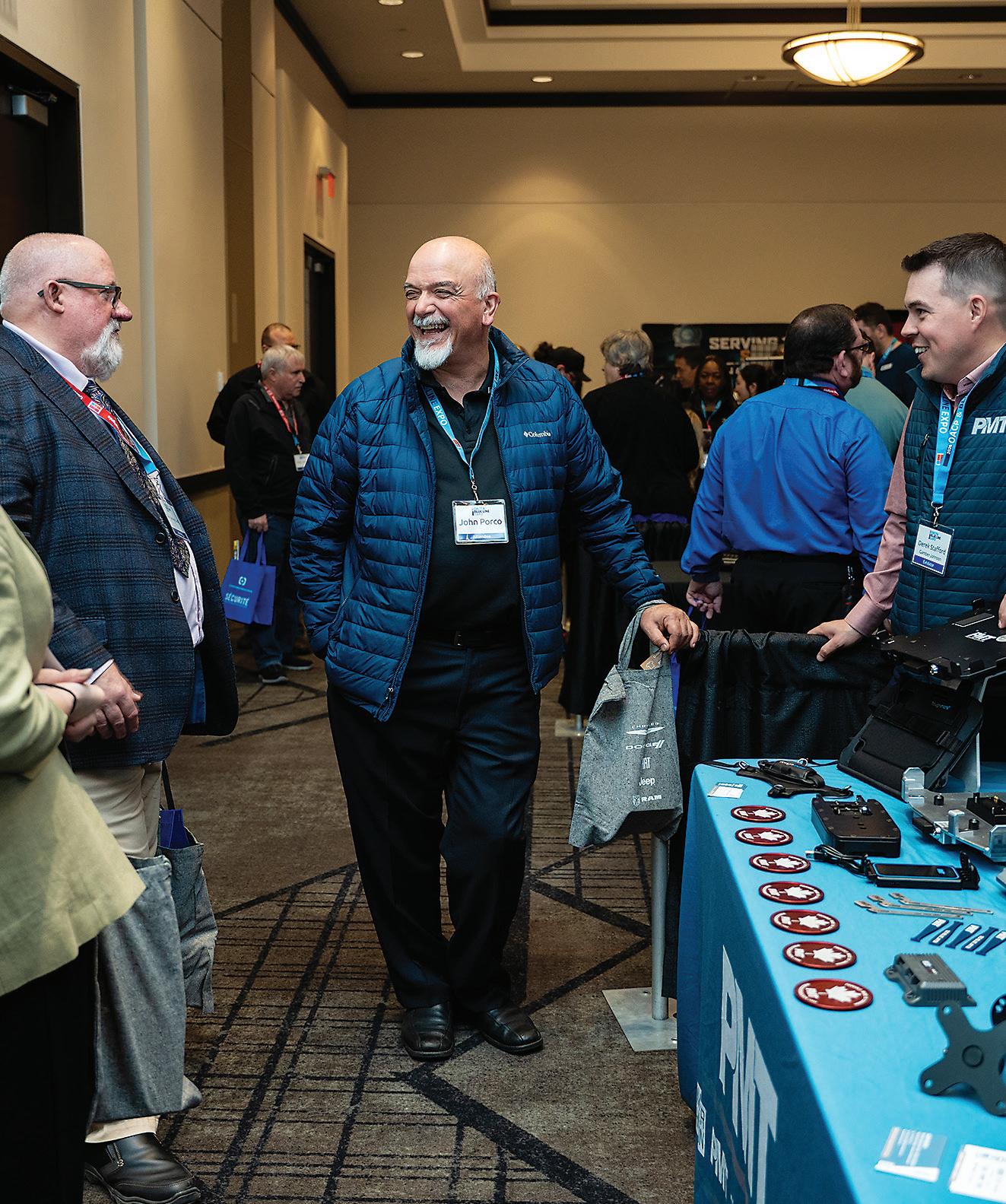
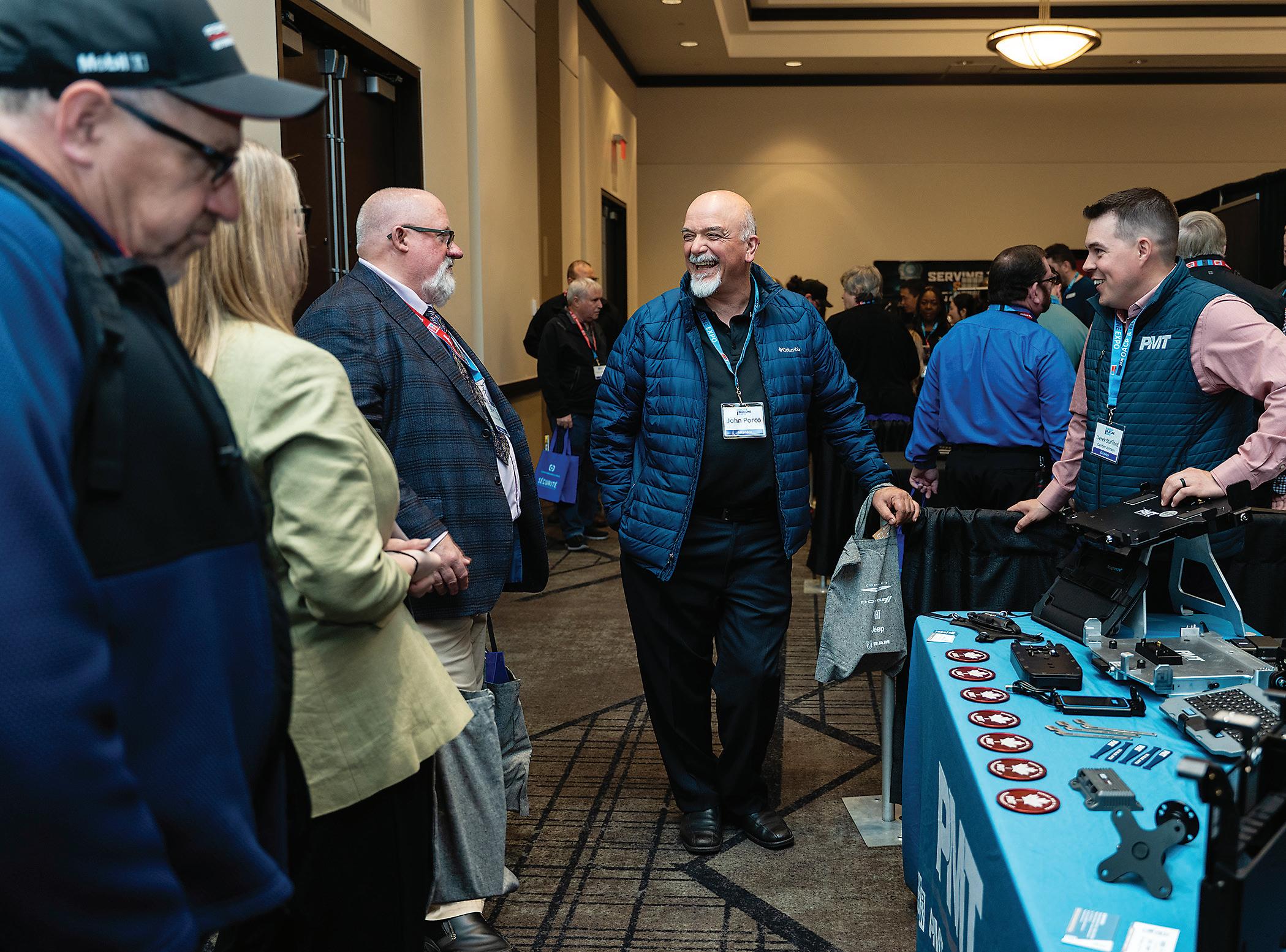
On April 29, Blue Line and the Ontario Association of Chiefs of Police welcomed more than 450 eager public safety personnel to the fifth annual OACP & Blue Line Expo in Mississauga, Ont. The expo floor included a range of organizations showcasing the latest technology, services and products available to public safety personnel.
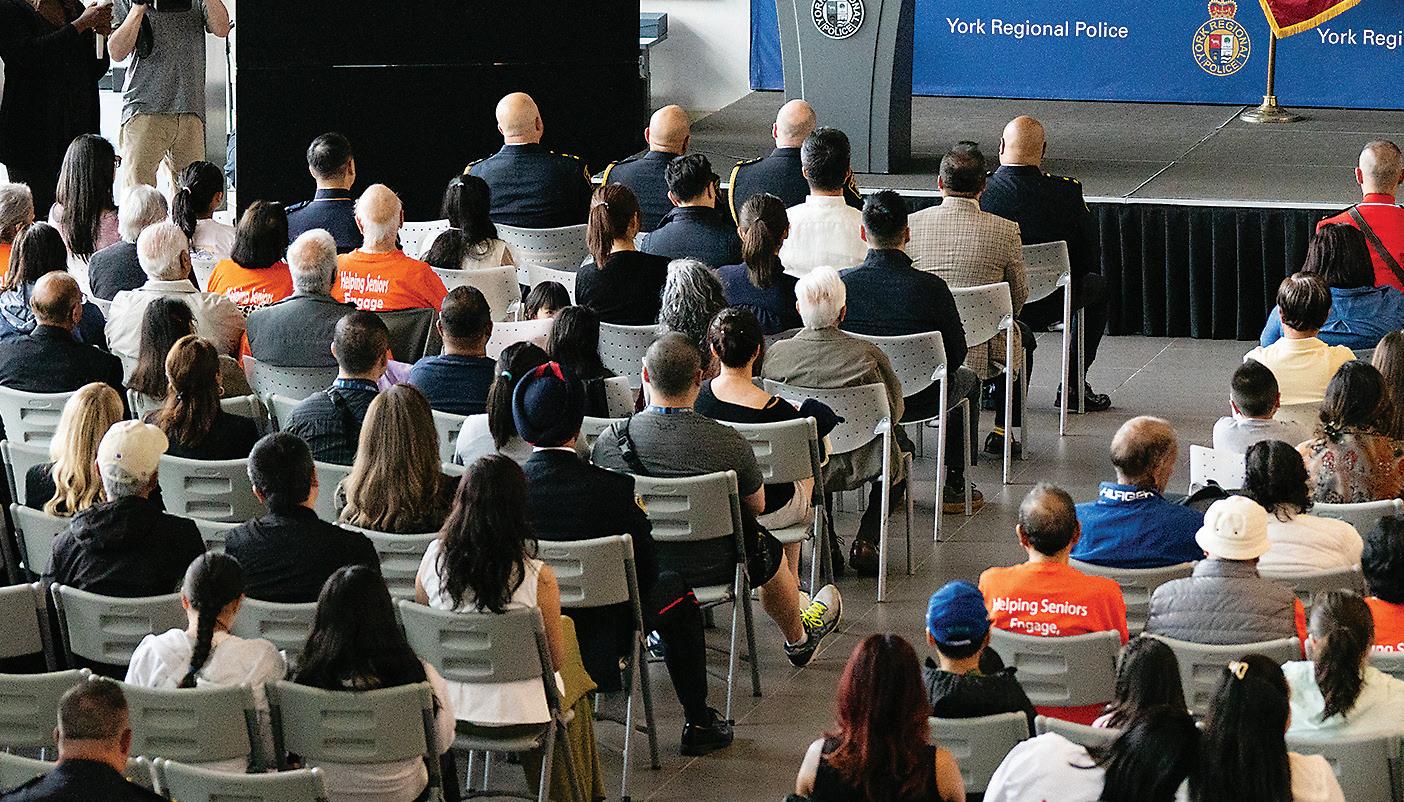
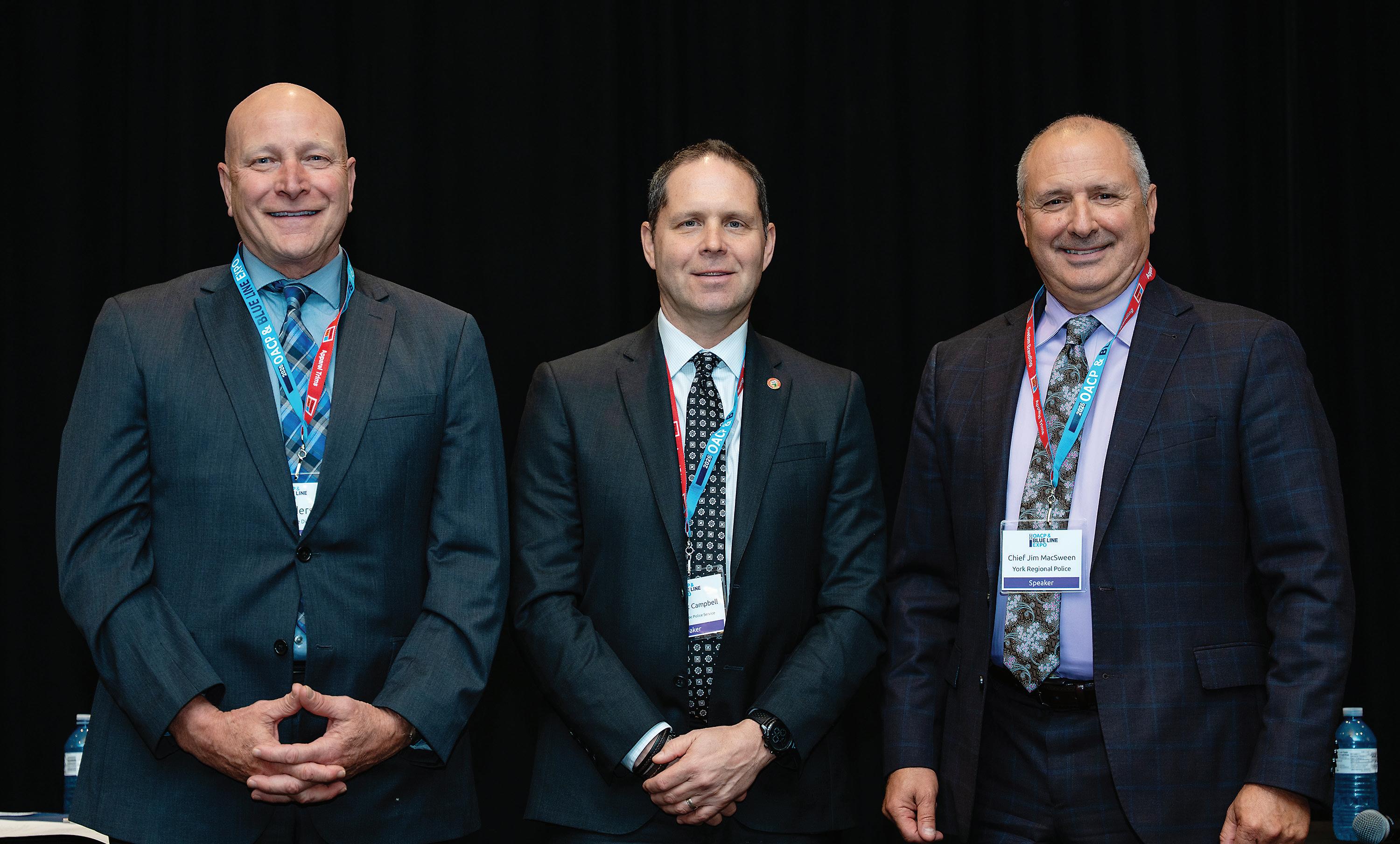
To kick off the event, Paul Pedersen, executive director of the OACP, was joined by York Regional Police’s Chief Jim MacSween and Durham Regional Police Service’s Chief Peter Moreira to discuss cultivating leadership and culture in complex times. Pedersen noted that leaders must not only navigate political polarization and rapid social media change but also a workforce spanning five distinct generations. MacSween emphasized that modern leadership requires a keen focus on internal culture, mentorship and supporting staff wellness, achieved by prioritizing people over rigid processes. Moreira shared his belief that officers grow most when challenged with roles outside their comfort zone and that leaders must provide the grace to make mistakes during this development. The session concluded by highlighting the importance of accessibility, visibility to frontline members and strong partnerships
BY
THE NUMBERS
with police unions.
In the second session, Pedersen and MacSween were joined by Chief Mark Campbell of the Strathroy-Caradoc Police Service to explore the need for police leaders to navigate complex government partnerships and politics while maintaining professional neutrality. MacSween said, “Alignment does not always have to mean agreement.” Instead, it is more important to find common ground to achieve strategic priorities. Campbell, speaking from his position as OACP president, discussed the challenge of representing the diverse interests of 44 police services across Ontario. He advocated for a stronger relationship with the Ministry of the Attorney General to “correct and fix a justice system that is having tremendous impacts in our communities.”
Pedersen then welcomed Kingston Police Service’s Deputy Chief Scott Gee and Hamilton Police Service’s Jackie Penman, Corporate Communications and Public Affairs Manager, onstage to talk about crisis leadership, internal alignment and public communication. To put people in the right frame of mind, Pedersen made the analogy that, as a police chief, he always felt like he was on a BOSU Ball because there was a precarious balance required to simultaneously manage internal staff, community expectations and political stakeholders. Gee then shared his experience navigating a major cyber incident that occurred just 48 hours after he joined KPS, which crippled essential systems and forced the service to rely on neighbouring agencies. Penman emphasized that crisis communication should be viewed as an “opportunity for you to enhance the legitimacy of your organization”, rather than a defensive maneuver.
In the afternoon, Trident Training Solutions offered an exclusive training session at OACP & Blue Line Expo. This year’s session focused on crowd dynamics and crowd management, especially as Canada prepares for the arrival of the FIFA World Cup 2026 tournament, and provided attendees with practical, experience-based instruction on operational response strategies in high-volume environments.
This event wouldn’t have been possible without our outstanding sponsors. Thank you to our platinum sponsors, Geotab and Outdoor Outfits; our gold sponsor, KLE Canada Inc.; our silver sponsors, GeoWarehouse, GFX LAW, K9ine Security and Wilfrid Laurier University; our delegate bag sponsor, Commissionaires; our lanyard sponsor, Trimtag Trading Inc.; our reception sponsor, uOttawaPDI; and our training sponsor, Trident Training Solutions. Be sure to visit www.blueline.ca and check out #OACPBLExpo for more photos from the event. We’ll see you in Spring 2027!
4 in 5
victims of police-reported online sexual offences against children were girls in 2024.
14 is the median age of those accused of non-consensual distribution of intimate images in 2024. 223
In March 2026, Statistics Canada released recent data on Police-reported online child sexual exploitation: Recent trends. For more information, please visit www150.statcan.gc.ca. 77 % of these incidents were online child sexual abuse and exploitation material offences.
OACP Executive Director Paul Pedersen, OACP President Chief Mark Campbell, Chief Jim MacSween.
DISPATCHES
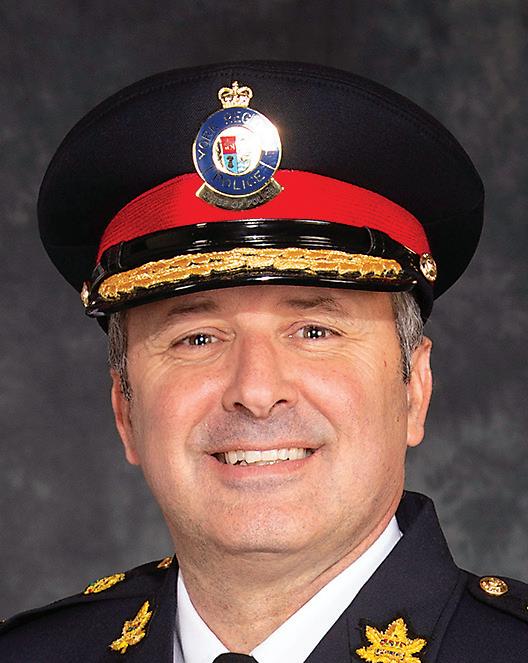
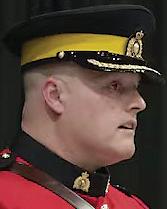
Following a successful six-year tenure as Chief of Police, Jim MacSween will retire from York Regional Police on June 26.
Chief Greg Skinner of the Stratford Police Service officially retired on March 2. Skinner joined the OPP in 1987 and became chief in Stratford in 2018.
The Regina Police Service has promoted Laurel Marshall to deputy chief. Marshall started her policing career in 1998 and most recently led the RPS investigative services division.
Francisco (Frank) Barredo is Toronto Police Service’s newest deputy chief. Barredo has nearly 40 years of service under his
belt. He is widely recognized for his tactical expertise and leadership in complex environments.
The Central Saanich Police Service has welcomed Paul Douglas as their newest deputy chief, who brings over 25 years of policing experience.
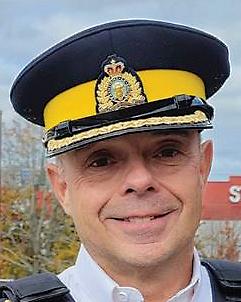
Chief Supt. Kenton Pike has taken command of Nunavut’s RCMP division. Pike’s main priorities include employee wellness, as well as transparency and accountability with the public, to continue reconciliation with the Inuit.
The RCMP Halifax Regional Detachment has appointed Chief Supt. John Duff as its officer in charge. Duff joined the RCMP in 1990 and is a
third-generation Mountie, following in the footsteps of his father and grandfather.
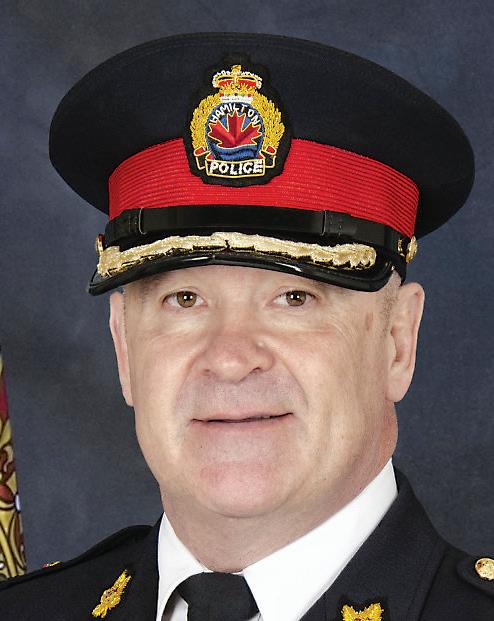
After more than 35 years, Deputy Chief Paul Hamilton will retire from the Hamilton Police Service on May 29. Paul Hamilton assumes the role of chief of Niagara Parks Police on June 1.
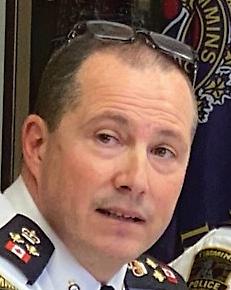
Deputy Chief Henry Dacosta retired from the Timmins Police Service in Dec. 2025. Dacosta joined the service in 1999 after spending four years at the Kenora Police Service.
Terry Gillespie has been promoted to superintendent in charge of West Shore RCMP. He brings nearly two decades of RCMP service and extensive leadership experience across British Columbia to his new role.
In Oct. 2025, Tom Wood was appointed to the role of inspector at the Amherst Police Department. Wood began his policing career with the RCMP in Alberta before relocating and joining the Amherst Police over 15 years ago.
CALENDAR
Ontario First Responders’ Mental Health Conference 2026
Date: Aug. 14 – 15, 2026
Location: Mississauga, Ont. ofrmh.ca
121st CACP Annual Summit and Policing Trade Show
Date: Aug. 16 – 18, 2026
Location: Edmonton, Alta. cacp.ca
Policing in a Digital Age
Date: Sep. 16, 2026
Location: Online blueline.ca
Emergency Services Career Expo West
Date: Oct. 24, 2026
Location: Calgary, Alta. careerexpowest.ca
End the pursuit. Control the outcome.
Introducing the Grappler Police Bumper—now exclusively available in Canada through MD Charlton.
Mounted to the front of a patrol vehicle, the system deploys a heavy-duty net to capture the suspect vehicle’s rear wheel and quickly bring it to a managed stop.
Why Grappler?
• Shorten pursuit timelines
• Controlled alternative to traditional pursuit tactics
• Rapid deployment and sub-10-minute reload
• Low-profile “bull-bar” appearance for discreet installation
Virtual reality
A force multiplier for Canadian police training
By Brittani Schroeder
Canadian police services are at a critical crossroads regarding the adoption of new technology. New challenges are common, such as staying current with officer training requirements while navigating tighter budgets and increased oversight, all while upholding ethical transparency. How can you keep up?
Traditional training is resource-intensive. Scenario actors and training cartridges represent only a sampling of what is needed, all while creating significant downtime as officers sit idle while waiting for their turn to train. Going forward, this practice may be considered unsustainable.
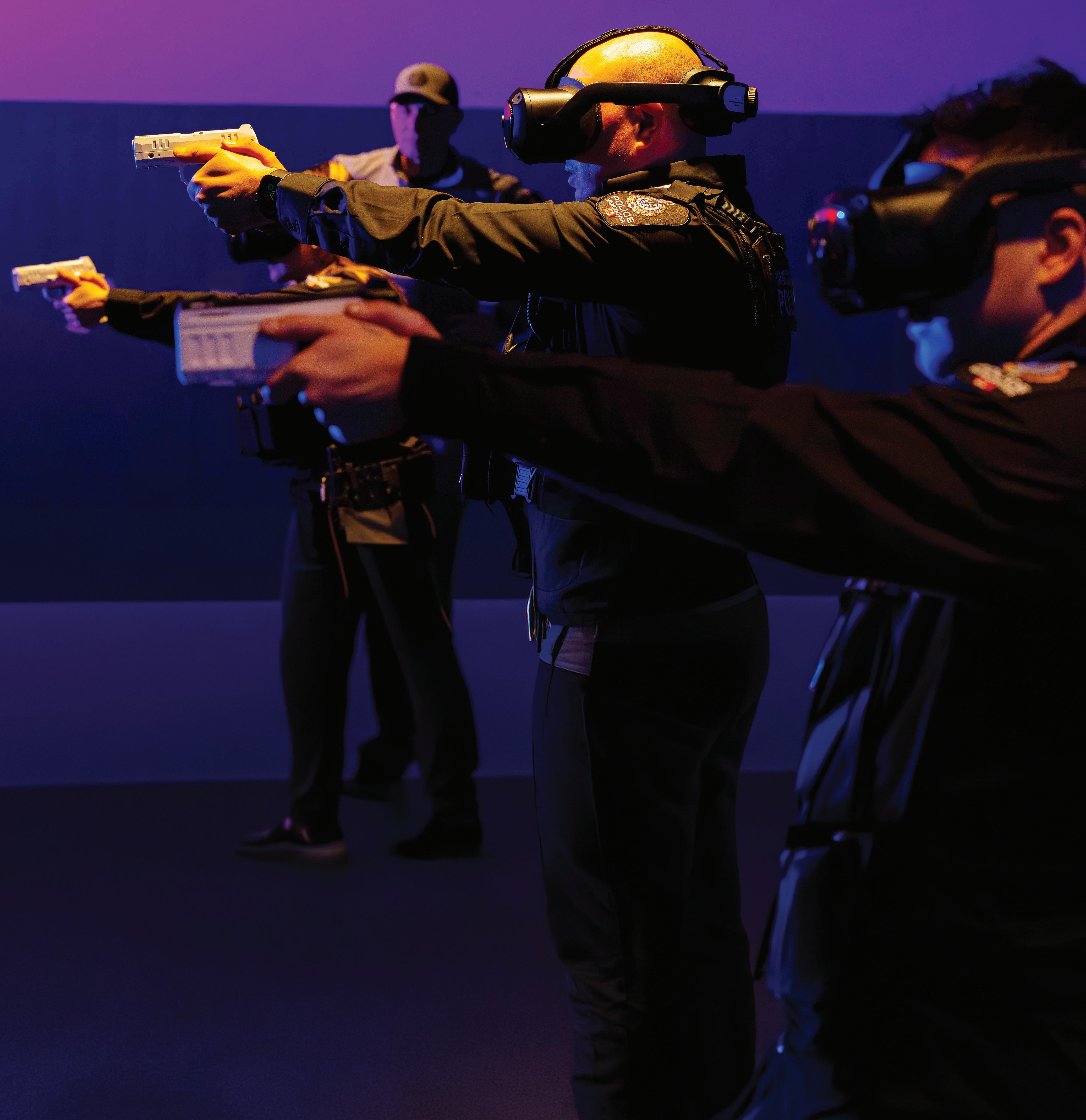
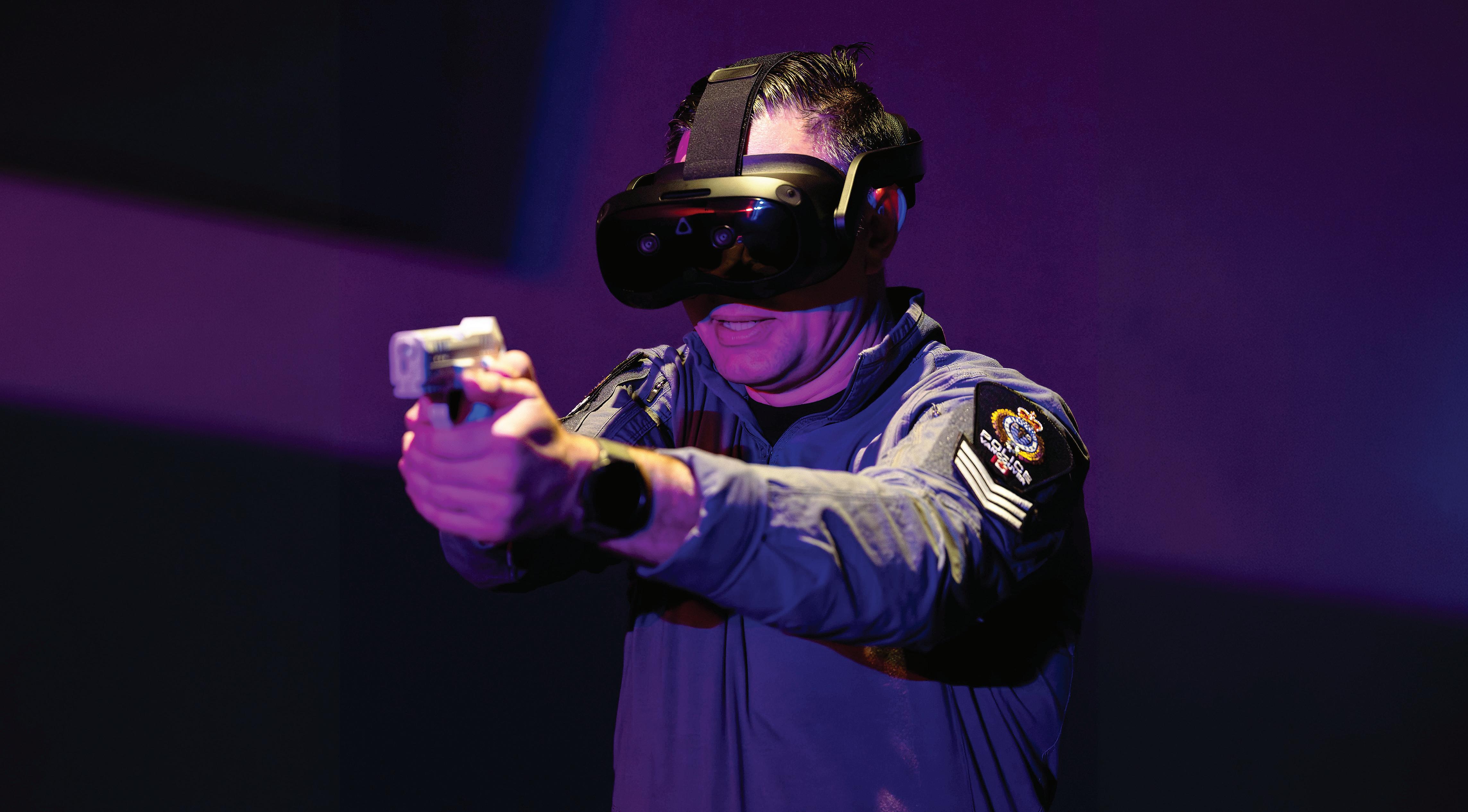
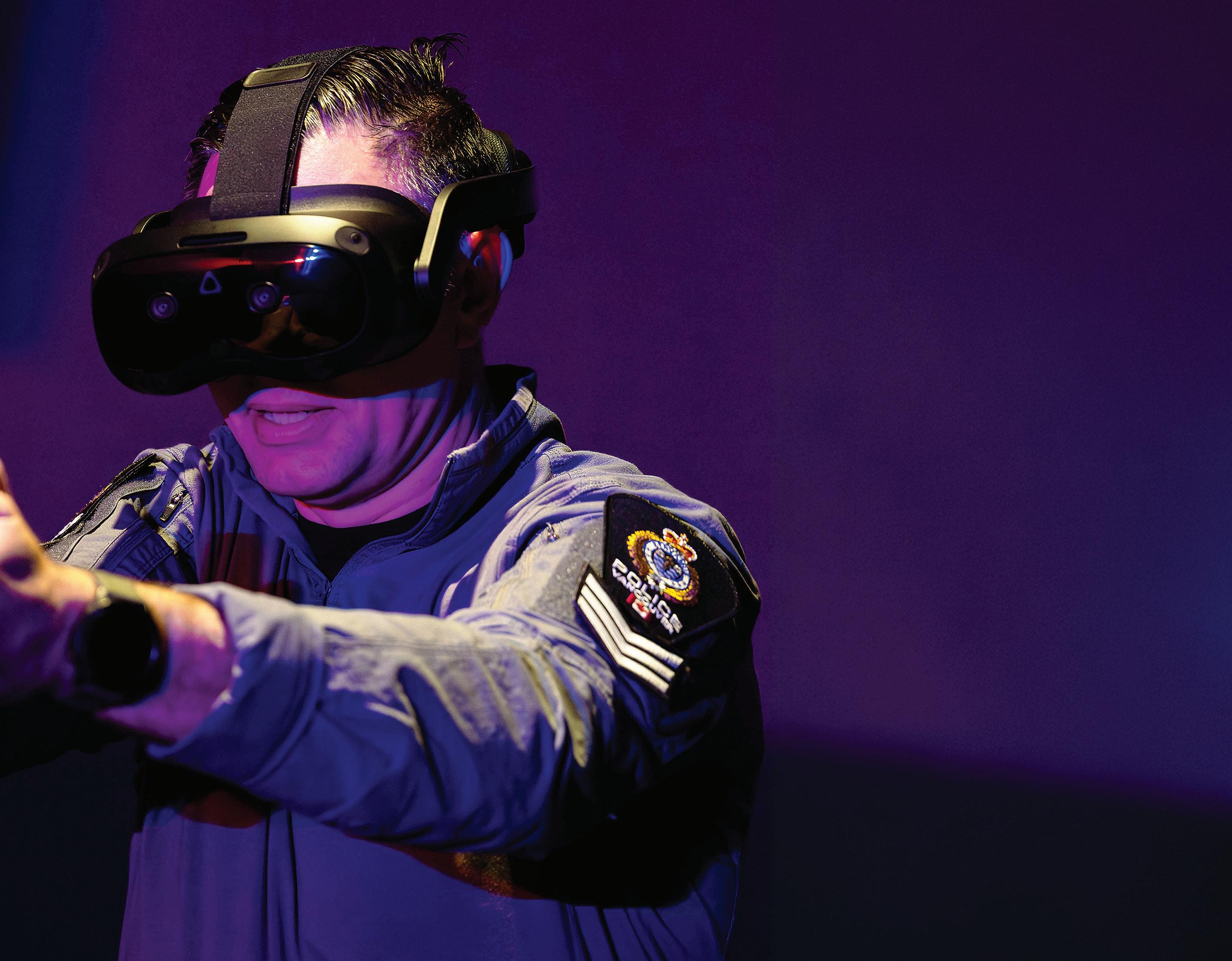
Now, virtual reality (VR) is entering the realm of police training. So Blue Line spoke with a few services across Canada that are already using this technology to get their thoughts on whether VR may or may not enhance training for their members.
VR: Not just for video games
The first VR headset, called “The Sword of Damocles,” was invented in 1968, but it’s only recently that the technology has evolved into a tool for law enforcement training. Many VR systems can be customized to some extent, allowing services to train their officers with data-driven content that goes beyond generic scenarios.
Another element often found in VR scenarios is AI-powered avatars. Sophistication varies, but where AI differs from traditional role-players is the responses are not predetermined.
“That is one aspect of scenario training that always frustrated me and still frustrates our members: the outcome is fixed,” explained Supt. Dyson Smith, Peel Regional Police (PRP). With VR, if an officer uses effective de-escalation skills, the AI
may act accordingly, but if an officer responds with aggression, the AI may mimic that escalation, which a traditional actor may not be able to do.
Case study: Peel Regional Police
For PRP, VR training became necessary due to a large hiring initiative, which led to a scalability challenge for their training section. With 300 new officers, PRP lacked the physical infrastructure and trainer capacity to accommodate them if it relied solely on traditional methods.
Deputy Chief Mark Dapat described VR as a “force multiplier” for their training goals, requiring fewer resources, less time and increasing safety. The service uses VR technology to focus on de-escalation scenarios and cultural competency training.
Smith noted that VR is particularly effective for “high frequency” skills. While he admitted that scenarios like active shooter incidents may still require in-person simulation exercises, VR builds the muscle memory for handling tools or practicing community engagement.
Insp. Nick Gregoriou emphasized, “[PRP has] a training ecosystem, and the VR allows us to integrate what’s important to us as an organization in ways that weren’t possible before.”
Case study: Delta Police Department
Delta Police Department’s (DPD) training section, led by Insp. Maurice Parry, has taken a measured, “evidence-informed” approach. Having used a training simulator since 2019, they are now transitioning to VR.
“Think of the iPhone: The 8 is almost obsolete, and we’re on 17 after only a few years. The technology in simulators and VR is advancing at the same rapid pace. I think there are a lot
of good things about VR, but it hasn’t yet reached its full potential.”
“The public expects officers to train and perform at Olympic levels, but in reality, officers receive less than recreational practice time.”
– Insp. Maurice Parry
When selecting which VR system to trial, Parry created a rigorous criteria matrix to evaluate the available options and considered factors such as processing speed to avoid motion sickness, bioanalytics, after-action review software, avatar capabilities, and the props that could be used.
But before deciding to invest, the DPD team asked themselves: What is the goal? From there, they could see whether the technology would fill gaps or create them. For Parry, it boiled down to, “Is the juice worth the squeeze?” Does the technology add value rather than just being a novelty?
Delta Police Department is using VR in a specific, limited capacity and finds the experience has been positive. While they are not going “all in” yet, they have an open mind and a willingness to learn and try something new.
Case study: Vancouver Police Department Vancouver Police Department (VPD), which was fortunate to borrow VR equipment from DPD to test, soon viewed VR as a “natural progression” for its training program.
“It was almost a ‘fear of missing out’ thing if we didn’t engage with it immediately,” said Insp. Wade Rodrigue. With permission to run their
own training academy, VPD is looking to VR to provide “consistent, repeatable training” for recruits and to use it as a stepping stone. Rodrigue sees VR as a way to change how members train, getting away from sitting in front of a computer to complete a mandatory course and instead engaging with the content in real time.
“Like many other agencies across Canada, we’re pretty much at maximum capacity for training with the staff that we have, the available room, the costs associated, and all the other things that need to be done to advance training,” said Rodrigue.
Sgt. Bryan Nykon highlighted VR as a fiscally responsible choice. Where live Reality Based Training (RBT) might have high costs, the VR could allow for “hundreds of repetitions” and the “exact same training every time, making it a no-brainer.”
A hybrid training model would be ideal for VPD. “Let’s build a scenario into the VR, get the members training on it, and then take them into a live environment to reinforce those skills,” said S/Sgt. Ryan Irving.
What does it come down to?
Through these conversations, several pros and cons arose.
On the pro list, officer confidence is at the top. An officer’s expanded skill set leads to greater confidence on the
They want to make sure it’s a good change before they buy in,” said Nykon. He emphasized that you can’t devote all time and effort to VR, and that investment in physical training environments remains crucial.
Will VR change the future of police training?
Dapat sees VR as “the wave of the future”. He foresees unprecedented growth in police services over the coming years, which will put pressure on training units. “The number of trainers that we traditionally use is not sustainable, and the infrastructure we have currently is not adequate.”
street. “Confidence breeds competence. The more times our officers access and handle their tools, the more confident they are when they have to do it in real life,” said Smith.
Virtual reality may also provide officers returning from leave with a safe place to prepare for duty. “They can come in and use the VR whenever they’d like to help them acclimate back into the job function they left,” said Dapat. “It gives our officers more opportunities to stay as skilled as we want them to be.”
This confidence boost for officers is in addition to the broader benefits, including fiscal efficiency, scalability and overall reduced downtime for trainees.
On the con list, the suspension of disbelief remains a hurdle. Smith believes that until this technology includes 360-degree treadmills and haptic vests to simulate moving through a space with a partner, it may be hard for some members to overcome the “video game” feeling.
Similarly, Rodrigue sees the technology as still “a little clunky”.
These potential downsides are in addition to infrastructure hurdles that vary by service and VR provider. Officer buy-in for specialized units, such as emergency response teams, may also be a challenge.
“People are resistant to change.
“Our community deserves the best officers. That means, we need to give them the best training and equipment.”
– Deputy Chief Mark Dapat
If VR expands beyond use-of-force or de-escalation scenarios to include, for example, team management for new sergeants, interviewing suspects, delivering testimony and being cross-examined in court, the technology might appeal to more police services across the country.
The “endgame” is for services to build their scenarios in-house. With AI assistance, custom scenarios that directly align with what’s being observed in the community could help officers immensely.
For Gregoriou, using VR “speaks to not being afraid to try things, not being afraid to fail.”
VR will likely never fully replace the raw stimulus of live training – what Irving calls the “booms and flash bangs, the smoke thrown in.”
Nykon recommended that each service consider all training needs and approach VR by asking how it will help.
“It won’t solve all your needs every time, and if it’s not exactly what you’re looking for, push back to the VR service provider. Giving good feedback will help your organization get maximum value. Try out headsets from a service that is already using them to see how they might be of value to you.”
The public expects officers to train and perform at Olympic levels, but in reality, officers receive less than recreational practice time. Parry said, “If VR technology can help us get better, more efficient training to our officers, because they deserve it, then I’m all in for exploring it and leveraging it.”
Integrating MHCR and CIT
Niagara’s standard for crisis response
By Benni Zaiser, Vicky Looby, Lindsay Galipeau and Jennifer Lavoie
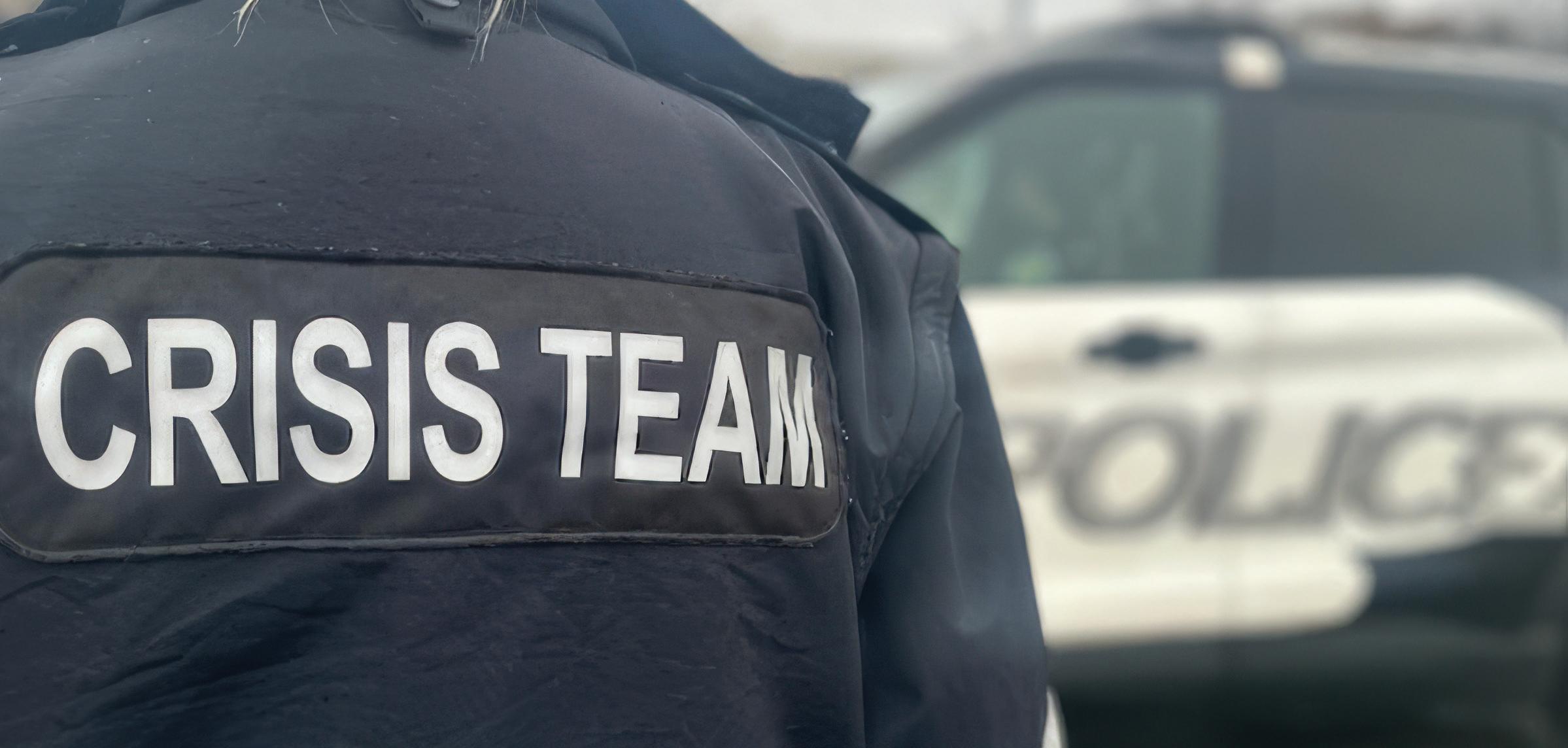
Across Canada, more police services are offering crisis intervention training to their officers, reflecting a growing commitment to improving outcomes for individuals experiencing mental health crises. In Ontario, this shift is also seen in the rising number of services that now use co-response units, which pair police officers with allied mental health professionals. In 2023, the Canadian Mental Health Association Ontario1 counted 94 co-response teams operating across the province. These programs, often called (mobile) Crisis Intervention Teams (CITs), mark valuable progress toward more compassionate, coordinated and effective crisis response systems.
However, CITs are about more than just training or the deployment of specialized co-response units. The original CIT program2 (also known as the Memphis model) was developed in Memphis, Tennessee, in 1988, in response to the police shooting of a man experiencing a mental health crisis. It was never meant to be a standalone course or a reactive solution. It arose from a deliberate, community co-owned effort involving law enforcement, mental health agencies, advocacy groups and individuals with lived
experience of mental illness, which has evolved into programs that aim to implement 10 core elements:
1 Partnerships: Law enforcement, advocacy, mental health
2 Community ownership: Planning, implementation and networking
3. Policies and procedures
4 CIT: Officer, dispatcher, coordinator
5 Curriculum: CIT training
6. Mental Health Receiving Facility: Emergency services
7 Evaluation and research
8. In-service training
9 Recognition and honours
10. Outreach: Developing CIT in other communities
The goal of CITs was not simply to improve police interactions with people in crisis, but also to provide a humane, person-centred crisis response and meaningful diversion from the justice system. Therefore, the Memphis model developed a 40-hour training curriculum that equips crisis responders with the clinical knowledge needed to respond safely and effectively to individuals experiencing mental health crises, including those with mental
illness, substance use challenges or intellectual and developmental disabilities. In addition to de-escalation and scenario-based training, the curriculum emphasizes community resource awareness and systems navigation, for instance, through corresponding site visits, as well as diversion from the justice system.
Researchers 3 have accumulated evidence demonstrating that CIT training and related programs enhance police officers’ knowledge and attitudes about mental health while reducing stigma towards individuals experiencing mental health crises. Additionally, officers display greater self-efficacy, improved decision-making during mental health-related encounters, increased knowledge, and more effective navigation of community resources. Furthermore, several services report reductions in arrests, use-offorce incidents, and injuries to both officers and citizens, supporting the idea that a broader, community-shared approach is essential for tackling complex systemic issues, such as frequent service usage and unnecessary criminal justice involvement.
While not sufficient on its own, training remains a critical and accessible entry point, as it offers a tangible way for law enforce-
NG911 IS HERE. IS YOUR PSAP READY FOR THE INTELLIGENCE THAT COMES WITH IT?
NG911 is raising the bar for public safety communications, with more data, more accountability, and higher expectations for every interaction. Eventide Communications Critical Insights AI, delivered by Cartel Communication Systems, gives PSAP leaders the tools to meet that standard.
As NG911 transforms how public safety communicates, the volume of recorded interactions is growing, and so is the pressure on PSAP supervisors to evaluate, coach, and train their teams faster and more consistently. Critical Insights AI (CI AI) was built for exactly this moment.
CI AI converts every recorded interaction into actionable intelligence — automatically scoring QA, identifying training opportunities, flagging stress exposure, and surfacing real-time insights — so your team can focus on the work that matters most.
KEY CAPABILITIES
EVALUATE
Automated QA scores 100% of calls in real time, validates CAD data, tracks evaluator consistency, and delivers timely coaching through integrated feedback workflows.
TRAIN
CI AI’s Training Simulator and E-Learning Modules remove roleplay training, provide instant feedback, and accelerate onboarding and skill development.
ASSIST
Role-based dashboards, realtime alerts, and transcript-driven tools provide supervisors and administrators with the insight and support needed.
Empower your PSAP to lead the NG911 transition confidently with CI AI.
Cartel is Canada’s master distributor of Eventide’s digital voice logging systems, with over 25 years of experience implementing recording systems and over 40 years of doing business in Canada: www.cartelsys.com/solutions/recording
Cartel Communication Systems, Inc.
Tel: 604.888.9711 | 1.800.663.0070
ment agencies to demonstrate their commitment to improving crisis response, build internal support, and lay the foundation for deeper collaboration with community and allied health partners.
Mental health crisis response training
In Ontario, the Community Safety and Policing Act4 now requires the delivery of the Mental Health and Crisis Response5 (MHCR) Education and Training Program to all police officers through Wilfrid Laurier University (WLU). This hybrid program is an evidence-based6, community-informed curriculum, designed to enhance police officers’ competencies in de-escalation tactics and communication, particularly during interactions with citizens experiencing mental health crises.
The MHCR is a homegrown program developed by researchers at WLU, Toronto Metropolitan University and the University of Victoria. To ensure the training aligned with Canadian community values, the curriculum was jointly developed and deployed with community partners, including people with lived experience of mental illness, mental health professionals, Indigenous cultural safety and anti-discrimination experts, researchers, and defensive tactics and use-of-force instructors.
The hallmark of the MHCR program is its use of realistic scenarios that immerse trainees in a range of mental health crisis situations featuring different characters, settings and safety challenges. Notably, the program includes a scenario-based evaluation component that emphasizes the practical demonstration of 14 specific competencies that officers apply as tools and articulate as strategies to manage or prevent escalation in public-police encounters.
The intentional deployment of MHCR scenarios within CIT programming presents a timely and strategic opportunity to combine the most valuable aspects of these holistic, community co-designed approaches. In particular, bolstering comprehensive CIT training with innovative Canadian curriculum that offers deep rehearsal of de-escalation techniques as well as a clear method of evaluation.
Marrying MHCR with CIT
Niagara Regional Police Service (NRPS) has been training its officers in CIT since 2002. In 2015, the Canadian Mental Health Association Niagara Branch (CMHA Niagara) col-
laborated with NRPS to deploy a Mobile Crisis Rapid Response Team (MCRRT), a co-response unit that pairs a mental health worker with a uniformed police officer to provide immediate responses to mental health-related 911 calls. The MCRRT provides crisis intervention to ensure the individual is both physically and emotionally safe and connected with the most appropriate community supports. The Niagara Region operates two teams, 365 days a year, from noon to midnight.
A broader, communityshared approach is essential for tackling complex systemic issues such as frequent service usage and unnecessary criminal justice involvement.
As this partnership strengthened, CMHA Niagara MCRRT crisis workers became certified as CIT Coordinators and began facilitating CIT training due to their in-depth understanding of the complexities involved in responding to a mental health crisis. The CIT training offered by CMHA Niagara distinguishes itself by combining instruction of crisis intervention and de-escalation skills, based on the latest scientific evidence, with familiarization of local community resources to help connect a person experiencing a mental health crisis to appropriate supports. It has also been recognized for how its facilitators continuously adapt the curriculum with each iteration, responding to the evolving needs of their community, as well as healthcare and law enforcement partners.
In anticipation of the now provincially mandated MHCR program, CMHA Niagara CIT Coordinators proactively engaged with the researchers behind it to ensure compatibility and alignment between MHCR and CIT training. Recognizing that MHCR complements rather than replaces CIT training, the team identified key areas, particularly in de-escalation and relational policing approaches, where integration would enhance consistency and instructional effectiveness. This included discussing de-escalation responses anchored in several core competencies of the relational policing approach7 identified in the MHCR research, such as:
1 Humanized
2 Person-centred
3. Procedurally just
4 Empathetic
5 Trauma-informed
6. Mental health and crisis aware
7 Culturally safe
The team used corresponding skills during training, which are now measurable with the validated De-escalating Persons In Crisis Competencies Tool (DePICT) to track performance. Participants were able to practice these skills throughout the training and demonstrate their abilities through participation in role-play scenarios. As a result, the latest NRPS CIT training successfully combined the MHCR and CIT core elements, leveraging evidence-informed best practice within their community-collaborative CIT program.
This integration reflects CMHA Niagara’s leadership in promoting innovative, evidence-informed training and its ongoing commitment to evolving a truly co-owned CIT program that addresses the needs of both frontline policing and community mental health support. CMHA Niagara remains proud of the progress achieved over the past year and looks forward to further expanding and strengthening the reach of CIT programming in Niagara and beyond.
Author note: The authors encourage interested readers to join the CIT Canada list-serv by contacting one of the authors and connecting with fellow crisis response practitioners (law enforcement, allied health/mental health, and advocacy) and researchers to share ideas, experiences and resources.
For a full list of references, visit www.blueline.ca/ Integrating-MHCR-and-CIT/.
Benni Zaiser is a patrol sergeant with York Regional Police and an independent behavioural scientist who serves on the board of CIT International.
Vicky Looby RSW, is a crisis worker with the Canadian Mental Health Association who co-responds with the Niagara Regional Police Service and co-facilitates their 40-hour CIT training as a CIT Coordinator.
Lindsay Galipeau BA, RSSW, is a crisis worker with the Canadian Mental Health Association, Niagara Branch, working in both primary (MCRRT) and secondary (COAST) co-response units.
Jennifer Lavoie PhD, is an associate professor of psychology and criminology in the Faculty of Human and Social Sciences at Wilfrid Laurier University (WLU), specializing in the development and evaluation of police de-escalation training.
Unity through identity
The vital role of internal support networks in modern policing
By Brittani Schroeder
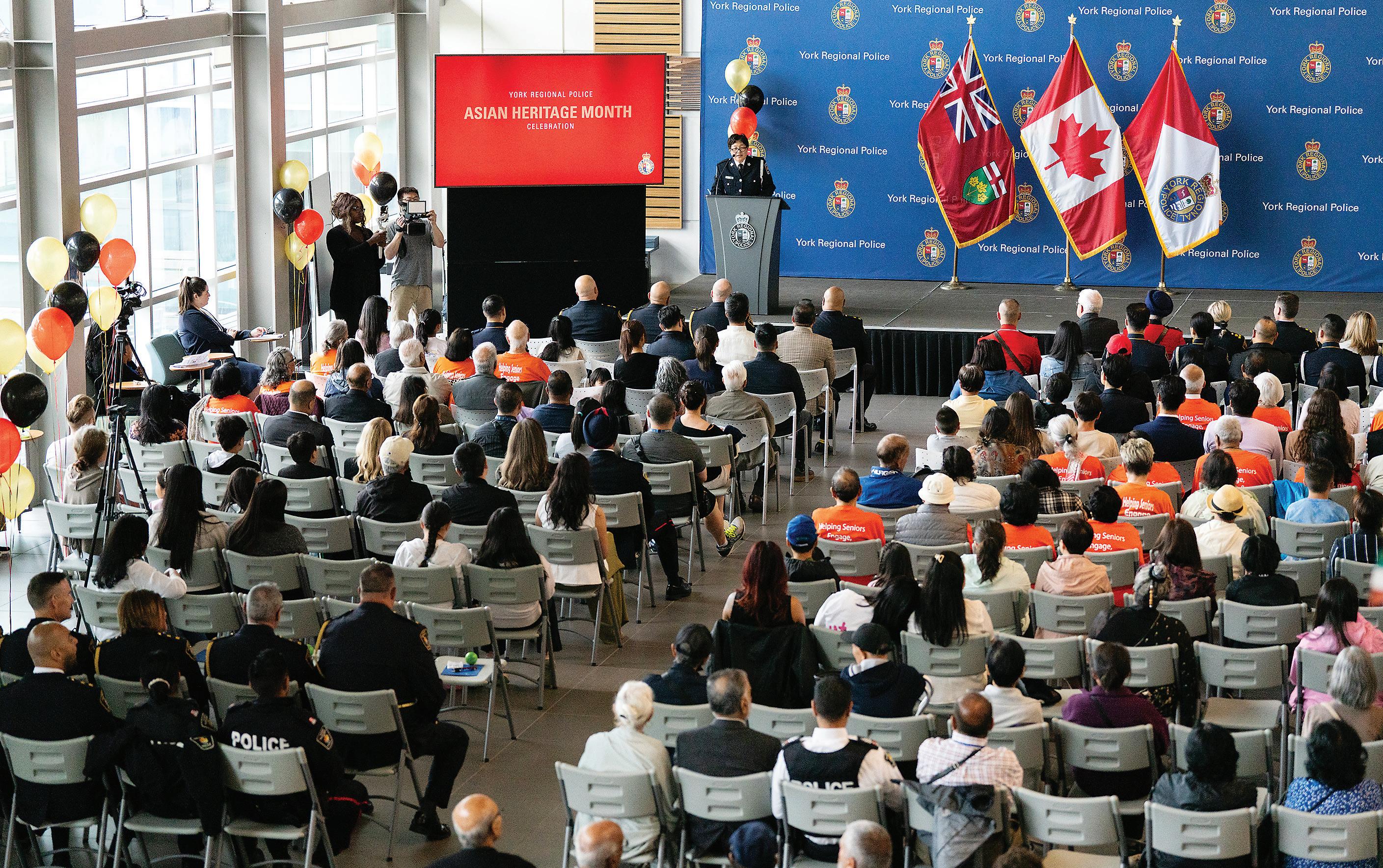
In honour of Asian Heritage Month, celebrated annually in May, Blue Line spoke with members of Toronto Police Service (TPS) and York Regional Police (YRP) about the importance of member-driven support networks to an organization’s success.
T hese groups, known as Internal Support Networks (ISNs), are spaces where members can con nect based on shared experiences, interests and identities, fostering a sense of inclusion and mentorship while helping shape organizational
practices. These connections can be based on cultural heritage, on faith-based groups, on sexual orientation and gender identity, on working parents and caregivers, on those who are working with restrictions, and more.
Toronto Police Inspector Paul Qureshi is in his 26 th year of policing in what he believes is the most diverse city in the world, but TPS wasn’t always representative of that diversity, especially early in his career. “As more diverse recruits joined the service, they didn’t know who to reach
out to for support. That’s where the ISNs came in,” he said.
For some police services, ISNs have existed for a long time. For example, the South Asians in Law Enforcement Internal Support Network (SAIL-ISN), the East Asian Internal Support Network (EA-ISN), and the Black Internal Support Network (B-ISN) at TPS have existed since the early 2000s. Many services are actively establishing new ISNs for their members, including YRP’s East/Southeast Asian Internal Support Network, founded in 2021.
The NightRide 360 is a magnetic or suction cup mounted, remote controlled 360⁰ pan and tilt thermal camera, using heat signatures to give you a view 1/4 mile or more away dust, rain, snow, fog, smoke, and complete darkness.
Perfect for monitoring ongoing situations at night including stakeouts and looking for felons on the run.
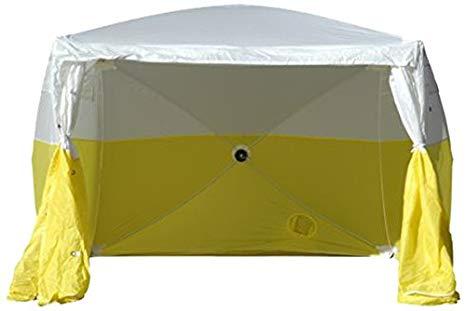
PORTABLE CRIME SCENE SHELTERS
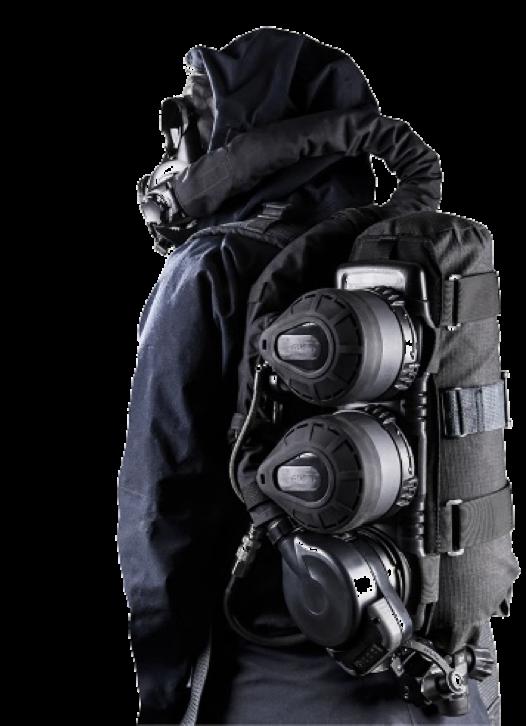
THE MOST ADVANCED MODULAR COMBINATION UNIT RESPIRATOR (CUR)
The Avon CS-PAPR™ is the newest generation of CBRN Powered Air Purifying Respirator (PAPR) designed for use in Combination Unit Respirators
The capability to change levels of protection dependent on the threat, now provides the wearer with increased duration on target and safer operation
Utilizing the Avon MP-PAPR module along with the patented combination hose module, the wearer can seamlessly switch between APR, PAPR and SCBA modes of protection The single air hose connection for all modes allows the wearer to retain a clear mask cheeks for optimum weapon sighting
The low profile shape of the Avon CS-PAPR delivers best in class integration with SCBA systems, benefiting the wearer with reduced weight and size compared to traditional systems
Modular Methodology allows the user to either add the Avon CS-PAPR APR and ST53 SCBA, use as back to the Avon
PORTABLE, NON-METALLIC, NO LOOSE PARTS, LIGHTWEIGHT AND FITS IN PATROL CAR TRUNK
Eflare Beacons are intensely bright
Can be seen from over 1 kilometer away without the night vision, point fixation and distance judgement problems associated with st robe and incandescent lights
Eflare Beacons are infinitely versatile
Available in a variety of one or two colour light combinations, steady -on or flashing, and in three light intensities Easily attaches to clothing, vehicles, cones and bollards Be seen and safe in almost any situation you can think of
Eflare Beacons are portable and simple to use
The largest model is 22 cm tall and weighs only 460 gm including batteries, making it easy to carry or st o w anywhere, and quick and simple to deploy in any situation Just twist the lens to turn on or off, and place one or mo re units around to provide a highly visible warning and safety zone around a person, work area, hazard or accident
Eflare Beacons double the safety
Eflares provide safety by ensuring max imum visibility, but unlike pyrotechnic flares there is no risk of fire or explosion, and there are no toxic fumes or residue
Eflare Beacons are extremely robust
Eflares are waterproof, dustproof and will survive a drop from a one metre height ont o a concrete surface
Eflare Beacons are HAZMAT accredited
Eflare Beacons are HAZMAT accredited for use in Class 1, Div ision 2 / Zone 2 hazardous areas
EFLARES First Responder Kits are found in Police cars across Canada.
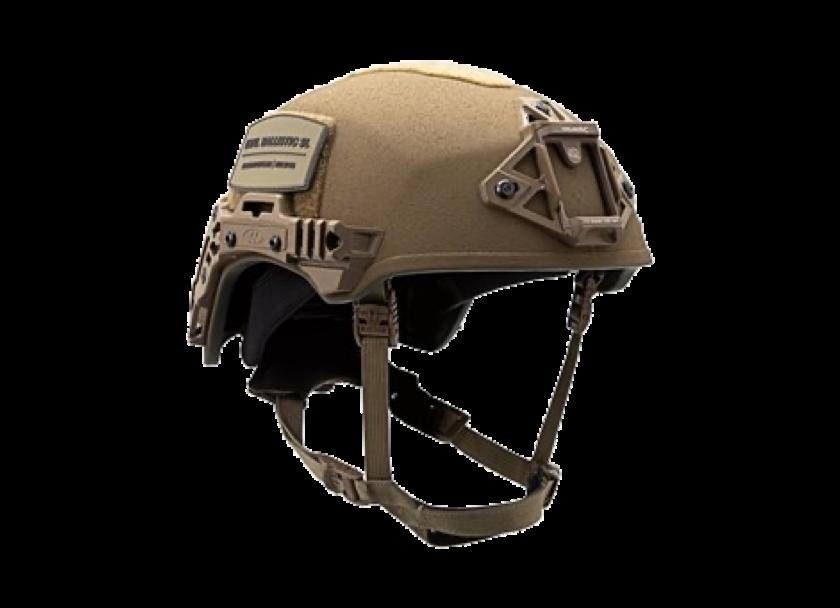
From ballistic protection to blunt impact mitigation; in the trenches, on the water or atop the mountain; Team Wendy has a purpose-built helmet for your mission. Military, law enforcement, search and rescue, and adventure community professionals around the world to Team Wendy for helmet solutions.
EXFIL® BALLISTIC SL
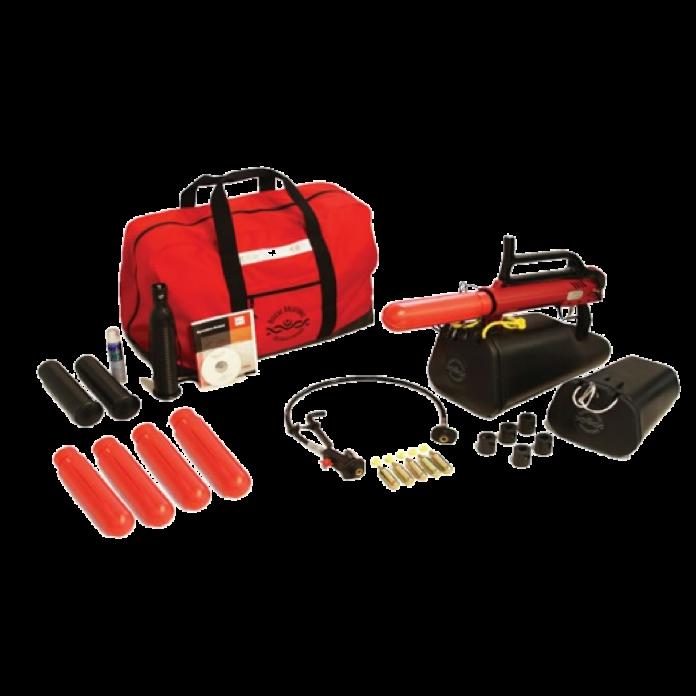
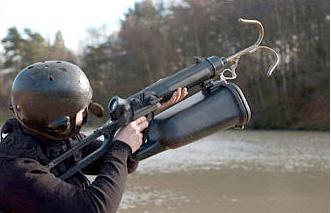
The Tactical ResQmax™ is the line thrower specifically designed for the tactical world of line-throwing As with all the ResQmax™ line throwers, the Tactical ResQmax™ is modular and can be used with a variety of accessories for horizontal or vertical line deployment When equipped with a grappling hook, a climbing line can be deployed to vertical distances up to 110 ft / 34 m, and a tactical ascending ladder can be deployed to vertical distances up to 50 ft / 15 m.
Entry points which would otherwise be inaccessible can be breached with ease for method of entry and ship-boarding operations in both land-based and maritime environments
“The ISNs create a footprint of identity, fairness and inclusion in the workplace.” – Det. Sgt. Stephen Yan, York Regional Police
D etective Sergeant Stephen Yan is one of the founders and co-chairs of the YRP East/Southeast Asian ISN, which was created in response to the narratives surrounding the COVID-19 pandemic. “Our Asian communities, both internal and external, were impacted by these narratives. Our ISN was formed because it gave members a platform to communicate their shared fears and anxieties.”
T hough ISNs are largely focused on supporting the organization’s sworn and civilian members, building relationships with community members who identify similarly and partnering with community groups are major parts of their work.
Mentorship and connection
A ll members need a range of support throughout their careers, and the professional mentoring opportunities from ISNs are said to be unique.
T hough he had been a member of the SAIL-ISN at TPS for most of his career, it wasn’t until Qureshi reached a higher rank that he took on a more active mentorship role.
“ The ISN executive committee members are truly doing this work on top of
their full-time duties. We volunteer to assist all members, whether it is a social event including members’ families, a professional development event for career advancement and/or networking, or events with a training component,” said Staff Sergeant Ross Fernandes.
A n example of this mentorship is that both Qureshi and Fernandes have prepared members for upcoming promotion processes through exercises such as mock interviews. The goal, shared Qureshi, is to help members be in a position to become the “future leaders we need them to be.”
Yan has also seen the power of ISNs in helping members who aspire to particular squads or units start on the right path to achieve that end. “When I see future leaders emerging from the ISNs, I know they’ve done it from a place of allyship, respect and courage. They’re able to come in and wear their culture on their sleeves proudly,” said Yan.
This type of mentorship is available to sworn and civilian members alike. Elaine Wong, a civilian member of TPS, has received support from her fellow EA-ISN members in a number of areas. “Being part of an ISN helped me meet and network
with other like-minded people across the organization. Just as an example, I would never see Paul [Qureshi] unless we were at an ISN event,” she said. “Now, let’s say an admin position is becoming available at TSV [traffic services]. Paul could let me know because we’ve made that connection through the ISNs; otherwise, I may not hear about it, given how large our service is. The ISNs are just another way to connect.”
All that said, the ISNs don’t replace the other formal support mechanisms in place for the police service. But if there is something else an ISN can add from a cultural perspective, they will do so.
Yan also believes that the mentoring aspect of the ISNs is a strong reason members stay within the organization. He said, “If people see they’re not always going to be stuck at the bottom rung of the organization, and they can aspire to some of the higher ranks and see others actually achieving their goals, it’s a big motivator.”
O n the recruitment side, as a member of an ISN’s executive committee, Fernandes has spoken to new recruits as they begin their training and has seen strong interest from new members right from the start. “It makes a huge difference and shows them that we welcome all cultures and backgrounds. Many times, these recruits follow up with us immediately afterwards, asking how they can get involved,” Fernandes relayed.
Inclusive, not exclusive
T he reach of an ISN extends far beyond the internal scope for which it was originally created. The ISNs at both TPS and YRP collaborate internally and externally with other services.
“ It’s important that we support one another because we can learn a lot from each other,” said Qureshi.
At TPS, the Equity, Inclusion, and Human Rights (EIHR) unit oversees all ISNs. The EIHR unit has knowledge of what all ISNs are doing, identifies where an ISN may be lacking, and determines where others can step in to provide additional support. This also reinforces the true mission behind every ISN: it’s never exclusive. Everything they do is about inclusivity.
E ven still, Yan sees one of the biggest challenges for ISNs as fighting the stigma that they are there to create unfair advantages, when really, they are established to ensure each member can be the “best
Lunar New Year Celebration – Year of the Snake, January 21, 2025.
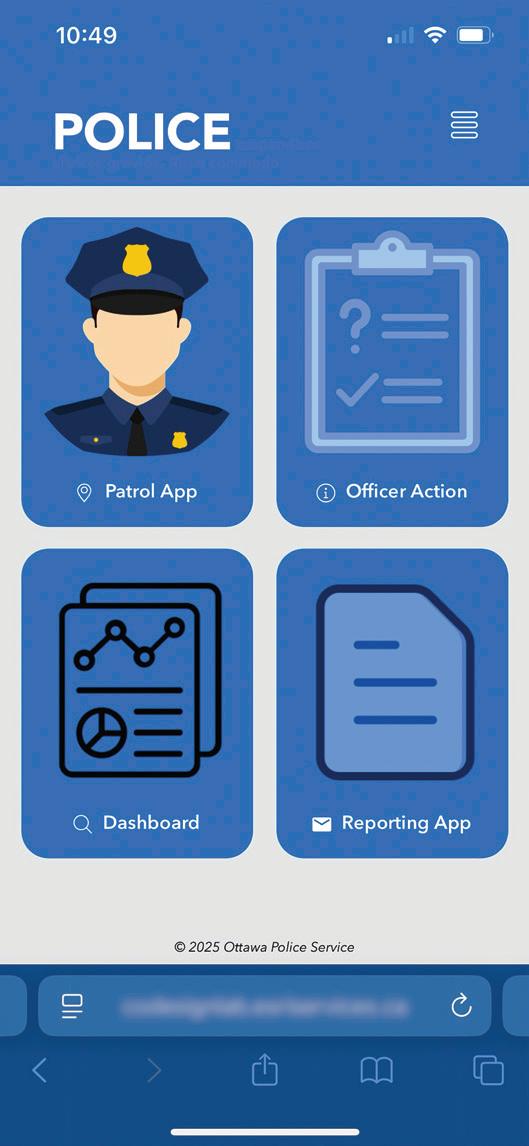
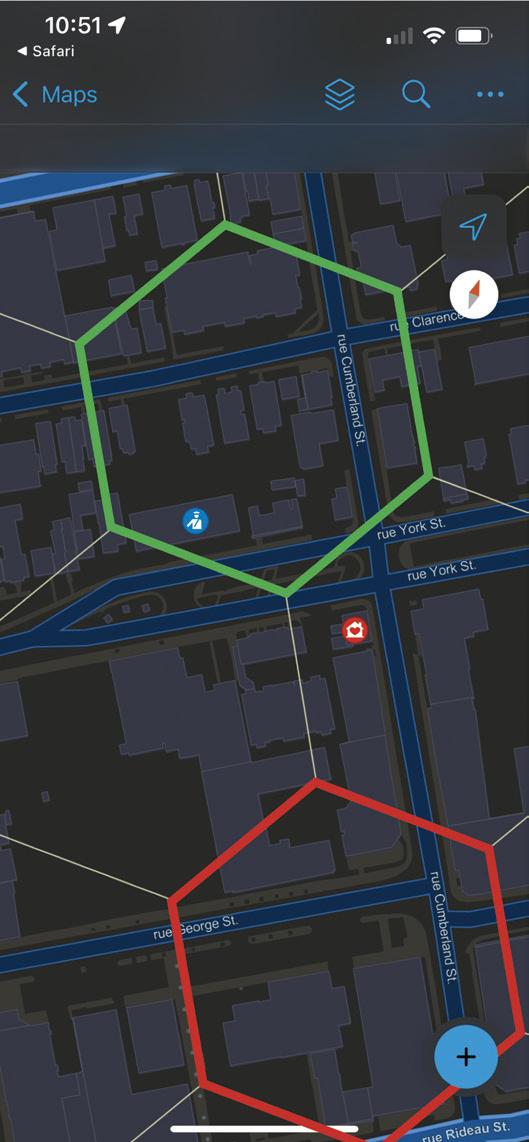
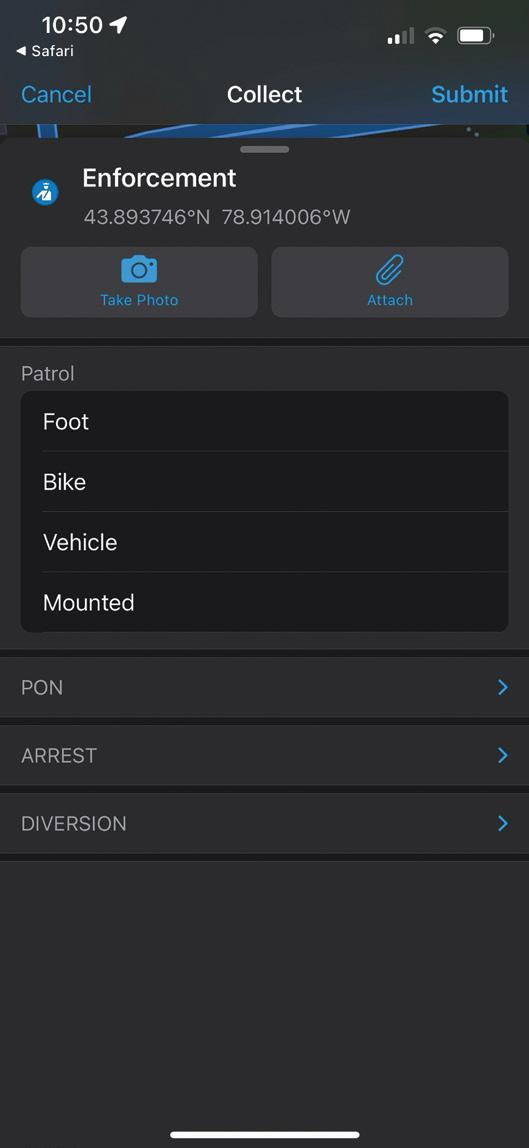
HOTSPOT POLICING THAT MOVES BEYOND THE MAP
Operationalizing crime analysis to support smarter deployments, better visibility and measurable impact.
Esri’s ArcGIS helps agencies:
• Build defensible hotspots using spatial and temporal analysis
• Coordinate operational activity across teams
• Support focused patrols and visible presence
• Capture field activity and operational intelligence
• Monitor outcomes through dashboards and reporting esri.ca/law-enforcement
version of themselves and have an equal footing in anything inside the organization,” he said.
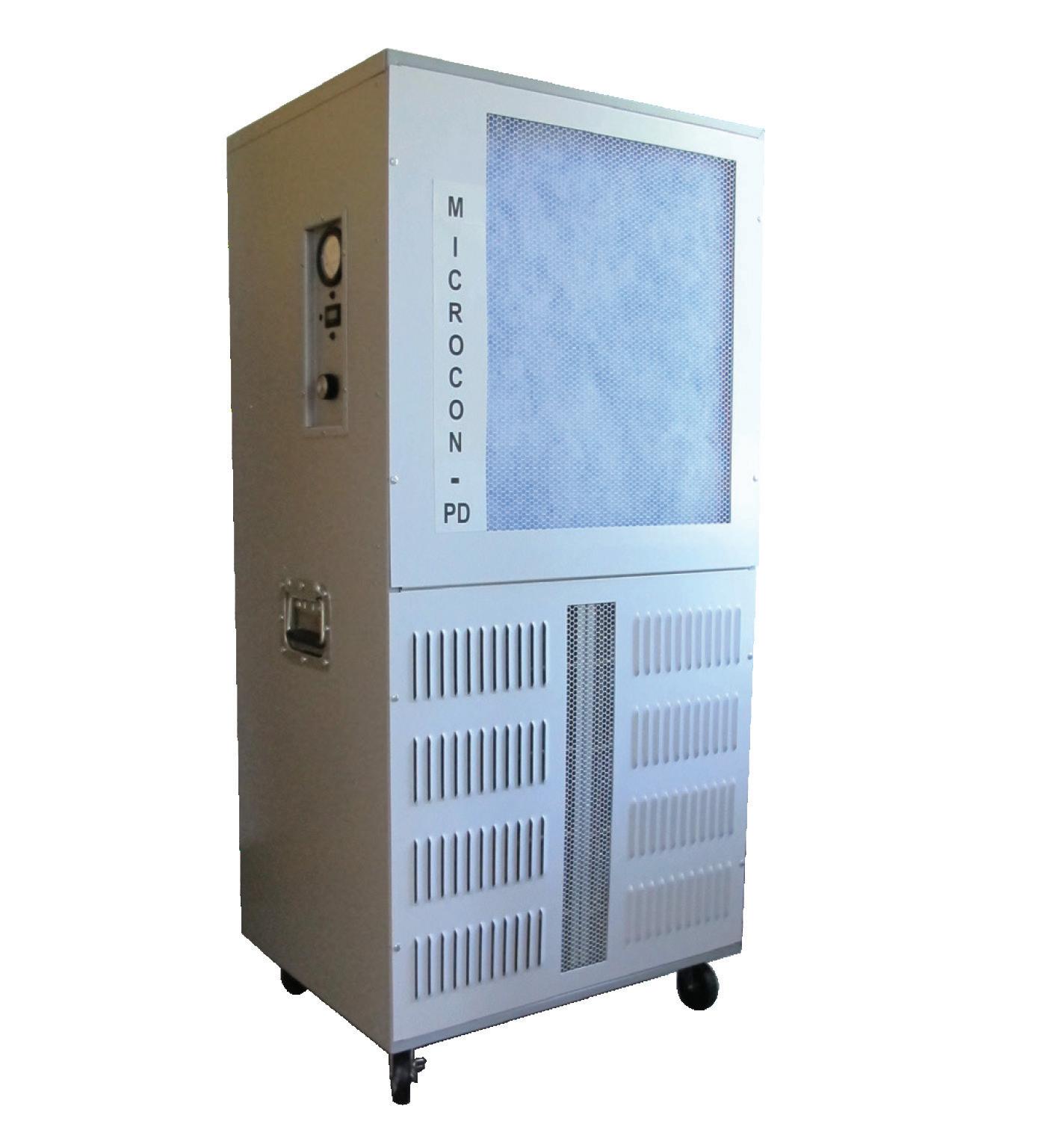
Property & Evidence
• Controls marijuana odors in storage area.
• Eliminates airborne virus & bacteria from contaminated evidence.
• Reduces airborne pollen.
Communications Room
• Eliminates the electronic odor
• Provides clean air for enclosed areas.
• Reduces the spread of viruses and bacteria among employees.
• Reduces the sick building syndrome known as “SBS”.
• Eliminates the stale air.
Booking Room
• Protects from the airborne and physical contaminants of suspects.
• Reduces exposure from contaminated evidence.
Alco-Test
• Cleans room air of contamination.
• Positive pressure can prevent air entry from other areas.
• Eliminates “tainted” test results.
Qureshi, Fernandes, Wong and Yan collectively shared that each ISN they are part of includes members who are not technically representative of their cultural backgrounds. This difference is celebrated. To them, this represents allyship and an eagerness to better understand their colleagues and the communities they serve.
The role of leadership
For ISNs to succeed, it’s important for a service’s leadership team to recognize their value not only in what they can do to support members internally but also in how they can build deeper connections with the community.
“A few years ago, we had a deputy chief serving as a senior adviser of the EA-ISN. Having someone in a leadership position who can make changes and discuss with other senior leaders the challenges members may be facing is very important,” shared Qureshi. He was recently promoted to a leadership position and is ready to take the needs of the ISNs “up the ladder” and address any potential pushback.
A big part of this also requires leadership to be authentic in their support. For Yan, showing up is one thing, but showing up and taking away something from the ISNs’ perspective, and adapting their leadership decision-making styles to reflect what they learned, shows the true value of how each ISN and member serves their community.
“Internal support networks like to deliver results in the sense that we like to come with solutions, not problems. We’re not about making an ‘us versus them’ narrative. It’s about what we can all contribute to the organization to make better leaders and members,” said Yan.
“Our work is meaningful, and when a leader also recognizes the value in what you do, it makes it feel that much more meaningful,” said Wong.
A stronger, unified organization
Without ISNs, police services may have a limited understanding of their members’ diverse experiences and fewer mechanisms to identify and address systemic gaps. Qureshi also believes that without ISNs, there would be less public trust in policing and among members of the service. “Toronto Police Service has well over 8,000 members who come from diverse backgrounds. If you don’t have a network of people you can relate to or go to for help, it would be hard to do this work,” he said.
“Policing has a challenge where we like to look for one-sizefits-all solutions and practices, and when you talk about diversity, it doesn’t always align with that. The ISNs show that the organization can still accomplish the same things, but we might be able to get there in different ways, especially if that’s what our communities want,” said Yan. “And from an internal perspective, it’s all about helping people find their path.”
Wong concluded, “The three biggest things in an ISN are support, allyship and fellowship. You don’t need to share my culture to understand allyship and fellowship. If we’re chatting over dim sum, why not? Or a samosa! Even if you’re not from the same culture as me, we can still be friends and do this work together.”
CASE LAW
BY MIKE NOVAKOWSKI
Implied licence and (im)permissible activity
Can the police enter a person’s private property under the implied licence doctrine and gather evidence against that person without a warrant, exigency or reasonable suspicion of criminal activity? It depends on why the police entered.
In R. v. Singer, 2026 SCC 8, at 11 p.m. a citizen reported an intoxicated driver speeding through the community in a white, single cab Ford truck. Two RCMP officers responded and searched the area. An hour later, officers spotted a truck matching the description parked in a private driveway with its engine running and lights on. From the road, the officers couldn’t see inside the truck, so they stepped onto the driveway and approached to investigate. Inside the truck, police found Singer slumped over in the driver’s seat. After knocking for several minutes with no response, an officer opened the driver’s door and smelled a strong odour of alcohol. They then opened the passenger door and shook Singer awake. A strong odour of alcohol came from Singer’s breath and his eyes were seen to be bloodshot and glassy. Singer was detained, failed an ASD test and was arrested for impaired care or control. At the station, Singer failed to provide a further breath sample, and was charged with refusal and impaired driving.
At trial in Saskatchewan Provincial Court, Singer argued his s. 8 Charter right to be secure against unreasonable search or seizure was violated when police unlawfully entered his private driveway, a place where he had a reasonable expectation of privacy. The judge, however,
concluded the officers were allowed to step onto the driveway under the “implied licence” doctrine: the idea that members of the public, including police, can approach a home for legitimate reasons. In this case, the officers were acting within the scope of their duties. Even if there had been a Charter breach, the judge would still have admitted the evidence. Singer was convicted of refusing to provide a breath sample, while the Crown stayed the impaired driving charge.
“So long as the police officer is lawfully present, the use of any of their senses … is not a search.”
Singer appealed his conviction to the Saskatchewan Court of Appeal, which unanimously reached the opposite conclusion. It found the police did violate Singer’s s. 8 right. They concluded that Singer had a reasonable expectation of privacy while sleeping in his truck in his driveway and it rejected the idea that officers could rely on implied licence. The officers weren’t trying to make contact in a routine way. The Appeal Court excluded the evidence, overturned Singer’s conviction, and entered an acquittal.
The Crown challenged the Appeal Court’s ruling to a full panel of the Supreme Court of Canada, which was deeply divided. A majority held that the entry onto the property and approach to the truck were lawful under the implied licence doctrine. Under this doctrine, the property’s occupier effectively waives their privacy interest in the approach to the door of their dwelling and grants the public permission to approach for the purpose of communication. This licence can be revoked by a clear expression of intent by an occupant, like posting signs prohibiting entry or asking the person to leave. If the police engage in activity that goes beyond the purpose of facilitating communication, they breach the implied conditions of the licence.
“So long as the police officer is lawfully present, the use of any of their senses of sight, hearing or smell is not a search.” Police intention matters. “Where evidence clearly establishes that the police have specifically adverted to the possibility of securing evidence against the occupant by knocking on the door, the police have exceeded the terms of the implied licence to knock,” said the majority.
Here, the officers were legally allowed to enter Singer’s driveway. They could approach the truck and knock on the window to try to speak with its occupant. But implied licence only extended to the door of the truck. By opening it, police gained access to information they couldn’t otherwise detect, like the smell of alcohol. That made it a Charter “search”, something the Crown failed to justify. As a result, the police violated Singer’s s. 8 right when they opened the truck’s door. However, the evidence was admissible, and the matter was remitted to the Court of Appeal to resolve an unrelated matter.
In a strongly worded dissent, the minority concluded that police conduct was unconstitutional from its inception. In its view, there was a search from the moment police stepped onto the property, something that couldn’t be justified by implied licence. The minority would have excluded the evidence, dismissed the Crown’s appeal and upheld Singer’s acquittal.
Mike Novakowski is
Line’s case law columnist.
Blue
Scan here to learn more
BY JENNIFER HYLAND
Rethinking talent and equity in policing
If you judge a fish by its ability to climb a tree, it will spend its whole life thinking it is stupid.”
The quote is often attributed to Albert Einstein, and while its origins may be debated, its truth is not. That simple metaphor captures a fundamental flaw in how workplaces, including policing, too often assess talent, performance and value. We measure individuals against a narrow standard, then mistake misalignment for deficiency.
Like most modern professions, policing is not composed of a single skillset. It is an ecosystem of disciplines. It requires technical proficiency, emotional intelligence, academic and investigative capacity, physical capability, judgment under pressure, legal literacy, communication and empathy.
of domestic violence may not be the right choice to execute a dynamic entry on a barricaded suspect.
Each of these competencies contributes to public safety, but not all are measured, rewarded or elevated equally.
How we define “good” shapes who thrives
Organizational value is never neutral. It is constructed through the systems we build for promotion, recognition and advancement. When those systems privilege a narrow slice of the competency spectrum, talent outside that slice becomes under-leveraged and sometimes actively discouraged.
We measure individuals against a narrow standard, then mistake misalignment for deficiency.
To suggest that any officer could sit at the top of all these categories would be as unreasonable as expecting a gold medalist in the 100-meter sprint to also take gold in the 100-meter freestyle. We instinctively understand that elite athletic performance is specialized, and we celebrate it. On rare occasions, a Clara Hughes-like individual emerges, competing in both Summer and Winter Olympics, a marvel not because it is common but precisely because it is not.
Yet in policing, we frequently fall into the trap of assuming that excellence should be universal, transferable and linear.
While most officers begin their careers in uniformed patrol, the profession quickly branches. Some enter tactical response, SWAT, or become K9 handlers. Others master forensic identification and crime scene processing, or refine the art of interviewing traumatized victims or reluctant suspects. Still others move into digital investigations, community engagement or intelligence work.
No one questions that different domains require different kinds of strength. The top recruit academically may not be the best at controlling a chaotic scene. The tactical standout may not be the ideal person to interview a child victim. The empathetic officer who excels at supporting survivors
This is how brilliant “fish” end up feeling like failed “tree climbers.” It is not that they lack ability, but that we are asking them to demonstrate the wrong one.
Where gender enters the conversation
For generations, policing was a profession designed primarily by men, shaped by masculine norms of performance such as decisiveness, aggression, physicality, tactical dominance and command presence. This isn’t a criticism; it is a historical reality.
When women entered policing in greater numbers, they arrived with different— not lesser—strengths such as empathy, communication, rapport building, trauma-informed interaction, conflict diffusion and relational intelligence. These skills are central to modern policing outcomes, particularly in an era defined by mental health calls, complex social issues and community legitimacy.
To frame the conversation in terms of “who is better” misses the point entirely. The most complete workplaces, like the most complete households, draw strength from complementary traits.
For decades, social scientists have observed that children raised in single-parent households often face unique challenges because a wider range of emotional and developmental experiences is harder to replicate on their own. As a society, we
understand the value of combined strengths in the home.
Policing is no different. A profession that relies solely on masculine-coded strengths leaves gaps. A profession that relies solely on feminine-coded strengths leaves others. True equity is not a zero-sum competition; it is additive and fills in the missing pieces until the organization becomes more whole.
Women do not need special treatment in policing. What they need, what anyone with under-recognized talents needs, is visibility. They need systems that acknowledge the full spectrum of abilities required for organizational success, not just the historical subset that has traditionally been easiest to measure.
That is what equity actually is: the ability to recognize value where it exists, not only where we’re accustomed to seeing it.
A simple thought experiment
If your household had only a father, what would you have missed? If it had only a mother, what would you have missed? Neither is better; both are incomplete on their own.
Now imagine your workplace under the same constraints. What capacities remain underdeveloped? What talent never surfaces? What community needs go unmet? What potential goes unrealized?
These are not ideological questions; they are operational ones.
The fish does not need climbing lessons; the fish needs water, and the climber needs a tree. The organization ne eds both to reach the top and to cross the river.
A modern police service cannot afford to optimize for only one version of value. Complex work demands a complex workforce. Our systems will either make room for that reality or lose the people who could have made them better.
Jennifer Hyland served as a police officer in B.C. for over 26 years. Her career spanned three organizations: the New Westminster Police, the RCMP and the Surrey Police Service. She retired as a deputy chief in Sep. 2024. She is the author of Tightrope: Balancing Duty With Courage and Conviction, which was published in late 2025.
Canada’s full-service security partner
Freeing police officers to focus on the work only they can do
BY-LAW ENFORCEMENT
NON-CORE POLICING
PRISONER MONITORING/ ESCORT/TRANSPORT
DETENTION GUARDS
ADMIN SUPPORT
PHOTO RADAR
FINGERPRINTING SOLUTIONS
ONLINE CRIMINAL RECORD CHECK SOLUTIONS
… AND MORE
Le par tenaire canadien en sécurité à ser vices complets
Permettre aux services policiers de se concentrer sur les rôles que seuls eux peuvent remplir
APPLICATION DES RÈGLEMENTS MUNICIPAUX
SERVICES COMPLÉMENTAIRES AUX CORPS POLICIERS
SURVEILLANCE DE DÉTENUS /ESCORTE ET TRANSPORT
AGENTS DE DÉTENTION
SOUTIEN ADMINISTRATIF
RADARS PHOTO
SOLUTIONS DE PRISE D’EMPREINTES DIGITALES
SOLUTIONS DE VÉRIFICATION DE CASIER JUDICIAIRE EN LIGNE