BLUE LINE CANADA’S LAW ENFORCEMENT MAGAZINE
www.BlueLine.ca
MAY 2020
FOR NEWS AND ADVICE ON COVID-19 IN THE LAW ENFORCEMENT SECTOR, VISIT BLUELINE.CA
Sept 29 SAVE THE DATE
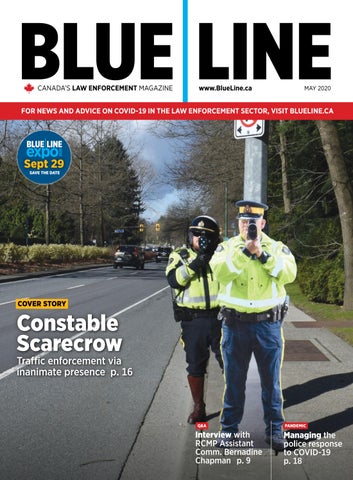
COVER STORY
Constable Scarecrow
Traffic enforcement via inanimate presence p. 16
Q&A
PANDEMIC
Interview with RCMP Assistant Comm. Bernadine Chapman p. 9
Managing the police response to COVID-19 p. 18
THE AVERAGE TRUCK NEVER COMES WITH THIS MUCH STORAGE.
BUT THEN THIS ISN’T YOUR AVERAGE TRUCK. The 2020 Ram 1500 Special Service is no ordinary truck, starting with its legendary 5.7L HEMI® V8 engine featuring the fuel-efficient Multi-Displacement System (MDS) Fuel Saver Technology. Variable Valve Timing (VVT) delivers impressive engine performance, while its Class-Exclusive Multilink Coil Spring Rear Suspension* ensures lateral stiffness and superior vehicle control. An available RamBox® Cargo Management System* means you’ll never run out of room — whatever you bring to the job. The Ram 1500 Special Service. With so many great features, no wonder they call it Special.
CLASS-EXCLUSIVE RAMBOX CARGO MANAGEMENT SYSTEM ®
WITH BED DIVIDER*
CLASS-EXCLUSIVE MULTILINK COIL SPRING REAR SUSPENSION*
fleet.fcacanada.ca
1 800 463-3600
*Based on Automotive News Full-Size Pickup segmentation. Excludes other vehicles designed and manufactured by FCA US LLC.
Contents
18 May 2020 Volume 32 Number 5
B:11.125"
S:9.875"
T:10.875"
Features COVER STORY
16 Traffic enforcement via inanimate presence
Traffic safety remains a priority for police agencies across North America. In hopes of reducing speeding, the Coquitlam Detachment of the RCMP, in collaboration with the City of Coquitlam and City of Port Coquitlam, introduced the newest member of its Traffic Services Unit in September of 2018: Constable Scarecrow. By Rylan Simpson
18 Policing the pandemic
COVER PHOTO: COQUITLAM RCMP
Today the world is grappling with a global pandemic, COVID-19. Police may have different roles during pandemics and there will be challenges that this creates. However, there are also some approaches to the development of police response in the complex context created by pandemics to consider. By Karl Roberts
9 16 @Blue_LineMag
Columns 4 9 10 12 13 24 26 30
Editor’s commentary Q&A Behavioural sciences Health & wellness Holding the line Technology Case law Back of the book
Departments 5 5 6 8 8 25 28 29 30
By the numbers News Cold case Dispatches Calendar Off the shelf Product showcase Marketplace Blue Links
24 May 2020 | BLUE LINE
3
EDITOR’S COMMENTARY BY RENÉE FRANCOEUR
Adapting together in times of uncertainty: thank you, technology
I
wasn’t going to write another editorial on the surging impacts of COVID-19 or general ruminations on a new paradigm for policing in a pandemic, but how can I not? So much has changed since my last one — so much is still changing on the daily — and it remains the most pressing development in all of our lives. That collectivity piece — how each and every one of us on the planet has been touched by this in one way or another — continues to really strike a chord with me. We may be social distancing right now, but in a way, I have never felt more connected. I find myself calling, texting, FaceTiming and Zooming more than ever before. Pandemics “remind us of how connected we all are,” writes Valerie Earnshaw in a piece for the Harvard Business Review. “Our shared vulnerability to this virus is a source of solidarity.” As expected, I am seeing this solidarity expressed beautifully across our Canadian law enforcement family. Who else was thrilled to wake up one morning and find Twitter and Instagram teeming with #positivepolicechallenge photos? It might sound like such a little thing, but these photos of officers and wide-eyed children, playful police dogs, and some pretty epic bike shots certainly brought a smile to my face — especially Toronto Police Officer Randall Arsenault’s snap of his fuchsia manicure while in uniform. Then there was the video shared of Calgary Police Const. Ryan Self, who was out on patrol when he happened to come across a “social distancing” line dance in a parking lot. Self joined in and we weren’t the only ones who appreciated his patterned foot movements — Narcity Media noticed, too. “COVID-19 has changed the way we do things, but connecting with Calgarians is always important to us,” the Calgary Police Service posted on Facebook. It is work to remain positive as our carefully constructed norms fall to pieces and we continue to have no concrete details on what the future holds — makes it hard to reassure an anxious, frightened public, too.
4
@Blue_LineMag
BLUE LINE | May 2020
www.BlueLine.ca
GROUP PUBLISHER | MARTIN MCANULTY mmcanulty@annexbusinessmedia.com EDITOR | RENÉE FRANCOEUR rfrancoeur@annexbusinessmedia.com ACCOUNT MANAGER | JANICE EATON jeaton@annexbusinessmedia.com MEDIA DESIGNER | SVETLANA AVRUTIN savrutin@annexbusinessmedia.com ACCOUNT COORDINATOR | TRISH RAMSAY tramsay@annexbusinessmedia.com
A sample of #positivepolicechallenge photos from Instagram.
It is work to try to practice gratitude and lasso silver linings as we grieve the loss of family gatherings, vacation plans, or even as we grieve the loss of shift parades and times of less PPE (personal protective equipment). But it is work we are doing and I am proud of all of us. So, keep sharing the photos and the connectivity innovations — I see some of you are successfully using Microsoft Teams for your ops meetings. And the non-profit Boots on the Ground presented a “Frontline and Family Wellness Chat” over video in partnership with two psychologists that you can check out at: youtu. be/ujj45WzLIgI. I myself hosted a virtual roundtable with five of our leaders in Canadian law enforcement from the RCMP, Delta Police Department, York Regional Police Service, Edmonton Police Service and Saskatoon Police Service. We discussed how everyone is addressing PPE issues and concerns, as well as other aspects of crisis management. It was a refreshing and enjoyable opportunity to learn, share and connect. You can watch the video at bit.ly/34St7fC. “Just because we’re self-isolating doesn’t mean we have to stop communicating with people; do it online,” said Dave McLennan, former police officer and Boots on the Ground president, during his “Frontline and Family Wellness Chat.” With that, know I wish you solid Wi-Fi connections and/or decent data plans, and peace and health, calm and safety. We are in this together.
CONNECT WITH BLUE LINE
www.BlueLine.ca
BLUE LINE
www.facebook.com/BlueLineMagazine
CIRCULATION MANAGER | BEATA OLECHNOWICZ bolechnowicz@annexbusinessmedia.com Tel: 416-510-5182 COO | SCOTT JAMIESON sjamieson@annexbusinessmedia.com
ANNEX BUSINESS MEDIA 111 Gordon Baker Road, Suite 400 Toronto, ON M2H 3R1 Tel. 416-442-5600 • Fax 416-442-2191
Publication Mail Agreement No. 40065710 ISSN 0847-8538 Printed in Canada SUBSCRIPTION RATES Canada — 1 Year $31.50; 2 Year $52.50 plus tax USA — 1 Year $136.50 CAD CIRCULATION email: bolechnowicz@annexbusinessmedia.com Tel: 416-510-5182 Fax: 416-510-6875 or 416-442-2191 Mail: 111 Gordon Baker Road, Suite 400, Toronto, ON M2H 3R1 Occasionally, Blue Line will mail information on behalf of industry-related groups whose products and services we believe may be of interest to you. If you prefer not to receive this information, please contact our circulation department in any of the four ways listed above. Annex Privacy Officer Privacy@annexbusinessmedia.com; Tel: 800-668-2374 © 2020 Annex Publishing & Printing Inc. All rights reserved. Printed in Canada. No part of the editorial content of this publication may be reprinted without the publisher’s written permission. Opinions expressed in this magazine are not necessarily those of the editor or the publisher. No liability is assumed for errors or omissions. Readers are cautioned and advised that articles presented herein are edited and supplied for your personal awareness and should not be used for further action until appropriate guidance is received from a supervisor, Crown Attorney or other persons in authority. All advertising is subject to the publisher’s approval. Such approval does not imply any endorsement of the products or services advertised. The publisher reserves the right to refuse advertising that does not meet the standards of this publication.
NEWS WORLDWIDE
World Class Policing Awards 2020 are now open for nominations
IMAGE COURTESY OF INTERPOL
WORLDWIDE
Interpol issues international guidelines to support law enforcement response to COVID-19 Interpol has announced its release of international guidelines in order to enhance the safety and effectiveness of law enforcement and first responder support in the context of the COVID-19 pandemic. Shaped in accordance with international best practices and the World Health Organization’s (WHO) recommendations, the guidelines provide information on how officers can protect themselves and their families, and outline the various roles carried out by law enforcement during a pandemic. Accordingly, the guidelines warn of emerging crimes linked
to the pandemic, including intimidation and deliberate dissemination attempts, fraud or phishing, cybercrime and counterfeiting. With police routinely running into dangerous situations to protect their communities, the guidelines are intended to be considered by law enforcement agencies as part of a response strategy to the outbreak, in line with recommendations by national public health authorities. Their purpose is to supplement rather than replace national guidelines. All measures taken by national law enforcement authorities should therefore conform with the applicable national legislation and international obligations. Download the guidelines at bit.ly/2UFkTEf.
International nominations for the World Class Policing Awards 2020 are now live at www.WorldClassPolicing.com. The inaugural 2019 World Class Policing Awards were “a fantastic success,” according to organizers, with nearly 120 entries from 31 U.K. police forces, three national U.K. policing agencies and five overseas forces. From these nominations, 54 finalists were shortlisted by the independent expert judging panel and celebrated at an awards ceremony. The winners included Operation Encompass, the pioneering project launched by Devon & Cornwall Police in the U.K., supporting children exposed to domestic violence; Queensland Police Service’s Tactical First Aid Project in Australia, which equips officers to save lives and increase survival rates for those affected by traumatic injury; and a force-wide initiative by New Zealand Police to equip officers with smartphones and develop apps and online resources that maximize the benefits of mobile working. The 2020 Awards introduce the Platinum, Gold, Silver and Bronze Globe Awards for the overall winners along with Special Category Commendation
Awards, which will recognize world class performance in specific aspects such as the use of technology, training and development, collaboration and police welfare to mention a few. The closing date for completed nominations is May 29. NORTH AMERICA
New report tackles forensic handwriting examination and human factors
A panel published a scientific assessment of the effects of human factors on forensic handwriting examination, titled “Forensic Handwriting Examination and Human Factors: Improving the Practice Through a Systems Approach,” in February 2020. It provides a discussion of human factors as they relate to all aspects of handwriting examination, from documenting discriminating features to reporting results and testifying in court. The report also includes recommendations for improving the practice going forward. The authors, the Expert Working Group for Human Factors in Handwriting Examination, are supported by the National Institute of Justice (NIJ) Office of Investigative and Forensic Sciences (OIFS) and the National Institute of Standards and Technology (NIST) Special Programs Office in the United States. Find the full report at bit.ly/3dU7obi.
BY THE NUMBERS
A study of three years of Canadian case law involving sexual offences against adolescent girls from the ages of 12 to 17 demonstrated that men accused in these cases were, on average, 19 years older than the complainant. Almost half the girls reported sexual abuse by a male family member. More from the study, which was published in the Canadian Journal of Women and the Law, can be found at bit.ly/2G81ALX.
680 written decisions from 2014 to 2016, where the complainant was a girl of at least 12 and no older than 17, were examined by researchers
@Blue_LineMag
518
625
accused persons were in these judgements
female complainants were in these judgements
6
of those 518 accused were women and the remaining 99 per cent were men
May 2020 | BLUE LINE
5
NEWS NOVA SCOTIA
RCMP Const. Heidi Stevenson killed in the line of duty
A 23-year veteran of the force, RCMP Const. Heidi Stevenson was killed in the line of duty on April 19, after members responded to an active threat situation in Colchester County, N.S., along Heidi Stevenson with at least 21 others. “Heidi answered the call of duty and lost her life while protecting those she served,” said Nova Scotia RCMP Commanding Officer, Assistant Commissioner Lee Bergerman in her official statement. “I met with Heidi’s family and there are no words to describe their pain. Two children have lost their mother and a husband his wife. Parents lost their daughter and countless others lost an incredible friend and colleague. Heidi’s family is a part of our RCMP family and we will embrace and support them in the days, weeks and months ahead.” Another RCMP officer was injured and was in hospital, receiving treatment of non-life-threatening injuries, following the tragedy.
Blue Line grieves with its wider blue family and extends its deepest condolences to RCMP Nova Scotia, the friends and family of Const. Stevenson and all the others impacted by this horrific shooting. Rest in peace. The Nova Scotia provincial crisis line is available 24/7 at 1-888-429-8167. Others are standing by as well to help us through this, such as those at Badge of Life Canada (badgeoflifecanada.org). WORLDWIDE
ASEBP facilitating more information sharing concerning COVID-19
The American Society of Evidence-Based Policing (ASEBP) is seeking to facilitate conversation and information sharing directly between law enforcement agencies. ASEBP has created a secure law enforcement only portal for police agencies to upload policies, practices and ideas concerning COVID-19. “Currently, policing organizations are asking agencies to submit information to them in order to gather information and then are pushing out that information back down to their membership,” said Renée J. Mitchell, the founder of ASEBP. “This is the way we have always communicated in policing.
During this global pandemic we need a way to share information and ask questions rapidly as this crisis evolves. Additionally, police agencies that have yet to be hit by COVID will need guidance from agencies that are in the trenches.” The first time you upload should not take more than 30 minutes. Updates after the first upload are even quicker, according to Mitchell. “Additionally, by uploading it into the site, others in your agency could also go in and see the policies and practices, as the website will create an individual agency’s COVID-19 gamebook. This site is intended to be a library of individual agencies gamebooks that can be accessed instantaneously. Think of the communication portal as building a library of gamebooks that can be accessed globally by other law enforcement agencies,” Mitchell added. The COVID-19 portal is free for all law enforcement, which means it is not connected to your ASEBP membership, so you will have to click on login and create a new login and password. This will be separate from your ASEBP membership. Visit www.americansebpcovid.org to begin. You will need to log in with a police email address and approval usually only takes a couple of minutes.
COLD CASE Blue Line’s NEW Cold Case Series:
OUT OF THE COLD File #2: A composite drawing from 20 years ago... BY STEPHEN METELSKY
We are proactively profiling a cold case in every other issue for our readers to share in order to spark renewed interest and hopefully generate tips and information. Victoria Avenue, also known as Regional Road No. 24, stretches through the epicentre of Niagara region, starting from the north shore of Lake Ontario, inclining through Vineland and spreading amongst endless views of surrounding farms and fields. It is an area known for its quaintness and country-like tranquility, but at night, amidst a minimal local population, it can also quickly transform into a dimly lit stretch of highway. On May 9, 1999, a woman’s body was found along this very stretch of road in Vineland in a 6
BLUE LINE | May 2020
ditch beside Regional Road No. 24, just near 8th Avenue. After the body had been discovered, more than two weeks elapsed before the identity of the victim was confirmed: Nadine Gurczenski, 26 at the time, from Toronto, Ont. Gurczenski had been murdered and Niagara Regional Police believe her partially clad body had been left at the side of the road in this desolate area for at least one full day prior to discovery. There is more information investigators are not releasing, namely the cause of Gurczenski’s death, which include details only the person or persons responsible for this heinous crime would be privy to. “During the initial investigation, a composite drawing of a male was released to the media. This male had been seen with Nadine on more than once occasion, just prior to her death. He was described as in his late twenties, six feet tall, medium build, with short brown hair and clean shaven,” says Det.-Sgt. Jackie Moore of the Niagara Regional Police cold case unit.
“Investigators are requesting the public be mindful this composite drawing was created 20 years ago and that an individual’s physical descriptor(s) change during a 20-year time span,” Moore adds. Niagara Regional Police Service is actively seeking assistance to positively identify this unknown male. “The investigation into the unsolved homicide of Nadine Gurczenski remains open and the Niagara Regional Police Service is committed to continuing this investigation in order to identify the person or persons responsible,” Moore says. Investigators are encouraging anyone who may have information to contact the Homicide Unit at 905 688 4111, extension 4200 or online at www. niagaratips.ca. To leave an anonymous tip, contact Crime Stoppers of Niagara at 1-800-222-TIPS (8477) or online at crimestoppersniagara.com. Stephen Metelsky, M.A., is a writer, (ret.) police intelligence sergeant and professor at Mohawk College. Find him on LinkedIn, follow him @StephenGm_Jr or email Stephen.Metelsky@mohawkcollege.ca.
www.BlueLine.ca
L
A T
ET
KNOW M I TH H
Thanks to First Responders for keeping us safe and secure in these challenging times.
Hudson Supplies is a distributor, importer and manufacturer of equipment for first responders and Health care workers. We are making 100% Canadian made face masks for minimum protection no MOQ. Also, in stock, hard-surface disinfectant, kills 99.9% of germs (COVID-19). Send your request to info@hudsontactical.com or visit our online store at www.hudson4supplies.com
NEWS DISPATCHES Peel Regional Police Service’s Acting Deputy Chief of Police Dale Mumby has retired. Mumby began his policing career in 1988 with Peel Regional Police and went on to spend time in Uniform Patrol, Divisional Criminal Investigation Bureau, Commercial Auto Crime Bureau, Communications Bureau, Street Crime Gang Unit, Homicide and Missing Persons Bureau, Fraud Bureau, Duty Inspectors’ Office, Emergency Support Services, and most recently served as the executive officer to the Chief of Police. Mumby was promoted to sergeant in 2002, staff sergeant in 2006, inspector in 2013 and superintendent in 2014. Const. Ann-Marie Gallop of the Bay St. George Detachment of the RCMP has been awarded the Atlantic Women in Law Enforcement Officer of the Year Award. The honour goes to a female police officer in the Atlantic region with a history of excellence in leadership, community service, mentoring and performance. Staff Sgt. Kale Pauls (photo) is now in command of the White Rock RCMP detachment in British Columbia, taking over from Sgt. Rob Dixon, who had been acting commander of the seaside detachment for several months. Dixon oversaw such initiatives as volunteer patrols, Speed Watch, Stop Watch, community engagement, crime prevention and waterfront enforcement. Pauls has been a Mountie for 15 years, most recently as strategic planning commander for the Surrey detachment, and as a member of the Surrey Contract Management Project Team. Previously, Staff Sgt. Daryl Creighton led the detachment. Grande Prairie RCMP members Sgt. Shiloh Fragomeni and Const. Darren Jensen have received Commendations for Bravery, handed out by RCMP Deputy Commissioner Curtis Zablocki at a ceremony in Edmonton. Both officers responded to a complaint involving a suicidal male at a residence in November 2015. When they arrived, they found a man with a long-barreled gun. The officers, along with two others, were able to get the gun and take the man into custody. 8
BLUE LINE | May 2020
CALENDAR Insp. Michael Maville is the detachment commander of the Nipissing West OPP Detachment.
Please note numerous events have either been postponed or cancelled due to COVID-19. Double-check all event websites before booking.
POSTPONED TO MAY 2021
North Grenville’s bylaw officer of 26 years, James Petersen, passed away after a sudden heart attack at the age of 52. He was also a volunteer firefighter. Petersen was recognized for 25 years of service by the Municipal Law Enforcement Officers’ Association of Ontario in 2018. Rest in peace. Staff Sgt. Lisa Hunt is retiring after more than 31 years with South Simcoe Police Service (and the former Bradford West Gwillimbury Police Service). Toronto Police Service Staff Sgt. Rob Brown of 52 Division has retired after 33 years of dedicated service.
Canadian Society of Forensic Science Conference and AGM May 11-15, 2020 Oshawa, Ont. www.csfs.ca/event/csfs-conferenceand-agm Laurier Online’s Public Safety Degree Programs: What to expect • Weekly Webinar May 12, 19, 26, 2020 Online online.wlu.ca/webinars/weeklywebinar-series POSTPONED TO JUNE 2-3, 2021
CANSEC 2020 May 27-28, 2020 Ottawa, Ont. defenceandsecurity.ca/CANSEC/ CANCELLED
Darren Sweazey, Woodstock Police Service’s deputy chief, will retire from later this summer. Sweazey will officially finish his 30-year career with the Woodstock service on July 31. Sweazey was the acting chief following Bill Renton’s retirement last year until Daryl Longworth assumed the role in September, after finishing with the London police. Blue Line’s Holding the Line columnist, Michelle Vincent, retired from York Regional Police after 18 years. She is the founder of The Haven and also recently received an award for her work in mental health for first responders from Badge of Life Canada. Dean Simmonds at Halifax Regional Police (HRP) was promoted to the role of superintendent. Simmonds has served as a member of HRP Strategic Planning Team, HRP/RCMP Integrated Cultural Diversity Committee, and Race Relation Advisory Committee for the past eight years.
International Police Mountain Bike Association (IPMBA) Conference June 1-6, 2020 Dayton, Ohio http://ipmba.org/conference POSTPONED TO OCT. 14-15, 2020
Canadian Tactical Conference by OTAB June 3-4, 2020 Collingwood, Ont. otab.ca Heroes In Life Memorial 2020 June 13, 2020 Toronto, Ont. www.heroesinlife.com/memorial POSTPONED
2020 OACP Annual Conference June 14-20, 2020 Niagara-on-the-Lake, Ont. www.oacp.on.ca CANCELLED
LEOSH 2020 Conference June 16-18, 2020 Banff, Alta. www.leosh.org/
www.BlueLine.ca
Q&A RCMP Assistant Commissioner Bernadine Chapman became the new Commanding Officer for RCMP, National Division in November 2019. Previously the RCMP district officer for Southern Alberta, Chapman was in charge of 37 detachments there and has spent 31 years overall with the federal police service. Originally from Prince Edward Island, she has served in general duty policing, anti-corruption drugs and organized crime, and employee management relations across the country. She opens up about some of her career highlights below as well as her thoughts on employee wellness. Q: Why did you decide on a career in law enforcement?
This may sound cliché but for as long as I can remember, I’ve always wanted to help people and work with communities by bringing positive change. I just didn’t know at the time that this would lead me to become a police officer since I had initially considered pursuing a law degree... A friend told me about the RCMP, and that I would probably love working there. That’s when I started looking into it and, well, the rest is history!
Q: What has been one of the most memorable moments of your career?
It was probably that fateful night in 2004 where, at the time, I was stationed in New Brunswick. A suicidal man had climbed on top of a bridge and myself and a firefighter were dispatched to the scene. I was familiar with the individual as he suffered from mental health issues, which often required police intervention. I remember vividly it being a very tall bridge and we had to climb it to get closer to him. I was a constable back then and it was also an intensely busy night. In the end, we were able to bring him down to safety. It was an unnerving event but this type of incident reminded me why I signed up to be a police officer in the first place. (Editor’s note: as a result of this courageous intervention, she received numerous awards, including RCMP Commander’s commendations, a Valour Award from the Atlantic Women in Policing as well as a Valour Award from the International Association of Women in Policing.)
PHOTO: RCMP
Q: What has been a particular challenging part of your career?
Policing is certainly one of those professions that requires a great deal of emotional investment within oneself, with the people you work with and with the public we serve. Over the years this becomes more and more challenging to manage. I have seen many succumb to these pres@Blue_LineMag
sures over the years, which has been very difficult. And I think the most challenging thing for me is that self-care check, to take off the mask so to speak. I would say I have only just started to make changes over the past several years to recognize when I need to step back and take a breath. I also navigate this by ensuring that the culture/environment around me is one that fosters employee well-being. This is extremely important for me and if I can foster open communication on employee wellness, hopefully it will empower people to ensure they seek self-care.
Q: What are some of your plans for National Division?
Q: How have your experiences in your postings in New Brunswick, Nova Scotia, Ontario, Manitoba, and Alberta prepared you for this role?
Q: What are your specific hopes for the RCMP of the future?
I think my professional experiences helped me to build character. I have acquired a diverse background as I’ve worked in many parts of the country and I think that these experiences have given me a better appreciation and understanding of certain things. I am better equipped now to deal with issues when I am faced with them and to make tough decisions when I need to. These have given me a greater level of comfort to have innovative approaches and go beyond beaten paths — or rather to think more “outside the box.”
I want to build a robust employee wellness foundation because we need to take better care of our own. I also want our members to have better access to training by having our own training facilities. I want to ensure that we are working within our mandate in the national capital region, modernizing our service delivery and that we continue building solid relationships with our internal and external partners. It’s probably a lot to take on but hopefully this will be my legacy to National Division employees.
These are exciting times as an RCMP union is currently in the works. It will help to have co-ordinated efforts at making the RCMP better, with appropriate resource levels and better care for our employees. In Commissioner Brenda Lucki’s two-year leadership, she hasn’t taken her foot off the pedal when it comes to our employees’ wellness. I think she has an inclusive approach and is people-oriented, which is contributing to steer the RCMP’s culture into the future. Find RCMP, National Division on Facebook at www. facebook.com/rcmpnationaldivision/.
May 2020 | BLUE LINE
9
BEHAVIOURAL SCIENCES
PETER COLLINS AND MATTHEW TOMLIN
Borderline personality disorder — • Suicidal threats or behaviour or self-injury, often in response to fear of separaa primer for police officers: Part one tion or rejection.
I
n response to a request from a reader, this column will address a personality disorder that can pose a challenge to both health professionals and law enforcement. Co-authoring this column is Const. Matthew Tomlin.
Individuals with BPD typically elicit police attention during altercations or suicidality in response to the perceived threat of abandonment by a person with whom there is a dependant relationship.
Personality
• Borderline personality disorder (BPD).
Everyone has a distinct personality. Personality is a way of thinking, feeling and behaving, and it is influenced by experiences, life situations and inherited characteristics. According to the American Psychiatric Association, personality disorder is a way of thinking, feeling and behaving that deviates from the expectations of the culture, causes distress or problems functionin1. The disorder is made up of longterm patterns of behaviour and inner experiences that differ significantly from what is expected and causes distress or problems in functioning. As an enduring pattern of inner experience, personality disorders affect at least two of the following areas: the way of thinking about oneself and others; the way of responding emotionally to others; interpersonal functioning; and impulse control. There are 10 different personality disorders that are described in the psychiatric literature. In policing we tend to encounter mainly four of them: • Antisocial personality disorder: a pattern of disregarding or violating the rights of others. A person with antisocial personality disorder may not conform to social norms, may repeatedly lie or deceive others, or may act impulsively. Although it is thought that only three per cent of the population meets the criteria for this disorder, 70 per cent of our federal penitentiary population actually meet the criteria. • Narcissistic personality disorder: a pattern of need for admiration and lack of empathy for others. A person with narcissistic personality disorder may have a grandiose sense of self-importance, a sense of entitlement, take advantage of others or lack empathy. • Paranoid personality disorder: a pattern of being suspicious of others and seeing them as mean or spiteful. People with paranoid personality disorder often assume people will harm or deceive them and don’t confide in others or become close to them. 10
BLUE LINE | May 2020
Borderline personality disorder
BPD is a personality disorder characterized by a pattern of intense fears of abandonment, stormy interpersonal relationships, an unstable sense of self, and significant emotional dysregulation 2. Hallmarks of BPD include emotional lability, repeated suicidal and self-harming behaviours, and marked impulsivity. Impulsivity and emotional lability are central features of this disorder. Their emotions typically drive thoughts and behaviours, as opposed to the general population whose thoughts generally regulate such processes. Emotions can vacillate from even-tempered to extreme rage within short periods, negatively impacting personal relationships and dayto-day functioning. Individuals with BPD tend to view the world as hostile and might not recognize that others don’t perceive the world through the same lens. Innocuous behaviours of others might be perceived as threatening to a person with BPD. Many of the symptoms may be interpreted as bad behaviour, or a volatile or manipulative personality, by laypersons and professionals alike. Typical features can include: • An intense fear of abandonment, even going to extreme measures to avoid real or imagined separation or rejection. • A pattern of unstable intense relationships, such as idealizing someone one moment and then suddenly believing the person doesn’t care enough or is cruel. • Rapid changes in self-identity and self-image that include shifting goals and values, and perceiving that they are bad. • Periods of stress-related paranoia. • Impulsive and risky behaviour, such as gambling, reckless driving, unsafe sex, spending sprees, binge eating or drug abuse, or sabotaging success by suddenly quitting a good job or ending a positive relationship.
• Wide mood swings lasting from a few hours to a couple of days, which can include intense happiness, irritability, shame or anxiety. • Ongoing feelings of emptiness. • Inappropriate and intense anger. Individuals with BPD typically elicit police attention during altercations or suicidality in response to the perceived threat of abandonment by a person with whom there is a dependant relationship. Contact is often manifested in domestic incidents, well-being checks, and person-in-crisis calls for service. Due in part to recurrent expressions of suicidality and self-harm, BPD is recognized for its high system demands on first responder, crisis and hospital supports3. Although many are chronically suicidal, completed suicide occurs in up to 10 per cent of the BPD population, sometimes through miscalculation. It is often frustrating for police officers for it is their duty to bring a borderline personality disordered patient to hospital, due to their erratic behaviour and/or suicidal ideation, but often they are not admitted. This is due to the fact that hospitalization is rarely beneficial to them due to their chronicity and the risk to being disruptive to the milieu. Next month we will discuss intervention and crisis resolution skills that may assist you when engaging borderline personality disordered individuals.
References
1. Diagnostic and Statistical Manual of Mental Disorders, Fifth Edition (DSM-5). American Psychiatric Association. (2013). 2. ibid. 3. Lohman, M., Whiteman, K., Yeomans, F., Cherico, S. & Christ, W. (2016) Qualitative analysis of resources and barriers related to treatment of borderline personality disorder in the United States. Psychiatric Services, 68(2), 167-172.
Dr. Peter Collins is the operational forensic psychiatrist with the Ontario Provincial Police’s Criminal Behaviour Analysis Section. Dr. Collins’ opinions are his own and may not reflect the opinion of the OPP, University of Toronto, CAMH or his mother. Contact him at peter. collins@utoronto.ca. Const. Matthew Tomlin serves in Ontario and is the mobile crisis response co-ordinator of his police service. Matthew is also adjunct faculty at several Ontario colleges. He holds a BA in Psychology, an MS in Criminal Justice, and is completing a PhD in Forensic Psychology. He can be contacted at matt.tomlin@startmail.com.
www.BlueLine.ca
PLAYING SARDINES IN THE FRONT SEAT? WITH TROY PRODUCTS’ PRISONER PARTITIONS, YOU SIGNIFICANTLY INCREASE FRONT-SEAT SPACE WHILE ONLY MINIMALLY REDUCING IT FOR YOUR…"CLIENTS” IN THE BACK.
ADDITIONAL FEATURES
» No-drill and no-cut installation, using existing factory bolt holes
» Full slide on the driver’s seat plus 10° more seat recline than other partitions
» 35% taller window and 40% wider side-wings, providing better visibility to the rear seat
604.757.5350 | SALES@SIGMASAFETY.CA | SIGMASAFETY.CA/TROY
HEALTH & WELLNESS
BY ISABELLE SAUVÉ AND BRUNO SEGUIN
Understanding people and the stages of confinement
H
umans are inherently hardwired to be social and to develop habits. COVID-19 is putting both fundamental natural tendencies to the test and turning our lives upside down. In countless ways life as we know it is drastically changing at an unprecedented speed completely outside the realm of our control. Social life, gatherings, concerts, festivals, community events, sport competitions, and group activities that typically promote human connections are replaced with mandatory “social distancing.” Major life changes such as this can consequently create many negative feelings — frustration, boredom, social disconnect, anxiety and fear. Many also battle a sense of uncertainty and worry for the future. Small business owners and landlords are already feeling financial repercussions and worry about sustainability. The potential psychological and overall health repercussions of COVID-19 are extremely concerning and the full extent is yet to be revealed. Along that vein, Professor Julianne Holt-Lunstad’s recent study found loneliness and social isolation are twice as harmful to physical and mental health as obesity: “There is robust evidence that social isolation and loneliness significantly increases risk for premature mortality, and the magnitude of the risk exceeds that of many leading health indicators.” While Canadians are being told to stay home to stop the spread of COVID-19, numerous essential workers, including law enforcement employees, must still put themselves and their loved ones at risk as they cannot stay home. Indeed, close contact with others is at times necessary in continued efforts to provide essential services. A pandemic is very difficult on everyone and especially those with pre-existing physical, emotional, or mental illness conditions. Understanding the stages of confinement can assist officers as they deal with related issues. A good way to understand what people are going through during this time of crisis is to draw a parallel with the various stages refugees experience when pushed away from their respective countries. Without clear established timelines, as
12
BLUE LINE | May 2020
sentence. It is also important to set a schedule to appropriately share time.
STAGE IV: IMPORTANCE
PHOTO: EVRIM ERTIK/E+/GETTY IMAGES
people have their own ways to deal with situations, the studies have shown there are five fundamental stages.
STAGE I: SURVIVAL
This is the most complicated and disorderly stage. It consists of adapting to a new way of life, often tainted with a sense of panic. This stage explains the behaviour that has left many store shelves utterly empty as people stockpile items “in case.” Advice for this stage: Avoid spending too much time watching or listening to the news or being on social media. It is also important to obtain information from the most trustworthy sources. It is time to plan positive goals for the duration of confinement. It is also a perfect opportunity to practice gratitude and be appreciative for what we have. Make the most of each day and appreciate the little things; it is important.
STAGE II: SECURITY
This stage is where individuals begin to lower their guards and become accustomed to the changes and embrace a new way of life. At this stage they can envision it for the long term. Advice for this stage: Avoid spending too much time in social/group chats centered around the negative aspects of COVID-19 but rather use it wisely to remain connected with others and loved ones. It is a good time to take up a new interest or rekindle a long-lost hobby.
STAGE III: SENSE OF BELONGING
At this stage, the new reality sets in and becomes normality. Individuals learn to juggle their schedules between responsibilities such as family, homeschooling, work, etc. Advice for this stage: It is important to view quarantine as an opportunity for personal time rather than seeing it as a jail
It is time to maximize on new opportunities and realities. Every situation presents possibility for growth, development and improvement. Advice for this stage: This stage consists of working to maintain or improve the balance established in the previous stage. It is also time to begin thinking of goals and aspirations for when the pandemic has concluded.
STAGE V: AUTO-ACTUALIZATION
This term is linked to Abraham Maslow’s Hierarchy of Needs, called self-actualization and it relates to needs that must be met to allow humans to have the maximum development of abilities, as well as a full involvement and appreciation for life. It is only attainable when basic needs such as survival, safety, love, belongingness and esteem have been fulfilled. As the pandemic begins to subside, individuals remain vigilant and a new “normal” has settled in. Advice for this stage: It is an opportunity to apply the plans, skills and lessons learned from the pandemic to improve ourselves and the future. In times of collective mobilization over a health crisis, we must respect the measures imposed onto us. Even though some may not necessarily agree with these measures, none of us can afford to follow our own individualistic ideas. Nonetheless, a respectful obedience must not stop us from engaging in critical thinking or speaking out for what we believe in. It is unquestionable we are living in traumatic times where the potential damage on a population is real and could be substantial. Making sense of what we are experiencing and living, being inquisitive and daring to ask questions is not only an undisputable right but also a vital necessity. Isabelle Sauvé is a 13-year veteran with the OPP, currently with the Lanark County Detachment. She can be contacted at: isabelle.sauve@hotmail.com. Bruno Seguin is a senior executive manager and international business consultant with experience in global operations, international business development, strategic planning, leadership and corporate governance.
www.BlueLine.ca
HOLDING THE LINE BY MICHELLE VINCENT
Policing in a pandemic: Aligning to lead together
PHOTO: HIRURG/E+/GETTY IMAGES
I
t is interesting to see, hear and feel the reaction of the world in a pandemic and even more interesting to experience this from a policing perspective. This experience comes from a professional/organizational and personal/individual stance. While policing is an essential service, and those providing this essential service do not have the opportunity to isolate or self-quarantine unless they meet the organization’s/provincial/ federal requirements, police agencies have a moral requirement to ensure they keep both their families and communities safe. Police officers and civilians within a policing organization are human beings and, as such, they are vulnerable to illness, may have elderly parents, young children, family members who are ill and/or pregnant all within their households, or other circumstances that may challenge their moral duty to serve in this pandemic. They will deal with unique circumstances — riots, panicking citizens, hospital protocols — and questions around where to take those experiencing immediate suicidal ideation when hospitals are not available. All of these circumstances are being processed while working with minimal staffing, sleep deprivation due to shift work and the weight of life’s challenges on their shoulders. It is during these times that we as leaders within our organizations need to pay particular attention to our teammates around us, as well as those who are at home. We need to check in, maybe with a video call (I have found that text does not provide a true clue as to how someone is doing) to really see how we’re all coping with this. Most policing organizations are cutting back in every non-essential area in order to ensure the minimal staffing is fresh, available and not self-contaminating so as to place the entire organization at risk in a state of emergency. There is uncertainty with staff as to whether they will be coming in for shift, and if not, then will the time be taken from a holiday time bank or a sick time bank? If any of those time banks are depleted throughout this pandemic, how will we manage future, already pre-arranged childcare or other essential time off? This is just one example of an internal dilemma our members may be @Blue_LineMag
It is during these times that we as leaders within our organizations need to pay particular attention to our teammates around us, as well as those who are at home. working through in their minds, on top of keeping our communities safe. One blog I recently came across, the “Breakthrough Blog” from consulting firm Being First (blog.beingfirst.com), provides a wise approach on how to lead in these trying times. We are all leaders, or at least have the opportunity to act as one, especially in this field. Five key points the Being First blog mentions are: • align leaders • co-ordinate planning and strategy • engage stakeholders and communicate • learn and course correct • walk the talk These points may be applied from an integrative perspective by aligning yourself with those you know are open to change, who are able to see the bigger picture and are likely to communicate productively in group discussion. Those are leaders that model walking the talk. Learn about and support your organization’s co-ordination and strategic planning, while communicating this aspect with those aligned leaders/colleagues/family — a.k.a. stakeholders you have identified. Understanding that everything is new, rapidly
changing and that adapting to this social crisis will likely need some course correction over time all provides a flexibility that supports seeing the opportunity at each stage of the game. What may appear to be a concerning futurist challenge — such as time banks being drained — could create a new key piece the organization implements as a result. Perhaps a new time bank will be created for exigent circumstances in emergency services. The service I am a veteran of is doing an outstanding job in their creative approach to ensuring the safety and security of their members and then their community as well —the organization and the association are collaborating as a team. Let’s come together in solidarity as police officers and civilians and focus on today with those five aspects mentioned above. This way we can have the clarity to see the opportunity rather than become bogged down with what might happen in the future. With such clarity we may be better able to play the dual role that is with us during this pandemic as we seek to keep our own families safe while serving our communities. Read the blog at bit.ly/3bBEc71. Michelle Vincent recently retired from York Regional Police after 18 years. She is the founder of The Haven, Ontario’s first non-profit, inpatient treatment centre exclusive to first responders and uniform personnel. Contact her at michelle.vincent@thehaven.cloud.
May 2020 | BLUE LINE
13
R
ugged Mobility for Field Automation
A new rugged tablet from Samsung Electronics Canada for your team.
Technology plays an essential role in today’s law enforcement. As the world moves in a digital direction, there is a growing need for remote access to important databases and communication tools. When it comes to implementing these tech solutions, police officers face a unique set of challenges. Samsung Electronics Canada recently introduced its latest ruggedized device – the Galaxy Tab Active Pro, which helps addresssomeofthesepain-points. Named an Innovation Award Honoree at CES® this year, this device offers a high-tech solution for law enforcement concerns.
Built to withstand the toughest environments, including extreme temperatures, varying altitudes, shocks, and pressures,1 the ruggedized Galaxy Tab Active Pro was built to be as active as you. With an IP68 rating, this tablet is water resistant, so you can keep going even in inclement weather.2 Plus, easily access key apps on the touchscreen using the glove mode feature. Use mobile solutions for a mobile job
Police officers are constantly on the go, and face the unpredictable on a daily basis. Officers need to stay connected to their desk even when in the field and need devices that can survive long Stay connected in harsh environments shifts. Often, in-vehicle tech solutions Police officers are frequently faced with are not mobile, and have a short battery challenging environments – especially life, which presents an array of challwhen operating in mission-critical sit- enges as officers navigate through uations. From inclement weather, to their day. overnight shifts, officers operate in some of the most challenging environments and need a device that can go with them.
“At Samsung, we recognize the major challenges faced when choosing the right tech, specifically with law enforcement,we understand they require secure and durable mobile solutions on the go – which is why we’ve designed a truly ruggedized device that helps address their unique needs.”
- Jennifer Safruk,
Vice President, Mobile Division, Samsung Canada
With Samsung DeX, available on the Galaxy Tab Active Pro, the need for traditional Mobile Data Terminals (MDTs) is reduced. Officers can easily stay connected, both in and out of the vehicle, by docking to any compatible keyboard via DeX for a PC-like experience.3 With up to 15 hours on a full charge, the replaceable battery4 allows officers to work around the clock without fear of running out of power. To further improve officers’ mobile tech experiences, Samsung works with key partners such as D&R Electronics, which offers their Dovetail Solution, compatible with the Galaxy Tab Active Pro, to replace the traditional vehicle laptop.
This device passed military specification (MIL-STD-810G) testing against a subset of 21 specific environmental conditions, including temperature, dust, shock/vibration, and low pressure/high altitude. Real world usage varies from the specific environmental conditions used in MIL-STD-810G testing. Samsung does not guarantee device performance in all extreme conditions. Please see the inbox Quick Sales Guide.
1
Help secure confidential data
Innovation doesn’t have to be delicate, Security is a priority for any business; especially when it comes to law enforcehowever, when it comes to policing, ment. Police officers need robust, rugged operating across a secure network is tools to keep up with the intensity essential. When it comes to mobile, of their job, which is why Samsung officers require access to highly sens- provides leading mobile solutions. itive information through their mobile The Galaxy Tab Active Pro is available devices. in Samsung Experience Stores or online through Samsung.com/ca. As a result of these strict security re- For more information and full product quirements, Samsung has built a secure specs, please visit : solution available for its mobile devices samsung.com/ca/business – Knox Security. Built into the Galaxy Tab Active Pro from the chip up, Knox Security offers added peace of mind to officers dealing with highly confidential data.
IP68 is based on test conditions for submersion in up to 1.5 meters of freshwater for up to 30 minutes. Not advised for beach or pool use. Water or dust damage not covered by warranty.
2
3 DeX can be activated via Samsung Galaxy Tab Active Pro with third party accessories, sold separately. Accessories and monitor sold separately. Samsung DeX using an HDMI adapter, multi-port adapter or cable is available on Galaxy Tab Active Pro. Using a genuine Samsung HDMI adapter or cable qualified for Samsung DeX is recommended. Cable is sold separately and some functions may differ from DeX Pad. Certain apps may not run or may require license (for purchase) on Samsung DeX.
4 Based on average battery life under typical usage conditions. Average expected performance based on typical use. Actual battery life depends on factors such as network, features selected, frequency of calls, and voice, data, and other application-usage patterns. Results may vary.
COVER STORY
of deterrence and capable guardianship, the findings from this body of research have generally demonstrated that police can reduce speeding when their strategies are tailored to the issue and deployed effectively. This article presents a description and summary of an evaluation of an innovative initiative designed by police to reduce speeding in British Columbia.
Introduction to Constable Scarecrow
By Rylan Simpson, Ph.D.
T
raffic safety remains a priority for police agencies across North America. A review of strategic plans and operating budgets highlights the relevance and salience of traffic initiatives for police. A query of print and electronic media reveals a similar pattern in the perceived importance of traffic management by police. This pressure for police to regulate motorist behaviour is well-warranted. Traffic collisions are a leading cause of death worldwide. They account for more than 1.2 million fatalities and millions of more non-fatal injuries each year. Given the explicit function of police to save lives and protect property, it is not surprising that reducing traffic-related deaths has become such an important cornerstone of contemporary police work. Collisions, however, are complex phenomena and can be the result of a plethora of different
16
BLUE LINE | May 2020
factors, including motorist behaviour, road design, and driver impairment. Although a description of each of these factors rests outside the scope of the current article, one factor that has been consistently identified as a contributor to collisions and subject to police attention and manipulation is speed. Given the societal interest in reducing speed and the demand for police to be effective in their approach to managing speed, studying the effects of police interventions on speeding has been the subject of much empirical scrutiny. Previous research has evaluated the effects of police enforcement and speed warning signs on speeding. Previous research has also explored the effects of occupied and unoccupied police vehicles on speeding and theorized regarding the relevance of police vehicle aesthetics for deterring speed. Consistent with the theoretical principles
Methods
As part of the evaluation, Constable Scarecrow was strategically positioned at various sites throughout Coquitlam and Port Coquitlam while motorist behaviour was measured using a radar-recording device. The radar-recording device, which was affixed to street infrastructure located behind Constable Scarecrow, recorded information on each passing vehicle, including its speed, size, and following distance from the prior vehicle. Although the www.BlueLine.ca
PHOTOS: COQUITLAM RCMP
Constable Scarecrow: Traffic enforcement via inanimate presence
In hopes of reducing speeding, the Coquitlam Detachment of the Royal Canadian Mounted Police (RCMP), in collaboration with the City of Coquitlam and City of Port Coquitlam, introduced the newest member of its Traffic Services Unit in September of 2018: Constable Scarecrow. Unlike its human counterparts, Constable Scarecrow was built without the need for breaks, meals, or compensation. Standing at approximately six feet tall, the inanimate but realistic appearing cut-out mirrored the appearance of a traffic officer holding a radar device in the operational position without the operational needs of a real police officer. In order to create the cut-out, a high-resolution photograph of a uniformed traffic officer dressed in enforcement apparel (including a forage cap and high-visibility vest with reflective striping) was printed onto a sheet of metal. The metal was then cut to mirror the outline of the body of the photographed officer. Once constructed, the cut-out was transported to the desired sites throughout the detachment’s jurisdiction and bolted upright to existing street infrastructure (e.g., poles, street signs) in order to create the illusion of an officer conducting static speed enforcement. The effects of this illusion on motorist behaviour were then assessed via a rigorous research strategy.
characteristics of each site varied, Constable Scarecrow was always installed at ground level alongside of roadways with at least two lanes of traffic and never within immediate visual proximity to any controlled intersection.
Results
In order to test the effects of Constable Scarecrow, data on motorist behaviour were collected before, during, and after the multi-week deployment of the cut-out using a radar-recording device. Following completion of data collection, all of the data were electronically downloaded and From left to right: Insp. Julie Drotar, Assistant Professor Rylan Simpson, Police Services analyzed using quantitative techniques. Manager Darryl Lal and Staff. Sgt. Mark McCutcheon. Overall, the analyses revealed that a smaller proportion of passing vehicles exceeded the speed limit in the presence of Constable Scarecrow when it was deployed along arterial routes: roads that connect residential streets to thoroughfares and regional highways. The analyses also revealed that this reduction effect along arterial routes was ficers to provide such attention. In order Conclusion curvilinear, such that the proportion of to alleviate some of the discrepancy in this The results from the Constable Scarecrow speeding vehicles exhibited a strong and demand, and help reduce traffic collisions, evaluation provide important insight into immediate decline during the first few days police agencies have thus needed to be- the theoretical mechanisms which underof the cut-out’s deployment which then come creative in their approach to man- pin police behaviour and the effects of tapered off over time. No significant differ- aging their presence for the purposes of such behaviour on motorist speed. This project adds to the growing body of literences in the proportion of speeding vehi- traffic safety. cles were observed at the primarily resiBy implementing interventions like ature regarding policing and contributes dential sites. Constable Scarecrow, it is possible that to the broader evidence-based policing police agencies can provide the illusion movement which has garnered the attenImplications that they are physically present in more tion of police leaders worldwide. By using Police agencies often find themselves under areas than what would otherwise be pos- research to inform policies and practices, pressure to engage in more preventive work sible by real officers. And such illusion can police agencies can be more effective, effiwith existing or fewer resources. The strain produce both observable and financial cient, and successful in their delivery of between demands for service and available benefits. As outlined in this article, the policing service. resources to deliver such service, both presence of Constable Scarecrow reduced perceived and actual, has forced many the proportion of speeding vehicles along Acknowledgments: agencies to evaluate their operational deci- arterial routes, at least for a short amount The author would like to thank Police Services sions. These evaluations have resulted in of time. Moreover, this reduction was Manager Darryl Lal, Staff. Sgt. Mark Mcredeployments of officers, reductions or achieved for very little cost: the cost of real Cutcheon, and Sgt. Quentin Frewing for their modifications to existing services, and new police presence at these sites would have work in facilitating this project. The author and more innovative approaches to target- exceeded the cost of the cut-out ($360) at would also like to thank the mayor and council from the City of Coquitlam and City of Port ing longstanding issues. such sites in a matter of hours. Traffic safety lends itself neatly to this The Constable Scarecrow initiative thus Coquitlam for supporting and funding the discussion of demand versus resources. reflects a sustainable, low-cost, and easily initiative, the staff from both cities for installing, Police agencies are unable to deploy offi- implementable intervention for commun- removing, and transporting the cut-out, and the cers to all roadways at all times or even ities of all sizes in all places. Indeed, since staff from the RCMP for installing, removing, most roadways for a period of time. This first unveiling Constable Scarecrow, sev- and managing the radar-recording devices. unnerving observation is a direct result of eral other police agencies and RCMP dethe disparity between the number of police tachments have implemented similar officers employed by a city and the number cut-outs, including the Abbotsford Police Rylan Simpson, Ph.D. is an assistant professor in the School of Criminology at Simon Fraser University. He of roadways in which such officers are Department, Kelowna RCMP, Lloydmin- has recently published his work in the Journal of tasked with policing: there are far more ster RCMP, North Vancouver RCMP, and Experimental Criminology, Policing and Society, and Policing: A Journal of Policy and Practice. streets in need of police attention than of- Surrey RCMP.
The Constable Scarecrow initiative reflects a sustainable, low-cost, and easily implementable intervention for communities of all sizes in all places.
@Blue_LineMag
May 2020 | BLUE LINE
17
COVID-19
Policing the pandemic: Managing the police response to COVID-19 By Karl Roberts
T
oday the world is grappling with a global pandemic, COVID-19. This has caused much debate on the levels of preparedness of governments, health services and the general population to deal with the challenges this virus represents. However, within all of this debate relatively little discussion has considered the
role of the police. The purpose of this article is then to explore some of the different roles police may have during pandemics and some of the challenges that this creates, although this is not intended as an exhaustive list...
Police and public health engagement
During a pandemic, police are likely to have to engage with public health officials for a range of different reasons. Where pandemic plans are vague on the role of police, this can lead to significant challenges such as ‘turf wars’ or lack of clarity in who has the lead and who has what responsibility. The relationships between police and public health therefore need to be carefully negotiated so that there is clarity in
It is not clear how practical it would be for police to wear PPE if involved in policing public order situations, particularly in view of the need to change this equipment regularly to maintain its efficacy. 18
BLUE LINE | May 2020
responsibilities and actions. There may be a need to share intelligence between different agencies; for example, the police may have intelligence that is significant for contact tracing by public health, or public health officials may have knowledge about potentially criminal behaviour of interest to police.
Absenteeism
A pandemic such as COVID-19, where most people have little or no immunity, is likely to mean that the rates of inflection among police are likely to be at least as high as within the non-police population. It is also possible that some areas of policing specialization may experience disproportionately higher rates of infection meaning that absenteeism may be unevenly spread throughout an organization. Some police forces have modeled the likely absentee rate in the case of an influenza pandemic and estimates range from 10 to 80 per cent of staff absent during the course of a pandemic. Clearly, whatever the actual rate of absenteeism, this will inevitably place a strain on police resources and the capability and capacity of police to deliver all services expected of them. www.BlueLine.ca
PHOTO: IVAN ARAGON ALONSO/ISTOCK / GETTY IMAGES PLUS/GETTY IMAGES
In this exclusive article for the U.K.’s Policing Insight, generously shared by its editors with Blue Line here in Canada, Professor Karl Roberts examines the different roles police may have during a pandemic and the challenges this creates alongside some suggested approaches to developing the police response. Please note Blue Line is sharing a condensed version of the original article.
THANK YOU TO ALL FRONTLINE WORKERS - STAY SAFE MILITARY | FIREFIGHTER | POLICE | PARAMEDICS
TIKKA T3x TACT A1 is paired with a Steiner M7Xi Scope, Steiner eOptics laser & Ase Utra SL7i Suppressor. The Tikka T3x TAC A1 is a special development for law enforcement sniper application. It provides straight-forward performance and ruggedness with just the right amount of adjustability and absolute precision, all in a compact package. WWW.STOEGERCANADA.CA/DEFENCE @BDTCANADA
BERETTADEFENSETECHNOLOGIES.COM | STOEGERCANADA.CA | ©2020 BDT Company. A Beretta Group Company
DMACDONALD@STOEGERCANADA.CA TEL: 905.436.9077 X223 | FAX: 905.436.9076
COVID-19
A response to the challenge of absenteeism is to minimize the risk of police becoming exposed to a virus. There are a number of ways to do this, including the use of personal protective equipment (PPE), regular hand washing, and social distancing. All of these methods of infection control present significant challenges to police functions.
Personal Protective Equipment
PPE such as goggles, gloves, face masks and body coverings are used by medical staff to prevent infection and a strong argument has been made for the deployment of such equipment to police. There are, however, challenges concerning the availability and use of PPE. In the current COVID-19 pandemic there have already been concerns expressed in some areas about a shortage of suitable PPE for medical staff, let alone police officers. Where police officers are supplied with PPE, they need to be competent in how to use it effectively, including safe fitting and safe disposal of used equipment. Failure to use PPE correctly presents a significant risk of infection. There is also a challenge of the suitability of PPE for police officers. Whilst gloves, masks and goggles may be very useful for
medical staff treating sick and often immobile patients, such materials may not necessarily be conducive to all of the activities police carry out. Indeed, PPE is most effective for single use followed by careful disposal. It is an open question how practical this is for police officers engaged in everyday duties; in particular they would need access to several changes of PPE and a safe way of disposing of used materials. (For more on infection control, read the unabridged version at bit.ly/2QNj1aa.)
Additional policing activities
In addition to core policing activities, there are a number of activities that have been suggested could fall within the responsibility of police during a pandemic. These include, policing curfews and protecting medical staff and supplies. Clearly these additional activities add an extra burden to likely stretched resources. They also expose police staff to increased risk of infection and must be considered in the light of other pressing demands upon police time. Having said that, the open question is, if the police do not carry out these tasks is who else would? The military could be used but this might be challenging for many social democracies to have them conducting policing tasks. Use of the military also
Perhaps most significantly, a major limitation to proving best practice advice is that pandemics are complex events. 20
BLUE LINE | May 2020
Changes in crime patterns
During pandemics, there may be changes in crime patterns that are likely to be influential upon the police deployment of resources. It is difficult to predict how they may change during a pandemic. Quarantine and curfew may serve to reduce crime whereas opportunities for new types of crime may evolve. New forms of criminality evolve where individuals attempt to exploit the situation. Regardless of how crime changes, the police will have a central role in devising strategies to deal with it, and in setting priorities. This may require new approaches towards crime prevention and investigation.
Effects on the criminal justice system
During a pandemic, likely absenteeism and infection controls may significantly impact the capacity and capability of the criminal justice system. Courts may have to prioritize certain cases at the expense of others. This will impact police and they may be www.BlueLine.ca
PHOTO: RICARDOIMAGEN/E+/GETTY IMAGES
Infection risk mitigation
brings challenges concerning the relationship between police and the military in terms of jurisdiction and responsibility. Policing curfews is a particular challenge. Few Western police forces have much experience of doing this and there are a number of issues they need to consider. It is important to realize that the task of policing curfews is likely to get increasingly more difficult over time as populations become skeptical of a curfew’s value and bored or frustrated with their freedom being curtailed. If policing curfews is done unfairly or in a too draconian, militaristic, or even violent manner, it can result in significant reputational damage to police and loss of public trust. Relatedly, another challenge is the policing of exceptions to a curfew. It is important to be clear who grants these and on what grounds. Especially important is how fairly they are policed. As the emergency service of last resort, police might also become involved in transporting very sick individuals to hospital should ambulance services become overburdened. Again, this presents increased exposure to illness, especially as those requiring transportation are likely to be the most ill. Police may also be asked to transport medical equipment, supplies and medical samples. Knowing how to safely transport these items is important and failing to do this correctly might itself increase risk of infection.
required to make decisions about which offences have a reasonable chance of being prosecuted and even, in the light of this, which are worth investigating. Decisions here will have a significant impact upon public perceptions of police and any changes to priorities will need to be carefully considered. The trust of the public is vital for the police to be seen as legitimate holders of power and if trust is lost, there is a risk of losing public co-operation.
Use of discretionary powers
Given challenges to the capacity of the criminal justice system, police may have to make greater use of their discretionary powers, greater use of cautions and on-thespot fines, and other methods of disposal. However, it is important that the public sees a consistent approach to this. Should the public become aware of inconsistencies in the application of discretion and other methods of disposal, this will be a significant threat to trust in the police. This therefore suggests that there is a need for clear policies concerning the use of discretion that are based upon policing priorities and that are capable of being clearly articulated to stakeholders.
PHOTO: SOUTH_AGENCY/E+/GETTY IMAGES
Communication
Communication with stakeholders is very important. The nature of the communication has a significant impact upon trust and co-operation with those in authority. As with regards the public, it is critical that police maintain a dialogue with communities at all levels. This is so that policies and decisions can be explained. Much research has signaled the significance of procedural justice in influencing trust and co-operation, and central to this is the use of fair and transparent procedures that are clearly communicated to those that are affected. In addition, establishing a two-way dialogue with stakeholders is important as this allows them to have a voice in the interaction with police and express their concerns and fears. Communication is also significant within police services, and the same considerations as described above apply for leaders communicating with subordinates. In communication with stakeholders it is also very important that police are realistic about what they are doing and the limitations and uncertainties that they are experiencing. Admitting uncertainty is difficult, and admitting mistakes more so, but communicating these in a realistic @Blue_LineMag
During pandemics there may be changes in crime patterns that are likely to be influential upon the police deployment of resources. manner, stressing the context of uncertainty, and the attempts to give the best possible service is likely to pay dividends in future reputational gains, especially in terms of trust.
Effects of pandemics on police staff
In responding to the needs of society it is easy to forget the toll that policing a pandemic may take upon police officers. For this reason, police organizations also need to be mindful of the impact upon their members. Failure to do this is likely to result in higher levels of absenteeism than otherwise would be expected, through a mixture of infection, other illnesses, including stress and trauma, burnout and breakdown in morale. As discussed, with limited resources, police are likely to be expected to carry out their usual duties as well as a range of other tasks that may default to them, substantially increasing normal workloads. Officers are likely to be mindful of their own safety and the safety of colleagues and family members, particularly avoiding infection. They are also likely to be exhausted from long work hours. This could predicate a rise in the experience of occupational stress. There is also a significant risk of psychological trauma as a result of officers seeing deaths on a
large scale and dealing with grief, anxiety and anger within the community (and potentially in their own homes). How staff work patterns are structured, how adequately breaks from work and leave are managed with a diminished workforce, how supportive and procedurally-just the leadership and management can be, how flexible officers can be in their responses to events and situations, and the adequacy of any occupational health support that is provided are key considerations in the maintenance of staff well-being during a pandemic.
Duration of a pandemic
A significant consideration for police is that it is unclear for how long a pandemic may continue. This means that long-term planning may be difficult, if not impossible. It may therefore be impossible to predict changes in workforce or the level of demand that is placed upon the police. In such circumstances planning may have to be subject to continuous review and frequent change as new circumstances evolve.
A new paradigm for policing?
Given the uncertainty and myriad challenges raised by pandemics, it is perhaps true to say that policing pandemics represents a new paradigm in policing. As with all new May 2020 | BLUE LINE
21
COVID-19
In responding to the needs of society it is easy to forget the toll that policing a pandemic may take upon police officers. paradigms, new thinking is likely to be required as many tightly-held assumptions about policing and what works may no longer apply. Indeed, while some traditional approaches to policing may well remain valid, it is important to recognize that avoiding an over-reliance upon repeating the ‘tried and tested’ and a desire to try new ideas is fundamental.
Beyond policing: pandemic policing and society
Pandemics remind us all of the interconnectedness of societies and police are a part of this complex social system, not separate from it. Thus, while it is clearly important that police focus upon their policing roles and how best to manage their own professional challenges, it is also important that they do not lose sight of their broader role in society and accept the importance of it. This means that within the new paradigm, perhaps some of the less tangible aspects of policing — such as visibility of police, reassurance of the public, and providing advice and support — may take on far greater social significance. This is because within uncertain times individuals look for guidance, protection and stability, signals that their world is at least in part predictable, and that there is at least some consistency. The presence of police (especially uniformed) on the streets arguably provides some of this. It provides someone to turn to, who is there to help and who can offer protection. Of course, challenges such as reduced capacity can significantly affect the ability to provide ‘visibility,’ reassurance, and advice and support. However, the important social value of this means that methods to maximize public reassurance may need to be prioritized.
Pandemics and best practice
It is difficult to present specific recommendations regarding best practice in how to respond to the challenges presented to police by pandemics. This is for a number of reasons. Police, and society in general, have faced very few pandemics in the modern age, and so there is a dearth of data on which to draw to identify best practices. The 22
BLUE LINE | May 2020
ill-defined nature of the police role within pandemics is another difficulty in providing concrete recommendations. This is because roles and expectations can change substantially, both as a result of the changing needs of governments and society, and the needs of the police themselves as the context of a pandemic changes. Perhaps most significantly, a major limitation to proving best practice advice is that pandemics are complex events. This means that they are dynamic, often unpredictable, and subject to considerable rapid change, where any actions can have a range of both intended and unintended consequences. The dynamic nature of pandemics means a strategy that may be best practice in the current circumstances may be ineffectual — or damaging — as the circumstances change and evolve. For example, imposing a curfew might be a successful strategy designed to control infection spread in the short term. However, in the longer term it may prove counterproductive should the public become disenchanted with the curtailment of their freedom, perhaps leading to increased lawlessness as people break the curfew, and an increased infection risk. Complex situations also present us with a range of wicked problems, where strategies aimed at solving one aspect of a problem may result in a range of unintended consequences, some of which create other challenges. For example, forgoing breathalyzing drunk driving suspects might be prudent with regard to infection control, but this may have an unintended consequence of increasing rates of drunk driving. Taken together, the characteristics of pandemics mean that decision making and strategy development is very difficult and the rigid application of so-called best practice solutions can be inappropriate and potentially risky.
Policing pandemics
Given all of this, what should police do? There are a number of reasonably well-defined and evidence-based approaches to strategy development within complex situations that can act as a guide. It is first important to note that within complexity, a rigid and dogmatic use of previously used strategies
(i.e. adopting a ‘tried and tested’ or ‘best practice’ mindset) is likely to be problematic. This is because such an approach implicitly regards the current situation as both being similar to previous situations and rests on the notion that outcomes can be predicted in the light of past experiences. This is not always the case in complex situations such as a pandemic. Due to the dynamic character of complex situations, the capacity to explore the (changing) situation is vital to planning. Planners should therefore ensure they collect and analyze as wide a range of relevant data and evidence as possible about how the situation is evolving and the efficacy of any strategy. Diversity in thinking among planners is also very useful within complex environments. Diverse thinking increases the likelihood of novel strategies being developed, minimizes the risk of repeating failed strategies, and mitigates against the risk of group think among planners. Finally, planners should not be constrained by fears that their strategies might fail. Often in complex situations it is unclear what the best course of action is. Here, doing something — even if it is unclear if it will work — is important. This is because in acting we generate new knowledge about a situation. Indeed, even if an experimental strategy fails, or does not perform as intended, this should not be seen as a disaster. If one collects information and evidence about its efficacy, the resulting increased knowledge about a situation may allow us to improve or design new strategies. Very pertinently, Dr. Mike Ryan, World Health Organization head of emergency responses, speaking recently with reference to COVID-19 and emergency responses, stated that “if you need to be right before you move you will never win… the greatest error is to be paralyzed by fear of failure.” Ultimately what is clear is that flexibility is crucial and the police will have to make many difficult choices as they attempt to provide the best service they can in the most challenging of circumstances. * Republished with permission from Policing Insight (policinginsight.com). Special thanks to Tina Orr-Munro, editor. You can read the original, unabridged article at bit.ly/2QNj1aa. Professor Karl Roberts is the consultant of health security, law enforcement and policing for the World Health Organization in Geneva. He can be contacted at kroberts@who.int.
www.BlueLine.ca
FIREARMS AND ACCESSORIES
SUPPRESSORS AND 40MM AMMUNITION
FIREARMS AND ACCESSORIES
UPARALLELLED BALLISTIC PROTECTION
SLINGS AND TACTICAL GEAR
GEAR AND ACCESSORIES
OPTIC MOUNTS AND ACCESSORIES
TECHNOLOGY
BY BRUCE BUDOWLE
Improving DNA typing Forensic analysts are turning to PG software to resolve mixed DNA profiles
O
ver the past 35 years, the field of forensic genetics and its accompanying analytical tools — often termed the “gold standard” — have become the premier forensic discipline. DNA can be derived from minute biological samples and used to differentiate most individuals in the population and, more importantly, exclude those who have been wrongly associated with forensic biological evidence. DNA typing is an extremely powerful tool for supporting investigations. As with any analytical tool, DNA typing has its limitations. Poor quality samples, such as those of limited quantity or highly degraded ones, can challenge current capabilities. DNA mixtures (i.e. those samples containing genetic data from two or more individuals and particularly those with three or more contributors) have been quite vexing. It is important to understand those limitations so the results of an analysis can be deemed reliable and the significance of the findings not overstated. The fundamentals of the science and validation studies help to define the limitations so proper protocols can be implemented. There is also a human component to the generation and interpretation of DNA results. While humans can and do make mistakes, the human interaction is an important part of a quality program and, in some situations, bias can have a positive impact. As in most fields, technology advances have improved DNA typing. One particular advance has been the introduction of forensic DNA probabilistic genotyping (PG) software, which significantly improves forensic analysts’ abilities to interpret lowlevel, degraded and/or mixture profiles with greater efficacy and at a much higher degree of accuracy than any interpretational approach used previously. PG software employs methods that are routinely employed in computational biology, weather prediction, physics, engineering and the stock market. Doing so allows for the reliable use of more of the information contained in a DNA profile — information that used to be discarded. Based on scientific principles of molecular biology, simulated data of millions of profiles and empirical data, such software can assist analysts in deriving sound inter24
BLUE LINE | May 2020
PHOTO: UNDEFINED/ISTOCK/GETTY IMAGES PLUS/GETTY IMAGES
The only software that can claim to have no miscodes is the software that has not been written. pretation on a broader range of DNA profiles. The software can grade profiles on how closely they resemble the observed DNA mixture profile. Successful conceptual profiles are examined to identify individual DNA profiles that best describe the observed mixture profile. Each of these individual profiles then can be compared to a suspect’s (or victim’s) DNA profile to calculate the strength of the evidence. The probability of the data can be calculated under the proposition that a person of interest is the donor compared to the proposition of an unknown individual is the donor. These results are presented as likelihood ratios, hardly a new manner to present statistical results. The most important outcome of such software is that previously deemed unresolvable and highly complex DNA mixtures are now providing meaningful and reliable data. To date, sophisticated forensic software has been used in thousands of cases around the world. For example, one such software, STRmix, has been used to interpret DNA evidence in more than 120,000 cases worldwide since its introduction in 2012. Laboratories using such forensic software are experiencing an increase of interpretable DNA results from guns, other touch evidence and sexual assault evidence. PG tools are proving effective in helping to solve cold cases in which evidence original-
ly dismissed as inconclusive has been reprocessed. PG tools have also been used to support exonerations of the wrongly convicted by re-examining inconclusive results in post-conviction cases. The prominence and reliance of PG software is demonstrated by the codification of practices to guide its use. The International Society for Forensic Genetics has published guidelines for validating software and the Scientific Working Group on DNA Analysis Methods (SWGDAM) has produced guidelines for validating PG tools. In addition, the Organization of Scientific Area Committees (DNA Analysis 2 Sub-Committee) is working on standards for assessing PG software tools. Despite those successes and the obvious power of PG software, it is perhaps not unexpected that some have criticized this technology, especially in countries with an adversarial system. Given that, it is incumbent on forensic scientists to: 1) receive proper training on the principles and practices of PG software and the data generated by the software 2) properly validate their PG software, which includes in-house studies and reliance on peer-reviewed literature 3) implement effective protocols to not overstate the strength of PG results 4) address criticisms that are raised and have merit For example, lack of peer-review and the potential existence of miscodes have been raised as criticisms of PG software. Peer-review is an important part of science. Science should consistently embrace constructive criticism to improve. Nothing in science is perfect and all that we use today will likely be replaced by better or novel methods. We should not be misdirected with the ultimate goal of perfection as the threshold for reliability. It is unobtainable and not necessary, though, in order to have reliable and valid systems. As the majority of peer-reviewed papers on PG software are authored by the developers, some argue that these publications may be biased. It is important to recognize that publication of a paper is just the beginning of peer-review. The www.BlueLine.ca
OFF THE SHELF
more effective part of peer-review comes once papers are published. Summaries of findings are presented to the greater scientific community who can read, assess and comment on the papers. If the data and interpretations seem suspect or improvements can be identified, the greater scientific community can comment, critique and perform studies to demonstrate flaws or alternatives to enhance the approach(es). To date, PG software appears to be generally accepted by the overall peer-review process. Another criticism is that there are miscodes that may impact reliability. The only software that can claim to have no miscodes is the software that has not been written. To be sure, mechanisms should be applied to identify miscodes that can impact the type of data that should be routinely encountered. Some may suggest reading code as an effective method to identify miscodes, but doing so is neither cost-effective nor efficient. Suppose a software has 100,000 lines of code and to manually scour the code takes about 30 seconds per line. That would equate to 833 hours of effort, or approximately 104 workdays — hardly a trivial exercise. Now consider that most miscodes that are not found during routine testing are those on the fringe of DNA typing results. Being on the fringe means they are not typically encountered and difficult to define. So, a person dedicated to the hypothetical 104 workdays of manual review is unlikely to identify such rare events by scouring code. Proper and comprehensive testing, accompanied by education and training, is a better avenue to identify miscodes and other problems that may arise. Despite such criticisms, DNA analysis is one of the most effective tools available in modern law enforcement. The use of sophisticated forensic PG software is an advancement that improves on the “gold standard” and undoubtedly will continue to have a profound impact on criminal and civil investigations by providing reliable data from a broader range of DNA evidence and in particular mixtures.
Heart of the City By Robert Rotenberg; 2017, 270 pages ISBN: 978-1476740584
Heart of the City by Robert Rotenberg is a great, quick read of a crime novel, a genre I am not generally a fan of due to the fact I worked in corrections for nearly 10 years. I heard about my fair share of crime. On that note, I find law enforcement personnel fall into two different types of reader categories: those who love to read crime novels, and those who feel there is nothing anyone can put into a crime novel that they have not yet witnessed in real life. In my opinion, this book is a great read for both types. The plot follows Det. Ari Green, who, just like many of us, found himself in law enforcement, hoping to make a difference, but who ended up leaving it earlier than anticipated due to a chain of administrative mishaps.
Rotenberg, who is a long-time Toronto criminal lawyer, has done a phenomenal job describing the historical sites of every nook and cranny in the city. He has also done an incredible job portraying Det. Green — he leaps off the page! Rotenberg does this not only by realistically detailing how Green’s policing career impacted him and his professional worldview, but also by peeling back the layers and revealing Green as someone very human, with personal struggles that extend far beyond the work day. Such a portrayal allows the reader to see Green not only as a first responder but also as the son of an immigrant Holocaust survivor, as a friend who accepts every Christmas shift so his co-workers are able to spend time with their families, and as someone who has had to make a significant career change mid-life. These are all traits many of us can relate to. Find more at robertrotenberg.com. - ELINA FEYGINBERG, AUTHOR OF BLUE LINE’S CORRECTIONS CORNER BLOG
DALHOUSIE’S CERTIFICATE IN POLICE LEADERSHIP
Become the leader you know you can be
Built for modern policing, our online courses, designed and delivered by academics along with industry experts and leaders in policing, give you the knowledge and skills to advance in your profession. Learn from the innovator in quality police education for over 25 years.
Bruce Budowle, PhD is a professor at the University of North Texas (UNT) Health Science Center, where he is involved in the research and validation of biotechnology and molecular genetics methodologies. Dr. Budowle has 26 years of experience in forensic science with the Federal Bureau of Investigation.
FALL TERM STARTS SEPTEMBER 8
DAL.CA/POLICELEADERSHIP
CCE
College of Continuing Education
May 2020 | BLUE LINE
@Blue_LineMag BL_Dalhousie_March20.indd 1
25
2020-01-15 9:28 AM
CASE LAW
BY MIKE NOVAKOWSKI
Attempted detention is no detention
U
nless a police interaction constitutionally amounts to a “detention,” there is no need to determine its arbitrariness nor a requirement for police to provide a reason for it. In R. v. Ratt, 2020 SKCA 19, two police officers saw a group of people fighting at a street corner. The officers went to investigate and saw a man flee as they arrived on scene. One of the officers yelled at the fleeing man to “stop” and that he was “under arrest.” The officer pursued the man and found him hiding behind a propane tank. The officer recognized the man as the accused, a probationer who was not permitted to be within 25 kilometres of the location where he was found. Ratt was arrested for breaching his probation order. While being escorted to the police vehicle, he allegedly threatened both officers. Ratt was advised of his right to silence and his right to counsel once he was placed in the police vehicle. He was subsequently charged with breaching his probation, resisting a peace officer in the lawful execution of his duty “by fleeing arrest” and two counts of uttering threats to cause bodily harm. A Saskatchewan Provincial Court judge concluded Ratt’s s. 9 and s. 10(a) Charter rights had been breached. The judge found Ratt had been unlawfully detained when police yelled at him to “stop” and that he was “under arrest.” In her view, the officers did not have the necessary reasonable grounds to arrest under s. 495(1) of the Criminal Code. They were acting on a “mere suspicion” since they did not see Ratt committing an indictable offence. Nor did they have reasonable grounds to believe he had committed one. Since there was no authority to arrest Ratt, his detention was arbitrary. Ratt was also not promptly advised of the reason for his arrest at this time. Thus, his s. 10(a) right had been violated as well. All of the evidence pertaining to events that occurred thereafter — his identification, the probation breach, his resisting arrest and his uttering threats – was excluded under s. 24(2) and Ratt was effectively acquitted, having had the charges dismissed by the judge. The judge, however, did not determine
26
BLUE LINE | May 2020
Unless an individual is physically “seized,” a detention requires submission or acquiescence to a police direction or demand, coupled with circumstances in which a reasonable person would understand that there was no choice but to comply.
- Justice Ryan-Froslie
whether Ratt’s s. 10(b) right to counsel had been breached. The Crown then argued before the Saskatchewan Court of Appeal, among other things, that the trial judge erred in holding that Ratt was actually “detained” under the Charter when the officer yelled at him to “stop” and that he was “under arrest.” Since he had not actually been detained at this moment, the Crown contended that s. 9 and s. 10 were not triggered. Ratt, on the other hand, submitted that the trial judge properly found he was detained when the officers yelled at him, even though the detention was only momentary and fleeting.
Detention, arrest or neither?
Justice Ryan-Froslie, delivering the opinion for the unanimous appeal court, first reviewed the “subtle, though distinct, difference between effecting an arrest and a detention”: An arrest can only occur if (i) there is an actual seizure or touching of a person’s body with a view to detention; or (ii) in the absence of a seizure or touching, the person submits to the process of arrest. Merely stating “you’re under arrest” is not sufficient to effect an arrest unless the person submits to the process and goes with the arresting officer. On the other hand, where a peace officer makes a demand or gives a direction to a person, that person is de-
tained “where he or she ‘submits or acquiesces in the deprivation of liberty and reasonably believes that the choice to do otherwise does not exist’.” [references omitted, paras. 21-22] And further: Unless an individual is physically “seized,” a detention requires submission or acquiescence to a police direction or demand, coupled with circumstances in which a reasonable person would understand that there was no choice but to comply. The submission or acquiescence can be extremely brief and immediately followed by flight. [para. 36] In this case, Ryan-Froslie concluded there was no arrest. The officers never “seized” or touched Ratt, nor did he submit to arrest, before he was found behind the propane tank. As for a detention, there was not one in this case. First, there was no physical restraint. Second, although the officer’s command to “stop” because he was “under arrest” was a police demand, Ratt “did not submit or acquiesce — even briefly — to the peace officer’s commands.” Here, Ratt was already running away when the officers got out of their police vehicle and issued commands at him. Since he did not submit or acquiesce to these demands, there was no detention. Without a detention, there was no need to proceed to the second stage of analysis — determining arbitrariness. “Before there can be an arbitrary detention within the meaning of s. 9 of the Charter, there must first be a detention,” said Ryan-Froslie. “An attempted detention is not a detention for the purposes of s. 9.” Since a violation of both s. 9 and s. 10(a) Charter rights depended upon a proper determination of detention, which the trial judge erred in finding, the Crown’s appeal was allowed, Ratt’s acquittal on the charges was set aside, and a new trial was ordered.
Mike Novakowski is Blue Line’s case law columnist.
www.BlueLine.ca
Toronto Forensic Institute
RE
Forensic Behavioural Psychology
atever we ate our ate our g our
nadian espect,
The institute of Mind, Diploma Attitude, This diplomaBehaviour, program will provide graduates with the critical-thinking skills, andadministrative justice.skills, and advanced
education in areas such as community policing, cross-cultural awareness, the environment, organized crime, managing family violence, and law and policing that is needed by police, corrections, security and other enforcement officers.
FORENSIC BEHAVIOURAL PSYCHOLOGY
WHO WE ARE TFI Values Statement
INDIVIDUAL COURSES A lady’s imagination is very rapid; it jumps
This diploma program will provide graduates
from admiration to determination. It is never
with the critical-thinking skills, administrative
too late to be fierce and fabulous. Girls
skills, and advanced education in areas such
compete, but women empower one another.
as community policing, cross-cultural wareness, the environment, organized crime,
TFI will provide an ethical and safe, pleasant
managing family violence, and law and policing that is needed by police, corrections, security and other enforcement officers.
work environment that fosters prosperity for
TFI Individualemployees, Courses and clients,strengthen and customers. It is critical our commitment to whatever we must do to find creative thinking through a broad ways to celebrate our uniqueness, diversity, range of social, political and without cultural studies. and debate our individuality fracturing our communities and The Courses are designed to: responsibility. Broaden your perspective on local and global We embrace Canadian values and support affairs; Encourage community and social integrity, respect, equality, and inclusion. involvement; Prepare you for lifelong learning and Get in touch and find out how occupational diversity.
Take your personal training and practical Find out how to selectwww.tfi.education and experience from the register for your program of choice. Easy steps encourage beat, substantiate it with you to start today. TFI also provides automatic scholarships one of our theoretical opportunities to every students that registers! framework outlook certificates. you can be part of the TFI
What TFI Does international family. Visit our website to find out more:
TFI provides the opportunity to accelerate any credential around your schedule
creating comfort knowing there is always a way to continue learning.
Choose electives that will build your
knowledge of how forensic psychology
professionals, criminal justice practitioners and victim advocates work together.
Toronto Forensic Consulting and Assessment specialize in treating trauma, stress, and burn-out. TFCA considers a high-pressure career, a survivor or witness of violence (sexual, physical, emotional, and psychological), or just struggling to keep your ground? When you come to see a member of the TFCA team, we will provide a private and non-judgmental space for you to examine yourself and your experiences, and a sure hand to guide you along the way. As you heal the hardened wounds of the past, you'll begin to recognize and let go of self-defeating patterns of thought and behaviour. Moreover, providing you with many professional services to help you get back on your path to success. Remember, It is not the destination but the journey to get there. (#DrT).
125 Norfinch Drive, Toronto, Ontario, Canada 1-888-741-5961 | info@torontoforensicinstitute.com | www.tfi.education
Toronto Forensic Institute... is offering one complimentary course to our first responders ...
PRODUCT SHOWCASE
Find more product info at www.BlueLine.ca/products
SAM Medical reveals IO Intraosseous Access System
Slimline Speaker for undercover vehicles
Code 3 Inc. is introducing the sleek, new C3900 Series Slimline Speaker, weighing under three pounds. Two 50-Watt speakers deliver 100 W of sound quality through an aluminum casing. The Slimline is 40 per cent thinner than other models, the company claims, and designed to mount behind the grille with universal or custom brackets. Other vehicle placements are compatible and the speaker works seamlessly with all Code 3 sirens, the company adds. www.code3esg.com
Meopta Optika HD binoculars now shipping
Meopta USA Sport Optics’ Optika HD binocular line is available in 8x42 and 10x42. These lightweight, rugged, magnesium-alloy binoculars are encased in a newly designed shock-proof, rubber-armoured exterior for a modern look and feel. The high-definition lenses are combined with phase-correction and dielectric coatings. Optika HD binoculars feature Meopta’s MeoShield anti-abrasion lens coatings and MeoDrop hydrophobic lens coatings which repel rain, dust and grease from lens surfaces. The twist-up eyecups are metal with a soft rubber exterior. The Optika HD series is nitrogen purged and fully sealed for fog-proof and waterproof performance. Special promotion on now until the end of the year. www.meoptasportsoptics.com
28
BLUE LINE | May 2020
SAM Medical, a developer and manufacturer of trauma care medical devices, has launched the SAM IO Intraosseous Access System for pre-hospital and hospital healthcare providers in the civilian and military sectors. “Designed to be an effective and intuitive alternative solution to intraosseous access, the SAM IO’s unique manually powered and multi-use driver offers medical professionals the ability to quickly and easily administer critical fluids and medications into a patient’s vascular system through the bone marrow during emergency situations,” the company stated. The SAM IO Intraosseous Access System has received FDA clearance and is now available in the U.S. and will be broadening to worldwide markets in the near future. For more information, contact Denise Ehlert at 503-783-6923 or at denise.ehlert@sammedical.com. sammedical.com
Pedego’s Patroller electric bike powers up law enforcement
Pedego Electric Bikes has presented the Pedego Patroller Edition, a “high-performance electric mountain bike designed to empower law enforcement, security and safety personnel as they protect and serve.” “The new edition enables police, security, EMS and fire personnel to cover more ground and increase their response times while reducing operator fatigue,” according to the company. Pedego is offering demonstration bikes for one-week “no obligation” trials to police departments, cities, municipalities and security/ safety agencies. Pedego’s “Sole Source Provider” program also helps expedite the purchasing process through its 100+ Pedego store owners who act as authorized selling agents. Some of the bike’s features include: Ridge Rider frame with bold “police” lettering, twist-and-go throttle, 20-speed drivetrain, hydraulic disc brakes, and flashing lights and sirens. www.pedegoelectricbikes.com
Benchmade’s gold class 535 Bugout
The 535 Bugout has become “one of the most popular knives in Benchmade’s lineup” and to celebrate the company created a new gold class version full of upgrades. Munin pattern Damasteel and ghost carbon fiber handles are coupled with smoked gray PVD coated liners, pocket clip and hardware. Blue anodized titanium thumb studs and barrel spacers round out this gold class product. www.benchmade.com
Prod360 releases fixed thermometer pole for entryways during pandemic
Prod360, a provider of special equipment for police, announced it had been given a mandate, along with its partners, to provide governments with products that could help mitigate the risks of COVID-19 in daily practices. “Temperature control remains the only immediate way to detect a possible case of an infected person and to avoid contamination,” stated the company, and so it is now offering a “fixed thermometer pole.” The thermometer pole is designed to be used at the entry of head offices, command posts and other essential infrastructure, and it allows the temperature of employees (and other visitors) to be monitored. Unlike body heat scanners one sees in airports, or other modes of manual equipment, this product does not mobilize the intervention of additional staff. www.prod360.ca
www.BlueLine.ca
MARKETPLACE
Check it out at BLUE | LINKS • www.BlueLine.ca/referrals
Media relations & crisis communications training Strategic communications services & consulting 20 years’ law enforcement communications experience
Serving those who serve
www.dutycallscommunications.ca
BL_Jan_Crimestoppers.indd 1
2018-12-11 2:11 PM BL_DutyCalls_April20.indd 1
PRIDEINSERVICE.COM 1-800-535-9735 sales@prideinservice.com
2020-03-09 1:09 PM Pride in service.indd 1
TORONTO POLICE MUSEUM AND GIFT SHOP
Writes in EXTREME conditions!
Museum hours Mon-Fri 9-4 • 416-808-7020 Gift shop hours Mon- Fri 9-3:30 • 416-808-7024 40 College St Toronto, ON www.torontopolice.on.ca
BL_Dec19_TorontoPoliceMuseum.indd BL_MK_Toronto Police Museum ad.indd 11
Custom rings and gifts, handcrafted in Canada since 1993 for police officers and police organizations across the country
Law enforcement influencers in compelling conversation BROUGHT TO YOU BY
2019-11-05 11:38 2019-10-16 10:51 AM BL_JuneJuly_ZebraPen.indd 1
2018-07-12 2:12 PM
BONUS EPISODE
BROUGHT TO YOU BY
SPECIAL UPDATE BL_PODCAST_MAY_SVA.indd 1 2019-05-14 2:22 PM
2020-04-21 1:52 PM
PHOTO: LONGUEUIL POLICE SERVICE
NEW DATE AND LOCATION
September 29, 2020
Bingemans Conference Centre • Kitchener, ON
FREE TO ATTEND Hosted by
in partnership with
NEW THIS YEAR
Training + sessions
Register today at bluelineexpo.ca
Thank you to our generous sponsors
@Blue_LineMag
May 2020 | BLUE LINE
29
BACK OF THE BOOK BY VERNON WHITE
Stepping up support for essential workers and their families during a pandemic
A
s of mid-March, across the emergency access points, and ensure orcountry schools are closed, ganizational engagement to make families businesses are shutting their feel supported. doors, provinces are declaring We think of external communications, states of emergencies, and Canadians are internal communications, but there being told to stay home. Unless, that is, should also be regular connection with their work provides an essential service. families, which could include the creation Doctors, nurses, police officers, para- of an online forum where family members medics and pharmacists are still heading can talk to and support each other, ask in to work to ensure the popuquestions, and share tips and lation is safe and has what it We think of tricks for passing the time. external needs. Families need updates on the Frontline workers are dealing communications, situation and access to clear, with a population that is scared internal factual information in order and stressed out. Police, for in- communications, to feel calm. stance, will likely be dealing but there should This effort should be comwith the fallout of people being also be regular municated to the workers, so isolated in close quarters, which connection with they know somebody is takcan lead to an increase in do- families, which ing care of their families could include mestic abuse cases. while we expect them to take Healthcare workers are not the creation of care of the population. Suponly dealing with the sick, they an online forum porting and working with the are going to get busier as num- where family loved ones at home will better bers increase, and worry about members can ensure staff members can their capacity to treat everyone talk to and focus their energy on comsupport each who needs it will grow. munity members who need At the same time, many of other... their support. these individuals have families The organizations that put at home, who are managing stress of their the right effort into creating this support own on two fronts: spouses, especially system will better guarantee their success those with children at home, are dealing in dealing with this very serious situation with isolation and separation as we con- we are and will continue to face. tinue social distancing, and they are likely worried about whether their partner will Vernon White joined Blue Line for the April be bringing an increased risk into the episode of Blue Line, The Podcast. Find out home when they return from work. more about White’s experience as a chief of police This, of course, adds to the stress of the during the H1N1 outbreak, his thoughts on what frontline workers. It is critical, therefore, police leadership should hone in on in the coming that employers and leaders in those emer- months and how prepared Canadian law enforcegency services organization are thinking ment was for something like this pandemic. You can find the conversation, along with all past podcast about how they will support for the fam- episodes, at www.blueline.ca/podcast. You can also ilies of staff. find our podcast on Spotify, SoundCloud, Apple Just as they should be communicating Podcasts or wherever you get your podcasts by several times a day with staff, ensuring searching “Annex Business Media: Podcasts.” they are keeping them up to date on how the situation is changing, and what’s being Vernon White is presently a sitting Senator and former Chief of Police in experienced with the general population, both Ottawa and the Durham Region. so too should they be communicating Additionally, he served with the RCMP directly with families. for more than 20 years. He is also lead Organizations should be making mental consultant with Syntax Prepares, an emergency health resources available, communicate planning and crisis communications agency. 30
BLUE LINE | May 2020
BLUE LINKS Advertisers Directory
Discover more about these law enforcement suppliers at www.BlueLine.ca/referrals Axon Public Safety Canada
31
Commissionaires
32
Dalhousie University
25
FCA Canada Inc.
2
Greater Victoria Crime Stoppers
29
Hudson Supplies
7
Pride in Service
29
Samsung
14,15
Sigma Safety Group
11
Stoeger Canada
19
Toronto Forensic Consulting and Assessment
27
Toronto Police Museum & Gift Shop
29
Wolverine Supplies
23
Zebra Pen Canada Corp.
29
Interested in advertising with Blue Line?
Reach the law enforcement community across Canada with an ad in Blue Line and/or in Blue Line News Week, our weekly eNewsletter. Contact our advertising account manager to book your space today: Janice Eaton: 416-527-0191 jeaton@annexbusinessmedia.com
Visit blueline.ca for the latest news, stories, products, videos, photo galleries and industry events
www.BlueLine.ca
STAY SAFE AND HEALTHY. WE WILL GET THROUGH THIS. We are grateful for everyone in the law enforcement community–for your commitment to keep Canada safe and secure during these uncertain times. Thank you for your professionalism and for being there for Canadians. And thank you to our police and municipal services clients for working with us to help ensure the uninterrupted delivery of essential services.