BLUE LINE CANADA’S LAW ENFORCEMENT MAGAZINE
www.BlueLine.ca
MAY 2017
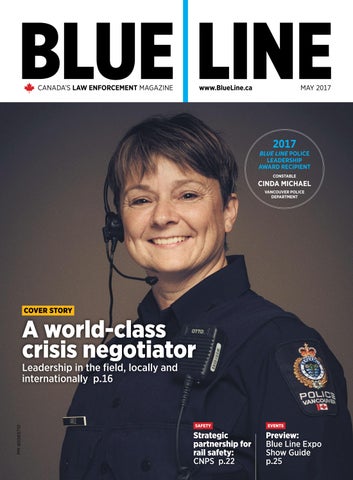
2017
BLUE LINE POLICE LEADERSHIP AWARD RECIPIENT CONSTABLE
CINDA MICHAEL VANCOUVER POLICE DEPARTMENT
COVER STORY
A world-class crisis negotiator
PM 40065710
Leadership in the field, locally and internationally p.16
SAFETY
EVENTS
Strategic partnership for rail safety: CNPS p.22
Preview: Blue Line Expo Show Guide p.25
MCX
DESIGNED TO BE SILENCED
SIG
™
Integrated Platform Taper-Lok™ System
GROUNDBREAKING FROM THE GROUND UP.
ENGINEERED FOR 300BLK / 5.56 NATO
Built to be silenced, light, and short. A complete weapon system delivering limitless possibilities and zero compromise. Introducing the adaptable rifle platform to which all others must adapt.
Subsonic / Supersonic 7.62x39 Coming Soon
SIGevolution.com/SIGMCX
SKELETONIZED FOLDING STOCK No Buffer Tube M1913 Rail Mount Low-Profile
Shown with
SIG SAUER® ELECTRO-OPTIC Tango6 1-6x24mm COMPLETE SYSTEMS PROVIDER
HEAD OFFICE 2200 Keating Cross Rd., Unit E, Victoria, BC V8M 2A6 Phone: (250) 652-5266 Fax: (250) 652-4700 Toll-Free: 1-866-652-2877 sales@mdcharlton.ca
WESTERN CANADA BC Mainland, Yukon, NW Territories 20253 Fraser Highway, Langley, BC V3A 4E7 Phone: (604) 534-1588 Fax: (604) 534-6899 saleswest@mdcharlton.ca
PRAIRIES Alberta, Saskatchewan, Manitoba Phone: (306) 445-2286 Fax: (306) 445-4801 Toll-Free: 1-866-652-2877 salescentral@mdcharlton.ca
ONTARIO 4100-B Sladeview Cres., Unit 4, Mississauga, ON L5L 5Z3 Phone: (905) 625-9846 Fax: (905) 625-3538 Toll-Free: 1-877-993-9968 ontariosales@mdcharlton.ca
66 Iber Rd, Unit 103 Stittsville, ON K2S 1E8 Phone: (613) 599-3950 Fax: (613) 599-3951 federalsales@mdcharlton.ca
ATLANTIC CANADA Phone: (902) 405-8322 Fax: (902) 405-8323 maritimesales@mdcharlton.ca QUÉBEC Phone: (450) 444-5365 Fax: (450) 444-3731 quebecsales@mdcharlton.ca
25
Contents
May 2017 Volume 29 Number 5
Features COVER STORY
16 A world-class crisis negotiator
Constable Cinda Michael of the Vancouver Police Department is the recipient of Blue Line’s 2017 Police Leadership Award.
22 Strategic partnerships for rail safety
CN Police looking to offer additional support for any community living along its vast network of rail lines. By Jocelyn Latulippe
24 Public goes to police college
For aspiring police officers, attending the Community Police Academy in Toronto is just one more step in fulfilling their dream job. By Meaghan Gray
Columns 4 12 13 14 30 34 38
Publisher’s commentary Holding the line Health & wellness Deep blue Case law Technology Back of the book
Departments 6 6 7 8 10 35 36 37 38
News Draw & order Calendar By the numbers Dispatches Off the shelf Product showcase Marketplace Blue Links
25 Blue Line Expo 2017 show guide
From the conference to the show floor. Canada’s premier law enforcement event should not be missed.
COVER PHOTO: MARTIN DEE
13 22 @Blue_LineMag
14 May 2017 | BLUE LINE
3
BLUE LINE
PUBLISHER’S COMMENTARY BY PAUL GROSSINGER
Welcome to the new Blue Line
W
hen I sat down to write It is these and many other discussions this (my first) Blue Line that make me excited about the breadth commentary, I took of stories we can bring to the forefront in some time to reflect on the coming months and years. Not to the past six months; more specifically, my mention the important role Blue Line newfound role as publisher of Blue Line, plays in the daily lives of everyone in the Canada’s law enforcement magazine. policing ecosystem: from police chiefs to On Oct. 1, 2016, Annex Business Media frontline officers. officially acquired Blue Line Magazine from I also had the opportunity to attend the its previous owners of 28 years, Blue Line Chiefs Gala in Toronto this past NovemInc. Annex is Canada’s largest B2B media ber. I met many Blue Line readers, supportcompany, with more than 60 brands under ers and contributors, and I also received its umbrella, including several you might my first glimpse into how tight-knit be familiar with: Canadian Security, Can- members of the police brethren truly are. adian Firefighter and Fire Fighting in Canada. That night I saw an amazing community Since the beginning of October, a lot has come together to support Victims Services changed at Blue Line: new owners, new Toronto. It was a great night to be a part leadership, new team members, of and I am so grateful that Morley new website, new format for Blue Blue Line is invited me to join him and his Line News Week, new magazine committed wife, Mary, at the event. Thanks design, new format for the Blue to supplying again Morley! Line Expo and new conversations Canadian law As publisher of Blue Line, I have on how to continually make Blue enforcement learned that policing in Canada Line an even better source of in- professionals does not stand still. It is always with great formation for our readers. evolving, always progressing to Despite the changes, a few content and ensure the safety and security of constants still hold true, includ- insight from all Canadians, and to improve the ing Blue Line’s commitment and industry ways police professionals serve dedication to supplying Canadian experts, and protect. law enforcement professionals insiders and To quote Socrates: “The secret with great content and insight thought of change is to focus all of your from industry experts, insiders leaders. energy not on fighting the old, and thought leaders. This combut on building on the new.” mitment to high-quality content comes At Blue Line, we are focused on building from Blue Line’s previous publisher, Morley our future, but not without remembering Lymburner, who had a passion for every- our past. We will work hard to improve thing Blue Line. Morley and his team at Blue every day because we are here to serve Line really helped in the transition to you — our loyal readers. This is why we Annex and his ongoing devotion to the want to hear from you; praise, suggestions, future success of the magazine has been criticisms and ideas are always welcome amazing. Thanks, Morley! and I look forward to hearing what you During my short stint as publisher of have to say as we travel down this journey Blue Line, I have had the opportunity to together. meet many members of Canada’s law enforcement community. I have had the pleasure to talk with several senior executives at various police associations across Paul Grossinger is the publisher of Canada to discuss the issues they feel are Blue Line magazine, and a group facing policing in Canada, and to hear their publisher at Annex Business Media. thoughts on Blue Line’s position and statHe can be contacted at: pgrossinger@annexweb.com. ure in the industry.
CONNECT WITH BLUE LINE
www.BlueLine.ca 4
@BlueLine_Mag
BLUE LINE | May 2017
www.facebook.com/BlueLineMagazine
www.BlueLine.ca
GROUP PUBLISHER | PAUL GROSSINGER pgrossinger@annexweb.com PUBLISHER EMERITUS | MORLEY LYMBURNER morley@blueline.ca ACCOUNT MANAGER | JANICE EATON janice@blueline.ca ACCOUNT MANAGER | APRIL LENSEN april@blueline.ca REDESIGN | JANICE VAN ECK www.janicevaneck.com ART DIRECTOR | SVETLANA AVRUTIN savrutin@annexweb.com ACCOUNT COORDINATOR | TRISH RAMSAY tramsay@annexweb.com CIRCULATION MANAGER | BEATA OLECHNOWICZ bolechnowicz@annexbizmedia.com COO | TED MARKLE tmarkle@annexweb.com PRESIDENT & CEO | MIKE FREDERICKS MAILING ADDRESS 80 Valleybrook Drive Toronto, ON M3B 2S9 Publication Mail Agreement No. 40065710 ISSN 0847-8538 Printed in Canada SUBSCRIPTION RATES Canada — 1 Year $30.00; 2 Year $50.00 plus tax USA — 1 Year $100.00 USD CIRCULATION email: asingh@annexbizmedia.com Tel: 416-442-5600 ext 3553; Fax: 416-510-5170 Mail: 80 Valleybrook Drive, Toronto, ON M3B 2S9
Occasionally, Blue Line will mail information on behalf of industry-related groups whose products and services we believe may be of interest to you. If you prefer not to receive this information, please contact our circulation department in any of the four ways listed above. Annex Privacy Officer privacy@annexbizmedia.com; Tel: 800-668-2374 © 2017 Annex Publishing & Printing Inc. All rights reserved. Printed in Canada. No part of the editorial content of this publication may be reprinted without the publisher’s written permission. Opinions expressed in this magazine are not necessarily those of the editor or the publisher. No liability is assumed for errors or omissions. Readers are cautioned and advised that articles presented herein are edited and supplied for your personal awareness and should not be used for further action until appropriate guidance is received from a supervisor, Crown Attorney or other persons in authority. All advertising is subject to the publisher’s approval. Such approval does not imply any endorsement of the products or services advertised. The publisher reserves the right to refuse advertising that does not meet the standards of this publication.
YOU HAVE THE RIGHT TO REMAIN IMPRESSED.
RAM 1500 SPECIAL SERVICE 395 horsepower, 410 lb-ft of torque* DODGE CHARGER ENFORCER Available AWD with active transfer case and front-axel disconnect DODGE DURANGO SPECIAL SERVICE 8-speed automatic transmission As policing gets ever more complex and specialized, you need a vehicle that can keep up. You won’t find a more impressive lineup than this: Ram 1500 Special Service, Dodge Charger Enforcer and Dodge Durango Special Service. Each loaded with safety and security features. Each purpose-built to excel in its field. Each offering uncompromising performance, capability and reliability. Whatever your policing needs, they’ve got you covered.
fleet.fcacanada.ca
1 800 463-3600 *Available on the 5.7L HEMI® VVT V8.
NEWS LONDON
Human trafficking probe
MONTREAL
Inquiry into journalists’ sources receives police chiefs input Quebec provincial police director Martin Prud’homme recently testified at the Chamberland Commission, a provincial inquiry studying protection for journalists’ sources. He says police exercise great care on occasions when it has to share information
JOURNALISTS’ PRIVACY: Quebec provincial police director Martin Prud’homme recently testified at the Chamberland Commission alongside other police chiefs. with the province’s Public Security Department. The inquiry was created after several revelations of police departments spying on journalists’ phone records in an attempt to identify sources speaking to reporters. Presided by Quebec Court of Appeal Justice Jacques Chamberland, the inquiry will hear testimony from actors on all sides including law enforcement, media and the courts before reporting back to the government with recommendations by March 1, 2018. It has already heard that word of warrants to collect data from the smartphones of several prominent journalists created a chilling effect on newsrooms and sent sources into a panic. Also during its first week of hearings, the inquiry heard two senior sitting judges defend the work done by justices of the peace who sign off on warrants. The inquiry has heard that police frequently solicit telecommunications companies for certain data of its mobile users, with the requests sometimes being quite extensive. Phone company representatives testified the type of information typically given is the source of incoming and outgoing calls, the times of such calls and the duration. EDMONTON
Police civilian facing child pornography charges
A civilian employee of the Edmonton Police Service has been arrested on charges of making and distributing child pornography. Police say the charges were laid following an investigation that began in February after 6
BLUE LINE | May 2017
a 41-year-old man allegedly had sexually explicit online chats with a Victoria, B.C., police undercover officer and tried to arrange for sex with a child. Authorities there determined the person was in Edmonton and notified police in the Alberta capital, who then identified a suspect. A number of computer and electronic devices were seized and an arrest was made after a home in southeast Edmonton was searched, Aaron Rothwell, who worked as an administrator, is also charged with agreement to commit a sexual offence against a child. Rothwell has been released on bail and must abide by a number of court-imposed conditions. Those conditions include not possessing any electronic device, not coming within 100 meters of a public facility where children may be present and not being in the company of any children. According to police, there’s no information to suggest any children were hurt. LA RONGE
Prisoner death ruled accidental
An inquest jury has found that the death of a man who died while being held at a northern Saskatchewan RCMP detachment nearly two years ago was accidental. After hearing testimony in April, the six-member jury found that Desmond Roberts suffered a brain hemorrhage while in custody in La Ronge. Roberts was found unresponsive in his cell on May 31, 2015, and was taken to the local hospital before being transferred to Royal University Hospital in www.BlueLine.ca
PHOTO: FILE
Police in southwestern Ontario say 78 people have been arrested in a human trafficking investigation. Eighteen women who were involved in the sex trade as a result of alleged human trafficking were assisted during the investigation dubbed Project Equinox that began on Oct. 4, 2016. According to police, the alleged victims, ranging in age from 15 to 55, were relocated to a safe place away from their alleged traffickers and provided with supports. Investigators say they concentrated on three aspects of human trafficking identifying people who were answering escort ads, suspects engaged in human trafficking, and possible victims. A total of 129 criminal code charges were laid, including four human trafficking charges and 24 drug charges. Thirty-five alleged customers were also charged.
Saskatoon, where he died the next day. Jurors recommended RCMP officers review medical training and response policies, and that they upgrade their first aid and CPR training to help prevent further deaths. The panel also called for a policy to ensure regular documentation of guard logs, and for a review of staffing policy to ensure proper monitoring of inmates. As well, the jury asked that an RCMP officer always be available with the jail guard or matron.
Ontario Court Chief Justice Lise Maisonneuve
OTTAWA
TORONTO
Impact of legalizing pot on ORC unclear
Ontario looking to offer judges additional sexual assault education
PHOTOS: SHUTTERSTOCK.COM; FILE
The RCMP says it is too early to know what effect the legalization of recreational marijuana may have on organized criminal involvement in the illicit pot market. The Mounties add that they will work with the federal government “to the extent possible’’ to ensure policies are in place to prevent crime networks from taking advantage of the legal marijuana trade. The cautious assessment spelled out in RCMP notes obtained by The Canadian Press through the Access to Information Act stands in contrast to the Trudeau government’s mantra that legalization will take pot profits out of criminal hands. The government wants to decriminalize marijuana consumption and incidental possession and create new sanctions to more severely punish those who provide pot to minors or drive under its influence. The Liberals say the current system of prohibition does not stop young people from using marijuana and too many Canadians end up with criminal records for possessing small amounts of pot.
@Blue_LineMag
CALENDAR Blue Line Expo and Police Leadership Award Gala May 2, 2017 Mississauga, Ontario www.blueline.ca/expo
The chief justice of Ontario’s provincial courts is examining what further steps could be taken on sexual assault education for judges, the attorney general recently stated. Two private members’ bills seeking to tackle the issue were introduced back-toback in mid-April; one from the Progressive Conservatives and the other from a member of the governing Liberals that seek to mandate such training. Laurie Scott, who introduced the PC bill, said she was inspired in part by recent judicial examples. Robin Camp, who resigned last month, asked a sexual assault complainant in an Alberta trial why she couldn’t keep her knees together. In Halifax, there have been calls for the judicial council to review Judge Gregory Lenehan’s remarks who said, in acquitting a taxi driver of sexual assault, that, “a drunk can consent.’’ Attorney General Yasir Naqvi, who is also the government house leader, won’t say whether the government will be backing either bill, but said he has spoken with and written to Ontario Court Chief Justice Lise Maisonneuve. “I’ve had very constructive conversations with her and I know she has informed me that there is training that exists that is available to judges on a variety of issues, including sexual assault, and she’s looking at what other steps could be taken as well,’’ Naqvi said. But, he said, the government shouldn’t interfere with judicial independence. “That is a very important and fundamental principle of our system,’’ Naqvi said. “You do not ever want politicians telling judges what to do, what not to do.’’ Maisonneuve declined an interview request, but said in a statement that the
RCMP Synthetic Drug Awareness Workshop May 4, 2017 London, Ontario terrie.goett@rcmp-grc.gc.ca CANSEC May 31–June 1, 2017 Ottawa, Ontario www.defenceandsecurity.ca/CANSEC International Police Mountain Bike Association June 5–10, 2017 Delaware, Ohio ipmba.org/conference/overview The 26th Annual Forensic Training Conference June 6–9, 2017 Toronto, Ontario www.torontopolice.on.ca/seminars/ forensic OACP Annual Meeting June 11–14, 2017 Waterloo, Ontario www.oacpconference.on.ca International Association of Crime Analysts Symposium June 19–21, 2017 Halifax, Nova Scotia www.iaca.net/symposium.asp National Law Enforcement Occupational Safety and Health (LEOSH) Association Conference 2017 June 21–23, 2017 Regina, Saskatchewan raceroster.com/events/2017/10569/ leosh-conference-2017 31st Annual Police Security Expo 2017 June 27-28, 2017 Atlantic City, New Jersey www.police-security.com
May 2017 | BLUE LINE
7
NEWS court recognizes the importance of sexual assault education. “Issues related to sexual violence and violence against women have regularly been included in the Ontario Court of Justice’s judicial education conferences,’’ she wrote. “We look forward to hearing about new education programming that the National Judicial Institute may be able to offer our court as a result of the recent federal government budget.’’ The 2017 federal budget proposes $2.7 million over five years, plus $500,000 annually afterwards, for the Canadian Judicial Council to support training on ethics and conduct for federally appointed judges, while also ensuring access to professional development that is gender and culturally sensitive. There is also a bill before the House of Commons from interim Conservative leader Rona Ambrose that would require anyone who wanted to be considered for a federal judicial appointment to undergo comprehensive training in sexual assault law. At the Ontario legislature, the Liberal bill would require that provincial judge candidates complete sexual assault law education before being considered. The PC bill sets out that requirement both for provincial judge candidates and potential justices of the peace, as well as requiring continuing education for people who currently hold those positions. NEW YORK
NYPD ready to deploy 1,200 bodycams
The New York Police Department is set to deploy the first body cameras to officers after resolving some of the thorniest issues on when to switch on the camera, how long to keep the tape and when to tell the public they’re being recorded.
BODY CAMERAS: The NYPD is set to deploy a bodycam pilot program this spring. About 1,200 officers who work the evening shifts around the city will get the cameras starting at the end of April. The pilot program was ordered by a judge following a 2013 ruling that officers were wrongly targeting black and Hispanic men with its stop-and-frisk program. At the time, few police departments used body cameras. Their use has since exploded around the country following a string of killings of unarmed blacks by police and the ambush killings of officers in New York City, Dallas and Baton Rouge, Louisiana. Both officers and citizens have said cameras could help de-escalate situations that lead to violence. The NYPD’s deployment had been on hold following a lengthy process to choose the camera company and storage and answer questions on how they would work. The department sought public comment through a questionnaire and worked with New York University’s Policing Project to analyze the results. Some 25,000 people, plus 5,000 police officers, responded anonymously, and NYPD officials made changes based on the outcome. Public response was disproportionately white relative to the city’s population, police officials acknowledged. But the report found that on many key questions, there was little difference in response by race. “I think this shows that the public can have
a voice in policing,” said Barry Friedman of NYU’s Policing Project. One change based on the results was to alert civilians they are being recorded “New Yorkers ... really want to be told they’re being recorded,” assistant deputy commissioner Nancy Hoppock said. “And officers really don’t want to tell them.” Police won’t record every interaction — even though the public would prefer it — because there’s not enough storage capability and it would bump up against privacy laws and could stop witnesses from coming forward. According to the proposal, which much be approved by a federal monitor, officers will turn on their cameras for arrests, summonses, vehicle stops, interactions with crime suspects, interactions with a mentally unstable person who is violent, or when using force. They will record property searches, but won’t record demonstrations unless there is a crime or other enforcement. The tapes will be kept for a year and the footage released publicly only in certain cases. Officers will receive a day of training, and the order will be revised as the department gets feedback and does its own study using a yearlong comparison to officers without cameras. Mayor Bill de Blasio has said he wants all 23,000 of its patrol officers outfitted with cameras by 2019.
Cybercrime gets most of the media attention these days, but the 2016 Global Fraud Study by the Association of Certified Fraud Examiners (ACFE) shows businesses should be worried about other scams as well
5
% $850k 40.7% $6.3 billion
Estimated loss of revenue in a given year for the businesses that participated in the ACFE study.
8
BLUE LINE | May 2017
Median loss by companies that were hit by a fraud scheme that lasted more than five years.
Total loss caused by the fraud cases in the study, with an average loss per case of $2.7 million.
Of cases in which the victim organizations decided not to refer their fraud cases to law enforcement; fear of bad publicity was most-cited reason.
www.BlueLine.ca
PHOTO: REUTERS/SHANNON STAPLETON
BY THE NUMBERS
OTTAWA
RCMP acknowledges using spy tech to track cellphone data
The RCMP has confirmed what civil liberties groups say has been an open secret for them for some time: that the Mounties use so-called mobile device identifiers, also known as Stingrays, to identify and locate cellphones. In a rare disclosure of police tactics, the national police force acknowledged in a statement that it used the technology 19 times last year, but insisted that it did so in compliance with the law and with judicial authorization. The Mounties say the devices can identify and locate cellular devices, such as a mobile phone, enabling police to identify and apprehend a criminal suspect or locate a missing person. The RCMP does not intercept phone calls, email or text messages, contact lists, images, encryption keys or basic subscriber information, the statement said.
@Blue_LineMag
BlueLine_AmericanMilitary_May.indd 1
The disclosure followed a CBC report that someone in downtown Ottawa has been using a device known as an “IMSI catcher,” which can intercept and identify cellphone metadata. The CBC report found the device being used in recent months in close proximity to Parliament Hill and the U.S. and Israeli embassies, among other locations. Brenda McPhail of the Canadian Civil Liberties Association said the technology casts far too broad a net to be used by police, since it captures the data of innocent people who might be in range of the device. The federal privacy commissioner’s office acknowledged Wednesday that it is investigating the use of the IMSI devices following a complaint by OpenMedia, a self-described crowd-sourced civic engagement platform for the Internet community. The technology works by momentarily connecting to cellphones in its immediate proximity, before returning them to their own networks. It collects metadata associated with the phones, allowing the operator to
identify the phone used by the suspect. “There are a limited number of authorized and trained RCMP operators who can use MDI technology and its use is subject to very strict rules, senior management approval and judicial authorization prior to deployment,” the RCMP statement said. Except for cases where there is an immediate threat of death or serious harm, police must obtain warrants to use the devices, it added. McPhail, the association’s director of privacy, technology and surveillance, said the RCMP has long refused to confirm or deny that it used Stingrays. “These devices are not about targeted surveillance, they’re indiscriminate,” McPhail said. “They mimic a cellphone tower and they scoop up the data of everybody who has an active cellphone in a large area. In order to find the information of one suspect or a small group of suspects, you’re capturing the information of thousands of innocent bystanders at the same time.”—News files from Canadian Press
May 2017 | BLUE LINE
9
2017-04-13 11:15 AM
NEWS DISPATCHES
POLICING ... IT’S MORE THAN YOU THINK If you’re career and community minded, consider joining Ontario’s most progressive police service. As a Police Constable or Police Cadet with Peel Regional Police you will be part of a dedicated team that enjoys outstanding training and is committed to our vision; “A Safer Community Together.”
PEELPOLICE.CA/RECRUITING
BL_PeelRegionalPolice_April.indd 1
Doug Sheppard, the Inspector in charge of the Investigative Services Division of the Waterloo Regional Police (ON), retired in March after 35 years of service. Sheppard joined the service in February 1982. Sheppard has a Business Administration Diploma from Wilfrid Laurier University and Supervisory Studies Certificate from Conestoga College. He is a Certified Municipal Manager Level III Police Professional and a member of the OACP since 2008.
Delaney Chisholm, Police Chief of the New Glasgow Regional Police Service (NS), retired on March 31 after a 44-year career. After graduating from the Atlantic Police Academy, he joined the 2017-03-17 8:15 AM service and worked his way up through the ranks, becoming Chief in July 2007. Chisholm was a long-time member of the NSCPA and the CACP. He chaired the Criminal Intelligence Service of Nova Scotia and was on the national committee for Criminal Intelligence Service of Canada. Chisholm was awarded the Queen’s Diamond Jubilee Medal, the PESM with 2 bars, and the Holland College Distinguished Alumni Award. Dan Ritchie, the commanding officer of the CN Police Service Pacific Division, announced his retirement, effective the end of April 2017. Ritchie’s policing career began as a reserve officer with the Delta Police Service which was followed by service in all the western provinces and Ontario with the CN Police. Ritchie is a graduate of the FBI
National Academy, SPAC & EDC at the Canadian Police College, was awarded the PESM with 2 bars, the Queen’s Jubilee Medal and the Order of Merit of the Police Services. Ritchie was ordained as a Deacon with the Catholic Church in 2015. Ian Grant, Chief of Police of the Brandon Police Service (MA), has announced his retirement, to be effective July 3, 2017. Grant started his policing career in 1980 with the RCMP, serving in the Brandon, Wasagaming and Flin Flon detachments, before joining the BPS in April 1985. He was sworn-in as Chief of Police in January 2013. In September 2015, Grant became a Member of the Order of Merit of the Police Forces. Ken Weatherill has been selected as the new Deputy Chief for the Barrie Police Service (ON) and will assume the role on May 23, 2017. Weatherill began his policing career with the Hamilton Police Service (ON), where he worked in uniform patrol, traffic, the ERT and Investigative Services. Weatherill was most recently the Deputy Chief with the HPS. He has completed the Police Leadership Program at the Rotman School of Management, the FBI National Academy (Police Leadership and Criminal Justice), and holds a BA in Geography from McMaster University. PROMOTIONS, RETIREMENTS, RECOGNITION • If you have a senior officer in your agency recently promoted or retiring or an individual you wish to have recognized (major award or recently deceased) you can let Blue Line magazine know by email to: dispatches@blueline.ca.
www.BlueLine.ca
INFORMATION SUPPLEMENT
MedicAlert helps police safely bring people home
L
ast fall, Constable Christine Trotter of Toronto Police 11 Division showed much compassion during a call, and was selected as the winner of the 2017 Legends of the Call – Law Enforcement Award from MedicAlert Foundation Canada. This annual distinction is given to a Canadian police officer who carries out MedicAlert’s Look-Read-Call procedure to protect and save the life of someone in need. Last October, Trotter found a man — a MedicAlert subscriber — wandering in downtown Toronto. All he knew was his name and birth date. Quickly looking for his MedicAlert subscriber wallet card, Trotter found the information she needed to safety return the man home. Still concerned for his well-being, Trotter called the MedicAlert 24/7 Emergency Hotline and was connected with the man’s personal support worker, updated the man’s situation and ensured that the support worker would visit shortly.
MedicAlert® Connect Protect One-of-a-kind service that gives police quick and secure access to the individual’s photo, emergency contact information and wandering history.
Look-Read-Call helps save lives When every second counts in an emergency, MedicAlert’s Look-Read-Call procedure can mean the different between life and death. Canada’s most trusted medical ID MedicAlert Foundation Canada is the largest membership-based registered charity in Canada. As part of its charitable mandate, MedicAlert trains emergency responders how to access the information available on each person wearing a MedicAlert medical ID. MedicAlert is Canada’s most trusted medical ID and it is the leading provider of emergency medical information services. Backed by robust electronic health records maintained by medically trained professionals, MedicAlert is the only one that supports Canadians with Family Notification service and a 24/7 Emergency Hotline for emergency responders to get access to detailed health records. Contact education@medicalert.ca for more information on MedicAlert’s emergency responder training program.
When a person with dementia, autism or cognitive impairment goes missing ... 24/7 secure access to a vulnerable persons registry is only seconds away
LOOK for the MedicAlert
name on the ID
MedicAlert® saves lives. c u r r e n t pa r t n e r s
READ the conditions and
unique MedicAlert subscriber ID number on the back
CALL the 24/7 Emergency Hotline so you can bring the wandering person home safely
Together, we can help deliver a new level of protection in your community. Ask us on how you can bring this to your police service at connectprotect@medicalert.ca
BlueLine_ad_04.indd 1
@Blue_LineMag
BlueLine_MedicAlert_May.indd 1
2017-04-11 11:59 AM
May 2017 | BLUE LINE
11
2017-04-12 8:59 AM
HOLDING THE LINE BY MICHELLE VINCENT
I
normally encourage people to look for the positive in order to achieve their goals, whether it’s at work or at home. When we look for something, we always find it, the mind makes it so. This is why it is so important to be selective in what we entertain from a mental perspective. If we want to find what is going right at work or in our personal worlds, we will find it, every time. If we want to find what is going wrong at work or in the home, we will find that just as easily. It is all about our ego that silently wants to be right. That being said, ensuring that we determine the goals we want to achieve is equally as important in our selective mental process, as in the focus on what is going right. There are also times when there may be more than one goal. In the world of policing there appears to be a significant amount of what I like to call “disconnects.” This applies in the working relationships we maintain and in our personal family dynamics. An example of a disconnect might be when a member is experiencing anxiety in a situation at work and the supervisor isn’t able to see the obvious
signs of distress because they are intensely focused on their own tasks. An example in a family situation might be a parent texting their partner about their teenager being in trouble, and the police officer partner responding to their partner that the trouble is not a crisis and that it can wait to be addressed until they get home from work. A crisis from a civilian perspective is likely very different than what is perceived as a crisis in the eyes of a police officer. As the result of this perception, a real disconnect in relationships can occur, both in the workplace between colleagues and in the home between family members. This disconnect can lead to the dissolution of those relationships, as one or more persons may feel that they are not being valued. Our response as police officers is understandable, as we have to focus completely on our work tasks in order to effectively investigate incidents. Some situations may become dangerous, so we need to focus on our personal safety and often the integrity of the investigation itself. The challenge comes in the form of noticing the disconnect in the rela-
A crisis from a civilian perspective is likely very different than what is perceived as a crisis in the eyes of a police officer.
tionship which may be compromised in that moment. How do we maintain the focus we believe we need in order to effectively and safely complete the task expected of us while maintaining the feeling of value for those in the workplace and in our personal lives? One suggestion I have heard repeatedly, in various forums, is the power of meditation, or as is suggested in the The Art of Stillness Ted Talk by Pico Iyer, is the concept of “going nowhere.” Calming the mind through “going nowhere” in a mental perspective has been proven to significantly enhance emotional intelligence. How is this related to managing “the focus” in the world of policing? It allows our mind to be more open and receptive to the tasks at hand as well as providing an opportunity for our mind to be available to listen and “hear” when a colleague, friend, partner, child or family member is really in need at that moment, or whether it can wait to be heard later. In order to notice the disconnects we must be connected. That clear mind that is not only essential in police work, but imperative at other times, in order to successfully negotiate the unpredictable experience or the investigation at hand, is also just as important in maintaining the connection in crucial relationships. A wise person once said, making a living and making a life, can point you in opposite directions if you are not connected. Although policing is far from being as simple as “making a living,” without those special people in our world, whether they are our partners at work or our family and friends, our life would be meaningless. Notice disconnections, look for connections and try “going nowhere” as often as you can. Michelle Vincent is a 15 year York Regional Police officer with a Masters Degree in Arts in Counselling Psychology and a background in equine assisted therapy, workplace reintegration and teaching. Her counselling practice is supervised by a psychologist with a specialty in addictions and trauma. She can be contacted at: michelle@smith.net.
12
BLUE LINE | May 2017
www.BlueLine.ca
PHOTO: SHUTTERSTOCK.COM
Noticing the disconnect
HEALTH & WELLNESS BY ISABELLE SAUVE
Fostering a health and fitness culture
PHOTO: SHUTTERSTOCK.COM
W
ellness is currently a prominent buzzword in the law enforcement field, which is formally recognizing and communicating its importance and committing considerably more resources to it. Good health and fitness play an intrinsic role in providing quality law enforcement. The majority of police agencies require fitness testing for applicants as part of the hiring process. This pre-employment fitness testing prepares successful applicants for the physical demands they will face at the police college and throughout their careers. Fitness is emphasized and rewarded for new recruits, but for many officers it gradually declines after they graduate. Aside from some specialty units, officer fitness testing is usually voluntary thereafter. Fitness is defined as a general state of health and well-being, resulting in the ability to perform aspects of sports, occupations and daily activities. Physical fitness is generally achieved through conscious nutritional discipline, moderate to vigorous physical exercise and adequate rest. It has a positive transformative effect on the quality of work and personal life. It boosts energy and mental clarity, reduces the risk of health problems such as heart disease, diabetes, musculoskeletal issues, and other physical injuries, and because it’s a natural mood elevator, it can reduce stress and relieve mild anxiety and depression. Physically fit officers tend to assess and handle situations better, use less force and are in a better position to diffuse volatile situations. Additionally, they develop a level of self-confidence that makes them capable of making more appropriate contextual decisions. Fitness provides officers with the confidence necessary to trust backup officers, protect other officers and ensure the safety of the communities they serve. Furthermore, fit and healthy @Blue_LineMag
officers promote a professional law enforcement image, which might be more important today during the current media climate. Having an entire police organization at peak fitness is nearly impossible because of many mitigating factors, especially shift work. Nonetheless, the organization must foster a wellness culture and tradition by fully embedding it into their corporate identity. It is important for personnel of all levels, especially leaders, to “walk the talk” and demonstrate a commitment to fitness and wellness. It must not remain an organizational luxury or an afterthought, otherwise its importance will become an afterthought for officers too. Consistently making physical activity a part of a daily routine is hard work, but having a strong source of support and encouragement and organizational commitment can make it happen more frequently. Fitness and wellness should be built into the workweek like any other task. Experts consistently reiterate that corporations must emphasize and support fitness if they want fit employees. A conscious dedication, driven from the highest levels is required in order to truly embed it into the culture. Making time for fitness and wellness is part of the solution and cannot be perceived as reducing productivity, as is too often the case. A growing body of research suggests that there is a direct positive correlation between fitness, wellness and produc-
Fit and healthy officers promote a professional law enforcement image.
Many police services in Ontario offer incentives to officers completing or attempting the Ontario Police Fitness Award. WWW.PFPO.ORG
tivity, and healthy employees who have higher attendance rates and who are more productive. Individuals should be encouraged to be active and to take short breaks throughout the workday. Unit and corporate challenges with incentives can help motivate and increase participation. Supporting worker wellness and physical activity sends a strong message and can increase job satisfaction, employee recruitment and retention. Employee input should be sought to inform decision-making and planning. Access to a properly equipped 24hour workout facility should be available on site, or alternatively by arrangement with a local fitness centre. The facility should have equipment that allows the targeting of different aspects of fitness such as endurance, flexibility, and job-specific conditioning, and have proper change rooms and showers to facilitate workouts. Physical fitness activities can also include activities such as yoga, meditation, walking, running and other alternatives. A number of police agencies have created wellness units consisting of professionals across multiple health fields. Ideally, each station should have a wellness liaison to disseminate program information, support individual goals, educate, organize health related activities and motivate co-workers. Educating police personnel will ensure they are equipped with the right knowledge required to achieve their personal goals, and dispel misinformation. In the long term, fit and healthy employees will result in increased productivity and overall organizational success. It is everyone’s duty and responsibility to encourage and promote a wellness culture. Perpetual investment in creating a healthy and fit team of employees will positively impact all aspects of law enforcement operations. Isabelle Sauve is a 10 year OPP veteran currently with the Emergency Response Team (ERT) at the Almaguin Highlands Detachment in Burks Falls, about 300 km north of Toronto. She can be contacted at: isabelle.sauve@hotmail.com.
May 2017 | BLUE LINE
13
DEEP BLUE
Living up, or down, to expectations
E
ver feel like screwing up on the job just because your boss treats you like you are an accident waiting to happen? You’re not the only one. Consider this study: Two groups of people are assigned to carry out a work task (let’s say they are making widgets), and are told they will be paid according to how many widgets they finish. In actuality, everyone is paid the same amount no matter how many widgets they make — but no one knows this. Everyone has to share the proceeds. So when widgetmaking is completed, each person has to report how much money they got. The boss tells one group: “If you under-report your income, you will be penalized by 25%. The purpose of this penalty is to deter you from lying about your income.” 14
BLUE LINE | May 2017
The boss tells the second group: “If you under-report your income, you will be penalized by 25%.” No reason is given. Of course since everyone actually received the same amount of money, you can tell which group is lying more when they report their income. And it is the first group, the group that was given the rationale for why the penalty was imposed. Both groups under-reported their income — but the first group under-reported more. And why might that be? It appears that the first group did not trust the boss — and the reason they did not trust the boss was because the boss did not trust them. By explaining that the penalty was intended as deterrence, the boss has made it clear that he expects his workers to lie. He does not trust them. And
If people feel like they are being trusted, if they are dealt with respectfully, they are more likely to follow the rules.
therefore the workers kind of thought, “Well, if THAT’S what you think of me then….” So consider a variation on the same theme. Same exercise, same task, same pay as the one before. This time, the boss tells one group what the penalty will be and then adds, “The primary aim of the fine is to give team members who misreport revenue their just deserts.” The other group just gets told there is a fine if they get caught lying, as was the case in the second group above. What happens? People were still a little grumpy and still felt a little distrusted after the “just deserts” explanation — but not as much as in the deterrence condition. They lied/underreported less in the just deserts condition as well. It turns out that people are generally okay with being told that people who have been caught breaking the rules will get what they deserve — but they are not so fond of you assuming that they are going to break the rules. The two experiments I have just described are two of five described in a paper by Marlon Mooijman and some colleagues at various universities around the world , all of which address the question of how the way in which you justify a sanction affects the degree to which people actually comply with what you had in mind to start with. In other words, they are asking, “Does the way in which policy makers or other authorities justify their sanctions affect the degree to which people are actually likely to follow the rules?” The answer appears to be “yes,” but the result is likely not what most people think it is. Needless to say, sanctions are supposed to be aimed at that subgroup of people who are most likely to break the rule in question. Fines for speeding should be aimed at people who are likely to speed (which is probably almost everyone). But what about penalties for cheating on your income tax? Robbing a bank? One could argue that everyone would do that if they thought they could get away with it — but actually that is probably not www.BlueLine.ca
PHOTO: SHUTTERSTOCK.COM
BY DOROTHY COTTON
true. Most people are honest. So if you establish a policy that assumes that everyone is a cheater just waiting for an opportunity, it tends to piss people off. How dare you just ASSUME that I am going to cheat!?!? It’s enough to make a person cheat! And apparently, people are more likely to cheat. This is not the overall goal. One can argue about whether sanctions are really an effective way to decrease rule breaking at all — but that is a discussion for another day. What is clear from this research and a whole body of research on use of sanctions, is that governments and policy makers who use a lot of sanctions in efforts to decrease rule breaking tend to be governments and authorities who do not have a lot of trust in their people to begin with. This becomes more apparent to the people in question when these authorities are open about
saying “I am doing this so you will not break the rules.” People do not like that, it makes them distrust the authorities, and it makes them more likely to break the rules. The essential ingredient in this relationship seems to be trust. If people feel like they are being trusted, if they are dealt with respectfully, they are more likely to follow the rules. But if they do not feel they are trusted, then they tend to doubt the legitimacy of the authority imposing the sanctions. It gets even more complicated when one notes that the more powerful an authority is, the more they tend to resort to sanctions and the more they are perceived as being unworthy of trust. I will leave it to you, dear reader, to think about how this might play out in policing, within specific groups who feel they are unfairly targeted and mistrusted by police. Or in organizations with very au-
How dare you just ASSUME that I am going to cheat!?!?
thoritarian hierarchies and management structures. So are sanctions a good idea at all? I am not going there, but if you want to use sanctions, and you want people to actually stop breaking rules, when you explain the sanctions, you might emphasize that the sanctions are meant to give the people who do violate the rules their just deserts, or you might give no rationale at all; you might make it clear that the deterrence is meant ONLY for the people who are breaking the rules — not for everyone. After all, if you know me and you seem to think I am a person who is going to break the rules, I just may feel compelled to live up (or down) to your expectations. Dr. Dorothy Cotton is Blue Line’s psychology columnist. She can be contacted at: deepblue@blueline.ca.
©2017 Whelen Engineering Co., Inc. All rights reserved.
WHEL0012_BLUELINE_HORZ_NOFDIC.indd 1
@Blue_LineMag
BlueLine_Whelan_May.indd 1
4/13/17 5:08 PM
May 2017 | BLUE LINE
15
2017-04-17 9:23 AM
COVER STORY
16
BLUE LINE | May 2017
www.BlueLine.ca
2017
BLUE LINE POLICE LEADERSHIP AWARD RECIPIENT CONSTABLE
CINDA MICHAEL VANCOUVER POLICE DEPARTMENT
A worldclass crisis negotiator Leadership in the field, locally and internationally
A
s a 28-year member of the Vancouver Police Department (VPD), Constable Cinda Michael is a leader in her community and a leader in policing. She was selected as the recipient of the 2017 Blue Line Police Leadership Award. Constable Michael is recognized internationally for her skills and experience in crisis negotiation. She has dedicated herself to the field and today is one of Canada’s most accomplished crisis negotiators. Many in policing will acknowledge that one of the most serious types of incidents a police officer can encounter is where the suspect is in a heightened emotional state. These situations pose the greatest risk to police officers and the general public, and have the potential to turn violent. Constable Michael has faced these situations countless times and thanks to her skills and abilities, she has saved many lives. In fact, she has personally responded to more than 250 critical incidents. Some of these incidents are high profile and have been reported on extensively. For example, in November 2010, Constable Michael was part of a team that resolved an incident where a three-year-old child was taken hostage at a Vancouver com-
@Blue_LineMag
munity centre by a subject armed with a large knife. The standoff lasted for eight hours with intense negotiations, and the child was ultimately rescued by Emergency Response Team members. As an accomplished negotiator, Constable Michael is able to recognize when a tactical intervention is appropriate. That said, a great many critical incidents are resolved through well-executed negotiations on the part of people like Constable Michael. It’s work that the public may not always hear about. In 2011, Constable Michael responded to an incident where a man threatened to jump off of a five-storey building. The standoff went on for hours in the boiling sun as the temperature on the tar roof climbed above 30 degrees Celsius. After about eight hours of patient and exhausting negotiating, the incident was brought to a safe resolution. Constable Michael has been a visionary in crisis negotiation and has spent 17 years of her career dedicated specifically to this field. She has been instrumental in the progression and development of the Crisis Negotiator program at the VPD — a program that is now regarded very highly throughout the world. Constable Michael joined the VPD in 1989 and in early 2000, she May 2017 | BLUE LINE
17
COVER STORY
18
BLUE LINE | May 2017
250
Critical incidents responded to by Constable Michael
17 Years Constable Michael has been working in crisis negotiation
2 WEEKS
Length of crisis negotiator course she developed at the Canadian Police College
100s Of police officers, crisis negotiators and medical practitioners she has educated in Canada and around the world
Constable Cinda Michael has returned to a role in the Mounted Unit and continues to be an active member of the VPD's crisis negotiating team.
Thanks to her well-earned reputation as a leader, Constable Michael is sought out by police agencies across the country and around the world for advice and/or instruction on crisis negotiation techniques. Over the course of her career, she has shared her extensive skills and knowledge locally, nationally and internationally and educated hundreds of police officers, crisis negotiators and medical practitioners. Since 2007, Constable Michael has been a senior instructor at the Can-
Constable Michael has been an innovator and a leader and has provided incredible service not only to the community she serves, but also to policing.
adian Police College (CPC) in Ottawa, Ont., on all crisis negotiator courses and lectures as a subject matter expert on the national critical incident commander course. She has played a major role in twice redeveloping and re-writing the CPC’s negotiator basic course curriculum. As a lead instructor at the CPC, she has been invited to attend other world leading courses like the FBI’s National Negotiator course in Quantico, Va., and the U.K. National Negotiator course in England. Constable Michael is so highly regarded in this field that she has also been asked to teach crisis negotiation techniques to police agencies around the world, including Singapore and the United Arab Emirates. However, her work isn’t limited to just police officers and other law enforcement officials. Constable Michael has worked extensively with Dr. Randy Mackoff to develop a crisis negotiation workshop for www.BlueLine.ca
PHOTOS: (PREVIOUS SPREAD AND THIS PAGE) MARTIN DEE
joined the VPD’s Crisis Negotiation team. After five years on the team, she took on the role of lead negotiator liaison officer. This move elevated her role during a crisis and gave her a spot in the “command triangle,” where she reported directly to a critical incident commander during any type of critical incident. She excelled in her new role but also had a vision for what crisis negotiation at the VPD could look like and how it could improve further. She put together a business plan for the creation of a new role: the VPD’s first full-time negotiator coordinator. And then, in 2010, she assumed this new, challenging role. Constable Michael has played a key role in setting up the crisis negotiation function at the VPD for success, not only through developing its structure, but also by ensuring the VPD trained the right people at the right time to take on the important roles in crisis negotiation. She developed a two-week crisis negotiator selection course in 2012 — another first for the department. All potential negotiators must first excel in a two-week basic negotiator course before they are considered for the team. It’s a challenging field that requires a specific skill set and this course has been a valuable tool in identifying the best possible candidates for training in crisis negotiation. She was also called on for her expertise when the VPD built its Mobile Command Post. The post is used regularly by the VPD at critical incidents. Constable Michael provided substantial input on the final design of the negotiator area within the Mobile Command Post, which helped to ensure that negotiators have the best tools and information during a crisis and can work effectively with other groups from within the VPD responding to the same crisis. In addition to working through high-risk crisis situations and developing and moulding the Crisis Negotiator program at the VPD, Constable Michael has made huge contributions to the field by helping other police officers improve their skills to resolve volatile situations peacefully.
psychologists and psychiatrists who provide consultative advice to law enforcement agencies. Because of her expertise and involvement, she also co-facilitates the workshops with Dr. Mackoff, who is a widely-recognized medical expert in the field of crisis negotiation. Constable Michael’s leadership, dedication and passion have extended beyond crisis negotiation. In fact, in 2010, she was awarded the highest level of recognition at the VPD — the Chief Constable’s Commendation — for her work with the department’s Mounted Unit. VPD horses have served the community for more than one hundred years. Constable Michael joined the Mounted Unit in 2003 and was concerned by the condition of the stables which had started to deteriorate to the point where the animals were being exposed to conditions that risked their health and made
… she has taught crisis negotiation techniques to police agencies around the world. them susceptible to injury. Due to budgetary constraints, new stables were not an option. So Constable Michael took it upon herself to raise money — outside of the police budget — to build a better facility. She worked through countless obstacles and challenges and connected with the community to raise tens of thousands of dollars to put towards a new and improved paddock for the police horses. Although she has returned to a role in the Mounted Unit, Constable Michael continues to be an active member of the VPD’s crisis negotiating team. At the same time, by
being generous with her time and expertise, she continues with her commitment to improve the quality of crisis negotiations for police agencies throughout the world through her teaching. During her extensive policing career, Constable Michael has been an innovator and a leader and has provided incredible service not only to the community she serves, but also to policing. For her tireless commitment to systemic improvement, Constable Michael was again awarded a Chief Constable’s Commendation by the VPD in 2017. Cinda Michael is a very worthy recipient of the Blue Line Police Leadership Award for 2017. She will be honoured at the Blue Line Leadership Award Gala on May 2, 2017. Article supplied by the Vancouver Police Department.
Discover how secure communication solutions can make a difference in community policing and the safety of officers and citizens by optimizing operations and communications across systems, people and processes
REGISTER TODAY for Free Webinar: May 10
@Blue_LineMag
BL_BB_WEBINAR_AD.indd 1
LEARN MORE AT BLUELINE.CA/BLACKBERRY
Brought to you by
May 2017 | BLUE LINE
19
2017-04-18 9:42 AM
COVER STORY
The Blue Line Police Leadership Award
T
he Police Leadership Award was initiated and first bestowed in 1999 by the Canadian Police Leadership Forum (PLF). With continual promotion and sponsorship from Blue Line magazine, the PLF presented the award annually until 2005 when the organization ceased to exist. Blue Line has long recognized the simpatico between the precepts of the award and the magazine’s founding principles. Leadership ability is not a virtue one is born with or delegated to perform, but rather something that is acquired through a learning experience and nurtured through a willing spirit. Encouraging leadership as an activity encourages leadership as a position. Drawing forth those with recognized leadership abilities at levels beneath senior management, encourages the
20
BLUE LINE | May 2017
BlueLine_OMVIC_May.indd 1
availability of a talent pool for the future of policing. The Blue Line Police Leadership Award exists to highlight the importance of recognizing those with leadership abilities and encouraging other officers to develop their leadership skills. It is open to active Canadian police officers below the rank of senior officer, who have demonstrated exemplary leadership and commitment to service through deeds resulting in a measurable benefit to their peers, police service and community. In February 2011, Blue Line took up the challenge of a cross-Canada search for suitable candidates for recognition. Blue Line’s appointed judges have so far selected numerous worthy recipients including this year’s recipient, Cinda Michael from the Vancouver Police Department.
THE 2017 JUDGES PANEL
Michael A. Sale (Panel Co-ordinator) served with the (Metropolitan) Toronto Police for 30 years, retiring as an Inspector after many years in public affairs and event management. He is a graduate of the 169th Session of the FBI National Academy. Sale has worked as a manager of emergency planning for the Ontario Ministry of Community Safety and Correctional Services and as a justice studies program co-ordinator for Humber College. He is currently a law enforcement education co-ordinator with American Military University and serves as the university’s representative in Canada. Sale was awarded the PESM with one bar, and the Queen’s Diamond Jubilee Medal.
www.BlueLine.ca
2017-04-03 11:57 AM
Frank Beazley is the retired Chief of the Halifax Regional Police Service in Nova Scotia. Beazley began his 42-year career with the Halifax Police Department in 1970 and became chief of the new HRPS in July 2003. He is a graduate of the Canadian Police College Executive Development program, Queen’s University executive program and numerous certificate studies concentrating in the area of business, law and human resources. He is a past and life member of the Nova Scotia Chiefs of Police Association and Canadian Association of Chiefs of Police. He is a past Vice-President of the CACP and served on its Board of Directors. Beazley has received the distinction of Officer of the Order of Merit for the Police Forces, and is a recipient of the PESM with two bars, both the Queen’s Gold and Diamond Jubilee Medals and the Province of Nova Scotia Long Service Medal and bar.
@Blue_LineMag
BlueLine_G4S_Feb.indd 1
Peter German is a former Deputy Commissioner with both the Royal Canadian Mounted Police and Correctional Service Canada, and currently practices law, is a consultant on criminal justice and leadership matters, and is President of the International Center for Criminal Law Reform at the University of British Columbia. Prior to retiring from the RCMP, he was the Deputy Commissioner for Western and Northern Canada. He holds a doctorate in law from the University of London, and is the author of a legal text, Proceeds of Crime and Money Laundering. German was awarded both the Queen’s Gold and Diamond Jubilee medals and is an Officer of the Order of Merit of Police.
Armand La Barge is the retired Chief of Police of York Regional Police in Ontario. La Barge began his career there in 1973 and retired in December 2010 after serving as chief for his final eight years. La Barge is the Past President of the Ontario Association of Chiefs of Police and the Ontario Director of the Canadian Association of Chiefs of Police. La Barge is a graduate of the FBI National Academy and the Past Chair of Special Olympics Ontario. He is the Chair of St. John Ambulance Ontario and a member of the Board of Governors of Trent University and Sacred Heart Catholic College. La Barge was awarded the PESM with one bar, both the Queen’s Gold and Diamond Jubilee Medals, is an Officer of the Order of Merit of the Police Forces and a Commander in the Order of St. John.
Maurice (Moe) Pilon is a former Deputy Commissioner of the Ontario Provincial Police. He joined the OPP in 1975 after spending three years in the Canadian Armed Forces. Pilon served with distinction in a variety of senior positions with the OPP as well as during a secondment in 1988 to the Royal Canadian Mounted Police in Ottawa as Assistant Director of the Criminal Intelligence Service Canada. Pilon served as CISC Director between 1990 and 1993 before returning to the OPP as Commander of the Provincial Traffic and Marine Safety Bureau. Pilon was promoted to Deputy Commissioner in 1998 and retired in 2006 as the Provincial Commander for Investigations and Organized Crime. Pilon served as Chair of the Ontario Association of Chiefs of Police Traffic and Torch Run Committees. Pilon was awarded the PESM with one bar, the Queen’s Golden Jubilee medal, and the Order of Merit of the Police Forces.
May 2017 | BLUE LINE
21
2017-01-18 12:52 PM
SAFETY
Strategic partnerships for rail safety By Jocelyn Latulippe
W For more information about the CNPS, contact them through their emergency line at 1-800-465-9239 or by email at the CN PoliceTipLine@cn.ca. Many resources are also online at www.cn.ca and through Operation Lifesaver: www.operationlifesaver.ca
22
e all know that much of this country was built along the railroad lines at a time when there were fewer Canadian citizens, trains and road traffic. Today, the reality is quite different and it is one of many challenges faced by the CN Police Service (CNPS). One of the key goals of the CNPS is to ensure the safety and security of communities along CN’s vast network of rail lines. The task is a daunting one because the CN rail network spans eight Canadian provinces and 16 U.S. states. CNPS officers are striving to change people’s attitudes and behaviours towards rail safety through strategic enforcement and educational initiatives. One of our best tools we have had over the years are the strategic partnerships with our many local
BLUE LINE | May 2017
law enforcement partners. We also do proactive community outreach, which includes free safety presentations to kids across the country on behalf of Operation Lifesaver Canada. Similar presentations are also provided to new and experienced drivers, and upon request to any organization looking for rail safety information.
We also want to ensure the safety of officers responding to incidents on or near rail lines. One of our biggest educational challenges has always been finding a way to effectively reach the numerous law enforcement agencies that have jurisdiction along CN’s
network. We have identified a need to educate our law enforcement partners about the importance of rail safety and the impacts rail related incidents can have on a community at large. There is also an opportunity to engage proactively during rail incident investigations. Front-line officers who are involved in rail related investigations now have a multitude of innovative tools available to assist any investigating agency. As the CNPS continues to move forward with its 2017 strategic priorities, our goal is to take every opportunity to discuss how we can partner with other law enforcement agencies to share the Rail Incident Investigation procedure expertise of our officers. This is an opportunity for law enforcement agencies to review, modernize, update and streamline their own policies and procedures that may affect rail investigations, based on the new information and technologies that are available to them through us. The Canadian Incident Investigation Guide provides guidance on how to deal with rail-related deaths, and includes information that has been approved by all provincial Chief Coroners. We also want to ensure the safety of officers responding to incidents on or near rail lines. www.BlueLine.ca
PHOTO: CNPS
The CN Police Service Prairie Division members, including the Divisional Inspector and NCO, stand beside their patrol vehicles outside the main building on the CN Campus in Winnipeg, Man.
In order to help police services investigate incidents on or near rail lines, it is important to make them and their personnel aware of the impacts of stopping trains on a line for long periods of time, which in-
@Blue_LineMag
BlueLine_Commissionaires_Feb.indd 1
cludes: blocked crossings (which may also prevent other emergency services from efficiently responding to emergencies), general security and safety concerns, and the larger impacts on railway operations (both regular and fragile cargo as well as passenger traffic). CN alone has approximately 19,000 crossings along its network, and with the average train now up to 3.65km in length, one can imagine the impact that occurs when one or more trains are stopped along the way for long periods of time. The CNPS wants to be part of the decisionmaking process, engaging with our partners to help them look at and understand the larger picture. In 2016, our officers responded to more than 253 rail incidents, where in many cases, trains were being requested to stop for local law enforcement investigations for long periods of time.
8
Provinces in which CN operates
16 U.S. states in which CN operates
19,000 CN rail crossings across its vast network
253
Rail incident investigations by CN Police in 2016
The CNPS has the experience and knowledge to assist with rail incident investigations and can provide you with the necessary expertise in order to guide your officers in the field. Front line police officers can be provided with the tools and skills that will allow officers to conduct thorough investigations using modern technologies while avoiding unnecessary delays to what is a very busy rail network system. CNPS officers are a key resource and can in many cases provide information that would forego the need to do a scene reconstruction. Our 2017 strategic priorities will be to offer our support to any law enforcement agency that would like to review and/or revise their policies and procedures affecting railway-related incidents. Jocelyn Latulippe is the Deputy Chief, Operations with the CN Police. He can be contacted at: jocelyn.latulippe@cn.ca.
May 2017 | BLUE LINE
23
2017-01-11 11:31 AM
Public goes to police college By Meaghan Gray
I
lana Gorban, Samson Chen and Jonathan Rozenblit have aspirations of becoming Toronto Police officers. To be selected for the first batch of Community Police Academy participants is a major step on their way to becoming officers. They were among 30 students selected from 150 applicants. “This course will help to broaden my understanding of policing,” said Gorban, who was a 22 Division-Humber College Police Rover for two years. “I am glad that I was accepted.” Rozenblit, 20, is a part-time police foundations student at Seneca College. “I learned about the program through Constable Randy Arsenault (@PCArsenault), who I follow on social media,” said Rozenblit, a security guard. “I network with other officers and I am interested in learning a little bit more about community policing.” A graduate of the Humber College Police Foundations program, Chen was a police Rover for four years. “I want to understand the way Toronto police operate and get a better grasp of how they serve the community,” he added. Staff Superintendent Peter Yuen was tasked with the responsibility of renewing the program that’s run in conjunction with Humber College — who offer graduates credits towards a Community Policing Certificate. “We have designed a robust curriculum and I promise that you will not be bored,” he told The TPS Community Academy is open to anyone 16 years of age and older, who lives, works or volunteers in Toronto: www.tps.on.ca/ police-academy
24
BLUE LINE | May 2017
From left: Insp. David Rydzik, S/Supt. Peter Yuen, A/Deputy Chief Rick Stubbings, Brian Khotsiphom and Toronto Police Chief Mark Saunders.
From left: Faiza Zulfiqar, Sarah Miller and Zackary Miller (valedictorians).
the participants. “It is our hope that you can go back into your community and tell them what policing is all about and help clear up some of the misconceptions. You can help them understand why and how we do things and that we are part of the community.” During the inaugural eightweek academy, officers from various areas within the Service addressed the class, providing insight and information on the challenges and responsibilities of policing. The class was introduced to a curriculum based on topics presented to regular recruits at the TPS College including scenario-based training, Introduction to the Criminal Justice System, Neighbourhood Poli-
“The real-life scenarios made it very engaging and practical. I really didn’t expect the program to be this good.”
cing/Situation Tables, Traffic Safety and the Law, Domestic Violence, Elder Abuse, Homicide Investigations, Use of Force, Diversity and Inclusion, Professional Standards, Sex Crimes and Forensics. Participants also received a tour of the Mounted Unit and Police Dog Services. Zachary Mitchell, a youth volunteer in Etobicoke and godson of former Jamaica Canadian Association president Audrey Campbell, who is a citizen volunteer with the Police and Community Engagement Review (PACER) committee, believes the course will enhance his ability to serve the community. “Everything I learn here, I can take back to my community,” said the
Humber College police foundations program graduate. Inspector David Rydzik and Sergeants Donovan Locke and Candace Paul played a role in shaping the program. “You will receive comprehensive and meaningful insight into police officers who work in your communities, as well as the rest of the Service,” said Rydzik, the Divisional Policing Support Unit commander. The general views of the CPA graduates suggest that the program has improved citizen perceptions of the TPS. One of three class valedictorians, Sarah Miller, said she wasn’t sure what to expect when she entered the program. “I knew a credit was going to be offered at Humber College for their Community Policing program if you graduated from this academy,” she said. “I have already done the program at Humber, so I wanted to compare the two and see what this curriculum was going to be like. “Humber College gives you more of an overview of policing in Canada while this program deals with community policing and, more specifically, Toronto Police.” An administrative assistant at a security firm, Miller hopes to become a 911 Communications Operator. Faiza Zulfiquar, who started a full-time job on December 12 as an alumni coordinator at the University of Guelph-Humber, where she graduated, holds the academy program in very high esteem. “I thought you would sit in a classroom and just listen to officers speaking,” she said. “The real-life scenarios made it very engaging and practical. I really didn’t expect the program to be this good.” Meaghan Gray is the Section Head of the Information & Issues Management section at the Corporate Communications unit of the Toronto Police Service. She can be contacted at: Meaghan. Gray@torontopolice.on.ca or followed on Twitter at: @mrsmeaghangray.
www.BlueLine.ca
PHOTOS: TORONTO POLICE SERVICE
COMMUNITY
SHOW GUIDE Tuesday, May 2, 2017 The International Centre, Mississauga, ON www.bluelineexpo.com
BLUE LINE EXPO 2017 FLOOR PLAN 1
3
2
4
EXHIBITOR
6
5
12
11
10
9
8
7
13
14
15
16
17
18
50 49 48
24
23
22
21
20
19
25
26
27
28
29
30
47
46 45
36
35
34
33
32
31 44
37
38
39
40
41
42 43
SESSION ROOM @Blue_LineMag
Booth #
911 Priority Company 5, 6 Alcohol Countermeasure Systems Corp. 37 Alere 26 American Military University 18 Annex Bookstore 43 Artcal 4 BlackBerry 34 Canadian Medic Alert 11 Canadian Tactical Officers Association (CTOA) 8 Colt Canada 41 Commissionaires 30 Dejero Labs 35 Durham Region Police 32 FCA Chrysler Canada Fleet 49, 50 Fire Service Management 46 Ford Fleet 21, 22, 27, 28 Fundy Tactical 29 G4S 38 Guardian Technology Solutions 42 Homewood Health 12 Hudson Supplies 1 Inkas 9, 10, 15, 16 Military Minds 3 Mitsubishi 24, 25 OMVIC (Ontario Motor Vehicle Industry Council) 31 Original SWAT 45 Orion Sunglasses 40 Osgoode Professional Development 39 Panasonic Canada 13 Pivot Technology Solutions 14 Provix 44 ROK Straps Canada 20 Sellmark Corp 33 Smith & Wesson 7 Stoeger Canada 47 Streamlight 48 TactiForce 19 Tasmanian Tiger 2 Thomson Reuters 17 Young & Mackenzie / Wool Power 36
May 2017 | BLUE LINE
25
BLUE LINE EXPO 2017 SHOW GUIDE
EXHIBITOR LISTINGS 911 Priority Inc. • Booths 4, 5 • Delegate Bag Sponsor A Canadian Police Up fitting company based in Barrie, Ont., providing complete turn-key solutions including custom installation of the safest and most effective emergency service vehicle lighting and sirens; prisoner transportation systems; rugged tablets and mobile networking; dash and body cameras; precision mounts, consoles and docking solutions; auxiliary weapon mounts; push-bumpers; and 3M vinyl design and installation. A true “One-Stop” shop. 911priority.com ACS (Alcohol Countermeasure Systems) • Booth 37 • Silver Sponsor
Alcohol Countermeasure Systems (ACS) is an international group of companies headquartered in Toronto, Canada, with over 40 years of experience developing innovative technology to prevent impaired driving. A leading designer and manufacturer of ALCOLOCKTM ignition interlocks and breath alcohol testers, ACS provides products and services to law enforcement, automotive, industrial, public and personal safety markets. acs-corp.com ACS (Alcohol Countermeasure Systems) • Booth 37 • Lanyard Sponsor
DrugWipe® is a drug detection device used to screen for drugs and drug metabolites on surfaces, in saliva or in sweat. The DrugWipe range of drug detection tests provides a convenient, easy-to-use and reliable means to detect common drugs of abuse. DrugWipe is manufactured by Securetec and distributed in North America by Alcohol Countermeasure Systems (ACS). acs-corp.com Alere • Booth 26 DDS®2 Mobile Test System is a portable system designed for rapid screening and detection for drugs of abuse in oral fluid. Test results in five minutes, the battery-operated device
26
BLUE LINE | May 2017
is portable, lightweight and easy to use, making it ideal for roadside drug screening. Alere DDS® 2 Mobile Test System meets the high performance demands of law enforcement agencies worldwide. alere.com/en/home/ product-details/dds2-mobile-testsystem.html American Military University • Booth 18 The Center for Applied Learning (CAL), at American Public University System, provides customized training and workforce development solutions designed to address the diverse and changing needs of teams and organizations. CAL solutions deliver focused, relevant, interactive educational experiences that improve organizational performance. amu. apus.edu/lp/public-safety/Canada ArtCal • Booth 4 ArtCal has been a supplier of policing graphics across Canada for over 40 years. We have the expertise in design, production and installation to provide you with high visibility graphics for your fleet. Artcal uses 3M products to ensure the highest quality vehicle graphics and our 3M certified installers are experts in graphic installations. Our commitment is to meet the demands of the Policing industry and to provide a level of service that meets or exceeds the expectations of our customers. artcal.com BlackBerry • Booth 34 • Awards Gala & Leadership Sponsor
BlackBerry is a mobile-native security software and services company dedicated to securing people, devices, processes and systems for today’s enterprise. As a leading software company, we provide the highest standard in security that manages the network of endpoints within and across enterprises and organizations: The Enterprise of Things. BlackBerry now secures, manages and connects the Enterprise of Things via BlackBerry Secure. Being BlackBerry Secure means enterprise-wide solutions that are informed by deep mobile security expertise and experience, continuous technical innovation, industry partnerships and academic collaborations, on-demand cyber-security expert services and a point of view that recognizes vulnerability wherever it lies. us.blackberry.com/enterprise/ industries
Canadian Tactical Officers Association (CTOA) • Booth 8 The Canadian Tactical Officers Association (CTOA) is a non-profit, fraternal organization directed by the needs of the membership. Our goal is to develop a professional network, committed to promoting and coordinating the sharing of information and best practice guidelines amongst law enforcement, corrections, military and security providers. CTOA offers accredited courses with experienced tactical instructors and accredited seminars with high profile speakers. The CTOA welcomes new membership. www.ctoa.ca Colt • Booth 41 Colt Canada weapons have been battle tested and proven through extreme battlefield conditions worldwide. At Colt Canada we listen to our customers that make up some of the most elite warfighting units and police services in the world. That, along with our attention to emerging technologies, ensures that our products continue to advance in operational functionality as well as popularity. coltcanada.com Commissionaires • Booth 30 • Silver Sponsor
Commissionaires is Canada’s premiere security provider offering comprehensive and cost effective non-core police services that help police officers get back on the streets. With over 90 years of experience, Commissionaires supports police departments across the country by taking on non-core duties including admin, process serving and traffic control. commissionaires.ca/en/national/ service/business/non-core-policeservices Dejero Labs • Booth 35 Dejero intelligently blends multiple Internet connections to deliver the bandwidth required to transport broadcast-quality live video and real-time data from virtually anywhere. Its LIVE+ platform enables organizations to reliably reach their TV, online, and mobile audiences instantly and cost-effectively. Headquartered in Waterloo, Ontario, Canada, Dejero is trusted for mobile video contribution around the globe. dejero.com Durham Region Police Service — Recruiting • Booth 32 Whether your dream is to serve as a police officer or in one of the many
civilian specialist roles, I am confident you’ll find the Durham Regional Police Service to be your employer of choice. Our vision is to be a leader in community safety. In order to achieve this vision we need to rely on our most valuable resource: our people. We strive to create a welcoming and safe environment for our members to work and grow. As an equal opportunity employer, our police service values the cultural diversity and unique skills and experiences each person brings to the organization. drps.ca/internet_ explorer/career/index.asp FCA Chrysler Canada • Booths 49, 50 FCA Canada has approximately 440 dealers and markets Chrysler, Jeep®, Dodge, Ram, FIAT and SRT models and distributes Alfa Romeo and Mopar products. The company has two Canadian assembly facilities which produce the Chrysler Pacifica, Dodge Grand Caravan (Windsor), Chrysler 300, Dodge Charger and Dodge Challenger (Brampton) as well as an aluminum casting plant (Etobicoke), a research and development centre (Windsor) and has sales and parts distribution centers throughout the country. fleet.fcacanada.ca FireService Management • Booth 46 Increase safety. clean and simple. Cleaning, Decontamination, Repair. Integrity Assessment. Asset Management. Founded 20 years ago in response to the ever-increasing need to care for and maintain protective clothing, FireService Management is a pioneering organization dedicated to minimizing or eliminating health and safety risks through effective cleaning and repair of PPE. fireservicemanagement.com Ford Canada • Booths 21, 22, 27, 28 Ford of Canada is a global automotive manufacturer of motor vehicles including police, special service and fleet vehicles. We are very pleased to announce that the Ford Police Interceptor Sedan and Utility will be on display at Blue Line Expo 2017. In recent testing conducted by both the MSP and LASD, Ford outperformed the competition as fastest and quickest pursuit vehicles. Take this opportunity to visit our booth and ask whatever questions you may. ford.com/fordpoliceinterceptor/ Fundy Tactical & Uniforms • Booth 29 Fundy Tactical serves the first responder industry including Law enforcement, Security EMS and Fire with mission purpose clothing, uniforms and duty gear. Through four retail locations across eastern Canada, we feature 5.11...the new generation
www.BlueLine.ca
of uniforms along with many other quality suppliers. Check us out and compare. fundytactical.com G4S • Booth 38 • Conference Sponsor G4S is the world’s largest security solutions provider, supporting police forces in Canada and around the world. G4S can support police agencies through increased monetary value, improved service levels, national surge capacity and effective security management. Additional value can be found in the provision of specialist knowledge, expertise and focused training on an as needed basis. In engaging G4S for non-core activities, police resources are freed up and are able to do more for less. g4s.ca Guardian Technologies Solutions • Booth 42 Guardian Technologies Solutions provides 4G LTE networking solutions from leading manufacturers including Cradlepoint, Sierra Wireless and Panorama Antennas. We offer modems, routers and antennas designed to deliver mission-critical communications for in-vehicle applications and surveillance. Our solutions include compact modems and antennas designed for applications that require minimal power and 24/7 connectivity, dual-modems with multi-carrier 4G LTE/Band 14 support permitting additional bandwidth or failover capability, augmented WAN bandwidth solutions including 4G LTE/ Band 14, Satellite, Ethernet, T1, DSL, Cable, Metro-E and Wi-Fi and compact OEM style shark fin vehicle antennas covering 4G/3G/2G/Band 14 and Wi-Fi frequencies. guardian-ts.com Homewood Health • Booth 12 Homewood Health has been Canada’s leader in mental health and addiction services since 1883. The Homewood Health Centre and The Homewood Clinics offer national programs including organizational wellness, employee and family assistance programs, outpatient and inpatient treatment and return to work services. Homewood Health is redefining mental health and addiction services by helping Canadians live healthy, productive and fulfilling lives. homewood.org Hudson Supplies • Booth 1 Hudson Supplies is Canada’s headquarter of ITW Military Products from repair kits to Fastmag™. We carry a wide selection of buckles for your Molle vests. We will introduce the new 2017 collection from
Tasmanian Tiger. Hudson Supplies is the exclusive wholesaler for Canada. Bring your patches for trade! hudson4supplies.com Humber College • Silver Sponsor
The School of Social and Community Services provides pathways for students to pursue a career and make a difference in their community. Outstanding student services, state-of-the-art facilities and practical work placements, along with expert faculty made for a rewarding student experience. We are dedicated to delivering more than an education - we are changing lives! communityservices.humber.ca INKAS® Armored Vehicle Manufacturing • Booths 9, 10, 15, 16 INKAS® Armored Vehicle Manufacturing is a leading Canadian-based company that specializes in the design and production of a wide range of armoured vehicles, including executive SUVs, luxury sedans, special purpose military vehicles, personnel carriers, cash-intransit vehicles and others. Since 1996, INKAS® Armored Vehicle Manufacturing has been providing armoured vehicles for banks, law enforcement agencies, corporate clients and individuals all over the world. inkasarmored.com
Mitsubishi cars and SUVs in Canada. We are proud to support law enforcement agencies in Canada and Blue Line Expo. While visiting Blue Line Expo, why not test-drive the Mitsubishi Mirage, RVR and Outlander? mitsubishi-motors.ca OMVIC • Booth 31 • Best Dressed Vehicle Sponsor
As the regulator of motor vehicle sales in Ontario, OMVIC exists to protect consumers while ensuring a fair marketplace for dealers. OMVIC conducts investigations and lays charges pursuant to the Motor Vehicle Dealers Act and other statutes, and is always willing to assist any law enforcement agency with their vehicle-trade related investigations. omvic.on.ca
Original S.W.A.T. • Booth 45 We design and build high-quality footwear that law enforcement officers, military operators, first responders and other uniformed professionals can trust in every critical situation. Our unwavering respect for our customers’ hard-earned pay and high standards for performance drives us to deliver honest products that we are proud to stand behind. The Original Footwear Company® is proud to make Altama® combat boots and Original S.W.A.T.® tactical boots. originalswat.com Orion Sunglasses • Booth 40 Orion Sunglasses are by far the best sunglasses on the planet. Our sunglasses are superior in terms of clarity, protection and comfort. Orion Sunglasses have special technology that surpasses polarized lenses. We offer superior protection in the form of UV450 and Blue Light filters. Law Enforcement, Athletes, Golfers and Drivers are just some of the people who Love our Sunglasses. orionsunglasses.ca
MedicAlert Foundation • Booth 11 MedicAlert Foundation Canada is the trusted provider of emergency information services for over one million Canadians since 1961. Our mission is to provide high quality information on behalf of our subscribers during their time of need. MedicAlert helps save lives. medicalert.ca Military Minds Inc. • Booth 3 Military Minds Inc. is dedicated to fighting the stigma associated with PTSD. Our team provides peer-support to veterans living with PTSD and assists them with finding appropriate resources in their area. We encourage those veterans suffering in silence to come forward and to recognize that they are not alone. Military Minds welcomes family members of currently serving members and veterans, first responders and civilians - as we recognize that PTSD knows no boundaries. (Hudson Supplies is sponsoring Military Minds at Blue Line Expo) militarymindsinc.com Mitsubishi • Booths 24 & 25 • Gold Sponsor Mitsubishi Motor Sales Canada Inc. is the exclusive distributor of
May 2017 | BLUE LINE
@Blue_LineMag BlueLine_Hudson_May.indd 1
27
2017-04-12 8:53 AM
SCHEDULE • MAY 2, 2017 9:00 am REGISTRATION OPENS TRADE SHOW OPENS 9:30 am Big data and investigative techniques for law enforcement Speaker: Michael Akpata, Team Lead Public Safety, Investigations, & Counter Fraud i2 National Sales, IBM In the ever changing and evolving data driven world which we live in investigators are inundated with information. The ability to discover, analyze, and interpret this information and draw relevant factual conclusions has become increasingly important to investigators. The key to this investigative data cycle begins with the initial responding officers and migrates through the hands of all individuals that touch the information. Effective use of this information can move investigations rapidly forward, identify persons of interest, and explain cases in simple visualized formats. Examination of the techniques used to collect the investigative data and how it is utilized will serve to enhance efficiency, and increase investigative outcomes. The goal is to conduct better investigations, and establish stronger intelligence gathering protocols in order to support the investigative process.
paramedics at a double murder call in 2012 in Barrie, Ontario, where two women were killed as part of a satanic cult ritual, and the murderer was her patient. Natalie will discuss post traumatic growth and its impact on law enforcement personnel, the difference between compassion and attachment, the importance of peer support and will share details on her Wings of Change — Peer Support meeting model. 3:30 pm Fort McMurray: Lessons learned Speaker: Inspector Mark Hancock, Investigative Services at the RCMP Wood Buffalo Detachment, Fort McMurray, Alberta On May 3, 2016, the City of Fort McMurray was home to one of the largest disasters in Canadian history — a raging wildfire that threatened to engulf the city. Within short order, the entire city of 88,000 people was under a mandatory evacuation order. The RCMP Wood Buffalo Detachment were called upon to provide front-line support to assist with the efforts to safely remove the citizens from the area.
Wood Buffalo Detachment’s Operations Officer Inspector Mark Hancock was the Incident Commander at the onset of the wildfire and throughout the first critical week of this disaster. Mark’s presentation will focus on the critical initial response and evacuations, as well as the ongoing issues throughout the disaster, and the follow up, with police securing property and managing the later re-entry of community residents once the wildfires were controlled. Mark will discuss partnerships with key stakeholders within the Regional Municipality of Wood Buffalo, the Province of Alberta and other organizations, including industry and first responders, and why they were essential. 5:30 pm TRADE SHOW CLOSES 6:00 pm COCKTAIL RECEPTION & BLUE LINE LEADERSHIP AWARD GALA Keynote address: Mark Saunders, Chief of Police, Toronto Police Service Master of Ceremonies: Cam Woolley, CP24 reporter and former OPP officer.
11:30 am Real or fake? That is the question! Speaker: Lorne M Lipkus, Founding Partner, Kestenberg Siegal Lipkus LLP Counterfeiting of consumer and everyday products is rapidly increasing. Sales are taking place in retail locations, online and elsewhere. This increase in illegal activity is resulting in expanded involvement by organized crime and terrorists to not only obtain financing for their illicit operations but also to launder money received from many of their activities. Learn about the extent of the problem, the type of products now being counterfeited, recent counterfeiting in anti-counterfeiting activities in Canada and worldwide and what law enforcement and related agencies are doing worldwide in the global marketplace. 1:30 pm PTSD: A journey of recovery through peer support Speaker: Natalie Harris, Advanced Care Paramedic Natalie Harris will share her journey through post traumatic stress injury, addiction and suicide attempts after being one of the main May 2017 | BLUE LINE
@Blue_LineMag BlueLine_ACS_Feb.indd 1
29
2017-01-16 2:57 PM
CASE LAW
BY MIKE NOVAKOWSKI
Exigent circumstances denote circumstances requiring immediate police action
E
xigent circumstances are more about urgency than about police convenience,’ Canada’s top court has said. In R. v. Paterson, 2017 SCC 15, the police responded to a dropped 911 call from a cellphone. A woman was crying and apparently injured. The cellphone belonged to the caller’s mother and she was contacted. The mother told police that she thought her daughter was with her boyfriend, Paterson, who lived in a nearby apartment. The mother also said he had a shotgun. The police went to the apartment building and learned that the daughter had been transported by ambulance to the hospital with unknown injuries. The police knocked several times at Paterson’s apartment and announced “police,” and the door was eventually opened. An officer immediately smelled a fairly strong odour of raw and smoked marijuana when the door was opened. Police questioned Paterson about the 911 call and satisfied themselves that no one needed assistance. When questioned about the marijuana smell, Paterson denied its source but then admitted that he still had some “roaches” lying around. The police decided to seize the marijuana and “be on their way” without charging Paterson with drug offences. He agreed to hand over the “roaches” but attempted to close the door. An officer used his foot to prevent the door from closing, fearing that Paterson would destroy evidence and for officer safety (they had been told he had a shotgun). Police followed Paterson into the residence. When Paterson picked up a baggie containing roaches on the kitchen counter to hand over, an officer saw a bullet-proof vest on a couch, a handgun on an end table and a bag of pills on a speaker stand. Paterson was immediately arrested and searched. A Blackberry cellphone and $4,655 in cash was found on him. The premises was “cleared” for officer safety purposes and two large bags of orange and blue pills (ecstasy), and a bag of crack cocaine was found on a closet shelf. The apartment was secured, Paterson was transported to the police station and a
30
BLUE LINE | May 2017
search warrant under the Controlled Drugs and Substances Act (CDSA) was obtained. When police attended the hospital, the injured woman said she slipped, hit the back of her head and called 911. When the search warrant was executed, three more handguns were found in a bedroom drawer as well as another bag of drugs in the kitchen. Paterson was charged with several offences. In B.C. Supreme Court, Paterson argued his rights under s. 8 of the Charter had been violated and sought the exclusion of the evidence. In his view, the warrantless entry into his residence breached s. 8 of the Charter because there were no exigent circumstances within the meaning of s. 11(7) of the CDSA making it impracticable for the police to obtain a warrant. The judge disagreed, concluding that the police were entitled to enter the apartment based on exigent circumstances. The judge found the police had reasonable grounds to believe that there was a quantity of mari-
In his view, the warrantless entry into his residence breached s. 8 of the Charter because there were no exigent circumstances within the meaning of s. 11(7) of the CDSA making it impracticable for the police to obtain a warrant. juana in Paterson’s apartment and therefore grounds to obtain a search warrant under s. 11(1) of the CDSA but by reason of exigent circumstances it was impracticable to do so. The exigent circumstances resulted from the belief by police that Paterson would likely have destroyed the evidence while a warrant was obtained since the police were not going to arrest him. The judge did find, however, that a delay in filing an incorrectly completed Form 5.2 report constituted a stand-alone breach of s. 8. He nevertheless admitted the evidence under s. 24(2). Paterson was convicted of several offences related to possessing drugs and guns. He was sentenced to four and a half years in prison, given a 10-year mandatory
firearms prohibition, ordered to provide a DNA sample and all items seized except for the money found on his person were ordered forfeited. Paterson then challenged his convictions to the B.C. Court of Appeal, arguing, in part, that the trial judge erred in finding that the entry and search of his apartment was justified based on exigent circumstances. He also suggested that the trial judge failed to determine the voluntariness of his statement that he had roaches in his apartment before relying on these statements in determining the lawfulness of the police entry and search. Justice Bennett, speaking for the unanimous Court of Appeal, agreed with the trial judge that it was impracticable for the police to obtain a warrant by reason of exigent circumstances. As for proving Paterson’s statement, the Crown was not required to prove voluntariness for it to be used at the voir dire. The rationale of the common law confessions rule in proving voluntariness is to ensure reliability and trial fairness in determining guilt, which does not apply where the inquiry is into state conduct. Furthermore, the Court of Appeal was of the view that the police should be allowed to rely on statements to justify an investigation, even where such statements are not the product of an operating mind or are otherwise involuntarily made. Finally, the judge made no error in his s. 24(2) analysis and Paterson’s appeal was dismissed. Paterson again appealed to Canada’s highest court suggesting that the confessions rule did apply to the statements he made for the purpose of determining the reasonableness of police conduct. He also asserted the police entry into his apartment was not justified on the basis of exigent circumstances that made it impracticable to obtain a warrant. All seven Supreme Court judges hearing the case agreed on the exigent circumstances and voluntariness issue, but the Court was divided on the s. 24(2) Charter remedy.
Voluntariness
Under the common law, a statement made to a person in authority will be admissible at trial (to support a finding of guilt) only if the Crown proves the statement was voluntary. The Supreme Court concluded that this rule does not apply, however, to statements used for all purposes during a trial such as establishing a police officer’s www.BlueLine.ca
reasonable grounds for a search during a Charter voir dire. First, the rationale for the confessions rule is not engaged by admitting a statement by an accused for the purpose of assessing the constitutionality of police action. A criminal trial focuses on guilt or innocence. A Charter voir dire focuses on whether constitutional rights were infringed and a statement admitted in this context goes only to the police officer’s state of mind and conduct, and not to the ultimate reliability of the evidence in determining guilt. Second, other legal protections, such as ss. 7, 8 and 9 of the Charter, address situations where the police may be seen to coerce information from vulnerable people. Finally, if the confessions rule applied to statements adduced at a Charter voir dire, legitimate and necessary police investigative powers could be inhibited. Thus, the Crown was not required to prove the voluntariness of Paterson’s statement about the presence of the roaches in his apartment prior to the statement being admitted during the Charter voir dire.
PRICE? CHECK. DURABILITY? CHECK. WARRANTY? CHECKMATE.
Visit your local dealer for details.
We don’t provide the best warranty in the game because we have to – we do it because we can. An unmatched combination of quality and durability means you can rest assured that you’re making the best decision when you make it a Mitsubishi.
Visit mitsubishi-motors.ca/fleet for more information on how you can add a Mitsubishi to your fleet. ** Whichever comes first. Regular maintenance not included. See dealer or mitsubishi-motors.ca for warranty terms, restrictions and details. Some conditions apply.
Exigent circumstances & urgency
The Supreme Court rejected Paterson’s submission that the definition of “exigent BlueLine_Mitsubishi_May.indd 1 circumstances” found in s. 529.3(2) of the 172 John St., Toronto, ON M5T 1X5 Criminal Code (Feeney provisions) deStudio Hotline 416 348 0048 x411 MITBRD17031 john st. Docket#: fined the meaning of exigent circumDocket Name: Fleet Print Q1 stances found in s. 11 of the CDSA, although Description: 1/3 page 4C print ad they may be similar. After reviewing differ- Client: Mitsubishi ent cases involving exigent circumstances, Filename: MITBRD17031-Q1-1-3-PG-Blueline-E Headline: Price? Check. Justice Brown stated: Studio Designer: Melina Furlong
The common theme emerging from these descriptions of “exigent circumstances” in s. 11(7) denotes not merely convenience, propitiousness or economy, but rather urgency, arising from circumstances calling for immediate police action to preserve evidence, officer safety or public safety. This threshold is affirmed by the French version of s. 11(7), which reads “l’urgence de la situation”. Even where exigent circumstances are present, however, they are not, on their own, sufficient to justify a warrantless search of a residence under s. 11(7). Those circumstances must render it “impracticable” to obtain a warrant. In this regard, I respectfully disagree with the Court of Appeal’s understanding of s. 11(7) as contemplating that the impracticability of
Contact: Krystal / Sarah
2017-04-10 9:42 AM AD CODE: MITBRD17031-Q1-1-3-PG-Blueline-E
Trim Size: 4.625” x 5”
Cyan
N/A
Bleed Size: N.A.
Magenta
N/A
Publication: Blue Line
Yellow
N/A
Black
N/A
Live Area: N.A.
Pub. Contact: april@blueline.ca Cover Date: May 2017 Position:
Studio/Traffic/Production Manager
Die Line / Fold Marks Inks: DO NOT PRINT
Fold Marks
Perf Line
Die Line
N/A
Proof Reading
Scale: 1:1
Laser is at 100%
NOTES: THIS IS NOT A COLOUR PROOF. Refer to pantone chips and process match books for accurate colour samples. No trapping has been done to this file. Our artists have done everything possible to make this file mechanically perfect. However, before signing approval please check all copy, dimensions and colour space.
@Blue_LineMag
Account Executive
Thermal Imaging Moncular
Format: 1/3p 4C
Start Date: April 7, 2017 Due Date: April 7, 2017
Creative (Designer/AD/CD)
Colour Information: Printing Inks: 4 Colours
May 2, 2017 The International Centre Mississauga, ON
CASE LAW
obtaining a warrant would itself comprise exigent circumstances. The text of s. 11(7) (“by reason of exigent circumstances it would be impracticable to obtain [a warrant]”) makes clear that the impracticability of obtaining a warrant does not support a finding of exigent circumstances. It is the other way around: exigent circumstances must be shown to make it impracticable to obtain a warrant. In other words, “impracticability”, howsoever understood, cannot justify a warrantless search under s. 11(7) on the basis that it constitutes an exigent circumstance. Rather, exigent circumstances must be shown to cause impracticability. [paras. 33-34] This requirement of impracticability, however, does not mean that it would be impossible to obtain a warrant. Nor does it mean that not obtaining a warrant would be realistic or merely practical. Rather, “‘impracticability’ suggests a more stringent standard requiring that it is impossible in practice or unmanageable to obtain a warrant”: ... “[I]mpracticable” within the meaning of s. 11(7) contemplates that the exigent nature of the circumstances are such that taking time to obtain a warrant would seriously undermine the objective of police action — whether it be preserving evidence, officer safety or public safety. In sum, I conclude that, in order for a warrantless entry to satisfy s. 11(7), the Crown must show that the entry was compelled by urgency, calling for immediate police action to preserve evidence, officer safety or public safety. Further, this urgency must be shown to have been such that taking the time to obtain a warrant would pose serious risk to those imperatives. [paras. 36-37]
Were there exigent circumstances?
Having defined exigent circumstances and the meaning of impracticable, the Supreme Court found exigencies did not exist in this case such that obtaining a warrant was impracticable. Justice Brown rejected the notion that the police intention of only wanting to seize the drugs and not arrest Paterson, thereby leaving him at the apartment, created exigent circum32
BLUE LINE | May 2017
“…concern for officer safety did not drive the decision to proceed with warrantless entry; rather, warrantless entry gave rise to concern for officer safety,” said Justice Brown. stances such that the warrantless entry was justified: With respect, the prospect of the [accused] destroying roaches which the police officers hoped to seize on a “no case” basis and destroy themselves, with no legal consequences to the [accused] whatsoever, did not remotely approach s. 11(7)’s threshold of exigency. No urgency compelled immediate action in order to preserve evidence. Nor, just as importantly, did the circumstances presented by the [accused’s] admission to having some partially consumed roaches, coupled with the police officers’ wish to seize them on a no case basis, make it impracticable to obtain a warrant. Inconvenient or impractical, perhaps. But s. 11(7) is not satisfied by mere inconvenience, but impracticability. In this case, the police had a practicable option: to arrest the [accused] and obtain a warrant to enter the residence and seize the roaches. If, as the Crown says, the situation was not serious enough to arrest and apply for a warrant, then it cannot have been serious enough to intrude into a private residence without a warrant. [para. 39] As for the safety concern arising from the possibility of the presence of a shotgun, the Supreme Court found this concern to be well-founded. However, this concern did not prompt the entry. Destruction of evidence was the basis for the entry. “In other words, concern for officer safety did not drive the decision to proceed with warrantless entry; rather, warrantless entry gave rise to concern for officer safety,” said Justice Brown. “While [the officers’ concern] was well-founded, it was not the basis for the decision to enter, but the result of the decision to enter. These facts, therefore, do not qualify as exigent circumstances making it impracticable to obtain a warrant, within the meaning of s. 11(7) of the CDSA.”
Evidence admissibility?
Although the evidence was highly reliable and essential to the Crown’s case such that society’s interest in adjudicating the case on its merits supported admitting the evidence found in this case, the five member majority concluded that the evidence was inadmissible under s. 24(2). The Charter-infringing state conduct was sufficiently serious to favour exclusion. No urgency for the entry was demonstrated and a high privacy interest attaches to a person’s home. Furthermore, the impact on Paterson’s Charter-protected interests was considerable and strongly favoured exclusion of the evidence. The intrusion into one’s home, with its high expectation of privacy, was serious. Having considered the three admissibility factors separately and together, the majority concluded that the admission of the evidence would bring the administration of justice into disrepute. Paterson’s appeal was allowed, his convictions were set aside and acquittals were entered.
A slightly different view
Justice Moldaver, speaking for himself and Justice Gascon, agreed with the majority on the voluntariness issue and with the finding that the police breached s. 8 of the Charter. He agreed that the requirements of s. 11(7) of the CDSA were not satisfied such that the police could enter without a warrant. However, Justice Moldaver, unlike the majority, would have admitted the firearms and drugs as evidence under s. 24(2). In his view, the law was not so clear. After all, a Supreme Court judge and three judges of the B.C. Court of Appeal found the warrantless entry lawful!
Safety searches: never say always
A
Saskatchewan judge has thrown out a two-foot-long machete as evidence because a police officer failed to articulate the need for a safety search. In R. v. Peekeekoot, 2017 SKQB 27, police officers responded to the dispatch of a robbery just before midnight. The victim was robbed at knife point and a cellphone was taken. The suspects were described as three nawww.BlueLine.ca
tive males shorter than six feet two inches. One was reportedly wearing all white, one was wearing all black, and one was wearing a white sweater with green stripes. Within a few minutes of receiving the dispatch, the officers came upon a group of four native males approximately three blocks from where the robbery was reported. One male was wearing white track pants with a black shirt. As the officers approached these males to determine if they had been involved in the robbery, Peekeekoot left the group. An officer caught up to him, grabbed hold of his arm, placed him in handcuffs and searched him for weapons. The officer found a two-foot-long machete, in a sheath, inside Peekeekoot’s pants. Peekeekoot was arrested for carrying a concealed weapon, but later ruled out as a suspect in the robbery. At trial in the Saskatchewan Court of Queen’s Bench on a charge of carrying a concealed weapon, the arresting officer testified he had a reasonable suspicion that these individuals may have been involved in the robbery, but not enough to arrest them. He said he placed Peekeekoot in handcuffs for safety. He also described the reason for the search as one to protect officer safety; he was searching for weapons, knives or needles. He testified that he searches anyone he is going to place in a police vehicle or, anyone put in handcuffs, on the basis of officer safety. The judge found that Peekeekoot was detained when his liberty was physically restrained. This investigative detention, however, was not arbitrary. “A review of the complete constellation of facts does not require there be absolute identity between the information the police have and those they detain to complete their investigation,” said the judge. “While there must be sufficient comparison to allow the officers to have a reasonable suspicion based on the objective evidence that further investigation is required, this cannot be raised to the level of that necessary for an arrest.” Here, in all of the circumstances the judge concluded, there were sufficient factors to allow the officer to complete an investigatory detention. The police had a recent or ongoing criminal offence and there was a nexus between Peekeekoot and the crime. “A robbery had recently been committed by native males wearing black and white clothing,” said the judge “The officers, in their brief patrols, had not seen anybody else on the streets in the
“…there was no reasonable basis given for suspecting officer safety was in issue in this particular case. The officer did not testify as to this.” vicinity. There were some similarities between the group and the reported details. The robbery occurred only a few blocks from where this group was located. It had occurred within minutes of the officers observing the group on the street.” As for the safety search, the Crown tried to connect the reported robbery at knife point with a concern over officer safety. Although the judge found this made sense, he did not accept this proposition as justifying the search because that is not what the officer said. Rather, the officer testified that he completes a search with EVERY investigative detention. “The officer did not testify as to any grounds he had for concerns for his safety,” said the judge. “Rather, this is something he effects every time he engages in an investigatory deten-
tion. On the facts of the case before me, there was no reasonable basis given for suspecting officer safety was in issue in this particular case. The officer did not testify as to this.” Since the officer did not sufficiently articulate his cause to conduct the search, it was unreasonable and breached s. 8 of the Charter. In excluding the machete as evidence under the s. 24(2) inquiry, the judge found the police conduct in breaching the Charter was serious. “It has been found the officer completes a search in each and every case where he detains someone for an investigatory purpose,” said the judge. “He apparently does this regardless of the stage of the inquiry or the nature of the investigation. This is not permissible on the authority of Mann. There was no articulable cause provided.”
Mike Novakowski is Blue Line’s case law columnist. He can be contacted at caselaw@blueline.ca.
JUSTICE STUDIES FOR wORkINg FRONTLINE OFFICERS At Humber, we teach the professional and practical skills you need to move up and make a difference in your community and in your career. Further your education one course at a time or work towards your diploma or degree. The Police Foundations Leadership Diploma program provides advanced standing to those working in justice services, including security. • Advanced standing opportunities for justice professionals • Guelph-Humber Justice Studies Degree OFF PAR ERED • Criminal Justice Degree T & ON -TIME • Police Foundations Diploma LINE • Police Foundations Leadership Program • Forensic Identification Services Certificate
communityservices.humber.ca /justiceprofessionals May 2017 | BLUE LINE
@Blue_LineMag BlueLine_Humber_March.indd 1
33
2017-02-16 2:19 PM
TECHNOLOGY
Keyboard magic
Y
ounger computer users don’t remember the days before the arrival of the computer mouse (in the late 1980s), because it’s just been a fixture for so long. Compared to the original computer mouse, today’s versions are pretty high-tech electromechanical devices that use a bunch of microswitches, a wheel of some kind and a red or blue laser to track the movement of the mouse. There are numerous wired or wireless versions and variations available to suit every user’s needs. Laptops typically have a track-pad with integrated buttons that perform all the same functions, and often more. Many Windows 10 laptops
The Control key (CTRL) unleashes a large assortment of quick and easy keyboard shortcuts.
KEYBOARD SHORTCUTS USING THE CONTROL KEY
Press and hold the CTRL key, and one of the keys as listed below: X cut (cuts selected text) C copy (copies selected text) V paste (pastes or inserts text or images previously copied) B bold (applies bold formatting to selected text) U underline (underlines selected text) I Italic (applies italic formatting to selected text) P Print (opens the print command) E Centre alignment (aligns a paragraph to the centre) R Right alignment (aligns a paragraph to the right margin) L Left alignment (aligns a paragraph to the left margin) J Justified alignment (adjusts a paragraph so both the left and right margins are straight) F Find (opens the find command) A All (selects all the text) Z Undo (reverses the most recent input) O Open (opens the Open file command) S Save (saves the currently open file) N New (opens a new file or document) Moves the cursor one whole word to the left Moves the cursor one whole word to the right Move the cursor one paragraph up Move the cursor one paragraph down
34
BLUE LINE | May 2017
also have multi-point touch-screens that allow direct manipulation of screen elements, reducing the need to use the track-pad or a mouse. While the mouse receives a large part of the navigational workload on most computers, the humble old keyboard actually conceals a virtual treasure-trove of navigational keyboard-shortcuts that can greatly improve speed and efficiency for many common and repetitive tasks, reducing or eliminating the number of times the user needs to move one hand to the mouse, track-pad or screen, and off the keyboard. Beyond the standard rectangular linear keyboard, there is a variety of weird-looking ergonomically sculpted keyboards available too, but they all essentially have the same keys. Keyboards are available in both wired and wireless versions to suit every user’s needs or preferences.
Around the keyboard
In addition to the basic ABC’s and 1, 2, 3’s of the standard computer keyboard, there are also a number of specialty keys that are holdovers from the days of the mainframe computer. Many of those keys are automatically added to every keyboard, although they no longer serve their original purposes. Most keyboards in use in the Western world are based on the “QWERTY” letter organization. The letter placement actually goes back to the early mechanical typewriter days in the 1860s when the letters were arranged this way to avoid collisions between the keyarms when typing quickly. Most dialogue boxes on computer interfaces are designed around a
workflow controlled by the TAB key, with each press advancing the cursor to the next field or button (like OK or Cancel). Using the TAB key instead of repeatedly going back to the mouse to advance to the next field or button is much faster and often more accurate, especially using a track-pad on a laptop. The little escape (ESC) button at the top left of the keyboard is an easy and fast universal cancel key. Most people are familiar with the usual fare of specialty keys such as Shift and Shift Lock, Tab, Backspace, Delete, Enter (or Return), Home, End, Page Up and Page Down, and the four arrow keys (up, down, left and right). Beyond that, the often unused “F” keys (F1 through F12) located above the number key row at the top of the keyboard offer a wide variety of functions that can also speed things up. They usually have four levels of functionality, alone or individually in combination with pressing the CTRL, ALT and SHIFT keys first. Some keyboards also add a function (FN) key, which adds one additional function modification to the F-keys. The Windows key also offers an astounding 48 unique shortcuts beyond just bringing up the start menu. In the Windows world, the Control key (CTRL) unleashes a large assortment of quick and easy keyboard shortcuts that often work better and more efficiently than if using a trackpad, touch-screen or mouse. The Shift, Tab, Alt, Home, End, Page Up and Page Down keys also all offer a great variety of shortcuts for navigating around documents and accomplishing various editing features, often in combination with another key, as well as in combination with the mouse. Space is limited here, so I’ve just included most of the common function-key shortcuts. For a complete current list of Windows shortcuts, visit: https://support. microsoft.com/en-ca/help/12445/ windows-keyboard-shortcuts. In the Apple MacOS world there are also many similar keyboard shortcuts: https://support.apple. com/en-ca/HT201236. www.BlueLine.ca
PHOTO: SHUTTERSTOCK.COM
BY TOM RATAJ
OFF THE SHELF
Walk the Talk: First Responder Peer Support By Brad McKay and Sylvio Gravel ISBN-13: 978-0988131668; 2016; 74 pages
Walk the Talk provides readers with a thorough and well-structured guide on how to build an effective, complete and credible peer support program for first-responder organizations. It uses 17 evidence-based modules that follow guidelines from the Mental Health Commission of Canada, supported and endorsed by the Mood Disorder Society of Canada. The authors, Brad McKay and Sylvio (Syd) Gravel, are both retired police officers who suffered through years of PTSD after each being involved in serious incidents while working as AUTHORIZED DEALER police officers. When those incidents occurred, there were no formal support programs in 1055, LOUIS-MARCHAND STREET, BELŒIL // info@prefair.ca // P 450 446-7060 // 1 866 855-7060 place, so they helped get support started. With a combined 55-years of peer-support experience, they have shared their thorough understanding of the topic to help guide organizations through the successful developmentBlueLine_Prefair_May.indd and 1 2017-04-06 8:48 AM implementation of a peer-support program. They detail compelling evidence on the College of advantages of peer-support programs, both Continuing Education for individuals and for organizations, and take the reader through a well-structured, step-bystep and chapter-by-chapter explanation of The Managing Police Have a degree already? everything required to build a complete peer Performance: Coaching Skills support program. Their systematic approach A post-degree certificate only workshop was a “great course enhances your skill-set as a police with tons of information that you helps readers understand that it is relatively officer. Professional development is can apply at any level in your easy and inexpensive to implement, and necessary in an era of rapid change, organization.” guides organizations in a structured fashion and our courses are career specific, Cst. Brad Lyons, with the information, tools and resources they adding to your arsenal of skills. Fredericton Police Force, NB need to establish a program that works well. There are 7 different certificates to The authors discuss the ten key issues which choose from: COACHING WORKSHOP need to be addressed when setting up a proHalifax: June 9-11, 2017 • Administration gram, identifying many of the challenges that ONLINE COURSES* • International Policing - NEW may be encountered along the way. Fall Term begins Sept. 5, 2017 • Law & Justice Their program guide also includes how to (Early Registration discount up to July 4) • Local Government establish a Critical Incident Stress Management *All courses are online except the • Service-Delivery (CISM) team as part of the program and exManaging Police Performance: • Supervisory Skills Coaching Skills for Police Supervisors plains how the CISM and peer-support pro• Advanced Police Leadership workshop which begins with a 3-day grams should work together to provide a workshop. complete solution. Organisational pre-hiring preparedness and members’ family support are Prepare for career advancement today! also discussed. Walk the Talk is a valuable resource for all Dalhousie University Detailed information and online registration can be found on our first-responder organizations, whether they website at www.dal.ca/cce. If you would like further information College of Continuing Education have an existing program, or are just starting please contact the Program Manager, Sherry Carmont, by email 1459 LeMarchant Street, Suite 2201 at CPL@Dal.Ca, by phone at 902.494.6930 or toll-free at out with building one. —TOM RATAJ PO Box 15000 1.800.565.8867. Halifax NS B3H 4R2
YOUR TACTICAL
DEALER
Certificate in Police Leadership
@Blue_LineMag
PRODUCT SHOWCASE
Find more product info at www.BlueLine.ca/products
IdleRight2 Fuel Management System
The Havis IdleRight2 Fuel Management System is a purpose-built idle reduction system designed to allow emergency vehicles to be parked with warning lights flashing continuously while minimizing engine idle time and decreasing fuel consumption. It is designed to work with many popular after-market remote starters, which greatly simplifies installation. It also features an LED diagnostics system and Return on Investment (ROI) calculator. idleright.havis.com/index.html
Avail Ballistic Door Panels Sightmark XT-3 Magnifier
Designed specifically to improve close-range optic versatility, the new Sightmark XT-3 Magnifier adds lightning fast mid-range reach for faster, more accurate shot placement at extended ranges. The XT-3 Magnifier is compatible with Sightmark reflex and red dot sights, as well as Aimpoint® and EOTech® products, making it a perfect choice for any recreational, competition or duty AR-platform rifle. sightmark.com
Angel Armor’s Avail Ballistic Door Panels exceed NIJ standards for multi-round and special threat protection, all with a single panel and simple installation in 30 minutes or less. Its proprietary design optimizes the coverage area for each unique make and model. The concealed and weatherproof panels are made for both driver and passenger side doors for the industry’s top police vehicles. armor.angelintelligence.com/ products/door-panel/
Congratulations to P.C. Cinda Michael, Vancouver Police Department
Recipient of Blue Line’s 2017 Police Leadership Award
36
BLUE LINE | May 2017
www.BlueLine.ca
MARKETPLACE
Check it out at BLUE | LINKS • www.BlueLine.ca/referrals Don’t Drag your family through Divorce/family court. DON’T DRAG YOUR FAMILY THROUGH DIVORCE/FAMILY COURT.
Choose the civilized way to separate.
LEADING EDGE REALTY INC.
Choose the civilized way to separate.
Antonio Saade 647-567-5175
Stop fighting, start moving forward.
Stop fighting, start moving forward.
Dawn is dedicated to YOU, your family and an
Antonio.Saade@century21.ca
From one police officer to another, I will take care of your real estate needs and make it an easy and enjoyable experience. Contact me and inquire about my services to members in the blue line family and see for yourself what makes me different from other real estate agents.
time to do the right thing for equitable agreement. Dawn is dedicated to It’s It’stime tofamily. do Over 16 years your mediating. YOU, your family and the right thing anstay equitable agreement. Save thousands … and out for your family. of court.
Over 16 years mediating.
Cornerstone Mediation.com
Save thousands ... and stay out of court. 905-567-6833
Cornterstone Mediation.com 905-567-6833 Dawn Porter-Schofield, Acc.F.M, LLM (ADR)
Dawn Porter-Schofield, Acc.F.M., LLM (ADR)
BlueLine_Artcal_Nov.indd 1
2016-10-20 BL_Antonio 9:27 Saade_Marketplace.indd AM 1
2017-03-21 BlueLine_Cornerstone_Nov.indd 2:17 PM 1
2016-10-20 10:30 AM
BlueLine_FisherSpace_Nov.indd 1
2016-10-20 BlueLine_FreedomLock_Nov.indd 10:45 AM 1
2016-10-18 BlueLine_PrideinService_Nov.indd 1:20 PM 1
2016-10-20 11:08 AM
Stainless Steel Long Shank Spurs Phone: 306-529-2642
www.royalspurs.com
BlueLine_ROYAL SPURS_DEC.indd 1
2016-11-02 BlueLine_Summit_Nov.indd 12:09 PM 1
Are you receiving
2016-10-13 BlueLine_Target_Nov.indd 9:57 AM 1
2016-10-20 11:22 AM
News Week?
Subscribe today! www.blueline.ca May 2017 | BLUE LINE
@Blue_LineMag BlueLine_Wealth_Nov.indd 1
2016-10-20 BlueLine_Scully_Nov.indd 2:45 PM 1
2016-10-21 BL_eNews9:34 Marketplace.indd AM 1
37
2017-04-12 12:06 PM
BACK OF THE BOOK BY MIKE SALE
Be courteous, firm, fair, neat & careful. Take time to explain.
W
hen I began my career volunteer something like, “this looks like with Metropolitan To- what I did.” I would reply with something ronto Police, I elected to like, “that’s the way I see it, sir/ma’am.” Later be posted to 4-District it occurred to me that the people I was Traffic Unit in the old borough of Scarbor- charging were pleading guilty once they ough. I rode the motorcycle, operated understood the offence they had commitradar, and thanks to a kindly old sergeant, ted, hence my lack of court appearances. managed to patrol in an accident car years Many years later, I attended the FBI before a typical junior officer would be National Academy, in Quantico, Va. My given that privilege. roommate was a sergeant from the Jackson After a couple of months of observing (Tennessee) Police Department. I visited everything that was new to me, I began to him in Jackson in January 1993 and he took notice that other officers were being noti- me on a tour of his police headquarters, an fied for accident court far more often than experience that modified my behaviour for I. And, because of the nature of the rest of my career. shiftwork, a lot of those appear- The people In every office, there was a ances were off-duty, and well-re- I was framed statement posted conwarded with premium pay. In- charging spicuously on a wall: “Be courteous, itially, I couldn’t figure out why I were firm, fair, neat and careful. Take time pleading wasn’t going to court as often. to explain.” I realized right away Sometime later, I figured out guilty once that this was the way I had been that as new officer, I wasn’t oper- they leading my own life and career. ating with the same level of confi- understood I had seen many versions of the dence as those with more experi- the offence “courteous, firm, fair, neat and ence, so I carried a copy of the they had careful” values, often posted beOntario Highway Traffic Act committed. side a large mirror where officers (HTA) for quick reference. would see themselves on the way In a typical “accident” as we called them out to their patrol cars. But Jackson cops back then, it was usually fairly easy to were also reminded to take an extra step determine who was at fault and who every day by “taking time to explain.” wasn’t. After dealing with the first priorI know taking time to explain actually ities, like taking care of the injured, or does take time, but, over many years of towing vehicles if necessary, I would public service, it naturally occurred to me, gather the required information and make that a thorough explanation of what has notes for the reports. Most often, I would happened, or is about to happen, can ensure that the not-at-fault driver had all promote understanding, reassurance and, the details they needed and I’d send them quite often, co-operation. I actually adopton their way. The at-fault driver would ed the Jackson PD maxim for myself and remain with me in the car and I would keep incorporated it into my everyday messathem waiting while I continued my reports. ging and routine In those days, we all carried a little “set Every good police officer, or public serfines” booklet that provided only the word- vant, knows, or should know, the value of ing and set-fine for each offence under the being courteous, firm, fair, neat and careful, HTA. The full offence descriptions had to and adding “take time to explain” to their be located in the copy of the Act. In every commitment is definitely worth doing. case, I would pull out my copy of the HTA and read the appropriate section, to make Michael Sale served 30 years with the sure it fit the circumstances properly. (Metropolitan) Toronto Police and retired as an inspector in 2002. As a life member Then I would politely hand the book to the of the Ontario, Canadian and International at-fault driver and have them read the Associations of Chiefs of Police, he section too. It was quite common to ob- continues to interact with police officers in his current serve the driver read the section, put down role as an outreach coordinator with American Military the book to think, read it again and then University. 38
BLUE LINE | May 2017
BLUE LINKS Advertisers Directory
Discover more about these law enforcement suppliers at www.BlueLine.ca/referrals ACS Corp Accident Support Services American Military University Artcal Graphics BlackBerry Century 21 Leading Edge Commissionaires Cornerstone Dalhousie University FCA Chrysler Canada Fisher Space Pen Ford Fleet Freedom Lock & Security G4S Secure Solutions Humber MD Charlton Company Medic Alert Mitsubishi Motors OMVIC Peel Regional Police Prefair, Imrico Ltd. Pride in Service Royal Spurs Sellmark Smith & Wesson Summit Canada TD Wealth Target Sports Tasmanian Tiger Teel Technologies Canada Whelen Engineering William Scully Wolverine Supplies
29 Tip-On 9 37 19 37 23 37 35 5 37 40 37 21 33 2 11 31 20 10 35 37 37 31 39 37 37 37 27 10 15 37 28
Interested in advertising with Blue Line?
Reach the law enforcement community across Canada with an ad in Blue Line and/or in Blue Line News Week, our weekly eNewsletter. Contact one of our advertising account managers to book your space today: Janice Eaton: janice@blueline.ca 416-510-5238 April Lensen: april@blueline.ca 416-294-6994
www.BlueLine.ca
SMITH & WESSON
M&P®9 M2.0
TM
SKU: 11761 • 10 ROUNDS • 9 MM
10 Round - 9mm SKU: 194420000 UPC Code: 022188127928
Total of four interchangeable palmswell grip inserts.
SPECIFICATIONS Model: SKU: Frame Size: Caliber: Action: Capacity: Barrel Length: Front Sight: Rear Sight: Frame Width: Overall Height: Overall Length:
M&P®9 M2.0™ 11761 Full 9mm Striker Fire 10+1 Rounds 4.25” (10.8 cm) Steel - White Dot Steel - White Two Dot 1.3” (3.3 cm) 5.5” (12.7 cm) 7.4” (18.8 cm)
OTHER FEATURES Sight Radius: 6.5” (16.5 cm) Grip: Polymer Weight: 27.6 oz. (782.0 g) Weight Empty Mag: 2.8 oz. (80.3 g) 10 Round Magazine Barrel Material: Stainless Steel Armornite® Finish Slide Material: Stainless Steel Armornite® Finish Frame Material: Polymer Finish: Black UPC Code: 022188870640
• High grip to barrel bore axis makes the M&P pistol more comfortable to shoot reducing muzzle rise and allowing for faster aim recovery. • Proven optimal 18-degree grip angle for natural point of aim. • Four interchangeable palmswell grip inserts for optimal hand fit and trigger reach - S, M, ML, L. • Aggressive grip texture for enhanced control. • New M&P M2.0 crisp trigger with lighter trigger pull. • Tactile and audible trigger reset. • Accurate 1 in 10” twist M&P M2.0 barrel. • Extended rigid embedded stainless steel chassis to reduce flex and torque when firing. • Armornite® durable corrosion resistant finish.
1-800-331-0852 MADE IN USA
www.smith-wesson.com NASDAQ: AOBC
REV010517
THE 365-HP *,TWIN-TURBO FORD POLICE INTERCEPTOR ®. MAKING PHOTO SHOOTS IMPOSSIBLE. THE 2017 FORD POLICE INTERCEPTOR
fordpoliceinterceptor.com Vehicles may be shown with optional features. *Horsepower rating achieved with 93-octane fuel. ©2017 Ford Motor Company of Canada Limited. All rights reserved.