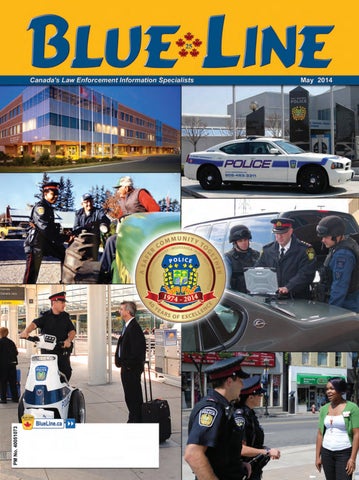
MAY 2014
2
BLUE LINE MAGAZINE
May 2014 Volume 26 Number 5
Features
6
6
Building on a Proud Past
12
Economies of Scale The regionalization of Ontario policing
14
Fentanyl, the new Oxycontin
16
Forensic Gait Analysis
20
Staying Ahead of Social Media
Departments
14
38 Back of the Book – Target Hardening: Police and community working together 23, 24 Blue Line News Week 38 Blue Links Advertisers Directory 28 Deep Blue – Even cringing has an upside 18 Dispatches 21 Letters MarketPlace 37 31 Holding The Line – Police Suicide 5 Publisher’s Commentary – Oh Cannabis, we stand on guard for thee! 26 Technology – Enhancing CCTV
16
Case Law 32 34 35 36
BLUE LINE MAGAZINE
3
Answers to hypotheticals did not taint arrest Consider reasonable suspicion factors collectively Intent matters: Private property pull-over lawful Due diligence available for seatbelt violation
MAY 2014
MAY 2014
4
BLUE LINE MAGAZINE
Blue Line
PUBLISHER’S COMMENTARY by Morley Lymburner
Magazine Inc. PUBLISHER Morley S. Lymburner – publisher@blueline.ca GENERAL MANAGER Mary K. Lymburner – mary@blueline.ca SENIOR EDITOR Mark Reesor – editor@blueline.ca NEWS EDITOR Kathryn Lymburner – kathryn@blueline.ca CREATIVE DIRECTOR E. Jolene Dreja – jolene@blueline.ca MARKETING MANAGER April Lensen – april@blueline.ca CONTRIBUTING WRITERS Robert Lunney Dave Brown Mike Novakowski Nancy Colagiacomo Tony Palermo Stephanie Conn Tom Rataj Dorothy Cotton Brent Snook Mark Giles AFFILIATIONS International Association of Law Enforcement Planners Canadian Advertising Rates Data International Police Association The Canadian Press Newswire Access Copyright SUBSCRIPTIONS $30 per year; $50 for 2yrs; US & Foreign: $100 ADVERTISING 888-640-3048 advertising@blueline.ca
www.blueline.ca 12A-4981 Hwy7 East, Ste 254, Markham, ON L3R 1N1 Canada P: 905-640-3048 F: 905-640-7547 blueline@blueline.ca
PRINTED IN CANADA
ISSN# 08478538 Blue Line Magazine was established in 1988 as an independent publication to inform, entertain, connect and educate those involved in the law enforcement profession. With no direct control from an enforcement agency, its opinions do not necessarily reflect those of any government or law enforcement agency. The authors, advisors, and publisher accept no liability whatsoever for any injuries to person(s) or property resulting from application or adoption of anything presented in this magazine. Readers are cautioned and advised that articles presented herein are edited and supplied for your personal awareness and should not be used for further action until appropriate guidance is received from a supervisor, Crown Attorney or other persons in authority. All material submitted for publication becomes property of Blue Line Magazine Inc. unless arrangements have been made with the publisher prior to publication. © 2014 All articles are protected by copyright. No part of this publication may be reproduced or transmitted in any form or means, electronic or mechanical, (including photocopying and recording or by any information storage or retrieval system), without prior permission. Permission to reprint may be obtained in advance from Access Copyright 1-800-893-5777.
BLUE LINE MAGAZINE
Oh Cannabis,
we stand on guard for thee! It’s the thin edge of the wedge. Three US states have legalized marijuana and now Canada has pulled the pin on the hand grenade in a friendly game of catch. Police have to shoulder some of the blame. Back in 2001 the federal health minister took a humanitarian approach toward those suffering chronic pain and other afflictions by permitting them to smoke “medical” marijuana. In his haste to win popularity with some segments of society he created a monster that still haunts us today on many levels and fronts. More recently, to gain a foothold with a younger voter, Justin Trudeau suggested its time to drop all laws pertaining to marijuana. Many politicians and top police managers are unwilling to continue expending the resources on investigating and processing federal marijuana charges. With all police agencies trying to do much more with much less it was inevitable that something would give. When the GWO (Great Wizard of Ottawa) can see a division in police leaders across the country, it’s a sure bet that it’s time for the ‘legalize dope’ agenda. The rush to pass the 2001 legislation came without any empirical evidence that marijuana will work as claimed. Doctors and researchers not only have no idea what quantities to prescribe but are also on the hot seat with patients who demand cannabis but have no evidence, other than the ‘pot-heads’ word on it, that it works. Well let the politicians put this in their pipe and smoke it. Why does this “medication” have to be smoked? Could it not be given in pill form, injection or maybe even as a suppository? Was the overwhelming evidence of the dangers of second hand smoke considered? Can users smoke it in public? How do you tax something that is so easy for everyone to grow? Will we be replacing cops for Revenue agents? Are we increasing costs on medicare? Are we ready for the additional loss of life on the roads? Are we ready for increased psychiatric care and the colateral costs to families? The genie is out of the bottle and police across the country will have to deal with it. Every law enforcement agency will now have to admit that we ain’t going back. The problem arises when ill-conceived regulations that don’t work are mixed with the political attitude that police can always be counted upon to make bad rules work. My recommendation is to not make it work this time. This is the future and Canadian police now have to change their lobbying techniques to meet the problems of the future. Legalizing the drug does not take away the problems it causes. Study after study has shown that cannabis 5
distorts an individual’s ability to judge time and distance – two crucial requirements to safely drive a motor vehicle. THC adheres to fat molecules in the body and will not purge from the system as efficiently as alcohol. Ever heard of a druggy going on a diet? That burns fat. There are several things we must do before we even consider legalizing. 1. All certificates authorizing drug use must be made reverse-onus, requiring the applicant to prove effectiveness.There are few doctors who could not be intimidated into issuing the current forms – and no drug traffickers (or bikers) who will not try. 2. Alcohol and driving don’t mix. Drugs and driving also don’t mix. Alcohol, drugs and driving is insane. Legislation is needed to permit mandatory blood tests of all motorists who appear to be impaired but have little or no alcohol in their system. 3. Mandatory blood tests of motorists whose vehicles smell of cannabis. Similar to the road-side screening laws this will be the only weapon that will work to gain back some semblance of control on the highways. 4. Legislation to suspend the licence of anyone given a prescription to use marijuana. Use it legally and you forfeit the privilege to drive on public roads. It’s just too scary otherwise. 5. A minimum licence suspension of two years for persons found guilty of driving while impaired by THC, with the suspension staying until blood samples indicate it has dropped to a low level. A zero reading is preferable but that would make politicians run scared. The goal here is to make driving as clean as possible. If people partaking in amateur sports must prove they are drug free to run, jump, swim, skate or ski then a blood test to drive is not too much to ask. While the politicians pontificate about the virtues of pot perhaps they might try an experiment. Let officers enforce the current antimarijuana campaigns by issuing tickets to users in much the same manner as provincial offences. Simple possession results in confiscation and a ticket with an out of court fine of $250. Better yet create a quota system for enforcement with a five per cent commission to officers and the customer base will shrink dramatically. Tear that Maple Leaf out of our flag. We all know what to replace it with – and many politicians want you to be ready to salute.
MAY 2014
BUILDING ON A PROUD PAST
by Jamie Armstrong Peel Regional Police (PRP) is celebrating its 40th anniversary – an important milestone. It’s an opportunity to look back at successes and challenges while also looking ahead. Five local police departments – Brampton, Chinguacousy and Mississauga townships, Port Credit and Streetsville – amalgamated on the first day of 1974 to form Peel Regional Police. Considered a bold move at the time, it created what would become one of Canada’s leading municipal police services. Many things have changed over the last four decades. Peel Region’s population has soared from 334,000 to 1.3 million and it is now one of the fastest growing and most diverse communities in the country. The PRP has also grown to meet the many challenges of providing safety and security while also establishing itself as a law enforcement leader and the third largest municipal police service in Canada. Members have made every effort to not only provide the best service to their community but to also reflect it. The sworn complement has ballooned from 412 officers in 1974, including 17 females, to 1,957 officers MAY 2014
in 2013, including 332 females. Civilian ranks grew from 81 to 818 during the same period. Today, one quarter of members speak a language in addition to English; in fact, officers and civilians speak 53 of the world’s languages, including American Sign Language. There have been six police chiefs since amalgamation, each offering a unique vision to meet the challenges of the day. Although innovative and groundbreaking in their own right, each has demanded professionalism, dedication and teamwork from members, seeing the service through many challenges over the years – and the PRP has seen more than its share of challenges. The Mississauga train derailment in 1979, 6
the Air France crash in 2005 and 28 murders in 2008 are just some of the significant events that tested the organization’s strength and character. Each time, members rose to the occasion with dedication to duty, compassion for victims and resolve to solve the most heinous of crimes. No matter how successful the organization became, members never stopped striving to improve. Being better meant being open to honest and constructive feedback, the most important of which came from the community. The business owners and families throughout Mississauga and Brampton know what they want in a police service and are more than willing to share their ideas and opinions. Since the early 1990s, PRP has regularly surveyed both businesses and residents and holds regular focus groups to get face to face input about the service and suggestions on how to improve. As the nature of the policing profession changed, so did the needs of those who serve and protect. It was recognized that those who take care of the public also needed to be cared for. Three new units were created in 2008: risk management, organizational wellness and corporate communications. Individually, these areas work to address the day to day BLUE LINE MAGAZINE
needs of staff and ensure members are kept safe, healthy and engaged. The results have been impressive. The annual PRP employee survey shows a marked increase in overall employee satisfaction and confidence in the chief’s management group to act in the best interest of employees. The service has an operating budget of $350 million and feels an obligation to manage public funds responsibly and transparently. The constant effort to gauge public and employee opinion and solicit input is a significant undertaking, yet nothing could be more vital to ensuring the continued success of a police service – especially when the information is used as the foundation for the organization’s most important document – the strategic plan. The 2014-2016 strategic plan is based on the changing needs of the community and members and re-affirms a commitment to community safety and policing excellence. It serves as a roadmap for how the service does business in the following areas: • Community safety together; • Member focused workplace; • Quality service & fiscal responsibility; • Growth & changing demographics. The hard work, determination and innovation of members during the past four decades has established PRP as a leader in Canadian policing. Some of its more noteworthy firsts include polygraph use, successful fingerprint identification on human skin, establishing a direct data entry system and convening stateof-the-art strategic planning sessions, to name but a few. The list of accomplishments is long and distinguished. Each one came about not as a result of one person’s actions but through a collective effort by sworn and civilian members alike. Throughout the year, the service will commemorate its 40th anniversary with officers and civilian staff at various public events throughout Peel Region. PRP has so much to be proud of and 2014 will be remembered as a year to reflect on the organization’s ability to continuously strive for improvement, appreciate its proud past and prepare for exciting challenges in the future.
Above: Peel Regional Police headquarters includes a memorial obelisk dedicated to fallen officers at the front entrance driveway. Below: In the mid to late 1950’s until the early 1980’s chrome yellow police vehicles were in vogue in much of southern Ontario. It was felt the vehicles were easy to spot in the large urban areas and created a “sense of presence” on the streets. Although visibility was important it was determined that the highly toxic lead paint used to create the colour was harmful to installers and painters and its use was discontinued.
Jamie Armstrong is a Staff Sergeant working in the Executive Administration section of the Peel Regional Police. He may be reached by email to Jamie.Armstrong@ peelpolice.ca
BLUE LINE MAGAZINE
7
MAY 2014
A BLENDED POLICING STRUCTURE Policing in Peel Region includes Ontario’s largest OPP detachment by Elizabeth Harrison The ten municipalities in the then County of Peel were officially whittled down to two cities and a town on the first day of 1974. The newly formed Peel Region took over from the county and the cities of Mississauaga and Brampton and the Town of Caledon became the lower level municipal government. The five local police forces – Brampton, Chinguacousy and Mississauga townships, Port Credit and Streetsville – were amalgamated to form Peel Regional Police (PRP). Peel’s population grew by some 25,000 people that first year and the region has maintained an average growth rate of 27,000 people in the four decades since it was formed. To keep pace, PRP has grown into the third largest municipal police force in Canada. The service has worked with the region to keep costs under control by reducing duplication of services and ensuring it is meeting community needs in the most cost effective way. Peel OPP Not all of Peel Region went along with the new police service. Despite regionalization the province continued to pay for highways, therefore Ontario Provincial Police patrolled provincial highways throughout municipalities, including in the Town of Caledon. Caledon’s population was only about 19,000 at the time and it didn’t make sense MAY 2014
to have the OPP patrol the highways and PRP patrol the side roads of a large, sparsely populated area made up of small hamlets and vast agricultural areas. Caledon council decided it would be more economical and effective to stick with the police officers who already knew the community. Caledon became one of the OPP’s first contracts with a municipality and is currently its largest. This has created a unique reporting structure; it reports to the town, and then relays that information to Peel Region. This makes for an interesting dynamic as the OPP collaborates with PRP and Peel District School Board, which contributed to Caledon’s status as Canada’s safest community from 2009 to 2011. Priorities and programs Caledon’s population has grown to almost 60,000 people and the OPP has evolved to keep pace. It consolidated three locations and 108 officers into a new state-of-the-art detachment last year to better meet the needs of the growing area. The detachment’s community response unit attends events throughout the community. The auxiliary program is also very active; its 26 members dedicate more than 4,500 hours each year and some have been with the program for more than 20 years. Caledon population is projected to double by 2031, which will require shifts in policing. 8
Caledon OPP is beginning the process by introducing a full time dedicated bicycle patrol unit. The six officers will patrol from May through September to promote visibility and increase interactions with the public. The detachment is also working to improve relations with youth, enhance partnerships with PRP and continue its strong committment to traffic enforcement. Initiatives The OPP began its Road Watch program in Caledon in 1995. The program aimed to use education and enforcement to improve road safety by encouraging citizens to take on the responsibility of reporting aggressive driving. Police and residents worked together to reduce deaths and injuries on area roads. Road Watch has been adopted in 40 other communities throughout Ontario. Another initiative, Project Ten-Four, began in June 2013 and ran for a week. The name stands for a main area road (Highway 10) and the four communities – Peel, Caledon, Shelburne and Owen Sound – that it runs through. The name also serves to acknowledge the numerous collisions that occur along the highway. Each detachment and police service worked together to increase enforcement on the stretch of Hwy. 10 running through their area. Colisions were reduced by 50 per cent during the week the program ran. BLUE LINE MAGAZINE
“LEEDING” THE WAY New police station encourages a “green” footprint by Paul Sapounzi The new OPP detachment in Caledon, Ontario is the first Ontario police facility to be awarded the Gold Standard under the LEED NC 2009 rating system by the Canadian Green Building Council (CaGBC). Leadership in Energy and Environmental Design (LEED) is a rating system recognized as the international mark of excellence for green building in over 132 countries. Gold certification is a significant achievement considering the new Caledon facility is Ontario’s largest OPP detachment. The new 23,650 square foot building is a state of the art, energy and cost-effective structure that embodies the town’s commitment to sustainable development. The building was designed with a focus on the environment and energy consumption, water usage, storm water controls and a compact building footprint, scoring six out of six for innovation in design and 10 out of 10 for water efficiency. Water efficiency To reduce the overall water demand a rainwater harvesting system supplies toilets and urinals, reducing potable water usage by 50 per cent. An additional 24 per cent water savings is attributed to low flow lavatories, faucets and showerheads. The total savings equates to 364,000 litres of water saved annually when compared to a standard building. Energy efficiency Mechanical systems include a geothermal heat pump system using the ground for heating
BLUE LINE MAGAZINE
and cooling. Additional features include a low voltage lighting control system, LED exterior lighting and the careful selection of high efficiency equipment (boilers, heat recovery units and heat pumps). Energy simulation software was used to validate the buildings’ overall energy cost savings of 51 per cent compared to an equivalent building meeting code. Innovative design Caledon and the OPP have implemented a “green cleaning policy” which includes buying environmentally responsible cleaning products. To support the growth of renewables, 70 per cent of the building’s annual electrical consumption has been purchased from EcoLogo certified renewable energy providers. Greenguard certified furniture is used throughout the building. The Greenguard certification program helps manufacturers create and buyers identify and trust interior products and materials that have low chemical emissions, improving indoor air quality. All certified products must meet stringent emis-
9
sions standards based on established chemical exposure criteria. The certification is broadly recognized and accepted by sustainable building programs and building codes around the world. Caledon OPP had very specific requirements with respect to the flow and functionality of spaces within the building, giving +VG Architects a clear guide to the systems and program components needed. It worked closely with the OPP and additional stakeholders to ensure key elements were incorporated mindfully into the design; the public spaces include education, resource and multi-purpose community rooms, allowing local volunteer groups access within the non-secure area of the building and providing the OPP an opportunity to interact with the community. Police administration spaces interface with secure areas such as retention court, sally ports and holding cells. The facility connects state-of-the-art technology with community policing through a customized local design and represents the neighbouring community by using natural materials, including stone, to reflect the region’s geography. “The modern, safe and comfortable facility will allow Caledon OPP to provide a level of police service that the town can be proud of,” said Caledon Mayor Marolyn Morrison. Paul Sapounzi is a partner with +VG Architects. For further information you may contact him at PSapounzi@ plusvg.com or visit www.plusvg.com to learn more.
MAY 2014
BUILDING ON
A STRONG FOUNDATION Douglas K. Burrows was the first Chief of the Peel Regional Police from 1974 to 1988. Chief Burrows had an extensive police career, which spanned approximately 35 years. The first four years were with the Ontario Provincial Police. Many years in criminal investigation and heading Criminal Identification has resulted in Chief Burrows being regarded as an expert in scenes of crime. His passion for solving major crimes is reflected in the excellent record of the force. Prior to his police career, Chief Burrows was in the Naval Air Service, 30th Carrier Air Group, during the Korean War.
William Teggart began his police career in 1956 as a Constable with the Toronto Township Police. In 1960 he was transferred to the Detective Bureau and was promoted through the ranks. In 1974 he became Deputy Chief and in 1988 was MAY 2014
appointed Chief of Peel Regional Police. Chief Teggart retired in 1990. During his distinguished 34-year career, Chief Teggart spent many years as the Officer in Charge of the Criminal Investigation Branch. He is best known for his investigation of the murder of fashion model Christine Demeter in 1973. In this case, investigations were conducted in 11 cities, four countries and two continents. During Chief Teggart’s tenure as Chief of Police, he retained experts from Harvard University for executive sessions on policing futures.
Robert Lunney assumed duties as Chief of Police for the Peel Regional Police on April 2, 1990. Previous to this, he served as Commissioner of Protection, Parks and Culture, with the City of Winnipeg. Chief Lunney’s police career began in 1953 when he joined the Royal Canadian Mounted Police. He retired from the RCMP in 1974 at the rank of Superintendent after service in Southern Ontario, the Yukon Territory, Alberta and Ottawa. From 1974 to 1987 Chief Lunney was Chief of Police for the City of Edmonton, Alberta. Chief Lunney has been the principle proponent of the accreditation movement in Canada, and is responsible either directly 10
or indirectly for the accreditation of five Canadian police services through the end of 1994, including Edmonton, Winnipeg and the Peel Regional Police.
Noel Catney was appointed Chief of Peel Regional Police on April 24, 1997, assuming his position following 27 years of distinguished service. He began his career with the Mississauga Police in 1970 and became a member of Peel Regional Police upon amalgamation, on January 1, 1974. Chief Catney’s career spans the entire history of Peel Regional Police. When the service was formed in 1974, he continued to serve as an investigator with #11 Division Detective Bureau. He subsequently moved to the Homicide Bureau, where he was deployed for six and a half years. As a result of Chief Catney’s visionary and progressive leadership, the service employed professional development opportunities for command and senior officers internationally. The Chief was noted for his deep commitment to the research and development process in all areas of policing and instituted a bureau which unilaterally examines and analyzes, on a world-wide basis, policing programs and concepts for possible application within the Region of Peel. BLUE LINE MAGAZINE
Chief H.M. (Mike) Metcalf’s four decade-long career began with the Mississauga Police Department. Following various patrol and investigative assignments as a Constable, Chief Metcalf worked in the Forensic Unit for 15 years, he was promoted through the ranks of Sergeant, Staff Sergeant and Inspector. During his tenure, he was responsible for the introduction of several forensic-related automated systems, enhancing and modernizing the organization’s ability to investigate crime. During this assignment, Chief Metcalf also lectured at Sheridan College on the subject of criminalistics. Chief Metcalf has previously received the Ontario Medal for Police Bravery in a unit citation for his role in the aftermath of the Mississauga train derailment in 1979.
Emil V. Kolb
Regional Chair and Chief Executive Officer A visionary, respected leader, award winner, mentor and humanitarian, Emil Vincent Kolb has devoted more than five decades of his life to public service. Mr. Kolb is the Chair of Peel Regional Council, Chief Executive Officer of the Region of Peel and Chair of the Peel Police Services Board. His passion for office is equalled only by his vision to invest in children, secure their future and ensure their role as the next generation of leaders in Canada. Mr. Kolb is an active fundraiser for children’s charities including Peel Children’s Centre, Peel Children’s Aid, the United Way of Peel Region and Peel Children’s Safety Village. Through various events including the Emil Kolb Hootenanny, he has raised more than $1.5 million for local children’s charities. A Regional Councillor since the establishment of Peel Regional Government in 1973, Mr. Kolb became Regional Chair in 1991 and Chair of the Police Servi-
ces Board in 1996. His seventh and current term as Regional Chair and CEO began in December 2010. In the early 1970s, Mr. Kolb served as an Albion Township Councillor after serving as a member and Chair of the Albion Township Planning Board. From 1985 to 1991, he served as Mayor of Caledon for two terms. A tribute was paid to Mr. Kolb for his contributions to the police service when, in 2004, a Peel Regional Police facility in Mississauga was renamed The Emil V. Kolb Centre for Police Excellence. In 2008 he was named “Leader of the Year” by the Ontario Public Works Association for his contributions and support of the Public Works industry in Ontario. Mr. Kolb was born in 1936, in Gravelbourg, Saskatchewan and raised in the Bolton, Ontario area. The Kolb family farm, in the former Township of Albion since 1939, is still operated by their son Paul, his wife Marion and their family.
Chief Jennifer Evans began her career with Peel Regional Police, in 1983, joining as a Cadet. Since then she has progressed with notable assignments which included the Uniform branch, Youth Bureau and the Criminal Investigations Bureau. In 1996 she assisted Justice Archie Campbell in the Review involving serial rapist and murderer Paul Bernardo and later accepted a two year secondment to work as a Violent Crime Analyst at the Provincial ViCLAS Centre in Orillia. Chief Evans also worked throughout the Province for the Office of the Chief Coroner. Returning to Peel she was a Detective in Homicide & Missing Persons Bureau, and several promotions later was the Inspector in Charge. As Deputy Chief, in 2010, she was seconded to conduct a review of the Missing Women Investigations in lower mainland British Columbia. She reviewed thousands of documents and conducted numerous interviews with police officers involved in the initial investigation of Robert Pickton prior to his arrest. In January 2012 she testified at the Missing Women Commission of Inquiry regarding her report. Chief Evans’ knowledge and experience is recognized both provincially and nationally. BLUE LINE MAGAZINE
11
MAY 2014
ECONOMIES OF SCALE The regionalization of Ontario policing by Morley Lymburner Ontario began creating 10 regional municipalities and police agencies in 1969. Only six remain in their original form: Peel Regional Police (1974) Peel is the second largest police service in Ontario. Its 2,000 officers police some 1.25 million people spread over three municipalities immediately west of Toronto, including the cities of Mississauga and Brampton. The 60,000 people living in the town of Caledon are policed by 108 Ontario Provincial Police (OPP) officers. Although policed by two different agencies the region has only one police services board. Durham Regional Police Service (1974) The Durham Regional Police Service has an established strength of some 900 officers who serve about 650,000 people living in an area bounded by Toronto to the west and Lake Ontario to the south. Durham Region encompasses the area formerly known as the County of Ontario and portions of Durham County. The police service was created from seven original city, town and township police departments. Due to MAY 2014
the complexities, the new agency was given six years to completely take over the responsibilities across the vast expanse of the new region. The OPP delivered local services until full strength was achieved. Halton Regional Police Service (1974) Halton’s 650 officers police just over half a million people. Halton Region was developed from the amalgamation of the former County of Halton with four townships, the cities of Oakville, Burlington and Milton and the town of Halton Hills. Waterloo Regional Police Service (1973) Waterloo has a population of just over half a million people and is policed by 780 officers. This region was developed from the amalgamation of five cities, four towns and four townships in the former County of Waterloo. The new regional government oversees three cities and four townships. York Regional Police (1970) This two-tiered municipal structure is policed by some 1,500 officers and has a population base of just over one million. This covers the policing 12
needs for nine municipalities stretching from Toronto’s north border to the southern shores of Lake Simcoe. The creation of the York Regional Police in 1970 amalgamated 14 police forces. Niagara Regional Police Service (1971) The Niagara Regional Police Force, as it was then known, was Ontario’s first regional police agency. It was established on January 1, 1971 with the creation of the Regional Municipality of Niagara. This two-tiered municipal system saw the amalgamation of 12 area police forces. The service currently works out of six police facilities and covers 12 municipalities bordered by Hamilton to the west, Lake Ontario to the North, Lake Erie to the south and the Niagara River to the east. The service’s 704 officers police a population of just under half a million people. Altered states Three of the other four former regional police services have morphed into stand-alone agencies; the other one disbanded. Ottawa-Carleton Regional Police (1995) This agency turned full circle with its expanding city and police responsibilities. It BLUE LINE MAGAZINE
traces its history back to 1855 when the town of Bytown formally incorporated and hired its first chief constable. Over time, neighbouring municipalities also formed their own police forces, including Eastview in 1913 (which became Vanier police in 1963) and Gloucester-Nepean in 1957 (this service split into separate Nepean and Gloucester forces in 1964). As a precursor to future amalgamations, Ottawa Police absorbed Vanier Police on the last day of 1984. The former Ottawa, Nepean and Gloucester police forces were amalgamated to form the Ottawa-Carleton Regional Police Service on Jan. 1 1995. The service area extended to those portions of Ottawa-Carleton that had previously been policed by the OPP. The service was given its current name in 2001 to reflect the amalgamation of Ottawa-Carleton’s constituent municipalities into the new City of Ottawa. It currently has 1,363 officers covering a population of just under one million. Hamilton-Wentworth Regional Police (1974) The Hamilton Police Service currently has some 850 officers policing a population of 550,000. It was formerly known as the HamiltonWentworth Regional Police Force, which began in 1974 after the amalgamation of Wentworth County with the cities of Hamilton, Dundas, Stoney Creek, Ancaster, Flamborough and Glanbrook. The new force included the former Dundas, Stoney Creek, Saltfleet, Ancaster and Hamilton City police. Sudbury Regional Police (1973) The now Greater Sudbury Police Service currently polices a population of 165,000 with 264 police officers. The OPP polices some portions of this geographically spread out population. Haldimand-Norfolk Regional Police (1974) Haldimand-Norfolk was created through the merger of the townships of Delhi and Norfolk, the City of Nanticoke and the towns of Dunnville, Haldimand and Simcoe. The regional municipality was created on the expectation of dramatic growth, which never realized due to changing government policies and other economic realities. It was situated to the north of Lake Erie and bounded by Niagara, Hamilton and Waterloo Regional Municipalities. At its peak the service had 80 officers policing a population base of 37,000. Haldimand-Norfolk Regional Police was disbanded in 1998. In a close, contentious vote the regional council opted to go with the OPP. Local government growth For many years the basic structure of local government in Ontario was that provided by Robert Baldwin’s Municipal Corporations Act of 1849, which divided the southern part of the province into counties, cities, towns and villages. The Ontario of the 1960s and 70s consisted of 49 cities, 146 towns, one borough, 119 villages and 477 townships, which all had powers of local taxation based on property valuation. There were also eight “improvement districts” and 70 “police villages” whose care was overseen by the province. Although these areas had local administration they were entities with no BLUE LINE MAGAZINE
independent taxation powers. Urban growth began to strain the traditional jurisdictions. Rather than let the cities expand indefinitely into the surrounding suburbs and countryside, the province looked to create super municipalities that could operate on a regional basis and encompass a variety of jurisdictions. The first of these new “two-tiered” municipalities was Metropolitan Toronto, which began on January 1, 1954. It was a federation of Toronto and its suburbs, carved out of the southern half of York County, including the City of Toronto, the towns of New Toronto, Mimico, Weston and Leaside, villages of Long Branch, Swansea and Forest Hill and the townships of Etobicoke, York, North York, East York and Scarborough. Each had its own police service, which was amalgamated into the Metropolitan Toronto Police Force. In 1998 the province decided to pass a regulation to amalgamate the six remaining municipalities under the Metro Toronto model into one city. More than two thirds of residents voted against the amalgamation but the province moved ahead regardless, citing considerable dysfunction and duplication of expenditures as the primary reason. In the 1960s and 1970s “regional municipalities” on the model of Toronto were created, sometimes over the intense resentment of local citizenry. Eventually there were 11 regional municipalities created, including one district (Regional District of Muskoka). They were governed by assemblies of locally elected politicians, with jurisdiction over such items as police, water supply and arterial roads. Many larger local cities that came under the regions were not abolished and enjoyed some extended limited powers. Regional study remnants Two key reports in the 1960s highlighted rapid urbanization and recommended the creation of regional governments. The first was the 1965 report of the Select Committee on the Municipal Act and Related Acts, which found that Ontario’s rapid urbanization required larger municipal units. The second was the report of the Ontario Committee on Taxation, which drew on the recommendations of the above committee and recommended a tiered system of regional government with varying service and policy responsibilities. Shortly after the two reports were submitted, several individual regional studies assessed the viability of regional government in many of the province’s most rapidly urbanizing areas. The result was the creation of ten regional governments and a permanent change in the way the province viewed urban areas in relation to their rural peripheries. The Beckett Committee, named after its chairman, Hollis E. Beckett, submitted the first major report addressing the need for regional government in the 1960s. The Beckett Committee began its discussion on local and regional government by emphasizing that the character of separated cities and counties in the province had changed dramatically since the introduction of the 1849 Baldwin Act. The combination of population growth and urbanization coupled with economic prosperity 13
and futuristic thinking had created a need for greater forethought and a demand for community services never envisioned by the original authors of Baldwin’s municipal legislation. Not only had the cities developed a new vigour but population had spilled over into rural areas which were neither financially or politically equipped to deal with the resulting problems. The report further notes that steady – and, in some areas, rapid – urbanization was changing the nature of certain communities. Rural areas slowly became more developed, earning the moniker “dormitory municipalities.” As these problems intensified, local politicians struggled to find solutions since urbanization crept over several jurisdictions. The Beckett Committee recommended restructuring as the only alternative. The committee suggested that larger municipal units would correct these problems and laid out seven benefits of increasing the size of local governments. In particular, it argued that larger municipal units would: 1. Enable the provision of services which require large areas; 2. Enable agreement on common policies and the co-ordination of activities; 3. Eliminate the justification of some special purpose bodies which had been created to deal with problems extending beyond the limited area of local municipalities; 4. Make it feasible to employ more highly qualified staff and staff with specialized qualifications; 5. Provide a more fiscally sound municipal unit; 6. Reduce competition for commercial and industrial assessment; 7. Enlarge the tax base, thereby reducing inequalities in the burden of taxation. To account for newly urbanizing areas, the committee saw a clear benefit in increasing the size of local governments, essentially arguing that the functional scope of each area needed to be increased. With respect to the new responsibility provided to new upper-tier municipal units, the committee noted that individual studies should be conducted for each new region in order to determine which services would be best handled by the upper- or lower-tier. However, it did recommend that the new regional councils have the responsibility to: • Assess, tax, plan; • Maintain arterial roads; • Administer public health, hospitals, welfare and policing. The report also suggested that regional councils assume responsibility for storm and sanitary trunk sewers, sewage treatment plants, trunk watermains, water purification plants, “regional type” parks and fire services. All upper tiered municipalities agreed to all regionalizations with the exception of fire services. In many locations municipalities could see themselves saving money using a mixture of volunteer and full-time fire fighters. For further comprehensive study into regional municipal structuring, see a Western University paper Regional Organization And The Dynamics Of Inter-Municipal Co-operation: Policy coordination between Ontario’s separated cities and counties by Zachary Spicer. It was published in 2013 and is the source for much of this article.
MAY 2014
FENTANYL THE NEW OXYCONTIN
One police service’s approach to combating the negative impact of fentanyl abuse by Greg McClenaghan Drug addicts turned to the prescription drug fentanyl since OxyNeo® was introduced in 2012. Once used mainly to treat patients in palliative care or suffering cancer-related pain who have built up a tolerance to other opioids, it is now finding its way to the street. Fentanyl has been linked to almost two dozen overdoses and deaths in North Bay, Ontario alone. Fentanyl is a synthetic opioid analgesic used as an anesthetic in operating rooms and intensive care units and clinically to manage chronic pain. When used for pain, it is administered either as a lozenge or through a transdermal (skin) patch that allows for continuous extended release into the bloodstream. The patch has a backing to protect it from the environment, a drug reservoir, a porous membrane that limits the rate of drug transfer and an adhesive so it can be secured to the skin. Aside from the drug’s therapeutic applications, fentanyl is a potent drug of abuse. Commonly referred to on the street as “the patch” and “stickies,” abuse has included illicit preparations of the drug and diversion of clinical preparations. In particular, abuse of the patches has received increasing attention in recent years. The abuse of patches is not restricted to transdermal application; contents are also MAY 2014
injected intravenously, volatilized and inhaled and taken orally. There are several sources of illicit fentanyl: “double doctoring” (until the centralized prescription tracking system came into effect), prescription forgeries, overprescribing, pharmacy robberies and B&Es and diversions from individuals with legitimate prescriptions. Although the majority of fentanyl available on the street in North Bay is trafficked by criminal entrepreneurs – patients with legitimate prescriptions who sell part or all to controlled prescription drug (CPD) dealers or users – organized crime involvement is growing. Misuse of prescription drugs and related harms – including overdose mortality – have emerged as important challenges for the North Bay Police Service (NBPS). As with other high abuse index drugs, increased misuse and abuse of fentanyl has been associated with acquisitive crime in North Bay (i.e., B&Es, thefts, prescription forgeries, prostitution). Fentanyl has also been linked to an increasing number of non-fatal overdoses. Since 2008, six people – three males and three females – have been admitted to the emergency department (ED) in North Bay as a consequence of fentanyl misuse and abuse. Four were found without vital signs and required resuscitation. 14
Fentanyl-related mortality rates Fentanyl is 30 to 50 times more potent than heroin and 50 to 100 times more potent than morphine. It can be fatal, depending on several factors, including a person’s weight and level of opiate tolerance. Fentanyl acts on and is a Central Nervous System (CNS) depressant. In combination with other opiates, it can be expected to produce more pronounced CNS depressant effects. Signs of overdose include difficult or shallow breathing, drowsiness (the “nods”), extreme sleepiness or sedation, inability to think, talk or walk normally and feeling faint, dizzy or confused. The transdermal system, the most commonly abused form of fentanyl, is designed to deliver a specific dose at a constant rate based on the initial concentration in the patch. When a patch is altered, a large dose of medication can be obtained in a gel form, resulting in 72 hours worth of the drug being ingested in a single setting. There are many different methods of altering the transdermal delivery system. All involve separating the release membrane from the patch. Varying temperature extremes will fracture the release membrane, as will biting or chewing the patch. There have been 13 cases in North Bay since 2007 where fentanyl caused or contributed to death (see Fig. 1) – nine men and four women BLUE LINE MAGAZINE
between 20 to 53 years. Blood concentrations of fentanyl ranged from 2.9 to 81 ng/mL. A variety of routes of administration were identified, including intravenous injection of patch contents, oral/transmucosal administration and volatilization and inhalation of the patch contents. The co-administration of other drugs with fentanyl was common, although their presence in many cases wasn’t considered to have contributed to death. Initiatives to combat abuse Education & awareness In response to the marked increase in deaths, the NBPS, in co-operation with the coroner and medical officer of health, issued a public advisory in October 2009 aimed at increasing awareness about the risks of misuse. Targeted enforcement Unlike other street drugs, mere possession of synthetic opiates by someone suspected of dealing them is not enough if they have a legitimate prescription. This poses a significant challenge for law enforcement. Investigations require significant time and substantial police resources to build cases and prosecute those involved in trafficking opiates. The NBPS successfully concluded an undercover operation dubbed Project HOPE in late 2013 to identify and prosecute street level individuals involved in supplying and/or trafficking controlled prescription drugs, specifically fentanyl, and reduce the supply through targeted enforcement. The operation resulted in 20 individuals facing 93 drug and drug related charges. A key objective was to collect information and intelligence with a view to providing a strategic level overview of the controlled prescription drug abuse issue. Street drug prices are not static. The perceived inexperience of the buyer, availability, current supply and even the time of the month (before or after the issuance of social assistance cheques) were all felt to influence the street value. Prices for controlled prescription drugs varied based on brand name and strength. Weak opioids such as Percocet sold for as little as $5 per pill while the more potent opioids sold for as much as $100 per pill. Percocet, morphine and oxycodone were the most commonly available controlled prescription drugs in North Bay. Fentanyl was also available, albeit at significantly lower levels than previously thought when compared to other controlled prescription and illicit drugs. This was attributed to the number of new users. The increasing popularity of fentanyl among young people, as evidenced by the age of those arrested during the project, was a concern. Given that fentanyl was more difficult to obtain on the street, it was therefore much more expensive. A 100 microgram ratio®-fentanyl patch worth $12.05 (in the pharmacy) sold in North Bay during the project for between $400 and $450 on the street. Patch exchange program Even after the prescribed application time has elapsed, enough fentanyl remains in a patch BLUE LINE MAGAZINE
to provide a potentially lethal dose. Up to 60 per cent of the medication can remain so discarded patches are a sought-after commodity by some abusers and can pose a risk to young children who may come into contact with them. Proper disposal is crucial in preventing both intentional and accidental misuse. The NBPS, in co-operation with local physicians and pharmacists, introduced a fentanyl “Patch 4 Patch” exchange program in December 2013. Patients with prescriptions are now required to return their used patches to a pharmacy for proper disposal before receiving new ones. The program is not meant to disrupt or otherwise complicate pain management treatment. Rather, it guarantees the responsible provision of a powerful and potentially lethal drug and ensures its proper disposal to avoid accidental misuse and outlines the responsibilities of both physicians and pharmacists. Prescribing physicians are discouraged from writing large prescriptions and pharmacists are required to reconcile and inspect used patches for any signs of damage (tampering) and to report any suspicions or concerns to the prescribing physician. Pharmacists are allowed to initiate a contingency dispensing protocol – one patch every 72 hours – should the patient fail to return all patches. Since its release in December, the policy has been revised to address issues that have arisen. To avoid the program, patients with legitimate prescriptions have their fentanyl dispensed by pharmacies outside of North Bay. To prevent this, physicians are now identifying on the prescription the actual pharmacy and location where it is to be dispensed and, whenever possible, faxing the prescription to the pharmacy. Complex challenges Regulations for the use of prescription opiates and the related harms they can cause poses distinct and complex challenges for law enforcement. These drugs are essential therapeutic tools in pain management, especially for severe and chronic pain. Any initiatives must 15
not affect or compromise access and their ability to manage pain. Any strategies or initiatives to reduce or counter the negative impact of prescription drug abuse should engage stakeholders and include four key elements: • Reduce drug related crime; • Reduce the supply of illegal drugs through targeted enforcement; • Prevent young people from becoming drug users; • Reduce drug use and drug-related offences through treatment (i.e. detoxification centers) and support (i.e., counselling). Because prescription drugs are legal, they are easily accessible. Police and the medical community (doctors and pharmacists) have a role to play in reducing abuse. Police need to engage and form partnerships with community partners and other stakeholders to reduce abuse. The fentanyl patch exchange program is the result of such partnerships and includes the following components: • Education: A crucial first step in tackling the problem of abuse is to educate parents, youth and patients about the dangers of abusing fentanyl drugs. Prescribers also need to be taught the appropriate and safe use and proper storage and disposal of fentanyl. • Proper disposal: Patients are required to return used patches for safe disposal by pharmacists. • Enforcement: Police are notified when a patient fails to return all their patches. The highly addictive nature of Fentanyl and the steady increase of misuse and abuse represent a serious threat to Ontario communities. A lack of understanding of its effects when abused, coupled with wider availability on the street, means more overdose deaths and acquisitive crimes committed primarily by drug addicts. Greg McClenaghan works in the Criminal Intelligence Services section of the North Bay Police Service. He may be reached by email to gmcclenaghan@northbaypolice. on.ca or Phone 705 497-5598.
MAY 2014
by Les Linder Each person moves in a unique way, making it possible to recognize them by the style or manner in which they walk or run – and law enforcement around the world is beginning to take notice. Forensic gait analysis was first admitted as evidence in London in July 2000 (R v Saunders) and has since been used in numerous cases, including the high profile UK ‘Night Stalker’ serial rapist case. Gait evidence was first used in Canada in R v Aitken. A man was shot multiple times outside his apartment building. Security camera video showed a male with a concealed face arriving at the building carrying something which appeared to be covered by a towel. Forensic gait analysis evidence by UK Consultant Podiatrist and Podiatric Surgeon Haydn Kelly showed the defendant demonstrated gait characteristics bearing a very strong similarity to the images of the shooter and the person who had earlier been surveying the premises. The jury accepted the evidence, convicting the defendant of first degree murder and sentencing him to life imprisonment. The BC Court of Appeal dismissed the defence appeal in 2012 and the Supreme Court of Canada denied leave to appeal in 2013. Unique movements The process of walking is a complicated activity which generally begins with the movement of the pelvis, says Kelly. MAY 2014
Our arms move to help counterbalance the distribution of weight from side to side and maintain the head pointing in the direction of travel. When an individual’s foot makes contact with the ground a force is generated which travels into the foot up through the leg, knee, hip and spine. How the body deals with those forces – biomechanics – affects how an individual moves. “Gait analysis is the detailed study of the positioning and movement of the way in which an individual walks through the various stages of the walking cycle. The movement of a person’s body is unique to each and this “signature” of the walk can contribute to the forensic toolbox,” says Kelly. As a form of evidence during a police investigation, security camera video is examined and compared to the known 16
(control) footage of an individual. In the majority of cases, video of the unknown person is compared to video of a known individual. This can provide investigators with scientific evidence admissible in court. “In some cases, officers are faced with many hours of CCTV footage that needs to be painstakingly trawled through,” explains Kelly. “If the suspect is known and if, to the trained eye, the suspect has an abnormal or unusual gait such as a detectable movement of the knee or foot, for example, then it is much easier to help identify an individual. This can save investigators an enormous amount of man hours.” Gait analysis helps to identify people at a crime scene, verify alibis of a person’s presence/absence at a location, eliminate suspects from an enquiry, locate and track persons of interest and reduce the time needed to analyze video. “It may be a qualitative analysis or a quantitative analysis that is carried out, or both, depending upon what footage is available,” says Kelly. “For example, a rear view of an individual caught on CCTV camera would be compared to rear view footage of a known individual. “During the investigation process, the CCTV footage is the ‘unknown’ footage in terms of the scientific analysis of it. Investigating officers may capture and record the suspect from overt footage, custody footage or during a surveillance operation, which is the ‘known’ footage. Analysis is then performed for both the consistent and different features of gait. It is very much a BLUE LINE MAGAZINE
tool of identification. “The technique may also be useful in confirming the links between series of crimes – there have been a number of cases of this. Incident footage of the perpetrators was compared to the covert footage of suspects and it was determined that the same individuals were responsible for the chain of crimes.” Certain features of gait can be observed when a person is walking or running, he notes. “If one is presented with footage of the same individual, then any distinguishing features of gait will be recognized.”
Gait must not be seen as simply a “style” of walking, says Kelly. “At the detailed level, it is a complicated process in which terms have to be simplified for evidential purposes and understanding in court,” he notes. “Because gait is so unique to all of us, it is much more than just a basic examination of ‘the way we walk’ and much more than simply studying an image or a left and right profile of the known person.” Gait is studied by comparing the various phases of an individual’s walking cycle from the assorted pieces of video presented during an investigation, says Kelly. “During a person’s gait cycle, for example, we may consider at what point an individual’s left foot begins a forward movement and, at the same time, what is the position of the other foot. Different biomechanical movements occur at different times during the walking process and we have to compare like with like.” Video is better than still images in demonstrating and explaining a person’s gait, Kelly notes. The length of time it takes to conduct BLUE LINE MAGAZINE
17
MAY 2014
a full gait analysis depends on the amount of video to be viewed and examined, adds Kelly. An initial view of one hour is often enough time to determine whether forensic gait analysis will assist an investigation. “The quality of CCTV footage can sometimes be a limitation to this kind of forensic analysis,” says Kelly, “but the question which should be addressed is ‘what information can be derived from the footage?’ There have been a number of cases where investigators considered forensic gait analysis late in the day, believing that video was of insufficient quality, but later recognized the use for it. “As digital and real time footage become more ubiquitous and the awareness increases that forensic gait analysis is often of use where offences are captured on CCTV, this will be of increasing assistance to investigations.” Another benefit of gait analysis is that complete head-to-head foot surveillance footage of an individual is not always required. “Although a complete view of the individual in motion is preferable, it is not essential every time and is specific to each case,” notes Kelly. “We can proceed with limited footage of an individual as long as the same structures are seen” First case Forensic gait analysis was first used in 2000 when London’s Metropolitan Police Service Flying Squad contacted Kelly for his help. A series of armed robberies had occurred across the south and south east of England and the investigators asked whether comparisons could be performed of the security camera video of the robberies and surveillance recordings of the suspects. The analysis led to a successful prosecution and made officers aware that forensic gait analysis is a valuable tool for identifying perpetrators. “The advice and subsequent evidence provided by Haydn Kelly was fascinating for us and the jury,” said Det/Insp. Wilf Pickles at the time. “It was key evidence against a team of dangerous armed robbers... who were targeting high class jewellers in and around London and the Home Counties.” There have been several cases of suspects admitting their guilt based on the visual forensic gait analysis evidence presented to them, Kelly adds, resulting in considerable savings on investigation and court costs. MAY 2014
DISPATCHES
Moving forward Kelly sees a bright future for gait analysis both evidentially and for intelligence uses. “With improving technology, databases and the appropriate support, this could become a facility as part of every police agency. We are already able to swiftly conduct gait comparisons. As technology becomes more readily available, as it already is in some countries, this will help analyzing electronic submissions very quickly.” Criminals have tried to hide or disguise their walk by wearing different clothing, for example, Kelly notes, but they were unsuccessful. Kelly has provided many forensic gait analysis opinions and reports relating to various investigations which have been successful at trial. Forensic gait analysis has been used as part of the forensic toolbox in hundreds of cases and investigations worldwide. Haydn Kelly has more than 20 years experience as a clinician. He is a Consultant Podiatrist and Podiatric Surgeon and is an examiner for the Faculty of Forensic and Legal Medicine at the Royal College of Physicians, London. He is writing and compiling the first textbook on forensic gait analysis and has written numerous medico-legal reports.
18
A Québec City police officer died in North Carolina on March 31 during a botched high-risk parachuting manoeuvre. Sgt. Philippe De Blois, 35, died on his first day of training for a skydiving competition in Raeford. He apparently made a technical error while “swooping,” a low altitude dive in which skydivers glide along just above the ground and do high-speed tricks prior to landing. The airport says De Blois was making a 180-degree turn to pick up speed and skim a landing pond when he crashed. It was his second jump of the day. His friends accompanied him to hospital where he was pronounced dead. Friend Dominic Chaput said De Blois was an experienced skydiver. “He was very powerful but not someone who was reckless,” Chaput said. “But mistakes are unforgiving. It’s a sport that’s riskier than traditional parachuting.” News of De Blois’ death sent waves of grief through the police force in Québec City. His pregnant girlfriend is also an officer on the force. ••• Paul Martin will take the reins from Durham Regional Police Chief Mike Ewles, a 32-year veteran who will retire by the end of May. Martin joined the DRPS in 1990 and worked in the Tactical Support and Nuclear Security units previous to being appointed deputy chief in February, 2012. The 49-year-old father of two, who has lived in Durham since the age of six, always wanted to be a police officer. “Very early on, I can remember in public school, it’s the role I wanted,” he said. The path to policing had its “twists and turns.” After college, Martin spent two years in enforcement at GO Transit. By the time he was 26, he decided to join Durham’s force. In his previous position as Superintendent, he was the Officer-in-Charge of Policing Operations, which included the five patrol divisions and the Duty Inspector’s office. ••• Dr. Dirk Huyer, a forensic pathologist who specializes in evaluating child maltreatment, has been named Ontario’s new chief coroner. Huyer takes over the top job after acting as the interim chief coroner since July 2013. The province says he has investigated more than 5,000 deaths since becoming a coroner in 1992. He rose through the ranks as regional supervising coroner for the regions of Peel and Halton, as well as the counties of Simcoe and Wellington, before joining the chief coroner’s office in 2008. The province says Huyer has expertise in medical evaluation of child maltreatment and has worked with a suspected child abuse and neglect program at Sick Kids Hospital in Toronto. Huyer is also an assistant professor with the pediatrics department at the University of Toronto medical school. ••• Andrew Brinton took up his postion of Chief with the Oak Bay Police on April 22. In the last issue of Dispatches a photo was inadvertently placed with the news of Brinton’s promotion. Blue Line apologizes for any confusion this may have caused. The 51-year-old Brinton, previously a staff sergeant and detachment commander with Powell River RCMP, took over from Mark Fisher. Fisher stepped down after two and a half years with Oak Bay to lead the RCMP in Nanaimo. Brinton brings 32 years of service to his new post, including stints as a watch commander in Parksville and a non-commissioned officer with the West Coast Marine Detachment. Oak Bay has 24 police officers while Powell River has 26. r has 26.
BLUE LINE MAGAZINE
Return to the healing cycle York Regional Police ride to support hospice Hundreds of cyclists converged in Peel and Halton Regions June 23, last year, biking up to 100km in support of the 9th annual Healing Cycle ride. The Healing Cycle raises funds with the vision of supporting dignified and compassionate end-of-life care for individuals with life-limiting illnesses and their families. York Regional Police (YRP) rode with Police 4 Palliative Care (P4PC) in support of Doane House Hospice. A generous donation from York Region Police Association (YRPA) covered entrance fees for police participants, encouraging 39 officers from three police jurisdictions to raise $6,460 for hospice palliative care. All proceeds raised by the ride are donated to the palliative care hospices of participating communities across Ontario. “Three out of ten Canadians don’t receive the hospice care they need and that has a ripple effect on our community. When a loved one does not receive the care they need at the end of their lives, it affects the health and well-being of everyone around him. That’s why – for the health of our community – it’s so important for us to give back,” says YRP Det. Steve Ross. Ross has been involved with palliative care since 2011, when he started working with Doane House. 2011 was also the year that P4PC was created to encourage police officers from across the province to participate in the Healing Cycle. It proved to be a great fit for a worthy cause. P4PC founder Frank McCrea has a personal connection to the cause. “My family has experienced the journey of palliative care first hand and we strongly believe in the value it provides to families, which is why we have been supporting this cause for over ten years,” says McCrea. “An event such as the Healing Cycle is the perfect opportunity to bring together valuable members of the community such as police officers with individuals and families who have a passion for hospice palliative care.” McCrea’s business, Procom, sponsored both a $5,000 matching donation (to encourage increased P4PC fundraising) and the Police Cup Challenge, which awarded three trophies. The 2013 Police Cup Challenge winners were Det. Greg McGuire of the York Regional Police for “Fastest Police Officer Rider in the 25km,” Craig Gardiner from Peel Regional Police for the “Fastest Police Officer Rider in the 100km,” and Toronto Police Service for “Best Fundraiser.” As YRP approaches its second year of participation with the Healing Cycle, officers hope to raise the bar for participation, increase the number of riders and maybe even steal the title for “Best Fundraiser.” BLUE LINE MAGAZINE
This year’s P4PC Healing Cycle ride takes place Sunday, June 22, 2014. To join the York team contact Ross at 957@yrp.ca
19
MAY 2014
STAYING AHEAD OF
SOCIAL MEDIA
Controlling rumours is crucial during a disaster or terrorist attack by Ashley Potter Authorities around the world should set up emergency communication teams to manage the amount of misinformation circulating on social media during disasters, terrorist attacks and other social crises. Dr Onook Oh of Warwick Business School, Manish Agrawal of the University of South Florida and Raghav Rao of the State University of New York at Buffalo studied social media use in three major incidents, including the 2008 Mumbai terrorist attack. Their research revealed that Twitter is emerging as the dominant social reporting tool for eye-witness accounts and shared information on disasters, terrorist attacks and social crises as a collective effort to make sense of what is happening. MAY 2014
When the online community create and exchange the news rather than official news channels, this can not only exaggerate the unfolding situation but also unintentionally turn it into misinformation, diverting attention from the real problems. Oh, assistant professor of information systems, believes authorities or organisations involved in a disaster or terrorist attack need to set up an emergency communication centre to provide speedy, relevant information on the unfolding crisis and confirm or dispel misinformation circulating on social media. The study, the first application of rumour theory to social media and community intelligence, analyses three large Twitter data sets: • The 2008 Mumbai terrorist attacks, where a group of gunmen killed 165 and injured 304 people; • The May 2012 shooting of five people by a gunman in Seattle; and • Toyota’s recall of four million cars in 2009 and 2010 because of potential “sticking” accelerator pedals and floor mat entrapment. Within minutes of the initial terrorist attack in Mumbai, a local resident posted a stream of pictures on photo sharing website Flickr. Almost concurrently, a group of people voluntarily formed a Twitter page with a link to the Flickr site and spread eyewitness accounts of the terrorist attacks with texts, photos and links to other sources. While the flurry of social media activity had many positive outcomes, enabling peo20
ple to contact family members, encouraging blood donations and providing eyewitness accounts, it also caused many rumours to circulate. In total 20,920 tweets were analysed on the Mumbai attacks in the study, ‘Community Intelligence and Social Media Services: A Rumor Theoretic Analysis of Tweets During Social Crisis,’ published in MIS Quarterly – from the moment the terror attack occurred on November 26 until November 30. “Natural disasters and crises such as terrorist attacks provide the optimum conditions for rumours to spread, which can exacerbate the situation for emergency response operations and cause panic amongst the public,” noted Oh. “For example, during the Mumbai terrorist attacks, the police control room was flooded with incorrect reports of explosions at leading hotels. “Misinformation on the Internet was also influencing what was being reported on official news channels. In fact, the British Broadcasting Corporation was forced to admit it had made a mistake after using Twitter coverage of the Mumbai terror attacks as a source of official news.” Oh believes the main motivation for people turning to Twitter in a crisis is to find out what is happening in their immediate area or to acquaintances. To control the flow of misinformation, emergency communication centres need to be set up quickly to respond to misinformation through social media channels. “People use mainstream media to try to BLUE LINE MAGAZINE
LETTERS
make sense of the situation but it usually provides general information or repeatedly broadcasts a few sensational scenes over and over again,” said Oh, who cites the US Federal Emergency Management Agency’s Rumour Control Centre web site during Hurricane Sandy in 2012 as an example of one way to use emergency communication centres. “What people involved in the crisis really want is very localised information in real time to aid their decision-making,” Oh concludes. “Hence they rapidly realise that mainstream media do not provide them with local information that they desperately need to overcome the extreme situation, hence, they turn to social media such as Casebook and Twitter. “Emergency response teams need to put in place prompt emergency communication systems to refute the misinformation and provide citizens with timely, localised and correct information through multiple communication channels such as web site links, social network web sites, RSS, email, text message, radio, TV or retweets. “In cases of community disasters, emergency responders need to make extra effort to distribute reliable information and, at the same time, control collective anxiety in the community to suppress the spreading of unintended rumour information. This includes the setting up of an ‘emergency communication centre’ in the local community to monitor social media very closely and respond rapidly to unverified and incorrect rumour information. “Given that the motivation of rumouring is fundamental to making sense of uncertain situations such that people can deal with a possible threat, the provision of timely and certain information may lead to successful crisis management in partnership with voluntary online citizens.” Ashley Potter is the Press and PR officer at the Warwick Business School, part of the University of Warwick in Coventry, England. Contact her at ashley.potter@wbs. ac.uk to obtain a copy of the study.
BLUE LINE MAGAZINE
Reading your article in the January issue of Blue Line Magazine about traffic direction brought back old memories of my experiences in directing traffic. I wasn’t a traffic officer but in my first seven years on the force I directed traffic every day and afternoon shift. As a retired Metro Toronto trained police officer, one who had to learn directing traffic in the real world, my first time directing traffic was at Don Mills and Eglinton with the traffic lights turned off, no safety vest, just white gloves, hat cover and a whistle. If you remember, motorcycle officers were issued white coats, which with snow/fog/heavy rain almost made them invisible. Later beat officers were issued white coats to use when directing traffic. We were never issued wands and had to purchase them if we wanted one. Now I teach new security guards the requirements needed to obtain their security guard license and that includes directing traffic. I would love to have them get practical experience directing traffic in the college’s parking lots but due to the limited time for all the required training this is not practical. I use most of what you have stated in the article in my training and will be using this article to re-enforce the requirements to do it properly and safely. Since retiring (in ‘93) I have observed officers from many different forces directing traffic and only once have I observed an officer doing it in the manner mentioned in your article. Most wear safety vests and after that their arms and hand directions make you guess what they want to do. In my travels I found one situation quite interesting. It was night and raining when I saw a marked police vehicle, with the lights activated at an intersection. The officer sat in it with the window opened about two inches and with one finger stuck out he directed traffic. This was on a major street in Toronto. Keep up the good work. Alan W. Richardson ••• I wanted to express my sincere appreciation for you printing our article on GO transit safety and security. (December 2013 Blue Line Magazine) My team was thrilled (still are) and I am in your debt – this level of awareness goes a long way to helping us in the work we do with local police and emergency services. We have placed a copy of the article on our GO web page and flagged it on Twitter. Again, looking forward to anything we can do to help in the future. Bill Grodzinski Director Safety and Security GO Transit ••• I’m a former police officer of some 32 years’ service in different parts of Canada. There were many times during my career where it would have been handy indeed to announce to the community just who we suspected were committing crimes and
21
what we thought of these people. I’m retired now and involved in other work, but as you no doubt agree, former police officers never quite leave the fold. And on that note, I want to offer a different perspective on Chief Blair’s comments as related in A community looks to its leaders (Blue Line, March 2014). Leaving aside for the moment Mayor Ford’s ridiculous, probably criminal and certainly embarrassing foolishness, he has – at least as far as I know – yet to be charged with anything. This observation, added to the fact that police are generally (and properly) tight-lipped about investigations prior to charges being laid, renders the chief’s press conference more than a little perplexing. His offering up an opinion on how he personally feels about Mayor Ford only added to the puzzlement. While something of an over simplification, I believe it’s accurate to say that it’s the fundamental task of the police to uphold the law and bring offenders to justice. And yes, to be involved in the community too, but with respect, Jim Chu’s remarks on the value of youth literacy in reducing crime, a police officer commenting on a particularly heinous crime or one thanking a community for help in solving a case are all miles distant from Toronto’s chief of police telling us he has an incriminating video of the mayor and he’s disappointed in him. With that in mind, police officials need to be careful (and indeed generally are to a fault), to restrict their public remarks to issues of safety, requests for assistance, confirming charges and the like. Opinions on others’ behaviour and how it makes them feel is best left to others. Thanks for the article and the time. Dan Tanner Hammonds Plains, NS ••• I just read your comments about Chief Blair in Blue Line, (March 2014 - Disappointed) It is nice to see a common sense opinion coming from an experienced standpoint. I couldn’t agree with you more John Harris Hamilton, ON ••• I recently received the April issue of Blue Line Magazine and want to tell you that your commentary (Just walk away) was dead on! I really believe that the present day police personnel are different and for sure younger and less experienced than when we were on the job. They may have more and better training but I still believe that the officers that were serving during our day were really good cops, probably because our hands weren’t so tied as you have identified as one of the major present day problems. Keep up the great work, you’re the strongest voice Police Services have these days. Don’t ease off! John Nowell Aurora, ON
MAY 2014
MAY 2014
22
BLUE LINE MAGAZINE
CONSENSUS ON PROSTITUTION LAWS
ELUDES CHIEFS There’s no consensus among Canada’s police chiefs on what the federal government should do now that the Supreme Court of Canada has struck down three of the country’s prostitution laws. The top court gave Justice Minister PeProfessor ter MacKay until the Carissima Mathen end of December to draft new legislation. In addition to online consultations with the public, the department asked for input from police. The Canadian AsChief Rick Hanson sociation of Chiefs of Police initially tried to come up with a common position paper but found members had too many points of view. Calgary Police Chief Rick Hanson puts it this way, “The law enforcement community ranges from ‘legalize it all, they’re all Julia Roberts from Pretty Women’ to those who agree with us and everything in between.” In his submission to government, Hanson told the government to outlaw prostitution altogether. However, Hanson doesn’t actually want his officers to charge sex workers. “I think that you can create a series of laws where you can come down hard on the user and that you look at the provider as a victim,” he says. If that sounds like the so-called Nordic model of regulating prostitution, where selling sex is legal but buying it is not, Hanson makes it clear that it isn’t. Hanson says officers need the law as a tool to give them access to victimized men and women who were coerced into sex work. “Then you have courses of action to move that person towards treatment or counselling or getting them out of that lifestyle.” York Regional Police Chief Eric Jolliffe says that’s exactly how his officers had used the laws until the Supreme Court struck them down: “We take a very victim-centered approach. We haven’t, in fact, charged a prostitute here in five years. But we have been able to extract, using the authorities that are given to us today, over 110 people over the last several years.” Jolliffe says having the power to arrest someone for prostitution, even if officers don’t use it, helps police get behind the closed doors where the mentally ill, abused and those addicted to drugs have been forced into sex work. Ottawa University law Prof. Carissima BLUE LINE MAGAZINE
Mathen says it’s commendable that police chiefs are thinking this way. However, she says criminalizing prostitution on the promise of enforcing it in a one-sided matter is risky. She says there’s no way to guarantee officers would apply the law in the same manner across the country. “The problem with keeping the law on the books is that they essentially are asking for the discretion to use the law as they see fit,” she says. “But as long as the law is on the books it will have an impact on at least some of the women. And the Supreme Court has ruled that unacceptable because it makes their lives more unsafe.” According to Mathen, there are steps the government can take, just short of an absolute prohibition on prostitution, to ensure the safety of prostitutes and help prevent their exploitation, such as restricting where and how sex work is carried out. “But all of these require essentially accepting that some sex work is going to happen and that there are ways it can be done that don’t lead to the harms that clearly concern some of these people, including the chiefs of police,” she says. Durham Regional Police Chief Mike Ewles didn’t send a position paper to the government because he says he doesn’t have a clearly defined opinion on how the 23
government should regulate prostitution. When it comes to the proposal to outlaw it though, “I think it really poses a significant risk. It’s something we would have to think about very, very carefully.” Like his colleagues in York and Calgary, Ewles is also focused on helping the exploited and prosecuting abusive johns and pimps. He just doesn’t think criminalization is the answer. “We might drive it under into a subculture where it is so difficult for us to investigate and infiltrate and deal with,” he says. Ewles has also given considerable thought to the consenting adults who want to run regulated businesses. “I really struggle with the notion of the individual’s right to freely engage in what is essentially the second-oldest profession. We’re not going to eliminate it.” He says he doesn’t necessarily have a problem with people such as Terri-Jean Bedford, the Toronto dominatrix who led the challenge against Canada’s prostitution laws. “Bedford is an entrepreneur who wants to ply her trade and do her trade. She’s a willing participant. I don’t necessarily have a problem with that. Where I have a problem is for those people who are being extorted, assaulted, coerced into it.” (CBC News)
MAY 2014
CONFERENCE STUDIES STANDARDS National standards being developed for calls involving mentally ill TORONTO - The beginnings of a national framework to train police on how to best deal with the mentally ill emerged Wednesday from the country’s first collaborative dialogue on the issue. Law enforcement officials, people who live with mental illness and advocates gathered in Toronto between March 24th and 26th to discuss what could be done to avert tragedies involving those in crisis. The conference – hosted by the Mental Health Commission of Canada and the Canadian Association of Chiefs of Police – came at a time when statistics suggest one in five Canadians experience a mental health illness in any given year. “One of the important takeaways that we’ll have as the Canadian Association of Chiefs of Police is a national framework for training all of our officers,’’ said Vancouver police Chief Jim Chu, who also heads the police chiefs association. It’s a significant development as a lack of national standards has been a key issue for police and mental health advocates – there isn’t currently a countrywide training curriculum for officers on how to deal with the mentally ill, nor is there comprehensive data collected on the issue. Certain police forces have been singled out as “pockets of excellence,’’ while others lag behind, but across the country there’s a consensus that police are increasingly on the front lines of mental health care. A summary of the training framework released at the conference provided a glimpse into a longer report, expected in June, which will lay out recommended education for officers and standards for agencies. The document, produced by experts at the MAY 2014
Mental Health Commission with some input from police, will then be presented to police leaders across the country in the hopes they will implement it. “It’s a good model and I’m optimistic and very confident that the CACP membership will support it,’’ Chu said. Having a set of national standards will help forces better respond to the growing amount of calls related to those with mental illness, added Toronto Police Deputy Chief Mike Federico. “Recognizing that there are common themes right across Canada can help provide excellent public service to our community,’’ he said. “The establishment of a national framework can help us focus our resources on where they’re most effective.’’ The few figures available emphasize the need for a collaborative approach – in Toronto police get 20,000 calls a year directly related to mental health issues while police in Vancouver say mental illness was a factor in 21 per cent of their calls last year. Although the majority of those calls end peacefully, the handful that result in the death of a person in crisis has led to accusations of police brutality. One such instance was the case of Toronto teenager Sammy Yatim, who was shot multiple 24
times while apparently wielding a knife on an empty streetcar. Another was the case of Michael Eligon, also of Toronto, who died on a residential street after approaching officers with two pairs of scissors while wearing only a hospital gown and socks. “I know the public is concerned about the harm that can come to a loved one or friend who is afflicted with a mental illness,’’ said Chu. “Any type of force used by the police must only be used as a last resort.’’ The very nature of policing has changed over the last few years as apprehension under the Mental Health Act has skyrocketed, Chu said. “One of the things I used to say was that police were the mental health response agency of last resort. The police are increasingly becoming the mental health response agency of first resort,’’ he said. “With this new policing responsibility goes a mind-set change that we need to engage in.’’ Part of that mind-set change is also an emphasis on openly discussing and supporting the mental health of police officers themselves. “That has been the second large component of this conference,’’ said Louise Bradley, CEO of the Mental Health Commission. “It’s extremely important that we look at workplace wellness, workplace culture.’’ The conference, which drew 320 participants, committed to including the experiences of those who have lived with mental illness in further training or policymaking. It also committed to working with Statistics Canada and other organizations to better measure police calls related to mental illness and try developing new tools to collect and analyze such data. “It’s major step forward,’’ Bradley said. “And a very bold step forward.’’ BLUE LINE MAGAZINE
Montréal starts intervention unit MONTREAL - Montréal police receive around 140 calls a day involving the homeless or people with mental health issues, and the service needs more help in dealing with these cases, said Montréal Police Chief Marc Parent. That’s why the police force has created a new crisis intervention unit known by its French acronym, RIC. Its creation is part of a new plan by police to deal with people with mental illnesses crafted after the downtown health and social services agency spent a year working with vulnerable people on the streets. “Fifteen years ago, it would have been unthinkable for the police and mental health intervention workers to get into the same patrol car to get to an intervention with homeless people,” Jason Champagne of the CSSS Jeanne-Mance told Radio-Canada. “We worked together to evolve the culture,” he continued. Champagne and Parent presented their new joint plan on intervention to the media on March 20th.
BLUE LINE MAGAZINE
“With the intervention of our mixed response teams, we can approach police work in a way that is more integrated with the social fabric of different neighbourhoods,” Parent said. The formation of the RIC crisis intervention team comes just months after Alain Magloire, a newly homeless man in Montreal with mental health issues, was shot dead by police during an intervention. In situations like these, Parent said specialized officers need to be present.
25
“A mixed team cannot talk to someone who is in a crisis like that so you have to use our specialized team to come down and control the situation,” he said. Parent said there will be one specially trained RIC officer in every police station by the end of 2014. These officers will be on the front lines when there is a dangerous situation involving the homeless or people with mental health problems. “You need to have a safe environment so RIC can be there to control and make sure you can have a safe intervention with the social worker and the health [intervention worker],” Parent said. The RIC program is in addition to ESUP, or psycho-social emergency support team, and EMRII, a roving unit of five specially trained police officers and four health care workers who help provide long-term assistance to some members of Montréal’s homeless population. According to the Montréal police, ESUP has made 2,091 interventions since 2012. (CBC News)
MAY 2014
TECHNOLOGY by Tom Rataj
CCT V
Enhancing Closed Circuit Television (CCTV) is literally everywhere these days, enabled by the dramatic drop in equipment prices and the subsequent and significant increases in availability, simplicity and quality. Many major electronics and computer retailers sell a wide variety of affordable turn-key CCTV systems. Packages contain cameras, all the wiring (or wireless equipment) and a dedicated multi-camera video recorder unit. A four camera system with recorder typically runs under $200. Unlike the videotape based systems of yesterday, most current equipment uses a computer hard drive to store the video so there is no quality degradation over time (such as from reusing the same tape hundreds of times) and the system owner doesn’t need to remember to change tapes. Most retailers, commercial property owners and even many homeowners use CCTV systems for security and general surveillance purposes. Many alarm and security system vendors (now including Rogers) offer CCTV upgrades to their basic systems. Most systems can be connected to the Internet so a user can remotely control and watch it using a smartphone, tablet or computer. For policing This explosion of private CCTV is proving to be a huge advantage to law enforcement. Private CCTV cameras helped to identify the two suspects in last year’s Boston Marathon bombing and the London Transit terrorist bombings in July 2005. Law enforcement and municipally owned and operated systems are used extensively in a number of places, most notably England, where there are upwards of 50,000 cameras in municipal centres. The Toronto Police Service has a small network of public CCTV cameras, located primarily within the downtown entertainment district, where there are constant problems after patrons leave nightclubs. Resolution Image quality is still all over the place (as I’m sure many people have noticed). In general quality is quite low so the effectiveness is often limited to just showing a scene. Video is not particularly useful for actually identifying anyone and can’t be enlarged or zoomed in on to see details. High-end commercial systems, such as in large shopping malls, generally have much MAY 2014
higher quality colour cameras and the ability to move, pan and tilt and zoom into specific areas. Yorkdale Shopping Centre, a large upscale regional shopping mall in the north end of Toronto, is currently implementing a new system from Avigilon (avigilon.com). It features 29-megapixel colour video cameras that offer astounding quality, with enough resolution to clearly read licence plates and see occupants of cars in parking lots and driveways. Enhancements Video enhancement technologies now being implemented can automatically suppress and clean-up noise, stabilise images, reduce blur and do other general clean-up tasks. The widespread adoption of solid-state and hard-drive based systems is making continuous video recording possible, replacing the old snapshot based systems where the video is more akin to stop-motion, hence the jerky playback. File formats are also a wild-west disaster; there are literally thousands of proprietary for26
mats that often require special software players to view. Fortunately, many systems include the ability to package a standalone software player onto a CD or DVD so the video to be viewed on many different devices. Many systems (including some cheap turn-key models) offer the option of infrared illumination so they can still record images when there is little or no ambient light. Video content analytics Most CCTV systems do nothing more than record video received from cameras. This is slowly starting to change with a range of technologies commonly known as “Video Content Analysis (or Analytics) – VCA. Some simple VCA tech has been around for quite a few years, especially motion detection technology. It basically detects motion within an otherwise static background scene and initiates recording. Most of us are probably familiar with Automated Number Plate Recognition (ANPR) systems, which can read licence plates and catalogue/check the information BLUE LINE MAGAZINE
on CPIC and other databases. Mobile ALPR systems have been used in policing for several years and are now starting to penetrate the private security industry, which often uses them to manage parking lots. Yorkdale now has a stationary ALPR camera system on all parking lot entrances and exits. Another VCA technology that many of us are familiar with is facial recognition. The systems are able to detect faces and compare them against a database of known faces. They have had mixed results in the commercial market, where they are typically used in security systems at large venues like sports stadiums. As computer processing power and software complexity and camera quality improves, they should become far more reliable, eliminating the current relatively high false-positive results. Video tracking is another VCA tech that is becoming widely available. Systems can track and determine the location of persons or object in the video scene relative to a known reference grid. They can also recognise when a pedestrian or vehicle is moving in the wrong direction in one way areas. While many CCTV systems record only video, some are also equipped with microphones to monitor audio. This introduces a bunch of new VCA tech where the audio can be analyzed for specific features. A CCTV system being used in the UK and the Netherlands (www.soundintel.com)
BLUE LINE MAGAZINE
includes VCA technology that can analyse audio and recognise possible disturbances because people are speaking in aggressive tones. Another very interesting similar system can analyze video scenes for aggressive behaviour. Used on CCTV systems in critical public areas such as airports, train and bus stations,
27
or even notoriously problematic places such as entertainment districts, aggressive behaviour recognition look for individuals moving and acting in a manner outside what would be considered “normal.” Crowd management systems (www. ipsotek.com) are able to do automated crowd counting in public places to accurately calculate pedestrian volume. The real value in these systems is that one operator can simultaneously monitor more CCTV feeds and be automatically alerted when the system detects potential trouble. After making a quick assessment they can dispatch personnel if necessary. Many videogame enthusiasts also use a version of VCA. The Microsoft Kinect for Xbox360 is a piece of add-on equipment to the main gaming terminal. It can track body movements and do basic voice recognition/ control, allowing players to interact with various types of games without a physical game controller. Third party developers are also exploiting the $100 Kinect system unit by creating specialised products that use its motion sensing capabilities and microphones. VCA offers a whole new range of almost endless possibilities. Tom Rataj is Blue Line’s Technology columnist and can be reached at technews@blueline.ca.
MAY 2014
DEEP BLUE by Dorothy Cotton
Even cringing has an upside Cringe. I just HATE those really awkward moments.
I tend to (no surprise here) have a certain amount of sympathy for people with major mental illnesses. They are really god-awful disorders that take a major toll on those that have them and their families. It doesn’t help that most of us want to put our heads in the sand and ignore the topic – and then there is that whole stigma thing. I often find myself out waving the flag for better treatment options, more respect and research, less discrimination, more social supports… but the world is not a simple place. I was at a conference recently about police interactions with people with mental illnesses. It was full of mental health professionals, police peoples, policy wonks, researchers, people with mental illnesses and consumer groups. One person did not fit into any of these categories. She was a woman whose son had been killed by a person with a serious and untreated mental illness. Talk about awkward. Don’t get me wrong; she was totally appropriate and made valid points – no venom or ranting. She simply said that while people with mental illnesses are victims in many ways, there are also other victims and they too should have rights. I do not disagree but it left me – and others, I am quite certain – with the feeling that two airplanes had just collided over our heads and were crashing to the ground right where we stood. The fact is that sometimes, rights and principles collide. The rights of victims do not line up very well with the rights of the perpetrators. Priorities also collide sometimes. Someone made the point during the conference that we need to teach mental health professionals more about public safety – and make them pay more heed to it. NO, I say. Police and the criminal justice system are all about public safety but NOT health care. Oh sure, we do consider it in extreme cases. If someone is clearly heading off to hurt another person, we need to take action even if they are our patient or client. In the big scheme of things though, health care is about individual rights, not community safety – and policing is about public safety, not individual rights. There is tension. I am good with that. We need it because the fact is the two sets of rights are sometimes at odds. The challenge is finding the balance. To have balance, there have to be people on each side – sort of like a tug-o-war. MAY 2014
People who work in the human rights area often face the same balance challenges. For example, we want to make all buildings accessible for people with mobility problems but if the cost would bankrupt a small business, do we still go ahead? We want to hire immigrants and make sure they have the same opportunities as others, but if they do not speak the dominant language, must they be given a customer service job where no one can easily interact with them? How about the person with trimethylaminuria (a disorder that makes one smell like rotting fish – and is not remedied by deodorant or bathing) versus a person who has a sensitivity to odours? How do you choose between two people’s rights? We certainly do not expect blind people to be allowed to fly a plane; where do we draw the line between individual and collective rights? What about the tension between the rights of an unborn child and a dying – or even technically dead – mother? What about the right of people who live in Québec to deal with public servants not affiliated with any religious group versus freedom of religion? Uh oh. Now we are treading on sensitive ground. I can see the tomatoes coming this way. If you consider any of these issues to be simple and the answers clear, then you are rigid and unthinking (according to me, in my own rigid and unthinking manner), because they are not easy dilemmas. The Ontario Human Rights Commission even has a policy on competing rights. It notes: The Canadian Charter of Rights and Freedoms, provincial human rights legislation (including the Ontario Human Rights Code) and the courts recognize that no rights are absolute and no one right is more import28
ant than another right. Our laws guarantee rights such as freedom of expression as well as protection against discrimination and harassment based on gender, creed, sexual orientation and disability, among other grounds. They require we give all rights equal consideration. The law also recognizes that rights have limits in some situations where they substantially interfere with the rights of others. The courts have said we must go through a process on a case-by-case basis to search for solutions to reconcile competing rights and accommodate individuals and groups, if possible. This search can be challenging, controversial and sometimes dissatisfying to one side or the other. But it is a shared responsibility and made easier when we better understand the nature of one another’s rights and obligations and demonstrate mutual respect for the dignity and worth of all involved. Finding the best solution for maximizing enjoyment of rights takes dialogue and even debate.* Meanwhile, back at the issue of people with mental illnesses versus victims, here’s my thoughts: 1. Fortunately, there are not too many such victims since people with mental illnesses do not typically hurt anyone. 2. Nevertheless, even one victim is five too many. If we were able to address mental illness more effectively, maybe there would be even fewer. 3. People with mental illnesses are actually more likely to be victims of crime than perpetrators – the categories are not distinct. 4. Cringe as I might when I find myself in an awkward situation such as this one, in the end I appreciate the people and circumstances that make me cringe. If I am not cringing, then I am forgetting one side or the other. Seeing both sides ain’t easy, but it IS important. 5. Also fortunately, the government is aware of the problem and while it has no magic answers, it does think about it – check out http://www.justice.gc.ca/eng/cj-jp/ victims-victimes/index.html * See more at: http://www.ohrc.on.ca/en/policy-competing-human-rights#sthash.LYBQeoa0.dpuf
Dr. Dorothy Cotton is Blue Line’s psychology columnist, she can be reached at deepblue@blueline.ca.
BLUE LINE MAGAZINE
From police officer to politician Former RNC officer thriving in his second career
by Danette Dooley Sitting across the table from Paul Davis at a restaurant or coffee shop isn’t unusual for this Blue Line Columnist. Our ties date back almost two decades. Whether being interviewed about a new community policing initiative or answering questions about being named officer of the year, Davis has never shied away from publicity – nor did he intentionally seek it. Always attentive, he answers all questions – including the tough ones. A few years ago, people were wondering about his health. He dispelled rumours that he was terminally ill – battling everything from brain cancer to leukemia. Having been diagnosed with non-Hodgkin’s lymphoma, Davis was running provincially for the second time. His decision was a gutsy one – fully supported by wife Cheryl, who shaved her head to show her love and support for her husband. The couple has one adult son. From policing to politics Davis joined the RNC in 1985 and began working with the force’s Criminal Investigation Division in St. John’s in 1992. While he served in numerous capacities, Davis is best known as the face of the force in his role as media relations officer. In addition to his policing duties he also served – for almost a decade – as a councillor in his home town of Conception Bay South. Anyone following Davis’ career would likely see his policing background, numerous community volunteer initiatives and his service as a municipal politician as stepping stones for his intentions upon retirement. Davis handed in his police badge in 2010 to throw his hat into the provincial political ring. He was seconded to the RCMP at the time and working at the Vancouver Olympics. Shortly after arriving in Vancouver, the Member of the House of Assembly (MHA) for Davis’ district resigned to accept a Senate appointment. “The time couldn’t have been worse for me as this was a dream opportunity to be immersed in the Olympic Games as a police officer.” While he had no political aspirations at the time, Davis felt that, down the road, if the stars lined up, he would think about running provincially. Close to retirement, he sensed that time had come. “I knew if I didn’t do it then, I didn’t know how long it would be before I’d get another opportunity.” Davis cut his time in Vancouver short and returned home to prepare for the election. Election would mean the end of his policing career – a career he loved dearly. Davis retired from the RNC in 2010 when he was elected MHA for the District of Topsail BLUE LINE MAGAZINE
in a by-election. He ran again for the same district in the 2011 while facing the biggest health battle of his life. Leading up to the election, Davis told his constituents that he was undergoing cancer campaign treatment. He told them he would work from home as much as his health allowed. They believed in him and he was re-elected. “I did my last chemo (treatment) in September (2011). The election was just a few weeks after that.” Davis’ transition from police officer to politician has been smooth. Both careers have many similarities, he says and policing has been a valuable asset in his role as both an MHA and minister. “As a police officer you’re, quite often, dealing with people in crisis and, it’s not unusual, through no fault of their own... You have to find a solution to help them work their way through it – and being an MHA is very similar to that,” Davis says. Weeks after his re-election, Davis was appointed Minister of Service Newfoundland and Labrador. In 2012 he was appointed Minister of Transportation and Works and Minister Responsible for the Newfoundland and Labrador Housing Corporation. The job that is right up Davis’ alley followed in 2013 when he took on his current role as Minister of Child, Youth and Family Services. Having served in the RNC’s Child Abuse Sexual Assault Unit, the province could not have chosen a more qualified and experienced MHA for the high profile portfolio. “The experience as a front line patrol officer dealing with those files on a responsive basis was a key asset in becoming minister... and when I took on the appointment, very quickly I rekindled friendships that had grown from my experiences in years gone by.” As a police officer, investigating sexual abuse allegations, particularly where children 29
are involved, is as difficult as it is challenging, Davis says. Families are often going through horrendous experiences. Even today, helping families is where Davis gets the most satisfaction. This is why his current portfolio means so much to him, he says. “Of all the roles I’ve had – with Service NL and Transportation – they are things, but with Child, Youth and Families Services it’s all about children and families – and I don’t know of any other experience (other than his policing career) that I could bring to the table that could equip me better for the role I have now.” Premier Paul Davis The province’s top job as premier is now up for grabs with the resignation of Premier Kathy Dunderdale. Davis’ name was one of the first in the media as a potential candidate for the job. It’s no secret that he has been courted by those inside and outside government circles to put his name forward. While he admits it’s humbling to be asked if he’s interested in the top job by some pillars in the party, Davis has decided not to run. “Health-wise today, I’m in a good place. Career-wise I’m in a good place. I enjoy the work I do. I don’t need to take on what arguably is the most stressful role in the province. That’s just not a commitment that I can make right now.” Davis doesn’t list infrastructure or policies that have been implemented under his watch when asked what he’d like his legacy to be. Rather he speaks of something far more important to him – as a son, husband, father, brother, police officer, friend and politician. “When I came into politics I did so, I believe, with my integrity intact and my goal is to leave with my integrity intact. My family deserves nothing less.” Danette Dooley is Blue Line’s East Coast correspondent. She can be reached at dooley@blueline.ca
MAY 2014
MAY 2014
30
BLUE LINE MAGAZINE
HOLDING THE LINE by Stephanie Conn
Police Suicide
Police officers, especially males, are at increased risk for suicide, according to Canada’s Occupational Health and Safety Magazine. Despite this awareness, the prevalence rate of suicides in Canadian police officers is not fully known. For a variety of reasons, this information is not identified and compiled across Canada. Psychological autopsies are oftentimes not performed but it is believed that, for some, suicide is an answer to the question “How do I get out of this torturous existence I live in?” It is the one act they feel they can control in a life that feels outside of their control.
Suicide and the police culture Suicide by any person is incredibly tragic but police suicides are particularly so. Officers are often viewed as the strongest, most stoic members of society. This is the problem. They seem to absorb this public image that they are invulnerable. The conflict between public image and inner feelings of vulnerability can be excruciating. As a male-dominated profession it is important to consider the influence of male socialization. This can even be applied to women who work in this historically “male” profession. Think about some of the things people say to little boys (and girls too) when they are growing up – “Don’t cry,” “Stop crying,” “Crying is for babies,” “If you don’t have something nice to say, don’t say anything”... the list goes on and on. We’ve been taught to shut down and deny how we feel if it is a “negative” emotion. We might make other people uncomfortable because they don’t know what to do for us or feel they can’t offer what we need. Add to these historical teachings the messages we might get from our employer and co-workers (whether intended or not) – “He/ She’s off work mad” and “He/She’s screwed. They’re never going to get that promotion now.” This traps officers into feeling they can’t talk about their difficulties. They believe the only choice is to suck it up until they can no longer do that.
in mood. This improvement comes because a person is no longer struggling with the indecision about suicide. They have decided and are experiencing a brief sense of peace since they know their suffering is “almost over.” This sign tends to shock family and friends after the completed suicide, as they will report that the person seemed to be doing better. Dealing with suicidal thoughts If you find yourself thinking suicide is the only option, you are not alone. Many people have moments when suicide seems to be their only source of relief. It is a desperate time and when things get this bad, it seems like the pain will NEVER end. Yet nothing, other than death, is permanent – not pain, happiness, sunshine or rain. You may think it’s hopeless and that you are helpless to change your circumstances but neither is true. I encourage you to reach out and ask for the support you need and deserve. I have had people show up at my counselling office unannounced (not my clients at the time) as a last-ditch effort to get help before they made the irreversible decision to end their lives. I asked them what I am now asking of you – give therapy a try. Talk to someone. What do you have to lose? More
importantly, what do you have to gain? If you think someone you know is contemplating suicide, I encourage you to tell them they are not alone. Tell them you are concerned for them and would like to help in some way. Ask them what they need. You may not be able to give it to them but you can help them find it. Don’t pretend that you fully understand. In fact, say that you don’t understand but want to. Ask them if it’s okay if you check with them again later in the week and then follow through. Get support from someone else to help you help this person – a peer support team member, mental health professional, family member, trusted friend and/or pastor. Badge of Life Canada is a great source for connecting with support across the country. Police suicide devastates the lives of so many people. We must make every effort as a law enforcement family to get informed, care for and support each other and speak up about mental health issues before it’s too late. Stephanie Conn is a registered clinical counsellor and former communications dispatcher and police officer. To find out more visit www.conncounsellingandconsulting. com or email her at stephanie@blueline.ca.
Recognizing suicide risk Some well-known indicators that people are considering suicide include saying goodbyes, getting one’s business in order, withdrawing socially and talking about suicide, either directly or indirectly. This could include expressing a lack of hope, such as “What’s the point?,” “It never ends,” “I can’t wait until it’s all over” – or comments about being helpless, such as “I can’t do anything right” and “I have no control over anything.” Increased substance use, deteriorating hygiene and emotional volatility also suggest possible suicide risk. Persons facing problems that are unsolvable, or at least appear to be, are also at heightened risk. Some of the less-common signs for suicide are taking excessive risks at work in hopes of being accidentally killed or an abrupt improvement BLUE LINE MAGAZINE
31
MAY 2014
CASE LAW by Mike Novakowski
Answers to hypotheticals did not taint arrest Only relevant evidence is to be considered when properly assessing whether the reasonable grounds standard for arrest have been met. In R. v. Day, 2014 NLCA 14 a police investigator received a tip from a reliable informant that the accused and his roommate possessed marijuana, cocaine and steroids for sale. The same day, the investigator corroborated some details of the tip, including Day’s and his roommate’s address, the vehicles they drove and the roommate’s involvement in selling drugs. He also learned that a year earlier Day had been found in possession of what was believed to be marijuana and a set of digital scales, though he had not been charged at that time. Police began surveillance of Day’s residence and saw him driving off in a black Honda Civic at 3:25 pm – a vehicle the investigator was informed he would be driving. After stopping at a convenience store, a man came out and got into Day’s car. The officers were unable to see what happened in the car or when exactly the man got out of it, but they followed the car when it drove away. Day parked and then entered a downtown bar. Meanwhile, the investigator appeared before a judge, obtained a search warrant at 4:00 pm and let the surveillance officers know. About half an hour later, they saw Day exit the bar with two women and walk to the Civic, which was parked nearby. They confronted Day when he got into the driver’s seat and started the car and arrested him for trafficking. The women were told they could leave and did so. A search of Day’s person yielded two cell phones and some cash. He was cautioned, informed of his Charter rights and placed in a police car. Officers searched his car and found a small quantity of marijuana, a bud buster and a used marijuana pipe. Two zip lock bags, each containing one-half pound of marijuana, were found in the trunk. Day was charged MAY 2014
with possessing marijuana for the purpose of trafficking. The investigator testified in Newfoundland Provincial Court that he waited for the warrant before arresting Day because he wanted to minimize the risk that the arrest could prompt contact with someone at the residence, who could have destroyed evidence. On cross-examination the investigator did not want to speculate as to what he would have done had the search warrant not been issued. The judge found Day’s arrest unlawful and that police had breached his Charter rights to be free from arbitrary detention s. 9 and secure from unreasonable search and seizure s. 8. In the judge’s view, police did not have the requisite subjective belief in grounds for arresting Day because the officer could not say whether he would have ordered the arrest if the search warrant had not been issued. The judge also found that a reasonable person placed in the position of the police would not be able to conclude that there were reasonable grounds for the arrest. She excluded the marijuana, cell phones and drug paraphernalia from the evidence under s. 24(2) of the Charter. As a result, Day was acquitted. The Crown appealed the acquittal to the Newfoundland Court of Appeal on the basis that the trial judge erred in ruling the arrest was unlawful and that Day’s ss. 8 and 9 Charter rights were breached. In the Crown’s opinion, the investigating officer who ordered the arrest had the necessary subjective belief that Day was committing or was about to commit a drug trafficking offence and that his belief was justifiable from an objective point of view. Furthermore, the Crown contended that even if Day’s Charter rights were breached, the judge erred in excluding the marijuana, cell phones and drug paraphernalia from evidence. 32
Arrest Justice Hoegg, authoring a majority judgment, first noted that “the reasonable grounds for arresting a person without a warrant encompass both 1) a subjective belief on the part of the police that the person has committed or is about to commit an indictable offence and 2) that the subjective belief must be ‘justifiable from an objective point of view’.” Subjective belief The majority concluded that the officer had the requisite subjective belief for the arrest. At no time did he say his grounds for arrest depended on the warrant being issued, nor was there any evidence that his subjective belief hinged on whether the judge issued it. Justice Hoegg stated: (I)t is worth observing that a decision to arrest can involve more than simply having the requisite grounds. The fact that the officer may not have arrested (the accused) had the warrant not been issued does not mean that the officer’s subjective belief was vitiated, or that his grounds were not objectively justifiable. The police may have a subjective belief that is objectively justifiable to arrest a person whom they choose not to arrest and the fact that the arrest is not carried out does not mean that the police do not have the grounds (para. 25). The investigator’s subjective belief in the grounds for arrest was what he personally believed at the time. What his belief might have been in a different set of circumstances is irrelevant to what he believed then. The judge focused on the investigator ’s answers to hypothetical questions respecting the warrant not being issued. Since there was no evidence linking the investigator’s belief in grounds for arrest to the warrant being issued, the evidence respecting the hypotheticals was irrelevant. It was an error in law for the trial judge to fail to state and apply the legal standard for subjective belief and consider irrelevant evidence respecting the investigator ’s subjective belief. Had she properly considered the evidence, the trial judge would have determined that the investigator had the requisite subjective belief. Furthermore, the trial BLUE LINE MAGAZINE
judge also made a palpable and overriding error by inferring that the investigator lacked a subjective belief from his hesitation to answer a hypothetical question. Objective grounds Hoegg found the trial judge also erred in concluding the objective test for reasonable grounds had not been met. The informant was very reliable, provided information from first hand knowledge and some of the details – like Day’s address and type of vehicle he drove – were verified. In addition, there was independently verified information that he had been involved with drugs on a prior occasion. Had the trial judge properly considered the correct legal principles, she would have concluded, in the totality of the circumstances, that the grounds for arresting Day were objectively justifiable. “The tip itself provided detail beyond a bald conclusionary statement that (the accused) was trafficking in drugs, some of the details were corroborated, the reliability of Source B was very high, his or her source was first hand and additional investigation and surveillance served to support the belief in grounds,” said Hoegg. Since both the subjective and objective prongs of reasonable grounds test had been met, Day’s arrest was lawful and he was, therefore, not arbitrarily detained under s. 9.
lawfully conducted incident to his arrest and there was no s. 8 breach. The marijuana, cell phones and drug paraphernalia were admissible as evidence. The Crown’s appeal was allowed and a new trial ordered. A different view Justice Rowe, in dissent, concluded that the arresting officer did not believe he had reasonable grounds independent of the search warrant being granted. Instead, he believed he had grounds, in part, because the warrant had been granted. Since the arresting officer couldn’t say whether he would have had grounds to
make the arrest in the absence of the search warrant, then the subjective prong of the test had not been made out. The inference the trial judge drew that the arresting officer did not subjectively have reasonable grounds for the arrest was logical. As for the objective test, it too had not been met. Since the arrest was arbitrary and unlawful, the search incidental to such an arrest would too be unlawful and thus unreasonable. “The arrest of (the accused) was a clear abuse of authority, one that warrants censure by the courts,” said Rowe, who felt the evidence was properly excluded. He would have dismissed the Crown’s appeal.
The search Under the common law doctrine of search incident to arrest, police may search without a warrant provided: 1. The arrest is lawful; 2. The search is conducted incident to the arrest for a valid purpose; and 3. The search is carried out in a reasonable manner. Valid purposes for conducting searches incident to arrest include protecting police and protecting and discovering evidence. Police searched Day and his car to discover evidence, a valid reason for searching incident to arrest. The public manner of the search did not taint its reasonableness. Hoegg stated: In my view, the time and place of the search were called for in the circumstances. There wasn’t anything abusive about the search of (the accused) and nothing done to him or in the searching of his car that could lead to the conclusion that the search was carried out in an unreasonable manner. While respect for the privacy and dignity of accused persons is always called for, the police cannot be expected to conduct their work at times and places which are optimal from the point of view of persons involved in investigations. Accordingly, I conclude that the search was carried out in a reasonable manner (para. 65). The searches of Day and his car were BLUE LINE MAGAZINE
33
MAY 2014
CASE LAW by Mike Novakowski
Consider reasonable suspicion factors collectively Although some factors may appear neutral, when looked at collectively they can provide sufficient grounds to nourish a reasonable suspicion. In R. v. Wunderlich, 2014 ABCA 94 a police officer stopped the accused because his vehicle had crossed over the fog line onto the shoulder of a highway. It also did not have mud flaps. As the officer approached along the passenger side, he noticed a large dog that prevented him from engaging the driver, Wunderlich. He saw a mattress in the rear box as he circled around the back to approach the driver’s side. The officer made a number of other observations that raised his suspicions as he spoke to Wunderlich: 1. The vehicle had a “very lived-in look;” 2. The presence of a mattress and Jerry can indicated that the driver did not want to leave the vehicle unattended; 3. There were numerous air fresheners hanging from the rear-view mirror, several emitting odour; 4. The large dog; 5. Wunderlich said he was travelling from Vancouver to Regina, but the highway travelled was not the most direct route for his supposed travel plans; 6. Wunderlich claimed that he planned to go hunting but the officer knew the hunting season was not open for nonresidents; and 7. Wunderlich appeared to be overly nervous for a traffic stop, his carotid artery was pulsating and he became increasingly
MAY 2014
nervous as the stop continued. A computer check revealed police had queried Wunderlich two days earlier in Vancouver, however he told the officer that he left Vancouver four days earlier, stayed overnight with his sister in Kelowna and the following night in Edmonton. The officer returned to the vehicle and noted Wunderlich’s nervousness had not subsided and his face was now flushed. Wunderlich then changed his story about his travel plans, indicating that he was going to Saskatoon, rather than Regina. This story would be more consistent with the vehicle travelling on the highway it was on. At this point the officer formed the suspicion that Wunderlich was involved in drug related activity, detained him and called for a police service dog to sniff around the vehicle exterior. The dog indicated the presence of narcotics. Wunderlich was arrested for possessing a controlled substance. A manual search turned up 9.5 lbs of marijuana. Wunderlich argued in Alberta Provincial Court that his rights under ss. 8 (unreasonable search) and 9 (arbitrary detention) of the Charter had been violated. However, the judge was satisfied that the officer had a reasonable suspicion – more than a hunch – that Wunderlich was involved in a drug-related offence before being detained for that purpose and the dog being deployed to sniff the vehicle. The judge recognized that individual pieces of evidence may be neutral when viewed in isolation (eg. messy or “lived in” appearance, air fresheners, travelling with a dog), but the correct test is to look at the evidence as a whole. He also recognized the officer’s experience and training in drug investigations. There were no Charter breaches, the evidence was admitted and
34
Wunderlich was convicted of possessing marijuana for the purpose of trafficking. Wunderlich challenged his conviction before Alberta’s top court arguing, in part, that the trial judge failed to properly consider the evidence when concluding there were no ss. 8 or 9 breaches. The Court of Appeal disagreed. Majority Justices Watson and Rowbotham found the trial judge recognized the neutrality of several of the factors cited as evidence to support a reasonable suspicion. However, in their view, there were also several important non-neutral factors, including the change in Wunderlich’s itinerary to explain why he was on the highway and the version of his travel plans being inconsistent with the vehicle query in Vancouver. The majority ruled that the trial judge adequately considered the officer’s testimony and explained that, “while some of the individual indicators may have been neutral, collectively, in context, and with the officer’s training and experience, the factors raised a reasonable suspicion that the [accused] was involved in drug related activity.” A second opinion Justice Berger, concurring in the result, gave his own reasons. In his view, even without conversation between the officer and Wunderlich, “the ‘drug investigation profile indicators’ observed by the investigating constable are sufficient... to establish the mere ‘possibility’ of criminality to warrant the subsequent search.” These included: 1. The presence of a mattress and Jerry can in the vehicle box “at the time of the year when it can be very cold in this part of the world, if one was planning to sleep there.” This was said to be consistent with a drug courier who would be unwilling to leave his vehicle. 2. The numerous air fresheners. 3. The lived-in look of the vehicle, including the multiple fast food containers throughout. 4. The accused’s nervousness, which “intensified” as evidenced by his pulsating carotid artery. 5. The discovery that the accused’s licence had been queried two days earlier in Vancouver. 6. The accused being flushed when the constable returned to the vehicle and before the impugned conversation took place. Wunderlich’s appeal was dismissed. BLUE LINE MAGAZINE
CASE LAW by Mike Novakowski
Intent matters: Private property pull-over lawful A random vehicle stop on private property was lawful because the officer formed the intention to pull it over while it was driving on a public roadway. In R. v. Anderson, 2014 SKCA 32 a police officer followed the accused’s vehicle in the early morning hours with the intention to stop it and check for licence, registration and driver sobriety. The vehicle turned into a private yard where Anderson lived. The police officer followed, drove onto the private yard and turned on his lights to stop the vehicle. The vehicle continued in the private yard and eventually came to a stop in front of a large building at 12:47 am. Up to this time, the police officer had observed no driving infractions or any other offences being committed. The officer approached Anderson, who complied with a request to produce his driver’s licence and vehicle registration. He said he had “a couple of beers” when asked about drinking. The officer formed a reasonable suspicion that Anderson had alcohol in his body and demanded a breath sample into an approved screening device (ASD) at 1:02 am. The officer turned on the ASD, explained the procedure while the ASD warmed up and obtained a sample at 1:18 am, which registered a fail. Immediately thereafter the officer made a breath test demand under s. 254(3) of the Criminal Code, gave the police warning and advised Anderson of his right to counsel, which was declined. He was taken to a police detachment and subsequently provided two breath samples at 2:31 am and 2:49 am, registering readings of 170 mg% and 160 mg%. Anderson was charged with operating a motor vehicle while his blood alcohol level exceeded 80 mg%. A Saskatchewan Provincial Court judge found the traffic stop unlawful. Since the officer did not attempt to stop Anderson until he left the public highway and entered onto private property, police lacked the authority to stop under Saskatchewan’s Traffic Safety Act. Thus Anderson’s detention breached s. 9 of the Charter. Furthermore, because 31 minutes elapsed from the time of the stop until the ASD demand was made, the judge concluded it wasn’t made “forthwith” as required by s. 254(2) of the Criminal Code. That meant the officer was required to advise Anderson of his right to counsel under s. 10(b). The Certificate of Analyses was excluded from evidence and Anderson was found not guilty of driving over 80 mg%. The Crown’s appeal to the Saskatchewan Court of Queen’s Bench was successful. The judge ruled that Saskatchewan’s Traffic Safety Act permitted a police officer to follow a vehicle from a public highway onto private property and stop it to perform a random vehicle check, provided the officer had formed the intention to BLUE LINE MAGAZINE
stop while it was on a public highway. Anderson had not been arbitrarily detained and his rights under s. 9 had not been violated. In addition, the appeal judge also found that the trial judge erred in law in determining that the ASD demand wasn’t made “forthwith.” In his view, “forthwith” did not mean “immediately.” The Certificate of Analyses was admitted and a conviction was entered. Anderson appealed his conviction to Saskatchewan’s highest court, arguing that the stop breached s. 9 because police lacked the requisite authority and that the trial judge was correct to conclude that the ASD sample wasn’t taken forthwith. Vehicle stop Anderson suggested that Saskatchewan’s Traffic Safety Act does not provide statutory authority for police to make random stops on private property, regardless of whether the officer had formed the intention to check while he was on a public highway. The Crown, on the other hand, submitted that the officer was entitled to pursue Anderson’s vehicle because he was already in the process of exercising an important and legitimate policing function. In the Crown’s view, the critical point in time to consider was when the officer formed the intention to stop the accused’s vehicle, not when he first expressed that intention by activating his emergency flashers. Although the officer did not actually activate his emergency lights or otherwise express his intention to stop until Anderson entered onto private property, he was driving on a public highway when the officer formed the intention to stop. This was to be distinguished from the random stop of a driver who was and always remained on private property when observed by the officer. Justice Whitmore, speaking for the court, put it this way: It is a fact found by the trial judge that the police officer formed the intention to stop the (accused) prior to the (accused) turning onto private property. In my view, the police officer must be allowed sufficient flexibility in carrying out his duties to complete that lawful activity. Interference with the appellant here was minimal and the entry onto private property, to complete the check stop, was reasonably necessary, having regard to the nature of the liberty interfered with and the public purpose served by the interference. To decide otherwise would encourage drivers to seek the sanctuary of private roadways if they suspected they were about to be stopped by police. In the circumstances of this case, where a police officer has formed the intention to stop a driver on a public highway pursuant to s. 209.1 of The Traffic Safety Act, the police officer is acting within the statutory authority by following the 35
driver onto private property in order to complete his investigation (paras. 24-25). Forthwith window Anderson contended that “forthwith” in s. 254(2) meant “immediately” and the entire period from the initial pull over until he was read his right to counsel was relevant when determining whether the breath sample had been taken forthwith. As a result, he suggested that his right to counsel under s. 10(b) had been violated. The Crown argued that “forthwith” does not mean “immediately” and that the circumstances of the case must be considered when determining whether the forthwith requirement had been complied with. The Crown also submitted that the delay under s. 254(2) starts when the officer formed the reasonable suspicion that the driver had alcohol in his body, not necessarily when the vehicle is stopped. Justice Whitmore, speaking for the unanimous Saskatchewan Court of Appeal, noted that the Supreme Court of Canada has held that “forthwith” means “immediately” (R. v. Woods, 2005 SCC 42), which has further been articulated to mean “without unreasonable or unjustified delay.” He found the appropriate time frame to consider whether a demand was made forthwith and whether s. 10(b) had been breached was the time commencing when the officer formed the requisite reasonable suspicion. The so-called “forthwith window,” being the time within which the police officer must require a driver to provide a breath sample, in my view, does not commence prior to the time when a police officer develops a reasonable suspicion that the accused had alcohol in his body, as the trial judge effectively held. Nor does it begin with the ASD demand, as the summary conviction appeal judge held. Rather, it begins when the police officer develops a reasonable suspicion that the accused has alcohol in their body (para. 31). Anderson’s admission to having consumed alcohol came shortly before the ASD demand was made, not immediately after the stop. Thus, the reasonableness of the delay to assess wasn’t 31 minutes, as found by the trial judge, but rather 16 minutes. In this case, the 16 minute delay was attributed to the operational requirements of the ASD testing – readying the equipment. (T)he police officer is to be afforded reasonable time to ready the ASD. There is no evidence before the court of how much time is usually required for an ASD to warm up and become operational. However, the trial judge found no fault in the ASD taking 16 minutes to warm up... In my view, the 16 minutes it took for the ASD to warm up and become operational was reasonable and did not offend the “forthwith” requirement in s. 254(2) of the Code (paras. 39-40). Anderson’s appeal was dismissed. MAY 2014
CASE LAW by Mike Novakowski
Due diligence available for seatbelt violation The Ontario Court of Appeal has ruled that a driver may raise the defence of due diligence in fighting a failure to wear seatbelt charge. In R. v. Wilson, 2014 ONCA 212 a police officer was conducting spot checks while standing near a corner when he watched the accused stop at a stop sign. The officer noticed that Wilson’s seatbelt was hanging by his shoulder, directed him to pull over and issued him a Provincial Offences Notice for failing to wear a seatbelt, contrary to s. 106(2) of Ontario’s Highway Traffic Act. At his trial Wilson said he had placed a coffee in a cup holder in the backseat of his car. While he was driving he noticed that it was spilling on his laptop. He testified that when the officer observed him, he had just pulled up to a stop sign and removed his seatbelt so he could straighten the cup. He said there was no other traffic around at the time and he intended to put his seatbelt back on as soon as he fixed the cup. Wilson was convicted after the Justice of the Peace held that failing to wear a seatbelt
was an absolute liability (no-fault) offence. Wilson appealed his conviction to the Ontario Court of Justice arguing, among other grounds, that the offence for a driver failing to wear a seatbelt was one of strict rather than absolute liability. The judge agreed, concluding that s. 106(2) was a strict liability offence, affording him a due diligence defence. A new trial was ordered. The Crown challenged the ruling classifying the offence as one of strict liability before Ontario’s highest court. A strict liability offence lies “between the extremes of true criminal offences that require proof of a guilty state of mind (intention, knowledge or recklessness) and public welfare offences imposing absolute liability, where conviction will follow upon proof that the accused did the prohibited act with no consideration of the accused’s state of mind or degree of fault.” With a strict liability offence, the prosecution makes its case by proving the prohibited act was committed, but the accused may avoid conviction by proving,
on a balance of probabilities, that they took reasonable care to avoid the prohibited act. In most cases, Ontario’s Highway Traffic Act does not clearly specify the level of fault required. The courts are left with the task of determining which of the three categories the offence falls within. As for s. 106(2), the Ontario Court of Appeal found the offence of a driver failing to wear a seatbelt was one of strict liability and that there wasn’t anything in the way the offence is defined to rebut the strong presumption of strict liability, as articulated in R. v. Sault Ste. Marie, (1978) 2 S.C.R. 1299, where the Supreme Court of Canada held that “punishment should in general should not be inflicted on those without fault.” First, there wasn’t anything in the language of the statute to displace the presumption of strict liability. Second, s. 106 is a detailed statutory scheme regarding seatbelts and does not specify the level of fault required. Third, as the appeal court noted, “it is not impossible to imagine situations where a driver finds him or herself not securely seatbelted despite having taken reasonable steps to secure the belt.” Fourth, although a s. 106(2) offence involves a simple act entirely within the control of the driver, it is quite possible that a driver could take reasonable steps to fasten his or her seatbelt only to find that the belt did not close properly or had come undone. Although the defence of due diligence will be rare, the small chance of success should not deprive the driver of the opportunity to present it. Finally, the presence of statutory exceptions to wearing a seatbelt – driving in reverse, medical reasons or work-related need – did not have any bearing on the classification of the offence. “The exceptions exclude the prosecution of certain individuals who have very specific needs and reasons not to wear a seatbelt,” said Justice Sharpe. “The exceptions neither arise from nor relate to the concept of due diligence.” In conclusion, the court noted that a due diligence defence will not be made out by acting generally in a reasonable way. Rather, “a defence of due diligence to this charge would only be made out where, although the driver was found not wearing his or her seatbelt when driving, the driver had taken all reasonable care to wear the seatbelt.” The Crown’s appeal was dismissed. Visit www.blueline.ca/resources/caselaw for complete cases. You can email Mike Novakowski at caselaw@ blueline.ca
MAY 2014
36
BLUE LINE MAGAZINE
MARKET PLACE
BLUE LINE MAGAZINE
37
MAY 2014
BACK OF THE BOOK by Tom Wetzel
Target Hardening
Police and community working together I remember years ago as a rookie riding with a veteran sergeant. We drove by a clothing store and he decided to stop by. The merchandise was on hangers which were all in one direction, he pointed out to the ladies working there, making it easy for a thief to quickly grab a large amount of clothing. He showed them how switching the direction of some of the clothes hangers would make it more difficult to quickly remove a bunch of clothes. What I had just watched was a good example of community policing. What this supervisor had shown me was how to work with our customers to make crime more difficult to commit through a friendly interaction. He had conveyed to these ladies the value of target hardening. If they took his advice, they may have discouraged thieves from trying to make quick snatch and grabs at that store. Making the commission of a crime more difficult or preventing it from happening altogether is what target hardening is all about. Developing and promoting target hardening tactics are an important component of any agency’s community policing efforts. During tours of duty, officers have opportunities to recognize areas of concern and act on them by working with their customers to develop strategies to prevent crime. Whether it is a business, religious institution, school or home, there are likely to be variables within each that can be adjusted or changed to help deter crime at that location. Depending on the location and present concerns, these tactics can be something as simple as changing the direction of clothing hangers, as the veteran sergeant suggested, to putting up concrete barriers in certain spots to prevent vehicle access. Target hardening ideas can be developed through daily observations of locations, the people who frequent them and looking at crime patterns in that area. Officers can work at advanced study of prevention and analysis to forecast possible trends and develop preventive action. Home or business surveys in which an officer evaluates the location’s makeup and surroundings and then provides a written survey with suggestions
is a good service that an agency can provide. What is also useful in promoting these efforts is that it allows officers to enhance their patrol activities through looking for ways to make crime more difficult – and then getting out of their cruisers to communicate these suggestions. All too often, too many citizens’ only contacts with officers may be viewed as negative, such as getting a ticket. When they have a chance to speak with a concerned cop about how to help keep them safer, it can develop trust – a vital component for the successful development of a symbiotic relationship with the served and the server. Citizen contacts are an important two way street as officers also learn things. When people get to meet officers and communicate concerns or just have a short pleasant conversation, it is likely to be viewed as a positive interaction. This is especially important if a person has an existing view, developed through negative media coverage or their own bias, of police. Recognizing opportunities to prevent crime at a location, developing tactics to make it more difficult to commit it there and then communicating these ideas to those affected should be an important component of an agency’s community policing efforts. They can range from basic observations and communication by a patrol officer to comprehensive programs the agency develops to reach a large audience. These efforts can help officers and their departments promote positive interactions with the public and help reduce crime and keep neighborhoods safer. An agency’s encouragement of target hardening strategies can help in their important mission of protecting and serving.duce crime and keep neighborhoods safer. An agency’s encouragement of target hardening strategies can help them in their important mission of protecting and serving. Tom Wetzel is a suburban northeast Ohio police lieutenant, trainer, SWAT officer and certified law enforcement executive. Contact him at wetzel@blueline.ca with your comments or for more information.
Advertisers Directory Learn more about these Canadian Law Enforcement suppliers at
www.BlueLine.ca 5 Mile Corner Media
37
911 Gear
37
Accident Support Services Int’l Insert American Military University
17
Best Dressed Police Vehicle
38
Blue Line Magazine
30
Blue Line News Week
22
Blue Line Uniform Image Award 36 Boxer Forensic Audio
37
CRAFM
34
Chrysler Canada
40
Dalhouise University
31
FCPO
9
Federated Press
Insert
Fisher Space Pen
37
Genesis
37
German Shepherd SCC
37
GTA GunSafety.com
9
Humber College
19
International Police Association 27 Investors Group - Croghan Investors Group - Muldoon
37
Karen Foden Artworks
25
Mag Instrument Inc
39
Manchester Bed & Breakfast
37
Meggitt Training Systems
2
North Urn Ltd
37
Pride in Service
37
Prof’l Dev’t TSCM Group
25
RCMP Heritage Centre
33
Triform
11
Underwater Kinetics Canada
27
Vortex Canada
37
WatchGuard Video Wolverine Worldwide Can.
MAY 2014
38
37
4 Insert
BLUE LINE MAGAZINE
BLUE LINE MAGAZINE
39
MAY 2014
MAY 2014
40
BLUE LINE MAGAZINE