MAy 2008
2
Blue Line Magazine
May 2008
Volume 20 Number 5
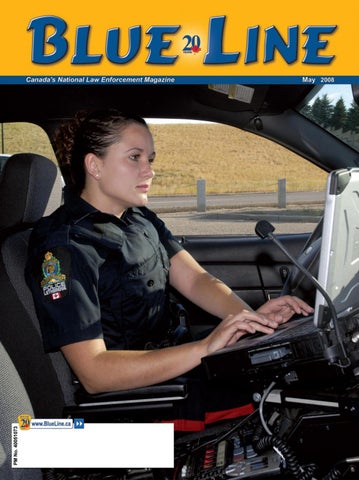
On the cover, Lethbridge Regional Police Constable Jamie Williamson demonstrates the hi-tech world within today’s police cruisers. In the photo to the left, Robin Klassen and Marc Gaumont perform a forensic analysis at a crime scene. To read more of what a midsize police service can accomplish go to page 6.
6 Participation and partnerships
14 The great Brinks robbery
10 Getting it back in line
26 Community drug pattern testing
Lethbridge police place emphasis on respect
Surveying recruitment in Canadian policing
It was the perfect crime
Environmental technology may help law enforcement spot drug use trends
12 Juvenile justice in Canada - Part 4
38 38 31 22 20 28 21 37 19, 25 17 36 5 18
Advertisers Index Back of the Book Dispatches Deep Blue Health & Fitness Emergency Services Forensic Science Market Place News Week Odditorials Product News Publisher’s Commentary Technology
Blue Line Magazine
34 35
3
Police must respect search provision limits Traffic stop impairment observations admissible
MAy 2008
MAy 2008
4
Blue Line Magazine
Keeping good intentions and money together by Morley Lymburner Britain has Bramshill (now known as the European Police College), created in 1948 with the understanding that police research and training should not be private sector. It was designed with the notion that prefessionalizing policing requires taking more direct control of this important asset to ensure consistency and continuity of service nation wide. Canada has yet to learn much from this. British Prime Minister Margaret Thatcher once said in a television interview that the Good Samaritan would never have been remembered if he had only good intentions; he also needed money. When it comes to attempting professionalization, policing has no shortage of individuals with good intentions. The stumbling block has always been the financial stability to carry them through. This has caused a great deal of consternation over the years, resulting in a multitude of strange bedfellows and scattered concepts. Many alliances have been tried in the hunt for dough, mainly from the public purse. Police agencies and related organizations have found themselves applying for grants that don’t quite fit the agenda as proposed, but manage to glean some cash with a little spin and salesmanship. On the other extreme, many turn to a form of begging, shmoozing and cajoling in the political arena to support the initiative of the month. The perfect form/fit has lately come from educational institutions, who have entire sections which excel at finding grants and funds. Tempted with being seen as the central knowledge base for a particular branch or discipline, they crank up their grant generating machines and go mining for political and corporate dollars. Any form of success nets kudos useful in marketing the institution.
Blue Line Magazine
Over the past decade, this liaison with academe has been seen as the new method of priming the pump for police research and training. It seems every school of higher learning in the country boasts some relationship with a local policing organization or network, motivated by the good intention of finding dollars to upgrade police skills and advance the policing research and knowledge base. There used to be few sources for higher police education, post police academy. One of them, the Canadian Police College, has earned considerable recognition over the past 30 years for training senior police administrators. Vacant seats in its classrooms were few and far between. Managed through a mandate with the RCMP, which sets its budget, attendee tuition and expenses are, for the most part, paid by the sending police agency. This money is used to offset most of the operation expense. It would appear this model is eroding as university criminology departments invite more practitioners into their schools of winsome theory. It is time to take control and bring the real training and skills upgrading of police back home where it belongs. If the good intentions are there, and we know they are, all that is required is the money. There is a solution. Many years ago I was on the board of a senior care facility. Not being very savvy in corporate finance and budgets, I was attracted to a line titled “replacement reserve.” The bylaws required a small percentage of the annual budget to be set aside in a special fund for major repairs or replacement of any portion of the facility, I was told. This money collected interest each year at a healthy rate – the institutional equivalent of a person setting aside money for their retirement years. When reflecting on the need to fund a police education and skills enhancement institution, it became clear where the money should come from. Instead of agencies across Canada
5
simply working on a pay-as-you-go basis for training, why not create a self sustaining foundation by investing this money? The rationale is simple enough. If each Canadian police agency dedicated a small portion of its annual budgets to a police educational foundation, the money problem is solved. As an incentive, senior officers of participating police agencies could receive skills enhancement training as a part of their membership. Doing the math, it would appear this would quickly become self-sustaining. Stats Canada estimates police budgets hover around $10 billion annually. If each agency contributed one half of one per cent of its budget, the foundation would have $50 million in its first year. If it earned a five per cent return, this would give it an operating budget of $2.5 million after the first year alone. All training costs could eventually be covered, meaning agencies would no longer have to budget for training. Clearly I am no accountant or actuary and there are a few stumbling blocks which have to be worked out, but this is at least a starting point for consideration. The goal is for policing to be the master of its own house when it comes to training, licensing and research; why not add accreditation? Keeping private sector influences and political patronage at a distance will go a long way toward professionalizing police work. Much the same as the medical and legal professions, there is no reason why police education and training can not be self sustaining and nationally regulated. Keeping good intentions and money together is a great way to start.
MAy 2008
by Kristen Harding The police are the public and the public are the police; the police being only members of the public who are paid to give full-time attention to duties which are incumbent on every citizen in the interests of community welfare and existence – Sir Robert Peel. Peel’s concept rings as true today for the Lethbridge Regional Police Service (LRPS) as it did 106 years ago when a two-man force began walking the beat. Strong partnerships and the role every citizen can play in crime prevention and public safety is truly the lifeblood of community policing. “We can’t be at every crime when it happens,” says Insp. Jeff Cove, head of the criminal investigation division. “The public are our eyes and ears. They are either witnesses to the incident, or they hold a small yet key piece of information that will give us a break in a case and allow us to arrest the offender responsible. “At full strength we are only 0.165 per cent of the entire resident population. It would be foolish to think we do not have to engage our community and build strong relationships to carry out our mission. We are but a small portion of the public and we happen to be the police. We get paid to carry out the inquiries and intervene in dangerous situations – which MAy 2008
we don’t want our citizens to do for their safety – but most of a police officer’s time is spent observing and reporting. That too, is what we want our citizens to do.” The mission of the LRPS is, quite simply, “providing safe communities.” These words are posted at every set of doors in the headquarters building; the important message is the first thing officers see when they arrive and the last thought they’re left with at the end of their tour – “but it doesn’t say we will do that by ourselves,” notes Cove. “Our vision includes community participation and partnerships.” Frontier town Lethbridge was a true Wild West town in the late 1800s, rife with gamblers, bootleggers, brothels and opium dens. Northwest Mounted Police from Fort Macleod – where barracks still stand today – patrolled the area and in 1885 set up shop in an old meat market. The city grew to roughly 2,000 people by 1902 and established its own police force. Former NWMP Cpl. Thomas Lewis was sworn in as the first chief constable and town engineer Thomas Hiscox was appointed special constable. Now, more than a century later, 140 sworn officers police the City of Lethbridge and Town of Coaldale, a combined population of nearly 88,000 people. The service’s annual budget is just over $21 million and 43 support staff and 50 volunteers round out the team. 6
“Often I say I started in the Andy of Mayberry style of policing, working through Miami Vice and Hill Street Chief Tom McKenzie Blues to COPS,” remarks Chief Tom McKenzie, an Edmonton native who joined the force in 1976 as a beat constable. The service is divided into four divisions – Community Policing, Criminal Investigation, Administrative Services and Support Services. Within those areas specialized units include: major crimes, organized crimes, special operations (drugs), downtown policing, integrated child exploitation, traffic enforcement, integrated intelligence, economic crimes, forensic identification, K9, property crimes, high risk offenders, school resource officers, a cultural and community liaison branch and a very vibrant Victim/Witness Services Program. Lethbridge also has its own tactical team, including an explosive disposal unit. In 1999, the LRPS was first accredited by the Commission on Accreditation for Law Enforcement Agencies (CALEA), a comprehensive process that involves agency self-assessment of 459 key standards. It has been re-accredited three times since then and remains one of only nine Canadian law enforcement agencies to hold the prestigious distinction. Blue Line Magazine
Grounded in the four pillars of policing – public safety, public trust, public confidence and professionalism – the men and women serving Lethbridge and Coaldale execute their duties with an emphasis on respect, honesty, integrity, commitment and excellence. Respect is first and foremost for McKenzie, who believes many of the issues society struggles with could be remedied if people respected themselves and each other just a little more. “Respect is so simple, yet hard,” he says. “It is our lead value. We are servants, yet guardians of our communities. Everyone deserves and should be given our respect, tolerance, understanding, empathy and compassion.” Basic respect in communities leads to empowered people, fair treatment and growth toward a safe and healthy society, he adds. Geography, history part of the culture Nestled in the heart of southern Alberta, Lethbridge is just over 100 kilometres northwest of the U.S. border and 215 kilometres southeast of Calgary along the Old Man River. Known for its High Level Bridge – the highest and longest of its kind in the world – the old coal mining city boasts two renowned post-secondary institutions, the University of Lethbridge and Lethbridge College. Coaldale, known as “the gem of the west,” is about 12 kilometres east of Lethbridge and became part of the city police jurisdiction in 2004 following regionalization. The amalgamation of the Lethbridge and Coaldale forces, under the direction of Lethbridge chief John Middleton-Hope, created the first communitydriven regional police service in Canada. The nearby Blood and Piikani Reserves have contributed immensely to the area’s cultural diversity and the LRPS has forged strong partnerships with the Blackfoot people over the years. A traditional teepee was transferred to the service in 2005 and both McKenzie and former cultural liaison officer Cst. George Carscadden were given Blackfoot names. The teepee is used during Whoop-Up Days, Canada Day, Aboriginal Day and the police service’s cultural camp.
Coaldale believe the police service is doing a good job. In an online survey on the LRPS web site, 71 per cent of respondents rated overall performance as good to excellent. The figures, while encouraging, prompted McKenzie to invite residents to share their concerns, compliments and suggestions for improvement at a recent series of community forums. Held throughout Lethbridge and Coaldale, attendance was not exceptionally high but the valuable feedback will be used as the police service completes its 2009-2011 strategic and business plans. Four areas of priority emerged throughout the surveys and forums: traffic enforcement, proactive policing, a greater police presence in neighbourhoods and better police response to quality of life issues such as noisy parties, graffiti, minor thefts and general nuisance complaints.
“We need to develop ways to respond in a more timely fashion to the calls we consider priority three, or low on the scale of seriousness,” says Cove. “When a citizen calls about their garage or house being broken into sometime over the past few days, that is a priority one to them. They deserve to have an officer respond in a timely fashion to investigate, assure them they are still safe, get the resources needed to ensure the mental and physical well being of the victim’s family and, if at all possible, arrest the offender and try to recover as much property as we can. “We can’t ignore the major things that happen that demand our immediate attention, but that’s not what the citizen thinks about. We need to do things like develop a team of officers whose sole purpose is ensuring that these kinds of complaints are managed in a timely
Safe but not crime free Overall Lethbridge is considered a safe community, but it’s far from crime free. On average, police are called to investigate around one homicide a year. Property crimes and robberies have increased, largely because of drug addiction and a need to maintain that lifestyle. Organized crime groups, mostly from Calgary and Edmonton, have come to the city, recruiting local dealers to sell cocaine and cultivate marijuana grow operations. Nonetheless, most residents who call Lethbridge home still feel safe and for police that’s half the battle. A community phone survey conducted last fall shows that 64 per cent of Lethbridge residents and about 50 per cent of those from Blue Line Magazine
7
MAy 2008
fashion. We are piloting programs like that right now, when human resources permit.” The LRPS receive more than 28,000 calls for service each year. These calls, other investigations and requests annually total more than 48,000 case files and reports. As stakeholders in the community, Cove says, “there isn’t a single social agency that we are not involved with.” The list of nearly two dozen agencies ranges from domestic and sexual violence committees, substance abuse initiatives, immigrant services and housing organizations to seniors centres, school boards, MADD, emergency shelters, Lethbridge Family Services and the Canadian Mental Health Association. There are also partnerships with municipal, provincial and federal governments and other police agencies, including the Alberta Law Enforcement Response Team, Alberta Relationship Threat Assessment and Management Initiative, Integrated Child Exploitation Unit, Integrated Response to Organized Crime and other organized crime response units. “These partnerships allow us to utilize best practices and access external expertise and training for the advantage of our communities,” says Cove. “These partnerships also provide us with policing grants from the province in the form of proceeds of crime and the recently announced new officer programs.” The LRPS also work with city businesses, raising money annually for Special Olympics through the Torch Run, Bike for Special Olympics and Free the Fuzz, where officers camp out on a Wal-Mart roof. A city in the news The city has been home to a number of highprofile cases in the last decade that – for better or worse – put Lethbridge on the map. Long before a 12-year-old Medicine Hat girl helped kill her parents and younger brother in a grisly triple murder that sent shockwaves around the world, MAy 2008
Lethbridge had its own young killers. A 13-year-old teen and her 15-year-old boyfriend hatched a murderous plot in 1998. The couple, frustrated because the girl’s mother didn’t approve of their relationship, bludgeoned the woman to death with a baseball bat while she sat watching television. Both pleaded guilty to first degree murder, but the boy was shipped to adult court. He was sentenced to life in prison and remains locked up after being denied parole several times. The girl spent five years in custody and is scheduled to complete a period of community supervision this fall. All eyes returned to the city on May 5, 2001 after five-year-old Jessica Koopmans vanished from her northside home. Her disappearance sparked a massive search that included hundreds of volunteers. Media from around the nation descended on the city in droves. The size of the Koopmans investigation was unprecedented in Lethbridge police history but as days passed, hope of finding the little girl alive faded. Finally on May 11, the search became a murder investigation after Jessica’s body was found in a brush pile near Fort Macleod. She had been smothered. A family friend, 30-year-old Anthony Gallup, was charged with the heinous crime. More than 13 months later, following a lengthy trial, Gallup was found guilty of first degree murder and sentenced to life behind bars. The national spotlight returned to Lethbridge in 2003 after city alderman Dar Heatherington disappeared during a council trip to Great Falls, a day after police accused her of writing lewd letters to herself. She surfaced three days later in Las Vegas claiming she had been drugged, abducted and sexually assaulted, a story she eventually recanted. Lethbridge police later charged her with public mischief for lying about a made-up stalker and leading investigators on a wild goose chase. She pleaded not guilty in the infamous case, but was convicted in June 2004 and sentenced to house arrest. 8
And then there was Shrek Const. Mark Smallbones, dressed as the movie ogre, made headlines all on his own after capturing a thief on his way to a Halloween party in 2004. Painted green and dressed in tights and a vest, the bald, six-foot-three, 260-lb. cop, had stopped at a liquor store to pick up a case of beer. The chase was on when Smallbones – stuffed donkey in tow – saw two people swipe a couple bottles and run. One of the crooks got away, but the other, so stunned by the big green man yelling “Stop, police,” doubled back to the strip mall where the chase began to get help. Dozens of news outlets picked up the story and a tape was sent to Jay Leno’s Tonight Show. Lethbridge is a vibrant, healthy community in a growing province. This status is, in no small part, a reflection of the safe communities supported by its police service and grounded with an emphasis on respect. Kristen Harding is a journalist with the Lethbridge Herald specializing in court news and crime stories. Contact her at kharding@ lethbridgeherald.com for more information.
Blue Line Magazine
(Based on the work of Alex Johnston)
When Lethbridge was founded in October 1882, it was called “The Coal Banks” or “Coalbanks” after the original Blackfoot name. The Post Office assigned the name Coalhurst but three years later it was named Lethbridge after North Western Coal & Navigation Company President William Lethbridge. In 1890 Lethbridge was incorporated as a town and was granted city status 1906. Coaldale - Lethbridge area was founded on three economic pillars: coal mining, railways and irrigated agriculture. Of these, coal was the first and by the late 1860s mining of coal commenced and became far more serious with the coming of the railroad and its coal needs. Coal production peaked during World War 1, when 2,000 miners in ten large mines extracted 1,000,000 tons of coal each year. The coal industry gradually declined after 1919 with the development of oil and natural gas resources but all the mines in the region extracted only a fraction of the available coal. Estimates are that about 800 million tons of coal is still there to be mined. Rail roads is the second pillar upon which Lethbridge was built. It evolved as the result of assistance provided by the Canadian government for construction of the narrow gauge railway. The
Blue Line Magazine
assistance took the form of land grants totalling 1.5 million acres south of Lethbridge. The land was to be sold to pay for their railway. Agriculture was the third pillar. The land in the region is semi-arid, and the challenge was to make it attractive to settlers. Irrigation was the obvious answer. The Canadian North West Irrigation Company was started to carry forward irrigation plans for the lands of southern Alberta. Settlers from Utah built the main canal from the St. Mary’s River to Lethbridge and on 4 September, 1900 the main canal reached Lethbridge. The history of dry land agriculture has been the struggle to find methods to combat southern Alberta’s semi-arid climate and incessant winds. The Agriculture Canada Research Station at Lethbridge had much to do with the development of farming in the area. In 1996 there were 11,216 farms in southern Alberta with a capital value of 11.3 billion dollars. Over 130 businesses processed food or feed for markets here and around the world. Until 1905 the CPR moved the divisional point of its Crowsnest Line from Fort Macleod to Lethbridge. Changes to straighten and shorten the line were launched soon after. The CPR high level bridge at Lethbridge was the most important part of those plans. At 5,327.625 feet long and 314 feet high, it is the largest viaduct-type bridge in the world. After World War I, the city slumped. Develop-
9
ment slowed to a crawl for the next 20 years. It was not until the end of World War II that Lethbridge experienced its second boom. Immigration swelled the city’s population and business flourished. Between 1950 and 1970, 23 new schools went up. Lethbridge Community College was founded in April, 1957, and the University of Lethbridge opened its doors in 1967. In the 1980s and early 1990s the city’s landscape underwent a fundamental change with the removal of the CPR yards from the centre of Lethbridge to the west of the city. The former railway land became home to a variety of retail, residential and service developments. The Urban Parks Project was another megaproject that transformed Lethbridge into a city with a series of parks and varying recreational facilities. Also included in the Urban Parks plan was renovation of Museums and Archives. In recent years, the southeast corner of Lethbridge has seen an explosion of residential and commercial growth. The west side is also growing again with the construction of vast subdivisions. The demographics of the city are changing as well, as more and more senior citizens are calling Lethbridge home. The future of Lethbridge and southern Alberta lies in a mix of the traditional and agriculture related businesses mixed with a leisure lifestyle suited toward retirement years.
MAy 2008
Comparison to industry best practice in recruitment Based on the work and experience that Hay Group has in Human Resources, we have found that recruitment practices in the last decade have evolved to focus on flexibility, speed of response and competency. Employers are recognizing the challenges associated with the demographic changes and have been preparing their responses. They develop go-to-market strategies in much the same way as they would develop marketing strategies for their products and services. They identify the unique strengths of their employee propositions; what elements of their package they will use to differentiate themselves from other employers, what elements will be superior to typical market practice and what elements will be treated as hygiene factors, (things that can cause dissatisfaction if missing but do not necessarily motivate employees). Employers recognize that the best source of recruits are those existing successful employees who may be thinking of leaving. Employee engagement is the latest catchphrase. It represents a holistic approach to thinking about what employees are looking for in a relationship with an employer. It goes beyond attempting to address major irritants and includes creating a positive environment where employees are able and willing to contribute effectively. In short, it comes down to effective people leadership practices. Hay Group’s research indicates that employees leave because of bad managers and bad management practices and our research with the police sector confirms this. Flexibility is a key element of modern hiring practices. Candidates want to tailor their package to suit their particular needs and they want to know that their employer will respond in a supportive manner. Rigid application of standard terms and conditions can be a major obstacle to hiring in today’s market. By definition, flexibility can be called for in many areas, but the most frequent requests are in the area of hours of work and time off for other activities. Speed of response is a major issue today. MAy 2008
In the boom of Y2K, employers would typically attend recruitment fairs with the ability to make offers on the spot in order to secure candidates before they went elsewhere. Those heady days are gone (for the time being) but the practice of closing the deal quickly has remained. Candidates expect to be hired in weeks if not days, and to attend no more than two rounds of interviews and testing. Private sector employers have streamlined their processes to enable this pace of response. Prompt response times are supported by a shift towards more competency based recruiting. Organizations recognize that their employees will need to be trained and re-trained multiple times during their employment and are more concerned with assessing a persons ability to learn and develop than the skills and knowledge that they possess at a given point in time. Therefore, if the person has strong potential and is a good fit culturally, employers are prepared 10
to make the commitment and then give the person the necessary training. Canadian Forces Provost Marshall One of the organizations that were contacted as a best practice comparator was the Canadian Forces Provost Marshall, National Defence’s police organization. The Canadian Forces and the Military Police have been very successful in their recruiting efforts. In fact, when asked to indicate the top three human resources issues facing the Military Police, “attracting the next generation of talent” was not one of them. Their focus is keeping employees committed to the organization, retention, and operations, managing their deployments. If money weren’t an issue, they would address their capability to train more people and increase salaries. The Military Police are not experiencing the same hiring dilemma that many other Blue Line Magazine
organizations are experiencing today. They say they have enough applicants to meet their strategic plan. The Military Police competes for positions that the rest of the Canadian Forces are competing for; however, the Military Police are told every year how many they can hire. That aside, they have several applicants per position. In terms of recruiting, the Canadian Forces recruit services are very effective. They require a two-year police foundation program that meets certain criteria of courses. They are very proactive when going to colleges and asking students to join up at the centres. Their top three approaches for recruiting qualified candidates are college outreach, Canadian Forces reserves, and the Canadian Forces personnel who transfer over to Military Police. Also, they have one of the better entrance salaries and they pay for training. The Military Police currently do not use incentives for hiring. About three years ago, incentives were being offered for those who could by-pass basic military training or basic police course or portions thereof. It was effective as it helped in meeting recruitment needs. They project their needs five years into the future based on attrition and potential new positions that turn up. They have gone through a significant flux of employees — the Canadian Forces is growing and the Military Police get a percentage of that population. The top three job factors used to promote the Military Police includes the opportunity to serve Canada, opportunity to travel, and the opportunity to be part of a bigger community. The Canadian Forces make special efforts to attract females, racially visible, Aboriginal and disabled persons — a recruiter or counsellor may show them videos that emphasize the particular demographic. When selecting recruits the Military Police say that having a college diploma or university degree is essential, as are “integrity”, “no convictions without a pardon” and “no use of illegal drugs”, although there are time limits for some drugs and hard drugs are not to have been used at all. Additionally, “volunteer or community work”, “self confidence” and “maturity” are very important. The Military Police perform assessment centres where they conduct aptitude testing and a drug history. In terms of the length of time the hiring process takes, it is three months at the outside. The Military Police canvassed a number of candidates that were accepted and 80 per cent said they applied to other police organizations and the Military Police were the first to call them. The Military Police perform four general assessment centres a year. So for example, if someone comes in Blue Line Magazine
May and there is an assessment centre in June, the process can be very quick. Nevertheless, even the three months can be a barrier at times. The Military Police do use competencybased approaches in their recruiting. They use 12-14 behavioural competencies in their assessment centres, through group role-plays, interviews, and a series of exercises. The competencies they use are: Analytical Thinking, Decision Making, Personal Impact, Interpersonal Skills, Tolerance, Conscientiousness, Stress Tolerance, Teamwork, Practical Intelligence, Oral and Written Communication Skills, Leadership and Integrity. When the Military Police were asked what they would highlight as a potential “best practice” for others to follow, they said “it is different for us because we have a large Canadian Forces recruiting organization. We are located across the country.” However, new videos would be a best practice. In summary, the best practices highlighted by the Military Police that would be most beneficial for police organizations to adopt are their aggressive recruiting techniques, including greater contact with candidates and shorter recruitment times; use of competencies; and, using videos to attract candidates.
11
MAy 2008
Part 4 - A benevolent society In spite of ambivalence and even opposition to changes in the treatment of young offenders, by the middle of the 19th Century signs of progress began to emerge. Possibly one of the most significant catalysts was the changing attitude towards children. As the nineteenth century progressed and the country became more civilized, society gradually turned from treating children as little adults to viewing them separately in their own right. Many people now recognised the special needs of children and emphasized the need for loving care in their upbringing. The former stern attitudes began to soften in many quarters, and the churches, benevolent and charitable societies, reformers, school officials and others reflected the change and encouraged it. The more humane attitude set the stage for some significant developments in the treatment of delinquents. Among the first innovations was a move to separate the young from adult offenders by establishing juvenile institutions. The first of these early reformatories were Isle-aux-Noix, opened in October, 1858 on the Richelieu River, and Penetanguishene, on Georgian Bay, the former to serve the Eastern part of the country and the latter the Western part. The early institutions offered a program of work, discipline, vocational and academic education and religious services. But while the intentions were good, both reformatories were classic examples of the lack of foresight and proper planning that characterised government’s approach to penal facilities. Isle-aux-Noix was a converted old army barracks dating from the War of 1812 and Penetanguishene was also a former army barracks. Both institutions were plagued with problems. One major mistake was allowing too broad a spread in ages. Inmates as old as 24 were included among the detainees, with the result that young children were still being mixed with adult criminals. There were escapes, discipline problems and a lack of training programs. Neither centre put any great effort into education or reform, and both functioned for a long time as institutions primarily of work and punishment rather than rehabilitation. MAy 2008
But despite these and other disappointments of some early experiments, reformers were not discouraged. Society was becoming progressively more concerned with child welfare. A growing constituency was agitating for reforms and child protective legislation. Reformers were urged on by the appalling conditions in which some young offenders were placed. For example, the 1862 Inspector’s Report on the Montreal jail described how, on opening the door of some of the wards, “one is horror-stricken at seeing little boys in rags and older offenders almost in a state of nudity, commingling together, with matted hair and countenances bedaubed with filth.” Such scenes urged reformers on, and small victories were gradually won through the 1860s and 1870s. Nova Scotia, for example, passed legislation limiting the term of imprisonment for juveniles to 90 days. Many reformers and even correction officials began to call for new approaches or even to oppose altogether the imprisonment of young people. For example, E.A. Meredith, a member of the board of inspectors of asylums and prisons for the Province of Canada, submitted a report in 1862 calling for alternative institutions. He argued that imprisonment in jail tends to complete the ruin of the unfortunate child, and that the jails were nurseries of vice and hotbeds of crime. He acknowledged that the separate reformatories at Isle-aux-Noix and 12
Penetanguishene were a step in the right direction. However, he criticised them for being remedial rather than preventive. Meredith argued that what was needed were facilities that would take in not only convicted offenders but also neglected children who were at risk. He reasoned that early intervention with proper care, education, and trades training might prevent many youngsters from developing criminal careers. He maintained that crime prevention was a better course because it is more agreeable, more hopeful, more economical, more humane and more socially responsible. Among the first institutions to reflect such an approach was the Halifax Protestant Industrial School, which opened in the Nova Scotia capital in 1864. The school was designed to provide a home, along with scholastic and technical education, for homeless and neglected young street urchins. In this respect, its aim was prevention and help. However, the courts soon began sending convicted juveniles to the school for rehabilitation. The institution was run by a group of community volunteers. Moral education and character development were stressed in the secure, clean and good, homelike atmosphere. Discipline was not harsh, and residents were allowed considerable freedom, including the right to leave if they so desired. Unfortunately, the school suffered from inadequate funding and, as a consequence, limited programs and staff. The boys did most of the maintenance chores at the school and took odd jobs in the community to raise revenue. The Halifax experiment was a forerunner of a host of new ideas and approaches that emerged across the country in the second half of the nineteenth century. They included industrial schools, the promotion of free public school education, foster care and progressive legislation. Behind these initiatives stood a growing reform community that collectively became known as the child savers. Individually they were diverse, but as a group they came mainly from the middle and upper classes. The majority were church members, civil servants, clergy, small-business people, public-spirited women and students. They volunteered their time in support of a variety of reforms and Blue Line Magazine
in lobbying governments for child protection legislation. Volunteer ranks were buttressed by a growing number of professionals such as social workers. Reform activities were also supported by an elite group of philanthropists who used their influence and gave their money in support of the endeavours of the child-saving movement. The industrial school movement was one of the beneficiaries of the efforts of reformers. As the philosophy behind institutionalisation shifted from punishment to the rescue of children, the preferred model changed from reformatories such as Isle-aux-Noix to schools along the lines pioneered in Halifax. In 1874 Ontario passed the Industrial Schools Act[4], which provided for the opening of institutions to serve neglected and problem children. These institutions were meant to fill the gap between public schools and reformatories. In 1884 the Act was amended to allow the incarceration in an industrial school of any child under 14 found guilty of petty crime who, in the opinion of the judge or magistrate before whom he has been convicted, should be sent to an industrial school instead of to a reformatory. The first industrial school in Ontario, the Victoria Industrial School for Boys, was opened in 1887 in the small community of Mimico, near Toronto. In 1892 the Alexandra Industrial School for Girls was established in Toronto. By 1894, almost 200 children were housed in Ontario industrial schools. The province of New Brunswick opened an industrial home for boys in 1893 and a reformatory for girls in 1896. All such institutions emphasized child rescue, reform through character development, moral and academic education, and vocational training. Some of the best-run reformatories for both boys and girls were in Quebec. By the late 1880s seven institutions were operating in the province, many run by religious orders. Officials had the power to apprentice or hire out the young people, with such working time deducted from their sentences. One of the most prominent of the Quebec juvenile institutions was the reformatory school run by the Brothers of Charity in Montreal. The Brothers worked side-by-side with the boys in the workshops, functioned as counsellors and teachers and interacted in all places of daily life. The school placed strong emphasis on trades training so that the boys would be equipped to find good jobs on their release. The school enjoyed a reputation for turning out quality products, and their leather goods especially enjoyed a ready market. Although industrial schools and refuges enjoyed widespread support among reformBlue Line Magazine
ers, some argued that an emphasis on formal schooling could be a more effective reform and prevention program. Known as the School Promoters, proponents of this view argued that the high correlation between juvenile offenders and illiteracy suggested a causal relationship. The conviction that a lack of academic and moral education was at the root of crime, idleness and poverty went far back in time. For much of the century reformers, churches and philanthropists had been campaigning for free and compulsory schooling. One of the most influential and persistent school promoters was Egerton Ryerson, a Methodist minister, journalist and teacher, who in 1844 was appointed chief superintendent of Common Schools in Canada West. Holding the office until 1876, he established a firm foundation for the school promotion movement. He also strongly influenced its direction. Ryerson argued that if more convicts had received the benefit of more schooling the number of people in jail would have been substantially reduced, money would have been saved and crime prevented. He maintained that schools could be the source
13
not only of academic instruction but also of moral and religious education. He believed that people were fundamentally moral beings and that this characteristic overrode all other considerations. The schools could turn out morally educated students and therefore diminish crime and poverty. By the last decade of the nineteenth century, a consensus had been reached on a fairly broad-based reform agenda. The Prisoner’s Aid Association of Canada, for example, although primarily concerned with adults, had by 1890 developed a detailed set of proposals for the treatment of juveniles. The organisation supported a program that included special courts for young offenders, limited use of detention for those under 14, qualified staff for reformatories and industrial schools and the use of indefinite sentences. Members maintained that it was not the term itself of a sentence that was important but the opportunity it provided for rehabilitation ; thus, the period of detention should depend on the time it took to bring about a meaningful change in attitude.
MAy 2008
The great Brink’s robbery It was the perfect crime – so well planned and executed that all the gang members needed to do to was lie low until the heat cooled down. But could they? In and out The year was 1950. It was a cold January in Boston. At around 7 p.m. on the 17th, a green 1949 Ford truck pulled up in front of the Prince Street entrance of the Brink’s Armored Car garage. Millions of dollars in cash, cheques, and money orders were stored inside the building. Seven men emerged from the back of the Ford and walked swiftly to the front door. Each man wore a Navy peacoat, gloves, rubber-soled shoes, and a chauffeur’s cap. After a series of blinking flashlight signals from a nearby rooftop, one of the men pulled out a key and unlocked the front door. Once inside, each man donned a Captain Marvel Halloween mask and went to work. They walked up the stairs and encountered a second locked door. Another key was produced, and they entered a room where five surprised Brink’s employees were counting money. The gang pulled out handguns and quickly subdued the stunned Brink’s men. Once their captives were bound and gagged, the masked men began collecting the loot. With clockwork precision and very little talking, the gang filled their bags with money. Fifteen minutes after their arrival, the robbers – each carrying two full bags – left the building. Six of them got back into the truck and one got into a Ford sedan parked nearby. As they made their getaway, the employees managed to free themselves and call the police. When it was over, $1.2 million in cash and $1.5 million in cheques, money orders, and securities were missing. It was the single largest robbery in U.S. history. Urban heroes The daring crime made front-page news all over the country, and the public was sympathetic with the robbers almost as soon as they heard about it. Their nonviolent methods and their audacity to take on a company as huge as Brink’s made them cult heroes. Comedians and cartoonists joked about it, mocking the huge security company’s apparent lack of security. On his weekly TV variety show, Ed Sullivan announced that he had some very special guests: the Brink’s robbers themselves. Seven men wearing Captain Marvel masks walked onstage to thunderous applause. It became more than a passing fad – the press dubbed it the “Crime of the Century.” Cops ... The Boston police and Brink’s were humiliated. How could seven men so easily walk off with more than $2.7 million? The FBI took over the case and immediately found some good news: word on the street was that the caper had been in the works for months, and informants were naming names. Among the prime suspects were some of Boston’s most notorious petty criminals, such as Anthony MAy 2008
Pino, Joseph McGinnis, Stanley Gusciora, and “Specs” O’Keefe all men known for pulling off similar crimes, although nothing nearly as big. The bad news: they all had alibis. But when a green Ford truck matching witnesses’ descriptions was found in pieces at a dump near where O’Keefe and Gusciora lived, the investigators knew they were hot on the trail. They just needed proof. ... And robbers The Feds’ instincts were correct: O’Keefe and Gusciora were two of the key men behind the Brink’s job. But what they didn’t know was that it was Anthony Pino, an illegal alien from Italy, who first came up with the idea... back in 1947. Pino had the savvy to do the job, but he couldn’t do it alone. So he’d called a meeting of some members of the Boston underworld and put together a gang. By the time they were ready to go, there were 11 members: Pino, his associate, liquor store owner Joseph McGinnis; strong-arms O’Keefe and Gusciora, both experienced criminals with reputations for keeping their cool and handling weapons; 14
Pino’s brother-in-law: Vincent Costa, the lookout: Adolph “jazz” Maffie; Henry Baker; Michael Vincent Geagan; Thomas “Sandy” Richardson; James Faherty; and Joseph Banfield. It would be the heist of a lifetime, and the gang spent the next two years preparing for it. Pino cased the Brink’s building from nearby rooftops, and was amazed at how lax the security was. Still, they would take no chances. They broke in after hours on several different occasions and took the lock cylinders from five doors, had keys made to fit them, and returned the cylinders. While inside, they obtained the Brink’s shipment schedules. It took discipline to not steal anything on those smaller break-ins, but they knew the real score would be on the big break-in, planned for a time when the day’s receipts were being counted and the vault was open. They were willing to wait. By December, 1949, Costa, the lookout man, could tell exactly how many employees were in the building and what they were doing by observing which lights were on. After about a dozen dress rehearsals, the gang made their move. The job went down without a hitch. Blue Line Magazine
The long good-bye The robbery was the easy part. Now each gang member had to keep quiet, not spend money like crazy, and lay low for six long years, after which the statute of limitations would run out. If they could do that, they would all be scot-free ... and very rich. A small portion of the loot was split up among the gang members, but most of it was hidden in various places. O’Keefe and Gusciora put their share ($100,000 each) in the trunk of O’Keefe’s car, parked in a garage on Blue Hill Avenue in Boston – with the agreement that the money was not to be touched until 1956. Even though they were careful to desttroy any physical evidence tying them to the crime, they were known criminals and couldn’t evade suspicion. Many were picked up and questioned by the FBI. All denied involvement; all provided alibis (though more than a few were shaky); and all of their homes and businesses turned up nothing in searches. Still, investigators knew there was something fishy going on. Their best approach would be to get one of the men to sing; they just had to watch closely and wait for someone to slip up. Someone slips up Less than six months after the Brinks job, O’Keefe and Gusciora were nabbed for robbing an Army-Navy store in Pennsylvania. Police found a pile of cash in the car, but none of it could be tied to the Brink’s job. O’Keefe was sentenced to three years in the Bradford County jail; Gusciora was sentenced to five years. O’Keefe wanted to appeal but had no money for legal bills, so he talked Banfield into retrieving his share of the money from the car. It was delivered a few weeks later (minus $2,000). But O’Keefe couldn’t keep it behind bars, so he sought out another gang member, the only one left on the outside that he thought he could trust – Jazz Maffie. Bad move; Maffie took O’Keefe’s money, disappeared, then reappeared claiming it had been stolen. Then Maffie said he had spent the money on O’Keefe’s legal bills. O’Keefe, meanwhile, was stuck in jail and getting angrier. The Feds worked this angle, trying to create a wedge between O’Keefe and the rest of the gang. They told O’Keefe that the gang had ratted him out for the Brinks job. But O’Keefe stuck to his guns and kept denying any involvement.
Bullet-proof That June, O’Keefe was driving through Dorchester, Massachusetts, when a car pulled up next to him and sprayed his car with bullets. O’Keefe escaped unharmed. Days later, fellow gang member Henry Baker shot at him, but O’Keefe escaped again. Fearing retribution, Pino brought in a professional hit man named Elmer “Trigger” Burke. When Burke found his target and shot him in the chest and wrist with a machine gun, Specs O’Keefe lived up to his reputation as one of the toughest crooks in the Boston underworld by surviving. By this point, he was extremely angry. O’Keefe immediately went to the cops and fingered Burke, who was arrested and convicted for attempted murder. But the plan backfired. While he was talking to police, they discovered that O’Keefe was carrying a concealed weapon, a violation of his parole. He was arrested and sentenced to 27 months in prison. Knowing that there was a contract on O’Keefe’s life, the FBI stepped up their interrogations. But he still wouldn’t confess. The heat is on Time was starting to run out. It had been more than five years since the crime, and the deadline for the statute of limitations was getting closer and closer. Thousands of hours had gone into identifying the suspects, but the FBI still had no hard evidence. As the case remained in the public eye, each passing day without an arrest was an embarrassment. Through all of it, the Feds knew that
O’Keefe was the key, so they kept chipping away at him. When they informed him that a huge portion of the loot had been recovered, he finally gave in. On January 6, 1956, Specs O’Keefe called a meeting with the Feds and said, “All right, what do you want to know?” It was 11 days before the six-year statute of limitations would take effect. O’Keefe spelled out every detail to the police – except where the rest of the money was hidden. He had no idea. (Neither did the police – they had exaggerated the loot – recovery story as a ruse to get O’Keefe to talk.) Tried and convicted Police rounded up all of the remaining members. They were arrested and tried amid a media circus. More than 1,000 prospective jurors had to be excused because they admitted they were sympathetic to the robbers. In the end, a jury found all of them guilty. Each man was sentenced to life in prison. Some died there – others were later released on parole. For turning state’s evidence, O’Keefe was given a reduced sentence. After prison, he changed his name, moved to California, and reportedly worked as Cary Grant’s chauffeur. The Brink’s gang stole $2.7 million in cash and securities. The government spent $29 million trying to catch them and bring them to justice. But in the end, only 0.2 percent of the loot – $5I,906 – was recovered. What happened to the remaining 99.8 per cent is a mystery. (Courtesy The Bathroom Readers’ Institute)
The tension mounts Prior to committing the robbery, the 11 men had agreed that if anyone of them “muffed” (acted carelessly), he would be “taken care of” (killed). Sitting in jail, O’Keefe convinced himself that the other members of the gang had “muffed.” And he vowed he would get his share of the loot... one way or another. After he was paroled in the spring of 1954, O’Keefe returned to Boston to ask McGinnis for enough money from the loot to hire a lawyer for his pending burglary charge. But McGinnis wouldn’t budge. So O’Keefe kidnapped McGinnis’s brorher-in-law, Costa, demanding his share as ransom. He only got some of it but still released the hostage. Pino and McGinnis, in the meantime, decided that O’Keefe needed to be “taken care of.” Blue Line Magazine
15
MAy 2008
A history of secure logistics Brink’s builds on 150 years of trust
by Morley Lymburner It was the Boston Brink’s heist of 1950 that brought on the glamour of such movies as Oceans 11 but the real success of these escapades is in how much was learned by the victims. The lessons learned by the Brink’s Company catapulted it to the front ranks of armoured car security. The company began in May, 1859 when Washington Perry Brink, a 26 year old teamster from Vermont, bought a horse and light wagon to collect and deliver parcels, baggage and merchandise in the Chicago downtown core. Others had similar ideas so Brink had to find ways to make his business distinctive for it to succeed in the crowded package-delivery marketplace. Pioneer expressmen Alvin Adams and Henry Wells, also from Vermont, had founded the American Express Company in 1850 and inspired Brink. Adams and others began the Adams Express Company in 1852 to move packages, money and valuables, but the challenges of an approaching civil war and finding trustworthy staff were daunting. Deciding his path to success lay in keeping his company’s integrity at the highest level, Brink devised a plan to hire only single men of presumed honesty who would agree to board within the Brink household. This not only assured that the horses were properly stabled at night but that all runs were completed. Deliverymen could be questioned as they gathered around the boardinghouse dining table. Chicago area merchants and bankers very quickly realized that the chancy service offered by Brink’s competitors could be avoided if they entrusted their packages to Brink’s men. Arthur Perry Brink assumed control of the business on his father’s death and incorporated it in February, 1879. Two company directors had connections with larger express companies operating over thousands of miles and in numerous cities. Brink City Express was able to complement these larger concerns by handling downtown Chicago deliveries for them. Packages were transferred at a Brink’s secured warehouse and delivered to inner city destinations by drivers who knew the city routes. The directors moved to have the company bond its own men, exclusive of stable caretakers and maintenance personnel, in 1891, permitting it to handle customs house goods. The firm appointed a manager and superintendent the same decade to arrange for payroll conveyance. The first recorded payroll delivery was for a Western Electric plant that same year. Security wasn’t a major issue during the first years of operations. Brink’s guards picking up money would wrap it loosely in a well MAy 2008
used pair of overalls or newspaper and place it under the seat of the wagon. If a large sum was to be carried, a shotgun would also make the trip, tucked under the seat beside the money. The company recorded its first delivery of bank funds in 1900 – six bags of silver dollars, each weighing 60 pounds, moved from the Home National Bank to the Federal building in Chicago. No effort was made to conceal the money. Four years later the company moved into the automotive age, purchasing its first standard assembly line truck. For most of the history of armoured carriers, the focus was on hiring employees trustworthy enough to deliver all that was shipped. This changed on August 28, 1917 with the first criminal attack on a Brink’s delivery. Four bandits planned and executed a surprise robbery on a courier truck. Three were quickly arrested and most of the money was recovered, however it was clear that after 26 years of operating without external criminal incident, times had changed. A strategy to better protect delivery vehicles and train deliverers to be more cautious was required. The Brink’s firm continued to steadily expand over the next several decades, entering new markets one at a time. The company offered to move money for banks and other businesses at rates less than the cost of operating in-house vehicle fleets and staff. The Brink’s bids were also less than what local deliverers would charge for the same service. Moving steadily to consolidate its growth, Brink’s received its first regular contract from a Federal Reserve Bank in Cleveland in 1949. Because of its insurance strength, operational efficiencies and extensive transport networks, the company increasingly became a supplier 16
of choice to move money for the banking, commercial and industrial markets. Brink’s controlled more than half of the US armoured-car services market by the early 1960s. The next two largest firms combined, Wells Fargo and Purolator Armored, accounted for approximately 16 per cent of the market. As a result of the business concentration, the Antitrust Division of the US Justice Department began a protracted investigation of monopolistic practices in the armoured carrier business. The companies were forced to divest some accounts and competitors and customers instituted civil actions for damages. The last class action and antitrust suit was settled by Brink’s in 1978. Trucking deregulation in 1980 and changes in Federal Reserve Board procedures permitted new and smaller armoured car companies to use its facilities, enlarging the competitive market for this segment of the security industry. Today Brink’s operations worldwide have greatly diversified. It began operating in Canada in 1927, beginning in Toronto and Montreal. Today it is a leading provider of armoured car transportation, ATM servicing, currency and coin processing and other value-added services to banks, retailers and commercial and governmental agencies. The Brink’s Company, through its subsidiaries, is now a leading global security services company with 52,000 employees worldwide and operations in more than 50 countries. Its total revenues last year were $3.2 billion. Visit www.brinkscompany.com for more information.
Blue Line Magazine
DUNBAR, W.Va. - Sometimes you need a police officer; sometimes you need a tissue. Confuse the two, and it could cost you. A woman in Charleston, West Virginia, is facing battery charges after allegedly wiping her nose on the back of a police officer’s shirt. Corporal S.E. Elliott says he had arrested the 36-year-old woman after seeing her slap a man, bite him on the elbow and spit in his face. Elliott says the woman wiped her nose on him as he led her into the police station for booking on a charge of domestic battery. Battery on a police officer is defined as intentionally making physical contact of an insulting or provoking nature with an officer. ••• FORT MYERS, Florida - A prison card game has dealt police in Florida the tip they needed to arrest a man in a killing that occurred nearly three years previous. The Florida Department of Law Enforcement gave nearly 93,000 state inmates playing cards in July that highlight 104 of the state’s most troubling unsolved homicide and missing-persons cases. Police credit an inmate tip for the arrest of Derrick L. Hamilton in the November, 2004 killing of James Foote. His picture and the details of his death were featured on a card. A Fort Myers television station says an inmate at a prison in Lake City told authorities
Hamilton had bragged about killing Foote. Hamilton has been charged with felony murder and is being held without bond. Police have received other tips since the cards were handed out, but the Department of Corrections says this is the first to lead to an arrest. A second deck is planned, and authorities hope to make enough for each new inmate to receive one. (The Associated Press)
••• COLUMBUS, Ohio - The man with the gun ordered workers at a fast-food restaurant not to answer the phone. But one worker’s voice-activated headset didn’t co-operate. Police said Keith Sturgill entered a Wendy’s restaurant early in the morning and held employees at gunpoint while waiting for a safe equipped with a timer to be opened. When the restaurant’s phone and an employee’s cellphone both started ringing, Sturgill yelled that he’d shoot if anyone answered, police said. His screams activated the employee’s voice-activated headset. The caller, a friend working at a bank down the street, heard the robber screaming in the background and called police. When officers surrounded the Wendy’s, Sturgill came outside with his gun pointed to an employee’s head, Sgt. Rich Weiner said. Police talked him into letting the employee go, and he
surrendered a short time later, after first ramming the gun into his own forehead until he bled. ••• First, unload the gun. Then, get the tattoo. Authorities in New Mexico report two men tried to trace a loaded .357-calibre Magnum for a tattoo pattern and accidentally shot themselves. Deputies in Otero County say Robert Glasser and Joey Acosta were treated at a hospital after the accident. Glasser was struck in the hand when the gun went off. Acosta was hit in the left arm Authorities report the injuries aren’t lifethreatening. ••• A senior Australian legislator who was once handcuffed in his underpants to a pole during a drunken night in a Russian strip club says he has learned two lessons from the experience: Don’t let anyone handcuff you to a post And always wear clean underwear. Senator Nigel Scullion says he enjoyed his night out in 1998 in St. Petersburg where, as a professional fisherman, he led an Australian delegation at a global fishing conference. The escapade was first reported in Australian newspapers a week after the 51-year-old married senator was elected deputy leader of the conservative opposition National party. (The Associated Press)
T AC T I C A L PRACTICAL
Whether you’re a budget-minded law enforcement agency wanting Leupold’s pedigree of accuracy or a hardcore hunter looking for the rugged durability of our line of tactical optics, the Mark 2 has you covered.
Blue Line Magazine
1.800.LEUPOLD
17
LEUPOLD.COM
MAy 2008
This Vista not always so clear by Tom Rataj On the market for just over a year, Microsoft’s latest generation operating system has suffered through mixed reviews and a lot of bad press. Having experienced (and at times endured) the first year of living with Vista on an almost daily basis, I will report my experiences and impressions, cut through some of the mixed reviews and bad press and update my recommendations. For a comparative computing experience, I also use several Windows XP based computers on a daily basis. In general terms, Vista is slower in almost everything it does and performs less consistently than XP, although it is more sophisticated, elegant and its cleaner interface is much more pleasant to use. Some of its usability improvements are well thought out and implemented, while others just miss the mark. Perhaps my single biggest complaint is its inconsistent performance. Some days it performs quite well, at speeds more-or-less comparable with XP; other days it lumbers along at a glacial pace, sometimes taking minutes to complete tasks that took mere seconds on the previous day. Because of all the mixed reviews and a groundswell of support for its predecessor, many major computer manufacturers and retailers still
offer buyers the choice of XP or Vista. Microsoft has extended XP availability and support beyond the original expiry dates and has busily issued a constant stream of updates, security patches and other fixes to address the myriad problems discovered and encountered with Vista. It has also finally released the first Vista ‘Service Pack,’ known as SP1. This is often
seen in the computer industry as a positive sign, indicating that the operating system is finally ready for use in the corporate world. SP1 became available through the Microsoft website on March 18 and will be distributed to most users over the next few months through the automated update process. This is designed to manage the massive task of updating the 100 million customers already using Vista. Technology savvy users and those who just cannot wait can do what I did – download the stand-alone package. I copied it to a CD, began the installation, waited patiently – and then not as patiently – as the first hour slowly dragged by. The upgrade process finished, but then reported portions had failed and needed to be uninstalled before beginning a second installation attempt. After about 2.5 hours, the process finally concluded successfully and the installation was done. Online reviews suggest that this lengthy experience is uncommon and the installation typically takes about 30 to 60 minutes. Microsoft acknowledges that there are a number of security related software problems between SP1 and some aftermarket security programs. Presumably, the vendors of these programs will update them in short order. The only problem I experienced was that my on-board AC97 audio no longer worked. I fixed this by downloading and installing the appropriate update. In a somewhat unusual move, Microsoft has also offered free SP1 support to all customers, regardless of whether Vista came pre-installed on their computer or they installed it themselves. The major fixes SP1 is designed to improve the reliability, performance and security of Vista computers. It includes a total of 573 patches, updates and other assorted fixes that Microsoft released during the first year. Copying, moving, decompressing and general large-file handling has noticeably improved; it’s between 25 and 50 per cent faster, depending on the system configuration and locations where files are transferred. A number of networking related performance problems are also significantly improved in both reliability and speed. Start-up and shutdown times are accelerated and unexpected delays in responsiveness have been reduced. Computers resuming from sleep and hibernate modes return to normal operation much faster than before. Many laptop users should also experience improved battery life and more stable and reliable wireless network connections. After analyzing end-user data about the causes of operating system failures and other issues with Vista, Microsoft says it has been able to successfully address and solve up to 75 per cent of all system failures caused by Microsoft software running on Vista machines. MS has added or improved additional
MAy 2008
18
Blue Line Magazine
support for new and emerging hardware and software and enhanced its BitLocker drive encryption technology, extending its use beyond the “C:” drive. This is particularly important with confidential information stored on more theft-prone computers such as laptops. One of Microsoft’s major Vista sales pitches was that it is substantially more secure against malicious software, including viruses, Trojan horses and other malware. It reports in its SP1 literature that Windows Defender (a feature of Vista) detected 60 per cent fewer malware infections on machines running Vista than those running XP with SP2. Compatibility One of the big complaints about Vista, particularly during the first few months after release, was the number of hardware and software products that no longer functioned. In the first year of release, Microsoft has reported increasing the hardware compatibility list from 13,000 to 54,000 devices. The biggest problems now appear to be with older components. The vast majority of software related compatibility problems with Vista were caused by changes made to the core architecture of the operating system. These were designed to make it more secure and resistant to malicious software and other attacks. Many security software vendors failed to have Vista compatible updates ready by the time Vista was released. Some of them blamed Microsoft for not co-operating by releasing the appropriate portions of code. Microsoft reports that 93 per cent of the 200 top-selling software products are now compatible with Vista. Most hardware related incompatibilities were primarily with software drivers, which allow the operating system to communicate with the device. Again, this was due to the core architectural changes in Vista and slow vendor response. I experienced no hardware compatibility issues when I originally installed Vista.
Cops don’t pay for phone records OTTAWA - The Supreme Court of Canada says police don’t have to pay when they demand that third parties, such as phone companies, produce records needed in criminal investigations. In a unanimous judgment released on March 28th, the court rejected an appeal by Telus Mobility, ruling there is nothing in the law to allow judges to order compensation. Companies just like individuals called to jury duty - have a “general ‘moral’ and ‘social’ duty’’ to assist in the maintenance of law and order, said the judgment. The case revolves around police production orders, which were legislated into existence in 2004. The judge-granted orders are essentially search warrants that compel third parties to produce documents and data. Telus argued that police orders for phone records in a murder case and a drug investigation placed an unreasonable burden on the company. Telus wanted compensation.
The high court ruled the only recourse in situations where the costs would be unreasonable is for a judge to partially or fully exempt the company from the order. The judgment noted that telecommunications companies, including Telus, made the argument for compensation when Parliament was drafting the original legislation. “Parliament’s decision not to include an express right of compensation in the scheme is given added significance when understood in light of this history,’’ said the ruling. As for the cost of complying with the production orders, the high court found that projected annual costs to Telus of all such demands would total about $662,000, or 0.023 per cent of the company’s operating revenues for 2004. “This, as the Ontario Crown pointed out, is the equivalent of a person earning $100,000 a year having to spend up to $58 to comply with jury duty,’’ said the judgment.
The future Microsoft plans to stop selling all versions of XP on June 30, 2008, when Vista will become the company’s only desktop operating system available pre-installed on new computers. It has already begun showing off Window version 7, currently scheduled to be Vista’s replacement as early as 2010. The first year of living with Windows Vista has often been frustrating, with routine tasks failing to work as expected or working acceptably one day and not the next. While my computer is not the newest and fastest, it is still relatively powerful. With ample system memory and mostly standard, brand name hardware and software, one would have expected it to perform better. Since SP1, it has become faster and more reliable in a number of areas. Choosing Windows Vista for a new computer is relatively safe, although the overall user experience would be best with a higher-end model with at least 2GB of RAM, a 2.0GHz or faster dual-core processor and powerful Vista certified video card. Tom Rataj is Blue Line’s Technology columnist and can be reached at technews@blueline.ca .
Blue Line Magazine
19
MAy 2008
Shift work and cancer by Brad McNish Many physiological functions rise and fall over a 24 hour cycle. This ‘circadian rhythm’ – from the Latin ‘circa’ (around) and ‘diem’ (day) – is the innate evolved function present in all life forms. Different biological functions occur during the day and night; you have probably noticed that you feel more alert or do your best thinking at certain times of the day. Working when we would normally be sleeping disrupts this cycle and can result in health problems. One major health issue studied is the increased cancer risk in shift workers. Based on available evidence, International Agency for Research on Cancer (IARC) scientists have classified shift work involving circadian disruption (nightshifts) as “probably carcinogenic to humans.” The IARC classifies risks as follows: Group 1: Carcinogens to humans (examples include asbestos, vinyl chloride and tobacco smoke) Group 2A: Probably carcinogenic to humans (lead, diesel engine exhaust, anabolic steroids, shift work, etc) Group 2B: Possibly carcinogenic to humans (interestingly, occupational exposure as a fire fighter falls into this category) Group 3: Unclassified as carcinogenic to humans Group 4: Probably not carcinogenic to humans The shift work classification is very alarming and it is critical that we learn how to minimize this risk. We consciously avoid inhaling harmful chemicals, so reducing the effects of shift work should be just as purposeful. This is, or at least should be, a shared responsibility between the individual and their employer. Most of the studies which have looked at shift work and cancer focused on the role of melatonin. It has many effects, including making us feel drowsy and sleepy, and its release is very specific to our circadian rhythm. Melatonin reaches its peak in the blood stream between midnight and 3 am and is dependant on the ‘light message’ entering the retina. Simply stated, its production is inhibited by light and permitted by darkness.
It has been shown that the melatonin curve is never ‘normalized’ in shift workers. We fight its presence on night shift and feel its absence when trying to sleep during daylight hours. Melatonin plays other significant roles in the body, and is heavily involved in protecting against cancer. It has an anti-proliferative effect which stops cancer cells from growing and spreading. This makes sense, since it normally reaches peak levels during the middle of the night, which is the body’s restoration and repair time. Studies have shown that decreased melatonin levels cause an increase in estrogens, which stimulate the growth and proliferation of hormone sensitive cells in the breast and intestine, hence increasing the cancer risk in these tissues. This may explain why shift workers have more of these types of cancers. Melatonin is also a very powerful antioxidant which scavenges for free radicals – unstable molecules that occur as the result of the body’s detoxification process. They must by quelled to prevent them doing additional damage (called oxidative damage), which is why you so often
hear about the importance of eating a diet rich in fruit and vegetables, which are stacked with antioxidants. The body also produces its own and melatonin is one of the more powerful. Minimizing risks Shift workers should reduce or eliminate known lifestyle risk factors and take responsibility for their health. This includes things like discontinuing all tobacco use, moderating alcohol intake (fewer choir practices), exercising regularly and maintaining a healthy body weight. It is also critical to understand the role diet plays in health. Getting enough sleep should be our top priority. It is critical to sleep in a darkened room so melatonin secretion is not affected. Although melatonin is available as a dietary supplement, the jury is still out and there is no clear-cut dose/response data available. Too much has counter-productive results. Dosages in the 1/3-1/2 milligram range are safe and may be helpful on a short term basis when taken as a sleep aid or to help reset the circadian clock when going from one shift to another. Theanine (an amino acid found naturally in green tea) can also play a role in sleep, especially when having difficulty falling asleep after a particularly stressful shift. A supplement with standardized levels of 50-200 mg can be beneficial in this situation. Brad McNish spent 18 years as a police officer and graduated with a degree in Agribusinesss from Harvard Business School. After building a successful business manufacturing nutritional products, he has now combined his experience, knowledge and manufacturing capabilities with his passion for th e people that wear the uniform to launch Stand Six Ltd., a multi-faceted health and wellness company. He can be reached at health@blueline.ca This column is supplied to Blue Line readers as a potential information source and not as medical advice. Talk to your doctor before beginning new health regimens.
MAy 2008
20
Blue Line Magazine
Criminal calls not safe Forensic cell phone extraction
by Brian Ward Evidence of illicit activities is often stored deep inside the memory of a suspect’s cell phone or personal digital assistant (PDA). These devices are no longer safe havens for such information, thanks to a new forensic product. The Universal Forensic Extraction Device (UFED), recently introduced by mobile phone content transfer and backup pioneer Cellebrite, was designed for law enforcement officers in the field or laboratory. It extracts vital data such as a phonebook, pictures, videos, text messages, call logs and ESN and IMEI (phone identification) information from more than 1200 models of handsets sold worldwide. Cellebrite began in 1999 and has grown to the point where it now provides more than 90 per cent of the transfer devices to the cellular phone industry. New political and criminal climate The New Jersey company originally intended its devices to be used to transfer data when a customer purchased a new cell
Blue Line Magazine
phone. Motivated by the change in political and criminal climates, CEO Aviad Ofrat introduced new products. Moving into the forensic field was “a calling,” he says. The company now has police and military clients, uses the Unicode industry standard and supports foreign alphabet systems – including European, Asian and Middle-Eastern languages – for extracted data. One operation removal The UFED, in one operation, copies a phonebook, text messages, call history, audio recordings, videos, pictures and deleted text messages off a Subscriber Identity Module (SIM card) or Universal Subscriber Identity Module (USIM). Information is quickly transferred to a storage device, which can be as simple as a flash card or memory stick, says Ofrat. Working with original equipment manufacturers, Cellebrite is able to provide unfettered access to their products. The system comes complete with userfriendly PC reporting and analysis software which processes records of all contents of
21
cellular phone data, on a per-handset basis. Concise, easy to analyze report logs can be generated in HTML format, providing an organized print-out for use as a courtroom reference. These will also supply important fields such as time and date of extraction, agent or officer who performed the extraction, department and case number. Unedited evidence The data is extracted in a strict “read only” process, without modifying data on the source phone. This is designed to provide the courts with an unbiased, unedited report of evidence that the officer has examined. Cellebrite’s UFED is designed as a kit which includes everything needed to extract vital data from almost any mobile phone. Included is a complete set of connecting data cables to access handsets worldwide, a power supply, UFED reporting software, manual, USB flash drive and a Bluetooth adaptor. “The beauty of this system is that it is designed to be operated intuitively. We don’t need to supply any instruction,” Ofrat said. Visit www.cellebrite.com for more information. Brian Ward can be contacted at forensics@blueline.ca
MAy 2008
More than wine improves with age by Dorothy Cotton I was recently asked to give an after dinner talk at a police awards banquet. That seemed like a really bad idea. Psychologists are generally not your average police officer’s favourite people. Our main roles appear to be preventing people from being hired or promoted, occasionally suggesting that their weapons be taken away and pointing out that they are falling apart at the seams. These are not ways to make yourself popular. I was at a loss about what to speak about. Most psychology topics are terminally serious – and this was, after all, a dinner, not a wake. I looked around the room and thought, “What on earth do I have in common with these people?” Many were getting awards for long service and some were near retirement – then it came to me – we were membership candidates for the ‘No Longer A Spring Chicken’ club. Ah yes, you know you’re getting on when people begin jockeying for position to get your job, your waistline grows larger and inseam smaller, and your list of body parts you have more than one of include chins. You know you are older when the best part of your day is over before the young folks
MAy 2008
even get out of bed and your back goes out more often than you do. I have noticed that a crane is helpful, if not essential, to remove me from the back seat of a two door car. Mentally, things tend not to be so rosy either, especially if you read the psychological literature on aging. Memory, especially visual memory, starts to fall off after 40, reaction
22
time slows and the ability to multi-task goes by the wayside. It gets harder to think of the right words so you fall back on ‘whatsits,’ ‘thingamabobs’ and ‘whosits.’ It’s not easy to age in our society – we are a culture that worships youth – and that’s also true, to some extent, about your profession. (The people in my profession are all a bit out to lunch and unlikely to notice if someone is 32 or 75.) I would hazard a guess that few older officers could pass entry level policing standards – or at least not as easily as they did when they were young. I’m also confident in suggesting that they don’t remember faces or multi-task as well as they used to, react slower – and lets not even talk about how hard it is to keep up with all the new computer stuff or cope with shift work. Young people are clearly much better officers, right? Yup, just like young men ages 16 to 25 are the best drivers because they are the quickest, have the best eyesight and are most physically able… . Now that I have thoroughly depressed you, I would like to point out that there are a number of things that actually improve with age. The first that come to mind are wine, some cheeses, fine art and some architecture, but I am pleased to report that some aspects of human functioning also improve with age. All those jokes about the joys of aging notwithstanding, the fact is there are a whole bunch of good things about aging – stuff that makes us old coots really good at what we do. When I say “old coot,” I should point out that I’m talking about anyone over age 40 or so. You don’t have to be old to be ‘old.’ If you were to take a good hard look at your brain – I don’t recommend this, as it can get pretty messy – you’d find that a lot of things pretty well seize up by age 40, but some aspects continue to improve, including: • Perspective: Older people have a much better idea of what is really important, which is critically important in policing. You have to know which things merit attention; it all comes down to judgment. Do you pursue those leads, consider that evidence or drop the case? Which problems do you take seriously? It’s just as well that young people have a ton of energy, as they spend a lot of time barking up wrong trees. With age, we get much better at sorting things out. • Coping: This becomes so engrained as we age that we don’t even recognize it as a skill. We forget how many things used to be laboriously taxing – like driving stick in traffic, juggling different kinds of demands and so on. (The reason we get grouchy when things change is because that means we have to rearrange all those coping strategies we forgot we were using). You likely HAD to learn a Blue Line Magazine
lot of coping skills in policing, and call on them regularly and fairly automatically. It’s not so much work to figure out how to cope any more. You just do it. •L anguage: I suspect that few veteran officers consider their most effective weapons to be the things hanging on their duty belt. The ability to speak rationally and thoughtfully, explain yourself well and even bullshit a little are essential police skills. Young people tend not to be so good at this; vocabulary and expressive language improve with age. •A ccess to cognitive templates: When you see something or confront a problem for the first time, it can take a while to sort through all the possible options and solutions and figure out which would be the most effective – so you guess, try different things – and hopefully eventually figure something out. As people age, they develop a repertoire of patterns or templates in their brain – it’s the ‘been there, done that’ sort of mental shortcut that allows you to cut to the chase later on. One of the most interesting areas of research around aging has to do with the acquiring and maintaining what is often called “expert knowledge” – information relevant to your occupation or hobby. Just as you don’t have to be old to be ‘old,’ you don’t have to be an expert to be an ‘expert.’ I use the term expert knowledge in contrast to novice – to some extent it means an experienced person who has “been there, done that” many times over. You don’t have to win the Nobel prize or discover a new planet to be an expert. Someone experienced in a certain area who has learned what’s important – how to sort the wheat from the chaff, what works and what doesn’t, when to get into a snit and when to let it go – would qualify. The funny thing about aging and expert knowledge is, while you might expect job performance to deteriorate as an individual’s psychological function heads south, it doesn’t work that way. A really good example of this relates to air traffic controllers. Based on the skills needed – great eyesight, attention to detail, quick reactions, the ability to keep track of many things at once – you might think the best controllers would be young people, since they are best at many of those skills. So how do you explain the finding that air-traffic controllers in their 60s are at least as skilled as those in their 30s? When various researchers gave older controllers standard lab tests for reaction speed, memory, attention and the like, they found what you might expect – they performed worse than the 30-somethings – but when it came to more fast-paced, complex and hence realistic tests like juggling multiple airliners and handling emergencies, they did as well as or better than the young ones. The older controllers kept simulated planes safely away from each other and – when ordering planes to change their altiBlue Line Magazine
tude, heading or speed to avoid a collision – used fewer commands than their younger colleagues. It was as if their experience had equipped them with the most efficient algorithm for keeping planes safely spaced. Experience and knowledge of aircraft types and strategies they’d used for years compensated for a decline in other abilities. The biggest benefit of an older brain is that fewer real-life challenges require deliberate, high effort problem solving. Where once it took hours of methodical scrutiny to understand a prospectus, for instance, older lawyers and investment bankers can zoom in on crucial sections and fit them into what they already know. In psychology-land we refer to this as developing schemas. It’s like there are a whole ton of templates or pre-existing sets of rules and patterns in your brain. Whereas a young person or novice has to start from square one in solving a problem, the experienced person or expert just has to select from the already formed templates and possible solutions they already have. The novice sees a whole bunch of details and little bits of information and has to sort and weigh them, figuring out which are important. The expert sees a pattern. The way we look at a problem will dictate the information we consider important, inferences we make and how we remember stuff. The fact that experienced people or experts (sounds so much better than saying old farts) use existing patterns or templates may make you think they’d be more likely to over-generalize or jump to conclusions. You would be wrong. Experts tend to have more categories that they put information into, so they have more details available to work from; they rely more on principles than surface similarities. It’s not only in the area of hard core thinking and problem solving that things improve with age. The benefits that come to the mind and brain with age include a greater ability to put yourself in another person’s shoes – empathizing and understanding another’s thought processes, which some call emotional wisdom. “I have gotten better with people, more understanding of young people and more patient with aggressive ones,” noted one older officer. “I’m more savvy about when to rush and when not to.” Perhaps an older officer is also a safer officer. The older brain tends to have greater control over emotions, especially negative ones such as impatience and anger. Studies of brain activity suggest better control of reactions to other people’s anger, fear and the like. This greater sensitivity seems to translate into decreasing neuroticism and greater emotional equanimity. So, are we getting older or getting better? I guess the answer is yes to both. Dr. Dorothy Cotton is Blue Line’s psychology columnist, she can be reached at deepblue@blueline.ca
23
MAy 2008
Democratic accountability by Robert Lunney Policing in a democratic society requires law enforcement personnel and agencies to be accountable for their actions under the law, rather than to government. Police should be clear and transparent in their activities. In the modern era, influenced by public expectations, there is a greater appreciation that police should also be sensitive and respond to local needs. Delivery of these attributes depends on legislation, organizational structure, police policy and procedures and the proximity and quality of oversight and governance. Let’s examine how the RCMP version of contract policing measures up against these criteria. The RCMP Act empowers the public safety minister to enter into agreements with any province for the use or employment of the force. The contracting provinces agree to accept internal management under terms of the act, including administration and application of professional police procedures. Divisional commanding officers take direction from the provincial/territorial attorneys/solicitors general in administering justice and implementing objectives, priorities and goals, but they remain accountable to the RCMP commissioner. RCMP municipal detachments in the contract provinces are not accountable to local police commissions, although the force maintains that detachments confer with a local consultative committee on policing needs. The force investigates public complaints under provisions of the RCMP Act and initially disposes of them in a manner consistent with most provincial police acts. A dissatisfied complainant has the right of appeal to the RCMP Public Complaints Commission in Ottawa. A commission member appointed for the province may conduct a hearing and act as the commissioner for a complaint originating in a contract division, either alone or with other members. Findings are referred back to the RCMP commissioner along with recommendations, if applicable. Re-consideration of the finding or remediation, including disciplinary action, is the responsibility of the RCMP commissioner. Reality check The RCMP and contract provinces strive to provide the semblance of accountability and control to the province and, to a lesser extent, the contract municipalities, but how real is this? The RCMP Act will prevail in the event of all differences, meaning that ultimately Ottawa MAy 2008
accountability to commanding officers while making the RCMP more answerable to the provincial and municipal governments for operational performance. Objectively assessed however, this is not a long-term solution. In every crisis, such as the Vancouver Airport tragedy or a controversial use of force incident, provincial concerns will be subjugated to federal interests, regardless of good will and best intentions. A commitment to consultation is far short of accountability and control, and it is difficult to conceive how federal legislation could be amended to transfer real authority to the provinces without creating a legal quagmire.
makes all final decisions. It is questionable whether this serves the best interests of the provinces. In the recent tragedy resulting in the death of Robert Dziekanski at the Vancouver Airport, the federal government reportedly rebuffed a request by the province to participate in two federal inquiries – one into the circumstances of Dziekanski’s death and a second on the use of conducted-energy weapons. BC Attorney General Wally Oppal conceded that there is no clear authority for the province to require the RCMP to comply with the provincial request. RCMP policy on all major operational and administrative issues is subject to approval from Ottawa. This arrangement may once have been acceptable in a less sophisticated and demanding society, but the “one size fits all” rule and exclusionary process cannot begin to answer differing provincial needs or demonstrate accountability and transparency to provincial governments and residents, municipalities and aggrieved parties. The RCMP embarked on a contract policing review in 2003 to determine the level of client satisfaction and assemble ideas for modernizing the current agreements. According to RCMP sources, the review confirmed that there is a high level of satisfaction with the service; however, many of the contracting partners were seeking more flexible mechanisms responsive to their community needs. The commissioner pledged to establish a menu of flexible policing options. Carried forward with sincere and steadfast intent, this may have the effect of devolving greater authority and 24
Transitioning to the future In the short run, within the limits of the existing act, the provinces may be mollified by a determined program of devolved authority and accountability to commanding officers of the contract divisions. With the current contracts expiring in 2012, the federal government could, in parallel with negotiations, begin encouraging the provinces to establish their own provincial police. This has political implications for both federal and provincial governments and, if it proceeds, there may be protracted negotiations to establish transitional funding arrangements. Transferring property will be complex and any conversion agreements must protect the employment and pension rights of serving officers, including the right to remain in the RCMP. There is broad experience with transitions in Canadian policing. The force went through a similar exercise when CSIS was created, though admittedly this was a less difficult challenge. Extraction of the RCMP from contract policing will mark the end of a long tradition of service in Western and Atlantic provinces, but a police service governed by provincial authorities and local police commissions will ensure greater influence, control over priorities, performance and accountability than will ever be possible under contract policing. Regardless of tradition and sentiment, the best interests of the people must be served. Lawyer David A. Brown, government appointed investigator on the RCMP pension fund controversy concluded in his final report that the culture of the RCMP was “Horribly broken.” The final article in this series will examine RCMP culture and ethos. A former senior officer with the RCMP, Edmonton and Peel Regional police, Robert Lunney can be contacted at lunney@blueline.ca .
Blue Line Magazine
Panel will oversee RCMP overhaul Mar 20 2008
OTTAWA - Declaring it time for “historic change,’’ Public Safety Minister Stockwell Day has appointed a five-member panel to oversee reform of the embattled RCMP. The group, led by former Alcan executive David McAusland, will ensure the Mounties follow and implement key recommendations of a recent task force report that called for more autonomy for the RCMP. The panel also includes a former RCMP commissioner, a justice professor, and a specialist in corporate governance. Day says the arm’s-length panel will make sure the necessary changes are implemented with “independence and transparency.’’ It will also ensure a co-ordinated approach to reforms. “Now we’re able to begin, really start to get to the business of rolling up the sleeves and showing that everybody’s working together.’’ The task force report recommended a stand-alone RCMP with supervised control over hiring and spending decisions. The report proposed a sweeping package of changes to the structure and oversight of the beleaguered national police force. The report said the
Blue Line Magazine
Mounties were mired in bureaucracy and must have more authority to manage their own staff and finances. McAusland, a lawyer, executive and corporate director, said he wants to see a betterrun police force. “My experience is that regardless of the type of organization you’re dealing with . . . excellence in management and excellence in leadership is driven by organizational excellence,’’ he said. The other panel members: • J ean-Claude Bouchard, a career civil servant who most recently was president
25
of the Canadian Environmental Assessment Agency. • Beverley Busson, a veteran Mountie who briefly served as commissioner of the force from December 2006 to July 2007. • Jocelyne Cote-O’Hara, president of The Cora Group, a Toronto-based management consulting firm. • Kevin McAlpine, former chief of police in Ontario’s Durham region, now a professor at the school of justice at Durham College. The group is to submit its first report to the Federal Public Safety Minister by September.
MAy 2008
Community drug pattern testing
Environmental technology may help law enforcement spot drug use trends by Jim McKay Wouldn’t it be interesting to know if your neighbours are taking illegal drugs? Though it’s not feasible to pinpoint exactly who is doing them, it is possible to detect trends in community wide drug use with a new, simpler test that samples a teaspoon of wastewater. Two researchers from the Pacific Northwest have simplified a procedure that, in effect, is a urinalysis for an entire community. The test’s main goal is to determine how the environment is being contaminated by pharmaceuticals flushed down toilets and throughout sewers, but police and public health officials also might find a new stream of data they can use to fight emerging drug problems. The wastewater test could be used to identify drug-use trends, such as the prevalence of methamphetamine, which has been a source of angst for law enforcement in parts of the Northwest and the rest of the United States. “What we used to see with methamphetamine labs was, for many years, the number of labs were increasing,” said Caleb Banta-Green, a researcher with the Alcohol and Drug Abuse Institute at the University of Washington. “Now, they’re declining. I was doing mapping, and I could see that as MAy 2008
numbers declined, [meth labs] were getting pushed from urban to rural areas. That’s a perfect example of a phenomenon relevant for law enforcement.” Banta-Green was one of the researchers involved in developing the new procedure, which simplifies the task of spotting drugs in wastewater. Medford, OR, police chief Randy Schoen said his department hasn’t discovered a meth lab in two years since the state passed a law requiring customers to register and present ID to buy over-the-counter medications, like Sudafed, used to manufacture meth. “We would be interested in the results of the meth chemicals in the water, as that would possibly alert us of meth labs that may be operating in our area,” Schoen said. New procedure Wastewater treatment plants are tested regularly to maintain functionality and to assure they comply with state and federal discharge requirements. They are tested for pH, residual chlorine and biological oxygen – but not drugs. Plants must report on how well they are functioning, but typically aren’t required to report on the presence of pharmaceuticals. The new wastewater drug test streamlines 26
existing ones; it’s cheaper and speedier. The typical testing method – tandem mass spectrometry – identifies the unique products of various drugs by determining their molecular weight. It requires, however, a timeconsuming step to concentrate the samples. Banta-Green and Jennifer Field, a professor of environmental and molecular toxicology at Oregon State University, eliminated that step and streamlined the process. “[Treatment plants] take a number of small samples over a 24-hour period and put them into a single container, and then a subset is tested for the things they usually monitor,” Field said. “We ask for a portion of that, and that’s brought into a lab and analyzed. What our methodology does is quantify and produce a concentration of each drug, metabolite or biomarker in the whole water sample.” A biomarker is a substance in the water – one example is caffeine – to which the measurement of drugs, such as meth and cocaine, can be compared. Caffeine, probably found in the wastewater of every community, is considered an accurate biomarker to other drugs. The researchers multiply the drug concentration numbers found in the wastewater by the total flow of the plant, which yields a Blue Line Magazine
calculation that is the total mass of the drug coming from the community. “You can then divide by either the stated population or some other biomarker of population,” Field said. “You get a per capita, equivalent drug excretion for that municipality.” Field said there were a few surprises in what she and Banta-Green found in the water the first time they used their new process to test a local community. “What surprises me could simply be a function of my naivete,” Field said. “For example, there are enough users excreting enough drugs that it’s measurable.” She also was surprised to get queries about the confidentiality of the test: There’s no way to pinpoint who is using drugs and who isn’t because the sewer is a public commons. Everybody uses it. Field said the drugs found in the water were the “usual suspects,” including cocaine, LSD, heroin and meth. Tracking trends The new test method could be used to track drug excretion rates over time to spot trends that may be applied to drug intervention policies, Field said. “I see a lot of interest in individual communities to simply know if they have a drug issue that you can see in their [wastewater].” The method could be used as an early warning system for the presence of drug problems within a community, according to Banta-Green. There’s typically a lag of five to 10 years between the time an individual starts using drugs and the time he or she gets treatment. Mortality is obviously another indicator
Blue Line Magazine
with a long lag time. “With this [wastewater test], theoretically, there’s not a lag,” said Banta-Green. “We’re talking about a 24-hour lag, not a five-to-10-year lag.” The new test could give law enforcement a head start on addressing drug problems, enabling agencies to allocate resources before problems get out of hand, Banta-Green said. “This would give law enforcement the data to go to captains or chiefs and say, ‘Not only do we think we’re seeing drugs, we’re hearing about it and it’s in the water.’” The test, however, cannot tell exactly how many people are using drugs and who they are, Banta-Green said. “We’re really talking about a community load of a drug, and not how many people it is.” There is some correlation between the load and heavy use by a community. If the test indicates a large load of meth in the wastewater, that’s a good indicator of substantial use. “It’s crude in terms of trying to quantify the number of people,” Banta-Green said. The utility of the test is being able to track drug-use changes over time and how it moves within a region, he said. “If it’s getting done throughout the state, you can know geographically where it is, and if it’s spreading.” Caleb Banta-Green is a University of Washington drug abuse researcher and research scientist at the Alcohol and Drug Abuse Institute. He has a B.A. in biology from the University of California in Santa Cruz and a Master’s degrees in Social Work and Public Health from the University of Washington. He can be reached at calebbg@u. washington.edu
27
MAy 2008
Assuring Ontario’s critical infrastructure by Jay Hope Infrastructure is the building blocks of our society, central for our health, safety, welfare and economic well-being. ‘Critical infrastructure’ is defined as “interdependent, interactive, interconnected networks of institutions, services, systems and processes that meet vital human needs, sustain the economy, protect public safety and security and maintain continuity of and confidence in government.” Many emergencies are either a result of critical infrastructure failure, or result in subsequent failures. The ice storm of 1998, for example, was a weather event that caused widespread critical infrastructure failures ranging from lengthy power outages to an inability to deliver emergency services. The massive power outage of 2003 was a critical infrastructure failure that led to a wide variety of secondary failures in sectors such as banking, food distribution and health care. To make our society more resilient, we need to make critical infrastructure less vulnerable to threat and failure. Soon after 9/11, the Ontario government began the Ontario Critical Infrastructure Assurance Program. The stated goal is to ensure “Ontario’s critical infrastructure will become disaster resilient and sustainable during threats from all hazards through the collaborative effort of government and the private sector.” Focused on system resilience, the program brings together all levels of government with the private sector in a cooperative effort across nine sectors (food and water, electricity, transportation, gas and oil, financial institutions, telecommunications systems, public safety and security, continuity of government and health). In recognized formal working groups, each sector identifies and assesses key facilities, systems and networks to determine interdependencies and risks. They then work on strategies to address vulnerabilities through emphasizing system resilience. Prevention and mitigation initiatives are emphasized to reduce the impact of adverse events and each group’s work is recorded in an assurance document. This provides a plan to ensure the continuance of the sector’s critical infrastructure during physical and cyber threats. Each sector-working group distributes the outcomes of its work to stakeholders within their respective jurisdictions. Ontario’s Ministry of Community Safety and Correctional Services leads the Public Safety and Security Sector Working Group. There are several sub-sectors curMAy 2008
rently envisioned or forming within a group: emergency response, police, fire, emergency management, correctional services and judiciary services. In keeping with the sector working group model, the province and various regulatory and standards-setting organizations are currently discussing the scope and focus of the public safety and security sector working groups. As the program advances, the policing services sub-group will ideally include representatives from police and security organizations and stakeholder groups at all levels of government. It may also include private sector representation. As we move forward, one of our biggest challenges is the issue of trust. The private sector owns and operates approximately 85 per cent of critical infrastructure. The success of any program, but especially critical infrastructure assurance, is measured by the extent to which constituents share information amongst them and as a result, increase resiliency within their sector. While I recognize that law enforcement deals with proprietary and security sensitive information, essential data relating to the interdependencies that increase sector resilience must be shared. Similarly, vulnerabilities within police and security services are obviously of great concern. However, if we do not engage in a process of sharing within trusted networks, significant gaps will remain in our collective ability to sustain ourselves in times of crisis. I recognize that the building of this trust with new partners will take time and is not without its difficulties. The work done within the intelligence community is a good example of collaboration and trust towards 28
a common goal. There are a variety of activities you can do right now, including ensuring your organization has a strong continuity of operations program. Many have already invested heavily in these processes, including identifying your own critical assets and systems. In preparing ourselves, we must remember that this is not just about protecting assets, but also about ensuring their resiliency and knowing what cascading effects one failure can set in motion. For example, during major power outages over the last years, we found that many communications towers did not have comprehensive alternate power supplies (some had no back-up, others had batteries that drained, while others had generators but no sustained fuel supply or maintenance program). This was, and in some cases remains, a significant risk to our ability to communicate with front line members and the public. We also need to be fully prepared for numerous failures. During the 2003 blackout, the world was simultaneously bombarded by a series of computer viruses that crippled major networks and even stopped freight trains in the United States. I encourage all of you to continue vigilant efforts to identify your critical infrastructure and address vulnerabilities to build resiliency. The challenge is how inclusive your assessments will be as you work towards that resiliency. Public confidence and the credibility of public safety and security organizations will be measured in part by how well we sustain our mission critical services during an emergency. Jay Hope can be reached at jay.hope@ontario.ca
Blue Line Magazine
The artful watcher
To see and not be seen is the real test of good surveillance by Michael Coates Exaggerating an “injury” to justify a large insurance claim just may make you the target of a well organized surveillance team intent upon collecting evidence to refute your story. People are often unaware that attempting to defraud an insurance company with a false or inflated claim is a crime, says surveillance consultant and trainer Hal Cunningham. They think of it as an innocent game where they have nothing to loose but, with the right stories and dramatics, everything to gain, often not even realizing that they can be caught. After a settlement is reached, many “victims” experience a miraculous recovery, notes Cunningham, who has spent a good part of his 35-year career in police surveillance, including a year doing counter-surveillance for the witness protection program. An expert witness on surveillance evidence, he has turned his experience into a profitable part-time hobby teaching the aggressive art of surveillance. His clients include Canada’s military police, large corporations, private investigation (PI) companies and individuals interested in a PI career. Cunningham describes his three-day surveillance course as a cross between a boot camp and outward bound experience. He teaches the terminology of surveillance on the first day – the “target” (subject), “road-boss” (team leader - the person who makes the decisions) and “eye” (team member who has the target under direct surveillance), for example. Other terms include “Number 2” (team member in a position to take over from the eye if need be) and “shade” (person between the eye and target). Before each surveillance operation, the roadboss briefs the team on the identity and possible whereabouts of the target, his/her vehicles, places frequented and descriptions of known associates, plus any other pertinent information. The more the team knows about the target, the better. One team member is designated as note-taker. Often, video evidence is required and this creates a whole new problem – how to capture video of a person without being conspicuous. Surveillance experts are improvisational actors, says Cunningham, able to think on their feet and immediately adapt to any new situation. They should be prepared to blend into the maze of ordinary people by wearing urban camouflage – clothes that do not attract attention. Very rarely will a target spot a surveillance team member on first sight, but if there is something unusual about their appearance or demeanour, the target will remember it subconsciously. Should they recognize the same person in a different locale, the warnings bells go off and the target will become “surveillance conscious.” The road-boss should then call Blue Line Magazine
off the project for the day instead of risking arousing further suspicion. Cunningham promotes the concept of team surveillance. While private firms may not have the financial resources to fund a team of four or more people, one-person surveillance is both unnecessarily difficult and dangerous. Never confuse Hollywood with reality, he says. While a one-person operation may make a good script or a bumper to bumper car pursuit an ideal camera shot, this is not how surveillance is done. After a morning of theory, it’s time for a practical lesson. Cunningham acts as the target to get everyone acquainted with the basic techniques. Armed only with two-way radios tuned to secure frequencies, the students experience both mobile and foot surveillance. Cunningham makes it easy on the first day – the targets on day two and three are less forgiving. Affectionately referred to as “rabbits,” they lead the student team on a merry chase throughout the Greater Toronto Area. Cunningham, a perfectionist, works with each student, sharing everything he knows about surveillance and pushing them hard so they learn from experience. He stresses the need to think, be creative, work as a team – to succeed. His persistent efforts pay off – by the end of the third day, the students all begin thinking as one unit. As the course progresses, communication skills and teamwork improve dramatically. With the ever increasing problem of fraudulent insurance claims, disappearing inventory, cloned cell phones, video piracy and car theft rings, the need to collect evidence to curb these operations rests mainly in the hands of both police and private surveillance experts. Learning to conduct surveillance the right way isn’t easy. Here’s some embarrassing moments I suffered while taking the course: • Doing a four-wheel drift around a corner during surveillance – in front of a bus stop where four people closely watched my antics. I had to quickly jam on the brakes, back the car up in front of them and retrieve my hub cap, which I quickly threw in my trunk before racing off. • Locking up my brakes on a busy street in 29
front of a group of people, doing a “J” turn (180 degree spin on the spot) so I could immediately turn around and race away, only to discover my emergency brake was stuck on, preventing me from moving. • I exited Hwy 401, letting other team members move up and take over following the target. I went up the ramp until I was out of sight, then reversed at about 60 km/h back towards the highway. When I began to brake, my car did an immediate 180 degree turn and stopped, leaving me facing west in the eastbound lanes. • During a quiet moment while watching a house, I slipped over to the McDonald’s drive-thru, not realizing one of my teammates (the resident practical joker) was sitting in the same lot. He timed it perfectly – as I was asking for my order he said loudly and clearly over the radio, “Yes, I’ll have 35 Big Macs and 17 chocolate shakes!” Michael Coates is a Burlington, Ontario freelance writer. Hal Cunningham retired as a staff sergeant after 30 years with the Toronto Police Service. He was a member of the elite surveillance unit within the intelligence bureau. Cunningham will be presenting the classroom portion of his three-day course at the 2009 Blue Line Trade Show. E-mail him at surv.consultants@sympatico.ca or call 613 398-1113 for more information.
MAy 2008
We’re in your corner
Canadian Emergency Services Boxing Association by Barry Dolan Canada is one of the greatest countries in the world and one of the reasons for this well deserved title is the dedication, commitment, professionalism and skill of our frontline emergency personnel. Canadians are truly fortunate to have such outstanding police, firefighters, paramedics, probation, parole, border and correction officers ensuring their safety. Boxers and emergency personnel have much in common. To succeed, they must be brilliant in the basics, persevere and be courageous and honourable – they are truly champions of Canada. A boxer who steps into the ring and does their best is also known as a champion. CESBA will promote sanctioned amateur emergency services boxing events throughout Canada and the world. Proceeds cover expenses and a donation to a select charity. This is an official call out across Canada for participants – either as boxers or supporters – for this year’s two inaugural events: August 16: Guns ‘n Hoses – police vs firefighters (paramedics). This event is a salute to the soldiers being deployed to Afghanistan in September. The venue is the Home Of The Warriors,” Canadian Forces MAy 2008
Base Petawawa, Ontario. The recipient charity hasn’t been selected yet but will be announced prior to the event. September 27: Punch Up At Parliament – Canadian police officers meet in the ring of honour. This event is being held during the National Police and Peace Officer Memorial weekend in Ottawa. The charity is the Canadian Police Association Robert Warner Memorial Fund, which assists the families of police and peace officers killed in the line of duty. There are no age restrictions in amateur boxing and boxers are matched according to age. Matches consist of three two minute or 90 second rounds and safety headgear is worn. Boxer safety is paramount, which is why the sport has such an excellent safety record and is far less injurious than soccer, hockey, rugby, martial arts and other mainstream sports. CESBA will work with Canada’s premier fight station, The Fight Network, during the selection process to develop profiles of boxers interested in participating. These will be showcased on a tribute video. This is amateur, not professional, boxing. We are seeking participants from across the country to reflect our troops and emergency services and will assist with transportation and lodging. All boxers are 30
equally matched and will be of the same skill and experience, whether it is your first match or your 50th. The majority of CESBA events are exhibition in nature; the chosen charity wins but so do all the participants, through goodwill, camaraderie and new friendships. We are committed to developing and promoting amateur boxing and all shows will feature some young up-and-coming local amateur boxers. We strongly support women in boxing and will strive to have an equal number of female and male matches. It’s time to answer the bell! We’re looking for emergency service workers to participate in these and many other events. I and countless others can attest that stepping into the ring of honour and doing your best is an incredible and rewarding experience. Don’t be counted out. Join us. Whether you want to box for the first time, train as a boxer, make a comeback, attend training camps or support our heroes – CESBA is in your corner. Visit www.cesba.ca for more information about us and our events. Barry Dolan is a Peel Regional Police inspector. He has been involved with boxing for more than 25 years and is president of CESBA.
Blue Line Magazine
MIAMI (Reuters) - Miami police could soon be the first in the United States to use cutting-edge, spy-in-the-sky technology to beef up their fight against crime. A small pilotless drone manufactured by Honeywell International, capable of hovering and “staring” using electro-optic or infrared sensors, is expected to make its debut soon in the skies over the Florida Everglades. If use of the drone wins Federal Aviation Administration approval after tests, the Miami-Dade Police Department will start
Blue Line Magazine
31
flying the 14-pound (6.3 kg) drone over urban areas with an eye toward full-fledged employment in crime fighting. “Our intentions are to use it only in tactical situations as an extra set of eyes,” said police department spokesman Juan Villalba. “We intend to use this to benefit us in carrying out our mission,” he added, saying the wingless Honeywell aircraft, which fits into a backpack and is capable of vertical takeoff and landing, seems ideally suited for use by SWAT teams in hostage situations or dealing with “barricaded subjects.”
MAy 2008
Student exchange to Labrador “Negative” place leaves positive impressions
by Danette Dooley Fifteen-year-old Shelby Sweet of Fergus, Ont. wasn’t sure what to expect when she signed up for an exchange program with a school in Natuashish. She knew the community was home to people formerly from Davis Inlet, and “we heard all about the substance abuse in Davis Inlet and the gassniffing” said the Grade 9 student at Centre Wellington District High School. “It was portrayed as a negative place to be.” She discovered just the opposite – caring students who wanted nothing more than to show their guests the Innu way of life. Sixteen students and two adults from Ontario were in Natuashish from March 7-13. Shelby said one of the most positive things about the trip was spending a night on the land. “About 10 snowmobiles came through our camp with about 10 caribou on the back of their sleds. You always hear about them going hunting but you never get to experience it. We were like, ‘Wow!’ when we saw that,” she said. Students were anxious to get the word out that there are many good things happening in Natuashish, said Mashuau Innu Natuashish School teacher Brad Jones.
MAy 2008
“These kids came in from Ontario with some preconceived notions about what went on here,” he noted. “They never saw anyone drinking. They never saw anyone stoned. They never saw anything negative.” His students were eager to demonstrate how they live. “We took them out on the land for a night,” Jones explained. “It was -38 C when we left town and we set up camp with the traditional Innu canvas tents. We set up the stoves inside the tents and we put
32
a bough floor in. Everyone had to cut their own firewood and we all cooked.” The Ontario youth helped skin a caribou and ate the meat for the first time – “and they were willing to try partridge and whatever else we cooked,” Jones said. “We also had rabbits that they cleaned and ate.” Jones credits RCMP Sgt. Ren Osmond and other officers in Natuashish for making the trip memorable for all involved. Their participation in the exchange program
Blue Line Magazine
showed commitment not only to police work but also to their community, he added. Great learning experience It was a great joy for his detachment to be involved in the program, said Osmond. Officers picked the Ontario students up at the airport and participated in numerous events with them, including a tour of Davis Inlet. “They were coming to a strange place and expected to see a lot of negative things, however they left with a very positive outlook on Natuashish,” he explained. “Our students, teachers and community embraced the Ontario students, gave and showed them all that Natuashish had to offer. It was a great learning experience for everyone,” he added. Osmond worked in Davis Inlet in the late 90s and transferred to Natuashish in July 2007. He’s seen very positive changes in the community, crediting the change to police presence and a community vote in January approving an alcohol ban. Reported occurrences have dropped by 50 per cent since then, he noted, and the detachment hasn’t laid a single criminal code charge related to alcohol. “Prior to November, 2006 the RCMP used to do rotational patrols into the community and there was definitely a lack of continuity as a result... (they now) have been posted into the community for two years
Blue Line Magazine
and currently there are six RCMP officers living and working in Natuashish with their families. This provides more continuity and a better interaction between the RCMP and the community.” Eye opener Grade 9 student Catay McKay was struck by the “northern lights waving across the sky. We’d never get to see anything like that here (in Ontario),” she said. She was also moved by an Innu dance the Natuashish youth wrote and performed depicting substance abuse, death and selfhealing. The dance spoke to the students’ past, present and future, and “when they were finished dancing, some of them were crying,” McKay said. “You could tell it was something they felt they had to do and it was definitely an eye-opener for us. Just knowing how far they’ve come is a good, powerful thing.” Ontario teacher Jack Frimeth said the experience was as emotional as it was educational, particularly the trip the students took to Davis Inlet. He said he sensed the Natuashish youth are still torn between their new community and the one they’ve left behind. “(We) saw the memorial to the six children that had died in the fire on Feb. 14, 1992, which brought world attention to that community,” Frimeth said. “Davis Inlet is where they were born, where they were raised, where their grandparents are
33
buried and where some of their parents are buried.” It was “the people themselves” that impressed Frimeth most about the trip. “The Innu people, to us, were absolutely fantastic. I can’t overemphasize how good and kind and gentle they are. They’re the kind of people – you felt you knew them all your life.” That’s just the kind of impression 16-year-old Andrew Rich hoped to make. “They learned that we are still a people who rely on our traditional way of life and our dependence on the land,” said the Level I student. “They also saw that we are very friendly, welcoming, giving and love to meet new people.” The Natuashish students were looking forward to visiting the Ontario students this month. “We’ll be seeing a new city and a busier place compared to my community,” Rich said. “I am also looking forward to Niagara Falls, CN Tower and Much Music.” Although the exchange program comes to an end after that trip, Rich said many of the youth will continue to correspond by Facebook and e-mail. The program, which aims to give youth a chance to learn about other Canadian cultures, is funded by the Department of Canadian Heritage and organized through YMCA Youth Exchanges Canada. Danette Dooley is Blue Line’s East Coast correspondent. She can be reached at dooley@blueline.ca
MAy 2008
Police must respect search provision limits by Mike Novakowski Police cannot use statutory search powers to look for items beyond what the provision authorizes. In R. v. Dreyer, 2008 BCCA 89, two police officers stopped a car driving with its tail lights off. Dreyer sat in the front passenger seat and his sister was driving. Their father was the registered owner of the car and the sister was listed as the principle driver. Police saw an open 1.2 litre bottle of beer on the floor behind the driver’s seat, an offence under s.44 of British Columbia’s Liquor Control and Licensing Act (LCLA). The Dreyers were told to get out and stand behind the car while it was searched under s.67 of the LCLA. This provision allows police to search any person or anywhere, except a residence, when there are reasonable and probable grounds to believe that liquor is anywhere or on anyone, unlawfully possessed or kept, or possessed or kept for unlawful purposes. The officer throroughly searched the vehicle, including looking under the windshield visors, and spotted a crumpled brown paper bag in the space between the driver’s seat and centre console. He moved it to look for liquor beneath and, in doing so, felt objects which suggested drug flaps. He opened it and found four packages of cocaine, each containing half a gram. The occupants were arrested for possession of a controlled substance and the car was searched for drugs. The officer found a plastic Ziploc bag containing two paper packages of cocaine under the front passenger seat, also one-half gram each. At trial in BC Provincial Court the officer testified he knew there was no liquor in the paper bag, but was suspicious of its contents. He also said he did not think he had grounds to arrest before he opened the bag. He felt it to get an idea of what was inside; trying to ascertain if there was something there that was going to be evidence or an officer safety risk, or whether it was just garbage. Dryer argued the drugs found during the liquor search were inadmissible because the police breached s.8 of the Charter. The trial
MAy 2008
judge rejected his claims, taking the view that searching the bag wasn’t unreasonable. “When the officer reached into the area between the driver’s seat and the centre console, that was a reasonable part of his search, as he had found liquor in such an area on prior occasions and… it seems like a reasonable place to look for liquor in circumstances such as this,” the judge said. When the officer found the bag, it was also reasonable for him to pick it up and move it, thereby feeling what he suspected was illegal drugs – given his previous experience and training. Although he may not have felt he had sufficient grounds to make an arrest, he nonetheless had reason to open the bag and look inside it. Even if there was a Charter violation, the trial judge would have ruled the evidence admissible. As a result, Dreyer was convicted of possessing cocaine for the purpose of trafficking. Dreyer then appealed to the British Columbia Court of Appeal arguing, among other things, that the search was unreasonable and breached his s.8 rights, rendering the evidence inadmissible under s.24(2). The three member panel hearing the appeal unanimously agreed. Justice Donald, delivering the opinion of the Court, ruled the trial judge erred in holding the search was authorized by the LCLA. The search Donald ruled police could not rely on the search provisions of the LCLA when the officer looked in the bag knowing it did not contain liquor, nor could he rely on his safety
34
reasons, noting: A search without legal authority is an unreasonable search within the meaning of section 8. A search for liquor was, in this case, authorized by section 67(2) of the Liquor Control and Licensing Act, by reason of the open beer bottle – but the act does not authorize a blanket search. The officer turned up the drugs knowing full well that the bag contained no alcohol. As mentioned, the officer testified that he was motivated by safety concerns in opening the bag. Safety can be a valid purpose for a search incidental to arrest… but here the (accused) was detained outside the car at the time of the search, and in the circumstances it is hard to imagine any hazard to the officers or the public. If in the course of a liquor search illicit drugs come into plain view, seizure can be valid. This is not such a case. What the judge has permitted is an expansion of a search authorized for a limited purpose to a general search for contraband on a hunch. He has allowed the police to rummage for whatever might look suspicious, regardless of the authorized limits of the search. This is a serious error in law. (references omitted, paras. 18-21). Thus, the court found the police exceeded the scope of what the LCLA search powers authorized. Admissibility The appeal court also found the trial judge erred in his s.24(2) analysis, which was improperly skewed by his earlier findings. Although the evidence was non-conscriptive and would not affect trial fairness, the Charter breach was serious. In noting that the officer offered an unsupportable safety reason for opening the bag, Donald stated: (The breach) represents a deliberate abuse of a limited power to search and the officer showed bad faith in trying to justify it on a spurious claim of safety. Such an abuse cannot be shrugged off as merely trivial; it must be condemned by a decision to exclude the evidence, so that the Charter will be seen to matter in actual cases and not just in theory. The reputation of justice will be harmed by allowing this improperly obtained evidence to lead to a conviction (para. 27). Police searched under a limited auspices for liquor, he ruled, and intruded on the accused’s privacy interest in his property to find something the officer knew could not have been liquor and could not have threatened the safety of the police or public. The integrity of the justice system requires police to respect the privacy of a motor vehicle occupant’s personal effects. In signalling the importance of this right and discouraging overzealous searches, Donald excluded the evidence. As a consequence, the accused’s conviction was set aside and an acquittal entered. Blue Line Magazine
Traffic stop impairment observations admissible by Mike Novakowski Testimony from a police officer noting that a driver exhibited signs of impairment is admissible as proof of impairment, Alberta’s top court has ruled. In R. v. Townsend, 2008 ABCA 44, a donut shop clerk advised an officer on routine patrol just after midnight that she thought a drive-thru customer she had just served may be impaired. The officer left immediately and noticed only one vehicle in the area. He followed as it left the parking lot, watching it stop at a red light but then proceed before the light turning green. The vehicle made somewhat of an erratic unsignalled left turn into a hotel parking lot, where the driver parked in the middle of the driveway. The officer activated his emergency lights and approached. Before he could speak, Townsend asked why he had been stopped, was told it was because of the observed driving infractions and asked for his licence, registration and insurance documents. The officer carefully observed Townsend’s movements, watching for signs of impairment, and noted he appeared dazed, his eyes were blood-shot, there was a strong smell of alcohol on his breath and he slurred his speech. He also had difficulty finding and producing his documents and his dexterity was very poor and very slow. Concluding that Townsend’s ability to drive was impaired by alcohol, the officer asked him to step out of his vehicle and accompany him to the police car. He noted Townsend had difficulty keeping his balance during the short walk – his upper body swayed and he had trouble standing up straight – and arrested him for impaired driving. Townsend was also told he would be charged with the two Alberta Traffic Safety Act (TSA) infractions and advised of his rights under s.10 of the Charter. He contacted legal counsel at the police detachment and took a breathalyzer test, providing samples over the legal limit. He was charged with driving over 80mg%, impaired driving and the traffic offences. At trial in Alberta Provincial Court, Townsend argued that the Crown could not rely on his statements to police or evidence that he had difficulty producing his documents because it was conscriptive, elicited from him before he was advised of his right to counsel. He submitted that evidence of his manner of speech (not the substance of what was said) and his fumbling documents should be excluded from consideration as to whether he was impaired. The trial judge disagreed, admitting the evidence and convicting the accused of impaired driving and the two TSA offences. Townsend successfully appealed to the Alberta Court of Queen’s Bench, which ruled the trial judge erred by relying on inadmissible compelled evidence obtained at the roadside Blue Line Magazine
– production of the driving documents. The officer’s observation was not passive, the justice found, and since the suspect had not yet been given his Charter rights, was limited only to the reasonable and probable grounds in laying the charge. A new trial was ordered. The Crown appealed to the Alberta Court of Appeal, arguing the justice erred in excluding the officer’s observations, which were made while carrying out his authorized duties. The rule restricting the use of evidence to reasonable and probable grounds did not apply in this case, it submitted, because the officer observed signs of impairment while carrying out his authorized duties to enforce the TSA. The evidence he observed – slurred speech, poor delivery of documents – was admissible as proof of impairment and not restricted to determining whether reasonable grounds existed. Justice Martin, delivering the opinion of the court, agreed. Whether the limitation on roadside screening evidence applies to a case requires analyzing the officer’s rationale for stopping the vehicle, the nature of the questions the driver is asked and their purpose. In this case, there was no suggestion Townsend was asked about his alcohol consumption or to perform any sobriety test. The officer had received a complaint of a possible impaired driver, followed the vehicle and observed two driving infractions, investigated, approached and requested documents. What transpired was in line with the officer’s duties under the TSA, Justice Martin noted: While the constable observed the (accused’s) speech and movements with a view to determining whether he was impaired, the entire interaction, at least until the time that the respondent was asked to step from his vehicle and arrested, was in keeping with the issuance of tickets for Traffic Safety Act infractions. All drivers who have been observed committing infractions under the Traffic Safety Act are required by s.167(1) to produce certain documents to enable the constable to issue tickets. To exclude observations made in the course of this encounter because the con-
35
stable also had in mind the possibility that the (accused) may have been impaired, is unwarranted. The investigation of one offence may lead to the investigation of another. It is unrealistic to think that police officers who stop vehicles for traffic offences are not also alert to the possibility that the driver may be involved in other offences. The limitation on the use of roadside screening evidence (in other cases) was intended to proportionally limit a driver’s right to counsel by providing police only with an investigative tool to confirm or reject an officer’s suspicion as to impairment. However, that restriction wasn’t intended to apply to an officer’s observations made in the course of carrying out otherwise authorized duties. Moreover, unlike the evidence obtained from sobriety or other roadside screening tests in those cases, the evidence here concerns the (accused’s) appearances while being dealt with for traffic offences. Such observations are admissible to prove impairment in the same way as is evidence of drunkenness observed before a suspect entered a vehicle and began driving. The evidence of his appearance (such as slurred speech) existed independently of anything the officer did or said and would not change, whether or not the (accused) was advised of his right to counsel, or even immediately after he had contacted counsel (paras. 18-20). As a result, the court concluded that an officer making observations of a driver, such as detecting signs of impairment like slurred speech while carrying out other authorized duties, would be admissible at trial to prove impairment. The Crown’s appeal was allowed, evidence of Townsend’s speech and poor performance in producing documents was ruled admissible as proof of his impairment, and his conviction was restored. Visit www.blueline.ca/resources/caselaw for complete cases. You can email Mike Novakowski at caselaw@blueline.ca
MAy 2008
5.11’s durable nylon belts are best all the way around. The buckles on 5.11 Tactical’s heavyduty nylon trainer and operator belts are tested to 6,000 pounds. At three tons, the stitching will go out before the buckle will fail. Each stainless steel, low-profile buckle is tumbled for maximum smoothness, then polished and powder coated. Also check out 5.11’s lightweight, airport-friendly TDU Belt. It doesn’t set off metal detectors or security alarms. The patentpending, non-metallic buckle is constructed of a specially engineered material that combines the properties of plastic with the toughness of steel. The ultra-sturdy buckle features a knurling grip for better leverage and an easy-lift tab for fast adjustment. 5.11 Tactical
••• 5.11 Tactical has created the ideal plate carrier. If you’re going into a situation where you need your gear already set up, this versatile vest allows you to have all the basics ready beforehand. It features durable, breathable stiffened-mesh construction on a wide, stable platform that adjusts at shoulder and torso. Standard or large plates are secured with heavy-duty, adhesive-backed Velcro. At 23 inches in length, the Large Plate Carrier is cut high enough to accommodate a duty belt and doesn’t float up. Innovations include recessed buckles on the inside back that offer a snug fit with good mobility and don’t pre-release, and an interior grab handle for officer safety. 5.11 Tactical
•••
Featuring a 4-line message sign, the trailer utilizes Decatur’s advanced SI-3 radar to display vehicle speeds together with a wide array of custom images on the full-matrix LED sign. The OS 450 features solar and battery power options, EZ Stat traffic collection devices, motor lift for the display and many other features. The OnSite 450 can display up to four lines of text MAy 2008
in 199 pre-programmed messages or 50 userset messages and features two battery banks which are augmented by solar panels, giving it an average battery life of up to 5 days. Decatur Electronics
•••
Insight Tech-Gear now offers the MTMV2, a truly pocket-sized, high resolution, hand-held thermal imager for a wide range of missions including reconnaissance, surveillance and search & rescue. The ergonomically designed MTM-V2 provides moving mansized target detection up to 500 metres with adjustable focus, unity magnification and 2X digital zoom. It can be tripod mounted and operates continuously for over 4 hours on two 3-volt lithium 123 batteries. It also has a menu function for custom operation of brightness, gain, polarization, and calibration.
Philips Automotive Lighting has introduced the new Philips MotoVision high performance halogen headlamp bulb, a breakthrough in lighting safety for all types of twowheeled motor vehicles. Designed to deliver special lighting performance for motorcycles, the Philips MotoVision produces a unique orange and white light effect that increases the vehicle’s overall visibility and helps differentiate it from the general road traffic. Philips MotoVision headlamp bulbs are street legal and DOT compliant. They are available in H4 (9003) and H7 models, offering coverage for virtually every type of motorcycle and two-wheeled motor vehicle in North America. Philips Automotive Lighting North America
•••
Insight Tech-Gear
•••
WatchGuard officially unveiled its redesigned 2nd Generation WatchGuard DV-1, a digital police in-car video system that records onto rewritable DVD-video discs that play in regular DVD players.It features a new, rubberpadded, welded aluminum overhead housing designed to meet Federal Motor Vehicle head impact standards, and the enclosure is more streamlined which increases external visibility. A new motherboard was incorporated to improve reliability in extreme environments and to expand the operational temperature range. Automatic Crash Detection has also been included which allows the system to sense a vehicle collision and automatically activate recording, including buffered pre-event video. In addition, an internal siren sensor has been built into the console as well as a new real-time clock with a lifetime battery that will never require replacement. WatchGuard Video
36
5.11’s ATAC (All-Terrain, All-Conditions) boot family consists of the ATAC 6 & 8, Coyote, Shield, Storm, Speed 6 & 8, Sleet 6 & 8 and Station CT6 & CT8. All feature the unique Shock Mitigation System for comfort, stability and speed, 5.11’s antibacterial and moisture-wicking lining and an oil & slip-resistant, quiet outsole. The 8” models incorporate a blood borne pathogen resistant lining, plus a hidden pocket and side zip convenience. With exception of the suede Coyote, all feature polishable leather toes. The operator-requested ATAC have a unique platform with different bolted components, including waterproof, breathable membranes and a padded upper, onto the same chassis so the end user can have a wide variety of choices based on their favourite boot. 5.11 Tactical
Blue Line Magazine
Blue Line Magazine
37
MAy 2008
How to kill a perfectly good bomb squad by Shawn Hughes A hazardous devices unit is much like any other special team. For it to work, there has to be camaraderie, trust and also respect, balanced out with some forced humility. Unfortunately, some managers were either only children or never participated in social groups while growing up, yet tragically they are occasionally put in charge of bomb squads and other special teams, with disastrous effects. Here’s a few pointers for dealing with such a manager – and if you’re a new manager, consider whether any of these apply to you. The team you save may be your own! 1. Unless you have worked as a technician or at least a support member, you do not know what you are doing and make a terrible mistake if you attempt to run the team as if you’re a subject matter expert. Consider listening to the people who actually do the job and see what they perceive as important. You will get much further this way and earn a great deal of respect. This goes double or triple if you were appointed as a political favour. Being receptive and displaying a little deferential treatment to your team will go a long, long way. 2. Taking the management course is not the same as going through the tech course. 3. Taking the tech course and not actually running calls still leaves you with a lot to be desired. 4. Favouring certain squad members is bad for team health. Having been a supervisor, I admit that it is very easy to overuse those willing to work and reward them for it, but you also need to give the others a chance to fail. More often than not, just offering is all it takes to set a marginal performer back on the right path. 5. Allowing deadweight to remain on a bomb squad is a bad thing. It’s important to
5.11 Tactical Accident Support Services Blue Line Library Bosik Technologies CACP Traffic Committee Canada Law Book Dalhousie University Dupont Groupe Techna Henry’s Impact Cases John E. Reid Leupold Mega-Technical Mount Royal College
MAy 2008
2 Insert 39 11 33 18 11 4 7 Insert 13 27 17 9 25
determine whether the individual in question is a sandbagger or simply ostracized by ‘the clique.’ Give them a few simple things to do and wait for the excuses – or watch how attentively they carry out the task – and you will have your answer. 6. PROTECT YOUR FLOCK. All teams have internal and external strife. Other special teams vie with bomb squads for attention, funding, equipment, manpower and training time, and non-similar units may decide they want to branch out and take over part of your squad’s job. Don’t be a passive boss (the ‘I’ve made commander, now leave me be until I can retire’ syndrome); actively cheer, lead and support your squad. Maintain good relations with your command structure. Don’t have one? Cultivate it. Support other bomb squads and educate others about why it pays to leave the bomb kicking to you and your team. Help your members grow. Find schools they can attend and help them if they’re having problems. Mentor the new people and motivate the old ones. Gardens do not grow on their own. 7. Give members something to do. If the only time your bomb squad works together
Niagara University Orangeville Police Service Original Shoe Panasonic Canada Seals Action Gear Silver Harvest Productions STC Footwear Thomson Carswell Thomson Carswell Triform Underwater Kinetics Canada Victoria Police Visions 2008 Visual Planning Whitmore & Hobbs
38
32 29 23 40 35 31 25 27 Insert 15 32 21 22 21 19
is on a callout or in training, you are wasting valuable resources. Many organizations and departments would love some training. SWAT could use some ID and breaching help. Go blow some stuff up and show the crime scene guys what it looks like. Bomb squad rodeos are also a great thing – it’s a shame there aren’t more of them. 8. When your people screw up, punish them, but also BACK THEM UP when they do things the way they’re told or were trained, even if it’s not politically or publicly in your best interest. Careers are made over years and killed in seconds. The difference between having a career and not many times comes down to whether administrators back up their employees or leave them hanging in the wind. Every day you get at least one chance to be the best boss the team has ever had – or to be remembered as that ‘self-serving prick.’ Who will you be today? 9. You’re a tech and are not so keen on your new commander or preferred their predecessor. Before you and the rest of the team swear a blood pact to run off the new boss, consider giving them a chance. Sometimes leadership can grow stale and it takes new blood to take the team to a new level – maybe even outside blood. Try open dialogue up front. State your concerns. Try not to curse so much; they may not be used to that – yet. Giving them the benefit of the doubt at the front end at least shows you tried to get along at the back end. 10. Your first call was when Og left Grog a stone tablet bomb. You have more campaign ribbons than Chesty Puller. After rendering safe every munition the military had, you spent the next 20 years doing it for the cops. You are set in your ways; I understand. You like your coffee in the morning. The new kid pisses you off – he’s just too dang cheerful and eager to help. STOP RIGHT HERE. This is why ham radio is dying. No, he’s probably not going to listen to you any more than you did at his age – but for the betterment of the profession, you ought to try and mentor him and maybe listen occasionally. Once in a while, something newfangled comes along that really IS a better idea – or you can keep using your ice tongs. Leave things better than you found them, or not – it’s your choice. Teams live or die by their leadership (note that I didn’t say management; it is NOT the same thing). Be the kind of leader you would want to follow, even if that may not always be comfortable. Shawn Hughes is a sometimes controversial veteran patrol officer and bomb technician who consults, writes and teaches. His articles have appeared in the NTOA Tactical Edge, the IABTI Detonator, Police, S.W.A.T., Frontline First Responder. His second book, this one on physical security vulnerabilities, is due out shortly. He can be reached at srh@esper.com
Blue Line Magazine
Blue Line Magazine
39
MAy 2008
MAy 2008
40
Blue Line Magazine