Photo: Kim KimWoolgar Woolgar Photo:
Inside This Edition
Volume 14 Number 5
Publisher’s Commentary APEC report is sweet release for many
May 2002 Blue Line Magazine
5
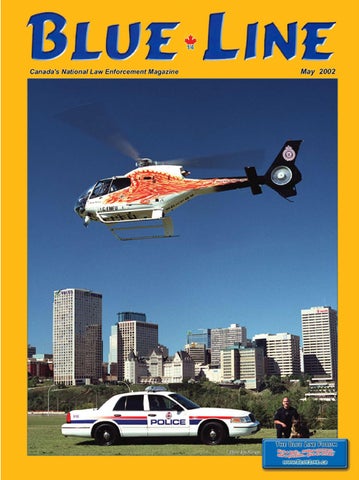
Edmonton Police take to the sky 6 Policing smarter . . . not harder is the answer to today’s complex policing needs
12A-4981 Hwy 7 East Ste 254 Markham, ON Canada L3R 1N1
Ph: 905 640-3048 Fax: 905 640-7547 eMail: blueline@blueline.ca
York chopper always has something to do 9
- Publisher / Editor Morley S. Lymburner
HMOS Boniface sinks on maiden voyage 10
eMail: publisher@blueline.ca
- General Manager Mary Lymburner, M.Ed. eMail: admin@blueline.ca
- Managing Editor Mark Reesor eMail: editor@blueline.ca
- News Editor Les Linder
Law enforcement ethics The continuum of compromise
11
The police retirement transition An opportunity for discovery and growth
14
TECHNOLOGY 16 Secure communication for Canadian police WINNING STRATEGIES FOR LIFE Something to laugh about
17
eMail: news@blueline.ca
- Advertising Mary Lymburner Dean Clarke Kieran Huggins Bob Murray
COMMENTARY Federal privacy commissioner versus the police
18
eMail: sales@blueline.ca
DEEP BLUE Chief, frontline cops often disagree — but that’s okay!
19
Questioning the questions Implications of child interview techniques
20
CORRESPONDENCE
21
- Pre-press Production Del Wall - Contributing Editors Communication Skills Police Management Tactical Firearms Technology Psychology Case Law
Terry Barker Robert Lunney Dave Brown Tom Rataj Dorothy Cotton Mike Novakowski
Blue Line Magazine is published monthly, September to June, by Blue Line Magazine Incorporated with a mailing address of: 12A - 4981 Hwy. 7 East, Ste. 254, Markham, Ontario, L3R 1N1. Individual magazines are $3.50 each. Subscriptions are $25.00 per year or $40.00 for 2 years. (Foreign - $50.00 U.S.) ©2002 - All articles are protected by copyright. No part of this publication may be reproduced or transmitted in any form or by any means, electronic or mechanical, including photocopying and recording or by any information storage or retrieval system without permission from the publisher. Internet activity is monitored and use or reposting of material on the Internet is restricted. All material submitted for publication becomes the property of Blue Line Magazine unless other arrangements have been made with the publisher. The authors, advisors and Publisher accept no liability whatsoever for any injuries to persons or property resulting from the application or adoption of any of the procedures, tactics or considerations presented in this magazine. Readers are cautioned and advised that articles presented herein are edited and supplied for your personal awareness and should not be used for further action until appropriate advice and guidance is received from a supervisor, Crown Attorney or other person in authority. Established in 1988, Blue Line Magazine is an independent publication designed to inform, entertain, educate and upgrade the skills of those involved in the law enforcement profession. It has no direct control from a law enforcement agency and its opinions and articles do not necessarily reflect the opinions of any government, police, or law enforcement agency. Blue Line Magazine is a private venture and as such is not funded through any level of government agency, union or association.
- Affiliations International Association of Law Enforcement Planners Canadian Advertising Rates & Data International Police Association The Police Leadership Forum The Canadian Press Newswire Printed in Canada
ISSN #0847 8538 Canada Post - Canadian Publications Mail Product Sales Agreement No. 176796 May 2002
CASE LAW • ‘Residual’ privacy interest in recovered stolen property • Search incident to a lawful arrest: taking a look
22 23
DOWN EAST RNC project warms hands and hearts
25
Acts consistent with fundamental freedoms The commission for public complaints against the RCMP
26
NEWS CLIPS
29
“Camp K” develops new angle to police training
30
VITALITY Recognition of police health and wellness contributors
31
The Last Noose Quebec
32
CPRC testing facial recognition technology
33
ON THE LIGHTER SIDE The big feathered caper
34
Blue Line Showcase – Tetragon Tasse
35
BLUE LINE CLASSIFIED
37
BACK OF THE BOOK Criminals with body armour threaten police
38
3
Edmonton residents didn’t hesitate when asked to help their police service get a helicopter. A community group, ‘SOS’ (Spotlight on Safety) was formed and people opened their wallets, raising over a million dollars for the program. Their faith wasn’t misplaced — in its first eight months of operation, the helicopter has been involved in 1168 calls, 191 vehicle stops and helped end 22 pursuits. Les Linder tells us more in his feature article, beginning on page six. York Regional Police are also happy with their helicopter program — read about one day’s aerial patrol on page nine. Our story about the HMOS Boniface captured people’s imaginations — the final chapter in the Boniface ‘caper’ is on page 10. The path from honest cop to compromised officer occurs so gradually it can go unnoticed; Kevin Gilmartin and John Harris tell us on page 11 how to stop this corrosive process from happening to you — and reverse the damage that may already have occurred. Retirement can be tough in any vocation which isn’t just a job but a way of life — psychologist Dr. David Hoath, a former OPP officer, takes a look at how you can ease the transition to civilian life on page 14. With the G8 summit in Alberta fast approaching, we recap the Hughes Inquiry recommendations on page 26. The second of our four-part feature on child interview techniques on page 20 looks at ‘questioning the questions,’ talking to children in language they understand. In our other regular features, Tom Rataj tells us about Entrust software, which is becoming the national secure communication standard, on page 16; Audrey Pihulyk gives us something to laugh about on page 17; Dr. Dorothy says disagreement isn’t necessarily a bad thing, as long as it’s handled properly, on page 19; Mike Novakowski gives us a double helping of case law, beginning on page 22; Peter Shipley recognizes people who have contributed to police wellness and health on page 31 and Danette Dooley profiles an Royal Newfoundland Constabulatory’s project which warms hands and hearts on page 25. Blue Blue Line Line Magazine Magazine
APEC report is a sweet release for many by Morley Lymburner Shirley Heafey, Chair to the Commission for Public Complaints Against the RCMP, has finally released her final report following the extensive hearing of complaints by the Honourable Ted Hughes on the Asia Pacific Economic Conference. The results of this hearing is, in my estimation, a fair and insightful study for any law enforcement practitioner. Not only is the report intense and complete but I believe it has shown the standard by which future hearings should be held. Other public complaints investigators and bureaus could learn much from this report. It would appear that no stone was left unturned in efforts to unravel the very complicated series of events of the APEC complaints. It shows considerable errors of commission and omission by all sides and it presents a recipe for success in future incidents of this nature. The report reads, for the most part, as a document of complete objectivity. No one could ask more of Ted Hughes than that which he has put into this inquiry and report. Chair Shirley Heafey’s summary of the Hughes report is a 13 page document that captures the essence of what really happened in each of the 15 complaints lodged to her office. Along with each complaint is her findings as to the veracity of the complaints. No one comes away snow white but in my estimation no one can dispute these conclusions. If you go to page 26 in this edition of Blue Line you will find a complete rundown on all findings. In his report Mr. Hughes correctly pointed out that “there is evidence in the country to indicate that the RCMP has learned considerably from the events of November 25, 1997.” Indeed subsequent events at Quebec City has shown that not only have the RCMP learned a great deal but so has every police service in Canada. There is no doubt the RCMP will use this report as a platform from which to grow. The most important factor in all this study as it relates to individual officers was more than adequately stated by Commissioner Zaccardelli in his response to Ms. Heafey. I feel these words are worth repeating... and often. “As a result of the review, the conduct of 17 individual RCMP members was subjected to a full investigation. Independent Crown counsel then reviewed the results of the criminal investigations and no criminal charges were approved. A Senior RCMP officer, who had no involvement with APEC, reviewed the results of the Code of Conduct investigations, and no disciplinary allegations were approved. “Those allegations were then examined by Mr. Hughes as part of the public complaints process. Mr. Hughes found no evidence of malice, nor did he recommend that action be taken concerning the conduct of any individual RCMP member. Having considered all of the foregoing, I am satisfied that further action concerning the conduct of any individual RCMP member in this case is not warranted.” In the passage of time many people forget that the APEC summit meeting spanned seven
days and involved the marshalling of over 3,000 police officers to protect dignitaries and the public at over 34 different sites. During this period up to November 25th there were no complaints of police misconduct. Zero! All 15 complaints occurred on the final day. We will certainly never get the full story of everyone who attended the events of that day but we do have the evidence of hundreds of officers to draw upon. They gave very candid and credible evidence at the inquiry and all this is documented for future generations of officers and managers to review and learn. In the modern lexicon of today’s corporate industry it has been recognized that when the organization is caught in an obvious situation of abuse or mishandling they should be very quick to apologize to those victimized. In Mr. Hughes’ report he points out the RCMP should have apologized to certain individuals in a timely fashion. Ms. Heafey reiterated this sentiment in her report pointing out that it would “provide some consolation for those who suffered the consequences of inappropriate police conduct.” To this I can only scratch my head as much as I am sure the Commissioner is doing. When viewing the studies it is obvious that mistakes were made at a multitude of levels. It took several millions of dollars and over four years to investigate. There was criticism of failures at multiple levels of governments and agencies. It would be more than appropriate under these
circumstances for Ms. Heafey and/ or Mr. Hughes to specify who should be apologized to and for what inappropriate action. Given the fact that no officers could be found to have committed any criminal actions I can only assume the apology would be one suggesting they are sorry the protestors voluntarily put themselves in harms way. To place yourself in the middle of a road to protest and think nothing uncomfortable was going to happen would certainly be the hallmark of an unskilled thinker. It would also be nice to give a definition in this case as to what time-line would have been appropriate for such an apology. In my mind making a little backhanded remark like this did tend to chip away a little of the credibility of the reports. It certainly appeared to be placed strategically for the purpose of mollifying some critics from the media and complainants’ side. It is certainly one comment which the media picked up in their usual shallow manner. RCMP Commissioner Zaccardelli, in his letter of response to the report, points out that the 1997 APEC security assignment was without doubt the largest event of this type the RCMP had ever handled. This being the case then it would naturally follow that mistakes are going to be made. The real point is whether the RCMP have learned from them. I believe the resounding answer to this is yes. Was the Hughes report thorough and well done? I would suggest another resounding yes.
For further details go to BlueLinks at www.blueline.ca
May 2002
5
Photo: Kim Woolg
by Les Linder The Edmonton Police Service is confident the helicopter they have been using for the past eight months is proving its worth in the fight against crime and taking public safety to new heights. S/Sgt. Rick Milne, head of the Flight Operations Unit with the Edmonton service, said the project has been a success since its inception in 2001. Milne and his colleagues had been researching the use of helicopters for his agency for five years and watched the progress made by Calgary, Durham Region, York Region, as well Toronto’s short-lived helicopter program. “The level of public support was overwhelming and it began when one community business leader stepped forward in response to a public challenge and offered to match money raised by citizen donations,” Milne said. Contributions began to pour in during October 2000 and, within a few months, $300,000 was raised. Milne said by May 2001, that figure increased significantly. “It became a partnership between the community group Spotlight on Safety (SOS) and the Edmonton Police Foundation to tackle crime prevention issues outside of our normal police budget - the community and business support just kept growing,” he said. Police Chief Bob Wasylyshen agreed to go ahead with the program and put the necessary May 2002
personnel into it. He had been aware of the benefits a police chopper could bring and supported a program long before he became chief in 2000. The program continued to grow and over $1.1 million has been raised, Milne added. He credits much of the program to editorialist Bob Layton from radio station 630 CHED who publicly asked why Edmonton had no helicopter. Ed Bean from Crystal Glass also led by donating $100,000 if the public would too. “The support by SOS and the community really confirmed to us that our community and most other communities across Canada, are very much in support of their police service and willing to help them,’ Wasylyshen said. “The community is extremely proud with what they have accomplished and that they are taking a part in their own public safety by supporting us with this technology.” Wasylyshen said the public has shown wisdom by supporting the program for the added level of protection. “It makes me proud to service such a fine community.” Milne says the service now has enough funds to run the helicopter for its first year of operation. The first year will cost about $750,000 to $800,000 for operational costs and equipment, not including staff. The total cost, including staff and maintenance is expected to be about $1 million for one year. The helicopter, a Eurocopter EC 120 equipped with a Forward Looking Infrared (FLIR) Mark II system and search light, is currently on lease. Milne said the intention of the 6
SOS group is to come up with enough funds to purchase it when the lease is up in July. A lottery has recently been approved by Alberta Gaming and an announcement is pending. During its eight months with the service, the helicopter has been involved in 1168 calls and 191 vehicle stops. It was also instrumental in ending 22 police pursuits, all of which were terminated without injuries and lead to multiple arrests. The helicopter was also the first police presence on scene at 40 per cent of the calls it responded to. “We’ve definitely been kept busy,” Milne said. “The big advantage we find with it is that it provides significant officer and public safety simply because we usually arrive first and can give timely intelligence to ground units.” He added that during pursuits, once the helicopter arrives, ground units terminate the pursuit and disappear, so the suspect does not see any officers pursuing and usually slows down or drives more carefully. Once the suspect abandons the vehicle, the helicopter directs ground officers to the location and arrests are made. “There’s a lot less chance of citizens, officers and even the suspect being injured or killed in a crash because speeds are reduced and suspects calm down. (The suspect) usually doesn’t even realize we are right above him watching as he casually drives off thinking he’s in the clear.” Wasylyshen said he also feels more reassured that his officers are safer when the helicopter is patrolling the skies. “We make situations so much safer for our officers because this tool can let our ground
careful consideration in choosing units know what is around them what was right for the job. and help them to avoid obstacles “We didn’t look at how much or distractions that might intermoney we had and what helicopfere,” he said. “If an officer chases ter we could get for it. We began an armed suspect into the woods with the end in mind and asked or a backyard, the helicopter can ourselves what helicopter would let that officer know whether the serve our community best in the suspect is waiting to ambush him long term.” or not. Wasylyshen said there was no “That brings a huge relief to point in choosing a helicopter that one’s mind because nobody wants is not designed to be used over an their officers hurt or worse. This urban area for many hours that simply helps make sure nobody causes noise. gets a surprise edge on our offic“You need a vehicle that has ers. It helps to keep our officers Chief Bob Wasylyshen the right amount of lift to carry all and the public alive and healthy - I the equipment officers need, inlike that.” Milne is also pleased with the helicopter’s cluding the FLIR and search light,” Wasylyshen quick response time of less than three minutes pointed out. “There’s no point in even getting a to a call, adding it is one of the key contributing helicopter if the model can’t do all the things factors to ensuring officer safety. He empha- you need it to do. So that’s why we went with sized that the helicopter is a patrol vehicle and the EC 120, it gave us everything we needed it that the service makes sure it is being used to its to.” Milne, who has about 2000 hours of flight full potential any time it is airborne. “If we’re not on an active call we conduct time, including 600 on helicopters and is also airborne patrols in high crime or problem areas training on the Bell 412HP Griffon as a reservist in the Canadian Air Force, said there was using the onboard technology,” he said. The helicopter is currently budgeted to fly enough flight experience in-house to use offic1,000 hours in its first year. The service is also ers as crew. Cst. Vern Zelent is the chief pilot for the somewhat unique in that it uses its own officers as pilots. The EPS was fortunate to have service’s helicopter unit and has over 5,000 flight several officers with helicopter pilots licenses hours logged. Zelent worked for Canadian Heliand extensive aviation experience. The service copters before joining the service and became also had gained aviation experience by having a an ideal candidate for the chief pilot position. “(Zelent) had the passion to become a police fixed-wing aircraft since 1980. Milne said the service also took a different officer and after 5 years of street experience he approach to getting the helicopter and placed was perfect for the unit,” Milne said.
For further details go to BlueLinks at www.blueline.ca
May 2002
7
The unit currently has two pilots and two flight officers. Cst. Darrel Day originally entered the program as a flight officer and will take over line-piloting duties from Milne who was promoted to help manage the administrative duties for the program. Milne still serves as a relief pilot. Cst. Randy Chaulk serves as a relief pilot as well in Patrol Division and Sgt. Chris Hayden is the chief flight officer and was key in developing the program. “Having our own officers as the flight crew makes a significant difference to us because they understand police policy, procedures, know the city very thoroughly and have credibility with our ground officers,” Milne said. He also added that it helps with managing costs as the agency doesn’t need to hire outside pilots or crew and can rely on its own members. He also is confident the unit will have no attrition problems. Milne says he still gets a smile on his face when he thinks back to one of the helicopter’s early responses to a series of pursuits. “On January 1, (the helicopter) was involved in four consecutive police pursuits,” he explained. “We ended up catching all the suspects involved one right after the other without a single collision or death. It really helped to show the level of safety it brings to our officers and the entire crew was smiling for quite a few days after catching those guys. We knew this helicopter was going to do great things.” A consulting firm is currently looking into the effectiveness of the helicopter and will make a report to the police commission later this year to determine long-term effectiveness of the program. Both Milne and Wasylyshen say they are confident the re-
port will come back with positive results when it is completed later this year. Although other police agencies have made studies into helicopters, Milne feels some of them have failed to capture the effectiveness of the public safety aspect it can provide. “You can’t just boil it down to the number of people you capture with it,” he explained. “You need to look at how much safer things are for our people on the street and for citizens,” Milne said. He pointed out that while many programs and projects developed by police look good on paper, they don’t do a whole lot for officers on the front line. He emphasized the helicopter is a project that is appreciated by ground officers and that the safety it brings to them will likely be seen in the report. Wasylyshen says that while Edmonton and the few other services using helicopters are having positive results with the helicopter, Canada as a whole still suffers from a lack of the vehicles and is being too slow to catch on to their importance. “Canada needs to take its policing to a higher level, so to speak,” Wasylyshen said in frustration. “I’m absolutely amazed that Canada’s large cities, with the exception of Calgary and Edmonton, feel they are able to properly police without a helicopter. I also can’t understand why they wouldn’t strongly pursue that sort of advancement.” He says that while he understands most services are struggling just to get more officers and can’t be bothered to go after a helicopter, it is no excuse not to aggressively find other means
May 2002
of getting one. “They shouldn’t be depriving themselves of such a powerful tool. There things a helicopter can do that simply cannot be done on the ground, such as being able to quickly respond to calls. “As the police, it’s our responsibility to undergo our duty in the safest way possible and that means using the best equipment available. (The US) recognized quite a while ago and now Canada needs to do the same.” Judging from the approval rate of the community in the helicopter, which Wasylyshen says survey’s have shown is 90 per cent, he feels the program will be around for many years to come and not suffer a short-lived existence as several other helicopter programs have in Canada. “The review being done is going to quantify exactly what the helicopter does for us and what it would be like if we didn’t have it.” While operating costs are a concern, Wasylyshen is confident the service will continue to find ways to support the program financially. The service has not approached city council for funding and no plans were made yet to do so. “My sense is that even if we did ask for the funding, the program would still receive support from the public since they are so strongly behind us on it,” Wasylyshen concluded. “As long as the public wants it, they shall have it.” For further information contact S/Sgt. Rick Milne of the Edmonton Police Service Flight Operations at 780-408-4218. www.police.edmonton.ab.ca/pages/helicopter/html
8
York chopper always has something to do by Roger Varley A beam of blue light stabbed through the darkness, illuminating the parking lot of a nightclub in Markham, Ontario, east of Toronto. Slowly, Air2, the York Regional Police helicopter, circled. It was before 10 p.m. Saturday night and there was little activity. “It will pick up later,” said Cst. Dave Saunders. “Usually there are lineups to get in about 3 a.m. That (the searchlight) is just to let them know we’re around.” It was the Viva Night Club, the scene of a fatal stabbing last February. The club was one of several Saunders’ and his civilian pilot, Sebastian Filion, illuminated during the first half of their shift in the Enstrom 480 turbine helicopter. “Operationally, this is our gig,” said Saunders. “Where we go, we decide.” The shift began at a small airport north of Toronto where the Air2 unit is based. Lifting off at 8:15 p.m., the crew’s first task was to assist canine handler Cst. Bill Charnock in a training exercise as he tried to locate another officer in the dark fields south of the airport. The area was pitch black but Saunders, a former canine officer himself, could easily read the terrain with his infrared camera. Charnock, his dog and the ‘fugitive’ were highly visible as bright, white figures, enabling the helicopter crew to direct the dog handler toward his quarry. Then it was off to answer a call from a ground officer. He had stopped a vehicle occupied by suspects with a history of drug offences and asked the Air2 crew to check whether any nearby homes might be indoor marijuanagrowing operations. To let them know there was air support nearby, Saunders aimed the searchlight on the cruiser as pilot Filion made tight circles over the scene, with the helicopter nose down and tilted sickeningly on its side. “We never hover,” said Saunders, explaining that would make the aircraft too easy a target for anyone who may want to take a shot with a gun. Also, by circling, the crew can see the entire picture instead of just one perspective. Using the infrared, they then scanned the rooftops, looking for tell-tale ‘hot spots’ which could indicate the excessive heat caused by high-intensity lights used in hydroponics operations. From his position above, Saunders could see the entire subdivision on his monitor and then zoom in for closer looks at individual houses. Nothing was found in that sweep, although Saunders did locate a possible pot house later in another subdivision. The rooftop glowed white on his infrared monitor. The location was noted, to be passed on later to the drug squad, who would use the information along with other evidence to obtain a search warrant. Asked how operators of pot houses could possibly escape infrared detection at night, Saunders replied “crooks aren’t dumb. They use evolving technology. They change their habits and we have to change ours.” May 2002
Photo: Les Linder
Apart from being a police officer, Saunders sees the marijuana-growing proliferation from a taxpayer’s point of view. “They’re stealing millions of dollars in hydro,” he said. “That’s costing all of us money.” Then it was off to industrial areas, where Air2 slowly circled over buildings, its searchlight looking for any untoward activity. A van was spotted driving slowly beside a small industrial site before it stopped near a driveway. Keeping watch with his infrared, Saunders called for a cruiser to investigate and then directed it to the hard-to locate area. From above, the crew watched as two cruisers, lights flashing, pulled up to the van. No problem. It belonged to a security guard doing his rounds. It was an example, however, of the teamwork required between Air2 and ground forces. Another example came when Air2 responded to a possible break-and-enter in a residential area of Markham. Arriving before ground officers, Saunders used both his searchlight and infrared to scan the area around the house. A couple, of minutes later, the bright white images of police officers could be seen searching around the house. Another false alarm. It seemed a relative of the home owners had placed a birthday congratulations sign on the front door. Criss-crossing and listening to the constant radio clicks, beeps and calls from dispatchers, cruisers and air traffic controllers, Saunders and his pilot checked known biker gang clubhouses, more industrial areas and circled over cruisers that had stopped vehicles for traffic violations. “It makes the officer on the ground feel more secure knowing we’re up here,” he said. Nevertheless, with the Air2 program less than two years old Saunders said ground officers and dispatchers still need to be more aware of the helicopter’s uses and availability. To that end, he makes his presence known to dispatchers as he moves from one district to another. The unit comprises Saunders and Cst. Mark Baggatt, the two full time ‘observers,’ three pilots and three alternate observers. “If you’re doing the job properly, you can barely walk out at the end of the shift,” he said. “It’s a physically demanding job. It sucks a lot of energy out of you.” But it has its special moments, such as the night last fall a 78-year-old woman, suffering from Parkinson’s disease and paranoia, was 9
reported missing from a retirement home in Richmond Hill. Air2 used its infra-red scanning equipment to locate her approximately 300 feet from the home and direct officers on the ground to the location. She was lying under thick brush, wet and semi-conscious. Due to the darkness of the night and the density of the brush, it was impossible to see her from the ground. “If we save one life, it’s worth it,” said Saunders. “As a peacekeeper in a foreign land (he served with the Canadian forces in Cyprus), I had to keep reminding myself why we were there. It’s the same here.” He said the helicopter has proved itself to the force, “but we’re only scratching the surface of what we can do.” When answering fugitive calls, Air2 can set up an aerial perimeter and marshall forces to appropriate check points. “That can force people to go to ground and let us get the canine unit in,” he explained. And then there’s the perks that occasionally show up during patrol, such as seeing deer quietly grazing just yards away from homes in an upscale urban area, or just taking in the breathtaking view of the greater Toronto area spread out below like a carpet of brilliant lights. Such moments are brief, however. As Saunders said, “there’s always something to do.” Roger Varley is a staff reporter with Metro Land Newspapers - Stouffville Tribune.
HMOS Boniface sinks on maiden voyage
TOBERMORY - Initial reports are sketchy but early reports indicate that the HMOS Boniface has sunk in Georgian Bay after narrowly missing an iceberg near Tobermory. Luckily the ship was only partially manned (no women volunteered) and all hands including the Captain managed to take to life boats before the ship slipped beneath the waves five nautical miles north east of Flower Pot Island. “It is a real blow to the force,” Commissioner Boniface said in an interview. “We had so many high expectations for the ship that it is rather hard for us to fathom how this could happen. Luckily it only cost us a dollar to buy.” Confidential sources have reported that intial investigations appear to be focussing on someone tampering with the helm and rudder controls. There is a suggestion that someone was seen wearing a police hat with a red hatband near the pilot house in the early morning hours but this is unconfirmed. Apparently Captain Horatio Pilon reported that everything was going well after the ship left the port of Tobermory. Suddenly, upon seeing the errant iceberg dead ahead, he ordered the helmsmen to go hard to port. The inexperienced pilot thought this meant he was to get the captain a bottle of port and left the pilot house at that critical moment. Captain Pilon grabbed the helm and began to swing the ship to port and narrowly missed the iceberg by inches. Unfortunatly several officers were inspecting the inside of the hull near the bottom level of the ship when the sudden swing of the ship caused an officer to fall and strike the ballast plug in the bottom of the ship causing water to flood into the compartment. The water was so cold the officers could not withstand it long enough to locate the plug to replace it and they decided it would be better in the interest of safety to abandon the ship. Lost with the HMOS Boniface were four Ford Cruisers, one Helicopter, two staplers and a shovel. Lloyd’s of London, the insurer of the ship, immediately declared bankruptcy. May 2002
Editor’s Note I hope everyone had fun with our April Fool’s story last month. Blue Line was busy answering calls asking if this was for real. One OPP officer called up to explain that she was trying to tell her fellow officers that it was a joke. “They won’t believe it!” she said. “I can tell you one thing... men sure are thick!” She then asked for someone to tell another officer that it was indeed an April Fool’s joke. A large number of voices were heard laughing in the background when the beans were spilled. In another incident a caller advised the editor that the joke was “absolute genius.” He continued by saying every officer was having a real hoot over the story. But he closed by asking, “but how did you arrange to get the commissioner and theToronto mayor and the rest to go along with it by giving you all those quotes?” OPP HQ personnel report receiving many congratulatory calls on the launch. A few wondered when they could expect to see it arriving. One senior officer was reported being quite upset that he had to read about it in Blue Line Magazine instead of through his own departmental publication. “The whole idea was to give everyone a little laugh, and a challenge to seperate fact from fiction,” Blue Line Publisher Morley Lymburner said. “The news over the past two months was filled with the unfortunate deaths and shootings of several officers. With all that downer news we felt it was simply time to have a little fun for our readers. What better occassion than April Fool’s. We would like to thank Commissioner Boniface among so many for indulging our weird sense of humour.” In the following two articles we are supplying a conclusion for all those people who are still trying to seperate fact from fiction. It’s okay... we know the old adage that the last one to pull an April Fool’s is the real fool. We will humble ourselves and wear this mantle for all. 10
KINGSTON - The HMOS Boniface, the OPPs innovative new floating regional headquarters, has been hit and sunk by one of her own missiles. The Boniface, a former Canadian navy frigate, had just undergone retrofit at the Port Weller Dry Docks and was only several miles away from the shipyard when it was struck. It quickly burst into flames, which were fuelled by the exploding gas tanks of the 23 new Ford Crown Victoria squad cars below deck, and sank to the bottom of Lake Ontario several hours later. No one was hurt; Captain Leonard Nemo says the crew of 12 were on deck posing for a ceremonial photo being taken from the OPP helicopter when the ship was struck. They were quickly plucked from the water. The frigate had 76 guided missiles when purchased by the OPP but red-faced National Defence officials said they had been mistakenly left on board and would have to be returned. Although details are still sketchy, it appears two members of the OPP TRU team couldn’t resist test firing one of the missiles, which were to be dropped off at the Royal Military College in Kingston the next day. “They fired it from a launcher on the stern,” an investigator, speaking on the condition of anonymity, told Blue Line, “but the darned fools aimed it straight up. They apparently thought it would go off like fireworks, which would look good in the picture. Instead it went up about 5,000 feet, flamed out and came right back down again, hitting the Boniface’s engines.” “It’s a miracle it didn’t hit the helicopter but the ship had a bigger heat signature.” The ship is said to be a total write-off. Initial plans call for crews to remove any equipment which can be salvaged and turn the Boniface into an artificial reef. The OPP dive team has also expressed interest in using the wreck for underwater police academy. “Perhaps they can turn it into the first submarine,” suggested an OPP source, who added he feared the cost of the “fiasco” would likely mean the force’s ever-popular karaoke nights would have to be discontinued.
Law enforcement ethics The continuum of compromise by Kevin M. Gilmartin, Ph.D. and John (Jack) J. Harris, M.Ed. Police corruption is often seen as a distant problem peculiar to “big city cops” or “other departments.” Denial and refusal to accept the potential for ethical compromise and corruption at “our department” prevents administrators and officers from developing an in-depth understanding and appreciation of the issues. Without a clear understanding, adequate information and practical strategies, officers who are exposed to a risk-filled environment are more likely to engage in inappropriate behaviors that can destroy their professional and personal lives, as well as the reputation and credibility of their organizations. The transformation from an idealistic, highly ethical officer into a self-serving individual who believes “if we don’t look out for ourselves, who will?” is a subtle process that usually occurs before the officers knows what has happened. For ethics training to be effective, officers have to see the information as relevant and credible. The typical ‘soap box’ approach, whether taught by internal affairs, supervisors and commanders, attorneys or others is often seen as scolding, warning and threatening. This approach, even when the information is interesting and enlightening, is rarely internalized by the officers nor incorporated into their day-to-day activities. The ‘Continuum of Compromise’ (Gilmartin & Harris, 1995) is a frame work for understanding and teaching how the transition from honest cop to compromised officer can occur. Law enforcement agencies can help prepare their officers for the ethical challenges they face during their careers. However, that will require changing the way this topic is approached by the organization and teaching and integrating the information throughout the organization. Officers live and work in a constantly changing and dynamically social context in which they are exposed to a myriad of ethical conflicts. When either unprepared or unaware, officers are more likely to go with the flow than they would be if they were adequately prepared to face potentially ethical risks. Everyday, officers practice mental preparation as it relates to tactical situations. Officers who are mentally prepared to face a lethal encounter are more likely to be successful than those who are tactically proficient but mentally unprepared. Just like lethal encounters, ethical dilemmas occur at the most inopportune times, frequently without warning and with little time to stop and think about the situation. When inadequately prepared, even the most honest, above reproach officers can make inappropriate splitsecond ethical decisions — decisions that can result in life-changing consequences. If officers are going to survive ethical dilemmas they need to be as mentally prepared as they would be for tactical encounters. While police work is seductive and exhilaMay 2002
rating, it can also lead officers down the path of ethical compromise. The continuum of compromise outlines the path of ethical compromise and can be used to help officers understand and mentally prepare for the ethical dilemmas they will face. Understanding the issues and being mentally prepared will help officers assume responsibility for and make more appropriate decisions. Compromising behaviour has to be seen as something that can potentially affect all law enforcement officers, not just those in “corruption rich” environments. Officers who view compromise or corruption as an all or none phenomenon will not see themselves as at risk. When the potential for compromise is not recognized, officers will see it as an unlikely event, training will be viewed as a waste of time and they will not become mentally prepared. Understanding the continuum of compromise will allow officers to recognize the risks, assess their own potential for compromise and develop an effective strategy to ensure ethical integrity. When teaching ethics the goal must be to develop an understanding of the progression towards compromise and the development of self-monitoring strategies to prevent becoming embroiled in compromising events. The continuum of compromise A perceived sense of victimization can lead to the rationalization and justification of: • Acts of omission • Acts of commission - administrative • Acts of commission - criminal • Entitlement versus accountability • Loyalty versus integrity Officers frequently develop a perceived sense of victimization over time. They typically begin their careers as enthusiastic, highly motivated people. However, when these young officers over-invest in and over-identify with their professional role, they will develop a sense of singular-identity based on their job and an increased sense of victimization. At greatest risk are officers whose jobs literally become their lives. For them, “I am a cop” is not just a cliché but rather a way of life. Overidentification and over-investment causes people to link their sense of self to their police role — a role they do not control. While this builds camaraderie, it can also cause officers to eventually hate and resent the job they once loved. While officers have absolute control over their own integrity and professionalism, the rest of their police role is controlled by someone else. Department rules, procedures, policies, equipment, budget allocations, assignments, dress codes and many other day-to-day and long-term activities are controlled by the chief, commanders, supervisors, prosecuting attorneys, the criminal justice system, laws, the courts, politicians, etc. Officers who over-identify with the job soon experience a loss of control over other aspects of their lives. Professional over-investment, coupled with 11
a loss of personal control puts officers at serious risk; a risk, that in some ways is more dangerous than the physical risks they face on the street. “It doesn’t matter how guilty you are but how slick your lawyer is” can become the officers’ cynical yet reality-based perception of the legal system. These realities combine with over-investment to develop an “us versus them” perception in terms of how officers see the world. The physical risks that officers are exposed to each day require them to see the world as potentially lethal. To survive, they have to develop a “hyper vigilant” (Gilmartin, 1984) mindset. Coupled with over-investment, that leads officers to believe the only person you can really trust is another cop, a “real cop” that is not some “pencil-neck in the administration.” While officers first become alienated from the public, they can soon distance themselves from the criminal justice system and finally from their own department administration. “I can handle the morons on the street, I just can’t handle the morons in the administration” is often heard among officers. It is ironic how quickly idealism and trust in the administration can change, often times even before the first set of uniforms wears out. As a sense of perceived victimization intensifies, officers become more distrusting and resentful of anyone who controls their job role. At this point, without any conscious awareness and certainly without any unethical intent, unsuspecting officers can begin a journey down the continuum of compromise. As the over-invested officer detaches from non-work related interests or activities, a perceived sense of victimization will increase. Peer groups, friends, co-workers and potentially their entire frame of reference of life begins to change. By itself, feeling like a victim is by no means equivalent to being ethically compromised. However, feeling like a victim, whether real or imagined, is the first stop on the continuum of compromise. Acts of omission When officers (or anyone for that matter) feel victimized, in their own mind they can rationalize and justify behaviors they may not normally engage in. Acts of omission occur when officers rationalize and justify not doing things they are responsible for doing. At this point, they can feel quite justified in not doing things that, from their own perspective, appear to “even the score.” “If they (whomever it may be) don’t care about us, why should we care about them.” Acts of omission can include selective non-productivity (ignoring traffic violations or certain criminal violations, etc.), “not seeing” or avoiding on-sight activity, superficial investigations, omitting paperwork, lack of follow up, doing enough to just “get by” and many other activities which officers can easily omit. “You will never get in trouble for the stop you don’t make!” typifies the mind-set of officers during this stage.
This results in decreased productivity and produces passive resistance to organizational mandates. Acts of omission rarely face critical scrutiny from peers who themselves are frequently experiencing the same sense of victimization and socialization process. Peer acceptance and loyalty become more important than following some arbitrary set of professional principles. The perceived sense of being victimized can allow officers to rationalize and justify other acts of omission such as not reporting another officer’s inappropriate behavior (sometimes regardless of how extreme or criminal the behavior may be). Acts of commission administrative Once officers routinely omit job responsibilities, the journey to the next step is not a difficult one to make. Instead of just omitting duties and responsibilities, officers commit administrative violations. Breaking small rules that seem inconsequential or which stand in the way of “real police work” is the first step and can set the stage for continued progression down the continuum. Acts of administrative commission are seen in many ways — carrying unauthorized equipment and/or weapons, engaging in prohibited pursuits and other activities, drinking on duty, romantic interludes at work, not reporting accidents and firing warning shots are just a few examples. Department sanctions are typically the only risk that officers will face at this point and, for most, this is the extent of their personal
journey down the continuum of compromise. Acts of omission and acts of administrative commission are significant in terms of professional accountability and personal integrity. When discovered, they can erode community trust and damage police/community relations but rarely place officers at risk for criminal prosecution. The initially honest and highly motivated officers can now rationalize their behavior along the lines of “I’m not a naive rookie out trying to change the world. I know what it’s really like on the streets and we (the police) have to look out for each other because no one else will.” Acts of commission - criminal Unsuspecting officers can unwittingly travel to the next and final stage of the continuum, acts of commission - criminal. In the final stage on the continuum of compromise, officers engage in and rationalize behavior that just a few years before could not be imagined. At first, acts of criminal commission may appear benign and not terribly different from acts of administrative commission. Evidence that will never be of any use is thrown away instead of being turned in, overtime or payroll records are embellished, needed police equipment is inappropriately purchased with money seized from a drug dealer and expecting “a little something in the envelope” when the officers drop by are but a few examples that officers have easily rationalized. “What the hell, we put our lives on the line and they owe us”. A gun not turned into evidence and kept by the officer can become “it’s
For further details go to BlueLinks at www.blueline.ca
May 2002
12
just a doper’s gun anyway and would probably be used to kill some innocent person or even a cop.” Theft and misappropriation of seized assets is a problem but it’s not “like real theft where there is a real victim, nobody is getting hurt but the dopers, what’s the big deal?” The “loyalty versus integrity” dilemma can permit criminal actions to develop into conspiracies, whether other officers are actively involved or passively remain loyal and accept what takes place. Now, the risks are far beyond just administrative reprimands or suspension; officers face being fired and criminal sanctions when they are caught. The initially honest, dedicated, above reproach officers now ask “where did it all go wrong” and “how did this happen” as they face the realities of personal and professional devastation and criminal prosecution. Officers who reach the final stage did not wake up one day and take a quantum leap from being honest hard working officers to criminal defendants. Entitlement versus accountability Officers can develop an overwhelming sense of victimization and an intense resentment toward the supervisors and administrators who control their job-role. This can lead to another dilemma — a sense of entitlement. Entitlement is a mindset that suggests “we stick together” and “we deserve special treatment.” The off-duty officer who is driving 30 mph over the speed limit and weaving in and out of traffic who tells his passenger, a concerned coworker, “relax, I have Mastershield!” implies a
sense of entitlement and feeling of impunity. Entitlement allows both on and off duty officers to operate with the belief that many of the rules don’t apply to them. “Professional courtesy” goes far beyond just giving another officer a break on a traffic violation. Officers are constantly faced with the dilemma of “doing the right thing” or “doing what they know is right.” The only way to change this sense of entitlement is to foster an environment of accountability, both organizational and personal. Loyalty versus integrity Most officers want to be known as loyal and a man or woman of integrity. A problem occurs, however, when a sense of victimization and over-identification with the job sets into motion the dilemma of “loyalty versus integrity” (Mollen Commission, 1994). Here is where officers called in to internal affairs and asked questions about another officer lie, many times about a minor issue. When this occurs, the officer has traded his/her integrity for loyalty to a fellow officer. Unfortunately, law enforcement agencies across the country can give many examples of ‘innocent’ officers not telling the truth in an attempt to protect a partner or co-worker, only to find themselves facing serious or career ending discipline. Early exposure to such statements as “how will the department find out about it if we all hang together” and “cops don’t snitch on other cops” can help foster the “loyalty vs. integrity” dilemma that officers will likely face during the course of their careers.
ties. Supervisors have to recognize and proactively address potential ethical violations before major problems develop. Supervisory acts of omission occur frequently. Not taking care of the “little things” can ultimately be devastating to individual officers and organizations as well. Supervisors need practical skills, a willingness to use these skills and they have to be held accountable for fulfilling their responsibilities. Supervisors, commanders and chief executive officers have to appreciate their own vulnerabilities and the mixed messages they sometimes send. They do not have the luxury of simply talking about ethics, they have to “walk the talk” and be day-to-day role models. Unethical behavior by supervisory and command personnel only models unethical behavior and sends the message, “do as I say, not as I do.” Is an executive-level officer who registers at a police conference (at taxpayer expense) and plays golf instead of attending the conference any less unethical than the line officer who is unavailable for calls because he/she is conducting personal business on duty? Politics, organizational history or institutional traditions should never be used to rationalize or justify unethical behavior. As long as what goes on in the department is inconsistent with what is being taught, any ethical training program will be nothing more than lip service and a waste of valuable time and resources. The continuum of compromise can be found at all levels of an organization. Ethics training and a commitment to the highest level of professional and personal integrity apply to all
What can be done? When officers are ill-prepared to face the ethical dilemmas to which they will be exposed and unaware of the continuum of compromise, they can blindly and over a period of time allow mild job frustration to develop into pathological anger and rage, leading to devastating consequences. This progression is clearly predictable and often preventable. The time and resources spent preventing ethical compromise through credible instruction and pro-active supervision is infinitely smaller than what it takes to conduct internal and criminal investigations, convene investigative commissions or restore community trust and repair police/community relations. If law enforcement agencies are going to foster an atmosphere of unreproachable ethics, they must implement a comprehensive strategy throughout the agency. Officers have to be aware of and accept the continuum of compromise as a potential reality that can effect all members of the agency. They must learn skills to help them change the victim perception and internalize a survivor mentality. Teaching officers to appreciate and understand the difference between what they do and do not control is essential for creating ethically sound officers. Strategies for accepting the fact that officers do not control their police role but do have absolute control over their integrity and professionalism have to be taught and practiced. While the ultimate responsibility for behaving in an ethical manner lies with the individual officer, management shares some responsibiliMay 2002
13
members and have to be consistently demonstrated throughout the department. If law enforcement is to enjoy, maintain and in some jurisdictions regain the status of a respected profession in our society, it has to change the way it approaches integrity and ethical issues. A sincere organizational commitment and meaningful training has to focus on preventing small incidents from developing into major situations with potentially devastating consequences. Despite the headline stories, law enforcement organizations can regain lost trust, improve police/community relations, protect the reputations of good, hardworking and ethical law enforcement professionals and help prevent officers from destroying their professional careers and personal lives. Ethics training can no longer be seen as window dressing that makes good press after an embarrassing incident hits the front page. The topics of ethics, integrity, compromise and corruption have to become as important as other critical areas of law enforcement training if significant changes can occur. By making a serious commitment and taking a pro-active role, organizations can look forward to spending less time investigating, disciplining and prosecuting officers for unethical or criminal behaviors. Kevin M. Gilmartin, Ph.D. and John J. (Jack) Harris, M.A. have a private counselling practice, Gilmartin, Harris & Associates, specializing in public safety, law enforcement and critical incidents. Contact them at jack@gilmartinharris.com or kevin@gilmartinharris.com.
The police retirement transition An opportunity for discovery and growth by Dr. David Hoath, Psychologist Retirement can be very difficult psychologically for a police officer, since they’re giving up a job which has been a source of structure (time, space and activity), identity, purpose, personal mastery, self-esteem, social contact and social status. This article hopes to: • Stimulate individuals and couples to think and talk about their retirements. • Introduce the stages and phases of the retirement transition. • Introduce the common and not so common stress reactions associated with the police retirement transition. • Suggest a number of positive coping strategies. Stages and phases of transition Life transitions are turning points that involve three major stages: pre-decision and anticipation; decision and commitment; post-decision and adjustment. I’m focusing primarily on the first stage. My counselling experience indicates most officers encounter most of their stress when preparing for retirement. The pre-decision stage consists of denial, orientation, letting-go and exploration/discovery. Denial When imagining retirement some officers have anticipated identity loss and uncertainty. Regrettably, many resort to denial to cope rather
than staying open to the experience and preparing for retirement. Denial is a method of managing anxiety that people use to protect themselves from painful or frightening information. Denial that allows us to get on with our lives in positive and constructive ways is adaptive. Denial that keeps us passive and stops us from preparing for or coping
with reality is maladaptive or self-defeating. An illustration may help make my point. Let’s say you see me leaning against a car with only one leg and ask what happened to my leg. Startled, I say “you’re nuts, my legs are fine.” Pointing, you say “Dave, look at your leg!” Angrily I state “bugger off.” You think ‘Dave must be in denial. I’ll invite him for a coffee and when he walks away from that car, he’ll soon realize how many legs he has.’ Surprisingly, after your invitation I respond “I don’t want a coffee. Bugger off!” You see a man getting into the car I’m leaning on and drive away. I fall down, which is synonymous to having a crisis because I’m not prepared to cope with changes that occur unexpectedly. When people deny the reality of their situations, they’re prone to being surprised and overwhelmed by change. To reduce denial, people must ask the questions they’re avoiding and search for solutions early enough that they’re useful and effective by the time they retire. Research indicates that the more time and effort a person devotes to planning their retirement, the better they adjust to it. Orientation When we turn our attention toward an uncertain and perhaps threatening future, it’s common to experience stress. Police officers and, at times, their spouses, have reported: • Physical: Increased tension, racing heart, increased blood pressure, chest pains, specific and/or generalized aches and pains, low or excess energy and chronic fatigue. • Emotional: Free floating anxiety, uneasiness, fear of the future, dispirited, anger/irritability, frustration, helpless, hopeless, low selfesteem, reduced confidence, fear, more tearful or emotional than usual, mood swings and feeling like you hate the job and can’t stand it one more day. • Cognitive: Trouble concentrating, short-term memory problems, indecision, flashbacks to traumatic incidents from years ago (e.g., near death experience, child’s death), nightmares of past incidents in which you are helpless or of the death of a loved one and preoccupation with unanswered questions. • Behavioural: Drinking more alcohol, becoming preoccupied with detail and order, low tolerance for frustration, avoiding people, increased conflict, avoiding risk, avoiding the job, gambling more or extramarital affairs. These symptoms are normal indicators that you are coping with a stressful time in your life. Don’t fight them. If they persist for more than four weeks, you probably would benefit from speaking with a counsellor. Letting go In this phase officers report feeling a sense of loss or emptiness as they reminisce over their careers. It is common to re-experience the past when preparing for retirement. Some of the memories, thoughts and feelings will be positive and others painful, even traumatic. Officers sometimes get stuck in the letting-go phase, often being hooked by their own
May 2002
14
anger and resentment. They hold to, even cherish, feelings of bitterness and anger. To move on, people must let go of their resentments, disappointments, hurts and perceived failures and forgive those who have wronged and hurt you, not for their benefit but for yours. An important turning point in this phase involves coming to the understanding that life will be okay, even better, in retirement. Some officers say that they don’t want a retirement party but I encourage you to have one. It is an important ritual of letting-go that should not be missed. Exploration and discovery The central task of this phase is to find new purpose and meaning for retirement. It requires the courage to risk failure, the self-confidence to tolerate feelings of uncertainty, the faith to move forward — at times into nothing — and the flexibility and determination to try again if things don’t work out well the first time. I offer the following suggestions to guide you through this phase of DISCOVERY: • Dare to dream. Nothing happens without a dream. • Investigate your dreams. It’s important to examine the reality of your dream before committing to a course of action. • Share your dreams. If you are married, both persons in the relationship should dream and share their dreams. • Care for yourself. Take the time! • Open up to the experience. Resist reverting to passive denial, where it feels more safe and secure. • Value your past. I you don’t, who will?
May 2002
• Expect bad days. Some days you’re up and others you’re down — way down. Hold on for the good days. • Risk asking for help. There is no weakness in asking for help. • Yearn to learn. The decision stage This is a time of commitment, when all other alternatives are moved aside and goal-directed action begins. The hardest part is taking the first step, having faith that things will be okay. The post-decision stage A time for review and adjustment. It’s unlikely all your plans will work out exactly as imagined and there may be concerns that need to be addressed. If you return to denial after the decision phase to manage anxiety and reinforce the facade that all is well, sooner or later your new reality might start to crumble around you. Give your new future time to come together and stabilize but if things don’t seem right after six months to a year, return to the beginning of the cycle, re-orient, examine the problem(s) and make the changes needed. Although these adjustments might cause some distress in the short term, you’re likely to find retirement much more satisfying and stable. Dr. Hoath was a police officer for 12 years before becoming a psychologist and managed the OPP’s psychological services for seven years. He’s currently in private practice in Barrie, ON. For the complete text of this article, contact him at hoath@primus.ca or (705) 733-7544.
15
Secure communication for Canadian police by Tom Rataj
New national secure communication standard being established across the country.
Building on an existing contract for security software already used by the RCMP, Entrust Inc. will be providing its suite of security products to every police service in Canada. The RCMP will use some of the new money provided to Canadian police services since 9/11 to buy and maintain the licences for Entrust’s Enhanced Internet Security software. Once the program is completely implemented, about 75,000 people will use the products under a contract valued at approximately $1-million. The Entrust software provide a secure communication infrastructure between and within police services, using a technology known as ‘public-key infrastructure’ (PKI) to establish and verify a secure connection between the sender and receiver. It also encrypts the information while it is being sent and received so that it remains completely secure. PKI and the other elements of the software can be used to secure telephone and fax communication, e-mail and communication between computers (both mobile and desktop), including devices communicating through a virtual private network (VPN) over the internet. This software ensures that intra and interservice communications are secure against electronic eavesdropping, allowing police services to communicate with each other as if they were both on the same secure internal computer network. The first phase of the project involves securing e-mail messages between laptop and desktop computers used by the RCMP, which should be implemented in time for the G8 Economic Summit in Alberta in July, 2002. Once the project is fully implemented across the RCMP, it will be distributed and implemented to all provincial and municipal police services
Keys please PKI establishes all the rules, policies and procedures required to ensure that secured communication works properly. Information (in virtually any form) is encrypted by the sender and decrypted by the receiver. While the information is in transit, it is an unintelligible electronic jumble of data that cannot be read, altered or used in any way. In order to decrypt or unscramble the contents of the communication, an electronic “key” or password is required by the recipient of the communication. With PKI, there is both a public and a private key associated with the process. Generally the original outbound message is encrypted using a public key, while the private key is required to decrypt the message at the receiver’s end. The Entrust suite of products establishes the policies and procedures under which the encryption operates. It generates, stores and manages the keys and dictates how they and certificates should be created, distributed and used. Industry and government standards also establish how PKI should operate and be used. Spy vs Spy Individual criminals and organized criminal organizations have long been involved in counter-intelligence and surveillance operations against individual police officers and agencies. Because every method and technology used by police to watch and listen to criminals and criminal organizations is becoming more readily avail-
able, affordable and easy to use, the need to establish secure communications is increasingly more important. Highly sensitive and strategically or tactically important communications need to be kept out of the public (and criminal) domain to ensure the integrity of investigations and investigative techniques. Encryption of voice radio communication is the first step, but with the increasing reliance on computerized communications, a whole new range of security measures are needed. Within an individual agency, security measures can easily be adopted and maintained, while the security of interagency communications become far more complex. The pervasiveness of the Internet as a mode of communication provides many new opportunities for Canadian police services to communicate efficiently, effectively and economically from coast to coast. But with the advantages come disadvantages, the largest one being an almost complete lack of security. With the cross-Canada implementation of the Entrust products, individual agencies will be able to secure all their in-house communications, as well as their external communication with other police agencies. Currently e-mailing a computerized mugshot file from Vancouver to Halifax is quick and easy but it can be easily intercepted using a number of different techniques. PKI technology will allow this same mug-shot to be sent just as easily while remaining completely secure against interception and decryption by anyone other than the authorized recipient. Entrust Inc. is a world leader in enhanced internet security products and solutions and the RCMP and other federal government agencies already use a number of their products and services. Conclusions The need to communicate securely in a timely and efficient manner is becoming increasingly important for law enforcement worldwide. With computerized data collection, manipulation and sharing becoming increasingly important and necessary, the need to provide a secure infrastructure has also increased. The internet provides an excellent platform for police agencies all across Canada to communicate in an affordable and effective manner - as long as information can be secured against casual eavesdroppers and technology-savvy criminals and criminal organizations. This project helps to provide a national framework and series of standards that will encourage and allow police agencies from coast to coast to more effectively share information. For more information on Entrust Inc go to
For further details go to BlueLinks at www.blueline.ca
May 2002
16
Something to laugh about Turning things around with humour by Audrey Pihulyk The old saying “keep your nose to the grindstone” aptly illustrates the old Puritan work ethic of no nonsense and hard work. This mentality has a long history but unfortunately its principles still govern the thinking in some workplaces. As we shall see, research shows that “all work and no play makes Jack a dull boy.” The ‘Superiority Theory’ of humour has dominated throughout history; one person puts down another, making themselves appear superior. It’s been ingrained in our society for so long, the mind set of some is to be suspicious of humour. More recently the ‘Incongruity Theory’ has emerged, under which humour is a mismatch between what we expect and what we experience. For example, you hear a knock but instead of finding someone you see the family dog banging its tail against the door. What you expected is not what you see, hence incongruity. It should be noted that humour is not an unrealistic, pie-in-the-sky response that evades the difficult issues of life but rather helps us maintain a positive outlook even in the face of challenging situations. Think of meeting with relatives and friends after the funeral of a loved one; stories are exchanged and laughter can be heard rippling through the crowd. What is happening? Tensions and sorrows are being lightened through fellowship and generous doses of humour. One valuable asset of humour is mental distance, the ability to step back and look at situations in a different way. For example, observe a butterfly struggling to break out of its cocoon. As we step back and watch closely, we begin to watch from a disengaged perspective. We should soon see the butterfly breaking out and spreading its beautiful wings for flight. This mental distance is particularly valuable to policemen, firefighters and health care workers who face life and death situations daily. Similarly, using humour to visualize difficult situations can help us step back and look at them objectively so we’re not negatively affected by them. Another distance that humour provides is time. When we are facing a challenging situation our view is narrow and all we see is the present discomfort and trouble. However, as time passes, we can look back at that difficult moment with less pain and even see some humour in it. The distance in time that humour provides can bring emotional healing to our lives and to those around us. Humour is also a valuable asset in the workplace. Effective managers realize that it can break down barriers, build team spirit and morale, soften any message and make people more receptive to business training. When these training sessions are presented in a relaxed and humourous manner, participants tend also to be relaxed, learning and retaining more.
Comedian, Ernie Kovacs said, “if you’re going to tell ‘em the truth, make ‘em laugh or they’ll kill you.” An exaggeration, no doubt, but the stress of bad news can be softened by humour. An innovative company was introducing a new computer program, surely potentially stressful for its employees. However, the company began by asking for humourous cartoons relating to computer training and offering prizes for the funniest ones. They then trained the employees that had the best senses of humour and had them train other employees. Laughter could be heard during the sessions, turning the entire procedure into an anticipated event. A growing number of Fortune 500 Companies are offering their employees ‘humour rooms’ in which they can take a break from mental work to relax and ‘play.’ These rooms are brightly painted and many have pool tables, humour videos and computer games, all to provide diversions for stressed workers. The results are positive. The employees begin to feel more relaxed, operate under reduced stress and, therefore, become happier and more productive in their work. They are proving what philosopher John Dewey said, “to be playful and serious at the
same time is possible, and it defines the ideal mental condition.” That’s good advice; we have come so far from the fun and play of our childhood. We laughed hundreds of times a day then instead of the 15 times a day now. What keeps us from releasing the ‘child within?’ Probably it is the seriousness of being an adult with the responsibilities that we all carry. If we look within, we can still find the child that is waiting to be released. Look for opportunities for humour and fun. Read cartoon books, watch funny movies, hang around humourous people and best of all, spend time with children. As our lives get increasingly complicated, having a sense of humour can act as a buffer against stressful situations. Every day we can look for opportunities to see humour in the things that may negatively affect us. By so doing we can add hope and richness to our lives and to those around us. Audrey Pihulyk is a ‘humour-cilator’ who speaks at conventions and for organizations on ‘Winning Strategies for Life.’ You can reach her at1-866-4842197, audrey@possibilitiesnetwork.com or through her website, www.possibilitiesnetwork.com.
For further details go to BlueLinks at www.blueline.ca
May 2002
17
Federal privacy commissioner versus the police Are public surveillance cameras Orwellian control or community security? by James Clark A recent editorial in the Vancouver Sun supporting the federal privacy commissioners stand limiting the use of cameras by the police can now be found, unfortunately, on the Privacy Commissioner of Canada’s web site. George Radwanski’s position is that police should not be allowed to use cameras in public places to help control or prevent crimes. This article is interesting because it goes to great lengths to suggest that there is no clear evidence that they offer any substantial benefit. The privacy commissioner and the Vancouver Sun both question how much good they do and whether those benefits can be achieved through other means. What do we lose when we allow cameras in public places? The editorial points out that a KPMG study of camera use in Sudbury found that 98 per cent of businesses support using cameras. But that finding is buried in a list of observations and suggestions, including putting police officers on every street corner, using Havana, Cuba as an example. Are cameras supported “because this gives the police an excuse not to put cops on the beat,” the article asks, a suggestion that can only be described as silly. Police would love nothing more than to have the resources to put more officers on beats but are limited by their budgets, controlled by the same people who hired Mr. Radwanski. I’m sure if the federal government would authorize hiring more officers to patrol that park in Kelowna the RCMP would be more than happy to remove the camera. What the article briefly comments on and then ignores is the real foundation of the issue. Canadians are concerned about their safety and willing to give authorities the power to provide it. So now we find ourselves trying to decide which side of the fence we should place ourselves. Radwanski is there to protect the public’s right to privacy and the police are there to protect the public’s safety. Both agencies see themselves as the front line of defence in their areas of responsibility and it is clear that nei-
ther wants to give in to the other. Many people will no doubt argue that although the police need all the help they can get in fighting crime, this intrusion into the lives of the public smacks of the Orwellian big brother concept. Others couldn’t care less who takes their picture or looks at them so long as it makes them safer. I think it is time the federal privacy commission had a reality check. His continued efforts to stop the RCMP from using cameras in public areas is out of sync with what the public really want, as is his position that they intrude on their expected privacy. Police take the position that this type of surveillance will provide greater opportunities for monitoring public areas, prevent offences and apprehend criminals. The problem with Radwanski’s argument is that the question was decided many years ago by the government that he works for. The state authorizes pictures to be taken of everyone applying for a passport or driver’s license; is this because it wants to know what you look like or to assist police in enforcing the law? Pictures are taken of you in your car if you run a red light or are caught speeding because it’s a deterrent and there’s no money to put more officers on patrol. Governments have allowed private companies to put cameras on toll roads and banks to take your picture when you use an ATM machine. Police officers use pictures from them to catch people walking by when a customer is using an ATM so the banks are, in effect, taking pictures of the public. Should these cameras be removed because of the public’s expectation of privacy? The fact is the public doesn’t really have an expectation of privacy in any place other than their homes. The most compelling argument against Radwanski comes from his own employers. If there is any place in Canada that is considered public, surely it must be the eternal flame memorial found on Parliament Hill. This is the seat of our democracy and the heart of everything that the public holds dear, yet there are cameras monitoring everything you do. It seems that the privacy commissioner
doesn’t have a problem with cameras guarding the statues of dead politicians, or maybe his own car parked on Parliament Hill, but he does with police putting them in a public park where your children and mine play. European police have used cameras in public places for more than 20 years. Some maintain there is no solid evidence that cameras reduce or prevent crimes but this is a weak argument because statistics can be used and spun to support varying positions and aren’t the best method of evaluation. The cause and effect of crime is the result of many different factors. Public acceptance of cameras and their intrusiveness can best be measured by looking at retailers. Marketing people will tell you that the public has two major priorities when shopping; they want good products at reasonable prices and a safe, clean place to spend their money. There isn’t a large shopping centre in this country that isn’t monitored by security cameras. The bottom line is, the public places their personal safety ahead of any concern about being monitored. The use of cameras by police will not only continue but also expand in the future. Much of this will be driven by the continued lack of resources and public demand for a safer place to live. Cameras in public parks is just the beginning; down the road you can expect to see them in school playgrounds, transit systems and high crime areas. Police should be cautioned though. Along with this new technology comes accountability. If a camera in put in a community, the public is told they’re being monitored for their protection; if this doesn’t happen, they could sue. A case in the United States several years ago sent a warning to all those who use cameras. A woman was sexually assaulted in a parking lot which had cameras mounted in the immediate area but they were dummies, used to deter people from committing crimes. The victim sued the owners, arguing that she had an expectation of protection and had she known that the cameras weren’t real, she wouldn’t have gone there. The jury awarded her more than one million dollars. Police must realize that when they put a camera into use they are sending a message not only to the criminals but to the general public and they better be prepared to back it up with an appropriate response. Let Radwanski continue to monitor this activity but make no mistake about it, the people will side with the police on this issue. James Clark is a founding shareholder and director of operations of Monad Security Audit Systems. A former Toronto deputy police chief, he acts as team leader in all security audits, consults and prepares client reports, training and policy and procedures manuals. He can be reached at jclark@monadsecurity.com.
For further details go to BlueLinks at www.blueline.ca
May 2002
18
Chief, frontline cops often disagree — but that’s okay! by Dr. Dorothy Cotton Ph. D., C. Psych. Ok, this is a quiz. Pay close attention. Consider the following scenario: There is one Important Person in an organization who is calling the shots and making all the decisions and a bunch of others - the minions who have to do whatever the Important Person decrees. This makes the minions very grumpy because they feel that the Important Person is out to lunch, out of touch, on a power trip and has lost sight of the real issues and concerns. In your opinion, who are these people: A - A police chief versus the other rank-andfile officers B - A hospital administrator versus all the frontline workers C - A parent versus his/her children D - A manufacturing company CEO versus the union The answer (a drum roll is appropriate here) — the answer is: YES!!! I hope this does not offend your sense of uniqueness. I know all you police persons are deeply invested in thinking you are very different from everyone else. Certainly this is true in many ways. But if you are a police chief and you think the minions are failing to see the big picture and are resistant to change, or if you are a minion and you feel that the chief has lost touch, caved to the politicians and forgotten what real police work is all about — well, welcome to the club. However, let me reassure you that just because you are not unique doesn’t mean that this isn’t a problem. In fact, stress between the chief and the front lines is routinely identified as the main source of stress in policing. It’s an interesting thing, really. We would like to think that most stress would be from the work itself. Let’s face it — doing shifts, dealing with scary people, worrying about getting hurt, coping with heaps of paperwork and periods of interminable boredom are all part of the job and they are indeed stressful. But repeated studies have indicated that for most front line folks, the boss is the biggest source of stress. I can see any boss-type people reading this starting to get a titch PO’d — and front line people grinning with glee, but don’t get too excited here, folks, because the fact is it ain’t that simple. Just because the frontline folks say the boss is the problem doesn’t mean that they are correct. I don’t know if anyone else has noticed this, but it occurs to me that bosses and frontline people have different jobs. The frontline job is to see what’s out there and deal with it. The job of the boss, on the other hand, is to see what could be and to move things toward that. There’s an essential conflict here. There HAS to be an essential conflict here. If the boss and the minions see things the same way all the time, then someone is not doing their job. There has to be some disagreement — and this is actually a good thing. So, one might ask, how do we make people somewhat less grumpy about this? Partly, it is a
matter of communication — what would we do in any organization if we did not have the fallback of “poor communication” to blame everything on? The more people understand the competing demands that come from outside a department, the more aware they become that there really is a ‘bigger picture’ and the easier it is for them to be sympathetic of decisions they don’t agree with. Although the traditional and sometimes rigid hierarchical structure of most police departments makes it harder to do, getting the message across is still worth a try. Beware of people who ascribe to the “knowledge is power— I have it and you don’t” school of management. Making sure people understand how and why their input is sought (and indeed making sure their input IS sought) is also crucial. Part of the ‘Big Picture’ that the chief needs to see is, of course, the little picture — the stuff that front lines are dealing with every day. The minions are probably right that this is not the focus of the chief. Part of communicating is of course giving out information — but part is listening, too. The hitch is that you can listen to a whole variety of opinions but at some point, someone has to make a decision and move forward. An ‘Important Police Person’ friend of mine recently was commenting on empowering his staff and reflecting that they didn’t know the differ-
ence between empowerment to do THEIR jobs and empowerment to do HIS job. It takes a high degree of skill for a manager to convince staff he is indeed listening even if he doesn’t eventually agree with them. If you are a police chief, then this is part of why they pay you the big bucks for — you have to figure it out. For you minions, look around and decide if your job is perfect the way it is. If that’s the case, you should fight every change the chief tries to make — and give me a call because I want to come and either work for your department or have you admitted to my hospital because you have lost your mind. If things aren’t perfect, you might want to consider the possibility things really do look a little different from where the chief sits — and that this is a good thing. How does all this fit into stress management? In my trade, we call it reframing. You can eliminate stress by thinking about things differently and taking a different point of view. Next time you think the people above or below you have lost their minds, rather than having a hissy fit, think about it in a different way. It would be a bad thing if everyone saw everything the same way. Disagreement is not only useful but essential. It’s the only way that individuals — and organizations — grow and learn.
For further details go to BlueLinks at www.blueline.ca
May 2002
19
Questioning the questions Implications of child interview techniques by Kim Roberts & Sean Cameron The skills needed to carefully question an alleged victim makes child abuse investigations different and more complicated than many other criminal cases. The questioning techniques of police and social workers are scrutinized from the moment of first contact to the completion of the investigation. The same time and care forensic investigators place on preserving crime scene evidence must also be used when interviewing children after alleged abuse in order to preserve the integrity of the interviews. One of the reasons interviewing children requires specialist training is that they have less sophisticated language skills than adults. Children often have difficulty understanding the meaning of many of our everyday language conventions. Below, we highlight two areas of difficulty for child witnesses – vocabulary and question structure – and suggest some alternative ways of questioning that may help increase the reliability of children’s answers. Many of these recommendations have come directly from studies conducted jointly by police and researchers. Children’s vocabulary • Jargon – Numerous studies have documented misunderstandings in the use of legal terms. For example, in past research children have interpreted ‘court’ as ‘a place to play basketball,’ ‘jury’ as ‘jewelry’ and ‘allegation’ as ‘alligator.’ It’s not always immediately apparent that child and interviewer are interpreting the same words differently, as each does not realize that the other person is referring to something else. In these cases, it is best to avoid jargon altogether and use simple descriptions or encourage the child to expand on their use of technical terms so that you can assess what their actual meaning was. • Referencing points in time – It is often important to establish when an incident of sexual abuse occurred. Until about age eight or nine, however, children cannot reliably use words like ‘before’ and ‘after’ and also have trouble with concepts like ‘first’ and ‘last.’ Although they can use these terms in proper speech, there is not always a correct understanding of them. It can be especially difficult interviewing children who have alleged multiple incidents of abuse. Researchers have found that they respond more accurately when asked to temporally locate the event in relation to some meaningful marker. For example, asking “Was it a school day?” instead of “What day was it?” or asking what the child was doing or what was on TV at the time of the alleged incident. These types of markers are more reliably associated with events, as they are May 2002
Part 2 of a 4 part series
more meaningful to the child. • This/That/These/Those – Children can find sentences containing such demonstrative pronouns extremely difficult to process. One cannot be sure they are considering the same ‘this’ or ‘that’ as the adult so it’s advisable to always include the full reference when questioning children. For example, although it makes sense to adults, children may be confused by the ‘this’ in the following statement: “OK. So he touched you in the bedroom. Did this happen one time or more than one time?” A “yes” answer from a child is ambiguous because it does not indicate whether the child is claiming that they were touched more than once, or whether it happened in the bedroom more than once. The question could be reworked into separate questions: “Did he touch you one time or more than one time?” or “Did it happen in the bedroom one time or more than one time?” Question structure • Multiple-choice questions – Many questions contain a list of possible answers to choose from as in the “one time or more than one time” example above. Children sometimes have difficulty with these kinds of questions if the correct alternative is not presented as one of the choices (and real world interviewers often don’t have the luxury of knowing the correct alternative ahead of time). For example, a child may be asked “Did it happen in the bedroom or bathroom?” when, in fact, it happened in neither place. Although some children are assertive enough to reject both alternatives, research has shown that children tend to choose the last alternative more often - even when it is isn’t correct. These results stem from mock lab studies in which researchers know for sure what the correct answer is. It is preferable, then, to avoid providing children with choices 20
unless absolutely necessary. Another option is to provide an ‘other’ choice, for example, “Did it happen in the bedroom, the bathroom or some other place?” noting though that young children may have difficulty keeping track of numerous choices. • Negatives – Research on interviewing in investigations and court cases has shown that children find sentences containing negatives (e.g., “Didn’t he touch you in the bath?” or “Was she not in the kitchen with you?”) more difficult to answer than sentences without negatives. Hence, negatives are best avoided with children. • Multi-part questions – Children can be easily confused by questions that contain several ideas such as “Did she pull your pants off and hit you with a stick?” In this example, it is unclear what a yes would indicate – that the pants were removed, that the child was hit by a stick or both. It is best to split the question into two, each dealing with a separate idea. Summary Interviewing children presents many challenges and requires interviewers to carefully consider their language development. Research conducted collaboratively with police interviewers and researchers indicates that it is generally best to ask children questions that are 1) short, 2) free of jargon and 3) contain clear references to subject matter. Using interview techniques that are customized for children right from the beginning of an investigation not only ensures that the most reliable information is gained from a child but also protects the integrity of the case from courtroom criticism about these interviews. Coming up… In the next edition of Blue Line we will discuss the controversial issue of child suggestibility in eyewitness testimony. This topic has gained unprecedented attention in the media and is applicable to any case involving a child as a witness. Dr. Kim Roberts has collaborated with police forces in Europe and the US and recently spent five years researching children’s allegations of sexual and physical abuse at the National Institute of Health. She currently works as a professor of psychology at Wilfrid Laurier University. Sean Cameron is completing a master’s degree in psychology at Wilfrid Laurier University. His interest in forensic psychology stems from working as a child counsellor for the past three years in British Columbia. Comments or expressions of interest in collaborating with the authors for research or training purposes can be made to kroberts@wlu.ca - we look forward to hearing from you.
After reading “Police force merged after 127 years” (April 2002) edition of your magazine, I was surprised to see that interviews with front line officers were not included. The entire article consisted of an ex-Chief complaining about the decision and the process. I am sure his position is not an accurate reflection of the front line officers who have to work with the inadequate resources of a small police service. I know this because I have been through an amalgamation. I am sure your readers would appreciate a more balanced point of view in future reports on this type of topic. Joe Jakubowski Ontario Provincial Police
Editor’s Note: We hear lots but no one seems to want to write us about it. I could not help notice that in the article “ Invisible no more” (March 2002) they state that there are only two provinces where radar detectors are legal. In addition to British Columbia and Alberta, radar detectors are legal in Saskatchewan as well. Cpl. Herb Hahn RCMP Depot division Saskatchewan Editors’ Note: Carl Fors included this in his article but it was mistakenly edited out.
OPP hosting OACP this year Several hundred senior police officers are putting the spotlight on the future of policing as the Ontario Association of Chiefs of Police meets for its 51st annual conference at Deerhurst Resort, Huntsville July 16 to 19. In the wake of Sept. 11, 2001, this year’s conference theme is Intelligence-led Policing. The professional program includes speakers from both the public and police sectors who are focusing on intelligence-led investigations, technological innovations and crime prevention initiatives. Closing the conference will be University of Toronto professor Tad Homer Dixon who, in his book The Ingenuity Gap, envisioned the social seeds that gave rise to terrorism more than a year before the first plane struck the World Trade Centre in New York City last fall. This year’s OACP conference is being hosted by the Ontario Provincial Police. For more on the conference, go to www.oacp.on.ca
The Great Mac Attack! by Tony MacKinnon “. . do you have any idea how long your gas barbeque had been on with the lid down, before your husband lit it? . . “
May 2002
21
We have just received our copies of the April issue of Blue Line Magazine and wanted to take this opportunity to thank you and your staff for highlighting our police service as we celebrate our 125th Anniversay. I am advised that your editor, Mark Reesor, was most helpful and I would ask that you express our thanks to him. You and your staff provide a valuable service to the Canadian law enforcement community, and I would like to further express my best wishes to you and your most capable staff for the very best in the future. Robert H. Peeling Chief of Police - Brantford Police Service
‘Residual’ privacy interest in recovered stolen property by Mike Novakowski Does an owner of stolen property maintain a privacy interest in it when it’s recovered by the police? That was the question the Supreme Court of Canada recently answered in R. v. Law et al. 2002 SCC 10. Police recovered the accused’s safe, stolen during a break in at his restaurant, open in a field where it had been abandoned by thieves. The theft was investigated and the safe placed in the exhibit room until it could be returned to its owner. Before he picked it up another officer, aware of but unconnected to the theft investigation and acting on “a gut feeling” the accused were committing tax violations, removed the documents from the exhibit room without complying with procedure by signing for them. He took the documents, many of which he could not understand because they were written in Chinese characters, and photocopied them without obtaining a warrant or consent. He sent the copies, which were translated and subsequently found to contain financial evidence revealing GST offences under the Excise Tax Act, to Revenue Canada. The trial judge held the accused’s rights under s.8 of the Charter of Rights and Freedoms were breached and the evidence was excluded. This was upheld by the New Brunswick Court of Queen’s Bench but overturned by the provincial Appeal Court. The principle question on further appeal to the Supreme Court of Canada was whether the accused, as owners of the safe, maintained a reasonable expectation of privacy in the documents. The purpose of s.8 of the charter is to protect a person’s expectation of privacy from unreasonable state intrusion. The principle of abandonment, where a person voluntarily discards an item, recognizes that they can relinquish their privacy interest and therefore have no standing in arguing a s.8 breach.
In this case the documents were locked in a safe that was stolen; the accused did not participate in the ‘abandonment’ of it in the field nor did they “voluntarily discard their private documents.” While it would be expected that the police would investigate the contents for evidence such as fingerprints to determine the thief, the examination did not extend to the pursuit of totally unrelated hunches. The Supreme Court unanimously held that the accused “retained a residual, but limited, reasonable expectation of privacy in the contents of their stolen safe” and “one would have expected the stolen property to remain private following its recovery, as it was before its theft.” Moreover, “the mere fact that the police recover lost or stolen property is insufficient to support an inference the owner voluntarily relinquished his expectation of privacy.” In short, simply because the property was reasonably obtained by the police for the purpose of the theft investigation did not mean they were entitled to use it for another purpose without further authorization. Police were restricted to using it in their investigation of the theft, not in the pursuit of speculative tax evasion offences. Having found the accused maintained a residual privacy interest in the documents and hence an entitlement to s.8 protection, the court examined whether the copying of the documents was nonetheless reasonable under the plain view doctrine, consent or statutory authorization. Plain view The plain view doctrine, which permits the seizure of inadvertently discovered and immediately obvious evidence coming within the view of a lawfully positioned officer, was of little assistance; there was nothing on the face of the documents suggesting illegal activity. In fact,
Shift work triggers disability A Nova Scotia tribunal has ruled that a factory employee is entitled to be compensated for insomnia brought on by working rotating day-night shifts. Richard Ross, a Michelin Tire plant worker, was diagnosed with shift work maladaptation syndrome, a condition that left him unable to sleep between shifts and so drowsy he felt unable to operate machinery safely. The three-member panel wrote that Ross’ case is a rare one with symptoms so disabling that he was unable to safely perform his work. Ross consulted a psychiatrist, Dr. Rachel Morehouse, who specializes in sleep disorders; she told the panel Ross was “out of sync” and suffered from the most severe case May 2002
of shift-work maladaptation syndrome she had ever seen. Given his age, good health and the disappearance of symptoms when he stopped work, she concluded his problems were caused by the shift work. Michelin’s experts disagreed that inability to adapt to shift work should be classified as a work-related injury. Dr. Colin Shapio said Ross’ trouble was due to past problems with alcohol abuse or social pressures and added that if his condition is considered a disorder, then 25 per cent of Canadians — the approximate number of shift workers — are sick. The panel ruled that “this is a clear case where nothing else but work explains the worker’s symptoms.” 22
the officer did not inadvertently detect anything incriminating through the unaided use of his senses; it wasn’t until after the documents were translated that the officer formed his grounds. Therefore, the doctrine didn’t apply. Consent The Court also rejected the argument that the accused waived their privacy interest and consented to the seizure of the safe’s contents by reporting its theft. Bastarache J., writing for the unanimous court, stated: The intervener made the interesting suggestion that by reporting the theft of their safe to the police, the appellants consented to the seizure of its contents, thus waiving his right to privacy. As they put it, the appellants’ conduct “represented, at a minimum, unlimited consent by the appellants for the police to take possession of the safe and its contents.” I disagree. Had the appellants expected the police to open the safe and examine its contents, it is difficult to imagine they would have directed the police’s attention to it, given that it contained incriminating documents. Far from representing the appellants’ consent to search the safe, such conduct reveals a certain faith that the police will not search the content of documents in the safe. Moreover, I have considerable difficulty with the implication that someone who reports a theft to the police must place conditions on the subsequent investigation, as though one’s privacy interest must be asserted to be respected. This suggestion runs contrary to s. 8 of the charter, which guarantees the individual’s right to be secure against unreasonable search and seizure. It is equally true that no request for the return of the safe was required to “re-establish” the appellants’ expectation of privacy. Statutory authorization It was also suggested that s.288 of the Excise Tax Act authorized the officer to search the documents relative to the financial records. This section permits a person authorized by the minister to “inspect, audit or examine” documents that may be relevant in determining whether a person is fulfilling their obligations under the Excise Tax Act. Since the officer was not authorized by the minister to conduct the audit, he was not acting under this authority. Results Having found a breach of the accused’s s.8 rights, the court agreed with the trial judge that the evidence should be excluded, as its admission would bring the administration of justice into disrepute. The officer’s “behaviour and disrespect for proper police procedures,” along with him taking on the role of Excise Tax official, was so serious it outweighed the state’s interest in admitting the evidence. Mike Novakowski is Blue Line Magazine’s Case Law Editor. You can get hold of him via eMail at caselaw@blueline.ca.
Search incident to a lawful arrest: taking a look by Mike Novakowski Police officers often find themselves in situations which lead to an arrest and consideration must be given to a search of the arrested person and their surroundings. The courts have set down guidelines allowing for searches incidental to arrest and it’s important that they be clear and easily understood by the officer on the street, who doesn’t have the luxury of time, a secure environment or judicial reflection. The police power to search incidental to a lawful arrest has been routinely examined by the courts since the inception of the Canadian Charter of Rights and Freedoms. To effectively carry out their duties, the front line officer must understand the scope of this power and at the same time recognize its limitations. A police officer’s authority to search a person and their immediate surroundings incidental to a lawful arrest is deeply rooted in common law. This authority is discretionary, does not impose a duty to search and if an officer is satisfied the law may be effectively and safely applied without a search, they may choose not to do so. Requirements Three requirementsare necessary for a search to be reasonable and pass constitutional muster as an incident to lawful arrest: 1. A lawful arrest. The lawfulness of the search derives from the legality of the arrest. If the arrest isn’t lawful, the resulting search won’t be either. In many cases, the belief that reasonable grounds exist is a condition precedent to a valid arrest and in its absence, any search conducted will also be invalid. 2. The search must be conducted as an incident to the arrest. The purpose or objective of the search must in some way be “connected” or “related” to the arrest and the manner and scope of the search must bear some reasonable relationship to the offence suspected and the evidence sought. Searching does not envelop purposes that have no connection to the reason for the arrest. For example, a vehicle inventory search based solely on departmental policy cannot be justified as an incident to arrest. Nor would a search for improper police motives such as suspect intimidation or public ridicule be justified. Valid objectives of a search incidental to a lawful arrest include: • Ensuring the safety of the police and public. The police have a right to protect themselves and a duty to protect the public, including the arrestee, from threats to their physical well being. Not only must the arresting officer be concerned with their own safety, they must ensure the safety of other personnel within the criminal justice system who may be in contact with the arrestee such as jail guards, court security officers or civilian court staff.
Instruments that may aid the arrestee in escape are also of concern during a search of this nature. • Protecting or discovering evidence. The police are entitled to secure or discover evidence related to the arrest. For example, a search following a drug arrest warrants a search for drug related evidence, but not pornography. In this way, what the police are looking for must be associated to the reason for the arrest. If the police “contrive” an arrest at a particular location as a pretext, camouflage, or subterfuge to justify the subsequent search, the search would fall outside the authority of this common law power. Nor may an arrest be incidental to the search; independent reasonable grounds to arrest must exist irrespective of the outcome of the search. Thus, an otherwise “unlawful” arrest (where reasonable grounds did not exist) would not become lawful merely because the officer discovered evidence. 3. The Search Must Be Conducted In A Reasonable Manner. The physical manner or method of the search must be carried out in a just and proper fashion. The search must not be conducted by abusive means and the nature of the search must be proportionate to the objectives of the search and other circumstances of the situation. Al-
though a search may be uncomfortable, such as a search that requires the removal and seizure of clothing, it is not necessarily unreasonable. Exigent circumstances Search incidental to arrest is an exception to the unreasonable presumption of a warrantless search. It is not necessary for the officer to believe that exigent circumstances exist or that it would be impracticable to obtain a warrant before conducting the search. The presumption of unreasonableness is rebutted by a lawful arrest. Reasonable grounds Although the arresting officer must possess reasonable grounds to effect the arrest, the existence of an independent belief that the person arrested has weapons or evidence on their person or in their immediate surrounding area is not required. In short, reasonable grounds to warrant the arrest must pre-exist the search. If however, the search provides the reasonable grounds for the arrest, the search cannot be justified as an incident to the arrest. Timing of the dearch If a search is carried out after an arrest, there is no requirement that the search be conducted immediately following the arrest. Postponing a . . . . continued page 24
For further details go to BlueLinks at www.blueline.ca
May 2002
23
search to a later time or place does not defeat the reasonableness of the search. However, this does not provide an unqualified right to search anytime after an arrest. The delay from the time of arrest to the time of search must be reasonable and the police will be required to give some explanation as to why the search was delayed. In fact, a search may be conducted prior to an arrest provided the officer has reasonable grounds to arrest the person before the search. As a best practice, it would be prudent for the officer to arrest before the search to avoid any allegations that the officer was uncertain as to whether they possessed the requisite grounds for arrest before conducting the search. Scope A search incidental to an arrest includes a search of the arrestee and is extended to encompass a search of the immediate surroundings of the arrest location. Although the courts have not attempted a comprehensive definition of the words ‘immediate surroundings,’ immediate surroundings is a broader and a less restrictive standard than the area within the ‘immediate control.’ Right to counsel Although a person who is arrested must be advised of their right to counsel under s.10 of the Charter, an incidental search need not be suspended while the arrestee is afforded a rea-
sonable opportunity to exercise that right. The search may proceed but the police must cease questioning the arrestee until a reasonable opportunity to contact counsel is provided, if the person asserts a desire to do so. Seizure of unrelated evidence If a police officer conducts a search incident to arrest and discovers items unrelated to the initial arrest, they are not expected to turn a blind eye and the unrelated items may be subject to seizure at both common law or statute. At common law the ‘plain view’ doctrine permits seizing evidence when a police officer is lawfully in a position to inadvertently discover the item in question, providing it’s apparent to the officer that it is illegal contraband or will provide evidence. In addition, s.489(2) of the Criminal Code allows for the warrantless seizure of anything that an officer has reasonable grounds to believe was obtained from, used in or will afford evidence of an offence when the officer is lawfully present in a place executing their duties. In this case, the search would be the lawful execution of duty. It must be noted that both plain view and s.489(2) of the code are seizure authorities only. Neither rule authorizes a power to search. However, if a contraband item or other evidence is located, this may be sufficient for the officer to arrest the suspect for the newly discovered of-
COVERT CUFF KEY This easy-to-conceal cuff key stands as a powerful reminder of the importance of thorough and detailed searching. Although manufactured by at least one company for restricted use by officers in the event they are ever taken hostage and cuffed, Officer Fred Megill with Eatontown (NJ) PD reports that at least one of these keys was manufactured by an unnamed civilian at a plastics warehouse. Fred also informed us that an officer in his area recently found a cuff key like this laying in a parking lot. Designed specifically for effective concealment these keys, which are suspended in a quarter-sized plastic ring, can be easily hidden under watches, attached to the underside of belts, secreted in shoes, taped inside pant waistbands and ballcap rims, even clipped to the inside of shirt buttons. Wherever you could hide a quarter you could hide one of these. The fully functional cuff key can be quickly snapped out of its supportive plastic ring and used to unlock cuffs. Keep this covert cuff key in mind whenever you search a suspect. Be sure to check "inside and under" and if you find one of these keys, KEEP LOOKING...there are likely more on your suspect.
May 2002
24
fence and continue the search with a greater latitude. The scope of the officers search incident to arrest may now be expanded to encompass a search for evidence related to the newly discovered offence. {Summary} In order for police officers to be effective in the field they must recognize the extent of their authorities. By properly following the search rules incident to arrest, a police officer may insulate their search from Charter attack and render any evidence obtained admissible.
Supreme court rules on admission of illegally recorded taped evidence The Supreme Court has ruled that a police officer’s testimony in a murder case should not be suppressed, even though he used an illegally recorded tape to help him remember a confession. The 7-0 judgment dismissed the appeal of Peter Fliss, who was convicted in 2000 of second degree murder of a female bicyclist in 1997. Fliss confessed to an undercover police officer that he killed the woman with a blunt object. He provided details to the officer, including the location of the body, how he disposed of it and how he made it look as if the victim was sexually assaulted. The officer recorded the confession using an authorized body pack and told Fliss he could make a terminally ill person falsely confess to the murder if he gave enough details about the crime. However, the trial judge ruled the tape and transcript inadmissible because there was not enough evidence to obtain a body-pack authorization. The judge allowed the officer’s testimony of the conversation, which was mostly a recitation of the transcript. Writing for four Supreme Court judges, Justice Ian Binnie said the officer was entitled to refresh his memory by any means, but not to recite the transcript. “In the witness box (the officer’s) testimony had to be sourced in his refreshed memory, not the excluded transcript,” Binnie was quoted as saying. “The problem with the corrected transcript as a stimulus to memory is not that it was itself inadmissible, but that it failed to stimulate.” While the officer’s recitation of the evidence was in violation of the s. 8 Charter guarantee against unreasonable search and seizure, Binnie ruled the testimony should not be excluded under s. 24(2) because the crime was very serious, the confession was freely volunteered, the officer remembered key elements and police acted in good faith when they obtained the body-pack authorization.
RNC project warms hands and hearts body looking out to them. I wouldn’t want it to be any of my family. I only knit caps but my heart and soul was in it, by Danette Dooley I can tell you. And each time I put a row across I thought, somebody is going to be It isn’t rocket science and doesn’t warm for this.” take a lot of organization. A ball of yarn, Annie Mae Brushett also thinks of a pair of hands, a couple of knitting neethose who will benefit as she struggles to dles and a few street patrol officers are all knit another row. The 85 year-old Little that’s needed to make the Royal NewBay resident suffers from severe arthritis foundland Constabulary’s (RNC) Warm and warms her knitting needles in the Hands/Warm Hearts project work. oven. When she picks up her yarn to beThanks to the police force and talented gin a row, the warm needles helps cut knitters throughout Newfoundland and down on the pain in her finger joints. Labrador, the province’s less fortunate “I have bad fingers all the time. I can’t were kept warm again this winter. The RNC Sgt. Paula Buckle and Cst. George Horan knit much but I always try to do someproject is the brainchild of Marystown, distributing knitted goods in downtown St John’s. thing for everybody that I can do it for. I Newfoundland resident Carol Anne Farrell, love to help poor people and people that who says the idea for it came to her while haven’t got much. I knit mitts and gloves visiting Ottawa five years ago. and socks. It’s hard because of my arthritis but “I was walking along downtown Ottawa knitting for the last three years. and I saw a lot of people panhandling. It was a “Our involvement came about during one it’s good knowing that it’s going to St. John’s beautiful summer’s day and it occurred to me, of our meetings when we were discussing what for the poor people.” Sgt. Buckle, the project coordinator, is amazed what in the name of God are these people going we could do to help people in other places beto do in the winter?... It (then) occurred to me cause, typical of all small towns around New- that the RNC has never had to ask for donations. that we probably have some people in St. John’s foundland and Labrador, everyone has family “The knitted goods simply arrive at my office at who could use something warm for their hands so there’s not a whole lot you can do to help Fort Townsend around October and keep comduring the winter, too. out anyone else in our own community,” ing. They come from all parts of the province – all who give voluntarily of their time and of the “So, when I got back, I called a number of Moores says. ladies through the church groups and asked if After seeing a piece on the evening news about wool that’s used to knit these products.” While the project began with mitts, it’s they’d mind knitting up a pair of gloves over the the project, Moores and her group of about 30 summer. They were more than happy to do it.” women decided to share some warmth and good evolved into a wide range of colours and sizes of With winter nearing and some 14 pairs of wishes with other people. “We really enjoy doing socks, vests, mittens, scarves and hats. One woman gloves knitted by a dozen women in the it. It’s a great pleasure to know you’re actually even takes the time to pin a beautiful broach into Marystown area, Farrell contacted the RNC to doing something to help somebody else out be- one of the scarves she knits for the needy. “Our Warm Hands/Warm Hearts project has see if they would be interested in helping dis- cause not everyone is as fortunate as we are.” tribute them. After talking to the then media For Gabriella Murphy of Little Bay, New- evolved into a tremendous success story (and) relations officer, Farrell knew she’d knocked foundland, knitting caps for the poor is her way we’re so indebted to the knitters throughout on the right door. of giving thanks for surviving cancer. She’s also Newfoundland and Labrador who contribute to “Sgt. (Paula) Buckle said they’d love to help convinced many of her relatives to get involved. this project year after year,” Buckle says. “We us and that the officers who patrol downtown “I’ll be five years (surviving cancer) in May, know they have certainly warmed the hands are familiar with the people who spend a lot of thank God. And knowing these people had no- and touched the hearts of many.” time on the streets... These officers know these poor people intimately.” Farrell thought there would be no more than a dozen or so people who’d want the gloves but “my goodness, we gave them out and I could not believe the number of people who we could serve with this. I didn’t realize the numbers we were talking about at all.” Nor did Farrell realize that the seed she’d planted would grow so quickly and become so far reaching; the program now involves people from across the province and into Labrador. Street people look forward to receiving the knitted items, according to Cst. George Horan, who has patrolled downtown St. John’s for almost two decades. “They gather around the police van when they see us getting out with the boxes — and we have to remember that many of these people are where they are today through no fault of their own. Many are coping with alcohol-related problems. It’s not an easy life and it’s heartwarming to see the tremendous support we’ve been getting to this project.” Alice Moores is one of the Labrador knitters. She lives in the tiny community of Red Bay, which has less than 300 people. Members of the United Church Women’s Group have been For further details go to BlueLinks at www.blueline.ca
May 2002
25
The chair of the Commission for Public Complaints Against the RCMP is largely satisfied with the force’s response to the Hughes Report and its recommendations. RCMP Commissioner Giuliano Zaccardelli directed a full review of the force’s national policies to ensure they reflect Hughes recommendations, Shirley Heafey writes, and “specifically agreed” that policies should be consistent from one detachment to another and that private areas be available to conduct searches. With the G8 summit in Kananaskis, Alberta coming up in June, Heafey’s summary of Hughes’ conclusions and recommendations are timely. Summary of conclusions and recommendations Complaint The RCMP provided demonstration sites too small for the number of protesters and created security zones that were larger than necessary for security purposes so that APEC delegates would be shielded from the sights and sounds of protest. Finding • RCMP conduct in establishing the security/ event perimeter was neither inappropriate nor inconsistent with the Charter. • RCMP conduct in respect of the demonstration area was neither inappropriate nor inconsistent with the Charter. • RCMP conduct in respect of the noise-free zone was neither inappropriate nor inconsistent with the Charter. Complaint Jaggi Singh’s photo was posted in the ACCO offices prior to the APEC conference, which he found to be intimidating. Finding • RCMP members had nothing to do with the posting of Singh’s photo. Complaint Six protesters were arrested on Nov. 22 and 23 and released on undertakings that placed reMay 2002
strictions on the protesters’ activities for the duration of the APEC conference. Finding • The three restrictive conditions included by the RCMP in the undertakings imposed on the arrested protesters were inconsistent with the Charter and were not appropriate to the circumstances. Complaint An RCMP officer wrongfully removed the press pass of Dennis Porter. Finding The conduct of Sgt. John Buis, who took Porter’s press pass, was neither inappropriate nor inconsistent with the charter. Complaint Singh was arrested on a warrant based on a spurious charge; the manner of his arrest was inappropriate in the circumstances; the timing of the arrest was calculated to prevent him from attending protests on Nov. 25; the bail conditions sought were overly restrictive. Finding • The conduct of Plante in recommending charges, a warrant and release conditions for Singh was not appropriate to the circumstances although not inconsistent with the Charter. • There was nothing inappropriate about the timing of Singh’s arrest. • The conduct of the arresting RCMP members in propelling Singh face first into the rear floor area of their vehicle, with his hands cuffed behind his back, was not appropriate to the circumstances. • There was insufficient communication between the RCMPs APEC planning process and the UBC Detachment, leaving Plante to make decisions without the benefit of the background knowledge held by senior commissioned officers in command roles. Complaint RCMP members wrongfully arrested David 26
Malmo-Levine at the flagpole and, in carrying out the arrest, used excessive force on him and others and infringed his right of expression. Finding • The conduct of the RCMP members who intervened in this incident was reasonable and necessary. • The arrest of Malmo-Levine was lawful. • The degree of force used by Stewart during the course of this arrest, including the use of pepper spray, was reasonable and appropriate in the circumstances. • The conduct of Sgt. (then Cst.) Claude Wilcott, Cst. Michelle Adriaanse, Cst. Patrick Lockert and Cst. Ricki Chaulk, all of whom assisted in this arrest, was appropriate to the circumstances. Complaint During the second arrest of Singh, Jamie Doucette was bitten on the arm by an RCMP police service dog. Finding The handling by the RCMP of their dogs during this incident was appropriate to the circumstances. Complaint RCMP members wrongly removed the Tibetan flag from the Graduate Student Society Building. (Note: It was also alleged that Kevin Dwyer’s security accreditation was wrongly removed and that the RCMP members inadequately investigated complaints of criminal acts by students of Chinese heritage. These complaints were not pursued. Refer to Chapter 20 for reasons given by Mr. Hughes.) Finding • The conduct of Plante and Cpl. Anderson in having the Tibetan flag removed was inconsistent with the charter and not appropriate to the circumstances. • The UBC Detachment should not have been in a position to drive the initiative to have the Tibetan flag removed – it should have been
required to consult with senior officers with full background knowledge. Complaint RCMP members removed signs from Craig Jones and others in front of Green College, just before the motorcades arrived; Jones was pushed to the ground and arrested. Finding • No fault or responsibility rests with the constables who followed the instructions of a senior officer and seized signs or arrested Jones. • The conduct of Insp. Bill Dingwall in ordering the indiscriminate removal of all of the signs was inconsistent with the charter and not appropriate to the circumstances. • The arrest of Jones was appropriate to the circumstances and the RCMP used no more force than necessary to effect the arrest. • Inadequate briefing and last minute assignments to key positions contributed to the problems in front of Green College. • Had the calibre of planning been higher, the major gaffe of failing to recognize the obvious protest site outside Green College would not have occurred and a contingency plan would have been in place. Complaint Doucette and Annette Muttray were arrested for using walkie-talkies; their bicycles and a backpack were not secured by the police. Finding • The arrest of Muttray resulted from a deci-
sion made by a member of the Vancouver Police Department, not the RCMP. • The conduct of RCMP Cst. Robert Hodder in assisting with the arrest of Muttray was appropriate to the circumstances. • The conduct of S/Sgt. Hugh Stewart in directing the arrest of Doucette without reasonable grounds, was not appropriate to the circumstances. • RCMP conduct with respect to the bicycle and backpack of Muttray was not inappropriate. • The loss of Doucette’s bicycle ought not to be borne by him. • S/Sgt. Plante was not involved in either arrest (as had been alleged). Complaint The RCMP used excessive force on the crowd, including pepper spray, after a security fence came down; they used it punitively and without warning; some protesters who were seeking to be arrested peacefully were pepper sprayed and assaulted by police. Finding • The conduct (including the use of pepper spray) of all RCMP members engaged when the fence first came down was appropriate to the circumstances. • The conduct (including the use of pepper spray) of the RCMP when four protesters subsequently re-advanced to the police line was appropriate to the circumstances. • Decontamination procedures following these incidents were proper and acceptable. • The conduct of the RCMP in allowing but
For further details go to BlueLinks at www.blueline.ca
May 2002
then limiting a number of negotiated arrests was reasonable. • RCMP conduct throughout the events surrounding the fence incident was appropriate to the circumstances. • Deficiencies in RCMP planning for the noon rally included: - the failure to have anyone in command who was aware of the protesters’ plans; - the last-minute decision to give protesters access to the fence; - the woefully inadequate construction of the fence; - the late recruitment and inadequate training of Deputy Site Commanders; - the ill-advised decision to separate the planning and operational responsibilities which left the senior officers who had planned the operation out of the chain of command; - the sheer folly of failing to plan for effective leadership at the well-publicized noon rally; - the lack of an approved contingency plan setting out the RCMP response to potential protests and demonstrations on campus. Complaint Jonathan Oppenheim was wrongfully arrested for his role in the collapse of the security fence near the School of Theology; excessive force was used in his arrest. Finding • Cpl. Charles McDonald had reasonable grounds to direct the arrest of Oppenheim.
For further details go to BlueLinks at www.blueline.ca
27
sprayed as they were leaving, others as they stood watching. Mark Brooks was arrested and pepper sprayed as he was asking for calm; decontamination services following the spray were insufficient and inadequate.
• The conduct of McDonald, Cst. Richard Rollings and all other members of the RCMP involved in the arrest of Oppenheim was appropriate to the circumstances. Complaint Johann Groebner was wrongfully arrested for an alleged assault on a cameraman. Finding • The arrest of Groebner near gate three by Cst. Dale Carr was not appropriate to the circumstances. Complaint Police wrongfully grabbed a megaphone from Brenna Bhandar during a demonstration near gate three and took hold of her arm. Finding • RCMP officers were involved in the seizure of the megaphone or the alleged assault. Complaint Various RCMP officers at various times did not display name tags or refused to identify themselves to members of the public. Finding RCMP members substantially complied with the requirement to wear identification and to respond to appropriate requests for identification. Complaint Peaceful protesters were ordered to clear the road at gate six and then pepper sprayed before they had a chance to do so. Some were pepper
Finding • Stewart did not give the protesters enough time to comply with his order to clear gate six. • Stewart’s use of pepper spray on that occasion was not a justifiable or appropriate level of force. It should not have been used. • The conduct of RCMP planners in failing to make contingency arrangements to delay the departure of the motorcades until Stewart had the opportunity to clear the road in a reasonable manner was not appropriate to the circumstances. They must bear major responsibility for this incident. • The conduct of RCMP members, which allowed the breakdown in communication between Stewart and the zone commander at gate six, was a serious error and not appropriate to the circumstances. • The manner in which the pepper spray was deployed by Stewart, Mercer and McLaren likely did not conform with recommended procedures but did not involve inappropriate conduct. • Stewart did not intentionally pepper spray Rob Douglas, the CBC cameraman, and he extended two apologies for having done so. • The conduct of Stewart in arresting Brooks at gate six was not lawful and not appropriate to the circumstances. • The precipitous arrest of Brooks, made in an atmosphere of crisis, was directly attributable to the chaos that resulted from inadequate police planning to ensure the orderly and safe exit of the world leaders. • The conduct of Cst. Alan Homeniuk (the van driver) and other members of the RCMP that resulted in David Wolinetz, Rex Bailey and Brooks receiving inadequate decontamination treatment after the gate six incident was not appropriate to the circumstances. • Deficiencies in RCMP planning for the gate six incident included: - the absence of a tactical plan to ensure exits from campus remained secure and open; - confusion and chaos in the APEC Command Centre when the exit routes were blocked, resulting in protocol being abandoned; - relieving Supt. Thompsett of his command responsibility to clear gate six and assigning it to the Command Centre,
amidst panic and uncertainty; - dispatching Stewart from gate 3 to gate six and giving him six minutes to get there and clear it. • The unnecessary pepper spraying of protesters at gate six was the direct result of the inadequacy of police planning and the lack of a contingency plan. Complaint The driver of the wagon taking prisoners to the Richmond detachment intentionally made the trip uncomfortable and long; prisoners at the Richmond cells were denied access to lawyers and to washrooms; the prisoners were placed in overcrowded cells; the prisoners were denied blankets, given inadequate food, and threatened with pepper spray; prisoners were held in custody for an excessive length of time; female prisoners were unnecessarily strip-searched. Finding • S/Sgt. Frank Shedden (the bus driver) did not intentionally make the trip long or uncomfortable. • The bathroom needs of the prisoners were not unduly delayed. • RCMP members did their best in allocating cell space in a difficult situation. • RCMP members made every reasonable effort to comply with the requirement to provide telephone calls to counsel as soon as possible. The delay with respect to Muttray’s case was inadvertent. • It was not established that any RCMP mem-
CIGARS Quality cigars for professionals For a complete line of cigars or humidors call...
CONSTABLE CIGAR COMPANY Toll Free 1-877-2 BY A CGR (1-877-229-2247)
www.policepride.com For further details go to BlueLinks at www.blueline.ca
May 2002
For further details go to BlueLinks at www.blueline.ca
28
ber threatened any prisoner with pepper spray. • Those on duty at the supper hour did their best to meet the nutritional needs of the prisoners, although vegetarians were not provided with a satisfying meal. • Individual needs were not taken into account when blankets were requested by prisoners. • Generally, the conduct of the RCMP members in dealing with the large number of prisoners in the Richmond cell block, was not inappropriate. • The allegation that women were forced to disrobe in front of men is a false one. Stripsearches of women were conducted but not as a punitive measure. • The strip-searches of all female prisoners were not justified, were far too intrusive in the circumstances and were neither reasonable nor necessary. They were inconsistent with the charter and inappropriate to the circumstances. • Major responsibility for the events at Richmond cells rests with the planners who failed to advise the detachment of the role it would play. Had the detachment been so notified, it is unlikely that the strip-searching and the differential treatment of male and female prisoners would have occurred. • The timing of the release of the prisoners was neither inconsistent with the charter nor inappropriate to the circumstances. • The release of two female prisoners in paper suits late at night was troublesome. Complaint Removal of protestors at the Museum of Anthropology.
Ottawa, ON – Youth crime continued to decline last year. Statistics Canada says there was a substantial decrease in property offences, but drug offences rose. It says youth courts heard about 100-thousand cases, down 10 per cent from 199697. The survey covered youths aged 12 to 17. Property crime accounted for 40 per cent of all cases before youth courts, violent crime for 22 per cent. Drug offences were up 30 per cent from 1996-97. *** Toronto, ON – The Special Investigations Unit has wrapped up its probe of an accident that killed Toronto Constable Laura Ellis. SIU Director Peter Tinsley ruled the officer driving the marked cruiser she was a passenger in did nothing that contributed to her death. On February 18th, the police car collided with another vehicle and struck a hydro pole in the city’s east end. Constable Ellis died at the scene and the driver of the cruiser, Constable Ron Tait, was taken to hospital and treated for serious injuries. *** Waterloo, ON – Waterloo Regional Police are promising a full review of the distribution of false information to the media. During testimony at an extortion trial in March, it was revealed a bogus report was planted in a Crime Stoppers item printed by the Kitchener-Waterloo Record in February, 1998. Detective Constable John Hargest says the false information was used to help establish the credibility of a May 2002
Finding • The conduct of the RCMP (on the directions of the federal government), in removing protesters tenting on the grounds of the Museum of Anthropology, was an unjustifiable infringement of the rights of the protesters under s. 2(b) of the charter. However, this conduct was the result of an honest mistake by the RCMP and therefore was appropriate to the circumstances. • RCMP personnel, principally Supt. May, should not have abandoned its independence by acceding to a federal government request to remove the tenters, which action could have jeopardized security operations. The Recommendations In Chapter 31 of his report, Hughes has set out a number of recommendations arising from his findings. The main ones relating to policing of public order events are summarized as follows: • At future public order events, a generous opportunity should be afforded for peaceful protesters to see and be seen. • The RCMP should adopt an integrated or similar command structure of planning and operations for public order events. • When one position reports to another, the same officer should not fill both positions. • For policing public order events, the RCMP should formulate a current policy addressing the methodology and a comprehensive training program for senior personnel. • Quick Response teams should be assembled in advance to allow for group instruction and training in the field.
police agent in an undercover investigation. Fred Hicks of the Ontario Association of Crime Stoppers says when they get information from police, they assume it is true. Hamilton Police Chief Ken Robertson says he wouldn’t rule out using Crime Stoppers to plant false information in the future. and that it is a little naive for people to expect that police won’t use every legal tactic they can to bring dangerous criminals to justice. *** Toronto, ON – Toronto Police Chief Julian Fantino has been handed a cheque for almost four million dollars to boost front-line policing and combat youth crime. The money from the province was presented by Solicitor General David Turnbull at police headquarters in March. Most of the cash will be used to hire 251 new police officers while the rest will go towards Fantino’s new youth-crime strategy. That includes over 30-thousand dollars for digital video equipment which will be used to collect evidence. About 15-thousand dollars will be used to produce a video to educate parents and teachers about how to look for signs of potential gang activity. *** Manitoba,– Bylaw enforcement officers in rural Manitoba are being issued Tasers, which send less then three watts of electricity through a person to immobilize them without hurting them. The Taser is the first of its kind to be used in Manitoba and costs about one-thousand dollars. 29
• Proper briefing of police personnel assigned to public order duties should be a priority. • Legal advice should be made available to police planners of such events. • An officer should be designated to compile and file records of such events including all operational plans. • The RCMP should continue and enhance its open door policy of meeting and working with protest groups, well in advance of events. • Before taking action that could result in physical confrontation, police should make reasonable efforts to warn protesters of what they are going to do and provide them with enough time to comply with the warning. • RCMP policy with respect to body searches of those in custody should record the need to take into account all relevant factors, including the circumstances of the arrest. • When releasing prisoners, police should take into account the circumstances of those who are particularly vulnerable. • The RCMP must instil in its officers, by whatever educational or other means available, that they are to brook no intrusion or interference from government officials with respect to the provision of security services. • RCMP detachment policies on specific issues should be as consistent as possible from one detachment to another, with coordination at the national level. • Detachment facilities should contain a private area for searches of prisoners and the renovations at the Richmond detachment in this regard should be completed without further delay.
Four Tasers have been purchased for the six bylaw officers employed by Prud’Homme. *** London, ON – London city’s police chief disgraced himself, his family and his community when he lied about his expense reports, a judge said in March. Al Gramolini resigned hours after appearing in court. Gramolini also cost taxpayers $328,000 while he has been off work the past 16 months. Judge Peter Bishop handed Gramolini a conditional discharge - no jail time - but six months probation after accepting terms of a joint submission from Gramolini’s lawyer and the Crown. Gramolini also has made $800 restitution to the London police services board. During his 16 months off the job, Gramolini was paid $170,552 in salary. *** Vancouver, BC - RCMP Cst. Wael Audi, 29, was killed in April after his patrol car was struck broadside by a charter bus on Hwy 99 about 10 km north of Squamish. Witnesses say Audi, who was southbound on a single lane of the highway, put on his emergency lights, slowed down and began a U-turn into the two northbound lanes. The car directly behind Audi stopped but the charter bus behind it veered left around the vehicle and struck the police car broadside on the driver’s door. Audi was rushed to hospital, where he was pronounced dead.
“Camp K” develops new angle to police training by L. Faith Ratchford Historically, policing has been exempt from higher education and administrators have been slow to acknowledge that highly educated officers are their force’s greatest asset. An Ontario college is working to change that. The police foundations program at Sir Sandford Fleming College has developed a unique approach to educating and moulding future police officers in annual off-campus, outdoor, recreational retreats. Now entering its third year at Camp Kawartha and Camp Kinark, both fondly referred to by students as ‘Camp K,’ the program attempts to evoke passion, stimulate intellects and develop critical thinking, helping students make informed decisions about their chosen profession. Teachers emphasize the need for enhanced educational methods and have abandoned the piece-meal approach. With the nature of policing changing dramatically, they feel compelled to do more than just teach potential police officers about technology. Students are also taught about social conditions, region-specific political climates, critical thinking and rational analysis, which provides the building blocks of intellect. The program tries to help transform the attitude and behaviour of students with a subtle framework of instruction on forming team-building skills, leadership capabilities, cross-cultural understanding and values such as honesty, integrity, trust, compassion, sensitivity and ethical behaviour. Educational workshops focusing on youth, victim services, ethics and world-views are also integrated into the program. The personal encounter of trust, energy and emotion conveyed through a native closing circle intimately links everyone with deeply embedded values. Classroom teaching also includes physical fitness testing, consultation on fitness clothing, mastery of basic terms and the on-site attendance of a mobile hearing unit since most students are unaware of police service hearing requirements. This is all enmeshed with the as-
Calling all Algonquin College grads We are compiling an exhaustive list of officers who are former graduates of the Algonquin College police foundations program. This will form the basis of a commemorative wall that will help promote the achievements of former students, the police foundations program and Algonquin College as a whole. It is a cooperative effort between the staff of the college and the Algonquin College Alumni Association. We are asking that any sworn police officers who are former Algonquin graduates or anyone who knows of former graduates to please forward the following information to Cst. Craig Roberts at robertsc@ottawapolice.ca: • Name (at time of attendance) • Date of attendance/graduation (ie:1994-95) •.Current police service (or retired) May 2002
sistance of Camp K staff providing outdoor challenges based on pre-planned themes. Nonetheless, there are glitches. Inevitably someone sleeps in or disregards the car-pool pickup point, becomes ‘directionally challenged’ or neglects to bring the mandatory sleeping bag, pillow and toiletries. Cabin assignments create unique predicaments that assist in the experience and every year many students from suburbia have no concept of the term “recreational outdoor retreat.” Constant verbal and written reminders fall upon deaf ears. Winter dress, let alone layering, are not part of their vocabulary. Summer retreat students quickly learn that 100 per cent cotton and cross-country running are not jogger-friendly. After a few of these ‘lessons’ the students are all ears during the ‘be-kind-to yourself’ fitness gear session. The two and a half days are filled with laughter, raw emotion, new found friendships and mental and physical challenges and all too soon come to an unanticipated finale. Students are not only debriefed during the retreat but also at the college. The first two years were particularly worrisome when students repeatedly said the only highlights were the food, cabin talk and camp fires. Further discussion revealed the experience transcended classroom borders — friendships evolved, fears were challenged, values scrutinized and in some cases dark secrets unleashed fears that had long been buried. What was startling was the students’ change in behaviour. They understood the aim of the retreat and how it was incorporated into progressive education. The retreat provided unique opportunities for reflection and self-assessment. There was understanding around exposing 30
vulnerabilities, participating in predetermined themes, building trust and creating an environmental climate where all could articulate on various positions on many issues. First semester police foundations students are usually keenly aware of Camp K. They’ve heard the food is great, the camp-fires produce well roasted marshmallows and there are saunas, paddle boats and a variety of sports equipment. They speak in hushed tones about the sensitivity workshop and closing circle with its “magical, majestic” eagle feather. The closing circle is now so prominent within the graduated class that they request the encounter once more. The program bestows the students with not only a continual culture of learning approached from new angles but also attempts to change the old police ways of doing business, which have been so steadfastly endorsed. Students proceed through and engage in the academic experience with ample awareness of how the collegiate encounter has contributed to their development as students, people and police officers. The viability of the police occupation depends on attracting talented, educated people and developing those talents. There’s always the persistent questions concerning the education-versus-training dichotomy. Nonetheless, the intellectual element of broad-based liberal arts and vocational teaching can only help students develop into better police officers. L. Faith Ratchford is a professor within the Centre of Law and Justice at Sir Sandford Fleming and coordinates the police foundations program. She was previously an OPP constable and worked with the Ontario Ministry of Correctional Services.
VITALITY
Recognition of police health and wellness contributors by Peter Shipley Enormous strides have been made since police fitness professionals decided to work together and formed the Police Fitness Personnel of Ontario (PFPO) in 1985. Many police service boards are concerned about spiralling costs. The largest expense is wages, so investing in the wellness area should be a priority. There are a few very committed, progressive police organizations that not only actively promote wellness but also invest in performance. Each also has individuals who go out of their way to improve themselves or others, which ultimately improves the quality of service delivered to the public. A recent study completed by the Ontario Provincial Police indicates that healthy, physically fit individuals use approximately 2.5 sick days a year compared with an average 6.5 to 9.5 days. As the leading police health and fitness authority, the PFPO asked chiefs for their help in recognizing individuals who helped improve of-
ficers’ health, wellness or fitness. We proudly acknowledge 71 award recipients — one agency has yet to formally recognize their recipient. Individuals were nominated in one or more of the following categories: • Individual accomplishment • Service to the Police Fitness Personnel of Ontario • Contribution to police wellness • Program innovation • Research and development The following individuals and agencies should be commended for recognizing employees who really do make a difference: Franco Bassoriello, OPP Sgt. Judy Kowalczyk, St. Thomas PS Cst. Anders Nielsen, St. Thomas PS Cst. Katherine Williams, Thunder Bay PS Insp. Richard McCabe, York Regional PS Sgt. Sharon Komar, Thunder Bay PS Sgt. Alan McKenzie, Thunder Bay PS Cst. Lynne Buehler, Peterborough Lakefield PS Sgt. Joanne Pendrak, Sudbury Regional PS S/Sgt. Don Arscott , Durham Regional PS Cst. Mark McLeod, North Bay PS Sgt. Jim Birtch, Carleton Place PS Cst. Rudy Jambrosic, Brantford PS S/Cst. Sandra Sexton, OPP
Sgt. Pat Frost, Ottawa-Carleton PS Sue McLaren, Ottawa-Carleton PS P/C Suzanne Kettle, OPP Sgt. Kathy Carter, OPP P/C Linda Dean, OPP P/C Karen Medeiros, OPP S/Sgt. Brain Cross, OPP S/C Gerry Culhane, OPP P/C Stacey Niceliu, OPP S/C Gino Bonneville, OPP Sgt. Barry Freeburn, OPP P/C Rick Croney, OPP P/C Tony Wannamaker, OPP P/C Gary Marino, OPP P/C Melody Tourigny, OPP P/C Rob Brennan, OPP P/C Vicki Dawson, OPP P/C Peter Jervis, OPP P/C Daryl McColl, OPP Ms. Marnie Pailey, OPP P/C Darcy Kay, OPP P/C Judy Alton, OPP P/C Doug Graham, OPP P/C Jason Twaddle, OPP S/C Curt Haney, OPP P/C Larry Ming, OPP P/C Jamie Stirling, OPP S/C Dave Bolander, OPP S/C Mark Van Buskirk, OPP P/C Christine Murphy, OPP P/C Straun Frederiksen, OPP P/C Gavin Grant, OPP
For further details go to BlueLinks at www.blueline.ca
May 2002
31
P/C Dan Esposito, OPP P/C Rob Wilkie, OPP P/C Laura Houliston, OPP Sgt. Tim Foster, OPP Sgt. Doug Marshall, OPP S/C Wayne Laroque, OPP P/C Corey Faddis, OPP P/C AI Kuzenko, OPP P/C Terry Armstrong, OPP Sgt. Jeff Simpkins, OPP S/C Robin Andrews, OPP S/C Eric Luoto. OPP P/C Troy Carlson, OPP S.C. Jim Dawson, OPP Sgt. Sandy Thomas, OPP Sgt. David Johnston, OPP Sgt. Chris Newton, OPP Sgt. Ron Sullivan, OPP Sgt. Dave Douglass, OPP Sgt. Leslie Craig, OPP Sgt. Dave McNeely, OPP Sgt. Pamela Bran-Lahaise, OPP Insp. Bob Bruce, OPP Sgt. Bob Gardner, OPP Peter Shipley, OPP
Articles for this column are supplied by members of the Police Fitness Personnel of Ontario (PFPO). Contact President Peter Shipley at (705) 329-7546 or e-mail peter.shipley@jus.gov.on.ca for more information.
Quebec by Blair McQuillan
rent location, but was fairly certain She began by contacting La Presse, the publication where he worked as a courier for Dennis. Perrault had seen the ad, thinking Poirier lived at 1207 Rue St.that if she could find the individual Thomas in Ville Jacques-Cartier, who had placed it, she may be able near where Perrault had met Dennis. to find Dennis. However, the classiWith the new information, Laurette and Roy decided to confront fied department refused to release the name. Poiriier. After he’d been missing for alWhen they were unable to find most a month his girlfriend, Claire Roy, him at his home or around the city, saw a ’57 Pontiac and recognized the Laurette approached a neighbour, telllicence plate number. When the car ing him Poirier owed her money for a car she had sold him. She asked him pulled alongside her at an intersection, Henri Hector she jumped out, opened the passento call her if it appeared Poirier was ger side door and hopped in. leaving town. She was startled to see that the driver was a The neighbour called the next morning and short, muscular, middle-aged man with a pale Laurette arrived in time to see him and a woman face and a moustache which was turning gray. loading the Pontiac. She and nephew Normand At the mention of Perrault’s name, he sped away. followed them as they drove off. When Poirier Roy quickly returned to her cab and told realized he was being followed he tried to lose the driver to follow the car. The chase ended them but finally stopped and asked why they when the man stopped in a parking lot on Rue were following him. St-Sulpice and Roy found a beat patrolman, Laurette learned as much as she could about who waited with her until the man returned. Dennis, who Poirier told her was a tall man The man’s licence identified him as Hector with black hair who weighed roughly 200 Dieudonne Poirier and he also presented a reg- pounds. Although he denied knowing where to istration for the car, which seemed to satisfy find him, he promised to call if he saw him. the officer. Roy requested that they all go to the They didn’t hear anything else until police station to learn more about Poirier, who Laurette’s son-in-law Marcel learned from a car initially agreed then suddenly changed his mind wash attendant that Poirier and Dennis were and fled. He was quickly caught and taken to the same person. Since there was no Dennis, there was obviously also no job and only unanthe station. During questioning Poirier produced a bill swered questions about what had become of of sale for the Pontiac dated January 27, 1958 Perrault. and claimed he didn’t know of Perrault’s curThe answer began to unfold on a sunny Sunday in March when a man discovered a body in a melting snowbank. Police quickly learned that Hector Poirier was actually Henri Hector Legault, who had a long history of criminal activity and was ready to confess when police Police officers from all Calgary hospital and was exarrested him on April 1, 1958. over North America attended pected to recover. Hector typed a ten page confession, exa funeral in Banff, AB to Diotte, originally from plaining that he came up with a scam to make mourn the loss of another Thunder Bay, ON, had been $1000 with the ad by choosing the most illiterfallen officer. with the RCMP since 1996. ate individuals who responded and telling them Cst. Christine Diotte, was She was originally stationed they must pay $200, which would be refunded, struck and killed while investo get the address of their employer. in Hinton, AB., and was Hector planned to con and rob five men so tigating a traffic accident in transferred to Banff last June. he could purchase a used car, with Perrault the March. Diotte graduated from first. He took two Nembutal and two BenzeDiotte, 35, and her partthe University of Manitoba drine capsules to give him courage. Hector inner Cst. David Davis, 24, in 1988 with a degree in getended to knock Perrault unconscious and then were at the scene of a pickup ography, her sister Leslie wait for the next victim but the blow killed him. rollover on the Trans-Canada Lukawy said. Faced with indecision Hector put the body Cst. Christine Diotte Highway about 10 kilometres “She worked in Toronto in the trunk of the car and aimlessly drove west of Banff when the accifor a year and then joined the around for close to 24 hours before deciding to dent happened. RCMP because she was looking for a chalcut Perrault into pieces. He bought an axe and The two were outside their cruiser inves- lenge,” Lukawy was quoted as saying. two burlap bags in Hull, stopped on a isolated tigating the accident when a sport utility veDiotte’s husband Mario is also an RCMP road and stripped the body. Just after he had hicle travelling along the same stretch of high- officer stationed in Banff and working with cut of the head and hands a light went on in a way skidded off the road and hit the two of- Parks Canada. Davis joined the RCMP last house nearby. In a moment of panic he dumped ficers and their car. year and had been in Banff since December. the body into a snowbank, taking the detached Both Davis and Diotte were taken to a Diotte is the sixth Canadian police officer parts with him and later burning them. hospital in Banff where Diotte was pro- to die on duty in the last six months and the The rest, as they say, is history. Legault nounced dead. Davis was transferred to a third to die in a traffic-related accident. was found guilty as charged and hung by the neck until dead on February 27, 1959.
Jean-Claude Perrault had some good news for his mother when he sat down for dinner on the evening of January 23, 1958. Perrault, who had become the bread winner of the family after his father’s death, had just been hired as a courier to deliver contracts to oil refineries and uranium mines in Canada for the United States government. The job was to pay $600 a month plus bonuses and expenses and he was to meet with his new boss, Mr. Dennis, that evening in Ville Jacques-Cartier, on the south shore of Montreal. His mother, Laurette, was apprehensive at first, wondering why a company would hire someone who could write less English than the little he spoke. However, she wanted to support him and was pleased that money was again coming into the house. She made him promise to phone every night he was away for the first week and then write weekly after that. Perrault kissed his mom, climbed into his 1957, turquoise-and-white Pontiac and drove off. Laurette reported her son missing after not hearing from him for two days. The sergeant she contacted knew that most of the thousands of people reported missing turn up safe and wasn’t overly concerned, telling her that police didn’t have the power to force grown men to write home. Two weeks went by and Laurette still hadn’t heard from her son so she decided to take matters into her own hands. If the police wouldn’t help her then she would search for him herself.
Mounties suffer another tragic loss
May 2002
32
CRPC testing facial recognition technology by John Arnold In the wake of 9/11, the importance of biometrics in the police technology business has increased dramatically, according to Ottawa police chief Vince Bevan. Bevan, chairman of the Canadian Police Research Centre (CPRC), told about 90 people attending a showcase on facial recognition at the National Research Council in Ottawa that the centre is studying how police can use facial recognition technology (FRT). Working with an Ottawa company, VisionSphere Technologies (VST), the CPRC is planning to launch a PS3 pilot project. Promising technology will be rolled-out to the police community, providing them the opportunity, in a non-operational test bed environment, to evaluate it. The attendees were invited to become members of the pilot project, called ‘BlueBear.’ FRT breaks the human face into a digital template that is stored in a computer database; its rapid search capabilities can produce a match with varying degrees of accuracy. VST was selected because it has developed an advanced, fully-integrated FRT system. Its inexpensive camera is software controlled, dramatically improving the accuracy, reliability and scalability of the technology in operational conditions. The company’s unique software auto-
matically converts existing mug shot pictures to a facial recognition bio-metric, enabling investigators to carry out FRT searches using a mug shot or police artist composite sketch. The pilot will also evaluate images extracted from news and surveillance video, passports and photographs to determine the degree of accuracy. The major goal of the project is to demonstrate the many benefits of this technology and test whether it is a worthwhile police investigative tool. Phase I - FRT stand alone evaluation (four months) VST will provide a minimum of ten (10) FRT systems, at no cost, for the duration of the project. All the necessary hardware and software will be included for network-based suspect identification. The FRT system is portable and no special lighting is required. Enrolments to the database normally take place within one minute, searches within seconds. VST will provide training and technical support and software to convert existing digital mug shot databases to FR. Participants will be asked to provide a written evaluation. Phase II - Sharing information using FRT over a secure network (three months) Police services will be provided access to a secure network linking them to the other pilot members databases. The success of the project will depend upon
For further details go to BlueLinks at www.blueline.ca
May 2002
Sal Kahn, CEO of Visionsphere Technologies with the VST ‘Face Cam’. all services adhering to a strict set of protocols. Each will co-operate, report and seek assistance for the duration of the project, though each services’ database will remain under their ownership. The project will use a secure network to communicate and share information timely and cost-effectively. Police services linked to BlueBear will be able to quickly search mug shot records of all participating agencies, verifying identities and locating duplicates or multiple suspects. As a result of the showcase a number of police organizations have indicated their willingness to participate in this project. CPRC will be contacting them shortly to confirm.
For further details go to BlueLinks at www.blueline.ca
33
ON THE LIGHTER SIDE
The big feathered caper
by Morley Lymburner There is no explaining where the human mind goes when it takes a vacation. What makes it worse is when you have a partner who sort of sits there and doesn’t mention an idea you have is about the stupidest idea since Hannibal decided elephants could mountain climb. This story takes you back around ten years but I am admitting nothing. My partner, whom I will call “Al” so as to protect the not-so innocent, and I drove to work everyday in a shiny new unmarked police car. We took the same route into downtown everyday at around 5:30 a.m. and always noted a kindly baker who came out on the sidewalk in front of his shop and threw out a large tray full of bread crumbs for the pigeons in the area. His cast was indeed wide as most of the debris hit the sidewalk and across much of the four lane street in front of his store. There is no doubt the baker had been doing this for some time because there was always an enormous flock of these grey and purple coloured birds on the hydro lines and sidewalks awaiting the morning handouts. Initially both of us, being rather sociable people, would stop and chat as we looked with curiosity at the large mass of pecking, bobbing heads as they fluttered their way in front of us in pursuit of a good meal. We were enchanted
May 2002
by their tiny red eyes and twitching almost mechanical movements. The baker would give us a friendly wave and we would wave back and smile as he re-entered his store without a further thought regarding his plumed and rather plump freeloaders. We would then wind our way stealthily though the mass of birds. Being rather prompt individuals we always seemed to arrive around the same time as the baker and the horde of birds. If we timed it just right we would be just ahead of the baker. If we were even a fraction late we had to endure a slow-down or complete stop while the birds did their civic duty of cleaning the debris from the sidewalk and the road way. This routine contin-
34
ued for about four weeks before we began to tire of the challenge of playing the clock game with the baker and decided to alter our route so as to go around the inevitable road block. On this one morning, shortly after the decision to alter our route, Al and I were engaged in a rather animated conversation with more than a little mirth attached when Al realized we had missed our detour route. The car had gone to auto-pilot during our conversation. Both of us realized we were heading down the pigeon trail and both realized we were going to be yet again the spectators to the baker’s foul smorgasbord. As we approached the feathery horde on the street my partner looked at me with a smile and advised that we might as well speed up and scare them away because today we had to get to work on time. I placidly sat in my seat as he accelerated and we awaited the predictable panorama of fluttering wings moving gracefully into the air in waves. This blissful vision turned quickly to sudden horror with the realization that nothing was moving. Our speed was now too fast to do anything but cannonball straight ahead. Our expletives were punctuated by the predictable multiple dull thud sounds followed by a virtual snowstorm of grey, white and purple feathers. Bird torso’s piroted off the windshield and tumbled right and left off the bumper and hood as visions of Alfred Hitchcock’s “The Birds” flashed through our minds. The flurry of feathers cleared and the gas peddle hit the floor as the only thought in mind was making the next right turn and hoping it could be made on two wheels. As our pounding hearts finally returned to our chests and the car pulled into the garage we scurried to the front of the car to survey the damage. We quickly deduced our escape was complete due to a lack of motorists and a flurry of feathers obscuring our rear licence plate. There where feathers stuck to every nook and cranny but not a single dent. After meticulously removing each feather and one baleful body from the grill we began a very fast car wash. Our drive home that afternoon was certainly quiet as we repentantly thought about the early morning adventure. Well there was no damage to the car. No one has to report hitting a flock of birds. Satisfied with our analysis we continued winding our way home. It was mid afternoon and curiously my thoughts began to turn toward supper. I looked at my partner, now the passenger of course, and suggested that perhaps chicken might be on the menu today. We began to chuckle. And then began to laugh as we crawled along in the stop and go rush-hour traffic. Just as quickly we both stopped laughing as if on que. “What’s that smell?” I asked. We looked at each other with round saucer eyes as we realized why the suggestion of chicken dinner lept to mind. The distinct odour of cooking foul was filling the interior of the car. “It couldn’t be... could it?” Yes indeed it was. One hapless bird got stuck under the catalytic converter. We never forgot our new route to work after that.
Tetragon-Tasse Distributors Joyce McLorn doesn’t hesitate when people ask why they should buy from TetragonTasse Distributors, a family owned business which has handled law enforcement equipment for 17 years. “We deal with you honestly; with integrity and we give you the courtesy that I expect to receive — we’re trying to give old fashioned courtesy. As the Bible says, ‘Do unto others as you would have done unto thyself;’ I treat others as I want to be treated.” McLorn says Tetragon-Tasse has grown mostly through word of mouth and customer service, always the cornerstone of the operation. “When we say we’ll deliver, we deliver. If we have a problem, we try our very best to get back to the customer and apprise them of it. We treat everyone with courtesy and respect, regardless of their position.” With the hiring of Lori Allard last August, the staff now collectively has 68 years of experience selling law enforcement and security equipment. Tetragon-Tasse is the only family-owned business in the police and security equipment field and the only one that McLorn knows of which is owned by a female. She has had the distinction of being the first female salesperson in all of Canada selling a complete line of law enforcement products, from clothing and badges to firearms and riot equipment. Being a female in the business is no longer a challenge, she says — “I think it’s become more acceptable and what’s very nice is that people have got to know of me because of our position in the market” — but it was a problem May 2002
early on, especially since she doesn’t have a police background. “They weren’t sure that I knew what they really wanted but if they told me their application, I would make inquiries and come back with the solution for them. I had to earn their trust.” McLorn got into the business by default, she says. Her husband worked for a law enforcement equipment supplier and “they were looking for someone for administrative work — the next thing I knew I was employed and working towards the position in the market which I now hold.” After her husband died, she left the company and worked as a consultant to an armoured vehicle manufacturer. I was contacted by a former customer, a police chief and “before I knew it I was back into selling the police line of products.” When the word went out that she could supply products, “they started to come to me.” The company now represents the full catalog of Simunition FX Products and related accessories, Walther Pistols, Blackinton Badges, Ray Allen K9 Equipment, ZM Weapons’ LR 300 M/L (Military/Law) Light Rifle, Para Ordnance Pistols, Delta 3D Tactical Targets, Emergency Lights, Hatch Gloves, Alessi Holsters, Spyderco Knifes, Maxa Beam Searchlight, Handcuffs, the full line of Uncle Mike’s products and Real Activated Training Target Systems. In early 1984, McLorn approached SNC for a distributorship for their Simunition products in Canada. They initially had 35
misgivings over whether a distributor could give their products full coverage, but decided that March to go with her. Tetragon-Tasse has taken this product from a few thousand rounds sold in Ontario to police forces nationwide and are now offering instructor training seminars across Canada. The company strives to provide complete service, McLorn says, working as a liaison between manufacturer and customer. “We strive to provide quality products which we are confident will perform to our customers satisfaction,” she notes. Tetragon-Tasse has grown over the years in what McLorn describes as a “controlled” fashion and she says their market base has also expanded. “The market has changed quite a bit — there’s a lot of new technology now where there wasn’t before — and things are changing rapidly because of it, but the basics will always be required, like handguns. “We are very proud that we have been chosen to supply the Montreal Police (SPCUM) with their new issue weapon, the Walther P99QA.” McLorn says the company wants to “continue giving our customers the service that we feel they deserve.”
Tetragon-Tasse Distributors 2378 Dunwin Dr., Mississauga ON L5L 1J9
1-800-387-6542 www.tetragon.ca
Over 60,000 peace medals still unclaimed It’s easy to forget Canada’s 54-year peacekeeping heritage in the aftermath of September 11th so it’s appropriate to note the Canadian Peacekeeping Service Medal (CPSM), awarded under authority of the Governor General. The purpose of the medal is to honour the nearly 125,000 Canadians who have contributed to promoting world peace and the 113 Canadians who have died in that attempt since 1948. Ottawa reports that over 60,000 are still unclaimed. The main reason is that the Department of National Defence has no records of many of the qualified people, as they have moved and left no forwarding address, or passed-on. The medal can be awarded posthumously with appropriate documentation. In 1988, the prestigious Nobel Peace Prize was awarded to United Nations peacekeepers in recognition of their collective efforts in the cause of peace for more than fifty years. This inspired the creation of the CPSM to recognize all Canadians, including serving and former members of the Canadian Forces, members of the Royal Canadian Mounted Police and other police services, and Canadian civilians who contributed to peace on specific missions. The Medal The medal’s obverse features the three Canadian peacekeeper figures that top the Peacekeeping Monument in Ottawa. One is an unarmed UN military observer, holding a pair of binoculars. A second soldier, a woman, shoulders a radio, while the third stands guard with a rifle. Above them flies a dove, the international symbol of peace.
This side of the medal also bears the inscriptions Peacekeeping And Service De La Paix, together with two maple leafs. The medal’s reverse shows the cypher of Her Majesty the Queen on a maple leaf surrounded by two sprigs of laurel and the word “Canada”. The Ribbon The medal’s ribbon consists of four colours: green, red, white and UN blue. The green represents volunteerism, the red and white the colours of Canada’s flag and the white and blue the colour of the UN flag, under whose auspices the majority of peacekeeping missions have taken place since 1947. The red and white carry additional meaning. White is associated with purity, and peacekeeping is one of mankind’s highest ideals. Red is symbolic of the blood shed by Canada’s 113 peacekeepers who have fallen in service to their country while on peacekeeping and observer missions. Canada’s record of peacekeeping is unsurpassed by any nation. This tradition “in the service of peace” continues today. Eligibility The CPSM will recognize service by Canadians deployed outside Canada for a minimum of 30 days (not necessarily consecutively) either on the strength of a unit of the Canadian Forces deployed on a peacekeeping or observer mission, or in direct support of any such mission. This in-
cludes RCMP and other police officers and civilians who served on peacekeeping missions. As the CPSM is a peacekeeping medal, certain service will not qualify. This includes service in Korea from 27 June 1950 to 27 July 1953, in the Arabian Gulf from 2 August 1990 to 27 June 1991 and in Somalia from 16 November 1992 to 30 June 1993. Additionally, humanitarian missions do not qualify. Holders of the Peace Bar to the Canadian Special Service Medal and individuals who have served on most UN and international peacekeeping missions are considered eligible for the CPSM. Those who do not hold any specific medals may also qualify, if they can show that they have supported such missions in theatre for a minimum of 30 days. The CPSM will be issued without bars or numbers, and will also be issued for future missions. Therefore, other missions will be added to the list of qualifying service as Canada accepts them. A request to add a mission to the eligibility list must be submitted through the chain of command to the chief of maritime, land and air staff for consideration by the Canadian Force honours and award committee. A complete list of eligible missions and instructions on how to apply for the medal can be found by going to www.forces.ca/hr/dhh or phoning 1-877-741-8333.
Training With Simunition FX Marking Cartridge In recent years both police departments and the military have transitioned to the use of more realistic scenario based training. This type of training has proven to be cost effective for the department as well as extremely beneficial to the participants and is definitely more practical when compared to training days spent at the range, punching holes in paper targets. Simunition is a Canadian company based in Quebec, who developed the FX Marking Cartridge, which is used by officers in their duty firearms for force on force scenario based training. Simunition also makes several different types of lethal ammunition, however this FX Marking Cartridge is the only one designated for use in force on force training. Simunition produces Toxfree .38/357 cal FX and 9mm FX, which work in conjunction with the FX firearm conversion kits. FX kits have been developed for most currently issued handguns and also for 12 gauge shotguns, H&K MP5’s, and the Colt AR15/M16 family. These kits are easily installed into the officer’s issue firearm, replacing the barrel and/or slide to accommodate the FX Marking cartridge. This helps to preclude the chambering of live ammunition. The FX kits convert the firearms into a blow May 2002
back type action enabling reliable cycling by the low powered FX ammunition. Projectiles travel in excess of 400 feet per second; therefore it is highly recommended that the participants wear full face, neck and groin protection. Accuracy with the kits is approximately 6 inches at 25 feet. These FX plastic capsules do not contain paint! The capsules contain a colored commercial detergent that easily washes off and is also available in 5 different colors. Having several different colors has its advantages as each participant in the scenario can be 36
given a different color. Another use for the different colored projectiles is in the recording of shot placement in stress shoot scenarios. By putting the different colored rounds in the converted firearm you can record both the participants hits and shot placement. Another beneficial use of The FX Marking Cartridge is for validating training procedures and tactics. FX Marking Cartridge scenario training can be used in almost any facility or building, due to the fact that its non-toxic, has low velocities and is easy to cleanup. Simunition employs a traveling cadre of Canadian instructors who will certify your staff on the safe instructional use of the FX Marking Cartridge, kit installations and safe scenario development. Training certification is recommended by Simunition. Should you require information on Simunition products or training please contact Tetragon Distributors Inc. 905-828-9803 phone or eMail sales@tetragon.ca. Author: Ken Rodd is a Canadian Simunition Instructor and has been a Police Officer for 14 years. His last 10 years have been spent on Tactical & Rescue Units.
Blue Line’s Classified advertisements are a free service to law enforcement agencies and related personnel support groups. Other persons or organizations may place their notices in this section at a price of $50 per insertion up to 25 words. Pre-payment by Visa, MasterCard or Cheque only please. Send information and pre-payment to: 12A-4981 Hwy. 7 East, Ste. 254, Markham, ON. L3R 1N1 or Fax (800) 563-1792 or E-mail to bluelinesales@home.com
Coming Events May 10, 2002 4th Annual Ontario Women in Law Enforcement Awards Banquet Mississauga, ON Hosted by CBC’s Jacquie Perrin. Guest speaker: Cecilia CarterSmith, with entertainment by the Hamilton Police Womens Choir. Tickets must be purchased in advance. Contact: Lisa Hodgins at 416-808-5037. May 18, 2002 Patch Trade Show Cleveland, OH Contact: John Kasinecz at patchman99@hotmail.com May 21 - 24, 2002 Vice Investigators Training Course Virginia Beach, VA Topics include prostitution, gambling, narcotics and liquor violations. The conference is being held at the Virginia Beach Resort Hotel and Conference Centre; discount lodging is available. E-mail info@esvia.org or visit www.esvia.org. May 28 - 29, 2002 Building Safer Schools and Communities Symposium Chatham, ON Guest speakers include Leena Augimeri of Toronto’s Earlscourt Child and Family Centre, Kevin Cameron, who led the response team after the Taber school shooting and youth profiling expert Dan Korem. Contact Dave Wood at (866) 222-1800, fax (519) 3519800 or e-mail info@getsetnow.org.
June 4 - 7, 2002 Reid Interview and Interrogation Course Halton Regional Police This will be a combined basic and advanced course and will be held at Halton police headquarters. Contact Kate Pulford at (905) 878-5511, x5105 or katherine.pulford@hrps.on.ca. June 16 - 19, 2002 51st Annual OACP Conference Huntsville, ON The OPP is hosting the annual conference this year at Deerhurst Resort. Contact: Insp. Irena Lawrenson at (705) 329-7590 or (705) 329-7539 (fax). June 22, 2002 Second Annual Law Enforcement Motorcycle Ride to Prevent Child Abuse In support of the Canadian Centre for Abuse Awareness/Martin Arnold Kruze Memorial Fund, law enforcement motorcycle riders will ride from downtown Toronto to Sibbald Point Provincial Park for an entertainment extravaganza. Contact: Ken Doige at (416) 461-6110 or Beth McBlain at (416) 580-7434/e-mail Beth.mcblain@mcblain.com. June 22 - 23, 2002 4th Annual Cst. Dave Nicholson Memorial Slo-Pitch Tournament Cambridge, ON Open to all police, emergency services and corrections officers. Men & coed divisions. Proceeds to Citizens Concerned with Crime Against Children. Contact: D/Cst Brad Finucan at (519) 6508500, x684.
June 24 - 25, 2002 The Art of Confession Oakville, ON Halton Regional Police are hosting the Laboratory for Scientific Interrogation’s two-day ‘Art of Confession’ course. Based on LSISCAN principles, the course uses subjects own words to get them to confess with dignity, preserving their integrity. Contact Kate Pulford at (905) 878-5511 x5105 or email katherine.pulford@hrps.on.ca. July 12 - 14, 2002 20th Annual Denis Williams Charity Slo-Pitch Tournament Hosted by the Hamilton Police Service, the tournament is open to all emergency and corrections service members, affiliated agencies and their spouses. Contact: Joanne Engelhardt at (905) 574-3379 or (905) 574-6044. July 24 - 27, 2002 CALEA 2002 Conference Cleveland, OH Contact CALEA at (800) 3683757 or go to www.calea.org. August 4 - 9, 2002 Annual Conference on Alcohol, Drugs and Traffic Safety Montreal, QC The 16th annual conference will be held in the Palais des Congrès de Montréal convention centre. It will build on acquired knowledge to push ahead with greater scientific understanding of impaired driving and seek to spur efforts to reduce it. Contact: (514) 395-1808 or info@opus3.com.
For further details go to BlueLinks at www.blueline.ca
May 2002
37
Aug. 21 - 24, 2002 4th Annual Great Lakes Police Motorcycle Training Seminar Hosted by the York Regional Police A dynamic seminar to improve and test police motorcycle riding skills, suitable for novice to expert. Three days of intensive practical exercises and a course specific to tactical survival for motor officers. Contact Vince Elgar at (416) 460-6671 or go to http://www.glpmts.org. Aug. 25 - 28, 2002 97th Annual CACP Conference Quebec City, QC Quebec City Police are hosting this year. Contact Michel Racine. Phone 1-866-686-CACP or e-mail mracine@cacp2002.com or info@cacp2002.com. Aug. 26 - 30, 2002 Anthropological Short Course York Regional Police An intensive, five-day course with lectures and hands-on training, geared to locating, identifying and recovering human remains. Instructors feature excavating shallow graves, interpreting blood splatter, sharp edge/gunshot trauma to bone and collecting entomological evidence. Call Greg Olson at (905) 830-0303, x7400. Sept. 7, 2002 Patch Trade Show Calgary, Alberta Contact: Colin Mills at (403) 9386110 or colinm@telusplanet.net. Sept. 14, 2002 Patch Trade Show Welland, ON Contact: Ken McGregor at (905) 7347035orkendebmcgregor@sympatico.ca.
Criminals with body armour threaten police by Bob Hinchcliffe & Dan Mulligan Ontario Provincial Police Constable Dan Brisson was shot on Sunday March 10, 2002 after stopping a motorist on Highway 401 near Morrisburg, Ontario. Fortunately, his soft body armour protected him and he was able to defend himself. Brisson’s assailant was associated with an outlaw motorcycle gang and a fugitive from justice. It is obvious the suspect intended to violently resist any attempt by police to capture him. He was armed and wearing soft body armour. The other occupant of the suspect’s vehicle was also wearing armour. The risk to police officers posed by criminals using or possessing soft body armour to evade arrest or commit crime is unacceptable. On May 7, 1981 Bob Hinchcliffe wrote to Chief John Ackroyd of the Metropolitan Toronto Police Force, requesting that he promote an amendment to the criminal code making it an offence to possess or use soft body armour while committing a serious crime. There were no recorded incidents in Canada at the time of criminals using soft body armour and no police departments had issued protective vests to members. Neither was there any interest within the government to supply vests, regulate their use or monitor quality control standards. The only way an officer could obtain armour was to purchase it privately. The sale usually occurred at the back door of the police station from the trunk of someone’s car. The Toronto police constables who formed a body armour company went to New York to learn about it. The NYPD was the first major city to establish standards and issue protective vests to their members. They were paid for by donations to the Patrolman’s Benevolent Association. The first officer to receive a PBA vest was saved one week later when it protected him from the blast of a shotgun loaded with 00 buck. The Canadians also learned about the darker side of body armour. On October 16, 1980 an NYPD patrol officer stopped a motorist for disobeying a red light, discovered the driver had produced false identification and arrested him. He discovered during a search that the suspect was carrying a loaded 357-magnum, cocaine — and was wearing body armour. On December 20, 1980 an article appeared in the New York Daily Times that featured William Levine, a butcher in Brooklyn who supplemented his business by selling body armour from his shop. Levine reported that he had sold 4,000 vests, at $170.00 each. The article is headlined, “Odd gifts - Better be safe than sorry” and contains a photo of Levine, in his butcher’s coat, proudly displaying his vests. Also, one of the US suppliers was advertising KTW solid steel bullets with Teflon coatMay 2002
We need a law ing. They proclaimed the special bullets were effective against cars, barricaded gunmen and big timers who wore imitations of their armour. KTW bullets were “straight out of a body armour maker’s nightmare.” The realization that there were absolutely no controls in place in America prompted the request to the Toronto chief. John Ward replied on behalf of Chief Ackroyd on May 22, 1981. His letter included the following: “The problem of body armour falling into the hands of criminals is one that needs more attention than it has been given in the past. However, there may be difficulty getting legislation enacted. Milk store owners, security guards, bank employees, business executives, airline pilots and prominent political figures all have a legitimate claim to the use of soft body armour. Hopefully your letter will generate sufficient interest that the appropriate legislation is passed. Thank you for your concern.” This response was unacceptable then and even more so today in the context of the attempted murder of Brisson. The clear and present danger posed by criminals and criminal organizations requires serious measures to prevent tragedy. The government must reduce this threat by enacting legislation to prohibit criminals from using or possessing soft body armour in this manner. Sections 344(2) and 346(1.1)(a) of the Criminal Code provide greater penalties for using a firearm during a robbery or extortion. Section 351(2) makes it an offence to wear a disguise with intent to commit an indictable offence. These laws do not prevent responsible people from owning guns or skiers from wearing ski masks. We need a law in Canada now to prevent criminals from using body armour against police officers. The attack on Brisson should be a wake-up call to all legislators that officers should not have to labour under conditions where society does not care for their health and safety.
Advanced Interactive Systems Blue Line Reading Library Blue Line Showcase Blue Line Tech Notes BlueLinks BMW Motorcycles Beretta CALEA Canadian Boating Association Constable Cigar Dalhousie University Deister Electronics Detect Investigations Edmonton Police Service Enstrom Helicopter Fellowship of Christian Police Officers
27 39 35 36 34 15 4 5 28 28 19 33 18 27 16 37
We urge you to attend your next association meeting and bring this matter to the table. Submit a memo to your chief. Make an appointment with your local MP. Be part of the solution and show how importantly we view this critical issue. This law won’t even cost them any money.
Suggested criminal code wording Wear body armour with intent. 351 (3) (1) Every one who uses, wears, carries or possesses body amour in any form with intent: (a) to commit an indictable offence, (b) to prevent, resist or obstruct the lawful arrest with or without warrant of themselves or any other person, (c) to escape or assist anyone in escaping from any place where they are lawfully confined or from any person in whose custody they are lawfully held, or (d) to commit an offence under section 467.1 (1), is guilty of an indictable offence and liable to imprisonment for a term not exceeding ten years. (2) For the purposes of section 351(3) (1), body armour is defined as any device, object, equipment or clothing designed or modified to provide the user, wearer, carrier or possessor with protection from any ballistic ammunition, projectile, electric charge, tear gas, Mace or other gas, liquid, spray, powder or any other substance or impact which is fired, discharged, propelled, broadcast, dispersed, delivered or used by a peace officer or other person acting in the lawful performance or their duty or who possesses lawful authority to arrest the user, wearer, carrier or possessor.
Ford Henry’s Laser Labs LiveLink Video Training Mega Tech Nine-One-One Outerwear Officer Alert OWLE Panasonic Canada PI Resources Police Leadership Forum PRC Sig Arms Tetragon Tasse Triform Business Systems Ltd Westervelt College
31 37 15 23 7 12 24 33 2 25 21 13 40 8 14 17
Find out more about these advertisers through BlueLinks at www.blueline.ca 38
May 2002
39