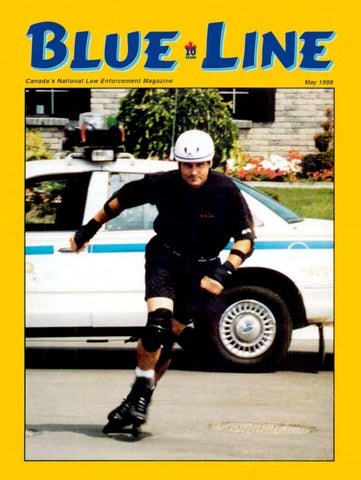
Inside This Issue The First Wave ... Hells Angels target Ontario Putting wheels on safe skating program The Run-down on Police Torch Runs New Horizons: Life after the badge Spot that counterfeit money
..
:
Email: Blueline@Blueline.ca
Find out the latest information about what's new between the covers of Blue Line Magazine, including up-coming articles, main feature story, commentary - past and present, up-coming events, book purchases as well as links to other law enforcement agencies across Canada and around the world. Do you need to know more about some product or service? Tune into Blue Line's web page and get connected to the electronic catalogues of companies and individuals supplying goods and services of particular interest to you. Feedback is more immediate and your letters to the editor can help direct future editorial content of Canada's only independent national magazine directed at the law enforcement profession.
This is another medium by which Blue Line can assist you in fulfilling your mandate to serve and protect.
Volume 10 Number 5
May 1998 - Editor I Publisher -
Morley S. Lymburner
Respollse
5
Officer puts wheels on a safe skating program
6
Prohibited ammunition in Canada
9
Dispatchers keep watchful eye on crooks with video surveillance
12
Montreal Police using technology to ensure safety of officers and prisoners
13
Phone (905) 640-3048 - Fax (905) 640-7547
E-mail: blueline@blueline.ca WEB PAGE: www.BlueLine.ca
- News Editor Blair McQuillan - Contributing Editors Ballistics & Firearms Manfred Benton Survival Tactics Joel Johnston Case Law Gino Arcaro Computers & Technology Tom Rataj - Advertising Mary Lymburner (Director) Phone (905) 640·3048 Fax (905) 640-7547 Don Disher Phone (416) 604-8793 Fax (416) 604·8497
- Illustration Tony MacKinnon Steffon Sepa - Production Del Wall Blair McQuillan General Manager Mary K. Lymburner, M.Ed. - Contributin WriteJsBruce Koffler Robert F. Lunney Blair McQuillan Gillian Cloutier Denise Gosling Jerry Gladman Dave Brown Tracy Ford Jacques Brunelle Janet Tatransky Blue Line Magazme is published monthly, September to June. by Blue Une MagaZIne Incorporated With a mailing address of: 12A - 4981 Hwy.7 East. Ste.254, Markham. Ontario, L3R lNt. Individual magazines are 53.50 each. Subscriptions are 525.00 per year or 540.00 for 2 years. (U.S. & Foreign· S50.00) All articles are protected by copyright No part o!thls publication may be reproduced or transmitted In any form or by any means. etectronlc or mechanical, including photOCOPYing and recording or by any information storage or retneval system without permission from the publisher. Internet activity is monitored and use of material is restricted on the Internet. All matenal submitted for publicallon becomes the property of 8/U8 Line Magazme unless other arrangements have been made with the publisher The authors. advisors and publisher accept no liability whatsoever for any InJunes 10 persons or property resulhng from Ihe application or adoption of any of the procedures, tacllcs or conslderallons presented In thiS magaZIne. Readers are cautioned and adVised that artICles presented herein are edited and supplied for your personal awareness and should not be used for further action until appropnate adVice and guidance is received from a supervisor. Crown Attomey or other person In authonty. Established In 1988. 81ue Lme MagaZIne is an independent publication designed to inform, entertain. educate and upgrade the skills of those Involved in the law enforcement profession. It has no direct control from a law enforcement agency and Its op'nions and articles do not necessarily reflect the opInions of any government, polICe. or law enforcement agency. Blue Line Magazine Is a private venture and as such is not funded by any level of government agency, union or association.
Blue Line Magazine is printed in Canada by Garson Graphic Services Inc.
- AffiliatiollsInternational Association of Law Enforcement Planners Canadian Advertising Rates & Data International Police Association The Canadian Press Newswire Periodical Publishers Exchange
~'
ISSN #0847 8538 Canada Post Canadian Publications Mail Product Sales Agreement No. 176796
g YEAR
May, 1998
Bandwagons by Robert Lunney The Next Big Thing
14
The First Wave 16 Police gearing up to stop Hells Angels attempted expansion into Olltario High powered excitement Sasktel-Ericsson Call-Am Police-Fire Games
19
Provincial Torch Runs
20
Joint Force Operations soar to new heights in Montreal
22
Spot that counterfeit money
24
New Horizons: Life after the Badge
26
Technology by Tom Rataj A closer look at Microsoft's newest Internet browser
28
Classified
30
The Clipboard
31
Tell-seven News
32
Criminally Funny
38
List of Advertisers Barrday Inc. CAPS Inc. Dalhousie University Elmo Canada Ericsson Canada Ltd. Laser Labs Lasik Vision Canada Maritime Services Matte Industries MD CharIton Pads Fitness & Supply Panasonic Canada Pro Carry Systems Pumpuii Energy Products R. Nicholls Distributors Rocky Shoes & Boots Securitech Sales Smith & Wesson Sturm Ruger & Co. Tetragon Tasse Virtual Depot Westervelt College
5
29 35 4
33 27 25 37 19 17
35 8
19,21,23 13 29 40
14 11 15 7
18 27
Warmer weather has arrived and police concerns for pubic safety make their perrennial alterations. With each change in season officers must shirt their concerns from snowmobiles to watercraft, road hockey to trail bikes. Warm weather has its own concerns for Cst. Dan Marshall of the Ontario Provincial Police. When first investigated he found that there was very little information about in - line skate safety. He began researching the issues and came up with a program that encourages safe skating. See more about this officer's award winning safety program and learn how your community can benefit from its use. Inside this issue you wll also find a fourth part in our series on motorcyle gangs and a profile on an ex-cop turned lawyer who has become an expert on motorcycle gang criminal activity. Very insightful reading indeed! With the onset of our heaviest tourist season we have decided to give you some information regarding counterfeit currency and the new safety features incorporated in both Canadian and American currency. The author of this article, Janet Tatransky, also explains some excellent, and relatively inexpensive, technology that can help police agencies in quickly identifying counterfeit currency, credit cards etc. Police agencies and detachments who inform local businesses and residents that they possess such capability would certain ly gain some positive community ou treach. Our annual run-down of a ll the Police Torch-runs across the country is also supplied along with the contact persons from each province so you too can get in vo lved in this worthwhile inititative. This edition also features the second part of a series by Bruce Koffler on the subject of ammunition and the impact by Bill C-68 on them. You will also find material from our regular columnists Robert Lun ney and Tom Rataj.
G"lJ-- - - - - - - - - - - BLU£ L.N£ 0 1 - - - - - - - - - - - - - - - - - - - - - - - - Magazine
•
I I
•
II
... .. . .. .. .. . .. ...
I •
:.....
••• •
•• I
I
I
•
I
...
I
....
•
•
I"
••
I.
... •
• • •
...... • I
......
I I
I
. .
There is an ELMO with the features to match every application. Call Donna, 1-800-363-4059 905 453-7880 Fax 905 453-2391 email: elmo.canada@cimtegratlon.com
ELlWD -visualiZing technology since 1921
RESPONSE
III. JJRoad Rage~~ article right on target
Another front page story and photo in the Toronto papers today, showing the body of a traffic accident victim, and the photo of a vehicle suspected of "running a traffic light", prompts me to respond to your well written article to the March issue of Blue Line. My comment on your "observation", comes from my own experience of just ten years, in the old Traffic Division of the Toronto Police, 19451955. That ten year time on the Police Force, was confined totally to traffic, at a time when accident investigation was becoming a science, and many of us moved from bike patrol , to the flrst accident cars. As one who has now lived in the " heart" of the City for the past ten years or so, and from walking through many familiar intersections, it has been clear to me for several years that motorists are ignoring signals and other regu lations, and they do so with complete impunity. I have to say, that in recent years, I have never seen a car and driver " pulled over" for an intersection infraction. It is probably tiresome, and boring for your officers, and even politicians, to hear the "Old War" stories, of how we had it "on the street" many years ago. But as someone who has had an interest in traffic, both in policing and engineering for a total career, I can only agree with your observation, that part of the problem, and the greatest part, has been the political, and board decisions of the past twenty
years, to almost "abandon" all traffic units, and to engage in what the consultants and bean counters call "constable generalist". When I walk about the downtown area today, I recall very clearly that in those years, '45 to '55, you could find a traffic officer, or beat officer on the corner of almost every major intersection in the city core. As you well know, in those days, if you could not stop the vehicle, you could issue a summons, using only the vehicle license and description. It then became the problem of the registered owner, to settle the fine, or have the driver appear in court, or pay the fine. That system which was in place for fifty years, worked very well, until the province, under pressure by the Law Society, required "driver identity", and thus began the failure in the system of traffic enforcement. Apart from the argument on driver identity, the other major failure in the system of traffic law enforcement, has been the almost total acceptance of management and consultant studies, which among other impacts on policing, have recommended many times, that traffic units be disbanded, and the task of control of motor vehicles, be given the "lowest" priority. The task was passed to Local Divi sions, who all had higher priorities . If the local Toronto politicians are serious about tracing the "failure" of the traffic policing system, they need only look back to the
infamous Hickling & Johnston Consultant Report, which put the nail in the coffin of traffic policing in thi s city. In one fell swoop, that report, adopted Hollus Boluis by the board, almost completely destroyed traffic control, by abandoning all traffic units. To be fair and honest, in successive years, the police brass has done some "tinkering" with the system to correct the errors, but nothing will ever replace the role and function of the traffic cop, on the bi"e or in a cruiser. The current controversy, has the mayor and politicians, arguing for installation of video cameras, at several critical intersections. Of course they are confronted again by the province and law society, who will again argue that the vehicle must be stopped and the driver identified. Personally, I do not see this as the solution , even with video approval. The only way in my judgement, to bring some control to our streets, is the clear presence of the co pper on the bike. Some budget conscious officials will argue that it is not "cost e ffective", but past history, ·eems to prove otherwise. Again, your article and observations are "right on target", and if I had your writing skills and experience, I would pass along your comments to the Mayor and Police Services board.
R. F. Alldersoll, Torollto, OlltariO
YOUR comments are expected
WORLD CLASS PROTECTION AND COMFORT The toughest protection standards (we meet them) . A complete armour line (we pioneered them). Unlimited accessory and custom options (we offer them). As important as these features are, protective apparel in the real world demands one other critical component ... comfort. That's why at Barrday, our engineers and designers place a special emphasis on material selection and fabric weaves so that our products meet your most demanding standards of protection and durability and are comfortable to wear. Day in and day out. Real world comfort that makes Barrday a world class body armour supplier to national and international police and peace keeping forces.
TOP: Barrday Advanced Tactical Armoured Vests (A TA \I) offer maximum flexibility and protection for police and military tactical applications. LEFT: Barrday offers a variety of external carriers for soft body armour including our fundional and popular CLEAN FRONT carrier.
Barrdal__ ADVANCED TEXTILE SOLUTIONS Barrday, Inc., P.O. Box 790, 75 Moorefield Street, Cambridge, ON, Canada N1 R 5W6 Tel: 519-62 1-3620 Fax: 519-621-4123
Officer puts wheels on a safe skating progranJ
by Morley Lymbllmer In line \k.ating ha\ become one 01 the trendiest and fastest "M~· growIng actIvItIes in orth menca. ccordingly the popularity of this mode 01 transportation has become a concern to public s"fely officials for mlUlY years. ne member of the ntario Provi ncial Police, after recognizing a soIUllon to th' problcm, decided to put wheels on hIS own initiative to save lives. on stab I ' Dan Marshall of the Kingston I 't,\(;hm 'nt of the .P.P. developed a handout pamphlct and trallllng ideo, complete with popular musIc played by a local r ck band, as thc ccntr' PICCC for his in-line sk.ating safety program SImply entitled" afe kate". The , k.ate ,a fe program has proved so popular that many agencies across Canada ha\e r'quested the vide and accompanying matcnal. Further recognition was received when Marshall became the recipient of the 1997 ational Police ward for Traffic afety. " In 1995 I decided I should devote more attentIOn to safe 1Il·line \kating," Marshall explains. "Reco 'ni/ing the huge popularity of the sl..atcs III my community I attempted to obtain matenab and any IIll0nnation I could so I cou ld dcllvcr It to area studcnts. I had been skating mysclf for around cight ycars and was both surpmcd and dIscouraged at the lack. of in~ nnation gcared to this activity. I came to realise that more and mm' people were being attracted to this sport with little or no direction ." Marshall gOlto work. researching the issues
~~~~~
involved and the safety concerns of both skaters. pedestrians and motorists. Arter compiling his infonnation and developing a training progmm he then turned his attention to the community to see how the program could be distributed, expanded and financed . Eventually a tri-fold pamphlet was produced and a short video accompanied by an intemctive classroom demonstration . Ten Kingston area elementary school\ were initially targeted as test scho Is for the prototype of the afe kate program. The presentations were delivered in a single day at each of the schools with five presentations each day. Over 5500 students were exposed to the material in a gruelling ten-day period. By listening to feedback the program was refined further and the final presentations were ready for maximum impact and program broadening. During the initial presentations it was found that over 0% of the students owned in-line skates. much smaller percentage had all the proper safety equipment and an even smaller gr up of students wore the equipment on a regu-
lar ba\i\. The mtios of usage of safety equipment ha\ dr..unatically increased since the lecture series and the progmm was deemed a tremendous success by both tea hers and students alike. The afe kate progmm is presently being used by over 16 police agencie\ across anada and is being used and promoted by 20 safety councils and organizations. Marshall points out that a lot of credit for the success of the afe kate program goes to local community groups, companies and indiVIduals who saw the benefits of this initiative and sponsored and supported it in many ways. The video was produced with the help of a local school teacher and three enthusiastic students in the communications technology department. Material and financial support was given by a local anadian Tire store and publicity was received from local radio, television, newspapers and cable companies. A local graphics company and boards of education in the area gave financial and other material support to the program as well. In spite of all this community support the real credit for the afe k.ate program belongs to the individual with the drive and deternlination to investigate. coordinate and initiate the program from concept to completion. Constable Dan Marshall was the person with the vision and dri ve to encourage people to skate safely. pon receiving the ational Police award for Traffic afety la\l year Commissioner Tom O ' Grady stated that Marshall's "personal initiative and contribution to traffic \afety and publi education will have a lasting effect for many young in-line \katers in the future ." r'Of further 1Il10nnallon about
Safe Sk.llc
yOU n1.l) .:a1l613 3H4-2400 or
Fa ... 613 ~X4-24(l.~
____________________________~~~______________________________B_L~!g~!~~
SAf[SKAf[
NATIONAL POLICE AWARD FOR TRAFFIC SAFETY
EQUIPMENT • Wear a CSA approved helmet to prevent head injury. • Buy equipment suitable for age and size of skater • Buy and wear knee pads, elbow pads and wrist guards. • Use equipment that is in good condition and fits properly. • Remember 85% of head injuries can be prevented by the use of an approved helmet.
HOW TO SKATE • Keep your head up. • Skate defensively-look ahead for potential hazards. • Look out for sand, glass, rocks or anything that can jam your wheels. • Don't skate when it is raining or wet. • Try not to skate on grades or curves where vision is restricted. • If you must fall , try to fall onto a grassy area look for an escape route. • Pedestrians always have the right of way. • Always shoulder check and listen for hazards. • Obey the rules of the road, stops signs and traffic lights. • Don't skate after dark. • Don't endanger others by showing off.
The 'Naliolll// Po/ice AWl/I'd for Traffic S'l/fen.' was created through the cooperative erfor! of the Canada Safety Council. Tra ns port Canada and the Canadian Association of Chiefs of Police. It is important to realize that traffic safety has enormous social and financial impacts for all Canadians. Each year, 0\\:1 3300 deaths and over 240,000 injuries n.:sult from traffic related collisions on Canadian roads. Initiatives which will help focus elfOlh in the an:aoftrallic safety will fm,ter long tellll results. The 'Nariolll// Police A~mr£IIor TratJic Sarely', in its Sixth year, \\as created to recognize excellence, dedication and imtiative in the field of traffic safety as demonstrated by enforcement officers across Canada. Much of the work done in this field by these ollicers
remains unrecognized hoth hy the general puhlic as well as hy other enforcement agencies n.rtionally. ThiS i, an opportunity to identify and commend active enforcement personnel for their work in the field of traffic safety. It is al,o a ,'hance to encourage others to heglll new initiatives. or publici/.e those in which thcy are alread) Illvoh·ed. The 'N(/liollal Police I\H'(//d ./f)r rraflic Salen" recoglllzes initiath es which were conceived or are completed during the preceding calendar year. Thcse initiatives could relate to any aspect of tr,lftic ,afet) including management. training or Implementation of education or enforcement programs which would ultlmateh reduce the incidence of death and injury on C~lI1adran mad..,.
TRAINING FOR REAL WORLD
WHERE TO SKATE • Avoid high volume streets, roads or sidewalks. • Busy parking lots can be dangerous. • Don't skate on private property without permission. • Don't skate inside businesses or stores. • Don't dart in and out of laneways and between parked cars. • Use crosswalks at busy intersections. • Skate with a friend , and try to find less travelled bike paths and newly paved streets. • Remember: Check your local bylaws and regulations in your community.
g Matt, 1998 YEAR
ON TARGET WITH THE NEWFX BLUE MARKING CARTRIDGES!
Use them with FX Red Marking cartridges to stage more true-to-life leam scenarios!
On the street... in the field ... in a crisis! Prepare your personnel for the real-life situations they are likely to encounter. Developed with law enforcement and milijary profeSSionals, the FX system is built around non-lethal marking cartndges. It includes easy-Ie-install conversion kits, safety,ring inserts and protective gear.
. . Exclusive Ontario & Western Canada Distributor
. . Tetragon- Tasse
Phone 1-800-38POLICE
Fax 905-828-6390
\1?r- - - - - - - - - - - BLU£ LIN£
Vt--- -- - - - -- - - - - - -- - - - - - Magazine
Prohibited Ammunition In Canada Part 2
by Bruce Koffler In the March 1998 issue of Blue Line, I ended part I with a discussion of prohibited handgun ammunition which is capable of penetrating soft body armour. I mentioned that if commercially-made ammunition with this capability is not available to a person who wants it, he can make it. There are two fairly simple ways to produce projectiles which have an intended purpose of penetrating body armour. It is not mine nor the publisher's wish that the details be explained further and I can describe the methods on an "as needed" basis. The two pictures supplied here depict such devices. Any of these designs are capable of penetrating aramid fabric body armour, depending on velocity, distance of the shooter from the body armour, and the threat level to which the armour is constructed. See figure 1.
.~ CIL~RE PlO'(CTILE! HOIIE ~AJl[ flOW SlEEl BOLT
Figure 1 The regulation does not mention any of the last factors, so theoretically the projectile could be fired at body armour from I inch away (point blank) in a test situation. If it penetrates, it is "capable" under the regulation subsection describing this type of ammunition. Reverting back to commercially manufactured ammunition designed to penetrate body armour, much of the input into this regulation was based on so-called "cop-killer" bullets made by a company in Lorain, Ohio, called KTW. The initials KTW stand for the first letters of the last names of a medical doctor, and two former police officers who owned the company. Their ammunition used projectiles first machined from tungsten carbide steel rod, and later a very hard bronze alloy. The projectiles were coated with green Teflon as a lubricant to reduce the wear on the barrel bore which would otherwise occur with such very hard bullets. The ammunition packages were marked "For police use only", and were not for sale to the public. At the time the ammunition was designed and manufactured, soft body armour had not been invented in its present form. So lhi ammunition does not fit the defi nition of being designed, manufactured or altered so as to be capable of penetrating body armour composed of aramid fibre or similar fabric. Similarly, much of the Second World War Sten Gun 9mm ammunition made in Canada by Defence Industries in 1942 and 1943 was steel jacketed, copper plated and had a hotter than usual powder charge. It is capa-
t
May, 1 998
Figure 2-C
Figure 2-B
The company went bankrupt when one of the principal owners died. It was only after that time that soft body armour came into use. There is no record in the United States or Canada of any police officer ever having been killed by this ammunition, whether or not that officer was wearing body armour. The nickname, "cop-killer bullet" was invented by a U.S. antigun group, publicized in various pieces of U.S . legislation designed to ban these and similar bullets, and was based on fear, not truth. Unfortunately the public did not have the opportunity or access to the expertise needed, to understand the reasons behind the campaign or the fact that they were being mislead. When the Canadian regulations were introduced for justice subcommittee hearings, the term "cop-killer bullet" was also used by Justice Department lawyers who should have known better.
Incendiary Projectiles The next subsection of the regulation deals with any projectile which ignites on impact, by design, manufacture or alteration. In this case, the projectile alone is prohibited, meaning that it may be in the possession of a person, not loaded into a cartridge case. The subsection does say that the projecti Ie must be of a type designed for use with a cartridge, and must not exceed 15mm in diameter. Such projectiles, if designed for use in muzzle-loading (black powder) fireanns are exempt, as by definition, muzzle-loaders do not use cartridges - they use only a powder charge poured in first, followed by a projectile rammed down on top of it. This subsection does not apply to tracer ammunition. Tracers have a projectile containing a chemical compound in an open base. This chemical is generally flame and heat sensitive. When the gun is fired, the propellant powder in the cartridge case produces a hot flame and a lot of pressure. As the pressure pushes the projectile down the barrel, the hot gases in contact with the base ignite the chemical compound, which then glows brightly. This makes the flight path of the projectile (its " trajectory") visible for some distance between the time it leaves the gun muzzle on its way to the target, until it burns out. Usually thi s flame only lasts 2-3 seconds. A secondary effect is that the flaming base of the projectile may ignite flammable material with which it co mes into contact, on the way to the target, or the target itself. This is an unintended feature.
As the regulation states that the projectile must ignite on impact, this is by definition incendiary ammunition, not tracer ammunition. Incendiary ammunition is designed to produce a burst of very hot flame as it strikes a target. If the target contains flammable material, the projectile contents will ignite it. This type of projectile is not burning before impact, and ignition occurs upon impact with the target. Incendiary ammunition is almost exclusively limited to rifle-calibre ammunition and it would be a very rare occurrence to find this in handgun calibre, for use in revolvers or semiauto pistols. This ammunition may be identified by the coloured bands or tip coatings on a projectile. As I mentioned in part I of this article, colour codes in use in different countries have changed over time since the beginning of this century. Some countries also used letter codes on the base (head) of the cartridge case. For instance, British Commonwealth countries for many years used the letter "B" to indicate an incendiary loading. One of the "B" series was actually a type of tracer, using a stepped bullet filled with phosphorous. This bullet had weep holes covered with low-temperature solder, drilled in the side. As the bullet passed through the bore, friction melted the solder and exposed the phosphorous core to the air. Phosphorous ignites in contact with air, leaving a white smoke plume trace behind it on its way to the target. So this bullet is actually a tracer. It was also intended for use against hydrogen-filled balloons. The stepped ridge on the bullet was found to tear a larger hole in the fabric balloon. If the phosphorous was still burning by the time the bullet reached the target, it would ignite the hydrogen gas spilling out through the entrance and exit holes created. This type of bullet was made primarily in the 1930s and 40s, then discontinued. It is a point of debate whether it is a tracer first or an incendiary first. It has an incendiary effect, but it does ignite itself upon impact. It ignites as it leaves the gun barrel. So, understanding how it works leads to its elimination from the net cast by the regulation, even though the British War Office designated it as an incendiary and gave it the "B" designation. See figure 3 A-D. SOtl: .Xl IIlnUl NCODU.RY CARlli:lOG[S AIID PRO.llCTUf$
OIR! BLUE TIP
K\U 81111
Figure 3-A
R"ll!ll~1 II\« Nil
IN!2
( Continued ... )
r g ! f - - - - - - - -- - - - BLU£ LIN£ 0 1 - - - - - - - - - - - - - - - - - - - - - - M a gaz ine
the World War II German B-patrone. The letter "B" stands for Beobachtungsgeschoss ("observation / spotting load"). The projectile was lacquered blac).. from where it entered the cartridge case mouth, half way up to the tip. Crates of this ammunition bear a printed warning notice in German not to drop them. They contain sufficient tetryl explosive and white phosphorous to cause a severe leg wound if dropped. This ammunition is very common and frequently turns up in collections without the owners being aware of the hazards. Also, it has no internal safety mechanisms. The British produced an almost identical projectile, which was produced for a very limited period during 1944, but these appeared to have been experimental only, and not issued to troops. Thus, it is unlikely to turn up in collections. See FigLlre 4.
FigLlre 3-B
1.12 X11MM MAUSER Bl:OBACHTUhGSGESCHOSS PATRONE EXPlO$IYE·INCENOIARY OBSERVATIONLOAD
l"'lf~
I)
,
of- TRACE OF GREE N8m
f$
FigLlre 3-e
IHERBl:SSERn
BU",tlSASU ~ Jl3 BIUTISH IN~E BilliES
FI
H.313 IIIiTISlt CARTRIDGE 11TH AlTERED EXPLOSIVE
aullr
Figure 6 Finally, the regulation prohibits any cartridge capable of being discharged from a shotgun containing projectiles known as nechettes. A flechette is a miniature steel dart, pointed at one end, with four fins at the other e nd . hotshells containing them were developed and issued to . . troops during the Vietnam War. While they are still made by the military, there are also commercial versions of these shotshells sold in the U.S.A. A shell casing may contain 15-20 nechettes, and these arc usually pac)..ed with polystyrene foam chip filler. ee figure 7. ~~~~~~--~-~
Figure 4 Figllre 3-D
Exploding Projectiles The next subsection covers projectiles that arc manufactured, designed or altered to explode upon impact with the target surface. I I)..e the 1I1cendiaries, these projectiles must h' d '''gncd for usc in or in conjunction with a carlnd 'c (u,cd in a cartridge firearm, not in a mUffle loader). PrOjectiles fall within this sub,cction only if they do not exceed 15 mm in diameter. The,e projectiles have a primarily military purpo,e, and most of those made over the years ha\e been of military Issue. Interestingly, this type of hulld is banned by several international cOl1\cntion, on weapons of war, if they arc used to )..ill 1)Cf'>(lI1S Thus, their usc is supposed to be limited to trallllllg Situation" primarily where machille runners arc being trained in proper use of their weapons. While the bullet functions in an explo\lve manner upon impact, it is too small to hlow anything up. If it were to stri)..e a person, It would cause an unnecessarily large \Hllilld ca\ ity, with bullet splinters lodged at the cnd of man)' ,mall WOUI1(J channels. The bullet is a 'tually de,igned to produce an observable pull of ,mo)..e, upon impact, in a training situation 11m allows the gunner to correct his aim. evertheles" it IS manufactured and designed to explode upon impact, and thus falls within tIm section of the regulation. Th' best )..nown of these projectiles was
Ma t/, 1998
everal companies in the U.S .A. have produced both handgun and rine bullets which are designed to explode on impact. The most common is the Velex. The tip of the projectile is drilled out and filled with a small amount of gunpowder. Then a cartridge primer or a .22 calibre blank is inserted upside down into the hole, so its base faces forward. The base strikes first when the bullet hits the target. The primer or blank detonates, and ignites the main powder charge in the bullet cavity. The bullet then explodes into a number of fragments, each with their own wound channel. These projectiles usually have a nat tip, with the inverted primer or .22 blank readily visible. Sometimes, the area around the primer is coated with a coloured lacquer sealant, the most common being yellow or red. See figure 5.
Figure 7 Flechette loads are capable of penetrating body armour. The individual nechettes will each create their own wound channel, and may be diverted by striking bone as they penetrate. Thus they are hard to find and remove by a surgeon. Inert shotshells (no live primer, no live propellant powder) containing nechettes as examples in a collection, and individual nechettes are not prohibited. or are nechette loads contained in rine or handgun ammunition. The prohibition applies only to shotshells capable of being discharged from a shotgun. Inert shotshelb and individual flechettes cannot be discharged from a shotgun, and so fall outside this section.
Markings
lED LACQJER
.31 SPL IElEl EXPLOSJYI BUUET
Figure 5 There are publications available by mail order which illustrate the simple steps anyone can follow to make explosive bulleLs similarto the commercia! variety. Projectiles so altered also faU under this section of the regulation. See figure 6.
8
yUI"'IIIt--"-=:~-OL...;=..::...::.....------------------_\
To recap from Part I of this article, me· tallic safety cartrid ges have been in use around the world for almost 150 years, with every possible type of projectile and cartridge case design. Many early designs, and many rare and experimental versions exist in private collections and in museums today. Some are ulllt(ue and very valuable. Prohibited Weapons Order o. lOis very elear about what types of ammunition arc prohibited from being owned in Canada. By ex elusion, anything not stated in that regulation, as currently worded, is permitted unless some other act or regulation prohibits its posses,ion
LIN£ 10 r - - - - - - - - - - - BLU£ M agazlne .
or use. However, the regulations do not provide the peace officer with any means of identifying the ammunition. Ammunition may bear no special markings. In fact, for about the first 50 years of its manufacture, much of the ammunition produced had no markings on individual cartridges. Any markings were to be found only on the box label. During World War I, a number of different speciali zed military loads were issued, and some thought was given at that time to standardize identification markings for different ammunition, within each producing country. That is, each country had its own standards. With time, many of the markings have worn off the cartridges and their box labels. Over the past 70 years, since that war ended, various manufacturing countries and private commercial manufacturers, have changed the identification codes several times. Thus there are a number of non-standard and standard marking systems on ammuni tion out there, requiring that you know the origin of the ammunition, the era in which it was manufactured, and whether it was military, commercially-made for military contracts (domestic and export), or commerciall y made for civilian use. The systems usually follow one or more (in combination) of the indicators shown in figure 8. See figure 8.
About the Firearms Act and Regulations Most regulations under Bill C-68 will come into effect on October I, 1998, the same time as the Firearms Act and the remaining Criminal Code amendments come into effect.
How This Applies to You If you have a firearm business, you can preregister the firearms in your inventory into the Canadian Fireanns Registration System before October 1, 1998. This will help you to be ready to conduct business as usual on the day the Act comes into effect. On October I, 1998, the Firearms Act and the remaining Criminal Code amendments will come into effect. Licencing and registration both officially begm on October I. If you are a firearm owner, you will need a
firearms licence before January I, 200 I. On January I, 200 I, as well, the regulations and sections of the Act dealing with the export and import of firearms by individuals, i.e. border crossings, will come into effect. You will need a new firearms licence before you register your firearm (or you can still use your valid FAC). You can apply for a licence and to register your firearms at the same time. You will need to register all of your firearms before January 1,2003.
Like More Information? Call toll-free 1-800-731-4000 or get connected on-line through www.BlueLine.ca.
~ o:I.I..(1R£D lAam;R AAOOND
CAf l1l.TDGf CA,<;E 1n"lH IlIDl'Bli.TlCllU 0Dl. :rrv HFIr
WJlll=
'"-
QIW~y.
7"
om~T
Smith&Wesson Where safety is always on duty.
COIDJI
Figure 8
c•. · .....
('_,.15 . '
Bruce Koffler is the President of Secursearch, Inc. in Scarborough. Ontario. His company specializes in producing training aids for hazardous device recognition. including explosives and ammunition. Bruce is an r.A.C. safety training course instructor. has been an Ontario Hunter Safety Education instrudor since 1968. and was a Deputy Consenation Officer with the Ontario Ministry of Natural Resources . He is a member of several associatIOn in Canada. the U.S. and Europe which specialile in the identification of ammunition. and is also a member of the Canadian Society of ForenSIc Science . For further information you may call Bruce at 416
492-5349.
g Mal{,1998 YEAR
As a law enforce ment officer, handgun safety is an issue thai concerns you both in and out of uniform. No one understands you r concerns more than Smit h & Wesson. That's \\-h)' \\-e haH developed a full range of features to provide an added measure of gun handling security. On or off duty, Smith & Wesson helps you make handgun safety your #1 priority.
MA~UAL SAFETYfDECOC KI'iG LEVER
FIRI~G PIN SAFETY
\!AGAZI'iE D1SCON'IECT
When the ~\er is in the do"'n position, the firing pin is shielded from the hammer. Returning the le"er to the up position puLs the pistol in a reod~· to-fire mode. This feature also allow' the hammer to be safely decocked "ithout engaging the trigger.
Posllhely locks the firing pin In place at all times, so the pistol ",ill not fire unle'\S the trillJ!:er is pulled, thus eliminating the possibilities or on accidcntal diSCharge if it '" frc dropped.
When the magazine is removed , the firing mKhan~m ",ill nol operate. Too eliminates the chane or an accident when cleaning or misuse by unauthorized persons even \\-ith a round In the charubfl-.
Can
1-800-331-0852,
Ext. 2904 for more information.
~r______________________________B_L~!g~!~!
Dispatchers keep a watchful eye on crooks with video surveillance program by Blair McQuillan Thieves and violent assailants could rind themselves under the watchful eye of a Montreall olice dispatcher thanks to an innovative new pilot project. In eptember, the Montreal Urban Community Police entered a partnership with seven compa nies including Bell Canada, the Canadian Alarm and Security Association and two alarm agencies, to catch offenders and reduce the number of false alarms through video surveillance. " We have a lot of false alarms here in Montreal," said Andre Bernard , the system manager for the municipal police service. "Those alarms cost us about $ 10 million a year in wasted time." In 1996, Montreal police responded to 75,277 alarm call s. More than 94 per cent of them were false. But Bernard and his partners are hoping to change all of that with the aid of telephone lines, television monitors and video surveillance cameras. The system is simple. Four colour video cameras arc installcd in a bank or other business by an alarm company. When a crime is in progress, an employee presses a panic button and the video images arc sent through the phone lines to a police dispatcher. The actual alarm signal is received by one of the alarm companies. "When the alarm is triggered the picture is sent to our central di spatcher and the alarm is se nt to the alarm company," Bernard said. " Because thi s is a sys tem under trial we want to be sure that the call for help is being heard." nce the di spatcher has a visual link with the site, police on the street can be notified and give n details as the situation unfolds. Bernard said the information will be vital. The dispatcher will be able to tell the officer if the suspect is still at the crime scene, give a description of the assailant and warn the 01'ricer if a weapon is involved. "Often criminals will take the subway and we lose them because we don't have details like what the suspect is wearing," Bernard said. " But iI' the ofricers get a description right away we will be able to respond better and continue the investigation if the suspect flees. " There are currently 10 sites equipped with the video surveillance system, they include eight local banks and two metro subway stations. The partners are hoping to get another two sites hooked up before the pilot project ends in cpt. 1998. The cos t or the project will be divided evenly among all partners at an estimated cost of $ 10,000 each. The Montreal police service is exempt from the cost-sharing process because the rorce is ac tin g as the project manager. "We , upply resources, police dispatch and trainin g," Bernard said.
8Y'Jtt Mmf, 1998
Once the pilot project has run its course Bernard will have to submit a report to the director of the police service. At this time the partners will have to review the program to determine if it has been successful. The partners will look at things like the quality of the technology used, what impact the program has had on the alarm industry and if the initiative was accepted by the general public. "We also want to evaluate the impact on the officers," Bernard said. "What will be the reaction when we give them live information? They are going to have to adjust their procedures and operational way of doing things." The system manager said the police service also wants to know how the dispatchers will handle the new technology. "This is a new way to dispatch information," he said. "How they give an officer information is very important." The legal aspects of the project will be examined as well. The partners want to ensure that the video surveillance evidence will be admissible in court. With the cost of installing and maintaining each system, revenue is another consideration that must be taken into account. " We have to look at our resources ," Bernard said. " Are we still wasting time on false alarms? Are we going to be able to get our money back? These are points under evaluation right now." If the pilot project is deemed a success, the partners will enter the second phase. At that time, the group will expand the program and look for more alarm companies to come on board during a three-year trial run.
The police will also turn more responsibility over to the alarm companies during the second phase. The companies will have to confirm that a crime is being committed before police dispatchers are contacted. No firm plans have been set for the third phase of the program. While the surveillance system has yet to be used in a real incident during the pi lot project, Bernard is optimistic about its impact. "I believe it will reduce the number of false alarms," he said. "We expect there will be more arrests. We also feel that if we promote it criminals will know there 's something going on and maybe that will help deter them." Bernard said that many of the Montreal residents they 've spoken with have thrown their support behind the project. " We have met with citizens and talked about the project. They said they would be more inclined to go to the banks with the surveillance system. They also said they ' d feel more secure knowing the bank is linked with the police. " But the partners don't just see the project as a method of reducing crime in banks and subway stations. "We also want to test small businesses that are frequently robbed," Bernard said. Because the system offers so many advantages, Bernard has found that he has become somewhat of a celebrity. He has had inquiries about the project's effectiveness from police services across Quebec and in the 1I0rthern United States. "Everybody is watching us to see what is going to happen and how the project is going," he said. "Right now things are going very well."
\ 1 2 7 1 - - - - - - - - - - - - BLU£ LIN£ dr~--------------------- M a g azin e
,.------ - - - - -- -- - - - - - -- - - - - - - - -- - - - - -- -- - -- - - - - - - - -- - - ------
Montreal Police using technology to ensure safety of officers and prisoners CCTV technology provides high-quality, reliable surveillance by Gillian Cloutier and Denise Gosling Montreal Urban Community (MUC) police recently began a large-scale project to upgrade all surveillance equipment in their four operation centres and 49 neighbourhood stations. This comprehensive, full-system upgrade of cameras, controllers, VCRs and monitors will improve the surveillance of all internal and extemalmovements of persons by providing full colour resolution images in varying light conditions. All 49 neighbourhood stations have been equipped with Panasonic's latest camera technology, complete with state-of-the-art asphcricallens, AGRT600 videocassette recorder and monitor. For the technically inclined two of the four operational centres are equipped with 40 to 50 of Panasonic 's WVCP4l4 cameras, complete with WVLA-series lenses; a WVCU550 controller, four Cf2084 monitors; a WJ420 quad and three AGRT600 VCRs. The two remaining operational centres will be equipped in similar fashion by late 1998 and early 1999. MUC police committed to an overhaul in their survei ll ance equipment partially to monitor prisoner movements while in the operations centre, and partially to record public access in the reception area of the neighbourhood stations. The MUC police's commitment to safety and security prompted the decision to move toward this equipment. Prior to the installation of Panasonic equipment, the cameras used to monitor cell activity were in a constant state of disrepair; Panasonic's WVCP4l4 camera has virtually eliminated this repair cycle. The colour camera and WVLA408 3P aspherical lens have intro luced several features that are proving to be invaluab le in ensuring police and prisoner safety. The auto-iris e liminates the need for officers to manually adjust the lens according to light conditions; there is no need for a separate power source for the camera, as its 24-volt capacity requires on ly a small cable hook-up; and the footage obtained is of exceptional quality. "\ am impressed by the quality of the timelapse footage captured by the WVCP4l4 camera," said Rhial Masse, an analyst with the MUC police. "It is comparable to normal video recordings, and the detail in the colour shots provides necessary and timely information to the officers." The recording of footage has also been rendered more efficient: MUC police are required to archive footage for three months, therefore, the use of Panasonic's T 130 videocassettes reduces the number of tapes stored. One T 130 videocassette can record from 24 to 40 hours worth of footage, thereby eliminating the need for frequent tape switches, and reducing the likelihood of failure to switch the tape. There were two logistical difficulties faced during the installation: time and camera positioning. "Time was the criti-
8v= Malt, 1998
cal factor in the first operational centre installation," comments Joe Bozzo, sales manager for Panasonic. "We made sure that the centre was up and running within the two week deadline." Police requirements stipulate that a frontal shot of persons entering their facilities must be captured. On very bright days, however, the quality of this type of shot is reduced. To compensate for these shortcomings, Panasonic's cameras were installed on a slight angle. in order to allow for a slightly off-centre shot of people entering the building, while Panasonic's
auto-iris feature enabled quality footage to be captured under bright light conditions. The location of the camera in each cell had to be strategically positioned to capture the entire cell, and the camera housing had to be durable enough to withstand potential damage caused by detainees. Panasonic Canada ' s Video Imaging Systems Department is a leading supplier of closed circuit security systems and products. In 1994, the RCMP used Panasonic Closed Circuit TV (CCTV) systems to monitor activities at the Commonwealth Ganles in Victoria, British Columbia, and in 1996 Panasonic CCTV cameras and monitors were the backbone of the security network surrounding the G7 summit meetings held in Halifax. GIllian Cloulicr, b a ~ysten1\ ~p<=cia"st \\ Ith MI~si~~auga baseu ()\' u~ Communications. lor further de(,li Is call (905) 454-0(HO cxtension I O~. Denise Goslll1g is a communications consultant \\ ith Panasonic Canada and can be contacted at (905) 2~8-226l\.
YOUR HEALTH & FITNESS IS OUR BUSINESS
GET SERIOUS. ...our CR EATINE speaks for itself • 100% Guaranteed • Affordable and highly effective nutritional supplement • Canadian Product, Canadian Company and Canadian Standards Toll Free 1-800-665-0802 Fax (807) 346-1244 email: pumpuii@tbaytel.net
LAW ENFORCEMENT DISCOUNT - 15%
~~
_____________________________B_L~!g~!~!
----
BANDWAGONS
The Next Big Thing by Robert F. Lunney One year ago a colleague in policing a\J..ed me what I thought would be "The ext Big Thill .". What he meant wa\ what would be the n 'xt dcmarcUlion POlllt in the evolution of public policing. s a frame of reference, perhaps we could accept that the defining eras in police Imtory dating from the time of ir Robert Peel are : The Traditional era epitomi7ed by the wat 'hman \tyle; the Professional model which h 'gan cOincidental with mobile patrol and radio communication; and then ommunity PoIU': lng, commencing about 20 years ago. If ommunlty Policing b the new orthodoxy, what will he the prevailing theme of the era to follow : Till' Nell Big Tllillg .
Polling for Answers Intriguing que\tion, and when I had no easy answer, I went about casually a\J..lng the opinion of others. ne well-J..nown anadian ommunity Policing authority told me thUllt wa\ a silly question ." ommunity PoliCing is the essence of public scnlce. The future lies in refinement; wnrJ..IIl' with the community and expanding the component clements of Partnership, Prohlem , 01\ In' , Empowerment and Ownership." Mo\t actl,e police officers were of the same mind, although almost everyone had a different slant on pnorltles and the future innuence of public policy deCISions. few were unprepared to accept om-
FRAUD
Conterf811 - Forgery Detection & PreventIOn
munity Policing as a legitimate successor to the Professional era, and prefer to believe that crime fighting alone and traditional responses to the maintenance of public order are the path of true virtue. A Dijferent Direction I put the same question of my American associates. The more progressive replied that in the next era of law enforcement Community Policing would expand its activities in the field of Crime Prevention through ocial Policy. urrently, at least by anadian standards, U Law Enforcement is awash in money. Their Federal Government has provided the COP program, which is funding 100,000 new police officers for front line service. Cities like New York are expanding their Police Departments still further. Major funding for special projects is available from a wide variety of government and private grant programs, and the police are taking a strategic role in expanded partnership to reduce crime and disorder. As example, initiatives in the schools that extend to coaching and mentoring, participation in early childhood development programs, and campaigns for tobacco free kids. At a recent meeting of the Commission on Accreditation for Law Enforcement Agencies (CALEA), one of the exemplary programs introduced by a police department involved partner hip in a pre-natal program offered to prospective mothers in disadvantaged neighbourhood . These programs extend upwards into the realm of social engineering, almost an impossible dream in the anadian context of budget re~.traint and load shedding. The ext Big Thing for our neighbours to the s uth may be quite different than for anada.
Outside the Box
We offer the following: Counterfeit detectIOn products for Canadian , US and Foreign currencies. 10 2000™ scanner to verify credit card , cheques, passports & other negotlabte documents. Ultra violet markers (for marking money & merchandise) & U.v lamps. Thief detection products (powders, sprays) . Training manuals & CON made Videos on shoptheft & internal loss prevention. Training seminars on counterfeit & shoptheft prevention
Essential for both police and the b usin ess community
SALPS
0
800 Steeles Ave West Unit 910-143 Thornhill , ON L4J 7L2
ARlO) ITO
Phn . (416) 226-5858 FAX (416) 226-5558
The art of futures thinking lies in projecting trends from known facts, whether emerging, obvious, or obscure, although individuals and organizations often refuse to recognize the signs of change when they don't fit within a comfortable frame of reference, or a pattern of desired outcomes. Still, contemporary notions about creativity encourage us to think "outside the box" for \olutions, and to open our minds to the unthinkable and the unspeakable. 0 here goes: I believe I recognize the ext Big Thing. I don't like it and neither will most of my readers. The next big thing in policing is Privatization.
Why Privatization Anyone who follows current evenb recognizes that since the 1980's the economic policies of the most advanced and developed nations have favoured fiscal responsibility, more freedom for private enterprise, and the withdrawal of government from many activities where once it maintained a monopoly or controlling pre ence. Impelled by a strategy of deficit reduction, our Federal Government has contained spending by redu ing grants to the provinces, vacating some fields and curtailing its activity in others. Most provinces, with varying speed and enthusiasm, have followed suit with cut backs, deregu lation, privatization and other
efficiency measures. Municipalities have been forced by down I ading tactics to adapt to these new realities. onsequently, in the rea lm of public policy, economic intere ts have ascendancy over ocial interests; efficiency and economy have reign over effectiveness; and quality service is in temporary eclipse. ome people applaud these initiatives as reducing waste or unnecessary spending in the public sector, and ultimately prom ting the greater good of society. painful proces , but necessary, and learning to live within our means. Others condemn the withdrawal of services and the changes to service level. and standards, and forecast economic and social dysfunction. Whatever the opinion or interest it is clear that all levels of government in anada today must commit to cost control and efficiency. And based on electoral results, this seems to be supported by the majority of the public . The movement is global and unstoppable. While Health Care, Education and ocial ervices have taken the brunt of re-structuring to this point it will not be long before this agenda reaches down to the next tier of public spending, and in that grouping is Justice.
The Business of Policing According to the latest available statistics, Canadians spend over 9.5 billion annually for the provision of Justice. Policing costs arc in the neighbourhood of 5.7 billion, or about 60CK of the total. When government cost cullers lift the lid on Justice, policing costs will come under increasing pressure. The battle over changes in the first tier of public pending has been noisy and public, but policy strategists learn by experience. When major re tructuring strategies arc applied to Police, it is likely that the changes will beubtle, silent and effective. For If the battle o,er Health are and Education has been conducted in the street, then the Police may be mugged in the back alley. It may be all over before the public notices, or if they do notice, before they care enough to protest. Those changes are ill ready underway. The prologue has been pending restraint, wage freezes, amalgamations and competitive contracting exercises pitting one organization against another. The real challenge to public policing will come from contrasting a business approach against a service orientation. It may be an unequal contest if the criteria is limited to cost efficiency. At issue is the long-tenm survival of public policing as an institution. If you think the position of police executive leadership and union solidarity is unassailable and that the police have a penmanent monopoly on public safety, consider the near destruction of the nursing profes\ion during the restructuring of Health are, or the privatization of air traffic controller\. And renect on the fact that people employed in private security today already outnumber police by three to one and c unting. The day of reckoning may be closer than any of us would like to believe. l\c:\t \)onth: The Shapc of the Challenge and a Formula for Suni\al
Q I - - - - - - - - - - - - BLUE LINE
~~~~~~~____________________________________~~r------------------------------------------ ~agazina
M ENT Ruger)s Answer to Your Professional Needs - The compact, lightweight autoloading Mini-14 Government Model rifles have heat-treated chrome-moly or stainless-steel alloys throughout the mechanism to give reliability under adverse operating conditions. Available in .223 caliber (5.56mm ATO).
[' !.3iaig;Ubijil:ii"·'iW[ -: Chambered in caliber 5.56mm, and available in blued or matte stainless-steel finishes, fixed or folding tock configurations. Built to deliver durable and dependable functioning under adverse field conditions.
[I . it i alla a,c.", :h§i I[ The carbine is a tough, reliable shoulder arm which is user friendly and costeffective enough to place in every police car. Available in 9x19mm and .40 Auto calibers, the magazines are interchangeable with the Ruger PSeries pistols.
T his high-tech 9x19mm pistol has an injection-molded one-piece gripframe tructufe of uper strong polyurethane material. The result is a tested sidearm that will continue to defi ne pistol construction for decades.
This compact 9x19mm submachine gtm features a telescoping folding stock and a three-position safety / selector lever. Firing from a closed bolt, in a semi- or full-automatic mode, it is highly accurate and dependable.
Ruger's tactical firearms offer exceptional value and certain models* are exclusively manufactured for official use. For additional information on Ruger service firearms and your nearest law enforcement dealer and representative, write or telephone: Sturm, Ruger & Company, 134 Old Post Road, Southport, CT, U.S.A., 06490 (203) 259-4537
-------------------------------------------------------------------------~
The First Wave Police are gearing up to stop a most notorious biker gang that has targeted Ontario as its next conquest By J erry Gladmall with perminloll The Tur(JIIIO S""
Police agencies across Ontario are forming a special joint task force to slow down the dreaded Hells Angels' expansion into the province, which could lead to the kind of bloodshed that framed Quebec's vicious biker wars in recent years. Ithough still in the planning stages and with few details available, the elite force, say police sources, is the only way to keep the Angels from gaining a complete stranglehold on ntario's lucrative drug and prostitution trade. It would also forestall violent confrontations with already-established biker gangs. The new squad - using officers from the more than 40 police agencies that arc part of the riminal Intclligcnce Service of Ontario ( I ) - could be up and running within the next few months. "We will put together a coordinated operational effort," confirmed Julian Fantino, London Police chief and chairman of the National tratcgy on utlaw Bikers. "The fear of a repeat here of what happened in Quebec is more thanjustificd. But wc're optimistic that all leve!<' of government will participate and help out." Fantino added that Ontario Solicitor Gencral Bob Runciman has already "expressed a commitmcnt to support our initiatives." Most anti-biJ..er experts warn that Ontario - Toronto in particular - could very easily be thc next battleground for an all out biker war. "The gangs in Quebcc fought back vigorously and thcre was much bloodshed," says Dct. onst. Joc Dorricott of CISO. "There are 500 gang members in Ontario and not all of them want to be Hells Angels. That mcans it could happen hcre the same as in Quehec. 0 we have to take a pro-active stance to avoid that kind of violence. Quehec ha\ been the main battleground for hiJ..er violence for the last five years, beginning as a turf clash hetween the Angels and the Rock Machine for control of Montreal's lucrative drug tradc and developing into an all-out war with numcrous car bombings and shootings that sent the body count s aring to 60. But it wasn't until an II-year-old boy was J..illcd in 1995 by shrapnel from a bomb exploding under a car that public outrage led to police estahlishing a special task force. They werc ahle to curtail some of the violence, but the hi J..cr wars turned another corner last year when two prison guards were shot to death. Police have known for some time that the Angels have had their sights set on Ontario. Ithough well ensconced in almost every other
~ M a l/, 1998
YEA':
province, the true go lden goose in numerous criminal activities resides here. "The Angels don't have a clubhouse here yet, but they are making inroads," says Det.Supt. Dave Crane, in charge of intelligence at Provincial Police headquarters in Orillia. "They don't operate in large numbers. That way there aren't as many people to share in the profits. They have others doing their crimina l endeavours for them." Dorricott says this back-door method of operations has been the key to their expansion across the country. "They become entrenched by using associates. It's like establishing a beachhead. They send in their commandos ahead of the main force. They know where to slice into the soft underbelly. It's like an invasion. The big guys will follow." The commandos are actually an Elite Ange ls strike force called the Nomads, which grew out of prev iously fa iled attempts to cross the border from Q uebec. In 1994 a strong contingent was intercepted by police hiding on a concession road. "J think they got a rude awakening when we stopped their first invasion," says Jimmy Lee, a former biker e>..pelt with Toronto and now a practising lawyer and security specialist. "They tried a couple of times after that with smaller numbers, but were also turned back. Now they are doing it more insidiously. They've picked up their intelligence 100 fold with equipment the likes of which we've never seen." [t was the first time the Angels flexed their muscles in Ontario. Even though they were thwarted, some gang members began wearing a patch that has the CN Tower, a grinning Ange ls sku ll and the words "Hells Ange ls Ontario, the first wave." Recently, the Angels have been shopping in Toronto for an ally and eventually found one in the Para-Dice Riders. But there are at least seven other gangs in the Greater Toronto Area, including Satan's Choice, The Vagabonds, The Loners and The Outlaws. Police don't expect
them to roll over and fold for the Angels. Lee sees some violence, but not at the level seen in Quebec. "1 don't believe Toronto will tolerate it. There will be some, maybe the murder of a couple of bikers, and all hell will break loose. The police and public will take a harder stance here." But he admits it will merely slow them down. "They'll just find other ways to get established. Taking care of business is the bottom line. Hells Angels are the most violent and richest dub in the world. There is just too much money here." [n 1995, Toronto had a small taste of the potential violence with a half-dozen bombings, three shootings and a rocket launcher attack. Meanwhile, local gangs, expecting the Angels' expansion, have been on a recruitment drive for years, Lee says. "Most have doub led in size. But not just guys -young, tough guys in their 20s. And they are heavily armed - much beller than the police." Estimates from police sources say the gang's activities cost the country well over $1 billion in law enforcement efforts, court costs, prisons and the bikers' illegal activities, particularly drugs and prostitution. "We are not fighting street gangs," says Sgt. Jean Paul Levesque, national coordinator of Outlaw Motorcycle Gangs for the Criminal Intelligence Service of Canada. "These are trans-national organized crime groups that are very well entrenched, well organized and wellstructured. And their potential for violence is very well documented. That's how they've gotten so successful - through ten·or." Levesque added th'lt while they don't want attention from the public or the police, they'll risk it to achieve their means. That's why, warns Fantino, only a conceited, pro-active effort will make any difference. "We had quite a focus in Ontario in the past, but we lost some of the momentum. But these guys are a very formidable challenge. They want for nothing. For all their outlaw activity, they are very shrewd business people."
\ 1 6 ? 1 - - - - - - - - - - - - BLUE LINE D~---------------------- Magazine
Badge to briefcase ex-cop fears Toronto biker war by J erry Gladman wit" pcrmissioll from Tile Torol/to Sun
When the biker war breaks out in Toronto - and he believes it 's inevitable - Jimmy Lee would like to be front and centre on the battlefield. Which is kind of ironic, considering that Lee, a biker expelt TiIllIll1! Lee for most of his years as a Toronto cop, is no longer on the force. Now a practising lawyer, he's also a senior investigator with Intelysis, a new Canadian investigati ve research firm. But the colourful, stillbearded Lee, who turned in his shield for a stylish sui t and fancy downtown digs last month, says he'd be there in a heartbeat. "I sti ll have a very big interest investigating organi zed crime involving bikers," says Lee, 45, a father of four, including Ryan, 17, a top OHA Junior A prospect. "When they come in, I really don't want to be on the sidelines. I'd like to be involved both from an investigative and legal standpoint. When they start arresti ng these Hells Angels, you can bet (the Angels) will have the best lawyers money can buy." Lee says the years he worked the bikers were the most enjoyable of his career. But not just as a copper investigating and busting bad guys. Lee was one of them. As a member of the drug squad, he worked exclusively undercover with the bikers for more than five action-packed, often scary years. "I worked right across the province. I was beaten, pistol-whipped, robbed at gunpoint in a rip-off and once had a gun pointed at me all the time we negotiated a drug deal. You gotta have balls to work undercover, but more important is mental toughness because so many different situations present themselves." And even though he admits there is a lot more return on investigating a complicated fraud than slicking hi s way through a biker drug deal , he misses those wild days. "The danger, the challenge, the juices flowing, the ability to deal with criminals on their own turf and to do it in a successfu l manner." Yet he would have stayed on the force if the brass had asked him . "I got my law degree to enhance the kind of work I was doing on investigations. I figured it would have been a real bonus. But there was absolutely no incentive coming from the top. one. So I left - 26 years to the day I first signed on." Expert witness Back then , all the Dublin-born , Torontoraised Lee wanted to be was a cop. He started out in uniform at 52 Division, joined the drug squad where he was promoted to sergeant and concentrated on investigating bikers and their dealings in chemical drugs. He quickly became an expert on both and, in fact, would later be called to court more than 100 times as an expert witness. After working several high-profile deals in dl1Jgs, including a $50-mi llion hash bust at Toronto International Airpolt, he took over the biker enforcement unit, which was really just an offshoot of his dl1Jg years. "But I found myself getting more involved in complex investigations where J had dealings
g YUR
May, 1998
with the justice people and Crown attorneys. It was extremely interesting to follow each case through. It just seemed like a natural next step to get my law degree." Not to the guys who worked with him , though. They knew Jimmy Lee as a great supervisor, but a wild and woolly character all the same. To a man, they figured he'd be the last dude to crack open the law books. "Burning the midnight oil studying was very difficult at first. But J persevered and five years later was called to the bar. But it was a bit of a letdown because I thought, with 26 years experience and a law degree, they could utilize me properly. ope." The guys in the know figure the force is the loser because few people know bikers like Jimmy Lee. He still has a lot of contacts and some of the bad guys admit a grudging respect for him as a guy who always played hardball- but fair hardball. He sure fooled a lot of people for a long time. In particular a doctor who saw this scruffy thug sitting at a bar one day unwinding. Thinking he was a biker, the doctor offered him money to kill a lawyer who owed him from a business transaction. "At first he only wanted the guy's legs broken. Then he decided I should kill him. It's lucky he came to me and not some real killer. But I still haven't figured out why he only got 18 months." Most violent in world Lee crossed paths with a lot of bad characters and a lot of colourful ones. Guys like Fatty
t~~~.ljt~~ ...
Lexon ~ Lens
High Pressure Pin lamp lamp Adjuster Assembly
Foamed Vinyl Grip
Ba"ery Tube
8
Each ASP Tac-Lite is precision ' machined from high strength aerospace aluminum. Bright dip industrial anodizing is accented by an extremely durable foamed vinyl grip. The leak proof Lithium power cells provide one hour of continuous run time with a ten year shelf life. Replaceable, high pressure pin lamps have an integral shock isolation system. The selfcontained Parabolic Reflector Assembly is metalized and gasket sealed. Adjustable from a soft flood to a penetrating beam of incredible brightness.
Parabalic Reflector
Lamp Shock Absorber
Terrell, who once fell through the floor of his clubhouse, and Dougie Hoyle, a tough mug who once ordered out for pizza (as Sgt. Hoyle) while Lee was arresting him. "Hey, Jimmy, if I'm goi n' in, I gotta eat first," Hoyle told him. "But there are bikers and then there are the Hells Angels," says Lee in a sombre tone. "They are vile people - the most violent, richest bikers in the world." He recounts how a U.S. Hells Angels chapter dealt with a suspected informant. "His wife answered the door one day and there was this package. They had cut off his head, arms and legs and bumed their insignia on his torso. And that was without any proof he was an informer." He said most Canadian bike gangs aren ' t in that league. "Except for the Quebec Hells Angels . They've adopted that vicious mentality. That's the breed destined for this province." However, all that appears to be in his past now. Instead of donning his grungy biker gear and assuming a phony persona, he now wraps his expertise around global investigations into corporate mergers, compute r fraud s and embezzlements. But should the biker wars come and the bullets start flying and the bombs exploding, Jimmy Lee sure hopes somebody remembers a bearded lawyer fella who just might have a little something to offer - something that could make a difference. "All it would take is a phone call," he says.
EadL Tac-Lite. ..
O-Ring Seal (omputer Micro Switch
• 5x Brighter than other Mini-lights • Soft01Wh TIl
O-Ring Sealed (over
Computer Micro Switch • Reliable Circuit Board Technology • Limited Lifetime llarranty Phone: 250 652-5266 Fax: 250 652-4700
, M.D.CHARLTDHCD.LTD.
East Phone: 519 942-9235 Fax: 519-942-9246 Prairies: 306 549-4602 Fax: 306 549-4663 .
~~
BOX 153, BRENTWOOD BAY, B.C. V8M 1R3
______________________________B_L~!g~!~~
PostScript
III. An open letter to Deputy Sheriff John R. Smith
by Dave Brown 1am glad you are taking the time and effort to research the issue of semi-autos versus revol vers as seen by your concerns recorded in the March edition of Blue Line. As a proressional firearms instructor, 1 would just like to add my own views on the topic. While T would hesitate to state that revolvers are inherently dangerous, per se (I train public and private organizations on both); there is no questi n that revolvers can be less safe than semi-automatics in certain circumstances. Given the unpredictable nature of the average sudden confrontation, this is a hugely important factor in officer survival. I would like to examine arguments, both ror and against semi-autos, and then look at which ones arc really important in the real world. I) Revolvers are more reliable than semi-automatics. orry. With quality ammunition, the modern semi-auto as made by the major law enforcement manufacturers is as reliable as any revolver. As an experienced competitive shooter, I have likely fired more than 200,000 rounds in my life. I have had far more jams with a revolver than any of my semi-autos. The revolver is absolutely intolerant of the slightest bit of debris under the ejector star, and one tiny nake of powder in this area is
enough to shut it down completely. 2) Semi-automatics are better because they hold more rounds than revolvers. 3) On the other hand, they may hold more rounds but the vast majority of officer-involved shootings happen with less than 2 or 3 shots fired. Therefore, there is no advantage to 6 versus 16. This is, in fact, the strongest case for the semiautomatic. In the real world, where the officer is confronted by a total ly unexpected situation, they are already behind the action-reaction curve. Now take the average officer who was trained months ago. Sure, they really meant to get out to the range and practice, but it never seemed to happen. When confronted by such a situation, the subconscious mind takes over. If the officer is shooting a revolver, the mind may readily fire the first shot, but there is an enormous reluctance to fire subsequent shots. If the officer fires two, they will then be subconsciously reluctant to fire a third. The mind knows that three shots will exhaust half the ammunition supply. The subconscious mind is very much aware of how difficult it is to reload the revolver under stress, and the fact that the officer probably did not get out to the range to practice as much as they should have. This psychological "freeze" may be just enough time for the officer to lose the fight. It is a sad fact but, given a totally equal fight on the street, with the bad guy just as good as the good guy, the officer always loses. This is simply because the officer must react to another's actions. They also have rules of engagement to govern their behav-
Are you logistically challenged? Give us a call! Virtual Depot is in the business of finding buyers and sellers of surplus law enforcement equipment. If your agency has excess equipment,
goods or supplies -
or not quite enough
simply give us a call . ..
.. . We'll do the rest!
Phone 905 833·4654 - Fax 905 833·8385 ~ M a l" 1998 YEAR
iour. The bad guys don't. In a society where the bad guy may be high on anything, or have a strongly reinforced survival instinct, a single shot may not be enough to stop the assailant. Even in a one-shot gunfight, the semi-auto provides a comfortable margin of self-confidence at a time where it is critical that the officer gain every tiny advantage possible. 4) Revolvers/semi-automatics (choose one) are more prone to accidental discharges. This is, of course, a training issue, not a gun issue. The sad fact is that the officer who is likely to cock the hammer on a revolver and have their finger ins ide the trigger guard before they have made the decision to fire, is also just as likely to have a negligent discharge with a semi-automatic. Any officer who has not developed the trigger finger discipline necessary to handle either firearm is a huge liabi lity time bomb; poised to explode at any moment. They must be corrected or removed immediately! 5) Revolvers are slower to reload. Not only are they slower to reload, but they are also deadly dangerous in a situation in which a reload must be accomplished in order to stay alive. A good revolver shooter should be able to go from empty to loaded in less than 3 seconds on the range. A good semiautomatic shooter could accomplish the same task in half that time. So what's the big deal? Simple. In a real situation on the street, the stress involved has eliminated blood flow to the extremities and one of the first things to go is the feeling in the fingers and, thus, all fine motor skills. The revolver relies on fine motor skills to accomplish a reload. The semi-automatic doesn't. This means that in a real situation, the average officer would be very lucky to be able to reload a revolver in under a minute. Add the loss of manipulation skills from the stress, and the violent shaking as a symptom of adrenaline dump, and you have another tragic funeral. Even in such a highly stressed environment, the average officer can reload a semi-automatic in 3 or 4 seconds. These are my views on the advantages of semiautomatics versus revolvers. Forget "greater firepower." Sell semi-automatics as a significant psychological and physiological advantage; right at that critical time when officers are most disadvantaged. However, I should caution you to not accept anything I say here at face value. There is no point contributing more to the "blissfully ignorant" as Morley so rightly puts it. Test it for yourself. Get some average officers on the range with both types of guns. Add some stress that they are not expecting. (Use reactive targets that require a vital area hit before they go down; dim the lights; perhaps set off a small smoke canister; have someone yelling at them at the top of their lungs; and put them under the pressures of a time limit.) Test it for yourself. It will become immediately apparent that semi-automatics have a huge advantage in certain situations. Please keep us informed as to the results and feel free to contact any of us at Blue Line again. Good luck! Dave Brown is the Firearm s Trainin g Editor for Blue Line Magazine . He may be contacted at 204 488-07 14.
G8?1 - - - - - - - - - - - - - BLUE LINE V l - - - - - - - - - - - - - - - - - - - - - - - Magazine
High powered excitell1ent A poster beari ng enjoy an afternoon in that promise decorates beauti ful Wascana the wall in the office of Park. Saskatchewan, th e 1998 SaskTel recognized as one of North America's preEricsson Can-Am Poli ce-F ire Games in mier destinations for Regina, Saskatchewan. fishing, hunting, canoeing, and wilderness As plans come together trips, has much to offer for this year,s Games, the wa ll s and noor that its visitors, besides the encompass this downexcitement of the town office are quickly Games. filling with merchan"When I particidise, volunteers and ... pated in the past pohigh-powered excitelice and fire games, I ment. was looking for a high Organizers expect level of competition thousands of people from and an equally satisfyacross orth America to ing blend offun," says Curtis Kemp, Execuconverge on the prairie c ity during the course of POL leE • F I tive Director of the GAM S the Games, June 22 to '98 Can-Am Games. 28, 1998. The last time Regina hosted a sports "We are working hard to ensure we produce extravaganza of this kind, visitors boasted of that combination at the 1998 Games." the best party ever. More importantly, the anAs Kemp sorts through a box of souvenirs, Am Games compare to Grey Cup '95 in another he reiterates that thought, "The athletic is only one component of the Can-Am Games - the fun way - recognizing sporting excellence. and camaraderie among law enforcement and Participants will compete in over 50 medal fire service agencies are equally important." event at the Police-Fire Games, including shootin g sports, powerlifting, volleyball, swimThe Games wi II also benefi t the local comming, track and field, and endurance testing munity, as profits will be placed in trust for Uus t to name a few). The Games are dethe Regina Fire Fighters Burn Unit and Sassigned for members of various forces, includkatchewan Special Olympics. This promises a ing vo lunteer fire fighters, conservation officguaranteed great time for a great causc. Plan ers, sworn police officers, and their spouses. now to be part of an event dedicated to the Many of the events will take place at the physical excellence and positive public prorenowned R MP Training Academy, which file of police and fire protection services include state-of-the-art driving and shooting throughout orth America. Plan to be part of facilities, Olympic-size pool and physical trainan Olympic-calibre opportunity to experience ing centre. As part of their 125th Anniversary and challenge your skills and physical capaccelebration, the Mounties promise to add to the ity among the forces. entertainment with their internationally-recogHelp us push the limits at the 1998 SaskTel-Ericsson Can-Am Police-Fire Games. nized Musical Ride and Sunset Ceremonies. Entertilinment is definitely a priority on the list of essentials for this particular group of rFor more information, contact the SaskTelgani zers. Barbecues, dances, and the famous Erics~on Can-Am Police Fire Game~ Guns Hoses Lounge are among the growing Office: Toll Free 1-888-CANAM98 (229list of activities open to athletes, their families, 2698) r-AX: (306) 777 659R EMail: and the public. While in the heart of Regina, canamgam98@logicallllll-... corn Wen Site: participants and their guests may want to try their http://www.canamgamcs.com luck at Saskatchewan's grand Casino Regina or
e
Finally... Pens that truly p erform! Writes upside down, in extreme temperatures, underwater, on carbon less paper, over grease and fingerprints .... 4her\ ..s-~cyE.tlI.
1-888-772-2350 Fax: (416) 696-0236
Matte Industrie s Inc. •••
~ Mat" 1998 YUR
spacepen@matte.ca
Ask about our Space Pen catalogue!
G9?~----------- 8LUE LINE 0 f - - - - - - - - - - - - - - - - - - - - - - - Magazin e
by Tracy Ford I he l .aw
nforcement Torch Run for pccia I Olymplc~ i~ unprecedented in the history of Imv enforcement. 0 other project or event 11<IS '~er united all a. pe ts of law enforccmcnt In wch a way. Thc honding of the law enforccment offlc r and the pccial Iympics th lete has touched the hearts of communities around the world. oundcd in 1968 by anallian Professor, Dr. Frank Haydcn, pecial Ol ympics IS the world's largcst program of yearround SpOilS trainin g and competition for ath-
letes with a mental disability. Thc Law Enforcement Torch Run began in 19 I under the direction of a Wichita, Kansas Police Chief, with the goal of raising money for and awareness of pecial Olympics. By 19 7 and endorsed by the International Association of hiefs of Police, every state in the .S. and ten other countries including anada held individual Torch Run events. The annual International Law Enforcement Torch Run Training onference was held in Portland, Oregon in ovember 1997, attract-
ing both representatives of law enforcement and pecial Olympics from around the world. The highlight of the conference WllS the wards Banquet. ach year, three to five individuals are inducted into the Hall of Fame. ergeant Peter Mcllarg (Hami Iton-Went worth Regional Police, Ontario) was one of the 1997 inductees! Ontario was awarded with the Top Grossing Fundraising Program in the world, while ewfoundlanu was Top Per Capita Fundraising Program, with Ontario second and Saskatchewan in fourth place. The Torch Run Final Leg is a symbol of law enforcement's dedication to the coura geou~ athletes of pecial Olympic~ . or 1998. the Final Leg will become part of Opening er emonies for the anadian pecial Olympics 199 ummer Game. in udbury, Ontario, July 7-12th. These Games will bring together 1200 athletes and coaches from all across Canada to compcte in eight sports; athletics, aquatics, 5-pin bowling, 10-pin bowling, powerlifting, rhythmic gymnastics, soccer and softball. These Games are co-chaired by Retired Ontario Provincial Police ergeant Dan Lee.
1998 Provincial Torch Runs British Columbia Phd roshr-Jolles. JII.Hiee 1/l.ltitLlle of B. . at 60-1-5285779 Runs will takc place throug houtthc province from May to eptemher. The main e~ent will he a four day run through th' I'rasel alley into Vancouver with th' I lIlall .eg on June 27th into at Bailey ta Ulllin 101 the Sp.:cial Olympics elehrity Ba~e hall ,amI.' FundralSlIlg goa l is 200,000.
Alberta Jot/ie Yllrelll cllllk, RCMP " 1\ " Dili.lioll at 403-4125353 PundralSlIlg goal is to exceed last year's tOlal of 93,400 Participating in the Torch Run arc representative~ from algary Police ervice. ['dnlllnton Police e~ ICC, R MP, Lethbridge Pollc' S '1"\ ICC, Medi cin > Ilat Police ervice and 1i1llar~ Police. Increased fundraising is a ma.1m 'oal In order to send Team lherta to the allonal Summer ames. Final Leg will take pl'lcc on June 20 as part of the Team Albelta Trainill' amp held III Ids June 19 21. Plans includ' runs from algary and Red Deer.
Saskatchewan 1'1:~eallt lar!.. Me leI/a lid. f...lte\·(l/l Police en'ice at 306634-1767 Fundmising goal is to exceed last year's total of 104,000. Celebrating year '---~--~-- numocr II , approximately 800 law enforcement pcf',onnel will cover 1500 km. With th' hnal Leg l() take place on June 5th into pcnlllg eremonles of the provincial ames in ,Win ' um:nl. n excitlllg fundraiser hllS heen d 'v 'Iopcu 7 local pilots will conduct 30 minute
air tours of the City of Estevan and surrounding area with proceeds to the Torch Run.
Manitoba Illspector AI Camll. Winnipeg Police en'ice at 204-9866203 Fundraising goal is to exceed last year's total. The Torch Run will take place on June 19th with the Final Leg to end at the Winnipeg !adium which will coincide with the Opening Ceremonies of the Winnipeg Goldeyes Baseball Game. All 150 runners expected will wear a pecial Edition Tshirt and receive a Torch Run pin. The primary fundraising vehiclc for 1998 is a Manitoba Torch Run Thank You Gift eltificate Book, which includes over $300 value merchandise, a Torch Run T-shirt - stockcd, distributed and sold by Mark \ Work Wearhouse. This should generate a profit of 55,000.
Ontario COilS table Lome White. Metropolitall Toronto Police at 416-200-0846 The official "Kick-ofr' for the ntario Law Enforcement Torch Run will take place at the Opening eremonies of the provincial pring Games in Oakville on May 7th. Law enforcement runners will criss-cross the province during the end of May into June. The two northern run s will take place end of June and join the Final Leg run on July 7th at the Opening Ceremonies of anadian pecialOlympics 1998 ummer Games in udbury. nder the direction of the Ontario Association of Chiefs of Police. the 12th annual Torch Run will cover 8,000 km by over 8,000 law enforccment personnel. Fundraising goa l is to surpass last
year\ total of 1.5 million, of which 750,000 was raised in support of the 1997 pecial 1ympics World Winter Games. ince 1987, over 7 million has been donated to Ontario Special Olympics.
Quebec Lt. Michel Laril·iere. MOlltreal Urball COllllllllliin Police De partment at 51.J-280-006.J The Montreal Torch Run will take place betwcen the 27th of eptember and the 3rd 01 Oc tober. The event will consist of 150 law enforcement offiCers running ,\ relay uniting the 49 neighborho()u Police tations and the four Operational en tres. The fundraising goal will be 50,000 On October 3rd, there will be closing ceremonies in downtown Montreal consisling of a sym bolic Torch Run and the presenting of the fundraising dollars to the pccial Olympics Community.
New Brunswick COllstable Mar!" Cal/aghel; odiac Regiollal RCM? at 506-857-2466 Fundraising goa l is to surpass 1997's total of 45,000. With a participation increase of over 6oo~. it is anticipated to be a goou Torch Run for 199 . A fundraising actIVIty dubbed as" hoot for the tars" involving Pilla Hut, Pepsi, Hostess Frito-Lay look place at various trade show. - a person attempts to shoot a basketball into a hoop, if successful, wins a pilla with proceeds to Torch Run . The event netted 5,000 with grand prizes donated by the Royal York Hotel (Toronto) including airfare and Raptors tickets.
GQ71-- - - - - - - - - - - BLUE LINE M agazine
,....:,.;.;::.::..:...ou-=::....::...;::.--------------------\ V
Nova Scotia Helen Bums, RCMP at 902426-2619 Fundraising goal is 25,000.00 with the main vehicle being the ever popular Torch Run T-shirt inc ludin g the unique Nova Scotia design. The highlight of this year's Torch Run will be at the Provincial Summer Games on June 12th in Halifax. The Torch will be escorted through the streets of Halifax by law enforcement personnel, a mounted escort and a Special Olympics Athlete. As part of Opening Ceremonies, there will be some law enforcement displays such as the Emergency Response Teams, the Blue Thunder Band and a law enforcement escort for each team participating in the parade.
was recognized as the Top Per Capita Fundraising Program in the world. The fundraising goal is to surpass last year's total of $ 11 7,500. Special events will include Law EnforcementlNHL Old Timers Hockey Game, Golf Tournament, T-shirt sales and runner sponsors. The Torch Run will be held June 512 throughout Newfoundland and Labrador with approximate ly 500 runners participating. The Final Leg wi ll be held on August 7th at the Opening Ceremonies of the provincial Summer Games in Mount Pearl.
Prince Edward Island Don Smith, RCMP at 902566-7157 Fundraising goal is to surpass $ 15,000.
1997 at
Newfoundland and Labrador Staff Sergeant Derek Pike, Royal Newfoulldland COIlstabulary at 709-729-8058 The 1997 ewfoundland a nd Labrador Torch Run
For further information con tact Coordinator - Sergeant Peter McHarg at 905-5462913
Atlantic police wOnlen cOnlpare notes by Brenda Zanill Reprinled/rom th e f'oll} Express CopyriglU 1998, /lAtR e
Its not quite so Ion ley being a female police officer in Atlantic Canada now. For the last five years, nearly 300 police women in the East have met at an annua l police conference for women. Getting a chance to meet and compare notes with other female police officers - RCMP, municipal and military - gives participants a tremendous morale boost, say confe re nce organizers. "A lot of them are saying it's good to know they have company," says RCMP Cst Kathy Long, one of the original organizers of the conference. "So many are a lone from day one of their service." " It 's very organized and very professional," adds Sgt. Micelle Martin, Women's Issues Advisor for the Force. "Women can see other women moving up the ladder, and it's a time when they can share their experie nces." The conference a llows fema le officers from a variety of police serv ices to make contacts and establ ish support networks, adds Long. "They know they can pick up the phone and call ," she explains. Topics and keynote speakers for the anIHlal three-day event focused on a variety of operationa l problems and issues related to women and the police, such as leadership and training, fitness, a nd stress management. Comments from participants in the previous conferences, guide organ izers, so workshops speak directly to the needs and interests of
=
A
May, 1998
the group, Long stresses. Atlantic area groups take turns hosting the event and this fall it will be 'J'Division's turn. The division was the first to hold a conference back in 1992, when 38 women participated. Organizers are expecting about 270 women, and there are plans afoot to form an association of women police officers with representatives from each of the four At lantic provinces. The group launched a newsletter earlier this year, as well. Since the proportion of women in the Force is smaller, even those in the same area can miss out on opportunities to compare notes if they're on opposite shifts, says Martin. "It's a great forum. I'm so pleased to see that it's growing." Martin says simi lar conferences in the United States have taken place, and more than two dozen female RCMP members paid their own way to attend the last one. The Force sponsored two participants. "Soon after taking command of 'J' Division, I saw the need for this type of forum." says DICommr Roy Berlinquette now of the Northwest Region. "Women in policing could not on ly share their woes, but also share in the successes as well as in the problem-solving process. I feel strong ly that this is great for the women who indeed need to network and share in their specific problems and to awaken the male components who still do not see nor seek to understand the 'difference' ." While the conference focuses on female pol ice officers, men are not barred from the conference. Organizers invite them to attend certain workshops or presentations that might interest them.
~~
______________________________B_L~!g~!~~
Joint Force Operations soar to new heights in Montreal new patrol helicopter for the MUC (Montreal) Police by Jacqll es BrLlnelle
porting the badge~ or both the Montreal rban ommunity police service and the R MP on the cabll1 doors of a B 'II 206 L Long Ranger, one cannot Ignore the mes~age that this implie~. Municipal policll1g and the rederal R MP are in ,In ellccti\e \\ork.ing partner~hip . sll1g a JOint Force~ perallon rormat, the Ro al anadian Mounted Police and the ervI 'e de police de la ommunautc rbaine de Montreal have accomplished the unlik.ely. Without any significant budget increases, a fully-equipped polic patrol helicopter is now In operation over Montreal's large urban area. In anlnnovallve venture, the Mounties and the M police ~hare an R MP Bell 206 L l.ong Ranger cqulpped with a Forward Look.111' Infra R 'd (f~ LlR) ~earch ~ystem , a P and a 15 million candlepower pcctrolab ight- un search light. It 1\ us d both ror municipal policIll' as well ,1\ for feder,1I enrorcement duties. pcration~ centre 1\ at" .. Divi~ion \ ir ervices hangar, alongside several R M P fixedwin' ,mcrult, at, t. ilubert's regional airport. To better understand the beginnings orthis helicopt 'r scheme, a quid. look. at the R MP's Ir Ser\ ices is beneficial. With th' excepllon of the Long Ranger now heing uscd part lime as Montreal\ new patrol hclicoptCl , all of th' R MP's nine helicopters an: used lor liaison and transport. The Bell 206 h 'licoptcr ha~cd 111 Vancouver has been occasionall task.ed With patrob under R MP jurisdiction In th' L (lwer Mainland. When called upon, they ha\e also aSSisted th' ancouver Police [ 'partment, however, no ronnal agrl:ement is In place. Th ' R Pill Brilish Columbia (" .. Division) operate a total of lour helicopter~ to enrorce prm II1cial and municipal statute~ under their policll1g contracts. In addition to the regular missions, they arc also used for maintaining the many isolated radiO repeater stations, 90% or which arc acccssihie only by helicopter. These sites arc crucial to police operations in the rugged mountall1s of B 's interior. Montreal's recently acquired patrol chopper \\as, until May 1996, operated rrom oll1erhrook., ewfoundland. !though con~idered an essential service hy R MP's "B" [)1\dSlonln ewloundland where they provide prmll1clal policing, the ewfoundland government was unwillll1g to continue paying ror their 70 11, portion of the helicopter operating costs under the provincial policing contract with the kderal government. long with this cancellatIOn, the ewfoundland government also cant'elled the only other police helicopter in the provll1ce, which was operated by the R MP Irom land 'r import. Following these two heli coptel cancellations, the R MP was faced with two surplus helicopters, and with no upcoming replacement n 'cds, were to dispose of them through r 1wn ssets Disposal (rpOralion . When th' two "B" Division helicopters becam' available, a series of discussions were held b'tween R MP national headquarters in
llawa and the divisional ommanding Officer, A/Commissioner Odilon Emond, located in Montreal. It was successfully argued that a Montreal-based helicopter would greatly a sist rederal enrorcement in the areas such as border patrol, drug interdiction and shipping. Additional approval was also given in principal to lease the helicopter on a part-time basis to the MUC police for municipal enrorcement. Through inrormal discussions with the Director of the MUC police service, Mr. Jacques Duchaineau and AJCommissioner Emond, a Memorandum or Understanding (MO ) was drawn up where the new helicopter would be nown for a specific time period by an M C police crew with rederal enrorcement having priority. Given that most federal missions are during daylight h urs, and municipal missions occur usually at night, this priority basis was not expected to be a problem. ince 1994, the MU police have been studying the viability of patrol helicopters. The biggest single obstacle has been budgetary restrictions. Up until this new partnership, the M C spent between 20,000 and 30,000 a year n chartering less pecialized aircraft. It was hoped that this new ervice arrangement would eliminate the requirement to charter helicopters for special events. Several options including the outright purchase or a turnkey lease or a speciallyequipped aircrart were considered. However, a partnership consortium appeared to be their best option, at least until the trial period was considered successru l and public support was rirmly behind the project. Only at that point could the MUC police consider a more permanent arrangement. An initial twelve month contract was signed on August 12th, 1997 and operations got orr the ground on eptember 19th. To fully support the impact study of the project for the MU ,not to mention the increased nying requirements, both services agreed that the MUC would provide their own crew to cover the extra nying hours. Three MUC police pilot candidates with minimum qualifications had been selected for the RCMP advanced heli-
copter course given in Penticton, B. . Out of thi. group, only one would be selected as the initial pilot. The best qualified pilot chosen was MU police Lt. Henri ardinal who had already amassed more than 4000 nying hours, mostly on rotary-wing aircrart. Moreover, he is a current anadian military reserve pilot nying the army's new Bell 412 Grirron helicopters also rrom t. Hubert airport. Lt. ardinal now maintains his R MP qualification by tak.ing the mountain-nying refresher course given annually in B. . With two police pilots now available, municipal patrols are nown by either pilot. Likewise, either pil t can ny rederal enrorcement duties maJJng the night s heduling much m re practical. Each police service simply pays for the salary and expenses of their own crew regardless or the night mission. When overtime is incurred, it is charged to the service requesting the specific mIssion . Liability is assumed directly by the federal government when n federal patrol. The M provide their own liability and loss insurance for municipal patrols. When on patrol over the city, the armed police crew ny the R MP helicopter equipped with additional HF radios for municipal communications. A GP computerized mapping and address system, similar to the one used by algary police, may be added in the ncar future if further funding is made available. Patrols over Montreal arc made mostly during the evenings between 19:00 hours and 04:00 hours, orten over industrial and commercial centres where break-ins have been a problem. During this time, the helicopter is available ror immediate response ror assistance to ground units. ince last eptember, the helicopter has logged more than 220 hours on municipal patrol and was dispatched to 317 calls which led to forty-eight arrests or detentions. The aircrart was also directly involved in several stolen car chases where the effective use of the patrol helicopter led to excellent press coverage. In several news articles it was credited with the arrest or the suspects without anyone being injured or property damaged . This positive reporting has helped gain
Q I - - - - - - - - - - - - - BLUE LINE
~~~~~~~~------------------------------------~~
~agaz;na
growing public support for the program. A concern not uncommon with this type of operati on is that of excessive noise from the helicopter. Police air units routinely fly very low over populated areas while providing back-up for ground units responding to emergencies. The noi e generated by the rotors and engine can be loud, however, citizens in Montreal have not complained. Many people have commented that the noise of the police helicopter is simply an indicator that the police are at work protecting their neighbourhoods. Lnterestingly, one citizen li ving in Montreal's east-end near the Olympic Stadium did call 9-1-1 to ask if he was being followed by the helicopter as it was operating in that area over several days! The patrol helicopter also demonstrated its value during an unusual late night brawl involving up to fifty revellers in the St. Denis street bar district. The two police cruisers that were dispatched to the scene were met there by the patrolling helicopter piloted by RCMP Cpl. Rejean Rocque. The two grou nd units found themselves quickly outnumbered by the unruly crowd, but the presence of the police helicopter using its 35 million-candlepower searchlight and Public-Address system quickly dispersed the crowd without further incident. It has been apparent to most Canadian police services for a number of years, that the use of a patrol helicopter does save lives and property. And as mentioned previously, the cost of starting up and operating such a service can put a serious strain on existing budgets. However, the MUC police wi th the local arm of the RCMP, have taken a strong step forward in proving to skeptics that such a service is effective, yet affordable, while building public desire and confidence in the project. Their costs for this undertaking are most acceptable, considering the area and size of the client base serviced. The helicopter is leased directly from the RCMP by the MUC police on a per hour basis, esti mated at the outset to be 240 hours for the twelve month period. This amount is expected to be exceeded by up to 60 hours to make the patrols more of a criminal deterrent and the endof-trial statistics more accurate. Total operating expenditures including crew and capital costs for this type of aircraft is about $490.00 per hour of night time. The MUC leases the aircraft for less than this as there is no additional fee for the crew or some installed equipment already in use by the Mounties. As a matter of interest, the minimum operating costs for a Bell 206 L, including only fuel and scheduled parts replacement, is 250.00 per hour. The originally scheduled 240 hours averages out to approximately 4.6 hours of flying time per week dedicated to patrolling the city. On average, with good weather and avai labi lity, the helicopter nies about 10 to 15 hours over a weekend period. Although running smoothly, this program did meet with some resistance at the outset with both Ottawa and Quebec City. Senior management at R MP headquarters first viewed this program with a certain amount of skepticism as they were concerned that federal enforcement would suffer as a result of the additional demands of municipal policing. In Quebec's provincial capital, concerns were raised that the Sun!te du Quebec should be providing such a cooperative effort with one of their
'! Mal/, 1998 YEAR
two Bell Long Rangers. The MUC had considered this arrangement, as the SQ's helicopters are mandated to assist Quebec municipalities. However, only the SQ's Bell 206 LT, based in nearby Chambly is authorized to fly night missions. And it does so with added restrictions not faced by the RCMP operation. Quebec regulations require a minimum of two civilian pilots from the provincial government's Service aerien du Quebec agency to fly night missions. As S/Sgt. Gilles Gosselin, NCO IC RCMP Air Services in Montreal points out, it is not a matter of politics, but rather a matter of operational capabilities and logistics. The RCMP were simply in a better position to respond to the needs of the MUC police which involve mostly night missions. This was undertaken without adversely affecting federal enforcement. Should this innovative program continue to be successful, it may lead to the MUC police forming their own air unit or at least continue with an effective partnership. The use of police helicopters is not new in Canada. What is new is the use of a Canadian police helicopter for routine patrols over an urban area. The first patrol helicopter in this country was established in Calgary, Alberta just two years ago. Its overwhelming success should have been a guiding light for other Canadian cities. Unfortunately, this is not yet the case. The budget allocations for such undertakings are low in priority, if they exist at all. Calgary's HAWC-I, a McDonnell Douglas MD 520N NOTAR helicopter, was paid for almost entirely by private funding following the tragic death of Calgary constable Rick Sonnenberg who was killed while pursuing a hit-and-run driver. Interestingly, last year HAWC-I logged more than 1000 patrol hours while claiming more than 500 suspects caught in a city only one-quarter the size of Montreal. Patrol helicopters are regularly employed in the United Kingdom, the United States and even as far away as in Brazil and Japan. Some major American cities even have more than five helicopters for 24-hour coverage by at least two aircraft. As MUC police Lt. Henri Cardinal so aptly put it for the Canadian situation, "Unfortunately, everyone wants a patrol helicopter, but nobody wants to pay for it." Ironically, a new generation of Bell helicopters, based on the Long Ranger airframe, has been developed and built in Canada. The Bell 407, as it is known, is already in use by dozens of police agencies in the United States. More than 200 407s have already been sold world-wide. The fact that these newer models are made in Canada at Bell's very successful Mirabel plant can only add to their attractiveness to Canadian policing. With the right determination, cooperation and appropriate budgeting, similar programs to those in Montreal and Calgruy may one day make the police patrol helicopter commonplace over most Canadian cities, where a need for this service definitely exists. On March 22 1998, it \~as announced that Bell Helicopter Tc\tron had purchased Boeing's (including McDonnell D,)uglas) commercial helicopter busine" indudlJlg the product line of MD 500 and MD bOO OTAR helicopters. This produclton line \~t11 soon he relocated to Bell's Mirabel plant. This facility already accoullt'> for 57<7, of the world's turhinc · pO\~ercd, commcrcial helicopter market.
Qr- - - - - - - - - - - BLUE LINE vr---------------------- Magazine
Spot that counterfeit lI10ney by: Jall et Tatrallsky
FE
which contain portraits and can be seen from both Sides when held up to Iighl. On ount 'rfell, fraud and forgery have been - " - - 1-------, the front of the bill the denomination on Incr'aslng at an alarming rate, .__-----i the lower right side contains "colour shifting inl-." which looks green when viewed resullin' In losses of billions .j~~~~"_I!!~ 01 dollars in onh qraight on and appears black alone 0 longer conwhen viewed at an angle in to prolesslOnal con lighl. and fraud arllq, counMicroprinting terfeiting and forgery as well a~ vi~ible IS, In f,ICt, on' of the fibres are found in most rapidly Increasdifferent areas on In' while collar the~e bills. The crimes 01 the last dccenlarged portraits ad' With every Indicaare now found off tIOn that this trend will cOl1linuc center reducing to escalate. feil by using the ID 2000). wear and tear on the portrait and maki ng Fasy a 'cessibility lO advanced and affordthe added detaih harder lO dup licate. There are a few key security features found able high lech equipmenl, such as desl-.lop on genuine Canadian bank notes. An 0 D (opThe three main methods of printing most puhltshll1g syslems, scanners, laser prinlers and often u~ed on the ~ame bank notes are: tical security device) is located in the upper colour copiers, fraud has never heen more left corner of the face of the note, which A) ff~et t 'mpllng or more affordable. t lhis stage lhe B) Typography (lCller press) changes colour from gold to green when tilted most cost efliclelll way to comhallhis lhreal is under light. mall green disks (planchelles) ap) Intaglio engraving h the usc of s 'cunly paper which incorpopear randomly on bOlh sides of the bill and anadian counterfeit notes are mostly made rales anti fraud fealures. glow (Ouoresce) blue under ultra violet light. by using laser printers and colour copiers. AlOne of the mosl hasic and mosl reliable The wavy pallern of pastel colours across the though microprinting is an excellent security fealure (even With lodays high-lech equipmenl) centre top portion of the nOle is made up of product it has its limitations in that you need IS the "watennarl-." which is applied at the time bright light, a good magnifier glass, good virows of tiny numbers of that bill's denomination. This microprint also runs lhrough the coat of prinllng the paper. ther securilY features sion and can be a lillie time consuming to view. that arc now widely lIsed lo deler counlerfeil Another very reliable security product that of arms and in the cenlral band of the note made and fraud in negotiahle documcnls arc; micro of sequences of the words "BA K OF has found it~ way into securing documents is pllllllng, riuorcsccnl fibres, numhers, and the use of V security ink which can not be AD BA QUE D ANADA" which scanned or copied and gives you instantaneplan 'hCllCS which gl()\\ undcr ultra violellighl can be clearly seen with the aid of a magnifyous re~ulls when viewed with an Itra Violet ing glass. These words would appear as a solid and can nOl h' duplicatcd with a phOlO copier. light (as with the ID 2000 scanner). These Ouo• ecurit thrcad, rall1how prinllng, safcty blocI-., line instead of word on a counlerfeit note. n\\arning hand and many olher products arc rescent inks arc found in many world wide forlllnately counterfeiters have already debank notes includll1g the planchelles on anaused to d 't 'r egotiablc documenls include feated the 0 D feature. dian notes and the polimer strip found on the BanI-. III 'S, chcques, moncy orders, lravellers One can test and look for a combination of new .. 50s and 100's. All major bank chequcs, 'Ifl ccrtificates, coupons, drug prefealures which protect the Canadian Bank note sCllplions, ales receiPls, passports, ID cards, credit cards and many companies have now including the lexture or feel of the intaglio print. chosen this feallire to be implemented il1lo their hlrth cerllflcalcs, vehicle registrations, insurn easier way is by using the ID 2000 which ance poliCies etc. cheques, gift certificates and other sensitive contains ultra violel light, and will give you imThe most widely recogniled counterfeitdocumel1ls. mediate results in determining if the paper and The banl-.ing industry has already seen ing practlcc is the counlerfeiting of currency planchelles are genuine or not. Authentic notes the need for the ID 2000. As of the end of han!.; nOl's . Ithough the .. banI-. nOle is will not glow under ultravi lellight unless lhey the highest coulllerfeited currency, the BanI-. have touched some detergent and planchelle 1997 it has become a stationary item at the TD banI-. and is now being lool-.ed at by other will Ouoresce blue under the light. of <Inada and the R MP have realilcd thal the ,Inadian BanI-. note has reached an all banh and financial instillitions as well as The Americ an Dre am retail stores. It can now even be found in tllne 11Igh for helng counlerfeiled . I had beThe nited tates has also given a face lift com' awarc of lhls problem five years ago to its currency adding everal new security feamany police department~. They are needed \\hen I developed and started manufaclurin these outlet~ for it~ capability to detect tures to deler against counterfeit. The newly deanadian bills, the new .. bilb , credit Ing thc II 20()() scanner for the inilial pursigned 100 note issued in 1996 wa~ followed cards, cheques, documents and passports pose 01 dClecting the anadian counlerfeit by the 50's in 1997 and for the next five years contall1lng security inl-.~. ecuritech htll. It also can detecl most of the above lhe U.S. notes wi ll be issued in successively lower m nlloned negotiable documents thal have denomi nations with the $1 coming last. markets a counterfeit detector pen for all older .. and foreign bank notes. lIuore,cent sccurity feature~ . I feel there is One of the new fealUres in both the 100's a dcllnlte necd for security producl awareand 50's is the presence of a lhin security strip ness and more education. or polimer lhread running from top to bottom. Janet 'latr,IIl'I-.) i, ple,ident or I.,t.:l'llritt.:ch On the 100's il is on the lefl of the portrait of s of late lasl year the BanI-. of anada "iak, (Ontano ) Ltd .. the manulalllller, or has put oul a pm,ler and pamphlet called "A Franklin containing the words "USA 100" and the II) 2000 and dlstnbutol, 01 other seclI clost.:r look at hanl-. Il()\es" showing certain secan be seen from both sides of the bill. This nt) product l.iht.: I" a Certilied hallu b .cunly ft.:alllrcs found on anadiannotcs, \\hich slrip has an added feature that it will tum red amlller ,Ind oilers con"ullation and 't.:mi aI" anlliahle fOrlhe asking. This pamphlet folwhen held under UV light. On the new 50's nm, on cOllntt.: rldt dt.:lt.:ction ." wt.:11 I(l\\s the ones already out by the .. ccrel the polimer ,trip is found on the right of lhe ,hoplirlln,\: and IIltt.:rnallo" prt.:\t.:ntiol1 . l·or , crvlcc showing the new chal1ge~ and ,ecuportrait of Grant containing the words A 50 mort.: inl olmation y OU c,ln reach ht.:1 at nty kalllrt.:' on the new . . $50's and 100's and will glow bright yellow under UV light. (416)2 26-5 K5H fax (416l.226 -555 H. (which can now also be verified for coulllerThe bi ll s a lso now have watermarks
.1'
( 4 ) 1 - - - - - - - - - - - - BLUE LINE
;;....;:..:.::..::..:..;'.J.L~:.:::.:::.-------------------__1V
M a g azin e
Response
III.
Cell phones for victims not a new program no financial support from any level of government or any other source. In addition, the agency has developed comprehensive operating policies and procedures which ensure the responsible administration of this very high profile program. These manuals have been provided to several municipalities throughout the province at no cost. We believe that here in Peel Region, we have demonstrated the positive results of a collaborative effort between the corporate sector, a police service and a community based agency. We have approached each of the three senior
We are writing in response to the abovenoted article, MTS Mobility siglls major fleet cOlltract with RCMP, printed in your March 1998 issue. The program is being billed as a first for Canada by the three senior cabinet ministers, Rogers Cantel Inc. and Ericsson Communications. In fact, the same program has been operating in Peel Region for some three years as part of the OVERS (Domestic Violence Emergency Response System) program administered by Victim Services of Peel. This is a community based, non-profit agency providing 24 hours crisis response services to persons victimized by crime or circumstance. The OVERS program was launched in May 1994 in Peel Region through a partnership between ADT Canada, Peel Regional Police and Victim Services of Peel. This program provides a home alarm system to persons (usually women) victimized by violence from an intimate partner. ADT provides the program with 25 alarms and installs and monitors these alarms free of charge. Peel Regional Police attend all installations, have added the pertinent information about the victims into their computer in communications, and upon receiving an alarm, treat the call as a priority one response. Victim Services of Peel receives the applications, attends the installations, counsels the victims in terms of developing long term safety plans and attends court dates as required. Approximately one year into the OVERS program, Victim Services staff identified that victims of this type of violence are often at risk while mobile i.e. going to work, attending the children's school etc. As a result, staff contacted CANTEL who readily agreed to donate 16 cellular telephones to the OVERS program in order that women who were eligible for the home alarm system could also receive a cellular telephone. Victim Services has since also approached Bell Mobility who welcomed the opportunity to be part of this very valuable program. Currently, there are 25 alarms and 25 cellu lar telephones as igned to the program in Peel. Over the past four years since the OVERS program was implemented , over 130 women and their children have been supported. Initially, the program was financially supported for two years by the United Way of Peel. However since September 1996, Victim Services of Peel has operated the program fully with
cabinet ministers involved in this new government initiative advising them of our existing program and requesting support for our program or at the very least to be included in the pilot project. To date we have had no reply. Should anyone Wish flllther information about the DVERS program, please feel free to contact us. PatriCia Sullivan, Execlltive Director. (1)05) 56R 1068; Detective Eric Harman, family Violence Co-Ordinator, Peel RegIOnal Po lice (905) 453-2121
SPECIAL OFFER TO POLICE OFFICERS *
Clearly, . a great opportunIty. LASER VISION CORRECTION
f you've been considering laser vision correction, but are concerned about the high costs involved, here's your chance! ow, for a limited time, LAsIKVISIO CANADA is pleased to offer police officers this unique opportunity to experience the many benefits of laser eye surgery. You can have vision in both eyes corrected and finally say goodbye to those bothersome glasses or contact lenses for only $2,595 (current market price $4,800).
I
EXPERTISE AND EXPE RIENCE
With thousands of successfully treated patients and a facility secondto-none, LA IK VISION is one of Canada's prem iere laser refractive
surgery centres. Our Medical Director, Dr. Hugo Sutton, is a p ioneer of the procedure, as well as one of North America's most experienced laser refractive surgeons. Th is expertise, along with a full complement of high ly-trained support staff and a reputation for friendly, personalized service makes LASIK VISION the clear choice. CALL NOW AND SAV E
To qualify for the substantial savings of this offer you must complete your treatment by December 31, 1998. Call LASIK VISIO N CANADA today and bring your future into perfect focus! • Valid identification is required.
LASIK 'I'r!'" y • ..,."". • CANADA
101-1281 West Georgia Street, Vancouver, Be V6E 3J7 www.laser-eye .com CALL
1-888-673-EYES
~~~A{~a~V~,~1~9~9~8~____________________________~~r_________________________________ BL~!g~!~!
New Horizons: L.ife after the Badge by fJ/air McQuillan In December, tati~tic~ anada rep rted that the number of police officers had fallen to 54,699 In 1997. Thi~ number represented a declin' in the number of officers per capita for th' sixth straight year. The reason? tatistic~ anndn said euthacb at all levels of government arc to blame. hll" tho~e trying to halance the bool-s, reducing the numher of officers ha~ been one of the cost saving solutions. Throughout the past two years, at lea~t three of anada's large~t police services have olTered lucrative retirem 'nt pacl-age~ to senior officer~ in an effort to r 'tluc ' the butlget. tIti to this the fact that policing i~ a stressful, political anti demanding career and it's easy to reali/' why the numbers arc dwind ling. But what happens after they leave? Il ow do officers cop' with retiremen t? "There IS a life thereafter," says AI , Iml110nS, a former superintendent with the Ontario ProVinCial Police. , Immons, ""ho retired from policing in 19K6, IS a perfect example of how to handle life aft 'r the badge. fter leaving the OPP with 27 years of serVice, the 64-year-old went into th' Jewellery busin ss as a sales representatI"e with ee\ Motivation anada. Lll-e many former police officers, , ImnHlIlS conslderetl starting a second career In pllvat· security. lie lool-ed into many offer ... Including one as the head of security for th' nlverslty of Waterloo. I lowever, in the 'ntl he tlecitled that he wanted something different "I.lu ... t thought, ' welll've done that sort of thill' allm} life, why should I continue?''' o when one of hi friends offered him a pm.ltlon with ee's he tool- it. immons ad mils that although everything has worl-ed in IllS laHlUr, he really didn ' t set any firm goab Pllor to retirement. " I tlecitled to retire within six months of actually leaving," he said. " I didn 't do a lot of in tlepth planning as to what I was going to do after" But algary police Oct. Grant Lydiard said that mal-ing plans prior to leaving the force is an Important step. In fact, Lytliard, who also \Hlrl- sin th • force's ' mployee Assistance Program, ha ... even launched an initiative to help officers mal-e the transition from officer to ciVilian a little easier. In March, th algary force began offer111' one day seminars aimed at teaching soon to b' retiretl members how to I ok for work al ter they leave the service . "I fountl senior officers who were close to n:tlrement were coming to me and they w 'rc concernetl about thing~ like how to make resulll's," Lytliard saitl. "Those arc normal fears of what to do after not having to 1001for a Job for 25 years . I percei "cd the need and based on that I started to look into the maller." Lydiarti, who has w rl-ed n the project since 'tober, enlisted the aid of Right Management olNllting to help him come up with a plan.
"Presently it's a one-day seminar for the "With retirement there's three things the pilot project. It'll probably wind up being a members have to take a look at: do I have the two-day initiative. It's directed in three directime to retire, can I afford to retire and the third tions, actual retirement, towards entrepreneurs, thing, which is more important, am I reatly to or towards seeki ng another career." retire?" The seminars, which wi ll be offered on an Dodson said that if an officer isn't prepared as needed basis, teach officers job finding to leave, feelings of depression and a sense of skills, financing and give them insight into the worthlessness could follow. current job market. "When they wake "We're just lookup on a Monday morning at the basics," ing without that badge "A lot stay too long. A lot Lydiard said. it's a huge void that's Retirement semibeen left because they of people hang in and they nars like the algary haven't prepared leave the force bitter. " initiative arc very themselves for it. beneficial in making That's when the offic- Al Simmons , future plans, ers have a lot of probopp Supt. (ret.) immons aid. lems." " I went to two," immons, like he said. "They're Dodson, feels that an officer must know when it's time to leave the great because they teach you things like money management and how much you need to retire. force. They don't just ta lk about your own pensi n "A lot stay too long. A lot of people hang system, but the government pension system, so in and they leave the force bitter. That's one you know when those things apply to you ." thing I didn't want to do. I wanted to leave with a good taste in my mouth ." However, police officers shouldn't just make financial plans, Toronto police Sgt. Roger The former superintendent also said that Dod on aid. Dodson, a former staff services officers I oking for a new occupation after remember now inv Ived with the force's Emtirement should be very focused in their caployee Assi tance Program, said officers nearreer choice. ing retirement have to make sure they are emo"Whatever you go into make sure you have tiona ll y prepared to leave the policing fie ld. control over your time and energy."
,..---::;~n--------------\® 26 } - - - - - - - - - - - - BLU£ LIN£
"~A1 ~a~1/~,~1~9~9~__________________________________~-
YEI s-
~---------------------------------------- ~agaz;ne
Simmons, who is involved with the proSome officers may feel their field of choice vincial police association, also believes that is limited by their policing career, but that's staying involved with the police is a healthy not true, according to Lydiard. way to enjoy retirement. "They're wide open," he said. "They're "It lets you keep a hand in and keep in only limited in what's in their mind." touch with some of your old friends," he said. One of the most popular post-policing ca"Some people walk away and don't go to any reers for many officers in the Calgary area is of those things and I landscaping and think these are the snow removal, ones who go away Lydiard said. He feels "When they wake up withbitter. these occupations are out that badge it's a huge "You don't want popular because they to lose contact with are relative ly stress void that's been left." people that you've free jobs that allow worked with for that retired members to - Sgt. Roger Dodson, length of time. But subsidize their inToronto Police Service you also want to be a come. step away from it." "I think it's beAccording to cause you don't have LAB TESTED FOR ACCURACY Lydiard a lot of officthe responsibility any ers will be taking a step back from the thin more," he said. "You can go out there and it's EASY TO OPERATE blue line over the next couple of years. something to do to keep you active, but you TENS OF THOUSANDS IN USE "When that 25 to 28 year span comes up don't have to worry about making decisions. they pretty well go," he said. "It's been steady "That's not uncommon. You're under that THIS DEVICE WILL SEND A for the last two years and will probably be high stress and then all of a sudden you walk MESSAGE TO ILLEGAL TINTERS! steady for the next two. out and say 'why do I need it. I've got a penM "I think the biggest reason is it's a demandsion. Let's enjoy life a little bit.'" ingjob." A number of officers have left policing to Like Simmons and Bowser, Lydiard will enjoy life as sale representatives, truck drivsoon be promoted to the rank of retired memers, forklift operators and taken government Shouldn't You Be Using The Same ber. He is eligible to leave the Calgary service Meters Other Cops Are Using? po itions, Lydiard said. in October, and though he will miss policing, However, many officers, like John Bowser, do choose to use their law enforcement expethe future excites him. "A week has not gone by where I haven't rience in similar fie lds after retirement. gotten an idea or an opportunity," he said. "If Bowser, 59, took on ajob as an investigator for the Nova Scotia Justice Department afyou leave your mind open, it's out there." ter leaving the Hal ifax police service in 1994. He is investigating numerous claims of abuse made by citizens formerly incarcerated at youth detention homes in the province. There are about 14 other investigators working with Bowser, the majority of whom are fonner Halifax and military police officers. "We thought it was only going to be a sixmonth contract," he said. "But when I signed the contract I was in for 13 months and I've signed again for this year." Bowser, who has 35 years wOlth of experience under his be lt, says his policing background has made him "well suited" for his current job. "You're listening to the ex-employee's side and you're listening to the complainants side and somewhere in the middle you're trying to come up with the truth. So being a police officers is quite a bonus for a job like this." But Bowser isn't sure he'd like to continue to work as an investigator. He says if he were delivered in a "Police Academy" environment to embark on a career after this one it would be something a little easier. "You're listening to complaints all the time Police Training Available Includes: and doing a lot of computer work. I wouldn't > Front-line Supervisor want something as intense (for my next career)." > Sexual Assault Investigation Aside from investigation work, Bowser has > Effecti ve Presentation also kept busy as a member of the Air Force Association of Canada. He is currently the > General Investigation membership chair of the association's local > Computer Fraud wing, treasurer of the Atlantic division and is Westervelt College on the committee for the national convention 1060 Wellington Road which will be held in ova Scotia in October. London Ontario "For the last II years now I've volunteered to be a civilian extra in the Nova Scotia InterN6E3W5 national Tattoo. Plus I've stayed involved in Teachillg tomorrow's professiollals, today! (519) 668-2000 the police colour guard."
CRACK/DOWN
ON WINDOW TINT
Window Tint Testers
# I Tint Meter
CO"1lF 80Q.452.2344
Westervelt College Excellence in Education Since 1885
Police Foundations Training
t
YEAR
Malf,1998
~~
______________________________B_L~!g~!~!
i"'''b~~~~~~[
TECHNOLOGY
A closer look at the newest version of Microsoft's Internet browser by Tom Rata} In the torrid world of Internet br wsers , Microsoft seems bent on dominating the market in the same fashion that it has captured the office sortware suite market. The seemingly unstoppable Microsoftjuggernaut was barely a faint blip on the Internet scene 2 years ago, but with the launch of Internet xplorer 4.0 (IE4), they have reportedly captured 65 % of the market share from the previous leader, Netscape Navigator.
NOT JUST A BROWSER While previous versions of IE were very distinctly separate applications, 1E4 introduces numerous features and set-up options that include modifications of Windows 95 itself. ( here are also versions of IE4 that are designed to run on the Macintosh and under Windows 3 . 1). Ch osing to letIE4 install all of its features , actually functions as a minor upgrade to Windows 95. It makes many Windows 95 features work the same way as similar features wor" in previous versions of the browser. All ic ns on the desktop become active when the cursor runs over them and activating them requires only a single click . Right-clicking on anything in the tart menu, displays a menu that provides access to the item 's properties dialogue box, allowing you to change how the program functions. without first having to start the actual program . Web pages, various Internet style applications and other useful " ctive Desktop" components can be added directly to the Windows 95 desktop . This would be a very useful feature in a corporate environment, because certain standard applications could be placed right on the desktop, being only a single click away.
SECURITY FEATURES In response to a number of embarrassing security flaws in previous versions of IE, Microsoft has completely overhauled the security features into a complete multilevel, userdefinable process. Known as "security zones," the features come in three distinct levels: a local intranet zone, the Internet itself, as well as user-definable cust m zones, where trusted or restricted sites can be controlled. The well designed security dialogue box presents security control features for each zone. An optional IE Administration Kit allows network managers to c mpletely ontrol the various zones to enable monitoring and enforcement of corporate security rules.
NEW TECHNOLOGIES Managed Webcasting or "push" technology also makes its debut in IE4. Basically, push technology allows the user to subscribe to various Web ites, and have the software check the Web sites on a user-defined schedule looking for updated content. If updated content is located at the sites, the Webcasting software will download the updated content for on or off-line viewing . This can be a particularly useful feature either as an lnternet user or as
iMat[(1998
YEAR
an organisation with a Web site. Instead of users having to physically check a particular site or group of sites looking for new information, the software can do it for them. Closely connected with Webcasting is another new feature called the Channel Bar.This is a subscription type feature that lets users directly access various frequently changing Internet sites, such as those maintained by various newspapers, magazines, and television networks. The Channel Bar, when installed, stays on the desktop, and provides single-click access to the sites.
EXTRAS With all the fixings, IE4 consumes around 80MB of disk space. Included in the full package are the following new features: Outlook Express - a lightweight e-mail and Internet newsgroup application; NetMeeting 2.0 - a basic collaboration program that allows multiple users to chat over the Internet using text, voice or both, and a mutual white-board; NetShow for streaming video; FrontPage Express - a light version of FrontPage 98 for designing, creating and managing Web sites.
USABILITY With all this new stuff and the "Webification" of Windows 95 itself, IE4 is quite a handful. Many of the minor upgrades and functional changes to Windows 95 are rumoured to be included in Windows 98, which is due this summer. Single click icons create a retraining issue for experienced users, while novice users will finally be able to avoid the non-intuitiveness of double clicking on some
things and single-clicking on other things. Outlook Express complicates things somewhat by adding yet another address book for Internet e-mail. I already use the Exchange In-Box for e-mail , and the e-mail component in Microsoft Outlook in Office 97. Each has a separate address book (that is fortunately accessible from either one), but now Outlook Express adds another one! Also, since installing Outlook Express, I have encountered constant and as yet unresolved error messages, every single time I access my e-mail. The browser portion ofIE4 itself works very well. Even with my older slower modem (soon to be retired), downloads are faster and smoother. The overall look and feel of the program shows its maturity as a product. Learning all the features takes some time, but the overall integration with both Window 95 and Office 97 makes IE4 a pretty decent package.
WHERE TO GET IT There is a retail package available at around $60.00 that includes all the above extras on one CD-ROM. The browser itself is also available for free on Microsoft's Web site, but the group of files, totalling 22MB in all, takes half a day to download. CD-ROM's containing the entire retail package are also being fairly widely distributed by various computer publications. The Microsoft Network CD, which you might find in the mail, also contains IE4.lt is also included on recently shipped retail copies of Windows 95, and nLilnerous other Microsoft products such as Office 97. More information, of course, can be had, by pointing your current browser to www.microsoft.com.
New concept for the logistically challenged Are you the person who is expected to create miracles by supplying your personnel with all their equipment needs for the year from a downsized budget? Are you the person who last year ordered and took delivery of the 10 flashlights, gunbelts, unifonns, boots and hats for the new recruits only to find the recruits where struck from the budget? These are just two of the many problems that can be alleviated by a new company called Virtual Depot. / "'~,, ,-", This innovative concept is designed to be your first level resource for either purchasing additio nal equipment or disposing of surplus equipment. Simply supply the fo lks at Virtual depot with a list of the equipment you have in storage and wish to dispose of along with other details such as if it has been used or sti ll new, and the items will be catalogued along with your agency and contact information. At the other end of the dilemma is the agency that has found itself a little ::l
~~
short on some supplies or simply wants to get the best bang for the buck on a limited budget. A quick check with Virtual Depot will determine if they can supply you with the product you need at the price you can afford. This appealing concept has benefits that every law enforcement agency can take advantage. This excess material is sitting around anyway and it can be converted to cash. Purchasers of this equipment can have the material delivered in as little as one day and can check it out for 30 days to determine if it meets their requirements. Call for further information on how to register your surplus inventory, how to source the products you require, or to find out more about this new way of getting the goods you need at the price you want. Phone 905 833-4654 or fax 905 833-8385.
______________________________B_l~;g~!~~
III. Award winning edible art! Photo Essay
Submitted by James Becksted -
Torollto
Judgment Training
Train with your service weapon and live ammunition in the range or with plastic projectiles in the classroom on a low-cost, Canadian-made CAPS Simulator. Contract training and custom scenario production available. Systems in use with : The Montreal Urban Community Police and Smith & Wesson Academy
At a bakillg competitioll ill east elld Torollto 's Scarborough Towlle Celltre, Darlelle Kolodillsky spellt J20 hours re-creatillg this Torollto Police cap and RCMP stetsoll sitting 011 top of the Calladian flag. The Torollto cap belollgs to Aux. Sgt. James Becksted (32 Division ill Ilorth Toronto) and the stetson was featured in memory ofthe late ex-Cst. Clare M. Becksted (formerly "0" Divisioll). Jllgrediellts illcluded rolledfolldant, pastillage alld gum paste. Miss Kolodinsky (IlOW fiallce of Becksted) was awarded third prize in the category, "Edible Art". They are to be married this mOllth. COllgratlllations Jim alld Darlelle!
FEDERAL Arn.rnun.i1ion Federal Cartridge Federal Cartidge has always been known for innovation and the full line of Tactical loads are no exception. These loads are exclusively designed and manufactured for law enforcement officers. They feature superior penetration of barrier materials, maintaining structural integrity and flight trajectory after defeating intermediate barriers. Available in 308, 223,9mm.
CAPsr+l CANADIAN ACADEMY OF PRACTICAL SHOOTING INC. e P 312 Roxboro, Quebec, Canada H8Y 3K4
Contact: Dave Young Tel: (514) 696-8591
Fax: (514) 696-2348
www.caps-inc.com
8 .Beretta U.S.A. Beretta 8000/8040 Mini Cougar This is the newest pistol in the Cougar series from Beretta. These proven performers are some of the most ergonomic pistols ever designed. These pistols couple concealability with serious firepower. The Mini Cougar is even more compact than the full size Cougar yet it offers the same firepower. The extended magazine is designed to aid controlability and provide full 15 and 11 round capacities.
H&K USP Compact The USP Compact is the latest in Heckler & Koch's proven and successful series of "Universal Selfloading Pistols" It is perfect for situations in which a powerful, small and lightweight pistol is needed without sacrificing reliability and firing performance.
CALL US TODAY FOR M ORE IN FO RMA TION AND SPECIFICATIONS ON TH ESE A ND OTHER PRODUCTS IN OUR EXTENSI VE LINE FOR LA W ENFORCEMENT. Fax: Fax: Fax:
Visit our Web Page at www.rn icholls.com cwfoundland
Tel:
(709) 368-0999 (902) 455-4858 (506) 832-0675
mmm_ _ _:mmB1BE g Mal" 1998 YEAR
Fax: (709) 368-099 1 (902) 455-4859 (506) 832-068 1
Qr- - - - - - - - - - - BLUE LINE ~~-------------------------------------- ~agaz;ne
l Blue Line's Classified advertisements is a FREE service to law enforcement agencies and related personnel support groups. Other persons or organizations may place their notices in this section at a price of $40.00 per insertion up to 25 words. (paid subscribers pay $30.00) Pre-payment by Visa, MasterCard or Cheque only please. Send to:--
1;1..I! ~4Q~1 r{,rw, 7 ~F-Gl~ ~f~, ?-s~ ~ r\~F-r'r"rTF-rilr
Rr, r-~ '\ 1rr1 fF-)' f; )0) 0 :;2~1~Q?-
~--------------------
May 25 - 29, 1998 16th Annual Toronto Police 1I0micidc cminar Toronto - Ontario This year's se minar will be held at the Toronto kydome Ilote\. For ti.lrther information contact the Ilomicide Squad at(416) 0 -7400. Junc 5 - 7, 1998 11th Annual lIalton Region Policc As ociation/Servicc Juvcnilc Diabctes Foundation harity Law Enforcement Tournamcnt lo-pitch divisions in Mens Open, Rec . Master (+ 5), Mixed (5-5) Open. Minimum four games, weather permitting. For more details call (905) 878-5511. Junc 14 - 17, 1998 8th World onfcrcnce on Disaster Managemcnt lIamilt on - Ontario The Canadian Centre for Emergcne} Preparedness \\ill be hosting this }car' conference. ror more inlormation or to regiter by calling (905) 546-3911. Junc 22 - 23, 1998 Ontario Association of Chiefs of Police Trade how Windsor - Ontario The Windso r Police ervice will be the host or this year' Conference Trade ' how at the Cleary Internalional Centre. The show will be open 10 all person involved in law enforcement. For further information contact Gerry Pocock at (519) 2556674.
June 22 - 27, 1998 Canadian Law Enforcement Games Gue lph - Ontario The organizers hope to welcome you to this year's games. Open to law enforcement official and their spouses, this year's games will include mountain bike racing, martial arts, golf, running and the toughest cop alive competition. Call Mike Mathieu at (613) 226-2815. June 22 - 28, 1998 SaskTel Ericsson Can-Am Police-Fire Games Regina - Saskatchewan Plan now to be part of an event dedicated to the physical excellence and posi tive public profile of pol ice and fire protection services throughout North America. Plan to be part of an Olympic-calibre opportunity to experience and challenge your skills and physical capacity among the forces. For information call the games office at (888) 229-2698. June 26,1998 Ca n/Am Mounted Police Competition Toronto - Ontario Spon ored by the Toronto Police Mounted Unit, this event will have competitions including equitation and uniform dress in addition to an obstacle course. For more details call Sgl. Lorna Kozmikat(416) 808-
1730. June 26 - July 1, 1998 Disaster Forum '98 Edmo nton - Alberta Local authorities, individuals and organizations who plan for, respond to and recover from disa ste rs
Turning the Page - Policing Made in Ontario
Trade Show & Exhibition June 22 - 23, 1998 For exhibit information Phone - (519) 255-6674
Fax - (519) 255-6191
should plan to attend this year's conference. For more information regarding registration fax (403) 422-1549. June 29 - July 3, 1998 21st Annual Confel'ence on Forensic Identification Kitchener - Ontario This conference, hosted by The Canadian Identification Society, will be held at Conestoga College . Guest speakers will be on hand to give the latest information on identi fication issues and delegates can attend hands-on comuter workshops. Contact Don Taylor at (519) 623-5388. July 12 - 15, 1998 29th Annual NASSLEO Co nference Toronto - Ontario The National Association of School Safety and Law Enforcement Officers is holdin g a 3-day conference. Topics will include safe school issues, school crisis management and planning and emergency preparedness for educational facilities. Register early as spaces are limited .For details contact T.M. Dorward at (416) 394-6865. July 27 - 31, 1998 Crime Prevention Through Environmental Design Winnipeg - Manitoba CCSA Consultants Inc. and Security Training Academy of Manitoba is sponsoring a certificate five-day seminar on Crime Prevention Through Environmental Design with the creator of the CPTED training program, Timothy D. Crowe. Seminar participants will learn how to use the principles of CPTED to improve quality of li fe in neighbourhoods and a reduction in crime. For further information, contact Herb Stephen or Kevin Gamble at (204) 982-6837. August 23- 25, 1998 98th Annual Ca nadian Association of C hiefs of Police Trade Show Edmonton _ Alberta The CACP Conference is sure to be an exciting and well attended event. For more information call Sgt. Phil Bailey at (403) 4213505.
September 3 - 6, 1998 Canadian Police Ca nin e Association Seminar & Championship Dog Trials Edmonton - Alberta The Edmonton Police Service's Dog Unit hosts this conference offered to all law enforcement dog handlers. This consists of an informative seminar and a three day competition putting the handIer and dog team's abilities to the test in tracking, obedience, agi Iity, criminal apprehension and various searches. For information contact the Edmonton Police Service Dog Unit at (403) 496-8618. September 21 - 24, 1998 5th Annual Organized Crime Conference Niagara Falls - Ontario The Canadian American Law Enforcement Organization is hostin g this conference. The theme for this year's seminar is "Smugg ling, organized crime and the effect on surrounding communities." Please contact Tom Algoe at (716) 439-6256 for more details. October 12 - 15, 1998 Coordinated Law Enforcement Unit Training Conference Vancouver - British Columbia "Targeting the Sexual Exploitation of Children" is an international conference that wi ll focus on child pornography and the Internet and will involve training for investigators dealing with th is type of criminal activity. In vest igators from various agencies from across Canada and the U.S. will be lecturing on their areas of expertise. Contact Del. Noreen Waters at (604) 660-6487 for more infonnation .
Forensic Occultology Unbiased identification and evaluation of occult-related situations, material, individuals, groups: B.H . Harris Consulting and Research, 140 King St. w., Gananoque, ON, K7G 2G4, (613) 382-3629.
~~~z~~N_£______________________________~~~______________________________ ~a~1998~
-----~ THE CUPBOARD Launched: The RCMP Public Complaints Commision opened an investigation in March to determine if officers used excessive force against New Brunswick parents demonstrating against school closures. Mounties broke up the May protests in St. Sauveur and St. Simon with tear gas and police dogs. More than 80 separate complaints regarding the incident have been received, complaints commission chairwoman Shirley Ileafey said in a press release. New Brunswick Premier Ray Frenette ordered a public inquiry in February.
Appeal: The Supreme Court of Canada will hear an appeal by the town of Chambly, Que., which wants to prevent its former chief of police from being reinstated. Fernand Gagnon was named chiefofthe Chambly force in July 1989, for a five year term. When his contract expired he was told his services were no longer needed and was dismissed for "administrative" reasons. Gagnon went to court arguing that the May 1994, dismissal was illegal and without motive. He lost the initial court battle, but won an appeal. The town now wants to appeal the ruling to stop Gagnon's retum.
Appointed: Two new members
itii
were appointed to the National Parole Board in March. Marielle Il etu, of SaintLambert, Que., was made a fulltime member. She was first appointed as a part-time member in 1996. Hetu is a criminologi t who has worked for the Quebec Department of Justice and the federal Ministry of the Solicitor General. Patricia Theriault, of Laval, Que ., also became a full-time member after being appointed as a part-time member in 1995. -
l~----
Theriault received her law degree in 1973, and has practised in the areas of civil and criminal law. "These appointments clearly demonstrate the government's continued commitment to appoint National Parole Board members on the basis of merit and ability," Federal Solicitor General Andy cott said.
Appointed: A new police chief
Changes: Regulatory changes
will take over as head of Ontario's St. Thomas Police Service at the end of May. Bill Lynch, the force's former deputy chief, will replace chief Wayne Howard, the police services board said. Lynch, 42, is a 20-year veteran of the force.
Sentenced: A former member of
Busted: Six people were arrested
the Hells Angels biker gang was sentenced in March to a minimum of 25 years in prison for the murder of a Quebec prison guard. Stephane Gagne, 28, pleaded guilty to the slaying of 42-yearold Diane Lavigne, who was shot and killed while driving home from work on June 26. Gagne will also serve a concurrent la-year sentence for the attempted murder of guard Robert Corriveau during a prison van attack last Sept. 8. Guard Pierre Rondeau, 49, was killcd in that ambush. Police are still searching for the killer or killers.
and more were pending following a police crackdown on marijuana trafficking on Newfoundland's west coast. Suspects were apprehended by members of the RCMP and Royal Newfoundland Constabulary in late March. The arrests were the result of an II-month drug investigation .
were put into place in March to allow municipal police officers in Ontario to hold elected positions on municipal councils. Amendments to regulations under the Pol ice Services Act will allow municipal police officers to hold elected positions on municipal councils without having to take a leave of absence, so long as that elected position does not interfere with the officer's duties, or place the officer in a position of conflict of interest. If the municipality is policed by the service in which the officer is employed, the officer would have to first obtain a leave to seek election, and then resign if elected. As well, the municipal police officers who hold positions on council will be excluded from participating in the discussions or votes on police services boards' budgets.
Postponed: The RCMP Public Complaints Commission has decided to delay the start 0 f hearings into allegations that Mounties used questionable security measures during the Asian Pacific Economic Co-operation summit in Vancouver. The hearings were to begin in March, but the commission decided to put it off until Sept. 14. The delay will allow investigators to collect thousands of pages of documents from the RCMP and federal Justice Department, commission counsel Chirs Considine said. lie also said the commission isn't worried about witnesses' memories fading during the delay because investigators have taken statements from 40 people and have video and audio tapes of the key protest to help keep events in perspective.
No Charges: West Vancouver police officers accused of fixing tickets shou Id not face criminal charges, a special prosecutor has ruled. Allegations of ticket fixing were made by a veteran officer who said senior officers pressured constables in to cancelling tickets in four instances dating back to 1994. These included cases involving a lawyer who advised the West Vancouver police union and former Vancouver Canuck Cliff Ronnmg. Lawyer Martin Taylor concluded it was likely that two of the alleged acts of wrongdoing would have resulted in a conviction. Ilowever, Taylor said it's not in the public's interest to proceed. In a report released in March, Taylor wrote that no criminal prosecution was warranted, but criminal charges could be justified if a similar incident were to occur again. Taylor, who didn't identify any of the officers, discovered evidence of attempts to obstruct justice in two cases. Taylor was appointed last November to provide independent advise on the issue to the criminal justice branch of the Attorney General's Ministry.
Sentenced: A former Toronto police officer and a Loomis guard were each sentenced to 10 years in jail in April for their part in an armoured car robbery. Piero Perciballi and Angelo Portante were also order to pay Loomis $2 million, the estimated amount of money still mis ing from the $3.1 million that was stolen in 1995. Perciball i apologized to his family and the police force.
Approved : Royal Newfoundland Constabulary police officers received approval in April to carry sidearms. Justice Minister Chris Decker said the government would implement the recommendations of a select house committee on the firearms issue. The committee recommended officers wear a sidearm as part of their uniform with certain restrictions.
Q BLUE LINE YEA: May, 1998 _________________---'QD-r___________________ Magazine
Most Canadians believe in their cops: survey 'an:Hhnns have great faith in their police ollicers, accordmg to an mternational survey. 01 the II mdustrinill'ed countries that took part m the 1996 International rime Victim ilatlon "lurvey, 0 per cent of Canad13n respondents, the hIghest among all c untries, said they feel thClf police are doing a good job. The nlted State. was a cl e second with a police salis faction rate of 77 per cent. But the survey dIdn't ju t prove that ':l1lucks hnve n hIgh officer approval ratc. The ' anndlan vlcl1mil'ation rate or25 per cent \vas sil 'htl\. above the 24 per cent average among Western mdustriali/ed countries. The rate for the .S. was right on avcrage. The etherlands had the highe t victimilation rate among the indu trialized nations at 12 pl!r Cl!nt and the least amount of faith in its olliccrs (45 pcr cent). Thc survc also found that man)' crimes \\crl! not rcported to police. n average of 55
per cent of all crime are reported in indu trialized countrie . The anadian reporting level fell three per cent below the average. Property crimes and car theft were reported more allen in industrialized countrie than other type of crime, partly for insurance reason ,the survey indicated. Violent crime had the 10\,,e t reporting rate in the II countries. Ju t 20 per cent of sexual a saults and 37 per cent of assaults were reported to police on average, compared to 94 per cent of auto thell . Re pondents most often said they didn't report a crime becau e they felt the oflence wasn't serious. While only 30 per cent of Canadians said they feared break-ins, 78 per cent of anadian h usehold reported that they've increa ed their home security measures.
Burglar alarm u e in Canada jumped to 19 per cent in 1996 from 12 per cent in 1992. The u e of special door lock increa eta 52 per cent compared to 42 per cent four years earlier. The urvey was co-ordinated by the Dutch justice department and the United ations Interregional rime and Justice research institute. Canada was grouped with the nlted tates Austria, Lngland and Wales, witzerland, Finland, weden, cotland, France, orthern Ireland and the etherlands for comparative purpose . In each country a standard questionnaire was issued to a random sample of 1,000 to 2,000 people aged 16 year or older. They were asked for information regarding various offences ranging from bic),cle thell to violent crime .
Montreal police director retires The head of the Montreal police service stepped down on pril 3, aller 30 year of ervicc. Director J acq ues Dusche. neau, whose mandate e:\pired on Dec. 21, said he isn't sure what his next mo\e \'vill be. DII\ c lt e \l1eflll But rumours about the dire t r' future say he IS bem ' conslden.:d to head up a federal govl!rnment agency, or could oon be running as a candldatl! f()r may r of Montreal in ovemhl!r's cll!ctlons. I uchesneau joined the Montreal police force 111 196 as a constable and ro e through the ranks to hl!come the ervice's top cop. lie has hl!l!n erctl1ted \\Ith in . tilling a higher degrl!l! of prolcsslOnallsm in the approximately 4, IOO·ml!mhl!r lorcl! smCl! bemg appointed a cll1d' fiVl! years ago. [ us hl!sneau, a member of the Order of ' nnadn and a military reserve officer, first ga111ed r cognlti n in 19 4 when he took part in thl! arrest of hi commander on the drug squad \vho had been tealing narcotics from thl! unIt 's eVIdence locker.
BLU£ l'N£- - -- - - - - - - - - - \ Q 32 M 9 zin V~_------------------May, 1998 ,.
Ericsson handles 107,000 calls for help a day When a firefighter calls for an address, a police car radios for backup, or an ambulance is dispatched on a life-saving mission, Ericsson's at work. You probably take the vital telecommunications links between life savers and their headquarters for granted, because they work so well. Most of Canada's emergency services use Ericsson radio systems. Innovative Ericsson hardware and software can now tie together individual services to one trunk line and allow a quicker, more coordinated response to emergency calls. That's Ericsson telecommunications lead rship in anion. You're going to hear more from Ericsson. www.ericsson.com or 1 800 661-4201
ERICSSON
Changes to boost provincial force's level of professionalism will take time: Coulombe Quebec's provincial police force \\ Ii I undergo some major changes, but It \\111 tal-e time to raise the scrvlce's Icvel of pro ressionalism, the cl'vliian interim director said 111 March . "It's a qucstlOn orhard \vorl..: and openness." Guy oulombe \\ as quoted as say II1g. "There is no qUlcl- lix to thiS problem. I thll11- in a couple of years the situatIOn \vlli be all right at this level." ' oulombe. the former president ofll dro-Quebec, announ ed changes to the poll e command, promotIOns and tmll1ing stnlcturc. One or IllS changes \\111 end the pra lise 01 automatically promotll1£ ollicers every tV\O years. practisc \vhich oulombc desCribed as inefficient and destabili/ing.
"There is no quickflX to this problem. I think in a couple of years the situation will be all right at this level. " - Guy Coulombe Interim Director
In addition, any open positions and their requirements will be posted and applicant interviewed by a hiring panel. The number or commanding olliccrs has been reduced to 139 from 161 and in five year every ncw ollicer mu t have a university degree. The scrvice. which plans to hire 300 new member in 199 -
1999, will select an even number ormale and remale officers. There arc currently 220 remale officer' erving on the provincial force. Coulombe became the interim director ror the force in ovember 1996, when erge Barbeau stepped aside ror the durati n or a public inquiry into how the force carrie out criminal and internal investigation .
Mounties get four per cent increase in pay Members of the ReMP \'vlll have a Intle more mone} to spend nm\ that a Ii've-) car pay free/e ha come to an end. Mounties across the country received an immediate t\\O per cent Increase retroactive to Januar) I, 199 , follo\',lI1g an announcement by RCM P Commissioner Philip Murray on Mar. 27 Olfleers also got another one per cent raise on pr. I, and \vill receive nn additiona lone per cent raise on et. I. "The free/e has certain Iy taken ns toll on our member, c peeially those \vho mu t also c pe \\lIh a higher cost of living," Murr,IY said. The starting salary ror a third\ear con . table in the R MP will increase from 50,50 to 52,423 in 1998 . The raise mean the force nov\ ranl-s Sixth among the nation's cl!!ht largest p lice . ervices But Murray \\ould Itke to sec that ranl-mg Improve. "This in rea e is a stcp in the right dircction, but we're not \'vhere vve need to be yet," he aid .
BLU£ L.N£M
gazin a
" ur goal is to be among the top three. We look rorward to an announcement in the coming months on further increases." The Mounties received their last rai e on Jan. I, 1993. The former onservative federal government later fro/e their wages along with other rederal civil service members in an attempt to cut the deficit. The latest pay increase eame as a result or the work done by the RCMP's Pay Council, which was created to provide an alternative to collective bargaining ~ r the force. The R M P ha al 0 submitted a propo al requesting additional compensation ror officer living in citie like Vancouver where the cost of living i higher than those posted in rural areas. More than 16,000 employees \\ere alTected by the increa e. The federal government i e:\pected to make another announccment regarding pay raises ror 1999, berore the end of the year.
--------------lQ
The inquiry was launched arter a judge tossed a major drug case out or court because police tampered with evidence and aller officer conducting an internal investigatIOn into the matter reported threats and ob truction by their uperiors. While Coulombe has named an entirely new staff ora sistant directors, he noted their appointment hmges on recommendation made by La\HenCe Poitras, the inquiry head. oulombe also said it was unrair that the commanding officers helping him to reform the promcial service go unrecognized until the mquiry is completed. Orlgll1ally cheduled to conclude la t ovember, the inquiry is e:\pected to wrap up at the end or June.
New recruiting system under development ,\ ne\\ r"crUit screening s~ stem \\ ill ensun: that Ontario police forces get the best person Illl the job. the project's manager sa) s. The s) st..:m, \\hich has been in de \ elopment sine..: 1992. \\ ill soon be used by all police ageneics across the prm Ince. Carroll Robinson said " Its aim is to de\elop a ne\\, fair. job-related and standardl/..:d s..:iection s)st..:m by all police ag..:ncies," Robinson v\as quoted as say ing. "Un til this syst..:m is full) implemented, pol icc age ncies an:. m essence. doing their o\\n thing." The s..:iectlOn S) stem is alread) being used in Toronto. Thunder 8ay. orth 8a) and \\ IIldsor. It \\ ill soon be implemented in Ii alton and Durham regIOns. "This system d..:fines the competencies required to do the job of policing mthis da): analytical thinking. self-control. Ile ibility, the abilit) to deal \vith diversity, phYSical sl-ills and t..:sting lor them," Robinson \Vas quoted as 'a) mg. The goal orthe project I'; to cr..:at..: belt..:r police ollicers li'om a bet ter group of app licants Robmson sa id Recruits \\ ill find the syst..:m makes appl) ing ror .lobs a lot easier because the test results at one pol ice serv ice \\ ill be accepted by all forces usmg the standards. Under the ne\\ S) stem appllcanh \\ III \\rite an intelligence test. have their \Hillen skills anal~ sed and be monitored as the) respond to a Video training simulator. Applicants \\ ill also Illce an obstacle course and a 20-metre run repeated a number of times at an increasing pace. Toronto has been using the S) stem sll1ce 1995 in an ellllrt to help streamline the proJeet. " It rea lly standardi/es the requirement lix policing right across the province," Toronto police human resources manager I'rank Trovato. \\as quoted as sa) mg,
Q
V~_-------------------May, 1998 YEARS
Go AHEAD ... MAKE YOUR DAY WITH
New Brunswick set to launch restorative justice program ew Brunswick will introduce a restorative justice program for non-violent offenders by 1999, the provincial government announced in March. Alberta, Saskatchewan, ova Scotia and Prince Edward I land are already using the program, which allows low-risk offenders to avoid courts and jail time by agreeing to make amends for their crimes. "A shoplifter might have to apologize, making re titution and possibly attend a shoplifters program," olicitor General Jane Barry was quoted as saying. "Someone who destroy trees in a park might have to purchase and plant replacements." I f the offender doesn't have any money, other arrangements, like providing labour for a period of time, could be made, Barry said. New Brunswick already has a similar program for young offenders in place. The adult program will be introduced in stages, but hould be fully operational by the beginning of 1999.
Family conference program a success, police say Working with victim instead of pending time in cu tody i helping to keep young offenders from committing more crime, official said in March. Family conference programs, which bring offenders in contact with their victims, have had positive results, according to the organizers of an Edmonton Police ervice training eminar for social worker, police and other intere ted parties. "It' a critical and important tool that we need to promote and foster," Edmonton police hief John Lindsay was quoted a saying. City police implemented a family conferences program a year ago. The program is based on one used in Australia. During the onehour sessions offenders are introduced to their victims and learn how their actions have affected them. gt. Randy Wickins, head of the force's victim's service department, said the program' popularity has grown in the past 12 months and he hopes to ee it used in all juri dictions. "I want to see lots of kids that do thoughtIe things that hurt people stay out ofthe court sy tem and be made accountable to people they hurt," he was quoted as saying.
Police and correctional officers feel the initiative is a step in the right direction. "I don't think it's touchy-feely," Fredericton RCMP Chief. Supt. Garry Loeppky was quoted as saying. "I think what it does is force a per on who has committed a relatively minor crime to accept the consequences and recognize his actions to the victim and community." Loeppky said the restorative justice approach is probably more effective than going to court because the offender is forced to explain their actions or face the victim. "I think it's more difficult for the offender to face his victims," he was quoted as saying. Brian Saunders of the John Howard Society of ew Brun wick aid one of the program's most positive aspects is that it addresses the needs of the victim, who is often overlooked in the criminal justice system. "I think the most important part of the retorative justice system is involving the victim and the community with the offender," aunders was quoted as saying. "/t's really important in trying to repair the damage which is what a correctional sy tem and ajustice system is all about."
NESS SUPPLIES Distributors of confrontational simulations equipment fo r all law en f orcement defensive tactics trai ning. Knowledgable staff, competitive prices, No P.S.T. For more details call or write:
PADS FITNESS SUPPLIES 9624-74th Street, Edmonton, Alberta PhonclFax: (403) 490-0]44 Dale Kliparchllk - Director /Instrllctor
Dalhousie University Certificate in Police Leadership Why take professional development courses with Henson College, Dalhousie University? ./ Content: our courses are designed specifically for tile policing community. In many cases, our writers and instructors are some of tile most respected authorities in their field. ./ Choice: we currently have seven courses to choose from, with a wide variet} of topics, from budgeting to communication, policing philosophies, to human rights. ./ Convenience: our courses are taken by distance education, which means you don't have to rearrange your schedule, hire a care-giver, or fight traffic to get to campus. ./ Certification: with the successful completion of each course you are awarded a certificate, signed by either the Director, our Dean, or tile President of Dalhousie University . ./ Immediacy: inspired by the content? Got a great idea to use at the office or on tile street? Your learning can be applied to your job right away - no waiting to return from training leave. ./ Cost: the tuition fee for each of our courses is $460 (one course is $545), and we've always had "discount dates" as an incentive to register early. This year, if we receive your registration on or before July 27th you'll receive $50 off your fee! This tuition fee is also tax deductible. ./ Inclusiveness: all course material is included in your courier-delivered package: textbooks, workbooks, videos, and handbooks. You won 't have to access a library or bookstore, so living in a remote area hould not be a concern. For more information or to register contact Cara Lynn Garvock by telephone at (902)494-6930, by fax at (902)494-2598, or bye-mail at Cara.Lynn,Garvock@DaI.Ca
HENSON
"*
Me' • • •
learning Solutions for a Changing World
~ A1a~1998 ______________________________~~~_________________________________ BL~!g~!~~
Saskatchewan governlnent to spend $1 Inillion on Serious Crilne Task Force There' a ne ~ gang In 'ask.atchewan . But tillS one's fighting for the right ·ide. In March, Jusli e MlI1lster John ilson announ cd lhe pr vince v,. ill pend I million over two years on the erious rime Task Force. The group \\111 be respon. Ible for prevent111 ' crlmll1al gangs from movll1g int the provlI1ee, eraek.lI1g down on thc. cx and drug trade, and tightll1" Internet Crime, child pornograph and money laundering. The task force, made up f senior mcer who will work with the R MP and a designatcd prosecutor, will have two unit opcrat111 • 111 Regll1a and askat n. "ThiS IS a really good program that's going to give a s\\111 kid; in the pant · to people who thll1k. 'ask.atche\\an I a good place for organl/ed crllne," ask.at on police hief [ ave I.) ott was qu ted as saying. "I think we have to get the me. sage out that is you're go111 ' to do crime in Sask.atchewan, you're go-
ing to do time." ogy to gather criminal intelligence Even though askatchewan has and b working together in cohesive four regional biker gang, the provunits, much more will be accomince has been able to avoid the crimiplished than wou ld be by each agenc working on its own," the nal gang acti-.· ity that have troublcd other province, Il owever, police ay mini ter was quoted as aying. that is changing. Police \~ouldn't give comment "We're seeing a greater presence in detail about hov they plan to stop of organized crime in askatchCriminal gangs, but they did say they ewan," cott was quoted as ay ing. plan to hit them in the pocketbook. The Hells Angels moved into AIThe unit will work with the R MP's Integrated Proceeds of rime units berta last year, and the chief said Ch ief Scott to sei/e asset obtained through ilthey're now looking to enter Regina and a katoon. legal activity. The new unit should be operating by the cott said aboriginal groups based in Maniend of the year, cott aid. toba already have unomcially made their pre en e felt in the province and Asian crime or"You can be assured that within about eight or 10 month , we're going to have a go d plan ganintion are a growing concern. il on said the task force will allow auin place and we're going to begin to look at ways we can curtail and monitor very closely thoritie to hare resources and target organthe activities of any organized crimi nal familed crime groups on a full-lime basis. "By using the latest methods and technolily," cott was quoted as saying.
Gambling unit attempts to tackle gaming industry 36-member unit seizes 125 machines, lays numerou charge in recent raid l1e\\ Ontario police un it cOlllhating IIIe!!al gambling h,ls sci/cd more than 500 \. Ideo ',lmll1 ' machlTles in less than ,I \ eM oj' undneo\ el operatllllh. Ilo\\e\er, the head of the rrm IIII:ial police quad admits IllS 111111 has)' et to make a SCrlous IlIIpact on the billion-dollar ulldel ground Industr:, " It's huge." Dct -Insp. Lall MoodIe \\as quoted as S,I) ing. " It" a hig-protit. cash, IO\\ -rr,k huslI1ess." But Moodie said hiS 36· 11H:l1lbcr unit is begll1nrng to mak.e theIr presence kl1()\\ nand th.lt e\ el) one \\ III soon be hearIII ' l\Iore Irom them . (lIlil:er~ \\ ith tin: "ambling IIIlIt, .1I(kd hy Imonto police. char 'cd har and re taurant o\\ners and a gamhling 1ll,1chulc distributor in a March
S,
raid . Police sci/ed 125 maehlTlcs capahle orgenerating as much as 52,000 In revenue each \\ed. loodie said he belie\.es there an: 15,000 to 20.000 machines across the pro\'lnce. r hat \\ould tr,lI1slate into 1.5 hlilion to:il2 hili Ion 111 revenue a year, although he said it's hard to estimate the value of an Illegal husiness. The gamhling machines are Imported li'om Asia, assemhh:d 111 liletories north or Toronto, or in some cascs resIdential basements. Moodie said. Gammg operators tak.e as Illllch as 40 per cent of the betting money, he said, compared \\ ith ahout 10 per cent tak.en by prO\. inctal governments in legal gambling venues. The remainder IS patd out In \\mnings. I he unit, \\hlch replaced a IilUr-lllember team last pril, \\ as created to hattie video garnhlin ' maehll1es and activities like Illegal casinos and foreign lottery scams.
Corrections a top priority, solicitor general says Making anada's correction system more errective is one of his top priorities, Federal olicitor General And colt told delegates from 40 countrie attending the Beyond Prisons ympo ium in March. The sympo ium focused on ways to safely reduce the number of offenders who enter and now through criminal justice systems around the world. cott said that the key to effective correction i being able to distingui h which orrenders need to be separated from ociety from those who can be safely and more errectively managed in the community. "Ju t as I know that prison i the right place, the only place, for some criminal , I al 0 know that it is the wrong place for others. "At the end of the day, there is no clear evidence that putting more people in prison results in safer communitie," aid cotto anada has one of the highe t incarceration rates in the world. The cost for maintaining the fed-
aid. itlng public con ultati ns on the orrections and onditi nal Release Act (C RA) that he launched two weeks ago, cott said he wants to hear from anadian about how the corrections y tem can be improved. The RA is the foundation of anada' corrections and conditi nal release system and will be reviewed by a parliamentary committee later this pring. " anadians deserve more and better in formation on how the system \~orks and what the Government is doing to make it more effective," he aid. " I am open to any constructive changes which will further improve public afely."
Vl-_ __________________ May, 1998 ;g
BLU£ L'N£- - - - - - - - - - - - - - IG6? M ag zin
eral and provincial adult corrections systems is almost 2 btllion annually, he noted. There is also gr wing interest on the part of governments, criminal justice organ i/ations and commun itie in worki ng together to develop alternati ves to incarceration for noniolent offenders, he
YEARS
Alberta introduces pepper spray guideline s for police to follow Alberta police oflicers must follow new guideline w hen using pepper spray. Police can't spray an individual more than once or target anyone known or suspected of having respiratory problems, the Law Enforcement Review Board ruled in March. The re tnctions foll ow a complaint by a taxi driver who claimed a Medicine Ilat officer wrongfu lly sprayed him while attempting to break up a fight between youths and hi passengers on Jan. 3 I . While the board dismissed the complaint and cleared the oflicer involved, recent controversies over the use of pepper spray have led the board to impose the new rules. Two Canadian men have died over the pa t two years as a result of excitation delirium after being sprayed by pol ice, the board said. A Ca lgary man with a history of mental illne died in June 1996, aller he was sprayed more than once. An inqu iry, which cleared the oflicer, ruled further study on the use of pepper spray was necessary. An Ontario man died a year earlier in a similar incident.
Kelly Gordon, an Edmonton police spokesman said pepper spray is one of the most u eful non-lethal weapons officers have. Gordon said the force will look over the review and restrictions before forming an opinion. "Under certain circumstances, I don't kno"" how you could tell if someone has a breathing problem," Edmonton police gt. Brad Manz was quoted as saying. Manz also said police don ' t normally blast someone with pepper spray a second or third time if it proves ineffective on the first attempt. While police are taking a wait and see approach, the president of the Alberta Federation of Police Associations says he is oppo ed to the new regulations. "Any sort of reticence on our behalf in dealing with violent offenders isn't good for the public, isn't good for the police officer," the local press quoted Jon Netelenbos as saying. Netelenbos said police may choose to use physical force in tead of the spray because of the board's decision.
Northern drug ring busted A nation-\\ Ide drug distribution ring based in Iqalull, . W.T., \\as smashed by the ReMP in March, police say. A total 01'23 people were arrested during Mountie raids on a fast-food restaurant, candy store, and residences in two communities on Baffin Island. Raids were also conduclt:d III Montreal, Sherbrooke, Que., and Rock CreeJ.., B.C. "It's a m:~ior disruption of a Significant drug distribution network that's been opcrating 111 the Baflin for several years now," RCMP Sgl. Tom Sl(!ggles was quoted as saying. The investigation was launched because of public concern o\er drug abuse and trallicking, t(!ggles said. Th(! l\\O-year imestigation focused on the link between Iqaluit and Montreal, Stegglcs said, adding that the community had become the distribution centre for drugs headed to other small northern locations. lie also said the purpose of the raid \\as to sei/e property. Police confiscated $2.5 million in assets.
Sidearm s taken away from HeMP auxiliaries RCMP aux iliary officers in Briti h Columbia had their right to carry sidearms revoked in early April. The decision wa announced by the RCMP followi ng a review by the force and the province's Attorney General's Ministry, RCMP spokesman gt. Russ Grabb said. B.C. is the only jurisdiction where the RCMP ha a llowed auxiliaries to carry a sidearm, a practise that has been in place since 1986. Grabb aid the deci sion to allow them to carry a weapon would have been made by the Attorney General's Mini try of the day. But the decision to take the sidearms away is only an interim one with final recommendati ons to be submitted to the Attorney General's Mini try in eptember. Grabb aid the decis ion is in line with some of the recommendations made in the 1994 O ppal report on policing in the province. "What we're doing is abandoning the old command and control ba ed, paramilitary sy tem in favour of one that focuses on community-based policing," he was quoted as saying. The decision to prohibit B.C.'s I, I 00 auxiliaries from carrying a gun didn't result from one incident in which a weapon was discharged by an auxi liary, but there have been ca e of uch, Grabb said. "There have been incidents and concerns raised and there's quite a number of them, but it's not just incident driven," he was quoted as saying. The order to suspend the auxiliaries' right to carry a sidearm was i ued very suddenly, said Terry Deacon, president of the Prince George auxiliary association. Deacon said there was no consultation or any mention of what incidents involving auxiliarics might have triggered the decision prior to the ban being imposed.
Therm."maging Solutions
• Revolu tionary infrared imaging technology • Works in daylight or total darkness • Detects suspects in hiding, recently driven cars, and much more • Affordably priced
MARITIME SERVICES DI VISION OF TRITON HOLDINGS INC.
3440 Bridgeway Street, Vancouver, B.C., Canada V5K 1B6 Tel : (604) 294-4444 TLX: 04-354598 FAX: (604) 294-5879
~ A1a~1998 ______________________________-4~r_________________________________ Bl~!g~!~!
Humorous tales of laughable oddities from both sides of the thin blue line
Massachusetts police see increase in 'gator guards When [ et. Victor Mednes entered a uspe ted drug house 111 e\\ Bedford, Mass., 111 I'ebrual), he thought he'd find cocaine and ca~h, not an alligator. " It's the ne\\ tatu thll1g," Mendes V\lIS quoted as say ing. "They usc the things as weapons, to II1timldate." Sinc.:e the begi nnll1' of 199 , I ca l poltc ' have had to deal \\Ith four all Igators or c.:aimans. 1 he reptiles have been Illega l in Massachusetts 111 'e the early 1970s. I aeh state ma l-es Its O\\n law on reptile ownrsh lp, federa l wildlife au thori tie said. ' rtmll1als may Itl-e owning the an imals slmp l) because they're Illegal. Ovvning one in Massachusets can resu lt in a 100 fine and 30 days beh Ind bars.
"They've graduated from pit bulls to alligators," Mende was quoted as saying. aimans, which can grow up to six feet in length , are more intimidating th an fe roc iou , animal offi cials ay. The reptil e wo n ' t hurt anyone as long as th ey aren ' t starved or provoked. "You can't train them to attack," Rhode I land public health veterinarian u an Littlefield v';a quoted a aying. " I'd rather face ne than a Rottweiler." But Ma achusetts isn't the only state that ha had problems with reptiles. Last year in Lakewood, 010., offi cer had to wrestler a four foot animal named " weetie" whil e evicting a tenant. In an Francisco, a cai man known for leaping attacks wa tolen from a zoo.
Suspected robber goes over the edge by T.J. Temm'un Olltario Prtll'illciu/ Po/ice Jt'illdHJr (u .\ ;no Elljorcemell1 V II;t
On,lan 7,1998, I \\as\\orl-mga lone at the Malden Ontario PrO\ mC lal Police detachme nt \\ hen I \\ as dispa tched to an assau lt robber) II1vestlgatlon at 4:10 am. Upon arri\ ing at the scene I met the elderl~ \llUm \\ho \\as bruised, bllten, disoriented and lO\ ered in blood . The \ IcUm ad\ ised me that he \\as an a\ id blacl-jacl- pl,l!cr and that he hadjust \\on 12000.00 dollars at the \\ indsor l aSlllo. pon h.:a\ ing the casino the VIc tI m \\ as follO\\ cd homc b;. the suspcc.:t. '\s the v ictil1l e\ lted his vehicle he \HIS attacked li'om behind and chol-ed out. In the ensuing struggle the \ ictim attempted to escape h) gouging the suspect's e~ e. The suspect returned this resistance V\ ith blo\\ s to the head v\lth a flashlight and bll ing the victim's hand . Once on the ground the suspect stated: "don't make me hlO\\ :-ou a\\a) sIr." The suspect then removed a do/en 1,000 hIli from the \lcllm's \\ allet and hastil) fled the 'cene in a vehicle onl) to crash through a hridge guard rail into the RIV er CIIl,lrd and dro\vn appro,imatel) five kilometres fl'llm the scene. When the bod) v\as recovered a do/en 1,000 bills \\ere retrteved from the soek of the deceased and prompt I! returned to the victim . The suspect never had a chance to spend a penn! of his robhef! earnll1gs and met a t~lIe gre,lIer than any Canad Ian crimmal coul1 cou ld dcal out.
Man surrenders after watching crime on TV An alcoho lic prone to blackout turn ed himse lf into police after spotti ng him se lfo n a security video pull ing off an armed robbery, Belfast rown ourt heard last eptember. Thirty-si,-year-old William i, on saw him elf on a television crime program r bbing a gas station "ith a fake handgun . ixon, \\<ho had pent hi welfa re checlon alcohol pri r to the robery, taggered out f the ga station wi th a total of 404 afler wishing the tafT all the best.
BLU£ L'N£- - - - - - - - - - - - - - - IQ38 M
9
zin
Vl-____________________ May, 1998 I.d" ~
The Blue Line Reading Ll
4) $48.95
$58.95 Tactical Communlcatlolu I ••
". ' ~'''I ~'
.. _ ,
........ -,
..., • ._ ., "'f '
Tired of wrestling for the office copy of BLUE
Don't hesitate! Order your very own subscription today! Are you tired of planning how to steal the office copy of Bw£ LIN£ every month? Do you find that you get frustrated when some
else has dog eared all the pages before you have a chance to? Why not reduce the stress in your life by filling out the order form below so you can receive your very own copy next month?
Both of the above 18 X 24 inch prints are from origlnat colour acryliC paintings PolICe Artist David Hart. The painting on the right depicts a police dog while the painting on the left depicts the Metropolrtan Toronto Police Marine Unrt with a ' Then and Now' theme. These numbered edition prints are available at a pnce of $69.95 each Also available In a beautiful mahogany frame, double matt and protective glass at a price of $230.00. Organizations wishing to purchase volumes of these limrted editions for fund rals"19 purposes may contact Mary at Blue Line Magazine for special bulk rates
QUANTITIES ARE LIM ITED
Fill out this h andy order form and send by mail or save time by using afax. r------- -------------------------------. o r_~
• ..
I
Place Credit Card Account Number Here
o Cheque Enclosed (Make cheques payable to Blue Line Magazine) Name _ _ _ _ _ _ _ _ _ _ _ _ _ _ _ _ _ _ _ _ _ ____
( + 2.00 Shipping each additional book) Address _ _ _ _ _ _ _ _ _ _ _ _ _ _ _ _ _ _ _ _ ___ City _ _ _ _ _ _ _ _ _ _ _ _ _ _ _ Provin ce _________ Postal Code _ _ _ _ _ _ _ _ Phon e _ _ _ _ _ _ _ _ _ __ Customer Signature X._ _ _ _ _ _ _ _ _ _ _ _ _ _ _ _ _ __
., ~~~-=-----------------~~--------I ,.,
~~-----------------------+---------~
7% G.S.T. ~------~ Sub Total
~---------------------------------
Subscription to Blue Line Magazine (Tax
CARDHOLDER WILL PAY TO THE ISSUER OF THE CHARGE CARD PRESENTED HEREWITH THE AMOUNT STATED HEREON IN ACCORDANCE WITH THE ISSUER'S AGREEMENT WITH L THE _CARDHOLDER ___________________________ _____ ______
Total
12A - 4981 Hwy. 7 East, Ste.254, Markham, Ont. L3R 1N1 Phone: 905640-3048
2 4 Hour Toll Free FAX 1-800-563-1 792
~
Rocky Shoes & Boots. Inc.
THE REAL DEAL SINCE 1932.
u depend
wh Ro ky