Tactical Deploytnent Ruger)s Answer to Your Professional Needs M77VLE MKll Precision Rifle Equipped with a preci ion, free floating, cold hammer forged heavy barrel, chambered in .223 Rem., or .308 Win. that deliver outstanding accuracy, at extended range , when firing it from a h t or cold bore.
MP-9 Thi compa t 9 19 mm submachine gun features a lei' oping fi Iding tock and a three position af,t / cle tor I' er. Firing from a clo ed bolt, in, cmi- or full -aut matic mode, it i highly < • urate and dependable for clo e range tactical Ia\ enforcement, r military applicati n .
~~~~;riiiiiii~FA~C~5~5~6~SeleCtive Fire Rifle hambered in caliber 5.56 mm, and available in blued or matte tainle steel fini he , fixed or fi lding tock configurations. Built to deliver durable and dependable functioning under adver e field conditi n
P-94L (La er) Pistol Series \ailable in aliber 9 19 mm, this pi tol hou es .1n integral la er aiming device, in the frame, that .1l1ow lightning fa l target acqui ition and PI' 'ci c a uracy in I \. light ituation .
Ruger'S tactical firearms offer exceptional value and are exclusively manufactured for official usc . For additional information on Ruger service firearm and your neare t law enforcement dealer and representative, Write or Fax t : tu rm , Ruger & ompany, 200 Ruger Road, Pre cott, Arizona 86301 , .. A., FAX (520 ) 541 -8 850
Volume 9 Number 5
May 1997 - EDITOR I PUBLISHER -
Morley S. Lymburner Phone (905) 640·3048 Fax (905) 640·7547
InterNet Address: 102547.3140@COMPUSERVE.COM
- CONTRIBUTING EDITORS Manfred Benton Joel Johnston Gino Arcaro Tom Rata)
Ballistics & Firearms Survival Tactics Case Law Computers & Technology
- ADVERTISING -
Mary Lymburner Tim Wise Phone (905) 640·3048 Fax (905) 640·7547
Don Disher Phone (416) 516·8797 Fax (905) 640·7547 - CONTRIBUTING WRITERS Gary Miller Tom Rataj Dave Brown Owen Percy - NEWS EPITOR Blair McQuillan - ILLUSTRATION Tony MacKinnon Stefan Sepa - PRODUCTION Morley Lymburner Del Wall Blue Line Magazine IS published monthly, September to June, by Blue Line Magazine Incorporated with a mailing address of. 12A· 4981 Hwy. 7 East, Ste. 254, Markham, Ontario, L3R 1N1 . Subscriptions are $25.00 per year ($50.00 for U.S & Foreign) Editorial and copy IS cons,dered to be completely separate from advertlSlf19 sales. No commitment for editorial coverage can form any part 01 a sale agreement All articles are protected by copynght. No part of thIS pubfiCat,on may be reproduced or transmitted In any form or by any means. electroniC or mechantcal. Including photocopying and recording or by any informahon storage or retneval system WIthout permiSSIOn from the pubfisher. The authors. adVISors and publisher accept no liability whatsoever for any InJunes to persons or property resulbng 110m the application or adopllon or any of the procedures, tactics or considerations presented in this magazine. Readers are cautioned and ad\llsed that articles presented herein are edited and supplied for your personal awareness and should not be used for further acoon until appropriate advice and gUidance is received from a supervisor or Crown Attorney Blue Une Magazine IS an Independent pubfiCatiCln designed to entertain. educate and upgrade the skills of those involved In the law enforcement professIOn. It hasnodlfectcontrol from alawenforcemen agency and ,ts opiI1IOflS and artJcIes do not necessanly reflect the opinIOnS 01 any govemment. poliCe, or law enlorcement agency
Blue Line Magazine is printed in Canada
- AffiliationsInternational Association of Law Enforcement Planners Canadian Advertising Rates & Data The Canadian Press Newswire Periodical Publishers Exchange International Police Association
~ (CP)
ISSN #0847 8538 Canada Post Canadian Publications Mail Product Sales Agreement No. 176796
4 5 6 7 9
Commentary Letters to the editor The Clipboard Back Talk Policing Eden
Gary Miller reports on his visit to the Vancouver Police Department British Columbia honours officers Role player/actor .. interactive training RCMP helicopters - Part 4
12 14 16
The fourth in a five part series on helicopters in policing across Canada Book review-Encyclopedia of underwater investigation
19
Author Cpl. Robert G. Teather C. V Mending Fences - Gary Miller 22 The parole board - skilled inquisitors Part 3 of 4 parts Metro Toronto Police fight back
24
Controversial cartoon sparks reaction from police community Technology- tandards for information exchange 26
An introductory look at fntranets for access to, and exchange of information. Product News 27 C lassified 30 Ten Seven - Law enforcement news 31 Press release- ABS, some common myths 35 CriminaUy Funny 38
List of Advertisers Advanced Workplace olutions Artcal Graphics AT I Canada Barrday Inc. Beretta Canadian Helicopters Cerulean Technology C P I Net Dalhousie University DKW Systems Framed Police Concepts Geomatics International Heli North Aviation Hi Tec Sports Canada Innovative Police Products John's Custom Crui ers Justice Publications icholls Distributor orthern Plains Leather Pads Fitness Supplies Pro Carry Systems Robinson Helicopters Rocky Shoes & Boots tratton Hats Inc Streetquip Stunn Ruger Tetragon Tasse Winchester
29 34 29 4 36 7 37 28 17 18 34 18 32 25 14 30 27 II
29 II
30 5 40 33 23 2
15 8
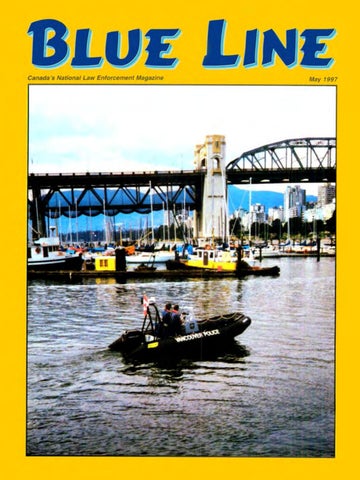
This month's cover reflects a lot of what is contained in thi edition. This issue ha a di tinct west coast flavour and the vision of the Vancouver Police harbour patrol boat both fits the season and the theme. The cover photo was taken some time back by editorial writer Gary Miller on an a signment for Blue Line Magazine. In this edition you will find Gary's profile and opinion regarding the Vancouver Police. Unfortunately the picture is a significant reminder that the federal government is about to disband the federal Ports Police and hand over the re ponsibility to municipalities. This questionable move disregards the highly specialized knowledge required for this type of duty and the importance of the mentoring processes required to make dedicated specialized police functions. This edition also features the beginning of an on-going series provided by the policing services branche of each of the provinces across Canada. This month we feature Briti h Columbia's contribution in the fonn of recognition 19 police officers who have received an award for going above and beyond the call of duty. Gary Miller contributes the third part of his series on the National Parole Board interviewing techniques. Next month Gary will be concluding this se ries with an interview ofa family who lives in terror of an abusive husband and father who will be released from prison next year. Bill opiro makes his third contribution on the subject of scenario roll playing for police instructors. Bill 's vast experience will a sist you in getting a handle on the who, what, how and why of officer training. A list of the provincial Law Enforcement Torch Runs across Canada can be found in this edition. You are invited to look up you provincial coordinator and either volunteer to run or if you are unable to do 0 then seek donation m your community for pecial Olympics. We hope you enjoy this edition.
~----------- BLU£ LIN£
0 r-_________________________________________
May, 1997 ____________________________________~
~agazine
The Police S ervices Amendment Act 1997-The new policing model: Disciplinary Justice and Independence Abandoned hI' Rol' Rawlllk - 'iwill he harsh liS lrulh lIlId (IS III1Com{JrolIIilinK liS jllslice On Ihis SlIhjecl. I do nol wish IOlhink. or speak. or wrile. wilh moderalion. No! \o! Tell a IIIlIn whose house is on fire 10 give a modemle lIlarlll. lell him 10 moderalel\, resclle his wi(c li'om Ihe hands oj Ihe ral'ishe,:; lellihe mOlher 10 gradual/\' exlricale her babe from Ihe lire infO which il has fiillen: hili urge lIIe nollo use modemiion ill a Cllllse like Ihe presenl .. - William Lloyd Garrison
t times, the be. t contribution a police of~ ficer can ma\...e to the debate on an important public issue is to e:\press the problems clearly enough so that diSCUSSion and under tanding can progress. This i particularly true \\hen the i sue has bl:comc mired in cliche that push our thin\...mg o()\I"n the samc old road. to the same old dead enos. ot that policc officer. havc nothing ubstantiVl: to contributc to such debatcs; \\e too have soluti ns to propose and defend. But on some Issues no one \\ill ma\...e much progress until \\l: stop trading the conventional wisdom that passl:s for solutions and reconsider the way III \\ hlch \\ e have posl:d the problem . The Imp, ton p licc di .c iplinc and funding
as being proposed in the Police ervices Amendment Act, 1997, that is being promulgated by the Progre ive Con ervative majority government in Ontario, is a classic example of such an i sue. In the government's drive to achieve co tcffectiveness, the propo ed disciplinary proce s under this Act will become a fonn of summary ju tice and municipalities will have been given a direct local locus of control, not only for financing police budget, but also majority control of police ervice boards. Both of the e major development are affronts to the legal status of "Office of onstable." Specifically, under this legislation, "nonseriou "disciplinary charge again t police officer could result in a pay loss of $1,000.00 \\ithout a hearing being held. This new legislation would mandate a 'procedureless' procedure, that abandon ub tantive standards of fairness. As a result ofthi proposal, there i no uch thing a ju tice, only varying degrees of injustice. Therefore, the Rule of Law is lost and might becomes right. This Act, al 0 introduces an 'unsati factory work perfornlance' misconduct rule for police officers in Ontario. The rule is a 'standardless' standard, because ubjective and arbitrary find-
ings can be used to discipline an officer and again without a hearing. Police officers under this misconduct cheme have no protection against the imposition of a charge or even the penalty, since they have no substantive right to compare their perfornlance with set standards, because there are none! The ct as proposed revert police officers to contractual employees for disciplinary purposes and it also allow them to be u ed as a political instrument of the municipal government of the da). Overall, it is a significant and overt shift in responsibility for the police. It is a direction that ignores the quasi-judicial a pect of the police function, and frustrates the common-Ia\ imperative of the independence of a police con table in the exerci e of the power of his public office. To accomplish our policing role in society, police officers must be separated from municipal, and indeed all concentrations of power. We are holders ofa public office towhich theguardianship of the Rule of Law is entrusted and therefore we must be free from actual or apparent direction in the e:\ecution of our duties. Police officers should not have to execute their dutie with trembling finger.
WORLD CLASS PROTECTION AND COMFORT The toughest protection standards (we meet them). A complete armour line (we pioneered them). Unlimited accessory and custom options (we offer them). As important as these feature are, protective apparel in the real world demands one other critical component ... comfort. That's why at Barrday, our engineers and designers place a special emphasis on material selection and fabric weaves so that our produ ts meet your most demanding standards of protection and durability and are comfortable to wear. Day in and day out. Real world comfort that makes Barrday a world class body armour supplier to national and international police and peace keeping forces.
TOP: Barrday Advanced Tactical Armoured Vests (A TA V) offer maximum flexibility and protection for police and military tactical applications. LEFT: Barrday offers a variety of external carriers for soft body armour including our functional and popular CLEAN FRONT carrier.
Barrdal_ _ ADVANCED TEXTILE SOLUTIONS Barrday, Inc., P.O. Box 790, 75 Moorefield Street, Cambridge, 0 , Canada 1R 5W6 Tel: 519-621-3620 Fax: 519-621-4123
The law isclearon this point, duties of police ofTicer are ofa public nature and are not o"ing to the municipality or board by which a police ofTicer has been appointed. Further it is concluded on the basis of law, that the manner in which the duties are imposed by tatute on a member of a police service are perfonned of public concern and therefore the relation hip of master and servant does not exist in law between a municipality or a board and a member of a police service. These legal principles provide considerable support that the con table is no one' ervant, he executes a public ofTice under Law, and it i the Law which i the police ofTicer's master.
The proposed law of police discipline has been sterilized to such an extent by these amendments that it is reasonable to conclude that, far from controlling managerial discretion and thereby protecting the fundamental justice interest of police officers, the law generally endorses and legitimates a strong conception of managerial authority. Paraphrasing, Woody Allan, this Act shall make the lion and lamb lie down together, but the lamb won't get much sleep. The culminative effect of the restructuring of disciplinary and fiscal control allows for a linear model of political interference to be established. The politicization of municipal police serv-
ices translates into an illusory police freedom to manage being dependent upon efTicient aving and revenue production. By not ensuring an apolitical and independent police service, that guarantees substantive and procedural fairness rights to its members in disciplinary proceedings, the revised policing model in Ontario, becomes a catalyst for crisi , discontent, political volatility, and a sure blueprint for disaster. For a full COpy of hiS rep0l1, contact Roy Rawluk Police Constable 53 Division, Metropolitan Toronto Police Service Res: (416) 667-0593 Bus: (416) 808-5303
LETTERS TO THE EDITOR We finally received our copy of Blue Line Magazine for March. I am proud to see our Department outlined however I am sorry that the information i so out of date. I would like to bring you up to present date in no particular order. We have had our CPIC now for over one ycar. Our compliment is now seven full time officer with two casuals and a uniformed clerk. Our neet of three vehicle consists ofa 94 Crown Vic, a 96 Crown Vic and a 92 Explorer which is to be replaced thi year by a 97 model. With budget approval (a familiar term) all three car will be equipped with top of the line cameras from Randy Bro\\n at Vec ystems. A uniform change this year to a tyle similartothat worn by the Ottawa-Carlton Police Service, (See Aug. 96 edilion of Blue Line) removal of the side stripe and wearing of ties but with the addition of a newly de igned non-glare breast badge. All members now carry a double action only, Beretta 9mm pistol (Centurion ). I very much appreciate the effort put forth by Dave Brown and it is unfortunate the most recent update did not make it in time for pubIi hing. On behalfofthe officers and staffofthe Ea t Sl.Paul Police I would like to thank Dave and Blue Line for their attention. (By the way Dave ... those tudent did wave!) David Granl Chief of Police Easl St.Paul Police
EDITOR 'S NOTE: f was looking around Ihe office for someone 10 blame this one on bUI evelJ'one ran oul on me. I guess I have /0 fess up... I had arranged for Dave 10 gel us an updale on his SIOIJ' Ihal sat arollnd in Ihe bollom of a file for well over a year... okay maybe /11'0 years. When il callie to press lime f gal'e Ihe oldfile over 10 production by mislake. AI)' apologies 10 ChiefGranl and David. f \\'as glad 10 see Ihis leller of clarificalion ... no\\' f have 10 look aroundfor sOllie help Iha/lI'ill lake Ihe fall for me more often when I mess up. (Good help is hard 10 find!)
• • • • • • • •
Turbine Speed ... Piston Price Fast 130 mph cruise Comfortable 2+2 seating Great visibility from all 4 seats 2000 hour TBO engine & airframe Reliable Lycoming 0-540 engine No scheduled maintenance between 100 hour inspections Governor, Heater, Aux fuel tank, Rotor brake & more all standard
•
Priced one-third of a turbine
• • • • • • • • •
II Proven Reliability... Low Maintenance Quick 110 mph cruise RPM Governor eliminates throttle twisting Holds every world record in its weight-class 2000 hour TBO engine & airframe Reliable Lycoming 0-360 engine Extra power margin at sea level & 9,000 foot IGE hover at max GW Governor, Rotor brake, Transceiver & much more - all standard Lowest initial price & operating cost
FOR MORE INFORMATION, CONTACT:
Robinson Helicopter Company 2901 Airport Drive • Torrance, California 90505 U.S.A. Telephone [31,OJ 539-0508 • . F~~_~~,!?9~ _
\;;:t
BLUE LINE
May, 1997 _ _ _ _ _ _ _ _ _ _ _ _ _ _ _ _ _ _----\~r------------------- MagaZ;ne
e ___ ar _ v"~ _ ""--- __
l
Outlaw Bikers : The Bloc Queb cois a ked the government t outlaw the Ro I.. Machine and lIell' ngel mot rcycle club in Mar h be ause of the turf wars in Quebec. The Blo 'aid the biker ' \\ar in the pro in e and th ir link to drugs and pro titUtl n can no longer be tolerated. The requcst t make membcr hip to thc clubs Illegal \~a. made four day after a bomb e'l.pl( ded utslde the Ilell' Angels clubh use in a LIebe ' ity , uburb. o one was mjured in the bombing which damaged several nearby home .
mon criminals and spoken to with di respect." Vickers aid that while the officers may have been trying to teach the girl - one I I, the others 12 at the time - a les on, putting them in a cell wa n't the proper cour e of action.
Busted: Police in Winnipeg arre ted 14 peoIe, including one pri on employee, • after a four-month inve tigation into the drug trade at tony Moun. --:' tain pri on. :, • R MP Insp. hris Bothe aid gang associates in ide of the federal penitentiary recruited prisoner who then got family members outside of the jail to obtain marijuana and cocaine. The prison employee was a garbage collect r, police aid. li e alleged ly smuggled drugs Awarded : Three Van ouver I land girls were into the jail, located north of Winnipeg. a\~arded 10,000 each Ii r being wrongfully The investigation, which co t about ImpIIsoned atler a tore owner accused them of 220,000, involved about 100 officers from stealing a teddy bear in 0 ember 1994. the drug squad of the R MP and Winnipeg Three R \liP officer \\r ngfully impri - police. ned the girls after they arre ted, earched and mterrogated them before placing them in a cell Get Tough: Four high school tudents at for sc\eral hour. ,Ju. tl e David Vickers aid in Miller Iligh chool in Regina began circulata B. .. uprcllle urt deci ion relea ed in late ing a petition in late March a king the federal government to toughen the Young Offender March. "Therc was C'l.trcllle emotional abu e wh ich Act. ome ofthe proposed changes the ludent was entlrcly unne e sary," Vickers wrotc in have asked for include mandatory re titution, the decision . 'Thc girl were treated a com-
~
Tired of wrestling for the station's copy of BJ.Ju£
Stop fighting! We'll iver a copy directly to you 10 times a year. See Page 3 9 for more details.
BLU£ L'N£- - - - - - - - - - - - IQ M
9
zin
tougher entencing and the ability to try all 16year-old in adult court. The tudent want to let the community know not all young people are wasting their time committing crime and there are tho e who are attempting to make po itive changes, 17-year-old Michael Farmer aid. The students plan to deliver the petition to Ju tice Mini ter Allan Rock. Cleared : Metro Toronto police con table who shot a burglary su pect was cleared of wrongdoing in late March by Ontario' pecial Investigations Unit. onst. Frank Lane, a 20year veteran with the force, had little choice but to fire his weapon after he came up n a burglary suspect on March 14, I director Andre Marin aid. Lane wa confronted by the man on a ide treet after he and hi partner re ponded to a break and enter call. The man wa armed with a gun. ven the uspect himself, who wa hot in the abdomen, told the IU that the officer acted properly. Although he did ay Lane hould have hot him in the leg. Court Ruling : Ifparent need help in exercising their legal right to have acces to their children police must assist if a ked, Ju tice Randolph Mazza ruled in late March . The ruling temmed from a ca e involving a Ilamiiton, Ont., man who had a court order granting hlln cu t dy of his daughter for about three day a \\eek. The order tates that polIce in whatever juri diction the child is in must help ifhe ha trouble gaining acce s to her. When the man did have trouble and police failed to help, he turned to the court. In January, the child's mother wa handed a five-day jail entence for contempt of court. In hi deci ion, Mazza wrote that whi le police intervention is unpleasant and troubleome in uch case, It i ometime nece ary. On Leave : Bryan ou ineau, chief of the York Region police, began a three-month pa id leave of ab ence in late March while the ntario Provincial Police inve tigate 17 allegation of po . ible \Hongdoing, ource told the Toronto tar. Peter cott, a [ornler deputy chief with the Metro Toronto police, will act a interim chief. orne irregularitie were di covered during a routine inspe lion of the York Regional Police 1EIII...&I1a.lI ervice by members of the provincial olicitor-general's policing er ice branch last January and February, sources said. The ources added that orne of the irregularitie involve personal phone calls being billed to a force credit card and private calls being made on a cellular phone belonging to the force.
V~_-------------------- May, 1997
At Fault: An internal police document blames the I lell' Angels for a 1995 car bombing that killed an II-year-old bystander, Television Quatre Sai ons reported in late March. It aid the document states the bombing was conducted by six people with close ties to the biker gang. The blast scattered debris that truck Daniel Desrochers, who died in ho pital. Drug trafficker Marc Dube, 26, died instantly behind the wheel of his car when it exploded. According to Television Quatre Saisons, the document states Dube was most likely killed after he was mistaken for some one else. A second, less plausible, theory is he wa murdered for selling drugs on turf that wa n't his. Apology : Ottawa-Carleton Con table Ray Lamarre apologized for his be, • I haviour to the family of a boy who was killed by another police officer. ,I hane Norris, 16, was struck . . and killed by OPP officer erge Loranger in August 1994. Lamarre, 34, was the officer who first noticed orris' body lying on the side of a regional road. He didn't get out of his car to see if the teen needed help, but instead drove to a nearby doughnut shop. When questioned about his actions, Lamarre claimed to have a phobia of dead bodies, a statement he now says is not true. Lamarre's admission shortened his disciplinary hearing. He was demoted and had his pay cut by 6,000. He said he won't appeal. Lamarre faces another disciplinary hearing next month. It is alleged that he drank while on duty and discussed undercover drug ca es while a civilian was present in the hours prior to Norris' death. Awarded: A Philadelphia police officer and his union were awarded $2.2 million in a ca e against a punk rock group which used the officer's photograph on an album cover that contained anti-police lyrics. Michael Smerconish, attorney forthe Philadelphia Fraternal OrderofPolice, said the award was granted against the members of "Cruci f-ks," and their record company, Alternative Tentacles. The group was sued over the unauthorized use of a picture which was taken for a policesupport rally. R escued : Two Ontario provincial police officers entered frigid, chestdeep water in early April to rescue a man trapped in a swamp for over an hour. Sgt. Gary Collins and Const. Joel Blacklock followed the voice of Doug Perry through the woods until they di covered him on the ice about 200 metre from shore. Both officers lost feeling in their leg during the rescue. After reinforcements were called in thc man was carried through the wood and taken to hospital by helicopter.
Parole Rejected : Inderjit ingh Reyat, convicted in the 1985 downing of an Air India Jet which killed 329 people, had his bid for early parole rejected at the Mat qui pri on east of Vancouver. [n a media release the Parole Board stated that they Reyat "was an undue risk" on society and they were also concerned about his refusal to admit liability in the incident. Reyatwas convicted in 1991 of mans laughter and sentenced to 10 years for his role in the bomb explosion which occurred in Tokyo airport at about the same time as the Air India explosion over the orth Atlantic. Although no one else ha been charged in either incident an R MP news release last
month indicated that severl arrests would be made within the next few months.
Law Introduced: The federal government introduced legi lation last month to create a national databank of D A profiles from convicted offenders to help police identify repeat violent and sex offenders. The new law would require adu lts and young offenders convicted of designated offences to provide samples for forensic DNA analysis. The resulting profiles would be kept in the databank maintained by the RCMP. The Canadian Police Association has voiced its concern that the Bill may die on the table due to a possible election call and questioned the delays in bringing it before the House.
LOOK AT
YOUR FORCE FROM A NEW ANGLE Join the wave of the future with Airborne Law Enforcement Canada's largest helicopter company offers a full range of services - from fl ight training to tum-key police helicopter patrol. For more information contact Simon Morton Vice President Marketing
Phone: 416203-9213 Fax 416203-9214
Canadian Helicopters \ 1 7 1 - - - - - - - - - - - -BLUE LINE
May, 1997 -----------------------\D~--------------------- Ma gazine
place for law enforcement off1c lead ammunition. But recently. Ammun1t1on, W1nchester Ghas de no health hazards to shoot1ng The Delta frang1ble bullet Combined w1th our patented he completely non-tox1c, it also an back splatter. RangerGFr clean up costs associated with To f1nd out more, contac
hooting range can be a hazardous there was no safe alternat1ve to all1ance with Delta Frang1ble~ free, frang1ble load that poses , tungsten and copper composite. th1s new ammunit10n 1s not only the tra1ning hazards of r1cochet even help you cut the expensive law enforcement d1stributor.
by Gary Miller
During a 10 day vacation to Vancouver a while back, I did something for the first time in all of my travel ; I went to visit the local police, admittedly with some trepidation. I have never been convinced that police officers have that much in common from one community to another or would necessarily wish to swap "war tories" about their experiences. I was wrong. There is a camaraderie that extends far beyond one's normal jurisdiction. Every Vancouver officer we met could not have been more hospitable or helpful. Every city in the world has its seamy underbelly. visitor normally enjoying Vancouver's ho pitality, unless seeking out some illicit thrills, would mo t likely not stumble across the leazier parts of town.! didn't start out looking for the seamy side. But, as it turned out, one had only to make a simple request to find it - ask directions to Police Headquarters. That did it. The old Ileadquarters building at 312 Main treet founders in its very midst. A left turn here, a right tum there and all the glitter and glitz of upscale Vancouver vani hed in a tumble of grubby, neglected, buildings and sordid booze cans. The wealth and prosperity of this fabulously rich coastal city, Canada's gateway to the bustling markets of Asia, had bypassed a ad enclaveofold Vancouver, many of the structures still showing the faded grandeur of better times. The sidewalks were crowded with unsavoury looking, shifty eyed persons of all shapes, sizes and ages. At the front desk, a few police personnel
were trying to deal with a small crowd of irate citizens. ot wanting to add to their difficulties, I discreetly identified myself and asked if I could be quickly directed to one of the "local police stations" in the city. I was greeted with a quizzical look when the officer said, well, this is it. 0, 0, I protested, I want a working police station. Again, the puzzled look. Again, the patient explanation, this is a working police station. We definitely seemed to be talking at cross purposes but, slowly, ever so slowly the penny began to drop. I began to realized that what I had fixed in my mind was a police department in the Metro Toronto mould, one that was controlled from a large downtown administrative headquarter with five District headquarters and 20 or so smaller police stations strategically located across the metropolitan area, from which the bulk of uniform and detective personnel were deployed. The realization also came that Vancouver City Police Department is NOT a metropolitan or regional police facility. All of Vancouver's policework at that time came out of just two locations. Headquarters, in Patrol Division North and the smaller Oakridge station, in Patrol Division South. hortly after my visit a new facility opened at 2120 Ganby treet which now houses all patrol functions while the Main Street facility handles all the administrative, central holding cells and investigative services. In the jurisdictional patchwork that makes up BC's lower mainland all the surrounding municipalities have either their own police departments, or are serviced by the RCMP.
It was clear that I had a lot to learn - one of them being to avoid preconceptions of what made up the Vancouver City Police Department (and Vancouver Police Department I still a department, not a "force" or a "service" as other police agencie have characterized themselves). What this means is that all of Vancouver's serving officers are gritty, down to earth, downtown "city" cops in the truest sense and not suburban police patrolling dormitory communities miles away from the big city action. I spoke with Police Constable Wayne Windrim, steadfastly manning the front desk of Headquarters. Wayne kindly offered to how me around headquarters, and after he ensured that someone covered for him, we promptly set out to tour the faci Iity. ! soon discovered there was none of the "corporate head office" appearance of many other pol ice headquarters faci Iities. Th is, in addition to being headquarters, was a "down and dirty" functioning police station as promised. Here was located the Vancouver City Police central lockup and I was given a tourofthat facility. ome of the larger cells housed tacked cots and 10 to 12 low risk persons shared the same cell. The facility appeared well staffed and included medical personnel who moved about as certain prisoners required them. The lockup appeared to have its full complement of prisoners waiting for their court appearance. With the main Courts building right acro s the street, from Police Ileadquarters, and a tunnel connecting the two buildings,
rgll - - - - - - - - - - - -BLUE LINE
May, 1997 - - - - - - - - - - - - - - - - - - - - - - \ V
Magazine
this la Ility seemed ideally located . I inquired if this \\ as als a "detox" centre but it i not, the detoxification fa Ilit} being located el e~here. The Identl fi ation ffice wa in near proxImlt} to the ccll arca and officer were occupied III prlllting ,nd photographing . ome "client" as \\e passed thr ugh. The one obviou lack throughout the building appeared to be pacc. I am sure the moving of the patrol functions to an Improved fa Ility did not come a moment too soon. I could nly tand in admiration of these people lor carrylllg n in such cro\\ded condition ...
On Patrol 'onstable Willdrim returned me to the front desl- and IIltroduced me to Police onstable Ra\ Belslcl- ,vh drove a downt ",n cout car IIlI;orthea t ancouver. Ray tool- me for a tour around his patrol area \\hlch he obvlOu I) I-nev\ vCr) well.llealso I-ne'" man} ofthe regulars on the street and they recognized and re pected hlill. Ra ,a r, ur year veteran, felt the interplay bet\\een the poll e and the street people helped the police to I-eep abreast of what wa happening and stay on t p of crime. onstable Bel. icl- felt the Vancouver poII e, with a full . trength total of about 1100 offi cr., ,vere thlilly . tretched to meet some CrISIS 0 cUrflng 111 the City. During the height of the busilless da ,and durlllg pe lUI event, the population of ancouver may well a high a 2 million. Ray alluded to the tan Icy up Ilocl-e play-orrs riot during which the city police were severely undermanned to control the ensulllg melee. lie stated that, had Vancouver It been able to draw member fr m a I, rger metr politan police department, they may vvell ha e prevented or minimized what turned III to , thor ughly na ti in ident and an IIlternational bla I- eye for the ity. It is ad to sa) that the malgamation ha not 0 curred since m) VI it ,nd neither has the establi hed tren 'th IIlcreased. t that time ancouver al lacked enough accessible store front . tyle police tat ions to service an increa IIlgly diverse community. .t. Belsicl- was eager to how me the hine e ommunity tore front Police tation in a mev\s immediately orra bu downtown treet. We str lde confidently up to the tore Front onl to dl. cover that it wa no longer there. It had been closed and the propert was for rent. The ancouver It} Police Department i divided up Into a cries of Team and quads. Teams I to 4 arc III Patrol Divi ion orth while Teams 5 to are in Patrol Division outh. Wlthlll the Patrol division are 4 district, Di tncts ne and Two in the orth, Three and our III the , uth. la h district has its own radio frequency and there i a fi Ilh frequency for spe lUI needs. The University of Briti h 0lumbla campus 0 cupie a huge land ma to the \\est of Patrol Divi ion outh and is p liced b the R MP . In lact, surrounded a it i largely by water on the north and th uth, hemmed in by UB on the ,,,cst and Burnaby and ew We tmin ter on the east, ancouver ha nowhere to expand. ith ut anne. IIlg omc of the surrounding tcrrltor ,the city may face increasing di fficulty III mcetlllg the demands pia cd upon it by II1creasll1g Immigration and orr hore money. What to do? Many urban cen tre wi h they
were faced with uch a dilemma, ince problems are ometime imply opportunities waiting to be discovered.
Wealth, drugs and vice
Native Community Patrol Later the same week I was introduced to Con table Jay Johns. Jay is attached to the ative Community Patrol which isdedicated to building partnerhip with the Native community. st.John had been attached to thi special project for about 8 months when I met him and he - - - - - - - found it a unique challenge. st. Johns guided us on a tour that was to be the intriguing highlight of the week. In his capacity on ative Community Patrol, it is Jay's job to ensure that whenever po sible, he look out for the afety and welfare of our native anadian. Unfortunately, many of them are street people and many are cur ed with tragic ubstance dependencies. Very young Ab riginal girl are known to prostitute themelve aller being hooked on drugs by low life pimp. C t. Johns see that they are given coun el, shelter and protected a much as po ible and as much a they will accept without his being pointedly judgmental. It is a er) difficult line to walk. Cst. Johns u ually work with a native Canadian police con table as hi partner. In 1994, Vancouver ity had 53 murders, the highest per capita in anada, and mo t of the murder occurred on his beat, among the street people. Immigration patterns do reveal them elves in crime and Vancouver, which apparently doe n't frown on identifying crime by race, has noted a significant influx of I Iispanic criminal from entral and outh merica. Ea t Indian A ians are also becoming prominent in underworld enterpri es a different ethnic groups jockey for power and influence. Tragically, mo t ollen victimized in thi downtown ethnic ragout of drugs and depravity i the native anadian aboriginal. At the time of my vi it there were even tatu anadian Indian on the Vancouver police department and about twice that many officer with at least some native Indian background. With anadian Indian street people highly visible in downtown Vancouver, the city is making herculean errort to attract qualified native Canadian Indian to the policing profe ion. Cst. Johns noted that Vancouver's skid row (downtown east side) is relatively mall. But because Vancouver is an ocean port with a continuous tran ient maritime presence and al 0 the destination for many third world immigrant, illegal alien and refugees, the ranks of offenders are large and growing. lIe ob erved, ruefully, they'll never clean up kid row. Another growing problem that every Vancouver police officer mentioned i the many, many recycled bandits from central and eastern anada, escaping both the harsh weather and the criminal warrant (with only a 50 mile or a province-wide return radiu ) that won't return them to the juri diction of their crimes. PIC details their crime but the we t coa t police can do nothing to execute the warrant.
A Va l/collver "SII ooting Gallery"
Drug are a growing problem in Vancouvcr as they are in almo t every orth American city. The problem i likely more acute though in "Lotu land" becau e of the obviou wealth flowing into the city. And drugs follow wealth. Expen ive vice, for expensive tastes. Ilaving been a former drug officer with hundreds of drug arre ts to hi credit, Jay \\as read) to concede that drug may be more of a social problem than a crimll1al one. All the drug arrest and eizure in the world hardl} create a ripple in the illicit drug trade. Ja took us to ee some h oting galleries, derelict area down dark alleys littered with hundreds of needle and discarded wrappings which had contained drug . lIe miled knowingl , "Is thi seam) enough for you?" Well, pretty much so. One la t drive, down to the track. That's the track for hookers. 11001-er of all sizes, shapes and persuasions, these pro were gaudier than peacock . There couldn't have been a pare equin lell in town. Why were they in it? I heard the an wer within my own head. "The money, stupid!" That' another part of life the police are not likely to tamp out. The odd are incredibly high against the women and in mo t ca es the pimps make the real money. But, tell these girl that? 0, not thi warnl ummer night. With the johns pra tically lining up.
Dogs, museums and comparisons Vancou er Police Department ha a Dog quad and we were fortunate enough to visit the quad and meet with st. Ralph Pauw and his dog ae ar. Ralph report that all 17 canines on the quad are German hepherds.llis dog ae ar came from Hungary, as there is a hortage of suitable German hepherds in anada. ( mployment equity has joined the animal kingdom.) Ralph states that the formerly all male squad of dogs now has 2 bitches on trength . Later that same day I finally got to meet eil Thomp on \\ho took me on a fine tour of the ancouver Police Mu eum. An excellent hi tory of the police department and of famous crime olved. It dawned on me as we ~ere being escorted that thi was where I should have started my tour.
~L~£z~'N_£____________________________~~~______________________________ May , 1997
VANCOUVER
POlICE DEPARTMENT DOG SQUAD-
COl/stable R alph PallIV and Caesar
Conclusion When one thinks of the world's most beautiful cities, a number come to mind. The "City of Light", Paris, France, is an architectural treasure of commanding edifices and graceful boulevards. Rome is another city that is visuall y and historically beautiful. Sydney, Austra li a makes a stirring "New World" entry /Tom the island continent. In Canada, Montreal has its mountain, handsome buildings, broad avenues and heroic statues a befits its proud and turbulent history. (Sorry, Toronto, neither you nor Charlie the Tuna made the cut on my list.) But, after all is said and done, when one thinks ofa naturally beautiful setting, one city stands out, where mountains, trees and ocean combine to create a vista unparalleled anywhere - Vancouver. Thi city and its region has everything - including the need for serious regional police study. In this era it shou ld be recognized that fragmented police agencies a nd jurisdictions work to the advantage of the criminal element. But perhaps this is where a good story sho uld end . Inspite ofa more jaundiced view of today we simply have to cast our thoughts back a few years to appreciate where we are today. l owe a large thank you to the Vancouver Po lice members for helping me during this visit, for you r knowledge, your candour and your good humour.
Gary Miller has over 30 years a/police experience and is an Editorial columnist with Blue Line Magazin e.
Go AHEAD••. MAKE Y OUR DAY WITH
Distributors of confrontational simulations equipment for all law enforcement defensive tactics training. Knowledgable staff, competitive prices, No P.S.T. For more details call or write:
PADS FITNESS SUPPLIES 9624-74th treet, Edmonton, Alberta Phone/Fax: (403) 490-0144 Dale Kliparchllk - Director / Instrllctor
The Leader in Law Enforcement Supplies - Since 1980
FEDERAl:.
~
~ ~ ..• r\il'\\(\\\\~ t m ~.
t!t
lO GUEUIL. QUEBEC
(514) 442-9215 FAX: (514) 442-9581 (613) 737~261 FAX : (613) 737~261 (905) 629-9171 FAX. (905) 629-91 TEL.: 1 (800) 561-3246 FAX: (403) 973-3291 TEL.: (506) 3 5-24 FA ' (506) 3 5-2499 TEl. : (709) 368-0999 fA • (709) 363-0991 TEl.: (902) 93-3288 FAX: (902) 93-3227
OTT WA ALES, ONTARIO TEl.: MISSISSAUGA, ONTARIO TEl. :
R. NICHOllS EDMONTO ,All. DISTRIBUTORS Inc:
FREDERICTO, .8. GOULDS, NFlD. TRURO, 'OVA SCOTIA
G1?~------------ ULV £ LIN£
May , 199 7 - - - - - - - - - - - - - - - - - - - \ V f _ _ _ _ _ _ _ _ _ _ _ _ _ _ _ _ _ _ _ M agazin e
British Columbia honours officers On the evening of March 5, 1997 Briti h Columbia held its 15th an nua l Poli ce Iionours night to recognize the valuab le officer of the province who perfo rm acts above and beyond the call of duty. Many outstandi ng acts of bravery, elfle ne s, leader hip, dedication and professionalism were recognized with honour from Lieutenant-Governor Garde Gardom and Attorney eneral jjal Do anj h. The ceremony took place at Government House in Victoria. wards were given to officer who knowi ngly placed themselve at risk of death or seri ous injury while attempting to help others. "Our po li ee officer risk their lives on the job every day ollen making split- econd decision that put them into extremely dangerou ituations," It rney eneral Dosanj h said. " It is an honour fo r me to pay tribute to these C\ccptlOnal individuals, and thank them per onally on behalf of all British Columbians. Their couragc and bra ery ave lives." inetcen a\~ard of val ur and si\ awa rds ofmeri toriou ervice were given to nine officers from poli e departments and si\teen police officers from R MP detachments across British olumbia. The follo\~ing i a list of the heroic officer and their acts of bravery in the line of duty.
Central Saanich Police Department
'1... gt.
hriltoph er 10rri5011 - st. Dal'id Glallcie ~t. " '11111' IlIrray 1 hesc officers were working day shi non r rida}. June 30. 1995 when the} heard a radio report of an armed robbery that had occurred at the Royal Bank branch in , idney ., gt. Morrison heard a di. patchcrrep rtthallheregisteredowner of the suspect vehicle resided in Central - --=.-, ,>aanieh . lpon finding the vehicle not at the residence gt. M rrison decided to set up observation at a point where the suspect vehicle would pass when returning. '>hortly . a vehicle that matched the description with t\VO men and one woman in it, passed by. gt. Morrison followed thc vchicleand sought immediate backup from Cst. Murra) and Glancie. ware that the robbel') suspects were armed. Sgt. Morri . on followed the vehicle until he came to a location remote cnough to conduct a vehicle take down safely . The susrect \ehicle was pulled to thc side of the road and \\ ith thc help of sts. Murray and (ilancic. thc three suspccts were arrested within an hour of the offencc The \\ eapons and $197,400 in stolen monc) \\cre also recovcred. All three individutis \\ erc subsequentl) c n, icted and given jail sentcnccs.
r.
. ....-.M_ . ra.I I Il!.
Vancouver Police Department It. DOl/aid KirMalld
On the morning of , eptember I, 1995. Cst. Kirkland. along with three othcr otlicers of the ancouver Police I cpartment, responded to a report of a ) oung \\oman about to commit suicide by jumping from the roof of an 8-storey _ _.01!1_ building to a concrete slab belo" . When thc) arri\cd. the )oung woman was perched on the f(lofratlin g and preraring tojump. Two of the office rs initiatt:d a convcrsation with hcr and ta lked her down from the "tiling Meal1\\hilc. Cst. Kirkland and the other olliccr acccssed the roofb) a sccond stairway in ordcr to approach her from behind. Cst. Kirkland strarrcd on his rappelling harness and adjusted his static line. Ilo"cver. the woman's mental state was deteriorating; she demanded that one of the officers Icavc. and then she again climbed onto the railing, I:lcing thc ground below. and Ie, ned forward to begin hcr fall. s a result of the woman' s movement closer to Cst. Io..ir\"bnd. the tatic line was now 7 metres too
long, and there was not time to adjust it. There was now the danger that the rope would break at the end ofa fall or that the incorrect positioning of the harness wou ld break his back. With fu ll knowledge of these dangers of working with a static line with excess slack, Cst. Kirkland lunged over the railing and c. ught the woman with both his arms around her waist. sl. Kirkland hu ng outside the railing, 30 metres above the concrete clingi ng to the struggling woman. ll is three team members ran to the railing and pulled CSI. Kirkland and the struggling female back over the rai ling to safety.
Vancouver Police Department Det. Delli/is W. Paulsoll Justbeforenoonon December9,1995, Det. Paulson was off duty when he saw a vehicle spin out of control and nip upside down in a water and ice-filled ditch. The vehicle was nearly submerged. Pau lson entered the water in an attempt to as ist any passengers inside. li e found the driver's sideofthe vehicle was inaccessible and the pas enger doors locked from the inside. The rear window of the vehi cle was broken, and the interior of the vehic le was full of water. Det. Paulson knew that anyone inside the veh icle would be underwater, so time was critical. Detective Paulson gave his watch to his son and to ld him to keep time while he tried to get the driver and any passengers out. omeone handed Det. Paulson a hammer, and he broke the rear passenger window and unlocked the door. o pas engers were in the rear. By this time, other motorists had stopped to help. Ilowever, they were unable to access the car and, without hesitation, several men climbed down the bank and lifted the side of the vehicle about 3 feel. Del. Paulson entered the front of the vehicle and pu lled a woman, who was unconscious, from the vehicle to the side ofthe ditch. The woman had been under the water for 4 minutes and 20 econds. he was taken to the Delta ho pital by ambu lance where she recovered.
Vancouver Police Department Cst. Greg Parsolls - Cst. Bob Reid In the evening of July 13, 1995, the officers responded to a report of a man who had broken into a 20 storey high-rise building, which was under construction. The man had climbed up the building crane and wa lked along the boom which - was about 250 feet in the air. lie was very distraught, had been drinking, and was threatening to leap from the cab.
Cst. Parsons and Reid climbed up the construction crane and out the narrow boom towards the booth. After talking calmly to the man for over two hours. the officers were able to convince him to put a rappelling harness on and to accompany them to the ground. The officers knew that if the agitated man had decided to resist at this point, it would have been disastrous for all three of them. The man was taken for treatment.
Victoria Police Department Sgt. JollII Hurtley - gr. DOli Blull d In eptember of 1994, the Victoria Police received a report that a loca l man had been killed by a group of 12 Vietnamese males and females from Vancouver \\ho \\ere involved with organi.~ed crime groups. After the shooting, the group split up and left Victoria in . . . . . . several unidentified vehicles. Atthe time of the incident, and for a period of time afterwards, the identities of the suspects were not known. The investigation was comple, and involved a number of outside police departments and agencies as _ _ _r.. well as a variety of complex investigative techniques. Throughout the course of the investigation. a number of criminal activities were identified including homicide. possession of restricted weapons. drug trafficking, threats, extortion, assault, conspiracy to commit murder, obstruction and arson. As a result of an extensive investigation coordinated by gts. Hartley and Bland, the shooter was identified and arre ted in Vancouver, and charged with homicide two months after the incident. Six other men were subsequently arrested in Vancouver and Edmonton. and were charged with manslaughter. The investigation was complicated due to the transient nature of the suspects and reluctant witnesses. Crown Counsel credits the work of gts. Bland and Hartley for the succes ful prosecution of this offence.
North Vancouver Detachment, HCMP Cst. Kim Ashf ord - Cst. George Makowski Cst. Terrellce Try ttell - Cst. Dick Waltoll In the early morning hours of December 15, 1994, the four officers responded to a motor vehicle accident where the driver and lone occupant ofa vehicle lost control and \\Tapped his vehicle _ _'._-.._ around a lamp post. The vehicle remained __.;;:JI_ running with wheels spinning at a high • • •• rate of peed. On impact, the vehicle began to moulder inside and within minutes began to burn. Thedriverwas trapped behind the steering wheel of the car, and was drifting in and out of consciousness. .~!III. Knowing that the gas tank could ex1!I~.. plode at an) moment. the officers cut the seat belt and pulled the motorist through the window of the car. st. Ashford maintained a spray of water on the man to control his burning clothes. hortly after the officers removed the man, the entire ~~~~ vehicle burst into names. Csts. Walton, • and Makowski had to be treated for smoke inhalati n and bums afterwards. In addition to this award, the officers received a Commendati n for Braveryfromthe ommi sionerofthcR MP, and the Medal of Bravery from the Governor General of anada.
m
BLU£ L'N_£__________________________~V ~I-----------------------------MaY, 1 997 M a g zin e
Vernon Detachment, HCMP
Kelowna Detachment, HCMP
Bella Bella Detachment
Cst. Johll Pliszka - Cst. Tib or Baldallf
Cst. Jeff Holmes
Cst. Thalle MacEachem
In the afternoon of October 12, 1995, Cst. Baldaufresponded to a 911 call of an anned bank robbery in progress. Cst. Baldaufwas in a position to see the bank employees and customers on the floor, but could not see the robber. l ie analysed his situation, reported his findings to dispatch, and then took up a position to cover both exits of the bank. eeonds later, the robber ran out of the bank, weapon in hand. The officer immediately pursued the suspect down a busy downtown street until he grabbed an elderl} man as a hostage. lie forced the man to the ground; held the gun to his neck, and told Cst. Baldauf that he would shoot the hostage unless he was allowed to go. Cst. Baldaufrepeatedly ordered the suspect to drop his weapon but held his fire. Other officers arrived on the scene and, at this point, st. Pliszka began to negotiate with the suspect, repeatedly instructing him to put his gun down and assuring him that he would not get hurt. Shortly afterwards, the suspect released the hostage and dropped the gun. The suspect had a small 9 millimetre pistol that was fully loaded. A drug addict, he was found to have a lengthy criminal record and classified as violent.
About 10:00 p.m. on February 22, 1996, st. Holmes noticed a vehicle that resembled the radio description of a vehicle that was involved in an armed robbery of a grocery store. Cst. Iioimes followed the vehicle for about 12 blocks LII_~_ until it pulled into a private driveway. He advised dispatch that he would be checking the suspect vehicle. The suspect, a large muscular individual, immediately ran from the vehicle, and Cst.llolmes pursued him on foot. When he caught up to the man a very physical, exhaustive and life-threatening fight ensued. During the fight the officer's revolver was knocked from the holster. The suspect and Cst. Iioimes struggled for control of the weapon. Cst. Iioimes, finall) managed to get one handcuffon the suspect. At this point backup arrived to assist. The suspect was subdued and taken into custody as a result of Cst. Iioimes' perseverance and determination.
hortl) before midnight on January 4, 1996, Cst. MacEachern was called to Ir-::::;:'C!"II a report of an attempted suicide where a young woman had jumped off the dock at Bachelor Bay. The young woman was ...... .,..., in an intoxicated, depressed state, and ..._ -- whiletalkingto hersocialworkerjumped off the dock into the \~ater. Shortly afterwards, the woman regretted her actions and came back to the dock. The social worker tried to pull the victim from the water, but the ice on the dock and her lack of physical strength made this impossible. Upon arrival at the dock, Cst. MacEachern, using a flash light, was able to locate the unresponsive woman floating on her back in the frigid water. The woman had been in the water for at least twenty-five minutes. The officer immediately dove into the water and swam out to her and was able to tow her back to the dock where both were assisted out of the water. The woman was admitted to the hospital and survived this incident.
Dawson Creek Detachment, HCMP Cpl. Bob Beatoll - Cst. Chris No ble In the early morning hours of December 9, 1995, pI. Beaton and an MU~. auxiliary officer responded to a break and enter of a sporting goods store and encountered a man holding a shotgun behind the counter. Cp l. Beaton lowly approached with his ervice revolver 1iI1IIIII• • drawn and advised the man to drop the weapon. The man refused and wanted Cpl. Beaton to shoot him. The man was distressed and appeared to be either intoxicated or impaired by drugs. Cpl. Beaton continued to talk to the distraught man in order to try to calm him and convince him to put down his weapon. Shortly after, several other members arrived and positioned themselves outside the building. Cst. Noble entered the store to assist Cpl. Beaton. st. Noble attempted to get closer to the suspect. At this point, the suspect indicated that he was going to shoot himselfand began to insert a shell into the chamber of the shotgun. Cst. oble rushed at the armed man from 30 feet away and knocked the shotgun away. Cpl. Beaton also rushed the uicidal man and both members subdued him.
U.".
Langley Detachment, HCMP Cst. Dowlley Brockelballk In the afternoon of December 8, 1995, Cst. Brockelbank was off duty walking his dog when he noticed a woman floating downstream on her back in the Fraser River. The temperature was minus 5 degrees elsius - it was windy and raining. st. Brockelbank called to her, but when she saw him she began to paddle herselffurther away from the shore. lie ran to a point \\ here he was ahead of the woman in the river, removed his outer clothing and began to swim out to the woman. he was suffering from h) potherrnia and was offering no assistance. At great risk to himself, Cst. Brockelbank safely returned the woman to shore, summoned assistance and remained with her until medical personnel arrived. he was taken to ho pital to receive treatment for hypothermia and depression.
Pemberton Detachment, HCMP
Prince George Detachment, HCMP
Cst. Terry Jacklill - Cst. Nick Lee
Cst. DOlllla Rorisoll
In the earl) morning hours of February 19, 1995, Cst. Jacklin responded to a motor vehicle accident report to find the vehicle was almost submerged in the Birkenhead River. The river current was swi ft; the water temperature 1Io.I1DI_~ was zero degrees eisius,andtheground was snow-covered. Because of the urgency of the situation, Cst. Jacklin swam out to the car, about 30 feet from shore. He was unable to locate the driver and was forced back to shore as he was becoming numb from the water, and felt he was losing his breath. Cs!. Lee arrived and without hesitation, swam out to the vehicle, but was also overcome by the frigid waters and had to return to shore. Cst. Jacklin, again exposing himself to an extremely hazardous situation, re-entered the water in another unsuccessful attempt to remove the driver. By this time, a tow truck arrived and Cst. Lee, again putting himsel fat great risk, grabbed the cable and swam out to the vehicle and attached the tow cable. The vehicle was removed from the water and the driver extricated. Unfortunately, the ambulance attendants were unable to revive the driver.
In the early morning of March 26, 1995, a motor vehicle lost control and skidded sideways into a lamp standard. Cst. Rorison arrived almost immediately and quickl) assisted the driver to a safe ...... _~_ area a short distance from the accident. - - - - - One of the passengers in a rear seat was also able to exit the vehicle on his own. Ilowever, the front seat passenger's legs were pinned preventing him from exiting, and a second passenger in the rear seat was knocked unconscious. Cst. Rorison noticed a small fire in the engine compartment. The front seat passenger started to panic and began to scream as the fire was beginning to spread into the passenger compartment. While other officers tried to control the fire with extinguishers, Cst. Rorison entered the veh icle through the hatchback and pulled the unconscious passenger from the rear of the vehicle. he then entered the driver's side of the vehicle and was finally able to pull the pinned passenger free of the wreckage. Shortly afterward the Fire Department arrived and controlled the spreading fire.
Western Communities Detachment, HCMP Cst. Mark Kellock In the evening or October 3, 1995, Cst. Kellock responded to a "fire" call at a motel. On arrival he was told thata man was believed to be in a room where the fire had started. The officer rushed up to the second .....-IL1.I.... floor unit, and entered the smoke-filled room and found the occupant lying on the smouldering bed. The officer tried to arouse and remove the man. However, he was both intoxicated and disoriented, and struggled with st. Kellock. Cst. Kellock had to forcibly remove the occupant out of a densely smoke-filled room. Flames could be seen through the thick smoke. On successfully removing the occupant, Cst. Kellock collapsed due to smoke inhalation. Both the victim and st. Kellock were taken to hospital and held overnight for observation. In addition to this award st. Kellock received a Commissioner's Commendation for Bravery from the Commissioner of the Royal Canadian Mounted Police.
Princeton Detachment, HCMP Cst. Tracy Ross On May 10, 1995, Cst. Ross was the lone member working the evening shi ft at Princeton Detachment. At approximately I :00 a.m., while on routine patrol, Cst. Ross noticed a woman walking down a river bank and heading - - - - to\~ards the Tulameen River. Cst. Ross called out, but the woman did not respond. Instead, she continued down the bank and walked directly into the swift, cold river. It was dark, and the river was fast flowing due to the spring run-off. Cst. Ross ran into the river after the woman. By the time the officer caught up to the woman, she was up to her neck in fast moving water. The woman who was intoxicated, stated she wanted to be left alone. C t. Ross was able to forcefully pull the de pondent woman to shore where she had to restrain her from returning to the water. The woman was taken to hospital by ambulance \~here he received treatment.
.....114.
British Columbia Police Commission Rth FI.. 100 I Douglas Street. Victona Be VHV I X4 Tel: 250 3R7-1741
\13?r - - - - - - - - - - - - BLU£ L.N£
May, 1997 - - - - - - - - - - - - - - - - - - - - - - \ 0
Magazine
The Role Player/Actor in Interactive Training
by " il/illll/
opiro
D
"01\. , ou t\VO you ' re going to be the bad gU} s for tillS IIltl cxer i e". Ilo\~ many time havc \VC heard thiS In training? What ever number of individuaL \~ere needed for an exercise to represent the oppo ition, they usually \vere randomly selected from who ever wa not lI11mediately needed f'or the support of the exerIS . In order to mollvate the tudent to interact in the deSired manner, the cenario must offer a certall1 amount of reali m. The realism and its II1tenslt) an; controlled 111 n small part by the ablllt) of the a tor to generate the nece . ary Imagel) . The "ey to success a \vellas the \veak 1111" 111 all S cl1ari b, ed trainll1g i the a tor. The actor does much more than just replicate certain sCrlptcd behavIor. Let II never lose sight that by hiS perfOnllal1Ce the a tor i teaching the tudent to 100" forobv iOll behavioral traits and strategies on the part of certain stereotypical II pect . Ifhe cannot do thiS thenhe is a bad actor. It might be \vorth\~hile to 100" at what ( nstitutcs a "go d" role player fr m a "bad" actor. In past seminar the fa te t \~ay for me "to
open a real can of worms" was to a k the que tion "Who hould be or can be an role player?" Let me open the current can by aying " nyone can be a role player." Thi include, civilians, lawenforcementand military per onnel. In fact three of the be t ro le players that I've k.nown over the la t four years, were civilians. John Klo en ki a retail manager from Kittery, Maine, coli Fergu on an audio vi ual technician in Concord, ew I lampshire, and Graham McLorn who runs a police upply company in Missi sauga, Ontario have portrayed evel)thing from friendly drunk , irate h usewive , to tone cold killer. That's not to ay that there aren't good law enforcement role player out there. 0 what or who exactly make a good role player.
Role Player Selection Criteria The first criteria we are looking for is integrity. By integrity I mean the ability for hi background to pa crutiny. Thi i important in the case of a civilian being u ed in thi role for obviou rea ons. The mo t important criteria is maturity. Thi cover a multitude of character flaws that are detrimental to the conduct of good training.
COpy Cars
INNOVATIVE POLICE PRODUCTS
Itl in ;I ~ri(." of 20 cars
L-_ _-!._ _ _ _ _ _ _ _ _ _ _ _ _ _ _ _ _ _ _---.l 7 1I1l' C'd.'1 m l·t~ Pull h,l(;" & ~o :1l'!iOIl SI'(,lI.t1 III p ritt' (llft'r , c\lwd.'d 10 III c. lOt\)(),
BLUE L'NEM g zin
802 Gar""705-734-1 Cou1 Bar'W' Or; L4'11A4
A::':~
rax IC5.734-C396
S_IlII'<:>cs
Dealer I-QUI~es \\'t'cone:
One of the worst thing that could happen in interactive cenario ba ed training(orany training for that matter) i for part of the in tructor cadre to go out after training and di clo e how a tudent badly handled a performance objective. Yet I have een thi done on a number of occasion by orne actor bragging how they moked thi one' orthatone's butt. Remember the scenarios end when the whi tie blow. It i howing a lack of profe ionalism to repeat to other the training deficiencie we ee in our tudent and peers. Attitude! Actor' game man hip i another problem related to maturity. The "I'm better than you" yndrome. Thi is perhap the harde t character flaw to deal with in an actor, and i one of the rea on I tend to like to use civilian actors. Game man hip can be de cribed a an attitude on the part of the actor that allow him to calculate all moves and countennove available to the tudent, and take the appropriate action to en ure that the tudent only ucceeds if he i tru Iy better ki lied than the actor. ontrol ! Iluman by nature are competitive. The Law Enforcement community trie to in till in their member the in tinct for urvival , the will to win . At times this urge is extremely hard to uppre with an officer who i acting as the bad guy. And yet the cenario may call fo r hi 10 ing gi en the right conditions being achieved by the tudent. ompliance! A ' the in tructor, one of the hardest tasks is ensuring that actor tick to the cript. If allowed, hijinks, goofing off and "get thi guy" attitude will hijack your training program, and re ult in Ie son that are not taught properly. Phy ical ability i another key consideration that can be often overlooked. While a cenario may be taxing for the tudent, uch a in a foot chase, he does it once. The actor may have to do it ten, twel e, fourteen or more time in the day. Given thata lotofthis i done out ide without benefitofclimate control, and wearing a fair amount of protective gear, the actor must have the tamina to complete the training. Technical ability while being a minor criteria, i important. Familiarity \~ith the work.ing of firearm, firearm afety, radios, and other gear found in the training area can eliminate a ource of headache for the instructor cadre. If the actor i elf ufficient, he can look after hi own equipment rather than coming to you for minor fixe .
Fastest Gun in the West The concept of scenario ba ed training program i to place the student in the mo t realistic simulation pos ible. Part of the effect of the imulation is to artificially create tre s to which the tudent i ubjected to. Thi I a de irable effect. A ew ngland Journal of Medicine article recently reported that volunteers inje ted with 10. do es of an adrenalin ubstance (which mimic stre experienced by the body) had enhanced learning ability compared to control groups in a beha iorallearning experiment. Ilowever, we have been hown in ational Research Council tudie (Enhanc-
- - -- - - - - - - - - 1Q vl-_____________________ May, 1997
ing Human Perfonnance 1988), that increased heart rates over certain thresho lds deteriorate human fine motor ski ll s, complex motor ski ll s and can affect cognitive and perceptual skills. What this all means to the role player is that he has to adjust his perfomlance to meet the skill level of the student or the student will not pick up on th e finer points of the attempted lesson. This mi ght be a scenario to illustrate basic tactics to a recruit class.
Use of Cover Part One What the officer knows: Date and time: 1730hrs Friday 13th December Scene: Interior garage of a small apartment building, well lighted, several cars parked. Officer starts scenario in the middle of the drive within 5 feet of parked car facing a hallway leading back into the apartments. The ha llway is about 10 to 12 feet long then turns right at 90 degrees. Ca ll Information: Suspicious Person(s): suspicious male loitering in the hallways and garage of apartment building Location: 1231 idestreet Apt 13. See Mr. Smith History: Previous break, entry and thefts reported, one recent assault this location
Backup:
(optional)
Part Two What the officer doesn ' t know: (read to student after scenari o) The Occurrence: You ng male sllspect entering the garage is a crack addict. He is awaiting trial for break entry and th eft. No previous adult record.He is extremely apprehens ive about going to prison. He hasju t successfully broken into a retired couples' apartment and fou nd a 9 mm Browning that the veteran had brought home from WW II. It is fully loaded and operable. Part Three The Actor(s) Ro le Main Branch I. Suspect exits hallway into th e garage, holds pistol along side, concealed behind leg. Wait for officer to approach. 2. Shoot if officer approaches within 15 ft. 3. If officer challenges from center of drive shoot. 4. If officer moves to cover before challenging you, then run back down the hall. Don't let him see the gun. eco nd Branch I. [f officer immediately pursues you down the ha ll, tum and fire. Debriefing: Recruit/student decides to challenge the actor from the middle of the drive at about 20 feet distance. Without warning th e actor lifts his pistol and shoots student 3 times with two hits to the head. Time elapsed 1.5 seconds. Q UESTION : What has the recruit learn ed from this lesson? Politely, I wou ld say, the actor has imparted to the student, a very good sense of his potential life expectancy. What should the ac-
tor have done differently? Given that this was the recruit's first go at this, the actor should have slowed down his moves and telegraphed his intentions. Given that under stress, the student may not have picked up on the fact that the actor held his right arnl slightly to the rear concealing his hand. The actor could have responded by obviously waving his left hand while trying perhaps to mask his right hand, drawing attention to the fact that he had something concealed, triggering the desired student response of using some available cover. Or he could have "flashed" the gun briefly and allowed the student to react in some other way. Actors should remember the phrase "Crawl, Walk, Run". When we teach a physical skill ie. field stripping a handgun, we nonnally do not demonstrate it as quickly as when we nonnally do the takedown, because we want to allow the student to perceive the correct sequence of events and the necessary manipulations. If the student has been told to lookout for certain threatening behaviors and how to react to them, then the actor through his perfonnance must teach (by providing the proper demonstration) the student to observe, identi fy and react to them. As the students become more advanced and sophisticated, the actor may then step up his perfonnance to where it approaches real time. The actor must never forget he's there to teach by way of demonstration. If the student cannot perceive the lesson then the demo was wasted. Care and Feeding of Actors I. Make sure that they understand that they are to act as assistant instructors not just bodies. 2. Make sure they understand what you are trying to achieve with the lesson plan. 3. Make sure they understand th e "script" and what characteristic warning traits they must display, when they interact with the student. 4. Make sure you listen to their after action "feedback". It nonnally contains valuable insight into the student's actions.
5. Make sure you do not tolerate problem actors. If they do not " perfonn" well get rid of them. They are a liability . 6. Make sure you protect and care for your actors. Good actors are resources. Role playing is a sometimes very bruising occupation both physically and mentally. Make sure they are properly padded up i fyou go force on force. And don't let the use of physical force get out ofhand. People can get hurt for real. Unless the scenario calls for being handcuffed, end the scenario with the suspect's compliance. Being handcuffed fifteen or twenty times in a day is tough on the wrists. One incident I will always recall is a certain agency down south, who used off duty firemen as volunteer actors. One day, three firemen showed up to the training site and one of the three was asked to act as the bad guy in a street drug bust. As the scenario unfolded with the other two looking on, the fireman was promptly shot to rat goo by two agents equipped with MP 5's and FX. Needless to say training for the day ended there and then when the other "Volunteers" left with their bru ised buddy. Speaking of bruising, I've been asked several times about protective gear for FX Training for that part of your rrontal anatomy on which the sun never shines. While an athletic cup works well for most guys, some have fit problems. Protection for female personnel is also problematical. For the last little while I've been testing an external protector, that seems to work quite well. One size fits all and everyone, over most outerwear. [t blends in with your gear and doesn't make you look foolish, as does wearing a jock over street clothes. Dark green in color and looking like a 'G" string on steroids, it is made from padded suede and nylon. The nylon belts are adjustable. Easy cleaning. You can get ordering information on the "Crotch Protector" which is made by Ray Allan dog handling equipment suppliers, from Tetragon Tasse at J-800-38Police or fax 905 8286390.
TRAININ6 FOR REAL WORLD
ON TARGET WITH THE NEW FXBLUE MARKING CARTRIDGESI
On the street... in the field ... in a crisisl
Use them with FX Red Marking cartridges to stage more true-to-life team scenarios!
Prepare your personnel for the real-life situations they are likely to encounter. Developed with law enforcement and military professionals, the FX system is built around non-lethal marking cartridges. It includes easy-to-install conversion kits , safety-ring Inserts and protective gear.
iii Exclusive Ontario & Western Canada Distributor III Tetragon-Tasse Phone 1-800-38POLICE Fax 905-828 -6390 g
BLU£ LIN£
1Way, 1997 ____________________________________~~~------------------------------------- ~agaz;ne
l
~DJ.J · ~3.i0
by KI'll Pole - Ilelicopferl Magazine
Randy IlIldebrandt will remember ctober27,1992,a I nga he live . The R MP In pect r \Va flying a Bell 206L a long the ea t ide of ugarloar Mountain near ampbellton in northern ew Brunswick. lie wa at an altitude or between _00 and 00 feet, I king for tolen vehicles. "I 'aw th wire v"hen it was about 10 reet ahead or me at eye level," he re unted in an IIlterVle\\>. Re urrent training and thou ands or hours of e:-..penen e kicked in. "I ju t dropped the colle live, came ba k on the cyclic and took It on the bottom culler. It went through it like buller. The t\\O pa . enger in the back eat asked \\h) I had lo\\ed the helicopter d wn: they didn't even know we had cut a wire." The p wer line, \\>hich ran rrom the base of the mount, in t the peak, \ as not n the map a SituatIOn which i. not unu ual in many part of anada and wh ich co. t the life of a anad ian oast ,uard 206L pilot flying a fi herie patrol ilion' the Margaree RI\.er in ape Breton in I ebruar 1995 . That aircrafl wa not fitted with a "'ire-strike protection y tem (W P ) beause regulations at the time, sin e amended, didn't require It. ''I'm here as living proor that the sy tem \\orks," aid II i1debrandt, \\>ho ha ju t retired afler 25 year with the R MP to take up an appointment a we tern anada marketing
manager for Bell Ilelicopter Textron. Con idering the terrain in which they mo tly operate, the helicopter pilot at R MP ir ervices have accumulated a tremendous afety record ince their first helicopter, a Bell 212 assigned to ewfoundland, came into ervice in 1972. Their only fatalities occurred in December 19 3 when an aircrafllo t three feet of its main rotor to a 1.25-inch steel cable. A ituation in which a W P would have been useless. The pilot and another R MP officer died in that cra h. The force didn't have another accident involving ubstantial damage to a helicopter until ugu t 19 7. It occurred at loudburst Mountain between quami h and Pemberton, Briti h olumbia, during preparations for the ommonwealth heads of government meeting in Vancouver that year. The crew wa installing a temporary communication repeater ite at the top and when the pilot was setting up his approach, the aircrafl settled into the hill, rolled and cra hed. It wa a write-off. "We have had a numberofincidentsoverthe year that we con ider fair wear and tear," II ildebrandt said. The e included occasional tail rotor trike and vandali m, the latter to parked aircrafl imply becau e they were in RCMP livery, but that' it. "I think that peaks fairly highly of our organization and our training." Today, R MP Air ervice, fixed-wing as well as rotary, operates under the command of uperintendent Peter Kimber from its own hangar and related facilitie at Ottawa International irport. It u ed to hare hangar pace
8LU£ L'N£- - - - - - - - - - - - - 1Q M
9
zin
with Transport anada, and other elements were scattered all 0 erthe capital until the mideighties. haring with Transport anada evidently wa n 't all that it hould be, con idering that it and the R MP are both arm of the same government. "They're union over there," Iliidebrandt aid, pointing acros the airport to Tran port anada's main hangar. "We're not, and it ju teemed to take forever to get anything done. You'd go in the morning and your helicopter would be at the back and you'd have to empty out half of the hangar to get your air raft out. The people there who handle the aircrafl would have to get approval from omebody and tho e other people would have to get appro al from omebodyel e. It was pathetic. Here, we do our own thing and we're all elfcontained. It work great." There currently are nine helicopter in the all-Bell 206 fleet. They include two 206L4 the late t ver ion of the LongRanger before the 407 came along. There al 0 are a pair or206Ls with Allison C220R engine and a 206L I with the C30. (The latter normally come with 2 s but were upgraded to the same engine as in the L3 and L4 models). urrent deployment are at Fredericton, Ottawa, Edmonton, Kamloop , Kelo'i na, ancou er and omox. The R M P had to hut down its hel icopter operation in Gander last ovember and then in Comer Brook in Ma when the ewroundlandLabradorgo ernmentdecided itcould no longer afford it 70-percent hare or the co t or what mo t would agree hould be considered an
~I-_-------------------- May, 1997
essential ervice. "They gave up the two helicopter ," Iliidebrandt said. "The aircraft are going to be old through Crown Assets in the near future. The LongRanger has 8,500 hours on it and it'll probably go for somewhere around U 525,000. The JetRanger, which has about 7,000 hour on it, will probably go for somewhere around U $350,000." For comparison's sake, current starting prices on new Bells, all in U dollars, are $665,000 for a 206B-3 JetRanger Ill , just over I million for a 206L-4 LongRanger and about 1.2 million for a 407 and $1.6 million for a 206LT TwinRanger. "There's a lot of enthusiasm out there for our aircraft," Hildebrandt aid. We often get fair market value for the aircraft without any trouble." A II Air Services sections across the country are linked to Ottawa and each does a weekly download so that the engineering status of each aircraft can be closely monitored. It's one reason why used R MP aircraft are highly prized in the community. "We like to retire our helicopters around the 12,000-hourmark," Hildebrandtexplained, saying the used machines are in "cream-puff" condition when sold offby Crown Assets Disposal Corp. At the time of this writer's visit, one of the RCMP's four remaining JetRangers was in the hangar, looking almost like it had just come off the line at Bell's Mirabel plant. Like the others, it was fitted with a 35-million candlepower pectrolab Nightsun searchlight, and a forwardlooking infrared (FLlR) system for work in poor visibi lity. "When an aircraft is approaching the II ,OOO-hour range, I start evaluating other aircraft for replacement and make a recommendation to the divi ion where the aircraft that's to be replaced is located. Then we deal with Public Works & Government Service (the federal government's official purchasing arm) and the supplier. We've gradually been getting out of the JetRangers and getting into, at a minimum, the LongRanger, it suits our needs really well. The JetRanger' a fine aircraft but it's just a little small for our people." There are three full-time technicians in the avionics shop who are so busy that contracting out extra work isn't unusual. They do routine maintenance and repair as well a a lot of in tallations and even make panels and wiring harnes e . There's even a full sheet metal shop and a paint booth. "Everything's done here," Ilildebrandtgestured during a tour of the facility . Asked why they didn't have aircraft and equipment manufacturer do it, he said it was a way for the "bare bone operation" to keep its costs down. "We have minimum people and the way that we're able to operate and provide such an efficient ervice is by doing everything in-hou e. The only thing we don 't do is major engine work and tran missions." A full complement of stores, all on computerized inventory, can include the occasional engine or et ofrotor blades but big-ticket items generally are brought in only when needed. "If we have to make the investment and keep it on the she If, that ties that money up. We can quite often get the part from suppliers overnight or at least within 24 to 48 hours. Our suppliers are fairly re ponsive. We don't have a lot of expe-
rience with aircraft sitting on the ground." That shows up in the logbook, where many of the RCMP pilots have more than 10,000 hours. The operation is much like the military in that there are lots oflast-minute missions under all kinds of conditions. "Oh God yes! We get a lot of immediate-re ponse calls." Like the fixed-wing fleet, the helicopters are used not only for routine police work and Criminal Code enforcement but also for roles related to three federal statutes: the Customs & Excise Act, the Migratory Birds Convention Act and the Narcotics Control Act. Asked why the RCMP has aircraft in places such as Kelowna and Kamloops, Ilildebrandt said the former services the Southern Okanagan and the Kootenays as well a doing border patrols. The Kamloops aircraft cover an area that extends east to Valemount in the Rocky Mountains, north to Williams Lake and west to Bella Coola on the coast. ot only a big territory, it's also probably one ofthe most mountainous in the world. "All of our pilots there are very experienced undergo annual training for mountain flying," Hildebrandt said. "Also a lot of the work we do in British Columbia supports our telecommunications system." He points out that a police officer without communications is inherently at risk. "One of the first things we do if we have a problem with our communications is drop everything and go get it fixed." The RCMP has an extensive system of transmitters and repeaters in British Columbia. At the north end of Vancouver Island, an area Hildebrandt used to cover out of Comox, they had no fewer than 14 repeater
sites; 12 were acce sible only by helicopter. "I worked in northern British Columbia last ummerwith the 206L4, putting in a number of new repeater sites and doing some upgrade work and we ""ere up to 9,000 feet above sea level. That's common. We have sites in the Rocky Mountains, in the Golden and Field areas, that are 10,000 fee t. We have ome very high altitude landings and the pilots have to be well-trained and versed in mountain flying." Why, if they routinely fly in that environment, are annual mountain flying courses mandatory? Ilildebrandt aid it's for the same reason that all RCMP helicopter pilots mu t do annual autorotation procedures training. "It's a skill that demands a high level of knowledge in certain procedures. It's just like instrumentrated pilots flying an instrument ride every year. When you fly a helicopter in the mountains, you fly by the numbers, because you have to be able to read the helicopter and determine what it's doing ... to ascertain whether you can land at high altitude with a safe margin ." Regardless of actual visibility, it's effectively a combination of VFRlIFR. "We fly procedures in the moun tains at a variety of predetermined airspeeds - 40 miles an hour, 60 miles an hour. We set approaches, we measure landing site at eye-level and we have to measure the wind, ""e have to measure power, we have to do missed approaches, if you want, at altitude, to measure your power." Understandably, different terrain requires different procedure as the pilots deal with pinnacles, saddles, shoulders, razorback, benches and cirques. The latter are essentially a hole in a mountainside, often containing a
u, Dalhousie University
ttf
Certificate in Police Leadership Program
"The Community-Based Policing course helped me to wade through the vast amount of terminology and understand exactly what community-based policing is and stands for." Courses in this unique program include:
./ ./ ./ ./ ./ ./ ./
Community-Based Policing Police Leadership and Management Development Communication Skills for Police Personnel PoliCing and the Law ofHuman Rights Legal Issues in Policing Problem-Oriented PoliCing Budgeting and Financial Management for Police Services
Constable Kelly Brown Royal Canadian Mounted Police Vonda, Saskatchewan
To obtain a brochure, call our Information By Fax line at 1-800-932-0338 or locally 481-2408 and enter document number 0211. For further information, call John MacLeod, Program Information Officer at (902) 494-6930 or write to John via E-mail at CPL@Dal.Caor to the address below: Henson College, Dalhousie Umversity 6100 University Avenue Halifax, S B3H 3J5 Web site: http//www.dal.ca/- hensonlcert-pl.html
r:;;;
HENSON rec.I .....
*
learn in g Soluti o ns for a Changi ng World
BLU£ LIN£
May, 1997 - - - - - - - - - - - - - - - - - - - - \ 6 f -_ _ _ _ _ _ _ _ _ _ _ _ _ _ _ _ _ _ _ _ M a gaZine
smalilal-.e. "The} 're one of the toughe t thing to 11\ m," II ddebrandt . aid. "You have to d a high-altitude wind findin' beft re >ou go do\\n into the ba in becau e usuall> )ou're dealing \\ith down-l1o\\ing air. It come. over the hill and \\hether there re obstructions III the cirque or not determine \\hleh \\a} the \",md I. going in the irque itself. You hlwe to d a recce on the lip at the top first to determine where all the do\\n-l1owing air i before }OU do a 'e ndar} rec nnais ance at the bottom. Ith ugh the R MP have ft ur helicopter m British olumbla, the} till charter civil aircrall when their own aircrall are tied up with other Jobs or arc d \\n ft r maintenan e. In the e ca es, h \\ever, th air rail are 1100,n by p Ii e pd ts."Wejustcan'tputcivilian inadanger u situation," Iiddebrandt aid. "Police omcers are tmllled for emergen y-type ituati n ." ThiS begged a que ti n from Iliidebrandt. "Is It ca. ler to mal-.e a pilot out or a p liceman or a p liceman out of a pilot?" he a ked. We c rrectl} gues. ed the fonner. "You can take a pd t olTthe street but }OU can't train him to be a policeman," he aid . "We've nly got one pdotllllhe R MP \\ho doe n't have a previous police bacl-.ground; he' the exception to the rule. lie's done incredibly vvell, but all of the other cIvilians we've hired a pecial constable, \,e'vc never had to en ourage one of them aller Sl months or two year of. ervice to leave the Il)rce. They've lell on their own because the) .lust can't adapt. "Iutifyou'veg tapolicemanwiththreeor four }ears f poli e experience \."ho leaves the R MP to get s me helicopter experience and
lIildebrandt checking the Toronto waterfront Jar the 19 8 Economic Summit.
come back, he' the guy that ucceeds .... "That' how ll ildebrandtdid it, quitting the force to work in the Yukon, retumingwhen he had hi helicopter licence and ome e perience. It u ed to be that meant relinquishing all tie. owaday, wouldbe pilots can take leave ofab ence without pay but retain all their rights and benefits. "We don't have the luxury of taking omeone on as a probationary pilot or a pilot under tudy for any great length of time and allowing him to gain that experience in the force." Iliidebrandt's experience probably would make a highly entertaining and potentially educational book about the world of helicopter training, including experienced pilot a well as ne\\comers to the force. Once a year, he would take group of five prospective pilots toCanadian Ilelicopters' mountain flying chool at Penticton for three hour of recurrent training and a Tran port anada imulated flight te t by the company's chief flying instructor under his supervision. anadian Heli-
copters'instructor evaluate the R MP pilot and Iliidebrandt \\ould debrief the CFI on their kills. The \\eek-Iong se sions al 0 included ground chool and written examination as \\ell as boardlyle intervie\\s and review. "The fir t thing \."e do after that i give them a 25-hour mountain coure becau e all of our flying in the R MP i based on mountain flying procedures. A fter that, if they need pol i h in other areas like vertical reference, linging, autorotation emergency procedure or confined areas, we bru h them up in that. And then we tran fer them to ir ection under the supervision of a enior pilot for a minimum of ix month. Iler that, I go out and fly with them day FR and night FR conditions - and certify them as a captain on the aircraft." A the logbook would ugge t, tumover isn't high m the group of 15 helicopter pilot position. Experience with a recent group of prospects uggest that it' ju t as well." ut of that group of fi e, I got one pilot," Iliidebrandt aid." ome of the thing you see when you're evaluating people are pretty ad. They come to us with 2,000-3,000 hours of flying experience and ome don't even know that they're uppo ed to put the collective down when the engine quits. They've never done a full-on autorotation in their life! "I can't believe it. It' a di grace. You have to have the e perience of taking it right to the ground. All of our pilots go through that. We demand that kind of experience. I've been doing autorotation for 20 years and I've never done any damage to a helicopter." I Ie began reachingaround in his mo tly metalfumi hed omce for a piece of wood to touch.
CrimeMAPPER
Can dian Law Enforcement Infonnation Management System
GIS and desktop mapping technology designed with police, for police
Evidence An lysis can be like looking very m II needle in a very large hay tack
• Uses, displays , and plots Computer Aided Dispatch (CAD) data • Aids police in visualizing and analyzing crime incident patterns • User-fri endly, easy to learn and operates in police syntax om Lina • ClflMS boosts at CI rcy By reducing ()( ellminattng the In maooaI evlderce lysiS, CLEIMS ma es It mar OOuIS lIoductrvely solving cases l
• Windows 3.1 and Windows95 compatible
Geondic:s ~llemalio..al 3370 South Service Rd . Phone (905) 632 · 4259 Burlington, Ontorio L7N 3M6 Fox (905) 333 · 0798 Emoil : richord_normon@geomotics.com WWW : http://www .geomotics .com/
BLUE LIN_E_ _ _ _ _ _ _ _ _ _ _ _ _----'Q An 9
zin
~r----------------------------------------
May, 1997
"Encyclopedia of Underwater Investigations" Author - Cpl. Robert G. TeatherC. V. (RCMP) Reviewer - Gord MacKinnon
ENCYCLOPEDIA UNDERWATER lNVESTIGATIONS t p Rok'l'tG.!~lTHthftC.\ ~C"""IOt.M,.
..
,,..,,.,,kt-
The introduction of SCUBA equipment into the civilian market following World War Two, forever changed the way law enforcement and public safety agencies handled the recovery of evidence and victims from bodies of water. The "hit and miss" uses ofthe pikepole and grappling hooks were replaced by swimmers who could now extend the investigation scene from the waters edge to the actual location of recovery. In the early days, this was often done by civilian volunteers from local dive clubs or police officers and fire fighters who had certified a cuba divers. Gradually, as more and more use wa made of this technique, it became apparent that the potential for such specialists extended far beyond merely recovering a body or a gun. With proper training and technique, the e underwater investigators could now extend the crime scene below the water line (where, for obvious rea ons, the dry land investigator had to stop!). Enter Corporal Bob Teather of the RCMP, a twenty-five year veteran of over two hundred underwater recovery missionsand a much decorated expert in this highly specialized field. In hi book, Encyclopedia of Underwater Investigation , Teather takes the reader step-by-step through the underwater investigation process. It is a highly detailed text covering a wide range of topics including homicide investigations, body recovery, vehicle and aircraft recovery, a well as the inve tigation of scuba-diving fatalities. Concise and well-written, this is an extensive work, lavishly illustrated with colour pho-
tos (some definitely not for the queamish!) as well as examples of checklists for the underwater investigator. Of particular interest is the partial transcript ofTeather's testimony at a murder trial (he has been declared an expert witness in both Canada and the U.. ) which illustrates some of the types of questions that a law enforcement diver may have to answer in the witness box. This is nota "learn howto dive" manual but rather, it is aimed at the public safety diver who is currently engaged in or about to embark upon his or her career in this field. It is designed as part of a correspondence course for the professional law enforcement diver. This book is also "must reading" for the non-diving investigator who Illay have the over-
Q
all responsibility for an extensive crime scene or disaster ite which includes the use of underwater recovery. By reading this book, he or she will be better able to utilize the services of a welltrained public safety dive team and will also gain valuable insight into how they go about their pecialized work. A definitive and extensive manual highly recommended! Gordon P. MacKinnon IS a Staff Sergeant with Peel RegIOnal Pollee and a founding member oCthe PRP Undeffiatcr Search and Recover) Unit. lie served as divemaster from 1974 through 19S6 on over 100 underwater recover) operations. Gord is also the author of Investi gati\e Interviewing.
BLUE LINE
~ay. 1997 ____________________________________~~~------------------------------------- nnagaz;ne
Study report on gun Beretta commemorates 470 years of laws released gunmaking excellence and innovation The debate on anada' controver ial gun control legi lati n i far from over, de pite it passage II1to la\\, 'a} a imon Fraser niverit reearcher in a I page repon, anadian 'ifill/tillS Toward GlIn Control' the Real tOI')',
Just released by the Mackenlie Institute 1n Toronto. The report provides a fresh analysis of a natIOnal stud b} r profess I' Gar} Mauser ,nd c -author Taylor Buckner of on ordia nlversit), \\ hi h contradict other opini n polls used to JU ,tlf} tta\\a' recent gun ontrollegislatl n, Bill -6 . There earcher found fe\\ anadillns vie\\ gun control a the solution to lolent crime. M re than twice a man} resp ndent. ailed for bringing back capital pUl1lshment, a, th e ugge tlng a need ~ I' m re gun c ntr Ilaw . Three-quarter of anadlans d n't believe Bill -6 will affe t crime, and "hundred ofth u and "of gun owners sa} thc} will n t bey it, n te Mau er. ''. upport for firearm regi 'tration i soft," he 'ay ." n canadian con ider c t, upport falls ff. lun c ntrol und nice, but anadillns stili do not want to pay for it." un ntrol has deepl divided anadians 0 er valuc. ,he adds. "Thirty-five percent of anadian bclieve lhe} nave a righllo own firearm' and go huntll1g, \\hile 24 percent oppo e b th gun o\\ncr~hlp and huntll1g. either group can be II1flucnced b thc other' argument. This deep dl\ ISlon hclps c:..plain \\h} four provin es ( nlano, Ibl!rta, askat hewan and Manitoba) and both Territ ries have launched a lega l halkngl! to the constitutionality of ttawa's Imposilion of universal fireaml registration." Thl! Mackl!nne Institute is an independent h( dy ror rl!scar h and commentary on i ue rl!latll1g to organized violence and political II1stahllity. I or copies or the report, conta t the Mackcnnc InstltUle at (416) 214-1
""'00.
d"II!] 0
At tho ho;ght oftho " 0"; ing the time when Leonardo da Vinci created ome orhis fine t works of art, ",","""to "d ,;oot;r., thootom,. . another Italian innovator made engineering advance that benefited sportsmen and adventurer for centuries to come. Bartolomeo Beretta, born ometime before 149 ,wa a ma tel' gun-barrel maker near Milan Ital}. Today, the company that bear his name and ha been handed down through 13 ucceeding generation of the Beretta family, celebrates 470 years a one of the world's leading manufacturers of porting, military and per onal defen e firearms. Bartolomeo Beretta' on, Giovannino, Ii 1I0wed in hi father' footstep, and the businl!SS ha thrived for nearly five centuries. The succe of its em i-automatic pi tols and renowned porting hotgun and rifle catapulted Beretta to its current pre-eminent po ition, Pre ident go Gu alii Beretta, a direct de cendant of Bartolomeo Beretta over ees the company's live afliliate .
Jul 27, 1997
Onlul) ~7, IQQ7, ". dedi ate a 10.5 '2kmrace'runtrot on hIS memo,) nd on the memo,) of others ",ho h"e made lh~ ultltn,ttc acrific . 'C team c3tcKones & draw pri/c . Can't com., ho,," ,Ihout a T- hlrt to . upport the cause? I or det.lils contact the Ileart & Stro~e foundation on Sault Stc Marie (705)251- 1461
For more informati on, contact Berell a U. ~ . " . 1760 1 Lkrl!tta Dme. ccokeek, '-1ar) land 20607, (30 I) 2R3 -2 191
Donation to police memorial
Mr. Brian dkin (left), vice-president anadian Police As ociation, recei e a cheque from D t Paul M Garry of Barrie Police ervice repre enting hi father Terry McGarry. The donation of one thousand dollar wa rai ed from a portion of the proceed of the police print Wearing the Blue. The donation was made for the bene lit of the National Police Memorial
On lui) 1, IQQ10P P Con table Eric y tedtS"chislifc In the Itne urdut) Ph) Ical htne s "as an Important part of hi lito
Aiw" ,dom;,,", ro'oo ;0 tho wodd firearms market, Beretta cemented its po Ilion in the U in 19 5, when 92F 9mm (M91 w, tho 0"' tho taod"d issu ideann for all Anned Forces. The 92F is made at Beretta A's headquarter in Acc keek, MD. Les than two year after winning the largest ever federalla\\ enforcement contract to supply 16,000 pi tol to the Immigration and atural ization ervice, Beretta U A has handed for an addia follo\\-on contract with the I tional 16,000 .40 caliber pi tol . The pi tol was picked becau e of it uperior performance, de ign characteristic which include: ability to function under a variety of extreme environmental condition, long-teml reliability over 10,000 rounds, ultra-safe feature , and ergonomic de ign.
in Ottawa. Wearing the Blue is a poem that tells of the rewards and struggles in Ii fe for those invo lved in law enforcement. It i availab le in a limited edition of 1994 hand-signed and numbered print and retail at 39.95 per print. Twenty-live percent of the proceeds from the ale of each print Will continue to be donated to the ational Police Memorial in Ottawa until all print have been sold. Terry Mc al1) wa born in London, 'ngland and rai ed in Ireland. He emigrated to anada in 196 . He is married with five grO\\n children and currently re ide in Wilcox, askatchewan where he is employed as the project manager for otre Dame ollege. Mr. McGarry i the author of everal poems representing different event in life. Wearing the BIlle, complete with a illouhette ofa child reaching up to a police oflicer, i Mr. McGarry's first police related work. Wearing the Bille is a moving tribute to all poli e oflicer and their families. It is perfect 111 Police tations, a a retirement or tran fer gift, at home or at the oflice and i available from Terry McGal1), phone: C06) 732-2015 fax: (306) 732 2135 or Paul McGarry, phone: (705) 35-5121 fa:..: (705) 35 2134.
SQ awards in-car video contract v- ec y tems, anadian distributor of Alpha ontrols,"Alpha am"in-carvideosy tems has recently been awarded the contract to supply the Quebec Provincial Police ( mete) training centre in Troi Riviere with in-car video system . Recently - ec y tem negotiated a standing offer agreement with the Federal overnment losupply the R. .M.P. with in-car video systems. Randy Brown of V- ec ystems tates in-
car video y tem are now coming into their own, and arc a front-line budget item in a lot of municipalitie ,as well as with Ule R.C.M.P. Incarvideo y tem offermorethanoflicerprotection, they area tremendous co t-saving item, and an progre ive police department hould be including them in their budget. For more information, and copies of costaving tudie ,call V- ec ystems at 1-800-694- 06 .
BLU£ LIN£ Q ~------------------------------------ lWay, 1997 ~ 9 zin __________________________________~~
----------
The Law Enforcement Torch Run for Special Olympics fI>~Cf.MENT fa
,;# ~....
Although Special Olympics
~ ~~. '"T~ programs are now estab~
Iished throughout Canada, enrollments are low, only 9,000 athlete nationwide. $"",.., O/Y"'p,c~ With the encouragement of law enforcement officers from across the country, the Law Enforcement Torch Run is the most important event in the Special Olympics organization in Canada, since its founding in 1969. Today, mentally handicapped kids, as a rule, are educated alongside their non-handicapped peers. As adults they hold down jobs and are a source of pride, not embarrassment, to their families ; they compete in sport, they act in movies and TV ; they live full lives. The Torch Run, the vehicle for law enforcement involvement in Special Olympic and it in piration in Canada, Constable Lome White (Metropolitan Toronto Police) is still very much involved. As a fund raising activity, the Torch Run in Ontario was once again awarded "Top fund raising Program" in the world, while Newfoundland's Torch Run was awarded second place per capita fund raising. These outstanding results have largely affected the stagnant enrollments of Special Olympics of the mid-eighties.
-..J
"', ,
1997 Provincial Torch Runs -Cst Peter Bakker Ca nadian Coordinator, 519351-8056 British Col umbia - Phil Crosby-Jones, Justice Institute of B.C. 604 528-5753 Fitly communities will participate in Torch Run fund rai sing events and activities thi s year, many organizing community Torch Runs draw ing from a few dozen to a tho usand participants. To recognize and celebrate the B.C. Special Olympics Summer Games, a four day Torch Run will precede the opening, covering all cities arid towns throughout the lower mainland of the Fraser Valle)" culminating with a mass Final Leg into Coquitlam Stadium for the Opening Ceremonies. Fund rai sing Goal for 1997 $150,000.00. Alberta - Rick Stewart, Edmo nton Police Service 403 421-2880 This Torch Run will participate in the World PolicelF ire Games to be held in Calgal") June 27 - Jul y 4. There will be four runs in the prov ince joined by a run from an Diego, California (site of last Games). The official date of the Torch Run will be June 26 whereby the west meets the east for a provi ncial run. There will be a Final Leg run into the Alberta Special Olympi cs Summer Games to be held in Red Dee r. On Feb. 4th of this year, there was a "F un Run" at the West Edmonton Ma ll in which $11 ,000.00 was raised for Special Olympics. 1997 fund rai si ng Goal $ 100,000.00. Saskatchewan - Gera ld Wiegel', Saskatchewan Pen. Services 306 953-8500 Torch Run week has been proclaimed by Justice Mini ster J. Nilson of the Provincial Government for June 8-14,1997. The Torch Run will see over 800 runners from over 50 communities. The Final Leg will see five legs of the run converging on Prince Albert, site of the 1997 Saskatchewan Special Olympics Summer Games. 1997 marks the 10th Anniversary of the Saskatchewan Torch Run and the law enforcement personnel have surpassed the half million dollar mark in the past nine years. Fund raising goal for 1997 - $100,000.00.
Manitoba - Tom Legge, Winnipeg Police e rvice 204986-6391 The Final Leg \\ ill be held at the Unh ersit) of Manitoba's Max Bell-Field Ii ou e involving 500 runners including those who wlil run the northern route of the province. Justice Minister, the Ii onourable Vic Toews has been named the Ii onourary Chairperson for the Torch Run and will complete a ten mile segment finishing at Max Bell carr) ing the Torch along "ith a Special Ol)mpian into the Opening Ceremonies of the Summer Games . 1997 marks the 10th Anniversary of the Manitoba Torch Run. Ontario - Lorne White, Metropolitan Toronto Police 416200-0847 From May 28 to June 11,1997, lawenforccment runners w ill take up the torch as part of a crosspro~ ince rela) which begins in ever) corner of Ontario and continues through each community until its concl us io n in Toronto at the Opening Ceremonies of the Toronto Blue Jays Game at Sky Domc. At the direction of the Ontario Association of Chiefs of Police Eleventh Annual Torch Run, over 8,000 km will be covered b)' over 8,000 law enforcement personne l from over 120 agencies . Since 1987, the Torch Run has raised oyer $6 million for Ontario Special Olympics. 1997 fund raising goal - surpass $1.4 million raised in 1996. The Cit) of Chatham wi ll welcome 850 ath letes for the Ontario Special Olympi cs Provincia l Summer Games from August 7- 10 thanks to the efforts and dedication of two Chatham oflicers, Peter Bakker and Mike Currie. ew Brunswick - Mark Gallagher, Moncton Police Service 504 857-2400 1997 marks the 9th Anniversary of the New Bruns\\ ick L3\\ Enforcement Torch Run. It is antici-
pated that 400 runners \\ ill take part comp ri sed of oflicers from municipal police services as well as RCMP. This year the rorch Run will dedicatc the run to Tyler Francis \\ho was the provincial Torch Run coo rdinator. li e died due to injuries sustai ned w11ile on dut). This year, the e\\ Bruns" ick Summer Games w ill be held in Oromocto from August 18-23 bringing together approximately 100 athl etes. 1997 fund rais ing Goal - surpass $50,000. Nova Scotia - Helen Burns, RCM P 902 426-9220 1 hi s run continues in the province involving RCMP, municipal police forces as well as militar) personnel. Law enforcement personnel will carr) the torch into the No\a Scotia Special O lympics Summer Garnes Opening Ceremonies scheduled for June 13th. 1997. Fund raising goal - surpass $70,000. Prince Edward Island - Don Smith, RCMP 902566-7157 This run has been scheduled for August 18th with 100 runners anticipated. The Law Enforcement Torch Run will become part of the first PEl Special Olympics Summer Games, Summerside whereby law enforcement runners wi ll carry the torch into Opening Ceremon ies. 1997 fund raising goal - $ 15,000. Newfoundland - Ed Walsh , RCM P 709 772-4036 Since its inception in 1989, this Torch Run has raised in excessof$350,000 wi th 400 runners participating. A cross-province run has been schedu led for 1997to coincide with the Opening Ceremonies of the Newfoundland Special Olympics Su mm er Garnes in Mount Pearl on June 13th . Special Olympics has gro\vn significantl) since 1989 thanks to the efforts and dedication of the law enforccment personnel.
ABDUCTED This is a monthly column supplied by the Royal Canadian Mounted Police Missing Children's Registry in cooperation with Blue Line Magazine. All material supplied is copyright free and may be distributed to local media.
Readers who feel they know the whereabouts of this child are asked to call:
(613) 993-1525 or Fax (613) 993-5430 National Center for Missing and Exploited Children
1-800-843-5678 Name of Child:
Male
Roman Lamar Henderson
~e: Wetght
23 Kg
White Eyes
Blond
Blue
Date Last Seen· Missing 05 June 1994 (rom Miami, Florida. Last seen in the company of his father. Roman ;s also known as "Rome" and has a birthmark on the back of his upper right thigh and freckles on his nose. Known Abductor
Randell Lamar Henderson (Father) is presently 41 years old (55-06-25). He is slender build , 173cm (5'8"), 64 Kg (140 Ibs.) with blue/green eyes and brown hair. He has a scar between his eyes and a tattoo(red and green) of a rose with a thorn on the stem and a drop of blood falling fron it on his left arm . Randy is an expert in sailing . He was last known to be living and travelling on a boat. He may travel up and down the North American East or West Coast. Randy has been known to travel to England and Denmark.
( 2 , l r - - - - - - - - - - -81UE LINE
May, 1997 - - - - - - - - - - - - - - - - - ------10
Magazine
MENDING FENCES
I
The parole board skilled inquisitors (Part 3) By ary Miller
In appear,n e, ollin Ba) In titute ( BI) IS as dliTerent from Wark\vorth as night from da} While the Warl,worth facili!} had a 10. elevati 1I1 and an ddl) relaxed atmosphere, olllOs Ba) I oked every bit like an anlled f lrtress. It ha. even been c mpared to a Dlsne) esque a tic, \V ith it t ne \\all and \,lUlted red roof. The . tructure wa built for another a 'e, the earlier part ofthi centu!,), but has re entl) been refurbished . iible for some distance, It 10 k. qUite grand, if au tere. On assignment for Blue Line Maga/ine I arrived at 0 15 hour (0 ~O i the deadline) and ellS") pas. ed through security to enter the parole board heanng room at 0 20 hour.. before, PB as. istant greeted me and courteousl) bllell.:d me on procedure. Two of the Parole Board members vvere the one I had met at Wark\\orth : the afTable 'v1r . I ran Baines and Mr J...en Pa)ne. The third member \\as ne\\ to me, and I understo d, rea onabl) nev" to the Parole Board. Ms Den- Iter is member of the abon 'mal communlt). he truck me as being a thoughtful, knovvlOg per on. The first Inmate to be n idered by the Parole Board entered the room al 0 30 hours. 1'13 heanng officml LlOda rer introduced the IOmate. It \\as diS 10 cd that the inmate, together \\Ith his aSSistant, had reviewed all the III cuments before the Bard that da) . The II1mate' name \\a Khan iavasllh "'lpIKI) ,In sian fr m Lao, but no\\ a anadlancltllen . llehadcometo anad a a)Olll1g child \\nh IllS mother and siblll1gs. The inmate peab 111 perfect, unaccented Lngli h. one of his anUso 1[11 beha"lOr could be ascribed t a poor understanding f the language. l Ie was serv 1Ill! a 4 year sentence for aggravated a.sault. The ca. e management re iew \"as conducted b) a Mr. Tait. The prcsidll1g Judge in the trial .. here he \\iIS com Icted des nbed the as 'ault as "h rrilk." Inmate Iph had been anlled v"nh a kni Ii: and a bas 'ball bat and had joined nine othcrs in a preplanned alta I. n one man. li e had also a.·saulted someone \\hile in cu todyat the" ,lIcrloo RegIOnal Detenti n entre. Thi IIlmate had prcvlOu convictIOn a well, in \\ hich he had u ed a stick, an umbrella and a baseball bat. "'Ipha} 's crimlllal backgr und had begun III 1990. In that . hort period, he had racked up 12 com Ictlons of assault and theft. l Ie was descnb 'd as shO\\ 109 no remor e and the fI'l:nder stated that III eve!,) case, hi victim "brought the assault upon himself." lIe was locked into an escalatlllg pattern of as aultive beha\ 101' lind he assocmted \.,.ith pe pIe of criminal beha\ ior. lIe \Vas de cribed b the ca e \Vorker as quick to anger and t tall) free of remorse. The rep m opllled gravel) that "recidivism 10\\ chuckle at the iron) of the \\as likely".
statement wa quickly tined. The Waterloo Regional Police had taken the trouble to in ert a trong declaration that they were oppo ed to any early relea e ofthi inmate. In hi "In titutional Profile" it wa n ted that he wa taking cour es in "anger management", ub tance abuse and family violence. lI e had taken the e cour e at Milhaven Institute but he had al 0 reoffended while at Milhaven, being found gui lty of two offence of intoxication. l ie had faced a further charge of mi conduct at ollin Baybutfoundnotguilty. omeone interjected that, in fact, the inmate had not taken part in the anger management program but it had been due to an admini trative problem. II i potential for iolent beha ior i high. The case manager concluded that the inmate had a eriou pattern of assaultive behavior with a high like lihood to reoffend. "This is a prell)' negative picture, " stated Board Member France Baines. "How do you explain yourself? " The inmate said the first as ault he committed was when he was 16 years old. "/ was drinking at a bu h Party. Things gOI Ollt 0/ hand. " At this time he was given 15 month probation and while on probation he wa charged \"ith two offences of a au It with a \\eapon u ing a stiletto knife and of having possession of a prohibited weapon. "Why did YOli carry a knife? " asked Bain. Inmate: "/ carlY il/ora/riend. " The inmate went on to describe other offences he committed while he wa wi th hi older friend po e sion of a stolen vehicle, break and enter, break and enter with theft, break and enter into and all of thi wa done to a ""arehouse support the older friend's drug habit. Board Member: " You admit YOll have an alcohol and drug abuse problem? " Inmate: "Yes. " In re ponse to que tioning, Inmate iphay disclosed that he has been using drugs since the fir t grade. lI e had been hanging around from an early age with teenager who were friend of hi brother. lI e aid he has done time at Guelph orrectional In ti tute and also at Maplehurst. When a ked if he had been enrolled in any program at Maplehur t, he an wered they told him he didn't need any. The focu then turned back to the aggraated a sault for \.hich he wa now erving entence. It occurred in 199~. lI e wa asked why he and the nine other et upon the victim. l Ie an wered, "My friend didn't like him. " Board Member: "Does it make sense to YOll
thaI] 0 people should bealllp on one person if one or fWO people don 'f like him? " Inmate: "Yes." Board Member: "/t does make sense?" Inmate: "Where] come/rom if does. !fe (the victim) mig/II be a police informant and inform on all a/us. " It was noted from the case notes that the ictim had needed between 200 and 300 titches to close hi \\ounds. Thejudge had noted that if the "ictim had died in thi latest a ault, the inmate .. ould have been facing fir t degree murder. The inmate \va a ked where he was when he wa arre ted for the aggravated as ault. Inmate: "At the time ] was home in bedat 7p.m. recovering/rom my drinking. ] was at the time doing intermittent time on weekends/or A B//. " Board Member: "Was the assault to exact vengeance? " Inmate: " Yes ." In the con er ation \... hich en ued, it became lear that the IOmate was familiar with police procedure and terminologie in checking out a per on, in particular with reference to PI (anadian Police Information entre) the computer ba ed data available to 010 t police officers through their dispatchers or their in-car computer tenllinal . The inmate wa at least remarkably straightforward with hi an .. er and eemed not to be an .. ering in a smart-aleck way to get an effect. Thi wasjust hi take on events. It was true. lIe exhibited no remor e. It wa ju t bu ines as u ua!. The viCtim \\as to blame becau e he had up et someone 10 the group. A lengthy que tion and an wer period followed .. here the inmate became somev"hat obtu e ince it would not benefit him to an wer frankly or directly. lIe aid he believed he was nota ri k to reoffend. Ifretunled to the community, he .. ould avoid violence by staying away from place where it occurred. Board Member: Why was the (police) Emergency Response Team called in to get you and your brother aUf a/the hOllse (to be arrested/or the aggramted assault). Inmate: "] have no idea. " Board Member: "After (vou committed) the a sault, II'hat did yo 11 do?" Inmate: "] just left him there and / went to AfcDonalds. " Board Member: " You went to McDonalds leaving a victim lying there needing 200-300 litches? " Inmate: "Yes." Board Member: "What do you expect from the Parole Board today? " Inmate:" otmllch." Board Member: "Do YOll expecl to be released?" Answer: " Yes. " And he \\a right. The inmate aid when he got out he .. ould go we t to B. . to live with one of his older brothers. lIe was taking English and Math course from Grade I I and 12 and doing fair!) \\ell . Board Member 'v1r. Payne asked the inmate orne question then. When a ked when would he top fighting ju t becau e he or hi friend ' don't like omeone, the an wer wa a glib a
BLU£ LIN£ r:;;;; nn 9 zin ________________________________~ ~ ~------------------------------------ ~ay, 1997
the inmate got: "Pretty well about now. " The idea wa Ooated that perhaps the inmate's problem was because of societal, cultural or even racial difficulties. To his credit, the inmate said he blamed no one for his predicament but him elf. The inmate was coming up for tatutory relea eandthiscouldnotberefusedtohim. The Board did in its decision, however, deny him full parole and declared him strong to medium risk of recidivi m and a strong risk to the community. Conditions on his statutory release are to abstain from drugs unless prescribed to him by a doctor, abstain from using alcohol and no a ociation with criminals except family member. oun eling i to be arranged for substance abu e. The hearing ended at 0945 hours. FilII parole denied. At 1000 hours inmate Raymond Labelle enters the Parole Board Hearing room. Board official Linda Orser begins the proceedings. We learn that Raymond Labelle wants to go to a ha lfway house. The previous month, the inmate had reviewed all the documents referring to himself. A tidy, compact, well built man in his late thirties, he seems remarkably well adju ted to the realities of his position. Like previou applicants for parole, he seems eager to please, but he was better equipped to convince the Board of his sincerity. In 1979 Labelle received Ii fe imprisonment for second degree murder. We learn that the victim was beaten to death in a hotel room and his body hidden. The inmate has in the past indulged in alcohol abuse, selfpity, depre sion and isolation. Labelle's psychological report states he has a low probability for repeat criminal conduct. There is a low to moderate risk of recidivism and of violence. l Ie is an e caper, having done 0 twice in the pa t. He was returned to Joyceville where he cooperated with the prison staff. His last attempt at escape ended in his causing serious injury to him elf. The anomaly is that Labelle, becau e of the timing of the conviction and becau eofhisowninfrequentbutseriou lapses in acceptable conduct during the serving of his sentence, has erved much more time for this crime than a second degree murder conviction would have brought him today. Board Member: "What went wrong?" Inmate: "I tried too hard to help others. I also had drllg, alcohol abuse and emotional disturbances. "The inmate is a recovering alco-
holic and he reports with some obvious pride that he has not had any alcoholic drink since 1988. This has been proved through testing negative for alcohol in urinalysis. He added that he has addressed his problems in a positive manner and at least on the face of what we are hearing, it would be hard to argue he wasn't doing so. In all, this murderer has served 17 years. But ifhe is making wise decisions now, it was not always so. lIe was paroled once and messed up badly, causing him to be returned into custody. Information from his caseworker is that a Ilamilton half-way house is now willing to accept Labelle as a re ident. Board Member Kenneth Payne: "Why are you still at Collins Bay?" (when Labelleshould have by now qualified for a minimum security facility). Inmate: "I wanted to practise my trade at CBI. CBI has a shop and I am a welder. Because of my escape or attempt escapes in the past, if I was transferred to minimum security I would allempt to abscond. " Board Member: "What were you thinking of when you attempted to escape? " Inmate: "I wasn't thinking very much. I wanted to be with Charlene, my girlfriend at the time. "This was when he had injured himselfby jumping out of the fourth Ooor of the institute. He was so severely injured he was unable to walk for three months. lie was asked about his drinking. "I haven't had a drink since July 1 7, 1988. Then 1 took the Brentwood program, which has a facility for treating alcoholics. Brentwood taught me how to turn my life around. It taught me respect, sharing, caring, and honesty ". It all sounded somewhat rehearsed but it was, nonetheless, convincing. Board Member: "Havingfallen offthe path before, can you prevent that from happening again? " "Yes, by using a new strafegy. I try to plan daily activities. To help alit, help people whenever J can. Everything I do in my job J have to deal with a lot ofpeople, staff. inmates ... " Board Member: " Why this theme to help others? " "1 'm a helpingperson by nature. It 's got me into a lot of trouble in the past. 1 'm aware of it now. If I'm put in a position when it 's going to get me into trouble.. . " The inmate now began to discuss how he got into trouble during his previous parole. He
had teamed up with another parollee. He had gotten the use of a car and his buddy asked him to drive to Toronto. He didn't know this buddy had a deadly weapon in his suitcase and when stopped by police outside a bank he found out his buddy was going to pull a heist and wanted him for a getaway driver. And all he wanted to do wa , as hi continuing theme went on, "help others." He was returned to jail and attempted three escapes before he was seriously injured trying to jump 3 floors to the ground. M . Den-Otter: "Do you feel confidenllhat you are ready to go back out?" "Yes, because 1 have dealt with negative peer influences. " The casemanager read out a long list of self improvement activities Labelle had engaged in to improve. The conclusion was that the case management team felt Labelle had matured. He responded by stating, "I have taken every opportunity 1 have had to improve. J have a better understanding of what caused me to relapse. " Thi inmate will get some supervised day parole and will live at the Hamilton half-way house. It can only be hoped he does not fall in with the "wrong people", a regrettable predisposition that has cost him, and the community, dearly in the past. S lIpervised Day Parole Granted. In conversation with Regional Director Simonne Ferguson later that day, he re-emphasized how important she believed it to be to send a olid message to all police agencies just how important it was and to what extent the ational Parole Board relied on information provided by police officers on site, gathering and recording evidence, and also for Crown Attorneys to send along as much information as possible about inmates erving sentences and coming before the Baord. It is important that the usual rules of evidence and admitting evidence which apply for court DO OT apply at PB hearing . The hearings are more relaxed and informal than a court but also Baord members can take into account information on the inmatet, either good or bad, which could not be admitted in a court of law. There is also a 1-800 number for the use of victims of crimes and Victim Impact tatements are very important. So keep those lines of commllnicatioll open! Next Month - Part 4
The Visit
STREETQUIP
Spyderco
Law EnForcement & Rescue Equipment
Cold Steel
220 Royal Crest Court Unit 8 Markham , Ontario L3R 9Y2
Break-Free Hi-Tec Boots Casco Batons Steeles Ave East
m....
a~II~A complete line of: Nylon Belts, Duty Gear & Tactical Style Uniforms
Phone (905) 475·3117 . Fax (905) 475·5128
Outdoor Outfits Damascus Gloves Sure Fire Lights
G3?~------------ BLOE LINE
May, 1997 - - - - - - - - - - - - - - - - - - - - - - \ V
M a gazine
Metro Toronto Police fight back Controversial cartoon sparks reaction from police community by It/lim ROH !len an editorial column or
artoon
\~III S[larl- a reaction from its readers. Rarely
do thos' readers become angry enough to \ OICC theIr conccrns and it is C\ en m re uncomm n for them to act n their discontent. The Metro[lolitan Tor nto Police , ervice (Ml PS) didjust that, and on February 26, 1997, made history. n that day, Metr [lolit,1ll Toronto hie I' fP lice David Boothby, along \\ith Waterl Regi n hiefofPoliee and (ntario ssociation of hier: ofP lice IC '-President R Larry ravill' prescntcd the \ lew of the , crv ice before the ntario Press ' uncd in regards to a cartoon that appeared In the Toronto tar, in June 1996. fhe earto n depIcted a police officer in hi . callS 'r \\ ith his hand out of the \V ind \\. In his hand \\ as a revolver and on the door, ll1stead of "To serve and protect", it read" 0 ahead, mal-e our day". The n:acllon to the tar' cartoon \Va not
the first incidence of police taking action \\ith a pres council; the R MP has had casc where it ha complained in Briti h olumbia. It did, however, mark the first time a pre council deemed an argument worthy of a formal hearing in front of a three-member panel. "The cartoon wa nothing hort of a slanderous attack on the men and women of the Police ervice," said hief Boothby at the hearing. "Day after day, they place their live on the line to defend the rights and protect member of the community." The cartoon wa met with seriou critici m from the Police ervice Board and the community a well. They con idered it hurtful, inappropriate and unju tified . "I ha e never received more complaint from police officer, their pouses, civilian members of the ervice and citizens at large, as I have a a result of thi cartoon," aid Boothby.
by fe//oll Sepa
-
- ----
Police ervice are common target of editorial and cartoon a their activitie appear in the new e ery day. Rarely, however, are the cartoon a blatant as this Toronto tar example. Boothby insisted that the cartoon was based on erroneou information and that the pecial Investigations nit had exonerated officer from criminal liability in all four fatal ho ting in 1996 prior to the cartoon. Mr Il aroon iddiqui, Editorial Page Editor for the Toronto tar, argued that the cartoon wa merely an e aggeration of facts and that they were the opinion of the arti t, not a landerou attack on the MTP . lIe que tioned how an opinion could be erroneou . lie cited the imilar ca e of then cabinet mini ter Bill Vander Zalm, who ued the ictoria Time for libel and lost aller the paper p rtrayed him in a cartoon pulling the wings off nie . lie al 0 reminded the panel that ntario Premier Mike lIarris is ollen portrayed a an executioner and that ymbolism i a common theme in cartoon . ymboli m. Mr. ander Zalm's cruelty to nies and Premier lIarri a a medieval executioner leave much to the imagination; seeing a police officer with a gun in his hand is not a far stretch The ymboli m was difficult for many in the MTP to appre iate. "In my opinion," said Boothby, "it was not nly hurtful, but a well I would sugge't it was cruel. The cartoon di played a complete disregard for the truth." hief Boothby added that there is no police officer who enjoy re orting to deadly force. The tres placed on the officer and hi or her family i sub tantial, and an array of phy ical, emotional, cognitive and behavioural rea lions including sleep dis rder , irritability, hort-term memory los, depression, feeling of "what iP, and feeling of being all alone affect the officer Ii r a long while aller the fact. "It is an out and out lie to even suggest that any police officer in Metropolitan Toronto or the Pro ince of Ontario i n thing but a gun-happy lint Eastwood of Dirty [larry fame," argued Boothby. iddiqui resp nded in the ame manner throughout the hearing, repeating that a cartoon i merely the opinion of the arti t and thatthe Toronto tar printed many letter that expre cd outrage 0 er the piece. After arguments and rebuttals had been heard fr m both parties, the Council brought an end to the hearing to consider the infor-
BLUE LINE Q M g z in _ _ _ _ _ _ __ __ _ _ __ _ _ _----\0J-I--__________________ Ma y , 1 99 7
mation. Among other options, the Council has the authority to request a newspaper to print a formal apology, or even a front page apology if it deems the offence serious enough. Two weeks after the hearing, the Press Council issued a news release with it verdict. While it admitted that the Toronto Star cartoon depicting police as trigger-happy was cruel and controversial, it represented the cartoonist's opinion . According to the Council, the cartoon was a hard-hitting commentary on police shootings and it understands why they (MTP ) would see it as cruel and unfair. It also believes the Star acted fairly in publish-
ing a substantial number of critical letters and a news story reporting that the Metropolitan Toronto Police Association was " angered and disgusted" over the cartoon which it said depicted police as "trigger-happy" .
The complain! was dismissed. Although the MTPS wa defeated in its bid to see the Toronto Star reprimanded for what it deemed misleading and hurtful coverage, the fact that a hearing was held at all was a victory of sorts. Chief Boothby, on behalf of the Metropolitan Toronto Police Service, acted on what he thought wa the reasonable argument that the cartoon stepped over the Iine between bad taste and slander. The Ontario Press Council
heard the argum ent and v"anted input from both parties. Whether edito rs across the province take notice of thi s incident or not is unimportant because the MTPS is prepared to stand up when neces ary and combat slanderous attacks on the Service and its member. Adam Ross is a Corporate Communications Omccrwith the Metropolitan Toronto Police Servicc. For rurtherddailscontacttheOllicer in Charge. Corporate Communications, Mctropolitan Toronto Police at 416 8088383 or foa" 416 80~-71 02.
laminated glass does not pose
significant risk during fire
Laminated glass properties bring many benefit to architectural design, including safety and ecurity for building occupants. Ilowever, the transparent, resistant barrier that helps protect against ballistic or forced entry does not pose a significant risk to inhabitant during a fire, according to fire officials. "We use windows as a last resort in re cue operation " aid Reginald Penny, president of the Fire Marshall's Association of orth America. "Open windows feed a fire with oxygen and ollen when utilized, open windows do more hann than good because they have a tendency to blowout when punctured under pre ure." "Windows arc only to be used a a secondary means of escape according to standard bui lding code requirements," Penny concluded. In some severe cases it may be necessary for a fire fighter to enter a building through a window. I fthe building is fitted with windows of laminated glass, fire fighters can penetrate the glass with a common fire axe or a fire hook. I f a resident must leave a burning building through a window, typically they open the window to e cape. "Normally, it is not someone's first response to attempt to break a window," aid Mike Forgy of the International Association of Fire hiefs. "We really don't like to break windows because the sharp glass shards that remain can cause injury and cut through fire hoses," Penny added. "Windows are removed as a last re ort because there i too much room for error and injury." Laminated glass also effectively reduces olar gain for energy control and sound transmittance in acoustically engineered tructures. For further infornlation contact Ace Clear Defence at 6 13237-0000 or Courage Distributing at 800 268-7243 .
You can 't choose the conditions ... you can choose your favorite footwear. When you've got to go out and get the job done, regardless of the weather, MAGNUM" WATERPROOF boots provide guaranteed waterproof protection and comfort with the new Sympatex breathable/ waterproof system. Steel shank construction and a channel stitched heel and toe give you rugged durability in a partner you can count on.
Stre e t Sm a rt . Street tough. Waterproof Boots HI· TE C S p orts (Canada) Ltd. 630 5 D anvi ll e Road, M isslssauga. Ontario 905/5640 .. 1 .. 800/ "65-5766 http;J/www.hi·tec.comlboota
Q
8U'E LINE
May , 1997 ---------------------\~I-------------------- MagaZ;ne
TECHNOLOGY by TOII/ Rataj
Standards for information exchange L -_ _ _
~
An introductory look at Intranets for access to, and exchange of information.
Buried within the structure of many corporate inn nnati n y tems is an often well-hidden and immen ely rich trea ure of information . Kn wing where to find thi information is the tart of u ing it effectively. Like many other bu ines proces es that have been converted from paper to computer, information y tem have suffered from the problem of mind- et. omputerized ystems oflen mimic their paper-based predecessors, andju tend up doing the ame, and oflen wrong things, a wh Ie lot fa ter. Ind ividua I computer programs are designed t eollect, tore, and erve-up unique types of information. Unfortunately, the information required to complete certain task, is oflen scattered throughout several different computer pr grams. Thi cau es users to access and u e many different program to find all the informati n they need to accompli h a particular ta k. The olution for many of these problem is already familiar to many of us, and is one ofthe fa te t and most extensively growing business olution of the 90' ; an intranet. Using exactly the ame technology as the internet, an intranet provide a single interface for users to access every type of information without the need to know where the infonnation i actually stored. Unlike the internet th ugh, an intranet i generally only an inh use ystem that is inaccessible from the outide, nfidential corporate infonnation can be acces ed through it.
SA Y INTRANET Becau e an intranet uses the same technology as the internet, it is cheap and easy to implement, requiring little additional investment in soflware or hardware. A typical networked office environment will be adequate to implement an intranet. ince intranet use exactly the same Web brow ers a those used on the internet, many users will already be familiar with their use. sing one ofthe completely free browsers such a Micr sofl's Internet Explorer, can even eliminate the substantial co ts often a ociated with putting the same software on every machine. The initial implementation of an intranet generally involves "publishing" prepared in~ rmation to the intranet. Good examples of thi would be uch imple things as an internal teleph ne directory. E isting telephone directories, which are often already basic word processing files, can be nverted to intranet documents as simply as aving them in the ame IlyperText Mark-up Language (IITML) format used on the internet. dding one of the many readily available search engine n the fr nt, makes the infonnation easy to find . ne f the primary advantages, is that the mo t up-to-date ver ion i avai lable to everyone at the ame time, and the usual di tribution
1)1U£ L.N£
nightmare is gone because the information is only stored in one location. Subsequent pha es ofintranet implementation include the introduction of intranet enabled collaborative and transaction-oriented applications designed specifically for the intranet. Multiple systems can be interconnected so users need only use the intranet browser to find all the infonnation that they need. Just finding people within larger organizations can often be a difficult task. By connecting portions of a Human Resources Management System (HRMS) with an internal telephone directory, individual users could locate other people within the organization, at any time, day or night, without having to make any inquiries elsewhere. For examp le, Officer Smith would be able to know where Officer Jones is stationed at any time, by making one simp le inquiry. Think of the possibilities; you need to know what Officer Smith's holidays are, two days after Officer Smith was transferred to station 1 from station 2 (a transfer you knew nothing about no less!). One simple inquiry could tell you all this within seconds, instead of having to make 2 or 3 p_hone calls. Wow!
PUBLISHING INFORMATION Without knowing how to program in HTM L, most computer literate users will be able to publish their information to the corporate intranet. Many excellent tools exist, providing quality publishing tools for creating single pages, or entire sites. Complete with built-in templates, programs such as Microsoft's FrontPage, make it easy to get things going. Even without specialized tools, publishing information is easy to do. While the specialized tools simplify the construction of fancy or elaborate pages, the basic utilities included in regular office applications such as word processors and spreadsheets do just fine.
TRAINING While much of the intranet technology is very easy to use, some training is also important. Some organizations that have implemented intranets, indicated that in addition to the usual resistance to change, they had some problems with cultural issues. Perhaps more so than training, a little user education seems to be the key to implementing an intranet. By educating users about what the system can and cannot do, organizations can overcome the resistance to change. One adventurous user, being watched by one or more resistant users is all it takes to get the ball rolling. In no time, everyone else wants to try.
MORE WITH LESS While we are all probably sick of this term, it is something that is a reality in these times. An intranet can allow organizations to do more things, more efficiently without spending a lot more money. As in some of the above exam-
Q
pies, a multiple phone call information gatheringjob that would probably take 3-10 minutes, can be reduced to several seconds through the proper implementation of an intranet. Massive and ever-changing textual volumes such as Rules, Regulations, and Procedures, are prime candidates for an intranet solution. Routine Orders or other such daily announcements can be published to a corporate intranet complete with hypertext links directly to the affected areas of change. Users wishing to view the changes can do so without switching to another applications, and everyone else can move right along to the areas in which they are interested. Filing cabinets full of historically significant documents can also be published to the intranet where everyone can quickly and easily search for and find what the changes were, and when they happened. Instead of buying multiple copies of reference books like the Criminal Code or other specialized directories, all the infonnation can be made available electronically through the intranet. Studies have shown that the establishment of corporate intranets has encouraged employees to actually use information systems that already existed, but were under-utilized, because the employees didn't know where they were or how to use them. Corporate intranets are being implemented at a staggering rate, with recent trade publication estimates suggesting that more than 34 % of all organizations have already implemented them or are planning to do so in the immediate future.
A DOWNSIDE While there is a great potential for accessing infonnation through a corporate intranet, there are also some downsides. HTML has some fonnatting restrictions, when it comes to displaying forms and other interactive elements. Users that have become accustomed to the more richly designed Windows dialogue boxes will be disappointed with the seemingly bland look and feel of similar dialogue screens on an intranet. To keep an intranet from becoming a wi ld and unmanageable entity, some serious discussions need to take place, in order to establish clear policy and the requisite infrastructure management to keep things orderly. Dependent on the actual set-up of an intranet, individual users can publish their own inronnation directly to the intranet. Although this is also one of its advantages, this is precisely the kind of freedom that can also lead to problems. Despite the risk, the development and implementation of a corporate intranet empowers employees by providing them with access to all the infonnation they need to make the right decisions.
nnagazine ------------------------------------~~~-----------------------------------~ay, 1997
Small cars for small agencies
What started as a hobby has grown in to a small busines . John Elliott i a member of the RCMP in Halifax, N.. and is a collector of antique toys including scale die-cast replicas of police vehicles. John knew of a collector in the United States who was a retired police officer and who was customizing 1/43rd scale die-cast vehicles for various police agencies in his country. The scale vehicle were available from a company in the U. S . but they were only producing replicas for a select few larger agencies which left out smaller to mid-size agencie . John aw potential for this market in Canada and decided to try the same thing locally. It was good timing due to the fact that the citie of Halifax and Dartmouth a well as the town of Bedford were amalgamating in April, 1996. All city vehicles, including police vehicles, would have to remove their particular crests or logos as of that date and replace them with one that incorporated the entire area. John believed that police officers from the three agencie would be intere ted in having some memorabilia from the old agencies and the I '43rd cale replica would be just the thing. He started to work and soon after di played the replicas of the three different agencies. They were an immediate succe . Due to the success John and his wife Marilyn decided to start a small business and see if other agencie would be intere ted. They were not disappointed as others heard about this and began to inquire about having their own vehicles reproduced. John's Custom Cruisers now provides replica vehicle for nine different police agencies and ha received inquiries from as far as the orth West Territories. 0 agency is too small and in fact he has reproduced replicas for a police agency with only five fulltime members. The cu tomized vehicles are made of a die-cast metal and are approx. 5 inches in length. A choice of either a Ford Crown Victoria or Chev Caprice i available and they have opening doors and trunk. John has also provided 1/43rd scale 4X4 vehicles for an agency who had that type of cruiser so he is not limited to just the Ford and Chev. Each vehicle is painted and customized by hand and co ts approx. 20.00 each. They now also offer the replicas mounted on a wooden base with a pen and business card holder. The e are great transfer or retirement gin and are proving to be very popular. John is now al 0 cu tomizing Fire Dept vehicle including ladder, pumper and rescue trucks in I '43rd cale. If you would like to inquire about having your agencie's vehicle replicated or wish to add to your present collection then please contact John at John 's ustom misers, 13 Bonita Dr., Dartmouth, B2X 3A2 - 902-435-5918.
Freight-Trac - Cargo identification system by Neurodynamics In July 1996, a truck containing an unknown number of occupants entered a C Rail yard and left a short while later with 3 million worth oftoonies. The toonies were left in a trailer at the yard. The rail yard had security posted at two main gates, but the thieves may have u ed one of five emergency exits for their getaway. Although police are still investigating the matter, the bandits have yet to be apprehended. While it may not have been possible to stop this incident from occurring, a company claims that their latest innovative product can prevent others like it from happening. eurodynamics, Inc., recently announced the availability of a cargo identification product known as Freight-Trac. Freight-Trac is a portable, P -based system used to identify, track, and inventory industrial cargoes as they are off loaded from their carriers. Freight-Trac utilizes neural networking techniques which process information in a manner similar to the human brain. The networking allows the system to analyse the characters which identify each container. "The problem and costs re ulting from 10 t, misdirected, or hijacked cargo are tremendous," said Peter Riordan, president of eurodynamics' orth American operation. "We believe Freight-Trac to be the most effec-
tive olution yet to the accountability problems faced in busy port operations, where large amount of cargo and containers are handled on a daily basi ." The system is capable of operating24 hours a day, under poor weather conditions, and when the markings have been damaged, or are partially obscured during transport. Freight-Trac provides port authorities with an effective tool for automated stock control, billing and ecurity. The system is also portable and PC-ba ed. The ystem consists of software and peripheral reader component, which keeps technology cost relatively low. Freight-Trac can also be combined with other identi fication systems for increased security mea ures. The Freight-Trac system combined with surveillance and image capture products can ensure that individual drivers leaving ports are those authorized to haul the cargo. In addition, the system can be used to record a digital video image of each driver if the need for identification should later arise. Freight-Trac can also be configured with eurodynamic's Automatic umberplate Recognition System which automatically identifies each vehicle as it passes through security check points. If cargo is reported stolen or missing, the e tools supply authorities with valuable information.
Your Body Armour Can Save Your Neck on the .§rnf.f.T
THIS CAN SAVE YOUR NECK ON THE .§TAINID THE "DAYPLANNERICASEMANAGER" GET IT NOW! & GET ORGANIZED! Tabbed Registers For: File Control • Case Management • Notebook Master To Do • Overtime Phone Directory Court Expenses
A Complete Dayplanner & a Casemanagement Sy tern To Order with Visa Call 1-800-281-7129 or Send Cheque OR Money Order to Justice Publications 829 Norwest Road, Suite 729, Kingston, Ontario K7P 2N3
Features: •
Criminal Code Quick Reference Search Law Quick Reference Quality Zippered Binder Holds 48 Bus. Cards 24 hr Time Format • Page Finder • ArrestIRelease Flowchart • Planning year begins month of order date
"lust Another Tool of The Trade"
9 1 - - - - - - - -- - - - -8LU£ LIN£
May, 1997 - - - - - - - - - - - - - - - - - - - - - - 1 V
M a gazi ne
Crin1e incident pattern analysis softvvare Additionally, community oriented policing focuses on prevention, rather than having officer respond to calls after the fact. The law enforcement method tracks crime over time, taking advantage of useful tools such as maps. GIS helps detennine where officers are needed most by showing automatically where the most crime is on a beat and where the officers should focus their efforts. One of the most common use of mapping software in police services is in the area of crime analysis. Police services crime analysts have long used paper "pin-maps" to indicate criminal activity in an area. Mapping oftware is a natural extension of the paper pin-map that offers far greater flexibility and analytical capabilities, while reducing time, man-power and cost allocations. Until recently, GI and mapping technology were expensive, highly specialized tools and were inaccessible for most police services. CrimeMAPPER is a new product that was developed by Geomatics International Inc., in consultation with Peel and Hamilton Wentworth Regional police services, using innovative desktop mapping and G IS software, based on ArcView 3.0, which runs under MS Windows omputer have been used to display and manipulate maps ince the 1960's. However, widespread u e of mappings oftware in industry is a relatively new phenomenon due, in large part, to the availability of inexpensive yet sophisticated P -based mapping oftware packages. omputerized mapping through a Geogml hi In~ rmation y tem ( I ) ha many erime prevention and control applications. Mapping software' unique ability to display and overlay data set patially make it an
excellent tool for crime incident pattern visualization and analysis. It has been well established that there are geographic trends in crime data. For crime control and prevention, mapping software has two primary goals: to further an understanding of the nature and extent of criminal and social problems in a community, particularly the relationship between criminal activity and possible contributing factors, and to improve the allocation of resources to combat these problems.
Community Policing Information Network I
•
_ _I net
V\nN~.cpi net.org BLU£ L'N£- - - - - - - - - - - - - - - \G87 M a g a zine
3. J or WindolVs95. CrimeMAPPER allows users to perform
the following: > display crime incident data by coloured symbols or by division as well as zoneslbeats > query crime incident data according to time and date as well as any category of crime supported by the data pan and zoom the display to more closely examine data import and geocode incident data sets from a variety of data sources > integrate demographic data for crime analysis investigations > two modes of operation - basic mode for onduty officers who need quick and simple access to the data, and advanced mode for crime analysts presentation graphics (i.e.- histograms) and quick printing of maps. CrimeMAPPER was designed to assist police with visualizing and analyzing crime incident patterns. CrimeMAPPER utilizes standard features from Computer Aided Dispatch (CAD) data while operating in an environment and using a syntax that is common to police. CrimeMAPPER provides instant "userfriendly" access to valuable geographic information for various police applications; from crime control, to planning, conducting, and evaluating crime prevention programs. CrimeMAPPER is fully customizable to accommodate speci fic requirements of individual police services. CrimelltfAPPER has been developed by Geomatics International, a leader in the app lication of GI technology to specific business needs. For more information call905 632-4259 or Fax 905 333-0798. E-mail -robvw@geomatics.com
V~~--------------------- May, 199 7
Northern Plain Leather Company 616- 4 th AH East
Regina, ask.,CANADA- 4 4Z5 Tel: 306545 1028-Fa'( 306 569 3321
Stream light Stinger Fast Chargers treamlight is pleased to announce the introduction of the new treamlight Fast charger. The fast charger is now available for both the tinger and the Pol y tinger flashlights. Now you can fully recharge your stinger batteries in L-_'--_ _ _-L----I onlytwohourswhich oITers bcttcr application of the flashlight in cold weather conditions. The new rapid charger features state of the art digital switching power supply and negative delta voltage charge termination, all with a back up safety timer. In addition, the charger automatically switches ofT once the tinger battery has been fully charged, minimizing power drain on vehicle batteries when u ed in D ituations. The treamlightfastchargerisavailable eparately or complete with the Stinger or Poly tinger flashlights and charge cords. Stream light products are available through your local distributors including R Nicholls Distributing.
Stinger Rat Trap
The Rat-Trap i a new pocket size tire deflating device which is de igned to prevent stationary vehicles from fleeing. The Rat-Trap is a small, hand sized spike system which operates much like Stinger's larger spike belts. It is ideal for stolen vehicle urvcillance, Swat operations, or any situation where an officer feels that a suspect might flee the cene. The police officer simply removes the Rat-Trap from his pocket, opens it up, and places it under the suspect's tire. If the u pect flees, the Rat-Trap will quickly deflate the tire which it was placed under using six stainless steel Stinger spikes. Within moments the slower speed of the vehicle will force the suspect to stop. The elimination of high speed chases saves lives, avoids costly damages, and reduces liability. The Stinger Rat-Trap is available exclusively from R. icholls Distributors. See advertisement on page II.
MANUFACTURER OF
• Shoulder Holsters • Concealment Holsters • Magazine Cases • Duty Belts • Garrison Belts • Belt Keepers • Handcuff Cases • Flashlight Cases • Key Iloiders • Mace Cases • Expandable Baton Cases • Pager Cases • Cell Phone Cases • Badge Wallets • Badge/l 0 Cases • Competition Iioisters • Competition Accessories • Handcuff Keys • LEATIIERMA uperTool
www.northemplainsleather.com
fI.T.I. Canada Ltd.
liThe Leasing and Installation Professionals"
is to do it right the first time ! ADVANCED WORKPLACE SOLUTIONS MANAGEMENT Technology Implementation and Integration Specialists
Ron Sawatsky 134 Wood bend Crescent, Waterloo, Ontario N2T 1G9
Phone: 519896-3008 - Fax: 519746-7905 e - mail : ronsawat@net .com.ca
Hardware and Software Sales and Consulting
Buy or Lease COMPLETE POLICE VEHICLES • All new Equipment & Installation GUARANTEED for Term of Lease · Operating Budget versus Capita+ Budget • New Cars AND New Equipment Every Two Years • Stock Units Available • Demo Units Available · Delivered and Serviced by Your Local Vehicle Dealer · Equipment Installed at Factory Level
Let us custom design a program best suited to your needs. Atlantic Canada 1-902-477-8458 fax: 1-902-477-5359 Quebec 1-514-968-3003 fax: 1-514-968-3004 Ontario 1-705-228-8103 fax: 1-705-228-8107 Manitoba & Sask. 1-705-228-8103 fax. 1-705-228-8107 Alberta & B.C. 1-705-228-8103 fax' 1-705-228-8107
Featuring WHIELE"- and other Fine Products. Maintenance Management Programs Available.
Gg?1-------- - - - - -BLUE LINE ---1V Magazine
May,1 997 _ _ _ _ _ _ _ _ _ _ _ _ _ _ _ _ _
Blue Line's Classified advertisments is a FREE service to law enforcement agencies and related personnel support groups. Other persons or organizations may place their notices in this section at a price of $40.00 per insertion up to 25 words. (paid subscribers pay $30.00) Pre· payment by Visa, MasterCard or Cheque only please. Send to:·· id'.'-Ii. ~:i ffw}r. 7 ~F-':-f~ ~f[:.. ?-fjr1 ~ Gf/':Tfr fi8TI1,
Ma y 25 - 28, 1997 24th nnual anadian ssociation of Police E du cators onference & Workshop s hawa - Ontario The Durham Regional Police and Durham ollege will be ho ts of thi year' nference and worksh p itu, ted n the campu of Durham ollege in 0 hawa. ubjects in lude meth d ofimpr ved learning, program de ign and delivery. For further information contact AI, n Ma k 905 579-1520 ext. 4440, or I leather Dwyer 905 7213 I I I ext. 2242. May I, 1997 Marks ma nsh ip hallenge ambridge - O n tario The challenge i an event ho ted by the T rch Run for the pecial Iympic . This i a service pi tol team challenge con i tingofa PP mat h and reactionary target match. F r m re in fonnation call Vi t r Danyl henk at 905 878141 ext. 241. June 2 - 6, 1997 ational Or g ani ze d rim e WorkshOI) ttawa - ntario The riminal Intelligence ervice of anada will be ho ting the 1997 Nati nal Organized rime Work hop . This year' theme i "Making a Di fference." For more inf rmation contact Richard Phillippe or Randy risp at 613 99 -9061.
June 3 - 5, 1997 C anadian Wire less 1997 Montreal - Quebec 110 ted by the Canadian Wireless Telecommunications Association (CWTA), the trade show will feature over 140 exhibitors, from equipment manufacturers to service providers. On display will be the late t advances in software, communications equipment and wireless systems as well as the newe t mobi le technologies. For further information call 613 2334888. June 9 - ] I , 1997 Incident C ommander/Crisis Negotiators eminar Toronto - O ntario The Canadian Critica l Incident As ociation wi ll be hosting a two and a ha lf fay seminar. Inc luded wi II be case studies of recent critical situations with instruction on selected topics of current interest to commanders and negotiators. For further information call S/ gt. Bi ll McNeilly at 416 8083800. Jun e 9 - 11, ] 997 C anadian Mu ltidisciplinary Road Safety Conference X Toro nto - Ontario The conference is expecting 150 delegates from a variety of discipline , all relating to the safety of vehicles, roads, and road users. Attendees and presenters are expected from Europe, the U.S., outh America and Canada. For further details contact the Vehic le afety Re earch Centreat416 9795192 .
John's
fT. f-~ ": iPi fp.jr
; J 1) 502ri7~Z
June 16 - 20, 1997 High Performance Pistol Training & Tactics Collingw ood - Ontario As a host for Sigarrns Academy th is is a ski lis development course designed to provide all law enforcement officers with a practical knowledge of the most efficient use of the semiautomatic pistol. Register before May 20th. For more infonnation contact Ken Walker at 705 444-2495. J u ne 16 - 20, 1997 15th Annual Homicide Seminar Toronto - Ontario The Metropolitan Toronto Police Homicide Squad will be hosting this ann ua l event at the SkyDome H otel. For further information call 416 808-7400, or Fax 416 8087402. J un e 17 - 22, 1997 20th An nu a l Canadian Law Enforcement Games G uelph - Ontario This year's event is co-sponsored by the Ontario Law Enforcement Athletic Association, University of Guelph, City of Guelph and the Guelph Police Service. All members of Ontario Police Forces are we lcome to participate. For further information call/fax 6132262815. June 17 - 20, 1997 Commercial Veh icle Collision Recon struction Windsor - Ontario Those currently at the Level of Reconstructionist are welcome to attend this specialized course
which will deal with many aspects of commercial vehicle collision and investigation. For more information regarding the course please call Cst. G. Ouellette at 519 255-6690. Jun e 23 - 25, 1997 Ontario Association of Chiefs of Police C onfer ence & Trad e S how L ondon - Ontario The London Police Service will be hosting th is year's annual conference and Trade how of the Ontario Association of Chiefs of Police. For further details call 519 661-5670, or Fax 519 6451908.
P ay Less Tax '" Lega lly! Ti red of the tax man taking half your paycheque? tart a small business now and write offa portion of your mortgage, car, meals and other business expenses. no start up costs. Products sell themselves. Contact Mike at Innovative Police Products 705 734-1802, or Fax 705 734-0396.
F orensic O ccultology Unbiased identifiaction and evaluation of occult-related situations, material, individuals, groups: B.I-I. Harris Consulting and Research, 140 King St. W., Gananoque,O ,K7G 2G4, 613 382-3629.
l..il 1\T I~NI~OIU; I~)II~ Nrl' 1~ (nJII»)II~Nrl'
ON-LINE http://www.procarry.com Ph: 604929·0634 Fax: 604 929·1359 13 Bonita Drive, Dartmouth, NS B2X 3A2 (902} 435·5918
BLUE LINE r:;;;; ~agazina ------------------------------------~~~----------------------------------- ~arch, 1997
-----
--
- - - - - -- - - -- - - - -----.
Canada's customs officers to be given more power Customs officers would be given the ability to arrest and detain suspected criminals attempting to enter the country un~ der legislation tabled in the ~. Commons in mid-March. 1-++ •• "Canada's customs of~ I ~ ficers are out first line of ~ .~~... defence in keeping drugs, contraband and illegal fireanns out of Canada," National Revenue Minister Jane Stewart said. Aside from the ability to detain suspected criminals, the proposal would broadened the border guards' existing powers and allow them to execute outstanding warrants and administer breathalyzer tests. "Giving customs officers the capability to hold suspected drunk drivers, child abductors and other potentially dangerous individuals until police arrive will increase their ability to provide Canadians with safe streets and safe communities," Stewart said.
-.
Offences at the border Between January I, 1994,andJanuary 31, 1997, Revenue Canada customs officer responded to a number of Criminal Code offences at ports of entry to Canada. These offences included: 7,328 suspected impaired drivers; 172 incidents of child abduction; 1,519 individuals subject to arrest warrants; and 363 suspected stolen property cases.
Under existing legislation border guards have the power to arrest suspects for offences like smuggling, but can do little to stop a suspected murderer. The changes are expected to take up to nine months to implement from the time the bill receives assent. This schedule includes
Forces engaged in legal battle over protection of witnesses Regional police in Waterloo, Ont., and the RCMP are embroiled in a lawsuit over who should cover the cost of protecting the identities of a couple who helped bring down a $44 million drug smuggling operation, CTVNews reported in early April. The Waterloo Regional Police Service says the RCMP are obligated to provide witness protection for the couple, identified in court documents as Jane Dependant and John Witness. The RCMP responded with a counterclaim and a statement of defence, CTV reported. The Mounties offered to treat the Waterloo police request to place the couple in the witness protection program favourably, but only if the Waterloo force picked up the tab. The RCMP also maintains that the two witnesses are making unreasonable and exorbitant demands and are refusing to cooperate in good faith.
In March, the couple launched their own suit against the police forces for $4 million. They have accused police of failing to give them new identities in return for cooperating in the drug case. Their involvement in the case resulted in a $4 million cocaine bust and seven arrests in March 1996. RCMP in Toronto seized $40 million worth of cocain stashed in a shipment of cooking pots three months later. "If they didn't spend all their money in high-priced legal help and this internal squabbling, maybe they could take that money and out it to good use in protecting my clients," the couple's lawyer, Barry Swadron, told CTVNews in a report which aired in April. Lawyers for the Mounties and Waterloo Regional Police told CTV News that Swadron was making the matter worse by taking their story to the public.
r:;;;
the time required to train customs officers and construct holding facilities at border crossings nationwide. "These changes are important and this means taking the time to get it right," Stewart said. The authority to provide this first-response capability would only be given to those officers who deal with individuals who want to enter the Canada. This would apply to about 2,500 of Canada's 3,200 customs officers. Despite all the changes, the legislation will not permit border guards to carry guns, even thought it has been a long-standing request by the Customs and Excise Union. Stewart said that guards won't be allowed to arm themselves, but they will be issued protective vests. Union president Ronny Moran said he is in favour of allowing customs officers to carry weapons at high-risk border crossings, but added that many guards prefer to remain unarmed.
Ruling defends new DNA sampling law An Alberta Court of Queen's Bench judge upheld a law in early April which allows police to forcibly take DNA samples from suspected criminals for evidence. Justice Alec Murray ruled that a blood sample taken from Peter Brighteyes can be admitted in his first-degree murder trial. Brighteyes, 35, is accused of raping and murdering Sheila Salter, 42, on Dec. 7, 1995, after allegedly accosting her in the parking lot beneath her office building. Court has heard Brighteyes refused to cooperate with police and allow them to take his blood in order to compare it with DNA left by the killer. A new section of the Criminal Code allows police to forcibly obtain blood sample with a judge's warrant. Defence lawyer Larry Anderson launched a constitutional challenge of the new legislation. Anderson argued that it violated the charter of rights of accused criminals on in a number of ways, including their right to personal security and their right not to give self-incriminating evidence. There is another trial in Ontario which is also challenging the new legislation. There is a publication ban on the details surrounding the trial.
BLU£ L.N£
Bfarch, 1997_ _ _ _ _ _ _ _ _ _ _ _ _ _ _ _ _ _ _~~r------------------------------ AnagaZine
Suggested changes to watchdog system opposed by cops, others ' I Pr p 'ed changes to ntario's . • police \\atchdog system were given a cold re eption in midMarch as officers, civil rights a tivi t and ethnic groups a. kcd that the bill be tra hed. The governmentsaid the bill \\ou ld streamline a cumbers me proce for handling allegation~ of mls ondu t again t police officers. But n t every ne feel the proposed change \\ould Impro\e the }tem. fhe la\\ \\ uld allm,; the police to police themselves and that would create increased tensIon bet\\een offi er and the public, civi l rights law er Ian B r VO} said. .. 0 system v.ill command public confiden e If It make p lice the umpires of their o\\n ball game," the spoke man for the anadllln ' 1'.11 LIbertIes s iati n wa quoted a a) 111 'durin' the first da} of public hearings on the legIslation. .... ome thought that the p lice wou ld benefit the m )st If the ne\\ legi latl n \\a pa sed, but police unIons spoke out again t Bill I05 be aU 'e the) fcellt \'ould strip mcers of their rights. The Ontario Police ss ciation, a group of ul1lo ns \\h lch represent I ,500 officers, complall1ed that the ne\\ S} tem \\ould give p Ii e chIef's too mu h po\\er to handle comp lain ts again~t officers. "That's not ah\ay fair, especially if the chlefls more concerned wIth publi 1I11,ge than fhirness f'or hIs or her police oOker ," the media quoted a:s lClatl n head J hn Moor as aying. MOl rstud that oni er uld be dIsciplined b\ theIr chIcI' \\Ith ut an} type of heari ng. Oflicers \\ould be able to conte t the chiers
di ci pl ine, but onl y if they go th ro ugh a co tl y arbi tration proce . Ifthe bill were to become law, it would mean that the province' three complai nt agencie \\ou ld be amalgamated into one. Thi move would ave taxpayer about 3. million year. II comp lai nt wo uld fi r t be handled by the chief of the police fo rce involved. If the complainant aren ' t atisfied, they cou ld then reque t a review by the Ontario ivi lian ommis ion on Police ervices. The independent pecia l In e tigations ni t would ti ll be call ed in when a police officer cau e serious inj ury or death. olici tor Genera l Bob Runciman told the all -party committee holding the hearing that the current ystem i compleA, bureaucratic and low. lI e aid he believe the changes wou ld lead to improved polici ng acro s Ontario. But Boro oy aid the new commi ion would have al most no inve tigative powers, \\hich would create a y tem where police conduct sel f-inve tigations. • ve n in ca e where omeone appeal to the commi ion, it could onl y order the same police fo rce to take action, or in truct another fo rce to review the ca e, he aid . Under the current ystem, the commission can carry out it own inquiry or refer the ca e to an independent board of inquiry . In a letter to Ontario Premier Mike lI arri , the International ssociation for Civilian 0 ersight of Law Enfo rcement aid the province's police over ight y tem i a model for the re t of the world and any change would have farreaching effects on the international communi ty.
,
The ideal turbine helicopter for Police patrol:
Schweizer 330 Safety Visibility snd Economy
Heli-North Aviation Inc. Tel: 705 693 0856 Fax: 705 693 0858 BLU£ L'N£- -- -- -- - - - - - - - - IQ32 M
9
zin
Public complaints commission report critical of Mounties The RCM!' Public Complaints CommissIon CrJtlcl/ed the WllItehorse RCMP detachmellt 111 mid-March for the manner in \\hlch It dealt \\ ith a man \\ho dIed 111 Jail after he \\a arrested for drunkenness. The commission \\as Imesllgatlng the 1995 am:st and death of40-) ear-old Robert Thomas Kl!dtlle . /I. hearlllg \\as held 111 Whitehorse last year after Donna Wilson, a friend of ,,"eddil!' s. filed a complaint. Wilson felt KeddIe \\ as treated improperly hy policc. KeddIe dIed from a dose ofmorphinl! combIned \\ ith alcohol several hours after he \\ as arrested for belllg drunk 111 a har. The complalllts commission found that Kl!ddle ~hO\\ed definite ~igns or illness \\hlch \\ere ignored and minimi/ed h) the arresting officer. \\ ho failed to take hIm in for medIcal treatml!nt. Keddie \\as not full) conscious at the tII11e of his arrl!st and should have been transported to hospital. the commIss Ion saId. In its inll:rim report, the commIssIon rl!commcnded that ReM P ml!mbcrs mallltalll their first-aid skIlls and rl!celve trainII1g III rl!cognlllng the sIgns and s) mptoms of drug abuse and overdoses. Thl! \10unlll!s should work \\ Ith trallled professIonaL , includlllg doctorsalld nurscs. in order to assess the le\ el of risk that individuals arrested f'or dmg or alcohol abuse face, the report said. Insp. Reg Reinhardt, commandIng officer of the WhItehorse detachmcnt \HIS quoted b) the localmedra a~ sa) Ing: "Thl!re arc some aspects of the report that I dlsagrce wIth . Certalllly. . therl! are some areas that have heen problematic and \\ e' \ e addressed the majority of those - particularly the ones that ha\e been voiced in the inquest." Reinhardt said all the members ofLhe force ha\t~ received morl! first-aid trallling. The complalOts COlllmlSSlon said Reinhardt and Wilson should lIll!et and discuss \\ hat l11easures the detachment \\ III take to make sure police deal more I!fTectively \\Ilh Intoxicated IIldividua ls III the future. The considl!rations outllnl!d in the pollc) dlrectl\ l! appear to ha\ e heen unknown , ignored. not understood or forgotten, the C0l111111SSl0n said. !\, to'\lcolo gy report indicated Keddle's blood-alcohol level \\as \\ell over the legal limIt for dm ing and hIS morphllll! le\el \\asabout 17 timesgremer than the amount admInistered to most surgIcal patients.
Vl-~------------------ March , 199 7
Research critical of police spousal abuse policy A group that conducts research into spousal abuse suggest some B.C. police agencies are inconsistent in applying an important ection of the provincial government's policy on violence against women. Ya min Jiwani, of the Feminist Research, Education, Development and Action Centre at imon Fraser University told local media that "Onethingthatcameout in the survey is the policy (on mandatory arrest) is being implemented in an uneven fashion." "It depends on the discretion of the individual police officer. It's like your luck of the draw, whoever you get," Jiwani concluded. The FU group urveyed 45 front-line organizations involved in helping abused women, including rape relief centres, transition houses and victim assistance centres. "Forty-scven per cent of the organizations said the police are not following the mandatory arrest policy," Jiwani reported. But the B.C. government seems to be trying to
Research helps send poachers to jail
stem the tide with one of the most comprehensive policies dealing with violence against women. It began in 1984 as the Wife Assault Policy and was greatly strengthened in 1993, when it became known as the Violencc Against Women in Relationships Policy. The Simon Fraser group took particular aim at a policy keystone - what has become known as the mandatory arrest policy. It suggests police must arrest a partner almost always the man - when the officer encounter< a woman who has been assaulted.
Police agencies insist they do follow it - but are bound by Criminal Code arrest guidelines. The Attorney General's Ministry concedes the policy isn't working perfectly and is conducting a review ofRCMP detachments and municipal forces. RCMP spokesman Sgt. Peter Montague advised the media the force is reviewing how it applies the policy and awaiting a final report from an independent investigator over its handling of events leading up to last year's mass murder in Vernon, B.C.
When You Start With A Stratton Hat Headwear so impressive that it outsells and outperforms any other uniform hat in the world. Made in the USA by a company with over 50 years of experience in crafting each hat "from
scratch," using only the highest quality materials and construction. Offered in the widest selection of styles, sizes, and shapes available anywhere. With "extras" like brims that protect against UV rays, prompt
service, custom sizing, and custom renovation. Want the look of authority? Start at the top ... with a Stratton Hat.
Write or fax for oU'r free catalog.
The Look Of Authority Starts At The Top
Two poachers are now serving time in a Manitoba jail, thanks in large part to the pioneering work of Simon Fraser University forensic entomologist Gail Anderson. Earlier this month, thc two mcn were sentenced to six months in jail for the senseless slaughter of two young black bear cubs at a dumpsite near Winnipeg. A pivotal piece of evidence against them was supplied by insects, courtesy of Anderson's rather unusual area of expertise. Ander on uses the Ii fe-span of insects found on bodiesto help determine time of death. She's frequently called in as an expert witness in murder trials, where her evidence can sometime make or break an alibi. Three years ago, Anderson expanded the scope of her research to include wildlife poaching. The Manitoba case is, to her knowledge, the first time forensic entomology has been used to get a poaching conviction in Canada. The twin bear cubs, only several weeks old, were found shot and gutted on July 15, 1995. Their gall bladders- too tiny to be worth any money had been removed. Poachers had recently killed the cubs' mother and several other adult bears, also for their gall bladders. Insect egg samples were taken from the cubs' bodies and monitored over the next 24 hours. From them, Anderson determined the window of time in which the cubs had been killed. Iler testimony tied the suspects to the scene. During his summation, the judge stated that the entomological evidence was a key factor in reaching the guilty verdict. Anderson is one of only a handful offorensic entomologists in orth America, and possibly the only one working on poaching cases. "Poaching i a massive problem in Canada," she ays. "It's considered to be the most profitable crime next to drug trafficking."
Stratton Hats The only way to top a great uniform.
3200 Randolph Street Bellwood, Illinois 60104 708/544-5220 Fax: 708 / 544-5243 1
Dealer inquiries welcome
Q
BLU£ LIN£
March , 1997_ _ _ _ _ _ _ _ _ _ _ _ _ _ _ _ _ _ _-\6~-------------------- MagaZ;ne
Former officers Police investigation fails to uncover gambling report leak given jail terms n investigation v,hich was to reveal the person v,ho gave the media a tudy on gambling-related crime was losed in late March \\lIhout an) h, rge being Imd . Ithough no one ha been charged, the head of nminallntelligence ervice or ntario aid the high-profile investigation should be enough to . t pother rr m leak.ing en itive documents. " We have t end a message out that ,\e ' re not gOing t take thi . ort of thing lightly," the local press quoted Oct.-Insp. hris Lewis as sa)ing. Thc report on lottcries, casinos, electronic belting machincs and othergambling was leaked to at least t\\O rcporters last year. The media coverage was a bit embarra ing ror the go ernment. m ng other finding, the report stated that lega li7ed video gambling machines may a tuall) in rease the market ror illegal one,
not deter it as the government maintain . It aid that other ronns of gambling tend to attract tho e involved in organized crime. The confidential report contained intelligence on organized crime groups that named people under investigation, Lewis said. It ha been di tributed to police rorce acros Ontario, but was not supposed to be released, he aid. The agency's chairman called provincial police to inve tigate the leak. The investigation was tenninated becau e offieer were unable to uncover the leaker, or determine iran offence had been committed, Det.- upt. Larry Edgar said. Ir police could have proven that someone who was given the document in confidence and then deliberately handed it over to a reporter, a breach or trust charge cou ld have been laid, he aid.
Casino means more crime, RCMP says Theestablishl11entoracasin in Kaml ps, B. ., \\ould lik.el) increa e crime and create a gre3lerdemand ror police service, R MP In p. urt Tugnum said in I, te March. II' a destination-style ca ino were announced, the local detachment w uld have to re, iew its current fi e-year plan in an attempt to increa. e tarr and re urce, aid Tugnum. ' hanges in the wa) policing is delivered in "-amloops ,\-ould be inevitable, he aid.
The RCM P presented its five-year budget plan earlier this year. The report reque ted an average increase of roughly 2.4 per cent per year until 200 I. The city has asked the Kamloops detachment ror its thoughts on the effects or gamb ling. Kamloop s Economic Development orp. has planned a number of town hall meeting to gauge support ror expanded gambling in the city.
for robbery '
T,\-o ronner Peel Regional Police officers charged in a home inva ion in 1995 were entenced ~. in an Ontario Provincial Court in ", ~l; ,.r' early April. George Bon u, 26, and Trevor Babolt,n, were entenced toa23-month prison term . Both men pled guilty to a charge or "robbery on October 25, 1996. The charge stemmed rrom a ovember 1995 incident in which a 27-year-old woman was bound and robbed after the two men rorced their way into her home. The hou e wa ran acked and the pair ned with Ie than 100. Babott wa named Peel Police Officer or the Year in 1992 and Bon u had been awarded many commendations during his career. In an interview with the media hierRobert Lunney stated that "this incident has cau ed a great dea l orconcern, embarrassment and disappointment throughout the organization." Both men have re igned rrom the rorce. ••
LIMITED EDITION PRINTS from $100 Framed·Police Concepts has captured the changes on the OPP's cru iser colours from the trad itional black and wh ite to the new blue & gold. The striking image is reproduced by Canadian Artist Marc Lacourci ere in full fall splendour along with an outline of the province's shape which seems to be part of a tree's branch system. This creation depicts a familiarity known to all of Ontario's provincial police officers.
A total run of 650 prints is available on a limited edition basis and range in price from $100 to 175.00. Also available is the RCMP print entitled "Coast to Coast"
~
Order yours today
,.
519 728-2502
--\G4II-______________ M arch , 1 9 97
BLU£ L'N_£______________ V M a gazine
Common myths about Anti-lock Brake Systems
Anti Lock Brakes have been instrumental in saving lives and preventing accidents ince their fir t appearance on the market over 15 years ago. They are a great improvement over the original braking systems, which reduced the amount of driver control and vehicular tability in rapid braking situations. As with all new and innovative design, there can be a questionable side, and in respon e to numerous complaints to Transport Canada regarding the effectiveness of the braking system, information ha been released clarifYing some common myths about ABS. The e are questions often asked by people who have purcha ed vehicles with the Anti Lock system, and the answers are taken from the studies at Transport Canada. Because of the brakes' recent introduction into the automotive industry, there are naturally many questions and concern about them. A common myth about ABS lie in topping distance. Is the stopping di tance horter with ABS? There is no real difference in the topping distance between Anti Lock Brakes and conventional brakes on wet and dry roads. However, on gravel, slush, or snow, the stopping distance will be greater than with conventional brakes. Although the stopping distance will be greater, the vehicle will be more table, and the chance of a spin-out is eliminated. Many people believe that the introduction of Anti Lock Brakes would force them to change their driving habits. hould driving habits be changed in order to accommodate Anti LockBrakes? Mostdefinitely. More stopping distance should be allowed
for when driving on gravel, lush, or snow. In addition it has been pointed out that when applying the ABS, constant pressure should be applied to the brake pedal, rather than the conventional method of pumping the pedal in emergency situations. If the ABS on your vehicle is not active, pumping the brakes would work, as it would if you did not have the AB System. It is apparent from this that many people have to re-learn some hard taught lessons in braking with regular brakes. ABS seemed to many to be an easier way to brake, which would take less pressure off the driver, and improve the vehicle's braking. What steps can be taken to improve the braking of a vehicle? In this case, the answer lies not in the brakes themselves, but in the tires. The installation of four snow tires will help reduce stopping distance on slush and snow. The driver should al 0 be alert in knowing road conditions, and stopping distances. The ABS has to contend with conventional braking systems, which makes many wonder why they hould get the system. What advantages does the Anti Lock Braking system offer? One major cause of accidents in Canada is brake induced spin-outs. With the AB System, the directional control of the vehicle is greatly improved, and the potential for a brake induced spin-out is eliminated. The steering is able to be maintained, becau e the wheel of the vehicle continue to rotate, and therefore do not lide. This gives the driver a true sense of ecurity, allowing them to concentrate on driving and know that the brakes will be operational, when they are used. The AB System introduced many new sensations for the driver when braking.
These sudden happenings could startle or concern a driver. Is it acceptable for the brake pedal to pulse, and to hear agroaning sound when the brakes are applied? These are normal occurrences with Anti Lock Brakes, and in fact, it is an indication that the AB ystem i active. Some Anti Lock Braking sy tems create more vibration or noises than other, so it is not uncommon for a silent sy tem to be just as active as a loud sy tem. If you are unsure about the capacity of your braking system, an indicator light on the instrument panel will tell you everything you need to know. ABS confused many new car consumers, and many are unsure of the entire concept. How do you determine if your vehicle has ABS? Just as the oil gauge and ervice check lights, an ABS indicator light will illuminate on the instrument panel when the vehicle is started. The light will only remain illuminated for a few seconds. It is a smart idea to know everything there is to know about the vehicle before getting in the driver's seat. You may reduce damage to the vehicle and yourself if you know how to treat the vehicle. Many people who have already determined where the ABS light is have other concerns. What action should be taken if the AB light remains on? If the light remains illuminated, it simply means that the Anti Lock Braking system is not active and functioning. The conventional braking system is however fully functioning, and the vehicle is operational. A service check on the vehicle and the brakes in particular might be in order. The vehicle is still operational if the AB System is not active, butthismaycause further problems. What action should be taken if the ABS light, and the Brake warning light remain illum inated? This is a ituation that is very dangerous. The vehicle should not be operated on any basis. Do not drive this vehicle, have it towed to your nearest dealer, and have the problem rectified. Any other action could cause serious physical or mechanical damage to driver and vehicle, respectively. Anti Lock Brakes revolutionized the way Canadians end up at red lights, and they give the driver more control and peace of mind when applying them. If you have any concerns, other than what has been discussed in this Press Release, contact
Public Complaints, Recalls and Investigations, Road Safety, Ottawa, at 1-800333-0510, toll free. It is best to know as much as possible, because used correctly, the Anti Lock Braking System may one day save your life.
Beretta 'D' Models: Everything you like about a revolver...
... and more.
15 plus One tandard revolver is econd nature to you, you'11 maJ(, a remarkably a.y Iran ition to th B lta 2D (9mm) or 96D (.40 calib r). Our J) m Is double action only emi-automati · pistol. They offer many ofth same qualiti of a tandard revolver, bul WiUl va Uy up rior ly, reliabilily and firepower. Beretta D Model are known for the total reliability that ha mad the Bcrella Ul handgun of choic of thou d oflaw enforcemenl agenci and police fore in over 0 countries. They are availa1>1 ' in slandard and th n w full capacily ompact Centurion model. BCl 'lla J) Mod I offer 01e same I ngth of trigger travel a a tandard police revolver, with the exact same mooth trigger pulllbr each sh L Lik the revolver, the B retta "lick lid "D eri pi toIs have no external safety lever or de 0 king I ver. The Ilnng m chani 'm remain un ock d unW you pull the trigger, while your D ~lodel i at t, it i al ready for in tanl action. Tl all add up lo quick r, more confident tran ition training. Plu the life saving advantage of 15+1firepower for th 92D Umm, and 10+1for the 96D . 10 cal. Exce11 nt reason to on ider our D Models. B 'reUa' 'ommitm nllo anadian law enforcement i built around a full line of quality produc , in-depth training and U,e ffi"'l c mpreh n ive pnxlucl upport available anywhere. To el up a demon tration, _ cont.ael B lla . . . Corp., Law Enforcement Divi ion, 17601 B retta Drive, Ac ok ek, \I1myland 20 7, (301) 2 3-2191. ~".u.... since 1526
Beretta
Ikrdlu f) \lode/I <Ire uvu liuhle III 9111m and . 10 ca l. III [ull .lize und u mlurion {1mjiguY<llions. 'i7lree dol sighl syslem l/tm dlJrd 't hlwlII elf IlIulIIlIWllllg nighl ligltls ami/a ble. (!) Copyrighlt993, Beretta ( ~s.. I. Corp.
l:'. CA; 'ADA 15 Sun HarlxlUr Hoad S.E., Calga!}" AIJx>rta, ,\.'\I'\D'\ T2X 31\5, Ph ne/ Fax 10325<j ·&107
Centre to study organized crime A ne'A< research centre for organized crime will delve into criminal operations in anada in order to learn more about their activities and how they can be stopped. The athanson Centre for the Study of Organized Crime and Corruption will examine uch issues as how globalization has affected organized crime and corruption, the internet and political changes in Iiong Kong, Ru sia and urope. The centre will also compare the effectiveness of Canadian crimefighting with other countries. The research centre, which will operate out of the law chool at York University in Toronto, has been funded by a 3-million endowment from Mark athanson, chairman of International African Mining Gold Corporation. athan on head a forensic investigation company. The centre is to be run by faculty members at the university who are interested in tudying organized crime. Margaret Beare, the centre's director, aid she hoped to have four or five graduate students working by eptember. Beare aid that the academics will rely on police and journali ts for first-hand information about organized crime. "But to undcrstand organized crime, you are not just understanding the crime," the pre s quoted her as saying. "You are under tanding the historic, economical, ocial and political changes that facilitate di fferent kinds of opportunities to make huge amounts of money." Marilyn Pilkington, dean of 0 goode Iiall Law School was quoted by the press as saying: "We hope to train a generation of new researchers who will become experts in this field. And we hope that we will generate law reform proposals that will ee the light of day."
Chief cleared by N.B. rights commission ew Brunswick's Human Right Commission cleared Moncton police ChiefGreg ohoon and two officers of wrongdoing in late March in connection with complaint of sexual haras ment on the city force. even civilian emp loyees and one female constable filed complaints against four Moncton officers, including the chief. The commission cleared Cohoon, taff upt. Kent omer and taff gt. Ross Hickey, of making exist comments. But the commission has determined four complaint against Cpl. Floyd Meunier and four again t the city police force in general are valid. Kathleen Wingate, the lawyer representing the complainants, said the next step is to begin a conciliation process in order to reach a settlement on those complaints.
CPA predicts trouble if Ports Police 1Jre axed If the Ports Police are terminated it will open a door for those who muggle drugs, guns and other contraband, the Canadian Police Association said in late March. The statement came as the association threatened to get a court injunction to stop the service from being dissolved. The commons is currently debating the third reading of Bill C-44, which would place the ports under the jurisdiction of local forces. "Remember, what pas es through the ports ends up on the streets of our citie ," said CPA
president Neal Jessop. Transport Minister David Anderson said Ports Police suffer from duplication and inefficiencies. Anderson backed up his statement by citing three reports, which date back as far as 1995, uggesting that the force be disbanded. "We'll have more security, we'll have better policing, we will have less risk to the Canadian public and the ports if we work in a new model based upon customs, immigration, ecurity services and the local police force, the pres quoted Ander on as saying.
Your New Partner Is Always On Patrol Whether your
From the trans-
officers are on
mission of real-
country roads or
time messages
city streets, whether
to field reports,
it's midday or
PacketCluster
midnight, they need a partner
Patrol allows officers to complete
they can rely on for the sensitive
most activities from their vehicles,
information needed to handle
keeping them on patrol longer and
any situation.
increasing their visibility in the
A Partnership
community.
You Can Count On
PacketCluster
As the leading wireless mobile
Patrol i a
information system for law
hard-working,
enforcement and public safety, PacketCluster Patrol' can become
smart-working nnl uncing Ver ion 4.0 total solution... PacketCluster Patrol
a partner to every officer on your
and a partner
force, delivering the advanced
you can't
capabilities that will make them
afford to be
more efficient and productive.
without.
~~":,,!,,,,_ _...L New . . .L
_
_
_
_
-
--=---::
~
.:.... ==-:":-"'=. ---
Version 4.0 features an easy-to-use tool bar for quick access to an expanded set of features
Cerulean-
PacketCluster7Uffl: WIRELESS
MOBILE
INFORMATION
SOFTWARE
Cerulean Technology. Inc .. 300 NIckerson Road. Marlborough. Massachusetts 01752-4694 TeL (508) 460-4000 !i Fax: (508) 460-4099 !i http:/ / www.cerulean.com
r:;;;
8UIE LINE
nfarch, 1997____________________________________~~~-------------------------------------- nnagaz;ne
Humourous tales of laughable oddities from both sides of the thin blue line
Frantic thief ends up in slammer Ifthe man in Ro m 12 had managed to keep his fear and feeling of guilt under control he may n t ha e wound up injaillike the c uple in Ro mil . Th man in Room 12 wa wanted on a natlOn-\\lde warrant for brea h of patrol. lie was slttin l in an tta\\a motel in mid-March \\hen he n ti ed a pile ta ti al unit in the distan e. The police were planning on arre ting two peopl' III r m I I, wh were \\antred on break and enter harges. But the man in Room 12 was convinced they were c mlllg to haul him fftojail. ot wanting to be caught he ran past the surpri ed officcrs, got
into his car and proceeded to slam into an unmarked police ar with two officer inside. n arre t took place hortlyafter. Once the arre t was completed police executed a search warrant and di covered a loaded h tgun and a cro bm\ in Room 12. Paul Lachance, 36, wa charged with careIe torage ofa firearm, po e ion ofa prohibited weapon and dangerou driving, in addition to parole violations. The original investigation that had left police to the motel was carried out uccessfully. Officer took po e ion of 50,000 worth of merchandize discovered in Room II and arre ted two people.
Chief orders wife to be ticketed for speeding police hleflll 'v1llwaukee demands that la\" breaker be treated the ·ame. r lice ' hief rthur J nes ha even g ne 0 far as to order a line for hi wife. rella Jones wa topped by a veleran patrol of1ieer in early pril for allegedly exeedll1g the speed limit by 16 m.p.h .. The officer de ided to let her off with a warning. Jon s saId he didn't know about the incident 've
until a reporter called him. lie decided to overrule the officer's deci ion and fine his wife. Jones aid hi wife paid the 6 fine. The chief defended the officer who topped hi wife, saying he had exerci ed his di crelion. Milwaukee police have handed out about 80 per cent more speeding tickets ince Jones ordered a crackdown on traffic enforcement.
A thief\\ho ans\\ered a call on the cellular phone he had ju t tolen wa 0 moved by the voice on the other end, that he mi takenly made a date with a Jail cell. The unu ual aga took place in Jerusalem in early pril after the u pected thiefanswered a call from Police First gt. Maj . Yardena Rahamim . The officer made the call after a break-in was reported in Haifa. Rahamim aid she placed the call in order to get an idea of \\ho the u pect wa . "In the course of ad-libbing I realized he was friendly, 0 I spontaneously pretended I was a lonely girl fr m a conservative village who wanted to go out," the local press quoted RahamllTI a saying. "I realized he \\a hot for me 0 I arranged a meeting and he fell for it." The officer met the man at the pre-determined locatIOn and promptly arrested him. The u pect had dri en to the rendezvous in a car stolen III the break-in and still had the cell phone in his po e sion.
Suspect walks into open arms of the law
Flashes by Tony MacKinnon
Amorous thief plans blind date with cop
AW, COME OW ... I DON'T KNOW WHAT PROMPTED ME TO ASK IF YOU WERE OFF YOUR DIET!. ..... HONEST!
A robbery uspect happened to be in the right place at the right time for police and an alert ga tation attendant in late March . The incident began as member of the iagara RegIOnal Police force's new robbery squad were filling up at a ga bar in t. atherine , Ont. The attendant erving them had been robbed at knife-point a week earlier by a man who had stolen cigarette and money. A police poke \\ith the attendant, he uddenly pointed to a man \\alking past the gas tation and aid he was the per 'on \\ho had robbed him . The officers arre ted the man and charged him with robbery.
Couple admits guilt in ornament thefts A couple with an obvious admiration for lawn ornament pleaded guilty in late March to wiping the decorative pieces. Richard and Joyce Ander on, both of udbury, each pleaded guilty to 22 charges of pos es ion of tolen property. cting on a tip, udbury police seized a number of item , including a pia tic frog, a wooden donkey pulling a cart, a plastic cow, a wi hing well, a I - peed bike, two lawn mower and a patio et.
BLU£ L'N_£____________________________~U~~--------------------------- March, 1997 M 9 zin
The Blue Line Reading Libra~»
4
19
48.95
1
$58.95
$34.95
The Great Mac Attack!
ma
r-----------;-, . ,.
l1li
r
'----,~ -
"111"""".\
dn,,,',. b:r
mI!I!I!l
,I
ntrtp'I,I",r; .'.-p. t/I" ,."U".""
t'JlilUjfN/rP ,Jllll",' tJUJ'r':'I'U
~
'''I''''I''''~ I~ ........=-;- , - - - -......t Pc'!I,t 1I.'t"~
J--~",",","
N
~l'I}t l (
'" " I-I.
II.t~~~lJ'f.I" hm','
".
. ,u IIlI." ,\l "\,,.tcd Yn 'lCI: !l fh ftll)'lO"<I
~$29 .95
Both 01 the above 18 X 24 Inch pnnts are lrom anginal colour acryflC pamtlngs by PolICe ArtIst DaVId Hart. The palnbng on the nght depICts a police dog white the pamtlng on the teft depICts the Metropolitan Toronto Police Manne Unit With a 'Then and Now' theme These numbered edition pnnts are available at a pnce of $6995 each. Also available In a beaubful mahogany frame , double matt and protective glass at a pnce of $230.00 Organlzallons Wishing to purchase volumes olthese limited editions lor lund raISing purposes may contact Mary at Blue Line Magazine for special bulk rates
QUANTITIES ARE LIMITED
Fill out this handy order form and send by mail or save time by using a fax.
r---------------------------------- -----, ~_I'/S.4ill
0
.
,.
I
Place Credit Card Account Number Here
Cheque Enclosed (Make cheques payable to Blue Line Magazine)
( + 5.00 Shipping for first book) Name _ _ _ _ _ _ _ _ _ _ _ _ _ _ _ _ _ _ _ _ _ _ _ ____
( + 2,00 Shipping each additional book)
Address _________________________
?-~~----
----~--------
.... ao ao
City _________________ Province _ _ _ ___ Postal Code _ _ _ _ _ _ _ _ Phone _____________ CustomerSignaturex_ _ _ _ _ _ _ _ _ _ _ _ _ _ _ _ _ __
>-
~t-~--~---------------~----~
7% G.S.T.
----------------------
----+-------
Sub Total
Total subscriptions as indicated a bove (Tax Incl.)
CARDHOLDER WI LL PAY TO THE ISSUER OF THE CHARGE CARD PRESENTED HEREWITH THE AMOUNT STATED HEREON IN ACCORDANCE WITH THE ISSUER'S AGREEMENT WITH L THE _CARDHOLDER _______________________________ _______
Total
12A - 4981 Hwy. 7 East, Ste.254, Markham, Ont. L3R 1N1 Phone: 905640-3048
24 Hour Toll Free FAX I-BOO-563-1 792
~
AT HOME ON ANY
TURF;
CofdurJ III fIIOl$tIftd trldemartc 01 the Du Pont ComPlfly VItH...... ,..teredll'ldlm4lrllotVIbrJmSPA 0'1184 Rocky_ ' BOC>1.1nc.
If you've got a lot of ground to 'over, Roc ho s and boots are comfortabl , lightw ight and durable. Armed with rugged ordura n lon , oolmax high technology lining, the Rocky upport yst m, ir- - Magic air-cushion d footb d and ibram slip-resistant outsol s, Rocky continu s to et th tandard [or militmy and law nforc ment.
Rocky 911 ri s advanced t chnology footwear, at hom n any turf. Call 1- 00-421-5151 for the Rocky deal r near t ou.