For Modern Law Enforcement ... PRIV ATE ECURITY n .• mitl; & Robert J. Prollse
An introductory text and r ference work for those rudying or employed in rh private ecurity field . Borh author are former police officer . They cover all a p ct of private ecuriry from a t rally anadian per pective, including: document, indu trial and hotel security ; ecuriry function and techniques; technical hard war and pecialized funcrions . This edition ha been updated to reflecr the R evised tatut es of Canada 1985 and th R . . . 19 5 amend d provi ion of the rimi nal ode, Food and Drugs A ct and Transportation of Dan~e ro us GoodJ A ct. I( 9-. 5 t Jul y 1989 352 pp. fe 24.95
Free Newsletter! s W ELL' ~,,\ nt<
..'
pdUCEN£M§ Checking Alibi : An Art All ItS Own
R TA DI GCRIMINAL E
2nd Editi n
Barm' J. axt011 & R01lald T. tamfield
This pracri al wo rk exa mines the practical app licarion of over 200 rimi nal ode offe nces. The author, b th former po lice ffice rs, exp lai n the important a ' p Ct of ea h offe nce and t he face nece sary co prove a prima fa cie ca e. All rh tatutOry provl Ion and case law in rhis 2nd dirion have b en updated for 1990. Exten ive revi s ion ' have b en made to rh chapeer o n exualOffe norrupring Mora l , i orde rl y o nducr a nd Ir arm . "Tb e Jubject matter of this book is relevant to policing needJ , its writing under th e p en of two authors of fi~ llificant credibility and exp erience will pro v ide .fOund JUp port and guidance f or those who study it. W .l. Jame Harding, Chief of Police Halton Regional Polic Force JI
pring 1990
P LI
400 pp. 30.00
OFFICER MAN AL
11th dition Itry P. Rodrigues
A rran ehe cri m inal law of anada in a dic tio nary f rmar. Include rateme nt o f offence and fo rms of harg . Provide the ec rio n n umbe rs of the R evised tatut es of Canada 19 5 a long wi th the o ld n umber they rep la e. L459-37560 Apri l 1989 834 pp. ftc v r 21.95
t
__
J
"",
C arswell 's Police ews is i ued ix times a year free of charge co law enforcement professional and stude nts. It feature articles on issues of interest to police, new development in law enforcement, commentary on important COurt case , police news from other jurisdictions and book reviews. If you wish to receive the newsletter, simply call TOLL FR EE or write to our Toronto addre .
Carswell's p olice titles are available f or a 30-day free examination. T o order simply call, w rite or FAX to:
CARSWEll Torollt o • Calga ry . Vallcouve r . Ol/au'a • MOtlt real
O rdering Add ress : 2330 Midland Ave nue, Agincourc, O ntario M i Orde r by FAX : ( 16) 29 1-3426 Call T OLL FREE : 1- 00-187·5164 (Toro nto Bus mess H our o nl y) In Toro nco : ( 16 ) 291- 421 Prtces JuiJ,cct to challgt u II hout tlOtilL .
l P7
~ / 9()
May 1990 C
IN THIS ISSUE FEATURES:
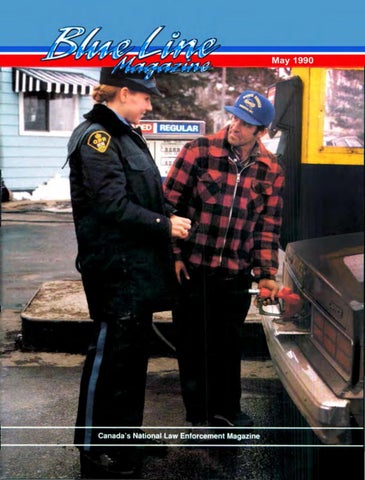
Cover Story DU C.C P
Letters to the Editor
4
The Wit and Wisdom of Tacky Burns
4
Editorial - "To The Best of My Power"
5
Canadians Save The Queen - Chris Raible
7
The Constable's Role - Chris Braiden
8
International Law Enforcement Games - Jeannette LaBrie
10
Officer Survival - Robert Hotston
11
Hi-Tech Report Writing - AI Porter
12
Blue Line Alert
13
Community Policing - Louise Dueck
14
You Asked For It
18
Photo Radar
19
Closeup - The Switchboard Operator
23
Project "P" - Part 2 - Lucy Becker
24
Up-Coming Events
25
Product Review
28
Rap With Rock
30
NEWS:
Homicide Rate Up For '89
16
Parents Sue Over Porno Tape
16
Court Reporter Given "Time"
17
Victim Delivers Nude Rapist to Police
17
New Shoplifter Bags Foil Detectors
17
CASE LAW:
"Cultivating" Given Broad Definition
18
Lowering Breathalyzer Reading is Okay
19
Officer Erred in Taking Three Samples
20
No Need to Announce Before Executing Warrant
26
Charter Not Breached After 18 Hour Detention
27
May 1990
3
p.
0lice officers working and living in .. their communities. This is the message given by Chris Braiden in this issue. The importance of officers getting out of their cruisers and meeting the public is of paramount importance in the '90's. As Constable Mary Elizabeth Cook demonstrates there is no real knack to community policing. Its just a simple matter of meeting and talking. Community policing is not a matter of forcing yourself on the community. The most important aspect of it is to be approachable and reliable within the community. Getting to know community leaders, merchants and teachers is a good beginning. Your willingness to be a resource to them and to lend advice when necessary will go a long way toward accomplishing your duty. In this issue you will read articles that will give you an insight into policing an Indian Reservation in Ontario. You will read about the difficulties encountered by these officers as they not only police their communities but in most cases their own relatives. No mere occupying army, these officers literally live and have lived their whole lives with the small communities they now police. In another approach Robert Hotston , in his regular column, has some good advice on how to utilize the media to your advantage. If you have any unique ideas that have worked for you feel free to write to us about it.
Letters to the Editor INFORMATIVE MAGAZINE I look forward to each new issue of your magazine as it is very informative and well written . I would like to know if it is possible to obtain back issues. Especially last January, February and March 19 9 as the first copy of your magazine I ever saw was April '89. I look forward to hearing from you and receiving my magazines. Brian E. McLaughlin Toronto, Ontario
••• Editor's Note: Coming from Toronto I am surprised you never saw the first three issues. Our first three issues were
printed for the Ontario market only. For this reason we printed enough to circulate to every police force in Ontario and every detachment of the o.pp We very quickly found that there was a demand for it across the country so we became a national magazine in April. We have been playing catch -up ever since. We have a very limited number available from those first three issues and they sell for $3.50 each . Other months are almost as scarce and we will send out what we have on a first come first serve basis, one per customer. We have a very short over-run and the
best way to keep up is to subscribe.
••• THANKS ... PARTNER! I have recently read an issue of "Blue Line Magazine" while in Sacks Harbour, North West Territories. I was intrigued and wish to subscribe to your publication . Thank you in ad vance, and I'm looking forward to my new magazine. P.A. Harrish Inuvik, North West Territories
••• Cont inued on page 6
The Wit and Wisdom of Tacky Burns by Terry Barker (excerpt from " The Five Minute Policeman" ) Recruits always want to get out there and do high speed chases, rescue kids from abusers, and save the world from the pushers and other bad guys. But the police experience isn't like Popeye Doyle or Miami Vice or even Hillstreet Blues. Those shows have to entertain the folks , so they always show lots of fights and shootups. I mean , would you stay home on a Friday night to watch TV that shows "real" police officers answering boring routine calls about barking dogs and noisy neighbours? And then writing up the reports on beat-up old keyboards? Not bloody likely! We join the force because we want an exciting job, but the truth is that most police officers never fire their guns over their ntire career (except to practice when they can get ammo) and most officers don't want to. That makes it real hard to take th ese calls seriously. They just don't seem very important. I mean , when
you are investigating a murder, how excited can you get when some old lady pensioner phones about a gaggle of raggedy teen -agers hanging around too near her corner? And when things are really busy you got a hot lead on a drug case, you're trying to write a report on a fatal accident that left you itching to kill the drunk who plowed through a Sunday School picnic, there's an outbreak of burglaries, and the third suspicious fire of the week has just been reported - that's when the nuisance calls come. Well , bud , you have to answer them anyway. The only question is: Will the old lady feel that the police officer gives a damn ... or not? When she calls, her problem is The Big One, and unless you can walk in her shoes for a minute she'll never understand why you didn't rush right over to save her. Think about it. If you sluff her off and give her the idea that she's a pain
4
in the neck, what'll happen? At the very least, she'll bad mouth the police. Can't you just hear her at her next tea party, saying, "Well, girls! I called the police, just like they're always saying we should do, but I got a rude young man who couldn't wait to get me off the phone!" And then the next time she has a complaint, she won't call . She'll say, "Well, they don't really want to hear from me." And we miss the vital tip. So get into the habit of looking at each call as an opportunity, not as a nuisance. Even if all you do is build a little community support, it's still worth it. If you take the time to apply "They System", you may create an ally and supporter for life. And more important to you personally, you may not have so many complaints about yourself. Not bad for five minutes work, eh?
_ _M _a~ y19~
Vol. 2 No. 5 · May 1990 . EDITOR/ PUBLISHER · Morley Lym burn er
. EDITORIAL ADVISORS · D a vid H . Ts ubo u ch i, LL.B. Edward Gunraj (P.o.A . C o n sulta nt) Ma ry Lymburn er B.A . M.Ed . G e ra ld A . O xm a n I.C.I.A . J aa n S ch aer B.A . (Me tro Police EAP.) To m Dykes (H a lto n Re gio n Po lice) Ro be rt H o tsto n B.A . M.Crim . Rick Patrick (Lambto n C o llege) The Editorial Advisors are persons from whom this publication seeks out advice and guidance. The use of their names is merely for recognition of their assista nce and ongoing support .
. ADVERTISING · Allan W. Stive r
(416) 294-5502 Fax : 294-8952 . ASSIGNMENT WRITERS · Lu cy Becke r • Louise Dueck AI Po rter • Rick Patrick
• CORRESPONDENTS· Ric hard Dupla in • Daffydd Herm a nn Craig McM illan • T. Richard Colle dge Murray E. Milligan • Rock Dueck
• COLUMNISTS· G eoff Cates • Ro be rt Ho tsto n
. PHOTOGRAPHY· J o hn Loftus • Mo rle y Lymburn e r
. ILLUSTRATION· To ny MacKinno n • Be tte C lark Dave S ills
. DESIGN AND PRODUCTION· J im Kelly Ca melot Graphic Design 97 Sir Lancelot Drive Markham . Ontario L3P 2J 3 (4 16) 47 1-0303 Fax : (416) 471-0305 Blue line Magazine is published monthly, ten times per year by Blu e line Magazine Incorporated with head office at 118 Main Street North. Markham . Ontario Canada. L3P IYl. Editorial and copy is considered to be completely separate from adve rtising sales. No committment for editorial coverage can form any part of a sale agreement. Advertising en quiries sho uld be made at 294-4773 or Fax Num ber 294 -8952 (area code 416) or to the advertising personn el listed . All articles are protected by copyright. No part of this publication may be reproduced or transmitted in an y form or by any means. electronic or mechanical, includi ng photocopyi ng and recordi ng. or by any information storage or retrieval system witho ut permission from the publisher. The authors. advisors and publisher accept no liability whatsoever for any injuries to person or propert y res ulting fro m the application or adoption of any of the procedures, tactics or considerations presented in this magazine. Readers are cautioned and ad vised that articles presented herein are edited an d supplied for yo ur personal awareness and sho uld not be referred to for further action until appropriate advice and gUidance is received from a supervising officer or the ad vice of a Crown Attorn ey. Blue line Magazine is an independant publication design ed to educate and upgrade the skills of those involved in the law enforcement profession. It has no direct control from a law enforcement agency and its opinions and articles do not neccessarily refl ect the opinions of any government agency or police force. Blue lin e Magazine is Printed in Canada by J ohanns Graphics. The sale authorized distributor of Blue line Magazine is Green Gables Book Shop. Markham , Ontario.
1"1. alAssociation of Police Planners Associate member , National
~ Member. Periodical
~ Publishers Exchange
ISSN #0847 8538 Second class mail registration No . 8242
May 1990
~~~
.
EDITORIAL
~~ "To the best of my power" The Meaning of Your Oath - Morley Lymburner-
W
ith out reading this article any further stop where you are. I really want you to think about this . Can you remember your oath of office? Try to remember even the basic points involved . Difficult isn't it!?
"I do swear that I will well and truly serve Her Majesty the Queen in the office of Police Constable .... , during the pleasure of the Board of Commissioners of Police without favour or affection , malice or ill will, and that to the best of my power, I will cause the peace to be kept and preserved, and prevent all offences against the persons and properties of Her Majesty's Subjects; and that while I continue to hold the said office, I will, to the best of my skill and knowledge, discharge all the duties thereof faithfully, according to law. - SO HELP ME GOD." Quite a statement isn't it? This is what every new police officer recites with his one hand in the air and the other hand holding a Bible. Hardly any officer ever sees this oath again after his first day on the job. During his training session they give a handout that has it written but no real in-depth look at the words are ever required of the officer. It is all too easy for officers today to take up the cry of the masses for individual rights rather than to consider their duty towards the general good of society. Is this attitude good for the officer in discharging his duty? Let's step through this oath and see what it says.
The Basics Its basic position is that the police officer is placed in a position of uncommon power and trust. This position is given to the officer by virtue of the Queen through her 5
representatives and with a geographic positioning for the purpose of administration and control. It is written in the first person so that each officer is aware that THEY are taking this position and that it is not being forced upon them . It is taken with the clear knowledge that they are going to be made accountable to keep their word .
Duty Without Favour The majority of the Oath is taken up by describing the manner in which the officer intends to perform his duties . In this manner the public can expect certain attitudes and certain responses from each and every officer. It is this consistency of service that is vital to the fabric of the force and the community. Every citizen is assured that each officer will perform his duty "without favour or affection , malice or ill will ." In other words the officer will not let his personal opinions interfere with the job he has to do. The officer then states that he/ she will "cause the peace to be kept and preserved ." The good order we now posses will be kept at the same level. Prevention Vs. Apprehension "Prevent all offences against the persons and properties" of the public at large. This does not mean that each officer is expected to pounce on absolutely everything he sees wrong. At the beginning of this area it states "to the best of MY power." It does not suggest the officer is superman. Just a person expected to care about what is happening around him. It is this area that uses the word "prevention ." This is an all encom passing word that leads the police in areas that some officers feel we do not belong . It is clear that prevention is
~~ ,~~~-
It is clear that prevention is specifically included while the word apprehension is not. The duty of arresting criminals comes by legislation not by oaths of office. The Oath of Office is a statement of intent. We all state we will do certain things. In the last line it says "according to law." Laws such as the Criminal Code, The Highway Traffic Act and the Police Act. This area states further that the duties put in place by statute will be enforced . This area could be described as a limitation rather than an expansion of authority. That everyone, officer and citizen , knows they can be subject to laws and rules being invoked by a popular and representative government. Not by an arbitrary decision of the individual officer to make his own laws.
" While I continue to hold the said office .. ." It becomes quite clear at this point that this is no mere job that can be performed by punching a clock. There is no room for personal likes or dislikes but there is room for compassion and discretion .
Now let us consider the officer assigned to a picket line, a demonstration or a domestic dispute. Does this officer have a right to express his opinion? Does this officer have the right to loose his temper and strike out at someone as a result? Does this officer have the right to ignore laws? Does this officer have the right to make judgments of individual rights and wrongs? Does he have the right to refuse to protect some person or segment of society? He has the right to his individual opinions and discriminations. Unfortunately while he is an officer he must not permit them to influence his job or anyone else's. Why is this the way it is? Simply put it is because everyone will know the officer as a known quantity. He has given his word to do something in a predictable way. The public counts on it, the Chief counts on it, and your fellow officers count on it. In the middle of a fight an officer does not wish to hear his partner advise him that it is against his personal belief to fight for such a cause. There is no excuse at this point that he is a
conscientious objector. A "C.o." understands the rules at the beginning of the game and determines then that he does not wish to participate. He does not wait for the time of need to arrive and then make his feelings known .
THANKS FROM BOTH OF US I am writing to let you know just how much my husband and I enjoy your magazine and that we look forward to reading each issue. Not only does it keep my husband up-to-date with police issues, but it also helps me, as his wife, to understand his job just that much more. These police officers do a fantastic job and I wish more people realized this . Thanks for doing such a great job. Keep up the good work. Mrs. Sharon Wright Fonthill, Ontario
Tony is GREAT! I would like to renew my subscription to Blue Line Magazine. You will find enclosed my cheque. I find your magazine very informative and professional. I was on course with your cartoonist Tony MacKinnon and am happy to see he's keeping up his sense of humour. Dan Anthony Orillia, Ontario
" So Help Me God " And what about those four words at the end? It advises the officer that he is not serving two masters. That his accountability is a personal one that is not restricted to earthly limitations.
What you need to know every day is in Blue Line every month.
Have you sent in your subscription yet?
ontinued from page 4
Editor's Note: Both these writers gave us the best compliment by using the words "MY Magazine." That is what we want all our readers to feel. Every new subscriber is a partner in this venture.
••• MAGAZINE IS ENLIGHTENING I have just recently received the December 1989 issue of "Blue Line Magazine". I have enjoyed reading the articles and I found them enlightening. Murray E. Milligan Winnipeg, Manitoba
•••
•••
6
• •• Editor's Note: Tony's cartoons are great but I wish he would quit having his relatives write these letters!
• ••
May 1990
Canadians "Save" The Queen For Some Good Reasons - Chris Raible -
O
ne aspect of Canadian culture that Americans find quaint, and even peculiar, is our national allegiance to a monarch . Despite their own apparently infinite capacity to be titillated by the royal family, Americans think it strange that the head of state of this Canadian nation is a foreign sovereign . They think they rid themselves of that nonsense more than 200 years ago. Historically, of course, allegiance to the monarch helped to define Canada. "Loyalists," who continued their loyalty to the British king, emigrated north after the American Revolution. Many fled persecution prompted by their sympathies. Although many more were lured north simply by the promise of good land, English Canada was most clearly distinguished from the 13 independent colonies by its remaining true to George III . The difference in national identities is even deeper. The American myth is that the people created the government. As the first settlers in the new land felt the need for law, they molded the minimum necessary governmental structures. With migrations to the west, the people preceded the law. A "government of the people," was fabricated out of nothing in response to the immediate necessity. Of course, had that really been true, there could have been no original colonies and no national survival. The myth overlooks the underlying English law. It forgets that most rebellious colonists in 1776 were insisting on their continued rights as Englishmen. "Life, liberty and the
May 1990
pursuit of happiness" implied little of the collective responsibility that was essential for the U.S. constitution to "establish justice, ensure domestic tranquility, provide for the common defence, promote the general welfare, and secure the blessings of liberty." The Canadian myth is that the government created the nation . Any map of Ontario, with its rigid grid of concessions, gives evidence that the surveyed lines were drawn first. The order preceded the people. The law was not the creation of the settlers, it was a condition of settlement.
Canada's Confederation in 1867 was for "peace, order and good government," communal not individual values. The new nation was a "Dominion ," continuing under the authority of the crown . The monarch was not oppressive, quite the contrary. In British law, the crown was pledged to defend the subject's rights against all possible encroachments - that was perhaps its prime purpose. A king or queen could keep the government from becoming too oppressive. The idea of disinterested, trustwor-
7
thy personages above the political particulars continues, although in largely symbolic form - for example, with "crown" attorneys, "crown" corporations, "royal" commissions, and such . Here in Canada criticism of the government need never be confused with disloyalty to the nation . The limitations of elected leaders are well understood, almost expected . In contrast, American presidential failabilities , revealed in the Watergate scandals and the Iran -Contra revelations, created national crises. To doubt the President was to threaten the Presidency and therefore to undermine the constitution . Americans are often surprised at Canadians' habitual hostility toward prime ministers. Past holders of the office are constantly demythologized . No matter how great their steps, we know their feet were clay - Sir John A. drank too much ; MacKenzie King sought advice from his dog . Present prime ministers are never promoted to too high a position . They are kept down to earth, even at the price of being a little dirty. We Canadians can deplore the Prime Minister and adore the Queen . The designation "Dominion" has been dropped, but the concept continues - ours is a constitutional monarchy, not a democratic republic. Allegiance to the monarchy, as w.L. Morton pointed out many years ago, is an essential aspect of Canadian identity. Victoria Day is appropriately a national holiday. OUt head of state is not above the government, but rather outside it. Her realm is a different realm - a mari usque ad mare - while our political leaders remain with us, very human , and in our hands . ~ Guest writer Chris Raible is a teacher of Canadian-American relations at the University of Toronto and is a citizen of both countries.
The Constable's Role
Familiarity is the Key - Chris Braiden Edmonton Police Force
I
t is the police leaders task to create an environment wherein com munity policing will grow, but in the final analysis it is the constables who must make it happen ; they must give it life nd Vitality. More than anything else, constables must be familiar with the people in their neighbourhood and vice versa . But this need for police/ citizen familiarity shouldn't surprise us. After all, in our personal lives don't we seek it out all the time in the doctors we go to, the service stations we take our cars to and the butcher, hair dresser and bartender we choose to give our business to? In every case, we are looking for one, predominant quality, trustworthiness. We want to be sur the doctor is familiar with our body, the service station operator with our car, the butcher with our choice of meat, the hairdresser with the way we like our hair and most important of all , that the bartender will give us full measure in our drinks. Why should we think it would be different when it comes to people and their police. Isn't it reasonable for them to want to have a cop they know and trust?
these neighbourhoods as their customers and cater to their individual needs. Policing need not be any different ; it too has clients with needs that must be met but it must get its service down to the neighbourhood level. So long as cities are policed in blanket department store fashion , we are missing the point. We need to bring the specialty shop atmosphere to our policing product. This familiarity cannot happen until police get out of their cars and meet ordinary people under normal circumstances on a regular basis and get to know each other as individuals. That cannot happen when the police are shut in behind closed car win dows .
Neighbourhood Foot Patrol This leads us to the subject of foot patrol. For the purpose of this paper,
foot patrol and neighbourhood patrol are synonymous but I will most often use the latter term because full -time foot patrol is not realistic in all cases, e.g., the regional police forces in central Canada that embrace large rural land areas . However, whether it be full time or part-time, front line uniform police officers must start walking again . They must spend time with ordinary people on a regular basis away from technology, under normal circumstances. It will be said by some that many police agencies across Canada already have foot patrols. That is true, but often they are there for the wrong reasons , to placate special-interest groups, and for public relations. Usually foot patrols are assigned to the business sections of large cities and only because of lobbying by the Chamber of Commerce or some similar group. This is dangerous because when the entire tax-paying population does not have a say in the role definition of their police, specialinterest groups are often allowed to monopolize police time and resources for selfish reasons. In many cases the people who need us the most get the
No Excuse For Big City Forces We are told it is unreasonable to expect this friendliness to happen in the hustle and bustle of big cities. This is a cop-out (no pun intended) . Just b cause most policing occurs in big citi s is no excuse for police officers bing nameless and alien . Most doctors, service stations and bars are in big cities too! The main difference is that the latter serve specific neighbourhoods, see the residents of
8
_______________________________M~ ay1990
What enhancements have you made to the basic concept of area foot patrol? Just write it down and send it to us. Do not worri about gramar, spellin or stile of riting. It is your message that counts. We will re-write, if necessary, to get YOUR story out there.
least of our time because they have no political clout. Wealth has no place in determining police service.
Alienation With Co-workers This style of foot patrol is harmful for another reason . It alienates foot patrol personnel from their motorized partners. Most often , current foot patrol officers are not assigned calls for service, do little substantive 'real' police work and there is no compulsion on them to really get involved in their beat or its problems. Their main task is to be visible and 'Fly the Flag'. Often , they will call in mobile patrol units to investigate incidents they are quite capable of handling themselves. Central to genuine neighbourhood patrol however is ordinary police work; answering calls for service, including crimes in progress, whenever possible. And doing the paperwork, too! The objective of neighbourhood patrol is not to be different from mobile patrol but rather to do more with the uncommitted time experienced by both . Neighbourhood patrol
must not and will not mean more work for mobile personnel. If it does , there will be friction between the two. The only limitation on neighbourhood patrol is lack of mobility. To counteract that limitation , it can perform all of the interpersonal social tasks that cannot be performed by an officer driving by in a patrol car.
Editor's Note: This concludes our recent series from Chris Braiden. I would be interested to hear your story. Have you tried any of these tactics in your own community? What changes occurred, for better or for worse, in your community?
Why you need The Five Minute Policeman:
Alberta May Create Native Jails Canadian Press reported last November that an agreement had been reached between Alberta's Solicitor General and the Chief of the Blood Nation "that will see the tribe provide community-based correctional services on the band's reserve." Plans are for a 24-bed minimumsecurity correctional faCility in the Blood community of Stand Off. Less than 5 % of the province's population is native and yet they make up 30% of the jail population . No mention was made that this is experimental but no doubt statistics will be closely watched.
THE FIVE MINUTE POLICEMAN
Terry Barker has made common sense something that can actually be grasped and identified. You 'll not only learn a new system , and see how and why it works, but you 'll be able to identify how and why some of your own methods have worked in the past. Terry gives you The System - the tools with which you can achieve results by design . Even experienced policemen feel a new confidence, and we all know that confidence coupled with experience and ability means a polished and professional job
By Terry Barker with the assistance of Sgt. Ed Hill and the members of the Gibsons, B.C. Detachment. RCMP
The Five Minute Policeman - $12.95 Available from
(416) 294-4773
Green Gables Book Shop
VISA - MasterCard - American Express Accepted
118 Main Street North , Markham, Ontario L3P IYl
May 1990
9
was also collected through ~~-- outMoney March in "sing-a-longs" where hockey stick will be auctioned off.
-
'" K
~ ~ ' _ _ _ _ _ _ _ _ _ _ _ _ _ _ _ _ _ _ _ __
International Law Enforcement Games . Jeannette laBrie .
H
undreds of law enforcement officers have already registered for the 1990 International Law Enforcement Olympics coming to Edmonton , Alberta July 29th to August 4th . "We are receiving many registrations much earlier than anticipated," said John Noyes , Director of Marketing and Communications. "We have been receiving many inquiries from all over Europe, the United States, Australia, New Zealand, and Asia for more information on the games." Over 5 ,000 officer from 25 countries are expected to be at the games to compete in over 45 different sporting categories. Two trade show will accompany the games with the main trade show July 28 to 31 and a mini Tradefest August 1st to 3rd. The main trade show includes registration , a law enforcement officers and visitors Insignia Swap area, a beer and wine bar and 50 commercial booths. The mini Tradefest will have only 16 booths, and Trade Show CoOrdinator, Constable Phil Bailey hopes that the product displayed or sold will be collectible items. The International Law Enforcement Games Foundation has two of the 16 booths to sell hats, pins, spoons, and other collectible items with the logo of the games on them . The International Law Enforce-
ment Games Foundation recently held its first fund raiser for the games. Over 200 people attended the celebrity auction which raised over $20 ,000 . Hollywood celebrity, and honorary ambassador Mickey Jones flew up for the occasion . The true blue Edmon ton Oiler fan auctioned off various hockey items including autographed game jerseys of Mark Messier, Kevin Lowe, and Jari Kurri. The four official ambassadors for the games were officially introduced
to the public at the fund raiser. Edmonton Oilers Geoff Smith and Adam Graves, Edmonton Eskimo Tom Richards, and World Junior Curling Champion LaDawn Funk were recognized . Media and P ublic Relations CoOrdinator, John Coonie said there will be a fund raiser each month until the games. O n March 30 and 31 a dart tournament is sched uled at Edmonton's Rose "n" Crown pub. During the competition, a couple of Oiler's jerseys and Wayne Gretzky's autographed
10
customers put money in a jar when they request their favorite song at the pub. "Not only does it realize funding for the foundation , it continually raises the awareness of our upcoming games and gives us a lot of media coverage," Coonie said . He added that the other monthly fundraisers are not yet finalized . The money raised at the fundraisers will go towards funding the games and money left over after the games will be donated to the Alberta Special Olympics. During the games, special social events are planned for the law en forcement officers and their families . On July 31 a n old fashioned Barbecue will be held at Fort Edmonton Park. The park will closed to the public for the event. All the attractions throughout the park will be open and dancing in the streets and special street entertainers will be included in the event. There will also be food and liquor stands. Invitations are exclusive to out of town athletes until the end of June and then tickets will also be available to local officers and their families . On the final night of the games, August 4th, there will also be a barbecue at the Red Barn . For more information , call toll free 1-800-661-1990. Copies of the entry book, which outlines all sports events, social events, accommodations, and transp.ortation , are available ......
Peel 's Fourth Principle of PoliCing To recognize always that the extent to which the co-operation of the public can be secured diminishes, proportionately, the necessity of the use of physical force and compulsion for achieving police objectives.
May 1990
Officer Survival
n many areas of policing, personal experience is one of the most important guides to the method of operation . Over time, officers develop a system which they have tested and proved in similar incidents. Whatever its value in routine situations, this process cannot be accepted as the sole method of assessing the problems of dealing with an armed or violent offender. No individual police officer ever becomes involved in a sufficient range of armed or violent confrontations to allow him or her to make balanced judgements based solely on personal experience. In order to produce information of sufficient scope and detail, one must review reports about incidents in which police officers have confronted
threats from armed or violent offenders. Useful information can come from a number of sources including police training manuals, particularly those concerned with situational training, reports from individual officers involved in specific incidents, and, surprisingly, media reports . Police training manuals are important sources but they may contain information which is either too specific, too general or which is inappropriate to many situations . Official police reports of specific incidents are generally concerned with relating evidence to be presented to a court or with information for senior officers. Failures of training, tactics or equipment may not be reported or only mentioned briefly. Moreover, such
reports may be limited in availability, restricted to a specific agency or jurisdiction . Media reports, particularly those found in newspapers, provide a prolific and available source of information . In individual cases, their accuracy, particularly as it relates to technical detail, may be suspect. Much will depend on the news value of the incident in question and the volume of other news at the time. One thing is certain, if police have made mistakes or acted in a questionable manner, the media will draw attention to it. But for all of their drawbacks media reports often provide a relatively accurate account of the broad outline of an incident. Lack of confirmed technical detail about an incident is often compensated for by the range of information that can be built up from media reports over a period of time. When such reports are evaluated against an individual officer's own personal skills, training and knowledge of tactics, they can provide a valuable source of survival information .
Ontario Police Fitness Award
involved with initiating this program for the year has been covered by the PoliCing Services Division of the Ontario Ministry of the Solicitor General.
Anyone wishing further information about this program is invited to contact Clair Shaw at the Ontario Police College at (519) 773-5361 Ext.244
Learning from the Media - Robert Hotston -
I
If you are a physically fit police officer in the Province of Ontario you could be a recipient of the Ontario Police Fitness Award . The Program was formally launched at the Ontario Association of Chiefs of Police Annual Conference in Thunder Bay last June 27th. Pins are given out in recognition to those officers who maintain acceptable physical fitness levels thro ughout their careers. Upon successful completion of the fitness appraisal the tested officer will receive a fitness pin, which may be worn on the police uniform in recognition of the accomplishment. Since the program's conception 1,752 fitness pins have been issued to O ntario police officers. The costs
May 1990
~~~-------------------------------.
FLASHES Tony MacKinnon by
'~. Suspect is nine f eet tall, weighs seven hundred and twenty-six pounds and has a small scar on his left ankle... "
11
Hi-Tech Report Writing
bell says, straining to keep a smile from his face. In actual operation of the system , Occurrence or Call Numbers are generated at STPD's dispatch center - AI Porter and this number stays with all records generated from this call. The officer responds to the call and takes olice Officer Joe Demeester is bell, "They had been field tested and whatever action is necessary, then one of the first officers in the approved for police work." Campbell draws his trusty laptop and begins his State of Michigan to do some on- relates a story that confirms this state- report. The system calls up screens as street computing. The 12-year Shelby ment. An officer using the new system required for the specific type of call Township Police Department (STPD) had managed to spill a soft drink on- and for the first section of his report officer was issued one of his depart- to the keyboard of his laptop. He held the officer is required only to fill in the ments 45 new Tandy model 102 lap- a hurried conference with his partner blanks on the screen with the pertitop computers when his agency, and while their imaginations began nent information . The system proresponsible for policing one of working on explanations, the alert vides space for all pertinent details Detroit's northern suburbs, made a thinking that sometimes occurs to of- and includes specific details for calls giant stride toward the twenty-first ficers under stress took over. In a of a special nature. Special calls which century and went to a computer "What have we got to lose?" solution, require information as to "modus reporting system in late 1988. Det.-Lt. the officers headed to a 25 cent car operandi" or "suspect autos" are also Don Campbell, self-confessed covered . The officer also types in "jack-of-all-trades" for STPD ?1~~~~~~~~~~~i(iii a short narrative of the occurrence says he first became interest- \ and he is then ready to file his ed in this idea when paper report. This is where the reporting work threatened to bury officer has several options. He the 49 member department. might clear the call and be ready for other patrol or complaint Campbell researched the problems faced by his departanswering duties, or, if the call ment and learned of a system is of such a nature that headquarters needs the informawhich had originated in Lakeland, Florida. This system tion quickly for further acprovided field officers with their ~• •" • • • • •_ _ _ _ _ _Iiiii__1iV' tion , the officer can make own laptop computers for report 1 use of a built in computer/ writing . Highland Technology telephone device known as a Inc., of Lakeland had developed wash in their area. After feeding the modem and with any telephone line, IMPRES software for police reporting, coin slot they waved the magic car- transmit the report directly into the and Campbell saw this as an answer wash wand over the keyboard and set data bank at the po. A distinct advanto a growing problem . The staff at upon the final stage of their project tage of the system is that the reports Highland Technology are all current by attacking the remaining dampness are written at the scene at the time of or former law enforcement officers with blow-driers. They then returned the officer's first arrival and are deemwho are aware of the specific needs their computer to service and it con- ed to be his notes and are admissible of such a system. Their software tinued to function . But police secrets in court as evidence. packages are individually tailored to being what they are, Campbell learnIf the officer chooses to save his meet each department's unique re- ed of this further demonstration of reports until the completion of his quirements. Tandy model 102 laptop equipment hardiness. "I wouldn't shift, he may then transfer the computers were chosen for the recommend that - and I certainly reports directly into the station's system because, according to Camp- didn't to the officers involved," Camp- larger computer.
In-Car Laptop Computers
P
12
May 1990
Supervisor's Task Made Easier Supervisors are required to check each report when it has been filed and they are given the option of "approving or disapproving" each report. An approved report is automatically routed to the proper division and is automatically filed in the records bureau. A disapproved report requires a printed copy and the system automatically generates an electronic mail message which is delivered to the officer on the next occasion when he checks in with the computer. Supervisors are also able to make minor alterations to reports and then approve them rather than sending the entire report back to be redone. A disapproved report also generates a page copy on which any shortcomings can be marked and brought to the attention of the reporting officer. Training Required Campbell says each officer was given 16 hours of training in basic operation of the system prior to its being brought on -line. He says it took about four working days for the officers to get used to the new system, but the improved results were almost immediately apparent. He says the departments reports are now "much more thorough, and of a higher quality." Campbell also mentioned a subtle incentive the department provided to encourage the officers to become familiar with the system. One printer was set aside for officer's personal use and some basic programs such as one for calculating mortgage payments were installed for personal use. Officers are encourage to use this and similar programs to become familiar with the capabilities of their system . Satisfaction With System Campbell describes the operation of the system as a "totally different concept; all the information is here." And with the "fill-in-the-blanks format,
May 1990
officers "don't have to make complete sentences." Demeester agrees with Campbell on the operation and value of the system. He feels the crossreferencing capabilities of the system are some of its most valuable assets to an officer conducting a field examination. He says his typing speed is about the only thing holding him back from cutting drastically into the time required to handle each complaint. Demeester says currently, "It takes just as long, but the reports contain more - and better information ." Demeester proVided a short demonstration of the operation of his laptop in his patrol unit. The pint-sized information gathering machine fits handily into a wire bracket which in turn is draped over the steering wheel providing good access and visibility for hunt and peck typists.
Acceptance of the system was easily overcome when some of the reluctant ones noticed that those using the system willingly were finished their end of shift reporting and waiting at their after shift meeting spots much more quickly than the hesitant. In a very short time even those initially skeptical of the merits of the system were won over and are now some of the system's staunchest supporters and defenders. System of the Future? Some time may lapse before computer terminology becomes as common-place around police officers as "wadcutters", "hollow-points" or "speed-loaders". It may be a while before "megabytes" are confused with "magnums", but to be sure, if the writing isn't on the wall, it IS on the LCD screen of a laptop computer.
~~£W~----------~ ALERT! EXTENDED
Guardian Ring The guardian ring consists of a ring in which two blades are concealed. When the two pins which protrude from two sides of the ring are pushed, the two blades flip into position. Although each blade is only approximately 1 cm (3/8") long, a bad wound could be inflicted with this weapon .
13
enjoys his duties policing a reserve. The occupation runs in the family. Monague took over the duties of his father, retired Special Constable Alfred Monague, a few months before his father's 1988 retirement. "It's slower here, more relaxed than in other places. Also it helps that I know everyone here, I know the area Community PoliCing well, and I had previous policing experience." Monague previously worked out of the Brantford office of the Ontario Provincial Police and the Peawanaul Reserve in Northern Ontario. Monague is assisted by two other - Louise Dueck Constables. Constable Rick Roulston is a non-native for whom Monague was the coach officer. As of January he pierCing sound of the winter, the summer tourist trade the newest Constable , Roland telephone's ring cut through the multiplies this figure many times over. Monague, was attending the Ontario air. The officer interrupted its second And 1989 was the busiest year on Police College. command for attention. record for policing this Georgian Bay Winter patrol consists mainly of "Christian Island Police, Constable Island . Domestic violence and sexual checking cottages using a snowmobile Dan Monague. Can I help you?" assault calls doubled from the year and a 4 -wheel all terrain vehicle. In "There's a canoe washed up on the before, due, Monague believes, to addition to Christian Island , with its shore, but there's nobody in it." public education . Break and enters, 40 square kilometers and 64 "What is the location of the however, dropped sharply from 132 kilometers of roadway, they are also canoe?" (all cleared by charge) in 1988 to responsible for Hope Island and "Near the tip of the South Cottage only 30 or so in 1989. Beckwith Island. Although they are area." . . . - - - - - - - - - - - - - - - - - - - - - - . . , unpopulated they still " I'll be right there. form part of the Christian Island reserve. The reserDon't touch or remove anything ." vation is easier to police Arriving at the site, in winter with the snow First Nations Constable vehicles than in summer, Monague finds the canoe when a cottager's boat and proceeds to examine often needs to be comit. There is a shoe and a mandeered in order to shirt in it, but, as adVised, answer a call. no person . With no patrol "I could apply for a boat, the Midland office lateral transfer," he says. "But I like it here. I know of the Ontario Provincial Police is called. An hour other officers look down later they arrive to assist on reserve officers as getwith the investigation . ting paid to do little, and Eventually the person is located . Calls ranged from cottage I'm accused here of doing a white He had swam ashore and quietly neighbour disputes, liquor offences, man's job, but I don't see it that way. gone home, afraid to tell his parents water calls and trespassing to HTA Its something I've worked hard to what happened . (careless driving) and off-road vehicles achieve (being senior officer) and I'm Monague says summer is the busy (no insurance, careless operation) . very proud of what I've done, for season for Christian Island Police. There has not been a murder on myself and for my people as a whole." While the Ojibway population on this Christian Island in twenty years. Policing relatives and friends is not First Nations Constable Monague a problem now, says Monague, but island reserve is just under 1,000 in
Preventive Policing on the Reservations
T
14
May 1990
he did receive his share of threats in the beginning, Now, he claims, relationships remain cordial unless a family is frequently charged.
Policing the Rama Reserve Rama First Nations Constables John Snache and Cliffe Sharpe admit to sharing the same experience as their Christian Island colleague. They still receive occasional threats and have hostile relatives due to charges laid. Rama First Nations Reserve differs from the Island reservation in that it is located just outside of the city of Orillia. It has an on-reserve population of 500-600, though another 1,000 band members live in Orillia or slightly further afield . First Nations Constable Sharpe, grandson of the first Ontario Special Constable hired on a reserve, Walter Sharpe, claims in spite of threats he really enjoys policing with its variety. "The charges may be the same, but the circumstances are always different," he says. "And we are not restricted to policing the reserve. When its quiet, we can also go into town or on the highway." Duties at Rama First Nations Reserve are mainly general patrol and property checks, though occurrences include drugs, break and enters, cheque frauds, liquor violations, speeding, assaults and thefts. Though domestic violence calls used to be high, only three have been reported in the first two months of 1989 and all were alcohol-related. "The main concern here is impaired drivers," Constable John Snache says, "and I started off in my first year charging only relatives. I also lost some friends since. Some I went to school with don't even talk to me anymore." Sometimes the accused of an impaired charge will claim the passenger was driving. Sometimes a charge is laid after driving behind a vehicle when it is obvious the driver
May 1990
is impaired. But the most bizarre case was the night a non-native from British Columbia arrived by car at the home of one constable with a case of beer. The visitor, who was obviously drunk, claimed he'd partied in B.c. with Indians and "they really like to drink". He was invited inside and then shown the badge. He qUickly asked for coffee and a cab but found an Opp cruiser calling for him . He was convicted and , as it turned out, had four previous ability impaired convictions in B.C. Both Rama officers believe in preventive policing . They drive around the reserve and talk to people, and make house calls just to share a coffee and affirm their presence. They have overcome the initial taunting, having personal cars damaged and being pushed to the limits . Now people are more helpful. They are providing information and taking more responsibility for themselves and their families. In addition, Sharpe co-ordinates the recreational activities with the children on the reserve - a job which he began seven years prior to becoming an officer. "I like helping the kids ," Sharpe says. "I wanted to become a police
officer because I saw the respect my grandfather had . Now other children are saying they want to graduate and become a First Nations Constable." Constable Snache, hired in 1984 and Sharpe, who began in 1986, report to both their OPP Liaison Officer, Sgt. Steve McFadden in Orillia, and to the Rama Chief and Council. In addition Sharpe occaSionally does undercover assignments, with a partner from the Saugeen Reserve, into bootlegging and drug trafficking on other reservations. "Reserve policing used to be a 'back-door' route into the OPP," they say. "Being a reserve officer is not a guaranteed job; if the reserve decides they don't want police, the job is gone." Any police agency is only as good as the support they receive from their community. The closer the connection between the community and the police the more the police agency can accomplish. This lesson appears to be second nature to the Reservation police officer."'ii\
Df{y~/~gw #~(~71f1P'*"1l-" Sent in your subscription yet?
~~ ~MY----------------------------------~
FLASHES by T ony MacKinnon
" I'll be glad when they get those damn radios repaired! "
15
... news beat ... news beat ... news beat ... news beat ... Homicide Rate Up For 1989 There were 649 homicides in Canada in 19 9 , up 13% from the unusually low total of 575 in 1988, Statistics Canada reported in February. The i9 9 rate of 2 .48 homicides per 100,000 population was slightly be low the 2.57 average rate for the last 10 years. For the second consecutive year no police officer was murdered while on duty, only the third year this has happened since 1961. Among provinces, Manitoba at 3 .97 homicides per 100,000 population in 19 9 had the highest rate for the fourth year in a row. Other provinces, in descending order: Quebec 3.20; British Columbia 2.91 ; Alberta 2 .6 ; New Brunswick 2.51 ; Saskatchewan 2.1 ; Ontario 1.78; Nova Scotia 1.69; Prince Edward Island 0 .77 ; and Newfoundland 0 .70 .
Homicide Rates Rate per 100,000 population 1988 - 1989 D
1988
_
1989
1-
0 NFLD
P.E.1. N.S.
N.B.
QUE. ONT.
The Northwest Territories rate was 11 .24 and Yukon 7 .87 . Among the 25 census Metropolitan areas, Montreal had the highest rate at 4 .19. Edmonton , the 1988 leader,
ON THE THE LIGHTER SIDE Of lawyers and horses Provincial Court Judge Nick Friesen, while sitting in a British Columbia court, was faced with a technical defence by a city lawyer. He was attempting to convince the judge that technically another judge that had released his client on an undertaking was not a judge within the meaning of the Criminal Code. Judge Friesen's remarks are worth repeating. "In Anahim Lake the residents use common sense, which they sometimes call horse sense. There are lots of horses in Anahim Lake. Yesterday we saw more horses than usual in this settlement. It was byelection day and our usual courtroom, which is this hall, was used as a polling place.
MAN . SASK. ALTA.
B.C.
SOURCE: Statistics Canada
"Some people came by horseback, tied their horses to the front door and voted . Some horses left piles of manure at the doorstep. They did not, however, bring it into the courtroom . Now that is horse sense! "Lawyers from Kamloops have to travel at least six hours to get to Anahim Lake. Lawyers generally have a very active mind . They have lots of time to dream up exotic legal arguments when they travel that long. "However, they should pause at the front door of our courtroom and look down and contemplate those piles of manure and their arguments. Had that been done in this case the lawyer might have been heard to say, 'That's horse shit!' and have left his argument outside the courtroom too."
was second with 3.90 followed by Winnipeg at 3 .15 and Vancouver at 3.10. St.John's, Nfld ., without a single case of murder, manslaughter or infanticide during 1989, was the only major city which was homicide free. Regina, which had the highest average homicide rate for the years 1981 to 1988, slipped to 13th spot in 1989 with a rate of 1.58. Calgary at 1.45 reached its lowest point since 1981. The 1989 figures released in February are preliminary and subject to future revision .
Parents Sue Over Porno Tape A couple from Shelton Connecticut are suing a local video store that sold them a porno flick instead of the Cinderella tape they thought they were buying for their children . Laura and David Burdick bought the tape at a video section of a local toy store as a Christmas gift for their
- - - - - -:-:- - - - May 1990
... news beat ... news beat ... news beat ... news beat ... two children . Mr. Burdick said he put the tape in the player and then left the room. When he returned later, his son and daughter, aged seven and eight, were not watching Cinderella, but "Hollywood Confidential: Diary of a Sex Goddess." The couple are suing the store for negligence in not inspecting the package to make sure the correct tape was inside, and for causing emotional distress to the children .
Court Reporter Given " Time" To Finish Transcript A court reporter from a Red Oak Texas court house was sent to jail for three weeks to prepare a transcript ordered two years ago. A man convicted of a double murder in 1985 launched an appeal but was required to have a full transcript of the trial prepared before the case could be heard . The court reporter was notified to prepare the transcript and was given two extensions to get it done. Meanwhile the accused remained in jail. After further inquiries were made it was determined that the court reporter had done very little of the work over the previous two years. The reporter was subsequently brought before a court and the judge fined her $250.00 and sent her to the county jail, along with her notes and typewriter, to finish the transcript. The clerk spent three weeks in the jail and finally completed the 7 ,000 pages of the transcript.
May 1990
Victim Delivers Nude New Shoplifter Bags Rapist To Police Foil Detectors Evidence revealed a Halifax man , convicted of sexual assualt in January, was delivered to police clingling to the front hood of a car and with no clothes on . The driver of the car was the victim in the assault. The victim reported that the man had threatened her with a knife and sexually assaulted her in his car. The suspect briefly left the vehicle to urinate and the victim took the opportunity to lock the car doors and start the engine. The accused , upon hearing the engine start jumped onto the hood of the car and the woman drove off. The victim continued to drive the car for about 30 minutes in the cold weather and decided she might as well take the suspect, who was still clinging to the front hood and feared letting go, to the local police. As she arrived with her chilly cargo a police officer took custody of the man . It is not certain how much the accused and brass monkeys have in common.
Shoplifting has gone high-tech . After many retailers spent thousands of dollars installing electronic anti-theft devices in their stores, a new breed of sophisticated thieves has devised a way to beat magnetic sensors. By placing garments in homemade bags lined with aluminum foil , wrapped in duct tape and concealed inside a larger plastic bag, a suspect could walk out of any store with items hidden inside. The scam was discovered by members of the Ecorse Michigan Police Department when they raided a known crack house. Members of the Department found several silver coloured pouches during the raid and recovered a considerable amount of stolen merchandise taken from local stores equipped with anti -theft devices. The best method of deterring such activity is for merchants to be attentive to their customers needs and greet them at the door.
/~#/ ~~/ --------------------------------~
FLASHES by Tony M ac Kinnon
"If I ever f ind out who put the
snake in our cruiser. .... POW! "
17
CASE LAW: Narcotic Control Act
" Cultivating" given broad definition (Reg ina Vs. Arnold) The British Columbia Court of Appeal has given a broader interpretation of the word "Cultivate" as it is used in the Narcotic Control Act. In 1986 a team of RCMP officers were lead to a remote field on a west coast island and they seized a full crop of mature marijuana plants that had an estimated street value of $350,000. Later investigation revealed the crop had been grown by a Ronald Arnold and charges of cultivating marijuana were laid . At the initial trial the case revolved around the definition of the word "cultivate". There being no definition in the Narcotic Control Act the court went to the Oxford English dictionary and found that "Cultivate" means "to
bestow labour and attention upon land in order to raise crops ..." The court found the accused guilty of cultivating the drug. Upon appeal Mr. Arnold argued that he had not bestowed any labour and attention on the drug to cultivate it. His argument was that the Crown would have to prove the seeding of the ground and give a full account of the care he had given the plants. He also argued that the Crown could not prove that he was actively cultivating on the specific date of the information before the court. The Court of Appeal disagreed stating, "The crop is being cultivated simply by being left alone to grow and mature in the environment created by
You Asked For It •••••• Is the magazine available in French? My wife is Francophone and would like to share the information your magazine will bring to us. If not, I am just as happy with my English subscription . Michael Burke Antigonish , Nova Scotia
••• It is an unfortunate reality of life that magazines are not produced from thin air. A magazine such as this costs a great deal of money and relys heavily on our ability to schedule, coordinate and manage minimal resources. This magazine has not got a large corporation funding it. It is what is known as a "Cottage Industry '~ As such we rely heavily upon our own talents as much as possible.
It is also a hobby for me as I am a full time police officer. Producing this magazine in one language is problem enough for the present. We are working on the con cept of a French language version in the future but only after we establish a financial base for the present one. To get that financial stability we need a strong subscriber base. Its people like you, Mike and Linda, that we truly value. You have invested in your own future and have supported the spirit and goals of this magazine by simply purchasing a subscription . We just hope we are worthy of that trust. I would give you this one piece of advice. Sit down with your wife and read it to her. Too many officers cut their spouses out of the picture. It is important that she has a clear understanding about your profession .
18
the person who undertook the cultivation. It is not to be said that a person who undertakes the task of raising a crop to maturity ceases to cultivate during such periods of delibera~e inactivity." The court stated that the offence of cultivating is a continuing offence and thereby the date on the information is merely a freeze frame picture of this continuing offence and ongoing offence. The court stated , "In our judgement, the accused could have been charged with cultivating marijuana on anyone day from the date that the marijuana seeds were sown until and including the day the plants were seized by the police ...."
She is as much a part of your team as the guy who works with you at the station and he doesn 't want to be left out of the picture either. M.L.
Peel 's Fifth Principle of PoliCing To seek and to preserve public favour, not by pandering to public opinion , but by constantly demonstrating absolutely impartial service to law, in complete independence of police and without regard to the justice or injustices of the substance of individual laws; by ready offering of individual service and friendship to all members of the public without regard to their wealth or social standing; by ready offering of sacrifice in protecting and preserving life.
May 1990
Photo Radar Becoming Popular in U.S. Study • IIHS Status Report • A telephone survey of drivers in two communities in the United States where photo radar is used to control speeding indicates the majority of area residents approve of photo radar for speed limit enforcement and nearly 50 percent say it makes them drive slower. The survey in Pasadena, California, and Paradise Valley, Arizona, "suggests that photo radar can be an effective speed enforcement tool and that a majority of the public favours its use," say the study's authors . Photo radar consists of a radar unit, a motor driven camera and flash , and a computer. Using a preselected speed setting for triggering the camera, speeders who exceed the threshold are photographed . The photo contains a view of the vehicle, its licence plate, and the driver. The date, time, speed and location are printed on the photograph . Using a central facility, a citation is mailed to the owner of the vehicle who is
Ph oto radar calches Ihe detail i>l a flash a>ld e/i>limates hazards associated u'ith ImJIic slops.
free to see the photograph to verify its accuracy. Used in about 40 countries over the last 15 to 20 years, it is relatively unknown in the United States and Canada. Police agencies and the National Highway Traffic Safety Administration in the U.S. are considering it as a tool to enforce speed limits because photo radar can eliminate many of the risks of apprehending speeders.
It is also cost-efficient. Vehicles as close as one-half second apart can be photographed with only one police officer on duty. In Paradise Valley, a small town of about 12,000, a single photo radar unit has been used since September 1987 for up to 30 hours a week on residential streets and through streets. Pasadena is larger and has about 130,000 residents. In that city photo radar has been used since June 1988 for about 15 to 20 hours a week. In surveys conducted by the Opinion Research Corporation for the Insurance Institute for Highway Safety, researchers found many motorists were familiar with the technique. In Paradise Valley 96 per-cent knew the radar technique was used in their community. In surrounding communities 86 per-cent knew that photo radar was used in Paradise Valley. The same survey in Pasadena revealed that 90 per-cent of the residents and 75 per-cent of the surrounding communities were familiar with the photo radar system in that city. In both communities 62 per-cent of the residents approved of the use of the radar units while people living in the surrounding country side were only 49 per-cent in favour.
CASE LAW: Breathalyzer
Lowering readings is okay (Regina Vs. Hanson) The standard practice of lowering Breathalyzer test readings to a round ed number is an acceptable practice. The Ontario Court of Appeal, in its unanimous January decision , stated "The rationale for the practice is clear, given that the instrument is considered to be accurate within plus or minus 10 per cent,"
May 1990
The court decided that the practice of truncating the reading to the lower reading was a practice that was clear even to the law makers when the law was first drafted. Mr. Justice Lacourciere pointed out that a Breathalyzer Technician should not be required to estimate a third digit "which the approved instrument,
19
by reason of its limitations, cannot give accurately." He continued, "Parliament was aware of this limitation , and cannot have intended that the results of the analysis be estimated to a degree of accuracy which is beyond the capacity of the instrument." The Appeal court determined that the lower court had erred in dismissing the charge and restored a conviction .
------------------------------------------------------
@
e
A
Officer erred in taking three samples (Reg ina Vs. Nichols) A British Columbia County Court decision has ruled that the second sample taken by a Breathalyzer Technician by mistake effectively excludes the admission of the third . In this unusual case a person was arrested for driving while his ability was impaired . After making the appropriate demand the accused was taken before a qualified Breathalyzer Technician . The Technician obtained his first sample and then demanded and received a second sample 13 minutes later. The officer, realizing his mistake in timing demanded and received a third sample 25 minutes after the first sample and 12 minutes after the second . The defence in this case pointed out the wording in section 258 of the Criminal Code which states, "an interval of at least fifteen minutes
between the times when the samples were taken". It was pointed out that there were no two consecutive tests that met this criteria. Therefore it was not a proper test and the evidence should be excluded . The court agreed with this stating that in all the cases brought before various courts where three tests had
been performed it was determined that at least one of the samples was not a proper sample. In some cases the sample was not performed right or there was a failure of the equipment. The case before the court, however, brought evidence of three tests performed in a proper fashion but the second one performed in error by the Technician as to time. The court decided that, "On the basis of the cases, the second sample is 'a sample' within the meaning of section 258(1) (c) (ii) because it was capable of proper analysis and was, in fact, properly analyzed. Accordingly, the 15 minute interval required was not satisfied because there was not at least 15 minutes between taking the first and second sample or the second sample and the third ."
Police Force Going For The Money The Metropolitan Toronto Police Force is the first municipal force to start up a special squad that will track down the assets of drug traffickers and have them seized under the new Federal Proceeds of Crime act. The new squad , called the "Proceeds of Crime Task Force", will be kept busy with their first job. Project "AMIGO" is aimed at seizing a Toronto west end disco worth over a million dollars . The owners of the disco, brothers Sergio and Manuel Padilla , were recently jailed for narcotics trafficking and importation . The squad, which parallels a similar squad in the RCMP, will keep on top
of land and other property transactions and keep tabs on present drug dealers and their holdings. All this will be catalogued and upon any conviction being brought against these people the squad will seek court orders to prevent the suspects from disposing of the property. Much of the property involved is believed to be such things as stocks, bonds, cars, boats, airplanes, real estate and businesses. Along with this are considerable amounts of cash and large bank accounts that will be targeted for collection. The squad is comprised of police investigators with a background in
20
business administration and accounting. They will team up with Forensic Accountants and other police and government agencies to recover as much as $25 million per year. The Canadian Bankers association has voiced its support of the initiative and promised to assist in locating the money now deposited . At the present time all money seized must be handed over to the Federal government but changes in the act will soon see money given back to the police agency that seizes the proceeds. This money, in turn, will be used to fund more programs aimed at reducing the drug trafficking industry.
May 1990
Officers Told To Follow Own Conscience
Addendum To Nuclear Cops
Police officers must follow their own consciences in deciding if they should protect abortion clinics said Emmett Cardinal Carter. The Toronto region Cardinal , while addressing the 26th annual Metro Toronto Police Mass and Communion Breakfast, was making reference to the matter of a police officer who refused to keep the peace outside one such clinic two years before. "I suggest to you that I don't know the answer:' Carter said, "The answer lies in you, in your conscience, in your assessment of what is right and wrong ." He continued, "If a police (officer) is not dedicated he's not only unhappy but a menace." The Cardinal suggested that he could not arbitrate between their devotion to God and the law. He added that officers betraying their beliefs could make them a danger to the people they protect. He said dedication to the job was an officer's most important asset and that it was eroded by conflicts of conscience. Cardinal Carter, addressing the Chief of Police and over 500 other officers, was responding to the recent resignation of Constable David Packer. This officer had recently won an appeal against a dismissal order made on a charge laid after he refused to stand duty outside the Morgantaler Clinic. Shortly after winning the appeal the officer tendered his resignation. It was the Police Force's opinion that the officer was to "keep the peace" between two opposing fac tions and it was this duty that the officer refused. Constable Packer believed he could not protect a place were unborn babies were being killed.
There are many times in life when confusion exists. In some areas it thrives. It is also nourished and cultivated by other segments of society. But there are many circumstances that just seem to happen and there is no way around it except to explain . In our February issue of Blue Line Magazine our feature story was Nuclear Cops. (Vo1.2 No.2 page 6) In the opening section of the article we started out by telling a fictional story that would clearly emphasize the problems that arise when one is charged with the duty of protecting a nuclear power plant. We did not mention in our fiction alized scenario where this incident occurred. We have found out since that similar incidents have occurred in many nuclear power facilities around the world including the Bruce Nuclear Power Plant in Ontario.
May 1990
We wish to point out that the scenario we presented was fiction but based on true incidents. Persons, places and descriptions used to dramatize the situation at the beginning were all fictional.
Peel 's Sixth Principle of Policing To use physical force only when the exercise of persuasion , advice and warning is found to be insufficient to obtain public co-operation to an extent necessary to secure observance of law or to restore order; and to use only the minimum degree of physical force which is necessary on any particular occasion for achieving a police objective.
DO YOU HAVE A STORY INSIDE YO U? We would like to hear from you. Cops are full of short stories and we like to encourage you to write about them . It is important for officers to hear about the experiences of their collegues across the country.
Rain, driven by high winds, sweeps across Halifax Constable Roland Gaudet as he prepares to m ount his Harley-Davidson . Nor sleet, nor snow, (nor com mon sense) keeps this dedicated Traffic Officer from his appointed rounds after April 1.
21
The Voice of Dispatching Why do dispatchers do the job they to five and Monday to Friday. Beyond do? The following are comments from that I knew I wanted a career that was dispatchers as to why they became going to serve the community in some dispatchers and what satisfaction they fashion and I also knew I didn't have get out of it. Take a few minutes and the stomach to do it right on scene listen to the voice of dispatching. as an officer has to." "Well police work runs in the family "For the excitement, for the and I saw this as a unique opportunity challenge, to get into police work. I've to have a job and a challenge. It also never wanted to be a police officer but has a lot of meaning to me." I have wanted to get into the police "I've always been interested in department." police work but a police officer wasn't " I became a communications for me so I just felt this was another operator for the opportunity to help way for me to do something to help serve the public." out the community." "I wanted something that was " I became a communications challenging and something that would operator because I definitely didn't hold my interest for a lengthy period want a job that was going to be nine of time."
"Before this I worked for CN/ CP telecommunications and before that as an Air Traffic Control trainee. It was just natural that I would fall into this line of work." "Dealing with the public is always something I've enjoyed . I think another very strong attraction was the idea of working alongside police officers whom we always tend to put on a pedestal. That was an attraction that was very hard to resist." "I like dispatching. Its interesting. A lot of different things happening. Each day is different." "I really enjoy dispatching. I enjoy the situations which allow me to take control and organize." "I think what I like best is being in control. I can do, within reason , what ever I want and how it turns out is going to depend on how well I chose my options." "Being on the dispatch desk, when it really gets going - say on a Saturday night in the summer when everything breaks loose - its really interesting, hectic but... fun ."
Travelling Billboard Launched The Crime Stoppers program sponsored by the Durham Regional Police Force in Oshawa, Ontario, now has a traveling billboard . It is a 50-foot long and 10-foot high furniture van / trailer that has the Crime Stoppers message painted on both sides . The project is a joint effort of several businesses in the community
who pooled their resources to create the high profile program . Companies involved included Signet Signs, Coburn Moving and Storage Company, and an area McDonald's Restaurant. Several months in the making, the van moves within a 200 km radius of Oshawa, and several times a year may
cross Canada and enter the U.S. On weekends, it is placed in high traffic areas. Sgt. Sandy Ryrie, coordinator, says the American Trucking Association advises that up to "200 people per mile can see this traveling billboard ." He adds, "By the way, a lady called and asked how many people were inside!"
Durham Regional
CRIME STOPPERS (416) 436-8477
__________________= 22 ~________________________________M _a~ y l~
Pursuit Directive Designed to Save Lives Ontario's Solicitor General, Steven Offer, says the directive he issued in December regulating and limiting pursuits (See story February 1990 Issue Page 28) wi11 help prot~ct both the public and the police officer. Mr. Offer acknowledges that "there are some matters and problems which need added looking at", but adds that generally, the directive should reduce
the number of injuries which can result from police pursuits. The directive is to be included as a regulation in planned revisions of the Ontario Police Act. Currently, the directive is only a guideline which can be utilized by Chiefs of Police, and therefore is not mandatory. Mr. Offer says there are sti11 outstanding issues which must be addressed and
~~~~ ------------~
Closeup The Switchboard Operator "Metropolitan Toronto Police Bonjour - May I help you?" This is the voice of Police Switchboard Operator Claire Chell as she answers one of the over 40,000 calls per week that are handled by the Communications Bureau where she has worked for over one year. Claire, however, has talents very necessary to the Police in a multicultural society that makes up this city of over 2 mi11ion . She speaks, French, German , Italian , Spanish and English . This ability to speak five languages has made her invaluable to the Police force but they were not the first to recognize her value. Claire previously worked for 14 years for the United States Army in Heidelburg, Germany, as a communications operator in the Signals Section. She and her husband came to Canada in 1959 and raised a
family here while her husband worked in the Hospitality Industry. They spent a short time in South Africa as well and then returned to Canada where they hope to eventually retire and enjoy their family and grandchildren . Although Claire has worked at various jobs over the years she says she has never enjoyed anything as much as her present position. "I get to speak to so many people. All different kinds . It is most interesting and I feel good when I can help someone to understand something." She states that there is a lot of misunderstanding between the citizens who do not understand English or the police in Canada. She feels it her obligation to help these people understand a little better how the police function in this country. With her abilities to translate between five languages Claire truly brings home the real meaning of communication in the Communications Bureau.
a decision made as to "what is a viable way in which the guidelines can be incorporated into the Police Act?" One area of concern to the policing community is whether legislation will be introduced to put the onus of responsibility on the registered owner of a vehicle. Mr. Offer contends that this is an area which needs further examination to determine whether it is a viable alternative and that there may be other ways to address the situation. He recognizes that this could be a problem area, but says when weighing all the options, it must be kept "in context". Although banning police pursuits was an option , Mr. Offer decided a distinction had to be drawn between the pursuit of criminal offences and those not suspected of criminal activity. As a result, a provision in the provincial directive states that "police pursuits may be initiated when police believe that a criminal offence has been or is about to be committed" and that "cases involving suspected non criminal offences may only be initiated to identify the vehicle and then must be discontinued ." Mr. Offer contends that "one of the major issues before me" is the safety of the police officer and aiding in his / her decision -making as to whether to continue the pursuit or not. This responsibility not only lies with the police officer involved, but with the radio dispatcher and the officer's supervisor. By introducing a directive, it is believed this will provide some guidance to police officers making these types of decisions.~
''I've got just three words for you, Officer ... "
~M~aY~1= 990~------------------~23~----------~~ ~~ ~ ~ ~~~~~~
period . Dialogue scenes are usually filmed in one take.
Distribution Means High Profits
Part 2
Project "P" Pornography Origins and Distribution - Lucy Becker -
S
outhern California may be the pornography production capital of North America, but Ontario holds the rank of being one of its largest con s umers . In fact , Detective Sergeant Bob Matthews, who heads up Project "P", Canada's only joint forces unit specializing in pornography and hate literature, admits one distributor from the province of British Columbia confided that he has a 20,000-name list of customers in Ontario alone. According to Matthews, almost all obscene material is produced in the United States, primarily in Southern California, where ideal shooting conditions exist. It is estimated that at least per cent of the sexually explicit video tapes are produced in and around the Los Angeles area . The L.A. area has become the centre of the sexually explicit film and film related industries for the same reasons that it is the centre of the mainstream film industry : the availability of resources and the temperate climate. Processing facilities and equipment, as well as film technicians, camera operators and performers are readily accessible for local operations and producing sexually explicit material.
o
Production Costs Are Cheap This material can also be manufactured rather inexpensively. For example minute video can be produced in two days for between $4,000
and $8,000. A 90-minute video takes a day longer and costs between $10,000 and $20,000. Profits are increased substantially, as still photographs from these videos are regularly duplicated for use in books and magazines and are produced by the "hundreds of thousands." Films are usually shot in motel rooms, private homes or on a sound stage and performers are chosen because of their appearance and anatomical characteristics. The performer must also be capable of performing the sexual acts as outlined in the script. Performers earn between $250 to $500 per day, while "stars" of the industry can make as much as $1 ,000 to $2,500 for the same
24
According to Det/ Sgt. Matthews, Ontario distributors obtain most of their material directly from the United States. However a very large amount of sexually explicit material is shipped into Ontario from the Province of British Columbia and Quebec and most of this material originates in the U.S.A. Matthews describes pornography as a " multi-million dollar business" in Ontario alone, especially considering the profits Ontario's distributors stand to gain each year. For example an Ontario distributor can purchase obscene magazines in the U.S. for between $1.00 and $3 .00 . The distributor can then turn around and sell the material for anywhere between $15.00 to $40.00, most falling into the $20.00 to $40.00 range. "It costs him practically nothing to mass distribute adult books and videos through mail and over the counter." Although explicit material is illegal in Ontario, Matthews admits it's readily available - through the small family owned convenience stores. He explains that if these small business people sell a Playboy magazine, they will make only about 80 cents in profits, whereas if they sell the "hardcore" material , they can easily make $8.00 to $20.00. Matthews also points out that consumers are often misled when purchasing this material. For instance there is no sales tax charged for magazines in Ontario. However Matthews knows of one large retailer who will place a $40.00 price sticker on the magazine and immediately below that he will add an extra $3.20, with the letter "S.c." in very small print. The customer assumes he is paying $40.00 plus 8% Provincial Sales Tax when in fact he is paying $3.20 sales commission just to buy it from the merchant.
May 1990
Similarly, Matthews says explicit videos can be obtained from smaller stores, as opposed to the reputable chain video stores, some of which no longer even carry adult material. It's the unscrupulous stores which don't care about getting authorization from the Ontario Film Review Board.
Restrictions Differ Across The Country One of the limitations on the spread of pornography in Ontario is the Theaters Act which gives jurisdiction to the Ontario Film Review Board to regulate the exhibition and distribution of film in the province. Det./Sgt. Matthews is supportive of the Film Board and the criteria it utilizes to rate and determine whether a film will be allowed into Ontario. To date, Matthews can't ever recall seizing material which had been ap proved for distribution by this Board. Unlike Ontario which allows only pornographic material which is implicit, Matthews explains that in British Columbia, from where much material
UP-COMING EVENTS June 18-20 1990 Belleville, Ontario Ontario Chiefs of Police Conference. Belleville, Ontario June 12-17 Albany, New York New York State Law Enforcement Olympics Members of Canadian Law Enforcement Agencies are invited to attend. This year the event will be held in Albany, New York. Contact: New York Law Enforcement Olympic Association , Po. Box 10540 Rochester, New York, U.S.A. 14610 June 19-23 Ottawa , Ontario Ontario Law Enforcement Olympics will be held in Ottawa. Members of
May 1990
comes, explicit sexual material is not illegal. The difference between these two terms is that one show the actual act and one appears to be simulated . Filming or photographs are usually shot at the same time only from different angles so they will fall into one of the classifications. It also saves the cost of making two separate videos. Matthews further explains that the B.c. government allows the sale of explicit sexual material provided that it does not contain violence and must have the B.c. Film Classification Board approval sticker affixed to it.
Controls On Distribution Although Project "P" maintains a close working relationship with Canada Post and Canada Customs, whose officers have the authority to seize material , there is such a "tremendous" amount which comes into the country that it is difficult to curtail. Much of it is smuggled into Ontario utilizing a number of different methods. One of the biggest forms of distribution is through the mail ,
all law enforcement agencies are invited to participate. Contact: Blair Gemmell at (613) 521 7010 or (613) 236-0311 Ex.212 July 15-20 Edmonton , Alberta International Association of Bomb Technicians and Investigators will hold a total of 40 hours of seminars and training. Among the many sessions scheduled will be courses and lectures on anti-terrorism , counterterrorism and bomb detection. Contact: Glenn E. Wilt (719) 636-2596 or FAX (719) 633-3723. July 29-August 4 Edmonton, Alberta The International Law Enforcement Olympics will be held in Edmonton , Alberta. This event is expected to attract over 10,000 competitors from
25
explains Matthews. And most of this "mail order" material arrives from either B.c. or Quebec. "It's all over the place. The distributors send thousands of unsolicited pamphlets to Ontario residents hoping they will place an order for a catalogue from which they can then place th eir orders ." Det/ Sgt. Matthews has several theories as to why Ontario is one of the largest consumers of obscene materials. The obvious is the large population of th e province. He also points out that what was considered obscene 20 years ago is more than tolerated as individual's acceptance levels are constantly pushed further. Matthews is of the strong belief that the pornography industry thrives solely because of the large profits that are made by distribution of this material. Until such time as the penalties for the sale and distribution offset the profits, it will continue to do so. In the mean time Det. / Sgt. Bob Matthews and his squad of officers from the Ontario Provincial and Metro Toronto Police Forces are vigilant and unrelentin g.
Law Enforcement Agencies all over the world . Each year it is held in a different country. Contact: 1990 International Law Enforcement Games Foundation , Po. Box 1990, Edmonton , Alberta T5J 2P4 or Phone 1-800-661-1990 August 14-15 Brampton , Ontario Joint Forces Association of Explosive Ordinance Disposal/ Explosives disposal Units will be hosting their annual conference in Brampton , Ontario. The conference will be held at the Peel Region Police Association Building in Brampton. Total cost of the conference is $100.00 . This includes some meals. Contact person ; Fred Lemieux or Bob Shering Peel Region Police Force Explosives Disposal Unit, 7750 Hurontario Street Brampton , Ontario L6V 3W6 (416) 453-3311 Ex.347
CASE LAW: Search Warrants
No need to announce before executing warrant (Regina Vs. Gimson) "Parliament, in enacting the special entry and search provisions of the Narcotic Control Act, was well aware of the need for unannounced entry in order to allow police to surprise the occupants of a dwelling house who they had reason to believe were dealing in drugs." These were the words of Ontario Court of Appeal Justice George Finlayson who wrote his findings for the unanimous decision in the case of Regina Vs. Gimson . This decision is considered to be quite firm and is expected to survive the appeals process. It will assist drug squad officers in their efforts to suppress the drug trafficking industry and go a long way toward repairing the much damaged credibility of the judiciary. In his decision , brought down in late February, Mr. Justice Finlayson further stated that where the police have information from a reliable in formant that a premises is a retail outlet for illicit narcotics, and that the door was probably barred to prevent police entry, then the police would be justified in using considerable force to gain entry so as to surprise the
occupants before valuable evidence could be destroyed. The case involved information received by the City of Ottawa Police that a Mr. Gimson was selling cocaine out of his apartment in that city. The informant advised the police that the suspect usually boarded up his front and rear door to permit him time to dispose of drugs. The police obtained a search warrant and attended at the apartment with two teams armed with sledge hammers at both the front and back doors. Officers entered simultaneously and pursued the suspect to the bathroom where they retrieved a packet of cocaine in the toilet bowl. Further searching discovered other drugs and numerous weapons. The accused was brought to trial and the evidence obtained was not permitted to be admitted into evidence. The trial judge ruled that the Supreme Court of Canada, in the case of Regina Vs . Genest (See story April 1989 issue, Page 20) stated that officers were required to announce their presence before entering the premises to execute search warrants .
This ruling stated that it was required by common law that police first give the occupants the opportunity to open the door for them before they escalate to using force to gain entry. This same court stated that the admission of the evidence in this case would bring the administration of justice into disrepute. However the Ontario Court of Appeal concluded that the trial judge was incorrect in his judgement. They stated that "the detailed provisions of the Narcotic Control Act authorizing lawful entry and permitting the use of force in the exercise of that authority supplants the common-law rules requiring notice of presence , intent and purpose . Trespass is not a factor when acting pursuant to a valid search warrant under this Act." Mr. Justice Finlayson concluded that "each case turns on its own facts , but there was abundant evidence on the record before us to demonstrate the need for surprise." With these words the court allowed the appeal by the Crown and set aside the acquittal and ordered a new trial.
Judge Resigns After Jailing Lawyer
the Crown to hold a case over for three days so the Crown could adduce more evidence. The defence council, Howard Goldkind , objected to the remand and attempted to explain to the court that he would be unavailable for the date set. The Judge immediately granted the adjournment. Mr. Goldkind objected again and the Judge cut him off saying, "I don't want to hear any political speeches." The lawyer continued to explain his problem and the judge ordered him
held in contempt, arrested and put in the cells until 2:00 PM. when the court would resume. Mr. Goldkind apologized to the judge and re quested that he be released on a promise to appear. This was denied and the lawyer was taken to the cell block area. The court officers permitted him to stay in a room next to the cells instead of in the cells and did not handcuff him . That afternoon the lawyer was presented to the court and represented by another lawyer who
A Toronto area Provincial Court Judge resigned his position six weeks after jailing a lawyer for contempt of court. The unusual case has caused an uproar in the legal community and brought on a civil action against the judge. Provincial Court Judge Fred White was presiding at a show-cause hearing last January when he permitted
26
May 1990
who advised the court that a complaint would be filed with the Ontario Judicial Council. The contempt hearing was put over for three days. At the subsequent contempt hearing Judge White read a statement saying he was dropping the contempt proceedings.
He did not, however, apologize for his actions in jailing the lawyer. Mr. Goldkind filed his complaint to the Ontario Judicial Council and commenced a $100,000 civil action against the judge. In addition a letter of complaint was filed by the Criminal
Lawyer's Association regarding the incident. On February 28th Judge White tendered his resignation which effectively shut down the inquiry by the Ontario Judicial Council. Mr. Goldkind is still proceeding with the civil action for damages.
CASE LAW: Detention
Charter not breached after 18 hou r detention (Regina Vs. Storrey) The Supreme Court of Canada ruled in a February decision that a person held in custody for 18 hours before being charged did not have his rights breached . Furthermore the court complimented the investigating officers, Ken Larkin and John Burrows of the Windsor Police Force, for "good police work". The case involved three Americans who were returning to their Michigan homes when cut off near the border by a 1973 blue Thunderbird . The driver of the car went over to the Americans and punched one of them while the passenger from the Thunderbird slashed all three of them with a knife. The victims could only describe the car as a 1973 to 1975 blue Ford Thunderbird. Two of the victims later looked at over 800 photos at the Windsor Police Headquarters and picked out four or five likely photographs . Both victims then narrowed the search down to one photo and the investigating officer quickly eliminated this man as a suspect. The officers continued to in vestigate the incident and searched the records of the police force and came up with a "person investigated" card on a Mr. Storrey who was the driver of a blue 1973 Thunderbird . Further checks revealed that this man had a history of violence with weapons . The investigators then located a mug shot of the suspect and felt that
he matched the description of the suspect involved . The officers issued a bulletin to arrest the suspect on August 4th, 1983 and finally apprehended him on August 10th at 7:30 P.M. He was held in custody and the officers worked steadily to locate the American victims so they could view a line-up. The officers explained to the court that they felt that the police line-up was the only method of identification because the accused was so hard to find . They also felt it was the less intrusive upon the accused . The following morning the two Americans arrived at Police Headquarters and identified the accused as the person who had slashed them in the attack. Mr. Storrey was subsequently charged at 1:44 P.M. At trial the officers agreed that if the witnesses were unable to identify the accused they would have let him go. The defence argued that the only purpose of the arrest was to have the accused stand in a line-up to further the police investigation and this was contrary to section 9 of the Charter of Rights and Freedoms to be free from arbitrary detention or arrest. All seven Supreme Court of Canada Judges agreed, however, that the delay was not unreasonable given the circumstances of the case. Mr. Justice Peter Cory wrote in his decision that the victims lived outside the jurisdiction and it took time to
bring them across the border to attend . He also concluded that the arrest was made in the evening making it difficult to bring the accused before a court. The Supreme Court stated that there was more than ample evidence from which the officers could form the reasonable grounds to make the arrest. The court concluded by stating, "an arrest which is lawfully made does not become unlawful simply because the police intend to continue th eir investigation after the arrest. The continued investigation will benefit society as a whole and not infrequently the arrested person . It is in the interest of the innocent arrested person that the investigation continue so that he or she may be cleared of the charges as quickly as possible."
--~M~a-Y~1~9~90~--------------------------------~27~--------------------~~~~~~~~~~
PRO D ue T • RE V lEW Interact R-900 Can Do Surveillance At A Distance
R.I.M.S. had a mechanical robot voice, the R-900's synthesized female voice is so good that you would think that you had reached a real person . "Project Interact". [t sounds like duty, scanning the airwaves, from a The concept is simple. You place something from a James Bond remote site. The regional DOC in an R-900 with a radio receiver out in thriller: a portable, automated , talk- Moncton, New Brunswick, worked on the field and connect it to either a dialing , surveillance system , capable of the solution over the next two years up or cellular phone. Now the radio monitoring radio transmissions from using a collection of readily available is accessible from absolutely anywhere any location and accessible by components. Their prototype passed in the world, provided you know the telephone to an operator hundreds of its field tests, but it needed the type password . The unit actually extends miles away. This is not science fiction; of fine tuning and modification that your ear to the site. You control the it is the product of four years of work could be provided better by private R-900 by pressing the keys on your by engineers at the federal Depart- industry. The Department of Com- telephone. The R-900 interprets the ment of Communications (DOC) munications decided to put the keys pressed as commands and con and NCA Microelectronics Inc. of construction of a second Interact trois the radio according to the 2 digit aint John , New ,--_ _ _ _ _ _ _ _ _ _ _ _ _ _ _ _ _ _ _ _ _ _ _ _ _ _---, commands entered Brunswick. The first by the caller. The R-900 Interact sysunit tells you what is tern came off the happening at the production line at remote site using its NCA in March , and voice. At any time interest is being you can listen to the xpressed from radio channel which round the world . you have selected . Project Interact is Although , the an example of original idea was to develop a radio private and public sector cooperation spectrum monitorat its best. It bagan ing tool for the back in 19 5 when DOC, which could Spectrum Managebe of use to the FCC and DOC ment, the sector of DOC responsible like operations in for management of the radio air- system up for bid , and NCA foreign countries; the unit is of equal waves, was receiving an increasing Microelectronics won the contract. value to the law enforcment comnumber of complaints of radio chan The research and development munity world wide. INTERACT nels being misued . During the week, effort resulted in continued technology makes it possible to when a radio inspector was on duty, refinements in tehcniology and size perform radio surveillance in remote, the regulations were followed fairly reduction . The original prototype - sometimes undeSirable, sites withwell , but, in the evenings and referred to as R.I.M.S. (Remote out subjecting individuals to unfriendweekends, radio channels often were Interactive Monitoring System) weigh- Iy surroundings. There is also a used for idle talk. Legitimate transmis- ed approximately 80 kilograms (175 reduced risk of detection if personnel sions sometimes had difficulty getting pounds) and measured 0.5 sqare are not moving back and forth to and through on channels clogged with meters (2 square feet) . The same unit, from the site. [n most cases the chatter and music. now referred to as the "Interact entire system can be set up in a single What was needed was a com - R-900", weighs approximately 3 visit. With this approach it is possible munications system that could take kilograms (7 Pounds) and is a little for a smaller group of law enforceover when the inspector went off larger than a shoe box . Where the ment intelligence personnel to keep
28
May 1990
PRO DUe T • REV lEW tabs on a large geographic territory from a central site. This type of technology will enhance the monitoring capability of small and large operations alike. It will provide a tool which many illegitimate operations depend upon , at the source. The cost is low enough to make it possible to set up a number of permanent monitoring stations thereby establishing a radio spectrum dragnet. This dragnet could vary in size from a small community to an entire country - all monitored from a central site.
A demonstration telephone line is currently available, which will allow you to perform surveillance of the Southern New Brunswick and Bay of Fundy area . The demo R-900 has been preset with 5 channels of active frequencies . The demp number is (506) 634-5146 . The password is "900 *". A short list of commands appears below: 02 * - Listen to activity on current channel 41 * - Find out which channel is currently selected. 42 * - Change the channel. When this
in helmet and face shield technology. A combination of fibre reinforced resin and four different polymers has resulted in a helmet that has capabilities without equal. Able to protect against a steel pipe to the face as well as it does to the rest of the head , impervious to caustic liquids and flaming hydrocarbons, possessing a faceshield with optical properties equalled only in NATO air crew helmets , the Mark III is the culmination of a five year joint effort between Biokinetics and the RCMP Science and Technology Branch. The helmet is available in four sizes; small medium , large and extra large and includes custom fitting pads . It can be ordered with out a com munication system , with fitted speakers, or with speakers and in tegrated police band radio receiver. Depending on the options chosen, the price will vary from $375 to $485 (Canadian) . For further information contact: Jocelyn Pedder, VP., Biokinetics and Associates Ltd. , 1481 Cyrville Road , Ottawa, Ontario, K1B 3L7 Phone (613) 744-1073.
Canadian Research Produces World Class Riot Helmet Canadian private industry research in cooperation with the RCMP has yielded what has been described as a world-class head protection helmet for crowd control officers. In September of 1989, a breakthrough in riot control headgear was unveiled at the facilities of Biokinetics and Associates Ltd . in Ottawa . Dr. James Newman , President of Biokinetics, on behalf of his team of experts in helmet design and performance, presented the Mark III Police Riot Helmet to representatives of various law-enforcement agencies. Desgined to meet the requirements of the new Canadian Standards Association standard for police riot helmets and faceshield protection, the design is unique in that it protects against many of the hazards not previously addressed in other helmet designs. The Mark III Police Riot Helmet incorporates the very latest
May 1990
command is entered the R-900 will ask you for a channel number. For the demo enter a channel number between 1 and 5 on the phone keys, then press the " * " key to enter (confirm) your choice. 99 * - Enter this command when you are finished with the demo. For a more detailed list of commands phone (506) 634-5014 and ask for the R900 Command Summary. A complete list of commands will be FAXed to you . For more information contact: NCA Microelectronics Inc. 199 Chesley Drive, Saint John , N.B. Canada , E2K 4S9 ""\
29
Rap With Rock
Coffee Drinkers... Strut Proudly - Rock Dueck -
H
ave you ever noticed that for every positive, there is a negative? And the negative is a lot worse than the positive could be good? Only a few weeks ago, I read an exciting medical revelation which stated that coffee drinkers make better lovers . "Oh Boy! I must be awesome!", I thought to myself. Having a two pot per day habit was turning out to be a real plus! My chest immediately expanded by four inches and I wore a smug little grin which , in retrospect, probably made me look more like a mental defective rather than the incredible " LOVE MACHINE" I now believed I was. Actually, I was very proud of the entire police population who had a 50/ 50 mixture of caffeine and blood running through their veins. The temptation to print an ad in Blue Line Magazine simply reading "COFFEE DRINKERS ... STRUT PROUDLY" was almost irresistible. Well , that lasted for a couple of weeks ... until the medical researchers released yet another wondrous revelation which freely translated said , "YOU COFFEE DRINKERS MAY BE BETTER LOVERS BUT, IF YOU ARE MALE AND DRINK MORE THAN TWO CUPS DAILY ... YOU WON'T LIVE LONG ENOUGH TO PROVE IT!" That's right guys, the excessive coffee consumption that our chosen occupation almost demands apparently decreases our life expectancy. I began to cut down on caffeine
Our Featured Columnist Rock J. Dueck wiJ/ be writing a regular column that will be a little on the lighter side as weJ/ as reporting happenings in Southern Alberta. We thought we would let Rock introduce himself (as it is apparent that he is the only one qualified) .
"Since 1975, law enforcement and / or investigation has been my chosen career. My first experience in this interesting but strange profession was an insurance investigator for an international company. This experience led me to believe that an enterprising individual could do far better financially by self-employment. This reasoning possessed me to operate my own private investigation and found that I required the two pots business which brought about yet a day just to make the shift work another interesting and strange tolerable. Two cups a day hardly kept experience... it was described as my eyes open. (Which I'm sure my "financial disaster". It seems that peosuperiors would say isn't much of a ple like Manix and Cannon had most change anyway) . people convinced that a P.I. only The real point, as I determined investigated murders. was simply this: TO LIVE WITHOUT "From there, I entered a city police THE THINGS THAT MAKE LIFE force and spent another entertaining A PLEASURE IS NOT REALLY 12 and one half years . At that time, LIVING. What's that you say? You I apparently had a slight memory think I'm addicted to caffeine and I'm lapse which led me to open my own unable to function without it? Let me business once again . Although not think about it over a cup of coffee and police related , it also resulted in an I'll get back to you! unpleasant, expensive lesson . "Presently I am employed with the Canadian Pacific Police, stationed in Calgary, Alberta . With a little luck (and a memory enhancement course) , this should be my career until retirement." Welcome aboard Rock. With this issue your train just left the station.
30
May 1990
GERALD A. OXMAN, I.C.I.A .• L.P.C.
p.c. C.O.p.S.rr'l
FINANCIAL CONSULTANT PERSONAL TAX RETURNS - SMALL BUSINESS
Personal Computer Community Organization and Prevention System
Effectively used by Police Forces includi ng: Brandon Police Force County of Olmstead Division "A" R.C.M.P. Headquarters Halton Regional Police Force London Police Force Metro Toronto Police Division 21 Metro Toronto Police Division 22 Metro Toronto Police Division 53 Ottawa Police Force Oxnard County Police Department R.C.M.P. Coquitlam R.C.M.P. Surrey Regina Police Service St. Thomas Police Force Sudbury Regional Police Sun Youth/Operation Tamdem Thunder Bay Police Force Windsor Police Force York Regional Force
22 Emeline Crescent Markham. Ontario; L3P 4G4 Phone (416) 294-9017 or (416) 294-5945
ME MBER: T he Can adian Institu te of Accredited Pu blic Accoun tan ts
GET IT? It's yours for the asking : a magazine. free of charge to peace officers. The Peacemaker is published quarterly by the Canad ian Fellowsh ip of Christian Peace Officers (CFCPO). a federal non-profit corporation wh ich encourages peace officers locally. nationally. and internationally to join in fellowship. The express purpose is to reach out to officers and their famil ies with the power of the Gospel of Life. If you would li ke to be placed ON OUR MAILING LIST or would like to receive INFORMATION ABOUT THE CFCPO. MEMBERSHIP APPLICATION . or PEACE OFFICER " SURVIVAL KIT." please send your request with your NAME. ADDRESS (including postal code). TELEPHONE NUMBER and OCCUPATION to : CANADIAN FCPO PEACEMAKER, P.O. BOX 520, STATION "A", SCARBOROUGH. ONTARIO, CANADA. M1K 5C3 SHARING THE WAY AND THE TRUTH AND THE LIFE: OUR LORD AND SAVIOUR JESUS CHRIST
Why reinvent the wheel?
For more information call : the I.M.P.A.C.T. group inc. Suite 300, 19 Yorkville Ave., Toronto, Ontario M4W 1L1 Tel : (416) 924-3777 Fax: (416) 924-1480
The system works - contact our users!
TRAFFIC
The Association of- Police Planners Research Officers International (APPRO) is comprised of people working in the area of planning and research for criminal justice agencies. APPRO was founded in 1970 and incorporated in F R A N C H 5 E 1978 as a non-profit organization . The 1 - - - - - - - - - - - - - - - organization has over 400 members throughout the United States and Canada. • ONTARIO'S FASTEST GROWING PROFESSION APPRO is based On the sharing of • CONSTANTL YINCREASING IN DEMAND information involving the latest innovations, issues, problems and solutions • OPPORTUNITY FOR EX·POLICEMEN, PROSECUTORS confronting law enforcement today. & COURT PERSONNEL Police and criminal justice agencies face common problems and needs. APPRO • HIGH DENSITY AREAS STill AVAILABLE serves as the forum for an exchange of ideas and procedures for the mutual • TURN·KEY OPERATIONS AVAILABLE benefit of individual participants. • START UP EXPERTISE AVAILABLE Applications must include your name, title, agency/department, address (in• EXCEllENT TRAINING AND UPGRADING cluding postal code) and telephone number. The $30 fee includes the newsletter, Project Abstract Listing with FINANCING AVAILABLE over 1,500 projects, conference news, as well as the membership dues. FOR FURTHER INFORMATION
COURT
AGENT
Association of Police PI&nning and Research Officers Mail application with check payable to APPRO, or for additional information write: Trooper, Jim Stuart, Treasurer, APPRO International, 800 Sleater Kinney SE, Suite 187, Lacey, WA 98503 USA.
CONTACT BUSINESS SERVICES (416) 848-6202 WILLIAM GAY Franchise Direc tor
INSIGNIA PRODUCTS Carlo Dalgas Ltd . specializes in custom made Lapel pins, Police and Military Badges, Leather 1.0. cases, Embroidered Crests, Medallions, and Souvenir spoons. High quality insignia products at very affordable prices are available now. For more information contact: Carlo Dalgas Ltd ., 1885 Briarcrook Cres. , Mississauga , Ont. L4X 1X3 (416) 625-8061 Fax: (416) 625-4911 .
B WSPELLS SAFETY 0 THE JOB IN JUST THREE LmERS: ABS Most motorcycle manufacturers put their engineering skill to work getting you going. At BMW we put our best minds to work getting you stopped. Safely. Anti -lock braking systems (ABS) have been used for years on aircraft and high performance cars. Now, BMW has integrated this state of the art technology into our motorcycles, including the K1 OOLT Police model.
HOW IT WORKS The ABS system uses an on board computer to monitor front and rear wheel brakes. When ABS senses the brakes are about to lock, it reduces pressure in the wheel brake cylinder up to 7 times a second, and continues to do so until the risk of lock-up has been eliminated.
The BMW K100LT: The police motorcycle incorporates the ABS system designed to give the officer more control in any road conditions, from dry pavement to rain, sleet, sand or oil patches.
Front and rear toothed sensors are constantly monitored by an electronic control unit to determine when intervention by ABS is necessary.
From the officer's perspective, the only change in sensation is an incredible increase in straight line stopping ability. Even applying full brakes in an emergency straight line stop, full control of the motorcycle can be maintained. BMW motorcycles are in active use by police departments in 100 countries around the world . We know what you ' re facing on the streets in congested traffic areas, and what unexpected demands are put on you and your machine. On rain-slick city streets, BMW can provide that additional edge. And in normal traffic conditions, ABS will give you the confidence to stop consistently in the shortest possible distance.
The outrigger-equipped motorcycle , without ABS , has locked up the wheels and lost stability during hard braking on wet pavement (right) . The ABS-equipped bike remains upright and controllable under the same conditions (left) .
WE HAVE WHAT YOU NEED TO GET HOME SAFELY BMW Police motorcycles and equipment are designed to meet the challenges you face on the job . The BMW System Helmet II has been positively accepted by major Canadian police forces . BMW protective suits, cold weather and rainwear all meet the toughest on the job challenges. Your job is tough enough. BMW wants to help you make it a bit safer.
BMW's System Helmet II : a unique frontopening design ideal for police use.
Contact Tony Fletcher at BMW Canada Inc., 920 Champlain Court, Whitby Ontari o L 1 N 6K9 or call (416) 683-1200.
RESPONSIBILITY MEANS NO COMPROMISE