www.BlueLine.ca
MAY/JUNE 2025
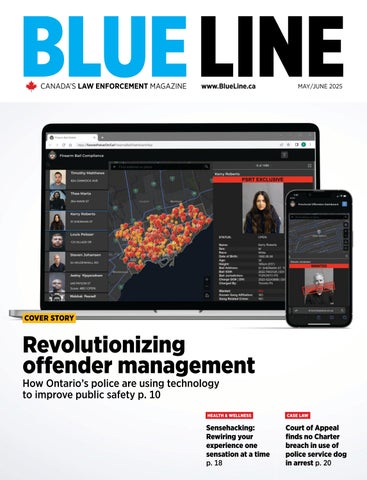
COVER STORY
Revolutionizing offender management How Ontario’s police are using technology to improve public safety p. 10
HEALTH & WELLNESS
CASE LAW
Sensehacking: Rewiring your experience one sensation at a time p. 18
Court of Appeal finds no Charter breach in use of police service dog in arrest p. 20
POLICE INNOVATIONS
Learn how Triton can make your recruiting & online process more efficient. TRITON’S AUTOMATION AND CUSTOMER SERVICE CREATES A USER-FRIENDLY ENVIRONMENT CUSTOMIZED TO YOUR NEEDS ONLINE AUTOMATION FOR RECORD CHECKS Triton works with police services across Canada to create a custom criminal record check platform for each agency’s needs.
RECRUITMENT SCREENING TRITON is a national pre-employment screening agency providing secure and easy-to-use online background checks. With over a decade of experience in the industry, we’ve made it our goal to help agencies of all sizes streamline their hiring process to make data-driven choices that foster long lasting relationships with their most important assets – their members. CRIMINAL BACKGROUND CHECK - 15 minutes
HOW CAN TRITON HELP? Live, Canadian Based, Customer Service - We manage all applicant calls We continuously innovate to modernize and automate processes Our Guided Entry makes completing an application as easy as ordering a pizza online Triton’s adherence to security and regulatory compliance are at the highest global standards
Custom platform built directly from your website. EMPLOYMENT & EDUCATION - 48 hours
Our experienced agents verify candidate information. REFERENCE CHECK VERIFICATION - 48 hours
Fully customized per your request.
CREDIT CHECK VERIFICATION - 120 minutes
Using Trans-Union to find any red flags concernting credit. DRIVING RECORD ABSTRACT - varies by province
Data from the Ministry of Transportation
SOCIAL MEDIA BACKGROUND CHECK - 48 hours
Full scan of candidates online presence
We work with you team to develop process to meet your service’s specific needs CONTACT US
ROB STEWART (416) 606-6016 rob.stewart@tritonverify.com tritoncanada.ca
WANT TO GET STARTED? Let’s talk about how we can create a custom solution for you.
Contents
10 May/June 2025
Columns
Volume 37 Number 3
4 16 18 20 30
Features 8
Editor’s Commentary Technology Health & Wellness Case Law Back of the Book
Departments
Inside the action
5 5 6 6 13 22 29
Key moments from OACP & Blue Line Expo 2025. By Brittani Schroeder. COVER STORY
10 Revolutionizing offender management
How Ontario’s police are using technology to improve public safety. By Brittani Schroeder.
News By the numbers Dispatches Calendar Off the Shelf Out of the Cold Marketplace
16 Advancing law enforcement
The Lethbridge Police Service’s data-driven approach to crime reduction. By Kristen Saturley.
26 The double-edged sword of technology in policing
COVER PHOTO: TORONTO POLICE SERVICE
The promise and the pitfalls. By Neil Dubord and Cal Corley.
8 @Blue_LineMag
14 26 May/June 2025 | BLUE LINE
3
EDITOR’S COMMENTARY BY BRITTANI SCHROEDER
www.BlueLine.ca
Technology, interoperability and the future of Canadian law enforcement
E
arlier this year, I had the oppor“This was important 10 years ago, but tunity to attend the CACP there’s been such a rapid pace of technoCanadian Public Safety Interlogical development, and with that comes operability Workshop in Toronincreased threats. The community is dicto. This event offered an interactive tating that we need to modify the way we chance for everyone in attendance to provide public safety, and when you bring identify and solve problems. it all together, you have a perfect storm of Two days of sessions focused on interwhy we need a public safety broadband operability challenges and sucnetwork,” said Deputy Chief cesses, governance issues, and “We’ve never Anthony Odoardi, Peel Regional case studies of interoperability in seen more Police. action, along with emergency crises across People representing police, alerting and advanced situational the world than fire and EMS were in attendance awareness. However, the real star I think we have at this event, and it was encourof this show was the discussions in the last few aging to see them establish around a Public Safety Broad- years.” concrete goals with timelines – Thomas and expectations attached. band Network (PSBN) and why Carrique, OPP it is crucially needed in Canada. As Odoardi said, the technolTo open the event, Commis- Commissioner. ogy around us is accelerating at sioner of the OPP and CACP such a rapid pace, and emerPresident Thomas Carrique emphasized gency services must do their best to keep that interoperability is essential for the up with it. For that reason, this edition of safety of frontline workers and communBlue Line is dedicated to emerging technolities. He also expressed the need for a ogy in law enforcement. transition from post-event analysis to a I hope you enjoy the wide range of solupre-event planning approach to adequatetions created by police officers across the ly prepare for potential future events. country that are featured in these pages. “We all rely on communication and beLet’s explore the technological solutions ing able to communicate with each other making waves across Canadian law enand with the public in a time of crisis. And forcement. we’ve never seen more crises across the As always, I encourage you to reach out world than I think we have in the last few to me if there’s an officer you think should years,” said Carrique. “So, the Public be featured, a topic you believe deserves Safety Broadband Network is going to be attention, or a new initiative your police absolutely critical to Canada as we move service has launched. Your input is invaluforward… We’re all here to ensure that we able in helping us cover the issues that are forward-focused and that we are taking matter most to the law enforcement comresponsibility for the safety of Canadians munity. You can contact me at bschroeder@ through leveraging technology, systems annexbusinessmedia.com. and relationships.” Until next time, happy reading and be The shared sentiment among attendees well. at the event was that the PSBN should be raised with every official at all levels of Canadian government until it becomes a priority for everyone.
CONNECT WITH BLUE LINE
www.BlueLine.ca
4
@Blue_LineMag
BLUE LINE | May/June 2025
www.facebook.com/BlueLineMagazine
Reader Service Print and digital subscription inquiries or changes, please contact customer service Angelita Potal Tel: 416-510-5113 Fax: (416) 510-6875 email: apotal@annexbusinessmedia.com Mail: 111 Gordon Baker Rd., Suite 400 Toronto, ON M2H 3R1 GROUP PUBLISHER | PAUL GROSSINGER pgrossinger@annexbusinessmedia.com PUBLISHER | ADAM SZPAKOWSKI aszpakowski@annexbusinessmedia.com EDITOR | BRITTANI SCHROEDER bschroeder@annexbusinessmedia.com EDITORIAL DIRECTOR PUBLIC SAFETY GROUP | LAURA AIKEN laiken@annexbusinessmedia.com ACCOUNT MANAGER | JANICE EATON jeaton@annexbusinessmedia.com MEDIA DESIGNER | ALISON KEBA akeba@annexbusinessmedia.com ACCOUNT COORDINATOR | KATHRYN NYENHUIS knyenhuis@annexbusinessmedia.com AUDIENCE DEVELOPMENT MANAGER BEATA OLECHNOWICZ | (416) 510-5182 bolechnowicz@annexbusinessmedia.com CEO | SCOTT JAMIESON sjamieson@annexbusinessmedia.com ANNEX BUSINESS MEDIA 111 Gordon Baker Road, Suite 400 Toronto, ON M2H 3R1 Tel. 416-442-5600 • Fax 416-442-2191 Publication Mail Agreement No. 40065710 ISSN 0847-8538 Printed in Canada SUBSCRIPTION RATES Canada — 1 Year $32.13; 2 Year $53.55 plus tax USA — 1 Year $139.23 CAD Occasionally, Blue Line will mail information on behalf of industry-related groups whose products and services we believe may be of interest to you. If you prefer not to receive this information, please contact our circulation department in any of the four ways listed above. Annex Privacy Officer Privacy@annexbusinessmedia.com; Tel: 800-668-2374 © 2025 Annex Business Media. All rights reserved. Printed in Canada. No part of the editorial content of this publication may be reprinted without the publisher’s written permission. Opinions expressed in this magazine are not necessarily those of the editor or the publisher. No liability is assumed for errors or omissions. Readers are cautioned and advised that articles presented herein are edited and supplied for your personal awareness and should not be used for further action until appropriate guidance is received from a supervisor, Crown Attorney or other persons in authority. All advertising is subject to the publisher’s approval. Such approval does not imply any endorsement of the products or services advertised. The publisher reserves the right to refuse advertising that does not meet the standards of this publication.
NEWS ALBERTA
Lethbridge Police and Wounded Warriors Canada launch new program
PHOTO: VICTORIA POLICE DEPARTMENT
BRITISH COLUMBIA
ONTARIO
Victoria Police Department launches new tool for community safety
Peel Police Foundation created to address critical issues
This spring, VicPD launched its Remotely Piloted Aircraft System (RPAS), which features technology designed to improve officers’ ability to monitor public events and respond quickly to public safety incidents. Piloted by certified Transport Canada pilots from VicPD, the RPAS will enhance public safety, aid in crime prevention and ensure public order during special events, protests, rallies, or any other events that require police attendance or involvement for the safety of the community. This new tool will help officers identify potential incidents unfolding on the ground, providing real-time insights that allow them to distribute resources more efficiently and make quick decisions. The RPAS camera does not record by default. If recordings are needed to gather evidence or capture an incident, the public will be notified, and the data will be stored for 30 days or longer. “VicPD provides policing support to more than 50 public events each year, in addition to an increasing number of demonstrations. The RPAS is the next step in our strategic plan of supporting community safety, preventing crime, and contributing to community vibrancy,” said VicPD Chief Del Manak. - Courtesy of Victoria Police Department
The Peel Police Foundation is a new nonprofit organization that will raise charitable funds to support community partners in their efforts to address the critical needs of Peel Region. The foundation will work closely with community partners to expand programs and services to better respond to issues like mental health, addiction, homelessness, youth engagement and intimate partner violence. This response is to address the issues which Peel Police sees within the community. Many community organizations and partners do not have the funding and support to meet increasing demands. Guided by the Community Safety and Well-Being framework, it will support innovative public-police solutions to address societal challenges. The foundation will be managed by a volunteer board of directors and led by the Chair, Catherine Murray – a former senior anchor and host of BNN Bloomberg. “The region is growing rapidly, and many organizations are struggling to keep up and help those who need it the most,” said Catherine Murray, Chair of the Peel Police Foundation. “The foundation is an opportunity to provide another layer of support for our communities to help address the issues they continue to face each and every day.” - Courtesy of Peel Regional Police
The Lethbridge Police Service and Wounded Warriors Canada recently partnered to deliver Down Regulation Skills Training (DRS-T), which was developed for police officers and other responders who regularly face the threat of death, serious injury or violence. The program equips trauma-exposed professionals with simple, practical interventions they can use not only after a high-stress call, but during the event itself as long as it’s safe to do so. Last year, Deputy Chief Gerald Grobmeier began working with Wounded Warriors Canada to build a resiliency training model that could be implemented as close to an incident as possible. That concept became a reality after extensive collaboration with Dr. Tim Black, WWC’s National Clinical Director. High-risk, high-intensity physical activities involve physiological components that require training, monitoring and maintenance. Just like high-performance athletes who take time to recover following intense competition and physical exertion, first responders whose limbic systems are highly activated must engage in a period of recovery or “down regulation” of their nervous systems to avoid chronic limbic activation and physiological stress. The first training session recently took place when Dr. Black spent a full day embedded with the LPS tactical team observing scenarios to better understand the pressures they face. Moving forward, the DRS-T program will be integrated service-wide so every officer has access to the mental health tools they need to do their job, protect the public and take care of themselves. - Courtesy of Lethbridge Police Service
BY THE NUMBERS In February 2025, Statistics Canada released data on Firearms and violent crime in Canada, 2023. For more information, please visit www150.statcan.gc.ca.
14,416 incidents of firearm-related violent crime in 2023.
@Blue_LineMag
1.7 % After reaching a 14-year high in 2022, the rate of firearm-related violent crime in Canada decline 1.7 per cent in 2023.
180
fewer firearm-related incidents in Ontario in 2023 than in 2022..
2.6 % Firearm-related violent crime accounted for 2.6 per cent of police-reported violent crime in Canada in 2023.
May/June 2025 | BLUE LINE
5
NEWS DISPATCHES
CALENDAR
The Victoria and Esquimalt Police Board is pleased to announce that, in a unanimous decision, they have selected Fiona Wilson as the next chief constable of the Victoria Police Department. Wilson currently serves as one of three deputy chief constables with the Vancouver Police Department and brings more than 26 years of experience to VicPD. She will begin her role as chief constable on Aug. 15, 2025, with a two-week transition alongside Chief Manak prior to his retirement on Aug. 31, 2025.
Karen Meyer was appointed as the newest deputy commissioner and provincial commander for Traffic Safety and Operational Support with the Ontario Provincial Police. “I look forward to leading OPP Traffic Safety and Operational Support Command as we work to ensure the safety of Ontario’s highways, deliver specialized support services and continue to learn from and partner with Indigenous communities on public safety,” Meyer said.
The New Westminster Police Board has appointed Paul Hyland as chief constable. Hyland has been a member of the NWPD since 1995 and in the acting chief constable role since June 2024. “I am both humbled and honoured to have been selected as the Chief Constable for the New Westminster Police Department,” said Chief Constable Hyland. “Having dedicated my entire career to serving this community, I remain deeply committed to its safety and well-being. Together, we will continue to address emerging challenges and create a stronger, safer and more connected community.”
The Lower Mainland District RCMP has selected Langley RCMP’s newest Officer-in-Charge (OIC), Superintendent Harm Dosange. Over his 23 years of service, Dosange has worked in a number of areas of policing and most recently served as the community services officer in Surrey where he oversaw the youth unit, emergency operations and planning unit, community response units and diversity and Indigenous peoples unit, along with all of the proactive enforcement teams.
Vancouver Police Department’s Chief Cst. Adam Palmer retired from the VPD at the end of April after 37 years with the department. He started his career with VPD in 1987 and spent 13 years as a patrol officer before working his way up to the top job in May 2015. Along the way, the chief says he has met exceptional team members and civilian professionals who give so much of themselves to help others in times of danger and crisis. Palmer now joins the RCMP as a deputy commissioner. Martin Perron has been promoted to deputy chief of the Edmundston Police Force. Perron has been a member of the EPF for 24 years. During that time, he has worked as a patrol officer, investigator and court liaison officer. In 2018, he was promoted to sergeant, and for the past two years, he has held the position of operations inspector.
6
BLUE LINE | May/June 2025
Port Moody Police Department has appointed Brad Sheridan to the rank of inspector and has now assumed the role of officer in charge of administration. He joined the Port Moody Police Department in 2003, climbing through the ranks and serving in numerous units, including Major Crime Section, Community Action Team, Professional Standards Section and IHIT. The Lower Mainland District RCMP selected Adam Gander to be the newest officer-in-charge of the Ridge Meadows Detachment. He has been promoted to the rank of Superintendent. Gander began his career with the RCMP in 2001 when he was posted to the Ridge Meadows Detachment following his graduation from Depot. He transferred to the Integrated Homicide Investigation Team (IHIT) in 2012 before returning to the Ridge Meadows RCMP as a staff sergeant. In 2021, he was commissioned to the rank of inspector.
CPCA Spring Patrol Dog Seminar w/ dog Date: June 6 – 7, 2025 Location: Vancouver, B.C. seminars.canadianpolicecanine.com Canada 911 Ride Foundation – Atlantic Ride Date: June 7 – 8, 2025 Location: Shellarton, N.S. canada911ride.org OACP 2025 Annual Conference Date: June 22 – 25, 2025 Location: Blue Mountains, Ont. oacp.ca Canadian Police Ceremonial Training Course Date: June 23 – 26, 2025 Location: Aylmer, Ont. cpctc.ca 120th CACP Annual Summit Date: Aug. 10 – 12, 2025 Location: Victoria, B.C. annualconference.cacp.ca Find more calendar events online at blueline.ca/events.
Staff Sergeant Simon Scott of the RCMP became Salmon Arm’s newest detachment commander in January 2025 after serving as the acting commander since Aug. 2024. With over two decades of RCMP service and experience in detachments across B.C., S/ Sgt. Scott transferred to Salmon Arm Detachment in May 2022 as the Operations Non-Commissioned Officer (NCO). It’s with a heavy heart that the Edmonton Police Service announced the passing of retired PSD Fozzy. The “Foz” and his handler won the Canadian Police Canine Association Patrol Dog Top Dog title at the National Police Dog Trials in 2018. PROMOTIONS, RETIREMENTS, RECOGNITION • If you have an officer in your agency recently promoted or retiring or an individual you wish to have recognized (major award or recently deceased) you can let Blue Line magazine know by emailing: bschroeder@annexbusinessmedia.com.
www.BlueLine.ca
123 XYZ
Stolen vehicles move fast. Your response should move faster. When every second counts, identifying and tracking stolen vehicles shouldn't slow you down. Axon Fleet 3 with automated license plate recognition and Axon Fusus real-time crime center platform work together to deliver the critical data you need to stay ahead of evolving auto-theft tactics and increase vehicle recovery rates. Learn more at ca.axon.com
RECAP
Inside the action
Key moments from OACP & Blue Line Expo 2025 By Brittani Schroeder
8
BLUE LINE | May/June 2025
Keynote: Cst. James Jefferson, Wellness Coordinator Officer
This year’s keynote was delivered by Cst. James Jefferson of the Greater Sudbury Police Service. In his presentation, Jefferson shared his “Blueprint to Resilience” for fellow officers and police services. Through personal stories and perspectives that aided him in his mental health and healing journey, Jefferson hoped to guide attendees on their paths toward progress by harnessing the power of their resilient minds. Nearing the end of his speech, Jefferson aimed to leave the audience with one final tip. He said, “Optimists see the glass half full and pessimists see the glass half empty. Be that believer in your life and yourself that your glass is always refillable.”
Bail reform and recidivism: A chiefs panel
In an important panel discussion during the second half of the event, a panel of police leaders from across Ontario gathered on the event stage to discuss bail reform and recidivism. Panellists included OPP Commissioner and CACP President Thomas Carrique, Halton Regional Police Deputy Chief and OACP President Roger Wilkie, Timmins Police Chief Sydney Lecky, Smiths Falls Police Chief Jodi Empey, Durham Regional Police
Chief Peter Moreira, and President of the Police Association of Ontario Mark Baxter. This session was moderated by OACP Executive Director and ret. Chief of the Greater Sudbury Police Paul Pedersen. Commissioner Carrique stated, “We need to make a more strategic approach towards justice reform. We can get bogged down with the topic of the day, whether it be bail reform or any number of other important items. But how often have we taken a holistic and systematic approach to say, ‘what are all the factors that are impacting safety and security, and trust and confidence in the justice system?’ and attack it as a whole? Because if we just make changes to one component of the system, and the rest of the system doesn’t get the attention that it needs, we will not have the desired outcome.” These sentiments were echoed by his fellow panellists. Each leader’s passion was palpable as they discussed the challenges facing police officers, the changes that have already taken place and the long journey still ahead. We thank this incredible panel of leaders for their time, interest in this discussion, and continued efforts on bail reform in Canada.
Platinum sponsor presentation: Calian
In another crucial session, Dr. Nina Fusco, Chief Psychologist
- Health at Calian, focused on redefining strength, building resilience and promoting psychological safety in policing. In her presentation, Fusco shared that though both men and women carry the emotional demands of the job with them, they experience it differently, and women frequently carry an additional mental load. Fusco emphasized, “It’s essential to foster a culture where we can speak about mental health issues, and have an openness and willingness to do that, so that we can promote everyone’s health and safety at an individual level and an organizational level. This will contribute to having happier, healthier and more sustainable and productive employees moving forward.”
2025 Rookie of the Year
At this year’s OACP & Blue Line Expo, Cst. David Um of the Toronto Police Service was honoured with the prestigious Blue Line Rookie of the Year award. During his acceptance speech, Um thanked his family and superiors for shaping who he is today and acknowledged all his fellow nominees from across Canada, by name, who were also considered for this year’s award. Congratulations to Cst. Um on this well-deserved recognition! Editor’s note: Check out #OACPBLExpo for photos from the event. We can’t wait to see you in 2026!
www.BlueLine.ca
PH0TOS: BRITTANI SCHROEDER
O
n April 28th, law enforcement personnel from across Ontario joined together for a day of learning and discovery at the fourth annual OACP & Blue Line Expo. The event boasted over 450 registered attendees. The expo floor hosted 61 exhibitors who were there to showcase their cutting-edge technology, services and products. Event attendees explored booths featuring everything from law enforcement vehicles and lighting systems to apparel and footwear, firearms and tactical equipment, virtual reality training systems, drones and surveillance systems, as well as custom graphics for clothing and vehicles. This event would not have been possible without our spectacular sponsors. Thank you to platinum sponsors, Calian and Outdoor Outfits; gold sponsor, McMaster University’s DeGroote School of Business; silver sponsors, 870 Tactical and GeoWarehouse; registration sponsor, BDT; delegate bag sponsor, Commissionaires; lanyard sponsor, Trimtag Trading Inc.; coffee sponsor, NicheRMS365; and training sponsor, Trident Training Solutions. Alongside this year’s expo, several conference sessions were available for attendees throughout the day.
Join us at the beautiful Blue Mountain Resort and Village Conference Centre to learn about developments in evidence-based policing (EBP) and the positive impact research-driven decision-making is having on policing in Canada. Three streams of focus available! This year’s conference will have three tracks available to maximize your conference attendance. Attend sessions on:
PRIORITY REGISTRATION
$298+ HST
Event Entry Ticket Includes, breakfast, lunch, coffee breaks and EBP delegate bag.
Operationalizing Evidence-Based Policing Organizational Wellness Strategic Planning & Governance
Today! r te s i g Re
BuildingBridgesEBP.ca NEW! ONE DAY
EBP TRAILBLAZER WORKSHOP October 8, 2025 - Join the wait list!
PRESENTED BY
CO-HOSTED & SUPPORTED BY
For more information, please contact the Building Bridges Team at BuildingBridges@BarriePolice.ca
SPONSORED BY
COVER STORY
Revolutionizing offender management
F
or decades, monitoring offenders on bail across various jurisdictions in Canada has posed considerable challenges. Most police services continue to depend on antiquated systems to track even the most serious offenders. So, how can police agencies collaborate effectively to monitor these individuals? Enter Shaun Hildebrand and Rob Williamson. Earlier this year, Blue Line spoke with them about an innovative dashboard developed to improve tracking and encourage further partnership among police services, and how it has expanded since its inception.
The dashboard
Shaun Hildebrand dedicated 15 years of his career as a frontline and investigative officer with the Toronto Police Service (TPS) before shifting to the role of innovation lead in the Analytics and Innovation Unit, where he served for an additional six years before making the transition to the private sector. One of the initial tasks assigned to him in the analytics unit was to find a way to leverage technology for the seamless tracking and management of offenders on bail. This request originated from a unit commander in Scarborough who was concerned about the high-risk, high-profile offenders within his division. “If his officers arrested one of those individuals who then got bail in another division across the city, it wasn’t realistic for his officers to 10
BLUE LINE | May/June 2025
leave Scarborough, drive an hour to another division to do a compliance check and drive back. He hoped that we could find a technological way to solve this problem,” said Hildebrand. Hildebrand embarked on a research mission to seek a solution. He discovered that the data on offenders being tracked and monitored while on bail was inconsistent and outdated. The list included individuals who were no longer on
TPS had 70 firearm offenders on bail in the Durham region, and DRPS were unaware of 33 of those individuals.
bail, as well as deceased persons. An example of some of the information gaps included individuals who were out on bail with the condition to notify the officer in charge within 24 hours of a change in residence. Although they notified that officer via email or voicemail, the officer was on annual leave for three weeks. This situation leaves other officers checking the previous residence daily, under the impression that the individual was evading the conditions of their release. Another notable gap was the seamless exchange of information between divisions within TPS, which, at the time of Hildebrand’s research, amounted to 16. This did not account for the sharing of information with other police agencies across Canada. “Someone could be charged by Halifax or Edmonton and receive bail with a Toronto address, and our frontline officers wouldn’t know about it,” said Hildebrand. He and his team discovered many pain points along the way due to the previous lack of automated quality control. The first move was to centralize all bail releases into a single unit, the Bail and Parole Unit, where one individual was responsible for maintaining administrative quality control. This person would enter the bail offenders into the records management system and then extract the data to place it into a user-friendly, map-based solution that would provide real-time situational awareness for officers. It didn’t matter who charged the indiwww.BlueLine.ca
PHOTOS : TORONTO POLICE SERVICE
How Ontario’s police are using technology to improve public safety By Brittani Schroeder
vidual—as long as the officers wanted to see who was on bail in their division or in proximity to their current location, they could isolate that information. The Firearm Bail Dashboard also had the capability to check every hour for any individuals listed who had been arrested or were in custody, whether charges had been withdrawn or concluded, and if they were deceased. It also identifies whether a surety is a potential professional surety representing multiple offenders simultaneously, while verifying if the surety has been arrested and charged while actively representing an offender. The team began building the Firearm Bail Dashboard in Sep. 2018, and by Dec. 2018, it went live with the TPS’ Public Safety Response team. By May 2019, following further organic growth of the solution and several more iterations, it was expanded to all police officers and divisions across Toronto. It was soon discovered that TPS had 70 firearm offenders on bail in the Durham region, and that the Durham Regional Police Service (DRPS) were unaware of 33 of these individuals. “We recognized that, even though Toronto and Durham are right next @Blue_LineMag
“I like to think of it like the Field of Dreams analogy—build it, and they will come. This is a no-brainer.” - Shaun Hildebrand
door to each other, there was still a large gap in information sharing,” said Hildebrand. That’s where D/Sgt. Rob Williamson from DRPS comes in. After nearly two decades in frontline patrol and another seven years in the drug unit, Williamson joined the intelligence unit as a supervisor. One of his primary responsibilities was to manage offenders on bail for firearm offences. “When I transitioned into my new position, we were using Excel spreadsheets to manage our offenders. Obviously, that’s not the best solution for something so serious,” said Williamson. Williamson’s team recognized that there were existing technolo-
“Fast forward to today, and we’re doing at least 60 per cent more compliance checks today than we did before the introduction of the dashboard.” - Rob Williamson
gies to create mapping systems, which could offer their officers some spatial awareness. Knowing that TPS had already developed a solution, Williamson and Hildebrand collaborated to create the DRPS dashboard. In developing the dashboard for DRPS, Williamson acknowledged that, as DRPS is a significantly smaller team than TPS, they wanted to avoid overwhelming officers with new information. The solution needed to be structured in such a way that DRPS could prioritize the information and deliver the relevant intel on offenders to the appropriate officers. A few modifications were specifically made for Durham, such as alerting officers regarding who was next in line for a bail check. Colour coding was also employed to indicate who requires monitoring and who is under investigation for a breach. “Fast forward to today, and we’re doing at least 60 per cent more compliance checks today than we did before the introduction of the dashboard,” shared Williamson. “In Canada, we have systems like CPIC [Canadian Police Information Centre] for sharing interagency data, but you can’t view it on a map to connect it with your current loMay/June 2025 | BLUE LINE
11
cation. If you’re not looking for a specific person, you won’t realize that while you’re out on a call, someone across the street might be on bail for homicide or firearm-related offences,” Hildebrand said. So, once the DRPS dashboard was operational, Hildebrand and Williamson began developing technology to share information with other agencies in real-time.
“The Provincial Bail Compliance Dashboard model builds upon the foundation of the TPS model but with capabilities to roll out to police services across the province, and includes adding a layer of customization and robustness. ” - Det. S/Sgt. Allan Gelinas, OPP
A prestigious presentation
As Hildebrand highlighted, the pain points his team experienced at TPS are not unique to a single agency— they are felt across the country. Following the successful dashboard integration at TPS and DRPS, Hildebrand and Williamson presented it to various stakeholders throughout Ontario. Part of their presentation involved demonstrating the capabilities available for a frontline officer. This was not only for those responding to a call and needing situational awareness, but also for those interested in using it for proactive compliance checks. They also illustrated how an investigator could take that data and overlay it with crimes that have occurred in a specific geographic area. “The solution was clear to us; it required no training for comprehension. The Ontario Provincial Police (OPP) recognized its significant potential and committed to expanding it to all police agencies throughout the province,” stated Hildebrand. The provincial expansion involved TPS and DRPS sharing all insights and research previously conducted, along with the trials and errors. The teams were able to communicate all the knowledge gained from years of running the program. The OPP used this as their foundation to continue developing the solution to meet provincial needs. “The Provincial Bail Compliance Dashboard model builds upon the foundation of the TPS model but with capabilities to roll out to police services across the province. This includes adding a layer of customization and robustness to enhance 12
BLUE LINE | May/June 2025
2018 is when the Toronto Police Service started building the Firearm Bail Dashboard. In 2025, it was officially expanded to a provincial solution with the Ontario Provincial Police.
security, privacy and legal complexities when deploying across a province,” shared Detective Staff Sergeant Allan Gelinas, OPP. During the summer season of 2024, the OPP collaborated with 16 police services across Ontario to initiate the onboarding process. By Dec. 2024, the Provincial Bail Compliance Dashboard became operational, incorporating data from the OPP, TPS, Guelph Police Service, York Regional Police Service and Peel Regional Police Service. Gelinas continued, “The OPP believes that this tool will greatly assist with keeping our officers and communities safe. Information-sharing is a powerful tool for police services, which can help us to protect the communities we serve. The more police services that use the dashboard, the more information we have available so that all police services can know the full bail terms of an individual who has committed a firearms-related offence and take the best course of action to ensure public and officer safety.”
Time for expansion
The dashboard has the potential to expand across the country. To achieve this, collaboration among multiple agencies is essential. The most significant lesson learned by Hildebrand was that you can’t wait for perfect data. “If you wait for the backend to be flawless, there will be many years when officers aren’t equipped with good technology that can help enhance their daily operations. Geographic Information Systems (GIS) are a game changer in providing officers with real-time situational awareness rooted in evidence-based data; some even call GIS the future of
proactive policing. We must acknowledge this because we can’t rely solely on our instincts. We need proper data-driven, evidence-based proactive measures, but we can’t achieve that with information overload. The information needs to be relevant to the officer’s current location, day of week, time of day.” For Williamson, the most significant takeaway was that he and his team didn’t need to reinvent the wheel, as there are more pressing matters to address. “Every day, individuals are released into our community after committing violent offences, and each day that passes is one less opportunity to utilize a system like the dashboard to better prepare our frontline officers for conducting bail checks. Let’s all embrace the solution that’s already been developed, because it’s essential for all of us. This goes for services outside of Ontario as well.” It was also important to recognize the time required to adopt new technological solutions, and the pair stressed the significance of police services understanding the critical need for interoperability in today’s world, highlighting that collaboration is essential. Hildebrand emphasized that every agency should start small. They should leverage what has already been accomplished by the Ontario agencies and adapt it for their province. His hope is that as more individuals—from frontline officers to chiefs—begin using it and recognizing its value, the integration of data between provinces will become a reality. He concluded, “I like to think of it like the Field of Dreams analogy—build it, and they will come. This is a no-brainer.” www.BlueLine.ca
OFF THE SHELF If They Only Knew: A Cop’s Journey with Addiction and Mental Health By Lance Valcour ISBN: 978-1988344492
Lance Valcour’s book is a compelling and deeply personal account of the struggles faced by a police officer grappling with addiction and mental health challenges. This book grabs your attention from the first page and keeps you turning until the end, eager to discover what happens next.
Having known Lance for over 20 years, I was deeply moved by his story. It revealed a side of him I never knew existed. To many people, Lance was always a highly respected leader in the Ottawa Police organization—a dedicated professional who genuinely cared about his job and the community he served. This book was a powerful reminder that you can never know the battles someone faces behind closed doors or in the quiet of their mind. One of the book’s most striking elements is the love story that unfolds. Lance’s journey is shaped by the unwavering support of his wife, Lise, and his children. Lise’s strength, love
and guidance illuminate how a strong, supportive partner can profoundly influence and improve one’s life. Through Lise, we see the transformative power of a nurturing relationship and how it can help someone navigate even the darkest times. For anyone struggling—whether with addiction, mental health or the weight of their responsibilities—this book is an essential read. It offers hope; with the right changes and a solid support system, life can and will get better. Lance Valcour’s courage in sharing his story will undoubtedly inspire others to seek help and find their own paths toward healing. – Matthew Cox, Ottawa Police Association, President.
REVOLUTIONIZING OFFENDER MANAGEMENT Map-based proactive policing to keep communities safer •
Real-time offender location tracking
•
Evidence-based and integrated with RMS
•
Perform mobile compliance checks
•
Enhance cross-jurisdictional situational awareness
esri.ca/publicsafety
BL_Esri Canada_MayJune25_CSA.indd 1 @Blue_LineMag
9:07 AM May/June 2025 2025-04-11 | BLUE LINE 13
EVIDENCE-BASED POLICING
Advancing law enforcement The Lethbridge Police Service’s data-driven approach to crime reduction By Kristen Saturley
14
BLUE LINE | May/June 2025
you’re fighting blind,” said Contre. The LPS techies equate AI in CompStat to a “high-speed, tireless detective assistant who reads every report instantly, understands context, and highlights exactly what officers need to know.” It’s designed to recognize key details, patterns and trends and then highlight critical information. During a review of 318 vehicle theft reports, AI identified that 30 per cent of incidents involved unattended, running vehicles with the keys inside. The insight informed a public awareness campaign, demonstrating how AI-generated intelligence can contribute to crime prevention. The technology is also being used in drug enforcement. During a targeted enforcement project in 2024, AI was used to read all police reports from the previous day, scanning for drug-related intelligence. The
AI-extracted details included suspects, methods of operation and drug types, with daily, actionable summaries sent automatically to enforcement teams. The LPS Intelligence Portal—another AI-driven tool built in-house—consolidates crime data, identifies emerging trends, hot spots, prolific offenders and stolen vehicles, and facilitates intelligence sharing across the organization. Access to the portal is role-based. Frontline officers can retrieve reports and search real-time crime data, and investigators can use it to link cases and command staff and track crime trends to allocate resources strategically. All access is real-time, with officers able to log in to the portal on their vehicle MDTs, cell phones or desktops. In addition, LPS will soon implement real-time hot spot push notifications to all issued devices. www.BlueLine.ca
PH0TO: LETHBRIDGE POLICE SERVICE
F
rom 2019 to 2021, Lethbridge held the highest Crime Severity Index (CSI) ranking in Canada, a dire distinction that prompted a shift from reactive policing to a proactive, data-driven strategy. The results? A significant reduction in crime over five years and a drop in CSI rankings to fourth place by 2023, with preliminary data predicting a further decrease when the 2024 results are released later this year. “Crime trends evolve quickly, and traditional policing models often lag behind real-time needs,” said Stephane Contre, who led Lethbridge Police Service’s (LPS) Crime and Strategic Analytics Section before his retirement earlier this year. “We needed a system that not only tracked crime but helped us predict and prevent it.” Enter LPS CompStat, a modernized crime-fighting tool adapted from the original 1994 NYPD model. “LPS took the core principles of CompStat and supercharged them with AI,” said Contre. “With AI and real-time analytics, we anticipate crime trends and deploy resources where needed.” Since inception, the AI-enhanced CompStat model has contributed to a 24 per cent reduction in crime severity, faster response times through optimized patrol routes, higher case clearance as a result of AI-driven linkages and greater resource efficiency by focusing on high-impact areas. Unlike off-the-shelf software, the LPS model was developed in-house “by police analysts, for police officers” and is locally hosted. Across the organization, everyone from civilian analysts to command staff gets real-time insights. While hundreds of agencies worldwide use some form of CompStat, AI is transforming how officers process intelligence. “If you’re not using data to fight crime,
Beyond crime reduction and intelliWith AI integration firmly rooted in LPS gence-sharing, LPS is piloting AI-powered operations, the organization is pioneering initiatives aimed at increasing administra- an AI-powered Wellness Severity Index that tive efficiencies. will revolutionize the early intervention Notes 2 Reports allows officers to process by proactively identifying convert digital notes recorded in the “AI is traumatic exposures and trigSmart Squad application into stan- proving to gering appropriate resources to dardized reports, streamlining the be a gamesupport officers. documentation process. The Tran- changer for The Wellness Severity Index is a script 2 Summary tool automates policing.” purpose-built application currentthe generation of summaries from ly in development that will read all – Stephane police reports from the previous recorded witness statements, exContre day and assess the mental health pediting the preparation of reports for Crown prosecutors in the format impact on officers. The system will they require. Supervisors are also utilizing evaluate actual report contents, assigning a AI-generated summaries to compile the daily severity rating to denote the mental health confidential bulletin, improving internal impact, a rationale explaining why the recommunication and situational awareness. port was assigned the rating and identify the The goal is to streamline traditionally primary trauma categories experienced. time-consuming tasks, ensuring accuracy Each morning, the AI-generated assessand consistency while freeing up officer ments will be provided to the LPS Wellness capacity for other duties. Coordinator, who will review, track and Administrative employees also use AI for proactively monitor how specific calls imnon-sensitive tasks such as drafting reports, pact officer mental health and prompt early document summarization, generating intervention and tailored support for offistructured templates and conducting re- cers dealing with high-stress incidents. search and policy comparisons. “Not all calls impact officers the same
way,” said Stacey Petite, the LPS Wellness Coordinator. “AI will allow for individualized assessments based on report details, rather than broad assumptions. The system will help identify officers who may need intervention before issues escalate.” The aggregate data will also help LPS finetune support programs. With any technological advancement comes the need for safeguards and LPS has implemented strict security measures to protect sensitive information. Contre stated, “AI is not the future; it’s the present, and LPS is using it to make good police work even better.” With a focus on crime reduction, operational efficiency, proactive crime prevention and officer well-being, LPS is setting a precedent for the role of AI in modern law enforcement. By embracing smart technology, the Service is proving that innovation can be a powerful ally in keeping communities safe. Kristen Saturley is the Strategic Communications Manager for the Lethbridge Police Service. She joined LPS in 2008 after six years as a journalist in southern Alberta covering the crime and court beats.
+1 867-668-5609 publisher@canadianguns.com www.canadianguns.com
The only Canadian buy-and-sell firearms newspaper distributed across Canada!
WHY ADVERTISE WITH CATF? Our paper is distributed monthly by subscription and at gun shows, gun trades, gun clubs, and select stores across Canada. We shall put you in touch with the active, committed core of Canada’s firearm community!
BL_CATF_JanFeb24.indd 1 @Blue_LineMag
$50
2:00 PM May/June 2025 2023-12-21 | BLUE LINE 15
TECHNOLOGY
Solving the common time discrepancy problem in evidence gathering
P
olice officers working on the front lines and in investigative units are required to collect evidence in a meticulous and comprehensive manner. During the evidence-gathering process, officers may face various challenges that require problem-solving skills to find a resolution. This was the case for my partner and me during November 2022. I was working with the Serious Crime Unit of Surrey and found myself doing what police officers often must do: video canvassing. We encountered a digital video recorder (DVR) that proved challenging. While we were accustomed to system time discrepancies of minutes, hours and even days, this was our first experience with a discrepancy of over 14 years (and 16 hours). We both attempted to resolve the discrepancy and began calculating the correction. Perhaps not surprisingly, we arrived at different results. We don’t become police officers because we love math, right? Nonetheless, the outcome was that we needed to download a wider range to 16
BLUE LINE | May/June 2025
offset any potential calculation error. This particular frustration motivated me to develop a solution to the problem. I aimed to create a simple, user-friendly tool to assist myself and other investigators. I began working on a web application that I called “CCTV Time”. The objective would be to eliminate the error-prone guesswork involved in calculating DVR time. Incorrect time calculations can lead not only to frustration for investigators but also to the potential loss of evidence. While the goal of this application was to provide a simple, user-friendly tool, achieving this simplicity required overcoming several complexities. Time itself is intricate, with numerous time zones spanning the globe. Some regions observe time changes while others do not. One challenge arising from this was how to ensure the application functions universally and accounts for these variables. To address this, I chose to use local device time and compare it with “Coordinated Universal Time” (UTC) offsets. This enabled the application
to automatically detect a time change event, such as daylight saving time, without needing to know exactly when these events occur. For instance, the Pacific Time Zone fluctuates between UTC -8 and UTC -7. If you attempt to calculate a time range that falls within UTC -8 and UTC -7, the application will provide a “daylight saving” warning and offer an option to account for the discrepancy. In January 2023, I launched the web application I created and shared it with my current team members and former colleagues. The “CCTV Time” application grew organically through word-of-mouth and search engine traffic, attracting approximately 1,000 users in its first year. During that time, I began iterating and adding new features to the application. These features included the ability to save and export time calculations and to implement a “review” feature that allowed users to convert time between “real time” and “DVR time” based on a known time offset. I launched these additional features in November 2023. Since launching this application, my colleagues in the Surrey Police Service and I have utilized this tool to conduct canvassing tasks during various investigations. The tool offers us significant utility, enabling us to calculate time discrepancies swiftly and accurately. This results in more efficient canvassing and provides peace of mind. Without an application like this, incorrect time calculations remain a silent error, as there is no feedback loop afterward. Investigators may not become aware of a mistake until it is likely too late, and it’s a risk that I am no longer willing to accept. To date, the CCTV Time application has served over 7,500 users from around the world, including the United States, the United Kingdom, Australia, Israel and India. I’ve received positive feedback from Canadian and U.S. law enforcement as well as corporate investigators from Australia. The application currently serves approximately 800 users each month. I encourage other law enforcement personnel to utilize this free application – CCTV Time – and I hope it offers a simple, convenient and accurate solution for them, just as it has for me. Curtis Knoblauch is an F Sergeant with Surrey Police Service Investigative Services Bureau’s “Frontline Investigative Support” team. In Oct. 2024, Knoblauch received a Chief Constable’s Commendation from SPS Chief Norm Lipinski for the creation and sharing of CCTV Time.
www.BlueLine.ca
PHOTO: SURREY POLICE SERVICE
BY CURTIS KNOBLAUCH
NightRide© Thermal Imaging Camera Systems Driving at night is an unavoidable experience for all drivers. Make your experiences safer with the Nightride Camera System. The risk of a serious accident is 3x higher when driving at night. Most animal-car collisions happen at night, and more pedestrians are injured by vehicles driving at night. THERMAL CAMERAS FOR FIRST RESPONDERS NightRide offers high-resolution thermal imaging purpose-built for mounting on first responder vehicles. Pair it with a laptop, tablet, or phone for wireless heads up display. No matter which vehicle thermal imaging model you choose, you can count on NightRide’s rugged casing and intuitive controls to be ready to go wherever and whenever you need it.
THE BEST TOOL FOR THE JOB The NightRide 360 is a magnetic or suction cup mounted, remote controlled 360⁰ pan and tilt thermal camera, using heat signatures to give you a view 1/4 mile or more away dust, rain, snow, fog, smoke, and complete darkness. Perfect for monitoring ongoing situations at night including stakeouts and looking for criminals on the run.
ELECTRONIC, INTRINSICALLY SAFE ROAD FLARES Eflare Beacons are intensely bright Can be seen from over 1 kilometer away without the night vision, point fixation and distance judgement problems associated with strobe and incandescent lights. Eflare Beacons are infinitely versatile Available in a variety of one or two colour light combinations, steady-on or flashing, and in three light intensities. Easily attaches to clothing, vehicles, cones and bollards. Be seen and safe in almost any situation you can think of. Eflare Beacons are portable and simple to use The largest model is 22 (8”) cm tall and weighs only 460gm including batteries, making it easy to carry or stow anywhere, and quick and simple to deploy in any situation. Just twist the lens to turn on or off, and place one or more units around to provide a highly visible warning and safety zone around a person, work area, hazard or accident. Eflare Beacons double the safety Eflares provide safety by ensuring maximum visibility, but unlike pyrotechnic flares there is no risk of fire or explosion, and there are no toxic fumes or residue. Eflare Beacons are extremely robust Eflares are waterproof, dustproof and will survive a drop from a one meter height onto a concrete surface. Eflare Beacons are HAZMAT accredited Eflare Beacons are HAZMAT accredited for use in Class 1, Division 2 / Zone 2 hazardous areas. Eflare Beacons are available in kit form or individually as required. Eflares Beacons are non toxic, non heat generating, non smoke producing and run 30+ hours on 4AA batteries and work well in rain, snow etc.
EFLARES First Responder Kits are found in Police cars across Canada.
HEALTH & WELLNESS BY ISABELLE SAUVÉ
S
ensehacking is a growing interdisciplinary approach with significant potential to augment the well-being of professionals facing high-stress occupational contexts, such as law enforcement. The strategic implementation of sensehacking interventions may provide a transformative means of supporting psychological adaptability and capacity to function under high-pressure occupational demands. The term “sensehacking” was coined by Professor Charles Spence of the University of Oxford. It denotes the strategic manipulation of sensory inputs to alter emotional, mental and physical states to promote overall well-being and performance. This practice entails the deliberate modulation of sensory stimuli by introducing auditory, tactile and olfactory inputs. Rooted in the interdisciplinary study of multisensory perception and experience, sensehacking is predicated on the foundational understanding that the human sensory modalities play a pivotal role in shaping perception of the environment and regulating psychological and physiological states. Through deliberate engagement with these sensory systems, individuals can foster relaxation, improve sleep quality, mitigate stress and enhance focus; thereby yielding a wide range of salutary impacts on health and performance. Among law enforcement personnel, whose occupational duties frequently involve exposure to acute stressors and emotionally charged scenarios, sensehacking techniques offer significant benefits in managing stress and enhancing operational readiness. Integrating sensory regulation strategies into daily routines may improve the ability for emotional regulation and situational awareness, enabling officers to maintain composure and cognitive clarity under pressure. Empirical evidence underscores the efficacy of auditory interventions in stress reduction. Exposure to calming soundscapes such as white noise, natural environments and binaural beats, for example, has been shown to decrease cortisol levels and induce a parasympathetic nervous system response. Use of such auditory stimuli prior 18
BLUE LINE | May/June 2025
to high-stress encounters can serve as a cognitive buffer against external stressors. A notable advancement in this domain is eight-dimensional (8D) audio, a form of immersive auditory technology that spatially modulates sound to simulate dynamic, multi-dimensional listening experiences. This technique, likened to auditory immersion in a concert setting, has demonstrated potential to heighten focus, reduce distraction and sharpen cognitive performance during tasks requiring sustained attention. While a calming effect can be achieved through auditory stimuli, arousal of the senses can also be attained. Auditory stimuli with high beats-perminute (BPM) have been linked to increased motivation and physical output, suggesting potential applications in scenarios requiring high energy and focus. Olfactory stimulation, particularly through aromatherapy, constitutes another salient dimension of sensehacking. Research has linked essential oils such as lavender and eucalyptus to reduced anxiety and improved affective balance. The application of such olfactory stimuli can facilitate emotional recovery following high-intensity interventions and serve as a form of psychological reset between operational engagements. Phototherapy, especially exposure to blue and white light, represents an additional sensory modality relevant to law enforcement personnel, particularly those working irregular or nighttime shifts. Light exposure has been shown to recalibrate circadian rhythms, enhance alertness and improve cognitive functioning, which is especially beneficial in the context of sleep disruption or deprivation.
Tactile interventions also play a critical role in sensory regulation. Pressure-based stimulation, delivered through weighted blankets or vests, has been linked to reductions in sympathetic arousal and enhancements in emotional regulation. Additionally, manipulating textured objects can create a grounding effect that supports mindfulness and reduces stress. Colour psychology, a central tenet of visual sensehacking, explores the relationship between chromatic stimuli and emotional or behavioural responses. Empirical studies suggest that specific hues elicit predictable affective reactions. Green is associated with tranquility, blue with calmness and red with heightened alertness. By curating environmental colour schemes, such as using calming tones in rest areas and stimulating varieties in operational zones, organizations can oscillate between relaxation and optimal alertness among law enforcement personnel based on necessity. Perhaps most intriguing is the dual capacity of sensehacking to either activate or suppress the sensory system. Techniques can be calibrated to facilitate a wanted response depending on contextual demands. Although sensehacking may seem novel or futuristic, it is firmly rooted in cognitive neuroscience and psychophysiological research. Similar to the sensory optimization techniques used by elite athletes, these practices can also be utilized by law enforcement professionals to enhance their occupational performance and resilience. The integration of sensehacking principles into law enforcement environments presents a promising opportunity to address the numerous challenges faced by the profession. By leveraging the various effects of sensory input, law enforcement officers can enhance their operational effectiveness and overall quality of life. Isabelle Sauvé is a sergeant investigator with the Nunavik Police Service. She has an MA in psychology and is a PhD candidate. She is also an ultramarathon/ endurance athlete and the Racing the Planet/4 Deserts 2018 Series winner as well as a Guinness World record holder. She can be contacted at: isabelle.sauve@hotmail.com.
www.BlueLine.ca
PHOTO: © THP CREATIVE / ADOBE STOCK
Sensehacking: Rewiring your experience one sensation at a time
Serve on the front lines in the Maritimes. Halifax is hiring experienced police officers.
halifax.ca/police-out-east
CASE LAW
BY MIKE NOVAKOWSKI
Court of Appeal finds no Charter breach in use of police service dog in arrest
T
he British Columbia Court of Appeal has overturned a trial judge’s ruling that the display of a barking police service dog (PSD) during an arrest violated the Charter. In R. v. Jaramillo, 2025 BCCA 77, the police, along with a PSD, attended a public storage facility to arrest the accused on an outstanding warrant for aggravated assault. Jaramillo, who was prohibited from possessing a firearm, had an extensive criminal record that included convictions for trafficking in controlled substances, breaches of release orders, assault with a weapon and a weapons offense. During the arrest, no guns were drawn, and the police dog remained leashed and under its handler’s control. Although the dog barked, it did not bite Jaramillo or otherwise make contact with him. After the arrest, an officer noticed an unzipped sling bag on a trolley near the locker door and saw the handle of a gun. When the bag was searched, police found two loaded revolvers. At trial in the Provincial Court of British Columbia, Jaramillo claimed the police dog behaved in a highly threatening manner by barking, behaving aggressively and frightening him. He suggested that the threat this behaviour posed deprived him of his “security of the person”, thereby breaching his s. 7 Charter right. The judge agreed, finding the manner in which the K9 was deployed to execute the arrest was unreasonable. “I find that because there was no formal or informal risk assessment supporting the use of a police service dog, the actions of the police here, created a real risk of harm to Mr. Jaramillo,” said the judge. “In the particular circumstances when there was no process in the period that was available to the detachment, to reflect on whether a police service dog should be used, and specific to the circumstances here, amounts to a breach of Mr. Jaramillo’s s. 7 rights.” Nevertheless, the judge declined to exclude the handguns as evidence, resulting in Jaramillo pleading guilty to two counts of possessing a loaded handgun and possessing the handguns in contravention of a firearms prohibition. The judge imposed a four-year global sentence but then re-
20
BLUE LINE | May/June 2025
duced it by 11 months under s. 24(1) as a remedy to the s. 7 breach. He also credited 25 months for time served. Consequently, the judge imposed four months in jail, followed by an eight-month Conditional Sentence Order (CSO) and two years of probation. The Crown challenged the trial judge’s sentencing ruling before the British Columbia Court of Appeal, arguing, in part, that he erred by deducting 11 months from Jaramillo’s jail time due to the s. 7 violation. The unanimous Appeal Court agreed with the Crown.
“It certainly fell well short of state-imposed harm that caused serious psychological prejudice.” – Justice Grauer Justice Grauer, authoring the Appeal Court’s judgement, noted the test for assessing whether a person’s s. 7 right was breached due to excessive force “requires a two-step analysis: (1) was there an excessive use of force that posed a real threat to the party’s security of the person by substantially interfering with the party’s physical and/or psychological integrity, (2) which was not in accordance with principles of fundamental justice?” But here, there was no physical harm; the dog did not bite or touch Jaramillo. Nor was his psychological integrity harmed. “I can accept hypothetically that, if the [Jaramillo’s] ability to respond in compliance with the demands of the police had been hampered by panic and an inability to hear caused by the PSD, so that the response was non-compliant with serious consequences, then the manner in which the dog was deployed could possibly rise to the level of excessive force. But that is not what happened. [Jaramillo] complied,” said Grauer. Grauer found the trial judge seemed concerned with Jaramillo’s imagined risk, rather than the real risk posed by the PSD. Even on Jaramillo’s own evidence, “he complied with the officers’ demands be-
cause of the dog—thereby reducing the risk of harm.” In short, the display of the PSD did not rise to a real risk of harm nor seriously interfere with Jaramillo’s psychological integrity. Instead, its use encouraged his compliance. “It certainly fell well short of state-imposed harm that caused serious psychological prejudice,” said Grauer. “But even if a risk of harm arose, the judge … erred in principle in his analysis of what was reasonable.” In this case, the handler used the dog, which remained on a leash and under control, to assist in the arrest by way of display. There was no contact between Jaramillo and the PSD, and its deployment appeared to be highly effective in securing a safe arrest. “What the judge failed to do is consider the totality of these circumstances in assessing whether a reasonable person standing in [the handler’s] shoes would consider it reasonable to bring the dog to the arrest. That was an error in principle,” said Grauer. However, Grauer never ruled out the potential for a s. 7 breach in the use of a PSD: I should not, of course, be taken as suggesting that the deployment of a police dog during an arrest can never give rise to a s. 7 breach. A PSD is one of many tools available to the police, and if the police use such a tool during an arrest in a manner that, properly analyzed, constitutes an excessive use of force that substantially interferes with a party’s physical or psychological integrity and is not in accordance with principles of fundamental justice, then a s. 7 breach may be established. [para. 82] As a result, the Crown’s appeal was allowed, and the remedy of the 11-month sentence reduction was set aside, as was the CSO (for other reasons). A revised sentence of 42 months concurrent on each firearm possession count, less credit of 25 months—for a total of 17 months—plus an additional six months to be served consecutively on possessing the firearms while prohibited—all to be followed by two years of probation—was imposed.
Mike Novakowski is Blue Line’s case law columnist.
www.BlueLine.ca
A second set of ears when you need them most Real-time 9-1-1 call transcription from .
Learn more
OUT OF THE COLD
BY STEPHEN METELSKY
O
ur determination to solve these heinous crimes is resolute,” said Peel Regional Police (PRP) Insp. Todd Custance during a press conference in 2024, as reported by the CBC. “Your courage can help us bring peace and closure to our grieving families.” Custance, who oversees PRP’s homicide and missing persons bureau, was referencing the unsolved murders of two young women in Mississauga that occurred four years apart. The victims were both innocent bystanders who police believe were “unintended targets” involved in two different shootings that investigators think
are unrelated. However, the two incidents and the young victims share many similarities.
Jackline Gore
On July 8, 2019, Jackline Gore spent her evening at the Fume Bar and Lounge, located at the intersection of Torbram Road and Drew Road in Mississauga. She was there to celebrate a friend’s birthday. During the early morning hours, approximately between 2:30 a.m. and 2:40 a.m., Gore was with a group of people who exited the bar. She was chatting with some friends in the parking lot when an armed suspect began firing at a group of males near the front door of the
Fume Bar and Lounge. One of the men in the crowd, whom police believe was the intended target of the suspect, immediately fled once the shots rang out. The unknown gunman began to pursue the male patron on foot through the parking lot and eventually into a nearby park. The sound of gunshots rang out as the suspect attempted to shoot the male patron while aggressively pursuing him. One of the stray bullets fired by the unknown suspect struck Gore and killed her. She was 24 years old. Peel Regional Police described the gunman as male, wearing a gray hoodie sweatshirt and a mask to conceal his face. He was last seen getting into a dark crossover-style SUV and fleeing the parking lot of the Fume Bar and Lounge.
PHOTOS: POLICE HANDOUT - PEEL REGIONAL POLICE
The murders of two innocent bystanders remain unsolved
OUT OF THE COLD
BY STEPHEN METELSKY Raneilia Richards
On December 31, 2023, 19-year-old Raneilia Richards ventured out for the evening to celebrate the new year with friends at the Jungle Event Space, situated on Eglinton Avenue East near Dixie Road in Mississauga. At 1:30 a.m., Richards and approximately 100 other patrons waited outside the club in line. At that moment, several shots rang out, aimed at the crowd of patrons gathered. Police suspect the random gunfire may have originated from a nearby car. One of the bullets struck Raneilia Richards as she patiently stood in line. When first responders arrived at the chaotic scene at the Jungle Event Space, they found that Richards had sustained severe injuries. She died at the scene. Investigators recovered the car used in the homicide shortly after the fatal shooting. On that fateful evening, two individuals fled the scene in that vehicle, and PRP is still seeking to identify both suspects. The two shootings occurred four years apart, and police believe they are not relat-
1 24 BL_CityofGrandePrairie_MayJune25_CSA.indd BLUE LINE | May/June 2025
ed. Both remain unsolved. The two young women had much in common, particularly regarding sports. Gore played varsity basketball during her tenure at both York University and Western University. At the time of the incident, she had graduated from school and was working at a bank full-time. Richards was also a talented athlete and had plans to enrol in college. Her future goals were geared toward working in the travel and aviation industry. The vibrant lives of these two young women were cut short by the senseless violence of two different gun-toting thugs in random acts of violence, with a shared modus operandi – albeit a careless, murderous one. Both women were innocent bystanders caught in the crossfire of bullets intended for specific targets in each Mississauga shooting. “We have no evidence at this time to suggest that they are linked; however, we aren’t discounting that possibility. They are quite similar, though,” said Custance during the July 2024 media conference addressing
both homicides. “These are two young women who were struck down in the prime of their lives, and like all victims of violent crime, we want to bring justice to them.” Many bystanders were present during both senseless incidents. Investigators continue to urge potential witnesses to come forward with information about the homicides. Peel Regional Police are offering two separate rewards of $100,000 for each case involving information that leads to the arrest and conviction of the suspects in both incidents. If you have information about these homicides, call investigators with the Peel Homicide and Missing Persons Bureau at 905-453-2121, ext. 3205. Tips can also be left anonymously by calling Crime Stoppers at 1-800-222- TIPS (8477) or by visiting www.peelcrimestoppers.ca.
Stephen Metelsky, M.A., is an author, professor and (ret.) sergeant. Follow him on X @StephenMetelsky and LinkedIn.
2025-04-30 8:11 AM www.BlueLine.ca
NUNAVIK POLICE SERVICE
EMBRACE ADVENTURE!
UNBEATABLE WORK SCHEDULE! 6 MONTH TRAINING – WE COVER THE COSTS!
2 Weeks of work in Nunavik QC., and then 2 weeks off back home 8 Weeks of paid time off every year Excellent salary and working conditions
VISIT OUR WEBSITE AT: NUNAVIKPOLICE.CA/EN/CAREERS
INNOVATION
The double-edged sword of technology in policing The promise and the pitfalls By Neil Dubord and Cal Corley
Oversold and underwhelming?
While technology continues to transform Canadian policing, it is not a silver bullet for crime reduction or police accountability. In some instances, vendors and policymakers exaggerate the benefits of new policing technologies, leading to inflated expecta26
BLUE LINE | May/June 2025
tions. These promises often fail to materialize or come at a high cost, which typically becomes evident only after the technology is implemented. Predictive policing software, for instance, has frequently been promoted as a game-changer in crime prevention, yet many departments have discovered its effectiveness to be limited when applied in real-world situations. Body-worn cameras, widely embraced as tools for increasing transparency and accountability, have also produced mixed results. While they can serve as objective records of police interactions, their impact on reducing police misconduct has been inconsistent. Several factors, including limited funding for video storage, inconsistencies in activation policies and the selective use of footage, have contributed to this shortfall. The reality is that no single technology can solve systemic issues in policing. Without strong policies, adequate training and consistent oversight, even the most advanced tools can fall short of expectations—or worse, be misused.
The impact on police culture and community relations
The growing reliance on technology in policing is reshaping police culture, sometimes in unintended ways. While technological advancements can enhance effi-
ciency and accountability, they also risk undermining traditional policing skills such as situational awareness, communication, and de-escalation techniques. Officers who become overly dependent on technology may neglect these essential aspects of law enforcement, resulting in a less human-centred approach to policing. For technology to positively influence police-community relations, departments must ensure that its use is transparent, fair and community-driven. Engaging with community stakeholders before implementing new technology can help alleviate concerns and foster public confidence in policing strategies. Simply put, technology alone will not make communities safer. Collaborating with communities on the deployment of new technologies is crucial.
Navigating the landscape
As police departments adopt new technologies, it’s essential to take a strategic and evidence-based approach to their implementation. Instead of rushing to deploy the latest tools, agencies should concentrate on measuring effectiveness, mitigating risks and ensuring community support. To navigate this landscape successfully, the police should: • Clearly define objectives – Departments must have a clear understanding of what they want to achieve with new technology. • Conduct thorough research – Agencies should carefully evaluate the costs, benefits, and potential drawbacks of each new tool before adoption. • Engage stakeholders – Officers, policymakers and community leaders should have a say in how, where and when new technologies are implemented. • Develop comprehensive policies– Clear policies on data use, privacy, and accountability must be in place before deploying any technology. • Provide ongoing training– Officers should receive continuous training on www.BlueLine.ca
PHOTO: DELTA POLICE DEPARTMENT
I
n a major North American city, the police opted to integrate facial recognition technology into existing CCTV systems. The aim was to improve public safety by facilitating the real-time identification of suspects. This new technology quickly proved operationally effective, successfully identifying a suspect wanted for armed robbery. His swift arrest likely also deterred future crimes. The technology’s ability to enhance both community safety and police efficiency was clear. However, the use of facial recognition soon sparked significant backlash, primarily due to ethical and privacy concerns. Vulnerable communities and advocacy groups raised alarms about potential biases inherent in this data-enabled technology, which had a higher rate of false positives for certain ethnic groups. This led to innocent individuals being mistakenly identified and questioned, causing distress and eroding trust in law enforcement agencies. Moreover, the use of this surveillance technology raised questions about the lack of civilian oversight and stringent policies regarding privacy issues, the potential for misuse of data, and the overall infringement on civil liberties. This story is not a one-off. The unilateral deployment of certain new technologies – in this case, facial recognition – illustrates the double-edged sword nature of technology in policing. While the introduction of new technologies can enhance operational efficiency and community safety, they can also pose significant ethical challenges that must be carefully managed to protect charter rights and maintain a high level of trust in public policing.
Providing Education for a Safer Canada Earn your Public Safety Degree online at Laurier! Undergraduate (BA) Degrees • Public Safety • Public Safety: Advanced Standing
→ 100% online → Part-time and Full-time programs available → Fall, Winter and Spring start dates available
• Policing • Criminology and Policing
Graduate Degrees • Graduate Diploma in Public Safety
Discover where our online programs could take you! publicsafety@wlu.ca
• Master of Public Safety (MPS)
Public Safety
INNOVATION how to use new technologies effectively and ethically. • Monitor and evaluate effectiveness – New technology should be regularly assessed based on data-driven outcomes, not just vendor promises. • Prioritize community engagement – Police departments must actively involve the public in discussions about policing technology.
Conclusion
As police agencies continue to integrate new technologies, they must ensure that their approach is strategic, ethical and focused on building safer, more equitable communities. Ultimately, policing technology should not be viewed as a replacement for human judgment, community relationships or fundamental policing principles—it should serve as a tool to support them. To what extent can we develop technology-enabled policing services that enhance community safety while building public trust and confidence in the police? To stay ahead of the curve, police leaders
should consider several innovative interventions that capitalize on the strengths of both the public and police communities. First, many police agencies have benefited from community consultation groups, such as Chief’s Advisory Committees, that focus on areas like Indigenous relations and youth, among others. It may be timely to establish a permanent Chief’s Advisory Committee on new technologies. This committee would bring together community leaders along with experts in fields such as law, ethics, emerging technologies, privacy, data security, social sciences, human rights and operational policing. By synthesizing broader community consultations, this multi-disciplinary committee could foster a better understanding and facilitate in-depth dialogue, leading to well-informed decisions. Second, the International Association of Chiefs of Police (IACP) has launched the “Connector” to assist law enforcement in identifying, researching and implementing new technologies. This online platform addresses the growing pressure on police agencies to adopt technological solutions
despite limited resources, staffing shortages, and concerns about public trust. The IACP Connector serves as a secure, member-driven, searchable database that allows agencies to discover vetted technologies, review actual deployment policies and procurement documents, connect with peers in policing who have implemented similar tools and engage with vendors with greater knowledge and confidence. The double-edged sword of technology in policing illustrates the need for a balanced approach that ensures innovations enhance public safety while safeguarding ethical standards and public trust. By thoughtfully navigating this complex landscape, we can harness technology’s promise while mitigating its pitfalls.
Neil Dubord is an accomplished law enforcement professional and thought leader with over 30 years of experience in policing and public safety. Cal Corley, MBA, is a former Assistant Commissioner of the RCMP, where he was head of the Canadian Police College and served as the RCMP Senior Envoy to Mexico and the Americas.
OUR CHAMPIONS .
The Law Enforcement Torch Run® (LETR) is the largest public awareness vehicle and grassroots fundraiser for Special Olympics in Canada - and around the world. Canada’s LETR began in 1987 and has since raised more than $90 million in support of Special Olympics while championing acceptance and inclusion for Canadians with intellectual and developmental disabilities. Thank you for more than 35 years of friendship and support. Together, we are transforming lives through sport in communities across the country every day. @specialocanada | specialolympics.ca
Olympics_MayJune25_CSA.indd 1 28 BL_Special BLUE LINE | May/June 2025
2025-05-06 8:04 AM www.BlueLine.ca
MARKETPLACE
Check it out at BLUE LINKS • www.BlueLine.ca/referrals
LAW ENFORCEMENT INFLUENCERS IN COMPELLING CONVERSATION
PARTNER WITH BLUE LINE TO ELEVATE YOUR SUCCESS! Come grow with us as we celebrate 35 years in business.
Brought to you by
CONTACT JANICE EATON Janice@blueline.ca
ARE YOU RECEIVING
BL_MARKETPLACE_FILLER_MARCH24_BAS.indd 1
News Week? Subscribe today!
blueline.ca
2024-03-14 BL_PODCAST_AD_MayJune2023_SVA.indd 1:48 PM 1
2023-05-10 4:13 PM
www.blueline.ca
BL_NewsWeek_Oct23.indd 1
2023-09-14 4:17 PM
GOLD MEDAL POLICING: OPERATIONAL READINESS AND PERFORMANCE EXCELLENCE, 2ND EDITION Scan code to buy this book
This straightforward, easy-to-understand textbook inspires tools for improving job performance, productivity, and morale in law enforcement. The groundbreaking first edition of Gold Medal Policing, inspired by work with Olympic athletes, confirmed the importance of mental readiness in frontline policing excellence. The 2nd edition consolidates two decades of peer-reviewed research and training, reflecting new trends, lessons, contemporary issues, and proven tools. Drawing on insights from frontline officers recognized for their excellence, it introduces an Operational Readiness Framework rooted in scientific principles. Best practices from exceptional officers are isolated, and operational benchmarks and strategies are established. Gold Medal Policing is indispensable for law enforcement leaders, scholars, students, and aspiring officers. $70.50 | Item# 0367700232
Educational Resources for Industry Professionals | 877-267-3473 | annexbookstore.com
BL_BOOKSTORE_MAYJUNE25_LAZ.indd 1 @Blue_LineMag
8:37 AM May/June 2025 2025-04-28 | BLUE LINE 29
BACK OF THE BOOK BY JENNIFER HYLAND
Dessert should never be skipped: Rethinking retirement in policing
T
here’s a saying I’ve always loved later, we found a better fit: long-overdue by Steve Jobs: “You can’t con- internal projects that didn’t drain his nect the dots looking forward; mental health. you can only connect them He made it through those final years, looking backward.” That’s when every- and on his last day, he sent me a message thing finally starts to make sense. After 26 that I’ll never forget: “Thank you for years in policing, I can now see how the helping me finish well—for my health, for experiences, people and lessons have my family and for myself.” shaped the way I view retirement—not That moment reminded me that there just my own, but also those of the many are so many officers, so many stories, like I’ve worked alongside. his. People who are just a few years from Throughout my career, I watched hun- the finish line but are silently struggling. dreds of colleagues retire, leaving active Whether it’s trauma, chronic fatigue or service for what some jokingly the emotional weight of years in call “pension land.” But it’s uniform, many need support. never just a punchline. Retire- We invest so Yet, few know how to ask for it. ment from policing is a pro- much into In the final stretch of my cafound transition, and how we recruitment reer, I was immersed in recruitapproach it, support it and and ment. My role was to build a retention— honour it matters deeply. brand-new police organization, One of my early wake-up why not into and with that came the excitecalls came when I was a cor- retirement? ment of hiring hundreds of offiporal. My husband and I hosted Why don’t we cers. We were laser-focused on a Christmas party for his honour the attracting new talent and prowatch, as we often did. We in- final chapter moting all the reasons to join. vited a few retirees, including with the same However, amidst all that moa former supervisor who had intentionality mentum, I noticed something: been out of the service for we give the we barely talked about the several years. He came to the beginning? people leaving. party alone. Later in the evenOnly two retirements ocing, we had a quiet chat. What curred while I was there—a he said stuck with me: married couple who were ready to em“I worked for 30 years. Ran big files. brace world travel and the next chapter Made high-level arrests. But the day you of life. But for many others, that chapter hand in your badge, it’s like you’re no feels uncertain. The badge is gone. The longer one of them. Most cops stop caring identity, the community, the schedule— the moment you’re out.” everything shifts. For me, even with It was honest. It was painful. And it was, preparation, retirement came with quesunfortunately, often true. tions and a strange stillness. My kids were Years later, as an inspector overseeing older. My schedule, once full, had gaps. patrol, a corporal walked into my office My social circle was still working. Sudand handed me his 1733—his retirement denly, I was on the outside looking in. notice. He still had two or three years to Over time, I started meeting with other go before his pension maximized. I asked retirees. Their experiences echoed the him why he was leaving. He simply said, words I’d heard years ago: once you’re “I can’t keep doing this. Not the frontline gone, you’re gone. There was little formal work, not anymore.” He had survived a support, no real offboarding or process to serious shooting years earlier, and the ease the transition. cumulative toll was undeniable. That got me thinking. We invest so I didn’t accept the paperwork. much into recruitment and retention— Instead, I asked him to meet with his why not into retirement? Why don’t we doctor and a psychologist. I gave him honour the final chapter with the same some administrative time off. Two weeks intentionality we give the beginning? 30
BLUE LINE | May/June 2025
Imagine a structured, supportive exit process. For example: 1. Health check-in: Meet with your physician to assess any lingering or developing health concerns. 2. Mental health support: Start proactive sessions with a psychologist. Don’t wait until the silence becomes overwhelming. 3. Financial planning: Speak with an advisor. Know your options and feel confident. 4. Rebuild your network: Establish friendships and a community outside of policing. 5. Plan your routine: Fill your days with purpose—whether through travel, hobbies, education or volunteering. 6. Family conversations: Retirement will shift your world, but not necessarily theirs. Discuss openly about what’s ahead. What if we made these steps not just available, but required? What if no one could submit their retirement notice until they had completed this “retirement readiness” checklist? Policing is often described as a calling, but it deserves a thoughtful ending just like any other meaningful journey. I like to think of a policing career as a fivecourse meal: • Training is the appetizer. • Early years are the salad. • Promotion and leadership—the main course. • The final few years? A palate cleanser. • Retirement? That’s the dessert. Too often, organizations overlook the dessert, yet it’s the part that lingers. It’s the sweetness after years of sacrifice, service and challenge. It’s the moment that tells the member: you mattered, and you still do. If you’re in a leadership role right now, I encourage you to help others end well. Celebrate their transition. Create systems that support them. Because one day, you’ll be the one connecting the dots, and you’ll be grateful for the legacy you left behind, for yourself and for others. Jennifer Hyland served as a police officer in B.C. for over 26 years. Her career spanned three organizations: the New Westminster Police, the RCMP and the Surrey Police Service. She retired as a deputy chief in Sep. 2024 and is now working on her first book.
www.BlueLine.ca
A CENTURY OF SERVICE TO CANADA
UN SIÈCLE DE SERVICE AU CANADA