BLUE LINE CANADA’S LAW ENFORCEMENT MAGAZINE
www.BlueLine.ca
MARCH 2020
April 21 SAVE THE DATE
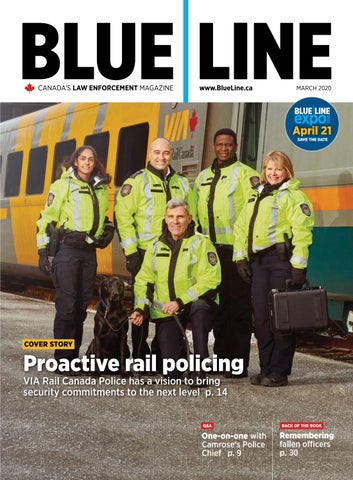
COVER STORY
Proactive rail policing VIA Rail Canada Police has a vision to bring security commitments to the next level p. 14 Q&A
BACK OF THE BOOK
One-on-one with Camrose’s Police Chief p. 9
Remembering fallen officers p. 30
THE AVERAGE TRUCK NEVER COMES WITH THIS MUCH STORAGE.
BUT THEN THIS ISN’T YOUR AVERAGE TRUCK. The 2020 Ram 1500 Special Service is no ordinary truck, starting with its legendary 5.7L HEMI® V8 engine featuring the fuel-efficient Multi-Displacement System (MDS) Fuel Saver Technology. Variable Valve Timing (VVT) delivers impressive engine performance, while its Class-Exclusive Multilink Coil Spring Rear Suspension* ensures lateral stiffness and superior vehicle control. An available RamBox® Cargo Management System* means you’ll never run out of room — whatever you bring to the job. The Ram 1500 Special Service. With so many great features, no wonder they call it Special.
CLASS-EXCLUSIVE RAMBOX CARGO MANAGEMENT SYSTEM ®
WITH BED DIVIDER*
CLASS-EXCLUSIVE MULTILINK COIL SPRING REAR SUSPENSION*
fleet.fcacanada.ca
1 800 463-3600
*Based on Automotive News Full-Size Pickup segmentation. Excludes other vehicles designed and manufactured by FCA US LLC.
Contents
22 March 2020
Columns
Volume 32 Number 3
4 9 10 12 13 26 30
Features COVER STORY
14 Protecting Canada’s intercity passenger rail service
How VIA Rail Canada Police and Corporate Security is adopting proactive policing to secure a 12,500-km network coast to coast. By Karl-Philip Marchand Giguere
20 Situation awareness: is it time to expand use-of-force training?
We hear a lot about the importance of situation(al) awareness (SA) in law enforcement but what do we know about how to train officers to monitor and regulate their SA in dynamic and uncertain environments? By Lori Horne
22 Not your average Canadian bike unit
Editor’s commentary Q&A Health & wellness Behavioural sciences Holding the line Case law Back of the book
Departments 5 5 7 8 8 27 28 29 30
By the numbers News Cold case Dispatches Calendar Off the shelf Product showcase Marketplace Blue Links
COVER PHOTO: MARC-OLIVIER BÉCOTTE
Pedalling 365 days a year, no matter the weather, these versatile RCMP members are targeting chronic offenders while also engaging with their community at large on Vancouver Island. By West Shore RCMP
9 @Blue_LineMag
20 26 March 2020 | BLUE LINE
3
EDITOR’S COMMENTARY BY RENÉE FRANCOEUR
The importance of futures thinking in policing
I
have finally read the report, “Plan- itional environment, like policing. ning for the Future: A Primer for He told me he first heard about futures Police Leaders on Futures Think- thinking back when he was taking an ing.” Released in October 2019, it is RCMP introduction to leadership course the first of a new publication series and a clip from Joel Arthur Barker, the launched to celebrate the collaboration author of Discovering the Future: The Busibetween the Society of Police Futurists ness of Paradigms, was played. International (PFI), the Futures Working “I just connected the dots to policing,” Group (FWG) — an entity previously Clapham said, crediting Barker as his futures developed and supported by the Federal thinking mentor. “[Barker’s] rules are timeBureau of Investigation (FBI) — and the less. If you want to know where the future is National Police Foundation in the U.S. going — look to the edge, look for the rule Futures thinking has been around for a breakers... Many new paradigms are created while; the FBI National Academy by outsiders that are not inbegan teaching a graduate course The FBI vested in the old paradigm.” on police futures in the early 1980s. National In the corporate world, Closer to home, Dalhousie Univer- Academy we’re always thinking about sity in Halifax, N.S., has been offer- began disruption and looking ahead... ing a “Police Leadership and teaching a how can we outperform Q1’s Management Development” graduate results in Q2? In fact, here at course for years, which also looks course on Annex Business Media, we at how “methods of futures think- police futures have an annual “innovation ing are exercised with some em- in the early day” where we brainstorm phasis on trend identification and 1980s... how to tap into coming media analysis and on how policing issues trends for better revenue emerge.” This course is a required part of streams. It helps us make informed deciDal’s well-known Police Leadership Certifi- sions, bolstered by forecasts, so we’re less cate Program. In fact, according to Sherry reactive in safeguarding our brands. Carmont, the Police Leadership Program’s We tackle decision making in multiple program director, most students start with places in this issue of Blue Line, including this course. That’s great news, because, as in our Health & Wellness column. We know the authors of the “Planning for the Future” we can’t have (nor be) poor decision makreport indicate, futures thinking is a tool ers in law enforcement. That’s where that is rarely used and often misunderstood training, in conjunction with policies and in law enforcement circles. procedures, comes into play, as Isabelle and “When we look at policing in general, we Bruno write on page 10. For leadership, see surprisingly little written about why futures thinking goes one step further — as futures thinking matters, what it can tell an empowering feature to decision making. us, and how leaders can integrate it into It allows you to position your agencies with their leadership toolkit,” the report states. the “necessary organizational agility,” as “That is not to say, we do not see innova- the authors of the report conclude, for tion or the dissemination of good practi- success down the road, in this rapidly ces; however, it often seems these things changing, high-tech world. happen to us rather than because of us.” “You can lead change or be changed, as Ward Clapham, a retired RCMP super- the story goes,” Clapham said. intendent and transit police chief, has Check out the “Planning for the Future” been teaching futures thinking at Dal- report at policefoundation.org/publicahousie for the past 10 years. I connected tion/planning-for-the-future-a-primer-forwith him by phone recently to hear more police-leaders-on-futures-thinking and let about evolved decision-making in a trad- me know what you think.
CONNECT WITH BLUE LINE
www.BlueLine.ca 4
@Blue_LineMag
BLUE LINE | March 2020
www.facebook.com/BlueLineMagazine
BLUE LINE www.BlueLine.ca
GROUP PUBLISHER | MARTIN MCANULTY mmcanulty@annexbusinessmedia.com EDITOR | RENÉE FRANCOEUR rfrancoeur@annexbusinessmedia.com ACCOUNT MANAGER | JANICE EATON jeaton@annexbusinessmedia.com MEDIA DESIGNER | SVETLANA AVRUTIN savrutin@annexbusinessmedia.com ACCOUNT COORDINATOR | TRISH RAMSAY tramsay@annexbusinessmedia.com CIRCULATION MANAGER | BEATA OLECHNOWICZ bolechnowicz@annexbusinessmedia.com Tel: 416-510-5182 COO | SCOTT JAMIESON sjamieson@annexbusinessmedia.com
ANNEX BUSINESS MEDIA 111 Gordon Baker Road, Suite 400 Toronto, ON M2H 3R1 Tel. 416-442-5600 • Fax 416-442-2191
Publication Mail Agreement No. 40065710 ISSN 0847-8538 Printed in Canada SUBSCRIPTION RATES Canada — 1 Year $31.50; 2 Year $52.50 plus tax USA — 1 Year $136.50 CAD CIRCULATION email: bolechnowicz@annexbusinessmedia.com Tel: 416-510-5182 Fax: 416-510-6875 or 416-442-2191 Mail: 111 Gordon Baker Road, Suite 400, Toronto, ON M2H 3R1 Occasionally, Blue Line will mail information on behalf of industry-related groups whose products and services we believe may be of interest to you. If you prefer not to receive this information, please contact our circulation department in any of the four ways listed above. Annex Privacy Officer Privacy@annexbusinessmedia.com; Tel: 800-668-2374 © 2020 Annex Publishing & Printing Inc. All rights reserved. Printed in Canada. No part of the editorial content of this publication may be reprinted without the publisher’s written permission. Opinions expressed in this magazine are not necessarily those of the editor or the publisher. No liability is assumed for errors or omissions. Readers are cautioned and advised that articles presented herein are edited and supplied for your personal awareness and should not be used for further action until appropriate guidance is received from a supervisor, Crown Attorney or other persons in authority. All advertising is subject to the publisher’s approval. Such approval does not imply any endorsement of the products or services advertised. The publisher reserves the right to refuse advertising that does not meet the standards of this publication.
NEWS
PHOTO: BRANDON POLICE SERVICE
BRANDON
Assiniboine houses new Brandon Police armoured recovery vehicle
The Brandon Police Service’s (BPS) new armoured rescue vehicle was unveiled for the first time publicly at the end of 2019 inside Assiniboine Community College’s Public Safety Training Centre. “We are pleased that they looked to us to assist them with the storage of this armoured recovery vehicle (ARV),” the college announced. Nearly $400,000 was provided to BPS to purchase the ARV, which is designed to be used in tactical responses in critical incidents across southwestern Manitoba. The ARV has the capacity to carry 10 fully equipped members at a time and is built with ballistic armour. The vehicle will be used by other police and public safety agencies within the region, in addition to BPS. “Having the proper tools can help police officers respond quickly and safely, protecting themselves and the public,” said Justice Minister Cliff Cullen. “Brandon police have recognized this vehicle will be an incredible asset in dangerous situations, and
our government is pleased to invest in an initiative that will bolster officer and public safety throughout southwestern Manitoba.” “The addition of the armoured rescue vehicle to our fleet will allow for increased safety for both the citizens we serve and the police officers that are tasked with bringing these high-risk situations to a safe conclusion,” said Chief Wayne Balcaen, Brandon Police Service. “If deployed during a live event, citizens and police are provided an incredibly safe option. Having the ARV available for all of the Westman region is essential as we continue to work collaboratively with our justice partners.” WORLD
IWCE report analyzes the impact of power outages on first responders
Organizers behind the International Wireless Communications Expo (IWCE), an event for the critical communications industry, say they recently surveyed over 597 first responders and public safety professionals to “benchmark the current technologies they are using” and to “understand technological challenges within the industry.”
The survey revealed that in the past year, 25 per cent of first responders have experienced an incident where loss of power affected their ability to do their job. The report also finds that the majority of first responders don’t have enough back-up power to last longer than 24 hours, with 43 per cent stating they would run out of power within 24 hours. Fifteen per cent of first responders reported they have no back-up power system in place at all and only 26 per cent said they have back up that lasts longer than a week. “As extreme weather incidents are becoming more frequent and we now live in a world where cyber terrorists may find ways to shut down power grids, first responders need to keep abreast of power options, specifically for communications equipment, and utilities need to be fully secure to avoid hack attacks,” said Stephanie McCall, show director for IWCE. VANCOUVER
Drug dispensing machine model should be expanded to fight overdoses: B.C. doctor
Don Durban holds his palm up to a screen on a tall steel box akin to a vending machine crossed with an ATM that displays his first name and an identification number seconds before dispensing what he calls a life-saving plastic package. Durban, 66, takes out two small hydromorphone pills and leaves a storefront with the heroin substitute he gets there four times a day as part of a program aimed at tackling an overdose crisis that has killed an estimated 5,000 people in British Columbia since 2016. The machine, called MySafe, is bolted to the floor in a building next to an overdose prevention site in Vancouver’s Downtown Eastside.
BY THE NUMBERS
New homicide numbers released by Statistics Canada at the end of last year showed the number of Indigenous people who died by someone else’s hand remained five times higher than the Canadian average. While the number of Indigenous men who died by homicide is double that of Indigenous women, the number of Indigenous women dying by homicide is on the rise.
140 Indigenous victims of homicide in 2018, representing 22 per cent of all homicide victims in Canada
@Blue_LineMag
7.31 Indigenous people per 100,000 suffered a death by homicide compared to 1.44 for non-Indigenous people
6
more Indigenous female victims of homicide in 2018 than in 2017, marking a second consecutive annual increase
23 fewer Indigenous male victims of homicide in 2018 than in 2017, the first time officials have seen a decrease since 2014 when data on Indigenous identity first became available
March 2020 | BLUE LINE
5
NEWS Dr. Mark Tyndall came up with the idea for the machine. He stocks it with hydromorphone delivered by a pharmacy for drug users whose urine has been tested for the presence of fentanyl. Tyndall, who has spent 20 years working in harm reduction and is a professor of medicine at the University of British Columbia’s school of population and public health, said a biometric scanner in the machine identifies patients who are dispensed particular dosages of the pain-management opioid sold under the brand name Dilaudid. Eight patients are using MySafe and three more were set to be added. The machine can be programmed to provide the drug for 48 people, Tyndall said, adding most of his patients have been swallowing the hydromorphone, which is sometimes crushed and cooked before being injected intravenously like heroin. His vision would see MySafe machines installed in overdose-ravaged communities across Canada, but in Vancouver, the
epicentre of the opioid crisis, only one other doctor has come on board to prescribe hydromorphone from the machine. Resistance from physicians so far is possibly because other “medicalized” models — where patients use methadone or inject a medical grade of heroin under supervision — have become the norm, even though his program is cheaper to run and does not require supervision, Tyndall said. “This is a harm reduction thing where I don’t want to see people continue to buy fentanyl and die.” Concerns about diversion of hydromorphone dispensed from MySafe are negligible because patients in the program are monitored and anyone they may be passing the drug on to could be saved from the illegal drug supply known to contain fentanyl, Tyndall said. “This is the same arguments against harm reduction altogether, that we’re just enabling people and what is the motivation to them to stop using drugs if we’re just giving them drugs? What I’ve seen people
Bachelor of Applied Arts Justice & Public Safety
go through to get illegal drugs, it’s crazy.” Tyndall said patients who use MySafe can use drugs alone, the way most people do, without fearing their addiction could kill them. The Vancouver Police Department says it is in support of the vending machine. “These machines dispense a known substance which has a known strength and are not contaminated. We are not concerned about diversion of the pills as they are also already readily available at the street level,” said Const. Tania Visintin over email. “These machines are a locked safe which people are able to access their prescriptions.” Health Canada said in a statement it is aware of the project, noting the dispensing of medication falls under provincial regulations. British Columbia’s Ministry of Mental Health and Addictions said it will await the results of the independent project involving MySafe. - © Canadian Press Enterprises Inc., 2020, with files from Blue Line. Visit www.BlueLine.ca for the latest news, stories, products, videos, photo galleries and industry events.
TORONTO, ON
for professionals
Part-time study > Credit for previous postsecondary education, training and work experience > Entrance scholarships > Apply for fall
Information Night
April 16, 2020 Apply by
June 1, 2020
guelphhumber.ca/jpsdc 6
BLUE LINE | March 2020
BL_UnivofGuelph_March20.indd 1
www.BlueLine.ca
2020-02-18 9:16 AM
NEWS CANADA
Almost 14,000 Canadians killed by opioids since 2016
New numbers released at the end of 2019 show close to 14,000 Canadians have been killed by opioids over the last four years and more than 17,000 people have been hospitalized for opioid-related poisoning. The data is in a new report from a national advisory committee struck to study the epidemic of opioid overdoses in Canada. Canada’s chief public-health officer, Dr. Theresa Tam, and Saskatchewan’s chief medical health officer, Dr. Saqib Shahab, issued a joint statement saying many of the deaths were caused by Canada’s illegal drug supply being contaminated with toxic substances. They say fentanyl and other very potent synthetic opioids continue to be a major cause of hospitalizations and deaths. The data also shows thousands of Canadians continue to have non-fatal overdoses each year and hundreds of thousands more are affected by problematic substance use. Western Canada continues to be the most affected by the opioid crisis, but Ontario has
also seen a rise in opioid-related deaths, according to the data. Also, 94 per cent of opioid deaths in the first six months of 2019 were accidental, the Public Health Agency of Canada says. – Teresa Wright © Canadian Press Enterprises Inc.
reconstruction, this school had been falling apart. Once construction was underway, Radke said he was keen to join the boots on the ground to see the progress first-hand. “It doesn’t take a lot for us to help out and make a big difference,” Radke said. SchoolBOX has built 111 classrooms, 84 libraries and 61 washrooms in Nicaragua.
NICARAGUA
Retired OPP officer builds classroom for children
Heroes y Martires de Nandaime School in Nicaragua opened on Nov. 4, 2019, and one of the three classrooms was sponsored by retired Ontario Provincial Police (OPP) Sgt. Mark Radke, who recently travelled to the country to assist with the construction. Radke was a police officer for 30 years before his retirement in 2018. He says he has chosen to take this new phase of his life to build a new school in Nicaragua with SchoolBOX, which is an organization that presents a “specific mission to build schools and libraries in Nicaragua.” Since becoming involved with SchoolBOX, Radke has donated $23,000 to Heroes y Martires de Nandaime School. Prior to
CANADA
Blue Line, The Podcast? There’s a playlist for that now!
We’ve been working hard to bring you regular episodes of Blue Line, The Podcast and now they’re even easier to find! We have placed all episodes in one spot for smooth listening. Grab your headphones and hit play! We cover diversity in the workplace, financial investigation, wrangling digital crimes, what it’s like to be a “Positive Space Ambassador” at the Canada Border Services Agency, and much more. Listen now at soundcloud.com/user381015363/sets/blue-line-podcast. You can find our podcast wherever you listen to your podcasts under Annex Business Media: Podcasts, or stream the show at annexbusinessmedia.com/podcasts.
COLD CASE Introducing Blue Line’s NEW Cold Case Series:
OUT OF THE COLD File #1: Double homicide in 1997 BY STEPHEN METELSKY
We are now proactively profiling a cold case in each issue for our readers to share in order to spark renewed interest and hopefully generate tips and information. Two women who were born 29 days apart tragically died together in a double homicide in 1997. A security officer from the metro housing authority stumbled across the grisly murder scene in the sixth-floor stairwell at 274 Sackville St. — in the Regent Park area of Toronto — on the afternoon of Jan. 5. Toronto police suspect the bodies of the two women were discovered 12 hours after the crime had occurred. The women were sex trade workers and had last been seen alive hours earlier in the area of Parliament and Dundas Street in downtown Toronto. Police and forensic examiners scoured the area seeking witnesses and potential evidence discarded by the perpetrator(s). @Blue_LineMag
The exterior building where the double homicide occurred in the Regent Park area. PHOTO: TORONTO POLICE SERVICE
Forensic post-mortem examinations conducted the next day revealed both women had been shot to death between the hours of 3 a.m. and 4 a.m. on Jan. 4, 1997. The victims, Florence Harrison and Therese Melanson, both 32 years-old at the time of the murders, were from Toronto and known in the area. Forensic testing identified DNA from the crime scene that was linked to the offender responsible for these heinous crimes. However, the forensic profile could not be linked to any known offenders in the national
DNA databank. The motive for the 22-year old homicide remains unknown and the offender has never been identified. Police and families of Harrison and Melanson are still seeking answers and closure. “The murders of Florence Henderson and Therese Melanson were extremely violent,” said Stephen Smith, a detective with Toronto’s Cold case unit. “These deplorable acts were committed against two vulnerable members of our community. We know that there are people that have information [about] these murders, including the identity of the person responsible for their deaths. The Toronto Police are asking anyone with any information to do the right thing and contact police,” Have a tip or information? Call the Toronto Cold Case Unit 416-808-7400 ext. 77967. You can also report information anonymously at Crime Stoppers: 416-222-TIPS (8477). Visit youtu.be/y2ioA_g3Qmc for a video from TPS discussing the case with the families of the victims. Stephen Metelsky, M.A., is a writer, (ret.) police intelligence sergeant and professor at Mohawk College. Find him on LinkedIn, follow him @StephenGm_Jr or email Stephen.Metelsky@mohawkcollege.ca.
March 2020 | BLUE LINE
7
NEWS DISPATCHES Nicole Chapdelaine has been promoted to the rank of superintendent at the Edmonton Police Service.
Deputy Chief Kevin Thaler is retiring from the Waterloo Regional Police Service (WRPS) after a 32-year career. He worked in Patrol, Traffic, Homicide, Professional Standards, as well as the chief’s executive officer. In 2018, Thaler received the Governor General’s Exemplary 30-year-Service Medal. After 34 years of policing, Chief Supt. Paul Beesley has retired from the Ontario Provincial Police. He started his policing career in 1986 as a member of the Royal Canadian Mounted Police. He is a recipient of the Ontario Homicide Investigators Association Major Case Management Award and the Robert Faulkner Memorial Award for Outstanding Investigation from the International Association of Outlaw Motor Cycle Gang Investigators. Staff Sgt. Barry Randell (photo) has retired from the Royal Newfoundland Constabulary after more than 39 years of service. Sgt. Corinne James retired from the force as well after more than 30 years. Carolyn Nichols has been promoted to the rank of inspector at Halifax Regional Police. She is the service’s Support Divisional Commander.
CALENDAR Katie McLellan is one of three new deputy chiefs joining Calgary Police Chief Mark Neufeld. She joined the Calgary Police Service in 1987, retiring in 2013 as senior superintendent. She transitioned to the corporate security realm joining an international oil and gas exploration company as the senior security advisor. In May 2018, she joined the RCMP and was selected to be the Officer in Charge of Federal Policing South, Serious and Organized Crime (K Division). Chad Tawfik is also a new deputy chief at Calgary Police Service. He worked his way up the ranks of the Edmonton Police Service (EPS) and was the acting deputy chief of its corporate service bureau upon his move to the Calgary Police Service in November 2019. He was involved with leading several significant organizational initiatives including a comprehensive strategic staffing plan, the development and implementation of the overarching EPS strategy and related structures, as well as a comprehensive review of the EPS Intelligence Model, which led to the creation of the Operations and Intelligence Command Centre. Calgary’s third new deputy chief is Raj Gill, who has 29 years of policing experience with the RCMP. He comes to the Calgary Police Service having recently been promoted to the rank of assistant commissioner, National Human Resources. In this role he has been providing executive leadership to all RCMP HR functions and services across Canada. This includes over 30,000 employees across the RCMP’s 15 operational divisions. RCMP Sgt. Jennifer Asbury passed away Jan. 7 after a courageous battle with cancer. She joined the RCMP in 2000 and was awarded the RCMP Commissioner’s Commendation for Outstanding Service in 2019. Rest in peace.
The OPP Commissioner’s Command Team announced Marc Bedard, Kari Dart, Paul Mackey, Carson Pardy, Dwight Peer, Karl Thomas and Rohan Thompson have all been promoted to the role of chief superintendent. 8
BLUE LINE | March 2020
PROMOTIONS, RETIREMENTS, RECOGNITION • If you have an officer in your agency recently promoted or retiring or an individual you wish to have recognized (major award or recently deceased) you can let Blue Line magazine know by emailing: rfrancoeur@annexbusinessmedia.com.
ILEETA International Training Conference and Expo March 23-28, 2020 St. Louis, Mo. ileeta.org/ileeta-conference-expo-3 RCMP N.L. Klondike Night March 27, 2020 St. John’s, N.L. bit.ly/2R2xNdv 13th National Symposium on Tech Crime and E-Evidence April 3, 2020 Toronto, Ont. www.osgoodepd.ca Risk & Recovery Conference April 16-17, 2020 Hamilton, Ont. www.riskandrecoveryconference.com Two Day Peer Support Training offered by Mood Disorders Society of Canada April 16-17, 2020 Sharon, Ont. conta.cc/35pRIIs Canadian Police Association Conference April 20-22, 2020 Ottawa, Ont. www.cpa-acp.ca 2020 Battle of the Badges Hockey Tournament April 24-26, 2020 Oshawa, Ont. ashl.ca National Symposium on Sexual Assault Cases in the Criminal Court April 25, 2020 Toronto, Ont. www.osgoodepd.ca Canadian Critical Incident Stress Congress and Training April 28-May 1, 2020 Niagara Falls, Ont. bit.ly/2APFFq9 2020 Chief Youth Courage Awards Gala April 29, 2020 Calgary, Alta. bit.ly/2APFFq9
www.BlueLine.ca
Q&A Dean LaGrange became the eighth chief of the Camrose Police Service in central Alberta in July 2019. He brought with him 26 years of experience with the Calgary Police Service, followed by a term with the RCMP. He discusses more about how those experiences shaped him and his plans for Camrose with Blue Line.
PHOTO: CONST. MATTHEW WILTON, CAMROSE POLICE SERVICE
Q: Tell us more about how your career has evolved over time.
I joined the Calgary Police Service (CPS) in 1992, a young kid from rural Alberta. After six years on the street in various districts, I went to the Traffic Section. Growing up watching Ponch and Jon from the TV show “CHiPs,” I had to experience the police motorcycles. After that I went to the Strike Force Unit (SFU) and worked surveillance for a few years before returning to the street, where I was promoted to sergeant in 2005. With stints in Major Events & Emergency Management and running a team out in District “4,” I was promoted to staff sergeant and placed in District “2.” A few years later, with a stop in the Office of the Chief as the executive officer for the deputy chief of field operations, I was promoted to inspector in 2011. I took command of the Traffic Section, which included a NATO (North Atlantic Treaty Organization) mission for a year in Afghanistan. This was done through IPOB (International Policing Operations Branch), managed by the RCMP. I then took command as the inspector of District “2” for a couple of years before ending up as a duty inspector. I retired in 2017, joined the RCMP at the rank of inspector four days after retiring and was posted to Red Deer as the operations support officer. My plan was to stay with the Mounties for the rest of my law enforcement career, when an unexpected opportunity here in Camrose presented itself. It’s been a very rewarding career.
Q: What has been your most memorable moment in policing?
I have enjoyed my career so much that it’s difficult to nail down a specific “moment.” The opportunity to experience a yearlong mission, assisting in the training of the Afghan National Police, certainly stands out as unique and memorable. @Blue_LineMag
Q: How did your former experiences prepare you for your current role?
Having the opportunity to work in two different organizations definitely helped prepare me. Camrose is a smaller agency that works quite closely with the local RCMP in the surrounding communities. Having knowledge of RCMP policy and procedures, as well as personal relationships with many RCMP colleagues around the province, was a distinct bonus. My time in Calgary, specifically as the deputy chief’s executive officer, with the exposure to the police commission and the “business” part of policing was very beneficial as well.
Q: What is something you enjoy about Camrose?
Having experienced big city policing with Calgary, and the RCMP to a lesser degree, this has been my first exposure to a smaller centre. The two-minute drive to work, the personal relationships developed with members of the police service and the community at large really appeals to me at this stage of my career. Having the ability to effect change directly and being able to be “hands-on” is quite rewarding.
Q: What is one thing you hope to enhance at the service?
The Camrose Police Service has very good equipment, resources and training. Something I discovered with my one-on-one conversations with members was a desire
for expanded opportunities outside of the organization — like with ALERT (Alberta Law Enforcement Response Team), IPOB missions, JFOs, (Joint Forces Operations), etc. These opportunities are excellent ways to expand skillsets and experiences that not only benefit individuals, but the organization and the community itself. I want to find ways to provide these opportunities without impacting staffing levels negatively, which is always a challenge. I am also in the process of modernizing some elements of the police service, including designing new dress uniforms, developing new badges and creating a more effective, modern work environment that our staff will take renewed pride in belonging to.
Q: How does technology play into the service’s future?
The Camrose Police Service is a primary 911 PSAP (Public Safety Answering Point) and so we are focusing on the mandated NextGen 911 upgrades over the next couple of years. We also have to ensure we have resources to invest in the AFRCCS (Alberta First Responders Radio Communications System) provincial radio system in the coming years.
Q: What is your advice to others with dreams of climbing the ladder in law enforcement?
Be yourself, don’t change. Be kind and humble. If that, combined with your work ethic, doesn’t get you promoted, you don’t want it anyway. Just because you have something on your sleeve or shoulder doesn’t define what type of person you are or how successful you have been. I have found that “people skills” are far more valuable than other abilities and talents you may have acquired. Read Blue Line’s full conversation with the chief at bit.ly/39nV6oA/.
March 2020 | BLUE LINE
9
HEALTH & WELLNESS
BY ISABELLE SAUVÉ AND BRUNO SEGUIN
Looking at decision making in a structured fashion “Decision making is a cognitive process that helps you map out the consequences of your actions.”
H
- Adam Sicinski
umans make countless decisions daily, many of which are undertaken with little to seemingly no thought: what to eat, who to interact with, what to do with one’s day, etc. Life can be viewed as a compilation of microscopic and significant decisions. What we do — as well as what we opt not to do — is the result of decisions taken. Some decisions are minor in nature while others are substantial and life changing. Law enforcement officers, like many other professionals with specific skill sets, are trained to make sound decisions as well as demonstrate appropriate judgement while dealing with a wide variety of challenging situations and persons. As a result of professional training and peer support, police decision making becomes fluid and dynamic. It evolves and unfolds over the course of time, based on recognized variables. Through repeated exposure and experience, these skills can be strengthened and enhanced. Training, in conjunction with policies and procedures, also provides a solid framework to guide and assist officers in making timely and sound on-the-job decisions. R. v. McNeil (2009) is Canadian case law that allows the disclosure of records of discipline and misconduct of officers involved in criminal proceedings and is an example of the importance of proper decision making both on and off duty. Police officers are entrusted a significant amount of discretion and power where their decisions can have serious consequences. Aside from an ethical responsibility to do a stellar job, the increasing pressures in accountability threaten the likelihood officers may continue in the profession if they are unskilled or “poor” decision makers. 10
BLUE LINE | March 2020
PHOTO: OLASER/E+/GETTY IMAGES
Every decision has a consequence. Deciding requires taking a stance and can also involve risk taking. It also frequently exposes the decision maker to a certain degree of vulnerability. The impact of a decision can be positive, negative, or result in status quo. It can lead to success but there is a possibility of failure. Decision making opens the door to criticism. One’s need to preserve an “image” or the fear of failure can become debilitating, rendering the individual incapable of deciding. Some officers “hide” behind other factors and excuses to avoid facing the truth or making important life decisions. Overall, planning for decision making is key to success. First, identifying and ratifying a decision is in order ensures proper attention is given to a particular issue. As a second step, collecting information and fully processing the circumstances related to the decision to make is critical. There are values attached to tough decisions, such as financial value, social value, emotional value, to name a few. Next, based on information collected, pertinent options can be developed. From this point, the various options can be examined and critically analyzed. Then comes time to decide and take action. Owning one’s decision is important regardless of outcome. Being true to ourselves and our values is key. Although it may be difficult, it is important to avoid excuses that prevent the needed decision making. In fact, not deciding is a decision
in itself. Many are afraid of failing but in actuality or hindsight may not necessarily regret a “failure.” Despite being provided with all tools and support to make decisions at work, some continue to struggle in making them on a personal and real-life level. The question remains how someone able to make prompt and assertive life or death decisions without skipping a beat can agonize and find it nearly impossible to make personal decisions. Proficiency in making professional decisions does not directly transfer to the personal life. We all know someone who is a great law enforcement officer but repeatedly makes iffy life decisions. Discrepancy between professional and private life is largely based on the verity that the governance of rules and policies, along with support of colleagues and regular As a result of training, provides a structure to ease professional decision making, while such a frametraining and work does not exist within the pripeer support, vate sphere. Furthermore, many inpolice dividuals have not been shown decision personal decision making in a making structured fashion. With minimal or becomes no boundaries, they find themselves fluid and at a loss. Asking for help becomes dynamic. increasingly difficult as they carry the image of a law enforcement officer who is expected to have the answers and make decisions. Being skilled on a professional level does not guarantee they are a “skilled” friend, spouse or parent. When required, it is important to lean on others for a little extra support. No one will have a perfect decision-making record and we all make mistakes. Learning and growth comes from all decisions. Isabelle Sauvé is a 13-year veteran with the OPP, currently with the Lanark County Detachment. She has a MA in psychology and is a PhD candidate. She is also an ultramarathon/endurance athlete and the Racing the Planet/4 Deserts 2018 Series winner as well as a Guinness World record holder. She can be contacted at: isabelle.sauve@hotmail.com. Bruno Seguin is a senior executive manager and international business consultant with experience in global operations, international business development, strategic planning, leadership and corporate governance. He is also an ultra-runner, 9th place finisher at the Racing the Planet/4 Deserts 2018 Series and fellow Guinness World record holder.
www.BlueLine.ca
Looking Looking to the the to future future The VIA Rail Police ready meet The VIA Rail Police is is ready toto meet the future and will continue ensure the future and will continue toto ensure a safe and secure travel experience a safe and secure travel experience for customers. for itsits customers. Find out more Find out more viarail.ca atat viarail.ca
TM
TM Trademark Rail Canada Trademark ownedowned by VIA by RailVIA Canada Inc. Inc.
BEHAVIOURAL SCIENCES
BY PETER COLLINS AND ALASDAIR GOODWILL
Preventing single actor extremist attacks: the TRAP-18
A
ttacks at the hands of single-actor extremists are uncommon events but prove to be frightening and potentially devastating when they occur. It is extremely difficult for law enforcement to predict the actions of the single actor as they have inherently different motivations, different identified ideologies, as well as possible emotional and psychological disturbances that must be considered by threat assessment specialists. Although there is no specific “profile” or “type” of single-actor extremist, we are getting better at understanding the behavioural, cognitive and emotional escalation of their path to violence – the series of sequential steps which indicate that an individual is progressing towards an act of targeted violence1. However, according to Meloy & Hoffman (2014), accurately predicting the risk of an individual committing an act of targeted violence is highly unlikely due to their low incidence (i.e., low base-rate). Nevertheless, prevention is possible if the focus is upon evidence-based and factual behavioural indicators of targeted violence, and threat management is employed to mitigate these behaviours of concern.2 In this two-part article, we will present a brief summary of the Terrorist Radicalization Assessment Protocol, the TRAP183, developed by Dr. Reid Meloy, a renowned forensic psychologist. The TRAP-18 is a structured professional judgment instrument composed of eight proximal warning behaviours (outlined here, in part one) and 10 distal characteristics (outlined in part two next month). Each indicator is coded as present, absent, or unknown (insufficient data to code). Unlike other instruments that exist - the VERA (Pressman, 2009) and the ERG 22 + (Lloyd & Dean, 2015), the TRAP-18 was intentionally designed to assess for risk of targeted or intended extremist violence in community subjects — regardless of their particular ideology — to assist in prioritizing cases for investigators. The proximal warning behaviours, the first eight indicators on the TRAP-18, have been shown to have validity in separating school attackers from other subjects of concern with no intent to attack4. Proximal warning behaviors of pathway, identification, energy burst, and last resort were 12
BLUE LINE | March 2020
Prevention of lone actor extremist attacks is possible if the focus is upon evidence-based and factual behavioural indicators of targeted violence, and threat management is employed to mitigate these behaviours of concern. significantly more frequent among North American attackers than those that were identified as national security concerns but did not mount an attack5.
Proximal warning behaviours
1. Pathway – research, planning, preparation or implementation of an attack. 2. Fixation – an increasingly pathological preoccupation with a person or a cause, accompanied by a deterioration in social and occupational life. A fixation warning behaviour appears to have one of three cognitive-affective drivers: delusion, obsession, or extreme overvalued belief.6 3. Identification – a psychological desire to be a pseudo-commando or have a warrior mentality, closely associate with weapons or other military or law enforcement paraphernalia, identifies with previous attackers or assassins, or identifies oneself as an agent to advance a particular cause or belief system. 4. Novel Aggression – an act of violence that appears unrelated to any targeted violence pathway and is committed for the first time. 5. Energy Burst – an increase in the frequency or variety of any noted activities related to the target, even if the activities themselves appear innocuous, usually in the hours, days or weeks before the attack. 6. Leakage – communication to a third party of an intent to do harm to a target through an attack. 7. Last Resort – evidence of a “violent action imperative” and “time imperative;” it is often a signal of desperation or distress. 8. Directly Communicated Threat – the communication of a direct threat to the target or law enforcement beforehand. Although directly communicated threats are quite infrequent among those who engage in targeted violence of any kind (fewer than 20 per cent), they always warrant active investigation because they may turn out to be true
positives. In a few cases, they are signaling an intent to act. Meloy and Gill (2016) found this to be the case in one out of five lone actor terrorists.7 As a cautionary note, full training is required to be able to use the TRAP-18 and the aforementioned is just a brief overview of the TRAP indicators. Many other articles are available that detail the research supporting the validity of the Terrorist Radicalization Assessment Protocol. Online training can be accessed through www.gifrinc.com. Dr. Meloy’s website is drreidmeloy.com. Next month we will further explore the TRAP-18 and the distal characteristic indicators.
Endnotes
1. Calhoun, F.S. & Weston, S.W. (2003). Contemporary threat management: A guide for identifying, assessing, and managing individuals of violent intent. San Diego, CA: Specialized Training Services. 2. Meloy, J. R., & Hoffmann, J. (Eds.) (2014). International handbook of threat assessment. New York: Oxford University Press 3. Meloy, J. R. (2017). The TRAP-18 manual version 1.0. Toronto: Multihealth Systems (mhs.com) 4. Meloy, J. R., Hoffmann, J., Roshdi, K., & Guldimann, A. (2014). Some warning behaviours discriminate between school shooters and other students of concern. Journal of Threat Assessment and Management, 1, 203–211. 5. Meloy, J. R., Goodwill, A. M., Meloy, M. J., Amat, G., Martinez, M., & Morgan, M. (2019). Some TRAP-18 indicators discriminate between terrorist attackers and other subjects of national security concern. Journal of Threat Assessment and Management. 6. Meloy, J. R., Roshdi, K., Glaz-Ocik, J., & Hoffmann, J. (2015). Investigating the individual terrorist in Europe. Journal of Threat Assessment and Management, 2, 140–152. https://doi.org/10.1037/tam0000036 7. Meloy, J. R. & Gill, P. (2016). The lone actor terrorist and the TRAP-18. Journal of Threat Assessment and Management, 3, 37-52. Dr. Peter Collins is the operational forensic psychiatrist with the Ontario Provincial Police’s Criminal Behaviour Analysis Section. His clinical appointment is with the Centre for Addiction & Mental Health and he is an associate professor with the University of Toronto. His opinions are his own and may not reflect the opinion of the OPP, University of Toronto, or CAMH. Contact him at peter.collins@utoronto.ca.
Dr. Alasdair Goodwill is a clinical and forensic psychologist with over 20 years combined experience in behavioural investigative analysis, threat assessment, forensic risk assessment, and therapeutic services. He has a clinical practice and forensic consultancy and is an associate professor at Ryerson University. Contact him at agoodwill@psych.ryerson.ca.
www.BlueLine.ca
HOLDING THE LINE BY MICHELLE VINCENT
Research and implementation: Our two-fold mental health resources
C
ognitive behavioural therapy? Exposure therapy? Yoga or a three or five-day retreat with the Badge of Life Canada non-profit? What do I need, what is available to me and what is likely to serve me best during my mental health journey as a police officer — whether I’m active or retired? When we look at adding resources to the mental health world for first responders and uniform personnel, or to any mental health community, it is best practice to research, gather data and then use that informative data to create a proposal. That proposal is then used to gather funding to implement the prospective resource. As an academic I understand and respect the necessity and quality control piece ethical research adds. Research is ongoing and technically eternal. With this in mind, it is just as important to ensure some sort of action is taken to implement a resource as a result of the research. Resources are few and far between, especially in the world of policing and mental health. While great strides are being made to create innovative resources — such as online cognitive behavioural “therapy,” the Boots on the Ground peer support line, and phone apps like Backup Buddy, promoted by some Ontario police services — we still need “beefier” supports in place. One excellent resource that gathers data through research while providing services simultaneously is a clinic out in Ottawa, exclusive to first responders. It is run by Dr. Simon Hatcher, a professor of psychiatry working out of Ottawa University, in partnership with the Ottawa Hospital. This research clinic is the first of its kind in Canada; being both a clinic providing mental health support for public safety personnel and conducting research at the same time to ensure best practices are met. This project is supported by the City of Ottawa and funded by the Canadian Safety and Security Program (CSSP). What does that mean for us as police officers? It means a safe place for us to go if we live and/or work in the Ottawa area and require mental health support. It means people care enough to find out what resources work for us as police officers and what resources need to be revamped. It means there is an opportunity to develop some leading edge, evi-
dence-based programming that is specialized just for us as a result of this clinic. It is essential our community understands and supports the development of these occupational-specific programs so if, and when, the time comes we need the support, physically attainable resources are available. A variety of programs exist and are fantastic for the general population, However, our ongoing exposure to traumatic incidents places us in a unique category for mental health needs. We are also a unique cohort because of what type of resources we are likely to use — you will not find many police officers opting to go to the hospital in the middle of a mental health event of their own. Let’s be frank. If I am having a mental health crisis at work as a police officer, I need somewhere to go immediately. I need to meet with a mental health provider that has some understanding of what I am
dealing with. I need them to understand the culture I work within, the identity I carry with me at all times, and the responsibility that lies on my shoulders as I serve my community under a microscope of armchair quarterbacks. My every decision, life-threatening or basic, is scrutinized and judged. Understandable? Absolutely — with the right provider and the background data. Let’s make sure that as we do research, we also implement resources that help me work through, process and reframe so I can remain mentally healthy and serve my community at my best. Michelle Vincent recently retired from York Regional Police after 18 years. She is the founder of The Haven, Ontario’s first non-profit, inpatient treatment centre exclusive to first responders and uniform personnel. Contact her at michelle.vincent@thehaven.cloud.
DALHOUSIE’S CERTIFICATE IN POLICE LEADERSHIP
Become the leader you know you can be
Built for modern policing, our online courses, designed and delivered by academics along with industry experts and leaders in policing, give you the knowledge and skills to advance in your profession. Learn from the innovator in quality police education for over 25 years. FALL TERM STARTS SEPTEMBER 8
DAL.CA/POLICELEADERSHIP
CCE
College of Continuing Education
March 2020 | BLUE LINE
@Blue_LineMag BL_Dalhousie_March20.indd 1
13
2020-01-15 9:28 AM
COVER STORY
Protecting Canada’s intercity passenger rail service
How VIA Rail Canada Police and Corporate Security is adopting proactive policing to secure a 12,500-km network coast to coast By Karl-Philip Marchand Giguere
In 2015 Peter Lambrinakos left the Montréal Police Service and became VIA Rail Canada’s first Chief of Police and Corporate Security. In the four years that followed, VIA Rail underwent what it calls a profound evolution in its approach to security in order to meet the needs and expectations of its passengers, employees and other stakeholders. Today, as the first and only intercity passenger rail police in Canada, VIA Rail Police and Corporate Security plays a key role in ensuring the safety and security of intercity passenger rail in Canada. sential connections to remote communities, carrying travellers safely and efficiently. In all, VIA Rail moves more than five million passengers per year. VIA Rail, a government-owned Crown corporation, has rich history and a deep commitment to its passengers and the communities its serves. What was needed,
From terrorism to criminality to helping at-risk individuals, today’s rail operators need to be prepared to respond to a variety of security challenges. 14
BLUE LINE | March 2020
though, was a vision to bring VIA Rail’s security commitments to the next level. From terrorism to criminality to helping at-risk individuals, today’s rail operators need to be prepared to respond to a variety of security challenges, and VIA Rail needed to be ready.
Understanding the threat environment
As we know, transportation networks around the world are constantly subject to the potential threats of terrorism and domestic extremism. Globally, passenger rail systems are no exception, as we have seen in several instances in recent years. www.BlueLine.ca
PHOTO: MARC-OLIVIER BÉCOTTE
V
IA Rail Canada’s passenger rail network operates more than 514 trains per week and over 12,500 kilometres of track. It serves more than 400 communities through 121 stations on a network stretching from Vancouver to Halifax and to as far north as Churchill, Man. Its trains provide es-
Law Enforcement Agency Chooses Cloudian Object Storage for Digital Evidence Data Calcasieu Parish Sheriff’s Office Deploys Cloudian and Hybrid Cloud, Saves More than 50% on CAPEX
CUSTOMER CASE STUDY: CALCASIEU PARISH SHERIFF
The Calcasieu Parish Sheriff’s Office in Louisiana has deployed a hybrid cloud with Cloudian’s HyperStore object storage system. The Cloudian solution stores and protects the department’s large volumes of video surveillance, body cam and evidence data, and has reduced costs by more than 50 percent when compared with alternative solutions. With more than 400 body-worn cameras and at least two cameras in each of its more than 200 patrol and prisoner transport vehicles, this Sheriff’s Office generates a vast amount of data. Digital evidence in the form of crimescene photos and digital forensic captures from storage devices, computers, tablets, smart phones and vehicle information systems add to the storage requirement. To store, manage, and protect this information, the organization deployed a Cloudian solution with 600TB of capacity on premises, and replicates data to Amazon S3 for disaster recovery. The Cloudian solution is used in conjunction with a video capture and digital evidence management system from Getac.
REQUIREMENTS • On-premises storage with S3 cloud integration • Quickly accessible media • Self-describing assets • Integrated data protection
SOLUTION Cloudian HyperStore appliances, 600TB
RESULTS
“We needed the performance and locality of storage in our data centers and the enhanced protection of storage in the cloud,” said Adrian Quintela, information technology director at the Calcasieu Parish Sheriff’s Office. “With Cloudian, we were able to combine scalable storage on-premises with cloud data-management, all in one platform.”
• Simplified management • Mission-critical performance • Multi-site data protection • Cost savings of 50 percent
To ensure robust data protection, the Calcasieu solution includes policybased data replication both to a Cloudian system at a remote DR site and to the public cloud. Replication processes are managed entirely via Cloudian’s integrated management tools, thus saving costs and reducing management complexity. Additional cost efficiencies were achieved with the solution’s small footprint. Consuming just 3U of rack height per location, the Cloudian system saved more than 70 percent on space, power, and cooling.
“With Cloudian, we were
Deploying the Cloudian system was a quick process for the office’s IT team. “It took no more than a day to set up Cloudian at each data center, and the Cloudian support team even helped us resolve a problem that turned out to be unrelated,” said Paul Hite, senior systems engineer at Calcasieu Parish Sheriff’s Office. Quintela added, “Storage availability is critical to our ongoing operations, so it gives us confidence to know the Cloudian team is ready to help out when needed.” “Law enforcement today requires always-on data access to support operations, making bulletproof data durability a must,” said Jon Toor, CMO of Cloudian. “We are thrilled that Calcasieu Parish Sheriff’s Office selected Cloudian for this highly innovative, mission-critical deployment and look forward to supporting them as their data management needs grow.”
able to combine scalable storage on-premises with cloud data-management, all in one platform.” ADRIAN QUINTELA IT DIRECTOR CALCASIEU PARISH SHERIFF’S OFFICE
Attend our Blueline webinar March 31st to learn more!
©2020 Cloudian, Inc. Cloudian, the Cloudian logo, HyperFile, and HyperStore are registered trademarks or trademarks of Cloudian, Inc. All other trademarks are property of their respective holders. AD-CSO-0220
COVER STORY and heightened vigilance, creates a safe and secure travel experience.
The sobering reality that passenger rail is not immune to this type of threat is where VIA Rail’s Corporate Security Strategy comes into play, acting as a preventative and proactive safeguard aimed at protecting passengers, employees and the people who use the corporation’s services and stations. On a day-to-day basis, VIA Rail encounters security concerns similar to other major passenger transportation services when it comes to unruly conduct and criminal activity unrelated to terrorism. Collisions, as well injuries and fatalities involving trains, railway tracks and crossings require prevention, response and support from the police. Furthermore, there is the ongoing need to safeguard victims of crime, people in crisis, and those experiencing homelessness. Along with corporate needs such as access control and video surveillance management, employee training and exercises, as well as insider threat mitigation and legislative compliance, it is clear the security environment VIA Rail faces today is its most challenging yet. It was in the context of these challenges that Chief Lambrinakos began the creation of a Corporate Security Strategy. This strategy is comprised of seven key pillars: • Security management and governance • Threat, risk and vulnerability assessments • Physical security • Intelligence, analysis and partnerships • Law enforcement and security forces • Passenger and baggage screening • Vigilance, awareness and training 16
BLUE LINE | March 2020
Maintaining a holistic threat understanding of the passenger rail industry and its ever-evolving regulatory and legislative environment requires constant co-ordination and engagement among stakeholders. VIA Rail Police and Corporate Security partners with Transport Canada, CN Police, CP Police, Amtrak Police, local, provincial and national police services, the intelligence community, light rail law enforcement agencies, corporate security experts, government agencies, community leaders, academics, and inter-agency networks. Every partner collaborates to keep ahead of evolving threats in order to enable rapid dissemination of information and continuous situational awareness. These partnerships have been developed The idea behind Chief Lambrinakos’ approach was to illustrate VIA Rail’s sec- to help VIA Rail respond across the country. Using them as a force multiplier has urity vision in the coming years. significantly increased VIA Rail’s success A team exemplary of the organization in providing solutions to complex security The VIA Rail Canada Police is a central part challenges. of this strategy. A law enforcement pres‘‘If there is something I understood in my ence in transportation systems is in fact 30 years of policing and which I will continue viewed globally as an essential baseline to stress, it is that relationships are key. In a security requirement for reassuring the relationship — rather than just a partnership public, providing deterrence, responding to — we share a greater commitment to each threats and promoting confidence in travel. other by establishing that bond of trust,’’ VIA Rail police constables have the same explained Chief Lambrinakos. powers as any police officer in Canada. ApThese trusted partnerships have allowed pointed by a judge of a superior court under VIA Rail Police to work with law enforcesection 44.1 of the Railway Safety Act, they ment across the country to intensify have jurisdiction to enforce the laws of Can- high-visibility sweeps at stations, platforms ada or a province to protect property under and on-board trains. Additionally, VIA Rail the ownership, administration or possession Police and Corporate Security personnel of VIA Rail and in any place within 500 metres deploy with partners across the country in of VIA Rail’s properties. They are also permit- joint training exercises for incident response ted to come to the protection of persons on and counterterrorism capabilities. One of VIA Rail’s properties. the most recent exercises took place in VIA Rail Police members come from a November 2019. Planned and co-ordinated variety of law enforcement backgrounds and by the Ontario Provincial Police, it was a live, represent the diverse communities VIA Rail full-scale fictitious domestic terrorism travels across. The constables are also aligned training event involving participation from with the strong customer relanumerous security stakeholders. tions approach that is important Close partnerships also proto the corporation. vide opportunities for tactical While VIA Rail notes it has units and first responders across made great strides in building Canada to train on board VIA Stations an effective police and securRail trains and stations, acquirity team, it is their employees ing an enhanced understanding across the network that make of the passenger rail system. the difference every day. EnThis allows for a more unified hanced security awareness and co-ordinated response to training and exercises, in million+ passengers per railway-related emergencies. year moved by VIA addition to a customer focus As well, since its creation, VIA
121 5
www.BlueLine.ca
PHOTOS: PASCALE SIMARD (ALPHA PRESSE)
The power of partnerships and innovation
A law enforcement presence in transportation systems is in fact viewed globally as an essential baseline security requirement... Rail Police and Corporate Security has increasingly turned to the latest technologies to enhance operational effectiveness and support local police in their investigations. A centralized Video Surveillance System assists VIA Rail’s Security Operations Team in monitoring activity within VIA Rail stations, maintenance centres and facilities while dispatching security agents who travel on select trains, or police as required. A Records Management System allows VIA Rail police constables to record security events, identify trends and hot spots, and share information with other police services when needed. Deep and dark web monitoring permits surveillance of harmful online content and fraudulent activity. And finally, the Access Control Management System allows for full-station access control across VIA Rail’s assets, 24 hours a day.
as well as a victim support protocol and a rail death protocol. For example, in 2019 VIA Rail led a local initiative in the vicinity of its London, Ont., station in which it worked to prevent incidents involving people experiencing homelessness and/or mental health issues and assisted them in a collaborative and respectful manner. This pilot project demonstrated that by taking charge of the person and guiding them to proper community resources, this prevention over enforcement approach helps not only the person but also the police forces and the community at large. This successful effort, which in VIA’s opinion showed the values of trust and listening required in these types of interventions, will be deployed at a national level starting this year.
Baggage and passenger screening
Airport-style security measures are not easily applied to passenger rail, because the open-access rail environment cannot Every VIA Rail employee is a part of the be closed off like an airport. Further, the security team. Public awareness cam- railway system is integrated within the paigns enlist employees and the public to urban environment. VIA Rail stations are “see something, say something” should often located in city centres and are used they notice anything suspicious. These not only by passengers but also as comhave proven to be a logical response to mercial spaces by other people and need random terrorism in other countries to be accessible to all users without having where attacks were foiled because suspi- to go through security checks. Therefore, cious behaviours were detected by passen- with such a broad network and diverse gers or officials. customer base comes the need for an inA significant portion of the security in- novative approach to screening. cidents are related to social ills facing our In addition to traditional passenger vericommunities, including mental health, fications and targeted station deployments, addiction and people in crisis. One ele- VIA Rail Police has implemented selective ment that is particularly close to the baggage screening by using non-intrusive team’s heart is the ties they form with technologies to detect explosives and communities, as well as being there to weapons. Furthermore, VIA Rail Police acprotect people who are vulnerquired detection dogs as an able and at risk by using a effective and non-invasive problem-resolving approach of security strategy in 2017. In prevention and sustainable fact, they were the first in solutions. Canada to use “Vapour trains per week operating on VIA Rail network In partnership with police Wake” dogs. These intelligent services across the country and animals are trained to detect Operation Lifesaver, initiatives explosives in large, moving are under way along the netcrowds and in distracting work aimed at developing and environments like passenger communities served on implementing lifesaving and railway stations without imVIA Rail network suicide prevention measures, peding customer flow.
Education, prevention, intervention — the many faces of security
514+
400+
@Blue_LineMag
Looking to the future
The coming years will be particularly exciting for VIA Rail Police and Corporate Security with the arrival of a new fleet of trains in 2022, bringing with it new technologies and intelligence-gathering tools, such as video surveillance systems in passenger cars and new Train Emergency Response Procedures. In addition, the proposed High Frequency Rail project could vastly expand VIA Rail’s passenger volumes. The plan would transform passenger rail in Canada by building a railway dedicated to VIA Rail trains linking Quebec City, Montreal, Ottawa and Toronto. New routes would also be established, repurposing discontinued and lower density rail infrastructure between Toronto-Peterborough-Ottawa, Ottawa-Dorion-Montréal and MontréalTrois-Rivières-Québec, providing services to more communities. All of this would then enlarge the jurisdiction and mandate of VIA Rail police. VIA Rail Police and Corporate Security is ready to meet these emerging challenges and continue to ensure a safe and secure travel experience for its customers. With the arrival of Chief Lambrinakos, the subsequent establishment of the VIA Rail police force and Corporate Security Strategy and the ongoing evolution and growth of VIA Rail’s safety and security measures, the corporation is successfully securing the safety of its ever-growing public transportation service. Karl-Philip Marchand Giguere is a public relations advisor with VIA Rail.
March 2020 | BLUE LINE
17
THE CACP EQUITY, DIVERSITY AND INCLUSION LEADERSHIP AWARD Sponsored by
Nominate this year’s winner The Canadian Association of Chiefs of Police (CACP) Equity, Diversity and Inclusion (EDI) Leadership Award recognizes individuals or teams who consistently go above and beyond in creating an inclusive environment. And we need your help to find them.
We’re looking for examples of outstanding people or teams who have shown innovation or created a meaningful difference, with a commitment to championing a culture that supports the CACP EDI Committee definitions of equity, diversity and inclusion: Equity is fairness; going beyond treating people equally to make sure everyone has what they need to succeed, including removing barriers that disadvantage some groups over others. Diversity is the range of visible and non-visible qualities, experiences, and identities that shape who we are, how we think, how we engage with, and are perceived by, the world. These can include, but aren’t limited to, dimensions of race, ethnicity, gender, sexual orientation, socio-economic status, age, physical or mental disabilities, religious/spiritual beliefs, political ideologies, personality, capabilities and perspectives. Inclusion is recognizing, welcoming and making space for diversity. An inclusive organization capitalizes on the diversity of thoughts, experiences, skills and talents of all our employees. If you work with an individual or a team whose achievements deserve to be recognized, nominate them today.
For nomination forms, selection criteria and all other information, visit Awards and Recognition at CACP.ca
IMPORTANT DATES • April 15th 2020: Deadline to submit nominations • June 15th 2020: Selection Committee to submit recommendation to the CACP Board of Directors • July 2020: Winning nominee(s) notified • August 2020: Award announced and presented at the CACP Annual Conference
USE OF FORCE
Situation awareness: is it time to expand use-of-force training?
W
e hear a lot about the importance of situation(al) awareness (SA) in law enforcement but what do we know about how to train officers to monitor and regulate their SA in dynamic and uncertain environments? To answer this question, we first need to understand what is meant by SA and why it is so important to decision-making and action. With this, we can begin to examine the central processes involved in developing and maintaining SA and explore how failures in SA can occur. We will then discuss the importance of monitoring and controlling (self-regulating) our internal conditions (prior knowledge, beliefs, expectations, assumptions, emotions, motivations) that influence SA accuracy and confidence. Lastly, we will highlight the need for evidence-based training that moves beyond simple performance outcomes. Broadly stated, situation awareness is knowing what is going on in a given situation so you can act upon the right information at the right time. More technically, 20
BLUE LINE | March 2020
SA is comprised of three levels that are best described as recognizing readily available cues (Level 1: perception), understanding the significance of those cues (Level 2: comprehension), and anticipating future events/states based on that understanding (Level 3: projection).1 The work of perception (Level 1) is accomplished through the processes of monitoring, cue detection and recognition, while the processes involved in comprehension (Level 2) include pattern matching and cue categorization. These processes allow officers to “make sense” of information from Level 1 SA and comprehend its significance in relation to individual goals and current mental models (i.e. your beliefs/representations about the situation at hand). Lastly, projection (Level 3) relies heavily on expectancies (defined as the state of thinking something will happen or be the case), thereby enabling officers to readily anticipate future states/events.1 The central processes involved in the three levels of SA (e.g. cue recognition, pattern matching, and expectancies) allow
for rapid cue-based categorization and automatic action selection, both of which are necessary in time-pressured dynamic situations.1,2,3 More specifically, cues enable us to generalize from prior knowledge and experience, while pattern matching guides expectancies and denotes a typical response.4 Pattern matching involves the ability to recognize key features in the environment that map to key features in mental models; the mental model then serves in the development of situation awareness. 1 Expectancies are considered an important aspect of situation awareness in that they direct attention and interpretation and allow for the anticipation of future states. These processes support a police officer’s ability to draw on prior experience and training to quickly categorize situations and generate an appropriate response. However, there is a dark side to all this, which is rooted in the reality that cue recognition, pattern matching and expectancies trivialize the complex cognitive and motivational processes inherent in decision-making; coupled with the fact such www.BlueLine.ca
PHOTO: MICHAEL BLANN/DIGITALVISION/GETTY IMAGES
By Lori Horne
processes are often disposed to bias and error.5,6 This limitation is of particular importance in uncertain situations. Let’s take a closer look at the central processes of SA described above to consider how they may actually limit response generation and cognitive adaptability. Doing so will highlight the need to continually regulate one’s own SA accuracy and confidence, thereby minimizing the risk of bias and error. As an officer you bring with you to all situations prior knowledge, experience and training, which contribute to the formation of your expectancies. While this can serve you well, it is critical to understand how it can also catch you up, so to speak. Expectancies can be problematic in that there may be a tendency to override or exclude cues that do not support your expectations and can lead you to perceive certain cues more readily than others.7,8,9 Seeking information that confirms expectations while discounting other available information is referred to as confirmation bias (failure in Level 1 SA), and results in faulty mental representations.8 When cues from Level 1 SA are misinterpreted — due to faulty mental models — there is a likelihood that you will fail to understand the significance of critical cues. The misinterpretation of information due to faulty mental models is known as a representational error (failure in Level 2 SA) and occurs when there is a mismatch between your understanding of the situation and the reality of that situation.10 When contextual cues are misinterpreted, overlooked, or ignored due to unrecognized biases, officers are at risk of making an error in projecting what is actually happening (failure in Level 3 SA). Although information may be readily available in the environment, it may not be utilized as it does not match prior experiences and is therefore not mentally accessible to the officer. The resultant outcome is decision and action based on inaccurate SA and misplaced confidence. Research has shown that 75 per cent of errors in SA occur during Level 1 (perception) while 65 per cent of all representational errors experienced during Level 2 SA (comprehension) go undetected. 10,11 Additionally, research has linked overconfidence to errors in Level 3 SA (projection).12 This data highlights the importance of monitoring and controlling (regulating) one’s own awareness of both SA confidence and accuracy levels (high/low). @Blue_LineMag
When considering the question of how to train SA, we need to consider developing training methodologies, measures and debriefing practices that not only explicitly distinguish between the three levels of SA but also identify SA confidence levels. Having a high level of SA confidence and high SA accuracy will likely lead to the adoption of different tactical strategies than low SA confidence and low SA accuracy. 13,14 Similarly, high SA confidence combined with low SA accuracy may lead to different actions than low SA confidence combined with high SA accuracy. Being aware of these differences in the moment is critical to successful decision-making and performance. Maintaining accurate situation awareness in dynamic and uncertain task environments requires the ability to be flexible and self-regulating in one’s cognitions and motivational states.15,16 Under conditions of uncertainty, it is acknowledged that higher-level cognitive processes aid in the reduction of associated judgment bias and decision error.7 In novel situations, often only one option is accessible to the decision maker, yet this option is not always the most accurate option for task conditions.17 Ill-defined dynamic tasks require officers to be aware of their own cognitive and motivational states and to monitor and control how such states influence SA. Strategic response requires accurate SA in order to act upon the right information at the right time. Without this, officers are at risk of enacting autonomic reactions that may or may not suit the situation at hand. When considering the question of how to train SA, we need to consider developing training methodologies, measures and debriefing practices that not only explicitly distinguish between the three levels of SA but also identify SA confidence levels. Doing so will provide insight into where and how breakdowns occur and allow for investigation and diagnosis of the cognitive and motivational states that contribute to SA failure. Simple performance outcomes will not provide adequate assessment and an-
alysis of the complex processes influencing SA accuracy and confidence. Adopting such an evidence-based approach to SA training will better enable officers to develop the cognitive skills required to successfully regulate one’s own SA in the moment.
Endnotes
1. Endsley, M.R. (1995). Toward a theory of situation awareness in dynamic systems. Human Factors, 37(1), 32-64. 2. Klein, G. A. (1993). A recognition-primed decision (RPD) model of rapid decision making. In Klein, G., Orasanu, J., Caldenvood, D., & Zsambok, C. (Eds.), Decision making in action: models and methods (pp. 138-147). Norwood, NJ: Ablex. 3. Klein, G. (1998). Sources of power. Cambridge, MA: MIT Press. 4. Klein, G. (2008). Naturalistic decision making. Human Factors: The Journal of the Human Factors and Ergonomics Society, 50(3), 456-460. 5. Barrows, H. S. & Feltovich, P. J. (1987). The clinical reasoning process. Medical Education, 21, 86–91. 6. Marcum, J. (2012). An integrated model of clinical reasoning: dual-process theory of cognition and metacognition. Journal of Evaluation in Clinical Practice, 18, 954-961. 7. Kahneman, D., & Tversky, A. (1982). Variants of uncertainty. Cognition, 11, 143-157. 8. Plant, K. L., & Stanton, N. A. (2012). Why did the pilots shut down the wrong engine? Explaining errors in context using Schema Theory and the Perceptual Cycle Model. Safety Science, 50(2), 300-315. 9. Stanton, N. A., & Walker, G. H. (2011). Exploring the psychological factors involved in the Ladbroke Grove rail accident. Accident Analysis & Prevention, 43(3), 1117-1127. 10. Jones, D. G., & Endsley, M. R. (2000). Overcoming representational errors in complex environments. Human Factors: The Journal of the Human Factors and Ergonomics Society, 42(3), 367-378. 11. Shorrock, S. (2007). Errors of perception in air traffic control. Safety Science 45, 890–904. 12. Sulistyawati, K., Wickens, C. D., & Chui, Y. P. (2011). Prediction in situation awareness: Confidence bias and underlying cognitive abilities. The International Journal of Aviation Psychology, 21(2),153-174. 13. Endsley, M.R., (in press). The divergence of objective and subjective situation awareness: A meta-analysis. Journal of Cognitive Engineering and Decision Making. 14. Minotra, D., & Burns, C. (2015). Finding common ground: Situation awareness and cognitive work analysis. Journal of Cognitive Engineering and Decision Making, 9(1), 87-89. 15. Haynie, J. M., Shepherd, D., Mosakowski, E., & Earley, P. C. (2010). A situated metacognitive model of the entrepreneurial mindset. Journal of Business Venturing, 25(2), 217-229. 16. Osman, M. (2010). Controlling uncertainty: A review of human behavior in complex dynamic environments. Psychological Bulletin, 136(1), 65-86. 17. Kahneman, D. (2003). A perspective on judgment and choice: Mapping bounded rationality. American Psychologist, 58(9), 697-720. Lori Horne founded SATR (a training and consulting business) out of her doctoral work, fuelled by her experience as a Toronto police officer. She can be reached at info@satr.co or through satr.co.
March 2020 | BLUE LINE
21
PATROL
Not your average Canadian bike unit
A
s one of the fastest growing communities in the country, the western suburbs of Victoria, B.C. — which is policed by the West Shore RCMP — has developed a specialized, proactive unit to adapt to the needs of this burgeoning population. Moreover, the topographical characteristics of the area — there are many fjords, bays, lakes and rivers — called for a unit that could access both rural, urban and trailed areas. As such, the West Shore RCMP Bike Unit was created on July 1, 2018, and it did just that.
The West Shore RCMP Bike Unit currently consists of four members: Cpl. Dave Vunic, Const. Alex Bérubé, Const. Brent Vose and Const. Grant Mackay. While larger detachments on Vancouver Island may have seasonal bike patrols during the summer, the West Shore RCMP Detachment launched a full time, year-round bike unit. “We have known each other for a few years and come from different policing backgrounds which makes a perfect blend for a proactive and successful unit. This in turn ultimately benefits the community,” says Vunic, supervisor of the bike unit.
The Vertex model and its light weight frame provides “incredible stiffness and rolling speed, while its modern, aggressive shape inspires confidence in our abilities to ride everywhere.” – Const. Alex Bérubé, West Shore RCMP Bike Unit 22
BLUE LINE | March 2020
2018 West Shore RCMP Bike Unit is established
4
members currently make up the unit
Without going into sensitive operational details, the shifts will typically consist of consulting with the detachment’s crime analyst to explore current crime trends and to see if there are specific areas officers need to pay particular attention to. “We patrol the whole West Shore and all the trails,” Vunic says. “We touch base with businesses and proactively target chronic offenders. It is not uncommon for us to stop and talk to people as this is what we do; we engage the community, and we make ourselves known to the public and the criminals. We want to make the criminals feel unwelcome here.” The members of the bike unit all come from different part of the country. Vunic hails from Victoria, B.C., and Bérubé grew up in Montreal, Que. Vose is from Langley, B.C. and Mackay is from Ottawa, Ont. They note the strong bond between them but say they also enjoy pranking each other – “a bit like brothers,” according to Bérubé. It is that sense of family that ultimately makes them a strong unit. www.BlueLine.ca
PHOTOS: MAX MCCULLOCH VISUALS
Pedalling 365 days a year, no matter the weather, these versatile RCMP members are targeting chronic offenders while also engaging with their community at large on Vancouver Island By West Shore RCMP
Rocky Mountain Vertex mountain bikes are one of the wheels of choice for the group; they also have two Rocky Mountain Growler Powerplay eBikes. The West Shore RCMP Bike Unit currently consists of four members: Const. Grant Mackay, Const. Brent Vose Const. Alex Bérubé and Cpl. Dave Vunic.
80+ arrests of wanted individuals by unit members since the bike unit’s establishment
120+ criminal charges recommended since bike unit’s establishment
“We don’t leave them alone. We will go wherever they are, on the street, in alleys, in parks, etc. (hence the versatility of a bike). We want to make sure that they know we are always on them and ultimately provide the community with a sense of security,” Bérubé says.
What makes the West Shore RCMP Bike Unit stand out?
The advantage of the unit is the ability to bond with people from all walks of life, according to the members. They go out into the community, whether it’s in the city core or around the suburbs, and they talk to everyone — from elderly members of the general public to children to known offenders. They let them know that they are there. This also helps them gather criminal intelligence, they explain. “We like to be involved with the community and interact with trail users. We also interact with people from all different paths of life. That’s just the nature of our work — from the wealthiest to the poorest, we will treat everyone equally with respect and dignity,” Bérubé says.
The bike unit members have specific training and are a great asset for covert/overt surveillance, the RCMP says, which led to the recent execution of search warrants where various items of stolen property and large amounts of drugs were seized. But the bike unit is even more than that; it is utilized to access trails and remote areas to assist with missing/ lost persons reports. “We are out there, day and night, no matter what the weather is — rain or snow,” Vose says. The members’ Rocky Mountain Vertex mountain bikes allow them to do that. “They are great quality bikes that can sustain a fair amount of abuse — because they literally go everywhere! — no matter what the terrain is: road, dirt, stairs, curb hopping, etc.,” according to Bérubé. The geometry of the bike is perfect for the kind of work they do; the Vertex model and its lightweight frame provides “incredible stiffness and rolling speed, while its modern, aggressive shape inspires confidence in our abilities to ride everywhere,”
0
“We know that we can trust each other with our lives,” Bérubé adds. All the bike unit officers are devoted to fitness and healthy lifestyles. They all obviously enjoy cycling. Vunic is constantly participating in bike races locally, provincial and nationally. In fact, he received the gold medal in the World Police/Fire Games, first place in the Red Bull Divide & Conquer, and first place in the Bear Mountain Canada Cup. He also placed 15th in the 2019 UCI World Championships for Olympic Distance Cross Country (XCO) and is the 2019 B.C. Provincial Champion XCO. Meanwhile, Vose was part of the 2018 Cops for Cancer Tour de Rock. Bérubé is an avid Brazilian jiu-jitsu (BJJ) athlete and Mackay loves working out with CrossFit. The officers say they consider themselves to be an aggressive unit. They are relentlessly targeting chronic offenders, especially property crime offenders that are responsible for a rash of crimes such as theft from and of vehicles, breakand-enters, etc. @Blue_LineMag
March 2020 | BLUE LINE
23
PATROL
Bérubé continues. Besides, the other officers chime in, they are happy to support a Canadian company. In addition, they have acquired two Rocky Mountain Growler Powerplay electric bikes or eBikes. The technology of the eBikes, which includes a Dyname 3.0 drive system and high-volume 27.5+ tires, allows them to cover greater distances and climb higher altitudes while conserving energy — something that is crucial as police work does not stop after the ride, Bérubé notes. To have a proactive bike unit that runs all year round, the West Shore RCMP Detachment consulted and sought feedback from experienced mountain bike riders in order to source high-quality gear that would allow bike unit officers to perform their duties as efficiently as possible. Moreover, the clothing has been specifically adapted to perform police duties. From socks, shoes, shorts, jackets, gloves (winter and summer), and glasses, the officers on the bike unit at West Shore RCMP detachment are well equipped to
brave the elements, any time of the day, any day of the year. For attire, they opted for another Canadian company based out of Squamish, B.C., called 7mesh. “A lot of our clothing is Gore-Tex, which proves to be very efficient in keeping us dry during the wet weather,” Bérubé says. The unit also uses gloves from the 100% brand, headquartered in San Diego, Calif., and well-known in the Motocross world and on BMX tracks. Smith Optics, established in 1965 in Sun Valley, Idaho, supplies their slick helmets and performance glasses. With the combination of the high-performance equipment and a high level of motivation from the officers, the West Shore RCMP Bike Unit has proved to be an extremely efficient asset to the detachment and a leader in Canada’s police bike units, according to the detachment. Since the creation of the unit, the members’ versatility and proactivity has led to more than 80 arrests of wanted individuals and the recommendation of more than 120 criminal charges to Crown Counsel.
Since the creation of the bike unit, the members’ work has led to more than 80 arrests of wanted individuals and the recommendation of more than 120 criminal charges to Crown Counsel. 24
BLUE LINE | March 2020
“As a bike unit, we enjoy connecting with the local businesses. We let them know of our presence — as it is not very typical to have bike patrols in some communities. Therefore, we make that human contact and listen to any concerns they may have,” Mackay says. “We try to come up with solutions with them if they have been victimized in the past, such as with a B&E or mischief, etc., or how they can help protect their businesses.” What really makes the unit a great success is no secret: these police cyclists have a lot of fun working together and they’re passionate about serving. “On occasion, we do step up and join friendly games of floor hockey with local students,” Vunic notes. “We all have children, we all have huge family values, which is reflected into how we like to get involved in the community.” Whether it’s dense woodland trails, thick with snow, or steep muddy hills climbing into the clouds, the challenge of the trails are no match for these highenergy officers on two wheels; they’re unstoppable in the saddle — a WTB (Wilderness Trail Bikes) saddle that is. The West Shore RCMP proudly provides policing service in British Columbia to the City of Langford, City of Colwood, Town of View Royal, District of Metchosin, District of Highlands, Songhees First Nation and Esquimalt First Nation. Visit westshore. rcmp-grc.gc.ca for more information.
www.BlueLine.ca
PHOTOS: MAX MCCULLOCH VISUALS
With the high-performance equipment and a high level of motivation from the officers, the West Shore RCMP Bike Unit has proved to be an extremely efficient asset to the detachment and a leader in Canada’s police bike units.
The premier event for Canada’s law enforcement community PHOTO: LONGUEUIL POLICE SERVICE
April 21, 2020
The International Centre • Mississauga, ON
FREE TO ATTEND NEW THIS YEAR
Training + sessions Hosted by
Register today at bluelineexpo.ca
in partnership with
More than 50 vendors bringing you the latest in technology, services & products from the law enforcement, corrections & security industries. Conference Agenda • Tackling Urban Gangs • Blue Line’s Awards Presentation
• Radicalization and Terrorism • Plus more!
Featuring these speakers:
Craig Peddle, Owen Sound Police Service
+
Ron Chhinzer, Toronto Police Service
Brent Bergeron, Soteria Security Consulting
NEW TRAINING opportunities with Steven Poplawski, Step Training Inc.
Thank you to our generous sponsors
CASE LAW
BY MIKE NOVAKOWSKI
Witness officers owe duty to co-operate with B.C. police watchdog investigators
T
he B.C. Court of Appeal has determined investigators with the agency that investigates police-involved events that result in death or serious injury are the ones who get to decide the conditions in which witness officers may be questioned. In Independent Investigations Office of B.C. v. Vancouver (City) Police Department, 2020 BCCA 4, several police officers responded to a robbery. One of them fatally shot a man. The Independent Investigations Office (IIO) investigated the matter. The IIO is a civilian-lead oversight agency responsible for conducting investigations into police actions resulting in death or serious bodily harm. The IIO directed several “witness officers” to attend for compulsory interviews. These officers were witnesses to the incident and were not being investigated for their potential role in causing the death, unlike “subject officers.” Prior to the interviews, lawyers for the witness officers asked the IIO for pre-interview disclosure. The officers wanted access to various contemporaneous records of the event, such as computer assisted dispatch (CAD) entries the officer made or was able to see during the incident; audio recordings or transcripts the officer made or was able to hear during the incident; and video of the incident that showed events the officer participated in or observed during the incident. The IIO refused to provide the requested disclosure, but was prepared to provide some limited materials prior to — but it would only be provided on the day of the interview. As a result, the officers declined to be interviewed. The IIO petitioned the British Columbia Supreme Court for an order of mandamus compelling the witness officers to attend the IIO interviews without the pre-interview disclosure they requested. The IIO submitted that the duty to co-operate found in s. 38.101 of the Police Act did not confer discretion on the witness officers to determine the terms of their co-operation. Section 38.101 states: “An officer must co-operate fully with (a) the chief civilian director in the chief
26
BLUE LINE | March 2020
PHOTO: ANDRESR/E+/GETTY IMAGES
“An officer must cooperate fully with (a) the chief civilian director in the chief civilian director’s exercise of powers or performance of duties under this Act, and (b) an IIO investigator in the IIO investigator’s exercise of powers or performance of duties under this Act.” - Section 38.101, the Police Act civilian director’s exercise of powers or performance of duties under this Act, and (b) an IIO investigator in the IIO investigator’s exercise of powers or performance of duties under this Act.” The witness officers contended that s. 38.101 did not empower the IIO to unilaterally impose interview terms related to disclosure that were not acceptable to witness officers. The judge concluded that the IIO determines what “co-operate fully” means, not witness officers. First, a memorandum of understanding between the IIO and all B.C. police agencies was not legislative authority and therefore did not assist in interpreting the obligations on witness officers to “co-operate fully” with the IIO.
Second, witness officers have an obligation to co-operate fully with an investigation and do not have discretion to determine the bounds of the interview process. At common law, police officers have the duty to assist in law enforcement and, as members of a self-governing profession, to co-operate with their governing bodies. The purpose of the legislative scheme was to “provide an independent and transparent investigative body for the purpose of maintaining public confidence in the police and the justice system along with the minimum procedural requirements expected at the investigation stage.” The judge granted the order requiring the officers attend the interviews and respond in good faith to questions put to them by the IIO. In addition, the judge made the following declarations: • the duty on witness officers to fully co-operate with the IIO under s. 38.101 includes the duty to attend interviews related to IIO investigations as and when the IIO directs; • attendance of witness officers’ counsel and union representatives at IIO interviews is at the discretion of the IIO; • the providing of pre-interview disclosure to witness officers is at the discretion of the IIO; and • the witness officers failed or refused to comply with their statutory duty to co-operate fully with the IIO. The witness officers complied with the order and attended the interviews. Following the IIO investigation, no charges were filed. The witness officers nevertheless sought to quash the Supreme Court judge’s declarations in the British Columbia Court of Appeal. They argued that the legislature did not intend to give the IIO the unilateral power to determine the content of the duty to co-operate fully in an investigation. They suggested, among other things, that withholding the pre-interview disclosure they requested was illogical, unsupported by evidence and arbitrary. They wanted the sought materials to ensure that the information they would provide in the interview was the most accurate www.BlueLine.ca
OFF THE SHELF
reflection of what happened, as they witnessed it, untarnished by misperception or faulty recollection. The contemporaneous recording of each particular officer’s participation in the event would best fulfil the investigation’s truth-seeking function, avoid potential factual error, and promote a scheme of investigation best able to ensure a transparent investigation capable of maintaining public confidence. In the officers’ view, the duty to co-operate was not a duty to submit to arbitrary terms imposed by the IIO.
The duty to “co-operate fully”
In interpreting the statutory duty to co-operate fully with an investigation under s. 38.101, Justice Harris found it was the IIO that decides what is required. He stated: The plain terms of the statute impose the duty to co-operate on police officers. The duty is owed to IIO investigators. It is a duty to co-operate fully with those investigators. It is expressed as a mandatory, not a qualified, duty. Nothing in the wording of the statute supports the inference that police officers can withhold their cooperation with the investigation, if they disagree with the terms on which it is being conducted. ... [para. 16] In my opinion, the broad and general definition of the duty to co-operate fully in s. 38.101, by contrast with the more prescriptive and specific articulation of the duty to co-operate elsewhere in the PA and other legislation, does not support an inference that the legislature intended that the scope and content of the duty to cooperate would be resolved by discussion among interested parties and perhaps included in a memorandum of understanding. To the contrary, the broad definition discloses a legislative intention to confer on the IIO a broad power to determine the terms on which an investigation will be conducted and to define what is required of police officers in discharging their duty to co-operate fully with an investigation as part of civilian oversight of investigations into police conduct. [para. 18] …. The purpose of the scheme is to ensure civilian oversight of investiga@Blue_LineMag
Keeping the Peace: 160 Years of Policing the Imperial City
The IIO is a civilian-lead oversight agency responsible for conducting investigations into police actions resulting in death or serious bodily harm. tions into police conduct causing death or serious personal injury. The mechanism to achieve this is the IIO. The IIO is a product of, and a response to, public inquiries into alleged police misconduct ... It is common ground that an important objective of an independent and transparent investigative body is the maintenance of public confidence in the police and the justice system as a whole. [para. 20] “The officers’ public legal duty to cooperate fully with the IIO is part of a legislative scheme that is intended to provide an independent and transparent investigative body for the purpose of maintaining public confidence in the police and the justice system, and that only minimal procedural requirements can be expected at the investigation stage,” said Justice Harris, agreeing with the lower court. “I also agree that witness officers fail to comply with their duty to co-operate by demanding certain conditions — such as pre-interview disclosure, the presence of counsel, the presence of union representatives, assurances that there will be no derivative use of their accounts, and that the interview be scheduled to accommodate annual leave, weekly leave, particular shifts or on some other basis — as a pre-condition to their co-operation.” The officers’ appeal was dismissed and the declarations were not quashed. The Court of Appeal also noted that the officers’ request for disclosure was made in good faith and was intended to be consistent with their duty to fully co-operate with the investigation, not frustrate it.
Mike Novakowski is Blue Line’s case law columnist.
By Phil Egan with Cal Gardner; 2020, 289 pages ISBN: 978- 0-9739339-7-0
Not too long ago, I took a walk in the downtown area of Sarnia, Ont. My first walk through the streets of Sarnia was as a rookie police officer walking the beat. Being new to the city at this time, I was somewhat unaware of the history that had unfolded over the centuries on these streets. That was 1983. Over time I learned a little about the past. I knew a little about the story of the tragic murder of Const. Jack Lewis by the notorious Red Ryan during the 1936 robbery at the Cromwell and Christina Street liquor store. I knew the St. Clair River was a conduit for liquor smuggling during the days of American prohibition. I knew public hangings had occurred downtown. The list goes on. I am sorry to say I did not know the entirety of any of these stories. Phil Egan’s epic work, Keeping the Peace: 160 Years of Policing the Imperial City, has begun to change that for me. As with all well-researched and well-written books, the reader receives far more than what the title implies. No piece of history ever existed in a vacuum. There are always origins and causes, sometimes a world away causing sway on local outcomes. This book shows how seemingly recent issues such as opiate addiction, in reality, have a history spanning nations and centuries. As I said, I knew the general story of Const. Jack Lewis. However, Egan lays out for the reader the foundational acts that led to this tragedy. These include an overly gullible Toronto media of the day and Prime Minister R.B. Bennett years before and many miles away. Knowing a historical chain of events that started at the other end of the province led to that tragic day in 1936 gives one a renewed perspective when walking by Cromwell and Christina. I encourage one and all to read this book, even if policing does not interest you. This historical research of which this book is the result gives a great overview of national, provincial and local history. It is a very colourful history. As Canadians, we don’t seem to celebrate or acknowledge our history enough. This book is a good start to changing that for many. - STAFF SGT. CHRIS ORAM (RETIRED), SARNIA POLICE SERVICE
March 2020 | BLUE LINE
27
PRODUCT SHOWCASE
Find more product info at www.BlueLine.ca/products
Alien Gear unveils Rapid Force Duty Holster
Re-imagined technology for bike-mounted police programs
The 2020 1854 Thoreau Tactical System from 1854 Cycling Co., out of Framingham, Mass., has been called a “police data centre on two wheels.” It features a flat-panel touchscreen over the handlebars that displays maps or photos of a fugitive, integrated radios that feed voice communications directly to the officer’s helmet, as well as body sensors that relay vital stats such as pulse and respiration. Other specifications include an electric Bosch Performance Speed motor, a Bosch PowerTube 650 battery that can last up to 12 hours, an infrared system that locks the bike unless the officer is nearby, and many others. www.1854tech.com/vehicles
Alien Gear Holsters has announced the Rapid Force Duty Holster, designed with “direct input from active law enforcement officers and military veterans.” Gross motor skills are involved in movement and co-ordination of the arms, legs, and other large body parts and movements, the company explains. “When operating in high-risk, high-stress environments, these gross motor skills and movements become key to survival,” it continues. The Rapid Force Duty Holster has integrated a patent-pending GMR (Gross Motor Response) Technology retention system, enabling officers to “minimize the chance of operator error under stress.” The holsters are made in the U.S. and include a 30 day test drive. aliengearholsters.com/duty-holsters
Reebok introduces Trailgrip Tactical work boot series
Warson Brands, official licensee of Reebok for duty and uniform footwear, has introduced its Trailgrip platform to law enforcement and military professionals with its new Trailgrip Tactical series. All three models of the Trailgrip Tactical are built on a slip-resistant rubber outsole with an active traction lug bottom, the company says, and feature a MicroWeb lacing system that keeps the foot locked in. All models contain no metal components for convenience in high-security environments. reebokwork.com/trailgrip-tactical
+1 867-668-5609 publisher@canadianguns.com www.canadianguns.com
CANADIAN ACCESS TO FIREARMS
The only Canadian buy-and-sell firearms newspaper distributed across Canada! WHY ADVERTISE WITH CATF? Our paper is distributed monthly by subscription and at gun shows, gun trades, gun clubs and select stores across Canada. We shall put you in touch with the active, committed core of Canada’s firearm community!
28
BLUE LINE | March 2020
BL_CATF_JanFeb20.indd 1
www.BlueLine.ca
2019-12-03 11:03 AM
MARKETPLACE
Check it out at BLUE | LINKS • www.BlueLine.ca/referrals
NEW!
4TH EDITION OF THE POPULAR
INVESTIGATING IMPAIRED DRIVERS The NEW impaired driving laws analyzed and explained in plain language. A must-have resource for anyone involved in the investigation and prosecution of impaired driving.
LawProfessionalGuides.com
BL_IPMBA_Feb20.indd 1 2018-12-11 2:11 PM
BL_Jan_Crimestoppers.indd 1 2019-12-06 9:02 AM
BL_5 Mile_Market ad.indd 1
2020-01-13 9:56 AM
Stainless Steel Long Shank Spurs TORONTO POLICE MUSEUM AND GIFT SHOP
Wayne Harris (306) 529-2642
Custom rings and gifts, handcrafted in Canada since 1993 for police officers and police organizations across the country
PRIDEINSERVICE.COM 1-800-535-9735 sales@prideinservice.com
info@royalspurs.com
www.royalspurs.com
Museum hours Mon-Fri 9-4 • 416-808-7020 Gift shop hours Mon- Fri 9-3:30 • 416-808-7024 40 College St Toronto, ON www.torontopolice.on.ca
Blue Line’s MARKETPLACE is designed to help you promote — BL_Dec19_TorontoPoliceMuseum.indd 2019-11-05 2018-03-21 9:23 AM BL_MK_Toronto Police Museum ad.indd 11 2019-10-16 11:38 10:51 AM IN PRINT AND ONLINE — business and employment opportunuties, products or services to Canadian police and law enforcement professionals
Pride in service.indd 1
2018-07-12 2:12 PM SPURS_2018.indd 1 BlueLine_ROYAL
Writes in EXTREME conditions!
BL_JuneJuly_ZebraPen.indd 1
CALL TODAY TO RESERVE YOUR SPACE IN BLUE LINE’S MARKETPLACE
2019-05-14 2:22 PM
BLUE LINE NEWSWEEK
BLUE LINE MARKETPLACE
Cost: $2,050 for 10 issues
(includes 2 free ads in Blue Line News Week) Janice Eaton • janice@blueline.ca • M: 416-527-0191
@Blue_LineMag
March 2020 | BLUE LINE
29
BACK OF THE BOOK BY JOHN BURCHILL
Lest we forget: identifying and remembering fallen officers
A
t Manitoba’s annual police became the town constable, deputy sheriff memorial for fallen officers in and deputy bailiff. 2019, supported in part by the I discovered Clarkson’s murder by acciManitoba Association of Chiefs dent while doing research on another of Police, the name John William Clarkson matter. There were no records left in the was read into the rolls for the first time. Town of Treherne about the murder but Const. Clarkson had been shot twice at the details were covered closely in the close range with a shotgun while awaiting local media. He had gone to Eli Grobb’s service of a court order on a farm outside farm on Nov. 17, 1905 to serve court docuof Treherne, Man. ments and seize goods under The murder of Const. Clarkson Any time you the Seed Grain Mortgage Act. may not resonate with any of you come across a Grobb was not home so reference to a Clarkson waited for him. as it happened 115 years ago. In 1905, almost every town or police officer When Grobb returned, he municipality in Manitoba had its killed in the wasn’t happy to see Clarkson own constable. Gradually, poli- line of duty, and shot him twice at close cing in small towns was taken over especially if it range. Grobb cleaned his gun, by provincial or regional policing. was more cleaned up the scene and then The Winnipeg Police Service itself than 60 years loaded Clarkson’s body face is a combination of 13 different ago, I would down into a wheelbarrow, municipal or town police depart- recommend depositing him and the wheelments. Treherne is now policed by checking it barrow in the yard near the against the the RCMP. granary. Grobb then went to Manitoba is no different from national Treherne and gave himself up. other provinces. Over the last 60 police and Grobb was arrested, taken years, regionalized policing has peace officer to Portage la Prairie and held become a priority for many prov- memorial in for trial. On Nov. 2, 1906, after incial governments. From 1962 to Ottawa to hearing all the evidence and 1996, 153 police services in Ontario make sure it all the experts, the jury found were amalgamated by the provin- has not been that Grobb was not guilty by cial government into 11 regional forgotten. reason of insanity. He was police services and from 1988 to spared the death penalty and 2014 the number of municipal police ser- was sentenced by Justice Perdue to an vice contracts entered into by the OPP indefinite period to be served at the pleasincreased from 16 to 145. ure of the Crown. In Quebec, the number of municipal Any time you come across a reference to police services dropped by 72 per cent a police officer killed in the line of duty, from 109 to 30 in just over 10 years after especially if it was more than 60 years ago, the introduction of amendments to the I would recommend checking it against Quebec Police Act in 2000. the national police and peace officer meAll this is to say that with amalgamation morial in Ottawa to make sure it has not or regionalization of policing services, been forgotten. This is the second time I tragic incidents involving small municipal have added a fallen officer to the police or town police officers may be forgotten memorial from a forgotten police departwith time — just as it was with John Wil- ment. The last was about 20 years ago. So, liam Clarkson. I do wonder how many more there might Clarkson was born in Manchester, Eng- be out there. land, on Nov.16, 1883. He came to Canada Lest we forget. in May 1904 after serving in the 1st Life Guards in England for four years. He oriJohn Burchill is the vice-president of the Winnipeg ginally joined the Winnipeg Police in De- Police Museum and Historical Society and the cember 1904, however, he moved to Tre- director of professionalism with the Manitoba herne in the summer of 1905 where he Association Chiefs of Police. More at macp.mb.ca. 30
BLUE LINE | March 2020
BLUE LINKS Advertisers Directory
Discover more about these law enforcement suppliers at www.BlueLine.ca/referrals 5 Mile Corner
29
Axon Public Safety Canada
18,19
Blue Line Expo
25
CATF
28
Cloudian
15
Dalhousie University
13
FCA Canada Inc.
2
GM Fleet
32
Greater Victoria Crime Stoppers
29
International Police Mountain Bike Association
29
Pride in Service
29
Royal Spurs
29
Toronto Police Museum & Gift Shop
29
University of Guelph-Humber
6
VIA Rail Canada
11
Zebra Pen Canada Corp.
29
Interested in advertising with Blue Line?
Reach the law enforcement community across Canada with an ad in Blue Line and/or in Blue Line News Week, our weekly eNewsletter. Contact our advertising account manager to book your space today: Janice Eaton: 416-527-0191 jeaton@annexbusinessmedia.com
Visit blueline.ca for the latest news, stories, products, videos, photo galleries and industry events
www.BlueLine.ca
TASER 7 THE MOST EFFECTIVE CEW
TASER 7 gives officers the confidence to de-escalate dangerous situations, provides improved integration to the Axon network for optimized workflows, and further demonstrates your commitment to keeping communities safe with reality-based training that improves outcomes. Visit: ca.axon.com/taser7
,
A XON, A xon, A xon Body 2, A xon Body 3, TA SER und Evidence.com sind Marken von A xon Enterprise, Inc., von denen manche in den USA und anderen Ländern registrier t sind. Für weitere Informationen besuchen Sie w w w.axon.com/legal. Alle Rechte vorbehalten. © 2019 A xon
TO PROTECT. SERVE. & HELP RECOVER. Using GPS technology and aerial imagery, OnStar ® can help pinpoint the exact location of a stolen vehicle. And with Remote Ignition Block™ and Stolen Vehicle Slowdown,™ OnStar can help speed up the recovery process by preventing the vehicle from being restarted or by slowing it down when conditions are appropriate. LEARN MORE AT onstar.ca
Requires paid plan, working electrical system, cell reception, GPS signal, armed GM factory-installed theft deterrent system, contact method on file and enrollment to receive alerts. All described features require customer to have an active, eligible paid plan, and properly equipped vehicle. OnStar advisors can assist law enforcement in recovery attempts, after the customer has reported the vehicle as stolen. Additional messaging and data rates may apply. Services are intended to assist with vehicle recovery and do not prevent theft or protect against damage or loss. See onstar.ca for details and limitations. ©2019 General Motors of Canada Company. All rights reserved.