MARCH 2014
2
BLUE LINE MAGAZINE
6
March 2014 Volume 26 Number 3
Features 12
6
When the Chips are Down
10
Recruitment and Training
12
Policing by the Numbers
16
Taking Care of Business
Moving and shooting vs shooting then moving
The twin pillars of the security industry
A statistical snapshot of Canadian policing What old style justice was really like
26 A History of Careless Driving
Departments 39 Back of the Book – Disappointed 38 Blue Links Advertisers Directory 20 Deep Blue – Scared secure 22 Holding the Line – Cops seeking help 37 MarketPlace 5 Publisher’s Commentary – Time for a little navel gazing 30 Technology – The wearable technology revolution
On the Cover
Case Law
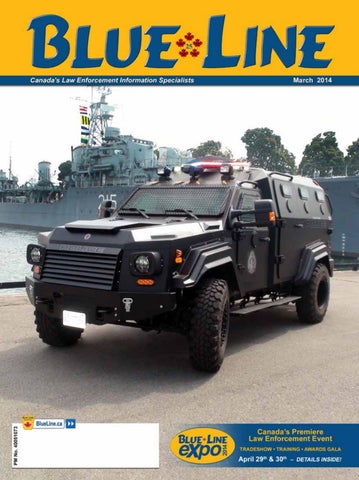
The cover photo, by John Piercy, shows the new Gurkha armoured personnel carrier delivered last year to the Hamilton Police Service Emergency Response Unit. The Canadian designed and manufactured tactical vehicle is made by Newmarket-based Terradyne Armored Vehicles Inc. It is a radically designed vehicle that has to be seen to be fully appreciated and you can do so at the Blue Line EXPO on April 29 and 30. Details and FREE pre-registration at blueline.ca. BLUE LINE MAGAZINE
32 34 35
3
Top court sanctions safety search Sign did not create privacy expectation Investigative questioning not chance to commit crime
MARCH 2014
MARCH 2014
4
BLUE LINE MAGAZINE
Blue Line Magazine Inc. PUBLISHER Morley S. Lymburner – publisher@blueline.ca GENERAL MANAGER Mary K. Lymburner – mary@blueline.ca SENIOR EDITOR Mark Reesor – editor@blueline.ca NEWS EDITOR Kathryn Lymburner – kathryn@blueline.ca CREATIVE DIRECTOR E. Jolene Dreja – jolene@blueline.ca MARKETING MANAGER April Lensen – april@blueline.ca CONTRIBUTING WRITERS Robert Lunney Dave Brown Mike Novakowski Nancy Colagiacomo Tony Palermo Stephanie Conn Tom Rataj Dorothy Cotton Brent Snook Mark Giles AFFILIATIONS International Association of Law Enforcement Planners Canadian Advertising Rates Data International Police Association The Canadian Press Newswire Access Copyright SUBSCRIPTIONS $30 per year; $50 for 2yrs; US & Foreign: $100 ADVERTISING 888-640-3048 advertising@blueline.ca
www.blueline.ca 12A-4981 Hwy7 East, Ste 254, Markham, ON L3R 1N1 Canada P: 905-640-3048 F: 905-640-7547 blueline@blueline.ca
PRINTED IN CANADA
ISSN# 08478538 Blue Line Magazine was established in 1988 as an independent publication to inform, entertain, connect and educate those involved in the law enforcement profession. With no direct control from an enforcement agency, its opinions do not necessarily reflect those of any government or law enforcement agency. The authors, advisors, and publisher accept no liability whatsoever for any injuries to person(s) or property resulting from application or adoption of anything presented in this magazine. Readers are cautioned and advised that articles presented herein are edited and supplied for your personal awareness and should not be used for further action until appropriate guidance is received from a supervisor, Crown Attorney or other persons in authority. All material submitted for publication becomes property of Blue Line Magazine Inc. unless arrangements have been made with the publisher prior to publication. © 2014 All articles are protected by copyright. No part of this publication may be reproduced or transmitted in any form or means, electronic or mechanical, (including photocopying and recording or by any information storage or retrieval system), without prior permission. Permission to reprint may be obtained in advance from Access Copyright 1-800-893-5777.
BLUE LINE MAGAZINE
PUBLISHER’S COMMENTARY by Morley Lymburner
Time for a little
navel gazing The recent rash of police shootings and subsequent studies, trials, investigations and inquests has me concerned. Few people appear to give police the benefit of the doubt or understand what officers face. Police themselves, however, may spend far too much time defending actions rather than seriously taking a hard look inside. Many police services aggressively campaign to convince the public and media that their cops are friendly, cuddly folks who just want to help everyone. Government spin doctors emphasize that cops are not there to scare the living bejeebers out of the bad guys but to be nice to everyone. The latest trend in television and movies is to glorify the average Joe gone bad as the hero, undercutting the image of police as an effective protector of the public. This new media mix of hero bad guys and villinous good guys needs some serious and sober rethinking. Two trends in the early 90s seem to have been the watershed. Police ‘force’ was changed to police ‘service’ and there was a move toward more less-lethal options. Both changes were designed to make cops look friendly and non aggressive. What it may have inadvertently done is make police and policing irrelevant. The unfortunate reality of life is that many predatory individuals seek out weakness, either real or perceived, and will seize every opportunity to exploit them. The ‘force’ change is symptomatic of the emasculation of policing concepts such as deterring crime and protecting the public. The new mindset is to soften the image of police as enforcers of laws democratically created by the will of the people. In other words, it’s okay to make a law but not to take its implementation too seriously. Somehow we became all mixed up. It’s high time Canadian police ‘services’ emphasized that cops are out there to catch the bad guys. They must do so as aggressively as they can (within the law), if only for the public’s peace of mind. The community must be confident that their police know what they are doing and are really good at catching crooks. People who may have a crooked leaning must be convinced they will be caught and appropriately punished. Earning a community’s respect can be accomplished in many ways but we need not sacrifice that necessary image of strength. The taxpayers want an agency that has the ability to have an iron fist but the intelligence to know when to use it appropriately. 5
In the mid 90s Winnipeg superintendent Bruce Taylor was asked why city police chose a more powerful handgun. The 40-calibre pistol was chosen for its “flesh-tearing characteristics,” he replied. The news story went on to note that Taylor’s committee chose the weapon because police needed a bigger gun capable of firing more bullets without reloading to keep up with the increased fire-power of criminals. “Stopping power is a simple concept,” Taylor explained. “To be morbid about it, the only thing that stops a bad guy is the size of the hole.” Initially I was taken aback when reading the forthright honesty of his comments but then realized the alternative would be to whimp out. Putting a positive spin on the new pistol would sound apologetic. It’s obvious that Taylor knew very well the message he wanted to send. That message was directed at the criminal element as well as his community. Crooks wanting to play hard ball needed to know there is a real ‘force’ to be reckoned with. I was recently equally impressed by a comment in Blue Line Magazine that officers can be taught to shoot at less vulnerable areas instead of simply shooting to kill. This would require training them to a skill level where their firearms could be used as strategically as they might use less lethal weapons. Eureka! If there is enough time and distance to strategically deploy a less lethal weapon, then why not simply use the firearm in the same strategic way to incapacitate a target? There are times when the threat is simply too dangerous to strategize anything other than lethal force. It may, however, be time for agencies to boost firearms training budgets instead of buying more tools to shoehorn on an already overloaded gunbelt. Using carbines to increase distance and accuracy is a welcome opportunity to encourage a change in mindset toward less lethal force. There are many factors which influence societal opinion but a little police navel gazing could do a lot of good. There just might be some things that could be done better.
MARCH 2014
WHEN THE CHIPS TRAINING
Moving and Shooting vs. Shooting then Moving
ARE DOWN
by Nir Maman The basic tactical orientation course instructor, a seasoned veteran, began explaining the concept, mechanics and importance of moving and shooting. After completing his introduction, he pointed at me and stated “Nir knows all about moving and shooting, he’s done it many times.” I had completed my second term of service in the Israeli Special Forces Counter Terror Unit one year prior to joining the police service so the instructor assumed I must have been heavily trained in and proficient with the technique. Moving and shooting is a dynamic, complex and advanced skill which is heavily trained and emphasized in military special MARCH 2014
forces, where the concept was born. The ability to master a complex skill is automatically equated with the ability to effectively address real life – a huge fallacy. There’s a perception in both the military and policing fields that if an ‘elite’ unit uses a theory or tactic, it must be effective. The fact is that the majority of the world’s special units, even ones who deploy to hostile war zones, don’t ever get a chance to experience or apply most of the tactics for which they trained! Additionally, many times when tactics are deployed in real life, the situations are not ones that push the tactic’s supporting principles to the point of exploiting their weaknesses, allowing for a full and realistic evaluation of effectiveness. It’s the equivalent of gauging your skill level in a sport by only training with or competing against less skilled opponents. Even with poor skills, you will win every time! Seeing the concept of moving and shooting implemented in a professional situation makes me cringe in frustration. We do not use this concept in Israel, simply because it does not lend itself to an efficient resolution in a real life gunfight. It’s important to understand the difference between: A. Shooting a threat; B. Being shot at by a threat; C. Being in a gunfight with a threat. 6
Most of the world is experienced with A and B but the majority of Israeli engagements are in the third category. Moving and shooting also negates both instinctive response and tactical capability under stress. Rationale There are three main points that constitute the foundation for implementing the concept: 1. You are a static target and much easier to hit if you’re not moving during a gun fight. 2. Moving while you shoot opens up visual acuity of the environment, allowing you to further visually assess your surroundings and possibly identify additional threats. 3. Moving allows you to close distance to the threat and dominate while engaging. Those are the three theories that support the idea behind the concept which, like most others, presents sound principles and makes sense in theory. However, when its put into practice against the backdrop of practical facts and statistics, it will not lend to optimal efficiency in a real life combat engagement. Going in order of the above list: One Theory: You’re a static target if you don’t move while shooting. Fact: The only thing in a real life gunfight that BLUE LINE MAGAZINE
will keep you alive is terminating the threat that is trying to kill you and immediately stopping the life threatening action being sent your way. Moving in an attempt to avoid fire is the equivalent of focusing on getting behind cover while under fire instead of focusing on terminating the threat. This is a principle I refer to as attempting to manipulate your environment to alter the physical elements as opposed to addressing the root source of the problem – the metaphorical equivalent of bailing the water out of a flooded canoe instead of plugging the hole. Two factual factors kill the ‘static target’ theory dead in its tracks. I’ll put it in the context of a drill (which I recommend you try to see the proof in tangible practice): Take a shooter who not only believes in the theory of moving and shooting but who is also proficient at it and set up this simple drill: have them stand in a designated area on the range floor (execute this drill at various distances to the target, ranging from five to 30 or 40 yards out). Have a running target as the focus which will begin at one lateral side of the range and then ‘run’ to the other lateral side (left to right/right to left). It’s best for the target to move at various speeds, although most ranges only have running targets that move at one speed, usually equivalent to a fast walk or slow jog. Have the shooter begin to walk around the range, weapon at the ready (he knows what the drill is, there are no surprises) and as the target begins to run from side to side, effectively engage it. Even experienced shooters who practice moving and shooting will often change their pace. Almost everyone immediately slows while engaging the target because there is a sudden shift in priorities, from moving to shooting. Even while under cognitive control (meaning the absence of real survival stress), the majority instinctively realize that when they bring their weapon up to fire, that becomes the priority. To ensure they are effectively hitting the target, they instinctively slow down to minimize excess body movement, which hinders effective shooting. The sole principle of moving and shooting is to only move as fast as you can effectively hit the target – and all humans can move only at a limited pace while balancing effective shooting. During this drill you will see shooters reach that limit, which is generally approximately two steps per second. Move faster and you compromise effective shooting. Second, even those exceptional shooters who force their muscle memory to overcome instinct (which only happens when your stress level does not surpass your level of cognitive reasoning, which essentially means you’re not under survival stress), you will see that they will effectively hit their target! Every shot! After running this drill, perform the following test drill as a follow up: Find a range that has a lateral running target that can run fast, as close as possible to a sprint. Have the shooter stand at a medium range of 15 to 20 yards from the target line, in the center of the range in a ready position. BLUE LINE MAGAZINE
When the target runs from one side to the other, have the shooter engage it. Most will hit the target effectively with most of their fired rounds. This is significant because a running target usually moves at a quicker pace than two steps per second! These ‘reality check’ points mean that if you want to ensure you are hitting your target in a gun fight, you have to drastically limit the pace at which you are moving. Based on the fact that almost every shooter can hit a target moving exponentially quicker than the pace a shooter moves while shooting, we know that moving at the pace of ‘not quicker than you can effectively hit your target’ is useless and will practically guarantee that you are as easy a target as if you were standing still! If the concern for moving in a gun fight was to reduce your risk of being hit, you would have to (at a minimum) sprint and also move in a pattern that induces movement of the threat’s line of fire, such as in a zig zag pattern. Moving in a straight line towards the threat makes you the same complexity, or ease, of a target whether you are standing still or sprinting, since the threat does not need to move his line of fire in any direction to acquire you. The more you adhere to any of those principles, which augment your possibility to not get hit over the standard move and shoot principle (which won’t reduce your ability to not get hit!), the more you diminish your ability to effectively hit your threat. The ‘hit ratio’ is another important factor that relates to this principle. The average for North American police officers hovers around 19 per cent (approximately one out of every five shots fired hits the intended target). One report puts the hit ratio average at 28 per cent. The NYPD ESU put the ratio at 11 to 17 per cent in 2010, which makes sense given the rash of new ambush type attacks on US police officers over the last five years; despite this, police ‘shooting’ training remains unchanged. We’ll give police the benefit of the doubt and go with 28 per cent, which is still a huge problem. Seventy two per cent of rounds officers fire miss their targets – and these officers are shooting static! So now people are grasping hold of this moving and shooting theory, which wasn’t widely known or practiced until the US war machine was reactivated in Iraq and Afghanistan and returning vets began running courses all over the place. The theory has a strong perception of effectiveness; it makes sense theoretically, it’s dynamic, relatively more complex than other shooting tactics and special forces practice it so therefore it must be effective! It suddenly became an integral concept in police training across North America. It’s also important to note that moving and shooting has no combat proven basis! You cannot attribute a win in a gunfight to a factor that you do not control, such as the chance possibility that you stepped out of the way of a bullet. It’s just as possible that you could have avoided a round by staying still! The combat proven gun fighting factor that 7
can be measured is that shooting your threat will effectively, in most cases, terminate that engagement and keep you alive. Either way the fact remains that police officers already have a difficult enough time hitting their targets while not moving. There is much focus in police training on how to remedy that problem but now trainers want officers to shoot while they are moving. This concept will do nothing to improve officer survivability during a deadly force engagement and will also cause the officer hit ratio average to decline even further! Two Theory: Moving while shooting will open up visual acuity of your environment, allowing you to further visually assess your surroundings and possibly identify additional threats. Fact: As every police instructor already knows, the number one negative physiological side effect of survival stress is tunnel vision, which all officers experience during a deadly force engagement. It would be negligent and tactically counter productive to ask officers to take their eyes off the threat while engaging, which is why no one teaches this. Therefore it simply becomes a contradictory point to profess this theory for moving and shooting. Even if you attempt to train officers to scan while engaging, it would be physiologically impossible for them to do so. They will experience tunnel vision, which will keep their focused vision on one thing only – the threat they are engaging. This will continue until they no longer perceive the person as a threat. It’s also important to not confuse the idea of scanning while shooting with scanning while moving upon ceasing to engage. Moving and shooting will not contribute in any way to visual dexterity while in a gunfight. It is practically impossible to speak commands while shooting – actually focusing on your sights/line of fire and squeezing the trigger – never mind trying to look somewhere else. That is why, no matter how much you profess you want your officers to shout commands while shooting, the reality is they will actually be delivered before the trigger is squeezed or after the last round is fired! Three Theory: Moving while shooting allows you to close the distance to the threat/dominate the engagement. Fact: Dominating the engagement is the only move and shoot principle I agree with. However, the physical end result usually dominates the attempted psychological process. If your shooting is compromised and the threat can effectively hit you because you’re busy trying to ‘psychologically dominate,’ your effort is futile at best. Additionally, your survival instincts will dominate over tactical training cognition under stress. If you’re face to face with a threat actively trying to kill you and you have a firearm in your hand, your body will not move forward towards the threat! Instead you will plant yourself, raise your weapon and focus on unloading rounds as fast as possible! MARCH 2014
effective when it’s time to shoot and 100 per cent effective when it’s time to move! If moving and shooting actually provided tangible and effective results, Israel would be the first fighting force to implement it.
Another point that shows the unintentional contradiction in training practices – police officers today are trained to shoot in the isosceles/Israeli stance and no longer in any other shooting platform. It has finally been realized that under stress your body will square off to the threat and drop; your legs will base out wide and you will not move anywhere or face any direction other than the direction of the threat. So – given this recognition, how are officers expected to move while engaging? Israel has been engaged in endless violent conflicts for 65 years. Our tactical methodology for deadly force engagements/gunfights is
to stop, establish a strong shooting platform and focus on shooting. Once the threat is down or has dissipated due to running away, etc., then you sprint as fast as possible to close the distance, allowing you to dominate safely, have less distance from the threat and maximize effective shooting during the next volley if the threat re-engages. The hit ratio average for Israeli soldiers and police officers in violent gunfights hovers around 70 per cent. We do not move and shoot! When you move and shoot, you are executing movement, which cuts your shooting potential by 50 per cent. Our philosophy is to be 100 per cent
Practical applications There are three predicaments when moving and shooting can be physiologically and tactically advantageous: 1: The most common application is during open field or urban combat environment where you suddenly come under fire and have only a general idea of the direction enemy fire is coming from, or know where it’s coming from but do not have effective access to directly engage the threat. In this predicament, your natural and tactical inclination will be to run out of that area or for cover as fast as humanly possible (which is the correct response). While moving out of the line of attack, it may (and I emphasize may) not hurt to raise your weapon and fire off some rounds in the direction of enemy fire. The focus is not on the conventional moving and shooting platform or concept, since you do not have a target to focus on. The focus is on quickly getting out of the danger area. By blindly shooting in the direction of enemy fire, you might get lucky and distract them, buying time to safely get to cover. Cover is the emphasis in this predicament only because you can’t identify or effectively engage the source of fire. 2: Another potential example is a ‘stalking’ situation, for example during a covert, stealth approach to a position when the enemy is not aware of your presence. Another example is during a hostage rescue operation where you are moving covertly and stealthily to a certain position (usually a final approach point before the breach), again without the enemy being aware you are there. In both cases, an unsuspecting threat might calmly appear, such as walking out of a room while you and your team are stalking down the hall. Before the threat has the chance to face you, point their weapon and engage, you can raise your weapon from the low ready (the position it is already in during stalking) and engage the threat while continuing to move. You will be able to execute moving and shooting in this predicament because you have not begun to engage, are not under the effects of survival stress and both you and the threat are moving at a pace that allows for balancing an effective application of shooting while moving. 3: If you are playing the role of a cool guy in a Hollywood action movie, because moving and shooting will not only look really cool but is absolutely guaranteed by the director to actually work! Nir Maman has served in elite units with the Israeli Special Forces, and he delivers counter-terror, active shooter intervention, tactical shooting, and Krav Maga training to police and military organizations around the world. Maman is instructing the course “Suicide Bomber: The modern urban terror threat,” with CTOA at the Blue Line EXPO. For course registration and details visit blueline.ca.
MARCH 2014
8
BLUE LINE MAGAZINE
BLUE LINE MAGAZINE
9
MARCH 2014
SPONSOR by John Dewar Security guarding operations have been around for a long time. Allan Pinkerton started his famous company in 1850, perhaps the first recognizable forerunner to today’s increasingly competitive security sector. Security guarding companies today still wrestle with the dual tasks that plagued Pinkerton in the 19th century: recruitment and training. The sector struggles with the misinformed perception that many security guards are unskilled, poorly trained and illequipped to be much more than glorified hall monitors in a sleepy suburban office building. Although wrong, this image is prevalent and must be changed; recruitment and training holds the key. The people we recruit and how we train them is of primary importance at Commissionaires. Not everyone can qualify. We are always in recruitment mode in Ottawa region, one of our largest operations, and have a steady flow of inquiries from people seeking employment. MARCH 2014
They find us through word-of-mouth, online and transit advertising, or perhaps one of the many job fairs we attend. As well, our mandate is to offer meaningful employment to veterans, so we also provide career transition seminars through the Canadian Forces (CF) to reach those who are considering retiring from the military. We go to where we’re most likely to find future guards. Last year in Ottawa we had about 3,000 “initial contacts” from people interested in joining. Through our rigorous preliminary screening process, approximately 1,700 of them were deemed to be “prequalified” and invited to submit applications. So before the application process even began, only a little more than half of the initial pool of candidates were permitted to proceed. Through the formal application process and interviews that followed, more applicants were screened out as unlikely candidates for success. In the end, of the 3,000 “initial contacts,” Ottawa hired only 532 new guards, many CF or RCMP veterans. This is not surprising. Veterans have the skills, experiences, discipline and attitude to make the smooth transition to security work. We’ve known this since 1925, when Commissionaires began in Canada. 10
We would have liked to hire more but know that lowering our entry standards ultimately fuels the industry’s image problems rather than solving them. Hiring marked the end of the recruitment phase but just the beginning of the all-important training phase. There’s a lot for raw recruits to learn and understand before they ever get anywhere near the job site. Training is what allows a security guard to exceed clients’ expectations, day in and day out. The Canadian Corps of Commissionaires invests heavily in the training process. It takes time, resources and a commitment to the long view. New recruits go through a rigorous and demanding training program that includes, depending on provincial requirements, more than 60 hours of training, usually in the classroom, including first aid. Final exams are written and must be passed with a score of at least 75 per cent. In some provinces, licences are required so another exam is written and passed. Our training exceeds all existing provincial requirements and actually meets the national stipulations of the Canadian General Standards Board. The training does not end when new guards reach the job site. There is also onBLUE LINE MAGAZINE
site training to ensure classroom learning is applied on the job and to ensure that guards are trained on site-specific requirements. Ongoing training is part of our culture, particularly for those who rise through the ranks to supervisory, consulting, or other management roles. Investing in training is the price of leadership in the security sector. Another challenge the industry faces is attrition. Many security companies are always recruiting, not to respond to a growing client list, but because they constantly lose guards to other jobs that might pay a little more. Beyond the culture of training, camaraderie and professionalism that we’ve tried to create, we tend to pay more and engender a sense that it’s possible to have a career in security rather than just a job. I think it’s working.
BLUE LINE MAGAZINE
Some industry estimates put the attrition rate in the security guarding sector at somewhere between 40 and 60 per cent annually. At Commissionaires, it’s between 13 and 15 per cent, the lowest in the sector. I can’t count how many long service award ceremonies I’ve attended. That is an important measure of our success. In some businesses, managers worry about the cost of training people that then leave the company, but I believe that is inconsequential compared to the cost of not training them and having them stay. Compromising recruiting and training standards is a false economy. It usually costs time and money to do the right thing, the right way. If the security guarding sector doesn’t place a higher priority on recruitment and training and elevate
11
standards, it will continue to suffer with recruiting challenges and image problems. Recruiting the right people and then training them better is the key to changing how Canadians perceive security guarding. We know how to fix this. John Dewar is CEO of Commissionaires Victoria, The Islands and Yukon Division and chair of the Commissionaires’ National Business Management Committee. He served in the Royal Canadian Navy, rising through the ranks from sailor to Captain before retiring in 2000.
MARCH 2014
POLICING BY THE NUMBERS A statistical snapshot of Canadian policing
by Blue Line editorial staff Statistics Canada’s annual police administration survey provides details on personnel and expenditures at the national, provincial and municipal levels. For the first time in 2012, a new supplemental survey collected detailed information on police hirings, retirements, eligibility to retire and, where available, visible minority status. Most of the personnel information is based on a “snapshot date” of May 15, 2012, while data on hirings, departures and expenditures represent the calendar year ending December 31, 2011 (or March 31, 2012 for those police services operating on a fiscal year). Slight decline in strength There were 69,539 police officers in Canada on May 15, 2012, 115 more than in 2011. Expressed as a rate, police strength declined slightly (-1.0 per cent ) from the previous year, to 199 officers per 100,000 population. While strength has been generally increasing since the late 1990s, the police-reported crime rate has continued to decline. In 2011, the latest year for which data are available, both the volume and severity of police-reported crime decreased. The 2011 crime rate was 24 per cent lower than in 2001 and at its lowest point since 1972. Similarly, the Crime Severity Index (CSI) was at 77.6 in 2011, 26 per cent lower than a decade earlier and at the lowest point since data became available in 19981. The number of Criminal Code (excluding traffic) incidents per police officer declined by six per cent in 2011. The ratio of 29 incidents per officer was the lowest since 1970. The number of incidents per officer has decreased by 31 per cent over the past decade. MARCH 2014
authorized strength. The largest shortfall appears to be in the greater Toronto and Montreal areas, which are short 117 off icers of that number. Large agencies suffer the most due to smaller agencies raiding them to top up their own staffing shortfalls.
Editor’s note: An interesting number not analyzed in general by the report is the shortfall below authorized strength. Although the raw numbers are reported for the top 30 highest population municipalities in Canada, there are no totals of comparison given. A Blue Line tally showed the top 10 agencies were 157 officers below their 12
Civilian strength There were 28,220 civilian employees working alongside police on May 15, 2012, a slight increase of 78 employees from the previous year. The rate of civilian employees per 100,000 population remained virtually unchanged from 2011, at 81 per capita. Police services reported employing 2.5 officers for every one civilian worker in 2012, a ratio that has held steady since 2007. The ratio BLUE LINE MAGAZINE
of officers to civilians has decreased substantially since the 1960s, when it was reported as between 4.6 and 4.1 officers for every civilian staff member. This change has coincided with increased employment of civilian staff that may be responsible for work such as dispatching, information technology support or forensic and crime scene analysis. One in ten officers eligible for retirement The potential impact of retirements and other types of workforce mobility have become a concern for executives at many Canadian police services. Based on information on workforce mobility during 20117, the survey measured the number of positions left vacant and those filled by incoming officers. The majority of officers who left their service in 2011 did so to retire (1,300, 65 per cent of departing officers).3 Retiring officers made up about two per cent of total officers employed by the services reporting this information. Almost half (49 per cent) of retiring officers had between 30 and 35 years service; over one-quarter (26 per cent ) had more than 35 years service. The proportion of departing police officers leaving to retire was highest in Nova Scotia (75 per cent) and Prince Edward Island (73 per cent). Reporting police services in Alberta and Manitoba recorded the highest percentages of officers leaving for reasons other than retirement (50 per cent and 49 per cent, respectively). The number of officers retiring was considerably smaller than the number eligible to do so.4 A total of 7,459 officers were eligible for retirement with full pension in 2011, representing about one in ten (11 per cent) of Canadian police officers.5 Over half (52 per cent) of officers eligible to retire in 2011 had over 30 years of policing service.6 While little variation was noted among BLUE LINE MAGAZINE
provinces with respect to retirement eligibility, differences exist among police services. For example, the RCMP reported that 19 per cent of officers were eligible to retire in 2011, while the average among non-RCMP municipal police services was eight per cent. In large part, these variations were due to the number of senior officers on staff and specific characteristics of various collective agreements. Officers aged 60 and over accounted for less than one per cent of all police officers, while those between 50 and 60 years old represented 15 per cent. The largest cohorts were officers aged 30 to 40 years (35 per cent) and those aged 40 to 50 years (35 per cent). Officers between 20 and 30 years old represented 14 per cent of all officers, while less than one per cent were under 20.7 Among officers hired by police services during 2011 and for whom prior policing experience was known, the majority (80 per cent) were recruit graduates.8, 9 Officers who had experience with another police service made up the remaining 20 per cent. More female officers For the second consecutive year, the number of female officers increased while the number of male officers decreased. There were 234 more female officers in 2012 than 2011 and 119 fewer male officers. The increasing number of women in policing is part of a longer-term trend that began in the 1960s. Over the past decade alone, the proportion of women has increased from 15 per cent of all officers in 2002 to 20 per cent in 2012. There are also more women among the higher ranks. The proportion of women serving as senior and non-commissioned officers has increased steadily, reaching 16 per cent by 2012, while the proportion of female constables has remained relatively stable since 2007 at between 21 and 22 per cent. The provinces with the highest proportions 13
of female officers continued to be Québec (24 per cent) and British Columbia (21 per cent). In contrast, Manitoba (15 per cent) and New Brunswick (16 per cent) continued to report the lowest proportions. As in past years, the proportion of female officers was lowest in the territories. Aboriginals and visible minorities Data f rom the 2006 Census shows Canada’s ethnocultural diversity is steadily increasing. In response, some police services are looking to staff their ranks with officers representative of the communities they serve. The 2012 supplemental questionnaire asked services to provide information on the visible minority identity of their officers.10 While the Canadian Human Rights Commission permits employers, including police services, to collect data on whether their employees are Aboriginal or visible minority, some police services choose not to collect this information. Those that do collect these data do so on a strictly voluntary basis – meaning officers can choose to disclose they are in those groups but are not compelled to do so. In 2012, this information was unknown for 33 per cent of officers, as either the police service or the individual officer chose not to report it. Information was collected for the more than 46,000 police officers who voluntarily self-identified as Aboriginal, visible minority or Caucasian.11 Eighty seven per cent reported being Caucasian in race or white in colour. A further nine per cent reported being a member of a non-Aboriginal visible minority group and five per cent reported being Aboriginal.12 Some variation was seen with respect to self-reported visible minority status for experienced officers versus recruit graduates. A larger proportion of experienced officers reported being members of a visible minority than did recruit graduates: among experienced MARCH 2014
officers, 11 per cent reported being a visible minority, compared to four per cent of recruit graduates. The proportions of experienced officers and recruit graduates who self-identified as Aboriginal showed less variation – four per cent of recruit graduates and three per cent of experienced officers. FOOTNOTES
1. The Crime Severity Index (CSI) takes into account both the volume and seriousness of crime. In calculating it, each offence is assigned a weight, derived from average sentences. The more serious the average sentence, the higher the weight for that offence. As a result, more serious offences have a greater impact on changes in the index. All Criminal Code offences, including traffic offences and other federal statute offences, are included in the CSI. 2. Data represent departures during the 2011 calendar year or the 2011/2012 fiscal year, depending on how individual police services chose to report the information. 3. Information on departures due to retirement is based on data collected from police services employing 98 per cent of Canadian police officers. They were able to report their total departures, including MARCH 2014
for retirement, but may not have been able to report details for other reasons. 4. Information on eligibility to retire is based on data collected from police services employing 97 per cent of Canadian police officers. 5. This number may or may not include officers who retired in 2011 (1,310 officers). 6. While most police collective agreements set the minimum years of service required for retirement with full pension at 25 years, other considerations may sometimes apply. For instance, many agreements require a minimum age in addition to minimum years of service, while others use a formula such as the “80 factor,” where years of service plus age must equal 80. 7. Officer age information is based on data collected from police services employing 99 per cent of Canadian police officers. Information on age wasn’t available for four per cent of these officers. 8. Information on hirings wasn’t available for one per cent of police officers. In addition, police services employing 36 per cent of officers were unable to provide the level of experience (experienced police officers or recruit graduate) at time of hire. These services are excluded from the percentage calculations. 14
9. Recruit graduates include senior officers, non-commissioned officers and constables who achieved the status of a fully-sworn officer during the calendar or fiscal year prior to the year for which data are shown. 10. Definitions related to visible minority status found on the supplemental are based on those used by the Census and the Employment Equity Act. Aboriginal peoples refers to whether the police officer is an Aboriginal person of Canada, that is, First Nations (North American Indian), Métis or Inuit. Visible minority refers to persons who are not Aboriginal or Caucasian or, non-white. Nonvisible minority populations are persons who are Caucasian or white. 11. Though the definitions for Aboriginal and visible minority specify that Aboriginals be counted separately from members of visible minority groups, it is possible that some individuals were counted in both categories. The number counted in both is estimated to be less than one per cent . 12. Percentages add up to more than 100 due to rounding. This is an edited version of Statistics Canada’s release.
BLUE LINE MAGAZINE
BLUE LINE MAGAZINE
15
MARCH 2014
by Morley Lymburner “Anyone doing real police work can’t always follow the Marquis of Queensbury rules,” a long retired officer once told me. “Every officer, now and again, has to step around the official rules of engagement or the job would never get done.” Out of respect, acknowledging what was said more than in agreement, I nodded my head. This reminded me of my early years walking the beat and getting to know everyone who lived and worked there. The barber shop owner, bank manager, waitresses at the corner coffee shop, real estate salesmen and bartender at the tavern were important people to me. They kept me abreast of what was going on and, if push came to shove, I was confident they would help me in any way they could. I soon discovered even the old copper who once walked my beat indirectly helped me... but it proved to be a double edged sword. I made a habit of standing in a certain blind alley because it was particularly sheltered from the street lights. With my dark navy uniform, my presence was known only to myself as I stood patiently watching the storefronts and sidewalks of my beat. Through the hustle, bustle and quiet times on that street, I was confident that nothing went unseen by myself or my ‘deputies’ living and working in every building. One evening around midnight, I heard the sound of breaking glass at a local car dealership. It was only about 50 metres to the north of my alley position and I briskly walked toward the sound. I had learned never to run; running sounds are louder and running feet tend to MARCH 2014
rush into danger with no strategic plan of attack or defence. I rounded the corner to see a well known local hood rummaging through a new Lincoln, frantically trying to remove the radio as quickly as possible. Catching him completely by surprise, I touched his shoulder and he jumped so hard he hit his head on the door sill. He yelled in pain and shouted at me not to hit him again. He was shaking uncontrollably with fear and holding tightly onto his head. A larger man than myself, his face was scarred and bent, making it clear he had seen the wrong end of something hard on many occasions. I watched this quivering hulk cover his face from anticipated blows and thought about the kind of copper who had preceded me. This street-wise tough had the experience and common sense to promptly obey my orders, placing his hands correctly for my awaiting handcuffs. I stood him up and was surprised to see another man cowering on the other side of the car. He bolted away at blazing speed to the edge of the parking lot. As I contemplated my next move he surprised me by jumping over the edge, crashing down into a gravel and stone river bank. I heard him scream out in pain as his left leg snapped. He completed his tangled fall by tumbling to a stop, writhing in pain, by the river’s edge. I was stunned at the way these two men had reacted to my presence. I walked the prisoner in hand to a phone booth across the street, calling for a scout car to transport him and another to search for the poor soul screaming in pain by the river bank. Arriving at the station I noticed that my prisoner had a nasty cut on the top of 16
his head; the blood wasn’t noticeable under the dim streetlights. I paraded him in front of the sergeant, who looked at the wounded man, smiled and said “A fine piece of police work, constable.” I explained the injury was caused when the prisoner struck the door jam after I surprised him but the grizzled sergeant simply smiled. “That’s a good one son. I hear you dispatched his brother down the river bank. It looks like my old beat will be well taken care of.” There was a transition taking place when I joined the force; although a good dust-up was still required on occasion, most of the time the back-alley justice of catching a miscreant and rapping him in the mouth instead of arresting him was disappearing. My apprehending these individuals was made a lot easier by that old sergeant but a grudging fear and hate that yearned for reprisal was the price paid in the balance. Several years later these boys would get their revenge by killing a cop as he pleaded for his life. We can all take pride in the officers of today and yesteryear. Both do, and did, their jobs as best they could given the circumstances society permitted them. Stepping around rules, however, can lead to a lot of unintended aggravations. Rapping a person in the mouth to teach them a lesson only teaches the wrong lesson. A law breaker has to understand that when they break the law, they do so alone. The ultimate goal is to never give them the satisfaction of seeing an officer reduced to their level. Given the frailties of the human spirit, it can at times be a tall order, but one that is demanded if we are to maintain the society we enjoy and crave. (First published October 2006)
BLUE LINE MAGAZINE
THE FALLIBILITY OF
EYEWITNESS TESTIMONY by Ian Fraser, Louise Bond-Fraser and Katelyn Waite The justice system has been under the microscope since the advent of DNA evidence and the resultant exonerations. Inquiries have scrutinized the investigative process and suggested changes to the way information is gathered and processed to ensure errors do not reoccur.1 The recommendations are being both noted and executed, the results suggest. In Canada, for example, most police investigators are now implementing recommendations on the correct way to conduct a line-up. 2 However, though the “how” of correct procedure seems to have been addressed, the underlying question of the “why” seems to have been largely overlooked. This is an important question since it only makes sense that an understanding of the reasoning behind procedural changes makes implementation logical and therefore less likely to be misunderstood. The authors of this article recently surveyed Canadian police officers and found that most are not aware of the scientific literature pertaining to eyewitness fallibility. 3 In fact, the
BLUE LINE MAGAZINE
overall score on the knowledge section of the questionnaire was only 61.1 per cent. Members with more than 25 years experience scored no better on the survey than newer members. It appears that, even though most officers were trained in the proper use of a line-up procedure, only 46 per cent answered correctly by agreeing with the following statement: Witnesses are more likely to misidentify someone in a culprit-absent lineup when it is presented in a simultaneous (i.e., all members of a lineup are presented at the same time) as opposed to a sequential procedure (i.e., all members of a lineup are presented one at a time). This may be due in part to the fact that 20 per cent of the responding officers had never been exposed to the research on the fallibility of eyewitness testimony. The authors believe that simply mandating the use of a particular procedure may not be sufficient. The officer should be fully informed of the possibility of misidentification, which can arise if the protocol is not followed properly. Understanding why a procedure is conducted in a particular way obviously makes it easier to apply without error.
17
It seems too that police would welcome this sort of instruction. In the course of the study, we asked participating officers whether they felt that they could use more training on eyewitness fallibility; most (89.9 per cent) believed it would be beneficial. Therefore, it would make sense to make this type of information an integral part of new officer training and implement refresher courses for those already on the job to update them on any new information as it becomes available. 1. Ian Fraser, Louise Bond-Fraser, Michael Houlihan, Kimberley Fenwick, Dave Korotkov and Barry Morrison, “Witnesses and the Law” (Ontario, Canada Law Books, 2011), 18. 2. Douglas Quan, “Book ‘em, Danno: Police Lineups Becoming a Thing of the Past,” Times Colonist Digital (23 October 2011), online: Canada.com 3. Ian Fraser, Katelyn Waite and Louise Bond-Fraser “Canadian Police Officers’ Knowledge of the Fallibility of Eyewitness Testimony” (2013), 1:3 International Journal of Liberal Arts and Social Science, 108. The complete paper can be found at: http://www.ijlass.org/ data/frontImages/gallery/Vol._1_No._3/11.pdf . Contact Ian Fraser at fras@stu.ca for more information.
MARCH 2014
SQUAD IS DEDICATED
TO THE YOUTH
by Veronica Fox
The Richmond RCMP Detachment’s new youth squad program celebrated the graduation of 45 students in December. The program was launched by the detachment’s youth section in partnership with the school district in the fall of 2013 and introduced Grade 10 to 12 students to various aspects of policing and other emergency services. There was a significant amount of interest from students; to qualify they had to demonstrate their good character and produce an essay explaining why they were interested in learning about policing and emergency services. Those accepted were offered the opportunity to spend three hours each Monday evening at the detachment, where they got to meet and learn from members of the RCMP, military, fire rescue, ambulance service and others. Specific to the RCMP, students learned about the tactical team, protective policing, general duty, forensic identification and drug sections, depot MARCH 2014
division, the Youth Criminal Justice Act, history of the RCMP uniform and much more. The program culminated on the final evening with an RCMP recruiting section presentation and a graduation ceremony in the detachment atrium attended by parents and school district representatives. “This was a wonderful opportunity for Richmond members to work in partnership with other emergency services personnel in delivering career oriented information to the youth in our community,” said youth section Cpl. Anette Martin, who conceived, developed and spearheaded the program. “The Richmond RCMP Youth Section is dedicated to the youth of Richmond and we look forward to continue to deliver the program in coming years.” Cst. Veronica Fox is attached to the Youth Section of the RCMP in Richmond, B.C. She may be contacted by phone to 604-278-1212 or email to Veronica.Fox@ rcmp-grc.gc.ca.
18
RCMP Lower Mainland B.C. Youth Academy The RCMP Lower Mainland Youth Academy is an established and formalized partnership between Coquitlam, Burnaby, North Vancouver, Surrey and Richmond RCMP Detachments and their respective School Districts. It is usually held every year during spring break. The RCMP Youth Academy is held at Stillwood Camp and Conference Centre south of Cultus lake in the Columbia Valley at Lindell Beach, B.C. It is an eight-day program for 50 grade 11 and 12 students who aspire to a career in policing. Candidates undergo a stringent selection process conducted by schools, districts and detachments. The Academy gives candidates an opportunity to experience police training and to partake in police work simulations. At the end of the experience, candidates have a better sense of whether they should continue to focus on policing as a career or to pursue other professions - either way, it is a win for the young people and a win for the RCMP. Upon conclusion of training, the Academy sends out 50 ambassadors for policing. Many successful candidates have made the decision to follow a career into policing. The RCMP prefers that candidates build up some life experience prior to engagement. The average age of an RCMP recruit now is 28 years. A 2001 study of candidates who attended the youth academy in the mid 1990s showed that 80 percent of the Youth Academy attendees pursued a career in law enforcement or in related occupations such as becoming a lawyer or a probation worker.
BLUE LINE MAGAZINE
BLUE LINE MAGAZINE
19
MARCH 2014
DEEP BLUE by Dorothy Cotton
Scared secure
I have been on the road a lot recently, wandering through airports and train stations – and standing in endless security lines to ensure that my yogurt is not responsible for the next major international disaster. Ah, I remember the days when you could go to the restroom without taking everything you owned into the stall with you. Try that today and the security staff might blow it up. Airports in particular seem to be places where large numbers of people are employed for the sole purpose of scaring the daylights out of travellers. I am certain there is a special Scary Voice Academy where men with booming deep voices learn how to make intimidating announcements on the public address system. I was sitting in the waiting area of Lower Rubber Boot airport, which is slightly smaller than my living room, listening to the admonitions that if I saw any unattended belongings or suspicious looking people, I should alert the ever-ready Keepers of the Peace before something really bad happened. “Please be aware that although that seat next to you looks empty, it is really inhabited by a very small but deadly terrorist; if you see a tissue blowing in the wind, please take immediate cover because the end is near.” (The announcements never actually say “And it will be all YOUR fault,” but we know that’s what they mean.) Really? The world would end because I have a cup of coffee from the machine (the only source of coffee in this airport and two
meters from the security line)? Those guys in security SAW me get the coffee. I am sure they were re-playing the security announcement just for me. (Given that I was the only one there, it’s a safe bet.) Perhaps they confiscated it because they were thirsty. There are two possible explanations for these fear-inducing rituals at airports: either we are caught up in a hopeless morass of bureaucracy – or someone, somewhere, thinks there is actually something to be gained by keeping the public in a perpetual state of fear... or perhaps both. I was reading a recent issue of the Journal of Police and Criminal Psychology (October 2013) as I pondered this question. Timely indeed. The first article in this particular issue was entitled “The Logic of Public Fear in Terrorism and Counter-terrorism,” and was written by a guy named Alex Braithwaite at the School of Government and Public Police at the University of Arizona. The essential question he asked (although he phrased it in academeze) was: Does it actually serve any purpose to scare the s*** out of people by constantly reminding them that they might get blown up at any moment by terrorists? (As an aside, I got to wondering how likely it actually is that terrorists will blow you up. I decided to look at the data for the UK because, as we well know, people there get blown up on almost a daily basis – or at least that seems to be what the press would have you believe. As it turns out, there were just under 600 people
killed in terrorist attacks in the UK between 1970 and 2008 but between 1,700 and 7,500 people a YEAR are killed in automobile collisions. Huh. Time for a little perspective here.) The experts generally define terrorism as a form of psychological warfare, with the goal of inducing change in public policy by influencing fear and changing attitudes among the general public. The reasoning goes something like this – if you convince everyone they will be blown up on their next visit to a train station, then people will pressure the government to change whatever policy seems to be pissing off the terrorists. Successful acts of terrorism lead ‘The People’ to believe that their government is ineffective – and therefore, in a democracy, they vote for someone who might conceivably do a better job of ensuring that things don’t get blown up. One of the side effects of this general process is that it ends up working to the advantage of the politicians who keep insisting that we are likely to be blown up any day now. Of course we really are not terribly apt to be blown up – as statistics tell us – but if the politicians say we are and then nothing happens, we think, “Gee, the government is doing a great job of making sure we don’t get blown up. I think I will vote for them again.” If a politician says, “Really, get a grip – there is not that much danger,” and then even one incident occurs, he/she will be looking for a new job when election time rolls around. If you look at the few actual surveys which have assessed the degree of public fear about terrorism, it quickly becomes evident that the risk is grossly over-estimated. I won’t mention the part of Braithwaite’s article where he explains how making sure people over estimate the real risk of terrorist attacks can further the agenda of people of some political orientations. Use your imagination. Far be it for me to advise what we should or should not do in the world of counterterrorism. I am not equipped with the knowledge to come up with any viable estimate of whether my yogurt possesses a threat to life as we know it – but I am fairly sure that my fretting over whether today’s orange alert level is higher or lower than yesterday’s blue, plaid or paisley alert level does not help things any. In fact, it might be giving the terrorists what they wanted. I am all for managing safety but I think we also need to think about how we manage fear. Dr. Dorothy Cotton is Blue Line’s psychology columnist, she can be reached at deepblue@blueline.ca
MARCH 2014
20
BLUE LINE MAGAZINE
The constable and the cub by Danette Dooley RCMP Const. Suzanne Bourque was shocked that a photo of her in uniform, standing next to a tiny bear cub on its hind legs, garnered so much attention when released to the media nearly three years ago. She was shocked again recently after learning that an 18-year-old Mexican girl used the photo as the basis for comic drawings which the young artist is now turning into a cartoon. The story begins in Terra Nova National Park, Newfoundland in June, 2011. “A lady reported to us that some visitors were feeding a bear cub. They’d told them to stop but they didn’t believe they understood what they were saying,” Bourque says in a recent interview. Bourque went to investigate, found the cub and scared it off with the police siren. She then approached the complainant, who told her the cub wouldn’t be gone for long. She wasn’t far off the mark. “I was telling her if it came back I would do what I could to scare it off again but he’d developed some habits to be human friendly. Then, as I’m getting the information from her, she says, ‘Oh my, there he is.’ I ask her where and as I’m saying it I see him brushing up against my leg.” Bourque’s partner arrived just in time to snap the now-famous photo of the constable and the cub. Helen Cleary-Escott of the RCMP’s media relations office was quick to see how the photo could give her division (B) some great, light-hearted publicity. “Cst. Bourque had a stern talk with the little cub and discussed the dangers of taking food from strangers and explained how it could make him stomach sick,” read a news release with the photo attached. It looks as if the bear is listening to what the officer is saying “while she lectures him on the dangers of talking to humans,” the release adds. The news release and photo were circulated to media in Newfoundland and Labrador and, thanks to social media, reached many parts of the world. Follow-up interviews gave the RCMP an opportunity to educate the public on the dangers of feeding wild animals. The story doesn’t stop there. Bourque says the teen in Mexico has created a comic entitled Miss Officer and Mr. Truffles. The young girl, who goes by the name Lemonteaflower online, shared her artwork on a social networking site called Tumblr. The web site knowyourmeme.com notes that Lemonteaflower had expanded on her initial concept of Miss Officer and Mr. Truffles, posting several other drawings of the duo. One introduces the constable and the cub. BLUE LINE MAGAZINE
There is also an image of the officer and the cub against a brick wall. The officer is telling the cub “We’re screwed, Mr. Truffles.” No one is more impressed with the young artist’s work than the officer featured in the drawings. “I couldn’t believe them. I was shocked and amazed,” said Bourque. The young artist’s work has also led to another creation. Someone posted a short video clip on YouTube featuring the constable and cub rocking out to the lyrics of the Spice Girls song Wannabe. Bourque laughs as she talks about the clip. Whoever created the video had no idea she was a huge fan of the band during her younger years, she says. Originally from Yarmouth, Nova Scotia, Bourque joined the RCMP in 2006 and has spent her entire policing career in Newfoundland and Labrador. She was stationed in Glovertown, Newfoundland when the photo was taken and is currently in Whitbourne, Newfoundland. Bourque says when she learned about the Mexican teen she set up a Tumblr account to try to contact the girl. “I wanted to tell her that I thought her work was awesome. She couldn’t get over it when I contacted her. She 21
couldn’t believe that she was speaking with the officer whose picture was the start of her little art comic strips.” The girl is now intent on turning her drawings into a cartoon. “She’s told me all her ideas and I’ve spoken with her and her manager, so things are starting to roll – but I’ve been sworn to secrecy,” Bourque says when asked for details about the project. Bourque says she’s still shocked that the photo has taken on a life of its own. There are t-shirts, sculptures, jingles – all based on the constable and the cub, she says. Bourque says she will keep in touch with the teen and her manager, who is doing the writing for the cartoon. It’s great positive publicity for the RCMP, she says, and she’s delighted that such a young girl has taken a keen interest in the photo. “Her manager told me that she just can’t believe she’s been talking to me and I’m really flattered. It’s just great. She’s made a tribute to me in this and I think that’s really sweet.” Danette Dooley is Blue Line’s East Coast correspondent. She can be reached at dooley@blueline.ca
MARCH 2014
HOLDING THE LINE by Stephanie Conn
Cops seeking help
If a doctor told you that you have cancer, what’s the first thing you would do? Tell family members? Contact an oncologist to outline your treatment regime? Would you let your friends, co-workers and employer know about your health concerns? Now, let’s change the situation. You have depression or a post-traumatic stress disorder. Would you do the same thing as with your cancer diagnosis or deny or hide it? Perhaps you would try to resolve it on your own? Unfortunately, for many the stigma of “mental” illness and the perceived sense of weakness prevents individuals from seeking the same levels of social support and treatment as they would with a “physical” illness. The distinction made between “mental” and “physical” illness is misguided. The mind and body are not separate entities. Brain scans of persons with post-traumatic stress disorder are different than those who do not have the disease. The same is true of other supposedly “mental” illnesses. My hope is that, in time, we will stop using that term as it is proven to be inaccurate. Being a cop-turned counsellor gives me
a unique vantage point to understand both the policing and counselling profession. I remember my fellow officers commenting about never wanting to have to see a shrink, not trusting the department shrink and not wanting to be psychoanalyzed. Most officers’ first (and only) encounter with a shrink is at the psychological assessment in the hiring stage or following a critical police incident so I wonder where all the “shrink” talk comes from. I also see the incredible value that counselling offers to those who are struggling. I have seen individuals who were at the brink of suicide transform their struggle into a life filled with purpose and contentment. Some people ask why they should go to counselling if the problem they are having cannot be changed by talking about it. Yes, counselling isn’t going to make management more understanding, do away with shift work and reduce issues with workplace bullying. Yet, I still say there is something that counselling can do. It can help you adjust to what you cannot change and redirect your attention to areas of your life under your control that bring you joy. Who knows? Maybe there is something
you can do about the situation that once felt impossible. It’s amazing how people can come up with small ways to create change when they are given the time and space to talk through it. Police officers are problem-solvers by nature, or at least by experience, so it seems unnecessary to ask a third party to help with a problem. It’s oftentimes seen as a sign of weakness or being “less-than” in some way. Counsellors aren’t there to tell people what to do. That assumes that people are feeble-minded and dependent, which doesn’t help anyone feel better. Good counsellors help their clients build upon their existing strengths. If you’re a good problem solver, you should expect this strength to be highlighted in your work together, not ignored. A common tendency for many individuals, police in particular, is to avoid talking about something that is upsetting. I have heard people say that it makes things worse, not better. Sure, it’s worse at the moment to talk about a painful experience than to pretend it doesn’t exist but how long do you think you can avoid a painful issue without consequences? I have received MANY e-mails from cops across Canada who have expressed regret for avoiding their painful experiences. The pain caught up to them eventually and built up to a degree that was overwhelming. I’ve said it time and again – running from your problems is a race you will never win. It is best to face your difficulty early with the support of a professional and your social support system. Some people push their support system away over time by coping in unhelpful ways such as abusing drugs and alcohol, withdrawing socially and verbally and physically abusing those they care about. So, how do you know who to see? Where to start? The contact person at each agency varies. Three potential sources are your human resources department, extended health care plan provider or a peer support team member. If you want to go outside of your department, each province has a registration body for counsellors and psychologists. A simple Internet search using terms such as police, your city name and counselling can direct you to a professional in your area. There are also non-profit organizations such as Badge of Life Canada that collect information about police resources, including culturally-competent (police) counsellors. Whatever challenges you face, you never have to face them alone. Stephanie Conn is a registered clinical counsellor and former communications dispatcher and police officer. To find out more visit www.conncounsellingandconsulting. com or email her at stephanie@blueline.ca.
MARCH 2014
22
BLUE LINE MAGAZINE
UNCLAIMED
BUT NOT FORGOTTEN Fig. 1
Fig. 2
Fig. 3
by Diana Trepkov Human remains were found in a densely wooded area of north Oshawa, Ontario in March, 2012. Durham Regional Police weren’t able to identify them and a detective asked me to create a drawing. A postmortem facial drawing is a forensic art technique done when the deceased person is still in good enough condition for the artist to develop a facial likeness from morgue/ autopsy and crime scene photographs or by actually viewing the body. The ultimate goal is for someone to recognize the unidentified person and connect a name to him. Creation My first step was to research the case and examine and measure all facial features. The man was decomposed but the body still had flesh, which gives more information to work with then a skeleton. I removed the swelling and looked past the decomposition when studying his facial bones. People are identified at a distance through proportion. I followed the contour of his eyebrows and nasal bone, then proceeded to illustrate the eyes, drawing them at the aperture of orbit. Each person’s facial proportions are very distinct. Photographs do not lie and indicate the right proportions. Males have a stronger mandible than females and I illustrate this in his drawing (Figure 2). You can see a slight bump on his nose/side profile. It also shows on the frontal view on the top of the bony nasal BLUE LINE MAGAZINE
aperture, which shows he has a long thin nose. The bump (Figure 1) is important because it can help with identification. The hair has some wave to it and it is layered and cut nicely – a professional job. Eyebrows are thick in some spots and he has a high forehead and cheekbones. Removing the swelling brought out the bone structure and cheekbones. His ear shape, antihelix, concha and lobule shapes are created from my measurements according to his autopsy photographs. In the finished drawings (Figures 1 and 2) the man looks very different from the morgue photographs. Sometimes it is hard to see the deceased person with so much decomposition, but I change my state of mind and think of it as a science to reproduce the likeness in a postmortem drawing. It is all about the victim or missing person. Teeth In the frontal view drawing (Figures 1 & 3) I have showed his full set of near perfect teeth with no dental restorations. They are adult dentition, with 32 permanent adult teeth and no evidence of fracture. Many people are identified through their smiles, making teeth a crucial element in any forensic art reconstruction or illustration. The description of the deceased noted that he was a good looking man around 20 to 40 years old, 5’ 9” tall and 224 pounds, with extra weight around his belly. He had a scar on his front left leg or knee, possibly 8 centimetres long and running vertically. His 23
hair is as shown in my drawing and he had scruffy facial hair and side burns. He was wearing a red misty Mountain waterproof men’s jacket (sold at Canadian Tire) with a folded hood under his collar, size XL Green Pathfinder pants by Kodiak and a black hooded sweatshirt. Reconstructions are crucial The use of postmortem facial reconstructions are underused in forensic identification. Any effort to identify the missing and murdered is very important. This man was found almost two years ago. My burning desire to help identify the missing and murdered has only grown stronger over my 10 years as a forensic artist. There’s rejoicing when we come into this world and everyone should also be honoured when they leave, not left lying unclaimed in a coroner’s office or buried without a name. Everyone deserves to be identified. The Durham Regional Police Service takes cold cases very seriously and are always looking for new avenues to help put a name to the missing and unidentified. With the help of missing person web sites and the media, we can identify this John Doe and return his remains to loved ones. It is just a matter of time! Diana Trepkov is an IAI Certified forensic artist, author, lecturer and member of the Toronto Police Victim Witness Advisory Committee. Contact her at dianatrepkov@ rogers.com, visit www.forensicsbydiana.com or call 647 522-9660 for more information.
MARCH 2014
FACING A KILLER is a life changing event by Olivia Schneider “It ended up being 25 years for me,” says Valerie Aucoin; 25 years before she came faceto-face with her father’s killer. Valerie was seven when told her police officer dad, Cst. Emmanuel (Manny) Aucoin, “had been hurt really badly and wouldn’t be coming home.” Manny was shot and killed on March 8, 1987 in New Brunswick. Serving as a highway patrol officer in the Harvey, NB detachment, the PEI native was only 31 when he was shot by Anthony Romeo, an American citizen on the run in Canada who was already a suspect in a New York murder. Investigators believed Aucoin pulled Romeo over for a routine traffic violation. While he was writing up the ticket, Romeo shot him twice in the head, leaving the young constable to die in his cruiser by the side of the road. Romeo fled to the US, where he was caught in Boston while attempting to board a plane to Florida. Valerie commends the swift action of police forces across North America and especially the instincts of the officer who apprehended her father’s killer. “Police everywhere knew what was happening,” she says. “That officer just reacted on
MARCH 2014
a gut feeling that it was him.” Romeo was sent back to Canada and found guilty of first degree murder. He was sentenced to life in prison, with no chance of parole for 25 years. Valerie has vague memories of March 8, 1987. She was having lunch with her mother and brother when a group of her father’s co-workers approached the house. Aucoin says her mother immediately began to cry when she saw them. “It must have been like every police wife’s nightmare,” she says. “You shouldn’t have to have those things in your memory as a young kid.” Manny’s life was over but his family’s life without him was just beginning. Valerie had to learn to live with those memories and with the day-to-day reality of how Romeo had changed her family’s life forever. It wasn’t until May 2012, at Romeo’s 25-year parole hearing, that she could tell him what he took from her.
24
“This murderer callously and maliciously killed my dad and also killed my childhood,” she wrote in her victim impact statement. The statements are written to offer insight into how a crime has affected the lives of people most affected – surviving crime victims and family/close friends of those who have not survived. “The purpose is to give the victim of crime a voice,” says John Joyce-Robinson, the director of victim services in Nova Scotia. Victim impact statements were introduced into Canada’s Criminal Code in 1988 and the legislation was amended in 1999. One of the key changes allowed victims to read their statements in court, where they are considered during sentencing. The process is entirely voluntary, but for Aucoin, it was an important experience. “Saying my words felt empowering,” she says. “I recommend you go through it if you’re in that position.” Research shows Aucoin is not alone in her opinion. A 2008 report by Oxford University Criminology professor Julian V. Roberts found victims who elected to read their statements felt the experience benefitted them. He reported they are also often more satisfied with the sentencing. In addition, judges say the statements are helpful when determining sentencing, especially for violent crimes. Despite Aucoin’s endorsement and the research to support the process, Joyce-Robinson says only about 10 per cent of people actually submit a victim impact statement – and even fewer personally read them. The often slow-moving justice system is one key factor. In some cases, the authors of statements wait months or years from the time they prepare them until the date of sentencing. Years – sometimes decades – pass before an offender has a parole hearing. People’s circumstances change – relocation, new jobs – making it difficult to attend in person. Joyce-Robinson says a travel fund has been set up in the past few years to ease the financial burden for those who wish to read their statements in person. Some victims manage to write an impact statement but are simply not ready to face the offender in person. Valerie says it was very difficult to face her father’s killer but she later found the BLUE LINE MAGAZINE
experience therapeutic. It took a lot of courage and support from her family and friends to stand in the same room as Romeo and read her statement, “but I know now that I’ve done my part,” she says. Despite the strides she’s made to move on from her past, she doesn’t like the popular idea that victim impact statements bring closure. “Closed sounds like a harsh term,” she says, although she acknowledges that facing Romeo, telling him how his long-ago actions changed her life forever, changed her life in another way. “It’s no longer something I’m holding onto. I’m not defining myself as the daughter of the slain police officer.” Olivia Schneider is Blue Line Magazine’s Maritime correspondent, and can be reached at olivia@blueline.ca.
Duplication and pay caused agency’s demise The New Brunswick Attorney General disbanded the eight year-old New Brunswick Highway Patrol (NBHP) in May 1989. The decision to disband the NBHP was announced at that time as a means to save two million dollars per year. The duties were taken over by the existing RCMP detachments across the province. Anthony Romeo The NBHP was formed in 1980 with a strength of 25 officers in the Fredericton area. It was designated as a “police force” with full powers of investigation and arrest. Its main mandate, however, was restricted to patrolling the provincial highways and investigating accidents. The force grew to a final strength of 131 officers in 16 detachments and 107 vehicles. The NBHP also supplied municipal policing for 12 communities. By contrast the RCMP’s “J” Division had 288 officers in 37 detachments at that time. There were other factors, however, which contributed to the agency’s demise. The NBHP always had lower wages than both the RCMP and municipal forces and as a result suffered from a 25 per cent turnover rate. The poor wages and benefits became an embarrassment after Cst. Aucoin was shot and killed on a New Brunswick highway in April 1987. The officer’s widow and two young children were to receive a $50,000 life Insurance policy and a welfare cheque of $380.00 per month. Upon hearing of the poor benefits members of the Metropolitan Toronto Police Force, in a ground swell of support, collected over $25,000 for the family In under four weeks. Upon hearing of the generosity of the force the Province of New Brunswick matched the amount raised. Forces across Canada and the United States raised further funds when knowledge of the poor benefits were made known to them. Constable Aucoin was the only officer on the force to lose his life and his murderer, American Anthony Romeo, was later convicted and sentenced to life in jail. The disbandment decision followed a study of the force by Prof. Alan Grant of Osgoode Hall Law School. In his study he stated the basic problem was not with the personnel but in the organizational idea of taking two interrelated aspects of police work and separating them. “What you end up with is the worst of all possible worlds, duplicated police premises using duplicated vehicles with a duplicated command structure.”
BLUE LINE MAGAZINE
25
MARCH 2014
A HISTORY OF
CARELESS DRIVING by Morley Lymburner (First published in Blue Line Magazine 1991)
This article was originally a three part series on the offence of Careless Driving reprinted and updated from a Blue Line Magazine series first released in 1989. Much of what is written in this series owes credit to the dedicated efforts of Mr. Edward A. Gunraj (deceased 2006) the then legal advisor to the bylaw enforcement branch of Metropolitan Toronto. Mr. Gunraj had spent many years as a barrister, Provincial Prosecutor and senior magistrate and authored a training manual used by the Ontario Provincial Prosecutors Office. Although the writing style is mine most of the research was his. Introduction The charge of careless driving is a greatly misunderstood and much maligned charge. Many people consider it to be a catch-all charge. “If in doubt lay careless” is the phrase jokingly mentioned when some one is asking advice about an accident investigation. Many misconceptions abound with this hybrid offence. Most feel that careless driving is a degree of dangerous driving and as such should be used as a plea bargain tool that can be interchanged easily with it. This is a fallacy that in itself can be dangerous to your prosecution. A considerable amount of case law exists on the subject of careless driving and it is a subject important enough to spend considerable time discussing. Understanding the offence as well as the subtle strategies around when and when not to use it is of paramount importance to a successful prosecution. MARCH 2014
What Is Careless Driving? The charge of careless driving was defined by the Supreme Court of Canada in the case of Archer v. the R., in 1955. At that time the offence was re-enacted to incorporate the two methods by which it can be committed. Before this case it was required of the Crown to prove that the defendant either “drove without reasonable consideration for others,” OR “without due care and attention.” The ruling effectively stated that the Crown did not have to do this. All the prosecution had to prove was that one of the two elements was present. Before “Archer” you could paraphrase it by saying the Crown had to call its shots. If information said “Driving without reasonable consideration” but the evidence showed that the defendant “drove without due care and attention,” then the defendant walked. The Defence to the Rescue You may have heard many defence attorneys refer to the case of R. v. Beauchamp (1953). This is better known as the “grasping at straws defence.” It probably means you have a strong case and the defence knows it. In this case a more appropriate charge would have been “Start From Stop Position - Not In Safety.” However careless driving was the charge laid. The facts of the case are not important but the judge’s ruling is. What the defence likes about Beauchamp is the judge’s feeling that the Crown must prove not only that the action was careless but further that “the conduct must be of such a nature that it can be considered a breach of duty to the public and deserving of punishment... and ... such a lack of care and attention as would be considered to be deserving of punishment as a crime or quasi-crime.” 26
For many years this defence stirred up a lot of mud in the courts. Since this ruling was made in 1953 the courts have blown it out of the water with R., v. Jacobsen, R., v. McIver, and O’Grady v. Sparling. These basically state that the offence of careless driving is merely an offence that is one of “strict liability” and there is no requirement for the Crown to prove an intent of any kind. Just that the offence was committed. This defence is still brought up on occasion and if a Crown is not sharp it can go by unchallenged. Advertent and Inadvertent Negligence Several years ago the Supreme Court found that the Criminal Code offence of “Drive While Disqualified” was ultra vires. What this meant was that the Federal Act could not duplicate an offence that was already on the books as a provincial violation. In 1960 the same thing was attempted against the offence of careless driving. In O’Grady v. Sparling the defence attempted to say that careless driving was the same offence as dangerous driving under the Criminal Code. It did not work. The reason cited was that most offences under the Criminal Code have an element of wilful intent attached to them that they termed “Advertent Negligence.” The judge’s reasoning in this case was that the Crown is not attempting to prove the accused set out to drive in this fashion but that he was merely found doing it. It was pointed out that if it is proved that the defendant mounted the vehicle with intent to drive in a careless or reckless manner then the violation is criminal in nature. What is important to remember is that BLUE LINE MAGAZINE
sometimes your case can be too strong. You just might go beyond carelessness and into the realm of intentionally driving in the manner they did. Once you have done this you may lose your careless charge. This is when you hear the judge state such things as “I find the action described as dangerous but not careless.” If you find a judge who states this and dismisses your charge do not entertain laying a dangerous charge. You are only allowed one “kick at the cat.” If you fail then the accused walks. Many of the old time JP’s would hear many charges of careless driving that should have been dangerous driving. They would convict for careless on the feeling that the officer gave the defendant a real break by not going criminally. Those days are gone. Think about your evidence before you proceed to trial. A good prosecutor may help you if you are in doubt. But What If... When dealing with a careless driving charge you can forget about all “What ifs.” In the case of Regina v. Mciver in 1965, the defence of “what if ” was effectively shut down. This was a simple accident in which the defendant struck the rear left corner of a parked car. On his charge of careless driving the defendant did not defend himself. His lawyer supplied the court with a couple of reasonable possibilities and suggested that the investigating officer was not a witness to the incident so the lawyer’s theory should be just as good. The presiding judge stated: “No conclusion can be a rational, conclusion that is not founded on evidence. Such a conclusion would be a speculative, imaginative conclusion, not a rational one.” In the absence of any explanation by the defence a conviction was registered. The superior court re-affirmed this judgement and further added that the Crown did not have to be burdened with disproving hypothetical defences. It was noted the case was mostly circumstantial against the defendant. This was the first case in which the Hodges’ rule was used in a Provincial Act prosecution. This rule is from stated case in 1963 in which the Supreme Court of Canada ruled a person may be convicted on circumstantial evidence if the facts of the case are consistent with the guilt of the accused AND inconsistent with any other rational conclusion. In Mr. Edward Gunraj’s study of the case he states: “ It is advised that whenever Justices begin to speculate and theorize as to what may have happened instead of dealing directly with the issue of a reasonable explanation by the defendant ON PROVEN FACTS, they be brought back to earth (forcefully and respectfully) by C.J. McRuer’s decision in the Hodges’ Rule.”
The mere fact he was found doing it is enough to register a conviction. The accused must prove to the court himself the offence was committed through no fault of his own. For instance he may show the offence was caused by someone else’s negligence or due to a mechanical failure. In other words even if the accused feels a mechanical defect may be the problem which caused the accident the charge of careless driving may still be laid by the officer. The accused would be the person required to come to court to prove the defect was the cause of the incident. The police officer is not required to go to extraordinary steps to disprove all possible defences before he lays a charge. The officer merely has to have reasonable grounds to believe the offence was committed. It was in the case of R. v. Mciver where the defence of Beauchamp was laid to rest. The Crown no longer had to prove the offence committed was worthy of severe punishment to obtain a conviction. This takes in another case which is interesting. It refers to the case of John v. Humphreys from 1955. In this case a man was charged with not having a driver’s licence. The only defence brought was one in which the Crown did not prove a licence did not exist. The courts ruling was a powerful statement which every officer should know: “ ... when a statute provides that a person shall not do a certain thing unless he (she) has a licence, the onus is ALWAYS on the defendant to prove he has a licence because it is a fact
peculiarly within his (her) own knowledge...” This matter was re-affirmed by the Mciver case and still stands. The interesting part about the Humphreys rule was it is still being used in matters of driving without insurance charges. In these matters there is no onus on the Crown to prove a policy is not in effect. It is rather up to the accused to prove a policy does exist. The officer merely has to point out he gave the defendant an opportunity to convince him that there was insurance and the defendant failed to do so. The ball is now in the defendant’s court. Another point should be made here. The word “licence” did not mean a drivers licence. It meant permission to do something that not everyone can do unless he has written authority. (ie. licence, ownership, insurance) The final nail was driven into the Beauchamp defence in 1978 when the Supreme Court of Canada made its ruling in the case of R. v. Sault Ste. Marie. Again the highest court in the land stated all offences under Provincial Acts are strict liability offences unless the section specifies an intent to commit it must be proved. This ruling re -affirmed other cases which stated the onus of proof on the Crown only goes as far as proving the act occurred. It is up to the defence to prove it occurred not by his own fault. When the highest court in the land states something, all inferior courts must conform. Defence To The Rescue... Again The case is R. v. Wilson 1970. It was made after Mciver but before Sault Ste.Marie.
But He Didn’t Mean To Do It Sorry! that is no defence. In 1965 in the case of R. v. Mciver this issue was dealt with at length. The bottom line was the Crown need not prove any intent on the part of the accused. BLUE LINE MAGAZINE
27
MARCH 2014
It stated in essence mere inadvertence is not Careless Driving. Now this would appear to fly in the face of O’Grady v. Sparling which stated inadvertent negligence is Careless Driving. R. v. Wilson is used quite a bit by the defence but it should be pointed out here the court in Wilson only ruled a conviction may not be sustained. It did not anticipate later rulings which, it can be argued, can overrule this case. In any event Wilson does not interfere with the laying of the charge but only with the conviction and what the court had to ponder about the evidence presented. Wilson again affirms what other courts state. The defence must give evidence to the court before Wilson can be applied. Another point of note in this case. The appeal in Wilson was dismissed and no higher court ever addressed the issue. A Reasonable and Prudent Driver On a charge of careless driving one of the most important criteria is whether the driver was a reasonable and prudent driver. If he was not, then it is either a deliberate act or an act of inattention. In each collision investigated the officer in charge should consider both of these options. Officers should bear in mind, further, that dangerous driving can include elements of inadvertence (in attention or not paying attention is another way of putting it). Some case law has proven that the mere act of inadvertence itself can be dangerous to the public having regard to all the circumstances.
MARCH 2014
However it does not necessarily go the other way. If your case in court proves that the offender really wanted to do what he was doing your careless driving charge will, or should, fail. The Appropriate Charge Many years ago it became quite popular in traffic fatalities to lay only the minimum charge that was committed. If it be an improper left turn or disobey a red light then that was the consequence the driver was faced with. The idea of penalties that refIected the victims point of view or which were a deterrent to others was only minimally considered. The police officer has a duty to bring the offender to court, and to prepare and assist in presenting the case to the courts in a fair and objective manner. He has a further duty to the public at large to protect them. When he fails, as in a fatality or serious injury, his duty is transferred to the victim. I know this is difficult to get our heads around but to say it in another fashion the officer must consider the victim in these matters as much as the offender. He must be ready to make an example of the offender that would be suitable to the public interest and the justice system. The charge to be considered by an officer must take into consideration firstly whether the suspect is deserving of the punishment contemplated by the charge. Secondly, if he is not, then an appropriate charge that would display to the public that this type of behaviour is unacceptable and is a direct consequence of that act.
28
“It Was Just An Accident” Another scenario would be the motorist involved in an accident on snow covered roads. Is a charge appropriate? Consider what has been mentioned. 1. Was the reason for this accident a result of a trap situation? Is the location of the accident such that no one who was driving in a prudent manner could avoid the collision? 2. Were the vast majority of drivers on the road that day smashing into others? At that particular location have there been numerous similar accidents in the past either historically or more recently? You may well come to a conclusion that a charge is warranted. The mere fact that snow exists does not lift all rules of the road. Certainly some discretion must be used but all responsibility for orderly traffic flow cannot be abandoned. You should always remember that ‘accident’ is just a polite term for someone doing something wrong. It is as much a caused occurrence as mischief, theft, or murder. The only difference is the degree of intent. If the intent is not there in a collision, then you may have careless driving. Editors Note: For an interesting overview of the differences between the Criminal Code dangerous driving and a Highway Traff ic Act careless driving go to www.lawofcanada.net/ cases/onca/1965canlii21
BLUE LINE MAGAZINE
CONTAIN, ISOLATE AND NEGOTIATE TRAINING
IN CRITICAL INCIDENT
by Tom Hart A concerned citizen calls 911 after seeing a woman run from a house. She wasn’t dressed appropriately for the weather conditions and appears to be in some kind of distress. Another 911 caller reports a female laying on the sidewalk in apparent distress. Police, fire and EMS respond. It is quickly learned the woman had been shot in the abdomen area. She is going into shock but is coherent enough to tell officers her boyfriend shot her during a heated argument. Her boyfriend is armed with a rifle, she tells officers, and she fled in fear for her life. Police immediately form containment on the two story house, which is situated in an older area of town. The duty inspector is notified, a critical incident command call out is activated and a command post established. The tactical team relieves the uniform members who had secured containment on the residence. Three crisis negotiators, a primary, secondary and liaison, arrive and immediately prepare to make the call while also gathering all available information to develop the very important subject assessment. There is pressure to call as soon as possible to help isolate the suspect and prevent the spread of the threat. The primary objective is to contain, isolate and negotiate. The crisis negotiating team quickly establishes a strategic plan based on the information on hand, then call the residence. A primary crisis negotiator gets the suspect on the phone, introduces himself by his first name and says that he is a police officer. The introduction and opening dialogue is critical for a successful and peaceful resolution and vital for making the subject assessment, which must be made early. It helps define the incident and assists in determining the crisis negotiating team’s strategy. Subject assessment is dynamic and must be on going and constantly reassessed. Effective communications and active listening skills are fundamental in building a rapport and developing trust with the suspect. The primary negotiator remains calm, clear and unchallenging while the suspect expresses his frustration over his girlfriend and their relationship. He is highly emotional and agitated. The negotiator allows the suspect to vent his frustrations and anxiety, while listening carefully for emotional clues to help develop the subject assessment and a negotiating strategy. The conversation lasts several hours, with many hang ups by the suspect. The negotiator’s BLUE LINE MAGAZINE
patience and tenacity allows the suspect to become less agitated and his level of emotional outburst (anger, frustration) decreases. By venting his frustration he is able to process his thoughts, lengthening the conversation. The quality of rapport established with the suspect allows him to disclose personal information about himself and the relationship with his girlfriend. This information is valuable for the negotiating team to list hooks, triggers and a strategy for a coming out plan. The flip side to the trust and rapport created by the negotiator is that the suspect wants to share a drink of vodka with him in his residence. This request turns into a demand. The suspect continues to drink and says that if the negotiator won’t drink with him he will come out to the street with his loaded rifle and confront the police. This is a challenge for the negotiation team. Demands should never be invited, ignored, dismissed or misunderstood. The negotiator changes the demand to a friendly request for a drink, then tells the suspect he does not have
29
the authority to agree to any requests, as the incident commander makes all the decisions. The negotiator effectively takes the conversation in a different direction, focusing on the suspect’s other needs. This prolongs the conversation and allows the incident commander and tactical team sergeant to review and prepare for other options. A nearby school is locked down, traffic rerouted, businesses closed and media demands apply pressure to the incident command team, particularly the crisis negotiation team. Learn more about the crisis negotiation tactics and techniques used and the outcome of this volatile and challenging call by attending my crisis negotiator course April 29 at the Blue Line EXPO. Visit blueline. ca/expo to register or for more information. Former detective Tom Hart retired from the Durham Regional Police Service in April 2012 and immediately became president of CCII. A qualified crisis negotiator for more than 20 years, he is currently an executive with the Durham Regional Critical Incident Stress Support Team. Contact him at tom@canadiancriticalincident.com.
MARCH 2014
TECHNOLOGY by Tom Rataj
The wearable technology revolution The ever-increasing ability to integrate and miniaturize electronics, especially various sensors, is creating a wearable technology revolution. Devices are worn on a person’s body or integrated into clothing. Some have been around for several years, although much of the more advanced tech has been restricted to military and other specialized markets. The incredible growth of the smartphone market has fuelled much of the change by increasing integration/miniaturization and driving down power consumption and cost per unit. Most smartphones feature sensors such as an accelerometer, gyroscope, magnetometer, GPS receiver and proximity, ambient light and imaging sensors. These are integrated to varying degrees and all fit onto a tiny circuit board measuring only a few square centimetres in area. With the appropriate software, they work in conjunction with one another and can measure, record, manipulate and share data, often many times per second, to provide a wide variety of useful information and functionality. The data can and often is shared wirelessly with other devices, systems and services external to the device through various means, including near-field communications (NFC), Bluetooth, WiFi and cellular networks for local and Internet based applications. Much of this tech will soon migrate into the policing world since it can improve officer safety, operational efficiencies and automated data recording, which can provide more neutral data about events. Physical monitoring One of the most common and affordable pieces of wearable tech is the sport watch; combined with a wireless heart-rate sensing chest strap, it can provide a wealth of performance data, allowing the wearer to better train and perform. More sophisticated watches also include GPS chips, which provide speed, distance and route measurement and data. Many also communicate wirelessly with smartphones and other computers, which can do further data recording, measuring, analysis and sharing. The latest craze is the activity and performance measurement wristband, such as the FitBit, Nike+ Fuelband, Jawbone UP24. These tiny waterproof and shockproof devices typically resemble a rubber or plastic bracelet and are designed to be worn 24/7. They typically measure body movement by various parameters such as steps taken, MARCH 2014
distance moved, number of stairs climbed, calories consumed and wearer activity. As one reviewer stated, they are a constant reminder to be less lazy. The bands can communicate with smartphone apps and computers using Bluetooth, allowing their information to be shared with friends and fellow users in apps or on websites. In addition to the primary purpose, their sleep monitoring functions can be quite beneficial, especially for us shift workers. The quality of data is likely not as accurate or detailed as expensive medical equipment, but it can certainly provide a good basic record of how long and how well the wearer has slept. The BioPeak Physiology Status Monitor (PSM) from BioPeak Corporation of Ottawa is specific to the emergency workers’ and industrial world. The chest-strap based system monitors and records a variety of data about the physiological health of the wearer. Using Bluetooth, the flip-phone sized unit transmits data to another radio transmitter, which then retransmits it to commanders so they can assess the physiological health of the wearer. It is already being used by firefighters and in the mining and other high-physiological stress work environments so it could be a good fit for police tactical teams. Another wearable monitoring tech for emergency workers is the Geospatial Location Accountability and Navigation System for Emergency Responders (GLANSER) system 30
being developed by Honeywell Automation and Control Solutions (ACS) labs. It’s essentially a personal beacon that allows commanders to track the location of all their personnel (in 2D and 3D) while at or in a scene. It also provides inertial measurements to show how fast the wearer is moving. This system is completely standalone and can potentially track up to 500 people. All units communicate with each another, improving overall accuracy, but they’re currently quite large and expensive, making them impractical for policing. Glass Google Glass is one of the recent darlings of the wearable tech world. Although just in the field trial stages, it is creating quite a stir because of its potential. The basic field-trial version of Google Glass is essentially a lens-free glasses frame that includes a wearable, Android based smartphone computer attached to the right arm. The front of the module features a small digital camera for recording video and a small display prism (about 15mm wide by 10mm tall) that rests above the top right corner of the wearer’s right eye. A miniature projector sends a 640x360 pixel image through the prism, creating a sort of heads-up display. All the usual smartphone sensors and other systems are jammed into the control module along with some physical controllers for activating functions. Users can see a variety of information BLUE LINE MAGAZINE
that can be called up using natural voice commands. A simple touch sensitive controller on the module also allows control of other functions. Glass can communicate wirelessly over WiFi and Bluetooth with Android and iOS phones and with computers over a micro-USB jack. Currently, Glass is only available to testers for $1,500, although Google recently announced wider availability and integration on prescription glasses and sunglasses from several vendors. Expect prices to plummet once this happens. A video circulating on the Internet recently claimed to show the first arrest recorded on Google Glass. Smart-Watches The other darling of the wearable tech world is smart-watches such as the Pebble, Sony SmartWatch and Samsung Galaxy Gear. In addition to all the usual electronic watch features, they can display various types of user-defined data sent from a compatible smartphone via Bluetooth. Apps While not wearable tech directly, there are many smart-phone apps that provide the same functionality as other specialised wearable tech. There are numerous sports centric apps like MapMyRun, CascaRun and others that use various smartphone sensors to display, analyze and track a user’s movements in real-time.
BLUE LINE MAGAZINE
Body borne cameras The other wearable tech that is getting a significant amount of attention, particularly from law enforcement, is the body-borne camera. These are generally small pager-sized devices attached to the chest area of a uniform and used to record both audio and video in front of the officer. There are also several products that fit on glasses or are otherwise affixed to the head. Image quality varies but can be had as high as 720p. Most units use an SD or microSD card and can record several hours of audio and video on a single charge and are being field tested all over the world. A wide variety of products are available. Watch for a complete article. The future The adoption of wearable technology will grow incredibly in the next few years as the smartphone driven sensor technology and the integration/miniaturization market explodes. Expect to see wearable technology virtually everywhere within the next few years. Many of these technologies will also appear in the law enforcement marketplace, providing improvements in officer safety, efficiency and recording of both officer and citizen actions. Tom Rataj is Blue Line’s Technology columnist and can be reached at technews@blueline.ca.
31
MARCH 2014
CASE LAW by Mike Novakowski
Top court sanctions safety search Canada’s highest court has recognized a police power to conduct a safety search provided it is reasonably necessary in the circumstances. In R. v. MacDonald, 2014 SCC 3 a concierge received a complaint about loud music coming from the accused’s unit. After hearing it he knocked on the door. There was no response but as he was about to leave guests exited. He asked MacDonald to turn the music down but he refused and swore at the concierge. Police were called and a constable went to the door, knocked and asked MacDonald to turn his music down or off. MacDonald swore at the officer and slammed the door shut. The constable called her sergeant, who went to the unit about 30 minutes later, knocked and kicked at the door and identified himself as police. Five minutes later MacDonald opened the door about 16 inches, just enough for officers to see the right side of his body and face. The sergeant noticed something “black and shiny” in MacDonald’s right hand, in a shadow and partially hidden by his right leg. Believing the object may be a knife, he asked twice what was behind the leg, gesturing toward his right hand. There was no response so, to get a better look, he pushed the door open a few inches further, saw it was a handgun, yelled “gun!” and forced his way into the condo. After a struggle, MacDonald was disarmed and found to have a loaded 9mm Beretta which was registered to him at his home in Alberta. He was charged with several offences, including careless handling, possessing a weapon for a purpose dangerous to the public peace and unauthorized possession of a loaded restricted firearm. A Nova Scotia Provincial Court judge found the police pushing the door open a little to determine what MacDonald was holding was justified in the interests of officer safety. In his view, there is an exception that permits an officer to enter a home to ensure safety, particularly when the intrusion is minor. There was no Charter breach and MacDonald was convicted of ss. 86(1), 88(1) and 95(1) and sentenced to three years in prison. His gun was forfeited and a weapons prohibition imposed. MacDonald appealed to the Nova Scotia Court of Appeal arguing, among other grounds, that the trial judge erred by failing to find police breached the Charter by entering his home. A majority disagreed, finding police have a common law power to search without a warrant where their or public safety is at stake, provided they have no other feasible less MARCH 2014
intrusive alternative and the search is carried out in a reasonable manner. Police acted lawfully in approaching MacDonald’s door to deal with a noise complaint. The sergeant acted reasonably in pushing the door open to see what was being hidden; it was too late to retreat or issue a noise violation ticket. Justice Beveridge, writing a dissenting opinion, concluded that the officer breached s. 8 of the Charter by pushing the door open and extending his hand into the unit. In his view, he did not have “reasonable grounds to believe that his safety, or the safety of others, was at risk and his search in pushing open the door was reasonably necessary in the circumstances.” He would have excluded the firearm as evidence, set aside the convictions and directed acquittals on all weapons charges. MacDonald appealed to Canada’s highest court, again arguing that pushing the door open was an unreasonable search and therefore the firearm should be excluded as evidence. The high court unanimously agreed that police did not breach s. 8 but split (4:3) on the route to get there. Majority Justice Lebel, writing a four judge majority opinion, found the sergeant’s actions did amount to a search. There is a strong expectation of privacy in a home and its approach. Although police have an implied licence to approach the door of a residence and knock, their actions constitute a search if they exceed the conditions of that licence. Police were within the conditions of implied licence when they went to the door, knocked (and even kicked at it) to tell the occupant to turn down the music. However, they exceeded the waiver when they pushed the door further open. This action constituted an intrusion upon MacDonald’s reasonable privacy interest in the dwelling. Even though the officer only pushed the door slightly further open, police could now see more of the interior of the unit and potentially reveal any number of things about MacDonald. Lebel termed this type of action a “safety search,” a reactionary measure reasonably necessary to eliminate threats to public or police safety. He described it as a “physical search that could uncover a broad array of information about an individual.” Safety searches Although such searches may arise in a wide variety of contexts, they will generally be unplanned, as they will be carried out in response 32
to dangerous situations created by individuals, to which the police must react ‘on the sudden’, said Lebel. Thus, safety searches will typically be warrantless, as the police will generally not have suff icient time to obtain prior judicial authorization for them. In a sense, such searches are driven by exigent circumstances. A warrantless search will be reasonable if it is authorized by a reasonable law and carried out in a reasonable manner. In this case, the majority found that “the duty of police officers to protect life and safety may justify the power to conduct a safety search in certain circumstances. At the very least, where a search is reasonably necessary to eliminate an imminent threat to the safety of the public or the police, the police should have the power to conduct the search.” The power to search is not unbridled. To exercise it, a police officer requires reasonable grounds to believe that there is an imminent threat to police or public safety before a safety search will be deemed reasonable. Officers must have more than a hunch or a vague concern for safety and must act on objectively verifiable circumstances. In this case, the officer had “reasonable grounds to believe that there was an imminent threat to the safety of the public or the police and that the search was necessary in order to eliminate that threat.” MacDonald had his hand behind his leg, was clearly holding a “black and shiny” object which could have been a weapon and refused to answer or provide any explanation when twice asked about it. A safety search must be conducted reasonably, not exceed what is required to search for weapons and must be reasonably necessary to eliminate any threat in light of the totality of the circumstances. The officer did no more than was necessary to see what MacDonald had behind his leg. “In these circumstances, it is hard to imagine a less invasive way of determining whether Mr. MacDonald was concealing a weapon (and thereby eliminating any threat in that regard),” said Lebel. The search was reasonable, there was no s. 8 breach and no need to consider s. 24(2). Minority A three member minority agreed that there was no s. 8 violation but found the test was reasonable grounds to “suspect,” rather than reasonable grounds to “believe,” an individual was armed and dangerous. It was quite critical of this distinction, going so far as to state: We should be clear about the consequences BLUE LINE MAGAZINE
of the majority’s decision: off icers are deprived of the ability to conduct protective searches except in circumstances where they already have grounds to arrest. As of today, off icers are empowered to detain individuals they suspect are armed and dangerous for investigatory purposes, but they have no power to conduct pat-down searches to ensure their safety or the safety of the public as they conduct these investigations. In our view, a police off icer in the f ield, faced with a realistic risk of imminent harm, should be able to act immediately and take reasonable steps, in the form of a minimally intrusive safety search, to alleviate the risk (at para. 91). MacDonald’s appeal on the s. 8 issue was dismissed.
Cops report that “ Crotches Kill” CALGARY - An ad campaign called “Crotches Kill’’ has been rolled out in Alberta to discourage drivers from using hand-held devices they hide in their laps to talk, text or watch movies. RCMP say the $380,000 campaign will target motorists who try to deceive police and also ask the public to consider how quickly danger can surface when they’re not paying attention behind the wheel. Coinciding with the campaign is a crackdown on distracted drivers, with more than 200 tickets issued since the beginning of the month - more than double the number handed out during the same period last year. RCMP Supt. Howard Eaton says despite Alberta’s distracted driving law, motorists still aren’t getting the message about the risk of not keeping their eyes on the road. He says it might be time to strengthen the legislation, possibly through demerit points or stiffer fines. There were about 19,000 convictions during the first year after Alberta’s distracted driving law took effect, with about 95 per cent of them involving hand-held devices. (CHQR, CHED)
BLUE LINE MAGAZINE
33
MARCH 2014
CASE LAW by Mike Novakowski
Sign did not create privacy expectation An owner can not establish a privacy interest in a retail shop by banning officers from entering, a British Columbia Court of Appeal panel has ruled. In R. v. Felger, 2014 BCCA 34 the accused owned and operated a store selling a variety of marijuana-related products. On the store window, adjacent to the door, he posted a sign which read: “No Police Officers Allowed In The Store Without A Warrant. Especially Badges #315 & 325.” His lawyer also wrote a letter to the police chief instructing that no officers were permitted to enter without a warrant. The chief wrote back, asking the lawyer to clarify with his client that police do not always need a warrant to enter a premises. Acting on information that the store was selling marijuana to minors, undercover officers entered, bought marijuana on five separate days and saw others buying it. Felger was charged with six counts of trafficking and one count of possessing marijuana for the purpose of trafficking. One of his employees was jointly charged with three counts of trafficking. A BC Supreme Court judge concluded that the officers’ actions breached Felger’s s. 8 Charter rights and excluded the evidence; this included the information the public could buy it, the purchased marijuana itself and various observations, such as the smell of burned marijuana and both accused weighing and retrieving it from the back. In the judge’s view, Felger, as lessee, had the right to exclude any person or persons from the premises unless they had some lawful authority to enter. The employee also had the right to enforce her employer’s policies regarding who could enter the store. By posting a sign and sending a letter to police, Felger had limited the implied waiver to enter the store and maintained his privacy rights with respect to police. By explicitly barring police entry, the entry and observations within were an intrusion into the accuseds’ reasonable privacy interests. Felger and his employee were acquitted. The Crown appealed to the BC Court of Appeal. It argued that police actions did not breach any objectively reasonable expectation of privacy in the business premise and that the trial judge erred in so finding. In the Crown’s view, the accused invited the public, including undercover officers posing as members of the public, to enter the store. Further, even if there was a Charter breach, the Crown suggested the evidence should have been admitted under s. 24(2). The accused, on MARCH 2014
the other hand, submitted that an individual could preserve a general prohibition against police, uniformed or undercover, from entering private property without permission (or some other lawful authority). Justice Garson, authoring the court’s opinion, concluded that a person cannot create a privacy interest under s. 8 in a publicly accessible retail establishment by posting a sign prohibiting police entry. A reasonable expectation of privacy is to be determined on basis of the totality of the circumstances and involves both subjective and objective aspects. Although Felger and his employee had a subjective expectation of privacy respecting the information the police intended to obtain – whether the store sold marijuana – their subjective intention to exclude all police wasn’t objectively reasonable. The store was open to the public and the expectation of privacy in a publicly accessible store during business hours was lower than in a dwelling place. Nor did the tort of trespass or a proprietary interest in the property necessarily establish a reasonable expectation of privacy. These are merely factors that might be relevant to consider in the totality of the circumstances. Furthermore, the information police wanted to obtain was accessible to any member of the public who sought it out. Undercover officers bought drugs from the accused, who freely and readily engaged in conversation about drug transactions, on five different days while making various observations about the 34
store, the accused and other patrons. Police were not intrusive and did not seek nor obtain any information that wasn’t already available to the public. The question of the reasonableness of the expectation of privacy also incorporates a balancing of societal interests in privacy with the legitimate interests of law enforcement, said Garson. In my view, in balancing those societal interests, an objectively reasonable expectation of privacy in a retail store could not be achieved simply by posting a sign excluding law enforcement officers. She continued: This would give too much weight to the subjective aspect of the s. 8 analysis. Privacy for the purposes of s. 8 must be assessed on an objective basis: would an objective observer construe the activities as being carried out in a private manner? In this case and considering that s. 8 “protects people not places,” the overwhelming evidence is that the activity of selling drugs was done in a public setting. There is an element of artifice in the (accuseds’) claim to privacy in a place in which they were publicly and brazenly selling marijuana, conduct that is currently unlawful (para. 50). The accused did not have a reasonable expectation of privacy in conducting the business of the store, regardless of whether they had excluded police from the premises. Since there wasn’t a reasonable privacy interest, there was no need to consider whether any search or seizure was reasonable. The Crown’s appeal was allowed, the acquittals set aside and a new trial ordered. BLUE LINE MAGAZINE
CASE LAW by Mike Novakowski
Investigative questioning not chance to commit crime There is a difference between investigative questioning and providing an opportunity to commit a crime. In R. v. Ralph, 2014 ONCA 3 police received a tip about a person using a particular telephone number to sell drugs. An undercover officer called and left a message asking the person to call him back. A male called back 41 minutes later, talking with the officer and setting up a meeting. The officer met with Ralph later that night and bought 1.6 grams of cocaine. He met with Ralph several more times to buy increasingly larger amounts of crack and powder cocaine. Ralph also offered to sell a firearm to the officer. When Ralph was arrested, police seized cocaine. In the Ontario Superior Court of Justice Ralph was convicted on multiple charges of trafficking, possession of the proceeds of crime, possessing cocaine for the purpose of trafficking and offering to transfer a firearm. He argued that the charges should have been stayed because he was entrapped but the judge disagreed. In the judge’s view, the telephone tip wasn’t enough to generate a reasonable suspicion. Police, however, are nonetheless permitted to pursue a tip by calling the number to investigate and confirm information as long as they did not offer an opportunity to commit a crime until they had grounds for reasonable suspicion. Commenting “I need product” did not amount to providing the target with an opportunity to commit the crime of trafficking. Rather it was investigative in nature. The opportunity to commit a crime occurred later when specific drugs were solicited and ordered (ie. when the officer said he needed “a half-ball.”) Ralph failed to establish on a balance of probabilities that police did not have a reasonable suspicion that he was a drug dealer by this time. He was sentenced to three years in prison. Ralph challenged the ruling to the Ontario Court of Appeal arguing, among other things, that the trial judge erred in not finding that he was entrapped. He submitted that police did not have a reasonable suspicion before giving him an opportunity to commit an offence and therefore he was subject to random virtue testing. In his view, the opportunity to commit an offence occurred when the officer said: “I was at Jane and Finch and a kid said that if I want anything to call this number and this guy would link me up... I need product.” At BLUE LINE MAGAZINE
this point, he contended the officer did not have a reasonable suspicion that he was involved in drug trafficking. Justice Rosenberg, writing the court’s opinion, agreed with the trial judge. The officer’s statement was part of the investigation rather than an opportunity to commit a crime. “(I)t was a legitimate investigative step,” said Rosenberg. “When the (accused) responded as he did, this response together with the anonymous tip was... sufficient to provide the officer with reasonable suspicion and justify the further statements from the officer. This wasn’t a case of random virtue testing and entrapment wasn’t made out.” Ralph’s appeal was dismissed. Telephone conversation Here is the complete exchange when Ralph returned the officer’s call: Officer: Hello? Ralph: You called me and left a message. Officer: Yeah, what’s going on?
35
Ralph: Who’s this? Officer: (gives his undercover name). Ralph: Okay, how’d you get my number? Officer: I was at Jane and Finch and a kid said that if I want anything to call this number and this guy would link me up... I need product. Ralph: Okay, so what are you looking for? What do you need? Officer: I need a half (meaning one half of an eight-ball of crack cocaine). Ralph: Okay, the small thing, that’s it? Officer: Yeah, hard, white (meaning crack cocaine)... where are you? Ralph: I’m at Weston Road. Meet me at Scarletwood. Officer: I’ll call you back at 7:30. How much? Ralph: A bill (meaning $100.) Officer: What’s your name? Ralph: Blacus. Visit www.blueline.ca/resources/caselaw for complete cases. You can email Mike Novakowski at caselaw@blueline.ca
MARCH 2014
MARCH 2014
36
BLUE LINE MAGAZINE
MARKET PLACE
BLUE LINE MAGAZINE
37
MARCH 2014
BACK OF BOOK
A community looks to its leaders
Advertisers Directory Learn more about these Canadian Law Enforcement suppliers at
www.BlueLine.ca by Robert Lunney To be disappointed in someone is to reflect sadness because of a failure to fulfill ones’ hopes or expectations. Unfortunately it is a word that will forever be associated with Toronto Police Service Chief Bill Blair. By now all the connected world is aware of the problems and proclivities of Toronto Mayor Rob Ford. Thousands, possibly millions, know that during an October media conference Blair revealed that a police investigation of a drug-related matter had turned up a video depicting the mayor allegedly smoking crack cocaine in the company of young men known to police. The chief was asked if he was shocked by the evidence and the video in police possession. Blair replied, “As a citizen of Toronto, I’m disappointed. I know this is a traumatic issue for the citizens of this city and for the reputation of this city and that concerns me.” This remark reverberated through the city and the international media. Senator Bob Runciman, a former solicitor general of Ontario, was quick to say that Blair may have overstepped his authority by saying he was “disappointed.” An unnamed senior member of the prime minister’s caucus said it was “shocking to see a chief of police use that choice of words.” Former British Columbia premier Ujjal Dosanjh tweeted, “by saying what evidence he has against Ford, Blair entered (the) political arena.” The mayor’s brother, councillor Doug Ford, suggested that the chief had overstepped his authority and should temporarily step down from office. How the public viewed the issue was another matter. A November Ipsos Reid poll reported that 70 per cent of Toronto residents sided with Blair and believed he should stay as chief. Blair received 86 per cent credibility compared with Doug and Rob Ford, who were both at 30 per cent. Look across the spectrum of comments by Canadian police and you will find many instances where leaders have made statements alluding to both broad moralistic and judgmental issues; morality referring to a code of MARCH 2014
conduct that would be supported by all rational persons. Vancouver Police Chief Jim Chu is quoted on the Vancouver Board of Education web site emphasizing the importance of education and literacy in deterring youth from criminal acts. Winnipeg chief Devon Clunis, in a call to action at his swearing-in ceremony, spoke movingly of social conditions contributing to crime. Both chiefs expressed personal views not directly associated with law enforcement but relating to community health and well-being. It is typical of police to offer some degree of value judgment about the investigations they are conducting. Examples include “Thanks to the co-operation of the community, a dangerous suspect has been taken off the streets,” or “We are relieved to have brought some closure to the family of victims.” A senior Northern Ireland police officer, speaking to a mass theft of sandbags protecting a neighbourhood from flooding, said recently that “If people have been taking property like that and trying to make a profit, I think it is morally reprehensible.” Leaders of public agencies are frequently called upon to express their reaction to serious or critical incidents. It is a mark of leadership that they rise to these occasions and express their emotional as well as professional opinion. In Toronto it was left to the police chief to comment, however obliquely, on the morality of the mayor’s behaviour at a time when, with a few exceptions, members of the city’s business elite and religious leaders were notably missing in action. In times of moral uncertainty the community looks to its leaders to define limits and articulate commonly held public standards. Leadership requires courage – courage to speak truth to power and courage of convictions. Given the community’s need for clarity and reassurance, Blair’s remark was entirely reasonable and responsible. Robert Lunney is the former chief of the Edmonton and Peel Regional police services. He is Blue Line Magazine’s Police Management editor and he is the author of Parting Shots - My Passsion for Policing. He may be contacted by email at lunney@blueline.ca.
38
5 Mile Corner Media Inc
37
911 Gear
37
Accident Support Services Int’l
31
American Military University
8
Blood Tribe Police Service
31
Blue Line EXPO
19
Blue Line EXPO Awards Gala
36
Blue Line EXPO Training
4
Boxer Studios Forensic Audio
37
C.A.P.E
28
Chrysler Canada
40
Commissionaires
9
Dalhousie University
24
Edmonton Police
15
Fisher Space Pen
37
Force of Habit Barbell Company 37 FrontLine Training & Supplies
25
Genesis
37
Georgian College
35
GSSCC
37
Halton Regional Police Service
17
Henry’s Photo-Video-Digital
2
Humber College
27
International Police Association
37
John E. Reid And Associates
22
Lethbridge College
20
Maglites Mag Instrument Inc.
39
North Urn Ltd
11
Pride in Service
37
Shaun Muldoon-Investors Group 37 Triform
29
Underwater Kinetics Canada
28
Vortex Canada
37
Wolverine Worldwide Canada
33
BLUE LINE MAGAZINE
BLUE LINE MAGAZINE
39
MARCH 2014
MARCH 2014
40
BLUE LINE MAGAZINE